EP3981675B1 - Lamp for two-wheeled vehicle - Google Patents
Lamp for two-wheeled vehicle Download PDFInfo
- Publication number
- EP3981675B1 EP3981675B1 EP20818959.7A EP20818959A EP3981675B1 EP 3981675 B1 EP3981675 B1 EP 3981675B1 EP 20818959 A EP20818959 A EP 20818959A EP 3981675 B1 EP3981675 B1 EP 3981675B1
- Authority
- EP
- European Patent Office
- Prior art keywords
- lamp unit
- lamp
- light
- wheeled vehicle
- luminous intensity
- Prior art date
- Legal status (The legal status is an assumption and is not a legal conclusion. Google has not performed a legal analysis and makes no representation as to the accuracy of the status listed.)
- Active
Links
Images

Classifications
-
- B—PERFORMING OPERATIONS; TRANSPORTING
- B62—LAND VEHICLES FOR TRAVELLING OTHERWISE THAN ON RAILS
- B62J—CYCLE SADDLES OR SEATS; AUXILIARY DEVICES OR ACCESSORIES SPECIALLY ADAPTED TO CYCLES AND NOT OTHERWISE PROVIDED FOR, e.g. ARTICLE CARRIERS OR CYCLE PROTECTORS
- B62J6/00—Arrangement of optical signalling or lighting devices on cycles; Mounting or supporting thereof; Circuits therefor
- B62J6/05—Direction indicators
- B62J6/055—Electrical means, e.g. lamps
- B62J6/056—Electrical means, e.g. lamps characterised by control means
-
- B—PERFORMING OPERATIONS; TRANSPORTING
- B60—VEHICLES IN GENERAL
- B60Q—ARRANGEMENT OF SIGNALLING OR LIGHTING DEVICES, THE MOUNTING OR SUPPORTING THEREOF OR CIRCUITS THEREFOR, FOR VEHICLES IN GENERAL
- B60Q1/00—Arrangement of optical signalling or lighting devices, the mounting or supporting thereof or circuits therefor
- B60Q1/0029—Spatial arrangement
- B60Q1/0041—Spatial arrangement of several lamps in relation to each other
-
- B—PERFORMING OPERATIONS; TRANSPORTING
- B60—VEHICLES IN GENERAL
- B60Q—ARRANGEMENT OF SIGNALLING OR LIGHTING DEVICES, THE MOUNTING OR SUPPORTING THEREOF OR CIRCUITS THEREFOR, FOR VEHICLES IN GENERAL
- B60Q1/00—Arrangement of optical signalling or lighting devices, the mounting or supporting thereof or circuits therefor
- B60Q1/26—Arrangement of optical signalling or lighting devices, the mounting or supporting thereof or circuits therefor the devices being primarily intended to indicate the vehicle, or parts thereof, or to give signals, to other traffic
- B60Q1/34—Arrangement of optical signalling or lighting devices, the mounting or supporting thereof or circuits therefor the devices being primarily intended to indicate the vehicle, or parts thereof, or to give signals, to other traffic for indicating change of drive direction
- B60Q1/38—Arrangement of optical signalling or lighting devices, the mounting or supporting thereof or circuits therefor the devices being primarily intended to indicate the vehicle, or parts thereof, or to give signals, to other traffic for indicating change of drive direction using immovably-mounted light sources, e.g. fixed flashing lamps
- B60Q1/381—Arrangement of optical signalling or lighting devices, the mounting or supporting thereof or circuits therefor the devices being primarily intended to indicate the vehicle, or parts thereof, or to give signals, to other traffic for indicating change of drive direction using immovably-mounted light sources, e.g. fixed flashing lamps with several light sources activated in sequence, e.g. to create a sweep effect
-
- B—PERFORMING OPERATIONS; TRANSPORTING
- B62—LAND VEHICLES FOR TRAVELLING OTHERWISE THAN ON RAILS
- B62J—CYCLE SADDLES OR SEATS; AUXILIARY DEVICES OR ACCESSORIES SPECIALLY ADAPTED TO CYCLES AND NOT OTHERWISE PROVIDED FOR, e.g. ARTICLE CARRIERS OR CYCLE PROTECTORS
- B62J6/00—Arrangement of optical signalling or lighting devices on cycles; Mounting or supporting thereof; Circuits therefor
- B62J6/02—Headlights
- B62J6/022—Headlights specially adapted for motorcycles or the like
- B62J6/026—Headlights specially adapted for motorcycles or the like characterised by the structure, e.g. casings
-
- H—ELECTRICITY
- H05—ELECTRIC TECHNIQUES NOT OTHERWISE PROVIDED FOR
- H05B—ELECTRIC HEATING; ELECTRIC LIGHT SOURCES NOT OTHERWISE PROVIDED FOR; CIRCUIT ARRANGEMENTS FOR ELECTRIC LIGHT SOURCES, IN GENERAL
- H05B47/00—Circuit arrangements for operating light sources in general, i.e. where the type of light source is not relevant
- H05B47/10—Controlling the light source
- H05B47/155—Coordinated control of two or more light sources
-
- H—ELECTRICITY
- H05—ELECTRIC TECHNIQUES NOT OTHERWISE PROVIDED FOR
- H05B—ELECTRIC HEATING; ELECTRIC LIGHT SOURCES NOT OTHERWISE PROVIDED FOR; CIRCUIT ARRANGEMENTS FOR ELECTRIC LIGHT SOURCES, IN GENERAL
- H05B47/00—Circuit arrangements for operating light sources in general, i.e. where the type of light source is not relevant
- H05B47/10—Controlling the light source
- H05B47/16—Controlling the light source by timing means
-
- B—PERFORMING OPERATIONS; TRANSPORTING
- B60—VEHICLES IN GENERAL
- B60Q—ARRANGEMENT OF SIGNALLING OR LIGHTING DEVICES, THE MOUNTING OR SUPPORTING THEREOF OR CIRCUITS THEREFOR, FOR VEHICLES IN GENERAL
- B60Q2900/00—Features of lamps not covered by other groups in B60Q
- B60Q2900/40—Several lamps activated in sequence, e.g. sweep effect, progressive activation
Definitions
- the invention relates to a technical field regarding a two-wheeled vehicle lamp that is used for a two-wheeled vehicle such as a motorcycle.
- a two-wheeled vehicle lamp having a lamp unit used as a turn signal lamp in a two-wheeled vehicle such as a motorcycle there is a so-called sequential-type two-wheeled vehicle lamp in which a plurality of light sources that emit light is arranged, and the light is emitted from the light sources sequentially with time difference in an alignment direction of the light sources (for example, see Patent Document 1).
- Patent Document 1 discloses a direction indicator device for a small vehicle.
- Document EP 3272632 A1 discloses a two-wheeled vehicle lamp according to the preamble of claim 1.
- An object of the invention is to ensure high conspicuity as well as improvement of functionality.
- a two-wheeled vehicle lamp according to the invention includes a first lamp unit and a second lamp unit arranged in a given direction.
- Luminous intensity of the second lamp unit in a lamp forward direction is set to be higher than luminous intensity of the first lamp unit in the lamp forward direction, and the first lamp unit and the second lamp unit are turned on sequentially with time difference.
- the first lamp unit and the second lamp unit having different luminous intensity and being arranged in the given direction are tuned on sequentially with time difference.
- a plurality of first light sources is provided to be arranged in the given direction in the first lamp unit, and the plurality of first light sources should be turned on in order of an arrangement with time difference.
- first light sources and the second lamp unit are turned on in order of the arrangement with time difference, it is visually recognized that light emitted from the plurality of first light sources and the second lamp unit flows from one side to the other.
- a third lamp unit having at least one third light source should be provided, and the second lamp unit should be positioned outward of the third lamp unit in a right-left direction.
- the first lamp unit should be positioned above or below the third lamp unit.
- the second lamp unit is positioned outward of the third lamp unit in the right-left direction, and the first lamp unit arranged with the second lamp unit in the given direction is positioned above or below the third lamp unit.
- an irradiation angle of light emitted from the first lamp unit should be set to be larger than an irradiation angle of light emitted from the second lamp unit.
- the light emitted from the first lamp unit illuminates a region in a wide range
- the light emitted from the second lamp unit with luminous intensity higher than that of the first lamp unit brightly illuminates a region in a narrow range
- the first lamp unit and the second lamp unit that have different luminous intensity and are arranged in the given direction are turned on sequentially with time difference, it is visually recognized that the emitted light flows from one side to the other, and the light is emitted from both the first lamp unit and the second lamp unit that has higher luminous intensity than that of the first lamp unit.
- a two-wheeled vehicle lamp 1 is used as a so-called combination lamp that functions as, for example, both a turn signal lamp and a head lamp, and is arranged in and attached to, for example, a central portion of a front end portion of a vehicle body in a right-left direction.
- the two-wheeled vehicle lamp 1 may be arranged in, for example, a rear end portion of the vehicle body as a combination lamp.
- one two-wheeled vehicle lamp 1 may be arranged in the central portion in the right-left direction, or two two-wheeled vehicle lamps 1 may be arranged separately from each other on the right side and the left side, respectively.
- the two-wheeled vehicle lamp 1 is used as a combination lamp in which the turn signal lamp is combined with other lamps such as a stop lamp and a tail lamp.
- the two-wheeled vehicle lamp 1 includes a lamp housing 2 having a recessed portion that is open to the front, and a cover 3 that closes the opening of the lamp housing 2 (see FIG. 1 and FIG. 2 ).
- the two-wheeled vehicle lamp 1 is, for example, formed into symmetrical shape and structure, and FIG. 2 shows a half of the two-wheeled vehicle lamp 1 in the right-left direction.
- the lamp housing 2 and the cover 3 form a lamp external case 4.
- An internal space of the lamp external case 4 is formed as a lamp chamber 5.
- the lamp housing 2 is provided with an arrangement plate portion 6 that is arranged to face an upper-lower direction at a location that separates the lamp chamber 5 into an upper part and a lower part.
- an unillustrated control circuit is arranged, and the control circuit is connected with an unillustrated power supply circuit.
- a first lamp unit 7, a second lamp unit 8, and a third lamp unit 9 are arranged.
- the first lamp unit 7 is, for example, arranged on top of the arrangement plate portion 6, and is formed into a laterally-long shape.
- the first lamp unit 7 is a lamp unit that functions as a turn signal lamp, and includes, for example, a laterally-long first substrate 10 directed along a front-rear direction, and first light sources 11, 11, 11 mounted on a front surface of the first substrate 10. At least one first light source 11 may be provided.
- the first light sources 11, 11, 11 are provided as a first light emitting part 51, a second light emitting part 52, and a third light emitting part 53 in this order from an inner side in the right-left direction.
- unillustrated light control members such as a reflector and an inner lens may be arranged in front of the first light sources 11, 11, 11, and the light control members may control an irradiation direction of light emitted from the first light sources 11, 11, 11.
- the first light sources 11, 11, 11 are positioned apart from each other in a given direction, for example, in a substantially right-left direction.
- the light emitted from the first light source 11 penetrates the cover 3 and is emitted forward or diagonally forward.
- the second lamp unit 8 is arranged, for example, on top of the arrangement plate portion 6, and positioned alongside the first lamp unit 7 in the substantially right-left direction.
- the second lamp unit 8 is a lamp unit that functions as a turn signal lamp together with the first lamp unit 7, and is positioned outward of the first lamp unit 7 in the substantially right-left direction with respect to the center of the two-wheeled vehicle lamp 1 in the right-left direction.
- the second lamp unit 8 includes, for example, a second substrate 12 directed in the front-rear direction, and second light sources 13, 13, 13 mounted on a front surface of the second substrate 12. At least one second light source 13 may be provided.
- the second light sources 13, 13, 13 are provided as a fourth light emitting part 54 as a whole.
- unillustrated light control members such as a reflector and an inner lens may be arranged in front of the second light sources 13, 13, 13, and the light control members may control an irradiation direction of light emitted from the second light sources 13, 13, 13.
- the second light source 13 for example, an LED is used.
- the light emitted from the second light source 13 penetrates the cover 3 and is emitted forward.
- the third lamp unit 9 is arranged, for example, underneath the arrangement plate portion 6, and formed into a laterally-long shape.
- the third lamp unit 9 is a lamp unit that functions as a head lamp, and is positioned below the first lamp unit 7.
- the third lamp unit 9 includes, for example, a laterally-long third substrate 14 directed in a substantially front-rear direction, third light sources 15, 15, 15 mounted on a lower surface of the third substrate 14, and a reflector 16 arranged at a position corresponding to the third light sources 15, 15, 15. At least one third light source 15 may be provided.
- the third substrate 14 is attached to, for example, a lower surface of the arrangement plate portion 6.
- the third light sources 15, 15, 15 are positioned apart from each other in the substantially right-left direction.
- reflection surfaces 16a, 16a, 16a aligned in the right-left direction are formed.
- the third light source 15 for example, an LED is used. Light emitted from the third light sources 15, 15, 15 is reflected by the reflection surfaces 16a, 16a, 16a of the reflector 16, respectively, penetrates the cover 3, and is emitted forward.
- the third lamp unit 9 is positioned below the first lamp unit 7, and the first lamp unit 7 and the third lamp unit 9 are respectively positioned on the upper side and the lower side of the arrangement plate portion 6. Therefore, the first lamp unit 7 is positioned above the third lamp unit 9, and the second lamp unit 8 is positioned outward of the third lamp unit 9 in the right-left direction.
- FIG. 2 shows an example where the first lamp unit 7, the second lamp unit 8, and the third lamp unit 9 as a whole are inclined so as to be displaced upwardly with respect to the right-left direction towards the outer side in the right left direction
- the first lamp unit 7, the second lamp unit 8, and the third lamp unit 9 as a whole may be inclined so as to be displaced downwardly with respect to the right-left direction towards the outer side in the right-left direction
- the first lamp unit 7, the second lamp unit 8, and the third lamp unit 9 as a whole may be arranged in a state where the right-left direction is a longitudinal direction.
- luminous intensity of the second lamp unit 8 is set to be higher than luminous intensity of the first lamp unit 7.
- the luminous intensity (HV luminous intensity) of the second lamp unit 8 in the forward direction with respect to the lamp is set to be higher than that of the first lamp unit 7.
- HV luminous intensity obtained by adding the HV luminous intensity of the first lamp unit 7 to the HV luminous intensity of the second lamp unit 8 is 100%, for example, the HV luminous intensity of the first lamp unit 7 is set to approximately 2%, and the HV luminous intensity of the second lamp unit 8 is set to approximately 98%.
- the HV luminous intensity of the second lamp unit 8 it is possible to set the HV luminous intensity of the second lamp unit 8 to be higher than the HV luminous intensity of the first lamp unit 7 by, for example, use of the first light sources 11, 11, 11 and the second light sources 13, 13, 13, that are different in kind from each other, and setting of a current value for the first light sources 11, 11, 11 to be smaller than a current value for the second light sources 13, 13, 13.
- the HV luminous intensity of the second lamp unit 8 is also possible to set the HV luminous intensity of the second lamp unit 8 to be higher than the HV luminous intensity of the first lamp unit 7 by use of the first light sources 11, 11, 11 and the second light sources 13, 13, 13 that are the same in kind, and setting of an irradiation direction (a light axis direction) of the light emitted from the first light sources 11, 11, 11 to be different from an irradiation direction (a light axis direction) of the light emitted from the second light sources 13, 13, 13.
- a control circuit controls on and off of the first lamp unit 7, the second lamp unit 8, and the third lamp unit 9. Since the first lamp unit 7 and the second lamp unit 8 function as a turn signal lamp, and the third lamp unit 9 functions as a head lamp, the on-off of the third lamp unit 9 is controlled independently from the first lamp unit 7 and the second lamp unit 8, and the on-off of the first lamp unit 7 and the on-off of the second lamp unit 8 are controlled in conjunction with each other.
- the on-off of the first light emitting part 51, the second light emitting part 52, the third light emitting part 53, and the fourth light emitting part 54 is performed with time difference according to the order of the arrangement, and, therefore, so-called sequential on-off control is performed.
- the first light emitting part 51, the second light emitting part 52, the third light emitting part 53, and the fourth light emitting part 54 are turned on sequentially.
- the first light emitting part 51, the second light emitting part 52, the third light emitting part 53, and the fourth light emitting part 54 are turned on sequentially.
- the first light emitting part 51, the second light emitting part 52, the third light emitting part 53, and the fourth light emitting part 54 are turned on sequentially.
- the first light emitting part 51, the second light emitting part 52, the third light emitting part 53, and the fourth light emitting part 54 are turned on, the first light emitting part 51, the second light emitting part 52, the third light emitting part 53, and the fourth light emitting part 54 are turned off simultaneously.
- the on-off of the first light emitting part 51, the second light emitting part 52, the third light emitting part 53, and the fourth light emitting part 54 in the above-described order is performed repeatedly.
- the light emitted from the first lamp unit 7 and the second lamp unit 8 with time difference is emitted sequentially in the right-left direction, and it is visually recognized that the emitted light flows from one side to the other, and attention of a viewer is thus drawn easily.
- light with higher luminous intensity than the luminous intensity of the first lamp unit 7 is emitted from the second lamp unit 8, and high conspicuity is ensured especially by the light emitted from the second lamp unit 8. Therefore, the viewer recognizes from the turn signal lamp that a moving direction of the two-wheeled vehicle may be changing to the right or the left. Thus, sufficient warning function is achieved as the turn signal lamp.
- the two-wheeled vehicle lamp 1 includes the first lamp unit 7 and the second lamp unit 8 arranged in the given direction, the luminous intensity of the second lamp unit 8 in the lamp forward direction is higher than the luminous intensity of the first lamp unit 7 in the lamp forward direction, and the first lamp unit 7 and the second lamp unit 8 are turned on sequentially with time difference.
- the first lamp unit 7 and the second lamp unit 8 having different luminous intensity and arranged in the given direction are turned on sequentially with time difference, it is visually recognized that the emitted light flows from one side to the other, and light is emitted from both the first lamp unit 7 and the second lamp unit 8 that has higher luminous intensity than that of the first lamp unit 7.
- high conspicuity is ensured in addition to improvement of functionality.
- first light sources 11, 11, 11 are provided 7 in the given direction in the first lamp unit, and the first light sources 11, 11, 11 are turned on in the order of the arrangement with time difference.
- the first light sources 11, 11, 11 and the second lamp unit 8 are turned on in the order of the arrangement with time difference, it is visually recognized that the light emitted from the first light sources 11, 11, 11 and the second lamp unit 8 flows from one side to the other. Thus, it is possible to easily attract attention of a viewer, to improve functionality, and to ensure high conspicuity more reliably.
- the second light sources 13, 13, 13 are provided in the second lamp unit 8, and the second light sources 13, 13, 13 are turned on and off simultaneously.
- the luminous intensity of the second lamp unit 8 becomes high.
- the third lamp unit 9 having at least one third light source 15 is provided, and the second lamp unit 8 is positioned outward of the third lamp unit 9 in the right-left direction.
- the luminous intensity of the light emitted from the position outward of the third lamp unit 9 in the right-left direction is high, and it becomes less likely that a rider blocks the light with high luminous intensity, thereby achieving higher improvement of conspicuity.
- the second lamp unit 8 is positioned outward of the third lamp unit 9 in the right-left direction, and the first lamp unit 7 arranged with the second lamp unit 8 in the given direction is positioned above the third lamp unit 9.
- the fourth light emitting part 54 may be turned on simultaneously with another light emitting part.
- the fourth light emitting part 54 may be turned on simultaneously with the third light emitting part 53.
- the third light emitting part 53 and the fourth light emitting part 54 are turned on simultaneously, and thus sequential on-off control is performed.
- the example was described where the first lamp unit 7 is positioned above the third lamp unit 9.
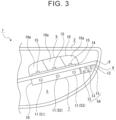
- the first lamp unit 7 may be positioned below the third lamp unit 9 (see FIG. 3 ).
- FIG. 3 a half of the two-wheeled vehicle lamp 1 in the right-left direction is also shown.
- the third lamp unit 9 is positioned above the first lamp unit 7, and the third lamp unit 9 and the first lamp unit 7 are respectively positioned on the upper side and the lower side of the arrangement plate portion 6. Further, the second lamp unit 8 is positioned outward of the third lamp unit 9 in the right-left direction in a state where the second lamp unit 8 is arranged with the first lamp unit 7.
- the second lamp unit 8 is positioned outward of the third lamp unit 9 in the right-left direction, and the first lamp unit 7 arranged with the second lamp unit 8 in the given direction is positioned below the third lamp unit 9.
- an irradiation angle of the light emitted from the first lamp unit 7 and an irradiation angle of the light emitted from the second lamp unit 8 may be different angles.
- the irradiation angle of the light emitted from the first lamp unit 7 can be set to be larger than the irradiation angle of the light emitted from the second lamp unit 8.
- the irradiation angle of the light emitted from the first lamp unit 7 By setting the irradiation angle of the light emitted from the first lamp unit 7 to be larger than the irradiation angle of the light emitted from the second lamp unit 8, a region in a wide range can be illuminated by the light emitted from the first lamp unit 7, and a region in a narrow range can be brought into a brightly-illuminated state by the light emitted from the second lamp unit 8 having higher luminous intensity than that of the first lamp unit 7. Therefore, it is possible to ensure high functionality achieved by illumination of a region in a wide range, and to ensure high conspicuity due to the light with high luminous intensity.
- the HV luminous intensity of the first lamp unit 7 may be set to be lower than the HV luminous intensity of the second lamp unit 8.
- a light control member such as a reflector may be provided, and, with the control by the light control member, it is possible to set the HV luminous intensity of the first lamp unit 7 to be lower than the HV luminous intensity of the second lamp unit 8.
- the irradiation angle of the light emitted from the first lamp unit 7 is set to be larger, the luminous intensity of the light emitted from the first lamp unit 7 is lowered in the forward direction, and the luminous intensity becomes higher on an oblique side. Therefore, a sequential light emitting state is visually recognized clearly even from the oblique side, and it is thus possible to ensure high conspicuity in a wide range.
- an emitting direction of the light from the first light sources 11, 11, 11 and an emitting direction of the light from the second light sources 13, 13, 13 can be set to be different from each other.
- the two-wheeled vehicle lamp 1 is used as a turn signal lamp.
- the two-wheeled vehicle lamp 1 may be applied as, for example, a welcome lamp that is turned on in a sequential light emitting state when a rider of the two-wheeled vehicle approaches a vehicle body.
Landscapes
- Engineering & Computer Science (AREA)
- Mechanical Engineering (AREA)
- Lighting Device Outwards From Vehicle And Optical Signal (AREA)
Description
- The invention relates to a technical field regarding a two-wheeled vehicle lamp that is used for a two-wheeled vehicle such as a motorcycle.
- As a two-wheeled vehicle lamp having a lamp unit used as a turn signal lamp in a two-wheeled vehicle such as a motorcycle, there is a so-called sequential-type two-wheeled vehicle lamp in which a plurality of light sources that emit light is arranged, and the light is emitted from the light sources sequentially with time difference in an alignment direction of the light sources (for example, see Patent Document 1).
- With this type of two-wheeled vehicle lamp, it is visually recognized that the light flows from one side to the other in the alignment direction of the light sources, and high functionality is thus secured.
- Patent Document 1:
WO 2019/044404 A1 discloses a direction indicator device for a small vehicle. - Document
EP 3272632 A1 discloses a two-wheeled vehicle lamp according to the preamble ofclaim 1. - Incidentally, even in a state where the above-described sequential function is performed, it is desirable that high conspicuity should be ensured by emission of sufficiently bright light. Unlike a body of a four-wheeled vehicle such as an automobile, a body of a two-wheeled vehicle is particularly small, and a space where a two-wheeled vehicle lamp is attached in the body of the two-wheeled vehicle is also small. Therefore, the number and arrangement positions of the light sources provided in the two-wheeled vehicle lamp tend to be limited, and high conspicuity may not be ensured depending on a light emission state.
- An object of the invention is to ensure high conspicuity as well as improvement of functionality.
- The invention is defined by
independent claim 1 and preferred embodiments are defined bydependent claims 2 to 5. First, a two-wheeled vehicle lamp according to the invention, according toclaim 1, includes a first lamp unit and a second lamp unit arranged in a given direction. Luminous intensity of the second lamp unit in a lamp forward direction is set to be higher than luminous intensity of the first lamp unit in the lamp forward direction, and the first lamp unit and the second lamp unit are turned on sequentially with time difference. - Thus, the first lamp unit and the second lamp unit having different luminous intensity and being arranged in the given direction are tuned on sequentially with time difference.
- Secondly, in the two-wheeled vehicle lamp according to the invention and thus still according to
claim 1, a plurality of first light sources is provided to be arranged in the given direction in the first lamp unit, and the plurality of first light sources should be turned on in order of an arrangement with time difference. - Therefore, since the first light sources and the second lamp unit are turned on in order of the arrangement with time difference, it is visually recognized that light emitted from the plurality of first light sources and the second lamp unit flows from one side to the other.
- Third, in the two-wheeled vehicle lamp according to the invention described above, it is desirable that a plurality of second light sources should be provided in the second lamp unit, and the plurality of second light sources should be turned on and off simultaneously.
- Thus, when the plurality of second light sources is turned on, luminous intensity of the second lamp unit becomes high.
- Fourth, in the two-wheeled vehicle lamp according to the invention described above, it is desirable that a third lamp unit having at least one third light source should be provided, and the second lamp unit should be positioned outward of the third lamp unit in a right-left direction.
- Thus, luminous intensity of light emitted from a position outward of the third lamp unit in the right-left direction becomes higher, and it is thus less likely that a rider blocks the light with high luminous intensity.
- Fifth, in the two-wheeled vehicle lamp according to the invention described above, it is desirable that the first lamp unit should be positioned above or below the third lamp unit.
- Therefore, the second lamp unit is positioned outward of the third lamp unit in the right-left direction, and the first lamp unit arranged with the second lamp unit in the given direction is positioned above or below the third lamp unit.
- Sixth, in the two-wheeled vehicle lamp according to the invention described above, it is desirable that an irradiation angle of light emitted from the first lamp unit should be set to be larger than an irradiation angle of light emitted from the second lamp unit.
- Thus, the light emitted from the first lamp unit illuminates a region in a wide range, and the light emitted from the second lamp unit with luminous intensity higher than that of the first lamp unit brightly illuminates a region in a narrow range.
- According to the invention, since the first lamp unit and the second lamp unit that have different luminous intensity and are arranged in the given direction are turned on sequentially with time difference, it is visually recognized that the emitted light flows from one side to the other, and the light is emitted from both the first lamp unit and the second lamp unit that has higher luminous intensity than that of the first lamp unit. Thus, it is possible to ensure high conspicuity in addition to improvement of functionality.
-
- [
FIG. 1] FIG. 1 shows an embodiment of a two-wheeled vehicle lamp according to the invention together withFIG. 2 andFIG. 3 , and is a schematic side view of the two-wheeled vehicle lamp; - [
FIG. 2] FIG. 2 is a schematic front view of the two-wheeled vehicle lamp shown in a state where a cover is removed; and - [
FIG. 3] FIG. 3 is a schematic front view of a two-wheeled vehicle lamp, showing another structure in the state where the cover is removed. - Hereinafter, description is given of modes for carrying out a two-wheeled vehicle lamp according to the invention with reference to the attached drawings.
- A two-
wheeled vehicle lamp 1 is used as a so-called combination lamp that functions as, for example, both a turn signal lamp and a head lamp, and is arranged in and attached to, for example, a central portion of a front end portion of a vehicle body in a right-left direction. - The two-
wheeled vehicle lamp 1 may be arranged in, for example, a rear end portion of the vehicle body as a combination lamp. When the two-wheeled vehicle lamp 1 is arranged in the rear end portion of the vehicle body, one two-wheeled vehicle lamp 1 may be arranged in the central portion in the right-left direction, or two two-wheeled vehicle lamps 1 may be arranged separately from each other on the right side and the left side, respectively. When the two-wheeled vehicle lamp 1 is arranged in the rear end portion of the vehicle body, the two-wheeled vehicle lamp 1 is used as a combination lamp in which the turn signal lamp is combined with other lamps such as a stop lamp and a tail lamp. - The two-
wheeled vehicle lamp 1 includes alamp housing 2 having a recessed portion that is open to the front, and acover 3 that closes the opening of the lamp housing 2 (seeFIG. 1 and FIG. 2 ). The two-wheeled vehicle lamp 1 is, for example, formed into symmetrical shape and structure, andFIG. 2 shows a half of the two-wheeled vehicle lamp 1 in the right-left direction. - The lamp housing 2 and the
cover 3 form a lamp external case 4. An internal space of the lamp external case 4 is formed as alamp chamber 5. - The
lamp housing 2 is provided with anarrangement plate portion 6 that is arranged to face an upper-lower direction at a location that separates thelamp chamber 5 into an upper part and a lower part. In thelamp chamber 5, an unillustrated control circuit is arranged, and the control circuit is connected with an unillustrated power supply circuit. - In the
lamp chamber 5, afirst lamp unit 7, asecond lamp unit 8, and athird lamp unit 9 are arranged. - The
first lamp unit 7 is, for example, arranged on top of thearrangement plate portion 6, and is formed into a laterally-long shape. Thefirst lamp unit 7 is a lamp unit that functions as a turn signal lamp, and includes, for example, a laterally-longfirst substrate 10 directed along a front-rear direction, andfirst light sources first substrate 10. At least onefirst light source 11 may be provided. Thefirst light sources light emitting part 51, a secondlight emitting part 52, and a thirdlight emitting part 53 in this order from an inner side in the right-left direction. - In the
first lamp unit 7, unillustrated light control members such as a reflector and an inner lens may be arranged in front of thefirst light sources first light sources - The
first light sources first light source 11, for example, an LED (light emitting diode) is used. The light emitted from thefirst light source 11 penetrates thecover 3 and is emitted forward or diagonally forward. - The
second lamp unit 8 is arranged, for example, on top of thearrangement plate portion 6, and positioned alongside thefirst lamp unit 7 in the substantially right-left direction. Thesecond lamp unit 8 is a lamp unit that functions as a turn signal lamp together with thefirst lamp unit 7, and is positioned outward of thefirst lamp unit 7 in the substantially right-left direction with respect to the center of the two-wheeled vehicle lamp 1 in the right-left direction. Thesecond lamp unit 8 includes, for example, asecond substrate 12 directed in the front-rear direction, andsecond light sources second substrate 12. At least onesecond light source 13 may be provided. Thesecond light sources light emitting part 54 as a whole. - In the
second lamp unit 8, unillustrated light control members such as a reflector and an inner lens may be arranged in front of thesecond light sources second light sources - As the
second light source 13, for example, an LED is used. The light emitted from thesecond light source 13 penetrates thecover 3 and is emitted forward. - The
third lamp unit 9 is arranged, for example, underneath thearrangement plate portion 6, and formed into a laterally-long shape. Thethird lamp unit 9 is a lamp unit that functions as a head lamp, and is positioned below thefirst lamp unit 7. - The
third lamp unit 9 includes, for example, a laterally-longthird substrate 14 directed in a substantially front-rear direction,third light sources third substrate 14, and areflector 16 arranged at a position corresponding to thethird light sources third light source 15 may be provided. - The
third substrate 14 is attached to, for example, a lower surface of thearrangement plate portion 6. The thirdlight sources reflector 16, reflection surfaces 16a, 16a, 16a aligned in the right-left direction are formed. - As the third
light source 15, for example, an LED is used. Light emitted from the thirdlight sources reflector 16, respectively, penetrates thecover 3, and is emitted forward. - As described above, the
third lamp unit 9 is positioned below thefirst lamp unit 7, and thefirst lamp unit 7 and thethird lamp unit 9 are respectively positioned on the upper side and the lower side of thearrangement plate portion 6. Therefore, thefirst lamp unit 7 is positioned above thethird lamp unit 9, and thesecond lamp unit 8 is positioned outward of thethird lamp unit 9 in the right-left direction. - Although
FIG. 2 shows an example where thefirst lamp unit 7, thesecond lamp unit 8, and thethird lamp unit 9 as a whole are inclined so as to be displaced upwardly with respect to the right-left direction towards the outer side in the right left direction, thefirst lamp unit 7, thesecond lamp unit 8, and thethird lamp unit 9 as a whole may be inclined so as to be displaced downwardly with respect to the right-left direction towards the outer side in the right-left direction. Also, thefirst lamp unit 7, thesecond lamp unit 8, and thethird lamp unit 9 as a whole may be arranged in a state where the right-left direction is a longitudinal direction. - In the two-wheeled
vehicle lamp 1 configured as describe above, luminous intensity of thesecond lamp unit 8 is set to be higher than luminous intensity of thefirst lamp unit 7. Specifically, the luminous intensity (HV luminous intensity) of thesecond lamp unit 8 in the forward direction with respect to the lamp is set to be higher than that of thefirst lamp unit 7. In the two-wheeledvehicle lamp 1, when HV luminous intensity obtained by adding the HV luminous intensity of thefirst lamp unit 7 to the HV luminous intensity of thesecond lamp unit 8 is 100%, for example, the HV luminous intensity of thefirst lamp unit 7 is set to approximately 2%, and the HV luminous intensity of thesecond lamp unit 8 is set to approximately 98%. - In the two-wheeled
vehicle lamp 1, it is possible to set the HV luminous intensity of thesecond lamp unit 8 to be higher than the HV luminous intensity of thefirst lamp unit 7 by, for example, use of thefirst light sources light sources first light sources light sources second lamp unit 8 to be higher than the HV luminous intensity of thefirst lamp unit 7 by use of thefirst light sources light sources first light sources light sources - A control circuit controls on and off of the
first lamp unit 7, thesecond lamp unit 8, and thethird lamp unit 9. Since thefirst lamp unit 7 and thesecond lamp unit 8 function as a turn signal lamp, and thethird lamp unit 9 functions as a head lamp, the on-off of thethird lamp unit 9 is controlled independently from thefirst lamp unit 7 and thesecond lamp unit 8, and the on-off of thefirst lamp unit 7 and the on-off of thesecond lamp unit 8 are controlled in conjunction with each other. - In the
first lamp unit 7 and thesecond lamp unit 8, the on-off of the firstlight emitting part 51, the secondlight emitting part 52, the thirdlight emitting part 53, and the fourthlight emitting part 54 is performed with time difference according to the order of the arrangement, and, therefore, so-called sequential on-off control is performed. - Specifically, the first
light emitting part 51, the secondlight emitting part 52, the thirdlight emitting part 53, and the fourthlight emitting part 54 are turned on sequentially. First, only the firstlight emitting part 51 is turned on, and, when the secondlight emitting part 52 is turned on, the firstlight emitting part 51 is in a lighted state. When the thirdlight emitting part 53 is turned on, the firstlight emitting part 51 and the secondlight emitting part 52 are in the lighted state. When the fourthlight emitting part 54 is turned on, the firstlight emitting part 51, the secondlight emitting part 52, and the thirdlight emitting part 53 are in the lighted state. When a given period of time passes after the firstlight emitting part 51, the secondlight emitting part 52, the thirdlight emitting part 53, and the fourthlight emitting part 54 are turned on, the firstlight emitting part 51, the secondlight emitting part 52, the thirdlight emitting part 53, and the fourthlight emitting part 54 are turned off simultaneously. - In the two-wheeled
vehicle lamp 1, the on-off of the firstlight emitting part 51, the secondlight emitting part 52, the thirdlight emitting part 53, and the fourthlight emitting part 54 in the above-described order is performed repeatedly. - Because the above-described light control is performed, the light emitted from the
first lamp unit 7 and thesecond lamp unit 8 with time difference is emitted sequentially in the right-left direction, and it is visually recognized that the emitted light flows from one side to the other, and attention of a viewer is thus drawn easily. At this time, light with higher luminous intensity than the luminous intensity of thefirst lamp unit 7 is emitted from thesecond lamp unit 8, and high conspicuity is ensured especially by the light emitted from thesecond lamp unit 8. Therefore, the viewer recognizes from the turn signal lamp that a moving direction of the two-wheeled vehicle may be changing to the right or the left. Thus, sufficient warning function is achieved as the turn signal lamp. - As described so far, the two-wheeled
vehicle lamp 1 includes thefirst lamp unit 7 and thesecond lamp unit 8 arranged in the given direction, the luminous intensity of thesecond lamp unit 8 in the lamp forward direction is higher than the luminous intensity of thefirst lamp unit 7 in the lamp forward direction, and thefirst lamp unit 7 and thesecond lamp unit 8 are turned on sequentially with time difference. - Therefore, because the
first lamp unit 7 and thesecond lamp unit 8 having different luminous intensity and arranged in the given direction are turned on sequentially with time difference, it is visually recognized that the emitted light flows from one side to the other, and light is emitted from both thefirst lamp unit 7 and thesecond lamp unit 8 that has higher luminous intensity than that of thefirst lamp unit 7. Thus, high conspicuity is ensured in addition to improvement of functionality. - Further, the
first light sources first light sources - Therefore, since the
first light sources second lamp unit 8 are turned on in the order of the arrangement with time difference, it is visually recognized that the light emitted from thefirst light sources second lamp unit 8 flows from one side to the other. Thus, it is possible to easily attract attention of a viewer, to improve functionality, and to ensure high conspicuity more reliably. - Further, the second
light sources second lamp unit 8, and the secondlight sources - Therefore, when the plurality of second
light sources second lamp unit 8 becomes high. Thus, it is possible to easily set a state where the luminous intensity of thesecond lamp unit 8 is higher than the luminous intensity of thefirst lamp unit 7, and it is possible to achieve improvement of conspicuity of the entire two-wheeledvehicle lamp 1 due to the high luminous intensity of thesecond lamp unit 8. - Furthermore, the
third lamp unit 9 having at least one thirdlight source 15 is provided, and thesecond lamp unit 8 is positioned outward of thethird lamp unit 9 in the right-left direction. - Therefore, the luminous intensity of the light emitted from the position outward of the
third lamp unit 9 in the right-left direction is high, and it becomes less likely that a rider blocks the light with high luminous intensity, thereby achieving higher improvement of conspicuity. - Additionally, since the
first lamp unit 7 is positioned above thethird lamp unit 9, thesecond lamp unit 8 is positioned outward of thethird lamp unit 9 in the right-left direction, and thefirst lamp unit 7 arranged with thesecond lamp unit 8 in the given direction is positioned above thethird lamp unit 9. - Therefore, it is possible to ensure that the size of the two-wheeled
vehicle lamp 1 in the right-left direction is reduced, to ensure a sufficient size of thefirst lamp unit 7 in the right-left direction, and to ensure high functionality of thefirst lamp unit 7 and thesecond lamp unit 8 that are turned on sequentially with time difference. - In the foregoing, the example was described where the first
light emitting part 51, the secondlight emitting part 52, the thirdlight emitting part 53, and the fourthlight emitting part 54 are turned on sequentially. However, in the two-wheeledvehicle lamp 1, the fourthlight emitting part 54 may be turned on simultaneously with another light emitting part. For example, the fourthlight emitting part 54 may be turned on simultaneously with the thirdlight emitting part 53. In this case, after the firstlight emitting part 51 and the secondlight emitting part 52 are turned on sequentially, the thirdlight emitting part 53 and the fourthlight emitting part 54 are turned on simultaneously, and thus sequential on-off control is performed. - In the foregoing, the example was described where the
first lamp unit 7 is positioned above thethird lamp unit 9. However, to the contrary, thefirst lamp unit 7 may be positioned below the third lamp unit 9 (seeFIG. 3 ). InFIG. 3 , a half of the two-wheeledvehicle lamp 1 in the right-left direction is also shown. - In this case, the
third lamp unit 9 is positioned above thefirst lamp unit 7, and thethird lamp unit 9 and thefirst lamp unit 7 are respectively positioned on the upper side and the lower side of thearrangement plate portion 6. Further, thesecond lamp unit 8 is positioned outward of thethird lamp unit 9 in the right-left direction in a state where thesecond lamp unit 8 is arranged with thefirst lamp unit 7. - As described above, when the
first lamp unit 7 is positioned below thethird lamp unit 9, thesecond lamp unit 8 is positioned outward of thethird lamp unit 9 in the right-left direction, and thefirst lamp unit 7 arranged with thesecond lamp unit 8 in the given direction is positioned below thethird lamp unit 9. - Therefore, it is possible to ensure that the size of the two-wheeled
vehicle lamp 1 in the right-left direction is reduced, to ensure a sufficient size of thefirst lamp unit 7 in the right-left direction, and to ensure high functionality of thefirst lamp unit 7 and thesecond lamp unit 8 that are turned on sequentially with time difference. - In the two-wheeled
vehicle lamp 1, an irradiation angle of the light emitted from thefirst lamp unit 7 and an irradiation angle of the light emitted from thesecond lamp unit 8 may be different angles. For example, the irradiation angle of the light emitted from thefirst lamp unit 7 can be set to be larger than the irradiation angle of the light emitted from thesecond lamp unit 8. - By setting the irradiation angle of the light emitted from the
first lamp unit 7 to be larger than the irradiation angle of the light emitted from thesecond lamp unit 8, a region in a wide range can be illuminated by the light emitted from thefirst lamp unit 7, and a region in a narrow range can be brought into a brightly-illuminated state by the light emitted from thesecond lamp unit 8 having higher luminous intensity than that of thefirst lamp unit 7. Therefore, it is possible to ensure high functionality achieved by illumination of a region in a wide range, and to ensure high conspicuity due to the light with high luminous intensity. - In addition, by setting the irradiation angle of the light emitted from the
first lamp unit 7 to be larger than the irradiation angle of the light emitted from thesecond lamp unit 8, the HV luminous intensity of thefirst lamp unit 7 may be set to be lower than the HV luminous intensity of thesecond lamp unit 8. In this case, for example, a light control member such as a reflector may be provided, and, with the control by the light control member, it is possible to set the HV luminous intensity of thefirst lamp unit 7 to be lower than the HV luminous intensity of thesecond lamp unit 8. - As the irradiation angle of the light emitted from the
first lamp unit 7 is set to be larger, the luminous intensity of the light emitted from thefirst lamp unit 7 is lowered in the forward direction, and the luminous intensity becomes higher on an oblique side. Therefore, a sequential light emitting state is visually recognized clearly even from the oblique side, and it is thus possible to ensure high conspicuity in a wide range. - Further, when the irradiation angle of the light emitted from the
first lamp unit 7 is set to be large than the irradiation angle of the light emitted from thesecond lamp unit 8 as described above, an emitting direction of the light from thefirst light sources light sources - In the foregoing, the example was given where the two-wheeled
vehicle lamp 1 is used as a turn signal lamp. However, the two-wheeledvehicle lamp 1 may be applied as, for example, a welcome lamp that is turned on in a sequential light emitting state when a rider of the two-wheeled vehicle approaches a vehicle body. -
- 1
- two-wheeled vehicle lamp
- 7
- first lamp unit
- 8
- second lamp unit
- 9
- third lamp unit
- 11
- first light source
- 13
- second light source
- 15
- third light source
Claims (5)
- A two-wheeled vehicle lamp comprising a first lamp unit (7) and a second lamp unit (8) arranged in a given direction, wherein:luminous intensity of the second lamp unit (8) in a lamp forward direction is set to be higher than luminous intensity of the first lamp unit (7) in the lamp forward direction; andthe first lamp unit (7) and the second lamp unit (8) are turned on sequentially with time difference, andthe second lamp unit (8) is a lamp unit that functions as a turn signal lamp together with the first lamp unit (7), and is positioned outward of the first lamp unit (7) in the substantially right-left direction with respect to the center of the two-wheeled vehicle lamp (1) in the right-left direction,characterized in that a plurality of first light sources (11) is provided to be arranged in the given direction in the first lamp unit (7);the plurality of first light sources (11) is turned on in order of an arrangement with time difference.
- The two-wheeled vehicle lamp according to claim 1, characterized in that:a plurality of second light sources (13) is provided in the second lamp unit (8); andthe plurality of second light sources (13) is turned on and off simultaneously.
- The two-wheeled vehicle lamp according to claim 1 or 2, characterized in that:a third lamp unit (9) having at least one third light source (15) is provided; andthe second lamp unit (8) is positioned outward of the third lamp unit (9) in a right-left direction.
- The two-wheeled vehicle lamp according to claim 3, characterized in that the first lamp unit (7) is positioned above or below the third lamp unit (9).
- The two-wheeled vehicle lamp according to claim 1, 2, 3 or 4, characterized in that an irradiation angle of light emitted from the first lamp unit (7) is set to be larger than an irradiation angle of light emitted from the second lamp unit (8).
Applications Claiming Priority (2)
| Application Number | Priority Date | Filing Date | Title |
|---|---|---|---|
| JP2019104262 | 2019-06-04 | ||
| PCT/JP2020/020882 WO2020246334A1 (en) | 2019-06-04 | 2020-05-27 | Lamp for two-wheeled vehicle |
Publications (3)
| Publication Number | Publication Date |
|---|---|
| EP3981675A1 EP3981675A1 (en) | 2022-04-13 |
| EP3981675A4 EP3981675A4 (en) | 2022-08-03 |
| EP3981675B1 true EP3981675B1 (en) | 2024-10-09 |
Family
ID=73652501
Family Applications (1)
| Application Number | Title | Priority Date | Filing Date |
|---|---|---|---|
| EP20818959.7A Active EP3981675B1 (en) | 2019-06-04 | 2020-05-27 | Lamp for two-wheeled vehicle |
Country Status (4)
| Country | Link |
|---|---|
| US (1) | US11952071B2 (en) |
| EP (1) | EP3981675B1 (en) |
| JP (1) | JPWO2020246334A1 (en) |
| WO (1) | WO2020246334A1 (en) |
Family Cites Families (14)
| Publication number | Priority date | Publication date | Assignee | Title |
|---|---|---|---|---|
| JPS5115397Y2 (en) * | 1971-05-07 | 1976-04-23 | ||
| JP3913459B2 (en) * | 2000-11-13 | 2007-05-09 | 株式会社小糸製作所 | Manufacturing method of vehicular lamp |
| US20050128761A1 (en) * | 2003-12-10 | 2005-06-16 | Shih-Hsiung Wu | Turn signal light using light-emitting diodes as light sources |
| US7646291B2 (en) * | 2004-11-15 | 2010-01-12 | Safecode, Inc. | Method for automotive lamp control |
| US20090051522A1 (en) * | 2007-08-24 | 2009-02-26 | Mark Perkins | Led sequential lighting system for vehicles and method of use |
| US8547219B2 (en) * | 2010-06-11 | 2013-10-01 | Anthony J. KISIEL | Automotive brake light with graduated display |
| DE102011119231A1 (en) * | 2011-11-23 | 2013-05-23 | Audi Ag | Motor vehicle light, motor vehicle and method for operating a motor vehicle light |
| EP3590805B1 (en) * | 2013-03-28 | 2021-10-06 | Honda Motor Co., Ltd. | Headlight for two-wheeled motor vehicle |
| DE102013217848A1 (en) | 2013-09-06 | 2015-03-26 | Bayerische Motoren Werke Aktiengesellschaft | Signal light for a motor vehicle |
| WO2016001936A2 (en) * | 2014-06-30 | 2016-01-07 | Rohit Singh | Direction signalling apparatus for motor vehicle |
| JP6399532B2 (en) * | 2015-03-17 | 2018-10-03 | 本田技研工業株式会社 | Direction indicator for small vehicles |
| JP6782514B2 (en) * | 2016-08-31 | 2020-11-11 | ダイハツ工業株式会社 | Vehicle direction indicator light |
| JP6769181B2 (en) * | 2016-08-31 | 2020-10-14 | 住友ゴム工業株式会社 | tire |
| US11318880B2 (en) | 2017-09-01 | 2022-05-03 | Koito Manufacturing Co., Ltd. | Vehicle illumination system, vehicle system, lamp unit and vehicle lamp |
-
2020
- 2020-05-27 US US17/615,733 patent/US11952071B2/en active Active
- 2020-05-27 JP JP2021524791A patent/JPWO2020246334A1/ja active Pending
- 2020-05-27 WO PCT/JP2020/020882 patent/WO2020246334A1/en not_active Ceased
- 2020-05-27 EP EP20818959.7A patent/EP3981675B1/en active Active
Also Published As
| Publication number | Publication date |
|---|---|
| US11952071B2 (en) | 2024-04-09 |
| EP3981675A1 (en) | 2022-04-13 |
| WO2020246334A1 (en) | 2020-12-10 |
| US20220234491A1 (en) | 2022-07-28 |
| EP3981675A4 (en) | 2022-08-03 |
| JPWO2020246334A1 (en) | 2020-12-10 |
Similar Documents
| Publication | Publication Date | Title |
|---|---|---|
| US6929390B2 (en) | Vehicular lamp | |
| US6657393B2 (en) | Vehicle lamp having light sources with LEDs arranged in two groups | |
| US11754250B2 (en) | Vehicle lamp | |
| US9248776B2 (en) | Vehicular light unit with multiple light sources | |
| JP2018043744A (en) | Vehicle lighting device | |
| EP3553370B1 (en) | Vehicle lamp | |
| WO2018047582A1 (en) | Vehicle lighting apparatus | |
| EP1510400A2 (en) | Combined cargo lamp and center high mounted stop lamp assembly for vehicles | |
| JP2006049232A (en) | Vehicle lighting | |
| EP4321794A1 (en) | Illumination module with multi light sources and headlight having the same | |
| CN107435882B (en) | lighting device | |
| US20060007697A1 (en) | Front floodlight of a motor vehicle with adaptive light distribution | |
| CN1641259B (en) | Vehicular lamp | |
| EP2839989A1 (en) | Vehicle light apparatus | |
| EP3165813B1 (en) | Vehicle headlamp and light-injecting accent lamp combination and method | |
| EP1510404A2 (en) | A cargo lamp assembly for vehicles | |
| US10285232B2 (en) | Headlight for a motor vehicle | |
| US11952071B2 (en) | Two-wheeled vehicle lamp turn signal | |
| CN100519269C (en) | Illumination device for motor vehicles, comprising a lamp module provided with light-emitting diodes | |
| JP2012530652A (en) | Automotive lighting equipment | |
| US11919442B2 (en) | Vehicle interior lighting device | |
| US11447064B1 (en) | Vehicle body side structure | |
| WO2019069682A1 (en) | Vehicle headlamp | |
| JP2005056727A (en) | Vehicle headlamp device | |
| TWI358366B (en) |
Legal Events
| Date | Code | Title | Description |
|---|---|---|---|
| STAA | Information on the status of an ep patent application or granted ep patent |
Free format text: STATUS: THE INTERNATIONAL PUBLICATION HAS BEEN MADE |
|
| PUAI | Public reference made under article 153(3) epc to a published international application that has entered the european phase |
Free format text: ORIGINAL CODE: 0009012 |
|
| STAA | Information on the status of an ep patent application or granted ep patent |
Free format text: STATUS: REQUEST FOR EXAMINATION WAS MADE |
|
| 17P | Request for examination filed |
Effective date: 20211202 |
|
| AK | Designated contracting states |
Kind code of ref document: A1 Designated state(s): AL AT BE BG CH CY CZ DE DK EE ES FI FR GB GR HR HU IE IS IT LI LT LU LV MC MK MT NL NO PL PT RO RS SE SI SK SM TR |
|
| A4 | Supplementary search report drawn up and despatched |
Effective date: 20220630 |
|
| RIC1 | Information provided on ipc code assigned before grant |
Ipc: H05B 47/16 20200101ALI20220624BHEP Ipc: H05B 45/44 20200101ALI20220624BHEP Ipc: F21Y 115/10 20160101ALI20220624BHEP Ipc: F21W 107/17 20180101ALI20220624BHEP Ipc: F21W 103/20 20180101ALI20220624BHEP Ipc: F21S 43/15 20180101ALI20220624BHEP Ipc: F21S 43/14 20180101ALI20220624BHEP Ipc: F21S 41/151 20180101ALI20220624BHEP Ipc: B60Q 1/38 20060101ALI20220624BHEP Ipc: B60Q 1/04 20060101ALI20220624BHEP Ipc: B62J 6/055 20200101ALI20220624BHEP Ipc: B62J 6/056 20200101ALI20220624BHEP Ipc: B62J 6/026 20200101AFI20220624BHEP |
|
| DAV | Request for validation of the european patent (deleted) | ||
| DAX | Request for extension of the european patent (deleted) | ||
| REG | Reference to a national code |
Ref country code: DE Ref legal event code: R079 Free format text: PREVIOUS MAIN CLASS: B62J0006055000 Ipc: B62J0006026000 Ref document number: 602020039227 Country of ref document: DE |
|
| GRAP | Despatch of communication of intention to grant a patent |
Free format text: ORIGINAL CODE: EPIDOSNIGR1 |
|
| STAA | Information on the status of an ep patent application or granted ep patent |
Free format text: STATUS: GRANT OF PATENT IS INTENDED |
|
| RIC1 | Information provided on ipc code assigned before grant |
Ipc: H05B 47/155 20200101ALI20240409BHEP Ipc: H05B 47/16 20200101ALI20240409BHEP Ipc: B60Q 1/00 20060101ALI20240409BHEP Ipc: B60Q 1/38 20060101ALI20240409BHEP Ipc: B62J 6/056 20200101ALI20240409BHEP Ipc: B62J 6/026 20200101AFI20240409BHEP |
|
| INTG | Intention to grant announced |
Effective date: 20240507 |
|
| GRAS | Grant fee paid |
Free format text: ORIGINAL CODE: EPIDOSNIGR3 |
|
| GRAA | (expected) grant |
Free format text: ORIGINAL CODE: 0009210 |
|
| STAA | Information on the status of an ep patent application or granted ep patent |
Free format text: STATUS: THE PATENT HAS BEEN GRANTED |
|
| P01 | Opt-out of the competence of the unified patent court (upc) registered |
Free format text: CASE NUMBER: APP_46488/2024 Effective date: 20240809 |
|
| AK | Designated contracting states |
Kind code of ref document: B1 Designated state(s): AL AT BE BG CH CY CZ DE DK EE ES FI FR GB GR HR HU IE IS IT LI LT LU LV MC MK MT NL NO PL PT RO RS SE SI SK SM TR |
|
| REG | Reference to a national code |
Ref country code: CH Ref legal event code: EP |
|
| REG | Reference to a national code |
Ref country code: DE Ref legal event code: R096 Ref document number: 602020039227 Country of ref document: DE |
|
| REG | Reference to a national code |
Ref country code: IE Ref legal event code: FG4D |
|
| REG | Reference to a national code |
Ref country code: LT Ref legal event code: MG9D |
|
| REG | Reference to a national code |
Ref country code: NL Ref legal event code: MP Effective date: 20241009 |
|
| REG | Reference to a national code |
Ref country code: AT Ref legal event code: MK05 Ref document number: 1730328 Country of ref document: AT Kind code of ref document: T Effective date: 20241009 |
|
| PG25 | Lapsed in a contracting state [announced via postgrant information from national office to epo] |
Ref country code: NL Free format text: LAPSE BECAUSE OF FAILURE TO SUBMIT A TRANSLATION OF THE DESCRIPTION OR TO PAY THE FEE WITHIN THE PRESCRIBED TIME-LIMIT Effective date: 20241009 |
|
| PG25 | Lapsed in a contracting state [announced via postgrant information from national office to epo] |
Ref country code: NL Free format text: LAPSE BECAUSE OF FAILURE TO SUBMIT A TRANSLATION OF THE DESCRIPTION OR TO PAY THE FEE WITHIN THE PRESCRIBED TIME-LIMIT Effective date: 20241009 |
|
| PG25 | Lapsed in a contracting state [announced via postgrant information from national office to epo] |
Ref country code: PT Free format text: LAPSE BECAUSE OF FAILURE TO SUBMIT A TRANSLATION OF THE DESCRIPTION OR TO PAY THE FEE WITHIN THE PRESCRIBED TIME-LIMIT Effective date: 20250210 Ref country code: IS Free format text: LAPSE BECAUSE OF FAILURE TO SUBMIT A TRANSLATION OF THE DESCRIPTION OR TO PAY THE FEE WITHIN THE PRESCRIBED TIME-LIMIT Effective date: 20250209 Ref country code: HR Free format text: LAPSE BECAUSE OF FAILURE TO SUBMIT A TRANSLATION OF THE DESCRIPTION OR TO PAY THE FEE WITHIN THE PRESCRIBED TIME-LIMIT Effective date: 20241009 |
|
| PG25 | Lapsed in a contracting state [announced via postgrant information from national office to epo] |
Ref country code: FI Free format text: LAPSE BECAUSE OF FAILURE TO SUBMIT A TRANSLATION OF THE DESCRIPTION OR TO PAY THE FEE WITHIN THE PRESCRIBED TIME-LIMIT Effective date: 20241009 |
|
| PG25 | Lapsed in a contracting state [announced via postgrant information from national office to epo] |
Ref country code: BG Free format text: LAPSE BECAUSE OF FAILURE TO SUBMIT A TRANSLATION OF THE DESCRIPTION OR TO PAY THE FEE WITHIN THE PRESCRIBED TIME-LIMIT Effective date: 20241009 |
|
| PG25 | Lapsed in a contracting state [announced via postgrant information from national office to epo] |
Ref country code: ES Free format text: LAPSE BECAUSE OF FAILURE TO SUBMIT A TRANSLATION OF THE DESCRIPTION OR TO PAY THE FEE WITHIN THE PRESCRIBED TIME-LIMIT Effective date: 20241009 |
|
| PG25 | Lapsed in a contracting state [announced via postgrant information from national office to epo] |
Ref country code: NO Free format text: LAPSE BECAUSE OF FAILURE TO SUBMIT A TRANSLATION OF THE DESCRIPTION OR TO PAY THE FEE WITHIN THE PRESCRIBED TIME-LIMIT Effective date: 20250109 |
|
| PG25 | Lapsed in a contracting state [announced via postgrant information from national office to epo] |
Ref country code: LV Free format text: LAPSE BECAUSE OF FAILURE TO SUBMIT A TRANSLATION OF THE DESCRIPTION OR TO PAY THE FEE WITHIN THE PRESCRIBED TIME-LIMIT Effective date: 20241009 Ref country code: GR Free format text: LAPSE BECAUSE OF FAILURE TO SUBMIT A TRANSLATION OF THE DESCRIPTION OR TO PAY THE FEE WITHIN THE PRESCRIBED TIME-LIMIT Effective date: 20250110 Ref country code: AT Free format text: LAPSE BECAUSE OF FAILURE TO SUBMIT A TRANSLATION OF THE DESCRIPTION OR TO PAY THE FEE WITHIN THE PRESCRIBED TIME-LIMIT Effective date: 20241009 |
|
| PG25 | Lapsed in a contracting state [announced via postgrant information from national office to epo] |
Ref country code: PL Free format text: LAPSE BECAUSE OF FAILURE TO SUBMIT A TRANSLATION OF THE DESCRIPTION OR TO PAY THE FEE WITHIN THE PRESCRIBED TIME-LIMIT Effective date: 20241009 |
|
| PG25 | Lapsed in a contracting state [announced via postgrant information from national office to epo] |
Ref country code: RS Free format text: LAPSE BECAUSE OF FAILURE TO SUBMIT A TRANSLATION OF THE DESCRIPTION OR TO PAY THE FEE WITHIN THE PRESCRIBED TIME-LIMIT Effective date: 20250109 |
|
| PG25 | Lapsed in a contracting state [announced via postgrant information from national office to epo] |
Ref country code: SM Free format text: LAPSE BECAUSE OF FAILURE TO SUBMIT A TRANSLATION OF THE DESCRIPTION OR TO PAY THE FEE WITHIN THE PRESCRIBED TIME-LIMIT Effective date: 20241009 |
|
| PGFP | Annual fee paid to national office [announced via postgrant information from national office to epo] |
Ref country code: DE Payment date: 20250402 Year of fee payment: 6 |
|
| PG25 | Lapsed in a contracting state [announced via postgrant information from national office to epo] |
Ref country code: DK Free format text: LAPSE BECAUSE OF FAILURE TO SUBMIT A TRANSLATION OF THE DESCRIPTION OR TO PAY THE FEE WITHIN THE PRESCRIBED TIME-LIMIT Effective date: 20241009 |
|
| REG | Reference to a national code |
Ref country code: DE Ref legal event code: R097 Ref document number: 602020039227 Country of ref document: DE |
|
| PG25 | Lapsed in a contracting state [announced via postgrant information from national office to epo] |
Ref country code: EE Free format text: LAPSE BECAUSE OF FAILURE TO SUBMIT A TRANSLATION OF THE DESCRIPTION OR TO PAY THE FEE WITHIN THE PRESCRIBED TIME-LIMIT Effective date: 20241009 |
|
| PGFP | Annual fee paid to national office [announced via postgrant information from national office to epo] |
Ref country code: FR Payment date: 20250401 Year of fee payment: 6 |
|
| PG25 | Lapsed in a contracting state [announced via postgrant information from national office to epo] |
Ref country code: RO Free format text: LAPSE BECAUSE OF FAILURE TO SUBMIT A TRANSLATION OF THE DESCRIPTION OR TO PAY THE FEE WITHIN THE PRESCRIBED TIME-LIMIT Effective date: 20241009 |
|
| PG25 | Lapsed in a contracting state [announced via postgrant information from national office to epo] |
Ref country code: SK Free format text: LAPSE BECAUSE OF FAILURE TO SUBMIT A TRANSLATION OF THE DESCRIPTION OR TO PAY THE FEE WITHIN THE PRESCRIBED TIME-LIMIT Effective date: 20241009 |
|
| PG25 | Lapsed in a contracting state [announced via postgrant information from national office to epo] |
Ref country code: CZ Free format text: LAPSE BECAUSE OF FAILURE TO SUBMIT A TRANSLATION OF THE DESCRIPTION OR TO PAY THE FEE WITHIN THE PRESCRIBED TIME-LIMIT Effective date: 20241009 |
|
| PG25 | Lapsed in a contracting state [announced via postgrant information from national office to epo] |
Ref country code: IT Free format text: LAPSE BECAUSE OF FAILURE TO SUBMIT A TRANSLATION OF THE DESCRIPTION OR TO PAY THE FEE WITHIN THE PRESCRIBED TIME-LIMIT Effective date: 20241009 |
|
| PLBE | No opposition filed within time limit |
Free format text: ORIGINAL CODE: 0009261 |
|
| STAA | Information on the status of an ep patent application or granted ep patent |
Free format text: STATUS: NO OPPOSITION FILED WITHIN TIME LIMIT |
|
| PG25 | Lapsed in a contracting state [announced via postgrant information from national office to epo] |
Ref country code: SE Free format text: LAPSE BECAUSE OF FAILURE TO SUBMIT A TRANSLATION OF THE DESCRIPTION OR TO PAY THE FEE WITHIN THE PRESCRIBED TIME-LIMIT Effective date: 20241009 |
|
| 26N | No opposition filed |
Effective date: 20250710 |
|
| REG | Reference to a national code |
Ref country code: CH Ref legal event code: H13 Free format text: ST27 STATUS EVENT CODE: U-0-0-H10-H13 (AS PROVIDED BY THE NATIONAL OFFICE) Effective date: 20251223 |
|
| PG25 | Lapsed in a contracting state [announced via postgrant information from national office to epo] |
Ref country code: LU Free format text: LAPSE BECAUSE OF NON-PAYMENT OF DUE FEES Effective date: 20250527 |
|
| PG25 | Lapsed in a contracting state [announced via postgrant information from national office to epo] |
Ref country code: CH Free format text: LAPSE BECAUSE OF NON-PAYMENT OF DUE FEES Effective date: 20250531 |
|
| GBPC | Gb: european patent ceased through non-payment of renewal fee |
Effective date: 20250527 |
|
| REG | Reference to a national code |
Ref country code: BE Ref legal event code: MM Effective date: 20250531 |
|
| PG25 | Lapsed in a contracting state [announced via postgrant information from national office to epo] |
Ref country code: MC Free format text: LAPSE BECAUSE OF FAILURE TO SUBMIT A TRANSLATION OF THE DESCRIPTION OR TO PAY THE FEE WITHIN THE PRESCRIBED TIME-LIMIT Effective date: 20241009 |
|
| PG25 | Lapsed in a contracting state [announced via postgrant information from national office to epo] |
Ref country code: GB Free format text: LAPSE BECAUSE OF NON-PAYMENT OF DUE FEES Effective date: 20250527 |
|
| PG25 | Lapsed in a contracting state [announced via postgrant information from national office to epo] |
Ref country code: IE Free format text: LAPSE BECAUSE OF NON-PAYMENT OF DUE FEES Effective date: 20250527 |
|
| PG25 | Lapsed in a contracting state [announced via postgrant information from national office to epo] |
Ref country code: BE Free format text: LAPSE BECAUSE OF NON-PAYMENT OF DUE FEES Effective date: 20250531 |