EP3980693B1 - Method of controlling deflagration combustion process in pistonless combustor - Google Patents
Method of controlling deflagration combustion process in pistonless combustor Download PDFInfo
- Publication number
- EP3980693B1 EP3980693B1 EP20758262.8A EP20758262A EP3980693B1 EP 3980693 B1 EP3980693 B1 EP 3980693B1 EP 20758262 A EP20758262 A EP 20758262A EP 3980693 B1 EP3980693 B1 EP 3980693B1
- Authority
- EP
- European Patent Office
- Prior art keywords
- input
- combustor
- input valve
- pistonless
- flow
- Prior art date
- Legal status (The legal status is an assumption and is not a legal conclusion. Google has not performed a legal analysis and makes no representation as to the accuracy of the status listed.)
- Active
Links
Images




Classifications
-
- F—MECHANICAL ENGINEERING; LIGHTING; HEATING; WEAPONS; BLASTING
- F02—COMBUSTION ENGINES; HOT-GAS OR COMBUSTION-PRODUCT ENGINE PLANTS
- F02C—GAS-TURBINE PLANTS; AIR INTAKES FOR JET-PROPULSION PLANTS; CONTROLLING FUEL SUPPLY IN AIR-BREATHING JET-PROPULSION PLANTS
- F02C5/00—Gas-turbine plants characterised by the working fluid being generated by intermittent combustion
- F02C5/12—Gas-turbine plants characterised by the working fluid being generated by intermittent combustion the combustion chambers having inlet or outlet valves, e.g. Holzwarth gas-turbine plants
-
- F—MECHANICAL ENGINEERING; LIGHTING; HEATING; WEAPONS; BLASTING
- F23—COMBUSTION APPARATUS; COMBUSTION PROCESSES
- F23R—GENERATING COMBUSTION PRODUCTS OF HIGH PRESSURE OR HIGH VELOCITY, e.g. GAS-TURBINE COMBUSTION CHAMBERS
- F23R7/00—Intermittent or explosive combustion chambers
-
- F—MECHANICAL ENGINEERING; LIGHTING; HEATING; WEAPONS; BLASTING
- F23—COMBUSTION APPARATUS; COMBUSTION PROCESSES
- F23C—METHODS OR APPARATUS FOR COMBUSTION USING FLUID FUEL OR SOLID FUEL SUSPENDED IN A CARRIER GAS OR AIR
- F23C6/00—Combustion apparatus characterised by the combination of two or more combustion chambers or combustion zones, e.g. for staged combustion
- F23C6/04—Combustion apparatus characterised by the combination of two or more combustion chambers or combustion zones, e.g. for staged combustion in series connection
- F23C6/045—Combustion apparatus characterised by the combination of two or more combustion chambers or combustion zones, e.g. for staged combustion in series connection with staged combustion in a single enclosure
- F23C6/047—Combustion apparatus characterised by the combination of two or more combustion chambers or combustion zones, e.g. for staged combustion in series connection with staged combustion in a single enclosure with fuel supply in stages
-
- F—MECHANICAL ENGINEERING; LIGHTING; HEATING; WEAPONS; BLASTING
- F23—COMBUSTION APPARATUS; COMBUSTION PROCESSES
- F23N—REGULATING OR CONTROLLING COMBUSTION
- F23N1/00—Regulating fuel supply
- F23N1/02—Regulating fuel supply conjointly with air supply
- F23N1/022—Regulating fuel supply conjointly with air supply using electronic means
-
- F—MECHANICAL ENGINEERING; LIGHTING; HEATING; WEAPONS; BLASTING
- F23—COMBUSTION APPARATUS; COMBUSTION PROCESSES
- F23N—REGULATING OR CONTROLLING COMBUSTION
- F23N5/00—Systems for controlling combustion
- F23N5/20—Systems for controlling combustion with a time program acting through electrical means, e.g. using time-delay relays
- F23N5/203—Systems for controlling combustion with a time program acting through electrical means, e.g. using time-delay relays using electronic means
-
- F—MECHANICAL ENGINEERING; LIGHTING; HEATING; WEAPONS; BLASTING
- F23—COMBUSTION APPARATUS; COMBUSTION PROCESSES
- F23R—GENERATING COMBUSTION PRODUCTS OF HIGH PRESSURE OR HIGH VELOCITY, e.g. GAS-TURBINE COMBUSTION CHAMBERS
- F23R3/00—Continuous combustion chambers using liquid or gaseous fuel
- F23R3/002—Wall structures
-
- F—MECHANICAL ENGINEERING; LIGHTING; HEATING; WEAPONS; BLASTING
- F23—COMBUSTION APPARATUS; COMBUSTION PROCESSES
- F23R—GENERATING COMBUSTION PRODUCTS OF HIGH PRESSURE OR HIGH VELOCITY, e.g. GAS-TURBINE COMBUSTION CHAMBERS
- F23R3/00—Continuous combustion chambers using liquid or gaseous fuel
- F23R3/02—Continuous combustion chambers using liquid or gaseous fuel characterised by the air-flow or gas-flow configuration
- F23R3/04—Air inlet arrangements
- F23R3/06—Arrangement of apertures along the flame tube
-
- F—MECHANICAL ENGINEERING; LIGHTING; HEATING; WEAPONS; BLASTING
- F23—COMBUSTION APPARATUS; COMBUSTION PROCESSES
- F23R—GENERATING COMBUSTION PRODUCTS OF HIGH PRESSURE OR HIGH VELOCITY, e.g. GAS-TURBINE COMBUSTION CHAMBERS
- F23R3/00—Continuous combustion chambers using liquid or gaseous fuel
- F23R3/28—Continuous combustion chambers using liquid or gaseous fuel characterised by the fuel supply
- F23R3/286—Continuous combustion chambers using liquid or gaseous fuel characterised by the fuel supply having fuel-air premixing devices
-
- F—MECHANICAL ENGINEERING; LIGHTING; HEATING; WEAPONS; BLASTING
- F23—COMBUSTION APPARATUS; COMBUSTION PROCESSES
- F23R—GENERATING COMBUSTION PRODUCTS OF HIGH PRESSURE OR HIGH VELOCITY, e.g. GAS-TURBINE COMBUSTION CHAMBERS
- F23R3/00—Continuous combustion chambers using liquid or gaseous fuel
- F23R3/28—Continuous combustion chambers using liquid or gaseous fuel characterised by the fuel supply
- F23R3/34—Feeding into different combustion zones
- F23R3/343—Pilot flames, i.e. fuel nozzles or injectors using only a very small proportion of the total fuel to insure continuous combustion
-
- F—MECHANICAL ENGINEERING; LIGHTING; HEATING; WEAPONS; BLASTING
- F23—COMBUSTION APPARATUS; COMBUSTION PROCESSES
- F23R—GENERATING COMBUSTION PRODUCTS OF HIGH PRESSURE OR HIGH VELOCITY, e.g. GAS-TURBINE COMBUSTION CHAMBERS
- F23R3/00—Continuous combustion chambers using liquid or gaseous fuel
- F23R3/42—Continuous combustion chambers using liquid or gaseous fuel characterised by the arrangement or form of the flame tubes or combustion chambers
- F23R3/58—Cyclone or vortex type combustion chambers
-
- F—MECHANICAL ENGINEERING; LIGHTING; HEATING; WEAPONS; BLASTING
- F05—INDEXING SCHEMES RELATING TO ENGINES OR PUMPS IN VARIOUS SUBCLASSES OF CLASSES F01-F04
- F05D—INDEXING SCHEME FOR ASPECTS RELATING TO NON-POSITIVE-DISPLACEMENT MACHINES OR ENGINES, GAS-TURBINES OR JET-PROPULSION PLANTS
- F05D2240/00—Components
- F05D2240/35—Combustors or associated equipment
-
- F—MECHANICAL ENGINEERING; LIGHTING; HEATING; WEAPONS; BLASTING
- F23—COMBUSTION APPARATUS; COMBUSTION PROCESSES
- F23C—METHODS OR APPARATUS FOR COMBUSTION USING FLUID FUEL OR SOLID FUEL SUSPENDED IN A CARRIER GAS OR AIR
- F23C2205/00—Pulsating combustion
- F23C2205/10—Pulsating combustion with pulsating fuel supply
Definitions
- the present invention relates to controlling of a deflagration combustion process in a pistonless combustor.
- Gas turbine combustion systems conventionally operate on a steady and continuous manner.
- Compressor supplies a continuous flow of air to the combustor.
- fuel is added to the airflow, and consequently ignited.
- As the combustion air needs to be driven through the combustor there is a loss of total pressure of around 3-5% over the combustion chamber. The loss of pressure is shown as diminished pressure at the turbine entry, detracting from the turbine's ability to generate mechanical power, therefore taking away of the total thermal efficiency of the gas turbine.
- Gas turbine companies make a lot of effort to improve efficiency, in order to cut fuel consumption and carbon dioxide (C02) emissions;
- the main method used to improve gas turbine efficiency is by increasing overall pressure ratio and enabling a higher turbine inlet temperature by targeted cooling, as well as by development of materials with higher resistance to high temperature environment, and furthermore, by optimizing the aerodynamic efficiencies of the compressor and turbine components.
- An object of the present invention is thus to provide a method which eliminates or alleviates the above disadvantages.
- the object of the invention is achieved by a method which is characterized by what is stated in the independent claim.
- the preferred embodiments of the invention are disclosed in the dependent claims.
- the invention is based on the idea of timing air and fuel inputs to a combustor to initiate and maintain a flow pattern having two flow components to achieve fast deflagration combustion in a pistonless combustor.
- An advantage of the method of the invention is that the flow pattern is maintained within the combustor and pressure can rise even in case of an open output. A significant pressure gain can be achieved with the combustion process by optimising velocity of heat release with the claimed method.
- a pistonless combustor 100 comprises a first combustion chamber 10, a second combustion chamber 11 and preferably a pre-combustion chamber 12.
- the pre-combustion chamber 12 forms a cavity or a protrusion on the periphery or wall of the first combustion chamber 10.
- the volume of the pre-combustion chamber 12 is at most 10 % of the volume of the first combustion chamber 10.
- the pre-combustion chamber has a semi-open configuration in which there is a line of sight to each point in an inner wall of the pre-combustion chamber 12 from an opening connecting the pre-combustion chamber to the first combustion chamber.
- the pre-combustion chamber preferably comprises an ignition device 64 for igniting a fuel-air mixture within the pre-combustion chamber.
- the ignition device can be for example a spark plug, or a microwave, plasma or laser ignition system.
- the pre-combustion chamber 12 can be a pre-chamber or a torch ignition device known from prior art internal combustion piston engines.
- the first combustion chamber can have a shaped wall section 13 for aligning one or more input valves, such as a first input valve 21, a second input valve 31 or a fifth input valve 41.
- the shaped wall section 13 is used for aligning the fifth input valve 41.
- a passage 14 connects the first combustion chamber 10 to the second combustion chamber. Fluids, such as air, exhaust gas and fuel can flow freely through the passage 14 between the first combustion chamber and the second combustion chamber. The flow of fluids through the passage is preferably not controlled by any valves.
- the exhaust gas and any other remaining fluids exit the pistonless combustor through output channel 15 which is preferably in connection with the second combustion chamber 11.
- the pistonless combustor 100 comprises only one combustion chamber, i.e.
- the passage 14 is positioned asymmetrically to the inlets and input valves, and the passage has a kidney-shaped cross-section. In general, an asymmetric positioning of the passage 14 compared to the input valves 21, 22, 31,32, 41, 42 has been found preferable.
- the output channel 15 is preferably located opposite to the passage 14 such that flow from the passage 14 is directed away from the output channel 15. Such direction of flow hinders the flow from the passage 14 to the output channel 15 thereby creating a third flow component 93 within the second combustion chamber and allows for any remaining fuel to be combusted in the second combustion chamber 11. Aligning the output channel 15 to a direction opposite to the direction of the third flow component 93 further hinders the flow leaving the second combustion chamber 11 through the output channel 11 but at the same time it reduces efficiency of scavenging.
- the second combustion chamber 11 does not have any fuel inputs and the purpose of the second combustion chamber is only to combust any remaining fuel in an air-rich environment.
- the second combustion chamber enables an increased burn rate, an improved pressure gain capability and it can be used to reduce NOx emissions.
- the first combustion chamber 10 preferably has a spherical inner wall having minor deviations such as input valves 21, 31, 41, 61, the pre-combustion chamber 12, the shaped wall section 13 and the passage 14.
- the first combustion chamber 10 has a toroidal inner wall having minor deviations such as input valves 21, 31, 41, 61, the pre-combustion chamber 12, the shaped wall section 13 and the passage 14.
- the first combustion chamber 10 has a cylindrical inner wall having minor deviations such as input valves 21, 31, 41, 61, the pre-combustion chamber 12, the shaped wall section 13 and the passage 14.
- the second combustion chamber 11 preferably has a spherical inner wall having minor deviations such as the passage 14 and the output channel 15.
- the second combustion chamber 11 has a toroidal inner wall having minor deviations such as the passage 14 and the output channel 15.
- the second combustion chamber 11 has a cylindrical inner wall having minor deviations such as the passage 14 and the output channel 15.
- a number of inlets 23, 33, 43 lead to the first combustion chamber and the inlets are controlled with valves 21, 31, 43.
- a first inlet 23 controlled by a first input valve 21 can be used for scavenging the first combustion chamber 10 and the second combustion chamber 11.
- An input flow of air can be provided through the first inlet 23 which flows through the first combustion chamber and the second combustion chamber thereby scavenging the pistonless combustor 100.
- the scavenging fills the combustion chambers with air while forcing exhaust gas to output channel 15.
- Positioning and aligning of the first inlet 23 and the first input valve 21 are designed to facilitate scavenging of the pistonless combustor.
- the first combustion chamber can comprise also a third inlet 24 controlled by a third input valve 22 for the same function.
- the positioning and alignment of the third inlet and the third input valve is similar to the first inlet and the first input valve, and in addition they are positioned and aligned symmetrically or asymmetrically compared to each other. Asymmetric positioning and alignment both increase possibilities to adjust the flows within the first combustion chamber.
- a second inlet 33 controlled by a second input valve 31 can be used for input of air, fuel or air-fuel mixture to the first combustion chamber 10.
- the second inlet 33 and the second input valve 31 are positioned and aligned to produce a first flow component 91 into the first combustion chamber 10.
- the second inlet 33 and the second input valve 31 are positioned and aligned to produce an eccentric flow, i.e. a flow directed a certain distance off from a center off the first combustion chamber.
- the second inlet 33 and the second input valve 31 are also positioned and aligned to produce an eccentric flow a certain distance off from the passage 14, or a certain distance off from the output channel 15 in case of a pistonless combustor having a single combustion chamber.
- the first combustion chamber can comprise also a fourth inlet 34 controlled by a fourth input valve 32 for the same function.
- the positioning and alignment of the fourth inlet and the fourth input valve can be similar to the second inlet and the second input valve but the size of the valve is different - or vice versa. This can create a second flow component 92 in the first combustion chamber. Preferably, in addition they are positioned and aligned symmetrically or asymmetrically compared to each other. Asymmetric positioning and alignment both increase possibilities to adjust the flows within the first combustion chamber.
- the second inlet and input valves, or both the second and fourth inlets and input valves can also provide the air for scavenging, and in that case the first and third inlets and input valves can be omitted.
- a fifth inlet 43 controlled by a fifth input valve 41 can be used for input of air, fuel or air-fuel mixture to the first combustion chamber 10.
- the input is provided in a form of a high-speed jet.
- the jet has an initial velocity of at least 0,1 Mach, preferably at least 0,2 Mach.
- the fifth inlet 43 and the fifth input valve 41 are positioned and aligned to either produce or strengthen a second flow component 92 into the first combustion chamber 10, or to increase turbulence in the first combustion chamber.
- the second flow component is not parallel to the first flow component 91.
- the fifth inlet 43 and the fifth input valve 41 are positioned and aligned to produce an eccentric flow, i.e. a flow directed a certain distance off from a center off the first combustion chamber.
- the fifth inlet 43 and the fifth input valve 41 are also positioned and aligned to produce an eccentric flow a certain distance off from the passage 14, or a certain distance off from the output channel 15 in case of a pistonless combustor having a single combustion chamber.
- the fifth inlet 43 and the fifth input valve 41 are positioned on the shaped wall section 13 of the first combustion chamber 10.
- the shaped wall section can be for example a planar wall section or a wall section having a different curvature than the majority of the first combustion chamber.
- the first combustion chamber can comprise also a sixth inlet 44 controlled by a sixth input valve 42 for the same function.
- the positioning and alignment of the sixth inlet and the sixth input valve is similar to the fifth inlet and the fifth input valve, and in addition they are positioned and aligned symmetrically or asymmetrically compared to each other. Asymmetric positioning and alignment both increase possibilities to adjust the flows within the first combustion chamber.
- both the fifth input valve 41 and the sixth input valve 43 are positioned on the shaped wall section 13 and a distance 51 of the fifth inlet 42 from a center line 50 of the first combustion chamber is different than a distance 52 of the sixth inlet 44 from the center line 50 of the first combustion chamber.
- the fifth and sixth inlet channel can be air channels and the fifth and sixth input valves can be air valves.
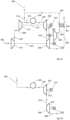
- Figures 2A to 2D disclose four different examples of systems where the pistonless combustor 100 is used to generate electric energy.
- an air input 101 is provided for a low-pressure compressor 121.
- the low-pressure compressor has a common shaft 122 with a low-pressure turbine 120 and a low-pressure generator 125.
- the output 123 from the low-pressure compressor flows to a first heat exchanger 140 which cools the compressed air.
- the cooled compressed air is an input 109 for a high-pressure compressor 111.
- the high-pressure compressor has a common shaft 112 with a high-pressure turbine 110 and a high-pressure generator 115.
- An output from the high-pressure compressor 111 is divided into an input 113 to the pistonless combustor 100 and into a high-pressure bypass flow 114. Any embodiment of the pistonless combustor 100 presented in the present disclosure can be used.
- the pistonless combustor uses the high-pressure air input and fuel input to produce an output 116 which is directed to the high-pressure turbine 110 which rotates the shaft 112 which in turn rotates the high-pressure generator 115 to generate electric energy.
- the output 119 from the high-pressure turbine is directed to the low-pressure turbine 120 which rotates the shaft 122 which in turn rotates the low-pressure generator 125 to generate electric energy.
- An output 139 from the low-pressure generator is directed to a second heat exchanger 141 which removes heat from the output flow 139 and the cooled output flow 143 is released from the system through exhaust.
- a flow from an external heat source can be arranged to the second heat exchanger, the first heat exchanger or both of them either in parallel or in series.
- the high-pressure bypass flow 114 from the high-pressure compressor 111 is divided into an input 117 to the first heat exchanger 140 and a flow 118 to the second heat exchanger 141.
- the division can either be controlled, e.g. with one or more valves, or uncontrolled, i.e. based on pressure differences.
- the input 117 to the first heat exchanger is heated in the first heat exchanger 140 using the heat extracted from the output 123 from the low-pressure compressor 121.
- the heated output 142 from the first heat exchanger 140 is combined to the flow 118 to the second heat exchanger 141, thereby creating an input 149 to the second heat exchanger 141.
- the second heat exchanger heats the input 149 using the heat extracted from the output 139 of the low-pressure turbine 120.
- the heated output 129 of the second heat exchanger 141 is directed to an auxiliary turbine 130 rotating an auxiliary generator 135 with a shaft 132.
- an input 102 from an external source can be combined to the high-pressure bypass flow 114.
- the input 102 can be direct to the first heat exchanger, the second heat exchanger, or both together with the high-pressure bypass flow 114.
- the external source is preferably an output of a wastegate of a turbocharger of an external combustion engine, but also other high temperature, high pressure sources can be utilized.
- an air input 201 is provided for a low-pressure compressor 221.
- the low-pressure compressor has a common shaft 222 with a low-pressure turbine 220 and a low-pressure generator 225.
- the output 223 from the low-pressure compressor flows to a first heat exchanger 240 which cools the compressed air.
- the cooled compressed air is an input 209 for a high-pressure compressor 211.
- the high-pressure compressor has a common shaft 212 with a high-pressure turbine 210 and a high-pressure generator 215.
- An output from the high-pressure compressor 211 is divided into an input 213 to the pistonless combustor 100 and into a high-pressure bypass flow 214. Any embodiment of the pistonless combustor 100 presented in the present disclosure can be used.
- the pistonless combustor uses the high-pressure air input and fuel input to produce an output 216 which is directed to the high-pressure turbine 210 which rotates the shaft 212 which in turn rotates the high-pressure generator 215 to generate electric energy.
- the output 219 from the high-pressure turbine is directed to the low-pressure turbine 220 which rotates the shaft 222 which in turn rotates the low-pressure generator 225 to generate electric energy.
- An output from the low-pressure generator is released from the system through exhaust.
- the high-pressure bypass flow 214 from the high-pressure compressor 211 is directed into an input 217 to the first heat exchanger 240.
- an input 202 from an external source can be combined to the high-pressure bypass flow 214.
- the external source is preferably an output of a wastegate of a turbocharger of an external combustion engine, but also other high temperature, high pressure sources can be utilized.
- the high-pressure bypass flow 214 optionally combined with the input 202 is the input 217 to the first heat exchanger which is heated in the first heat exchanger 240 using the heat extracted from the output 223 from the low-pressure compressor 221.
- the heated output 242 from the first heat exchanger 240 is directed to an auxiliary turbine 230 rotating an auxiliary generator 235 with a shaft 232.
- an air input 301 is provided for a low-pressure compressor 321.
- the low-pressure compressor has a common shaft 322 with a low-pressure turbine 320 and a low-pressure generator 325.
- the output from the low-pressure compressor is an input 309 for a high-pressure compressor 311.
- the high-pressure compressor has a common shaft 312 with a high-pressure turbine 310 and a high-pressure generator 315.
- An output from the high-pressure compressor 311 is divided into an input 313 to the pistonless combustor 100 and into a high-pressure bypass flow 314. Any embodiment of the pistonless combustor 100 presented in the present disclosure can be used.
- the pistonless combustor uses the high-pressure air input and fuel input to produce an output 316 which is directed to the high-pressure turbine 310 which rotates the shaft 312 which in turn rotates the high-pressure generator 315 to generate electric energy.
- the output 319 from the high-pressure turbine is directed to the low-pressure turbine 320 which rotates the shaft 322 which in turn rotates the low-pressure generator 325 to generate electric energy.
- An output 339 from the low-pressure generator is directed to a second heat exchanger 341 which removes heat from the output flow 339 and the cooled output flow 343 is released from the system through exhaust.
- a flow from an external heat source can be arranged to the second heat exchanger.
- the high-pressure bypass flow 314 from the high-pressure compressor 311 is directed to the second heat exchanger 341.
- an input 302 from an external source can be combined to the high-pressure bypass flow 314.
- the external source is preferably an output of a wastegate of a turbocharger of an external combustion engine, but also other high temperature, high pressure sources can be utilized.
- the high-pressure bypass flow 314 optionally combined with the input 302 is the input 349 to the second heat exchanger 341.
- the second heat exchanger heats the input 349 using the heat extracted from the output 339 of the low-pressure turbine 320.
- the heated output 329 of the second heat exchanger 341 is directed to an auxiliary turbine 330 rotating an auxiliary generator 335 with a shaft 332.
- a high-pressure input 402 from an external source, such as a turbocharger of an external combustion engine is an input to the pistonless combustor 100.
- Any embodiment of the pistonless combustor 100 presented in the present disclosure can be used.
- the pistonless combustor uses the high-pressure input 402 and fuel input to produce an output 416 which is directed to the high-pressure turbine 410 which rotates a shaft 412 which in turn rotates a high-pressure generator 415 to generate electric energy.
- the output 419 from the high-pressure turbine is directed to a low-pressure turbine 420 which rotates a shaft 422 which in turn rotates a low-pressure generator 425 to generate electric energy.
- An output 439 from the low-pressure generator is released from the system through exhaust.
- each of the first heat exchanger and the second heat exchanger can be a single heat exchanger or two or more heat exchanger connected in series or in parallel.
- the input from a wastegate 102, 202, 302, 402 of an external turbo charger could also be an input directly from an external turbocharger.
- An aspect of the invention is a pistonless combustor 100 (also referred as “the combustor") comprising at least one input channel 33, 34, 43, 44, 63 for air and fuel, an output channel 15, and a first combustion chamber 10.
- the combustor is a deflagration combustor where detonation combustion is avoided.
- Said at least one input channel 33, 34, 43, 44, 63 is controlled with a valve 31, 32, 41, 42, 61.
- the output channel 15 is constantly open to the first combustion chamber 10.
- one or more of the at least one input channel 33, 34, 43, 44, 63 has an eccentric alignment configured to produce an eccentric input flow of air creating a self-preserving flow pattern 91, 92 of a fuel-air mixture within the first combustion chamber 10.
- fuel is mixed with air within one or more of the at least one input channel to produce a fuel-air mixture.
- two or more of the at least one input channel 33, 34, 43, 44, 63 has an eccentric alignment configured to produce an eccentric input flow of air creating a self-preserving flow pattern of a fuel-air mixture within the first combustion chamber 10.
- the self-preserving flow pattern preferably comprises combined swirl flow and tumble flow.
- the swirl flow is initiated by one input channel and the tumble flow is initiated by another input channel.
- the eccentric input flow has a ratio e/r of at least 0,1 and at most 0,3, where e is a distance 51, 52 between a centre of the first combustion chamber and a line of alignment of the one or more of the at least one input channel, and where r is a distance 53 between the centre of the combustion chamber and an inner surface of an exterior wall of the first combustion chamber.
- the geometry of the first combustion 10 chamber facilitates maintaining of the combined swirl flow and tumble flow by means of the first combustion chamber having an internal shape that is at least substantially one of the following: toroidal, spherical and cylindrical.
- the pistonless combustor further comprises an air channel controlled by an air valve and having an eccentric alignment, the air channel being configured to supply air or fuel-air mixture into the combustion chamber for maintaining the combined swirl flow and tumble flow within the first combustion chamber.
- the combustor comprises a pre-combustion chamber 12 having smaller volume than the first combustion chamber.
- the pre-combustion chamber 12 forms a cavity or a protrusion on the periphery of the first combustion chamber 10.
- the volume of the pre-combustion chamber is at most 10 % of the volume of the first combustion chamber.
- the pre-combustion chamber has a semi-open configuration in which there is a line of sight to each point in an inner wall of the pre-combustion chamber from an opening connecting the pre-combustion chamber to the first combustion chamber.
- the passage 14 connects the first combustion chamber 10 to a second combustion chamber 11 and the output channel 15 is in connection with the second combustion chamber.
- the passage 14 is configured to be constantly open between the first combustion chamber and the second combustion chamber.
- the combustor is configured to produce a flow pattern which enables use of an open passage but of course a valve controlled passage can also be used.
- the second combustion chamber 11 has a volume larger than the first combustion chamber but smaller than three times the volume of the first combustion chamber 10.
- the second combustion chamber 11 has a volume smaller than the first combustion chamber but larger than 25% of the volume of the first combustion chamber 10.
- the second combustion chamber 11 has a volume larger than a quarter of the first combustion chamber but smaller than three times the volume of the first combustion chamber 10.
- the output channel 15 connects the first combustion chamber to a pressure wave charger.
- the output channel is configured to be constantly open between the first combustion chamber and the pressure wave charger, i.e. the pressure wave charger replaces the second combustion chamber 11 presented in some embodiments of the present disclosure.
- the pistonless combustor is configured to produce a flow pattern which enables use of an open output channel 15 but of course a valve-controlled output channel can also be used.
- the pistonless combustor comprises at least one input channel (23, 24) for air only, at least one input channel (33, 34, 43, 44) for air which may include fuel and at least one input channel (33, 34, 43, 44, 63) for fuel which may include air.
- the pistonless combustor (100) preferably comprises also at least one air input channel (43, 44) configured to input air jets having initial air velocity at least Mach 0,2.
- a combustion system comprises a single pistonless combustor 100 and a source of compressed air, such as a compressor 111, and a turbine 110 configured to received combustion products from the combustor and generate electric energy by rotating a generator 115.
- a source of compressed air such as a compressor 111
- a turbine 110 configured to received combustion products from the combustor and generate electric energy by rotating a generator 115.
- a combustion system comprises one or more pistonless combustors and a source of compressed air, such as a compressor, and a turbine configured to received combustion products from the combustor and generate electric energy by rotating a generator.
- a portion of air from compressor output is led to the combustor to cool down the combustor.
- Said portion of air is heated by the combustor and the system is configured to direct the flow of heated air to the turbine or to an auxiliary turbine configured to operate the compressor or the generator or an auxiliary generator.
- the combustion system is configured to direct the flow from the turbine to a heat exchanger.
- Said heat exchanger transfers heat from an external heat source and/or the heat released from the heated air flow coming from the turbine into a flow or air coming from the compressor.
- This flow heated by the heat exchanger is directed to the turbine or to the auxiliary turbine configured to operate the compressor or the generator or the auxiliary generator.
- Water or steam, or both water and steam can be introduced to said heated flow from the compressor in a controlled manner using one or more valves.
- Said one or more valves can be e.g. rotating valves or electrically controlled valves.
- the flow of heated air to the turbine or to the auxiliary turbine can be configured to flow through narrow passages.
- the pistonless combustor in general can also in a method where timing of air and fuel inputs to a combustor is used for initiating and maintaining a flow pattern having two flow components to achieve fast deflagration combustion in a pistonless combustor.
- the embodiments of the pistonless combustor 100 of the present disclosure can also be used in the method.
- An advantage of the method is that the flow pattern (91, 92, 93) is maintained within the combustor and pressure can rise even in case of an open output. A significant pressure gain can be achieved with the combustion process by optimising velocity of heat release with the method.
- FIG. 6 an example of a timing diagram is disclosed.
- the diagram shows a time slot for each input valve and each input valve is opened and closed in each cycle within the respective time slot.
- One working cycle of the pistonless combustor is divided to time units from 0 to 1000 and Figure 6 shows a single cycle starting from 0 units and ending to 1000 time units, the latter marking a reference point 600.
- a time slot 601 for the first input valve starts from 750 units before the reference point and ends at the reference point.
- the first input valve 21 can be used for e.g. input of air for scavenging the pistonless combustor.
- a time slot 602 for the second input valve starts from 450 time units before the reference point and ends at the reference point.
- the second input valve 31 can be used for e.g. input of fuel and air.
- Figure 6 does not show a time slot for the third input valve 22 but in an embodiment, the third input valve 22 is also used for scavenging the pistonless combustor with air like the first input valve 21 and a similar time slot could be used for the third input valve as is used for the first input valve.
- Figure 6 does not show a time slot for the fourth input valve 32 but in an embodiment, the fourth input valve 32 is also used for input of fuel and air like the second input valve 31 and a similar time slot could be used for the fourth input valve 32 as is used for the second input valve 31.
- a time slot 605 for the fifth input valve 41 starts from 170 time units before the reference point and ends 100 time units after the reference points.
- the fifth input valve 41 can be used for e.g. input of fuel and air.
- a time slot 610 for ignition is shown and it starts from 70 time units before the reference point and ends at 60 time units after the reference point 600. The ignition takes place within the time slot 610.
- FIG. 7 shows a time slot for each input valve and each input valve is opened and closed in each cycle within the respective time slot.
- One working cycle of the pistonless combustor is divided to time units from 0 to 1000 and Figure 7 shows a single cycle starting from 0 units and ending to 1000 time units, the latter marking a reference point 600.
- a time slot 601 for the first input valve starts from 750 units before the reference point and ends at the reference point.
- the first input valve 21 can be used for e.g. input of air for scavenging the pistonless combustor.
- a time slot 602 for the second input valve 31 starts from 450 time units before the reference point and ends at the reference point.
- the second input valve 31 can be used for e.g. input of fuel and air.
- Figure 7 does not show a time slot for the third input valve 22 but in an embodiment, the third input valve is also used for scavenging the pistonless combustor with air like the first input valve and a similar time slot could be used for the third input valve as is used for the first input valve.
- Figure 7 does not show a time slot for the fourth input valve 32 but in an embodiment, the fourth input valve 32 is also used for input of fuel and air like the second input valve 31 and a similar time slot could be used for the fourth input valve 32 as is used for the second input valve 31.
- a time slot 605 for the fifth input valve 41 starts from 170 time units before the reference point and ends 100 time units after the reference points.
- the fifth input valve 41 can be used for e.g. input of fuel and air.
- a time slot 607 for the seventh input valve 61 starts from 160 time units before the reference point and end 65 time units after the reference.
- the seventh input valve 61 can be used for e.g. input of fuel and air to e.g. an ignition area such as the pre-combustion chamber 12.
- a time slot 610 for ignition is shown and it starts from 70 time units before the reference point and ends at 60 time units after the reference point 600. The ignition takes place within the time slot 610.
- An aspect of the disclosure is a method of controlling a deflagration combustion process in a pistonless combustor.
- the combustion process consists of repeating working cycles divided to equally long time units, e.g. from 0 to 1000.
- the division to time units is artificial and any number of time units can be used to divide a single cycle.
- the method comprises a step of opening a first input valve 21 and introducing air into the first combustion chamber 10 of the pistonless combustor 100.
- a purpose of this air input is to scavenge combustion products of a previous cycle from the pistonless combustor.
- the first input valve is preferably opened at earliest 750 time units before a reference point 600 and preferably closed at latest at the reference point 600.
- the first input valve can be a single valve 21 or a set of valves 21, 23, such as a combination of two or more valves.
- the size, shape and other physical properties may or may not vary between the set of valves. Timing between the valves of the set of valves can be adjusted individually.
- the first input valve 21 can be opened at earliest 600, 680 or 800 time units before the reference point 600.
- the reference point 600 is a closing event of a second input valve 31.
- the reference point could be any other defined point in a cycle.
- the reference point is merely an anchor to which timings of all events are tied to.
- the method further comprises a step of opening a second input valve 31 after opening the first input valve 21 and introducing air into the combustor.
- the input of air via the second input valve thereby preferably initiates a flow pattern having a first flow component 91 within the first combustion chamber 10.
- the second input valve is preferably opened at earliest 450 time units before a reference point and closed at the reference point.
- the closing event of the second input valve defines the reference point.
- the second input valve can be a single valve 31 or a set of valves 31, 33, such as a combination of two or more valves.
- the size, shape and other physical properties may or may not vary between the set of valves. Timing between the valves of the set of valves can be adjusted individually.
- the second input valve 31 can be opened at earliest 300, 350 or 400 time units before the reference point.
- the method also comprises a step opening a fifth input valve 41 after opening the second input valve 31 and introducing air into the combustor.
- the air input of the fifth input valve is in a nonparallel angle in relation to the input through the second input valve thereby creating a second flow component to the flow pattern within the combustor for increasing speed of combustion propagation.
- the fifth input valve is preferably opened at earliest 170 time units before a reference point and the fifth input valve is preferably closed at latest 100 time units after the reference point.
- the fifth input valve 41 can be a single valve or a set of valves, such as a combination of two or more valves, such as the fifth input valve 41 and the sixth input valve 42.
- the size, shape and other physical properties may or may not vary between the set of valves. Timing between the valves of the set of valves can be adjusted individually.
- the fifth input valve can be opened at earliest 150, 160 or 200 time units before the reference point.
- the method further comprises a step of introducing fuel from any input valve opening after the opening of the first input valve 21, wherein the fuel is mixed into the air creating a fuel-air mixture flowing within the flow pattern.
- a step of introducing fuel from any input valve opening after the opening of the first input valve 21, wherein the fuel is mixed into the air creating a fuel-air mixture flowing within the flow pattern Preferably an input of fuel-air mixture through either the second input valve 31, the fourth input valve 33, the fifth input valve 41, the sixth input valve 43, the seventh input valve 61, or any combination of them or even all of them, is used instead of pure air input.
- the method still comprises a step of igniting the fuel-air mixture within the pistonless combustor thereby increasing pressure within the pistonless combustor.
- the ignition is performed preferably at earliest 40 units before the reference point and preferably at latest 60 units after the reference point,
- the method further comprises a step of opening a seventh input valve 61 and introducing fuel-air mixture into an ignition area.
- Ignition area is a space within the combustor in which said ignition step takes place and an additional fuel-air mixture input facilitates ignition of the whole content of the combustor.
- the ignition are is a pre-combustion chamber 12 as disclosed in the present disclosure.
- the seventh input valve 61 is preferably opened at earliest 160 time units before the reference point and closed preferably at latest 65 units after the reference point.
- the seventh input valve can be a single valve or a set of valves, such as a combination of two or more valves. The size, shape and other physical properties may or may not vary between the set of valves. Timing between the valves of the set of valves can be adjusted individually.
- the seventh input valve can be opened at earliest 150, 160 or 200 time units before the reference point.
- the second input valve 31, the fifth input valve 41 or both of them have an eccentric alignment producing an eccentric input flow of air for initiating and maintaining the flow pattern of the fuel-air mixture within the combustor.
- the eccentric alignment means that the input is directed off-center, i.e. directed to miss the center point of the combustor.
- the eccentric alignment together with shaping of the combustor can create the flow pattern 91, 92 within the combustor.
- the first flow component 91 is a swirl flow and the second flow component 92 is a tumble flow.
- the first flow component is a tumble flow and the second flow component is a swirl flow.
- the first flow component and the second flow component are two vortices non-parallel between each other.
- geometry of the combustor facilitates maintaining of the combined swirl flow and tumble flow. This is achieved by means of the combustor having an internal shape that is at least substantially one of the following: toroidal, spherical and cylindrical.
- the pistonless combustor has an output channel 15 that is constantly open.
- the flow pattern within the combustor enables use of the constantly open output channel 15.
- an output channel controlled with an output valve can also be used but it is not essential and it leads to a more complicated solution.
- Example 1 based on prototype.
- Example 1 Combustor volume 1 liter Operating frequency 17 Hz Liquid fuel, gasoline Open Close Input 1 438 811 Input 2 734 1000 Input 5 842 942 Input 7 892 942 Spark 974 974 Table 2.
- Example 2 based on simulation.
- Example 2 Combustor volume 22 litres Operating frequency 15 Hz Liquid fuel, kerosene Open Close Input 1 300 736 Input 2 697 1000 Input 5 902 1000 Input 7 905 961 Spark 961 961 Table 3.
- Example 3 based on simulation.
- Example 3 Combustor volume 500 litres Operating frequency 5 Hz Gaseous fuel, methane Open Close Input 1 388 744 Input 2 677 1000 Input 5 859 957 Input 7 905 961 Spark 975 975
Landscapes
- Engineering & Computer Science (AREA)
- Chemical & Material Sciences (AREA)
- Combustion & Propulsion (AREA)
- Mechanical Engineering (AREA)
- General Engineering & Computer Science (AREA)
- Fluidized-Bed Combustion And Resonant Combustion (AREA)
- Combustion Methods Of Internal-Combustion Engines (AREA)
Description
- The present invention relates to controlling of a deflagration combustion process in a pistonless combustor.
- Gas turbine combustion systems conventionally operate on a steady and continuous manner. Compressor supplies a continuous flow of air to the combustor. Inside combustor, fuel is added to the airflow, and consequently ignited. As the combustion air needs to be driven through the combustor, there is a loss of total pressure of around 3-5% over the combustion chamber. The loss of pressure is shown as diminished pressure at the turbine entry, detracting from the turbine's ability to generate mechanical power, therefore taking away of the total thermal efficiency of the gas turbine.
- Gas turbine companies make a lot of effort to improve efficiency, in order to cut fuel consumption and carbon dioxide (C02) emissions; The main method used to improve gas turbine efficiency is by increasing overall pressure ratio and enabling a higher turbine inlet temperature by targeted cooling, as well as by development of materials with higher resistance to high temperature environment, and furthermore, by optimizing the aerodynamic efficiencies of the compressor and turbine components.
- New and ambitious medium to long range goals have been established to meet the demands of mitigating the emissions that indorse climate change. The incremental development of gas turbine efficiency improvement starts showing an asymptotic development of diminishing returns, and possibly indicates that alternative methods of power generation and efficiency improvement need to be sought. To increase the competitiveness of the gas turbines in general, it essential to find a technology that bypasses the design constraints that the conventional gas turbine process is subjected to, and makes it possible to generate a step change in the efficiency.
- It is generally recognized that by replacing the conventional gas turbine's combustor with a combustor that is able to increase at the same time temperature and pressure of the working fluid, a step change in the efficiency is possible. This principle is known as constant volume, or pressure gain combustion. Known idealisations of such a process are the Humphrey cycle, as well as the Atkinson cycle. It is a known fact based on rigorous thermodynamic principles, that such a mode of heat introduction is superior to that of the Brayton or Joule type cycle used in the regular gas turbine. If both cycles start heat introduction from the same state, a firm base for efficiency improvement is provided by lessening the irreversible exergy loss indicated by the entropy generation integral by use of the pressure gain combustion system. As a result, more work potential is introduced to the turbine, manifested by the increased overall pressure ratio made available to the turbine.
- Because of its well-known thermodynamic advantages, pressure gain combustion has been investigated for decades. Many accomplished companies and research institutions are pushing to find workable solutions. Lately, there have been multiple approaches attempting to harness the potential of pressure gain combustion, most of them trying to exploit detonation, but with no real breakthrough. Usually, the failure is due to insufficient pressure gain, or the machinery not enduring the destructive nature of detonation.
- A method of controlling a deflagration combustion process in a pistonless combustor according to the prior art is described by
US201 0823A . - An object of the present invention is thus to provide a method which eliminates or alleviates the above disadvantages. The object of the invention is achieved by a method which is characterized by what is stated in the independent claim. The preferred embodiments of the invention are disclosed in the dependent claims.
- The invention is based on the idea of timing air and fuel inputs to a combustor to initiate and maintain a flow pattern having two flow components to achieve fast deflagration combustion in a pistonless combustor.
- An advantage of the method of the invention is that the flow pattern is maintained within the combustor and pressure can rise even in case of an open output. A significant pressure gain can be achieved with the combustion process by optimising velocity of heat release with the claimed method.
- In the following the invention will be described in greater detail by means of preferred embodiments with reference to the attached drawings, in which
-
Figure 1 illustrates an embodiment of a pistonless combustor; -
Figures 2A to 2D illustrate examples of combustion systems; -
Figure 3 illustrates a top view of an embodiment of a first combustion chamber; -
Figure 4 illustrates a bottom view of an embodiment of a first combustion chamber; -
Figure 5 illustrates flow components inside an embodiment of a pistonless combustor; and -
Figures 6 and 7 are examples of timing diagrams of a pistonless combustor. - Referring to
Figure 1 andFigures 3 to 5 , apistonless combustor 100 comprises afirst combustion chamber 10, asecond combustion chamber 11 and preferably apre-combustion chamber 12. Preferably thepre-combustion chamber 12 forms a cavity or a protrusion on the periphery or wall of thefirst combustion chamber 10. Preferably the volume of thepre-combustion chamber 12 is at most 10 % of the volume of thefirst combustion chamber 10. In an embodiment the pre-combustion chamber has a semi-open configuration in which there is a line of sight to each point in an inner wall of thepre-combustion chamber 12 from an opening connecting the pre-combustion chamber to the first combustion chamber. The pre-combustion chamber preferably comprises anignition device 64 for igniting a fuel-air mixture within the pre-combustion chamber. The ignition device can be for example a spark plug, or a microwave, plasma or laser ignition system. In an embodiment, thepre-combustion chamber 12 can be a pre-chamber or a torch ignition device known from prior art internal combustion piston engines. - The first combustion chamber can have a
shaped wall section 13 for aligning one or more input valves, such as afirst input valve 21, asecond input valve 31 or afifth input valve 41. InFigure 1 theshaped wall section 13 is used for aligning thefifth input valve 41. Apassage 14 connects thefirst combustion chamber 10 to the second combustion chamber. Fluids, such as air, exhaust gas and fuel can flow freely through thepassage 14 between the first combustion chamber and the second combustion chamber. The flow of fluids through the passage is preferably not controlled by any valves. The exhaust gas and any other remaining fluids exit the pistonless combustor throughoutput channel 15 which is preferably in connection with thesecond combustion chamber 11. In an embodiment, thepistonless combustor 100 comprises only one combustion chamber, i.e. thefirst combustion chamber 10, and thepassage 14 is replaced with theoutput channel 15. Sizing, shaping and positioning of thepassage 14 and theoutput channel 15 are also important means for controlling flows within the pistonless combustor. For example, in the embodiment shown inFigure 4 , thepassage 14 is positioned asymmetrically to the inlets and input valves, and the passage has a kidney-shaped cross-section. In general, an asymmetric positioning of thepassage 14 compared to theinput valves - In case where the
output channel 15 is in connection with thesecond combustion chamber 11, theoutput channel 15 is preferably located opposite to thepassage 14 such that flow from thepassage 14 is directed away from theoutput channel 15. Such direction of flow hinders the flow from thepassage 14 to theoutput channel 15 thereby creating athird flow component 93 within the second combustion chamber and allows for any remaining fuel to be combusted in thesecond combustion chamber 11. Aligning theoutput channel 15 to a direction opposite to the direction of thethird flow component 93 further hinders the flow leaving thesecond combustion chamber 11 through theoutput channel 11 but at the same time it reduces efficiency of scavenging. Preferably, thesecond combustion chamber 11 does not have any fuel inputs and the purpose of the second combustion chamber is only to combust any remaining fuel in an air-rich environment. The second combustion chamber enables an increased burn rate, an improved pressure gain capability and it can be used to reduce NOx emissions. - The
first combustion chamber 10 preferably has a spherical inner wall having minor deviations such asinput valves pre-combustion chamber 12, theshaped wall section 13 and thepassage 14. In an embodiment, thefirst combustion chamber 10 has a toroidal inner wall having minor deviations such asinput valves pre-combustion chamber 12, theshaped wall section 13 and thepassage 14. In an embodiment, thefirst combustion chamber 10 has a cylindrical inner wall having minor deviations such asinput valves pre-combustion chamber 12, theshaped wall section 13 and thepassage 14. Thesecond combustion chamber 11 preferably has a spherical inner wall having minor deviations such as thepassage 14 and theoutput channel 15. In an embodiment, thesecond combustion chamber 11 has a toroidal inner wall having minor deviations such as thepassage 14 and theoutput channel 15. In an embodiment, thesecond combustion chamber 11 has a cylindrical inner wall having minor deviations such as thepassage 14 and theoutput channel 15. - A number of
inlets valves first inlet 23 controlled by afirst input valve 21 can be used for scavenging thefirst combustion chamber 10 and thesecond combustion chamber 11. An input flow of air can be provided through thefirst inlet 23 which flows through the first combustion chamber and the second combustion chamber thereby scavenging thepistonless combustor 100. The scavenging fills the combustion chambers with air while forcing exhaust gas tooutput channel 15. Positioning and aligning of thefirst inlet 23 and thefirst input valve 21 are designed to facilitate scavenging of the pistonless combustor. The first combustion chamber can comprise also athird inlet 24 controlled by athird input valve 22 for the same function. The positioning and alignment of the third inlet and the third input valve is similar to the first inlet and the first input valve, and in addition they are positioned and aligned symmetrically or asymmetrically compared to each other. Asymmetric positioning and alignment both increase possibilities to adjust the flows within the first combustion chamber. - A
second inlet 33 controlled by asecond input valve 31 can be used for input of air, fuel or air-fuel mixture to thefirst combustion chamber 10. Thesecond inlet 33 and thesecond input valve 31 are positioned and aligned to produce afirst flow component 91 into thefirst combustion chamber 10. Preferably thesecond inlet 33 and thesecond input valve 31 are positioned and aligned to produce an eccentric flow, i.e. a flow directed a certain distance off from a center off the first combustion chamber. Preferably thesecond inlet 33 and thesecond input valve 31 are also positioned and aligned to produce an eccentric flow a certain distance off from thepassage 14, or a certain distance off from theoutput channel 15 in case of a pistonless combustor having a single combustion chamber. The first combustion chamber can comprise also afourth inlet 34 controlled by afourth input valve 32 for the same function. The positioning and alignment of the fourth inlet and the fourth input valve can be similar to the second inlet and the second input valve but the size of the valve is different - or vice versa. This can create asecond flow component 92 in the first combustion chamber. Preferably, in addition they are positioned and aligned symmetrically or asymmetrically compared to each other. Asymmetric positioning and alignment both increase possibilities to adjust the flows within the first combustion chamber. In an embodiment where the number of inlets and input valves is minimized, the second inlet and input valves, or both the second and fourth inlets and input valves can also provide the air for scavenging, and in that case the first and third inlets and input valves can be omitted. - A
fifth inlet 43 controlled by afifth input valve 41 can be used for input of air, fuel or air-fuel mixture to thefirst combustion chamber 10. The input is provided in a form of a high-speed jet. The jet has an initial velocity of at least 0,1 Mach, preferably at least 0,2 Mach. Thefifth inlet 43 and thefifth input valve 41 are positioned and aligned to either produce or strengthen asecond flow component 92 into thefirst combustion chamber 10, or to increase turbulence in the first combustion chamber. The second flow component is not parallel to thefirst flow component 91. Preferably thefifth inlet 43 and thefifth input valve 41 are positioned and aligned to produce an eccentric flow, i.e. a flow directed a certain distance off from a center off the first combustion chamber. Preferably thefifth inlet 43 and thefifth input valve 41 are also positioned and aligned to produce an eccentric flow a certain distance off from thepassage 14, or a certain distance off from theoutput channel 15 in case of a pistonless combustor having a single combustion chamber. Preferably, thefifth inlet 43 and thefifth input valve 41 are positioned on the shapedwall section 13 of thefirst combustion chamber 10. The shaped wall section can be for example a planar wall section or a wall section having a different curvature than the majority of the first combustion chamber. The first combustion chamber can comprise also asixth inlet 44 controlled by asixth input valve 42 for the same function. The positioning and alignment of the sixth inlet and the sixth input valve is similar to the fifth inlet and the fifth input valve, and in addition they are positioned and aligned symmetrically or asymmetrically compared to each other. Asymmetric positioning and alignment both increase possibilities to adjust the flows within the first combustion chamber. Preferably both thefifth input valve 41 and thesixth input valve 43 are positioned on the shapedwall section 13 and adistance 51 of thefifth inlet 42 from acenter line 50 of the first combustion chamber is different than adistance 52 of thesixth inlet 44 from thecenter line 50 of the first combustion chamber. The fifth and sixth inlet channel can be air channels and the fifth and sixth input valves can be air valves. - In general, alignment, positioning, sizing and shaping of the inlet channels and input valves, as well as other openings and channels, offer a wide set of parameters to control flows inside the pistonless combustor. For example, using a set of two different-sized valves instead of a single valve for the same input gives the freedom to adjust flow rate between the two valves and that functionality can be used for creating a desired flow pattern inside the pistonless combustor. Specific details vary depending on the size, shape and desired output of the combustor and also depending on the fuel used and desired operating frequency of the combustor. A person skilled in the art, provided with these design options and pursued objectives, is able to design a pistonless combustor according to the claims of the present disclosure.
-
Figures 2A to 2D disclose four different examples of systems where thepistonless combustor 100 is used to generate electric energy. - Referring to
Figure 2A , anair input 101 is provided for a low-pressure compressor 121. The low-pressure compressor has acommon shaft 122 with a low-pressure turbine 120 and a low-pressure generator 125. Theoutput 123 from the low-pressure compressor flows to afirst heat exchanger 140 which cools the compressed air. The cooled compressed air is aninput 109 for a high-pressure compressor 111. The high-pressure compressor has acommon shaft 112 with a high-pressure turbine 110 and a high-pressure generator 115. An output from the high-pressure compressor 111 is divided into aninput 113 to thepistonless combustor 100 and into a high-pressure bypass flow 114. Any embodiment of thepistonless combustor 100 presented in the present disclosure can be used. The pistonless combustor uses the high-pressure air input and fuel input to produce anoutput 116 which is directed to the high-pressure turbine 110 which rotates theshaft 112 which in turn rotates the high-pressure generator 115 to generate electric energy. - The
output 119 from the high-pressure turbine is directed to the low-pressure turbine 120 which rotates theshaft 122 which in turn rotates the low-pressure generator 125 to generate electric energy. Anoutput 139 from the low-pressure generator is directed to asecond heat exchanger 141 which removes heat from theoutput flow 139 and the cooledoutput flow 143 is released from the system through exhaust. In an embodiment a flow from an external heat source can be arranged to the second heat exchanger, the first heat exchanger or both of them either in parallel or in series. - The high-
pressure bypass flow 114 from the high-pressure compressor 111 is divided into aninput 117 to thefirst heat exchanger 140 and aflow 118 to thesecond heat exchanger 141. The division can either be controlled, e.g. with one or more valves, or uncontrolled, i.e. based on pressure differences. Theinput 117 to the first heat exchanger is heated in thefirst heat exchanger 140 using the heat extracted from theoutput 123 from the low-pressure compressor 121. Theheated output 142 from thefirst heat exchanger 140 is combined to theflow 118 to thesecond heat exchanger 141, thereby creating aninput 149 to thesecond heat exchanger 141. The second heat exchanger heats theinput 149 using the heat extracted from theoutput 139 of the low-pressure turbine 120. Theheated output 129 of thesecond heat exchanger 141 is directed to anauxiliary turbine 130 rotating anauxiliary generator 135 with ashaft 132. - Optionally, an
input 102 from an external source can be combined to the high-pressure bypass flow 114. Theinput 102 can be direct to the first heat exchanger, the second heat exchanger, or both together with the high-pressure bypass flow 114. The external source is preferably an output of a wastegate of a turbocharger of an external combustion engine, but also other high temperature, high pressure sources can be utilized. - Referring to
Figure 2B , anair input 201 is provided for a low-pressure compressor 221. The low-pressure compressor has acommon shaft 222 with a low-pressure turbine 220 and a low-pressure generator 225. Theoutput 223 from the low-pressure compressor flows to afirst heat exchanger 240 which cools the compressed air. The cooled compressed air is aninput 209 for a high-pressure compressor 211. The high-pressure compressor has acommon shaft 212 with a high-pressure turbine 210 and a high-pressure generator 215. An output from the high-pressure compressor 211 is divided into aninput 213 to thepistonless combustor 100 and into a high-pressure bypass flow 214. Any embodiment of thepistonless combustor 100 presented in the present disclosure can be used. The pistonless combustor uses the high-pressure air input and fuel input to produce anoutput 216 which is directed to the high-pressure turbine 210 which rotates theshaft 212 which in turn rotates the high-pressure generator 215 to generate electric energy. - The
output 219 from the high-pressure turbine is directed to the low-pressure turbine 220 which rotates theshaft 222 which in turn rotates the low-pressure generator 225 to generate electric energy. An output from the low-pressure generator is released from the system through exhaust. - The high-
pressure bypass flow 214 from the high-pressure compressor 211 is directed into aninput 217 to thefirst heat exchanger 240. Optionally, aninput 202 from an external source can be combined to the high-pressure bypass flow 214. The external source is preferably an output of a wastegate of a turbocharger of an external combustion engine, but also other high temperature, high pressure sources can be utilized. The high-pressure bypass flow 214 optionally combined with theinput 202 is theinput 217 to the first heat exchanger which is heated in thefirst heat exchanger 240 using the heat extracted from theoutput 223 from the low-pressure compressor 221. Theheated output 242 from thefirst heat exchanger 240 is directed to anauxiliary turbine 230 rotating anauxiliary generator 235 with ashaft 232. - Referring to
Figure 2C , anair input 301 is provided for a low-pressure compressor 321. The low-pressure compressor has acommon shaft 322 with a low-pressure turbine 320 and a low-pressure generator 325. The output from the low-pressure compressor is aninput 309 for a high-pressure compressor 311. The high-pressure compressor has acommon shaft 312 with a high-pressure turbine 310 and a high-pressure generator 315. An output from the high-pressure compressor 311 is divided into aninput 313 to thepistonless combustor 100 and into a high-pressure bypass flow 314. Any embodiment of thepistonless combustor 100 presented in the present disclosure can be used. The pistonless combustor uses the high-pressure air input and fuel input to produce anoutput 316 which is directed to the high-pressure turbine 310 which rotates theshaft 312 which in turn rotates the high-pressure generator 315 to generate electric energy. - The
output 319 from the high-pressure turbine is directed to the low-pressure turbine 320 which rotates theshaft 322 which in turn rotates the low-pressure generator 325 to generate electric energy. Anoutput 339 from the low-pressure generator is directed to asecond heat exchanger 341 which removes heat from theoutput flow 339 and the cooledoutput flow 343 is released from the system through exhaust. In an embodiment a flow from an external heat source can be arranged to the second heat exchanger. - The high-
pressure bypass flow 314 from the high-pressure compressor 311 is directed to thesecond heat exchanger 341. Optionally, aninput 302 from an external source can be combined to the high-pressure bypass flow 314. The external source is preferably an output of a wastegate of a turbocharger of an external combustion engine, but also other high temperature, high pressure sources can be utilized. The high-pressure bypass flow 314 optionally combined with theinput 302 is theinput 349 to thesecond heat exchanger 341. The second heat exchanger heats theinput 349 using the heat extracted from theoutput 339 of the low-pressure turbine 320. Theheated output 329 of thesecond heat exchanger 341 is directed to anauxiliary turbine 330 rotating anauxiliary generator 335 with ashaft 332. - Referring to
Figure 2D , a high-pressure input 402 from an external source, such as a turbocharger of an external combustion engine is an input to thepistonless combustor 100. Any embodiment of thepistonless combustor 100 presented in the present disclosure can be used. The pistonless combustor uses the high-pressure input 402 and fuel input to produce anoutput 416 which is directed to the high-pressure turbine 410 which rotates ashaft 412 which in turn rotates a high-pressure generator 415 to generate electric energy. - The
output 419 from the high-pressure turbine is directed to a low-pressure turbine 420 which rotates ashaft 422 which in turn rotates a low-pressure generator 425 to generate electric energy. Anoutput 439 from the low-pressure generator is released from the system through exhaust. - In the systems of
Figures 2A to 2D each of the first heat exchanger and the second heat exchanger can be a single heat exchanger or two or more heat exchanger connected in series or in parallel. Similarly, the input from awastegate - An aspect of the invention is a pistonless combustor 100 (also referred as "the combustor") comprising at least one
input channel output channel 15, and afirst combustion chamber 10. In an embodiment of the invention the combustor is a deflagration combustor where detonation combustion is avoided. Said at least oneinput channel valve output channel 15 is constantly open to thefirst combustion chamber 10. In addition, one or more of the at least oneinput channel flow pattern first combustion chamber 10. In an embodiment fuel is mixed with air within one or more of the at least one input channel to produce a fuel-air mixture. - Preferably two or more of the at least one
input channel first combustion chamber 10. In an embodiment the self-preserving flow pattern preferably comprises combined swirl flow and tumble flow. In an embodiment the swirl flow is initiated by one input channel and the tumble flow is initiated by another input channel. - In an embodiment of the invention the eccentric input flow has a ratio e/r of at least 0,1 and at most 0,3, where e is a
distance distance 53 between the centre of the combustion chamber and an inner surface of an exterior wall of the first combustion chamber. - In an embodiment of the invention the geometry of the
first combustion 10 chamber facilitates maintaining of the combined swirl flow and tumble flow by means of the first combustion chamber having an internal shape that is at least substantially one of the following: toroidal, spherical and cylindrical. - In an embodiment of the invention the pistonless combustor further comprises an air channel controlled by an air valve and having an eccentric alignment, the air channel being configured to supply air or fuel-air mixture into the combustion chamber for maintaining the combined swirl flow and tumble flow within the first combustion chamber.
- In an embodiment of the invention the combustor comprises a
pre-combustion chamber 12 having smaller volume than the first combustion chamber. Thepre-combustion chamber 12 forms a cavity or a protrusion on the periphery of thefirst combustion chamber 10. Preferably the volume of the pre-combustion chamber is at most 10 % of the volume of the first combustion chamber. In an embodiment fthe pre-combustion chamber has a semi-open configuration in which there is a line of sight to each point in an inner wall of the pre-combustion chamber from an opening connecting the pre-combustion chamber to the first combustion chamber. - In an embodiment the
passage 14 connects thefirst combustion chamber 10 to asecond combustion chamber 11 and theoutput channel 15 is in connection with the second combustion chamber. Preferably thepassage 14 is configured to be constantly open between the first combustion chamber and the second combustion chamber. The combustor is configured to produce a flow pattern which enables use of an open passage but of course a valve controlled passage can also be used. In an embodiment thesecond combustion chamber 11 has a volume larger than the first combustion chamber but smaller than three times the volume of thefirst combustion chamber 10. In an embodiment thesecond combustion chamber 11 has a volume smaller than the first combustion chamber but larger than 25% of the volume of thefirst combustion chamber 10. In an embodiment thesecond combustion chamber 11 has a volume larger than a quarter of the first combustion chamber but smaller than three times the volume of thefirst combustion chamber 10. - In an embodiment the
output channel 15 connects the first combustion chamber to a pressure wave charger. Preferably the output channel is configured to be constantly open between the first combustion chamber and the pressure wave charger, i.e. the pressure wave charger replaces thesecond combustion chamber 11 presented in some embodiments of the present disclosure. The pistonless combustor is configured to produce a flow pattern which enables use of anopen output channel 15 but of course a valve-controlled output channel can also be used. - In an embodiment of the invention the pistonless combustor comprises at least one input channel (23, 24) for air only, at least one input channel (33, 34, 43, 44) for air which may include fuel and at least one input channel (33, 34, 43, 44, 63) for fuel which may include air. The pistonless combustor (100) preferably comprises also at least one air input channel (43, 44) configured to input air jets having initial air velocity at
least Mach - As an example, a combustion system comprises a
single pistonless combustor 100 and a source of compressed air, such as acompressor 111, and aturbine 110 configured to received combustion products from the combustor and generate electric energy by rotating agenerator 115. - As another example, a combustion system comprises one or more pistonless combustors and a source of compressed air, such as a compressor, and a turbine configured to received combustion products from the combustor and generate electric energy by rotating a generator. A portion of air from compressor output is led to the combustor to cool down the combustor. Said portion of air is heated by the combustor and the system is configured to direct the flow of heated air to the turbine or to an auxiliary turbine configured to operate the compressor or the generator or an auxiliary generator.
- In an embodiment the combustion system is configured to direct the flow from the turbine to a heat exchanger. Said heat exchanger transfers heat from an external heat source and/or the heat released from the heated air flow coming from the turbine into a flow or air coming from the compressor. This flow heated by the heat exchanger is directed to the turbine or to the auxiliary turbine configured to operate the compressor or the generator or the auxiliary generator. Water or steam, or both water and steam, can be introduced to said heated flow from the compressor in a controlled manner using one or more valves. Said one or more valves can be e.g. rotating valves or electrically controlled valves. In an embodiment, the flow of heated air to the turbine or to the auxiliary turbine can be configured to flow through narrow passages.
- The pistonless combustor in general can also in a method where timing of air and fuel inputs to a combustor is used for initiating and maintaining a flow pattern having two flow components to achieve fast deflagration combustion in a pistonless combustor. The embodiments of the
pistonless combustor 100 of the present disclosure can also be used in the method. - An advantage of the method is that the flow pattern (91, 92, 93) is maintained within the combustor and pressure can rise even in case of an open output. A significant pressure gain can be achieved with the combustion process by optimising velocity of heat release with the method.
- Now referring to
Figure 6 , an example of a timing diagram is disclosed. The diagram shows a time slot for each input valve and each input valve is opened and closed in each cycle within the respective time slot. One working cycle of the pistonless combustor is divided to time units from 0 to 1000 andFigure 6 shows a single cycle starting from 0 units and ending to 1000 time units, the latter marking areference point 600. - In
Figure 6 , atime slot 601 for the first input valve starts from 750 units before the reference point and ends at the reference point. Thefirst input valve 21 can be used for e.g. input of air for scavenging the pistonless combustor. Atime slot 602 for the second input valve starts from 450 time units before the reference point and ends at the reference point. Thesecond input valve 31 can be used for e.g. input of fuel and air.Figure 6 does not show a time slot for thethird input valve 22 but in an embodiment, thethird input valve 22 is also used for scavenging the pistonless combustor with air like thefirst input valve 21 and a similar time slot could be used for the third input valve as is used for the first input valve.Figure 6 does not show a time slot for thefourth input valve 32 but in an embodiment, thefourth input valve 32 is also used for input of fuel and air like thesecond input valve 31 and a similar time slot could be used for thefourth input valve 32 as is used for thesecond input valve 31. - A
time slot 605 for thefifth input valve 41 starts from 170 time units before the reference point and ends 100 time units after the reference points. Thefifth input valve 41 can be used for e.g. input of fuel and air. Finally, atime slot 610 for ignition is shown and it starts from 70 time units before the reference point and ends at 60 time units after thereference point 600. The ignition takes place within thetime slot 610. - Now referring to
Figure 7 where another example of a timing diagram is disclosed. The diagram shows a time slot for each input valve and each input valve is opened and closed in each cycle within the respective time slot. One working cycle of the pistonless combustor is divided to time units from 0 to 1000 andFigure 7 shows a single cycle starting from 0 units and ending to 1000 time units, the latter marking areference point 600. - In
Figure 7 , atime slot 601 for the first input valve starts from 750 units before the reference point and ends at the reference point. Thefirst input valve 21 can be used for e.g. input of air for scavenging the pistonless combustor. Atime slot 602 for thesecond input valve 31 starts from 450 time units before the reference point and ends at the reference point. Thesecond input valve 31 can be used for e.g. input of fuel and air.Figure 7 does not show a time slot for thethird input valve 22 but in an embodiment, the third input valve is also used for scavenging the pistonless combustor with air like the first input valve and a similar time slot could be used for the third input valve as is used for the first input valve.Figure 7 does not show a time slot for thefourth input valve 32 but in an embodiment, thefourth input valve 32 is also used for input of fuel and air like thesecond input valve 31 and a similar time slot could be used for thefourth input valve 32 as is used for thesecond input valve 31. - A
time slot 605 for thefifth input valve 41 starts from 170 time units before the reference point and ends 100 time units after the reference points. Thefifth input valve 41 can be used for e.g. input of fuel and air. Atime slot 607 for theseventh input valve 61 starts from 160 time units before the reference point and end 65 time units after the reference. Theseventh input valve 61 can be used for e.g. input of fuel and air to e.g. an ignition area such as thepre-combustion chamber 12. Finally, atime slot 610 for ignition is shown and it starts from 70 time units before the reference point and ends at 60 time units after thereference point 600. The ignition takes place within thetime slot 610. - The same definitions and purposes of the input valves described in connection with
Figures 1 to 5 can be applied to the timing diagrams ofFigures 6 and 7 . The timings disclosed in the present application can be used in the pistonless combustor described in connection withFigures 1 to 5 . - An aspect of the disclosure is a method of controlling a deflagration combustion process in a pistonless combustor. The combustion process consists of repeating working cycles divided to equally long time units, e.g. from 0 to 1000. The division to time units is artificial and any number of time units can be used to divide a single cycle.
- The method comprises a step of opening a
first input valve 21 and introducing air into thefirst combustion chamber 10 of thepistonless combustor 100. A purpose of this air input is to scavenge combustion products of a previous cycle from the pistonless combustor. The first input valve is preferably opened at earliest 750 time units before areference point 600 and preferably closed at latest at thereference point 600. In a configuration, the first input valve can be asingle valve 21 or a set ofvalves - Depending on the number of valves, physical properties of the valve and most of all properties of the pistonless combustor, the
first input valve 21 can be opened at earliest 600, 680 or 800 time units before thereference point 600. - The
reference point 600 is a closing event of asecond input valve 31. The reference point could be any other defined point in a cycle. The reference point is merely an anchor to which timings of all events are tied to. - The method further comprises a step of opening a
second input valve 31 after opening thefirst input valve 21 and introducing air into the combustor. The input of air via the second input valve thereby preferably initiates a flow pattern having afirst flow component 91 within thefirst combustion chamber 10. The second input valve is preferably opened at earliest 450 time units before a reference point and closed at the reference point. As said, the closing event of the second input valve defines the reference point. In a configuration, the second input valve can be asingle valve 31 or a set ofvalves - Depending on the number of valves, physical properties of the valve and most of all properties of the pistonless combustor, the
second input valve 31 can be opened at earliest 300, 350 or 400 time units before the reference point. - The method also comprises a step opening a
fifth input valve 41 after opening thesecond input valve 31 and introducing air into the combustor. The air input of the fifth input valve is in a nonparallel angle in relation to the input through the second input valve thereby creating a second flow component to the flow pattern within the combustor for increasing speed of combustion propagation. The fifth input valve is preferably opened at earliest 170 time units before a reference point and the fifth input valve is preferably closed at latest 100 time units after the reference point. In an embodiment, thefifth input valve 41 can be a single valve or a set of valves, such as a combination of two or more valves, such as thefifth input valve 41 and thesixth input valve 42. The size, shape and other physical properties may or may not vary between the set of valves. Timing between the valves of the set of valves can be adjusted individually. - Depending on the number of valves, physical properties of the valve and most of all properties of the combustor, the fifth input valve can be opened at earliest 150, 160 or 200 time units before the reference point.
- The method further comprises a step of introducing fuel from any input valve opening after the opening of the
first input valve 21, wherein the fuel is mixed into the air creating a fuel-air mixture flowing within the flow pattern. Preferably an input of fuel-air mixture through either thesecond input valve 31, thefourth input valve 33, thefifth input valve 41, thesixth input valve 43, theseventh input valve 61, or any combination of them or even all of them, is used instead of pure air input. - The method still comprises a step of igniting the fuel-air mixture within the pistonless combustor thereby increasing pressure within the pistonless combustor. The ignition is performed preferably at earliest 40 units before the reference point and preferably at latest 60 units after the reference point,
- In an embodiment of the invention the method further comprises a step of opening a
seventh input valve 61 and introducing fuel-air mixture into an ignition area. Ignition area is a space within the combustor in which said ignition step takes place and an additional fuel-air mixture input facilitates ignition of the whole content of the combustor. Preferably the ignition are is apre-combustion chamber 12 as disclosed in the present disclosure. Theseventh input valve 61 is preferably opened at earliest 160 time units before the reference point and closed preferably at latest 65 units after the reference point. In an embodiment, the seventh input valve can be a single valve or a set of valves, such as a combination of two or more valves. The size, shape and other physical properties may or may not vary between the set of valves. Timing between the valves of the set of valves can be adjusted individually. - Depending on the number of valves, physical properties of the valve and most of all properties of the combustor, the seventh input valve can be opened at earliest 150, 160 or 200 time units before the reference point.
- In an embodiment of the invention the
second input valve 31, thefifth input valve 41 or both of them have an eccentric alignment producing an eccentric input flow of air for initiating and maintaining the flow pattern of the fuel-air mixture within the combustor. The eccentric alignment means that the input is directed off-center, i.e. directed to miss the center point of the combustor. The eccentric alignment together with shaping of the combustor can create theflow pattern - In an embodiment of the invention the
first flow component 91 is a swirl flow and thesecond flow component 92 is a tumble flow. In an embodiment the first flow component is a tumble flow and the second flow component is a swirl flow. In an embodiment the first flow component and the second flow component are two vortices non-parallel between each other. - In a configuration, geometry of the combustor facilitates maintaining of the combined swirl flow and tumble flow. This is achieved by means of the combustor having an internal shape that is at least substantially one of the following: toroidal, spherical and cylindrical.
- In a configuration of the invention the pistonless combustor has an
output channel 15 that is constantly open. The flow pattern within the combustor enables use of the constantlyopen output channel 15. Of course, an output channel controlled with an output valve can also be used but it is not essential and it leads to a more complicated solution. - A set of examples of timing of valves based on prototype testing or simulation is disclosed in Tables 1 to 3. The invention and its embodiments are not limited to the examples described above but may vary within the scope of the claims.
Table 1. Example 1, based on prototype. Example 1 Combustor volume 1 liter Operating frequency 17 Hz Liquid fuel, gasolineOpen Close Input 1 438 811 Input 2734 1000 Input 5842 942 Input 7892 942 Spark 974 974 Table 2. Example 2 based on simulation. Example 2 Combustor volume 22litres Operating frequency 15 Hz Liquid fuel, keroseneOpen Close Input 1 300 736 Input 2697 1000 Input 5902 1000 Input 7905 961 Spark 961 961 Table 3. Example 3 based on simulation. Example 3 Combustor volume 500 litres Operating frequency 5 Hz Gaseous fuel, methaneOpen Close Input 1 388 744 Input 2677 1000 Input 5859 957 Input 7905 961 Spark 975 975 -
- 10
- first combustion chamber
- 11
- second combustion chamber
- 12
- pre-combustion chamber
- 13
- shaped wall section
- 14
- passage
- 15
- output channel
- 21
- first input valve /
input valve 1 - 22
- third input valve / input valve 3
- 23
- first inlet
- 24
- third inlet
- 31
- second input valve /
input valve 2 - 32
- second inlet
- 33
- fourth input valve / input valve 4
- 34
- fourth inlet
- 41
- fifth input valve /
input valve 5 - 42
- fifth inlet
- 43
- sixth input valve / input valve 6
- 44
- sixth inlet
- 50
- center line
- 51
- distance of fifth inlet
- 52
- distance of sixth inlet
- 53
- distance between inner wall and centre
- 61
- seventh input valve /
input valve 7 - 63
- seventh inlet
- 64
- ignition device
- 91
- first flow component
- 92
- second flow component
- 93
- third flow component
- 100
- pistonless combustor
- 101
- air input
- 102
- input from wastegate
- 109
- high pressure compressor input
- 110
- high pressure turbine
- 111
- high pressure compressor
- 112
- shaft
- 113
- input to pistonless combustor
- 114
- high pressure bypass
- 115
- high pressure generator
- 116
- output from pistonless combustor
- 117
- input to first heat exchanger
- 118
- flow to second heat exchanger
- 119
- output from high pressure turbine
- 120
- low pressure turbine
- 121
- low pressure compressor
- 122
- shaft
- 123
- output from low pressure compressor
- 125
- low pressure generator
- 130
- auxiliary turbine
- 132
- shaft
- 135
- auxiliary generator
- 139
- output from low pressure turbine
- 140
- first heat exchanger
- 141
- second heat exchanger
- 142
- output from first heat exchanger
- 143
- output from second heat exchanger
- 149
- input to second heat exchanger
- 201
- air input
- 202
- input from wastegate
- 209
- high pressure compressor input
- 210
- high pressure turbine
- 211
- high pressure compressor
- 212
- shaft
- 213
- input to pistonless combustor
- 214
- high pressure bypass
- 215
- high pressure generator
- 216
- output from pistonless combustor
- 217
- input to first heat exchanger
- 219
- output from high pressure turbine
- 220
- low pressure turbine
- 221
- low pressure compressor
- 222
- shaft
- 223
- output from low pressure compressor
- 225
- low pressure generator
- 230
- auxiliary turbine
- 232
- shaft
- 235
- auxiliary generator
- 240
- first heat exchanger
- 242
- output from first heat exchanger
- 301
- air input
- 302
- input from wastegate
- 309
- high pressure compressor input
- 310
- high pressure turbine
- 311
- high pressure compressor
- 312
- shaft
- 313
- input to pistonless combustor
- 314
- high pressure bypass
- 315
- high pressure generator
- 316
- output from pistonless combustor
- 319
- output from high pressure turbine
- 320
- low pressure turbine
- 321
- low pressure compressor
- 322
- shaft
- 325
- low pressure generator
- 330
- auxiliary turbine
- 332
- shaft
- 335
- auxiliary generator
- 339
- output from low pressure turbine
- 341
- second heat exchanger
- 343
- output from second heat exchanger
- 349
- input to second heat exchanger
- 402
- input from wastegate
- 410
- high pressure turbine
- 412
- shaft
- 415
- high pressure generator
- 416
- output from pistonless combustor
- 419
- output from high pressure turbine
- 420
- low pressure turbine
- 422
- shaft
- 425
- low pressure generator
- 439
- output from low pressure turbine
- 600
- reference point for timing
- 601
- time slot for first input valve
- 602
- time slot for second input valve
- 605
- time slot for fifth input valve
- 607
- time slot for seventh input valve
- 610
- time slot for ignition
Claims (11)
- A method of controlling a deflagration combustion process in a pistonless combustor (100), the combustion process consisting of repeating working cycles divided to equally long time units from 0 to 1000, and the method comprising steps of:opening a first input valve (21) and introducing air into the pistonless combustor thereby scavenging combustion products of the previous cycle;opening a second input valve (31) after opening the first input valve (21) and introducing air into the combustor (100) thereby initiating a flow pattern having a first flow component (91) within the combustor, the second input valve (31) being opened at earliest 450 time units before a reference point (600) and closed at the reference point;opening a fifth input valve (41) after opening the second input valve (31) and introducing air into the pistonless combustor in a nonparallel angle in relation to the input through the second input valve (31) thereby creating a second flow component (92) to the flow pattern within the pistonless combustor for increasing speed of combustion propagation, the fifth input valve (41) being opened at earliest 170 time units before a reference point and closed at latest 100 time units after the reference point;introducing fuel from any input valve opening after the opening of the first input valve (21), wherein the fuel is mixed into the air creating a fuel-air mixture flowing within the flow pattern (91, 92); andigniting the fuel-air mixture within the pistonless combustor thereby increasing pressure within the pistonless combustor, where the ignition is performed at earliest 70 units before the reference point and at latest 60 units after the reference point,wherein the reference point is a closing event of the second input valve (31).
- A method of claim 1, wherein the method further comprises opening a seventh input valve (61) and introducing fuel-air mixture into an ignition area, the seventh input valve (61) being opened at earliest 160 time units before the reference point (600) and closed at latest 65 units after the reference point.
- The method of claim 1 or 2, wherein one or more of the following: the second input valve (31) and the fifth input valve (41), have an eccentric alignment producing an eccentric input flow of air for initiating and maintaining the flow pattern of the fuel-air mixture within the pistonless combustor.
- The method of any one of claims 1 to 3, wherein the first flow component (91) is a swirl flow and the second flow component (92) is a tumble flow, or the first flow component (91) is a tumble flow and the second flow component (92) is a swirl flow.
- The method of claim 4, wherein geometry of the pistonless combustor (100) facilitates maintaining of the combined swirl flow and tumble flow by means of the pistonless combustor having an internal shape that is at least substantially one of the following: toroidal, spherical and cylindrical.
- The method of any one of claims 1 to 5, wherein the pistonless combustor has an output channel (15) that is constantly open.
- The method of any one of claims 1 to 6, wherein the first input valve (21) is open at least 300 time units in each working cycle.
- The method of any one of claims 1 to 7, wherein the second input valve (31) is open at least 200 time units in each working cycle.
- The method of any one of claims 1 to 8, wherein the fifth input valve (41) is open at least 50 time units and at most 150 time units in each working cycle.
- The method of any one of claims 1 to 9, wherein the first input valve (21) is opened at earliest 750 time units before a reference point and closed at latest at the reference point.
- The method of any one of claims 1 to 10, wherein combustion of the air-fuel mixture lasts at least 10 time units and at most 100 time units of a working cycle.
Priority Applications (1)
| Application Number | Priority Date | Filing Date | Title |
|---|---|---|---|
| EP23203129.4A EP4286673A3 (en) | 2019-06-09 | 2020-06-08 | Method of controlling deflagration combustion process in pistonless combustor |
Applications Claiming Priority (3)
| Application Number | Priority Date | Filing Date | Title |
|---|---|---|---|
| FI20195488A FI129141B (en) | 2019-06-09 | 2019-06-09 | Method of controlling deflagration combustion process in pistonless combustor |
| FI20195487A FI129140B (en) | 2019-06-09 | 2019-06-09 | Pistonless combustor |
| PCT/FI2020/050398 WO2020249862A1 (en) | 2019-06-09 | 2020-06-08 | Method of controlling deflagration combustion process in pistonless combustor |
Related Child Applications (1)
| Application Number | Title | Priority Date | Filing Date |
|---|---|---|---|
| EP23203129.4A Division EP4286673A3 (en) | 2019-06-09 | 2020-06-08 | Method of controlling deflagration combustion process in pistonless combustor |
Publications (2)
| Publication Number | Publication Date |
|---|---|
| EP3980693A1 EP3980693A1 (en) | 2022-04-13 |
| EP3980693B1 true EP3980693B1 (en) | 2023-11-22 |
Family
ID=72148163
Family Applications (2)
| Application Number | Title | Priority Date | Filing Date |
|---|---|---|---|
| EP23203129.4A Pending EP4286673A3 (en) | 2019-06-09 | 2020-06-08 | Method of controlling deflagration combustion process in pistonless combustor |
| EP20758262.8A Active EP3980693B1 (en) | 2019-06-09 | 2020-06-08 | Method of controlling deflagration combustion process in pistonless combustor |
Family Applications Before (1)
| Application Number | Title | Priority Date | Filing Date |
|---|---|---|---|
| EP23203129.4A Pending EP4286673A3 (en) | 2019-06-09 | 2020-06-08 | Method of controlling deflagration combustion process in pistonless combustor |
Country Status (4)
| Country | Link |
|---|---|
| US (2) | US12241407B2 (en) |
| EP (2) | EP4286673A3 (en) |
| CN (2) | CN118129189A (en) |
| WO (1) | WO2020249862A1 (en) |
Families Citing this family (2)
| Publication number | Priority date | Publication date | Assignee | Title |
|---|---|---|---|---|
| EP4113008A1 (en) * | 2021-07-01 | 2023-01-04 | Siemens Energy Global GmbH & Co. KG | Hydrogen fired combustion chamber system, method and apparatus |
| FI130655B1 (en) * | 2022-12-20 | 2024-01-08 | Finno Exergy Oy | Method of controlling deflagration combustion process in pistonless combustor |
Citations (1)
| Publication number | Priority date | Publication date | Assignee | Title |
|---|---|---|---|---|
| US5603299A (en) * | 1994-06-10 | 1997-02-18 | Mazda Motor Corporation | Intake port structure and method of determining details thereof |
Family Cites Families (36)
| Publication number | Priority date | Publication date | Assignee | Title |
|---|---|---|---|---|
| US1346509A (en) * | 1918-09-14 | 1920-07-13 | Ernst J Ohnell | Explosion gas-turbine |
| US1982665A (en) * | 1928-04-30 | 1934-12-04 | Holzwarth Gas Turbine Co | Explosion turbine |
| US2010823A (en) * | 1930-12-11 | 1935-08-13 | Holzwarth Gas Turbine Company | Method of and apparatus for supercharging explosion chambers |
| US2054081A (en) * | 1931-06-12 | 1936-09-15 | Holzwarth Gas Turbine Co | Explosion gas turbine and method of operating same |
| DE638234C (en) * | 1932-04-28 | 1936-11-12 | E H Hans Holzwarth Dr Ing | Method for operating deflagration chambers, in particular for internal combustion turbines |
| US2049446A (en) * | 1932-08-23 | 1936-08-04 | Holzwarth Gas Turbine Co | Explosion turbine with full admission high speed rotor |
| US2399394A (en) * | 1940-12-07 | 1946-04-30 | Bbc Brown Boveri & Cie | Pressure exchanger |
| CH233945A (en) * | 1942-12-29 | 1944-08-31 | Sulzer Ag | Process for generating propellant gases by means of oscillating gases and gas piston propellant gas generators for carrying out the process. |
| US2614387A (en) * | 1946-09-17 | 1952-10-21 | Ingersoll Rand Co | Intermittent explosion unit for gas turbine plants |
| US2480626A (en) * | 1947-11-03 | 1949-08-30 | Jr Albert G Bodine | Resonant wave pulse engine and process |
| US3043368A (en) * | 1958-04-21 | 1962-07-10 | Midland Ross Corp | Method of high speed heating |
| GB1274728A (en) * | 1969-09-26 | 1972-05-17 | Rolls Royce | Combustion equipment |
| GB1275119A (en) * | 1969-10-27 | 1972-05-24 | Rolls Royce | Combustion equipment |
| DE2232025A1 (en) * | 1972-06-30 | 1974-01-17 | Motoren Turbinen Union | GAS TURBINE SYSTEM, IN PARTICULAR ENGINE WITH COUNTER-ROOM COMBUSTION |
| US4138842A (en) * | 1975-11-05 | 1979-02-13 | Zwick Eugene B | Low emission combustion apparatus |
| US4218426A (en) * | 1976-04-09 | 1980-08-19 | Continental Carbon Company | Method and apparatus for the combustion of waste gases |
| DE2844095C2 (en) * | 1978-10-10 | 1984-10-31 | Ludwig Dipl.-Ing. Dr.-Ing. 7000 Stuttgart Huber | Rocking fire device |
| JPS6093211A (en) * | 1983-10-28 | 1985-05-25 | Toshiba Corp | Pulse burning device |
| US4651712A (en) * | 1985-10-11 | 1987-03-24 | Arkansas Patents, Inc. | Pulsing combustion |
| US4856981A (en) * | 1988-05-24 | 1989-08-15 | Gas Research Institute | Mixing rate controlled pulse combustion burner |
| JPH01310204A (en) * | 1988-06-06 | 1989-12-14 | Paloma Ind Ltd | Combustion chamber of pulse burner |
| US4928481A (en) * | 1988-07-13 | 1990-05-29 | Prutech Ii | Staged low NOx premix gas turbine combustor |
| US5025622A (en) * | 1988-08-26 | 1991-06-25 | Sol-3- Resources, Inc. | Annular vortex combustor |
| US5158445A (en) * | 1989-05-22 | 1992-10-27 | Institute Of Gas Technology | Ultra-low pollutant emission combustion method and apparatus |
| US7621118B2 (en) * | 2002-07-03 | 2009-11-24 | Rolls-Royce North American Technologies, Inc. | Constant volume combustor having a rotating wave rotor |
| KR100830316B1 (en) * | 2002-08-09 | 2008-05-19 | 제이에프이 스틸 가부시키가이샤 | Tubular flame burner, combustion controlling method and apparatus therefor |
| US6920761B2 (en) * | 2003-01-03 | 2005-07-26 | Dennis A. Laper | High efficiency low hydrocarbon emmisson hybrid power plant using operational aspects of both internal combustion and jet engines |
| US6931862B2 (en) * | 2003-04-30 | 2005-08-23 | Hamilton Sundstrand Corporation | Combustor system for an expendable gas turbine engine |
| JP2005120995A (en) * | 2003-10-20 | 2005-05-12 | Nissan Motor Co Ltd | Partition plate for intake port, sand core for forming intake port and cylinder head |
| ITTO20031041A1 (en) * | 2003-12-24 | 2005-06-25 | Fiat Ricerche | ROTARY COMBUSTOR, AND ELECTRIC GENERATOR INCLUDING SUCH A COMBUSTOR. |
| US9140456B2 (en) * | 2011-12-01 | 2015-09-22 | General Electric Company | Variable initiation location system for pulse detonation combustor |
| BR112015010472A2 (en) * | 2012-11-07 | 2017-07-11 | Exponential Tech Inc | pressure gain combustion apparatus and method |
| WO2015159956A1 (en) * | 2014-04-18 | 2015-10-22 | 大石 光江 | Engine jetting out combustion gas as driving force |
| US20160102609A1 (en) * | 2014-10-09 | 2016-04-14 | United Technologies Corporation | Pulse detonation combustor |
| FI127178B (en) * | 2016-02-09 | 2017-12-29 | Finno Energy Oy | Combustion chamber arrangements and systems comprising said arrangement |
| WO2019122514A1 (en) * | 2017-12-22 | 2019-06-27 | Finno Energy Oy | System and method for generating power |
-
2020
- 2020-06-08 EP EP23203129.4A patent/EP4286673A3/en active Pending
- 2020-06-08 CN CN202410387950.8A patent/CN118129189A/en active Pending
- 2020-06-08 CN CN202080054147.2A patent/CN114207356B/en active Active
- 2020-06-08 WO PCT/FI2020/050398 patent/WO2020249862A1/en not_active Ceased
- 2020-06-08 EP EP20758262.8A patent/EP3980693B1/en active Active
- 2020-06-08 US US17/617,373 patent/US12241407B2/en active Active
-
2025
- 2025-01-27 US US19/037,773 patent/US20250179959A1/en active Pending
Patent Citations (1)
| Publication number | Priority date | Publication date | Assignee | Title |
|---|---|---|---|---|
| US5603299A (en) * | 1994-06-10 | 1997-02-18 | Mazda Motor Corporation | Intake port structure and method of determining details thereof |
Also Published As
| Publication number | Publication date |
|---|---|
| EP3980693A1 (en) | 2022-04-13 |
| CN118129189A (en) | 2024-06-04 |
| US20250179959A1 (en) | 2025-06-05 |
| WO2020249862A1 (en) | 2020-12-17 |
| CN114207356B (en) | 2024-04-19 |
| CN114207356A (en) | 2022-03-18 |
| US20220252005A1 (en) | 2022-08-11 |
| US12241407B2 (en) | 2025-03-04 |
| EP4286673A2 (en) | 2023-12-06 |
| EP4286673A3 (en) | 2024-02-21 |
Similar Documents
| Publication | Publication Date | Title |
|---|---|---|
| US20250179959A1 (en) | Method of controlling deflagration combustion process in pistonless combustor | |
| CN104153884B (en) | A kind of rotation pinking gas turbine | |
| CN204082338U (en) | A kind of rotation pinking gas turbine | |
| US20260104006A1 (en) | Rotating internal combustion engine | |
| CN205190043U (en) | Gas turbine engine | |
| Akbari et al. | Numerical simulation and design of a combustion wave rotor for deflagrative and detonative propagation | |
| US10240794B2 (en) | Thermal and thrust management in dynamic pressure exchangers | |
| FI129141B (en) | Method of controlling deflagration combustion process in pistonless combustor | |
| FI129140B (en) | Pistonless combustor | |
| US20260117975A1 (en) | Method of controlling deflagration combustion process in pistonless combustor | |
| CN106337738B (en) | Continuous rotation pinking tank | |
| US20010025478A1 (en) | Hot air power system with heated multi process expansion | |
| CN206205998U (en) | Continuous rotation pinking tank | |
| US11286866B2 (en) | Intermittent injection system for a gas turbine combustor | |
| CN107084049B (en) | A kind of three-spool gas turbine peculiar to vessel based on rotation detonation combustion | |
| JP2005233069A (en) | Valve for pulse detonation engine | |
| CN116291873A (en) | Gas turbine with post-combustion detonation combustor | |
| CN106895439A (en) | A kind of high-efficiency low-pollution core engine | |
| CN107100735B (en) | A kind of marine gas turbine based on combined type combustion chamber | |
| KR102753491B1 (en) | Gas turbine apparatus including flow controller | |
| KR101984397B1 (en) | Rotor, turbine and gas turbine comprising the same | |
| CN107313859A (en) | A kind of electric generation gas turbine based on combined type combustion chamber |
Legal Events
| Date | Code | Title | Description |
|---|---|---|---|
| STAA | Information on the status of an ep patent application or granted ep patent |
Free format text: STATUS: UNKNOWN |
|
| STAA | Information on the status of an ep patent application or granted ep patent |
Free format text: STATUS: THE INTERNATIONAL PUBLICATION HAS BEEN MADE |
|
| PUAI | Public reference made under article 153(3) epc to a published international application that has entered the european phase |
Free format text: ORIGINAL CODE: 0009012 |
|
| STAA | Information on the status of an ep patent application or granted ep patent |
Free format text: STATUS: REQUEST FOR EXAMINATION WAS MADE |
|
| 17P | Request for examination filed |
Effective date: 20220107 |
|
| AK | Designated contracting states |
Kind code of ref document: A1 Designated state(s): AL AT BE BG CH CY CZ DE DK EE ES FI FR GB GR HR HU IE IS IT LI LT LU LV MC MK MT NL NO PL PT RO RS SE SI SK SM TR |
|
| DAV | Request for validation of the european patent (deleted) | ||
| DAX | Request for extension of the european patent (deleted) | ||
| GRAP | Despatch of communication of intention to grant a patent |
Free format text: ORIGINAL CODE: EPIDOSNIGR1 |
|
| STAA | Information on the status of an ep patent application or granted ep patent |
Free format text: STATUS: GRANT OF PATENT IS INTENDED |
|
| INTG | Intention to grant announced |
Effective date: 20230616 |
|
| GRAS | Grant fee paid |
Free format text: ORIGINAL CODE: EPIDOSNIGR3 |
|
| GRAA | (expected) grant |
Free format text: ORIGINAL CODE: 0009210 |
|
| STAA | Information on the status of an ep patent application or granted ep patent |
Free format text: STATUS: THE PATENT HAS BEEN GRANTED |
|
| AK | Designated contracting states |
Kind code of ref document: B1 Designated state(s): AL AT BE BG CH CY CZ DE DK EE ES FI FR GB GR HR HU IE IS IT LI LT LU LV MC MK MT NL NO PL PT RO RS SE SI SK SM TR |
|
| RAP3 | Party data changed (applicant data changed or rights of an application transferred) |
Owner name: FINNO ENERGY OY |
|
| REG | Reference to a national code |
Ref country code: GB Ref legal event code: FG4D |
|
| REG | Reference to a national code |
Ref country code: CH Ref legal event code: EP |
|
| REG | Reference to a national code |
Ref country code: DE Ref legal event code: R096 Ref document number: 602020021546 Country of ref document: DE |
|
| REG | Reference to a national code |
Ref country code: IE Ref legal event code: FG4D |
|
| REG | Reference to a national code |
Ref country code: NL Ref legal event code: FP |
|
| REG | Reference to a national code |
Ref country code: LT Ref legal event code: MG9D |
|
| PG25 | Lapsed in a contracting state [announced via postgrant information from national office to epo] |
Ref country code: GR Free format text: LAPSE BECAUSE OF FAILURE TO SUBMIT A TRANSLATION OF THE DESCRIPTION OR TO PAY THE FEE WITHIN THE PRESCRIBED TIME-LIMIT Effective date: 20240223 |
|
| PG25 | Lapsed in a contracting state [announced via postgrant information from national office to epo] |
Ref country code: IS Free format text: LAPSE BECAUSE OF FAILURE TO SUBMIT A TRANSLATION OF THE DESCRIPTION OR TO PAY THE FEE WITHIN THE PRESCRIBED TIME-LIMIT Effective date: 20240322 |
|
| PG25 | Lapsed in a contracting state [announced via postgrant information from national office to epo] |
Ref country code: LT Free format text: LAPSE BECAUSE OF FAILURE TO SUBMIT A TRANSLATION OF THE DESCRIPTION OR TO PAY THE FEE WITHIN THE PRESCRIBED TIME-LIMIT Effective date: 20231122 |
|
| REG | Reference to a national code |
Ref country code: AT Ref legal event code: MK05 Ref document number: 1634162 Country of ref document: AT Kind code of ref document: T Effective date: 20231122 |
|
| PG25 | Lapsed in a contracting state [announced via postgrant information from national office to epo] |
Ref country code: AT Free format text: LAPSE BECAUSE OF FAILURE TO SUBMIT A TRANSLATION OF THE DESCRIPTION OR TO PAY THE FEE WITHIN THE PRESCRIBED TIME-LIMIT Effective date: 20231122 |
|
| PG25 | Lapsed in a contracting state [announced via postgrant information from national office to epo] |
Ref country code: ES Free format text: LAPSE BECAUSE OF FAILURE TO SUBMIT A TRANSLATION OF THE DESCRIPTION OR TO PAY THE FEE WITHIN THE PRESCRIBED TIME-LIMIT Effective date: 20231122 |
|
| PG25 | Lapsed in a contracting state [announced via postgrant information from national office to epo] |
Ref country code: LT Free format text: LAPSE BECAUSE OF FAILURE TO SUBMIT A TRANSLATION OF THE DESCRIPTION OR TO PAY THE FEE WITHIN THE PRESCRIBED TIME-LIMIT Effective date: 20231122 Ref country code: IS Free format text: LAPSE BECAUSE OF FAILURE TO SUBMIT A TRANSLATION OF THE DESCRIPTION OR TO PAY THE FEE WITHIN THE PRESCRIBED TIME-LIMIT Effective date: 20240322 Ref country code: GR Free format text: LAPSE BECAUSE OF FAILURE TO SUBMIT A TRANSLATION OF THE DESCRIPTION OR TO PAY THE FEE WITHIN THE PRESCRIBED TIME-LIMIT Effective date: 20240223 Ref country code: ES Free format text: LAPSE BECAUSE OF FAILURE TO SUBMIT A TRANSLATION OF THE DESCRIPTION OR TO PAY THE FEE WITHIN THE PRESCRIBED TIME-LIMIT Effective date: 20231122 Ref country code: BG Free format text: LAPSE BECAUSE OF FAILURE TO SUBMIT A TRANSLATION OF THE DESCRIPTION OR TO PAY THE FEE WITHIN THE PRESCRIBED TIME-LIMIT Effective date: 20240222 Ref country code: AT Free format text: LAPSE BECAUSE OF FAILURE TO SUBMIT A TRANSLATION OF THE DESCRIPTION OR TO PAY THE FEE WITHIN THE PRESCRIBED TIME-LIMIT Effective date: 20231122 Ref country code: PT Free format text: LAPSE BECAUSE OF FAILURE TO SUBMIT A TRANSLATION OF THE DESCRIPTION OR TO PAY THE FEE WITHIN THE PRESCRIBED TIME-LIMIT Effective date: 20240322 |
|
| PG25 | Lapsed in a contracting state [announced via postgrant information from national office to epo] |
Ref country code: SE Free format text: LAPSE BECAUSE OF FAILURE TO SUBMIT A TRANSLATION OF THE DESCRIPTION OR TO PAY THE FEE WITHIN THE PRESCRIBED TIME-LIMIT Effective date: 20231122 Ref country code: RS Free format text: LAPSE BECAUSE OF FAILURE TO SUBMIT A TRANSLATION OF THE DESCRIPTION OR TO PAY THE FEE WITHIN THE PRESCRIBED TIME-LIMIT Effective date: 20231122 Ref country code: PL Free format text: LAPSE BECAUSE OF FAILURE TO SUBMIT A TRANSLATION OF THE DESCRIPTION OR TO PAY THE FEE WITHIN THE PRESCRIBED TIME-LIMIT Effective date: 20231122 Ref country code: NO Free format text: LAPSE BECAUSE OF FAILURE TO SUBMIT A TRANSLATION OF THE DESCRIPTION OR TO PAY THE FEE WITHIN THE PRESCRIBED TIME-LIMIT Effective date: 20240222 Ref country code: LV Free format text: LAPSE BECAUSE OF FAILURE TO SUBMIT A TRANSLATION OF THE DESCRIPTION OR TO PAY THE FEE WITHIN THE PRESCRIBED TIME-LIMIT Effective date: 20231122 Ref country code: HR Free format text: LAPSE BECAUSE OF FAILURE TO SUBMIT A TRANSLATION OF THE DESCRIPTION OR TO PAY THE FEE WITHIN THE PRESCRIBED TIME-LIMIT Effective date: 20231122 |
|
| PG25 | Lapsed in a contracting state [announced via postgrant information from national office to epo] |
Ref country code: DK Free format text: LAPSE BECAUSE OF FAILURE TO SUBMIT A TRANSLATION OF THE DESCRIPTION OR TO PAY THE FEE WITHIN THE PRESCRIBED TIME-LIMIT Effective date: 20231122 |
|
| PG25 | Lapsed in a contracting state [announced via postgrant information from national office to epo] |
Ref country code: CZ Free format text: LAPSE BECAUSE OF FAILURE TO SUBMIT A TRANSLATION OF THE DESCRIPTION OR TO PAY THE FEE WITHIN THE PRESCRIBED TIME-LIMIT Effective date: 20231122 |
|
| PG25 | Lapsed in a contracting state [announced via postgrant information from national office to epo] |
Ref country code: SK Free format text: LAPSE BECAUSE OF FAILURE TO SUBMIT A TRANSLATION OF THE DESCRIPTION OR TO PAY THE FEE WITHIN THE PRESCRIBED TIME-LIMIT Effective date: 20231122 |
|
| PG25 | Lapsed in a contracting state [announced via postgrant information from national office to epo] |
Ref country code: SM Free format text: LAPSE BECAUSE OF FAILURE TO SUBMIT A TRANSLATION OF THE DESCRIPTION OR TO PAY THE FEE WITHIN THE PRESCRIBED TIME-LIMIT Effective date: 20231122 Ref country code: SK Free format text: LAPSE BECAUSE OF FAILURE TO SUBMIT A TRANSLATION OF THE DESCRIPTION OR TO PAY THE FEE WITHIN THE PRESCRIBED TIME-LIMIT Effective date: 20231122 Ref country code: RO Free format text: LAPSE BECAUSE OF FAILURE TO SUBMIT A TRANSLATION OF THE DESCRIPTION OR TO PAY THE FEE WITHIN THE PRESCRIBED TIME-LIMIT Effective date: 20231122 Ref country code: IT Free format text: LAPSE BECAUSE OF FAILURE TO SUBMIT A TRANSLATION OF THE DESCRIPTION OR TO PAY THE FEE WITHIN THE PRESCRIBED TIME-LIMIT Effective date: 20231122 Ref country code: EE Free format text: LAPSE BECAUSE OF FAILURE TO SUBMIT A TRANSLATION OF THE DESCRIPTION OR TO PAY THE FEE WITHIN THE PRESCRIBED TIME-LIMIT Effective date: 20231122 Ref country code: DK Free format text: LAPSE BECAUSE OF FAILURE TO SUBMIT A TRANSLATION OF THE DESCRIPTION OR TO PAY THE FEE WITHIN THE PRESCRIBED TIME-LIMIT Effective date: 20231122 Ref country code: CZ Free format text: LAPSE BECAUSE OF FAILURE TO SUBMIT A TRANSLATION OF THE DESCRIPTION OR TO PAY THE FEE WITHIN THE PRESCRIBED TIME-LIMIT Effective date: 20231122 |
|
| REG | Reference to a national code |
Ref country code: DE Ref legal event code: R097 Ref document number: 602020021546 Country of ref document: DE |
|
| PLBE | No opposition filed within time limit |
Free format text: ORIGINAL CODE: 0009261 |
|
| STAA | Information on the status of an ep patent application or granted ep patent |
Free format text: STATUS: NO OPPOSITION FILED WITHIN TIME LIMIT |
|
| PG25 | Lapsed in a contracting state [announced via postgrant information from national office to epo] |
Ref country code: SI Free format text: LAPSE BECAUSE OF FAILURE TO SUBMIT A TRANSLATION OF THE DESCRIPTION OR TO PAY THE FEE WITHIN THE PRESCRIBED TIME-LIMIT Effective date: 20231122 |
|
| 26N | No opposition filed |
Effective date: 20240823 |
|
| PG25 | Lapsed in a contracting state [announced via postgrant information from national office to epo] |
Ref country code: SI Free format text: LAPSE BECAUSE OF FAILURE TO SUBMIT A TRANSLATION OF THE DESCRIPTION OR TO PAY THE FEE WITHIN THE PRESCRIBED TIME-LIMIT Effective date: 20231122 |
|
| PG25 | Lapsed in a contracting state [announced via postgrant information from national office to epo] |
Ref country code: MC Free format text: LAPSE BECAUSE OF FAILURE TO SUBMIT A TRANSLATION OF THE DESCRIPTION OR TO PAY THE FEE WITHIN THE PRESCRIBED TIME-LIMIT Effective date: 20231122 |
|
| REG | Reference to a national code |
Ref country code: CH Ref legal event code: PL |
|
| PG25 | Lapsed in a contracting state [announced via postgrant information from national office to epo] |
Ref country code: LU Free format text: LAPSE BECAUSE OF NON-PAYMENT OF DUE FEES Effective date: 20240608 |
|
| PG25 | Lapsed in a contracting state [announced via postgrant information from national office to epo] |
Ref country code: IE Free format text: LAPSE BECAUSE OF NON-PAYMENT OF DUE FEES Effective date: 20240608 |
|
| PG25 | Lapsed in a contracting state [announced via postgrant information from national office to epo] |
Ref country code: BE Free format text: LAPSE BECAUSE OF NON-PAYMENT OF DUE FEES Effective date: 20240630 Ref country code: CH Free format text: LAPSE BECAUSE OF NON-PAYMENT OF DUE FEES Effective date: 20240630 |
|
| REG | Reference to a national code |
Ref country code: BE Ref legal event code: MM Effective date: 20240630 |
|
| PGFP | Annual fee paid to national office [announced via postgrant information from national office to epo] |
Ref country code: NL Payment date: 20250630 Year of fee payment: 6 |
|
| PGFP | Annual fee paid to national office [announced via postgrant information from national office to epo] |
Ref country code: FR Payment date: 20250630 Year of fee payment: 6 |
|
| PG25 | Lapsed in a contracting state [announced via postgrant information from national office to epo] |
Ref country code: FI Free format text: LAPSE BECAUSE OF FAILURE TO SUBMIT A TRANSLATION OF THE DESCRIPTION OR TO PAY THE FEE WITHIN THE PRESCRIBED TIME-LIMIT Effective date: 20231122 |
|
| PGFP | Annual fee paid to national office [announced via postgrant information from national office to epo] |
Ref country code: DE Payment date: 20250722 Year of fee payment: 6 |
|
| PGFP | Annual fee paid to national office [announced via postgrant information from national office to epo] |
Ref country code: GB Payment date: 20250722 Year of fee payment: 6 |
|
| PG25 | Lapsed in a contracting state [announced via postgrant information from national office to epo] |
Ref country code: CY Free format text: LAPSE BECAUSE OF FAILURE TO SUBMIT A TRANSLATION OF THE DESCRIPTION OR TO PAY THE FEE WITHIN THE PRESCRIBED TIME-LIMIT; INVALID AB INITIO Effective date: 20200608 |
|
| PG25 | Lapsed in a contracting state [announced via postgrant information from national office to epo] |
Ref country code: HU Free format text: LAPSE BECAUSE OF FAILURE TO SUBMIT A TRANSLATION OF THE DESCRIPTION OR TO PAY THE FEE WITHIN THE PRESCRIBED TIME-LIMIT; INVALID AB INITIO Effective date: 20200608 |