EP3979782B1 - Ortsspezifische saatkornausrichtung für optimales pflanzenwachstum - Google Patents
Ortsspezifische saatkornausrichtung für optimales pflanzenwachstum Download PDFInfo
- Publication number
- EP3979782B1 EP3979782B1 EP20819202.1A EP20819202A EP3979782B1 EP 3979782 B1 EP3979782 B1 EP 3979782B1 EP 20819202 A EP20819202 A EP 20819202A EP 3979782 B1 EP3979782 B1 EP 3979782B1
- Authority
- EP
- European Patent Office
- Prior art keywords
- seed
- orientation
- seedbed
- planted
- maker
- Prior art date
- Legal status (The legal status is an assumption and is not a legal conclusion. Google has not performed a legal analysis and makes no representation as to the accuracy of the status listed.)
- Active
Links
Images



Classifications
-
- A—HUMAN NECESSITIES
- A01—AGRICULTURE; FORESTRY; ANIMAL HUSBANDRY; HUNTING; TRAPPING; FISHING
- A01C—PLANTING; SOWING; FERTILISING
- A01C7/00—Sowing
- A01C7/20—Parts of seeders for conducting and depositing seed
-
- A—HUMAN NECESSITIES
- A01—AGRICULTURE; FORESTRY; ANIMAL HUSBANDRY; HUNTING; TRAPPING; FISHING
- A01C—PLANTING; SOWING; FERTILISING
- A01C21/00—Methods of fertilising, sowing or planting
- A01C21/005—Following a specific plan, e.g. pattern
-
- A—HUMAN NECESSITIES
- A01—AGRICULTURE; FORESTRY; ANIMAL HUSBANDRY; HUNTING; TRAPPING; FISHING
- A01C—PLANTING; SOWING; FERTILISING
- A01C5/00—Making or covering furrows or holes for sowing, planting or manuring
- A01C5/06—Machines for making or covering drills or furrows for sowing or planting
- A01C5/066—Devices for covering drills or furrows
- A01C5/068—Furrow packing devices, e.g. press wheels
-
- A—HUMAN NECESSITIES
- A01—AGRICULTURE; FORESTRY; ANIMAL HUSBANDRY; HUNTING; TRAPPING; FISHING
- A01C—PLANTING; SOWING; FERTILISING
- A01C7/00—Sowing
- A01C7/08—Broadcast seeders; Seeders depositing seeds in rows
- A01C7/10—Devices for adjusting the seed-box ; Regulation of machines for depositing quantities at intervals
- A01C7/102—Regulating or controlling the seed rate
- A01C7/105—Seed sensors
-
- G—PHYSICS
- G05—CONTROLLING; REGULATING
- G05B—CONTROL OR REGULATING SYSTEMS IN GENERAL; FUNCTIONAL ELEMENTS OF SUCH SYSTEMS; MONITORING OR TESTING ARRANGEMENTS FOR SUCH SYSTEMS OR ELEMENTS
- G05B15/00—Systems controlled by a computer
- G05B15/02—Systems controlled by a computer electric
Definitions
- the present disclosure relates generally to a method for planting a seed using site-specific seed orientation.
- Agricultural machines are utilized for a wide variety of agricultural operations. For instance, agricultural machines can be utilized to plant crops, provide crop care operations (spraying, watering, fertilizing, etc.), harvesting operations, to name a few.
- an agricultural machine includes or otherwise supports an agricultural implement such as tools for operation such as tillage, planting, spraying, baling, reaping, etc.
- WO 2018/013861 A1 describes a planter with a seed orientation device.
- a map with desired seed orientations according to a prescription is stored, seed is deposited in a furrow and the orientation of the seed is altered if the orientation does not confirm to the desired orientation.
- the seed can in particular be planted such that leaves of corn plants have longitudinal axes in a direction transverse to a row.
- controlling the operation of an agricultural process by utilizing site specific data for the area being planted allows for certain early season benefits in terms of time to emergence and light capture.
- seeds placed in a desired planted orientation will impact later developing features of the plant such as leaf, root and grain orientation.
- Optimizing the desired planted orientation of the seed in a seedbed, and then ensuring the actual planted seed orientation corresponds to the desired planted orientation allows for optimal contact with the soil, uniform emergence and plant growth, optimal and uniform utilization of inputs such as light, water and nutrients, and avoiding other causes of yield loss such as soil compaction or machine contact with the plant or grain.
- leaf orientation relative to neighboring plants can impact light intercepted by the leaves and plant behaviors such as shade avoidance. Additionally, by increasing the amount of shade through leaf orientation, weed presence and pressure may be reduced. Similarly, root orientation can impact a plant's ability to locate applied nutrients or impact competition between plants and weeds for nutrients. Finally, the grain, flower, fruit or ear orientation - and specifically corn ears - produced by the plant may be located on a stalk/stem relative to as-planted seed orientation. Ensuring the corn ears are in series within a row (e.g., row 102 best seen in FIG. 3 ) can help minimize in-season contact between the grain with machinery and reduce grain loss at harvest.
- row 102 may not be a conventional series of parallel rows but can include any number of patterns to aid in the growth of the crop.
- Some crops or crop varieties have an initial leaf and/or root orientation relative to the orientation of the seed. For example, with kernels planted tip down, the first leaves of the corn plant generally emerge parallel to the germ. Torres, Guilherme, Leaf Angle and Emergence as Affected by Seed Orientation at Planting, Experimental Agricultural, Volume 47, Issue 4 October 2011, pp. 579-592 .
- topography unsunlight capture, heat, water
- row direction soil compaction, machinery contact, harvest
- prevailing winds soil compaction, machinery contact, sunlight
- future equipment paths or tramline proximity soil compaction, machinery contact, sunlight
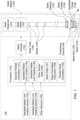
- FIG. 1 shows a block diagram of an exemplary site-specific seed orientation system 100.
- the system 100 operates in a worksite (e.g., agricultural field) 90 comprising some number of seedbeds 105 such as crop rows 102 (best seen by the dashed lines in FIG. 3 ).
- a worksite e.g., agricultural field
- the system 100 comprising at least one seed orienter 120, each seed orienter 120 having an associated seedbed maker 130 plants seeds 124 at a given position within the agricultural field according to a seed orientation instruction 148.
- the seed orientation instruction has a desired planted orientation 141 which includes multi-dimensional position information of the seed relative to the surface plane (i.e., ground level), seed planting depth and crop row for a given position within the agricultural field 90.
- multi-dimensional position information is provided such that seed has a position (e.g., within row 102) and/or an orientation in three-dimensional Cartesian coordinates (X, Y, and Z) at that position.
- the Cartesian coordinates would have an origin corresponding to some point on the seed and then X, Y, and Z axis lines.
- the seed orienter 120 would then be configured to adjust the pitch, roll and yaw (orthogonal axes and resulting coordinates) of the seed using the multi-dimensional position information.
- Seedbed maker 130 may be a high-speed row unit as disclosed in U.S. Patent No. 8,850,998 .
- seedbed maker 130 has disposed thereon a seedbed forming device (not shown) and a seed meter 122 which singulates seeds 124 from a seed reservoir 123 having a pool of seeds into a seed delivery system 126.
- the seed delivery system 126 may be configured to convey the seed 124 some distance to the seedbed 105 while retaining the seed in its desired planted orientation 141.
- a seed 124 may be planted in a seedbed 105, the seedbed 105 being formed in any number of ways such as a furrow, pocket, indentation, hole, opening or any other shape or position from which the seed 124 can grow to a plant.
- the seedbed 105 is formed with the seedbed forming device to create a conventional "V" shaped furrow.
- the seed 124 is not deposited in a "V" shaped furrow in conventional parallel rows.
- the seedbed maker 130 is an injection system whereby seed 124 is injected into uniquely shaped pockets in the soil 95 (best seen in FIG.
- the pockets being created in varying geometries and patterns within the worksite/field 90 such that the seed 124 is placed in optimal spacing and contact with the soil 95.
- the seedbed maker 130 may create a specific shape of seedbed 105 to be aid planting of the seed 124 in its desired planted orientation 141.
- seedbed maker 130 may utilized any number of methods may be utilized to form different seedbed styles and shapes and plant the seed 124 in that seedbed 105.
- seed orienter 120 further comprises a seedbed maker 130 to orient the seed 124 in the desired planted orientation 141 in seedbed 105.
- seed orienter 120 may include adjustment of the seed orientation in one or more of the X,Y and Z dimensions at one or more locations on the seedbed maker 130 including, for example, the seed meter 122, seed delivery system 126, or seed detector 132.
- Seedbed maker 130 may include one or more components at various locations to adjust the seed orientation such as positioning device 134, seed rotator 136 and/or seedbed closer 138.
- seedbed maker 130 may be controlled by processor 140 based on a desired planted orientation 141.
- Desired planted orientation 141 may be determined prior to planting of the seed 124 using the seed orientation instruction 148, seedbed maker location 142 from a seedbed maker location sensor 152, a seedbed maker heading 144 from a seedbed maker heading sensor 154, other sensor data 146 and other sensors 156.
- seedbed maker 130 may provide initial orientation of the seed 124 before the seed 124 is planted.
- the seed meter 122 may have a seed disk with seed indentations thereon to uniformly orient the seed. While this may provide some initial orientation, the seeds 124 may deviate from the desired planted orientation 141 as they travel towards the seedbed 105.
- the seed 124 may bounce off the sides of the tube as the seed freefalls to the seedbed 105, resulting in a random seed orientation and failing to achieve, on its own, the necessary desired planted orientation 141.
- seed delivery systems 126 such as the John Deere ExactEmerge TM row units disclosed in U.S. Patent No. 8,850,998 , may maintain the desired planted orientation 141 from seed meter 122 to seedbed 105 by, among other things, eliminating bouncing of the seed 124 in the seed tube. Still further, while the desired planted orientation 141 may be maintained all the way to seedbed 105, the seed 124 may still be knocked out of desired planted orientation 141 after contacting the seedbed 105 and/or being covered with soil 95.
- Positioning device 134 and seed rotator 136 may include various other suitable structure for adjusting the orientation of the seed 124 before the seed 124 is contacted by soil 95. As can be appreciated by one of ordinary skill, the positioning device 134 and seed rotator 136 may also be independent structures working in combination or independently and thus are not limited to a conventional seed firmer.
- Seedbed closer 138 may then follow the positioning device 134 or seed rotator 136 and move soil 95 into optimal contact with the seed 124 while preserving the desired planted orientation 141.
- seedbed closer 138 is a conventional closing wheel or drag chain to move soil 95 into contact with the seed 124.
- seedbed closer 138 is not limited to this example and may include other suitable structure to move soil 95 into contact with the seed.
- the positioning device 134, seed rotator 136 and seedbed closer 138 may work in combination or independently with the seed meter 122, seed delivery system 126 and a seed detector 132 to provide some initial seed orientation, detect the orientation of the seed 124 within the seedbed 105 and then orient the seed 124 to an actual planted seed orientation 149 which corresponds to the desired planted orientation 141.
- seed orienter 120 ensures that seeds are planted in the correct position within seedbed 105 of the row 102 and in the desired planted orientation 141. Achievement of the desired planted orientation 141 may be done at any step between the seed reservoir 123 of seedbed maker 130 and the seedbed 105 or at some combination therebetween.
- the seed orienter 120 may utilize the positioning device 134, seed rotator 136 or seedbed closer 138 to correct the random orientation of the seed 124 due to seed tube bounce or movement within a seed delivery system 126 by rotating or flipping the seed 124 within a seedbed 105 prior to being covered with soil 95.
- the seed orienter 120 ensures that the seed 124 is planted in actual planted seed orientation 149 - i.e., singulated, dispensed and covered with soil 95 (e.g., with seedbed closer 138) - that corresponds the desired planted orientation 141.
- the seed orienter 120 may act on a seed 124 that has been altered to form an altered seed and facilitate additional seed orientation.
- an altered seed may include placing or otherwise affixing a magnetic material on some portion of the seed 124.
- a corresponding structure(s), such as a chamfer made of an appropriate material reactive (e.g., magnetic) to the altered seed may be embedded or otherwise positioned near and/or along the seed path in one or segments or portions until the seed reaches the seedbed 105. As the now magnetized seed passes the chamfer, the seed would gain additional seed orientation proximate to the seedbed 105 in a repeatable manner to aid in achieving the desired planted orientation 141.
- the seed 124 is altered by marking the seed with a symbol or other designation representing the desired planted orientation 141 of the seed 124.
- altered seeds - whether by marking or applying magnetic material - may be done either onboard or offboard an agricultural machine by a seed company, distributor, the seed grower or some combination thereof.
- the marking may be inside the visible spectrum, outside the visible spectrum (e.g., near or medium infrared) or some combination thereof.
- the marking (similarly applicable to a seed with magnetic material) would be detected and captured by a seed detector 132 and then a representative signal sent to processor 140. The processor 140 could then interpret the marking and send an instruction to seed orienter 120 to adjust the orientation of the seed 124 to the desired planted orientation 141.
- processor 140 utilizes an open or closed loop orientation control to provide an actual planted seed orientation 149 matching the desired planted orientation 141.
- the processor 140 may utilize a seed detector 132, such as a camera, to verify seed orientation by observing the planted seed orientation 149 and send a representative signal to the processor 140 for comparison against the desired planted orientation 141.
- the verified seed orientation, the observed seed orientation and/or the comparison thereof may be further be stored in a database for later access.
- the seed detector 132 may be disposed in locations such as the seed meter 122, the seed delivery system 126, the seedbed 105 or at some other point prior to the seed 124 being covered by soil 95.
- processor 140 includes a receiver, transceiver, or other electronic component that receives the signal or signals from seedbed maker location sensor 152, seedbed maker heading sensor 154 and other sensors 156 (which may include, in one example, a signal from seed detector 132 corresponding to detection of seeds).
- the processor 140 is configured to use the received signal or signals to determine information regarding the location, heading, placement and/or orientation of a seed 124 or seeds within the seedbed 105.
- the processor 140 is coupled to a display component (not shown), which may display the seed orientation instruction 148 and/or display the location and actual planted seed orientation 149 of the seed 124 or seeds in the seedbed 105 to an operator.
- the processor 140 and the display component are disposed remotely.
- the other sensors 156 themselves include a processor or other electronic component that calculates a position of the seed 124 or seeds in the seedbed 105.
- Knowing the seed location and placement parameters may help an operator to understand, for example, what percentage of the seeds are within a desired tolerance range or threshold for desired planted orientation and/or spacing. The operator may then make corrections to the seedbed maker 130 as described in U.S. Patent Publication No. 2012/0004768 , which discusses various types of seed placement and location parameters and measures of the seed placement parameters that may be determined by the processor 140, as well as how those measures may be displayed (see, e.g., paragraphs [0013] - [0037]).
- Seed orientation instruction 148 may be an priori seed orientation map, a seed orientation map per georeferenced seed location, a rule set, a formula, a vector map, a raster map or any suitable format determining a preferred orientation for a given seed or seeds at a given location(s).
- the seed orientation instruction 148 is generated using a set of rules that use in situ data to calculate the orientation without using a map as an intermediate data structure.
- the seed orientation instruction 148 may use data which is georeferenced (e.g., a topographical map) or which is not georeferenced (e.g., a compass).
- the map may further have management zones for a particular agricultural field 90. Each management zone in the map may have, without limitation, desired planted orientation 141 comprising orientation relative to the ground, orientation relative to North; orientation relative to direction of travel; and orientation such as pitch, roll, or yaw.
- the seed orientation instruction 148 initially includes a desired planted orientation 141 calculated with the processor 140 other sensor data 146 from other sensors 156 independently of or in combination with the seed detector 132. Seed orientation instruction 148 may also later be updated with the planted seed orientation 149 determined and verified with the processor 140 and seed detector 132 For example, in some worksites, such as hilly worksites, pitch and roll data may be useful in fully controlling seed orientation. Other sensors 156 and sensor data 146 may be used to calculate planted seed orientation 149 without limitation.
- Desired planted orientation 141 may also be calculated using seed data 147.
- Seed data 147 may include without limitation the type of crop, type of seed including size and shape (e.g., predominately flat, predominately round, large round, large flat, medium round, medium flat, small flat, small round), crop variety, seed geometry, roots relative to seed orientation, leaves relative to seed orientation and grain relative to seed orientation, plant height, leaf size, quantity of leaves, quantity of agricultural product (e.g., corn ears, soybean pods, etc.), size of agricultural product (e.g., corn tassel length, ear length/size, soybean pod length/size, etc.), root lodging, quantity of agricultural products dropped to the ground from the plant (e.g., dropped corn ears, dropped soybean pods, etc.), stalk lodging, plant appearance, stay green rating, crop rot (e.g., ear rot, kernel rot, stalk rot, etc.), intactness, grain quality rating, agricultural product shape (e.g., corn ear shape, etc.), ear type
- Position and heading may come from a single global navigation system receiver located on agricultural vehicle (e.g., tractor) 300, implement or both. Utilizing position and heading inputs, geometry techniques can be applied to determine the location and heading of a seedbed maker 130 on a towed toolbar. Heading and position inputs can, as described previously, may come from the global navigation satellite system (GNSS) receiver 150 (e.g. GPS receiver) or any localization system reporting in any global or local coordinate system. In one example, heading may be obtained from an electronic compass and may be relative to true or magnetic north.
- GNSS global navigation satellite system
- heading may be obtained from an electronic compass and may be relative to true or magnetic north.
- processing may be done on a single processor 140 dedicated to a seedbed maker 130, distributed to a single processor 140 dedicated to controlling multiple seedbed makers 130, distributed across processors 140 on the agricultural vehicle 300, on the implement, or in a remote location etc. While this description is focused on corn and singulated metering thereof, it may also be applied without limitation to other crops and other metering approaches such as volumetric metering, seed pick-and-place, a priori orientation on seed tape, plug metering, etc.
- desired planted orientation 141 is obtained from a seed orientation instruction 148 based on seedbed maker location 142 determined in the previous step.
- a seed orientation instruction 148 may be an a priori seed orientation map, a seed orientation map per georeferenced seed location, a rule set, a formula, a vector map, a raster map or any suitable format determining a preferred orientation for a given seed or seeds at a given location(s).
- the seed orientation instruction 148 is generated using a set of rules that use in situ data to calculate the orientation without using a map as an intermediate data structure.
- the seed orientation instruction 148 may use data which is georeferenced (e.g., a topographical map) or which is not georeferenced (e.g., a compass).
- the map may further have management zones for a particular agricultural field 90.
- Each management zone in the map may have, without limitation, desired planted orientation information such as: orientation relative to North; orientation relative to direction of travel; and orientation such as pitch, roll, or yaw.
- desired planted orientation 141 is determined from the seed orientation instruction 148, seedbed maker location 142 from the seedbed maker location sensor 152, seedbed maker heading 144 from the seedbed maker heading sensor 154, other sensor data 146 and other sensors 156.
- the seed 124 may be oriented with seed orienter 120 to the desired planted orientation.
- seed orienter 120 may include adjustment of the seed orientation at one or more locations on the seedbed maker 130 including, for example, the seed meter 122, seed delivery system 126, or seed detector 132.
- Seedbed maker 130 may include one or more components at various locations such as positioning device 134, seed rotator 136 and/or seedbed closer 138 to further adjust orientation of the seed relative to the desired planted orientation 141.
- additional steps may be provided and include seed orientation using an open or closed loop control on processor 140.
- the open and closed control loop orientation control may utilize a seed detector 132, such as a camera, to verify seed orientation by observing actual planted seed orientation 149 and sending a representative signal to the processor 140 for comparison against the desired planted orientation 141.
- the seed detector 132 may be disposed in locations such as the seed meter 122, the seed delivery system 126, the seedbed 105 or at some other point prior to the seed 124 being covered by soil 95.
- the processor 140 may initiate adjustments of the seed orienter 120 needed to bring the actual planted seed orientation 149 in line with the desired planted orientation 141.
- the storage tanks 308 are coupled to the mini-hoppers by way of conduits, such as hoses, and a pressurized delivery apparatus (not shown). Each storage tank 308 may contain the same or different varieties of seed 124 to be planted in the soil 95.
- Each seedbed maker 130 is connected to a conduit such that it is in communication with a storage tank 308 to receive seed. As illustrated by way of example only in FIG. 1 , each seedbed maker 130 further includes its own sub-frame to which the various components (e.g., seed meter 122, seed delivery system 126, seed detector 132, positioning device 134, seed rotator 136, seedbed closer 138, etc.) are mounted.
- the agricultural vehicle 300 follows one or more generated or programmed guidance lines 306 using receiver 150, the guidance lines further allowing for the creation and visualization of the one or more rows 102 along which seed orienter 120, specifically seedbed maker 130, will plant seed 124.
- the guidance line 306 can thus be used to guide agricultural vehicle 300 and planter 302 to, among other things, minimize compaction and reduce product application overlapping.
- FIG. 3 may further represent a seed orientation instruction 148 shown on a display component and visually representing a map by which the agricultural vehicle 300 and the seedbed maker 130 will plant seed.
- the rows 102 are dashed lines, each dash representing a potential location of a seed in a desired planted orientation.
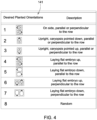
- the seed 124a is oriented with the its caryopsis 400 pointed down and at an angle substantially parallel to the crop row 102 and surrounded by soil 95.
- the caryposis 400 is pointed down within soil 95 and the seed 124a is parallel to the row 102, it can be expected with reasonable certainty the plant will emerge uniformly and grow with its leaves perpendicular to the row 102.
- the corn plant 160 depicted in FIG. 5 In this position, the plant will be in optimal contact with the soil 95 and allowing for uniform emergence and plant growth, optimal and uniform utilization of inputs such as light, water and nutrients, and avoiding other causes of yield loss such as soil compaction or machine contact with the plant or grain.
- one or more desired planted orientations 141 of a crop seed may be necessary to achieve optimal spacing and orientation to maximize a crop yield in an agricultural field 90.
- the desired planted orientation 141 may change according to the type of crop (e.g., soybean, sugar beets, sunflowers, oats, sorghum, wheat) being planted and be altogether different or some combination of the desired planted orientations 141 as shown in FIGS. 4-5 .
- the desired planted orientation 141 may change according to the type of seed (e.g., flat or round corn seed) being planted, thus requiring one or more different desired planted orientations.
- the desired planted orientations 141 as shown in FIGS. 4-5 are illustrative only and do not include all the desired planted orientations 141 which may be utilized for optimally planting and growing a crop in an agricultural field 90.
- the processor 140 may be comprised of one or more of software and/or hardware in any proportion.
- the processor 140 may reside on a computer-based platform such as, for example, a server or set of servers. Any such server or servers may be a physical server(s) or a virtual machine(s) executing on another hardware platform or platforms. Any server, or for that matter any computer-based system, systems or elements described herein, will be generally characterized by one or more processors and associated processing elements and storage devices communicatively interconnected to one another by one or more busses or other communication mechanism for communicating information or data.
- storage within such devices may include a main memory such as, for example, a random access memory (RAM) or other dynamic storage devices, for storing information and instructions to be executed by the processor(s) and for storing temporary variables or other intermediate information during the use of the system and computing element described herein.
- main memory such as, for example, a random access memory (RAM) or other dynamic storage devices, for storing information and instructions to be executed by the processor(s) and for storing temporary variables or other intermediate information during the use of the system and computing element described herein.
- RAM random access memory
- the processor 140 may also include a static storage device such as, for example, read only memory (ROM), for storing static information and instructions for the processor(s).
- the processor 140 may include a storage device such as, for example, a hard disk or solid state memory, for storing information and instructions.
- Such storing information and instructions may include, but not be limited to, instructions to compute, which may include, but not be limited to processing and analyzing agronomic data or information of all types.
- data or information may pertain to, but not be limited to, weather, soil, water, crop growth stage, pest or disease infestation data, historical data, future forecast data, economic data associated with agronomics or any other type of agronomic data or information.
- the processing and analyzing of data by the processor 140 may pertain to processing and analyzing agronomic factors obtained from externally gathered image data, and issue alerts if so required based on pre-defined acceptability parameters.
- RAMs, ROMs, hard disks, solid state memories, and the like are all examples of tangible computer readable media, which may be used to store instructions which comprise processes, methods and functionalities of the present disclosure.
- Exemplary processes, methods and functionalities of the processor 140 may include determining a necessity for generating and presenting alerts in accordance with examples of the present disclosure. Execution of such instructions causes the various computer-based elements of processor 140 to perform the processes, methods, functionalities, operations, etc., described herein.
- the processor 140 of the present disclosure may include hard-wired circuitry to be used in place of or in combination with, in any proportion, such computer-readable instructions to implement the disclosure.
- ASICs Application Specific Integrated Circuits
- FPGAs Field Programmable Gate Arrays
- DSPs digital signal processors
- ASICs Application Specific Integrated Circuits
- FPGAs Field Programmable Gate Arrays
- DSPs digital signal processors
- those skilled in the art will recognize that some aspects of the embodiments disclosed herein, in whole or in part, can be equivalently implemented in integrated circuits, as one or more computer programs running on one or more computers (e.g., as one or more programs running on one or more computer systems), as one or more programs running on one or more processors (e.g., as one or more programs running on one or more microprocessors), as firmware, or as virtually any combination thereof, and that designing the circuitry and/or writing the code for the software and or firmware would be well within the skill of a skilled artisan in light of this disclosure.
- the computer system and/or the computing element may manipulate and transform information and/or data represented as physical (electronic) quantities within the computer system's and/or computing element's processor(s), register(s), and/or memory(ies) into other data similarly represented as physical quantities within the computer system's and/or computing element's memory(ies), register(s) and/or other such information storage, processing, transmission, and/or display components of the computer system(s), computing element(s) and/or other electronic computing device(s).
- the computer system(s) and/or computing element(s) may carry out operations of one or more of the processes, methods and/or functionalities of the present disclosure.
Landscapes
- Life Sciences & Earth Sciences (AREA)
- Soil Sciences (AREA)
- Environmental Sciences (AREA)
- Engineering & Computer Science (AREA)
- General Engineering & Computer Science (AREA)
- Physics & Mathematics (AREA)
- General Physics & Mathematics (AREA)
- Automation & Control Theory (AREA)
- Pretreatment Of Seeds And Plants (AREA)
- Guiding Agricultural Machines (AREA)
Claims (7)
- Verfahren zum Pflanzen eines Saatguts (124) in einem landwirtschaftlichen Feld (90), wobei das Verfahren Folgendes umfasst:Bestimmen einer standortspezifischen Saatgutausrichtungsanweisung für das landwirtschaftliche Feld (90);Bestimmen, mit einem Prozessor (140), einer Position einer Saatgutausrichtungsvorrichtung (120) innerhalb des landwirtschaftlichen Feldes (90) unter Verwendung von Positionsdaten von einer Pflanzmaschine (302) und/oder einem landwirtschaftlichen Fahrzeug (300);Bestimmen, mit dem Prozessor (140), einer gewünschten Pflanzausrichtung, die der Position der Saatgutausrichtungsvorrichtung (120) innerhalb des landwirtschaftlichen Feldes (90) entspricht, aus der Saatgutausrichtungsanweisung, wobei die Saatgutausrichtungsanweisung vor dem Pflanzen des Saatguts gemäß der gewünschten Pflanzausrichtung auf dem Prozessor (140) gespeichert oder an den Prozessor (140) übertragen wird; undPflanzen des Saatguts (124) innerhalb des landwirtschaftlichen Feldes (90) gemäß der gewünschten Pflanzausrichtung mit der Saatgutausrichtungsvorrichtung (120) ;dadurch gekennzeichnet, dass die Saatgutausrichtungsanweisung unter Verwendung von Topographie und/oder vorherrschenden Winden und/oder zukünftigen Ausrüstungspfaden und/oder einer Fahrgassennähe erzeugt wird.
- Verfahren nach Anspruch 1, wobei die Saatgutausrichtungsanweisung dreidimensionale Positionen des Saatguts (124) relativ zu einer Oberflächenebene des landwirtschaftlichen Feldes (90) und/oder einer Pflanztiefe und/oder einer Erntegutreihe innerhalb des landwirtschaftlichen Feldes (90) umfasst.
- Verfahren nach Anspruch 2, wobei die Saatgutausrichtungsanweisung eine dreidimensionale Position des Saatguts in einer senkrechten Position relativ zu der Erntegutreihe oder in einer parallelen Position relativ zu der Erntegutreihe oder in einer Position zwischen parallel und senkrecht relativ zu der Erntegutreihe enthält.
- Verfahren nach Anspruch 1, wobei die Positionsdaten von einem Positionssensor, der mit der Pflanzmaschine (302) assoziiert ist, oder von einem Positionssensor, der mit einer Saatgutausrichtungsvorrichtung (120) auf der Pflanzmaschine (302) assoziiert ist, oder von einem Positionssensor, der mit einer Saatbettbereitungsvorrichtung (130) auf der Pflanzmaschine (302) assoziiert ist, oder von einem Positionssensor, der mit dem landwirtschaftlichen Fahrzeug (300) assoziiert ist, bestimmt werden.
- Verfahren nach Anspruch 4, wobei der Positionssensor ein GPS-Empfänger (150) und/oder ein Lokalisierungssystem ist, der bzw. das in beliebigen globalen oder lokalen Koordinaten berichtet und dazu ausgelegt ist, Positionsdaten zu erzeugen.
- Verfahren nach Anspruch 1, wobei die Saatgutausrichtungsvorrichtung (120) ferner eine Saatbettbereitungsvorrichtung (130) umfasst, wobei die Saatbettbereitungsvorrichtung (130) ferner eine Saatgutdosiervorrichtung (122), ein Saatgutabgabesystem (126), einen Saatgutdetektor (132), eine Positioniervorrichtung und eine Saatbettschließvorrichtung (138) umfasst, wobei die Saatbettbereitungsvorrichtung (130) zum Pflanzen des Saatguts (124) innerhalb eines Saatbetts (105) gemäß der gewünschten Pflanzausrichtung ausgelegt ist.
- Verfahren nach Anspruch 6, wobei das Saatbett (105) eine Furche und/oder eine Tasche und/oder eine Öffnung und/oder ein Loch und/oder eine Vertiefung umfasst, in der bzw. dem das Saatgut (124) abgelagert und mit Erde bedeckt werden kann.
Applications Claiming Priority (2)
| Application Number | Priority Date | Filing Date | Title |
|---|---|---|---|
| US201962858971P | 2019-06-07 | 2019-06-07 | |
| PCT/US2020/070128 WO2020247985A1 (en) | 2019-06-07 | 2020-06-08 | Site-specific seed orientation for optimal crop growth |
Publications (3)
| Publication Number | Publication Date |
|---|---|
| EP3979782A1 EP3979782A1 (de) | 2022-04-13 |
| EP3979782A4 EP3979782A4 (de) | 2023-08-23 |
| EP3979782B1 true EP3979782B1 (de) | 2025-07-09 |
Family
ID=73652660
Family Applications (1)
| Application Number | Title | Priority Date | Filing Date |
|---|---|---|---|
| EP20819202.1A Active EP3979782B1 (de) | 2019-06-07 | 2020-06-08 | Ortsspezifische saatkornausrichtung für optimales pflanzenwachstum |
Country Status (5)
| Country | Link |
|---|---|
| US (2) | US12302780B2 (de) |
| EP (1) | EP3979782B1 (de) |
| AU (1) | AU2020287180B2 (de) |
| BR (1) | BR112021020852A2 (de) |
| WO (1) | WO2020247985A1 (de) |
Families Citing this family (21)
| Publication number | Priority date | Publication date | Assignee | Title |
|---|---|---|---|---|
| US12419213B2 (en) | 2019-05-08 | 2025-09-23 | Precision Planting Llc | Aerodynamic and centrifugal seed orientation system for agricultural planters |
| AU2020268428B2 (en) | 2019-05-08 | 2025-08-14 | Precision Planting Llc | Seed orientation system for agricultural planters |
| US11490558B2 (en) | 2019-12-24 | 2022-11-08 | Cnh Industrial America Llc | Particle delivery system of an agricultural row unit |
| US11483963B2 (en) | 2019-12-24 | 2022-11-01 | Cnh Industrial America Llc | Particle delivery system of an agricultural row unit |
| US11564344B2 (en) | 2019-12-24 | 2023-01-31 | Cnh Industrial America Llc | Particle delivery system of an agricultural row unit |
| US11553638B2 (en) | 2019-12-24 | 2023-01-17 | Cnh Industrial America Llc | Particle delivery system of an agricultural row unit |
| US11582899B2 (en) | 2019-12-24 | 2023-02-21 | Cnh Industrial America Llc | Particle delivery system of an agricultural row unit |
| US11589500B2 (en) | 2019-12-24 | 2023-02-28 | Cnh Industrial America Llc | Particle delivery system of an agricultural row unit |
| US11523555B2 (en) | 2019-12-24 | 2022-12-13 | Cnh Industrial America Llc | Particle delivery system of an agricultural row unit |
| US11523556B2 (en) | 2019-12-24 | 2022-12-13 | Cnh Industrial America Llc | Particle delivery system of an agricultural row unit |
| US11564346B2 (en) | 2019-12-24 | 2023-01-31 | Cnh Industrial America Llc | Particle delivery system of an agricultural row unit |
| US11553639B2 (en) | 2019-12-24 | 2023-01-17 | Cnh Industrial America Llc | Particle delivery system of an agricultural row unit |
| US11596095B2 (en) | 2019-12-24 | 2023-03-07 | Cnh Industrial America Llc | Particle delivery system of an agricultural row unit |
| US11516958B2 (en) | 2019-12-24 | 2022-12-06 | Cnh Industrial America Llc | Particle delivery system of an agricultural row unit |
| CN117812997A (zh) | 2021-07-28 | 2024-04-02 | 精密种植有限责任公司 | 用于农业种植机的空气动力和离心式种子定向系统 |
| WO2023062507A2 (en) | 2021-10-11 | 2023-04-20 | Precision Planting Llc | Seed receiver and path constrainer for an agricultural planter seed orientation system |
| CN117979820A (zh) * | 2021-10-11 | 2024-05-03 | 精密种植有限责任公司 | 种子加速器 |
| US12591848B2 (en) | 2022-02-24 | 2026-03-31 | Auburn University | Tree seedling inventory system |
| WO2024127129A1 (en) * | 2022-12-13 | 2024-06-20 | Precision Planting Llc | Sensor system to determine seed orientation and seed performance during planting of agricultural fields |
| DE102023101911A1 (de) * | 2023-01-26 | 2024-08-01 | Amazonen-Werke H. Dreyer SE & Co. KG | Sämaschine und Verfahren zur orientierten Aussaat von Saatgutkörnern mit einer Sämaschine |
| WO2025264780A1 (en) * | 2024-06-21 | 2025-12-26 | Syngenta Crop Protection Ag | Systems and methods for singulating seeds |
Family Cites Families (15)
| Publication number | Priority date | Publication date | Assignee | Title |
|---|---|---|---|---|
| US4321972A (en) | 1980-05-09 | 1982-03-30 | Acra Plant, Inc. | Seed planter furrow opener and follower therefor |
| US7735626B2 (en) * | 2006-11-13 | 2010-06-15 | Pioneer Hi-Bred International, Inc. | Apparatus, method and system for handling, positioning, and/or automatically orienting objects |
| US8286387B2 (en) * | 2007-12-17 | 2012-10-16 | Pioneer Hi-Bred International, Inc. | Apparatus, method and system for creating, handling, collecting and indexing seed and seed portions from plant seed |
| US9538714B2 (en) | 2009-04-21 | 2017-01-10 | Deere & Company | Managing resource prescriptions of botanical plants |
| US8150554B2 (en) * | 2009-04-21 | 2012-04-03 | Deere & Company | Resource use management in yards and gardens |
| US10285325B2 (en) | 2010-07-02 | 2019-05-14 | Deere & Company | Seeding apparatus and method of determining a seed spacing variability value |
| US8850998B2 (en) | 2011-03-25 | 2014-10-07 | Deere & Company | Planting unit for a seeding machine having a seed meter and seed delivery system |
| US9924629B2 (en) * | 2013-06-21 | 2018-03-27 | Appareo Systems, Llc | Method and system for optimizing planting operations |
| HUE038640T2 (hu) * | 2013-09-05 | 2018-11-28 | Kinze Mfg Inc | Összetett mezõgazdasági termék alkalmazási eljárás és rendszerek |
| CA3029134A1 (en) * | 2015-12-18 | 2017-06-22 | Realmfive, Inc. | Autonomous integrated farming system |
| WO2018013858A1 (en) * | 2016-07-14 | 2018-01-18 | Precision Planting Llc | Systems, implements, and methods for seed orientation with adjustable singulators during planting |
| WO2018013860A2 (en) * | 2016-07-14 | 2018-01-18 | Precision Planting Llc | Systems, implements, and methods for passive seed orientation within agricultural fields |
| WO2018013859A1 (en) * | 2016-07-14 | 2018-01-18 | Precision Planting Llc | Systems, implements, and methods for seed orientation within agricultural fields |
| CN109688792B (zh) * | 2016-07-14 | 2023-02-14 | 精密种植有限责任公司 | 用于利用种子定位器在农田内种子定向的系统、机具和方法 |
| GB2565277B (en) * | 2017-07-31 | 2020-12-16 | Forthroots Ltd | Turf repair tool |
-
2020
- 2020-06-08 EP EP20819202.1A patent/EP3979782B1/de active Active
- 2020-06-08 WO PCT/US2020/070128 patent/WO2020247985A1/en not_active Ceased
- 2020-06-08 BR BR112021020852A patent/BR112021020852A2/pt unknown
- 2020-06-08 AU AU2020287180A patent/AU2020287180B2/en active Active
-
2021
- 2021-12-06 US US17/543,575 patent/US12302780B2/en active Active
-
2025
- 2025-04-23 US US19/187,524 patent/US20250311660A1/en active Pending
Also Published As
| Publication number | Publication date |
|---|---|
| AU2020287180A1 (en) | 2022-01-06 |
| WO2020247985A1 (en) | 2020-12-10 |
| US12302780B2 (en) | 2025-05-20 |
| US20220087097A1 (en) | 2022-03-24 |
| EP3979782A4 (de) | 2023-08-23 |
| EP3979782A1 (de) | 2022-04-13 |
| US20250311660A1 (en) | 2025-10-09 |
| BR112021020852A2 (pt) | 2021-12-14 |
| AU2020287180B2 (en) | 2025-06-05 |
Similar Documents
| Publication | Publication Date | Title |
|---|---|---|
| US12302780B2 (en) | Site-specific seed orientation | |
| EP3482619B1 (de) | Verfahren zur behandlung von pflanzen mit hilfe von geschätzten wurzelzonen | |
| US11154018B2 (en) | Method for optimizing an operating parameter of a machine for application of agricultural material to a field and a corresponding machine | |
| US10362726B2 (en) | On-the-go soil sensors and control methods for agricultural machines | |
| US10830751B2 (en) | Method for treating plants with respect to estimated root zones | |
| US11266060B2 (en) | System and method for controlling the operation of a seed-planting implement based on cover crop density | |
| AU2020217409A1 (en) | Fertilization map generation method, fertilization map generation system, fertilization map generation device, and fertilization map generation program | |
| US7591226B2 (en) | Automatic path generation for tramlines | |
| US20170270446A1 (en) | Agronomic systems, methods and apparatuses for determining yield limits | |
| US11272701B2 (en) | Method for remediating developmentally delayed plants | |
| US12575475B2 (en) | Method and system for estimating performance for position-specific control of an agricultural machine | |
| SA516380255B1 (ar) | جهاز لنثر البذور للتحكم في عمق زراعة البذور باستخدام مجس | |
| US20200305339A1 (en) | Planting machine | |
| US12108694B2 (en) | Method for performing an agricultural task | |
| Vaz et al. | Zonal application of plant growth regulator in cotton to reduce variability and increase yield in a highly variable field | |
| US20240065140A1 (en) | Controlling a crop care implement based on a plurality of sentinel plant characteristics | |
| Vories et al. | Influence of irrigation patterns on the effectiveness of furrow irrigation of Cotton | |
| Karayel et al. | Using real-time kinematic (RTK) global positioning system (GPS) for the determination of seedling distributions over the field. | |
| Vaz et al. | AGRONOMY AND SOILS | |
| Lawson | Peanut growing on the levee soils of the Gascoyne River | |
| Brown Jasa | Crop Watch No. 2005-20, September 2, 2005 | |
| Postlethwaite et al. | Grain sorghum as a dryland cropping option in the Wimmera region, Victoria. | |
| Mitchell Peter | Can NZ arable farmers profitably adopt GPS guidance technology? |
Legal Events
| Date | Code | Title | Description |
|---|---|---|---|
| STAA | Information on the status of an ep patent application or granted ep patent |
Free format text: STATUS: THE INTERNATIONAL PUBLICATION HAS BEEN MADE |
|
| PUAI | Public reference made under article 153(3) epc to a published international application that has entered the european phase |
Free format text: ORIGINAL CODE: 0009012 |
|
| STAA | Information on the status of an ep patent application or granted ep patent |
Free format text: STATUS: REQUEST FOR EXAMINATION WAS MADE |
|
| 17P | Request for examination filed |
Effective date: 20220107 |
|
| AK | Designated contracting states |
Kind code of ref document: A1 Designated state(s): AL AT BE BG CH CY CZ DE DK EE ES FI FR GB GR HR HU IE IS IT LI LT LU LV MC MK MT NL NO PL PT RO RS SE SI SK SM TR |
|
| DAV | Request for validation of the european patent (deleted) | ||
| DAX | Request for extension of the european patent (deleted) | ||
| A4 | Supplementary search report drawn up and despatched |
Effective date: 20230720 |
|
| RIC1 | Information provided on ipc code assigned before grant |
Ipc: A01C 7/20 20060101ALI20230714BHEP Ipc: A01C 7/10 20060101ALI20230714BHEP Ipc: A01C 5/06 20060101ALI20230714BHEP Ipc: A01C 21/00 20060101AFI20230714BHEP |
|
| GRAP | Despatch of communication of intention to grant a patent |
Free format text: ORIGINAL CODE: EPIDOSNIGR1 |
|
| STAA | Information on the status of an ep patent application or granted ep patent |
Free format text: STATUS: GRANT OF PATENT IS INTENDED |
|
| INTG | Intention to grant announced |
Effective date: 20250225 |
|
| GRAS | Grant fee paid |
Free format text: ORIGINAL CODE: EPIDOSNIGR3 |
|
| GRAA | (expected) grant |
Free format text: ORIGINAL CODE: 0009210 |
|
| STAA | Information on the status of an ep patent application or granted ep patent |
Free format text: STATUS: THE PATENT HAS BEEN GRANTED |
|
| AK | Designated contracting states |
Kind code of ref document: B1 Designated state(s): AL AT BE BG CH CY CZ DE DK EE ES FI FR GB GR HR HU IE IS IT LI LT LU LV MC MK MT NL NO PL PT RO RS SE SI SK SM TR |
|
| REG | Reference to a national code |
Ref country code: GB Ref legal event code: FG4D |
|
| REG | Reference to a national code |
Ref country code: CH Ref legal event code: EP |
|
| REG | Reference to a national code |
Ref country code: IE Ref legal event code: FG4D |
|
| REG | Reference to a national code |
Ref country code: DE Ref legal event code: R096 Ref document number: 602020054297 Country of ref document: DE |
|
| REG | Reference to a national code |
Ref country code: NL Ref legal event code: MP Effective date: 20250709 |
|
| PG25 | Lapsed in a contracting state [announced via postgrant information from national office to epo] |
Ref country code: PT Free format text: LAPSE BECAUSE OF FAILURE TO SUBMIT A TRANSLATION OF THE DESCRIPTION OR TO PAY THE FEE WITHIN THE PRESCRIBED TIME-LIMIT Effective date: 20251110 |
|
| PG25 | Lapsed in a contracting state [announced via postgrant information from national office to epo] |
Ref country code: NL Free format text: LAPSE BECAUSE OF FAILURE TO SUBMIT A TRANSLATION OF THE DESCRIPTION OR TO PAY THE FEE WITHIN THE PRESCRIBED TIME-LIMIT Effective date: 20250709 |
|
| REG | Reference to a national code |
Ref country code: AT Ref legal event code: MK05 Ref document number: 1810879 Country of ref document: AT Kind code of ref document: T Effective date: 20250709 |
|
| PG25 | Lapsed in a contracting state [announced via postgrant information from national office to epo] |
Ref country code: IS Free format text: LAPSE BECAUSE OF FAILURE TO SUBMIT A TRANSLATION OF THE DESCRIPTION OR TO PAY THE FEE WITHIN THE PRESCRIBED TIME-LIMIT Effective date: 20251109 |
|
| PG25 | Lapsed in a contracting state [announced via postgrant information from national office to epo] |
Ref country code: NO Free format text: LAPSE BECAUSE OF FAILURE TO SUBMIT A TRANSLATION OF THE DESCRIPTION OR TO PAY THE FEE WITHIN THE PRESCRIBED TIME-LIMIT Effective date: 20251009 |
|
| REG | Reference to a national code |
Ref country code: LT Ref legal event code: MG9D |
|
| PG25 | Lapsed in a contracting state [announced via postgrant information from national office to epo] |
Ref country code: AT Free format text: LAPSE BECAUSE OF FAILURE TO SUBMIT A TRANSLATION OF THE DESCRIPTION OR TO PAY THE FEE WITHIN THE PRESCRIBED TIME-LIMIT Effective date: 20250709 |
|
| PG25 | Lapsed in a contracting state [announced via postgrant information from national office to epo] |
Ref country code: FI Free format text: LAPSE BECAUSE OF FAILURE TO SUBMIT A TRANSLATION OF THE DESCRIPTION OR TO PAY THE FEE WITHIN THE PRESCRIBED TIME-LIMIT Effective date: 20250709 |
|
| PG25 | Lapsed in a contracting state [announced via postgrant information from national office to epo] |
Ref country code: HR Free format text: LAPSE BECAUSE OF FAILURE TO SUBMIT A TRANSLATION OF THE DESCRIPTION OR TO PAY THE FEE WITHIN THE PRESCRIBED TIME-LIMIT Effective date: 20250709 |
|
| PG25 | Lapsed in a contracting state [announced via postgrant information from national office to epo] |
Ref country code: GR Free format text: LAPSE BECAUSE OF FAILURE TO SUBMIT A TRANSLATION OF THE DESCRIPTION OR TO PAY THE FEE WITHIN THE PRESCRIBED TIME-LIMIT Effective date: 20251010 |
|
| PG25 | Lapsed in a contracting state [announced via postgrant information from national office to epo] |
Ref country code: SE Free format text: LAPSE BECAUSE OF FAILURE TO SUBMIT A TRANSLATION OF THE DESCRIPTION OR TO PAY THE FEE WITHIN THE PRESCRIBED TIME-LIMIT Effective date: 20250709 |
|
| PG25 | Lapsed in a contracting state [announced via postgrant information from national office to epo] |
Ref country code: LV Free format text: LAPSE BECAUSE OF FAILURE TO SUBMIT A TRANSLATION OF THE DESCRIPTION OR TO PAY THE FEE WITHIN THE PRESCRIBED TIME-LIMIT Effective date: 20250709 |
|
| PG25 | Lapsed in a contracting state [announced via postgrant information from national office to epo] |
Ref country code: BG Free format text: LAPSE BECAUSE OF FAILURE TO SUBMIT A TRANSLATION OF THE DESCRIPTION OR TO PAY THE FEE WITHIN THE PRESCRIBED TIME-LIMIT Effective date: 20250709 Ref country code: PL Free format text: LAPSE BECAUSE OF FAILURE TO SUBMIT A TRANSLATION OF THE DESCRIPTION OR TO PAY THE FEE WITHIN THE PRESCRIBED TIME-LIMIT Effective date: 20250709 |
|
| PG25 | Lapsed in a contracting state [announced via postgrant information from national office to epo] |
Ref country code: RS Free format text: LAPSE BECAUSE OF FAILURE TO SUBMIT A TRANSLATION OF THE DESCRIPTION OR TO PAY THE FEE WITHIN THE PRESCRIBED TIME-LIMIT Effective date: 20251009 |
|
| PG25 | Lapsed in a contracting state [announced via postgrant information from national office to epo] |
Ref country code: ES Free format text: LAPSE BECAUSE OF FAILURE TO SUBMIT A TRANSLATION OF THE DESCRIPTION OR TO PAY THE FEE WITHIN THE PRESCRIBED TIME-LIMIT Effective date: 20250709 |
|
| PG25 | Lapsed in a contracting state [announced via postgrant information from national office to epo] |
Ref country code: SM Free format text: LAPSE BECAUSE OF FAILURE TO SUBMIT A TRANSLATION OF THE DESCRIPTION OR TO PAY THE FEE WITHIN THE PRESCRIBED TIME-LIMIT Effective date: 20250709 |
|
| PG25 | Lapsed in a contracting state [announced via postgrant information from national office to epo] |
Ref country code: DK Free format text: LAPSE BECAUSE OF FAILURE TO SUBMIT A TRANSLATION OF THE DESCRIPTION OR TO PAY THE FEE WITHIN THE PRESCRIBED TIME-LIMIT Effective date: 20250709 |
|
| PG25 | Lapsed in a contracting state [announced via postgrant information from national office to epo] |
Ref country code: IT Free format text: LAPSE BECAUSE OF FAILURE TO SUBMIT A TRANSLATION OF THE DESCRIPTION OR TO PAY THE FEE WITHIN THE PRESCRIBED TIME-LIMIT Effective date: 20250709 |