EP3977482B1 - System und verfahren zur filterung zeitvariierender daten zur vorhersage physiologischer signale - Google Patents
System und verfahren zur filterung zeitvariierender daten zur vorhersage physiologischer signale Download PDFInfo
- Publication number
- EP3977482B1 EP3977482B1 EP20813874.3A EP20813874A EP3977482B1 EP 3977482 B1 EP3977482 B1 EP 3977482B1 EP 20813874 A EP20813874 A EP 20813874A EP 3977482 B1 EP3977482 B1 EP 3977482B1
- Authority
- EP
- European Patent Office
- Prior art keywords
- time
- machine learning
- data
- learning model
- varying
- Prior art date
- Legal status (The legal status is an assumption and is not a legal conclusion. Google has not performed a legal analysis and makes no representation as to the accuracy of the status listed.)
- Active
Links
Images




Classifications
-
- A—HUMAN NECESSITIES
- A61—MEDICAL OR VETERINARY SCIENCE; HYGIENE
- A61B—DIAGNOSIS; SURGERY; IDENTIFICATION
- A61B5/00—Measuring for diagnostic purposes; Identification of persons
- A61B5/02—Detecting, measuring or recording for evaluating the cardiovascular system, e.g. pulse, heart rate, blood pressure or blood flow
-
- A—HUMAN NECESSITIES
- A61—MEDICAL OR VETERINARY SCIENCE; HYGIENE
- A61B—DIAGNOSIS; SURGERY; IDENTIFICATION
- A61B5/00—Measuring for diagnostic purposes; Identification of persons
- A61B5/72—Signal processing specially adapted for physiological signals or for diagnostic purposes
- A61B5/7235—Details of waveform analysis
- A61B5/7264—Classification of physiological signals or data, e.g. using neural networks, statistical classifiers, expert systems or fuzzy systems
- A61B5/7267—Classification of physiological signals or data, e.g. using neural networks, statistical classifiers, expert systems or fuzzy systems involving training the classification device
-
- A—HUMAN NECESSITIES
- A61—MEDICAL OR VETERINARY SCIENCE; HYGIENE
- A61B—DIAGNOSIS; SURGERY; IDENTIFICATION
- A61B5/00—Measuring for diagnostic purposes; Identification of persons
- A61B5/08—Measuring devices for evaluating the respiratory organs
- A61B5/0816—Measuring devices for examining respiratory frequency
-
- A—HUMAN NECESSITIES
- A61—MEDICAL OR VETERINARY SCIENCE; HYGIENE
- A61B—DIAGNOSIS; SURGERY; IDENTIFICATION
- A61B5/00—Measuring for diagnostic purposes; Identification of persons
- A61B5/103—Measuring devices for testing the shape, pattern, colour, size or movement of the body or parts thereof, for diagnostic purposes
- A61B5/11—Measuring movement of the entire body or parts thereof, e.g. head or hand tremor or mobility of a limb
- A61B5/113—Measuring movement of the entire body or parts thereof, e.g. head or hand tremor or mobility of a limb occurring during breathing
-
- A—HUMAN NECESSITIES
- A61—MEDICAL OR VETERINARY SCIENCE; HYGIENE
- A61B—DIAGNOSIS; SURGERY; IDENTIFICATION
- A61B5/00—Measuring for diagnostic purposes; Identification of persons
- A61B5/68—Arrangements of detecting, measuring or recording means, e.g. sensors, in relation to patient
- A61B5/6801—Arrangements of detecting, measuring or recording means, e.g. sensors, in relation to patient specially adapted to be attached to or worn on the body surface
- A61B5/6802—Sensor mounted on worn items
- A61B5/681—Wristwatch-type devices
-
- A—HUMAN NECESSITIES
- A61—MEDICAL OR VETERINARY SCIENCE; HYGIENE
- A61B—DIAGNOSIS; SURGERY; IDENTIFICATION
- A61B5/00—Measuring for diagnostic purposes; Identification of persons
- A61B5/72—Signal processing specially adapted for physiological signals or for diagnostic purposes
- A61B5/7203—Signal processing specially adapted for physiological signals or for diagnostic purposes for noise prevention, reduction or removal
- A61B5/7207—Signal processing specially adapted for physiological signals or for diagnostic purposes for noise prevention, reduction or removal of noise induced by motion artifacts
- A61B5/7214—Signal processing specially adapted for physiological signals or for diagnostic purposes for noise prevention, reduction or removal of noise induced by motion artifacts using signal cancellation, e.g. based on input of two identical physiological sensors spaced apart, or based on two signals derived from the same sensor, for different optical wavelengths
-
- A—HUMAN NECESSITIES
- A61—MEDICAL OR VETERINARY SCIENCE; HYGIENE
- A61B—DIAGNOSIS; SURGERY; IDENTIFICATION
- A61B5/00—Measuring for diagnostic purposes; Identification of persons
- A61B5/72—Signal processing specially adapted for physiological signals or for diagnostic purposes
- A61B5/7235—Details of waveform analysis
- A61B5/725—Details of waveform analysis using specific filters therefor, e.g. Kalman or adaptive filters
-
- A—HUMAN NECESSITIES
- A61—MEDICAL OR VETERINARY SCIENCE; HYGIENE
- A61B—DIAGNOSIS; SURGERY; IDENTIFICATION
- A61B5/00—Measuring for diagnostic purposes; Identification of persons
- A61B5/72—Signal processing specially adapted for physiological signals or for diagnostic purposes
- A61B5/7271—Specific aspects of physiological measurement analysis
- A61B5/7275—Determining trends in physiological measurement data; Predicting development of a medical condition based on physiological measurements, e.g. determining a risk factor
-
- G—PHYSICS
- G06—COMPUTING OR CALCULATING; COUNTING
- G06N—COMPUTING ARRANGEMENTS BASED ON SPECIFIC COMPUTATIONAL MODELS
- G06N3/00—Computing arrangements based on biological models
- G06N3/02—Neural networks
- G06N3/04—Architecture, e.g. interconnection topology
- G06N3/045—Combinations of networks
-
- G—PHYSICS
- G06—COMPUTING OR CALCULATING; COUNTING
- G06N—COMPUTING ARRANGEMENTS BASED ON SPECIFIC COMPUTATIONAL MODELS
- G06N3/00—Computing arrangements based on biological models
- G06N3/02—Neural networks
- G06N3/04—Architecture, e.g. interconnection topology
- G06N3/0464—Convolutional networks [CNN, ConvNet]
-
- G—PHYSICS
- G06—COMPUTING OR CALCULATING; COUNTING
- G06N—COMPUTING ARRANGEMENTS BASED ON SPECIFIC COMPUTATIONAL MODELS
- G06N3/00—Computing arrangements based on biological models
- G06N3/02—Neural networks
- G06N3/08—Learning methods
-
- G—PHYSICS
- G06—COMPUTING OR CALCULATING; COUNTING
- G06N—COMPUTING ARRANGEMENTS BASED ON SPECIFIC COMPUTATIONAL MODELS
- G06N3/00—Computing arrangements based on biological models
- G06N3/02—Neural networks
- G06N3/08—Learning methods
- G06N3/09—Supervised learning
-
- G—PHYSICS
- G16—INFORMATION AND COMMUNICATION TECHNOLOGY [ICT] SPECIALLY ADAPTED FOR SPECIFIC APPLICATION FIELDS
- G16H—HEALTHCARE INFORMATICS, i.e. INFORMATION AND COMMUNICATION TECHNOLOGY [ICT] SPECIALLY ADAPTED FOR THE HANDLING OR PROCESSING OF MEDICAL OR HEALTHCARE DATA
- G16H50/00—ICT specially adapted for medical diagnosis, medical simulation or medical data mining; ICT specially adapted for detecting, monitoring or modelling epidemics or pandemics
- G16H50/20—ICT specially adapted for medical diagnosis, medical simulation or medical data mining; ICT specially adapted for detecting, monitoring or modelling epidemics or pandemics for computer-aided diagnosis, e.g. based on medical expert systems
-
- G—PHYSICS
- G16—INFORMATION AND COMMUNICATION TECHNOLOGY [ICT] SPECIALLY ADAPTED FOR SPECIFIC APPLICATION FIELDS
- G16H—HEALTHCARE INFORMATICS, i.e. INFORMATION AND COMMUNICATION TECHNOLOGY [ICT] SPECIALLY ADAPTED FOR THE HANDLING OR PROCESSING OF MEDICAL OR HEALTHCARE DATA
- G16H50/00—ICT specially adapted for medical diagnosis, medical simulation or medical data mining; ICT specially adapted for detecting, monitoring or modelling epidemics or pandemics
- G16H50/30—ICT specially adapted for medical diagnosis, medical simulation or medical data mining; ICT specially adapted for detecting, monitoring or modelling epidemics or pandemics for calculating health indices; for individual health risk assessment
-
- A—HUMAN NECESSITIES
- A61—MEDICAL OR VETERINARY SCIENCE; HYGIENE
- A61B—DIAGNOSIS; SURGERY; IDENTIFICATION
- A61B5/00—Measuring for diagnostic purposes; Identification of persons
- A61B5/103—Measuring devices for testing the shape, pattern, colour, size or movement of the body or parts thereof, for diagnostic purposes
- A61B5/11—Measuring movement of the entire body or parts thereof, e.g. head or hand tremor or mobility of a limb
- A61B5/113—Measuring movement of the entire body or parts thereof, e.g. head or hand tremor or mobility of a limb occurring during breathing
- A61B5/1135—Measuring movement of the entire body or parts thereof, e.g. head or hand tremor or mobility of a limb occurring during breathing by monitoring thoracic expansion
-
- G—PHYSICS
- G06—COMPUTING OR CALCULATING; COUNTING
- G06N—COMPUTING ARRANGEMENTS BASED ON SPECIFIC COMPUTATIONAL MODELS
- G06N20/00—Machine learning
- G06N20/10—Machine learning using kernel methods, e.g. support vector machines [SVM]
-
- G—PHYSICS
- G06—COMPUTING OR CALCULATING; COUNTING
- G06N—COMPUTING ARRANGEMENTS BASED ON SPECIFIC COMPUTATIONAL MODELS
- G06N20/00—Machine learning
- G06N20/20—Ensemble learning
-
- G—PHYSICS
- G06—COMPUTING OR CALCULATING; COUNTING
- G06N—COMPUTING ARRANGEMENTS BASED ON SPECIFIC COMPUTATIONAL MODELS
- G06N3/00—Computing arrangements based on biological models
- G06N3/02—Neural networks
- G06N3/04—Architecture, e.g. interconnection topology
- G06N3/044—Recurrent networks, e.g. Hopfield networks
-
- G—PHYSICS
- G06—COMPUTING OR CALCULATING; COUNTING
- G06N—COMPUTING ARRANGEMENTS BASED ON SPECIFIC COMPUTATIONAL MODELS
- G06N3/00—Computing arrangements based on biological models
- G06N3/02—Neural networks
- G06N3/04—Architecture, e.g. interconnection topology
- G06N3/048—Activation functions
-
- G—PHYSICS
- G06—COMPUTING OR CALCULATING; COUNTING
- G06N—COMPUTING ARRANGEMENTS BASED ON SPECIFIC COMPUTATIONAL MODELS
- G06N5/00—Computing arrangements using knowledge-based models
- G06N5/01—Dynamic search techniques; Heuristics; Dynamic trees; Branch-and-bound
Definitions
- the following relates generally to real-time data processing; and more specifically, to a system and method for filtering time-varying data for physiological signal prediction.
- Receiving and processing physiological signals in real-time can provide an important window into the health and well-being of an individual.
- respiratory rate is a vital physiological signal that may be useful for a multitude of clinical applications, especially if measured outside of controlled clinical settings (referred to as "in-the-wild").
- Some approaches to in-the-wild physiological signal monitoring can require specialized, expensive, invasive, and/or cumbersome devices or procedures.
- some approaches may be overly susceptible to noise in the readings, such that meaningful signals received in-the-wild may not be practical or useful due to insufficient accuracy or computational burden.
- the prior art documents US 2013/345585 A1 and US 2018/233227 A1 disclose systems for filtering time-varying data for physiological signal prediction.
- the threshold is tunable by a user.
- input to the filter machine learning model comprises one or more aggregate measures of the time-varying data.
- the physiological signal prediction comprises using an extraction machine learning model to predict the physiological signal using the time-varying data as input, the extraction machine learning model trained using the training time-varying data and known values of the physiological signal for the training time-varying data.
- training of the filter machine learning model comprises performing principal component analysis (PCA) on the predictions of the extraction machine learning model and passing the PCA output to the filter machine learning model for training.
- PCA principal component analysis
- the portion of training time-varying data used to train the extraction machine learning model is different than the portion of training time-varying data used to make predictions by the extraction machine learning model for training of the filter machine learning model.
- the physiological signal comprises respiratory rate and the time-varying data comprises continuous motion sensor data from one or more movement sensors.
- input to the filter machine learning model comprises a plurality of aggregate measures for each axis of the continuous motion sensor data.
- an Inertial Measurement Unit (IMU) in a smartwatch comprises at least one of the accelerometer, the magnetometer, and the gyroscope.
- a system for filtering time-varying data for physiological signal prediction, the physiological signal predicted based on the time-varying data comprising one or more processors and a data storage, the one or more processors in communication with the data storage device and configured to execute: an interface module to receive the time-varying data and segment the time-varying data into temporal windows; and a filter module to: using a trained filter machine learning model, predict an error for each prediction of the physiological signal by the trained extraction machine learning model for each window of time-varying data, the filter machine learning model trained using physiological signal predictions based on training time-varying data and known values of the physiological signal for the training time-varying data; discard the window of time-varying data when the predicted error for such window is greater than a threshold; and where the window of time-varying data is not discarded, output at least one of the window of time-varying data and the predicted error for each prediction of the physiological signal.
- the threshold is tunable by a user via input to the interface module.
- input to the filter machine learning model comprises one or more aggregate measures of the time-varying data.
- training of the filter machine learning model comprises performing principal component analysis (PCA) on the predictions of the extraction machine learning model and passing the PCA output to the filter machine learning model for training.
- PCA principal component analysis
- the portion of training time-varying data used to train the extraction machine learning model is different than the portion of training time-varying data used to make predictions by the extraction machine learning model for training of the filter machine learning model.
- the physiological signal comprises respiratory rate and the time-varying data comprises continuous motion sensor data from one or more movement sensors.
- the continuous motion sensor data is received from at least one of an accelerometer, a magnetometer, and a gyroscope.
- input to the filter machine learning model comprises a plurality of aggregate measures for each axis of the continuous motion sensor data.
- an Inertial Measurement Unit (IMU) in a smartwatch comprises at least one of the accelerometer, the magnetometer, and the gyroscope.
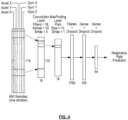
- a computer-implemented method for extracting a physiological signal from time-varying data comprising: receiving the time-varying data; segmenting the time-varying data into temporal windows; extracting a physiological signal for each temporal window using a Convolutional Neural Network (CNN), input to the CNN comprising the segmented time-varying data, the CNN trained using training time-varying data and known values of the physiological signal for the training time-varying data; and outputting the extracted physiological signal.
- CNN Convolutional Neural Network
- a system for extracting a physiological signal from time-varying data comprising one or more processors and a data storage, the one or more processors in communication with the data storage device and configured to execute: an interface module to receive the time-varying data and segment the time-varying data into temporal windows; and an extractor module to extract a physiological signal for each temporal window using a Convolutional Neural Network (CNN), input to the CNN comprising the segmented time-varying data, the CNN trained using training time-varying data and known values of the physiological signal for the training time-varying data, the interface module outputting the extracted physiological signal.
- CNN Convolutional Neural Network
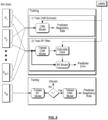
- a computer-implemented method for training two interoperable machine learning models using time-varying training data an extraction machine learning model predicting an outcome on the time-varying data and a filter machine learning model predicting an error of the outcome prediction of the extraction machine learning model, the time-varying training data comprising time-varying data with known outcomes
- the method comprising: training the extraction machine learning model comprising passing a majority portion of the training time-varying data through the extraction machine learning model with the known outcomes as labels for training; and training the filter machine learning model comprising: passing a minority portion of the training time-varying data through the extraction machine learning model to output predicted outcomes; determining an error for each predicted outcome compared to the known outcome; and passing the minority portion of the training time-varying data through the filter machine learning model with the determined errors as labels for training.
- the time-varying training data comprises time-varying data from a plurality of sources, and wherein the division of majority portion and minority portion applies to the time-varying training data from each of the plurality of sources.
- a portion of the training time-varying data that is separate from the majority portion and the minority portion is used for testing both the filter machine learning model and the extraction machine learning model.
- Any module, unit, component, server, computer, terminal, engine or device exemplified herein that executes instructions may include or otherwise have access to computer readable media such as storage media, computer storage media, or data storage devices (removable and/or non-removable) such as, for example, magnetic disks, optical disks, or tape.
- Computer storage media may include volatile and non-volatile, removable and non-removable media implemented in any method or technology for storage of information, such as computer readable instructions, data structures, program modules, or other data.
- the SleepMonitor extractor uses a total variational filter (TV filter) to remove both high and low-frequency noise. After noise removal, respiratory rate estimation is performed on each accelerometer axis using an FFT in a manner similar to BioWatch. However, unlike BioWatch which selects respiratory rate from a single axis, SleepMonitor merges the respiratory rate from all three axes using a Kalman filter.
- the filter to reject widows looks at the proportion of accelerometer readings in a window with a vector magnitude greater than 10m/s 2 .
- the threshold used in SleepMonitor is 5, so that any window where more than 5% of samples have a vector magnitude greater than 10m/s 2 is rejected
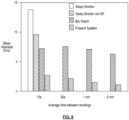
- the example experiments also controlled the frequency at which the approaches provided readings and compared their accuracy.
- BioWatch's default threshold value of 0.15 provides a reading on average every 50 seconds with a MAE of 7.49. If a threshold of 1.05 was set with the present embodiments, the same frequency was achieved and a MAE of 2.05 (3.7 times lower). Because SleepMonitor cannot provide a reading on average every 50 seconds, it was not included in the remaining analysis of the present embodiments.
- the MAE and frequency (% of windows accepted) for both the present embodiments and BioWatch were examined during various activities. The results are presented in TABLE 2. Regardless of activity, the present embodiments had a lower MAE than BioWatch. In some cases, BioWatch does accept more windows than the present embodiments.
- TABLE 2 also shows that BioWatch's performance on the COPD group is lower than on healthy participants; illustrating that for other approaches, systems developed on one population may not generalize to other populations.
- respiratory rate is particularly inaccurate (MAE 12.4) for participants with chronic lung disease when they are lying down. This may be because people with COPD have increased airway obstruction and reduced lung volume while lying down.
- the filter used by BioWatch summarizes the amount of motion in a window, it accepts quite a few windows while patients are lying down, which leads to large errors.
- the present embodiments were trained on participants with chronic lung disease and was able to better learn and recognize their breathing patterns.
- a Bland-Altman plot helps analyze agreement between two measurement methods. For each pair of measurements, it shows the mean of the two against the difference of the two.
- the Bland-Altman plot for the healthy group and the COPD group is shown in FIGS. 7A and 7B , respectively. For clarity, these graphs only plot a small random sample of data points, however the mean error, limits of agreement and best fit line were computed using all data points.
- a fixed bias of 0.19 breaths per minute, proportional bias of 0.02, and limits of agreement between -3.21 and 3.60 were observed.
- the filter module 290 can also be used with other physiological signal extraction approaches.
- the extraction machine learning model By training the extraction machine learning model to predict the error of, for example, the BioWatch and SleepMonitor approaches, the present inventors were able to use the filter module 290 to improve the performance of these approaches.
- a lower threshold may result in a lower MAE, but generally at the cost of the number of readings. It was observed that with the SleepMonitor filter, even with a threshold of 0, it did not discard 100% of the windows. This is because in each window, there was generally accelerometer readings where there are no forces acting on the smartwatch besides gravity; and therefore the vector magnitude is close to 9.8m/s 2 . In contrast, the filter module 290 incorporates a useful feature that filters should have, which is that they should allow selecting as much or as little data as desired. It was also observed how the threshold affects the respiratory rate extraction error applying each filter to each extractor.
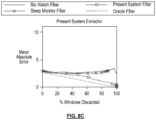
- the threshold for each filter was altered and how that affects the number of windows discarded and the mean absolute error when passing the accepted windows to the extractor were observed.
- the results for this analysis for BioWatch, SleepMonitor, and the present system are shown in FIGS. 8A, 8B , and 8C respectively.
- Simple filters are observed to have not smooth functions, which is not a desirable characteristic for tunability since they make it hard to predict how small changes affect accuracy.
- the spikes seen in these filters' curves can be attributed to the fact that values these filters are computing were not well-distributed across the threshold domain and there was no direct link between the threshold and filter value. This makes it so that a small change in the filter threshold does not necessarily result in a small change to the number of windows accepted by the filter.
- a good filter should be a smooth function that is capable of discarding anywhere from 0% to 100% of the windows.
- the filter module 290 advantageously meets both these requirements.
- This linear property allows the filter module 290 to be tweaked to the requirements of individual applications. For example, if one wanted to detect respiratory rate with a MAE of 2, they could set the threshold to 1, which would result in a reading roughly every 50 seconds. If one wanted higher accuracy, they could set the threshold to 0.5 which would give a MAE of 1.09 and a reading roughly every 5 minutes.
- the filter module 290 has a MAE of 3.48 for the BioWatch extractor and 4.57 for the SleepMonitor extractor.
Landscapes
- Health & Medical Sciences (AREA)
- Engineering & Computer Science (AREA)
- Life Sciences & Earth Sciences (AREA)
- Physics & Mathematics (AREA)
- Biomedical Technology (AREA)
- General Health & Medical Sciences (AREA)
- Molecular Biology (AREA)
- Biophysics (AREA)
- Public Health (AREA)
- Medical Informatics (AREA)
- Pathology (AREA)
- Artificial Intelligence (AREA)
- Surgery (AREA)
- Animal Behavior & Ethology (AREA)
- Heart & Thoracic Surgery (AREA)
- Veterinary Medicine (AREA)
- Physiology (AREA)
- Theoretical Computer Science (AREA)
- Signal Processing (AREA)
- Data Mining & Analysis (AREA)
- Computer Vision & Pattern Recognition (AREA)
- Psychiatry (AREA)
- Mathematical Physics (AREA)
- Evolutionary Computation (AREA)
- Software Systems (AREA)
- General Physics & Mathematics (AREA)
- General Engineering & Computer Science (AREA)
- Computing Systems (AREA)
- Computational Linguistics (AREA)
- Databases & Information Systems (AREA)
- Epidemiology (AREA)
- Primary Health Care (AREA)
- Pulmonology (AREA)
- Cardiology (AREA)
- Fuzzy Systems (AREA)
- Dentistry (AREA)
- Oral & Maxillofacial Surgery (AREA)
- Measurement Of The Respiration, Hearing Ability, Form, And Blood Characteristics Of Living Organisms (AREA)
- Measuring And Recording Apparatus For Diagnosis (AREA)
Claims (13)
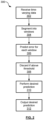
- Computerimplementiertes Verfahren (300) zum Filtern kontinuierlicher zeitvariabler Sensordaten zur Vorhersage physiologischer Signale, das Verfahren umfassend:Empfangen der mindestens teilweise mit einem physiologischen Signal korrelierten, kontinuierlichen zeitvariablen Sensordaten (302);Segmentieren der kontinuierlichen zeitvariablen Sensordaten in zeitliche Fenster (304);Verwenden eines trainierten Filtermaschinenlernmodells, das einen Fehler von Vorhersagen des physiologischen Signals für jedes zeitliche Fenster der zeitvariablen Daten (306) vorhersagt, wobei das trainierte Filtermaschinenlernmodell Vorhersagen physiologischer Signale basierend auf kontinuierlichen zeitvariablen Trainingssensordaten und bekannten Werten des physiologischen Signals für die kontinuierlichen zeitvariablen Trainingssensordaten verwendet;Verwerfen jedes Fensters von zeitvariablen Sensordaten, wenn der vorhergesagte Fehler für ein solches Fenster größer als ein Schwellenwert (308) ist; undwenn das Fenster von zeitvariablen Sensordaten nicht verworfen wird, Verwenden eines Extraktionsmaschinenlernmodells, das eine Vorhersage physiologischer Signale für jedes zeitliche Fenster der zeitvariablen Sensordaten (310) bestimmt, wobei das Extraktionsmaschinenlernmodell unter Verwendung einer Trainingsmenge von kontinuierlichen zeitvariablen Sensordaten und bekannter Werte des physiologischen Signals für die Trainingsmenge von kontinuierlichen zeitvariablen Daten trainiert wurde, und Ausgeben der Vorhersage physiologischer Signale (312).
- Verfahren nach Anspruch 1, wobei der Schwellenwert durch einen Nutzer einstellbar ist.
- Verfahren nach Anspruch 1, wobei eine Eingabe in das Filtermaschinenlernmodell eine oder mehrere aggregierte Messgrößen der zeitvariablen Daten umfasst.
- Verfahren nach Anspruch 1, wobei der für das Trainieren des Extraktionsmaschinenlernmodells verwendete Anteil an zeitvariablen Trainingsdaten unterschiedlich von dem Anteil an zeitvariablen Trainingsdaten ist, der verwendet wird, um Vorhersagen durch das Extraktionsmaschinenlernmodell für das Trainieren des Filtermaschinenlernmodels vorzunehmen.
- Verfahren nach Anspruch 4, wobei der für das Trainieren des Extraktionsmaschinenlernmodells verwendete Anteil an zeitvariablen Trainingsdaten unkontrollierte Daten umfasst, die gesammelt wurden, während ein Teilnehmer eine nicht beschriebene Aktivität ausführte.
- Verfahren nach Anspruch 1, wobei das physiologische Signal die Atemfrequenz umfasst und die zeitvariablen Daten kontinuierliche Bewegungssensordaten von einem oder mehreren Bewegungssensor(en) umfassen.
- Verfahren nach Anspruch 6, wobei die kontinuierlichen Bewegungssensordaten von mindestens einem von einem Akzelerometer, einem Magnetometer und einem Gyroskop empfangen werden.
- System zum Filtern zeitvariabler Sensordaten zur Vorhersage physiologischer Signale (200), das System umfassend einen oder mehrere Prozessor(en) (260) und eine Datenspeichervorrichtung (264, 280), wobei der eine oder die mehreren Prozessor(en) in Kommunikation mit der Datenspeichervorrichtung steht/en und konfiguriert ist/sind, auszuführen,dass ein Schnittstellenmodul (268), die zeitvariablen Sensordaten, die mindestens teilweise mit einem physiologischen Signal korreliert sind, empfängt und die zeitvariablen Sensordaten in zeitliche Fenster segmentiert;dass ein Filtermodul (290)unter Verwendung eines trainierten Filtermaschinenlernmodells einen Fehler von Vorhersagen des physiologischen Signals durch ein trainiertes Extraktionsmaschinenlernmodell für jedes zeitliche Fenster der zeitvariablen Sensordaten vorhersagt, wobei das Filtermaschinenlernmodell unter Verwendung von Vorhersagen physiologischer Signale basierend auf zeitvariablen Trainingsensorsdaten und bekannten Werten des physiologischen Signals für die zeitvariablen Trainingssensordaten trainiert wurde;das Fenster von zeitvariablen Sensordaten, wenn der vorhergesagte Fehler für solch ein Fenster größer ist als ein Schwellenwert, verwirft; unddass ein Extraktormodul (292),wenn das Fenster von zeitvariablen Sensordaten nicht verworfen wird, das Extraktionsmaschinenlernmodell verwendet, um eine Vorhersage physiologischer Signale für jedes zeitliche Fenster der zeitvariablen Sensordaten zu bestimmen, wobei das Extraktionsmaschinenlernmodell unter Verwendung einer Trainingsmenge von kontinuierlichen zeitvariablen Sensordaten und bekannter Daten des physiologischen Signals für die Trainingsmenge von kontinuierlichen zeitvariablen Sensordaten trainiert wurde;die Vorhersage physiologischer Signale ausgibt.
- System nach Anspruch 8, wobei der Schwellenwert durch einen Nutzer über eine Eingabe in das Schnittstellenmodul einstellbar ist.
- System nach Anspruch 8, wobei die Eingabe in das Filtermaschinenlernmodell eine oder mehrere aggregierte Messgrößen der zeitvariablen Daten umfasst.
- System nach Anspruch 10, wobei der für das Trainieren des Extraktionsmaschinenlernmodells verwendete Anteil an zeitvariablen Trainingsdaten unterschiedlich von dem Anteil an zeitvariablen Trainingsdaten ist, der verwendet wird, um Vorhersagen durch das Extraktionsmaschinenlernmodell für das Trainieren des Filtermaschinenlernmodels vorzunehmen.
- System nach Anspruch 8, wobei das physiologische Signal die Atemfrequenz umfasst und die zeitvariablen Daten kontinuierliche Bewegungssensordaten von einem oder mehreren Bewegungssensor(en) umfassen.
- System nach Anspruch 12, wobei die kontinuierlichen Bewegungssensordaten von mindestens einem von einem Akzelerometer, einem Magnetometer und einem Gyroskop empfangen werden.
Applications Claiming Priority (3)
| Application Number | Priority Date | Filing Date | Title |
|---|---|---|---|
| US201962855258P | 2019-05-31 | 2019-05-31 | |
| GB201913131A GB201913131D0 (en) | 2019-05-31 | 2019-09-12 | System and method for filtering time-varying data for physiological signal prediction |
| PCT/CA2020/050718 WO2020237371A1 (en) | 2019-05-31 | 2020-05-27 | System and method for filtering time-varying data for physiological signal prediction |
Publications (3)
| Publication Number | Publication Date |
|---|---|
| EP3977482A1 EP3977482A1 (de) | 2022-04-06 |
| EP3977482A4 EP3977482A4 (de) | 2023-06-21 |
| EP3977482B1 true EP3977482B1 (de) | 2025-07-02 |
Family
ID=68315368
Family Applications (1)
| Application Number | Title | Priority Date | Filing Date |
|---|---|---|---|
| EP20813874.3A Active EP3977482B1 (de) | 2019-05-31 | 2020-05-27 | System und verfahren zur filterung zeitvariierender daten zur vorhersage physiologischer signale |
Country Status (5)
| Country | Link |
|---|---|
| US (1) | US20230263400A1 (de) |
| EP (1) | EP3977482B1 (de) |
| CA (1) | CA3139034A1 (de) |
| GB (1) | GB201913131D0 (de) |
| WO (1) | WO2020237371A1 (de) |
Families Citing this family (3)
| Publication number | Priority date | Publication date | Assignee | Title |
|---|---|---|---|---|
| CN116235148A (zh) * | 2021-09-24 | 2023-06-06 | 京东方科技集团股份有限公司 | 干泵宕机的预警方法、装置、电子设备、存储介质及程序 |
| CN116610535B (zh) * | 2023-07-20 | 2023-09-22 | 中国科学院东北地理与农业生态研究所 | 一种机房运维监控数据处理方法及系统 |
| CN119577425B (zh) * | 2024-11-14 | 2025-11-04 | 合肥工业大学 | 基于时变-时不变特征提取的供水管网流量预测方法 |
Family Cites Families (6)
| Publication number | Priority date | Publication date | Assignee | Title |
|---|---|---|---|---|
| JP2002514452A (ja) * | 1998-05-13 | 2002-05-21 | シグナス, インコーポレイテッド | 生理学的検体の測定のための信号処理 |
| BR112013022900A2 (pt) * | 2011-03-11 | 2017-11-14 | Koninklijke Philips Nv | aparelho, método e programa de computador de monitoramento para monitorar sinais fisiológicos |
| US10614364B2 (en) * | 2015-09-16 | 2020-04-07 | Microsoft Technology Licensing, Llc | Localized anomaly detection using contextual signals |
| EP3379998A4 (de) * | 2015-11-23 | 2019-07-31 | Mayo Foundation for Medical Education and Research | Verarbeitung physiologischer elektrischer daten für analytische beurteilungen |
| WO2018148690A1 (en) * | 2017-02-10 | 2018-08-16 | Alivecor, Inc. | Systems and methods of analyte measurement analysis |
| WO2019079503A2 (en) * | 2017-10-17 | 2019-04-25 | Whoop, Inc. | DATA QUALITY METRICS APPLIED FOR PHYSIOLOGICAL MEASUREMENTS |
-
2019
- 2019-09-12 GB GB201913131A patent/GB201913131D0/en not_active Ceased
-
2020
- 2020-05-27 US US17/456,001 patent/US20230263400A1/en active Pending
- 2020-05-27 EP EP20813874.3A patent/EP3977482B1/de active Active
- 2020-05-27 WO PCT/CA2020/050718 patent/WO2020237371A1/en not_active Ceased
- 2020-09-30 CA CA3139034A patent/CA3139034A1/en active Pending
Also Published As
| Publication number | Publication date |
|---|---|
| GB201913131D0 (en) | 2019-10-30 |
| US20230263400A1 (en) | 2023-08-24 |
| WO2020237371A1 (en) | 2020-12-03 |
| EP3977482A1 (de) | 2022-04-06 |
| EP3977482A4 (de) | 2023-06-21 |
| CA3139034A1 (en) | 2020-12-03 |
Similar Documents
| Publication | Publication Date | Title |
|---|---|---|
| Liaqat et al. | WearBreathing: Real world respiratory rate monitoring using smartwatches | |
| Tazarv et al. | A deep learning approach to predict blood pressure from ppg signals | |
| KR102220228B1 (ko) | 자율신경 균형에 기반한 스트레스 검출 | |
| US8478542B2 (en) | Non-parametric modeling apparatus and method for classification, especially of activity state | |
| JP2025016623A (ja) | 睡眠段階検出のための方法、コンピューティングデバイス、およびウェアラブルデバイス | |
| Shin | Deep convolutional neural network-based signal quality assessment for photoplethysmogram | |
| US20230233123A1 (en) | Systems and methods to detect and characterize stress using physiological sensors | |
| US12165052B2 (en) | Interpretable neural networks for cuffless blood pressure estimation | |
| EP3977482B1 (de) | System und verfahren zur filterung zeitvariierender daten zur vorhersage physiologischer signale | |
| Banfi et al. | Efficient embedded sleep wake classification for open-source actigraphy | |
| Altini et al. | Cardiorespiratory fitness estimation using wearable sensors: Laboratory and free-living analysis of context-specific submaximal heart rates | |
| Premalatha et al. | Design and implementation of intelligent patient in-house monitoring system based on efficient XGBoost-CNN approach | |
| US11813077B2 (en) | Arrhythmic heartbeat resilient sleep apnea detection | |
| US20250302378A1 (en) | Method for monitoring the sleep of a user, and corresponding monitoring device and computer program | |
| Slapnicar et al. | Contact-free monitoring of physiological parameters in people with profound intellectual and multiple disabilities | |
| US20240206822A1 (en) | Computer implemented method for adaptive physiology-based monitoring of a subject | |
| Bui et al. | Smart health monitoring wearable with integrated sensors, machine learning, and IoT | |
| JP2024044993A (ja) | 信号処理装置、信号処理方法、プログラム、および学習装置 | |
| Locharla et al. | EEG-based deep learning neural net for apnea detection | |
| Khandoker et al. | Modeling respiratory movement signals during central and obstructive sleep apnea events using electrocardiogram | |
| Ferretti et al. | INCLASS: incremental classification strategy for self-aware epileptic seizure detection | |
| Venkatakiran et al. | Real-Time Health Data Analytics in IoT-Connected Wearable Devices | |
| Rakesh et al. | AI-Driven Sleep Health Recommendations Using Deep Learning for Personalized Medicine | |
| US20250009307A1 (en) | Denoising encoder-decoder neural network for pain recognition and other diagnostic applications | |
| Salem et al. | Pervasive detection of sleep apnea using medical wireless sensor networks |
Legal Events
| Date | Code | Title | Description |
|---|---|---|---|
| STAA | Information on the status of an ep patent application or granted ep patent |
Free format text: STATUS: THE INTERNATIONAL PUBLICATION HAS BEEN MADE |
|
| PUAI | Public reference made under article 153(3) epc to a published international application that has entered the european phase |
Free format text: ORIGINAL CODE: 0009012 |
|
| STAA | Information on the status of an ep patent application or granted ep patent |
Free format text: STATUS: REQUEST FOR EXAMINATION WAS MADE |
|
| 17P | Request for examination filed |
Effective date: 20211126 |
|
| AK | Designated contracting states |
Kind code of ref document: A1 Designated state(s): AL AT BE BG CH CY CZ DE DK EE ES FI FR GB GR HR HU IE IS IT LI LT LU LV MC MK MT NL NO PL PT RO RS SE SI SK SM TR |
|
| DAV | Request for validation of the european patent (deleted) | ||
| DAX | Request for extension of the european patent (deleted) | ||
| A4 | Supplementary search report drawn up and despatched |
Effective date: 20230522 |
|
| RIC1 | Information provided on ipc code assigned before grant |
Ipc: G06N 3/045 20230101ALI20230515BHEP Ipc: A61B 5/113 20060101ALI20230515BHEP Ipc: A61B 5/08 20060101ALI20230515BHEP Ipc: A61B 5/00 20060101ALI20230515BHEP Ipc: G16H 50/20 20180101ALI20230515BHEP Ipc: G06N 3/08 20060101ALI20230515BHEP Ipc: G06N 3/02 20060101ALI20230515BHEP Ipc: G06N 20/00 20190101ALI20230515BHEP Ipc: G16H 50/30 20180101AFI20230515BHEP |
|
| GRAP | Despatch of communication of intention to grant a patent |
Free format text: ORIGINAL CODE: EPIDOSNIGR1 |
|
| STAA | Information on the status of an ep patent application or granted ep patent |
Free format text: STATUS: GRANT OF PATENT IS INTENDED |
|
| INTG | Intention to grant announced |
Effective date: 20250214 |
|
| RIN1 | Information on inventor provided before grant (corrected) |
Inventor name: WU, ROBERT Inventor name: GERSHON, ANDREA Inventor name: RUDZICZ, FRANK Inventor name: DE LARA, EYAL Inventor name: ABDALLA, MOHAMED Inventor name: LIAQAT, DANIYAL |
|
| GRAS | Grant fee paid |
Free format text: ORIGINAL CODE: EPIDOSNIGR3 |
|
| GRAA | (expected) grant |
Free format text: ORIGINAL CODE: 0009210 |
|
| STAA | Information on the status of an ep patent application or granted ep patent |
Free format text: STATUS: THE PATENT HAS BEEN GRANTED |
|
| AK | Designated contracting states |
Kind code of ref document: B1 Designated state(s): AL AT BE BG CH CY CZ DE DK EE ES FI FR GB GR HR HU IE IS IT LI LT LU LV MC MK MT NL NO PL PT RO RS SE SI SK SM TR |
|
| REG | Reference to a national code |
Ref country code: GB Ref legal event code: FG4D |
|
| REG | Reference to a national code |
Ref country code: CH Ref legal event code: EP |
|
| REG | Reference to a national code |
Ref country code: DE Ref legal event code: R096 Ref document number: 602020053920 Country of ref document: DE |
|
| REG | Reference to a national code |
Ref country code: IE Ref legal event code: FG4D |
|
| REG | Reference to a national code |
Ref country code: NL Ref legal event code: MP Effective date: 20250702 |