EP3976474B1 - Engin comprenant un groupe motopropulseur hybride et procédé de pilotage correspondant - Google Patents
Engin comprenant un groupe motopropulseur hybride et procédé de pilotage correspondant Download PDFInfo
- Publication number
- EP3976474B1 EP3976474B1 EP20743189.1A EP20743189A EP3976474B1 EP 3976474 B1 EP3976474 B1 EP 3976474B1 EP 20743189 A EP20743189 A EP 20743189A EP 3976474 B1 EP3976474 B1 EP 3976474B1
- Authority
- EP
- European Patent Office
- Prior art keywords
- drive system
- thermal
- electric
- machine
- electric drive
- Prior art date
- Legal status (The legal status is an assumption and is not a legal conclusion. Google has not performed a legal analysis and makes no representation as to the accuracy of the status listed.)
- Active
Links
Images


Classifications
-
- B—PERFORMING OPERATIONS; TRANSPORTING
- B64—AIRCRAFT; AVIATION; COSMONAUTICS
- B64D—EQUIPMENT FOR FITTING IN OR TO AIRCRAFT; FLIGHT SUITS; PARACHUTES; ARRANGEMENT OR MOUNTING OF POWER PLANTS OR PROPULSION TRANSMISSIONS IN AIRCRAFT
- B64D27/00—Arrangement or mounting of power plants in aircraft; Aircraft characterised by the type or position of power plants
- B64D27/02—Aircraft characterised by the type or position of power plants
-
- B—PERFORMING OPERATIONS; TRANSPORTING
- B64—AIRCRAFT; AVIATION; COSMONAUTICS
- B64U—UNMANNED AERIAL VEHICLES [UAV]; EQUIPMENT THEREFOR
- B64U50/00—Propulsion; Power supply
- B64U50/10—Propulsion
- B64U50/11—Propulsion using internal combustion piston engines
-
- B—PERFORMING OPERATIONS; TRANSPORTING
- B64—AIRCRAFT; AVIATION; COSMONAUTICS
- B64D—EQUIPMENT FOR FITTING IN OR TO AIRCRAFT; FLIGHT SUITS; PARACHUTES; ARRANGEMENT OR MOUNTING OF POWER PLANTS OR PROPULSION TRANSMISSIONS IN AIRCRAFT
- B64D27/00—Arrangement or mounting of power plants in aircraft; Aircraft characterised by the type or position of power plants
- B64D27/02—Aircraft characterised by the type or position of power plants
- B64D27/30—Aircraft characterised by electric power plants
- B64D27/33—Hybrid electric aircraft
-
- B—PERFORMING OPERATIONS; TRANSPORTING
- B60—VEHICLES IN GENERAL
- B60L—PROPULSION OF ELECTRICALLY-PROPELLED VEHICLES; SUPPLYING ELECTRIC POWER FOR AUXILIARY EQUIPMENT OF ELECTRICALLY-PROPELLED VEHICLES; ELECTRODYNAMIC BRAKE SYSTEMS FOR VEHICLES IN GENERAL; MAGNETIC SUSPENSION OR LEVITATION FOR VEHICLES; MONITORING OPERATING VARIABLES OF ELECTRICALLY-PROPELLED VEHICLES; ELECTRIC SAFETY DEVICES FOR ELECTRICALLY-PROPELLED VEHICLES
- B60L50/00—Electric propulsion with power supplied within the vehicle
- B60L50/50—Electric propulsion with power supplied within the vehicle using propulsion power supplied by batteries or fuel cells
- B60L50/60—Electric propulsion with power supplied within the vehicle using propulsion power supplied by batteries or fuel cells using power supplied by batteries
-
- B—PERFORMING OPERATIONS; TRANSPORTING
- B64—AIRCRAFT; AVIATION; COSMONAUTICS
- B64C—AEROPLANES; HELICOPTERS
- B64C27/00—Rotorcraft; Rotors peculiar thereto
- B64C27/04—Helicopters
- B64C27/12—Rotor drives
-
- B—PERFORMING OPERATIONS; TRANSPORTING
- B64—AIRCRAFT; AVIATION; COSMONAUTICS
- B64D—EQUIPMENT FOR FITTING IN OR TO AIRCRAFT; FLIGHT SUITS; PARACHUTES; ARRANGEMENT OR MOUNTING OF POWER PLANTS OR PROPULSION TRANSMISSIONS IN AIRCRAFT
- B64D27/00—Arrangement or mounting of power plants in aircraft; Aircraft characterised by the type or position of power plants
- B64D27/02—Aircraft characterised by the type or position of power plants
- B64D27/24—Aircraft characterised by the type or position of power plants using steam or spring force
-
- B—PERFORMING OPERATIONS; TRANSPORTING
- B64—AIRCRAFT; AVIATION; COSMONAUTICS
- B64D—EQUIPMENT FOR FITTING IN OR TO AIRCRAFT; FLIGHT SUITS; PARACHUTES; ARRANGEMENT OR MOUNTING OF POWER PLANTS OR PROPULSION TRANSMISSIONS IN AIRCRAFT
- B64D27/00—Arrangement or mounting of power plants in aircraft; Aircraft characterised by the type or position of power plants
- B64D27/02—Aircraft characterised by the type or position of power plants
- B64D27/30—Aircraft characterised by electric power plants
- B64D27/35—Arrangements for on-board electric energy production, distribution, recovery or storage
- B64D27/357—Arrangements for on-board electric energy production, distribution, recovery or storage using batteries
-
- B—PERFORMING OPERATIONS; TRANSPORTING
- B64—AIRCRAFT; AVIATION; COSMONAUTICS
- B64D—EQUIPMENT FOR FITTING IN OR TO AIRCRAFT; FLIGHT SUITS; PARACHUTES; ARRANGEMENT OR MOUNTING OF POWER PLANTS OR PROPULSION TRANSMISSIONS IN AIRCRAFT
- B64D31/00—Power plant control systems; Arrangement of power plant control systems in aircraft
- B64D31/16—Power plant control systems; Arrangement of power plant control systems in aircraft for electric power plants
- B64D31/18—Power plant control systems; Arrangement of power plant control systems in aircraft for electric power plants for hybrid-electric power plants
-
- B—PERFORMING OPERATIONS; TRANSPORTING
- B64—AIRCRAFT; AVIATION; COSMONAUTICS
- B64D—EQUIPMENT FOR FITTING IN OR TO AIRCRAFT; FLIGHT SUITS; PARACHUTES; ARRANGEMENT OR MOUNTING OF POWER PLANTS OR PROPULSION TRANSMISSIONS IN AIRCRAFT
- B64D33/00—Arrangement in aircraft of power plant parts or auxiliaries not otherwise provided for
- B64D33/08—Arrangement in aircraft of power plant parts or auxiliaries not otherwise provided for of power plant cooling systems
-
- B—PERFORMING OPERATIONS; TRANSPORTING
- B64—AIRCRAFT; AVIATION; COSMONAUTICS
- B64D—EQUIPMENT FOR FITTING IN OR TO AIRCRAFT; FLIGHT SUITS; PARACHUTES; ARRANGEMENT OR MOUNTING OF POWER PLANTS OR PROPULSION TRANSMISSIONS IN AIRCRAFT
- B64D35/00—Transmitting power from power plants to propellers or rotors; Arrangements of transmissions
- B64D35/02—Transmitting power from power plants to propellers or rotors; Arrangements of transmissions specially adapted for specific power plants
- B64D35/021—Transmitting power from power plants to propellers or rotors; Arrangements of transmissions specially adapted for specific power plants for electric power plants
- B64D35/022—Transmitting power from power plants to propellers or rotors; Arrangements of transmissions specially adapted for specific power plants for electric power plants of hybrid-electric type
- B64D35/023—Transmitting power from power plants to propellers or rotors; Arrangements of transmissions specially adapted for specific power plants for electric power plants of hybrid-electric type of series-parallel type
-
- B—PERFORMING OPERATIONS; TRANSPORTING
- B64—AIRCRAFT; AVIATION; COSMONAUTICS
- B64D—EQUIPMENT FOR FITTING IN OR TO AIRCRAFT; FLIGHT SUITS; PARACHUTES; ARRANGEMENT OR MOUNTING OF POWER PLANTS OR PROPULSION TRANSMISSIONS IN AIRCRAFT
- B64D35/00—Transmitting power from power plants to propellers or rotors; Arrangements of transmissions
- B64D35/02—Transmitting power from power plants to propellers or rotors; Arrangements of transmissions specially adapted for specific power plants
- B64D35/021—Transmitting power from power plants to propellers or rotors; Arrangements of transmissions specially adapted for specific power plants for electric power plants
- B64D35/022—Transmitting power from power plants to propellers or rotors; Arrangements of transmissions specially adapted for specific power plants for electric power plants of hybrid-electric type
- B64D35/024—Transmitting power from power plants to propellers or rotors; Arrangements of transmissions specially adapted for specific power plants for electric power plants of hybrid-electric type of series type
-
- B—PERFORMING OPERATIONS; TRANSPORTING
- B64—AIRCRAFT; AVIATION; COSMONAUTICS
- B64D—EQUIPMENT FOR FITTING IN OR TO AIRCRAFT; FLIGHT SUITS; PARACHUTES; ARRANGEMENT OR MOUNTING OF POWER PLANTS OR PROPULSION TRANSMISSIONS IN AIRCRAFT
- B64D35/00—Transmitting power from power plants to propellers or rotors; Arrangements of transmissions
- B64D35/02—Transmitting power from power plants to propellers or rotors; Arrangements of transmissions specially adapted for specific power plants
- B64D35/021—Transmitting power from power plants to propellers or rotors; Arrangements of transmissions specially adapted for specific power plants for electric power plants
- B64D35/022—Transmitting power from power plants to propellers or rotors; Arrangements of transmissions specially adapted for specific power plants for electric power plants of hybrid-electric type
- B64D35/025—Transmitting power from power plants to propellers or rotors; Arrangements of transmissions specially adapted for specific power plants for electric power plants of hybrid-electric type of parallel type
-
- B—PERFORMING OPERATIONS; TRANSPORTING
- B64—AIRCRAFT; AVIATION; COSMONAUTICS
- B64U—UNMANNED AERIAL VEHICLES [UAV]; EQUIPMENT THEREFOR
- B64U50/00—Propulsion; Power supply
- B64U50/10—Propulsion
- B64U50/19—Propulsion using electrically powered motors
-
- B—PERFORMING OPERATIONS; TRANSPORTING
- B60—VEHICLES IN GENERAL
- B60L—PROPULSION OF ELECTRICALLY-PROPELLED VEHICLES; SUPPLYING ELECTRIC POWER FOR AUXILIARY EQUIPMENT OF ELECTRICALLY-PROPELLED VEHICLES; ELECTRODYNAMIC BRAKE SYSTEMS FOR VEHICLES IN GENERAL; MAGNETIC SUSPENSION OR LEVITATION FOR VEHICLES; MONITORING OPERATING VARIABLES OF ELECTRICALLY-PROPELLED VEHICLES; ELECTRIC SAFETY DEVICES FOR ELECTRICALLY-PROPELLED VEHICLES
- B60L2200/00—Type of vehicles
- B60L2200/10—Air crafts
-
- B—PERFORMING OPERATIONS; TRANSPORTING
- B64—AIRCRAFT; AVIATION; COSMONAUTICS
- B64D—EQUIPMENT FOR FITTING IN OR TO AIRCRAFT; FLIGHT SUITS; PARACHUTES; ARRANGEMENT OR MOUNTING OF POWER PLANTS OR PROPULSION TRANSMISSIONS IN AIRCRAFT
- B64D27/00—Arrangement or mounting of power plants in aircraft; Aircraft characterised by the type or position of power plants
- B64D27/02—Aircraft characterised by the type or position of power plants
- B64D27/026—Aircraft characterised by the type or position of power plants comprising different types of power plants, e.g. combination of a piston engine and a gas-turbine
-
- Y—GENERAL TAGGING OF NEW TECHNOLOGICAL DEVELOPMENTS; GENERAL TAGGING OF CROSS-SECTIONAL TECHNOLOGIES SPANNING OVER SEVERAL SECTIONS OF THE IPC; TECHNICAL SUBJECTS COVERED BY FORMER USPC CROSS-REFERENCE ART COLLECTIONS [XRACs] AND DIGESTS
- Y02—TECHNOLOGIES OR APPLICATIONS FOR MITIGATION OR ADAPTATION AGAINST CLIMATE CHANGE
- Y02T—CLIMATE CHANGE MITIGATION TECHNOLOGIES RELATED TO TRANSPORTATION
- Y02T50/00—Aeronautics or air transport
- Y02T50/60—Efficient propulsion technologies, e.g. for aircraft
Definitions
- the present invention generally relates to a machine, such as an aircraft, equipped with a powertrain comprising a thermal engine and an electric engine.
- the powertrain includes a blade propulsion system, an electric motor, a battery for powering the electric motor, and a heat engine associated with an alternator for recharging the battery.
- the document US2016083104 A1 describes an aircraft comprising a thermal engine and an electric engine arranged in parallel with the thermal engine to provide additional power for driving a rotor of the aircraft in addition to the power provided by the thermal engine.
- the document FR3039614A1 describes a hybrid power plant for a rotary wing aircraft comprising two turboshaft engines and at least one electric machine.
- the document US2014283519A1 deals with a hybrid aircraft consisting of two combustion engines coupled to a rotor via a transmission housing and an electric machine which is also coupled to the rotor via the transmission housing.
- the document US2012025032A1 describes a helicopter comprising a propulsion system of a rotor associated with a main motor and an electric machine.
- the document US2009145998A1 describes a helicopter that includes a gas turbine engine mechanically coupled to an electric motor, associated with a battery pack, to drive a rotor.
- the aim of the present invention is to propose a new device making it possible to overcome all or part of the problems set out above.
- the invention relates to a machine, such as an aircraft, equipped with a power unit, according to claim 1.
- Such a hybrid powertrain configuration that includes two thermal engines that can be disengaged from each other makes it possible to ensure safe piloting of the aircraft when one of the thermal engines is defective. Such a configuration is particularly useful when the aircraft is a helicopter.
- the propeller propulsion system of the machine can thus be driven independently or simultaneously, by the electric motor and/or by the thermal motor, part or all of which can be used.
- the device may also include one or more of the following characteristics taken in any technically admissible combination.
- said machine comprises a control unit for the clutch system of the thermal engine and the power supply system of the electric engine, the control unit being configured to allow the two thermal engines to be engaged to transmit the rotational movement of the thermal engine to the blade propulsion system via the electric engine, without consuming or recharging the electric battery.
- the bladed propulsion system comprises two bladed rotors which each comprise a vertical rotating shaft provided with blades, said rotors being configured to, in the driven state in rotation, rotate in opposite directions to each other.
- the machine comprising an output shaft of the thermal engine, the clutch system of the thermal engine is interposed between the output shafts of the thermal engines and a motion transmission system configured to transmit the rotational motion of one or each of said thermal engines to said output shaft of the thermal engine.
- the powertrain comprises a speed reduction system, preferably comprising a gear train, located between the output shaft of the thermal motor and the input of the electric motor.
- the machine comprising an output shaft of the electric motor
- the powertrain comprises a transmission system arranged at the output of the electric motor and configured to transmit the rotational movement of the electric motor to said output shaft of the electric motor.
- the machine comprising an output shaft of the electric motor and an input shaft of the blade propulsion system
- the powertrain comprises a speed reduction system, preferably an epicyclic gear train, between said output shaft of the electric motor and said input shaft of the blade propulsion system.
- the input shaft of the blade propulsion system is provided with a conical reduction device.
- the electric motor has several, preferably three, electric motors, preferably distributed regularly around a central axis.
- each electric motor comprises a clutch release system, for example by disengaging, making it possible, for example in the event of a breakdown of said electric motor, to mechanically isolate said electric motor from the other electric motor(s).
- the power of each thermal engine is of the order of 150 kW
- the power of the electric motor is of the order of 180 kW, with preferably 60 kW per electric motor of the electric motor.
- the machine comprises a control unit for the clutch system of the thermal engine and the power supply system of the electric engine, the control unit being configured to enable the two thermal engines to be engaged and the electric engine to be powered to drive the blade propulsion system using the combination of the two thermal engines and the electric engine.
- the machine comprises a control unit for the clutch system of the thermal engine and the power supply system of the electric engine, the control unit being configured to allow the two heat engines to be engaged to drive the electric motor, so as to, on the one hand, transmit, via the electric motor, the rotational movement of the heat engine to the blade propulsion system, while recharging the battery of the electric power supply system.
- the different operating modes permitted by the control unit presented above are selectable in relation to each other.
- the machine comprises a casing in which the electric motor is housed and in which openings and/or cavities are provided for cooling the electric motor, said powertrain preferably comprising a water cooling system for cooling the thermal engines.
- the invention also relates to a method for controlling a machine as described above which comprises the disengagement or engagement of one or each of the thermal engines relative to the blade propulsion system, and/or the control of the power supply system of the electric motor to power the electric motor or recharge the battery.
- an embodiment means that a particular feature, structure, or characteristic described in connection with an embodiment is included in at least one embodiment of the present invention.
- the occurrence of the phrase “in an embodiment” at various locations throughout the specification does not necessarily refer to the same embodiment.
- the particular features, structures, or characteristics may be combined in any suitable manner in one or more embodiments.
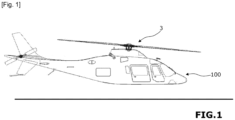
- FIG. 1 we have illustrated a machine which is a helicopter 100 equipped with a power unit.
- the craft may be an aircraft of another type, such as an airplane or a drone.
- the craft may also be a watercraft.
- the helicopter powerplant includes a 3-blade propulsion system that includes two counter-rotating rotors 31, 32. Alternatively, a single rotor may be provided.
- the helicopter may also include an anti-torque rotor or other anti-torque device which may be driven by said power unit or by an independent engine.
- the anti-torque device is not necessary when the craft includes two counter-rotating rotors.
- the blade propulsion system of the craft may include one or more propellers for an airplane or a boat.
- the powertrain comprises a thermal engine 1 configured to enable the propulsion system 3 with blades to be driven as detailed below.
- the thermal engine 1 includes a first thermal engine 1A and a second thermal engine 1B. Each of the first and second thermal engines comprises an output shaft.
- the power of each thermal engine 1A, 1B is for example 150 kW.
- Said powertrain preferably comprises a water cooling system for cooling the heat engines 1A, 1B.
- the powertrain comprises a clutch system 10 which makes it possible to engage any or all of the heat engines 1A, 1B to drive the bladed propulsion system 3.
- the clutch system 10 comprises a clutch 10A and a clutch 10B that can be selectively controlled to enable the first heat engine 1A to be engaged, and/or the second heat engine 1B to be engaged relative to the motion transmission chain between the heat engine 1 and the blade propulsion system 3.
- the clutch system 10 is also configured to allow any or each of the heat engines 1A, 1B to be disengaged relative to the bladed propulsion system 3.
- disengaged with respect to the 3-blade propulsion system means that the thermal engine 1 is decoupled from the force or movement transmission chain which extends between the thermal engine 1 and the 3-blade propulsion system.
- the clutch system 10 of the thermal engine 1 is interposed between the output shafts of the thermal engines 1A, 1B and a motion transmission system 12.
- the motion transmission system 12 is configured to transmit the rotational motion of one or each of said heat engines to a shaft 13, called the output shaft of the heat engine 1.
- the system 12 comprises, for example, a set of gears, or a set of wheel and belt or chain.
- the output shaft 13 is coupled or coupleable to the bladed propulsion system 3 via a motion transmission mechanism presented below.
- the transmission mechanism comprises a speed reduction system which comprises a gear train 21 located between the output shaft 13 of the thermal motor 1 and the input of the electric motor 2.
- the gear train comprises an input shaft 13 and satellites carried by the input shafts of the electric motor 2.
- the transmission mechanism also comprises a transmission system 23 arranged at the output of the electric motor 2 and configured to transmit the rotational movement of the electric motor 2 (which comprises several electric motors in the example illustrated in the figures) to a shaft, called the output shaft 26 of the electric motor.
- a transmission system 23 arranged at the output of the electric motor 2 and configured to transmit the rotational movement of the electric motor 2 (which comprises several electric motors in the example illustrated in the figures) to a shaft, called the output shaft 26 of the electric motor.
- the output shaft 26 is preferably coaxial with the output shaft 13.
- the transmission system 23 forms a reduction (for example of a ratio equal to approximately 1.4) which, with the output shaft 26, makes it possible to drive a speed reduction system 5.
- the speed reduction system 5 comprises an epicyclic gear train 5 whose reduction ratio is for example equal to approximately 3.
- the epicyclic gear train 5 is located between the output shaft 26 of the electric motor 2 and an input shaft A3 of the bladed propulsion system 3.
- the powertrain also includes an electric motor 2 configured to drive the bladed propulsion system 3.
- An electric power supply system 4 comprises a battery 40 for powering the electric motor 2.
- the battery 40 can comprise a set of batteries.
- the electrical power supply system 4 also includes an electrical management system 41, 42 which includes a high-voltage box 41 and a controller 42.
- the high-voltage box 41 makes it possible to open or close the power circuit between the battery 40 and the electric motor 2.
- the controller 42 allows the current supplied by the battery 40 or produced by the electric motor 2 to be processed when it operates as a generator.
- the electric motor 2 has several electric motors 201, 202, preferably distributed regularly around a central axis.
- the electric motor comprises three motors distributed at 120° around an imaginary axis coaxial with the output axis 26.
- the electric motor comprises three motors distributed at 120° around an imaginary axis coaxial with the output axis 26.
- only two motors are shown but a third is present.
- the power of the electric motor 2 is 180 kW, with preferably 60 kW per electric motor 2.
- Each electric motor 201, 202 has an input shaft coupled to the reduction system 21 and an output shaft coupled to the output transmission system 23.
- Each electric motor 201, 202 comprises a clutch release system allowing, for example in the event of a breakdown of said electric motor, to mechanically isolate said electric motor from the other electric motor(s).
- the clutch release system may be a clutch release system.
- the powertrain comprises a casing in which the electric motor 2 is housed. Openings and/or cavities may be provided in the casing to allow the electric motor 2 to be cooled.
- the bladed propulsion system 3 comprises two bladed rotors 31, 32 which each comprise a vertical rotating shaft A31, A32 provided with blades. Said rotors 31, 32 are configured to, in the rotationally driven state, rotate in opposite directions to each other.
- the input shaft A3 of the 3-blade propulsion system is provided with a conical reduction device 6.
- the conical reduction device 6 comprises a bevel gear with a reduction ratio which is for example of the order of 3.7.
- each shaft A31, A32 of rotor 31, 32 is provided with a conical bearing 316, 326 configured to cooperate with the conical gear 6 carried by the input shaft A3 of the propulsion system 3 with blades.
- the powertrain comprises a control unit for controlling the clutch system 10 of the thermal engine 1 and the power supply system 4 of the electric engine 2.
- the clutches are represented for simplification in the open position.
- the description below specifies the actual configuration, open (disengaged) or closed (engaged), of each of said clutches according to the control method implemented.
- arrows have been added (distinct from the reference arrows) to symbolize the motion transmission chain that is active and, where applicable, the electric current delivered or received by the electrical power supply system.
- the powertrain presented above makes it possible to implement different aircraft control processes by adapting the configuration of the clutches.
- the control unit is configured to allow different powertrain operating configurations to be selected depending on the operations to be performed.
- the control unit controls the engagement of the two heat engines 1A, 1B and supplies the electric motor 2 to drive the bladed propulsion system 3 using the combination of the two heat engines 1A, 1B and the electric motor 2.
- This operating mode illustrated in figure 3 is particularly useful when high power is required, especially during take-off.
- the powertrain thus makes it possible to combine the rotational movement provided by the two thermal engines and the rotational movement provided by the electric motor to drive the blade propulsion system.
- the control unit controls the clutch of the two thermal engines 1A, 1B to drive the electric motor 2, so as to, on the one hand, transmit, via the electric motor 2, the rotational movement of the thermal motor 1 to the blade propulsion system 3, while controlling the power supply system 4 to recharge the battery 40.
- This mode of operation illustrated in the figure 4 can be used when the power requirement for the propulsion system 3 is lower than that which can be provided by the thermal engine 1 and the electric battery 40 needs to be recharged.
- Such a mode of operation of the powertrain makes it possible to use the surplus power of the heat engine 1 to recharge the battery 40 in flight, in particular when the battery has been used for electric propulsion during the take-off phase.
- the motorization 2 in particular the electric motors which compose it in the example illustrated in the figures, has or have a double output at the level of their rotor, which allows them to be a motor and/or generator depending on the operating cases.
- the power provided by the thermal engines 1A, 1B is the main source of propulsion.
- the electric motors are transformed into generators and recharge the battery pack 40 through the converter 42 and the power electronics 41.
- the power supplied is approximately 260 kW for propulsion by the thermal engine and 30 kW for recharging the battery.
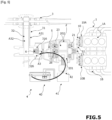
- the control unit controls the disengagement of the two thermal engines 1A, 1B and controls the power supply system 4 to power the electric motor 2.
- the propulsion system 3 with blades is driven using only the electric motorization 2.
- This operating mode illustrated in the figure 5 is particularly useful for a silent landing.
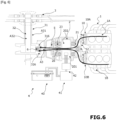
- control unit controls the clutch of the two thermal engines 1A, 1B to transmit the rotational movement of the thermal engine 1 to the propulsion system 3 with blades, but without consuming or generating electric current.
- the rotational motion of the thermal motor 1 is transmitted to the bladed propulsion system 3 via the electric motor 2, which is then passive.
- the electric motor 2 simply serves as a mechanical link in the motion transmission chain between the thermal motor 1 and the propulsion system 3.
- This operating mode illustrated in figure 6 is particularly useful in the event of a power supply system failure.
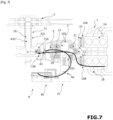
- the control unit controls the disengagement of one 1A of the two heat engines 1A, 1B, for example in the event of a fault in said heat engine 1A, the other heat engine 1B remaining engaged.
- the control unit also controls the power supply system 4 to power the electric motor 2.
- the bladed propulsion system 3 is driven using one of the two heat engines 1A, 1B and preferably the electric motor 2.
- This mode of operation illustrated in the figure 7 is a particularly useful operating mode in the event of a thermal engine failure.
- This operating mode can also be used, for example in a cruise flight configuration, to reduce energy consumption.
- each heat engine 1 can be turned off or can idle while waiting to be used.
- the clutch system is controlled to switch from one configuration to another by a manual or automatic control device comprising the control unit.
- the control device may comprise a human-machine interface connected to the control unit to enable the drivers to control the switch from one configuration to another of the powertrain. It may also be provided that the switch from one configuration to another of the powertrain is triggered automatically by the control unit when predefined conditions are met.
- control unit such as a computer, makes it possible to control a clutch actuation system to control the transition from one configuration to another.
- the control unit may be in the form of a processor and a data memory in which computer instructions executable by said processor are stored, or in the form of a microcontroller.
- the functions and steps described can be implemented using a computer program or via hardware components (e.g. programmable gate arrays).
- the functions and steps performed by the control unit presented above can be performed by instruction sets or computer modules implemented in a processor or controller or can be performed by dedicated electronic components or FPGA or ASIC type components. It is also possible to combine computer parts and electronic parts.
Landscapes
- Engineering & Computer Science (AREA)
- Aviation & Aerospace Engineering (AREA)
- Mechanical Engineering (AREA)
- Chemical & Material Sciences (AREA)
- Combustion & Propulsion (AREA)
- Power Engineering (AREA)
- Sustainable Development (AREA)
- Sustainable Energy (AREA)
- Life Sciences & Earth Sciences (AREA)
- Transportation (AREA)
- Electric Propulsion And Braking For Vehicles (AREA)
- Arrangement Of Transmissions (AREA)
- Engine Equipment That Uses Special Cycles (AREA)
- Auxiliary Drives, Propulsion Controls, And Safety Devices (AREA)
- Hybrid Electric Vehicles (AREA)
- General Engineering & Computer Science (AREA)
Description
- La présente invention concerne de manière générale un engin, tel qu'un aéronef, équipé d'un groupe motopropulseur comprenant une motorisation thermique et une motorisation électrique.
- On connait de l'état de la technique des engins tels que des aéronefs qui comprennent un groupe motopropulseur avec la configuration suivante. Le groupe motopropulseur comprend un système de propulsion à pales, une motorisation électrique, une batterie permettant d'alimenter la motorisation électrique, et un moteur thermique associé à un alternateur permettant de recharger la batterie.
- Cependant, en cas de défaut du moteur thermique, la puissance électrique restante peut se révéler insuffisante pour assurer un pilotage sécurisé de l'aéronef.
- Le document
US2016083104 A1 décrit un aéronef comprenant une motorisation thermique et une motorisation électrique agencée en parallèle de la motorisation thermique pour apporter un ajout de puissance pour l'entrainement d'un rotor de l'aéronef en plus de la puissance fournie par la motorisation thermique. - Le document
FR3039614A1 US2014283519A1 traite d'un aéronef hybride composé de deux moteurs à combustion couplés à un rotor via un boîtier de transmission et d'une machine électrique qui est également couplée au rotor via le boîtier de transmission. Le documentUS2012025032A1 décrit un hélicoptère comprenant un système de propulsion d'un rotor associé à un moteur principal et une machine électrique. Le documentUS2009145998A1 décrit un hélicoptère qui comprend un moteur à turbine à gaz couplé mécaniquement à un moteur électrique, associé à un bloc-batterie, pour entraîner un rotor. - La présente invention a pour but de proposer un nouvel engin permettant de pallier tout ou partie des problèmes exposés ci-dessus.
- A cet effet, l'invention a pour objet un engin, tel qu'un aéronef, muni d'un groupe motopropulseur, selon la revendication 1.
- Une telle configuration de groupe motopropulseur hybride qui comprend deux moteurs thermiques débrayables l'un par rapport à l'autres permet d'assurer un pilotage sécurisé de l'aéronef lorsque l'un des moteurs thermiques est défectueux. Une telle configuration est particulièrement utile lorsque l'engin est un hélicoptère.
- Le système de propulsion à hélice de l'engin peut ainsi être entrainé de façon indépendante ou simultanée, par la motorisation électrique et/ou par la motorisation thermique dont une partie ou la totalité peut être utilisée.
- La sécurité, notamment au décollage lorsque l'engin est un aéronef, est ainsi améliorée puisque, en cas de problème sur la chaine de transmission électrique, la motorisation thermique peut prendre le relais pour entraîner l'hélice avec l'un ou la combinaison des deux moteurs thermiques.
- Par ailleurs, la possibilité d'utiliser un mode de propulsion électrique seul, permet à un aéronef de décoller et d'atterrir sur des terrains urbains, ou périurbains avec une production sonore réduite.
- Le fait de pouvoir débrayer l'un des moteurs thermiques, tout en conservant l'autre embrayé, permet également de pallier un défaut de moteur ou, par exemple dans une configuration de croisière, de réduire la consommation d'énergie.
- Selon des modes de réalisations, l'engin permet d'obtenir tout ou partie des avantages suivants :
- un faible bruit à l'atterrissage et au décollage,
- une grande sécurité en opérations du fait des redondances de motorisation disponibles et des possibilités d'adaptation de configuration de motorisation,
- une optimisation possible de la consommation d'énergie,
- une réduction des émissions de CO2 dans les phases de décollage et d'atterrissage,
- une possibilité de réduire la maintenance d'un tel groupe motopropulseur par rapport à l'usage d'une turbine.
- L'engin peut aussi comporter une ou plusieurs des caractéristiques suivantes prises dans toute combinaison techniquement admissible.
- Selon une caractéristique avantageuse de l'invention, ledit engin comprend une unité de pilotage du système d'embrayage de la motorisation thermique et du système d'alimentation de la motorisation électrique, l'unité de pilotage étant configurée pour permettre d'embrayer les deux moteurs thermiques pour transmettre le mouvement de rotation de la motorisation thermique au système de propulsion à pales par l'intermédiaire de la motorisation électrique, sans consommation ou recharge de la batterie électrique.
- Selon une caractéristique avantageuse de l'invention, le système de propulsion à pales comprend deux rotors à pales qui comprennent chacun un arbre rotatif vertical muni de pales, lesdits rotors étant configurés pour, à l'état entrainé en rotation, tourner en sens opposé l'un de l'autre.
- Selon une caractéristique avantageuse de l'invention, l'engin comprenant un arbre de sortie de la motorisation thermique, le système d'embrayage de la motorisation thermique est interposé entre les arbres de sortie des moteurs thermiques et un système de transmission de mouvement configuré pour transmettre le mouvement de rotation d'un ou de chacun desdits moteurs thermique audit arbre de sortie de la motorisation thermique.
- Selon une caractéristique avantageuse de l'invention, le groupe motopropulseur comprend un système de réduction de vitesse, de préférence comprenant un train d'engrenages, situé entre l'arbre de sortie de la motorisation thermique et l'entrée de la motorisation électrique.
- Selon une caractéristique avantageuse de l'invention, l'engin comprenant un arbre de sortie de la motorisation électrique, le groupe motopropulseur comprend un système de transmission disposé en sortie de la motorisation électrique et configuré pour transmettre le mouvement de rotation de la motorisation électrique audit arbre de sortie de la motorisation électrique.
- Selon une caractéristique avantageuse de l'invention, l'engin comprenant un arbre de sortie de la motorisation électrique et un arbre d'entrée du système de propulsion à pales, le groupe motopropulseur comprend un système de réduction de vitesse, de préférence un train épicycloïdal, entre ledit arbre de sortie de la motorisation électrique et ledit arbre d'entrée du système de propulsion à pales.
- Selon une caractéristique avantageuse de l'invention, l'arbre d'entrée du système de propulsion à pales est muni d'un dispositif de réduction conique.
- Selon une caractéristique avantageuse de l'invention, la motorisation électrique présente plusieurs, de préférence trois, moteurs électriques, répartis de préférence régulièrement autour d'un axe central.
- Selon une caractéristique avantageuse de l'invention, chaque moteur électrique comprend un système de débrayage, par exemple par décrabotage, permettant, par exemple en cas de panne dudit moteur électrique, d'isoler mécaniquement ledit moteur électrique vis-à-vis du ou des autres moteurs électriques.
- Selon une caractéristique avantageuse de l'invention, la puissance de chaque moteur thermique est de l'ordre de 150 kW, et la puissance de la motorisation électrique est de l'ordre de 180 kW, avec de préférence 60 kW par moteur électrique de la motorisation électrique.
- Selon une caractéristique avantageuse de l'invention, l'engin comprend une unité de pilotage du système d'embrayage de la motorisation thermique et du système d'alimentation de la motorisation électrique, l'unité de pilotage étant configurée pour permettre d'embrayer les deux moteurs thermiques et d'alimenter la motorisation électrique pour entraîner le système de propulsion à pales à l'aide de la combinaison des deux moteurs thermiques et de la motorisation électrique.
- Selon une caractéristique avantageuse de l'invention, l'engin comprend une unité de pilotage du système d'embrayage de la motorisation thermique et du système d'alimentation de la motorisation électrique, l'unité de pilotage étant configurée pour permettre d'embrayer les deux moteurs thermiques pour entraîner la motorisation électrique, de manière à, d'une part, transmettre, par l'intermédiaire de la motorisation électrique, le mouvement de rotation de la motorisation thermique au système de propulsion à pales, tout en rechargeant la batterie du système d'alimentation électrique.
- Selon un aspect particulier, les différents modes de fonctionnement permis par l'unité de pilotage présentés ci-avant, sont sélectionnables les uns par rapport aux autres.
- Selon une caractéristique avantageuse de l'invention, l'engin comprend un carter dans lequel est logée la motorisation électrique et dans lequel sont ménagées des ouvertures et/ou cavités permettant de refroidir la motorisation électrique, ledit groupe motopropulseur comprenant de préférence un système de refroidissement à eau pour le refroidissement des moteurs thermiques.
- L'invention concerne également un procédé de pilotage d'un engin tel que décrit ci-dessus qui comprend le débrayage ou l'embrayage de l'un ou chacun des moteurs thermiques par rapport au système de propulsion à pales, et/ou le pilotage du système d'alimentation de la motorisation électrique pour alimenter la motorisation électrique ou recharger la batterie.
- D'autres caractéristiques et avantages de l'invention ressortiront encore de la description qui suit, laquelle est purement illustrative et non limitative et doit être lue en regard des dessins annexés, sur lesquels :
- [
Fig. 1 ] lafigure 1 est une vue schématique d'un aéronef, ici un hélicoptère, conformément à un mode de réalisation de l'invention ; - [
Fig. 2 ] lafigure 2 est une vue schématique d'un groupe motopropulseur d'un aéronef, tel que celui de lafigure 1 , conformément à un mode de réalisation de l'invention ; - [
Fig. 3 ] lafigure 3 est une vue schématique d'un groupe motopropulseur conformément à un mode de réalisation de l'invention, par exemple en mode de décollage et/ou de montée, combinant une propulsion thermique et une propulsion électrique ; - [
Fig. 4 ] lafigure 4 est une vue schématique d'un groupe motopropulseur d'un aéronef conformément à un mode de réalisation de l'invention, en mode de propulsion thermique et de recharge de la batterie électrique ; - [
Fig. 5 ] lafigure 5 est une vue schématique d'un groupe motopropulseur d'un aéronef conformément à un mode de réalisation de l'invention, en mode de propulsion électrique seule ; - [
Fig. 6 ] lafigure 6 est une vue schématique d'un groupe motopropulseur d'un aéronef conformément à un mode de réalisation de l'invention, en mode de propulsion thermique seule ; - [
Fig. 7 ] lafigure 7 est une vue schématique d'un aéronef conformément à un mode de réalisation de l'invention, au cours de son vol, par exemple en palier et/ou par exemple en cas de défaut d'un des moteurs thermiques. - Le concept de l'invention est décrit plus complètement ci-après avec référence aux dessins joints, sur lesquels des modes de réalisation du concept de l'invention sont montrés. Sur les dessins, la taille et les tailles relatives des éléments peuvent être exagérées à des fins de clarté. Des numéros similaires font référence à des éléments similaires sur tous les dessins. Cependant, ce concept de l'invention peut être mis en œuvre sous de nombreuses formes différentes et ne devrait pas être interprété comme étant limité aux modes de réalisation exposés ici. Au lieu de cela, ces modes de réalisation sont proposés de sorte que cette description soit complète, et communiquent l'étendue du concept de l'invention aux hommes du métier. Les modes de réalisation qui suivent sont examinés, par souci de simplification, en relation avec la terminologie et la structure d'un aéronef. Comme expliqué ci-après, l'engin peut aussi être un engin nautique.
- Une référence dans toute la spécification à « un mode de réalisation » signifie qu'une fonctionnalité, une structure, ou une caractéristique particulière décrite en relation avec un mode de réalisation est incluse dans au moins un mode de réalisation de la présente invention. Ainsi, l'apparition de l'expression « dans un mode de réalisation » à divers emplacements dans toute la spécification ne fait pas nécessairement référence au même mode de réalisation. En outre, les fonctionnalités, les structures, ou les caractéristiques particulières peuvent être combinées de n'importe quelle manière appropriée dans un ou plusieurs modes de réalisation.
- A la
figure 1 , on a illustré un engin qui est un hélicoptère 100 muni d'un groupe motopropulseur. - En variante, l'engin peut être un aéronef d'un autre type, tel qu'un avion ou un drone. L'engin peut aussi être un engin nautique.
- Le groupe motopropulseur de l'hélicoptère comprend un système de propulsion 3 à pales qui inclut deux rotors 31, 32 contrarotatifs. En variante, il peut être prévu un seul rotor.
- L'hélicoptère peut comprendre aussi un rotor anti-couple ou autre dispositif anti-couple qui peut être entrainé par ledit groupe motopropulseur ou par une motorisation indépendante. Le dispositif anti-couple n'est pas nécessaire lorsque l'engin comprend deux rotors contrarotatifs.
- La description qui suit est réalisée pour un hélicoptère mais s'applique à d'autres types d'engins muni de système de propulsion à pales. On comprend en particulier que selon le type d'engin, le système de propulsion à pales de l'engin peut comprendre une ou des hélices pour un avion ou un bateau.
- En outre la description est aussi applicable à des engins tels que décrits dans la demande de brevet français déposée sous le numéro
FR 18 01092 FR 18 01092 - Comme illustré à la
figure 2 , le groupe motopropulseur comprend une motorisation thermique 1 configurée pour permettre d'entrainer le système de propulsion 3 à pales comme détaillé ci-après. - La motorisation thermique 1 inclut un premier moteur thermique 1A et un deuxième moteur thermique 1B. Chacun des premier et deuxième moteurs thermiques comprend un arbre de sortie.
- La puissance de chaque moteur thermique 1A, 1B est par exemple de 150 kW.
- Ledit groupe motopropulseur comprend de préférence un système de refroidissement à eau pour le refroidissement des moteurs thermiques 1A, 1B.
- Le groupe motopropulseur comprend un système d'embrayage 10 qui permet d'embrayer l'un quelconque ou chacun des moteurs thermiques 1A, 1B pour entrainer le système de propulsion 3 à pales.
- Le système d'embrayage 10 comprend un embrayage 10A et un embrayage 10B commandable sélectivement pour permettre d'embrayer le premier moteur thermique 1A, et/ou d'embrayer le deuxième moteur thermique 1B par rapport à la chaine de transmission de mouvement entre la motorisation thermique 1 et le système de propulsion à pales 3.
- Le système d'embrayage 10 est aussi configuré pour permettre de débrayer l'un quelconque ou chacun des moteurs thermiques 1A, 1B par rapport au système de propulsion 3 à pales.
- On entend par "débrayer par rapport au système de propulsion 3 à pales", le fait que la motorisation thermique 1 est découplée de la chaine de transmission d'effort ou de mouvement qui s'étend entre la motorisation thermique 1 et le système de propulsion 3 à pales.
- Le système d'embrayage 10 de la motorisation thermique 1 est interposé entre les arbres de sortie des moteurs thermiques 1A, 1B et un système de transmission 12 de mouvement.
- Le système de transmission 12 de mouvement est configuré pour transmettre le mouvement de rotation d'un ou de chacun desdits moteurs thermiques à un arbre 13, appelé arbre de sortie de la motorisation thermique 1.
- Le système 12 comprend par exemple un ensemble d'engrenages, ou encore un ensemble de roue et de courroie ou de chaîne.
- L'arbre de sortie 13 est couplé ou couplable au système de propulsion 3 à pales par l'intermédiaire d'un mécanisme de transmission de mouvement présenté ci-après.
- Le mécanisme de transmission comprend un système de réduction de vitesse qui comprend un train d'engrenages 21 situé entre l'arbre de sortie 13 de la motorisation thermique 1 et l'entrée de la motorisation électrique 2.
- Le train d'engrenages comporte un arbre d'entrée 13 et des satellites portés par les arbres d'entrée de la motorisation électrique 2.
- Le mécanisme de transmission comprend aussi un système de transmission 23 disposé en sortie de la motorisation électrique 2 et configuré pour transmettre le mouvement de rotation de la motorisation électrique 2 (qui comprend plusieurs moteurs électriques dans l'exemple illustré aux figures) à un arbre, appelé arbre de sortie 26 de la motorisation électrique.
- L'arbre de sortie 26 est de préférence coaxial avec l'arbre de sortie 13.
- Le système de transmission 23 forme une réduction (par exemple d'un rapport égal à environ 1.4) qui, avec l'arbre de sortie 26, permet d'attaquer un système de réduction 5 de vitesse.
- Le système de réduction 5 de vitesse comprend un train épicycloïdal 5 dont le rapport de réduction est par exemple égal à environ 3.
- Le train épicycloïdal 5 est situé entre l'arbre de sortie 26 de la motorisation électrique 2 et un arbre d'entrée A3 du système de propulsion 3 à pales.
- Le groupe motopropulseur comprend aussi une motorisation électrique 2 configurée pour permettre d'entrainer le système de propulsion 3 à pales.
- Un système d'alimentation 4 électrique comprend une batterie 40 permettant d'alimenter la motorisation électrique 2. Bien entendu, la batterie 40 peut comprend un ensemble de batteries.
- Le système d'alimentation 4 électrique comporte aussi un système de gestion électrique 41, 42 qui comprend un boîtier haute-tension 41 et un contrôleur 42.
- Le boîtier haute-tension 41 permet d'ouvrir ou de fermer le circuit d'alimentation entre la batterie 40 et la motorisation électrique 2. Le contrôleur 42 permet de traiter le courant fourni par la batterie 40 ou produit par la motorisation électrique 2 lorsqu'elle fonctionne en génératrice.
- Dans l'exemple illustré aux figures, la motorisation électrique 2 présente plusieurs moteurs électriques 201, 202, répartis de préférence régulièrement autour d'un axe central. Avantageusement, la motorisation électrique comprend trois moteurs répartis à 120° autour d'un axe imaginaire coaxial à l'axe de sortie 26. Ainsi dans l'exemple illustré aux figures, seuls deux moteurs sont représentés mais un troisième est présent.
- La puissance de la motorisation électrique 2 est de 180 kW, avec de préférence 60 kW par moteur électrique 2.
- Chaque moteur électrique 201, 202 présente un arbre d'entrée couplé au système de réduction 21 et un arbre de sortie couplé au système de transmission 23 de sortie.
- Chaque moteur électrique 201, 202 comprend un système de débrayage permettant, par exemple en cas de panne dudit moteur électrique, d'isoler mécaniquement ledit moteur électrique vis-à-vis du ou des autres moteurs électriques. Le système de débrayage peut être un système de débrayage par décrabotage.
- De manière générale, lorsqu'il est fait référence à un système d'embrayage celui-ci peut être du type à friction ou à crabots.
- Le groupe motopropulseur comprend un carter dans lequel est logée la motorisation électrique 2. Des ouvertures et/ou des cavités peuvent être ménagées dans le carter pour permettre de refroidir la motorisation électrique 2.
- Selon le mode de réalisation illustré aux figures, le système de propulsion 3 à pales comprend deux rotors à pales 31, 32 qui comprennent chacun un arbre A31, A32 rotatif vertical muni de pales. Lesdits rotors 31, 32 sont configurés pour, à l'état entrainé en rotation, tourner en sens opposé l'un de l'autre.
- L'arbre d'entrée A3 du système de propulsion 3 à pales est muni d'un dispositif de réduction conique 6. Le dispositif de réduction conique 6 comprend un engrenage conique avec un rapport de réduction qui est par exemple de l'ordre de 3.7.
- Dans l'exemple illustré aux figures, chaque arbre A31, A32 de rotor 31, 32 est muni d'une portée conique 316, 326 configurée pour coopérer avec l'engrenage conique 6 porté par l'arbre d'entrée A3 du système de propulsion 3 à pales.
- Selon un aspect particulier, le groupe motopropulseur comprend une unité de pilotage permettant de piloter le système d'embrayage 10 de la motorisation thermique 1 et le système d'alimentation 4 de la motorisation électrique 2.
- Dans l'exemple illustré aux figures, les embrayages sont représentés par simplification en position ouverte. Pour autant, la description ci-après précise la configuration réelle, ouverte (débrayée) ou fermée (embrayée), de chacun desdits embrayage selon le procédé de pilotage mis en œuvre. Par ailleurs, des flèches ont été ajoutées (distinctes des flèches de référence) pour symboliser la chaine de transmission de mouvement qui est active et le cas échéant le courant électrique délivré ou reçu par le système d'alimentation électrique.
- Le groupe motopropulseur présenté ci-avant permet de mettre en œuvre différents procédés de pilotage de l'aéronef en adaptant la configuration des embrayages.
- L'unité de pilotage est configurée pour permettre de sélectionner différentes configurations de fonctionnement du groupe motopropulseur selon les opérations à réaliser.
- Selon une première configuration de fonctionnement illustrée à la
figure 3 , l'unité de pilotage commande l'embrayage des deux moteurs thermiques 1A, 1B et d'alimenter la motorisation électrique 2 pour entraîner le système de propulsion 3 à pales à l'aide de la combinaison des deux moteurs thermiques 1A, 1B et de la motorisation électrique 2. Ce mode de fonctionnement illustré à lafigure 3 est particulièrement utile en cas de de besoin de forte puissance, notamment au décollage. - Le groupe motopropulseur permet ainsi de combiner le mouvement de rotation fourni par les deux moteurs thermiques et le mouvement de rotation fourni par le moteur électrique pour entraîner le système de propulsion à pales.
- Selon une deuxième configuration de fonctionnement illustrée à la
figure 4 , l'unité de pilotage commande l'embrayage des deux moteurs thermiques 1A, 1B pour entraîner la motorisation électrique 2, de manière à, d'une part, transmettre, par l'intermédiaire de la motorisation électrique 2, le mouvement de rotation de la motorisation thermique 1 au système de propulsion 3 à pales, tout en pilotant le système d'alimentation 4 pour recharger la batterie 40. - Ce mode de fonctionnement illustré à la
figure 4 peut être utilisé lorsque le besoin de puissances pour le système de propulsion 3 est inférieur à celui que peut fournir la motorisation thermique 1 et que la batterie électrique 40 a besoin d'être rechargée. - Un tel mode de fonctionnement du groupe motopropulseur permet d'utiliser le surplus de puissance du moteur thermique 1 pour recharger la batterie 40 en vol, notamment lorsque la batterie a été utilisée pour la propulsion électrique en phase de décollage.
- Selon un aspect particulier, la motorisation 2, en particulier les moteurs électriques qui la composent dans l'exemple illustré aux figures, a ou ont une double sortie au niveau de leur rotor, ce qui leur permet d'être moteur et/ou génératrice en fonction des cas de fonctionnement.
- Ainsi, en mode croisière, la puissance fournie par les moteurs thermiques 1A, 1B est la source de propulsion principale. Les moteurs électriques se transforment en génératrices et rechargent le pack batterie 40 au travers du convertisseur 42 et de l'électronique de puissance 41.
- Avantageusement, la puissance fournie est d'environ 260 kW pour la propulsion par la motorisation thermique et de 30 kW pour la recharge de la batterie.
- Selon une troisième configuration de fonctionnement illustrée à la
figure 5 , l'unité de pilotage commande le débrayage des deux moteurs thermiques 1A, 1B et pilote le système d'alimentation 4 pour alimenter la motorisation électrique 2. Ainsi, le système de propulsion 3 à pales est entrainé à l'aide uniquement de la motorisation électrique 2. Ce mode de fonctionnement illustré à lafigure 5 est particulièrement utile pour un atterrissage en silence. - Il est ainsi possible en mode atterrissage, d'activer uniquement le mode électrique à l'aide de la batterie 40 et du système de gestion électrique 41, 42 qui fournissent l'énergie électrique à la motorisation électrique 2.
- Selon une quatrième configuration de fonctionnement illustrée à la
figure 6 , l'unité de pilotage commande l'embrayage des deux moteurs thermiques 1A, 1B pour transmettre le mouvement de rotation de la motorisation thermique 1 au système de propulsion 3 à pales, mais sans consommation ou génération de courant électrique. - Le mouvement de rotation de la motorisation thermique 1 est transmis au système de propulsion 3 à pales en passant par la motorisation électriques 2, qui est alors passive. Autrement dit, la motorisation électrique 2 sert simplement de maillon mécanique dans la chaine de transmission de mouvement entre la motorisation thermique 1 et le système de propulsion 3. Ce mode de fonctionnement illustré à la
figure 6 est particulièrement utile en cas de panne du système d'alimentation électrique. - Selon une cinquième configuration de fonctionnement illustrée à la
figure 7 , l'unité de pilotage commande le débrayage de l'un 1A des deux moteurs thermiques 1A, 1B, par exemple en cas de défaut dudit moteur thermique 1A, l'autre moteur thermique 1B restant embrayé. Avantageusement, l'unité de pilotage pilote aussi le système d'alimentation 4 pour alimenter la motorisation électrique 2. Ainsi, le système de propulsion 3 à pales est entrainé à l'aide d'un des deux moteurs thermiques 1A, 1B et de préférence de la motorisation électrique 2. - Ce mode de fonctionnement illustré à la
figure 7 est un mode de fonctionnement particulièrement utile en cas de panne d'un moteur thermique. - En cas de panne d'un des moteurs thermiques, il est ainsi possible de débrayer le moteur thermique en panne et de conserver la puissance du moteur thermique restant, par exemple 150 kW pour continuer de faire fonctionner le système de propulsion 3. Cette puissance du moteur thermique restant peut s'ajouter à la puissance du moteur électrique pour entraîner le système de propulsion 3, ce qui permet d'effectuer un atterrissage en sécurité de l'aéronef.
- Ce mode de fonctionnement peut aussi être utilisé, par exemple dans une configuration de vol de croisière, pour réduire la consommation d'énergie.
- De manière générale, chaque moteur thermique 1 peut être éteint ou peut tourner au ralenti en attendant d'être utilisé.
- On peut prévoir que le système d'embrayages soit commandé pour passer d'une configuration à une autre par un dispositif de commande manuel ou automatique comprenant l'unité de pilotage. Le dispositif de commande peut comprendre une interface homme-machine connectée à l'unité de pilotage pour permettre aux pilotes de commander le passage d'une configuration à une autre du groupe motopropulseur. On peut aussi prévoir que le passage d'une configuration à une autre du groupe motopropulseur soit déclenché automatiquement par l'unité de pilotage lorsque des conditions prédéfinies sont remplies.
- En particulier on peut prévoir que l'unité de pilotage, telle qu'un calculateur, permette de piloter un système d'actionnement des embrayages pour commander le passage d'une configuration à un autre. L'unité de pilotage peut se présenter sous la forme d'un processeur et d'une mémoire de données dans laquelle sont stockées des instructions informatiques exécutables par ledit processeur, ou encore sous la forme d'un microcontrôleur.
- Autrement dit, les fonctions et étapes décrites peuvent être mise en œuvre à l'aide de programme informatique ou via des composants matériels (p. ex. des réseaux de portes programmables). En particulier, les fonctions et étapes opérées par l'unité de pilotage présentée ci-avant peuvent être réalisées par des jeux d'instructions ou modules informatiques implémentés dans un processeur ou contrôleur ou être réalisées par des composants électroniques dédiés ou des composants de type FPGA ou ASIC. Il est aussi possible de combiner des parties informatiques et des parties électroniques.
- L'invention n'est pas limitée aux modes de réalisation illustrés dans les dessins.
- De plus, le terme « comprenant » n'exclut pas d'autres éléments ou étapes. En outre, des caractéristiques ou étapes qui ont été décrites en référence à l'un des modes de réalisation exposés ci-dessus peuvent également être utilisées en combinaison avec d'autres caractéristiques ou étapes d'autres modes de réalisation exposés ci-dessus.
Claims (12)
- Engin (100), tel qu'un aéronef, muni d'un groupe motopropulseur, le groupe motopropulseur comprenant :- un système de propulsion (3) à pales,- une motorisation thermique (1), comprenant un premier moteur thermique (1A) et un deuxième moteur thermique (1B), configurée pour permettre d'entrainer le système de propulsion (3) à pales,- une motorisation électrique (2) configurée pour permettre d'entrainer le système de propulsion (3) à pales,- un système d'alimentation (4) électrique comprenant une batterie (40) permettant d'alimenter la motorisation électrique (2),- un système d'embrayage (10) configuré pour permettre d'embrayer l'un quelconque ou chacun des moteurs thermiques (1A, 1B) pour entrainer le système de propulsion (3) à pales, le système d'embrayage (10) étant aussi configuré pour permettre de débrayer l'un quelconque ou chacun des moteurs thermiques (1A, 1B) par rapport au système de propulsion (3) à pales, la motorisation électrique (2) étant agencée en série avec la motorisation thermique (1), entre la motorisation thermique (1) et le système de propulsion à pales (30), caractérisé en ce que ledit engin comprend une unité de pilotage du système d'embrayage (10) de la motorisation thermique (1) et du système d'alimentation (4) de la motorisation électrique (2), l'unité de pilotage étant configurée pour permettre de débrayer l'un (1A) des deux moteurs thermiques (1A, 1B) en cas de défaut dudit moteur thermique (1A), l'autre moteur thermique (1B) restant embrayé, et de piloter le système d'alimentation (4) électrique afin d'alimenter la motorisation électrique (2) pour entraîner le système de propulsion (3) à pales à l'aide d'un des deux moteurs thermiques (1A, 1B) et de la motorisation électrique (2),et en ce que l'unité de pilotage est configurée pour permettre de débrayer les deux moteurs thermiques (1A, 1B) et de piloter le système d'alimentation (4) électrique pour alimenter la motorisation électrique (2) afin d'entraîner le système de propulsion (3) à pales à l'aide uniquement de la motorisation électrique (2).
- Engin (100) selon la revendication 1 , caractérisé en ce que ledit engin comprend une unité de pilotage du système d'embrayage (10) de la motorisation thermique (1) et du système d'alimentation (4) de la motorisation électrique (2), l'unité de pilotage étant configurée pour permettre d'embrayer les deux moteurs thermiques (1A, 1B) pour transmettre le mouvement de rotation de la motorisation thermique (1) au système de propulsion (3) à pales par l'intermédiaire de la motorisation électrique (2), sans consommation ou recharge de la batterie (40) électrique.
- Engin (100) selon la revendication 1 ou 2, caractérisé en ce que le système de propulsion (3) à pales comprend deux rotors à pales (31, 32) qui comprennent chacun un arbre (A31, A32) rotatif vertical muni de pales, lesdits rotors (31, 32) étant configurés pour, à l'état entrainé en rotation, tourner en sens opposé l'un de l'autre.
- Engin (100) selon l'une des revendications précédentes, caractérisé en ce que, ledit engin comprenant un arbre (13) de sortie de la motorisation thermique (1), le système d'embrayage (10) de la motorisation thermique (1) est interposé entre les arbres de sortie des moteurs thermiques (1A, 1B) et un système de transmission (12) de mouvement configuré pour transmettre le mouvement de rotation d'un ou de chacun desdits moteurs thermique audit arbre (13) de sortie de la motorisation thermique (1).
- Engin (100) selon l'une des revendications précédentes, caractérisé en ce que, l'engin comprenant un arbre de sortie (26) de la motorisation électrique, le groupe motopropulseur comprend un système de transmission (23) disposé en sortie de la motorisation électrique (2) et configuré pour transmettre le mouvement de rotation de la motorisation électrique (2) audit arbre de sortie (26) de la motorisation électrique.
- Engin (100) selon l'une des revendications précédentes, caractérisé en ce que, l'engin comprenant un arbre de sortie (26) de la motorisation électrique (2) et un arbre d'entrée (A3) du système de propulsion (3) à pales, le groupe motopropulseur comprend un système de réduction (5) de vitesse, de préférence un train épicycloïdal, entre ledit arbre de sortie (26) de la motorisation électrique (2) et ledit arbre d'entrée (A3) du système de propulsion (3) à pales.
- Engin (100) selon l'une des revendications précédentes, caractérisé en ce que la motorisation électrique (2) présente plusieurs, de préférence trois, moteurs électriques (201, 202), répartis de préférence régulièrement autour d'un axe central.
- Engin (100) selon la revendication 7, caractérisé en ce que chaque moteur électrique (201, 202) comprend un système de débrayage, par exemple par décrabotage, permettant, par exemple en cas de panne dudit moteur électrique, d'isoler mécaniquement ledit moteur électrique vis-à-vis du ou des autres moteurs électriques.
- Engin (100) selon l'une des revendications précédentes, caractérisé en ce que ledit engin comprend une unité de pilotage du système d'embrayage (10) de la motorisation thermique (1) et du système d'alimentation (4) de la motorisation électrique (2), l'unité de pilotage étant configurée pour permettre d'embrayer les deux moteurs thermiques (1A, 1B) et d'alimenter la motorisation électrique (2) pour entraîner le système de propulsion (3) à pales à l'aide de la combinaison des deux moteurs thermiques (1A, 1B) et de la motorisation électrique (2).
- Engin (100) selon l'une des revendications précédentes, caractérisé en ce que ledit engin comprend une unité de pilotage du système d'embrayage (10) de la motorisation thermique (1) et du système d'alimentation (4) de la motorisation électrique (2), l'unité de pilotage étant configurée pour permettre d'embrayer les deux moteurs thermiques (1A, 1B) pour entraîner la motorisation électrique (2), de manière à, d'une part, transmettre, par l'intermédiaire de la motorisation électrique (2), le mouvement de rotation de la motorisation thermique (1) au système de propulsion (3) à pales, tout en rechargeant la batterie (40) du système d'alimentation (4) électrique.
- Engin (100) selon l'une des revendications précédentes, caractérisé en ce que ledit engin comprend un carter dans lequel est logée la motorisation électrique (2) et dans lequel sont ménagées des ouvertures et/ou cavités permettant de refroidir la motorisation électrique (2), ledit groupe motopropulseur comprenant de préférence un système de refroidissement à eau pour le refroidissement des moteurs thermiques (1A, 1B).
- Procédé de pilotage d'un engin (100) conforme à l'une des revendications précédentes, caractérisé en ce que, le procédé comprend le débrayage ou l'embrayage de l'un ou chacun des moteurs thermiques (1A, 1B) par rapport au système de propulsion (3) à pales, et/ou le pilotage du système d'alimentation (4) de la motorisation électrique pour alimenter la motorisation électrique (2) ou recharger la batterie (41).
Applications Claiming Priority (2)
| Application Number | Priority Date | Filing Date | Title |
|---|---|---|---|
| FR1905703A FR3096659B1 (fr) | 2019-05-29 | 2019-05-29 | Engin comprenant un groupe motopropulseur hybride et procédé de pilotage correspondant |
| PCT/FR2020/050892 WO2020240134A1 (fr) | 2019-05-29 | 2020-05-27 | Engin comprenant un groupe motopropulseur hybride et procédé de pilotage correspondant |
Publications (4)
| Publication Number | Publication Date |
|---|---|
| EP3976474A1 EP3976474A1 (fr) | 2022-04-06 |
| EP3976474B1 true EP3976474B1 (fr) | 2025-02-26 |
| EP3976474C0 EP3976474C0 (fr) | 2025-02-26 |
| EP3976474B8 EP3976474B8 (fr) | 2025-05-07 |
Family
ID=67742801
Family Applications (1)
| Application Number | Title | Priority Date | Filing Date |
|---|---|---|---|
| EP20743189.1A Active EP3976474B8 (fr) | 2019-05-29 | 2020-05-27 | Engin comprenant un groupe motopropulseur hybride et procédé de pilotage correspondant |
Country Status (9)
| Country | Link |
|---|---|
| US (1) | US11912421B2 (fr) |
| EP (1) | EP3976474B8 (fr) |
| JP (1) | JP7522768B2 (fr) |
| KR (1) | KR20220013552A (fr) |
| CN (1) | CN113905949A (fr) |
| CA (1) | CA3141176A1 (fr) |
| FR (1) | FR3096659B1 (fr) |
| IL (1) | IL287892A (fr) |
| WO (1) | WO2020240134A1 (fr) |
Families Citing this family (5)
| Publication number | Priority date | Publication date | Assignee | Title |
|---|---|---|---|---|
| EP4294727A4 (fr) * | 2021-02-21 | 2025-02-12 | Verdego Aero, Inc. | Architecture flexible pour un système hybride aérospatial et composants optimisés associés |
| BR112023016761A2 (pt) | 2021-03-19 | 2023-10-31 | Verdego Aero Inc | Resfriamento de ar simultâneo de múltiplos elementos de um motor de alta potência híbrido |
| GB2636842A (en) * | 2023-12-22 | 2025-07-02 | Evolito Ltd | Aeronautical propulsion system |
| US12451824B1 (en) | 2024-07-12 | 2025-10-21 | Pratt & Whitney Canada Corp. | Hybrid electric propulsion system with regeneration and method for operating the same |
| US12595071B1 (en) | 2024-12-16 | 2026-04-07 | Lockheed Martin Corporation | Parallel hybrid electric vertical takeoff and landing aircraft |
Family Cites Families (22)
| Publication number | Priority date | Publication date | Assignee | Title |
|---|---|---|---|---|
| US2462825A (en) * | 1944-11-03 | 1949-02-22 | United Aircraft Corp | Automatic declutching means for multiengine drives |
| GB1322948A (en) * | 1970-04-24 | 1973-07-11 | Canadair Ltd | Aircraft yaw control system |
| DE4239639A1 (de) * | 1992-11-23 | 1994-05-26 | Stemme Gmbh & Co Kg | Antriebssystem für ein Flugzeug |
| JP3029976B2 (ja) * | 1995-01-27 | 2000-04-10 | 株式会社コミュータヘリコプタ先進技術研究所 | ヘリコプタの動力伝達装置 |
| US5931757A (en) * | 1998-06-24 | 1999-08-03 | General Motors Corporation | Two-mode, compound-split electro-mechanical vehicular transmission |
| US7413142B2 (en) | 2005-05-31 | 2008-08-19 | Sikorsky Aircraft Corporation | Split torque gearbox for rotary wing aircraft with translational thrust system |
| US8727271B2 (en) | 2008-01-11 | 2014-05-20 | Ival O. Salyer | Aircraft using turbo-electric hybrid propulsion system |
| DE102010021025B4 (de) * | 2010-05-19 | 2014-05-08 | Eads Deutschland Gmbh | Hubschrauber mit Hybridantrieb |
| DE102010021026A1 (de) | 2010-05-19 | 2011-11-24 | Eads Deutschland Gmbh | Hybrides Antriebs- und Energiesystem für Fluggeräte |
| CH703260A1 (de) * | 2010-06-03 | 2011-12-15 | Eugen Gaehwiler | Segelflugzeug. |
| FR2962404B1 (fr) * | 2010-07-08 | 2012-07-20 | Eurocopter France | Architecture electrique pour aeronef a voilure tournante a motorisation hybride |
| FR2964948B1 (fr) * | 2010-09-16 | 2012-08-31 | Eurocopter France | Aeronef a voilure tournante muni d'un moyen propulsif, et procede applique par ledit aeronef |
| FR2979615B1 (fr) * | 2011-09-04 | 2013-09-20 | Eric Chantriaux | Aeronef equipe d'un groupe electromoteur distribue a roues libres. |
| CA2820254C (fr) * | 2012-07-09 | 2020-02-18 | Mcmaster University | Systeme de groupe propulseur hybride |
| FR3003514B1 (fr) * | 2013-03-25 | 2016-11-18 | Eurocopter France | Aeronef a voilure tournante a motorisation hybride. |
| US10569892B2 (en) * | 2013-05-06 | 2020-02-25 | Sikorsky Aircraft Corporation | Supplemental power for reduction of prime mover |
| US10850863B2 (en) * | 2014-03-04 | 2020-12-01 | Pratt & Whitney Canada Corp. | System and method for operating a multi-engine aircraft in an auxiliary power unit mode |
| FR3036235B1 (fr) * | 2015-05-15 | 2018-06-01 | Airbus Helicopters | Procede pour activer un moteur electrique d'une installation hybride d'un aeronef multimoteur et un aeronef |
| FR3039614B1 (fr) * | 2015-07-31 | 2018-05-04 | Airbus Helicopters | Installation motrice hybride pour aeronef a voilure tournante bimoteur |
| FI126991B (en) * | 2016-03-01 | 2017-09-15 | Miricle Oy | The floatplane |
| CN108082499B (zh) * | 2018-01-29 | 2023-04-25 | 吉林大学 | 行星式混合动力直升机动力耦合系统及驱动方法 |
| CN108082500A (zh) | 2018-01-29 | 2018-05-29 | 吉林大学 | 一种固定翼式混合动力飞行器驱动装置及驱动方法 |
-
2019
- 2019-05-29 FR FR1905703A patent/FR3096659B1/fr active Active
-
2020
- 2020-05-27 CN CN202080038866.5A patent/CN113905949A/zh active Pending
- 2020-05-27 KR KR1020217039043A patent/KR20220013552A/ko not_active Ceased
- 2020-05-27 WO PCT/FR2020/050892 patent/WO2020240134A1/fr not_active Ceased
- 2020-05-27 JP JP2021566999A patent/JP7522768B2/ja active Active
- 2020-05-27 CA CA3141176A patent/CA3141176A1/fr active Pending
- 2020-05-27 US US17/614,458 patent/US11912421B2/en active Active
- 2020-05-27 EP EP20743189.1A patent/EP3976474B8/fr active Active
-
2021
- 2021-11-07 IL IL287892A patent/IL287892A/en unknown
Also Published As
| Publication number | Publication date |
|---|---|
| IL287892A (en) | 2022-01-01 |
| EP3976474C0 (fr) | 2025-02-26 |
| JP7522768B2 (ja) | 2024-07-25 |
| EP3976474A1 (fr) | 2022-04-06 |
| JP2022534362A (ja) | 2022-07-29 |
| CA3141176A1 (fr) | 2020-12-03 |
| WO2020240134A1 (fr) | 2020-12-03 |
| EP3976474B8 (fr) | 2025-05-07 |
| CN113905949A (zh) | 2022-01-07 |
| US11912421B2 (en) | 2024-02-27 |
| US20220234744A1 (en) | 2022-07-28 |
| BR112021023596A2 (pt) | 2022-01-04 |
| FR3096659B1 (fr) | 2021-05-07 |
| KR20220013552A (ko) | 2022-02-04 |
| FR3096659A1 (fr) | 2020-12-04 |
Similar Documents
| Publication | Publication Date | Title |
|---|---|---|
| EP3976474B1 (fr) | Engin comprenant un groupe motopropulseur hybride et procédé de pilotage correspondant | |
| EP3867152B1 (fr) | Engin comprenant un groupe motopropulseur hybride et procédé de pilotage correspondant | |
| EP2750969B1 (fr) | Aéronef équipé d'un groupe électromoteur distribué à roues libres | |
| EP3599140B1 (fr) | Procede et dispositif de gestion de l'energie d'une installation motrice hybride d'un aeronef multirotor | |
| FR2979614A1 (fr) | Transmission electromagnetique de puissance pour aeronef a voilure tournante ou fixe. | |
| EP4334210B1 (fr) | Dispositif de transmission amélioré pour aéronef hybride | |
| CA2964670C (fr) | Pack amovible de reactivation d'un turbomoteur, architecture d'un systeme propulsif d'un helicoptere multi-moteur equipe d'un tel pack et helicoptere correspondant | |
| WO2011107718A1 (fr) | Aéronef à voilure tournante ou fixe équipé d'un groupe électromoteur distribué | |
| FR3039614A1 (fr) | Installation motrice hybride pour aeronef a voilure tournante bimoteur | |
| EP4486650B1 (fr) | Ensemble propulsif amélioré pour aéronef hybride multi moteurs | |
| FR3078057A1 (fr) | Architecture de systeme propulsif d'un helicoptere bimoteurs | |
| FR3126016A1 (fr) | Turbopropulseur apte à fournir une fonction d’éolienne de secours et aéronef comportant un tel turbopropulseur | |
| EP3659922B1 (fr) | Aeronef de type modulaire et procede de preparation d'un tel aeronef a une mission specifique | |
| EP4713572A1 (fr) | Ensemble propulsif ameliore pour aeronef hybride multi moteurs | |
| WO2023175254A1 (fr) | Turbomachine amelioree pour aeronef hybride | |
| FR3138411A1 (fr) | Ensemble propulsif amélioré pour aéronef hybridé multi moteurs | |
| RU2799278C2 (ru) | Аппарат, содержащий гибридную силовую установку, и соответствующий способ управления | |
| FR3158273A1 (fr) | Dispositif de transmission amélioré pour aéronef hybridé et procédé de désengagement utilisant un tel dispositif | |
| EP4253248A1 (fr) | Avion à hélices | |
| FR2944261A1 (fr) | Systeme de generation de puissance electrique pour aeronef a propulsion arriere |
Legal Events
| Date | Code | Title | Description |
|---|---|---|---|
| STAA | Information on the status of an ep patent application or granted ep patent |
Free format text: STATUS: UNKNOWN |
|
| STAA | Information on the status of an ep patent application or granted ep patent |
Free format text: STATUS: THE INTERNATIONAL PUBLICATION HAS BEEN MADE |
|
| PUAI | Public reference made under article 153(3) epc to a published international application that has entered the european phase |
Free format text: ORIGINAL CODE: 0009012 |
|
| STAA | Information on the status of an ep patent application or granted ep patent |
Free format text: STATUS: REQUEST FOR EXAMINATION WAS MADE |
|
| 17P | Request for examination filed |
Effective date: 20211115 |
|
| AK | Designated contracting states |
Kind code of ref document: A1 Designated state(s): AL AT BE BG CH CY CZ DE DK EE ES FI FR GB GR HR HU IE IS IT LI LT LU LV MC MK MT NL NO PL PT RO RS SE SI SK SM TR |
|
| DAV | Request for validation of the european patent (deleted) | ||
| DAX | Request for extension of the european patent (deleted) | ||
| STAA | Information on the status of an ep patent application or granted ep patent |
Free format text: STATUS: EXAMINATION IS IN PROGRESS |
|
| 17Q | First examination report despatched |
Effective date: 20230620 |
|
| GRAP | Despatch of communication of intention to grant a patent |
Free format text: ORIGINAL CODE: EPIDOSNIGR1 |
|
| STAA | Information on the status of an ep patent application or granted ep patent |
Free format text: STATUS: GRANT OF PATENT IS INTENDED |
|
| INTG | Intention to grant announced |
Effective date: 20241009 |
|
| GRAS | Grant fee paid |
Free format text: ORIGINAL CODE: EPIDOSNIGR3 |
|
| GRAA | (expected) grant |
Free format text: ORIGINAL CODE: 0009210 |
|
| STAA | Information on the status of an ep patent application or granted ep patent |
Free format text: STATUS: THE PATENT HAS BEEN GRANTED |
|
| AK | Designated contracting states |
Kind code of ref document: B1 Designated state(s): AL AT BE BG CH CY CZ DE DK EE ES FI FR GB GR HR HU IE IS IT LI LT LU LV MC MK MT NL NO PL PT RO RS SE SI SK SM TR |
|
| REG | Reference to a national code |
Ref country code: GB Ref legal event code: FG4D Free format text: NOT ENGLISH |
|
| REG | Reference to a national code |
Ref country code: CH Ref legal event code: EP |
|
| REG | Reference to a national code |
Ref country code: DE Ref legal event code: R096 Ref document number: 602020046760 Country of ref document: DE |
|
| REG | Reference to a national code |
Ref country code: IE Ref legal event code: FG4D Free format text: LANGUAGE OF EP DOCUMENT: FRENCH |
|
| REG | Reference to a national code |
Ref country code: CH Ref legal event code: PK Free format text: RECTIFICATION B8 |
|
| RAP4 | Party data changed (patent owner data changed or rights of a patent transferred) |
Owner name: VOLTAERO |
|
| U01 | Request for unitary effect filed |
Effective date: 20250325 |
|
| U07 | Unitary effect registered |
Designated state(s): AT BE BG DE DK EE FI FR IT LT LU LV MT NL PT RO SE SI Effective date: 20250401 |
|
| PG25 | Lapsed in a contracting state [announced via postgrant information from national office to epo] |
Ref country code: RS Free format text: LAPSE BECAUSE OF FAILURE TO SUBMIT A TRANSLATION OF THE DESCRIPTION OR TO PAY THE FEE WITHIN THE PRESCRIBED TIME-LIMIT Effective date: 20250526 |
|
| PG25 | Lapsed in a contracting state [announced via postgrant information from national office to epo] |
Ref country code: PL Free format text: LAPSE BECAUSE OF FAILURE TO SUBMIT A TRANSLATION OF THE DESCRIPTION OR TO PAY THE FEE WITHIN THE PRESCRIBED TIME-LIMIT Effective date: 20250226 |
|
| PG25 | Lapsed in a contracting state [announced via postgrant information from national office to epo] |
Ref country code: ES Free format text: LAPSE BECAUSE OF FAILURE TO SUBMIT A TRANSLATION OF THE DESCRIPTION OR TO PAY THE FEE WITHIN THE PRESCRIBED TIME-LIMIT Effective date: 20250226 |
|
| PGFP | Annual fee paid to national office [announced via postgrant information from national office to epo] |
Ref country code: GB Payment date: 20250415 Year of fee payment: 6 |
|
| PG25 | Lapsed in a contracting state [announced via postgrant information from national office to epo] |
Ref country code: NO Free format text: LAPSE BECAUSE OF FAILURE TO SUBMIT A TRANSLATION OF THE DESCRIPTION OR TO PAY THE FEE WITHIN THE PRESCRIBED TIME-LIMIT Effective date: 20250526 Ref country code: IS Free format text: LAPSE BECAUSE OF FAILURE TO SUBMIT A TRANSLATION OF THE DESCRIPTION OR TO PAY THE FEE WITHIN THE PRESCRIBED TIME-LIMIT Effective date: 20250626 |
|
| PG25 | Lapsed in a contracting state [announced via postgrant information from national office to epo] |
Ref country code: HR Free format text: LAPSE BECAUSE OF FAILURE TO SUBMIT A TRANSLATION OF THE DESCRIPTION OR TO PAY THE FEE WITHIN THE PRESCRIBED TIME-LIMIT Effective date: 20250226 |
|
| PG25 | Lapsed in a contracting state [announced via postgrant information from national office to epo] |
Ref country code: GR Free format text: LAPSE BECAUSE OF FAILURE TO SUBMIT A TRANSLATION OF THE DESCRIPTION OR TO PAY THE FEE WITHIN THE PRESCRIBED TIME-LIMIT Effective date: 20250527 |
|
| PGFP | Annual fee paid to national office [announced via postgrant information from national office to epo] |
Ref country code: CH Payment date: 20250601 Year of fee payment: 6 |
|
| U20 | Renewal fee for the european patent with unitary effect paid |
Year of fee payment: 6 Effective date: 20250627 |
|
| PG25 | Lapsed in a contracting state [announced via postgrant information from national office to epo] |
Ref country code: SM Free format text: LAPSE BECAUSE OF FAILURE TO SUBMIT A TRANSLATION OF THE DESCRIPTION OR TO PAY THE FEE WITHIN THE PRESCRIBED TIME-LIMIT Effective date: 20250226 |
|
| PG25 | Lapsed in a contracting state [announced via postgrant information from national office to epo] |
Ref country code: CZ Free format text: LAPSE BECAUSE OF FAILURE TO SUBMIT A TRANSLATION OF THE DESCRIPTION OR TO PAY THE FEE WITHIN THE PRESCRIBED TIME-LIMIT Effective date: 20250226 |
|
| PG25 | Lapsed in a contracting state [announced via postgrant information from national office to epo] |
Ref country code: SK Free format text: LAPSE BECAUSE OF FAILURE TO SUBMIT A TRANSLATION OF THE DESCRIPTION OR TO PAY THE FEE WITHIN THE PRESCRIBED TIME-LIMIT Effective date: 20250226 |
|
| PLBE | No opposition filed within time limit |
Free format text: ORIGINAL CODE: 0009261 |
|
| STAA | Information on the status of an ep patent application or granted ep patent |
Free format text: STATUS: NO OPPOSITION FILED WITHIN TIME LIMIT |
|
| PG25 | Lapsed in a contracting state [announced via postgrant information from national office to epo] |
Ref country code: MC Free format text: LAPSE BECAUSE OF FAILURE TO SUBMIT A TRANSLATION OF THE DESCRIPTION OR TO PAY THE FEE WITHIN THE PRESCRIBED TIME-LIMIT Effective date: 20250226 |
|
| 26N | No opposition filed |
Effective date: 20251127 |
|
| PG25 | Lapsed in a contracting state [announced via postgrant information from national office to epo] |
Ref country code: IE Free format text: LAPSE BECAUSE OF NON-PAYMENT OF DUE FEES Effective date: 20250527 |