EP3976420B1 - Tipper assembly - Google Patents
Tipper assembly Download PDFInfo
- Publication number
- EP3976420B1 EP3976420B1 EP20730384.3A EP20730384A EP3976420B1 EP 3976420 B1 EP3976420 B1 EP 3976420B1 EP 20730384 A EP20730384 A EP 20730384A EP 3976420 B1 EP3976420 B1 EP 3976420B1
- Authority
- EP
- European Patent Office
- Prior art keywords
- arm
- assembly
- tailgate
- linkage point
- tipper
- Prior art date
- Legal status (The legal status is an assumption and is not a legal conclusion. Google has not performed a legal analysis and makes no representation as to the accuracy of the status listed.)
- Active
Links
Images





Classifications
-
- B—PERFORMING OPERATIONS; TRANSPORTING
- B60—VEHICLES IN GENERAL
- B60P—VEHICLES ADAPTED FOR LOAD TRANSPORTATION OR TO TRANSPORT, TO CARRY, OR TO COMPRISE SPECIAL LOADS OR OBJECTS
- B60P1/00—Vehicles predominantly for transporting loads and modified to facilitate loading, consolidating the load, or unloading
- B60P1/04—Vehicles predominantly for transporting loads and modified to facilitate loading, consolidating the load, or unloading with a tipping movement of load-transporting element
- B60P1/26—Means for controlling movement of tailboards or sideboards
-
- B—PERFORMING OPERATIONS; TRANSPORTING
- B60—VEHICLES IN GENERAL
- B60P—VEHICLES ADAPTED FOR LOAD TRANSPORTATION OR TO TRANSPORT, TO CARRY, OR TO COMPRISE SPECIAL LOADS OR OBJECTS
- B60P1/00—Vehicles predominantly for transporting loads and modified to facilitate loading, consolidating the load, or unloading
- B60P1/04—Vehicles predominantly for transporting loads and modified to facilitate loading, consolidating the load, or unloading with a tipping movement of load-transporting element
- B60P1/26—Means for controlling movement of tailboards or sideboards
- B60P1/267—Controlling degree of tailboard or sideboard movement in dependence upon degree of tipping movement, e.g. by linkage or cam
Definitions
- the disclosure relates to the field of tipper assemblies, more particularly tipper assemblies for use in dump trucks, tipper trucks and/or the like.
- Dump trucks also known as tipper trucks, can be fitted with a tailgate to close off the end of the truck body to increase payload volume and reduce spillage during hauling.
- a pivoting arm mechanism actuated by a single tie or chain may be used to open the tailgate.
- the chain or tie may be connected to an end of the pivoting arm and to the chassis.
- the chain or tie causes the arm to move relative to the truck body as the truck body is pivoted into the raised tipping position relative to the chassis by the tipping actuators, thereby opening the tailgate.
- Such mechanisms may be limited by the geometry of the tailgate, the truck body and the chassis and may result in a restricted opening rate.
- JP S5817233 U relates to a rear door opening / closing device for dump trucks.
- US5887914 relates to a vehicle in-service/out-of-service rotatable tailgate mechanism.
- a tipper assembly configured to open the tailgate quickly and efficiently to avoid interfering with the free flow of the payload as the truck body is raised into a raised “tipping" position, to avoid damage and destabilisation of the machine.
- a tailgate lift assembly is configured to lift the tailgate from a closed position to the open position on movement of the body from the lowered position to the raised position.
- the dump truck or the like comprises a chassis and a truck-bed/dump-body, and the truck-bed is pivotally attached to the chassis about a truck-bed pivot axis.
- the truck-bed is configured to contain a load to be carried by the truck and is coupled with the chassis so that it can be moved between a lowered position for transporting the load and a raised position for emptying the load from the truck-bed.
- the truck-bed includes a tailgate that is designed to maintain the load within the truck-bed during transport.
- the tailgate is moveable between a closed position, in which the tailgate closes an end opening of the truck-bed and an open position in which the tailgate is pivoted away from the end opening leaving an opening through which the load can be emptied from the truck-bed.
- the tailgate is coupled with a tailgate lift assembly.
- the tailgate lift assembly is configured to lift the tailgate from the closed position to the open position when the truck bed is raised from the lowered position to the raised position.
- the tailgate lift assembly includes arms on either side of the truck bed that extend from the tailgate, to which the arms are coupled, to a linkage point.
- the arms are each pivotally attached to the truck-bed at a pivot point, where the pivot point is disposed between the tailgate and the linkage point.
- a first tailgate lift assembly comprises a first arm having a tailgate end fixedly attached to the tailgate and a first arm linkage point, the first arm being pivotally attached to the body about an arm pivot axis, the arm pivot axis being arranged between the tailgate end and the first arm linkage point.
- a first linkage assembly connects the first arm linkage point to the first chassis linkage point, the first linkage assembly comprising an arm link and a rapid opening assembly having a first end attached to the body or chassis and a second end attached to an intermediate portion of the first arm link.
- the rapid opening assembly is configured to create a v-shape in the arm link, drawing the first arm linkage point closer to the first chassis linkage point on rotation of the body about the body pivot axis from the lowered to the raised position.
- the linkage assembly is configured to draw the linkage point closer to the chassis linkage point when the truck-bed is raised.
- the drawing of the tailgate linkage point closer to the chassis linkage point causes the tailgate-opening assembly to increase the rate at which the tailgate is opened.
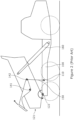
- a tipper truck comprising a tipper assembly 100 in accordance with the prior art is shown in Figures 1 and 2 .
- the tipper assembly may comprise a chassis 110 and a body 120 for receiving a load of material.
- the body 120 may be pivotably attached to the chassis 110 at a body pivot axis 122 such that the body can be pivoted about a body pivot axis 122 from a lowered position as shown in Figure 1 to a raised or lifted position in which the load of material can flow out of an end opening 121 of the body 120 as shown in Figure 2 .
- a tailgate 130 may be arranged in a closed position across the end opening 121.
- the tailgate 130 may be attached to an arm 140.
- the arm 140 may be pivotably attached to the body 120 about an arm pivot axis 141 arranged in an intermediate portion of the arm 140, such that the arm 140 and the tailgate 130 may be pivoted relative to the body 120, lifting the tailgate 130 to an open position away from the end opening 121.
- a chain or tie 150 may be attached to an arm linkage point 142 arranged at a distal end of the arm 140 to the tailgate 130.
- the chain or tie150 may be further attached to a chassis linkage point 111 on the chassis 110, thereby attaching the chassis linkage point 111 to the arm linkage point 142.
- the arm pivot axis 141 As the body 120 is pivoted into its lifted position under the action of a tipper actuator 160, the arm pivot axis 141, being in a fixed position relative to the body 120, may move in an upwards arc.
- the chain or tie 150 may hold the arm linkage point 142 of the arm at a fixed distance relative to the chassis 110, thereby causing the arm 140 to pivot relative to the body 120 about the arm pivot axis 141 and lifting the tailgate 130 into the open position.
- the tailgate 130 may therefore be lifted into the open position by the tipper actuator 160 as a result of the action of the chain or tie 150 and the tipper actuator 160 lifting the body to the open position.
- the pivoting action may result in an arcuate motion of the tailgate 130 outwards and upwards from its original position.
- the shape of the arc may therefore be dictated by the fixed length and pivoting motion of the chain or tie 150.
- any slack in the chain is taken up by initial movement of the body such that the arm linkage point 142 first moves away from and then at a fixed distance to the chassis linkage point 111 as the body is lifted from the lowered to the raised position.
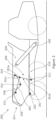
- a tipper assembly 200 in accordance with a first aspect of the present disclosure is shown in Figures 3 to 6 .
- the tipper assembly 200 is shown in the context of a tipper truck.
- the tipper assembly 200 may comprise a chassis 210 and a body 220 suitable for receiving a load of material to be tipped out by the tipper assembly.
- the body may be, for example, a truck bed or body, or a container body.
- the body 220 may be pivotable between a lowered position and a raised position.
- the body 220 may be pivotably attached to the chassis 210 at a body pivot axis 222 such that the body can be pivoted about a body pivot axis 222 from the lowered position as shown in Figure 3 to the raised or lifted position (as shown in Figure 6 ) in which the load of material can flow out of an end opening 221 of the body 220.
- the body pivot axis 222 may be arranged in a fixed position on the chassis 210 and may be arranged at or near a first end of the chassis 210, adjacent to the end opening 221 of the body 220.
- a tipper actuator 160 may be arranged to act on and lift a free end of the body 220, distal to the end opening 221 of the body, thereby pivoting the body 220 about the body pivot axis 222 to move the body 220 into the raised position (i.e. the tipping position).
- a tailgate 230 When the body 220 is arranged in the lowered position, shown in Figure 3 , a tailgate 230 may be arranged in a closed position across the end opening 221.
- the tailgate 230 may be fixedly attached to an arm 240.
- the arm 240 may be pivotably attached to the body 220 about an arm pivot axis 241 arranged in an intermediate portion of the arm 240, such that the arm 240 and the tailgate 230 may be pivoted together relative to the body 220.
- a first linkage assembly 250 may comprise an arm link 251 attached to an arm linkage point 242, the arm linkage point 242 arranged at or near an end of the arm 240 distal to the tailgate 230.
- the arm link 251 may be non-extensible.
- the arm link 251 may be further attached to a chassis linkage point 211 on the chassis 210, thereby connecting the chassis linkage point 211 to the arm linkage point 242.
- the arm link 251 may be formed from a first element 251a pivotally attached to the arm linkage point 242 and a second element 251b pivotally attached to the chassis linkage point 211.
- the first element 251a may be pivotally attached to the second element 251b, thereby allowing bending or folding of the arm link 251 at the joint 251c of the first element 251a and the second element 251b, the joint 251c being arranged at an intermediate portion 253 of the arm link 251.
- the first linkage assembly 250 may further comprise a rapid opening assembly comprising offset link 252.
- the offset link 252 may extend between a body linkage point 223 on the body 220 and the arm link 251.
- the body linkage point 223 may be disposed on a side of the body between the arm pivot axis and the tailgate opening.
- a first end of the offset link 252 may be pivotably attached to the body 220 and a second end of the offset link 252 may be attached to the arm link 251 at or near the joint 251c at the intermediate portion 253 of the arm link 251.
- the offset link 252 may be non-extensible.
- the arm pivot axis 241 being in a fixed position relative to the body 220, may move in an upwards arc relative to the chassis 210.
- the direction of movement of the tailgate 230 and the rotation of the body 220 about the body pivot axis 222 are illustrated by arrows in Figure 4 .
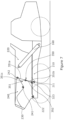
- Figures 5 and 6 show a locus of movement 231 of the tailgate 230 and a locus of movement 243 of arm linkage point 242 of tipper assembly 200 as the body moves to the raised position.
- Figures 5 and 6 also show the locus of movement 131 of a tailgate 130 and the locus of movement 143 of arm linkage point 142 as moved by a chain or tie 150 as shown in Figures 1 and 2 .
- the locus of movement 143 remains at a fixed distance from the chassis linkage point 211.
- the offset link 252 may pull the intermediate portion 253 of the arm link 251 to displace the intermediate portion 253 laterally such that the arm link 251 is curved, bent or folded.
- the rapid opening assembly may thereby be configured to create a v-shape in the arm link 251.
- the arm linkage point 242 and the chassis linkage point 211 may thereby be drawn closer together, as illustrated by locus of movement 243 in Figures 5 and 6 .
- An effective length of the arm link 251, being the shortest distance between the arm linkage point 242 and the chassis linkage point 211, may thereby be reduced.
- the above configuration of the first linkage assembly 250 may draw the arm linkage point 242 closer to the chassis linkage point 211 on rotation of the body 220 about the body pivot axis 222 from the lowered to the raised position.
- the tailgate 230 may therefore be lifted by the tipper actuator 160 as a result of the action of the first linkage assembly 250.
- the pivoting action may result in an arcuate motion of the tailgate 230 outwards and upwards from its original closed position to an open position as shown in Figure 6 .
- the shape of the arc of the locus of movement 243 may therefore be dictated by arc of movement of the body 220 and the shortening of the distance between the arm linkage point 242 and the chassis linkage point described above under the effect of the first linkage assembly 250.
- this may result in an increase in vertical movement of the tailgate 230 at the beginning of the motion of the body 220 from the lowered position, such that the tailgate 230 clears the open end of the body 220 faster, as shown by the increased angle of locus of movement 231 of the tailgate 230 compared to locus of movement 131 of the tailgate 130 in the known system. This may also result in an increased final height of the tailgate 230.
- the speed of rotation of the tailgate 230 away from the end opening 221 is faster than the speed of rotation of the prior art tailgate 130 relative to the end opening 121. Consequently, other than in the lowered position, for any angular position of body 220 relative to the chassis 210, the tailgate 230 is further from the end opening 221 than for the same angular position (other than the lowered position) of the prior art body 120 relative to the chassis 110.
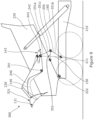
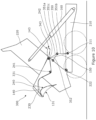
- FIGS 7 to 10 show a further tipper assembly 300 according to the present disclosure.
- the tipper assembly 300 is shown in the context of a tipper truck.
- a first linkage assembly 350 may comprise an arm link 351 attached to an arm linkage point 242, the arm linkage point 242 arranged at or near an end of the arm 240 distal to the tailgate 230.
- the arm link 351 may be non-extensible.
- the arm link 351 may be further attached to a chassis linkage point 211 on the chassis 210, thereby connecting the chassis linkage point 211 to the arm linkage point 242.
- the arm link 351 may be formed from a first element 351a pivotally attached to the arm linkage point 242 and a second element 351b pivotally attached to the chassis linkage point 211.
- the first element 351a may be pivotally attached to the second element 351b, thereby allowing bending or folding of the arm link 351 at a joint 351c of the first element 351a and the second element 351b, the joint 351c being arranged at an intermediate portion 353 of the arm link 351.
- the first linkage assembly 350 may further comprise a rapid opening assembly comprising an offset link 352.
- the offset link 352 may extend between a body linkage point 323 on the body 220 and the arm link 351.
- the body linkage point may be disposed on a side of the body between the arm pivot axis and the tailgate opening.
- a first end of the offset link 352 may be pivotably attached to the body 220 and a second end of the offset link 352 may be attached to the arm link 351 at or near the joint 351c at the intermediate portion 353 of the arm link 351.
- the offset link 352 may therefore have a first end having a fixed position relative to the body.
- the offset link 352 may be non-extensible.
- the arm pivot axis 241 As the body 220 is pivoted into its lifted position under the action of a tipper actuator 160, the arm pivot axis 241, being in a fixed position relative to the body 220, may move in an upwards arc.
- the direction of movement of the tailgate 230 and the rotation of the body 220 about the body pivot axis 222 are illustrated by arrows in Figure 8 .
- Figures 9 and 10 show a locus of movement 331 of the tailgate 230 and a locus of movement 343 of arm linkage point 242 of tipper assembly 300 as the body moves into the raised position.
- Figures 9 and 10 also show the locus of movement 131 of a tailgate 130 and the locus of movement 143 of arm linkage point 142 as moved by a chain or tie 150 as shown in Figures 1 and 2 .
- the locus of movement 143 remains at a fixed distance from the chassis linkage point 211.
- the offset link 352 may push the intermediate portion 353 of the arm link 351 to displace the intermediate portion 353 laterally such that the arm link 351 is curved, bent or folded.
- the rapid opening assembly may thereby be configured to create a v-shape in the arm link 351.
- the arm linkage point 242 and the chassis linkage point 211 may thereby be drawn closer together, as illustrated by locus of movement 343 in Figures 9 and 10 .
- An effective length of the arm link 351 being the shortest distance between the arm linkage point 242 and the chassis linkage point 211, may thereby be reduced.
- the offset link 352 may be a strut suitable for withstanding compressive loading.
- the above configuration of the first linkage assembly 350 may draw the arm linkage point 242 closer to the chassis linkage point 211 on rotation of the body 220 about the body pivot axis 222 from the lowered to the raised position.
- the tailgate 230 may therefore be lifted by the tipper actuator 160 as a result of the action of the first linkage assembly 250.
- the pivoting action may result in an arcuate motion of the tailgate 230 outwards and upwards from its original closed position to an open position as shown in Figure 10 .
- the shape of the arc of the locus of movement 343 may therefore dictated by arc of movement of the body 220 and the shortening of the distance between the arm linkage point 242 and the chassis linkage point described above under the effect of the first linkage assembly 350.
- this may result in an increase in vertical movement of the tailgate 230 at the beginning of the motion of the body 220 from the lowered position, such that the tailgate 230 clears the open end of the body 220 faster, as shown by the increased angle of locus of movement 331 of the tailgate compared to locus of movement 131 of the tailgate 230 of the known system. This may also result in an increased final height of the tailgate 230.
- the speed of rotation of the tailgate 230 away from the end opening 221 is faster than the speed of rotation of the prior art tailgate 130 relative to the end opening 121. Consequently, other than in the lowered position, for any angular position of body 220 relative to the chassis 210, the tailgate 230 is further from the end opening 221 than for the same angular position (other than the lowered position) of the prior art body 120 relative to the chassis 110.
- Figure 11 shows a further tipper assembly 400 according to the present disclosure in the context of a tipper truck.
- the first linkage assembly 450 comprises an arm link 451 connecting the arm linkage point 442 and the body linkage point 423.
- the arm link 451 may be formed from a first element 451a pivotally attached to the arm linkage point 442 and a second element 451b pivotally attached to a body linkage point 423.
- the first element 451a may be pivotally attached to the second element 451b, thereby allowing bending or folding of the arm link 451 at the joint 451c of the first element 451a and the second element 451b, the joint 451c being arranged at an intermediate portion 453 of the arm link 451.
- the rapid opening assembly comprising offset link 452 may connect an intermediate portion 453 of the arm link 451 with the chassis linkage point 411.
- the offset link 452 may have a fixed overall length.
- the offset link 452 may resist movement of the intermediate portion 453 of the arm link away from the chassis 410 and may thereby draw the arm linkage point 442 down relative to the body 120 as the body 120 moves upwards.
- the rapid opening assembly may thereby be configured to create a v-shape in the arm link 451.
- An effective length of the first linkage assembly 450 being the shortest distance between the arm linkage point 442 and a distal end of the arm link 451, may thereby be reduced.
- the arm link may be inextensible.
- the arm link may alternatively comprise a chain or wire or other similar element that is bendable or foldable at an intermediate point under the action of the offset link. If first element and second element of the arm link are replaced by a single bendable tie or chain, the joint may be replaced by a bending point or attachment point for the offset link, arranged at an intermediate portion of the arm link.
- the offset link may comprise a flexible element such as a wire, chain, rope or similar tie suitable for carrying a tensile load, or a rigid element, for example a bar or rod or other similar tie suitable for carrying a tensile load.
- the offset link may comprise a rigid element, for example a bar, rod or similar strut suitable for carrying a compressive load.
- the tailgate on lowering of the body from the raised to the lowered position, the tailgate returns to the closed position under the action of the linkage assembly as a result of a lowering action of the tipper actuator.
- the offset link may be configured to act (push or pull) the intermediate portion of the arm link on movement of the body into the raised position to displace the intermediate portion laterally such that the arm link is curved, bent folded.
- An effective length of the first linkage assembly being the shortest distance between the arm linkage point and a distal end of the arm link, may thereby be reduced.
- the tailgate lift assembly may consist of simple mechanical links and connections (i.e. does not comprise actuators, motors, or hydraulic components).
- the tailgate lift assembly may be actuated by the movement of the body under the action of the tipper actuator.
- the first and/or second arm link may be arranged in a straight line or in a v-shape when the body is in the lowered position.
- the arm link may be arranged with two elements or sections arranged at an angle to each other, or in a straight line when the body is in the lowered position.
- the creation of a v-shape in an arm link may therefore include creating a v-shape in a previously straight arm link or deepening an existing v-shape (for example by reducing an angle between two elements or sections of the arm link).
- the term v-shape may include u-shapes or similar curved shapes.
- the term fixedly attached is used to refer to an attachment with little or no relative movement between the components. This may include the components in question being welded or bolted together, or being integrally produced as a single component.
- the arm may be fixedly attached to the tailgate.
- the tipper assembly may comprise a second tailgate lift assembly configured to lift the tailgate from the closed position to the open position on movement of the body from the lowered position to the raised position.
- the first tailgate lift assembly may be arranged on a first side of the body and the second tailgate lift assembly may be arranged on a second side of the body.
- the second tailgate lift assembly may be of the same construction as the first tailgate lift assembly.
- the second tailgate lift assembly may comprise a second arm having a tailgate end fixedly attached to the tailgate and a second arm linkage point, the second arm being pivotally attached to the body about the arm pivot axis, the arm pivot axis being arranged between the tailgate end and the second arm linkage point, and a second linkage assembly connecting the second arm linkage point to the second chassis linkage point, the second linkage assembly comprising a second arm link and a second rapid opening assembly, the second rapid opening assembly having a first end attached to the body or chassis and a second end attached to an intermediate portion of the second arm link.
- the second rapid opening assembly may be configured to create a v-shape in the second arm link, drawing the second arm linkage point closer to the second chassis linkage point on rotation of the body about the body pivot axis from the lowered to the raised position.
- the tailgate may be moved away from the opening more quickly, as it follows a different arc to that in the prior art, gaining height relative to the chassis more quickly in the initial phase of the movement. There may therefore be less chance of obstruction of the flow of material out of the body as the assembly moves to a tipping position.
Landscapes
- Engineering & Computer Science (AREA)
- Transportation (AREA)
- Mechanical Engineering (AREA)
- Power-Operated Mechanisms For Wings (AREA)
Description
- The disclosure relates to the field of tipper assemblies, more particularly tipper assemblies for use in dump trucks, tipper trucks and/or the like.
- Dump trucks, also known as tipper trucks, can be fitted with a tailgate to close off the end of the truck body to increase payload volume and reduce spillage during hauling.
- It is known to provide a separate tailgate actuation mechanism, powered independently from the truck body tipping mechanism. This adds cost and complexity to the system.
- Alternatively, a pivoting arm mechanism actuated by a single tie or chain may be used to open the tailgate. The chain or tie may be connected to an end of the pivoting arm and to the chassis. The chain or tie causes the arm to move relative to the truck body as the truck body is pivoted into the raised tipping position relative to the chassis by the tipping actuators, thereby opening the tailgate. Such mechanisms may be limited by the geometry of the tailgate, the truck body and the chassis and may result in a restricted opening rate.
-
JP S5817233 U -
US5887914 relates to a vehicle in-service/out-of-service rotatable tailgate mechanism. - Against this background there is provided a tipper assembly configured to open the tailgate quickly and efficiently to avoid interfering with the free flow of the payload as the truck body is raised into a raised "tipping" position, to avoid damage and destabilisation of the machine.
- In embodiments of the present disclosure, a tailgate lift assembly is configured to lift the tailgate from a closed position to the open position on movement of the body from the lowered position to the raised position. The dump truck or the like comprises a chassis and a truck-bed/dump-body, and the truck-bed is pivotally attached to the chassis about a truck-bed pivot axis. The truck-bed is configured to contain a load to be carried by the truck and is coupled with the chassis so that it can be moved between a lowered position for transporting the load and a raised position for emptying the load from the truck-bed. The truck-bed includes a tailgate that is designed to maintain the load within the truck-bed during transport.
- In accordance with embodiments of the present disclosure, the tailgate is moveable between a closed position, in which the tailgate closes an end opening of the truck-bed and an open position in which the tailgate is pivoted away from the end opening leaving an opening through which the load can be emptied from the truck-bed.
- In embodiments of the present disclosure, the tailgate is coupled with a tailgate lift assembly. The tailgate lift assembly is configured to lift the tailgate from the closed position to the open position when the truck bed is raised from the lowered position to the raised position.
- In embodiments of the present disclosure, the tailgate lift assembly includes arms on either side of the truck bed that extend from the tailgate, to which the arms are coupled, to a linkage point. The arms are each pivotally attached to the truck-bed at a pivot point, where the pivot point is disposed between the tailgate and the linkage point.
- In embodiments of the present disclosure, a first tailgate lift assembly comprises a first arm having a tailgate end fixedly attached to the tailgate and a first arm linkage point, the first arm being pivotally attached to the body about an arm pivot axis, the arm pivot axis being arranged between the tailgate end and the first arm linkage point.
- In embodiments of the present disclosure, a first linkage assembly connects the first arm linkage point to the first chassis linkage point, the first linkage assembly comprising an arm link and a rapid opening assembly having a first end attached to the body or chassis and a second end attached to an intermediate portion of the first arm link. The rapid opening assembly is configured to create a v-shape in the arm link, drawing the first arm linkage point closer to the first chassis linkage point on rotation of the body about the body pivot axis from the lowered to the raised position.
- The linkage assembly is configured to draw the linkage point closer to the chassis linkage point when the truck-bed is raised. The drawing of the tailgate linkage point closer to the chassis linkage point causes the tailgate-opening assembly to increase the rate at which the tailgate is opened.
- Embodiments of the disclosure are now described with reference to the accompanying drawings, in which:
-
Figure 1 shows a schematic representation of a tipper assembly according to the prior art in a lowered position; -
Figure 2 shows a schematic representation of the tipper assembly ofFigure 1 in an intermediate position during raising of the tailgate; -
Figure 3 shows a schematic representation of a tipper assembly according to the present disclosure in a lowered position; and -
Figure 4 shows a schematic representation of the tipper assembly ofFigure 3 in an intermediate position during raising of the tailgate; -
Figure 5 shows a schematic representation of the tipper assembly ofFigure 3 in an intermediate position, showing the locus of movement of the tailgate and arm linkage point and a tipper assembly as inFigure 1 showing the locus of movement of the tailgate and arm linkage point of the tipper assembly ofFigure 1 ; -
Figure 6 shows a schematic representation of the tipper assembly ofFigure 3 in a raised position, showing the locus of movement of the tailgate and arm linkage point and a tipper assembly as inFigure 1 showing the locus of movement of the tailgate and arm linkage point of the tipper assembly ofFigure 1 ; -
Figure 7 shows a schematic representation of a further tipper assembly according to the present disclosure in a lowered position; and -
Figure 8 shows a schematic representation of the tipper assembly ofFigure 7 in an intermediate position during raising of the tailgate; -
Figure 9 shows a schematic representation of the tipper assembly ofFigure 7 in an intermediate position, showing the locus of movement of the tailgate and arm linkage point and a tipper assembly as inFigure 1 showing the locus of movement of the tailgate and arm linkage point of the tipper assembly ofFigure 1 ; -
Figure 10 shows a schematic representation of the tipper assembly ofFigure 7 in a raised position, showing the locus of movement of the tailgate and arm linkage point and a tipper assembly as inFigure 1 showing the locus of movement of the tailgate and arm linkage point of the tipper assembly ofFigure 1 ; -
Figure 11 shows a schematic representation of a further tipper assembly according to the present disclosure in a lowered position. - A tipper truck comprising a
tipper assembly 100 in accordance with the prior art is shown inFigures 1 and2 . The tipper assembly may comprise achassis 110 and abody 120 for receiving a load of material. Thebody 120 may be pivotably attached to thechassis 110 at abody pivot axis 122 such that the body can be pivoted about abody pivot axis 122 from a lowered position as shown inFigure 1 to a raised or lifted position in which the load of material can flow out of an end opening 121 of thebody 120 as shown inFigure 2 . - In the lowered position, a
tailgate 130 may be arranged in a closed position across the end opening 121. Thetailgate 130 may be attached to anarm 140. Thearm 140 may be pivotably attached to thebody 120 about anarm pivot axis 141 arranged in an intermediate portion of thearm 140, such that thearm 140 and thetailgate 130 may be pivoted relative to thebody 120, lifting thetailgate 130 to an open position away from the end opening 121. A chain ortie 150 may be attached to anarm linkage point 142 arranged at a distal end of thearm 140 to thetailgate 130. The chain or tie150 may be further attached to a chassis linkage point 111 on thechassis 110, thereby attaching the chassis linkage point 111 to thearm linkage point 142. - As the
body 120 is pivoted into its lifted position under the action of atipper actuator 160, thearm pivot axis 141, being in a fixed position relative to thebody 120, may move in an upwards arc. The chain ortie 150 may hold thearm linkage point 142 of the arm at a fixed distance relative to thechassis 110, thereby causing thearm 140 to pivot relative to thebody 120 about thearm pivot axis 141 and lifting thetailgate 130 into the open position. - The
tailgate 130 may therefore be lifted into the open position by thetipper actuator 160 as a result of the action of the chain ortie 150 and thetipper actuator 160 lifting the body to the open position. The pivoting action may result in an arcuate motion of thetailgate 130 outwards and upwards from its original position. The shape of the arc may therefore be dictated by the fixed length and pivoting motion of the chain ortie 150. Where achain 150 is used, any slack in the chain is taken up by initial movement of the body such that thearm linkage point 142 first moves away from and then at a fixed distance to the chassis linkage point 111 as the body is lifted from the lowered to the raised position. - A
tipper assembly 200 in accordance with a first aspect of the present disclosure is shown inFigures 3 to 6 . InFigures 3 and4 , thetipper assembly 200 is shown in the context of a tipper truck. Thetipper assembly 200 may comprise achassis 210 and abody 220 suitable for receiving a load of material to be tipped out by the tipper assembly. The body may be, for example, a truck bed or body, or a container body. Thebody 220 may be pivotable between a lowered position and a raised position. Thebody 220 may be pivotably attached to thechassis 210 at abody pivot axis 222 such that the body can be pivoted about abody pivot axis 222 from the lowered position as shown inFigure 3 to the raised or lifted position (as shown inFigure 6 ) in which the load of material can flow out of an end opening 221 of thebody 220. Thebody pivot axis 222 may be arranged in a fixed position on thechassis 210 and may be arranged at or near a first end of thechassis 210, adjacent to the end opening 221 of thebody 220. - A
tipper actuator 160 may be arranged to act on and lift a free end of thebody 220, distal to the end opening 221 of the body, thereby pivoting thebody 220 about thebody pivot axis 222 to move thebody 220 into the raised position (i.e. the tipping position). - When the
body 220 is arranged in the lowered position, shown inFigure 3 , atailgate 230 may be arranged in a closed position across the end opening 221. Thetailgate 230 may be fixedly attached to anarm 240. Thearm 240 may be pivotably attached to thebody 220 about anarm pivot axis 241 arranged in an intermediate portion of thearm 240, such that thearm 240 and thetailgate 230 may be pivoted together relative to thebody 220. - A
first linkage assembly 250 may comprise an arm link 251 attached to anarm linkage point 242, thearm linkage point 242 arranged at or near an end of thearm 240 distal to thetailgate 230. The arm link 251 may be non-extensible. The arm link 251 may be further attached to achassis linkage point 211 on thechassis 210, thereby connecting thechassis linkage point 211 to thearm linkage point 242. The arm link 251 may be formed from afirst element 251a pivotally attached to thearm linkage point 242 and asecond element 251b pivotally attached to thechassis linkage point 211. Thefirst element 251a may be pivotally attached to thesecond element 251b, thereby allowing bending or folding of the arm link 251 at the joint 251c of thefirst element 251a and thesecond element 251b, the joint 251c being arranged at anintermediate portion 253 of the arm link 251. - The
first linkage assembly 250 may further comprise a rapid opening assembly comprising offsetlink 252. The offsetlink 252 may extend between abody linkage point 223 on thebody 220 and the arm link 251. Thebody linkage point 223 may be disposed on a side of the body between the arm pivot axis and the tailgate opening. A first end of the offsetlink 252 may be pivotably attached to thebody 220 and a second end of the offsetlink 252 may be attached to the arm link 251 at or near the joint 251c at theintermediate portion 253 of the arm link 251. The offsetlink 252 may be non-extensible. - As the
body 220 is pivoted into its lifted position under the action of atipper actuator 160, thearm pivot axis 241, being in a fixed position relative to thebody 220, may move in an upwards arc relative to thechassis 210. The direction of movement of thetailgate 230 and the rotation of thebody 220 about thebody pivot axis 222 are illustrated by arrows inFigure 4 . -
Figures 5 and6 show a locus ofmovement 231 of thetailgate 230 and a locus ofmovement 243 ofarm linkage point 242 oftipper assembly 200 as the body moves to the raised position. For comparison,Figures 5 and6 also show the locus ofmovement 131 of atailgate 130 and the locus ofmovement 143 ofarm linkage point 142 as moved by a chain or tie 150 as shown inFigures 1 and2 . The locus ofmovement 143 remains at a fixed distance from thechassis linkage point 211. - In
tipper assembly 200, on rotation of thebody 220 about thebody pivot axis 222 from the lowered to the raised position, the offsetlink 252 may pull theintermediate portion 253 of the arm link 251 to displace theintermediate portion 253 laterally such that the arm link 251 is curved, bent or folded. The rapid opening assembly may thereby be configured to create a v-shape in the arm link 251. Thearm linkage point 242 and thechassis linkage point 211 may thereby be drawn closer together, as illustrated by locus ofmovement 243 inFigures 5 and6 . An effective length of the arm link 251, being the shortest distance between thearm linkage point 242 and thechassis linkage point 211, may thereby be reduced. - The above configuration of the
first linkage assembly 250 may draw thearm linkage point 242 closer to thechassis linkage point 211 on rotation of thebody 220 about thebody pivot axis 222 from the lowered to the raised position. Thetailgate 230 may therefore be lifted by thetipper actuator 160 as a result of the action of thefirst linkage assembly 250. The pivoting action may result in an arcuate motion of thetailgate 230 outwards and upwards from its original closed position to an open position as shown inFigure 6 . The shape of the arc of the locus ofmovement 243 may therefore be dictated by arc of movement of thebody 220 and the shortening of the distance between thearm linkage point 242 and the chassis linkage point described above under the effect of thefirst linkage assembly 250. As shown inFigures 5 and6 , this may result in an increase in vertical movement of thetailgate 230 at the beginning of the motion of thebody 220 from the lowered position, such that thetailgate 230 clears the open end of thebody 220 faster, as shown by the increased angle of locus ofmovement 231 of thetailgate 230 compared to locus ofmovement 131 of thetailgate 130 in the known system. This may also result in an increased final height of thetailgate 230. - In this way, as the
body 220 is tipped relative to thechassis 210, the speed of rotation of thetailgate 230 away from theend opening 221 is faster than the speed of rotation of theprior art tailgate 130 relative to theend opening 121. Consequently, other than in the lowered position, for any angular position ofbody 220 relative to thechassis 210, thetailgate 230 is further from theend opening 221 than for the same angular position (other than the lowered position) of theprior art body 120 relative to thechassis 110. - Further embodiments of the disclosure are described below. Features of the first embodiment and the following embodiments may be interchanged and combined as desired. In addition, in the following description only differences between the embodiments will be described in detail. In other respects the reader is directed to the description of the prior embodiment.
-
Figures 7 to 10 show afurther tipper assembly 300 according to the present disclosure. InFigures 7 and8 , thetipper assembly 300 is shown in the context of a tipper truck. - In this tipper assembly a
first linkage assembly 350 may comprise anarm link 351 attached to anarm linkage point 242, thearm linkage point 242 arranged at or near an end of thearm 240 distal to thetailgate 230. Thearm link 351 may be non-extensible. Thearm link 351 may be further attached to achassis linkage point 211 on thechassis 210, thereby connecting thechassis linkage point 211 to thearm linkage point 242. Thearm link 351 may be formed from afirst element 351a pivotally attached to thearm linkage point 242 and asecond element 351b pivotally attached to thechassis linkage point 211. Thefirst element 351a may be pivotally attached to thesecond element 351b, thereby allowing bending or folding of thearm link 351 at a joint 351c of thefirst element 351a and thesecond element 351b, the joint 351c being arranged at anintermediate portion 353 of thearm link 351. - The
first linkage assembly 350 may further comprise a rapid opening assembly comprising an offsetlink 352. The offsetlink 352 may extend between abody linkage point 323 on thebody 220 and thearm link 351. The body linkage point may be disposed on a side of the body between the arm pivot axis and the tailgate opening. A first end of the offsetlink 352 may be pivotably attached to thebody 220 and a second end of the offsetlink 352 may be attached to thearm link 351 at or near the joint 351c at theintermediate portion 353 of thearm link 351. The offsetlink 352 may therefore have a first end having a fixed position relative to the body. The offsetlink 352 may be non-extensible. - As the
body 220 is pivoted into its lifted position under the action of atipper actuator 160, thearm pivot axis 241, being in a fixed position relative to thebody 220, may move in an upwards arc. The direction of movement of thetailgate 230 and the rotation of thebody 220 about thebody pivot axis 222 are illustrated by arrows inFigure 8 . -
Figures 9 and10 show a locus ofmovement 331 of thetailgate 230 and a locus ofmovement 343 ofarm linkage point 242 oftipper assembly 300 as the body moves into the raised position. For comparison,Figures 9 and10 also show the locus ofmovement 131 of atailgate 130 and the locus ofmovement 143 ofarm linkage point 142 as moved by a chain or tie 150 as shown inFigures 1 and2 . The locus ofmovement 143 remains at a fixed distance from thechassis linkage point 211. - On rotation of the
body 220 about thebody pivot axis 222 from the lowered to the raised position, the offsetlink 352 may push theintermediate portion 353 of thearm link 351 to displace theintermediate portion 353 laterally such that thearm link 351 is curved, bent or folded. The rapid opening assembly may thereby be configured to create a v-shape in thearm link 351. Thearm linkage point 242 and thechassis linkage point 211 may thereby be drawn closer together, as illustrated by locus ofmovement 343 inFigures 9 and10 . An effective length of thearm link 351, being the shortest distance between thearm linkage point 242 and thechassis linkage point 211, may thereby be reduced. The offsetlink 352 may be a strut suitable for withstanding compressive loading. - The above configuration of the
first linkage assembly 350 may draw thearm linkage point 242 closer to thechassis linkage point 211 on rotation of thebody 220 about thebody pivot axis 222 from the lowered to the raised position. Thetailgate 230 may therefore be lifted by thetipper actuator 160 as a result of the action of thefirst linkage assembly 250. The pivoting action may result in an arcuate motion of thetailgate 230 outwards and upwards from its original closed position to an open position as shown inFigure 10 . The shape of the arc of the locus ofmovement 343 may therefore dictated by arc of movement of thebody 220 and the shortening of the distance between thearm linkage point 242 and the chassis linkage point described above under the effect of thefirst linkage assembly 350. As shown inFigures 9 and10 , this may result in an increase in vertical movement of thetailgate 230 at the beginning of the motion of thebody 220 from the lowered position, such that thetailgate 230 clears the open end of thebody 220 faster, as shown by the increased angle of locus ofmovement 331 of the tailgate compared to locus ofmovement 131 of thetailgate 230 of the known system. This may also result in an increased final height of thetailgate 230. - In this way, as the
body 220 is tipped relative to thechassis 210, the speed of rotation of thetailgate 230 away from theend opening 221 is faster than the speed of rotation of theprior art tailgate 130 relative to theend opening 121. Consequently, other than in the lowered position, for any angular position ofbody 220 relative to thechassis 210, thetailgate 230 is further from theend opening 221 than for the same angular position (other than the lowered position) of theprior art body 120 relative to thechassis 110. -
Figure 11 shows afurther tipper assembly 400 according to the present disclosure in the context of a tipper truck. In this tipper assembly, thefirst linkage assembly 450 comprises anarm link 451 connecting thearm linkage point 442 and thebody linkage point 423. Thearm link 451 may be formed from afirst element 451a pivotally attached to thearm linkage point 442 and asecond element 451b pivotally attached to abody linkage point 423. Thefirst element 451a may be pivotally attached to thesecond element 451b, thereby allowing bending or folding of thearm link 451 at the joint 451c of thefirst element 451a and thesecond element 451b, the joint 451c being arranged at anintermediate portion 453 of thearm link 451. - The rapid opening assembly comprising offset
link 452 may connect anintermediate portion 453 of thearm link 451 with thechassis linkage point 411. The offsetlink 452 may have a fixed overall length. On raising of the body 420 by the tipper actuator, the offsetlink 452 may resist movement of theintermediate portion 453 of the arm link away from the chassis 410 and may thereby draw thearm linkage point 442 down relative to thebody 120 as thebody 120 moves upwards. The rapid opening assembly may thereby be configured to create a v-shape in thearm link 451. An effective length of thefirst linkage assembly 450, being the shortest distance between thearm linkage point 442 and a distal end of thearm link 451, may thereby be reduced. - Whilst preferred embodiments of the present invention have been described above and illustrated in the drawings, these are by way of example only and non-limiting. It will be appreciated by those skilled in the art that many alternatives are possible within the ambit of the invention.
- In any embodiment, the arm link may be inextensible.
- In any embodiment of the present disclosure the arm link may alternatively comprise a chain or wire or other similar element that is bendable or foldable at an intermediate point under the action of the offset link. If first element and second element of the arm link are replaced by a single bendable tie or chain, the joint may be replaced by a bending point or attachment point for the offset link, arranged at an intermediate portion of the arm link.
- In any embodiment in which the offset link is configured to pull on the intermediate portion of the arm link, the offset link may comprise a flexible element such as a wire, chain, rope or similar tie suitable for carrying a tensile load, or a rigid element, for example a bar or rod or other similar tie suitable for carrying a tensile load. In any embodiment in which the offset link is configured to push on the intermediate portion of the arm link, the offset link may comprise a rigid element, for example a bar, rod or similar strut suitable for carrying a compressive load.
- In any embodiment, on lowering of the body from the raised to the lowered position, the tailgate returns to the closed position under the action of the linkage assembly as a result of a lowering action of the tipper actuator.
- In any embodiment the offset link may be configured to act (push or pull) the intermediate portion of the arm link on movement of the body into the raised position to displace the intermediate portion laterally such that the arm link is curved, bent folded. An effective length of the first linkage assembly, being the shortest distance between the arm linkage point and a distal end of the arm link, may thereby be reduced.
- In any embodiment, the tailgate lift assembly may consist of simple mechanical links and connections (i.e. does not comprise actuators, motors, or hydraulic components).
- In any embodiment, the tailgate lift assembly may be actuated by the movement of the body under the action of the tipper actuator.
- In any embodiment, the first and/or second arm link may be arranged in a straight line or in a v-shape when the body is in the lowered position. For example, the arm link may be arranged with two elements or sections arranged at an angle to each other, or in a straight line when the body is in the lowered position. The creation of a v-shape in an arm link may therefore include creating a v-shape in a previously straight arm link or deepening an existing v-shape (for example by reducing an angle between two elements or sections of the arm link). The term v-shape may include u-shapes or similar curved shapes.
- In the present disclosure, the term fixedly attached is used to refer to an attachment with little or no relative movement between the components. This may include the components in question being welded or bolted together, or being integrally produced as a single component. For example, in any embodiment of the present disclosure, the arm may be fixedly attached to the tailgate.
- In any embodiment, the tipper assembly may comprise a second tailgate lift assembly configured to lift the tailgate from the closed position to the open position on movement of the body from the lowered position to the raised position. The first tailgate lift assembly may be arranged on a first side of the body and the second tailgate lift assembly may be arranged on a second side of the body.
- The second tailgate lift assembly may be of the same construction as the first tailgate lift assembly. For example, the second tailgate lift assembly may comprise a second arm having a tailgate end fixedly attached to the tailgate and a second arm linkage point, the second arm being pivotally attached to the body about the arm pivot axis, the arm pivot axis being arranged between the tailgate end and the second arm linkage point, and a second linkage assembly connecting the second arm linkage point to the second chassis linkage point, the second linkage assembly comprising a second arm link and a second rapid opening assembly, the second rapid opening assembly having a first end attached to the body or chassis and a second end attached to an intermediate portion of the second arm link. The second rapid opening assembly may be configured to create a v-shape in the second arm link, drawing the second arm linkage point closer to the second chassis linkage point on rotation of the body about the body pivot axis from the lowered to the raised position.
- In this way, it may be possible for the tailgate to be moved away from the opening more quickly, as it follows a different arc to that in the prior art, gaining height relative to the chassis more quickly in the initial phase of the movement. There may therefore be less chance of obstruction of the flow of material out of the body as the assembly moves to a tipping position.
Claims (14)
- A tipper assembly (200) comprising:a chassis (210) having a first chassis linkage point (211);a body (220) pivotally attached to the chassis (210) about a body pivot axis (222), the body (220) being pivotable between a lowered position and a raised position;a tailgate (230) moveable between a closed position in which the tailgate (230) is arranged across an end opening (221) of the body (220) and an open position in which the tailgate (230) is pivoted away from the end opening (221); anda first tailgate lift assembly configured to lift the tailgate (230) from the closed position to the open position on movement of the body (220) from the lowered position to the raised position;wherein the first tailgate lift assembly comprises:a first arm (240) having a tailgate end fixedly attached to the tailgate (230) and a first arm linkage point (242), the first arm (240) being pivotally attached to the body (220) about an arm pivot axis (241), the arm pivot axis (241) being arranged between the tailgate end and the first arm linkage point (242); anda first linkage assembly (250) connecting the first arm linkage point (242) to the first chassis linkage point (211), the first linkage assemblycomprising an arm link (251)characterised in thatthe first linkage assembly further comprisesa rapid opening assembly, the rapidopening assembly having a first end attached to the body (220) or the chassis (210) and a second end attached to an intermediate portion of the arm link (251);wherein the rapid opening assembly is configured to create a v-shape in the arm link (251), drawing the first arm linkage point (242) closer to the first chassis linkage point (211) on rotation of the body (220) about the body pivot axis (222) from the lowered to the raised position.
- A tipper assembly (200) as in claim 1 wherein:the arm link (251) is pivotally attached to the first arm linkage point (242) and the first chassis linkage point (211); andthe first end of the rapid opening assembly is attached to the body (220) at a first body linkage point (223), the first body linkage point (223) preferably being disposed on a side of the body (220) between the arm pivot axis (241) and the tailgate opening.
- A tipper assembly (200) as in claim 1 wherein:the arm link (251) is pivotally attached to the first arm linkage point (242) and a body linkage point (223); andthe first end of the rapid opening assembly is attached to the first chassis linkage point (211).
- A tipper assembly (200) as in any preceding claim wherein the arm link (251) comprises:a chain or wire; ora first element pivotally attached to a second element; ora flexible element.
- A tipper assembly (200) as in any preceding claim wherein the rapid opening assembly comprises an offset link (252);
wherein the offset link (252) is configured to laterally displace the intermediate portion of the arm link (251) on rotation of the body (220) about the body pivot axis (222) from the lowered to the raised position such that the first arm linkage point (242) and the first chassis linkage point (211) are thereby drawn together. - A tipper assembly as in claim 5 wherein the offset link (252) comprises;a chain or wire; ora rigid element.
- A tipper assembly (200) as in any of claims 5 to 6 wherein the offset link (252) is configured to push the intermediate portion of the arm link (251).
- A tipper assembly (200) as in any of claims 5 to 6 wherein the offset link (252) is configured to pull on the intermediate portion of the arm link (251).
- A tipper assembly (200) as in any preceding claim, the tipper assembly (200) further comprising a second tailgate lift assembly configured to lift the tailgate from the closed position to the open position on movement of the body from the lowered position to the raised position, wherein the first tailgate lift assembly is arranged on a first side of the body and the second tailgate lift assembly is arranged on a second side of the body.
- A tipper assembly (200) as in claim 9 wherein the second tailgate lift assembly is of the same construction as the first tailgate lift assembly.
- A tipper assembly (200) as in claim 9 or claim 10, wherein the second tailgate lift assembly comprises:a second arm having a tailgate end fixedly attached to the tailgate (230) and a second arm linkage point, the second arm being pivotally attached to the body (220) about the arm pivot axis (241), the arm pivot axis (241) being arranged between the tailgate end and the second arm linkage point; anda second linkage assembly connecting the second arm linkage point to the second chassis linkage point, the second linkage assembly comprising a second arm link and a second rapid opening assembly, the second rapid opening assembly having a first end attached to the body (220) or chassis (210) and a second end attached to an intermediate portion of the second arm link;wherein the second rapid opening assembly is configured to create a v-shape in the arm link, drawing the second arm linkage point closer to the second chassis linkage point on rotation of the body (220) about the body pivot axis (222) from the lowered to the raised position.
- A tipper assembly (200) as in any preceding claim further comprising a tipper actuator (160) configured to lift the body (220) into the raised position relative to the chassis (210), where in the first tailgate lift assembly is configured to be actuated by movement of the tipper actuator (160).
- A machine comprising a tipper assembly (200) as in any preceding claim.
- A dump truck comprising a tipper assembly (200) as in any of claims 1 to 12.
Applications Claiming Priority (2)
| Application Number | Priority Date | Filing Date | Title |
|---|---|---|---|
| GB1907390.7A GB2584153B (en) | 2019-05-24 | 2019-05-24 | A tipper tailgate assembly |
| PCT/EP2020/025237 WO2020239257A1 (en) | 2019-05-24 | 2020-05-21 | Tipper assembly |
Publications (2)
| Publication Number | Publication Date |
|---|---|
| EP3976420A1 EP3976420A1 (en) | 2022-04-06 |
| EP3976420B1 true EP3976420B1 (en) | 2023-05-03 |
Family
ID=67385625
Family Applications (1)
| Application Number | Title | Priority Date | Filing Date |
|---|---|---|---|
| EP20730384.3A Active EP3976420B1 (en) | 2019-05-24 | 2020-05-21 | Tipper assembly |
Country Status (6)
| Country | Link |
|---|---|
| US (1) | US12434614B2 (en) |
| EP (1) | EP3976420B1 (en) |
| AU (1) | AU2020282521B2 (en) |
| GB (1) | GB2584153B (en) |
| WO (1) | WO2020239257A1 (en) |
| ZA (1) | ZA202108898B (en) |
Families Citing this family (1)
| Publication number | Priority date | Publication date | Assignee | Title |
|---|---|---|---|---|
| US11673615B2 (en) * | 2019-12-18 | 2023-06-13 | LeRoy George Hagenbuch | Automatic fluidic sealing tailgate |
Family Cites Families (15)
| Publication number | Priority date | Publication date | Assignee | Title |
|---|---|---|---|---|
| US2439585A (en) * | 1946-02-05 | 1948-04-13 | Euclid Road Machinery Co | Semistationary tail gate for rear dump bodies |
| US3751112A (en) * | 1971-06-17 | 1973-08-07 | L Hagenbuch | Tailgate |
| JPS6021895B2 (en) * | 1980-11-21 | 1985-05-30 | 極東開発工業株式会社 | Dump truck rear door opening/closing device |
| JPS6027050Y2 (en) * | 1981-07-29 | 1985-08-15 | 有限会社戸谷建設工業 | Dump truck loading platform rear door opening/closing device |
| US4621858A (en) * | 1984-09-28 | 1986-11-11 | Hagenbuch Roy George Le | Apparatus and method for a rotatable tailgate assembly having service and out-of-service positions |
| US5726288A (en) | 1989-11-13 | 1998-03-10 | Massachusetts Institute Of Technology | Localization and characterization of the Wilms' tumor gene |
| RU2057657C1 (en) * | 1992-07-14 | 1996-04-10 | Люберецкая станция аэрации | Device for opening and closing of dump vehicle body side |
| US5887914A (en) * | 1993-11-30 | 1999-03-30 | Hagenbuch; Leroy G. | Vehicle in-service/out-of-service rotatable tailgate mechanism |
| US5503462A (en) * | 1994-03-29 | 1996-04-02 | Western Oil Tool & Mfg. Co., Inc. (Wotco Inc.) | Mechanical tiedown for stationary tailgate |
| US6491349B2 (en) * | 2000-12-06 | 2002-12-10 | Mccafferty Michael V. | In-service/out-of-service rotatable tailgate assembly |
| JP2003191784A (en) * | 2001-12-27 | 2003-07-09 | Kazuo Kimura | Door opening and closing method for dump truck and its device |
| US6726288B2 (en) * | 2002-05-14 | 2004-04-27 | Leroy G. Hagenbuch | Tailgate assembly for an off-road truck |
| US6893099B2 (en) | 2003-10-06 | 2005-05-17 | O'brien George M. | Tailgate |
| US11453324B2 (en) * | 2019-12-20 | 2022-09-27 | Philippi-Hagenbuch, Inc. | Automatic four bar linkage tailgate anchor point |
| EP4353535B1 (en) * | 2022-10-10 | 2026-04-22 | Volvo Construction Equipment AB | Overload protection system |
-
2019
- 2019-05-24 GB GB1907390.7A patent/GB2584153B/en active Active
-
2020
- 2020-05-21 AU AU2020282521A patent/AU2020282521B2/en active Active
- 2020-05-21 EP EP20730384.3A patent/EP3976420B1/en active Active
- 2020-05-21 US US17/613,806 patent/US12434614B2/en active Active
- 2020-05-21 WO PCT/EP2020/025237 patent/WO2020239257A1/en not_active Ceased
-
2021
- 2021-11-10 ZA ZA2021/08898A patent/ZA202108898B/en unknown
Also Published As
| Publication number | Publication date |
|---|---|
| AU2020282521A1 (en) | 2021-12-09 |
| AU2020282521B2 (en) | 2022-09-15 |
| US20220219588A1 (en) | 2022-07-14 |
| GB201907390D0 (en) | 2019-07-10 |
| GB2584153B (en) | 2021-09-29 |
| EP3976420A1 (en) | 2022-04-06 |
| US12434614B2 (en) | 2025-10-07 |
| GB2584153A (en) | 2020-11-25 |
| WO2020239257A1 (en) | 2020-12-03 |
| ZA202108898B (en) | 2023-07-26 |
Similar Documents
| Publication | Publication Date | Title |
|---|---|---|
| US4026590A (en) | Folding bumper arrangement | |
| US7147264B2 (en) | Cover system for a transfer trailer | |
| US5498066A (en) | Articulated cover for a top loading hauling body | |
| US20180334321A1 (en) | Transport Container | |
| EP3976420B1 (en) | Tipper assembly | |
| JP2000515830A (en) | Car body side wall | |
| EP2280122B1 (en) | Vertical lift arm device | |
| CN105283352B (en) | Foldable backboard, the loader(-mounted) shovel with the foldable backboard and the vehicle with the loader(-mounted) shovel | |
| CA2437169A1 (en) | Linkage for on-off loading and dumping of a dumpster on a truck frame | |
| JPH0626068A (en) | Vertical lifting loader boom device | |
| US7344179B2 (en) | Retractable hardtop for a vehicle | |
| KR20040089676A (en) | Pivoting convertible roof for a motor vehicle | |
| EP0700802A1 (en) | Articulated cover for a top loading hauling body | |
| CN108569184B (en) | Loading mechanism | |
| CN222360893U (en) | Electric dump truck | |
| JP4188291B2 (en) | Cargo handling vehicle | |
| AU2020276749B2 (en) | Side tipper system | |
| CA1290913C (en) | Storage bin lid or cover closing and opening mechanism | |
| JP3972507B2 (en) | Air resistance reduction device for flat body mounted vehicle | |
| US4962966A (en) | Automatic tailgate assembly | |
| AU689631B2 (en) | Self-opening tailgate assembly | |
| CN118322970A (en) | Electric dump truck | |
| CA1318935C (en) | Automatic tailgate assembly | |
| AU716340B2 (en) | Loader arm assembly | |
| WO2001012455A1 (en) | Covering means for vehicle containers |
Legal Events
| Date | Code | Title | Description |
|---|---|---|---|
| STAA | Information on the status of an ep patent application or granted ep patent |
Free format text: STATUS: UNKNOWN |
|
| STAA | Information on the status of an ep patent application or granted ep patent |
Free format text: STATUS: THE INTERNATIONAL PUBLICATION HAS BEEN MADE |
|
| PUAI | Public reference made under article 153(3) epc to a published international application that has entered the european phase |
Free format text: ORIGINAL CODE: 0009012 |
|
| STAA | Information on the status of an ep patent application or granted ep patent |
Free format text: STATUS: REQUEST FOR EXAMINATION WAS MADE |
|
| 17P | Request for examination filed |
Effective date: 20211118 |
|
| AK | Designated contracting states |
Kind code of ref document: A1 Designated state(s): AL AT BE BG CH CY CZ DE DK EE ES FI FR GB GR HR HU IE IS IT LI LT LU LV MC MK MT NL NO PL PT RO RS SE SI SK SM TR |
|
| DAV | Request for validation of the european patent (deleted) | ||
| DAX | Request for extension of the european patent (deleted) | ||
| GRAP | Despatch of communication of intention to grant a patent |
Free format text: ORIGINAL CODE: EPIDOSNIGR1 |
|
| STAA | Information on the status of an ep patent application or granted ep patent |
Free format text: STATUS: GRANT OF PATENT IS INTENDED |
|
| INTG | Intention to grant announced |
Effective date: 20221223 |
|
| GRAS | Grant fee paid |
Free format text: ORIGINAL CODE: EPIDOSNIGR3 |
|
| GRAA | (expected) grant |
Free format text: ORIGINAL CODE: 0009210 |
|
| STAA | Information on the status of an ep patent application or granted ep patent |
Free format text: STATUS: THE PATENT HAS BEEN GRANTED |
|
| AK | Designated contracting states |
Kind code of ref document: B1 Designated state(s): AL AT BE BG CH CY CZ DE DK EE ES FI FR GB GR HR HU IE IS IT LI LT LU LV MC MK MT NL NO PL PT RO RS SE SI SK SM TR |
|
| REG | Reference to a national code |
Ref country code: GB Ref legal event code: FG4D |
|
| REG | Reference to a national code |
Ref country code: AT Ref legal event code: REF Ref document number: 1564322 Country of ref document: AT Kind code of ref document: T Effective date: 20230515 Ref country code: CH Ref legal event code: EP |
|
| REG | Reference to a national code |
Ref country code: DE Ref legal event code: R096 Ref document number: 602020010461 Country of ref document: DE |
|
| REG | Reference to a national code |
Ref country code: IE Ref legal event code: FG4D |
|
| REG | Reference to a national code |
Ref country code: SE Ref legal event code: TRGR |
|
| P01 | Opt-out of the competence of the unified patent court (upc) registered |
Effective date: 20230526 |
|
| REG | Reference to a national code |
Ref country code: LT Ref legal event code: MG9D |
|
| REG | Reference to a national code |
Ref country code: NL Ref legal event code: MP Effective date: 20230503 |
|
| REG | Reference to a national code |
Ref country code: AT Ref legal event code: MK05 Ref document number: 1564322 Country of ref document: AT Kind code of ref document: T Effective date: 20230503 |
|
| PG25 | Lapsed in a contracting state [announced via postgrant information from national office to epo] |
Ref country code: PT Free format text: LAPSE BECAUSE OF FAILURE TO SUBMIT A TRANSLATION OF THE DESCRIPTION OR TO PAY THE FEE WITHIN THE PRESCRIBED TIME-LIMIT Effective date: 20230904 Ref country code: NO Free format text: LAPSE BECAUSE OF FAILURE TO SUBMIT A TRANSLATION OF THE DESCRIPTION OR TO PAY THE FEE WITHIN THE PRESCRIBED TIME-LIMIT Effective date: 20230803 Ref country code: NL Free format text: LAPSE BECAUSE OF FAILURE TO SUBMIT A TRANSLATION OF THE DESCRIPTION OR TO PAY THE FEE WITHIN THE PRESCRIBED TIME-LIMIT Effective date: 20230503 Ref country code: ES Free format text: LAPSE BECAUSE OF FAILURE TO SUBMIT A TRANSLATION OF THE DESCRIPTION OR TO PAY THE FEE WITHIN THE PRESCRIBED TIME-LIMIT Effective date: 20230503 Ref country code: AT Free format text: LAPSE BECAUSE OF FAILURE TO SUBMIT A TRANSLATION OF THE DESCRIPTION OR TO PAY THE FEE WITHIN THE PRESCRIBED TIME-LIMIT Effective date: 20230503 |
|
| PG25 | Lapsed in a contracting state [announced via postgrant information from national office to epo] |
Ref country code: RS Free format text: LAPSE BECAUSE OF FAILURE TO SUBMIT A TRANSLATION OF THE DESCRIPTION OR TO PAY THE FEE WITHIN THE PRESCRIBED TIME-LIMIT Effective date: 20230503 Ref country code: PL Free format text: LAPSE BECAUSE OF FAILURE TO SUBMIT A TRANSLATION OF THE DESCRIPTION OR TO PAY THE FEE WITHIN THE PRESCRIBED TIME-LIMIT Effective date: 20230503 Ref country code: LV Free format text: LAPSE BECAUSE OF FAILURE TO SUBMIT A TRANSLATION OF THE DESCRIPTION OR TO PAY THE FEE WITHIN THE PRESCRIBED TIME-LIMIT Effective date: 20230503 Ref country code: LT Free format text: LAPSE BECAUSE OF FAILURE TO SUBMIT A TRANSLATION OF THE DESCRIPTION OR TO PAY THE FEE WITHIN THE PRESCRIBED TIME-LIMIT Effective date: 20230503 Ref country code: IS Free format text: LAPSE BECAUSE OF FAILURE TO SUBMIT A TRANSLATION OF THE DESCRIPTION OR TO PAY THE FEE WITHIN THE PRESCRIBED TIME-LIMIT Effective date: 20230903 Ref country code: HR Free format text: LAPSE BECAUSE OF FAILURE TO SUBMIT A TRANSLATION OF THE DESCRIPTION OR TO PAY THE FEE WITHIN THE PRESCRIBED TIME-LIMIT Effective date: 20230503 Ref country code: GR Free format text: LAPSE BECAUSE OF FAILURE TO SUBMIT A TRANSLATION OF THE DESCRIPTION OR TO PAY THE FEE WITHIN THE PRESCRIBED TIME-LIMIT Effective date: 20230804 |
|
| PG25 | Lapsed in a contracting state [announced via postgrant information from national office to epo] |
Ref country code: FI Free format text: LAPSE BECAUSE OF FAILURE TO SUBMIT A TRANSLATION OF THE DESCRIPTION OR TO PAY THE FEE WITHIN THE PRESCRIBED TIME-LIMIT Effective date: 20230503 |
|
| REG | Reference to a national code |
Ref country code: CH Ref legal event code: PL |
|
| PG25 | Lapsed in a contracting state [announced via postgrant information from national office to epo] |
Ref country code: SK Free format text: LAPSE BECAUSE OF FAILURE TO SUBMIT A TRANSLATION OF THE DESCRIPTION OR TO PAY THE FEE WITHIN THE PRESCRIBED TIME-LIMIT Effective date: 20230503 |
|
| REG | Reference to a national code |
Ref country code: BE Ref legal event code: MM Effective date: 20230531 |
|
| PG25 | Lapsed in a contracting state [announced via postgrant information from national office to epo] |
Ref country code: SM Free format text: LAPSE BECAUSE OF FAILURE TO SUBMIT A TRANSLATION OF THE DESCRIPTION OR TO PAY THE FEE WITHIN THE PRESCRIBED TIME-LIMIT Effective date: 20230503 Ref country code: SK Free format text: LAPSE BECAUSE OF FAILURE TO SUBMIT A TRANSLATION OF THE DESCRIPTION OR TO PAY THE FEE WITHIN THE PRESCRIBED TIME-LIMIT Effective date: 20230503 Ref country code: RO Free format text: LAPSE BECAUSE OF FAILURE TO SUBMIT A TRANSLATION OF THE DESCRIPTION OR TO PAY THE FEE WITHIN THE PRESCRIBED TIME-LIMIT Effective date: 20230503 Ref country code: LU Free format text: LAPSE BECAUSE OF NON-PAYMENT OF DUE FEES Effective date: 20230521 Ref country code: LI Free format text: LAPSE BECAUSE OF NON-PAYMENT OF DUE FEES Effective date: 20230531 Ref country code: EE Free format text: LAPSE BECAUSE OF FAILURE TO SUBMIT A TRANSLATION OF THE DESCRIPTION OR TO PAY THE FEE WITHIN THE PRESCRIBED TIME-LIMIT Effective date: 20230503 Ref country code: DK Free format text: LAPSE BECAUSE OF FAILURE TO SUBMIT A TRANSLATION OF THE DESCRIPTION OR TO PAY THE FEE WITHIN THE PRESCRIBED TIME-LIMIT Effective date: 20230503 Ref country code: CZ Free format text: LAPSE BECAUSE OF FAILURE TO SUBMIT A TRANSLATION OF THE DESCRIPTION OR TO PAY THE FEE WITHIN THE PRESCRIBED TIME-LIMIT Effective date: 20230503 Ref country code: CH Free format text: LAPSE BECAUSE OF NON-PAYMENT OF DUE FEES Effective date: 20230531 |
|
| REG | Reference to a national code |
Ref country code: DE Ref legal event code: R097 Ref document number: 602020010461 Country of ref document: DE |
|
| PG25 | Lapsed in a contracting state [announced via postgrant information from national office to epo] |
Ref country code: MC Free format text: LAPSE BECAUSE OF FAILURE TO SUBMIT A TRANSLATION OF THE DESCRIPTION OR TO PAY THE FEE WITHIN THE PRESCRIBED TIME-LIMIT Effective date: 20230503 |
|
| REG | Reference to a national code |
Ref country code: IE Ref legal event code: MM4A |
|
| PG25 | Lapsed in a contracting state [announced via postgrant information from national office to epo] |
Ref country code: MC Free format text: LAPSE BECAUSE OF FAILURE TO SUBMIT A TRANSLATION OF THE DESCRIPTION OR TO PAY THE FEE WITHIN THE PRESCRIBED TIME-LIMIT Effective date: 20230503 |
|
| PLBE | No opposition filed within time limit |
Free format text: ORIGINAL CODE: 0009261 |
|
| STAA | Information on the status of an ep patent application or granted ep patent |
Free format text: STATUS: NO OPPOSITION FILED WITHIN TIME LIMIT |
|
| 26N | No opposition filed |
Effective date: 20240206 |
|
| PG25 | Lapsed in a contracting state [announced via postgrant information from national office to epo] |
Ref country code: IE Free format text: LAPSE BECAUSE OF NON-PAYMENT OF DUE FEES Effective date: 20230521 |
|
| PG25 | Lapsed in a contracting state [announced via postgrant information from national office to epo] |
Ref country code: IE Free format text: LAPSE BECAUSE OF NON-PAYMENT OF DUE FEES Effective date: 20230521 |
|
| PG25 | Lapsed in a contracting state [announced via postgrant information from national office to epo] |
Ref country code: SI Free format text: LAPSE BECAUSE OF FAILURE TO SUBMIT A TRANSLATION OF THE DESCRIPTION OR TO PAY THE FEE WITHIN THE PRESCRIBED TIME-LIMIT Effective date: 20230503 |
|
| PG25 | Lapsed in a contracting state [announced via postgrant information from national office to epo] |
Ref country code: SI Free format text: LAPSE BECAUSE OF FAILURE TO SUBMIT A TRANSLATION OF THE DESCRIPTION OR TO PAY THE FEE WITHIN THE PRESCRIBED TIME-LIMIT Effective date: 20230503 Ref country code: IT Free format text: LAPSE BECAUSE OF FAILURE TO SUBMIT A TRANSLATION OF THE DESCRIPTION OR TO PAY THE FEE WITHIN THE PRESCRIBED TIME-LIMIT Effective date: 20230503 Ref country code: BE Free format text: LAPSE BECAUSE OF NON-PAYMENT OF DUE FEES Effective date: 20230531 |
|
| PG25 | Lapsed in a contracting state [announced via postgrant information from national office to epo] |
Ref country code: BG Free format text: LAPSE BECAUSE OF FAILURE TO SUBMIT A TRANSLATION OF THE DESCRIPTION OR TO PAY THE FEE WITHIN THE PRESCRIBED TIME-LIMIT Effective date: 20230503 |
|
| PG25 | Lapsed in a contracting state [announced via postgrant information from national office to epo] |
Ref country code: BG Free format text: LAPSE BECAUSE OF FAILURE TO SUBMIT A TRANSLATION OF THE DESCRIPTION OR TO PAY THE FEE WITHIN THE PRESCRIBED TIME-LIMIT Effective date: 20230503 |
|
| GBPC | Gb: european patent ceased through non-payment of renewal fee |
Effective date: 20240521 |
|
| PG25 | Lapsed in a contracting state [announced via postgrant information from national office to epo] |
Ref country code: GB Free format text: LAPSE BECAUSE OF NON-PAYMENT OF DUE FEES Effective date: 20240521 |
|
| PGFP | Annual fee paid to national office [announced via postgrant information from national office to epo] |
Ref country code: DE Payment date: 20250423 Year of fee payment: 6 |
|
| PGFP | Annual fee paid to national office [announced via postgrant information from national office to epo] |
Ref country code: FR Payment date: 20250423 Year of fee payment: 6 |
|
| PG25 | Lapsed in a contracting state [announced via postgrant information from national office to epo] |
Ref country code: CY Free format text: LAPSE BECAUSE OF FAILURE TO SUBMIT A TRANSLATION OF THE DESCRIPTION OR TO PAY THE FEE WITHIN THE PRESCRIBED TIME-LIMIT; INVALID AB INITIO Effective date: 20200521 |
|
| PGFP | Annual fee paid to national office [announced via postgrant information from national office to epo] |
Ref country code: SE Payment date: 20250423 Year of fee payment: 6 |
|
| PG25 | Lapsed in a contracting state [announced via postgrant information from national office to epo] |
Ref country code: HU Free format text: LAPSE BECAUSE OF FAILURE TO SUBMIT A TRANSLATION OF THE DESCRIPTION OR TO PAY THE FEE WITHIN THE PRESCRIBED TIME-LIMIT; INVALID AB INITIO Effective date: 20200521 |
|
| PG25 | Lapsed in a contracting state [announced via postgrant information from national office to epo] |
Ref country code: TR Free format text: LAPSE BECAUSE OF FAILURE TO SUBMIT A TRANSLATION OF THE DESCRIPTION OR TO PAY THE FEE WITHIN THE PRESCRIBED TIME-LIMIT Effective date: 20230503 |