EP3975155B1 - Rear lateral blind-spot warning system and method for vehicle - Google Patents
Rear lateral blind-spot warning system and method for vehicle Download PDFInfo
- Publication number
- EP3975155B1 EP3975155B1 EP21191258.9A EP21191258A EP3975155B1 EP 3975155 B1 EP3975155 B1 EP 3975155B1 EP 21191258 A EP21191258 A EP 21191258A EP 3975155 B1 EP3975155 B1 EP 3975155B1
- Authority
- EP
- European Patent Office
- Prior art keywords
- detection sensor
- obstacle
- predetermined conditions
- longitudinal direction
- direction position
- Prior art date
- Legal status (The legal status is an assumption and is not a legal conclusion. Google has not performed a legal analysis and makes no representation as to the accuracy of the status listed.)
- Active
Links
Images



Classifications
-
- B—PERFORMING OPERATIONS; TRANSPORTING
- B60—VEHICLES IN GENERAL
- B60W—CONJOINT CONTROL OF VEHICLE SUB-UNITS OF DIFFERENT TYPE OR DIFFERENT FUNCTION; CONTROL SYSTEMS SPECIALLY ADAPTED FOR HYBRID VEHICLES; ROAD VEHICLE DRIVE CONTROL SYSTEMS FOR PURPOSES NOT RELATED TO THE CONTROL OF A PARTICULAR SUB-UNIT
- B60W30/00—Purposes of road vehicle drive control systems not related to the control of a particular sub-unit, e.g. of systems using conjoint control of vehicle sub-units
- B60W30/08—Active safety systems predicting or avoiding probable or impending collision or attempting to minimise its consequences
- B60W30/095—Predicting travel path or likelihood of collision
- B60W30/0956—Predicting travel path or likelihood of collision the prediction being responsive to traffic or environmental parameters
-
- B—PERFORMING OPERATIONS; TRANSPORTING
- B60—VEHICLES IN GENERAL
- B60W—CONJOINT CONTROL OF VEHICLE SUB-UNITS OF DIFFERENT TYPE OR DIFFERENT FUNCTION; CONTROL SYSTEMS SPECIALLY ADAPTED FOR HYBRID VEHICLES; ROAD VEHICLE DRIVE CONTROL SYSTEMS FOR PURPOSES NOT RELATED TO THE CONTROL OF A PARTICULAR SUB-UNIT
- B60W50/00—Details of control systems for road vehicle drive control not related to the control of a particular sub-unit, e.g. process diagnostic or vehicle driver interfaces
- B60W50/08—Interaction between the driver and the control system
- B60W50/14—Means for informing the driver, warning the driver or prompting a driver intervention
-
- G—PHYSICS
- G08—SIGNALLING
- G08G—TRAFFIC CONTROL SYSTEMS
- G08G1/00—Traffic control systems for road vehicles
- G08G1/16—Anti-collision systems
- G08G1/167—Driving aids for lane monitoring, lane changing, e.g. blind spot detection
-
- B—PERFORMING OPERATIONS; TRANSPORTING
- B60—VEHICLES IN GENERAL
- B60Q—ARRANGEMENT OF SIGNALLING OR LIGHTING DEVICES, THE MOUNTING OR SUPPORTING THEREOF OR CIRCUITS THEREFOR, FOR VEHICLES IN GENERAL
- B60Q9/00—Arrangement or adaptation of signal devices not provided for in one of main groups B60Q1/00 - B60Q7/00, e.g. haptic signalling
- B60Q9/008—Arrangement or adaptation of signal devices not provided for in one of main groups B60Q1/00 - B60Q7/00, e.g. haptic signalling for anti-collision purposes
-
- B—PERFORMING OPERATIONS; TRANSPORTING
- B60—VEHICLES IN GENERAL
- B60R—VEHICLES, VEHICLE FITTINGS, OR VEHICLE PARTS, NOT OTHERWISE PROVIDED FOR
- B60R21/00—Arrangements or fittings on vehicles for protecting or preventing injuries to occupants or pedestrians in case of accidents or other traffic risks
- B60R21/01—Electrical circuits for triggering passive safety arrangements, e.g. airbags, safety belt tighteners, in case of vehicle accidents or impending vehicle accidents
- B60R21/013—Electrical circuits for triggering passive safety arrangements, e.g. airbags, safety belt tighteners, in case of vehicle accidents or impending vehicle accidents including means for detecting collisions, impending collisions or roll-over
- B60R21/0134—Electrical circuits for triggering passive safety arrangements, e.g. airbags, safety belt tighteners, in case of vehicle accidents or impending vehicle accidents including means for detecting collisions, impending collisions or roll-over responsive to imminent contact with an obstacle, e.g. using radar systems
-
- B—PERFORMING OPERATIONS; TRANSPORTING
- B60—VEHICLES IN GENERAL
- B60W—CONJOINT CONTROL OF VEHICLE SUB-UNITS OF DIFFERENT TYPE OR DIFFERENT FUNCTION; CONTROL SYSTEMS SPECIALLY ADAPTED FOR HYBRID VEHICLES; ROAD VEHICLE DRIVE CONTROL SYSTEMS FOR PURPOSES NOT RELATED TO THE CONTROL OF A PARTICULAR SUB-UNIT
- B60W30/00—Purposes of road vehicle drive control systems not related to the control of a particular sub-unit, e.g. of systems using conjoint control of vehicle sub-units
- B60W30/08—Active safety systems predicting or avoiding probable or impending collision or attempting to minimise its consequences
-
- B—PERFORMING OPERATIONS; TRANSPORTING
- B60—VEHICLES IN GENERAL
- B60W—CONJOINT CONTROL OF VEHICLE SUB-UNITS OF DIFFERENT TYPE OR DIFFERENT FUNCTION; CONTROL SYSTEMS SPECIALLY ADAPTED FOR HYBRID VEHICLES; ROAD VEHICLE DRIVE CONTROL SYSTEMS FOR PURPOSES NOT RELATED TO THE CONTROL OF A PARTICULAR SUB-UNIT
- B60W30/00—Purposes of road vehicle drive control systems not related to the control of a particular sub-unit, e.g. of systems using conjoint control of vehicle sub-units
- B60W30/18—Propelling the vehicle
- B60W30/18009—Propelling the vehicle related to particular drive situations
- B60W30/18163—Lane change; Overtaking manoeuvres
-
- G—PHYSICS
- G01—MEASURING; TESTING
- G01S—RADIO DIRECTION-FINDING; RADIO NAVIGATION; DETERMINING DISTANCE OR VELOCITY BY USE OF RADIO WAVES; LOCATING OR PRESENCE-DETECTING BY USE OF THE REFLECTION OR RERADIATION OF RADIO WAVES; ANALOGOUS ARRANGEMENTS USING OTHER WAVES
- G01S13/00—Systems using the reflection or reradiation of radio waves, e.g. radar systems; Analogous systems using reflection or reradiation of waves whose nature or wavelength is irrelevant or unspecified
- G01S13/88—Radar or analogous systems specially adapted for specific applications
- G01S13/93—Radar or analogous systems specially adapted for specific applications for anti-collision purposes
- G01S13/931—Radar or analogous systems specially adapted for specific applications for anti-collision purposes of land vehicles
-
- B—PERFORMING OPERATIONS; TRANSPORTING
- B60—VEHICLES IN GENERAL
- B60W—CONJOINT CONTROL OF VEHICLE SUB-UNITS OF DIFFERENT TYPE OR DIFFERENT FUNCTION; CONTROL SYSTEMS SPECIALLY ADAPTED FOR HYBRID VEHICLES; ROAD VEHICLE DRIVE CONTROL SYSTEMS FOR PURPOSES NOT RELATED TO THE CONTROL OF A PARTICULAR SUB-UNIT
- B60W50/00—Details of control systems for road vehicle drive control not related to the control of a particular sub-unit, e.g. process diagnostic or vehicle driver interfaces
- B60W50/08—Interaction between the driver and the control system
- B60W50/14—Means for informing the driver, warning the driver or prompting a driver intervention
- B60W2050/143—Alarm means
-
- B—PERFORMING OPERATIONS; TRANSPORTING
- B60—VEHICLES IN GENERAL
- B60W—CONJOINT CONTROL OF VEHICLE SUB-UNITS OF DIFFERENT TYPE OR DIFFERENT FUNCTION; CONTROL SYSTEMS SPECIALLY ADAPTED FOR HYBRID VEHICLES; ROAD VEHICLE DRIVE CONTROL SYSTEMS FOR PURPOSES NOT RELATED TO THE CONTROL OF A PARTICULAR SUB-UNIT
- B60W2552/00—Input parameters relating to infrastructure
- B60W2552/50—Barriers
-
- B—PERFORMING OPERATIONS; TRANSPORTING
- B60—VEHICLES IN GENERAL
- B60W—CONJOINT CONTROL OF VEHICLE SUB-UNITS OF DIFFERENT TYPE OR DIFFERENT FUNCTION; CONTROL SYSTEMS SPECIALLY ADAPTED FOR HYBRID VEHICLES; ROAD VEHICLE DRIVE CONTROL SYSTEMS FOR PURPOSES NOT RELATED TO THE CONTROL OF A PARTICULAR SUB-UNIT
- B60W2554/00—Input parameters relating to objects
- B60W2554/40—Dynamic objects, e.g. animals, windblown objects
- B60W2554/402—Type
-
- B—PERFORMING OPERATIONS; TRANSPORTING
- B60—VEHICLES IN GENERAL
- B60W—CONJOINT CONTROL OF VEHICLE SUB-UNITS OF DIFFERENT TYPE OR DIFFERENT FUNCTION; CONTROL SYSTEMS SPECIALLY ADAPTED FOR HYBRID VEHICLES; ROAD VEHICLE DRIVE CONTROL SYSTEMS FOR PURPOSES NOT RELATED TO THE CONTROL OF A PARTICULAR SUB-UNIT
- B60W2554/00—Input parameters relating to objects
- B60W2554/40—Dynamic objects, e.g. animals, windblown objects
- B60W2554/404—Characteristics
- B60W2554/4044—Direction of movement, e.g. backwards
-
- B—PERFORMING OPERATIONS; TRANSPORTING
- B60—VEHICLES IN GENERAL
- B60Y—INDEXING SCHEME RELATING TO ASPECTS CROSS-CUTTING VEHICLE TECHNOLOGY
- B60Y2300/00—Purposes or special features of road vehicle drive control systems
- B60Y2300/08—Predicting or avoiding probable or impending collision
-
- G—PHYSICS
- G01—MEASURING; TESTING
- G01S—RADIO DIRECTION-FINDING; RADIO NAVIGATION; DETERMINING DISTANCE OR VELOCITY BY USE OF RADIO WAVES; LOCATING OR PRESENCE-DETECTING BY USE OF THE REFLECTION OR RERADIATION OF RADIO WAVES; ANALOGOUS ARRANGEMENTS USING OTHER WAVES
- G01S13/00—Systems using the reflection or reradiation of radio waves, e.g. radar systems; Analogous systems using reflection or reradiation of waves whose nature or wavelength is irrelevant or unspecified
- G01S13/88—Radar or analogous systems specially adapted for specific applications
- G01S13/93—Radar or analogous systems specially adapted for specific applications for anti-collision purposes
- G01S13/931—Radar or analogous systems specially adapted for specific applications for anti-collision purposes of land vehicles
- G01S2013/9315—Monitoring blind spots
-
- G—PHYSICS
- G01—MEASURING; TESTING
- G01S—RADIO DIRECTION-FINDING; RADIO NAVIGATION; DETERMINING DISTANCE OR VELOCITY BY USE OF RADIO WAVES; LOCATING OR PRESENCE-DETECTING BY USE OF THE REFLECTION OR RERADIATION OF RADIO WAVES; ANALOGOUS ARRANGEMENTS USING OTHER WAVES
- G01S13/00—Systems using the reflection or reradiation of radio waves, e.g. radar systems; Analogous systems using reflection or reradiation of waves whose nature or wavelength is irrelevant or unspecified
- G01S13/88—Radar or analogous systems specially adapted for specific applications
- G01S13/93—Radar or analogous systems specially adapted for specific applications for anti-collision purposes
- G01S13/931—Radar or analogous systems specially adapted for specific applications for anti-collision purposes of land vehicles
- G01S2013/9323—Alternative operation using light waves
-
- G—PHYSICS
- G01—MEASURING; TESTING
- G01S—RADIO DIRECTION-FINDING; RADIO NAVIGATION; DETERMINING DISTANCE OR VELOCITY BY USE OF RADIO WAVES; LOCATING OR PRESENCE-DETECTING BY USE OF THE REFLECTION OR RERADIATION OF RADIO WAVES; ANALOGOUS ARRANGEMENTS USING OTHER WAVES
- G01S13/00—Systems using the reflection or reradiation of radio waves, e.g. radar systems; Analogous systems using reflection or reradiation of waves whose nature or wavelength is irrelevant or unspecified
- G01S13/88—Radar or analogous systems specially adapted for specific applications
- G01S13/93—Radar or analogous systems specially adapted for specific applications for anti-collision purposes
- G01S13/931—Radar or analogous systems specially adapted for specific applications for anti-collision purposes of land vehicles
- G01S2013/9324—Alternative operation using ultrasonic waves
Definitions
- the present disclosure relates to a rear lateral blind-spot warning system and method for a vehicle, and more particularly to a rear lateral blind-spot warning system and method for monitoring a blind spot on the rear lateral side of a host vehicle or supporting a lane-change assist function.
- a rear lateral blind-spot warning system for a vehicle is a system that provides a warning to a driver when an obstacle is present in a blind spot on the rear lateral side of a host vehicle, which is traveling, or when it is determined that there is a risk of collision between the host vehicle, which intends to change lanes to the left or right, and another vehicle approaching at a high speed from an area behind the host vehicle, thereby improving driver convenience.
- examples of rear lateral blind-spot warning systems include a blind-spot detection (BSD) system, which announces the presence of an obstacle in a rear lateral blind spot to a driver, and a lane-change assist (LCA) system, which determines the probability of a collision between a host vehicle, which intends to change lanes to the left or right, and another vehicle approaching at a high speed in a rear lateral blind spot, and provides a collision warning to a driver.
- BSD blind-spot detection
- LCA lane-change assist
- the conventional rear lateral blind-spot warning system for a vehicle determines whether all of the targets sensed by a radar sensor for sensing an area on the rear lateral side of a host vehicle satisfy predetermined warning conditions.
- the center frequency of a radar sensor for sensing an area on the rear lateral side of a host vehicle has changed so as to improve the sensing performance of the radar sensor, and accordingly the number of targets that can be sensed by the radar sensor has increased, leading to an increase in the amount of computation, resulting in an increase in the time taken to determine whether the predetermined warning conditions are satisfied.
- JP 2009 086788 A discloses a rear lateral blind-spot warning system for a vehicle, comprising: a detection sensor installed in a vehicle, the detection sensor configured to sense an obstacle located in a rear blind spot or a lateral blind spot of the vehicle; and a warning determiner configured to determine, whether the obstacle sensed by the detection sensor satisfies the multiple predetermined conditions and to determine, based on a result of determination with regard to satisfaction of the multiple predetermined conditions, whether the sensed obstacle is a target to be monitored.
- Further rear lateral blind-spot warning systems are known from US 2019/019412 A1 , US 2018/257646 A1 , US 2010/318263 A1 und EP 3 342 671 A1 .
- the present disclosure has been made in view of the above problems, and it is an object of the present disclosure to provide a rear lateral blind-spot warning system and method for a vehicle capable of rapidly and efficiently determining whether a target located in an area on the rear lateral side of a host vehicle satisfies predetermined warning conditions.
- a rear lateral blind-spot warning system for a vehicle, including a detection sensor installed in a vehicle to sense an obstacle located in a rear blind spot or a lateral blind spot of the vehicle, a sequence setter configured, based on the sensing range of the detection sensor and multiple predetermined conditions, to set the sequence, among the multiple predetermined conditions of determining whether the conditions are satisfied, and a warning determiner configured to sequentially determine, based on the sequence set by the sequence setter, whether the obstacle sensed by the detection sensor satisfies the multiple predetermined conditions and to determine, based on the result of the determination with regard to satisfaction of the conditions, whether the sensed obstacle is a target to be monitored and, when the sensed obstacle is a target to be monitored, to generate warning signals.
- the warning determiner stops sequential determination for remaining conditions of the multiple predetermined conditions and determines that the sensed obstacle is not a target to be monitored.
- the warning determiner may determine that the sensed obstacle is a target to be monitored.
- the sequence setter may calculate a satisfaction level of each of the multiple predetermined conditions based on the sensing range of the detection sensor and may set, based on the calculated satisfaction level, the sequence of determining whether the multiple predetermined conditions are satisfied.
- the sequence setter may set the sequence of determining whether the multiple predetermined conditions are satisfied in order from the condition having the lowest satisfaction level to the condition having the highest satisfaction level.
- the multiple predetermined conditions may include a longitudinal direction position condition that the position of the obstacle in a longitudinal direction be within a predetermined range in the longitudinal direction and a lateral direction position condition that the position of the obstacle in a lateral direction be within a predetermined range in the lateral direction, and the sequence setter may calculate the satisfaction level of the longitudinal direction position condition of the obstacle based on the sensing range of the detection sensor in the longitudinal direction and the satisfaction level of the lateral direction position condition of the obstacle based on the sensing range of the detection sensor in the lateral direction.
- the longitudinal direction position condition may be set between the minimum longitudinal direction position condition and the maximum longitudinal direction position condition, and the sequence setter may calculate the satisfaction level of the minimum longitudinal direction position condition based on the sensing range of the detection sensor in the longitudinal direction and the satisfaction level of the maximum longitudinal direction position condition based on the sensing range of the detection sensor in the longitudinal direction.
- the lateral direction position condition may be set between the minimum lateral direction position condition and the maximum lateral direction position condition, and the sequence setter may calculate the satisfaction level of the minimum lateral direction position condition based on the sensing range of the detection sensor in the lateral direction and the satisfaction level of the maximum lateral direction position condition based on the sensing range of the detection sensor in the lateral direction.
- the multiple predetermined conditions may further include a collision time condition that a time to collision with an obstacle in the longitudinal direction be equal to or less than a predetermined time, and the sequence setter may calculate the satisfaction level of the collision time condition based on the longitudinal-direction speed-sensing range of the detection sensor and the longitudinal-direction position-sensing range of the detection sensor.
- the warning determiner may omit determination of satisfaction of the condition having the satisfaction level of 1 or more, and may determine that the condition having the satisfaction level of 1 or more is satisfied.
- a rear lateral blind-spot warning method for a vehicle includes setting, based on the sensing range of a detection sensor, configured to sense an obstacle located in a rear blind spot or a lateral blind spot of a vehicle, and multiple predetermined conditions, a sequence, among the multiple predetermined conditions, of determining whether the conditions are satisfied, sequentially determining, based on the set sequence, whether the obstacle sensed by the detection sensor satisfies the multiple predetermined conditions, and determining, based on the result of determination with regard to satisfaction of the conditions, whether the sensed obstacle is a target to be monitored and, when the sensed obstacle is a target to be monitored, generating warning signals.
- the detection sensor when the obstacle sensed by the detection sensor does not satisfy any one of the multiple predetermined conditions, in the sequentially determining whether the obstacle satisfies the multiple predetermined conditions, sequential determination is stopped for remaining conditions of the multiple predetermined conditions, and in the determining whether the sensed obstacle is a target to be monitored, the sensed obstacle is determined not to be a target to be monitored.
- the sensed obstacle may be determined to be a target to be monitored.
- the setting the sequence may include calculating a satisfaction level of each of the multiple predetermined conditions based on the sensing range of the detection sensor, and setting, based on the calculated satisfaction level, the sequence of determining whether the multiple predetermined conditions are satisfied.
- the sequence of determining whether the multiple predetermined conditions are satisfied may be set in order from the condition having the lowest satisfaction level to the condition having the highest satisfaction level.
- the multiple predetermined conditions may include a longitudinal direction position condition that the position of the obstacle in a longitudinal direction be within a predetermined range in the longitudinal direction and a lateral direction position condition that the position of the obstacle in a lateral direction be within a predetermined range in the lateral direction
- the setting the sequence may include calculating the satisfaction level of the longitudinal direction position condition of the obstacle based on the sensing range of the detection sensor in the longitudinal direction and the satisfaction level of the lateral direction position condition of the obstacle based on the sensing range of the detection sensor in the lateral direction.
- the longitudinal direction position condition may be set between the minimum longitudinal direction position condition and the maximum longitudinal direction position condition, and the setting the sequence may include calculating the satisfaction level of the minimum longitudinal direction position condition based on the sensing range of the detection sensor in the longitudinal direction and the satisfaction level of the maximum longitudinal direction position condition based on the sensing range of the detection sensor in the longitudinal direction.
- the lateral direction position condition may be set between the minimum lateral direction position condition and the maximum lateral direction position condition, and the setting the sequence may include calculating the satisfaction level of the minimum lateral direction position condition based on the sensing range of the detection sensor in the lateral direction and the satisfaction level of the maximum lateral direction position condition based on the sensing range of the detection sensor in the lateral direction.
- the multiple predetermined conditions may further include a collision time condition that a time to collision with an obstacle in the longitudinal direction be equal to or less than a predetermined time, and the setting the sequence may include calculating the satisfaction level of the collision time condition based on the longitudinal-direction speed-sensing range of the detection sensor and the longitudinal-direction position-sensing range of the detection sensor.
- the sequentially determining whether the obstacle satisfies the multiple predetermined conditions may include omitting, when a condition among the multiple predetermined conditions has a satisfaction level of 1 or more, determination of satisfaction of the condition having the satisfaction level of 1 or more, and determining that the condition having the satisfaction level of 1 or more is satisfied.
- first, second, etc. may be used herein to describe various elements, these elements should not be limited by these terms. These terms are only used to distinguish one element from another. For example, a first element could be termed a second element, and, similarly, a second element could be termed a first element, without departing from the scope of exemplary embodiments of the present disclosure.
- FIG. 1 is a diagram showing the configuration of a rear lateral blind-spot warning system of a vehicle V according to an embodiment of the present disclosure
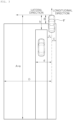
- FIG. 2 is a diagram showing a sensing region and a warning region of the rear lateral blind-spot warning system of the vehicle V according to the embodiment of the present disclosure.
- the rear lateral blind-spot warning system of the vehicle V includes a detection sensor 10, which is installed in the vehicle V and senses an obstacle O located in the rear blind spot or the lateral blind spot of the vehicle V, a sequence setter 20, which sets a sequence in which to determine, based on the sensing range of the detection sensor 10 and multiple predetermined conditions, whether the respective conditions are satisfied, and a warning determiner 30, which sequentially determines, based on the sequence set by the sequence setter 20, whether the obstacle O sensed by the detection sensor 10 satisfies the multiple predetermined conditions and determines, based on the result of the determination with regard to satisfaction of the conditions, whether the sensed obstacle O is a target to be monitored.
- the rear lateral blind-spot warning system of the vehicle V may include a processor having an associated non-transitory memory storing software instructions which, when executed by the processor, provides the functionalities of the sequence setter 20 and/or the warning determiner 30.
- the processor may take the form of one or more processor(s) and associated memory storing program instructions.
- the detection sensor 10 may sense an obstacle O located in the area on the rear lateral side of the vehicle V.
- the detection sensor 10 may sense the distance to the obstacle O, the moving direction of the obstacle O, and the moving speed of the obstacle O.
- the detection sensor 10 may sense the presence of an obstacle O located in a blind spot on the rear lateral side of the vehicle V, or may determine the probability of a collision with an obstacle O located in the area on the rear lateral side of the vehicle V when the vehicle V intends to change lanes.
- the detection sensor 10 may be a radar sensor installed in the vehicle V. In another embodiment, the detection sensor 10 may be a camera sensor, an ultrasonic sensor, or a laser sensor.
- the warning determiner 30 may determine whether the obstacle O sensed by the detection sensor 10 satisfies multiple predetermined conditions, and may determine, based on the result of the determination with regard to satisfaction of the conditions, whether the sensed obstacle O is a target to be monitored.
- the warning determiner 30 may generate warning signals.
- the warning signals may be generated so as to be recognized by the driver of the vehicle V.
- the warning determiner 30 may visually display warning messages on a cluster or a display device, or may generate warning sounds.
- the sequence setter 20 may set a sequence, among the multiple predetermined conditions, of determining whether the sensed obstacle O satisfies the respective conditions.
- the sequence setter 20 may calculate a satisfaction level of each of the multiple predetermined conditions based on the sensing range of the detection sensor 10, and may set the sequence of determining whether the multiple predetermined conditions are satisfied.
- the warning determiner 30 may sequentially determine, according to the sequence set by the sequence setter 20, whether the multiple predetermined conditions are satisfied.
- the warning determiner 30 may stop the sequential determination and may determine that the sensed obstacle O is not a target to be monitored.
- the warning determiner 30 may determine condition 2, and when condition 2 is not satisfied, the warning determiner 30 may stop the determination without the necessity to determine condition 3 or 4, and may determine that the sensed obstacle O is not a target to be monitored.
- the warning determiner 30 may stop the sequential determination, thereby reducing the amount of computation.
- the warning determiner 30 may determine that the sensed obstacle O is a target to be monitored.
- the warning determiner 30 may determine that the sensed obstacle O is a target to be monitored.
- the sequence setter 20 may calculate a satisfaction level of each of the multiple predetermined conditions based on the sensing range of the detection sensor 10, and may set, based on the calculated satisfaction level, the sequence in which the multiple predetermined conditions are determined.
- the sensing range of the detection sensor 10 may be set based on the performance of the detection sensor 10 installed in the vehicle V.
- the sensing range of the detection sensor 10 may be set to a range within which sensing information about the obstacle O, such as the position or the speed thereof sensed by the detection sensor 10, is reliable.
- the sequence setter 20 may set the sequence of determining the multiple predetermined conditions in order from the condition having the lowest satisfaction level to the condition having the highest satisfaction level. As the satisfaction level is lower, the probability that the obstacle is determined not to be a target to be monitored increases.
- the determination sequence may be set in ascending order of satisfaction level.
- the condition having the lowest satisfaction level, under which the probability that the obstacle is determined not to be a target to be monitored is the highest, is determined first, whereby it is possible to rapidly filter the obstacle O, which is not a target to be monitored.
- the multiple predetermined conditions may include a longitudinal direction position condition that the position of the obstacle O in the longitudinal direction be within a predetermined range in the longitudinal direction and a lateral direction position condition that the position of the obstacle O in the lateral direction be within a predetermined range in the lateral direction.
- the sequence setter 20 may calculate the satisfaction level of the longitudinal direction position condition of the obstacle O based on the sensing range of the detection sensor 10 in the longitudinal direction and the satisfaction level of the lateral direction position condition of the obstacle O based on the sensing range of the detection sensor 10 in the lateral direction.
- the longitudinal direction position condition may be set between a minimum longitudinal direction position condition and a maximum longitudinal direction position condition
- the sequence setter 20 may calculate the satisfaction level of the minimum longitudinal direction position condition based on the sensing range of the detection sensor 10 in the longitudinal direction and the satisfaction level of the maximum longitudinal direction position condition based on the sensing range of the detection sensor 10 in the longitudinal direction.
- the lateral direction position condition may be set between a minimum lateral direction position condition and a maximum lateral direction position condition, and the sequence setter 20 may calculate the satisfaction level of the minimum lateral direction position condition based on the sensing range of the detection sensor 10 in the lateral direction and the satisfaction level of the maximum lateral direction position condition based on the sensing range of the detection sensor 10 in the lateral direction.
- the multiple predetermined conditions may include a longitudinal direction position condition and a lateral direction position condition, and each of the longitudinal direction position condition and the lateral direction position condition may be set between a minimum position condition and a maximum position condition.
- the warning region may be set such that the minimum longitudinal direction position is "a” and the maximum longitudinal direction position is "b" (the longitudinal direction oriented toward the sensing region (i.e. the backward direction) being defined as a negative direction). That is, the position Y of the obstacle O in the longitudinal direction needs to satisfy the following condition: a ⁇ Y ⁇ b.
- the warning region may be set such that the minimum lateral direction position is "c" and the maximum lateral direction position is "d" (the lateral direction oriented toward the sensing region being defined as a positive direction) . That is, the position X of the obstacle O in the lateral direction needs to satisfy the following condition: c ⁇ X ⁇ d.
- the multiple predetermined conditions may include the minimum longitudinal direction position condition, the maximum longitudinal direction position condition, the minimum lateral direction position condition, and the maximum lateral direction position condition.
- the sequence setter 20 may calculate the satisfaction level of the minimum longitudinal direction position condition based on the sensing range of the detection sensor 10 in the longitudinal direction and the satisfaction level of the maximum longitudinal direction position condition based on the sensing range of the detection sensor 10 in the longitudinal direction.
- the position that can be sensed by the detection sensor 10 in the longitudinal direction may range from “A” to "B". In one example, the position that can be sensed by the detection sensor 10 in the longitudinal direction may be set to a range from -90 m to -1 m.
- the position that can be sensed by the detection sensor 10 in the lateral direction may range from “C” to "D". In one example, the position that can be sensed by the detection sensor 10 in the lateral direction may be set to a range from -2 m to 16 m.
- the sequence setter 20 may set the sequence of determining the multiple predetermined conditions in ascending order of satisfaction level, which is as follows.
- FIG. 3 is a diagram showing the sensing region and the warning region of a rear lateral blind-spot warning system of the vehicle V according to another embodiment of the present disclosure
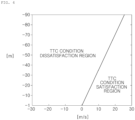
- FIG. 4 is a diagram showing a collision time condition related to a time to collision with the obstacle O in the longitudinal direction according to another embodiment of the present disclosure.
- a lane-change assist (LCA) system which determines the probability of a collision between the vehicle V, which intends to change lanes, and the obstacle approaching at a high speed in a rear lateral blind spot and provides a collision warning to a driver, will be described with reference to FIGS. 3 and 4 .
- the warning determiner 30 may omit the determination of satisfaction of the condition having the satisfaction level of 1 or more, which is calculated by the sequence setter 20, among the multiple predetermined conditions, and may determine that the condition having the satisfaction level of 1 or more is satisfied.
- all obstacles O sensed by the detection sensor 10 may be determined to satisfy conditions, the satisfaction levels of which are calculated to be 1 or more, without the necessity to determine whether the corresponding conditions are satisfied.
- the multiple predetermined conditions may further include a collision time condition that a time to collision (TTC) with the obstacle O in the longitudinal direction be equal to or less than a predetermined time t_default, and the sequence setter 20 may calculate the satisfaction level of the collision time condition based on the longitudinal-direction speed-sensing range of the detection sensor 10 and the longitudinal-direction position-sensing range of the detection sensor 10.
- TTC time to collision
- TTC time to collision
- Y_pos represents the position of the obstacle O in the longitudinal direction
- Y_vel represents the speed of the obstacle O in the longitudinal direction
- FIG. 4 is a diagram showing the satisfaction region and the dissatisfaction region of the collision time condition when the predetermined time t_default, which is a threshold time for determination of the time to collision (TTC) with the obstacle O in the longitudinal direction, is set to 3.5 seconds.
- the X-axis represents the longitudinal direction speed that can be sensed by the detection sensor 10, which is set to a range, for example, from -30 m/s to 30 m/s
- the Y-axis represents the longitudinal direction position that can be sensed by the detection sensor 10, which is set to a range, for example, from -90 m to -1 m.
- the satisfaction level of the collision time condition may be calculated as follows.
- the sequence setter 20 may set the sequence of determining the multiple predetermined conditions in ascending order of satisfaction level, which is as follows.
- the sequence setter 20 may set the time to collision with the obstacle O in the longitudinal direction to the predetermined TTC threshold value, or may set the calculated satisfaction level to 1. Accordingly, it is possible to reduce the amount of computation performed by the warning determiner 30.
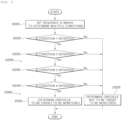
- FIG. 5 is a flowchart showing a rear lateral blind-spot warning method of the vehicle V according to an embodiment of the present disclosure.
- a rear lateral blind-spot warning method of the vehicle V includes setting a sequence in which to determine, based on the sensing range of the detection sensor 10, which senses an obstacle O located in the rear blind spot or the lateral blind spot of the vehicle V, and multiple predetermined conditions, whether the respective conditions are satisfied (S100), sequentially determining, based on the set sequence, whether the obstacle O sensed by the detection sensor 10 satisfies the multiple predetermined conditions (S200), and determining, based on the result of the determination with regard to satisfaction of the conditions, whether the sensed obstacle O is a target to be monitored (S300).
- the sequential determination may be stopped, and in the determining whether the sensed obstacle O is a target to be monitored (S300), the sensed obstacle O may be determined not to be a target to be monitored.
- the sensed obstacle O may be determined to be a target to be monitored (S310).
- the setting the sequence (S100) may include calculating a satisfaction level of each of the multiple predetermined conditions of the obstacle O based on the sensing range of the detection sensor 10, and setting, based on the calculated satisfaction level, the sequence in which the multiple predetermined conditions are determined.
- the sequence in which the multiple predetermined conditions are determined may be set in order from the condition having the lowest satisfaction level to the condition having the highest satisfaction level.
- the multiple predetermined conditions may include a longitudinal direction position condition that the position of the obstacle O in the longitudinal direction be within a predetermined range in the longitudinal direction, and a lateral direction position condition that the position of the obstacle O in the lateral direction be within a predetermined range in the lateral direction.
- the setting the sequence (S100) may include calculating the satisfaction level of the longitudinal direction position condition of the obstacle O based on the sensing range of the detection sensor 10 in the longitudinal direction and the satisfaction level of the lateral direction position condition of the obstacle O based on the sensing range of the detection sensor 10 in the lateral direction.
- the longitudinal direction position condition may be set between a minimum longitudinal direction position condition and a maximum longitudinal direction position condition.
- the setting the sequence (S100) may include calculating the satisfaction level of the minimum longitudinal direction position condition based on the sensing range of the detection sensor 10 in the longitudinal direction and the satisfaction level of the maximum longitudinal direction position condition based on the sensing range of the detection sensor 10 in the longitudinal direction.
- the lateral direction position condition may be set between a minimum lateral direction position condition and a maximum lateral direction position condition.
- the setting the sequence (S100) may include calculating the satisfaction level of the minimum lateral direction position condition based on the sensing range of the detection sensor 10 in the lateral direction and the satisfaction level of the maximum lateral direction position condition based on the sensing range of the detection sensor 10 in the lateral direction.
- the multiple predetermined conditions may further include a collision time condition that a time to collision with the obstacle O in the longitudinal direction be equal to or less than a predetermined time.
- the setting the sequence (S100) may include calculating the satisfaction level of the collision time condition based on the longitudinal-direction speed-sensing range of the detection sensor 10 and the longitudinal-direction position-sensing range of the detection sensor 10.
- the sequentially determining whether the obstacle satisfies the multiple predetermined conditions (S200) may include omitting determination of the satisfaction of the condition having the satisfaction level of 1 or more, among the multiple predetermined conditions, and determining that the condition having the satisfaction level of 1 or more is satisfied.
- FIG. 6 is a diagram showing a comparison between the number of computations performed in the rear lateral blind-spot warning system and method of the vehicle V according to the embodiment of the present disclosure and the number of computations performed in a conventional art.
- the 3 rd obstacle O which is located in the warning region, satisfies four respective conditions is determined, and when the final condition is satisfied, the 3 rd obstacle O is determined to be a target to be monitored. Accordingly, computation is performed not more than four times.
- each of these obstacles is determined not to be a target to be monitored, and at this time, computation is performed less than four times for each obstacle. Accordingly, as shown in FIG. 6 , the total number of computations for sixteen obstacles O is 30.
- the rear lateral blind-spot warning system and method of the vehicle V according to the present disclosure exhibit an effect of reduction in the amount of computation by 62.5% compared to the conventional art.
- a rear lateral blind-spot warning system and method for a vehicle are capable of minimizing the amount of computation when determining whether an obstacle located in an area on the rear lateral side of a host vehicle is a target to be monitored.
Landscapes
- Engineering & Computer Science (AREA)
- Mechanical Engineering (AREA)
- Automation & Control Theory (AREA)
- Transportation (AREA)
- Physics & Mathematics (AREA)
- Radar, Positioning & Navigation (AREA)
- Remote Sensing (AREA)
- Human Computer Interaction (AREA)
- General Physics & Mathematics (AREA)
- Electromagnetism (AREA)
- Computer Networks & Wireless Communication (AREA)
- Traffic Control Systems (AREA)
Description
- The present disclosure relates to a rear lateral blind-spot warning system and method for a vehicle, and more particularly to a rear lateral blind-spot warning system and method for monitoring a blind spot on the rear lateral side of a host vehicle or supporting a lane-change assist function.
- A rear lateral blind-spot warning system for a vehicle is a system that provides a warning to a driver when an obstacle is present in a blind spot on the rear lateral side of a host vehicle, which is traveling, or when it is determined that there is a risk of collision between the host vehicle, which intends to change lanes to the left or right, and another vehicle approaching at a high speed from an area behind the host vehicle, thereby improving driver convenience.
- Specifically, examples of rear lateral blind-spot warning systems include a blind-spot detection (BSD) system, which announces the presence of an obstacle in a rear lateral blind spot to a driver, and a lane-change assist (LCA) system, which determines the probability of a collision between a host vehicle, which intends to change lanes to the left or right, and another vehicle approaching at a high speed in a rear lateral blind spot, and provides a collision warning to a driver. Recently, a rear lateral blind-spot warning system capable of simultaneously implementing a BSD function and an LCA function and thus of performing sensing in a broader area has been developed in order to effectively provide a warning to a driver.
- The conventional rear lateral blind-spot warning system for a vehicle determines whether all of the targets sensed by a radar sensor for sensing an area on the rear lateral side of a host vehicle satisfy predetermined warning conditions. Recently, the center frequency of a radar sensor for sensing an area on the rear lateral side of a host vehicle has changed so as to improve the sensing performance of the radar sensor, and accordingly the number of targets that can be sensed by the radar sensor has increased, leading to an increase in the amount of computation, resulting in an increase in the time taken to determine whether the predetermined warning conditions are satisfied.
- The information disclosed in this Background section above is only for enhancement of understanding of the general background of the present disclosure, and should not be taken as an acknowledgement or any form of suggestion that this information forms the related art already known to a person skilled in the art.
JP 2009 086788 A US 2019/019412 A1 ,US 2018/257646 A1 ,US 2010/318263 A1 undEP 3 342 671 A1 . - Therefore, the present disclosure has been made in view of the above problems, and it is an object of the present disclosure to provide a rear lateral blind-spot warning system and method for a vehicle capable of rapidly and efficiently determining whether a target located in an area on the rear lateral side of a host vehicle satisfies predetermined warning conditions.
- In accordance with an aspect of the present disclosure, the above and other objects can be accomplished by the provision of a rear lateral blind-spot warning system for a vehicle, including a detection sensor installed in a vehicle to sense an obstacle located in a rear blind spot or a lateral blind spot of the vehicle, a sequence setter configured, based on the sensing range of the detection sensor and multiple predetermined conditions, to set the sequence, among the multiple predetermined conditions of determining whether the conditions are satisfied, and a warning determiner configured to sequentially determine, based on the sequence set by the sequence setter, whether the obstacle sensed by the detection sensor satisfies the multiple predetermined conditions and to determine, based on the result of the determination with regard to satisfaction of the conditions, whether the sensed obstacle is a target to be monitored and, when the sensed obstacle is a target to be monitored, to generate warning signals.
- According to the invention, when the obstacle sensed by the detection sensor does not satisfy any one of the multiple predetermined conditions, the warning determiner stops sequential determination for remaining conditions of the multiple predetermined conditions and determines that the sensed obstacle is not a target to be monitored.
- When the obstacle sensed by the detection sensor satisfies all of the multiple predetermined conditions, the warning determiner may determine that the sensed obstacle is a target to be monitored.
- The sequence setter may calculate a satisfaction level of each of the multiple predetermined conditions based on the sensing range of the detection sensor and may set, based on the calculated satisfaction level, the sequence of determining whether the multiple predetermined conditions are satisfied.
- The sequence setter may set the sequence of determining whether the multiple predetermined conditions are satisfied in order from the condition having the lowest satisfaction level to the condition having the highest satisfaction level.
- The multiple predetermined conditions may include a longitudinal direction position condition that the position of the obstacle in a longitudinal direction be within a predetermined range in the longitudinal direction and a lateral direction position condition that the position of the obstacle in a lateral direction be within a predetermined range in the lateral direction, and the sequence setter may calculate the satisfaction level of the longitudinal direction position condition of the obstacle based on the sensing range of the detection sensor in the longitudinal direction and the satisfaction level of the lateral direction position condition of the obstacle based on the sensing range of the detection sensor in the lateral direction.
- The longitudinal direction position condition may be set between the minimum longitudinal direction position condition and the maximum longitudinal direction position condition, and the sequence setter may calculate the satisfaction level of the minimum longitudinal direction position condition based on the sensing range of the detection sensor in the longitudinal direction and the satisfaction level of the maximum longitudinal direction position condition based on the sensing range of the detection sensor in the longitudinal direction.
- The lateral direction position condition may be set between the minimum lateral direction position condition and the maximum lateral direction position condition, and the sequence setter may calculate the satisfaction level of the minimum lateral direction position condition based on the sensing range of the detection sensor in the lateral direction and the satisfaction level of the maximum lateral direction position condition based on the sensing range of the detection sensor in the lateral direction.
- The multiple predetermined conditions may further include a collision time condition that a time to collision with an obstacle in the longitudinal direction be equal to or less than a predetermined time, and the sequence setter may calculate the satisfaction level of the collision time condition based on the longitudinal-direction speed-sensing range of the detection sensor and the longitudinal-direction position-sensing range of the detection sensor.
- When a condition among the multiple predetermined conditions has a satisfaction level of 1 or more, the warning determiner may omit determination of satisfaction of the condition having the satisfaction level of 1 or more, and may determine that the condition having the satisfaction level of 1 or more is satisfied.
- In accordance with another aspect of the present disclosure, a rear lateral blind-spot warning method for a vehicle includes setting, based on the sensing range of a detection sensor, configured to sense an obstacle located in a rear blind spot or a lateral blind spot of a vehicle, and multiple predetermined conditions, a sequence, among the multiple predetermined conditions, of determining whether the conditions are satisfied, sequentially determining, based on the set sequence, whether the obstacle sensed by the detection sensor satisfies the multiple predetermined conditions, and determining, based on the result of determination with regard to satisfaction of the conditions, whether the sensed obstacle is a target to be monitored and, when the sensed obstacle is a target to be monitored, generating warning signals.
- According to the invention, when the obstacle sensed by the detection sensor does not satisfy any one of the multiple predetermined conditions, in the sequentially determining whether the obstacle satisfies the multiple predetermined conditions, sequential determination is stopped for remaining conditions of the multiple predetermined conditions, and in the determining whether the sensed obstacle is a target to be monitored, the sensed obstacle is determined not to be a target to be monitored.
- When the obstacle sensed by the detection sensor satisfies all of the multiple predetermined conditions, in the determining whether the sensed obstacle is a target to be monitored, the sensed obstacle may be determined to be a target to be monitored.
- The setting the sequence may include calculating a satisfaction level of each of the multiple predetermined conditions based on the sensing range of the detection sensor, and setting, based on the calculated satisfaction level, the sequence of determining whether the multiple predetermined conditions are satisfied.
- In the setting the sequence, the sequence of determining whether the multiple predetermined conditions are satisfied may be set in order from the condition having the lowest satisfaction level to the condition having the highest satisfaction level.
- The multiple predetermined conditions may include a longitudinal direction position condition that the position of the obstacle in a longitudinal direction be within a predetermined range in the longitudinal direction and a lateral direction position condition that the position of the obstacle in a lateral direction be within a predetermined range in the lateral direction, and the setting the sequence may include calculating the satisfaction level of the longitudinal direction position condition of the obstacle based on the sensing range of the detection sensor in the longitudinal direction and the satisfaction level of the lateral direction position condition of the obstacle based on the sensing range of the detection sensor in the lateral direction.
- The longitudinal direction position condition may be set between the minimum longitudinal direction position condition and the maximum longitudinal direction position condition, and the setting the sequence may include calculating the satisfaction level of the minimum longitudinal direction position condition based on the sensing range of the detection sensor in the longitudinal direction and the satisfaction level of the maximum longitudinal direction position condition based on the sensing range of the detection sensor in the longitudinal direction.
- The lateral direction position condition may be set between the minimum lateral direction position condition and the maximum lateral direction position condition, and the setting the sequence may include calculating the satisfaction level of the minimum lateral direction position condition based on the sensing range of the detection sensor in the lateral direction and the satisfaction level of the maximum lateral direction position condition based on the sensing range of the detection sensor in the lateral direction.
- The multiple predetermined conditions may further include a collision time condition that a time to collision with an obstacle in the longitudinal direction be equal to or less than a predetermined time, and the setting the sequence may include calculating the satisfaction level of the collision time condition based on the longitudinal-direction speed-sensing range of the detection sensor and the longitudinal-direction position-sensing range of the detection sensor.
- The sequentially determining whether the obstacle satisfies the multiple predetermined conditions may include omitting, when a condition among the multiple predetermined conditions has a satisfaction level of 1 or more, determination of satisfaction of the condition having the satisfaction level of 1 or more, and determining that the condition having the satisfaction level of 1 or more is satisfied.
- The above and other objects, features and other advantages of the present disclosure will be more clearly understood from the following detailed description taken in conjunction with the accompanying drawings, in which:
-
FIG. 1 is a diagram showing the configuration of a rear lateral blind-spot warning system for a vehicle according to an embodiment of the present disclosure; -
FIG. 2 is a diagram showing a sensing region and a warning region of the rear lateral blind-spot warning system for a vehicle according to the embodiment of the present disclosure; -
FIG. 3 is a diagram showing a sensing region and a warning region of a rear lateral blind-spot warning system for a vehicle according to another embodiment of the present disclosure; -
FIG. 4 is a diagram showing a collision time condition related to a time to collision with an obstacle in a longitudinal direction according to another embodiment of the present disclosure; -
FIG. 5 is a flowchart showing a rear lateral blind-spot warning method for a vehicle according to an embodiment of the present disclosure; and -
FIG. 6 is a diagram showing a comparison between the number of computations performed in the rear lateral blind-spot warning system and method for a vehicle according to the embodiment of the present disclosure and the number of computations performed in a conventional art. - Various exemplary embodiments will now be described more fully with reference to the accompanying drawings, in which only some exemplary embodiments are shown. Specific structural and functional details disclosed herein are merely representative for the purpose of describing exemplary embodiments. The present disclosure, however, may be embodied in many alternative forms, and should not be construed as being limited to the exemplary embodiments set forth herein.
- Accordingly, while exemplary embodiments of the disclosure are capable of being variously modified and taking alternative forms, embodiments thereof are shown by way of example in the drawings and will herein be described in detail. It should be understood, however, that there is no intent to limit the present disclosure to the particular exemplary embodiments disclosed. On the contrary, exemplary embodiments are to cover all modifications, equivalents, and alternatives falling within the scope of the disclosure.
- It will be understood that, although the terms "first", "second", etc. may be used herein to describe various elements, these elements should not be limited by these terms. These terms are only used to distinguish one element from another. For example, a first element could be termed a second element, and, similarly, a second element could be termed a first element, without departing from the scope of exemplary embodiments of the present disclosure.
- It will be understood that when an element is referred to as being "connected" or "coupled" to another element, it can be directly connected or coupled to the other element, or intervening elements may be present. In contrast, when an element is referred to as being "directly connected" or "directly coupled" to another element, there are no intervening elements present. Other words used to describe the relationship between elements should be interpreted in a like fashion (e.g. "between" versus "directly between", "adjacent" versus "directly adjacent", etc.).
- The terminology used herein is for the purpose of describing particular embodiments only and is not intended to be limiting of exemplary embodiments of the present disclosure. As used herein, the singular forms "a", "an", and "the", are intended to include the plural forms as well, unless the context clearly indicates otherwise. It will be further understood that the terms "comprises", "comprising", "includes", and/or "including", when used herein, specify the presence of stated features, integers, steps, operations, elements, components, or combinations thereof, but do not preclude the presence or addition of one or more other features, integers, steps, operations, elements, components, or combinations thereof.
- Unless otherwise defined, all terms used herein, which include technical or scientific terms, have the same meanings as those generally appreciated by those skilled in the art. The terms, such as ones defined in common dictionaries, should be interpreted as having the same meanings as terms in the context of pertinent technology, and should not be interpreted as having ideal or excessively formal meanings unless clearly defined in the specification.
- Hereinafter, exemplary embodiments of the present disclosure will be described in detail with reference to the accompanying drawings. In the drawings, the same reference numerals refer to the same components.
-
FIG. 1 is a diagram showing the configuration of a rear lateral blind-spot warning system of a vehicle V according to an embodiment of the present disclosure, andFIG. 2 is a diagram showing a sensing region and a warning region of the rear lateral blind-spot warning system of the vehicle V according to the embodiment of the present disclosure. - Referring to
FIGS. 1 and2 , the rear lateral blind-spot warning system of the vehicle V according to the embodiment of the present disclosure includes adetection sensor 10, which is installed in the vehicle V and senses an obstacle O located in the rear blind spot or the lateral blind spot of the vehicle V, asequence setter 20, which sets a sequence in which to determine, based on the sensing range of thedetection sensor 10 and multiple predetermined conditions, whether the respective conditions are satisfied, and a warning determiner 30, which sequentially determines, based on the sequence set by thesequence setter 20, whether the obstacle O sensed by thedetection sensor 10 satisfies the multiple predetermined conditions and determines, based on the result of the determination with regard to satisfaction of the conditions, whether the sensed obstacle O is a target to be monitored. - According to an embodiment of the present disclosure, the rear lateral blind-spot warning system of the vehicle V may include a processor having an associated non-transitory memory storing software instructions which, when executed by the processor, provides the functionalities of the
sequence setter 20 and/or thewarning determiner 30. The processor may take the form of one or more processor(s) and associated memory storing program instructions. - The
detection sensor 10 may sense an obstacle O located in the area on the rear lateral side of the vehicle V. In particular, thedetection sensor 10 may sense the distance to the obstacle O, the moving direction of the obstacle O, and the moving speed of the obstacle O. Thedetection sensor 10 may sense the presence of an obstacle O located in a blind spot on the rear lateral side of the vehicle V, or may determine the probability of a collision with an obstacle O located in the area on the rear lateral side of the vehicle V when the vehicle V intends to change lanes. - In one embodiment, the
detection sensor 10 may be a radar sensor installed in the vehicle V. In another embodiment, thedetection sensor 10 may be a camera sensor, an ultrasonic sensor, or a laser sensor. - The
warning determiner 30 may determine whether the obstacle O sensed by thedetection sensor 10 satisfies multiple predetermined conditions, and may determine, based on the result of the determination with regard to satisfaction of the conditions, whether the sensed obstacle O is a target to be monitored. - In one embodiment, when at least one obstacle O is a target to be monitored, the
warning determiner 30 may generate warning signals. The warning signals may be generated so as to be recognized by the driver of the vehicle V. For example, thewarning determiner 30 may visually display warning messages on a cluster or a display device, or may generate warning sounds. - Based on the sensing range of the
detection sensor 10 and multiple predetermined conditions, thesequence setter 20 may set a sequence, among the multiple predetermined conditions, of determining whether the sensed obstacle O satisfies the respective conditions. - Specifically, the
sequence setter 20 may calculate a satisfaction level of each of the multiple predetermined conditions based on the sensing range of thedetection sensor 10, and may set the sequence of determining whether the multiple predetermined conditions are satisfied. - When determining whether the multiple predetermined conditions are satisfied, the
warning determiner 30 may sequentially determine, according to the sequence set by thesequence setter 20, whether the multiple predetermined conditions are satisfied. - Accordingly, when whether the obstacle O located in the area on the rear lateral side of the vehicle V is a target to be monitored is determined, it is possible to minimize the amount of computation. Further, even when
many obstacles 0 are sensed at the same time, it is possible to increase the computation speed at which whether theobstacles 0 are targets to be monitored is determined. - In particular, when the obstacle O sensed by the
detection sensor 10 does not satisfy any one of the multiple predetermined conditions, thewarning determiner 30 may stop the sequential determination and may determine that the sensed obstacle O is not a target to be monitored. - Specifically, in the case in which the
warning determiner 30 sequentially determinescondition 1,condition 2,condition 3, andcondition 4, whencondition 1 is satisfied, thewarning determiner 30 may determinecondition 2, and whencondition 2 is not satisfied, thewarning determiner 30 may stop the determination without the necessity to determinecondition - That is, when any one condition is not satisfied during the sequential determination, the
warning determiner 30 may stop the sequential determination, thereby reducing the amount of computation. - In addition, when the obstacle O sensed by the
detection sensor 10 satisfies all of the multiple predetermined conditions, thewarning determiner 30 may determine that the sensed obstacle O is a target to be monitored. - Specifically, in the case in which the
warning determiner 30 sequentially determinescondition 1,condition 2,condition 3, andcondition 4, when all ofcondition 1 tocondition 4 are satisfied, thewarning determiner 30 may determine that the sensed obstacle O is a target to be monitored. - The
sequence setter 20 may calculate a satisfaction level of each of the multiple predetermined conditions based on the sensing range of thedetection sensor 10, and may set, based on the calculated satisfaction level, the sequence in which the multiple predetermined conditions are determined. - Here, the sensing range of the
detection sensor 10 may be set based on the performance of thedetection sensor 10 installed in the vehicle V. For example, the sensing range of thedetection sensor 10 may be set to a range within which sensing information about the obstacle O, such as the position or the speed thereof sensed by thedetection sensor 10, is reliable. - In particular, the
sequence setter 20 may set the sequence of determining the multiple predetermined conditions in order from the condition having the lowest satisfaction level to the condition having the highest satisfaction level. As the satisfaction level is lower, the probability that the obstacle is determined not to be a target to be monitored increases. The determination sequence may be set in ascending order of satisfaction level. - Accordingly, the condition having the lowest satisfaction level, under which the probability that the obstacle is determined not to be a target to be monitored is the highest, is determined first, whereby it is possible to rapidly filter the obstacle O, which is not a target to be monitored.
- The multiple predetermined conditions may include a longitudinal direction position condition that the position of the obstacle O in the longitudinal direction be within a predetermined range in the longitudinal direction and a lateral direction position condition that the position of the obstacle O in the lateral direction be within a predetermined range in the lateral direction. The
sequence setter 20 may calculate the satisfaction level of the longitudinal direction position condition of the obstacle O based on the sensing range of thedetection sensor 10 in the longitudinal direction and the satisfaction level of the lateral direction position condition of the obstacle O based on the sensing range of thedetection sensor 10 in the lateral direction. - Specifically, the longitudinal direction position condition may be set between a minimum longitudinal direction position condition and a maximum longitudinal direction position condition, and the
sequence setter 20 may calculate the satisfaction level of the minimum longitudinal direction position condition based on the sensing range of thedetection sensor 10 in the longitudinal direction and the satisfaction level of the maximum longitudinal direction position condition based on the sensing range of thedetection sensor 10 in the longitudinal direction. - In addition, the lateral direction position condition may be set between a minimum lateral direction position condition and a maximum lateral direction position condition, and the
sequence setter 20 may calculate the satisfaction level of the minimum lateral direction position condition based on the sensing range of thedetection sensor 10 in the lateral direction and the satisfaction level of the maximum lateral direction position condition based on the sensing range of thedetection sensor 10 in the lateral direction. - Hereinafter, a blind-spot detection (BSD) system, which informs a driver of the presence of an obstacle O in the blind spot on the rear lateral side of the vehicle V, will be described based on the sensing region and the warning region shown in
FIG. 2 . In this case, the multiple predetermined conditions may include a longitudinal direction position condition and a lateral direction position condition, and each of the longitudinal direction position condition and the lateral direction position condition may be set between a minimum position condition and a maximum position condition. - In one example, the warning region may be set such that the minimum longitudinal direction position is "a" and the maximum longitudinal direction position is "b" (the longitudinal direction oriented toward the sensing region (i.e. the backward direction) being defined as a negative direction). That is, the position Y of the obstacle O in the longitudinal direction needs to satisfy the following condition: a ≤ Y ≤ b.
- In addition, the warning region may be set such that the minimum lateral direction position is "c" and the maximum lateral direction position is "d" (the lateral direction oriented toward the sensing region being defined as a positive direction) . That is, the position X of the obstacle O in the lateral direction needs to satisfy the following condition: c ≤ X ≤ d.
- That is, the multiple predetermined conditions may include the minimum longitudinal direction position condition, the maximum longitudinal direction position condition, the minimum lateral direction position condition, and the maximum lateral direction position condition.
- The
sequence setter 20 may calculate the satisfaction level of the minimum longitudinal direction position condition based on the sensing range of thedetection sensor 10 in the longitudinal direction and the satisfaction level of the maximum longitudinal direction position condition based on the sensing range of thedetection sensor 10 in the longitudinal direction. - The position that can be sensed by the
detection sensor 10 in the longitudinal direction may range from "A" to "B". In one example, the position that can be sensed by thedetection sensor 10 in the longitudinal direction may be set to a range from -90 m to -1 m. - Among the multiple predetermined conditions, when the condition pertaining to the minimum position a of the obstacle O in the longitudinal direction is set to, for example, -10 m, the satisfaction level of the minimum longitudinal direction position condition may be calculated as follows.

- In addition, among the multiple predetermined conditions, when the condition pertaining to the maximum position b of the obstacle O in the longitudinal direction is set to, for example, -3 m, the satisfaction level of the maximum longitudinal direction position condition may be calculated as follows.

- In addition, the position that can be sensed by the
detection sensor 10 in the lateral direction may range from "C" to "D". In one example, the position that can be sensed by thedetection sensor 10 in the lateral direction may be set to a range from -2 m to 16 m. - Among the multiple predetermined conditions, when the condition pertaining to the minimum position c of the obstacle O in the lateral direction is set to, for example, 1 m, the satisfaction level of the minimum lateral direction position condition may be calculated as follows.

- In addition, among the multiple predetermined conditions, when the condition pertaining to the maximum position d of the obstacle O in the lateral direction is set to, for example, 5 m, the satisfaction level of the maximum lateral direction position condition may be calculated as follows.

- In this case, the
sequence setter 20 may set the sequence of determining the multiple predetermined conditions in ascending order of satisfaction level, which is as follows. - Condition 1: Minimum value of longitudinal direction position Y is "a" (Y ≥ a)
- Condition 2: Maximum value of lateral direction position X is "d" (X ≤ d)
- Condition 3: Minimum value of lateral direction position X is "c" (X ≥ c)
- Condition 4: Maximum value of longitudinal direction position Y is "b" (Y ≤ b)
-
FIG. 3 is a diagram showing the sensing region and the warning region of a rear lateral blind-spot warning system of the vehicle V according to another embodiment of the present disclosure, andFIG. 4 is a diagram showing a collision time condition related to a time to collision with the obstacle O in the longitudinal direction according to another embodiment of the present disclosure. - Hereinafter, a lane-change assist (LCA) system, which determines the probability of a collision between the vehicle V, which intends to change lanes, and the obstacle approaching at a high speed in a rear lateral blind spot and provides a collision warning to a driver, will be described with reference to
FIGS. 3 and4 . - It is assumed that all of the conditions determined in the LCA system are the same as those described above. Among the multiple predetermined conditions, when the condition pertaining to the minimum position a of the obstacle O in the longitudinal direction is set to -90 m, which is equal to the maximum distance that can be sensed by the detection sensor in the longitudinal direction, the satisfaction level of the minimum longitudinal direction position condition may be calculated as follows.

- The
warning determiner 30 may omit the determination of satisfaction of the condition having the satisfaction level of 1 or more, which is calculated by thesequence setter 20, among the multiple predetermined conditions, and may determine that the condition having the satisfaction level of 1 or more is satisfied. - That is, all obstacles O sensed by the
detection sensor 10 may be determined to satisfy conditions, the satisfaction levels of which are calculated to be 1 or more, without the necessity to determine whether the corresponding conditions are satisfied. - The multiple predetermined conditions may further include a collision time condition that a time to collision (TTC) with the obstacle O in the longitudinal direction be equal to or less than a predetermined time t_default, and the
sequence setter 20 may calculate the satisfaction level of the collision time condition based on the longitudinal-direction speed-sensing range of thedetection sensor 10 and the longitudinal-direction position-sensing range of thedetection sensor 10. - Specifically, the time to collision (TTC) with the obstacle O in the longitudinal direction may be calculated using the following equation.

- Here, Y_pos represents the position of the obstacle O in the longitudinal direction, and Y_vel represents the speed of the obstacle O in the longitudinal direction.
-
FIG. 4 is a diagram showing the satisfaction region and the dissatisfaction region of the collision time condition when the predetermined time t_default, which is a threshold time for determination of the time to collision (TTC) with the obstacle O in the longitudinal direction, is set to 3.5 seconds. - Here, the X-axis represents the longitudinal direction speed that can be sensed by the
detection sensor 10, which is set to a range, for example, from -30 m/s to 30 m/s, and the Y-axis represents the longitudinal direction position that can be sensed by thedetection sensor 10, which is set to a range, for example, from -90 m to -1 m. - Accordingly, the satisfaction level of the collision time condition may be calculated as follows.

- In this case, the
sequence setter 20 may set the sequence of determining the multiple predetermined conditions in ascending order of satisfaction level, which is as follows. - Condition 1: Time to collision TTC with obstacle in longitudinal direction is equal to or less than predetermined time t_default (TTC ≤ t_default)
- Condition 2: Maximum value of lateral direction position X is "d" (X ≤ d)
- Condition 3: Minimum value of lateral direction position X is "c" (X ≥ c)
- Condition 4: Maximum value of longitudinal direction position Y is "b" (Y ≤ b)
- Here, since the satisfaction level of the condition in which the minimum value of the position Y of the obstacle O in the longitudinal direction is "a" (Y ≥ a) is calculated to be 1, this condition may be determined to be satisfied without a separate determination process.
- In addition, when the obstacle O moves away from the host vehicle (Y_vel ≤ 0), when the obstacle O is located beside or ahead of the host vehicle (Y_pos > 0), or when the TTC value is greater than the TTC threshold value (TTC > t_default), the
sequence setter 20 may set the time to collision with the obstacle O in the longitudinal direction to the predetermined TTC threshold value, or may set the calculated satisfaction level to 1. Accordingly, it is possible to reduce the amount of computation performed by thewarning determiner 30. -
FIG. 5 is a flowchart showing a rear lateral blind-spot warning method of the vehicle V according to an embodiment of the present disclosure. - Referring to
FIG. 5 , a rear lateral blind-spot warning method of the vehicle V according to an embodiment of the present disclosure includes setting a sequence in which to determine, based on the sensing range of thedetection sensor 10, which senses an obstacle O located in the rear blind spot or the lateral blind spot of the vehicle V, and multiple predetermined conditions, whether the respective conditions are satisfied (S100), sequentially determining, based on the set sequence, whether the obstacle O sensed by thedetection sensor 10 satisfies the multiple predetermined conditions (S200), and determining, based on the result of the determination with regard to satisfaction of the conditions, whether the sensed obstacle O is a target to be monitored (S300). - When the obstacle O sensed by the
detection sensor 10 does not satisfy any one of the multiple predetermined conditions, in the sequentially determining whether the obstacle satisfies the multiple predetermined conditions (S200), the sequential determination may be stopped, and in the determining whether the sensed obstacle O is a target to be monitored (S300), the sensed obstacle O may be determined not to be a target to be monitored. - When the obstacle O sensed by the
detection sensor 10 satisfies all of the multiple predetermined conditions, in the determining whether the sensed obstacle O is a target to be monitored (S300), the sensed obstacle O may be determined to be a target to be monitored (S310). - The setting the sequence (S100) may include calculating a satisfaction level of each of the multiple predetermined conditions of the obstacle O based on the sensing range of the
detection sensor 10, and setting, based on the calculated satisfaction level, the sequence in which the multiple predetermined conditions are determined. - In the setting the sequence (S100), the sequence in which the multiple predetermined conditions are determined may be set in order from the condition having the lowest satisfaction level to the condition having the highest satisfaction level.
- The multiple predetermined conditions (S210, 5220, S230, and S240) may include a longitudinal direction position condition that the position of the obstacle O in the longitudinal direction be within a predetermined range in the longitudinal direction, and a lateral direction position condition that the position of the obstacle O in the lateral direction be within a predetermined range in the lateral direction. The setting the sequence (S100) may include calculating the satisfaction level of the longitudinal direction position condition of the obstacle O based on the sensing range of the
detection sensor 10 in the longitudinal direction and the satisfaction level of the lateral direction position condition of the obstacle O based on the sensing range of thedetection sensor 10 in the lateral direction. - The longitudinal direction position condition may be set between a minimum longitudinal direction position condition and a maximum longitudinal direction position condition. The setting the sequence (S100) may include calculating the satisfaction level of the minimum longitudinal direction position condition based on the sensing range of the
detection sensor 10 in the longitudinal direction and the satisfaction level of the maximum longitudinal direction position condition based on the sensing range of thedetection sensor 10 in the longitudinal direction. - The lateral direction position condition may be set between a minimum lateral direction position condition and a maximum lateral direction position condition. The setting the sequence (S100) may include calculating the satisfaction level of the minimum lateral direction position condition based on the sensing range of the
detection sensor 10 in the lateral direction and the satisfaction level of the maximum lateral direction position condition based on the sensing range of thedetection sensor 10 in the lateral direction. - The multiple predetermined conditions (S210, 5220, S230, and S240) may further include a collision time condition that a time to collision with the obstacle O in the longitudinal direction be equal to or less than a predetermined time. The setting the sequence (S100) may include calculating the satisfaction level of the collision time condition based on the longitudinal-direction speed-sensing range of the
detection sensor 10 and the longitudinal-direction position-sensing range of thedetection sensor 10. - The sequentially determining whether the obstacle satisfies the multiple predetermined conditions (S200) may include omitting determination of the satisfaction of the condition having the satisfaction level of 1 or more, among the multiple predetermined conditions, and determining that the condition having the satisfaction level of 1 or more is satisfied.
-
FIG. 6 is a diagram showing a comparison between the number of computations performed in the rear lateral blind-spot warning system and method of the vehicle V according to the embodiment of the present disclosure and the number of computations performed in a conventional art. - Referring to
FIG. 6 , in the case in which 1st to 16th obstacles O are located within the sensing range of thedetection sensor 10, which senses the area on the rear lateral side of the vehicle V, according to the conventional art, it is required to determine all of multiple predetermined conditions. - According to the conventional art, respective conditions are determined, and thereafter, whether all of the conditions are satisfied is additionally determined. Therefore, in the case in which the number of multiple predetermined conditions is, for example, four, it is required to perform five computations for each obstacle O. As a result, the total number of computations for sixteen obstacles O is 80.
- In contrast, according to the present disclosure, whether the 3rd obstacle O, which is located in the warning region, satisfies four respective conditions is determined, and when the final condition is satisfied, the 3rd obstacle O is determined to be a target to be monitored. Accordingly, computation is performed not more than four times.
- In addition, since the 1st and 2nd obstacles O and the 4th to 16th obstacles O do not satisfy all of the multiple predetermined conditions, each of these obstacles is determined not to be a target to be monitored, and at this time, computation is performed less than four times for each obstacle. Accordingly, as shown in
FIG. 6 , the total number of computations for sixteen obstacles O is 30. - As a result, the rear lateral blind-spot warning system and method of the vehicle V according to the present disclosure exhibit an effect of reduction in the amount of computation by 62.5% compared to the conventional art.
- As is apparent from the above description, a rear lateral blind-spot warning system and method for a vehicle according to the present disclosure are capable of minimizing the amount of computation when determining whether an obstacle located in an area on the rear lateral side of a host vehicle is a target to be monitored.
- In addition, even when many obstacles are sensed at the same time, it is possible to increase the computation speed at which whether the obstacles are targets to be monitored is determined.
Claims (13)
- A rear lateral blind-spot warning system for a vehicle (V), comprising:a detection sensor (10) installed in a vehicle (V), the detection sensor (10) configured to sense an obstacle (O) located in a rear blind spot or a lateral blind spot of the vehicle (V);a sequence setter (20) configured, based on a sensing range of the detection sensor (10) and multiple predetermined conditions, to set a sequence, among the multiple predetermined conditions, of determining whether the multiple predetermined conditions are satisfied; anda warning determiner (30) configured to sequentially determine, based on the sequence set by the sequence setter (20), whether the obstacle (O) sensed by the detection sensor (10) satisfies the multiple predetermined conditions and to determine, based on a result of determination with regard to satisfaction of the multiple predetermined conditions, whether the sensed obstacle (O) is a target to be monitored and, when the sensed obstacle (O) is a target to be monitored, to generate warning signals, wherein, when the obstacle (O) sensed by the detection sensor (10) does not satisfy any one of the multiple predetermined conditions, the warning determiner (30) stops sequential determination for remaining conditions of the multiple predetermined conditions and determines that the sensed obstacle (O) is not a target to be monitored.
- The rear lateral blind-spot warning system of claim 1, wherein the sequence setter (20) calculates a satisfaction level of each of the multiple predetermined conditions based on the sensing range of the detection sensor (10), and sets, based on the calculated satisfaction level, the sequence of determining whether the multiple predetermined conditions are satisfied.
- The rear lateral blind-spot warning system of claim 2, wherein the sequence setter (20) sets the sequence of determining whether the multiple predetermined conditions are satisfied in order from a condition having a lowest satisfaction level to a condition having a highest satisfaction level.
- The rear lateral blind-spot warning system of claim 2, wherein the multiple predetermined conditions comprise a longitudinal direction position condition that a position of the obstacle (O) in a longitudinal direction be within a predetermined range in the longitudinal direction and a lateral direction position condition that a position of the obstacle (O) in a lateral direction be within a predetermined range in the lateral direction, and
wherein the sequence setter calculates a satisfaction level of the longitudinal direction position condition of the obstacle based on a sensing range of the detection sensor (10) in the longitudinal direction and a satisfaction level of the lateral direction position condition of the obstacle (O) based on a sensing range of the detection sensor (10) in the lateral direction. - The rear lateral blind-spot warning system of claim 4, wherein the longitudinal direction position condition is set between a minimum longitudinal direction position condition and a maximum longitudinal direction position condition, and
wherein the sequence setter (20) calculates a satisfaction level of the minimum longitudinal direction position condition based on the sensing range of the detection sensor (10) in the longitudinal direction and a satisfaction level of the maximum longitudinal direction position condition based on the sensing range of the detection sensor (10) in the longitudinal direction. - The rear lateral blind-spot warning system of claim 4, wherein the lateral direction position condition is set between a minimum lateral direction position condition and a maximum lateral direction position condition, and
wherein the sequence setter (20) calculates a satisfaction level of the minimum lateral direction position condition based on the sensing range of the detection sensor (10) in the lateral direction and a satisfaction level of the maximum lateral direction position condition based on the sensing range of the detection sensor (10) in the lateral direction. - The rear lateral blind-spot warning system of claim 4, wherein the multiple predetermined conditions further comprise a collision time condition that a time to collision with an obstacle in the longitudinal direction be equal to or less than a predetermined time, and
wherein the sequence setter (20) calculates a satisfaction level of the collision time condition based on a longitudinal-direction speed-sensing range of the detection sensor (10) and a longitudinal-direction position-sensing range of the detection sensor (10). - The rear lateral blind-spot warning system of claim 2, wherein, when a condition among the multiple predetermined conditions has a satisfaction level of 1 or more, the warning determiner (30) omits determination of satisfaction of the condition having the satisfaction level of 1 or more, and determines that the condition having the satisfaction level of 1 or more is satisfied.
- A rear lateral blind-spot warning method for a vehicle (V), comprising:setting, based on a sensing range of a detection sensor (10), configured to sense an obstacle (O) located in a rear blind spot or a lateral blind spot of a vehicle (V), and multiple predetermined conditions, a sequence, among the multiple predetermined conditions, of determining whether the multiple predetermined conditions are satisfied;sequentially determining, based on the set sequence, whether the obstacle sensed by the detection sensor satisfies the multiple predetermined conditions; anddetermining, based on a result of determination with regard to satisfaction of the multiple predetermined conditions, whether the sensed obstacle (O) is a target to be monitored and, when the sensed obstacle (O) is a target to be monitored, generating warning signals, wherein, when the obstacle (O) sensed by the detection sensor (10) does not satisfy any one of the multiple predetermined conditions, in the sequentially determining whether the obstacle (O) satisfies the multiple predetermined conditions, sequential determination is stopped for remaining conditions of the multiple predetermined conditions, andwherein, in the determining whether the sensed obstacle (O) is a target to be monitored, the sensed obstacle (O) is determined not to be a target to be monitored.
- The rear lateral blind-spot warning method of claim 9, wherein the setting the sequence comprises:calculating a satisfaction level of each of the multiple predetermined conditions based on the sensing range of the detection sensor (10); andsetting, based on the calculated satisfaction level, the sequence of determining whether the multiple predetermined conditions are satisfied.
- The rear lateral blind-spot warning method of claim 10, wherein a longitudinal direction position condition is set between a minimum longitudinal direction position condition and a maximum longitudinal direction position condition, and
wherein the setting the sequence comprises calculating a satisfaction level of the minimum longitudinal direction position condition based on the sensing range of the detection sensor (10) in the longitudinal direction and a satisfaction level of the maximum longitudinal direction position condition based on the sensing range of the detection sensor (10) in the longitudinal direction. - The rear lateral blind-spot warning method of claim 10, wherein a lateral direction position condition is set between a minimum lateral direction position condition and a maximum lateral direction position condition, and
wherein the setting the sequence comprises calculating a satisfaction level of the minimum lateral direction position condition based on the sensing range of the detection sensor (10) in the lateral direction and a satisfaction level of the maximum lateral direction position condition based on the sensing range of the detection sensor (10) in the lateral direction. - The rear lateral blind-spot warning method of claim 10, wherein the multiple predetermined conditions further comprise a collision time condition that a time to collision with an obstacle (O) in the longitudinal direction be equal to or less than a predetermined time, and
wherein the setting the sequence comprises calculating a satisfaction level of the collision time condition based on a longitudinal-direction speed-sensing range of the detection sensor (10) and a longitudinal-direction position-sensing range of the detection sensor (10).
Applications Claiming Priority (1)
| Application Number | Priority Date | Filing Date | Title |
|---|---|---|---|
| KR1020200108101A KR20220026938A (en) | 2020-08-26 | 2020-08-26 | Rear lateral warning system and method of vehicle |
Publications (2)
| Publication Number | Publication Date |
|---|---|
| EP3975155A1 EP3975155A1 (en) | 2022-03-30 |
| EP3975155B1 true EP3975155B1 (en) | 2024-04-03 |
Family
ID=77338545
Family Applications (1)
| Application Number | Title | Priority Date | Filing Date |
|---|---|---|---|
| EP21191258.9A Active EP3975155B1 (en) | 2020-08-26 | 2021-08-13 | Rear lateral blind-spot warning system and method for vehicle |
Country Status (4)
| Country | Link |
|---|---|
| US (1) | US12190734B2 (en) |
| EP (1) | EP3975155B1 (en) |
| KR (1) | KR20220026938A (en) |
| CN (1) | CN114194185B (en) |
Families Citing this family (2)
| Publication number | Priority date | Publication date | Assignee | Title |
|---|---|---|---|---|
| KR102818487B1 (en) * | 2019-11-26 | 2025-06-11 | 삼성전자주식회사 | Radar apparatus and method of operating the same |
| JP7728301B2 (en) * | 2023-05-31 | 2025-08-22 | 本田技研工業株式会社 | control device |
Family Cites Families (19)
| Publication number | Priority date | Publication date | Assignee | Title |
|---|---|---|---|---|
| DE10125426A1 (en) * | 2001-05-25 | 2002-11-28 | Bosch Gmbh Robert | Warning system for monitoring dead angle in motor vehicles, detects direction of movement of object relative to vehicle and generates alarm accordingly |
| CN101011967A (en) * | 2006-12-22 | 2007-08-08 | 东风汽车有限公司 | Parking warning system and motor vehicle using same |
| JP2009086788A (en) * | 2007-09-28 | 2009-04-23 | Hitachi Ltd | Vehicle periphery monitoring device |
| JP2009086778A (en) * | 2007-09-28 | 2009-04-23 | Sumisho Computer Systems Corp | Sweepstakes system |
| JP5088350B2 (en) * | 2009-06-16 | 2012-12-05 | 日産自動車株式会社 | Vehicle driving support device and vehicle driving support method |
| JP6188471B2 (en) * | 2013-07-26 | 2017-08-30 | アルパイン株式会社 | Vehicle rear side warning device, vehicle rear side warning method, and three-dimensional object detection device |
| JP6303975B2 (en) * | 2014-10-22 | 2018-04-04 | 株式会社デンソー | Obstacle alarm device |
| KR20170067562A (en) | 2015-12-08 | 2017-06-16 | 현대자동차주식회사 | Apparatus and method for preventing wrong alarm of bsd system |
| CN105922990B (en) * | 2016-05-26 | 2018-03-20 | 广州市甬利格宝信息科技有限责任公司 | A kind of vehicle environmental based on high in the clouds machine learning perceives and control method |
| CN106184096A (en) * | 2016-08-22 | 2016-12-07 | 明光市龙腾科技工贸有限公司 | Vehicle automatic collision avoidance system |
| KR102033884B1 (en) * | 2016-12-30 | 2019-10-18 | 현대자동차주식회사 | An apparatus and method for implementing LCDAS |
| JP6593607B2 (en) * | 2017-03-07 | 2019-10-23 | トヨタ自動車株式会社 | Vehicle control device |
| US11127297B2 (en) * | 2017-07-17 | 2021-09-21 | Veoneer Us, Inc. | Traffic environment adaptive thresholds |
| US9947228B1 (en) * | 2017-10-05 | 2018-04-17 | StradVision, Inc. | Method for monitoring blind spot of vehicle and blind spot monitor using the same |
| US20190315345A1 (en) * | 2018-04-16 | 2019-10-17 | David E. Newman | Blind spot potential-hazard avoidance system |
| CN109263557B (en) * | 2018-11-19 | 2020-10-09 | 威盛电子股份有限公司 | Vehicle blind area detection method |
| US11465626B2 (en) * | 2019-02-06 | 2022-10-11 | Toyota Jidosha Kabushiki Kaisha | Virtualized driver assistance |
| JP7147733B2 (en) * | 2019-11-22 | 2022-10-05 | トヨタ自動車株式会社 | Collision avoidance support device |
| CN111516677B (en) | 2020-04-28 | 2023-03-21 | 深圳市国脉畅行科技股份有限公司 | Vehicle driving blind area monitoring method and device, computer equipment and storage medium |
-
2020
- 2020-08-26 KR KR1020200108101A patent/KR20220026938A/en not_active Ceased
-
2021
- 2021-08-13 EP EP21191258.9A patent/EP3975155B1/en active Active
- 2021-08-25 CN CN202110980719.6A patent/CN114194185B/en active Active
- 2021-08-25 US US17/411,559 patent/US12190734B2/en active Active
Also Published As
| Publication number | Publication date |
|---|---|
| CN114194185B (en) | 2024-04-26 |
| CN114194185A (en) | 2022-03-18 |
| US12190734B2 (en) | 2025-01-07 |
| EP3975155A1 (en) | 2022-03-30 |
| KR20220026938A (en) | 2022-03-07 |
| US20220068138A1 (en) | 2022-03-03 |
Similar Documents
| Publication | Publication Date | Title |
|---|---|---|
| EP2923911B1 (en) | A method and system for predicting movement behavior of a target traffic object | |
| EP1602940B1 (en) | Obstacle recognition system and method with a radar and a camera | |
| US10777081B2 (en) | Collision preventing control device | |
| US6317693B2 (en) | Safety running system for vehicle | |
| EP2127986A1 (en) | Parking assistance device | |
| US20030139883A1 (en) | Collision damage reduction system | |
| EP3552899B1 (en) | Apparatus and method for controlling lane change in vehicle | |
| EP2765047A1 (en) | Vehicle driving support system | |
| EP1544022B1 (en) | Operation assistance system and method | |
| EP3975155B1 (en) | Rear lateral blind-spot warning system and method for vehicle | |
| CN111731279B (en) | Method for realizing vehicle side protection by fusing side-view camera, vehicle-mounted equipment and vehicle | |
| CN113511137B (en) | Vehicle rear warning system and method thereof | |
| JP2020021179A (en) | Driving support device | |
| JP2003072416A (en) | Travel control device for vehicles | |
| EP3552898B1 (en) | Apparatus and method for controlling lane change in vehicle | |
| CN112816985B (en) | Rear cross-collision detection system and method | |
| CN112470034A (en) | Collision determination device | |
| CN106575479A (en) | Driving assistance apparatus | |
| US20250010823A1 (en) | Vehicle control device | |
| US20190291725A1 (en) | Drive assist device, drive assist method and non-transitory computer readable storage medium for storing programs thereof | |
| KR102782684B1 (en) | Rear cross collision detecting system and method | |
| EP4357807A1 (en) | Vehicle detection system and method for detecting a target vehicle in a detection area located behind a subject vehicle | |
| CN118082684A (en) | Early warning method and device for vehicle collision prevention, vehicle and storage medium | |
| WO2020017592A1 (en) | Moving object detecting device | |
| EP4358061A1 (en) | Vehicle object detection system and method for detecting a target object in a detection area located behind and lateral of a subject vehicle |
Legal Events
| Date | Code | Title | Description |
|---|---|---|---|
| PUAI | Public reference made under article 153(3) epc to a published international application that has entered the european phase |
Free format text: ORIGINAL CODE: 0009012 |
|
| STAA | Information on the status of an ep patent application or granted ep patent |
Free format text: STATUS: REQUEST FOR EXAMINATION WAS MADE |
|
| 17P | Request for examination filed |
Effective date: 20210813 |
|
| AK | Designated contracting states |
Kind code of ref document: A1 Designated state(s): AL AT BE BG CH CY CZ DE DK EE ES FI FR GB GR HR HU IE IS IT LI LT LU LV MC MK MT NL NO PL PT RO RS SE SI SK SM TR |
|
| RBV | Designated contracting states (corrected) |
Designated state(s): AL AT BE BG CH CY CZ DE DK EE ES FI FR GB GR HR HU IE IS IT LI LT LU LV MC MK MT NL NO PL PT RO RS SE SI SK SM TR |
|
| STAA | Information on the status of an ep patent application or granted ep patent |
Free format text: STATUS: EXAMINATION IS IN PROGRESS |
|
| 17Q | First examination report despatched |
Effective date: 20230116 |
|
| GRAP | Despatch of communication of intention to grant a patent |
Free format text: ORIGINAL CODE: EPIDOSNIGR1 |
|
| STAA | Information on the status of an ep patent application or granted ep patent |
Free format text: STATUS: GRANT OF PATENT IS INTENDED |
|
| INTG | Intention to grant announced |
Effective date: 20231016 |
|
| P01 | Opt-out of the competence of the unified patent court (upc) registered |
Effective date: 20231130 |
|
| GRAS | Grant fee paid |
Free format text: ORIGINAL CODE: EPIDOSNIGR3 |
|
| GRAA | (expected) grant |
Free format text: ORIGINAL CODE: 0009210 |
|
| STAA | Information on the status of an ep patent application or granted ep patent |
Free format text: STATUS: THE PATENT HAS BEEN GRANTED |
|
| AK | Designated contracting states |
Kind code of ref document: B1 Designated state(s): AL AT BE BG CH CY CZ DE DK EE ES FI FR GB GR HR HU IE IS IT LI LT LU LV MC MK MT NL NO PL PT RO RS SE SI SK SM TR |
|
| REG | Reference to a national code |
Ref country code: CH Ref legal event code: EP |
|
| REG | Reference to a national code |
Ref country code: DE Ref legal event code: R096 Ref document number: 602021011183 Country of ref document: DE |
|
| REG | Reference to a national code |
Ref country code: IE Ref legal event code: FG4D |
|
| REG | Reference to a national code |
Ref country code: LT Ref legal event code: MG9D |
|
| REG | Reference to a national code |
Ref country code: NL Ref legal event code: MP Effective date: 20240403 |
|
| REG | Reference to a national code |
Ref country code: AT Ref legal event code: MK05 Ref document number: 1673247 Country of ref document: AT Kind code of ref document: T Effective date: 20240403 |
|
| PG25 | Lapsed in a contracting state [announced via postgrant information from national office to epo] |
Ref country code: NL Free format text: LAPSE BECAUSE OF FAILURE TO SUBMIT A TRANSLATION OF THE DESCRIPTION OR TO PAY THE FEE WITHIN THE PRESCRIBED TIME-LIMIT Effective date: 20240403 |
|
| PG25 | Lapsed in a contracting state [announced via postgrant information from national office to epo] |
Ref country code: NL Free format text: LAPSE BECAUSE OF FAILURE TO SUBMIT A TRANSLATION OF THE DESCRIPTION OR TO PAY THE FEE WITHIN THE PRESCRIBED TIME-LIMIT Effective date: 20240403 |
|
| PG25 | Lapsed in a contracting state [announced via postgrant information from national office to epo] |
Ref country code: IS Free format text: LAPSE BECAUSE OF FAILURE TO SUBMIT A TRANSLATION OF THE DESCRIPTION OR TO PAY THE FEE WITHIN THE PRESCRIBED TIME-LIMIT Effective date: 20240803 |
|
| PG25 | Lapsed in a contracting state [announced via postgrant information from national office to epo] |
Ref country code: BG Free format text: LAPSE BECAUSE OF FAILURE TO SUBMIT A TRANSLATION OF THE DESCRIPTION OR TO PAY THE FEE WITHIN THE PRESCRIBED TIME-LIMIT Effective date: 20240403 |
|
| PG25 | Lapsed in a contracting state [announced via postgrant information from national office to epo] |
Ref country code: HR Free format text: LAPSE BECAUSE OF FAILURE TO SUBMIT A TRANSLATION OF THE DESCRIPTION OR TO PAY THE FEE WITHIN THE PRESCRIBED TIME-LIMIT Effective date: 20240403 Ref country code: FI Free format text: LAPSE BECAUSE OF FAILURE TO SUBMIT A TRANSLATION OF THE DESCRIPTION OR TO PAY THE FEE WITHIN THE PRESCRIBED TIME-LIMIT Effective date: 20240403 |
|
| PG25 | Lapsed in a contracting state [announced via postgrant information from national office to epo] |
Ref country code: GR Free format text: LAPSE BECAUSE OF FAILURE TO SUBMIT A TRANSLATION OF THE DESCRIPTION OR TO PAY THE FEE WITHIN THE PRESCRIBED TIME-LIMIT Effective date: 20240704 |
|
| PG25 | Lapsed in a contracting state [announced via postgrant information from national office to epo] |
Ref country code: PT Free format text: LAPSE BECAUSE OF FAILURE TO SUBMIT A TRANSLATION OF THE DESCRIPTION OR TO PAY THE FEE WITHIN THE PRESCRIBED TIME-LIMIT Effective date: 20240805 |
|
| PG25 | Lapsed in a contracting state [announced via postgrant information from national office to epo] |
Ref country code: ES Free format text: LAPSE BECAUSE OF FAILURE TO SUBMIT A TRANSLATION OF THE DESCRIPTION OR TO PAY THE FEE WITHIN THE PRESCRIBED TIME-LIMIT Effective date: 20240403 |
|
| PG25 | Lapsed in a contracting state [announced via postgrant information from national office to epo] |
Ref country code: CZ Free format text: LAPSE BECAUSE OF FAILURE TO SUBMIT A TRANSLATION OF THE DESCRIPTION OR TO PAY THE FEE WITHIN THE PRESCRIBED TIME-LIMIT Effective date: 20240403 |
|
| PG25 | Lapsed in a contracting state [announced via postgrant information from national office to epo] |
Ref country code: AT Free format text: LAPSE BECAUSE OF FAILURE TO SUBMIT A TRANSLATION OF THE DESCRIPTION OR TO PAY THE FEE WITHIN THE PRESCRIBED TIME-LIMIT Effective date: 20240403 |
|
| PG25 | Lapsed in a contracting state [announced via postgrant information from national office to epo] |
Ref country code: PL Free format text: LAPSE BECAUSE OF FAILURE TO SUBMIT A TRANSLATION OF THE DESCRIPTION OR TO PAY THE FEE WITHIN THE PRESCRIBED TIME-LIMIT Effective date: 20240403 |
|
| PG25 | Lapsed in a contracting state [announced via postgrant information from national office to epo] |
Ref country code: LV Free format text: LAPSE BECAUSE OF FAILURE TO SUBMIT A TRANSLATION OF THE DESCRIPTION OR TO PAY THE FEE WITHIN THE PRESCRIBED TIME-LIMIT Effective date: 20240403 |
|
| PG25 | Lapsed in a contracting state [announced via postgrant information from national office to epo] |
Ref country code: PT Free format text: LAPSE BECAUSE OF FAILURE TO SUBMIT A TRANSLATION OF THE DESCRIPTION OR TO PAY THE FEE WITHIN THE PRESCRIBED TIME-LIMIT Effective date: 20240805 Ref country code: PL Free format text: LAPSE BECAUSE OF FAILURE TO SUBMIT A TRANSLATION OF THE DESCRIPTION OR TO PAY THE FEE WITHIN THE PRESCRIBED TIME-LIMIT Effective date: 20240403 Ref country code: NO Free format text: LAPSE BECAUSE OF FAILURE TO SUBMIT A TRANSLATION OF THE DESCRIPTION OR TO PAY THE FEE WITHIN THE PRESCRIBED TIME-LIMIT Effective date: 20240703 Ref country code: LV Free format text: LAPSE BECAUSE OF FAILURE TO SUBMIT A TRANSLATION OF THE DESCRIPTION OR TO PAY THE FEE WITHIN THE PRESCRIBED TIME-LIMIT Effective date: 20240403 Ref country code: IS Free format text: LAPSE BECAUSE OF FAILURE TO SUBMIT A TRANSLATION OF THE DESCRIPTION OR TO PAY THE FEE WITHIN THE PRESCRIBED TIME-LIMIT Effective date: 20240803 Ref country code: HR Free format text: LAPSE BECAUSE OF FAILURE TO SUBMIT A TRANSLATION OF THE DESCRIPTION OR TO PAY THE FEE WITHIN THE PRESCRIBED TIME-LIMIT Effective date: 20240403 Ref country code: GR Free format text: LAPSE BECAUSE OF FAILURE TO SUBMIT A TRANSLATION OF THE DESCRIPTION OR TO PAY THE FEE WITHIN THE PRESCRIBED TIME-LIMIT Effective date: 20240704 Ref country code: FI Free format text: LAPSE BECAUSE OF FAILURE TO SUBMIT A TRANSLATION OF THE DESCRIPTION OR TO PAY THE FEE WITHIN THE PRESCRIBED TIME-LIMIT Effective date: 20240403 Ref country code: ES Free format text: LAPSE BECAUSE OF FAILURE TO SUBMIT A TRANSLATION OF THE DESCRIPTION OR TO PAY THE FEE WITHIN THE PRESCRIBED TIME-LIMIT Effective date: 20240403 Ref country code: CZ Free format text: LAPSE BECAUSE OF FAILURE TO SUBMIT A TRANSLATION OF THE DESCRIPTION OR TO PAY THE FEE WITHIN THE PRESCRIBED TIME-LIMIT Effective date: 20240403 Ref country code: BG Free format text: LAPSE BECAUSE OF FAILURE TO SUBMIT A TRANSLATION OF THE DESCRIPTION OR TO PAY THE FEE WITHIN THE PRESCRIBED TIME-LIMIT Effective date: 20240403 Ref country code: AT Free format text: LAPSE BECAUSE OF FAILURE TO SUBMIT A TRANSLATION OF THE DESCRIPTION OR TO PAY THE FEE WITHIN THE PRESCRIBED TIME-LIMIT Effective date: 20240403 Ref country code: RS Free format text: LAPSE BECAUSE OF FAILURE TO SUBMIT A TRANSLATION OF THE DESCRIPTION OR TO PAY THE FEE WITHIN THE PRESCRIBED TIME-LIMIT Effective date: 20240703 |
|
| REG | Reference to a national code |
Ref country code: DE Ref legal event code: R097 Ref document number: 602021011183 Country of ref document: DE |
|
| PG25 | Lapsed in a contracting state [announced via postgrant information from national office to epo] |
Ref country code: DK Free format text: LAPSE BECAUSE OF FAILURE TO SUBMIT A TRANSLATION OF THE DESCRIPTION OR TO PAY THE FEE WITHIN THE PRESCRIBED TIME-LIMIT Effective date: 20240403 |
|
| PG25 | Lapsed in a contracting state [announced via postgrant information from national office to epo] |
Ref country code: EE Free format text: LAPSE BECAUSE OF FAILURE TO SUBMIT A TRANSLATION OF THE DESCRIPTION OR TO PAY THE FEE WITHIN THE PRESCRIBED TIME-LIMIT Effective date: 20240403 |
|
| PG25 | Lapsed in a contracting state [announced via postgrant information from national office to epo] |
Ref country code: RO Free format text: LAPSE BECAUSE OF FAILURE TO SUBMIT A TRANSLATION OF THE DESCRIPTION OR TO PAY THE FEE WITHIN THE PRESCRIBED TIME-LIMIT Effective date: 20240403 Ref country code: SK Free format text: LAPSE BECAUSE OF FAILURE TO SUBMIT A TRANSLATION OF THE DESCRIPTION OR TO PAY THE FEE WITHIN THE PRESCRIBED TIME-LIMIT Effective date: 20240403 |
|
| PG25 | Lapsed in a contracting state [announced via postgrant information from national office to epo] |
Ref country code: SM Free format text: LAPSE BECAUSE OF FAILURE TO SUBMIT A TRANSLATION OF THE DESCRIPTION OR TO PAY THE FEE WITHIN THE PRESCRIBED TIME-LIMIT Effective date: 20240403 |
|
| PG25 | Lapsed in a contracting state [announced via postgrant information from national office to epo] |
Ref country code: SM Free format text: LAPSE BECAUSE OF FAILURE TO SUBMIT A TRANSLATION OF THE DESCRIPTION OR TO PAY THE FEE WITHIN THE PRESCRIBED TIME-LIMIT Effective date: 20240403 Ref country code: SK Free format text: LAPSE BECAUSE OF FAILURE TO SUBMIT A TRANSLATION OF THE DESCRIPTION OR TO PAY THE FEE WITHIN THE PRESCRIBED TIME-LIMIT Effective date: 20240403 Ref country code: RO Free format text: LAPSE BECAUSE OF FAILURE TO SUBMIT A TRANSLATION OF THE DESCRIPTION OR TO PAY THE FEE WITHIN THE PRESCRIBED TIME-LIMIT Effective date: 20240403 Ref country code: EE Free format text: LAPSE BECAUSE OF FAILURE TO SUBMIT A TRANSLATION OF THE DESCRIPTION OR TO PAY THE FEE WITHIN THE PRESCRIBED TIME-LIMIT Effective date: 20240403 Ref country code: DK Free format text: LAPSE BECAUSE OF FAILURE TO SUBMIT A TRANSLATION OF THE DESCRIPTION OR TO PAY THE FEE WITHIN THE PRESCRIBED TIME-LIMIT Effective date: 20240403 |
|
| PLBE | No opposition filed within time limit |
Free format text: ORIGINAL CODE: 0009261 |
|
| STAA | Information on the status of an ep patent application or granted ep patent |
Free format text: STATUS: NO OPPOSITION FILED WITHIN TIME LIMIT |
|
| 26N | No opposition filed |
Effective date: 20250106 |
|
| REG | Reference to a national code |
Ref country code: CH Ref legal event code: PL |
|
| PG25 | Lapsed in a contracting state [announced via postgrant information from national office to epo] |
Ref country code: LU Free format text: LAPSE BECAUSE OF NON-PAYMENT OF DUE FEES Effective date: 20240813 |
|
| PG25 | Lapsed in a contracting state [announced via postgrant information from national office to epo] |
Ref country code: CH Free format text: LAPSE BECAUSE OF NON-PAYMENT OF DUE FEES Effective date: 20240831 Ref country code: MC Free format text: LAPSE BECAUSE OF FAILURE TO SUBMIT A TRANSLATION OF THE DESCRIPTION OR TO PAY THE FEE WITHIN THE PRESCRIBED TIME-LIMIT Effective date: 20240403 Ref country code: SI Free format text: LAPSE BECAUSE OF FAILURE TO SUBMIT A TRANSLATION OF THE DESCRIPTION OR TO PAY THE FEE WITHIN THE PRESCRIBED TIME-LIMIT Effective date: 20240403 |
|
| REG | Reference to a national code |
Ref country code: BE Ref legal event code: MM Effective date: 20240831 |
|
| PGFP | Annual fee paid to national office [announced via postgrant information from national office to epo] |
Ref country code: GB Payment date: 20250624 Year of fee payment: 5 |
|
| PG25 | Lapsed in a contracting state [announced via postgrant information from national office to epo] |
Ref country code: BE Free format text: LAPSE BECAUSE OF NON-PAYMENT OF DUE FEES Effective date: 20240831 |
|
| PGFP | Annual fee paid to national office [announced via postgrant information from national office to epo] |
Ref country code: FR Payment date: 20250624 Year of fee payment: 5 |
|
| PG25 | Lapsed in a contracting state [announced via postgrant information from national office to epo] |
Ref country code: IE Free format text: LAPSE BECAUSE OF NON-PAYMENT OF DUE FEES Effective date: 20240813 |
|
| PG25 | Lapsed in a contracting state [announced via postgrant information from national office to epo] |
Ref country code: SE Free format text: LAPSE BECAUSE OF FAILURE TO SUBMIT A TRANSLATION OF THE DESCRIPTION OR TO PAY THE FEE WITHIN THE PRESCRIBED TIME-LIMIT Effective date: 20240403 |
|
| PGFP | Annual fee paid to national office [announced via postgrant information from national office to epo] |
Ref country code: DE Payment date: 20250624 Year of fee payment: 5 |
|
| PG25 | Lapsed in a contracting state [announced via postgrant information from national office to epo] |
Ref country code: IT Free format text: LAPSE BECAUSE OF FAILURE TO SUBMIT A TRANSLATION OF THE DESCRIPTION OR TO PAY THE FEE WITHIN THE PRESCRIBED TIME-LIMIT Effective date: 20240403 Ref country code: CY Free format text: LAPSE BECAUSE OF FAILURE TO SUBMIT A TRANSLATION OF THE DESCRIPTION OR TO PAY THE FEE WITHIN THE PRESCRIBED TIME-LIMIT; INVALID AB INITIO Effective date: 20210813 |
|
| PG25 | Lapsed in a contracting state [announced via postgrant information from national office to epo] |
Ref country code: HU Free format text: LAPSE BECAUSE OF FAILURE TO SUBMIT A TRANSLATION OF THE DESCRIPTION OR TO PAY THE FEE WITHIN THE PRESCRIBED TIME-LIMIT; INVALID AB INITIO Effective date: 20210813 |