EP3974873A1 - Verfahren zum füllen eines streamers - Google Patents
Verfahren zum füllen eines streamers Download PDFInfo
- Publication number
- EP3974873A1 EP3974873A1 EP21208290.3A EP21208290A EP3974873A1 EP 3974873 A1 EP3974873 A1 EP 3974873A1 EP 21208290 A EP21208290 A EP 21208290A EP 3974873 A1 EP3974873 A1 EP 3974873A1
- Authority
- EP
- European Patent Office
- Prior art keywords
- mixture
- streamer
- unreactive
- reaction mixture
- filler material
- Prior art date
- Legal status (The legal status is an assumption and is not a legal conclusion. Google has not performed a legal analysis and makes no representation as to the accuracy of the status listed.)
- Granted
Links
Images



Classifications
-
- C—CHEMISTRY; METALLURGY
- C08—ORGANIC MACROMOLECULAR COMPOUNDS; THEIR PREPARATION OR CHEMICAL WORKING-UP; COMPOSITIONS BASED THEREON
- C08L—COMPOSITIONS OF MACROMOLECULAR COMPOUNDS
- C08L83/00—Compositions of macromolecular compounds obtained by reactions forming in the main chain of the macromolecule a linkage containing silicon with or without sulfur, nitrogen, oxygen or carbon only; Compositions of derivatives of such polymers
- C08L83/04—Polysiloxanes
-
- G—PHYSICS
- G01—MEASURING; TESTING
- G01V—GEOPHYSICS; GRAVITATIONAL MEASUREMENTS; DETECTING MASSES OR OBJECTS; TAGS
- G01V1/00—Seismology; Seismic or acoustic prospecting or detecting
- G01V1/16—Receiving elements for seismic signals; Arrangements or adaptations of receiving elements
- G01V1/20—Arrangements of receiving elements, e.g. geophone pattern
- G01V1/201—Constructional details of seismic cables, e.g. streamers
-
- B—PERFORMING OPERATIONS; TRANSPORTING
- B29—WORKING OF PLASTICS; WORKING OF SUBSTANCES IN A PLASTIC STATE IN GENERAL
- B29C—SHAPING OR JOINING OF PLASTICS; SHAPING OF MATERIAL IN A PLASTIC STATE, NOT OTHERWISE PROVIDED FOR; AFTER-TREATMENT OF THE SHAPED PRODUCTS, e.g. REPAIRING
- B29C48/00—Extrusion moulding, i.e. expressing the moulding material through a die or nozzle which imparts the desired form; Apparatus therefor
- B29C48/001—Combinations of extrusion moulding with other shaping operations
-
- B—PERFORMING OPERATIONS; TRANSPORTING
- B29—WORKING OF PLASTICS; WORKING OF SUBSTANCES IN A PLASTIC STATE IN GENERAL
- B29C—SHAPING OR JOINING OF PLASTICS; SHAPING OF MATERIAL IN A PLASTIC STATE, NOT OTHERWISE PROVIDED FOR; AFTER-TREATMENT OF THE SHAPED PRODUCTS, e.g. REPAIRING
- B29C48/00—Extrusion moulding, i.e. expressing the moulding material through a die or nozzle which imparts the desired form; Apparatus therefor
- B29C48/03—Extrusion moulding, i.e. expressing the moulding material through a die or nozzle which imparts the desired form; Apparatus therefor characterised by the shape of the extruded material at extrusion
- B29C48/09—Articles with cross-sections having partially or fully enclosed cavities, e.g. pipes or channels
- B29C48/10—Articles with cross-sections having partially or fully enclosed cavities, e.g. pipes or channels flexible, e.g. blown foils
-
- C—CHEMISTRY; METALLURGY
- C08—ORGANIC MACROMOLECULAR COMPOUNDS; THEIR PREPARATION OR CHEMICAL WORKING-UP; COMPOSITIONS BASED THEREON
- C08J—WORKING-UP; GENERAL PROCESSES OF COMPOUNDING; AFTER-TREATMENT NOT COVERED BY SUBCLASSES C08B, C08C, C08F, C08G or C08H
- C08J3/00—Processes of treating or compounding macromolecular substances
- C08J3/02—Making solutions, dispersions, lattices or gels by other methods than by solution, emulsion or suspension polymerisation techniques
- C08J3/03—Making solutions, dispersions, lattices or gels by other methods than by solution, emulsion or suspension polymerisation techniques in aqueous media
- C08J3/075—Macromolecular gels
-
- C—CHEMISTRY; METALLURGY
- C08—ORGANIC MACROMOLECULAR COMPOUNDS; THEIR PREPARATION OR CHEMICAL WORKING-UP; COMPOSITIONS BASED THEREON
- C08L—COMPOSITIONS OF MACROMOLECULAR COMPOUNDS
- C08L91/00—Compositions of oils, fats or waxes; Compositions of derivatives thereof
-
- G—PHYSICS
- G01—MEASURING; TESTING
- G01N—INVESTIGATING OR ANALYSING MATERIALS BY DETERMINING THEIR CHEMICAL OR PHYSICAL PROPERTIES
- G01N33/00—Investigating or analysing materials by specific methods not covered by groups G01N1/00 - G01N31/00
- G01N33/24—Earth materials
-
- B—PERFORMING OPERATIONS; TRANSPORTING
- B29—WORKING OF PLASTICS; WORKING OF SUBSTANCES IN A PLASTIC STATE IN GENERAL
- B29K—INDEXING SCHEME ASSOCIATED WITH SUBCLASSES B29B, B29C OR B29D, RELATING TO MOULDING MATERIALS OR TO MATERIALS FOR MOULDS, REINFORCEMENTS, FILLERS OR PREFORMED PARTS, e.g. INSERTS
- B29K2083/00—Use of polymers having silicon, with or without sulfur, nitrogen, oxygen, or carbon only, in the main chain, as moulding material
-
- B—PERFORMING OPERATIONS; TRANSPORTING
- B29—WORKING OF PLASTICS; WORKING OF SUBSTANCES IN A PLASTIC STATE IN GENERAL
- B29K—INDEXING SCHEME ASSOCIATED WITH SUBCLASSES B29B, B29C OR B29D, RELATING TO MOULDING MATERIALS OR TO MATERIALS FOR MOULDS, REINFORCEMENTS, FILLERS OR PREFORMED PARTS, e.g. INSERTS
- B29K2105/00—Condition, form or state of moulded material or of the material to be shaped
- B29K2105/0058—Liquid or visquous
- B29K2105/0061—Gel or sol
-
- C—CHEMISTRY; METALLURGY
- C08—ORGANIC MACROMOLECULAR COMPOUNDS; THEIR PREPARATION OR CHEMICAL WORKING-UP; COMPOSITIONS BASED THEREON
- C08J—WORKING-UP; GENERAL PROCESSES OF COMPOUNDING; AFTER-TREATMENT NOT COVERED BY SUBCLASSES C08B, C08C, C08F, C08G or C08H
- C08J2391/00—Characterised by the use of oils, fats or waxes; Derivatives thereof
-
- C—CHEMISTRY; METALLURGY
- C08—ORGANIC MACROMOLECULAR COMPOUNDS; THEIR PREPARATION OR CHEMICAL WORKING-UP; COMPOSITIONS BASED THEREON
- C08J—WORKING-UP; GENERAL PROCESSES OF COMPOUNDING; AFTER-TREATMENT NOT COVERED BY SUBCLASSES C08B, C08C, C08F, C08G or C08H
- C08J2483/00—Characterised by the use of macromolecular compounds obtained by reactions forming in the main chain of the macromolecule a linkage containing silicon with or without sulfur, nitrogen, oxygen, or carbon only; Derivatives of such polymers
- C08J2483/04—Polysiloxanes
Definitions
- Certain aspects of the present disclosure generally relate to the field of geophysical surveying and may have particular applicability to components used in marine settings.
- Geophysical surveying is conducted using energy sources and sensors.
- the energy sources direct energy, typically acoustic or electromagnetic energy, toward an area of interest for determining geology and potential for resource recovery.
- the sensors detect energy, or the effects thereof, in the surrounding environment and render data representing what was detected. The data is then related to the energy emitted by the energy sources, and differences are related to geophysics of the area of interest through physical principles and relations.
- the sensors are assembled in elongated assemblies called streamers, which may be attached to a vessel for towing through water, or may be stationary in the water or on the sea floor.
- the streamers typically contain a plurality of sensors of varying types, along with data conduits, power conduits or local generators, positioners, communication devices, and the like.
- the sensors may be protected from the marine environment by a coating or shell that defines the exterior of the streamer and encloses most or all of the components of the streamer.
- the streamer may be filled with a filler material.
- the filler material may provide a desired strength, stiffness, buoyancy, acoustic or electromagnetic property, or other desired property to the streamer.
- This disclosure may have applications in marine surveying, in which one or more energy sources are used to generate wavefields, and sensors ⁇ either towed or ocean bottom ⁇ receive energy generated by the sources and affected by the interaction with the subsurface formation.
- this disclosure may have applications in marine electromagnetic (EM) surveying, in which one or more EM field sources are used to generate EM fields, and EM sensors ⁇ either towed or ocean bottom ⁇ receive EM energy generated by the EM sources and affected by the interaction with the subsurface formations.
- EM marine electromagnetic
- At least one embodiment of the present disclosure can include a streamer filler material that is a low density gel.
- the low density gel can be health, safety, and environment (HSE) friendly.
- a two-part, mix-curable polymer may be used in a mixture with a paraffin oil to form the gel.
- the two-part, mix-curable polymer is typically made by mixing an "A" component with a "B" component.
- the A component typically includes a polymerization reactant, which may be a prepolymer material along with a crosslinker in some cases.
- the B component may include a catalyst, promoter, or co-reactant that gives rise to a chemical reaction when mixed with the A component.
- the chemical reaction is a polymerization reaction or crosslinking reaction that increases molecular weight of polymer chains in the mixture, leading to formation of a gel material.
- the low density gel includes a two-part silicone gel mixed with a paraffinic oil.
- paraffinic oil include, but are not limited to, Isopar TM V and Isopar TM M.
- the two-part silicone gel can make up 15% to 25%, by weight or volume, of the mixture.
- the two-part silicone gel can be an RTV-2 silicone rubber, such as Silgel ® 612 A/B, available from Wacker Group of Kunststoff, Germany, or any of the Sylgard ® silicone materials, such as Sylgard ® 182 or Sylgard ® 184, available from Dow Corning Corp., of Midland, Michigan.
- the two-part silicone gel by itself may be a hard material
- mixing the two-part silicone gel with the paraffinic oil can result in a gel material suitable for use as a streamer filler material. For example, 2-12 hours after mixing, the mixture may form a gel.
- At least one embodiment of the present disclosure can include a two-part mix-curable silicone gel comprising an A component and a B component.
- the A component typically includes a siloxane or polysiloxane pre-polymer material
- the B component may include a catalyst, such as a platinum catalyst, a promoter, or other substance that promotes a chemical reaction when mixed with the A component to form the silicone.
- Silgel ® 612 A/B may typically be mixed at a concentration of 1:1 between the A component and the B component, unequal amounts of the A and B components, mixed with the paraffinic oil can yield desirable results.
- At least one embodiment of the present disclosure can include mixing the A and B components of the two-part silicone gel at a volume or mass ratio greater than 1:1. For example, the ratio can be between 1.5 and 2:1.
- At least one embodiment of the present disclosure can include a mixture of a two-part silicone gel, a paraffinic oil, and an inhibitor or a catalyst.
- An inhibitor can be used to slow down the gelation process whereas a catalyst can be used to speed up the gelation process.
- Benefits of a streamer filler material according to at least one embodiment of the present disclosure can include, but are not limited to, reduced density, improved tackiness, being HSE friendly, being less chemically aggressive, improved acoustic properties (for example, on hydrophones), low cost, short cure times, and ability to tune mixture concentrations to achieve improved consistency or robustness.
- the two-part silicone gel can be a pourable, addition-curing, RTV-2 silicone rubber that vulcanizes at room temperature to a very soft silicone gel.
- the resulting gel can have a low viscosity, rapid heat cure, low hardness, and pronounced inherent tack.
- the resulting gel can be clear in color and flame retardant.
- the resulting gel can be formed by mixing the A component comprising a crosslinker and the B component comprising a platinum catalyst and mixing with the paraffinic oil.
- the A component and the B component Prior to mixing and curing, can each have a viscosity at 23°C of approximately 1000 mPa-s and a density at 23°C of approximately 0.97 g/cm 3 . Prior to curing, a mixture of the A component and the B component can have a viscosity of approximately 1000 mPa-s and a pot life at 23°C of approximately 150 minutes.
- the resulting gel from the mixture of the A component and the B component has a density at 23°C of approximately 0.97 g/cm 3 , a penetration of approximately 300mm/10, a permittivity of approximately 2.7, a volume resistivity of approximately 10 15 ⁇ -cm, a refractive index of approximately 1.404, and a flame retardancy of approximately 94 HB.
- RTV-2 silicone is an example according to at least one embodiment of the present disclosure and does not exclude the use of other two-part silicone gels being mixed with paraffinic oil.
- Materials usable to form a filler material according to the embodiments disclosed herein include mix-curable polymers that are soluble in hydrocarbon solvents such as any of the ISOPAR ® solvents, which are available from ExxonMobil Chemical Co. of Houston, TX.
- Mix-curable polymers that may be used to form a filler material include epoxy polymers, silicone polymers, urea-formaldehyde resins, melamine-formaldehyde resins, polyurethanes, and various organogel systems.
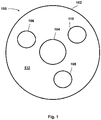
- FIG. 1 is a schematic cross-sectional diagram of a geophysical streamer 100 according to one embodiment.
- the streamer 100 has a casing 102 that encloses one or more functional components such as a strength member 104, a power member 106, a data member 108, and a sensor member 110.
- These members are shown as having a circular cross-section, but some of the members may include devices or structures having non-circular cross-section at certain locations along their lengths.
- the sensor members 110 can be any type of seismic sensors known in the art, including, for example, hydrophones, geophones, particle velocity sensors, particle displacement sensors, particle acceleration sensors, pressure gradient sensors, or electromagnetic sensors.
- the arrangement and content of the functional components in a streamer may vary, and the arrangement and content shown in Figure 1 is for illustration purposes only.
- streamers may have many more members than are shown in Figure 1 , but the filler materials described herein are still usable in such streamers.
- the streamer 100 is typically filled with a filler material 112 that occupies space inside the streamer casing 102 that would otherwise be empty.
- the filler material 112 in the streamers described herein is a gel material made from a polymer dispersed in an oil material.
- the polymer is made from a two-part reaction system in which a first part includes one or more first reactants that are unreactive toward each other and a second part that likewise includes one or more second reactants or catalysts that are unreactive toward each other.
- first part and the second part When mixed, the first part and the second part generally participate in a polymerization reaction that forms the polymer.
- Each of the first part and the second part may include one or more solvents, catalysts, promoters, inhibitors, or other additives.
- Such polymers are also called mix-curable polymers because they cure only upon mixing.
- energy such as acoustic energy, can pass or otherwise be transmitted through filler material 112.
- the polymer is a two-part silicone polymer.
- an A part typically contains a siloxane reactant, which may include a low molecular weight polysiloxane prepolymer, and a B part contains a curative or catalyst component. Mixing the two brings the catalyst together with the siloxane reactant to form the polysiloxane, or silicone, resin.
- the filler material 112 may be, or may include, any such two-part resin that can get formed into a gel by mixing with an oil system, as further described in the methods herein.
- the A part and B part may be used in a 1:1 ratio, or the A part may be used in excess, for example in a volume or mass ratio of A part to B part greater that 1:1, for example between 1.5 and 2.1.
- Figure 2 is a flow diagram illustrating a method 200 of making a filled streamer according to one embodiment.
- a first unreactive mixture is formed containing one or more first reactants, promoters, and/or catalysts that can form a gelator polymer when mixed with an appropriate system of reactants.
- a second unreactive mixture is also formed containing one or more second reactants, promoters, and/or catalysts that will react with, or participate in a reaction with, the first reactants to form a gelator polymer.
- the first mixture may include the A components of an A/B resin system, as described above, while the second mixture includes the B components.
- Solvent is usually included in at least one of the first mixture and the second mixture, but in some cases solvent may be added to the final mixture separately. In systems requiring a catalyst, such as the RTV-2 silicone system, the catalyst may be included with the first mixture or the second mixture, or may be included in a third mixture.
- the first and second mixtures are added to a paraffin oil system selected to provide the filler material with one or more target properties.
- the paraffin oil system may include the hydrocarbon materials described above.
- the reaction system thus formed is mixed for a period of time and allowed to cure. Depending on the relative concentrations of reactants and solvents in the reaction system, the system may be allowed to cure for 15 minutes to 4 hours.
- the reaction system thickens as the polymer grows, eventually reaching an end point.
- the resulting filler material may have a first amount of a two-part silicone gel and a second amount of a paraffin oil, where the first and second amounts are unequal. For example, a volume or mass ratio of the first amount to the total of the filler material may be 15-25%.
- gelation is stopped.
- gelation may be stopped by adding a quenching agent that removes a reactant or catalyst from chemical activity.
- gelation stops due to exhaustion of one or more reactants.
- the reaction system is typically structured to allow gelation to stop, or be stopped, when the gel reaches a target property, usually a hardness, penetration, viscosity, or flow measure.
- a rotary viscometer may monitor development of viscosity in the reaction system and may signal when a target viscosity is reached. If a powered mixer is used, current draw by the mixer may be monitored to detect when gelation should be stopped.
- the resulting filler material is installed into a streamer casing, usually by pumping or extrusion. If the final viscosity of the filler material is sufficiently low, the filler material is pumped into the streamer casing. If the filler material is not pumpable, heat may be applied to reduce the mixture viscosity enough to pump the material.
- the filler material may be gelled in a heated vessel wherein the temperature of the mixture can be maintained at a level to provide sufficient flowability to pump the material.
- a hose or pipe which may also be heated, for example by jacketing with heater tape or heating fluid conduits, may be connected from the heated vessel to the pump and from the pump to the streamer casing to deliver the gel at an elevated temperature. Then as the gel cools inside the streamer casing, the viscosity of the gel reverts to its ambient value.
- Figure 3 is a flow diagram illustrating a method 300 of making a filled streamer according to another embodiment.
- a first unreactive mixture is formed containing one or more first reactants that can form a gelator polymer when mixed with an appropriate system of reactants, making up a first reactant component of a two-part polymerization reaction.
- a second unreactive mixture is also formed containing one or more second reactants that will react with the first reactants to form a gelator polymer, making up a second reactant component of the two-part polymerization reaction.
- a polymerization inhibitor is added to one or both the first mixture and the second mixture.
- the first mixture may include the A components of an A/B resin system, as described above, while the second mixture includes the B components, and solvents may be added to one or both the first and second mixtures.
- the first unreactive mixture may include an A component of a two-part silicone material and the second unreactive mixture may include a B component of the two-part silicone material.
- the mixtures are added to a paraffin oil.
- the reaction mixture is complete, but due to presence of the inhibitor, curing proceeds only slowly, or not at all, for some time.
- many chemicals are known to inhibit cure. Examples include amines, such as melamine and triethylamine, amides such as dimethylformamide, nitriles, oximes, sulfides, alcohols, and others. Delayed or slowed curing may be useful in some cases to allow time to install the reaction mixture into the streamer casing prior to hardening. Curing may also be delayed by cooling the reaction mixture.
- the mixing vessel may be jacketed with refrigerant coils, or the first and second unreactive mixtures may be subcooled prior to mixing.
- the final reaction mixture may be cooled to a temperature near, but above, a solidification point of the solvents, for example a wax point of the hydrocarbon solvents.
- the reaction mixture is pumped into the streamer. Prior to significant curing, the reaction mixture is a pumpable thin to thick liquid that easily fills the streamer casing.
- the filler material is allowed time to fully cure and harden into a gel having the target properties. Heat may be applied to the streamer and/or the fill line using heating elements, which may be radiative, resistive, or conductive, and internal or external, or ambient heat may suffice to warm the mixture in some cases.
- Figure 4 is a flow diagram illustrating a method 300 according to another embodiment.
- an extruder is used to fill a streamer with an extrudable mix cured filler material.
- an extrudable fill material is formed at 402 by adding a two-part liquid polymerization mixture to the paraffin oil system that forms part of the final gel.
- the liquid polymerization mixture may include the components of an A/B resin system, as described above.
- the mixture is fully or partially cured to form a gel.
- the gel is provided to an extruder to fill the streamer.
- the streamer casing may be attached directly to the extruder die such that gel leaving the extruder die enters the casing directly, or a plenum may be attached to the extruder die and connected to the streamer casing.
- the plenum provides a space for expansion, cooling, and or heating of the gel prior to flowing into the casing.
- the plenum may also support extruded construction of the streamer by including features for feeding streamer components through the plenum.
- the casing may be provided in compact form, such as a roll, at the plenum exit such that the casing extends as streamer components and filler exit the plenum.
- Extrusion rate may be controlled by screw speed, and casing payout rate and component feed rate adjusted to match.
- Temperature and pressure may also be controlled in numerous ways. Total die cross-section at the extruder face or plenum exit may be adjusted, along with screw speed, to affect pressure and temperature, or heating elements may be included in the extruder to control temperature.
- the extrusion can also be used to fine tune properties of the gel.
- the reaction mixture may be allowed to overcure prior to extruding.
- a critical property of the mixture such as viscosity, hardness, or penetration, overshoots a target level.
- the resulting material is then fed to the extruder, and the temperature and pressure increased in the extruder to achieve some level of cracking in the extruder.
- Mild pyrolysis can reduce the viscosity of the gel.
- Pyrolysis promoters can be added to the extruder feed, if desired, to promote pyrolysis, and heating or cooling can be applied along the extruder barrel to increase or decrease cracking at selected locations along the barrel.
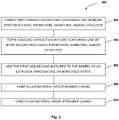
- Figure 5 is a flow diagram illustrating a method 500 according to another embodiment.
- the method 500 involves reactive extrusion of a streamer filler material.
- a first unreactive mixture is formed, as described above.
- a second unreactive mixture is formed, as also described above.
- the two unreactive mixtures are constituted to react with each other to form the gel filler material.
- the first mixture may include the A components of an A/B resin system, as described above, while the second mixture includes the B components, and solvents may be added to one or both the first and second mixtures.
- Each of the first and second unreactive mixtures may include a portion of the paraffin oil that will ultimately be part of the final gel filler material.
- the first and second unreactive mixtures are provided to the barrel of an extruder through one or more feed ports.
- a reactive extrusion is performed in the extruder barrel to produce a gel streamer filler material at the extruder face.
- curing the mixture includes extruding the mixture into the streamer.
- the exact kinetics of the gelation reaction in the extruder may be designed and controlled by using extruder parameters, and through the use of promoters and inhibitors in the initial reaction mixture, or added to the extruder at selected locations.
- the streamer casing is then filled with the gel filler material at 510. As described above, the streamer casing may be filled at the extruder face, or the entire streamer may be extruded using a plenum at the extruder face to feed streamer components into the casing.
Landscapes
- Chemical & Material Sciences (AREA)
- Life Sciences & Earth Sciences (AREA)
- Engineering & Computer Science (AREA)
- Physics & Mathematics (AREA)
- Health & Medical Sciences (AREA)
- Medicinal Chemistry (AREA)
- General Life Sciences & Earth Sciences (AREA)
- Environmental & Geological Engineering (AREA)
- Geology (AREA)
- Remote Sensing (AREA)
- General Physics & Mathematics (AREA)
- Polymers & Plastics (AREA)
- Chemical Kinetics & Catalysis (AREA)
- Organic Chemistry (AREA)
- Geophysics (AREA)
- Acoustics & Sound (AREA)
- Mechanical Engineering (AREA)
- Food Science & Technology (AREA)
- Analytical Chemistry (AREA)
- Biochemistry (AREA)
- General Health & Medical Sciences (AREA)
- Immunology (AREA)
- Pathology (AREA)
- Dispersion Chemistry (AREA)
- Oil, Petroleum & Natural Gas (AREA)
- Compositions Of Macromolecular Compounds (AREA)
- Processes Of Treating Macromolecular Substances (AREA)
- Heating, Cooling, Or Curing Plastics Or The Like In General (AREA)
Applications Claiming Priority (3)
| Application Number | Priority Date | Filing Date | Title |
|---|---|---|---|
| US201662356213P | 2016-06-29 | 2016-06-29 | |
| US15/493,864 US20180002526A1 (en) | 2016-06-29 | 2017-04-21 | Streamer filler material and process |
| EP17175948.3A EP3264140B1 (de) | 2016-06-29 | 2017-06-14 | Streamerfüllmaterial und verfahren |
Related Parent Applications (2)
| Application Number | Title | Priority Date | Filing Date |
|---|---|---|---|
| EP17175948.3A Division-Into EP3264140B1 (de) | 2016-06-29 | 2017-06-14 | Streamerfüllmaterial und verfahren |
| EP17175948.3A Division EP3264140B1 (de) | 2016-06-29 | 2017-06-14 | Streamerfüllmaterial und verfahren |
Publications (2)
| Publication Number | Publication Date |
|---|---|
| EP3974873A1 true EP3974873A1 (de) | 2022-03-30 |
| EP3974873B1 EP3974873B1 (de) | 2025-03-05 |
Family
ID=59077856
Family Applications (2)
| Application Number | Title | Priority Date | Filing Date |
|---|---|---|---|
| EP21208290.3A Active EP3974873B1 (de) | 2016-06-29 | 2017-06-14 | Verfahren zum füllen eines streamers |
| EP17175948.3A Active EP3264140B1 (de) | 2016-06-29 | 2017-06-14 | Streamerfüllmaterial und verfahren |
Family Applications After (1)
| Application Number | Title | Priority Date | Filing Date |
|---|---|---|---|
| EP17175948.3A Active EP3264140B1 (de) | 2016-06-29 | 2017-06-14 | Streamerfüllmaterial und verfahren |
Country Status (4)
| Country | Link |
|---|---|
| US (3) | US20180002526A1 (de) |
| EP (2) | EP3974873B1 (de) |
| AU (1) | AU2017204085B2 (de) |
| MY (1) | MY190921A (de) |
Families Citing this family (4)
| Publication number | Priority date | Publication date | Assignee | Title |
|---|---|---|---|---|
| US12105238B2 (en) | 2018-06-20 | 2024-10-01 | Pgs Geophysical As | Long offset acquisition |
| US12105240B2 (en) | 2019-10-28 | 2024-10-01 | Pgs Geophysical As | Long-offset acquisition with improved low frequency performance for full wavefield inversion |
| US12072461B2 (en) | 2019-10-28 | 2024-08-27 | Pgs Geophysical As | Modified simultaneous long-offset acquisition with improved low frequency performance for full wavefield inversion |
| RU2747076C1 (ru) * | 2020-11-25 | 2021-04-26 | Лариса Анатольевна Базилевских | Наполнитель сейсмокосы |
Citations (3)
| Publication number | Priority date | Publication date | Assignee | Title |
|---|---|---|---|---|
| DE19518461C1 (de) * | 1995-05-19 | 1996-06-13 | Stn Atlas Elektronik Gmbh | Unterwasser-Schleppantenne |
| EP0944127A2 (de) * | 1998-03-16 | 1999-09-22 | STN ATLAS Elektronik GmbH | Schleppantenne |
| US20070064528A1 (en) * | 2005-09-12 | 2007-03-22 | Metzbower D R | Marine seismic streamer and method for manufacture thereof |
Family Cites Families (5)
| Publication number | Priority date | Publication date | Assignee | Title |
|---|---|---|---|---|
| DE3416694A1 (de) * | 1984-05-05 | 1985-11-07 | Bayer Ag, 5090 Leverkusen | Verwendung von paraffin- oder mikrowachsen fuer silikonpasten, deren konfektionierung und verwendung |
| DE10116223A1 (de) * | 2001-03-30 | 2002-10-10 | 3M Espe Ag | Automatisch mischbare Abformassen mit Putty-Konsistenz |
| US7573781B2 (en) * | 2004-07-30 | 2009-08-11 | Teledyne Technologies Incorporation | Streamer cable with enhanced properties |
| US9268049B2 (en) * | 2009-12-31 | 2016-02-23 | Westerngeco L.L.C. | Seismic acquisition using solid streamers |
| US9857487B2 (en) | 2012-10-01 | 2018-01-02 | Westerngeco Llc | Solid marine seismic streamers |
-
2017
- 2017-04-21 US US15/493,864 patent/US20180002526A1/en not_active Abandoned
- 2017-06-14 EP EP21208290.3A patent/EP3974873B1/de active Active
- 2017-06-14 EP EP17175948.3A patent/EP3264140B1/de active Active
- 2017-06-16 AU AU2017204085A patent/AU2017204085B2/en active Active
- 2017-06-20 MY MYPI2017702282A patent/MY190921A/en unknown
-
2020
- 2020-04-27 US US16/859,499 patent/US11999851B2/en active Active
-
2024
- 2024-04-29 US US18/648,752 patent/US20240279470A1/en active Pending
Patent Citations (3)
| Publication number | Priority date | Publication date | Assignee | Title |
|---|---|---|---|---|
| DE19518461C1 (de) * | 1995-05-19 | 1996-06-13 | Stn Atlas Elektronik Gmbh | Unterwasser-Schleppantenne |
| EP0944127A2 (de) * | 1998-03-16 | 1999-09-22 | STN ATLAS Elektronik GmbH | Schleppantenne |
| US20070064528A1 (en) * | 2005-09-12 | 2007-03-22 | Metzbower D R | Marine seismic streamer and method for manufacture thereof |
Also Published As
| Publication number | Publication date |
|---|---|
| US20200255664A1 (en) | 2020-08-13 |
| MY190921A (en) | 2022-05-19 |
| US20180002526A1 (en) | 2018-01-04 |
| US11999851B2 (en) | 2024-06-04 |
| AU2017204085B2 (en) | 2021-07-08 |
| BR102017013786A2 (pt) | 2018-01-16 |
| EP3264140A1 (de) | 2018-01-03 |
| EP3264140B1 (de) | 2022-01-05 |
| EP3974873B1 (de) | 2025-03-05 |
| AU2017204085A1 (en) | 2018-01-18 |
| US20240279470A1 (en) | 2024-08-22 |
Similar Documents
| Publication | Publication Date | Title |
|---|---|---|
| US20240279470A1 (en) | Streamer Filler Material And Process | |
| CA2881922C (en) | Downhole fluid tracking with distributed acoustic sensing | |
| EP2675993B1 (de) | Überwachung von bohrlochzement | |
| US8493815B2 (en) | Streamer cable with enhanced properties | |
| US3126959A (en) | Borehole casing | |
| US7896072B2 (en) | Calorimetric distributed temperature system and methods | |
| US11319790B2 (en) | Proppant ramp up decision making | |
| AU2017400546B2 (en) | Delayed release of resin curing agent | |
| Liang et al. | Mechanism study of disproportionate permeability reduction using nuclear magnetic resonance T2 | |
| CN111978943B (zh) | 自适应型防砂固砂材料 | |
| US20070064528A1 (en) | Marine seismic streamer and method for manufacture thereof | |
| US12140473B2 (en) | Multi-layer fiber optic cable with a cured gelling material and methods of making and using same | |
| EP1644609B1 (de) | Verfahren zur thermischen isolation von rohren | |
| Hong et al. | Effects of water or alkali solution immersion on the water uptake and physicochemical properties of a pultruded carbon fiber reinforced polyurethane plate | |
| KR20200015693A (ko) | 지하 전기 부품을 화학적 손상으로부터 보호하기 위한 저밀도 겔 및 복합재 | |
| Backe et al. | Shrinkage of oil well cement slurries | |
| Zahirovic et al. | Laboratory Testing of Nanosilica-Reinforced Silicate and Polyacrylamide Gels | |
| BR102017013786B1 (pt) | Material de enchimento do cabo sísmico flutuante, cabo sísmico flutuante geofísico e método para fabricação de um cabo sísmico flutuante geofísico preenchido | |
| SA520411682B1 (ar) | طرق وتركيبات لتحميض وتثبيت تكوين لأوجه الصدوع في نفس المعالجة | |
| Zhao et al. | Development of low density rigid gels/composites for ESP packer penetrator protection | |
| Or et al. | Heat-activated Epoxy Foam for Permeability Alteration in Fractured Geothermal Fields: Proof of Concept |
Legal Events
| Date | Code | Title | Description |
|---|---|---|---|
| PUAI | Public reference made under article 153(3) epc to a published international application that has entered the european phase |
Free format text: ORIGINAL CODE: 0009012 |
|
| STAA | Information on the status of an ep patent application or granted ep patent |
Free format text: STATUS: THE APPLICATION HAS BEEN PUBLISHED |
|
| AC | Divisional application: reference to earlier application |
Ref document number: 3264140 Country of ref document: EP Kind code of ref document: P |
|
| AK | Designated contracting states |
Kind code of ref document: A1 Designated state(s): AL AT BE BG CH CY CZ DE DK EE ES FI FR GB GR HR HU IE IS IT LI LT LU LV MC MK MT NL NO PL PT RO RS SE SI SK SM TR |
|
| STAA | Information on the status of an ep patent application or granted ep patent |
Free format text: STATUS: REQUEST FOR EXAMINATION WAS MADE |
|
| 17P | Request for examination filed |
Effective date: 20220929 |
|
| RBV | Designated contracting states (corrected) |
Designated state(s): AL AT BE BG CH CY CZ DE DK EE ES FI FR GB GR HR HU IE IS IT LI LT LU LV MC MK MT NL NO PL PT RO RS SE SI SK SM TR |
|
| P01 | Opt-out of the competence of the unified patent court (upc) registered |
Effective date: 20230516 |
|
| STAA | Information on the status of an ep patent application or granted ep patent |
Free format text: STATUS: EXAMINATION IS IN PROGRESS |
|
| 17Q | First examination report despatched |
Effective date: 20240219 |
|
| GRAP | Despatch of communication of intention to grant a patent |
Free format text: ORIGINAL CODE: EPIDOSNIGR1 |
|
| STAA | Information on the status of an ep patent application or granted ep patent |
Free format text: STATUS: GRANT OF PATENT IS INTENDED |
|
| RIC1 | Information provided on ipc code assigned before grant |
Ipc: C08J 3/075 20060101ALI20240916BHEP Ipc: G01N 33/24 20060101ALI20240916BHEP Ipc: G01V 1/20 20060101AFI20240916BHEP |
|
| INTG | Intention to grant announced |
Effective date: 20241004 |
|
| GRAS | Grant fee paid |
Free format text: ORIGINAL CODE: EPIDOSNIGR3 |
|
| GRAA | (expected) grant |
Free format text: ORIGINAL CODE: 0009210 |
|
| STAA | Information on the status of an ep patent application or granted ep patent |
Free format text: STATUS: THE PATENT HAS BEEN GRANTED |
|
| AC | Divisional application: reference to earlier application |
Ref document number: 3264140 Country of ref document: EP Kind code of ref document: P |
|
| AK | Designated contracting states |
Kind code of ref document: B1 Designated state(s): AL AT BE BG CH CY CZ DE DK EE ES FI FR GB GR HR HU IE IS IT LI LT LU LV MC MK MT NL NO PL PT RO RS SE SI SK SM TR |
|
| REG | Reference to a national code |
Ref country code: GB Ref legal event code: FG4D |
|
| REG | Reference to a national code |
Ref country code: CH Ref legal event code: EP |
|
| REG | Reference to a national code |
Ref country code: IE Ref legal event code: FG4D |
|
| REG | Reference to a national code |
Ref country code: DE Ref legal event code: R096 Ref document number: 602017088243 Country of ref document: DE |
|
| PG25 | Lapsed in a contracting state [announced via postgrant information from national office to epo] |
Ref country code: RS Free format text: LAPSE BECAUSE OF FAILURE TO SUBMIT A TRANSLATION OF THE DESCRIPTION OR TO PAY THE FEE WITHIN THE PRESCRIBED TIME-LIMIT Effective date: 20250605 |
|
| PG25 | Lapsed in a contracting state [announced via postgrant information from national office to epo] |
Ref country code: FI Free format text: LAPSE BECAUSE OF FAILURE TO SUBMIT A TRANSLATION OF THE DESCRIPTION OR TO PAY THE FEE WITHIN THE PRESCRIBED TIME-LIMIT Effective date: 20250305 |
|
| REG | Reference to a national code |
Ref country code: NL Ref legal event code: MP Effective date: 20250305 |
|
| PG25 | Lapsed in a contracting state [announced via postgrant information from national office to epo] |
Ref country code: ES Free format text: LAPSE BECAUSE OF FAILURE TO SUBMIT A TRANSLATION OF THE DESCRIPTION OR TO PAY THE FEE WITHIN THE PRESCRIBED TIME-LIMIT Effective date: 20250305 |
|
| PGFP | Annual fee paid to national office [announced via postgrant information from national office to epo] |
Ref country code: GB Payment date: 20250627 Year of fee payment: 9 |
|
| REG | Reference to a national code |
Ref country code: LT Ref legal event code: MG9D |
|
| PGFP | Annual fee paid to national office [announced via postgrant information from national office to epo] |
Ref country code: NO Payment date: 20250627 Year of fee payment: 9 |
|
| PG25 | Lapsed in a contracting state [announced via postgrant information from national office to epo] |
Ref country code: HR Free format text: LAPSE BECAUSE OF FAILURE TO SUBMIT A TRANSLATION OF THE DESCRIPTION OR TO PAY THE FEE WITHIN THE PRESCRIBED TIME-LIMIT Effective date: 20250305 |
|
| PG25 | Lapsed in a contracting state [announced via postgrant information from national office to epo] |
Ref country code: LV Free format text: LAPSE BECAUSE OF FAILURE TO SUBMIT A TRANSLATION OF THE DESCRIPTION OR TO PAY THE FEE WITHIN THE PRESCRIBED TIME-LIMIT Effective date: 20250305 |
|
| PGFP | Annual fee paid to national office [announced via postgrant information from national office to epo] |
Ref country code: FR Payment date: 20250625 Year of fee payment: 9 |
|
| PG25 | Lapsed in a contracting state [announced via postgrant information from national office to epo] |
Ref country code: GR Free format text: LAPSE BECAUSE OF FAILURE TO SUBMIT A TRANSLATION OF THE DESCRIPTION OR TO PAY THE FEE WITHIN THE PRESCRIBED TIME-LIMIT Effective date: 20250606 Ref country code: BG Free format text: LAPSE BECAUSE OF FAILURE TO SUBMIT A TRANSLATION OF THE DESCRIPTION OR TO PAY THE FEE WITHIN THE PRESCRIBED TIME-LIMIT Effective date: 20250305 |
|
| REG | Reference to a national code |
Ref country code: AT Ref legal event code: MK05 Ref document number: 1773390 Country of ref document: AT Kind code of ref document: T Effective date: 20250305 |
|
| PG25 | Lapsed in a contracting state [announced via postgrant information from national office to epo] |
Ref country code: NL Free format text: LAPSE BECAUSE OF FAILURE TO SUBMIT A TRANSLATION OF THE DESCRIPTION OR TO PAY THE FEE WITHIN THE PRESCRIBED TIME-LIMIT Effective date: 20250305 |
|
| PG25 | Lapsed in a contracting state [announced via postgrant information from national office to epo] |
Ref country code: SE Free format text: LAPSE BECAUSE OF FAILURE TO SUBMIT A TRANSLATION OF THE DESCRIPTION OR TO PAY THE FEE WITHIN THE PRESCRIBED TIME-LIMIT Effective date: 20250305 |
|
| PG25 | Lapsed in a contracting state [announced via postgrant information from national office to epo] |
Ref country code: SM Free format text: LAPSE BECAUSE OF FAILURE TO SUBMIT A TRANSLATION OF THE DESCRIPTION OR TO PAY THE FEE WITHIN THE PRESCRIBED TIME-LIMIT Effective date: 20250305 |
|
| PG25 | Lapsed in a contracting state [announced via postgrant information from national office to epo] |
Ref country code: PT Free format text: LAPSE BECAUSE OF FAILURE TO SUBMIT A TRANSLATION OF THE DESCRIPTION OR TO PAY THE FEE WITHIN THE PRESCRIBED TIME-LIMIT Effective date: 20250707 |
|
| PG25 | Lapsed in a contracting state [announced via postgrant information from national office to epo] |
Ref country code: IT Free format text: LAPSE BECAUSE OF FAILURE TO SUBMIT A TRANSLATION OF THE DESCRIPTION OR TO PAY THE FEE WITHIN THE PRESCRIBED TIME-LIMIT Effective date: 20250305 Ref country code: PL Free format text: LAPSE BECAUSE OF FAILURE TO SUBMIT A TRANSLATION OF THE DESCRIPTION OR TO PAY THE FEE WITHIN THE PRESCRIBED TIME-LIMIT Effective date: 20250305 |
|
| PG25 | Lapsed in a contracting state [announced via postgrant information from national office to epo] |
Ref country code: AT Free format text: LAPSE BECAUSE OF FAILURE TO SUBMIT A TRANSLATION OF THE DESCRIPTION OR TO PAY THE FEE WITHIN THE PRESCRIBED TIME-LIMIT Effective date: 20250305 |
|
| PG25 | Lapsed in a contracting state [announced via postgrant information from national office to epo] |
Ref country code: EE Free format text: LAPSE BECAUSE OF FAILURE TO SUBMIT A TRANSLATION OF THE DESCRIPTION OR TO PAY THE FEE WITHIN THE PRESCRIBED TIME-LIMIT Effective date: 20250305 Ref country code: CZ Free format text: LAPSE BECAUSE OF FAILURE TO SUBMIT A TRANSLATION OF THE DESCRIPTION OR TO PAY THE FEE WITHIN THE PRESCRIBED TIME-LIMIT Effective date: 20250305 |
|
| PG25 | Lapsed in a contracting state [announced via postgrant information from national office to epo] |
Ref country code: RO Free format text: LAPSE BECAUSE OF FAILURE TO SUBMIT A TRANSLATION OF THE DESCRIPTION OR TO PAY THE FEE WITHIN THE PRESCRIBED TIME-LIMIT Effective date: 20250305 |
|
| PG25 | Lapsed in a contracting state [announced via postgrant information from national office to epo] |
Ref country code: SK Free format text: LAPSE BECAUSE OF FAILURE TO SUBMIT A TRANSLATION OF THE DESCRIPTION OR TO PAY THE FEE WITHIN THE PRESCRIBED TIME-LIMIT Effective date: 20250305 |
|
| PG25 | Lapsed in a contracting state [announced via postgrant information from national office to epo] |
Ref country code: IS Free format text: LAPSE BECAUSE OF FAILURE TO SUBMIT A TRANSLATION OF THE DESCRIPTION OR TO PAY THE FEE WITHIN THE PRESCRIBED TIME-LIMIT Effective date: 20250705 |
|
| REG | Reference to a national code |
Ref country code: DE Ref legal event code: R097 Ref document number: 602017088243 Country of ref document: DE |
|
| REG | Reference to a national code |
Ref country code: DE Ref legal event code: R119 Ref document number: 602017088243 Country of ref document: DE |
|
| PLBE | No opposition filed within time limit |
Free format text: ORIGINAL CODE: 0009261 |
|
| STAA | Information on the status of an ep patent application or granted ep patent |
Free format text: STATUS: NO OPPOSITION FILED WITHIN TIME LIMIT |
|
| PG25 | Lapsed in a contracting state [announced via postgrant information from national office to epo] |
Ref country code: DK Free format text: LAPSE BECAUSE OF FAILURE TO SUBMIT A TRANSLATION OF THE DESCRIPTION OR TO PAY THE FEE WITHIN THE PRESCRIBED TIME-LIMIT Effective date: 20250305 |
|
| REG | Reference to a national code |
Ref country code: CH Ref legal event code: L10 Free format text: ST27 STATUS EVENT CODE: U-0-0-L10-L00 (AS PROVIDED BY THE NATIONAL OFFICE) Effective date: 20260114 |
|
| REG | Reference to a national code |
Ref country code: CH Ref legal event code: H13 Free format text: ST27 STATUS EVENT CODE: U-0-0-H10-H13 (AS PROVIDED BY THE NATIONAL OFFICE) Effective date: 20260127 |
|
| PG25 | Lapsed in a contracting state [announced via postgrant information from national office to epo] |
Ref country code: MC Free format text: LAPSE BECAUSE OF FAILURE TO SUBMIT A TRANSLATION OF THE DESCRIPTION OR TO PAY THE FEE WITHIN THE PRESCRIBED TIME-LIMIT Effective date: 20250305 |
|
| 26N | No opposition filed |
Effective date: 20251208 |
|
| PG25 | Lapsed in a contracting state [announced via postgrant information from national office to epo] |
Ref country code: LU Free format text: LAPSE BECAUSE OF NON-PAYMENT OF DUE FEES Effective date: 20250614 |
|
| REG | Reference to a national code |
Ref country code: BE Ref legal event code: MM Effective date: 20250630 |
|
| PG25 | Lapsed in a contracting state [announced via postgrant information from national office to epo] |
Ref country code: IE Free format text: LAPSE BECAUSE OF NON-PAYMENT OF DUE FEES Effective date: 20250614 Ref country code: DE Free format text: LAPSE BECAUSE OF NON-PAYMENT OF DUE FEES Effective date: 20260101 |
|
| PG25 | Lapsed in a contracting state [announced via postgrant information from national office to epo] |
Ref country code: BE Free format text: LAPSE BECAUSE OF NON-PAYMENT OF DUE FEES Effective date: 20250630 |
|
| PG25 | Lapsed in a contracting state [announced via postgrant information from national office to epo] |
Ref country code: CH Free format text: LAPSE BECAUSE OF NON-PAYMENT OF DUE FEES Effective date: 20250630 |