EP3974462B1 - Polyethylene glycol derivative, preparation method therefor, and polyethylene glycol hydrogel enabling fast crosslinking reaction - Google Patents
Polyethylene glycol derivative, preparation method therefor, and polyethylene glycol hydrogel enabling fast crosslinking reaction Download PDFInfo
- Publication number
- EP3974462B1 EP3974462B1 EP20938000.5A EP20938000A EP3974462B1 EP 3974462 B1 EP3974462 B1 EP 3974462B1 EP 20938000 A EP20938000 A EP 20938000A EP 3974462 B1 EP3974462 B1 EP 3974462B1
- Authority
- EP
- European Patent Office
- Prior art keywords
- polyethylene glycol
- formula
- terminal group
- glycol derivative
- polymerization
- Prior art date
- Legal status (The legal status is an assumption and is not a legal conclusion. Google has not performed a legal analysis and makes no representation as to the accuracy of the status listed.)
- Active
Links
Images



Classifications
-
- C—CHEMISTRY; METALLURGY
- C08—ORGANIC MACROMOLECULAR COMPOUNDS; THEIR PREPARATION OR CHEMICAL WORKING-UP; COMPOSITIONS BASED THEREON
- C08G—MACROMOLECULAR COMPOUNDS OBTAINED OTHERWISE THAN BY REACTIONS ONLY INVOLVING UNSATURATED CARBON-TO-CARBON BONDS
- C08G65/00—Macromolecular compounds obtained by reactions forming an ether link in the main chain of the macromolecule
- C08G65/02—Macromolecular compounds obtained by reactions forming an ether link in the main chain of the macromolecule from cyclic ethers by opening of the heterocyclic ring
- C08G65/32—Polymers modified by chemical after-treatment
- C08G65/329—Polymers modified by chemical after-treatment with organic compounds
- C08G65/333—Polymers modified by chemical after-treatment with organic compounds containing nitrogen
- C08G65/33331—Polymers modified by chemical after-treatment with organic compounds containing nitrogen containing imide group
- C08G65/33337—Polymers modified by chemical after-treatment with organic compounds containing nitrogen containing imide group cyclic
-
- A—HUMAN NECESSITIES
- A61—MEDICAL OR VETERINARY SCIENCE; HYGIENE
- A61L—METHODS OR APPARATUS FOR STERILISING MATERIALS OR OBJECTS IN GENERAL; DISINFECTION, STERILISATION OR DEODORISATION OF AIR; CHEMICAL ASPECTS OF BANDAGES, DRESSINGS, ABSORBENT PADS OR SURGICAL ARTICLES; MATERIALS FOR BANDAGES, DRESSINGS, ABSORBENT PADS OR SURGICAL ARTICLES
- A61L27/00—Materials for grafts or prostheses or for coating grafts or prostheses
- A61L27/50—Materials characterised by their function or physical properties, e.g. injectable or lubricating compositions, shape-memory materials, surface modified materials
- A61L27/52—Hydrogels or hydrocolloids
-
- A—HUMAN NECESSITIES
- A61—MEDICAL OR VETERINARY SCIENCE; HYGIENE
- A61K—PREPARATIONS FOR MEDICAL, DENTAL OR TOILETRY PURPOSES
- A61K47/00—Medicinal preparations characterised by the non-active ingredients used, e.g. carriers or inert additives; Targeting or modifying agents chemically bound to the active ingredient
- A61K47/06—Organic compounds, e.g. natural or synthetic hydrocarbons, polyolefins, mineral oil, petrolatum or ozokerite
- A61K47/08—Organic compounds, e.g. natural or synthetic hydrocarbons, polyolefins, mineral oil, petrolatum or ozokerite containing oxygen, e.g. ethers, acetals, ketones, quinones, aldehydes, peroxides
- A61K47/10—Alcohols; Phenols; Salts thereof, e.g. glycerol; Polyethylene glycols [PEG]; Poloxamers; PEG/POE alkyl ethers
-
- A—HUMAN NECESSITIES
- A61—MEDICAL OR VETERINARY SCIENCE; HYGIENE
- A61K—PREPARATIONS FOR MEDICAL, DENTAL OR TOILETRY PURPOSES
- A61K47/00—Medicinal preparations characterised by the non-active ingredients used, e.g. carriers or inert additives; Targeting or modifying agents chemically bound to the active ingredient
- A61K47/06—Organic compounds, e.g. natural or synthetic hydrocarbons, polyolefins, mineral oil, petrolatum or ozokerite
- A61K47/16—Organic compounds, e.g. natural or synthetic hydrocarbons, polyolefins, mineral oil, petrolatum or ozokerite containing nitrogen, e.g. nitro-, nitroso-, azo-compounds, nitriles, cyanates
- A61K47/18—Amines; Amides; Ureas; Quaternary ammonium compounds; Amino acids; Oligopeptides having up to five amino acids
-
- A—HUMAN NECESSITIES
- A61—MEDICAL OR VETERINARY SCIENCE; HYGIENE
- A61K—PREPARATIONS FOR MEDICAL, DENTAL OR TOILETRY PURPOSES
- A61K9/00—Medicinal preparations characterised by special physical form
- A61K9/06—Ointments; Bases therefor; Other semi-solid forms, e.g. creams, sticks, gels
-
- A—HUMAN NECESSITIES
- A61—MEDICAL OR VETERINARY SCIENCE; HYGIENE
- A61L—METHODS OR APPARATUS FOR STERILISING MATERIALS OR OBJECTS IN GENERAL; DISINFECTION, STERILISATION OR DEODORISATION OF AIR; CHEMICAL ASPECTS OF BANDAGES, DRESSINGS, ABSORBENT PADS OR SURGICAL ARTICLES; MATERIALS FOR BANDAGES, DRESSINGS, ABSORBENT PADS OR SURGICAL ARTICLES
- A61L24/00—Surgical adhesives or cements; Adhesives for colostomy devices
- A61L24/001—Use of materials characterised by their function or physical properties
- A61L24/0031—Hydrogels or hydrocolloids
-
- A—HUMAN NECESSITIES
- A61—MEDICAL OR VETERINARY SCIENCE; HYGIENE
- A61L—METHODS OR APPARATUS FOR STERILISING MATERIALS OR OBJECTS IN GENERAL; DISINFECTION, STERILISATION OR DEODORISATION OF AIR; CHEMICAL ASPECTS OF BANDAGES, DRESSINGS, ABSORBENT PADS OR SURGICAL ARTICLES; MATERIALS FOR BANDAGES, DRESSINGS, ABSORBENT PADS OR SURGICAL ARTICLES
- A61L24/00—Surgical adhesives or cements; Adhesives for colostomy devices
- A61L24/04—Surgical adhesives or cements; Adhesives for colostomy devices containing macromolecular materials
- A61L24/046—Surgical adhesives or cements; Adhesives for colostomy devices containing macromolecular materials obtained otherwise than by reactions only involving carbon-to-carbon unsaturated bonds
-
- A—HUMAN NECESSITIES
- A61—MEDICAL OR VETERINARY SCIENCE; HYGIENE
- A61L—METHODS OR APPARATUS FOR STERILISING MATERIALS OR OBJECTS IN GENERAL; DISINFECTION, STERILISATION OR DEODORISATION OF AIR; CHEMICAL ASPECTS OF BANDAGES, DRESSINGS, ABSORBENT PADS OR SURGICAL ARTICLES; MATERIALS FOR BANDAGES, DRESSINGS, ABSORBENT PADS OR SURGICAL ARTICLES
- A61L27/00—Materials for grafts or prostheses or for coating grafts or prostheses
- A61L27/14—Macromolecular materials
- A61L27/18—Macromolecular materials obtained otherwise than by reactions only involving carbon-to-carbon unsaturated bonds
-
- C—CHEMISTRY; METALLURGY
- C07—ORGANIC CHEMISTRY
- C07C—ACYCLIC OR CARBOCYCLIC COMPOUNDS
- C07C235/00—Carboxylic acid amides, the carbon skeleton of the acid part being further substituted by oxygen atoms
- C07C235/70—Carboxylic acid amides, the carbon skeleton of the acid part being further substituted by oxygen atoms having carbon atoms of carboxamide groups and doubly-bound oxygen atoms bound to the same carbon skeleton
- C07C235/84—Carboxylic acid amides, the carbon skeleton of the acid part being further substituted by oxygen atoms having carbon atoms of carboxamide groups and doubly-bound oxygen atoms bound to the same carbon skeleton with the carbon atom of at least one of the carboxamide groups bound to a carbon atom of a six-membered aromatic ring
-
- C—CHEMISTRY; METALLURGY
- C07—ORGANIC CHEMISTRY
- C07D—HETEROCYCLIC COMPOUNDS
- C07D405/00—Heterocyclic compounds containing both one or more hetero rings having oxygen atoms as the only ring hetero atoms, and one or more rings having nitrogen as the only ring hetero atom
- C07D405/02—Heterocyclic compounds containing both one or more hetero rings having oxygen atoms as the only ring hetero atoms, and one or more rings having nitrogen as the only ring hetero atom containing two hetero rings
- C07D405/12—Heterocyclic compounds containing both one or more hetero rings having oxygen atoms as the only ring hetero atoms, and one or more rings having nitrogen as the only ring hetero atom containing two hetero rings linked by a chain containing hetero atoms as chain links
-
- C—CHEMISTRY; METALLURGY
- C08—ORGANIC MACROMOLECULAR COMPOUNDS; THEIR PREPARATION OR CHEMICAL WORKING-UP; COMPOSITIONS BASED THEREON
- C08G—MACROMOLECULAR COMPOUNDS OBTAINED OTHERWISE THAN BY REACTIONS ONLY INVOLVING UNSATURATED CARBON-TO-CARBON BONDS
- C08G65/00—Macromolecular compounds obtained by reactions forming an ether link in the main chain of the macromolecule
- C08G65/02—Macromolecular compounds obtained by reactions forming an ether link in the main chain of the macromolecule from cyclic ethers by opening of the heterocyclic ring
- C08G65/32—Polymers modified by chemical after-treatment
- C08G65/329—Polymers modified by chemical after-treatment with organic compounds
- C08G65/333—Polymers modified by chemical after-treatment with organic compounds containing nitrogen
- C08G65/3332—Polymers modified by chemical after-treatment with organic compounds containing nitrogen containing carboxamide group
- C08G65/33327—Polymers modified by chemical after-treatment with organic compounds containing nitrogen containing carboxamide group cyclic
-
- C—CHEMISTRY; METALLURGY
- C08—ORGANIC MACROMOLECULAR COMPOUNDS; THEIR PREPARATION OR CHEMICAL WORKING-UP; COMPOSITIONS BASED THEREON
- C08G—MACROMOLECULAR COMPOUNDS OBTAINED OTHERWISE THAN BY REACTIONS ONLY INVOLVING UNSATURATED CARBON-TO-CARBON BONDS
- C08G65/00—Macromolecular compounds obtained by reactions forming an ether link in the main chain of the macromolecule
- C08G65/02—Macromolecular compounds obtained by reactions forming an ether link in the main chain of the macromolecule from cyclic ethers by opening of the heterocyclic ring
- C08G65/32—Polymers modified by chemical after-treatment
- C08G65/329—Polymers modified by chemical after-treatment with organic compounds
- C08G65/333—Polymers modified by chemical after-treatment with organic compounds containing nitrogen
- C08G65/33396—Polymers modified by chemical after-treatment with organic compounds containing nitrogen having oxygen in addition to nitrogen
-
- C—CHEMISTRY; METALLURGY
- C08—ORGANIC MACROMOLECULAR COMPOUNDS; THEIR PREPARATION OR CHEMICAL WORKING-UP; COMPOSITIONS BASED THEREON
- C08J—WORKING-UP; GENERAL PROCESSES OF COMPOUNDING; AFTER-TREATMENT NOT COVERED BY SUBCLASSES C08B, C08C, C08F, C08G or C08H
- C08J3/00—Processes of treating or compounding macromolecular substances
- C08J3/02—Making solutions, dispersions, lattices or gels by other methods than by solution, emulsion or suspension polymerisation techniques
- C08J3/03—Making solutions, dispersions, lattices or gels by other methods than by solution, emulsion or suspension polymerisation techniques in aqueous media
- C08J3/075—Macromolecular gels
-
- A—HUMAN NECESSITIES
- A61—MEDICAL OR VETERINARY SCIENCE; HYGIENE
- A61L—METHODS OR APPARATUS FOR STERILISING MATERIALS OR OBJECTS IN GENERAL; DISINFECTION, STERILISATION OR DEODORISATION OF AIR; CHEMICAL ASPECTS OF BANDAGES, DRESSINGS, ABSORBENT PADS OR SURGICAL ARTICLES; MATERIALS FOR BANDAGES, DRESSINGS, ABSORBENT PADS OR SURGICAL ARTICLES
- A61L2400/00—Materials characterised by their function or physical properties
- A61L2400/04—Materials for stopping bleeding
-
- C—CHEMISTRY; METALLURGY
- C08—ORGANIC MACROMOLECULAR COMPOUNDS; THEIR PREPARATION OR CHEMICAL WORKING-UP; COMPOSITIONS BASED THEREON
- C08G—MACROMOLECULAR COMPOUNDS OBTAINED OTHERWISE THAN BY REACTIONS ONLY INVOLVING UNSATURATED CARBON-TO-CARBON BONDS
- C08G2650/00—Macromolecular compounds obtained by reactions forming an ether link in the main chain of the macromolecule
- C08G2650/02—Macromolecular compounds obtained by reactions forming an ether link in the main chain of the macromolecule characterized by the type of post-polymerisation functionalisation
- C08G2650/04—End-capping
-
- C—CHEMISTRY; METALLURGY
- C08—ORGANIC MACROMOLECULAR COMPOUNDS; THEIR PREPARATION OR CHEMICAL WORKING-UP; COMPOSITIONS BASED THEREON
- C08J—WORKING-UP; GENERAL PROCESSES OF COMPOUNDING; AFTER-TREATMENT NOT COVERED BY SUBCLASSES C08B, C08C, C08F, C08G or C08H
- C08J2371/00—Characterised by the use of polyethers obtained by reactions forming an ether link in the main chain; Derivatives of such polymers
- C08J2371/02—Polyalkylene oxides
Definitions
- the present invention falls into the technical field of new biomedical materials, and specifically relates to a polyethylene glycol derivative, a preparation method thereof, and a polyethylene glycol hydrogel capable of producing a rapid crosslinking reaction.
- Hydrogel is a material with a three-dimensional network structure formed by certain crosslinking. Hydrogel is widely applied in the biomedical field, due to its physical and chemical properties similar to extracellular matrix as well as good biocompatibility.
- Polyethylene glycol is a common raw material for preparing hydrogel, including linear polyethylene glycol and multi-arm polyethylene glycol. Due to the low reactivity of the terminal hydroxyl of the polyethylene glycol, it is usually necessary to derivatize polyethylene glycol to produce terminal groups with different functions, such as carboxy, amino, mercapto, and aldehyde groups. Through the chemical reaction of the terminal group, a chemically cross-linked hydrogel can be conveniently prepared, and the hydrogel can also be functionalized by coupling other molecules.
- the prior art discloses a variety of polyethylene glycol hydrogels, such as polyethylene glycol hydrogel through the reaction of aldehyde group and amino group and polyethylene glycol hydrogel through enzymatic crosslinking reactions.
- US2017182220A1 discloses a hydrogel having a controllable and predictable gelling kinetics and/or disintegration profile, comprising a bioorthogonally crosslinked network of a first set of macromers and a second set of macromers, wherein the first set of macromers are a first poly(ethylene glycol) macromer and the second set of macromers is a second poly(ethylene glycol) macromer.
- the technical problem to be solved by the present invention is to provide a polyethylene glycol derivative, a preparation method thereof, and a polyethylene glycol hydrogel capable of producing a rapid crosslinking reaction.
- the hydrogel prepared from the polyethylene glycol derivative provided by the present invention has the characteristics of mild preparation conditions, fast gel-forming speed, high mechanical strength, etc.
- the present invention provides a polyethylene glycol derivative, comprising a repeat unit having the structure of Formula (I) and a terminal group having the structure of Formula (II);
- the polyethylene glycol derivative has any of the structures of Formula (IIIa), Formula (IIIb), Formula (IIIc), Formula (IIId), and Formula (IIIe):
- the present invention also provides a preparation method of the above-mentioned polyethylene glycol derivative, comprising the following steps:
- the 1,3-dimethoxy-1,3-dihydroisobenzofuran-5-carboxylic acid succinimidyl ester is prepared according to the following process:
- the present invention also provides a polyethylene glycol hydrogel capable of producing a rapid crosslinking reaction, which is formed by connecting a polyethylene glycol derivative and a polyethylene glycol having an amino-containing terminal group via a chemical bond, wherein the polyethylene glycol derivative is the above-mentioned polyethylene glycol derivative.
- the polyethylene glycol having an amino-containing terminal group comprises a repeat unit having the structure of Formula (IV) and a terminal group having any of the structures of Formula (Va), Formula (Vb), Formula (Vc), Formula (Vd), and Formula (Ve): -NH 2 (Va)
- the polyethylene glycol having an amino-containing terminal group has any of the structures of Formula (VIa), Formula (VIb), Formula (VIc), Formula (VId), and Formula (VIe):
- the present invention also provides a preparation method of the above-mentioned polyethylene glycol hydrogel, which is prepared from polyethylene glycol derivative, polyethylene glycol having an amino-containing terminal group, and solvent.
- the solvent is water, physiological saline, or buffer solution
- the mass ratio of the polyethylene glycol derivative to the polyethylene glycol having an amino-containing terminal group is 1 : 0.01 ⁇ 100.
- the present invention provides a polyethylene glycol derivative comprising a repeat unit having the structure of Formula (I) and a terminal group having the structure of Formula (II).
- the polyethylene glycol derivative provided by the present invention has a good biocompatibility, due to the repeat unit having the structure of Formula (I); and can react with various groups such as amino, (acyl)hydrazino, and aminooxy with a fast reaction rate and under mild reaction conditions, due to the o-phthalaldehyde terminal group having the structure of Formula (II).
- the polyethylene glycol derivative provided by the present invention is mixed with polyethylene glycol having an amino-containing terminal group in an aqueous medium, to rapidly form a chemically cross-linked hydrogel material.
- the hydrogel material has mild preparation conditions, fast gel-forming speed, high mechanical strength, and good stability. This polyethylene glycol hydrogel can be applied as a sustained-release drug carrier, a tissue engineering scaffold, etc. in the field of biomedical materials.
- the present invention provides a polyethylene glycol derivative, comprising a repeat unit having the structure of Formula (I) and a terminal group having the structure of Formula (II):
- the polyethylene glycol derivative may be a linear polyethylene glycol derivative or a multi-arm polyethylene glycol derivative.
- the polyethylene glycol derivative has any of the structures of Formula (IIIa), Formula (IIIb), Formula (IIIc), Formula (IIId), and Formula (IIIe):
- the present invention also provides a preparation method of the above polyethylene glycol derivative, which comprises the following steps:
- the reaction process is as follows:
- 1,3-dimethoxy-1,3-dihydroisobenzofuran-5-carboxylic acid succinimidyl ester and polyethylene glycol with amino as terminal group are dissolved in an organic solvent, reacted in the presence of acid-binding agent, and settled, to obtain the reaction product.
- the molar equivalent of 1,3-dimethoxy-1,3-dihydroisobenzofuran-5-carboxylic acid succinimidyl ester is 1.2 ⁇ 5 times, preferably 2 times, of that of the amino group in the polyethylene glycol with amino as terminal group;
- the organic solvent is preferably anhydrous dichloromethane; and
- the acid-binding agent is preferably anhydrous pyridine.
- the reaction time is 24 ⁇ 72 h, preferably 48 h; and the reaction temperature is 10 ⁇ 40 °C, preferably 25 °C.
- anhydrous ethyl ether is preferably used for the settling; and the settled solid is filtered, and dried in vacuum, to obtain the reaction product.
- the reaction product is deprotected, dialyzed, and lyophilized, to obtain a polyethylene glycol derivative.
- the deprotection can adopt a technical solution well known to those skilled in the art.
- a mixed solvent of trifluoroacetic acid and water is preferably used; the volume of the mixed solvent is 5 ⁇ 20 times, preferably 5 times, of the mass of the reaction product; the deprotection time is 0.5 ⁇ 3 h, preferably 1 h; and the deprotection temperature is 10 ⁇ 40 °C, preferably 25 °C.
- the dialysis and lyophilization can adopt the technical solutions well known to those skilled in the art.
- the 1,3-dimethoxy-1,3-dihydroisobenzofuran-5-carboxylic acid succinimidyl ester is prepared according to the following process:
- the reaction process is as follows:
- 3,4-dimethylbenzoic acid is brominatd, to prepare 3,4-bis(dibromomethyl)benzoic acid.
- the bromination reaction can adopt a technical solution well known to those skilled in the art.
- the present invention uses N-bromosuccinimide as brominating agent, any one of benzoyl peroxide and azobisisobutyronitrile as free radical initiator, and carbon tetrachloride as solvent, for the bromination reaction.
- the molar equivalent of N-bromosuccinimide is 3 ⁇ 5 times, preferably 4 times, of that of 3,4-dimethylbenzoic acid; the molar equivalent of benzoyl peroxide is 0.05-0.5 times, preferably 0.1 times, of that of 3,4-dimethylbenzoic acid; and the volume (ml) of carbon tetrachloride is 10 ⁇ 50 times, preferably 20 times, of the mass (g) of 3,4-dimethylbenzoic acid.
- the bromination reaction temperature is 70 ⁇ 90 °C, preferably 81 °C; and the bromination reaction time is 10 ⁇ 20 h, preferably 15 h.
- the reaction mixture is filtered; the filter cake is washed with benzene or ethyl ether; all the filtrates are combined and concentrated, and then vacuum dried; and the solid product is recrystallized in acetonitrile, to obtain 3,4-bis(dibromomethyl)benzoic acid.
- a rotary evaporator is preferably used for concentration; the concentration temperature is preferably 30 °C; and it is preferable to be concentrated to 10% of the liquid volume.
- the recrystallization can adopt a technical solution well known to those skilled in the art.
- 3,4-bis(dibromomethyl)benzoic acid is subjected to hydrolysis reaction, to obtain 3,4-diformylbenzoic acid.
- the hydrolysis reaction can adopt the technical solutions well known to those skilled in the art.
- 3,4-bis(dibromomethyl)benzoic acid is preferably dissolved in an aqueous solution of sodium carbonate for the hydrolysis reaction.
- the mass-volume concentration of the aqueous solution of sodium carbonate is 10%; the volume of the aqueous solution of sodium carbonate is 5-20 times, preferably 10 times, of the mass of 3,4-bis(dibromomethyl)benzoic acid.
- the hydrolysis reaction temperature is 60 ⁇ 80 °C, preferably 70 °C; and the hydrolysis reaction time is 3-5 h, preferably 4 h.
- the pH of the reaction solution is adjusted to 0-3, preferably 1, with concentrated hydrochloric acid; extracted by ethyl acetate; concentrated, and vacuum dried, to obtain 3,4-diformylbenzoic acid.
- the catalyst is preferably scandium trifluoromethanesulfonate; the reaction temperature is 10 ⁇ 40 °C, preferably 25 °C; and the reaction time is 6 ⁇ 24 h, preferably 12 h.
- 1,3-dimethoxy-1,3-dihydroisobenzofuran-5-carboxylic acid is reacted with N-hydroxysuccinimide and a condensation agent in an organic solvent, to obtain 1,3-dimethoxy-1,3-dihydroisobenzofuran-5-carboxylic acid succinimidyl ester.
- the condensation agent is any of dicyclohexylcarbodiimide, 1-(3-dimethylaminopropyl)-3-ethylcarbodiimide hydrochloride, and diisopropylcarbodiimide, preferably 1-(3-dimethylaminopropyl)-3-ethylcarbodiimide hydrochloride; and the organic solvent is any one of dimethylformamide, dimethyl sulfoxide, and acetonitrile, preferably acetonitrile.
- the reaction temperature is 10 ⁇ 40 °C, preferably 25 °C; and the reaction time is 6 ⁇ 24 h, preferably 12 h.
- the crude product is purified by silica gel column chromatography, to obtain 1,3-dimethoxy-1,3-dihydroisobenzofuran-5-carboxylic acid succinimidyl ester.
- the mobile phase of the column chromatography is preferably n-hexane and ethyl acetate at a volume ratio of 1:5-1:1, preferably 1:3.
- the present invention also provides a polyethylene glycol hydrogel capable of producing a rapid crosslinking reaction, formed by connecting a polyethylene glycol derivative and a polyethylene glycol having an amino-containing terminal group via a chemical bond, wherein the polyethylene glycol derivative is the above-mentioned polyethylene glycol derivative.
- the polyethylene glycol having an amino-containing terminal group comprises a repeat unit having the structure of Formula (IV) and a terminal group having any one of the structures of Formula (Va), Formula (Vb), Formula (Vc), Formula (Vd), and Formula (Ve); -NH 2 (Va)
- the polyethylene glycol having an amino-containing terminal group may be a linear polyethylene glycol having an amino-containing terminal group or a multi-arm polyethylene glycol having an amino-containing terminal group.
- the polyethylene glycol having an amino-containing terminal group has any one of the structures of Formula (VIa), Formula (VIb), Formula (VIc), Formula (VId), and Formula (VIe):
- the present invention also provides a preparation method of the above-mentioned polyethylene glycol hydrogel, which is prepared from a polyethylene glycol derivative, a polyethylene glycol having an amino-containing terminal group, and a solvent.
- the preparation process of the polyethylene glycol hydrogel includes:
- the mass-volume concentration of the polyethylene glycol derivative is 1 ⁇ 1000 mg/mL, preferably 10 ⁇ 200 mg/mL.
- the mass-volume concentration of the polyethylene glycol having an amino-containing terminal group is 1 ⁇ 1000 mg/mL, preferably 10 ⁇ 200 mg/mL.
- the solvent used in the preparation of solution 1 and solution 2 is selected from water, physiological saline, or buffer solution, and the buffer solution is selected from phosphate buffer solution.
- the mass ratio of the polyethylene glycol derivative to the polyethylene glycol having an amino-containing terminal group is 1:0.01 ⁇ 100, preferably 1:0.1 ⁇ 10.
- the polyethylene glycol derivative provided by the present invention has a good water-solubility and biocompatibility, and the o-phthalaldehyde at terminal can chemically react with various groups.
- the polyethylene glycol derivative provided by the present invention comprises a main chain of polyethylene glycol and a terminal group of o-phthalaldehyde.
- the polyethylene glycol hydrogel is formed by connecting the above-mentioned polyethylene glycol derivative and polyethylene glycol having an amino-containing terminal group via a chemical bond.
- the polyethylene glycol hydrogel of the present invention has a fast gel-forming speed, high mechanical strength, excellent tissue adhesion ability, and good biocompatibility.
- the polyethylene glycol hydrogel of the present invention has potential applications in the following fields: drug sustained-release carriers, tissue engineering scaffolds, and hemostatic sealing coatings.
- the polyethylene glycol derivative, the preparation method thereof, and the polyethylene glycol hydrogel capable of producing a rapid crosslinking reaction as provided in the present invention will be illustrated below in conjugation with Examples, but the protection scope of the present invention is not limited by the following Examples.
- the reagents used in the following Examples are purchased from J&K Chemical, and the solvents used are purchased from Beijing Chemical Plant.
- 3,4-bis(dibromomethyl)benzoic acid (13 g) prepared in Example 1 was dissolved in an aqueous sodium carbonate solution (130mL) with a mass-volume concentration of 10%, and reacted at 70 °C for 4 h.
- the pH of the reaction solution was adjusted to 1 with concentrated hydrochloric acid, and then extracted with ethyl acetate (4 ⁇ 60 mL).
- the organic phases were combined, washed with saturated brine, dried over anhydrous sodium sulfate, filtered, and vacuum dried, to obtain 3,4-diformylbenzoic acid (2.8 g, 56%).
- 1,3-dimethoxy-1,3-dihydroisobenzofuran-5-carboxylic acid prepared in Example 4 and N-hydroxysuccinimide (3.6 g) were dissolved in anhydrous acetonitrile (80 mL), followed by the addition of 1-(3-dimethylaminopropyl)-3-ethylcarbodiimide hydrochloride (4.5 g), and the reaction was conducted for 12 h. Most of the solvent was removed by rotary evaporation, and the remaining mixture was dissolved in dichloromethane, washed with saturated brine for 3 times, and dried over anhydrous magnesium sulfate.
- Fig. 1 shows the H-NMR spectrum of 1,3-dimethoxy-1,3-dihydroisobenzofuran-5-carboxylic acid succinimidyl ester as prepared in Example 4 of the present invention.
- the linear polyethylene glycol with amino as terminal group (number-average molecular weight: 2000, 2.0 g) was dissolved in 25 mL of dichloromethane, and 1 mL of pyridine was added as acid-binding agent, followed by the dropwise addition of a solution (25 mL) of 1,3-dimethoxy-1,3-dihydroisobenzofuran-5-carboxylic acid succinimidyl ester prepared in Example 4 (1.3 g) in dichloromethane, and the reaction was conducted for 48 h. The reaction solution was poured into 500 mL of glacial ethyl ether, settled, filtered, and dried in vacuum, to obtain a linear polyethylene glycol derivative with protected terminal group (1.9 g, 95%).
- linear polyethylene glycol derivative with protected terminal group (1.9 g) was dissolved in 5 mL of water, and then 5 mL of trifluoroacetic acid was added dropwise. After the reaction under stirring for 1 h, it was diluted with water to 50 mL, transferred to a dialysis bag with a molecular weight cut-off of 500 and dialyzed for 48 h, then lyophilized, to obtain a linear polyethylene glycol derivative (1.6 g, 84%).
- Three-arm polyethylene glycol with amino as terminal group (number-average molecular weight: 10000, 2.0 g) was dissolved in 25 mL of dichloromethane, and 1 mL of pyridine was added as acid-binding agent, followed by the dropwise addition of a solution (25 mL) of 1,3-dimethoxy-1,3-dihydroisobenzofuran-5-carboxylic acid succinimidyl ester (0.39 g) in dichloromethane, and the reaction was conducted for 48 h. The reaction solution was poured into 500 mL of glacial ethyl ether, settled, filtered, and dried in vacuum, to obtain a three-arm polyethylene glycol derivative with protected terminal group (2.0 g, 100%).
- the three-arm polyethylene glycol derivative with protected terminal group (2.0 g) was dissolved in 5 mL of water, and then 5 mL of trifluoroacetic acid was added dropwise. After the reaction under stirring for 1 h, it was diluted with water to 50 mL, transferred to a dialysis bag with a molecular weight cut-off of 3500 and dialyzed for 48 h, then lyophilized, to obtain a three-arm polyethylene glycol derivative (1.8 g, 90%).
- the four-arm polyethylene glycol derivative with protected terminal group (2.0 g) was dissolved in 5 mL of water, and then 5 mL of trifluoroacetic acid was added dropwise. After the reaction under stirring for 1 h, it was diluted with water to 50 mL, transferred to a dialysis bag with a molecular weight cut-off of 3500 and dialyzed for 48 h, then lyophilized, to obtain a four-arm polyethylene glycol derivative (1.9 g, 95%).
- Fig. 3 shows the H-NMR spectrum of the four-arm polyethylene glycol derivative as prepared in Example 7 of the present invention.
- the four-arm polyethylene glycol derivative with protected terminal group (1.9 g) was dissolved in 5 mL of water, and then 5 mL of trifluoroacetic acid was added dropwise. After the reaction under stirring for 1 h, it was diluted with water to 50 mL, transferred to a dialysis bag with a molecular weight cut-off of 7000 and dialyzed for 48 h, then lyophilized, to obtain a four-arm polyethylene glycol derivative (1.8 g, 95%).
- the six-arm polyethylene glycol derivative with protected terminal group (2.0 g) was dissolved in 5 mL of water, and then 5 mL of trifluoroacetic acid was added dropwise. After the reaction under stirring for 1 h, it was diluted with water to 50 mL, transferred to a dialysis bag with a molecular weight cut-off of 3500 and dialyzed for 48 h, then lyophilized, to obtain a six-arm polyethylene glycol derivative (1.8 g, 90%).
- Eight-arm polyethylene glycol with amino as terminal group (number-average molecular weight: 10000, 2.0 g) was dissolved in 25 mL of dichloromethane, and 1 mL of pyridine was added as acid-binding agent, followed by the dropwise addition of a solution (25 mL) of 1,3-dimethoxy-1,3-dihydroisobenzofuran-5-carboxylic acid succinimidyl ester (1.0 g) in dichloromethane, and the reaction was conducted for 48 h. The reaction solution was poured into 500 mL of glacial ethyl ether, settled, filtered, and dried in vacuum, to obtain an eight-arm polyethylene glycol derivative with protected terminal group (2.0 g, 100%).
- the eight-arm polyethylene glycol derivative with protected terminal group (2.0 g) was dissolved in 5 mL of water, and then 5 mL of trifluoroacetic acid was added dropwise. After the reaction under stirring for 1 h, it was diluted with water to 50 mL, transferred to a dialysis bag with a molecular weight cut-off of 3500 and dialyzed for 48 h, then lyophilized, to obtain an eight-arm polyethylene glycol derivative (1.9 g, 95%).
- the four-arm polyethylene glycol derivative prepared in Example 7 was weighed and dissolved in PBS (1 mL) to obtain solution 1.
- the four-arm polyethylene glycol with amino as terminal group (as shown by Formula Va) (number-average molecular weight: 10000, 60 mg) was weighed and dissolved in PBS (1 mL) to obtain solution 2.
- the solution 1 (100 ⁇ L) and the solution 2 (100 ⁇ L) were mixed thoroughly, and placed in a water bath at 37 °C. The gelation status was observed by inverted method, and the gel-forming time is 40 seconds.
- Fig. 4 shows the rheological test chart of the polyethylene glycol hydrogel prepared in Example 11 of the present invention.
- the elastic modulus quickly exceeds the loss modulus, indicating that the solution quickly transforms into a hydrogel. After complete crosslinking, the elastic modulus of the hydrogel is 13.0 kPa.
- the four-arm polyethylene glycol derivative prepared in Example 7 (number-average molecular weight: 10000, 60 mg) was weighed and dissolved in PBS (1 mL) to obtain solution 1.
- the four-arm polyethylene glycol with carbazate as terminal group (as shown by Formula Vb) (number-average molecular weight: 10000, 60 mg) was weighed and dissolved in PBS (1 mL) to obtain solution 2.
- the solution 1 (100 ⁇ L) and the solution 2 (100 ⁇ L) were mixed thoroughly, and placed in a water bath at 37 °C. The gelation status was observed by inverted method, and the gel-forming time is 290 seconds.
- Fig. 5 shows the rheological test chart of the polyethylene glycol hydrogel prepared in Example 12 of the present invention.
- the elastic modulus quickly exceeds the loss modulus, indicating that the solution quickly transforms into a hydrogel. After complete crosslinking, the elastic modulus of the hydrogel is 11.1 kPa.
- the four-arm polyethylene glycol derivative prepared in Example 7 was weighed and dissolved in PBS (1 mL) to obtain solution 1.
- the four-arm polyethylene glycol with aminooxy as terminal group (as shown by Formula Ve) (number-average molecular weight: 10000, 60 mg) was weighed and dissolved in PBS (1 mL) to obtain solution 2.
- the solution 1 (100 ⁇ L) and the solution 2 (100 ⁇ L) were mixed thoroughly, and placed in a water bath at 37 °C. The gelation status was observed by inverted method, and the gel-forming time is 160 seconds.
- Fig. 6 shows the rheological test chart of the polyethylene glycol hydrogel prepared in Example 13 of the present invention.
- the elastic modulus quickly exceeds the loss modulus, indicating that the solution quickly transforms into a hydrogel. After complete crosslinking, the elastic modulus of the hydrogel is 10.6 kPa.
- the four-arm polyethylene glycol derivative prepared in Example 7 (number-average molecular weight: 10000, 90 mg) was weighed and dissolved in PBS (1 mL) to obtain solution 1.
- the four-arm polyethylene glycol with amino as terminal group (as shown by Formula Va) (number-average molecular weight: 10000, 90 mg) was weighed and dissolved in PBS (1 mL) to obtain solution 2.
- Each barrel in the double-barreled syringe was used to draw one solution respectively, and the solutions were simultaneously injected to obtain a hydrogel.
- the hydrogel prepared in this Example which was applied to a wound (2 cm) on the back of a rat, can effectively close the wound and reduce the healing time.
- 280 g of SD rats purchased from Beijing Vital River
- the skin on the back was shaved and disinfected with iodine tincture.
- the hydrogel was applied to the incision, and the incision was closed for 2 min for fully crosslinking.
- Fig. 7 shows the use of the polyethylene glycol hydrogel as prepared in Example 14 of the present invention in the wound closure of rat skin.
- the blank refers to natural healing.
- the four-arm polyethylene glycol derivative prepared in Example 7 (number-average molecular weight: 10000, 150 mg) was weighed and dissolved in PBS (1 mL) to obtain solution 1.
- the four-arm polyethylene glycol with amino as terminal group (as shown by Formula Va) (number-average molecular weight: 10000, 150 mg) was weighed and dissolved in PBS (1 mL) to obtain solution 2.
- Each barrel in the double-barreled syringe was used to draw one solution respectively, and the solutions were simultaneously injected to obtain a hydrogel.
- the hydrogel prepared in this Example which was applied to a rat liver defect site, can effectively achieve the sealing and hemostasis.
- 280 g of SD rats purchased from Beijing Vital River
- they were intraperitoneally injected with 3000 U/kg of heparin. After 30 min, they were anesthetized by intraperitoneally injecting 40 mg/kg of sodium pentobarbital.
- the liver was exposed, and a 3 mm-deep incision was made by a scalpel.
- the hydrogel was applied to the incision, to observe the hemostatic effect.
- Fig. 8 shows the use of the polyethylene glycol hydrogel as prepared in Example 15 of the present invention in the sealing and hemostasis of rat liver defect.
- the four-arm polyethylene glycol derivative prepared in Example 7 (number-average molecular weight: 10000, 150 mg) was weighed and dissolved in PBS (1 mL) to obtain solution 1.
- the four-arm polyethylene glycol with amino as terminal group (as shown by Formula Va) (number-average molecular weight: 10000, 150 mg) was weighed and dissolved in PBS (1 mL) to obtain solution 2.
- Each barrel in the double-barreled syringe was used to draw one solution respectively, and the solutions were simultaneously injected to obtain a hydrogel.
- the hydrogel prepared in this Example which was applied to a rabbit abdominal aorta defect site, can effectively achieve the sealing and hemostasis.
- 3 kg of New Zealand rabbits purchased from Beijing Vital River
- the abdominal aorta was exposed, and a 4 mm incision was made by a scalpel.
- the blood flowing was controlled by the arterial vascular clamp.
- the hydrogel was applied to the incision, and after 30 seconds for fully crosslinking, the vascular clamp was removed to observe the hemostatic effect.
- Fig. 9 shows the use of the polyethylene glycol hydrogel as prepared in Example 16 of the present invention in the sealing and hemostasis of rabbit abdominal aorta defect.
- the preparation method of the four-arm polyethylene glycol with benzaldehyde as terminal group was as follows: The four-arm polyethylene glycol with benzaldehyde as terminal group (number-average molecular weight: 10000, 2.0 g) was dissolved in 40 mL of dichloromethane, followed by the addition of 1-(3-dimethylaminopropyl)-3-ethylcarbodiimide hydrochloride (1.5 g), 4-dimethylaminopyridine (98 mg), and carboxybenzaldehyde (0.6 g), and the reaction was conducted for 72 h.
- reaction solution was washed with saturated brine for 3 times, dried over anhydrous sodium sulfate, filtered, and poured into glacial ethyl ether for settling.
- the obtained solid was dissolved in water, transferred to a dialysis bag with a molecular weight cut-off of 3500 and dialyzed for 72 h, then lyophilized, to obtain a four-arm polyethylene glycol with benzaldehyde as terminal group (1.5 g, 75%).
- the solution 1 (150 ⁇ L) and the solution 2 (150 ⁇ L) were mixed thoroughly, and then quickly transferred to a rheometer to measure the changes over time of storage modulus and loss modulus for the mixed solution, wherein the elastic modulus of the hydrogel is 0.2 Pa, much lower than that of the hydrogel prepared in Example 11 (13.0 kPa).
- the solution 1 (150 ⁇ L) and the solution 2 (150 ⁇ L) were mixed thoroughly, and then quickly transferred to a rheometer to measure the changes over time of storage modulus and loss modulus for the mixed solution, wherein the elastic modulus of the hydrogel is 1.3 kPa, much lower than that of the hydrogel prepared in Example 12 (11.1 kPa).
- the solution 1 (150 ⁇ L) and the solution 2 (150 ⁇ L) were mixed thoroughly, and then quickly transferred to a rheometer to measure the changes over time of storage modulus and loss modulus for the mixed solution, wherein the elastic modulus of the hydrogel is 6.6 kPa, lower than that of the hydrogel prepared in Example 13 (10.6 kPa).
Landscapes
- Chemical & Material Sciences (AREA)
- Health & Medical Sciences (AREA)
- Medicinal Chemistry (AREA)
- Organic Chemistry (AREA)
- Chemical Kinetics & Catalysis (AREA)
- Life Sciences & Earth Sciences (AREA)
- Polymers & Plastics (AREA)
- Dispersion Chemistry (AREA)
- General Health & Medical Sciences (AREA)
- Veterinary Medicine (AREA)
- Public Health (AREA)
- Epidemiology (AREA)
- Animal Behavior & Ethology (AREA)
- General Chemical & Material Sciences (AREA)
- Transplantation (AREA)
- Oral & Maxillofacial Surgery (AREA)
- Dermatology (AREA)
- Pharmacology & Pharmacy (AREA)
- Engineering & Computer Science (AREA)
- Oil, Petroleum & Natural Gas (AREA)
- Surgery (AREA)
- Materials Engineering (AREA)
- Proteomics, Peptides & Aminoacids (AREA)
- Polyethers (AREA)
- Medicinal Preparation (AREA)
Description
- The present invention falls into the technical field of new biomedical materials, and specifically relates to a polyethylene glycol derivative, a preparation method thereof, and a polyethylene glycol hydrogel capable of producing a rapid crosslinking reaction.
- Hydrogel is a material with a three-dimensional network structure formed by certain crosslinking. Hydrogel is widely applied in the biomedical field, due to its physical and chemical properties similar to extracellular matrix as well as good biocompatibility.
- Polyethylene glycol is a common raw material for preparing hydrogel, including linear polyethylene glycol and multi-arm polyethylene glycol. Due to the low reactivity of the terminal hydroxyl of the polyethylene glycol, it is usually necessary to derivatize polyethylene glycol to produce terminal groups with different functions, such as carboxy, amino, mercapto, and aldehyde groups. Through the chemical reaction of the terminal group, a chemically cross-linked hydrogel can be conveniently prepared, and the hydrogel can also be functionalized by coupling other molecules. The prior art discloses a variety of polyethylene glycol hydrogels, such as polyethylene glycol hydrogel through the reaction of aldehyde group and amino group and polyethylene glycol hydrogel through enzymatic crosslinking reactions. However, the polyethylene glycol hydrogel prepared by the prior art has a slow gel-forming speed, poor stability, low mechanical strength, and the need to add toxic catalysts and other defects that limit its application in the biomedical field.
US2017182220A1 discloses a hydrogel having a controllable and predictable gelling kinetics and/or disintegration profile, comprising a bioorthogonally crosslinked network of a first set of macromers and a second set of macromers, wherein the first set of macromers are a first poly(ethylene glycol) macromer and the second set of macromers is a second poly(ethylene glycol) macromer. - In view of above, the technical problem to be solved by the present invention is to provide a polyethylene glycol derivative, a preparation method thereof, and a polyethylene glycol hydrogel capable of producing a rapid crosslinking reaction. The hydrogel prepared from the polyethylene glycol derivative provided by the present invention has the characteristics of mild preparation conditions, fast gel-forming speed, high mechanical strength, etc.
- The present invention provides a polyethylene glycol derivative, comprising a repeat unit having the structure of Formula (I) and a terminal group having the structure of Formula (II);


- Preferably, the polyethylene glycol derivative has any of the structures of Formula (IIIa), Formula (IIIb), Formula (IIIc), Formula (IIId), and Formula (IIIe):

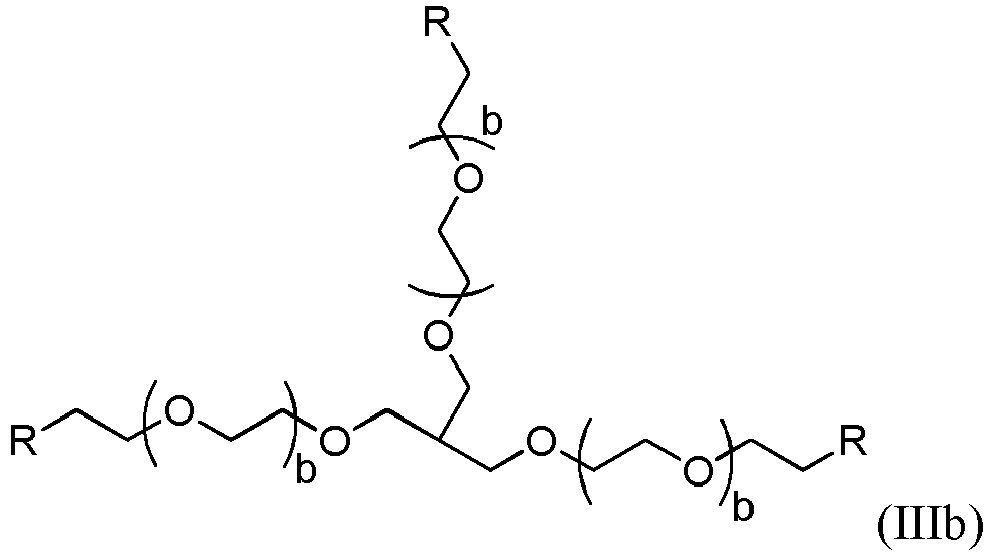


- wherein, a is the degree of polymerization, 1≤a≤1000;
- b is the degree of polymerization, 1≤b≤333;
- c is the degree of polymerization, 1≤c≤250;
- d is the degree of polymerization, 1≤d≤166;
- e is the degree of polymerization, 1≤e≤125;
- R is a terminal group having a structure of Formula (II).
- The present invention also provides a preparation method of the above-mentioned polyethylene glycol derivative, comprising the following steps:
- A) reacting 1,3-dimethoxy-1,3-dihydroisobenzofuran-5-carboxylic acid succinimidyl ester with polyethylene glycol with amino as terminal group, to obtain a reaction product;
- B) deprotecting the reaction product, to obtain a polyethylene glycol derivative.
- Preferably, the 1,3-dimethoxy-1,3-dihydroisobenzofuran-5-carboxylic acid succinimidyl ester is prepared according to the following process:
- 1) brominating 3,4-dimethylbenzoic acid, to prepare 3,4-bis(dibromomethyl)benzoic acid;
- 2) hydrolyzing 3,4-bis(dibromomethyl)benzoic acid, to obtain 3,4-diformylbenzoic acid;
- 3) reacting 3,4-diformylbenzoic acid with methanol, to obtain 1,3-dimethoxy-1,3-dihydroisobenzofuran-5-carboxylic acid;
- 4) reacting 1,3-dimethoxy-1,3-dihydroisobenzofuran-5-carboxylic acid with N-hydroxysuccinimide and a condensation agent, to obtain 1,3-dimethoxy-1,3-dihydroisobenzofuran-5-carboxylic acid succinimidyl ester.
- The present invention also provides a polyethylene glycol hydrogel capable of producing a rapid crosslinking reaction, which is formed by connecting a polyethylene glycol derivative and a polyethylene glycol having an amino-containing terminal group via a chemical bond, wherein the polyethylene glycol derivative is the above-mentioned polyethylene glycol derivative.
- Preferably, the polyethylene glycol having an amino-containing terminal group comprises a repeat unit having the structure of Formula (IV) and a terminal group having any of the structures of Formula (Va), Formula (Vb), Formula (Vc), Formula (Vd), and Formula (Ve):

-NH2 (Va)


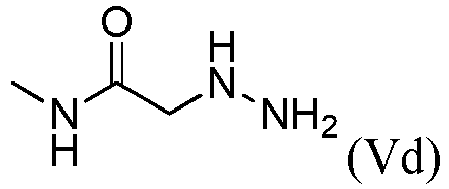

- Preferably, the polyethylene glycol having an amino-containing terminal group has any of the structures of Formula (VIa), Formula (VIb), Formula (VIc), Formula (VId), and Formula (VIe):


- wherein, a is the degree of polymerization, 1≤a≤1000;
- b is the degree of polymerization, 1≤b≤333;
- c is the degree of polymerization, 1≤c≤250;
- d is the degree of polymerization, 1≤d≤166;
- e is the degree of polymerization, 1≤e≤125;
- R is a terminal group having any of the structures of Formula (Va), Formula (Vb), Formula (Vc), Formula (Vd), and Formula (Ve).
- The present invention also provides a preparation method of the above-mentioned polyethylene glycol hydrogel, which is prepared from polyethylene glycol derivative, polyethylene glycol having an amino-containing terminal group, and solvent.
- Preferably, the solvent is water, physiological saline, or buffer solution;
- the polyethylene glycol derivative has a mass-volume concentration of 1~1000 mg/mL; and
- the polyethylene glycol having an amino-containing terminal group has a mass-volume concentration of 1~1000 mg/mL.
- Preferably, the mass ratio of the polyethylene glycol derivative to the polyethylene glycol having an amino-containing terminal group is 1 : 0.01~100.
- Compared with the prior art, the present invention provides a polyethylene glycol derivative comprising a repeat unit having the structure of Formula (I) and a terminal group having the structure of Formula (II). The polyethylene glycol derivative provided by the present invention has a good biocompatibility, due to the repeat unit having the structure of Formula (I); and can react with various groups such as amino, (acyl)hydrazino, and aminooxy with a fast reaction rate and under mild reaction conditions, due to the o-phthalaldehyde terminal group having the structure of Formula (II). The polyethylene glycol derivative provided by the present invention is mixed with polyethylene glycol having an amino-containing terminal group in an aqueous medium, to rapidly form a chemically cross-linked hydrogel material. The hydrogel material has mild preparation conditions, fast gel-forming speed, high mechanical strength, and good stability. This polyethylene glycol hydrogel can be applied as a sustained-release drug carrier, a tissue engineering scaffold, etc. in the field of biomedical materials.
-
-
Fig. 1 shows the H-NMR spectrum of 1,3-dimethoxy-1,3-dihydroisobenzofuran-5-carboxylic acid succinimidyl ester as prepared in Example 4 of the present invention; -
Fig. 2 shows the H-NMR spectrum of the four-arm polyethylene glycol derivative with protected terminal group as prepared in Example 7 of the present invention; -
Fig. 3 shows the H-NMR spectrum of the four-arm polyethylene glycol derivative as prepared in Example 7 of the present invention; -
Fig. 4 shows the changes of storage modulus and loss modulus for the mixed solution as prepared in Example 11 of the present invention over time; -
Fig. 5 shows the changes of storage modulus and loss modulus for the mixed solution as prepared in Example 12 of the present invention over time; -
Fig. 6 shows the changes of storage modulus and loss modulus for the mixed solution as prepared in Example 13 of the present invention over time. -
Fig. 7 shows the use of the polyethylene glycol hydrogel as prepared in Example 14 of the present invention in the wound closure of rat skin. -
Fig. 8 shows the use of the polyethylene glycol hydrogel as prepared in Example 15 of the present invention in the sealing and hemostasis of rat liver defect. -
Fig. 9 shows the use of the polyethylene glycol hydrogel as prepared in Example 16 of the present invention in the sealing and hemostasis of rabbit abdominal aorta defect. - The present invention provides a polyethylene glycol derivative, comprising a repeat unit having the structure of Formula (I) and a terminal group having the structure of Formula (II):


- In the present invention, the polyethylene glycol derivative may be a linear polyethylene glycol derivative or a multi-arm polyethylene glycol derivative.
- In some specific embodiments of the present invention, the polyethylene glycol derivative has any of the structures of Formula (IIIa), Formula (IIIb), Formula (IIIc), Formula (IIId), and Formula (IIIe):


- wherein, a is the degree of polymerization, 1≤a≤1000;
- b is the degree of polymerization, 1≤b≤333;
- c is the degree of polymerization, 1≤c≤250;
- d is the degree of polymerization, 1≤d≤166;
- e is the degree of polymerization, 1≤e≤125;
- R is a terminal group having the structure of Formula (II).
- The present invention also provides a preparation method of the above polyethylene glycol derivative, which comprises the following steps:
- A) reacting 1,3-dimethoxy-1,3-dihydroisobenzofuran-5-carboxylic acid succinimidyl ester with polyethylene glycol having amino as terminal group, to obtain a reaction product;
- B) deprotecting the reaction product, to obtain a polyethylene glycol derivative.
- The reaction process is as follows:

- In the present invention, 1,3-dimethoxy-1,3-dihydroisobenzofuran-5-carboxylic acid succinimidyl ester and polyethylene glycol with amino as terminal group are dissolved in an organic solvent, reacted in the presence of acid-binding agent, and settled, to obtain the reaction product.
- The molar equivalent of 1,3-dimethoxy-1,3-dihydroisobenzofuran-5-carboxylic acid succinimidyl ester is 1.2~5 times, preferably 2 times, of that of the amino group in the polyethylene glycol with amino as terminal group; the organic solvent is preferably anhydrous dichloromethane; and the acid-binding agent is preferably anhydrous pyridine.
- The reaction time is 24~72 h, preferably 48 h; and the reaction temperature is 10~40 °C, preferably 25 °C.
- In the present invention, anhydrous ethyl ether is preferably used for the settling; and the settled solid is filtered, and dried in vacuum, to obtain the reaction product.
- In the present invention, after the reaction product is obtained, the reaction product is deprotected, dialyzed, and lyophilized, to obtain a polyethylene glycol derivative.
- The deprotection can adopt a technical solution well known to those skilled in the art. In the present invention, a mixed solvent of trifluoroacetic acid and water is preferably used; the volume of the mixed solvent is 5~20 times, preferably 5 times, of the mass of the reaction product; the deprotection time is 0.5~3 h, preferably 1 h; and the deprotection temperature is 10~40 °C, preferably 25 °C.
- The dialysis and lyophilization can adopt the technical solutions well known to those skilled in the art.
- In the present invention, the 1,3-dimethoxy-1,3-dihydroisobenzofuran-5-carboxylic acid succinimidyl ester is prepared according to the following process:
- 1)
brominating 3,4-dimethylbenzoic acid, to prepare 3,4-bis(dibromomethyl)benzoic acid; - 2) hydrolyzing 3,4-bis(dibromomethyl)benzoic acid, to obtain 3,4-diformylbenzoic acid;
- 3) reacting 3,4-diformylbenzoic acid with methanol, to obtain 1,3-dimethoxy-1,3-dihydroisobenzofuran-5-carboxylic acid; and
- 4) reacting 1,3-dimethoxy-1,3-dihydroisobenzofuran-5-carboxylic acid with N-hydroxysuccinimide and a condensation agent, to obtain 1,3-dimethoxy-1,3-dihydroisobenzofuran-5-carboxylic acid succinimidyl ester.
- The reaction process is as follows:

- Specifically, in the present invention, 3,4-dimethylbenzoic acid is brominatd, to prepare 3,4-bis(dibromomethyl)benzoic acid.
- The bromination reaction can adopt a technical solution well known to those skilled in the art. The present invention uses N-bromosuccinimide as brominating agent, any one of benzoyl peroxide and azobisisobutyronitrile as free radical initiator, and carbon tetrachloride as solvent, for the bromination reaction.
- The molar equivalent of N-bromosuccinimide is 3~5 times, preferably 4 times, of that of 3,4-dimethylbenzoic acid; the molar equivalent of benzoyl peroxide is 0.05-0.5 times, preferably 0.1 times, of that of 3,4-dimethylbenzoic acid; and the volume (ml) of carbon tetrachloride is 10~50 times, preferably 20 times, of the mass (g) of 3,4-dimethylbenzoic acid.
- The bromination reaction temperature is 70~90 °C, preferably 81 °C; and the bromination reaction time is 10~20 h, preferably 15 h.
- After the bromination reaction is completed, the reaction mixture is filtered; the filter cake is washed with benzene or ethyl ether; all the filtrates are combined and concentrated, and then vacuum dried; and the solid product is recrystallized in acetonitrile, to obtain 3,4-bis(dibromomethyl)benzoic acid.
- In the present invention, a rotary evaporator is preferably used for concentration; the concentration temperature is preferably 30 °C; and it is preferable to be concentrated to 10% of the liquid volume.
- The recrystallization can adopt a technical solution well known to those skilled in the art.
- In the present invention, 3,4-bis(dibromomethyl)benzoic acid is subjected to hydrolysis reaction, to obtain 3,4-diformylbenzoic acid.
- The hydrolysis reaction can adopt the technical solutions well known to those skilled in the art. In the present invention, 3,4-bis(dibromomethyl)benzoic acid is preferably dissolved in an aqueous solution of sodium carbonate for the hydrolysis reaction.
- The mass-volume concentration of the aqueous solution of sodium carbonate is 10%; the volume of the aqueous solution of sodium carbonate is 5-20 times, preferably 10 times, of the mass of 3,4-bis(dibromomethyl)benzoic acid.
- The hydrolysis reaction temperature is 60~80 °C, preferably 70 °C; and the hydrolysis reaction time is 3-5 h, preferably 4 h.
- After the hydrolysis reaction is completed, the pH of the reaction solution is adjusted to 0-3, preferably 1, with concentrated hydrochloric acid; extracted by ethyl acetate; concentrated, and vacuum dried, to obtain 3,4-diformylbenzoic acid.
- In the present invention, 3,4-diformylbenzoic acid, methanol, and a catalyst are reacted to obtain 1,3-dimethoxy-1,3-dihydroisobenzofuran-5-carboxylic acid.
- The catalyst is preferably scandium trifluoromethanesulfonate; the reaction temperature is 10~40 °C, preferably 25 °C; and the reaction time is 6~24 h, preferably 12 h.
- In the present invention, 1,3-dimethoxy-1,3-dihydroisobenzofuran-5-carboxylic acid is reacted with N-hydroxysuccinimide and a condensation agent in an organic solvent, to obtain 1,3-dimethoxy-1,3-dihydroisobenzofuran-5-carboxylic acid succinimidyl ester.
- The condensation agent is any of dicyclohexylcarbodiimide, 1-(3-dimethylaminopropyl)-3-ethylcarbodiimide hydrochloride, and diisopropylcarbodiimide, preferably 1-(3-dimethylaminopropyl)-3-ethylcarbodiimide hydrochloride; and the organic solvent is any one of dimethylformamide, dimethyl sulfoxide, and acetonitrile, preferably acetonitrile.
- The reaction temperature is 10~40 °C, preferably 25 °C; and the reaction time is 6~24 h, preferably 12 h.
- After the reaction is completed, the crude product is purified by silica gel column chromatography, to obtain 1,3-dimethoxy-1,3-dihydroisobenzofuran-5-carboxylic acid succinimidyl ester. The mobile phase of the column chromatography is preferably n-hexane and ethyl acetate at a volume ratio of 1:5-1:1, preferably 1:3.
- The present invention also provides a polyethylene glycol hydrogel capable of producing a rapid crosslinking reaction, formed by connecting a polyethylene glycol derivative and a polyethylene glycol having an amino-containing terminal group via a chemical bond, wherein the polyethylene glycol derivative is the above-mentioned polyethylene glycol derivative.
- Herein, the polyethylene glycol having an amino-containing terminal group comprises a repeat unit having the structure of Formula (IV) and a terminal group having any one of the structures of Formula (Va), Formula (Vb), Formula (Vc), Formula (Vd), and Formula (Ve);

-NH2 (Va)


- The polyethylene glycol having an amino-containing terminal group may be a linear polyethylene glycol having an amino-containing terminal group or a multi-arm polyethylene glycol having an amino-containing terminal group.
- In some specific embodiments of the present invention, the polyethylene glycol having an amino-containing terminal group has any one of the structures of Formula (VIa), Formula (VIb), Formula (VIc), Formula (VId), and Formula (VIe):
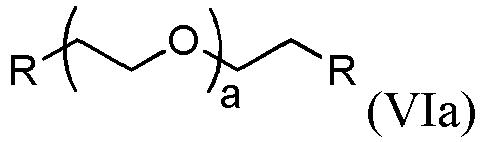


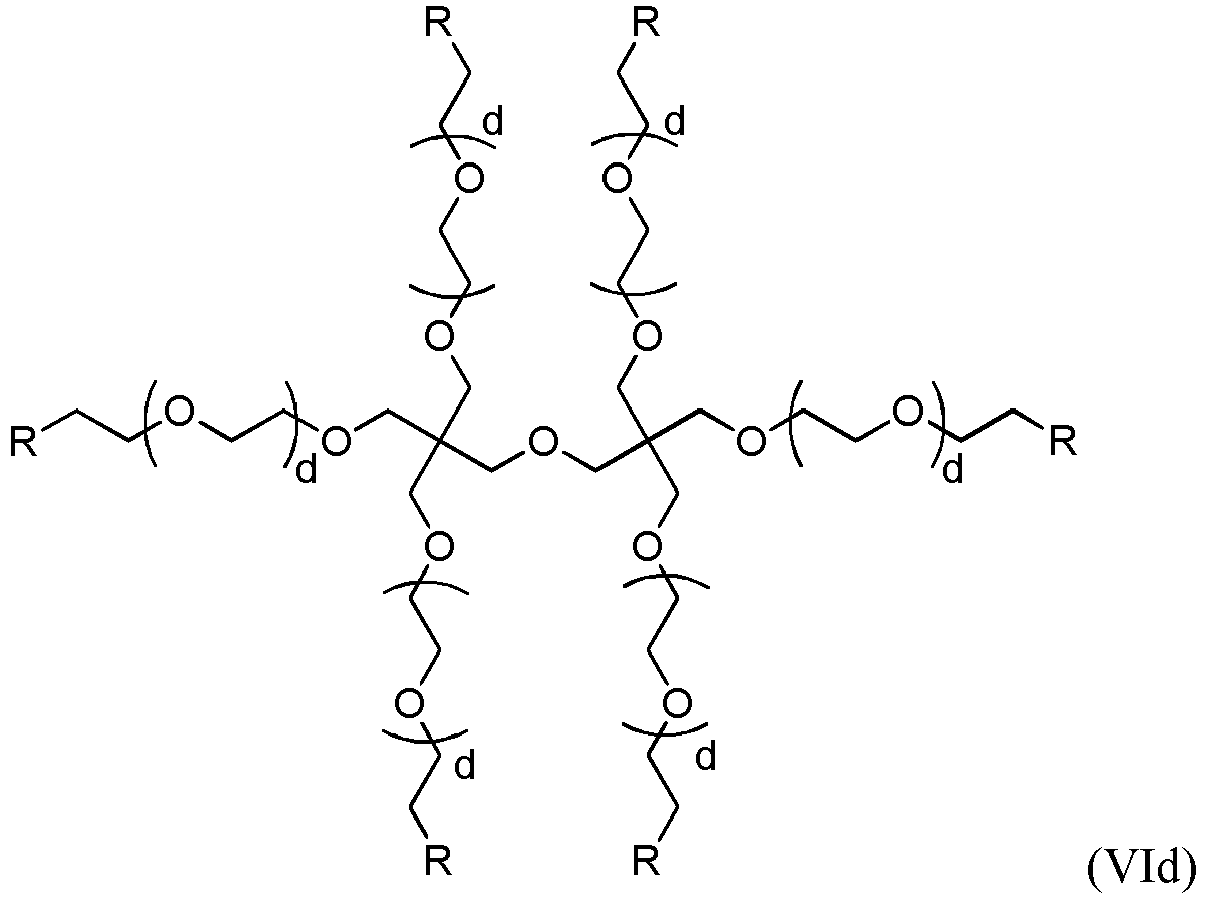

- wherein, a is the degree of polymerization, 1≤a≤1000;
- b is the degree of polymerization, 1≤b≤333;
- c is the degree of polymerization, 1≤c≤250;
- d is the degree of polymerization, 1≤d≤166;
- e is the degree of polymerization, 1≤e≤125;
- R is a terminal group having any of the structures of Formula (Va), Formula (Vb), Formula (Vc), Formula (Vd), and Formula (Ve).
- The present invention also provides a preparation method of the above-mentioned polyethylene glycol hydrogel, which is prepared from a polyethylene glycol derivative, a polyethylene glycol having an amino-containing terminal group, and a solvent.
- In the present invention, the preparation process of the polyethylene glycol hydrogel includes:
- (1) preparing
solution 1 of polyethylene glycol derivative; - (2) preparing
solution 2 of polyethylene glycol having an amino-containing terminal group; - (3) mixing the
solution 1 and thesolution 2, to obtain a polyethylene glycol hydrogel via a chemical reaction. - In the
solution 1, the mass-volume concentration of the polyethylene glycol derivative is 1~1000 mg/mL, preferably 10~200 mg/mL. - In the
solution 2, the mass-volume concentration of the polyethylene glycol having an amino-containing terminal group is 1~1000 mg/mL, preferably 10~200 mg/mL. - The solvent used in the preparation of
solution 1 andsolution 2 is selected from water, physiological saline, or buffer solution, and the buffer solution is selected from phosphate buffer solution. - The mass ratio of the polyethylene glycol derivative to the polyethylene glycol having an amino-containing terminal group is 1:0.01∼100, preferably 1:0.1∼10.
- The polyethylene glycol derivative provided by the present invention has a good water-solubility and biocompatibility, and the o-phthalaldehyde at terminal can chemically react with various groups.
- The polyethylene glycol derivative provided by the present invention comprises a main chain of polyethylene glycol and a terminal group of o-phthalaldehyde. The polyethylene glycol hydrogel is formed by connecting the above-mentioned polyethylene glycol derivative and polyethylene glycol having an amino-containing terminal group via a chemical bond. The polyethylene glycol hydrogel of the present invention has a fast gel-forming speed, high mechanical strength, excellent tissue adhesion ability, and good biocompatibility. The polyethylene glycol hydrogel of the present invention has potential applications in the following fields: drug sustained-release carriers, tissue engineering scaffolds, and hemostatic sealing coatings.
- In order to further understand the present invention, the polyethylene glycol derivative, the preparation method thereof, and the polyethylene glycol hydrogel capable of producing a rapid crosslinking reaction as provided in the present invention will be illustrated below in conjugation with Examples, but the protection scope of the present invention is not limited by the following Examples. Unless otherwise specified, the reagents used in the following Examples are purchased from J&K Chemical, and the solvents used are purchased from Beijing Chemical Plant.
- 3,4-dimethylbenzoic acid (12 g) and N-bromosuccinimide (57 g) were dissolved in hot carbon tetrachloride (200 mL), and then 1.6 g of benzoyl peroxide was slowly added. The mixture was refluxed for reaction at 81 °C for 15 h. After filtration, the filter cake was washed with benzene (200 mL) and ethyl ether (300 mL). All the filtrates were combined, concentrated by a rotary evaporator to a remaining liquid volume of 70 mL, and then evacuated to solid by a vacuum pump. The obtained solid was recrystallized in acetonitrile, to obtain 3,4-bis(dibromomethyl)benzoic acid (13 g, 35%).
- 3,4-bis(dibromomethyl)benzoic acid (13 g) prepared in Example 1 was dissolved in an aqueous sodium carbonate solution (130mL) with a mass-volume concentration of 10%, and reacted at 70 °C for 4 h. The pH of the reaction solution was adjusted to 1 with concentrated hydrochloric acid, and then extracted with ethyl acetate (4 × 60 mL). The organic phases were combined, washed with saturated brine, dried over anhydrous sodium sulfate, filtered, and vacuum dried, to obtain 3,4-diformylbenzoic acid (2.8 g, 56%).
- 3,4-bis(dibromomethyl)benzoic acid (2.8 g) prepared in Example 2 was dissolved in anhydrous methanol (60 mL), followed by the addition of the catalyst scandium trifluoromethanesulfonate (420 mg), and the reaction was conducted for 12 h. After vacuum drying, 1,3-dimethoxy-1,3-dihydroisobenzofuran-5-carboxylic acid (3.5 g, 100%) was obtained.
- 1,3-dimethoxy-1,3-dihydroisobenzofuran-5-carboxylic acid prepared in Example 4 and N-hydroxysuccinimide (3.6 g) were dissolved in anhydrous acetonitrile (80 mL), followed by the addition of 1-(3-dimethylaminopropyl)-3-ethylcarbodiimide hydrochloride (4.5 g), and the reaction was conducted for 12 h. Most of the solvent was removed by rotary evaporation, and the remaining mixture was dissolved in dichloromethane, washed with saturated brine for 3 times, and dried over anhydrous magnesium sulfate. The crude product was purified by silica gel column chromatography, to obtain 1,3-dimethoxy-1,3-dihydroisobenzofuran-5-carboxylic acid succinimidyl ester (2.3 g, 45%), wherein the mobile phase is n-hexane and ethyl acetate at a volume ratio of 1:3. Referring to
Fig. 1, Fig. 1 shows the H-NMR spectrum of 1,3-dimethoxy-1,3-dihydroisobenzofuran-5-carboxylic acid succinimidyl ester as prepared in Example 4 of the present invention. - The linear polyethylene glycol with amino as terminal group (number-average molecular weight: 2000, 2.0 g) was dissolved in 25 mL of dichloromethane, and 1 mL of pyridine was added as acid-binding agent, followed by the dropwise addition of a solution (25 mL) of 1,3-dimethoxy-1,3-dihydroisobenzofuran-5-carboxylic acid succinimidyl ester prepared in Example 4 (1.3 g) in dichloromethane, and the reaction was conducted for 48 h. The reaction solution was poured into 500 mL of glacial ethyl ether, settled, filtered, and dried in vacuum, to obtain a linear polyethylene glycol derivative with protected terminal group (1.9 g, 95%).
- The linear polyethylene glycol derivative with protected terminal group (1.9 g) was dissolved in 5 mL of water, and then 5 mL of trifluoroacetic acid was added dropwise. After the reaction under stirring for 1 h, it was diluted with water to 50 mL, transferred to a dialysis bag with a molecular weight cut-off of 500 and dialyzed for 48 h, then lyophilized, to obtain a linear polyethylene glycol derivative (1.6 g, 84%).
- Three-arm polyethylene glycol with amino as terminal group (number-average molecular weight: 10000, 2.0 g) was dissolved in 25 mL of dichloromethane, and 1 mL of pyridine was added as acid-binding agent, followed by the dropwise addition of a solution (25 mL) of 1,3-dimethoxy-1,3-dihydroisobenzofuran-5-carboxylic acid succinimidyl ester (0.39 g) in dichloromethane, and the reaction was conducted for 48 h. The reaction solution was poured into 500 mL of glacial ethyl ether, settled, filtered, and dried in vacuum, to obtain a three-arm polyethylene glycol derivative with protected terminal group (2.0 g, 100%).
- The three-arm polyethylene glycol derivative with protected terminal group (2.0 g) was dissolved in 5 mL of water, and then 5 mL of trifluoroacetic acid was added dropwise. After the reaction under stirring for 1 h, it was diluted with water to 50 mL, transferred to a dialysis bag with a molecular weight cut-off of 3500 and dialyzed for 48 h, then lyophilized, to obtain a three-arm polyethylene glycol derivative (1.8 g, 90%).
- Four-arm polyethylene glycol with amino as terminal group (number-average molecular weight: 10000, 2.0 g) was dissolved in 25 mL of dichloromethane, and 1 mL of pyridine was added as acid-binding agent, followed by the dropwise addition of a solution (25 mL) of 1,3-dimethoxy-1,3-dihydroisobenzofuran-5-carboxylic acid succinimidyl ester (0.51 g) in dichloromethane, and the reaction was conducted for 48 h. The reaction solution was poured into 500 mL of glacial ethyl ether, settled, filtered, and dried in vacuum, to obtain a four-arm polyethylene glycol derivative with protected terminal group (2.0 g, 100%). Referring to
Fig. 2, Fig. 2 shows the H-NMR spectrum of the four-arm polyethylene glycol derivative with protected terminal group as prepared in Example 7 of the present invention. - The four-arm polyethylene glycol derivative with protected terminal group (2.0 g) was dissolved in 5 mL of water, and then 5 mL of trifluoroacetic acid was added dropwise. After the reaction under stirring for 1 h, it was diluted with water to 50 mL, transferred to a dialysis bag with a molecular weight cut-off of 3500 and dialyzed for 48 h, then lyophilized, to obtain a four-arm polyethylene glycol derivative (1.9 g, 95%). Referring to
Fig. 3, Fig. 3 shows the H-NMR spectrum of the four-arm polyethylene glycol derivative as prepared in Example 7 of the present invention. - Four-arm polyethylene glycol with amino as terminal group (number-average molecular weight: 20000, 2.0 g) was dissolved in 25 mL of dichloromethane, 1 mL of pyridine was added as acid-binding agent, followed by the dropwise addition of a solution (25 mL) of 1,3-dimethoxy-1,3-dihydroisobenzofuran-5-carboxylic acid succinimidyl ester (0.26 g) in dichloromethane, and the reaction was conducted for 48 h. The reaction solution was poured into 500 mL of glacial ethyl ether, settled, filtered, and dried in vacuum, to obtain a four-arm polyethylene glycol derivative with protected terminal group (1.9 g, 95%).
- The four-arm polyethylene glycol derivative with protected terminal group (1.9 g) was dissolved in 5 mL of water, and then 5 mL of trifluoroacetic acid was added dropwise. After the reaction under stirring for 1 h, it was diluted with water to 50 mL, transferred to a dialysis bag with a molecular weight cut-off of 7000 and dialyzed for 48 h, then lyophilized, to obtain a four-arm polyethylene glycol derivative (1.8 g, 95%).
- Six-arm polyethylene glycol with amino as terminal group (number-average molecular weight: 10000, 2.0 g) was dissolved in 25 mL of dichloromethane, and 1 mL of pyridine was added as acid-binding agent, followed by the dropwise addition of a solution (25 mL) of 1,3-dimethoxy-1,3-dihydroisobenzofuran-5-carboxylic acid succinimidyl ester (0.77 g) in dichloromethane, and the reaction was conducted for 48 h. The reaction solution was poured into 500 mL of glacial ethyl ether, settled, filtered, and dried in vacuum, to obtain a six-arm polyethylene glycol derivative with protected terminal group (2.0 g, 100%).
- The six-arm polyethylene glycol derivative with protected terminal group (2.0 g) was dissolved in 5 mL of water, and then 5 mL of trifluoroacetic acid was added dropwise. After the reaction under stirring for 1 h, it was diluted with water to 50 mL, transferred to a dialysis bag with a molecular weight cut-off of 3500 and dialyzed for 48 h, then lyophilized, to obtain a six-arm polyethylene glycol derivative (1.8 g, 90%).
- Eight-arm polyethylene glycol with amino as terminal group (number-average molecular weight: 10000, 2.0 g) was dissolved in 25 mL of dichloromethane, and 1 mL of pyridine was added as acid-binding agent, followed by the dropwise addition of a solution (25 mL) of 1,3-dimethoxy-1,3-dihydroisobenzofuran-5-carboxylic acid succinimidyl ester (1.0 g) in dichloromethane, and the reaction was conducted for 48 h. The reaction solution was poured into 500 mL of glacial ethyl ether, settled, filtered, and dried in vacuum, to obtain an eight-arm polyethylene glycol derivative with protected terminal group (2.0 g, 100%).
- The eight-arm polyethylene glycol derivative with protected terminal group (2.0 g) was dissolved in 5 mL of water, and then 5 mL of trifluoroacetic acid was added dropwise. After the reaction under stirring for 1 h, it was diluted with water to 50 mL, transferred to a dialysis bag with a molecular weight cut-off of 3500 and dialyzed for 48 h, then lyophilized, to obtain an eight-arm polyethylene glycol derivative (1.9 g, 95%).
- The four-arm polyethylene glycol derivative prepared in Example 7 (number-average molecular weight: 10000, 60 mg) was weighed and dissolved in PBS (1 mL) to obtain
solution 1. The four-arm polyethylene glycol with amino as terminal group (as shown by Formula Va) (number-average molecular weight: 10000, 60 mg) was weighed and dissolved in PBS (1 mL) to obtainsolution 2. The solution 1 (100 µL) and the solution 2 (100 µL) were mixed thoroughly, and placed in a water bath at 37 °C. The gelation status was observed by inverted method, and the gel-forming time is 40 seconds. - The solution 1 (150 µL) and the solution 2 (150 µL) were mixed thoroughly, and then quickly transferred to a rheometer to measure the changes over time of elastic modulus and loss modulus for the mixed solution, wherein the elastic modulus of the hydrogel is 13.0 kPa. Referring to
Fig. 4, Fig. 4 shows the rheological test chart of the polyethylene glycol hydrogel prepared in Example 11 of the present invention. The elastic modulus quickly exceeds the loss modulus, indicating that the solution quickly transforms into a hydrogel. After complete crosslinking, the elastic modulus of the hydrogel is 13.0 kPa. - The four-arm polyethylene glycol derivative prepared in Example 7 (number-average molecular weight: 10000, 60 mg) was weighed and dissolved in PBS (1 mL) to obtain
solution 1. The four-arm polyethylene glycol with carbazate as terminal group (as shown by Formula Vb) (number-average molecular weight: 10000, 60 mg) was weighed and dissolved in PBS (1 mL) to obtainsolution 2. The solution 1 (100 µL) and the solution 2 (100 µL) were mixed thoroughly, and placed in a water bath at 37 °C. The gelation status was observed by inverted method, and the gel-forming time is 290 seconds. - The solution 1 (150 µL) and the solution 2 (150 µL) were mixed thoroughly, and then quickly transferred to a rheometer to measure the changes over time of storage modulus and loss modulus for the mixed solution, wherein the elastic modulus of the hydrogel is 11.1 kPa. Referring to
Fig. 5, Fig. 5 shows the rheological test chart of the polyethylene glycol hydrogel prepared in Example 12 of the present invention. The elastic modulus quickly exceeds the loss modulus, indicating that the solution quickly transforms into a hydrogel. After complete crosslinking, the elastic modulus of the hydrogel is 11.1 kPa. - The four-arm polyethylene glycol derivative prepared in Example 7 (number-average molecular weight: 10000, 60 mg) was weighed and dissolved in PBS (1 mL) to obtain
solution 1. The four-arm polyethylene glycol with aminooxy as terminal group (as shown by Formula Ve) (number-average molecular weight: 10000, 60 mg) was weighed and dissolved in PBS (1 mL) to obtainsolution 2. The solution 1 (100 µL) and the solution 2 (100 µL) were mixed thoroughly, and placed in a water bath at 37 °C. The gelation status was observed by inverted method, and the gel-forming time is 160 seconds. - The solution 1 (150 µL) and the solution 2 (150 µL) were mixed thoroughly, and then quickly transferred to a rheometer to measure the changes over time of storage modulus and loss modulus for the mixed solution, wherein the elastic modulus of the hydrogel is 10.6 kPa. Referring to
Fig. 6, Fig. 6 shows the rheological test chart of the polyethylene glycol hydrogel prepared in Example 13 of the present invention. The elastic modulus quickly exceeds the loss modulus, indicating that the solution quickly transforms into a hydrogel. After complete crosslinking, the elastic modulus of the hydrogel is 10.6 kPa. - The four-arm polyethylene glycol derivative prepared in Example 7 (number-average molecular weight: 10000, 90 mg) was weighed and dissolved in PBS (1 mL) to obtain
solution 1. The four-arm polyethylene glycol with amino as terminal group (as shown by Formula Va) (number-average molecular weight: 10000, 90 mg) was weighed and dissolved in PBS (1 mL) to obtainsolution 2. Each barrel in the double-barreled syringe was used to draw one solution respectively, and the solutions were simultaneously injected to obtain a hydrogel. - The hydrogel prepared in this Example, which was applied to a wound (2 cm) on the back of a rat, can effectively close the wound and reduce the healing time. Specifically, 280 g of SD rats (purchased from Beijing Vital River) were anesthetized by intraperitoneally injecting 40 mg/kg of sodium pentobarbital, and the skin on the back was shaved and disinfected with iodine tincture. After a 2 cm-long full-thickness incision was made by a scalpel, the hydrogel was applied to the incision, and the incision was closed for 2 min for fully crosslinking. Refer to
Fig. 7, Fig. 7 shows the use of the polyethylene glycol hydrogel as prepared in Example 14 of the present invention in the wound closure of rat skin. InFig. 7 , the blank refers to natural healing. - The four-arm polyethylene glycol derivative prepared in Example 7 (number-average molecular weight: 10000, 150 mg) was weighed and dissolved in PBS (1 mL) to obtain
solution 1. The four-arm polyethylene glycol with amino as terminal group (as shown by Formula Va) (number-average molecular weight: 10000, 150 mg) was weighed and dissolved in PBS (1 mL) to obtainsolution 2. Each barrel in the double-barreled syringe was used to draw one solution respectively, and the solutions were simultaneously injected to obtain a hydrogel. - The hydrogel prepared in this Example, which was applied to a rat liver defect site, can effectively achieve the sealing and hemostasis. Specifically, 280 g of SD rats (purchased from Beijing Vital River), were intraperitoneally injected with 3000 U/kg of heparin. After 30 min, they were anesthetized by intraperitoneally injecting 40 mg/kg of sodium pentobarbital. The liver was exposed, and a 3 mm-deep incision was made by a scalpel. The hydrogel was applied to the incision, to observe the hemostatic effect. Referring to
Fig. 8, Fig. 8 shows the use of the polyethylene glycol hydrogel as prepared in Example 15 of the present invention in the sealing and hemostasis of rat liver defect. - The four-arm polyethylene glycol derivative prepared in Example 7 (number-average molecular weight: 10000, 150 mg) was weighed and dissolved in PBS (1 mL) to obtain
solution 1. The four-arm polyethylene glycol with amino as terminal group (as shown by Formula Va) (number-average molecular weight: 10000, 150 mg) was weighed and dissolved in PBS (1 mL) to obtainsolution 2. Each barrel in the double-barreled syringe was used to draw one solution respectively, and the solutions were simultaneously injected to obtain a hydrogel. - The hydrogel prepared in this Example, which was applied to a rabbit abdominal aorta defect site, can effectively achieve the sealing and hemostasis. Specifically, 3 kg of New Zealand rabbits (purchased from Beijing Vital River), were anesthetized by injecting 40 mg/kg of sodium pentobarbital through the ear vein. The abdominal aorta was exposed, and a 4 mm incision was made by a scalpel. The blood flowing was controlled by the arterial vascular clamp. The hydrogel was applied to the incision, and after 30 seconds for fully crosslinking, the vascular clamp was removed to observe the hemostatic effect. Referring to
Fig. 9, Fig. 9 shows the use of the polyethylene glycol hydrogel as prepared in Example 16 of the present invention in the sealing and hemostasis of rabbit abdominal aorta defect. - The preparation method of the four-arm polyethylene glycol with benzaldehyde as terminal group was as follows:
The four-arm polyethylene glycol with benzaldehyde as terminal group (number-average molecular weight: 10000, 2.0 g) was dissolved in 40 mL of dichloromethane, followed by the addition of 1-(3-dimethylaminopropyl)-3-ethylcarbodiimide hydrochloride (1.5 g), 4-dimethylaminopyridine (98 mg), and carboxybenzaldehyde (0.6 g), and the reaction was conducted for 72 h. The reaction solution was washed with saturated brine for 3 times, dried over anhydrous sodium sulfate, filtered, and poured into glacial ethyl ether for settling. The obtained solid was dissolved in water, transferred to a dialysis bag with a molecular weight cut-off of 3500 and dialyzed for 72 h, then lyophilized, to obtain a four-arm polyethylene glycol with benzaldehyde as terminal group (1.5 g, 75%). - The above-mentioned four-arm polyethylene glycol with benzaldehyde as terminal group (number-average molecular weight: 10000, 60 mg) was weighed and dissolved in PBS (1 mL) to obtain
solution 1. The four-arm polyethylene glycol with amino as terminal group (as shown by Formula Va) (number-average molecular weight: 10000, 60 mg) was weighed and dissolved in PBS (1 mL) to obtainsolution 2. The solution 1 (100 µL) and the solution 2 (100 µL) were mixed thoroughly, and placed in a water bath at 37 °C. The gelation status was observed by inverted method, and the hydrogel cannot be formed after 24 h. - The solution 1 (150 µL) and the solution 2 (150µL) were mixed thoroughly, and then quickly transferred to a rheometer to measure the changes over time of storage modulus and loss modulus for the mixed solution, wherein the elastic modulus of the hydrogel is 0.2 Pa, much lower than that of the hydrogel prepared in Example 11 (13.0 kPa).
- The above-mentioned four-arm polyethylene glycol with benzaldehyde as terminal group (number-average molecular weight: 10000, 60 mg) was weighed and dissolved in PBS (1 mL) to obtain
solution 1. The four-arm polyethylene glycol with carbazate as terminal group (as shown by Formula Vb) (number-average molecular weight: 10000, 60 mg) was weighed and dissolved in PBS (1 mL) to obtainsolution 2. The solution 1 (100 µL) and the solution 2 (100 µL) were mixed thoroughly, and placed in a water bath at 37 °C. The gelation status was observed by inverted method, and the gel-forming time is 290 minutes, much higher than that of the hydrogel prepared in Example 12 (290 s). - The solution 1 (150 µL) and the solution 2 (150µL) were mixed thoroughly, and then quickly transferred to a rheometer to measure the changes over time of storage modulus and loss modulus for the mixed solution, wherein the elastic modulus of the hydrogel is 1.3 kPa, much lower than that of the hydrogel prepared in Example 12 (11.1 kPa).
- The above-mentioned four-arm polyethylene glycol with benzaldehyde as terminal group (number-average molecular weight: 10000, 60 mg) was weighed and dissolved in PBS (1 mL) to obtain
solution 1. The four-arm polyethylene glycol with aminooxy as terminal group (as shown by Formula Ve) (number-average molecular weight: 10000, 60 mg) was weighed and dissolved in PBS (1 mL) to obtainsolution 2. The solution 1 (100 µL) and the solution 2 (100 µL) were mixed thoroughly, and placed in a water bath at 37 °C. The gelation status was observed by inverted method, and the gel-forming time is 80 minutes, much higher than that of the hydrogel prepared in Example 13 (160 s). - The solution 1 (150 µL) and the solution 2 (150µL) were mixed thoroughly, and then quickly transferred to a rheometer to measure the changes over time of storage modulus and loss modulus for the mixed solution, wherein the elastic modulus of the hydrogel is 6.6 kPa, lower than that of the hydrogel prepared in Example 13 (10.6 kPa).
Claims (10)
- A polyethylene glycol derivative, comprising a repeat unit having the structure of Formula (I) and a terminal group having the structure of Formula (II);
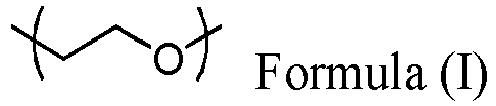

- The polyethylene glycol derivative according to claim 1, wherein the polyethylene glycol derivative has any one of the structures of Formula (IIIa), Formula (IIIb), Formula (IIIc), Formula (IIId), and Formula (IIIe):


 wherein, a is the degree of polymerization, 1≤a≤1000;b is the degree of polymerization, 1≤b≤333;c is the degree of polymerization, 1≤c≤250;d is the degree of polymerization, 1≤d≤166;e is the degree of polymerization, 1≤e≤125;R is a terminal group having the structure of Formula (II).
 - A preparation method of the polyethylene glycol derivative according to claim 1 or 2, including the following steps:A) reacting 1,3-dimethoxy-1,3-dihydroisobenzofuran-5-carboxylic acid succinimidyl ester with a polyethylene glycol having amino as terminal group, to obtain a reaction product;B) deprotecting the reaction product, to obtain a polyethylene glycol derivative.
- The preparation method according to claim 3, wherein the 1,3-dimethoxy-1,3-dihydroisobenzofuran-5-carboxylic acid succinimidyl ester is prepared by the following process:1) brominating 3,4-dimethylbenzoic acid, to prepare 3,4-bis(dibromomethyl)benzoic acid;2) hydrolyzing 3,4-bis(dibromomethyl)benzoic acid, to obtain 3,4-diformylbenzoic acid;3) reacting 3,4-diformylbenzoic acid with methanol, to obtain 1,3-dimethoxy-1,3-dihydroisobenzofuran-5-carboxylic acid;4) reacting 1,3-dimethoxy-1,3-dihydroisobenzofuran-5-carboxylic acid with N-hydroxysuccinimide and a condensation agent, to obtain 1,3-dimethoxy-1,3-dihydroisobenzofuran-5-carboxylic acid succinimidyl ester.
- A polyethylene glycol hydrogel capable of producing a rapid crosslinking reaction, which is formed by connecting a polyethylene glycol derivative and a polyethylene glycol having an amino-containing terminal group via a chemical bond, wherein the polyethylene glycol derivative is the polyethylene glycol derivative according to claim 1 or 2.
- The polyethylene glycol hydrogel according to claim 5, wherein the polyethylene glycol having an amino-containing terminal group comprises a repeat unit having the structure of Formula (IV) and a terminal group having any one of the structures of Formula (Va), Formula (Vb), Formula (Vc), Formula (Vd), and Formula (Ve);

-NH2 (Va)


- The polyethylene glycol hydrogel according to claim 5, wherein the polyethylene glycol having an amino-containing terminal group has any of the structures of Formula (VIa), Formula (VIb), Formula (VIc), Formula (VId), and Formula (VIe):


 wherein, a is the degree of polymerization, 1≤a≤1000;b is the degree of polymerization, 1≤b≤333;c is the degree of polymerization, 1≤c≤250;d is the degree of polymerization, 1≤d≤166;e is the degree of polymerization, 1≤e≤125;R is a terminal group having any of the structures of Formula (Va), Formula (Vb), Formula (Vc), Formula (Vd), and Formula (Ve).
 - A preparation method of the polyethylene glycol hydrogel according to any one of claims 5-7, wherein the polyethylene glycol hydrogel is prepared from the polyethylene glycol derivative, the polyethylene glycol having the amino-containing terminal group, and a solvent.
- The preparation method according to claim 8, wherein the solvent is water, physiological saline, or buffer solution;the polyethylene glycol derivative has a mass-volume concentration of 1~1000 mg/mL; andthe polyethylene glycol having the amino-containing terminal group has a mass-volume concentration of 1~1000 mg/mL.
- The preparation method according to claim 8, wherein the mass ratio of the polyethylene glycol derivative to the polyethylene glycol having the amino-containing terminal group is 1:0.01-100.
Applications Claiming Priority (2)
| Application Number | Priority Date | Filing Date | Title |
|---|---|---|---|
| CN202010455951.3A CN111440310B (en) | 2020-05-26 | 2020-05-26 | Polyethylene glycol derivative, preparation method thereof and polyethylene glycol hydrogel capable of rapidly generating crosslinking reaction |
| PCT/CN2020/098863 WO2021237864A1 (en) | 2020-05-26 | 2020-06-29 | Polyethylene glycol derivative, preparation method therefor, and polyethylene glycol hydrogel enabling fast crosslinking reaction |
Publications (3)
| Publication Number | Publication Date |
|---|---|
| EP3974462A1 EP3974462A1 (en) | 2022-03-30 |
| EP3974462A4 EP3974462A4 (en) | 2023-05-31 |
| EP3974462B1 true EP3974462B1 (en) | 2024-04-17 |
Family
ID=71648341
Family Applications (1)
| Application Number | Title | Priority Date | Filing Date |
|---|---|---|---|
| EP20938000.5A Active EP3974462B1 (en) | 2020-05-26 | 2020-06-29 | Polyethylene glycol derivative, preparation method therefor, and polyethylene glycol hydrogel enabling fast crosslinking reaction |
Country Status (4)
| Country | Link |
|---|---|
| US (1) | US12297320B2 (en) |
| EP (1) | EP3974462B1 (en) |
| CN (1) | CN111440310B (en) |
| WO (1) | WO2021237864A1 (en) |
Families Citing this family (18)
| Publication number | Priority date | Publication date | Assignee | Title |
|---|---|---|---|---|
| CN114907580B (en) * | 2021-02-09 | 2024-11-29 | 上海瓴就医疗科技有限公司 | Degradable double-component hydrogel and preparation method and application thereof |
| CN114907558B (en) * | 2021-02-09 | 2024-05-07 | 上海瓴就医疗科技有限公司 | Low-swelling injectable hydrogel and preparation method and application thereof |
| CN113171463B (en) * | 2021-03-31 | 2022-09-02 | 北京诺康达医药科技股份有限公司 | In-situ drug-loaded hydrogel and preparation method and application thereof |
| CN113209357B (en) * | 2021-05-14 | 2023-02-17 | 南方科技大学 | Composite styptic powder |
| CN113509591A (en) * | 2021-07-16 | 2021-10-19 | 中国科学院长春应用化学研究所 | Antibacterial cationic injectable hydrogel dressing and preparation method thereof |
| CN114767920B (en) * | 2022-05-13 | 2023-08-29 | 中国科学院长春应用化学研究所 | Polyethylene glycol-based adhesive and preparation method and application thereof |
| CN115109248B (en) * | 2022-06-30 | 2024-04-19 | 北京诺康达医药科技股份有限公司 | Four-arm polyethylene glycol glutarate succinimide ester and preparation method thereof |
| CN116284492B (en) | 2022-12-31 | 2025-09-02 | 上海交通大学 | Polysaccharide-based polymer cross-linking agent, polysaccharide-based biomaterial, and preparation method and application thereof |
| CN115873270B (en) * | 2022-12-31 | 2025-06-17 | 西安交通大学 | A gelatin-multi-arm polyethylene glycol hydrogel system with independently controllable cell-mediated degradability and preparation method thereof |
| CN116376125A (en) * | 2023-03-22 | 2023-07-04 | 中国科学院长春应用化学研究所 | A kind of hyaluronic acid-based hydrogel and preparation method thereof |
| CN118806965A (en) * | 2023-04-17 | 2024-10-22 | 上海交通大学 | High-efficiency hemostatic material and its preparation method and application |
| CN116454541B (en) * | 2023-06-15 | 2023-08-25 | 中南大学 | Lithium battery composite diaphragm and preparation method and application thereof |
| CN118085340B (en) * | 2024-03-11 | 2025-02-14 | 南京鼓楼医院 | A controllable self-destructive hydrogel and its preparation method and application |
| CN117860952B (en) * | 2024-03-12 | 2024-05-24 | 颢箔医疗科技(上海)有限公司 | Adhesive material and application thereof |
| CN118806976B (en) * | 2024-06-19 | 2025-05-02 | 中国人民解放军总医院第一医学中心 | Hydrogel for gastric perforation repair, preparation method and application |
| CN118420916B (en) * | 2024-07-03 | 2024-10-18 | 浙江巴泰医疗科技有限公司 | Preformed blood sealing plug and preparation method thereof |
| CN119119455A (en) * | 2024-09-11 | 2024-12-13 | 中国科学院长春应用化学研究所 | A polyethylene glycol derivative and its preparation method and polyethylene glycol hydrogel |
| KR102856513B1 (en) * | 2025-05-02 | 2025-09-09 | 주식회사 오라즈인터내셔널 | Effervescent tablet for cosmetics and Method for manufacturing the same |
Family Cites Families (9)
| Publication number | Priority date | Publication date | Assignee | Title |
|---|---|---|---|---|
| WO2015130878A1 (en) * | 2014-02-26 | 2015-09-03 | University Of Massachusetts Medical School | Degradable hydrogel with predictable tuning of properties, and compositions and methods thereof |
| US9968683B2 (en) * | 2014-12-17 | 2018-05-15 | Organolinx Corp. | Method for conjugating molecules |
| CN106832060A (en) * | 2017-03-10 | 2017-06-13 | 中国科学院长春应用化学研究所 | Shitosan, its preparation method and injectable anti-bacterial hydrogel that arginine is modified |
| CN107596438B (en) * | 2017-10-26 | 2018-09-07 | 山东大学 | A kind of natural polysaccharide self-healing hydrogel of injectable and the preparation method and application thereof |
| KR20190143555A (en) * | 2018-06-20 | 2019-12-31 | 동국대학교 산학협력단 | Kartogenin Derivative containing Polymeric Micelle, Hyaluronic Acid Hydrogel, Process for Producing The Same and Use Thereof |
| CN108822299B (en) * | 2018-06-26 | 2020-03-13 | 中国科学院长春应用化学研究所 | Hydroxylamino-terminated polyethylene glycol block polymer, preparation method thereof, hydrogel containing polyethylene glycol block polymer, preparation method and application |
| CN109939065B (en) * | 2018-08-10 | 2021-08-03 | 上海瑞凝生物科技有限公司 | Medical hydrogel |
| CN109867822A (en) * | 2019-01-08 | 2019-06-11 | 中国人民解放军东部战区总医院 | A kind of alkylating chitosan multifunctional water gel and its preparation method and application |
| CN110157011B (en) * | 2019-05-13 | 2022-02-11 | 南京邮电大学 | Multi-stimulus response type intelligent hydrogel and preparation method thereof |
-
2020
- 2020-05-26 CN CN202010455951.3A patent/CN111440310B/en active Active
- 2020-06-29 WO PCT/CN2020/098863 patent/WO2021237864A1/en not_active Ceased
- 2020-06-29 EP EP20938000.5A patent/EP3974462B1/en active Active
- 2020-06-29 US US17/619,402 patent/US12297320B2/en active Active
Also Published As
| Publication number | Publication date |
|---|---|
| EP3974462A1 (en) | 2022-03-30 |
| US12297320B2 (en) | 2025-05-13 |
| WO2021237864A1 (en) | 2021-12-02 |
| CN111440310B (en) | 2022-02-22 |
| US20230002554A1 (en) | 2023-01-05 |
| EP3974462A4 (en) | 2023-05-31 |
| CN111440310A (en) | 2020-07-24 |
Similar Documents
| Publication | Publication Date | Title |
|---|---|---|
| US12297320B2 (en) | Polyethylene glycol derivative, preparation method thereof, and polyethylene glycol hydrogel capable of producing a rapid crosslinking reaction | |
| CN108310460B (en) | Injectable high-strength thermosensitive modified chitin-based hydrogel and its preparation method and application | |
| CN111440334B (en) | A kind of injectable hyaluronic acid-based hydrogel and preparation method thereof | |
| WO2008071058A1 (en) | Mercapto-group modified macromolecule derivative and cross-linked material | |
| JP5872576B2 (en) | Polysaccharide derivatives containing alkene units and thiol click chemical coupling reactions | |
| Perera et al. | Gelatin based dynamic hydrogels via thiol–norbornene reactions | |
| WO2000012564A1 (en) | High-purity polysaccharide containing hydrophobic groups and process for producing the same | |
| CN114907580B (en) | Degradable double-component hydrogel and preparation method and application thereof | |
| Chen et al. | Photo-curable, double-crosslinked, in situ-forming hydrogels based on oxidized hydroxypropyl cellulose | |
| WO2004022603A1 (en) | Hyaluronic acid derivatives and processes for preparing the same | |
| CN102731792B (en) | Preparation method of chitosan grafted polymer with thermosensitivity | |
| CN111484611B (en) | Polyethylene glycol polymer containing thioester and aldehyde group, preparation method thereof, chemically crosslinked hydrogel containing same and application | |
| CN102964593A (en) | Block polymer, preparation method thereof and electrically active hydrogel | |
| Zeng et al. | Synthesis and characterization of incorporating mussel mimetic moieties into photoactive hydrogel adhesive | |
| CN111574756B (en) | Chitosan-based/functionalized chitosan-based hydrogel and preparation and application thereof | |
| CN103289074B (en) | A kind of preparation method based on oxetane derivative synthesizing bionic mussel adhesive | |
| CN106432548B (en) | Preparation and Characterization of Fatty Acidated Heparin Based on Thiol-ene Click Chemistry | |
| Shaikh et al. | Thermotropic behavior of cholesterol‐linked polysaccharides | |
| JP2002525405A (en) | PEG-based macromonomers, chemically inert polymers made therefrom, and the use of these polymers in organic synthesis and enzymatic reactions | |
| CN115515652A (en) | Medical hydrogel and preparation method and application thereof | |
| CN112194741A (en) | Polyethylene glycol derivative modified beta-cyclodextrin and preparation method and application thereof | |
| CN114907558A (en) | Low-swelling injectable hydrogel and preparation method and application thereof | |
| CN116217917A (en) | A kind of polyethylene glycol derivative, its preparation method and polyethylene glycol hydrogel and its preparation method | |
| JPS61130302A (en) | Ribofuranan sulfate having anticoagulant activity and its production | |
| CN107417801B (en) | Injectable hydrogel and preparation method and application thereof |
Legal Events
| Date | Code | Title | Description |
|---|---|---|---|
| STAA | Information on the status of an ep patent application or granted ep patent |
Free format text: STATUS: THE INTERNATIONAL PUBLICATION HAS BEEN MADE |
|
| PUAI | Public reference made under article 153(3) epc to a published international application that has entered the european phase |
Free format text: ORIGINAL CODE: 0009012 |
|
| STAA | Information on the status of an ep patent application or granted ep patent |
Free format text: STATUS: REQUEST FOR EXAMINATION WAS MADE |
|
| 17P | Request for examination filed |
Effective date: 20211220 |
|
| AK | Designated contracting states |
Kind code of ref document: A1 Designated state(s): AL AT BE BG CH CY CZ DE DK EE ES FI FR GB GR HR HU IE IS IT LI LT LU LV MC MK MT NL NO PL PT RO RS SE SI SK SM TR |
|
| A4 | Supplementary search report drawn up and despatched |
Effective date: 20230504 |
|
| RIC1 | Information provided on ipc code assigned before grant |
Ipc: C07C 235/84 20060101ALI20230426BHEP Ipc: A61L 27/52 20060101ALI20230426BHEP Ipc: A61L 27/18 20060101ALI20230426BHEP Ipc: A61L 24/04 20060101ALI20230426BHEP Ipc: A61L 24/00 20060101ALI20230426BHEP Ipc: A61K 47/18 20170101ALI20230426BHEP Ipc: A61K 47/10 20170101ALI20230426BHEP Ipc: A61K 9/06 20060101ALI20230426BHEP Ipc: C07D 405/12 20060101ALI20230426BHEP Ipc: C08L 71/02 20060101ALI20230426BHEP Ipc: C08J 3/075 20060101ALI20230426BHEP Ipc: C08G 65/333 20060101AFI20230426BHEP |
|
| DAV | Request for validation of the european patent (deleted) | ||
| DAX | Request for extension of the european patent (deleted) | ||
| GRAP | Despatch of communication of intention to grant a patent |
Free format text: ORIGINAL CODE: EPIDOSNIGR1 |
|
| STAA | Information on the status of an ep patent application or granted ep patent |
Free format text: STATUS: GRANT OF PATENT IS INTENDED |
|
| INTG | Intention to grant announced |
Effective date: 20231122 |
|
| P01 | Opt-out of the competence of the unified patent court (upc) registered |
Effective date: 20231207 |
|
| GRAS | Grant fee paid |
Free format text: ORIGINAL CODE: EPIDOSNIGR3 |
|
| GRAA | (expected) grant |
Free format text: ORIGINAL CODE: 0009210 |
|
| STAA | Information on the status of an ep patent application or granted ep patent |
Free format text: STATUS: THE PATENT HAS BEEN GRANTED |
|
| AK | Designated contracting states |
Kind code of ref document: B1 Designated state(s): AL AT BE BG CH CY CZ DE DK EE ES FI FR GB GR HR HU IE IS IT LI LT LU LV MC MK MT NL NO PL PT RO RS SE SI SK SM TR |
|
| REG | Reference to a national code |
Ref country code: GB Ref legal event code: FG4D |
|
| REG | Reference to a national code |
Ref country code: CH Ref legal event code: EP |
|
| REG | Reference to a national code |
Ref country code: DE Ref legal event code: R096 Ref document number: 602020029362 Country of ref document: DE |
|
| REG | Reference to a national code |
Ref country code: IE Ref legal event code: FG4D |
|
| REG | Reference to a national code |
Ref country code: LT Ref legal event code: MG9D |
|
| REG | Reference to a national code |
Ref country code: NL Ref legal event code: MP Effective date: 20240417 |
|
| REG | Reference to a national code |
Ref country code: AT Ref legal event code: MK05 Ref document number: 1677213 Country of ref document: AT Kind code of ref document: T Effective date: 20240417 |
|
| PG25 | Lapsed in a contracting state [announced via postgrant information from national office to epo] |
Ref country code: NL Free format text: LAPSE BECAUSE OF FAILURE TO SUBMIT A TRANSLATION OF THE DESCRIPTION OR TO PAY THE FEE WITHIN THE PRESCRIBED TIME-LIMIT Effective date: 20240417 |
|
| PG25 | Lapsed in a contracting state [announced via postgrant information from national office to epo] |
Ref country code: NL Free format text: LAPSE BECAUSE OF FAILURE TO SUBMIT A TRANSLATION OF THE DESCRIPTION OR TO PAY THE FEE WITHIN THE PRESCRIBED TIME-LIMIT Effective date: 20240417 |
|
| PG25 | Lapsed in a contracting state [announced via postgrant information from national office to epo] |
Ref country code: IS Free format text: LAPSE BECAUSE OF FAILURE TO SUBMIT A TRANSLATION OF THE DESCRIPTION OR TO PAY THE FEE WITHIN THE PRESCRIBED TIME-LIMIT Effective date: 20240817 |
|
| PG25 | Lapsed in a contracting state [announced via postgrant information from national office to epo] |
Ref country code: BG Free format text: LAPSE BECAUSE OF FAILURE TO SUBMIT A TRANSLATION OF THE DESCRIPTION OR TO PAY THE FEE WITHIN THE PRESCRIBED TIME-LIMIT Effective date: 20240417 |
|
| PG25 | Lapsed in a contracting state [announced via postgrant information from national office to epo] |
Ref country code: HR Free format text: LAPSE BECAUSE OF FAILURE TO SUBMIT A TRANSLATION OF THE DESCRIPTION OR TO PAY THE FEE WITHIN THE PRESCRIBED TIME-LIMIT Effective date: 20240417 Ref country code: FI Free format text: LAPSE BECAUSE OF FAILURE TO SUBMIT A TRANSLATION OF THE DESCRIPTION OR TO PAY THE FEE WITHIN THE PRESCRIBED TIME-LIMIT Effective date: 20240417 |
|
| PG25 | Lapsed in a contracting state [announced via postgrant information from national office to epo] |
Ref country code: GR Free format text: LAPSE BECAUSE OF FAILURE TO SUBMIT A TRANSLATION OF THE DESCRIPTION OR TO PAY THE FEE WITHIN THE PRESCRIBED TIME-LIMIT Effective date: 20240718 |
|
| PG25 | Lapsed in a contracting state [announced via postgrant information from national office to epo] |
Ref country code: PT Free format text: LAPSE BECAUSE OF FAILURE TO SUBMIT A TRANSLATION OF THE DESCRIPTION OR TO PAY THE FEE WITHIN THE PRESCRIBED TIME-LIMIT Effective date: 20240819 |
|
| PG25 | Lapsed in a contracting state [announced via postgrant information from national office to epo] |
Ref country code: ES Free format text: LAPSE BECAUSE OF FAILURE TO SUBMIT A TRANSLATION OF THE DESCRIPTION OR TO PAY THE FEE WITHIN THE PRESCRIBED TIME-LIMIT Effective date: 20240417 |
|
| PG25 | Lapsed in a contracting state [announced via postgrant information from national office to epo] |
Ref country code: AT Free format text: LAPSE BECAUSE OF FAILURE TO SUBMIT A TRANSLATION OF THE DESCRIPTION OR TO PAY THE FEE WITHIN THE PRESCRIBED TIME-LIMIT Effective date: 20240417 |
|
| PG25 | Lapsed in a contracting state [announced via postgrant information from national office to epo] |
Ref country code: PL Free format text: LAPSE BECAUSE OF FAILURE TO SUBMIT A TRANSLATION OF THE DESCRIPTION OR TO PAY THE FEE WITHIN THE PRESCRIBED TIME-LIMIT Effective date: 20240417 |
|
| PG25 | Lapsed in a contracting state [announced via postgrant information from national office to epo] |
Ref country code: LV Free format text: LAPSE BECAUSE OF FAILURE TO SUBMIT A TRANSLATION OF THE DESCRIPTION OR TO PAY THE FEE WITHIN THE PRESCRIBED TIME-LIMIT Effective date: 20240417 |
|
| PG25 | Lapsed in a contracting state [announced via postgrant information from national office to epo] |
Ref country code: PT Free format text: LAPSE BECAUSE OF FAILURE TO SUBMIT A TRANSLATION OF THE DESCRIPTION OR TO PAY THE FEE WITHIN THE PRESCRIBED TIME-LIMIT Effective date: 20240819 Ref country code: PL Free format text: LAPSE BECAUSE OF FAILURE TO SUBMIT A TRANSLATION OF THE DESCRIPTION OR TO PAY THE FEE WITHIN THE PRESCRIBED TIME-LIMIT Effective date: 20240417 Ref country code: NO Free format text: LAPSE BECAUSE OF FAILURE TO SUBMIT A TRANSLATION OF THE DESCRIPTION OR TO PAY THE FEE WITHIN THE PRESCRIBED TIME-LIMIT Effective date: 20240717 Ref country code: LV Free format text: LAPSE BECAUSE OF FAILURE TO SUBMIT A TRANSLATION OF THE DESCRIPTION OR TO PAY THE FEE WITHIN THE PRESCRIBED TIME-LIMIT Effective date: 20240417 Ref country code: IS Free format text: LAPSE BECAUSE OF FAILURE TO SUBMIT A TRANSLATION OF THE DESCRIPTION OR TO PAY THE FEE WITHIN THE PRESCRIBED TIME-LIMIT Effective date: 20240817 Ref country code: HR Free format text: LAPSE BECAUSE OF FAILURE TO SUBMIT A TRANSLATION OF THE DESCRIPTION OR TO PAY THE FEE WITHIN THE PRESCRIBED TIME-LIMIT Effective date: 20240417 Ref country code: GR Free format text: LAPSE BECAUSE OF FAILURE TO SUBMIT A TRANSLATION OF THE DESCRIPTION OR TO PAY THE FEE WITHIN THE PRESCRIBED TIME-LIMIT Effective date: 20240718 Ref country code: FI Free format text: LAPSE BECAUSE OF FAILURE TO SUBMIT A TRANSLATION OF THE DESCRIPTION OR TO PAY THE FEE WITHIN THE PRESCRIBED TIME-LIMIT Effective date: 20240417 Ref country code: ES Free format text: LAPSE BECAUSE OF FAILURE TO SUBMIT A TRANSLATION OF THE DESCRIPTION OR TO PAY THE FEE WITHIN THE PRESCRIBED TIME-LIMIT Effective date: 20240417 Ref country code: BG Free format text: LAPSE BECAUSE OF FAILURE TO SUBMIT A TRANSLATION OF THE DESCRIPTION OR TO PAY THE FEE WITHIN THE PRESCRIBED TIME-LIMIT Effective date: 20240417 Ref country code: AT Free format text: LAPSE BECAUSE OF FAILURE TO SUBMIT A TRANSLATION OF THE DESCRIPTION OR TO PAY THE FEE WITHIN THE PRESCRIBED TIME-LIMIT Effective date: 20240417 Ref country code: RS Free format text: LAPSE BECAUSE OF FAILURE TO SUBMIT A TRANSLATION OF THE DESCRIPTION OR TO PAY THE FEE WITHIN THE PRESCRIBED TIME-LIMIT Effective date: 20240717 |
|
| PG25 | Lapsed in a contracting state [announced via postgrant information from national office to epo] |
Ref country code: DK Free format text: LAPSE BECAUSE OF FAILURE TO SUBMIT A TRANSLATION OF THE DESCRIPTION OR TO PAY THE FEE WITHIN THE PRESCRIBED TIME-LIMIT Effective date: 20240417 |
|
| REG | Reference to a national code |
Ref country code: DE Ref legal event code: R097 Ref document number: 602020029362 Country of ref document: DE |
|
| PG25 | Lapsed in a contracting state [announced via postgrant information from national office to epo] |
Ref country code: EE Free format text: LAPSE BECAUSE OF FAILURE TO SUBMIT A TRANSLATION OF THE DESCRIPTION OR TO PAY THE FEE WITHIN THE PRESCRIBED TIME-LIMIT Effective date: 20240417 |
|
| PG25 | Lapsed in a contracting state [announced via postgrant information from national office to epo] |
Ref country code: CZ Free format text: LAPSE BECAUSE OF FAILURE TO SUBMIT A TRANSLATION OF THE DESCRIPTION OR TO PAY THE FEE WITHIN THE PRESCRIBED TIME-LIMIT Effective date: 20240417 |
|
| PG25 | Lapsed in a contracting state [announced via postgrant information from national office to epo] |
Ref country code: SK Free format text: LAPSE BECAUSE OF FAILURE TO SUBMIT A TRANSLATION OF THE DESCRIPTION OR TO PAY THE FEE WITHIN THE PRESCRIBED TIME-LIMIT Effective date: 20240417 Ref country code: RO Free format text: LAPSE BECAUSE OF FAILURE TO SUBMIT A TRANSLATION OF THE DESCRIPTION OR TO PAY THE FEE WITHIN THE PRESCRIBED TIME-LIMIT Effective date: 20240417 |
|
| PG25 | Lapsed in a contracting state [announced via postgrant information from national office to epo] |
Ref country code: SM Free format text: LAPSE BECAUSE OF FAILURE TO SUBMIT A TRANSLATION OF THE DESCRIPTION OR TO PAY THE FEE WITHIN THE PRESCRIBED TIME-LIMIT Effective date: 20240417 |
|
| PG25 | Lapsed in a contracting state [announced via postgrant information from national office to epo] |
Ref country code: SM Free format text: LAPSE BECAUSE OF FAILURE TO SUBMIT A TRANSLATION OF THE DESCRIPTION OR TO PAY THE FEE WITHIN THE PRESCRIBED TIME-LIMIT Effective date: 20240417 Ref country code: SK Free format text: LAPSE BECAUSE OF FAILURE TO SUBMIT A TRANSLATION OF THE DESCRIPTION OR TO PAY THE FEE WITHIN THE PRESCRIBED TIME-LIMIT Effective date: 20240417 Ref country code: RO Free format text: LAPSE BECAUSE OF FAILURE TO SUBMIT A TRANSLATION OF THE DESCRIPTION OR TO PAY THE FEE WITHIN THE PRESCRIBED TIME-LIMIT Effective date: 20240417 Ref country code: EE Free format text: LAPSE BECAUSE OF FAILURE TO SUBMIT A TRANSLATION OF THE DESCRIPTION OR TO PAY THE FEE WITHIN THE PRESCRIBED TIME-LIMIT Effective date: 20240417 Ref country code: DK Free format text: LAPSE BECAUSE OF FAILURE TO SUBMIT A TRANSLATION OF THE DESCRIPTION OR TO PAY THE FEE WITHIN THE PRESCRIBED TIME-LIMIT Effective date: 20240417 Ref country code: CZ Free format text: LAPSE BECAUSE OF FAILURE TO SUBMIT A TRANSLATION OF THE DESCRIPTION OR TO PAY THE FEE WITHIN THE PRESCRIBED TIME-LIMIT Effective date: 20240417 Ref country code: MC Free format text: LAPSE BECAUSE OF FAILURE TO SUBMIT A TRANSLATION OF THE DESCRIPTION OR TO PAY THE FEE WITHIN THE PRESCRIBED TIME-LIMIT Effective date: 20240417 |
|
| REG | Reference to a national code |
Ref country code: CH Ref legal event code: PL |
|
| PG25 | Lapsed in a contracting state [announced via postgrant information from national office to epo] |
Ref country code: IT Free format text: LAPSE BECAUSE OF FAILURE TO SUBMIT A TRANSLATION OF THE DESCRIPTION OR TO PAY THE FEE WITHIN THE PRESCRIBED TIME-LIMIT Effective date: 20240417 |
|
| PG25 | Lapsed in a contracting state [announced via postgrant information from national office to epo] |
Ref country code: LU Free format text: LAPSE BECAUSE OF NON-PAYMENT OF DUE FEES Effective date: 20240629 |
|
| PLBE | No opposition filed within time limit |
Free format text: ORIGINAL CODE: 0009261 |
|
| STAA | Information on the status of an ep patent application or granted ep patent |
Free format text: STATUS: NO OPPOSITION FILED WITHIN TIME LIMIT |
|
| 26N | No opposition filed |
Effective date: 20250120 |
|
| PG25 | Lapsed in a contracting state [announced via postgrant information from national office to epo] |
Ref country code: IE Free format text: LAPSE BECAUSE OF NON-PAYMENT OF DUE FEES Effective date: 20240629 |
|
| PG25 | Lapsed in a contracting state [announced via postgrant information from national office to epo] |
Ref country code: SI Free format text: LAPSE BECAUSE OF FAILURE TO SUBMIT A TRANSLATION OF THE DESCRIPTION OR TO PAY THE FEE WITHIN THE PRESCRIBED TIME-LIMIT Effective date: 20240417 Ref country code: BE Free format text: LAPSE BECAUSE OF NON-PAYMENT OF DUE FEES Effective date: 20240630 Ref country code: CH Free format text: LAPSE BECAUSE OF NON-PAYMENT OF DUE FEES Effective date: 20240630 |
|
| REG | Reference to a national code |
Ref country code: BE Ref legal event code: MM Effective date: 20240630 |
|
| PGFP | Annual fee paid to national office [announced via postgrant information from national office to epo] |
Ref country code: GB Payment date: 20250619 Year of fee payment: 6 |
|
| PGFP | Annual fee paid to national office [announced via postgrant information from national office to epo] |
Ref country code: FR Payment date: 20250630 Year of fee payment: 6 |
|
| PG25 | Lapsed in a contracting state [announced via postgrant information from national office to epo] |
Ref country code: SE Free format text: LAPSE BECAUSE OF FAILURE TO SUBMIT A TRANSLATION OF THE DESCRIPTION OR TO PAY THE FEE WITHIN THE PRESCRIBED TIME-LIMIT Effective date: 20240417 |
|
| PGFP | Annual fee paid to national office [announced via postgrant information from national office to epo] |
Ref country code: DE Payment date: 20250627 Year of fee payment: 6 |
|
| PG25 | Lapsed in a contracting state [announced via postgrant information from national office to epo] |
Ref country code: CY Free format text: LAPSE BECAUSE OF FAILURE TO SUBMIT A TRANSLATION OF THE DESCRIPTION OR TO PAY THE FEE WITHIN THE PRESCRIBED TIME-LIMIT; INVALID AB INITIO Effective date: 20200629 |
|
| PG25 | Lapsed in a contracting state [announced via postgrant information from national office to epo] |
Ref country code: HU Free format text: LAPSE BECAUSE OF FAILURE TO SUBMIT A TRANSLATION OF THE DESCRIPTION OR TO PAY THE FEE WITHIN THE PRESCRIBED TIME-LIMIT; INVALID AB INITIO Effective date: 20200629 |