EP3973621B1 - Method for detecting the rotary angle positions of rotating parts of a wiper motor, and wiper motor - Google Patents
Method for detecting the rotary angle positions of rotating parts of a wiper motor, and wiper motor Download PDFInfo
- Publication number
- EP3973621B1 EP3973621B1 EP20725116.6A EP20725116A EP3973621B1 EP 3973621 B1 EP3973621 B1 EP 3973621B1 EP 20725116 A EP20725116 A EP 20725116A EP 3973621 B1 EP3973621 B1 EP 3973621B1
- Authority
- EP
- European Patent Office
- Prior art keywords
- wiper motor
- rotary angle
- rotor
- driven shaft
- angle position
- Prior art date
- Legal status (The legal status is an assumption and is not a legal conclusion. Google has not performed a legal analysis and makes no representation as to the accuracy of the status listed.)
- Active
Links
Images

Classifications
-
- H—ELECTRICITY
- H02—GENERATION; CONVERSION OR DISTRIBUTION OF ELECTRIC POWER
- H02K—DYNAMO-ELECTRIC MACHINES
- H02K11/00—Structural association of dynamo-electric machines with electric components or with devices for shielding, monitoring or protection
- H02K11/20—Structural association of dynamo-electric machines with electric components or with devices for shielding, monitoring or protection for measuring, monitoring, testing, protecting or switching
- H02K11/21—Devices for sensing speed or position, or actuated thereby
- H02K11/215—Magnetic effect devices, e.g. Hall-effect or magneto-resistive elements
-
- H—ELECTRICITY
- H02—GENERATION; CONVERSION OR DISTRIBUTION OF ELECTRIC POWER
- H02P—CONTROL OR REGULATION OF ELECTRIC MOTORS, ELECTRIC GENERATORS OR DYNAMO-ELECTRIC CONVERTERS; CONTROLLING TRANSFORMERS, REACTORS OR CHOKE COILS
- H02P6/00—Arrangements for controlling synchronous motors or other dynamo-electric motors using electronic commutation dependent on the rotor position; Electronic commutators therefor
- H02P6/14—Electronic commutators
- H02P6/16—Circuit arrangements for detecting position
-
- B—PERFORMING OPERATIONS; TRANSPORTING
- B60—VEHICLES IN GENERAL
- B60S—SERVICING, CLEANING, REPAIRING, SUPPORTING, LIFTING, OR MANOEUVRING OF VEHICLES, NOT OTHERWISE PROVIDED FOR
- B60S1/00—Cleaning of vehicles
- B60S1/02—Cleaning windscreens, windows or optical devices
- B60S1/04—Wipers or the like, e.g. scrapers
- B60S1/06—Wipers or the like, e.g. scrapers characterised by the drive
- B60S1/08—Wipers or the like, e.g. scrapers characterised by the drive electrically driven
-
- H—ELECTRICITY
- H02—GENERATION; CONVERSION OR DISTRIBUTION OF ELECTRIC POWER
- H02K—DYNAMO-ELECTRIC MACHINES
- H02K29/00—Motors or generators having non-mechanical commutating devices, e.g. discharge tubes or semiconductor devices
- H02K29/06—Motors or generators having non-mechanical commutating devices, e.g. discharge tubes or semiconductor devices with position sensing devices
- H02K29/08—Motors or generators having non-mechanical commutating devices, e.g. discharge tubes or semiconductor devices with position sensing devices using magnetic effect devices, e.g. Hall-plates, magneto-resistors
-
- H—ELECTRICITY
- H02—GENERATION; CONVERSION OR DISTRIBUTION OF ELECTRIC POWER
- H02K—DYNAMO-ELECTRIC MACHINES
- H02K7/00—Arrangements for handling mechanical energy structurally associated with dynamo-electric machines, e.g. structural association with mechanical driving motors or auxiliary dynamo-electric machines
- H02K7/10—Structural association with clutches, brakes, gears, pulleys or mechanical starters
- H02K7/116—Structural association with clutches, brakes, gears, pulleys or mechanical starters with gears
- H02K7/1163—Structural association with clutches, brakes, gears, pulleys or mechanical starters with gears where at least two gears have non-parallel axes without having orbital motion
- H02K7/1166—Structural association with clutches, brakes, gears, pulleys or mechanical starters with gears where at least two gears have non-parallel axes without having orbital motion comprising worm and worm-wheel
Definitions
- a wiper motor which is configured to carry out a method according to the precharacterizing clause of Claim 1 is known from DE 10 2017 121 222 A1 by the applicant.
- the known wiper motor or the known method is distinguished in that two sensor devices are provided for detecting the rotary angle positions of a rotor of a brushless electric motor and of a gear wheel which is driven by the electric motor and serves at least indirectly for driving a wiper.
- Each of the two sensor devices comprises a signal generating element and a sensor element for detecting a changing physical parameter of the signal generating element.
- sensor devices are configured in the form of Hall sensors, in which the Hall sensor detects the changes of an element which moves past the Hall sensor and generates a magnetic field.
- a further significant feature of the known sensor devices is that, when a magnetic field is first detected or when the electric motor is started, said sensor devices are not capable of detecting an absolute angle position of the rotating part (rotor or gear wheel). On the contrary, further information or a certain rotary angle of the rotating part is needed before an evaluating unit of the sensor device can draw a conclusion regarding an absolute angle of the rotating part.
- the method according to the invention for detecting the rotary angle positions of rotating parts of a wiper motor having the features of claim 1 has the advantage of permitting a very rapid and precise detection of an absolute rotary angle of a rotating part, in particular when starting up a wiper motor.
- an absolute rotary angle position of the rotating part is detected by means of at least one of the sensor devices.
- a conclusion can be drawn regarding the absolute rotary angle of the rotating part with respect to an angle reference (0 degrees) just from first information or a first detection of a physical parameter. This in particular even includes the situation in which the electric motor is still not rotating, i.e. that the angle position can be detected even in a stationary state of the otherwise rotating part.
- a change of a magnetic field of the signal generating element is detected by means of the sensor device that detects the absolute angle position.
- the method according to the invention further provides that the rotary angle positions of the two rotating parts (in particular rotor and gear wheel) are matched with each other in such a manner that a specific rotary angle position of the one part (for example of the gear wheel or of the driven shaft) is matched with at least one specific rotary angle position of the other part (for example of the rotor), that currently matched rotary angle positions of the two rotating parts are compared to values stored in a storage unit and that a signal, an error message or the like is generated when a stored limit value between current values and stored values is exceeded.
- the background of this preferred method is that typically in the new state or in a state of the wiper motor in which the rotating parts are disposed with little play or no play with respect to one another, the matched rotary angle positions of the parts have only small tolerances with respect to one another.
- the detected rotary angle positions of the rotating parts change in such a manner that, for example, there is a greater angular offset or a greater angular difference between the rotary angle positions than is the case in the new state or when there is no play.
- the method according to the invention therefore makes it possible to be able to draw a conclusion regarding the wear of the rotating parts of the wiper motor and, for example, because of a corresponding error message read within the scope of inspections or similar measures, to be able to undertake a repair or a corresponding replacement of the wiper motor. Furthermore, such a method moreover makes it fundamentally possible, for example, also to adapt or to modify a temporal or angle-conforming activation of wire windings of the stator, in order to be able to always obtain the same movement sequence at the wiper motor and therefore at the wipers.
- a further preferred refinement of the method according to the invention in which, for example, a conclusion can be drawn regarding increased friction or blocking of rotating parts of the wiper motor, provides that during operation of the wiper motor, a rotary angle velocity of at least one of the two rotating parts is detected and that the motion of the wiper motor is stopped and/or a signal and/or an error message or the like is generated when the rotary angle velocity falls short of a limit value. Damage or overloading of the wiper motor can thereby be prevented.
- the invention furthermore comprises a wiper motor which is preferably operated in accordance with a method according to the invention described to this extent.
- the wiper motor is distinguished, as known per se, by a brushless electric motor which has a rotor and which drives a driven shaft by means of a gear wheel, and comprising two sensor devices each having a signal generating element and a sensor element for detecting a changing physical parameter of the signal generating element, the sensor devices being configured to detect the rotary angle positions of the rotor and of the driven shaft.
- the wiper motor according to the invention is distinguished in that at least one of the two sensor devices is configured to measure an absolute angle.
- the at least one sensor device is matched to the rotor of the electric motor for measuring the absolute angle.
- This therefore relates to the fact that, for the activation of the wire windings of the stator correctly in terms of time, it is essential to know the (absolute) rotary angle position of the rotor as rapidly as possible.
- one and the same absolute rotary angle position of the gear wheel or of the driven shaft can optionally be matched with a plurality of different rotary angle positions of the rotor. From the knowledge of the absolute rotary angle of the gear wheel or of the driven shaft, it is therefore not inevitably possible to be able to draw a conclusion regarding the absolute rotary angle position of the rotor.
- At least one of the signal generating elements of the two sensor devices is configured to generate a magnetic field that is detectable by the sensor element and that changes as a function of the rotary angle position.
- the two sensor elements are disposed in the area of a shared circuit board and are connected to the circuit board in an electrically conductive manner.
- At least one sensor element is disposed so as to not cover the axis of rotation of the rotor or the driven shaft.
- the sensor element detecting the rotary angle position of the driven shaft or of the rotor is disposed so as to cover the axis of rotation of the driven shaft.
- the circuit board has a cutout and that the signal generating element assigned to the rotor is disposed in the area of the cutout.
- a particularly compact construction of the wiper motor can thereby be made possible.
- the plane of the circuit board runs parallel to the axis of rotation of the rotor and perpendicular to the axis of rotation of the driven shaft.
- an storage and evaluating unit is provided which is at least configured to match a rotary angle position of the driven shaft with at least one rotary angle position of the rotor and to compare it to stored matched values of the driven shaft and of the rotor during operation of the wiper motor, and that a signal, an error message or the like can be generated when a stored limit value between current matched values and stored matched values is exceeded.
- the storage and evaluating unit is additionally configured to detect a rotary angle velocity of at least one of the rotating parts during operation of the wiper motor and to generate a signal, an error message or the like and/or to reduce the power output of the wiper motor and/or to stop its operation when the rotary angle velocity falls short of a predefined limit value.
- Figs 1 and 2 illustrate the essential components of a wiper motor 10 for driving a wiper (not illustrated).
- the wiper motor 10 has a brushless electric motor 12 which has a rotor 15 which rotates about an axis of rotation 14 and has magnetic elements 16.
- the rotor 15 is surrounded radially by a stator 18 which is illustrated only in Fig. 1 and which in a known manner has a plurality of wire windings 19 in such a manner that the rotor 15 is set into a rotational movement by a phase-displaced or temporally consecutive energizing of the individual wire windings 19.
- the rotor 15 is connected to a rotor shaft 20 for rotation therewith, the rotor shaft being mounted rotatably in a bearing device 21, for example, on the side facing away from the rotor 15.
- a bearing device 21 for example, on the side facing away from the rotor 15.
- the gear wheel 24 is connected to a driven shaft 26 for rotation therewith and is mounted rotatably about an axis of rotation 28.
- the driven shaft 26 is coupled in turn in a manner known per se, for example, to a wiper linkage or else directly to the wiper to be moved.
- the rotor 15 or the rotor shaft 20 is disposed close to the rotor 15 in operative connection with a first magnetic element arrangement 30.
- the first magnetic element arrangement 30 is connected to the rotor shaft 20 for rotation therewith.
- the first magnetic element arrangement 30 is part of a first sensor device 31 for detecting the rotary angle position of the rotor shaft 20 and therefore of the rotor 15.
- the first magnetic element arrangement 30 interacts, for example, with a sensor element 32.
- the sensor element 32 comprises, for example, a Hall sensor arrangement which is configured to draw a conclusion regarding the absolute rotary angle position of the rotor 15 or of the rotor shaft 20 directly from the rotary angle position of the first magnetic element arrangement 30.
- the absolute rotary angle position is required in order to permit a phase-conforming or angle-conforming energizing of the wire windings 19 of the stator 18.
- An absolute rotary angle position is understood as meaning a rotary angle of the rotating part with respect to a fixed reference position (0 degrees angle position).
- a second magnetic element arrangement 36 is provided on an end surface 34 of the driven shaft 26.
- the second magnetic element arrangement 36 is part of a second sensor device 38 which is configured to detect an absolute angle position of the driven shaft 26 and therefore of the gear wheel 24.
- the second magnetic element arrangement 36 for example, likewise interacts with a sensor element 40 which likewise has, for example, a Hall sensor arrangement which is configured to draw a conclusion regarding an absolute angle position of the driven shaft 26 or of the gear wheel 24 on the basis of the changing magnetic field of the second magnetic element arrangement 36.
- the two sensor elements 32 and 40 are disposed in an electrically conductive manner on a shared circuit board 42.
- the plane of the circuit board 42 runs parallel to the axis of rotation 14 of the rotor 15 and perpendicular to the axis of rotation 28 of the driven shaft 26.
- the two sensor elements 32, 40 are each disposed on the lower side 43 of the circuit board 42, said lower side facing the rotor shaft 20.
- components for activating or for driving the wiper motor 10 are disposed, as known per se, on the circuit board 42.
- Said components comprise, by way of example, an IC 44 or a similar logical circuit which is configured to activate or to energize in particular wire windings 19 of the stator 18.
- the information from the two sensor devices 31 of 38 is supplied as an input variable to the IC 44.
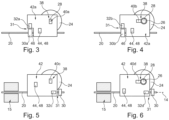
- Figs 3 to 6 illustrate different arrangements of the two sensor devices 31 and 38. It is illustrated in Fig. 3 that the circuit board 42a has a rectangular cutout 46, on the edge of which the sensor element 32a is disposed. The first magnetic element arrangement 30a enters at least in regions into the cutout 46. Furthermore, it can be seen that the sensor element 40a is disposed so as to align with the axis of rotation 28, i.e. so as to cover the second magnetic element arrangement 36.
- Fig. 4 illustrates the case in which the sensor element 40b is disposed laterally offset with respect to the axis of rotation 28 of the driven shaft 26 while the arrangement of the first magnetic element arrangement 30b and of the sensor element 32b corresponds to that of the first magnetic element arrangement 30a of Fig. 3 .
- Fig. 5 illustrates an arrangement approximately according to Fig. 2 in which the rectangular circuit board 42 is provided on the side facing the first magnetic element arrangement 30 with the sensor element 32c which is disposed at a distance from the axis of rotation 14 of the rotor shaft 20.
- the first magnetic element arrangement 30 is located outside the circuit board 42 on the side of the circuit board 42 that faces away from the rotor 15.
- the arrangement of the sensor element 40c corresponds to that of the sensor element 40a according to Fig. 3 .
- Fig. 6 illustrates the case in which the two sensor elements 32d and 40d are disposed so as not to cover the axes of rotation 14 and 28 of the rotor shaft 20 and of the driven shaft 26, respectively.
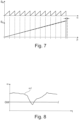
- Fig. 7 thus illustrates one above the other the signals S R and S G detected by the sensor devices 31 and 38 over the absolute rotary angle ⁇ of the rotor 15 and ⁇ of the gear wheel 24, respectively. It is seen here that, at a revolution about 360o of the gear wheel 24 (maximum of the signal S G ), the rotor 15 in the new state of the components or not having any play between the components has rotated, for example, twelve times. Furthermore, the dashed illustration of the signal profile of the signal S G in the lower part of Fig.
- the storing and evaluating unit 48 can furthermore be configured to detect a rotary angle velocity ⁇ of the rotor shaft 20 and/or of the driven shaft 26 over the time t of the wiper motor 10. If, during the operation of the wiper motor 10, the rotary angle velocity ⁇ 1 falls short of, for example, a lower limit value GW, a conclusion is drawn that the wiper motor 10 has increased friction values or a tendency to block due to an internal error or else that the wiper motor 10 is prevented from operating correctly due to external force influences, for example a snow load or the like. Also in this case, the storing and evaluating unit 48 can deposit, for example, a corresponding error in an error memory, can generate a signal or else can stop the operation of the wiper motor 10.
- the wiper motor 10 described so far can be altered or modified in a wide variety of ways without departing from the concept of the invention.
- This consists in that at least one sensor device which serves to detect the rotary angle position of the rotor shaft 20 or of the rotor 15 and of the driven shaft 26 or of the gear wheel 24 uses an absolute angle sensor. It can thus be provided, for example, for the rotary angle information of the two sensor devices 31 and 38 and the activation of the wire windings of the stator 18 to be brought about not (internally) by the wiper motor 10, but rather by an external control device or the like.
- the sensor devices 31 and 38 can also be based on different physical operative principles and/or can have different specifications.
Landscapes
- Engineering & Computer Science (AREA)
- Power Engineering (AREA)
- Mechanical Engineering (AREA)
- Microelectronics & Electronic Packaging (AREA)
- Measurement Of Length, Angles, Or The Like Using Electric Or Magnetic Means (AREA)
- Transmission And Conversion Of Sensor Element Output (AREA)
Description
- The invention relates to a method for detecting the rotary angle positions of rotating parts of a wiper motor having the features of the precharacterizing clause of
Claim 1. The invention furthermore relates to a wiper motor which is configured to carry out a method according to the invention. - A wiper motor which is configured to carry out a method according to the precharacterizing clause of
Claim 1 is known fromDE 10 2017 121 222 A1 - The patent
application publications EP 3 051 672 A1 andUS 2018/0241283 A1 illustrate other exemplary wiper motors known in the state of the art. - In particular in conjunction with brushless electric motors, it is desirable or required to know the rotary angle position as rapidly and exactly as possible for the energizing or activating of the individual wire windings of the stator. This is similarly also desirable in order to detect a rotary angle position of a driven shaft of the wiper motor, said driven shaft being connected to the wiper motor.
- The method according to the invention for detecting the rotary angle positions of rotating parts of a wiper motor having the features of
claim 1 has the advantage of permitting a very rapid and precise detection of an absolute rotary angle of a rotating part, in particular when starting up a wiper motor. This is made possible according to the invention in accordance with the teaching ofClaim 1 in that an absolute rotary angle position of the rotating part is detected by means of at least one of the sensor devices. What is meant here is that a conclusion can be drawn regarding the absolute rotary angle of the rotating part with respect to an angle reference (0 degrees) just from first information or a first detection of a physical parameter. This in particular even includes the situation in which the electric motor is still not rotating, i.e. that the angle position can be detected even in a stationary state of the otherwise rotating part. - Advantageous developments of the method according to the invention for detecting the rotary angle positions of rotating parts of a wiper motor are presented in the dependent claims.
- In a preferred refinement of the method according to the invention, it is provided that a change of a magnetic field of the signal generating element is detected by means of the sensor device that detects the absolute angle position In particular, it is therefore possible, for example, to draw a conclusion about an absolute angle position of the rotating part from the magnitude of the magnetic flux density of the magnetic field in combination with the orientation thereof.
- However, other physical operative principles are also conceivable, for example optically operating measuring devices or sensor devices which detect other physical parameters, such as inductance or the like.
- The method according to the invention further provides that the rotary angle positions of the two rotating parts (in particular rotor and gear wheel) are matched with each other in such a manner that a specific rotary angle position of the one part (for example of the gear wheel or of the driven shaft) is matched with at least one specific rotary angle position of the other part (for example of the rotor), that currently matched rotary angle positions of the two rotating parts are compared to values stored in a storage unit and that a signal, an error message or the like is generated when a stored limit value between current values and stored values is exceeded.
- The background of this preferred method is that typically in the new state or in a state of the wiper motor in which the rotating parts are disposed with little play or no play with respect to one another, the matched rotary angle positions of the parts have only small tolerances with respect to one another. However, with increasing wear or increasing play between the rotating parts, the detected rotary angle positions of the rotating parts change in such a manner that, for example, there is a greater angular offset or a greater angular difference between the rotary angle positions than is the case in the new state or when there is no play. The method according to the invention therefore makes it possible to be able to draw a conclusion regarding the wear of the rotating parts of the wiper motor and, for example, because of a corresponding error message read within the scope of inspections or similar measures, to be able to undertake a repair or a corresponding replacement of the wiper motor. Furthermore, such a method moreover makes it fundamentally possible, for example, also to adapt or to modify a temporal or angle-conforming activation of wire windings of the stator, in order to be able to always obtain the same movement sequence at the wiper motor and therefore at the wipers.
- A further preferred refinement of the method according to the invention, in which, for example, a conclusion can be drawn regarding increased friction or blocking of rotating parts of the wiper motor, provides that during operation of the wiper motor, a rotary angle velocity of at least one of the two rotating parts is detected and that the motion of the wiper motor is stopped and/or a signal and/or an error message or the like is generated when the rotary angle velocity falls short of a limit value. Damage or overloading of the wiper motor can thereby be prevented.
- The invention furthermore comprises a wiper motor which is preferably operated in accordance with a method according to the invention described to this extent. The wiper motor is distinguished, as known per se, by a brushless electric motor which has a rotor and which drives a driven shaft by means of a gear wheel, and comprising two sensor devices each having a signal generating element and a sensor element for detecting a changing physical parameter of the signal generating element, the sensor devices being configured to detect the rotary angle positions of the rotor and of the driven shaft. The wiper motor according to the invention is distinguished in that at least one of the two sensor devices is configured to measure an absolute angle.
- It is particularly preferred that the at least one sensor device is matched to the rotor of the electric motor for measuring the absolute angle. This therefore relates to the fact that, for the activation of the wire windings of the stator correctly in terms of time, it is essential to know the (absolute) rotary angle position of the rotor as rapidly as possible. Furthermore, it should be taken into consideration here that, owing to the reduction in the rotational speed of the electric motor, one and the same absolute rotary angle position of the gear wheel or of the driven shaft can optionally be matched with a plurality of different rotary angle positions of the rotor. From the knowledge of the absolute rotary angle of the gear wheel or of the driven shaft, it is therefore not inevitably possible to be able to draw a conclusion regarding the absolute rotary angle position of the rotor.
- In a structurally preferred refinement of the wiper motor, at least one of the signal generating elements of the two sensor devices is configured to generate a magnetic field that is detectable by the sensor element and that changes as a function of the rotary angle position.
- In a structurally preferred arrangement and configuration of the wiper motor, it is moreover provided that the two sensor elements are disposed in the area of a shared circuit board and are connected to the circuit board in an electrically conductive manner.
- There are various possibilities in respect of the specific arrangement of the sensor elements. In a development of the last proposal for use of a shared circuit board, it can be provided that at least one sensor element is disposed so as to not cover the axis of rotation of the rotor or the driven shaft.
- In this case, it is moreover provided that the sensor element detecting the rotary angle position of the driven shaft or of the rotor is disposed so as to cover the axis of rotation of the driven shaft.
- Furthermore, it can be provided in an advantageous structural refinement of the circuit board that the latter has a cutout and that the signal generating element assigned to the rotor is disposed in the area of the cutout. A particularly compact construction of the wiper motor can thereby be made possible.
- With regard to as compact an arrangement or configuration of the wiper motor as possible, it is moreover of advantage if the plane of the circuit board runs parallel to the axis of rotation of the rotor and perpendicular to the axis of rotation of the driven shaft.
- In order to obtain additional functionalities of the wiper motor, it can moreover be provided that an storage and evaluating unit is provided which is at least configured to match a rotary angle position of the driven shaft with at least one rotary angle position of the rotor and to compare it to stored matched values of the driven shaft and of the rotor during operation of the wiper motor, and that a signal, an error message or the like can be generated when a stored limit value between current matched values and stored matched values is exceeded.
- A development of the last proposal provides that the storage and evaluating unit is additionally configured to detect a rotary angle velocity of at least one of the rotating parts during operation of the wiper motor and to generate a signal, an error message or the like and/or to reduce the power output of the wiper motor and/or to stop its operation when the rotary angle velocity falls short of a predefined limit value.
- Further advantages, features and details of the invention will emerge from the following description of preferred exemplary embodiments and with reference to the drawing,
in which: - Fig. 1
- shows a perspective, partially sectioned view of a wiper motor,
- Fig. 2
- shows a simplified longitudinal section through the wiper motor according to
Fig. 1 , - Fig. 3 to Fig. 6
- each show, in simplified illustrations, different arrangements of sensor devices for detecting the rotary angle position of a rotor and a gear wheel,
- Fig. 7
- shows a diagram for explaining the matching of different rotary angle positions of a rotor and of a gear wheel for detecting a possible wear, and
- Fig. 8
- shows a diagram for explaining the detection of a rotary angle velocity of rotating parts of the wiper motor for detecting a possible blockage of rotating parts.
- Identical elements or elements having an identical function are provided with the same reference numbers in the figures.
-
Figs 1 and 2 illustrate the essential components of awiper motor 10 for driving a wiper (not illustrated). Thewiper motor 10 has a brushlesselectric motor 12 which has arotor 15 which rotates about an axis ofrotation 14 and hasmagnetic elements 16. Therotor 15 is surrounded radially by astator 18 which is illustrated only inFig. 1 and which in a known manner has a plurality ofwire windings 19 in such a manner that therotor 15 is set into a rotational movement by a phase-displaced or temporally consecutive energizing of theindividual wire windings 19. - The
rotor 15 is connected to arotor shaft 20 for rotation therewith, the rotor shaft being mounted rotatably in abearing device 21, for example, on the side facing away from therotor 15. In a central section of therotor shaft 20, the latter has a worm toothing 22 which meshes with a mating toothing on agear wheel 24. Thegear wheel 24 is connected to a drivenshaft 26 for rotation therewith and is mounted rotatably about an axis ofrotation 28. The drivenshaft 26 is coupled in turn in a manner known per se, for example, to a wiper linkage or else directly to the wiper to be moved. - The
rotor 15 or therotor shaft 20 is disposed close to therotor 15 in operative connection with a firstmagnetic element arrangement 30. In particular, the firstmagnetic element arrangement 30 is connected to therotor shaft 20 for rotation therewith. The firstmagnetic element arrangement 30 is part of afirst sensor device 31 for detecting the rotary angle position of therotor shaft 20 and therefore of therotor 15. For this purpose, the firstmagnetic element arrangement 30 interacts, for example, with asensor element 32. Thesensor element 32 comprises, for example, a Hall sensor arrangement which is configured to draw a conclusion regarding the absolute rotary angle position of therotor 15 or of therotor shaft 20 directly from the rotary angle position of the firstmagnetic element arrangement 30. The absolute rotary angle position is required in order to permit a phase-conforming or angle-conforming energizing of thewire windings 19 of thestator 18. An absolute rotary angle position is understood as meaning a rotary angle of the rotating part with respect to a fixed reference position (0 degrees angle position). - Furthermore, a second
magnetic element arrangement 36 is provided on anend surface 34 of the drivenshaft 26. The secondmagnetic element arrangement 36 is part of asecond sensor device 38 which is configured to detect an absolute angle position of the drivenshaft 26 and therefore of thegear wheel 24. For this purpose, the secondmagnetic element arrangement 36, for example, likewise interacts with asensor element 40 which likewise has, for example, a Hall sensor arrangement which is configured to draw a conclusion regarding an absolute angle position of the drivenshaft 26 or of thegear wheel 24 on the basis of the changing magnetic field of the secondmagnetic element arrangement 36. - The two
sensor elements circuit board 42. The plane of thecircuit board 42 runs parallel to the axis ofrotation 14 of therotor 15 and perpendicular to the axis ofrotation 28 of the drivenshaft 26. In the exemplary embodiment illustrated inFig. 2 , the twosensor elements lower side 43 of thecircuit board 42, said lower side facing therotor shaft 20. Furthermore, components for activating or for driving thewiper motor 10 are disposed, as known per se, on thecircuit board 42. Said components comprise, by way of example, an IC 44 or a similar logical circuit which is configured to activate or to energize inparticular wire windings 19 of thestator 18. For this purpose, the information from the twosensor devices 31 of 38 is supplied as an input variable to the IC 44. -
Figs 3 to 6 illustrate different arrangements of the twosensor devices Fig. 3 that thecircuit board 42a has a rectangular cutout 46, on the edge of which thesensor element 32a is disposed. The first magnetic element arrangement 30a enters at least in regions into the cutout 46. Furthermore, it can be seen that thesensor element 40a is disposed so as to align with the axis ofrotation 28, i.e. so as to cover the secondmagnetic element arrangement 36. -
Fig. 4 illustrates the case in which thesensor element 40b is disposed laterally offset with respect to the axis ofrotation 28 of the drivenshaft 26 while the arrangement of the firstmagnetic element arrangement 30b and of thesensor element 32b corresponds to that of the first magnetic element arrangement 30a ofFig. 3 . -
Fig. 5 illustrates an arrangement approximately according toFig. 2 in which therectangular circuit board 42 is provided on the side facing the firstmagnetic element arrangement 30 with the sensor element 32c which is disposed at a distance from the axis ofrotation 14 of therotor shaft 20. The firstmagnetic element arrangement 30 is located outside thecircuit board 42 on the side of thecircuit board 42 that faces away from therotor 15. The arrangement of thesensor element 40c corresponds to that of thesensor element 40a according toFig. 3 . - Finally,
Fig. 6 , as a modification of the arrangement inFig. 5 , illustrates the case in which the twosensor elements rotation rotor shaft 20 and of the drivenshaft 26, respectively. - The IC 44 optionally has a storing and evaluating unit 48 which permits additional functionalities of the
wiper motor 10.Fig. 7 thus illustrates one above the other the signals SR and SG detected by thesensor devices rotor 15 and β of thegear wheel 24, respectively. It is seen here that, at a revolution about 360º of the gear wheel 24 (maximum of the signal SG), therotor 15 in the new state of the components or not having any play between the components has rotated, for example, twelve times. Furthermore, the dashed illustration of the signal profile of the signal SG in the lower part ofFig. 7 shows the situation which arises after a certain operating duration or when wear occurs between those parts of therotor shaft 20 or of therotor 15 and of the drivenshaft 26 or of thegear wheel 24 that are operatively connected to one another. In particular, it is seen that, after twelve revolutions of therotor 12, the signal SG of thegear wheel 24 has not yet reached its maximum, that is to say that thegear wheel 24 is still not revolving about 360°. This is the case only after an additional angle offset δ. - As soon as the angle offset δ exceeds a limit value stored in the storing and evaluating unit 48, a conclusion is drawn regarding wear at the components of the
wiper motor 10 and so that this is stored, for example, in an error memory as an error message, a corresponding signal is generated or the like. - Finally, it is explained with regard to
Fig. 8 that the storing and evaluating unit 48 can furthermore be configured to detect a rotary angle velocity ω of therotor shaft 20 and/or of the drivenshaft 26 over the time t of thewiper motor 10. If, during the operation of thewiper motor 10, the rotary angle velocity ω1 falls short of, for example, a lower limit value GW, a conclusion is drawn that thewiper motor 10 has increased friction values or a tendency to block due to an internal error or else that thewiper motor 10 is prevented from operating correctly due to external force influences, for example a snow load or the like. Also in this case, the storing and evaluating unit 48 can deposit, for example, a corresponding error in an error memory, can generate a signal or else can stop the operation of thewiper motor 10. - The
wiper motor 10 described so far can be altered or modified in a wide variety of ways without departing from the concept of the invention. This consists in that at least one sensor device which serves to detect the rotary angle position of therotor shaft 20 or of therotor 15 and of the drivenshaft 26 or of thegear wheel 24 uses an absolute angle sensor. It can thus be provided, for example, for the rotary angle information of the twosensor devices stator 18 to be brought about not (internally) by thewiper motor 10, but rather by an external control device or the like. Furthermore, thesensor devices -
- 10
- Wiper motor
- 12
- Electric motor
- 14
- Axis of rotation
- 15
- Rotor
- 16
- Magnetic element
- 18
- Stator
- 19
- Wire winding
- 20
- Rotor shaft
- 21
- Bearing device
- 22
- Worm gearing
- 24
- Gear wheel
- 26
- Driven shaft
- 28
- Axis of rotation
- 30/a/b
- Magnetic element arrangement
- 31
- First sensor device
- 32/a/b/c/d
- Sensor element
- 34
- End surface of the driven shaft
- 36
- Magnetic element arrangement
- 38
- Second sensor device
- 40/a/b/c/d
- Sensor element
- 42/a
- Circuit board
- 43
- Lower side of the circuit board
- 44
- IC
- 46
- Cutout
- 48
- Evaluating unit
- α
- Angle
- β
- Angle
- δ
- Angle offset
- ω
- Rotary angle velocity
- DW
- Rotary angle
- GW
- Limit value
- S
- Signal
- t
- Time
Claims (13)
- Method for detecting the rotary angle positions (α, β) of rotating parts of a wiper motor (10), the wiper motor (10) having a brushless electric motor (12) as a first part which comprises a rotor (15) rotating about a first axis of rotation (14) and which drives a gear wheel (24) as a second part which rotates about a second axis of rotation (28) and which comprises a driven shaft (26), and the rotary angle positions (α, β) of the two rotating parts being detected by means of two sensor devices (31, 38) each having a signal generating element (30; 30a; 30b, 36) and a sensor element (32; 32a to 32d; 40; 40a to 40d) for detecting a changing physical parameter of the signal generating element (30; 30a; 30b, 36), an absolute angle position (α, β) of both rotating parts is detected by means of a respective one of the sensor devices (31, 38), the rotary angle positions (α, β) of the two rotating parts being matched with each other in such a manner that a specific rotary angle position (β) of the driven shaft (26) is matched with at least one specific rotary angle position (α) of the rotor (15), that currently matched rotary angle positions (α, β) of the two rotating parts are compared to values stored in a storage and evaluation unit (48) a signal or an error message is generated when a stored limit value (σ) between current values and stored values is exceeded, characterized in that a conclusion is drawn regarding a wear state of the rotating parts of the wiper motor and/or the temporal or angle-conforming activation of the wire windings of the stator are adapted or modified in response to said signal or error message.
- Method according to Claim 1,
characterized in that
a change of a magnetic field of the signal generating element (30; 30a; 30b, 36) is detected by means of the sensor device (31, 38) that detects the absolute angle position (α, β). - Method according to one of Claims 1 or 2,
characterized in that
during operation of the wiper motor (10), a rotary angle velocity (ω) of at least one of the two rotating parts is detected and that the motion of the wiper motor (10) is stopped and/or a signal and/or an error message or the like is generated when the rotary angle velocity (ω) falls short of a limit value (GW). - Wiper motor (10), comprising a brushless electric motor (12) which has a rotor (15) and which drives a driven shaft (26) by means of a gear wheel (24), and comprising two sensor devices (31, 38) each having a signal generating element (30; 30a; 30b, 36) and a sensor element (32; 32a to 32d; 40; 40a to 40d) for detecting a changing physical parameter of the signal generating element (30; 30a; 30b, 36), the sensor devices (31, 38) being configured to detect the rotary angle positions (α, β) of the rotor (15) and of the driven shaft (26), the wiper motor (10) being configured to be operated according to a method of any one of Claims 1 to 3,
characterized in that
both of the sensor devices (31, 38) are configured to measure an absolute angle position (α, β). - Wiper motor according to Claim 4,
characterized in that
the at least one sensor device (31) is configured for measuring the rotary angle position (α) of the rotor (15). - Wiper motor according to claim 4 or 5,
characterized in that
at least one of the signal generating elements (30; 30a; 30b, 36) of the two sensor devices (31, 38) is configured to generate a magnetic field that changes as a function of the rotary angle position (α, β). - Wiper motor according to any one of claims 4 to 6,
characterized in that
the two sensor elements (32; 32a to 32d; 40; 40a to 40d) are disposed in the area of a shared circuit board (42; 42a) and are connected to the circuit board (42; 42a) in an electrically conductive manner. - Wiper motor according to Claim 7,
characterized in that
at least one sensor element (32; 32a to 32d; 40; 40b; 40d) is disposed so as to not cover the axis of rotation (14, 28) of the rotor (15) or the driven shaft (26). - Wiper motor according to Claim 8,
characterized in that
the sensor element (40; 40a; 40c) detecting the rotary angle position (α, β) of the driven shaft (26) or of the rotor (15) is disposed so as to cover the axis of rotation of the driven shaft. - Wiper motor according to any one of claims 7 to 9,
characterized in that
the circuit board (42a) has a cutout (46) and that the signal generating element (30a; 30b) assigned to the rotor (15) is disposed in the area of the cutout (46). - Wiper motor according to any one of claims 7 to 10,
characterized in that
the plane of the circuit board (42; 42a) runs parallel to the axis of rotation (14) of the rotor (15) and perpendicular to the axis of rotation (28) of the driven shaft (26). - Wiper motor according to any one of claims 4 to 11,
characterized in that
an storage and evaluating unit (48) is provided which is at least configured to match a rotary angle position (β) of the driven shaft (26) with at least one rotary angle position (α) of the rotor (15) and to compare it to stored matched values of the driven shaft (26) and of the rotor (15) during operation of the wiper motor (10), and that a signal, an error message or the like can be generated when a stored limit value (σ) between current matched values and stored matched values is exceeded. - Wiper motor according to Claim 12,
characterized in that
the storage and evaluating unit (48) is additionally configured to detect a rotary angle velocity (ω) of at least one of the rotating parts during operation of the wiper motor (10) and to generate a signal, an error message or the like and/or to reduce the power output of the wiper motor (10) and/or to stop its operation when the rotary angle velocity (ω) falls short of a predefined limit value (GW).
Applications Claiming Priority (2)
| Application Number | Priority Date | Filing Date | Title |
|---|---|---|---|
| DE102019113549.4A DE102019113549A1 (en) | 2019-05-21 | 2019-05-21 | Method for detecting the angular positions of rotating parts of a windshield wiper motor and a windshield wiper motor |
| PCT/EP2020/062350 WO2020233974A1 (en) | 2019-05-21 | 2020-05-04 | Method for detecting the rotary angle positions of rotating parts of a wiper motor, and wiper motor |
Publications (2)
| Publication Number | Publication Date |
|---|---|
| EP3973621A1 EP3973621A1 (en) | 2022-03-30 |
| EP3973621B1 true EP3973621B1 (en) | 2025-03-19 |
Family
ID=70680471
Family Applications (1)
| Application Number | Title | Priority Date | Filing Date |
|---|---|---|---|
| EP20725116.6A Active EP3973621B1 (en) | 2019-05-21 | 2020-05-04 | Method for detecting the rotary angle positions of rotating parts of a wiper motor, and wiper motor |
Country Status (6)
| Country | Link |
|---|---|
| US (1) | US11962260B2 (en) |
| EP (1) | EP3973621B1 (en) |
| JP (1) | JP2022533230A (en) |
| CN (1) | CN113939982A (en) |
| DE (1) | DE102019113549A1 (en) |
| WO (1) | WO2020233974A1 (en) |
Families Citing this family (1)
| Publication number | Priority date | Publication date | Assignee | Title |
|---|---|---|---|---|
| FR3162410A1 (en) * | 2024-05-22 | 2025-11-28 | Stellantis Auto Sas | Method and device for controlling a vehicle's front windshield washer system |
Citations (1)
| Publication number | Priority date | Publication date | Assignee | Title |
|---|---|---|---|---|
| US20180241283A1 (en) * | 2014-03-06 | 2018-08-23 | Sony Corporation | Actuator and robot arm apparatus |
Family Cites Families (18)
| Publication number | Priority date | Publication date | Assignee | Title |
|---|---|---|---|---|
| JP3058638B1 (en) * | 1993-06-15 | 2000-07-04 | アスモ株式会社 | Motor rotation position detector |
| US6111378A (en) * | 1995-04-28 | 2000-08-29 | Ut Automotive Dearborn, Inc. | Window wiper motor system for an automotive vehicle |
| JP4329792B2 (en) | 2006-08-10 | 2009-09-09 | トヨタ自動車株式会社 | Electric power steering device |
| JP2008148412A (en) * | 2006-12-07 | 2008-06-26 | Asmo Co Ltd | Motor control device |
| JP2011057174A (en) * | 2009-09-14 | 2011-03-24 | Mitsuba Corp | Wiper controlling apparatus |
| DE102012102900A1 (en) | 2012-04-03 | 2013-10-10 | Valeo Wischersysteme Gmbh | Device for detecting the angular position of a shaft of a windscreen wiper motor and windscreen wiper motor with a device for detecting the angular position |
| CN104272579B (en) * | 2012-04-16 | 2018-01-12 | 株式会社美姿把 | Brushless motor and wiper device |
| DE102012222273A1 (en) | 2012-12-05 | 2014-06-05 | Schaeffler Technologies Gmbh & Co. Kg | Drive device for use in four-wheel vehicle, has pinion with pinion shaft driven by electrical machine, and pinion shaft bearing provided with series of balls in radial-thrust bearing arrangement and sensor unit |
| CN105556812A (en) * | 2013-09-24 | 2016-05-04 | 株式会社美姿把 | Brushless wiper motor |
| JP6239378B2 (en) | 2013-12-25 | 2017-11-29 | 株式会社ミツバ | WIPER DEVICE AND WIPER DEVICE CONTROL METHOD |
| WO2016002732A1 (en) | 2014-06-30 | 2016-01-07 | パナソニックヘルスケアホールディングス株式会社 | Circuit for detecting rotation angle, method for detecting rotation angle, sample analysis device, and computer program for sample analysis device |
| DE102015201411A1 (en) | 2015-01-28 | 2016-07-28 | Robert Bosch Gmbh | Motor-pump unit for a brake system |
| DE102016201069A1 (en) * | 2015-01-30 | 2016-08-04 | Schaeffler Technologies AG & Co. KG | Drive unit with an electronically commutated electric motor and method for determining a rotor position of an electronically commutated electric motor |
| DE102015202031A1 (en) * | 2015-02-05 | 2016-08-11 | Robert Bosch Gmbh | Drive unit for a wiper system |
| JP6650302B2 (en) * | 2015-03-19 | 2020-02-19 | 株式会社ミツバ | Brushless motor and wiper device |
| DE102016108007A1 (en) * | 2016-04-29 | 2017-11-02 | Lock Antriebstechnik Gmbh | Switching device for switching an electric motor |
| DE102017121222A1 (en) * | 2017-09-13 | 2019-03-14 | Valeo Systèmes d'Essuyage | wiper motor |
| JP6438176B1 (en) * | 2018-02-16 | 2018-12-12 | 株式会社 五十嵐電機製作所 | DC motor control device |
-
2019
- 2019-05-21 DE DE102019113549.4A patent/DE102019113549A1/en active Pending
-
2020
- 2020-05-04 JP JP2021569132A patent/JP2022533230A/en active Pending
- 2020-05-04 WO PCT/EP2020/062350 patent/WO2020233974A1/en not_active Ceased
- 2020-05-04 EP EP20725116.6A patent/EP3973621B1/en active Active
- 2020-05-04 US US17/608,708 patent/US11962260B2/en active Active
- 2020-05-04 CN CN202080037778.3A patent/CN113939982A/en active Pending
Patent Citations (1)
| Publication number | Priority date | Publication date | Assignee | Title |
|---|---|---|---|---|
| US20180241283A1 (en) * | 2014-03-06 | 2018-08-23 | Sony Corporation | Actuator and robot arm apparatus |
Also Published As
| Publication number | Publication date |
|---|---|
| EP3973621A1 (en) | 2022-03-30 |
| WO2020233974A1 (en) | 2020-11-26 |
| JP2022533230A (en) | 2022-07-21 |
| US11962260B2 (en) | 2024-04-16 |
| US20220224260A1 (en) | 2022-07-14 |
| DE102019113549A1 (en) | 2020-11-26 |
| CN113939982A (en) | 2022-01-14 |
Similar Documents
| Publication | Publication Date | Title |
|---|---|---|
| JP4314031B2 (en) | Wiper device with two flat glass wipers | |
| US8502528B2 (en) | Arrangement for detecting a rotation angle | |
| CN101296824B (en) | Electric auxiliary drive device for vehicle | |
| US7994749B2 (en) | Multiple-rotation absolute-value encoder of geared motor | |
| EP3351906B1 (en) | Door position detection device for electric door opener | |
| EP1577182B1 (en) | Wiper device | |
| JP5214626B2 (en) | Optical steering angle sensor for measuring the absolute value of steering angle | |
| US6222362B1 (en) | Method for detecting the position and direction of motion of a moving part mounted on an electric motor | |
| CN114787601B (en) | Device for determining the torque and/or the rotation angle between a first shaft and a second shaft | |
| KR20040030057A (en) | Gear drive unit with speed measurement | |
| US10177638B2 (en) | Rotor position encoder for an electronically commutated electric machine having a reference encoder | |
| JP4139157B2 (en) | Vehicle steering control system | |
| US6360449B1 (en) | Incremental encoder having absolute reference marks | |
| US11962260B2 (en) | Method for detecting the rotary angle positions of rotating parts of a wiper motor, and wiper motor | |
| KR20210102402A (en) | brushless electric machine | |
| JP2008160941A (en) | Wiper motor | |
| JP2008538138A (en) | Method and apparatus for detecting the rotation angle of a rotatable element in a non-contact manner | |
| CN107206969B (en) | Drive unit for a wiper system | |
| JP2008148412A (en) | Motor control device | |
| JP2009133793A (en) | Resolver abnormality detection device | |
| JP2002262515A (en) | Motor with reduction gear mechanism | |
| US20240308572A1 (en) | Steering system | |
| KR20190007546A (en) | Position detecting device according to power mode and motor device using the same | |
| JP2004254455A (en) | Electric motor equipped with reduction mechanism | |
| JPH08207259A (en) | Positioning driver |
Legal Events
| Date | Code | Title | Description |
|---|---|---|---|
| STAA | Information on the status of an ep patent application or granted ep patent |
Free format text: STATUS: UNKNOWN |
|
| STAA | Information on the status of an ep patent application or granted ep patent |
Free format text: STATUS: THE INTERNATIONAL PUBLICATION HAS BEEN MADE |
|
| PUAI | Public reference made under article 153(3) epc to a published international application that has entered the european phase |
Free format text: ORIGINAL CODE: 0009012 |
|
| STAA | Information on the status of an ep patent application or granted ep patent |
Free format text: STATUS: REQUEST FOR EXAMINATION WAS MADE |
|
| 17P | Request for examination filed |
Effective date: 20211104 |
|
| AK | Designated contracting states |
Kind code of ref document: A1 Designated state(s): AL AT BE BG CH CY CZ DE DK EE ES FI FR GB GR HR HU IE IS IT LI LT LU LV MC MK MT NL NO PL PT RO RS SE SI SK SM TR |
|
| DAV | Request for validation of the european patent (deleted) | ||
| DAX | Request for extension of the european patent (deleted) | ||
| P01 | Opt-out of the competence of the unified patent court (upc) registered |
Effective date: 20230528 |
|
| STAA | Information on the status of an ep patent application or granted ep patent |
Free format text: STATUS: EXAMINATION IS IN PROGRESS |
|
| 17Q | First examination report despatched |
Effective date: 20240531 |
|
| GRAP | Despatch of communication of intention to grant a patent |
Free format text: ORIGINAL CODE: EPIDOSNIGR1 |
|
| STAA | Information on the status of an ep patent application or granted ep patent |
Free format text: STATUS: GRANT OF PATENT IS INTENDED |
|
| INTG | Intention to grant announced |
Effective date: 20241022 |
|
| GRAS | Grant fee paid |
Free format text: ORIGINAL CODE: EPIDOSNIGR3 |
|
| GRAA | (expected) grant |
Free format text: ORIGINAL CODE: 0009210 |
|
| STAA | Information on the status of an ep patent application or granted ep patent |
Free format text: STATUS: THE PATENT HAS BEEN GRANTED |
|
| AK | Designated contracting states |
Kind code of ref document: B1 Designated state(s): AL AT BE BG CH CY CZ DE DK EE ES FI FR GB GR HR HU IE IS IT LI LT LU LV MC MK MT NL NO PL PT RO RS SE SI SK SM TR |
|
| REG | Reference to a national code |
Ref country code: GB Ref legal event code: FG4D |
|
| REG | Reference to a national code |
Ref country code: CH Ref legal event code: EP |
|
| REG | Reference to a national code |
Ref country code: DE Ref legal event code: R096 Ref document number: 602020047909 Country of ref document: DE |
|
| REG | Reference to a national code |
Ref country code: IE Ref legal event code: FG4D |
|
| PG25 | Lapsed in a contracting state [announced via postgrant information from national office to epo] |
Ref country code: RS Free format text: LAPSE BECAUSE OF FAILURE TO SUBMIT A TRANSLATION OF THE DESCRIPTION OR TO PAY THE FEE WITHIN THE PRESCRIBED TIME-LIMIT Effective date: 20250619 |
|
| PG25 | Lapsed in a contracting state [announced via postgrant information from national office to epo] |
Ref country code: FI Free format text: LAPSE BECAUSE OF FAILURE TO SUBMIT A TRANSLATION OF THE DESCRIPTION OR TO PAY THE FEE WITHIN THE PRESCRIBED TIME-LIMIT Effective date: 20250319 |
|
| PGFP | Annual fee paid to national office [announced via postgrant information from national office to epo] |
Ref country code: DE Payment date: 20250513 Year of fee payment: 6 |
|
| REG | Reference to a national code |
Ref country code: LT Ref legal event code: MG9D |
|
| PG25 | Lapsed in a contracting state [announced via postgrant information from national office to epo] |
Ref country code: NO Free format text: LAPSE BECAUSE OF FAILURE TO SUBMIT A TRANSLATION OF THE DESCRIPTION OR TO PAY THE FEE WITHIN THE PRESCRIBED TIME-LIMIT Effective date: 20250619 |
|
| PG25 | Lapsed in a contracting state [announced via postgrant information from national office to epo] |
Ref country code: HR Free format text: LAPSE BECAUSE OF FAILURE TO SUBMIT A TRANSLATION OF THE DESCRIPTION OR TO PAY THE FEE WITHIN THE PRESCRIBED TIME-LIMIT Effective date: 20250319 |
|
| PG25 | Lapsed in a contracting state [announced via postgrant information from national office to epo] |
Ref country code: LV Free format text: LAPSE BECAUSE OF FAILURE TO SUBMIT A TRANSLATION OF THE DESCRIPTION OR TO PAY THE FEE WITHIN THE PRESCRIBED TIME-LIMIT Effective date: 20250319 |
|
| PGFP | Annual fee paid to national office [announced via postgrant information from national office to epo] |
Ref country code: FR Payment date: 20250530 Year of fee payment: 6 |
|
| PG25 | Lapsed in a contracting state [announced via postgrant information from national office to epo] |
Ref country code: GR Free format text: LAPSE BECAUSE OF FAILURE TO SUBMIT A TRANSLATION OF THE DESCRIPTION OR TO PAY THE FEE WITHIN THE PRESCRIBED TIME-LIMIT Effective date: 20250620 Ref country code: BG Free format text: LAPSE BECAUSE OF FAILURE TO SUBMIT A TRANSLATION OF THE DESCRIPTION OR TO PAY THE FEE WITHIN THE PRESCRIBED TIME-LIMIT Effective date: 20250319 |
|
| REG | Reference to a national code |
Ref country code: NL Ref legal event code: MP Effective date: 20250319 |
|
| REG | Reference to a national code |
Ref country code: AT Ref legal event code: MK05 Ref document number: 1777787 Country of ref document: AT Kind code of ref document: T Effective date: 20250319 |
|
| PG25 | Lapsed in a contracting state [announced via postgrant information from national office to epo] |
Ref country code: NL Free format text: LAPSE BECAUSE OF FAILURE TO SUBMIT A TRANSLATION OF THE DESCRIPTION OR TO PAY THE FEE WITHIN THE PRESCRIBED TIME-LIMIT Effective date: 20250319 |
|
| PG25 | Lapsed in a contracting state [announced via postgrant information from national office to epo] |
Ref country code: SE Free format text: LAPSE BECAUSE OF FAILURE TO SUBMIT A TRANSLATION OF THE DESCRIPTION OR TO PAY THE FEE WITHIN THE PRESCRIBED TIME-LIMIT Effective date: 20250319 |
|
| PG25 | Lapsed in a contracting state [announced via postgrant information from national office to epo] |
Ref country code: SM Free format text: LAPSE BECAUSE OF FAILURE TO SUBMIT A TRANSLATION OF THE DESCRIPTION OR TO PAY THE FEE WITHIN THE PRESCRIBED TIME-LIMIT Effective date: 20250319 |
|
| PG25 | Lapsed in a contracting state [announced via postgrant information from national office to epo] |
Ref country code: ES Free format text: LAPSE BECAUSE OF FAILURE TO SUBMIT A TRANSLATION OF THE DESCRIPTION OR TO PAY THE FEE WITHIN THE PRESCRIBED TIME-LIMIT Effective date: 20250319 Ref country code: PT Free format text: LAPSE BECAUSE OF FAILURE TO SUBMIT A TRANSLATION OF THE DESCRIPTION OR TO PAY THE FEE WITHIN THE PRESCRIBED TIME-LIMIT Effective date: 20250721 |
|
| PG25 | Lapsed in a contracting state [announced via postgrant information from national office to epo] |
Ref country code: PL Free format text: LAPSE BECAUSE OF FAILURE TO SUBMIT A TRANSLATION OF THE DESCRIPTION OR TO PAY THE FEE WITHIN THE PRESCRIBED TIME-LIMIT Effective date: 20250319 Ref country code: IT Free format text: LAPSE BECAUSE OF FAILURE TO SUBMIT A TRANSLATION OF THE DESCRIPTION OR TO PAY THE FEE WITHIN THE PRESCRIBED TIME-LIMIT Effective date: 20250319 |
|
| PG25 | Lapsed in a contracting state [announced via postgrant information from national office to epo] |
Ref country code: AT Free format text: LAPSE BECAUSE OF FAILURE TO SUBMIT A TRANSLATION OF THE DESCRIPTION OR TO PAY THE FEE WITHIN THE PRESCRIBED TIME-LIMIT Effective date: 20250319 |
|
| PG25 | Lapsed in a contracting state [announced via postgrant information from national office to epo] |
Ref country code: CZ Free format text: LAPSE BECAUSE OF FAILURE TO SUBMIT A TRANSLATION OF THE DESCRIPTION OR TO PAY THE FEE WITHIN THE PRESCRIBED TIME-LIMIT Effective date: 20250319 Ref country code: EE Free format text: LAPSE BECAUSE OF FAILURE TO SUBMIT A TRANSLATION OF THE DESCRIPTION OR TO PAY THE FEE WITHIN THE PRESCRIBED TIME-LIMIT Effective date: 20250319 |
|
| PG25 | Lapsed in a contracting state [announced via postgrant information from national office to epo] |
Ref country code: RO Free format text: LAPSE BECAUSE OF FAILURE TO SUBMIT A TRANSLATION OF THE DESCRIPTION OR TO PAY THE FEE WITHIN THE PRESCRIBED TIME-LIMIT Effective date: 20250319 |
|
| PG25 | Lapsed in a contracting state [announced via postgrant information from national office to epo] |
Ref country code: SK Free format text: LAPSE BECAUSE OF FAILURE TO SUBMIT A TRANSLATION OF THE DESCRIPTION OR TO PAY THE FEE WITHIN THE PRESCRIBED TIME-LIMIT Effective date: 20250319 |
|
| PG25 | Lapsed in a contracting state [announced via postgrant information from national office to epo] |
Ref country code: IS Free format text: LAPSE BECAUSE OF FAILURE TO SUBMIT A TRANSLATION OF THE DESCRIPTION OR TO PAY THE FEE WITHIN THE PRESCRIBED TIME-LIMIT Effective date: 20250719 |
|
| REG | Reference to a national code |
Ref country code: DE Ref legal event code: R097 Ref document number: 602020047909 Country of ref document: DE |
|
| REG | Reference to a national code |
Ref country code: CH Ref legal event code: H13 Free format text: ST27 STATUS EVENT CODE: U-0-0-H10-H13 (AS PROVIDED BY THE NATIONAL OFFICE) Effective date: 20251223 |
|
| PG25 | Lapsed in a contracting state [announced via postgrant information from national office to epo] |
Ref country code: DK Free format text: LAPSE BECAUSE OF FAILURE TO SUBMIT A TRANSLATION OF THE DESCRIPTION OR TO PAY THE FEE WITHIN THE PRESCRIBED TIME-LIMIT Effective date: 20250319 |
|
| PG25 | Lapsed in a contracting state [announced via postgrant information from national office to epo] |
Ref country code: LU Free format text: LAPSE BECAUSE OF NON-PAYMENT OF DUE FEES Effective date: 20250504 |
|
| PG25 | Lapsed in a contracting state [announced via postgrant information from national office to epo] |
Ref country code: CH Free format text: LAPSE BECAUSE OF NON-PAYMENT OF DUE FEES Effective date: 20250531 |
|
| PLBE | No opposition filed within time limit |
Free format text: ORIGINAL CODE: 0009261 |
|
| STAA | Information on the status of an ep patent application or granted ep patent |
Free format text: STATUS: NO OPPOSITION FILED WITHIN TIME LIMIT |
|
| REG | Reference to a national code |
Ref country code: CH Ref legal event code: L10 Free format text: ST27 STATUS EVENT CODE: U-0-0-L10-L00 (AS PROVIDED BY THE NATIONAL OFFICE) Effective date: 20260128 |
|
| REG | Reference to a national code |
Ref country code: BE Ref legal event code: MM Effective date: 20250531 |
|
| PG25 | Lapsed in a contracting state [announced via postgrant information from national office to epo] |
Ref country code: MC Free format text: LAPSE BECAUSE OF FAILURE TO SUBMIT A TRANSLATION OF THE DESCRIPTION OR TO PAY THE FEE WITHIN THE PRESCRIBED TIME-LIMIT Effective date: 20250319 |
|
| 26N | No opposition filed |
Effective date: 20251222 |
|
| GBPC | Gb: european patent ceased through non-payment of renewal fee |
Effective date: 20250619 |
|
| PG25 | Lapsed in a contracting state [announced via postgrant information from national office to epo] |
Ref country code: GB Free format text: LAPSE BECAUSE OF NON-PAYMENT OF DUE FEES Effective date: 20250619 |
|
| PG25 | Lapsed in a contracting state [announced via postgrant information from national office to epo] |
Ref country code: IE Free format text: LAPSE BECAUSE OF NON-PAYMENT OF DUE FEES Effective date: 20250504 |
|
| PG25 | Lapsed in a contracting state [announced via postgrant information from national office to epo] |
Ref country code: BE Free format text: LAPSE BECAUSE OF NON-PAYMENT OF DUE FEES Effective date: 20250531 |