EP3973494B1 - System und verfahren zur leistungsverbrauchsoptimierung und leistungsspeicherung - Google Patents
System und verfahren zur leistungsverbrauchsoptimierung und leistungsspeicherung Download PDFInfo
- Publication number
- EP3973494B1 EP3973494B1 EP20809731.1A EP20809731A EP3973494B1 EP 3973494 B1 EP3973494 B1 EP 3973494B1 EP 20809731 A EP20809731 A EP 20809731A EP 3973494 B1 EP3973494 B1 EP 3973494B1
- Authority
- EP
- European Patent Office
- Prior art keywords
- power
- power consumption
- grid
- power grid
- consumer
- Prior art date
- Legal status (The legal status is an assumption and is not a legal conclusion. Google has not performed a legal analysis and makes no representation as to the accuracy of the status listed.)
- Active
Links
Images


Classifications
-
- H—ELECTRICITY
- H02—GENERATION; CONVERSION OR DISTRIBUTION OF ELECTRIC POWER
- H02J—CIRCUIT ARRANGEMENTS OR SYSTEMS FOR SUPPLYING OR DISTRIBUTING ELECTRIC POWER; SYSTEMS FOR STORING ELECTRIC ENERGY
- H02J3/00—Circuit arrangements for AC mains or AC distribution networks
- H02J3/003—Load forecast, e.g. methods or systems for forecasting future load demand
-
- G—PHYSICS
- G06—COMPUTING OR CALCULATING; COUNTING
- G06Q—INFORMATION AND COMMUNICATION TECHNOLOGY [ICT] SPECIALLY ADAPTED FOR ADMINISTRATIVE, COMMERCIAL, FINANCIAL, MANAGERIAL OR SUPERVISORY PURPOSES; SYSTEMS OR METHODS SPECIALLY ADAPTED FOR ADMINISTRATIVE, COMMERCIAL, FINANCIAL, MANAGERIAL OR SUPERVISORY PURPOSES, NOT OTHERWISE PROVIDED FOR
- G06Q10/00—Administration; Management
- G06Q10/06—Resources, workflows, human or project management; Enterprise or organisation planning; Enterprise or organisation modelling
-
- G—PHYSICS
- G06—COMPUTING OR CALCULATING; COUNTING
- G06Q—INFORMATION AND COMMUNICATION TECHNOLOGY [ICT] SPECIALLY ADAPTED FOR ADMINISTRATIVE, COMMERCIAL, FINANCIAL, MANAGERIAL OR SUPERVISORY PURPOSES; SYSTEMS OR METHODS SPECIALLY ADAPTED FOR ADMINISTRATIVE, COMMERCIAL, FINANCIAL, MANAGERIAL OR SUPERVISORY PURPOSES, NOT OTHERWISE PROVIDED FOR
- G06Q50/00—Information and communication technology [ICT] specially adapted for implementation of business processes of specific business sectors, e.g. utilities or tourism
- G06Q50/06—Energy or water supply
-
- H—ELECTRICITY
- H02—GENERATION; CONVERSION OR DISTRIBUTION OF ELECTRIC POWER
- H02J—CIRCUIT ARRANGEMENTS OR SYSTEMS FOR SUPPLYING OR DISTRIBUTING ELECTRIC POWER; SYSTEMS FOR STORING ELECTRIC ENERGY
- H02J13/00—Circuit arrangements for providing remote indication of network conditions, e.g. an instantaneous record of the open or closed condition of each circuitbreaker in the network; Circuit arrangements for providing remote control of switching means in a power distribution network, e.g. switching in and out of current consumers by using a pulse code signal carried by the network
- H02J13/00006—Circuit arrangements for providing remote indication of network conditions, e.g. an instantaneous record of the open or closed condition of each circuitbreaker in the network; Circuit arrangements for providing remote control of switching means in a power distribution network, e.g. switching in and out of current consumers by using a pulse code signal carried by the network characterised by information or instructions transport means between the monitoring, controlling or managing units and monitored, controlled or operated power network element or electrical equipment
-
- H—ELECTRICITY
- H02—GENERATION; CONVERSION OR DISTRIBUTION OF ELECTRIC POWER
- H02J—CIRCUIT ARRANGEMENTS OR SYSTEMS FOR SUPPLYING OR DISTRIBUTING ELECTRIC POWER; SYSTEMS FOR STORING ELECTRIC ENERGY
- H02J3/00—Circuit arrangements for AC mains or AC distribution networks
- H02J3/004—Generation forecast, e.g. methods or systems for forecasting future energy generation
-
- H—ELECTRICITY
- H02—GENERATION; CONVERSION OR DISTRIBUTION OF ELECTRIC POWER
- H02J—CIRCUIT ARRANGEMENTS OR SYSTEMS FOR SUPPLYING OR DISTRIBUTING ELECTRIC POWER; SYSTEMS FOR STORING ELECTRIC ENERGY
- H02J3/00—Circuit arrangements for AC mains or AC distribution networks
- H02J3/12—Circuit arrangements for AC mains or AC distribution networks for adjusting voltage in AC networks by changing a characteristic of the network load
- H02J3/14—Circuit arrangements for AC mains or AC distribution networks for adjusting voltage in AC networks by changing a characteristic of the network load by switching loads on to, or off from, network, e.g. progressively balanced loading
- H02J3/144—Demand-response operation of the power transmission or distribution network
-
- H—ELECTRICITY
- H02—GENERATION; CONVERSION OR DISTRIBUTION OF ELECTRIC POWER
- H02J—CIRCUIT ARRANGEMENTS OR SYSTEMS FOR SUPPLYING OR DISTRIBUTING ELECTRIC POWER; SYSTEMS FOR STORING ELECTRIC ENERGY
- H02J3/00—Circuit arrangements for AC mains or AC distribution networks
- H02J3/28—Arrangements for balancing of the load in a network by storage of energy
-
- H—ELECTRICITY
- H02—GENERATION; CONVERSION OR DISTRIBUTION OF ELECTRIC POWER
- H02J—CIRCUIT ARRANGEMENTS OR SYSTEMS FOR SUPPLYING OR DISTRIBUTING ELECTRIC POWER; SYSTEMS FOR STORING ELECTRIC ENERGY
- H02J3/00—Circuit arrangements for AC mains or AC distribution networks
- H02J3/38—Arrangements for parallely feeding a single network by two or more generators, converters or transformers
- H02J3/381—Dispersed generators
-
- H—ELECTRICITY
- H02—GENERATION; CONVERSION OR DISTRIBUTION OF ELECTRIC POWER
- H02J—CIRCUIT ARRANGEMENTS OR SYSTEMS FOR SUPPLYING OR DISTRIBUTING ELECTRIC POWER; SYSTEMS FOR STORING ELECTRIC ENERGY
- H02J2300/00—Systems for supplying or distributing electric power characterised by decentralized, dispersed, or local generation
- H02J2300/20—The dispersed energy generation being of renewable origin
-
- H—ELECTRICITY
- H02—GENERATION; CONVERSION OR DISTRIBUTION OF ELECTRIC POWER
- H02J—CIRCUIT ARRANGEMENTS OR SYSTEMS FOR SUPPLYING OR DISTRIBUTING ELECTRIC POWER; SYSTEMS FOR STORING ELECTRIC ENERGY
- H02J2300/00—Systems for supplying or distributing electric power characterised by decentralized, dispersed, or local generation
- H02J2300/20—The dispersed energy generation being of renewable origin
- H02J2300/22—The renewable source being solar energy
-
- H—ELECTRICITY
- H02—GENERATION; CONVERSION OR DISTRIBUTION OF ELECTRIC POWER
- H02J—CIRCUIT ARRANGEMENTS OR SYSTEMS FOR SUPPLYING OR DISTRIBUTING ELECTRIC POWER; SYSTEMS FOR STORING ELECTRIC ENERGY
- H02J2310/00—The network for supplying or distributing electric power characterised by its spatial reach or by the load
- H02J2310/10—The network having a local or delimited stationary reach
- H02J2310/12—The local stationary network supplying a household or a building
-
- H—ELECTRICITY
- H02—GENERATION; CONVERSION OR DISTRIBUTION OF ELECTRIC POWER
- H02J—CIRCUIT ARRANGEMENTS OR SYSTEMS FOR SUPPLYING OR DISTRIBUTING ELECTRIC POWER; SYSTEMS FOR STORING ELECTRIC ENERGY
- H02J2310/00—The network for supplying or distributing electric power characterised by its spatial reach or by the load
- H02J2310/50—The network for supplying or distributing electric power characterised by its spatial reach or by the load for selectively controlling the operation of the loads
-
- H—ELECTRICITY
- H02—GENERATION; CONVERSION OR DISTRIBUTION OF ELECTRIC POWER
- H02J—CIRCUIT ARRANGEMENTS OR SYSTEMS FOR SUPPLYING OR DISTRIBUTING ELECTRIC POWER; SYSTEMS FOR STORING ELECTRIC ENERGY
- H02J2310/00—The network for supplying or distributing electric power characterised by its spatial reach or by the load
- H02J2310/50—The network for supplying or distributing electric power characterised by its spatial reach or by the load for selectively controlling the operation of the loads
- H02J2310/56—The network for supplying or distributing electric power characterised by its spatial reach or by the load for selectively controlling the operation of the loads characterised by the condition upon which the selective controlling is based
- H02J2310/58—The condition being electrical
-
- H—ELECTRICITY
- H02—GENERATION; CONVERSION OR DISTRIBUTION OF ELECTRIC POWER
- H02J—CIRCUIT ARRANGEMENTS OR SYSTEMS FOR SUPPLYING OR DISTRIBUTING ELECTRIC POWER; SYSTEMS FOR STORING ELECTRIC ENERGY
- H02J2310/00—The network for supplying or distributing electric power characterised by its spatial reach or by the load
- H02J2310/50—The network for supplying or distributing electric power characterised by its spatial reach or by the load for selectively controlling the operation of the loads
- H02J2310/56—The network for supplying or distributing electric power characterised by its spatial reach or by the load for selectively controlling the operation of the loads characterised by the condition upon which the selective controlling is based
- H02J2310/62—The condition being non-electrical, e.g. temperature
- H02J2310/64—The condition being economic, e.g. tariff based load management
-
- Y—GENERAL TAGGING OF NEW TECHNOLOGICAL DEVELOPMENTS; GENERAL TAGGING OF CROSS-SECTIONAL TECHNOLOGIES SPANNING OVER SEVERAL SECTIONS OF THE IPC; TECHNICAL SUBJECTS COVERED BY FORMER USPC CROSS-REFERENCE ART COLLECTIONS [XRACs] AND DIGESTS
- Y04—INFORMATION OR COMMUNICATION TECHNOLOGIES HAVING AN IMPACT ON OTHER TECHNOLOGY AREAS
- Y04S—SYSTEMS INTEGRATING TECHNOLOGIES RELATED TO POWER NETWORK OPERATION, COMMUNICATION OR INFORMATION TECHNOLOGIES FOR IMPROVING THE ELECTRICAL POWER GENERATION, TRANSMISSION, DISTRIBUTION, MANAGEMENT OR USAGE, i.e. SMART GRIDS
- Y04S40/00—Systems for electrical power generation, transmission, distribution or end-user application management characterised by the use of communication or information technologies, or communication or information technology specific aspects supporting them
- Y04S40/12—Systems for electrical power generation, transmission, distribution or end-user application management characterised by the use of communication or information technologies, or communication or information technology specific aspects supporting them characterised by data transport means between the monitoring, controlling or managing units and monitored, controlled or operated electrical equipment
-
- Y—GENERAL TAGGING OF NEW TECHNOLOGICAL DEVELOPMENTS; GENERAL TAGGING OF CROSS-SECTIONAL TECHNOLOGIES SPANNING OVER SEVERAL SECTIONS OF THE IPC; TECHNICAL SUBJECTS COVERED BY FORMER USPC CROSS-REFERENCE ART COLLECTIONS [XRACs] AND DIGESTS
- Y04—INFORMATION OR COMMUNICATION TECHNOLOGIES HAVING AN IMPACT ON OTHER TECHNOLOGY AREAS
- Y04S—SYSTEMS INTEGRATING TECHNOLOGIES RELATED TO POWER NETWORK OPERATION, COMMUNICATION OR INFORMATION TECHNOLOGIES FOR IMPROVING THE ELECTRICAL POWER GENERATION, TRANSMISSION, DISTRIBUTION, MANAGEMENT OR USAGE, i.e. SMART GRIDS
- Y04S50/00—Market activities related to the operation of systems integrating technologies related to power network operation or related to communication or information technologies
- Y04S50/10—Energy trading, including energy flowing from end-user application to grid
Definitions
- the present invention generally relates to electric power systems. More particularly, the present invention relates to systems and methods for optimization of power consumption and/or optimization of power storage.
- Computing device 100 may include a controller or processor 105 (e.g., a central processing unit processor (CPU), a graphics processing unit (GPU), a chip or any suitable computing or computational device), an operating system 115, memory 120, executable code 125, storage 130, input devices 135 (e.g. a keyboard or touchscreen), and output devices 140 (e.g., a display), a communication unit 145 (e.g., a cellular transmitter or modem, a Wi-Fi communication unit, or the like) for communicating with remote devices via a communication network, such as, for example, the Internet.
- Controller 105 may be configured to execute program code to perform operations described herein.
- the system described herein may include one or more computing device(s) 100.
- Memory 120 may be or may include, for example, a Random Access Memory (RAM), a read only memory (ROM), a Dynamic RAM (DRAM), a Synchronous DRAM (SD-RAM), a double data rate (DDR) memory chip, a Flash memory, a volatile memory, a non-volatile memory, a cache memory, a buffer, a short term memory unit, a long term memory unit, or other suitable memory units or storage units.
- Memory 120 may be or may include a plurality of, possibly different memory units.
- Memory 120 may be a computer or processor non-transitory readable medium, or a computer non-transitory storage medium, e.g., a RAM.
- Storage 130 may be or may include, for example, a hard disk drive, a universal serial bus (USB) device or other suitable removable and/or fixed storage unit. In some embodiments, some of the components shown in Fig. 1 may be omitted.
- memory 120 may be a non-volatile memory having the storage capacity of storage 130. Accordingly, although shown as a separate component, storage 130 may be embedded or included in memory 120.
- Input devices 135 may be or may include a keyboard, a touch screen or pad, one or more sensors or any other or additional suitable input device. Any suitable number of input devices 135 may be operatively connected to computing device 100.
- Output devices 140 may include one or more displays or monitors and/or any other suitable output devices. Any suitable number of output devices 140 may be operatively connected to computing device 100.
- Any applicable input/output (I/O) devices may be connected to computing device 100 as shown by blocks 135 and 140.
- NIC network interface card
- USB universal serial bus
- external hard drive may be included in input devices 135 and/or output devices 140.
- Embodiments of the invention may include an article such as a computer or processor non-transitory readable medium, or a computer or processor non-transitory storage medium, such as for example a memory, a disk drive, or a USB flash memory, encoding, including or storing instructions, e.g., computer-executable instructions, which, when executed by a processor or controller, carry out methods disclosed herein.
- an article may include a storage medium such as memory 120, computer-executable instructions such as executable code 125 and a controller such as controller 105.
- non-transitory computer readable medium may be for example a memory, a disk drive, or a USB flash memory, encoding, including or storing instructions, e.g., computer-executable instructions, which when executed by a processor or controller, carry out methods disclosed herein.
- the storage medium may include, but is not limited to, any type of disk including, semiconductor devices such as read-only memories (ROMs) and/or random access memories (RAMs), flash memories, electrically erasable programmable read-only memories (EEPROMs) or any type of media suitable for storing electronic instructions, including programmable storage devices.
- ROMs read-only memories
- RAMs random access memories
- EEPROMs electrically erasable programmable read-only memories
- memory 120 is a non-transitory machine-readable medium.
- a system may include components such as, but not limited to, a plurality of central processing units (CPU), GPUs, or any other suitable multi-purpose or specific processors or controllers (e.g., controllers similar to controller 105), a plurality of input units, a plurality of output units, a plurality of memory units, and a plurality of storage units.
- a system may additionally include other suitable hardware components and/or software components.
- a system may include or may be, for example, a personal computer, a desktop computer, a laptop computer, a workstation, a server computer, a network device, or any other suitable computing device.
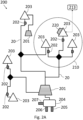
- Fig. 2A shows a block diagram of a power management system 200 for managing power distribution in an electrical power grid, according to some embodiments.
- the power management system 200 may allow management of power distribution, for instance manage power consumption and/or power production, in at least a portion of an electrical power grid 20.
- Management of power consumption and/or power production may include automatic enforcement of change to power consumption and/or power production in a power grid (e.g., allocate all power produced in the power grid to a dedicated power storage instead of using for power consumption).
- the power grid 20 may include a plurality of nodes where at least one power storage facility 201 may be coupled to at least one node managed by the power management system 200.
- At least one power storage facility 201 may be coupled to a consumer (e.g., a household) that consumes electrical power, and/or the at least one power storage facility 201 may be coupled to a power production facility (e.g., a renewable energy device, such as solar panels).
- a consumer e.g., a household
- a power production facility e.g., a renewable energy device, such as solar panels.
- the at least one power consumption rule 213 may include the user preferences for user defined life style or "comfort” (e.g., limiting minimal production facility charging rate, allowed flexibility of smart air conditioner temperature, etc.), and with increased flexibility on the "comfort" of the consumer (e.g., flexibility on ranges/thresholds of the at least one power consumption rule), the efficiency of the optimization of power consumption may be increased as well since there may be fewer restrictions on the optimization algorithm to reduce total costs.
- user preferences for user defined life style or "comfort” e.g., limiting minimal production facility charging rate, allowed flexibility of smart air conditioner temperature, etc.
- flexibility on ranges/thresholds of the at least one power consumption rule e.g., flexibility on ranges/thresholds of the at least one power consumption rule
- the computerized device 204 may apply the at least one power consumption rule 213 on power consumption data that have been analyzed by the computerized device 204, for instance applying the rule based on forecasted power consumption and/or forecasted power production and/or forecasted energy price and/or data received from the power consumption database 205 and/or the ambient condition database 206 and/or the renewable energy source database 207.
- the application of the at least one power consumption rule may be based on forecasted data.
- the power management system 200 automatically manages power consumption for the at least one consumer 203 within at least a portion of the power grid 20, based on the result of the application of the at least one power consumption rule 213, and also based on a power capacity status of the at least one power storage facility 201. Such management of power consumption produces optimization of power consumption that cannot be achieved by a human deciding on its own when and/or how to consume electrical power.
- the power management system 200 may send instructions to electrical appliances and/or the at least one power storage facility 201 to consume power from the power grid 20.
- the power grid 20 (e.g., defined geographically or physically based on nodes location in the power grid) may be regarded as a separate (e.g., self-sustaining) system, and the computerized device 204 analyzes influence of managing power consumption for the at least one consumer 203 on power distribution of the entire power grid 20 and update the at least one power consumption rule 213 to maintain power distribution of the power grid 20 below a first predefined threshold of total power consumption.
- the first predefined threshold may be based on power consumption data from consumers 203 that are geographically adjacent to the at least one consumer 203 (e.g., within the geographical area 210).
- the management system 200 manages power consumption in at least a portion of the power grid 20 for at least one consumer 203 coupled to the at least one power storage facility 201. In some embodiments, the management system 200 manages power consumption in at least a portion of the power grid 20 for at least one consumer 203 coupled to the at least one power storage facility 201 and also coupled to the at least one production facility 220.
- the management system 200 manages power consumption in at least a portion of the power grid 20 for at least one production facility 220 coupled to the at least one power storage facility 201, for instance a renewable energy power production facility that manages times when to store the power to the at least one power storage facility 201 and when to distribute the power to the power grid 20.
- the result of the application of the at least one power consumption rule is calculated based on a machine learning algorithm configured to increase power distribution of the power grid 20 towards a second predefined threshold.
- the machine learning algorithm may include a decision tree generated based on a consumer feedback loop.
- the computerized device 204 carries out at least one of: allocating power resources to the at least one power storage 201, retrieving power from the power grid 20, consuming power from the at least one power storage 201 instead of the power grid 20, and reallocating power resources to a different consumer 203 of the power grid 20.
- Fig. 2B shows a block diagram of a power management system 250 for managing power distribution without an electrical power grid, according to some embodiments.
- the power management system 250 manages power consumption for at least one consumer 203 coupled to the production facility 220 and also coupled to the at least one power storage facility 201. It should be noted that in case a consumer 203 wishes to manage power (e.g., in a closed community or a farm) without any connection to a power grid, the power management system 250 may automatically manage power for the consumer 203 based on the result of the application of at least one power consumption rule 213. Such management of power consumption produces optimization of power consumption that cannot be achieved by a human deciding on its own when and/or how to consume electrical power.
- the computerized device 204 carries out at least one of: allocating power resources from the at least one power production facility to the at least one power storage, and allocating power resources from the at least one power production facility to the power grid.
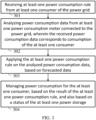
- the at least one power consumption rule 213 is applied 303 on the analyzed power consumption data, for instance based on forecasted power consumption and/or forecasted power production and/or forecasted energy price such that power consumption is automatically managed 304 for the at least one consumer 203, based on the result of the application of the at least one power consumption rule 213, and also based on a power capacity status (e.g., empty or 70% full) of the at least one power storage facility 201.
- a power capacity status e.g., empty or 70% full
- Such management of power consumption produces optimization of power consumption that cannot be achieved by a human deciding on its own when and/or how to consume electrical power.
- the power management system may automatically distribute power between the power grid and/or the power storage facility and/or individual electric appliances with the washing machine may be automatically operated at night by the power management system.
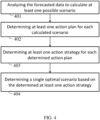
- the power management system may determine optimal management of power for the at least one consumer 203, taking as input at least one of forecasted power consumption and/or forecasted power production and/or forecasted energy costs. Multiple possible scenarios may be calculated based on the forecasted input and at least one (deterministic) action plan may be determined for each such scenario.
- the forecasted data may be analyzed 401 to calculate at least one possible scenario and determine 402 at least one action plan for each calculated scenario.
- At least one (conditional) action strategy may be determined 403 for each determined action plan, and a single optimal scenario may be determined 404 based on the determined at least one action strategy. For instance, a single optimal scenario may be determined using the at least one power consumption rule 213.
- determination of the optimal scenario is carried out using a hidden Markov model and/or using a Monte-Carlo evaluator.
- a power management system as described above may have an advantage for managing power over a plurality of consumers, compared to power consumption management for a single consumer (e.g., a single household).
- At least some of the reasons for the advantages may include: learning the relation between the user preferences (indicated in the at least one power consumption rule 213) and the corresponding effect on the power distribution within the power grid may be achieved faster when the learning is performed on multiple users, additionally a group of multiple users may share a common goal (e.g., reduce consumption from the power grid 20) and thereby automatically manage their power consumption based on that goal, with corresponding power consumption rules.
- a common goal e.g., reduce consumption from the power grid 20
- most households may have common hardware (electrical infrastructure, appliances, solar panels, etc.), these consumers may share similar constraints and thereby benefit from a system that manages power for a plurality of consumers.
- a group of users/consumers working for a "common goal" shares power therebetween, for instance if at least one user of the group has a production facility 220 then other users may buy/sell power produced within the group instead of consuming power from the power grid 20.
- the power management system maintains power consumption within a predefined range in order to prevent sharp changes, for instance with a predefined set of rules for each power grid. For example, in case that electrical power price forecast indicates low prices the power management system may prevent all users consuming at the same time, thereby possibly damaging the power grid and/or cause increase of the price due to the high consumption.
Landscapes
- Engineering & Computer Science (AREA)
- Power Engineering (AREA)
- Business, Economics & Management (AREA)
- Economics (AREA)
- Health & Medical Sciences (AREA)
- Human Resources & Organizations (AREA)
- Strategic Management (AREA)
- Theoretical Computer Science (AREA)
- Physics & Mathematics (AREA)
- General Physics & Mathematics (AREA)
- Marketing (AREA)
- General Business, Economics & Management (AREA)
- Tourism & Hospitality (AREA)
- Water Supply & Treatment (AREA)
- Primary Health Care (AREA)
- General Health & Medical Sciences (AREA)
- Public Health (AREA)
- Entrepreneurship & Innovation (AREA)
- Development Economics (AREA)
- Educational Administration (AREA)
- Game Theory and Decision Science (AREA)
- Operations Research (AREA)
- Quality & Reliability (AREA)
- Supply And Distribution Of Alternating Current (AREA)
- Management, Administration, Business Operations System, And Electronic Commerce (AREA)
Claims (14)
- Ein Verfahren zur Verwaltung der Leistungsverteilung in einem Teil eines elektrischen Stromnetzes, wobei das Stromnetz (20) mindestens einen Leistungsspeicher (201) umfasst, wobei das Verfahren Folgendes umfasst:das Empfangen mindestens einer Leistungsaufnahmeregel (213) von mindestens einem Verbraucher (203) des Stromnetzes (20), wobei die mindestens eine Stromverbrauchsregel eintritt, die umzusetzen ist, um den Stromverbrauch zu ändern, wenn ein vordefinierter Zustand auftritt;das Analysieren von Stromverbrauchsdaten von mindestens einem mit dem Stromnetz (20) verbundenen Stromverbrauchsmessgerät (202), wobei die empfangenen Stromverbrauchsdaten dem Verbrauch des mindestens einen Verbrauchers (203) entsprechen;das Empfangen prognostizierter Stromverbrauchsdaten, gewählt aus der Gruppe bestehend aus prognostiziertem Stromverbrauch, prognostizierter Stromproduktion und prognostizierten Energiekosten;das Anwenden der mindestens einen Stromverbrauchsregel (213) auf die analysierten Stromverbrauchsdaten, wobei das Anwenden der mindestens einen Stromverbrauchsregel auch auf den prognostizierten Stromverbrauchsdaten basiert; und das Verwalten des Stromverbrauchs für den mindestens einen Verbraucher (203), basierend auf dem Ergebnis der Anwendung der mindestens einen Stromverbrauchsregel (213) sowie auf einem Leistungskapazitätsstatus des mindestens einen Leistungsspeichers (201),das Analysieren des Einflusses der Verwaltung des Stromverbrauchs für den mindestens einen Verbraucher (203) auf die Leistungsverteilung des Stromnetzes (20) unddas Aktualisieren der mindestens einen Stromverbrauchsregel (213), um die Leistungsverteilung des Stromnetzes (20) unterhalb eines ersten vordefinierten Schwellenwerts des Gesamt-Stromverbrauchs zu halten.
- Das Verfahren gemäß Anspruch 1, wobei die Verwaltung des Stromverbrauchs einen oder mehrere Vorgänge umfasst, die gewählt sind aus der Gruppe bestehend aus: dem Zuteilen von Leistungsressourcen an den mindestens einen Leistungsspeicher (201), dem Abrufen von Leistung aus dem Stromnetz (20), dem Verbrauchen von Leistung aus dem mindestens einen Leistungsspeicher (201) anstelle des Stromnetzes (20), und dem erneuten Zuteilen von Leistungsressourcen an einen anderen Verbraucher des Stromnetzes.
- Das Verfahren gemäß Anspruch 1 oder 2, wobei die Verwaltung des Stromverbrauchs den Verbrauch von Strom durch ein elektrisches Gerät umfasst, das mit dem Stromnetz (20) verbunden ist.
- Das Verfahren gemäß einem beliebigen der Ansprüche 1-3, worin das Stromnetz (20) weiter mindestens eine Stromproduktionseinrichtung (220) umfasst und wobei die Verwaltung des Stromverbrauchs mindestens einen Vorgang umfasst, der gewählt ist aus: der Zuteilung von Leistungsressourcen von der mindestens einen Stromproduktionseinrichtung (220) an den mindestens einen Stromspeicher (201) und der Zuteilung von Leistungsressourcen von der mindestens einen Stromproduktionseinrichtung (220) an das Stromnetz (20).
- Das Verfahren gemäß Anspruch 1, wobei der erste vordefinierte Schwellenwert auf Stromverbrauchsdaten von Verbrauchern basiert, die geographisch nah an dem mindestens einen Verbraucher (203) sind.
- Das Verfahren gemäß einem beliebigen der Ansprüche 1-5, wobei das Ergebnis der Anwendung der mindestens einen Stromverbrauchsregel (213) auf der Grundlage eines maschinellen Lernalgorithmus berechnet wird, der konfiguriert ist, um die Leistungsverteilung des Stromnetzes (20) zu einem zweiten vordefinierten Schwellenwert hin zu erhöhen.
- Das Verfahren gemäß Anspruch 6, worin der maschinelle Lernalgorithmus einen Entscheidungsbaum umfasst, der auf der Grundlage einer Verbraucher-Rückkopplungsschleife erstellt wird.
- Das Verfahren gemäß einem beliebigen der Ansprüche 1-7, das weiter Folgendes umfasst:das Analysieren der prognostizierten Daten, um mindestens ein mögliches Szenario zu berechnen;das Festlegen mindestens eines Aktionsplans für jedes berechnete Szenario;das Festlegen mindestens einer Aktionsstrategie für jeden festgelegten Aktionsplan
unddas Erstellen eines einzelnen optimalen Szenarios auf der Grundlage der mindestens einen festgelegten Aktionsstrategie. - Das Verfahren gemäß Anspruch 8, wobei der mindestens eine Aktionsplan deterministisch ist.
- Das Verfahren gemäß Anspruch 8, wobei die mindestens eine Aktionsstrategie bedingt ist.
- Das Verfahren gemäß Anspruch 8, wobei das einzelne optimale Szenario anhand der mindestens einen Stromverbrauchsregel erstellt wird.
- Das Verfahren gemäß Anspruch 8, worin das einzelne optimale Szenario anhand des Hidden-Markov-Modells und/oder einer Monte-Carlo-Auswertefunktion erstellt wird.
- Ein System zur Verwaltung der Stromverteilung in einem elektrischen Stromnetz (20), wobei das Stromnetz (20) mindestens einen Stromspeicher (201) umfasst, wobei das System (200) Folgendes umfasst:mindestens ein Stromverbrauchsmessgerät (202), das mit dem Stromnetz (20) verbunden ist; undeinen Prozessor (204), gekoppelt mit dem mindestens einen Stromverbrauchsmessgerät (202) und konfiguriert, um die Schritte eines Verfahrens gemäß einem beliebigen obigen Anspruch auszuführen.
- Ein nichtflüchtiges maschinenlesbares Medium, das Anweisungen umfasst, welche, bei Ausführung durch ein Computersystem, das einen Speicher (120) umfasst, der eine Vielzahl vom Computersystem ausführbarer Programmkomponenten enthält, das Computersystem veranlassen, die Schritte des Verfahrens gemäß einem beliebigen der Ansprüche 1-12 auszuführen.
Applications Claiming Priority (2)
| Application Number | Priority Date | Filing Date | Title |
|---|---|---|---|
| US201962851643P | 2019-05-23 | 2019-05-23 | |
| PCT/IL2020/050564 WO2020234887A1 (en) | 2019-05-23 | 2020-05-21 | System and method for optimization of power consumption and power storage |
Publications (4)
| Publication Number | Publication Date |
|---|---|
| EP3973494A1 EP3973494A1 (de) | 2022-03-30 |
| EP3973494A4 EP3973494A4 (de) | 2023-04-12 |
| EP3973494C0 EP3973494C0 (de) | 2025-07-02 |
| EP3973494B1 true EP3973494B1 (de) | 2025-07-02 |
Family
ID=73458447
Family Applications (1)
| Application Number | Title | Priority Date | Filing Date |
|---|---|---|---|
| EP20809731.1A Active EP3973494B1 (de) | 2019-05-23 | 2020-05-21 | System und verfahren zur leistungsverbrauchsoptimierung und leistungsspeicherung |
Country Status (3)
| Country | Link |
|---|---|
| US (1) | US12046899B2 (de) |
| EP (1) | EP3973494B1 (de) |
| WO (1) | WO2020234887A1 (de) |
Families Citing this family (2)
| Publication number | Priority date | Publication date | Assignee | Title |
|---|---|---|---|---|
| US20220376499A1 (en) * | 2019-12-27 | 2022-11-24 | Eaton Intelligent Power Limited | System and method for load and source forecasting for increasing electrical grid component longevity |
| IL308466B2 (en) | 2023-11-09 | 2025-05-01 | Foresight Energy Ltd | Electricity grid management with alternative electricity generation |
Family Cites Families (12)
| Publication number | Priority date | Publication date | Assignee | Title |
|---|---|---|---|---|
| US7274975B2 (en) | 2005-06-06 | 2007-09-25 | Gridpoint, Inc. | Optimized energy management system |
| AU2010204729A1 (en) * | 2009-01-14 | 2011-09-01 | Integral Analytics, Inc. | Optimization of microgrid energy use and distribution |
| US20110015797A1 (en) | 2009-07-14 | 2011-01-20 | Daniel Gilstrap | Method and apparatus for home automation and energy conservation |
| US20120326503A1 (en) | 2009-07-31 | 2012-12-27 | Mogens Birkelund | Method and apparatus for managing transmission of power in a power transmission network |
| US8676394B2 (en) * | 2010-06-30 | 2014-03-18 | Siemens Aktiengesellschaft | Integrated demand response for energy utilization |
| US20120323382A1 (en) | 2011-06-15 | 2012-12-20 | Expanergy, Llc | Systems and methods to assess and optimize energy usage for a facility |
| US9563215B2 (en) | 2012-07-14 | 2017-02-07 | Causam Energy, Inc. | Method and apparatus for actively managing electric power supply for an electric power grid |
| DE102012108065A1 (de) * | 2012-08-30 | 2014-03-06 | EnBW Energie Baden-Württemberg AG | Energieverbrauchersteuerverfahren und Steuervorrichtung auf Basis eines Energieverbrauchsprofils |
| KR20140075614A (ko) | 2012-12-10 | 2014-06-19 | 주식회사 케이티 | 지능형 에너지 소비 지침 생성 방법 |
| US10559044B2 (en) * | 2015-11-20 | 2020-02-11 | Opower, Inc. | Identification of peak days |
| US9645596B1 (en) * | 2016-11-23 | 2017-05-09 | Advanced Microgrid Solutions, Inc. | Method and apparatus for facilitating the operation of an on-site energy storage system to co-optimize battery dispatch |
| US20180225779A1 (en) | 2017-02-07 | 2018-08-09 | Foresight Energy Ltd | System and method for determining power production in an electrical power grid |
-
2020
- 2020-05-21 WO PCT/IL2020/050564 patent/WO2020234887A1/en not_active Ceased
- 2020-05-21 EP EP20809731.1A patent/EP3973494B1/de active Active
- 2020-05-21 US US17/613,372 patent/US12046899B2/en active Active
Also Published As
| Publication number | Publication date |
|---|---|
| US20220209531A1 (en) | 2022-06-30 |
| EP3973494A1 (de) | 2022-03-30 |
| EP3973494A4 (de) | 2023-04-12 |
| WO2020234887A1 (en) | 2020-11-26 |
| US12046899B2 (en) | 2024-07-23 |
| EP3973494C0 (de) | 2025-07-02 |
Similar Documents
| Publication | Publication Date | Title |
|---|---|---|
| KR102749895B1 (ko) | 에너지 저장 시스템의 최적의 제어를 위한 시스템 및 방법 | |
| JP7051856B2 (ja) | 動的エネルギーストレージシステム制御のためのシステムおよび方法 | |
| Jiang et al. | Dynamic residential demand response and distributed generation management in smart microgrid with hierarchical agents | |
| Wang et al. | Stochastic optimization for energy management in power systems with multiple microgrids | |
| Rokonuzzaman et al. | Levenberg-Marquardt algorithm-based solar PV energy integrated internet of home energy management system | |
| Dridi et al. | A novel deep reinforcement approach for IIoT microgrid energy management systems | |
| KR102343339B1 (ko) | 가전기기 스케줄링 방법 및 장치 | |
| EP3973494B1 (de) | System und verfahren zur leistungsverbrauchsoptimierung und leistungsspeicherung | |
| US20180225779A1 (en) | System and method for determining power production in an electrical power grid | |
| US10931107B2 (en) | System and method for management of an electricity distribution grid | |
| Ramos et al. | Selection of features in reinforcement learning applied to energy consumption forecast in buildings according to different contexts | |
| US20140365023A1 (en) | Systems and Methods for Computer Implemented Energy Management | |
| Li et al. | Real-time scheduling of time-shiftable loads in smart grid with dynamic pricing and photovoltaic power generation | |
| Al-Ani et al. | Optimal operation of water pumping stations | |
| Torriti | Flexibility | |
| Baliyan et al. | Predictive analytics for energy forecasting and optimization | |
| Babu et al. | Explainable AI and Solar Energy Integration | |
| SE2250614A1 (en) | Optimized energy delivery | |
| Shiny et al. | Dynamic load scheduling and power allocation for energy efficiency and cost reduction in smart grids: An RL-SAL-BWO approach | |
| Aguilar et al. | Analysis of data generated by an automated platform for aggregation of distributed energy resources | |
| Yassine et al. | Cooperative Distributed Multi-Agent System for Carbon-Aware IIoT in Smart Grids | |
| Al et al. | Smart home energy optimization system | |
| Kampars et al. | Predictive and optimisation models for AI driven electricity balancing platform | |
| Kyrtsilas et al. | Integrating industry 4.0 technologies for smart energy management in the industrial sector: trends and challenges | |
| Liu et al. | Fusing Decision Tree and Deep Reinforcement Learning for Demand Response Optimization of Variable Volume Water Heaters |
Legal Events
| Date | Code | Title | Description |
|---|---|---|---|
| STAA | Information on the status of an ep patent application or granted ep patent |
Free format text: STATUS: THE INTERNATIONAL PUBLICATION HAS BEEN MADE |
|
| PUAI | Public reference made under article 153(3) epc to a published international application that has entered the european phase |
Free format text: ORIGINAL CODE: 0009012 |
|
| STAA | Information on the status of an ep patent application or granted ep patent |
Free format text: STATUS: REQUEST FOR EXAMINATION WAS MADE |
|
| 17P | Request for examination filed |
Effective date: 20211202 |
|
| AK | Designated contracting states |
Kind code of ref document: A1 Designated state(s): AL AT BE BG CH CY CZ DE DK EE ES FI FR GB GR HR HU IE IS IT LI LT LU LV MC MK MT NL NO PL PT RO RS SE SI SK SM TR |
|
| DAV | Request for validation of the european patent (deleted) | ||
| DAX | Request for extension of the european patent (deleted) | ||
| A4 | Supplementary search report drawn up and despatched |
Effective date: 20230315 |
|
| RIC1 | Information provided on ipc code assigned before grant |
Ipc: H02J 3/38 20060101ALI20230309BHEP Ipc: H02J 3/28 20060101ALI20230309BHEP Ipc: H02J 3/14 20060101ALI20230309BHEP Ipc: H02J 3/00 20060101ALI20230309BHEP Ipc: G06Q 10/06 20120101ALI20230309BHEP Ipc: G05F 1/66 20060101ALI20230309BHEP Ipc: H02J 13/00 20060101ALI20230309BHEP Ipc: G06Q 50/06 20120101AFI20230309BHEP |
|
| GRAP | Despatch of communication of intention to grant a patent |
Free format text: ORIGINAL CODE: EPIDOSNIGR1 |
|
| STAA | Information on the status of an ep patent application or granted ep patent |
Free format text: STATUS: GRANT OF PATENT IS INTENDED |
|
| INTG | Intention to grant announced |
Effective date: 20250130 |
|
| GRAS | Grant fee paid |
Free format text: ORIGINAL CODE: EPIDOSNIGR3 |
|
| GRAA | (expected) grant |
Free format text: ORIGINAL CODE: 0009210 |
|
| STAA | Information on the status of an ep patent application or granted ep patent |
Free format text: STATUS: THE PATENT HAS BEEN GRANTED |
|
| RAP3 | Party data changed (applicant data changed or rights of an application transferred) |
Owner name: TIGO ENERGY AI LTD |
|
| AK | Designated contracting states |
Kind code of ref document: B1 Designated state(s): AL AT BE BG CH CY CZ DE DK EE ES FI FR GB GR HR HU IE IS IT LI LT LU LV MC MK MT NL NO PL PT RO RS SE SI SK SM TR |
|
| REG | Reference to a national code |
Ref country code: GB Ref legal event code: FG4D |
|
| REG | Reference to a national code |
Ref country code: CH Ref legal event code: EP |
|
| REG | Reference to a national code |
Ref country code: DE Ref legal event code: R096 Ref document number: 602020053908 Country of ref document: DE |
|
| REG | Reference to a national code |
Ref country code: IE Ref legal event code: FG4D |
|
| U01 | Request for unitary effect filed |
Effective date: 20250804 |
|
| U07 | Unitary effect registered |
Designated state(s): AT BE BG DE DK EE FI FR IT LT LU LV MT NL PT RO SE SI Effective date: 20250812 |