EP3973393B1 - Executing system calls in isolated address space in operating system kernel - Google Patents
Executing system calls in isolated address space in operating system kernel Download PDFInfo
- Publication number
- EP3973393B1 EP3973393B1 EP20727198.2A EP20727198A EP3973393B1 EP 3973393 B1 EP3973393 B1 EP 3973393B1 EP 20727198 A EP20727198 A EP 20727198A EP 3973393 B1 EP3973393 B1 EP 3973393B1
- Authority
- EP
- European Patent Office
- Prior art keywords
- system call
- page table
- kernel
- space
- user
- Prior art date
- Legal status (The legal status is an assumption and is not a legal conclusion. Google has not performed a legal analysis and makes no representation as to the accuracy of the status listed.)
- Active
Links
Images


Classifications
-
- G—PHYSICS
- G06—COMPUTING OR CALCULATING; COUNTING
- G06F—ELECTRIC DIGITAL DATA PROCESSING
- G06F9/00—Arrangements for program control, e.g. control units
- G06F9/06—Arrangements for program control, e.g. control units using stored programs, i.e. using an internal store of processing equipment to receive or retain programs
- G06F9/46—Multiprogramming arrangements
- G06F9/54—Interprogram communication
- G06F9/545—Interprogram communication where tasks reside in different layers, e.g. user- and kernel-space
-
- G—PHYSICS
- G06—COMPUTING OR CALCULATING; COUNTING
- G06F—ELECTRIC DIGITAL DATA PROCESSING
- G06F12/00—Accessing, addressing or allocating within memory systems or architectures
- G06F12/02—Addressing or allocation; Relocation
- G06F12/08—Addressing or allocation; Relocation in hierarchically structured memory systems, e.g. virtual memory systems
- G06F12/10—Address translation
- G06F12/1009—Address translation using page tables, e.g. page table structures
-
- G—PHYSICS
- G06—COMPUTING OR CALCULATING; COUNTING
- G06F—ELECTRIC DIGITAL DATA PROCESSING
- G06F12/00—Accessing, addressing or allocating within memory systems or architectures
- G06F12/14—Protection against unauthorised use of memory or access to memory
- G06F12/1416—Protection against unauthorised use of memory or access to memory by checking the object accessibility, e.g. type of access defined by the memory independently of subject rights
- G06F12/145—Protection against unauthorised use of memory or access to memory by checking the object accessibility, e.g. type of access defined by the memory independently of subject rights the protection being virtual, e.g. for virtual blocks or segments before a translation mechanism
-
- G—PHYSICS
- G06—COMPUTING OR CALCULATING; COUNTING
- G06F—ELECTRIC DIGITAL DATA PROCESSING
- G06F12/00—Accessing, addressing or allocating within memory systems or architectures
- G06F12/14—Protection against unauthorised use of memory or access to memory
- G06F12/1458—Protection against unauthorised use of memory or access to memory by checking the subject access rights
- G06F12/1491—Protection against unauthorised use of memory or access to memory by checking the subject access rights in a hierarchical protection system, e.g. privilege levels, memory rings
-
- G—PHYSICS
- G06—COMPUTING OR CALCULATING; COUNTING
- G06F—ELECTRIC DIGITAL DATA PROCESSING
- G06F21/00—Security arrangements for protecting computers, components thereof, programs or data against unauthorised activity
- G06F21/60—Protecting data
- G06F21/62—Protecting access to data via a platform, e.g. using keys or access control rules
-
- G—PHYSICS
- G06—COMPUTING OR CALCULATING; COUNTING
- G06F—ELECTRIC DIGITAL DATA PROCESSING
- G06F21/00—Security arrangements for protecting computers, components thereof, programs or data against unauthorised activity
- G06F21/60—Protecting data
- G06F21/62—Protecting access to data via a platform, e.g. using keys or access control rules
- G06F21/6218—Protecting access to data via a platform, e.g. using keys or access control rules to a system of files or objects, e.g. local or distributed file system or database
-
- G—PHYSICS
- G06—COMPUTING OR CALCULATING; COUNTING
- G06F—ELECTRIC DIGITAL DATA PROCESSING
- G06F21/00—Security arrangements for protecting computers, components thereof, programs or data against unauthorised activity
- G06F21/70—Protecting specific internal or peripheral components, in which the protection of a component leads to protection of the entire computer
-
- G—PHYSICS
- G06—COMPUTING OR CALCULATING; COUNTING
- G06F—ELECTRIC DIGITAL DATA PROCESSING
- G06F9/00—Arrangements for program control, e.g. control units
- G06F9/06—Arrangements for program control, e.g. control units using stored programs, i.e. using an internal store of processing equipment to receive or retain programs
- G06F9/30—Arrangements for executing machine instructions, e.g. instruction decode
- G06F9/30003—Arrangements for executing specific machine instructions
- G06F9/3004—Arrangements for executing specific machine instructions to perform operations on memory
-
- G—PHYSICS
- G06—COMPUTING OR CALCULATING; COUNTING
- G06F—ELECTRIC DIGITAL DATA PROCESSING
- G06F9/00—Arrangements for program control, e.g. control units
- G06F9/06—Arrangements for program control, e.g. control units using stored programs, i.e. using an internal store of processing equipment to receive or retain programs
- G06F9/44—Arrangements for executing specific programs
- G06F9/4401—Bootstrapping
- G06F9/4406—Loading of operating system
-
- G—PHYSICS
- G06—COMPUTING OR CALCULATING; COUNTING
- G06F—ELECTRIC DIGITAL DATA PROCESSING
- G06F9/00—Arrangements for program control, e.g. control units
- G06F9/06—Arrangements for program control, e.g. control units using stored programs, i.e. using an internal store of processing equipment to receive or retain programs
- G06F9/46—Multiprogramming arrangements
- G06F9/468—Specific access rights for resources, e.g. using capability register
-
- G—PHYSICS
- G06—COMPUTING OR CALCULATING; COUNTING
- G06F—ELECTRIC DIGITAL DATA PROCESSING
- G06F2212/00—Indexing scheme relating to accessing, addressing or allocation within memory systems or architectures
- G06F2212/10—Providing a specific technical effect
- G06F2212/1052—Security improvement
Definitions
- the present invention relates to techniques that provide additional security mechanisms inside an operating system kernel itself by executing system calls in a dedicated address space to reduce the amount of shared resources that are visible to and thus exploitable by a malicious application.
- System calls are a significant part of the kernel application binary interface (ABI) of an operating system, such as Linux, that is exposed to the user space applications.
- ABSI kernel application binary interface
- the CPU transitions from an unprivileged mode, such as Ring-3 on x86, to the super-user mode, such as Ring-0 on x86, and the routines invoked during the system call execution have the highest privilege level and thus the ability to access and modify system resources.
- a malicious user-space application can exploit a vulnerability in the system call implementation to get access to these system resources and cause a crash of the system, read sensitive information, or gain super-user privileges.
- Micro-kernels avoid wide exposure of the privileged state by minimizing the amount of the code that runs in the super-user mode and executing most of the operating system services with user privileges in isolated address spaces.
- the major drawbacks of the micro-kernel approach is the performance cost associated with inter-process communications and the complexity of the interfaces between various components of the system.
- Kernel page-table isolation as a Linux kernel feature that mitigates the Meltdown security vulnerability (affecting mainly Intel's x86 CPUs) [4] and improves kernel hardening against attempts to bypass kernel address space layout randomization. It works by better isolating user space and kernel space memory.
- kernel exploits are commonly used for privilege escalation to take full control over a system, e.g., by means of code-reuse attacks. For this reason, modern kernels are hardened with kernel Address Space Layout Randomization (KASLR), which randomizes the start address of the kernel code section at boot time. Hence, the attacker first has to bypass the randomization, to conduct the attack using an adjusted payload in a second step.
- KASLR kernel Address Space Layout Randomization
- LAZARUS is disclosed as a novel technique to harden KASLR against paging-based side-channel attacks. In particular, this allows for fine-grained protection of the virtual memory mappings that implement the randomization.
- Embodiments of the present systems and methods may provide additional security mechanisms inside an operating system kernel itself by executing system calls in a dedicated address space to reduce the amount of shared resources that are visible to and thus exploitable by a malicious application.
- the kernel entry code may select an address space suitable for execution of that particular system call. If the execution of the system call tries to access memory outside of that address space, a page fault occurs.
- the page fault handler may verify whether the requested memory range is allowed to be accessed by the system call handler routine and, if it is, may add this range to the dedicated address space. Upon the completion of the system call, the address space definition may be restored to the original.
- the computer system operating system may be the Linux operating system.
- the system call page table may comprise a plurality of kernel-space address ranges allowing execution of kernel code and access to kernel data.
- the system call page table may be created by: creating a template system call page table comprising mappings of kernel code and data required to perform the entry to the kernel mode upon execution of a system call, a table with the pointers to a system call handlers, and an entry code of each system call handler, creating a copy of the template system call page table for the user process in a process state representation when the user process is created and populating the per-process entry page table with user-space mappings along with the original template, and when a page fault is determined to be allowed, adding a mapping of a kernel-space address range allowing execution of the system call handler that attempted to access kernel-space memory.
- the method may further comprise when a page fault is determined not to be allowed, terminating execution of the user process that made the system call that attempted to access kernel-space memory.
- the method may further comprise when execution of the system call handler ends, removing the mapping of the kernel-space address range added during execution of the system call handler.
- Embodiments of the present systems and methods may provide additional security mechanisms inside an operating system kernel itself by executing system calls in a dedicated address space to reduce the amount of shared resources that are visible to and thus exploitable by a malicious application.
- a conventional monolithic operating system kernel such as the Linux kernel, which runs code in only a single address space may be modified to run code in multiple address spaces for increased security. Additional properties may be used to enhance security.
- code in multiple address spaces may run in kernel (privileged) mode, which may be used to ensure that if an entity executing a system call attempts an access outside its allowed address space, the attempted access may be detected and handled securely.
- the address spaces may be created per user process and may be used to enforce security properties on the user process.
- the kernel entry code may select an address space suitable for execution of that particular system call. If the execution of the system call tries to access memory outside of that address space, a page fault occurs.
- the page fault handler may verify whether the requested memory range is allowed to be accessed by the system call handler routine and, if it is, may add this range to the dedicated address space. Upon the completion of the system call, the address space definition may be restored to the original.
- FIG. 1 An exemplary diagram of system memory space 100 is shown in Fig. 1 .
- This example illustrates a kernel page table 102, a system call page table 104, and a user page table 106.
- kernel page table 102 may be associated with a particular user process and may include user space entries 108, kernel entry page table 110, and kernel space entries 112.
- User space entries 108 may include user-space address mappings for use when the system is running in kernel (privileged) mode.
- Kernel space entries 112 may include kernel-space address mappings for use when the system is running in kernel (privileged) mode.
- Kernel entry page table 110 may include a CPU entry area that maps structures necessary to perform the switch from unprivileged to kernel (privileged) mode.
- User page table 106 may be associated with a particular user-space process and user-space entries 114 may only include user-space mappings used by the user-space process.
- Kernel entry page table 116 may include a CPU entry area that maps structures necessary to perform the switch from unprivileged to kernel (privileged) mode. This separation of page tables including kernel entry page tables 110, 116, and 120 may mitigate security vulnerabilities.
- a user process normally runs in unprivileged mode and has access to user page table 106 including only user-space entries 114 and kernel entry page table 116.
- the system would switch from unprivileged to kernel (privileged) mode and the process would have access to the entire kernel page table including user space entries 108, kernel entry page table 110, and kernel space entries 112.
- the system may switch from unprivileged to kernel (privileged) mode and the process may have access to system call page table 104.
- System call page table 104 may expand the user process visible mappings with an additional system call (syscall) entry page table 122.
- Syscall entry page table 122 may allow a user process access to limited kernel-space address ranges to execute a limited additional portion of code or access to data after a switch from unprivileged to kernel (privileged) mode. Syscall entry page table 122 may provide access to a portion of code that is limited enough to prevent malicious access to kernel code and data, yet provides access to more code than is accessible from user-space entries 118.
- security code block 124 may verify that any accesses made are safe. In embodiments, any of a variety of verifications may be performed by security code block 124. For example, in embodiments, security code block 124 may verify that accesses are made only to known symbols.
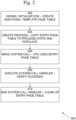
- FIG. 2 An exemplary flow diagram of a process of operation 200 of embodiments of the present systems and methods is shown in Fig. 2 . It is best viewed in conjunction with Fig. 1 .
- Process 200 begins with 202, in which, during the Linux kernel initialization, an additional template system call page table 126, shown in Fig. 3 , is rmarbe created.
- the template system call page table 126 may be used to create a functional system call page table 104 for execution of the system call handlers in an isolated address space.
- the template system call page table 126 may have mappings 128 of the kernel code and data that are required to perform the entry to the kernel (privileged) mode upon execution of a system call, the table with the pointers to the system call handlers, and the entry code of each system call handler in syscall entry page table 122.
- template system call page table 126 may have a populated kernel entry page table 120 and an empty user-space page table 118.
- the template system call page table 126 is copied to the process state representation to form an operational system call page table 104.
- the empty user-space page table 118 of the per-process system call page table 104 is populated with user-space mappings in the same way as the normal process page table.
- a user-space process may execute a system call.
- the CPU may transition to the kernel (privileged) mode and invokes a generic system call entry routine. This routing may switch the CPU page table pointer register to use the system call page table 104 for that process, and jumps to a particular system call handler.
- any access to the kernel-space kernel code and/or data may cause a page fault.
- the page fault handler of security block 124 verifies whether the requested memory access is safe or allowed. If the access if found to be safe or allowed, a mapping of the requested memory range is added to the per-process system call page table 104. If the access is considered unsafe or not allowed, the user-space process may be terminated and/or other security action may be taken.
- control is transferred back to the generic system call entry routine.
- This routine cleans up the per-process system call page table 104 and removes the mappings added during the execution of the system call handler
- Computer system 300 may be implemented using one or more programmed general-purpose computer systems, such as embedded processors, systems on a chip, personal computers, workstations, server systems, and minicomputers or mainframe computers, or in distributed, networked computing environments.
- Computer system 300 may include one or more processors (CPUs) 302A-302N, input/output circuitry 304, network adapter 306, and memory 308.
- CPUs 302A-302N execute program instructions in order to carry out the functions of the present communications systems and methods.
- CPUs 302A-302N are one or more microprocessors, such as an INTEL CORE ® processor.
- Fig. 3 illustrates an embodiment in which computer system 300 is implemented as a single multi-processor computer system, in which multiple processors 302A-302N share system resources, such as memory 308, input/output circuitry 304, and network adapter 306.
- system resources such as memory 308, input/output circuitry 304, and network adapter 306.
- the present communications systems and methods also include embodiments in which computer system 300 is implemented as a plurality of networked computer systems, which may be single-processor computer systems, multi-processor computer systems, or a mix thereof.
- Input/output circuitry 304 provides the capability to input data to, or output data from, computer system 300.
- input/output circuitry may include input devices, such as keyboards, mice, touchpads, trackballs, scanners, analog to digital converters, etc., output devices, such as video adapters, monitors, printers, etc., and input/output devices, such as, modems, etc.
- Network adapter 306 interfaces device 300 with a network 310.
- Network 310 may be any public or proprietary LAN or WAN, including, but not limited to the Internet.
- Memory 308 stores program instructions that are executed by, and data that are used and processed by, CPU 302 to perform the functions of computer system 300.
- Memory 308 may include, for example, electronic memory devices, such as random-access memory (RAM), read-only memory (ROM), programmable read-only memory (PROM), electrically erasable programmable read-only memory (EEPROM), flash memory, etc., and electro-mechanical memory, such as magnetic disk drives, tape drives, optical disk drives, etc., which may use an integrated drive electronics (IDE) interface, or a variation or enhancement thereof, such as enhanced IDE (EIDE) or ultra-direct memory access (UDMA), or a small computer system interface (SCSI) based interface, or a variation or enhancement thereof, such as fast-SCSI, wide-SCSI, fast and wide-SCSI, etc., or Serial Advanced Technology Attachment (SATA), or a variation or enhancement thereof, or a fiber channel-arbitrated loop (FC-AL) interface.
- RAM random-access memory
- ROM read-only memory
- memory 308 may vary depending upon the function that computer system 300 is programmed to perform.
- exemplary memory contents are shown representing routines and data for embodiments of the processes described above.
- routines along with the memory contents related to those routines, may not be included on one system or device, but rather may be distributed among a plurality of systems or devices, based on well-known engineering considerations.
- the present communications systems and methods may include any and all such arrangements.
- kernel-space 312 may include kernel-space 312, user-space 314, security block routines 324, and other operating system routines 322.
- Kernel-space 312 may include code and data that resides in an elevated system state, and which may include a protected memory space and full access to the hardware. Kernel-space 312 may include kernel page tables 316, system call (syscall) page tables 318, and template system call page table 320. Kernel page tables 316 may be associated with a particular user process and may include user space page table 108, kernel entry page table 110, and kernel space page table 112, as shown in Fig. 1 and described above.
- System call page tables 318 may expand the user process visible mappings with an additional syscall entry page table 122, shown in Fig 1 and described above.
- Template system call page table 320 may be used to create a functional system call page table 104 for execution of the system call handlers in an isolated address space, as described above.
- User-space 314 may include user applications, programs, tasks, processes, etc., which may execute with reduced privileges, in which they can access only a subset of the available resources of the hardware and software.
- User-space 314 may include user page tables 322, which may map to user-space unprivileged accesses.
- Security block routines 324 may verify that any accesses made using system call page tables 318 are safe or allowed. Other operating system routines 322 may provide additional system functionality.
- the present communications systems and methods may include implementation on a system or systems that provide multi-processor, multi-tasking, multi-process, and/or multi-thread computing, as well as implementation on systems that provide only single processor, single thread computing.
- Multi-processor computing involves performing computing using more than one processor.
- Multi-tasking computing involves performing computing using more than one operating system task.
- a task is an operating system concept that refers to the combination of a program being executed and bookkeeping information used by the operating system. Whenever a program is executed, the operating system creates a new task for it. The task is like an envelope for the program in that it identifies the program with a task number and attaches other bookkeeping information to it.
- Multi-tasking is the ability of an operating system to execute more than one executable at the same time.
- Each executable is running in its own address space, meaning that the executables have no way to share any of their memory. This has advantages, because it is impossible for any program to damage the execution of any of the other programs running on the system. However, the programs have no way to exchange any information except through the operating system (or by reading files stored on the file system).
- Multi-process computing is similar to multi-tasking computing, as the terms task and process are often used interchangeably, although some operating systems make a distinction between the two.
- the present invention may be a system, a method, and/or a computer program product at any possible technical detail level of integration
- the computer program product may include a computer readable storage medium (or media) having computer readable program instructions thereon for causing a processor to carry out aspects of the present invention.
- the computer readable storage medium can be a tangible device that can retain and store instructions for use by an instruction execution device.
- the computer readable storage medium may be, for example, but is not limited to, an electronic storage device, a magnetic storage device, an optical storage device, an electromagnetic storage device, a semiconductor storage device, or any suitable combination of the foregoing.
- a non-exhaustive list of more specific examples of the computer readable storage medium includes the following: a portable computer diskette, a hard disk, a random access memory (RAM), a read-only memory (ROM), an erasable programmable read-only memory (EPROM or Flash memory), a static random access memory (SRAM), a portable compact disc read-only memory (CD-ROM), a digital versatile disk (DVD), a memory stick, a floppy disk, a mechanically encoded device such as punch-cards or raised structures in a groove having instructions recorded thereon, and any suitable combination of the foregoing.
- a computer readable storage medium is not to be construed as being transitory signals per se, such as radio waves or other freely propagating electromagnetic waves, electromagnetic waves propagating through a waveguide or other transmission media (e.g., light pulses passing through a fiber-optic cable), or electrical signals transmitted through a wire.
- Computer readable program instructions described herein can be downloaded to respective computing/processing devices from a computer readable storage medium or to an external computer or external storage device via a network, for example, the Internet, a local area network, a wide area network and/or a wireless network.
- the network may comprise copper transmission cables, optical transmission fibers, wireless transmission, routers, firewalls, switches, gateway computers, and/or edge servers.
- a network adapter card or network interface in each computing/processing device receives computer readable program instructions from the network and forwards the computer readable program instructions for storage in a computer readable storage medium within the respective computing/processing device.
- Computer readable program instructions for carrying out operations of the present invention may be assembler instructions, instruction-set-architecture (ISA) instructions, machine instructions, machine dependent instructions, microcode, firmware instructions, state-setting data, configuration data for integrated circuitry, or either source code or object code written in any combination of one or more programming languages, including an object oriented programming language such as Smalltalk, C++, or the like, and procedural programming languages, such as the "C" programming language or similar programming languages.
- the computer readable program instructions may execute entirely on the user's computer, partly on the user's computer, as a stand-alone software package, partly on the user's computer and partly on a remote computer or entirely on the remote computer or server.
- the remote computer may be connected to the user's computer through any type of network, including a local area network (LAN) or a wide area network (WAN), or the connection may be made to an external computer (for example, through the Internet using an Internet Service Provider).
- electronic circuitry including, for example, programmable logic circuitry, field-programmable gate arrays (FPGA), or programmable logic arrays (PLA) may execute the computer readable program instructions by utilizing state information of the computer readable program instructions to personalize the electronic circuitry, in order to perform aspects of the present invention.
- These computer readable program instructions may be provided to a processor of a general-purpose computer, special purpose computer, or other programmable data processing apparatus to produce a machine, such that the instructions, which execute via the processor of the computer or other programmable data processing apparatus, create means for implementing the functions/acts specified in the flowchart and/or block diagram block or blocks.
- These computer readable program instructions may also be stored in a computer readable storage medium that can direct a computer, a programmable data processing apparatus, and/or other devices to function in a particular manner, such that the computer readable storage medium having instructions stored therein comprises an article of manufacture including instructions which implement aspects of the function/act specified in the flowchart and/or block diagram block or blocks.
- the computer readable program instructions may also be loaded onto a computer, other programmable data processing apparatus, or other device to cause a series of operational steps to be performed on the computer, other programmable apparatus or other device to produce a computer implemented process, such that the instructions which execute on the computer, other programmable apparatus, or other device implement the functions/acts specified in the flowchart and/or block diagram block or blocks.
- each block in the flowchart or block diagrams may represent a module, segment, or portion of instructions, which comprises one or more executable instructions for implementing the specified logical function(s).
- the functions noted in the blocks may occur out of the order noted in the Figures.
- two blocks shown in succession may, in fact, be executed substantially concurrently, or the blocks may sometimes be executed in the reverse order, depending upon the functionality involved.
Landscapes
- Engineering & Computer Science (AREA)
- Theoretical Computer Science (AREA)
- Software Systems (AREA)
- General Physics & Mathematics (AREA)
- Physics & Mathematics (AREA)
- General Engineering & Computer Science (AREA)
- Computer Security & Cryptography (AREA)
- Computer Hardware Design (AREA)
- Health & Medical Sciences (AREA)
- Bioethics (AREA)
- General Health & Medical Sciences (AREA)
- Databases & Information Systems (AREA)
- Storage Device Security (AREA)
- Bus Control (AREA)
- Hardware Redundancy (AREA)
Applications Claiming Priority (2)
| Application Number | Priority Date | Filing Date | Title |
|---|---|---|---|
| US16/416,229 US11194639B2 (en) | 2019-05-19 | 2019-05-19 | Executing system calls in isolated address space in operating system kernel |
| PCT/EP2020/063618 WO2020234155A1 (en) | 2019-05-19 | 2020-05-15 | Executing system calls in isolated address space in operating system kernel |
Publications (2)
| Publication Number | Publication Date |
|---|---|
| EP3973393A1 EP3973393A1 (en) | 2022-03-30 |
| EP3973393B1 true EP3973393B1 (en) | 2024-08-07 |
Family
ID=70779711
Family Applications (1)
| Application Number | Title | Priority Date | Filing Date |
|---|---|---|---|
| EP20727198.2A Active EP3973393B1 (en) | 2019-05-19 | 2020-05-15 | Executing system calls in isolated address space in operating system kernel |
Country Status (12)
| Country | Link |
|---|---|
| US (1) | US11194639B2 (https=) |
| EP (1) | EP3973393B1 (https=) |
| JP (1) | JP7546602B2 (https=) |
| KR (1) | KR102612503B1 (https=) |
| CN (1) | CN113711182B (https=) |
| AU (1) | AU2020277632B2 (https=) |
| BR (1) | BR112021023258A2 (https=) |
| CA (1) | CA3137259A1 (https=) |
| IL (1) | IL288057B2 (https=) |
| MX (1) | MX2021013230A (https=) |
| SG (1) | SG11202110222XA (https=) |
| WO (1) | WO2020234155A1 (https=) |
Families Citing this family (7)
| Publication number | Priority date | Publication date | Assignee | Title |
|---|---|---|---|---|
| US11799741B2 (en) * | 2019-10-29 | 2023-10-24 | Fannie Mae | Systems and methods for enterprise information technology (IT) monitoring |
| US11586727B2 (en) * | 2021-03-29 | 2023-02-21 | Red Hat, Inc. | Systems and methods for preventing kernel stalling attacks |
| CN114048502B (zh) * | 2021-10-15 | 2023-08-15 | 中国科学院信息工程研究所 | 一种轻量级可信通道及其通信控制方法 |
| CN116204884A (zh) * | 2021-11-30 | 2023-06-02 | 华为技术有限公司 | 内核保护方法、装置及系统 |
| US12254079B2 (en) * | 2022-05-10 | 2025-03-18 | International Business Machines Corporation | Providing system services |
| CN117573419B (zh) * | 2024-01-16 | 2024-04-26 | 上海芯联芯智能科技有限公司 | 一种页面异常处理方法及装置 |
| CN119004420B (zh) * | 2024-10-23 | 2025-08-15 | 浙江大华技术股份有限公司 | 一种权限控制方法、权限控制装置以及计算机存储介质 |
Family Cites Families (21)
| Publication number | Priority date | Publication date | Assignee | Title |
|---|---|---|---|---|
| US7496576B2 (en) | 2006-03-30 | 2009-02-24 | Microsoft Corporation | Isolated access to named resources |
| KR20080104591A (ko) * | 2007-05-28 | 2008-12-03 | 삼성전자주식회사 | 메모리 보호 방법 및 장치 |
| US10019327B1 (en) | 2008-12-15 | 2018-07-10 | Open Invention Network Llc | System and method for hybrid kernel- and user-space incremental and full checkpointing |
| US9354977B1 (en) | 2008-12-15 | 2016-05-31 | Open Invention Network Llc | System and method for hybrid kernel- and user-space incremental and full checkpointing |
| US8627451B2 (en) | 2009-08-21 | 2014-01-07 | Red Hat, Inc. | Systems and methods for providing an isolated execution environment for accessing untrusted content |
| US8533418B2 (en) * | 2010-06-30 | 2013-09-10 | International Business Machines Corporation | Memory allocation with identification of requesting loadable kernel module |
| US8677354B2 (en) | 2010-07-12 | 2014-03-18 | International Business Machines Corporation | Controlling kernel symbol visibility and accessibility across operating system linkage spaces |
| US9323921B2 (en) | 2010-07-13 | 2016-04-26 | Microsoft Technology Licensing, Llc | Ultra-low cost sandboxing for application appliances |
| US8954697B2 (en) * | 2010-08-05 | 2015-02-10 | Red Hat, Inc. | Access to shared memory segments by multiple application processes |
| WO2012106908A1 (zh) * | 2011-07-20 | 2012-08-16 | 华为技术有限公司 | 多处理器体系结构远端内存访问的模拟方法及模拟器 |
| US9152548B2 (en) * | 2012-01-17 | 2015-10-06 | Vmware, Inc. | Controlling access to a privileged resource in user-mode system level mobile virtualization using a ptrace () system call |
| US9529614B2 (en) * | 2012-03-05 | 2016-12-27 | Board Of Regents The University Of Texas Systems | Automatically bridging the semantic gap in machine introspection |
| CN102681940B (zh) * | 2012-05-15 | 2015-06-10 | 北京航空航天大学 | 一种针对Linux操作系统内存管理子系统进行性能测试的方法 |
| US10585801B2 (en) * | 2012-11-26 | 2020-03-10 | Advanced Micro Devices, Inc. | Prefetch kernels on a graphics processing unit |
| US9910689B2 (en) * | 2013-11-26 | 2018-03-06 | Dynavisor, Inc. | Dynamic single root I/O virtualization (SR-IOV) processes system calls request to devices attached to host |
| US9628279B2 (en) * | 2014-09-30 | 2017-04-18 | Microsoft Technology Licensing, Llc | Protecting application secrets from operating system attacks |
| US10192067B2 (en) | 2016-05-26 | 2019-01-29 | Microsoft Technology Licensing, Llc | Self-described security model for resource access |
| US11188365B2 (en) * | 2016-11-29 | 2021-11-30 | Red Hat, Inc. | Memory overcommit by speculative fault |
| US10324838B2 (en) * | 2017-10-12 | 2019-06-18 | International Business Machines Corporation | Virtually addressable hardware global kernel segment table |
| US10599835B2 (en) * | 2018-02-06 | 2020-03-24 | Vmware, Inc. | 32-bit address space containment to secure processes from speculative rogue cache loads |
| US10698637B2 (en) * | 2018-07-03 | 2020-06-30 | Oracle International Corporation | Stale block resynchronization in NVM based systems |
-
2019
- 2019-05-19 US US16/416,229 patent/US11194639B2/en not_active Expired - Fee Related
-
2020
- 2020-05-15 JP JP2021568575A patent/JP7546602B2/ja active Active
- 2020-05-15 WO PCT/EP2020/063618 patent/WO2020234155A1/en not_active Ceased
- 2020-05-15 CN CN202080029768.5A patent/CN113711182B/zh active Active
- 2020-05-15 IL IL288057A patent/IL288057B2/en unknown
- 2020-05-15 BR BR112021023258A patent/BR112021023258A2/pt unknown
- 2020-05-15 MX MX2021013230A patent/MX2021013230A/es unknown
- 2020-05-15 KR KR1020217034428A patent/KR102612503B1/ko active Active
- 2020-05-15 AU AU2020277632A patent/AU2020277632B2/en active Active
- 2020-05-15 EP EP20727198.2A patent/EP3973393B1/en active Active
- 2020-05-15 SG SG11202110222XA patent/SG11202110222XA/en unknown
- 2020-05-15 CA CA3137259A patent/CA3137259A1/en active Pending
Also Published As
| Publication number | Publication date |
|---|---|
| EP3973393A1 (en) | 2022-03-30 |
| KR20210141682A (ko) | 2021-11-23 |
| AU2020277632B2 (en) | 2023-07-06 |
| CA3137259A1 (en) | 2020-11-26 |
| KR102612503B1 (ko) | 2023-12-08 |
| IL288057A (en) | 2022-01-01 |
| CN113711182A (zh) | 2021-11-26 |
| AU2020277632A1 (en) | 2021-10-14 |
| JP2022534685A (ja) | 2022-08-03 |
| CN113711182B (zh) | 2025-02-11 |
| IL288057B2 (en) | 2024-06-01 |
| IL288057B1 (en) | 2024-02-01 |
| BR112021023258A2 (pt) | 2022-01-04 |
| US11194639B2 (en) | 2021-12-07 |
| SG11202110222XA (en) | 2021-10-28 |
| US20200364101A1 (en) | 2020-11-19 |
| WO2020234155A1 (en) | 2020-11-26 |
| JP7546602B2 (ja) | 2024-09-06 |
| MX2021013230A (es) | 2022-01-06 |
Similar Documents
| Publication | Publication Date | Title |
|---|---|---|
| EP3973393B1 (en) | Executing system calls in isolated address space in operating system kernel | |
| US10033759B1 (en) | System and method of threat detection under hypervisor control | |
| Peinado et al. | NGSCB: A trusted open system | |
| US11755753B2 (en) | Mechanism to enable secure memory sharing between enclaves and I/O adapters | |
| US10255088B2 (en) | Modification of write-protected memory using code patching | |
| US10810305B2 (en) | Securing untrusted code using memory protection key and control flow integrity | |
| US10083129B2 (en) | Code loading hardening by hypervisor page table switching | |
| US11341241B2 (en) | Enhancing memory safe programming using a page frame tag mechanism | |
| US10885206B2 (en) | Protecting enterprise data at each system layer | |
| JP7784897B2 (ja) | モノリシック・カーネルのための制限された実行環境 | |
| Weisberg et al. | Enhancing Transportation System Networks Reliability by Securer Operating System | |
| US9158710B2 (en) | Page coloring with color inheritance for memory pages | |
| Jungwirth et al. | OS Friendly Microprocessor Architecture | |
| Loiacono | The Hypervisor Advantage | |
| RU2609761C1 (ru) | Способ выполнения кода в режиме гипервизора |
Legal Events
| Date | Code | Title | Description |
|---|---|---|---|
| STAA | Information on the status of an ep patent application or granted ep patent |
Free format text: STATUS: UNKNOWN |
|
| STAA | Information on the status of an ep patent application or granted ep patent |
Free format text: STATUS: THE INTERNATIONAL PUBLICATION HAS BEEN MADE |
|
| PUAI | Public reference made under article 153(3) epc to a published international application that has entered the european phase |
Free format text: ORIGINAL CODE: 0009012 |
|
| STAA | Information on the status of an ep patent application or granted ep patent |
Free format text: STATUS: REQUEST FOR EXAMINATION WAS MADE |
|
| 17P | Request for examination filed |
Effective date: 20211207 |
|
| AK | Designated contracting states |
Kind code of ref document: A1 Designated state(s): AL AT BE BG CH CY CZ DE DK EE ES FI FR GB GR HR HU IE IS IT LI LT LU LV MC MK MT NL NO PL PT RO RS SE SI SK SM TR |
|
| STAA | Information on the status of an ep patent application or granted ep patent |
Free format text: STATUS: EXAMINATION IS IN PROGRESS |
|
| 17Q | First examination report despatched |
Effective date: 20220607 |
|
| DAV | Request for validation of the european patent (deleted) | ||
| DAX | Request for extension of the european patent (deleted) | ||
| REG | Reference to a national code |
Ref country code: DE Ref legal event code: R079 Free format text: PREVIOUS MAIN CLASS: G06F0009460000 Ipc: G06F0012100900 Ref document number: 602020035294 Country of ref document: DE |
|
| GRAJ | Information related to disapproval of communication of intention to grant by the applicant or resumption of examination proceedings by the epo deleted |
Free format text: ORIGINAL CODE: EPIDOSDIGR1 |
|
| GRAP | Despatch of communication of intention to grant a patent |
Free format text: ORIGINAL CODE: EPIDOSNIGR1 |
|
| GRAJ | Information related to disapproval of communication of intention to grant by the applicant or resumption of examination proceedings by the epo deleted |
Free format text: ORIGINAL CODE: EPIDOSDIGR1 |
|
| GRAP | Despatch of communication of intention to grant a patent |
Free format text: ORIGINAL CODE: EPIDOSNIGR1 |
|
| GRAP | Despatch of communication of intention to grant a patent |
Free format text: ORIGINAL CODE: EPIDOSNIGR1 |
|
| STAA | Information on the status of an ep patent application or granted ep patent |
Free format text: STATUS: GRANT OF PATENT IS INTENDED |
|
| RIC1 | Information provided on ipc code assigned before grant |
Ipc: G06F 21/62 20130101ALI20240412BHEP Ipc: G06F 12/14 20060101ALI20240412BHEP Ipc: G06F 9/54 20060101ALI20240412BHEP Ipc: G06F 9/46 20060101ALI20240412BHEP Ipc: G06F 12/1009 20160101AFI20240412BHEP |
|
| RIN1 | Information on inventor provided before grant (corrected) |
Inventor name: BOTTOMLEY, JAMES Inventor name: NIDER, JOEL KELLY Inventor name: RAPOPORT, MICHAEL |
|
| INTG | Intention to grant announced |
Effective date: 20240429 |
|
| GRAS | Grant fee paid |
Free format text: ORIGINAL CODE: EPIDOSNIGR3 |
|
| GRAA | (expected) grant |
Free format text: ORIGINAL CODE: 0009210 |
|
| STAA | Information on the status of an ep patent application or granted ep patent |
Free format text: STATUS: THE PATENT HAS BEEN GRANTED |
|
| AK | Designated contracting states |
Kind code of ref document: B1 Designated state(s): AL AT BE BG CH CY CZ DE DK EE ES FI FR GB GR HR HU IE IS IT LI LT LU LV MC MK MT NL NO PL PT RO RS SE SI SK SM TR |
|
| REG | Reference to a national code |
Ref country code: GB Ref legal event code: FG4D |
|
| REG | Reference to a national code |
Ref country code: CH Ref legal event code: EP |
|
| REG | Reference to a national code |
Ref country code: IE Ref legal event code: FG4D |
|
| REG | Reference to a national code |
Ref country code: DE Ref legal event code: R096 Ref document number: 602020035294 Country of ref document: DE |
|
| REG | Reference to a national code |
Ref country code: DE Ref legal event code: R084 Ref document number: 602020035294 Country of ref document: DE |
|
| P01 | Opt-out of the competence of the unified patent court (upc) registered |
Free format text: CASE NUMBER: APP_47984/2024 Effective date: 20240821 |
|
| REG | Reference to a national code |
Ref country code: GB Ref legal event code: 746 Effective date: 20240829 |
|
| REG | Reference to a national code |
Ref country code: LT Ref legal event code: MG9D |
|
| REG | Reference to a national code |
Ref country code: NL Ref legal event code: MP Effective date: 20240807 |
|
| PG25 | Lapsed in a contracting state [announced via postgrant information from national office to epo] |
Ref country code: NO Free format text: LAPSE BECAUSE OF FAILURE TO SUBMIT A TRANSLATION OF THE DESCRIPTION OR TO PAY THE FEE WITHIN THE PRESCRIBED TIME-LIMIT Effective date: 20241107 |
|
| REG | Reference to a national code |
Ref country code: AT Ref legal event code: MK05 Ref document number: 1711699 Country of ref document: AT Kind code of ref document: T Effective date: 20240807 |
|
| PG25 | Lapsed in a contracting state [announced via postgrant information from national office to epo] |
Ref country code: NL Free format text: LAPSE BECAUSE OF FAILURE TO SUBMIT A TRANSLATION OF THE DESCRIPTION OR TO PAY THE FEE WITHIN THE PRESCRIBED TIME-LIMIT Effective date: 20240807 Ref country code: FI Free format text: LAPSE BECAUSE OF FAILURE TO SUBMIT A TRANSLATION OF THE DESCRIPTION OR TO PAY THE FEE WITHIN THE PRESCRIBED TIME-LIMIT Effective date: 20240807 Ref country code: PL Free format text: LAPSE BECAUSE OF FAILURE TO SUBMIT A TRANSLATION OF THE DESCRIPTION OR TO PAY THE FEE WITHIN THE PRESCRIBED TIME-LIMIT Effective date: 20240807 Ref country code: PT Free format text: LAPSE BECAUSE OF FAILURE TO SUBMIT A TRANSLATION OF THE DESCRIPTION OR TO PAY THE FEE WITHIN THE PRESCRIBED TIME-LIMIT Effective date: 20241209 Ref country code: GR Free format text: LAPSE BECAUSE OF FAILURE TO SUBMIT A TRANSLATION OF THE DESCRIPTION OR TO PAY THE FEE WITHIN THE PRESCRIBED TIME-LIMIT Effective date: 20241108 |
|
| PG25 | Lapsed in a contracting state [announced via postgrant information from national office to epo] |
Ref country code: BG Free format text: LAPSE BECAUSE OF FAILURE TO SUBMIT A TRANSLATION OF THE DESCRIPTION OR TO PAY THE FEE WITHIN THE PRESCRIBED TIME-LIMIT Effective date: 20240807 |
|
| PG25 | Lapsed in a contracting state [announced via postgrant information from national office to epo] |
Ref country code: LV Free format text: LAPSE BECAUSE OF FAILURE TO SUBMIT A TRANSLATION OF THE DESCRIPTION OR TO PAY THE FEE WITHIN THE PRESCRIBED TIME-LIMIT Effective date: 20240807 |
|
| PG25 | Lapsed in a contracting state [announced via postgrant information from national office to epo] |
Ref country code: IS Free format text: LAPSE BECAUSE OF FAILURE TO SUBMIT A TRANSLATION OF THE DESCRIPTION OR TO PAY THE FEE WITHIN THE PRESCRIBED TIME-LIMIT Effective date: 20241207 Ref country code: AT Free format text: LAPSE BECAUSE OF FAILURE TO SUBMIT A TRANSLATION OF THE DESCRIPTION OR TO PAY THE FEE WITHIN THE PRESCRIBED TIME-LIMIT Effective date: 20240807 |
|
| PG25 | Lapsed in a contracting state [announced via postgrant information from national office to epo] |
Ref country code: HR Free format text: LAPSE BECAUSE OF FAILURE TO SUBMIT A TRANSLATION OF THE DESCRIPTION OR TO PAY THE FEE WITHIN THE PRESCRIBED TIME-LIMIT Effective date: 20240807 |
|
| PG25 | Lapsed in a contracting state [announced via postgrant information from national office to epo] |
Ref country code: ES Free format text: LAPSE BECAUSE OF FAILURE TO SUBMIT A TRANSLATION OF THE DESCRIPTION OR TO PAY THE FEE WITHIN THE PRESCRIBED TIME-LIMIT Effective date: 20240807 Ref country code: RS Free format text: LAPSE BECAUSE OF FAILURE TO SUBMIT A TRANSLATION OF THE DESCRIPTION OR TO PAY THE FEE WITHIN THE PRESCRIBED TIME-LIMIT Effective date: 20241107 |
|
| PG25 | Lapsed in a contracting state [announced via postgrant information from national office to epo] |
Ref country code: RS Free format text: LAPSE BECAUSE OF FAILURE TO SUBMIT A TRANSLATION OF THE DESCRIPTION OR TO PAY THE FEE WITHIN THE PRESCRIBED TIME-LIMIT Effective date: 20241107 Ref country code: PT Free format text: LAPSE BECAUSE OF FAILURE TO SUBMIT A TRANSLATION OF THE DESCRIPTION OR TO PAY THE FEE WITHIN THE PRESCRIBED TIME-LIMIT Effective date: 20241209 Ref country code: PL Free format text: LAPSE BECAUSE OF FAILURE TO SUBMIT A TRANSLATION OF THE DESCRIPTION OR TO PAY THE FEE WITHIN THE PRESCRIBED TIME-LIMIT Effective date: 20240807 Ref country code: NO Free format text: LAPSE BECAUSE OF FAILURE TO SUBMIT A TRANSLATION OF THE DESCRIPTION OR TO PAY THE FEE WITHIN THE PRESCRIBED TIME-LIMIT Effective date: 20241107 Ref country code: NL Free format text: LAPSE BECAUSE OF FAILURE TO SUBMIT A TRANSLATION OF THE DESCRIPTION OR TO PAY THE FEE WITHIN THE PRESCRIBED TIME-LIMIT Effective date: 20240807 Ref country code: LV Free format text: LAPSE BECAUSE OF FAILURE TO SUBMIT A TRANSLATION OF THE DESCRIPTION OR TO PAY THE FEE WITHIN THE PRESCRIBED TIME-LIMIT Effective date: 20240807 Ref country code: IS Free format text: LAPSE BECAUSE OF FAILURE TO SUBMIT A TRANSLATION OF THE DESCRIPTION OR TO PAY THE FEE WITHIN THE PRESCRIBED TIME-LIMIT Effective date: 20241207 Ref country code: HR Free format text: LAPSE BECAUSE OF FAILURE TO SUBMIT A TRANSLATION OF THE DESCRIPTION OR TO PAY THE FEE WITHIN THE PRESCRIBED TIME-LIMIT Effective date: 20240807 Ref country code: GR Free format text: LAPSE BECAUSE OF FAILURE TO SUBMIT A TRANSLATION OF THE DESCRIPTION OR TO PAY THE FEE WITHIN THE PRESCRIBED TIME-LIMIT Effective date: 20241108 Ref country code: FI Free format text: LAPSE BECAUSE OF FAILURE TO SUBMIT A TRANSLATION OF THE DESCRIPTION OR TO PAY THE FEE WITHIN THE PRESCRIBED TIME-LIMIT Effective date: 20240807 Ref country code: ES Free format text: LAPSE BECAUSE OF FAILURE TO SUBMIT A TRANSLATION OF THE DESCRIPTION OR TO PAY THE FEE WITHIN THE PRESCRIBED TIME-LIMIT Effective date: 20240807 Ref country code: BG Free format text: LAPSE BECAUSE OF FAILURE TO SUBMIT A TRANSLATION OF THE DESCRIPTION OR TO PAY THE FEE WITHIN THE PRESCRIBED TIME-LIMIT Effective date: 20240807 Ref country code: AT Free format text: LAPSE BECAUSE OF FAILURE TO SUBMIT A TRANSLATION OF THE DESCRIPTION OR TO PAY THE FEE WITHIN THE PRESCRIBED TIME-LIMIT Effective date: 20240807 |
|
| PG25 | Lapsed in a contracting state [announced via postgrant information from national office to epo] |
Ref country code: SM Free format text: LAPSE BECAUSE OF FAILURE TO SUBMIT A TRANSLATION OF THE DESCRIPTION OR TO PAY THE FEE WITHIN THE PRESCRIBED TIME-LIMIT Effective date: 20240807 Ref country code: DK Free format text: LAPSE BECAUSE OF FAILURE TO SUBMIT A TRANSLATION OF THE DESCRIPTION OR TO PAY THE FEE WITHIN THE PRESCRIBED TIME-LIMIT Effective date: 20240807 |
|
| PG25 | Lapsed in a contracting state [announced via postgrant information from national office to epo] |
Ref country code: EE Free format text: LAPSE BECAUSE OF FAILURE TO SUBMIT A TRANSLATION OF THE DESCRIPTION OR TO PAY THE FEE WITHIN THE PRESCRIBED TIME-LIMIT Effective date: 20240807 |
|
| PG25 | Lapsed in a contracting state [announced via postgrant information from national office to epo] |
Ref country code: CZ Free format text: LAPSE BECAUSE OF FAILURE TO SUBMIT A TRANSLATION OF THE DESCRIPTION OR TO PAY THE FEE WITHIN THE PRESCRIBED TIME-LIMIT Effective date: 20240807 |
|
| PG25 | Lapsed in a contracting state [announced via postgrant information from national office to epo] |
Ref country code: SK Free format text: LAPSE BECAUSE OF FAILURE TO SUBMIT A TRANSLATION OF THE DESCRIPTION OR TO PAY THE FEE WITHIN THE PRESCRIBED TIME-LIMIT Effective date: 20240807 |
|
| REG | Reference to a national code |
Ref country code: DE Ref legal event code: R097 Ref document number: 602020035294 Country of ref document: DE |
|
| PLBE | No opposition filed within time limit |
Free format text: ORIGINAL CODE: 0009261 |
|
| STAA | Information on the status of an ep patent application or granted ep patent |
Free format text: STATUS: NO OPPOSITION FILED WITHIN TIME LIMIT |
|
| PGFP | Annual fee paid to national office [announced via postgrant information from national office to epo] |
Ref country code: DE Payment date: 20250414 Year of fee payment: 6 |
|
| 26N | No opposition filed |
Effective date: 20250508 |
|
| PGFP | Annual fee paid to national office [announced via postgrant information from national office to epo] |
Ref country code: FR Payment date: 20250527 Year of fee payment: 6 |
|
| PG25 | Lapsed in a contracting state [announced via postgrant information from national office to epo] |
Ref country code: SE Free format text: LAPSE BECAUSE OF FAILURE TO SUBMIT A TRANSLATION OF THE DESCRIPTION OR TO PAY THE FEE WITHIN THE PRESCRIBED TIME-LIMIT Effective date: 20240807 |
|
| REG | Reference to a national code |
Ref country code: CH Ref legal event code: H13 Free format text: ST27 STATUS EVENT CODE: U-0-0-H10-H13 (AS PROVIDED BY THE NATIONAL OFFICE) Effective date: 20251223 |
|
| PG25 | Lapsed in a contracting state [announced via postgrant information from national office to epo] |
Ref country code: LU Free format text: LAPSE BECAUSE OF NON-PAYMENT OF DUE FEES Effective date: 20250515 |
|
| PG25 | Lapsed in a contracting state [announced via postgrant information from national office to epo] |
Ref country code: CH Free format text: LAPSE BECAUSE OF NON-PAYMENT OF DUE FEES Effective date: 20250531 |
|
| PG25 | Lapsed in a contracting state [announced via postgrant information from national office to epo] |
Ref country code: IT Free format text: LAPSE BECAUSE OF FAILURE TO SUBMIT A TRANSLATION OF THE DESCRIPTION OR TO PAY THE FEE WITHIN THE PRESCRIBED TIME-LIMIT Effective date: 20240807 |
|
| REG | Reference to a national code |
Ref country code: BE Ref legal event code: MM Effective date: 20250531 |
|
| PG25 | Lapsed in a contracting state [announced via postgrant information from national office to epo] |
Ref country code: MC Free format text: LAPSE BECAUSE OF FAILURE TO SUBMIT A TRANSLATION OF THE DESCRIPTION OR TO PAY THE FEE WITHIN THE PRESCRIBED TIME-LIMIT Effective date: 20240807 |
|
| PGFP | Annual fee paid to national office [announced via postgrant information from national office to epo] |
Ref country code: GB Payment date: 20260319 Year of fee payment: 7 |
|
| PG25 | Lapsed in a contracting state [announced via postgrant information from national office to epo] |
Ref country code: IE Free format text: LAPSE BECAUSE OF NON-PAYMENT OF DUE FEES Effective date: 20250515 |
|
| PG25 | Lapsed in a contracting state [announced via postgrant information from national office to epo] |
Ref country code: RO Free format text: LAPSE BECAUSE OF FAILURE TO SUBMIT A TRANSLATION OF THE DESCRIPTION OR TO PAY THE FEE WITHIN THE PRESCRIBED TIME-LIMIT Effective date: 20240807 Ref country code: BE Free format text: LAPSE BECAUSE OF NON-PAYMENT OF DUE FEES Effective date: 20250531 |