EP3972246B1 - Verfahren zur kodierung und dekodierung von bildern, vorrichtung zur kodierung und dekodierung von bildern und entsprechende computerprogramme - Google Patents
Verfahren zur kodierung und dekodierung von bildern, vorrichtung zur kodierung und dekodierung von bildern und entsprechende computerprogramme Download PDFInfo
- Publication number
- EP3972246B1 EP3972246B1 EP21204503.3A EP21204503A EP3972246B1 EP 3972246 B1 EP3972246 B1 EP 3972246B1 EP 21204503 A EP21204503 A EP 21204503A EP 3972246 B1 EP3972246 B1 EP 3972246B1
- Authority
- EP
- European Patent Office
- Prior art keywords
- partition
- causal
- encoding
- parameter
- current
- Prior art date
- Legal status (The legal status is an assumption and is not a legal conclusion. Google has not performed a legal analysis and makes no representation as to the accuracy of the status listed.)
- Active
Links
Images




Classifications
-
- H—ELECTRICITY
- H04—ELECTRIC COMMUNICATION TECHNIQUE
- H04N—PICTORIAL COMMUNICATION, e.g. TELEVISION
- H04N19/00—Methods or arrangements for coding, decoding, compressing or decompressing digital video signals
- H04N19/10—Methods or arrangements for coding, decoding, compressing or decompressing digital video signals using adaptive coding
- H04N19/189—Methods or arrangements for coding, decoding, compressing or decompressing digital video signals using adaptive coding characterised by the adaptation method, adaptation tool or adaptation type used for the adaptive coding
- H04N19/19—Methods or arrangements for coding, decoding, compressing or decompressing digital video signals using adaptive coding characterised by the adaptation method, adaptation tool or adaptation type used for the adaptive coding using optimisation based on Lagrange multipliers
-
- H—ELECTRICITY
- H04—ELECTRIC COMMUNICATION TECHNIQUE
- H04N—PICTORIAL COMMUNICATION, e.g. TELEVISION
- H04N19/00—Methods or arrangements for coding, decoding, compressing or decompressing digital video signals
- H04N19/10—Methods or arrangements for coding, decoding, compressing or decompressing digital video signals using adaptive coding
- H04N19/102—Methods or arrangements for coding, decoding, compressing or decompressing digital video signals using adaptive coding characterised by the element, parameter or selection affected or controlled by the adaptive coding
- H04N19/103—Selection of coding mode or of prediction mode
-
- H—ELECTRICITY
- H04—ELECTRIC COMMUNICATION TECHNIQUE
- H04N—PICTORIAL COMMUNICATION, e.g. TELEVISION
- H04N19/00—Methods or arrangements for coding, decoding, compressing or decompressing digital video signals
- H04N19/10—Methods or arrangements for coding, decoding, compressing or decompressing digital video signals using adaptive coding
- H04N19/102—Methods or arrangements for coding, decoding, compressing or decompressing digital video signals using adaptive coding characterised by the element, parameter or selection affected or controlled by the adaptive coding
- H04N19/103—Selection of coding mode or of prediction mode
- H04N19/105—Selection of the reference unit for prediction within a chosen coding or prediction mode, e.g. adaptive choice of position and number of pixels used for prediction
-
- H—ELECTRICITY
- H04—ELECTRIC COMMUNICATION TECHNIQUE
- H04N—PICTORIAL COMMUNICATION, e.g. TELEVISION
- H04N19/00—Methods or arrangements for coding, decoding, compressing or decompressing digital video signals
- H04N19/10—Methods or arrangements for coding, decoding, compressing or decompressing digital video signals using adaptive coding
- H04N19/102—Methods or arrangements for coding, decoding, compressing or decompressing digital video signals using adaptive coding characterised by the element, parameter or selection affected or controlled by the adaptive coding
- H04N19/12—Selection from among a plurality of transforms or standards, e.g. selection between discrete cosine transform [DCT] and sub-band transform or selection between H.263 and H.264
-
- H—ELECTRICITY
- H04—ELECTRIC COMMUNICATION TECHNIQUE
- H04N—PICTORIAL COMMUNICATION, e.g. TELEVISION
- H04N19/00—Methods or arrangements for coding, decoding, compressing or decompressing digital video signals
- H04N19/10—Methods or arrangements for coding, decoding, compressing or decompressing digital video signals using adaptive coding
- H04N19/134—Methods or arrangements for coding, decoding, compressing or decompressing digital video signals using adaptive coding characterised by the element, parameter or criterion affecting or controlling the adaptive coding
- H04N19/146—Data rate or code amount at the encoder output
- H04N19/147—Data rate or code amount at the encoder output according to rate distortion criteria
-
- H—ELECTRICITY
- H04—ELECTRIC COMMUNICATION TECHNIQUE
- H04N—PICTORIAL COMMUNICATION, e.g. TELEVISION
- H04N19/00—Methods or arrangements for coding, decoding, compressing or decompressing digital video signals
- H04N19/10—Methods or arrangements for coding, decoding, compressing or decompressing digital video signals using adaptive coding
- H04N19/169—Methods or arrangements for coding, decoding, compressing or decompressing digital video signals using adaptive coding characterised by the coding unit, i.e. the structural portion or semantic portion of the video signal being the object or the subject of the adaptive coding
- H04N19/17—Methods or arrangements for coding, decoding, compressing or decompressing digital video signals using adaptive coding characterised by the coding unit, i.e. the structural portion or semantic portion of the video signal being the object or the subject of the adaptive coding the unit being an image region, e.g. an object
- H04N19/176—Methods or arrangements for coding, decoding, compressing or decompressing digital video signals using adaptive coding characterised by the coding unit, i.e. the structural portion or semantic portion of the video signal being the object or the subject of the adaptive coding the unit being an image region, e.g. an object the region being a block, e.g. a macroblock
-
- H—ELECTRICITY
- H04—ELECTRIC COMMUNICATION TECHNIQUE
- H04N—PICTORIAL COMMUNICATION, e.g. TELEVISION
- H04N19/00—Methods or arrangements for coding, decoding, compressing or decompressing digital video signals
- H04N19/10—Methods or arrangements for coding, decoding, compressing or decompressing digital video signals using adaptive coding
- H04N19/189—Methods or arrangements for coding, decoding, compressing or decompressing digital video signals using adaptive coding characterised by the adaptation method, adaptation tool or adaptation type used for the adaptive coding
- H04N19/196—Methods or arrangements for coding, decoding, compressing or decompressing digital video signals using adaptive coding characterised by the adaptation method, adaptation tool or adaptation type used for the adaptive coding being specially adapted for the computation of encoding parameters, e.g. by averaging previously computed encoding parameters
-
- H—ELECTRICITY
- H04—ELECTRIC COMMUNICATION TECHNIQUE
- H04N—PICTORIAL COMMUNICATION, e.g. TELEVISION
- H04N19/00—Methods or arrangements for coding, decoding, compressing or decompressing digital video signals
- H04N19/46—Embedding additional information in the video signal during the compression process
-
- H—ELECTRICITY
- H04—ELECTRIC COMMUNICATION TECHNIQUE
- H04N—PICTORIAL COMMUNICATION, e.g. TELEVISION
- H04N19/00—Methods or arrangements for coding, decoding, compressing or decompressing digital video signals
- H04N19/50—Methods or arrangements for coding, decoding, compressing or decompressing digital video signals using predictive coding
- H04N19/503—Methods or arrangements for coding, decoding, compressing or decompressing digital video signals using predictive coding involving temporal prediction
- H04N19/51—Motion estimation or motion compensation
- H04N19/513—Processing of motion vectors
-
- H—ELECTRICITY
- H04—ELECTRIC COMMUNICATION TECHNIQUE
- H04N—PICTORIAL COMMUNICATION, e.g. TELEVISION
- H04N19/00—Methods or arrangements for coding, decoding, compressing or decompressing digital video signals
- H04N19/50—Methods or arrangements for coding, decoding, compressing or decompressing digital video signals using predictive coding
- H04N19/503—Methods or arrangements for coding, decoding, compressing or decompressing digital video signals using predictive coding involving temporal prediction
- H04N19/51—Motion estimation or motion compensation
- H04N19/547—Motion estimation performed in a transform domain
-
- H—ELECTRICITY
- H04—ELECTRIC COMMUNICATION TECHNIQUE
- H04N—PICTORIAL COMMUNICATION, e.g. TELEVISION
- H04N19/00—Methods or arrangements for coding, decoding, compressing or decompressing digital video signals
- H04N19/50—Methods or arrangements for coding, decoding, compressing or decompressing digital video signals using predictive coding
- H04N19/503—Methods or arrangements for coding, decoding, compressing or decompressing digital video signals using predictive coding involving temporal prediction
- H04N19/51—Motion estimation or motion compensation
- H04N19/567—Motion estimation based on rate distortion criteria
-
- H—ELECTRICITY
- H04—ELECTRIC COMMUNICATION TECHNIQUE
- H04N—PICTORIAL COMMUNICATION, e.g. TELEVISION
- H04N19/00—Methods or arrangements for coding, decoding, compressing or decompressing digital video signals
- H04N19/60—Methods or arrangements for coding, decoding, compressing or decompressing digital video signals using transform coding
- H04N19/61—Methods or arrangements for coding, decoding, compressing or decompressing digital video signals using transform coding in combination with predictive coding
-
- H—ELECTRICITY
- H04—ELECTRIC COMMUNICATION TECHNIQUE
- H04N—PICTORIAL COMMUNICATION, e.g. TELEVISION
- H04N19/00—Methods or arrangements for coding, decoding, compressing or decompressing digital video signals
- H04N19/10—Methods or arrangements for coding, decoding, compressing or decompressing digital video signals using adaptive coding
- H04N19/102—Methods or arrangements for coding, decoding, compressing or decompressing digital video signals using adaptive coding characterised by the element, parameter or selection affected or controlled by the adaptive coding
- H04N19/103—Selection of coding mode or of prediction mode
- H04N19/11—Selection of coding mode or of prediction mode among a plurality of spatial predictive coding modes
-
- H—ELECTRICITY
- H04—ELECTRIC COMMUNICATION TECHNIQUE
- H04N—PICTORIAL COMMUNICATION, e.g. TELEVISION
- H04N19/00—Methods or arrangements for coding, decoding, compressing or decompressing digital video signals
- H04N19/10—Methods or arrangements for coding, decoding, compressing or decompressing digital video signals using adaptive coding
- H04N19/102—Methods or arrangements for coding, decoding, compressing or decompressing digital video signals using adaptive coding characterised by the element, parameter or selection affected or controlled by the adaptive coding
- H04N19/12—Selection from among a plurality of transforms or standards, e.g. selection between discrete cosine transform [DCT] and sub-band transform or selection between H.263 and H.264
- H04N19/122—Selection of transform size, e.g. 8x8 or 2x4x8 DCT; Selection of sub-band transforms of varying structure or type
-
- H—ELECTRICITY
- H04—ELECTRIC COMMUNICATION TECHNIQUE
- H04N—PICTORIAL COMMUNICATION, e.g. TELEVISION
- H04N19/00—Methods or arrangements for coding, decoding, compressing or decompressing digital video signals
- H04N19/46—Embedding additional information in the video signal during the compression process
- H04N19/463—Embedding additional information in the video signal during the compression process by compressing encoding parameters before transmission
-
- H—ELECTRICITY
- H04—ELECTRIC COMMUNICATION TECHNIQUE
- H04N—PICTORIAL COMMUNICATION, e.g. TELEVISION
- H04N19/00—Methods or arrangements for coding, decoding, compressing or decompressing digital video signals
- H04N19/50—Methods or arrangements for coding, decoding, compressing or decompressing digital video signals using predictive coding
- H04N19/503—Methods or arrangements for coding, decoding, compressing or decompressing digital video signals using predictive coding involving temporal prediction
- H04N19/51—Motion estimation or motion compensation
- H04N19/513—Processing of motion vectors
- H04N19/517—Processing of motion vectors by encoding
- H04N19/52—Processing of motion vectors by encoding by predictive encoding
-
- H—ELECTRICITY
- H04—ELECTRIC COMMUNICATION TECHNIQUE
- H04N—PICTORIAL COMMUNICATION, e.g. TELEVISION
- H04N19/00—Methods or arrangements for coding, decoding, compressing or decompressing digital video signals
- H04N19/80—Details of filtering operations specially adapted for video compression, e.g. for pixel interpolation
- H04N19/82—Details of filtering operations specially adapted for video compression, e.g. for pixel interpolation involving filtering within a prediction loop
Definitions
- the present invention relates generally to the field of image processing, and more specifically to the competitive coding and decoding of digital images and digital image sequences.
- the invention applies to the compression of images or video sequences using a block representation of the video sequence.
- the invention may in particular, but not exclusively, apply to video coding implemented in current video coders and their amendments (MPEG, H.264, H.264 SVC, H.264 MVC, etc.) or future ones (ITU-T/VCEG (H.265) or ISO/MPEG (HVC)), and to the corresponding decoding.
- Digital images and image sequences take up a lot of space in terms of memory, which requires, when transmitting these images, to compress them in order to avoid congestion problems on the communication network used for this transmission, the usable flow rate on this network being generally limited. This compression is also desirable for the storage of this data.
- Video data compression techniques are already known.
- many video coding techniques notably the H.264 technique, use spatial or temporal prediction techniques of groups of pixel blocks of a current image with respect to other groups of pixel blocks belonging to the same image or to a previous or following image.
- I-frames are encoded by spatial prediction (intra prediction)
- P and B-frames are encoded by temporal prediction (inter prediction) relative to other I, P or B frames encoded/decoded using motion compensation.
- Such images are generally divided into macroblocks, themselves divided into partitions comprising a set of pixels (for example 8x8).
- a residual partition is coded, also called a prediction residue, corresponding to the original partition reduced by a prediction.
- the residual partitions are transformed by a discrete cosine transform (DCT) type transform, then quantized.
- DCT discrete cosine transform
- the coefficients of the quantized residual partitions are then scanned in a reading order allowing the exploitation of the large number of zero coefficients in the high frequencies, then coded by an entropic coding.
- a partition may consist of a block of generally square or rectangular shape, or may have other shapes, such as linear, L-shaped, etc.
- a partition according to the invention may also have a completely arbitrary shape.
- Decoding is done frame by frame, and for each frame, macroblock by macroblock. For each partition of a macroblock, the corresponding elements of the signal are read. The inverse quantization and the inverse transformation of the block coefficients are performed. Then, the partition prediction is calculated and the partition is reconstructed by adding the prediction to the decoded prediction residue.
- Intra or inter coding by competition is thus based on the competition of different coding parameters, such as those mentioned above, with the aim of selecting the best coding mode, i.e. the one which will optimize the coding of the partition considered according to a predetermined performance criterion, for example the bitrate/distortion cost well known to those skilled in the art.
- the coding parameters relating to the selected coding mode are contained in the data signal transmitted by the coder to the decoder, in the form of identifiers generally called competition indices.
- the decoder is thus able to identify the coding mode selected by the coder, then to apply the prediction conforming to this mode.
- the bandwidth allocated to these competition indices is not negligible, since it reaches at least about 30%. It also tends to increase due to the ever-increasing contribution of new coding parameters such as new partition dimensions, new partition shapes, new Intra prediction parameters, etc.
- the "template matching" technique consists in comparing the intensity of the pixels of the current partition with the intensity of the pixels of one or more causal partitions already coded and then decoded, in selecting the motion vector pointing to the causal partition whose pixel intensity is closest to the intensity of the pixels of the current partition, then in predicting the motion vector thus selected.
- a disadvantage of this technique is that the matching carried out between the current partition and the selected causal partition is limited to a comparison of the intensity of the pixels and does not take into account a mismatch in size or shape for example, which could exist between the current partition to be coded (respectively to be decoded) and the causal partition.
- the causal partitions put into competition according to this technique are always those located in certain predetermined directions relative to the current partition to be coded, i.e. generally above and to the left of the current partition. This results in an imprecise prediction of the current partition which leads to non-negligible errors during the coding (respectively decoding) of the current partition.
- One of the aims of the invention is to remedy drawbacks of the aforementioned state of the art.
- an object of the present invention relates to a coding method according to claim 1.
- Such an arrangement further allows, for a coding parameter of a fixed type, to increase the number of parameters of the same type or of a similar type capable of being put into competition.
- the invention allows to easily add other spatial predictors during the competition, without thereby deteriorating the flow rate and while consequently improving the reconstruction of the image.
- Such a causal partition can be located in the current image or in another image previously encoded and then decoded.
- the causal partition can be in any layer available at the time of coding the current partition.
- the causal partition can be in a base quality layer - called “baselayer” in English - or a quality refinement layer - called “enhancement layer” in English -, in the case of scalable video coding (in English “Scalable Video Coding”). It can also be in a layer corresponding to another view in the case of multiview video coding (in English "Multiview Video Coding").
- a movement parameter is determined defining the movement between the current partition to be coded and the selected causal partition.
- such a motion parameter is not necessarily transmitted in the coded stream to the decoder, in particular in the case where the latter is capable of recalculating this parameter itself.
- Such a motion parameter is transmitted in the coded stream to the decoder which will then only have to read it.
- Such a motion parameter consists for example of a motion vector pointing to the selected causal partition.
- Such a vector is for example calculated from at least one motion vector associated with another causal partition which is neighboring the selected causal partition.
- the current partition is encoded using at least two optimal encoding parameters of different type.
- Such an arrangement allows to encode the current partition more finely since it uses two different type encoding parameters, both selected optimally. For example, it could be a first parameter optimizing the Intra prediction of a causal partition and a second parameter optimizing the subsampling of the transformed and quantized residuals of the prediction of another causal partition.
- the number of optimal coding parameters that can be determined can of course be greater than two, with the accuracy of coding a current partition being increased as a function of the number of optimal coding parameters used.
- the selected causal partition comes from a prior geometric transformation, an index associated with this transformation then being coded.
- Such an arrangement aims to deform a causal partition previously selected according to the invention so as to optimize the adequacy of size and shape of the latter with the current partition to be coded.
- Such a transformation consists, for example, of applying a rotation, a symmetry, etc. to the causal partition, the type of geometric transformation being associated with an index intended to be transmitted in the data flow to the decoder.
- the invention also relates to a device for encoding at least one image.
- the invention also relates to a decoding method according to claim 8.
- An advantage of such a decoding method is that the operations of determining the motion parameter and calculating the optimal coding parameter that take place during coding are reproducible during decoding. It is thus possible to transmit in the data signal received at the decoder neither the index associated with the motion parameter nor the index associated with the optimal coding parameter, which significantly reduces the cost of signaling such indices.
- the advantages of putting any type of coding parameters into competition applied to the decoded causal partition are the same as those provided during coding and allow decoding to obtain a reconstruction of the current partition and, ultimately, of the image, which is of better quality.
- the determination of the motion parameter is carried out by calculation or by reading the latter in the data signal.
- the decoding is carried out autonomously with a calculation of the motion parameter associated with the current partition to be reconstructed which is identical to that carried out during coding.
- decoding is carried out upon reading the motion parameter associated with the current partition to be reconstructed by simple extraction of the motion parameter contained in the received signal.
- the motion parameter is a motion vector pointing to the causal partition, such a motion vector being calculated from at least one reference motion vector which is associated with another causal partition which is close to the causal partition.
- the other causal partition is the closest neighbor of the causal partition pointed to by the motion vector. This is then referred to as a co-located partition.
- said motion vector is equal to the reference motion vector associated with this other causal partition.
- said motion vector is equal to a median of a plurality of motion vectors associated respectively with a plurality of causal partitions selected as being the closest neighbors of the causal partition pointed to by the motion.
- the current partition is reconstructed using at least two optimal coding parameters of different type which are used as decoding parameters of the current partition.
- the causal partition comes from a prior geometric transformation, the decoding of said causal partition being carried out by reading in the signal an index relating to the geometric transformation.
- the invention also relates to a device for decoding a data signal representative of at least one image.
- the invention also relates to a computer program comprising instructions for implementing one of the methods according to the invention, when it is executed on a computer.
- This program may use any programming language, and may be in the form of source code, object code, or code intermediate between source code and object code, such as in a partially compiled form, or in any other desirable form.
- the invention also relates to a recording medium readable by a computer on which a computer program is recorded, this program comprising instructions adapted to the implementation of one of the methods according to the invention, as described above.
- the information carrier may be any entity or device capable of storing the program.
- the carrier may include a storage medium, such as a ROM, such as a CD ROM or a microelectronic circuit ROM, or a means magnetic recording media, such as a floppy disk or hard disk.
- the information carrier may be a transmissible carrier such as an electrical or optical signal, which may be conveyed via an electrical or optical cable, by radio or by other means.
- the program according to the invention may in particular be downloaded from a network such as the Internet.
- the information carrier may be an integrated circuit in which the program is incorporated, the circuit being adapted to execute or to be used in the execution of the method in question.
- the aforementioned decoding method, coding device, decoding device and computer programs have at least the same advantages as those conferred by the coding method according to the present invention.
- the coding method according to the invention is used to code a sequence of images according to a bit stream close to that obtained by coding according to the H.264/MPEG-4 AVC standard.
- the coding method according to the invention is for example implemented in software or hardware by modifications of an encoder initially compliant with the H.264/MPEG-4 AVC standard.
- the coding method according to the invention is represented in the form of an algorithm comprising steps C1 to C8, represented in figure 1 .
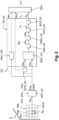
- the coding method according to the invention is implemented in a coding device CO shown in figure 2 .
- a current macroblock MBc of an image I N is pre-divided into a plurality of partitions PA1, PA2,..., PAn as shown in the figure. figure 2 .
- Such a step is classically performed by a partitioning software module not shown.
- Such a partitioning module uses, for example, a method of choice by exhaustive competition or a method of choice using an algorithm with a priori. Such methods are well known to those skilled in the art (cf: GJ Sullivan and T.Wiegand, "Rate-distortion optimization for video compression", IEEE Signal Proc. Mag., pp.74-90, 1998 ) . They will therefore not be described further.
- the different types of possible partitioning algorithms are grouped in a database (not shown) of the CO coder. They make it possible to obtain a division of the image or macroblocks of this image into a plurality of partitions either of rectangular or square shape, or of other geometric shapes, such as for example substantially linear shapes, or of completely arbitrary shape.
- a current macroblock MBc of the current image I N is cut into sixteen partitions PA1, PA2,..., PA16.
- Said partitions obtained have for example all the shape of a square block and are all of the same size.
- At least one causal partition PAi r is selected from a plurality K of available causal partitions PA1 r , PA2 r ,..., PAi r , ... PAK r , (1 ⁇ i ⁇ K) i.e. a partition previously coded then decoded, with a view to coding a current partition PA c (1 ⁇ c ⁇ n) of the current image I N .
- a matching software module APP_CO shown in the figure 2 is adapted to select, from all the aforementioned causal partitions, a first causal partition which is as similar as possible to the current partition PA c , by means of a classic block matching criterion carried out in the pixel domain, or by means of a characteristic function of the current partition PA c such as a projection in a transformed domain or even in the domain of the coding mode of the latter as will be described later.
- the selected causal partition PAi r belongs either to an image coded then decoded prior to the image I N , or to said image I N .
- a geometric deformation of said causal partition is carried out during an optional step C21, by applying to the latter a geometric transformation such as a rotation, a symmetry, etc. by means of a geometric transformation software module MTG_CO well known per se and as represented in the figure. figure 2 .
- a transformed causal partition Pati r is obtained.
- a motion parameter defining the motion between the current partition PAc and the selected causal partition PAi r is calculated.
- a motion parameter is for example a motion vector MV c .
- Such a step is performed by a first calculation software sub-module CAL1_CO belonging to a processing software module TR_CO, as shown in the figure 2 .
- At least one optimal coding parameter associated with said selected causal partition PAi r or with said transformed selected causal partition PAti r is calculated, according to a predetermined coding performance criterion, by placing in competition a plurality of coding parameters associated with said selected causal partition PAi r or PAti r .
- the causal partition PAi r selected in the aforementioned step C2 or the causal partition PAti c transformed in the aforementioned step C21 is transmitted to a sub-module TEST_CO for testing coding modes which is represented in the figure 2 .
- the TEST_CO submodule calculates the different possible coding modes of the causal partition PAi r or the transformed causal partition PAti r considered.
- a DCN_CO decision submodule selects at least a first type of coding parameter Idx 1 associated with an optimal coding mode, such a selection constituting the optimal prediction according to a predetermined performance criterion which, in the example shown, is the rate-distortion criterion well known to those skilled in the art.
- a predetermined performance criterion which, in the example shown, is the rate-distortion criterion well known to those skilled in the art.
- a first type of optimal coding parameter obtained at the end of step C43 consists, for example, of the Inter 8 ⁇ 8 prediction mode of the selected causal partition PAi r .
- a PRED_CO calculation software submodule represented in the figure 2 , predicts the current partition PA c , using the optimal coding parameters idx1 , idx2, idx3,... , idxK selected in step C43, with respect to at least one of the causal partitions PA1 r , PA2 r , ..., PAK r .
- a second calculation submodule CAL2_CO determines residual data a 1 , a 2 , ...., a L , by comparing the data relating to the current partition PA c to the data relating to the obtained predicted current partition PAp c .
- the residual data a 1 , a 2 , ...., a L are sent to a MTQ_CO transform and quantization sub-module represented in figure 2 , to undergo a transform, for example into discrete cosines, then a quantization.
- the current predicted partition PAp c is then advantageously encoded by inheritance of the optimal coding parameters selected in the aforementioned step C43.
- a data signal F is then delivered at the end of step C8.
- Such encoding is performed by an ENC encoder as shown in figure 2 .
- Such an encoder is for example compliant with the H.264/MPEG-4 AVC standard.
- the data signal F is then transmitted by means of a transmission interface (not shown) of the encoder CO, via a communication network, to a remote terminal.
- the latter comprises a decoder DO as shown in figure 3 .
- the signal F is first sent to an entropy decoding software module DE, the inverse decoding of that performed by the encoder ENC shown in the figure. figure 2 . Then, for a current partition to be reconstructed PAi c , the decoded coefficients c 1 , c 2 , ...., cnn, if they exist, are sent to a QTI_DO inverse quantization and inverse transform module which delivers the residual data a 1 , a 2 ,..., a L obtained in the aforementioned coding step C6.
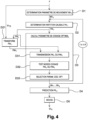
- a TR_DO processing software module as shown in figure 3 , then implements steps D1 to D5 of the decoding method according to the invention, as represented in figure 4 .
- Such a decoding method according to the invention is also implemented in software or hardware by modifications of a decoder initially compliant with the H.264/MPEG-4 AVC standard.
- a motion parameter MV c associated with the current partition to be reconstructed PAi c is determined.
- a motion parameter is, for example, a motion vector MV c .
- a calculation submodule CAL1_DO performs the calculation of said motion vector MV c relative to the motion between the current partition to be reconstructed PA c and a causal partition PAi r .
- a reading submodule LC_DO reads this information in the received data signal F.
- the causal partition PAi r is determined, which is pointed to by the motion vector MV c read by the reading sub-module LC_DO in the data signal F or calculated by the reading submodule CAL1_DO.
- Such a step is implemented by a second calculation submodule CAL2_DO as shown in figure 3 .
- the data signal F contains a geometric transformation index Id TG indicating that the causal partition PAi r has undergone a geometric transformation at the encoder CO such as a rotation, a symmetry, etc.
- the following procedure is carried out during a step D21 shown in figure 4 , to a geometric deformation of said causal partition PAi r by applying to the latter the geometric transformation indicated by the index Id TG by means of a geometric transformation software module MTG_DO as represented in the figure 3 and which is identical in every way to the geometric transformation software module MTG_CO of the figure 2 .
- a transformed causal partition PAti r is obtained.
- At least one optimal coding parameter associated with said determined causal partition PAi r or with said determined transformed causal partition PAti r is calculated, according to a predetermined coding performance criterion, by placing in competition a plurality of coding parameters associated with said selected causal partition.
- the said coding parameters are of the same type as those mentioned above in the description of the coding method.
- the causal partition PAi r determined in the aforementioned step D2 or the transformed causal partition Pati r determined in the aforementioned step D21 is transmitted to a TEST_DO sub-module for testing coding modes which is represented in figure 3 .
- the TEST_DO submodule calculates the different possible coding modes of the causal partition PAi r or the transformed causal partition PAti r considered.
- a DCN_DO decision submodule selects at least one first type of Idx 1 coding parameter associated with an optimal coding mode, such selection constituting the optimal prediction according to a predetermined performance criterion which, in the example shown, is the rate distortion criterion well known to those skilled in the art.
- a first type of optimal coding parameter obtained at the end of step D33 consists, for example, of the Inter 8x8 prediction mode of the determined causal partition PAi r .
- a PRED_DO calculation software submodule predicteds the current partition PAi c to be reconstructed with respect to at least one causal partition among K causal partitions PA1 r , PA2 r ,..., PAK r already coded then decoded, using the optimal coding parameters idx1,idx2, idx3,...,idxK obtained in step D33 and used as a decoding parameter, and, if they exist, the residual data a 1 , a 2 ,...,a L delivered by the QTI_DO inverse quantization and inverse transform module, as shown in the figure figure 3 .
- the current predicted partition PAp c is then decoded, during a step D5, by adding to the latter, if they exist, the residual data a 1 , a 2 ,...,a L delivered by the QTI_DO inverse quantization and inverse transform module, as shown in the figure. figure 3 .
- Such a step is implemented by means of an RI reconstruction submodule compliant with the H.264/MPEG-AVC standard.
- the image reconstruction sub-module RI provides as output of the decoder DO, an image ID N corresponding to the decoding of the image I N .
- the macroblock is considered as a single partition that is predicted against a set of four spatial predictors.
- each smaller block is predicted against a set of nine spatial predictors that include the four spatial predictors used in 16x16 Intra encoding.
- Intra coding/decoding by competition is thus based on the competition between the various aforementioned spatial predictors, with the aim of selecting the best predictor, i.e. the predictor which will optimize the coding of the current partition considered according to a predetermined criterion, for example the bitrate/distortion cost.
- the invention proposes to apply the coding and decoding steps as described above in the context of coding/decoding in Intra mode, without being particularly limited to the number of spatial predictors already envisaged in the H264/MPEG-AVC standard, and by applying the competition to the number of new Intra predictors likely to be proposed in the future.
- the current macroblock MBc of the current image I N is cut during the aforementioned step C1 into sixteen partitions PA1, PA2,..., PA16.
- Said partitions obtained have for example all the shape of a square block and are all of the same size.
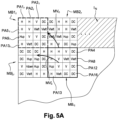
- the macroblock MBc thus cut is represented in the Figure 5A .
- partitions PA4, PA8, PA12, PA13 and PA16 are shown.
- At least one causal macroblock containing a plurality K of available causal partitions PA1 r , PA2 r ,..., PAi r , ... PAK r , (1 ⁇ i ⁇ K) is selected.
- such a selection is performed in accordance with a correlation criterion of prediction modes between the current partitions to be predicted of the current macroblock MBc and the causal partitions of a causal macroblock forming part of a number E of available causal macroblocks MB1 r , MB2 r ,...,MBj r ,...MBE r , where 1 ⁇ j ⁇ E.
- the causal macroblocks MB1 r , MB2 r and MBj r are represented, the remaining causal macroblocks being schematically represented by hatched lines.
- the optimal spatial predictors relating to each of the current partitions PA1 to PA16 of the current macroblock MBc are respectively H, H, V, DC, H, V, Vleft, Vleft, Hup, V, V, DC, H, Vleft, DC, DC.
- the causal macroblock for which the calculated optimal spatial predictors are the most similar to those calculated relative to the current macroblock MB c is the first causal macroblock MB1 r . It is therefore this causal macroblock MB1 r which is selected.
- the causal macroblock MB1 r obtained according to the mode correlation criterion is better chosen than in the case of a classic block matching, since the correlation between the current macroblock MBc and the causal macroblocks is taken into account, predictor by predictor.
- the spatial predictors of the selected causal macroblock may turn out to be different from the optimal predictors actually calculated for said causal macroblock, which significantly harms the precision of the selection of this causal macroblock.
- step C3 is carried out to calculate the motion vector MVc between the current macroblock MBc and the causal macroblock MB1 r .
- Each of the current partitions PA1 to PA16 of the current macroblock MBc is then predicted during the aforementioned step C5, using the optimal predictors calculated respectively for each of the partitions of the causal macroblock MB1 r .
- the data signal F transmitted to the decoder DO at the end of step C8 possibly contains the motion vector MVc and the residual data if they exist.
- the data signal F does not contain advantageously not the optimal predictor(s) of the causal macroblock(s) which were calculated in the aforementioned step C4, since these predictors are associated with macroblocks already coded then decoded and therefore can be determined independently by the decoder DO.
- the aforementioned decoding step D1 is then applied to the coded data signal F so as to decode the motion vector MVc calculated in step C3.
- the causal macroblock MB1 r pointed to by the motion vector MVc is then determined during the aforementioned decoding step D2.
- the optimal predictors are then calculated for each of the partitions of the causal macroblock MB1 r by implementing the aforementioned step D3.
- these are the spatial predictors H, H, V, DC, H, V, Vleft, Vleft, Hup, V, V, DC, H, Vleft, DC, DC associated respectively with the partitions PA1 r to PA16 r of the causal macroblock MB1 r .
- the current macroblock MB c to be reconstructed is predicted with respect to the causal macroblock MB1 r , using the optimal spatial predictors H, H, V, DC, H, V, Vleft, Vleft, Hup, V, V, DC, H, Vleft, DC, DC.
- a predicted current macroblock MBp c is delivered.
- step D5 the current predicted macroblock MBpc is then reconstructed.
- the invention is of course not limited to the fact that the causal macroblock(s) are systematically selected in the current image I N .
- the causal macroblock MB1 r is located in a previously coded/decoded image and not in the current image I N .
- a previously coded/decoded image is for example the image I N-1 which immediately precedes the current image I N .
- This method allows to delete several transformed and quantized residual coefficients and then to reconstruct the corresponding current partition in an efficient manner.
- To be very efficient, such a method however requires a large number of parameters.
- the reduced signaling cost, as advantageously obtained by the method thanks to the deletion of the aforementioned coefficients, is thus increased unfavorably, due to the obligation to add this large number of parameters in the data signal to be transmitted to the decoder. Such an increase in cost therefore harms the interest of such a method.
- the present invention advantageously makes it possible to apply this iterative method without impacting the cost of signaling such parameters, since the latter are advantageously not transmitted in the data signal to the decoder.
- the current macroblock MBc of the current image I N is cut during step C1 above-mentioned into sixteen partitions PA1, PA2,..., PA16. Said partitions obtained have for example all the shape of a square block and are all of the same size.
- the macroblock MBc thus cut is for example identical to that represented in the Figure 5A .
- At least one causal macroblock containing a plurality K of available causal partitions PA1 r , PA2 r ,..., PAi r ,...PAK r , (1 ⁇ i ⁇ K) is selected.
- Such a selection is made in accordance with a conventional block matching criterion.
- the macroblock thus selected is, for example, the macroblock MBj r shown in the Figure 5A .
- This criterion consists of selecting the causal macroblock whose transformed residual data are closest to the transformed residual data of the current macroblock MBc.
- the motion vector MV'c is calculated between the current macroblock MBc and the causal macroblock MBj r .
- the motion vector MV'c is represented on the Figure 5A .
- one or more optimal coding parameters are calculated relative to the causal macroblock MBj r .
- a competition is carried out, according to the aforementioned rate-distortion criterion J or J', of the weighting coefficients, the sub-sampling parameters, the acquisition operators, the reconstruction operators or a combination of these elements, so as to determine at least one optimal coding parameter among these elements.
- a sub-sampling parameter is considered to optimize the coding of each of the causal partitions of the selected causal macroblock MBj r .
- Each of the current partitions PA1 to PA16 of the current macroblock MBc is then predicted during the aforementioned step C5. At the end of this step, a predicted current macroblock MBp c is delivered.
- the residual data a 1 , a 2 , ...., a L are determined by comparing the data relating to the current macroblock MB c with the data relating to the current predicted macroblock obtained MBp c .
- the residual data a 1 , a 2 , ...., a L are transformed then quantized so as to obtain coefficients c 1 , c 2 , ...., cnn.
- step C7 only some of the coefficients c 1 , c 2 , ...., cnn are retained following a subsampling (not shown) of the latter using said optimal subsampling parameter determined in step C4.
- step C8 as shown in figure 1 is then implemented to encode the current macroblock MBc.
- the data signal F transmitted to the decoder DO at the end of step C8 possibly contains the motion vector MV'c if the decoder DO is not capable of recalculating it independently and, according to the second embodiment, the residual data calculated in step C6.
- the data signal F advantageously does not contain the subsampling parameter which was determined in the aforementioned step C4, since this parameter is associated with the causal macroblock MBj r already coded then decoded and, as a result, can be determined independently by the decoder DO.
- the aforementioned decoding step D1 is then applied to the coded data signal F so as to decode the motion vector MV'c calculated in step C3.
- the causal macroblock MBj r pointed to by the motion vector MV'c is then determined during the aforementioned decoding step D2.
- the optimal coding parameters are then calculated for each of the partitions of the causal macroblock MBj r by implementing the aforementioned step D3. According to the second embodiment, this calculation step delivers an optimal subsampling parameter for each of the causal partitions of the causal macroblock MBj r .
- each of the current partitions PA1 to PA16 of the current macroblock MBc to be reconstructed are predicted in a conventional manner in order to deliver a predicted current macroblock MBp c .
- the predicted current macroblock MBpc is then reconstructed by adding to the predicted current macroblock MBpc, residual data transmitted in the data signal F, and by subsampling the coefficients c 1 , c 2 , ...., cm, resulting from the transformation and quantification of said residual data, using the optimal subsampling parameter calculated in step D3.
- a third embodiment will now be described in the case of a coding/decoding method to which an Intra or Inter type prediction is applied as described in the first embodiment and an iterative compressed sampling method as described in the second embodiment.
- Such an embodiment thus makes it possible to obtain at least two optimal coding parameters resulting respectively from the implementation of the first and second embodiments.
- Such an arrangement makes it possible to more finely code a current macroblock, since two optimal parameters of different types come into play, instead of just one.
- the prediction is of the Intra type.
- the current macroblock MBc of the current image I N is cut during the aforementioned step C1 into sixteen partitions PA1, PA2,..., PA16.
- Said partitions obtained have for example all the shape of a square block and are all of the same size.
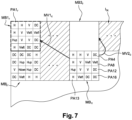
- the macroblock MBc thus cut is represented in the figure 7 .
- partitions PA4, PA8, PA12, PA13 and PA16 are shown.
- At least one causal macroblock is selected. containing a plurality K of available causal partitions PA1 r , PA2 r ,..., PAi r , ... PAK r , (1 ⁇ i ⁇ K).
- such a selection is performed in the same way as in the first embodiment, i.e. in accordance with a correlation criterion of prediction modes between the current partitions to be predicted of the current macroblock MBc and the causal partitions of a causal macroblock forming part of a number E of available causal macroblocks MB1 r , MB2 r ,... ,MBj r ,... MBE r , where 1 ⁇ j ⁇ E.
- the causal macroblocks MB1 r , MB3 r and MBj r are shown, the remaining causal macroblocks being schematically represented by hatched lines.
- the optimal spatial predictors relating to each of the current partitions PA1 to PA16 of the current macroblock MBc are respectively H, H, V, DC, H, V, Vleft, Vleft, Hup, V, V, DC, H, Vleft, DC, DC.
- the causal macroblock for which the calculated optimal spatial predictors are the most similar to those calculated relative to the current macroblock MB c is the first causal macroblock MB1 r . It is therefore this causal macroblock MB1 r which is selected.
- step C3 is carried out to calculate the motion vector MV1c between the current macroblock MBc and the causal macroblock MB1 r .
- steps C2 to C4 as described above in connection with the second embodiment are implemented so as to obtain, for a causal macroblock considered, optimal compressed sampling parameters.
- the selection of at least one partition is carried out.
- least one causal macroblock containing a plurality K of available causal partitions PA1 r , PA2 r ,..., PAi r ,...PAK r , (1 ⁇ i ⁇ K).
- the selected causal macroblock is for example the macroblock MB3 r .
- Such selection is made in accordance with a modified block matching criterion.
- a motion vector MV2c is calculated between the current macroblock MBc and the causal macroblock MB3 r which has just been selected in step C2.
- step C4 one or more optimal coding parameters relative to the selected causal macroblock MB3 r are calculated.
- a competition is carried out, according to the aforementioned rate-distortion criterion J or J', of the weighting coefficients, the sub-sampling parameters, the acquisition operators, the reconstruction operators or a combination of these elements, so as to determine at least one optimal coding parameter among these elements.
- a subsampling parameter is considered to optimize the coding of the selected causal macroblock MB3 r .
- Each of the current partitions PA1 to PA16 of the current macroblock MBc is then predicted during the aforementioned step C5, using the optimal predictors calculated respectively for each of the partitions of the causal macroblock MB1 r and also with respect to each of the partitions of the causal macroblock MB3 r .
- the residual data a 1 , a 2 , ...., a L are determined by comparing the data relating to the current macroblock MB c with the data relating to the predicted current macroblock obtained MBp c .
- the residual data a 1 , a 2 , ...., a L are transformed then quantized so as to obtain coefficients C1, C2, ...., CM.
- step C7 only some of the coefficients c 1 , c 2 , ...., cnn are retained following a subsampling (not shown) of the latter using said optimal subsampling parameter determined in step C4.
- step C8 is then implemented so as to encode the current macroblock MBc.
- the data signal F transmitted to the decoder DO at the end of step C8 possibly contains the motion vectors MV1c and MV2c calculated in the aforementioned step C3, if the decoder DO is not capable of recalculating them independently, as well as the residual data calculated in step C6.
- the data signal F advantageously does not contain the spatial predictors and the subsampling parameter which were determined in the aforementioned step C4, since the latter are associated with the causal macroblocks MB1 r and MB3 r already coded then decoded and, as a result, can be determined independently by the decoder DO.
- step D1 the motion vectors MV1c and MV2c calculated in step C3 are decoded.
- the causal macroblocks MB1 r and MB3 r respectively pointed to by the motion vectors MV1c and MV2c are then determined during the aforementioned decoding step D2.
- the optimal predictors H, H, V, DC, H, V, Vleft, Vleft, Hup, V, V, DC, H, Vleft, DC, DC associated respectively with the partitions PA1 r to PA16 r of the causal macroblock MB1 r are then calculated.
- the optimal subsampling parameter is calculated for each of the causal partitions of the causal macroblock MBj r .
- a predicted current macroblock MBp c is delivered.
- the predicted current macroblock MBpc is then reconstructed by adding, to the predicted current macroblock MBpc, the residual data transmitted in the data signal F, and by subsampling the coefficients c 1 , c 2 , ...., cm, resulting from the transformation and quantification of said residual data, using the optimal subsampling parameter calculated in step D3.
Landscapes
- Engineering & Computer Science (AREA)
- Multimedia (AREA)
- Signal Processing (AREA)
- Computing Systems (AREA)
- Theoretical Computer Science (AREA)
- Physics & Mathematics (AREA)
- Discrete Mathematics (AREA)
- General Physics & Mathematics (AREA)
- Compression Or Coding Systems Of Tv Signals (AREA)
Claims (15)
- Verfahren zum Codieren wenigstens eines in Partitionen (PA1, PA2, ...PAn) unterteilten Bildes (IN), dadurch gekennzeichnet, dass es für eine zu codierende aktuelle Partition (PAc) die folgenden Schritte umsetzt:- Auswählen (C2) wenigstens einer bereits codierten und dann decodierten kausalen Partition (PAir, Patir), wobei sich die wenigstens eine kausale Partition in einem Bild befindet, das vor dem Bild decodiert wurde,- Berechnen (C4) wenigstens eines optimalen Codierungsparameters der wenigstens einen ausgewählten kausalen Partition, um ein vorgegebenes Codierungsleistungskriterium einer Codierung der kausalen Partition durch Bringen einer Vielzahl von Codierungsparametern, die auf die wenigstens eine ausgewählte kausale Partition angewendet wurde, in Konkurrenz zu optimieren;- Codieren (C8) der aktuellen Partition mit Hilfe des wenigstens einen berechneten optimalen Codierungsparameters der wenigstens einen ausgewählten kausalen Partition.
- Codierungsverfahren nach Anspruch 1, bei dem der Schritt des Auswählens einer kausalen Partition aus Folgendem besteht:- Bestimmen einer Vielzahl von kausalen Partitionen,- Berechnen wenigstens eines optimalen Codierungsparameters, der jeder der kausalen Partitionen zugeordnet ist, in Übereinstimmung mit dem vorgegebenen Codierungsleistungskriterium,- Berechnen wenigstens eines optimalen Codierungsparameters, der der aktuellen Partition zugeordnet ist, in Übereinstimmung mit dem vorgegebenen Codierungsleistungskriterium,- Vergleichen des berechneten optimalen Codierungsparameters, der der aktuellen Partition zugeordnet ist, mit jedem der berechneten optimalen Codierungsparameter, die jeweils jeder der kausalen Partitionen zugeordnet sind,- Auswählen der kausalen Partition, deren optimaler Codierungsparameter den Wert aufweist, der am nächsten bei jenem des optimalen Codierungsparameters der aktuellen Partition liegt.
- Codierungsverfahren nach Anspruch 1, bei dem der Schritt des Auswählens einer kausalen Partition aus Folgendem besteht:- Bestimmen einer Vielzahl von kausalen Partitionen;- Auswählen der kausalen Partition, die am nächsten bei der aktuellen Partition liegt, durch einen Abgleich von Blöcken.
- Codierungsverfahren nach einem der vorhergehenden Ansprüche, bei dem die ausgewählte kausale Partition (Patir) von einer vorhergehenden geometrischen Transformation stammt, wobei das Verfahren einen Schritt des Codierens eines der Transformation zugeordneten Indexes beinhaltet.
- Vorrichtung (CO) zum Codieren wenigstens eines in Partitionen unterteilten Bildes, dadurch gekennzeichnet, dass sie für eine zu codierende aktuelle Partition Folgendes beinhaltet:- Mittel zum Auswählen (C2) wenigstens einer bereits codierten und dann decodierten kausalen Partition, wobei sich die wenigstens eine kausale Partition in einem Bild befindet, das vor dem Bild decodiert wurde;- Verarbeitungsmittel (TR_CO), die dazu fähig sind, wenigstens einen optimalen Codierungsparameter zu berechnen, um ein vorgegebenes Codierungsleistungskriterium einer Codierung der kausalen Partition durch Bringen einer Vielzahl von Codierungsparametern, die auf die wenigstens eine ausgewählte kausale Partition angewendet wurde, in Konkurrenz zu optimieren;- Mittel (ENC) zum Codieren der aktuellen Partition mit Hilfe des wenigstens einen berechneten optimalen Codierungsparameters der wenigstens einen ausgewählten kausalen Partition.
- Computerprogramm, das Anweisungen zur Umsetzung des Codierungsverfahrens nach einem beliebigen der Ansprüche 1 bis 4 umfasst, wenn es auf einem Computer ausgeführt wird.
- Computerlesbarer Aufzeichnungsträger, auf dem ein Computerprogramm aufgezeichnet ist, das Anweisungen zur Ausführung der Schritte des Codierungsverfahrens nach einem beliebigen der Ansprüche 1 bis 4 beinhaltet, wenn das Programm durch einen Computer ausgeführt wird.
- Verfahren zum Decodieren eines Datensignals, das wenigstens ein in Partitionen unterteiltes Bild (IN) darstellt, das wenigstens eine bereits codierte und dann decodierte kausale Partition beinhaltet, dadurch gekennzeichnet, dass es für wenigstens eine in dem Bild zu rekonstruierende aktuelle Partition die folgenden Schritte umsetzt:- Bestimmen (D2) wenigstens einer kausalen Partition anhand wenigstens eines Bewegungsparameters, der der zu rekonstruierenden aktuellen Partition zugeordnet ist, wobei sich die wenigstens eine kausale Partition in einem Bild befindet, das vor dem Bild decodiert wurde;- Bringen (D32) einer Vielzahl von Codierungsparametern, die auf die bestimmte kausale Partition angewendet wurde, in Konkurrenz, um wenigstens einen optimalen Codierungsparameter zu bestimmen, der ein vorgegebenes Codierungsleistungskriterium einer Codierung der kausalen Partition optimiert;- Rekonstruieren (D5) der aktuellen Partition mit Hilfe des wenigstens einen bestimmten optimalen Codierungsparameters der wenigstens einen kausalen Partition, der als Decodierungsparameter für die aktuelle Partition verwendet wird.
- Decodierungsverfahren nach Anspruch 8, bei dem das Bestimmen des Bewegungsparameters durch Berechnen oder aber durch Lesen dieses Letzteren in dem Datensignal erfolgt.
- Decodierungsverfahren nach Anspruch 8, bei dem die aktuelle Partition mit Hilfe wenigstens zweier optimaler Codierungsparameter unterschiedlichen Typs rekonstruiert wird, die als Decodierungsparameter für die aktuelle Partition verwendet werden.
- Decodierungsverfahren nach Anspruch 8, bei dem das Codierungsleistungskriterium aus wenigstens einem Kriterium gewählt wird, das zu der Gruppe gehört, die Folgendes beinhaltet:- ein Durchsatz-Verzerrungs-Kriterium, bei dem der Durchsatz durch Simulation berechnet wird,ein Verzerrungskriterium.
- Decodierungsverfahren nach Anspruch 8, wobei die kausale Partition von einer vorhergehenden geometrischen Transformation stammt, wobei die Transformation durch das Lesen, in dem Signal, eines Indexes bezüglich der geometrischen Transformation bestimmt wird.
- Vorrichtung (DO) zum Decodieren eines Datensignals, das wenigstens ein in Partitionen unterteiltes Bild darstellt, das wenigstens eine bereits codierte und dann decodierte kausale Partition beinhaltet, dadurch gekennzeichnet, dass sie für wenigstens eine in dem Bild zu rekonstruierende aktuelle Partition Folgendes beinhaltet:- Mittel zum Bestimmen (CAL2_DO) wenigstens einer kausalen Partition anhand wenigstens eines Bewegungsparameters, der der zu rekonstruierenden aktuellen Partition zugeordnet ist, wobei sich die wenigstens eine kausale Partition in einem Bild befindet, das vor dem Bild decodiert wurde;- Mittel (TEST_DO) zum Bringen einer Vielzahl von Codierungsparametern, die auf die wenigstens eine bestimmte kausale Partition angewendet wurde, in Konkurrenz, um wenigstens einen optimalen Codierungsparameter zu bestimmen, der ein vorgegebenes Codierungsleistungskriterium einer Codierung der kausalen Partition optimiert;- Mittel (DCN_DO) zum Bestimmen wenigstens eines optimalen Codierungsparameters, um ein vorgegebenes Codierungsleistungskriterium der zweiten Codierung der kausalen Partition zu optimieren;- Mittel (RI) zum Rekonstruieren der aktuellen Partition mit Hilfe des wenigstens einen bestimmten optimalen Codierungsparameters der wenigstens einen kausalen Partition, der als Decodierungsparameter für die aktuelle Partition verwendet wird.
- Computerprogramm, das Anweisungen zur Umsetzung des Decodierungsverfahrens nach einem beliebigen der Ansprüche 8 bis 12 umfasst, wenn es auf einem Computer ausgeführt wird.
- Computerlesbarer Aufzeichnungsträger, auf dem ein Computerprogramm aufgezeichnet ist, das Anweisungen zur Ausführung der Schritte des Decodierungsverfahrens nach einem beliebigen der Ansprüche 8 bis 12 beinhaltet, wenn das Programm durch einen Computer ausgeführt wird.
Applications Claiming Priority (3)
| Application Number | Priority Date | Filing Date | Title |
|---|---|---|---|
| FR1154595A FR2975856A1 (fr) | 2011-05-26 | 2011-05-26 | Procede de codage et de decodage d'images, dispositif de codage et de decodage d'images et programmes d'ordinateur correspondants |
| EP12731046.4A EP2716045B1 (de) | 2011-05-26 | 2012-05-23 | Verfahren, vorrichtung und computerprogramme zur enkodierung und dekodierung von bildern |
| PCT/FR2012/051158 WO2012160313A1 (fr) | 2011-05-26 | 2012-05-23 | Procédé de codage et de décodage d'images, dispositif de codage et de décodage d'images et programmes d'ordinateur correspondants |
Related Parent Applications (2)
| Application Number | Title | Priority Date | Filing Date |
|---|---|---|---|
| EP12731046.4A Division EP2716045B1 (de) | 2011-05-26 | 2012-05-23 | Verfahren, vorrichtung und computerprogramme zur enkodierung und dekodierung von bildern |
| EP12731046.4A Division-Into EP2716045B1 (de) | 2011-05-26 | 2012-05-23 | Verfahren, vorrichtung und computerprogramme zur enkodierung und dekodierung von bildern |
Publications (3)
| Publication Number | Publication Date |
|---|---|
| EP3972246A1 EP3972246A1 (de) | 2022-03-23 |
| EP3972246B1 true EP3972246B1 (de) | 2024-08-21 |
| EP3972246C0 EP3972246C0 (de) | 2024-08-21 |
Family
ID=46420362
Family Applications (3)
| Application Number | Title | Priority Date | Filing Date |
|---|---|---|---|
| EP21204503.3A Active EP3972246B1 (de) | 2011-05-26 | 2012-05-23 | Verfahren zur kodierung und dekodierung von bildern, vorrichtung zur kodierung und dekodierung von bildern und entsprechende computerprogramme |
| EP21204509.0A Active EP3972247B1 (de) | 2011-05-26 | 2012-05-23 | Verfahren zur kodierung und dekodierung von bildern, vorrichtung zur kodierung und dekodierung von bildern und entsprechende computerprogramme |
| EP12731046.4A Active EP2716045B1 (de) | 2011-05-26 | 2012-05-23 | Verfahren, vorrichtung und computerprogramme zur enkodierung und dekodierung von bildern |
Family Applications After (2)
| Application Number | Title | Priority Date | Filing Date |
|---|---|---|---|
| EP21204509.0A Active EP3972247B1 (de) | 2011-05-26 | 2012-05-23 | Verfahren zur kodierung und dekodierung von bildern, vorrichtung zur kodierung und dekodierung von bildern und entsprechende computerprogramme |
| EP12731046.4A Active EP2716045B1 (de) | 2011-05-26 | 2012-05-23 | Verfahren, vorrichtung und computerprogramme zur enkodierung und dekodierung von bildern |
Country Status (7)
| Country | Link |
|---|---|
| US (1) | US9967585B2 (de) |
| EP (3) | EP3972246B1 (de) |
| CN (1) | CN103718560B (de) |
| ES (3) | ES2907382T3 (de) |
| FR (1) | FR2975856A1 (de) |
| PL (1) | PL3972247T3 (de) |
| WO (1) | WO2012160313A1 (de) |
Families Citing this family (5)
| Publication number | Priority date | Publication date | Assignee | Title |
|---|---|---|---|---|
| FR2982446A1 (fr) | 2011-11-07 | 2013-05-10 | France Telecom | Procede de codage et decodage d'images, dispositif de codage et decodage et programmes d'ordinateur correspondants |
| FR2982447A1 (fr) * | 2011-11-07 | 2013-05-10 | France Telecom | Procede de codage et decodage d'images, dispositif de codage et decodage et programmes d'ordinateur correspondants |
| US11523112B2 (en) | 2020-04-09 | 2022-12-06 | Tencent America LLC | Intra coding with L-type partitioning tree |
| US11343512B1 (en) | 2021-01-08 | 2022-05-24 | Samsung Display Co., Ltd. | Systems and methods for compression with constraint on maximum absolute error |
| CN116127532B (zh) * | 2023-02-07 | 2025-05-16 | 浙江大学杭州国际科创中心 | 一种基于动静态分析的pa签名上下文分析方法 |
Family Cites Families (3)
| Publication number | Priority date | Publication date | Assignee | Title |
|---|---|---|---|---|
| US8160150B2 (en) * | 2007-04-10 | 2012-04-17 | Texas Instruments Incorporated | Method and system for rate distortion optimization |
| CN102265615B (zh) * | 2008-12-22 | 2015-08-05 | 法国电信公司 | 使用参考因果区的重新分区的图像预测、以及使用这样的预测的编码和解码 |
| TW201119407A (en) * | 2009-11-19 | 2011-06-01 | Thomson Licensing | Method for coding and method for reconstruction of a block of an image |
-
2011
- 2011-05-26 FR FR1154595A patent/FR2975856A1/fr not_active Withdrawn
-
2012
- 2012-05-23 ES ES12731046T patent/ES2907382T3/es active Active
- 2012-05-23 ES ES21204509T patent/ES2991493T3/es active Active
- 2012-05-23 EP EP21204503.3A patent/EP3972246B1/de active Active
- 2012-05-23 US US14/122,194 patent/US9967585B2/en active Active
- 2012-05-23 PL PL21204509.0T patent/PL3972247T3/pl unknown
- 2012-05-23 EP EP21204509.0A patent/EP3972247B1/de active Active
- 2012-05-23 CN CN201280036747.1A patent/CN103718560B/zh active Active
- 2012-05-23 EP EP12731046.4A patent/EP2716045B1/de active Active
- 2012-05-23 WO PCT/FR2012/051158 patent/WO2012160313A1/fr not_active Ceased
- 2012-05-23 ES ES21204503T patent/ES2991510T3/es active Active
Also Published As
| Publication number | Publication date |
|---|---|
| ES2991510T3 (es) | 2024-12-03 |
| CN103718560A (zh) | 2014-04-09 |
| US9967585B2 (en) | 2018-05-08 |
| EP3972247A1 (de) | 2022-03-23 |
| EP3972247B1 (de) | 2024-08-21 |
| ES2991493T3 (es) | 2024-12-03 |
| EP3972247C0 (de) | 2024-08-21 |
| PL3972247T3 (pl) | 2025-02-03 |
| WO2012160313A1 (fr) | 2012-11-29 |
| CN103718560B (zh) | 2018-12-25 |
| EP3972246A1 (de) | 2022-03-23 |
| EP3972246C0 (de) | 2024-08-21 |
| EP2716045B1 (de) | 2021-12-08 |
| US20140348237A1 (en) | 2014-11-27 |
| FR2975856A1 (fr) | 2012-11-30 |
| EP2716045A1 (de) | 2014-04-09 |
| ES2907382T3 (es) | 2022-04-25 |
Similar Documents
| Publication | Publication Date | Title |
|---|---|---|
| EP2991351B1 (de) | Verfahren zur dekodierung von bildern | |
| EP2985998B1 (de) | Aufzeichnungsmedium zur speicherung von kodierten bilddaten | |
| WO2015197945A1 (fr) | Procédé de codage d'une image numérique, procédé de décodage, dispositifs, et programmes d'ordinateurs associés | |
| FR2951345A1 (fr) | Procede et dispositif de traitement d'une sequence video | |
| EP3972247B1 (de) | Verfahren zur kodierung und dekodierung von bildern, vorrichtung zur kodierung und dekodierung von bildern und entsprechende computerprogramme | |
| WO2015055937A1 (fr) | Procédé de codage et de décodage d'images, dispositif de codage et de décodage d'images et programmes d'ordinateur correspondants | |
| EP2443835B1 (de) | Bewegungsvektorkodierung durch wettbewerb zwischen verschiedenen prediktoren | |
| EP2761871B1 (de) | Dekoder-seitige bewegungschätzung durch mustervergleich | |
| EP3180914B1 (de) | Bildcodierungs- und decodierungsverfahren, bildcodierungs- und decodierungsvorrichtung sowie entsprechende computerprogramme | |
| WO2018073523A1 (fr) | Procédé de codage et de décodage de paramètres d'image, dispositif de codage et de décodage de paramètres d'image et programmes d'ordinateur correspondants | |
| WO2015044581A1 (fr) | Codage et décodage vidéo par héritage d'un champ de vecteurs de mouvement | |
| FR2957744A1 (fr) | Procede de traitement d'une sequence video et dispositif associe | |
| FR3033114A1 (fr) | Procede de codage et decodage d'images, dispositif de codage et decodage et programmes d'ordinateur correspondants | |
| FR3035761A1 (fr) | Procede de codage et de decodage d'images, dispositif de codage et de decodage d'images et programmes d'ordinateur correspondants | |
| WO2020260843A1 (fr) | Procédé d'encodage et de décodage vidéo par signalisation d'un sous-ensemble de candidat | |
| WO2013007920A1 (fr) | Procédé de codage et décodage d'images, dispositif de codage et décodage et programmes d'ordinateur correspondants |
Legal Events
| Date | Code | Title | Description |
|---|---|---|---|
| PUAI | Public reference made under article 153(3) epc to a published international application that has entered the european phase |
Free format text: ORIGINAL CODE: 0009012 |
|
| STAA | Information on the status of an ep patent application or granted ep patent |
Free format text: STATUS: THE APPLICATION HAS BEEN PUBLISHED |
|
| AC | Divisional application: reference to earlier application |
Ref document number: 2716045 Country of ref document: EP Kind code of ref document: P |
|
| AK | Designated contracting states |
Kind code of ref document: A1 Designated state(s): AL AT BE BG CH CY CZ DE DK EE ES FI FR GB GR HR HU IE IS IT LI LT LU LV MC MK MT NL NO PL PT RO RS SE SI SK SM TR |
|
| STAA | Information on the status of an ep patent application or granted ep patent |
Free format text: STATUS: REQUEST FOR EXAMINATION WAS MADE |
|
| 17P | Request for examination filed |
Effective date: 20220906 |
|
| RBV | Designated contracting states (corrected) |
Designated state(s): AL AT BE BG CH CY CZ DE DK EE ES FI FR GB GR HR HU IE IS IT LI LT LU LV MC MK MT NL NO PL PT RO RS SE SI SK SM TR |
|
| GRAP | Despatch of communication of intention to grant a patent |
Free format text: ORIGINAL CODE: EPIDOSNIGR1 |
|
| STAA | Information on the status of an ep patent application or granted ep patent |
Free format text: STATUS: GRANT OF PATENT IS INTENDED |
|
| INTG | Intention to grant announced |
Effective date: 20240422 |
|
| GRAS | Grant fee paid |
Free format text: ORIGINAL CODE: EPIDOSNIGR3 |
|
| GRAA | (expected) grant |
Free format text: ORIGINAL CODE: 0009210 |
|
| STAA | Information on the status of an ep patent application or granted ep patent |
Free format text: STATUS: THE PATENT HAS BEEN GRANTED |
|
| AC | Divisional application: reference to earlier application |
Ref document number: 2716045 Country of ref document: EP Kind code of ref document: P |
|
| AK | Designated contracting states |
Kind code of ref document: B1 Designated state(s): AL AT BE BG CH CY CZ DE DK EE ES FI FR GB GR HR HU IE IS IT LI LT LU LV MC MK MT NL NO PL PT RO RS SE SI SK SM TR |
|
| REG | Reference to a national code |
Ref country code: GB Ref legal event code: FG4D Free format text: NOT ENGLISH |
|
| REG | Reference to a national code |
Ref country code: CH Ref legal event code: EP |
|
| REG | Reference to a national code |
Ref country code: IE Ref legal event code: FG4D Free format text: LANGUAGE OF EP DOCUMENT: FRENCH |
|
| REG | Reference to a national code |
Ref country code: DE Ref legal event code: R096 Ref document number: 602012081024 Country of ref document: DE |
|
| U01 | Request for unitary effect filed |
Effective date: 20240917 |
|
| U07 | Unitary effect registered |
Designated state(s): AT BE BG DE DK EE FI FR IT LT LU LV MT NL PT RO SE SI Effective date: 20241008 |
|
| REG | Reference to a national code |
Ref country code: ES Ref legal event code: FG2A Ref document number: 2991510 Country of ref document: ES Kind code of ref document: T3 Effective date: 20241203 |
|
| REG | Reference to a national code |
Ref country code: GR Ref legal event code: EP Ref document number: 20240402709 Country of ref document: GR Effective date: 20241209 |
|
| PG25 | Lapsed in a contracting state [announced via postgrant information from national office to epo] |
Ref country code: NO Free format text: LAPSE BECAUSE OF FAILURE TO SUBMIT A TRANSLATION OF THE DESCRIPTION OR TO PAY THE FEE WITHIN THE PRESCRIBED TIME-LIMIT Effective date: 20241121 |
|
| PG25 | Lapsed in a contracting state [announced via postgrant information from national office to epo] |
Ref country code: IS Free format text: LAPSE BECAUSE OF FAILURE TO SUBMIT A TRANSLATION OF THE DESCRIPTION OR TO PAY THE FEE WITHIN THE PRESCRIBED TIME-LIMIT Effective date: 20241221 |
|
| PG25 | Lapsed in a contracting state [announced via postgrant information from national office to epo] |
Ref country code: HR Free format text: LAPSE BECAUSE OF FAILURE TO SUBMIT A TRANSLATION OF THE DESCRIPTION OR TO PAY THE FEE WITHIN THE PRESCRIBED TIME-LIMIT Effective date: 20240821 |
|
| PG25 | Lapsed in a contracting state [announced via postgrant information from national office to epo] |
Ref country code: RS Free format text: LAPSE BECAUSE OF FAILURE TO SUBMIT A TRANSLATION OF THE DESCRIPTION OR TO PAY THE FEE WITHIN THE PRESCRIBED TIME-LIMIT Effective date: 20241121 |
|
| PG25 | Lapsed in a contracting state [announced via postgrant information from national office to epo] |
Ref country code: RS Free format text: LAPSE BECAUSE OF FAILURE TO SUBMIT A TRANSLATION OF THE DESCRIPTION OR TO PAY THE FEE WITHIN THE PRESCRIBED TIME-LIMIT Effective date: 20241121 Ref country code: NO Free format text: LAPSE BECAUSE OF FAILURE TO SUBMIT A TRANSLATION OF THE DESCRIPTION OR TO PAY THE FEE WITHIN THE PRESCRIBED TIME-LIMIT Effective date: 20241121 Ref country code: IS Free format text: LAPSE BECAUSE OF FAILURE TO SUBMIT A TRANSLATION OF THE DESCRIPTION OR TO PAY THE FEE WITHIN THE PRESCRIBED TIME-LIMIT Effective date: 20241221 Ref country code: HR Free format text: LAPSE BECAUSE OF FAILURE TO SUBMIT A TRANSLATION OF THE DESCRIPTION OR TO PAY THE FEE WITHIN THE PRESCRIBED TIME-LIMIT Effective date: 20240821 |
|
| PG25 | Lapsed in a contracting state [announced via postgrant information from national office to epo] |
Ref country code: SM Free format text: LAPSE BECAUSE OF FAILURE TO SUBMIT A TRANSLATION OF THE DESCRIPTION OR TO PAY THE FEE WITHIN THE PRESCRIBED TIME-LIMIT Effective date: 20240821 |
|
| PG25 | Lapsed in a contracting state [announced via postgrant information from national office to epo] |
Ref country code: SK Free format text: LAPSE BECAUSE OF FAILURE TO SUBMIT A TRANSLATION OF THE DESCRIPTION OR TO PAY THE FEE WITHIN THE PRESCRIBED TIME-LIMIT Effective date: 20240821 |
|
| U20 | Renewal fee for the european patent with unitary effect paid |
Year of fee payment: 14 Effective date: 20250423 |
|
| PLBE | No opposition filed within time limit |
Free format text: ORIGINAL CODE: 0009261 |
|
| STAA | Information on the status of an ep patent application or granted ep patent |
Free format text: STATUS: NO OPPOSITION FILED WITHIN TIME LIMIT |
|
| 26N | No opposition filed |
Effective date: 20250522 |
|
| U1N | Appointed representative for the unitary patent procedure changed after the registration of the unitary effect |
Representative=s name: KILBURN & STRODE LLP; GB |
|
| PGFP | Annual fee paid to national office [announced via postgrant information from national office to epo] |
Ref country code: GB Payment date: 20260317 Year of fee payment: 15 |
|
| U20 | Renewal fee for the european patent with unitary effect paid |
Year of fee payment: 15 Effective date: 20260421 |
|
| REG | Reference to a national code |
Ref country code: CH Ref legal event code: U11 Free format text: ST27 STATUS EVENT CODE: U-0-0-U10-U11 (AS PROVIDED BY THE NATIONAL OFFICE) Effective date: 20260601 |
|
| PGFP | Annual fee paid to national office [announced via postgrant information from national office to epo] |
Ref country code: ES Payment date: 20260601 Year of fee payment: 15 |
|
| PGFP | Annual fee paid to national office [announced via postgrant information from national office to epo] |
Ref country code: PL Payment date: 20260424 Year of fee payment: 15 |
|
| PGFP | Annual fee paid to national office [announced via postgrant information from national office to epo] |
Ref country code: GR Payment date: 20260422 Year of fee payment: 15 Ref country code: MC Payment date: 20260423 Year of fee payment: 15 |
|
| PGFP | Annual fee paid to national office [announced via postgrant information from national office to epo] |
Ref country code: IE Payment date: 20260422 Year of fee payment: 15 Ref country code: CH Payment date: 20260601 Year of fee payment: 15 |
|
| PGFP | Annual fee paid to national office [announced via postgrant information from national office to epo] |
Ref country code: CZ Payment date: 20260504 Year of fee payment: 15 Ref country code: TR Payment date: 20260429 Year of fee payment: 15 |
|
| PG25 | Lapsed in a contracting state [announced via postgrant information from national office to epo] |
Ref country code: CY Free format text: LAPSE BECAUSE OF FAILURE TO SUBMIT A TRANSLATION OF THE DESCRIPTION OR TO PAY THE FEE WITHIN THE PRESCRIBED TIME-LIMIT Effective date: 20240821 |