EP3971908A1 - Max-margin zeitliche transduktion zur automatischen prognose, diagnose und änderungspunkterkennung - Google Patents
Max-margin zeitliche transduktion zur automatischen prognose, diagnose und änderungspunkterkennung Download PDFInfo
- Publication number
- EP3971908A1 EP3971908A1 EP21195244.5A EP21195244A EP3971908A1 EP 3971908 A1 EP3971908 A1 EP 3971908A1 EP 21195244 A EP21195244 A EP 21195244A EP 3971908 A1 EP3971908 A1 EP 3971908A1
- Authority
- EP
- European Patent Office
- Prior art keywords
- time
- series data
- classifier
- gradient
- component
- Prior art date
- Legal status (The legal status is an assumption and is not a legal conclusion. Google has not performed a legal analysis and makes no representation as to the accuracy of the status listed.)
- Pending
Links
Images




Classifications
-
- G—PHYSICS
- G16—INFORMATION AND COMMUNICATION TECHNOLOGY [ICT] SPECIALLY ADAPTED FOR SPECIFIC APPLICATION FIELDS
- G16H—HEALTHCARE INFORMATICS, i.e. INFORMATION AND COMMUNICATION TECHNOLOGY [ICT] SPECIALLY ADAPTED FOR THE HANDLING OR PROCESSING OF MEDICAL OR HEALTHCARE DATA
- G16H50/00—ICT specially adapted for medical diagnosis, medical simulation or medical data mining; ICT specially adapted for detecting, monitoring or modelling epidemics or pandemics
- G16H50/20—ICT specially adapted for medical diagnosis, medical simulation or medical data mining; ICT specially adapted for detecting, monitoring or modelling epidemics or pandemics for computer-aided diagnosis, e.g. based on medical expert systems
-
- G—PHYSICS
- G05—CONTROLLING; REGULATING
- G05B—CONTROL OR REGULATING SYSTEMS IN GENERAL; FUNCTIONAL ELEMENTS OF SUCH SYSTEMS; MONITORING OR TESTING ARRANGEMENTS FOR SUCH SYSTEMS OR ELEMENTS
- G05B23/00—Testing or monitoring of control systems or parts thereof
- G05B23/02—Electric testing or monitoring
- G05B23/0205—Electric testing or monitoring by means of a monitoring system capable of detecting and responding to faults
- G05B23/0259—Electric testing or monitoring by means of a monitoring system capable of detecting and responding to faults characterized by the response to fault detection
- G05B23/0283—Predictive maintenance, e.g. involving the monitoring of a system and, based on the monitoring results, taking decisions on the maintenance schedule of the monitored system; Estimating remaining useful life [RUL]
-
- G—PHYSICS
- G06—COMPUTING OR CALCULATING; COUNTING
- G06N—COMPUTING ARRANGEMENTS BASED ON SPECIFIC COMPUTATIONAL MODELS
- G06N20/00—Machine learning
-
- G—PHYSICS
- G06—COMPUTING OR CALCULATING; COUNTING
- G06N—COMPUTING ARRANGEMENTS BASED ON SPECIFIC COMPUTATIONAL MODELS
- G06N20/00—Machine learning
- G06N20/10—Machine learning using kernel methods, e.g. support vector machines [SVM]
-
- G—PHYSICS
- G06—COMPUTING OR CALCULATING; COUNTING
- G06N—COMPUTING ARRANGEMENTS BASED ON SPECIFIC COMPUTATIONAL MODELS
- G06N7/00—Computing arrangements based on specific mathematical models
- G06N7/08—Computing arrangements based on specific mathematical models using chaos models or non-linear system models
-
- G—PHYSICS
- G16—INFORMATION AND COMMUNICATION TECHNOLOGY [ICT] SPECIALLY ADAPTED FOR SPECIFIC APPLICATION FIELDS
- G16H—HEALTHCARE INFORMATICS, i.e. INFORMATION AND COMMUNICATION TECHNOLOGY [ICT] SPECIALLY ADAPTED FOR THE HANDLING OR PROCESSING OF MEDICAL OR HEALTHCARE DATA
- G16H50/00—ICT specially adapted for medical diagnosis, medical simulation or medical data mining; ICT specially adapted for detecting, monitoring or modelling epidemics or pandemics
-
- G—PHYSICS
- G16—INFORMATION AND COMMUNICATION TECHNOLOGY [ICT] SPECIALLY ADAPTED FOR SPECIFIC APPLICATION FIELDS
- G16H—HEALTHCARE INFORMATICS, i.e. INFORMATION AND COMMUNICATION TECHNOLOGY [ICT] SPECIALLY ADAPTED FOR THE HANDLING OR PROCESSING OF MEDICAL OR HEALTHCARE DATA
- G16H50/00—ICT specially adapted for medical diagnosis, medical simulation or medical data mining; ICT specially adapted for detecting, monitoring or modelling epidemics or pandemics
- G16H50/50—ICT specially adapted for medical diagnosis, medical simulation or medical data mining; ICT specially adapted for detecting, monitoring or modelling epidemics or pandemics for simulation or modelling of medical disorders
-
- A—HUMAN NECESSITIES
- A61—MEDICAL OR VETERINARY SCIENCE; HYGIENE
- A61B—DIAGNOSIS; SURGERY; IDENTIFICATION
- A61B5/00—Measuring for diagnostic purposes; Identification of persons
- A61B5/0002—Remote monitoring of patients using telemetry, e.g. transmission of vital signals via a communication network
- A61B5/0015—Remote monitoring of patients using telemetry, e.g. transmission of vital signals via a communication network characterised by features of the telemetry system
- A61B5/0022—Monitoring a patient using a global network, e.g. telephone networks, internet
-
- A—HUMAN NECESSITIES
- A61—MEDICAL OR VETERINARY SCIENCE; HYGIENE
- A61B—DIAGNOSIS; SURGERY; IDENTIFICATION
- A61B5/00—Measuring for diagnostic purposes; Identification of persons
- A61B5/02—Detecting, measuring or recording for evaluating the cardiovascular system, e.g. pulse, heart rate, blood pressure or blood flow
- A61B5/0205—Simultaneously evaluating both cardiovascular conditions and different types of body conditions, e.g. heart and respiratory condition
- A61B5/02055—Simultaneously evaluating both cardiovascular condition and temperature
-
- A—HUMAN NECESSITIES
- A61—MEDICAL OR VETERINARY SCIENCE; HYGIENE
- A61B—DIAGNOSIS; SURGERY; IDENTIFICATION
- A61B5/00—Measuring for diagnostic purposes; Identification of persons
- A61B5/72—Signal processing specially adapted for physiological signals or for diagnostic purposes
- A61B5/7235—Details of waveform analysis
- A61B5/7264—Classification of physiological signals or data, e.g. using neural networks, statistical classifiers, expert systems or fuzzy systems
- A61B5/7267—Classification of physiological signals or data, e.g. using neural networks, statistical classifiers, expert systems or fuzzy systems involving training the classification device
-
- A—HUMAN NECESSITIES
- A61—MEDICAL OR VETERINARY SCIENCE; HYGIENE
- A61B—DIAGNOSIS; SURGERY; IDENTIFICATION
- A61B5/00—Measuring for diagnostic purposes; Identification of persons
- A61B5/72—Signal processing specially adapted for physiological signals or for diagnostic purposes
- A61B5/7271—Specific aspects of physiological measurement analysis
- A61B5/7275—Determining trends in physiological measurement data; Predicting development of a medical condition based on physiological measurements, e.g. determining a risk factor
Definitions
- Embodying systems and methods apply temporal transductive learning to time-series data to detect changes, and a corresponding point in time, in monitored physical assets (e.g., a turbine engine, machinery, appliances, industrial equipment, computer systems, etc.) or patients.
- monitored physical assets e.g., a turbine engine, machinery, appliances, industrial equipment, computer systems, etc.
- the techniques are scalable, even in the presence of temporal constraints and non-linear kernels.
- monitored entity refers to either a monitored physical asset, or a monitored patient. It should be readily understood that the invention is not so limited, and that entities of other natures and/or types that can be monitored are within the scope of this disclosure.
- a monitored entity can be an industrial plant, machinery, computing system, or software system.
- operation, healthy, and functional can be used interchangeably regardless of the nature and/or type of monitored entity.
- nonoperational, unhealthy, and nonfunctional can be used interchangeably regardless of the nature and/or type of monitored entity. It should be readily understood that these terms are not binary states of the monitored entity (e.g., an engine can have reduced efficiency (nonoperational) but still provide full power; a patient can have diabetes (unhealthy), but still participate fully in daily activities).
- a monitored entity if a monitored entity is diagnosed with a failure (non-operational, disorder, etc.), historical data can be examined to detect an early indicator of the failure's cause. Detection of change-points in the historical data can lead to the identification of external stimuli and/or operating conditions that were the root cause for the eventual failure. For example, the doctor may question the exposure of the individual to certain geographies and an engineer might investigate the operating conditions around the time of change.
- the knowledge can be applied in forecasting whether other monitored entities can experience possible faults.
- Historical data on functioning entities can be seldom available. For example, a doctor might get visits from patients that are already symptomatic or ill. Other patients might ignore early onset symptoms until their next routine visit. Similarly, physical assets might experience continued usage till the problem escalates. Once failure occurs, a user might then first complain about non-functioning units. Routine measurements are inexpensive, but expensive investigative analyses are usually not performed on asymptomatic entities. Thus, for most purposes, any asymptomatic entities are assumed to have an unknown health status.
- FIG. 1 depicts a representation of temporal transduction scenario 100 in accordance with embodiments.
- Each horizontal row corresponds to the temporal state of a monitored entity ME1, ME2, . . . , MEn.
- Each circle represents a time of a multivariate measurement, or observation, for that particular monitored entity. Time progresses along the rows from left to right, so that the measurements/ observations are chronologically ordered.
- Measurements 110 indicate that the monitored entity is in a healthy state.
- Measurements 120 indicate that the monitored entity is in an unhealthy state.
- Measurements 130 indicate that the status of the monitored entity was made as part of a routine checkup, and that an occurrence of disorder was unknown at that time. The interval between measurements need not be uniform, nor does the quantity of measurements need be equal for each monitored entity.
- monitored entities are initially considered healthy. For a mechanical asset this might be a safe assumption, since every new equipment is thoroughly inspected before being deployed. While doctors might perform a comprehensive examination before admitting a new patient, this assumption might not hold for disorders that exist prior to the initial measurement. Only few monitored entities may have known final unhealthy diagnoses, but the exact occurrence of when the status changed could be unknown.
- transductive learning is applied to model the problem setting with temporal information.
- Transductive learning is similar to semi-supervised learning, in its use of unlabeled data for inferring a better model with minimal supervision.
- transductive learning differs from semi-supervised learning by using test data as the unlabeled data, instead of any randomly chosen unlabeled data for model inference.
- the model is optimized for better performance on the unlabeled data that is to be predicted upon, not just historical failures used for training.
- the labeled set can include two parts: the initial measurements from all entities (such as measurement 110) and the final measurements from the entities with known unhealthy states (such as measurement 120).
- the unlabeled set can include intermediate measurements and final observations from entities with unknown health status (such as measurement 130).
- the unlabeled set is classified to (1) classify the final states of monitored entities with unknown final diagnoses to identify those with disorders; and to (2) classify the intermediate observations to identify transitions points (i.e., the time when the entity changed state from healthy to unhealthy).
- the unlabeled set is also the test set, hence the transductive learning setting.
- a maximum margin classifier incorporates an support vector machine (SVM) classifier with its transductive counterpart.
- SVM support vector machine
- This embodying classifier is referred to as a Max-Margin Temporal Transduction (MMTT).
- MMTT Max-Margin Temporal Transduction
- an embodying MMTT further incorporates a constraint that penalizes violation in the chronology of events — the entity cannot go from unhealthy to healthy without intervention. For scalability, a stochastic gradient descent approach is implemented.
- An MMTT classifier can utilize both linear and non-linear kernels. Independent of the kernel, the number of iterations needed to infer an ⁇ -accurate model are of the order of 0(1/ ⁇ ).
- X ⁇ x 1 , . . . , x N ⁇ .
- Each entity denotes the element being monitored — a monitored entity.
- x i ⁇ R Ti ⁇ D where D is the dimensionality of the multivariate time-series and T i is the length of time-series of that particular entity i.
- i-th row depicts x i and t-th circle in the i-th row depicts the observation xit.
- Y ⁇ y 1 , . . . , y N ⁇ be the health-status or labels for each of the entities, where y i ⁇ ⁇ -1, 0, +1 ⁇ Ti .
- -1 denotes healthy (initial) state
- +1 denotes unhealthy (changed) state
- 0 indicates unknown diagnoses.
- the set of entities with known final diagnoses can be denoted by K c X, and usually
- the prediction can be denoted by ylTl ⁇ , ⁇ x i ⁇ K c , with the goal of minimizing the prediction error l(y iTi , ylTl ⁇ ).
- embodying systems and methods also can provide a change-point detection to identify the earliest point of change from healthy to unhealthy state in an unhealthy entity.
- both of these predictions can be addressed by classifying all observations along each entity, xit, ⁇ x it ⁇ x i , x i ⁇ X — i.e., the prediction can be represented as ylt ⁇ , ⁇ i t , which results in an entire series prediction. Analyzing the predictions of the entire series can enable the discovery of change-points in the health state of a monitored entity.
- FIG. 2 depicts system 200 for predicting performance of a monitored entity using a MMTT classifier in accordance with embodiments.
- the MMTT classifier can detect operational status changes and a corresponding point in time in the monitored entity.
- System 200 can include monitored physical asset 202.
- the frequency of data sampling by the sensors can be varied based on factors that include the nature and type of physical asset that is undergoing monitoring. For example for a turbine engine, sensors can monitor turbine vane wear, fuel mixture, power output, temperature(s), pressure(s), etc.
- Sensor(s) 204 provide data to asset computing device 206.
- Asset computing device 206 can include control processor 207 that executes executable instructions 208 to control other modules of the asset computing device.
- Memory 209 can include executable instructions 208 and sensor data records 210.
- System 200 can include monitored patient 212.
- Sensor(s) 214 provide data to telemetry computing device 215.
- Asset computing device 215 can include control processor 216 that executes executable instructions 217 to control other modules of the telemetry computing device.
- Memory 218 can include executable instructions 217 and sensor data records 219.
- one monitored physical entity and one monitored patient is illustrated in FIG 2 , however it is readily understood that system 200 can include multiple monitored entities of any type and nature. Further, embodying systems and methods be implemented regardless of the number of sensors, quantity of data, and format of information received from monitored entities.
- server 220 can obtain multivariate, temporal sensor data from an asset computing device and/or a telemetry computing device across electronic communication network 240.
- the electronic communication network can be, can comprise, or can be part of, a private internet protocol (IP) network, the Internet, an integrated services digital network (ISDN), frame relay connections, a modem connected to a phone line, a public switched telephone network (PSTN), a public or private data network, a local area network (LAN), a metropolitan area network (MAN), a wide area network (WAN), a wireline or wireless network, a local, regional, or global communication network, an enterprise intranet, any combination of the preceding, and/or any other suitable communication means.
- IP internet protocol
- ISDN integrated services digital network
- PSTN public switched telephone network
- LAN local area network
- MAN metropolitan area network
- WAN wide area network
- wireline or wireless network a local, regional, or global communication network
- enterprise intranet any combination of the preceding, and/or any other suitable communication means.
- Server 220 can include at least one server control processor 222 configured to support embodying MMTT techniques by executing executable instructions 231 accessible by the server control processor from server data store 230.
- the server can include memory 224 for, among reasons, local cache purposes.
- Server 220 can include data preprocessing unit 226 which can apply a stochastic gradient descent based solution to enable scalability.
- Transductive learning unit 228 can include max-margin temporal transduction SVM classifier unit 229 that can detect operational status changes and a corresponding point in time in the monitored entity sensor data to predict performance.
- Data store 230 can include past observation data 232 that contains records of prior accumulated historic time series data 233 and diagnostics data 234. This cumulative data can be organized by unique identifiers associated with individual monitored assets. Recent observations 235 can include current time series data 236 and predictions/alerts 237. Max-margin model 238 is a predictive model of when a monitored entity could change from healthy to unhealthy state.
- l L , lu and lc refer, respectively, to the constraints arising from the labeled, unlabeled and chronological considerations.
- the hinge-loss (l L ) is utilized in the context of supervised SVM classifiers.
- the unlabeled loss (lu) can maximize the margin with the help of unlabeled data, a formulation very commonly used in transductive SVMs.
- the chronological loss (lc) can penalize if the chronological constraints are violated.
- the transition from one state e.g., operational-to-nonoperational; healthy-to-unhealthy
- Any violation of the chronological constraint can result in a penalty that needs to be minimized.
- the prediction at a particular observation is consistent with all the observations that follow it. While attractive for the linear kernel, this comprehensive loss is likely to be computationally expensive.
- a localized constraint leads to an efficient streaming algorithm that requires just an observation and its immediate neighbor (i.e., one element of time-series data and the next subsequent element), not the entire series, making it attractive for scalability.
- w can be iteratively learned using the update ws+1 ⁇ ws - ⁇ s ⁇ s . srs.
- ⁇ s 1/ ⁇ s can be used, similar to primal estimated sub-gradient solver (PEGASOS) for SVMs.
- PGASOS primal estimated sub-gradient solver
- SGD stochastic gradient descent
- FIGS 3A-3B depict a flowchart for temporal transductive stochastic gradient descent (TTSGD) process 300 for a linear model in accordance with embodiments.
- the weight vector (w) is set to zero, step 305.
- a loop is entered to determine gradient update components. If there are no further dataset members, process 300 ends.
- a sensor observation is chosen, step 315, using a random distribution to select the particular observation.
- the learning rate ( ⁇ ) is updated, step 320.
- the learning rate is the speed at which the model is updated. If the learning rate is too fast, then the optimum can be overshot, resulting in oscillations around the optimum; if too slow, then the optimum can be reached at some longer duration.
- the learning rate can be updated by ⁇ ⁇ 1/( ⁇ (s)), as shown in Algorithm I.
- the gradient update is updated ( ⁇ ⁇ ⁇ w s ), step 325, to account for regularization loss (R).
- a determination is made, step 330, as to whether a prediction using the chosen observation (step 315) is chronologically incorrect. This step compares a chosen observation having an unhealthy status with the next sensor data for that monitored entity. Should a prediction based on the next sensor data indicate a healthy status, an error is flagged — recall that a basis condition is set that assumes monitored entities go from healthy to unhealthy states (not unhealthy to healthy states).
- step 330 If at step 330 a determination is made that the current weight vector is chronologically incorrect, the gradient component (A) is set to zero, step 335. If chronologically correct, process 300 generates an update to gradient component (A), step 340.
- step 345 A determination is made, step 345, as to whether the predicted health of the monitored entity matches a known health status of the monitored entity. If the predicted does match the known health status, the gradient component (B) is set to zero, step 350. If the predicted and known health statuses do not match, process 300 generates an update to gradient component (B), step 355.
- step 360 A determination is made, step 360, as to whether the true health status of the monitored entity is known (either healthy or unhealthy). If the true health status is known, the gradient component (C) is set to zero, step 365. If the true health status is not known, process 300 generates an update to gradient component (C), step 370. At step 375, the weight vector (ws) for the particular member of the dataset is updated using the components (R+A+B+C) further weighted by the learning rate (step 320).
- Equation 5 the predictive model of EQ 1 can be written as Equation 5:
- a complex Mercer kernel for non-linear transforms of the input feature space can be used.
- Algorithm II shows that Algorithm II still optimizes for the primal, but due to the nature of the sub-gradient, kernel products can be used to optimize for the primal.
- ws is never explicitly calculated, but rather, ⁇ ws, ⁇ (x it )> is estimated as ⁇ it using EQ. 5.
- the convergence rate of the optimization algorithm is independent of the dataset size, labeled as well as unlabeled, but rather depends on the regularization parameter ⁇ and the desired accuracy ⁇ .
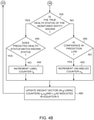
- FIGS. 4A-4B depict a flowchart for temporal transductive scholastic gradient descent (TTSGD) process 400 in accordance with embodiments.
- TTSGD process 400 implements Algorithm II using a complex Mercer kernel to enable non-linear models. Initially the weight vector (w) is set to zero, step 405. Counters representing labeled (1), unlabeled (u), and chronological (c) loss are set to zero, step 410. For each member of the sensor dataset, step 415, a loop is entered to determine gradient update components. If there are no further dataset members, process 400 ends.
- a sensor observation is chosen, step 420, using a random distribution to select the particular observation.
- a determination is made, step 425, as to whether a prediction using the current weight vector is chronologically incorrect. This step compares a chosen observation having an unhealthy status with the next sensor data for that monitored entity. Should a prediction based on the next sensor data indicate a healthy status, an error is flagged — recall that a basis condition is set that assumes monitored entities go from healthy to unhealthy states (not unhealthy to healthy states).
- step 425 If at step 425 a determination is made that the current weight vector is chronologically incorrect, the chronological counter c is incremented, step 430. If chronologically correct, process 400 continues to step 435.
- step 435 A determination is made, step 435, as to whether the true health status of the monitored entity is known (either healthy or unhealthy). If the true health status is known, a determination is made as to whether the predicted health of the monitored entity matches a known health status of the monitored entity. If the predicted does match the known health status, process 400 continues to step 460. If the predicted and known health statuses do not match, label counter c is incremented, step 345.
- step 435 If at step 435 the true health status of the monitored entity is not known, a determination is made regarding the confidence of the predicted health status, step 450. If the confidence in the accuracy of the predicted health status is low, then unlabeled counter u is incremented, step 455. If the confidence in the predicted health status is not low, then process 400 continues to step 460. At step 460, the weight vector (ws) for the particular member of the dataset is updated using counters 1, c, and u as described by EQ. 5.
- the number of iterations is independent of the number of examples (labeled or unlabeled), but rather depends on the regularization and desired accuracy.
- the runtime can depend on the number of observations, due to the min(s,
- Algorithm III is pseudocode for a data generation process.
- the terms N, T, p, a are predefined constants; where: N is the total instances to generate, T is a typical length of a series, p is a fraction of instances that will change state, and a is a fraction of the time-series that denotes change.
- C-/+ represents an input binary classification dataset.
- the time series of each entity can start from observations from one class (healthy), and then for a select group of entities change over to the other class (unhealthy).
- Generating datasets in this manner enables the accurate identification of changepoints, since ground truth about change is available for evaluation.
- Algorithm III describes the process of generating the state-change dataset given any binary classification problem.
- Algorithm III is governed by four parameters: (1) number of entities to generate (N); (2) length of time series for entity i (modeled as a random variable drawn from a Poisson distribution with expected value T); (3) fraction of instances that undergo change (modeling the likelihood that a certain entity can undergo change as a Bernoulli distribution with success probability p); and (4) time of change (modeled as a Poisson distribution with expected value aT i for entity i). Where the factor 'a' can be thought of as roughly the fraction of the time series of entity i that has changed state.
- Custom datasets for controlled experiments were created using popular benchmark classification datasets which deal with the identification of onset of certain major disorders, and Algorithm III.
- the popular benchmark datasets included (a) Pima-Indian Diabetes Smith et al. (1988) (glucose, plasma, serum and skin measurements from individuals of the Pima tribe to identify those which show signs of diabetes); (b) Parkinson Speech dataset Little et al. (2007) (voice measurements from thirty-one people including twenty-three with Parkinson's disease, with roughly 6 measurements from each individual, to identify the diseased); (c) Ovarian Cancer III et al. (2002) (proteomic patterns in serum that distinguish ovarian cancer from non-cancer).
- Figure 5 depicts comparison 500 illustrating the accuracy of various conventional approaches with an embodying MMTT approach in accordance with embodiments, where the number of known unhealthy entities is increased.
- the approaches for this comparison are stratified 540, SVMlight 530, SVM 520, and MMTT 510.
- the particular dataset of FIG. 5 is for diabetes, however the results shown are representative of the performance for the other data sets (Parkinson, Ovarian Cancer, Adult, MNIST, and USPS).
- the accuracy is expressed as a percentage (normalized to 1.0) and is plotted against an increasing number of known unhealthy entities. Increasing the number of known unhealthy entities is akin to the task of attempting to classify all monitored entities given a disease outbreak wherein, the information about few unhealthy entities becomes available at a time. The accuracy is reported on being able to classify all entities at the final diagnoses, as well as all the intermediate predictions leading to the final state. It can be observed that MMTT 510 outperforms all the other approaches, with minimal supervision.
- Root-cause analysis is another use case where final diagnoses of many/all entities are available and the goal is to classify observations along the time-series for time-of-change identification, enabling investigation of external stimuli concurrent with time of change.
- Figure 6 depicts comparison 600 illustrating the accuracy of various conventional approaches with an embodying MMTT approach in accordance with embodiments. The approaches for this comparison are stratified 640, SVMlight 630, SVM 620, and MMTT 610.
- FIG. 6 presents the trends of accuracy on the various datasets when there is knowledge of final diagnoses of entities — e.g., either a final diagnosis of healthy or unhealthy.
- embodying systems and methods offer a remedy for parameter tuning.
- This being a transductive problem setting interest resides in the performance on unlabeled sets, not the generalization error. It is well known that estimating this error using the labeled subset is a untenable and might lead to overfitting the labeled set.
- embodying systems and methods utilize the fact that healthiness only transitions from healthy to unhealthy.
- a chronological error l chrono is defined. This chronological error is estimated only on the unlabeled subset, as the fraction of violated chronological constraints. This estimate can be used in conjunction with the accuracy on the labeled set l labeled to arrive at an estimate of eventual performance on the unlabeled set.
- l ⁇ unlabeled C C + L l chrono + L C + L l labeled
- Figure 7 depicts comparison 700 of strategies to estimate performance on an unlabeled set for tuning the model parameter in accordance with embodiments.
- the x-axis represents the parameter being tuned for better performance.
- the y-axis represents the fraction of correctly classified observations as an accuracy normalized to unity.
- comparison 700 for any value of a parameter the estimated score obtained by embodying systems and methods better aligns with the true score, as compared to the score that is derived from the labeled dataset only.
- the comparison of FIG. 7 relies on estimates of unlabeled loss from EQ. 6, with true loss 720 and estimated loss 710 based on the labeled set.
- the estimated unlabeled score tracks the true score better than labeled set score 730, which is likely to overfit the labeled set. It is crucial that the comparison uses the estimate of EQ. 6, rather than just the chrono loss, because a perfect chrono score can be achieved just by labeling all instances as belonging to any one class.
- the linear combination with labeled score penalizes such scenarios and achieves a more balanced score.
- the score on the labeled set alone is not good for choosing the right ⁇ though and might lead to sub-optimal performance.
- EQ. 6 seems to be a valid potential surrogate performance metric for tuning parameters that are likely to achieve better performance on the unlabeled set.
- a computer program application stored in non-volatile memory or computer-readable medium may include code or executable instructions that when executed may instruct and/or cause a controller or processor to perform methods discussed herein such as a method for max-margin temporal transduction SVM, as disclosed above.
- the computer-readable medium may be a non-transitory computer-readable media including all forms and types of memory and all computer-readable media except for a transitory, propagating signal.
- the non-volatile memory or computer-readable medium may be external memory.
Landscapes
- Engineering & Computer Science (AREA)
- Medical Informatics (AREA)
- Health & Medical Sciences (AREA)
- Physics & Mathematics (AREA)
- Theoretical Computer Science (AREA)
- Data Mining & Analysis (AREA)
- Public Health (AREA)
- General Physics & Mathematics (AREA)
- Software Systems (AREA)
- Biomedical Technology (AREA)
- Computing Systems (AREA)
- Artificial Intelligence (AREA)
- Mathematical Physics (AREA)
- Evolutionary Computation (AREA)
- General Engineering & Computer Science (AREA)
- Epidemiology (AREA)
- Pathology (AREA)
- General Health & Medical Sciences (AREA)
- Databases & Information Systems (AREA)
- Primary Health Care (AREA)
- Computer Vision & Pattern Recognition (AREA)
- Automation & Control Theory (AREA)
- Nonlinear Science (AREA)
- Algebra (AREA)
- Computational Mathematics (AREA)
- Mathematical Analysis (AREA)
- Mathematical Optimization (AREA)
- Pure & Applied Mathematics (AREA)
- Management, Administration, Business Operations System, And Electronic Commerce (AREA)
Applications Claiming Priority (2)
| Application Number | Priority Date | Filing Date | Title |
|---|---|---|---|
| US15/634,042 US11443850B2 (en) | 2017-06-27 | 2017-06-27 | Max-margin temporal transduction for automatic prognostics, diagnosis and change point detection |
| EP18179513.9A EP3422356A1 (de) | 2017-06-27 | 2018-06-25 | Max-margin zeitliche transduktion zur automatischen prognose, diagnose und änderungspunkterkennung |
Related Parent Applications (1)
| Application Number | Title | Priority Date | Filing Date |
|---|---|---|---|
| EP18179513.9A Division EP3422356A1 (de) | 2017-06-27 | 2018-06-25 | Max-margin zeitliche transduktion zur automatischen prognose, diagnose und änderungspunkterkennung |
Publications (1)
| Publication Number | Publication Date |
|---|---|
| EP3971908A1 true EP3971908A1 (de) | 2022-03-23 |
Family
ID=62904243
Family Applications (2)
| Application Number | Title | Priority Date | Filing Date |
|---|---|---|---|
| EP21195244.5A Pending EP3971908A1 (de) | 2017-06-27 | 2018-06-25 | Max-margin zeitliche transduktion zur automatischen prognose, diagnose und änderungspunkterkennung |
| EP18179513.9A Ceased EP3422356A1 (de) | 2017-06-27 | 2018-06-25 | Max-margin zeitliche transduktion zur automatischen prognose, diagnose und änderungspunkterkennung |
Family Applications After (1)
| Application Number | Title | Priority Date | Filing Date |
|---|---|---|---|
| EP18179513.9A Ceased EP3422356A1 (de) | 2017-06-27 | 2018-06-25 | Max-margin zeitliche transduktion zur automatischen prognose, diagnose und änderungspunkterkennung |
Country Status (3)
| Country | Link |
|---|---|
| US (1) | US11443850B2 (de) |
| EP (2) | EP3971908A1 (de) |
| AU (1) | AU2018204480A1 (de) |
Families Citing this family (9)
| Publication number | Priority date | Publication date | Assignee | Title |
|---|---|---|---|---|
| US12310716B2 (en) | 2017-02-13 | 2025-05-27 | Starkey Laboratories, Inc. | Fall prediction system including an accessory and method of using same |
| US10630546B2 (en) * | 2017-09-22 | 2020-04-21 | Servicenow, Inc. | Distributed tool for detecting states and state transitions in remote network management platforms |
| US20200025525A1 (en) * | 2017-12-01 | 2020-01-23 | Peter J. Spransy | Collapsible Rolling Ballistic Bunker and Methods of Deployment and Use |
| US11204602B2 (en) * | 2018-06-25 | 2021-12-21 | Nec Corporation | Early anomaly prediction on multi-variate time series data |
| WO2020139850A1 (en) * | 2018-12-27 | 2020-07-02 | Starkey Laboratories, Inc. | Predictive fall event management system and method of using same |
| CN110728327B (zh) * | 2019-10-18 | 2021-11-23 | 中国科学技术大学 | 一种具有可解释性的直推学习方法及系统 |
| WO2023183320A1 (en) * | 2022-03-21 | 2023-09-28 | Argus Iot Inc. | Methods and systems for sensor-assisted monitoring of temporal state of device |
| US20260025091A1 (en) * | 2024-07-18 | 2026-01-22 | Nxp B.V. | Operating condition and health of an apparatus |
| CN118520375B (zh) * | 2024-07-25 | 2024-10-01 | 国网浙江省电力有限公司双创中心 | 一种楼宇设备运行状态数据处理方法、装置、设备及介质 |
Citations (2)
| Publication number | Priority date | Publication date | Assignee | Title |
|---|---|---|---|---|
| US20120025997A1 (en) * | 2010-05-27 | 2012-02-02 | University Of Southern California | System and method for failure prediction for rod pump artificial lift systems |
| US20150272509A1 (en) * | 2014-03-31 | 2015-10-01 | Samsung Electronics Co., Ltd. | Diagnostic apparatus and method |
Family Cites Families (11)
| Publication number | Priority date | Publication date | Assignee | Title |
|---|---|---|---|---|
| US8417360B2 (en) | 2001-08-10 | 2013-04-09 | Rockwell Automation Technologies, Inc. | System and method for dynamic multi-objective optimization of machine selection, integration and utilization |
| US8306610B2 (en) * | 2006-04-18 | 2012-11-06 | Susan Mirow | Method and apparatus for analysis of psychiatric and physical conditions |
| US8191005B2 (en) | 2007-09-27 | 2012-05-29 | Rockwell Automation Technologies, Inc. | Dynamically generating visualizations in industrial automation environment as a function of context and state information |
| US8571904B2 (en) | 2008-02-08 | 2013-10-29 | Rockwell Automation Technologies, Inc. | Self sensing component interface system |
| EP2172887A3 (de) | 2008-09-30 | 2011-11-09 | Rockwell Automation Technologies, Inc. | System und Verfahren zur dynamischen Mehrfachobjektoptimierung zur Maschinenauswahl, Integration und Verwendung |
| US9824060B2 (en) | 2010-07-23 | 2017-11-21 | Polyvalor, Limited Partnership | Tool and method for fault detection of devices by condition based maintenance |
| WO2013155421A1 (en) | 2012-04-13 | 2013-10-17 | Siemens Corporation | Embedded prognostics on plc platforms for equipment condition monitoring, diagnosis and time-to-failure/service prediction |
| EP3722744A1 (de) | 2012-05-30 | 2020-10-14 | Cytroniq Co., Ltd. | System und verfahren zur bereitstellung von informationen hinsichtlich der kraftstoffeinsparungen, des sicheren betriebs und der wartung mittels prädiktiver echtzeitüberwachung und prädiktiver steuerung von aerodynamischen und hydrodynamischen internen/externen umgebungskräften, rumpfbelastungen, bewegung mit sechs freiheitsgraden und der ortung einer meeresstruktur |
| GB201409590D0 (en) * | 2014-05-30 | 2014-07-16 | Rolls Royce Plc | Asset condition monitoring |
| US20160154802A1 (en) * | 2014-12-02 | 2016-06-02 | Nec Laboratories America, Inc. | Quality control engine for complex physical systems |
| US20160161375A1 (en) * | 2014-12-05 | 2016-06-09 | General Electric Company | Text-mining approach for diagnostics and prognostics using temporal multidimensional sensor observations |
-
2017
- 2017-06-27 US US15/634,042 patent/US11443850B2/en active Active
-
2018
- 2018-06-21 AU AU2018204480A patent/AU2018204480A1/en not_active Abandoned
- 2018-06-25 EP EP21195244.5A patent/EP3971908A1/de active Pending
- 2018-06-25 EP EP18179513.9A patent/EP3422356A1/de not_active Ceased
Patent Citations (2)
| Publication number | Priority date | Publication date | Assignee | Title |
|---|---|---|---|---|
| US20120025997A1 (en) * | 2010-05-27 | 2012-02-02 | University Of Southern California | System and method for failure prediction for rod pump artificial lift systems |
| US20150272509A1 (en) * | 2014-03-31 | 2015-10-01 | Samsung Electronics Co., Ltd. | Diagnostic apparatus and method |
Non-Patent Citations (1)
| Title |
|---|
| NING WANG ET AL: "A machine learning framework for space medicine predictive diagnostics with physiological signals", AEROSPACE CONFERENCE, 2013 IEEE, IEEE, 2 March 2013 (2013-03-02), pages 1 - 12, XP032397319, ISBN: 978-1-4673-1812-9, DOI: 10.1109/AERO.2013.6497431 * |
Also Published As
| Publication number | Publication date |
|---|---|
| AU2018204480A1 (en) | 2019-01-17 |
| US20180373841A1 (en) | 2018-12-27 |
| US11443850B2 (en) | 2022-09-13 |
| EP3422356A1 (de) | 2019-01-02 |
Similar Documents
| Publication | Publication Date | Title |
|---|---|---|
| EP3971908A1 (de) | Max-margin zeitliche transduktion zur automatischen prognose, diagnose und änderungspunkterkennung | |
| Jiwani et al. | Novel healthcare framework for cardiac arrest with the application of AI using ANN | |
| Xiao et al. | Joint modeling of event sequence and time series with attentional twin recurrent neural networks | |
| Shamout et al. | Deep interpretable early warning system for the detection of clinical deterioration | |
| EP3594860B1 (de) | Auf spärlichem neuronalem netzwerk basierende anomaliedetektion in mehrdimensionalen zeitreihen | |
| Abououf et al. | Explainable AI for event and anomaly detection and classification in healthcare monitoring systems | |
| Lim et al. | Disease-atlas: Navigating disease trajectories using deep learning | |
| JP5753286B1 (ja) | 情報処理装置、診断方法、およびプログラム | |
| EP3573068A1 (de) | System und verfahren für ein automatisiertes system zur unterstützung klinischer entscheidungen | |
| US9282008B2 (en) | Systems and methods for monitoring system performance and availability | |
| Lim et al. | Identifying recurrent and unknown performance issues | |
| EP2864914A2 (de) | Klinisches prädiktives analysesystem | |
| US20230118182A1 (en) | Remote Monitoring With Artificial Intelligence And Awareness Machines | |
| Peng et al. | A just-in-time learning based monitoring and classification method for hyper/hypocalcemia diagnosis | |
| Amor et al. | PCA-based multivariate anomaly detection in mobile healthcare applications | |
| Adomavicius et al. | Improving reliability estimation for individual numeric predictions: a machine learning approach | |
| Al Rasyid et al. | Anomaly detection in wireless body area network using mahalanobis distance and sequential minimal optimization regression | |
| US20170257304A1 (en) | Systems and methods for monitoring system performance and availability | |
| Yin et al. | SepsisCalc: Integrating clinical calculators into early sepsis prediction via dynamic temporal graph construction | |
| Amor et al. | Recursive and rolling windows for medical time series forecasting: a comparative study | |
| US20240403692A1 (en) | Anomaly detection | |
| Amor et al. | Anomaly detection and diagnosis scheme for mobile health applications | |
| Rajmohan et al. | G-Sep: A deep learning algorithm for detection of long-term sepsis using bidirectional gated recurrent unit | |
| JP2025010862A5 (de) | ||
| US12057231B1 (en) | Forecasting arterial embolic and bleeding events |
Legal Events
| Date | Code | Title | Description |
|---|---|---|---|
| PUAI | Public reference made under article 153(3) epc to a published international application that has entered the european phase |
Free format text: ORIGINAL CODE: 0009012 |
|
| STAA | Information on the status of an ep patent application or granted ep patent |
Free format text: STATUS: THE APPLICATION HAS BEEN PUBLISHED |
|
| AC | Divisional application: reference to earlier application |
Ref document number: 3422356 Country of ref document: EP Kind code of ref document: P |
|
| AK | Designated contracting states |
Kind code of ref document: A1 Designated state(s): AL AT BE BG CH CY CZ DE DK EE ES FI FR GB GR HR HU IE IS IT LI LT LU LV MC MK MT NL NO PL PT RO RS SE SI SK SM TR |
|
| STAA | Information on the status of an ep patent application or granted ep patent |
Free format text: STATUS: REQUEST FOR EXAMINATION WAS MADE |
|
| 17P | Request for examination filed |
Effective date: 20220921 |
|
| RBV | Designated contracting states (corrected) |
Designated state(s): AL AT BE BG CH CY CZ DE DK EE ES FI FR GB GR HR HU IE IS IT LI LT LU LV MC MK MT NL NO PL PT RO RS SE SI SK SM TR |
|
| STAA | Information on the status of an ep patent application or granted ep patent |
Free format text: STATUS: EXAMINATION IS IN PROGRESS |
|
| 17Q | First examination report despatched |
Effective date: 20250210 |