EP3971891B1 - Voice information processing apparatus and voice information processing method - Google Patents
Voice information processing apparatus and voice information processing method Download PDFInfo
- Publication number
- EP3971891B1 EP3971891B1 EP21196638.7A EP21196638A EP3971891B1 EP 3971891 B1 EP3971891 B1 EP 3971891B1 EP 21196638 A EP21196638 A EP 21196638A EP 3971891 B1 EP3971891 B1 EP 3971891B1
- Authority
- EP
- European Patent Office
- Prior art keywords
- voice
- user
- information processing
- voice information
- processing apparatus
- Prior art date
- Legal status (The legal status is an assumption and is not a legal conclusion. Google has not performed a legal analysis and makes no representation as to the accuracy of the status listed.)
- Active
Links
Images



Classifications
-
- G—PHYSICS
- G10—MUSICAL INSTRUMENTS; ACOUSTICS
- G10L—SPEECH ANALYSIS TECHNIQUES OR SPEECH SYNTHESIS; SPEECH RECOGNITION; SPEECH OR VOICE PROCESSING TECHNIQUES; SPEECH OR AUDIO CODING OR DECODING
- G10L15/00—Speech recognition
- G10L15/22—Procedures used during a speech recognition process, e.g. man-machine dialogue
-
- G—PHYSICS
- G06—COMPUTING OR CALCULATING; COUNTING
- G06V—IMAGE OR VIDEO RECOGNITION OR UNDERSTANDING
- G06V20/00—Scenes; Scene-specific elements
- G06V20/50—Context or environment of the image
- G06V20/59—Context or environment of the image inside of a vehicle, e.g. relating to seat occupancy, driver state or inner lighting conditions
- G06V20/597—Recognising the driver's state or behaviour, e.g. attention or drowsiness
-
- G—PHYSICS
- G06—COMPUTING OR CALCULATING; COUNTING
- G06V—IMAGE OR VIDEO RECOGNITION OR UNDERSTANDING
- G06V40/00—Recognition of biometric, human-related or animal-related patterns in image or video data
- G06V40/10—Human or animal bodies, e.g. vehicle occupants or pedestrians; Body parts, e.g. hands
- G06V40/16—Human faces, e.g. facial parts, sketches or expressions
- G06V40/161—Detection; Localisation; Normalisation
-
- G—PHYSICS
- G06—COMPUTING OR CALCULATING; COUNTING
- G06V—IMAGE OR VIDEO RECOGNITION OR UNDERSTANDING
- G06V40/00—Recognition of biometric, human-related or animal-related patterns in image or video data
- G06V40/10—Human or animal bodies, e.g. vehicle occupants or pedestrians; Body parts, e.g. hands
- G06V40/16—Human faces, e.g. facial parts, sketches or expressions
- G06V40/174—Facial expression recognition
-
- G—PHYSICS
- G10—MUSICAL INSTRUMENTS; ACOUSTICS
- G10L—SPEECH ANALYSIS TECHNIQUES OR SPEECH SYNTHESIS; SPEECH RECOGNITION; SPEECH OR VOICE PROCESSING TECHNIQUES; SPEECH OR AUDIO CODING OR DECODING
- G10L15/00—Speech recognition
- G10L15/24—Speech recognition using non-acoustical features
- G10L15/25—Speech recognition using non-acoustical features using position of the lips, movement of the lips or face analysis
-
- G—PHYSICS
- G10—MUSICAL INSTRUMENTS; ACOUSTICS
- G10L—SPEECH ANALYSIS TECHNIQUES OR SPEECH SYNTHESIS; SPEECH RECOGNITION; SPEECH OR VOICE PROCESSING TECHNIQUES; SPEECH OR AUDIO CODING OR DECODING
- G10L15/00—Speech recognition
- G10L15/26—Speech to text systems
-
- H—ELECTRICITY
- H04—ELECTRIC COMMUNICATION TECHNIQUE
- H04M—TELEPHONIC COMMUNICATION
- H04M1/00—Substation equipment, e.g. for use by subscribers
- H04M1/72—Mobile telephones; Cordless telephones, i.e. devices for establishing wireless links to base stations without route selection
-
- B—PERFORMING OPERATIONS; TRANSPORTING
- B60—VEHICLES IN GENERAL
- B60R—VEHICLES, VEHICLE FITTINGS, OR VEHICLE PARTS, NOT OTHERWISE PROVIDED FOR
- B60R16/00—Electric or fluid circuits specially adapted for vehicles and not otherwise provided for; Arrangement of elements of electric or fluid circuits specially adapted for vehicles and not otherwise provided for
- B60R16/02—Electric or fluid circuits specially adapted for vehicles and not otherwise provided for; Arrangement of elements of electric or fluid circuits specially adapted for vehicles and not otherwise provided for electric constitutive elements
- B60R16/037—Electric or fluid circuits specially adapted for vehicles and not otherwise provided for; Arrangement of elements of electric or fluid circuits specially adapted for vehicles and not otherwise provided for electric constitutive elements for occupant comfort, e.g. for automatic adjustment of appliances according to personal settings, e.g. seats, mirrors, steering wheel
- B60R16/0373—Voice control
-
- G—PHYSICS
- G01—MEASURING; TESTING
- G01C—MEASURING DISTANCES, LEVELS OR BEARINGS; SURVEYING; NAVIGATION; GYROSCOPIC INSTRUMENTS; PHOTOGRAMMETRY OR VIDEOGRAMMETRY
- G01C21/00—Navigation; Navigational instruments not provided for in groups G01C1/00 - G01C19/00
- G01C21/26—Navigation; Navigational instruments not provided for in groups G01C1/00 - G01C19/00 specially adapted for navigation in a road network
- G01C21/34—Route searching; Route guidance
- G01C21/36—Input/output arrangements for on-board computers
- G01C21/3605—Destination input or retrieval
- G01C21/3608—Destination input or retrieval using speech input, e.g. using speech recognition
-
- G—PHYSICS
- G01—MEASURING; TESTING
- G01C—MEASURING DISTANCES, LEVELS OR BEARINGS; SURVEYING; NAVIGATION; GYROSCOPIC INSTRUMENTS; PHOTOGRAMMETRY OR VIDEOGRAMMETRY
- G01C21/00—Navigation; Navigational instruments not provided for in groups G01C1/00 - G01C19/00
- G01C21/26—Navigation; Navigational instruments not provided for in groups G01C1/00 - G01C19/00 specially adapted for navigation in a road network
- G01C21/34—Route searching; Route guidance
- G01C21/36—Input/output arrangements for on-board computers
- G01C21/3626—Details of the output of route guidance instructions
- G01C21/3629—Guidance using speech or audio output, e.g. text-to-speech
-
- G—PHYSICS
- G06—COMPUTING OR CALCULATING; COUNTING
- G06F—ELECTRIC DIGITAL DATA PROCESSING
- G06F3/00—Input arrangements for transferring data to be processed into a form capable of being handled by the computer; Output arrangements for transferring data from processing unit to output unit, e.g. interface arrangements
- G06F3/16—Sound input; Sound output
- G06F3/167—Audio in a user interface, e.g. using voice commands for navigating, audio feedback
-
- G—PHYSICS
- G10—MUSICAL INSTRUMENTS; ACOUSTICS
- G10L—SPEECH ANALYSIS TECHNIQUES OR SPEECH SYNTHESIS; SPEECH RECOGNITION; SPEECH OR VOICE PROCESSING TECHNIQUES; SPEECH OR AUDIO CODING OR DECODING
- G10L13/00—Speech synthesis; Text to speech systems
-
- G—PHYSICS
- G10—MUSICAL INSTRUMENTS; ACOUSTICS
- G10L—SPEECH ANALYSIS TECHNIQUES OR SPEECH SYNTHESIS; SPEECH RECOGNITION; SPEECH OR VOICE PROCESSING TECHNIQUES; SPEECH OR AUDIO CODING OR DECODING
- G10L15/00—Speech recognition
- G10L15/22—Procedures used during a speech recognition process, e.g. man-machine dialogue
- G10L2015/221—Announcement of recognition results
-
- G—PHYSICS
- G10—MUSICAL INSTRUMENTS; ACOUSTICS
- G10L—SPEECH ANALYSIS TECHNIQUES OR SPEECH SYNTHESIS; SPEECH RECOGNITION; SPEECH OR VOICE PROCESSING TECHNIQUES; SPEECH OR AUDIO CODING OR DECODING
- G10L15/00—Speech recognition
- G10L15/22—Procedures used during a speech recognition process, e.g. man-machine dialogue
- G10L2015/225—Feedback of the input speech
-
- G—PHYSICS
- G10—MUSICAL INSTRUMENTS; ACOUSTICS
- G10L—SPEECH ANALYSIS TECHNIQUES OR SPEECH SYNTHESIS; SPEECH RECOGNITION; SPEECH OR VOICE PROCESSING TECHNIQUES; SPEECH OR AUDIO CODING OR DECODING
- G10L25/00—Speech or voice analysis techniques not restricted to a single one of groups G10L15/00 - G10L21/00
- G10L25/78—Detection of presence or absence of voice signals
-
- H—ELECTRICITY
- H04—ELECTRIC COMMUNICATION TECHNIQUE
- H04M—TELEPHONIC COMMUNICATION
- H04M1/00—Substation equipment, e.g. for use by subscribers
- H04M1/26—Devices for calling a subscriber
- H04M1/27—Devices whereby a plurality of signals may be stored simultaneously
- H04M1/271—Devices whereby a plurality of signals may be stored simultaneously controlled by voice recognition
Definitions
- the present invention relates to a voice information processing apparatus and a voice information processing method, and more particularly, to be suitable for use in a voice information processing apparatus and a voice information processing method that convert uttered voice of a user into text.
- a voice information processing apparatus that inputs an uttered voice of a user, converts the input voice into text, and transmits the text as a chat application message or a mail.
- the user can transmit sentences of desired contents converted into text to the other party by utterance without performing an operation using a hand.
- JP 2007-151188 A describes a technology in which, in a telephone, in a case where there is an interruption while a phone number is being input, data processed so far is temporarily saved in a nonvolatile memory, and the data is returned after the interruption processing is finished.
- JP 2003-319280 A describes a technology in which, in a digital broadcast receiving system, in a case where a lack of a signal occurs while a received signal is recorded in a recording/reproducing device, a missing information signal corresponding to a missing time is generated and recorded in the recording/reproducing device, and for the missed portion, an image or a voice is output on the basis of the generated and recorded missing information signal.
- the user's utterance may be interrupted during the utterance for some reason. Then, after the utterance is interrupted, the cause of the interruption is eliminated, and when utterances to be converted into text are resumed, the user does not accurately memorize the content of the sentence uttered so far, and it is often not possible to know exactly where to utter a sentence with what content. In such a case, the user had to cancel the sentence that had been converted into the utterance text and start the utterance from the beginning of the sentence, which was complicated for the user.
- US 2009/0187406 A1 relates to a voice recognition system that outputs a talk-back voice in a manner such that a user can distinguish the accuracy of a voice-recognized character string more easily.
- a voice recognition unit performs voice recognition on a user's articulation in which a character string such as the telephone number "024 636 0123" is entered via a microphone. Based on each sound existing period delimited by silent intervals, each recognized partial character string "024", "636” and "0123” is obtained.
- a talk-back voice data generating unit connects each recognized partial character string "024", "636” and "0123” together in a manner such that space characters are inserted, and generates a character string "024 636 0123". The generated character string "024 636 0123" is supplied to a voice generating device as talk-back voice data.
- An object of the present invention is to enable a user to complete conversion of a desired sentence into text without performing complicated work in a case where the utterance is interrupted while the utterance is being converted into text.
- the invention relates to a voice information processing apparatus and method according to the appended independent claims. Possible embodiments are disclosed in the dependent claims.
- the utterance content uttered by the user so far are automatically output as a voice. Therefore, by listening to the output voice, the user can grasp the content of the sentence that the user has uttered so far and recognize how far the user has uttered and where the user should utter. As a result, the user can resume the utterance from the middle sentence without canceling the already-textualized sentence. Therefore, according to the present invention, in a case where the utterance is interrupted while the utterance is being converted into text, the user can complete conversion of a desired sentence into text without performing complicated work.
- Fig. 1 is a block diagram illustrating a functional configuration example of a voice information processing apparatus 1.
- the voice information processing apparatus 1 according to the first embodiment is an apparatus mounted on a vehicle.
- the voice information processing apparatus 1 has a function of providing a user with an environment in which text chat in which a plurality of persons exchange text messages is performed.
- the voice information processing apparatus 1 according to the first embodiment has a function of, at the time of text chat, inputting a voice uttered by an occupant (hereinafter, simply referred to as a "user") who uses the apparatus within a voice reception period (described later), converting a sentence indicated by the input voice into text, and transmitting the converted text as a message.
- the user can use the function to create and transmit a message to be transmitted to the other party in a text chat without inputting by hand.
- the vehicle on which the voice information processing apparatus 1 is mounted is referred to as "host vehicle”.
- a microphone 2 and a speaker 3 are connected to the voice information processing apparatus 1.
- the microphone 2 is provided at a position where an uttered voice of a user boarding the host vehicle can be collected.
- the microphone 2 collects a voice and outputs a voice signal of the collected voice.
- the speaker 3 is provided inside the vehicle, receives a voice signal, and emits a voice based on the input voice signal.
- the voice information processing apparatus 1 includes a voice output unit 10, a voice input unit 11, and a voice information processing unit 12 as functional configurations.
- Each of the functional blocks 10 to 12 described above can be implemented by any one of hardware, a digital signal processor (DSP), or software.
- DSP digital signal processor
- each of the above functional blocks 10 to 12 substantially includes, for example, a CPU, a RAM, and a ROM of a computer, and is achieved by operation of a program stored in a recording medium, such as a RAM, a ROM, a hard disk, or a semiconductor memory.
- the voice output unit 10 inputs a voice signal, drives the speaker 3 on the basis of the input voice signal, and causes the speaker 3 to emit a voice based on the voice signal.
- the chat mode is the operation mode in which the user can perform text chat with a desired party (or a plurality of parties) using the voice information processing apparatus 1.
- the mode is shifted to the chat mode by a user's operation on an operation means (which may be a touch panel) of the voice information processing apparatus 1 or an instruction by voice.
- setting necessary for transmission of a message such as designation of a party with whom text chat is to be performed, is also appropriately performed.
- the user utters a message start word including a predetermined fixed sentence, utters a sentence desired to be converted into text, and then, utters a message end word including a predetermined fixed sentence.
- the message start word is, for example, a sentence "message start”
- the message end word is, for example, a sentence "message end”. That is, in accordance with the invention, the period from the end of the utterance of the message start word to the start of the utterance of the message end word is a period in which the voice of the sentence to be converted into text is accepted. This period corresponds to a "voice reception period".
- the user in a case where the user wishes to transmit, as a message, a sentence uttered during the voice reception period after uttering the message end word, the user utters the message transmission word.
- the message transmission word is, for example, a sentence "message transmission”. Transmission of the sentence uttered by the user to the other party is executed according to the utterance of the message transmission word by the user.
- the voice input unit 11 inputs a voice signal output from the microphone 2, performs analog/digital conversion processing including sampling, quantization, and encoding on the voice signal, and performs other signal processing to generate voice data (hereinafter referred to as "input voice data"), and buffers the voice data in the buffer 13.
- the buffer 13 is a storage area formed in a work area such as a RAM.
- the input voice data is data of a voice waveform sampled at a predetermined sample cycle (for example, 16 kHz).
- the voice information processing unit 12 analyzes the input voice data buffered in the buffer 13 as needed, and monitors whether or not the voice waveform of the message start word appears in the input voice data.
- the voice information processing unit 12 compares the voice waveform of the input voice data with the voice pattern related to the message start word as needed and calculates similarity by a predetermined method, and in a case where the similarity is equal to or greater than a certain value, determines that the waveform of the message start word appears in the input voice data.
- detecting that the waveform of the message start word appears in the input voice data by the voice information processing unit 12 is appropriately expressed as "the voice information processing unit 12 detects the message start word”.
- the voice information processing unit 12 executes voice recognition on the input voice data buffered in the buffer 13 at any time, converts a sentence recorded in the input voice data into text, and describes the text as text in sentence data stored in a storage unit (not illustrated).
- this processing is referred to as "text conversion processing”.
- conversion of input voice data into text is appropriately performed by performing morphological analysis, syntactic structure analysis, semantic structure analysis, and the like on the basis of the existing technologies related to natural language processing.
- An artificial intelligence technology may be used as a part of the technology.
- the voice information processing unit 12 may be configured to execute the text conversion processing in cooperation with an external device.
- the configuration may be such that the text conversion processing is executed in cooperation with a cloud server that provides a service for converting audio data into text.
- the voice information processing unit 12 analyzes the input voice data buffered in the buffer 13 as needed, and monitors whether or not the voice waveform of the message end word appears in the input voice data. The monitoring is executed in a similar manner to the monitoring of whether the voice waveform of the message start word appears on the basis of the voice pattern of the message end word registered in advance.
- the voice information processing unit 12 When detecting that the voice waveform of the message end word appears in the input voice data, the voice information processing unit 12 ends the text conversion processing. Thereafter, the voice information processing unit 12 analyzes the input voice data buffered in the buffer 13 as needed, and monitors whether or not the voice waveform of the message transmission word appears in the input voice data. The monitoring is executed by a method similar to the above-described monitoring of whether or not the voice waveform of the message start word appears on the basis of the voice pattern of the message transmission word registered in advance.
- the voice information processing unit 12 When detecting that the voice waveform of the message transmission word appears in the input voice data, the voice information processing unit 12 transmits a message regarding the text described in the sentence data to a predetermined server via a network N according to a protocol.
- the voice information processing unit 12 analyzes the input voice data buffered in the buffer 13 as needed in parallel with the text conversion processing, and monitors whether or not a voice waveform of a cancel word appears in the input voice data.
- the cancel word is, for example, a sentence "cancel message".
- the monitoring is executed by a method similar to the monitoring of whether or not the voice waveform of the message start word appears on the basis of the voice pattern of the cancel word registered in advance.
- the voice information processing unit 12 cancels the text conversion processing and further deletes the text described in the sentence data so far. Thereafter, the voice information processing unit 12 starts monitoring again whether or not the voice waveform of the message start word appears in the input voice data.
- the voice information processing unit 12 executes the following processing during the execution of the text conversion processing, that is, during a period from the detection of the message start word to the end or cancellation of the text conversion processing. That is, it is determined whether or not a period during which the user's utterance is not performed has continued for a predetermined time or longer.
- the fact that the period during which the user's utterance is not performed continues for a predetermined time or longer means the following. For example, it is assumed that the user utters a sentence "Hi.” In this case, it means that a predetermined time or longer has elapsed without the user's utterance being performed after the utterance of "Hi.” is completed.
- the voice information processing unit 12 analyzes the input voice data, and in a case where a sound pressure value of the voice waveform once exceeds a first threshold value (threshold value for determining that the utterance has been performed), and is then smaller than or equal to a second threshold value (threshold value for determining that the utterance has not been performed.
- the threshold value may be the same value as the first threshold), and the second threshold or less continues for a predetermined time or longer, determines that the period during which the user's utterance is not performed is a predetermined time or longer.
- the determination method may be any method.
- the voice output by the voice output unit 10 in this manner is referred to as "already-textualized voice”
- the voice information processing unit 12 causing the voice output unit 10 to output the already-textualized voice is simply expressed as "the voice information processing unit 12 outputs the already-textualized voice”.
- the already-textualized voice corresponds to "voice corresponding to utterance content already uttered by the user during the voice reception period" in the claims.
- the voice information processing unit 12 Describing the processing of the voice information processing unit 12 in detail, the voice information processing unit 12 generates voice data for outputting a sentence indicated by a text described in the sentence data as a voice. The generation of the voice data is appropriately performed by the existing technology such as a voice synthesis technology. Then, the voice information processing unit 12 outputs the voice signal based on the voice data to the voice output unit 10 to emit the voice based on the voice data from the speaker 3.
- the voice information processing unit 12 continues to execute the conversion into the text conversion processing, and converts the uttered sentence into text in a case where there is an utterance to be converted into text. Thereafter, in a case where there is the utterance of the user and the period in which the utterance of the user is not performed continues for a predetermined time or longer, the voice information processing unit outputs the already-textualized voice again.
- the voice information processing unit 12 also detects the message end word and the cancel word in parallel.
- the voice information processing apparatus 1 operates, for example, in the following manner. For example, it is assumed that a user wants to speak a sentence "I am heading by the car now. It's past point A. Arrival time is 13:00. Arrival may be delayed because the road is congested. I will contact you again when I get closer to you.” Then, it is assumed that the user utters the message start word, and then interrupts the utterance for some reason when uttering the sentence "I am heading by car now. It is just past point A.” An example of the reason is that a vehicle approaches an intersection or starts parking, and thus it is necessary to concentrate on driving, or it is necessary to perform work such as paying a toll at a gate on a road. Note that the portion uttered by the user is converted into text by the text conversion processing of the voice information processing unit 12, and the text is described in the sentence data.
- the voice information processing unit 12 of the voice information processing apparatus 1 causes the voice output unit 10 to automatically output the voice related to the already-generated text.
- the sentence "I'm heading by car now. It's just past point A" is output by voice.
- the user when resuming the utterance to be converted into text after interrupting the utterance while the utterance is converted into text, the user is required to newly make utterance from the sentence immediately after the portion where the utterance has been completed.
- the user does not accurately memorize the content of the sentence uttered so far, and does not accurately know from where and what the content of the sentence should be uttered.
- the user should start the utterance from "the estimated time of arrival -,” but may not accurately know how far the user has uttered and where the user should make the utterance.
- by uttering the cancel word it is possible to temporarily cancel the voice input so far and perform work regarding conversion of a desired sentence into text and transmission as a message from the beginning, but such work is troublesome for the user.
- the following effects are obtained.
- the period during which the user does not utter continues for a considerable time it can be considered that the user's utterance is interrupted. This is because, in general, in a case where the user utters a series of sentences to be transmitted as a message for conversion into text, the user does not utter for an unnecessarily long period of time during the utterance.
- the voice information processing apparatus 1 in a case where the user's utterance can be regarded as being interrupted, a sentence converted into text by the user so far is automatically output as a voice. Therefore, the user can grasp the content of the sentence that he/she has uttered so far and that is converted into text, by listening to the output voice. As a result, the user can resume the utterance from the middle sentence without canceling the already-textualized sentence. Therefore, according to the first embodiment, in a case where the utterance is interrupted while the utterance is converted into text, the user can complete conversion of a desired sentence into text without performing complicated work.
- the user may forget the fact that the user has made the utterance to be converted into text after interrupting the utterance to be converted into text.
- the sentence already converted into text on the basis of the utterance of the user is automatically output as a voice, it is possible to make the user realize that the user is being uttered (naturally, the content of the already uttered sentence can be recognized.).
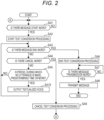
- the flowchart of Fig. 2 illustrates the operation of the voice information processing unit 12 when the chat mode is on.
- the voice information processing unit 12 analyzes the input voice data buffered in the buffer 13 as needed, and monitors whether or not the voice waveform of the message start word appears in the input voice data (step SA1). In a case where the voice waveform of the message start word appears (step SA1: YES), the voice information processing unit 12 starts the text conversion processing (step SA2).
- the voice information processing unit 12 monitors whether or not the voice waveform of the message end word appears in the input voice data (step SA3), whether or not the voice waveform of the cancel word appears in the input voice data (step SA4), and whether or not the period in which the utterance is not performed is longer than or equal to a predetermined time (step SA5).
- the voice information processing unit 12 ends the text conversion processing (step SA6) and monitors whether or not the voice waveform of the message transmission word appears in the input voice data (step SA7).
- the voice information processing unit 12 transmits a message for the text described in the sentence data (step SA8).
- step SA4 the voice information processing unit 12 cancels the text conversion processing (step SA9) and returns the processing procedure to step SA1.
- a voice information processing unit 12 is configured to cause a voice output unit 10 to output a sentence indicated by text that has been already-generated as a voice (already-textualized voice).
- the voice information processing unit 12 cuts out voice data corresponding to a portion already uttered by the user during the voice reception period from the input voice data stored in the buffer 13, and outputs a voice signal based on the cut out voice data to the voice output unit 10.
- this modification can be applied to a second embodiment (including a modification of the second embodiment) to be described later.
- Fig. 3 is a block diagram illustrating a functional configuration example of a voice information processing apparatus 1A according to the second embodiment.
- the same components as those of the first embodiment will be denoted by the same reference signs and a detailed description thereof will be omitted.
- a user who uses the voice information processing apparatus 1A is a driver.
- an occupant other than the driver may be a user who uses the voice information processing apparatus 1A.
- the voice information processing apparatus 1A according to the second embodiment includes a voice information processing unit 12A instead of the voice information processing unit 12 according to the first embodiment. Furthermore, a camera 14 is connected to the voice information processing apparatus 1A according to the second embodiment. The camera 14 is provided at a position where an upper body including a user's face can be photographed when the user is seated on a driver's seat. The camera 14 performs photographing at a predetermined cycle, and outputs captured image data based on the photographed result to the voice information processing unit 12A.
- the voice information processing unit 12 causes the voice output unit 10 to output a voice (already-textualized voice) related to a sentence that has already been converted into text when a period in which the user's utterance is not performed becomes a predetermined time or longer during the voice reception period.
- the voice information processing unit 12A according to the second embodiment outputs the already-textualized voice in a case where the user's utterance has not been performed for a predetermined time or longer after the user's face moves in a mode of looking outside through a side window.
- the monitoring is performed based on an existing motion recognition technology. It is a matter of course that the monitoring may be performed using a model learned by deep learning or another machine learning method.
- the voice information processing unit 12A detects that the operation performed in a case where the user is looking outside through the side window has been performed by the user, when a period in which the user's utterance is not further performed continues for a predetermined time or longer after the detection, the voice information processing unit automatically outputs the already-textualized voice.
- the following effects are obtained. That is, when the utterance of the user can be regarded as being interrupted, the sentence converted into text by the user so far is automatically output as a voice, so that the same effect as that of the first embodiment can be obtained. Furthermore, in a case where the user has not made an utterance to be converted into text for a predetermined time or longer after looking outside through the side window, it is possible to strongly estimate that the driver has interrupted the utterance to be converted into text due to looking at the outside scenery, as compared with a case where a period in which there is no utterance continues for a predetermined time or longer. Based on this, according to the second embodiment, it is possible to output the already-textualized voice in a situation where it can be more strongly estimated that the utterance is interrupted, as compared with the first embodiment.
- step SB1 the voice information processing apparatus 1A according to the second embodiment executes processing different from the processing in step SA5 in Fig. 2 . That is, in step SB1, the voice information processing unit 12A monitors whether or not a period in which the driver's face is not uttered after moving in a mode of looking outside through the side window has become a predetermined time or longer.
- step SB1 YES
- the voice information processing unit 12A may be configured to output the recorded voice of the user's utterance instead of the already-textualized voice in the second embodiment.
- the voice information processing unit 12A outputs the already-textualized voice in a case where the user's utterance has not been performed for a predetermined time or longer after the user's (driver's) face moves in a mode of looking outside through the side window.
- the voice information processing unit 12A according to the present modification executes the following processing. Note that the present modification is based on the premise that a car navigation device is installed in a host vehicle.
- the voice information processing unit 12A outputs the already-textualized voice in a case where the user's utterance has not been performed for a predetermined time or longer after the user's face moves in a mode of looking at a display screen of the car navigation device on the basis of the input from the camera 14.
- step SB1 the voice information processing unit 12A monitors whether or not the user has not uttered for a predetermined time or longer after the user's face moves in a mode of looking at the display screen of the car navigation device.
- the voice information processing unit 12A monitors whether or not the user's face has moved in a predetermined manner on the basis of the photographed result of the camera 14, and causes the voice output unit 10 to output a voice related to text that has already been generated in a case where the user has not uttered for a predetermined time or longer after moving in the predetermined manner.
- the example of the configuration is not limited to the example.
- the voice information processing unit 12A may be configured to monitor whether or not the user's face has moved in a mode of looking at other occupants other than the user's own face, and execute the corresponding processing, or the voice information processing unit 12A may be configured to monitor whether or not the user's face has moved in a mode of looking at members provided in the host vehicle such as a rearview mirror and a side mirror, and execute the corresponding processing. Furthermore, as described in the modification of the first embodiment, in the first modification of the second embodiment, the voice information processing unit 12A may be configured to output the recorded voice of the user's utterance instead of the already-textualized voice.
- the voice information processing unit 12A monitors whether or not the user's face has turned into an expression focusing on driving on the basis of the photographed result of the camera 14, and outputs the already-textualized voice in a case where the user's utterance has not been performed for a predetermined time or longer after the user's face has turned into the expression.
- the monitoring is performed based on an existing facial expression recognition technology. It is a matter of course that the monitoring may be performed using a model learned by deep learning or another machine learning method.
- step SB1 the voice information processing unit 12A monitors whether or not the user's utterance has not been performed for a predetermined time or longer after the user's face has turned into an expression of concentrating on driving.
- the voice information processing unit 12A monitors whether or not the user's face has the predetermined expression on the basis of the photographed result of the camera 14, and causes the voice output unit 10 to output the voice related to the already-generated text in a case where the user's utterance has not been performed for a predetermined time or longer after the face has the predetermined expression.
- the example of the configuration is not limited to the example.
- the voice information processing unit 12A may be configured to monitor whether or not the user's face has a surprised expression and execute corresponding processing.
- the voice information processing unit 12A may be configured to output the recorded voice of the user's utterance instead of the already-textualized voice.
- the voice information processing unit 12A monitors whether or not the user has started yawning on the basis of the photographed result of the camera 14. In a case where the voice information processing unit 12A detects that the user has started yawning, the voice information processing unit monitors whether or not the yawning has ended, and outputs an already-textualized voice when it is detected that the yawning has ended. Note that detection of start/end of the yawning is performed on the basis of the existing image recognition technology. It is a matter of course that the monitoring may be performed using a model learned by deep learning or another machine learning method.
- step SB1 the voice information processing unit 12A monitors whether or not the yawning has ended after the user has started yawning.
- the voice information processing unit 12A may be configured to output the recorded voice of the user's utterance instead of the already-textualized voice in the third modification of the second embodiment.
- the telephone call of the user is assumed to be a call made by the user using his/her mobile phone in a vehicle.
- the detection of the start/end of the call by the user is performed on the basis of the existing image recognition technology. It is a matter of course that the monitoring may be performed using a model learned by deep learning or another machine learning method. Furthermore, in the present modification, the voice information processing unit 12A detects the start/end of the call on the basis of the photographed result of the camera 14, but the method of performing the detection is not limited to the illustrated method. As an example, the voice information processing apparatus 1A and the mobile phone may be communicably connected, and a predetermined signal may be transmitted from the mobile phone to the voice information processing apparatus 1A at the start and end of the call, and the voice information processing unit 12A may detect the start/end of the call on the basis of the predetermined signal.
- step SB 1 the voice information processing unit 12A monitors whether or not the call has ended after the user has started the call by the telephone.
- the voice input by the voice input unit 11 during the call is not a voice to be converted into text but a voice for the telephone call, and should not be converted into text. Then, according to the present modification, it is possible to prevent uttered voice that should not be converted into text from being converted into text.
- the voice information processing unit 12A when the voice information processing unit 12A causes the voice output unit 10 to output the already-textualized voice, the following processing may be executed. That is, the voice information processing unit 12A may be configured to cause the voice output unit 10 to output, as a voice, a sentence indicating that the conversion of the voice input by the voice input unit 11 into text has been stopped while the user is talking, together with the already-textualized voice (voice corresponding to the utterance content). For example, the voice information processing unit 12A executes the following processing. That is, the voice information processing unit 12A first outputs the already-textualized voice. Next, the voice information processing unit 12A outputs, as a voice, the text of the context "The voice during a call on the phone is not converted to text.
- the voice data that is the source of the voice is prepared in advance.
- the exemplified processing is merely an example, and for example, the voice information processing unit 12A may be configured to first output "A sentence indicating that the voice input unit 11 has stopped converting the input voice into text while the user is talking.” as a voice, and then output an already-textualized voice as text.
- the voice information processing unit 12A may be configured to output the recorded voice of the user's utterance instead of the already-textualized voice.
- the voice information processing unit 12A detects that the user has entered the predetermined mode in which the user cannot made the utterance to be converted into text, and after entering the predetermined mode, outputs the already-textualized voice when the predetermined mode is resolved.
- the example of the configuration is not limited to the example.
- the voice information processing unit 12A may be configured to detect that the user has started and finished a meal, and output the already-textualized voice when the meal is finished.
- the transmission of the text by the voice information processing unit 12 is performed as the transmission of the message in the text chat, but the transmission of the text is not limited to the mode illustrated in each embodiment.
- the text may be transmitted by e-mail.
- the transmission of the text does not mean only transmission to a specific partner, but is a concept widely including transmission of text to an external device such as transmission of text to a server or a specific host device.
- transmission of text to a message posting site or a bulletin board site according to a protocol is also included in the transmission of the text. The same applies to the second embodiment.
- the voice information processing apparatus may be provided in a vehicle.
- the voice information processing apparatus is not necessarily a device provided in the vehicle.
- the present invention is widely applicable to the voice information processing apparatus that converts the user's uttered voice into the text.
- the voice reception period has been started by the user uttering the message start word.
- the voice reception period may be started when the user performs a predetermined operation on the touch screen or other input means, or when the user performs a predetermined gesture in a configuration capable of detecting a gesture. The same applies to the message end word, the message transmission word, and the cancel word.
Landscapes
- Engineering & Computer Science (AREA)
- Multimedia (AREA)
- Physics & Mathematics (AREA)
- Human Computer Interaction (AREA)
- Health & Medical Sciences (AREA)
- Acoustics & Sound (AREA)
- Audiology, Speech & Language Pathology (AREA)
- Computational Linguistics (AREA)
- General Physics & Mathematics (AREA)
- Theoretical Computer Science (AREA)
- General Health & Medical Sciences (AREA)
- Oral & Maxillofacial Surgery (AREA)
- Signal Processing (AREA)
- Computer Networks & Wireless Communication (AREA)
- User Interface Of Digital Computer (AREA)
- Machine Translation (AREA)
Description
- The present invention relates to a voice information processing apparatus and a voice information processing method, and more particularly, to be suitable for use in a voice information processing apparatus and a voice information processing method that convert uttered voice of a user into text.
- Conventionally, there is a voice information processing apparatus that inputs an uttered voice of a user, converts the input voice into text, and transmits the text as a chat application message or a mail. By using this type of device, the user can transmit sentences of desired contents converted into text to the other party by utterance without performing an operation using a hand.
- Note that
JP 2007-151188 A JP 2003-319280 A - When the user converts his/her own uttered voice into text using the above-described conventional voice information processing apparatus, the user's utterance may be interrupted during the utterance for some reason. Then, after the utterance is interrupted, the cause of the interruption is eliminated, and when utterances to be converted into text are resumed, the user does not accurately memorize the content of the sentence uttered so far, and it is often not possible to know exactly where to utter a sentence with what content. In such a case, the user had to cancel the sentence that had been converted into the utterance text and start the utterance from the beginning of the sentence, which was complicated for the user.
-
US 2009/0187406 A1 relates to a voice recognition system that outputs a talk-back voice in a manner such that a user can distinguish the accuracy of a voice-recognized character string more easily. A voice recognition unit performs voice recognition on a user's articulation in which a character string such as the telephone number "024 636 0123" is entered via a microphone. Based on each sound existing period delimited by silent intervals, each recognized partial character string "024", "636" and "0123" is obtained. A talk-back voice data generating unit connects each recognized partial character string "024", "636" and "0123" together in a manner such that space characters are inserted, and generates a character string "024 636 0123". The generated character string "024 636 0123" is supplied to a voice generating device as talk-back voice data. - An object of the present invention is to enable a user to complete conversion of a desired sentence into text without performing complicated work in a case where the utterance is interrupted while the utterance is being converted into text.
- The invention relates to a voice information processing apparatus and method according to the appended independent claims. Possible embodiments are disclosed in the dependent claims.
- According to the present invention, in a situation where the user's utterance can be regarded as being interrupted, the utterance content uttered by the user so far are automatically output as a voice. Therefore, by listening to the output voice, the user can grasp the content of the sentence that the user has uttered so far and recognize how far the user has uttered and where the user should utter. As a result, the user can resume the utterance from the middle sentence without canceling the already-textualized sentence. Therefore, according to the present invention, in a case where the utterance is interrupted while the utterance is being converted into text, the user can complete conversion of a desired sentence into text without performing complicated work.
-
-
Fig. 1 is a block diagram illustrating a configuration example of a voice information processing apparatus according to a first embodiment of the present invention. -
Fig. 2 is a flowchart illustrating an operation example of the voice information processing apparatus according to the first embodiment of the present invention. -
Fig. 3 is a block diagram of a functional configuration example of a voice information processing apparatus according to a second embodiment of the present invention. -
Fig. 4 is a flowchart illustrating an operation example of the voice information processing apparatus according to the second embodiment of the present invention. - A first embodiment of the present invention will be described below based on the drawings.
Fig. 1 is a block diagram illustrating a functional configuration example of a voiceinformation processing apparatus 1. The voiceinformation processing apparatus 1 according to the first embodiment is an apparatus mounted on a vehicle. The voiceinformation processing apparatus 1 has a function of providing a user with an environment in which text chat in which a plurality of persons exchange text messages is performed. In particular, the voiceinformation processing apparatus 1 according to the first embodiment has a function of, at the time of text chat, inputting a voice uttered by an occupant (hereinafter, simply referred to as a "user") who uses the apparatus within a voice reception period (described later), converting a sentence indicated by the input voice into text, and transmitting the converted text as a message. The user can use the function to create and transmit a message to be transmitted to the other party in a text chat without inputting by hand. Hereinafter, the vehicle on which the voiceinformation processing apparatus 1 is mounted is referred to as "host vehicle". - As illustrated in
Fig. 1 , amicrophone 2 and aspeaker 3 are connected to the voiceinformation processing apparatus 1. Themicrophone 2 is provided at a position where an uttered voice of a user boarding the host vehicle can be collected. Themicrophone 2 collects a voice and outputs a voice signal of the collected voice. Thespeaker 3 is provided inside the vehicle, receives a voice signal, and emits a voice based on the input voice signal. - As illustrated in
Fig. 1 , the voiceinformation processing apparatus 1 includes avoice output unit 10, avoice input unit 11, and a voiceinformation processing unit 12 as functional configurations. Each of thefunctional blocks 10 to 12 described above can be implemented by any one of hardware, a digital signal processor (DSP), or software. For example, in a case where the functional blocks are configured by the software, each of the abovefunctional blocks 10 to 12 substantially includes, for example, a CPU, a RAM, and a ROM of a computer, and is achieved by operation of a program stored in a recording medium, such as a RAM, a ROM, a hard disk, or a semiconductor memory. Among the functional configurations, thevoice output unit 10 inputs a voice signal, drives thespeaker 3 on the basis of the input voice signal, and causes thespeaker 3 to emit a voice based on the voice signal. - Hereinafter, an operation of the voice
information processing apparatus 1 when a sentence uttered by the user is converted into text and transmitted as a message in a case where an operation mode is a chat mode will be described. The chat mode is the operation mode in which the user can perform text chat with a desired party (or a plurality of parties) using the voiceinformation processing apparatus 1. The mode is shifted to the chat mode by a user's operation on an operation means (which may be a touch panel) of the voiceinformation processing apparatus 1 or an instruction by voice. At that time, setting necessary for transmission of a message, such as designation of a party with whom text chat is to be performed, is also appropriately performed. - In a case where it is desired to convert a desired sentence into text using the voice
information processing apparatus 1 and transmit the text as a message, the user utters a message start word including a predetermined fixed sentence, utters a sentence desired to be converted into text, and then, utters a message end word including a predetermined fixed sentence. The message start word is, for example, a sentence "message start", and the message end word is, for example, a sentence "message end". That is, in accordance with the invention, the period from the end of the utterance of the message start word to the start of the utterance of the message end word is a period in which the voice of the sentence to be converted into text is accepted. This period corresponds to a "voice reception period". - Furthermore, in the first embodiment, in a case where the user wishes to transmit, as a message, a sentence uttered during the voice reception period after uttering the message end word, the user utters the message transmission word. The message transmission word is, for example, a sentence "message transmission". Transmission of the sentence uttered by the user to the other party is executed according to the utterance of the message transmission word by the user.
- While the operation mode is the chat mode, the
voice input unit 11 inputs a voice signal output from themicrophone 2, performs analog/digital conversion processing including sampling, quantization, and encoding on the voice signal, and performs other signal processing to generate voice data (hereinafter referred to as "input voice data"), and buffers the voice data in thebuffer 13. Thebuffer 13 is a storage area formed in a work area such as a RAM. The input voice data is data of a voice waveform sampled at a predetermined sample cycle (for example, 16 kHz). - The voice
information processing unit 12 analyzes the input voice data buffered in thebuffer 13 as needed, and monitors whether or not the voice waveform of the message start word appears in the input voice data. In the first embodiment, a voice pattern of the message start word (= a pattern of a voice waveform when the message start word is uttered) is registered in advance. A plurality of voice patterns may be registered. The voiceinformation processing unit 12 compares the voice waveform of the input voice data with the voice pattern related to the message start word as needed and calculates similarity by a predetermined method, and in a case where the similarity is equal to or greater than a certain value, determines that the waveform of the message start word appears in the input voice data. Hereinafter, detecting that the waveform of the message start word appears in the input voice data by the voiceinformation processing unit 12 is appropriately expressed as "the voiceinformation processing unit 12 detects the message start word". - When the message start word is detected, the voice
information processing unit 12 executes voice recognition on the input voice data buffered in thebuffer 13 at any time, converts a sentence recorded in the input voice data into text, and describes the text as text in sentence data stored in a storage unit (not illustrated). Hereinafter, this processing is referred to as "text conversion processing". Note that conversion of input voice data into text is appropriately performed by performing morphological analysis, syntactic structure analysis, semantic structure analysis, and the like on the basis of the existing technologies related to natural language processing. An artificial intelligence technology may be used as a part of the technology. In addition, the voiceinformation processing unit 12 may be configured to execute the text conversion processing in cooperation with an external device. For example, the configuration may be such that the text conversion processing is executed in cooperation with a cloud server that provides a service for converting audio data into text. - In parallel with the text conversion processing, the voice
information processing unit 12 analyzes the input voice data buffered in thebuffer 13 as needed, and monitors whether or not the voice waveform of the message end word appears in the input voice data. The monitoring is executed in a similar manner to the monitoring of whether the voice waveform of the message start word appears on the basis of the voice pattern of the message end word registered in advance. - When detecting that the voice waveform of the message end word appears in the input voice data, the voice
information processing unit 12 ends the text conversion processing. Thereafter, the voiceinformation processing unit 12 analyzes the input voice data buffered in thebuffer 13 as needed, and monitors whether or not the voice waveform of the message transmission word appears in the input voice data. The monitoring is executed by a method similar to the above-described monitoring of whether or not the voice waveform of the message start word appears on the basis of the voice pattern of the message transmission word registered in advance. - When detecting that the voice waveform of the message transmission word appears in the input voice data, the voice
information processing unit 12 transmits a message regarding the text described in the sentence data to a predetermined server via a network N according to a protocol. - Further, the voice
information processing unit 12 analyzes the input voice data buffered in thebuffer 13 as needed in parallel with the text conversion processing, and monitors whether or not a voice waveform of a cancel word appears in the input voice data. The cancel word is, for example, a sentence "cancel message". The monitoring is executed by a method similar to the monitoring of whether or not the voice waveform of the message start word appears on the basis of the voice pattern of the cancel word registered in advance. When detecting that the voice waveform of the cancel word appears in the input voice data, the voiceinformation processing unit 12 cancels the text conversion processing and further deletes the text described in the sentence data so far. Thereafter, the voiceinformation processing unit 12 starts monitoring again whether or not the voice waveform of the message start word appears in the input voice data. - Furthermore, the voice
information processing unit 12 executes the following processing during the execution of the text conversion processing, that is, during a period from the detection of the message start word to the end or cancellation of the text conversion processing. That is, it is determined whether or not a period during which the user's utterance is not performed has continued for a predetermined time or longer. The fact that the period during which the user's utterance is not performed continues for a predetermined time or longer means the following. For example, it is assumed that the user utters a sentence "Hi." In this case, it means that a predetermined time or longer has elapsed without the user's utterance being performed after the utterance of "Hi." is completed. - The voice
information processing unit 12 analyzes the input voice data, and in a case where a sound pressure value of the voice waveform once exceeds a first threshold value (threshold value for determining that the utterance has been performed), and is then smaller than or equal to a second threshold value (threshold value for determining that the utterance has not been performed. The threshold value may be the same value as the first threshold), and the second threshold or less continues for a predetermined time or longer, determines that the period during which the user's utterance is not performed is a predetermined time or longer. However, the determination method may be any method. - In a case where it is detected that the period in which the user's utterance is not performed has continued for a predetermined time or longer, the voice
information processing unit 12 executes the following processing. That is, the voiceinformation processing unit 12 causes thevoice output unit 10 to output, by voice, the sentence indicated by the text (= text already-generated in the text conversion processing) described so far in the sentence data. Hereinafter, the voice output by thevoice output unit 10 in this manner is referred to as "already-textualized voice", and the voiceinformation processing unit 12 causing thevoice output unit 10 to output the already-textualized voice is simply expressed as "the voiceinformation processing unit 12 outputs the already-textualized voice". The already-textualized voice corresponds to "voice corresponding to utterance content already uttered by the user during the voice reception period" in the claims. - Describing the processing of the voice
information processing unit 12 in detail, the voiceinformation processing unit 12 generates voice data for outputting a sentence indicated by a text described in the sentence data as a voice. The generation of the voice data is appropriately performed by the existing technology such as a voice synthesis technology. Then, the voiceinformation processing unit 12 outputs the voice signal based on the voice data to thevoice output unit 10 to emit the voice based on the voice data from thespeaker 3. - Thereafter, the voice
information processing unit 12 continues to execute the conversion into the text conversion processing, and converts the uttered sentence into text in a case where there is an utterance to be converted into text. Thereafter, in a case where there is the utterance of the user and the period in which the utterance of the user is not performed continues for a predetermined time or longer, the voice information processing unit outputs the already-textualized voice again. The voiceinformation processing unit 12 also detects the message end word and the cancel word in parallel. - Under the above configuration, the voice
information processing apparatus 1 operates, for example, in the following manner. For example, it is assumed that a user wants to speak a sentence "I am heading by the car now. It's past point A. Arrival time is 13:00. Arrival may be delayed because the road is congested. I will contact you again when I get closer to you." Then, it is assumed that the user utters the message start word, and then interrupts the utterance for some reason when uttering the sentence "I am heading by car now. It is just past point A." An example of the reason is that a vehicle approaches an intersection or starts parking, and thus it is necessary to concentrate on driving, or it is necessary to perform work such as paying a toll at a gate on a road. Note that the portion uttered by the user is converted into text by the text conversion processing of the voiceinformation processing unit 12, and the text is described in the sentence data. - In this case, after the utterance of the sentence "It is just past point A." is completed, when a predetermined time or longer has elapsed without the utterance being performed, the voice
information processing unit 12 of the voiceinformation processing apparatus 1 according to the first embodiment causes thevoice output unit 10 to automatically output the voice related to the already-generated text. In this example, the sentence "I'm heading by car now. It's just past point A" is output by voice. - As a result of performing the above processing, the following effects are obtained. In other words, when resuming the utterance to be converted into text after interrupting the utterance while the utterance is converted into text, the user is required to newly make utterance from the sentence immediately after the portion where the utterance has been completed. However, there may be a case where the user does not accurately memorize the content of the sentence uttered so far, and does not accurately know from where and what the content of the sentence should be uttered. In the present example, the user should start the utterance from "the estimated time of arrival -," but may not accurately know how far the user has uttered and where the user should make the utterance. In such a case, by uttering the cancel word, it is possible to temporarily cancel the voice input so far and perform work regarding conversion of a desired sentence into text and transmission as a message from the beginning, but such work is troublesome for the user.
- On the other hand, according to the first embodiment, the following effects are obtained. In other words, in a case where the period during which the user does not utter continues for a considerable time, it can be considered that the user's utterance is interrupted. This is because, in general, in a case where the user utters a series of sentences to be transmitted as a message for conversion into text, the user does not utter for an unnecessarily long period of time during the utterance.
- Then, according to the voice
information processing apparatus 1 according to the first embodiment, in a case where the user's utterance can be regarded as being interrupted, a sentence converted into text by the user so far is automatically output as a voice. Therefore, the user can grasp the content of the sentence that he/she has uttered so far and that is converted into text, by listening to the output voice. As a result, the user can resume the utterance from the middle sentence without canceling the already-textualized sentence. Therefore, according to the first embodiment, in a case where the utterance is interrupted while the utterance is converted into text, the user can complete conversion of a desired sentence into text without performing complicated work. - Note that the user may forget the fact that the user has made the utterance to be converted into text after interrupting the utterance to be converted into text. In such a case, according to the first embodiment, since the sentence already converted into text on the basis of the utterance of the user is automatically output as a voice, it is possible to make the user realize that the user is being uttered (naturally, the content of the already uttered sentence can be recognized.).
- Next, a voice information processing method by the voice
information processing apparatus 1 will be described with reference to a flowchart. The flowchart ofFig. 2 illustrates the operation of the voiceinformation processing unit 12 when the chat mode is on. As illustrated inFig. 2 , the voiceinformation processing unit 12 analyzes the input voice data buffered in thebuffer 13 as needed, and monitors whether or not the voice waveform of the message start word appears in the input voice data (step SA1). In a case where the voice waveform of the message start word appears (step SA1: YES), the voiceinformation processing unit 12 starts the text conversion processing (step SA2). - Next, the voice
information processing unit 12 monitors whether or not the voice waveform of the message end word appears in the input voice data (step SA3), whether or not the voice waveform of the cancel word appears in the input voice data (step SA4), and whether or not the period in which the utterance is not performed is longer than or equal to a predetermined time (step SA5). In a case where the voice waveform of the message end word appears in the input voice data (step SA3: YES), the voiceinformation processing unit 12 ends the text conversion processing (step SA6) and monitors whether or not the voice waveform of the message transmission word appears in the input voice data (step SA7). In a case where the voice waveform of the message transmission word appears in the input voice data (step SA7: YES), the voiceinformation processing unit 12 transmits a message for the text described in the sentence data (step SA8). - In a case where the voice waveform of the cancel word appears in the input voice data (step SA4: YES), the voice
information processing unit 12 cancels the text conversion processing (step SA9) and returns the processing procedure to step SA1. - In a case where the period during which no utterance is performed is longer than or equal to the predetermined time (step SA5: YES), the voice
information processing unit 12 causes thevoice output unit 10 to output, by voice, the sentence indicated by the text described so far in the sentence data (= text already-generated in the text conversion processing) (step SA10). Thereafter, the voiceinformation processing unit 12 returns the processing procedure to step SA3. - In the first embodiment described above, in a case where a period during which no utterance is performed is longer than or equal to a predetermined time in a voice reception period, a voice
information processing unit 12 is configured to cause avoice output unit 10 to output a sentence indicated by text that has been already-generated as a voice (already-textualized voice). In this regard, the voiceinformation processing unit 12 may be configured to cause thevoice output unit 10 to output a voice (= recorded voice of user's utterance) based on voice data stored in abuffer 13, instead of the already-textualized voice. In this configuration, a voice (= recorded voice of user's utterance) output instead of the already-textualized voice corresponds to "a voice corresponding to utterance content already uttered by a user during the voice reception period" in the claims. - In this case, for example, the voice
information processing unit 12 cuts out voice data corresponding to a portion already uttered by the user during the voice reception period from the input voice data stored in thebuffer 13, and outputs a voice signal based on the cut out voice data to thevoice output unit 10. Note that this modification can be applied to a second embodiment (including a modification of the second embodiment) to be described later. - Next, a second embodiment will be described.
Fig. 3 is a block diagram illustrating a functional configuration example of a voiceinformation processing apparatus 1A according to the second embodiment. In the following second embodiment, the same components as those of the first embodiment will be denoted by the same reference signs and a detailed description thereof will be omitted. Note that, in the second embodiment, for convenience of description, it is assumed that a user who uses the voiceinformation processing apparatus 1A is a driver. However, this is for convenience of description, and an occupant other than the driver may be a user who uses the voiceinformation processing apparatus 1A. - As is clear from the comparison between
Figs. 1 and3 , the voiceinformation processing apparatus 1A according to the second embodiment includes a voiceinformation processing unit 12A instead of the voiceinformation processing unit 12 according to the first embodiment. Furthermore, a camera 14 is connected to the voiceinformation processing apparatus 1A according to the second embodiment. The camera 14 is provided at a position where an upper body including a user's face can be photographed when the user is seated on a driver's seat. The camera 14 performs photographing at a predetermined cycle, and outputs captured image data based on the photographed result to the voiceinformation processing unit 12A. - The voice
information processing unit 12 according to the first embodiment causes thevoice output unit 10 to output a voice (already-textualized voice) related to a sentence that has already been converted into text when a period in which the user's utterance is not performed becomes a predetermined time or longer during the voice reception period. On the other hand, the voiceinformation processing unit 12A according to the second embodiment outputs the already-textualized voice in a case where the user's utterance has not been performed for a predetermined time or longer after the user's face moves in a mode of looking outside through a side window. - More specifically, when detecting a message start word, the voice
information processing unit 12A recognizes the image (= the image of the upper body of the user) of the upper body of the human in the captured image data with the existing recognition technology with respect to the captured image data input from the camera 14 at a predetermined cycle, continuously analyzes the image of the upper body, and monitors whether or not an operation (operation of facing the side window side and looking outside) performed in a case where the user is looking outside through the side window has been performed. The monitoring is performed based on an existing motion recognition technology. It is a matter of course that the monitoring may be performed using a model learned by deep learning or another machine learning method. - Then, in a case where the voice
information processing unit 12A detects that the operation performed in a case where the user is looking outside through the side window has been performed by the user, when a period in which the user's utterance is not further performed continues for a predetermined time or longer after the detection, the voice information processing unit automatically outputs the already-textualized voice. - According to the second embodiment, the following effects are obtained. That is, when the utterance of the user can be regarded as being interrupted, the sentence converted into text by the user so far is automatically output as a voice, so that the same effect as that of the first embodiment can be obtained. Furthermore, in a case where the user has not made an utterance to be converted into text for a predetermined time or longer after looking outside through the side window, it is possible to strongly estimate that the driver has interrupted the utterance to be converted into text due to looking at the outside scenery, as compared with a case where a period in which there is no utterance continues for a predetermined time or longer. Based on this, according to the second embodiment, it is possible to output the already-textualized voice in a situation where it can be more strongly estimated that the utterance is interrupted, as compared with the first embodiment.
- Next, an operation of the voice
information processing apparatus 1A according to the second embodiment will be described with reference to a flowchart ofFig. 4 . In the flowchart ofFig. 4 , the same process as that in the flowchart ofFig. 2 is denoted by the same step number, and the description thereof will be omitted. As illustrated inFig. 4 , in step SB1, the voiceinformation processing apparatus 1A according to the second embodiment executes processing different from the processing in step SA5 inFig. 2 . That is, in step SB1, the voiceinformation processing unit 12A monitors whether or not a period in which the driver's face is not uttered after moving in a mode of looking outside through the side window has become a predetermined time or longer. Then, after the driver's face moves in a mode of looking outside through the side window instep SB 1, in a case where a period in which no utterance is further performed is longer than or equal to a predetermined time (step SB1: YES), the processing procedure proceeds to step SA1. Note that, as described in the modification of the first embodiment, the voiceinformation processing unit 12A may be configured to output the recorded voice of the user's utterance instead of the already-textualized voice in the second embodiment. - Next, a first modification of the second embodiment will be described. In the second embodiment, the voice
information processing unit 12A outputs the already-textualized voice in a case where the user's utterance has not been performed for a predetermined time or longer after the user's (driver's) face moves in a mode of looking outside through the side window. In this regard, the voiceinformation processing unit 12A according to the present modification executes the following processing. Note that the present modification is based on the premise that a car navigation device is installed in a host vehicle. That is, the voiceinformation processing unit 12A according to the present modification outputs the already-textualized voice in a case where the user's utterance has not been performed for a predetermined time or longer after the user's face moves in a mode of looking at a display screen of the car navigation device on the basis of the input from the camera 14. - The operation of the voice
information processing apparatus 1A according to the present modification will be described with reference to the flowchart ofFig. 4 . In step SB1, the voiceinformation processing unit 12A monitors whether or not the user has not uttered for a predetermined time or longer after the user's face moves in a mode of looking at the display screen of the car navigation device. - In a case where the user has not made an utterance to be converted into text for a predetermined time or longer after viewing the display screen of the car navigation device, it can be strongly estimated that the driver has interrupted the utterance to be converted into text due to looking at the display screen. Based on this, according to the present modification, the same effects as those of the second embodiment can be obtained.
- Note that, in the second embodiment and the present modification, an example of a configuration has been described in which the voice
information processing unit 12A monitors whether or not the user's face has moved in a predetermined manner on the basis of the photographed result of the camera 14, and causes thevoice output unit 10 to output a voice related to text that has already been generated in a case where the user has not uttered for a predetermined time or longer after moving in the predetermined manner. However, the example of the configuration is not limited to the example. As an example, the voiceinformation processing unit 12A may be configured to monitor whether or not the user's face has moved in a mode of looking at other occupants other than the user's own face, and execute the corresponding processing, or the voiceinformation processing unit 12A may be configured to monitor whether or not the user's face has moved in a mode of looking at members provided in the host vehicle such as a rearview mirror and a side mirror, and execute the corresponding processing. Furthermore, as described in the modification of the first embodiment, in the first modification of the second embodiment, the voiceinformation processing unit 12A may be configured to output the recorded voice of the user's utterance instead of the already-textualized voice. - Next, a second modification of the second embodiment will be described. The voice
information processing unit 12A according to the present modification monitors whether or not the user's face has turned into an expression focusing on driving on the basis of the photographed result of the camera 14, and outputs the already-textualized voice in a case where the user's utterance has not been performed for a predetermined time or longer after the user's face has turned into the expression. The monitoring is performed based on an existing facial expression recognition technology. It is a matter of course that the monitoring may be performed using a model learned by deep learning or another machine learning method. Note that it is assumed that the driver concentrates on driving and appears as an expression immediately before a host vehicle enters an intersection, while the host vehicle enters the intersection, while the host vehicle is parked in a parking lot, while the host vehicle is traveling on a congested road, or the like. - Describing the operation of the voice
information processing apparatus 1A according to the present modification with reference to the flowchart ofFig. 4 , in step SB1, the voiceinformation processing unit 12A monitors whether or not the user's utterance has not been performed for a predetermined time or longer after the user's face has turned into an expression of concentrating on driving. - In a case where the utterance to be converted into text has not been performed for a predetermined time or longer after the expression in which the user concentrates on driving, it is possible to strongly estimate that the driver has interrupted the utterance to be converted into text due to the concentration on driving. Therefore, according to the configuration of the present modification, the same effects as those of the second embodiment can be obtained.
- Note that, in the present modification, an example of a configuration has been described in which the voice
information processing unit 12A monitors whether or not the user's face has the predetermined expression on the basis of the photographed result of the camera 14, and causes thevoice output unit 10 to output the voice related to the already-generated text in a case where the user's utterance has not been performed for a predetermined time or longer after the face has the predetermined expression. However, the example of the configuration is not limited to the example. As an example, which the voiceinformation processing unit 12A may be configured to monitor whether or not the user's face has a surprised expression and execute corresponding processing. Furthermore, as described in the modification of the first embodiment, in the second modification of the second embodiment, the voiceinformation processing unit 12A may be configured to output the recorded voice of the user's utterance instead of the already-textualized voice. - Next, a third modification of the second embodiment will be described. The voice
information processing unit 12A according to the present modification monitors whether or not the user has started yawning on the basis of the photographed result of the camera 14. In a case where the voiceinformation processing unit 12A detects that the user has started yawning, the voice information processing unit monitors whether or not the yawning has ended, and outputs an already-textualized voice when it is detected that the yawning has ended. Note that detection of start/end of the yawning is performed on the basis of the existing image recognition technology. It is a matter of course that the monitoring may be performed using a model learned by deep learning or another machine learning method. - The operation of the voice
information processing apparatus 1A according to the present modification will be described with reference to the flowchart ofFig. 4 . In step SB1, the voiceinformation processing unit 12A monitors whether or not the yawning has ended after the user has started yawning. - While the user is yawning, the user can be regarded as having interrupted the utterance to be converted into text due to the yawning. Based on this, according to the configuration of the present modification, the same effects as those of the second embodiment can be obtained. Note that, as described in the modification of the first embodiment, the voice
information processing unit 12A may be configured to output the recorded voice of the user's utterance instead of the already-textualized voice in the third modification of the second embodiment. - Next, a fourth modification of the second embodiment will be described. The voice
information processing unit 12A according to the present modification monitors whether or not the user has started a telephone call on the basis of the photographed result of the camera 14. In a case where the voiceinformation processing unit 12A detects that the user has started the call, the voice information processing unit monitors whether or not the call has ended, and outputs the already-textualized voice when detecting that the call has ended. Further, the voiceinformation processing unit 12A stops the conversion of the voice data into text based on the voice input by thevoice input unit 11 during a period (= a period from the detection of the start to the detection of the end of the call) in which the call by the user is being made. The telephone call of the user is assumed to be a call made by the user using his/her mobile phone in a vehicle. - Note that the detection of the start/end of the call by the user is performed on the basis of the existing image recognition technology. It is a matter of course that the monitoring may be performed using a model learned by deep learning or another machine learning method. Furthermore, in the present modification, the voice
information processing unit 12A detects the start/end of the call on the basis of the photographed result of the camera 14, but the method of performing the detection is not limited to the illustrated method. As an example, the voiceinformation processing apparatus 1A and the mobile phone may be communicably connected, and a predetermined signal may be transmitted from the mobile phone to the voiceinformation processing apparatus 1A at the start and end of the call, and the voiceinformation processing unit 12A may detect the start/end of the call on the basis of the predetermined signal. - The operation of the voice
information processing apparatus 1A according to the present modification will be described with reference to the flowchart ofFig. 4 . Instep SB 1, the voiceinformation processing unit 12A monitors whether or not the call has ended after the user has started the call by the telephone. - While the user is making a telephone call, the user can be regarded as having interrupted the utterance to be converted into text due to the telephone call. Therefore, according to the present modification, the same effects as those of the second embodiment can be obtained. Furthermore, the voice input by the
voice input unit 11 during the call is not a voice to be converted into text but a voice for the telephone call, and should not be converted into text. Then, according to the present modification, it is possible to prevent uttered voice that should not be converted into text from being converted into text. - Note that, in the fourth modification, when the voice
information processing unit 12A causes thevoice output unit 10 to output the already-textualized voice, the following processing may be executed. That is, the voiceinformation processing unit 12A may be configured to cause thevoice output unit 10 to output, as a voice, a sentence indicating that the conversion of the voice input by thevoice input unit 11 into text has been stopped while the user is talking, together with the already-textualized voice (voice corresponding to the utterance content). For example, the voiceinformation processing unit 12A executes the following processing. That is, the voiceinformation processing unit 12A first outputs the already-textualized voice. Next, the voiceinformation processing unit 12A outputs, as a voice, the text of the context "The voice during a call on the phone is not converted to text. You can continue to input." The voice data that is the source of the voice is prepared in advance. The exemplified processing is merely an example, and for example, the voiceinformation processing unit 12A may be configured to first output "A sentence indicating that thevoice input unit 11 has stopped converting the input voice into text while the user is talking." as a voice, and then output an already-textualized voice as text. - Furthermore, as described in the modification of the first embodiment, in the fourth modification, the voice
information processing unit 12A may be configured to output the recorded voice of the user's utterance instead of the already-textualized voice. - Furthermore, in the third modification and the fourth modification, an example of a configuration has been described in which the voice
information processing unit 12A detects that the user has entered the predetermined mode in which the user cannot made the utterance to be converted into text, and after entering the predetermined mode, outputs the already-textualized voice when the predetermined mode is resolved. However, the example of the configuration is not limited to the example. As an example, the voiceinformation processing unit 12A may be configured to detect that the user has started and finished a meal, and output the already-textualized voice when the meal is finished. - Hereinabove, although the first and second embodiments (including modifications) have been described, the technical scope of the present invention is defined by the appended claims.
- For example, in the first embodiment, the transmission of the text by the voice
information processing unit 12 is performed as the transmission of the message in the text chat, but the transmission of the text is not limited to the mode illustrated in each embodiment. For example, the text may be transmitted by e-mail. Furthermore, the transmission of the text does not mean only transmission to a specific partner, but is a concept widely including transmission of text to an external device such as transmission of text to a server or a specific host device. For example, transmission of text to a message posting site or a bulletin board site according to a protocol is also included in the transmission of the text. The same applies to the second embodiment. - In the above described embodiments, the voice information processing apparatus may be provided in a vehicle. However, the voice information processing apparatus is not necessarily a device provided in the vehicle. The same applies to any other embodiments. That is, the present invention is widely applicable to the voice information processing apparatus that converts the user's uttered voice into the text.
- Furthermore, in each of the above-described embodiments, the voice reception period has been started by the user uttering the message start word. In this regard, the voice reception period may be started when the user performs a predetermined operation on the touch screen or other input means, or when the user performs a predetermined gesture in a configuration capable of detecting a gesture. The same applies to the message end word, the message transmission word, and the cancel word.
-
- 1, 1A
- Voice information processing apparatus
- 10
- Voice output unit
- 11
- Voice input unit
- 12, 12A
- Voice information processing unit
- 14
- Camera
Claims (9)
- A voice information processing apparatus (1, 1A), comprising:a voice input unit (11) configured to input a voice;a voice output unit (10) configured to output the voice; anda voice information processing unit (12, 12A) configured to convert a voice input by the voice input unit (11) into text during a voice reception period that is a period in which an uttered voice to be converted into text is received from a user and that is started by the user uttering a message start word or when the user performs a predetermined operation on an input means or performs a predetermined gesture and that is ended by the user uttering a message end word or when the user performs a predetermined operation on an input means or performs a predetermined gesture, wherein the voice information processing unit (12, 12A) is configured to:
automatically output utterance content already uttered by the user during the voice reception period to the voice output unit (10) for outputting by voice in a case where the utterance of the user can be regarded as being interrupted while the utterance of the user is sequentially converted into text during the voice reception period, and cause the voice output unit (10) to output a voice corresponding to the utterance content already uttered by the user during the voice reception period in a case where a period in which the user's utterance is not performed is a predetermined time or longer during the voice reception period. - The voice information processing apparatus (1, 1A) according to claim 1, whereinthe voice information processing apparatus (1, 1A) is connected to a camera (14) that is configured to photograph a user's face, andthe voice information processing unit (12, 12A) is configured to monitor whether or not the user's face moves in a predetermined mode based on the photographed result of the camera (14), and after moving in the predetermined mode, to output a voice signal corresponding to the utterance content already uttered by the user during the voice reception period to the voice output unit (10) in a case where the user does not utter for a predetermined time or longer.
- The voice information processing apparatus (1, 1A) according to claim 2, whereinthe voice information processing apparatus (1, 1A) is installed in a vehicle, andthe predetermined mode is in a mode in which the user's face looks outside a side window.
- The voice information processing apparatus (1, 1A) according to claim 2 or 3, whereinthe voice information processing apparatus (1, 1A) is installed in a vehicle in which a car navigation device is installed, andthe predetermined mode is in a mode in which the user's face looks at a display screen of the car navigation device.
- The voice information processing apparatus (1, 1A) according to one of claims 1-4, whereinthe voice information processing apparatus (1, 1A) is connected to a camera (14) that is configured to photograph a user's face, andthe voice information processing unit (12, 12A) is configured to monitor whether or not the user's face turns into a predetermined expression based on a photographed result of the camera (14), and after turning into the predetermined expression, to output a voice signal corresponding to the utterance content already uttered by the user during the voice reception period to the voice output unit (10) in a case where the user does not utter for a predetermined time or longer.
- The voice information processing apparatus (1, 1A) according to claim 5, whereinthe voice information processing apparatus (1, 1A) is installed in the vehicle, andthe predetermined expression is an expression in which the user's face concentrates on driving.
- The voice information processing apparatus (1, 1A) according to one of claims 1 - 6, wherein the voice information processing unit (12, 12A) is configured to detect that the user has reached a predetermined mode in which the user does not make utterance for textualization, and after the predetermined mode is reached, when the predetermined mode is resolved, a voice signal corresponding to the utterance content already uttered by the user during the voice reception period is output to the voice output unit (10).
- The voice information processing apparatus (1, 1A) according to one of claims 1-7, whereinthe voice information processing apparatus (1, 1A) is connected to a camera (14) that is configured to photograph a user's face, andthe voice information processing unit (12, 12A) is configured to detect that the user has started yawning based on the photographed result of the camera (14), and after starting yawning, to output a voice signal corresponding to the utterance content already uttered by the user during the voice reception period to the voice output unit (10) when the yawning is finished.
- A voice information processing method, comprising:converting, by a voice information processing unit (12, 12A) of a voice information processing apparatus (1, 1A), a voice input by a voice input unit (11) of the voice information processing apparatus (1, 1A) into text during a voice reception period, which is a period during which the voice information processing unit (12, 12A) of the voice information processing apparatus (1, 1A) receives an uttered voice to be converted into the text from a user and that is started by the user uttering a message start word or when the user performs a predetermined operation on an input means or performs a predetermined gesture and that is ended by the user uttering a message end word or when the user performs a predetermined operation on an input means or performs a predetermined gesture;automatically outputting, by the voice information processing unit (12, 12A) of the voice information processing apparatus (1, 1A), utterance content already uttered by the user during the voice reception period to a voice output unit (10) of the voice information processing apparatus (1, 1A) for outputting by voice, in a case where the utterance of the user is regarded as being interrupted while the utterance of the user is sequentially converted into the text during the voice reception period, andcausing, by the voice information processing unit (12, 12A), the voice output unit (10) to output a voice corresponding to the utterance content already uttered by the user during the voice reception period in a case where a period in which the user's utterance is not performed is a predetermined time or longer during the voice reception period.
Applications Claiming Priority (1)
| Application Number | Priority Date | Filing Date | Title |
|---|---|---|---|
| CN202010999526.0A CN114255757B (en) | 2020-09-22 | 2020-09-22 | Voice information processing device and voice information processing method |
Publications (2)
| Publication Number | Publication Date |
|---|---|
| EP3971891A1 EP3971891A1 (en) | 2022-03-23 |
| EP3971891B1 true EP3971891B1 (en) | 2024-08-07 |
Family
ID=77750179
Family Applications (1)
| Application Number | Title | Priority Date | Filing Date |
|---|---|---|---|
| EP21196638.7A Active EP3971891B1 (en) | 2020-09-22 | 2021-09-14 | Voice information processing apparatus and voice information processing method |
Country Status (4)
| Country | Link |
|---|---|
| US (1) | US12142272B2 (en) |
| EP (1) | EP3971891B1 (en) |
| JP (1) | JP7631142B2 (en) |
| CN (1) | CN114255757B (en) |
Families Citing this family (1)
| Publication number | Priority date | Publication date | Assignee | Title |
|---|---|---|---|---|
| US20260038497A1 (en) * | 2024-07-31 | 2026-02-05 | Haier Us Appliance Solutions, Inc. | Conversational control of an appliance |
Family Cites Families (23)
| Publication number | Priority date | Publication date | Assignee | Title |
|---|---|---|---|---|
| JP3505982B2 (en) * | 1997-10-24 | 2004-03-15 | 日産自動車株式会社 | Voice interaction device |
| JP2003319280A (en) | 2002-04-26 | 2003-11-07 | Matsushita Electric Ind Co Ltd | Digital broadcasting reception system |
| JP4209247B2 (en) * | 2003-05-02 | 2009-01-14 | アルパイン株式会社 | Speech recognition apparatus and method |
| EP1560200B8 (en) * | 2004-01-29 | 2009-08-05 | Harman Becker Automotive Systems GmbH | Method and system for spoken dialogue interface |
| JP4621223B2 (en) | 2007-03-06 | 2011-01-26 | 株式会社日立国際電気 | Mobile phone |
| JP2008233678A (en) | 2007-03-22 | 2008-10-02 | Honda Motor Co Ltd | Spoken dialogue apparatus, spoken dialogue method, and spoken dialogue program |
| JP2009169139A (en) * | 2008-01-17 | 2009-07-30 | Alpine Electronics Inc | Voice recognizer |
| US9111538B2 (en) * | 2009-09-30 | 2015-08-18 | T-Mobile Usa, Inc. | Genius button secondary commands |
| JP6559417B2 (en) | 2014-12-03 | 2019-08-14 | シャープ株式会社 | Information processing apparatus, information processing method, dialogue system, and control program |
| CN105139849B (en) * | 2015-07-22 | 2017-05-10 | 百度在线网络技术(北京)有限公司 | Speech recognition method and apparatus |
| JP6589514B2 (en) * | 2015-09-28 | 2019-10-16 | 株式会社デンソー | Dialogue device and dialogue control method |
| EP3384475B1 (en) * | 2015-12-06 | 2021-12-22 | Cerence Operating Company | System and method of conversational adjustment based on user's cognitive state |
| US20170235361A1 (en) * | 2016-01-20 | 2017-08-17 | Panasonic Automotive Systems Company Of America, Division Of Panasonic Corporation Of North America | Interaction based on capturing user intent via eye gaze |
| KR102495517B1 (en) * | 2016-01-26 | 2023-02-03 | 삼성전자 주식회사 | Electronic device and method for speech recognition thereof |
| JP6722347B2 (en) * | 2017-03-31 | 2020-07-15 | 本田技研工業株式会社 | Action support system, action support device, action support method and program |
| US11430437B2 (en) | 2017-08-01 | 2022-08-30 | Sony Corporation | Information processor and information processing method |
| GB2567164A (en) * | 2017-10-04 | 2019-04-10 | Continental Automotive Gmbh | Display system in a vehicle |
| CN110140167A (en) * | 2017-11-02 | 2019-08-16 | 索尼公司 | Information processing equipment and information processing method |
| CN109994108B (en) * | 2017-12-29 | 2023-08-29 | 微软技术许可有限责任公司 | Full-duplex communication technology for conversational conversations between chatbots and humans |
| WO2019177637A1 (en) * | 2018-03-12 | 2019-09-19 | Google Llc | Systems, methods, and apparatuses for managing incomplete automated assistant actions |
| CN109410945A (en) * | 2018-12-22 | 2019-03-01 | 广州市视云信息科技有限公司 | Can information alert video-meeting method and system |
| DE102019201413B4 (en) * | 2019-02-04 | 2025-01-23 | Volkswagen Aktiengesellschaft | Method for operating and/or controlling a dialogue system |
| FR3100640B1 (en) * | 2019-09-10 | 2021-08-06 | Faurecia Interieur Ind | Method and device for detecting yawns of a driver of a vehicle |
-
2020
- 2020-09-22 CN CN202010999526.0A patent/CN114255757B/en active Active
-
2021
- 2021-08-04 JP JP2021128311A patent/JP7631142B2/en active Active
- 2021-09-09 US US17/470,467 patent/US12142272B2/en active Active
- 2021-09-14 EP EP21196638.7A patent/EP3971891B1/en active Active
Also Published As
| Publication number | Publication date |
|---|---|
| EP3971891A1 (en) | 2022-03-23 |
| CN114255757B (en) | 2025-09-16 |
| CN114255757A (en) | 2022-03-29 |
| JP2022051681A (en) | 2022-04-01 |
| JP7631142B2 (en) | 2025-02-18 |
| US20220093099A1 (en) | 2022-03-24 |
| US12142272B2 (en) | 2024-11-12 |
Similar Documents
| Publication | Publication Date | Title |
|---|---|---|
| JP6515764B2 (en) | Dialogue device and dialogue method | |
| EP2196989B1 (en) | Grammar and template-based speech recognition of spoken utterances | |
| JP3674990B2 (en) | Speech recognition dialogue apparatus and speech recognition dialogue processing method | |
| JP4859982B2 (en) | Voice recognition device | |
| US20050216271A1 (en) | Speech dialogue system for controlling an electronic device | |
| EP1879000A1 (en) | Transmission of text messages by navigation systems | |
| KR20180071426A (en) | Voice trigger for a digital assistant | |
| CN106030697A (en) | In-vehicle control apparatus and in-vehicle control method | |
| EP1494208A1 (en) | Method for controlling a speech dialog system and speech dialog system | |
| EP3971891B1 (en) | Voice information processing apparatus and voice information processing method | |
| CN108780644A (en) | Vehicle, system and method for adjusting allowable speech pause length within speech input range | |
| JP2007219207A (en) | Speech recognition device | |
| CN116580699A (en) | Vehicle and control method thereof | |
| JP2006251545A (en) | Spoken dialogue system and computer program | |
| JPH09269889A (en) | Dialogue device | |
| JP2004301875A (en) | Voice recognition device | |
| JP2019101805A (en) | Dialogue system | |
| JP3846500B2 (en) | Speech recognition dialogue apparatus and speech recognition dialogue processing method | |
| JP2020154013A (en) | Caution evocation device for vehicle, caution evocation method for vehicle and program | |
| JP2020152298A (en) | Agent device, agent device control method, and program | |
| JP2004184803A (en) | Vehicle speech recognition device | |
| JPH1021049A (en) | Speech synthesizer | |
| JP2014232289A (en) | Guide voice adjustment device, guide voice adjustment method and guide voice adjustment program | |
| JP2000311077A (en) | Voice information input device | |
| JP2005107384A (en) | Voice recognition apparatus and method, program, and recording medium |
Legal Events
| Date | Code | Title | Description |
|---|---|---|---|
| PUAI | Public reference made under article 153(3) epc to a published international application that has entered the european phase |
Free format text: ORIGINAL CODE: 0009012 |
|
| STAA | Information on the status of an ep patent application or granted ep patent |
Free format text: STATUS: THE APPLICATION HAS BEEN PUBLISHED |
|
| AK | Designated contracting states |
Kind code of ref document: A1 Designated state(s): AL AT BE BG CH CY CZ DE DK EE ES FI FR GB GR HR HU IE IS IT LI LT LU LV MC MK MT NL NO PL PT RO RS SE SI SK SM TR |
|
| STAA | Information on the status of an ep patent application or granted ep patent |
Free format text: STATUS: REQUEST FOR EXAMINATION WAS MADE |
|
| 17P | Request for examination filed |
Effective date: 20220908 |
|
| RBV | Designated contracting states (corrected) |
Designated state(s): AL AT BE BG CH CY CZ DE DK EE ES FI FR GB GR HR HU IE IS IT LI LT LU LV MC MK MT NL NO PL PT RO RS SE SI SK SM TR |
|
| STAA | Information on the status of an ep patent application or granted ep patent |
Free format text: STATUS: EXAMINATION IS IN PROGRESS |
|
| 17Q | First examination report despatched |
Effective date: 20230504 |
|
| GRAP | Despatch of communication of intention to grant a patent |
Free format text: ORIGINAL CODE: EPIDOSNIGR1 |
|
| STAA | Information on the status of an ep patent application or granted ep patent |
Free format text: STATUS: GRANT OF PATENT IS INTENDED |
|
| INTG | Intention to grant announced |
Effective date: 20240321 |
|
| RIC1 | Information provided on ipc code assigned before grant |
Ipc: B60R 16/037 20060101ALN20240311BHEP Ipc: G10L 13/00 20060101ALN20240311BHEP Ipc: G10L 25/78 20130101ALN20240311BHEP Ipc: G10L 15/26 20060101ALN20240311BHEP Ipc: H04M 1/27 20060101ALN20240311BHEP Ipc: G06F 3/16 20060101ALN20240311BHEP Ipc: G06V 40/16 20220101ALI20240311BHEP Ipc: G06V 20/59 20220101ALI20240311BHEP Ipc: G10L 15/22 20060101AFI20240311BHEP |
|
| GRAS | Grant fee paid |
Free format text: ORIGINAL CODE: EPIDOSNIGR3 |
|
| GRAA | (expected) grant |
Free format text: ORIGINAL CODE: 0009210 |
|
| STAA | Information on the status of an ep patent application or granted ep patent |
Free format text: STATUS: THE PATENT HAS BEEN GRANTED |
|
| AK | Designated contracting states |
Kind code of ref document: B1 Designated state(s): AL AT BE BG CH CY CZ DE DK EE ES FI FR GB GR HR HU IE IS IT LI LT LU LV MC MK MT NL NO PL PT RO RS SE SI SK SM TR |
|
| REG | Reference to a national code |
Ref country code: GB Ref legal event code: FG4D |
|
| REG | Reference to a national code |
Ref country code: CH Ref legal event code: EP |
|
| P01 | Opt-out of the competence of the unified patent court (upc) registered |
Free format text: CASE NUMBER: APP_41344/2024 Effective date: 20240712 |
|
| REG | Reference to a national code |
Ref country code: IE Ref legal event code: FG4D |
|
| REG | Reference to a national code |
Ref country code: DE Ref legal event code: R096 Ref document number: 602021016724 Country of ref document: DE |
|
| REG | Reference to a national code |
Ref country code: LT Ref legal event code: MG9D |
|
| REG | Reference to a national code |
Ref country code: NL Ref legal event code: MP Effective date: 20240807 |
|
| PG25 | Lapsed in a contracting state [announced via postgrant information from national office to epo] |
Ref country code: NO Free format text: LAPSE BECAUSE OF FAILURE TO SUBMIT A TRANSLATION OF THE DESCRIPTION OR TO PAY THE FEE WITHIN THE PRESCRIBED TIME-LIMIT Effective date: 20241107 |
|
| REG | Reference to a national code |
Ref country code: AT Ref legal event code: MK05 Ref document number: 1711866 Country of ref document: AT Kind code of ref document: T Effective date: 20240807 |
|
| PG25 | Lapsed in a contracting state [announced via postgrant information from national office to epo] |
Ref country code: NL Free format text: LAPSE BECAUSE OF FAILURE TO SUBMIT A TRANSLATION OF THE DESCRIPTION OR TO PAY THE FEE WITHIN THE PRESCRIBED TIME-LIMIT Effective date: 20240807 Ref country code: PL Free format text: LAPSE BECAUSE OF FAILURE TO SUBMIT A TRANSLATION OF THE DESCRIPTION OR TO PAY THE FEE WITHIN THE PRESCRIBED TIME-LIMIT Effective date: 20240807 Ref country code: PT Free format text: LAPSE BECAUSE OF FAILURE TO SUBMIT A TRANSLATION OF THE DESCRIPTION OR TO PAY THE FEE WITHIN THE PRESCRIBED TIME-LIMIT Effective date: 20241209 Ref country code: GR Free format text: LAPSE BECAUSE OF FAILURE TO SUBMIT A TRANSLATION OF THE DESCRIPTION OR TO PAY THE FEE WITHIN THE PRESCRIBED TIME-LIMIT Effective date: 20241108 Ref country code: FI Free format text: LAPSE BECAUSE OF FAILURE TO SUBMIT A TRANSLATION OF THE DESCRIPTION OR TO PAY THE FEE WITHIN THE PRESCRIBED TIME-LIMIT Effective date: 20240807 |
|
| PG25 | Lapsed in a contracting state [announced via postgrant information from national office to epo] |
Ref country code: BG Free format text: LAPSE BECAUSE OF FAILURE TO SUBMIT A TRANSLATION OF THE DESCRIPTION OR TO PAY THE FEE WITHIN THE PRESCRIBED TIME-LIMIT Effective date: 20240807 |
|
| PG25 | Lapsed in a contracting state [announced via postgrant information from national office to epo] |
Ref country code: LV Free format text: LAPSE BECAUSE OF FAILURE TO SUBMIT A TRANSLATION OF THE DESCRIPTION OR TO PAY THE FEE WITHIN THE PRESCRIBED TIME-LIMIT Effective date: 20240807 |
|
| PG25 | Lapsed in a contracting state [announced via postgrant information from national office to epo] |
Ref country code: AT Free format text: LAPSE BECAUSE OF FAILURE TO SUBMIT A TRANSLATION OF THE DESCRIPTION OR TO PAY THE FEE WITHIN THE PRESCRIBED TIME-LIMIT Effective date: 20240807 Ref country code: IS Free format text: LAPSE BECAUSE OF FAILURE TO SUBMIT A TRANSLATION OF THE DESCRIPTION OR TO PAY THE FEE WITHIN THE PRESCRIBED TIME-LIMIT Effective date: 20241207 |
|
| PG25 | Lapsed in a contracting state [announced via postgrant information from national office to epo] |
Ref country code: HR Free format text: LAPSE BECAUSE OF FAILURE TO SUBMIT A TRANSLATION OF THE DESCRIPTION OR TO PAY THE FEE WITHIN THE PRESCRIBED TIME-LIMIT Effective date: 20240807 |
|
| PG25 | Lapsed in a contracting state [announced via postgrant information from national office to epo] |
Ref country code: ES Free format text: LAPSE BECAUSE OF FAILURE TO SUBMIT A TRANSLATION OF THE DESCRIPTION OR TO PAY THE FEE WITHIN THE PRESCRIBED TIME-LIMIT Effective date: 20240807 Ref country code: RS Free format text: LAPSE BECAUSE OF FAILURE TO SUBMIT A TRANSLATION OF THE DESCRIPTION OR TO PAY THE FEE WITHIN THE PRESCRIBED TIME-LIMIT Effective date: 20241107 |
|
| PG25 | Lapsed in a contracting state [announced via postgrant information from national office to epo] |
Ref country code: RS Free format text: LAPSE BECAUSE OF FAILURE TO SUBMIT A TRANSLATION OF THE DESCRIPTION OR TO PAY THE FEE WITHIN THE PRESCRIBED TIME-LIMIT Effective date: 20241107 Ref country code: PT Free format text: LAPSE BECAUSE OF FAILURE TO SUBMIT A TRANSLATION OF THE DESCRIPTION OR TO PAY THE FEE WITHIN THE PRESCRIBED TIME-LIMIT Effective date: 20241209 Ref country code: PL Free format text: LAPSE BECAUSE OF FAILURE TO SUBMIT A TRANSLATION OF THE DESCRIPTION OR TO PAY THE FEE WITHIN THE PRESCRIBED TIME-LIMIT Effective date: 20240807 Ref country code: NO Free format text: LAPSE BECAUSE OF FAILURE TO SUBMIT A TRANSLATION OF THE DESCRIPTION OR TO PAY THE FEE WITHIN THE PRESCRIBED TIME-LIMIT Effective date: 20241107 Ref country code: NL Free format text: LAPSE BECAUSE OF FAILURE TO SUBMIT A TRANSLATION OF THE DESCRIPTION OR TO PAY THE FEE WITHIN THE PRESCRIBED TIME-LIMIT Effective date: 20240807 Ref country code: LV Free format text: LAPSE BECAUSE OF FAILURE TO SUBMIT A TRANSLATION OF THE DESCRIPTION OR TO PAY THE FEE WITHIN THE PRESCRIBED TIME-LIMIT Effective date: 20240807 Ref country code: IS Free format text: LAPSE BECAUSE OF FAILURE TO SUBMIT A TRANSLATION OF THE DESCRIPTION OR TO PAY THE FEE WITHIN THE PRESCRIBED TIME-LIMIT Effective date: 20241207 Ref country code: HR Free format text: LAPSE BECAUSE OF FAILURE TO SUBMIT A TRANSLATION OF THE DESCRIPTION OR TO PAY THE FEE WITHIN THE PRESCRIBED TIME-LIMIT Effective date: 20240807 Ref country code: GR Free format text: LAPSE BECAUSE OF FAILURE TO SUBMIT A TRANSLATION OF THE DESCRIPTION OR TO PAY THE FEE WITHIN THE PRESCRIBED TIME-LIMIT Effective date: 20241108 Ref country code: FI Free format text: LAPSE BECAUSE OF FAILURE TO SUBMIT A TRANSLATION OF THE DESCRIPTION OR TO PAY THE FEE WITHIN THE PRESCRIBED TIME-LIMIT Effective date: 20240807 Ref country code: ES Free format text: LAPSE BECAUSE OF FAILURE TO SUBMIT A TRANSLATION OF THE DESCRIPTION OR TO PAY THE FEE WITHIN THE PRESCRIBED TIME-LIMIT Effective date: 20240807 Ref country code: BG Free format text: LAPSE BECAUSE OF FAILURE TO SUBMIT A TRANSLATION OF THE DESCRIPTION OR TO PAY THE FEE WITHIN THE PRESCRIBED TIME-LIMIT Effective date: 20240807 Ref country code: AT Free format text: LAPSE BECAUSE OF FAILURE TO SUBMIT A TRANSLATION OF THE DESCRIPTION OR TO PAY THE FEE WITHIN THE PRESCRIBED TIME-LIMIT Effective date: 20240807 |
|
| PG25 | Lapsed in a contracting state [announced via postgrant information from national office to epo] |
Ref country code: DK Free format text: LAPSE BECAUSE OF FAILURE TO SUBMIT A TRANSLATION OF THE DESCRIPTION OR TO PAY THE FEE WITHIN THE PRESCRIBED TIME-LIMIT Effective date: 20240807 Ref country code: SM Free format text: LAPSE BECAUSE OF FAILURE TO SUBMIT A TRANSLATION OF THE DESCRIPTION OR TO PAY THE FEE WITHIN THE PRESCRIBED TIME-LIMIT Effective date: 20240807 |
|
| PG25 | Lapsed in a contracting state [announced via postgrant information from national office to epo] |
Ref country code: EE Free format text: LAPSE BECAUSE OF FAILURE TO SUBMIT A TRANSLATION OF THE DESCRIPTION OR TO PAY THE FEE WITHIN THE PRESCRIBED TIME-LIMIT Effective date: 20240807 |
|
| PG25 | Lapsed in a contracting state [announced via postgrant information from national office to epo] |
Ref country code: CZ Free format text: LAPSE BECAUSE OF FAILURE TO SUBMIT A TRANSLATION OF THE DESCRIPTION OR TO PAY THE FEE WITHIN THE PRESCRIBED TIME-LIMIT Effective date: 20240807 |
|
| PG25 | Lapsed in a contracting state [announced via postgrant information from national office to epo] |
Ref country code: SK Free format text: LAPSE BECAUSE OF FAILURE TO SUBMIT A TRANSLATION OF THE DESCRIPTION OR TO PAY THE FEE WITHIN THE PRESCRIBED TIME-LIMIT Effective date: 20240807 |
|
| REG | Reference to a national code |
Ref country code: CH Ref legal event code: PL |
|
| REG | Reference to a national code |
Ref country code: DE Ref legal event code: R097 Ref document number: 602021016724 Country of ref document: DE |
|
| PG25 | Lapsed in a contracting state [announced via postgrant information from national office to epo] |
Ref country code: LU Free format text: LAPSE BECAUSE OF NON-PAYMENT OF DUE FEES Effective date: 20240914 |
|
| PLBE | No opposition filed within time limit |
Free format text: ORIGINAL CODE: 0009261 |
|
| STAA | Information on the status of an ep patent application or granted ep patent |
Free format text: STATUS: NO OPPOSITION FILED WITHIN TIME LIMIT |
|
| PG25 | Lapsed in a contracting state [announced via postgrant information from national office to epo] |
Ref country code: MC Free format text: LAPSE BECAUSE OF FAILURE TO SUBMIT A TRANSLATION OF THE DESCRIPTION OR TO PAY THE FEE WITHIN THE PRESCRIBED TIME-LIMIT Effective date: 20240807 |
|
| REG | Reference to a national code |
Ref country code: BE Ref legal event code: MM Effective date: 20240930 |
|
| PG25 | Lapsed in a contracting state [announced via postgrant information from national office to epo] |
Ref country code: BE Free format text: LAPSE BECAUSE OF NON-PAYMENT OF DUE FEES Effective date: 20240930 |
|
| 26N | No opposition filed |
Effective date: 20250508 |
|
| PG25 | Lapsed in a contracting state [announced via postgrant information from national office to epo] |
Ref country code: CH Free format text: LAPSE BECAUSE OF NON-PAYMENT OF DUE FEES Effective date: 20240930 |
|
| PG25 | Lapsed in a contracting state [announced via postgrant information from national office to epo] |
Ref country code: IE Free format text: LAPSE BECAUSE OF NON-PAYMENT OF DUE FEES Effective date: 20240914 |
|
| PG25 | Lapsed in a contracting state [announced via postgrant information from national office to epo] |
Ref country code: SE Free format text: LAPSE BECAUSE OF FAILURE TO SUBMIT A TRANSLATION OF THE DESCRIPTION OR TO PAY THE FEE WITHIN THE PRESCRIBED TIME-LIMIT Effective date: 20240807 |
|
| PGFP | Annual fee paid to national office [announced via postgrant information from national office to epo] |
Ref country code: DE Payment date: 20250919 Year of fee payment: 5 |
|
| PGFP | Annual fee paid to national office [announced via postgrant information from national office to epo] |
Ref country code: GB Payment date: 20250919 Year of fee payment: 5 |
|
| PGFP | Annual fee paid to national office [announced via postgrant information from national office to epo] |
Ref country code: FR Payment date: 20250922 Year of fee payment: 5 |
|
| PG25 | Lapsed in a contracting state [announced via postgrant information from national office to epo] |
Ref country code: RO Free format text: LAPSE BECAUSE OF FAILURE TO SUBMIT A TRANSLATION OF THE DESCRIPTION OR TO PAY THE FEE WITHIN THE PRESCRIBED TIME-LIMIT Effective date: 20240807 |
|
| PG25 | Lapsed in a contracting state [announced via postgrant information from national office to epo] |
Ref country code: IT Free format text: LAPSE BECAUSE OF FAILURE TO SUBMIT A TRANSLATION OF THE DESCRIPTION OR TO PAY THE FEE WITHIN THE PRESCRIBED TIME-LIMIT Effective date: 20240807 Ref country code: CY Free format text: LAPSE BECAUSE OF FAILURE TO SUBMIT A TRANSLATION OF THE DESCRIPTION OR TO PAY THE FEE WITHIN THE PRESCRIBED TIME-LIMIT; INVALID AB INITIO Effective date: 20210914 |
|
| PG25 | Lapsed in a contracting state [announced via postgrant information from national office to epo] |
Ref country code: HU Free format text: LAPSE BECAUSE OF FAILURE TO SUBMIT A TRANSLATION OF THE DESCRIPTION OR TO PAY THE FEE WITHIN THE PRESCRIBED TIME-LIMIT; INVALID AB INITIO Effective date: 20210914 |