EP3971804A1 - Co2 savings monitoring system - Google Patents
Co2 savings monitoring system Download PDFInfo
- Publication number
- EP3971804A1 EP3971804A1 EP21197621.2A EP21197621A EP3971804A1 EP 3971804 A1 EP3971804 A1 EP 3971804A1 EP 21197621 A EP21197621 A EP 21197621A EP 3971804 A1 EP3971804 A1 EP 3971804A1
- Authority
- EP
- European Patent Office
- Prior art keywords
- savings
- data
- vehicle
- oil
- type
- Prior art date
- Legal status (The legal status is an assumption and is not a legal conclusion. Google has not performed a legal analysis and makes no representation as to the accuracy of the status listed.)
- Pending
Links
Images


Classifications
-
- G—PHYSICS
- G06—COMPUTING OR CALCULATING; COUNTING
- G06Q—INFORMATION AND COMMUNICATION TECHNOLOGY [ICT] SPECIALLY ADAPTED FOR ADMINISTRATIVE, COMMERCIAL, FINANCIAL, MANAGERIAL OR SUPERVISORY PURPOSES; SYSTEMS OR METHODS SPECIALLY ADAPTED FOR ADMINISTRATIVE, COMMERCIAL, FINANCIAL, MANAGERIAL OR SUPERVISORY PURPOSES, NOT OTHERWISE PROVIDED FOR
- G06Q10/00—Administration; Management
- G06Q10/20—Administration of product repair or maintenance
Definitions
- the present invention relates to a method and system for calculating, compiling and displaying energy, cost and CO 2 savings related to lubricants usage.
- ICE Internal combustion engine
- the actual savings for a single oil change depends on a rage of metrics, such as vehicle type, vehicle age, mileage and the oil being replaced. Allowing an individual customer to have accurate information about fuel and cost savings can incentivise CO 2 -conscious decisions. With accurate information available, the cumulative effect of energy, cost and CO 2 savings may also easily be highlighted.
- the present invention provides a method comprising:
- the present invention also provides a system for carrying out said process, said system comprising:
- the system and method of the present invention allow an improved, accurate determination of savings data, including the energy, cost and CO 2 savings, that can be achieved by a vehicle or device during its operation after an oil change service.
- Energy savings as used herein typically refers to fuel savings.
- This data can be displayed for an individual oil change service and/or compiled for multiple oil change services in a single or multiple location.
- an individual car service centre may have a display indicating the energy, cost and CO 2 savings achieved by its work over a prescribed period of time.
- the data may also be combined for different groupings, for example a group of service centres, or on a national/regional basis.
- the system comprises one or more local input devices.
- the input devices are used for recording an oil change service carried out on a vehicle or device and recording data corresponding to the age of the vehicle or device, the amount and type of oil removed from said vehicle or device; and the amount and type of fresh oil applied to said vehicle or device.
- Other data recorded may include vehicle or device registration, type of fuel system, (gasoline or diesel and/or hybrid), total mileage, average fuel consumption.
- the input device may be a local computer, smart phone or tablet or the like.
- the input device is a mobile device loaded with a user interface system or 'app'.
- the user interface may be via a human-readable web page, to which the service centre has a unique login.
- the system also includes a memory.
- Said memory is coupled to the input device and data is sent to the memory from the input device.
- the memory also stores data on relative energy/fuel efficiency and CO 2 savings for different oil types.
- the memory preferably also stores information relating to known factors influencing the relative fuel efficiency for different fuel types, such as one or more of vehicle/device makes and models, vehicle/device age and usage style (e.g. average fuel consumption).
- Greenhouse Gas (GHG) intensity factor on the basis of JEC WtW Study v4.a, 2014, may also be applied.
- IAFV i IM i ⁇ IIVR i ⁇ AFc i 100
- IASV I IM i ⁇ AFc i 100 ⁇ IIVR i ⁇ AvgFP + IM i IODIC i ⁇ IOVT i + IOTUC i ⁇ PPLC IM i ⁇ IM i IODIN i ⁇ IOVT i + IOTUN i ⁇ PPLN IM i ⁇ IM i
- a processor is coupled to the memory.
- the processor applies an algorithm to the data available allowing calculation and determining of the expected total energy savings and CO 2 savings achieved by the oil change over a given period of time (e.g. a year). By linking the system to up-to-date fuel cost, an expected cost savings figure can also be determined.
- This determination can be carried out in advance of the oil change, in order to incentivise the use of fuel-efficient oils. In this embodiment, the result of such a determination would not be added to a set of cumulative statistics. In a preferred embodiment, data input and the determination are carried out after an oil change and are added to a set of cumulative statistics.
- a server also forms part of the system savings data is sent to said server where the information for any specified group of local systems is compiled.
- the server may compile the data for an individual service centre, allowing display locally of the savings data achieved at that location over a period of time. Again, this may be used to incentivise selling of fuel-efficient oils.
- the data may also be compiled for groups of service centres, e.g. for a single company or region. Savings data may also be compiled for service centres selling specific oils within a region or country or for the sales of specific oils for any grouping.
- the memory, processor, server and one or more displays may be located locally, in the vicinity of the local input device, or these sections of the system may be located remotely.
- the input device forms part of a local system comprising said device, the memory and the processor. Fuel, cost and CO 2 savings for an oil change are determined locally and may be uploaded automatically to a remote server.
- the input device provides data directly to a remote server and fuel, cost and CO 2 savings for an oil change are determined remotely with the memory and processor located at the remote server.
- the displays may be any suitable device and may be accessed as a website or on a mobile app.
- a service centre may have a dedicated display within the service centre highlighting cumulative savings made within a specific time period.
- the display may be available on a publicly available website.
- FIG. 1 illustrates a system according to the present invention.
- An input device 1 is used to record an oil change service.
- Data is received by the input device and is processed locally in a local system 3 comprising a memory and a processor.
- the savings data is provided back to the local input device 1 in order to inform the technician or customer before making an oil selection.
- the savings data can be supplied to the server 3 , which updates both the local display 4 and further displays 5 in one or more other locations.
- FIG. 2 provides a further illustration of a system according to the present invention.
- An input device 1 is used to record an oil change service. Data is received by the input device and is sent to the remotely located server 3.
- a memory 6 receives the recorded data and the savings data is determined in the processor 7. In the embodiment that the determination is carried out in advance of the oil change, the savings data is provided back to the local input device 1 in order to inform the technician or customer before making an oil selection.
- the savings data can be supplied back to the local input device and/or a local display 4.
- compiled information from the server may also be sent to displays 5 in one or more other locations and/or a locally located display 4.
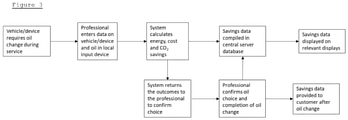
- Figure 3 shows an example communication flow according to an implementation of the disclosed subject matter.
- a vehicle or device requires an oil change during a service.
- the professional carrying out the service enters the data relating to the vehicle/device into the local input device.
- the data will include the age of the vehicle or device, the amount and type of oil removed from said vehicle or device; the amount and type of fresh oil applied to said vehicle or device; and the location of the oil change service.
- Other data may include the make and model of the vehicle or device, the fuel used by the vehicle or device and, for a vehicle, the annual mileage.
- the system calculates the energy, cost and CO 2 savings.
- this data is compiled in the central database in the server and the relevant displays are updated.
- the data is returned to the professional to indicate expected savings for the oil selected.
- This data can be used before an oil change in order to inform the professional and/or customer of potential savings for one or more oils.
- the professional confirms the oil choice and that the oil change has been completed.
- the savings data is then compiled in a database in the central server and the relevant displays are updated.
Landscapes
- Business, Economics & Management (AREA)
- Human Resources & Organizations (AREA)
- Engineering & Computer Science (AREA)
- Economics (AREA)
- Entrepreneurship & Innovation (AREA)
- Marketing (AREA)
- Operations Research (AREA)
- Quality & Reliability (AREA)
- Strategic Management (AREA)
- Tourism & Hospitality (AREA)
- Physics & Mathematics (AREA)
- General Business, Economics & Management (AREA)
- General Physics & Mathematics (AREA)
- Theoretical Computer Science (AREA)
- Combined Controls Of Internal Combustion Engines (AREA)
Abstract
a) recording an oil change service carried out on a vehicle or device and recording data corresponding to the age of the vehicle or device, the amount and type of oil removed from said vehicle or device; the amount and type of fresh oil applied to said vehicle or device; and the location of the oil change service on a local input device;
b) sending the recorded data from the input device to a memory coupled to the input device and storing said recorded data, wherein the memory also has stored on it: data on relative fuel efficiency and CO2 savings for different oil types; and
c) determining, using a processor coupled to said memory, on the basis of the data received and stored, savings data, said savings data comprising the energy savings to be achieved by the vehicle during its operation after the oil change service;
d) sending said savings data to a server configured to receive the savings data and compile the information for any specified group of local systems; and
e) displaying the savings data on one or more display devices coupled to the server,
wherein the savings data is determined by calculating the difference in fuel economy between the M111 Fuel economy test result for the new type of oil and the M111 Fuel economy test result for the type of oil removed from the vehicle or device.
Description
- The present invention relates to a method and system for calculating, compiling and displaying energy, cost and CO2 savings related to lubricants usage.
- An average European contributes approximately 7 mt per year to CO2 emissions (source: ourworldindata.org, 2017). Many technologies are being developed to minimise CO2 emissions and to assess the impact of said mitigation. As well as those technologies that make dramatic changes to lifestyles, even simple changes can be made within normal processes and procedures that can help reduce CO2 emissions.
- Internal combustion engine (ICE) vehicle operations are a considerable source of CO2 emissions. Improving energy efficiency in ICEs is one of the quickest and cheapest ways to address environmental challenges. For any powered equipment with moving parts, reducing friction and using efficient lubrication can help minimize energy use and thus reduce CO2 emissions. These small improvements, when added together for thousands of motorists can result in large energy and CO2 savings.
- To help ensure increased fuel economy without compromising on wear protection or oil life, the latest fuel-efficient oils need to deliver at least the same wear protection and can additionaly help to extend oil life as their less efficient counterparts.
- Use of lower viscosity engine oils, such as SAE 0W viscosity grade engine oils, can reduce friction and is known to provide energy efficiency and CO2 savings. Such oils continue to be developed and improved in cooperation with original equipment manufacturers (OEMs). However, it is important to ensure that after-market oil changes are selected to provide optimal efficiency and fuel savings.
- Current practice is to provide a predicted fuel economy improvement for a new oil assessed against an industry standard. For passenger car motor oils, the reference used in the industry standard is usually an SAE 15W-40 oil. However, the improvement over such a standard does not reflect the real-life situation which depends on the original oil in the vehicle.
- The actual savings for a single oil change depends on a rage of metrics, such as vehicle type, vehicle age, mileage and the oil being replaced. Allowing an individual customer to have accurate information about fuel and cost savings can incentivise CO2-conscious decisions. With accurate information available, the cumulative effect of energy, cost and CO2 savings may also easily be highlighted.
- To meet these needs, the present invention provides a method comprising:
- a) recording an oil change service carried out on a vehicle or device and recording data corresponding to the age of the vehicle or device, the amount and type of oil removed from said vehicle or device; the amount and type of fresh oil applied to said vehicle or device; and the location of the oil change service on a local input device;
- b) sending the recorded data from the input device to a memory coupled to the input device and storing said recorded data, wherein the memory also has stored on it: data on relative fuel efficiency and CO2 savings for different oil types; and
- c) determining, using a processor coupled to said memory, on the basis of the data received and stored, savings data, said savings data comprising the energy savings to be achieved by the vehicle during its operation after the oil change service;
- d) sending said savings data to a server configured to receive the savings data and compile the information for any specified group of local systems; and
- e) displaying the savings data on one or more display devices coupled to the server,
- The present invention also provides a system for carrying out said process, said system comprising:
- a) one or more local input devices configured to record an oil change service carried out on a vehicle or device and record data corresponding to the age of the vehicle or device, the amount and type of oil removed from said vehicle or device; the amount and type of fresh oil applied to said vehicle or device; and the location of the oil change service;
- b) a memory coupled to the input device and configured to receive the recorded data from the input device and to store the recorded data and also to store data on relative fuel efficiency and CO2 savings for different oil types; and
- c) a processor coupled to the memory and configured to determine, on the basis of the data received and stored, the savings data, said savings data comprising the energy savings, CO2 savings and cost savings to be achieved by the vehicle during its operation after the oil change service;
- d) a server configured to receive the savings data and compile the information for any specified group of local systems; and
- e) one or more display devices coupled to the server to display the savings data and/or the grouped savings data.
- The accompanying drawings, which are included to provide a further understanding of the disclosed subject matter, are incorporated in and constitute a part of this specification. The drawings also illustrate embodiments of the disclosed subject matter and together with the detailed description serve to explain the principles of embodiments of the disclosed subject matter. No attempt is made to show structural details in more detail than may be necessary for a fundamental understanding of the disclosed subject matter and various ways in which it may be practiced.
-
Figure 1 shows an example system according to an implementation of the disclosed subject matter. -
Figure 2 shows a second example system according to an implementation of the disclosed subject matter. -
Figure 3 shows an example communication flow according to an implementation of the disclosed subject matter. - The system and method of the present invention allow an improved, accurate determination of savings data, including the energy, cost and CO2 savings, that can be achieved by a vehicle or device during its operation after an oil change service. Energy savings as used herein typically refers to fuel savings. This data can be displayed for an individual oil change service and/or compiled for multiple oil change services in a single or multiple location. For example, an individual car service centre may have a display indicating the energy, cost and CO2 savings achieved by its work over a prescribed period of time. The data may also be combined for different groupings, for example a group of service centres, or on a national/regional basis.
- The system comprises one or more local input devices. In the method of the present invention, the input devices are used for recording an oil change service carried out on a vehicle or device and recording data corresponding to the age of the vehicle or device, the amount and type of oil removed from said vehicle or device; and the amount and type of fresh oil applied to said vehicle or device. Other data recorded may include vehicle or device registration, type of fuel system, (gasoline or diesel and/or hybrid), total mileage, average fuel consumption.
- In practice, details of an individual oil change service will be entered into the local input device by a member of staff, such as a technician at a car service centre or garage.
- The input device may be a local computer, smart phone or tablet or the like. In one embodiment, the input device is a mobile device loaded with a user interface system or 'app'. Alternatively, the user interface may be via a human-readable web page, to which the service centre has a unique login.
- The system also includes a memory. Said memory is coupled to the input device and data is sent to the memory from the input device. The memory also stores data on relative energy/fuel efficiency and CO2 savings for different oil types. The memory preferably also stores information relating to known factors influencing the relative fuel efficiency for different fuel types, such as one or more of vehicle/device makes and models, vehicle/device age and usage style (e.g. average fuel consumption).
- Data on relative fuel/energy efficiency is derived from M111 Fuel Economy tests using 15W-40 as a reference. However, rather than merely using the figure for improvement over the reference oil, the difference in fuel economy between the old oil and the new oil is calculated. The difference in fuel economy may be obtained by assessing the difference between the two lubricants used both measured against industry standard M111 FE.
- Greenhouse Gas (GHG) intensity factor, on the basis of JEC WtW Study v4.a, 2014, may also be applied.
- A simple representation of the foregoing by means of equations is set out below (terms used are defined in Table 1:


- For calculation of individual CO2 savings, the following equations applies:

- Total CO2 savings (TCO2) may then be calculated per unit of time:

- For calculation of individual fuel savings, the following equations applies:

- The total fuel savings may then be calculated per unit of time:

- Individual annual cost savings, may be calculated using the following equation:

- Total cost savings may be calculated per unit of time:

Table 1 INLFE ACEA MB111 test result for new lubricant ICLFE ACEA MB111 test result for current lubricant IIVR individual improvement in fuel economy IFCO2 Individual CO2 Conversion Factor[kg CO2/liter of Fuel] - constant depending on fuel type IACO2Vi Individual Annual CO2 Reduction per vehicle [kg CO2/year] IMi Individual mileage per year [km] AFci Average fuel consumption [liter/100km] TCO2 Total Annual CO2 Reduction of fleet [kg CO2/year] Vn Number of vehicles IAFVi Individual Annual Fuel Savings per vehicle [liter/year] TF Total fuel savings [liter/year] IASVi Individual Annual Savings per vehicle [euro/year] AvgFP Average fuel price [Euro/liter] IODICi Individual Oil drain interval (ODI) current [km] IODINi Individual Oil drain interval new [km] IOTUCi Individual Oil Top up per ODI current [liter] IOTUNi Individual Oil Top up per ODI new [liter] IOVTi Individual Oil volume in circulation [liter] PPLC Price per liter current [euro] PPLN Price per liter new [euro] TAS Total annual savings [euro/year] - A processor is coupled to the memory. The processor applies an algorithm to the data available allowing calculation and determining of the expected total energy savings and CO2 savings achieved by the oil change over a given period of time (e.g. a year). By linking the system to up-to-date fuel cost, an expected cost savings figure can also be determined.
- This determination can be carried out in advance of the oil change, in order to incentivise the use of fuel-efficient oils. In this embodiment, the result of such a determination would not be added to a set of cumulative statistics. In a preferred embodiment, data input and the determination are carried out after an oil change and are added to a set of cumulative statistics.
- A server also forms part of the system savings data is sent to said server where the information for any specified group of local systems is compiled. For example, the server may compile the data for an individual service centre, allowing display locally of the savings data achieved at that location over a period of time. Again, this may be used to incentivise selling of fuel-efficient oils.
- The data may also be compiled for groups of service centres, e.g. for a single company or region. Savings data may also be compiled for service centres selling specific oils within a region or country or for the sales of specific oils for any grouping.
- The memory, processor, server and one or more displays may be located locally, in the vicinity of the local input device, or these sections of the system may be located remotely. In one embodiment, the input device forms part of a local system comprising said device, the memory and the processor. Fuel, cost and CO2 savings for an oil change are determined locally and may be uploaded automatically to a remote server.
- In another embodiment, the input device provides data directly to a remote server and fuel, cost and CO2 savings for an oil change are determined remotely with the memory and processor located at the remote server.
- The displays may be any suitable device and may be accessed as a website or on a mobile app. For example, a service centre may have a dedicated display within the service centre highlighting cumulative savings made within a specific time period. Alternatively, the display may be available on a publicly available website.
-
Figure 1 illustrates a system according to the present invention. Aninput device 1 is used to record an oil change service. Data is received by the input device and is processed locally in alocal system 3 comprising a memory and a processor. In the embodiment that the determination is carried out in advance of the oil change, the savings data is provided back to thelocal input device 1 in order to inform the technician or customer before making an oil selection. Alternatively, once the oil change has been completed and indicated as so in the system, the savings data can be supplied to theserver 3 , which updates both thelocal display 4 andfurther displays 5 in one or more other locations. -
Figure 2 provides a further illustration of a system according to the present invention. Aninput device 1 is used to record an oil change service. Data is received by the input device and is sent to the remotely locatedserver 3. Amemory 6 receives the recorded data and the savings data is determined in theprocessor 7. In the embodiment that the determination is carried out in advance of the oil change, the savings data is provided back to thelocal input device 1 in order to inform the technician or customer before making an oil selection. - Alternatively, once the oil change has been completed and indicated as such in the system, the savings data can be supplied back to the local input device and/or a
local display 4. Once the oil change has been completed, compiled information from the server may also be sent todisplays 5 in one or more other locations and/or a locally locateddisplay 4. -
Figure 3 shows an example communication flow according to an implementation of the disclosed subject matter. A vehicle or device requires an oil change during a service. The professional carrying out the service enters the data relating to the vehicle/device into the local input device. The data will include the age of the vehicle or device, the amount and type of oil removed from said vehicle or device; the amount and type of fresh oil applied to said vehicle or device; and the location of the oil change service. Other data may include the make and model of the vehicle or device, the fuel used by the vehicle or device and, for a vehicle, the annual mileage. The system calculates the energy, cost and CO2 savings. - In one embodiment, this data is compiled in the central database in the server and the relevant displays are updated.
- In another embodiment, the data is returned to the professional to indicate expected savings for the oil selected. This data can be used before an oil change in order to inform the professional and/or customer of potential savings for one or more oils. In this embodiment, the professional then confirms the oil choice and that the oil change has been completed. The savings data is then compiled in a database in the central server and the relevant displays are updated.
Claims (3)
- A method comprising:a) recording an oil change service carried out on a vehicle or device and recording data corresponding to the age of the vehicle or device, the amount and type of oil removed from said vehicle or device; the amount and type of fresh oil applied to said vehicle or device; and the location of the oil change service on a local input device;b) sending the recorded data from the input device to a memory coupled to the input device and storing said recorded data, wherein the memory also has stored on it: data on relative fuel efficiency and CO2 savings for different oil types; andc) determining, using a processor coupled to said memory, on the basis of the data received and stored therein, savings data, said savings data comprising the energy savings to be achieved by the vehicle during its operation after the oil change service;d) sending said savings data to a server configured to receive the savings data and compile the information for any specified group of local systems; ande) displaying the savings data on one or more display devices coupled to the server,wherein the savings data is determined by calculating the difference in fuel economy between the M111 Fuel economy test result for the new type of oil and the M111 Fuel economy test result for the type of oil removed from the vehicle or device.
- A method according to Claim 1, wherein CO2 savings and cost savings are also calculated on the basis of the energy savings calculated in step c).
- A system for carrying out the process of Claim 1, said system comprising:a) one or more local input devices configured to record an oil change service carried out on a vehicle or device and record data corresponding to the age of the vehicle or device, the amount and type of oil removed from said vehicle or device; the amount and type of fresh oil applied to said vehicle or device; and the location of the oil change service;b) a memory coupled to the input device and configured to receive the recorded data from the input device and to store the recorded data and also to store data on relative fuel efficiency and CO2 savings for different oil types; andc) a processor coupled to the memory and configured to determine, on the basis of the data received and stored, the savings data, said savings data comprising the energy savings, CO2 savings and cost savings to be achieved by the vehicle during its operation after the oil change service;d) a server configured to receive the savings data and compile the information for any specified group of local systems; ande) one or more display devices coupled to the server to display the savings data and/or the grouped savings data.
Applications Claiming Priority (1)
| Application Number | Priority Date | Filing Date | Title |
|---|---|---|---|
| EP20425037 | 2020-09-21 |
Publications (1)
| Publication Number | Publication Date |
|---|---|
| EP3971804A1 true EP3971804A1 (en) | 2022-03-23 |
Family
ID=73014461
Family Applications (1)
| Application Number | Title | Priority Date | Filing Date |
|---|---|---|---|
| EP21197621.2A Pending EP3971804A1 (en) | 2020-09-21 | 2021-09-20 | Co2 savings monitoring system |
Country Status (1)
| Country | Link |
|---|---|
| EP (1) | EP3971804A1 (en) |
Citations (4)
| Publication number | Priority date | Publication date | Assignee | Title |
|---|---|---|---|---|
| JP2012185781A (en) * | 2011-03-08 | 2012-09-27 | Cosmo Oil Lubricants Co Ltd | Oil product use customer information management system |
| US20140012553A1 (en) * | 2012-04-20 | 2014-01-09 | United Parcel Service Of America, Inc. | Systems and methods for aggregating and evaluating environmental data |
| US20150133352A1 (en) * | 2012-06-06 | 2015-05-14 | Vanderbilt Chemicals, Llc | Fuel efficient lubricating oils |
| KR20190040643A (en) * | 2017-10-11 | 2019-04-19 | 박종관 | Apparatus and method for providing service of visiting maintenance |
-
2021
- 2021-09-20 EP EP21197621.2A patent/EP3971804A1/en active Pending
Patent Citations (4)
| Publication number | Priority date | Publication date | Assignee | Title |
|---|---|---|---|---|
| JP2012185781A (en) * | 2011-03-08 | 2012-09-27 | Cosmo Oil Lubricants Co Ltd | Oil product use customer information management system |
| US20140012553A1 (en) * | 2012-04-20 | 2014-01-09 | United Parcel Service Of America, Inc. | Systems and methods for aggregating and evaluating environmental data |
| US20150133352A1 (en) * | 2012-06-06 | 2015-05-14 | Vanderbilt Chemicals, Llc | Fuel efficient lubricating oils |
| KR20190040643A (en) * | 2017-10-11 | 2019-04-19 | 박종관 | Apparatus and method for providing service of visiting maintenance |
Similar Documents
| Publication | Publication Date | Title |
|---|---|---|
| US9111264B2 (en) | System and method for pre-evaluation vehicle diagnostic and repair cost estimation | |
| Hagman et al. | Total cost of ownership and its potential implications for battery electric vehicle diffusion | |
| KR101425019B1 (en) | System for providing tire change service through online | |
| Grosso et al. | How will vehicle automation and electrification affect the automotive maintenance, repair sector? | |
| CN113674015A (en) | Vehicle rapid damage assessment and residual value assessment method | |
| CN111861086B (en) | Resource allocation method and system | |
| JP3522679B2 (en) | Vehicle maintenance system and vehicle maintenance method | |
| CN114802305B (en) | Automobile fuel management method, device, equipment and storage medium | |
| JP2023130044A (en) | Information processing device, information processing method and program | |
| US20050177337A1 (en) | Vehicle usage forecast | |
| CN118350670A (en) | Diagnostic method and device for gas station reconstruction | |
| Guzmán et al. | Utility factor frameworks for plug-in hybrid electric vehicles: A comparative assessment | |
| KR20130094595A (en) | Vehicle management system using mobile terminal | |
| NL2009812C2 (en) | ELECTRONIC SYSTEM FOR COMPARING FUEL VALUES OF USE OF FUEL AND OF THE CORRESPONDING QUANTITY VALUES OF POLLUTED GAS EMISSIONS FROM A MOTOR VEHICLE AND ASSOCIATED METHOD OF COMPARISON. | |
| JP2009211276A (en) | Fuel quality decision program, fuel quality decision method and fuel quality decision device | |
| JP2003095399A (en) | Car history information management system | |
| JP4387971B2 (en) | Vehicle inspection information processing system and vehicle inspection method using the same | |
| DE102004003497B3 (en) | Displaying servicing work required on motor vehicle involves comparing operating parameter signals with service plan stored in memory unit, checking if any other operating parameters indicate a task is due if first servicing task is due | |
| KR100400347B1 (en) | A method and system providing car management information via a communications network and a medium for recording that method | |
| JP2002166999A (en) | Fuel efficiency management system and fuel efficiency management method | |
| Kochhan | Techno-economic evaluation of battery-electric taxis | |
| KR20200078462A (en) | Main server of system for offering fuel consumption rate of avehicle | |
| KR20170116487A (en) | Server and method for managing vehicle maintenance cost | |
| JP2003312305A (en) | Driver evaluation method | |
| US20250085119A1 (en) | System And Method For Generating Transportation Recommendations For Improved Efficiency |
Legal Events
| Date | Code | Title | Description |
|---|---|---|---|
| PUAI | Public reference made under article 153(3) epc to a published international application that has entered the european phase |
Free format text: ORIGINAL CODE: 0009012 |
|
| STAA | Information on the status of an ep patent application or granted ep patent |
Free format text: STATUS: THE APPLICATION HAS BEEN PUBLISHED |
|
| AK | Designated contracting states |
Kind code of ref document: A1 Designated state(s): AL AT BE BG CH CY CZ DE DK EE ES FI FR GB GR HR HU IE IS IT LI LT LU LV MC MK MT NL NO PL PT RO RS SE SI SK SM TR |
|
| STAA | Information on the status of an ep patent application or granted ep patent |
Free format text: STATUS: REQUEST FOR EXAMINATION WAS MADE |
|
| 17P | Request for examination filed |
Effective date: 20220921 |
|
| RBV | Designated contracting states (corrected) |
Designated state(s): AL AT BE BG CH CY CZ DE DK EE ES FI FR GB GR HR HU IE IS IT LI LT LU LV MC MK MT NL NO PL PT RO RS SE SI SK SM TR |
|
| STAA | Information on the status of an ep patent application or granted ep patent |
Free format text: STATUS: EXAMINATION IS IN PROGRESS |
|
| 17Q | First examination report despatched |
Effective date: 20250808 |