EP3971784A1 - Hardware-implementierung von fenster-operationen in drei oder mehr dimensionen - Google Patents
Hardware-implementierung von fenster-operationen in drei oder mehr dimensionen Download PDFInfo
- Publication number
- EP3971784A1 EP3971784A1 EP21197618.8A EP21197618A EP3971784A1 EP 3971784 A1 EP3971784 A1 EP 3971784A1 EP 21197618 A EP21197618 A EP 21197618A EP 3971784 A1 EP3971784 A1 EP 3971784A1
- Authority
- EP
- European Patent Office
- Prior art keywords
- windowed
- operations
- dimensions
- data
- convolution
- Prior art date
- Legal status (The legal status is an assumption and is not a legal conclusion. Google has not performed a legal analysis and makes no representation as to the accuracy of the status listed.)
- Pending
Links
Images




Classifications
-
- G—PHYSICS
- G06—COMPUTING OR CALCULATING; COUNTING
- G06F—ELECTRIC DIGITAL DATA PROCESSING
- G06F17/00—Digital computing or data processing equipment or methods, specially adapted for specific functions
- G06F17/10—Complex mathematical operations
- G06F17/15—Correlation function computation including computation of convolution operations
- G06F17/153—Multidimensional correlation or convolution
-
- G—PHYSICS
- G06—COMPUTING OR CALCULATING; COUNTING
- G06N—COMPUTING ARRANGEMENTS BASED ON SPECIFIC COMPUTATIONAL MODELS
- G06N3/00—Computing arrangements based on biological models
- G06N3/02—Neural networks
- G06N3/04—Architecture, e.g. interconnection topology
- G06N3/045—Combinations of networks
-
- G—PHYSICS
- G06—COMPUTING OR CALCULATING; COUNTING
- G06N—COMPUTING ARRANGEMENTS BASED ON SPECIFIC COMPUTATIONAL MODELS
- G06N3/00—Computing arrangements based on biological models
- G06N3/02—Neural networks
- G06N3/06—Physical realisation, i.e. hardware implementation of neural networks, neurons or parts of neurons
- G06N3/063—Physical realisation, i.e. hardware implementation of neural networks, neurons or parts of neurons using electronic means
-
- G—PHYSICS
- G06—COMPUTING OR CALCULATING; COUNTING
- G06F—ELECTRIC DIGITAL DATA PROCESSING
- G06F7/00—Methods or arrangements for processing data by operating upon the order or content of the data handled
- G06F7/76—Arrangements for rearranging, permuting or selecting data according to predetermined rules, independently of the content of the data
-
- G—PHYSICS
- G06—COMPUTING OR CALCULATING; COUNTING
- G06N—COMPUTING ARRANGEMENTS BASED ON SPECIFIC COMPUTATIONAL MODELS
- G06N3/00—Computing arrangements based on biological models
- G06N3/02—Neural networks
- G06N3/04—Architecture, e.g. interconnection topology
- G06N3/0464—Convolutional networks [CNN, ConvNet]
-
- G—PHYSICS
- G06—COMPUTING OR CALCULATING; COUNTING
- G06N—COMPUTING ARRANGEMENTS BASED ON SPECIFIC COMPUTATIONAL MODELS
- G06N3/00—Computing arrangements based on biological models
- G06N3/02—Neural networks
- G06N3/08—Learning methods
-
- G—PHYSICS
- G06—COMPUTING OR CALCULATING; COUNTING
- G06N—COMPUTING ARRANGEMENTS BASED ON SPECIFIC COMPUTATIONAL MODELS
- G06N3/00—Computing arrangements based on biological models
- G06N3/02—Neural networks
- G06N3/10—Interfaces, programming languages or software development kits, e.g. for simulating neural networks
-
- G—PHYSICS
- G06—COMPUTING OR CALCULATING; COUNTING
- G06T—IMAGE DATA PROCESSING OR GENERATION, IN GENERAL
- G06T1/00—General purpose image data processing
- G06T1/20—Processor architectures; Processor configuration, e.g. pipelining
Definitions
- 2-D convolution and pooling are well understood and widely used in the context of neural networks - in particular, convolutional neural networks (CNNs).
- CNNs convolutional neural networks
- These 2-D operations support the application of neural network-based algorithms to image-processing / -analysis / -understanding tasks, for example.
- Hardware accelerators are known in the art, which are optimised for performing these 2-D operations.
- the tensors used in CNNs that process 2-D images typically have a greater number of dimensions than two. Additional dimensions are added by the number of input channels associated with each image, the number of filters to be applied to each channel, etc.
- An exemplary tensor has four dimensions: batch, channel, height, and width.
- a corresponding 2-D convolution kernel to be applied to this tensor also has four dimensions: number of output channels, number of input channels, kernel height, and kernel width.
- the windowed operation performed is fundamentally two-dimensional. That is, the window (e.g. kernel) is only shifted over strides in two dimensions - namely, the height and width dimensions. We say that these two dimensions are "traversed" by the window. Other dimensions, such as batch and channel dimensions, may also be present.
- a method of implementing a windowed operation in at least three traversed dimensions according to claim 1.
- the windowed operation is implemented at least partially in hardware, in that the 2-D windowed operations are implemented in the at least one hardware accelerator.
- the at least one hardware accelerator may comprise circuitry configured to perform 2-D windowed operations.
- the step of assembling the partial results may be implemented in software (for example by a call to general purpose programmable circuitry) or in hardware (for example, by the at least one hardware accelerator).
- the step of assembling the partial results may comprise at least one or any combination of two or more of: collecting some or all of the partial results, combining some or all of the partial results, and concatenating some or all of the partial results.
- Concatenating partial results may comprise concatenating them into a single tensor - in particular, concatenating them into a single tensor of higher dimensionality.
- Combining partial results may comprise element-wise combination, which does not increase the dimensionality.
- partial results may be combined by an element-wise sum, min, max, or mean operation.
- Collecting partial results may comprise collecting them in a memory, or collecting them and passing them on for further processing - for example, collecting them and passing them directly to a subsequent windowed operation.
- the manner in which the partial results are assembled typically depends on the windowed operation being implemented. In particular, it may depend on the kind of windowed operation and the size of the window.
- the at least three traversed dimensions may for example comprise two spatial dimensions, optionally three spatial dimensions. In one example, they may comprise or consist of two spatial dimensions and one temporal dimension. Other examples are possible. Other dimensions may be traversed, including but not limited to one or more frequency dimensions, such as spatial frequency or temporal frequency.
- the windowed operation is defined by a window, which may have a size of at least one, or at least two, in each of the three traversed dimensions.
- the data may have a size of at least one, at least two or at least three in each of the three traversed dimensions. (All permutations and combinations of these sizes are hereby disclosed.)
- a slice refers to a subset of the data (or window) having a reduced size in at least one dimension, but containing the full extent of the data (or window) in the other dimensions.
- a 2-D slice of 3-D data reduces the size of the data in one dimension.
- a 2-D slice of 4-D data reduces the size of the data in two dimensions.
- each slice may be a 2-D slice.
- a tensor may be considered as an array with multiple dimensions.
- a "slice" of a tensor is also a tensor, containing all elements of the original tensor that correspond to one or more specified indices.
- the slice does not extend at all in the dimension that is reduced. In other words, it has a size of one in that dimension.
- a 2-D slice contains the full extent of the data in two dimensions (which are the dimensions traversed by the shifts in each 2-D windowed operation) and does not extend in the other dimensions traversed by the shifts of the windowed operation.
- a mathematical operator underlying the windowed operation is associative, meaning that the result does not depend on how the data is grouped together to perform the windowed operation, and commutative, meaning that the order in which operations are performed may be changed.
- the underlying mathematical operator is addition; in the case of max-pooling or min-pooling, the underlying mathematical operator is a maximum or minimum operator, for example.
- the at least one hardware accelerator may be a fixed-function hardware accelerator.
- "Fixed-function” in this context refers to the property of the hardware that the logic it implements cannot be reconfigured after manufacture (or at least cannot be reconfigured extensively). This is in contrast to field programmable logic, for example, which is reconfigurable.
- the at least one hardware accelerator may be comprised in an application specific integrated circuit (ASIC). The behaviour of fixed-function hardware may be programmable.
- the windowed operation in at least three traversed dimensions may be defined by a computational graph, and the mapping may comprise redrawing the computational graph to unroll/expand the windowed operation into the plurality of constituent 2-D windowed operations.
- the method may further comprise, when implementing one of the plurality of 2-D windowed operations in the at least one hardware accelerator, storing at least a part of the slice of the data or at least a part of the slice of the window in a local memory of the at least one hardware accelerator, and when subsequently implementing another one of the plurality of 2-D windowed operations in the at least one hardware accelerator, reusing the stored part.
- the slice of the window may be a slice of the convolution kernel.
- the windowed operation may be a convolution operation, wherein each of the 2-D windowed operations is a 2-D convolution operation, and wherein assembling the partial results comprises combining the partial results by summing the partial results.
- the windowed operation may be a transposed convolution operation (sometimes called a "deconvolution” or fractionally strided convolution, in the neural network literature). Such operations may be used, for example, for up-sampling of data.
- the windowed operation may be a grouped convolution, in which groups of the channels of the input data tensor are processed separately.
- the assembling may be done at least in part by a component of the hardware accelerator configured to perform elementwise operations on tensors.
- the windowed operation may be used in any one of a variety of useful tasks, operating on 3-D (or higher dimensional) data.
- the task may comprise an analysis or classification task such as spatiotemporal segmentation, object recognition, gesture or action recognition, emotion recognition, or video event classification; or a task such as video compression.
- the input data comprises volumetric data (comprising three spatial dimensions)
- the task may comprise an analysis or classification task such as 3-D segmentation or 3-D object recognition; or a task such as 3-D volumetric data compression.
- the task may comprise an analysis or classification task such as 3-D spatiotemporal segmentation, 3-D object / action / gesture / emotion recognition, or 3-D event classification; or data compression of the 4-D data.
- the windowed operation may also be used for restoration, denoising, enhancement, frame interpolation or super-resolution, on data in three or more dimensions, including but not limited to video data, 4-D data comprising three spatial and one temporal dimension.
- Data having two spatial dimensions is not limited to natural image data - it may include depth/ranging data, such as produced by RADAR, LiDAR, or acoustic sensors, for example.
- 3-D data may be formed by adding a temporal dimension to such data. Any of the tasks described above as being carried out on video data may be usefully performed on a 3-D dataset of time varying ranging images.
- the data may comprise one of the following, or a derivative thereof: video data comprising two spatial dimensions and one temporal dimension; and volumetric data, comprising three spatial dimensions.
- the assembly unit may be implemented in the at least one hardware accelerator.
- the at least one hardware accelerator may comprise an element-wise operations module configured to combine the partial results.
- the assembly unit may be configured to concatenate partial results by writing them to memory arranged as a single tensor.
- the at least one hardware accelerator may comprise any one, or any combination of two or more of: one or more convolution engines, comprising circuitry configured to perform convolution calculations; a pooling unit, comprising circuitry configured to perform a pooling operation; an element-wise operations module, comprising circuitry configured to perform element-wise operations on the elements of two or more tensors; and an activation unit, comprising circuitry configured to implement an activation function of a neural network layer.
- Each of the second plurality of constituent 2-D windowed operations may produce a respective second partial result, wherein the assembly unit is configured to assemble the second partial results to produce the result of the second windowed operation.
- the at least one hardware accelerator may comprise an element-wise operations module configured to combine some or all of the second partial results as appropriate.
- the windowed operation may be a maximum operation, wherein each of the 2-D windowed operations is a maximum operation, and wherein the assembly unit is configured to combine the partial results by identifying the maximum among them.
- the windowed operation may be a minimum operation, wherein each of the 2-D windowed operations is a minimum operation, and wherein the assembly unit is configured to combine the partial results by identifying the minimum among the partial results.
- the windowed operation may include a bias addition operation, wherein the transformation unit is configured map the bias addition to a selected one of the 2-D windowed operations, wherein the bias addition is performed in the at least one hardware accelerator as part of the selected 2-D windowed operation.
- the data processing system may further comprise a zero-padding optimisation unit, and the data may comprise zero-padded data, wherein the zero-padding optimisation unit is configured to exclude from the plurality of constituent 2-D windowed operations a 2-D windowed operation that would be applied to a slice of the zero-padded data that consists solely of zeros.
- the zero-padding optimisation unit may be part of the transformation unit.
- the memory may be a local memory - for example, implemented on the same semiconductor die as the hardware accelerator, transformation unit, and assembly unit.
- Storing (caching) part of the data may be advantageous, in particular, if the stride of the window in at least one remaining dimension (other than the two dimensions of the 2-D windowed operations) is less than the size of the window in that remaining dimension. In this case, different slices of the window will be applied to the same data elements in different 2-D windowed operations.
- the at least one hardware accelerator may comprise a plurality of convolution engines, each configured to perform a convolution calculation, and each comprising a plurality of elements of multiply logic and a plurality of elements of addition logic; and a plurality of accumulators, each configured to perform an accumulation calculation on convolution results output by the convolution engines, wherein the convolution engines and accumulators are configured to perform a 2-D convolution operation.
- NNA neural network accelerator
- an integrated circuit definition dataset that, when processed in an integrated circuit manufacturing system, configures the integrated circuit manufacturing system to manufacture a data processing system or NNA as summarised above or claimed in any of claims 9 to 14.
- non-transitory computer readable storage medium having stored thereon a computer readable description of a data processing system or NNA as summarised above or claimed in any of claims 9 to 14 that, when processed in an integrated circuit manufacturing system, causes the integrated circuit manufacturing system to manufacture an integrated circuit embodying the data processing system or NNA.
- non-transitory computer readable storage medium having stored thereon a computer readable description of a data processing system or NNA as summarised above or claimed in any of claims 9 to 14 which, when processed in an integrated circuit manufacturing system, causes the integrated circuit manufacturing system to: process, using a layout processing system, the computer readable description of the data processing system or NNA so as to generate a circuit layout description of an integrated circuit embodying the data processing system or NNA; and manufacture, using an integrated circuit generation system, the data processing system or NNA according to the circuit layout description.
- an integrated circuit manufacturing system comprising: non-transitory computer readable storage medium having stored thereon a computer readable description of a data processing system or NNA configured to implement a windowed operation in at least three dimensions, the windowed operation comprising applying a window having at least three dimensions to data having at least three dimensions, with shifts of the window in all three dimensions; layout processing system configured to process the computer readable description so as to generate a circuit layout description of an integrated circuit embodying the data processing system or NNA; and an integrated circuit generation system configured to manufacture the data processing system or NNA according to the circuit layout description, wherein the data processing system or NNA comprises: a transformation unit, configured to map the windowed operation to a plurality of constituent 2-D windowed operations, each 2-D windowed operation comprising applying a slice of the window to a slice of the data, with shifts of the slice of the window in only two dimensions; at least one hardware accelerator, comprising circuitry configured to implement the plurality of 2-D windowed operations, each 2-D windowed operation producing
- a “windowed operation” refers to an operation in which a function is applied to different locations in a multidimensional input data tensor, according to a sliding window that strides on some or all of the dimensions (referred to as “window-traversed dimensions", or “traversed dimensions” for short).
- the windowed operation generates an output data tensor in correspondence with the input data tensor.
- the input and output data tensors may include other dimensions (for example, batch and/or channel dimensions) in addition to the dimensions traversed by the window.
- a windowed operation may be referred to by the number of dimensions that are traversed in the operation - for example, an "N-D" convolution is a convolution with N traversed dimensions.
- CNNs convolutional neural networks
- One of the most widely used applications of CNNs to 2-D data is for image processing and analysis (including image understanding, object detection and segmentation).
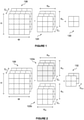
- Figure 1 illustrates a 2-D convolution operation on input data (an input tensor) 108 of height H and width W, which includes C in input channels.
- C in 3.
- These channels could represent the three colour channels of a colour image, for instance.
- the channels might represent the outputs of different filters that have operated on a preceding layer.
- the input data 108 is convolved with a kernel 120, having a height K H and a width K W .
- the convolution is denoted by the asterisk (*) in Figure 1 .
- the kernel has the same number of channels C in as the input data.
- convolutions may be performed with a stride greater than 1 in one or both dimensions.
- a stride of 2 for example, the kernel is shifted by two data elements (for example, pixels) in each step. This reduces the number of inner product calculations to be performed and reduces the size of the output correspondingly.
- the input data may be padded - for example, padded with zeros. Padding allows the kernel to be centred on data elements that lie at or near the boundary of the input data, where the kernel would extend beyond the boundary. The padding provides additional data values that can be operated on by the relevant elements of the kernel, in these circumstances. This can avoid a reduction in the size of the output tensor, compared with the input tensor.
- the kernel can only shift until the boundary of the kernel reaches the boundary of the data tensor.
- a stride of 1 for example, the size of the output in the two dimensions traversed by the kernel can be identical to the size of the input in those dimensions.
- Convolutions may also be dilated (also called "atrous"), meaning that rather than using contiguous input data elements on each application of the kernel, the sample locations can be spread out over a larger input region.
- the use of padding and strides other than 1 and dilation in 2D convolutions (and other 2D windowed operations) will be familiar known to those skilled in the art. Without loss of generality, they will therefore be ignored in much of the following description. It will be understood that everything disclosed is applicable also when suitable padding is used, to windowed operations with any stride in any traversed dimension and any dilation factor.
- input tensor 109 is four dimensional, with dimensions [B, C, H, W].
- NNAs Neuronal Network Accelerators
- a fixed-function hardware accelerator may, for instance, be an application-specific integrated circuit (ASIC).
- NNAs typically include dedicated, optimised hardware for computing 2-D operations, for example convolutions and poolings, quickly and efficiently. The inventors have recognised that existing NNA hardware specialised in 2-D windowed operations (including for example convolution and pooling operations) can be exploited to implement 3-D windowed operations efficiently.
- This restructuring along one dimension, to produce a combination of constituent 2-D operations may be referred to variously as “unrolling” "unpacking” or “factoring out” that dimension.
- the depth dimension is factored out in the example above, it should be understood that the approach can be applied generally: any one of the three traversed dimensions may be selected and factored out, leaving the other two traversed dimensions as a plurality of 2-D operations in the inner part of the calculation.
- each of the 2-D windowed operations produces a partial result.
- These partial results need to be assembled to produce the result of the 3-D windowed operation.
- the appropriate way to assemble the partial results depends on the operation being implemented.
- the underlying operation in the case of convolution is addition; therefore, the partial results are combined by summing them over the unpacked dimension.
- summation is not necessary, and the partial results are simply collected, or concatenated, at the output of the 2-D windowed operations.
- the partial results may be assembled by summing and optional concatenation.
- the partial results of a 3-D convolution transpose may be assembled purely by collecting them - optionally, concatenating them by stacking them appropriately in the unpacked dimension to bring them together into one tensor. As previously, it will be understood that any of the traversed dimensions may be factored out instead of the depth dimension.
- a neural network accelerator may include dedicated hardware for element-wise operations on tensors.
- Hardware for element-wise operations can be used to implement the combination of the partial results efficiently.
- the partial results from a plurality of 2-D convolution operations can be combined using an element-wise addition.
- the partial results from a plurality of 2-D max pooling operations can be combined using an element-wise maximum; and the partial results from a plurality of 2-D min-pooling operations can be combined using an element-wise minimum.
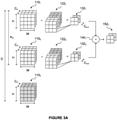
- Figures 3A-3B show an example that extends the 2-D convolution of Figure 2 into three dimensions, and implements the 3-D convolution operation as a set of 2-D convolutions.
- the data 110 is illustrated as three "slices" 110 1 -110 3 , each slice having a size of 1 in the depth dimension. Each of these slices is equivalent to the input data 109 used in the example of Figure 2 .
- the batch dimension has been suppressed.
- the input tensor is thus a 5-D tensor, [B, C, D, H, W].
- each of the dimensions in the convolution depends on the application.
- the three traversed dimensions may be spatial dimensions [D, H, W].
- one or more traversed dimensions need not be spatial dimensions.
- a traversed dimension could be a temporal dimension or a temporal- or spatial-frequency dimension, for example.
- the kernel is depicted as two "slices" 122 1 -122 2 , each having size 1 in the depth dimension. Each slice is equivalent to the kernel 122 in Figure 2 .
- Figure 3A shows the kernel in a first position (first shift), where the first slice 122 1 of the kernel is aligned with the first slice 110 1 of the input tensor and the second slice 122 2 of the kernel is aligned with the second slice 110 2 of the input tensor.
- the calculation of the 3-D convolution, for the first shift consists of two 2-D convolutions followed by an element-wise summation.
- the first slice 110 1 of the input tensor is convolved with the first slice 122 1 of the kernel, to produce a first partial result 132 1 .
- the second slice 110 2 of the input tensor is convolved with the second slice 122 2 of the kernel, to produce a second partial result 132 2 . (Each of these partial results is equivalent to the result 132 of the 2-D convolution in Figure 2 .)
- the two partial results are summed by summation block 140 1 .
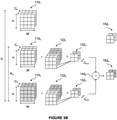
- Figure 3B shows the kernel in a second position (second shift) according to the stride of the convolution in the D dimension, where the first slice 122 1 of the kernel is aligned with the second slice 110 2 of the input tensor and the second slice 122 2 of the kernel is aligned with the third slice 110 3 of the input tensor.
- the calculation of the 3-D convolution for this second shift consists of two 2-D convolutions followed by an element-wise summation.
- the second slice 110 2 of the input tensor is convolved with the first slice 122 1 of the kernel, to produce a third partial result 132 3 .
- the third slice 110 3 of the input tensor is convolved with the second slice 122 2 of the kernel, to produce a fourth partial result 132 4 .
- the two partial results 132 3 and 132 4 are summed by summation block 140 2 . Consequently, the full output 152 of the 3-D convolution (which has dimensions 2 x 2 x 2 x 2) can be generated by performing four 2-D convolutions followed by two element-wise summations of the partial results produced by the 2-D convolutions.
- the second slice 550 2 can likewise be produced by performing three 2-D convolutions 560 4 -560 6 , in which the last three slices 510 3 -510 5 of the input tensor are convolved with the three slices of the kernel, respectively.
- the outputs of these 2-D convolutions are summed element-wise, at summation block 540 2 , to produce the second slice 550 2 of the output tensor.
- the weights in the 2-D convolution 560 1 are identical to the weights in the 2-D convolution 560 4 . In both cases, these are the weights from the first slice of the kernel.
- the weights in the 2-D convolution 560 2 are identical to the weights in the 2-D convolution 560 5 (the second slice of the kernel); and the weights in the 2-D convolution 560 3 are identical to the weights in the 2-D convolution 560 6 (the third slice of the kernel). It will be appreciated that in this way the processing on the depth dimension of the original 3-D convolution has been reproduced in the topology of the computational graph.
- FIG 5A shows another example, in which the example of Figure 4 is extended to include bias addition.
- Bias addition is a commonly used feature in CNNs, and it would be desirable to be able to implement it efficiently in the context of 3-D convolution.
- NNAs that support efficient 2-D convolution typically support bias addition as part of the 2-D convolution.
- the present inventors have recognised that the bias addition in a 3-D convolution can be included in one of the 2-D convolutions producing partial results for the 3-D convolution. This can enable the bias addition to be implemented efficiently by incorporating it in a single pass of a 2-D convolution function on an NNA.
- the bias addition can be incorporated in any one of the 2-D convolutions that go into producing a single output slice of the 3-D convolution.
- Bias addition 570 1 is included at the output of the convolution 560 1 and bias addition 570 2 is likewise incorporated at the output of the convolution 560 4 .
- the convolution weights and biases are the same in both cases.
- FIG. 5B shows another example of a computational graph, this time for a 3-D convolution transpose.
- the 3-D convolution transpose is structured as a plurality of 2-D convolution transpose operations, as explained previously above.
- the stride in the depth dimension is 2.
- the output 551 will have a size of 7 in the depth dimension.
- the output 551 consists of seven slices 551 1 -551 7 .
- the first slice 551 1 and second slice 551 2 can be produced by performing 2-D deconvolutions 561 1 -561 2 , respectively, on the first slice 511 1 of the input tensor.
- the third slice 551 3 is produced by performing two 2-D deconvolutions 561 3 -561 4 , respectively, on the first and second slices 511 1 -511 2 of the input tensor, and summing the results element-wise, at summation block 541 1 .
- the fourth slice 551 4 is produced by performing a 2-D deconvolution 561 5 on the second slice 511 2 of the input tensor.
- the fifth slice 551 5 is produced by performing two 2-D deconvolutions 561 6 -561 7 , on the second and third slices 511 2 -511 3 of the input tensor, respectively, and summing the results element-wise, at summation block 541 2 .
- the sixth slice 551 6 and seventh slice 551 7 can be produced by performing 2-D deconvolutions 561 8 -561 9 , respectively, on the third slice 511 3 of the input tensor.
- deconvolutions 561 1 , 561 4 and 561 7 all of which use the first slice of the kernel
- deconvolutions 561 2 , 561 5 and 561 8 all of which use the second slice of the kernel
- deconvolutions 561 3 , 561 6 and 561 9 all of which use the third slice of the kernel.
- Figures 6A-6C show three variants of data processing systems according to examples.
- Figures 7A-7B show flowcharts of associated methods that may be implemented by the data processing systems.
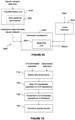
- Figure 6A is a block diagram of a data processing system 600 according to a first example.
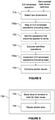
- Figure 7A shows a flowchart of a method performed by the data processing system 600, according to this example.
- the data processing system comprises a transformation unit 610; a hardware accelerator 620; an assembly unit 630; and a memory, local memory 640. It may further comprise an optional zero padding optimisation unit 650 (shown in dashed outline), which may be comprised in the transformation unit 610.
- the transformation unit 610 receives a definition of a 3-D windowed operation to be performed by the data processing system 600, as well as a definition of the data tensor.
- the definition of the data tensor includes at least the size of the data in each dimension.
- the 3-D windowed operation is a 3-D convolution.
- the transformation unit 610 selects two dimensions out of the three traversed dimensions of the windowed operation.
- the transformation unit will map the 3-D convolution to a set of 2-D convolutions in these two selected dimensions as described above with reference to Figures 4 and 5 .
- the partial results from the 2-D convolutions will be assembled (in particular, combined) along the remaining, third dimension not selected in step 710.
- the transformation unit 610 selects the largest two dimensions; therefore, the 3-D convolution will be unrolled along the smallest dimension into 2-D convolutions, and the combination of partial results will also be along the smallest dimension. In this way, the transformation unit 610 arranges the 3-D convolution as a relatively small number of relatively large 2-D convolutions. (Nevertheless, in other examples, the dimensions may be selected according to different rules.)
- the data is not zero-padded and the zero-padding optimisation unit is not used.
- the slices of the input data are stored in the local memory 640 of the data processing system, while the respective 2-D convolutions are being performed.
- the coefficients (weights) representing the slices of the kernel are stored in the local memory 640, when performing the 2-D convolution operations.
- step 730 the circuitry of the hardware accelerator 620 carries out the set of 2-D convolution operations. That is, as explained above with reference to Figures 3-5 , the hardware accelerator 620 convolves the appropriate slices of the input tensor with the appropriate slices of the kernel. Depending on the size of the local memory, it might not be possible to fit the entirety of the input tensor and the kernel in the memory 640 at the same time. Therefore, data may be loaded (stored) to the local memory, as needed, for the 2-D convolutions currently being implemented at any given time.
- the output from each 2-D convolution is a partial result.
- the partial results are provided by the hardware accelerator 620 to the assembly unit 630.
- the assembly unit 630 assembles (in particular, combines) the partial results from the individual 2-D convolutions, to produce the final result of the 3-D convolution. Since the 3-D windowed operation is a 3-D convolution in this example, the assembly unit combines the partial results by summing them.
- the results of the summing are slices of the output (as described above with reference to Figures 4 and 5A , for example). These slices are collected to provide the output of the 3-D convolution. In some cases, the collected slices may be passed to the next layer of the neural network separately from one another.
- the slices may be concatenated into a single output tensor, by stacking the slices along the unwrapped dimension. This may be done by writing the slices to appropriate locations in the local memory 640 or the external memory - for example, to occupy a single contiguous block of memory.
- the assembly unit 630 is configured to assemble the partial results in whatever manner is appropriate, according to the type and window-size of the 3-D windowed operation.
- the assembly unit 630 is illustrated separately from the hardware accelerator 620. This may indeed be the case, in some implementations.
- the assembly unit may be implemented in general-purpose programmable circuitry, such as a CPU.
- the CPU may be programmed to perform the necessary assembly operations on the partial results of the 2-D convolutions.
- the transformation unit 610 instructs the hardware accelerator 620 to carry out the plurality of 2-D convolution operations, and instructs the assembly unit 630 to sum, collect, and optionally concatenate the partial results produced, as needed, to produce the result of the original 3-D convolution.
- the transformation unit 610' provides the hardware accelerator 620' with a complete set of hardware-implementable operations to implement the 3-D windowed operation.
- the transformation unit 610' instructs the hardware accelerator 620' to perform the plurality of 2-D windowed operations and instructs it how to assemble the results of these 2-D operations (including appropriate element-wise summation, in the example of a 3-D convolution).
- the results of the element-wise summation are collected and output as the result of the 3-D convolution.
- the method implemented by the data processing system 600' is substantially the same as that illustrated in Figure 7A .
- One or more 3-D windowed operations may be performed as part of a neural network comprising a plurality of layers.
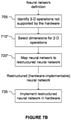
- Figure 6C shows a block diagram of a data processing system 600" according to a third example.
- a method performed according to this example is illustrated in the flowchart of Figure 7B .
- the system 600" is similar to the system 600' of Figure 6B in that the assembly unit 630" is part of the hardware accelerator 620".
- the transformation unit 610" receives, as input, a definition of a complete neural network, which may include one or more 3-D windowed operations.
- the definition of the neural network also incorporates a definition of the data tensors processed at each layer in the network.
- the transformation unit 610" identifies any 3-D windowed operations in the neural network that are not supported by the hardware accelerator 620".
- Step 710" is an extension of step 710 in Figure 7A - for each of the identified 3-D windowed operations, the transformation unit 610" selects the two dimensions that will be traversed when the 3-D operation is mapped to 2-D operations.
- the transformation unit 610" maps the entire neural network to a restructured neural network. This includes mapping each of the identified 3-D windowed operations to a respective plurality of 2-D windowed operations, and defining how the partial results of these 2-D windowed operations will be assembled.
- the 2-D windowed operations and the assembly operations are suitable for implementation by (i.e. supported by) the hardware accelerator 620"; therefore, the restructured neural network is said to be "hardware-implementable”. Layers of the original neural network that do not include unsupported 3-D windowed operations may be preserved unchanged in the restructured neural network.
- the hardware accelerator 620" implements the restructured neural network.
- Zero-padding optimisation may also be performed in this example. In general, it may be necessary to perform zero-padding at several layers within a neural network; therefore, the zero-padding would be performed not only on the input data tensor, but also on tensors representing the output of intermediate layers. This may be done by the hardware accelerator 620", acting under the control of the transformation unit 610".
- Step 710 is identical to the corresponding step in Figure 7A .
- the transformation unit 610 maps the 3-D convolution operation to a set of 2-D convolution operations (in the selected two dimensions), this time including bias addition operations as described above with reference to Figure 5A .
- the zero-padding optimisation unit 650 identifies 2-D convolutions that would operate entirely on zeros as a result of the zero-padding.
- the zero-padding optimisation unit 650 excludes the identified, unnecessary 2-D convolutions from the operations to be performed by the hardware accelerator. In other words, these operations are not performed, when the 2-D operations are implemented by the hardware accelerator 620 in step 730a. This omission of unnecessary operations can save computation time, memory, bandwidth and power.
- the weights in the 2-D convolution 560 2 are identical to the weights in the 2-D convolution 560 5 (the second slice of the kernel); and the weights in the 2-D convolution 560 3 are identical to the weights in the 2-D convolution 560 6 (the third slice of the kernel). It can also be seen that the third slice 510 3 of the input tensor is used twice, in 2-D convolutions 560 3 and 560 4 .
- the system stores (at least part of) a slice of the kernel or (at least part of) a slice of the data in the local memory 640, for later reuse in a subsequent 2-D convolution operation.
- the hardware accelerator 620 reuses the stored slice in the subsequent 2-D convolution operation.
- the weights (that is, the first slice of the kernel) used for the convolution 560 1 may be stored in the local memory and remain there until the hardware accelerator 620 performs convolution 560 4 , when they are reused.
- at least a part of the third slice of the input tensor 510 3 may be stored in the local memory 640 and may remain there after the convolution 560 3 has completed. This (at least partial) slice of the input tensor may then be reused, without requiring a further read from external memory, when the convolution 560 4 is performed.
- the quantity of data stored and reused may depend on the capacity of the local memory 640.
- the transformation unit 610 may be configured to sequence the set of 2-D convolution operations so as to increase the reuse of data and coefficients stored in the local memory 640. For example, the transformation unit 610 may instruct the hardware accelerator 620 to perform convolution 560 5 immediately after convolution 560 2 , because this will allow the stored weights to be reused between these successive convolutions.
- the examples above have focused on 3-D convolution operations as the windowed operation.
- the present disclosure is neither limited to 3-D windowed operations nor to convolution operations.
- Any windowed operation whose underlying mathematical operation has the properties of being associative and commutative can be decomposed / unrolled into a plurality of equivalent 2-D windowed operations, in a similar manner to the 3-D convolutions discussed above.
- the step of assembling the partial results should be chosen according to the windowed operation being implemented.
- the assembling may comprise combining partial results (as in step 740) and/or collecting or concatenating them.
- the combination 740 is based on element-wise summation, when implementing a convolution operation.
- the combination will be based on an element-wise maximum operator (that is, returning the maximum of the partial results).
- the combination will be based on an element-wise minimum operator.
- Other windowed operations may be performed based on those already mentioned.
- a mean pooling operation can be implemented by means of a convolution operation.
- the original windowed operation to be performed was a 3-D windowed operation, and this was unrolled over one dimension into a plurality of 2-D windowed operations.
- the same strategy can be applied to higher dimensional windowed operations.
- a 4-D windowed operation could be unrolled over two dimensions into a plurality of 2-D windowed operations.
- higher dimensional windowed operations in any number of dimensions can be reduced to a set of 2-D windowed operations, which it is possible to implement efficiently using a hardware accelerator for 2-D windowed operations.
- the data processing systems 600, 600', 600" can thus be used to implement 3-D (and higher dimensional) operations efficiently, as well as traditional 2-D operations. Moreover, a system that is optimised for 2-D windowed operations can be used in this way, either without modification or with minimal modification, to implement 3-D and higher dimensional windowed operations efficiently.
- a 4-D tensor denoted "[B, C, H, W]"
- the ordering of the dimensions generally has no special significance. The dimensions may be ordered in the tensor differently in different implementations.
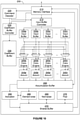
- FIG. 10 illustrates a hardware accelerator 200 that is configured to implement a CNN.
- the hardware accelerator comprises digital logic circuitry that is configured to receive data (including weights and input tensors) and commands for processing them.
- the hardware accelerator 200 comprises a memory interface 210, an input buffer controller 215, a command decoder 220, a coefficient buffer controller 225, a coefficient buffer 230, n input buffers 235, n convolution engines 240, n accumulators 245, an activation module 255, a normalize module 265, a shared buffer 270, a pool module 275, and an element-wise operations module 285.
- the hardware accelerator 200 can be used to implement 2-D operations and assemble their partial results, according to examples.
- the hardware accelerator 620' or 620" in Figure 6B or 6C is suitable for providing the hardware accelerator 620' or 620" in Figure 6B or 6C .
- the "local memory" 640 of Figures 6B and 6C is provided, collectively, by the coefficient buffer 230, input buffers 235, the accumulation buffer 250 and the shared buffer 270 in Figure 10 .
Landscapes
- Engineering & Computer Science (AREA)
- Physics & Mathematics (AREA)
- Theoretical Computer Science (AREA)
- General Physics & Mathematics (AREA)
- Data Mining & Analysis (AREA)
- Mathematical Physics (AREA)
- Computing Systems (AREA)
- General Engineering & Computer Science (AREA)
- Biophysics (AREA)
- Health & Medical Sciences (AREA)
- Software Systems (AREA)
- Life Sciences & Earth Sciences (AREA)
- Biomedical Technology (AREA)
- Molecular Biology (AREA)
- Artificial Intelligence (AREA)
- Computational Linguistics (AREA)
- General Health & Medical Sciences (AREA)
- Evolutionary Computation (AREA)
- Computational Mathematics (AREA)
- Mathematical Analysis (AREA)
- Mathematical Optimization (AREA)
- Pure & Applied Mathematics (AREA)
- Neurology (AREA)
- Algebra (AREA)
- Databases & Information Systems (AREA)
- Complex Calculations (AREA)
Applications Claiming Priority (1)
| Application Number | Priority Date | Filing Date | Title |
|---|---|---|---|
| GB2014932.4A GB2599098B (en) | 2020-09-22 | 2020-09-22 | Hardware implementation of windowed operations in three or more dimensions |
Publications (1)
| Publication Number | Publication Date |
|---|---|
| EP3971784A1 true EP3971784A1 (de) | 2022-03-23 |
Family
ID=73196695
Family Applications (1)
| Application Number | Title | Priority Date | Filing Date |
|---|---|---|---|
| EP21197618.8A Pending EP3971784A1 (de) | 2020-09-22 | 2021-09-20 | Hardware-implementierung von fenster-operationen in drei oder mehr dimensionen |
Country Status (4)
| Country | Link |
|---|---|
| US (2) | US12198034B2 (de) |
| EP (1) | EP3971784A1 (de) |
| CN (1) | CN114254742A (de) |
| GB (1) | GB2599098B (de) |
Families Citing this family (2)
| Publication number | Priority date | Publication date | Assignee | Title |
|---|---|---|---|---|
| US12567122B1 (en) * | 2022-04-19 | 2026-03-03 | Nvidia Corporation | Application programming interface to modify tensor dimensions |
| WO2026059603A1 (en) * | 2024-09-10 | 2026-03-19 | Qualcomm Incorporated | Efficient neural network architecture with inline channel reduction |
Citations (2)
| Publication number | Priority date | Publication date | Assignee | Title |
|---|---|---|---|---|
| EP3242254A1 (de) * | 2016-05-03 | 2017-11-08 | Imagination Technologies Limited | Hardwarekonfiguration für ein neuronales konvolutionsnetzwerk |
| WO2019150067A2 (en) * | 2018-02-01 | 2019-08-08 | Brendan Ruff | Low precision efficient convolutional neural network inference device that avoids multiplication without loss of accuracy |
Family Cites Families (18)
| Publication number | Priority date | Publication date | Assignee | Title |
|---|---|---|---|---|
| US8437538B2 (en) * | 2009-09-29 | 2013-05-07 | Peking University | Volumetric image data processing |
| US9613001B2 (en) * | 2013-12-20 | 2017-04-04 | Intel Corporation | Processing device for performing convolution operations |
| US10546211B2 (en) * | 2016-07-01 | 2020-01-28 | Google Llc | Convolutional neural network on programmable two dimensional image processor |
| JP2018067154A (ja) * | 2016-10-19 | 2018-04-26 | ソニーセミコンダクタソリューションズ株式会社 | 演算処理回路および認識システム |
| US10438115B2 (en) * | 2016-12-01 | 2019-10-08 | Via Alliance Semiconductor Co., Ltd. | Neural network unit with memory layout to perform efficient 3-dimensional convolutions |
| EP3545466A4 (de) * | 2016-12-29 | 2019-11-27 | Zhejiang Dahua Technology Co., Ltd. | Systeme und verfahren zur erfassung von objekten in bildern |
| US10310768B1 (en) * | 2017-01-11 | 2019-06-04 | Ambarella, Inc. | Convolution calculations in multiple dimensions |
| KR102499396B1 (ko) * | 2017-03-03 | 2023-02-13 | 삼성전자 주식회사 | 뉴럴 네트워크 장치 및 뉴럴 네트워크 장치의 동작 방법 |
| CN110622169A (zh) * | 2017-05-15 | 2019-12-27 | 渊慧科技有限公司 | 用于视频中的动作识别的神经网络系统 |
| CN107403117A (zh) * | 2017-07-28 | 2017-11-28 | 西安电子科技大学 | 基于fpga的三维卷积器 |
| US11687762B2 (en) * | 2018-02-27 | 2023-06-27 | Stmicroelectronics S.R.L. | Acceleration unit for a deep learning engine |
| US10855986B2 (en) * | 2018-05-29 | 2020-12-01 | Qualcomm Incorporated | Bandwidth compression for neural network systems |
| EP3654247B1 (de) * | 2018-11-15 | 2025-01-01 | IMEC vzw | Faltungsmotor für neuronale netzwerke |
| KR20200091623A (ko) * | 2019-01-23 | 2020-07-31 | 삼성전자주식회사 | 위노그라드 변환에 기반한 뉴럴 네트워크의 컨볼루션 연산을 수행하는 방법 및 장치 |
| US11688032B2 (en) * | 2019-08-16 | 2023-06-27 | Meta Platforms, Inc. | Three-dimensional convolution pipeline with memory organizer unit |
| US11501145B1 (en) * | 2019-09-17 | 2022-11-15 | Amazon Technologies, Inc. | Memory operation for systolic array |
| US11681902B2 (en) * | 2019-09-27 | 2023-06-20 | Amazon Technologies, Inc. | Transposed convolution using systolic array |
| CN111368941B (zh) * | 2020-04-10 | 2023-09-01 | 浙江大华技术股份有限公司 | 一种图像处理方法、装置以及计算机存储介质 |
-
2020
- 2020-09-22 GB GB2014932.4A patent/GB2599098B/en active Active
-
2021
- 2021-09-17 CN CN202111091907.XA patent/CN114254742A/zh active Pending
- 2021-09-20 EP EP21197618.8A patent/EP3971784A1/de active Pending
- 2021-09-22 US US17/481,588 patent/US12198034B2/en active Active
-
2025
- 2025-01-13 US US19/018,414 patent/US20250148264A1/en active Pending
Patent Citations (2)
| Publication number | Priority date | Publication date | Assignee | Title |
|---|---|---|---|---|
| EP3242254A1 (de) * | 2016-05-03 | 2017-11-08 | Imagination Technologies Limited | Hardwarekonfiguration für ein neuronales konvolutionsnetzwerk |
| WO2019150067A2 (en) * | 2018-02-01 | 2019-08-08 | Brendan Ruff | Low precision efficient convolutional neural network inference device that avoids multiplication without loss of accuracy |
Non-Patent Citations (1)
| Title |
|---|
| FAN HONGXIANG ET AL: "F-C3D: FPGA-based 3-dimensional convolutional neural network", 2017 27TH INTERNATIONAL CONFERENCE ON FIELD PROGRAMMABLE LOGIC AND APPLICATIONS (FPL), GHENT UNIVERSITY, 4 September 2017 (2017-09-04), pages 1 - 4, XP033160659, DOI: 10.23919/FPL.2017.8056779 * |
Also Published As
| Publication number | Publication date |
|---|---|
| US20220101102A1 (en) | 2022-03-31 |
| CN114254742A (zh) | 2022-03-29 |
| GB2599098B (en) | 2024-04-10 |
| US12198034B2 (en) | 2025-01-14 |
| GB202014932D0 (en) | 2020-11-04 |
| GB2599098A (en) | 2022-03-30 |
| US20250148264A1 (en) | 2025-05-08 |
Similar Documents
| Publication | Publication Date | Title |
|---|---|---|
| US11868426B2 (en) | Hardware implementation of convolutional layer of deep neural network | |
| US12174910B2 (en) | Methods and systems for implementing a convolution transpose layer of a neural network | |
| US20250148264A1 (en) | Hardware implementation of windowed operations in three or more dimensions | |
| US20230021204A1 (en) | Neural network comprising matrix multiplication | |
| US12488253B2 (en) | Neural network comprising matrix multiplication | |
| EP4060564B1 (de) | Verfahren und systeme zur erzeugung der gradienten einer verlustfunktion in bezug auf die gewichte einer faltungsschicht | |
| US20240320298A1 (en) | Methods and systems for performing a sparse submanifold convolution using an nna | |
| GB2627075A (en) | Hardware implementation of windowed operations in three or more dimensions | |
| GB2627807A (en) | Methods and systems for performing a sparse submanifold deconvolution on a GPU | |
| GB2623140A (en) | Methods and systems for performing a sparse submanifold convolution using an NNA | |
| EP4586145A1 (de) | Neuronales netzwerk | |
| EP4361890A1 (de) | Implementierung einer streufunktion auf einem beschleuniger eines neuronalen netzwerks | |
| GB2627804A (en) | Methods and systems for performing a sparse submanifold convolution on a GPU | |
| GB2627806A (en) | Methods and systems for performing a standard deconvolution on a GPU | |
| GB2639072A (en) | Neural network comprising matrix multiplication |
Legal Events
| Date | Code | Title | Description |
|---|---|---|---|
| PUAI | Public reference made under article 153(3) epc to a published international application that has entered the european phase |
Free format text: ORIGINAL CODE: 0009012 |
|
| STAA | Information on the status of an ep patent application or granted ep patent |
Free format text: STATUS: THE APPLICATION HAS BEEN PUBLISHED |
|
| AK | Designated contracting states |
Kind code of ref document: A1 Designated state(s): AL AT BE BG CH CY CZ DE DK EE ES FI FR GB GR HR HU IE IS IT LI LT LU LV MC MK MT NL NO PL PT RO RS SE SI SK SM TR |
|
| STAA | Information on the status of an ep patent application or granted ep patent |
Free format text: STATUS: REQUEST FOR EXAMINATION WAS MADE |
|
| 17P | Request for examination filed |
Effective date: 20220922 |
|
| RBV | Designated contracting states (corrected) |
Designated state(s): AL AT BE BG CH CY CZ DE DK EE ES FI FR GB GR HR HU IE IS IT LI LT LU LV MC MK MT NL NO PL PT RO RS SE SI SK SM TR |
|
| P01 | Opt-out of the competence of the unified patent court (upc) registered |
Effective date: 20230513 |
|
| STAA | Information on the status of an ep patent application or granted ep patent |
Free format text: STATUS: EXAMINATION IS IN PROGRESS |
|
| 17Q | First examination report despatched |
Effective date: 20250514 |