EP3971400B1 - System and method for reducing the visibility of exhaust emissions in a gas turbine system - Google Patents
System and method for reducing the visibility of exhaust emissions in a gas turbine system Download PDFInfo
- Publication number
- EP3971400B1 EP3971400B1 EP21174182.2A EP21174182A EP3971400B1 EP 3971400 B1 EP3971400 B1 EP 3971400B1 EP 21174182 A EP21174182 A EP 21174182A EP 3971400 B1 EP3971400 B1 EP 3971400B1
- Authority
- EP
- European Patent Office
- Prior art keywords
- emissions
- turbine
- visibility
- exhaust
- sensor
- Prior art date
- Legal status (The legal status is an assumption and is not a legal conclusion. Google has not performed a legal analysis and makes no representation as to the accuracy of the status listed.)
- Active
Links
Images




Classifications
-
- F—MECHANICAL ENGINEERING; LIGHTING; HEATING; WEAPONS; BLASTING
- F02—COMBUSTION ENGINES; HOT-GAS OR COMBUSTION-PRODUCT ENGINE PLANTS
- F02C—GAS-TURBINE PLANTS; AIR INTAKES FOR JET-PROPULSION PLANTS; CONTROLLING FUEL SUPPLY IN AIR-BREATHING JET-PROPULSION PLANTS
- F02C7/00—Features, components parts, details or accessories, not provided for in, or of interest apart form groups F02C1/00 - F02C6/00; Air intakes for jet-propulsion plants
-
- F—MECHANICAL ENGINEERING; LIGHTING; HEATING; WEAPONS; BLASTING
- F01—MACHINES OR ENGINES IN GENERAL; ENGINE PLANTS IN GENERAL; STEAM ENGINES
- F01D—NON-POSITIVE DISPLACEMENT MACHINES OR ENGINES, e.g. STEAM TURBINES
- F01D21/00—Shutting-down of machines or engines, e.g. in emergency; Regulating, controlling, or safety means not otherwise provided for
- F01D21/003—Arrangements for testing or measuring
-
- F—MECHANICAL ENGINEERING; LIGHTING; HEATING; WEAPONS; BLASTING
- F01—MACHINES OR ENGINES IN GENERAL; ENGINE PLANTS IN GENERAL; STEAM ENGINES
- F01D—NON-POSITIVE DISPLACEMENT MACHINES OR ENGINES, e.g. STEAM TURBINES
- F01D25/00—Component parts, details, or accessories, not provided for in, or of interest apart from, other groups
- F01D25/30—Exhaust heads, chambers, or the like
- F01D25/305—Exhaust heads, chambers, or the like with fluid, e.g. liquid injection
-
- F—MECHANICAL ENGINEERING; LIGHTING; HEATING; WEAPONS; BLASTING
- F02—COMBUSTION ENGINES; HOT-GAS OR COMBUSTION-PRODUCT ENGINE PLANTS
- F02C—GAS-TURBINE PLANTS; AIR INTAKES FOR JET-PROPULSION PLANTS; CONTROLLING FUEL SUPPLY IN AIR-BREATHING JET-PROPULSION PLANTS
- F02C3/00—Gas-turbine plants characterised by the use of combustion products as the working fluid
- F02C3/04—Gas-turbine plants characterised by the use of combustion products as the working fluid having a turbine driving a compressor
-
- F—MECHANICAL ENGINEERING; LIGHTING; HEATING; WEAPONS; BLASTING
- F02—COMBUSTION ENGINES; HOT-GAS OR COMBUSTION-PRODUCT ENGINE PLANTS
- F02C—GAS-TURBINE PLANTS; AIR INTAKES FOR JET-PROPULSION PLANTS; CONTROLLING FUEL SUPPLY IN AIR-BREATHING JET-PROPULSION PLANTS
- F02C3/00—Gas-turbine plants characterised by the use of combustion products as the working fluid
- F02C3/20—Gas-turbine plants characterised by the use of combustion products as the working fluid using a special fuel, oxidant, or dilution fluid to generate the combustion products
- F02C3/30—Adding water, steam or other fluids for influencing combustion, e.g. to obtain cleaner exhaust gases
-
- F—MECHANICAL ENGINEERING; LIGHTING; HEATING; WEAPONS; BLASTING
- F02—COMBUSTION ENGINES; HOT-GAS OR COMBUSTION-PRODUCT ENGINE PLANTS
- F02C—GAS-TURBINE PLANTS; AIR INTAKES FOR JET-PROPULSION PLANTS; CONTROLLING FUEL SUPPLY IN AIR-BREATHING JET-PROPULSION PLANTS
- F02C6/00—Plural gas-turbine plants; Combinations of gas-turbine plants with other apparatus; Adaptations of gas-turbine plants for special use
- F02C6/04—Gas-turbine plants providing heated or pressurised working fluid for other apparatus, e.g. without mechanical power output
- F02C6/06—Gas-turbine plants providing heated or pressurised working fluid for other apparatus, e.g. without mechanical power output providing compressed gas
- F02C6/08—Gas-turbine plants providing heated or pressurised working fluid for other apparatus, e.g. without mechanical power output providing compressed gas the gas being bled from the gas-turbine compressor
-
- F—MECHANICAL ENGINEERING; LIGHTING; HEATING; WEAPONS; BLASTING
- F02—COMBUSTION ENGINES; HOT-GAS OR COMBUSTION-PRODUCT ENGINE PLANTS
- F02C—GAS-TURBINE PLANTS; AIR INTAKES FOR JET-PROPULSION PLANTS; CONTROLLING FUEL SUPPLY IN AIR-BREATHING JET-PROPULSION PLANTS
- F02C7/00—Features, components parts, details or accessories, not provided for in, or of interest apart form groups F02C1/00 - F02C6/00; Air intakes for jet-propulsion plants
- F02C7/12—Cooling of plants
- F02C7/16—Cooling of plants characterised by cooling medium
- F02C7/18—Cooling of plants characterised by cooling medium the medium being gaseous, e.g. air
-
- F—MECHANICAL ENGINEERING; LIGHTING; HEATING; WEAPONS; BLASTING
- F23—COMBUSTION APPARATUS; COMBUSTION PROCESSES
- F23J—REMOVAL OR TREATMENT OF COMBUSTION PRODUCTS OR COMBUSTION RESIDUES; FLUES
- F23J15/00—Arrangements of devices for treating smoke or fumes
- F23J15/003—Arrangements of devices for treating smoke or fumes for supplying chemicals to fumes, e.g. using injection devices
-
- F—MECHANICAL ENGINEERING; LIGHTING; HEATING; WEAPONS; BLASTING
- F02—COMBUSTION ENGINES; HOT-GAS OR COMBUSTION-PRODUCT ENGINE PLANTS
- F02C—GAS-TURBINE PLANTS; AIR INTAKES FOR JET-PROPULSION PLANTS; CONTROLLING FUEL SUPPLY IN AIR-BREATHING JET-PROPULSION PLANTS
- F02C7/00—Features, components parts, details or accessories, not provided for in, or of interest apart form groups F02C1/00 - F02C6/00; Air intakes for jet-propulsion plants
- F02C7/12—Cooling of plants
- F02C7/16—Cooling of plants characterised by cooling medium
-
- F—MECHANICAL ENGINEERING; LIGHTING; HEATING; WEAPONS; BLASTING
- F05—INDEXING SCHEMES RELATING TO ENGINES OR PUMPS IN VARIOUS SUBCLASSES OF CLASSES F01-F04
- F05D—INDEXING SCHEME FOR ASPECTS RELATING TO NON-POSITIVE-DISPLACEMENT MACHINES OR ENGINES, GAS-TURBINES OR JET-PROPULSION PLANTS
- F05D2260/00—Function
- F05D2260/20—Heat transfer, e.g. cooling
- F05D2260/232—Heat transfer, e.g. cooling characterized by the cooling medium
-
- F—MECHANICAL ENGINEERING; LIGHTING; HEATING; WEAPONS; BLASTING
- F05—INDEXING SCHEMES RELATING TO ENGINES OR PUMPS IN VARIOUS SUBCLASSES OF CLASSES F01-F04
- F05D—INDEXING SCHEME FOR ASPECTS RELATING TO NON-POSITIVE-DISPLACEMENT MACHINES OR ENGINES, GAS-TURBINES OR JET-PROPULSION PLANTS
- F05D2260/00—Function
- F05D2260/60—Fluid transfer
- F05D2260/606—Bypassing the fluid
-
- F—MECHANICAL ENGINEERING; LIGHTING; HEATING; WEAPONS; BLASTING
- F05—INDEXING SCHEMES RELATING TO ENGINES OR PUMPS IN VARIOUS SUBCLASSES OF CLASSES F01-F04
- F05D—INDEXING SCHEME FOR ASPECTS RELATING TO NON-POSITIVE-DISPLACEMENT MACHINES OR ENGINES, GAS-TURBINES OR JET-PROPULSION PLANTS
- F05D2270/00—Control
- F05D2270/01—Purpose of the control system
- F05D2270/08—Purpose of the control system to produce clean exhaust gases
-
- F—MECHANICAL ENGINEERING; LIGHTING; HEATING; WEAPONS; BLASTING
- F05—INDEXING SCHEMES RELATING TO ENGINES OR PUMPS IN VARIOUS SUBCLASSES OF CLASSES F01-F04
- F05D—INDEXING SCHEME FOR ASPECTS RELATING TO NON-POSITIVE-DISPLACEMENT MACHINES OR ENGINES, GAS-TURBINES OR JET-PROPULSION PLANTS
- F05D2270/00—Control
- F05D2270/01—Purpose of the control system
- F05D2270/08—Purpose of the control system to produce clean exhaust gases
- F05D2270/083—Purpose of the control system to produce clean exhaust gases by monitoring combustion conditions
- F05D2270/0831—Purpose of the control system to produce clean exhaust gases by monitoring combustion conditions indirectly, at the exhaust
-
- F—MECHANICAL ENGINEERING; LIGHTING; HEATING; WEAPONS; BLASTING
- F05—INDEXING SCHEMES RELATING TO ENGINES OR PUMPS IN VARIOUS SUBCLASSES OF CLASSES F01-F04
- F05D—INDEXING SCHEME FOR ASPECTS RELATING TO NON-POSITIVE-DISPLACEMENT MACHINES OR ENGINES, GAS-TURBINES OR JET-PROPULSION PLANTS
- F05D2270/00—Control
- F05D2270/30—Control parameters, e.g. input parameters
- F05D2270/303—Temperature
-
- F—MECHANICAL ENGINEERING; LIGHTING; HEATING; WEAPONS; BLASTING
- F05—INDEXING SCHEMES RELATING TO ENGINES OR PUMPS IN VARIOUS SUBCLASSES OF CLASSES F01-F04
- F05D—INDEXING SCHEME FOR ASPECTS RELATING TO NON-POSITIVE-DISPLACEMENT MACHINES OR ENGINES, GAS-TURBINES OR JET-PROPULSION PLANTS
- F05D2270/00—Control
- F05D2270/30—Control parameters, e.g. input parameters
- F05D2270/306—Mass flow
-
- F—MECHANICAL ENGINEERING; LIGHTING; HEATING; WEAPONS; BLASTING
- F05—INDEXING SCHEMES RELATING TO ENGINES OR PUMPS IN VARIOUS SUBCLASSES OF CLASSES F01-F04
- F05D—INDEXING SCHEME FOR ASPECTS RELATING TO NON-POSITIVE-DISPLACEMENT MACHINES OR ENGINES, GAS-TURBINES OR JET-PROPULSION PLANTS
- F05D2270/00—Control
- F05D2270/50—Control logic embodiments
- F05D2270/54—Control logic embodiments by electronic means, e.g. electronic tubes, transistors or IC's within an electronic circuit
-
- F—MECHANICAL ENGINEERING; LIGHTING; HEATING; WEAPONS; BLASTING
- F23—COMBUSTION APPARATUS; COMBUSTION PROCESSES
- F23J—REMOVAL OR TREATMENT OF COMBUSTION PRODUCTS OR COMBUSTION RESIDUES; FLUES
- F23J2215/00—Preventing emissions
- F23J2215/10—Nitrogen; Compounds thereof
- F23J2215/101—Nitrous oxide (N2O)
-
- F—MECHANICAL ENGINEERING; LIGHTING; HEATING; WEAPONS; BLASTING
- F23—COMBUSTION APPARATUS; COMBUSTION PROCESSES
- F23J—REMOVAL OR TREATMENT OF COMBUSTION PRODUCTS OR COMBUSTION RESIDUES; FLUES
- F23J2215/00—Preventing emissions
- F23J2215/20—Sulfur; Compounds thereof
-
- F—MECHANICAL ENGINEERING; LIGHTING; HEATING; WEAPONS; BLASTING
- F23—COMBUSTION APPARATUS; COMBUSTION PROCESSES
- F23J—REMOVAL OR TREATMENT OF COMBUSTION PRODUCTS OR COMBUSTION RESIDUES; FLUES
- F23J2219/00—Treatment devices
- F23J2219/10—Catalytic reduction devices
-
- Y—GENERAL TAGGING OF NEW TECHNOLOGICAL DEVELOPMENTS; GENERAL TAGGING OF CROSS-SECTIONAL TECHNOLOGIES SPANNING OVER SEVERAL SECTIONS OF THE IPC; TECHNICAL SUBJECTS COVERED BY FORMER USPC CROSS-REFERENCE ART COLLECTIONS [XRACs] AND DIGESTS
- Y02—TECHNOLOGIES OR APPLICATIONS FOR MITIGATION OR ADAPTATION AGAINST CLIMATE CHANGE
- Y02T—CLIMATE CHANGE MITIGATION TECHNOLOGIES RELATED TO TRANSPORTATION
- Y02T10/00—Road transport of goods or passengers
- Y02T10/10—Internal combustion engine [ICE] based vehicles
- Y02T10/12—Improving ICE efficiencies
Definitions
- the subject matter disclosed herein relates to gas turbine systems and, more particularly, to systems and methods for reducing the visibility of exhaust emissions, such as a yellow plume.
- a gas turbine system may include a gas turbine engine having a compressor, a combustor, and a turbine driven by combustion gases from the combustor.
- Combustion of fuel in the combustor generates various exhaust emissions, such as nitrogen oxides (NOx), sulfur oxides (SOx), particulate matter, and other pollutants.
- NOx nitrogen oxides
- SOx sulfur oxides
- particulate matter and other pollutants.
- some of these exhaust emissions may be visible (e.g., a yellow plume) when discharged from the gas turbine system into the atmosphere under some operating conditions, such as start-up when the downstream emission control systems (e.g., carbon monoxide (CO) and selective catalytic reduction (SCR) catalysts) may not be fully functional. Accordingly, as emission regulations and community awareness are getting stricter in some parts of the world, a need exists for reducing concentrations of exhaust emissions and the corresponding visibility of such emissions being exhausted into the atmosphere.
- NOx nitrogen oxides
- SOx sulfur oxides
- particulate matter
- EP 3112616 A1 discloses systems and methods for cooling the exhaust gas of power generation systems; EP 3228848 A1 use of a gas turbine heated fluid for reductant vaporization; US 5272867 a method and plant for reducing the nitrogen oxide emissions of a gas turbine; EP 3604770 A1 a gas turbine uniformizing the temperature distribution of the combustion gas that acts on a plurality of stator vanes and rotor blades or limiting temperature unevenness; JP H02 55835 A a gas turbine device additionally providing exhaust gas boiler with built-in exhaust gas denitrification device; and US 2016/356495 A1 an emission control system for a gas turbine engine.
- the disclosed embodiments are directed toward systems and methods to reduce exhaust emissions, and a corresponding visibility of such exhaust emissions, in a gas turbine system.
- the exhaust emissions may include any undesirable pollutants or emissions that are visible in an exhaust being discharged from the gas turbine system.
- the exhaust emissions may include nitrogen oxides (NOx), sulfur oxides (SOx), particulate matter, and other pollutants.
- the visible emissions may have a variety of colors depending on the type and concentration of the exhaust emissions. For example, the visible emissions may be yellow (e.g., a yellow plume) when the concentration of nitrogen oxides (e.g., nitrogen dioxide (NO 2 )) exceed a threshold level.
- the disclosed embodiments include an emissions control system and associated method to reduce the concentration and visibility of such exhaust emissions by, for example, supplying a reducing agent into one or more fluid pathways of the gas turbine engine (e.g., a cooling circuit or a bypass circuit).
- a cooling circuit may extend through various parts of the gas turbine system that typically heat up during operation and/or that benefit from cooling to improve performance or extend the life of the parts.
- the cooling circuit may include one or more cooling flow paths that extend along and/or through portions of the combustor (e.g., framework, combustor liner, head end, etc.), rotating parts (e.g., shaft, bearings, seals, etc.), portions of the turbine (e.g., rotating turbine blades, stationary turbine vanes, turbine nozzles, turbine wheels, turbine casings, etc.), or any other parts of the gas turbine system exposed to the heat of combustion or exhaust gases.
- the bypass circuit may include bypass lines coupled to the compressor (e.g., one or more compressor stages) and other portions of the gas turbine system (e.g., one or more turbine stages of the turbine).
- the emissions control system and method may be retrofitted into exhaust gas turbine systems by using pre-existing fluid pathways.
- the use of the fluid pathways also may improve the distribution and mixing of the reducing agent in the exhaust gas and may increase the residence time of the reducing agent in the exhaust gas upstream from one or more additional emissions control systems, such as a selective catalytic reduction (SCR) system disposed in an exhaust duct downstream from the turbine.
- SCR selective catalytic reduction
- FIG. 1 is a block diagram of an embodiment of a gas turbine system 10 having an emissions control system 11 configured to reduce the level of exhaust emissions and the visibility of the exhaust emissions (e.g., nitrogen oxides (NOx), sulfur oxides (SOx), particulate matter, and other pollutants).
- the gas turbine system 10 includes a turbine engine 12 coupled to a load 14, e.g., an electrical generator.
- the turbine engine 12 may be a 7FA gas turbine engine manufactured by General Electric Company, Greenville, S.C.
- the turbine engine 12 includes an air intake 16, a compressor 18, one or more fuel nozzles 20, a combustor 22, a turbine 24, and an exhaust duct 26.
- the exhaust duct 26 may include a horizontal duct portion 25 and a vertical stack portion 27. However, the duct 26 may extend in any direction to an exhaust outlet.
- the compressor 18 may include any number of stages, e.g., 1 to 20 stages, of compressor blades rotatable in shrouds.
- the turbine 24 may include any number of stages, e.g., 1 to 20 stages, of turbine blades rotatable in shrouds.
- the turbine engine 12 can also include multiple compressor 18-turbine 24 couples as found, e.g., in a two shaft aeroderivative turbine engine 12.
- the combustor 18 also may include a single combustor (e.g., an annular combustor) or multiple combustors (e.g., 2 to 12 combustor cans arranged circumferentially about a rotational axis of the turbine engine 12) arranged in any manner including different designs not mentioned here.
- a single combustor e.g., an annular combustor
- multiple combustors e.g., 2 to 12 combustor cans arranged circumferentially about a rotational axis of the turbine engine 12
- the turbine engine 12 routes air 28 through the air intake 16 and the compressor 18, which generates compressed air 30 for combustion and cooling flows.
- the fuel nozzles 20 within the combustor 22 receive at least a portion of the compressed air 30 and a fuel 32, which are then directed into a combustion zone of the combustor 22 as indicated by arrows 34.
- a portion of the compressed air 30 also may flow along the combustor 22 and/or the turbine 24 for cooling purposes.
- the air 30 and the fuel 32 mix and combust to generate hot products of combustion, which then flow into and through the turbine 24 and the exhaust duct 26.
- These combustion gases drive turbine blades to rotate within the turbine 24, thereby driving a shaft 36 to rotate the compressor 18 and the load 14.
- the emissions control system 11 includes an emissions control unit 38 coupled to an emissions control fluid supply system 40 and a monitoring system 42.
- the emissions control unit 38 includes a controller 44 having a processor 46, a memory 48, and instructions 49 stored on the memory 48 and executable by the processor 46 to control the emissions control fluid supply system 40 based on feedback from the monitoring system 42.
- the emissions control fluid supply system 40 includes one or more emissions control fluid supplies 50, one or more flow control units 52, and one or more fluid supply conduits 54.
- the emissions control fluid supplies 50 may include one or more tanks or storage containers configured to hold and supply emissions control fluids, such as reducing agents.
- the emissions control fluid supplies 50 may include tanks or storage containers of reducing agents, such as ammonia, ethanol, alcohol, and/or hydrogen.
- the flow control units 52 may include one or more valves, pressure regulators, flowmeters or flow regulators, or any combination thereof.
- the flow control units 52 may include electric actuators controlled by the emissions control unit 38.
- the flow control units 52 may be referred to as valves; however, any reference to valves may include other types of flow control units as noted above.
- the fluid supply conduits 54 may be coupled to one or more fluid pathways 56 of the gas turbine system 10, such that the emissions control system 11 can supply one or more of the emissions control fluids (e.g., reducing agents) into the fluid pathways to reduce the level of exhaust emission and the visibility of the exhaust emissions.
- the monitoring system 42 may include one or more sensors 58, indicated by S, configured to obtain sensor feedback of one or more parameters of the gas turbine system 10, such that the emissions control system 11 can adjust (e.g., increase or decrease) the supply of the emissions control fluids (e.g., reducing agents) based on the sensor feedback.
- the sensors 58 may be distributed throughout the gas turbine system 10 at various locations, such as the compressor 18, the combustor 22, the turbine 24, and the exhaust duct 26.
- the sensor feedback of one or more operating parameters may include, or be indicative of, a level of the exhaust emissions and/or a visibility of the exhaust emissions.
- the sensors 58 may include exhaust emissions sensors (e.g., NOx sensors, SOx sensors, particulate matter sensors, and other pollutant sensors) configured to sense emissions levels in the exhaust gas.
- the sensors 58 include visibility sensors, such as opacity sensors, color sensors, or a combination thereof.
- the visibility sensors 58 may be configured to sense an intensity or level of opacity and/or color of the exhaust emissions in the exhaust gas.
- the sensors 58 may include pressure sensors, temperature sensors (e.g., combustion temperature sensors), flow rate sensors (e.g., fuel flow rate sensors), vibration sensors, and/or fuel composition sensors.
- the emissions control system 11 may be configured to (A) selectively supply one or more different emissions control fluids (e.g., reducing agents) by opening and/or closing the flow control units 52 associated with the different emissions control fluid supplies 50, (B) adjust (e.g., increase or decrease) the flow of the selected emissions control fluids to the one or more fluid pathways 56 of the gas turbine system 10, and (C) selectively change the target destination of the selected emissions control fluids in the one or more fluid pathways 56 as discussed further below.
- one or more different emissions control fluids e.g., reducing agents
- the emissions control unit 38 may compare the sensor feedback against one or more thresholds (e.g., upper and/or lower thresholds), determine if the sensor feedback indicates compliance with the one or more thresholds (e.g., falls within acceptable levels or fails to meet the acceptable levels), and then adjust the emissions control fluid supply system 40 based on the indicated compliance or lack of compliance.
- one or more thresholds e.g., upper and/or lower thresholds
- the one or more thresholds may include one or more visibility thresholds (e.g., opacity thresholds and/or color thresholds), such as a minimum or lower visibility threshold and an upper or maximum visibility threshold. If the sensed visibility (e.g., opacity or color) does not meet the minimum or lower visibility threshold, then the emissions control unit 38 may selectively increase a flow of the emissions control fluids to the one or more fluid pathways 56 to help reduce the level of emissions and reduce the visibility of the emissions in the exhaust gas.
- one or more visibility thresholds e.g., opacity thresholds and/or color thresholds
- the emissions control unit 38 may selectively increase a flow of the emissions control fluids to the one or more fluid pathways 56 to help reduce the level of emissions and reduce the visibility of the emissions in the exhaust gas.
- the emissions control unit 38 may selectively hold or reduce a flow of the emissions control fluids to the one or more fluid pathways 56 to avoid wasting the emissions control fluid while maintaining an acceptable level of emissions and an acceptable visibility of the emissions in the exhaust gas.
- the one or more visibility thresholds e.g., opacity thresholds and/or color thresholds
- the thresholds may correspond to an opacity and/or intensity of yellow in the yellow plume.
- the disclosed emissions control system 11 may be used for any exhaust emissions and associated colors in the exhaust gas.
- the fluid pathways 56 may include external conduits outside the gas turbine engine 12, internal passages or conduits extending through the gas turbine engine 12, or a combination thereof.
- the fluid pathways 56 may include one or more compressor bleed conduits 60 coupled to one or more compressor stages of the compressor 18.
- the compressor bleed conduits 60 are coupled to the compressor 18 driven by the gas turbine engine 12.
- the compressor bleed conduits 60 may be coupled to a standalone compressor (e.g., not driven by the gas turbine engine 12).
- the emissions control system 11 may selectively open or close valves along the compressor bleed conduits 60 to change the temperature and pressure of the compressor bleed air being extracted from the compressor 18 depending on the location (e.g., compressor stage) of extraction.
- the fluid pathways 56 may include one or more coolant supplies 59, such as an air supply, an inert gas supply (e.g., a nitrogen gas supply), a recirculated exhaust gas supply, or a combination thereof.
- the coolant supplies 59 may include one or more storage tanks, compressors, pumps, or a combination thereof.
- the coolant supplies 59 may include a standalone air compressor, such as an air compressor skid, which may supplement or replace the compressor bleed air from the compressor 18.
- the one or more compressor bleed conduits 60 and/or the one or more coolant supplies 59 are coupled to one or more distribution conduits 61, which are configured to fluidly couple to one or more target locations throughout the gas turbine system 10.
- the distribution conduits 61 include one or more coolers 63 (e.g., heat exchangers) configured to cool the flows from the compressor bleed conduits 60 and/or the coolant supplies 59.
- the coolant supplies 59 is configured to flow a coolant through the cooler 63 to transfer heat away from the compressor bleed air from the compressor bleed conduits 60 and/or a different coolant from a different one of the coolant supplies 59.
- at least one of the coolant supplies 59 is configured to direct a coolant into the compressor bleed conduit 60 with or without the compressor bleed air from the compressor bleed conduits 60. Accordingly, the compressor bleed air from the compressor bleed conduits 60 and/or the coolant from one or more of the coolant supplies 59 may be described as coolant supplies for other components of the gas turbine system 10.
- the foregoing coolant supplies are fluidly coupled to one or more target locations in the gas turbine system 10 via the distribution conduits 61, such as one or more coolant conduits 62, 66, 74, and 80 as described below.
- the fluid pathways 56 may include one or more coolant conduits 62 fluidly coupled to bearing cavities or housings having bearings 64 for the shaft 26. These bearing cavities or bearings 64 may be part of an internal cooling circuit of the gas turbine engine 12.
- the fluid pathways 56 may include one or more coolant conduits 66 fluidly coupled to the combustor 22.
- the coolant conduits 66 may be fluidly coupled to an internal compressed air flow path between a combustor liner 68 and a flow sleeve 70 of the combustor 22, an internal cavity in a head end 72 of the combustor 22, an internal cavity of the fuel nozzles 20, or a combination thereof.
- the foregoing flow paths or cavities of the combustor 22 may be part of an internal cooling circuit of the gas turbine engine 12.
- the fluid pathways 56 also may include one or more coolant conduits 74 fluidly coupled to one or more turbine stages of the turbine 24.
- the coolant conduits 74 may fluidly couple to an internal cooling flow path between an outer casing 76 and an inner shroud 78 of the turbine 24, and one or more internal cooling flow paths through turbine stator vanes, turbine rotor blades, turbine wheels, and/or bearing cavities.
- the foregoing flow paths of the turbine 24 may be part of an internal cooling circuit of the gas turbine engine 12.
- the fluid pathways 56 also may include one or more conduits 80 (e.g., bypass conduits) fluidly coupled to the exhaust duct 26 downstream from the turbine 24.
- the conduits 80 may be coupled to the exhaust duct 26 upstream, downstream, or at locations of one or more emissions control units 82 inside the exhaust duct 26.
- the exhaust duct 26 may include any number and arrangement (e.g., parallel or series arrangements) of emissions control units 82, such as emissions control units 84, 86, 88, 90, and 91.
- the emissions control system 11 may include a fluid manifold 92 configured to distribute the coolant from the conduits 61, 80 into the exhaust duct 26.
- the fluid manifold 92 also may be configured to inject other fluids into the exhaust duct 26, such as emissions control fluids (e.g., reducing agents) supplied by the emissions control fluid supply system 40.
- the emissions control units 82 may include one or more of: heat exchangers, evaporators, emissions control fluid injection grids, catalysts (e.g., selective catalytic reduction (SCR) systems), or any combination thereof.
- the emissions control units 84, 86, 88, 90, and 91 may include a first injection grid, a heat exchanger (e.g., a high pressure superheater), a second injection grid, an evaporator (e.g., a high pressure evaporator), and a SCR system, respectively.
- the first and second injection grids may be configured to inject the same or different emissions control fluids.
- the first injection grid e.g., 84
- the second injection grid e.g., 88
- the emissions control fluids may be injected into the exhaust gas in liquid form (e.g., as a spray) via the injection grids, in vapor form (e.g., vaporized with additional heat) via an evaporator, or any combination thereof.
- the second injection grid 88 may be configured to inject ammonia (e.g., ammonia solution or anhydrous ammonia) or in some cases urea that can be hydrolyzed/decomposed in the end making vaporized ammonia.
- ammonia e.g., ammonia solution or anhydrous ammonia
- urea that can be hydrolyzed/decomposed in the end making vaporized ammonia.
- the emissions control system 11 is configured to supply the emissions control fluid directly into the exhaust gas via the fluid conduit 54 coupled to the exhaust duct 26 and/or indirectly into the exhaust gas via the one or more fluid pathways 56 (e.g., coolant circuits in the gas turbine engine 12) as discussed above. Accordingly, based on an analysis of the sensor feedback from sensors 58 as discussed above, the emissions control unit 38 may selectively adjust one or more flow control units 52 (e.g., valves) to vary a flow of the emissions control fluid (e.g., reducing agent) from the one or more emissions control fluid supplies 50 into the one or more fluid pathways 56 eventually leading into the exhaust gas and also directly into the exhaust duct 26 via the fluid supply conduit 54.
- the emissions control fluid e.g., reducing agent
- the supplied emissions control fluid may be injected via one or more of the emissions control units 82 (e.g., 84, 86, 88, 90, and 91), such as via an injection grid and/or an evaporator as discussed above.
- the injection grid(s) may include a plurality of conduits (e.g., parallel conduits) having injection openings or nozzles distributed across an exhaust flow path of the exhaust duct 26.
- a heat exchanger may be used to add heat to the exhaust flow path, thereby helping to evaporate the injected emissions control fluid.
- An evaporator may be used to evaporate the emissions control fluid prior to injection into the exhaust flow path.
- the supply of the emissions control fluid into the one or more fluid pathways 56 of the gas turbine engine 12 may improve the mixing and residence time of the emissions control fluid with the exhaust gas, thereby helping to reduce emissions and visibility of the emissions before being discharged from the exhaust duct 26 into the atmosphere.
- FIG. 2 is a partial cross-sectional view of an embodiment of the turbine 24 of FIG. 1 , illustrating cooling flows along the fluid pathways 56 inside the turbine 24.
- the turbine 24 includes a rotor 100 circumferentially surrounded by a stator 102, wherein the turbine 24 includes a plurality of axially spaced turbine stages 104.
- the rotor 100 includes a plurality of turbine blades 106 mounted in a circumferential arrangement about a wheel 108
- the stator 102 includes a plurality of stator vanes 110 mounted in a similar circumferential arrangement about a casing 112.
- the illustrated casing 112 includes the outer casing 76 and an inner shroud 78, wherein the outer casing 112 has a plurality of hangers 114 supporting shroud segments 116.
- each hanger 114 includes a pair of hooks 118 and 120, which mate with complementary hooks 122 and 124 of the respective shroud segment 116.
- These shroud segments 116 generally align with the turbine blades 106 in each stage 104 and define a clearance 126. In operation, the hot combustion gases flow through each stage 104, thereby driving rotation of the turbine blades 106 within the respective shroud segments 116.
- various components of the turbine 24 include one or more of the fluid pathways 56 discussed above with reference to FIG. 1 .
- the fluid pathways 56 may extend through the rotor 100, around and/or into the wheels 108, and into an exhaust flow path 128 as indicated by arrows 130.
- the fluid pathways 56 also may extend from the rotor 100, into and through the blades 106, and into the exhaust flow path 128 as indicated by arrows 132.
- the fluid pathways 56 may extend into and through the stator 102 between the outer casing 76 and the inner shroud 78 of the casing 112, through and/or around the shroud segments 116 and into the exhaust flow path 128, through the stator vanes 110 and into the exhaust flow path 128, and/or through the stator vanes 110 to the rotor 100 and then into the exhaust flow path 128.
- the illustrated fluid pathways 56 are used by the emissions control system 11 to supply one or more emissions control fluids (e.g., reducing agents) into the exhaust flow path 128 upstream of an exhaust outlet 136 of the turbine 24.
- the illustrated fluid pathways 56 may be part of a cooling circuit (e.g., a turbine cooling circuit) of the gas turbine engine 12.
- the emissions control system 11 advantageously supplies the one or more emissions control fluids (e.g., reducing agents) into the cooling circuit, such that the emissions control system 11 can be retrofitted into any new or pre-existing gas turbine engine 12 (e.g., already installed on site) to improve the emissions control of the gas turbine system 10.
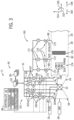
- FIG. 3 is a diagram of an embodiment of the gas turbine system 10, illustrating an embodiment of the emissions control system 11 having a valve control system 150 and a flow meter system 151 configured to control and monitor flows along the fluid pathways 56.
- an axial direction or axis 152 e.g., along a longitudinal axis
- a radial direction or axis 154 extending radially away from the longitudinal axis of the gas turbine engine 12
- a circumferential direction or axis 156 extending circumferentially about the longitudinal axis of the gas turbine engine 12.
- each of the compressor bleed conduits 60 coupled to the compressor 18 includes a valve 162 and a flowmeter 163 communicatively coupled to the emissions control unit 38.
- the compressor bleed conduits 60 may be coupled to extraction points 164 at different stages of the compressor 18, such that different temperatures and pressures of compressor bleed air can be extracted from the compressor 18 into the compressor bleed conduits 60.
- each of the coolant conduits 74 coupled to the turbine 24 includes a valve 166 and a flowmeter 167 communicatively coupled to the emissions control unit 38.
- the coolant conduits 74 may be coupled to injection points 168 at different stages of the turbine 24, such that the same or different coolant flows can be injected into the turbine 24 depending on the temperature in various locations in the turbine 24.
- each of the coolant conduits 80 coupled to the exhaust duct 26 includes a valve 170 and a flowmeter 171 communicatively coupled to the emissions control unit 38.
- the coolant conduits 80 may be coupled to injection points 172 at different positions (e.g., different axial positions relative to the downstream direction 158), such that the same or different coolant flows can be injected into the exhaust duct 24 at various positions relative to the emissions control units 82 (e.g., upstream, downstream, or directly at the units 82).
- the illustrated emissions control units 82 include a duct burner assembly 174 having a plurality of duct burners 176 positioned upstream from a SCR system 178.
- the illustrated injection points 172 are disposed at a first position upstream from both the duct burner assembly 174 and the SCR system 178, at a second position between the duct burner assembly 174 and the SCR system 178, and at a third position downstream from both the duct burner assembly 174 and the SCR system 178.
- the emissions control unit 38 is configured to monitor flowrates of the coolant flows via the flowmeters 163, 167, and 171 of the flow meter system 151 and to selectively adjust the valves 162, 166, and 170 of the valve control system 150 to control the coolant flows from the compressor 18 into the turbine 24 and the exhaust duct 26. Additionally, the emissions control unit 38 is configured to selectively control the flow control units 52 to supply one or more emissions control fluids into the one or more fluid pathways 56. In certain embodiments, the emissions control system 11 is configured to supply the one or more emissions control fluids into a common distribution conduit 61 coupled to the coolant conduits 74 and/or the coolant conduits 80.
- the emissions control system 11 is configured to supply the one or more emissions control fluids into a separate distribution conduit 61 coupled to each of the coolant conduits 74 and/or a separate distribution conduit 61 coupled to each of the coolant conduits 80.
- Each valve 162, 166, and 170 may be a ball valve, a globe valve, a butterfly valve, a diaphragm valve, or any other valve type that allows for rotary or sliding action to control the flow of a fluid.
- the valves 162, 166, and/or 170 may be multi-way valves (e.g., 3-way valves) or include injection ports to supply the emissions control fluid into the one or more fluid pathways 56.
- the flowmeters 163, 167, and 171 may include mechanical flowmeters (e.g., gear flowmeters, turbine flowmeters, and/or jet flowmeters), pressure-based flowmeters (e.g., venturi meters), variable area flowmeters, optical flowmeters, magnetic flowmeters, ultrasonic flowmeters, or any combination thereof.
- mechanical flowmeters e.g., gear flowmeters, turbine flowmeters, and/or jet flowmeters
- pressure-based flowmeters e.g., venturi meters
- variable area flowmeters e.g., optical flowmeters, magnetic flowmeters, ultrasonic flowmeters, or any combination thereof.
- the valve control system 150 may be operated by the controller 44 based at least in part on flowrate information sensed by the flow meter system 151. For example, flow information acquired from the flowmeters 163, 167, and 171 may be analyzed by the controller 44 to determine operation of the valves 162, 166, and 170. In one or more embodiments, the controller 44 may automatically control the position of the valves 162, 166, and 170 to adjust the flow path (i.e., open a valve to allow flow, close a valve to stop flow). In one or more embodiments, the controller 44 determines flow of an emissions control fluid (e.g., reducing agent) through the gas turbine system 10. The controller 44 may be located with the gas turbine system 10 or separate in a remote location receiving information through a network (e.g., located in an operating room receiving data via a LAN network).
- an emissions control fluid e.g., reducing agent
- FIG. 4 shows a detailed view of the extraction points 164, the injection points 168 into the turbine 24, the injection points 172 into the exhaust duct 26, and a cooling circuit 200 associated with the gas turbine engine 12.
- the extraction points 164 may include low pressure, medium pressure, and high pressure extraction points, which are configured to obtain a low pressure air extraction 202, a medium pressure air extraction 204, and a high pressure air extraction 206 for use in the cooling circuit 200.
- the injection points 168 may include high pressure, medium pressure, and low pressure injection points, which are configured to inject the extracted compressor air into a high pressure turbine section 208, a medium pressure turbine section 210, and a low pressure turbine section 212 of the turbine 24 for use in the cooling circuit 200.
- the extraction points 164 and the injection points 168 may not be limited to the pressure rating of the fluid (i.e., low, medium, and high) and may, for example, be determined by the flow rate of the fluid. Additionally, the pressure ratings may be distinguished and not limited to low, medium, and high. For example, the labeling may use the specific pressure of the extraction point, the stage of the extraction point, or a combination thereof.
- the emissions control system 11 is configured to supply one or more emissions control fluids (e.g., reducing agents) into fluid pathways 56 of the cooling circuit 200, thereby combining the emissions control fluids with the extracted air being supplied into the injection points 168 into the turbine 24.
- the cooling circuit 200 may include a connected series of pipes or tubes that interconnect with the injection points 168 and extraction points 164 via valves, fittings, open connections, or any other type of connection.
- a combination of air and emissions control fluid passes through the fluid pathways 56 inside the turbine 24 (e.g., through casings, blades, vanes, wheels, etc.) and eventually flows into the exhaust gas flowing through and driving the turbine 24.
- the emissions control system 11 is configured to supply one or more emissions control fluids (e.g., reducing agents) into fluid pathways 56 leading directly to the exhaust duct 26, such as the injection points 172.
- the injection points 172 include a first injection point 214 upstream of the duct burner assembly 174, a second injection point 216 between the duct burner assembly 174 and the SCR system 178, and a third injection point 218 downstream of the SCR system 178.
- the emissions control system 11 is configured control the flows of emissions control fluids to these injection points 168 and 172 to reduce the level of exhaust emissions and the visibility of the exhaust emissions (e.g., nitrogen oxides (NOx), sulfur oxides (SOx), particulate matter, and other pollutants).
- NOx nitrogen oxides
- SOx sulfur oxides
- FIG. 5 shows an expanded view of the gas turbine system 10 with an injection system 240 coupled to the exhaust duct 26.
- the injection system may provide an ammonia solution or anhydrous ammonia, or, in some cases, urea that may be hydrolyzed or decomposed to produce vaporized ammonia.
- the exhaust duct 24 may include one or more emissions control units 82.
- the injection system 240 is part of the emissions control units 82.
- the emissions control units 82 of the injection system 240 may include injection grids 242 and 244, and the emissions control units 82 may also include a SCR system 246, a heat exchanger 248 (e.g., a high pressure superheater), and an evaporator 250 (e.g., a high pressure evaporator) in the exhaust duct 24.
- the injection grids 242 and 244 may be yellow plume elimination systems (YPES).
- the injection grids 242 and 244 may utilize various emissions control fluids (e.g., reducing agents such as ethanol, ammonia, and/or alcohol) to cool and reduce exhaust emissions in the exhaust gas 128 passing through the injection grids 242 and 244.
- the amount of emissions control fluid injected is controlled by a remote operator and/or the controller 44 based on sensor feedback and various thresholds as discussed in detail above.
- the controller 44 may adjust (e.g., increase or decrease) the flow of the emissions control fluids if the temperature of the exhaust gas 128 is above or below one or more temperature thresholds, if the visibility of exhaust emissions is above or below one or more visibility thresholds, and/or if the level of exhaust emissions is above or below one or more emissions thresholds.
- the injection grids 242 and 244 may operate during start up, steady state, and shut down of the gas turbine system 10 to decrease the exhaust emissions (e.g., NO x , SO x ,, or other pollutants) and the visibility of the exhaust emissions in the exhaust gas 128.
- exhaust emissions e.g., NO x , SO x ,, or other pollutants
- the gas turbine system 10 may utilize the SCR system 246 to decrease levels of the exhaust emissions.
- the SCR system 246 may be used in conjunction with the injection grids 242 and 244 or as a stand-alone system.
- pollutants such as NO x
- the catalyst converts the NO x into nitrogen and water through reaction with vaporized ammonia as a reduction agent.
- the catalyst of the SCR system 246 may be made from various ceramic materials such as titanium oxide, vanadium, molybdenum, tungsten, zeolites, or various precious metals. Each material may have advantages and disadvantages, such as operating temperature range, thermal durability, and catalyzing potential.
- the SCR system 246 may receive an injection of a reducing agent to reduce pollutants.
- the amount of reducing agent e.g., vaporized ammonia
- the amount of reducing agent may be controlled by the controller 44.
- the SCR system 246 may use a high temperature (>400°F) to achieve a high conversion rate of NO x to nitrogen and water.
- the heat exchanger 248 is configured to add heat into the exhaust gas 128 upstream of the SCR system 246, thereby helping to improve the conversion rate of the NO x .
- a heated fluid e.g., steam
- the heat exchanger 248 may include a superheater (e.g., a high pressure superheater or steam drum) of a heat recovery steam generator (HRSG), which recovers heat from the exhaust gas 128 to generate steam for a steam turbine.
- the heated fluid (e.g., steam) flowing through the heat exchanger 248 may be at a temperature greater than or equal to a target temperature suitable for the SCR system 246, such as a steam temperature greater than 400°F.
- the gas turbine system 10 may also include a blower 252 coupled to the exhaust duct 26 downstream of the turbine 24.
- the blower 252 may be an air blower that assists in dilution by providing blowback air across the compressor 18 and the turbine 24.
- the blower 252 may be linked to the controller 44 that monitors the gas turbine system 10. The controller 44 may adjust the operational speed of the blower 252 or turn on/off the blower 252 based on the requirements of the gas turbine system 10.
- the gas turbine system 10 may also include a reducing solution system 254.
- the reducing solution system 254 may connect to the gas turbine system 10 via the injection grids 242 and 244.
- the reducing solution system 254 may connect to the gas turbine system 10 via one or more fluid pathways 56, such as the cooling circuit 200.
- the connection may be made through pipes, tubes, valves, and other methods of mechanical connection.
- the connection may allow one or more reducing agents to be injected directly into the injection grids 242 and 244, one or more fluid pathways 56, the cooling circuit 200, or the SCR system 246.
- the reducing agent may be delivered through the air cooling and/or bleeding lines of the gas turbine 24, e.g., fluid pathways 56.
- the reducing agent may be ammonia (solution, anhydrous, or derived from urea or other ammonia compounds), ethanol, alcohol, or any other type of chemical configured to reduce exhaust emissions.
- the reducing solution system 254 may include an ammonia solution train 256 and a reducing solution train 258.
- the ammonia solution train 256 may include an ammonia solution tank 260, a pump 262, a valve 264, an evaporator or evaporation tank 266, electric heaters 268 and 270, an air blower 272, and a fluid conduit 274 coupled to the injection grid 244.
- the pump 262 and valve 264 are controlled by the controller 44 to adjust (e.g., increase or decrease) a flow of an ammonia solution from the ammonia solution tank 260 to the evaporator 266, while the air blower 272 provides an airflow to the evaporator 266.
- the electric heaters 268 and 270 are configured to heat the airflow and/or the ammonia solution in the evaporator 266, thereby evaporating the ammonia solution to supply an evaporated ammonia solution to the injection grid 244.
- the reducing solution train 258 may include a reducing solution tank 280, a pump 282, a valve 284, an evaporator or evaporation tank 286, an electric heater 288, and a fluid conduit 290 coupled to the injection grid 242.
- the pump 282 and valve 284 are controlled by the controller 44 to adjust (e.g., increase or decrease) a flow of a reducing solution (e.g., ethanol) from the reducing solution tank 280 to the evaporator 286.
- the electric heater 288 is configured to heat the reducing solution in the evaporator 286, thereby evaporating the reducing solution to supply an evaporated reducing solution to the injection grid 242.
- the reducing solution system 254 may be integrated with or cooperate with the emissions control fluid supply system 40 of the emissions control system 11 to supply the ammonia solution and/or the reducing solution into the one or more fluid pathways 56.
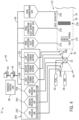
- FIG. 6 is a diagram illustrating an embodiment of the reducing solution system 254 of the emissions control system 11 interacting with the gas turbine system 10.
- the reducing solution system 254 includes the ammonia solution train 256 and the reducing solution train 258 having the tanks 260 and 280 connected to a single control valve 300.
- the control valve 300 may control the amount of flow for each emissions control fluid (e.g., ammonia and emissions reducing agent) through a common fluid conduit to the gas turbine system 10, which may be controlled by the controller 44.
- each emissions control fluid e.g., ammonia and emissions reducing agent
- the emissions control fluids are injected into the gas turbine system 10 at various portions of the fluid pathways 56, such as at the compressor bleed conduits 60, the distribution conduits 61, the coolant conduits 74 coupled to the turbine 24, and/or the coolant conduits 80 coupled to the exhaust duct 26.
- the controller 44 may monitor the exhaust gas 128 and various operating parameters of the gas turbine system 10 to determine the amount of flow of the emissions control fluids suitable to reduce the level of exhaust emissions and the visibility of the exhaust emissions (e.g., yellow plume levels).
- the controller 44 may route at least part of the emissions control fluids to the one or more fluid pathways 56 (e.g., cooling circuit 200) and also may route at least part of the emissions control fluids to the exhaust gas 128 in the exhaust duct 26 (e.g., via injection grids 302 and 304).
- the injection grid 302 is disposed in the exhaust duct 26 upstream of the duct burner assembly 174 while the injection grid 304 is disposed in the exhaust duct 26 downstream from the duct burner assembly 174.
- FIG. 7 is a diagram illustrating an embodiment of the reducing solution system 254 of the emissions control system 11 interacting with the gas turbine system 10.
- the embodiment of FIG. 7 is substantially the same as the embodiment of FIG 6 , except that a separate control valve 300 is used for each of the tanks 260 and 280, an injection grid 306 is disposed in the exhaust duct 26 downstream from the injection grids 302 and 304, and a heat exchanger 308 (e.g., 248, FIG. 5 ) is disposed between the injection grids 304 and 306.
- the controller 44 is communicatively coupled to the control valves 300, such that the controller 44 can independently control the flows of ammonia and emissions reducing agent from the tanks 260 and 280, respectively.
- the reducing solution train 258 may be connected to a first one of the control valves 300, which is connected to a first fluid circuit 310 (e.g., coolant circuit) extending from one of the compressor bleed conduits 60 to a plurality of coolant conduits 74 coupled to the turbine 24 and a plurality of coolant conduits 80 coupled to the exhaust duct 26.
- first fluid circuit 310 extends to the coolant conduits 80 coupled to the injection grids 302 and 304.
- the ammonia solution train 256 may be connected to a second one of the control valves 300, which is connected to a second fluid circuit 312 extending from one of the compressor bleed conduits 60 to one of the coolant conduits 80 coupled to the exhaust duct 26.
- the second fluid circuit 312 extends to the coolant conduit 80 coupled to the injection grid 306 (e.g., an ammonia injection grid).
- the controller 44 may determine the amount of reducing agent and/or ammonia suitable to lower a level of exhaust emissions and a visibility of the exhaust emissions (e.g., yellow plume) and may operate the control valves 300 to route the reducing agent to the first fluid circuit 310 and the ammonia to the second fluid circuit 312. While the example shows specific flow paths for the reducing solution system 254, the control valves 300 may divert flow for each solution train 256 and 258 in any number of ways.
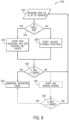
- FIG. 8 is a flow chart of an embodiment of a process 320 for reducing exhaust emissions and a visibility of the exhaust emissions in a gas turbine system 10.
- the process 320 may include the instructions 49 stored on the memory 48 and executable by the processor 46 of the controller 44 as discussed above.
- the process 320 measures one or more parameters of the gas turbine system 10.
- the process 320 may measure (e.g., using sensors) the parameters in the exhaust duct 26, in the combustor 22, in the turbine 24, or any other suitable location.
- the process 320 may measure the parameters during start up, during steady state operation, or during shutdown of the gas turbine system 10.
- the measured parameters may include NO x levels, SO x levels, CO levels, temperature of the exhaust, temperature of a catalyst of the SCR system 246, visibility levels (e.g., degree of opacity and/or color), and any other parameter associated with the exhaust emissions.
- the process 320 evaluates whether a temperature of the SCR system 246 (e.g., TSCR) is greater than 350°F.
- the TSCR may be the temperature of the exhaust gas 128 at the SCR system 246, a temperature of a catalyst of the SCR system 246, or a combination thereof.
- the controller 44 may continually monitor the temperature of the SCR system 246 to determine the next steps. If the temperature at the SCR system 246 is greater than 350° F, the process 320 moves to step 326. If the temperature at the SCR system 246 is less than 350° F, the process 320 moves to step 328.
- the process 320 controls a reducing solution system to begin or adjust an ammonia injection into the SCR system 246 via coolant conduits 80 and/or into one or more fluid pathways 56 (e.g., coolant conduits 62, 66, and/or 74) of the gas turbine engine 12.
- the ammonia may be injected into the SCR system 246 to allow for the SCR system 246 to reduce NO x and other emissions using a catalyst in the SCR system for conversion.
- the efficiency of the conversion is proportional to the temperature of the SCR system 246.
- the controller 44 selectively routes ammonia to the SCR system 246.
- the controller 44 may operate a control valve 300 connected to the reducing solution system to control the flow of ammonia into the SCR system 246.
- the process 320 begins or adjusts an ethanol injection via a reducing solution system.
- the process 320 may control the ethanol injection into one or more fluid pathways 56 (e.g., coolant conduits 62, 66, 74, and/or 80), such as the cooling circuit 200.
- the process 320 may selectively supply the ethanol to all or select injection points in the bearings 64, the combustor 22, the turbine 24, the exhaust duct 26, or a combination thereof, thereby helping to reduce emission levels (e.g., NO x levels) and visibility of the emissions (e.g., yellow plume).
- the controller 44 may operate a control valve 300 connected to the reducing solution system 258 to control the flow of ethanol into the gas turbine system 10.
- reducing agents other than ethanol may be used.
- step 330 the process 320 evaluates whether the NO x levels are reduced below a target level (e.g., threshold).
- the controller 44 actively monitors NO x levels at the turbine exhaust, the flow of reducing agents (e.g., ammonia and ethanol), and operations at each part of the gas turbine system (e.g., injection points, compressor, turbine, injection grids, cooling circuit).
- the process 320 continues maintaining operation at the operating point as indicated by step 332. However, if NO x levels still exceed the pre-determined target level, the process 320 may repeat the process or move to optional step 334.
- step 334 the controller 44 operates a blower 252 to provide bypass air to the gas turbine system 10.
- step 336 another determination is made by the controller 44 to determine if NO x levels are reduced below a target level due to the bypass air. If the controller 44 determines NO x levels are reduced below a target level, the process 320 continues to maintain operating at the operating point as indicated by step 332. If the controller 44 determines that NO x levels are not below a target level, the controller 44 may begin the process again.
- inventions enable a reduction in exhaust emissions levels and associated visibility of the exhaust emissions by injecting an emissions control fluid (e.g., reducing agent) into one or more fluid pathways 56 of the gas turbine engine 12.
- the fluid pathways 56 may including cooling pathways through the bearings 64, the combustor 22, and/or the turbine 24 (e.g., one or more cooling circuits).
- the fluid pathways 56 also may extend to the exhaust duct 26.
- the injection of emissions control fluids into the fluid pathways upstream from the exhaust outlet 136 of the turbine 24 may help improve the mixing and residence time of the emissions control fluids with the exhaust gas, thereby helping to reducing the exhaust emissions and the visibility of the exhaust emissions before being discharged into the atmosphere.
Landscapes
- Engineering & Computer Science (AREA)
- Mechanical Engineering (AREA)
- General Engineering & Computer Science (AREA)
- Chemical & Material Sciences (AREA)
- Combustion & Propulsion (AREA)
- Chemical Kinetics & Catalysis (AREA)
- General Chemical & Material Sciences (AREA)
- Engine Equipment That Uses Special Cycles (AREA)
- Exhaust Gas After Treatment (AREA)
Description
- The subject matter disclosed herein relates to gas turbine systems and, more particularly, to systems and methods for reducing the visibility of exhaust emissions, such as a yellow plume.
- A gas turbine system may include a gas turbine engine having a compressor, a combustor, and a turbine driven by combustion gases from the combustor. Combustion of fuel in the combustor generates various exhaust emissions, such as nitrogen oxides (NOx), sulfur oxides (SOx), particulate matter, and other pollutants. Unfortunately, some of these exhaust emissions may be visible (e.g., a yellow plume) when discharged from the gas turbine system into the atmosphere under some operating conditions, such as start-up when the downstream emission control systems (e.g., carbon monoxide (CO) and selective catalytic reduction (SCR) catalysts) may not be fully functional. Accordingly, as emission regulations and community awareness are getting stricter in some parts of the world, a need exists for reducing concentrations of exhaust emissions and the corresponding visibility of such emissions being exhausted into the atmosphere.
-
EP 3112616 A1 discloses systems and methods for cooling the exhaust gas of power generation systems;EP 3228848 A1 use of a gas turbine heated fluid for reductant vaporization;US 5272867 a method and plant for reducing the nitrogen oxide emissions of a gas turbine;EP 3604770 A1 a gas turbine uniformizing the temperature distribution of the combustion gas that acts on a plurality of stator vanes and rotor blades or limiting temperature unevenness;JP H02 55835 A US 2016/356495 A1 an emission control system for a gas turbine engine. - A system in accordance with the invention as hereinafter claimed comprises the features of claim 1 below.
- A method in accordance with the invention as hereinafter claimed comprises the features of claim 8 below.
- [deleted]
- These and other features, aspects, and advantages of the present system will become better understood when the following detailed description is read with reference to the accompanying drawings in which like characters represent like parts throughout the drawings, wherein:
-
FIG. 1 is a block diagram of an embodiment of a gas turbine system having an emissions control system to reduce a visibility of exhaust emissions; -
FIG. 2 is a partial cross-sectional view of an embodiment of the turbine ofFIG. 1 , illustrating cooling flows along fluid pathways inside the turbine; -
FIG. 3 is a diagram of an embodiment of the gas turbine system ofFIG. 1 , illustrating an embodiment of the emissions control system having a valve control system and a flow meter system; -
FIG. 4 is a diagram of an embodiment of the gas turbine system ofFIG. 1 , illustrating an embodiment of the emissions control system having various extraction points in the compressor and injection points in the turbine and the exhaust duct; -
FIG. 5 is a diagram of an embodiment of the gas turbine system ofFIG. 1 , illustrating an embodiment of the emissions control system having an ammonia solution train and a reducing solution train; -
FIG. 6 is a diagram of an embodiment of the gas turbine system ofFIG. 1 , illustrating an embodiment of the emissions control system having the ammonia solution train and the reducing solution train ofFIG. 5 coupled to a common fluid circuit; -
FIG. 7 is a diagram of an embodiment of the gas turbine system ofFIG. 1 , illustrating an embodiment of the emissions control system having the ammonia solution train and the reducing solution train ofFIG. 5 coupled to different fluid circuits; and -
FIG. 8 is a flow chart of an embodiment of a process for reducing exhaust emissions and a visibility of the exhaust emissions in a gas turbine system. - One or more specific embodiments of the present system will be described below. In an effort to provide a concise description of these embodiments, all features of an actual implementation may not be described in the specification. It should be appreciated that in the development of any such actual implementation, as in any engineering or design project, numerous implementation-specific decisions must be made to achieve the developers' specific goals, such as compliance with system-related and business-related constraints, which may vary from one implementation to another. Moreover, it should be appreciated that such a development effort might be complex and time consuming, but would nevertheless be a routine undertaking of design, fabrication, and manufacture for those of ordinary skill having the benefit of this disclosure.
- When introducing elements of various embodiments of the present invention, the articles "a," "an," "the," and "said" are intended to mean that there are one or more of the elements. The terms "comprising," "including," and "having" are intended to be inclusive and mean that there may be additional elements other than the listed elements.
- The disclosed embodiments are directed toward systems and methods to reduce exhaust emissions, and a corresponding visibility of such exhaust emissions, in a gas turbine system. The exhaust emissions may include any undesirable pollutants or emissions that are visible in an exhaust being discharged from the gas turbine system. For example, the exhaust emissions may include nitrogen oxides (NOx), sulfur oxides (SOx), particulate matter, and other pollutants. The visible emissions may have a variety of colors depending on the type and concentration of the exhaust emissions. For example, the visible emissions may be yellow (e.g., a yellow plume) when the concentration of nitrogen oxides (e.g., nitrogen dioxide (NO2)) exceed a threshold level.
- The disclosed embodiments include an emissions control system and associated method to reduce the concentration and visibility of such exhaust emissions by, for example, supplying a reducing agent into one or more fluid pathways of the gas turbine engine (e.g., a cooling circuit or a bypass circuit). For example, the cooling circuit may extend through various parts of the gas turbine system that typically heat up during operation and/or that benefit from cooling to improve performance or extend the life of the parts. For example, the cooling circuit may include one or more cooling flow paths that extend along and/or through portions of the combustor (e.g., framework, combustor liner, head end, etc.), rotating parts (e.g., shaft, bearings, seals, etc.), portions of the turbine (e.g., rotating turbine blades, stationary turbine vanes, turbine nozzles, turbine wheels, turbine casings, etc.), or any other parts of the gas turbine system exposed to the heat of combustion or exhaust gases. The bypass circuit may include bypass lines coupled to the compressor (e.g., one or more compressor stages) and other portions of the gas turbine system (e.g., one or more turbine stages of the turbine).
- The reducing agent flows through these fluid pathways and eventually enters a flow path of the exhaust gas, wherein the reducing agent is then able to help reduce the concentration of the exhaust emissions and the corresponding visibility of such exhaust emissions. By using the fluid pathways of the gas turbine engine, the emissions control system and method may be retrofitted into exhaust gas turbine systems by using pre-existing fluid pathways. The use of the fluid pathways also may improve the distribution and mixing of the reducing agent in the exhaust gas and may increase the residence time of the reducing agent in the exhaust gas upstream from one or more additional emissions control systems, such as a selective catalytic reduction (SCR) system disposed in an exhaust duct downstream from the turbine.
-
FIG. 1 is a block diagram of an embodiment of agas turbine system 10 having anemissions control system 11 configured to reduce the level of exhaust emissions and the visibility of the exhaust emissions (e.g., nitrogen oxides (NOx), sulfur oxides (SOx), particulate matter, and other pollutants). In the illustrated embodiment, thegas turbine system 10 includes aturbine engine 12 coupled to aload 14, e.g., an electrical generator. In one embodiment, theturbine engine 12 may be a 7FA gas turbine engine manufactured by General Electric Company, Greenville, S.C. Theturbine engine 12 includes anair intake 16, acompressor 18, one ormore fuel nozzles 20, acombustor 22, aturbine 24, and anexhaust duct 26. Theexhaust duct 26 may include ahorizontal duct portion 25 and avertical stack portion 27. However, theduct 26 may extend in any direction to an exhaust outlet. - As appreciated, the
compressor 18 may include any number of stages, e.g., 1 to 20 stages, of compressor blades rotatable in shrouds. Likewise, theturbine 24 may include any number of stages, e.g., 1 to 20 stages, of turbine blades rotatable in shrouds. Theturbine engine 12 can also include multiple compressor 18-turbine 24 couples as found, e.g., in a two shaftaeroderivative turbine engine 12. Thecombustor 18 also may include a single combustor (e.g., an annular combustor) or multiple combustors (e.g., 2 to 12 combustor cans arranged circumferentially about a rotational axis of the turbine engine 12) arranged in any manner including different designs not mentioned here. - In operation, the
turbine engine 12routes air 28 through theair intake 16 and thecompressor 18, which generates compressedair 30 for combustion and cooling flows. In the illustrated embodiment, thefuel nozzles 20 within thecombustor 22 receive at least a portion of the compressedair 30 and afuel 32, which are then directed into a combustion zone of thecombustor 22 as indicated byarrows 34. A portion of the compressedair 30 also may flow along thecombustor 22 and/or theturbine 24 for cooling purposes. Inside the combustor 22 (e.g., inside the combustion liner), theair 30 and thefuel 32 mix and combust to generate hot products of combustion, which then flow into and through theturbine 24 and theexhaust duct 26. These combustion gases drive turbine blades to rotate within theturbine 24, thereby driving ashaft 36 to rotate thecompressor 18 and theload 14. - The
emissions control system 11 includes anemissions control unit 38 coupled to an emissions controlfluid supply system 40 and amonitoring system 42. Theemissions control unit 38 includes acontroller 44 having aprocessor 46, amemory 48, andinstructions 49 stored on thememory 48 and executable by theprocessor 46 to control the emissions controlfluid supply system 40 based on feedback from themonitoring system 42. The emissions controlfluid supply system 40 includes one or more emissionscontrol fluid supplies 50, one or moreflow control units 52, and one or morefluid supply conduits 54. The emissionscontrol fluid supplies 50 may include one or more tanks or storage containers configured to hold and supply emissions control fluids, such as reducing agents. For example, the emissions control fluid supplies 50 (e.g., reducing agent supplies) may include tanks or storage containers of reducing agents, such as ammonia, ethanol, alcohol, and/or hydrogen. Theflow control units 52 may include one or more valves, pressure regulators, flowmeters or flow regulators, or any combination thereof. Theflow control units 52 may include electric actuators controlled by theemissions control unit 38. In the following discussion, theflow control units 52 may be referred to as valves; however, any reference to valves may include other types of flow control units as noted above. - The
fluid supply conduits 54 may be coupled to one ormore fluid pathways 56 of thegas turbine system 10, such that theemissions control system 11 can supply one or more of the emissions control fluids (e.g., reducing agents) into the fluid pathways to reduce the level of exhaust emission and the visibility of the exhaust emissions. Additionally, themonitoring system 42 may include one ormore sensors 58, indicated by S, configured to obtain sensor feedback of one or more parameters of thegas turbine system 10, such that theemissions control system 11 can adjust (e.g., increase or decrease) the supply of the emissions control fluids (e.g., reducing agents) based on the sensor feedback. Thesensors 58 may be distributed throughout thegas turbine system 10 at various locations, such as thecompressor 18, thecombustor 22, theturbine 24, and theexhaust duct 26. - The sensor feedback of one or more operating parameters may include, or be indicative of, a level of the exhaust emissions and/or a visibility of the exhaust emissions. For example, the
sensors 58 may include exhaust emissions sensors (e.g., NOx sensors, SOx sensors, particulate matter sensors, and other pollutant sensors) configured to sense emissions levels in the exhaust gas. Thesensors 58 include visibility sensors, such as opacity sensors, color sensors, or a combination thereof. Thevisibility sensors 58 may be configured to sense an intensity or level of opacity and/or color of the exhaust emissions in the exhaust gas. Additionally, thesensors 58 may include pressure sensors, temperature sensors (e.g., combustion temperature sensors), flow rate sensors (e.g., fuel flow rate sensors), vibration sensors, and/or fuel composition sensors. - In response to the sensor feedback from the
sensors 58, theemissions control system 11 may be configured to (A) selectively supply one or more different emissions control fluids (e.g., reducing agents) by opening and/or closing theflow control units 52 associated with the different emissions control fluid supplies 50, (B) adjust (e.g., increase or decrease) the flow of the selected emissions control fluids to the one or morefluid pathways 56 of thegas turbine system 10, and (C) selectively change the target destination of the selected emissions control fluids in the one or morefluid pathways 56 as discussed further below. For example, the emissions controlunit 38 may compare the sensor feedback against one or more thresholds (e.g., upper and/or lower thresholds), determine if the sensor feedback indicates compliance with the one or more thresholds (e.g., falls within acceptable levels or fails to meet the acceptable levels), and then adjust the emissions controlfluid supply system 40 based on the indicated compliance or lack of compliance. - For example, the one or more thresholds may include one or more visibility thresholds (e.g., opacity thresholds and/or color thresholds), such as a minimum or lower visibility threshold and an upper or maximum visibility threshold. If the sensed visibility (e.g., opacity or color) does not meet the minimum or lower visibility threshold, then the emissions control
unit 38 may selectively increase a flow of the emissions control fluids to the one or morefluid pathways 56 to help reduce the level of emissions and reduce the visibility of the emissions in the exhaust gas. If the sensed visibility (e.g., opacity or color) meets the minimum or lower visibility threshold and exceeds the maximum or upper visibility threshold, then the emissions controlunit 38 may selectively hold or reduce a flow of the emissions control fluids to the one or morefluid pathways 56 to avoid wasting the emissions control fluid while maintaining an acceptable level of emissions and an acceptable visibility of the emissions in the exhaust gas. In certain embodiments, the one or more visibility thresholds (e.g., opacity thresholds and/or color thresholds) may correspond to a yellow plume in the exhaust gas, and thus the thresholds may correspond to an opacity and/or intensity of yellow in the yellow plume. However, the disclosedemissions control system 11 may be used for any exhaust emissions and associated colors in the exhaust gas. - The
fluid pathways 56 may include external conduits outside thegas turbine engine 12, internal passages or conduits extending through thegas turbine engine 12, or a combination thereof. For example, thefluid pathways 56 may include one or morecompressor bleed conduits 60 coupled to one or more compressor stages of thecompressor 18. In the illustrated embodiment, thecompressor bleed conduits 60 are coupled to thecompressor 18 driven by thegas turbine engine 12. In some embodiments, thecompressor bleed conduits 60 may be coupled to a standalone compressor (e.g., not driven by the gas turbine engine 12). The emissions controlsystem 11 may selectively open or close valves along thecompressor bleed conduits 60 to change the temperature and pressure of the compressor bleed air being extracted from thecompressor 18 depending on the location (e.g., compressor stage) of extraction. - As an alternative or in addition to the
compressor bleed conduits 60, thefluid pathways 56 may include one or more coolant supplies 59, such as an air supply, an inert gas supply (e.g., a nitrogen gas supply), a recirculated exhaust gas supply, or a combination thereof. For example, the coolant supplies 59 may include one or more storage tanks, compressors, pumps, or a combination thereof. In some embodiments, the coolant supplies 59 may include a standalone air compressor, such as an air compressor skid, which may supplement or replace the compressor bleed air from thecompressor 18. The one or morecompressor bleed conduits 60 and/or the one or more coolant supplies 59 are coupled to one ormore distribution conduits 61, which are configured to fluidly couple to one or more target locations throughout thegas turbine system 10. - In certain embodiments, the
distribution conduits 61 include one or more coolers 63 (e.g., heat exchangers) configured to cool the flows from thecompressor bleed conduits 60 and/or the coolant supplies 59. For example, in certain embodiments, at least one of the coolant supplies 59 is configured to flow a coolant through the cooler 63 to transfer heat away from the compressor bleed air from thecompressor bleed conduits 60 and/or a different coolant from a different one of the coolant supplies 59. In some embodiments, at least one of the coolant supplies 59 is configured to direct a coolant into the compressor bleedconduit 60 with or without the compressor bleed air from thecompressor bleed conduits 60. Accordingly, the compressor bleed air from thecompressor bleed conduits 60 and/or the coolant from one or more of the coolant supplies 59 may be described as coolant supplies for other components of thegas turbine system 10. - The foregoing coolant supplies (e.g., 59, 60) are fluidly coupled to one or more target locations in the
gas turbine system 10 via thedistribution conduits 61, such as one ormore coolant conduits fluid pathways 56 may include one ormore coolant conduits 62 fluidly coupled to bearing cavities orhousings having bearings 64 for theshaft 26. These bearing cavities orbearings 64 may be part of an internal cooling circuit of thegas turbine engine 12. - The
fluid pathways 56 may include one ormore coolant conduits 66 fluidly coupled to thecombustor 22. For example, thecoolant conduits 66 may be fluidly coupled to an internal compressed air flow path between acombustor liner 68 and aflow sleeve 70 of thecombustor 22, an internal cavity in ahead end 72 of thecombustor 22, an internal cavity of thefuel nozzles 20, or a combination thereof. The foregoing flow paths or cavities of thecombustor 22 may be part of an internal cooling circuit of thegas turbine engine 12. - The
fluid pathways 56 also may include one ormore coolant conduits 74 fluidly coupled to one or more turbine stages of theturbine 24. For example, thecoolant conduits 74 may fluidly couple to an internal cooling flow path between anouter casing 76 and aninner shroud 78 of theturbine 24, and one or more internal cooling flow paths through turbine stator vanes, turbine rotor blades, turbine wheels, and/or bearing cavities. Again, the foregoing flow paths of theturbine 24 may be part of an internal cooling circuit of thegas turbine engine 12. - The
fluid pathways 56 also may include one or more conduits 80 (e.g., bypass conduits) fluidly coupled to theexhaust duct 26 downstream from theturbine 24. Theconduits 80 may be coupled to theexhaust duct 26 upstream, downstream, or at locations of one or more emissions controlunits 82 inside theexhaust duct 26. Theexhaust duct 26 may include any number and arrangement (e.g., parallel or series arrangements) of emissions controlunits 82, such as emissions controlunits emissions control system 11 may include afluid manifold 92 configured to distribute the coolant from theconduits exhaust duct 26. Thefluid manifold 92 also may be configured to inject other fluids into theexhaust duct 26, such as emissions control fluids (e.g., reducing agents) supplied by the emissions controlfluid supply system 40. - The emissions control units 82 (e.g., 84, 86, 88, 90, and 91) may include one or more of: heat exchangers, evaporators, emissions control fluid injection grids, catalysts (e.g., selective catalytic reduction (SCR) systems), or any combination thereof. For example, in certain embodiments, the emissions control
units second injection grid 88 may be configured to inject ammonia (e.g., ammonia solution or anhydrous ammonia) or in some cases urea that can be hydrolyzed/decomposed in the end making vaporized ammonia. - In the illustrated embodiment, the
emissions control system 11 is configured to supply the emissions control fluid directly into the exhaust gas via thefluid conduit 54 coupled to theexhaust duct 26 and/or indirectly into the exhaust gas via the one or more fluid pathways 56 (e.g., coolant circuits in the gas turbine engine 12) as discussed above. Accordingly, based on an analysis of the sensor feedback fromsensors 58 as discussed above, the emissions controlunit 38 may selectively adjust one or more flow control units 52 (e.g., valves) to vary a flow of the emissions control fluid (e.g., reducing agent) from the one or more emissions control fluid supplies 50 into the one or morefluid pathways 56 eventually leading into the exhaust gas and also directly into theexhaust duct 26 via thefluid supply conduit 54. At theexhaust duct 26, the supplied emissions control fluid may be injected via one or more of the emissions control units 82 (e.g., 84, 86, 88, 90, and 91), such as via an injection grid and/or an evaporator as discussed above. The injection grid(s) may include a plurality of conduits (e.g., parallel conduits) having injection openings or nozzles distributed across an exhaust flow path of theexhaust duct 26. A heat exchanger may be used to add heat to the exhaust flow path, thereby helping to evaporate the injected emissions control fluid. An evaporator may be used to evaporate the emissions control fluid prior to injection into the exhaust flow path. The supply of the emissions control fluid into the one or morefluid pathways 56 of thegas turbine engine 12 may improve the mixing and residence time of the emissions control fluid with the exhaust gas, thereby helping to reduce emissions and visibility of the emissions before being discharged from theexhaust duct 26 into the atmosphere. -
FIG. 2 is a partial cross-sectional view of an embodiment of theturbine 24 ofFIG. 1 , illustrating cooling flows along thefluid pathways 56 inside theturbine 24. In the illustrated embodiment, theturbine 24 includes arotor 100 circumferentially surrounded by astator 102, wherein theturbine 24 includes a plurality of axially spaced turbine stages 104. In eachstage 104, therotor 100 includes a plurality ofturbine blades 106 mounted in a circumferential arrangement about awheel 108, and thestator 102 includes a plurality ofstator vanes 110 mounted in a similar circumferential arrangement about acasing 112. The illustratedcasing 112 includes theouter casing 76 and aninner shroud 78, wherein theouter casing 112 has a plurality ofhangers 114 supportingshroud segments 116. In particular, eachhanger 114 includes a pair ofhooks complementary hooks respective shroud segment 116. Theseshroud segments 116 generally align with theturbine blades 106 in eachstage 104 and define aclearance 126. In operation, the hot combustion gases flow through eachstage 104, thereby driving rotation of theturbine blades 106 within therespective shroud segments 116. - In the illustrated embodiment, various components of the turbine 24 (e.g., the
rotor 100, thestator 102, theblades 106, thewheels 108, thestator vanes 110, and the casing 112) include one or more of thefluid pathways 56 discussed above with reference toFIG. 1 . For example, thefluid pathways 56 may extend through therotor 100, around and/or into thewheels 108, and into anexhaust flow path 128 as indicated byarrows 130. Thefluid pathways 56 also may extend from therotor 100, into and through theblades 106, and into theexhaust flow path 128 as indicated byarrows 132. As illustrated byarrows 134, thefluid pathways 56 may extend into and through thestator 102 between theouter casing 76 and theinner shroud 78 of thecasing 112, through and/or around theshroud segments 116 and into theexhaust flow path 128, through thestator vanes 110 and into theexhaust flow path 128, and/or through thestator vanes 110 to therotor 100 and then into theexhaust flow path 128. - The illustrated fluid pathways 56 (e.g., as represented by
arrows emissions control system 11 to supply one or more emissions control fluids (e.g., reducing agents) into theexhaust flow path 128 upstream of anexhaust outlet 136 of theturbine 24. As noted above, the illustratedfluid pathways 56 may be part of a cooling circuit (e.g., a turbine cooling circuit) of thegas turbine engine 12. Thus, theemissions control system 11 advantageously supplies the one or more emissions control fluids (e.g., reducing agents) into the cooling circuit, such that theemissions control system 11 can be retrofitted into any new or pre-existing gas turbine engine 12 (e.g., already installed on site) to improve the emissions control of thegas turbine system 10. -
FIG. 3 is a diagram of an embodiment of thegas turbine system 10, illustrating an embodiment of theemissions control system 11 having avalve control system 150 and aflow meter system 151 configured to control and monitor flows along thefluid pathways 56. In the following discussion, reference may be made to an axial direction or axis 152 (e.g., along a longitudinal axis) of thegas turbine engine 12, a radial direction oraxis 154 extending radially away from the longitudinal axis of thegas turbine engine 12, and a circumferential direction oraxis 156 extending circumferentially about the longitudinal axis of thegas turbine engine 12. Reference may also be made to adownstream direction 158 and anupstream direction 160 relative the flow direction through thegas turbine engine 12. - In the illustrated embodiment, each of the
compressor bleed conduits 60 coupled to thecompressor 18 includes avalve 162 and aflowmeter 163 communicatively coupled to the emissions controlunit 38. For example, thecompressor bleed conduits 60 may be coupled toextraction points 164 at different stages of thecompressor 18, such that different temperatures and pressures of compressor bleed air can be extracted from thecompressor 18 into thecompressor bleed conduits 60. - Similarly, each of the
coolant conduits 74 coupled to theturbine 24 includes avalve 166 and aflowmeter 167 communicatively coupled to the emissions controlunit 38. For example, thecoolant conduits 74 may be coupled toinjection points 168 at different stages of theturbine 24, such that the same or different coolant flows can be injected into theturbine 24 depending on the temperature in various locations in theturbine 24. - Similarly, each of the
coolant conduits 80 coupled to theexhaust duct 26 includes avalve 170 and aflowmeter 171 communicatively coupled to the emissions controlunit 38. For example, thecoolant conduits 80 may be coupled toinjection points 172 at different positions (e.g., different axial positions relative to the downstream direction 158), such that the same or different coolant flows can be injected into theexhaust duct 24 at various positions relative to the emissions control units 82 (e.g., upstream, downstream, or directly at the units 82). The illustrated emissions controlunits 82 include aduct burner assembly 174 having a plurality ofduct burners 176 positioned upstream from aSCR system 178. The illustrated injection points 172 are disposed at a first position upstream from both theduct burner assembly 174 and theSCR system 178, at a second position between theduct burner assembly 174 and theSCR system 178, and at a third position downstream from both theduct burner assembly 174 and theSCR system 178. - In operation, as discussed above, the emissions control
unit 38 is configured to monitor flowrates of the coolant flows via theflowmeters flow meter system 151 and to selectively adjust thevalves valve control system 150 to control the coolant flows from thecompressor 18 into theturbine 24 and theexhaust duct 26. Additionally, the emissions controlunit 38 is configured to selectively control theflow control units 52 to supply one or more emissions control fluids into the one or morefluid pathways 56. In certain embodiments, theemissions control system 11 is configured to supply the one or more emissions control fluids into acommon distribution conduit 61 coupled to thecoolant conduits 74 and/or thecoolant conduits 80. However, in some embodiments, theemissions control system 11 is configured to supply the one or more emissions control fluids into aseparate distribution conduit 61 coupled to each of thecoolant conduits 74 and/or aseparate distribution conduit 61 coupled to each of thecoolant conduits 80. - Each
valve valves fluid pathways 56. Theflowmeters - The
valve control system 150 may be operated by thecontroller 44 based at least in part on flowrate information sensed by theflow meter system 151. For example, flow information acquired from theflowmeters controller 44 to determine operation of thevalves controller 44 may automatically control the position of thevalves controller 44 determines flow of an emissions control fluid (e.g., reducing agent) through thegas turbine system 10. Thecontroller 44 may be located with thegas turbine system 10 or separate in a remote location receiving information through a network (e.g., located in an operating room receiving data via a LAN network). -
FIG. 4 shows a detailed view of the extraction points 164, the injection points 168 into theturbine 24, the injection points 172 into theexhaust duct 26, and acooling circuit 200 associated with thegas turbine engine 12. The extraction points 164 may include low pressure, medium pressure, and high pressure extraction points, which are configured to obtain a lowpressure air extraction 202, a mediumpressure air extraction 204, and a highpressure air extraction 206 for use in thecooling circuit 200. The injection points 168 may include high pressure, medium pressure, and low pressure injection points, which are configured to inject the extracted compressor air into a highpressure turbine section 208, a mediumpressure turbine section 210, and a lowpressure turbine section 212 of theturbine 24 for use in thecooling circuit 200. In one or more embodiments, the extraction points 164 and the injection points 168 may not be limited to the pressure rating of the fluid (i.e., low, medium, and high) and may, for example, be determined by the flow rate of the fluid. Additionally, the pressure ratings may be distinguished and not limited to low, medium, and high. For example, the labeling may use the specific pressure of the extraction point, the stage of the extraction point, or a combination thereof. - As discussed above, the
emissions control system 11 is configured to supply one or more emissions control fluids (e.g., reducing agents) intofluid pathways 56 of thecooling circuit 200, thereby combining the emissions control fluids with the extracted air being supplied into the injection points 168 into theturbine 24. Thecooling circuit 200 may include a connected series of pipes or tubes that interconnect with the injection points 168 andextraction points 164 via valves, fittings, open connections, or any other type of connection. A combination of air and emissions control fluid passes through thefluid pathways 56 inside the turbine 24 (e.g., through casings, blades, vanes, wheels, etc.) and eventually flows into the exhaust gas flowing through and driving theturbine 24. - Additionally, the
emissions control system 11 is configured to supply one or more emissions control fluids (e.g., reducing agents) intofluid pathways 56 leading directly to theexhaust duct 26, such as the injection points 172. In the illustrated embodiment, the injection points 172 include afirst injection point 214 upstream of theduct burner assembly 174, asecond injection point 216 between theduct burner assembly 174 and theSCR system 178, and athird injection point 218 downstream of theSCR system 178. Again, theemissions control system 11 is configured control the flows of emissions control fluids to these injection points 168 and 172 to reduce the level of exhaust emissions and the visibility of the exhaust emissions (e.g., nitrogen oxides (NOx), sulfur oxides (SOx), particulate matter, and other pollutants). -
FIG. 5 shows an expanded view of thegas turbine system 10 with aninjection system 240 coupled to theexhaust duct 26. In one or more embodiments, the injection system may provide an ammonia solution or anhydrous ammonia, or, in some cases, urea that may be hydrolyzed or decomposed to produce vaporized ammonia. As discussed above with reference toFIG. 1 , theexhaust duct 24 may include one or more emissions controlunits 82. In the illustrated embodiments, theinjection system 240 is part of the emissions controlunits 82. For example, the emissions controlunits 82 of theinjection system 240 may includeinjection grids units 82 may also include aSCR system 246, a heat exchanger 248 (e.g., a high pressure superheater), and an evaporator 250 (e.g., a high pressure evaporator) in theexhaust duct 24. In one or more embodiments, theinjection grids injection grids exhaust gas 128 passing through theinjection grids - In one or more embodiments, the amount of emissions control fluid injected is controlled by a remote operator and/or the
controller 44 based on sensor feedback and various thresholds as discussed in detail above. For example, thecontroller 44 may adjust (e.g., increase or decrease) the flow of the emissions control fluids if the temperature of theexhaust gas 128 is above or below one or more temperature thresholds, if the visibility of exhaust emissions is above or below one or more visibility thresholds, and/or if the level of exhaust emissions is above or below one or more emissions thresholds. Theinjection grids gas turbine system 10 to decrease the exhaust emissions (e.g., NOx, SOx,, or other pollutants) and the visibility of the exhaust emissions in theexhaust gas 128. - In addition to the
injection grids gas turbine system 10 may utilize theSCR system 246 to decrease levels of the exhaust emissions. TheSCR system 246 may be used in conjunction with theinjection grids SCR system 246, the catalyst converts the NOx into nitrogen and water through reaction with vaporized ammonia as a reduction agent. The catalyst of theSCR system 246 may be made from various ceramic materials such as titanium oxide, vanadium, molybdenum, tungsten, zeolites, or various precious metals. Each material may have advantages and disadvantages, such as operating temperature range, thermal durability, and catalyzing potential. TheSCR system 246 may receive an injection of a reducing agent to reduce pollutants. The amount of reducing agent (e.g., vaporized ammonia) may be controlled by thecontroller 44. - The
SCR system 246 may use a high temperature (>400°F) to achieve a high conversion rate of NOx to nitrogen and water. Theheat exchanger 248 is configured to add heat into theexhaust gas 128 upstream of theSCR system 246, thereby helping to improve the conversion rate of the NOx. In certain embodiments, a heated fluid (e.g., steam) may circulate through theheat exchanger 248 and transfer heat from the heated fluid into theexhaust gas 128. For example, theheat exchanger 248 may include a superheater (e.g., a high pressure superheater or steam drum) of a heat recovery steam generator (HRSG), which recovers heat from theexhaust gas 128 to generate steam for a steam turbine. The heated fluid (e.g., steam) flowing through theheat exchanger 248 may be at a temperature greater than or equal to a target temperature suitable for theSCR system 246, such as a steam temperature greater than 400°F. - The
gas turbine system 10 may also include ablower 252 coupled to theexhaust duct 26 downstream of theturbine 24. Theblower 252 may be an air blower that assists in dilution by providing blowback air across thecompressor 18 and theturbine 24. Theblower 252 may be linked to thecontroller 44 that monitors thegas turbine system 10. Thecontroller 44 may adjust the operational speed of theblower 252 or turn on/off theblower 252 based on the requirements of thegas turbine system 10. - The
gas turbine system 10 may also include a reducingsolution system 254. The reducingsolution system 254 may connect to thegas turbine system 10 via theinjection grids solution system 254 may connect to thegas turbine system 10 via one or morefluid pathways 56, such as thecooling circuit 200. The connection may be made through pipes, tubes, valves, and other methods of mechanical connection. The connection may allow one or more reducing agents to be injected directly into theinjection grids fluid pathways 56, thecooling circuit 200, or theSCR system 246. In one or more embodiments, the reducing agent may be delivered through the air cooling and/or bleeding lines of thegas turbine 24, e.g.,fluid pathways 56. The reducing agent may be ammonia (solution, anhydrous, or derived from urea or other ammonia compounds), ethanol, alcohol, or any other type of chemical configured to reduce exhaust emissions. - In one or more embodiments, the reducing
solution system 254 may include anammonia solution train 256 and a reducingsolution train 258. Theammonia solution train 256 may include anammonia solution tank 260, apump 262, avalve 264, an evaporator orevaporation tank 266,electric heaters air blower 272, and afluid conduit 274 coupled to theinjection grid 244. Thepump 262 andvalve 264 are controlled by thecontroller 44 to adjust (e.g., increase or decrease) a flow of an ammonia solution from theammonia solution tank 260 to theevaporator 266, while theair blower 272 provides an airflow to theevaporator 266. Theelectric heaters evaporator 266, thereby evaporating the ammonia solution to supply an evaporated ammonia solution to theinjection grid 244. - The reducing
solution train 258 may include a reducingsolution tank 280, apump 282, avalve 284, an evaporator orevaporation tank 286, anelectric heater 288, and afluid conduit 290 coupled to theinjection grid 242. Thepump 282 andvalve 284 are controlled by thecontroller 44 to adjust (e.g., increase or decrease) a flow of a reducing solution (e.g., ethanol) from the reducingsolution tank 280 to theevaporator 286. Theelectric heater 288 is configured to heat the reducing solution in theevaporator 286, thereby evaporating the reducing solution to supply an evaporated reducing solution to theinjection grid 242. - In addition to supplying emissions control fluids to the
exhaust duct 26, the reducingsolution system 254 may be integrated with or cooperate with the emissions controlfluid supply system 40 of theemissions control system 11 to supply the ammonia solution and/or the reducing solution into the one or morefluid pathways 56. -
FIG. 6 is a diagram illustrating an embodiment of the reducingsolution system 254 of theemissions control system 11 interacting with thegas turbine system 10. The reducingsolution system 254 includes theammonia solution train 256 and the reducingsolution train 258 having thetanks single control valve 300. Thecontrol valve 300 may control the amount of flow for each emissions control fluid (e.g., ammonia and emissions reducing agent) through a common fluid conduit to thegas turbine system 10, which may be controlled by thecontroller 44. The emissions control fluids are injected into thegas turbine system 10 at various portions of thefluid pathways 56, such as at thecompressor bleed conduits 60, thedistribution conduits 61, thecoolant conduits 74 coupled to theturbine 24, and/or thecoolant conduits 80 coupled to theexhaust duct 26. - The
controller 44 may monitor theexhaust gas 128 and various operating parameters of thegas turbine system 10 to determine the amount of flow of the emissions control fluids suitable to reduce the level of exhaust emissions and the visibility of the exhaust emissions (e.g., yellow plume levels). Thecontroller 44 may route at least part of the emissions control fluids to the one or more fluid pathways 56 (e.g., cooling circuit 200) and also may route at least part of the emissions control fluids to theexhaust gas 128 in the exhaust duct 26 (e.g., viainjection grids 302 and 304). In the illustrated embodiment, theinjection grid 302 is disposed in theexhaust duct 26 upstream of theduct burner assembly 174 while theinjection grid 304 is disposed in theexhaust duct 26 downstream from theduct burner assembly 174. -
FIG. 7 is a diagram illustrating an embodiment of the reducingsolution system 254 of theemissions control system 11 interacting with thegas turbine system 10. The embodiment ofFIG. 7 is substantially the same as the embodiment ofFIG 6 , except that aseparate control valve 300 is used for each of thetanks injection grid 306 is disposed in theexhaust duct 26 downstream from theinjection grids FIG. 5 ) is disposed between theinjection grids controller 44 is communicatively coupled to thecontrol valves 300, such that thecontroller 44 can independently control the flows of ammonia and emissions reducing agent from thetanks - The reducing
solution train 258 may be connected to a first one of thecontrol valves 300, which is connected to a first fluid circuit 310 (e.g., coolant circuit) extending from one of thecompressor bleed conduits 60 to a plurality ofcoolant conduits 74 coupled to theturbine 24 and a plurality ofcoolant conduits 80 coupled to theexhaust duct 26. In particular, the firstfluid circuit 310 extends to thecoolant conduits 80 coupled to theinjection grids ammonia solution train 256 may be connected to a second one of thecontrol valves 300, which is connected to a secondfluid circuit 312 extending from one of thecompressor bleed conduits 60 to one of thecoolant conduits 80 coupled to theexhaust duct 26. In particular, thesecond fluid circuit 312 extends to thecoolant conduit 80 coupled to the injection grid 306 (e.g., an ammonia injection grid). Thecontroller 44 may determine the amount of reducing agent and/or ammonia suitable to lower a level of exhaust emissions and a visibility of the exhaust emissions (e.g., yellow plume) and may operate thecontrol valves 300 to route the reducing agent to the firstfluid circuit 310 and the ammonia to thesecond fluid circuit 312. While the example shows specific flow paths for the reducingsolution system 254, thecontrol valves 300 may divert flow for eachsolution train -
FIG. 8 is a flow chart of an embodiment of aprocess 320 for reducing exhaust emissions and a visibility of the exhaust emissions in agas turbine system 10. Theprocess 320 may include theinstructions 49 stored on thememory 48 and executable by theprocessor 46 of thecontroller 44 as discussed above. Instep 322, theprocess 320 measures one or more parameters of thegas turbine system 10. For example, theprocess 320 may measure (e.g., using sensors) the parameters in theexhaust duct 26, in thecombustor 22, in theturbine 24, or any other suitable location. Theprocess 320 may measure the parameters during start up, during steady state operation, or during shutdown of thegas turbine system 10. The measured parameters may include NOx levels, SOx levels, CO levels, temperature of the exhaust, temperature of a catalyst of theSCR system 246, visibility levels (e.g., degree of opacity and/or color), and any other parameter associated with the exhaust emissions. - In
step 324, theprocess 320 evaluates whether a temperature of the SCR system 246 (e.g., TSCR) is greater than 350°F. The TSCR may be the temperature of theexhaust gas 128 at theSCR system 246, a temperature of a catalyst of theSCR system 246, or a combination thereof. Thecontroller 44 may continually monitor the temperature of theSCR system 246 to determine the next steps. If the temperature at theSCR system 246 is greater than 350° F, theprocess 320 moves to step 326. If the temperature at theSCR system 246 is less than 350° F, theprocess 320 moves to step 328. - In
step 326, theprocess 320 controls a reducing solution system to begin or adjust an ammonia injection into theSCR system 246 viacoolant conduits 80 and/or into one or more fluid pathways 56 (e.g.,coolant conduits gas turbine engine 12. The ammonia may be injected into theSCR system 246 to allow for theSCR system 246 to reduce NOx and other emissions using a catalyst in the SCR system for conversion. The efficiency of the conversion is proportional to the temperature of theSCR system 246. Thus, with theSCR system 246 operating above 350° F, thecontroller 44 selectively routes ammonia to theSCR system 246. Thecontroller 44 may operate acontrol valve 300 connected to the reducing solution system to control the flow of ammonia into theSCR system 246. - In
step 328, theprocess 320 begins or adjusts an ethanol injection via a reducing solution system. Theprocess 320 may control the ethanol injection into one or more fluid pathways 56 (e.g.,coolant conduits cooling circuit 200. Theprocess 320 may selectively supply the ethanol to all or select injection points in thebearings 64, thecombustor 22, theturbine 24, theexhaust duct 26, or a combination thereof, thereby helping to reduce emission levels (e.g., NOx levels) and visibility of the emissions (e.g., yellow plume). Thecontroller 44 may operate acontrol valve 300 connected to the reducingsolution system 258 to control the flow of ethanol into thegas turbine system 10. As noted above, reducing agents other than ethanol may be used. - Although the
process 320 illustratessteps alternatives following step 324, embodiments of theprocess 320 may simultaneously use the emissions control measures of bothsteps step 330, theprocess 320 evaluates whether the NOx levels are reduced below a target level (e.g., threshold). Thecontroller 44 actively monitors NOx levels at the turbine exhaust, the flow of reducing agents (e.g., ammonia and ethanol), and operations at each part of the gas turbine system (e.g., injection points, compressor, turbine, injection grids, cooling circuit). If the NOx levels are determined to be below a pre-determined target level, theprocess 320 continues maintaining operation at the operating point as indicated bystep 332. However, if NOx levels still exceed the pre-determined target level, theprocess 320 may repeat the process or move tooptional step 334. - In
optional step 334, thecontroller 44 operates ablower 252 to provide bypass air to thegas turbine system 10. Inoptional step 336, another determination is made by thecontroller 44 to determine if NOx levels are reduced below a target level due to the bypass air. If thecontroller 44 determines NOx levels are reduced below a target level, theprocess 320 continues to maintain operating at the operating point as indicated bystep 332. If thecontroller 44 determines that NOx levels are not below a target level, thecontroller 44 may begin the process again. - Technical effects of the disclosed embodiments enable a reduction in exhaust emissions levels and associated visibility of the exhaust emissions by injecting an emissions control fluid (e.g., reducing agent) into one or more
fluid pathways 56 of thegas turbine engine 12. Thefluid pathways 56 may including cooling pathways through thebearings 64, thecombustor 22, and/or the turbine 24 (e.g., one or more cooling circuits). Thefluid pathways 56 also may extend to theexhaust duct 26. However, the injection of emissions control fluids into the fluid pathways upstream from theexhaust outlet 136 of theturbine 24 may help improve the mixing and residence time of the emissions control fluids with the exhaust gas, thereby helping to reducing the exhaust emissions and the visibility of the exhaust emissions before being discharged into the atmosphere. - This written description uses examples to disclose the invention, including the best mode, and also to enable any person skilled in the art to practice the invention, including making and using any devices or systems and performing any incorporated methods.
Claims (8)
- A system (10), comprising:
an emissions control system (11) configured to couple to a turbine engine (12), wherein the emissions control system (11) comprises:an emission control fluid supply (50) having one or more conduits (54) configured to couple to one or more fluid pathways (56) of the system (10), wherein the one or more fluid pathways (56) are fluidly coupled to a flow path of an exhaust gas from a combustor (22) through a turbine (24) of the turbine engine (12);at least one sensor (58) configured to obtain a feedback of one or more parameters of the turbine engine (12), wherein the one or more parameters are indicative of a visibility of emissions of the exhaust gas;at least one valve (52) coupled to the emissions control fluid supply (50); anda controller (44) communicatively coupled to the at least one sensor (58) and the at least one valve (52), wherein the controller (44) is responsive to the feedback to adjust the at least one valve (52) to adjust a flow of the emission control fluid to reduce the visibility of the emissions of the exhaust gas, the emission control fluid comprising a reducing agent; characterized in thatthe at least one sensor comprises a visibility sensor, wherein the visibility sensor includes an opacity sensor, a color sensor, or a combination thereof. - The system (10) of claim 1, further comprising the turbine engine (12) having the combustor (22) and the turbine (24).
- The system (10) of claim 2, wherein the one or more fluid pathways (56) comprise a cooling circuit (200) through the turbine engine (12);wherein the cooling circuit (200) comprises one or more compressor bleed conduits (60) coupled to a compressor of the turbine engine (12) orone or more coolant conduits (80) coupled to the turbine (24) of the turbine engine (12) or both.
- The system (10) of claim 2, wherein the one or more fluid pathways comprise a bypass circuit having one or more compressor bleed conduits (60) coupled to a compressor (18) of the turbine engine (12), and one or more bypass conduits (80) coupled to an exhaust duct (26) downstream of the turbine (24).
- The system (10) of claim 1, wherein the emission control fluid supply (50) comprises a storage tank (260), an evaporator (266), and a pump (262); and wherein the storage tank (260) comprises one or more tanks of ammonia solution, anhydrous ammonia, urea, ethanol, alcohol, hydrogen, or any combination thereof.
- The system (10) of claim 1, wherein the at least one sensor (52) comprises an opacity sensor and wherein the at least one sensor (52) is configured to obtain the feedback of the one or more parameters of the exhaust gas.
- The system (10) of claim 2, comprising a selective catalytic reduction (SCR) system (178, 246), an injection grid (242, 244), or both disposed in an exhaust duct (26) downstream of the turbine (24).
- A method for reducing visibility of exhaust emissions in a gas turbine system (10), the method comprising:receiving a feedback, via at least one sensor (58) of an emissions control system (11), of one or more parameters of the gas turbine system (10), wherein the one or more parameters are indicative of the visibility of emissions in an exhaust gas from the gas turbine system (10); andadjusting at least one valve (52), via a controller (44) of the emissions control system (11), to adjust a flow of a reducing agent from an emissions control fluid supply (50) to one or more fluid pathways (56) of the gas turbine system (10) to reduce the visibility of the emissions of the exhaust gas, wherein the one or more fluid pathways (56) are fluidly coupled to a flow path of the exhaust gas from a combustor (22) through a turbine (24) of the gas turbine system (10) ; characterized in thatthe at least one sensor comprises a visibility sensor, wherein the visibility sensor includes an opacity sensor, a color sensor, or a combination thereof.
Applications Claiming Priority (1)
| Application Number | Priority Date | Filing Date | Title |
|---|---|---|---|
| US16/890,990 US11598225B2 (en) | 2020-06-02 | 2020-06-02 | System and method for reducing the visibility of exhaust emissions in a gas turbine system |
Publications (2)
| Publication Number | Publication Date |
|---|---|
| EP3971400A1 EP3971400A1 (en) | 2022-03-23 |
| EP3971400B1 true EP3971400B1 (en) | 2024-11-27 |
Family
ID=75936911
Family Applications (1)
| Application Number | Title | Priority Date | Filing Date |
|---|---|---|---|
| EP21174182.2A Active EP3971400B1 (en) | 2020-06-02 | 2021-05-17 | System and method for reducing the visibility of exhaust emissions in a gas turbine system |
Country Status (4)
| Country | Link |
|---|---|
| US (1) | US11598225B2 (en) |
| EP (1) | EP3971400B1 (en) |
| JP (1) | JP7735079B2 (en) |
| CN (1) | CN113756956A (en) |
Families Citing this family (4)
| Publication number | Priority date | Publication date | Assignee | Title |
|---|---|---|---|---|
| KR102159082B1 (en) * | 2020-01-08 | 2020-09-23 | 주식회사 이엠코 | Method for treating exhaust gas of thermal plant |
| US11448133B2 (en) * | 2020-05-05 | 2022-09-20 | Raytheon Technologies Corporation | Moderate pressure liquid hydrogen storage for hybrid-electric propulsion system |
| JP7623336B2 (en) * | 2022-11-30 | 2025-01-28 | 三菱重工業株式会社 | Gas turbine cogeneration system and its operating method |
| US20250146441A1 (en) * | 2023-11-02 | 2025-05-08 | Rtx Corporation | Turbine cooling air pressure boost system |
Citations (1)
| Publication number | Priority date | Publication date | Assignee | Title |
|---|---|---|---|---|
| US20160356495A1 (en) * | 2015-06-02 | 2016-12-08 | Ansaldo Energia Ip Uk Limited | Method and system for operating a combustion device |
Family Cites Families (15)
| Publication number | Priority date | Publication date | Assignee | Title |
|---|---|---|---|---|
| JPH0255835A (en) | 1988-08-18 | 1990-02-26 | Kawasaki Steel Corp | Gas turbine device additionally providing exhaust gas boiler with built-in exhaust gas denitrification device |
| EP0523469A1 (en) | 1991-07-18 | 1993-01-20 | Siemens Aktiengesellschaft | Method for the reduction of NOx emission of a gas turbine |
| US8280202B2 (en) * | 2009-05-14 | 2012-10-02 | General Electric Company | Fiber-optic dynamic sensing modules and methods |
| US10208677B2 (en) * | 2012-12-31 | 2019-02-19 | General Electric Company | Gas turbine load control system |
| KR101552863B1 (en) | 2013-03-07 | 2015-09-14 | 주식회사 해림엔지니어링 | Method for reducing chrome yellow of nitrogen oxide elimination system |
| KR101277518B1 (en) | 2013-04-09 | 2013-06-21 | 포항공과대학교 산학협력단 | Scr/sncr combined de-nox system for reducing yellow plume and nox |
| US8790609B1 (en) | 2013-06-27 | 2014-07-29 | Siemens Energy, Inc. | Method of yellow plume elimination in gas turbine exhaust |
| US20150020529A1 (en) * | 2013-07-18 | 2015-01-22 | General Electric Company | Gas turbine emissions control system and method |
| KR20140043428A (en) | 2014-03-24 | 2014-04-09 | 주식회사 코캣 | Hybrid nox elimination system comprising yellow plume elimination system and selective catalytic reduction system |
| US20160376908A1 (en) | 2015-06-29 | 2016-12-29 | General Electric Company | Power generation system exhaust cooling |
| US20170292424A1 (en) * | 2016-04-06 | 2017-10-12 | General Electric Company | Use of gas turbine heated fluid for reductant vaporization |
| EP3354867A1 (en) | 2017-01-27 | 2018-08-01 | Siemens Aktiengesellschaft | Exhaust duct for a fossil fuel powered engine comprising a dilution selective catalytic reduction system |
| JP6880902B2 (en) | 2017-03-27 | 2021-06-02 | 株式会社Ihi | gas turbine |
| JP2018189059A (en) * | 2017-05-10 | 2018-11-29 | 一般財団法人電力中央研究所 | Thermal power generation equipment, power generation equipment, and combustion equipment |
| KR101807996B1 (en) | 2017-07-17 | 2017-12-12 | 블루버드환경 주식회사 | Combined De-NOx System using Heterogeneous Reducing agent for Reducing Yellow Plume and NOx |
-
2020
- 2020-06-02 US US16/890,990 patent/US11598225B2/en active Active
-
2021
- 2021-05-12 JP JP2021081304A patent/JP7735079B2/en active Active
- 2021-05-17 EP EP21174182.2A patent/EP3971400B1/en active Active
- 2021-05-17 CN CN202110533282.1A patent/CN113756956A/en active Pending
Patent Citations (1)
| Publication number | Priority date | Publication date | Assignee | Title |
|---|---|---|---|---|
| US20160356495A1 (en) * | 2015-06-02 | 2016-12-08 | Ansaldo Energia Ip Uk Limited | Method and system for operating a combustion device |
Also Published As
| Publication number | Publication date |
|---|---|
| CN113756956A (en) | 2021-12-07 |
| US20210372623A1 (en) | 2021-12-02 |
| JP7735079B2 (en) | 2025-09-08 |
| JP2021188616A (en) | 2021-12-13 |
| EP3971400A1 (en) | 2022-03-23 |
| US11598225B2 (en) | 2023-03-07 |
Similar Documents
| Publication | Publication Date | Title |
|---|---|---|
| JP7735079B2 (en) | Systems and methods for reducing exhaust emission visibility in gas turbine systems | |
| US9562475B2 (en) | Vane carrier temperature control system in a gas turbine engine | |
| JP6894199B2 (en) | Power generation system exhaust cooling | |
| CN206429309U (en) | System for being extracted via turbine and compressor extracts generation steam | |
| US10436445B2 (en) | Assembly for controlling clearance between a liner and stationary nozzle within a gas turbine | |
| US10415432B2 (en) | Power plant with steam generation and fuel heating capabilities | |
| US9719372B2 (en) | Gas turbomachine including a counter-flow cooling system and method | |
| JP2017503966A (en) | Control system and method for a gas turbine engine | |
| JP2017524095A (en) | Corrosion suppression system and method in an exhaust gas recirculation gas turbine system | |
| US10436073B2 (en) | System for generating steam via turbine extraction and compressor extraction | |
| US9874143B2 (en) | System for generating steam and for providing cooled combustion gas to a secondary gas turbine combustor | |
| US9970354B2 (en) | Power plant including an ejector and steam generating system via turbine extraction and compressor extraction | |
| US10584615B2 (en) | System for generating steam via turbine extraction and compressor extraction including an ejector and static mixer | |
| US10072573B2 (en) | Power plant including an ejector and steam generating system via turbine extraction | |
| US20170167380A1 (en) | System for Generating Steam and for Providing Cooled Combustion Gas to a Secondary Gas Turbine | |
| JP6870970B2 (en) | Steam generation system by turbine extraction | |
| EP3228848A1 (en) | Use of a gas turbine heated fluid for reductant vaporization | |
| JP2017110646A (en) | Power plant generating steam by combustor gas extraction | |
| US10577982B2 (en) | Power plant with steam generation via turbine extraction and including a gas distribution manifold | |
| EP3321590A1 (en) | Auto-thermal fuel nozzle flow modulation | |
| US10151250B2 (en) | Method of operating a gas turbine assembly and the gas turbine assembly | |
| CN217207054U (en) | Hot air purging system of coal-fired generating set and coal-fired generating set |
Legal Events
| Date | Code | Title | Description |
|---|---|---|---|
| PUAI | Public reference made under article 153(3) epc to a published international application that has entered the european phase |
Free format text: ORIGINAL CODE: 0009012 |
|
| STAA | Information on the status of an ep patent application or granted ep patent |
Free format text: STATUS: THE APPLICATION HAS BEEN PUBLISHED |
|
| AK | Designated contracting states |
Kind code of ref document: A1 Designated state(s): AL AT BE BG CH CY CZ DE DK EE ES FI FR GB GR HR HU IE IS IT LI LT LU LV MC MK MT NL NO PL PT RO RS SE SI SK SM TR |
|
| STAA | Information on the status of an ep patent application or granted ep patent |
Free format text: STATUS: REQUEST FOR EXAMINATION WAS MADE |
|
| 17P | Request for examination filed |
Effective date: 20220921 |
|
| RBV | Designated contracting states (corrected) |
Designated state(s): AL AT BE BG CH CY CZ DE DK EE ES FI FR GB GR HR HU IE IS IT LI LT LU LV MC MK MT NL NO PL PT RO RS SE SI SK SM TR |
|
| RAP1 | Party data changed (applicant data changed or rights of an application transferred) |
Owner name: GENERAL ELECTRIC TECHNOLOGY GMBH |
|
| GRAP | Despatch of communication of intention to grant a patent |
Free format text: ORIGINAL CODE: EPIDOSNIGR1 |
|
| STAA | Information on the status of an ep patent application or granted ep patent |
Free format text: STATUS: GRANT OF PATENT IS INTENDED |
|
| INTG | Intention to grant announced |
Effective date: 20240409 |
|
| GRAJ | Information related to disapproval of communication of intention to grant by the applicant or resumption of examination proceedings by the epo deleted |
Free format text: ORIGINAL CODE: EPIDOSDIGR1 |
|
| STAA | Information on the status of an ep patent application or granted ep patent |
Free format text: STATUS: REQUEST FOR EXAMINATION WAS MADE |
|
| INTC | Intention to grant announced (deleted) | ||
| GRAP | Despatch of communication of intention to grant a patent |
Free format text: ORIGINAL CODE: EPIDOSNIGR1 |
|
| STAA | Information on the status of an ep patent application or granted ep patent |
Free format text: STATUS: GRANT OF PATENT IS INTENDED |
|
| GRAS | Grant fee paid |
Free format text: ORIGINAL CODE: EPIDOSNIGR3 |
|
| INTG | Intention to grant announced |
Effective date: 20240919 |
|
| GRAA | (expected) grant |
Free format text: ORIGINAL CODE: 0009210 |
|
| STAA | Information on the status of an ep patent application or granted ep patent |
Free format text: STATUS: THE PATENT HAS BEEN GRANTED |
|
| AK | Designated contracting states |
Kind code of ref document: B1 Designated state(s): AL AT BE BG CH CY CZ DE DK EE ES FI FR GB GR HR HU IE IS IT LI LT LU LV MC MK MT NL NO PL PT RO RS SE SI SK SM TR |
|
| REG | Reference to a national code |
Ref country code: GB Ref legal event code: FG4D |
|
| REG | Reference to a national code |
Ref country code: CH Ref legal event code: EP |
|
| REG | Reference to a national code |
Ref country code: IE Ref legal event code: FG4D |
|
| REG | Reference to a national code |
Ref country code: DE Ref legal event code: R096 Ref document number: 602021022296 Country of ref document: DE |
|
| REG | Reference to a national code |
Ref country code: LT Ref legal event code: MG9D |
|
| REG | Reference to a national code |
Ref country code: NL Ref legal event code: MP Effective date: 20241127 |
|
| PG25 | Lapsed in a contracting state [announced via postgrant information from national office to epo] |
Ref country code: PT Free format text: LAPSE BECAUSE OF FAILURE TO SUBMIT A TRANSLATION OF THE DESCRIPTION OR TO PAY THE FEE WITHIN THE PRESCRIBED TIME-LIMIT Effective date: 20250327 Ref country code: IS Free format text: LAPSE BECAUSE OF FAILURE TO SUBMIT A TRANSLATION OF THE DESCRIPTION OR TO PAY THE FEE WITHIN THE PRESCRIBED TIME-LIMIT Effective date: 20250327 Ref country code: HR Free format text: LAPSE BECAUSE OF FAILURE TO SUBMIT A TRANSLATION OF THE DESCRIPTION OR TO PAY THE FEE WITHIN THE PRESCRIBED TIME-LIMIT Effective date: 20241127 |
|
| PG25 | Lapsed in a contracting state [announced via postgrant information from national office to epo] |
Ref country code: FI Free format text: LAPSE BECAUSE OF FAILURE TO SUBMIT A TRANSLATION OF THE DESCRIPTION OR TO PAY THE FEE WITHIN THE PRESCRIBED TIME-LIMIT Effective date: 20241127 Ref country code: NL Free format text: LAPSE BECAUSE OF FAILURE TO SUBMIT A TRANSLATION OF THE DESCRIPTION OR TO PAY THE FEE WITHIN THE PRESCRIBED TIME-LIMIT Effective date: 20241127 |
|
| REG | Reference to a national code |
Ref country code: AT Ref legal event code: MK05 Ref document number: 1745909 Country of ref document: AT Kind code of ref document: T Effective date: 20241127 |
|
| PG25 | Lapsed in a contracting state [announced via postgrant information from national office to epo] |
Ref country code: BG Free format text: LAPSE BECAUSE OF FAILURE TO SUBMIT A TRANSLATION OF THE DESCRIPTION OR TO PAY THE FEE WITHIN THE PRESCRIBED TIME-LIMIT Effective date: 20241127 |
|
| PG25 | Lapsed in a contracting state [announced via postgrant information from national office to epo] |
Ref country code: ES Free format text: LAPSE BECAUSE OF FAILURE TO SUBMIT A TRANSLATION OF THE DESCRIPTION OR TO PAY THE FEE WITHIN THE PRESCRIBED TIME-LIMIT Effective date: 20241127 |
|
| PG25 | Lapsed in a contracting state [announced via postgrant information from national office to epo] |
Ref country code: NO Free format text: LAPSE BECAUSE OF FAILURE TO SUBMIT A TRANSLATION OF THE DESCRIPTION OR TO PAY THE FEE WITHIN THE PRESCRIBED TIME-LIMIT Effective date: 20250227 |
|
| PG25 | Lapsed in a contracting state [announced via postgrant information from national office to epo] |
Ref country code: LV Free format text: LAPSE BECAUSE OF FAILURE TO SUBMIT A TRANSLATION OF THE DESCRIPTION OR TO PAY THE FEE WITHIN THE PRESCRIBED TIME-LIMIT Effective date: 20241127 Ref country code: AT Free format text: LAPSE BECAUSE OF FAILURE TO SUBMIT A TRANSLATION OF THE DESCRIPTION OR TO PAY THE FEE WITHIN THE PRESCRIBED TIME-LIMIT Effective date: 20241127 Ref country code: GR Free format text: LAPSE BECAUSE OF FAILURE TO SUBMIT A TRANSLATION OF THE DESCRIPTION OR TO PAY THE FEE WITHIN THE PRESCRIBED TIME-LIMIT Effective date: 20250228 |
|
| PG25 | Lapsed in a contracting state [announced via postgrant information from national office to epo] |
Ref country code: PL Free format text: LAPSE BECAUSE OF FAILURE TO SUBMIT A TRANSLATION OF THE DESCRIPTION OR TO PAY THE FEE WITHIN THE PRESCRIBED TIME-LIMIT Effective date: 20241127 |
|
| PG25 | Lapsed in a contracting state [announced via postgrant information from national office to epo] |
Ref country code: RS Free format text: LAPSE BECAUSE OF FAILURE TO SUBMIT A TRANSLATION OF THE DESCRIPTION OR TO PAY THE FEE WITHIN THE PRESCRIBED TIME-LIMIT Effective date: 20250227 |
|
| PG25 | Lapsed in a contracting state [announced via postgrant information from national office to epo] |
Ref country code: SM Free format text: LAPSE BECAUSE OF FAILURE TO SUBMIT A TRANSLATION OF THE DESCRIPTION OR TO PAY THE FEE WITHIN THE PRESCRIBED TIME-LIMIT Effective date: 20241127 |
|
| PGFP | Annual fee paid to national office [announced via postgrant information from national office to epo] |
Ref country code: DE Payment date: 20250423 Year of fee payment: 5 |
|
| PG25 | Lapsed in a contracting state [announced via postgrant information from national office to epo] |
Ref country code: DK Free format text: LAPSE BECAUSE OF FAILURE TO SUBMIT A TRANSLATION OF THE DESCRIPTION OR TO PAY THE FEE WITHIN THE PRESCRIBED TIME-LIMIT Effective date: 20241127 |
|
| PG25 | Lapsed in a contracting state [announced via postgrant information from national office to epo] |
Ref country code: EE Free format text: LAPSE BECAUSE OF FAILURE TO SUBMIT A TRANSLATION OF THE DESCRIPTION OR TO PAY THE FEE WITHIN THE PRESCRIBED TIME-LIMIT Effective date: 20241127 |
|
| PG25 | Lapsed in a contracting state [announced via postgrant information from national office to epo] |
Ref country code: RO Free format text: LAPSE BECAUSE OF FAILURE TO SUBMIT A TRANSLATION OF THE DESCRIPTION OR TO PAY THE FEE WITHIN THE PRESCRIBED TIME-LIMIT Effective date: 20241127 |
|
| PG25 | Lapsed in a contracting state [announced via postgrant information from national office to epo] |
Ref country code: SK Free format text: LAPSE BECAUSE OF FAILURE TO SUBMIT A TRANSLATION OF THE DESCRIPTION OR TO PAY THE FEE WITHIN THE PRESCRIBED TIME-LIMIT Effective date: 20241127 |
|
| PG25 | Lapsed in a contracting state [announced via postgrant information from national office to epo] |
Ref country code: CZ Free format text: LAPSE BECAUSE OF FAILURE TO SUBMIT A TRANSLATION OF THE DESCRIPTION OR TO PAY THE FEE WITHIN THE PRESCRIBED TIME-LIMIT Effective date: 20241127 |
|
| PG25 | Lapsed in a contracting state [announced via postgrant information from national office to epo] |
Ref country code: IT Free format text: LAPSE BECAUSE OF FAILURE TO SUBMIT A TRANSLATION OF THE DESCRIPTION OR TO PAY THE FEE WITHIN THE PRESCRIBED TIME-LIMIT Effective date: 20241127 |
|
| REG | Reference to a national code |
Ref country code: DE Ref legal event code: R097 Ref document number: 602021022296 Country of ref document: DE |
|
| PG25 | Lapsed in a contracting state [announced via postgrant information from national office to epo] |
Ref country code: SE Free format text: LAPSE BECAUSE OF FAILURE TO SUBMIT A TRANSLATION OF THE DESCRIPTION OR TO PAY THE FEE WITHIN THE PRESCRIBED TIME-LIMIT Effective date: 20241127 |
|
| RAP4 | Party data changed (patent owner data changed or rights of a patent transferred) |
Owner name: GE VERNOVA TECHNOLOGY GMBH |
|
| PLBE | No opposition filed within time limit |
Free format text: ORIGINAL CODE: 0009261 |
|
| STAA | Information on the status of an ep patent application or granted ep patent |
Free format text: STATUS: NO OPPOSITION FILED WITHIN TIME LIMIT |
|
| REG | Reference to a national code |
Ref country code: CH Ref legal event code: L10 Free format text: ST27 STATUS EVENT CODE: U-0-0-L10-L00 (AS PROVIDED BY THE NATIONAL OFFICE) Effective date: 20251008 |
|
| 26N | No opposition filed |
Effective date: 20250828 |
|
| REG | Reference to a national code |
Ref country code: CH Ref legal event code: H13 Free format text: ST27 STATUS EVENT CODE: U-0-0-H10-H13 (AS PROVIDED BY THE NATIONAL OFFICE) Effective date: 20251223 |
|
| PG25 | Lapsed in a contracting state [announced via postgrant information from national office to epo] |
Ref country code: LU Free format text: LAPSE BECAUSE OF NON-PAYMENT OF DUE FEES Effective date: 20250517 |
|
| PG25 | Lapsed in a contracting state [announced via postgrant information from national office to epo] |
Ref country code: CH Free format text: LAPSE BECAUSE OF NON-PAYMENT OF DUE FEES Effective date: 20250531 |
|
| GBPC | Gb: european patent ceased through non-payment of renewal fee |
Effective date: 20250517 |
|
| REG | Reference to a national code |
Ref country code: BE Ref legal event code: MM Effective date: 20250531 |
|
| PG25 | Lapsed in a contracting state [announced via postgrant information from national office to epo] |
Ref country code: MC Free format text: LAPSE BECAUSE OF FAILURE TO SUBMIT A TRANSLATION OF THE DESCRIPTION OR TO PAY THE FEE WITHIN THE PRESCRIBED TIME-LIMIT Effective date: 20241127 |
|
| PG25 | Lapsed in a contracting state [announced via postgrant information from national office to epo] |
Ref country code: GB Free format text: LAPSE BECAUSE OF NON-PAYMENT OF DUE FEES Effective date: 20250517 |
|
| PG25 | Lapsed in a contracting state [announced via postgrant information from national office to epo] |
Ref country code: IE Free format text: LAPSE BECAUSE OF NON-PAYMENT OF DUE FEES Effective date: 20250517 |
|
| PG25 | Lapsed in a contracting state [announced via postgrant information from national office to epo] |
Ref country code: BE Free format text: LAPSE BECAUSE OF NON-PAYMENT OF DUE FEES Effective date: 20250531 |
|
| PG25 | Lapsed in a contracting state [announced via postgrant information from national office to epo] |
Ref country code: FR Free format text: LAPSE BECAUSE OF NON-PAYMENT OF DUE FEES Effective date: 20250531 |