EP3604770A1 - Gas turbine - Google Patents
Gas turbine Download PDFInfo
- Publication number
- EP3604770A1 EP3604770A1 EP18776659.7A EP18776659A EP3604770A1 EP 3604770 A1 EP3604770 A1 EP 3604770A1 EP 18776659 A EP18776659 A EP 18776659A EP 3604770 A1 EP3604770 A1 EP 3604770A1
- Authority
- EP
- European Patent Office
- Prior art keywords
- turbine
- ammonia
- gas
- combustion gas
- cooling air
- Prior art date
- Legal status (The legal status is an assumption and is not a legal conclusion. Google has not performed a legal analysis and makes no representation as to the accuracy of the status listed.)
- Granted
Links
Images



Classifications
-
- B—PERFORMING OPERATIONS; TRANSPORTING
- B01—PHYSICAL OR CHEMICAL PROCESSES OR APPARATUS IN GENERAL
- B01D—SEPARATION
- B01D53/00—Separation of gases or vapours; Recovering vapours of volatile solvents from gases; Chemical or biological purification of waste gases, e.g. engine exhaust gases, smoke, fumes, flue gases, aerosols
- B01D53/34—Chemical or biological purification of waste gases
- B01D53/92—Chemical or biological purification of waste gases of engine exhaust gases
- B01D53/94—Chemical or biological purification of waste gases of engine exhaust gases by catalytic processes
- B01D53/9404—Removing only nitrogen compounds
- B01D53/9409—Nitrogen oxides
- B01D53/9413—Processes characterised by a specific catalyst
- B01D53/9418—Processes characterised by a specific catalyst for removing nitrogen oxides by selective catalytic reduction [SCR] using a reducing agent in a lean exhaust gas
-
- F—MECHANICAL ENGINEERING; LIGHTING; HEATING; WEAPONS; BLASTING
- F01—MACHINES OR ENGINES IN GENERAL; ENGINE PLANTS IN GENERAL; STEAM ENGINES
- F01D—NON-POSITIVE DISPLACEMENT MACHINES OR ENGINES, e.g. STEAM TURBINES
- F01D9/00—Stators
- F01D9/02—Nozzles; Nozzle boxes; Stator blades; Guide conduits, e.g. individual nozzles
- F01D9/04—Nozzles; Nozzle boxes; Stator blades; Guide conduits, e.g. individual nozzles forming ring or sector
- F01D9/041—Nozzles; Nozzle boxes; Stator blades; Guide conduits, e.g. individual nozzles forming ring or sector using blades
-
- B—PERFORMING OPERATIONS; TRANSPORTING
- B01—PHYSICAL OR CHEMICAL PROCESSES OR APPARATUS IN GENERAL
- B01D—SEPARATION
- B01D53/00—Separation of gases or vapours; Recovering vapours of volatile solvents from gases; Chemical or biological purification of waste gases, e.g. engine exhaust gases, smoke, fumes, flue gases, aerosols
- B01D53/34—Chemical or biological purification of waste gases
- B01D53/74—General processes for purification of waste gases; Apparatus or devices specially adapted therefor
- B01D53/86—Catalytic processes
- B01D53/8621—Removing nitrogen compounds
- B01D53/8625—Nitrogen oxides
- B01D53/8631—Processes characterised by a specific device
-
- B—PERFORMING OPERATIONS; TRANSPORTING
- B01—PHYSICAL OR CHEMICAL PROCESSES OR APPARATUS IN GENERAL
- B01D—SEPARATION
- B01D53/00—Separation of gases or vapours; Recovering vapours of volatile solvents from gases; Chemical or biological purification of waste gases, e.g. engine exhaust gases, smoke, fumes, flue gases, aerosols
- B01D53/34—Chemical or biological purification of waste gases
- B01D53/74—General processes for purification of waste gases; Apparatus or devices specially adapted therefor
- B01D53/86—Catalytic processes
- B01D53/90—Injecting reactants
-
- B—PERFORMING OPERATIONS; TRANSPORTING
- B01—PHYSICAL OR CHEMICAL PROCESSES OR APPARATUS IN GENERAL
- B01D—SEPARATION
- B01D53/00—Separation of gases or vapours; Recovering vapours of volatile solvents from gases; Chemical or biological purification of waste gases, e.g. engine exhaust gases, smoke, fumes, flue gases, aerosols
- B01D53/34—Chemical or biological purification of waste gases
- B01D53/92—Chemical or biological purification of waste gases of engine exhaust gases
- B01D53/94—Chemical or biological purification of waste gases of engine exhaust gases by catalytic processes
-
- F—MECHANICAL ENGINEERING; LIGHTING; HEATING; WEAPONS; BLASTING
- F01—MACHINES OR ENGINES IN GENERAL; ENGINE PLANTS IN GENERAL; STEAM ENGINES
- F01D—NON-POSITIVE DISPLACEMENT MACHINES OR ENGINES, e.g. STEAM TURBINES
- F01D25/00—Component parts, details, or accessories, not provided for in, or of interest apart from, other groups
- F01D25/08—Cooling; Heating; Heat-insulation
- F01D25/12—Cooling
-
- F—MECHANICAL ENGINEERING; LIGHTING; HEATING; WEAPONS; BLASTING
- F01—MACHINES OR ENGINES IN GENERAL; ENGINE PLANTS IN GENERAL; STEAM ENGINES
- F01D—NON-POSITIVE DISPLACEMENT MACHINES OR ENGINES, e.g. STEAM TURBINES
- F01D5/00—Blades; Blade-carrying members; Heating, heat-insulating, cooling or antivibration means on the blades or the members
- F01D5/12—Blades
- F01D5/14—Form or construction
- F01D5/18—Hollow blades, i.e. blades with cooling or heating channels or cavities; Heating, heat-insulating or cooling means on blades
-
- F—MECHANICAL ENGINEERING; LIGHTING; HEATING; WEAPONS; BLASTING
- F01—MACHINES OR ENGINES IN GENERAL; ENGINE PLANTS IN GENERAL; STEAM ENGINES
- F01D—NON-POSITIVE DISPLACEMENT MACHINES OR ENGINES, e.g. STEAM TURBINES
- F01D5/00—Blades; Blade-carrying members; Heating, heat-insulating, cooling or antivibration means on the blades or the members
- F01D5/12—Blades
- F01D5/14—Form or construction
- F01D5/18—Hollow blades, i.e. blades with cooling or heating channels or cavities; Heating, heat-insulating or cooling means on blades
- F01D5/185—Liquid cooling
-
- F—MECHANICAL ENGINEERING; LIGHTING; HEATING; WEAPONS; BLASTING
- F01—MACHINES OR ENGINES IN GENERAL; ENGINE PLANTS IN GENERAL; STEAM ENGINES
- F01D—NON-POSITIVE DISPLACEMENT MACHINES OR ENGINES, e.g. STEAM TURBINES
- F01D5/00—Blades; Blade-carrying members; Heating, heat-insulating, cooling or antivibration means on the blades or the members
- F01D5/12—Blades
- F01D5/14—Form or construction
- F01D5/18—Hollow blades, i.e. blades with cooling or heating channels or cavities; Heating, heat-insulating or cooling means on blades
- F01D5/186—Film cooling
-
- F—MECHANICAL ENGINEERING; LIGHTING; HEATING; WEAPONS; BLASTING
- F01—MACHINES OR ENGINES IN GENERAL; ENGINE PLANTS IN GENERAL; STEAM ENGINES
- F01D—NON-POSITIVE DISPLACEMENT MACHINES OR ENGINES, e.g. STEAM TURBINES
- F01D9/00—Stators
- F01D9/02—Nozzles; Nozzle boxes; Stator blades; Guide conduits, e.g. individual nozzles
-
- F—MECHANICAL ENGINEERING; LIGHTING; HEATING; WEAPONS; BLASTING
- F01—MACHINES OR ENGINES IN GENERAL; ENGINE PLANTS IN GENERAL; STEAM ENGINES
- F01D—NON-POSITIVE DISPLACEMENT MACHINES OR ENGINES, e.g. STEAM TURBINES
- F01D9/00—Stators
- F01D9/06—Fluid supply conduits to nozzles or the like
- F01D9/065—Fluid supply or removal conduits traversing the working fluid flow, e.g. for lubrication-, cooling-, or sealing fluids
-
- F—MECHANICAL ENGINEERING; LIGHTING; HEATING; WEAPONS; BLASTING
- F02—COMBUSTION ENGINES; HOT-GAS OR COMBUSTION-PRODUCT ENGINE PLANTS
- F02C—GAS-TURBINE PLANTS; AIR INTAKES FOR JET-PROPULSION PLANTS; CONTROLLING FUEL SUPPLY IN AIR-BREATHING JET-PROPULSION PLANTS
- F02C3/00—Gas-turbine plants characterised by the use of combustion products as the working fluid
- F02C3/20—Gas-turbine plants characterised by the use of combustion products as the working fluid using a special fuel, oxidant, or dilution fluid to generate the combustion products
- F02C3/24—Gas-turbine plants characterised by the use of combustion products as the working fluid using a special fuel, oxidant, or dilution fluid to generate the combustion products the fuel or oxidant being liquid at standard temperature and pressure
-
- F—MECHANICAL ENGINEERING; LIGHTING; HEATING; WEAPONS; BLASTING
- F02—COMBUSTION ENGINES; HOT-GAS OR COMBUSTION-PRODUCT ENGINE PLANTS
- F02C—GAS-TURBINE PLANTS; AIR INTAKES FOR JET-PROPULSION PLANTS; CONTROLLING FUEL SUPPLY IN AIR-BREATHING JET-PROPULSION PLANTS
- F02C3/00—Gas-turbine plants characterised by the use of combustion products as the working fluid
- F02C3/20—Gas-turbine plants characterised by the use of combustion products as the working fluid using a special fuel, oxidant, or dilution fluid to generate the combustion products
- F02C3/30—Adding water, steam or other fluids for influencing combustion, e.g. to obtain cleaner exhaust gases
-
- F—MECHANICAL ENGINEERING; LIGHTING; HEATING; WEAPONS; BLASTING
- F02—COMBUSTION ENGINES; HOT-GAS OR COMBUSTION-PRODUCT ENGINE PLANTS
- F02C—GAS-TURBINE PLANTS; AIR INTAKES FOR JET-PROPULSION PLANTS; CONTROLLING FUEL SUPPLY IN AIR-BREATHING JET-PROPULSION PLANTS
- F02C3/00—Gas-turbine plants characterised by the use of combustion products as the working fluid
- F02C3/34—Gas-turbine plants characterised by the use of combustion products as the working fluid with recycling of part of the working fluid, i.e. semi-closed cycles with combustion products in the closed part of the cycle
-
- F—MECHANICAL ENGINEERING; LIGHTING; HEATING; WEAPONS; BLASTING
- F02—COMBUSTION ENGINES; HOT-GAS OR COMBUSTION-PRODUCT ENGINE PLANTS
- F02C—GAS-TURBINE PLANTS; AIR INTAKES FOR JET-PROPULSION PLANTS; CONTROLLING FUEL SUPPLY IN AIR-BREATHING JET-PROPULSION PLANTS
- F02C7/00—Features, components parts, details or accessories, not provided for in, or of interest apart form groups F02C1/00 - F02C6/00; Air intakes for jet-propulsion plants
- F02C7/12—Cooling of plants
- F02C7/16—Cooling of plants characterised by cooling medium
-
- F—MECHANICAL ENGINEERING; LIGHTING; HEATING; WEAPONS; BLASTING
- F02—COMBUSTION ENGINES; HOT-GAS OR COMBUSTION-PRODUCT ENGINE PLANTS
- F02C—GAS-TURBINE PLANTS; AIR INTAKES FOR JET-PROPULSION PLANTS; CONTROLLING FUEL SUPPLY IN AIR-BREATHING JET-PROPULSION PLANTS
- F02C7/00—Features, components parts, details or accessories, not provided for in, or of interest apart form groups F02C1/00 - F02C6/00; Air intakes for jet-propulsion plants
- F02C7/22—Fuel supply systems
-
- F—MECHANICAL ENGINEERING; LIGHTING; HEATING; WEAPONS; BLASTING
- F23—COMBUSTION APPARATUS; COMBUSTION PROCESSES
- F23R—GENERATING COMBUSTION PRODUCTS OF HIGH PRESSURE OR HIGH VELOCITY, e.g. GAS-TURBINE COMBUSTION CHAMBERS
- F23R3/00—Continuous combustion chambers using liquid or gaseous fuel
- F23R3/40—Continuous combustion chambers using liquid or gaseous fuel characterised by the use of catalytic means
-
- B—PERFORMING OPERATIONS; TRANSPORTING
- B01—PHYSICAL OR CHEMICAL PROCESSES OR APPARATUS IN GENERAL
- B01D—SEPARATION
- B01D2251/00—Reactants
- B01D2251/10—Oxidants
- B01D2251/11—Air
-
- B—PERFORMING OPERATIONS; TRANSPORTING
- B01—PHYSICAL OR CHEMICAL PROCESSES OR APPARATUS IN GENERAL
- B01D—SEPARATION
- B01D2251/00—Reactants
- B01D2251/20—Reductants
- B01D2251/206—Ammonium compounds
- B01D2251/2062—Ammonia
-
- B—PERFORMING OPERATIONS; TRANSPORTING
- B01—PHYSICAL OR CHEMICAL PROCESSES OR APPARATUS IN GENERAL
- B01D—SEPARATION
- B01D2258/00—Sources of waste gases
- B01D2258/02—Other waste gases
- B01D2258/0283—Flue gases
-
- F—MECHANICAL ENGINEERING; LIGHTING; HEATING; WEAPONS; BLASTING
- F02—COMBUSTION ENGINES; HOT-GAS OR COMBUSTION-PRODUCT ENGINE PLANTS
- F02C—GAS-TURBINE PLANTS; AIR INTAKES FOR JET-PROPULSION PLANTS; CONTROLLING FUEL SUPPLY IN AIR-BREATHING JET-PROPULSION PLANTS
- F02C3/00—Gas-turbine plants characterised by the use of combustion products as the working fluid
- F02C3/20—Gas-turbine plants characterised by the use of combustion products as the working fluid using a special fuel, oxidant, or dilution fluid to generate the combustion products
- F02C3/22—Gas-turbine plants characterised by the use of combustion products as the working fluid using a special fuel, oxidant, or dilution fluid to generate the combustion products the fuel or oxidant being gaseous at standard temperature and pressure
-
- F—MECHANICAL ENGINEERING; LIGHTING; HEATING; WEAPONS; BLASTING
- F05—INDEXING SCHEMES RELATING TO ENGINES OR PUMPS IN VARIOUS SUBCLASSES OF CLASSES F01-F04
- F05D—INDEXING SCHEME FOR ASPECTS RELATING TO NON-POSITIVE-DISPLACEMENT MACHINES OR ENGINES, GAS-TURBINES OR JET-PROPULSION PLANTS
- F05D2260/00—Function
- F05D2260/20—Heat transfer, e.g. cooling
- F05D2260/205—Cooling fluid recirculation, i.e. after cooling one or more components is the cooling fluid recovered and used elsewhere for other purposes
-
- F—MECHANICAL ENGINEERING; LIGHTING; HEATING; WEAPONS; BLASTING
- F05—INDEXING SCHEMES RELATING TO ENGINES OR PUMPS IN VARIOUS SUBCLASSES OF CLASSES F01-F04
- F05D—INDEXING SCHEME FOR ASPECTS RELATING TO NON-POSITIVE-DISPLACEMENT MACHINES OR ENGINES, GAS-TURBINES OR JET-PROPULSION PLANTS
- F05D2260/00—Function
- F05D2260/20—Heat transfer, e.g. cooling
- F05D2260/232—Heat transfer, e.g. cooling characterized by the cooling medium
Definitions
- the present disclosure relates to a gas turbine.
- Patent Document 1 discloses a gas turbine and a combustion apparatus combusting ammonia as a fuel.
- ammonia fuel ammonia
- the combustion apparatus and the gas turbine ammonia (fuel ammonia) is premixed with natural gas, the result of the premixing is supplied to a combustor, and then flue gas driving a turbine is obtained.
- a reduction region is formed on the downstream side in the combustor for the purpose of nitrogen oxide (NOx) reduction. In the reduction region, the nitrogen oxide (NOx) that is generated in a combustion region is reduced by means of ammonia for reduction.
- NOx nitrogen oxide
- Patent Document 1 Japanese Unexamined Patent Application, First Publication No. 2016-191507
- the flue gas (main flow) is rectified into an annular flow via a member (deflection member) deflecting the flow of the flue gas, such as a scroll or a transition piece, and is supplied to a stator vane portion where a plurality of stator vanes are annularly disposed and a rotor blade portion where a plurality of rotor blades are annularly disposed.
- the flue gas combustion gas acts as a drive fluid on the rotor blade portion via the deflection member and the stator vane portion and the main shaft that is coupled to the rotor blade portion is driven to rotate as a result.
- the thermal stress in the plurality of stator vanes and rotor blades which are annularly disposed, becomes non-uniform.
- the stress that is applied to the stator vane exposed to combustion gas relatively high in temperature exceeds the stress that is applied to the stator vane exposed to combustion gas relatively low in temperature.
- the rotor blade is alternately exposed to the combustion gas relatively high in temperature and the combustion gas relatively low in temperature.
- the temperature non-uniformity of the combustion gas at the inlet of the deflection member needs to be redressed in that the non-uniformity leads to stator vane portion and rotor blade portion failures, that is, a gas turbine failure.
- the present disclosure has been made in view of the above, and an object of the present disclosure is to provide a gas turbine uniformizing the temperature distribution of the combustion gas that acts on a plurality of stator vanes and rotor blades or limiting temperature unevenness.
- a gas turbine denitrifies combustion gas by using a denitrification catalyst and ammonia as a reducing agent.
- the gas turbine includes: a turbine provided with turbine blades, the turbine blades being exposed to the combustion gas reaching a temperature higher than an average value in a temperature distribution of the combustion gas, and a compressor configured to supply the turbine blades with a cooling air and the ammonia.
- the gas turbine is configured to lower the temperature of the turbine blades by supplying the turbine blades with the ammonia and the cooling air.
- the gas turbine is configured such that the ammonia supplied to the turbine blades is supplied to a combustor as a fuel after cooling the turbine blades.
- the gas turbine is configured such that the ammonia supplied to the turbine blades is injected into a combustion gas flow path after cooling the turbine blades and is discharged from the turbine after mixing with the combustion gas.
- the gas turbine is configured such that the ammonia is supplied to the turbine blades in a liquid state.
- the gas turbine is configured such that the ammonia is mixed in advance with the cooling air and is supplied to the turbine blades.
- the gas turbine is configured to generate the combustion gas by combusting the ammonia at least as some of a fuel.
- each of the turbine blades has a flow path of the ammonia in each of the turbine blades.
- each of the turbine blades has a flow path for discharging the ammonia from an inside toward an outside.
- a gas turbine A according to the present embodiment is provided with a compressor 1, a combustor 2, a turbine 3, a denitrification chamber 4, a tank 5, a pump 6, and a vaporizer 7 as shown in FIG. 1 .
- the gas turbine A is a drive source of a generator G and generates rotational power by combusting ammonia as a fuel.
- the compressor 1 is a multistage axial flow compressor generating compressed air by compressing air taken in from outside air to a predetermined pressure.
- the compressor 1 supplies some of the compressed air to the combustor 2 as air for combustion and supplies some of the compressed air to the turbine 3 as cooling air.
- the combustor 2 combusts gaseous ammonia supplied from the vaporizer 7 by using the air for combustion supplied from the compressor 1 as an oxidant and outputs combustion gas to the turbine 3.
- the turbine 3 is a multistage axial flow turbine generating rotational power by using the combustion gas as drive gas. As shown, the turbine 3 is axially coupled to the compressor 1 and the generator G. The compressor 1 and the generator G are driven to rotate by the rotational power of the turbine 3.
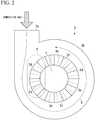
- the turbine 3 is provided with an intake port 3a, a scroll flow path 3b, a plurality of stator vanes 3d, and a plurality of rotor blades 3e.
- the stator vane 3d and the rotor blade 3e are turbine blades in the present disclosure.
- the intake port 3a is an opening communicating with the combustor 2.
- the combustion gas is taken into the intake port 3a from the combustor 2.
- the scroll flow path 3b is in communication with the intake port 3a and rectifies the combustion gas taken in from the intake port 3a into an annular flow S.
- the plurality of stator vanes 3d are first-stage fixed blades annularly arranged on the center side of the scroll flow path 3b and constitute a stator vane portion.
- the plurality of rotor blades 3e are first-stage movable blades disposed on the back side of the drawing with respect to the plurality of stator vanes 3d and constitute a rotor blade portion.
- the plurality of rotor blades 3e are annularly arranged with respect to a rotary shaft J positioned at the center of the scroll flow path 3b.
- the stator vane portion and the rotor blade portion are alternately disposed in multiple stages in the direction in which the rotary shaft J extends (direction perpendicular to the drawing).
- sign H in FIG. 2 indicates a high-temperature region into which the combustion gas that has a temperature higher than the average value in the temperature distribution of the combustion gas flows.
- the stator vanes 3d that are positioned in the high-temperature region H are exposed to the combustion gas that has a higher-than-average temperature as the temperature distribution of the combustion gas flowing into the intake port 3a is not uniform and the temperature of the combustion gas is higher on the left side in FIG. 2 than on the right side in FIG. 2 .
- the cooling air (compressed air) that the compressor 1 outputs toward the turbine 3 is distributed and supplied to each stator vane 3d of the turbine 3 via branch flow paths 3f.
- liquid ammonia is supplied to the branch flow paths 3f that supply the cooling air to the stator vanes 3d that are positioned in the high-temperature region H.
- the branch flow paths 3f that supply the cooling air to the stator vanes 3d that are positioned in the high-temperature region H are liquid ammonia flow paths and the liquid ammonia is supplied to each stator vane 3d after being premixed with the cooling air (compressed air) in the branch flow paths 3f respectively provided in the stage ahead of the stator vanes 3d.
- the cooling air premixed with the liquid ammonia is referred to as premixed cooling air.
- stator vanes 3d are substantially evenly cooled as the cooling air is distributed and supplied to each stator vane 3d, the liquid ammonia functions as a coolant cooling only the stator vanes 3d positioned in the high-temperature region H from the inside.
- Multiple holes film cooling holes are formed in each stator vane 3d so that film cooling is performed on the surface of the stator vane 3d.
- the liquid ammonia and the cooling air supplied to the stator vanes 3d leak out in part to the surface sides from the inner portions of the stator vanes 3d via the film cooling holes. As a result, the stator vanes 3d are cooled from the surfaces as well.
- the respective surfaces of the stator vanes 3d are substantially evenly cooled by the cooling air and the surfaces of the stator vanes 3d that are positioned in the high-temperature region H are further cooled by the liquid ammonia.
- the liquid ammonia on the surfaces of the stator vanes 3d is vaporized by the heat of the combustion gas, become gaseous ammonia, and cools the rotor blades 3e that are positioned in the stage behind the stator vanes 3d from the surfaces of the rotor blades 3e.
- the rotor blades 3e that pass through the high-temperature region H are effectively cooled by the liquid ammonia.
- each stator vane 3d is provided with the film cooling hole (flow path), the liquid ammonia is discharged from the inside of the hole to the outside of the hole, and a gaseous ammonia layer (gas layer) lower in temperature than the combustion gas is formed on the surface of the stator vane 3d.
- the turbine 3 discharges post-power recovery combustion gas toward the denitrification chamber 4.
- the combustion gas discharged from the turbine 3 to the denitrification chamber 4 contains the gaseous ammonia derived from the liquid ammonia injected into the branch flow path 3f.
- the denitrification chamber 4 is filled with a denitrification catalyst.
- the nitrogen oxide (NOx) that is contained in the combustion gas is reduced to nitrogen (N 2 ) through denitrification by the gaseous ammonia being used as a reducing agent.
- the tank 5 is a fuel tank in which a predetermined amount of liquid ammonia is stored and supplies the liquid ammonia to the pump 6.
- the pump 6 pressurizes the liquid ammonia supplied from the tank 5 to a predetermined pressure and supplies the liquid ammonia to the vaporizer 7 and the turbine 3.
- the vaporizer 7 generates gaseous ammonia by vaporizing the liquid ammonia supplied from the pump 6.
- the vaporizer 7 supplies the combustor 2 with the gaseous ammonia as a fuel (fuel ammonia).
- liquid ammonia is supplied from the tank 5 to the vaporizer 7 and the turbine 3 by the pump 6 operating.
- the gaseous ammonia (fuel ammonia) is generated by the liquid ammonia vaporizing in the vaporizer 7, and the liquid ammonia is mixed with the cooling air supplied from the compressor 1 in the turbine 3.
- the gaseous ammonia (fuel ammonia) generated in the vaporizer 7 is supplied to the combustor 2.
- the compressor 1 By the compressor 1 operating, compressed air is supplied to the combustor 2 as air for combustion.
- the gaseous ammonia (fuel ammonia) supplied from the vaporizer 7 is combusted by the air for combustion supplied from the compressor 1 being used as an oxidant, and then combustion gas is generated.
- the combustion gas acts on the turbine 3 as drive gas.
- the turbine 3 generates rotational power driving the compressor 1 and the generator G.
- the combustion gas supplied from the combustor 2 flows into the scroll flow path 3b from the intake port 3a and becomes the annular flow S as a result. Then, the combustion gas passes between the plurality of stator vanes 3d annularly disposed inside the scroll flow path 3b and is sprayed onto the plurality of rotor blades 3e, which are adjacent to the plurality of stator vanes 3d and annularly disposed similarly to the plurality of stator vanes 3d. As a result, rotational power is generated in the rotary shaft J.
- the combustion gas enters the plurality of gaps that are radially formed between the plurality of stator vanes 3d that are annularly disposed and passes between the plurality of stator vanes 3d and the plurality of stator vanes 3d provided in multiple stages.
- the combustion gas generates rotational power in the rotary shaft J.
- the plurality of stator vanes 3d are fixed blades, and thus the plurality of stator vanes 3d are exposed to a temperature environment in accordance with the temperature distribution of the combustion gas at the intake port 3a.
- the high-temperature region H is generated inside the scroll flow path 3b and in the vicinity of the inlet of the scroll flow path 3b as shown in FIG. 2 in a case where the temperature of the combustion gas in the region that corresponds to the inside of the scroll flow path 3b is higher than the temperature of the combustion gas in the other region regarding the combustion gas that has flowed into the intake port 3a from the combustor 2.
- the temperature to which the stator vanes 3d positioned in the high-temperature region H are exposed is higher than the temperature to which the other stator vanes 3d are exposed.
- the plurality of rotor blades 3e, which rotate, are alternately exposed to the combustion gas that is relatively high in temperature and the combustion gas that is relatively low in temperature.
- the high-temperature region H is specified by the temperature distribution of the combustion gas being measured in advance and liquid ammonia is selectively supplied as a result to the branch flow paths 3f supplying cooling air to the stator vanes 3d exposed to the high-temperature region H.
- liquid ammonia By means of the liquid ammonia, the cooling capacity of the stator vanes 3d in the high-temperature region H is improved as compared with the cooling capacity of the other stator vanes 3d.
- the nitrogen oxide (NOx) that is contained in the combustion gas is removed from the combustion gas by the gaseous ammonia that is contained in the premixed cooling air functioning as a reducing agent.
- the gaseous ammonia that contributed to the cooling of the stator vanes 3d exposed to the high-temperature region H functions as a reducing agent in the denitrification chamber 4 and is used for nitrogen oxide (NOx) removal.
- the temperature distribution of the combustion gas that acts on the plurality of stator vanes 3d and rotor blades 3e can be uniformized or temperature unevenness can be limited. As a result, it is possible to limit a decrease in the service life of the turbine 3.
- the liquid ammonia supplied from the pump 6 is mixed with the cooling air output from the compressor 1.
- the specific heat of ammonia is 3.0 kJ/(K ⁇ kg) and the specific heat of air is 1.1 kJ/(K ⁇ kg). Since the specific heat of ammonia significantly exceeds the specific heat of air, the premixed cooling air is unlikely to fall behind the cooling air alone in terms of cooling capacity in the case of reception of the same energy.
- the cooling air supplied from the compressor 1 to the turbine 3 is compressed air, and thus the temperature of the cooling air is higher than an ordinary temperature.
- the temperature of the liquid ammonia is significantly lower than the temperature of the cooling air.
- the temperature of the premixed cooling air is lower than the temperature of the cooling air alone, and thus it is possible to improve the cooling efficiency of the turbine 3 by mixing the liquid ammonia with the cooling air.
- the temperature of the cooling air is approximately 390°C
- the liquid ammonia has a temperature of 100°C or less even after pressurization to, for example, 20 atm. Accordingly, it is possible to reliably improve the cooling efficiency of the turbine 3 by mixing the liquid ammonia with the cooling air.
- the premixed cooling air is obtained by the liquid ammonia output from the pump 6, not the gaseous ammonia output from the vaporizer 7, being mixed with the cooling air.
- the cooling air is cooled by the heat of vaporization at a time when the liquid ammonia is mixed with the cooling air and evaporated. Accordingly, in the gas turbine A, the stator vanes 3d in the high-temperature region H can be more effectively cooled than in a case where gaseous ammonia is mixed with cooling air as the premixed cooling air resulting from the mixing of the liquid ammonia with the cooling air is adopted.
- the premixed cooling air has a risk of backfiring
- the ammonia has an extremely small risk of backfiring as the rate of combustion of the ammonia is lower than the rates of combustion of general hydrocarbon-based fuels such as natural gas.
- the temperature distribution of the combustion gas that acts on a plurality of stator vanes and rotor blades can be uniformized or temperature unevenness can be limited.
Landscapes
- Engineering & Computer Science (AREA)
- Chemical & Material Sciences (AREA)
- Mechanical Engineering (AREA)
- General Engineering & Computer Science (AREA)
- Combustion & Propulsion (AREA)
- Environmental & Geological Engineering (AREA)
- Chemical Kinetics & Catalysis (AREA)
- Analytical Chemistry (AREA)
- Biomedical Technology (AREA)
- General Chemical & Material Sciences (AREA)
- Oil, Petroleum & Natural Gas (AREA)
- Health & Medical Sciences (AREA)
- Life Sciences & Earth Sciences (AREA)
- Sustainable Development (AREA)
- Physics & Mathematics (AREA)
- Fluid Mechanics (AREA)
- Turbine Rotor Nozzle Sealing (AREA)
- Exhaust Gas Treatment By Means Of Catalyst (AREA)
- Structures Of Non-Positive Displacement Pumps (AREA)
Abstract
Description
- The present disclosure relates to a gas turbine.
- Priority is claimed on Japanese Patent Application No.
2017-061213, filed on March 27, 2017 - Patent Document 1 discloses a gas turbine and a combustion apparatus combusting ammonia as a fuel. As for the combustion apparatus and the gas turbine, ammonia (fuel ammonia) is premixed with natural gas, the result of the premixing is supplied to a combustor, and then flue gas driving a turbine is obtained. In addition, a reduction region is formed on the downstream side in the combustor for the purpose of nitrogen oxide (NOx) reduction. In the reduction region, the nitrogen oxide (NOx) that is generated in a combustion region is reduced by means of ammonia for reduction.
- [Patent Document 1] Japanese Unexamined Patent Application, First Publication No.
2016-191507 - The flue gas (main flow) is rectified into an annular flow via a member (deflection member) deflecting the flow of the flue gas, such as a scroll or a transition piece, and is supplied to a stator vane portion where a plurality of stator vanes are annularly disposed and a rotor blade portion where a plurality of rotor blades are annularly disposed. In other words, in the turbine, the flue gas (combustion gas) acts as a drive fluid on the rotor blade portion via the deflection member and the stator vane portion and the main shaft that is coupled to the rotor blade portion is driven to rotate as a result.
- In a case where the inlet temperature distribution of the combustion gas is not uniform at the inlet of the deflection member, the thermal stress in the plurality of stator vanes and rotor blades, which are annularly disposed, becomes non-uniform. In other words, the stress that is applied to the stator vane exposed to combustion gas relatively high in temperature exceeds the stress that is applied to the stator vane exposed to combustion gas relatively low in temperature. In addition, the rotor blade is alternately exposed to the combustion gas relatively high in temperature and the combustion gas relatively low in temperature. Accordingly, the temperature non-uniformity of the combustion gas at the inlet of the deflection member needs to be redressed in that the non-uniformity leads to stator vane portion and rotor blade portion failures, that is, a gas turbine failure.
- The present disclosure has been made in view of the above, and an object of the present disclosure is to provide a gas turbine uniformizing the temperature distribution of the combustion gas that acts on a plurality of stator vanes and rotor blades or limiting temperature unevenness.
- A gas turbine according to a first aspect of the present disclosure denitrifies combustion gas by using a denitrification catalyst and ammonia as a reducing agent. The gas turbine includes: a turbine provided with turbine blades, the turbine blades being exposed to the combustion gas reaching a temperature higher than an average value in a temperature distribution of the combustion gas, and a compressor configured to supply the turbine blades with a cooling air and the ammonia. The gas turbine is configured to lower the temperature of the turbine blades by supplying the turbine blades with the ammonia and the cooling air.
- According to a second aspect of the present disclosure, in the first aspect, the gas turbine is configured such that the ammonia supplied to the turbine blades is supplied to a combustor as a fuel after cooling the turbine blades.
- According to a third aspect of the present disclosure, in the first aspect, the gas turbine is configured such that the ammonia supplied to the turbine blades is injected into a combustion gas flow path after cooling the turbine blades and is discharged from the turbine after mixing with the combustion gas.
- According to a fourth aspect of the present disclosure, in any one of the first to third aspects, the gas turbine is configured such that the ammonia is supplied to the turbine blades in a liquid state.
- According to a fifth aspect of the present disclosure, in any one of the first to fourth aspects, the gas turbine is configured such that the ammonia is mixed in advance with the cooling air and is supplied to the turbine blades.
- According to a sixth aspect of the present disclosure, in any one of the first to fifth aspects, the gas turbine is configured to generate the combustion gas by combusting the ammonia at least as some of a fuel.
- According to a seventh aspect of the present disclosure, in any one of the first to sixth aspects, each of the turbine blades has a flow path of the ammonia in each of the turbine blades.
- According to an eighth aspect of the present disclosure, in any one of the first to seventh aspects, each of the turbine blades has a flow path for discharging the ammonia from an inside toward an outside.
- According to the present disclosure, it is possible to provide a gas turbine uniformizing the temperature distribution of the combustion gas that acts on a plurality of stator vanes and rotor blades or limiting temperature unevenness.
-
-
FIG. 1 is a block diagram showing an overall configuration of a gas turbine according to an embodiment of the present disclosure. -
FIG. 2 is a first schematic diagram showing a detailed configuration of a turbine according to an embodiment of the present disclosure. -
FIG 3 is a second schematic diagram showing the detailed configuration of the turbine according to an embodiment of the present disclosure. -
FIG 4 is a block diagram showing an overall configuration of a gas turbine according to an embodiment of the present disclosure. - Hereinafter, an embodiment of the present disclosure will be described with reference to accompanying drawings.
- A gas turbine A according to the present embodiment is provided with a compressor 1, a
combustor 2, aturbine 3, adenitrification chamber 4, atank 5, apump 6, and avaporizer 7 as shown inFIG. 1 . The gas turbine A is a drive source of a generator G and generates rotational power by combusting ammonia as a fuel. - The compressor 1 is a multistage axial flow compressor generating compressed air by compressing air taken in from outside air to a predetermined pressure. The compressor 1 supplies some of the compressed air to the
combustor 2 as air for combustion and supplies some of the compressed air to theturbine 3 as cooling air. Thecombustor 2 combusts gaseous ammonia supplied from thevaporizer 7 by using the air for combustion supplied from the compressor 1 as an oxidant and outputs combustion gas to theturbine 3. - The
turbine 3 is a multistage axial flow turbine generating rotational power by using the combustion gas as drive gas. As shown, theturbine 3 is axially coupled to the compressor 1 and the generator G. The compressor 1 and the generator G are driven to rotate by the rotational power of theturbine 3. - As shown in
FIG. 2 , theturbine 3 is provided with anintake port 3a, ascroll flow path 3b, a plurality ofstator vanes 3d, and a plurality ofrotor blades 3e. Thestator vane 3d and therotor blade 3e are turbine blades in the present disclosure. Theintake port 3a is an opening communicating with thecombustor 2. The combustion gas is taken into theintake port 3a from thecombustor 2. Thescroll flow path 3b is in communication with theintake port 3a and rectifies the combustion gas taken in from theintake port 3a into an annular flow S. - The plurality of
stator vanes 3d are first-stage fixed blades annularly arranged on the center side of thescroll flow path 3b and constitute a stator vane portion. The plurality ofrotor blades 3e are first-stage movable blades disposed on the back side of the drawing with respect to the plurality ofstator vanes 3d and constitute a rotor blade portion. Similarly to the plurality ofstator vanes 3d, the plurality ofrotor blades 3e are annularly arranged with respect to a rotary shaft J positioned at the center of thescroll flow path 3b. The stator vane portion and the rotor blade portion are alternately disposed in multiple stages in the direction in which the rotary shaft J extends (direction perpendicular to the drawing). - Regarding the plurality of
stator vanes 3d androtor blades 3e, sign H inFIG. 2 indicates a high-temperature region into which the combustion gas that has a temperature higher than the average value in the temperature distribution of the combustion gas flows. In other words, the stator vanes 3d that are positioned in the high-temperature region H are exposed to the combustion gas that has a higher-than-average temperature as the temperature distribution of the combustion gas flowing into theintake port 3a is not uniform and the temperature of the combustion gas is higher on the left side inFIG. 2 than on the right side inFIG. 2 . - As shown in
FIG. 3 , the cooling air (compressed air) that the compressor 1 outputs toward theturbine 3 is distributed and supplied to eachstator vane 3d of theturbine 3 viabranch flow paths 3f. As shown, liquid ammonia is supplied to thebranch flow paths 3f that supply the cooling air to thestator vanes 3d that are positioned in the high-temperature region H. In other words, thebranch flow paths 3f that supply the cooling air to thestator vanes 3d that are positioned in the high-temperature region H are liquid ammonia flow paths and the liquid ammonia is supplied to eachstator vane 3d after being premixed with the cooling air (compressed air) in thebranch flow paths 3f respectively provided in the stage ahead of thestator vanes 3d. Here, the cooling air premixed with the liquid ammonia is referred to as premixed cooling air. - Although the
stator vanes 3d are substantially evenly cooled as the cooling air is distributed and supplied to eachstator vane 3d, the liquid ammonia functions as a coolant cooling only thestator vanes 3d positioned in the high-temperature region H from the inside. Multiple holes (film cooling holes) are formed in eachstator vane 3d so that film cooling is performed on the surface of thestator vane 3d. The liquid ammonia and the cooling air supplied to thestator vanes 3d leak out in part to the surface sides from the inner portions of thestator vanes 3d via the film cooling holes. As a result, thestator vanes 3d are cooled from the surfaces as well. - As a result, the respective surfaces of the
stator vanes 3d are substantially evenly cooled by the cooling air and the surfaces of thestator vanes 3d that are positioned in the high-temperature region H are further cooled by the liquid ammonia. Further, the liquid ammonia on the surfaces of thestator vanes 3d is vaporized by the heat of the combustion gas, become gaseous ammonia, and cools therotor blades 3e that are positioned in the stage behind thestator vanes 3d from the surfaces of therotor blades 3e. In other words, therotor blades 3e that pass through the high-temperature region H are effectively cooled by the liquid ammonia. In other words, eachstator vane 3d is provided with the film cooling hole (flow path), the liquid ammonia is discharged from the inside of the hole to the outside of the hole, and a gaseous ammonia layer (gas layer) lower in temperature than the combustion gas is formed on the surface of thestator vane 3d. - The
turbine 3 discharges post-power recovery combustion gas toward thedenitrification chamber 4. The combustion gas discharged from theturbine 3 to thedenitrification chamber 4 contains the gaseous ammonia derived from the liquid ammonia injected into thebranch flow path 3f. Thedenitrification chamber 4 is filled with a denitrification catalyst. In thedenitrification chamber 4, the nitrogen oxide (NOx) that is contained in the combustion gas is reduced to nitrogen (N2) through denitrification by the gaseous ammonia being used as a reducing agent. - The
tank 5 is a fuel tank in which a predetermined amount of liquid ammonia is stored and supplies the liquid ammonia to thepump 6. Thepump 6 pressurizes the liquid ammonia supplied from thetank 5 to a predetermined pressure and supplies the liquid ammonia to thevaporizer 7 and theturbine 3. Thevaporizer 7 generates gaseous ammonia by vaporizing the liquid ammonia supplied from thepump 6. Thevaporizer 7 supplies thecombustor 2 with the gaseous ammonia as a fuel (fuel ammonia). - Next, the operation (steady-state operation) of the gas turbine A according to the present embodiment will be described in detail.
- In the gas turbine A, liquid ammonia is supplied from the
tank 5 to thevaporizer 7 and theturbine 3 by thepump 6 operating. The gaseous ammonia (fuel ammonia) is generated by the liquid ammonia vaporizing in thevaporizer 7, and the liquid ammonia is mixed with the cooling air supplied from the compressor 1 in theturbine 3. The gaseous ammonia (fuel ammonia) generated in thevaporizer 7 is supplied to thecombustor 2. - By the compressor 1 operating, compressed air is supplied to the
combustor 2 as air for combustion. In thecombustor 2, the gaseous ammonia (fuel ammonia) supplied from thevaporizer 7 is combusted by the air for combustion supplied from the compressor 1 being used as an oxidant, and then combustion gas is generated. The combustion gas acts on theturbine 3 as drive gas. As a result, theturbine 3 generates rotational power driving the compressor 1 and the generator G. - The operation of the
turbine 3 will be described in further detail below. In theturbine 3, the combustion gas supplied from thecombustor 2 flows into thescroll flow path 3b from theintake port 3a and becomes the annular flow S as a result. Then, the combustion gas passes between the plurality ofstator vanes 3d annularly disposed inside thescroll flow path 3b and is sprayed onto the plurality ofrotor blades 3e, which are adjacent to the plurality ofstator vanes 3d and annularly disposed similarly to the plurality ofstator vanes 3d. As a result, rotational power is generated in the rotary shaft J. - In other words, the combustion gas enters the plurality of gaps that are radially formed between the plurality of
stator vanes 3d that are annularly disposed and passes between the plurality ofstator vanes 3d and the plurality ofstator vanes 3d provided in multiple stages. In the meantime, the combustion gas generates rotational power in the rotary shaft J. The plurality ofstator vanes 3d are fixed blades, and thus the plurality ofstator vanes 3d are exposed to a temperature environment in accordance with the temperature distribution of the combustion gas at theintake port 3a. - For example, the high-temperature region H is generated inside the
scroll flow path 3b and in the vicinity of the inlet of thescroll flow path 3b as shown inFIG. 2 in a case where the temperature of the combustion gas in the region that corresponds to the inside of thescroll flow path 3b is higher than the temperature of the combustion gas in the other region regarding the combustion gas that has flowed into theintake port 3a from thecombustor 2. The temperature to which thestator vanes 3d positioned in the high-temperature region H are exposed is higher than the temperature to which theother stator vanes 3d are exposed. The plurality ofrotor blades 3e, which rotate, are alternately exposed to the combustion gas that is relatively high in temperature and the combustion gas that is relatively low in temperature. - It is possible to specify the position of the high-temperature region H by measuring the temperature distribution of the combustion gas at the
intake port 3a in advance. In theturbine 3 in the present embodiment, the high-temperature region H is specified by the temperature distribution of the combustion gas being measured in advance and liquid ammonia is selectively supplied as a result to thebranch flow paths 3f supplying cooling air to thestator vanes 3d exposed to the high-temperature region H. By means of the liquid ammonia, the cooling capacity of thestator vanes 3d in the high-temperature region H is improved as compared with the cooling capacity of theother stator vanes 3d. - In the
denitrification chamber 4 provided in the stage behind theturbine 3, the nitrogen oxide (NOx) that is contained in the combustion gas is removed from the combustion gas by the gaseous ammonia that is contained in the premixed cooling air functioning as a reducing agent. In other words, the gaseous ammonia that contributed to the cooling of thestator vanes 3d exposed to the high-temperature region H functions as a reducing agent in thedenitrification chamber 4 and is used for nitrogen oxide (NOx) removal. - In the gas turbine A according to the present embodiment, the temperature distribution of the combustion gas that acts on the plurality of
stator vanes 3d androtor blades 3e can be uniformized or temperature unevenness can be limited. As a result, it is possible to limit a decrease in the service life of theturbine 3. - In the premixed cooling air, the liquid ammonia supplied from the
pump 6 is mixed with the cooling air output from the compressor 1. As is known, the specific heat of ammonia is 3.0 kJ/(K·kg) and the specific heat of air is 1.1 kJ/(K·kg). Since the specific heat of ammonia significantly exceeds the specific heat of air, the premixed cooling air is unlikely to fall behind the cooling air alone in terms of cooling capacity in the case of reception of the same energy. - The cooling air supplied from the compressor 1 to the
turbine 3 is compressed air, and thus the temperature of the cooling air is higher than an ordinary temperature. In contrast, the temperature of the liquid ammonia is significantly lower than the temperature of the cooling air. In other words, the temperature of the premixed cooling air is lower than the temperature of the cooling air alone, and thus it is possible to improve the cooling efficiency of theturbine 3 by mixing the liquid ammonia with the cooling air. - At an atmospheric temperature of 15°C and a cooling air pressure of 12 atm, for example, the temperature of the cooling air is approximately 390°C, still, the liquid ammonia has a temperature of 100°C or less even after pressurization to, for example, 20 atm. Accordingly, it is possible to reliably improve the cooling efficiency of the
turbine 3 by mixing the liquid ammonia with the cooling air. - In the gas turbine A according to the present embodiment, the premixed cooling air is obtained by the liquid ammonia output from the
pump 6, not the gaseous ammonia output from thevaporizer 7, being mixed with the cooling air. In other words, in the gas turbine A, the cooling air is cooled by the heat of vaporization at a time when the liquid ammonia is mixed with the cooling air and evaporated. Accordingly, in the gas turbine A, thestator vanes 3d in the high-temperature region H can be more effectively cooled than in a case where gaseous ammonia is mixed with cooling air as the premixed cooling air resulting from the mixing of the liquid ammonia with the cooling air is adopted. - Although the premixed cooling air has a risk of backfiring, the ammonia has an extremely small risk of backfiring as the rate of combustion of the ammonia is lower than the rates of combustion of general hydrocarbon-based fuels such as natural gas.
- The present disclosure is not limited to the embodiment described above. For example, the following modification examples are conceivable.
- (1) In the embodiment described above, the premixed cooling air is injected into the
stator vanes 3d provided in the region where the temperature of the combustion gas is relatively high (high-temperature region H). The present disclosure is not limited thereto. If necessary, the premixed cooling air may be individually injected into anystator vane 3d. - (2) In the embodiment described above, the premixed cooling air is generated by the liquid ammonia being mixed with the cooling air. The present disclosure is not limited thereto. If necessary, the premixed cooling air may be generated by gaseous ammonia being mixed with the cooling air.
- (3) The gas turbine A using gaseous ammonia as a fuel has been described in the embodiment described above. The present disclosure is not limited thereto. A hydrocarbon other than the gaseous ammonia may be used as a fuel or a hydrocarbon and ammonia may be used as fuels.
- (4) Although the liquid ammonia is injected into the
branch flow paths 3f in the embodiment described above, ammonia is corrosive to metals and, as such, it is preferable to use a metal material corrosion-resistant to ammonia for the combustion gas flow paths behind thebranch flow paths 3f.
Although it has been described that the risk of backfiring is extremely small despite the use of the premixed cooling air, a sensor (thermometer) for backfiring detection may be provided in thescroll flow path 3b if necessary. - (5) In the embodiment described above, combustion gas is discharged toward the
denitrification chamber 4 after power recovery in theturbine 3. Alternatively, thecombustor 2 may be supplied with some of the combustion gas power-recovered in theturbine 3 as shown inFIG. 4 . In this manner, the gaseous ammonia that is contained in the combustion gas can be reused as the fuel ammonia. - With the gas turbine according to the present disclosure, the temperature distribution of the combustion gas that acts on a plurality of stator vanes and rotor blades can be uniformized or temperature unevenness can be limited.
-
- H
- High-temperature region
- S
- Annular flow
- 1
- Compressor
- 2
- Combustor
- 3
- Turbine
- 3a
- Intake port
- 3b
- Scroll flow path
- 3d
- Stator vane (turbine blade)
- 3e
- Rotor blade (turbine blade)
- 3f
- Branch flow path
- 4
- Denitrification chamber
- 5
- Tank
- 6
- Pump
- 7
- Vaporizer
Claims (8)
- A gas turbine denitrifying combustion gas by using a denitrification catalyst and ammonia as a reducing agent, the gas turbine comprising:a turbine provided with turbine blades, the turbine blades being exposed to the combustion gas reaching a temperature higher than an average value in a temperature distribution of the combustion gas, anda compressor configured to supply the turbine blades with a cooling air and the ammonia, whereinthe gas turbine is configured to lower the temperature of the turbine blades by supplying the turbine blades with the ammonia and the cooling air.
- The gas turbine according to claim 1, wherein the gas turbine is configured such that the ammonia supplied to the turbine blades is supplied to a combustor as a fuel after cooling the turbine blades.
- The gas turbine according to claim 1, wherein the gas turbine is configured such that the ammonia supplied to the turbine blades is injected into a combustion gas flow path after cooling the turbine blades and is discharged from the turbine after mixing with the combustion gas.
- The gas turbine according to any one of claims 1 to 3, wherein the gas turbine is configured such that the ammonia is supplied to the turbine blades in a liquid state.
- The gas turbine according to any one of claims 1 to 4, wherein the gas turbine is configured such that the ammonia is mixed in advance with the cooling air and is supplied to the turbine blades.
- The gas turbine according to any one of claims 1 to 5, wherein the gas turbine is configured to generate the combustion gas by combusting the ammonia at least as some of a fuel.
- The gas turbine according to any one of claims 1 to 6, wherein each of the turbine blades has a flow path of the ammonia in each of the turbine blades.
- The gas turbine according to any one of claims 1 to 7, wherein each of the turbine blades has a flow path for discharging the ammonia from an inside toward an outside.
Applications Claiming Priority (2)
| Application Number | Priority Date | Filing Date | Title |
|---|---|---|---|
| JP2017061213A JP6880902B2 (en) | 2017-03-27 | 2017-03-27 | gas turbine |
| PCT/JP2018/011058 WO2018180781A1 (en) | 2017-03-27 | 2018-03-20 | Gas turbine |
Publications (3)
| Publication Number | Publication Date |
|---|---|
| EP3604770A1 true EP3604770A1 (en) | 2020-02-05 |
| EP3604770A4 EP3604770A4 (en) | 2020-12-16 |
| EP3604770B1 EP3604770B1 (en) | 2024-08-28 |
Family
ID=63677566
Family Applications (1)
| Application Number | Title | Priority Date | Filing Date |
|---|---|---|---|
| EP18776659.7A Active EP3604770B1 (en) | 2017-03-27 | 2018-03-20 | Gas turbine |
Country Status (7)
| Country | Link |
|---|---|
| US (1) | US11141695B2 (en) |
| EP (1) | EP3604770B1 (en) |
| JP (1) | JP6880902B2 (en) |
| KR (1) | KR20190116522A (en) |
| CN (1) | CN110418880B (en) |
| AU (1) | AU2018245143B2 (en) |
| WO (1) | WO2018180781A1 (en) |
Cited By (3)
| Publication number | Priority date | Publication date | Assignee | Title |
|---|---|---|---|---|
| EP3971400A1 (en) * | 2020-06-02 | 2022-03-23 | General Electric Company | System and method for reducing the visibility of exhaust emissions in a gas turbine system |
| GB2616062A (en) * | 2022-02-28 | 2023-08-30 | Airbus Operations Ltd | Aircraft engine for nitrogen oxide reduction |
| US11959417B2 (en) | 2020-05-18 | 2024-04-16 | Tohoku University | Ammonia-fueled gas turbine |
Families Citing this family (7)
| Publication number | Priority date | Publication date | Assignee | Title |
|---|---|---|---|---|
| JP6772925B2 (en) * | 2017-03-27 | 2020-10-21 | 株式会社Ihi | Combustion equipment and gas turbine engine system |
| JP2020172904A (en) * | 2019-04-11 | 2020-10-22 | 株式会社豊田自動織機 | Remodeling system and engine system |
| US20220162989A1 (en) * | 2020-11-20 | 2022-05-26 | Raytheon Technologies Corporation | Engine using cracked ammonia fuel |
| JP7548442B2 (en) * | 2021-07-14 | 2024-09-10 | 株式会社Ihi | Gas Turbine Systems |
| JP7686522B2 (en) * | 2021-09-27 | 2025-06-02 | 株式会社Ihi | Turbine |
| JP2023080576A (en) * | 2021-11-30 | 2023-06-09 | 東京電力ホールディングス株式会社 | Combustion device and combustion method |
| KR102713233B1 (en) | 2023-06-16 | 2024-10-07 | 조선대학교 산학협력단 | Gas turbine system |
Family Cites Families (13)
| Publication number | Priority date | Publication date | Assignee | Title |
|---|---|---|---|---|
| JPS592768B2 (en) * | 1976-02-10 | 1984-01-20 | 株式会社日立製作所 | Gas turbine exhaust gas treatment method and device |
| JPH0255835A (en) * | 1988-08-18 | 1990-02-26 | Kawasaki Steel Corp | Gas turbine device additionally providing exhaust gas boiler with built-in exhaust gas denitrification device |
| US5122033A (en) * | 1990-11-16 | 1992-06-16 | Paul Marius A | Turbine blade unit |
| JP2001107703A (en) * | 1999-10-07 | 2001-04-17 | Toshiba Corp | gas turbine |
| US8220268B2 (en) * | 2007-11-28 | 2012-07-17 | Caterpillar Inc. | Turbine engine having fuel-cooled air intercooling |
| US8943826B2 (en) * | 2009-01-14 | 2015-02-03 | Toyota Jidosha Kabushiki Kaisha | Engine |
| CN102272428B (en) * | 2009-01-14 | 2014-06-11 | 丰田自动车株式会社 | Engine |
| JP5863755B2 (en) * | 2013-11-27 | 2016-02-17 | 三菱日立パワーシステムズ株式会社 | Gas turbine and its operating method at rated time |
| JP2015190466A (en) * | 2014-03-31 | 2015-11-02 | 株式会社Ihi | Combustion device, gas turbine and power generation device |
| JP6520309B2 (en) | 2015-03-31 | 2019-05-29 | 株式会社Ihi | Combustion device, gas turbine and power generation device |
| US9856768B2 (en) * | 2015-06-29 | 2018-01-02 | General Electric Company | Power generation system exhaust cooling |
| JP6495794B2 (en) | 2015-09-24 | 2019-04-03 | 株式会社東海理化電機製作所 | Customized device |
| JP6772925B2 (en) * | 2017-03-27 | 2020-10-21 | 株式会社Ihi | Combustion equipment and gas turbine engine system |
-
2017
- 2017-03-27 JP JP2017061213A patent/JP6880902B2/en active Active
-
2018
- 2018-03-20 EP EP18776659.7A patent/EP3604770B1/en active Active
- 2018-03-20 AU AU2018245143A patent/AU2018245143B2/en active Active
- 2018-03-20 CN CN201880016936.XA patent/CN110418880B/en active Active
- 2018-03-20 WO PCT/JP2018/011058 patent/WO2018180781A1/en not_active Ceased
- 2018-03-20 KR KR1020197028356A patent/KR20190116522A/en not_active Ceased
-
2019
- 2019-09-18 US US16/574,777 patent/US11141695B2/en active Active
Cited By (6)
| Publication number | Priority date | Publication date | Assignee | Title |
|---|---|---|---|---|
| US11959417B2 (en) | 2020-05-18 | 2024-04-16 | Tohoku University | Ammonia-fueled gas turbine |
| EP3971400A1 (en) * | 2020-06-02 | 2022-03-23 | General Electric Company | System and method for reducing the visibility of exhaust emissions in a gas turbine system |
| US11598225B2 (en) | 2020-06-02 | 2023-03-07 | General Electric Company | System and method for reducing the visibility of exhaust emissions in a gas turbine system |
| GB2616062A (en) * | 2022-02-28 | 2023-08-30 | Airbus Operations Ltd | Aircraft engine for nitrogen oxide reduction |
| GB2616062B (en) * | 2022-02-28 | 2024-07-17 | Airbus Operations Ltd | Aircraft engine for nitrogen oxide reduction |
| US12264821B2 (en) | 2022-02-28 | 2025-04-01 | Airbus Operations Limited | Aircraft engine for nitrogen oxide reduction |
Also Published As
| Publication number | Publication date |
|---|---|
| US20200023315A1 (en) | 2020-01-23 |
| KR20190116522A (en) | 2019-10-14 |
| CN110418880B (en) | 2022-03-04 |
| AU2018245143A1 (en) | 2019-10-03 |
| CN110418880A (en) | 2019-11-05 |
| EP3604770B1 (en) | 2024-08-28 |
| AU2018245143B2 (en) | 2020-11-12 |
| WO2018180781A1 (en) | 2018-10-04 |
| JP6880902B2 (en) | 2021-06-02 |
| EP3604770A4 (en) | 2020-12-16 |
| US11141695B2 (en) | 2021-10-12 |
| JP2018162759A (en) | 2018-10-18 |
Similar Documents
| Publication | Publication Date | Title |
|---|---|---|
| US11141695B2 (en) | Gas turbine | |
| US7334396B2 (en) | Method and apparatus for a rocket engine power cycle | |
| US9856768B2 (en) | Power generation system exhaust cooling | |
| CN103388837B (en) | For the system by working fluid supply to burner | |
| US20030145598A1 (en) | Method of operation of gas turbine having multiple burners | |
| EP3604765B1 (en) | Combustion device and gas turbine | |
| EP2653659B1 (en) | Cooling assembly for a gas turbine system | |
| US6755359B2 (en) | Fluid mixing injector and method | |
| US10280760B2 (en) | Turbine engine assembly and method of assembling the same | |
| US8297059B2 (en) | Nozzle for a turbomachine | |
| EP3287602B1 (en) | Gas turbine | |
| US20160356496A1 (en) | D5/d5a df-42 integrated exit cone and splash plate | |
| JP2013156005A (en) | Fuel nozzle for gas turbine engine and method of operating the same | |
| US7997060B2 (en) | Rocket engine power cycle | |
| US20090100839A1 (en) | Combustion chamber wall with optimized dilution and cooling, and combustion chamber and turbomachine both provided therewith | |
| US20120144838A1 (en) | Combined cycle power augmentation by efficient utilization of atomizing air energy | |
| US20140090387A1 (en) | Fuel heating system for a power plant and method of heating fuel | |
| EP2589778A2 (en) | System for operating a power plant | |
| US11404711B2 (en) | Fuel cell system | |
| US20170107902A1 (en) | Systems and Methods for Wheel Space Temperature Management | |
| US9527736B2 (en) | System and method for generating nitrogen from a gas turbine | |
| JP2017002901A (en) | System and method for passively providing one or more flows of cooling fluid to a hot cavity within a cooling circuit of a gas turbine engine |
Legal Events
| Date | Code | Title | Description |
|---|---|---|---|
| STAA | Information on the status of an ep patent application or granted ep patent |
Free format text: STATUS: THE INTERNATIONAL PUBLICATION HAS BEEN MADE |
|
| PUAI | Public reference made under article 153(3) epc to a published international application that has entered the european phase |
Free format text: ORIGINAL CODE: 0009012 |
|
| STAA | Information on the status of an ep patent application or granted ep patent |
Free format text: STATUS: REQUEST FOR EXAMINATION WAS MADE |
|
| 17P | Request for examination filed |
Effective date: 20190918 |
|
| AK | Designated contracting states |
Kind code of ref document: A1 Designated state(s): AL AT BE BG CH CY CZ DE DK EE ES FI FR GB GR HR HU IE IS IT LI LT LU LV MC MK MT NL NO PL PT RO RS SE SI SK SM TR |
|
| AX | Request for extension of the european patent |
Extension state: BA ME |
|
| DAV | Request for validation of the european patent (deleted) | ||
| DAX | Request for extension of the european patent (deleted) | ||
| A4 | Supplementary search report drawn up and despatched |
Effective date: 20201113 |
|
| RIC1 | Information provided on ipc code assigned before grant |
Ipc: F01D 5/18 20060101ALI20201109BHEP Ipc: F02C 3/24 20060101ALI20201109BHEP Ipc: F01D 25/12 20060101ALI20201109BHEP Ipc: B01D 53/94 20060101ALI20201109BHEP Ipc: F02C 3/34 20060101ALI20201109BHEP Ipc: F01D 9/02 20060101ALI20201109BHEP Ipc: F02C 7/16 20060101AFI20201109BHEP Ipc: F01D 9/04 20060101ALI20201109BHEP Ipc: F02C 3/22 20060101ALI20201109BHEP Ipc: F02C 7/22 20060101ALI20201109BHEP Ipc: F02C 3/30 20060101ALI20201109BHEP |
|
| STAA | Information on the status of an ep patent application or granted ep patent |
Free format text: STATUS: EXAMINATION IS IN PROGRESS |
|
| 17Q | First examination report despatched |
Effective date: 20220704 |
|
| GRAP | Despatch of communication of intention to grant a patent |
Free format text: ORIGINAL CODE: EPIDOSNIGR1 |
|
| STAA | Information on the status of an ep patent application or granted ep patent |
Free format text: STATUS: GRANT OF PATENT IS INTENDED |
|
| INTG | Intention to grant announced |
Effective date: 20240325 |
|
| GRAS | Grant fee paid |
Free format text: ORIGINAL CODE: EPIDOSNIGR3 |
|
| GRAA | (expected) grant |
Free format text: ORIGINAL CODE: 0009210 |
|
| STAA | Information on the status of an ep patent application or granted ep patent |
Free format text: STATUS: THE PATENT HAS BEEN GRANTED |
|
| AK | Designated contracting states |
Kind code of ref document: B1 Designated state(s): AL AT BE BG CH CY CZ DE DK EE ES FI FR GB GR HR HU IE IS IT LI LT LU LV MC MK MT NL NO PL PT RO RS SE SI SK SM TR |
|
| REG | Reference to a national code |
Ref country code: GB Ref legal event code: FG4D |
|
| REG | Reference to a national code |
Ref country code: CH Ref legal event code: EP |
|
| REG | Reference to a national code |
Ref country code: DE Ref legal event code: R096 Ref document number: 602018073656 Country of ref document: DE |
|
| REG | Reference to a national code |
Ref country code: IE Ref legal event code: FG4D |
|
| REG | Reference to a national code |
Ref country code: SE Ref legal event code: TRGR |
|
| REG | Reference to a national code |
Ref country code: LT Ref legal event code: MG9D |
|
| PG25 | Lapsed in a contracting state [announced via postgrant information from national office to epo] |
Ref country code: NO Free format text: LAPSE BECAUSE OF FAILURE TO SUBMIT A TRANSLATION OF THE DESCRIPTION OR TO PAY THE FEE WITHIN THE PRESCRIBED TIME-LIMIT Effective date: 20241128 |
|
| REG | Reference to a national code |
Ref country code: AT Ref legal event code: MK05 Ref document number: 1718161 Country of ref document: AT Kind code of ref document: T Effective date: 20240828 |
|
| PG25 | Lapsed in a contracting state [announced via postgrant information from national office to epo] |
Ref country code: NL Free format text: LAPSE BECAUSE OF FAILURE TO SUBMIT A TRANSLATION OF THE DESCRIPTION OR TO PAY THE FEE WITHIN THE PRESCRIBED TIME-LIMIT Effective date: 20240828 Ref country code: GR Free format text: LAPSE BECAUSE OF FAILURE TO SUBMIT A TRANSLATION OF THE DESCRIPTION OR TO PAY THE FEE WITHIN THE PRESCRIBED TIME-LIMIT Effective date: 20241129 Ref country code: PT Free format text: LAPSE BECAUSE OF FAILURE TO SUBMIT A TRANSLATION OF THE DESCRIPTION OR TO PAY THE FEE WITHIN THE PRESCRIBED TIME-LIMIT Effective date: 20241230 Ref country code: PL Free format text: LAPSE BECAUSE OF FAILURE TO SUBMIT A TRANSLATION OF THE DESCRIPTION OR TO PAY THE FEE WITHIN THE PRESCRIBED TIME-LIMIT Effective date: 20240828 Ref country code: FI Free format text: LAPSE BECAUSE OF FAILURE TO SUBMIT A TRANSLATION OF THE DESCRIPTION OR TO PAY THE FEE WITHIN THE PRESCRIBED TIME-LIMIT Effective date: 20240828 |
|
| PG25 | Lapsed in a contracting state [announced via postgrant information from national office to epo] |
Ref country code: BG Free format text: LAPSE BECAUSE OF FAILURE TO SUBMIT A TRANSLATION OF THE DESCRIPTION OR TO PAY THE FEE WITHIN THE PRESCRIBED TIME-LIMIT Effective date: 20240828 |
|
| PG25 | Lapsed in a contracting state [announced via postgrant information from national office to epo] |
Ref country code: LV Free format text: LAPSE BECAUSE OF FAILURE TO SUBMIT A TRANSLATION OF THE DESCRIPTION OR TO PAY THE FEE WITHIN THE PRESCRIBED TIME-LIMIT Effective date: 20240828 |
|
| REG | Reference to a national code |
Ref country code: NL Ref legal event code: MP Effective date: 20240828 |
|
| PG25 | Lapsed in a contracting state [announced via postgrant information from national office to epo] |
Ref country code: AT Free format text: LAPSE BECAUSE OF FAILURE TO SUBMIT A TRANSLATION OF THE DESCRIPTION OR TO PAY THE FEE WITHIN THE PRESCRIBED TIME-LIMIT Effective date: 20240828 Ref country code: IS Free format text: LAPSE BECAUSE OF FAILURE TO SUBMIT A TRANSLATION OF THE DESCRIPTION OR TO PAY THE FEE WITHIN THE PRESCRIBED TIME-LIMIT Effective date: 20241228 |
|
| PG25 | Lapsed in a contracting state [announced via postgrant information from national office to epo] |
Ref country code: HR Free format text: LAPSE BECAUSE OF FAILURE TO SUBMIT A TRANSLATION OF THE DESCRIPTION OR TO PAY THE FEE WITHIN THE PRESCRIBED TIME-LIMIT Effective date: 20240828 |
|
| PG25 | Lapsed in a contracting state [announced via postgrant information from national office to epo] |
Ref country code: ES Free format text: LAPSE BECAUSE OF FAILURE TO SUBMIT A TRANSLATION OF THE DESCRIPTION OR TO PAY THE FEE WITHIN THE PRESCRIBED TIME-LIMIT Effective date: 20240828 Ref country code: RS Free format text: LAPSE BECAUSE OF FAILURE TO SUBMIT A TRANSLATION OF THE DESCRIPTION OR TO PAY THE FEE WITHIN THE PRESCRIBED TIME-LIMIT Effective date: 20241128 |
|
| PG25 | Lapsed in a contracting state [announced via postgrant information from national office to epo] |
Ref country code: RS Free format text: LAPSE BECAUSE OF FAILURE TO SUBMIT A TRANSLATION OF THE DESCRIPTION OR TO PAY THE FEE WITHIN THE PRESCRIBED TIME-LIMIT Effective date: 20241128 Ref country code: PT Free format text: LAPSE BECAUSE OF FAILURE TO SUBMIT A TRANSLATION OF THE DESCRIPTION OR TO PAY THE FEE WITHIN THE PRESCRIBED TIME-LIMIT Effective date: 20241230 Ref country code: PL Free format text: LAPSE BECAUSE OF FAILURE TO SUBMIT A TRANSLATION OF THE DESCRIPTION OR TO PAY THE FEE WITHIN THE PRESCRIBED TIME-LIMIT Effective date: 20240828 Ref country code: NO Free format text: LAPSE BECAUSE OF FAILURE TO SUBMIT A TRANSLATION OF THE DESCRIPTION OR TO PAY THE FEE WITHIN THE PRESCRIBED TIME-LIMIT Effective date: 20241128 Ref country code: NL Free format text: LAPSE BECAUSE OF FAILURE TO SUBMIT A TRANSLATION OF THE DESCRIPTION OR TO PAY THE FEE WITHIN THE PRESCRIBED TIME-LIMIT Effective date: 20240828 Ref country code: LV Free format text: LAPSE BECAUSE OF FAILURE TO SUBMIT A TRANSLATION OF THE DESCRIPTION OR TO PAY THE FEE WITHIN THE PRESCRIBED TIME-LIMIT Effective date: 20240828 Ref country code: IS Free format text: LAPSE BECAUSE OF FAILURE TO SUBMIT A TRANSLATION OF THE DESCRIPTION OR TO PAY THE FEE WITHIN THE PRESCRIBED TIME-LIMIT Effective date: 20241228 Ref country code: HR Free format text: LAPSE BECAUSE OF FAILURE TO SUBMIT A TRANSLATION OF THE DESCRIPTION OR TO PAY THE FEE WITHIN THE PRESCRIBED TIME-LIMIT Effective date: 20240828 Ref country code: GR Free format text: LAPSE BECAUSE OF FAILURE TO SUBMIT A TRANSLATION OF THE DESCRIPTION OR TO PAY THE FEE WITHIN THE PRESCRIBED TIME-LIMIT Effective date: 20241129 Ref country code: FI Free format text: LAPSE BECAUSE OF FAILURE TO SUBMIT A TRANSLATION OF THE DESCRIPTION OR TO PAY THE FEE WITHIN THE PRESCRIBED TIME-LIMIT Effective date: 20240828 Ref country code: ES Free format text: LAPSE BECAUSE OF FAILURE TO SUBMIT A TRANSLATION OF THE DESCRIPTION OR TO PAY THE FEE WITHIN THE PRESCRIBED TIME-LIMIT Effective date: 20240828 Ref country code: BG Free format text: LAPSE BECAUSE OF FAILURE TO SUBMIT A TRANSLATION OF THE DESCRIPTION OR TO PAY THE FEE WITHIN THE PRESCRIBED TIME-LIMIT Effective date: 20240828 Ref country code: AT Free format text: LAPSE BECAUSE OF FAILURE TO SUBMIT A TRANSLATION OF THE DESCRIPTION OR TO PAY THE FEE WITHIN THE PRESCRIBED TIME-LIMIT Effective date: 20240828 |
|
| PGFP | Annual fee paid to national office [announced via postgrant information from national office to epo] |
Ref country code: SE Payment date: 20250311 Year of fee payment: 8 |
|
| PGFP | Annual fee paid to national office [announced via postgrant information from national office to epo] |
Ref country code: DE Payment date: 20250327 Year of fee payment: 8 |
|
| PG25 | Lapsed in a contracting state [announced via postgrant information from national office to epo] |
Ref country code: DK Free format text: LAPSE BECAUSE OF FAILURE TO SUBMIT A TRANSLATION OF THE DESCRIPTION OR TO PAY THE FEE WITHIN THE PRESCRIBED TIME-LIMIT Effective date: 20240828 Ref country code: SM Free format text: LAPSE BECAUSE OF FAILURE TO SUBMIT A TRANSLATION OF THE DESCRIPTION OR TO PAY THE FEE WITHIN THE PRESCRIBED TIME-LIMIT Effective date: 20240828 Ref country code: RO Free format text: LAPSE BECAUSE OF FAILURE TO SUBMIT A TRANSLATION OF THE DESCRIPTION OR TO PAY THE FEE WITHIN THE PRESCRIBED TIME-LIMIT Effective date: 20240828 |
|
| PG25 | Lapsed in a contracting state [announced via postgrant information from national office to epo] |
Ref country code: EE Free format text: LAPSE BECAUSE OF FAILURE TO SUBMIT A TRANSLATION OF THE DESCRIPTION OR TO PAY THE FEE WITHIN THE PRESCRIBED TIME-LIMIT Effective date: 20240828 |
|
| PG25 | Lapsed in a contracting state [announced via postgrant information from national office to epo] |
Ref country code: CZ Free format text: LAPSE BECAUSE OF FAILURE TO SUBMIT A TRANSLATION OF THE DESCRIPTION OR TO PAY THE FEE WITHIN THE PRESCRIBED TIME-LIMIT Effective date: 20240828 |
|
| PG25 | Lapsed in a contracting state [announced via postgrant information from national office to epo] |
Ref country code: IT Free format text: LAPSE BECAUSE OF FAILURE TO SUBMIT A TRANSLATION OF THE DESCRIPTION OR TO PAY THE FEE WITHIN THE PRESCRIBED TIME-LIMIT Effective date: 20240828 Ref country code: SK Free format text: LAPSE BECAUSE OF FAILURE TO SUBMIT A TRANSLATION OF THE DESCRIPTION OR TO PAY THE FEE WITHIN THE PRESCRIBED TIME-LIMIT Effective date: 20240828 |
|
| PGFP | Annual fee paid to national office [announced via postgrant information from national office to epo] |
Ref country code: GB Payment date: 20250324 Year of fee payment: 8 |
|
| REG | Reference to a national code |
Ref country code: DE Ref legal event code: R097 Ref document number: 602018073656 Country of ref document: DE |
|
| PLBE | No opposition filed within time limit |
Free format text: ORIGINAL CODE: 0009261 |
|
| STAA | Information on the status of an ep patent application or granted ep patent |
Free format text: STATUS: NO OPPOSITION FILED WITHIN TIME LIMIT |
|
| 26N | No opposition filed |
Effective date: 20250530 |
|
| PG25 | Lapsed in a contracting state [announced via postgrant information from national office to epo] |
Ref country code: MC Free format text: LAPSE BECAUSE OF FAILURE TO SUBMIT A TRANSLATION OF THE DESCRIPTION OR TO PAY THE FEE WITHIN THE PRESCRIBED TIME-LIMIT Effective date: 20240828 |
|
| REG | Reference to a national code |
Ref country code: CH Ref legal event code: H13 Free format text: ST27 STATUS EVENT CODE: U-0-0-H10-H13 (AS PROVIDED BY THE NATIONAL OFFICE) Effective date: 20251023 |
|
| PG25 | Lapsed in a contracting state [announced via postgrant information from national office to epo] |
Ref country code: LU Free format text: LAPSE BECAUSE OF NON-PAYMENT OF DUE FEES Effective date: 20250320 |
|
| REG | Reference to a national code |
Ref country code: BE Ref legal event code: MM Effective date: 20250331 |
|
| PG25 | Lapsed in a contracting state [announced via postgrant information from national office to epo] |
Ref country code: FR Free format text: LAPSE BECAUSE OF NON-PAYMENT OF DUE FEES Effective date: 20250331 |
|
| PG25 | Lapsed in a contracting state [announced via postgrant information from national office to epo] |
Ref country code: BE Free format text: LAPSE BECAUSE OF NON-PAYMENT OF DUE FEES Effective date: 20250331 |
|
| PG25 | Lapsed in a contracting state [announced via postgrant information from national office to epo] |
Ref country code: CH Free format text: LAPSE BECAUSE OF NON-PAYMENT OF DUE FEES Effective date: 20250331 |
|
| PG25 | Lapsed in a contracting state [announced via postgrant information from national office to epo] |
Ref country code: IE Free format text: LAPSE BECAUSE OF NON-PAYMENT OF DUE FEES Effective date: 20250320 |