EP3970994B1 - Tire tread and tire with such a tread - Google Patents
Tire tread and tire with such a tread Download PDFInfo
- Publication number
- EP3970994B1 EP3970994B1 EP21197499.3A EP21197499A EP3970994B1 EP 3970994 B1 EP3970994 B1 EP 3970994B1 EP 21197499 A EP21197499 A EP 21197499A EP 3970994 B1 EP3970994 B1 EP 3970994B1
- Authority
- EP
- European Patent Office
- Prior art keywords
- tread
- groove
- axially
- circumferential
- circumferential groove
- Prior art date
- Legal status (The legal status is an assumption and is not a legal conclusion. Google has not performed a legal analysis and makes no representation as to the accuracy of the status listed.)
- Active
Links
Images




Classifications
-
- B—PERFORMING OPERATIONS; TRANSPORTING
- B60—VEHICLES IN GENERAL
- B60C—VEHICLE TYRES; TYRE INFLATION; TYRE CHANGING; CONNECTING VALVES TO INFLATABLE ELASTIC BODIES IN GENERAL; DEVICES OR ARRANGEMENTS RELATED TO TYRES
- B60C11/00—Tyre tread bands; Tread patterns; Anti-skid inserts
- B60C11/03—Tread patterns
-
- B—PERFORMING OPERATIONS; TRANSPORTING
- B60—VEHICLES IN GENERAL
- B60C—VEHICLE TYRES; TYRE INFLATION; TYRE CHANGING; CONNECTING VALVES TO INFLATABLE ELASTIC BODIES IN GENERAL; DEVICES OR ARRANGEMENTS RELATED TO TYRES
- B60C11/00—Tyre tread bands; Tread patterns; Anti-skid inserts
- B60C11/0083—Tyre tread bands; Tread patterns; Anti-skid inserts characterised by the curvature of the tyre tread
-
- B—PERFORMING OPERATIONS; TRANSPORTING
- B60—VEHICLES IN GENERAL
- B60C—VEHICLE TYRES; TYRE INFLATION; TYRE CHANGING; CONNECTING VALVES TO INFLATABLE ELASTIC BODIES IN GENERAL; DEVICES OR ARRANGEMENTS RELATED TO TYRES
- B60C11/00—Tyre tread bands; Tread patterns; Anti-skid inserts
- B60C11/03—Tread patterns
- B60C11/04—Tread patterns in which the raised area of the pattern consists only of continuous circumferential ribs, e.g. zig-zag
- B60C11/042—Tread patterns in which the raised area of the pattern consists only of continuous circumferential ribs, e.g. zig-zag further characterised by the groove cross-section
-
- B—PERFORMING OPERATIONS; TRANSPORTING
- B60—VEHICLES IN GENERAL
- B60C—VEHICLE TYRES; TYRE INFLATION; TYRE CHANGING; CONNECTING VALVES TO INFLATABLE ELASTIC BODIES IN GENERAL; DEVICES OR ARRANGEMENTS RELATED TO TYRES
- B60C11/00—Tyre tread bands; Tread patterns; Anti-skid inserts
- B60C11/03—Tread patterns
- B60C11/0327—Tread patterns characterised by special properties of the tread pattern
-
- B—PERFORMING OPERATIONS; TRANSPORTING
- B60—VEHICLES IN GENERAL
- B60C—VEHICLE TYRES; TYRE INFLATION; TYRE CHANGING; CONNECTING VALVES TO INFLATABLE ELASTIC BODIES IN GENERAL; DEVICES OR ARRANGEMENTS RELATED TO TYRES
- B60C11/00—Tyre tread bands; Tread patterns; Anti-skid inserts
- B60C11/03—Tread patterns
- B60C11/032—Patterns comprising isolated recesses
- B60C11/0323—Patterns comprising isolated recesses tread comprising channels under the tread surface, e.g. for draining water
-
- B—PERFORMING OPERATIONS; TRANSPORTING
- B60—VEHICLES IN GENERAL
- B60C—VEHICLE TYRES; TYRE INFLATION; TYRE CHANGING; CONNECTING VALVES TO INFLATABLE ELASTIC BODIES IN GENERAL; DEVICES OR ARRANGEMENTS RELATED TO TYRES
- B60C11/00—Tyre tread bands; Tread patterns; Anti-skid inserts
- B60C11/03—Tread patterns
- B60C11/12—Tread patterns characterised by the use of narrow slits or incisions, e.g. sipes
- B60C11/1236—Tread patterns characterised by the use of narrow slits or incisions, e.g. sipes with special arrangements in the tread pattern
- B60C11/125—Tread patterns characterised by the use of narrow slits or incisions, e.g. sipes with special arrangements in the tread pattern arranged at the groove bottom
-
- B—PERFORMING OPERATIONS; TRANSPORTING
- B60—VEHICLES IN GENERAL
- B60C—VEHICLE TYRES; TYRE INFLATION; TYRE CHANGING; CONNECTING VALVES TO INFLATABLE ELASTIC BODIES IN GENERAL; DEVICES OR ARRANGEMENTS RELATED TO TYRES
- B60C11/00—Tyre tread bands; Tread patterns; Anti-skid inserts
- B60C11/03—Tread patterns
- B60C11/12—Tread patterns characterised by the use of narrow slits or incisions, e.g. sipes
- B60C11/1272—Width of the sipe
- B60C11/1281—Width of the sipe different within the same sipe, i.e. enlarged width portion at sipe bottom or along its length
-
- B—PERFORMING OPERATIONS; TRANSPORTING
- B60—VEHICLES IN GENERAL
- B60C—VEHICLE TYRES; TYRE INFLATION; TYRE CHANGING; CONNECTING VALVES TO INFLATABLE ELASTIC BODIES IN GENERAL; DEVICES OR ARRANGEMENTS RELATED TO TYRES
- B60C11/00—Tyre tread bands; Tread patterns; Anti-skid inserts
- B60C11/03—Tread patterns
- B60C11/13—Tread patterns characterised by the groove cross-section, e.g. for buttressing or preventing stone-trapping
- B60C11/1307—Tread patterns characterised by the groove cross-section, e.g. for buttressing or preventing stone-trapping with special features of the groove walls
- B60C11/1323—Tread patterns characterised by the groove cross-section, e.g. for buttressing or preventing stone-trapping with special features of the groove walls asymmetric
-
- B—PERFORMING OPERATIONS; TRANSPORTING
- B60—VEHICLES IN GENERAL
- B60C—VEHICLE TYRES; TYRE INFLATION; TYRE CHANGING; CONNECTING VALVES TO INFLATABLE ELASTIC BODIES IN GENERAL; DEVICES OR ARRANGEMENTS RELATED TO TYRES
- B60C11/00—Tyre tread bands; Tread patterns; Anti-skid inserts
- B60C11/03—Tread patterns
- B60C11/13—Tread patterns characterised by the groove cross-section, e.g. for buttressing or preventing stone-trapping
- B60C11/1353—Tread patterns characterised by the groove cross-section, e.g. for buttressing or preventing stone-trapping with special features of the groove bottom
-
- B—PERFORMING OPERATIONS; TRANSPORTING
- B60—VEHICLES IN GENERAL
- B60C—VEHICLE TYRES; TYRE INFLATION; TYRE CHANGING; CONNECTING VALVES TO INFLATABLE ELASTIC BODIES IN GENERAL; DEVICES OR ARRANGEMENTS RELATED TO TYRES
- B60C11/00—Tyre tread bands; Tread patterns; Anti-skid inserts
- B60C11/03—Tread patterns
- B60C11/13—Tread patterns characterised by the groove cross-section, e.g. for buttressing or preventing stone-trapping
- B60C11/1369—Tie bars for linking block elements and bridging the groove
-
- B—PERFORMING OPERATIONS; TRANSPORTING
- B60—VEHICLES IN GENERAL
- B60C—VEHICLE TYRES; TYRE INFLATION; TYRE CHANGING; CONNECTING VALVES TO INFLATABLE ELASTIC BODIES IN GENERAL; DEVICES OR ARRANGEMENTS RELATED TO TYRES
- B60C11/00—Tyre tread bands; Tread patterns; Anti-skid inserts
- B60C11/03—Tread patterns
- B60C11/0327—Tread patterns characterised by special properties of the tread pattern
- B60C2011/0334—Stiffness
-
- B—PERFORMING OPERATIONS; TRANSPORTING
- B60—VEHICLES IN GENERAL
- B60C—VEHICLE TYRES; TYRE INFLATION; TYRE CHANGING; CONNECTING VALVES TO INFLATABLE ELASTIC BODIES IN GENERAL; DEVICES OR ARRANGEMENTS RELATED TO TYRES
- B60C11/00—Tyre tread bands; Tread patterns; Anti-skid inserts
- B60C11/03—Tread patterns
- B60C2011/0337—Tread patterns characterised by particular design features of the pattern
- B60C2011/0339—Grooves
- B60C2011/0341—Circumferential grooves
-
- B—PERFORMING OPERATIONS; TRANSPORTING
- B60—VEHICLES IN GENERAL
- B60C—VEHICLE TYRES; TYRE INFLATION; TYRE CHANGING; CONNECTING VALVES TO INFLATABLE ELASTIC BODIES IN GENERAL; DEVICES OR ARRANGEMENTS RELATED TO TYRES
- B60C11/00—Tyre tread bands; Tread patterns; Anti-skid inserts
- B60C11/03—Tread patterns
- B60C2011/0337—Tread patterns characterised by particular design features of the pattern
- B60C2011/0339—Grooves
- B60C2011/0341—Circumferential grooves
- B60C2011/0348—Narrow grooves, i.e. having a width of less than 4 mm
-
- B—PERFORMING OPERATIONS; TRANSPORTING
- B60—VEHICLES IN GENERAL
- B60C—VEHICLE TYRES; TYRE INFLATION; TYRE CHANGING; CONNECTING VALVES TO INFLATABLE ELASTIC BODIES IN GENERAL; DEVICES OR ARRANGEMENTS RELATED TO TYRES
- B60C11/00—Tyre tread bands; Tread patterns; Anti-skid inserts
- B60C11/03—Tread patterns
- B60C2011/0337—Tread patterns characterised by particular design features of the pattern
- B60C2011/0339—Grooves
- B60C2011/0341—Circumferential grooves
- B60C2011/0353—Circumferential grooves characterised by width
-
- B—PERFORMING OPERATIONS; TRANSPORTING
- B60—VEHICLES IN GENERAL
- B60C—VEHICLE TYRES; TYRE INFLATION; TYRE CHANGING; CONNECTING VALVES TO INFLATABLE ELASTIC BODIES IN GENERAL; DEVICES OR ARRANGEMENTS RELATED TO TYRES
- B60C11/00—Tyre tread bands; Tread patterns; Anti-skid inserts
- B60C11/03—Tread patterns
- B60C11/12—Tread patterns characterised by the use of narrow slits or incisions, e.g. sipes
- B60C11/1236—Tread patterns characterised by the use of narrow slits or incisions, e.g. sipes with special arrangements in the tread pattern
- B60C2011/1254—Tread patterns characterised by the use of narrow slits or incisions, e.g. sipes with special arrangements in the tread pattern with closed sipe, i.e. not extending to a groove
-
- B—PERFORMING OPERATIONS; TRANSPORTING
- B60—VEHICLES IN GENERAL
- B60C—VEHICLE TYRES; TYRE INFLATION; TYRE CHANGING; CONNECTING VALVES TO INFLATABLE ELASTIC BODIES IN GENERAL; DEVICES OR ARRANGEMENTS RELATED TO TYRES
- B60C11/00—Tyre tread bands; Tread patterns; Anti-skid inserts
- B60C11/03—Tread patterns
- B60C11/13—Tread patterns characterised by the groove cross-section, e.g. for buttressing or preventing stone-trapping
- B60C11/1307—Tread patterns characterised by the groove cross-section, e.g. for buttressing or preventing stone-trapping with special features of the groove walls
- B60C2011/1338—Tread patterns characterised by the groove cross-section, e.g. for buttressing or preventing stone-trapping with special features of the groove walls comprising protrusions
-
- B—PERFORMING OPERATIONS; TRANSPORTING
- B60—VEHICLES IN GENERAL
- B60C—VEHICLE TYRES; TYRE INFLATION; TYRE CHANGING; CONNECTING VALVES TO INFLATABLE ELASTIC BODIES IN GENERAL; DEVICES OR ARRANGEMENTS RELATED TO TYRES
- B60C11/00—Tyre tread bands; Tread patterns; Anti-skid inserts
- B60C11/03—Tread patterns
- B60C11/13—Tread patterns characterised by the groove cross-section, e.g. for buttressing or preventing stone-trapping
- B60C11/1353—Tread patterns characterised by the groove cross-section, e.g. for buttressing or preventing stone-trapping with special features of the groove bottom
- B60C2011/1361—Tread patterns characterised by the groove cross-section, e.g. for buttressing or preventing stone-trapping with special features of the groove bottom with protrusions extending from the groove bottom
Definitions
- the present invention relates to a tire, and more specifically, to a tread for a tire.
- a construction may be adopted in conventional tires in which, when a cross-section is viewed from a tire meridian direction, a contact patch of a shoulder rib arches and forms a convex on an inner side of a tire radial direction. Due to this construction, contact pressure of the tire may be distributed evenly over a center region and a shoulder region of a tread portion and uneven wear of the tire may be suppressed.
- a tread comprising a stabilizing structure is disclosed in US 2019/0168546 .
- a tread in accordance with the preamble of claim 1 is described in US 2016/0272012 A1 .
- GB 20 328 729 A1 discloses a tread having a groove with a slit at the bottom of the groove, the slit being axially offset from the center of the groove.
- EP 2 722 199 A1 describes a tread having a groove with a slit at the bottom of the groove and with a circumferentially extending structure radially inside of the groove and being connected to the groove via the slit.
- the invention relates to a tread in accordance with claim 1 and to a tire in accordance with claim 13.
- a tread for a tire in accordance with a preferred aspect of the present invention includes a first circumferential main groove; a second circumferential main groove; a third circumferential main groove; and a fourth circumferential main groove.
- the fourth circumferential main groove has a stabilizing structure for increasing tread stiffness.
- the stabilizing structure is axially offset a predetermined amount from a centerline of the fourth circumferential main groove.
- the fourth circumferential main groove has an angled axially inner sidewall, an angled axially outer sidewall, and a curved base surface.
- the stabilizing structure extends radially inward from the curved base surface of the fourth circumferential main groove.
- the stabilizing structure has a subgroove with a curved, cylindrical radially innermost surface for mitigating cracking and increasing axial flexibility of the stabilizing structures.
- an axial width of the subgroove shrinks to 0.0 mm under a predetermined operating condition.
- the subgroove has a first sidewall and a second sidewall interconnected by the curved, cylindrical radially innermost surface of the subgroove.
- the first sidewall abuts the second sidewall under the predetermined operating condition.
- relative motion between the first sidewall and the second sidewall is prevented by a frictional engagement of the first sidewall and the second sidewall.
- the radially innermost bottom of the first main groove has a radius of curvature ranging from 40.0 mm at an axially inner edge and 20.0 mm at an axially outer edge.
- the radially innermost bottom of the first main groove has a radius of curvature as low as between 1.5 mm and 4.0 mm.
- a method not covered by the claimed invention for stiffening a tire tread comprising the steps of: extending a first circumferential main groove across the tire tread; extending a second circumferential main groove across the tire tread; circumferentially extending a subgroove across a radially innermost curved bottom surface of the first main groove; axially offsetting the subgroove a predetermined amount from a centerline of the first main groove; and curving a radially innermost surface of the subgroove, the radially innermost surface of the subgroove being radially inside the radially innermost curved bottom surface of the first main groove.
- Annular means formed like a ring.
- Asymmetric tread means a tread that has a tread pattern not symmetrical about the centerplane or equatorial plane EP of the tire.
- “Circumferential” means lines or directions extending along the perimeter of the surface of the annular tire parallel to the Equatorial Plane (EP) and perpendicular to the axial direction.
- Equatorial plane means the plane perpendicular to the tire's axis of rotation and passing through the center of its tread; or the plane containing the circumferential centerline of the tread.
- “Groove” means an elongated void area in a tread that may extend circumferentially or laterally about the tread in a straight, curved, or zigzag manner.
- Circumferentially and laterally extending grooves sometimes have common portions.
- the "groove width" may be the tread surface occupied by a groove or groove portion divided by the length of such groove or groove portion; thus, the groove width may be its average width over its length.
- Grooves may be of varying depths in a tire. The depth of a groove may vary around the circumference of the tread, or the depth of one groove may be constant but vary from the depth of another groove in the tire. If such narrow or wide grooves are of substantially reduced depth as compared to wide circumferential grooves, which they interconnect, they may be regarded as forming "tie bars" tending to maintain a rib-like character in the tread region involved.
- a groove is intended to have a width large enough to remain open in the tires contact patch or footprint.
- Inboard side means the side of the tire nearest the vehicle when the tire is mounted on a wheel and the wheel is mounted on the vehicle.
- “Lateral” means an axial direction.
- Non-directional tread means a tread that has no preferred direction of forward travel and is not required to be positioned on a vehicle in a specific wheel position or positions to ensure that the tread pattern is aligned with the preferred direction of travel. Conversely, a directional tread pattern has a preferred direction of travel requiring specific wheel positioning.
- Outboard side means the side of the tire farthest away from the vehicle when the tire is mounted on a wheel and the wheel is mounted on the vehicle.
- Ring and radially are used to mean directions radially toward or away from the axis of rotation of the tire.
- Ring means a circumferentially extending strip of rubber on the tread which is defined by at least one circumferential groove and either a second such groove or a lateral edge, the strip being laterally undivided by full-depth grooves.
- “Sipe” or “incision” means small slots molded into the tread elements of the tire that subdivide the tread surface and improve traction; sipes may be designed to close when within the contact patch or footprint, as distinguished from grooves.
- Thread means a molded rubber component which, when bonded to a tire casing, includes that portion of the tire that comes into contact with the road when the tire is normally inflated and under normal load.
- Thread element or “traction element” means a rib or a block element.
- Thread width means the arc length of the tread surface in a plane including the axis of rotation of the tire.
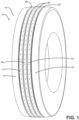
- the pneumatic, or non-pneumatic, tire 10 in accordance with the embodiment illustrated in FIGS. 1-7 has a tread 11 defined by intermediate circumferential first shoulder ribs 12, intermediate circumferential second ribs 14, and a center intermediate circumferential third rib 16.
- the intermediate circumferential ribs 12, 14, 16 are defined by two stabilizing circumferential grooves 22 and two central circumferential grooves 24.
- the two central circumferential grooves 24 preferably each have a trapezoidal cross-section with slanted walls and a curved bottom ( FIG. 4 ).
- the intermediate circumferential second ribs 14 and the center intermediate circumferential third rib 16 preferably have wavy blind sipes 15, 17, respectively, for improving performance of the tread 11.
- the two stabilizing circumferential grooves 22 preferably also have a trapezoidal cross-section with slanted walls and a curved bottom, similar to the two central circumferential grooves 24.
- the radial depth of each stabilizing groove 22 may be more shallow ( FIG. 4 ) or less (not shown) than the depth of the central circumferential grooves 24.
- the stabilizing groove depths are preferably 50% or in a range of from 40% to 60% of the central groove depths ( FIG. 4 ).
- At the curved bottom of each stabilizing groove 22 is a stabilizing structure 220.
- the stabilizing structures 220 defines circumferentially extending, preferably linear subgrooves 222 in the bottoms of the stabilizing grooves 22. As shown in FIG.
- the axial width of the subgrooves 222 is preferably less than the axial width of the bottoms of the stabilizing grooves 22.
- the subgrooves 222 have curved, cylindrical radially innermost surfaces 229 to mitigate cracking and to increase axial flexibility of the stabilizing structures 222 ( FIGS. 5-7 ).
- the axial width of the subgrooves 222 may shrink to as little as 0.0 mm (e.g., touching). Because of the linear pattern of the subgrooves 222, the walls of the subgrooves may frictionally lock thereby preventing relative circumferential movement between the walls of the subgrooves. This may provide an increase in stiffness of the tread 11 while cornering, without requiring increased overall stiffness of the tread during straight line movement of the vehicle.
- the subgrooves 222 are axially offset a predetermined amount 228 from a centerline 227 of the grooves 22.
- the amount 228 of offset may be varied to tune the cornering stiffness of the tread 11. If a subgroove 222 is offset toward the center rib 16 ( FIGS. 5-7 ), the tread 11 around that subgroove may have less cornering stiffness than a subgroove at the centerline 227 of the groove 22. Conversely, if a subgroove 222 is offset away from the center rib 16 (not shown), the tread 11 around that subgroove may have greater cornering stiffness than a subgroove at the centerline 227 of the groove 22. No matter the axial position relative to the centerline 227 of the groove 22, the stabilizing structure 220 may mitigate cracking and increase axial flexibility of the tread 11 during non-cornering, straight line motion and rotation of the tire 10.
- the asymmetric first left-hand shoulder groove 22 has a radially angled inner sidewall 161 with a first sidewall radial angle between 170° and 180°, or 175° and a radially angled outer sidewall 162 with a second sidewall radial angle between 155° and 170°, or 161 °.
- This angle is the respective larger angle the equatorial plane of the tread 11 or tire makes with the respective angled sidewall 161, 162.
- the respective smaller angle the equatorial plane of the tread 11 or tire makes with the respective angled sidewall is the complementary angle to this larger angle and thus for instance 5° or 9° respectively.
- the first left-hand shoulder groove 22 further has a curved base surface 163 with a radius of curvature ranging from 40.0 mm at its axially inner edge 164 and 20.0 mm at its axially outer edge 165.
- the curved base surface 163 may have a radius of curvature as low as between 1.5 mm and 4.0 mm, or 2.5 mm, as it extends from edge 164 to edge 165.
- the first left-hand shoulder groove 22 may further have a stabilizing structure 220 nearer the center of the tread 11 than the centerline of the first left hand shoulder groove (See FIG. 5 ).
- the asymmetric second right-hand shoulder groove 22 has a radially angled inner sidewall 171 with a first sidewall radial angle between 167° and 177°, or 172°, and a radially angled outer sidewall 172 with a second sidewall radial angle between 155° and 170°, or 161°.
- the second right-hand shoulder groove 22 further has a curved base surface 173 with a radius of curvature ranging from 40.0 mm at its axially inner edge 174 and 8.0 mm at its axially outer edge 175.
- the curved base surface 173 may have a radius of curvature as low as between 1.5 mm and 4.0 mm, or 1.5 mm, as it extends from edge 174 to edge 175.
- the second right-hand shoulder groove 22 may still further have a stabilizing structure 220 nearer the center of the tread 11 than the centerline of the second right-hand shoulder groove ( FIG. 5 ).
- a tread 11 for a tire 10 wherein the tread 11 comprise a circumferential groove 22 having a radially outermost and axially inner first groove edge 240 and a radially outermost and axially outer second groove edge 241, wherein a centerline 227 or center plane of the circumferential groove 22 extends circumferentially along the circumferential groove 22 and axially in the middle between the first and second groove edge 240, 241.
- the circumferential groove 22 comprises a stabilizing structure 220 for increasing tread stiffness.
- the stabilizing structure 220 is axially offset a predetermined amount from the centerline 227 or center plane of the circumferential groove.
- the circumferential groove 22 has an angled axially inner sidewall 161, 171, an angled axially outer sidewall 162, 172 and a curved base surface 163, 173.
- the stabilizing structure 220 extends radially inward of the curved base surface 163, 173.
- the stabilizing structure 220 comprises a circumferentially extending subgroove 222 or slit in the curved base surface 163, 173 of the circumferential groove 22.
- the subgroove 222 or slit is axially offset from the centerline 227 or center plane of the circumferential groove 22.
- the circumferential groove 22 has a maximum axial width and the maximum axial width of the subgroove 222 or slit is in a range of from 3 to 15 percent, preferably 5 to 10 percent, of the maximal axial width of the circumferential groove 22.
- the circumferential groove 22 has a maximum axial width and the subgroove 222 or slit is in a range of from 5 to 25 percent, preferably 10 to 20 percent, axially offset from the centerline 227 or center plane of the circumferential groove 22.
- the circumferential groove 22 has a maximum axial width and the subgroove 222 or slit is in a range of from 1 to 5 mm, preferably 2 to 4 mm, axially offset from the centerline 227 or center plane of the circumferential groove 22.
- the stabilizing structure 220 has the shape of a tie bar with said subgroove 222 or slit dividing said tie bar.
- the subgroove 22 has a circumferentially extending curved cylindrical radially innermost surface 229.
- the subgroove 22 or slit is connected radially downwards to a radially innermost, circumferentially extending structure 242 having a circular cross section.
- the cylindrical radially innermost surface 229 or the radially innermost, circumferentially extending structure 242 has an axial width in a range of from 20 to 60 percent, preferably 25 to 50 percent, of the maximal axial width of the circumferential groove 22.
- the tread 11 has a first circumferential main groove, a second circumferential main groove, a third circumferential main groove and a fourth circumferential main groove, the fourth circumferential main groove being said a circumferential groove 22.
- the axial width of the subgroove 222 or slit is such that it shrinks to 0.0 mm under a predetermined operating condition of the tread 11 when used on a tire 10.
- the subgroove 222 has a first sidewall and a second sidewall interconnected by the curved, cylindrical radially innermost surface of the subgroove 222.
- the subgroove 222 is configured such that the first sidewall abuts the second sidewall under a predetermined operating condition of the tread 11 when used on a tire 10 and/or in that a relative motion between the first sidewall and the second sidewall is prevented or hindered by a frictional engagement of the first sidewall and the second sidewall.
- the curved base surface 163, 173 has a radius of curvature in a range of from 35 mm to 45 mm such as 40 mm at the axially inner edge 164, 174 of the curved base surface 163, 173 and a radius of curvature in a range of from 5 mm to 25 mm such as 20 mm or 8 mm at the axially outer edge 165, 175 of the curved base surface 163, 173.
- the radially innermost bottom of the curved base surface 163, 173 has a radius of curvature in a range of from 1.5 mm to 4.0 mm.
- the angled axially inner sidewall 161, 171 makes an angle in a range of from 167° to 180° or from 170° to 180° or from 167° to 177°, such as 175°, with the radial direction or the equatorial plane.
- the angled axially outer sidewall 162, 172 makes an angle in a range of from 155° to 170° such as 161° with the radial direction or the equatorial plane.
- the angle of the angled axially inner sidewall 161, 171 is greater, more preferably at least 5° or at least 10° greater, than the angle of the angled axially outer sidewall 162, 172.
- the tread 11 comprises a plurality of circumferential grooves 22 such as two, three, four or five of circumferential grooves 22, and wherein only one, only two, or all of said circumferential grooves comprise said stabilizing structure 220 that is axially offset a predetermined amount from the centerline 227 or center plane of the circumferential groove 22 and comprise an angled axially inner sidewall 161, an angled axially outer sidewall 162, and a curved base surface 163 with the stabilizing structure 220 extending radially inward of the curved base surface 163.
- the tread 11 comprises a plurality of circumferential grooves 22 such as two, three, four or five of circumferential grooves 22 wherein only the one axially outermost circumferential groove on either side of the equatorial plane of the tread 11 comprises said stabilizing structure 220 that is axially offset a predetermined amount from the centerline 227 or center plane of the circumferential groove 22 and comprises an angled axially inner sidewall 161, an angled axially outer sidewall 162, and a curved base surface 163 with the stabilizing structure 220 extending radially inward of the curved base surface 163.
- the tread 11 comprises a plurality of circumferential grooves 22 such as two, three, four or five of circumferential grooves 22 wherein only the one axially innermost circumferential groove on either side of the equatorial plane of the tread 11 comprises said stabilizing structure 220 that is axially offset a predetermined amount from the centerline 227 or center plane of the circumferential groove 22 and comprises an angled axially inner sidewall 161, an angled axially outer sidewall 162, and a curved base surface 163 with the stabilizing structure 220 extending radially inward of the curved base surface 163.
- the tread 11 comprises a plurality of circumferential grooves 22 such as two, three, four or five of circumferential grooves 22 wherein only the one circumferential groove that is located axially closest to the outboard side of the vehicle when the tread 11 is used on a vehicle in accordance with the tread's or tire's specification comprises said stabilizing structure 220 that is axially offset a predetermined amount from the centerline 227 or center plane of the circumferential groove 22 and comprises an angled axially inner sidewall 161, an angled axially outer sidewall 162, and a curved base surface 163 with the stabilizing structure 220 extending radially inward of the curved base surface 163.
- the stabilizing structure 220 that is axially offset a predetermined amount from the centerline 227 or center plane of the circumferential groove 22 and comprises an angled axially inner sidewall 161, an angled axially outer sidewall 162, and a curved base surface 163 with the stabilizing structure 220 extending radially inward of the curved base
- the tread 11 comprises a plurality of circumferential grooves 22 such as two, three, four or five of circumferential grooves 22, wherein only the one circumferential groove that is located axially closest to the inboard side of the vehicle when the tread 11 is used on a vehicle in accordance with the tread's or tire's specification comprises said stabilizing structure 220 that is axially offset a predetermined amount from the centerline 227 or center plane of the circumferential groove 22 and comprises an angled axially inner sidewall 161, an angled axially outer sidewall 162, and a curved base surface 163 with the stabilizing structure 220 extending radially inward of the curved base surface 163.
- the stabilizing structure 220 that is axially offset a predetermined amount from the centerline 227 or center plane of the circumferential groove 22 and comprises an angled axially inner sidewall 161, an angled axially outer sidewall 162, and a curved base surface 163 with the stabilizing structure 220 extending radially inward of the curved base
- the tread 11 as described in any of the embodiments above is used with a pneumatic tire, preferably a pneumatic truck tire.
Landscapes
- Engineering & Computer Science (AREA)
- Mechanical Engineering (AREA)
- Tires In General (AREA)
Description
- The present invention relates to a tire, and more specifically, to a tread for a tire.
- A construction may be adopted in conventional tires in which, when a cross-section is viewed from a tire meridian direction, a contact patch of a shoulder rib arches and forms a convex on an inner side of a tire radial direction. Due to this construction, contact pressure of the tire may be distributed evenly over a center region and a shoulder region of a tread portion and uneven wear of the tire may be suppressed.
- A tread comprising a stabilizing structure is disclosed in
US 2019/0168546 . - A tread in accordance with the preamble of claim 1 is described in
US 2016/0272012 A1 . -
GB 20 328 729 A1 -
EP 2 722 199 A1 describes a tread having a groove with a slit at the bottom of the groove and with a circumferentially extending structure radially inside of the groove and being connected to the groove via the slit. - The invention relates to a tread in accordance with claim 1 and to a tire in accordance with claim 13.
- Dependent claims refer o preferred embodiments of the invention.
- A tread for a tire in accordance with a preferred aspect of the present invention includes a first circumferential main groove; a second circumferential main groove; a third circumferential main groove; and a fourth circumferential main groove. The fourth circumferential main groove has a stabilizing structure for increasing tread stiffness. The stabilizing structure is axially offset a predetermined amount from a centerline of the fourth circumferential main groove. The fourth circumferential main groove has an angled axially inner sidewall, an angled axially outer sidewall, and a curved base surface. The stabilizing structure extends radially inward from the curved base surface of the fourth circumferential main groove.
- According to another a preferred aspect of the invention, the stabilizing structure has a subgroove with a curved, cylindrical radially innermost surface for mitigating cracking and increasing axial flexibility of the stabilizing structures.
- According to still another preferred aspect of the invention, an axial width of the subgroove shrinks to 0.0 mm under a predetermined operating condition.
- According to yet another preferred aspect of the invention, the subgroove has a first sidewall and a second sidewall interconnected by the curved, cylindrical radially innermost surface of the subgroove.
- According to still another preferred aspect of the invention, the first sidewall abuts the second sidewall under the predetermined operating condition.
- According to yet another preferred aspect of the invention, relative motion between the first sidewall and the second sidewall is prevented by a frictional engagement of the first sidewall and the second sidewall.
- According to yet another preferred aspect of the invention, the radially innermost bottom of the first main groove has a radius of curvature ranging from 40.0 mm at an axially inner edge and 20.0 mm at an axially outer edge.
- According to yet another preferred aspect of the invention, the radially innermost bottom of the first main groove has a radius of curvature as low as between 1.5 mm and 4.0 mm.
- Also, a method not covered by the claimed invention for stiffening a tire tread is disclosed comprising the steps of:
extending a first circumferential main groove across the tire tread; extending a second circumferential main groove across the tire tread; circumferentially extending a subgroove across a radially innermost curved bottom surface of the first main groove; axially offsetting the subgroove a predetermined amount from a centerline of the first main groove; and curving a radially innermost surface of the subgroove, the radially innermost surface of the subgroove being radially inside the radially innermost curved bottom surface of the first main groove. - "Annular" means formed like a ring.
- "Asymmetric tread" means a tread that has a tread pattern not symmetrical about the centerplane or equatorial plane EP of the tire.
- "Axial" and "axially" are used herein to refer to lines or directions that are parallel to the axis of rotation of the tire.
- "Circumferential" means lines or directions extending along the perimeter of the surface of the annular tire parallel to the Equatorial Plane (EP) and perpendicular to the axial direction.
- "Equatorial plane (EP)" means the plane perpendicular to the tire's axis of rotation and passing through the center of its tread; or the plane containing the circumferential centerline of the tread.
- "Groove" means an elongated void area in a tread that may extend circumferentially or laterally about the tread in a straight, curved, or zigzag manner.
- Circumferentially and laterally extending grooves sometimes have common portions. The "groove width" may be the tread surface occupied by a groove or groove portion divided by the length of such groove or groove portion; thus, the groove width may be its average width over its length. Grooves may be of varying depths in a tire. The depth of a groove may vary around the circumference of the tread, or the depth of one groove may be constant but vary from the depth of another groove in the tire. If such narrow or wide grooves are of substantially reduced depth as compared to wide circumferential grooves, which they interconnect, they may be regarded as forming "tie bars" tending to maintain a rib-like character in the tread region involved. As used herein, a groove is intended to have a width large enough to remain open in the tires contact patch or footprint.
- "Inner" means toward the inside of the tire and "outer" means toward its exterior.
- "Inboard side" means the side of the tire nearest the vehicle when the tire is mounted on a wheel and the wheel is mounted on the vehicle.
- "Lateral" means an axial direction.
- "Non-directional tread" means a tread that has no preferred direction of forward travel and is not required to be positioned on a vehicle in a specific wheel position or positions to ensure that the tread pattern is aligned with the preferred direction of travel. Conversely, a directional tread pattern has a preferred direction of travel requiring specific wheel positioning.
- "Outboard side" means the side of the tire farthest away from the vehicle when the tire is mounted on a wheel and the wheel is mounted on the vehicle.
- "Radial" and "radially" are used to mean directions radially toward or away from the axis of rotation of the tire.
- "Rib" means a circumferentially extending strip of rubber on the tread which is defined by at least one circumferential groove and either a second such groove or a lateral edge, the strip being laterally undivided by full-depth grooves.
- "Sipe" or "incision" means small slots molded into the tread elements of the tire that subdivide the tread surface and improve traction; sipes may be designed to close when within the contact patch or footprint, as distinguished from grooves.
- "Tread" means a molded rubber component which, when bonded to a tire casing, includes that portion of the tire that comes into contact with the road when the tire is normally inflated and under normal load.
- "Tread element" or "traction element" means a rib or a block element.
- "Tread width" means the arc length of the tread surface in a plane including the axis of rotation of the tire.
- The present invention will be better understood through reference to the following description and the appended drawings, in which:
-
FIG. 1 is a schematic perspective view of a tire in accordance with the present invention; -
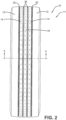
FIG. 2 is a schematic orthogonal view of the tread of the tire ofFIG. 1 ; -
FIG. 3 is a schematic detail view of the tread ofFIG. 2 ; -
FIG. 4 is a schematic section view taken along the line "4-4" inFIG. 2 ; -
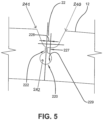
FIG. 5 is a detailed schematic view of part of the tread ofFIG. 4 ; -
FIG. 6 represents a schematic detail perspective view of an asymmetric tread groove fromFIG. 4 ; and -
FIG. 7 represents a schematic detail perspective view of another asymmetric tread groove fromFIG. 4 . - Referring now to the drawings, the present invention will below be described in more detail. The pneumatic, or non-pneumatic,
tire 10 in accordance with the embodiment illustrated inFIGS. 1-7 has atread 11 defined by intermediate circumferentialfirst shoulder ribs 12, intermediate circumferentialsecond ribs 14, and a center intermediate circumferentialthird rib 16. The intermediatecircumferential ribs circumferential grooves 22 and two centralcircumferential grooves 24. The two centralcircumferential grooves 24 preferably each have a trapezoidal cross-section with slanted walls and a curved bottom (FIG. 4 ). The intermediate circumferentialsecond ribs 14 and the center intermediate circumferentialthird rib 16 preferably have wavyblind sipes tread 11. - The two stabilizing
circumferential grooves 22 preferably also have a trapezoidal cross-section with slanted walls and a curved bottom, similar to the two centralcircumferential grooves 24. The radial depth of each stabilizinggroove 22 may be more shallow (FIG. 4 ) or less (not shown) than the depth of the centralcircumferential grooves 24. The stabilizing groove depths are preferably 50% or in a range of from 40% to 60% of the central groove depths (FIG. 4 ). At the curved bottom of each stabilizinggroove 22 is a stabilizingstructure 220. The stabilizingstructures 220 defines circumferentially extending, preferablylinear subgrooves 222 in the bottoms of the stabilizinggrooves 22. As shown inFIG. 3 , the axial width of thesubgrooves 222 is preferably less than the axial width of the bottoms of the stabilizinggrooves 22. Thesubgrooves 222 have curved, cylindrical radiallyinnermost surfaces 229 to mitigate cracking and to increase axial flexibility of the stabilizing structures 222 (FIGS. 5-7 ). - When an axially inward load is placed on the
tread 11, such as while the vehicle is cornering, the axial width of thesubgrooves 222 may shrink to as little as 0.0 mm (e.g., touching). Because of the linear pattern of thesubgrooves 222, the walls of the subgrooves may frictionally lock thereby preventing relative circumferential movement between the walls of the subgrooves. This may provide an increase in stiffness of thetread 11 while cornering, without requiring increased overall stiffness of the tread during straight line movement of the vehicle. - The
subgrooves 222 are axially offset apredetermined amount 228 from acenterline 227 of thegrooves 22. Theamount 228 of offset may be varied to tune the cornering stiffness of thetread 11. If asubgroove 222 is offset toward the center rib 16 (FIGS. 5-7 ), thetread 11 around that subgroove may have less cornering stiffness than a subgroove at thecenterline 227 of thegroove 22. Conversely, if asubgroove 222 is offset away from the center rib 16 (not shown), thetread 11 around that subgroove may have greater cornering stiffness than a subgroove at thecenterline 227 of thegroove 22. No matter the axial position relative to thecenterline 227 of thegroove 22, the stabilizingstructure 220 may mitigate cracking and increase axial flexibility of thetread 11 during non-cornering, straight line motion and rotation of thetire 10. - In accordance with a preferred embodiment of the present invention and as shown in
FIGS. 4-7 , the asymmetric first left-hand shoulder groove 22 has a radially angledinner sidewall 161 with a first sidewall radial angle between 170° and 180°, or 175° and a radially angledouter sidewall 162 with a second sidewall radial angle between 155° and 170°, or 161 °. This angle is the respective larger angle the equatorial plane of thetread 11 or tire makes with the respectiveangled sidewall tread 11 or tire makes with the respective angled sidewall is the complementary angle to this larger angle and thus for instance 5° or 9° respectively. - The first left-
hand shoulder groove 22 further has acurved base surface 163 with a radius of curvature ranging from 40.0 mm at its axiallyinner edge 164 and 20.0 mm at its axiallyouter edge 165. Thecurved base surface 163 may have a radius of curvature as low as between 1.5 mm and 4.0 mm, or 2.5 mm, as it extends fromedge 164 to edge 165. The first left-hand shoulder groove 22 may further have a stabilizingstructure 220 nearer the center of thetread 11 than the centerline of the first left hand shoulder groove (SeeFIG. 5 ). - In accordance with a preferred embodiment of the present invention and as shown in
FIGS. 4-7 , the asymmetric second right-hand shoulder groove 22 has a radially angledinner sidewall 171 with a first sidewall radial angle between 167° and 177°, or 172°, and a radially angledouter sidewall 172 with a second sidewall radial angle between 155° and 170°, or 161°. The second right-hand shoulder groove 22 further has acurved base surface 173 with a radius of curvature ranging from 40.0 mm at its axiallyinner edge 174 and 8.0 mm at its axiallyouter edge 175. Thecurved base surface 173 may have a radius of curvature as low as between 1.5 mm and 4.0 mm, or 1.5 mm, as it extends fromedge 174 to edge 175. The second right-hand shoulder groove 22 may still further have a stabilizingstructure 220 nearer the center of thetread 11 than the centerline of the second right-hand shoulder groove (FIG. 5 ). - Hence and in accordance with the invention, a
tread 11 for atire 10 is disclosed wherein thetread 11 comprise acircumferential groove 22 having a radially outermost and axially innerfirst groove edge 240 and a radially outermost and axially outersecond groove edge 241, wherein acenterline 227 or center plane of thecircumferential groove 22 extends circumferentially along thecircumferential groove 22 and axially in the middle between the first andsecond groove edge circumferential groove 22 comprises a stabilizingstructure 220 for increasing tread stiffness. The stabilizingstructure 220 is axially offset a predetermined amount from thecenterline 227 or center plane of the circumferential groove. Thecircumferential groove 22 has an angled axiallyinner sidewall outer sidewall curved base surface structure 220 extends radially inward of thecurved base surface - In accordance with the invention, the stabilizing
structure 220 comprises acircumferentially extending subgroove 222 or slit in thecurved base surface circumferential groove 22. Thesubgroove 222 or slit is axially offset from thecenterline 227 or center plane of thecircumferential groove 22. - In a preferred embodiment of the invention, the
circumferential groove 22 has a maximum axial width and the maximum axial width of thesubgroove 222 or slit is in a range of from 3 to 15 percent, preferably 5 to 10 percent, of the maximal axial width of thecircumferential groove 22. - In a preferred embodiment of the invention, the
circumferential groove 22 has a maximum axial width and thesubgroove 222 or slit is in a range of from 5 to 25 percent, preferably 10 to 20 percent, axially offset from thecenterline 227 or center plane of thecircumferential groove 22. - In a preferred embodiment of the invention, the
circumferential groove 22 has a maximum axial width and thesubgroove 222 or slit is in a range of from 1 to 5 mm, preferably 2 to 4 mm, axially offset from thecenterline 227 or center plane of thecircumferential groove 22. - In a preferred embodiment of the invention, the stabilizing
structure 220 has the shape of a tie bar with saidsubgroove 222 or slit dividing said tie bar. - In a preferred embodiment of the invention, the
subgroove 22 has a circumferentially extending curved cylindrical radiallyinnermost surface 229. - In accordance with the invention, the
subgroove 22 or slit is connected radially downwards to a radially innermost, circumferentially extendingstructure 242 having a circular cross section. - The cylindrical radially
innermost surface 229 or the radially innermost, circumferentially extendingstructure 242 has an axial width in a range of from 20 to 60 percent, preferably 25 to 50 percent, of the maximal axial width of thecircumferential groove 22. - In a preferred embodiment of the invention, the
tread 11 has a first circumferential main groove, a second circumferential main groove, a third circumferential main groove and a fourth circumferential main groove, the fourth circumferential main groove being said acircumferential groove 22. - In a preferred embodiment of the invention, the axial width of the
subgroove 222 or slit is such that it shrinks to 0.0 mm under a predetermined operating condition of thetread 11 when used on atire 10. - In a preferred embodiment of the invention, the
subgroove 222 has a first sidewall and a second sidewall interconnected by the curved, cylindrical radially innermost surface of thesubgroove 222. Optionally, thesubgroove 222 is configured such that the first sidewall abuts the second sidewall under a predetermined operating condition of thetread 11 when used on atire 10 and/or in that a relative motion between the first sidewall and the second sidewall is prevented or hindered by a frictional engagement of the first sidewall and the second sidewall. - In a preferred embodiment of the invention, the
curved base surface inner edge curved base surface outer edge curved base surface curved base surface - In a preferred embodiment of the invention, the angled axially
inner sidewall - In a preferred embodiment of the invention, the angled axially
outer sidewall - Preferably, the angle of the angled axially
inner sidewall outer sidewall - In a preferred embodiment of the invention, the
tread 11 comprises a plurality ofcircumferential grooves 22 such as two, three, four or five ofcircumferential grooves 22, and wherein only one, only two, or all of said circumferential grooves comprise said stabilizingstructure 220 that is axially offset a predetermined amount from thecenterline 227 or center plane of thecircumferential groove 22 and comprise an angled axiallyinner sidewall 161, an angled axiallyouter sidewall 162, and acurved base surface 163 with the stabilizingstructure 220 extending radially inward of thecurved base surface 163. - In a preferred embodiment of the invention, the
tread 11 comprises a plurality ofcircumferential grooves 22 such as two, three, four or five ofcircumferential grooves 22 wherein only the one axially outermost circumferential groove on either side of the equatorial plane of thetread 11 comprises said stabilizingstructure 220 that is axially offset a predetermined amount from thecenterline 227 or center plane of thecircumferential groove 22 and comprises an angled axiallyinner sidewall 161, an angled axiallyouter sidewall 162, and acurved base surface 163 with the stabilizingstructure 220 extending radially inward of thecurved base surface 163. - In a preferred embodiment of the invention, the
tread 11 comprises a plurality ofcircumferential grooves 22 such as two, three, four or five ofcircumferential grooves 22 wherein only the one axially innermost circumferential groove on either side of the equatorial plane of thetread 11 comprises said stabilizingstructure 220 that is axially offset a predetermined amount from thecenterline 227 or center plane of thecircumferential groove 22 and comprises an angled axiallyinner sidewall 161, an angled axiallyouter sidewall 162, and acurved base surface 163 with the stabilizingstructure 220 extending radially inward of thecurved base surface 163. - In a preferred embodiment of the invention, the
tread 11 comprises a plurality ofcircumferential grooves 22 such as two, three, four or five ofcircumferential grooves 22 wherein only the one circumferential groove that is located axially closest to the outboard side of the vehicle when thetread 11 is used on a vehicle in accordance with the tread's or tire's specification comprises said stabilizingstructure 220 that is axially offset a predetermined amount from thecenterline 227 or center plane of thecircumferential groove 22 and comprises an angled axiallyinner sidewall 161, an angled axiallyouter sidewall 162, and acurved base surface 163 with the stabilizingstructure 220 extending radially inward of thecurved base surface 163. - In a preferred embodiment of the invention, the
tread 11 comprises a plurality ofcircumferential grooves 22 such as two, three, four or five ofcircumferential grooves 22, wherein only the one circumferential groove that is located axially closest to the inboard side of the vehicle when thetread 11 is used on a vehicle in accordance with the tread's or tire's specification comprises said stabilizingstructure 220 that is axially offset a predetermined amount from thecenterline 227 or center plane of thecircumferential groove 22 and comprises an angled axiallyinner sidewall 161, an angled axiallyouter sidewall 162, and acurved base surface 163 with the stabilizingstructure 220 extending radially inward of thecurved base surface 163. - In a preferred embodiment of the invention, the
tread 11 as described in any of the embodiments above is used with a pneumatic tire, preferably a pneumatic truck tire.
Claims (13)
- A tread for a tire (10), the tread (11) comprising a circumferential groove (22) having a radially outermost and axially inner first groove edge (240) and a radially outermost and axially outer second groove edge (241), wherein a centerline (227) or center plane of the circumferential groove (22) extends circumferentially along the circumferential groove (22) and axially in the middle between the first and second groove edge (240, 241), the circumferential groove (22) comprising a stabilizing structure (220) for increasing tread stiffness, wherein the stabilizing structure (220) is axially offset a predetermined amount from the centerline (227) or center plane of the circumferential groove (22) and wherein the circumferential groove (22) has an angled axially inner sidewall (161, 171), an angled axially outer sidewall (162, 172), and a curved base surface (163, 173), the stabilizing structure (220) extending radially inward of the curved base surface (163, 173) and comprising a circumferentially extending subgroove (222) or slit in the curved base surface (163, 173) of the circumferential groove (22), the subgroove (222) or slit being axially offset from the centerline (227) or center plane of the circumferential groove (22), characterized in that the subgroove (22) or slit is connected radially downwards to a radially innermost, circumferentially extending structure (242) having a circular cross section and having an axial width in a range of from 20 to 60 percent of the maximal axial width of the circumferential groove (22).
- The tread of claim 1 wherein the maximum axial width of the subgroove (222) or slit is in a range of from 3 to 15 percent, preferably 5 to 10 percent, of the maximal axial width of the circumferential groove (22).
- The tread of claim 1 or 2 wherein the subgroove (222) or slit is in a range of from 5 to 25 percent, preferably 10 to 20 percent, axially offset from the centerline (227) or center plane of the circumferential groove (22).
- The tread of at least one of the claims 1 to 3 wherein the subgroove (222) or slit is in a range of from 1 to 5 mm, preferably 2 to 4 mm, axially offset from the centerline (227) or center plane of the circumferential groove (22).
- The tread of at least one of the claims 1 to 4 wherein the stabilizing structure (220) has the shape of a tie bar with said subgroove (222) or slit dividing said tie bar.
- The tread of claim 1 wherein the the radially innermost, circumferentially extending structure (242) has an axial width in a range of from 25 to 50 percent of the maximal axial width of the circumferential groove (22).
- The tread of at least one of the previous claims wherein the tread (11) has a first circumferential main groove, a second circumferential main groove, a third circumferential main groove and a fourth circumferential main groove, the fourth circumferential main groove being said a circumferential groove (22).
- The tread of at least one of the previous claims wherein the axial width of the subgroove (222) or slit is such that it shrinks to 0.0 mm under a predetermined operating condition of the tread (11) when used on a tire (10).
- The tread of at least one of the previous claims wherein the curved base surface (163, 173) has a radius of curvature in a range of from 35 mm to 45 mm such as 40 mm at the axially inner edge (164, 174) of the curved base surface (163, 173) and a radius of curvature in a range of from 5 mm to 25 mm such as 20 mm or 8 mm at the axially outer edge (165, 175) of the curved base surface (163, 173); and/or wherein the radially innermost bottom of the curved base surface (163, 173) has a radius of curvature in a range of from 1.5 mm to 4.0 mm.
- The tread of at least one of the previous claims wherein the angled axially inner sidewall (161, 171) makes an angle in a range of from 167° to 180° or from 170° to 180° or from 167° to 177° with the radial direction or the equatorial plane; and/or wherein the angled axially outer sidewall (162, 172) makes an angle in a range of from 155° to 170° with the radial direction or the equatorial plane.
- The tread of at least one of the previous claims wherein the tread (11) comprises a plurality of circumferential grooves (22) such as two, three, four or five of circumferential grooves (22), and wherein only one, only two, or all of said circumferential grooves comprise said stabilizing structure (220) that is axially offset a predetermined amount from the centerline (227) or center plane of the circumferential groove (22) and comprise an angled axially inner sidewall (161, 171), an angled axially outer sidewall (162, 172), and a curved base surface (163, 173) with the stabilizing structure (220) extending radially inward of the curved base surface (163, 173).
- The tread of at least one of the previous claims wherein the tread (11) comprises a plurality of circumferential grooves (22) such as two, three, four or five of circumferential grooves (22), and wherein:(i) only the one axially outermost circumferential groove on either side of the equatorial plane of the tread (11) comprises said stabilizing structure (220) that is axially offset a predetermined amount from the centerline (227) or center plane of the circumferential groove (22) and comprises an angled axially inner sidewall (161, 171), an angled axially outer sidewall (162, 172), and a curved base surface (163, 173) with the stabilizing structure (220) extending radially inward of the curved base surface (163, 173); or(ii) only the one axially innermost circumferential groove on either side of the equatorial plane of the tread (11) comprises said stabilizing structure (220) that is axially offset a predetermined amount from the centerline (227) or center plane of the circumferential groove (22) and comprises an angled axially inner sidewall (161, 171), an angled axially outer sidewall (162, 172), and a curved base surface (163, 173) with the stabilizing structure (220) extending radially inward of the curved base surface (163, 173); or(iii) only the one circumferential groove that is located axially closest to the outboard side of the vehicle when the tread (11) is used on a vehicle in accordance with the tread's or tire's specification comprises said stabilizing structure (220) that is axially offset a predetermined amount from the centerline (227) or center plane of the circumferential groove (22) and comprises an angled axially inner sidewall (161, 171), an angled axially outer sidewall (162, 172), and a curved base surface (163, 173) with the stabilizing structure (220) extending radially inward of the curved base surface (163, 173); or(iv) only the one circumferential groove that is located axially closest to the inboard side of the vehicle when the tread (11) is used on a vehicle in accordance with the tread's or tire's specification comprises said stabilizing structure (220) that is axially offset a predetermined amount from the centerline (227) or center plane of the circumferential groove (22) and comprises an angled axially inner sidewall (161, 171), an angled axially outer sidewall (162, 172), and a curved base surface (163, 173) with the stabilizing structure (220) extending radially inward of the curved base surface (163, 173).
- A tire, preferably a pneumatic tire, having a tread in accordance with at least one of the previous claims.
Applications Claiming Priority (1)
| Application Number | Priority Date | Filing Date | Title |
|---|---|---|---|
| US17/027,741 US20220088967A1 (en) | 2020-09-22 | 2020-09-22 | Tire tread |
Publications (2)
| Publication Number | Publication Date |
|---|---|
| EP3970994A1 EP3970994A1 (en) | 2022-03-23 |
| EP3970994B1 true EP3970994B1 (en) | 2024-05-22 |
Family
ID=80248761
Family Applications (1)
| Application Number | Title | Priority Date | Filing Date |
|---|---|---|---|
| EP21197499.3A Active EP3970994B1 (en) | 2020-09-22 | 2021-09-17 | Tire tread and tire with such a tread |
Country Status (4)
| Country | Link |
|---|---|
| US (1) | US20220088967A1 (en) |
| EP (1) | EP3970994B1 (en) |
| CN (1) | CN114248583B (en) |
| BR (1) | BR102021018782A2 (en) |
Families Citing this family (2)
| Publication number | Priority date | Publication date | Assignee | Title |
|---|---|---|---|---|
| FR3111292B1 (en) * | 2020-06-10 | 2022-08-26 | Michelin & Cie | Tire tread for a heavy-duty vehicle with improved resistance to attacks |
| KR20250161300A (en) * | 2024-05-08 | 2025-11-17 | 한국타이어앤테크놀로지 주식회사 | Heavy duty tire |
Family Cites Families (17)
| Publication number | Priority date | Publication date | Assignee | Title |
|---|---|---|---|---|
| IT1101233B (en) * | 1978-12-22 | 1985-09-28 | Pirelli | TREAD DESIGN WITH SIDE GROOVES |
| JP2001187517A (en) * | 1999-12-28 | 2001-07-10 | Bridgestone Corp | Pneumatic tire |
| JP4475756B2 (en) * | 2000-07-12 | 2010-06-09 | 株式会社ブリヂストン | Pneumatic tire |
| KR100473249B1 (en) * | 2002-10-18 | 2005-03-08 | 금호타이어 주식회사 | Tread Pattern for a Heavy Duty Pneumatic Radial Tire |
| US8794279B2 (en) * | 2007-03-13 | 2014-08-05 | Bridgestone Corporation | Pneumatic tire with tread including thin groove having rounded corner portions |
| US9033013B2 (en) * | 2008-06-06 | 2015-05-19 | Continental Tire North America, Inc. | Undercut stone bumper structure for vehicle tire groove |
| US8393365B2 (en) * | 2009-12-11 | 2013-03-12 | The Goodyear Tire & Rubber Company | Tire tread having serrated grooves |
| US20160272012A1 (en) * | 2011-04-29 | 2016-09-22 | Compagnie Generale Des Etablissements Michelin | Tire with tread having bridged areas with split contact faces within a longitudinal groove |
| JP5374565B2 (en) * | 2011-10-28 | 2013-12-25 | 住友ゴム工業株式会社 | Pneumatic tire |
| US9027615B2 (en) * | 2012-09-12 | 2015-05-12 | The Goodyear Tire & Rubber Company | Tire tread with groove reinforcement |
| DE102012110054A1 (en) * | 2012-10-22 | 2014-05-08 | Continental Reifen Deutschland Gmbh | Vehicle tires |
| JP6040073B2 (en) * | 2013-03-27 | 2016-12-07 | 東洋ゴム工業株式会社 | Pneumatic tire |
| JP5848731B2 (en) * | 2013-08-21 | 2016-01-27 | 住友ゴム工業株式会社 | Pneumatic tire |
| JP6621312B2 (en) * | 2015-11-24 | 2019-12-18 | 株式会社ブリヂストン | Pneumatic tire |
| US20180056729A1 (en) * | 2016-08-29 | 2018-03-01 | The Goodyear Tire & Rubber Company | Tire groove |
| JP6793021B2 (en) * | 2016-12-02 | 2020-12-02 | Toyo Tire株式会社 | Pneumatic tires |
| US11701925B2 (en) * | 2017-12-01 | 2023-07-18 | The Goodyear Tire & Rubber Company | Stabilizer structure for a tread of a tire |
-
2020
- 2020-09-22 US US17/027,741 patent/US20220088967A1/en not_active Abandoned
-
2021
- 2021-09-15 CN CN202111080361.8A patent/CN114248583B/en active Active
- 2021-09-17 EP EP21197499.3A patent/EP3970994B1/en active Active
- 2021-09-21 BR BR102021018782-4A patent/BR102021018782A2/en not_active Application Discontinuation
Also Published As
| Publication number | Publication date |
|---|---|
| US20220088967A1 (en) | 2022-03-24 |
| CN114248583B (en) | 2024-02-27 |
| BR102021018782A2 (en) | 2022-04-05 |
| CN114248583A (en) | 2022-03-29 |
| EP3970994A1 (en) | 2022-03-23 |
Similar Documents
| Publication | Publication Date | Title |
|---|---|---|
| CN111137072B (en) | Tyre for vehicle wheels | |
| EP3492283B1 (en) | Tire tread comprising a stabilizer structure | |
| US12275276B2 (en) | Tyre | |
| EP3581402B1 (en) | Multiplane interlocking structure for a tread of a tire | |
| EP3569424B1 (en) | Tire for motorcycle for uneven ground traveling | |
| CN112124008A (en) | Pneumatic tire | |
| EP3666551B1 (en) | Tire tread | |
| EP0319860B1 (en) | Radial tire for heavy duty vehicles | |
| EP3970994B1 (en) | Tire tread and tire with such a tread | |
| EP3670209B1 (en) | Tread for a pneumatic tire | |
| EP3444128A1 (en) | Tire tread for off the road tires | |
| EP3599112B1 (en) | Studless tyre | |
| EP0135467B1 (en) | Pneumatic tire | |
| EP4389461B1 (en) | Tire | |
| EP3970993B1 (en) | Tire tread and tire comprising a stabilizer structure | |
| US20240227455A1 (en) | Pneumatic Tire | |
| EP3744535B1 (en) | Tire | |
| EP4091841B1 (en) | Tire with a tread having sipes | |
| EP4043243A1 (en) | Pneumatic tire | |
| EP4541604B1 (en) | Tire | |
| EP4375089B1 (en) | Tire | |
| JP7650690B2 (en) | Pneumatic tires | |
| JP7648431B2 (en) | Pneumatic tires | |
| JP7599931B2 (en) | tire | |
| EP3988331B1 (en) | Pneumatic tire |
Legal Events
| Date | Code | Title | Description |
|---|---|---|---|
| PUAI | Public reference made under article 153(3) epc to a published international application that has entered the european phase |
Free format text: ORIGINAL CODE: 0009012 |
|
| STAA | Information on the status of an ep patent application or granted ep patent |
Free format text: STATUS: THE APPLICATION HAS BEEN PUBLISHED |
|
| AK | Designated contracting states |
Kind code of ref document: A1 Designated state(s): AL AT BE BG CH CY CZ DE DK EE ES FI FR GB GR HR HU IE IS IT LI LT LU LV MC MK MT NL NO PL PT RO RS SE SI SK SM TR |
|
| RAP3 | Party data changed (applicant data changed or rights of an application transferred) |
Owner name: THE GOODYEAR TIRE & RUBBER COMPANY |
|
| STAA | Information on the status of an ep patent application or granted ep patent |
Free format text: STATUS: REQUEST FOR EXAMINATION WAS MADE |
|
| 17P | Request for examination filed |
Effective date: 20220923 |
|
| RBV | Designated contracting states (corrected) |
Designated state(s): AL AT BE BG CH CY CZ DE DK EE ES FI FR GB GR HR HU IE IS IT LI LT LU LV MC MK MT NL NO PL PT RO RS SE SI SK SM TR |
|
| STAA | Information on the status of an ep patent application or granted ep patent |
Free format text: STATUS: EXAMINATION IS IN PROGRESS |
|
| 17Q | First examination report despatched |
Effective date: 20230327 |
|
| GRAP | Despatch of communication of intention to grant a patent |
Free format text: ORIGINAL CODE: EPIDOSNIGR1 |
|
| STAA | Information on the status of an ep patent application or granted ep patent |
Free format text: STATUS: GRANT OF PATENT IS INTENDED |
|
| INTG | Intention to grant announced |
Effective date: 20231219 |
|
| GRAS | Grant fee paid |
Free format text: ORIGINAL CODE: EPIDOSNIGR3 |
|
| GRAA | (expected) grant |
Free format text: ORIGINAL CODE: 0009210 |
|
| STAA | Information on the status of an ep patent application or granted ep patent |
Free format text: STATUS: THE PATENT HAS BEEN GRANTED |
|
| AK | Designated contracting states |
Kind code of ref document: B1 Designated state(s): AL AT BE BG CH CY CZ DE DK EE ES FI FR GB GR HR HU IE IS IT LI LT LU LV MC MK MT NL NO PL PT RO RS SE SI SK SM TR |
|
| REG | Reference to a national code |
Ref country code: GB Ref legal event code: FG4D |
|
| REG | Reference to a national code |
Ref country code: CH Ref legal event code: EP |
|
| REG | Reference to a national code |
Ref country code: DE Ref legal event code: R096 Ref document number: 602021013502 Country of ref document: DE |
|
| REG | Reference to a national code |
Ref country code: IE Ref legal event code: FG4D |
|
| REG | Reference to a national code |
Ref country code: LT Ref legal event code: MG9D |
|
| REG | Reference to a national code |
Ref country code: NL Ref legal event code: MP Effective date: 20240522 |
|
| PG25 | Lapsed in a contracting state [announced via postgrant information from national office to epo] |
Ref country code: IS Free format text: LAPSE BECAUSE OF FAILURE TO SUBMIT A TRANSLATION OF THE DESCRIPTION OR TO PAY THE FEE WITHIN THE PRESCRIBED TIME-LIMIT Effective date: 20240922 |
|
| PG25 | Lapsed in a contracting state [announced via postgrant information from national office to epo] |
Ref country code: BG Free format text: LAPSE BECAUSE OF FAILURE TO SUBMIT A TRANSLATION OF THE DESCRIPTION OR TO PAY THE FEE WITHIN THE PRESCRIBED TIME-LIMIT Effective date: 20240522 |
|
| PG25 | Lapsed in a contracting state [announced via postgrant information from national office to epo] |
Ref country code: HR Free format text: LAPSE BECAUSE OF FAILURE TO SUBMIT A TRANSLATION OF THE DESCRIPTION OR TO PAY THE FEE WITHIN THE PRESCRIBED TIME-LIMIT Effective date: 20240522 Ref country code: FI Free format text: LAPSE BECAUSE OF FAILURE TO SUBMIT A TRANSLATION OF THE DESCRIPTION OR TO PAY THE FEE WITHIN THE PRESCRIBED TIME-LIMIT Effective date: 20240522 |
|
| PG25 | Lapsed in a contracting state [announced via postgrant information from national office to epo] |
Ref country code: GR Free format text: LAPSE BECAUSE OF FAILURE TO SUBMIT A TRANSLATION OF THE DESCRIPTION OR TO PAY THE FEE WITHIN THE PRESCRIBED TIME-LIMIT Effective date: 20240823 |
|
| PG25 | Lapsed in a contracting state [announced via postgrant information from national office to epo] |
Ref country code: PT Free format text: LAPSE BECAUSE OF FAILURE TO SUBMIT A TRANSLATION OF THE DESCRIPTION OR TO PAY THE FEE WITHIN THE PRESCRIBED TIME-LIMIT Effective date: 20240923 |
|
| REG | Reference to a national code |
Ref country code: AT Ref legal event code: MK05 Ref document number: 1688482 Country of ref document: AT Kind code of ref document: T Effective date: 20240522 |
|
| PG25 | Lapsed in a contracting state [announced via postgrant information from national office to epo] |
Ref country code: NL Free format text: LAPSE BECAUSE OF FAILURE TO SUBMIT A TRANSLATION OF THE DESCRIPTION OR TO PAY THE FEE WITHIN THE PRESCRIBED TIME-LIMIT Effective date: 20240522 |
|
| PG25 | Lapsed in a contracting state [announced via postgrant information from national office to epo] |
Ref country code: ES Free format text: LAPSE BECAUSE OF FAILURE TO SUBMIT A TRANSLATION OF THE DESCRIPTION OR TO PAY THE FEE WITHIN THE PRESCRIBED TIME-LIMIT Effective date: 20240522 |
|
| PG25 | Lapsed in a contracting state [announced via postgrant information from national office to epo] |
Ref country code: AT Free format text: LAPSE BECAUSE OF FAILURE TO SUBMIT A TRANSLATION OF THE DESCRIPTION OR TO PAY THE FEE WITHIN THE PRESCRIBED TIME-LIMIT Effective date: 20240522 |
|
| PG25 | Lapsed in a contracting state [announced via postgrant information from national office to epo] |
Ref country code: PL Free format text: LAPSE BECAUSE OF FAILURE TO SUBMIT A TRANSLATION OF THE DESCRIPTION OR TO PAY THE FEE WITHIN THE PRESCRIBED TIME-LIMIT Effective date: 20240522 |
|
| PG25 | Lapsed in a contracting state [announced via postgrant information from national office to epo] |
Ref country code: LV Free format text: LAPSE BECAUSE OF FAILURE TO SUBMIT A TRANSLATION OF THE DESCRIPTION OR TO PAY THE FEE WITHIN THE PRESCRIBED TIME-LIMIT Effective date: 20240522 |
|
| PG25 | Lapsed in a contracting state [announced via postgrant information from national office to epo] |
Ref country code: PT Free format text: LAPSE BECAUSE OF FAILURE TO SUBMIT A TRANSLATION OF THE DESCRIPTION OR TO PAY THE FEE WITHIN THE PRESCRIBED TIME-LIMIT Effective date: 20240923 Ref country code: PL Free format text: LAPSE BECAUSE OF FAILURE TO SUBMIT A TRANSLATION OF THE DESCRIPTION OR TO PAY THE FEE WITHIN THE PRESCRIBED TIME-LIMIT Effective date: 20240522 Ref country code: NO Free format text: LAPSE BECAUSE OF FAILURE TO SUBMIT A TRANSLATION OF THE DESCRIPTION OR TO PAY THE FEE WITHIN THE PRESCRIBED TIME-LIMIT Effective date: 20240822 Ref country code: NL Free format text: LAPSE BECAUSE OF FAILURE TO SUBMIT A TRANSLATION OF THE DESCRIPTION OR TO PAY THE FEE WITHIN THE PRESCRIBED TIME-LIMIT Effective date: 20240522 Ref country code: LV Free format text: LAPSE BECAUSE OF FAILURE TO SUBMIT A TRANSLATION OF THE DESCRIPTION OR TO PAY THE FEE WITHIN THE PRESCRIBED TIME-LIMIT Effective date: 20240522 Ref country code: IS Free format text: LAPSE BECAUSE OF FAILURE TO SUBMIT A TRANSLATION OF THE DESCRIPTION OR TO PAY THE FEE WITHIN THE PRESCRIBED TIME-LIMIT Effective date: 20240922 Ref country code: HR Free format text: LAPSE BECAUSE OF FAILURE TO SUBMIT A TRANSLATION OF THE DESCRIPTION OR TO PAY THE FEE WITHIN THE PRESCRIBED TIME-LIMIT Effective date: 20240522 Ref country code: GR Free format text: LAPSE BECAUSE OF FAILURE TO SUBMIT A TRANSLATION OF THE DESCRIPTION OR TO PAY THE FEE WITHIN THE PRESCRIBED TIME-LIMIT Effective date: 20240823 Ref country code: FI Free format text: LAPSE BECAUSE OF FAILURE TO SUBMIT A TRANSLATION OF THE DESCRIPTION OR TO PAY THE FEE WITHIN THE PRESCRIBED TIME-LIMIT Effective date: 20240522 Ref country code: ES Free format text: LAPSE BECAUSE OF FAILURE TO SUBMIT A TRANSLATION OF THE DESCRIPTION OR TO PAY THE FEE WITHIN THE PRESCRIBED TIME-LIMIT Effective date: 20240522 Ref country code: BG Free format text: LAPSE BECAUSE OF FAILURE TO SUBMIT A TRANSLATION OF THE DESCRIPTION OR TO PAY THE FEE WITHIN THE PRESCRIBED TIME-LIMIT Effective date: 20240522 Ref country code: AT Free format text: LAPSE BECAUSE OF FAILURE TO SUBMIT A TRANSLATION OF THE DESCRIPTION OR TO PAY THE FEE WITHIN THE PRESCRIBED TIME-LIMIT Effective date: 20240522 Ref country code: RS Free format text: LAPSE BECAUSE OF FAILURE TO SUBMIT A TRANSLATION OF THE DESCRIPTION OR TO PAY THE FEE WITHIN THE PRESCRIBED TIME-LIMIT Effective date: 20240822 |
|
| PG25 | Lapsed in a contracting state [announced via postgrant information from national office to epo] |
Ref country code: DK Free format text: LAPSE BECAUSE OF FAILURE TO SUBMIT A TRANSLATION OF THE DESCRIPTION OR TO PAY THE FEE WITHIN THE PRESCRIBED TIME-LIMIT Effective date: 20240522 |
|
| PG25 | Lapsed in a contracting state [announced via postgrant information from national office to epo] |
Ref country code: EE Free format text: LAPSE BECAUSE OF FAILURE TO SUBMIT A TRANSLATION OF THE DESCRIPTION OR TO PAY THE FEE WITHIN THE PRESCRIBED TIME-LIMIT Effective date: 20240522 |
|
| PG25 | Lapsed in a contracting state [announced via postgrant information from national office to epo] |
Ref country code: CZ Free format text: LAPSE BECAUSE OF FAILURE TO SUBMIT A TRANSLATION OF THE DESCRIPTION OR TO PAY THE FEE WITHIN THE PRESCRIBED TIME-LIMIT Effective date: 20240522 |
|
| PG25 | Lapsed in a contracting state [announced via postgrant information from national office to epo] |
Ref country code: SK Free format text: LAPSE BECAUSE OF FAILURE TO SUBMIT A TRANSLATION OF THE DESCRIPTION OR TO PAY THE FEE WITHIN THE PRESCRIBED TIME-LIMIT Effective date: 20240522 Ref country code: RO Free format text: LAPSE BECAUSE OF FAILURE TO SUBMIT A TRANSLATION OF THE DESCRIPTION OR TO PAY THE FEE WITHIN THE PRESCRIBED TIME-LIMIT Effective date: 20240522 |
|
| PG25 | Lapsed in a contracting state [announced via postgrant information from national office to epo] |
Ref country code: SK Free format text: LAPSE BECAUSE OF FAILURE TO SUBMIT A TRANSLATION OF THE DESCRIPTION OR TO PAY THE FEE WITHIN THE PRESCRIBED TIME-LIMIT Effective date: 20240522 Ref country code: RO Free format text: LAPSE BECAUSE OF FAILURE TO SUBMIT A TRANSLATION OF THE DESCRIPTION OR TO PAY THE FEE WITHIN THE PRESCRIBED TIME-LIMIT Effective date: 20240522 Ref country code: EE Free format text: LAPSE BECAUSE OF FAILURE TO SUBMIT A TRANSLATION OF THE DESCRIPTION OR TO PAY THE FEE WITHIN THE PRESCRIBED TIME-LIMIT Effective date: 20240522 Ref country code: DK Free format text: LAPSE BECAUSE OF FAILURE TO SUBMIT A TRANSLATION OF THE DESCRIPTION OR TO PAY THE FEE WITHIN THE PRESCRIBED TIME-LIMIT Effective date: 20240522 Ref country code: CZ Free format text: LAPSE BECAUSE OF FAILURE TO SUBMIT A TRANSLATION OF THE DESCRIPTION OR TO PAY THE FEE WITHIN THE PRESCRIBED TIME-LIMIT Effective date: 20240522 |
|
| PG25 | Lapsed in a contracting state [announced via postgrant information from national office to epo] |
Ref country code: IT Free format text: LAPSE BECAUSE OF FAILURE TO SUBMIT A TRANSLATION OF THE DESCRIPTION OR TO PAY THE FEE WITHIN THE PRESCRIBED TIME-LIMIT Effective date: 20240522 |
|
| REG | Reference to a national code |
Ref country code: DE Ref legal event code: R097 Ref document number: 602021013502 Country of ref document: DE |
|
| PLBE | No opposition filed within time limit |
Free format text: ORIGINAL CODE: 0009261 |
|
| STAA | Information on the status of an ep patent application or granted ep patent |
Free format text: STATUS: NO OPPOSITION FILED WITHIN TIME LIMIT |
|
| PG25 | Lapsed in a contracting state [announced via postgrant information from national office to epo] |
Ref country code: SI Free format text: LAPSE BECAUSE OF FAILURE TO SUBMIT A TRANSLATION OF THE DESCRIPTION OR TO PAY THE FEE WITHIN THE PRESCRIBED TIME-LIMIT Effective date: 20240522 Ref country code: MC Free format text: LAPSE BECAUSE OF FAILURE TO SUBMIT A TRANSLATION OF THE DESCRIPTION OR TO PAY THE FEE WITHIN THE PRESCRIBED TIME-LIMIT Effective date: 20240522 |
|
| 26N | No opposition filed |
Effective date: 20250225 |
|
| REG | Reference to a national code |
Ref country code: CH Ref legal event code: PL |
|
| PG25 | Lapsed in a contracting state [announced via postgrant information from national office to epo] |
Ref country code: LU Free format text: LAPSE BECAUSE OF NON-PAYMENT OF DUE FEES Effective date: 20240917 |
|
| REG | Reference to a national code |
Ref country code: BE Ref legal event code: MM Effective date: 20240930 |
|
| PG25 | Lapsed in a contracting state [announced via postgrant information from national office to epo] |
Ref country code: BE Free format text: LAPSE BECAUSE OF NON-PAYMENT OF DUE FEES Effective date: 20240930 |
|
| PG25 | Lapsed in a contracting state [announced via postgrant information from national office to epo] |
Ref country code: CH Free format text: LAPSE BECAUSE OF NON-PAYMENT OF DUE FEES Effective date: 20240930 |
|
| PG25 | Lapsed in a contracting state [announced via postgrant information from national office to epo] |
Ref country code: IE Free format text: LAPSE BECAUSE OF NON-PAYMENT OF DUE FEES Effective date: 20240917 |
|
| PG25 | Lapsed in a contracting state [announced via postgrant information from national office to epo] |
Ref country code: SE Free format text: LAPSE BECAUSE OF FAILURE TO SUBMIT A TRANSLATION OF THE DESCRIPTION OR TO PAY THE FEE WITHIN THE PRESCRIBED TIME-LIMIT Effective date: 20240522 |
|
| PGFP | Annual fee paid to national office [announced via postgrant information from national office to epo] |
Ref country code: DE Payment date: 20250820 Year of fee payment: 5 |
|
| PGFP | Annual fee paid to national office [announced via postgrant information from national office to epo] |
Ref country code: GB Payment date: 20250820 Year of fee payment: 5 |
|
| PGFP | Annual fee paid to national office [announced via postgrant information from national office to epo] |
Ref country code: FR Payment date: 20250820 Year of fee payment: 5 |
|
| PG25 | Lapsed in a contracting state [announced via postgrant information from national office to epo] |
Ref country code: SM Free format text: LAPSE BECAUSE OF FAILURE TO SUBMIT A TRANSLATION OF THE DESCRIPTION OR TO PAY THE FEE WITHIN THE PRESCRIBED TIME-LIMIT; INVALID AB INITIO Effective date: 20210917 |
|
| PG25 | Lapsed in a contracting state [announced via postgrant information from national office to epo] |
Ref country code: CY Free format text: LAPSE BECAUSE OF FAILURE TO SUBMIT A TRANSLATION OF THE DESCRIPTION OR TO PAY THE FEE WITHIN THE PRESCRIBED TIME-LIMIT; INVALID AB INITIO Effective date: 20210917 |
|
| PG25 | Lapsed in a contracting state [announced via postgrant information from national office to epo] |
Ref country code: HU Free format text: LAPSE BECAUSE OF FAILURE TO SUBMIT A TRANSLATION OF THE DESCRIPTION OR TO PAY THE FEE WITHIN THE PRESCRIBED TIME-LIMIT; INVALID AB INITIO Effective date: 20210917 |