EP3970988B1 - Pneumatic tire - Google Patents
Pneumatic tire Download PDFInfo
- Publication number
- EP3970988B1 EP3970988B1 EP20806620.9A EP20806620A EP3970988B1 EP 3970988 B1 EP3970988 B1 EP 3970988B1 EP 20806620 A EP20806620 A EP 20806620A EP 3970988 B1 EP3970988 B1 EP 3970988B1
- Authority
- EP
- European Patent Office
- Prior art keywords
- rubber
- sidewall
- layer rubber
- inner layer
- tire
- Prior art date
- Legal status (The legal status is an assumption and is not a legal conclusion. Google has not performed a legal analysis and makes no representation as to the accuracy of the status listed.)
- Active
Links
Images
Classifications
-
- B—PERFORMING OPERATIONS; TRANSPORTING
- B60—VEHICLES IN GENERAL
- B60C—VEHICLE TYRES; TYRE INFLATION; TYRE CHANGING; CONNECTING VALVES TO INFLATABLE ELASTIC BODIES IN GENERAL; DEVICES OR ARRANGEMENTS RELATED TO TYRES
- B60C1/00—Tyres characterised by the chemical composition or the physical arrangement or mixture of the composition
- B60C1/0025—Compositions of the sidewalls
-
- B—PERFORMING OPERATIONS; TRANSPORTING
- B60—VEHICLES IN GENERAL
- B60C—VEHICLE TYRES; TYRE INFLATION; TYRE CHANGING; CONNECTING VALVES TO INFLATABLE ELASTIC BODIES IN GENERAL; DEVICES OR ARRANGEMENTS RELATED TO TYRES
- B60C19/00—Tyre parts or constructions not otherwise provided for
- B60C19/08—Electric-charge-dissipating arrangements
- B60C19/086—Electric-charge-dissipating arrangements using conductive sidewalls
-
- B—PERFORMING OPERATIONS; TRANSPORTING
- B60—VEHICLES IN GENERAL
- B60C—VEHICLE TYRES; TYRE INFLATION; TYRE CHANGING; CONNECTING VALVES TO INFLATABLE ELASTIC BODIES IN GENERAL; DEVICES OR ARRANGEMENTS RELATED TO TYRES
- B60C13/00—Tyre sidewalls; Protecting, decorating, marking, or the like, thereof
- B60C2013/005—Physical properties of the sidewall rubber
- B60C2013/006—Modulus; Hardness; Loss modulus or "tangens delta"
-
- B—PERFORMING OPERATIONS; TRANSPORTING
- B60—VEHICLES IN GENERAL
- B60C—VEHICLE TYRES; TYRE INFLATION; TYRE CHANGING; CONNECTING VALVES TO INFLATABLE ELASTIC BODIES IN GENERAL; DEVICES OR ARRANGEMENTS RELATED TO TYRES
- B60C13/00—Tyre sidewalls; Protecting, decorating, marking, or the like, thereof
- B60C13/04—Tyre sidewalls; Protecting, decorating, marking, or the like, thereof having annular inlays or covers, e.g. white sidewalls
- B60C2013/045—Tyre sidewalls; Protecting, decorating, marking, or the like, thereof having annular inlays or covers, e.g. white sidewalls comprising different sidewall rubber layers
-
- C—CHEMISTRY; METALLURGY
- C08—ORGANIC MACROMOLECULAR COMPOUNDS; THEIR PREPARATION OR CHEMICAL WORKING-UP; COMPOSITIONS BASED THEREON
- C08K—Use of inorganic or non-macromolecular organic substances as compounding ingredients
- C08K2201/00—Specific properties of additives
- C08K2201/002—Physical properties
- C08K2201/006—Additives being defined by their surface area
-
- C—CHEMISTRY; METALLURGY
- C08—ORGANIC MACROMOLECULAR COMPOUNDS; THEIR PREPARATION OR CHEMICAL WORKING-UP; COMPOSITIONS BASED THEREON
- C08K—Use of inorganic or non-macromolecular organic substances as compounding ingredients
- C08K2201/00—Specific properties of additives
- C08K2201/014—Additives containing two or more different additives of the same subgroup in C08K
-
- Y—GENERAL TAGGING OF NEW TECHNOLOGICAL DEVELOPMENTS; GENERAL TAGGING OF CROSS-SECTIONAL TECHNOLOGIES SPANNING OVER SEVERAL SECTIONS OF THE IPC; TECHNICAL SUBJECTS COVERED BY FORMER USPC CROSS-REFERENCE ART COLLECTIONS [XRACs] AND DIGESTS
- Y02—TECHNOLOGIES OR APPLICATIONS FOR MITIGATION OR ADAPTATION AGAINST CLIMATE CHANGE
- Y02T—CLIMATE CHANGE MITIGATION TECHNOLOGIES RELATED TO TRANSPORTATION
- Y02T10/00—Road transport of goods or passengers
- Y02T10/80—Technologies aiming to reduce greenhouse gasses emissions common to all road transportation technologies
- Y02T10/86—Optimisation of rolling resistance, e.g. weight reduction
Definitions
- the present disclosure relates to a pneumatic tire.
- tires generate static electricity during vehicle running. If static electricity is accumulated on tires, radio noise and spark discharge may cause vehicle failures and the like. It is therefore important to decrease the electrical resistance of tires and prevent electrification as much as possible.
- tires in which conductive rubber is used in rubber members such as sidewalls and ply coating rubbers are currently available on the market.
- loss reduction means include reducing the amount of carbon black contained, and replacing carbon black with a filler such as silica.
- all these means tend to decrease the conductivity of tires. That is, there is generally a trade-off between conductivity and fuel efficiency in tires.
- JP 2007-008269 A discloses a technique of setting the content rate of silica in a reinforcing filler to 70 wt% or more in a tread portion, a sidewall portion, and a ply portion and providing, inside the tire, a conductive rubber layer whose specific resistance value is less than or equal to a predetermined value, the conductive rubber layer being in contact with a bead portion and continuously extending to the contact patch of the tread portion through the gap between the sidewall portion and the ply portion.
- JP 2013-226917 A discloses a technique of providing a side conductive layer made of conductive rubber between a sidewall rubber and a carcass and increasing the height of the outer end of a rim strip rubber in contact with the side conductive layer and a rim to ensure the stiffness of a tire outer portion while maintaining conducting performance and low rolling resistance.
- EP2799247 discloses a pneumatic tire capable of ensuring conductivity while being reduced in weight, and further having good fuel efficiency and handling stability.
- the tires disclosed in PTL 1 and PTL 2 are not subjected to any particular measures to enhance the ozone resistance, and have room for improvement in ozone resistance.
- a pneumatic tire according to the present disclosure comprises a carcass and a sidewall rubber, wherein the sidewall rubber is formed by laminating two or more layers of rubbers including a sidewall outermost layer rubber at a tire outer surface and a sidewall inner layer rubber closer to a tire inner surface than the sidewall outermost layer rubber is, the carcass is composed of at least one carcass ply each including a carcass cord and a ply coating rubber covering the carcass cord, the ply coating rubber has a volume resistivity of 1 ⁇ 10 10 ⁇ cm or more, the sidewall outermost layer rubber has a volume resistivity of 1 ⁇ 10 10 ⁇ cm or more, the sidewall inner layer rubber has a volume resistivity of 1 ⁇ 10 7 ⁇ cm or less, the sidewall inner layer rubber has a maximum thickness of 0.1 mm or more and 1.2 mm or less, a mass ratio of an anti oxidant in the sidewall inner layer rubber is 1.2 mass% or more, a proportion of the mass ratio of the anti oxid
- a pneumatic tire according to the present disclosure will be described in detail below by way of embodiments.
- a pneumatic tire (hereafter also simply referred to as "tire") according to the present disclosure includes a carcass and a sidewall rubber.
- the sidewall rubber is formed by laminating two or more layers of rubbers including a sidewall outermost layer rubber at the tire outer surface and a sidewall inner layer rubber closer to the tire inner surface than the sidewall outermost layer rubber is.
- the carcass includes a carcass cord and a ply coating rubber covering the carcass cord.
- the ply coating rubber has a volume resistivity of 1 ⁇ 10 10 ⁇ cm or more
- the sidewall outermost layer rubber has a volume resistivity of 1 ⁇ 10 10 ⁇ cm or more
- the sidewall inner layer rubber has a volume resistivity of 1 ⁇ 10 7 ⁇ cm or less.
- the sidewall inner layer rubber has a maximum thickness of 0.1 mm or more and 1.2 mm or less.
- the mass ratio of an anti oxidant in the sidewall inner layer rubber is 1.2 mass% or more.
- the proportion ((the mass ratio of the anti oxidant in the sidewall inner layer rubber)/(the mass ratio of the anti oxidant in the sidewall outermost layer rubber)) of the mass ratio of the anti oxidant in the sidewall inner layer rubber to the mass ratio of the anti oxidant in the sidewall outermost layer rubber is 0.7 or more and 2.0 or less.
- the proportion (E' swout /E' swin ) of the storage modulus E' swout of the sidewall outermost layer rubber at a dynamic strain of 1 % and 25 °C to the storage modulus E' swin of the sidewall inner layer rubber at a dynamic strain of 1 % and 25 °C is more than 0.57 and less than 1.5.
- the tire according to the present disclosure has all of these features and thus is excellent in fuel efficiency, durability, and ozone resistance while having high conductivity.
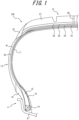
- FIG. 1 is a schematic cross-sectional view of the left half of a tire according to one of the disclosed embodiments taken along a plane including its rotational axis.
- a cross-sectional view of the right half is the same in structure as that of the left half and accordingly is omitted.
- a tire 100 includes a pair of bead portions 11, a pair of sidewall portions 12, and a tread portion 13.
- a pair of bead cores 14 are buried in the bead portions 11, and a sidewall rubber is provided in each sidewall portion 12.
- the tire 100 also includes a carcass 16 that extends from the tread portion 13 through the sidewall portion 12 and is folded from inside to outside in the tire axial direction around the bead core 14 and a bead filler 15 and held by a folding portion.
- the bead filler 15 extends outward in the tire radial direction from the upper end of the bead core 14.
- the carcass 16 is composed of one or more carcass plies each including a carcass cord and a ply coating rubber covering the carcass cord.
- the tire 100 includes an inner liner rubber 17 along the inner surface of the carcass 16, as an inner rubber member.
- the tire 100 includes, in the bead portion 11, a rubber chafer 18 as a conductive rubber member located above a rim R.
- the tire 100 also includes, in the tread portion 13, a belt 19, a cap layer 24, a top under cushion 25, a base tread 26, and a cap tread 27 in this order on the outer circumferential side of the carcass 16 to strengthen the tread portion 13.
- the belt 19 is composed of one or more layers of belt plies each including a belt cord and a belt coating rubber covering the belt cord.
- the sidewall rubber in the sidewall portion 12 is formed by laminating a sidewall outermost layer rubber 41 at the outer surface and a sidewall inner layer rubber 42 closer to the tire inner surface than the sidewall outermost layer rubber is 41, and the sidewall inner layer rubber 42 is located between the sidewall outermost layer rubber 41 and the carcass 16.
- the sidewall inner layer rubber 42 is located between and adjacent to the sidewall outermost layer rubber 41 and the carcass 16.
- the sidewall inner layer rubber 42 is at least in contact with the rubber chafer 18 in the bead portion 11 and the top under cushion 25 in the tread portion 13.
- an antenna rubber 28 as a conductive rubber member is in contact with the top under cushion 25 and is partially exposed to the tire contact patch.
- the tire 100 illustrated in FIG. 1 has a structure in which the conductive rubber member located above the rim R, i.e. the rubber chafer 18, and the antenna rubber 28 exposed to the contact patch are connected via the sidewall inner layer rubber 42 and the top under cushion 25.
- the conductivity, the fuel efficiency, the durability, and the ozone resistance of the tire 100 can be improved in a balanced manner by appropriately adjusting the volume resistivity, the anti oxidant mass ratio, the storage modulus E', and the like for the ply coating rubber, the sidewall inner layer rubber 42, and the sidewall outermost layer rubber 41 as mentioned above.
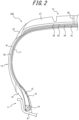
- FIG. 2 is a schematic cross-sectional view of the left half of a tire according to another one of the disclosed embodiments taken along a plane including its rotational axis.
- a cross-sectional view of the right half is the same in structure as that of the left half and accordingly is omitted.
- the same members as those in FIG. 1 are given the same reference signs as in FIG. 1 .
- a tire 200 in FIG. 2 is different from the tire 100 in FIG. 1 in that a sidewall inner layer rubber 42' is continuous from the sidewall portion 12 to the tread portion 13 and is connected to the antenna rubber 28.
- the conductivity, the fuel efficiency, the durability, and the ozone resistance of the tire 200 can be improved in a balanced manner by appropriately adjusting the volume resistivity, the anti oxidant mass ratio, the storage modulus E', and the like for the ply coating rubber, the sidewall inner layer rubber 42', and the sidewall outermost layer rubber 41 as mentioned above, too.
- the sidewall inner layer rubber is not limited to the structures illustrated in FIGS. 1 and 2 as long as it is located closer to the tire inner surface than the sidewall outermost layer rubber. More specifically, the sidewall inner layer rubber may, for example, extend directly to the tire contact patch.
- sidewall outermost layer rubber 41 and the sidewall inner layer rubber 42 or 42' are laminated in the sidewall portion 12 in FIGS. 1 and 2 as sidewall rubbers, one or more layers of sidewall rubbers may be further laminated.
- the tire may further include a mini-sidewall rubber 23 that is in contact with the sidewall portion 12 and the tread portion 13 and acts as an interface therebetween, as illustrated in FIGS. 1 and 2 .
- the carcass is composed of one or more carcass plies each including a carcass cord and a ply coating rubber covering the carcass cord, as mentioned above.
- carcass cord examples include single-twist cords made of organic fibers such as nylon 66 fibers, aramid fibers, nylon fibers, polyethylene naphthalate (PEN) fibers, polyethylene (PE) fibers, and polyethylene terephthalate (PET) fibers, and composite cords in which a plurality of cords of different organic fibers mentioned above are twisted, without being limited thereto.
- organic fibers such as nylon 66 fibers, aramid fibers, nylon fibers, polyethylene naphthalate (PEN) fibers, polyethylene (PE) fibers, and polyethylene terephthalate (PET) fibers
- PEN polyethylene naphthalate
- PET polyethylene terephthalate
- the volume resistivity of the ply coating rubber is 1 ⁇ 10 10 ⁇ cm or more. If the volume resistivity of the ply coating rubber is less than 1 ⁇ 10 10 ⁇ cm, a larger amount of carbon black needs to be contained, which may cause a decrease in the fuel efficiency of the tire.
- the volume resistivity of the ply coating rubber is preferably 1 ⁇ 10 11 ⁇ cm or more and more preferably 1 ⁇ 10 12 ⁇ cm or more, from the viewpoint of further improving the fuel efficiency of the tire.
- the volume resistivity of the ply coating rubber can be adjusted, for example, by adjusting the content of carbon black.
- volume resistivity of a member such as the ply coating rubber can be measured in accordance with the procedure described in the EXAMPLES section.
- the loss tangent (tan ⁇ ) of the ply coating rubber at 25 °C is preferably 0.20 or less. If tan ⁇ is 0.20 or less, the low loss property of the tire can be enhanced and the fuel efficiency of the tire can be further improved. From the same viewpoint, tan ⁇ of the ply coating rubber at 25 °C is more preferably 0.17 or less. tan ⁇ of the ply coating rubber can be adjusted, for example, by adjusting the content of fillers such as carbon black and silica or adjusting the ratio of the rubber component.
- tan ⁇ of a member such as the ply coating rubber can be measured in accordance with the procedure described in the EXAMPLES section.
- the storage modulus E' pc of the ply coating rubber at a dynamic strain of 1 % and 25 °C is preferably 5.0 MPa or more and 10.0 MPa or less. If E' pc is within this range, the durability of the tire can be further improved.
- the storage modulus of the ply coating rubber can be adjusted, for example, by adjusting the content of fillers or adjusting the crosslinking density.
- the carcass before tire molding can be produced by sandwiching a carcass cord between sheets made of a rubber composition for ply coating rubber.
- the rubber composition for ply coating rubber may contain a rubber component, carbon black, silica, a vulcanizing agent such as sulfur, a vulcanization accelerator, and an anti oxidant.
- the rubber composition for ply coating rubber may further contain, besides the foregoing components, compounding agents typically used for production of rubber members, such as a wax, a softener, a plasticizer, and a tackifier, as appropriate.
- the rubber composition for ply coating rubber can be prepared by kneading the components using a Banbury mixer, a kneader, an open roll, or the like.
- Examples of the rubber component include natural rubber (NR) and synthetic rubber.
- Examples of the synthetic rubber include butadiene rubber (BR), styrene-butadiene rubber (SBR), isoprene rubber (IR), butyl rubber (IIR), halogenated butyl rubber, chloroprene rubber (CR), acrylonitrile-butadiene rubber (NBR), and ethylene-propylene-diene rubber (EPDM).
- One rubber component may be used alone, or two or more rubber components may be used in combination.
- silica examples include wet silica and dry silica.
- One silica may be used alone, or two or more silicas may be used in combination.
- vulcanization accelerator examples include sulfenamide vulcanization accelerators such as N-cyclohexyl-2-benzothiazolyl sulfenamide (CBS), N-t-butyl-2-benzothiazil sulfenamide (TBBS), and N-t-butyl-2-benzothiazil sulfenimide (TBSI); guanidine vulcanization accelerators such as diphenylguanidine (DPG); thiuram vulcanization accelerators such as tetraoctylthiuram disulfide and tetrabenzylthiuram disulfide; and vulcanization accelerators such as zinc dialkyldithiophosphate.
- CBS is preferable as the vulcanization accelerator.
- One vulcanization accelerator may be used alone, or two or more vulcanization accelerators may be used in combination.
- the anti oxidant examples include N-phenyl-N'-(1,3-dimethylbutyl)-p-phenylenediamine (6PPD), 2,2,4-trimethyl-1,2-dihydroquinoline polymer (TMDQ), 6-ethoxy-2,2,4-trimethyl-1,2-dihydroquinoline (AW), N,N'- diphenyl-p-phenylenediamine (DPPD), N,N'-di -sec-butyl-p-phenylenediamine, and N-phenyl-N'-(methylheptyl)-p-phenylenediamine.
- 6PPD is preferable as the anti oxidant.
- One anti oxidant may be used alone, or two or more anti oxidants may be used in combination.
- the ply coating rubber preferably contains carbon black.
- the nitrogen adsorption specific surface area of the carbon black is preferably 20 m 2 /g or more from the viewpoint of durability, and preferably 50 m 2 /g or less and more preferably 35 m 2 /g or less from the viewpoint of fuel efficiency.
- the content of carbon black in the ply coating rubber is preferably 30 parts by mass or more with respect to 100 parts by mass of the rubber component from the viewpoint of durability, and preferably 50 parts by mass or less with respect to 100 parts by mass of the rubber component from the viewpoint of fuel efficiency.
- the mass ratio of the anti oxidant in the ply coating rubber is preferably 0.4 mass% or more and 1.0 mass% or less. If the mass ratio of the anti oxidant in the ply coating rubber is within this range, the ozone resistance of the tire can be further improved.
- the mass ratio of the anti oxidant in a member such as the ply coating rubber denotes not the number of parts of the anti oxidant with respect to 100 parts by mass of the rubber component but the mass ratio of the anti oxidant to the total mass of the member.
- the volume resistivity of the sidewall inner layer rubber is 1 ⁇ 10 7 ⁇ cm or less. If the volume resistivity of the sidewall inner layer rubber is more than 1 ⁇ 10 7 ⁇ cm, static electricity cannot be sufficiently released from the tire, which may cause degradation in conductivity.
- the volume resistivity of the sidewall inner layer rubber is preferably 5 ⁇ 10 6 ⁇ cm or less, more preferably 3 ⁇ 10 6 ⁇ cm or less, and further preferably 1 ⁇ 10 6 ⁇ cm or less, from the viewpoint of further improving the conductivity of the tire.
- the volume resistivity of the sidewall inner layer rubber can be adjusted, for example, by adjusting the content of carbon black.
- the storage modulus E' swin of the sidewall inner layer rubber at a dynamic strain of 1 % and 25 °C is preferably 3.0 MPa or more and 8.0 MPa or less. If E' swin is within this range, the durability of the tire can be further improved.
- the storage modulus of the sidewall inner layer rubber can be adjusted, for example, by adjusting the content of fillers such as carbon black and silica, changing the type of carbon black, changing the type of silica, adjusting the ratio of the rubber component, or adjusting the content of the softener.
- the maximum thickness of the sidewall inner layer rubber is 0.1 mm or more and 1.2 mm or less. If the maximum thickness of the sidewall inner layer rubber is less than 0.1 mm, static electricity cannot be sufficiently released from the tire, which may cause degradation in conductivity. If the maximum thickness of the sidewall inner layer rubber is more than 1.2 mm, the fuel efficiency of the tire may degrade.
- the maximum thickness of the sidewall inner layer rubber is preferably 0.2 mm or more and more preferably 0.25 mm or more from the viewpoint of further improving the conductivity, and preferably 1.0 mm or less and more preferably 0.6 mm or less from the viewpoint of further improving the fuel efficiency.
- the sidewall inner layer rubber before tire molding can be produced by processing a rubber composition for sidewall inner layer rubber into a predetermined shape.
- the rubber composition for sidewall inner layer rubber may contain a rubber component, carbon black, silica, a vulcanizing agent such as sulfur, a vulcanization accelerator, and an anti oxidant.
- the rubber composition for sidewall inner layer rubber may further contain, for example, the compounding agents described above with regard to the ply coating rubber as appropriate.
- the rubber composition for sidewall inner layer rubber can be prepared by kneading the components using a Banbury mixer, a kneader, an open roll, or the like.
- the rubber component the silica, the vulcanization accelerator, and the anti oxidant are the same as those described above with regard to the ply coating rubber.
- the sidewall inner layer rubber preferably contains carbon black (I) having a nitrogen adsorption specific surface area of 25 m 2 /g or more and 75 m 2 /g or less and carbon black (II) having a nitrogen adsorption specific surface area of more than 75 m 2 /g and 150 m 2 /g or less.
- carbon black (I) and the carbon black (II) together can achieve more favorable balance between the conductivity and fuel efficiency of the tire.
- the sidewall inner layer rubber (and the rubber composition for sidewall inner layer rubber) preferably contains 10 parts to 80 parts by mass of the carbon black (I) having a nitrogen adsorption specific surface area of 25 m 2 /g or more and 75 m 2 /g or less with respect to 100 parts by mass of the rubber component, and 5 parts to 30 parts by mass of the carbon black (II) having a nitrogen adsorption specific surface area of more than 75 m 2 /g and 150 m 2 /g or less with respect to 100 parts by mass of the rubber component.
- the mass ratio of the anti oxidant in the sidewall inner layer rubber in the tire is 1.2 mass% or more. If the mass ratio of the anti oxidant in the sidewall inner layer rubber is less than 1.2 mass%, the ozone resistance of the tire may not be able to be improved.
- the mass ratio of the anti oxidant in the sidewall inner layer rubber is preferably 1.4 mass% or more and more preferably 1.8 mass% or more, from the viewpoint of further improving the ozone resistance of the tire.
- the mass ratio of the anti oxidant in the sidewall inner layer rubber is preferably 5.0 mass% or less, from the viewpoint of more sufficiently achieving the effects by the other components.
- the mass ratio of the anti oxidant in a member such as the sidewall inner layer rubber denotes not the number of parts of the anti oxidant with respect to 100 parts by mass of the rubber component but the mass ratio of the anti oxidant to the total mass of the member.
- the volume resistivity of the sidewall outermost layer rubber is 1 ⁇ 10 10 ⁇ cm or more. If the volume resistivity of the sidewall outermost layer rubber is less than 1 ⁇ 10 10 ⁇ cm, a larger amount of carbon black needs to be contained, which may cause a decrease in the fuel efficiency of the tire.
- the volume resistivity of the sidewall outermost layer rubber is preferably 1 ⁇ 10 11 ⁇ cm or more and more preferably 1 ⁇ 10 12 ⁇ cm or more, from the viewpoint of further improving the fuel efficiency of the tire.
- the volume resistivity of the sidewall outermost layer rubber can be adjusted, for example, by adjusting the content of carbon black.
- the loss tangent (tan ⁇ ) of the sidewall outermost layer rubber at 25 °C is preferably 0.15 or less. If tan ⁇ is 0.15 or less, the low loss property of the tire can be enhanced and the fuel efficiency of the tire can be further improved. From the same viewpoint, tan ⁇ of the sidewall outermost layer rubber at 25 °C is more preferably less than 0.10.
- tan ⁇ of a member such as the ply coating rubber can be measured in accordance with the procedure described in the EXAMPLES section.
- tan ⁇ of the sidewall outermost layer rubber can be adjusted, for example, by adjusting the content of fillers such as carbon black and silica or adjusting the content of the softener.
- the storage modulus E' swout of the sidewall outermost layer rubber at a dynamic strain of 1 % and 25 °C is preferably 2.0 MPa or more and 7.0 MPa or less. If E' swout is within this range, the durability of the tire can be further improved.
- the storage modulus of the sidewall outermost layer rubber can be adjusted, for example, by adjusting the content of fillers such as carbon black and silica, adjusting the ratio of the rubber component, or adjusting the crosslinking density.
- the sidewall outermost layer rubber before tire molding can be produced by processing a rubber composition for sidewall outermost layer rubber into a predetermined shape.
- the rubber composition for sidewall outermost layer rubber may contain a rubber component, carbon black, silica, a vulcanizing agent such as sulfur, a vulcanization accelerator, and an anti oxidant.
- the rubber composition for sidewall outermost layer rubber may further contain, for example, the compounding agents described above with regard to the ply coating rubber as appropriate.
- the rubber composition for sidewall outermost layer rubber can be prepared by kneading the components using a Banbury mixer, a kneader, an open roll, or the like.
- the rubber component the silica, the vulcanization accelerator, and the anti oxidant are the same as those described above with regard to the ply coating rubber.
- the sidewall outermost layer rubber preferably contains carbon black.
- the nitrogen adsorption specific surface area of the carbon black is preferably 30 m 2 /g or more from the viewpoint of durability, and preferably 70 m 2 /g or less and more preferably 55 m 2 /g or less from the viewpoint of low heat generating property.
- the content of carbon black in the sidewall outermost layer rubber is preferably 10 parts by mass or more with respect to 100 parts by mass of the rubber component from the viewpoint of durability, and preferably 50 parts by mass or less with respect to 100 parts by mass of the rubber component from the viewpoint of low heat generating property.
- the mass ratio of the anti oxidant in the sidewall outermost layer rubber is preferably 0.5 mass% or more and 3.0 mass% or less. If the mass ratio of the anti oxidant in the sidewall outermost layer rubber is within this range, the ozone resistance of the tire can be further improved.
- the mass ratio of the anti oxidant in a member such as the sidewall outermost layer rubber denotes not the number of parts of the anti oxidant with respect to 100 parts by mass of the rubber component but the mass ratio of the anti oxidant to the total mass of the member.
- the mass ratio of the anti oxidant in the whole sidewall rubber including the sidewall inner layer rubber and the sidewall outermost layer rubber in the tire is preferably 1.2 mass% or more. If the mass ratio is 1.2 mass% or more, the ozone resistance of the tire can be further improved. From the same viewpoint, the mass ratio of the anti oxidant in the whole of the sidewall outermost layer rubber and the sidewall inner layer rubber is more preferably 1.4 mass% or more. The mass ratio of the anti oxidant in the whole of the sidewall outermost layer rubber and the sidewall inner layer rubber is preferably 4.0 mass% or less, from the viewpoint of more sufficiently achieving the effects by the other components.
- the proportion ((the mass ratio of the anti oxidant in the sidewall inner layer rubber)/(the mass ratio of the anti oxidant in the sidewall outermost layer rubber)) of the mass ratio of the anti oxidant in the sidewall inner layer rubber to the mass ratio of the anti oxidant in the sidewall outermost layer rubber in the tire is 0.7 or more and 2.0 or less. If the proportion in mass ratio is less than 0.7, the anti oxidant in the sidewall inner layer rubber is less than the anti oxidant in the sidewall outermost layer rubber, so that the anti oxidant in the sidewall outermost layer rubber may move to the sidewall inner layer rubber and cause degradation in the ozone resistance of the tire.
- the proportion in mass ratio is more than 2.0, the anti oxidant in the sidewall outermost layer rubber is less than the anti oxidant in the sidewall inner layer rubber, so that the ozone resistance of the tire may degrade. Moreover, the durability may degrade as a result of a decrease in the adhesiveness of the ply coating rubber.
- the proportion in mass ratio is preferably 0.75 or more and more preferably 0.90 or more, and preferably 1.6 or less and more preferably 1.3 or less, from the viewpoint of further improving the ozone resistance and durability of the tire.
- the proportion (E' swout /E' swin ) of the storage modulus E' swout of the sidewall outermost layer rubber at a dynamic strain of 1 % and 25 °C to the storage modulus E' swin of the sidewall inner layer rubber at a dynamic strain of 1 % and 25 °C in the tire is more than 0.57 and less than 1.5. If the proportion is 0.57 or less or 1.5 or more, the tire may be locally deformed due to undesired stiffness difference and as a result decrease in durability. Moreover, the fuel efficiency of the tire may degrade as a result of heat generation in the deformed part.
- the proportion is preferably 0.6 or more and preferably 1.2 or less, from the viewpoint of maintaining favorable durability and fuel efficiency.
- the storage modulus of each member can be measured in accordance with the procedure described in the EXAMPLES section.
- the proportion (E' swin /E' pc ) of the storage modulus E' swin of the sidewall inner layer rubber at a dynamic strain of 1 % and 25 °C to the storage modulus E' pc of the ply coating rubber at a dynamic strain of 1 % and 25 °C in the tire is preferably more than 0.5 and less than 1.0. If the proportion is more than 0.5 and less than 1.0, local deformation of the tire caused by undesired stiffness difference can be effectively suppressed, and the durability and fuel efficiency of the tire can be further improved.
- E' swout , E' swin , and E' pc preferably satisfy the relationship E' swout ⁇ E' swin ⁇ E' pc . If this inequality is satisfied, local deformation of the tire caused by undesired stiffness difference can be suppressed more effectively, and the durability and fuel efficiency of the tire can be further improved.
- the tire described above can be produced, for example, by the following method.
- the foregoing carcass, sidewall inner layer rubber, and sidewall outermost layer rubber processed into predetermined shapes beforehand are molded in a tire molding machine by a typical method together with the other tire members, to form an unvulcanized tire.
- the unvulcanized tire is then heated and pressurized (vulcanized) in a vulcanizer, to produce the tire.
- the mass ratio of carbon black is unchanged between immediately before and immediately after the vulcanization. It can also be considered that, for the ply coating rubber, the sidewall inner layer rubber, and the sidewall outermost layer rubber, the mass ratio of the anti oxidant may change between immediately before and immediately after the vulcanization but the change is slight.
- a rubber composition for ply coating rubber was prepared with the formulation shown in Table 1 through kneading using a Banbury mixer.
- Table 1 (For ply coating rubber) a Natural rubber parts by mass 70 Styrene-butadiene rubber 30 Carbon black 45 Stearic acid 2 Zinc oxide 4 Anti oxidant (RD) 0.7 Vulcanization accelerator (DM+NS) 0.83 Sulfur 3.44 Total parts by mass 155.97 Mass ratio of anti oxidant mass% 0.45
- Styrene-butadiene rubber "JSR1500” made by JSR Corporation.
- Carbon black "STERLING V” made by Cabot Corporation, N660 (nitrogen adsorption specific surface area: 35 m 2 /g).
- Anti oxidant RD: "NOCRAC 224 (224-S)” made by Ouchi Shinko Chemical Industrial Co., Ltd., 2,2,4-trimethyl-1,2-dihydroquinoline polymer.
- Vulcanization accelerator (DM + NS): mixture of "NOCCELER DM-P (DM)” (di-2-benzothiazolyl disulfide) and "NOCCELER NS-P (NS)” (N-tert-butyl-2-benzothiazolylsulfenamide) made by Ouchi Shinko Chemical Industrial Co., Ltd.
- a rubber composition X for sidewall outermost layer rubber was prepared with the corresponding formulation shown in Table 2 through kneading using a Banbury mixer.
- a rubber composition Z for sidewall outermost layer rubber was prepared with the corresponding formulation shown in Table 2 through kneading using a Banbury mixer.
- Butadiene rubber "UBEPOL 150L” made by Ube Industries, Ltd.
- Carbon black "Asahi #65” made by Asahi Carbon Co., Ltd., N550 (nitrogen adsorption specific surface area: 42 m 2 /g).
- Silica nitrogen adsorption specific surface area: 105 m 2 /g, CTAB specific surface area: 90 m 2 /g.
- Anti oxidant (RD + 6C) mixture of "NOCRAC 224 (224-S)" (2,2,4-trimethyl-1,2-dihydroquinoline polymer) and "NOCRAC 6C” (N-phenyl-N'-(1,3-dimethylbutyl)-p-phenylenediamine) made by Ouchi Shinko Chemical Industrial Co., Ltd.
- DCPD resin "Quintone1105" made by Zeon Corporation.
- Vulcanization accelerator (CZ) "NOCCELER CZ” made by Ouchi Shinko Chemical Industrial Co., Ltd., N-cyclohexyl-2-benzothiazolylsulfenamide.
- Rubber compositions A, B, C, E, G, H, and I for sidewall inner layer rubber were each prepared with the corresponding formulation shown in Table 3 through kneading using a Banbury mixer.
- Table 3 (For sidewall inner layer rubber) A B C E G H I Natural rubber parts by mass 50 50 50 50 50 50 50 50 50 50 50 50 50 50 50 50 50 50 Carbon black 1 30 25 30 30 30 40 38 Carbon black 2 15 20 10 15 10 0 15 Oil 4 4 4 4 4 4 4 4 DCPD resin 1 1 1 1 1 1 1 1 1 1 1 1 1 1 1 Stearic acid 2 2 2 2 2 2 2 2 2 Zinc oxide 3 3 3 3 3 3 3 3 3 3 3 3 3 3 3 3 3 3 3 3 3 3 3 3 3 3 3 3 3 3 3 3 3 3 3 3 3 3 3 3 3 3 3 3 3 3 3 3 3 3 3 3 3 5 1.5 3 3 3 Wax 1.7 1.7 1.7 1.7 1.7 1.7 Vulcanization accelerator (CZ) 0.6 0.6 0.6 0.6 0.6 0.6 0.6 0.6 S
- Butadiene rubber "UBEPOL 150L” made by Ube Industries, Ltd.
- Carbon black 1 "Asahi #65” made by Asahi Carbon Co., Ltd., N550 (nitrogen adsorption specific surface area: 42 m 2 /g).
- Carbon black 2 "DIABLACK N234" made by Mitsubishi Chemical Corporation, N234 (nitrogen adsorption specific surface area: 123 m 2 /g).
- DCPD resin "Quintone1105" made by Zeon Corporation.
- Anti oxidant (RD + 6C) mixture of "NOCRAC 224 (224-S)" (2,2,4-trimethyl-1,2-dihydroquinoline polymer) and "NOCRAC 6C” (N-phenyl-N'-(1,3-dimethylbutyl)-p-phenylenediamine) made by Ouchi Shinko Chemical Industrial Co., Ltd.
- Vulcanization accelerator (CZ) "NOCCELER CZ” made by Ouchi Shinko Chemical Industrial Co., Ltd., N-cyclohexyl-2-benzothiazolylsulfenamide.
- the rubber compositions obtained in the above-described manner were combined as shown in Table 4, and processed into predetermined shapes and used in the corresponding members. These members were molded together with other tire members such as a rubber chafer, an antenna rubber, and the like, and then vulcanized according to an ordinary method to produce each pneumatic tire having the structure illustrated in FIG. 1 .
- carcass cords single-twist cords made of nylon 66 fibers were used.
- test piece of 70 mm ⁇ 10 mm ⁇ 2 mm was collected from each member in the pneumatic tire of each example.
- the volume resistivity of the member was measured in accordance with JIS K 6271 (2008) using "R8340" made by Advantest Corporation.
- test piece of 50 mm ⁇ 5 mm ⁇ 2 mm was collected from each member in the pneumatic tire of each example.
- the storage modulus (E') and the loss tangent (tan ⁇ ) at 25 °C were measured under the conditions of an initial strain of 2 %, a dynamic strain of 1 %, and a frequency of 52 Hz, using a spectrometer made by Ueshima Seisakusho Co., Ltd.
- tan ⁇ was measured only for the ply coating rubber and the sidewall inner layer rubber.
- the tread portion of the pneumatic tire of each example was placed on an iron plate under the conditions of an internal pressure of 2.0 MPa and a load of 4.7 kN, and the volume resistivity between the rim and the iron plate was measured with an applied voltage of 100 V.
- the volume resistivity of the tire of each example is represented by an index, where the volume resistivity of the tire of Comparative Example 1 is 100.
- a smaller index value indicates better conductivity. More specifically, the conductivity is determined as favorable in the case where the index value is 90 or less.
- the pneumatic tire of each example was rotated at a speed of 80 km/hr using a rotating drum, and the rolling resistance was measured with a load of 4.82 kN.
- the rolling resistance of the tire of each example is represented by an index, where the inverse of the rolling resistance of the tire of Comparative Example 1 is 100.
- a larger index value indicates lower rolling resistance and better fuel efficiency. More specifically, the fuel efficiency is determined as favorable in the case where the index value is 93 or more.
- the pneumatic tire of each example was attached to an applicable rim (size: 15 ⁇ 6 J), set to an internal pressure of 240 kPa, and run for 300 hr at a speed of 60 km/m with an ozone concentration of 30 pphm.
- the crack area in the maximum strain portion on the tire side after running was measured using X-Loupe made by Lumos Tech.
- the crack area of the tire of each example is represented by an index, where the inverse of the crack area of the tire of Comparative Example 1 is 100.
- a larger index value indicates better ozone resistance. More specifically, the ozone resistance is determined as favorable in the case where the index value is 94 or more.
- the pneumatic tire of each example was attached to an applicable rim (size: 15 ⁇ 6 J), set to an internal pressure of 240 kPa, and subjected to a drum endurance test under the conditions of a load 4.17 kN, a speed of 89 km/h, and 38 °C. The running distance until a failure occurred was measured.
- the running distance of the tire of each example is represented by an index, where the running distance of the tire of Comparative Example 1 is 100.
- a larger index value indicates better durability. More specifically, the durability is determined as favorable in the case where the index value is 98 or more.
- each example was comprehensively evaluated as good in the case where the index value of the volume resistivity for the evaluation of the conductivity was 90 or less, the index value of the rolling resistance for the evaluation of the fuel efficiency was 93 or more, the index value of the crack area for the evaluation of the ozone resistance was 94 or more, and the index value of the running distance of the tire for the evaluation of the durability was 98 or more, and comprehensively evaluated as poor in the case where at least one index value did not meet the criterion.
Landscapes
- Engineering & Computer Science (AREA)
- Mechanical Engineering (AREA)
- Tires In General (AREA)
- Compositions Of Macromolecular Compounds (AREA)
Description
- The present disclosure relates to a pneumatic tire.
- Typically, tires generate static electricity during vehicle running. If static electricity is accumulated on tires, radio noise and spark discharge may cause vehicle failures and the like. It is therefore important to decrease the electrical resistance of tires and prevent electrification as much as possible. To prevent accumulation of static electricity on tires, tires in which conductive rubber is used in rubber members such as sidewalls and ply coating rubbers are currently available on the market.
- In recent years, there is demand to reduce the loss (rolling resistance) of sidewall rubbers and ply coating rubbers in order to further enhance the fuel efficiency of tires. Examples of loss reduction means include reducing the amount of carbon black contained, and replacing carbon black with a filler such as silica. However, all these means tend to decrease the conductivity of tires. That is, there is generally a trade-off between conductivity and fuel efficiency in tires.
- To improve the conductivity and rolling resistance performance of tires, for example,
JP 2007-008269 A - For example,
JP 2013-226917 A
EP2799247 discloses a pneumatic tire capable of ensuring conductivity while being reduced in weight, and further having good fuel efficiency and handling stability. -
- PTL 1:
JP 2007-008269 A - PTL 2:
JP 2013-226917 A - However, in the case where a conductive rubber layer is provided between a sidewall rubber and a carcass as in the tires disclosed in PTL 1 and PTL 2, there is a possibility that, due to the property difference between these members, the tire is locally deformed and decreases in durability. Such local deformation causes heat generation, as a result of which the fuel efficiency of the tire degrades. The tires disclosed in PTL 1 and PTL 2 thus have room for improvement in durability and fuel efficiency.
- Moreover, the tires disclosed in PTL 1 and PTL 2 are not subjected to any particular measures to enhance the ozone resistance, and have room for improvement in ozone resistance.
- It could therefore be helpful to provide a pneumatic tire excellent in fuel efficiency, durability, and ozone resistance while having high conductivity.
- A pneumatic tire according to the present disclosure comprises a carcass and a sidewall rubber, wherein the sidewall rubber is formed by laminating two or more layers of rubbers including a sidewall outermost layer rubber at a tire outer surface and a sidewall inner layer rubber closer to a tire inner surface than the sidewall outermost layer rubber is, the carcass is composed of at least one carcass ply each including a carcass cord and a ply coating rubber covering the carcass cord, the ply coating rubber has a volume resistivity of 1 × 10¹⁰ Ω·cm or more, the sidewall outermost layer rubber has a volume resistivity of 1 × 10¹⁰ Ω·cm or more, the sidewall inner layer rubber has a volume resistivity of 1 × 10⁷ Ω·cm or less, the sidewall inner layer rubber has a maximum thickness of 0.1 mm or more and 1.2 mm or less, a mass ratio of an anti oxidant in the sidewall inner layer rubber is 1.2 mass% or more, a proportion of the mass ratio of the anti oxidant in the sidewall inner layer rubber to a mass ratio of an anti oxidant in the sidewall outermost layer rubber, calculated as (the mass ratio of the anti oxidant in the sidewall inner layer rubber)/(the mass ratio of the anti oxidant in the sidewall outermost layer rubber), is 0.7 or more and 2.0 or less, and a proportion E'swout/E'swin of a storage modulus E'swout of the sidewall outermost layer rubber at a dynamic strain of 1 % and 25 °C to a storage modulus E'swin of the sidewall inner layer rubber at a dynamic strain of 1 % and 25 °C is more than 0.57 and less than 1.5.
- It is therefore possible to provide a tire excellent in fuel efficiency, durability, and ozone resistance while having high conductivity.
- In the accompanying drawings:
-
FIG. 1 is a schematic cross-sectional view of the left half of a pneumatic tire according to one of the disclosed embodiments taken along a plane including its rotational axis; and -
FIG. 2 is a schematic cross-sectional view of the left half of a pneumatic tire according to another one of the disclosed embodiments taken along a plane including its rotational axis. - A pneumatic tire according to the present disclosure will be described in detail below by way of embodiments.
- A pneumatic tire (hereafter also simply referred to as "tire") according to the present disclosure includes a carcass and a sidewall rubber. The sidewall rubber is formed by laminating two or more layers of rubbers including a sidewall outermost layer rubber at the tire outer surface and a sidewall inner layer rubber closer to the tire inner surface than the sidewall outermost layer rubber is. The carcass includes a carcass cord and a ply coating rubber covering the carcass cord.
- The ply coating rubber has a volume resistivity of 1 × 10¹⁰ Ω·cm or more, the sidewall outermost layer rubber has a volume resistivity of 1 × 10¹⁰ Ω·cm or more, and the sidewall inner layer rubber has a volume resistivity of 1 × 10⁷ Ω·cm or less.
- The sidewall inner layer rubber has a maximum thickness of 0.1 mm or more and 1.2 mm or less.
- The mass ratio of an anti oxidant in the sidewall inner layer rubber is 1.2 mass% or more.
- The proportion ((the mass ratio of the anti oxidant in the sidewall inner layer rubber)/(the mass ratio of the anti oxidant in the sidewall outermost layer rubber)) of the mass ratio of the anti oxidant in the sidewall inner layer rubber to the mass ratio of the anti oxidant in the sidewall outermost layer rubber is 0.7 or more and 2.0 or less.
- The proportion (E'swout/E'swin) of the storage modulus E'swout of the sidewall outermost layer rubber at a dynamic strain of 1 % and 25 °C to the storage modulus E'swin of the sidewall inner layer rubber at a dynamic strain of 1 % and 25 °C is more than 0.57 and less than 1.5.
- The tire according to the present disclosure has all of these features and thus is excellent in fuel efficiency, durability, and ozone resistance while having high conductivity.
-
FIG. 1 is a schematic cross-sectional view of the left half of a tire according to one of the disclosed embodiments taken along a plane including its rotational axis. A cross-sectional view of the right half is the same in structure as that of the left half and accordingly is omitted. InFIG. 1 , atire 100 includes a pair ofbead portions 11, a pair ofsidewall portions 12, and atread portion 13. A pair ofbead cores 14 are buried in thebead portions 11, and a sidewall rubber is provided in eachsidewall portion 12. Thetire 100 also includes acarcass 16 that extends from thetread portion 13 through thesidewall portion 12 and is folded from inside to outside in the tire axial direction around thebead core 14 and abead filler 15 and held by a folding portion. Thebead filler 15 extends outward in the tire radial direction from the upper end of thebead core 14. Thecarcass 16 is composed of one or more carcass plies each including a carcass cord and a ply coating rubber covering the carcass cord. Thetire 100 includes aninner liner rubber 17 along the inner surface of thecarcass 16, as an inner rubber member. - The
tire 100 includes, in thebead portion 11, arubber chafer 18 as a conductive rubber member located above a rim R. Thetire 100 also includes, in thetread portion 13, abelt 19, acap layer 24, a top undercushion 25, abase tread 26, and acap tread 27 in this order on the outer circumferential side of thecarcass 16 to strengthen thetread portion 13. Thebelt 19 is composed of one or more layers of belt plies each including a belt cord and a belt coating rubber covering the belt cord. The sidewall rubber in thesidewall portion 12 is formed by laminating a sidewalloutermost layer rubber 41 at the outer surface and a sidewallinner layer rubber 42 closer to the tire inner surface than the sidewall outermost layer rubber is 41, and the sidewallinner layer rubber 42 is located between the sidewalloutermost layer rubber 41 and thecarcass 16. In this example, the sidewallinner layer rubber 42 is located between and adjacent to the sidewalloutermost layer rubber 41 and thecarcass 16. The sidewallinner layer rubber 42 is at least in contact with therubber chafer 18 in thebead portion 11 and the top undercushion 25 in thetread portion 13. Further, in thetread portion 13, anantenna rubber 28 as a conductive rubber member is in contact with the top undercushion 25 and is partially exposed to the tire contact patch. - Thus, the
tire 100 illustrated inFIG. 1 has a structure in which the conductive rubber member located above the rim R, i.e. therubber chafer 18, and theantenna rubber 28 exposed to the contact patch are connected via the sidewallinner layer rubber 42 and the top undercushion 25. - The conductivity, the fuel efficiency, the durability, and the ozone resistance of the
tire 100 can be improved in a balanced manner by appropriately adjusting the volume resistivity, the anti oxidant mass ratio, the storage modulus E', and the like for the ply coating rubber, the sidewallinner layer rubber 42, and the sidewalloutermost layer rubber 41 as mentioned above. -
FIG. 2 is a schematic cross-sectional view of the left half of a tire according to another one of the disclosed embodiments taken along a plane including its rotational axis. A cross-sectional view of the right half is the same in structure as that of the left half and accordingly is omitted. InFIG. 2 , the same members as those inFIG. 1 are given the same reference signs as inFIG. 1 . Atire 200 inFIG. 2 is different from thetire 100 inFIG. 1 in that a sidewall inner layer rubber 42' is continuous from thesidewall portion 12 to thetread portion 13 and is connected to theantenna rubber 28. The conductivity, the fuel efficiency, the durability, and the ozone resistance of thetire 200 can be improved in a balanced manner by appropriately adjusting the volume resistivity, the anti oxidant mass ratio, the storage modulus E', and the like for the ply coating rubber, the sidewall inner layer rubber 42', and the sidewalloutermost layer rubber 41 as mentioned above, too. - The sidewall inner layer rubber is not limited to the structures illustrated in
FIGS. 1 and2 as long as it is located closer to the tire inner surface than the sidewall outermost layer rubber. More specifically, the sidewall inner layer rubber may, for example, extend directly to the tire contact patch. - Although two layers, i.e. the sidewall
outermost layer rubber 41 and the sidewallinner layer rubber 42 or 42', are laminated in thesidewall portion 12 inFIGS. 1 and2 as sidewall rubbers, one or more layers of sidewall rubbers may be further laminated. - The tire may further include a
mini-sidewall rubber 23 that is in contact with thesidewall portion 12 and thetread portion 13 and acts as an interface therebetween, as illustrated inFIGS. 1 and2 . - Each of the members included in the foregoing tire will be described in detail below.
- The carcass is composed of one or more carcass plies each including a carcass cord and a ply coating rubber covering the carcass cord, as mentioned above.
- Examples of the carcass cord include single-twist cords made of organic fibers such as nylon 66 fibers, aramid fibers, nylon fibers, polyethylene naphthalate (PEN) fibers, polyethylene (PE) fibers, and polyethylene terephthalate (PET) fibers, and composite cords in which a plurality of cords of different organic fibers mentioned above are twisted, without being limited thereto.
- The volume resistivity of the ply coating rubber is 1 × 10¹⁰ Ω·cm or more. If the volume resistivity of the ply coating rubber is less than 1 × 10¹⁰ Ω·cm, a larger amount of carbon black needs to be contained, which may cause a decrease in the fuel efficiency of the tire. The volume resistivity of the ply coating rubber is preferably 1 × 10¹¹ Ω·cm or more and more preferably 1 × 10¹² Ω·cm or more, from the viewpoint of further improving the fuel efficiency of the tire.
- The volume resistivity of the ply coating rubber can be adjusted, for example, by adjusting the content of carbon black.
- Herein, the volume resistivity of a member such as the ply coating rubber can be measured in accordance with the procedure described in the EXAMPLES section.
- The loss tangent (tanδ) of the ply coating rubber at 25 °C is preferably 0.20 or less. If tanδ is 0.20 or less, the low loss property of the tire can be enhanced and the fuel efficiency of the tire can be further improved. From the same viewpoint, tanδ of the ply coating rubber at 25 °C is more preferably 0.17 or less.
tanδ of the ply coating rubber can be adjusted, for example, by adjusting the content of fillers such as carbon black and silica or adjusting the ratio of the rubber component. - Herein, tanδ of a member such as the ply coating rubber can be measured in accordance with the procedure described in the EXAMPLES section.
- The storage modulus E'pc of the ply coating rubber at a dynamic strain of 1 % and 25 °C is preferably 5.0 MPa or more and 10.0 MPa or less. If E'pc is within this range, the durability of the tire can be further improved.
- The storage modulus of the ply coating rubber can be adjusted, for example, by adjusting the content of fillers or adjusting the crosslinking density.
- The carcass before tire molding can be produced by sandwiching a carcass cord between sheets made of a rubber composition for ply coating rubber. For example, the rubber composition for ply coating rubber may contain a rubber component, carbon black, silica, a vulcanizing agent such as sulfur, a vulcanization accelerator, and an anti oxidant. The rubber composition for ply coating rubber may further contain, besides the foregoing components, compounding agents typically used for production of rubber members, such as a wax, a softener, a plasticizer, and a tackifier, as appropriate. The rubber composition for ply coating rubber can be prepared by kneading the components using a Banbury mixer, a kneader, an open roll, or the like.
- Examples of the rubber component include natural rubber (NR) and synthetic rubber. Examples of the synthetic rubber include butadiene rubber (BR), styrene-butadiene rubber (SBR), isoprene rubber (IR), butyl rubber (IIR), halogenated butyl rubber, chloroprene rubber (CR), acrylonitrile-butadiene rubber (NBR), and ethylene-propylene-diene rubber (EPDM). One rubber component may be used alone, or two or more rubber components may be used in combination.
- Examples of the silica include wet silica and dry silica. One silica may be used alone, or two or more silicas may be used in combination.
- Examples of the vulcanization accelerator include sulfenamide vulcanization accelerators such as N-cyclohexyl-2-benzothiazolyl sulfenamide (CBS), N-t-butyl-2-benzothiazil sulfenamide (TBBS), and N-t-butyl-2-benzothiazil sulfenimide (TBSI); guanidine vulcanization accelerators such as diphenylguanidine (DPG); thiuram vulcanization accelerators such as tetraoctylthiuram disulfide and tetrabenzylthiuram disulfide; and vulcanization accelerators such as zinc dialkyldithiophosphate. Of these, CBS is preferable as the vulcanization accelerator. One vulcanization accelerator may be used alone, or two or more vulcanization accelerators may be used in combination.
- Examples of the anti oxidant include N-phenyl-N'-(1,3-dimethylbutyl)-p-phenylenediamine (6PPD), 2,2,4-trimethyl-1,2-dihydroquinoline polymer (TMDQ), 6-ethoxy-2,2,4-trimethyl-1,2-dihydroquinoline (AW), N,N'- diphenyl-p-phenylenediamine (DPPD), N,N'-di -sec-butyl-p-phenylenediamine, and N-phenyl-N'-(methylheptyl)-p-phenylenediamine. Of these, 6PPD is preferable as the anti oxidant. One anti oxidant may be used alone, or two or more anti oxidants may be used in combination.
- The ply coating rubber preferably contains carbon black. In the case where the ply coating rubber contains carbon black, the nitrogen adsorption specific surface area of the carbon black is preferably 20 m2/g or more from the viewpoint of durability, and preferably 50 m2/g or less and more preferably 35 m2/g or less from the viewpoint of fuel efficiency. The content of carbon black in the ply coating rubber is preferably 30 parts by mass or more with respect to 100 parts by mass of the rubber component from the viewpoint of durability, and preferably 50 parts by mass or less with respect to 100 parts by mass of the rubber component from the viewpoint of fuel efficiency.
- The mass ratio of the anti oxidant in the ply coating rubber is preferably 0.4 mass% or more and 1.0 mass% or less. If the mass ratio of the anti oxidant in the ply coating rubber is within this range, the ozone resistance of the tire can be further improved.
- Herein, the mass ratio of the anti oxidant in a member such as the ply coating rubber denotes not the number of parts of the anti oxidant with respect to 100 parts by mass of the rubber component but the mass ratio of the anti oxidant to the total mass of the member.
- The volume resistivity of the sidewall inner layer rubber is 1 × 10⁷ Ω·cm or less. If the volume resistivity of the sidewall inner layer rubber is more than 1 × 10⁷ Ω·cm, static electricity cannot be sufficiently released from the tire, which may cause degradation in conductivity. The volume resistivity of the sidewall inner layer rubber is preferably 5 × 10⁶ Ω·cm or less, more preferably 3 × 10⁶ Ω·cm or less, and further preferably 1 × 10⁶ Ω·cm or less, from the viewpoint of further improving the conductivity of the tire.
- The volume resistivity of the sidewall inner layer rubber can be adjusted, for example, by adjusting the content of carbon black.
- The storage modulus E'swin of the sidewall inner layer rubber at a dynamic strain of 1 % and 25 °C is preferably 3.0 MPa or more and 8.0 MPa or less. If E'swin is within this range, the durability of the tire can be further improved.
- The storage modulus of the sidewall inner layer rubber can be adjusted, for example, by adjusting the content of fillers such as carbon black and silica, changing the type of carbon black, changing the type of silica, adjusting the ratio of the rubber component, or adjusting the content of the softener.
- The maximum thickness of the sidewall inner layer rubber is 0.1 mm or more and 1.2 mm or less. If the maximum thickness of the sidewall inner layer rubber is less than 0.1 mm, static electricity cannot be sufficiently released from the tire, which may cause degradation in conductivity. If the maximum thickness of the sidewall inner layer rubber is more than 1.2 mm, the fuel efficiency of the tire may degrade. The maximum thickness of the sidewall inner layer rubber is preferably 0.2 mm or more and more preferably 0.25 mm or more from the viewpoint of further improving the conductivity, and preferably 1.0 mm or less and more preferably 0.6 mm or less from the viewpoint of further improving the fuel efficiency.
- The sidewall inner layer rubber before tire molding can be produced by processing a rubber composition for sidewall inner layer rubber into a predetermined shape. For example, the rubber composition for sidewall inner layer rubber may contain a rubber component, carbon black, silica, a vulcanizing agent such as sulfur, a vulcanization accelerator, and an anti oxidant. The rubber composition for sidewall inner layer rubber may further contain, for example, the compounding agents described above with regard to the ply coating rubber as appropriate. The rubber composition for sidewall inner layer rubber can be prepared by kneading the components using a Banbury mixer, a kneader, an open roll, or the like.
- Specific examples of the rubber component, the silica, the vulcanization accelerator, and the anti oxidant are the same as those described above with regard to the ply coating rubber.
- The sidewall inner layer rubber preferably contains carbon black (I) having a nitrogen adsorption specific surface area of 25 m2/g or more and 75 m2/g or less and carbon black (II) having a nitrogen adsorption specific surface area of more than 75 m2/g and 150 m2/g or less. Using the carbon black (I) and the carbon black (II) together can achieve more favorable balance between the conductivity and fuel efficiency of the tire. From the same viewpoint, the sidewall inner layer rubber (and the rubber composition for sidewall inner layer rubber) preferably contains 10 parts to 80 parts by mass of the carbon black (I) having a nitrogen adsorption specific surface area of 25 m2/g or more and 75 m2/g or less with respect to 100 parts by mass of the rubber component, and 5 parts to 30 parts by mass of the carbon black (II) having a nitrogen adsorption specific surface area of more than 75 m2/g and 150 m2/g or less with respect to 100 parts by mass of the rubber component.
- The mass ratio of the anti oxidant in the sidewall inner layer rubber in the tire is 1.2 mass% or more. If the mass ratio of the anti oxidant in the sidewall inner layer rubber is less than 1.2 mass%, the ozone resistance of the tire may not be able to be improved. The mass ratio of the anti oxidant in the sidewall inner layer rubber is preferably 1.4 mass% or more and more preferably 1.8 mass% or more, from the viewpoint of further improving the ozone resistance of the tire. The mass ratio of the anti oxidant in the sidewall inner layer rubber is preferably 5.0 mass% or less, from the viewpoint of more sufficiently achieving the effects by the other components.
- Herein, the mass ratio of the anti oxidant in a member such as the sidewall inner layer rubber denotes not the number of parts of the anti oxidant with respect to 100 parts by mass of the rubber component but the mass ratio of the anti oxidant to the total mass of the member.
- The volume resistivity of the sidewall outermost layer rubber is 1 × 10¹⁰ Ω·cm or more. If the volume resistivity of the sidewall outermost layer rubber is less than 1 × 10¹⁰ Ω·cm, a larger amount of carbon black needs to be contained, which may cause a decrease in the fuel efficiency of the tire. The volume resistivity of the sidewall outermost layer rubber is preferably 1 × 10¹¹ Ω·cm or more and more preferably 1 × 10¹² Ω·cm or more, from the viewpoint of further improving the fuel efficiency of the tire.
- The volume resistivity of the sidewall outermost layer rubber can be adjusted, for example, by adjusting the content of carbon black.
- The loss tangent (tanδ) of the sidewall outermost layer rubber at 25 °C is preferably 0.15 or less. If tanδ is 0.15 or less, the low loss property of the tire can be enhanced and the fuel efficiency of the tire can be further improved. From the same viewpoint, tanδ of the sidewall outermost layer rubber at 25 °C is more preferably less than 0.10.
- Herein, tanδ of a member such as the ply coating rubber can be measured in accordance with the procedure described in the EXAMPLES section.
tanδ of the sidewall outermost layer rubber can be adjusted, for example, by adjusting the content of fillers such as carbon black and silica or adjusting the content of the softener. - The storage modulus E'swout of the sidewall outermost layer rubber at a dynamic strain of 1 % and 25 °C is preferably 2.0 MPa or more and 7.0 MPa or less. If E'swout is within this range, the durability of the tire can be further improved.
- The storage modulus of the sidewall outermost layer rubber can be adjusted, for example, by adjusting the content of fillers such as carbon black and silica, adjusting the ratio of the rubber component, or adjusting the crosslinking density.
- The sidewall outermost layer rubber before tire molding can be produced by processing a rubber composition for sidewall outermost layer rubber into a predetermined shape. For example, the rubber composition for sidewall outermost layer rubber may contain a rubber component, carbon black, silica, a vulcanizing agent such as sulfur, a vulcanization accelerator, and an anti oxidant. The rubber composition for sidewall outermost layer rubber may further contain, for example, the compounding agents described above with regard to the ply coating rubber as appropriate. The rubber composition for sidewall outermost layer rubber can be prepared by kneading the components using a Banbury mixer, a kneader, an open roll, or the like.
- Specific examples of the rubber component, the silica, the vulcanization accelerator, and the anti oxidant are the same as those described above with regard to the ply coating rubber.
- The sidewall outermost layer rubber preferably contains carbon black. In the case where the sidewall outermost layer rubber contains carbon black, the nitrogen adsorption specific surface area of the carbon black is preferably 30 m2/g or more from the viewpoint of durability, and preferably 70 m2/g or less and more preferably 55 m2/g or less from the viewpoint of low heat generating property. The content of carbon black in the sidewall outermost layer rubber is preferably 10 parts by mass or more with respect to 100 parts by mass of the rubber component from the viewpoint of durability, and preferably 50 parts by mass or less with respect to 100 parts by mass of the rubber component from the viewpoint of low heat generating property.
- The mass ratio of the anti oxidant in the sidewall outermost layer rubber is preferably 0.5 mass% or more and 3.0 mass% or less. If the mass ratio of the anti oxidant in the sidewall outermost layer rubber is within this range, the ozone resistance of the tire can be further improved.
- Herein, the mass ratio of the anti oxidant in a member such as the sidewall outermost layer rubber denotes not the number of parts of the anti oxidant with respect to 100 parts by mass of the rubber component but the mass ratio of the anti oxidant to the total mass of the member.
- The mass ratio of the anti oxidant in the whole sidewall rubber including the sidewall inner layer rubber and the sidewall outermost layer rubber in the tire is preferably 1.2 mass% or more. If the mass ratio is 1.2 mass% or more, the ozone resistance of the tire can be further improved. From the same viewpoint, the mass ratio of the anti oxidant in the whole of the sidewall outermost layer rubber and the sidewall inner layer rubber is more preferably 1.4 mass% or more. The mass ratio of the anti oxidant in the whole of the sidewall outermost layer rubber and the sidewall inner layer rubber is preferably 4.0 mass% or less, from the viewpoint of more sufficiently achieving the effects by the other components.
- The proportion ((the mass ratio of the anti oxidant in the sidewall inner layer rubber)/(the mass ratio of the anti oxidant in the sidewall outermost layer rubber)) of the mass ratio of the anti oxidant in the sidewall inner layer rubber to the mass ratio of the anti oxidant in the sidewall outermost layer rubber in the tire is 0.7 or more and 2.0 or less. If the proportion in mass ratio is less than 0.7, the anti oxidant in the sidewall inner layer rubber is less than the anti oxidant in the sidewall outermost layer rubber, so that the anti oxidant in the sidewall outermost layer rubber may move to the sidewall inner layer rubber and cause degradation in the ozone resistance of the tire. If the proportion in mass ratio is more than 2.0, the anti oxidant in the sidewall outermost layer rubber is less than the anti oxidant in the sidewall inner layer rubber, so that the ozone resistance of the tire may degrade. Moreover, the durability may degrade as a result of a decrease in the adhesiveness of the ply coating rubber. The proportion in mass ratio is preferably 0.75 or more and more preferably 0.90 or more, and preferably 1.6 or less and more preferably 1.3 or less, from the viewpoint of further improving the ozone resistance and durability of the tire.
- The proportion (E'swout/E'swin) of the storage modulus E'swout of the sidewall outermost layer rubber at a dynamic strain of 1 % and 25 °C to the storage modulus E'swin of the sidewall inner layer rubber at a dynamic strain of 1 % and 25 °C in the tire is more than 0.57 and less than 1.5. If the proportion is 0.57 or less or 1.5 or more, the tire may be locally deformed due to undesired stiffness difference and as a result decrease in durability. Moreover, the fuel efficiency of the tire may degrade as a result of heat generation in the deformed part. The proportion is preferably 0.6 or more and preferably 1.2 or less, from the viewpoint of maintaining favorable durability and fuel efficiency.
- Herein, the storage modulus of each member can be measured in accordance with the procedure described in the EXAMPLES section.
- The proportion (E'swin/E'pc) of the storage modulus E'swin of the sidewall inner layer rubber at a dynamic strain of 1 % and 25 °C to the storage modulus E'pc of the ply coating rubber at a dynamic strain of 1 % and 25 °C in the tire is preferably more than 0.5 and less than 1.0. If the proportion is more than 0.5 and less than 1.0, local deformation of the tire caused by undesired stiffness difference can be effectively suppressed, and the durability and fuel efficiency of the tire can be further improved.
- In the tire, E'swout, E'swin, and E'pc preferably satisfy the relationship E'swout < E'swin < E'pc. If this inequality is satisfied, local deformation of the tire caused by undesired stiffness difference can be suppressed more effectively, and the durability and fuel efficiency of the tire can be further improved.
- The tire described above can be produced, for example, by the following method. The foregoing carcass, sidewall inner layer rubber, and sidewall outermost layer rubber processed into predetermined shapes beforehand are molded in a tire molding machine by a typical method together with the other tire members, to form an unvulcanized tire. The unvulcanized tire is then heated and pressurized (vulcanized) in a vulcanizer, to produce the tire.
- It can be considered that, for the ply coating rubber, the sidewall inner layer rubber, and the sidewall outermost layer rubber, at least the mass ratio of carbon black is unchanged between immediately before and immediately after the vulcanization. It can also be considered that, for the ply coating rubber, the sidewall inner layer rubber, and the sidewall outermost layer rubber, the mass ratio of the anti oxidant may change between immediately before and immediately after the vulcanization but the change is slight.
- The presently disclosed techniques will be described in more detail below by way of examples, although the present disclosure is not limited to the following examples and changes can be made as appropriate without departing from the gist thereof.
- A rubber composition for ply coating rubber was prepared with the formulation shown in Table 1 through kneading using a Banbury mixer.
Table 1 (For ply coating rubber) a Natural rubber parts by mass 70 Styrene-butadiene rubber 30 Carbon black 45 Stearic acid 2 Zinc oxide 4 Anti oxidant (RD) 0.7 Vulcanization accelerator (DM+NS) 0.83 Sulfur 3.44 Total parts by mass 155.97 Mass ratio of anti oxidant mass% 0.45 - Styrene-butadiene rubber: "JSR1500" made by JSR Corporation.
- Carbon black: "STERLING V" made by Cabot Corporation, N660 (nitrogen adsorption specific surface area: 35 m2/g).
- Anti oxidant (RD): "NOCRAC 224 (224-S)" made by Ouchi Shinko Chemical Industrial Co., Ltd., 2,2,4-trimethyl-1,2-dihydroquinoline polymer.
- Vulcanization accelerator (DM + NS): mixture of "NOCCELER DM-P (DM)" (di-2-benzothiazolyl disulfide) and "NOCCELER NS-P (NS)" (N-tert-butyl-2-benzothiazolylsulfenamide) made by Ouchi Shinko Chemical Industrial Co., Ltd.
- A rubber composition X for sidewall outermost layer rubber was prepared with the corresponding formulation shown in Table 2 through kneading using a Banbury mixer. A rubber composition Z for sidewall outermost layer rubber was prepared with the corresponding formulation shown in Table 2 through kneading using a Banbury mixer.
Table 2 (For sidewall outermost layer rubber) X Z Natural rubber parts by mass 40 40 Butadiene rubber 60 60 Carbon black 35 19 Silica 0 16 Silane coupling agent 0 1.28 Oil 4 4 Stearic acid 2 2 Zinc oxide 3 3 Anti oxidant (RD+6C) 3 3 Wax 1.7 1.7 DCPD resin 1 1 Vulcanization accelerator (CZ) 0.6 0.6 Sulfur 1.58 1.58 Total parts by mass 151.88 153.16 Mass ratio of anti oxidant mass% 1.98 1.96 - Butadiene rubber: "UBEPOL 150L" made by Ube Industries, Ltd.
- Carbon black: "Asahi #65" made by Asahi Carbon Co., Ltd., N550 (nitrogen adsorption specific surface area: 42 m2/g).
- Silica: nitrogen adsorption specific surface area: 105 m2/g, CTAB specific surface area: 90 m2/g.
- Anti oxidant (RD + 6C): mixture of "NOCRAC 224 (224-S)" (2,2,4-trimethyl-1,2-dihydroquinoline polymer) and "NOCRAC 6C" (N-phenyl-N'-(1,3-dimethylbutyl)-p-phenylenediamine) made by Ouchi Shinko Chemical Industrial Co., Ltd.
- DCPD resin: "Quintone1105" made by Zeon Corporation.
- Vulcanization accelerator (CZ): "NOCCELER CZ" made by Ouchi Shinko Chemical Industrial Co., Ltd., N-cyclohexyl-2-benzothiazolylsulfenamide.
- Rubber compositions A, B, C, E, G, H, and I for sidewall inner layer rubber were each prepared with the corresponding formulation shown in Table 3 through kneading using a Banbury mixer.
Table 3 (For sidewall inner layer rubber) A B C E G H I Natural rubber parts by mass 50 50 50 50 50 50 50 Butadiene rubber 50 50 50 50 50 50 50 Carbon black 1 30 25 30 30 30 40 38 Carbon black 2 15 20 10 15 10 0 15 Oil 4 4 4 4 4 4 4 DCPD resin 1 1 1 1 1 1 1 Stearic acid 2 2 2 2 2 2 2 Zinc oxide 3 3 3 3 3 3 3 Anti oxidant (RD+6C) 3 3 3 5 1.5 3 3 Wax 1.7 1.7 1.7 1.7 1.7 1.7 1.7 Vulcanization accelerator (CZ) 0.6 0.6 0.6 0.6 0.6 0.6 0.6 Sulfur 1.58 1.58 1.58 1.58 1.58 1.58 1.58 Total parts by mass 161.88 161.88 156.88 163.88 155.38 156.88 169.88 Mass ratio of anti oxidant mass% 1.85 1.85 1.91 3.05 0.97 1.91 1.77 - Butadiene rubber: "UBEPOL 150L" made by Ube Industries, Ltd.
- Carbon black 1: "Asahi #65" made by Asahi Carbon Co., Ltd., N550 (nitrogen adsorption specific surface area: 42 m2/g).
- Carbon black 2: "DIABLACK N234" made by Mitsubishi Chemical Corporation, N234 (nitrogen adsorption specific surface area: 123 m2/g).
- DCPD resin: "Quintone1105" made by Zeon Corporation.
- Anti oxidant (RD + 6C): mixture of "NOCRAC 224 (224-S)" (2,2,4-trimethyl-1,2-dihydroquinoline polymer) and "NOCRAC 6C" (N-phenyl-N'-(1,3-dimethylbutyl)-p-phenylenediamine) made by Ouchi Shinko Chemical Industrial Co., Ltd.
- Vulcanization accelerator (CZ): "NOCCELER CZ" made by Ouchi Shinko Chemical Industrial Co., Ltd., N-cyclohexyl-2-benzothiazolylsulfenamide.
- The rubber compositions obtained in the above-described manner were combined as shown in Table 4, and processed into predetermined shapes and used in the corresponding members. These members were molded together with other tire members such as a rubber chafer, an antenna rubber, and the like, and then vulcanized according to an ordinary method to produce each pneumatic tire having the structure illustrated in
FIG. 1 . As carcass cords, single-twist cords made of nylon 66 fibers were used. - The volume resistivity, storage modulus, and loss tangent (tanδ) of the ply coating rubber, the sidewall inner layer rubber, and the sidewall outermost layer rubber in each pneumatic tire were measured as follows. The results are shown in Table 4.
- A test piece of 70 mm × 10 mm × 2 mm was collected from each member in the pneumatic tire of each example. For the test piece, the volume resistivity of the member was measured in accordance with JIS K 6271 (2008) using "R8340" made by Advantest Corporation.
- A test piece of 50 mm × 5 mm × 2 mm was collected from each member in the pneumatic tire of each example. For the test piece, the storage modulus (E') and the loss tangent (tanδ) at 25 °C were measured under the conditions of an initial strain of 2 %, a dynamic strain of 1 %, and a frequency of 52 Hz, using a spectrometer made by Ueshima Seisakusho Co., Ltd. tanδ was measured only for the ply coating rubber and the sidewall inner layer rubber.
- The conductivity, fuel efficiency, ozone resistance, and durability of the pneumatic tire of each example were evaluated in accordance with the following procedures. The results are shown in Table 4.
- The tread portion of the pneumatic tire of each example was placed on an iron plate under the conditions of an internal pressure of 2.0 MPa and a load of 4.7 kN, and the volume resistivity between the rim and the iron plate was measured with an applied voltage of 100 V. The volume resistivity of the tire of each example is represented by an index, where the volume resistivity of the tire of Comparative Example 1 is 100.
- A smaller index value indicates better conductivity. More specifically, the conductivity is determined as favorable in the case where the index value is 90 or less.
- The pneumatic tire of each example was rotated at a speed of 80 km/hr using a rotating drum, and the rolling resistance was measured with a load of 4.82 kN. The rolling resistance of the tire of each example is represented by an index, where the inverse of the rolling resistance of the tire of Comparative Example 1 is 100.
- A larger index value indicates lower rolling resistance and better fuel efficiency. More specifically, the fuel efficiency is determined as favorable in the case where the index value is 93 or more.
- The pneumatic tire of each example was attached to an applicable rim (size: 15 × 6 J), set to an internal pressure of 240 kPa, and run for 300 hr at a speed of 60 km/m with an ozone concentration of 30 pphm. The crack area in the maximum strain portion on the tire side after running was measured using X-Loupe made by Lumos Tech. The crack area of the tire of each example is represented by an index, where the inverse of the crack area of the tire of Comparative Example 1 is 100.
- A larger index value indicates better ozone resistance. More specifically, the ozone resistance is determined as favorable in the case where the index value is 94 or more.
- The pneumatic tire of each example was attached to an applicable rim (size: 15 × 6 J), set to an internal pressure of 240 kPa, and subjected to a drum endurance test under the conditions of a load 4.17 kN, a speed of 89 km/h, and 38 °C. The running distance until a failure occurred was measured. The running distance of the tire of each example is represented by an index, where the running distance of the tire of Comparative Example 1 is 100.
- A larger index value indicates better durability. More specifically, the durability is determined as favorable in the case where the index value is 98 or more.
- Based on the foregoing evaluation results, each example was comprehensively evaluated as good in the case where the index value of the volume resistivity for the evaluation of the conductivity was 90 or less, the index value of the rolling resistance for the evaluation of the fuel efficiency was 93 or more, the index value of the crack area for the evaluation of the ozone resistance was 94 or more, and the index value of the running distance of the tire for the evaluation of the durability was 98 or more, and comprehensively evaluated as poor in the case where at least one index value did not meet the criterion.
Table 4 Example Comparative Example 1 2 3 4 5 1 2 3 Ply coating rubber (PC) Rubber composition used a a a a a a a a Mass ratio of anti oxidant mass% 0.62 0.62 0.62 0.62 0.62 0.62 0.62 0.62 Volume resistivity Ω·cm 4×10¹³ 4×10¹³ 4×10¹³ 4×10¹³ 4×10¹³ 4×10¹³ 4×10¹³ 4×10¹³ Storage modulus (E'pc) MPa 6.8 6.8 6.8 6.8 6.8 6.8 6.8 6.8 tanδ - 0.17 0.17 0.17 0.17 0.17 0.17 0.17 0.17 Sidewall inner layer rubber (SWIN) Rubber composition used A B C E A H G I Mass ratio of anti oxidant mass% 1.85 1.85 1.91 3.05 1.85 1.91 0.97 1.77 Volume resistivity Ω·cm 2×10⁶ 4×10⁵ 9×10⁶ 3×10⁶ 2×10⁶ 1×10¹⁴ 1×10⁶ 4×10⁵ Storage modulus (E'swin) MPa 5.0 6.5 4.0 5.0 5.0 4.5 5.0 7.2 Maximum thickness mm 0.3 0.3 0.3 0.3 0.3 0.3 0.3 0.3 Sidewall outermost layer rubber (SWOUT) Rubber composition used X X X X Z X X X Mass ratio of anti oxidant mass% 1.98 1.98 1.98 1.98 1.96 1.98 1.98 1.98 Volume resistivity Ω·cm 1×10¹⁴ 1×10¹⁴ 1×10¹⁴ 1×10¹⁴ 1×10¹⁶ 1×10¹⁴ 1×10¹⁴ 1×10¹⁴ Storage modulus (E'swout) MPa 4.0 4.0 4.0 4.0 3.0 4.0 4.0 4.0 tanδ - 0.14 0.14 0.14 0.14 0.08 0.14 0.14 0.14 Proportion in mass ratio of anti oxidant (SWIN/SWOUT) 0.93 0.93 0.96 1.54 0.94 0.96 0.49 0.89 Proportion in storage modulus (E'swout/E'swin) 0.80 0.62 1.00 0.80 0.60 0.89 0.80 0.56 Proportion in storage modulus (E'swin/E'pc) 0.74 0.96 0.59 0.74 0.74 0.66 0.74 1.06 Conductivity Index 79 55 87 83 80 100 76 71 Fuel efficiency Index 97 101 93 96 109 100 99 93 Ozone resistance Index 100 100 100 140 95 100 80 100 Durability Index 100 100 100 101 100 100 97 90 Comprehensive evaluation Good Good Good Good Good Poor Poor Poor - As can be understood from Table 4, the pneumatic tire of each Example according to the present disclosure was better in all of conductivity, durability, fuel efficiency, and ozone resistance than the tire of each Comparative Example.
- It is thus possible to provide a tire excellent in fuel efficiency, durability, and ozone resistance while having high conductivity.
-
- 100, 200
- tire
- 11
- bead portion
- 12
- sidewall portion
- 13
- tread portion
- 14
- bead core
- 15
- bead filler
- 16
- carcass
- 17
- inner liner rubber
- 18
- rubber chafer
- 19
- belt
- 23
- mini-sidewall rubber
- 24
- cap layer
- 25
- top under cushion
- 26
- base tread
- 27
- cap tread
- 28
- antenna rubber
- 41
- sidewall outermost layer rubber
- 42, 42'
- sidewall inner layer rubber
- R
- rim
Claims (6)
- A pneumatic tire comprising a carcass and a sidewall rubber, wherein the sidewall rubber is formed by laminating two or more layers of rubbers including a sidewall outermost layer rubber at a tire outer surface and a sidewall inner layer rubber closer to a tire inner surface than the sidewall outermost layer rubber is,the carcass is composed of at least one carcass ply each including a carcass cord and a ply coating rubber covering the carcass cord,the ply coating rubber has a volume resistivity of 1 × 10¹⁰ Ω·cm or more,the sidewall outermost layer rubber has a volume resistivity of 1 × 10¹⁰ Ω·cm or more,the sidewall inner layer rubber has a volume resistivity of 1 × 10⁷ Ω·cm or less,the sidewall inner layer rubber has a maximum thickness of 0.1 mm or more and 1.2 mm or less,a mass ratio of an anti oxidant in the sidewall inner layer rubber is 1.2 mass% or more,a proportion of the mass ratio of the anti oxidant in the sidewall inner layer rubber to a mass ratio of an anti oxidant in the sidewall outermost layer rubber, calculated as (the mass ratio of the anti oxidant in the sidewall inner layer rubber)/(the mass ratio of the anti oxidant in the sidewall outermost layer rubber), is 0.7 or more and 2.0 or less, anda proportion E'swout/Eswin of a storage modulus E'swout of the sidewall outermost layer rubber at a dynamic strain of 1 % and 25 °C to a storage modulus E'swin of the sidewall inner layer rubber at a dynamic strain of 1 % and 25 °C is more than 0.57 and less than 1.5, wherein the volume resistivity of the ply coating rubber, the volume resistivity of the sidewall outermost layer rubber and the volume resistivity of the sidewall inner layer rubber are measured according to the method as disclosed in the description, and wherein the storage modulus E'swout of the sidewall outermost layer rubber and the storage modulus E'swin of the sidewall inner layer rubber are measured according to the method as disclosed in the description.
- The pneumatic tire according to claim 1, wherein a proportion E'swin/E'pc of E'swin to a storage modulus E'pc of the ply coating rubber at a dynamic strain of 1 % and 25 °C is more than 0.5 and less than 1.0.
- The pneumatic tire according to claim 2, wherein E'swout, E'swin, and E'pc satisfy a relationship E'swout < E'swin < E'pc.
- The pneumatic tire according to any of claims 1 to 3, wherein tanδ of the sidewall outermost layer rubber at 25 °C is less than 0.10.
- The pneumatic tire according to any of claims 1 to 4, wherein tanδ of the ply coating rubber at 25 °C is 0.20 or less.
- The pneumatic tire according to any of claims 1 to 5, wherein the sidewall inner layer rubber contains 10 parts to 80 parts by mass of a carbon black (I) having a nitrogen adsorption specific surface area of 25 m2/g or more and 75 m2/g or less with respect to 100 parts by mass of a rubber component, and 5 parts to 30 parts by mass of a carbon black (II) having a nitrogen adsorption specific surface area of more than 75 m2/g and 150 m2/g or less with respect to 100 parts by mass of the rubber component.
Applications Claiming Priority (2)
| Application Number | Priority Date | Filing Date | Title |
|---|---|---|---|
| JP2019091538 | 2019-05-14 | ||
| PCT/JP2020/017376 WO2020230560A1 (en) | 2019-05-14 | 2020-04-22 | Pneumatic tire |
Publications (3)
| Publication Number | Publication Date |
|---|---|
| EP3970988A1 EP3970988A1 (en) | 2022-03-23 |
| EP3970988A4 EP3970988A4 (en) | 2023-02-22 |
| EP3970988B1 true EP3970988B1 (en) | 2024-01-03 |
Family
ID=73289425
Family Applications (1)
| Application Number | Title | Priority Date | Filing Date |
|---|---|---|---|
| EP20806620.9A Active EP3970988B1 (en) | 2019-05-14 | 2020-04-22 | Pneumatic tire |
Country Status (3)
| Country | Link |
|---|---|
| EP (1) | EP3970988B1 (en) |
| JP (1) | JP7340011B2 (en) |
| WO (1) | WO2020230560A1 (en) |
Families Citing this family (1)
| Publication number | Priority date | Publication date | Assignee | Title |
|---|---|---|---|---|
| JP7671641B2 (en) * | 2021-06-30 | 2025-05-02 | 株式会社ブリヂストン | tire |
Family Cites Families (9)
| Publication number | Priority date | Publication date | Assignee | Title |
|---|---|---|---|---|
| JP4628888B2 (en) | 2005-06-29 | 2011-02-09 | 住友ゴム工業株式会社 | tire |
| JP4950565B2 (en) * | 2006-06-12 | 2012-06-13 | 株式会社ブリヂストン | Pneumatic radial tire |
| JP2008308083A (en) * | 2007-06-15 | 2008-12-25 | Sumitomo Rubber Ind Ltd | Pneumatic tire |
| JP5464811B2 (en) * | 2008-03-14 | 2014-04-09 | 株式会社ブリヂストン | tire |
| JP2011173469A (en) * | 2010-02-23 | 2011-09-08 | Bridgestone Corp | Pneumatic radial tire |
| JP5734679B2 (en) * | 2011-01-26 | 2015-06-17 | 株式会社ブリヂストン | Laminated rubber and method for producing the same, rubber laminate using the laminated rubber, and tread, side rubber and tire using the laminated rubber or the rubber laminated body |
| JP5342670B2 (en) | 2012-04-25 | 2013-11-13 | 東洋ゴム工業株式会社 | Pneumatic tire |
| JP6130205B2 (en) * | 2013-05-01 | 2017-05-17 | 住友ゴム工業株式会社 | Pneumatic tire |
| JP6150770B2 (en) * | 2014-08-14 | 2017-06-21 | 住友ゴム工業株式会社 | Pneumatic tire |
-
2020
- 2020-04-22 EP EP20806620.9A patent/EP3970988B1/en active Active
- 2020-04-22 JP JP2021519335A patent/JP7340011B2/en active Active
- 2020-04-22 WO PCT/JP2020/017376 patent/WO2020230560A1/en not_active Ceased
Also Published As
| Publication number | Publication date |
|---|---|
| EP3970988A4 (en) | 2023-02-22 |
| JPWO2020230560A1 (en) | 2020-11-19 |
| WO2020230560A1 (en) | 2020-11-19 |
| JP7340011B2 (en) | 2023-09-06 |
| EP3970988A1 (en) | 2022-03-23 |
Similar Documents
| Publication | Publication Date | Title |
|---|---|---|
| JP6130205B2 (en) | Pneumatic tire | |
| EP3196048B1 (en) | Rubber composition for tires, pneumatic tire, and an airless tire | |
| EP2738022B1 (en) | Pneumatic tire | |
| JP6150770B2 (en) | Pneumatic tire | |
| JP5172686B2 (en) | Pneumatic tire | |
| US8353324B2 (en) | Pneumatic tire | |
| EP2815893B1 (en) | Tire with reduced rolling resistance | |
| US8376005B2 (en) | Pneumatic tire | |
| JP5480588B2 (en) | Pneumatic tire | |
| US8424578B2 (en) | Pneumatic tire | |
| EP2239154A1 (en) | Side part reinforcing layer and run-flat tire | |
| JP2013163802A (en) | Rubber composition for tire, and pneumatic tire | |
| WO2006098110A1 (en) | Pneumatic tire | |
| JPWO2017208852A1 (en) | Pneumatic tire | |
| EP3970988B1 (en) | Pneumatic tire | |
| JP2008069207A (en) | Pneumatic tire | |
| US20130276958A1 (en) | Method for producing base tire and method for producing tire | |
| EP3378677B1 (en) | Pneumatic tire | |
| JP6325305B2 (en) | Pneumatic tire | |
| EP3895915A1 (en) | Run-flat tire | |
| US12358324B2 (en) | Pneumatic tire | |
| EP1892128B1 (en) | Rubber composition for sidewall and rubber composition for clinch apex and tire prepared using same | |
| JP5529623B2 (en) | Pneumatic tire | |
| JP2009292162A (en) | Pneumatic tire |
Legal Events
| Date | Code | Title | Description |
|---|---|---|---|
| STAA | Information on the status of an ep patent application or granted ep patent |
Free format text: STATUS: THE INTERNATIONAL PUBLICATION HAS BEEN MADE |
|
| PUAI | Public reference made under article 153(3) epc to a published international application that has entered the european phase |
Free format text: ORIGINAL CODE: 0009012 |
|
| STAA | Information on the status of an ep patent application or granted ep patent |
Free format text: STATUS: REQUEST FOR EXAMINATION WAS MADE |
|
| 17P | Request for examination filed |
Effective date: 20211112 |
|
| AK | Designated contracting states |
Kind code of ref document: A1 Designated state(s): AL AT BE BG CH CY CZ DE DK EE ES FI FR GB GR HR HU IE IS IT LI LT LU LV MC MK MT NL NO PL PT RO RS SE SI SK SM TR |
|
| DAV | Request for validation of the european patent (deleted) | ||
| DAX | Request for extension of the european patent (deleted) | ||
| A4 | Supplementary search report drawn up and despatched |
Effective date: 20230124 |
|
| RIC1 | Information provided on ipc code assigned before grant |
Ipc: C08K 3/04 20060101ALI20230118BHEP Ipc: C08L 21/00 20060101ALI20230118BHEP Ipc: C08K 5/00 20060101ALI20230118BHEP Ipc: B60C 9/04 20060101ALI20230118BHEP Ipc: B60C 13/00 20060101ALI20230118BHEP Ipc: B60C 1/00 20060101AFI20230118BHEP |
|
| GRAP | Despatch of communication of intention to grant a patent |
Free format text: ORIGINAL CODE: EPIDOSNIGR1 |
|
| STAA | Information on the status of an ep patent application or granted ep patent |
Free format text: STATUS: GRANT OF PATENT IS INTENDED |
|
| INTG | Intention to grant announced |
Effective date: 20230809 |
|
| GRAS | Grant fee paid |
Free format text: ORIGINAL CODE: EPIDOSNIGR3 |
|
| P01 | Opt-out of the competence of the unified patent court (upc) registered |
Effective date: 20231020 |
|
| GRAA | (expected) grant |
Free format text: ORIGINAL CODE: 0009210 |
|
| STAA | Information on the status of an ep patent application or granted ep patent |
Free format text: STATUS: THE PATENT HAS BEEN GRANTED |
|
| AK | Designated contracting states |
Kind code of ref document: B1 Designated state(s): AL AT BE BG CH CY CZ DE DK EE ES FI FR GB GR HR HU IE IS IT LI LT LU LV MC MK MT NL NO PL PT RO RS SE SI SK SM TR |
|
| REG | Reference to a national code |
Ref country code: GB Ref legal event code: FG4D |
|
| REG | Reference to a national code |
Ref country code: CH Ref legal event code: EP |
|
| REG | Reference to a national code |
Ref country code: DE Ref legal event code: R096 Ref document number: 602020023927 Country of ref document: DE |
|
| REG | Reference to a national code |
Ref country code: IE Ref legal event code: FG4D |
|
| REG | Reference to a national code |
Ref country code: LT Ref legal event code: MG9D |
|
| PG25 | Lapsed in a contracting state [announced via postgrant information from national office to epo] |
Ref country code: ES Free format text: LAPSE BECAUSE OF FAILURE TO SUBMIT A TRANSLATION OF THE DESCRIPTION OR TO PAY THE FEE WITHIN THE PRESCRIBED TIME-LIMIT Effective date: 20240103 |
|
| PG25 | Lapsed in a contracting state [announced via postgrant information from national office to epo] |
Ref country code: ES Free format text: LAPSE BECAUSE OF FAILURE TO SUBMIT A TRANSLATION OF THE DESCRIPTION OR TO PAY THE FEE WITHIN THE PRESCRIBED TIME-LIMIT Effective date: 20240103 |
|
| REG | Reference to a national code |
Ref country code: NL Ref legal event code: MP Effective date: 20240103 |
|
| REG | Reference to a national code |
Ref country code: AT Ref legal event code: MK05 Ref document number: 1646451 Country of ref document: AT Kind code of ref document: T Effective date: 20240103 |
|
| PG25 | Lapsed in a contracting state [announced via postgrant information from national office to epo] |
Ref country code: NL Free format text: LAPSE BECAUSE OF FAILURE TO SUBMIT A TRANSLATION OF THE DESCRIPTION OR TO PAY THE FEE WITHIN THE PRESCRIBED TIME-LIMIT Effective date: 20240103 |
|
| PG25 | Lapsed in a contracting state [announced via postgrant information from national office to epo] |
Ref country code: NL Free format text: LAPSE BECAUSE OF FAILURE TO SUBMIT A TRANSLATION OF THE DESCRIPTION OR TO PAY THE FEE WITHIN THE PRESCRIBED TIME-LIMIT Effective date: 20240103 |
|
| PG25 | Lapsed in a contracting state [announced via postgrant information from national office to epo] |
Ref country code: IS Free format text: LAPSE BECAUSE OF FAILURE TO SUBMIT A TRANSLATION OF THE DESCRIPTION OR TO PAY THE FEE WITHIN THE PRESCRIBED TIME-LIMIT Effective date: 20240503 |
|
| PG25 | Lapsed in a contracting state [announced via postgrant information from national office to epo] |
Ref country code: LT Free format text: LAPSE BECAUSE OF FAILURE TO SUBMIT A TRANSLATION OF THE DESCRIPTION OR TO PAY THE FEE WITHIN THE PRESCRIBED TIME-LIMIT Effective date: 20240103 |
|
| PG25 | Lapsed in a contracting state [announced via postgrant information from national office to epo] |
Ref country code: GR Free format text: LAPSE BECAUSE OF FAILURE TO SUBMIT A TRANSLATION OF THE DESCRIPTION OR TO PAY THE FEE WITHIN THE PRESCRIBED TIME-LIMIT Effective date: 20240404 |
|
| PG25 | Lapsed in a contracting state [announced via postgrant information from national office to epo] |
Ref country code: HR Free format text: LAPSE BECAUSE OF FAILURE TO SUBMIT A TRANSLATION OF THE DESCRIPTION OR TO PAY THE FEE WITHIN THE PRESCRIBED TIME-LIMIT Effective date: 20240103 Ref country code: RS Free format text: LAPSE BECAUSE OF FAILURE TO SUBMIT A TRANSLATION OF THE DESCRIPTION OR TO PAY THE FEE WITHIN THE PRESCRIBED TIME-LIMIT Effective date: 20240403 |
|
| PG25 | Lapsed in a contracting state [announced via postgrant information from national office to epo] |
Ref country code: CZ Free format text: LAPSE BECAUSE OF FAILURE TO SUBMIT A TRANSLATION OF THE DESCRIPTION OR TO PAY THE FEE WITHIN THE PRESCRIBED TIME-LIMIT Effective date: 20240103 Ref country code: AT Free format text: LAPSE BECAUSE OF FAILURE TO SUBMIT A TRANSLATION OF THE DESCRIPTION OR TO PAY THE FEE WITHIN THE PRESCRIBED TIME-LIMIT Effective date: 20240103 |
|
| PG25 | Lapsed in a contracting state [announced via postgrant information from national office to epo] |
Ref country code: RS Free format text: LAPSE BECAUSE OF FAILURE TO SUBMIT A TRANSLATION OF THE DESCRIPTION OR TO PAY THE FEE WITHIN THE PRESCRIBED TIME-LIMIT Effective date: 20240403 Ref country code: NO Free format text: LAPSE BECAUSE OF FAILURE TO SUBMIT A TRANSLATION OF THE DESCRIPTION OR TO PAY THE FEE WITHIN THE PRESCRIBED TIME-LIMIT Effective date: 20240403 Ref country code: LT Free format text: LAPSE BECAUSE OF FAILURE TO SUBMIT A TRANSLATION OF THE DESCRIPTION OR TO PAY THE FEE WITHIN THE PRESCRIBED TIME-LIMIT Effective date: 20240103 Ref country code: IS Free format text: LAPSE BECAUSE OF FAILURE TO SUBMIT A TRANSLATION OF THE DESCRIPTION OR TO PAY THE FEE WITHIN THE PRESCRIBED TIME-LIMIT Effective date: 20240503 Ref country code: HR Free format text: LAPSE BECAUSE OF FAILURE TO SUBMIT A TRANSLATION OF THE DESCRIPTION OR TO PAY THE FEE WITHIN THE PRESCRIBED TIME-LIMIT Effective date: 20240103 Ref country code: GR Free format text: LAPSE BECAUSE OF FAILURE TO SUBMIT A TRANSLATION OF THE DESCRIPTION OR TO PAY THE FEE WITHIN THE PRESCRIBED TIME-LIMIT Effective date: 20240404 Ref country code: CZ Free format text: LAPSE BECAUSE OF FAILURE TO SUBMIT A TRANSLATION OF THE DESCRIPTION OR TO PAY THE FEE WITHIN THE PRESCRIBED TIME-LIMIT Effective date: 20240103 Ref country code: BG Free format text: LAPSE BECAUSE OF FAILURE TO SUBMIT A TRANSLATION OF THE DESCRIPTION OR TO PAY THE FEE WITHIN THE PRESCRIBED TIME-LIMIT Effective date: 20240103 Ref country code: AT Free format text: LAPSE BECAUSE OF FAILURE TO SUBMIT A TRANSLATION OF THE DESCRIPTION OR TO PAY THE FEE WITHIN THE PRESCRIBED TIME-LIMIT Effective date: 20240103 |
|
| PG25 | Lapsed in a contracting state [announced via postgrant information from national office to epo] |
Ref country code: PL Free format text: LAPSE BECAUSE OF FAILURE TO SUBMIT A TRANSLATION OF THE DESCRIPTION OR TO PAY THE FEE WITHIN THE PRESCRIBED TIME-LIMIT Effective date: 20240103 Ref country code: PT Free format text: LAPSE BECAUSE OF FAILURE TO SUBMIT A TRANSLATION OF THE DESCRIPTION OR TO PAY THE FEE WITHIN THE PRESCRIBED TIME-LIMIT Effective date: 20240503 |
|
| PG25 | Lapsed in a contracting state [announced via postgrant information from national office to epo] |
Ref country code: SE Free format text: LAPSE BECAUSE OF FAILURE TO SUBMIT A TRANSLATION OF THE DESCRIPTION OR TO PAY THE FEE WITHIN THE PRESCRIBED TIME-LIMIT Effective date: 20240103 Ref country code: PT Free format text: LAPSE BECAUSE OF FAILURE TO SUBMIT A TRANSLATION OF THE DESCRIPTION OR TO PAY THE FEE WITHIN THE PRESCRIBED TIME-LIMIT Effective date: 20240503 Ref country code: PL Free format text: LAPSE BECAUSE OF FAILURE TO SUBMIT A TRANSLATION OF THE DESCRIPTION OR TO PAY THE FEE WITHIN THE PRESCRIBED TIME-LIMIT Effective date: 20240103 Ref country code: LV Free format text: LAPSE BECAUSE OF FAILURE TO SUBMIT A TRANSLATION OF THE DESCRIPTION OR TO PAY THE FEE WITHIN THE PRESCRIBED TIME-LIMIT Effective date: 20240103 |
|
| REG | Reference to a national code |
Ref country code: DE Ref legal event code: R097 Ref document number: 602020023927 Country of ref document: DE |
|
| PG25 | Lapsed in a contracting state [announced via postgrant information from national office to epo] |
Ref country code: DK Free format text: LAPSE BECAUSE OF FAILURE TO SUBMIT A TRANSLATION OF THE DESCRIPTION OR TO PAY THE FEE WITHIN THE PRESCRIBED TIME-LIMIT Effective date: 20240103 |
|
| PG25 | Lapsed in a contracting state [announced via postgrant information from national office to epo] |
Ref country code: SM Free format text: LAPSE BECAUSE OF FAILURE TO SUBMIT A TRANSLATION OF THE DESCRIPTION OR TO PAY THE FEE WITHIN THE PRESCRIBED TIME-LIMIT Effective date: 20240103 |
|
| PG25 | Lapsed in a contracting state [announced via postgrant information from national office to epo] |
Ref country code: EE Free format text: LAPSE BECAUSE OF FAILURE TO SUBMIT A TRANSLATION OF THE DESCRIPTION OR TO PAY THE FEE WITHIN THE PRESCRIBED TIME-LIMIT Effective date: 20240103 |
|
| PG25 | Lapsed in a contracting state [announced via postgrant information from national office to epo] |
Ref country code: SK Free format text: LAPSE BECAUSE OF FAILURE TO SUBMIT A TRANSLATION OF THE DESCRIPTION OR TO PAY THE FEE WITHIN THE PRESCRIBED TIME-LIMIT Effective date: 20240103 |
|
| PG25 | Lapsed in a contracting state [announced via postgrant information from national office to epo] |
Ref country code: SM Free format text: LAPSE BECAUSE OF FAILURE TO SUBMIT A TRANSLATION OF THE DESCRIPTION OR TO PAY THE FEE WITHIN THE PRESCRIBED TIME-LIMIT Effective date: 20240103 Ref country code: SK Free format text: LAPSE BECAUSE OF FAILURE TO SUBMIT A TRANSLATION OF THE DESCRIPTION OR TO PAY THE FEE WITHIN THE PRESCRIBED TIME-LIMIT Effective date: 20240103 Ref country code: RO Free format text: LAPSE BECAUSE OF FAILURE TO SUBMIT A TRANSLATION OF THE DESCRIPTION OR TO PAY THE FEE WITHIN THE PRESCRIBED TIME-LIMIT Effective date: 20240103 Ref country code: EE Free format text: LAPSE BECAUSE OF FAILURE TO SUBMIT A TRANSLATION OF THE DESCRIPTION OR TO PAY THE FEE WITHIN THE PRESCRIBED TIME-LIMIT Effective date: 20240103 Ref country code: DK Free format text: LAPSE BECAUSE OF FAILURE TO SUBMIT A TRANSLATION OF THE DESCRIPTION OR TO PAY THE FEE WITHIN THE PRESCRIBED TIME-LIMIT Effective date: 20240103 |
|
| PLBE | No opposition filed within time limit |
Free format text: ORIGINAL CODE: 0009261 |
|
| STAA | Information on the status of an ep patent application or granted ep patent |
Free format text: STATUS: NO OPPOSITION FILED WITHIN TIME LIMIT |
|
| PG25 | Lapsed in a contracting state [announced via postgrant information from national office to epo] |
Ref country code: MC Free format text: LAPSE BECAUSE OF FAILURE TO SUBMIT A TRANSLATION OF THE DESCRIPTION OR TO PAY THE FEE WITHIN THE PRESCRIBED TIME-LIMIT Effective date: 20240103 |
|
| PG25 | Lapsed in a contracting state [announced via postgrant information from national office to epo] |
Ref country code: MC Free format text: LAPSE BECAUSE OF FAILURE TO SUBMIT A TRANSLATION OF THE DESCRIPTION OR TO PAY THE FEE WITHIN THE PRESCRIBED TIME-LIMIT Effective date: 20240103 |
|
| REG | Reference to a national code |
Ref country code: CH Ref legal event code: PL |
|
| PG25 | Lapsed in a contracting state [announced via postgrant information from national office to epo] |
Ref country code: IT Free format text: LAPSE BECAUSE OF FAILURE TO SUBMIT A TRANSLATION OF THE DESCRIPTION OR TO PAY THE FEE WITHIN THE PRESCRIBED TIME-LIMIT Effective date: 20240103 |
|
| 26N | No opposition filed |
Effective date: 20241007 |
|
| PG25 | Lapsed in a contracting state [announced via postgrant information from national office to epo] |
Ref country code: LU Free format text: LAPSE BECAUSE OF NON-PAYMENT OF DUE FEES Effective date: 20240422 |
|
| GBPC | Gb: european patent ceased through non-payment of renewal fee |
Effective date: 20240422 |
|
| REG | Reference to a national code |
Ref country code: BE Ref legal event code: MM Effective date: 20240430 |
|
| PG25 | Lapsed in a contracting state [announced via postgrant information from national office to epo] |
Ref country code: LU Free format text: LAPSE BECAUSE OF NON-PAYMENT OF DUE FEES Effective date: 20240422 Ref country code: IT Free format text: LAPSE BECAUSE OF FAILURE TO SUBMIT A TRANSLATION OF THE DESCRIPTION OR TO PAY THE FEE WITHIN THE PRESCRIBED TIME-LIMIT Effective date: 20240103 |
|
| PG25 | Lapsed in a contracting state [announced via postgrant information from national office to epo] |
Ref country code: BE Free format text: LAPSE BECAUSE OF NON-PAYMENT OF DUE FEES Effective date: 20240430 |
|
| PG25 | Lapsed in a contracting state [announced via postgrant information from national office to epo] |
Ref country code: GB Free format text: LAPSE BECAUSE OF NON-PAYMENT OF DUE FEES Effective date: 20240422 |
|
| PG25 | Lapsed in a contracting state [announced via postgrant information from national office to epo] |
Ref country code: GB Free format text: LAPSE BECAUSE OF NON-PAYMENT OF DUE FEES Effective date: 20240422 Ref country code: BE Free format text: LAPSE BECAUSE OF NON-PAYMENT OF DUE FEES Effective date: 20240430 Ref country code: CH Free format text: LAPSE BECAUSE OF NON-PAYMENT OF DUE FEES Effective date: 20240430 |
|
| PG25 | Lapsed in a contracting state [announced via postgrant information from national office to epo] |
Ref country code: IE Free format text: LAPSE BECAUSE OF NON-PAYMENT OF DUE FEES Effective date: 20240422 |
|
| PG25 | Lapsed in a contracting state [announced via postgrant information from national office to epo] |
Ref country code: SI Free format text: LAPSE BECAUSE OF FAILURE TO SUBMIT A TRANSLATION OF THE DESCRIPTION OR TO PAY THE FEE WITHIN THE PRESCRIBED TIME-LIMIT Effective date: 20240103 |
|
| PGFP | Annual fee paid to national office [announced via postgrant information from national office to epo] |
Ref country code: DE Payment date: 20250422 Year of fee payment: 6 |
|
| PGFP | Annual fee paid to national office [announced via postgrant information from national office to epo] |
Ref country code: FR Payment date: 20250425 Year of fee payment: 6 |
|
| PG25 | Lapsed in a contracting state [announced via postgrant information from national office to epo] |
Ref country code: CY Free format text: LAPSE BECAUSE OF FAILURE TO SUBMIT A TRANSLATION OF THE DESCRIPTION OR TO PAY THE FEE WITHIN THE PRESCRIBED TIME-LIMIT; INVALID AB INITIO Effective date: 20200422 |
|
| PG25 | Lapsed in a contracting state [announced via postgrant information from national office to epo] |
Ref country code: HU Free format text: LAPSE BECAUSE OF FAILURE TO SUBMIT A TRANSLATION OF THE DESCRIPTION OR TO PAY THE FEE WITHIN THE PRESCRIBED TIME-LIMIT; INVALID AB INITIO Effective date: 20200422 |
|
| PG25 | Lapsed in a contracting state [announced via postgrant information from national office to epo] |
Ref country code: FI Free format text: LAPSE BECAUSE OF FAILURE TO SUBMIT A TRANSLATION OF THE DESCRIPTION OR TO PAY THE FEE WITHIN THE PRESCRIBED TIME-LIMIT Effective date: 20240103 |