EP3970542B1 - Kompressionskleidungsstück - Google Patents
Kompressionskleidungsstück Download PDFInfo
- Publication number
- EP3970542B1 EP3970542B1 EP21188296.4A EP21188296A EP3970542B1 EP 3970542 B1 EP3970542 B1 EP 3970542B1 EP 21188296 A EP21188296 A EP 21188296A EP 3970542 B1 EP3970542 B1 EP 3970542B1
- Authority
- EP
- European Patent Office
- Prior art keywords
- garment
- elements
- base fabric
- printed elements
- printed
- Prior art date
- Legal status (The legal status is an assumption and is not a legal conclusion. Google has not performed a legal analysis and makes no representation as to the accuracy of the status listed.)
- Active
Links
Images






Classifications
-
- A—HUMAN NECESSITIES
- A41—WEARING APPAREL
- A41D—OUTERWEAR; PROTECTIVE GARMENTS; ACCESSORIES
- A41D1/00—Garments
- A41D1/06—Trousers
- A41D1/08—Trousers specially adapted for sporting purposes
-
- A—HUMAN NECESSITIES
- A41—WEARING APPAREL
- A41D—OUTERWEAR; PROTECTIVE GARMENTS; ACCESSORIES
- A41D31/00—Materials specially adapted for outerwear
- A41D31/04—Materials specially adapted for outerwear characterised by special function or use
- A41D31/18—Elastic
- A41D31/185—Elastic using layered materials
-
- A—HUMAN NECESSITIES
- A41—WEARING APPAREL
- A41D—OUTERWEAR; PROTECTIVE GARMENTS; ACCESSORIES
- A41D2400/00—Functions or special features of garments
- A41D2400/38—Shaping the contour of the body or adjusting the figure
-
- A—HUMAN NECESSITIES
- A41—WEARING APPAREL
- A41D—OUTERWEAR; PROTECTIVE GARMENTS; ACCESSORIES
- A41D2500/00—Materials for garments
- A41D2500/50—Synthetic resins or rubbers
- A41D2500/54—Synthetic resins or rubbers in coated form
Definitions
- Object of the present invention is a compression garment according to the pre-characterizing part of the independent claim.
- compression identifies a category of garments comprising parts which are designed to compress certain muscles of the person wearing the garment, during a physical exercise, increasing their strength, reducing fatigue, reducing vibrations and muscle micro traumas, improving performance and facilitating recovery.
- Compression garments are known in which compression is obtained using a highly elastic fabric comprising for this purpose a high percentage (for example greater than 150) of a yarn of the "elastane” or “spandex” type, for example of the type marketed with brands: Lycra (Invista), Elaspan (Invista), Dorlastan (Asahi), Roica (Asahi), Linel (Fillattice), so the person wears the garment reduced by one or more sizes compared to that usual for him/her in order to create a compression on the muscle bands.
- This solution is not particularly effective because, due to the physical differences between one person and another, the garment fabric only partially adapts to the wearer's body, and in any case not adequately to achieve the desired effects; moreover it does not create any real areas of gradual compression.
- WO 2019/191498 which discloses the preamble of claim 1, describes an energizing garment that in particular is capable of acting on the lymphatic system of the wearer's body to stimulate circulation and smooth/reduce cellulite (in this regard, see for example paragraphs 3, 4, 29 and 30).
- the invention described in this document relates to the making of a compression garment comprising a compression material formed by one or more layers and with one or more parts secured together, wherein the following elements are secured to said compression material:
- WO 2019/191498 teaches to generate a compressive force by using the compression material the garment itself is made of; WO 2019/191498 also teaches to provide the watershed fingers and massage fingers on said compression material which do not have a compressive purpose but have the purpose of selectively activating the watershed regions and/or massaging the non-watershed region in order to reduce cellulite. To this purpose WO 2019/191498 teaches to position the watershed fingers and the massage fingers on said compression material only and exclusively in certain predefined patterns, which follow the lymphatic watersheds for the watershed fingers, and follow the non-watershed regions for the massage fingers.
- US 2007/074328 relates to an article of apparel having a cylindrical portion, such as an arm region or a leg region for extending around a joint of the wearer of the article of apparel itself.
- the cylindrical portion includes a textile material and a pattern located on a surface of the textile material.
- the pattern has: a first density in at least one area of the cylindrical portion oriented substantially parallel to a plane of bending of the joint, and the pattern has a second density in at least one area of the cylindrical portion oriented substantially perpendicular to the plane of bending of the joint.
- US 2007/074328 The teaching of US 2007/074328 is that the higher density due to the pattern printed on the textile material varies the stretch resistance of the article of apparel.
- the purpose of the pattern printed on the textile material is not to increase the compression exerted by the article of apparel for example on an arm, but to vary the stretch resistance of the article of apparel at the joints, for example at the elbow.
- the density of the pattern has a non-uniform development and has a plurality of vertical areas, in which each vertical area has its own development in the density of the elements forming the pattern, and in which in any case the density of the elements of the patterns of each of said vertical areas first decreases, then increases and then decreases again, or vice versa (as shown for example in Figure 6 of US 2007/074328 ).
- US 2018/279696 relates to a garment to facilitate weight loss.
- US 2018/279696 explicitly states (see paragraph 42) that the invention is not intended to portray a supplement to physical activity; rather, it is a tool that can aide people who want temporary weight-loss and who seek to reduce their weight through some depletion of water weight by perspiration.
- US 2018/279696 describes a compression garment for use in sport which allows to improve athletic performance, and teaches, to this purpose, to provide a first material on the inner face of the garment and a second material on the outer face, wherein these materials are adapted to vary the modulus of elasticity of the garment and ultimately the extent and position of the compression exerted by the garment itself. These first and second materials form a sort of "taping" on the garment. US 2018/27969696 does not suggest making silicone microelements on the garment, but printing a silicone film or ink, i.e. a continuous silicone element.
- the object of the present invention which is solely defined by the claims, is to make a compression garment, a fabric for making said garment, and a method for making this garment, which overcome the drawbacks of known compression garments and wherein the compression parts of the garment adapt to the different physical/muscular characteristics of the wearer, in order to guarantee an effective compression effect, even if the garment is worn by people who do not have identical or similar physical/muscular characteristics.
- a further object is to provide a fabric which is simple and easy to produce.
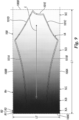
- FIGS 1-4 show a first embodiment of a compression garment according to the invention, indicated as a whole with 1, wherein the garment is a long-sleeved shirt.
- the compression garment 1 comprises:
- elastic base fabric not only refers to an elastic element which is actually made by weaving but it also refers to any substantially two-dimensional elastic body, of a conventional type for one skilled in the art, adapted to cover and fit the body of the person wearing the garment.
- the total compressive force applied by the compression garment at a given position of the first portion of the anatomy of the person wearing the garment is the sum of the first compressive force and the second compressive force at that position of the garment.
- the elastomer printed on at least said portion of base fabric 1A, 1B of at least one portion of the arms and/or legs only provides said elements whose size and/or density decrease continuously.
- At least one plurality of the elements is positioned on the portion of base fabric 1A, 1B along a plurality of annular portions Z, which surround corresponding annular portions of the arms and/or legs, and all the elements of each of said annular portions 2 have equal size and/or density, so that all said elements of each of said annular portions of elements exert a substantially equal compressive force on the corresponding portion of the arms and/or legs.
- This is calculated, for example, by dividing the base fabric which includes the elastomer elements, into a plurality of annular bands F1-Fn (shown in Fig. 4 A) all having an equal height H, for example a height between 5 cm and 1 cm, and calculating for each annular band the values of the fabric surface covered by elements (Stc) and of the free fabric surface (Stl).
- dimensions of the elements refers to the flat dimensions of the elements, that is their length and/or width or diameter.
- torso refers to that part of the human body to which the upper limbs (that is the arms) and the lower limbs (that is the legs) are connected, that is that part of the body comprising, among other parts, the shoulders and the hip.
- the decrease in the size and/or density of the micro elements could be less marked in a first determined portion of the base fabric, for example the one going from the wrists to the elbow, and then be more marked in a second determined portion of the base fabric, for example the one going from the elbow to the shoulders; or vice versa.
- all the elements or at least part of them (for example more than 50%, more preferably more than 80%) have an equal regular shape, for example a circular or regular polygonal shape, such as a square, rectangular, hexagonal, triangular shape.
- This feature makes the element printing process quicker and easier.
- the elements have decreasing dimensions (for example the diameter, or the diagonal) going from the lower end parts 3A, 3B of the portions of base fabric 1A, 1B of the garment to the upper parts 4A, 4B of the portions of base fabric 1A, 1B; this technical feature is even more advantageous if combined with the previous one relating to the fact that the elements have all or at least part of them (for example more than 50%, more preferably more than 80%, even more preferably more than 100%) an equal regular shape.
- This feature also makes the element printing process quicker and easier.
- the elements have uniformly decreasing dimensions (for example the diameter, or the diagonal) going from the lower end parts 3A, 3B of the portions of base fabric 1A, 1B of the garment to the upper parts 4A, 4B of the portions of base fabric 1A, 1B, and for example the dimension of the elements (for example their diameter) decreases by a percentage which is almost equal (almost equal meaning a difference between +/- 50) to the percentage of decrease in the surface of the fabric including the elastomer; so, if for example with 100% printed fabric comprising the elements, these have a diameter of 0.57 cm, with 90% printed fabric comprising the elements, these have a diameter of 0.512 cm, with 80% of printed fabric the diameter drops to about 0.457 cm and with 70% of printed fabric the diameter drops to 0.399 cm, and so on, up to when with 10% of printed fabric the diameter is 0.057.
- the printed elastomer elements can also be provided in the garment areas that do not completely surround or enclose an anatomical part of the body of the person wearing the garment, for example in figures 1, 2 these elements are also arranged at the upper parts 1C, 1D of the arms and shoulders, in these parts the garment has a lower compressive force than the other parts 1A, 1B previously discussed because the garment does not tighten annularly, therefore completely, the arm.
- the size and/or the density of said elements decrease going towards the upper parts 5C, 5D of the garment provided at the upper part of the shoulders and/or the opening 6 for the neck, so as to reduce the compressive force exerted by said elements going towards said opening, that is going from the extremities of the person wearing the garment to the upper part of the shoulders and/or the neck of the person wearing the garment.
- the development of the size and/or density of the elements decreases, preferably uniformly, even more preferably substantially linearly (the term "substantially” is intended to indicate possible deviations equal to +/- 5%), going from the lower end parts 3 A, B, that is from the cuffs, in which it is maximum, to the upper parts 5C, D provided at the upper part of the shoulders and/or collar, where it is minimum.
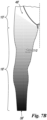
- Figures 5-8 show a second embodiment of a garment according to the invention wherein the garment is trousers that entirely cover the legs.
- the parts or components of this second garment shared with the previously described garment will be indicated with the same numbering used for the first garment with the addition, however, of a superscript.
- the compression garment 1' comprises:
- the elastomer printed on at least said portion of base fabric 1A, 1B of at least one portion of the arms and/or legs only provides said elements whose size and/or density decrease continuously.
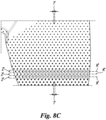
- At least one plurality of the elements is positioned on the portion of base fabric 1A', 1B' along a plurality of annular portions Z', which surround corresponding annular portions of the arms and/or legs, and all the elements of each of said annular portions Z' of elements have equal size and/or density, so that said elements of each of said annular portions of elements all exert substantially equal compressive force on the corresponding portion of the arms and/or legs.
- This is calculated, for example, by dividing the base fabric which includes the elastomer elements, into a plurality of annular bands F1'-Fn' (shown in Fig. 8 A) all having an equal height H', for example a height between 5 cm and 1 cm, and calculating for each annular band the values of the fabric surface covered by elements (Stc) and of the free fabric surface (Stl) .
- the elements have all or at least part of them (for example more than 50%, more preferably more than 80%, even more preferably more than 100%),) an equal regular shape, for example a circular or regular polygonal shape, such as a square, rectangular, hexagonal shape.
- the elements have decreasing dimensions (for example the diameter, or the diagonal) going from the lower end parts 3A', 3B' of the portions of base fabric 1A', 1B' of the garment to the upper parts 4A', 4B' of the portions of base fabric 1A', 1B'; this technical feature is even more advantageous if combined with the previous one relating to the fact that the elements have all or at least part of them (for example more than 50%, more preferably more than 80%, even more preferably more than 100%) an equal regular shape.
- the elements have uniformly decreasing dimensions (for example the diameter, or the diagonal) going from the lower end parts 3A', 3B' of the portions of base fabric 1A', 1B' of the garment to the upper parts 4A', 4B' of the portions of base fabric 1A', 1B', and for example the dimension of the elements (for example their diameter) decreases by a percentage which is almost equal (almost equal meaning a difference between +/- 50) to the percentage of decrease in the surface of the fabric including the elastomer; so, if for example with 100% printed fabric comprising the elements, these have a diameter of 0.57 cm, with 90% printed fabric comprising the elements, these have a diameter of 0.512 cm, with 80% of printed fabric the diameter drops to about 0.457 cm and with 70% of printed fabric the diameter drops to 0.399 cm, and so on, up to when with 10% of printed fabric the diameter is 0.057.
- the dimensions for example the diameter, or the diagonal
- the printed elastomer elements can also be provided in the garment areas that do not completely surround or enclose an anatomical part of the body of the person wearing the garment, for example in Figures 5 , 6 these elements are also arranged at the upper parts 1C', 1D' of the legs, in these parts the garment has a lower compressive force than the other parts 1A', 1B' previously discussed because the garment does not tighten annularly, therefore completely, the legs.
- the size and/or density of said elements decrease going towards the upper parts 5C', 5D' of the garment provided at the iliac crests of the hip of the person wearing the garment, so as to reduce the compressive force exerted by said elements going towards said parts 5C", 5D', that is going from the extremities of the person wearing the garment to the iliac crests of the person wearing the garment.
- the decrease in the size and/or density of the elements in the areas 1C', 1D' follows the same decreasing development of the elements of the areas 1A', 1B', so that there is a continuous and preferably uniform decrease of the elements from the lower end parts 3A', 3B' to the upper parts of the garment 5C', 5D' provided at the iliac crests 6.
- the development of the size and/or density of the elements decreases, preferably uniformly, going from the lower end parts 3A', 3B', where it is maximum, to the upper parts 5C', 5D' provided at the iliac crests, where it is minimum.
- the elastomer to print the elements on the base fabric can be of any conventional type to the one skilled in the art, for example it can be of the type comprising silicone.
- the silicone is advantageously printed on the base fabric.
- the element printing process is also of a conventional type for the one skilled in the art, and includes, for example, a screen, silkscreen or high frequency transfer printing process.
- This arrangement of the elements makes the compression more uniform and allows to better fit the different physical and/or muscular characteristics of the wearer.
- the distance S between an axis K and the one immediately following is the same for all the annular portions of elements.
- some of the elements have maximum dimensions T greater than said constant distance S between the axes K, of the annular portions, so that the elements can also partially overlap each other, in the areas of the fabric that are required to have less elasticity (those which are closer to the ends 3A, 3B), that is those areas of the garment that are required to have a maximum percentage of the base fabric (for example between 100% and 90%) covered by the elements.
- the invention also relates to an elastic fabric 100 ( fig. 9 ) for manufacturing the compression parts of a compression garment, for example of the previously described type, which surround and enclose the circumference of at least one first part of the anatomy of a person wearing the garment, namely the upper limbs (that is the arms) in the example shown in figures 1-4 and the lower limbs, that is the legs of the wearer in the example shown in figures in figures 5-8 , and/or for manufacturing the entire sleeve/leg of the garment, that is parts 1A, 1C and 1B, 1D of the garment.
- Figure 9 shows the portion of fabric necessary for manufacturing a sleeve of the long-sleeved shirt of figures 1, 2 ; the profile of this sleeve has been represented with a double continuous line, as usual in the textile field, and the sleeve is indicated as a whole with the reference 1A.
- the fabric 100 preferably has a rectangular shape, with edges 100A and 100B and 100C and D in pairs parallel to each other and perpendicular.
- the fabric 100 also has a length L1 and a width L2; these dimensions must be greater than or equal to the dimensions of the compression part of the garment (in the example of Fig. 9 , of the sleeve 1A) to be manufactured.
- the longitudinal axis L of this compression part 1A of the garment should preferably be parallel to one of the edges 100A-D of the fabric 100, preferably to the greater edge 1001B, C.
- the fabric 100 includes:
- the elastomer printed on the portion of base fabric only includes the elements whose dimensions and/or density decrease continuously.
- elasticity refers to the ability of the fabric to stretch, if subjected to a force, and subsequently return to its original shape.
- the base fabric can be any known type of elastic fabric, but it is preferably an elastic fabric with a high percentage (for example greater than 15%, advantageously greater than or equal to 20%) of a yarn of the "elastane” or "spandex” type, for example of the type marketed with brands: Lycra, Elaspan, Dorlastan, Roica, Linel.
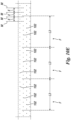
- This is calculated, for example, by dividing the base fabric which includes the elastomer elements into a plurality of bands F (schematically represented in Figs. 10A-D ) all having an equal length L3 and a width equal to the length L2 of the base fabric, for example a length between 5 cm and 1 cm, and calculating for each annular band the values of the fabric surface covered by the elements (Stc) and the free fabric surface (Stl).
- the elements have all or at least part of them (for example more than 50%, more preferably more than 80%, even more preferably more than 100%) an equal regular shape, for example a circular or regular polygonal shape, such as a square, rectangular, hexagonal shape.
- This feature makes the element printing process quicker and easier.
- the elements have decreasing dimensions (for example the diameter, or the diagonal) going from the first edge 100C to the second edge 100D; this technical feature is even more advantageous if combined with the previous one relating to the fact that the elements have all or at least part of them (for example more than 50%, more preferably more than 80%, even more preferably more than 100%) an equal regular shape. This feature also makes the element printing process quicker and easier.
- the elements have uniformly decreasing dimensions (for example the diameter, or the diagonal) going from the first edge 100C to the second edge 100D, and for example the dimension of the elements (for example their diameter) decreases by a percentage which is almost equal (almost equal meaning a difference between +/- 50) to the percentage of decrease in the surface of the fabric including the elastomer.
- some of the elements have dimensions greater than the distance D between the axes M, as shown in Figure 10A so that the elements can also partially overlap each other, in the areas of the fabric that are required to have less elasticity (those which are closer to the edge 100C), that is those areas of the garment that are required to have a maximum percentage of the base fabric (for example between 100% and 90%) covered by the elements.
- the garment could have a shape other than that shown in Figures 1-4 and 5-8 and be, for example, a garment adapted to only cover a part of the arms, for example only the forearms, or only a part of the legs, for example only the calves, or even a different anatomical part or a plurality of anatomical parts of the body of the person wearing the garment.
- the distribution of the elements on the base fabric can be such as to vary the elasticity of the fabric in a linear but also in a continuous but non-linear way, for example so as to have a high compression at the ankles or wrists and a similar compression substantially up to the knees or elbows, which then rapidly decreases above the knees or elbows.
- the elastomer micro elements could cover about 100% of the base fabric at the extremity of the limb to be compressed, and be present only up to an intermediate part of the length of the limb to be compressed and not for the entire length of the limb, and with a distribution that substantially requires the absence of base fabric covered by elements above this intermediate part of the limb.
- the elements could cover about 100% of the base fabric at the wrist or ankle, and not be present or cover only a limited percentage of the base fabric at the biceps or thigh.
- a distribution of the elastomer elements on the base fabric starting from less than 100%, for example between 99% and 60%, more preferably between 90% and 70%, and ending with a distribution of the elastomer elements which is greater than 0%, for example between 5% and 40%, more preferably between 10% and 25%.
Landscapes
- Engineering & Computer Science (AREA)
- Textile Engineering (AREA)
- Professional, Industrial, Or Sporting Protective Garments (AREA)
- Details Of Garments (AREA)
- Treatment Of Fiber Materials (AREA)
Claims (10)
- Kompressionskleidungsstück der Art, die Folgendes umfasst:- einen Abschnitt aus einem Grundgewebe (1A, 1B, 1A', 1B), der mindestens einen Abschnitt der Arme und/oder Beine einer Person, die das Kleidungsstück trägt, umgibt und umschließt und eine im Wesentlichen ringförmige Gestalt aufweist,- wobei der Abschnitt des Grundgewebes (1A, 1B, 1A', 1B) eine erste Kompressionskraft auf den mindestens einen Abschnitt der Arme oder Beine ausübt, undein Elastomer, das auf mindestens den Abschnitt des Grundgewebes (1A, 1B, 1A', 1B) gedruckt ist, so dass es den ersten einen Abschnitt der Arme und/oder Beine ebenfalls zumindest teilweise umgibt, und das dafür eingerichtet ist, eine zweite Kompressionskraft auf den ersten Abschnitt der Anatomie der Person auszuüben, die das Kleidungsstück trägt,wobei die Gesamtkompressionskraft, die durch das Kompressionskleidungsstück an einer gegebenen Position des mindestens einen Abschnitts der Arme und/oder Beine ausgeübt wird, die Summe der ersten Kompressionskraft und der zweiten Kompressionskraft an dieser Position des Kleidungsstücks ist,- wobei das Elastomer, das auf mindestens den Abschnitt des Grundgewebes (1A, 1B, 1A`, 1B) gedruckt ist, in mehrere gedruckte Elemente (2, 2') unterteilt ist, deren maximale Abmessungen (T, T`) zwischen 5 cm und 0,01 cm liegen, bevorzugter zwischen 2 cm und 0,1 cm,- wobei der Abschnitt des Grundgewebes (1A, 1B, 1A', 1B) Folgendes umfasst: untere Teile (3A, 3B, 3A`, 3B`), die näher zu den Endabschnitten der Arme und/oder Beine der Person bereitgestellt sind, die das Kleidungsstück trägt, zum Beispiel den Handgelenken und/oder Knöcheln, und obere Teile (4A, 4B, 4A`, 4B`), die näher zum Torso der Person bereitgestellt sind, die das Kleidungsstück trägt,dadurch gekennzeichnet, dass
die Größe und/oder Dichte der gedruckten Elemente nur an den unteren Teilen (3A, 3B, 3A`, 3B`) des Abschnitts des Grundgewebes (1A, 1B, 1A', 1B) maximal sind und nur an den oberen Teilen (4A, 4B, 4A`, 4B`) des Abschnitts des Grundgewebes (1A, 1B, 1A', 1B) minimal sind, und die Größe und/oder Dichte der gedruckten Elemente ausgehend von den unteren Teilen (3A, 3B, 3A`, 3B`) hin zu den oberen Teilen (4A, 4B, 4A`, 4B`) des Abschnitts des Grundgewebes (1A, 1B, 1A`, 1B) kontinuierlich abnehmen, so dass die zweite Kompressionskraft nur an den unteren Teilen (3A, 3B, 3A`, 3B`) maximal ist und nur an den oberen Teilen (4A, 4B, 4A`, 4B`) minimal ist und sich ausgehend von den unteren Teilen (3A, 3B, 3A`, 3B`) hin zu den oberen Teilen (4A, 4B, 4A`, 4B`), das heißt, ausgehend von den Extremitäten der Person, die das Kleidungsstück trägt, hin zum Torso der Person, die das Kleidungsstück trägt, kontinuierlich verringert. - Kompressionskleidungsstück nach Anspruch 1, dadurch gekennzeichnet, dass das Elastomer, das auf mindestens den Abschnitt des Grundgewebes (1A, 1B, 1A', 1B) von mindestens einem Abschnitt der Arme und/oder Beine gedruckt ist, lediglich die gedruckten Elemente bereitstellt, deren Größe und/oder Dichte kontinuierlich abnehmen.
- Kompressionskleidungsstück nach einem oder mehreren der vorhergehenden Ansprüche, dadurch gekennzeichnet, dass mindestens eine Vielzahl der gedruckten Elemente auf dem Abschnitt des Grundgewebes (1A, 1B, 1A', 1B) entlang einer Vielzahl ringförmiger Abschnitte (Z, Z') positioniert ist, welche die entsprechenden ringförmigen Abschnitte der Arme und/oder Beine umgeben, und dadurch, dass alle gedruckten Elemente jedes der ringförmigen Abschnitte (Z, Z') aus gedruckten Elementen die gleiche Größe und/oder Dichte aufweist, so dass alle gedruckten Elemente jedes der ringförmigen Abschnitte gedruckter Elemente eine im Wesentlichen gleiche Kompressionskraft auf den entsprechenden Abschnitt der Arme und/oder Beine ausübt.
- Kompressionskleidungsstück nach einem oder mehreren der vorhergehenden Ansprüche, dadurch gekennzeichnet, dass die gedruckten Elemente (2, 2') alle oder mindestens ein Teil derselben, vorzugsweise mehr als 50 %, bevorzugter mehr als 80 %, eine gleiche regelmäßige Gestalt aufweisen, vorzugsweise eine kreisförmige Gestalt oder die eines regelmäßigen Vielecks.
- Kompressionskleidungsstück nach einem oder mehreren der vorhergehenden Ansprüche, dadurch gekennzeichnet, dass die gedruckten Elemente (2, 2') ausgehend von den unteren Endteilen (3A, 3B, 3A`, 3B`) der Abschnitte des Grundgewebes (1A, 1B, 1A', 1B) des Kleidungsstücks hin zu den oberen Teilen (4A, 4B, 4A`, 4B`) der Abschnitte des Grundgewebes (1A, 1B, 1A`, 1B) gleichmäßig abnehmende Abmessungen aufweisen, wobei die Größe der gedruckten Elemente vorzugsweise um einen Prozentsatz abnimmt, der nahezu gleich dem Prozentsatz der Abnahme der Fläche des Abschnitts des Grundgewebes ist, auf welches das Elastomer gedruckt ist.
- Kompressionskleidungsstück nach einem oder mehreren der vorhergehenden Ansprüche, dadurch gekennzeichnet, dass das Elastomer der gedruckten Elemente (2, 2') Silikon umfasst.
- Kompressionskleidungsstück nach einem oder mehreren der vorhergehenden Ansprüche, dadurch gekennzeichnet, dass das Kompressionskleidungsstück ein langärmeliges Shirt oder eine Hose ist, die dafür eingerichtet ist, die Beine gänzlich zu bedecken, und wobei der Abschnitt des Grundgewebes ein rechter Ärmel (1A) oder ein linker Ärmel (1B) oder ein rechtes Hosenbein (1A') oder ein linkes Hosenbein (1B`) ist, wobei die gedruckten Elemente (2, 2') mindestens entlang der gesamten Oberfläche der Ärmel und Hosenbeine bereitgestellt sind, welche die Arme und Beine der Person, die das Kleidungsstück trägt, umgibt oder umschließt, und dadurch, dass die Größe und/oder Dichte der gedruckten Elemente nur an dem unteren Teil (3A, 3B, 3A', 3B`) des Abschnitts des Grundgewebes (1A, 1B, 1A', 1B) maximal ist, das an den Handgelenken und/oder Knöcheln der Person bereitgestellt ist, die das Kleidungsstück trägt.
- Kompressionskleidungsstück nach einem oder mehreren der vorhergehenden Ansprüche, dadurch gekennzeichnet, dass:a) alle gedruckten Elemente (2) eine gleiche regelmäßige, vorzugsweise kreisförmige, Gestalt aufweisen,b) alle gedruckten Elemente (2) entlang ringförmiger Abschnitte (Z, Z') aus gedruckten Elementen angeordnet sind, wobei die gedruckten Elemente in jedem ringförmigen Abschnitt in einer Reihe liegen, wobei die gedruckten Element jedes ringförmigen Abschnitts alle eine gemeinsame Achse (K, K') aufweisen, die durch ein Symmetriezentrum der gedruckten Elemente jedes ringförmigen Abschnitts verläuft,c) wobei die Achsen (K, K') alle im Wesentlichen parallel zueinander liegen, wenn der Abschnitt des Grundgewebes auf einer Ebene ausgelegt ist.
- Kompressionskleidungsstück nach Anspruch 8, dadurch gekennzeichnet, dass die Anzahl gedruckter Elemente in allen ringförmigen Abschnitten (Z, Z') gleich ist.
- Kompressionskleidungsstück nach einem oder mehreren der Ansprüche 8 bis 9, dadurch gekennzeichnet, dass der Abstand (S) zwischen einer Achse (K, K') und der unmittelbar darauf folgenden für alle ringförmigen Abschnitte der gedruckten Elemente gleich ist und dass vorzugsweise die maximalen Abmessungen (T, T`) einiger der gedruckten Elemente größer als der konstante Abstand (S) zwischen den Achsen (K) ist.
Applications Claiming Priority (1)
| Application Number | Priority Date | Filing Date | Title |
|---|---|---|---|
| IT102020000021865A IT202000021865A1 (it) | 2020-09-16 | 2020-09-16 | Indumento compressivo, e tessuto per la realizzazione delle parti compressive di un indumento |
Publications (3)
| Publication Number | Publication Date |
|---|---|
| EP3970542A1 EP3970542A1 (de) | 2022-03-23 |
| EP3970542B1 true EP3970542B1 (de) | 2024-08-14 |
| EP3970542C0 EP3970542C0 (de) | 2024-08-14 |
Family
ID=73643218
Family Applications (1)
| Application Number | Title | Priority Date | Filing Date |
|---|---|---|---|
| EP21188296.4A Active EP3970542B1 (de) | 2020-09-16 | 2021-07-28 | Kompressionskleidungsstück |
Country Status (2)
| Country | Link |
|---|---|
| EP (1) | EP3970542B1 (de) |
| IT (1) | IT202000021865A1 (de) |
Family Cites Families (6)
| Publication number | Priority date | Publication date | Assignee | Title |
|---|---|---|---|---|
| AT336776B (de) * | 1973-01-12 | 1977-05-25 | Fankhanel Karl | Textile, strumpfartige beinbandage |
| US7636950B2 (en) * | 2005-09-30 | 2009-12-29 | Nike, Inc. | Article of apparel with zonal stretch resistance |
| US8172782B2 (en) * | 2008-11-25 | 2012-05-08 | Mmi-Ipco, Llc | Compression garments |
| US10674774B2 (en) * | 2017-02-14 | 2020-06-09 | Salvador Navarro | Garment for water weight-loss |
| US11021819B2 (en) * | 2017-05-15 | 2021-06-01 | Under Armour, Inc | Athletic performance garment |
| CA3095055A1 (en) * | 2018-03-28 | 2019-10-03 | Emeline KUHNER-STOUT | Energizing garment |
-
2020
- 2020-09-16 IT IT102020000021865A patent/IT202000021865A1/it unknown
-
2021
- 2021-07-28 EP EP21188296.4A patent/EP3970542B1/de active Active
Also Published As
| Publication number | Publication date |
|---|---|
| IT202000021865A1 (it) | 2022-03-16 |
| EP3970542A1 (de) | 2022-03-23 |
| EP3970542C0 (de) | 2024-08-14 |
Similar Documents
| Publication | Publication Date | Title |
|---|---|---|
| US20230029625A1 (en) | Posture Control and Therapy System | |
| US10299519B2 (en) | Variable compression garment | |
| US8007457B2 (en) | Elasticized garment and strapping system to aid in body mobility support and maintenance | |
| US8535256B2 (en) | Elasticized garment and strapping system to aid in body mobility support and maintenance | |
| US20070022510A1 (en) | Close-fitting garment | |
| US20170246071A1 (en) | Apparatus and method for muscle, central nervous system and viscera stimulation for wheelchair bound persons | |
| CN110113960A (zh) | 运动服装 | |
| CA2126176A1 (en) | Dynamic postural stability splint | |
| US20240156184A1 (en) | Compression garment, and fabric for making the compression parts of a compression garment | |
| WO2021063184A1 (zh) | 调节分区压力的层状结构及制备方法和护身用品 | |
| US20230060119A9 (en) | Wearable Tension Apparatus | |
| CN113382648A (zh) | 衣服 | |
| EP3970542B1 (de) | Kompressionskleidungsstück | |
| WO2010050539A1 (ja) | 衣類 | |
| KR20240090609A (ko) | 스패츠 및 양말 | |
| US20150264980A1 (en) | Posture protector devices, systems and methods | |
| KR102878514B1 (ko) | 자세 회복 의복 디바이스 시스템 및 그 제조 방법 | |
| CN115670040A (zh) | 服装 | |
| EP1125512A1 (de) | Energieverbrauchskleidung | |
| WO2020037011A1 (en) | Garment | |
| CN114269185A (zh) | 衣服 | |
| EP2967964A1 (de) | Sensorische motorik stimulierende kleidungsstücke und verfahren | |
| WO2020154179A1 (en) | Wearable tension apparatus | |
| EP3914210A1 (de) | Tragbare spannvorrichtung | |
| WO2014145046A1 (en) | Sensory motor stimulation garments and methods |
Legal Events
| Date | Code | Title | Description |
|---|---|---|---|
| PUAI | Public reference made under article 153(3) epc to a published international application that has entered the european phase |
Free format text: ORIGINAL CODE: 0009012 |
|
| STAA | Information on the status of an ep patent application or granted ep patent |
Free format text: STATUS: THE APPLICATION HAS BEEN PUBLISHED |
|
| AK | Designated contracting states |
Kind code of ref document: A1 Designated state(s): AL AT BE BG CH CY CZ DE DK EE ES FI FR GB GR HR HU IE IS IT LI LT LU LV MC MK MT NL NO PL PT RO RS SE SI SK SM TR |
|
| STAA | Information on the status of an ep patent application or granted ep patent |
Free format text: STATUS: REQUEST FOR EXAMINATION WAS MADE |
|
| 17P | Request for examination filed |
Effective date: 20220907 |
|
| RBV | Designated contracting states (corrected) |
Designated state(s): AL AT BE BG CH CY CZ DE DK EE ES FI FR GB GR HR HU IE IS IT LI LT LU LV MC MK MT NL NO PL PT RO RS SE SI SK SM TR |
|
| GRAP | Despatch of communication of intention to grant a patent |
Free format text: ORIGINAL CODE: EPIDOSNIGR1 |
|
| STAA | Information on the status of an ep patent application or granted ep patent |
Free format text: STATUS: GRANT OF PATENT IS INTENDED |
|
| INTG | Intention to grant announced |
Effective date: 20240312 |
|
| GRAS | Grant fee paid |
Free format text: ORIGINAL CODE: EPIDOSNIGR3 |
|
| GRAA | (expected) grant |
Free format text: ORIGINAL CODE: 0009210 |
|
| STAA | Information on the status of an ep patent application or granted ep patent |
Free format text: STATUS: THE PATENT HAS BEEN GRANTED |
|
| AK | Designated contracting states |
Kind code of ref document: B1 Designated state(s): AL AT BE BG CH CY CZ DE DK EE ES FI FR GB GR HR HU IE IS IT LI LT LU LV MC MK MT NL NO PL PT RO RS SE SI SK SM TR |
|
| REG | Reference to a national code |
Ref country code: GB Ref legal event code: FG4D |
|
| REG | Reference to a national code |
Ref country code: CH Ref legal event code: EP |
|
| REG | Reference to a national code |
Ref country code: DE Ref legal event code: R096 Ref document number: 602021017097 Country of ref document: DE |
|
| REG | Reference to a national code |
Ref country code: IE Ref legal event code: FG4D |
|
| U01 | Request for unitary effect filed |
Effective date: 20240911 |
|
| U07 | Unitary effect registered |
Designated state(s): AT BE BG DE DK EE FI FR IT LT LU LV MT NL PT RO SE SI Effective date: 20241008 |
|
| PG25 | Lapsed in a contracting state [announced via postgrant information from national office to epo] |
Ref country code: NO Free format text: LAPSE BECAUSE OF FAILURE TO SUBMIT A TRANSLATION OF THE DESCRIPTION OR TO PAY THE FEE WITHIN THE PRESCRIBED TIME-LIMIT Effective date: 20241114 |
|
| PG25 | Lapsed in a contracting state [announced via postgrant information from national office to epo] |
Ref country code: PL Free format text: LAPSE BECAUSE OF FAILURE TO SUBMIT A TRANSLATION OF THE DESCRIPTION OR TO PAY THE FEE WITHIN THE PRESCRIBED TIME-LIMIT Effective date: 20240814 Ref country code: GR Free format text: LAPSE BECAUSE OF FAILURE TO SUBMIT A TRANSLATION OF THE DESCRIPTION OR TO PAY THE FEE WITHIN THE PRESCRIBED TIME-LIMIT Effective date: 20241115 |
|
| PG25 | Lapsed in a contracting state [announced via postgrant information from national office to epo] |
Ref country code: IS Free format text: LAPSE BECAUSE OF FAILURE TO SUBMIT A TRANSLATION OF THE DESCRIPTION OR TO PAY THE FEE WITHIN THE PRESCRIBED TIME-LIMIT Effective date: 20241214 |
|
| PG25 | Lapsed in a contracting state [announced via postgrant information from national office to epo] |
Ref country code: HR Free format text: LAPSE BECAUSE OF FAILURE TO SUBMIT A TRANSLATION OF THE DESCRIPTION OR TO PAY THE FEE WITHIN THE PRESCRIBED TIME-LIMIT Effective date: 20240814 |
|
| PG25 | Lapsed in a contracting state [announced via postgrant information from national office to epo] |
Ref country code: ES Free format text: LAPSE BECAUSE OF FAILURE TO SUBMIT A TRANSLATION OF THE DESCRIPTION OR TO PAY THE FEE WITHIN THE PRESCRIBED TIME-LIMIT Effective date: 20240814 Ref country code: RS Free format text: LAPSE BECAUSE OF FAILURE TO SUBMIT A TRANSLATION OF THE DESCRIPTION OR TO PAY THE FEE WITHIN THE PRESCRIBED TIME-LIMIT Effective date: 20241114 |
|
| PG25 | Lapsed in a contracting state [announced via postgrant information from national office to epo] |
Ref country code: RS Free format text: LAPSE BECAUSE OF FAILURE TO SUBMIT A TRANSLATION OF THE DESCRIPTION OR TO PAY THE FEE WITHIN THE PRESCRIBED TIME-LIMIT Effective date: 20241114 Ref country code: PL Free format text: LAPSE BECAUSE OF FAILURE TO SUBMIT A TRANSLATION OF THE DESCRIPTION OR TO PAY THE FEE WITHIN THE PRESCRIBED TIME-LIMIT Effective date: 20240814 Ref country code: NO Free format text: LAPSE BECAUSE OF FAILURE TO SUBMIT A TRANSLATION OF THE DESCRIPTION OR TO PAY THE FEE WITHIN THE PRESCRIBED TIME-LIMIT Effective date: 20241114 Ref country code: IS Free format text: LAPSE BECAUSE OF FAILURE TO SUBMIT A TRANSLATION OF THE DESCRIPTION OR TO PAY THE FEE WITHIN THE PRESCRIBED TIME-LIMIT Effective date: 20241214 Ref country code: HR Free format text: LAPSE BECAUSE OF FAILURE TO SUBMIT A TRANSLATION OF THE DESCRIPTION OR TO PAY THE FEE WITHIN THE PRESCRIBED TIME-LIMIT Effective date: 20240814 Ref country code: GR Free format text: LAPSE BECAUSE OF FAILURE TO SUBMIT A TRANSLATION OF THE DESCRIPTION OR TO PAY THE FEE WITHIN THE PRESCRIBED TIME-LIMIT Effective date: 20241115 Ref country code: ES Free format text: LAPSE BECAUSE OF FAILURE TO SUBMIT A TRANSLATION OF THE DESCRIPTION OR TO PAY THE FEE WITHIN THE PRESCRIBED TIME-LIMIT Effective date: 20240814 |
|
| PG25 | Lapsed in a contracting state [announced via postgrant information from national office to epo] |
Ref country code: SM Free format text: LAPSE BECAUSE OF FAILURE TO SUBMIT A TRANSLATION OF THE DESCRIPTION OR TO PAY THE FEE WITHIN THE PRESCRIBED TIME-LIMIT Effective date: 20240814 |
|
| PG25 | Lapsed in a contracting state [announced via postgrant information from national office to epo] |
Ref country code: CZ Free format text: LAPSE BECAUSE OF FAILURE TO SUBMIT A TRANSLATION OF THE DESCRIPTION OR TO PAY THE FEE WITHIN THE PRESCRIBED TIME-LIMIT Effective date: 20240814 |
|
| PG25 | Lapsed in a contracting state [announced via postgrant information from national office to epo] |
Ref country code: SK Free format text: LAPSE BECAUSE OF FAILURE TO SUBMIT A TRANSLATION OF THE DESCRIPTION OR TO PAY THE FEE WITHIN THE PRESCRIBED TIME-LIMIT Effective date: 20240814 |
|
| PLBE | No opposition filed within time limit |
Free format text: ORIGINAL CODE: 0009261 |
|
| STAA | Information on the status of an ep patent application or granted ep patent |
Free format text: STATUS: NO OPPOSITION FILED WITHIN TIME LIMIT |
|
| 26N | No opposition filed |
Effective date: 20250515 |
|
| U20 | Renewal fee for the european patent with unitary effect paid |
Year of fee payment: 5 Effective date: 20250613 |
|
| PGFP | Annual fee paid to national office [announced via postgrant information from national office to epo] |
Ref country code: GB Payment date: 20250728 Year of fee payment: 5 |