EP3970495A1 - Detecting antimicrobial surfaces - Google Patents
Detecting antimicrobial surfaces Download PDFInfo
- Publication number
- EP3970495A1 EP3970495A1 EP21197837.4A EP21197837A EP3970495A1 EP 3970495 A1 EP3970495 A1 EP 3970495A1 EP 21197837 A EP21197837 A EP 21197837A EP 3970495 A1 EP3970495 A1 EP 3970495A1
- Authority
- EP
- European Patent Office
- Prior art keywords
- antimicrobial
- photochromic material
- substrate
- photochromic
- recited
- Prior art date
- Legal status (The legal status is an assumption and is not a legal conclusion. Google has not performed a legal analysis and makes no representation as to the accuracy of the status listed.)
- Pending
Links
- 230000000845 anti-microbial effect Effects 0.000 title claims abstract description 88
- 239000000463 material Substances 0.000 claims abstract description 119
- 239000000758 substrate Substances 0.000 claims abstract description 29
- 238000000034 method Methods 0.000 claims abstract description 27
- 238000000151 deposition Methods 0.000 claims abstract description 20
- 239000004599 antimicrobial Substances 0.000 claims abstract description 16
- 239000000203 mixture Substances 0.000 claims abstract description 10
- 238000005286 illumination Methods 0.000 claims description 18
- 125000000129 anionic group Chemical group 0.000 claims description 14
- 238000000576 coating method Methods 0.000 claims description 8
- 230000001010 compromised effect Effects 0.000 claims description 6
- QGZKDVFQNNGYKY-UHFFFAOYSA-O Ammonium Chemical compound [NH4+] QGZKDVFQNNGYKY-UHFFFAOYSA-O 0.000 claims description 5
- 239000011248 coating agent Substances 0.000 claims description 5
- 238000002835 absorbance Methods 0.000 claims description 4
- WSFMFXQNYPNYGG-UHFFFAOYSA-M dimethyl-octadecyl-(3-trimethoxysilylpropyl)azanium;chloride Chemical compound [Cl-].CCCCCCCCCCCCCCCCCC[N+](C)(C)CCC[Si](OC)(OC)OC WSFMFXQNYPNYGG-UHFFFAOYSA-M 0.000 claims description 4
- 238000006317 isomerization reaction Methods 0.000 claims description 4
- 150000003871 sulfonates Chemical class 0.000 claims description 4
- 229910019142 PO4 Inorganic materials 0.000 claims description 3
- ABLZXFCXXLZCGV-UHFFFAOYSA-N Phosphorous acid Chemical class OP(O)=O ABLZXFCXXLZCGV-UHFFFAOYSA-N 0.000 claims description 3
- 150000001252 acrylic acid derivatives Chemical class 0.000 claims description 3
- 150000007942 carboxylates Chemical class 0.000 claims description 3
- 235000021317 phosphate Nutrition 0.000 claims description 3
- 150000003013 phosphoric acid derivatives Chemical class 0.000 claims description 3
- 125000001453 quaternary ammonium group Chemical group 0.000 claims description 3
- 150000003467 sulfuric acid derivatives Chemical class 0.000 claims description 3
- 239000000975 dye Substances 0.000 description 5
- 239000007850 fluorescent dye Substances 0.000 description 3
- 238000007689 inspection Methods 0.000 description 3
- 238000004140 cleaning Methods 0.000 description 2
- 241000894006 Bacteria Species 0.000 description 1
- 241000700605 Viruses Species 0.000 description 1
- 125000002091 cationic group Chemical group 0.000 description 1
- 239000003086 colorant Substances 0.000 description 1
- 150000001875 compounds Chemical class 0.000 description 1
- 238000007796 conventional method Methods 0.000 description 1
- 150000001988 diarylethenes Chemical class 0.000 description 1
- 230000000694 effects Effects 0.000 description 1
- 238000004519 manufacturing process Methods 0.000 description 1
- 238000012986 modification Methods 0.000 description 1
- 230000004048 modification Effects 0.000 description 1
- 238000012544 monitoring process Methods 0.000 description 1
- 238000012546 transfer Methods 0.000 description 1
Images


Classifications
-
- A—HUMAN NECESSITIES
- A01—AGRICULTURE; FORESTRY; ANIMAL HUSBANDRY; HUNTING; TRAPPING; FISHING
- A01P—BIOCIDAL, PEST REPELLANT, PEST ATTRACTANT OR PLANT GROWTH REGULATORY ACTIVITY OF CHEMICAL COMPOUNDS OR PREPARATIONS
- A01P1/00—Disinfectants; Antimicrobial compounds or mixtures thereof
-
- G—PHYSICS
- G01—MEASURING; TESTING
- G01N—INVESTIGATING OR ANALYSING MATERIALS BY DETERMINING THEIR CHEMICAL OR PHYSICAL PROPERTIES
- G01N33/00—Investigating or analysing materials by specific methods not covered by groups G01N1/00 - G01N31/00
- G01N33/48—Biological material, e.g. blood, urine; Haemocytometers
- G01N33/50—Chemical analysis of biological material, e.g. blood, urine; Testing involving biospecific ligand binding methods; Immunological testing
- G01N33/53—Immunoassay; Biospecific binding assay; Materials therefor
- G01N33/531—Production of immunochemical test materials
- G01N33/532—Production of labelled immunochemicals
-
- A—HUMAN NECESSITIES
- A01—AGRICULTURE; FORESTRY; ANIMAL HUSBANDRY; HUNTING; TRAPPING; FISHING
- A01N—PRESERVATION OF BODIES OF HUMANS OR ANIMALS OR PLANTS OR PARTS THEREOF; BIOCIDES, e.g. AS DISINFECTANTS, AS PESTICIDES OR AS HERBICIDES; PEST REPELLANTS OR ATTRACTANTS; PLANT GROWTH REGULATORS
- A01N55/00—Biocides, pest repellants or attractants, or plant growth regulators, containing organic compounds containing elements other than carbon, hydrogen, halogen, oxygen, nitrogen and sulfur
-
- C—CHEMISTRY; METALLURGY
- C09—DYES; PAINTS; POLISHES; NATURAL RESINS; ADHESIVES; COMPOSITIONS NOT OTHERWISE PROVIDED FOR; APPLICATIONS OF MATERIALS NOT OTHERWISE PROVIDED FOR
- C09D—COATING COMPOSITIONS, e.g. PAINTS, VARNISHES OR LACQUERS; FILLING PASTES; CHEMICAL PAINT OR INK REMOVERS; INKS; CORRECTING FLUIDS; WOODSTAINS; PASTES OR SOLIDS FOR COLOURING OR PRINTING; USE OF MATERIALS THEREFOR
- C09D5/00—Coating compositions, e.g. paints, varnishes or lacquers, characterised by their physical nature or the effects produced; Filling pastes
- C09D5/14—Paints containing biocides, e.g. fungicides, insecticides or pesticides
-
- G—PHYSICS
- G01—MEASURING; TESTING
- G01N—INVESTIGATING OR ANALYSING MATERIALS BY DETERMINING THEIR CHEMICAL OR PHYSICAL PROPERTIES
- G01N21/00—Investigating or analysing materials by the use of optical means, i.e. using sub-millimetre waves, infrared, visible or ultraviolet light
- G01N21/62—Systems in which the material investigated is excited whereby it emits light or causes a change in wavelength of the incident light
- G01N21/63—Systems in which the material investigated is excited whereby it emits light or causes a change in wavelength of the incident light optically excited
-
- G—PHYSICS
- G01—MEASURING; TESTING
- G01N—INVESTIGATING OR ANALYSING MATERIALS BY DETERMINING THEIR CHEMICAL OR PHYSICAL PROPERTIES
- G01N33/00—Investigating or analysing materials by specific methods not covered by groups G01N1/00 - G01N31/00
- G01N33/48—Biological material, e.g. blood, urine; Haemocytometers
- G01N33/50—Chemical analysis of biological material, e.g. blood, urine; Testing involving biospecific ligand binding methods; Immunological testing
- G01N33/53—Immunoassay; Biospecific binding assay; Materials therefor
- G01N33/569—Immunoassay; Biospecific binding assay; Materials therefor for microorganisms, e.g. protozoa, bacteria, viruses
- G01N33/56911—Bacteria
-
- G—PHYSICS
- G01—MEASURING; TESTING
- G01N—INVESTIGATING OR ANALYSING MATERIALS BY DETERMINING THEIR CHEMICAL OR PHYSICAL PROPERTIES
- G01N21/00—Investigating or analysing materials by the use of optical means, i.e. using sub-millimetre waves, infrared, visible or ultraviolet light
- G01N21/62—Systems in which the material investigated is excited whereby it emits light or causes a change in wavelength of the incident light
- G01N21/63—Systems in which the material investigated is excited whereby it emits light or causes a change in wavelength of the incident light optically excited
- G01N2021/634—Photochromic material analysis
Definitions
- the present disclosure relates to antimicrobial coatings, and more particularly to systems and methods of detecting efficacy of antimicrobial coatings.
- microbes viruses, bacteria, spores
- surfaces in aircraft interior may harbor microbes (viruses, bacteria, spores) that may be transferred between passengers. While surfaces are disinfected during regular cleaning, there is a need to maintain these surfaces free of microbes between scheduled cleaning.
- a method includes depositing an antimicrobial material onto a surface of a substrate.
- the method includes binding a photochromic material to the antimicrobial material.
- Depositing the antimicrobial material and binding the photochromic material can include forming a mixture of the antimicrobial material and the photochromic material and depositing the mixture onto the surface of the substrate. It is also contemplated that depositing the antimicrobial material and binding the photochromic material can include first depositing the antimicrobial material onto the surface of the substrate and then depositing the photochromic material onto the antimicrobial material.
- the antimicrobial material can include Si-QAC (3-(trimethoxysilyl) Propyldimethyl Octadecyl Ammonium Chloride).
- the photochromic material can include at least one of sulfonates, sulfates, carboxylates, acrylates, phosphates, and/or phosphonates.
- the photochromic material can include an anionic moiety. Binding the photochromic material to the antimicrobial material can include the anionic moiety binding to ammonium in the Si-QAC.
- the anionic moiety binding to ammonium in the Si-QAC can include the anionic moiety binding to a quaternary ammonium in respective spiked molecules of the Si-QAC.
- the photochromic material can be an anionic die with absorbance near-UV which undergoes isomerization to become visible under near-UV illumination and remain invisible absent the near-UV illumination.
- the method can include illuminating the photochromic material to reveal if any of the antimicrobial material is compromised or missing. If any of the antimicrobial material is revealed by illumination to be compromised or missing, the method can include re-applying the antimicrobial material and re-applying the photochromic material.
- An antimicrobial structure includes a substrate.
- An array of spiked molecules of antimicrobial material extend from a surface of the substrate.
- Photochromic material is bound to the spiked molecules.
- the substrate can include at least one of an aircraft seat surface, an aircraft tray table surface, an aircraft magazine pouch surface, an aircraft seat handle surface, an aircraft luggage bin surface, an aircraft overhead bin surface, an aircraft lavatory surface, an aircraft galley surface, and/or an aircraft cockpit surface.
- An antimicrobial material includes a mixture of an antimicrobial material and a photochromic material.
- the antimicrobial material can be any antimicrobial material disclosed herein.
- the photochromic material can be any antimicrobial material disclosed herein.
- An antimicrobial surface includes a substrate, a coating comprising an antimicrobial material deposited on the substrate, and a photochromic material bound on at least a portion of the antimicrobial substrate.
- the photochromic material can be deposited as an array. The photochromic material need be bound on only a portion of the antimicrobial material.
- FIG. 1 a partial view of an embodiment of an antimicrobial structure in accordance with the disclosure is shown in Fig. 1 and is designated generally by reference character 100.
- FIGs. 2-4 Other embodiments of systems in accordance with the disclosure, or aspects thereof, are provided in Figs. 2-4 , as will be described.
- the systems and methods described herein can be used to provide antimicrobial surfaces that can be checked using an illuminator to confirm presence/efficacy of the antimicrobial surface.
- the antimicrobial structure 100 includes a substrate 102.
- An array of spiked molecules 104 of antimicrobial material 105 extend from a surface 106 of the substrate 102.
- Photochromic material 108 may be bound to at least a fraction of the spiked molecules 104.
- the substrate 102 can include at least one of an aircraft seat surface, an aircraft tray table surface, an aircraft magazine pouch surface, an aircraft seat handle surface, an aircraft luggage bin surface, an aircraft overhead bin surface, an aircraft lavatory surface, an aircraft galley surface, and/or an aircraft cockpit surface, or any other suitable surface.
- the photochromic material 108 need be bound on only a portion of the antimicrobial material 105 on the substrate 102, as shown in Fig. 4 .
- the photochromic material 108 can be deposited as an array or pattern such as the pattern shown in Fig. 4 or any other suitable pattern including a decorative pattern.
- the antimicrobial material can include Si-QAC (3-(trimethoxysilyl) Propyldimethyl Octadecyl Ammonium Chloride).
- Si-QAC 3-(trimethoxysilyl) Propyldimethyl Octadecyl Ammonium Chloride
- the photochromic material 108 can be a dye with an anionic moiety.
- the anionic moiety allows the dye molecules to ionically bond to the cationic ammonium, e.g., the quaternary ammonium, portion of the antimicrobial spiked molecules 104.
- the photochromic material 108 can include spiropyrans (as shown in Fig. 2 ), indolino-naphthoxazines, diarylethenes, naphthopyrans, and/or spirooxazines.
- suitable anionic moieties for the antimicrobial material 108 include sulfonates, sulfates, carboxylates,
- the photochromic material 108 is an anionic dye with absorbance near-UV which undergoes isomerization to become visible under near-UV illumination and remain invisible absent the near-UV illumination.
- the photochromic dye reacts differently than a fluorescent dye. Fluorescent dyes react by exciting an electron via light (typically UV), and the resulting falling electron emits light. In fluorescent dyes there is no structural change to the molecule. In a photochromic compound, the illumination actually results in temporary bond breaking (photoisomerism), and that breakage results in emitted light. The effect is illumination such as near-UV illumination can make the dye appear to have a visible color it does not have in the absence of the near-UV illumination. For aesthetics the surface 106 thus appears to be whatever color is desired unless the illumination is present.
- the antimicrobial function of the combined photochromic, antimicrobial material is not impacted by the bonding of the photochromic material 108 to the spiked molecules 104.
- a method 200 includes depositing 202 an antimicrobial material onto a surface of a substrate, e.g. substrate 102 of Fig. 1 .
- the method includes binding a photochromic material, e.g. photochromic material 108 of Fig. 1 , to the antimicrobial material.
- the antimicrobial material can be formed into a mixture of the antimicrobial material and the photochromic material and the method can include depositing the antimicrobial, photochromic mixture onto the surface of the substrate. It is also contemplated that the antimicrobial material can be deposited onto the substrate first, and then the photochromic material can be deposited onto the antimicrobial material.
- the method 200 can include illuminating 204 the photochromic material to reveal if any of the antimicrobial material is compromised or missing. For example, on an aircraft a crew member can shine a near-UV flashlight on surfaces to check the antimicrobial coatings. The photochromic color will show under illumination if the antimicrobial material is intact on a given surface. If any of the antimicrobial material is revealed by illumination to be compromised or missing, the method can include re-applying the antimicrobial material and re-applying the photochromic material. The checking by illumination and reapplication as needed can be repeated on a regular basis, as indicated by the decision box 204.
- This disclosure provides for inspection at manufacture, coating quality, coverage, highly sensitive inspection of coating, which can be invisible when not under irradiation, and can optionally be premixed into a coating solution prior to application, potentially reducing additional labor.
- Simple inspection is possible under an illuminator, which can provide confidence about the efficacy of the antimicrobial function.
- the materials can be turned for specific colors/wavelengths for aesthetics.
Landscapes
- Life Sciences & Earth Sciences (AREA)
- Health & Medical Sciences (AREA)
- Engineering & Computer Science (AREA)
- Immunology (AREA)
- Chemical & Material Sciences (AREA)
- General Health & Medical Sciences (AREA)
- Urology & Nephrology (AREA)
- Molecular Biology (AREA)
- Hematology (AREA)
- Biomedical Technology (AREA)
- Plant Pathology (AREA)
- Wood Science & Technology (AREA)
- General Physics & Mathematics (AREA)
- Physics & Mathematics (AREA)
- Analytical Chemistry (AREA)
- Biochemistry (AREA)
- Pathology (AREA)
- Environmental Sciences (AREA)
- Zoology (AREA)
- Pest Control & Pesticides (AREA)
- Microbiology (AREA)
- Medicinal Chemistry (AREA)
- Food Science & Technology (AREA)
- Biotechnology (AREA)
- Cell Biology (AREA)
- Dentistry (AREA)
- Agronomy & Crop Science (AREA)
- Nuclear Medicine, Radiotherapy & Molecular Imaging (AREA)
- Organic Chemistry (AREA)
- Materials Engineering (AREA)
- Tropical Medicine & Parasitology (AREA)
- Virology (AREA)
- General Chemical & Material Sciences (AREA)
- Chemical Kinetics & Catalysis (AREA)
- Photometry And Measurement Of Optical Pulse Characteristics (AREA)
Abstract
Description
- This application claims benefit of priority to
U.S. Provisional Patent Application No. 63/080,974 filed September 21, 2020 - The present disclosure relates to antimicrobial coatings, and more particularly to systems and methods of detecting efficacy of antimicrobial coatings.
- Surfaces in aircraft interior that are frequent touchpoints, e.g., aircraft seats, tray tables, magazine pouches, seat handles, luggage bins, and the like, may harbor microbes (viruses, bacteria, spores) that may be transferred between passengers. While surfaces are disinfected during regular cleaning, there is a need to maintain these surfaces free of microbes between scheduled cleaning.
- The conventional techniques have been considered satisfactory for their intended purpose. However, there is an ever present need for improved systems and methods for keeping surfaces inherently microbe free to minimize transfer of microbes. This disclosure provides a solution for this need.
- A method includes depositing an antimicrobial material onto a surface of a substrate. The method includes binding a photochromic material to the antimicrobial material. Depositing the antimicrobial material and binding the photochromic material can include forming a mixture of the antimicrobial material and the photochromic material and depositing the mixture onto the surface of the substrate. It is also contemplated that depositing the antimicrobial material and binding the photochromic material can include first depositing the antimicrobial material onto the surface of the substrate and then depositing the photochromic material onto the antimicrobial material.
- The antimicrobial material can include Si-QAC (3-(trimethoxysilyl) Propyldimethyl Octadecyl Ammonium Chloride). The photochromic material can include at least one of sulfonates, sulfates, carboxylates, acrylates, phosphates, and/or phosphonates. The photochromic material can include an anionic moiety. Binding the photochromic material to the antimicrobial material can include the anionic moiety binding to ammonium in the Si-QAC. The anionic moiety binding to ammonium in the Si-QAC can include the anionic moiety binding to a quaternary ammonium in respective spiked molecules of the Si-QAC.
- The photochromic material can be an anionic die with absorbance near-UV which undergoes isomerization to become visible under near-UV illumination and remain invisible absent the near-UV illumination. The method can include illuminating the photochromic material to reveal if any of the antimicrobial material is compromised or missing. If any of the antimicrobial material is revealed by illumination to be compromised or missing, the method can include re-applying the antimicrobial material and re-applying the photochromic material.
- An antimicrobial structure includes a substrate. An array of spiked molecules of antimicrobial material extend from a surface of the substrate. Photochromic material is bound to the spiked molecules. The substrate can include at least one of an aircraft seat surface, an aircraft tray table surface, an aircraft magazine pouch surface, an aircraft seat handle surface, an aircraft luggage bin surface, an aircraft overhead bin surface, an aircraft lavatory surface, an aircraft galley surface, and/or an aircraft cockpit surface.
- An antimicrobial material includes a mixture of an antimicrobial material and a photochromic material. The antimicrobial material can be any antimicrobial material disclosed herein. The photochromic material can be any antimicrobial material disclosed herein.
- An antimicrobial surface includes a substrate, a coating comprising an antimicrobial material deposited on the substrate, and a photochromic material bound on at least a portion of the antimicrobial substrate. The photochromic material can be deposited as an array. The photochromic material need be bound on only a portion of the antimicrobial material.
- These and other features of the systems and methods of the subject disclosure will become more readily apparent to those skilled in the art from the following detailed description of the preferred embodiments taken in conjunction with the drawings.
- So that those skilled in the art to which the subject disclosure appertains will readily understand how to make and use the devices and methods of the subject disclosure without undue experimentation, preferred embodiments thereof will be described in detail herein below with reference to certain figures, wherein:
-
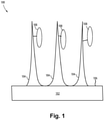
Fig. 1 is a schematic view of an embodiment of an antimicrobial structure constructed in accordance with the present disclosure, showing the spiked molecules of the antimicrobial material and the photochromic material bound to the spiked molecules; -
Fig. 2 is a schematic view of an example of the antimicrobial structure ofFig. 1 , showing the molecular bond between one of the spiked molecules and the photochromic material; -
Fig. 3 is a schematic view of a method in accordance with the subject disclosure, showing a procedure for monitoring and maintaining the antimicrobial structure; and -
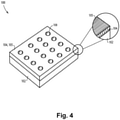
Fig. 4 is a schematic perspective view of the structure ofFig. 1 , showing photochromic material deposited on the antimicrobial material in a pattern or array. - Reference will now be made to the drawings wherein like reference numerals identify similar structural features or aspects of the subject disclosure. For purposes of explanation and illustration, and not limitation, a partial view of an embodiment of an antimicrobial structure in accordance with the disclosure is shown in
Fig. 1 and is designated generally byreference character 100. Other embodiments of systems in accordance with the disclosure, or aspects thereof, are provided inFigs. 2-4 , as will be described. The systems and methods described herein can be used to provide antimicrobial surfaces that can be checked using an illuminator to confirm presence/efficacy of the antimicrobial surface. - The
antimicrobial structure 100 includes asubstrate 102. An array ofspiked molecules 104 ofantimicrobial material 105 extend from asurface 106 of thesubstrate 102.Photochromic material 108 may be bound to at least a fraction of the spikedmolecules 104. Thesubstrate 102 can include at least one of an aircraft seat surface, an aircraft tray table surface, an aircraft magazine pouch surface, an aircraft seat handle surface, an aircraft luggage bin surface, an aircraft overhead bin surface, an aircraft lavatory surface, an aircraft galley surface, and/or an aircraft cockpit surface, or any other suitable surface. Thephotochromic material 108 need be bound on only a portion of theantimicrobial material 105 on thesubstrate 102, as shown inFig. 4 . Thephotochromic material 108 can be deposited as an array or pattern such as the pattern shown inFig. 4 or any other suitable pattern including a decorative pattern. - As shown in
Fig. 2 , the antimicrobial material can include Si-QAC (3-(trimethoxysilyl) Propyldimethyl Octadecyl Ammonium Chloride). With respect to thephotochromic material 108, it can be a dye with an anionic moiety. The anionic moiety allows the dye molecules to ionically bond to the cationic ammonium, e.g., the quaternary ammonium, portion of the antimicrobial spikedmolecules 104. Thephotochromic material 108 can include spiropyrans (as shown inFig. 2 ), indolino-naphthoxazines, diarylethenes, naphthopyrans, and/or spirooxazines. Examples of suitable anionic moieties for theantimicrobial material 108 include sulfonates, sulfates, carboxylates, acrylates, phosphates, phosphonates. - The
photochromic material 108 is an anionic dye with absorbance near-UV which undergoes isomerization to become visible under near-UV illumination and remain invisible absent the near-UV illumination. The photochromic dye reacts differently than a fluorescent dye. Fluorescent dyes react by exciting an electron via light (typically UV), and the resulting falling electron emits light. In fluorescent dyes there is no structural change to the molecule. In a photochromic compound, the illumination actually results in temporary bond breaking (photoisomerism), and that breakage results in emitted light. The effect is illumination such as near-UV illumination can make the dye appear to have a visible color it does not have in the absence of the near-UV illumination. For aesthetics thesurface 106 thus appears to be whatever color is desired unless the illumination is present. The antimicrobial function of the combined photochromic, antimicrobial material is not impacted by the bonding of thephotochromic material 108 to thespiked molecules 104. - With reference now to
Fig. 3 , amethod 200 includes depositing 202 an antimicrobial material onto a surface of a substrate,e.g. substrate 102 ofFig. 1 . The method includes binding a photochromic material, e.g.photochromic material 108 ofFig. 1 , to the antimicrobial material. The antimicrobial material can be formed into a mixture of the antimicrobial material and the photochromic material and the method can include depositing the antimicrobial, photochromic mixture onto the surface of the substrate. It is also contemplated that the antimicrobial material can be deposited onto the substrate first, and then the photochromic material can be deposited onto the antimicrobial material. - The
method 200 can include illuminating 204 the photochromic material to reveal if any of the antimicrobial material is compromised or missing. For example, on an aircraft a crew member can shine a near-UV flashlight on surfaces to check the antimicrobial coatings. The photochromic color will show under illumination if the antimicrobial material is intact on a given surface. If any of the antimicrobial material is revealed by illumination to be compromised or missing, the method can include re-applying the antimicrobial material and re-applying the photochromic material. The checking by illumination and reapplication as needed can be repeated on a regular basis, as indicated by thedecision box 204. - This disclosure provides for inspection at manufacture, coating quality, coverage, highly sensitive inspection of coating, which can be invisible when not under irradiation, and can optionally be premixed into a coating solution prior to application, potentially reducing additional labor. Simple inspection is possible under an illuminator, which can provide confidence about the efficacy of the antimicrobial function. The materials can be turned for specific colors/wavelengths for aesthetics.
- The methods and systems of the present disclosure, as described above and shown in the drawings, provide for antimicrobial surfaces that can be checked using an illuminator to confirm presence/efficacy of the antimicrobial surface. While the apparatus and methods of the subject disclosure have been shown and described with reference to preferred embodiments, those skilled in the art will readily appreciate that changes and/or modifications may be made thereto without departing from the scope of the subject disclosure.
Claims (15)
- A method comprising:depositing an antimicrobial material onto a surface of a substrate (102); andbinding a photochromic material (108) to the antimicrobial material (105).
- The method as recited in claim 1, wherein depositing the antimicrobial material and binding the photochromic material includes:forming a mixture of the antimicrobial material (105) and the photochromic material (108); anddepositing the mixture onto the surface of the substrate (102).
- The method as recited in claim 1 or 2, wherein depositing the antimicrobial material and binding the photochromic material (108) includes:first depositing the antimicrobial material (105) onto the surface of the substrate (102);
anddepositing the photochromic material (108) onto the antimicrobial material (105). - The method as recited in any preceding claim, wherein the antimicrobial material (150) includes Si-QAC (3-(trimethoxysilyl) Propyl dimethyl Octadecyl Ammonium Chloride), or wherein the photochromic material (108) includes at least one of sulfonates, sulfates, carboxylates, acrylates, phosphates, and/or phosphonates.
- The method as recited in any of claims 1 to 3, wherein the antimicrobial material includes Si-QAC and the photochromic material (108) includes anionic moiety, wherein binding the photochromic material to the antimicrobial material (105) includes the anionic moiety binding to ammonium in the Si-QAC, and optionally wherein the anionic moiety binding to ammonium in the Si-QAC includes the sulfonates binding to a quaternary ammonium in respective spiked molecules of the Si-QAC.
- The method as recited in any preceding claim, wherein the photochromic material (108) is an anionic dye with absorbance near-UV which undergoes isomerization to become visible under near-UV illumination and remain invisible absent the near-UV illumination.
- The method as recited in any preceding claim, further comprising:
illuminating the photochromic material to reveal if any of the antimicrobial material is compromised or missing, and optionally further comprising if any of the antimicrobial material (105) is revealed by illumination to be compromised or missing:
re-applying the antimicrobial material (105) and re-applying the photochromic material (108). - An antimicrobial structure comprising:a substrate (102);an array of spiked molecules of antimicrobial material (105) extending from a surface of the substrate; andphotochromic material (108) bound to the spiked molecules.
- The structure as recited in claim 8, wherein the substrate includes at least one of:
an aircraft seat surface, an aircraft tray table surface, an aircraft magazine pouch surface, an aircraft seat handle surface, an aircraft luggage bin surface, an aircraft overhead bin surface, an aircraft lavatory surface, an aircraft galley surface, and/or an aircraft cockpit surface. - The structure as recited in claim 8 or 9, wherein the antimicrobial material (105) includes Si-QAC (3-(trimethoxysilyl) Propyldimethyl Octadecyl Ammonium Chloride).
- The structures as recited in any of claims 8 to 10, wherein the photochromic material (108) is an anionic dye with absorbance near-UV which undergoes isomerization to become visible under near-UV illumination and remain invisible absent the near-UV illumination.
- An antimicrobial material comprising:
a mixture of an antimicrobial material (105) and a photochromic material (108) . - An antimicrobial surface comprising:a substrate (102);a coating comprising an antimicrobial material (105) deposited on the substrate (102);a photochromic material bound on at least a portion of the antimicrobial substrate.
- The antimicrobial surface as recited in claim 13, wherein the photochromic material (108) is deposited as an array.
- The antimicrobial surface as recited in claim 13, wherein the photochromic material (108) is bound on only a portion of the antimicrobial material (105).
Applications Claiming Priority (1)
| Application Number | Priority Date | Filing Date | Title |
|---|---|---|---|
| US202063080974P | 2020-09-21 | 2020-09-21 |
Publications (1)
| Publication Number | Publication Date |
|---|---|
| EP3970495A1 true EP3970495A1 (en) | 2022-03-23 |
Family
ID=77864433
Family Applications (1)
| Application Number | Title | Priority Date | Filing Date |
|---|---|---|---|
| EP21197837.4A Pending EP3970495A1 (en) | 2020-09-21 | 2021-09-20 | Detecting antimicrobial surfaces |
Country Status (2)
| Country | Link |
|---|---|
| US (1) | US12326443B2 (en) |
| EP (1) | EP3970495A1 (en) |
Families Citing this family (1)
| Publication number | Priority date | Publication date | Assignee | Title |
|---|---|---|---|---|
| US12332180B2 (en) * | 2020-06-24 | 2025-06-17 | B/E Aerospace, Inc. | Antimicrobial surface coating formation, detection, quantification and reactivation systems and methods |
Citations (8)
| Publication number | Priority date | Publication date | Assignee | Title |
|---|---|---|---|---|
| US20030078441A1 (en) * | 2001-09-04 | 2003-04-24 | Weili Zhao | Photochromic bis-naphthopyran compounds and methods for their manufacture |
| WO2008157323A1 (en) * | 2007-06-13 | 2008-12-24 | 3M Innovative Properties Company | Antimicrobial film-forming composition, antimicrobial film, and method of verifying the presence of an antimicrobial film |
| KR20110002716U (en) * | 2011-02-28 | 2011-03-16 | 송훈호 | Photochromic small stones and plant seeds |
| US9206382B2 (en) * | 2013-05-28 | 2015-12-08 | The Procter & Gamble Company | Surface treatment compositions comprising photochromic dyes |
| US20170292068A1 (en) * | 2016-04-11 | 2017-10-12 | The Boeing Company | Colorimetric Indicators for Photocurable Sealants |
| CN109778390A (en) * | 2019-01-23 | 2019-05-21 | 新乡市新科防护科技有限公司 | A kind of processing technology of the environmental garment fabric of discoloration |
| EP3929569A1 (en) * | 2020-06-24 | 2021-12-29 | B/E Aerospace, Inc. | Methods for detecting antimicrobial surface coatings using fluorescent indicators |
| EP3936858A1 (en) * | 2020-07-06 | 2022-01-12 | B/E Aerospace, Inc. | Antimicrobial surface coating formation, detection, quantification and reactivation systems and methods |
Family Cites Families (2)
| Publication number | Priority date | Publication date | Assignee | Title |
|---|---|---|---|---|
| US8648127B2 (en) * | 2008-06-02 | 2014-02-11 | The Boeing Company | Self decontaminating chemical and biological agent resistant coating |
| WO2019090920A1 (en) * | 2017-11-10 | 2019-05-16 | 江苏视科新材料股份有限公司 | Photochromic optical material and preparation method therefor |
-
2021
- 2021-09-15 US US17/476,169 patent/US12326443B2/en active Active
- 2021-09-20 EP EP21197837.4A patent/EP3970495A1/en active Pending
Patent Citations (8)
| Publication number | Priority date | Publication date | Assignee | Title |
|---|---|---|---|---|
| US20030078441A1 (en) * | 2001-09-04 | 2003-04-24 | Weili Zhao | Photochromic bis-naphthopyran compounds and methods for their manufacture |
| WO2008157323A1 (en) * | 2007-06-13 | 2008-12-24 | 3M Innovative Properties Company | Antimicrobial film-forming composition, antimicrobial film, and method of verifying the presence of an antimicrobial film |
| KR20110002716U (en) * | 2011-02-28 | 2011-03-16 | 송훈호 | Photochromic small stones and plant seeds |
| US9206382B2 (en) * | 2013-05-28 | 2015-12-08 | The Procter & Gamble Company | Surface treatment compositions comprising photochromic dyes |
| US20170292068A1 (en) * | 2016-04-11 | 2017-10-12 | The Boeing Company | Colorimetric Indicators for Photocurable Sealants |
| CN109778390A (en) * | 2019-01-23 | 2019-05-21 | 新乡市新科防护科技有限公司 | A kind of processing technology of the environmental garment fabric of discoloration |
| EP3929569A1 (en) * | 2020-06-24 | 2021-12-29 | B/E Aerospace, Inc. | Methods for detecting antimicrobial surface coatings using fluorescent indicators |
| EP3936858A1 (en) * | 2020-07-06 | 2022-01-12 | B/E Aerospace, Inc. | Antimicrobial surface coating formation, detection, quantification and reactivation systems and methods |
Non-Patent Citations (1)
| Title |
|---|
| ELENA POVERENOV ET AL: "Formation of contact active antimicrobial surfaces by covalent grafting of quaternary ammonium compounds", COLLOIDS AND SURFACES B: BIOINTERFACES, ELSEVIER AMSTERDAM, NL, vol. 169, 25 May 2018 (2018-05-25), pages 195 - 205, XP085417216, ISSN: 0927-7765, DOI: 10.1016/J.COLSURFB.2018.04.065 * |
Also Published As
| Publication number | Publication date |
|---|---|
| US20220091107A1 (en) | 2022-03-24 |
| US12326443B2 (en) | 2025-06-10 |
Similar Documents
| Publication | Publication Date | Title |
|---|---|---|
| US6030687A (en) | Vision control panels for displaying discrete images observable from one side of the panel and method of making | |
| US6066437A (en) | Film which can be lettered using a laser beam | |
| US12326443B2 (en) | Detecting antimicrobial surfaces | |
| US9512980B2 (en) | Laminated glass panel including phosphors | |
| ATE525755T1 (en) | LIGHT-EMITTING COMPONENT AND METHOD FOR THE PRODUCTION THEREOF | |
| WO2009137535A1 (en) | Static interferometric display device and method for providing the same | |
| DE202017103175U1 (en) | Hidden lighting for vehicles | |
| EP2282303B1 (en) | Multilayer label | |
| EP1723624B1 (en) | Emergency information sign | |
| EP3922684A1 (en) | Enhanced maintenance antiviral coatings for cabin surfaces | |
| DE102015114690A1 (en) | Photoluminescent vehicle console | |
| DE102015110836A1 (en) | Photoluminescent cup holder lighting | |
| DE102016103372A1 (en) | Photoluminescent vehicle lighting | |
| DE102015117859A1 (en) | Photoluminescent color change cover card light | |
| JP2021043280A (en) | Decorative sheet, display device with decorative sheet, and manufacturing method for decorative sheet | |
| DE102016100848A1 (en) | Photoluminescent vehicle panel | |
| JP2023022012A (en) | Decorative sheet, display device with decorative sheet, sheet article, method for manufacturing decorative sheet | |
| DE102015114531A1 (en) | Photoluminescent container lamp | |
| JP2017519347A (en) | Light panel shade | |
| US11548436B2 (en) | Illuminated vehicle panel and method for manufacturing an illuminated vehicle panel | |
| EP1300353B1 (en) | Device for detecting the position of an edge of a processed material | |
| DE102016100942A1 (en) | Photoluminescent tailgate and step | |
| DE102015114908A1 (en) | Photoluminescent cup holder lighting | |
| US20040128896A1 (en) | Matboard for artwork having luminescent designs | |
| KR20160074578A (en) | Glass panel for display system |
Legal Events
| Date | Code | Title | Description |
|---|---|---|---|
| PUAI | Public reference made under article 153(3) epc to a published international application that has entered the european phase |
Free format text: ORIGINAL CODE: 0009012 |
|
| STAA | Information on the status of an ep patent application or granted ep patent |
Free format text: STATUS: THE APPLICATION HAS BEEN PUBLISHED |
|
| AK | Designated contracting states |
Kind code of ref document: A1 Designated state(s): AL AT BE BG CH CY CZ DE DK EE ES FI FR GB GR HR HU IE IS IT LI LT LU LV MC MK MT NL NO PL PT RO RS SE SI SK SM TR |
|
| STAA | Information on the status of an ep patent application or granted ep patent |
Free format text: STATUS: REQUEST FOR EXAMINATION WAS MADE |
|
| 17P | Request for examination filed |
Effective date: 20220923 |
|
| RBV | Designated contracting states (corrected) |
Designated state(s): AL AT BE BG CH CY CZ DE DK EE ES FI FR GB GR HR HU IE IS IT LI LT LU LV MC MK MT NL NO PL PT RO RS SE SI SK SM TR |
|
| P01 | Opt-out of the competence of the unified patent court (upc) registered |
Effective date: 20230922 |
|
| STAA | Information on the status of an ep patent application or granted ep patent |
Free format text: STATUS: EXAMINATION IS IN PROGRESS |
|
| 17Q | First examination report despatched |
Effective date: 20241122 |