EP3969630B1 - Kerbblock zur verbesserung einer linienproduktivität - Google Patents
Kerbblock zur verbesserung einer linienproduktivität Download PDFInfo
- Publication number
- EP3969630B1 EP3969630B1 EP20725953.2A EP20725953A EP3969630B1 EP 3969630 B1 EP3969630 B1 EP 3969630B1 EP 20725953 A EP20725953 A EP 20725953A EP 3969630 B1 EP3969630 B1 EP 3969630B1
- Authority
- EP
- European Patent Office
- Prior art keywords
- ingot
- notch
- width
- face
- height
- Prior art date
- Legal status (The legal status is an assumption and is not a legal conclusion. Google has not performed a legal analysis and makes no representation as to the accuracy of the status listed.)
- Active
Links
Images



Classifications
-
- B—PERFORMING OPERATIONS; TRANSPORTING
- B22—CASTING; POWDER METALLURGY
- B22D—CASTING OF METALS; CASTING OF OTHER SUBSTANCES BY THE SAME PROCESSES OR DEVICES
- B22D7/00—Casting ingots, e.g. from ferrous metals
- B22D7/005—Casting ingots, e.g. from ferrous metals from non-ferrous metals
-
- B—PERFORMING OPERATIONS; TRANSPORTING
- B22—CASTING; POWDER METALLURGY
- B22D—CASTING OF METALS; CASTING OF OTHER SUBSTANCES BY THE SAME PROCESSES OR DEVICES
- B22D25/00—Special casting characterised by the nature of the product
-
- B—PERFORMING OPERATIONS; TRANSPORTING
- B22—CASTING; POWDER METALLURGY
- B22D—CASTING OF METALS; CASTING OF OTHER SUBSTANCES BY THE SAME PROCESSES OR DEVICES
- B22D25/00—Special casting characterised by the nature of the product
- B22D25/02—Special casting characterised by the nature of the product by its peculiarity of shape; of works of art
-
- B—PERFORMING OPERATIONS; TRANSPORTING
- B22—CASTING; POWDER METALLURGY
- B22D—CASTING OF METALS; CASTING OF OTHER SUBSTANCES BY THE SAME PROCESSES OR DEVICES
- B22D5/00—Machines or plants for pig or like casting
- B22D5/005—Devices for stacking pigs; Pigforms to be stacked
-
- B—PERFORMING OPERATIONS; TRANSPORTING
- B22—CASTING; POWDER METALLURGY
- B22D—CASTING OF METALS; CASTING OF OTHER SUBSTANCES BY THE SAME PROCESSES OR DEVICES
- B22D7/00—Casting ingots, e.g. from ferrous metals
-
- B—PERFORMING OPERATIONS; TRANSPORTING
- B22—CASTING; POWDER METALLURGY
- B22D—CASTING OF METALS; CASTING OF OTHER SUBSTANCES BY THE SAME PROCESSES OR DEVICES
- B22D7/00—Casting ingots, e.g. from ferrous metals
- B22D7/06—Ingot moulds or their manufacture
-
- C—CHEMISTRY; METALLURGY
- C23—COATING METALLIC MATERIAL; COATING MATERIAL WITH METALLIC MATERIAL; CHEMICAL SURFACE TREATMENT; DIFFUSION TREATMENT OF METALLIC MATERIAL; COATING BY VACUUM EVAPORATION, BY SPUTTERING, BY ION IMPLANTATION OR BY CHEMICAL VAPOUR DEPOSITION, IN GENERAL; INHIBITING CORROSION OF METALLIC MATERIAL OR INCRUSTATION IN GENERAL
- C23C—COATING METALLIC MATERIAL; COATING MATERIAL WITH METALLIC MATERIAL; SURFACE TREATMENT OF METALLIC MATERIAL BY DIFFUSION INTO THE SURFACE, BY CHEMICAL CONVERSION OR SUBSTITUTION; COATING BY VACUUM EVAPORATION, BY SPUTTERING, BY ION IMPLANTATION OR BY CHEMICAL VAPOUR DEPOSITION, IN GENERAL
- C23C2/00—Hot-dipping or immersion processes for applying the coating material in the molten state without affecting the shape; Apparatus therefor
- C23C2/003—Apparatus
- C23C2/0034—Details related to elements immersed in bath
-
- C—CHEMISTRY; METALLURGY
- C23—COATING METALLIC MATERIAL; COATING MATERIAL WITH METALLIC MATERIAL; CHEMICAL SURFACE TREATMENT; DIFFUSION TREATMENT OF METALLIC MATERIAL; COATING BY VACUUM EVAPORATION, BY SPUTTERING, BY ION IMPLANTATION OR BY CHEMICAL VAPOUR DEPOSITION, IN GENERAL; INHIBITING CORROSION OF METALLIC MATERIAL OR INCRUSTATION IN GENERAL
- C23C—COATING METALLIC MATERIAL; COATING MATERIAL WITH METALLIC MATERIAL; SURFACE TREATMENT OF METALLIC MATERIAL BY DIFFUSION INTO THE SURFACE, BY CHEMICAL CONVERSION OR SUBSTITUTION; COATING BY VACUUM EVAPORATION, BY SPUTTERING, BY ION IMPLANTATION OR BY CHEMICAL VAPOUR DEPOSITION, IN GENERAL
- C23C2/00—Hot-dipping or immersion processes for applying the coating material in the molten state without affecting the shape; Apparatus therefor
- C23C2/04—Hot-dipping or immersion processes for applying the coating material in the molten state without affecting the shape; Apparatus therefor characterised by the coating material
-
- C—CHEMISTRY; METALLURGY
- C23—COATING METALLIC MATERIAL; COATING MATERIAL WITH METALLIC MATERIAL; CHEMICAL SURFACE TREATMENT; DIFFUSION TREATMENT OF METALLIC MATERIAL; COATING BY VACUUM EVAPORATION, BY SPUTTERING, BY ION IMPLANTATION OR BY CHEMICAL VAPOUR DEPOSITION, IN GENERAL; INHIBITING CORROSION OF METALLIC MATERIAL OR INCRUSTATION IN GENERAL
- C23C—COATING METALLIC MATERIAL; COATING MATERIAL WITH METALLIC MATERIAL; SURFACE TREATMENT OF METALLIC MATERIAL BY DIFFUSION INTO THE SURFACE, BY CHEMICAL CONVERSION OR SUBSTITUTION; COATING BY VACUUM EVAPORATION, BY SPUTTERING, BY ION IMPLANTATION OR BY CHEMICAL VAPOUR DEPOSITION, IN GENERAL
- C23C2/00—Hot-dipping or immersion processes for applying the coating material in the molten state without affecting the shape; Apparatus therefor
- C23C2/50—Controlling or regulating the coating processes
-
- C—CHEMISTRY; METALLURGY
- C23—COATING METALLIC MATERIAL; COATING MATERIAL WITH METALLIC MATERIAL; CHEMICAL SURFACE TREATMENT; DIFFUSION TREATMENT OF METALLIC MATERIAL; COATING BY VACUUM EVAPORATION, BY SPUTTERING, BY ION IMPLANTATION OR BY CHEMICAL VAPOUR DEPOSITION, IN GENERAL; INHIBITING CORROSION OF METALLIC MATERIAL OR INCRUSTATION IN GENERAL
- C23C—COATING METALLIC MATERIAL; COATING MATERIAL WITH METALLIC MATERIAL; SURFACE TREATMENT OF METALLIC MATERIAL BY DIFFUSION INTO THE SURFACE, BY CHEMICAL CONVERSION OR SUBSTITUTION; COATING BY VACUUM EVAPORATION, BY SPUTTERING, BY ION IMPLANTATION OR BY CHEMICAL VAPOUR DEPOSITION, IN GENERAL
- C23C2/00—Hot-dipping or immersion processes for applying the coating material in the molten state without affecting the shape; Apparatus therefor
- C23C2/50—Controlling or regulating the coating processes
- C23C2/54—Controlling or regulating the coating processes of the mixing or stirring the bath
-
- Y—GENERAL TAGGING OF NEW TECHNOLOGICAL DEVELOPMENTS; GENERAL TAGGING OF CROSS-SECTIONAL TECHNOLOGIES SPANNING OVER SEVERAL SECTIONS OF THE IPC; TECHNICAL SUBJECTS COVERED BY FORMER USPC CROSS-REFERENCE ART COLLECTIONS [XRACs] AND DIGESTS
- Y10—TECHNICAL SUBJECTS COVERED BY FORMER USPC
- Y10T—TECHNICAL SUBJECTS COVERED BY FORMER US CLASSIFICATION
- Y10T428/00—Stock material or miscellaneous articles
- Y10T428/12—All metal or with adjacent metals
- Y10T428/12222—Shaped configuration for melting [e.g., package, etc.]
-
- Y—GENERAL TAGGING OF NEW TECHNOLOGICAL DEVELOPMENTS; GENERAL TAGGING OF CROSS-SECTIONAL TECHNOLOGIES SPANNING OVER SEVERAL SECTIONS OF THE IPC; TECHNICAL SUBJECTS COVERED BY FORMER USPC CROSS-REFERENCE ART COLLECTIONS [XRACs] AND DIGESTS
- Y10—TECHNICAL SUBJECTS COVERED BY FORMER USPC
- Y10T—TECHNICAL SUBJECTS COVERED BY FORMER US CLASSIFICATION
- Y10T428/00—Stock material or miscellaneous articles
- Y10T428/12—All metal or with adjacent metals
- Y10T428/12229—Intermediate article [e.g., blank, etc.]
-
- Y—GENERAL TAGGING OF NEW TECHNOLOGICAL DEVELOPMENTS; GENERAL TAGGING OF CROSS-SECTIONAL TECHNOLOGIES SPANNING OVER SEVERAL SECTIONS OF THE IPC; TECHNICAL SUBJECTS COVERED BY FORMER USPC CROSS-REFERENCE ART COLLECTIONS [XRACs] AND DIGESTS
- Y10—TECHNICAL SUBJECTS COVERED BY FORMER USPC
- Y10T—TECHNICAL SUBJECTS COVERED BY FORMER US CLASSIFICATION
- Y10T428/00—Stock material or miscellaneous articles
- Y10T428/12—All metal or with adjacent metals
- Y10T428/12354—Nonplanar, uniform-thickness material having symmetrical channel shape or reverse fold [e.g., making acute angle, etc.]
-
- Y—GENERAL TAGGING OF NEW TECHNOLOGICAL DEVELOPMENTS; GENERAL TAGGING OF CROSS-SECTIONAL TECHNOLOGIES SPANNING OVER SEVERAL SECTIONS OF THE IPC; TECHNICAL SUBJECTS COVERED BY FORMER USPC CROSS-REFERENCE ART COLLECTIONS [XRACs] AND DIGESTS
- Y10—TECHNICAL SUBJECTS COVERED BY FORMER USPC
- Y10T—TECHNICAL SUBJECTS COVERED BY FORMER US CLASSIFICATION
- Y10T428/00—Stock material or miscellaneous articles
- Y10T428/12—All metal or with adjacent metals
- Y10T428/12361—All metal or with adjacent metals having aperture or cut
-
- Y—GENERAL TAGGING OF NEW TECHNOLOGICAL DEVELOPMENTS; GENERAL TAGGING OF CROSS-SECTIONAL TECHNOLOGIES SPANNING OVER SEVERAL SECTIONS OF THE IPC; TECHNICAL SUBJECTS COVERED BY FORMER USPC CROSS-REFERENCE ART COLLECTIONS [XRACs] AND DIGESTS
- Y10—TECHNICAL SUBJECTS COVERED BY FORMER USPC
- Y10T—TECHNICAL SUBJECTS COVERED BY FORMER US CLASSIFICATION
- Y10T428/00—Stock material or miscellaneous articles
- Y10T428/12—All metal or with adjacent metals
- Y10T428/12389—All metal or with adjacent metals having variation in thickness
- Y10T428/12396—Discontinuous surface component
Definitions
- the present invention relates to a metallic ingot permitting to reduce the formation of dross and to increase a coating line productivity by improving its melting rate and easing the line management while keeping satisfactory mechanical properties of the ingot.
- the metallic products are coated to enhance their properties, especially their surface properties.
- Such coatings are generally alloys primarily based on aluminium and/or zinc.
- the hot-dip wherein the product to be coated 1 (eg.: a band, a strip or a wire) is dipped into a bath of molten metal 2, contained in a tank 3, which will adhere to the product surface and then form a desired coating.
- Said product is generally continuously passed through the bath by means of conveying means and an immerged roll 4.
- the bath level decreases if not supplied in coating material. Consequently, the bath should be fed regularly to maintain or at least regulate the bath level at a desired level.
- This feeding can be done through ingot addition wherein an ingot 5 is introduced into the bath 2 at a controlled rate using an insert table 6 and a holding or inserting mean 7.
- the ingot supply into the bath is commonly, but not necessarily, done in three steps. Firstly, the ingot is handled from a storage location to an introduction position, where the ingot is usually hold by the holding mean 6 and positioned on an insert table 5. Secondly, the ingot is introduced little by little into the bath 2 until the ingot portion 8 where the ingot is hold melts. At that moment, the non-melted portion of the ingot, usually the core, falls to the tank bottom. Even though the ingot is introduced step by step, it is not completely melted at the end of the second step except in rare case such as for low productivities. Thirdly, the ingot at the tank bottom melts.
- modelled ingot shapes A to D Only a half of an ingot is modelled because a symmetrical behaviour is expected for the other half, said half is along the ingot length.
- the shape A represented the ingot shape at the end of the step 2, when the ingot is completely immersed.
- the shapes B to D represent ingot shapes after a determined complete immersion time in the molten metal bath: B:10 min - C: 20 min - D: 25 min.
- This sequence and the calculated ingot are calculated for an ingot having a length of 2150 mm, a solidus temperature of 575°C, a liquidus temperature of 601°C, during a feeding process in a molten metal bath of 650°C made of the following steps:
- an ingot fed during an industrial sequence can take more than 30 min to completely melt so one or several ingots can be present and/or pile at the tank bottom.
- said melting time depends on the sequence of immersion, the ingot and bath properties and the process condition.
- the thermal bath properties depend on the bath composition, e.g. for a zinc-based bath, the temperature is generally around 470°C and for an Alusi-based bath, the bath temperature is around 650°C.
- the purpose of this invention is to provide a solution solving the aforementioned problems.
- the ingot can also comprise any characteristics of claims 2 to 10.
- This object is also achieved by providing a method according to claim 11.
- the invention relates a rectangular parallelepiped ingot 9 defined by a height H, a width W and a length L, having longitudinal faces 11a extending between two end faces 11b, having a volume between 0.15 m 3 and 0.80 m 3 and a surface area to volume ratio between 10 m -1 and 18 m -1 , made of at least one metal, comprising at least one notch 10 and a notch tip 12 along said ingot length, wherein said at least one notch 10 is configured such that :
- the length L is bigger than the height and the width.
- a width and a height for example an egg or pyramidal form
- the projection of such ingot on a surface can be used to define a width and a height.
- the ingot is described as parallelepipedal, but, as represented in Figure 5 , the term "parallelepipedal” includes crenellations 13, attachment means 14, any rim or edges 15 and/or any common ingot geometry. Such crenellations are used for handling purpose solely, e.g.: for elevating the ingot. Moreover, the ingot shape, a parallelepiped is commonly used and would thus need only minor or no change to the supplying system to be industrially implemented. Furthermore, because it does not contain any protuberance nor fragile edges or sections, which might break during the ingot handling and/or addition, the claimed ingot is choc resistant and thus industrially suitable
- the ingot has a volume between 0.15 m 3 and 0.80 m 3 .
- the ingot volume exceeds 0.80 m 3 , the ingot might be difficult to transport, stock, handle and/or used by the supplying mean of the coating line.
- the productivity might be negatively impacted because the time taken to handle and place the ingot on the supplying mean will be too high compared to the ingot melting time.
- the ingot has a surface area to volume ratio between 10 m -1 and 18 m -1 .
- this ratio is lower than 10 m -1 , it lowers the melting rate of the ingot due to a low exchange surface between the ingot and the molten metal bath which negatively impacts the line productivity and the bath management due to the risk of ingot pile formation at the tank bottom.
- this ratio exceeds 18 m -1 , considering the claimed ingot, it would apparently weaken the choc resistance of the ingot and thus increase the ingot breakage risk.
- the term along said ingot length includes a deviation of 1°, 2°, 3°, 4°, 5°, 6°, 9°, 8°, 9° or 10° of the notch tip (12) to the ingot length.
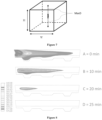
- an ingot comprising a notch is particularly interesting for two reasons. Firstly, compared to a classical ingot, an ingot according to the invention, as represented in Figure 3 , permits to reduce MaxD to a value smaller than H/2 and W/2. So during the claimed ingot melting, the molten metal bath will melt more rapidly the point at a distance MaxD from the ingot surface because it is at a smaller distance from the molten metal bath, i.e. the heat source, compared to a parallelepipedal ingot as illustrated in Figure 7 . In Figure 8 , the ingot melting is modelled for the same condition as in the Figure 1 . The time noted, from 0 to 25 min, is the time during which the ingot is completely immersed. Secondly, said claimed ingot is easy to cast, even from existing mould where only a part should be added inside the mould to have a desired notch.
- Figure 9 exhibits the impact of the increased melting between a classical ingot A and an embodiment of the claimed invention B by showing rear views of said ingots.
- the claimed ingot comprises a notch
- the term "notch” means an indentation on an ingot surface and/or as a V-shaped cut in a hard surface.
- Said indentation can also be of any shape such as spherical, parallelepipedal, pyramidal.
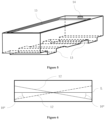
- said indentation can be comprised on only one face as illustrated in Figure 3 , extend from one face to its opposed face as illustrated in Figure 4 .
- it can have a V-shape or have a pyramidal shape.
- the claimed ingot is made of at least one metal.
- the ingot is at least made of zinc and/or silicon and/or magnesium and/or aluminium.
- said at least one notch 10 extends from a first face of the ingot to a second face of the ingot being the opposite face of said first face.
- a notch eases the separation of the ingot into two ingots reducing the formation of ingots pile at the tank bottom for two reasons. Firstly, due to the ingot separation, the melting speed is increased because a greater exchange surface is available between the metal molten bath and the ingots. Secondly, thanks to smaller ingots, the pile formed will be smaller.
- said at least one notch 10 extends from a first end face of the ingot to a second end face of the ingot being the opposite face of said first end face of the ingot.
- said ingot has a surface area to volume ratio between 12 m -1 and 18 m -1 .
- Such a ratio range increases even further the productivity because the lower threshold is increased compared to the previous mentioned range.
- said ingot has a volume between 0.15 m 3 and 0.40 m 3 .
- said at least one notch (20, 21, 22) comprises at least two faces (20A and 20B, 21A and 21B, 22A and 22B) facing each other, said two faces forming an angle comprised between 10° and 90°.
- the schemed ingot comprises three notches (20, 21 and 22), each of them having two faces (respectively 20A, 20B, 21A, 21B, 22A and 22B).
- Each notch has a defined angle between its two faces : 20°, 35° and 60° for the notches 19, 21 and 22.
- the angle is higher than 10°, the molten metal bath flows more easily along said notch tip 12 leading to a higher heat exchange and thus increasing the melting rate along the notch tip.
- the angle is higher than 90°, the melting rate increases compared to the volume loss become less advantageous in view of the supplying rate, notably due to the handling time of the ingot.
- said at least one notch (20, 21, 22) comprises at least two faces (20A and 20B, 21A and 21B, 22A and 22B) facing each other, said two faces forming an angle comprised between 20° and 50°.
- this range is optimal in view of the melting rate increase compared to the volume loss.
- said at least one notch has a maximum depth of three quarters of the ingot width W and/or height H. Hence, when the notch depth is greater than those values, it lowers the choc resistance and the robustness of the ingot thus increasing the risk of negative drawbacks, such as breakage, when handling said ingot.
- the at least one notch has a depth at least a quarter of the ingot width W and/or height H and the ratio between said ingot width W and said ingot H being comprised between 0.75 and 1.33.
- said at least one notch has a depth at least a third of the ingot width W and/or height H and the ratio between said ingot width W and said ingot H being comprised between 0.66 and 1.5.
- said at least one notch has a depth of at least a half of the ingot width W and/or height H and the ratio between said ingot width W and said ingot H being comprised between 0.50 and 2.
- the notch tip is positioned between a quarter and three quarters of the ingot width W or of the ingot height H.
- said notch tip is positioned at half width of the ingot or half height of the ingot.
- Such a notch configuration is apparently advantageous because upon melting, the ingot can be separated into two pieces, depending on the notch depth and position, of approximately the same size which will melt at a quasi-similar rate. The period at which no more ingot is present is reduced compared to a case where the ingot separates into two pieces of different size, e.g.: a big piece and a smaller piece. This participates in the formation reduction of ingot pile and consequently eases the molten metal bath management.
- the invention also refers to a process for managing a bath level of a molten alloy and preventing dross formation inside a tank wherein an ingot, according to anyone of claims 1 to 12, is fully immersed into said bath.
Landscapes
- Chemical & Material Sciences (AREA)
- Engineering & Computer Science (AREA)
- Mechanical Engineering (AREA)
- Chemical Kinetics & Catalysis (AREA)
- Materials Engineering (AREA)
- Metallurgy (AREA)
- Organic Chemistry (AREA)
- Manufacture And Refinement Of Metals (AREA)
Claims (11)
- Rechteckiger, quaderförmiger Block (9), der durch eine Höhe H, eine Breite W und eine Länge L definiert ist, der Längsflächen (11a) aufweist, die sich zwischen zwei Endflächen (11b) erstrecken, der ein Volumen zwischen 0,15 m3 und 0,80 m3 und ein Verhältnis von Oberfläche zu Volumen zwischen 10 m-1 und 18 m-1 aufweist, hergestellt aus mindestens einem Metall, umfassend mindestens eine Kerbe (10) und eine Kerbenspitze (12) entlang der Blocklänge, wobei die mindestens eine Kerbe (10) konfiguriert ist, sodass:- MaxD < H/2,- MaxD < W/2, und- wobei MaxD der maximale Abstand zwischen einem beliebigen Punkt des Blocks und der nächstgelegenen Oberfläche des Blocks ist,und die Kerbenspitze zwischen einem Viertel und drei Viertel der Blockbreite W oder der Blockhöhe positioniert ist und die mindestens eine Kerbe eine Tiefe von mindestens einem Viertel der Blockbreite W und/oder der Blockhöhe H aufweist und das Verhältnis zwischen der Blockbreite W und dem Block zwischen 0,75 und 1,33 liegt.
- Block nach Anspruch 1, wobei sich die mindestens eine Kerbe (10) von einer ersten Fläche des Blocks zu einer zweiten Fläche des Blocks erstreckt, die der ersten Fläche gegenüberliegt.
- Block nach Anspruch 1 oder 2, wobei sich die mindestens eine Kerbe (10) von einer ersten Endfläche des Blocks zu einer zweiten Endfläche des Blocks erstreckt, die der ersten Endfläche des Blocks gegenüberliegt.
- Block nach einem der Ansprüche 1 bis 3, wobei der Block ein Volumen zwischen 0,15 m3 und 0,40 m3 aufweist.
- Block nach einem der Ansprüche 1 bis 4, dadurch gekennzeichnet, dass die mindestens eine Kerbe (20, 21, 22) mindestens zwei einander zugewandte Flächen (20A und 20B, 21A und 21B, 22A und 22B) aufweist, wobei die zwei Flächen einen Winkel zwischen 10° und 90° bilden.
- Block nach einem der Ansprüche 1 bis 4, dadurch gekennzeichnet, dass die mindestens eine Kerbe (20, 21, 22) mindestens zwei einander zugewandte Flächen (20A und 20B, 21A und 21B, 22A und 22B) aufweist, wobei die zwei Flächen einen Winkel zwischen 20° und 50° bilden.
- Block nach einem der Ansprüche 1 bis 6, wobei die mindestens eine Kerbe eine maximale Tiefe von drei Vierteln der Blockbreite W und/oder -höhe H aufweist.
- Block nach einem der Ansprüche 1 bis 7, wobei die mindestens eine Kerbe eine Tiefe von mindestens einem Drittel der Blockbreite W und/oder der Blockhöhe H aufweist und das Verhältnis zwischen der Blockbreite W und der Blockhöhe H zwischen 0,66 und 1,5 liegt.
- Block nach einem der Ansprüche 1 bis 7, wobei die mindestens eine Kerbe eine Tiefe von mindestens der Hälfte der Blockbreite W und/oder der Blockhöhe H aufweist und das Verhältnis zwischen der Blockbreite W und der Blockhöhe H zwischen 0,50 und 2 liegt.
- Block nach einem der Ansprüche 1 bis 9, wobei die Kerbenspitze auf halber Breite des Blocks oder halber Höhe des Blocks positioniert ist.
- Verfahren zur Handhabung eines Badpegels einer geschmolzenen Legierung und zur Verhinderung der Schlackebildung in einem Tank, wobei ein Block nach einem der Ansprüche 1 bis 10 vollständig in das Bad eingetaucht wird.
Applications Claiming Priority (2)
| Application Number | Priority Date | Filing Date | Title |
|---|---|---|---|
| PCT/IB2019/053932 WO2020229875A1 (en) | 2019-05-13 | 2019-05-13 | Notched ingot improving a line productivity |
| PCT/IB2020/054538 WO2020230058A1 (en) | 2019-05-13 | 2020-05-13 | Notched ingot improving a line productivity |
Publications (2)
| Publication Number | Publication Date |
|---|---|
| EP3969630A1 EP3969630A1 (de) | 2022-03-23 |
| EP3969630B1 true EP3969630B1 (de) | 2025-02-12 |
Family
ID=67070879
Family Applications (1)
| Application Number | Title | Priority Date | Filing Date |
|---|---|---|---|
| EP20725953.2A Active EP3969630B1 (de) | 2019-05-13 | 2020-05-13 | Kerbblock zur verbesserung einer linienproduktivität |
Country Status (7)
| Country | Link |
|---|---|
| US (1) | US12005496B2 (de) |
| EP (1) | EP3969630B1 (de) |
| CN (1) | CN113728120B (de) |
| CA (1) | CA3137684C (de) |
| ES (1) | ES3016635T3 (de) |
| PL (1) | PL3969630T3 (de) |
| WO (2) | WO2020229875A1 (de) |
Families Citing this family (1)
| Publication number | Priority date | Publication date | Assignee | Title |
|---|---|---|---|---|
| WO2020229874A1 (en) | 2019-05-13 | 2020-11-19 | Arcelormittal | Holed ingot improving a coating line productivity |
Family Cites Families (15)
| Publication number | Priority date | Publication date | Assignee | Title |
|---|---|---|---|---|
| US3385678A (en) * | 1965-11-30 | 1968-05-28 | Reynolds Metals Co | Corrugated ingot |
| US4148394A (en) * | 1976-07-29 | 1979-04-10 | Charles Bederman | Bundle of self-skidded Margach ingots |
| SU1321508A1 (ru) | 1985-05-14 | 1987-07-07 | Предприятие П/Я Г-4781 | Способ ковки пластин |
| SU1400765A1 (ru) | 1986-06-04 | 1988-06-07 | Всесоюзный Научно-Исследовательский И Проектный Институт Вторичных Цветных Металлов | Пакетируема металлическа чушка |
| SU1694322A1 (ru) | 1988-04-22 | 1991-11-30 | Донецкий политехнический институт | Устройство дл лить чушек из цветных металлов |
| FR2678185B1 (fr) | 1991-06-27 | 1993-10-29 | Sollac | Lingotiere perfectionnee et procede pour l'obtention de lingots gerbables notamment en zinc. |
| RU2066583C1 (ru) | 1993-04-09 | 1996-09-20 | Акционерное общество "Белокалитвинское металлургическое производственное объединение" | Поддон для отливки плоских слитков |
| ES2828281T3 (es) | 2003-06-24 | 2021-05-25 | Novelis Inc | Lingote de metal compuesto y producto de lámina compuesta que comprende tal lingote laminado en caliente y en frío |
| BRPI0707992A2 (pt) * | 2006-02-20 | 2011-05-17 | Superior Press & Automation Inc | método para formar uma carga a partir de um lingote de material de superliga, e, aparelho para formar uma carga a partir de um lingote cilìndrico de material de superliga |
| CN100491560C (zh) | 2007-07-23 | 2009-05-27 | 株洲冶炼集团股份有限公司 | 用于窄带钢镀锌的热镀锌铝铅锑合金及其方法及其锭型 |
| CN201150977Y (zh) | 2007-12-20 | 2008-11-19 | 株洲冶炼集团股份有限公司 | 金属锭锭型 |
| JP2016026876A (ja) | 2014-06-24 | 2016-02-18 | Jx日鉱日石金属株式会社 | インゴット鋳造装置及び鋳造方法 |
| CN205650781U (zh) | 2016-04-13 | 2016-10-19 | 邹平汇鑫冶金材料有限公司 | 一种金属锭锭型 |
| TWM568856U (zh) | 2018-05-02 | 2018-10-21 | 中國鋼鐵股份有限公司 | Hot-dip plating tank metal ingot slag isolation device |
| WO2020229874A1 (en) | 2019-05-13 | 2020-11-19 | Arcelormittal | Holed ingot improving a coating line productivity |
-
2019
- 2019-05-13 WO PCT/IB2019/053932 patent/WO2020229875A1/en not_active Ceased
-
2020
- 2020-05-13 CN CN202080031500.5A patent/CN113728120B/zh active Active
- 2020-05-13 US US17/610,791 patent/US12005496B2/en active Active
- 2020-05-13 WO PCT/IB2020/054538 patent/WO2020230058A1/en not_active Ceased
- 2020-05-13 ES ES20725953T patent/ES3016635T3/es active Active
- 2020-05-13 CA CA3137684A patent/CA3137684C/en active Active
- 2020-05-13 PL PL20725953.2T patent/PL3969630T3/pl unknown
- 2020-05-13 EP EP20725953.2A patent/EP3969630B1/de active Active
Also Published As
| Publication number | Publication date |
|---|---|
| PL3969630T3 (pl) | 2025-04-07 |
| ES3016635T3 (en) | 2025-05-09 |
| CA3137684C (en) | 2024-05-07 |
| US20220314308A1 (en) | 2022-10-06 |
| WO2020229875A1 (en) | 2020-11-19 |
| EP3969630A1 (de) | 2022-03-23 |
| CA3137684A1 (en) | 2020-11-19 |
| WO2020230058A1 (en) | 2020-11-19 |
| CN113728120B (zh) | 2023-08-22 |
| US12005496B2 (en) | 2024-06-11 |
| CN113728120A (zh) | 2021-11-30 |
Similar Documents
| Publication | Publication Date | Title |
|---|---|---|
| CA3137683C (en) | Holed ingot improving a line productivity | |
| EP3969630B1 (de) | Kerbblock zur verbesserung einer linienproduktivität | |
| US10975899B2 (en) | Welded member and method for manufacturing same | |
| KR102379261B1 (ko) | Zn-Al-Mg 코팅을 제공하는 방법 및 그 코팅 | |
| KR20170125139A (ko) | 금속-코팅된 강철 스트립 | |
| EP3075875A1 (de) | Aluminiumlegierung für sprühdosen hergestellt durch fliesspressen und verfahren zur herstellung davon | |
| EP1980639B1 (de) | Feuerverzinkungsbad und verzinktes eisenprodukt | |
| KR102471806B1 (ko) | 용융 금속 도금 강대의 제조 방법 및 연속 용융 금속 도금 설비 | |
| CN102216485A (zh) | 用于控制多种金属在适于熔融所述金属的空腔中的引入的方法和装置 | |
| US2334929A (en) | Method of separating ingots in a continuous casting process | |
| JP6593453B2 (ja) | 金属薄帯の製造装置及びそれを用いた金属薄帯の製造方法 | |
| US20200071220A1 (en) | Glass melting component | |
| JPS6017038A (ja) | ワイヤカツト放電加工用ワイヤ電極 | |
| JP2007245167A (ja) | 鋼の連続鋳造用モールドフラックス及び連続鋳造方法 | |
| JPH046256A (ja) | 連続溶融亜鉛めっき用めっき槽への地金投入方法 | |
| JPH09155516A (ja) | 鋼の連続鋳造方法 | |
| UA46190A (uk) | Спосіб електронно-променевої переплавки шихти на основі губчастого титану |
Legal Events
| Date | Code | Title | Description |
|---|---|---|---|
| STAA | Information on the status of an ep patent application or granted ep patent |
Free format text: STATUS: UNKNOWN |
|
| STAA | Information on the status of an ep patent application or granted ep patent |
Free format text: STATUS: THE INTERNATIONAL PUBLICATION HAS BEEN MADE |
|
| PUAI | Public reference made under article 153(3) epc to a published international application that has entered the european phase |
Free format text: ORIGINAL CODE: 0009012 |
|
| STAA | Information on the status of an ep patent application or granted ep patent |
Free format text: STATUS: REQUEST FOR EXAMINATION WAS MADE |
|
| 17P | Request for examination filed |
Effective date: 20211014 |
|
| AK | Designated contracting states |
Kind code of ref document: A1 Designated state(s): AL AT BE BG CH CY CZ DE DK EE ES FI FR GB GR HR HU IE IS IT LI LT LU LV MC MK MT NL NO PL PT RO RS SE SI SK SM TR |
|
| DAV | Request for validation of the european patent (deleted) | ||
| DAX | Request for extension of the european patent (deleted) | ||
| GRAP | Despatch of communication of intention to grant a patent |
Free format text: ORIGINAL CODE: EPIDOSNIGR1 |
|
| STAA | Information on the status of an ep patent application or granted ep patent |
Free format text: STATUS: GRANT OF PATENT IS INTENDED |
|
| INTG | Intention to grant announced |
Effective date: 20241127 |
|
| GRAS | Grant fee paid |
Free format text: ORIGINAL CODE: EPIDOSNIGR3 |
|
| GRAF | Information related to payment of grant fee modified |
Free format text: ORIGINAL CODE: EPIDOSCIGR3 |
|
| GRAA | (expected) grant |
Free format text: ORIGINAL CODE: 0009210 |
|
| STAA | Information on the status of an ep patent application or granted ep patent |
Free format text: STATUS: THE PATENT HAS BEEN GRANTED |
|
| AK | Designated contracting states |
Kind code of ref document: B1 Designated state(s): AL AT BE BG CH CY CZ DE DK EE ES FI FR GB GR HR HU IE IS IT LI LT LU LV MC MK MT NL NO PL PT RO RS SE SI SK SM TR |
|
| REG | Reference to a national code |
Ref country code: GB Ref legal event code: FG4D |
|
| REG | Reference to a national code |
Ref country code: CH Ref legal event code: EP |
|
| REG | Reference to a national code |
Ref country code: DE Ref legal event code: R096 Ref document number: 602020045898 Country of ref document: DE |
|
| REG | Reference to a national code |
Ref country code: IE Ref legal event code: FG4D Ref country code: NL Ref legal event code: FP |
|
| REG | Reference to a national code |
Ref country code: SE Ref legal event code: TRGR |
|
| P01 | Opt-out of the competence of the unified patent court (upc) registered |
Free format text: CASE NUMBER: APP_14650/2025 Effective date: 20250326 |
|
| REG | Reference to a national code |
Ref country code: ES Ref legal event code: FG2A Ref document number: 3016635 Country of ref document: ES Kind code of ref document: T3 Effective date: 20250509 |
|
| PGFP | Annual fee paid to national office [announced via postgrant information from national office to epo] |
Ref country code: NL Payment date: 20250423 Year of fee payment: 6 |
|
| REG | Reference to a national code |
Ref country code: SK Ref legal event code: T3 Ref document number: E 46222 Country of ref document: SK |
|
| PG25 | Lapsed in a contracting state [announced via postgrant information from national office to epo] |
Ref country code: RS Free format text: LAPSE BECAUSE OF FAILURE TO SUBMIT A TRANSLATION OF THE DESCRIPTION OR TO PAY THE FEE WITHIN THE PRESCRIBED TIME-LIMIT Effective date: 20250512 |
|
| PG25 | Lapsed in a contracting state [announced via postgrant information from national office to epo] |
Ref country code: FI Free format text: LAPSE BECAUSE OF FAILURE TO SUBMIT A TRANSLATION OF THE DESCRIPTION OR TO PAY THE FEE WITHIN THE PRESCRIBED TIME-LIMIT Effective date: 20250212 |
|
| PGFP | Annual fee paid to national office [announced via postgrant information from national office to epo] |
Ref country code: PL Payment date: 20250425 Year of fee payment: 6 Ref country code: DE Payment date: 20250423 Year of fee payment: 6 |
|
| PGFP | Annual fee paid to national office [announced via postgrant information from national office to epo] |
Ref country code: GB Payment date: 20250423 Year of fee payment: 6 Ref country code: ES Payment date: 20250602 Year of fee payment: 6 |
|
| REG | Reference to a national code |
Ref country code: LT Ref legal event code: MG9D |
|
| PG25 | Lapsed in a contracting state [announced via postgrant information from national office to epo] |
Ref country code: NO Free format text: LAPSE BECAUSE OF FAILURE TO SUBMIT A TRANSLATION OF THE DESCRIPTION OR TO PAY THE FEE WITHIN THE PRESCRIBED TIME-LIMIT Effective date: 20250512 Ref country code: IS Free format text: LAPSE BECAUSE OF FAILURE TO SUBMIT A TRANSLATION OF THE DESCRIPTION OR TO PAY THE FEE WITHIN THE PRESCRIBED TIME-LIMIT Effective date: 20250612 |
|
| PGFP | Annual fee paid to national office [announced via postgrant information from national office to epo] |
Ref country code: BE Payment date: 20250423 Year of fee payment: 6 Ref country code: IT Payment date: 20250423 Year of fee payment: 6 |
|
| PG25 | Lapsed in a contracting state [announced via postgrant information from national office to epo] |
Ref country code: HR Free format text: LAPSE BECAUSE OF FAILURE TO SUBMIT A TRANSLATION OF THE DESCRIPTION OR TO PAY THE FEE WITHIN THE PRESCRIBED TIME-LIMIT Effective date: 20250212 |
|
| PG25 | Lapsed in a contracting state [announced via postgrant information from national office to epo] |
Ref country code: PT Free format text: LAPSE BECAUSE OF FAILURE TO SUBMIT A TRANSLATION OF THE DESCRIPTION OR TO PAY THE FEE WITHIN THE PRESCRIBED TIME-LIMIT Effective date: 20250612 Ref country code: LV Free format text: LAPSE BECAUSE OF FAILURE TO SUBMIT A TRANSLATION OF THE DESCRIPTION OR TO PAY THE FEE WITHIN THE PRESCRIBED TIME-LIMIT Effective date: 20250212 |
|
| PGFP | Annual fee paid to national office [announced via postgrant information from national office to epo] |
Ref country code: FR Payment date: 20250424 Year of fee payment: 6 |
|
| PG25 | Lapsed in a contracting state [announced via postgrant information from national office to epo] |
Ref country code: BG Free format text: LAPSE BECAUSE OF FAILURE TO SUBMIT A TRANSLATION OF THE DESCRIPTION OR TO PAY THE FEE WITHIN THE PRESCRIBED TIME-LIMIT Effective date: 20250212 Ref country code: GR Free format text: LAPSE BECAUSE OF FAILURE TO SUBMIT A TRANSLATION OF THE DESCRIPTION OR TO PAY THE FEE WITHIN THE PRESCRIBED TIME-LIMIT Effective date: 20250513 |
|
| PGFP | Annual fee paid to national office [announced via postgrant information from national office to epo] |
Ref country code: AT Payment date: 20250424 Year of fee payment: 6 Ref country code: RO Payment date: 20250505 Year of fee payment: 6 |
|
| PGFP | Annual fee paid to national office [announced via postgrant information from national office to epo] |
Ref country code: TR Payment date: 20250425 Year of fee payment: 6 Ref country code: SK Payment date: 20250429 Year of fee payment: 6 |
|
| PGFP | Annual fee paid to national office [announced via postgrant information from national office to epo] |
Ref country code: CZ Payment date: 20250429 Year of fee payment: 6 |
|
| PGFP | Annual fee paid to national office [announced via postgrant information from national office to epo] |
Ref country code: SE Payment date: 20250423 Year of fee payment: 6 |
|
| PG25 | Lapsed in a contracting state [announced via postgrant information from national office to epo] |
Ref country code: SM Free format text: LAPSE BECAUSE OF FAILURE TO SUBMIT A TRANSLATION OF THE DESCRIPTION OR TO PAY THE FEE WITHIN THE PRESCRIBED TIME-LIMIT Effective date: 20250212 |
|
| PG25 | Lapsed in a contracting state [announced via postgrant information from national office to epo] |
Ref country code: DK Free format text: LAPSE BECAUSE OF FAILURE TO SUBMIT A TRANSLATION OF THE DESCRIPTION OR TO PAY THE FEE WITHIN THE PRESCRIBED TIME-LIMIT Effective date: 20250212 |
|
| PG25 | Lapsed in a contracting state [announced via postgrant information from national office to epo] |
Ref country code: EE Free format text: LAPSE BECAUSE OF FAILURE TO SUBMIT A TRANSLATION OF THE DESCRIPTION OR TO PAY THE FEE WITHIN THE PRESCRIBED TIME-LIMIT Effective date: 20250212 |
|
| REG | Reference to a national code |
Ref country code: DE Ref legal event code: R097 Ref document number: 602020045898 Country of ref document: DE |
|
| PLBE | No opposition filed within time limit |
Free format text: ORIGINAL CODE: 0009261 |
|
| STAA | Information on the status of an ep patent application or granted ep patent |
Free format text: STATUS: NO OPPOSITION FILED WITHIN TIME LIMIT |
|
| REG | Reference to a national code |
Ref country code: CH Ref legal event code: H13 Free format text: ST27 STATUS EVENT CODE: U-0-0-H10-H13 (AS PROVIDED BY THE NATIONAL OFFICE) Effective date: 20251223 |
|
| REG | Reference to a national code |
Ref country code: CH Ref legal event code: L10 Free format text: ST27 STATUS EVENT CODE: U-0-0-L10-L00 (AS PROVIDED BY THE NATIONAL OFFICE) Effective date: 20251224 |
|
| PG25 | Lapsed in a contracting state [announced via postgrant information from national office to epo] |
Ref country code: LU Free format text: LAPSE BECAUSE OF NON-PAYMENT OF DUE FEES Effective date: 20250513 |
|
| PG25 | Lapsed in a contracting state [announced via postgrant information from national office to epo] |
Ref country code: CH Free format text: LAPSE BECAUSE OF NON-PAYMENT OF DUE FEES Effective date: 20250531 |
|
| 26N | No opposition filed |
Effective date: 20251113 |
|
| PG25 | Lapsed in a contracting state [announced via postgrant information from national office to epo] |
Ref country code: MC Free format text: LAPSE BECAUSE OF FAILURE TO SUBMIT A TRANSLATION OF THE DESCRIPTION OR TO PAY THE FEE WITHIN THE PRESCRIBED TIME-LIMIT Effective date: 20250212 |
|
| REG | Reference to a national code |
Ref country code: AT Ref legal event code: UEP Ref document number: 1766116 Country of ref document: AT Kind code of ref document: T Effective date: 20250212 |