EP3968412A1 - Sodium-sulfur battery control device and sodium-sulfur battery control method - Google Patents
Sodium-sulfur battery control device and sodium-sulfur battery control method Download PDFInfo
- Publication number
- EP3968412A1 EP3968412A1 EP21772128.1A EP21772128A EP3968412A1 EP 3968412 A1 EP3968412 A1 EP 3968412A1 EP 21772128 A EP21772128 A EP 21772128A EP 3968412 A1 EP3968412 A1 EP 3968412A1
- Authority
- EP
- European Patent Office
- Prior art keywords
- sodium
- sulfur battery
- sulfur
- temperature
- active material
- Prior art date
- Legal status (The legal status is an assumption and is not a legal conclusion. Google has not performed a legal analysis and makes no representation as to the accuracy of the status listed.)
- Pending
Links
- BNOODXBBXFZASF-UHFFFAOYSA-N [Na].[S] Chemical compound [Na].[S] BNOODXBBXFZASF-UHFFFAOYSA-N 0.000 title claims abstract description 81
- 238000000034 method Methods 0.000 title claims description 7
- HYHCSLBZRBJJCH-UHFFFAOYSA-N sodium polysulfide Chemical compound [Na+].S HYHCSLBZRBJJCH-UHFFFAOYSA-N 0.000 claims abstract description 24
- DGAQECJNVWCQMB-PUAWFVPOSA-M Ilexoside XXIX Chemical compound C[C@@H]1CC[C@@]2(CC[C@@]3(C(=CC[C@H]4[C@]3(CC[C@@H]5[C@@]4(CC[C@@H](C5(C)C)OS(=O)(=O)[O-])C)C)[C@@H]2[C@]1(C)O)C)C(=O)O[C@H]6[C@@H]([C@H]([C@@H]([C@H](O6)CO)O)O)O.[Na+] DGAQECJNVWCQMB-PUAWFVPOSA-M 0.000 claims abstract description 22
- 239000011734 sodium Substances 0.000 claims abstract description 22
- 229910052708 sodium Inorganic materials 0.000 claims abstract description 22
- NINIDFKCEFEMDL-UHFFFAOYSA-N Sulfur Chemical compound [S] NINIDFKCEFEMDL-UHFFFAOYSA-N 0.000 claims abstract description 20
- 239000011593 sulfur Substances 0.000 claims abstract description 20
- 229910052717 sulfur Inorganic materials 0.000 claims abstract description 20
- 239000007773 negative electrode material Substances 0.000 claims abstract description 18
- 239000007774 positive electrode material Substances 0.000 claims abstract description 17
- 230000007704 transition Effects 0.000 claims description 3
- 230000006866 deterioration Effects 0.000 description 6
- 239000011149 active material Substances 0.000 description 4
- 238000010586 diagram Methods 0.000 description 4
- 239000007784 solid electrolyte Substances 0.000 description 4
- 238000006243 chemical reaction Methods 0.000 description 3
- 230000004913 activation Effects 0.000 description 2
- 230000008859 change Effects 0.000 description 2
- 230000003247 decreasing effect Effects 0.000 description 2
- 230000007850 degeneration Effects 0.000 description 2
- 230000035882 stress Effects 0.000 description 2
- 229910000873 Beta-alumina solid electrolyte Inorganic materials 0.000 description 1
- FKNQFGJONOIPTF-UHFFFAOYSA-N Sodium cation Chemical compound [Na+] FKNQFGJONOIPTF-UHFFFAOYSA-N 0.000 description 1
- 239000000919 ceramic Substances 0.000 description 1
- 238000007906 compression Methods 0.000 description 1
- 238000003487 electrochemical reaction Methods 0.000 description 1
- 239000011521 glass Substances 0.000 description 1
- 239000010416 ion conductor Substances 0.000 description 1
- 230000004048 modification Effects 0.000 description 1
- 238000012986 modification Methods 0.000 description 1
- 229920001021 polysulfide Polymers 0.000 description 1
- 239000005077 polysulfide Substances 0.000 description 1
- 150000008117 polysulfides Polymers 0.000 description 1
- 229910001415 sodium ion Inorganic materials 0.000 description 1
- 230000008646 thermal stress Effects 0.000 description 1
- 230000032258 transport Effects 0.000 description 1
Images


Classifications
-
- H—ELECTRICITY
- H01—ELECTRIC ELEMENTS
- H01M—PROCESSES OR MEANS, e.g. BATTERIES, FOR THE DIRECT CONVERSION OF CHEMICAL ENERGY INTO ELECTRICAL ENERGY
- H01M10/00—Secondary cells; Manufacture thereof
- H01M10/42—Methods or arrangements for servicing or maintenance of secondary cells or secondary half-cells
- H01M10/48—Accumulators combined with arrangements for measuring, testing or indicating the condition of cells, e.g. the level or density of the electrolyte
- H01M10/486—Accumulators combined with arrangements for measuring, testing or indicating the condition of cells, e.g. the level or density of the electrolyte for measuring temperature
-
- H—ELECTRICITY
- H01—ELECTRIC ELEMENTS
- H01M—PROCESSES OR MEANS, e.g. BATTERIES, FOR THE DIRECT CONVERSION OF CHEMICAL ENERGY INTO ELECTRICAL ENERGY
- H01M10/00—Secondary cells; Manufacture thereof
- H01M10/36—Accumulators not provided for in groups H01M10/05-H01M10/34
- H01M10/39—Accumulators not provided for in groups H01M10/05-H01M10/34 working at high temperature
- H01M10/3909—Sodium-sulfur cells
-
- H—ELECTRICITY
- H01—ELECTRIC ELEMENTS
- H01M—PROCESSES OR MEANS, e.g. BATTERIES, FOR THE DIRECT CONVERSION OF CHEMICAL ENERGY INTO ELECTRICAL ENERGY
- H01M10/00—Secondary cells; Manufacture thereof
- H01M10/42—Methods or arrangements for servicing or maintenance of secondary cells or secondary half-cells
- H01M10/425—Structural combination with electronic components, e.g. electronic circuits integrated to the outside of the casing
-
- H—ELECTRICITY
- H01—ELECTRIC ELEMENTS
- H01M—PROCESSES OR MEANS, e.g. BATTERIES, FOR THE DIRECT CONVERSION OF CHEMICAL ENERGY INTO ELECTRICAL ENERGY
- H01M10/00—Secondary cells; Manufacture thereof
- H01M10/42—Methods or arrangements for servicing or maintenance of secondary cells or secondary half-cells
- H01M10/44—Methods for charging or discharging
- H01M10/443—Methods for charging or discharging in response to temperature
-
- H—ELECTRICITY
- H01—ELECTRIC ELEMENTS
- H01M—PROCESSES OR MEANS, e.g. BATTERIES, FOR THE DIRECT CONVERSION OF CHEMICAL ENERGY INTO ELECTRICAL ENERGY
- H01M10/00—Secondary cells; Manufacture thereof
- H01M10/42—Methods or arrangements for servicing or maintenance of secondary cells or secondary half-cells
- H01M10/425—Structural combination with electronic components, e.g. electronic circuits integrated to the outside of the casing
- H01M2010/4271—Battery management systems including electronic circuits, e.g. control of current or voltage to keep battery in healthy state, cell balancing
-
- Y—GENERAL TAGGING OF NEW TECHNOLOGICAL DEVELOPMENTS; GENERAL TAGGING OF CROSS-SECTIONAL TECHNOLOGIES SPANNING OVER SEVERAL SECTIONS OF THE IPC; TECHNICAL SUBJECTS COVERED BY FORMER USPC CROSS-REFERENCE ART COLLECTIONS [XRACs] AND DIGESTS
- Y02—TECHNOLOGIES OR APPLICATIONS FOR MITIGATION OR ADAPTATION AGAINST CLIMATE CHANGE
- Y02E—REDUCTION OF GREENHOUSE GAS [GHG] EMISSIONS, RELATED TO ENERGY GENERATION, TRANSMISSION OR DISTRIBUTION
- Y02E60/00—Enabling technologies; Technologies with a potential or indirect contribution to GHG emissions mitigation
- Y02E60/10—Energy storage using batteries
Definitions
- the present invention relates to apparatuses for controlling sodium-sulfur batteries and methods for controlling the sodium-sulfur batteries.
- a sodium-sulfur battery includes a negative electrode active material and a positive electrode active material.
- the negative electrode active material includes sodium.
- the positive electrode active material includes sulfur and sodium polysulfide.
- the sodium-sulfur battery When charged and discharged, the sodium-sulfur battery is heated to approximately 320 °C at which sodium as the negative electrode active material and sulfur and sodium polysulfide as the positive electrode active material are liquefied. Sulfur and sodium polysulfide activated at a high temperature are corrosive. In particular, liquefied sodium polysulfide is highly corrosive.
- the sodium-sulfur battery thus has a lifetime on the order of only 15 years in many cases.
- Patent Document 1 discloses that a sodium-sulfur cell has a lifetime on the order of 15 years (paragraph 0005).
- the sodium-sulfur battery is desired to be used for a longer period than the lifetime thereof.
- Patent Document 1 Japanese Patent Application Laid-Open No. 2003-151620 Summary
- the present invention has been conceived in view of the problem. It is an object of the present invention to enable use of a sodium-sulfur battery for a longer period than an expected lifetime.
- the present invention relates to an apparatus for controlling the sodium-sulfur battery.
- the sodium-sulfur battery includes a negative electrode active material and a positive electrode active material.
- the negative electrode active material includes sodium.
- the positive electrode active material includes sulfur and sodium polysulfide.
- the apparatus for controlling the sodium-sulfur battery includes a charge and discharge controller and a temperature controller.
- the charge and discharge controller controls charge and discharge of the sodium-sulfur battery.
- the temperature controller maintains the sodium-sulfur battery at a first temperature at which sodium, sulfur, and sodium polysulfide are liquefied in an operation period during which the charge and discharge controller causes the sodium-sulfur battery to be charged and discharged, and maintains the sodium-sulfur battery at a second temperature at which sodium and sulfur are liquefied and sodium polysulfide is solidified in a non-operation period during which the charge and discharge controller causes the sodium-sulfur battery not to be charged and discharged.
- the present invention also relates to a method for controlling the sodium-sulfur battery.
- sodium polysulfide activated at a high temperature to be highly corrosive is solidified while a liquefied state of sodium included in the negative electrode active material is maintained. Furthermore, by decreasing the temperature of the sodium-sulfur battery to the temperature at which sodium polysulfide is solidified, activation of an active material at a high temperature can be suppressed, and degeneration of a container, a sealer, and the like of the sodium-sulfur battery caused by the active material activated at the high temperature can be suppressed. Deterioration of the sodium-sulfur battery during the non-operation period can thereby be suppressed, and the sodium-sulfur battery can be used for a longer period than an expected lifetime.
- FIG. 1 is a block diagram schematically showing a power storage facility 1 in an embodiment of the present invention.
- the power storage facility 1 shown in FIG. 1 includes a power storage apparatus 11 and a control apparatus 12.
- the power storage apparatus 11 is linked to a system 13, and inputs and outputs AC power into and from the system 13 through a power conversion system (PCS) 122.
- the control apparatus 12 controls the power storage apparatus 11.
- the power storage facility 1 includes four module battery strings 101 (101a, 101b, 101c, and 101d), the power conversion system (PCS) 122, and a transformer 102.
- the four module battery strings 101 may be replaced with three or less or five or more module battery strings 101.
- each of the module battery strings 101 includes 10 module batteries 121 (121a, 121b, ..., and 121c).
- the 10 module batteries 121 may be replaced with 9 or less or 11 or more module batteries 121.
- each of the module batteries 121 includes an assembled battery 131, a heater 132, and a blower fan 133.
- the module battery strings 101a, 101b, 101c, and 101d are electrically connected in parallel.
- the module battery strings 101a, 101b, 101c, and 101d connected in parallel are electrically connected to the system 13 through the power conversion system (PCS) 122 and the transformer 102.
- PCS power conversion system
- the module batteries 121a, 121b, ..., and 121c are electrically connected in series.
- the heater 132 belonging to each of the module batteries 121 converts heater power received from the control apparatus 12 into heat, and heats the interior of the module battery 121.
- Sodium-sulfur batteries 163, which will be described below, are thereby heated.
- the blower fan 133 belonging to each of the module batteries 121 generates an air flow 141 using fan power received from the control apparatus 12.
- the generated air flow 141 transports heat from the interior of the module battery 121 to the exterior of the module battery 121 to cool the interior of the module battery 121.
- the sodium-sulfur batteries 163, which will be described below, are thereby cooled.
- FIG. 2 is a circuit diagram schematically showing the assembled battery 131 of the power storage facility 1.
- the assembled battery 131 includes four blocks 161 (161a, 161b, 161c, and 161d).
- the four blocks 161 may be replaced with three or less or five or more blocks 161.
- Each of the blocks 161 includes 12 strings 162 (162a, 162b, 162c, ..., and 162m).
- the 12 strings 162 may be replaced with 11 or less or 13 or more strings.
- Each of the strings 162 includes eight cells 163 (163a, 163b, 163c, ..., and 163g).
- the eight cells 163 may be replaced with seven or less or nine or more cells.
- the blocks 161a, 161b, 161c, and 161d are electrically connected in series.
- the strings 162a, 162b, 162c, ..., and 162m are electrically connected in parallel.
- the cells 163a, 163b, 163c, ..., and 163g are electrically connected in series.
- Discharge from the assembled battery 131 is caused by discharge from each of the cells 163.
- Charge to the assembled battery 131 is caused by charge to each of the cells 163.
- Each of the cells 163 is a sodium-sulfur battery.
- the cells 163 are thus also referred to as the sodium-sulfur batteries 163 in the present embodiment.
- a negative electrode active material is contained in a container.
- a positive electrode active material is contained in a gap between a solid electrolyte tube and a positive electrode container.
- the solid electrolyte tube is in contact with the negative electrode active material and the positive electrode active material, and separates the negative electrode active material and the positive electrode active material. Electrochemical reaction is thereby caused between the negative electrode active material and the positive electrode active material through the solid electrolyte tube to generate electromotive force.
- the solid electrolyte tube is formed of a sodium-ion conductor, and is desired to be formed of ceramics of ⁇ -alumina.
- the negative electrode active material includes sodium.
- the positive electrode active material includes sulfur and sodium polysulfide.
- control apparatus 12 includes a charge and discharge controller 151 and a temperature controller 152.
- the charge and discharge controller 151 and the temperature controller 152 are configured by causing a computer to execute a program.
- the charge and discharge controller 151 and the temperature controller 152 may be configured by hardware.
- the charge and discharge controller 151 controls charge and discharge of the sodium-sulfur batteries 163.
- the charge and discharge controller 151 transmits a control signal therefor to the power storage apparatus 11.
- the temperature controller 152 controls the temperature of the sodium-sulfur batteries 163. The temperature controller 152 thus supplies the heater power and the fan power described above to the power storage apparatus 11.
- the temperature controller 152 maintains the sodium-sulfur batteries 163 at a first temperature in an operation period during which the charge and discharge controller 151 causes the sodium-sulfur batteries 163 to be charged and discharged.
- the temperature controller 152 also maintains the sodium-sulfur batteries 163 at a second temperature in a non-operation period during which the charge and discharge controller 151 causes the sodium-sulfur batteries 163 not to be charged and discharged.
- the first temperature is a temperature at which sodium as the negative electrode active material and sulfur and sodium polysulfide as the positive electrode active material are liquefied, and is desired to be 280 °C or more and 320 °C or less.
- the second temperature is a temperature at which sodium as the negative electrode active material and sulfur as the positive electrode active material are liquefied and sulfur polysulfide as the positive electrode active material is solidified, and is desired to be 140 °C or more and 160 °C or less.
- sodium polysulfide activated at a high temperature to be highly corrosive is solidified while a liquefied state of sodium included in the negative electrode active material is maintained. Furthermore, by decreasing the temperature of the sodium-sulfur batteries 163 to the second temperature at which sodium polysulfide is solidified, activation of an active material at a high temperature is suppressed, and thus degeneration of a container, a sealer, and the like of the sodium-sulfur batteries 163 caused by the active material activated at the high temperature is suppressed.
- Deterioration of a component of the sodium-sulfur batteries 163 with which sodium and sodium polysulfide are in contact is thereby suppressed in the non-operation period.
- deterioration of the sodium-sulfur batteries 163 is suppressed, so that the sodium-sulfur batteries 163 can be used for a longer period than an expected lifetime.
- the sodium-sulfur batteries 163 expected to have a lifetime of 15 years are used while a non-operation period of 95 days is provided per year, for example, the sodium-sulfur batteries 163 can be used for 20 years, which is longer than 15 years as the lifetime.
- sodium and sulfur are not solidified in the non-operation period during which the sodium-sulfur batteries 163 are not to be charged and discharged.
- Application of large stress to a component of the sodium-sulfur batteries 163 at switching between the operation period and the non-operation period is thus suppressed.
- the charge and discharge controller 151 is desired to cause the sodium-sulfur batteries 163 to reach the end of charge at transition from the operation period to the non-operation period.
- the sodium-sulfur batteries 163 can thus enter into the non-operation period with stress therein being balanced, so that deterioration of the sodium-sulfur batteries 163 can be suppressed.
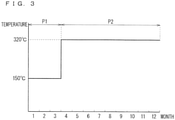
- FIG. 3 is a graph showing an example of a change over time in temperature of the sodium-sulfur batteries 163 of the power storage facility 1 within a calendar year.
- the first temperature is 150 °C
- the second temperature is 320 °C.
- a non-operation period P1 is January to March, and an operation period P2 is April to December.
- the non-operation period P1 and the operation period P2 are repeated annually.
- the non-operation period P1 is set only once without being divided within the calendar year.
- the temperature of the sodium-sulfur batteries 163 is not frequently switched between the first temperature and the second temperature, so that thermal stress applied to the sodium-sulfur batteries 163 is suppressed.
Landscapes
- Engineering & Computer Science (AREA)
- Manufacturing & Machinery (AREA)
- Chemical & Material Sciences (AREA)
- Chemical Kinetics & Catalysis (AREA)
- Electrochemistry (AREA)
- General Chemical & Material Sciences (AREA)
- Secondary Cells (AREA)
- Microelectronics & Electronic Packaging (AREA)
- Battery Electrode And Active Subsutance (AREA)
Abstract
Description
- The present invention relates to apparatuses for controlling sodium-sulfur batteries and methods for controlling the sodium-sulfur batteries.
- A sodium-sulfur battery includes a negative electrode active material and a positive electrode active material. The negative electrode active material includes sodium. The positive electrode active material includes sulfur and sodium polysulfide.
- When charged and discharged, the sodium-sulfur battery is heated to approximately 320 °C at which sodium as the negative electrode active material and sulfur and sodium polysulfide as the positive electrode active material are liquefied. Sulfur and sodium polysulfide activated at a high temperature are corrosive. In particular, liquefied sodium polysulfide is highly corrosive. The sodium-sulfur battery thus has a lifetime on the order of only 15 years in many cases. For example,
Patent Document 1 discloses that a sodium-sulfur cell has a lifetime on the order of 15 years (paragraph 0005). - In some applications of the sodium-sulfur battery, the sodium-sulfur battery is desired to be used for a longer period than the lifetime thereof.
- Patent Document 1:
Japanese Patent Application Laid-Open No. 2003-151620 - The present invention has been conceived in view of the problem. It is an object of the present invention to enable use of a sodium-sulfur battery for a longer period than an expected lifetime.
- The present invention relates to an apparatus for controlling the sodium-sulfur battery.
- The sodium-sulfur battery includes a negative electrode active material and a positive electrode active material. The negative electrode active material includes sodium. The positive electrode active material includes sulfur and sodium polysulfide.
- The apparatus for controlling the sodium-sulfur battery includes a charge and discharge controller and a temperature controller. The charge and discharge controller controls charge and discharge of the sodium-sulfur battery. The temperature controller maintains the sodium-sulfur battery at a first temperature at which sodium, sulfur, and sodium polysulfide are liquefied in an operation period during which the charge and discharge controller causes the sodium-sulfur battery to be charged and discharged, and maintains the sodium-sulfur battery at a second temperature at which sodium and sulfur are liquefied and sodium polysulfide is solidified in a non-operation period during which the charge and discharge controller causes the sodium-sulfur battery not to be charged and discharged.
- The present invention also relates to a method for controlling the sodium-sulfur battery.
- According to the present invention, in the non-operation period during which the sodium-sulfur battery is not charged and discharged, sodium polysulfide activated at a high temperature to be highly corrosive is solidified while a liquefied state of sodium included in the negative electrode active material is maintained. Furthermore, by decreasing the temperature of the sodium-sulfur battery to the temperature at which sodium polysulfide is solidified, activation of an active material at a high temperature can be suppressed, and degeneration of a container, a sealer, and the like of the sodium-sulfur battery caused by the active material activated at the high temperature can be suppressed. Deterioration of the sodium-sulfur battery during the non-operation period can thereby be suppressed, and the sodium-sulfur battery can be used for a longer period than an expected lifetime.
- The objects, features, aspects, and advantages of the present invention will become more apparent from the following detailed description and the accompanying drawings.
-
-
FIG. 1 is a block diagram schematically showing apower storage facility 1. -
FIG. 2 is a circuit diagram schematically showing an assembled battery of thepower storage facility 1. -
FIG. 3 is a graph showing an example of a change over time in temperature of a sodium-sulfur battery of thepower storage facility 1 within a calendar year. -
FIG. 1 is a block diagram schematically showing apower storage facility 1 in an embodiment of the present invention. - The
power storage facility 1 shown inFIG. 1 includes apower storage apparatus 11 and acontrol apparatus 12. - The
power storage apparatus 11 is linked to asystem 13, and inputs and outputs AC power into and from thesystem 13 through a power conversion system (PCS) 122. Thecontrol apparatus 12 controls thepower storage apparatus 11. - As shown in
FIG. 1 , thepower storage facility 1 includes four module battery strings 101 (101a, 101b, 101c, and 101d), the power conversion system (PCS) 122, and atransformer 102. The fourmodule battery strings 101 may be replaced with three or less or five or moremodule battery strings 101. - As shown in
FIG. 1 , each of themodule battery strings 101 includes 10 module batteries 121 (121a, 121b, ..., and 121c). The 10module batteries 121 may be replaced with 9 or less or 11 ormore module batteries 121. - As shown in
FIG. 1 , each of themodule batteries 121 includes an assembledbattery 131, aheater 132, and ablower fan 133. - The
module battery strings module battery strings system 13 through the power conversion system (PCS) 122 and thetransformer 102. In each of themodule battery strings 101, themodule batteries - The
heater 132 belonging to each of themodule batteries 121 converts heater power received from thecontrol apparatus 12 into heat, and heats the interior of themodule battery 121. Sodium-sulfur batteries 163, which will be described below, are thereby heated. - The
blower fan 133 belonging to each of themodule batteries 121 generates anair flow 141 using fan power received from thecontrol apparatus 12. The generatedair flow 141 transports heat from the interior of themodule battery 121 to the exterior of themodule battery 121 to cool the interior of themodule battery 121. The sodium-sulfur batteries 163, which will be described below, are thereby cooled. -
FIG. 2 is a circuit diagram schematically showing the assembledbattery 131 of thepower storage facility 1. - As shown in
FIG. 2 , the assembledbattery 131 includes four blocks 161 (161a, 161b, 161c, and 161d). The fourblocks 161 may be replaced with three or less or five ormore blocks 161. - Each of the
blocks 161 includes 12 strings 162 (162a, 162b, 162c, ..., and 162m). The 12strings 162 may be replaced with 11 or less or 13 or more strings. - Each of the
strings 162 includes eight cells 163 (163a, 163b, 163c, ..., and 163g). The eightcells 163 may be replaced with seven or less or nine or more cells. - The
blocks blocks 161, thestrings strings 162, thecells - Discharge from the assembled
battery 131 is caused by discharge from each of thecells 163. Charge to the assembledbattery 131 is caused by charge to each of thecells 163. - Each of the
cells 163 is a sodium-sulfur battery. Thecells 163 are thus also referred to as the sodium-sulfur batteries 163 in the present embodiment. - In each of the
cells 163, a negative electrode active material is contained in a container. A positive electrode active material is contained in a gap between a solid electrolyte tube and a positive electrode container. The solid electrolyte tube is in contact with the negative electrode active material and the positive electrode active material, and separates the negative electrode active material and the positive electrode active material. Electrochemical reaction is thereby caused between the negative electrode active material and the positive electrode active material through the solid electrolyte tube to generate electromotive force. - The solid electrolyte tube is formed of a sodium-ion conductor, and is desired to be formed of ceramics of β-alumina. The negative electrode active material includes sodium. The positive electrode active material includes sulfur and sodium polysulfide.
- As shown in
FIG. 1 , thecontrol apparatus 12 includes a charge and dischargecontroller 151 and atemperature controller 152. - The charge and discharge
controller 151 and thetemperature controller 152 are configured by causing a computer to execute a program. The charge and dischargecontroller 151 and thetemperature controller 152 may be configured by hardware. - The charge and discharge
controller 151 controls charge and discharge of the sodium-sulfur batteries 163. The charge and dischargecontroller 151 transmits a control signal therefor to thepower storage apparatus 11. - The
temperature controller 152 controls the temperature of the sodium-sulfur batteries 163. Thetemperature controller 152 thus supplies the heater power and the fan power described above to thepower storage apparatus 11. - The
temperature controller 152 maintains the sodium-sulfur batteries 163 at a first temperature in an operation period during which the charge and dischargecontroller 151 causes the sodium-sulfur batteries 163 to be charged and discharged. Thetemperature controller 152 also maintains the sodium-sulfur batteries 163 at a second temperature in a non-operation period during which the charge and dischargecontroller 151 causes the sodium-sulfur batteries 163 not to be charged and discharged. - The first temperature is a temperature at which sodium as the negative electrode active material and sulfur and sodium polysulfide as the positive electrode active material are liquefied, and is desired to be 280 °C or more and 320 °C or less. The second temperature is a temperature at which sodium as the negative electrode active material and sulfur as the positive electrode active material are liquefied and sulfur polysulfide as the positive electrode active material is solidified, and is desired to be 140 °C or more and 160 °C or less.
- According to control performed by the
temperature controller 152, in the non-operation period during which the sodium-sulfur batteries 163 are not charged and discharged, sodium polysulfide activated at a high temperature to be highly corrosive is solidified while a liquefied state of sodium included in the negative electrode active material is maintained. Furthermore, by decreasing the temperature of the sodium-sulfur batteries 163 to the second temperature at which sodium polysulfide is solidified, activation of an active material at a high temperature is suppressed, and thus degeneration of a container, a sealer, and the like of the sodium-sulfur batteries 163 caused by the active material activated at the high temperature is suppressed. Deterioration of a component of the sodium-sulfur batteries 163 with which sodium and sodium polysulfide are in contact is thereby suppressed in the non-operation period. For example, deterioration of a glass joint, a thermo-compression joint, and the like with which sodium is in contact is suppressed, and deterioration of an anti-corrosive layer on an inner surface of a positive electrode container 1023, a bottom lid of the positive electrode container 1023, and the like with which sodium polysulfide is in contact is suppressed. As a result, deterioration of the sodium-sulfur batteries 163 is suppressed, so that the sodium-sulfur batteries 163 can be used for a longer period than an expected lifetime. When the sodium-sulfur batteries 163 expected to have a lifetime of 15 years are used while a non-operation period of 95 days is provided per year, for example, the sodium-sulfur batteries 163 can be used for 20 years, which is longer than 15 years as the lifetime. - According to control performed by the
temperature controller 152, sodium and sulfur are not solidified in the non-operation period during which the sodium-sulfur batteries 163 are not to be charged and discharged. Application of large stress to a component of the sodium-sulfur batteries 163 at switching between the operation period and the non-operation period is thus suppressed. - The charge and discharge
controller 151 is desired to cause the sodium-sulfur batteries 163 to reach the end of charge at transition from the operation period to the non-operation period. The sodium-sulfur batteries 163 can thus enter into the non-operation period with stress therein being balanced, so that deterioration of the sodium-sulfur batteries 163 can be suppressed. -
FIG. 3 is a graph showing an example of a change over time in temperature of the sodium-sulfur batteries 163 of thepower storage facility 1 within a calendar year. - In an example shown in
FIG. 3 , the first temperature is 150 °C, and the second temperature is 320 °C. - In the example, a non-operation period P1 is January to March, and an operation period P2 is April to December. The non-operation period P1 and the operation period P2 are repeated annually.
- That is to say, in the example, the non-operation period P1 is set only once without being divided within the calendar year. In this case, the temperature of the sodium-
sulfur batteries 163 is not frequently switched between the first temperature and the second temperature, so that thermal stress applied to the sodium-sulfur batteries 163 is suppressed. - While the invention has been described in detail, the foregoing description is in all aspects illustrative and not restrictive. It is therefore understood that numerous unillustrated modifications can be devised without departing from the scope of the invention.
Claims (6)
- An apparatus for controlling a sodium-sulfur battery, the sodium-sulfur battery including a negative electrode active material including sodium and a positive electrode active material including sulfur and sodium polysulfide, the apparatus comprising:a charge and discharge controller to control charge and discharge of the sodium-sulfur battery; anda temperature controller to control a temperature of the sodium-sulfur battery, whereinthe temperature controller maintains the sodium-sulfur battery at a first temperature in an operation period during which the charge and discharge controller causes the sodium-sulfur battery to be charged and discharged, and maintains the sodium-sulfur battery at a second temperature in a non-operation period during which the charge and discharge controller causes the sodium-sulfur battery not to be charged and discharged, the first temperature being a temperature at which sodium, sulfur, and sodium polysulfide are liquefied, the second temperature being a temperature at which sodium and sulfur are liquefied and sodium polysulfide is solidified.
- The apparatus for controlling the sodium-sulfur battery according to claim 1, whereinthe first temperature is 280 °C or more and 320 °C or less, andthe second temperature is 140 °C or more and 160 °C or less.
- The apparatus for controlling the sodium-sulfur battery according to claim 1 or 2, wherein
the charge and discharge controller causes the sodium-sulfur battery to reach the end of charge at transition from the operation period to the non-operation period. - A method for controlling a sodium-sulfur battery, the sodium-sulfur battery including a negative electrode active material including sodium and a positive electrode active material including sulfur and sodium polysulfide, the method comprising:maintaining the sodium-sulfur battery at a first temperature at which sodium, sulfur, and sodium polysulfide are liquefied in an operation period during which the sodium-sulfur battery is charged and discharged; andmaintaining the sodium-sulfur battery at a second temperature at which sodium and sulfur are liquefied and sodium polysulfide is solidified in a non-operation period during which the sodium-sulfur battery is not charged and discharged.
- The method for controlling the sodium-sulfur battery according to claim 4, whereinthe first temperature is 280 °C or more and 320 °C or less, andthe second temperature is 140 °C or more and 160 °C or less.
- The method for controlling the sodium-sulfur battery according to claim 4 or 5, wherein
the sodium-sulfur battery is caused to reach the end of charge at transition from the operation period to the non-operation period.
Applications Claiming Priority (2)
| Application Number | Priority Date | Filing Date | Title |
|---|---|---|---|
| JP2020047295 | 2020-03-18 | ||
| PCT/JP2021/008340 WO2021187125A1 (en) | 2020-03-18 | 2021-03-04 | Sodium–sulfur battery control device and sodium–sulfur battery control method |
Publications (2)
| Publication Number | Publication Date |
|---|---|
| EP3968412A1 true EP3968412A1 (en) | 2022-03-16 |
| EP3968412A4 EP3968412A4 (en) | 2024-07-24 |
Family
ID=77770858
Family Applications (1)
| Application Number | Title | Priority Date | Filing Date |
|---|---|---|---|
| EP21772128.1A Pending EP3968412A4 (en) | 2020-03-18 | 2021-03-04 | APPARATUS AND METHOD FOR SODIUM-SULFUR BATTERY CONTROL |
Country Status (3)
| Country | Link |
|---|---|
| EP (1) | EP3968412A4 (en) |
| JP (1) | JP7316445B2 (en) |
| WO (1) | WO2021187125A1 (en) |
Family Cites Families (3)
| Publication number | Priority date | Publication date | Assignee | Title |
|---|---|---|---|---|
| JP2003151620A (en) | 2001-11-16 | 2003-05-23 | Ngk Insulators Ltd | Sodium-sulfur battery |
| JP4313011B2 (en) * | 2002-09-17 | 2009-08-12 | 日本碍子株式会社 | Control method of heater for sodium-sulfur battery module |
| JP2010051074A (en) * | 2008-08-20 | 2010-03-04 | Ngk Insulators Ltd | Heater power supply method of sodium-sulfur battery |
-
2021
- 2021-03-04 WO PCT/JP2021/008340 patent/WO2021187125A1/en not_active Ceased
- 2021-03-04 JP JP2022508202A patent/JP7316445B2/en active Active
- 2021-03-04 EP EP21772128.1A patent/EP3968412A4/en active Pending
Also Published As
| Publication number | Publication date |
|---|---|
| EP3968412A4 (en) | 2024-07-24 |
| JP7316445B2 (en) | 2023-07-27 |
| WO2021187125A1 (en) | 2021-09-23 |
| JPWO2021187125A1 (en) | 2021-09-23 |
Similar Documents
| Publication | Publication Date | Title |
|---|---|---|
| CN112005425B (en) | Backup power systems and backup battery racks for data centers | |
| CN101765940B (en) | Battery internal short-circuit detection device and method, battery assembly, and electronic device system | |
| Pramanik et al. | Electrochemical model based charge optimization for lithium-ion batteries | |
| CN111175664B (en) | Method for determining aging state of battery, controller and vehicle | |
| CN110785889B (en) | Battery pack temperature control method and device | |
| KR102516362B1 (en) | Method and apparatus for battery charging | |
| CN103155348B (en) | Charging device | |
| CN107534188A (en) | System and method for controlling output parameters of secondary battery | |
| CN101192757A (en) | Charging system, charging device and battery assembly | |
| KR20160142336A (en) | Real-time battery thermal management for electric vehicles | |
| CN114586220B (en) | Method and system for battery formation | |
| Zhao et al. | A modified pulse charging method for lithium-ion batteries by considering stress evolution, charging time and capacity utilization | |
| CN112507579A (en) | Method for researching lithium separation of lithium battery based on electrothermal coupling model | |
| Pathak et al. | Analyzing and minimizing capacity fade through optimal model-based control-theory and experimental validation | |
| WO2020053585A1 (en) | Battery management | |
| CN102439778B (en) | For electrochemical device to be integrated within fixation means or on method | |
| CN110071339A (en) | The method for controlling the method for the charging of battery assembly module and charging to battery assembly module | |
| JP2011222358A (en) | Charging method of lithium ion secondary battery | |
| Khalik et al. | Ageing-aware charging of lithium-ion batteries using an electrochemistry-based model with capacity-loss side reactions | |
| WO2024119652A1 (en) | Solid-state battery system, and control method for solid-state battery system | |
| EP1639415B1 (en) | Method and apparatus for soft-sensor characterization of batteries | |
| Tran et al. | State of charge estimation of lithium ion batteries using an extended single particle model and sigma-point Kalman filter | |
| EP3968412A1 (en) | Sodium-sulfur battery control device and sodium-sulfur battery control method | |
| Garg et al. | Elevated temperature for life extension of lithium ion power cells | |
| CN114765280B (en) | Method and system for battery cell |
Legal Events
| Date | Code | Title | Description |
|---|---|---|---|
| STAA | Information on the status of an ep patent application or granted ep patent |
Free format text: STATUS: THE INTERNATIONAL PUBLICATION HAS BEEN MADE |
|
| PUAI | Public reference made under article 153(3) epc to a published international application that has entered the european phase |
Free format text: ORIGINAL CODE: 0009012 |
|
| STAA | Information on the status of an ep patent application or granted ep patent |
Free format text: STATUS: REQUEST FOR EXAMINATION WAS MADE |
|
| 17P | Request for examination filed |
Effective date: 20211206 |
|
| AK | Designated contracting states |
Kind code of ref document: A1 Designated state(s): AL AT BE BG CH CY CZ DE DK EE ES FI FR GB GR HR HU IE IS IT LI LT LU LV MC MK MT NL NO PL PT RO RS SE SI SK SM TR |
|
| DAV | Request for validation of the european patent (deleted) | ||
| DAX | Request for extension of the european patent (deleted) | ||
| A4 | Supplementary search report drawn up and despatched |
Effective date: 20240625 |
|
| RIC1 | Information provided on ipc code assigned before grant |
Ipc: H01M 10/48 20060101ALI20240619BHEP Ipc: H01M 10/42 20060101ALI20240619BHEP Ipc: H01M 10/44 20060101ALI20240619BHEP Ipc: H01M 10/39 20060101AFI20240619BHEP |