EP3966369B1 - Method and device for depositing a fiber material layer on a carrier - Google Patents
Method and device for depositing a fiber material layer on a carrier Download PDFInfo
- Publication number
- EP3966369B1 EP3966369B1 EP20725958.1A EP20725958A EP3966369B1 EP 3966369 B1 EP3966369 B1 EP 3966369B1 EP 20725958 A EP20725958 A EP 20725958A EP 3966369 B1 EP3966369 B1 EP 3966369B1
- Authority
- EP
- European Patent Office
- Prior art keywords
- carrier
- material layer
- fiber material
- carrier plates
- unit
- Prior art date
- Legal status (The legal status is an assumption and is not a legal conclusion. Google has not performed a legal analysis and makes no representation as to the accuracy of the status listed.)
- Active
Links
Images

Classifications
-
- D—TEXTILES; PAPER
- D01—NATURAL OR MAN-MADE THREADS OR FIBRES; SPINNING
- D01D—MECHANICAL METHODS OR APPARATUS IN THE MANUFACTURE OF ARTIFICIAL FILAMENTS, THREADS, FIBRES, BRISTLES OR RIBBONS
- D01D5/00—Formation of filaments, threads, or the like
- D01D5/0007—Electro-spinning
- D01D5/0061—Electro-spinning characterised by the electro-spinning apparatus
- D01D5/0076—Electro-spinning characterised by the electro-spinning apparatus characterised by the collecting device, e.g. drum, wheel, endless belt, plate or grid
-
- D—TEXTILES; PAPER
- D04—BRAIDING; LACE-MAKING; KNITTING; TRIMMINGS; NON-WOVEN FABRICS
- D04H—MAKING TEXTILE FABRICS, e.g. FROM FIBRES OR FILAMENTARY MATERIAL; FABRICS MADE BY SUCH PROCESSES OR APPARATUS, e.g. FELTS, NON-WOVEN FABRICS; COTTON-WOOL; WADDING ; NON-WOVEN FABRICS FROM STAPLE FIBRES, FILAMENTS OR YARNS, BONDED WITH AT LEAST ONE WEB-LIKE MATERIAL DURING THEIR CONSOLIDATION
- D04H1/00—Non-woven fabrics formed wholly or mainly of staple fibres or like relatively short fibres
- D04H1/70—Non-woven fabrics formed wholly or mainly of staple fibres or like relatively short fibres characterised by the method of forming fleeces or layers, e.g. reorientation of fibres
- D04H1/72—Non-woven fabrics formed wholly or mainly of staple fibres or like relatively short fibres characterised by the method of forming fleeces or layers, e.g. reorientation of fibres the fibres being randomly arranged
- D04H1/736—Non-woven fabrics formed wholly or mainly of staple fibres or like relatively short fibres characterised by the method of forming fleeces or layers, e.g. reorientation of fibres the fibres being randomly arranged characterised by the apparatus for arranging fibres
-
- D—TEXTILES; PAPER
- D04—BRAIDING; LACE-MAKING; KNITTING; TRIMMINGS; NON-WOVEN FABRICS
- D04H—MAKING TEXTILE FABRICS, e.g. FROM FIBRES OR FILAMENTARY MATERIAL; FABRICS MADE BY SUCH PROCESSES OR APPARATUS, e.g. FELTS, NON-WOVEN FABRICS; COTTON-WOOL; WADDING ; NON-WOVEN FABRICS FROM STAPLE FIBRES, FILAMENTS OR YARNS, BONDED WITH AT LEAST ONE WEB-LIKE MATERIAL DURING THEIR CONSOLIDATION
- D04H1/00—Non-woven fabrics formed wholly or mainly of staple fibres or like relatively short fibres
- D04H1/70—Non-woven fabrics formed wholly or mainly of staple fibres or like relatively short fibres characterised by the method of forming fleeces or layers, e.g. reorientation of fibres
- D04H1/72—Non-woven fabrics formed wholly or mainly of staple fibres or like relatively short fibres characterised by the method of forming fleeces or layers, e.g. reorientation of fibres the fibres being randomly arranged
- D04H1/728—Non-woven fabrics formed wholly or mainly of staple fibres or like relatively short fibres characterised by the method of forming fleeces or layers, e.g. reorientation of fibres the fibres being randomly arranged by electro-spinning
-
- H—ELECTRICITY
- H01—ELECTRIC ELEMENTS
- H01M—PROCESSES OR MEANS, e.g. BATTERIES, FOR THE DIRECT CONVERSION OF CHEMICAL ENERGY INTO ELECTRICAL ENERGY
- H01M10/00—Secondary cells; Manufacture thereof
- H01M10/05—Accumulators with non-aqueous electrolyte
- H01M10/052—Li-accumulators
- H01M10/0525—Rocking-chair batteries, i.e. batteries with lithium insertion or intercalation in both electrodes; Lithium-ion batteries
-
- H—ELECTRICITY
- H01—ELECTRIC ELEMENTS
- H01M—PROCESSES OR MEANS, e.g. BATTERIES, FOR THE DIRECT CONVERSION OF CHEMICAL ENERGY INTO ELECTRICAL ENERGY
- H01M50/00—Constructional details or processes of manufacture of the non-active parts of electrochemical cells other than fuel cells, e.g. hybrid cells
- H01M50/40—Separators; Membranes; Diaphragms; Spacing elements inside cells
- H01M50/403—Manufacturing processes of separators, membranes or diaphragms
-
- H—ELECTRICITY
- H01—ELECTRIC ELEMENTS
- H01M—PROCESSES OR MEANS, e.g. BATTERIES, FOR THE DIRECT CONVERSION OF CHEMICAL ENERGY INTO ELECTRICAL ENERGY
- H01M50/00—Constructional details or processes of manufacture of the non-active parts of electrochemical cells other than fuel cells, e.g. hybrid cells
- H01M50/40—Separators; Membranes; Diaphragms; Spacing elements inside cells
- H01M50/403—Manufacturing processes of separators, membranes or diaphragms
- H01M50/406—Moulding; Embossing; Cutting
-
- H—ELECTRICITY
- H01—ELECTRIC ELEMENTS
- H01M—PROCESSES OR MEANS, e.g. BATTERIES, FOR THE DIRECT CONVERSION OF CHEMICAL ENERGY INTO ELECTRICAL ENERGY
- H01M50/00—Constructional details or processes of manufacture of the non-active parts of electrochemical cells other than fuel cells, e.g. hybrid cells
- H01M50/40—Separators; Membranes; Diaphragms; Spacing elements inside cells
- H01M50/409—Separators, membranes or diaphragms characterised by the material
- H01M50/44—Fibrous material
-
- Y—GENERAL TAGGING OF NEW TECHNOLOGICAL DEVELOPMENTS; GENERAL TAGGING OF CROSS-SECTIONAL TECHNOLOGIES SPANNING OVER SEVERAL SECTIONS OF THE IPC; TECHNICAL SUBJECTS COVERED BY FORMER USPC CROSS-REFERENCE ART COLLECTIONS [XRACs] AND DIGESTS
- Y02—TECHNOLOGIES OR APPLICATIONS FOR MITIGATION OR ADAPTATION AGAINST CLIMATE CHANGE
- Y02E—REDUCTION OF GREENHOUSE GAS [GHG] EMISSIONS, RELATED TO ENERGY GENERATION, TRANSMISSION OR DISTRIBUTION
- Y02E60/00—Enabling technologies; Technologies with a potential or indirect contribution to GHG emissions mitigation
- Y02E60/10—Energy storage using batteries
Definitions
- the present invention relates, in a first aspect to a method for depositing a fiber material layer on a carrier, the method comprising feeding the carrier in a transport direction with a predetermined speed, and forming the fiber material layer on the carrier in a continuous manner, the carrier moving in the transport direction.
- the present invention relates to a device for depositing a fiber material layer on a carrier, the device comprising a deposition unit positioned remote from the carrier during operation, the deposition unit being arranged for forming the fiber material layer on the carrier in a continuous manner.
- the present invention seeks to provide an improved method and device for providing a fiber material layer, allowing reliable and large scale production of the fiber material layer.
- a method as defined above wherein the carrier comprises a plurality of carrier plates, and the method further comprises cutting the deposited fiber material layer in between two adjacent ones of the plurality of carrier plates to enable the separation of the carrier plates with the fiber material layer.
- a device as defined above the device further comprising a carrier feed unit for feeding the carrier in a transport direction with a predetermined speed, wherein the carrier comprises a plurality of carrier plates, and a cutting unit arranged downstream from the deposition unit, the cutting unit being arranged to cut the deposited fiber material layer in between two adjacent ones of the plurality of carrier plates to enable the separation of the carrier plates with the fiber material layer.
- the present invention embodiments allow to post-process the fiber material layers on individual carrier plates, e.g. by stacking the individual carrier plates. This in turn allows to keep the fiber material layers unaffected, without compression and with the possibility to allow outgassing (i.e. evaporation of remaining solvents) in a sufficient manner.
- the present invention relates to a method and device for depositing a fiber material layer on a carrier in a generic sense, allowing to be used in large scale fiber material deposition processes to enhance the (fiber) product reproducibility and improved automation of such processes.
- deposition techniques wherein the present invention embodiments may be advantageously applied are electrospinning, electro-spraying and melt-printing (e.g. a melt electro writing (MEW) process).
- the rolls are replaced by a feed of individual carrier plates 4, e.g. by means of a sheet or plate feeder and sheet or plate collector.
- the process applied is e.g. electro-spinning wherein a fiber 2a is spun onto the carrier plates 4 in a continuous fashion and as such, creates an endless fiber matt or fiber material layer 2b.
- the endless fiber matt is cut between successive carrier plates 4 to enable the separation of the carrier plates 4 with fiber material layer 2b and to prevent any stress in the fiber material layer 2b due to the further handling of the carrier plates 4.
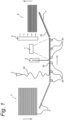
- FIG. 1 An exemplary embodiment of a device according to the present invention is shown schematically in Fig. 1 .
- a carrier feed unit 3 is provided, which holds a stack of carrier plates 4, and is arranged for feeding a (generic) carrier in a transport direction (shown with the arrow in the drawing) with a predetermined speed v b .
- the carrier comprises a plurality or sequence of (adjacent) carrier plates 4.
- the individual carrier plates 4 are transported using rollers 3a, which may be controlled to keep the predetermined speed v b and a distance s between adjacent carrier plates 4 (see also Fig. 3 discussed below) constant.
- rollers 3a e.g. a conveyor belt or sprocket wheels may be used.
- a deposition unit 2 is shown schematically in Fig. 1 , which in this exemplary embodiment is an electrospinning assembly which during operation provides a single endless fiber 2a onto a target, i.e. the carrier plates 4 as shown, thus forming the fiber material layer 2b. Furthermore, a cutting unit 5 is present, which is arranged to cut through the fiber material layer 2b in order to obtain individual carrier plates 4 with a fiber material layer 2b on top of it.
- FIG. 1 exemplary embodiment, further (optional) units are present, such as an inspection unit 7, a drying unit 8 and a stacking unit 6, the functioning of which will be explained below referring to further embodiments of the present invention.
- the present invention relates to a device for depositing a fiber material layer on a carrier, the device comprising a deposition unit 2 positioned remote from (e.g. above as indicated in the Fig. 1 embodiment, but deposition can also be from below) the carrier during operation, the deposition unit 2 being arranged for forming the fiber material layer 2b layer on the carrier in a continuous manner.
- a carrier feed unit 3 is provided for feeding the carrier in a transport direction with a predetermined speed v b .
- the carrier comprises a plurality of carrier plates 4.
- a cutting unit 5 is arranged downstream from the deposition unit 2, the cutting unit 5 being arranged to cut the deposited fiber material layer 2b in between two adjacent ones of the plurality of carrier plates 4.
- the present invention relates to a method for depositing a fiber material layer on a carrier, the method comprising feeding the carrier in a transport direction with a predetermined speed, forming the fiber material layer on the carrier in a continuous manner, the carrier moving in the transport direction, wherein the carrier comprises a plurality of carrier plates 4.
- the method further comprises cutting the deposited fiber material layer in between two adjacent ones of the plurality of carrier plates 4. It is noted that using this method, or operating this device, a fiber material layer 2b (e.g. a layer of electro-spun material) is deposited onto the plurality of carrier plates 4, wherein the fiber material layer 2b has a predetermined lateral strength in the transport direction (before being cut).
- All present invention embodiments provide the advantage that the individual carrier plates 4 with fiber material layer 2b can be processed further individually, such that no bending or suffocation of the freshly formed fiber material layer 2b occurs, easy drying can be provided, and more easy outgassing of solvents, etc. can be accomplished.
- the device further comprises a stacking unit 6 positioned downstream from the cutting unit 5, the stacking unit 6 being arranged to stack adjacent ones of the plurality of carrier plates 4.
- the present invention method embodiments may further comprise stacking adjacent ones of the plurality of carrier plates 4 after the cutting. This allows to provide a compact, small footprint device, and by properly controlling both the carrier feed unit 3 and the stacking unit 6, it is possible to cater for timing variations in further processing steps of the individual carrier plates 4 (e.g. drying, see below).
- the carrier feed unit 3 comprises a de-stacking unit, the de-stacking unit being arranged for taking a carrier plate 4 from a stack of carrier plates 4 and forming the plurality of carrier plates 4.
- De-stacking units as such are well known to the person skilled in the art in various implementation schemes, and can be adapted to specifically suit the dimensions of the carrier plates 4 as used in the present invention embodiments.
- feeding the carrier comprises taking a carrier plate 4 from a stack of carrier plates 4 and forming the plurality of carrier plates 4.
- the stack of carrier plates 4 can be re-used after e.g. removing the individual fiber material layers 2b and cleaning the carrier plates 4.
- the carrier plates 4 can be stacked with an inter-stack distance d.
- the carrier plates 4 coated with fiber material layer 2b in a separated manner with distance d, it is ensured that the fiber material layer 2b cannot be compressed, suffocated and/or induced by bending stresses.
- a further method embodiment further comprising stacking adjacent ones of the plurality of carrier plates 4 with an inter-stack distance d, the inter-stack distance d being larger than the sum of a thickness t c of an individual carrier plate 4 plus a thickness t f of the fiber material layer 2b.
- the inter-stack distance d will provide space between carrier plates 4 to allow drying/outgassing/etc. of the fiber material layer 2b.
- Stacking the carrier plates 4 in a separated manner also creates (in a small footprint) a sort of drying 'tunnel', and, additionally or alternatively, can also provide a buffer from which the carrier plates 4 can be fed into an automated post-processing scheme.
- cutting is performed using a mechanical cutting method, e.g. using moving knives or razor blades.
- cutting is performed using a contactless cutting method.
- An example thereof is a material ablation cutting technique, such as laser cutting.
- abrasive cutting methods may be applied, such as waterjet cutting.
- the cutting unit 5 follows the plate speed v b during the cut with cutting speed v c .
- This can e.g. be accomplished by implementing a "flying saw” approach where the cutting unit 5 (more specifically an actual cutting element of the cutting unit 5) moves along with the carrier plates 4 in a synchronized way during the cut. This is shown schematically in Fig. 3 .
- the plurality of carrier plates 4 comprise a rigid (or stiff) material, e.g. a metal. This allows easy, proper and reliable handling of the individual (and sequence) of carrier plates 4, such as during (de-)stacking.
- the device further comprises an inspection unit 7 positioned downstream from the cutting unit 5, the inspection unit 7 being arranged for inspecting the fiber material layer 2b on individual ones of the plurality of carrier plates 4.
- the method further comprises inspecting the fiber material layer 2b on individual ones of the plurality of carrier plates 4 after the cutting.
- inspecting comprises a thickness measurement. If the individual carrier plate 4 thickness t c is known, allows to perform a precise measurement of the thickness t c of the fiber material layer 2b thereon, e.g. using laser distance measurement. Additionally or alternatively, inspecting comprises image analysis. Using this embodiment can be applied e.g. for detecting mesh defects in the fiber material layer 2b. The inspection measurements can be even further enhanced if, according to a further embodiment, individual ones of the plurality of the carrier plates 4 comprise individual identification codes, e.g. a readable, bar or QR code.
- each carrier plate 4 can have a specific ID code in combination with pre-identified carrier thickness t c information. Subtracting the exact carrier thickness t c on the measurement location makes a precise determination of the thickness t f of the fiber material layer 2b possible. It is noted that these type of inspection steps are very hard to achieve in a roll-to-roll situation of depositing a fiber material layer on a carrier.
- the carrier plates 4 can also have specific features especially adapted for production and/or post processing of the fiber material layer 2b.
- the plurality of carrier plates 4 comprise a predetermined pattern, e.g. etched, coated or metallic patterns, which e.g. allows to collect fibers in specific directions.
- the plurality of carrier plates 4 comprise a surface which is compatible with post-processing of the fiber material layer 2b.
- the surface of each carrier plate 4 can e.g. be of a material insensitive to post-processing, or have a coating or surface finish which is compatible with the post-processing.
- Compatible with the post-processing is to be understood broadly, and includes being inert to, or resistant/insensitive to post-processing techniques.
- the post-processing e.g. comprises using a laser cutting technique to obtain specific geometries out of the fiber material layer 2b on the surface of the carrier plates 4.
- the plurality of carrier plates 4 comprise a surface layer, e.g. in the form of an anti-stick or Teflon layer, which allows to easily separate the fiber material layer 2b from the carrier plate 4.
- the carrier plates 4 are pre-treated, by e.g. smoothing of the surface.
- post-processing steps would be incorporated product handling, quality inspection, and/or scrap management (e.g. excluding a carrier plate 4 from stacking and/or post-processing when a mesh defect is detected in the fiber material layer 2b.
- the method further comprises drying the plurality of carrier plates 4, e.g. after stacking the carrier plates.
- the device can accordingly further comprise a drying unit 8 positioned downstream from the cutting unit 5, the drying unit 8 being arranged to enhance drying of the fiber material layer 2b on individual ones of the plurality of carrier plates 4.
- drying units for drying deposited material on a carrier plate are known to the person skilled in the art.
- the drying unit 20 can be arranged to be operative on a single carrier plate 4 (directly downstream of the cutting unit 5), or on a stack of carrier plates 4, such as when the stack is in the stacking unit 6 (see Fig. 1 ).
- specific adaptations of the drying unit 8 can be implemented.
Landscapes
- Engineering & Computer Science (AREA)
- Chemical & Material Sciences (AREA)
- Chemical Kinetics & Catalysis (AREA)
- Electrochemistry (AREA)
- General Chemical & Material Sciences (AREA)
- Manufacturing & Machinery (AREA)
- Textile Engineering (AREA)
- Materials Engineering (AREA)
- Mechanical Engineering (AREA)
- Nonwoven Fabrics (AREA)
- Preliminary Treatment Of Fibers (AREA)
Description
- The present invention relates, in a first aspect to a method for depositing a fiber material layer on a carrier, the method comprising feeding the carrier in a transport direction with a predetermined speed, and forming the fiber material layer on the carrier in a continuous manner, the carrier moving in the transport direction. In a second aspect, the present invention relates to a device for depositing a fiber material layer on a carrier, the device comprising a deposition unit positioned remote from the carrier during operation, the deposition unit being arranged for forming the fiber material layer on the carrier in a continuous manner.
- International patent publication
WO2012/050682 discloses an electrospinning method for forming an integrated separator for lithium-ion batteries, using roll-to-roll processing of a carrier substrate. The separator is made of a porous electro-spun polymer material and has a nanofiber backbone structure. - International patent publication
WO2019/052881 discloses a method for laser cutting an endless web of battery separator material into individual membranes. Laser cutting is carried out on the surface of a rotating roll provided with a series of segments, with cutting taking place in between adjacent segments. - The present invention seeks to provide an improved method and device for providing a fiber material layer, allowing reliable and large scale production of the fiber material layer.
- According to the present invention, a method as defined above is provided, wherein the carrier comprises a plurality of carrier plates, and the method further comprises cutting the deposited fiber material layer in between two adjacent ones of the plurality of carrier plates to enable the separation of the carrier plates with the fiber material layer. In a further aspect, a device as defined above is provided, the device further comprising a carrier feed unit for feeding the carrier in a transport direction with a predetermined speed, wherein the carrier comprises a plurality of carrier plates, and a cutting unit arranged downstream from the deposition unit, the cutting unit being arranged to cut the deposited fiber material layer in between two adjacent ones of the plurality of carrier plates to enable the separation of the carrier plates with the fiber material layer. The present invention embodiments allow to post-process the fiber material layers on individual carrier plates, e.g. by stacking the individual carrier plates. This in turn allows to keep the fiber material layers unaffected, without compression and with the possibility to allow outgassing (i.e. evaporation of remaining solvents) in a sufficient manner.
- The present invention will be discussed in more detail below, with reference to the attached drawings, in which
-
Fig. 1 shows a schematic diagram of a device for depositing a fiber material layer on a carrier according to an embodiment of the present invention; -
Fig. 2 shows a detailed view of a stack of carrier plates as applied in the device embodiment ofFig. 1 ; and -
Fig. 3 shows a perspective view of two adjacent carrier plates subjected to a cutting step. - The present invention relates to a method and device for depositing a fiber material layer on a carrier in a generic sense, allowing to be used in large scale fiber material deposition processes to enhance the (fiber) product reproducibility and improved automation of such processes. Examples of the deposition techniques wherein the present invention embodiments may be advantageously applied are electrospinning, electro-spraying and melt-printing (e.g. a melt electro writing (MEW) process).
- Bulk production of fibers into a flat 'matt' structure is e.g. done by spinning onto a roll-to-roll carrier as a continuous process. Roll-to-roll carriers however have some drawbacks when it comes to maintaining the integrity of the produced fibrous structures. The collection of the freshly spun fibers onto a roll causes the fibers to become compressed between successive layers on the roll which can cause unwanted deformation of the mesh structure. The compression also causes the fibrous layer to attach to the successive carrier layer, which causes damage of the structure at the unwinding of the roll. Moreover, rolling up successive layers causes suffocation of the evaporation of the remaining solvent inside the freshly spun fibers. This results in an uneven drying course inside the fiber matt and may cause unwanted (severe) morphology changes of the fibers and mesh structure. Finally, the collection of freshly spun fibers onto a roll also causes the matt to set in a bended form which may cause bulging or wrinkling of the matt when flattened later, which can be very undesirable in post-processing steps.
- In the present invention method and device embodiments, the rolls are replaced by a feed of
individual carrier plates 4, e.g. by means of a sheet or plate feeder and sheet or plate collector. The process applied is e.g. electro-spinning wherein afiber 2a is spun onto thecarrier plates 4 in a continuous fashion and as such, creates an endless fiber matt orfiber material layer 2b. Directly after the spinning process the endless fiber matt is cut betweensuccessive carrier plates 4 to enable the separation of thecarrier plates 4 withfiber material layer 2b and to prevent any stress in thefiber material layer 2b due to the further handling of thecarrier plates 4. - An exemplary embodiment of a device according to the present invention is shown schematically in
Fig. 1 . Acarrier feed unit 3 is provided, which holds a stack ofcarrier plates 4, and is arranged for feeding a (generic) carrier in a transport direction (shown with the arrow in the drawing) with a predetermined speed vb. The carrier comprises a plurality or sequence of (adjacent)carrier plates 4. As shown in this exemplary embodiment, theindividual carrier plates 4 are transported usingrollers 3a, which may be controlled to keep the predetermined speed vb and a distance s between adjacent carrier plates 4 (see alsoFig. 3 discussed below) constant. As an alternative torollers 3a, e.g. a conveyor belt or sprocket wheels may be used. - A
deposition unit 2 is shown schematically inFig. 1 , which in this exemplary embodiment is an electrospinning assembly which during operation provides a singleendless fiber 2a onto a target, i.e. thecarrier plates 4 as shown, thus forming thefiber material layer 2b. Furthermore, acutting unit 5 is present, which is arranged to cut through thefiber material layer 2b in order to obtainindividual carrier plates 4 with afiber material layer 2b on top of it. - In the
Fig. 1 exemplary embodiment, further (optional) units are present, such as aninspection unit 7, adrying unit 8 and astacking unit 6, the functioning of which will be explained below referring to further embodiments of the present invention. - In a generic embodiment, the present invention relates to a device for depositing a fiber material layer on a carrier, the device comprising a
deposition unit 2 positioned remote from (e.g. above as indicated in theFig. 1 embodiment, but deposition can also be from below) the carrier during operation, thedeposition unit 2 being arranged for forming thefiber material layer 2b layer on the carrier in a continuous manner. Acarrier feed unit 3 is provided for feeding the carrier in a transport direction with a predetermined speed vb. wherein the carrier comprises a plurality ofcarrier plates 4. Acutting unit 5 is arranged downstream from thedeposition unit 2, thecutting unit 5 being arranged to cut the depositedfiber material layer 2b in between two adjacent ones of the plurality ofcarrier plates 4. In an even more generic sense, the present invention relates to a method for depositing a fiber material layer on a carrier, the method comprising feeding the carrier in a transport direction with a predetermined speed, forming the fiber material layer on the carrier in a continuous manner, the carrier moving in the transport direction, wherein the carrier comprises a plurality ofcarrier plates 4. The method further comprises cutting the deposited fiber material layer in between two adjacent ones of the plurality ofcarrier plates 4. It is noted that using this method, or operating this device, afiber material layer 2b (e.g. a layer of electro-spun material) is deposited onto the plurality ofcarrier plates 4, wherein thefiber material layer 2b has a predetermined lateral strength in the transport direction (before being cut). All present invention embodiments provide the advantage that theindividual carrier plates 4 withfiber material layer 2b can be processed further individually, such that no bending or suffocation of the freshly formedfiber material layer 2b occurs, easy drying can be provided, and more easy outgassing of solvents, etc. can be accomplished. - In a further embodiment, the device further comprises a
stacking unit 6 positioned downstream from thecutting unit 5, thestacking unit 6 being arranged to stack adjacent ones of the plurality ofcarrier plates 4. In analogy, the present invention method embodiments may further comprise stacking adjacent ones of the plurality ofcarrier plates 4 after the cutting. This allows to provide a compact, small footprint device, and by properly controlling both thecarrier feed unit 3 and thestacking unit 6, it is possible to cater for timing variations in further processing steps of the individual carrier plates 4 (e.g. drying, see below). - This can even be enhanced at the input side of the device by adding a further optional feature, wherein the
carrier feed unit 3 comprises a de-stacking unit, the de-stacking unit being arranged for taking acarrier plate 4 from a stack ofcarrier plates 4 and forming the plurality ofcarrier plates 4. De-stacking units as such are well known to the person skilled in the art in various implementation schemes, and can be adapted to specifically suit the dimensions of thecarrier plates 4 as used in the present invention embodiments. In an associated method embodiment, feeding the carrier comprises taking acarrier plate 4 from a stack ofcarrier plates 4 and forming the plurality ofcarrier plates 4. In addition to providing an efficient, compact, small footprint device on the input side, it is noted that in the end it would be possible that the stack ofcarrier plates 4 can be re-used after e.g. removing the individualfiber material layers 2b and cleaning thecarrier plates 4. - As shown in more detail in the cross-sectional view in
Fig. 2 of a stack ofcarrier plates 4 provided with afiber material layer 2b (in the stacking unit 6), thecarrier plates 4 can be stacked with an inter-stack distance d. By stacking thecarrier plates 4 coated withfiber material layer 2b in a separated manner with distance d, it is ensured that thefiber material layer 2b cannot be compressed, suffocated and/or induced by bending stresses. - This is further ensured in a further method embodiment, further comprising stacking adjacent ones of the plurality of
carrier plates 4 with an inter-stack distance d, the inter-stack distance d being larger than the sum of a thickness tc of anindividual carrier plate 4 plus a thickness tf of thefiber material layer 2b. The inter-stack distance d will provide space betweencarrier plates 4 to allow drying/outgassing/etc. of thefiber material layer 2b. Stacking thecarrier plates 4 in a separated manner also creates (in a small footprint) a sort of drying 'tunnel', and, additionally or alternatively, can also provide a buffer from which thecarrier plates 4 can be fed into an automated post-processing scheme. - In a further embodiment, cutting is performed using a mechanical cutting method, e.g. using moving knives or razor blades. Alternatively, cutting is performed using a contactless cutting method. An example thereof is a material ablation cutting technique, such as laser cutting. In an even further alternative, abrasive cutting methods may be applied, such as waterjet cutting.
- As the cutting must be performed between successive
moving carrier plates 4 during operation of the device (which cannot be periodically stopped), thecutting unit 5 follows the plate speed vb during the cut with cutting speed vc. This can e.g. be accomplished by implementing a "flying saw" approach where the cutting unit 5 (more specifically an actual cutting element of the cutting unit 5) moves along with thecarrier plates 4 in a synchronized way during the cut. This is shown schematically inFig. 3 . - In an embodiment of the present invention, the plurality of
carrier plates 4 comprise a rigid (or stiff) material, e.g. a metal. This allows easy, proper and reliable handling of the individual (and sequence) ofcarrier plates 4, such as during (de-)stacking. - Using rigid
individual carrier plates 4 also enables improved inline quality control steps, such as thickness measurement of the individual (e.g. electrospun)fiber material layer 2b. In a further device embodiment, to this end, the device further comprises aninspection unit 7 positioned downstream from thecutting unit 5, theinspection unit 7 being arranged for inspecting thefiber material layer 2b on individual ones of the plurality ofcarrier plates 4. - In the associated method embodiment, the method further comprises inspecting the
fiber material layer 2b on individual ones of the plurality ofcarrier plates 4 after the cutting. In a first alternative, inspecting comprises a thickness measurement. If theindividual carrier plate 4 thickness tc is known, allows to perform a precise measurement of the thickness tc of thefiber material layer 2b thereon, e.g. using laser distance measurement. Additionally or alternatively, inspecting comprises image analysis. Using this embodiment can be applied e.g. for detecting mesh defects in thefiber material layer 2b. The inspection measurements can be even further enhanced if, according to a further embodiment, individual ones of the plurality of thecarrier plates 4 comprise individual identification codes, e.g. a readable, bar or QR code. In this manner, eachcarrier plate 4 can have a specific ID code in combination with pre-identified carrier thickness tc information. Subtracting the exact carrier thickness tc on the measurement location makes a precise determination of the thickness tf of thefiber material layer 2b possible. It is noted that these type of inspection steps are very hard to achieve in a roll-to-roll situation of depositing a fiber material layer on a carrier. - The
carrier plates 4 can also have specific features especially adapted for production and/or post processing of thefiber material layer 2b. In one embodiment, the plurality ofcarrier plates 4 comprise a predetermined pattern, e.g. etched, coated or metallic patterns, which e.g. allows to collect fibers in specific directions. In a further embodiment, the plurality ofcarrier plates 4 comprise a surface which is compatible with post-processing of thefiber material layer 2b. The surface of eachcarrier plate 4 can e.g. be of a material insensitive to post-processing, or have a coating or surface finish which is compatible with the post-processing. Compatible with the post-processing is to be understood broadly, and includes being inert to, or resistant/insensitive to post-processing techniques. The post-processing e.g. comprises using a laser cutting technique to obtain specific geometries out of thefiber material layer 2b on the surface of thecarrier plates 4. In an even further embodiment, the plurality ofcarrier plates 4 comprise a surface layer, e.g. in the form of an anti-stick or Teflon layer, which allows to easily separate thefiber material layer 2b from thecarrier plate 4. Alternatively or additionally, thecarrier plates 4 are pre-treated, by e.g. smoothing of the surface. - Other examples of post-processing steps would be incorporated product handling, quality inspection, and/or scrap management (e.g. excluding a
carrier plate 4 from stacking and/or post-processing when a mesh defect is detected in thefiber material layer 2b. - In a specific further embodiment, the method further comprises drying the plurality of
carrier plates 4, e.g. after stacking the carrier plates. The device can accordingly further comprise adrying unit 8 positioned downstream from thecutting unit 5, the dryingunit 8 being arranged to enhance drying of thefiber material layer 2b on individual ones of the plurality of carrier plates 4.As such, drying units for drying deposited material on a carrier plate are known to the person skilled in the art. The drying unit 20 can be arranged to be operative on a single carrier plate 4 (directly downstream of the cutting unit 5), or on a stack ofcarrier plates 4, such as when the stack is in the stacking unit 6 (seeFig. 1 ). Depending on the exact deposition process type and type offiber material layers 2 being formed using the present invention embodiments, specific adaptations of thedrying unit 8 can be implemented. - The present invention has been described above with reference to a number of exemplary embodiments as shown in the drawings. Modifications and alternative implementations of some parts or elements are possible, and are included in the scope of protection as defined in the appended claims.
Claims (15)
- Method for depositing a fiber material layer (2b) on a carrier, the method comprisingfeeding the carrier in a transport direction with a predetermined speed,forming the fiber material layer (2b) on the carrier in a continuous manner, the carrier moving in the transport direction,wherein the carrier comprises a plurality of carrier plates (4), and the method further comprisescutting the deposited fiber material layer (2b) in between two adjacent ones of the plurality of carrier plates (4) to enable the separation of the carrier plates (4) with the fiber material layer (2b).
- Method according to claim 1, further comprising stacking adjacent ones of the plurality of carrier plates (4) after the cutting.
- Method according to claim 2, further comprising stacking adjacent ones of the plurality of carrier plates (4) with an inter-stack distance (d), the inter-stack distance (d) being larger than the sum of a thickness (tc) of an individual carrier plate (4) plus a thickness (tf) of the fiber material layer (2b).
- Method according to any one of claims 1-3, wherein feeding the carrier comprises taking a carrier plate (4) from a stack of carrier plates (4) and forming the plurality of carrier plates (4).
- Method according to any one of claims 1-4, wherein cutting is performed using a mechanical cutting method or a contactless cutting method.
- Method according to any one of claims 1-5, wherein the method further comprises inspecting the fiber material layer (2b) on individual ones of the plurality of carrier plates (4) after the cutting.
- Method according to any one of claims 1-6, wherein inspecting comprises a thickness measurement or image analysis.
- Method according to any one of claims 1-7, wherein individual ones of the plurality of the carrier plates (4) comprise individual identification codes.
- Method according to any one of claims 1-8, wherein the plurality of carrier plates (4) comprise at least one of:a rigid material,a predetermined pattern,a surface which is compatible with post-processing of the fiber material layer (2b), anda surface layer.
- Method according to any one of claims 1-9, wherein the method further comprises drying the plurality of carrier plates (4).
- Device for depositing a fiber material layer (2b) on a carrier, the device comprisinga deposition unit (2) positioned remote from the carrier during operation, the deposition unit (2) being arranged for forming the fiber material layer (2b) on the carrier in a continuous manner,a carrier feed unit (3) for feeding the carrier in a transport direction with a predetermined speed (vb), wherein the carrier comprises a plurality of carrier plates (4), anda cutting unit (5) arranged downstream from the deposition unit (2), the cutting unit (5) being arranged to cut the deposited fiber material layer (2b) in between two adjacent ones of the plurality of carrier plates (4) to enable the separation of the carrier plates (4) with the fiber material layer (2b).
- The device according to claim 11, further comprising
a stacking unit (6) positioned downstream from the cutting unit (5), the stacking unit (6) being arranged to stack adjacent ones of the plurality of carrier plates (4). - The device according to claim 11 or 12, wherein the carrier feed unit (3) comprises a de-stacking unit, the de-stacking unit being arranged for taking a carrier plate (4) from a stack of carrier plates (4) and forming the plurality of carrier plates (4).
- The device according to any one of claims 11-13, further comprising
an inspection unit (7) positioned downstream from the cutting unit (5), the inspection unit (7) being arranged for inspecting the fiber material layer (2b) on individual ones of the plurality of carrier plates (4). - The device according to any one of claims 11-14, further comprising
a drying unit (8) positioned downstream from the cutting unit (5), the drying unit (8) being arranged to enhance drying of the fiber material layer (2b) on individual ones of the plurality of carrier plates (4).
Applications Claiming Priority (2)
| Application Number | Priority Date | Filing Date | Title |
|---|---|---|---|
| NL2023085A NL2023085B1 (en) | 2019-05-08 | 2019-05-08 | Method and device for depositing a fiber material layer on a carrier |
| PCT/NL2020/050272 WO2020226488A1 (en) | 2019-05-08 | 2020-04-30 | Method and device for depositing a fiber material layer on a carrier |
Publications (2)
| Publication Number | Publication Date |
|---|---|
| EP3966369A1 EP3966369A1 (en) | 2022-03-16 |
| EP3966369B1 true EP3966369B1 (en) | 2023-05-31 |
Family
ID=66589850
Family Applications (1)
| Application Number | Title | Priority Date | Filing Date |
|---|---|---|---|
| EP20725958.1A Active EP3966369B1 (en) | 2019-05-08 | 2020-04-30 | Method and device for depositing a fiber material layer on a carrier |
Country Status (7)
| Country | Link |
|---|---|
| US (1) | US12241189B2 (en) |
| EP (1) | EP3966369B1 (en) |
| CN (1) | CN114008252B (en) |
| ES (1) | ES2953132T3 (en) |
| NL (1) | NL2023085B1 (en) |
| PL (1) | PL3966369T3 (en) |
| WO (1) | WO2020226488A1 (en) |
Family Cites Families (11)
| Publication number | Priority date | Publication date | Assignee | Title |
|---|---|---|---|---|
| US7744793B2 (en) * | 2005-09-06 | 2010-06-29 | Lemaire Alexander B | Apparatus and method for growing fullerene nanotube forests, and forming nanotube films, threads and composite structures therefrom |
| PT103999B (en) * | 2008-03-20 | 2012-11-16 | Univ Nova De Lisboa | METHOD FOR USING AND CREATING PAPER BASED ON NATURAL CELLULOSE FIBERS, SYNTHETIC OR MIST FIBERS AS A PHYSICAL SUPPORT AND HANDLING OF ELECTRICAL LOADS IN SELF-SUSTAINABLE MEMORY FIELD EFFECT TRANSI- TERS USING SEM |
| CN102115071B (en) * | 2009-12-31 | 2013-01-09 | 清华大学 | Film spreading system and method for spreading films by using same |
| CN103168384B (en) | 2010-09-30 | 2015-11-25 | 应用材料公司 | The integration separator of Electrospun lithium ion battery |
| DE102011115118A1 (en) * | 2011-10-06 | 2013-04-11 | Li-Tec Battery Gmbh | Method and system for cutting sheet or plate-shaped objects |
| KR101959974B1 (en) | 2012-07-10 | 2019-07-16 | 삼성디스플레이 주식회사 | Apparatus for organic layer deposition, method for manufacturing of organic light emitting display apparatus using the same, and organic light emitting display apparatus manufactured by the method |
| EP3350853A4 (en) * | 2015-07-22 | 2019-10-09 | Celgard LLC | ENHANCED MEMBRANES, SEPARATORS AND BATTERIES, AND ASSOCIATED METHODS |
| US20170348876A1 (en) * | 2016-05-31 | 2017-12-07 | General Electric Company | Thin ply high temperature composites |
| DE102017216133A1 (en) * | 2017-09-13 | 2019-03-14 | Robert Bosch Gmbh | Method for separating ribbon-shaped electrode and separator material on a curved surface |
| DE102017124659B3 (en) * | 2017-10-23 | 2019-02-07 | Südwolle GmbH & Co. KG | Method and device for producing a yarn |
| CN110400152A (en) * | 2018-04-17 | 2019-11-01 | 鹏鼎控股(深圳)股份有限公司 | Quality traceability system for printed circuit board |
-
2019
- 2019-05-08 NL NL2023085A patent/NL2023085B1/en active
-
2020
- 2020-04-30 CN CN202080033325.3A patent/CN114008252B/en active Active
- 2020-04-30 WO PCT/NL2020/050272 patent/WO2020226488A1/en not_active Ceased
- 2020-04-30 US US17/606,797 patent/US12241189B2/en active Active
- 2020-04-30 ES ES20725958T patent/ES2953132T3/en active Active
- 2020-04-30 PL PL20725958.1T patent/PL3966369T3/en unknown
- 2020-04-30 EP EP20725958.1A patent/EP3966369B1/en active Active
Also Published As
| Publication number | Publication date |
|---|---|
| CN114008252A (en) | 2022-02-01 |
| CN114008252B (en) | 2024-03-15 |
| US20220205155A1 (en) | 2022-06-30 |
| ES2953132T3 (en) | 2023-11-08 |
| EP3966369A1 (en) | 2022-03-16 |
| US12241189B2 (en) | 2025-03-04 |
| WO2020226488A1 (en) | 2020-11-12 |
| NL2023085B1 (en) | 2020-11-30 |
| PL3966369T3 (en) | 2023-10-02 |
Similar Documents
| Publication | Publication Date | Title |
|---|---|---|
| KR101741632B1 (en) | Apparatus and method for stripping of protective film | |
| US20190240932A1 (en) | Tape-laying device and tape-laying method using a pivotal cutting device | |
| US20100106288A1 (en) | Device for automatically sorting glass plates | |
| JP6589517B2 (en) | Electrode plate laminate manufacturing method and electrode plate laminate manufacturing system | |
| EP3966369B1 (en) | Method and device for depositing a fiber material layer on a carrier | |
| KR102754517B1 (en) | Apparatus and method for continuously manufacturing electrode | |
| US5011123A (en) | System and method for collating book and pamphlet signatures and the like | |
| US20250002261A1 (en) | Conveying Facility for Conveying Cell Stacks Formed by Segments for the Energy Cell-Producing Industry, Corresponding Cell Stack Production System, and Method for Providing Cell Stacks of this Kind | |
| US20130134668A1 (en) | Method and device for forming an auxiliary stack | |
| EP4187637B1 (en) | Apparatus and method for continuously manufacturing electrode | |
| US20090211951A1 (en) | Device and Method for Continuously Producing a Defective-Free Carrier Strip | |
| EP3296968B1 (en) | Apparatus for preprocessing paper sheets and method for processing paper sheets | |
| US20090206012A1 (en) | Sorting device and method for sorting rfid tags | |
| US20230231147A1 (en) | Method of providing a cleaned gas diffusion layer for electrochemical applications | |
| EP4456225B1 (en) | Method and device for providing an electrode strand and for producing a monocell and a battery stack | |
| DE19952471A1 (en) | Method and device for producing an error-free material web and error-free material web | |
| ITMI930998A1 (en) | DEVICE FOR COATING PANELS | |
| WO2003097360A2 (en) | Measurement of quality in a delivery device pertaining to a rotary sheet printing machine | |
| EP1553219B1 (en) | Combing machine for cotton and the like with improved sliver forming device | |
| DE102014220270B4 (en) | Method for generating and outputting small batches from a sheet-fed rotary printing press | |
| DE102023135280B3 (en) | Method for operating a sheet processing machine | |
| IT202300027657A1 (en) | APPARATUS AND PROCEDURE FOR HANDLING SINGLE CELLS FOR THE PRODUCTION OF ELECTRIC ENERGY STORAGE DEVICES | |
| KR20190017770A (en) | Apparatus for treating mineral fiber mats by detecting and removing local defects, and corresponding methods | |
| EP4231398A1 (en) | Device and method for machining a film-like electrode sheet | |
| MX2008002592A (en) | Device and method for continuously producing a defective-free carrier strip |
Legal Events
| Date | Code | Title | Description |
|---|---|---|---|
| STAA | Information on the status of an ep patent application or granted ep patent |
Free format text: STATUS: UNKNOWN |
|
| STAA | Information on the status of an ep patent application or granted ep patent |
Free format text: STATUS: THE INTERNATIONAL PUBLICATION HAS BEEN MADE |
|
| PUAI | Public reference made under article 153(3) epc to a published international application that has entered the european phase |
Free format text: ORIGINAL CODE: 0009012 |
|
| STAA | Information on the status of an ep patent application or granted ep patent |
Free format text: STATUS: REQUEST FOR EXAMINATION WAS MADE |
|
| 17P | Request for examination filed |
Effective date: 20211130 |
|
| AK | Designated contracting states |
Kind code of ref document: A1 Designated state(s): AL AT BE BG CH CY CZ DE DK EE ES FI FR GB GR HR HU IE IS IT LI LT LU LV MC MK MT NL NO PL PT RO RS SE SI SK SM TR |
|
| DAV | Request for validation of the european patent (deleted) | ||
| DAX | Request for extension of the european patent (deleted) | ||
| REG | Reference to a national code |
Ref country code: DE Ref legal event code: R079 Ref document number: 602020011342 Country of ref document: DE Free format text: PREVIOUS MAIN CLASS: D01D0005000000 Ipc: H01M0050406000 |
|
| GRAP | Despatch of communication of intention to grant a patent |
Free format text: ORIGINAL CODE: EPIDOSNIGR1 |
|
| STAA | Information on the status of an ep patent application or granted ep patent |
Free format text: STATUS: GRANT OF PATENT IS INTENDED |
|
| RIC1 | Information provided on ipc code assigned before grant |
Ipc: H01M 50/44 20210101ALN20221018BHEP Ipc: D04H 1/728 20120101ALI20221018BHEP Ipc: D01D 5/00 20060101ALI20221018BHEP Ipc: H01M 50/403 20210101ALI20221018BHEP Ipc: H01M 50/406 20210101AFI20221018BHEP |
|
| INTG | Intention to grant announced |
Effective date: 20221116 |
|
| GRAS | Grant fee paid |
Free format text: ORIGINAL CODE: EPIDOSNIGR3 |
|
| GRAA | (expected) grant |
Free format text: ORIGINAL CODE: 0009210 |
|
| STAA | Information on the status of an ep patent application or granted ep patent |
Free format text: STATUS: THE PATENT HAS BEEN GRANTED |
|
| AK | Designated contracting states |
Kind code of ref document: B1 Designated state(s): AL AT BE BG CH CY CZ DE DK EE ES FI FR GB GR HR HU IE IS IT LI LT LU LV MC MK MT NL NO PL PT RO RS SE SI SK SM TR |
|
| REG | Reference to a national code |
Ref country code: GB Ref legal event code: FG4D Ref country code: CH Ref legal event code: EP |
|
| REG | Reference to a national code |
Ref country code: DE Ref legal event code: R096 Ref document number: 602020011342 Country of ref document: DE |
|
| REG | Reference to a national code |
Ref country code: AT Ref legal event code: REF Ref document number: 1571514 Country of ref document: AT Kind code of ref document: T Effective date: 20230615 |
|
| P01 | Opt-out of the competence of the unified patent court (upc) registered |
Effective date: 20230512 |
|
| REG | Reference to a national code |
Ref country code: IE Ref legal event code: FG4D |
|
| REG | Reference to a national code |
Ref country code: NL Ref legal event code: FP |
|
| REG | Reference to a national code |
Ref country code: LT Ref legal event code: MG9D |
|
| REG | Reference to a national code |
Ref country code: AT Ref legal event code: MK05 Ref document number: 1571514 Country of ref document: AT Kind code of ref document: T Effective date: 20230531 |
|
| PG25 | Lapsed in a contracting state [announced via postgrant information from national office to epo] |
Ref country code: SE Free format text: LAPSE BECAUSE OF FAILURE TO SUBMIT A TRANSLATION OF THE DESCRIPTION OR TO PAY THE FEE WITHIN THE PRESCRIBED TIME-LIMIT Effective date: 20230531 Ref country code: NO Free format text: LAPSE BECAUSE OF FAILURE TO SUBMIT A TRANSLATION OF THE DESCRIPTION OR TO PAY THE FEE WITHIN THE PRESCRIBED TIME-LIMIT Effective date: 20230831 Ref country code: AT Free format text: LAPSE BECAUSE OF FAILURE TO SUBMIT A TRANSLATION OF THE DESCRIPTION OR TO PAY THE FEE WITHIN THE PRESCRIBED TIME-LIMIT Effective date: 20230531 |
|
| REG | Reference to a national code |
Ref country code: ES Ref legal event code: FG2A Ref document number: 2953132 Country of ref document: ES Kind code of ref document: T3 Effective date: 20231108 |
|
| PG25 | Lapsed in a contracting state [announced via postgrant information from national office to epo] |
Ref country code: RS Free format text: LAPSE BECAUSE OF FAILURE TO SUBMIT A TRANSLATION OF THE DESCRIPTION OR TO PAY THE FEE WITHIN THE PRESCRIBED TIME-LIMIT Effective date: 20230531 Ref country code: LV Free format text: LAPSE BECAUSE OF FAILURE TO SUBMIT A TRANSLATION OF THE DESCRIPTION OR TO PAY THE FEE WITHIN THE PRESCRIBED TIME-LIMIT Effective date: 20230531 Ref country code: LT Free format text: LAPSE BECAUSE OF FAILURE TO SUBMIT A TRANSLATION OF THE DESCRIPTION OR TO PAY THE FEE WITHIN THE PRESCRIBED TIME-LIMIT Effective date: 20230531 Ref country code: IS Free format text: LAPSE BECAUSE OF FAILURE TO SUBMIT A TRANSLATION OF THE DESCRIPTION OR TO PAY THE FEE WITHIN THE PRESCRIBED TIME-LIMIT Effective date: 20230930 Ref country code: HR Free format text: LAPSE BECAUSE OF FAILURE TO SUBMIT A TRANSLATION OF THE DESCRIPTION OR TO PAY THE FEE WITHIN THE PRESCRIBED TIME-LIMIT Effective date: 20230531 Ref country code: GR Free format text: LAPSE BECAUSE OF FAILURE TO SUBMIT A TRANSLATION OF THE DESCRIPTION OR TO PAY THE FEE WITHIN THE PRESCRIBED TIME-LIMIT Effective date: 20230901 |
|
| PG25 | Lapsed in a contracting state [announced via postgrant information from national office to epo] |
Ref country code: FI Free format text: LAPSE BECAUSE OF FAILURE TO SUBMIT A TRANSLATION OF THE DESCRIPTION OR TO PAY THE FEE WITHIN THE PRESCRIBED TIME-LIMIT Effective date: 20230531 |
|
| PG25 | Lapsed in a contracting state [announced via postgrant information from national office to epo] |
Ref country code: SK Free format text: LAPSE BECAUSE OF FAILURE TO SUBMIT A TRANSLATION OF THE DESCRIPTION OR TO PAY THE FEE WITHIN THE PRESCRIBED TIME-LIMIT Effective date: 20230531 |
|
| PG25 | Lapsed in a contracting state [announced via postgrant information from national office to epo] |
Ref country code: SM Free format text: LAPSE BECAUSE OF FAILURE TO SUBMIT A TRANSLATION OF THE DESCRIPTION OR TO PAY THE FEE WITHIN THE PRESCRIBED TIME-LIMIT Effective date: 20230531 Ref country code: SK Free format text: LAPSE BECAUSE OF FAILURE TO SUBMIT A TRANSLATION OF THE DESCRIPTION OR TO PAY THE FEE WITHIN THE PRESCRIBED TIME-LIMIT Effective date: 20230531 Ref country code: RO Free format text: LAPSE BECAUSE OF FAILURE TO SUBMIT A TRANSLATION OF THE DESCRIPTION OR TO PAY THE FEE WITHIN THE PRESCRIBED TIME-LIMIT Effective date: 20230531 Ref country code: PT Free format text: LAPSE BECAUSE OF FAILURE TO SUBMIT A TRANSLATION OF THE DESCRIPTION OR TO PAY THE FEE WITHIN THE PRESCRIBED TIME-LIMIT Effective date: 20231002 Ref country code: EE Free format text: LAPSE BECAUSE OF FAILURE TO SUBMIT A TRANSLATION OF THE DESCRIPTION OR TO PAY THE FEE WITHIN THE PRESCRIBED TIME-LIMIT Effective date: 20230531 Ref country code: DK Free format text: LAPSE BECAUSE OF FAILURE TO SUBMIT A TRANSLATION OF THE DESCRIPTION OR TO PAY THE FEE WITHIN THE PRESCRIBED TIME-LIMIT Effective date: 20230531 |
|
| REG | Reference to a national code |
Ref country code: DE Ref legal event code: R097 Ref document number: 602020011342 Country of ref document: DE |
|
| PLBE | No opposition filed within time limit |
Free format text: ORIGINAL CODE: 0009261 |
|
| STAA | Information on the status of an ep patent application or granted ep patent |
Free format text: STATUS: NO OPPOSITION FILED WITHIN TIME LIMIT |
|
| PG25 | Lapsed in a contracting state [announced via postgrant information from national office to epo] |
Ref country code: SI Free format text: LAPSE BECAUSE OF FAILURE TO SUBMIT A TRANSLATION OF THE DESCRIPTION OR TO PAY THE FEE WITHIN THE PRESCRIBED TIME-LIMIT Effective date: 20230531 |
|
| 26N | No opposition filed |
Effective date: 20240301 |
|
| PG25 | Lapsed in a contracting state [announced via postgrant information from national office to epo] |
Ref country code: SI Free format text: LAPSE BECAUSE OF FAILURE TO SUBMIT A TRANSLATION OF THE DESCRIPTION OR TO PAY THE FEE WITHIN THE PRESCRIBED TIME-LIMIT Effective date: 20230531 |
|
| PG25 | Lapsed in a contracting state [announced via postgrant information from national office to epo] |
Ref country code: BG Free format text: LAPSE BECAUSE OF FAILURE TO SUBMIT A TRANSLATION OF THE DESCRIPTION OR TO PAY THE FEE WITHIN THE PRESCRIBED TIME-LIMIT Effective date: 20230531 |
|
| PG25 | Lapsed in a contracting state [announced via postgrant information from national office to epo] |
Ref country code: MC Free format text: LAPSE BECAUSE OF FAILURE TO SUBMIT A TRANSLATION OF THE DESCRIPTION OR TO PAY THE FEE WITHIN THE PRESCRIBED TIME-LIMIT Effective date: 20230531 |
|
| PG25 | Lapsed in a contracting state [announced via postgrant information from national office to epo] |
Ref country code: MC Free format text: LAPSE BECAUSE OF FAILURE TO SUBMIT A TRANSLATION OF THE DESCRIPTION OR TO PAY THE FEE WITHIN THE PRESCRIBED TIME-LIMIT Effective date: 20230531 Ref country code: BG Free format text: LAPSE BECAUSE OF FAILURE TO SUBMIT A TRANSLATION OF THE DESCRIPTION OR TO PAY THE FEE WITHIN THE PRESCRIBED TIME-LIMIT Effective date: 20230531 |
|
| REG | Reference to a national code |
Ref country code: CH Ref legal event code: PL |
|
| PG25 | Lapsed in a contracting state [announced via postgrant information from national office to epo] |
Ref country code: LU Free format text: LAPSE BECAUSE OF NON-PAYMENT OF DUE FEES Effective date: 20240430 |
|
| PG25 | Lapsed in a contracting state [announced via postgrant information from national office to epo] |
Ref country code: LU Free format text: LAPSE BECAUSE OF NON-PAYMENT OF DUE FEES Effective date: 20240430 |
|
| PG25 | Lapsed in a contracting state [announced via postgrant information from national office to epo] |
Ref country code: CH Free format text: LAPSE BECAUSE OF NON-PAYMENT OF DUE FEES Effective date: 20240430 |
|
| PGFP | Annual fee paid to national office [announced via postgrant information from national office to epo] |
Ref country code: NL Payment date: 20250409 Year of fee payment: 6 |
|
| PGFP | Annual fee paid to national office [announced via postgrant information from national office to epo] |
Ref country code: PL Payment date: 20250423 Year of fee payment: 6 Ref country code: DE Payment date: 20250428 Year of fee payment: 6 |
|
| PGFP | Annual fee paid to national office [announced via postgrant information from national office to epo] |
Ref country code: GB Payment date: 20250422 Year of fee payment: 6 Ref country code: ES Payment date: 20250513 Year of fee payment: 6 |
|
| PGFP | Annual fee paid to national office [announced via postgrant information from national office to epo] |
Ref country code: IT Payment date: 20250422 Year of fee payment: 6 Ref country code: BE Payment date: 20250424 Year of fee payment: 6 |
|
| PGFP | Annual fee paid to national office [announced via postgrant information from national office to epo] |
Ref country code: FR Payment date: 20250424 Year of fee payment: 6 |
|
| PGFP | Annual fee paid to national office [announced via postgrant information from national office to epo] |
Ref country code: CZ Payment date: 20250422 Year of fee payment: 6 |
|
| PGFP | Annual fee paid to national office [announced via postgrant information from national office to epo] |
Ref country code: IE Payment date: 20250417 Year of fee payment: 6 |
|
| PG25 | Lapsed in a contracting state [announced via postgrant information from national office to epo] |
Ref country code: CY Free format text: LAPSE BECAUSE OF FAILURE TO SUBMIT A TRANSLATION OF THE DESCRIPTION OR TO PAY THE FEE WITHIN THE PRESCRIBED TIME-LIMIT; INVALID AB INITIO Effective date: 20200430 |
|
| PG25 | Lapsed in a contracting state [announced via postgrant information from national office to epo] |
Ref country code: HU Free format text: LAPSE BECAUSE OF FAILURE TO SUBMIT A TRANSLATION OF THE DESCRIPTION OR TO PAY THE FEE WITHIN THE PRESCRIBED TIME-LIMIT; INVALID AB INITIO Effective date: 20200430 |