EP3966079B1 - Method and system for the recognition of the irregularities of a road pavement - Google Patents
Method and system for the recognition of the irregularities of a road pavement Download PDFInfo
- Publication number
- EP3966079B1 EP3966079B1 EP20723218.2A EP20723218A EP3966079B1 EP 3966079 B1 EP3966079 B1 EP 3966079B1 EP 20723218 A EP20723218 A EP 20723218A EP 3966079 B1 EP3966079 B1 EP 3966079B1
- Authority
- EP
- European Patent Office
- Prior art keywords
- motor vehicle
- sub
- vertical acceleration
- irregularities
- road pavement
- Prior art date
- Legal status (The legal status is an assumption and is not a legal conclusion. Google has not performed a legal analysis and makes no representation as to the accuracy of the status listed.)
- Active
Links
Images

Classifications
-
- B—PERFORMING OPERATIONS; TRANSPORTING
- B60—VEHICLES IN GENERAL
- B60W—CONJOINT CONTROL OF VEHICLE SUB-UNITS OF DIFFERENT TYPE OR DIFFERENT FUNCTION; CONTROL SYSTEMS SPECIALLY ADAPTED FOR HYBRID VEHICLES; ROAD VEHICLE DRIVE CONTROL SYSTEMS FOR PURPOSES NOT RELATED TO THE CONTROL OF A PARTICULAR SUB-UNIT
- B60W40/00—Estimation or calculation of non-directly measurable driving parameters for road vehicle drive control systems not related to the control of a particular sub unit, e.g. by using mathematical models
- B60W40/02—Estimation or calculation of non-directly measurable driving parameters for road vehicle drive control systems not related to the control of a particular sub unit, e.g. by using mathematical models related to ambient conditions
- B60W40/06—Road conditions
-
- B—PERFORMING OPERATIONS; TRANSPORTING
- B60—VEHICLES IN GENERAL
- B60W—CONJOINT CONTROL OF VEHICLE SUB-UNITS OF DIFFERENT TYPE OR DIFFERENT FUNCTION; CONTROL SYSTEMS SPECIALLY ADAPTED FOR HYBRID VEHICLES; ROAD VEHICLE DRIVE CONTROL SYSTEMS FOR PURPOSES NOT RELATED TO THE CONTROL OF A PARTICULAR SUB-UNIT
- B60W30/00—Purposes of road vehicle drive control systems not related to the control of a particular sub-unit, e.g. of systems using conjoint control of vehicle sub-units
- B60W30/08—Active safety systems predicting or avoiding probable or impending collision or attempting to minimise its consequences
- B60W30/095—Predicting travel path or likelihood of collision
-
- G—PHYSICS
- G01—MEASURING; TESTING
- G01B—MEASURING LENGTH, THICKNESS OR SIMILAR LINEAR DIMENSIONS; MEASURING ANGLES; MEASURING AREAS; MEASURING IRREGULARITIES OF SURFACES OR CONTOURS
- G01B21/00—Measuring arrangements or details thereof, where the measuring technique is not covered by the other groups of this subclass, unspecified or not relevant
- G01B21/30—Measuring arrangements or details thereof, where the measuring technique is not covered by the other groups of this subclass, unspecified or not relevant for measuring roughness or irregularity of surfaces
-
- G—PHYSICS
- G01—MEASURING; TESTING
- G01S—RADIO DIRECTION-FINDING; RADIO NAVIGATION; DETERMINING DISTANCE OR VELOCITY BY USE OF RADIO WAVES; LOCATING OR PRESENCE-DETECTING BY USE OF THE REFLECTION OR RERADIATION OF RADIO WAVES; ANALOGOUS ARRANGEMENTS USING OTHER WAVES
- G01S19/00—Satellite radio beacon positioning systems; Determining position, velocity or attitude using signals transmitted by such systems
- G01S19/01—Satellite radio beacon positioning systems transmitting time-stamped messages, e.g. GPS [Global Positioning System], GLONASS [Global Orbiting Navigation Satellite System] or GALILEO
-
- G—PHYSICS
- G06—COMPUTING OR CALCULATING; COUNTING
- G06F—ELECTRIC DIGITAL DATA PROCESSING
- G06F30/00—Computer-aided design [CAD]
- G06F30/20—Design optimisation, verification or simulation
- G06F30/23—Design optimisation, verification or simulation using finite element methods [FEM] or finite difference methods [FDM]
-
- G—PHYSICS
- G07—CHECKING-DEVICES
- G07C—TIME OR ATTENDANCE REGISTERS; REGISTERING OR INDICATING THE WORKING OF MACHINES; GENERATING RANDOM NUMBERS; VOTING OR LOTTERY APPARATUS; ARRANGEMENTS, SYSTEMS OR APPARATUS FOR CHECKING NOT PROVIDED FOR ELSEWHERE
- G07C5/00—Registering or indicating the working of vehicles
- G07C5/008—Registering or indicating the working of vehicles communicating information to a remotely located station
-
- G—PHYSICS
- G07—CHECKING-DEVICES
- G07C—TIME OR ATTENDANCE REGISTERS; REGISTERING OR INDICATING THE WORKING OF MACHINES; GENERATING RANDOM NUMBERS; VOTING OR LOTTERY APPARATUS; ARRANGEMENTS, SYSTEMS OR APPARATUS FOR CHECKING NOT PROVIDED FOR ELSEWHERE
- G07C5/00—Registering or indicating the working of vehicles
- G07C5/02—Registering or indicating driving, working, idle, or waiting time only
-
- B—PERFORMING OPERATIONS; TRANSPORTING
- B60—VEHICLES IN GENERAL
- B60W—CONJOINT CONTROL OF VEHICLE SUB-UNITS OF DIFFERENT TYPE OR DIFFERENT FUNCTION; CONTROL SYSTEMS SPECIALLY ADAPTED FOR HYBRID VEHICLES; ROAD VEHICLE DRIVE CONTROL SYSTEMS FOR PURPOSES NOT RELATED TO THE CONTROL OF A PARTICULAR SUB-UNIT
- B60W50/00—Details of control systems for road vehicle drive control not related to the control of a particular sub-unit, e.g. process diagnostic or vehicle driver interfaces
- B60W2050/0001—Details of the control system
- B60W2050/0019—Control system elements or transfer functions
- B60W2050/0042—Transfer function lag; delays
-
- B—PERFORMING OPERATIONS; TRANSPORTING
- B60—VEHICLES IN GENERAL
- B60W—CONJOINT CONTROL OF VEHICLE SUB-UNITS OF DIFFERENT TYPE OR DIFFERENT FUNCTION; CONTROL SYSTEMS SPECIALLY ADAPTED FOR HYBRID VEHICLES; ROAD VEHICLE DRIVE CONTROL SYSTEMS FOR PURPOSES NOT RELATED TO THE CONTROL OF A PARTICULAR SUB-UNIT
- B60W50/00—Details of control systems for road vehicle drive control not related to the control of a particular sub-unit, e.g. process diagnostic or vehicle driver interfaces
- B60W2050/0001—Details of the control system
- B60W2050/0043—Signal treatments, identification of variables or parameters, parameter estimation or state estimation
- B60W2050/0052—Filtering, filters
-
- B—PERFORMING OPERATIONS; TRANSPORTING
- B60—VEHICLES IN GENERAL
- B60W—CONJOINT CONTROL OF VEHICLE SUB-UNITS OF DIFFERENT TYPE OR DIFFERENT FUNCTION; CONTROL SYSTEMS SPECIALLY ADAPTED FOR HYBRID VEHICLES; ROAD VEHICLE DRIVE CONTROL SYSTEMS FOR PURPOSES NOT RELATED TO THE CONTROL OF A PARTICULAR SUB-UNIT
- B60W50/00—Details of control systems for road vehicle drive control not related to the control of a particular sub-unit, e.g. process diagnostic or vehicle driver interfaces
- B60W2050/0001—Details of the control system
- B60W2050/0043—Signal treatments, identification of variables or parameters, parameter estimation or state estimation
- B60W2050/0052—Filtering, filters
- B60W2050/0054—Cut-off filters, retarders, delaying means, dead zones, threshold values or cut-off frequency
-
- B—PERFORMING OPERATIONS; TRANSPORTING
- B60—VEHICLES IN GENERAL
- B60W—CONJOINT CONTROL OF VEHICLE SUB-UNITS OF DIFFERENT TYPE OR DIFFERENT FUNCTION; CONTROL SYSTEMS SPECIALLY ADAPTED FOR HYBRID VEHICLES; ROAD VEHICLE DRIVE CONTROL SYSTEMS FOR PURPOSES NOT RELATED TO THE CONTROL OF A PARTICULAR SUB-UNIT
- B60W50/00—Details of control systems for road vehicle drive control not related to the control of a particular sub-unit, e.g. process diagnostic or vehicle driver interfaces
- B60W2050/0001—Details of the control system
- B60W2050/0043—Signal treatments, identification of variables or parameters, parameter estimation or state estimation
- B60W2050/0057—Frequency analysis, spectral techniques or transforms
-
- B—PERFORMING OPERATIONS; TRANSPORTING
- B60—VEHICLES IN GENERAL
- B60W—CONJOINT CONTROL OF VEHICLE SUB-UNITS OF DIFFERENT TYPE OR DIFFERENT FUNCTION; CONTROL SYSTEMS SPECIALLY ADAPTED FOR HYBRID VEHICLES; ROAD VEHICLE DRIVE CONTROL SYSTEMS FOR PURPOSES NOT RELATED TO THE CONTROL OF A PARTICULAR SUB-UNIT
- B60W2510/00—Input parameters relating to a particular sub-units
- B60W2510/22—Suspension systems
- B60W2510/227—Oscillation frequency
-
- B—PERFORMING OPERATIONS; TRANSPORTING
- B60—VEHICLES IN GENERAL
- B60W—CONJOINT CONTROL OF VEHICLE SUB-UNITS OF DIFFERENT TYPE OR DIFFERENT FUNCTION; CONTROL SYSTEMS SPECIALLY ADAPTED FOR HYBRID VEHICLES; ROAD VEHICLE DRIVE CONTROL SYSTEMS FOR PURPOSES NOT RELATED TO THE CONTROL OF A PARTICULAR SUB-UNIT
- B60W2520/00—Input parameters relating to overall vehicle dynamics
- B60W2520/10—Longitudinal speed
-
- B—PERFORMING OPERATIONS; TRANSPORTING
- B60—VEHICLES IN GENERAL
- B60W—CONJOINT CONTROL OF VEHICLE SUB-UNITS OF DIFFERENT TYPE OR DIFFERENT FUNCTION; CONTROL SYSTEMS SPECIALLY ADAPTED FOR HYBRID VEHICLES; ROAD VEHICLE DRIVE CONTROL SYSTEMS FOR PURPOSES NOT RELATED TO THE CONTROL OF A PARTICULAR SUB-UNIT
- B60W2520/00—Input parameters relating to overall vehicle dynamics
- B60W2520/14—Yaw
-
- B—PERFORMING OPERATIONS; TRANSPORTING
- B60—VEHICLES IN GENERAL
- B60W—CONJOINT CONTROL OF VEHICLE SUB-UNITS OF DIFFERENT TYPE OR DIFFERENT FUNCTION; CONTROL SYSTEMS SPECIALLY ADAPTED FOR HYBRID VEHICLES; ROAD VEHICLE DRIVE CONTROL SYSTEMS FOR PURPOSES NOT RELATED TO THE CONTROL OF A PARTICULAR SUB-UNIT
- B60W2520/00—Input parameters relating to overall vehicle dynamics
- B60W2520/16—Pitch
-
- B—PERFORMING OPERATIONS; TRANSPORTING
- B60—VEHICLES IN GENERAL
- B60W—CONJOINT CONTROL OF VEHICLE SUB-UNITS OF DIFFERENT TYPE OR DIFFERENT FUNCTION; CONTROL SYSTEMS SPECIALLY ADAPTED FOR HYBRID VEHICLES; ROAD VEHICLE DRIVE CONTROL SYSTEMS FOR PURPOSES NOT RELATED TO THE CONTROL OF A PARTICULAR SUB-UNIT
- B60W2520/00—Input parameters relating to overall vehicle dynamics
- B60W2520/18—Roll
-
- B—PERFORMING OPERATIONS; TRANSPORTING
- B60—VEHICLES IN GENERAL
- B60W—CONJOINT CONTROL OF VEHICLE SUB-UNITS OF DIFFERENT TYPE OR DIFFERENT FUNCTION; CONTROL SYSTEMS SPECIALLY ADAPTED FOR HYBRID VEHICLES; ROAD VEHICLE DRIVE CONTROL SYSTEMS FOR PURPOSES NOT RELATED TO THE CONTROL OF A PARTICULAR SUB-UNIT
- B60W2520/00—Input parameters relating to overall vehicle dynamics
- B60W2520/28—Wheel speed
-
- B—PERFORMING OPERATIONS; TRANSPORTING
- B60—VEHICLES IN GENERAL
- B60W—CONJOINT CONTROL OF VEHICLE SUB-UNITS OF DIFFERENT TYPE OR DIFFERENT FUNCTION; CONTROL SYSTEMS SPECIALLY ADAPTED FOR HYBRID VEHICLES; ROAD VEHICLE DRIVE CONTROL SYSTEMS FOR PURPOSES NOT RELATED TO THE CONTROL OF A PARTICULAR SUB-UNIT
- B60W2530/00—Input parameters relating to vehicle conditions or values, not covered by groups B60W2510/00 or B60W2520/00
- B60W2530/20—Tyre data
-
- B—PERFORMING OPERATIONS; TRANSPORTING
- B60—VEHICLES IN GENERAL
- B60W—CONJOINT CONTROL OF VEHICLE SUB-UNITS OF DIFFERENT TYPE OR DIFFERENT FUNCTION; CONTROL SYSTEMS SPECIALLY ADAPTED FOR HYBRID VEHICLES; ROAD VEHICLE DRIVE CONTROL SYSTEMS FOR PURPOSES NOT RELATED TO THE CONTROL OF A PARTICULAR SUB-UNIT
- B60W2540/00—Input parameters relating to occupants
- B60W2540/18—Steering angle
-
- B—PERFORMING OPERATIONS; TRANSPORTING
- B60—VEHICLES IN GENERAL
- B60W—CONJOINT CONTROL OF VEHICLE SUB-UNITS OF DIFFERENT TYPE OR DIFFERENT FUNCTION; CONTROL SYSTEMS SPECIALLY ADAPTED FOR HYBRID VEHICLES; ROAD VEHICLE DRIVE CONTROL SYSTEMS FOR PURPOSES NOT RELATED TO THE CONTROL OF A PARTICULAR SUB-UNIT
- B60W2552/00—Input parameters relating to infrastructure
- B60W2552/35—Road bumpiness, e.g. potholes
-
- B—PERFORMING OPERATIONS; TRANSPORTING
- B60—VEHICLES IN GENERAL
- B60W—CONJOINT CONTROL OF VEHICLE SUB-UNITS OF DIFFERENT TYPE OR DIFFERENT FUNCTION; CONTROL SYSTEMS SPECIALLY ADAPTED FOR HYBRID VEHICLES; ROAD VEHICLE DRIVE CONTROL SYSTEMS FOR PURPOSES NOT RELATED TO THE CONTROL OF A PARTICULAR SUB-UNIT
- B60W2556/00—Input parameters relating to data
- B60W2556/45—External transmission of data to or from the vehicle
Definitions
- the present invention relates to a method and a system for the recognition of the irregularities of a road pavement.
- Road pavements must be designed in such a way as to ensure a rolling surface that is substantially regular and with little deformation in order to meet safety and comfort requirements for the motor vehicles that drive on them.
- any obstacle on the road pavement such as, for example, a sidewalk, a pothole or a speed ramp
- damage to the wheel pneumatic tyre in particular to the carcass (i.e., the casing) of the pneumatic tyre.
- a protuberance that is externally visible upon the side of a pneumatic tyre typically indicates that some cords have been broken within the carcass due to an impact since driving over objects such as curbs, speed ramps and potholes may cause individual cords to break.
- a damaged pneumatic tyre e.g. a pneumatic tyre with some damaged cords
- a damaged pneumatic tyre e.g. a pneumatic tyre with some damaged cords
- IRI International Roughness Index
- the aim of the present invention is thus to provide a method for the recognition of the irregularities of a road pavement that is free from the disadvantages of the state of the art and that is, in particular, easy and inexpensive to implement.
- a further aim of the present invention is thus to provide a system for the recognition of the irregularities of a road pavement that is free from the disadvantages of the state of the art and that is, in particular, easy and inexpensive to make.
- the normalized wheel speed i.e., the ratio between an acquired/measured wheel speed and the corresponding motor vehicle speed
- irregularity refers to any obstacle potentially present upon the road pavement (such as, for example, sidewalks, potholes, curbs, speed ramps, etc.).
- the applicant has designed and developed an innovative technology to detect the irregularities of the road pavement described in the following section and including a preliminary step and an actual irregularity detection step.
- the preliminary step for the optimization of this technology involves the execution of tests that envisage pneumatic tyres driving over or impacting different types of irregularities and at different speeds of the motor vehicle.
- the preliminary testing step is also conducted with different types of pneumatic tyres with specific characteristics (in terms of pressure, size and stiffness) and with different types of vehicles with specific characteristics (for example, in terms of shock absorber stiffness).
- test campaigns were followed in order to study the response in relation to:
- Figure 1 schematically illustrates, by means of a block diagram, the functional architecture of a system 1 for the recognition of irregularities of a road pavement.
- the system 1 for the recognition of irregularities of the road pavement includes an acquisition device 11 that is installed on board a motor vehicle equipped with two or more wheels, each equipped with a pneumatic tyre, and is coupled to a vehicle bus 20 (e.g. based upon a standard Controller Area Network (CAN) bus) of said motor vehicle.
- a vehicle bus 20 e.g. based upon a standard Controller Area Network (CAN) bus
- the acquisition device 11 is fixed/bound to the chassis of the motor vehicle.
- the acquisition device 11 is connected to the chassis of the motor vehicle in such a way that the acquisition device 11 is subjected to the same vibrations to which the chassis of the motor vehicle is subjected.
- the acquisition device 11 is placed near an OBD connector of the motor vehicle.
- the system 1 for the recognition of irregularities of a road pavement also comprises a processing device 12 that is connected, in wired or wireless mode, to the acquisition device 11.
- the acquisition device 11 is configured to acquire from the vehicle bus 20 signals that are indicative of the speed of the motor vehicle and the speed of a wheel of said motor vehicle (speed signals that are, for convenience, expressed in kilometers or miles per hour). Furthermore, the acquisition device 11 is configured to provide at the output measurements that are indicative of the speeds of the motor vehicle and the speed of the wheel thereof.
- the acquisition device 11 is also configured to acquire from the vehicle bus 20 signals linked to the driving of the motor vehicle.
- the acquisition device 11 is configured to acquire from the vehicle bus 20 signals such as vertical acceleration, yaw rate, pitch and roll (by means of a gyroscope), the steering angle of the vehicle and information relating to the position of the vehicle (by means of a GPS signal).
- the processing device 12 is configured to receive from the acquisition device 11 those measurements that are indicative of the speeds of the motor vehicle and the speed of the wheel of said motor vehicle. In addition, the processing device 12 is configured to receive from the acquisition device 11 also those measurements that are indicative of the steering angle of the vehicle and information related to the position of the vehicle (by means of a GPS signal).
- the acquisition of the signal relating to the wheel speed is performed with a sampling frequency of at least 50 Hz.
- the acquisition of the signal relating to the wheel speed is performed with a sampling frequency of 100 Hz.
- the processing device 12 is intended for the analysis of that measurement which is indicative of the steering angle of the wheel of said motor vehicle, wherefore transformations that alter the distribution of said measurement are used.
- the processing device 12 performs a FFT (Fast Fourier Transform) of that measurement which is indicative of the steering angle of the wheel of said motor vehicle over a reference section of the road pavement of variable length.
- the reference section of the road pavement has a variable and/or adjustable length; the reference section of the road pavement has a length of between 2 and 25 linear meters, preferably between 5 and 10 linear meters.
- Said analysis by means of the FFT makes it possible to identify the frequency content of that measurement which is indicative of the steering angle of the wheel; moreover, said analysis makes it possible to highlight a minimum threshold that varies according to the driving style of the driver of the motor vehicle within the reference section.
- the processing device 12 is thus configured such as to perform filtering of that measurement which is indicative of the speed of the wheel of the motor vehicle.
- the filtering of that measurement which is indicative of the speed of the wheel of the motor vehicle is also performed over the reference section of the road pavement.
- the filtering is at least of the high-pass type; preferably, the filtering is of the band-pass type.
- the minimum threshold determined during the previous section by the analysis of that measurement which is indicative of the steering angle of the wheel is used within the high-pass filter; in this way it is possible to analyze only that part of the signal containing information relating to the irregularities of the road pavement and not to the driving style of the driver of the vehicle.
- the processing device 12 is then configured to calculate, on the basis of those measurements that are indicative of the speeds of the motor vehicle and of the speeds of the wheel thereof, a normalized wheel speed that is indicative of a ratio (preferably a percentage ratio) of the wheel speed in relation to the speed of the motor vehicle.
- the processing device 12 is configured to calculate, on the basis of those measurements that are indicative of the speeds of the motor vehicle and of the speeds of the wheel thereof, a normalized wheel speed that is indicative of a ratio (preferably, a percentage ratio) of the wheel speed in relation to the motor vehicle speed and to subsequently perform the filtering of the normalized wheel speed over the reference section of the road pavement.
- a ratio preferably, a percentage ratio
- the processing device 12 is thus configured to calculate the standard deviation of said normalized wheel speed over the reference section of the road pavement.
- the preliminary step described above involves determining on the basis of the results of the tests performed one or more predefined models in order to associate the standard deviation of the normalized wheel speed over the reference section with the presence of irregularities of the road pavement.
- the preliminary test step includes, in succession, a sub-step in which tests are performed by having pneumatic tyres drive over and/or impact different irregularities at different speeds of the motor vehicle; a sub-step in which, during the tests performed, the wheel speeds and the speeds of the motor vehicle are acquired and the normalized wheel speeds are calculated in relation to those tests performed by means of the ratio between the wheel speeds and the respective speeds of the motor vehicle; and a sub-step for the construction of at least one model for associating the standard deviation of the normalized speeds with the irregularities on the road pavement.
- the preliminary test step involves the construction of a number of models depending upon the type of pneumatic tyre and the type of motor vehicle.
- the standard deviation of said normalized wheel speed is thus compared to the predefined models developed during the preliminary test step and is used to recognize the presence of irregularities of the road pavement.
- the irregularity that has just been recognized can be located by means of information related to the position of the vehicle (by means of a GPS signal).
- the processing device 12 is configured to receive from the acquisition device 11 those measurements that are indicative of vertical acceleration (along the z axis). Furthermore, the processing device 12 is configured to receive from the acquisition device 11 also those measurements that are indicative of the steering angle and information related to the position of the vehicle (by means of a GPS signal). The acquisition device 11 is also configured to acquire from the vehicle bus 20 and to transmit to the processing device 12 signals related to the driving of the motor vehicle. In particular, the acquisition device 11 is configured to acquire from the vehicle bus 20 signals such as yaw rate, pitch and roll (by means of a gyroscope).
- the acquisition of the signal related to vertical acceleration is performed with a sampling frequency of at least 10 Hz.
- the processing device 12 is thus configured to initially perform filtering of that measurement which is indicative of vertical acceleration.
- the filtering of that measurement which is indicative of vertical acceleration is performed over a reference section of the road pavement of variable length.
- the reference section of the road pavement has a variable and/or adjustable length; the reference section of the road pavement has a length of between 2 and 25 linear meters, preferably between 5 and 10 linear meters.
- the filtering is preferably of the high-pass type; the minimum threshold of the high-pass filter is preferably less than or equal to 0.1 Hz.
- the processing device 12 is intended to analyze that measurement which is indicative of vertical acceleration by means of a transformation that alters the distribution of said measure.
- the processing device 12 performs a FFT (Fast Fourier Transform) of that measurement which is indicative of vertical acceleration over the reference section.
- the processing device 12 is thus configured to calculate the standard deviation of that measurement which is indicative of vertical acceleration over the reference section.
- the processing device 12 is configured to calculate the standard deviation of that measurement which is indicative of vertical acceleration over the reference section and at relevant frequencies.
- the relevant frequencies include a first range of vibration frequencies of the motor vehicle suspension system; preferably the first frequency range is between 1.5 Hz and 3 Hz.
- the relevant frequencies also include a second range of vibration frequencies of the motor vehicle chassis.
- the preliminary step described above involves determining on the basis of the results of the tests performed one or more predefined models in order to associate the standard deviation of that measurement which is indicative of vertical acceleration over the reference section and at relevant frequencies with the presence and size of irregularities of the road pavement.
- the preliminary test step includes, in succession, a sub-step in which to perform the tests by having pneumatic tyres drive over and/or impact different irregularities at different speeds of the motor vehicle; a sub-step in which to acquire the vertical acceleration during the tests performed; and a sub-step of construction of at least one model for associating the standard deviation of the vertical acceleration with the presence and size of the irregularities of the road pavement.
- the preliminary test step involves the construction of a number of models depending upon the type of pneumatic tyre and the type of motor vehicle.
- the standard deviation of said measurement that is indicative of the vertical acceleration over the reference section is thus compared to the predefined models developed during the preliminary test step and is used to recognize the presence of irregularities of the road pavement.
- the irregularity that has just been recognized can be located by means of information related to the position of the vehicle (by means of a GPS signal).
- the first and second embodiments described in the previous section can be used alternatively in order to recognize the presence of irregularities of the road pavement.
- the first and second embodiments described in the previous section can be used at the same time and in parallel in order to recognize, with a higher degree of precision and more reliably, the presence of irregularities of the road pavement.
- Figure 2 schematically illustrates a first variant of the system 1* for the recognition of irregularities of the road pavement wherein the processing device 12 is implemented/carried out by means of a cloud-type computing system 12* that is remotely wirelessly connected to the acquisition device 11 (e.g. by means of one or more mobile communication technologies, such as GSM, GPRS, EDGE, HSPA, UMTS, LTE, LTE Advanced and/or 5th generation (or even beyond) wireless communication systems).
- mobile communication technologies such as GSM, GPRS, EDGE, HSPA, UMTS, LTE, LTE Advanced and/or 5th generation (or even beyond) wireless communication systems.
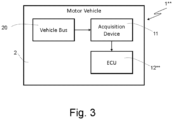
- the processing device 12 is implemented/carried out by means of a motor vehicle's electronic control unit (ECU) 12** installed on board the motor vehicle 2.
- the electronic control unit 12** can conveniently be a control unit specifically dedicated to the recognition of irregularities of the road pavement, or a control unit dedicated to various tasks that also include the recognition of the irregularities of the road pavement.
Landscapes
- Engineering & Computer Science (AREA)
- Physics & Mathematics (AREA)
- General Physics & Mathematics (AREA)
- Automation & Control Theory (AREA)
- Transportation (AREA)
- Mechanical Engineering (AREA)
- Remote Sensing (AREA)
- Radar, Positioning & Navigation (AREA)
- Theoretical Computer Science (AREA)
- Mathematical Physics (AREA)
- General Engineering & Computer Science (AREA)
- Geometry (AREA)
- Evolutionary Computation (AREA)
- Computer Hardware Design (AREA)
- Computer Networks & Wireless Communication (AREA)
- Control Of Driving Devices And Active Controlling Of Vehicle (AREA)
- Road Repair (AREA)
- Testing Of Devices, Machine Parts, Or Other Structures Thereof (AREA)
- Traffic Control Systems (AREA)
- Tires In General (AREA)
- Length Measuring Devices With Unspecified Measuring Means (AREA)
Description
- The present invention relates to a method and a system for the recognition of the irregularities of a road pavement.
- Road pavements must be designed in such a way as to ensure a rolling surface that is substantially regular and with little deformation in order to meet safety and comfort requirements for the motor vehicles that drive on them. As is known, in fact, the impact of a wheel of a motor vehicle against any obstacle on the road pavement (such as, for example, a sidewalk, a pothole or a speed ramp) may cause damage to the wheel pneumatic tyre, in particular to the carcass (i.e., the casing) of the pneumatic tyre.
- More specifically, a protuberance that is externally visible upon the side of a pneumatic tyre typically indicates that some cords have been broken within the carcass due to an impact since driving over objects such as curbs, speed ramps and potholes may cause individual cords to break.
- If a damaged pneumatic tyre (e.g. a pneumatic tyre with some damaged cords) is not detected promptly and, therefore, is not promptly repaired or replaced, in continuing to drive with said damaged pneumatic tyre there is a risk of completely breaking/destroying the carcass of the pneumatic tyre and also of damaging the wheel rim and/or the suspension (e.g. in the case of further impacts to the damaged pneumatic tyre against other obstacles).
- Until now, systems were periodically implemented in order to monitor the level of regularity of individual roads, mainly for the purpose of planning maintenance work. Typically, said monitoring systems are based upon a calculation of the International Roughness Index (IRI) which represents the international index for the irregularity of road pavements.
- However, in recent years, within the automotive sector, there has been a strong need for technologies for detecting road surface conditions that are able to automatically and continuously detect the presence of potential obstacles (such as sidewalks, potholes or speed ramps) and that are able to promptly report them to the drivers of such motor vehicles.
- Some methods for the recognition of the irregularities of a road pavement are described, for example, in:
- Perttunen Mikko et al: "Distributed Road Surface Condition Monitoring Using Mobile Phones", 2011-09-02, PERVASIVE: INTERNATIONAL CONFERENCE ON PERVASIVE COMPUTING; [LECTURE NOTES IN COMPUTER SCIENCE; LECT. NOTES COMPUTER], SPRINGER, HEIDELBERG, pages 64-78, wherein traffic safety improvement is achieved by collecting and distributing up-to-date road surface condition information using mobile phones;
- Anonymous: "Resonance and Natural frequency - Pico Technology", 2017-09-22, XP055636756, which concerns resonance and natural frequency of a vehicle suspension in automotive-guided-tests; and
-
US 2017/284824 A1 , which relates to a method and system for providing a predicted driving condition to an electronic device associated with a current vehicle having a current vehicle characteristic; the method being executable on a server and comprising: receiving an indication of the current vehicle approaching a road segment and the current vehicle characteristic; identifying a preceding vehicle which has a time of travel along the road segment before a current time, a time difference between the preceding vehicle time of travel and the current time being within a predetermined range, the preceding vehicle having a preceding vehicle characteristic; determining the predicted driving condition for the road segment, the predicted driving condition being based on the current vehicle characteristic and the preceding vehicle characteristic; and providing to the electronic device before the current vehicle reaches the road segment, the predicted driving condition for the current vehicle on the road segment. - The aim of the present invention is thus to provide a method for the recognition of the irregularities of a road pavement that is free from the disadvantages of the state of the art and that is, in particular, easy and inexpensive to implement.
- A further aim of the present invention is thus to provide a system for the recognition of the irregularities of a road pavement that is free from the disadvantages of the state of the art and that is, in particular, easy and inexpensive to make.
- According to the present invention a method and a system are provided for the recognition of the irregularities of a road pavement according to that which is determined within the attached claims.
- The present invention will now be described with reference to the attached drawings, which show an exemplary, non-limiting embodiment, wherein:
-
Figure 1 schematically illustrates a first embodiment of a system that implements the method for the recognition of the irregularities of a road pavement that is the object of the present invention; -
Figure 2 schematically illustrates a first variant of the system inFigure 1 ; and -
Figure 3 schematically illustrates a second variant of the system inFigure 1 . - The applicant has experimentally verified that the normalized wheel speed (i.e., the ratio between an acquired/measured wheel speed and the corresponding motor vehicle speed) is correlated to the wheel driving over or impacting an irregularity within the road pavement. In the following section, the term irregularity refers to any obstacle potentially present upon the road pavement (such as, for example, sidewalks, potholes, curbs, speed ramps, etc.).
- Based upon the results of the tests performed, the applicant has designed and developed an innovative technology to detect the irregularities of the road pavement described in the following section and including a preliminary step and an actual irregularity detection step.
- More specifically, the preliminary step for the optimization of this technology involves the execution of tests that envisage pneumatic tyres driving over or impacting different types of irregularities and at different speeds of the motor vehicle. The preliminary testing step is also conducted with different types of pneumatic tyres with specific characteristics (in terms of pressure, size and stiffness) and with different types of vehicles with specific characteristics (for example, in terms of shock absorber stiffness).
- In particular, at least three test campaigns were followed in order to study the response in relation to:
- (i) the state of the road pavement and the types of irregularities of the road pavement;
- (ii) the type of motor vehicle and type of pneumatic tyre; and
- (iii) the speed of the motor vehicle.
-
Figure 1 schematically illustrates, by means of a block diagram, the functional architecture of asystem 1 for the recognition of irregularities of a road pavement. - In particular, the
system 1 for the recognition of irregularities of the road pavement includes anacquisition device 11 that is installed on board a motor vehicle equipped with two or more wheels, each equipped with a pneumatic tyre, and is coupled to a vehicle bus 20 (e.g. based upon a standard Controller Area Network (CAN) bus) of said motor vehicle. - According to a preferred variant, the
acquisition device 11 is fixed/bound to the chassis of the motor vehicle. In particular, theacquisition device 11 is connected to the chassis of the motor vehicle in such a way that theacquisition device 11 is subjected to the same vibrations to which the chassis of the motor vehicle is subjected. - Preferably, the
acquisition device 11 is placed near an OBD connector of the motor vehicle. - The
system 1 for the recognition of irregularities of a road pavement also comprises aprocessing device 12 that is connected, in wired or wireless mode, to theacquisition device 11. - The
acquisition device 11 is configured to acquire from thevehicle bus 20 signals that are indicative of the speed of the motor vehicle and the speed of a wheel of said motor vehicle (speed signals that are, for convenience, expressed in kilometers or miles per hour). Furthermore, theacquisition device 11 is configured to provide at the output measurements that are indicative of the speeds of the motor vehicle and the speed of the wheel thereof. - The
acquisition device 11 is also configured to acquire from thevehicle bus 20 signals linked to the driving of the motor vehicle. In particular, theacquisition device 11 is configured to acquire from thevehicle bus 20 signals such as vertical acceleration, yaw rate, pitch and roll (by means of a gyroscope), the steering angle of the vehicle and information relating to the position of the vehicle (by means of a GPS signal). - According to a first embodiment, the
processing device 12 is configured to receive from theacquisition device 11 those measurements that are indicative of the speeds of the motor vehicle and the speed of the wheel of said motor vehicle. In addition, theprocessing device 12 is configured to receive from theacquisition device 11 also those measurements that are indicative of the steering angle of the vehicle and information related to the position of the vehicle (by means of a GPS signal). - In more detail, the acquisition of the signal relating to the wheel speed is performed with a sampling frequency of at least 50 Hz. Preferably, the acquisition of the signal relating to the wheel speed is performed with a sampling frequency of 100 Hz.
- The
processing device 12 is intended for the analysis of that measurement which is indicative of the steering angle of the wheel of said motor vehicle, wherefore transformations that alter the distribution of said measurement are used. In particular, theprocessing device 12 performs a FFT (Fast Fourier Transform) of that measurement which is indicative of the steering angle of the wheel of said motor vehicle over a reference section of the road pavement of variable length. The reference section of the road pavement has a variable and/or adjustable length; the reference section of the road pavement has a length of between 2 and 25 linear meters, preferably between 5 and 10 linear meters. - Said analysis by means of the FFT makes it possible to identify the frequency content of that measurement which is indicative of the steering angle of the wheel; moreover, said analysis makes it possible to highlight a minimum threshold that varies according to the driving style of the driver of the motor vehicle within the reference section.
- The
processing device 12 is thus configured such as to perform filtering of that measurement which is indicative of the speed of the wheel of the motor vehicle. The filtering of that measurement which is indicative of the speed of the wheel of the motor vehicle is also performed over the reference section of the road pavement. - The filtering is at least of the high-pass type; preferably, the filtering is of the band-pass type. The minimum threshold determined during the previous section by the analysis of that measurement which is indicative of the steering angle of the wheel is used within the high-pass filter; in this way it is possible to analyze only that part of the signal containing information relating to the irregularities of the road pavement and not to the driving style of the driver of the vehicle.
- The
processing device 12 is then configured to calculate, on the basis of those measurements that are indicative of the speeds of the motor vehicle and of the speeds of the wheel thereof, a normalized wheel speed that is indicative of a ratio (preferably a percentage ratio) of the wheel speed in relation to the speed of the motor vehicle. - Alternatively, the
processing device 12 is configured to calculate, on the basis of those measurements that are indicative of the speeds of the motor vehicle and of the speeds of the wheel thereof, a normalized wheel speed that is indicative of a ratio (preferably, a percentage ratio) of the wheel speed in relation to the motor vehicle speed and to subsequently perform the filtering of the normalized wheel speed over the reference section of the road pavement. - The
processing device 12 is thus configured to calculate the standard deviation of said normalized wheel speed over the reference section of the road pavement. - The preliminary step described above involves determining on the basis of the results of the tests performed one or more predefined models in order to associate the standard deviation of the normalized wheel speed over the reference section with the presence of irregularities of the road pavement. In essence, the preliminary test step includes, in succession, a sub-step in which tests are performed by having pneumatic tyres drive over and/or impact different irregularities at different speeds of the motor vehicle; a sub-step in which, during the tests performed, the wheel speeds and the speeds of the motor vehicle are acquired and the normalized wheel speeds are calculated in relation to those tests performed by means of the ratio between the wheel speeds and the respective speeds of the motor vehicle; and a sub-step for the construction of at least one model for associating the standard deviation of the normalized speeds with the irregularities on the road pavement. Preferably, the preliminary test step involves the construction of a number of models depending upon the type of pneumatic tyre and the type of motor vehicle.
- The standard deviation of said normalized wheel speed is thus compared to the predefined models developed during the preliminary test step and is used to recognize the presence of irregularities of the road pavement. The irregularity that has just been recognized can be located by means of information related to the position of the vehicle (by means of a GPS signal).
- According to a further embodiment, the
processing device 12 is configured to receive from theacquisition device 11 those measurements that are indicative of vertical acceleration (along the z axis). Furthermore, theprocessing device 12 is configured to receive from theacquisition device 11 also those measurements that are indicative of the steering angle and information related to the position of the vehicle (by means of a GPS signal). Theacquisition device 11 is also configured to acquire from thevehicle bus 20 and to transmit to theprocessing device 12 signals related to the driving of the motor vehicle. In particular, theacquisition device 11 is configured to acquire from thevehicle bus 20 signals such as yaw rate, pitch and roll (by means of a gyroscope). - In more detail, the acquisition of the signal related to vertical acceleration is performed with a sampling frequency of at least 10 Hz.
- The
processing device 12 is thus configured to initially perform filtering of that measurement which is indicative of vertical acceleration. The filtering of that measurement which is indicative of vertical acceleration is performed over a reference section of the road pavement of variable length. The reference section of the road pavement has a variable and/or adjustable length; the reference section of the road pavement has a length of between 2 and 25 linear meters, preferably between 5 and 10 linear meters. - The filtering is preferably of the high-pass type; the minimum threshold of the high-pass filter is preferably less than or equal to 0.1 Hz.
- Once the high-pass filtering has been performed, the
processing device 12 is intended to analyze that measurement which is indicative of vertical acceleration by means of a transformation that alters the distribution of said measure. In particular, theprocessing device 12 performs a FFT (Fast Fourier Transform) of that measurement which is indicative of vertical acceleration over the reference section. - Said analysis by means of the FFT makes it possible to identify the frequency content of that measurement which is indicative of vertical acceleration over the reference section.
- The
processing device 12 is thus configured to calculate the standard deviation of that measurement which is indicative of vertical acceleration over the reference section. In particular, theprocessing device 12 is configured to calculate the standard deviation of that measurement which is indicative of vertical acceleration over the reference section and at relevant frequencies. Preferably, the relevant frequencies include a first range of vibration frequencies of the motor vehicle suspension system; preferably the first frequency range is between 1.5 Hz and 3 Hz. Preferably, the relevant frequencies also include a second range of vibration frequencies of the motor vehicle chassis. - It has been experimentally verified that a minimum threshold for the high-pass filter of less than or equal to 0.1 Hz and a range of relevant frequencies that corresponds to the vibration frequencies of the motor vehicle suspension system (between 1.5 Hz and 3 Hz) makes it possible to obtain reliable results without exceeding the computational burden of the
processing device 12. Similarly, it has been experimentally verified that the best results, in terms of the reliability of the results, are obtained when the reference portion of the road surface has a length of between 2 and 25 linear meters, preferably between 5 and 10 linear meters. - The preliminary step described above involves determining on the basis of the results of the tests performed one or more predefined models in order to associate the standard deviation of that measurement which is indicative of vertical acceleration over the reference section and at relevant frequencies with the presence and size of irregularities of the road pavement.
- In essence, the preliminary test step includes, in succession, a sub-step in which to perform the tests by having pneumatic tyres drive over and/or impact different irregularities at different speeds of the motor vehicle; a sub-step in which to acquire the vertical acceleration during the tests performed; and a sub-step of construction of at least one model for associating the standard deviation of the vertical acceleration with the presence and size of the irregularities of the road pavement.
- Preferably, the preliminary test step involves the construction of a number of models depending upon the type of pneumatic tyre and the type of motor vehicle.
- The standard deviation of said measurement that is indicative of the vertical acceleration over the reference section is thus compared to the predefined models developed during the preliminary test step and is used to recognize the presence of irregularities of the road pavement. The irregularity that has just been recognized can be located by means of information related to the position of the vehicle (by means of a GPS signal).
- The first and second embodiments described in the previous section can be used alternatively in order to recognize the presence of irregularities of the road pavement. The first and second embodiments described in the previous section can be used at the same time and in parallel in order to recognize, with a higher degree of precision and more reliably, the presence of irregularities of the road pavement.
-
Figure 2 schematically illustrates a first variant of thesystem 1* for the recognition of irregularities of the road pavement wherein theprocessing device 12 is implemented/carried out by means of a cloud-type computing system 12* that is remotely wirelessly connected to the acquisition device 11 (e.g. by means of one or more mobile communication technologies, such as GSM, GPRS, EDGE, HSPA, UMTS, LTE, LTE Advanced and/or 5th generation (or even beyond) wireless communication systems). - In contrast, with reference to
Figure 3 , in a second variant of thesystem 1** for the recognition of irregularities of the road pavement theprocessing device 12 is implemented/carried out by means of a motor vehicle's electronic control unit (ECU) 12** installed on board themotor vehicle 2. Theelectronic control unit 12** can conveniently be a control unit specifically dedicated to the recognition of irregularities of the road pavement, or a control unit dedicated to various tasks that also include the recognition of the irregularities of the road pavement.
Claims (11)
- A method for the recognition of the irregularities of a road pavement comprising:(A) a preliminary test step including in turn- a sub-step wherein tests are performed in having pneumatic tyres drive over and/or impact different irregularities at different speeds of the motor vehicle;- a sub-step wherein during the tests the vertical acceleration is acquired; and- a sub-step for the construction of at least one first model for associating the standard deviation of the vertical acceleration in relation to the tests performed with the irregularities on the road pavement; and(B) an actual recognition step including in turncharacterized in that :- a sub-step wherein the vertical acceleration is acquired;- a sub-step wherein high-pass filtering of the vertical acceleration is implemented; wherein a minimum filtering threshold of the high-pass filter is preferably less than or equal to 0.1 Hz;- a sub-step wherein the high-pass-filtered vertical acceleration is processed by means of a Fast Fourier Transform;- a sub-step including calculating the standard deviation of the Fast-Fourier-Transform-processed vertical acceleration at relevant frequencies; and- recognizing the presence and the dimensions of the irregularities on the road pavement on the basis of a comparison between said first model and the standard deviation calculated at the relevant frequencies;- the sub-step of high-pass filtering is performed on a reference section of the road pavement of variable length having a length of between 2 and 25 linear meters, preferably between 5 and 10 linear meters; and- the relevant frequencies comprise a first range of frequencies of vibration of a suspension system of the motor vehicle, said first range of vibration frequencies being preferably between 1.5 Hz and 3 Hz.
- Method according to claim 1, wherein the sub-step of acquiring the vertical acceleration is performed at a sampling rate of at least 10 Hz.
- Method according to any preceding claim, wherein the relevant frequencies comprise a second range of frequencies of vibration of a chassis of the motor vehicle.
- Method according to any preceding claim, wherein the step (B) comprises the further sub-steps of acquiring information regarding the position of the vehicle by means of a GPS signal; and locating any irregularities depending upon the position of the vehicle.
- Method according to any preceding claim, wherein the step (A) comprises the further sub-steps of performing the tests by means of having different types of pneumatic tyres on different types of motor vehicle drive over and/or impact and of constructing a number of models in order to associate the standard deviation of the vertical acceleration with the type of pneumatic tyre and/or motor vehicle.
- Method according to any preceding claim, wherein the step (A) includes:- a sub-step wherein, during the tests performed, the wheel speeds and the speeds of the motor vehicle are acquired and wherein the normalized wheel speeds relating to the tests performed are calculated by means of the ratio between the wheel speeds and the respective speeds of the motor vehicle; and- a sub-step for the construction of at least one second model for associating the standard deviation of the normalized wheel speeds with the irregularities on the road pavement;wherein the step (B) includes:- a sub-step wherein the steering angle of the wheel of said motor vehicle is acquired;- a sub-step wherein the steering angle of the wheel of said motor vehicle is processed by means of a Fast Fourier Transform;- a sub-step wherein a minimum threshold is determined within the frequency content of the Fast-Fourier-Transform-processed wheel steering angle;- a sub-step wherein the wheel speeds are acquired;- a sub-step wherein the speeds of the motor vehicle are acquired;- a sub-step wherein the normalized wheel speeds are calculated by means of the ratio between the wheel speeds and the respective speeds of the motor vehicle;- a sub-step wherein high-pass filtering of the wheel speeds or of the normalized wheel speeds is performed in applying said minimum threshold; and- a sub-step wherein the standard deviation of the normalized wheel speeds is calculated;and wherein the sub-step of recognizing the presence of irregularities on the road pavement implies using both the comparison between the first model and the standard deviation calculated at the relevant frequencies and a comparison between the second model and the standard deviation of the normalized wheel speeds.
- System (1, 1*, 1**) for the recognition of the irregularities of a road pavement comprising an acquisition device (11) and a processing device (12, 12*, 12**); wherein the acquisition device (11) is:• designed to be- installed on board a motor vehicle (2) provided with two or more wheels fitted with pneumatic tyres, and- coupled to a vehicle bus (20) of the motor vehicle (2); and• configured to- acquire from the vehicle bus (20) signals indicative of vertical acceleration, and- output amplitudes indicative of the vertical acceleration;wherein the processing device (12, 12*, 12**) is configured to store at least one model that is:• constructed based on vertical acceleration acquired during tests performed in having pneumatic tyres drive over and/or impact different irregularities at different motor vehicle speeds; and• such that to associate the standard deviation of the vertical acceleration in relation to the tests performed with the irregularities on the road pavement;wherein the processing device (12, 12*, 12**) is further configured to receive from the acquisition device (11) the amplitudes indicative of the vertical acceleration; andand wherein the processing device (12, 12*, 12**) is programmed to:• implement high-pass filtering of the vertical acceleration, wherein a minimum filtering threshold of the high-pass filter is preferably less than or equal to 0.1 Hz;• process the high-pass-filtered vertical acceleration by means of a Fast Fourier Transform;• calculate the standard deviation of the Fast-Fourier-Transform-processed vertical acceleration at relevant frequencies; and• recognize the presence and the dimensions of the irregularities on the road pavement on the basis of a comparison between the stored model and the standard deviation calculated at the relevant frequencies;characterized in that:• the processing device (12, 12*, 12**) is programmed to perform said high-pass filtering on a reference section of the road pavement of variable length having a length of between 2 and 25 linear meters, preferably between 5 and 10 linear meters; and• the relevant frequencies comprise a first range of frequencies of vibration of a suspension system of the motor vehicle, said first range of vibration frequencies being preferably between 1.5 Hz and 3 Hz.
- System according to claim 7, wherein the acquisition device (11) is fixed/ bound to a chassis of the motor vehicle (2); preferably in such a way that the acquisition device (11) is subjected to the same vibrations to which the chassis of the motor vehicle (2) is subjected.
- System according to claim 7 or 8, wherein the acquisition device (11) is placed near an OBD connector of the motor vehicle (2).
- System according to any claim 7-9, wherein the processing device (12*) is a cloud-type computing system (12*) that is remotely and wirelessly connected to the acquisition device (11).
- System according to any claim 7-9, wherein the processing device (12**) is an electronic control unit (12**) designed to be installed on board the motor vehicle (2).
Applications Claiming Priority (2)
| Application Number | Priority Date | Filing Date | Title |
|---|---|---|---|
| IT102019000006613A IT201900006613A1 (en) | 2019-05-07 | 2019-05-07 | METHOD AND SYSTEM FOR THE RECOGNITION OF THE IRREGULARITIES OF A ROAD FLOORING |
| PCT/IB2020/054196 WO2020225699A1 (en) | 2019-05-07 | 2020-05-04 | Method and system for the recognition of the irregularities of a road pavement |
Publications (2)
| Publication Number | Publication Date |
|---|---|
| EP3966079A1 EP3966079A1 (en) | 2022-03-16 |
| EP3966079B1 true EP3966079B1 (en) | 2024-11-13 |
Family
ID=67551626
Family Applications (1)
| Application Number | Title | Priority Date | Filing Date |
|---|---|---|---|
| EP20723218.2A Active EP3966079B1 (en) | 2019-05-07 | 2020-05-04 | Method and system for the recognition of the irregularities of a road pavement |
Country Status (7)
| Country | Link |
|---|---|
| US (1) | US20220274599A1 (en) |
| EP (1) | EP3966079B1 (en) |
| JP (1) | JP7309915B2 (en) |
| CN (1) | CN113825686B (en) |
| AU (1) | AU2020268954B2 (en) |
| IT (1) | IT201900006613A1 (en) |
| WO (1) | WO2020225699A1 (en) |
Families Citing this family (11)
| Publication number | Priority date | Publication date | Assignee | Title |
|---|---|---|---|---|
| CN112393740B (en) * | 2020-12-03 | 2022-09-09 | 吉林大学 | A method and system for determining pavement comfort index |
| JP7406182B2 (en) * | 2020-12-11 | 2023-12-27 | トヨタ自動車株式会社 | Related value information update system and related value information update method |
| US20240185646A1 (en) | 2021-03-30 | 2024-06-06 | Bridgestone Europe NV/SA [BE/BE] | International roughness index estimation method and system |
| IT202100010496A1 (en) | 2021-04-26 | 2022-10-26 | Bridgestone Europe Nv Sa | METHOD AND RELATED SYSTEM FOR ESTIMATION OF THE INTERNATIONAL ROUGHNESS INDEX OF A ROAD SEGMENT |
| CN113295137A (en) * | 2021-05-21 | 2021-08-24 | 吉林大学 | Road unevenness identification method based on vehicle wheel speed fluctuation |
| CN114291094B (en) * | 2021-12-28 | 2024-05-17 | 清华大学苏州汽车研究院(相城) | Road surface condition sensing response system and method based on automatic driving |
| CN114758526B (en) * | 2022-03-31 | 2023-05-12 | 浙江吉利控股集团有限公司 | Obstacle avoidance method and device based on Internet of vehicles big data and storage medium |
| CN115798194B (en) * | 2022-11-01 | 2024-01-19 | 西部科学城智能网联汽车创新中心(重庆)有限公司 | Road condition monitoring method and device based on vehicle vibration data |
| CN116013100B (en) * | 2023-01-05 | 2024-08-13 | 中国第一汽车股份有限公司 | Road state early warning method, device, vehicle and storage medium |
| CN116124075B (en) * | 2023-02-02 | 2026-03-03 | 北京中交慧联信息科技有限公司 | Method, system, electronic equipment and storage medium for detecting hollow convex hull on road |
| EP4468032A1 (en) * | 2023-05-23 | 2024-11-27 | Aptiv Technologies AG | Method for estimating a road layout in a vehicle assistance system |
Family Cites Families (26)
| Publication number | Priority date | Publication date | Assignee | Title |
|---|---|---|---|---|
| JPS60596A (en) * | 1983-06-16 | 1985-01-05 | 株式会社デンソー | Road surface state identifier |
| JP2780887B2 (en) * | 1992-01-31 | 1998-07-30 | 本田技研工業株式会社 | Vehicle tire pressure determination device |
| JP3186474B2 (en) * | 1994-11-10 | 2001-07-11 | 日産自動車株式会社 | Road surface shape detection device |
| JP3684726B2 (en) * | 1996-12-24 | 2005-08-17 | 株式会社デンソー | Road surface condition discrimination device |
| US6202020B1 (en) * | 1999-08-20 | 2001-03-13 | Meritor Heavy Vehicle Systems, Llc | Method and system for determining condition of road |
| JP2004237881A (en) * | 2003-02-06 | 2004-08-26 | Toyota Motor Corp | Road condition detector |
| JP4696983B2 (en) * | 2006-03-15 | 2011-06-08 | トヨタ自動車株式会社 | Vehicle whose active stabilizer is controlled according to vehicle vibration |
| DE102006028411A1 (en) * | 2006-06-21 | 2007-12-27 | Robert Bosch Gmbh | Procedure for tire condition detection |
| JP5130181B2 (en) | 2008-10-16 | 2013-01-30 | トヨタ自動車株式会社 | Wheel vibration extraction device and road surface state estimation device |
| JP2010287044A (en) * | 2009-06-11 | 2010-12-24 | Isuzu Motors Ltd | Road information providing device and navigation device |
| US20110285518A1 (en) * | 2010-05-19 | 2011-11-24 | The Regents Of The University Of Michigan | Method for detecting rumble strips on roadways |
| CN103717469B (en) * | 2011-07-20 | 2016-08-03 | 株式会社普利司通 | Pavement state method of estimation and pavement state estimate equipment |
| JP6021309B2 (en) | 2011-10-05 | 2016-11-09 | 鹿島道路株式会社 | Road surface unevenness evaluation system |
| CN103318180B (en) * | 2013-05-28 | 2015-09-09 | 万向钱潮股份有限公司 | A kind of vehicle road out-of-flat automatic recognition system and method |
| FR3008789B1 (en) * | 2013-07-22 | 2023-05-12 | Commissariat Energie Atomique | METHOD FOR CHARACTERIZING MECHANICAL PARAMETERS OF A PAVEMENT |
| CN105473983B (en) * | 2014-06-09 | 2020-05-12 | 尼拉动力公司 | Detection of short-term irregularities on road surfaces |
| DE102015203062A1 (en) * | 2015-02-20 | 2016-08-25 | Robert Bosch Gmbh | Method and device for detecting road conditions for a vehicle |
| DE102015003115B4 (en) * | 2015-03-11 | 2021-10-07 | Audi Ag | Method for determining road condition information and motor vehicle |
| KR102484148B1 (en) | 2015-06-03 | 2023-01-03 | 클리어모션, 아이엔씨. | Methods and systems for controlling vehicle body motion and occupant experience |
| JP2017021584A (en) | 2015-07-10 | 2017-01-26 | 矢崎総業株式会社 | Network system |
| DE102015218830B4 (en) * | 2015-09-30 | 2025-11-13 | Bayerische Motoren Werke Aktiengesellschaft | Method for a motor vehicle for detecting poor road conditions and a related system and motor vehicle |
| RU2629875C1 (en) * | 2016-04-04 | 2017-09-04 | Общество С Ограниченной Ответственностью "Яндекс" | Methods and systems for predicting driving conditions |
| JP2017223640A (en) | 2016-06-08 | 2017-12-21 | 浩一 八木 | Paved surface crack inspection method |
| US10417837B2 (en) * | 2016-09-22 | 2019-09-17 | Ford Global Technologies, Llc | Arrangements for collecting diagnostic information regarding vibrations of wheel-tire assembly and drive-line components of a wheeled vehicle |
| US10696227B2 (en) * | 2017-01-12 | 2020-06-30 | Mobileye Vision Technologies Ltd. | Determining a road surface characteristic |
| JP6902774B2 (en) | 2017-01-25 | 2021-07-14 | 株式会社ユピテル | Data collection device, road condition evaluation support device, and program |
-
2019
- 2019-05-07 IT IT102019000006613A patent/IT201900006613A1/en unknown
-
2020
- 2020-05-04 JP JP2021566048A patent/JP7309915B2/en active Active
- 2020-05-04 CN CN202080033783.7A patent/CN113825686B/en active Active
- 2020-05-04 US US17/608,824 patent/US20220274599A1/en active Pending
- 2020-05-04 EP EP20723218.2A patent/EP3966079B1/en active Active
- 2020-05-04 WO PCT/IB2020/054196 patent/WO2020225699A1/en not_active Ceased
- 2020-05-04 AU AU2020268954A patent/AU2020268954B2/en active Active
Also Published As
| Publication number | Publication date |
|---|---|
| AU2020268954A1 (en) | 2021-12-02 |
| JP2022532100A (en) | 2022-07-13 |
| WO2020225699A1 (en) | 2020-11-12 |
| EP3966079A1 (en) | 2022-03-16 |
| AU2020268954B2 (en) | 2023-05-18 |
| IT201900006613A1 (en) | 2020-11-07 |
| JP7309915B2 (en) | 2023-07-18 |
| CN113825686A (en) | 2021-12-21 |
| US20220274599A1 (en) | 2022-09-01 |
| CN113825686B (en) | 2024-06-21 |
Similar Documents
| Publication | Publication Date | Title |
|---|---|---|
| EP3966079B1 (en) | Method and system for the recognition of the irregularities of a road pavement | |
| EP2955479B1 (en) | Methods, systems and computer program products for detection of short term irregularities in a road surface | |
| CN114953860B (en) | Tire monitoring method, device, vehicle and storage medium | |
| CN107933559B (en) | Method and system for determining road characteristics in a vehicle | |
| CN108698593A (en) | Hazard Avoidance Devices for Vehicles | |
| EP3966080B1 (en) | Method and system for the recognition of the irregularities of a road pavement | |
| CN118119542A (en) | Method and device for determining and characterizing roadway irregularities | |
| EP4330092B1 (en) | Method and related system for estimating the international roughness index of a road segment | |
| US20240185646A1 (en) | International roughness index estimation method and system | |
| WO2007030036A1 (en) | A method and a system for alerting a driver of a vehicle of a departure from a driving area in a lane | |
| JP7753508B2 (en) | Method and system for detecting and locating obstacles/elements on road pavements that are dangerous or potentially dangerous to tire and/or vehicle integrity |
Legal Events
| Date | Code | Title | Description |
|---|---|---|---|
| STAA | Information on the status of an ep patent application or granted ep patent |
Free format text: STATUS: UNKNOWN |
|
| STAA | Information on the status of an ep patent application or granted ep patent |
Free format text: STATUS: THE INTERNATIONAL PUBLICATION HAS BEEN MADE |
|
| PUAI | Public reference made under article 153(3) epc to a published international application that has entered the european phase |
Free format text: ORIGINAL CODE: 0009012 |
|
| STAA | Information on the status of an ep patent application or granted ep patent |
Free format text: STATUS: REQUEST FOR EXAMINATION WAS MADE |
|
| 17P | Request for examination filed |
Effective date: 20211206 |
|
| AK | Designated contracting states |
Kind code of ref document: A1 Designated state(s): AL AT BE BG CH CY CZ DE DK EE ES FI FR GB GR HR HU IE IS IT LI LT LU LV MC MK MT NL NO PL PT RO RS SE SI SK SM TR |
|
| DAV | Request for validation of the european patent (deleted) | ||
| DAX | Request for extension of the european patent (deleted) | ||
| RAP3 | Party data changed (applicant data changed or rights of an application transferred) |
Owner name: BRIDGESTONE EUROPE NV/SA |
|
| GRAP | Despatch of communication of intention to grant a patent |
Free format text: ORIGINAL CODE: EPIDOSNIGR1 |
|
| STAA | Information on the status of an ep patent application or granted ep patent |
Free format text: STATUS: GRANT OF PATENT IS INTENDED |
|
| INTG | Intention to grant announced |
Effective date: 20240604 |
|
| GRAS | Grant fee paid |
Free format text: ORIGINAL CODE: EPIDOSNIGR3 |
|
| GRAA | (expected) grant |
Free format text: ORIGINAL CODE: 0009210 |
|
| STAA | Information on the status of an ep patent application or granted ep patent |
Free format text: STATUS: THE PATENT HAS BEEN GRANTED |
|
| AK | Designated contracting states |
Kind code of ref document: B1 Designated state(s): AL AT BE BG CH CY CZ DE DK EE ES FI FR GB GR HR HU IE IS IT LI LT LU LV MC MK MT NL NO PL PT RO RS SE SI SK SM TR |
|
| REG | Reference to a national code |
Ref country code: GB Ref legal event code: FG4D |
|
| REG | Reference to a national code |
Ref country code: CH Ref legal event code: EP |
|
| REG | Reference to a national code |
Ref country code: IE Ref legal event code: FG4D |
|
| REG | Reference to a national code |
Ref country code: DE Ref legal event code: R096 Ref document number: 602020041268 Country of ref document: DE |
|
| REG | Reference to a national code |
Ref country code: LT Ref legal event code: MG9D |
|
| REG | Reference to a national code |
Ref country code: NL Ref legal event code: MP Effective date: 20241113 |
|
| P01 | Opt-out of the competence of the unified patent court (upc) registered |
Free format text: CASE NUMBER: APP_8761/2025 Effective date: 20250220 |
|
| PG25 | Lapsed in a contracting state [announced via postgrant information from national office to epo] |
Ref country code: PT Free format text: LAPSE BECAUSE OF FAILURE TO SUBMIT A TRANSLATION OF THE DESCRIPTION OR TO PAY THE FEE WITHIN THE PRESCRIBED TIME-LIMIT Effective date: 20250313 Ref country code: IS Free format text: LAPSE BECAUSE OF FAILURE TO SUBMIT A TRANSLATION OF THE DESCRIPTION OR TO PAY THE FEE WITHIN THE PRESCRIBED TIME-LIMIT Effective date: 20250313 Ref country code: HR Free format text: LAPSE BECAUSE OF FAILURE TO SUBMIT A TRANSLATION OF THE DESCRIPTION OR TO PAY THE FEE WITHIN THE PRESCRIBED TIME-LIMIT Effective date: 20241113 |
|
| PG25 | Lapsed in a contracting state [announced via postgrant information from national office to epo] |
Ref country code: FI Free format text: LAPSE BECAUSE OF FAILURE TO SUBMIT A TRANSLATION OF THE DESCRIPTION OR TO PAY THE FEE WITHIN THE PRESCRIBED TIME-LIMIT Effective date: 20241113 Ref country code: NL Free format text: LAPSE BECAUSE OF FAILURE TO SUBMIT A TRANSLATION OF THE DESCRIPTION OR TO PAY THE FEE WITHIN THE PRESCRIBED TIME-LIMIT Effective date: 20241113 |
|
| REG | Reference to a national code |
Ref country code: AT Ref legal event code: MK05 Ref document number: 1741474 Country of ref document: AT Kind code of ref document: T Effective date: 20241113 |
|
| PG25 | Lapsed in a contracting state [announced via postgrant information from national office to epo] |
Ref country code: BG Free format text: LAPSE BECAUSE OF FAILURE TO SUBMIT A TRANSLATION OF THE DESCRIPTION OR TO PAY THE FEE WITHIN THE PRESCRIBED TIME-LIMIT Effective date: 20241113 |
|
| PG25 | Lapsed in a contracting state [announced via postgrant information from national office to epo] |
Ref country code: ES Free format text: LAPSE BECAUSE OF FAILURE TO SUBMIT A TRANSLATION OF THE DESCRIPTION OR TO PAY THE FEE WITHIN THE PRESCRIBED TIME-LIMIT Effective date: 20241113 |
|
| PG25 | Lapsed in a contracting state [announced via postgrant information from national office to epo] |
Ref country code: NO Free format text: LAPSE BECAUSE OF FAILURE TO SUBMIT A TRANSLATION OF THE DESCRIPTION OR TO PAY THE FEE WITHIN THE PRESCRIBED TIME-LIMIT Effective date: 20250213 |
|
| PG25 | Lapsed in a contracting state [announced via postgrant information from national office to epo] |
Ref country code: LV Free format text: LAPSE BECAUSE OF FAILURE TO SUBMIT A TRANSLATION OF THE DESCRIPTION OR TO PAY THE FEE WITHIN THE PRESCRIBED TIME-LIMIT Effective date: 20241113 Ref country code: AT Free format text: LAPSE BECAUSE OF FAILURE TO SUBMIT A TRANSLATION OF THE DESCRIPTION OR TO PAY THE FEE WITHIN THE PRESCRIBED TIME-LIMIT Effective date: 20241113 Ref country code: GR Free format text: LAPSE BECAUSE OF FAILURE TO SUBMIT A TRANSLATION OF THE DESCRIPTION OR TO PAY THE FEE WITHIN THE PRESCRIBED TIME-LIMIT Effective date: 20250214 |
|
| PG25 | Lapsed in a contracting state [announced via postgrant information from national office to epo] |
Ref country code: PL Free format text: LAPSE BECAUSE OF FAILURE TO SUBMIT A TRANSLATION OF THE DESCRIPTION OR TO PAY THE FEE WITHIN THE PRESCRIBED TIME-LIMIT Effective date: 20241113 |
|
| PG25 | Lapsed in a contracting state [announced via postgrant information from national office to epo] |
Ref country code: RS Free format text: LAPSE BECAUSE OF FAILURE TO SUBMIT A TRANSLATION OF THE DESCRIPTION OR TO PAY THE FEE WITHIN THE PRESCRIBED TIME-LIMIT Effective date: 20250213 |
|
| PG25 | Lapsed in a contracting state [announced via postgrant information from national office to epo] |
Ref country code: SM Free format text: LAPSE BECAUSE OF FAILURE TO SUBMIT A TRANSLATION OF THE DESCRIPTION OR TO PAY THE FEE WITHIN THE PRESCRIBED TIME-LIMIT Effective date: 20241113 |
|
| PGFP | Annual fee paid to national office [announced via postgrant information from national office to epo] |
Ref country code: DE Payment date: 20250423 Year of fee payment: 6 |
|
| PG25 | Lapsed in a contracting state [announced via postgrant information from national office to epo] |
Ref country code: DK Free format text: LAPSE BECAUSE OF FAILURE TO SUBMIT A TRANSLATION OF THE DESCRIPTION OR TO PAY THE FEE WITHIN THE PRESCRIBED TIME-LIMIT Effective date: 20241113 |
|
| PGFP | Annual fee paid to national office [announced via postgrant information from national office to epo] |
Ref country code: IT Payment date: 20250423 Year of fee payment: 6 |
|
| PG25 | Lapsed in a contracting state [announced via postgrant information from national office to epo] |
Ref country code: EE Free format text: LAPSE BECAUSE OF FAILURE TO SUBMIT A TRANSLATION OF THE DESCRIPTION OR TO PAY THE FEE WITHIN THE PRESCRIBED TIME-LIMIT Effective date: 20241113 |
|
| PGFP | Annual fee paid to national office [announced via postgrant information from national office to epo] |
Ref country code: FR Payment date: 20250424 Year of fee payment: 6 |
|
| PG25 | Lapsed in a contracting state [announced via postgrant information from national office to epo] |
Ref country code: RO Free format text: LAPSE BECAUSE OF FAILURE TO SUBMIT A TRANSLATION OF THE DESCRIPTION OR TO PAY THE FEE WITHIN THE PRESCRIBED TIME-LIMIT Effective date: 20241113 |
|
| PG25 | Lapsed in a contracting state [announced via postgrant information from national office to epo] |
Ref country code: SK Free format text: LAPSE BECAUSE OF FAILURE TO SUBMIT A TRANSLATION OF THE DESCRIPTION OR TO PAY THE FEE WITHIN THE PRESCRIBED TIME-LIMIT Effective date: 20241113 |
|
| PG25 | Lapsed in a contracting state [announced via postgrant information from national office to epo] |
Ref country code: CZ Free format text: LAPSE BECAUSE OF FAILURE TO SUBMIT A TRANSLATION OF THE DESCRIPTION OR TO PAY THE FEE WITHIN THE PRESCRIBED TIME-LIMIT Effective date: 20241113 |
|
| REG | Reference to a national code |
Ref country code: DE Ref legal event code: R097 Ref document number: 602020041268 Country of ref document: DE |
|
| PG25 | Lapsed in a contracting state [announced via postgrant information from national office to epo] |
Ref country code: SE Free format text: LAPSE BECAUSE OF FAILURE TO SUBMIT A TRANSLATION OF THE DESCRIPTION OR TO PAY THE FEE WITHIN THE PRESCRIBED TIME-LIMIT Effective date: 20241113 |
|
| PLBE | No opposition filed within time limit |
Free format text: ORIGINAL CODE: 0009261 |
|
| STAA | Information on the status of an ep patent application or granted ep patent |
Free format text: STATUS: NO OPPOSITION FILED WITHIN TIME LIMIT |
|
| 26N | No opposition filed |
Effective date: 20250814 |
|
| REG | Reference to a national code |
Ref country code: CH Ref legal event code: H13 Free format text: ST27 STATUS EVENT CODE: U-0-0-H10-H13 (AS PROVIDED BY THE NATIONAL OFFICE) Effective date: 20251223 |
|
| PG25 | Lapsed in a contracting state [announced via postgrant information from national office to epo] |
Ref country code: LU Free format text: LAPSE BECAUSE OF NON-PAYMENT OF DUE FEES Effective date: 20250504 |
|
| PG25 | Lapsed in a contracting state [announced via postgrant information from national office to epo] |
Ref country code: CH Free format text: LAPSE BECAUSE OF NON-PAYMENT OF DUE FEES Effective date: 20250531 |
|
| GBPC | Gb: european patent ceased through non-payment of renewal fee |
Effective date: 20250504 |
|
| REG | Reference to a national code |
Ref country code: BE Ref legal event code: MM Effective date: 20250531 |
|
| PG25 | Lapsed in a contracting state [announced via postgrant information from national office to epo] |
Ref country code: MC Free format text: LAPSE BECAUSE OF FAILURE TO SUBMIT A TRANSLATION OF THE DESCRIPTION OR TO PAY THE FEE WITHIN THE PRESCRIBED TIME-LIMIT Effective date: 20241113 |
|
| PG25 | Lapsed in a contracting state [announced via postgrant information from national office to epo] |
Ref country code: GB Free format text: LAPSE BECAUSE OF NON-PAYMENT OF DUE FEES Effective date: 20250504 |
|
| PG25 | Lapsed in a contracting state [announced via postgrant information from national office to epo] |
Ref country code: IE Free format text: LAPSE BECAUSE OF NON-PAYMENT OF DUE FEES Effective date: 20250504 |
|
| PG25 | Lapsed in a contracting state [announced via postgrant information from national office to epo] |
Ref country code: BE Free format text: LAPSE BECAUSE OF NON-PAYMENT OF DUE FEES Effective date: 20250531 |