EP3964701B1 - System and method for monitoring fuel additives - Google Patents
System and method for monitoring fuel additives Download PDFInfo
- Publication number
- EP3964701B1 EP3964701B1 EP21205522.2A EP21205522A EP3964701B1 EP 3964701 B1 EP3964701 B1 EP 3964701B1 EP 21205522 A EP21205522 A EP 21205522A EP 3964701 B1 EP3964701 B1 EP 3964701B1
- Authority
- EP
- European Patent Office
- Prior art keywords
- fuel
- additive
- line
- additives
- aircraft
- Prior art date
- Legal status (The legal status is an assumption and is not a legal conclusion. Google has not performed a legal analysis and makes no representation as to the accuracy of the status listed.)
- Active
Links
Images




Classifications
-
- F—MECHANICAL ENGINEERING; LIGHTING; HEATING; WEAPONS; BLASTING
- F02—COMBUSTION ENGINES; HOT-GAS OR COMBUSTION-PRODUCT ENGINE PLANTS
- F02M—SUPPLYING COMBUSTION ENGINES IN GENERAL WITH COMBUSTIBLE MIXTURES OR CONSTITUENTS THEREOF
- F02M25/00—Engine-pertinent apparatus for adding non-fuel substances or small quantities of secondary fuel to combustion-air, main fuel or fuel-air mixture
- F02M25/022—Adding fuel and water emulsion, water or steam
- F02M25/0227—Control aspects; Arrangement of sensors; Diagnostics; Actuators
-
- F—MECHANICAL ENGINEERING; LIGHTING; HEATING; WEAPONS; BLASTING
- F02—COMBUSTION ENGINES; HOT-GAS OR COMBUSTION-PRODUCT ENGINE PLANTS
- F02C—GAS-TURBINE PLANTS; AIR INTAKES FOR JET-PROPULSION PLANTS; CONTROLLING FUEL SUPPLY IN AIR-BREATHING JET-PROPULSION PLANTS
- F02C3/00—Gas-turbine plants characterised by the use of combustion products as the working fluid
- F02C3/20—Gas-turbine plants characterised by the use of combustion products as the working fluid using a special fuel, oxidant, or dilution fluid to generate the combustion products
- F02C3/30—Adding water, steam or other fluids for influencing combustion, e.g. to obtain cleaner exhaust gases
-
- F—MECHANICAL ENGINEERING; LIGHTING; HEATING; WEAPONS; BLASTING
- F02—COMBUSTION ENGINES; HOT-GAS OR COMBUSTION-PRODUCT ENGINE PLANTS
- F02C—GAS-TURBINE PLANTS; AIR INTAKES FOR JET-PROPULSION PLANTS; CONTROLLING FUEL SUPPLY IN AIR-BREATHING JET-PROPULSION PLANTS
- F02C7/00—Features, components parts, details or accessories, not provided for in, or of interest apart form groups F02C1/00 - F02C6/00; Air intakes for jet-propulsion plants
- F02C7/22—Fuel supply systems
-
- F—MECHANICAL ENGINEERING; LIGHTING; HEATING; WEAPONS; BLASTING
- F02—COMBUSTION ENGINES; HOT-GAS OR COMBUSTION-PRODUCT ENGINE PLANTS
- F02C—GAS-TURBINE PLANTS; AIR INTAKES FOR JET-PROPULSION PLANTS; CONTROLLING FUEL SUPPLY IN AIR-BREATHING JET-PROPULSION PLANTS
- F02C7/00—Features, components parts, details or accessories, not provided for in, or of interest apart form groups F02C1/00 - F02C6/00; Air intakes for jet-propulsion plants
- F02C7/22—Fuel supply systems
- F02C7/232—Fuel valves; Draining valves or systems
-
- F—MECHANICAL ENGINEERING; LIGHTING; HEATING; WEAPONS; BLASTING
- F02—COMBUSTION ENGINES; HOT-GAS OR COMBUSTION-PRODUCT ENGINE PLANTS
- F02C—GAS-TURBINE PLANTS; AIR INTAKES FOR JET-PROPULSION PLANTS; CONTROLLING FUEL SUPPLY IN AIR-BREATHING JET-PROPULSION PLANTS
- F02C7/00—Features, components parts, details or accessories, not provided for in, or of interest apart form groups F02C1/00 - F02C6/00; Air intakes for jet-propulsion plants
- F02C7/22—Fuel supply systems
- F02C7/236—Fuel delivery systems comprising two or more pumps
-
- F—MECHANICAL ENGINEERING; LIGHTING; HEATING; WEAPONS; BLASTING
- F02—COMBUSTION ENGINES; HOT-GAS OR COMBUSTION-PRODUCT ENGINE PLANTS
- F02C—GAS-TURBINE PLANTS; AIR INTAKES FOR JET-PROPULSION PLANTS; CONTROLLING FUEL SUPPLY IN AIR-BREATHING JET-PROPULSION PLANTS
- F02C9/00—Controlling gas-turbine plants; Controlling fuel supply in air- breathing jet-propulsion plants
- F02C9/26—Control of fuel supply
- F02C9/263—Control of fuel supply by means of fuel metering valves
-
- F—MECHANICAL ENGINEERING; LIGHTING; HEATING; WEAPONS; BLASTING
- F02—COMBUSTION ENGINES; HOT-GAS OR COMBUSTION-PRODUCT ENGINE PLANTS
- F02C—GAS-TURBINE PLANTS; AIR INTAKES FOR JET-PROPULSION PLANTS; CONTROLLING FUEL SUPPLY IN AIR-BREATHING JET-PROPULSION PLANTS
- F02C9/00—Controlling gas-turbine plants; Controlling fuel supply in air- breathing jet-propulsion plants
- F02C9/26—Control of fuel supply
- F02C9/40—Control of fuel supply specially adapted to the use of a special fuel or a plurality of fuels
-
- F—MECHANICAL ENGINEERING; LIGHTING; HEATING; WEAPONS; BLASTING
- F02—COMBUSTION ENGINES; HOT-GAS OR COMBUSTION-PRODUCT ENGINE PLANTS
- F02M—SUPPLYING COMBUSTION ENGINES IN GENERAL WITH COMBUSTIBLE MIXTURES OR CONSTITUENTS THEREOF
- F02M33/00—Other apparatus for treating combustion-air, fuel or fuel-air mixture
-
- F—MECHANICAL ENGINEERING; LIGHTING; HEATING; WEAPONS; BLASTING
- F02—COMBUSTION ENGINES; HOT-GAS OR COMBUSTION-PRODUCT ENGINE PLANTS
- F02M—SUPPLYING COMBUSTION ENGINES IN GENERAL WITH COMBUSTIBLE MIXTURES OR CONSTITUENTS THEREOF
- F02M37/00—Apparatus or systems for feeding liquid fuel from storage containers to carburettors or fuel-injection apparatus; Arrangements for purifying liquid fuel specially adapted for, or arranged on, internal-combustion engines
- F02M37/0047—Layout or arrangement of systems for feeding fuel
- F02M37/0064—Layout or arrangement of systems for feeding fuel for engines being fed with multiple fuels or fuels having special properties, e.g. bio-fuels; varying the fuel composition
-
- F—MECHANICAL ENGINEERING; LIGHTING; HEATING; WEAPONS; BLASTING
- F02—COMBUSTION ENGINES; HOT-GAS OR COMBUSTION-PRODUCT ENGINE PLANTS
- F02M—SUPPLYING COMBUSTION ENGINES IN GENERAL WITH COMBUSTIBLE MIXTURES OR CONSTITUENTS THEREOF
- F02M37/00—Apparatus or systems for feeding liquid fuel from storage containers to carburettors or fuel-injection apparatus; Arrangements for purifying liquid fuel specially adapted for, or arranged on, internal-combustion engines
- F02M37/04—Feeding by means of driven pumps
- F02M37/18—Feeding by means of driven pumps characterised by provision of main and auxiliary pumps
-
- G—PHYSICS
- G01—MEASURING; TESTING
- G01N—INVESTIGATING OR ANALYSING MATERIALS BY DETERMINING THEIR CHEMICAL OR PHYSICAL PROPERTIES
- G01N27/00—Investigating or analysing materials by the use of electric, electrochemical, or magnetic means
- G01N27/62—Investigating or analysing materials by the use of electric, electrochemical, or magnetic means by investigating the ionisation of gases, e.g. aerosols; by investigating electric discharges, e.g. emission of cathode
- G01N27/622—Ion mobility spectrometry
-
- F—MECHANICAL ENGINEERING; LIGHTING; HEATING; WEAPONS; BLASTING
- F05—INDEXING SCHEMES RELATING TO ENGINES OR PUMPS IN VARIOUS SUBCLASSES OF CLASSES F01-F04
- F05D—INDEXING SCHEME FOR ASPECTS RELATING TO NON-POSITIVE-DISPLACEMENT MACHINES OR ENGINES, GAS-TURBINES OR JET-PROPULSION PLANTS
- F05D2270/00—Control
- F05D2270/30—Control parameters, e.g. input parameters
- F05D2270/336—Blade lift measurements
-
- F—MECHANICAL ENGINEERING; LIGHTING; HEATING; WEAPONS; BLASTING
- F05—INDEXING SCHEMES RELATING TO ENGINES OR PUMPS IN VARIOUS SUBCLASSES OF CLASSES F01-F04
- F05D—INDEXING SCHEME FOR ASPECTS RELATING TO NON-POSITIVE-DISPLACEMENT MACHINES OR ENGINES, GAS-TURBINES OR JET-PROPULSION PLANTS
- F05D2270/00—Control
- F05D2270/40—Type of control system
- F05D2270/42—Type of control system passive or reactive, e.g. using large wind vanes
-
- F—MECHANICAL ENGINEERING; LIGHTING; HEATING; WEAPONS; BLASTING
- F05—INDEXING SCHEMES RELATING TO ENGINES OR PUMPS IN VARIOUS SUBCLASSES OF CLASSES F01-F04
- F05D—INDEXING SCHEME FOR ASPECTS RELATING TO NON-POSITIVE-DISPLACEMENT MACHINES OR ENGINES, GAS-TURBINES OR JET-PROPULSION PLANTS
- F05D2270/00—Control
- F05D2270/70—Type of control algorithm
- F05D2270/703—Type of control algorithm integral
-
- F—MECHANICAL ENGINEERING; LIGHTING; HEATING; WEAPONS; BLASTING
- F05—INDEXING SCHEMES RELATING TO ENGINES OR PUMPS IN VARIOUS SUBCLASSES OF CLASSES F01-F04
- F05D—INDEXING SCHEME FOR ASPECTS RELATING TO NON-POSITIVE-DISPLACEMENT MACHINES OR ENGINES, GAS-TURBINES OR JET-PROPULSION PLANTS
- F05D2270/00—Control
- F05D2270/80—Devices generating input signals, e.g. transducers, sensors, cameras or strain gauges
-
- F—MECHANICAL ENGINEERING; LIGHTING; HEATING; WEAPONS; BLASTING
- F05—INDEXING SCHEMES RELATING TO ENGINES OR PUMPS IN VARIOUS SUBCLASSES OF CLASSES F01-F04
- F05D—INDEXING SCHEME FOR ASPECTS RELATING TO NON-POSITIVE-DISPLACEMENT MACHINES OR ENGINES, GAS-TURBINES OR JET-PROPULSION PLANTS
- F05D2300/00—Materials; Properties thereof
- F05D2300/50—Intrinsic material properties or characteristics
- F05D2300/514—Porosity
-
- G—PHYSICS
- G01—MEASURING; TESTING
- G01N—INVESTIGATING OR ANALYSING MATERIALS BY DETERMINING THEIR CHEMICAL OR PHYSICAL PROPERTIES
- G01N33/00—Investigating or analysing materials by specific methods not covered by groups G01N1/00 - G01N31/00
- G01N33/26—Oils; Viscous liquids; Paints; Inks
- G01N33/28—Oils, i.e. hydrocarbon liquids
- G01N33/2829—Mixtures of fuels
-
- Y—GENERAL TAGGING OF NEW TECHNOLOGICAL DEVELOPMENTS; GENERAL TAGGING OF CROSS-SECTIONAL TECHNOLOGIES SPANNING OVER SEVERAL SECTIONS OF THE IPC; TECHNICAL SUBJECTS COVERED BY FORMER USPC CROSS-REFERENCE ART COLLECTIONS [XRACs] AND DIGESTS
- Y02—TECHNOLOGIES OR APPLICATIONS FOR MITIGATION OR ADAPTATION AGAINST CLIMATE CHANGE
- Y02T—CLIMATE CHANGE MITIGATION TECHNOLOGIES RELATED TO TRANSPORTATION
- Y02T10/00—Road transport of goods or passengers
- Y02T10/10—Internal combustion engine [ICE] based vehicles
- Y02T10/12—Improving ICE efficiencies
Definitions
- the present disclosure relates to on-board delivery of fuel additives on board of an aircraft.
- Fuel additives are frequently needed for aircraft fuels. These fuel additives can be essential for fuel stabilization, and numerous other functions with respect to fuel and desirable combustion and related properties.
- fuel stabilization will be required on next generation aircraft in order to meet performance and operability targets. Increased thermal loads and decreased fuel flows necessitate higher temperature fuel. The most viable fuel stabilization technologies require removal of dissolved oxygen, which is the root cause of carbonaceous deposits.
- additive packages have been developed which allow for an increase in fuel temperature up to certain limits. For example, one package allows an increase in operating fuel temperature of up to 100°F (37. 8°C).
- This additive package was designed for injection into JP-8 fuel at refueling truck loading racks. There is a move to eliminate the use of JP-8 at military installations, replacing it with Jet-A fuel, with the additives injected while the fuel is in the logistics pipeline.
- the fuel additive dispenser is positioned along a fuel additive bypass line connected at an upstream end to the flow control device and connected at a downstream end back to the fuel line.
- the fuel additive sensor is positioned upstream of or at the flow control device.
- the fuel additive sensor is positioned downstream of the downstream end of the fuel additive bypass line.
- the controller is configured to compare the concentration with a pre-set additive requirement specification, and to control the flow control device to increase flow through to fuel additive dispenser when the concentration is less than the specification.
- the fuel additive dispenser contains a plurality of fuel additives and wherein the controller is configured to increase flow through the fuel additive dispenser when the concentration of any one or more of the plurality of fuel additives is less than the specification.
- the fuel additive dispenser is a passive fuel additive dosing system.
- the passive fuel additive dosing system comprises a cartridge; a membrane-based contractor within the cartridge; a fuel inlet to the cartridge connected to receive diverted flow from the flow control device; a fuel outlet from the cartridge connected to return flow back to the fuel line; and an additive within the membrane-based contractor, the membrane-based contractor being arranged in the cartridge such that, with fuel in the cartridge, a fuel contact area with the membrane-based contractor is dependent on a fuel flow rate to passively dispense a proportional amount of the additive in to the fuel.
- the presently disclosed system and method operate in conjunction with a fuel additive dispenser such as the dispenser disclosed in intermediate publication EP3550125A1 .
- the present disclosure operates in conjunction with such a dispenser to monitor concentration of fuel additives in a fuel tank, and to ensure the proper level of fuel additives in the fuel as it is fed from the fuel tank to the engine of the aircraft.
- the system and method thereby ensure proper additive levels in an environment wherein fuels intended to be provided with certain levels of additives are provided under circumstances which are not as regulated as may be desired.
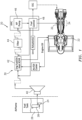
- FIG. 1 schematically illustrates a fuel system 20 for an engine 22.
- the engine 22 is a gas turbine engine utilized for propulsion of an aircraft.
- control of the additive blending operation is performed on-board the aircraft as opposed to relying on ground operations. This also avoids interference with coalescing filters, etc.
- the fuel system 20 may generally include a tank pump 24 to supply fuel from a fuel tank 26 through a passive fuel additives dosing system 28 to a fuel subsystem 30, thence to a fuel manifold 32 in a combustor section 34 of the engine 22.
- the fuel subsystem 30, in one example, may include a boost pump 40, an engine fuel-oil heat exchanger 42, a filter system 44, a highpressure fuel pump 46 and control system 48.
- the fuel subsystem 30 may alternatively or additionally include various components such as multiple fuel tanks, air-oil coolers, fuel driven actuators fuel modules, solenoid valves, metering valves, shut-off valves, spill valves, and other filters.
- the passive fuel additives dosing system 28 will be described primarily as within the low pressure fuel tank 26, the passive fuel additives dosing system 28 may be directly associated with the fuel tank 26 and/or distributed elsewhere in the fuel system 20 such as downstream of the boost pump 40 and upstream of the engine fuel-oil heat exchanger 42; downstream of the engine fuel-oil heat exchanger 42 and upstream of the filter system 44; and/or downstream of the filter system 44 and upstream of the high pressure fuel pump 46.
- the passive fuel additives dosing system 28 generally includes a cartridge 100, a membrane-based contactor 102 within the cartridge 100, and an additive 104 within the membrane-based contactor 102.
- the cartridge 100 includes a fuel inlet 106 and a fuel outlet 108 for communication with the fuel subsystem 30.
- the membrane-based contactor 102 is arranged within the cartridge 100 such that, with fuel in the cartridge 100, a fuel contact area with the membrane-based contactor 102 is dependent on a fuel flow rate to passively dispense a proportional amount of the additive 104 into the fuel.
- the membrane-based contactor 102 is sized and oriented within the cartridge 100 to facilitate metering of the fuel contact area with the membrane-based contactor 102 in relation to the fuel flow rate to passively dispense the additive 104.
- the fuel outlet 108 is arranged with respect to the fuel inlet 106 to facilitate metering of the fuel contact area.
- the fuel inlet 106 can be located adjacent a top 110 of the cartridge 100 and the fuel outlet 108 adjacent to a bottom 112 of the cartridge 100. This facilitates draining of the membrane-based contactor 102 once fuel flow has stopped such that osmotic pressure will not continue to drive additives into the fuel which may otherwise result in large concentrations of additives in the remaining volume of fuel. It should be appreciated that relative positional terms such as "top” and "bottom” are with respect to a normal operational attitude of the aircraft such as level flight.
- the membrane-based contactor 102 may include a non-porous or a porous membrane.
- a non-porous membrane may be a reverse selective membrane to permeate large molecules over smaller ones, based on differences in solubility rather than diffusivity.
- Suitable membranes include silicone rubbers, poly-methyl pentyl, and poly-trimethyl-silyl-propyl, and other such reverse selective types.
- Typical polymer non-porous membranes would be unsuitable for this application as membranes such as those typically used for aircraft fuel tank inerting (based on polyimides, polysulfones or polycarbonates) would result in very low permeance of the large molecules comprising the fuel additives package as well as membranes such as those used for fuel stabilization, which are inherently oleophobic (fuel and oil repellent).
- a porous membrane may comprise an oleophobic layer overcoating the outer diameter of a nanoporous polymer film to provide a barrier that facilitates prevention of the fuel from entering into the bore of each hollow fiber while the additives can exit therefrom.
- the porous membrane may have a thickness between about 50 nanometers and about 4 microns with pores of an average pore diameter less than or equal to 0.06 microns.
- the membrane-based contactor 102 may be formed as a bundle of hollow fibers, in which a bore of each fiber contains the additive in a solution, suspension, or emulsion form.
- the relatively large surface area afforded by hollow fibers facilitates effective release of the additive when the flow rate is high.
- the outside surface of each hollow fiber of the bundle of hollow fibers is wetted by the fuel that enters the cartridge 100 from the fuel inlet 106 and exits from the fuel outlet 108.
- Each hollow fiber may include a porous support and a non-porous or porous membrane on an outer diameter of the porous support.
- Other forms of the membrane-based contactor 102 may be a spiral-wound configuration ( FIG. 3 ), a hollow-fiber bundle ( FIG. 4 ), or plate-and-frame configuration ( FIG. 5 ).
- examples include both organic (polymeric) and inorganic (e.g. ceramic) membranes.
- the additive can include anti-oxidants such as hindered phenols, metal deactivators, and dispersants that diffuse across the membrane-based contactor 102 due to the difference in osmotic pressure inside and outside of the hollow fibers.
- anti-oxidants such as hindered phenols, metal deactivators, and dispersants that diffuse across the membrane-based contactor 102 due to the difference in osmotic pressure inside and outside of the hollow fibers.
- some or all of the additive can be added as a concentrated liquid that is diluted to meet the specified application.
- the driving force for the additive to permeate the membrane-based contactor 102 is a concentration gradient (higher in the bore, lower in the fuel). Since the hollow fibers are always filled with the additive, the concentration difference between the inside (exposed to the additive) and the outside (exposed to flowing fuel) is essentially constant. Therefore, overall mass transfer is determined by the amount of membrane surface area wetted by the flowing fuel. This, in turn, is determined by the fuel flow rate and a recommended additive
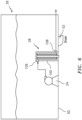
- the cartridge 100 in one embodiment, is located at a bottom 50 of the fuel tank 26 with the fuel outlet 108 adjacent to a tank fuel drain 52 in the fuel tank 26 to facilitate draining of fuel from the cartridge 100 ( FIG. 6 ).
- An additive inlet 114 FIG. 2 ) for refilling the additive is located at the bottom 112 of the cartridge 100.
- the additive inlet 114 communicates with a manifold 116 adjacent to the top 110 of the cartridge 100.
- the manifold 116 supplies additive by gravity such that the hollow fibers are always filled with the additive. Replenishment of the manifold 116 may occur over various intervals and may be conveniently performed at regular intervals as typical operators drain fuel tanks daily to avoid accumulation of water in the fuel tank. Alternatively, the entire cartridge 100 may be replaceable.
- FIG. 7 shows a flow scheme or layout according to one non-limiting aspect of the present disclosure.
- a fuel tank 26 is shown containing a fuel additive dispenser such as fuel additives dosing system 28.
- a fuel supply pump 24 pumps fuel along a fuel line 200 to a high pressure pump which is schematically illustrated by arrow 202 exiting tank 26.
- Dispenser 28 is positioned along a parallel line 204, in parallel with line 200, and connected at an upstream end 206 by way of a flow control device such as a three way valve 208.
- the bypass line 204 is connected at a downstream end 210 back to the main fuel line 200, for example through a junction 212.
- a sensor 214 is positioned along fuel line 200, and is communicated with a controller 216 such that measurements taken by sensor 214 can be analyzed to determine whether fuel in fuel line 200 contains sufficient fuel additives.
- Controller 216 is configured to issue controlling commands to alter the position of flow control device 208 and control how much flow of fuel is passed through the main fuel line 200, and how much fuel is diverted through bypass line 204 into dispenser 28.
- Controller 216 is configured to compare levels of additives within the fuel, particularly to determine whether the additives are present in at least a specification amount of additive.
- sensor 214 and controller 216 quantify the additive concentration in the fuel tank and adjust the amount of flow through dispenser 28. If the concentration of additive is too low, controller 216 will operate flow control device 208 to increase the amount of flow of fuel through dispenser 28 such that the combined fuel, downstream of junction 212, will have a higher additive concentration that is closer to the specified value. In this way, fuel is monitored onboard, between the fuel tank and engine, to ensure that the fuel has proper additives to address the various needs of a particular fuel.
- Sensor 214 can be any of numerous different types of available sensors which can be in the form of a mass spectrometer (mass spec), which are available on a chip.
- mass spec mass spectrometer
- Chip-based mass spectrometers are particularly well suited to the present system and method since they can be implemented in compact configurations, with very low power requirements.
- Other types of sensors could be utilized within the scope of the present disclosure.
- one particularly well suited configuration of sensor is a sensor based upon Ion Mobility Spectrometry for the reasons set forth above.
- Controller 216 preferably stores or has access to a stored profile of fuel, including a specification of which fuel additives should be present, and in what quantities. With access to this information, controller 216 can rapidly determine whether there is any deficiency in one or more additives which is intended to be present in the fuel. In this regard, additives within dispenser 28 would be selected to correspond to the additives which are desired in a particular fuel profile or specification. Thus, controller 216 can be configured to issue commands to flow control device 208 to pass additional fuel through dispenser 28 under circumstances where one or more additives is not present in the desired concentration. Further, controller 216 can be configured to determine a magnitude of shortage of the fuel additive, and to divert a proportionally increased amount of flow of fuel to dispenser 28 depending upon the magnitude of shortage of the additive.
- Flow control device 208 can be any suitable three-way valve which accepts input from one source, such as fuel supply pump 24, and which has a controllable structure of configuration to allocate flow between two different branches, in this case fuel line 200 and bypass line 204.
- Junction 212 can be any suitable flow control structure to combine flows from fuel line 200 and bypass line 204, preferably with a minimum of flow resistance or the like.
- FIG. 8 shows an alternative configuration of the system according to the present disclosure, wherein sensor 214 is positioned at a point along fuel line 200 which is downstream of the additive dispenser 28.
- sensor 214 and controller 216 which, in this example, is integrated with sensor 214, checks fuel for presence of proper additives, and then sends commands (illustrated schematically by line 218) to flow control device 208 to control the flow of fuel, and the amount of fuel which flows to dispenser 28, in similar fashion to that which is discussed above.
- fuel additive level of fuel as it is supplied to the high pressure pump is directly measured, which can be seen as advantageous for purposes of ensuring that adjustments are made and then confirmed to produce the desired level of additive.
- a further non-limiting configuration could involve utilization of two sensors, with one sensor being in the position shown in FIG. 7 and the second sensor being shown in FIG. 8 .
- the flow control device could be controlled primarily based upon input from the first sensor and additive content at the upstream side, and then the changes made could be confirmed by the downstream sensor or further adjustments made, if necessary, due to levels of an additive still not being reached.
- fuel additive sensor 214 can be positioned upstream of or at flow control device 208, or could be positioned downstream of the downstream end 210 of the fuel additive bypass line 204, or sensors could be positioned in both of these locations.
- controller 216 is programmed to increase fuel flow through dispenser 28 if any one of the plurality of fuel additives is not present in the desired concentration.
- controller 216 could be implemented for a single fuel specification determined globally for an entire operation. Alternatively, it may be desirable to allow further configuration of controller 216 to control which additives are being monitored. For example, a fuel to be used in a very cold climate could require a different additive package than a fuel to be utilized in a very hot climate. Thus, it may be desirable in one configuration to allow controller 216 to be configured by an operator to correspond to a particular fuel additive specification.
- dispenser 28 in the present disclosure contains a combination of additives which are all dispensed into a fuel together
- a dispenser 28 would be operative to individually dispense different additives, and multiple dispensers or internal dispenser flow passages could be configured such that sensor 214 and controller 216 would increase flow through that portion of a dispenser 28 which would increase concentration of only one additive out of an additive package.
- sensor 214 and controller 216 would increase flow through that portion of a dispenser 28 which would increase concentration of only one additive out of an additive package.
- This would conceivably lead to much more complex flow structures, and it may be that it would be preferable to simply increase the concentration of all additives within a tolerable range such that the level of one additive could be raised.
- the system of the present disclosure functions as follows.
- fuel from tank 26 is pumped, for example by pump 24, from the fuel tank along a fuel line 200 and ultimately to an engine of the aircraft.
- FIGS. 7 and 8 the portion of this path is shown concluding in line 202 which leads to a high -p pump.
- the remainder of a possible flow path is shown, for example in FIG. 1 .
- concentration of additives in the fuel is sensed, for example with sensor 214 in any of the disclosed positions.
- Data from the sensor is passed to a controller, which analyzes the data and compares to a profile of additives in a desired fuel specification.
- a controller which analyzes the data and compares to a profile of additives in a desired fuel specification.
- fuel flow would be entirely through the main fuel line 200 as illustrated in FIGS. 7 and 8 . This would be indicative of the fuel having been supplied to the aircraft with the proper level of additives in the fuel.
- commands are then sent to the flow control device to divert some flow of fuel from the main fuel line into the bypass fuel line and through the dispenser of additives.
- the amount of fuel diverted can be adjusted, depending upon the capability of the flow control device in question. Assuming that the flow control device can be controlled to variably select the amount of fuel which is diverted toward the dispenser, than the amount of fuel to be diverted may be proportional to the shortage of additive which is detected by the sensor and controller. Fuel diverted through the dispenser has additional additives dispensed into same, and is then rejoined to the main flow downstream of the dispenser. The combined flow then has a higher additive concentration.
- measurements can advantageously be taken of the fuel additive concentration in fuel being supplied out of fuel tank 26, and thereby the adjustments can be insured to be producing the desired resultant fuel additive concentration.
- the passive fuel additives dosing system 28 is a relatively uncomplicated, passive osmotic dispenser device that leverages osmotic pressure, as opposed to a power source with dosing properties tuned by the characteristics of the membrane-based contactor 102 as opposed to complex control systems.
Landscapes
- Engineering & Computer Science (AREA)
- Chemical & Material Sciences (AREA)
- Combustion & Propulsion (AREA)
- Mechanical Engineering (AREA)
- General Engineering & Computer Science (AREA)
- Physics & Mathematics (AREA)
- Life Sciences & Earth Sciences (AREA)
- General Health & Medical Sciences (AREA)
- Electrochemistry (AREA)
- Health & Medical Sciences (AREA)
- Spectroscopy & Molecular Physics (AREA)
- Analytical Chemistry (AREA)
- Biochemistry (AREA)
- Chemical Kinetics & Catalysis (AREA)
- General Physics & Mathematics (AREA)
- Immunology (AREA)
- Pathology (AREA)
- Cooling, Air Intake And Gas Exhaust, And Fuel Tank Arrangements In Propulsion Units (AREA)
- Feeding And Controlling Fuel (AREA)
- Output Control And Ontrol Of Special Type Engine (AREA)
Description
- The present disclosure relates to on-board delivery of fuel additives on board of an aircraft.
- Fuel additives are frequently needed for aircraft fuels. These fuel additives can be essential for fuel stabilization, and numerous other functions with respect to fuel and desirable combustion and related properties.
- For example, fuel stabilization will be required on next generation aircraft in order to meet performance and operability targets. Increased thermal loads and decreased fuel flows necessitate higher temperature fuel. The most viable fuel stabilization technologies require removal of dissolved oxygen, which is the root cause of carbonaceous deposits.
- As an alternative to dissolved oxygen removal, additive packages have been developed which allow for an increase in fuel temperature up to certain limits. For example, one package allows an increase in operating fuel temperature of up to 100°F (37. 8°C). This additive package was designed for injection into JP-8 fuel at refueling truck loading racks. There is a move to eliminate the use of JP-8 at military installations, replacing it with Jet-A fuel, with the additives injected while the fuel is in the logistics pipeline.
- With responsibility for additive incorporation in the fuel shifted away from refiners and toward separate commercial entities, it is now possible that an aircraft, especially if operating outside the USA, may receive fuel that contains a lower concentration of the required additives than the specifications require. This creates the need to validate the presence and the correct concentration of additives in the fuel tank.
-
US 2010/228400 A1 andKR 101376464 B1 - In one aspect, there is provided an aircraft according to claim 1.
- In another aspect there is provided a method for monitoring fuel additives on board an aircraft according to claim 2.
- In one non-limiting configuration, the fuel additive dispenser is positioned along a fuel additive bypass line connected at an upstream end to the flow control device and connected at a downstream end back to the fuel line.
- In another non-limiting configuration, the fuel additive sensor is positioned upstream of or at the flow control device.
- In a further configuration, the fuel additive sensor is positioned downstream of the downstream end of the fuel additive bypass line.
- In a still further configuration, the controller is configured to compare the concentration with a pre-set additive requirement specification, and to control the flow control device to increase flow through to fuel additive dispenser when the concentration is less than the specification.
- In another non-limiting configuration, the fuel additive dispenser contains a plurality of fuel additives and wherein the controller is configured to increase flow through the fuel additive dispenser when the concentration of any one or more of the plurality of fuel additives is less than the specification.
- In still another non-limiting configuration, the fuel additive dispenser is a passive fuel additive dosing system.
- In a further non-limiting configuration, the passive fuel additive dosing system comprises a cartridge; a membrane-based contractor within the cartridge; a fuel inlet to the cartridge connected to receive diverted flow from the flow control device; a fuel outlet from the cartridge connected to return flow back to the fuel line; and an additive within the membrane-based contractor, the membrane-based contractor being arranged in the cartridge such that, with fuel in the cartridge, a fuel contact area with the membrane-based contractor is dependent on a fuel flow rate to passively dispense a proportional amount of the additive in to the fuel.
- The foregoing features and elements may be combined in various combinations without exclusivity, unless expressly indicated otherwise. These features and elements as well as the operation thereof will become more apparent in light of the following description and the accompanying drawings. It should be appreciated that however the following description and drawings are intended to be exemplary in nature and non-limiting.
- Various features will become apparent to those skilled in the art from the following detailed description of the disclosed non-limiting embodiment. The drawings that accompany the detailed description can be briefly described as follows:
-
FIG. 1 is a schematic cross-section of a fuel system for a gas turbine engine. -
FIG. 2 is an enlarged sectional view of a fuel additives dosing system. -
FIG. 3 is a membrane-based contactor for the fuel additives dosing system according to an alternative embodiment. -
FIG. 4 is a membrane-based contactor for the fuel additives dosing system according to an alternative embodiment. -
FIG. 5 is a membrane-based contactor for the fuel additives dosing system according to an alternative embodiment. -
FIG. 6 is an enlarged sectional view of a fuel tank with a fuel additives dosing system. -
FIG. 7 shows a system for monitoring fuel additive concentration. -
FIG. 8 shows an alternative system for monitoring fuel additive concentration. - The presently disclosed system and method operate in conjunction with a fuel additive dispenser such as the dispenser disclosed in intermediate
publication EP3550125A1 . The present disclosure operates in conjunction with such a dispenser to monitor concentration of fuel additives in a fuel tank, and to ensure the proper level of fuel additives in the fuel as it is fed from the fuel tank to the engine of the aircraft. The system and method thereby ensure proper additive levels in an environment wherein fuels intended to be provided with certain levels of additives are provided under circumstances which are not as regulated as may be desired. -
FIG. 1 schematically illustrates afuel system 20 for anengine 22. Theengine 22 is a gas turbine engine utilized for propulsion of an aircraft. To ensure that the increased heat sink capability is enabled by fuel additives, control of the additive blending operation is performed on-board the aircraft as opposed to relying on ground operations. This also avoids interference with coalescing filters, etc. - The
fuel system 20 may generally include atank pump 24 to supply fuel from afuel tank 26 through a passive fueladditives dosing system 28 to afuel subsystem 30, thence to afuel manifold 32 in acombustor section 34 of theengine 22. Thefuel subsystem 30, in one example, may include aboost pump 40, an engine fuel-oil heat exchanger 42, afilter system 44, ahighpressure fuel pump 46 andcontrol system 48. Thefuel subsystem 30 may alternatively or additionally include various components such as multiple fuel tanks, air-oil coolers, fuel driven actuators fuel modules, solenoid valves, metering valves, shut-off valves, spill valves, and other filters. It should be appreciated that various other systems, subsystems and components may alternatively or additionally be provided and are contemplated as included by thefuel subsystem 30. Although the passive fueladditives dosing system 28 will be described primarily as within the lowpressure fuel tank 26, the passive fueladditives dosing system 28 may be directly associated with thefuel tank 26 and/or distributed elsewhere in thefuel system 20 such as downstream of theboost pump 40 and upstream of the engine fuel-oil heat exchanger 42; downstream of the engine fuel-oil heat exchanger 42 and upstream of thefilter system 44; and/or downstream of thefilter system 44 and upstream of the highpressure fuel pump 46. - With reference to
FIG. 2 , the passive fueladditives dosing system 28 generally includes acartridge 100, a membrane-basedcontactor 102 within thecartridge 100, and anadditive 104 within the membrane-basedcontactor 102. Thecartridge 100 includes afuel inlet 106 and afuel outlet 108 for communication with thefuel subsystem 30. - The membrane-based
contactor 102 is arranged within thecartridge 100 such that, with fuel in thecartridge 100, a fuel contact area with the membrane-basedcontactor 102 is dependent on a fuel flow rate to passively dispense a proportional amount of theadditive 104 into the fuel. - In one embodiment, the membrane-based
contactor 102 is sized and oriented within thecartridge 100 to facilitate metering of the fuel contact area with the membrane-basedcontactor 102 in relation to the fuel flow rate to passively dispense theadditive 104. In another embodiment, thefuel outlet 108 is arranged with respect to thefuel inlet 106 to facilitate metering of the fuel contact area. Thefuel inlet 106 can be located adjacent atop 110 of thecartridge 100 and thefuel outlet 108 adjacent to abottom 112 of thecartridge 100. This facilitates draining of the membrane-basedcontactor 102 once fuel flow has stopped such that osmotic pressure will not continue to drive additives into the fuel which may otherwise result in large concentrations of additives in the remaining volume of fuel. It should be appreciated that relative positional terms such as "top" and "bottom" are with respect to a normal operational attitude of the aircraft such as level flight. - The membrane-based
contactor 102 may include a non-porous or a porous membrane. A non-porous membrane may be a reverse selective membrane to permeate large molecules over smaller ones, based on differences in solubility rather than diffusivity. Suitable membranes include silicone rubbers, poly-methyl pentyl, and poly-trimethyl-silyl-propyl, and other such reverse selective types. Typical polymer non-porous membranes would be unsuitable for this application as membranes such as those typically used for aircraft fuel tank inerting (based on polyimides, polysulfones or polycarbonates) would result in very low permeance of the large molecules comprising the fuel additives package as well as membranes such as those used for fuel stabilization, which are inherently oleophobic (fuel and oil repellent). - A porous membrane may comprise an oleophobic layer overcoating the outer diameter of a nanoporous polymer film to provide a barrier that facilitates prevention of the fuel from entering into the bore of each hollow fiber while the additives can exit therefrom. In one example, the porous membrane may have a thickness between about 50 nanometers and about 4 microns with pores of an average pore diameter less than or equal to 0.06 microns.
- The membrane-based
contactor 102 may be formed as a bundle of hollow fibers, in which a bore of each fiber contains the additive in a solution, suspension, or emulsion form. The relatively large surface area afforded by hollow fibers facilitates effective release of the additive when the flow rate is high. The outside surface of each hollow fiber of the bundle of hollow fibers is wetted by the fuel that enters thecartridge 100 from thefuel inlet 106 and exits from thefuel outlet 108. Each hollow fiber may include a porous support and a non-porous or porous membrane on an outer diameter of the porous support. Other forms of the membrane-basedcontactor 102 may be a spiral-wound configuration (FIG. 3 ), a hollow-fiber bundle (FIG. 4 ), or plate-and-frame configuration (FIG. 5 ). For the porous membrane, examples include both organic (polymeric) and inorganic (e.g. ceramic) membranes. - The additive can include anti-oxidants such as hindered phenols, metal deactivators, and dispersants that diffuse across the membrane-based
contactor 102 due to the difference in osmotic pressure inside and outside of the hollow fibers. Depending on the application, some or all of the additive can be added as a concentrated liquid that is diluted to meet the specified application. The driving force for the additive to permeate the membrane-basedcontactor 102 is a concentration gradient (higher in the bore, lower in the fuel). Since the hollow fibers are always filled with the additive, the concentration difference between the inside (exposed to the additive) and the outside (exposed to flowing fuel) is essentially constant. Therefore, overall mass transfer is determined by the amount of membrane surface area wetted by the flowing fuel. This, in turn, is determined by the fuel flow rate and a recommended additive dosage, for example, 100 mg/L. - The
cartridge 100, in one embodiment, is located at a bottom 50 of thefuel tank 26 with thefuel outlet 108 adjacent to atank fuel drain 52 in thefuel tank 26 to facilitate draining of fuel from the cartridge 100 (FIG. 6 ). An additive inlet 114 (FIG. 2 ) for refilling the additive is located at the bottom 112 of thecartridge 100. Theadditive inlet 114 communicates with a manifold 116 adjacent to the top 110 of thecartridge 100. The manifold 116 supplies additive by gravity such that the hollow fibers are always filled with the additive. Replenishment of the manifold 116 may occur over various intervals and may be conveniently performed at regular intervals as typical operators drain fuel tanks daily to avoid accumulation of water in the fuel tank. Alternatively, theentire cartridge 100 may be replaceable. -
FIG. 7 shows a flow scheme or layout according to one non-limiting aspect of the present disclosure. In this system, afuel tank 26 is shown containing a fuel additive dispenser such as fueladditives dosing system 28. Withinfuel tank 26, afuel supply pump 24 pumps fuel along afuel line 200 to a high pressure pump which is schematically illustrated byarrow 202 exitingtank 26.Dispenser 28 is positioned along aparallel line 204, in parallel withline 200, and connected at anupstream end 206 by way of a flow control device such as a threeway valve 208. Thebypass line 204 is connected at adownstream end 210 back to themain fuel line 200, for example through ajunction 212. Asensor 214 is positioned alongfuel line 200, and is communicated with acontroller 216 such that measurements taken bysensor 214 can be analyzed to determine whether fuel infuel line 200 contains sufficient fuel additives.Controller 216 is configured to issue controlling commands to alter the position offlow control device 208 and control how much flow of fuel is passed through themain fuel line 200, and how much fuel is diverted throughbypass line 204 intodispenser 28.Controller 216 is configured to compare levels of additives within the fuel, particularly to determine whether the additives are present in at least a specification amount of additive. - In the configuration of
FIG. 7 ,sensor 214 andcontroller 216 quantify the additive concentration in the fuel tank and adjust the amount of flow throughdispenser 28. If the concentration of additive is too low,controller 216 will operateflow control device 208 to increase the amount of flow of fuel throughdispenser 28 such that the combined fuel, downstream ofjunction 212, will have a higher additive concentration that is closer to the specified value. In this way, fuel is monitored onboard, between the fuel tank and engine, to ensure that the fuel has proper additives to address the various needs of a particular fuel. -
Sensor 214 can be any of numerous different types of available sensors which can be in the form of a mass spectrometer (mass spec), which are available on a chip. These small-scale devices, such as an Ion Mobility Spectrometry (IMS sensor by Owlstone Technology), can produce an ultra-fast chemical separation and detection which exploits the unique properties of ionized products of the chemical sample, utilizing the unique spectral fingerprint of various different chemicals. This produces a very fast and accurate analysis of contents of the fuel. - Chip-based mass spectrometers are particularly well suited to the present system and method since they can be implemented in compact configurations, with very low power requirements. Other types of sensors could be utilized within the scope of the present disclosure. However, one particularly well suited configuration of sensor is a sensor based upon Ion Mobility Spectrometry for the reasons set forth above.
-
Sensor 214 is connected tocontroller 216 for example, as schematically illustrated inFIG. 7 , to pass the data collected bysensor 214 tocontroller 216, where this data is analyzed.Controller 216 preferably stores or has access to a stored profile of fuel, including a specification of which fuel additives should be present, and in what quantities. With access to this information,controller 216 can rapidly determine whether there is any deficiency in one or more additives which is intended to be present in the fuel. In this regard, additives withindispenser 28 would be selected to correspond to the additives which are desired in a particular fuel profile or specification. Thus,controller 216 can be configured to issue commands to flowcontrol device 208 to pass additional fuel throughdispenser 28 under circumstances where one or more additives is not present in the desired concentration. Further,controller 216 can be configured to determine a magnitude of shortage of the fuel additive, and to divert a proportionally increased amount of flow of fuel to dispenser 28 depending upon the magnitude of shortage of the additive. -
Flow control device 208 can be any suitable three-way valve which accepts input from one source, such asfuel supply pump 24, and which has a controllable structure of configuration to allocate flow between two different branches, in thiscase fuel line 200 andbypass line 204.Junction 212 can be any suitable flow control structure to combine flows fromfuel line 200 andbypass line 204, preferably with a minimum of flow resistance or the like. -
FIG. 8 shows an alternative configuration of the system according to the present disclosure, whereinsensor 214 is positioned at a point alongfuel line 200 which is downstream of theadditive dispenser 28. In this configuration,sensor 214 andcontroller 216 which, in this example, is integrated withsensor 214, checks fuel for presence of proper additives, and then sends commands (illustrated schematically by line 218) to flowcontrol device 208 to control the flow of fuel, and the amount of fuel which flows todispenser 28, in similar fashion to that which is discussed above. In the configuration inFIG. 8 , however, fuel additive level of fuel as it is supplied to the high pressure pump is directly measured, which can be seen as advantageous for purposes of ensuring that adjustments are made and then confirmed to produce the desired level of additive. - Considering
FIGS. 7 and8 together, a further non-limiting configuration could involve utilization of two sensors, with one sensor being in the position shown inFIG. 7 and the second sensor being shown inFIG. 8 . In this way, the flow control device could be controlled primarily based upon input from the first sensor and additive content at the upstream side, and then the changes made could be confirmed by the downstream sensor or further adjustments made, if necessary, due to levels of an additive still not being reached. - Thus, according to the various configurations presently disclosed,
fuel additive sensor 214 can be positioned upstream of or atflow control device 208, or could be positioned downstream of thedownstream end 210 of the fueladditive bypass line 204, or sensors could be positioned in both of these locations. - It should also be appreciated that particular specifications for a fuel may require the presence of a number of different additives, and
sensors 214 withcontroller 216 can be configured to check for the presence of each of these additives. Furthermore,controller 216 is programmed to increase fuel flow throughdispenser 28 if any one of the plurality of fuel additives is not present in the desired concentration. - It should be appreciated that the system and method of the present disclosure could be implemented for a single fuel specification determined globally for an entire operation. Alternatively, it may be desirable to allow further configuration of
controller 216 to control which additives are being monitored. For example, a fuel to be used in a very cold climate could require a different additive package than a fuel to be utilized in a very hot climate. Thus, it may be desirable in one configuration to allowcontroller 216 to be configured by an operator to correspond to a particular fuel additive specification. - Furthermore, it should be appreciated that while
dispenser 28 in the present disclosure contains a combination of additives which are all dispensed into a fuel together, it is well within the scope of the present disclosure that adispenser 28 would be operative to individually dispense different additives, and multiple dispensers or internal dispenser flow passages could be configured such thatsensor 214 andcontroller 216 would increase flow through that portion of adispenser 28 which would increase concentration of only one additive out of an additive package. This would conceivably lead to much more complex flow structures, and it may be that it would be preferable to simply increase the concentration of all additives within a tolerable range such that the level of one additive could be raised. Nevertheless, it is within the scope of the present disclosure to individually control specific additives of an entire additive package. - The system of the present disclosure functions as follows.
- During operation fuel from
tank 26 is pumped, for example bypump 24, from the fuel tank along afuel line 200 and ultimately to an engine of the aircraft. - In
FIGS. 7 and8 , the portion of this path is shown concluding inline 202 which leads to a high -p pump. The remainder of a possible flow path is shown, for example inFIG. 1 . - While such fuel is flowing, concentration of additives in the fuel is sensed, for example with
sensor 214 in any of the disclosed positions. Data from the sensor is passed to a controller, which analyzes the data and compares to a profile of additives in a desired fuel specification. During normal operation, it is anticipated that fuel flow would be entirely through themain fuel line 200 as illustrated inFIGS. 7 and8 . This would be indicative of the fuel having been supplied to the aircraft with the proper level of additives in the fuel. If the controller determines that the concentration of additive in the fuel line is less than a fuel additive specification, commands are then sent to the flow control device to divert some flow of fuel from the main fuel line into the bypass fuel line and through the dispenser of additives. The amount of fuel diverted can be adjusted, depending upon the capability of the flow control device in question. Assuming that the flow control device can be controlled to variably select the amount of fuel which is diverted toward the dispenser, than the amount of fuel to be diverted may be proportional to the shortage of additive which is detected by the sensor and controller. Fuel diverted through the dispenser has additional additives dispensed into same, and is then rejoined to the main flow downstream of the dispenser. The combined flow then has a higher additive concentration. - In configurations such as that shown in
FIG. 8 , when a sensor is positioned downstream of the fuel additive device, measurements can advantageously be taken of the fuel additive concentration in fuel being supplied out offuel tank 26, and thereby the adjustments can be insured to be producing the desired resultant fuel additive concentration. - Applications for fuel stabilization include kerosene-based fuels for aviation and diesel fuel stabilization for transportation (including terrestrial and marine), heavy equipment, and power generation. The passive fuel
additives dosing system 28 is a relatively uncomplicated, passive osmotic dispenser device that leverages osmotic pressure, as opposed to a power source with dosing properties tuned by the characteristics of the membrane-basedcontactor 102 as opposed to complex control systems. - Although the different non-limiting embodiments have specific illustrated components, the embodiments of this invention are not limited to those particular combinations. It is possible to use some of the components or features from any of the non-limiting embodiments in combination with features or components from any of the other non-limiting embodiments.
- It should be appreciated that like reference numerals identify corresponding or similar elements throughout the several drawings. It should also be appreciated that although a particular component arrangement is disclosed in the illustrated embodiment, other arrangements will benefit herefrom.
- Although particular step sequences are shown, described, and claimed, it should be appreciated that steps may be performed in any order, separated or combined unless otherwise indicated and will still benefit from the present disclosure.
- The foregoing description is exemplary rather than defined by the limitations within. Various non-limiting embodiments are disclosed herein, however, one of ordinary skill in the art would recognize that various modifications and variations in light of the above teachings will fall within the scope of the appended claims. It is therefore to be appreciated that within the scope of the appended claims, the disclosure may be practiced other than as specifically described. For that reason the appended claims should be studied to determine true scope and content.
Claims (9)
- An aircraft comprising a system for monitoring fuel additives on board the aircraft comprising:a fuel tank (26);a fuel line (200) configured to carry fuel from the fuel tank (26) to an engine (22);a fuel additive sensor (214) configured to measure concentration of additives in fuel at a point along the fuel line (200);a fuel additive dispenser (28) connected in parallel to the fuel line (200);at least one flow control device (208) for controlling an amount of flow from the fuel line (200) into the fuel additive dispenser (28); anda controller (216) configured to receive input from the fuel additive sensor (28) and to control the flow control device (208) to adjust the amount of the flow from the fuel line (200) into the fuel additive dispenser (28), wherein the fuel line (200), the fuel additive sensor (214), the fuel additive dispenser (28) and the at least one flow control device (208) are within the fuel tank (26).
- A method for monitoring fuel additives on board an aircraft, comprising:flowing fuel from a fuel tank (26) along a fuel line (200) to an engine (22);sensing concentration of additives in the fuel at a point along the fuel line (200) via a fuel additive sensor (214);determining whether the concentration of the additive in the fuel is less than a fuel additive specification;when the concentration is less than the specification, operating a flow control device (208) to divert a portion of the fuel from the fuel line (200) along a parallel line (204) to a fuel additive dispenser (28), wherein the fuel line (200), the fuel additive sensor (214), the fuel additive dispenser (28) and the at least one flow control device (208) are within the fuel tank (26).
- The aircraft or method of claim 1 or 2, wherein the fuel additive dispenser (28) is positioned along a fuel additive bypass line (204) connected at an upstream end (206) to the flow control device (208) and connected at a downstream end (210) back to the fuel line (200).
- The aircraft or method of claim 1, 2 or 3, wherein the fuel additive sensor (214) is positioned upstream of or at the flow control device (208).
- The aircraft or method of claim 3, wherein the fuel additive sensor (214) is positioned downstream of the downstream end (210) of the fuel additive bypass line (204).
- The aircraft or method of any preceding claim, wherein the controller (216) is configured to compare the concentration with a pre-set additive requirement specification, and to control the flow control device (208) to increase flow through to the fuel additive dispenser (28) when the concentration is less than the specification.
- The aircraft or method of claim 6, wherein the fuel additive dispenser (28) contains a plurality of fuel additives and wherein the controller (216) is configured to increase flow through the fuel additive dispenser (28) when the concentration of any one or more of the plurality of fuel additives is less than the specification.
- The aircraft or method of any preceding claim, wherein the fuel additive dispenser (28) is a passive fuel additive dosing system.
- The aircraft or method of claim 8, wherein the passive fuel additive dosing system (28) comprises a cartridge (100), a membrane-based contractor (102) within the cartridge (100), a fuel inlet (106) to the cartridge (100) connected to receive diverted flow from the flow control device (208), a fuel outlet (108) from the cartridge (100) connected to return flow back to the fuel line (200), and an additive (104) within the membrane-based contractor (102), the membrane-based contractor (102) being arranged in the cartridge (100) such that, with fuel in the cartridge (100), a fuel contact area with the membrane-based contractor (102) is dependent on a fuel flow rate to passively dispense a proportional amount of the additive (104) in to the fuel.
Applications Claiming Priority (2)
| Application Number | Priority Date | Filing Date | Title |
|---|---|---|---|
| US16/193,146 US11193420B2 (en) | 2018-11-16 | 2018-11-16 | System and method for monitoring fuel additives |
| EP19209847.3A EP3654033B1 (en) | 2018-11-16 | 2019-11-18 | System and method for monitoring fuel additives |
Related Parent Applications (2)
| Application Number | Title | Priority Date | Filing Date |
|---|---|---|---|
| EP19209847.3A Division-Into EP3654033B1 (en) | 2018-11-16 | 2019-11-18 | System and method for monitoring fuel additives |
| EP19209847.3A Division EP3654033B1 (en) | 2018-11-16 | 2019-11-18 | System and method for monitoring fuel additives |
Publications (2)
| Publication Number | Publication Date |
|---|---|
| EP3964701A1 EP3964701A1 (en) | 2022-03-09 |
| EP3964701B1 true EP3964701B1 (en) | 2023-04-12 |
Family
ID=68610065
Family Applications (2)
| Application Number | Title | Priority Date | Filing Date |
|---|---|---|---|
| EP21205522.2A Active EP3964701B1 (en) | 2018-11-16 | 2019-11-18 | System and method for monitoring fuel additives |
| EP19209847.3A Active EP3654033B1 (en) | 2018-11-16 | 2019-11-18 | System and method for monitoring fuel additives |
Family Applications After (1)
| Application Number | Title | Priority Date | Filing Date |
|---|---|---|---|
| EP19209847.3A Active EP3654033B1 (en) | 2018-11-16 | 2019-11-18 | System and method for monitoring fuel additives |
Country Status (2)
| Country | Link |
|---|---|
| US (2) | US11193420B2 (en) |
| EP (2) | EP3964701B1 (en) |
Families Citing this family (4)
| Publication number | Priority date | Publication date | Assignee | Title |
|---|---|---|---|---|
| US11193420B2 (en) * | 2018-11-16 | 2021-12-07 | United Technologies Corporation | System and method for monitoring fuel additives |
| US12006865B2 (en) * | 2020-11-20 | 2024-06-11 | Rtx Corporation | Cracking and separation of ammonia fuel |
| US20230417190A1 (en) * | 2022-06-22 | 2023-12-28 | Hamilton Sundstrand Corporation | Dual fuel pump system for an aircraft |
| CN118407843A (en) * | 2023-01-27 | 2024-07-30 | 通用电气公司 | Oxygen Reduction Systems for Hydrocarbon Fluids |
Family Cites Families (33)
| Publication number | Priority date | Publication date | Assignee | Title |
|---|---|---|---|---|
| US4346689A (en) | 1980-12-09 | 1982-08-31 | Neely Noah A | Controlled fuel injection system |
| KR950019076A (en) * | 1993-12-28 | 1995-07-22 | 가나이 쯔도무 | Combustion Method and Combustion Device |
| US5507942A (en) * | 1994-02-22 | 1996-04-16 | Davco Manufacturing L.L.C. | Fuel filter assembly |
| US6315815B1 (en) | 1999-12-16 | 2001-11-13 | United Technologies Corporation | Membrane based fuel deoxygenator |
| US6623636B2 (en) * | 2000-05-08 | 2003-09-23 | Honeywell International Inc. | Staged oil filter incorporating timed release oil conditioner |
| AUPQ984500A0 (en) | 2000-09-01 | 2000-09-28 | National Valve & Engineering Company Pty. Limited | Multi-additive injection system for aviation fuel |
| US6827750B2 (en) | 2001-08-24 | 2004-12-07 | Dober Chemical Corp | Controlled release additives in fuel systems |
| US6835218B1 (en) | 2001-08-24 | 2004-12-28 | Dober Chemical Corp. | Fuel additive compositions |
| US6887381B2 (en) * | 2001-10-11 | 2005-05-03 | Honeywell International, Inc. | Filter apparatus for removing sulfur-containing compounds from liquid fuels, and methods of using same |
| US6877488B2 (en) * | 2002-05-29 | 2005-04-12 | Nartron Corporation | Vehicle fuel management system |
| WO2004013484A2 (en) | 2002-08-01 | 2004-02-12 | Briggs & Stratton Corporation | Drip feed apparatus for a fuel container |
| US6709492B1 (en) | 2003-04-04 | 2004-03-23 | United Technologies Corporation | Planar membrane deoxygenator |
| US7156991B2 (en) * | 2004-01-29 | 2007-01-02 | Fleetguard, Inc. | Liquid additive slow-release apparatus driven by a filter pressure gradient |
| US7744827B2 (en) | 2004-02-13 | 2010-06-29 | United Technologies Corporation | Catalytic treatment of fuel to impart coking resistance |
| US7431818B2 (en) | 2004-03-26 | 2008-10-07 | United Technologies Corporation | Electrochemical fuel deoxygenation system |
| JP2006110485A (en) * | 2004-10-15 | 2006-04-27 | Johnson Matthey Japan Inc | Exhaust gas catalyst and exhaust gas trteatment apparatus using the catalyst |
| US7210460B2 (en) * | 2005-04-26 | 2007-05-01 | Walbro Engine Management, L.L.C. | Bypass pressure regulator |
| US7393388B2 (en) | 2005-05-13 | 2008-07-01 | United Technologies Corporation | Spiral wound fuel stabilization unit for fuel de-oxygenation |
| US8648596B2 (en) | 2006-10-31 | 2014-02-11 | Active Spectrum, Inc. | Method of and apparatus for analysis of the composition of a sample by electron spin resonance (ESR) spectrometry employing carrier suppression |
| WO2007080070A1 (en) * | 2006-01-09 | 2007-07-19 | Fraenkle Gerhard Juergen | Method for admixing an additive with a fluid and installation therefor |
| US8210826B2 (en) | 2006-04-15 | 2012-07-03 | William Freeman | Controlled liquid injection and blending apparatus |
| US7950216B2 (en) | 2007-01-30 | 2011-05-31 | Pratt & Whitney Canada Corp. | Gas turbine engine fuel control system |
| US8702995B2 (en) | 2008-05-27 | 2014-04-22 | Dober Chemical Corp. | Controlled release of microbiocides |
| US8468982B2 (en) * | 2009-03-09 | 2013-06-25 | GM Global Technology Operations LLC | Systems and methods for dispensing oil and fuel additives |
| US20100242490A1 (en) | 2009-03-31 | 2010-09-30 | General Electric Company | Additive delivery systems and methods |
| FR2971016B1 (en) | 2011-02-02 | 2015-08-07 | Filtrauto | DEVICE FOR DISTRIBUTING AN ADDITIVE |
| US9458761B2 (en) | 2011-09-07 | 2016-10-04 | Afton Chemical Corporation | Airborne engine additive delivery system |
| GB201211058D0 (en) * | 2012-06-22 | 2012-08-01 | Rolls Royce Plc | Fuel system |
| KR101376464B1 (en) | 2012-11-28 | 2014-03-19 | (주) 유니크코리아엔아이 | Concentration sensor module of additive for improving efficiency of diesel engine of ship |
| US10124294B2 (en) | 2016-06-23 | 2018-11-13 | Saudi Arabian Oil Company | On-board fuel adjustment by molecular separation |
| US10844788B2 (en) * | 2017-06-19 | 2020-11-24 | General Electric Company | Fuel additive injection system and methods for inhibiting coke formation |
| US10823072B2 (en) * | 2018-04-02 | 2020-11-03 | Raytheon Technologies Corporation | Passive fuel additives dosing system |
| US11193420B2 (en) * | 2018-11-16 | 2021-12-07 | United Technologies Corporation | System and method for monitoring fuel additives |
-
2018
- 2018-11-16 US US16/193,146 patent/US11193420B2/en active Active
-
2019
- 2019-11-18 EP EP21205522.2A patent/EP3964701B1/en active Active
- 2019-11-18 EP EP19209847.3A patent/EP3654033B1/en active Active
-
2021
- 2021-11-08 US US17/521,024 patent/US11879388B2/en active Active
Also Published As
| Publication number | Publication date |
|---|---|
| EP3654033A2 (en) | 2020-05-20 |
| US20200158016A1 (en) | 2020-05-21 |
| US20220056841A1 (en) | 2022-02-24 |
| US11879388B2 (en) | 2024-01-23 |
| EP3654033B1 (en) | 2021-12-29 |
| EP3654033A3 (en) | 2020-07-15 |
| US11193420B2 (en) | 2021-12-07 |
| EP3964701A1 (en) | 2022-03-09 |
Similar Documents
| Publication | Publication Date | Title |
|---|---|---|
| US11879388B2 (en) | System and method for monitoring fuel additives | |
| CN102400799A (en) | Fuel tank temperature and pressure management via selective extraction of liquid fuel and fuel vapor | |
| US7114490B2 (en) | Multiple pump fuel delivery system | |
| JP4843602B2 (en) | Ship gas supply device and gas supply method in ship | |
| JP5350625B2 (en) | Gas supply device for drive machine | |
| US8789379B2 (en) | Two-phase hydrogen pump and method | |
| FI107830B (en) | Control and safety valve device in a fuel supply system | |
| US8257583B2 (en) | Vehicle mounted fuel separation apparatus | |
| KR20100112594A (en) | Multiple fuel system for internal combustion engines | |
| US20100012097A1 (en) | Oil separator for gas-powered combustion engines | |
| WO2015077238A1 (en) | Parallel metering pressure regulation system with integrated flow meter placement | |
| US7216634B2 (en) | Diesel engine DME fuel supply device | |
| EP3022427B1 (en) | Parallel metering pressure regulation system for a thermal efficient metering system | |
| US8562825B2 (en) | Device for separating fuel components | |
| EP3156621B1 (en) | Remote fluid supply for an engine | |
| JP4900328B2 (en) | Abnormality judgment device for fuel separator | |
| EP3550125B1 (en) | Passive fuel additives dosing system | |
| US20050072160A1 (en) | Method and system for fuel control in a gas turbine engine | |
| US20160186706A1 (en) | Systems and methods for fuel state control with fuel recirculation and preheat | |
| JPH09125077A (en) | Heat exchanger of cargo section for liquefied gas carrier and its heat exchanger | |
| JP2010084741A (en) | In-oil diluted fuel separating device for internal combustion engine | |
| KR20260043712A (en) | fuel treatment system and ship having the same | |
| KR20260043368A (en) | fuel treatment system and ship having the same | |
| JP2004144076A (en) | Fuel supplying device for diesel engine |
Legal Events
| Date | Code | Title | Description |
|---|---|---|---|
| PUAI | Public reference made under article 153(3) epc to a published international application that has entered the european phase |
Free format text: ORIGINAL CODE: 0009012 |
|
| STAA | Information on the status of an ep patent application or granted ep patent |
Free format text: STATUS: THE APPLICATION HAS BEEN PUBLISHED |
|
| AC | Divisional application: reference to earlier application |
Ref document number: 3654033 Country of ref document: EP Kind code of ref document: P |
|
| AK | Designated contracting states |
Kind code of ref document: A1 Designated state(s): AL AT BE BG CH CY CZ DE DK EE ES FI FR GB GR HR HU IE IS IT LI LT LU LV MC MK MT NL NO PL PT RO RS SE SI SK SM TR |
|
| STAA | Information on the status of an ep patent application or granted ep patent |
Free format text: STATUS: REQUEST FOR EXAMINATION WAS MADE |
|
| GRAP | Despatch of communication of intention to grant a patent |
Free format text: ORIGINAL CODE: EPIDOSNIGR1 |
|
| STAA | Information on the status of an ep patent application or granted ep patent |
Free format text: STATUS: GRANT OF PATENT IS INTENDED |
|
| 17P | Request for examination filed |
Effective date: 20220909 |
|
| RBV | Designated contracting states (corrected) |
Designated state(s): AL AT BE BG CH CY CZ DE DK EE ES FI FR GB GR HR HU IE IS IT LI LT LU LV MC MK MT NL NO PL PT RO RS SE SI SK SM TR |
|
| INTG | Intention to grant announced |
Effective date: 20221018 |
|
| GRAS | Grant fee paid |
Free format text: ORIGINAL CODE: EPIDOSNIGR3 |
|
| GRAA | (expected) grant |
Free format text: ORIGINAL CODE: 0009210 |
|
| STAA | Information on the status of an ep patent application or granted ep patent |
Free format text: STATUS: THE PATENT HAS BEEN GRANTED |
|
| AC | Divisional application: reference to earlier application |
Ref document number: 3654033 Country of ref document: EP Kind code of ref document: P |
|
| AK | Designated contracting states |
Kind code of ref document: B1 Designated state(s): AL AT BE BG CH CY CZ DE DK EE ES FI FR GB GR HR HU IE IS IT LI LT LU LV MC MK MT NL NO PL PT RO RS SE SI SK SM TR |
|
| REG | Reference to a national code |
Ref country code: GB Ref legal event code: FG4D |
|
| REG | Reference to a national code |
Ref country code: CH Ref legal event code: EP |
|
| REG | Reference to a national code |
Ref country code: DE Ref legal event code: R096 Ref document number: 602019027598 Country of ref document: DE |
|
| REG | Reference to a national code |
Ref country code: IE Ref legal event code: FG4D |
|
| REG | Reference to a national code |
Ref country code: AT Ref legal event code: REF Ref document number: 1559904 Country of ref document: AT Kind code of ref document: T Effective date: 20230515 |
|
| P01 | Opt-out of the competence of the unified patent court (upc) registered |
Effective date: 20230521 |
|
| REG | Reference to a national code |
Ref country code: LT Ref legal event code: MG9D |
|
| REG | Reference to a national code |
Ref country code: NL Ref legal event code: MP Effective date: 20230412 |
|
| REG | Reference to a national code |
Ref country code: AT Ref legal event code: MK05 Ref document number: 1559904 Country of ref document: AT Kind code of ref document: T Effective date: 20230412 |
|
| PG25 | Lapsed in a contracting state [announced via postgrant information from national office to epo] |
Ref country code: NL Free format text: LAPSE BECAUSE OF FAILURE TO SUBMIT A TRANSLATION OF THE DESCRIPTION OR TO PAY THE FEE WITHIN THE PRESCRIBED TIME-LIMIT Effective date: 20230412 |
|
| PG25 | Lapsed in a contracting state [announced via postgrant information from national office to epo] |
Ref country code: SE Free format text: LAPSE BECAUSE OF FAILURE TO SUBMIT A TRANSLATION OF THE DESCRIPTION OR TO PAY THE FEE WITHIN THE PRESCRIBED TIME-LIMIT Effective date: 20230412 Ref country code: PT Free format text: LAPSE BECAUSE OF FAILURE TO SUBMIT A TRANSLATION OF THE DESCRIPTION OR TO PAY THE FEE WITHIN THE PRESCRIBED TIME-LIMIT Effective date: 20230814 Ref country code: NO Free format text: LAPSE BECAUSE OF FAILURE TO SUBMIT A TRANSLATION OF THE DESCRIPTION OR TO PAY THE FEE WITHIN THE PRESCRIBED TIME-LIMIT Effective date: 20230712 Ref country code: ES Free format text: LAPSE BECAUSE OF FAILURE TO SUBMIT A TRANSLATION OF THE DESCRIPTION OR TO PAY THE FEE WITHIN THE PRESCRIBED TIME-LIMIT Effective date: 20230412 Ref country code: AT Free format text: LAPSE BECAUSE OF FAILURE TO SUBMIT A TRANSLATION OF THE DESCRIPTION OR TO PAY THE FEE WITHIN THE PRESCRIBED TIME-LIMIT Effective date: 20230412 |
|
| RAP4 | Party data changed (patent owner data changed or rights of a patent transferred) |
Owner name: RTX CORPORATION |
|
| PG25 | Lapsed in a contracting state [announced via postgrant information from national office to epo] |
Ref country code: RS Free format text: LAPSE BECAUSE OF FAILURE TO SUBMIT A TRANSLATION OF THE DESCRIPTION OR TO PAY THE FEE WITHIN THE PRESCRIBED TIME-LIMIT Effective date: 20230412 Ref country code: PL Free format text: LAPSE BECAUSE OF FAILURE TO SUBMIT A TRANSLATION OF THE DESCRIPTION OR TO PAY THE FEE WITHIN THE PRESCRIBED TIME-LIMIT Effective date: 20230412 Ref country code: LV Free format text: LAPSE BECAUSE OF FAILURE TO SUBMIT A TRANSLATION OF THE DESCRIPTION OR TO PAY THE FEE WITHIN THE PRESCRIBED TIME-LIMIT Effective date: 20230412 Ref country code: LT Free format text: LAPSE BECAUSE OF FAILURE TO SUBMIT A TRANSLATION OF THE DESCRIPTION OR TO PAY THE FEE WITHIN THE PRESCRIBED TIME-LIMIT Effective date: 20230412 Ref country code: IS Free format text: LAPSE BECAUSE OF FAILURE TO SUBMIT A TRANSLATION OF THE DESCRIPTION OR TO PAY THE FEE WITHIN THE PRESCRIBED TIME-LIMIT Effective date: 20230812 Ref country code: HR Free format text: LAPSE BECAUSE OF FAILURE TO SUBMIT A TRANSLATION OF THE DESCRIPTION OR TO PAY THE FEE WITHIN THE PRESCRIBED TIME-LIMIT Effective date: 20230412 Ref country code: GR Free format text: LAPSE BECAUSE OF FAILURE TO SUBMIT A TRANSLATION OF THE DESCRIPTION OR TO PAY THE FEE WITHIN THE PRESCRIBED TIME-LIMIT Effective date: 20230713 Ref country code: AL Free format text: LAPSE BECAUSE OF FAILURE TO SUBMIT A TRANSLATION OF THE DESCRIPTION OR TO PAY THE FEE WITHIN THE PRESCRIBED TIME-LIMIT Effective date: 20230412 |
|
| PG25 | Lapsed in a contracting state [announced via postgrant information from national office to epo] |
Ref country code: FI Free format text: LAPSE BECAUSE OF FAILURE TO SUBMIT A TRANSLATION OF THE DESCRIPTION OR TO PAY THE FEE WITHIN THE PRESCRIBED TIME-LIMIT Effective date: 20230412 |
|
| REG | Reference to a national code |
Ref country code: DE Ref legal event code: R097 Ref document number: 602019027598 Country of ref document: DE |
|
| PG25 | Lapsed in a contracting state [announced via postgrant information from national office to epo] |
Ref country code: SK Free format text: LAPSE BECAUSE OF FAILURE TO SUBMIT A TRANSLATION OF THE DESCRIPTION OR TO PAY THE FEE WITHIN THE PRESCRIBED TIME-LIMIT Effective date: 20230412 |
|
| PG25 | Lapsed in a contracting state [announced via postgrant information from national office to epo] |
Ref country code: SM Free format text: LAPSE BECAUSE OF FAILURE TO SUBMIT A TRANSLATION OF THE DESCRIPTION OR TO PAY THE FEE WITHIN THE PRESCRIBED TIME-LIMIT Effective date: 20230412 Ref country code: SK Free format text: LAPSE BECAUSE OF FAILURE TO SUBMIT A TRANSLATION OF THE DESCRIPTION OR TO PAY THE FEE WITHIN THE PRESCRIBED TIME-LIMIT Effective date: 20230412 Ref country code: RO Free format text: LAPSE BECAUSE OF FAILURE TO SUBMIT A TRANSLATION OF THE DESCRIPTION OR TO PAY THE FEE WITHIN THE PRESCRIBED TIME-LIMIT Effective date: 20230412 Ref country code: EE Free format text: LAPSE BECAUSE OF FAILURE TO SUBMIT A TRANSLATION OF THE DESCRIPTION OR TO PAY THE FEE WITHIN THE PRESCRIBED TIME-LIMIT Effective date: 20230412 Ref country code: DK Free format text: LAPSE BECAUSE OF FAILURE TO SUBMIT A TRANSLATION OF THE DESCRIPTION OR TO PAY THE FEE WITHIN THE PRESCRIBED TIME-LIMIT Effective date: 20230412 Ref country code: CZ Free format text: LAPSE BECAUSE OF FAILURE TO SUBMIT A TRANSLATION OF THE DESCRIPTION OR TO PAY THE FEE WITHIN THE PRESCRIBED TIME-LIMIT Effective date: 20230412 |
|
| PLBE | No opposition filed within time limit |
Free format text: ORIGINAL CODE: 0009261 |
|
| STAA | Information on the status of an ep patent application or granted ep patent |
Free format text: STATUS: NO OPPOSITION FILED WITHIN TIME LIMIT |
|
| 26N | No opposition filed |
Effective date: 20240115 |
|
| PG25 | Lapsed in a contracting state [announced via postgrant information from national office to epo] |
Ref country code: SI Free format text: LAPSE BECAUSE OF FAILURE TO SUBMIT A TRANSLATION OF THE DESCRIPTION OR TO PAY THE FEE WITHIN THE PRESCRIBED TIME-LIMIT Effective date: 20230412 |
|
| PG25 | Lapsed in a contracting state [announced via postgrant information from national office to epo] |
Ref country code: SI Free format text: LAPSE BECAUSE OF FAILURE TO SUBMIT A TRANSLATION OF THE DESCRIPTION OR TO PAY THE FEE WITHIN THE PRESCRIBED TIME-LIMIT Effective date: 20230412 Ref country code: IT Free format text: LAPSE BECAUSE OF FAILURE TO SUBMIT A TRANSLATION OF THE DESCRIPTION OR TO PAY THE FEE WITHIN THE PRESCRIBED TIME-LIMIT Effective date: 20230412 |
|
| REG | Reference to a national code |
Ref country code: CH Ref legal event code: PL |
|
| PG25 | Lapsed in a contracting state [announced via postgrant information from national office to epo] |
Ref country code: MC Free format text: LAPSE BECAUSE OF FAILURE TO SUBMIT A TRANSLATION OF THE DESCRIPTION OR TO PAY THE FEE WITHIN THE PRESCRIBED TIME-LIMIT Effective date: 20230412 |
|
| PG25 | Lapsed in a contracting state [announced via postgrant information from national office to epo] |
Ref country code: LU Free format text: LAPSE BECAUSE OF NON-PAYMENT OF DUE FEES Effective date: 20231118 |
|
| PG25 | Lapsed in a contracting state [announced via postgrant information from national office to epo] |
Ref country code: CH Free format text: LAPSE BECAUSE OF NON-PAYMENT OF DUE FEES Effective date: 20231130 |
|
| PG25 | Lapsed in a contracting state [announced via postgrant information from national office to epo] |
Ref country code: MC Free format text: LAPSE BECAUSE OF FAILURE TO SUBMIT A TRANSLATION OF THE DESCRIPTION OR TO PAY THE FEE WITHIN THE PRESCRIBED TIME-LIMIT Effective date: 20230412 Ref country code: LU Free format text: LAPSE BECAUSE OF NON-PAYMENT OF DUE FEES Effective date: 20231118 Ref country code: CH Free format text: LAPSE BECAUSE OF NON-PAYMENT OF DUE FEES Effective date: 20231130 |
|
| REG | Reference to a national code |
Ref country code: BE Ref legal event code: MM Effective date: 20231130 |
|
| REG | Reference to a national code |
Ref country code: IE Ref legal event code: MM4A |
|
| PG25 | Lapsed in a contracting state [announced via postgrant information from national office to epo] |
Ref country code: IE Free format text: LAPSE BECAUSE OF NON-PAYMENT OF DUE FEES Effective date: 20231118 |
|
| PG25 | Lapsed in a contracting state [announced via postgrant information from national office to epo] |
Ref country code: BE Free format text: LAPSE BECAUSE OF NON-PAYMENT OF DUE FEES Effective date: 20231130 |
|
| PG25 | Lapsed in a contracting state [announced via postgrant information from national office to epo] |
Ref country code: IE Free format text: LAPSE BECAUSE OF NON-PAYMENT OF DUE FEES Effective date: 20231118 Ref country code: BE Free format text: LAPSE BECAUSE OF NON-PAYMENT OF DUE FEES Effective date: 20231130 |
|
| PG25 | Lapsed in a contracting state [announced via postgrant information from national office to epo] |
Ref country code: BG Free format text: LAPSE BECAUSE OF FAILURE TO SUBMIT A TRANSLATION OF THE DESCRIPTION OR TO PAY THE FEE WITHIN THE PRESCRIBED TIME-LIMIT Effective date: 20230412 |
|
| PG25 | Lapsed in a contracting state [announced via postgrant information from national office to epo] |
Ref country code: BG Free format text: LAPSE BECAUSE OF FAILURE TO SUBMIT A TRANSLATION OF THE DESCRIPTION OR TO PAY THE FEE WITHIN THE PRESCRIBED TIME-LIMIT Effective date: 20230412 |
|
| PG25 | Lapsed in a contracting state [announced via postgrant information from national office to epo] |
Ref country code: CY Free format text: LAPSE BECAUSE OF FAILURE TO SUBMIT A TRANSLATION OF THE DESCRIPTION OR TO PAY THE FEE WITHIN THE PRESCRIBED TIME-LIMIT; INVALID AB INITIO Effective date: 20191118 |
|
| PG25 | Lapsed in a contracting state [announced via postgrant information from national office to epo] |
Ref country code: HU Free format text: LAPSE BECAUSE OF FAILURE TO SUBMIT A TRANSLATION OF THE DESCRIPTION OR TO PAY THE FEE WITHIN THE PRESCRIBED TIME-LIMIT; INVALID AB INITIO Effective date: 20191118 |
|
| REG | Reference to a national code |
Ref country code: DE Ref legal event code: R081 Ref document number: 602019027598 Country of ref document: DE Owner name: RTX CORPORATION (N.D.GES.D. STAATES DELAWARE),, US Free format text: FORMER OWNER: RAYTHEON TECHNOLOGIES CORPORATION, FARMINGTON, CT, US |
|
| PG25 | Lapsed in a contracting state [announced via postgrant information from national office to epo] |
Ref country code: TR Free format text: LAPSE BECAUSE OF FAILURE TO SUBMIT A TRANSLATION OF THE DESCRIPTION OR TO PAY THE FEE WITHIN THE PRESCRIBED TIME-LIMIT Effective date: 20230412 |
|
| PGFP | Annual fee paid to national office [announced via postgrant information from national office to epo] |
Ref country code: DE Payment date: 20251022 Year of fee payment: 7 |
|
| PGFP | Annual fee paid to national office [announced via postgrant information from national office to epo] |
Ref country code: GB Payment date: 20251023 Year of fee payment: 7 |
|
| PGFP | Annual fee paid to national office [announced via postgrant information from national office to epo] |
Ref country code: FR Payment date: 20251022 Year of fee payment: 7 |