EP3962602B1 - Itaconic acid derivatives and uses thereof in treating an inflammatory disease or a disease associated with an undesirable immune response - Google Patents
Itaconic acid derivatives and uses thereof in treating an inflammatory disease or a disease associated with an undesirable immune response Download PDFInfo
- Publication number
- EP3962602B1 EP3962602B1 EP20723186.1A EP20723186A EP3962602B1 EP 3962602 B1 EP3962602 B1 EP 3962602B1 EP 20723186 A EP20723186 A EP 20723186A EP 3962602 B1 EP3962602 B1 EP 3962602B1
- Authority
- EP
- European Patent Office
- Prior art keywords
- oxy
- methylene
- acetic acid
- oxobutanoyl
- disease
- Prior art date
- Legal status (The legal status is an assumption and is not a legal conclusion. Google has not performed a legal analysis and makes no representation as to the accuracy of the status listed.)
- Active
Links
Classifications
-
- A—HUMAN NECESSITIES
- A61—MEDICAL OR VETERINARY SCIENCE; HYGIENE
- A61K—PREPARATIONS FOR MEDICAL, DENTAL OR TOILETRY PURPOSES
- A61K31/00—Medicinal preparations containing organic active ingredients
- A61K31/185—Acids; Anhydrides, halides or salts thereof, e.g. sulfur acids, imidic, hydrazonic or hydroximic acids
- A61K31/19—Carboxylic acids, e.g. valproic acid
-
- A—HUMAN NECESSITIES
- A61—MEDICAL OR VETERINARY SCIENCE; HYGIENE
- A61K—PREPARATIONS FOR MEDICAL, DENTAL OR TOILETRY PURPOSES
- A61K31/00—Medicinal preparations containing organic active ingredients
- A61K31/185—Acids; Anhydrides, halides or salts thereof, e.g. sulfur acids, imidic, hydrazonic or hydroximic acids
- A61K31/19—Carboxylic acids, e.g. valproic acid
- A61K31/194—Carboxylic acids, e.g. valproic acid having two or more carboxyl groups, e.g. succinic, maleic or phthalic acid
-
- A—HUMAN NECESSITIES
- A61—MEDICAL OR VETERINARY SCIENCE; HYGIENE
- A61K—PREPARATIONS FOR MEDICAL, DENTAL OR TOILETRY PURPOSES
- A61K31/00—Medicinal preparations containing organic active ingredients
- A61K31/21—Esters, e.g. nitroglycerine, selenocyanates
- A61K31/215—Esters, e.g. nitroglycerine, selenocyanates of carboxylic acids
- A61K31/22—Esters, e.g. nitroglycerine, selenocyanates of carboxylic acids of acyclic acids, e.g. pravastatin
-
- A—HUMAN NECESSITIES
- A61—MEDICAL OR VETERINARY SCIENCE; HYGIENE
- A61K—PREPARATIONS FOR MEDICAL, DENTAL OR TOILETRY PURPOSES
- A61K31/00—Medicinal preparations containing organic active ingredients
- A61K31/21—Esters, e.g. nitroglycerine, selenocyanates
- A61K31/215—Esters, e.g. nitroglycerine, selenocyanates of carboxylic acids
- A61K31/22—Esters, e.g. nitroglycerine, selenocyanates of carboxylic acids of acyclic acids, e.g. pravastatin
- A61K31/225—Polycarboxylic acids
-
- A—HUMAN NECESSITIES
- A61—MEDICAL OR VETERINARY SCIENCE; HYGIENE
- A61K—PREPARATIONS FOR MEDICAL, DENTAL OR TOILETRY PURPOSES
- A61K31/00—Medicinal preparations containing organic active ingredients
- A61K31/275—Nitriles; Isonitriles
-
- A—HUMAN NECESSITIES
- A61—MEDICAL OR VETERINARY SCIENCE; HYGIENE
- A61K—PREPARATIONS FOR MEDICAL, DENTAL OR TOILETRY PURPOSES
- A61K31/00—Medicinal preparations containing organic active ingredients
- A61K31/33—Heterocyclic compounds
- A61K31/335—Heterocyclic compounds having oxygen as the only ring hetero atom, e.g. fungichromin
- A61K31/337—Heterocyclic compounds having oxygen as the only ring hetero atom, e.g. fungichromin having four-membered rings, e.g. taxol
-
- A—HUMAN NECESSITIES
- A61—MEDICAL OR VETERINARY SCIENCE; HYGIENE
- A61K—PREPARATIONS FOR MEDICAL, DENTAL OR TOILETRY PURPOSES
- A61K31/00—Medicinal preparations containing organic active ingredients
- A61K31/33—Heterocyclic compounds
- A61K31/335—Heterocyclic compounds having oxygen as the only ring hetero atom, e.g. fungichromin
- A61K31/34—Heterocyclic compounds having oxygen as the only ring hetero atom, e.g. fungichromin having five-membered rings with one oxygen as the only ring hetero atom, e.g. isosorbide
- A61K31/341—Heterocyclic compounds having oxygen as the only ring hetero atom, e.g. fungichromin having five-membered rings with one oxygen as the only ring hetero atom, e.g. isosorbide not condensed with another ring, e.g. ranitidine, furosemide, bufetolol, muscarine
-
- A—HUMAN NECESSITIES
- A61—MEDICAL OR VETERINARY SCIENCE; HYGIENE
- A61K—PREPARATIONS FOR MEDICAL, DENTAL OR TOILETRY PURPOSES
- A61K31/00—Medicinal preparations containing organic active ingredients
- A61K31/33—Heterocyclic compounds
- A61K31/335—Heterocyclic compounds having oxygen as the only ring hetero atom, e.g. fungichromin
- A61K31/35—Heterocyclic compounds having oxygen as the only ring hetero atom, e.g. fungichromin having six-membered rings with one oxygen as the only ring hetero atom
- A61K31/351—Heterocyclic compounds having oxygen as the only ring hetero atom, e.g. fungichromin having six-membered rings with one oxygen as the only ring hetero atom not condensed with another ring
-
- A—HUMAN NECESSITIES
- A61—MEDICAL OR VETERINARY SCIENCE; HYGIENE
- A61K—PREPARATIONS FOR MEDICAL, DENTAL OR TOILETRY PURPOSES
- A61K31/00—Medicinal preparations containing organic active ingredients
- A61K31/33—Heterocyclic compounds
- A61K31/38—Heterocyclic compounds having sulfur as a ring hetero atom
-
- A—HUMAN NECESSITIES
- A61—MEDICAL OR VETERINARY SCIENCE; HYGIENE
- A61K—PREPARATIONS FOR MEDICAL, DENTAL OR TOILETRY PURPOSES
- A61K31/00—Medicinal preparations containing organic active ingredients
- A61K31/33—Heterocyclic compounds
- A61K31/395—Heterocyclic compounds having nitrogen as a ring hetero atom, e.g. guanethidine or rifamycins
- A61K31/397—Heterocyclic compounds having nitrogen as a ring hetero atom, e.g. guanethidine or rifamycins having four-membered rings, e.g. azetidine
-
- A—HUMAN NECESSITIES
- A61—MEDICAL OR VETERINARY SCIENCE; HYGIENE
- A61K—PREPARATIONS FOR MEDICAL, DENTAL OR TOILETRY PURPOSES
- A61K31/00—Medicinal preparations containing organic active ingredients
- A61K31/33—Heterocyclic compounds
- A61K31/395—Heterocyclic compounds having nitrogen as a ring hetero atom, e.g. guanethidine or rifamycins
- A61K31/40—Heterocyclic compounds having nitrogen as a ring hetero atom, e.g. guanethidine or rifamycins having five-membered rings with one nitrogen as the only ring hetero atom, e.g. sulpiride, succinimide, tolmetin, buflomedil
- A61K31/4015—Heterocyclic compounds having nitrogen as a ring hetero atom, e.g. guanethidine or rifamycins having five-membered rings with one nitrogen as the only ring hetero atom, e.g. sulpiride, succinimide, tolmetin, buflomedil having oxo groups directly attached to the heterocyclic ring, e.g. piracetam, ethosuximide
-
- A—HUMAN NECESSITIES
- A61—MEDICAL OR VETERINARY SCIENCE; HYGIENE
- A61K—PREPARATIONS FOR MEDICAL, DENTAL OR TOILETRY PURPOSES
- A61K31/00—Medicinal preparations containing organic active ingredients
- A61K31/33—Heterocyclic compounds
- A61K31/395—Heterocyclic compounds having nitrogen as a ring hetero atom, e.g. guanethidine or rifamycins
- A61K31/41—Heterocyclic compounds having nitrogen as a ring hetero atom, e.g. guanethidine or rifamycins having five-membered rings with two or more ring hetero atoms, at least one of which being nitrogen, e.g. tetrazole
-
- A—HUMAN NECESSITIES
- A61—MEDICAL OR VETERINARY SCIENCE; HYGIENE
- A61K—PREPARATIONS FOR MEDICAL, DENTAL OR TOILETRY PURPOSES
- A61K31/00—Medicinal preparations containing organic active ingredients
- A61K31/33—Heterocyclic compounds
- A61K31/395—Heterocyclic compounds having nitrogen as a ring hetero atom, e.g. guanethidine or rifamycins
- A61K31/435—Heterocyclic compounds having nitrogen as a ring hetero atom, e.g. guanethidine or rifamycins having six-membered rings with one nitrogen as the only ring hetero atom
- A61K31/44—Non condensed pyridines; Hydrogenated derivatives thereof
- A61K31/445—Non condensed piperidines, e.g. piperocaine
-
- A—HUMAN NECESSITIES
- A61—MEDICAL OR VETERINARY SCIENCE; HYGIENE
- A61K—PREPARATIONS FOR MEDICAL, DENTAL OR TOILETRY PURPOSES
- A61K31/00—Medicinal preparations containing organic active ingredients
- A61K31/33—Heterocyclic compounds
- A61K31/395—Heterocyclic compounds having nitrogen as a ring hetero atom, e.g. guanethidine or rifamycins
- A61K31/435—Heterocyclic compounds having nitrogen as a ring hetero atom, e.g. guanethidine or rifamycins having six-membered rings with one nitrogen as the only ring hetero atom
- A61K31/46—8-Azabicyclo [3.2.1] octane; Derivatives thereof, e.g. atropine, cocaine
-
- A—HUMAN NECESSITIES
- A61—MEDICAL OR VETERINARY SCIENCE; HYGIENE
- A61K—PREPARATIONS FOR MEDICAL, DENTAL OR TOILETRY PURPOSES
- A61K31/00—Medicinal preparations containing organic active ingredients
- A61K31/33—Heterocyclic compounds
- A61K31/395—Heterocyclic compounds having nitrogen as a ring hetero atom, e.g. guanethidine or rifamycins
- A61K31/495—Heterocyclic compounds having nitrogen as a ring hetero atom, e.g. guanethidine or rifamycins having six-membered rings with two or more nitrogen atoms as the only ring heteroatoms, e.g. piperazine or tetrazines
-
- A—HUMAN NECESSITIES
- A61—MEDICAL OR VETERINARY SCIENCE; HYGIENE
- A61K—PREPARATIONS FOR MEDICAL, DENTAL OR TOILETRY PURPOSES
- A61K31/00—Medicinal preparations containing organic active ingredients
- A61K31/33—Heterocyclic compounds
- A61K31/395—Heterocyclic compounds having nitrogen as a ring hetero atom, e.g. guanethidine or rifamycins
- A61K31/535—Heterocyclic compounds having nitrogen as a ring hetero atom, e.g. guanethidine or rifamycins having six-membered rings with at least one nitrogen and one oxygen as the ring hetero atoms, e.g. 1,2-oxazines
- A61K31/5375—1,4-Oxazines, e.g. morpholine
-
- A—HUMAN NECESSITIES
- A61—MEDICAL OR VETERINARY SCIENCE; HYGIENE
- A61K—PREPARATIONS FOR MEDICAL, DENTAL OR TOILETRY PURPOSES
- A61K31/00—Medicinal preparations containing organic active ingredients
- A61K31/33—Heterocyclic compounds
- A61K31/395—Heterocyclic compounds having nitrogen as a ring hetero atom, e.g. guanethidine or rifamycins
- A61K31/54—Heterocyclic compounds having nitrogen as a ring hetero atom, e.g. guanethidine or rifamycins having six-membered rings with at least one nitrogen and one sulfur as the ring hetero atoms, e.g. sulthiame
-
- A—HUMAN NECESSITIES
- A61—MEDICAL OR VETERINARY SCIENCE; HYGIENE
- A61K—PREPARATIONS FOR MEDICAL, DENTAL OR TOILETRY PURPOSES
- A61K45/00—Medicinal preparations containing active ingredients not provided for in groups A61K31/00 - A61K41/00
- A61K45/06—Mixtures of active ingredients without chemical characterisation, e.g. antiphlogistics and cardiaca
-
- A—HUMAN NECESSITIES
- A61—MEDICAL OR VETERINARY SCIENCE; HYGIENE
- A61P—SPECIFIC THERAPEUTIC ACTIVITY OF CHEMICAL COMPOUNDS OR MEDICINAL PREPARATIONS
- A61P1/00—Drugs for disorders of the alimentary tract or the digestive system
-
- A—HUMAN NECESSITIES
- A61—MEDICAL OR VETERINARY SCIENCE; HYGIENE
- A61P—SPECIFIC THERAPEUTIC ACTIVITY OF CHEMICAL COMPOUNDS OR MEDICINAL PREPARATIONS
- A61P1/00—Drugs for disorders of the alimentary tract or the digestive system
- A61P1/16—Drugs for disorders of the alimentary tract or the digestive system for liver or gallbladder disorders, e.g. hepatoprotective agents, cholagogues, litholytics
-
- A—HUMAN NECESSITIES
- A61—MEDICAL OR VETERINARY SCIENCE; HYGIENE
- A61P—SPECIFIC THERAPEUTIC ACTIVITY OF CHEMICAL COMPOUNDS OR MEDICINAL PREPARATIONS
- A61P11/00—Drugs for disorders of the respiratory system
-
- A—HUMAN NECESSITIES
- A61—MEDICAL OR VETERINARY SCIENCE; HYGIENE
- A61P—SPECIFIC THERAPEUTIC ACTIVITY OF CHEMICAL COMPOUNDS OR MEDICINAL PREPARATIONS
- A61P11/00—Drugs for disorders of the respiratory system
- A61P11/06—Antiasthmatics
-
- A—HUMAN NECESSITIES
- A61—MEDICAL OR VETERINARY SCIENCE; HYGIENE
- A61P—SPECIFIC THERAPEUTIC ACTIVITY OF CHEMICAL COMPOUNDS OR MEDICINAL PREPARATIONS
- A61P13/00—Drugs for disorders of the urinary system
- A61P13/12—Drugs for disorders of the urinary system of the kidneys
-
- A—HUMAN NECESSITIES
- A61—MEDICAL OR VETERINARY SCIENCE; HYGIENE
- A61P—SPECIFIC THERAPEUTIC ACTIVITY OF CHEMICAL COMPOUNDS OR MEDICINAL PREPARATIONS
- A61P15/00—Drugs for genital or sexual disorders; Contraceptives
-
- A—HUMAN NECESSITIES
- A61—MEDICAL OR VETERINARY SCIENCE; HYGIENE
- A61P—SPECIFIC THERAPEUTIC ACTIVITY OF CHEMICAL COMPOUNDS OR MEDICINAL PREPARATIONS
- A61P17/00—Drugs for dermatological disorders
-
- A—HUMAN NECESSITIES
- A61—MEDICAL OR VETERINARY SCIENCE; HYGIENE
- A61P—SPECIFIC THERAPEUTIC ACTIVITY OF CHEMICAL COMPOUNDS OR MEDICINAL PREPARATIONS
- A61P17/00—Drugs for dermatological disorders
- A61P17/06—Antipsoriatics
-
- A—HUMAN NECESSITIES
- A61—MEDICAL OR VETERINARY SCIENCE; HYGIENE
- A61P—SPECIFIC THERAPEUTIC ACTIVITY OF CHEMICAL COMPOUNDS OR MEDICINAL PREPARATIONS
- A61P17/00—Drugs for dermatological disorders
- A61P17/14—Drugs for dermatological disorders for baldness or alopecia
-
- A—HUMAN NECESSITIES
- A61—MEDICAL OR VETERINARY SCIENCE; HYGIENE
- A61P—SPECIFIC THERAPEUTIC ACTIVITY OF CHEMICAL COMPOUNDS OR MEDICINAL PREPARATIONS
- A61P19/00—Drugs for skeletal disorders
-
- A—HUMAN NECESSITIES
- A61—MEDICAL OR VETERINARY SCIENCE; HYGIENE
- A61P—SPECIFIC THERAPEUTIC ACTIVITY OF CHEMICAL COMPOUNDS OR MEDICINAL PREPARATIONS
- A61P19/00—Drugs for skeletal disorders
- A61P19/02—Drugs for skeletal disorders for joint disorders, e.g. arthritis, arthrosis
-
- A—HUMAN NECESSITIES
- A61—MEDICAL OR VETERINARY SCIENCE; HYGIENE
- A61P—SPECIFIC THERAPEUTIC ACTIVITY OF CHEMICAL COMPOUNDS OR MEDICINAL PREPARATIONS
- A61P25/00—Drugs for disorders of the nervous system
-
- A—HUMAN NECESSITIES
- A61—MEDICAL OR VETERINARY SCIENCE; HYGIENE
- A61P—SPECIFIC THERAPEUTIC ACTIVITY OF CHEMICAL COMPOUNDS OR MEDICINAL PREPARATIONS
- A61P27/00—Drugs for disorders of the senses
- A61P27/02—Ophthalmic agents
- A61P27/12—Ophthalmic agents for cataracts
-
- A—HUMAN NECESSITIES
- A61—MEDICAL OR VETERINARY SCIENCE; HYGIENE
- A61P—SPECIFIC THERAPEUTIC ACTIVITY OF CHEMICAL COMPOUNDS OR MEDICINAL PREPARATIONS
- A61P27/00—Drugs for disorders of the senses
- A61P27/16—Otologicals
-
- A—HUMAN NECESSITIES
- A61—MEDICAL OR VETERINARY SCIENCE; HYGIENE
- A61P—SPECIFIC THERAPEUTIC ACTIVITY OF CHEMICAL COMPOUNDS OR MEDICINAL PREPARATIONS
- A61P29/00—Non-central analgesic, antipyretic or antiinflammatory agents, e.g. antirheumatic agents; Non-steroidal antiinflammatory drugs [NSAID]
-
- A—HUMAN NECESSITIES
- A61—MEDICAL OR VETERINARY SCIENCE; HYGIENE
- A61P—SPECIFIC THERAPEUTIC ACTIVITY OF CHEMICAL COMPOUNDS OR MEDICINAL PREPARATIONS
- A61P3/00—Drugs for disorders of the metabolism
- A61P3/08—Drugs for disorders of the metabolism for glucose homeostasis
- A61P3/10—Drugs for disorders of the metabolism for glucose homeostasis for hyperglycaemia, e.g. antidiabetics
-
- A—HUMAN NECESSITIES
- A61—MEDICAL OR VETERINARY SCIENCE; HYGIENE
- A61P—SPECIFIC THERAPEUTIC ACTIVITY OF CHEMICAL COMPOUNDS OR MEDICINAL PREPARATIONS
- A61P35/00—Antineoplastic agents
-
- A—HUMAN NECESSITIES
- A61—MEDICAL OR VETERINARY SCIENCE; HYGIENE
- A61P—SPECIFIC THERAPEUTIC ACTIVITY OF CHEMICAL COMPOUNDS OR MEDICINAL PREPARATIONS
- A61P37/00—Drugs for immunological or allergic disorders
-
- A—HUMAN NECESSITIES
- A61—MEDICAL OR VETERINARY SCIENCE; HYGIENE
- A61P—SPECIFIC THERAPEUTIC ACTIVITY OF CHEMICAL COMPOUNDS OR MEDICINAL PREPARATIONS
- A61P37/00—Drugs for immunological or allergic disorders
- A61P37/02—Immunomodulators
-
- A—HUMAN NECESSITIES
- A61—MEDICAL OR VETERINARY SCIENCE; HYGIENE
- A61P—SPECIFIC THERAPEUTIC ACTIVITY OF CHEMICAL COMPOUNDS OR MEDICINAL PREPARATIONS
- A61P37/00—Drugs for immunological or allergic disorders
- A61P37/02—Immunomodulators
- A61P37/06—Immunosuppressants, e.g. drugs for graft rejection
-
- A—HUMAN NECESSITIES
- A61—MEDICAL OR VETERINARY SCIENCE; HYGIENE
- A61P—SPECIFIC THERAPEUTIC ACTIVITY OF CHEMICAL COMPOUNDS OR MEDICINAL PREPARATIONS
- A61P7/00—Drugs for disorders of the blood or the extracellular fluid
-
- A—HUMAN NECESSITIES
- A61—MEDICAL OR VETERINARY SCIENCE; HYGIENE
- A61P—SPECIFIC THERAPEUTIC ACTIVITY OF CHEMICAL COMPOUNDS OR MEDICINAL PREPARATIONS
- A61P9/00—Drugs for disorders of the cardiovascular system
- A61P9/04—Inotropic agents, i.e. stimulants of cardiac contraction; Drugs for heart failure
-
- A—HUMAN NECESSITIES
- A61—MEDICAL OR VETERINARY SCIENCE; HYGIENE
- A61P—SPECIFIC THERAPEUTIC ACTIVITY OF CHEMICAL COMPOUNDS OR MEDICINAL PREPARATIONS
- A61P9/00—Drugs for disorders of the cardiovascular system
- A61P9/10—Drugs for disorders of the cardiovascular system for treating ischaemic or atherosclerotic diseases, e.g. antianginal drugs, coronary vasodilators, drugs for myocardial infarction, retinopathy, cerebrovascula insufficiency, renal arteriosclerosis
-
- C—CHEMISTRY; METALLURGY
- C07—ORGANIC CHEMISTRY
- C07C—ACYCLIC OR CARBOCYCLIC COMPOUNDS
- C07C219/00—Compounds containing amino and esterified hydroxy groups bound to the same carbon skeleton
- C07C219/02—Compounds containing amino and esterified hydroxy groups bound to the same carbon skeleton having esterified hydroxy groups and amino groups bound to acyclic carbon atoms of the same carbon skeleton
- C07C219/04—Compounds containing amino and esterified hydroxy groups bound to the same carbon skeleton having esterified hydroxy groups and amino groups bound to acyclic carbon atoms of the same carbon skeleton the carbon skeleton being acyclic and saturated
- C07C219/08—Compounds containing amino and esterified hydroxy groups bound to the same carbon skeleton having esterified hydroxy groups and amino groups bound to acyclic carbon atoms of the same carbon skeleton the carbon skeleton being acyclic and saturated having at least one of the hydroxy groups esterified by a carboxylic acid having the esterifying carboxyl group bound to an acyclic carbon atom of an acyclic unsaturated carbon skeleton
-
- C—CHEMISTRY; METALLURGY
- C07—ORGANIC CHEMISTRY
- C07C—ACYCLIC OR CARBOCYCLIC COMPOUNDS
- C07C219/00—Compounds containing amino and esterified hydroxy groups bound to the same carbon skeleton
- C07C219/02—Compounds containing amino and esterified hydroxy groups bound to the same carbon skeleton having esterified hydroxy groups and amino groups bound to acyclic carbon atoms of the same carbon skeleton
- C07C219/04—Compounds containing amino and esterified hydroxy groups bound to the same carbon skeleton having esterified hydroxy groups and amino groups bound to acyclic carbon atoms of the same carbon skeleton the carbon skeleton being acyclic and saturated
- C07C219/10—Compounds containing amino and esterified hydroxy groups bound to the same carbon skeleton having esterified hydroxy groups and amino groups bound to acyclic carbon atoms of the same carbon skeleton the carbon skeleton being acyclic and saturated having at least one of the hydroxy groups esterified by a carboxylic acid having the esterifying carboxyl group bound to an acyclic carbon atom of a carbon skeleton containing rings
-
- C—CHEMISTRY; METALLURGY
- C07—ORGANIC CHEMISTRY
- C07C—ACYCLIC OR CARBOCYCLIC COMPOUNDS
- C07C233/00—Carboxylic acid amides
- C07C233/01—Carboxylic acid amides having carbon atoms of carboxamide groups bound to hydrogen atoms or to acyclic carbon atoms
- C07C233/02—Carboxylic acid amides having carbon atoms of carboxamide groups bound to hydrogen atoms or to acyclic carbon atoms having nitrogen atoms of carboxamide groups bound to hydrogen atoms or to carbon atoms of unsubstituted hydrocarbon radicals
- C07C233/04—Carboxylic acid amides having carbon atoms of carboxamide groups bound to hydrogen atoms or to acyclic carbon atoms having nitrogen atoms of carboxamide groups bound to hydrogen atoms or to carbon atoms of unsubstituted hydrocarbon radicals with carbon atoms of carboxamide groups bound to acyclic carbon atoms of an acyclic saturated carbon skeleton
- C07C233/05—Carboxylic acid amides having carbon atoms of carboxamide groups bound to hydrogen atoms or to acyclic carbon atoms having nitrogen atoms of carboxamide groups bound to hydrogen atoms or to carbon atoms of unsubstituted hydrocarbon radicals with carbon atoms of carboxamide groups bound to acyclic carbon atoms of an acyclic saturated carbon skeleton having the nitrogen atoms of the carboxamide groups bound to hydrogen atoms or to acyclic carbon atoms
-
- C—CHEMISTRY; METALLURGY
- C07—ORGANIC CHEMISTRY
- C07C—ACYCLIC OR CARBOCYCLIC COMPOUNDS
- C07C233/00—Carboxylic acid amides
- C07C233/01—Carboxylic acid amides having carbon atoms of carboxamide groups bound to hydrogen atoms or to acyclic carbon atoms
- C07C233/16—Carboxylic acid amides having carbon atoms of carboxamide groups bound to hydrogen atoms or to acyclic carbon atoms having the nitrogen atom of at least one of the carboxamide groups bound to a carbon atom of a hydrocarbon radical substituted by singly-bound oxygen atoms
- C07C233/17—Carboxylic acid amides having carbon atoms of carboxamide groups bound to hydrogen atoms or to acyclic carbon atoms having the nitrogen atom of at least one of the carboxamide groups bound to a carbon atom of a hydrocarbon radical substituted by singly-bound oxygen atoms with the substituted hydrocarbon radical bound to the nitrogen atom of the carboxamide group by an acyclic carbon atom
- C07C233/18—Carboxylic acid amides having carbon atoms of carboxamide groups bound to hydrogen atoms or to acyclic carbon atoms having the nitrogen atom of at least one of the carboxamide groups bound to a carbon atom of a hydrocarbon radical substituted by singly-bound oxygen atoms with the substituted hydrocarbon radical bound to the nitrogen atom of the carboxamide group by an acyclic carbon atom having the carbon atom of the carboxamide group bound to a hydrogen atom or to a carbon atom of an acyclic saturated carbon skeleton
-
- C—CHEMISTRY; METALLURGY
- C07—ORGANIC CHEMISTRY
- C07C—ACYCLIC OR CARBOCYCLIC COMPOUNDS
- C07C235/00—Carboxylic acid amides, the carbon skeleton of the acid part being further substituted by oxygen atoms
- C07C235/02—Carboxylic acid amides, the carbon skeleton of the acid part being further substituted by oxygen atoms having carbon atoms of carboxamide groups bound to acyclic carbon atoms and singly-bound oxygen atoms bound to the same carbon skeleton
- C07C235/04—Carboxylic acid amides, the carbon skeleton of the acid part being further substituted by oxygen atoms having carbon atoms of carboxamide groups bound to acyclic carbon atoms and singly-bound oxygen atoms bound to the same carbon skeleton the carbon skeleton being acyclic and saturated
- C07C235/06—Carboxylic acid amides, the carbon skeleton of the acid part being further substituted by oxygen atoms having carbon atoms of carboxamide groups bound to acyclic carbon atoms and singly-bound oxygen atoms bound to the same carbon skeleton the carbon skeleton being acyclic and saturated having the nitrogen atoms of the carboxamide groups bound to hydrogen atoms or to acyclic carbon atoms
-
- C—CHEMISTRY; METALLURGY
- C07—ORGANIC CHEMISTRY
- C07C—ACYCLIC OR CARBOCYCLIC COMPOUNDS
- C07C255/00—Carboxylic acid nitriles
- C07C255/01—Carboxylic acid nitriles having cyano groups bound to acyclic carbon atoms
- C07C255/11—Carboxylic acid nitriles having cyano groups bound to acyclic carbon atoms containing cyano groups and singly-bound oxygen atoms bound to the same saturated acyclic carbon skeleton
- C07C255/14—Carboxylic acid nitriles having cyano groups bound to acyclic carbon atoms containing cyano groups and singly-bound oxygen atoms bound to the same saturated acyclic carbon skeleton containing cyano groups and esterified hydroxy groups bound to the carbon skeleton
-
- C—CHEMISTRY; METALLURGY
- C07—ORGANIC CHEMISTRY
- C07C—ACYCLIC OR CARBOCYCLIC COMPOUNDS
- C07C255/00—Carboxylic acid nitriles
- C07C255/45—Carboxylic acid nitriles having cyano groups bound to carbon atoms of rings other than six-membered aromatic rings
- C07C255/46—Carboxylic acid nitriles having cyano groups bound to carbon atoms of rings other than six-membered aromatic rings to carbon atoms of non-condensed rings
-
- C—CHEMISTRY; METALLURGY
- C07—ORGANIC CHEMISTRY
- C07C—ACYCLIC OR CARBOCYCLIC COMPOUNDS
- C07C311/00—Amides of sulfonic acids, i.e. compounds having singly-bound oxygen atoms of sulfo groups replaced by nitrogen atoms, not being part of nitro or nitroso groups
- C07C311/01—Sulfonamides having sulfur atoms of sulfonamide groups bound to acyclic carbon atoms
- C07C311/02—Sulfonamides having sulfur atoms of sulfonamide groups bound to acyclic carbon atoms of an acyclic saturated carbon skeleton
- C07C311/03—Sulfonamides having sulfur atoms of sulfonamide groups bound to acyclic carbon atoms of an acyclic saturated carbon skeleton having the nitrogen atoms of the sulfonamide groups bound to hydrogen atoms or to acyclic carbon atoms
-
- C—CHEMISTRY; METALLURGY
- C07—ORGANIC CHEMISTRY
- C07C—ACYCLIC OR CARBOCYCLIC COMPOUNDS
- C07C311/00—Amides of sulfonic acids, i.e. compounds having singly-bound oxygen atoms of sulfo groups replaced by nitrogen atoms, not being part of nitro or nitroso groups
- C07C311/01—Sulfonamides having sulfur atoms of sulfonamide groups bound to acyclic carbon atoms
- C07C311/02—Sulfonamides having sulfur atoms of sulfonamide groups bound to acyclic carbon atoms of an acyclic saturated carbon skeleton
- C07C311/03—Sulfonamides having sulfur atoms of sulfonamide groups bound to acyclic carbon atoms of an acyclic saturated carbon skeleton having the nitrogen atoms of the sulfonamide groups bound to hydrogen atoms or to acyclic carbon atoms
- C07C311/04—Sulfonamides having sulfur atoms of sulfonamide groups bound to acyclic carbon atoms of an acyclic saturated carbon skeleton having the nitrogen atoms of the sulfonamide groups bound to hydrogen atoms or to acyclic carbon atoms to acyclic carbon atoms of hydrocarbon radicals substituted by singly-bound oxygen atoms
-
- C—CHEMISTRY; METALLURGY
- C07—ORGANIC CHEMISTRY
- C07C—ACYCLIC OR CARBOCYCLIC COMPOUNDS
- C07C311/00—Amides of sulfonic acids, i.e. compounds having singly-bound oxygen atoms of sulfo groups replaced by nitrogen atoms, not being part of nitro or nitroso groups
- C07C311/22—Sulfonamides, the carbon skeleton of the acid part being further substituted by singly-bound oxygen atoms
- C07C311/23—Sulfonamides, the carbon skeleton of the acid part being further substituted by singly-bound oxygen atoms having the sulfur atoms of the sulfonamide groups bound to acyclic carbon atoms
- C07C311/26—Sulfonamides, the carbon skeleton of the acid part being further substituted by singly-bound oxygen atoms having the sulfur atoms of the sulfonamide groups bound to acyclic carbon atoms of an acyclic unsaturated carbon skeleton
-
- C—CHEMISTRY; METALLURGY
- C07—ORGANIC CHEMISTRY
- C07C—ACYCLIC OR CARBOCYCLIC COMPOUNDS
- C07C317/00—Sulfones; Sulfoxides
- C07C317/16—Sulfones; Sulfoxides having sulfone or sulfoxide groups and singly-bound oxygen atoms bound to the same carbon skeleton
- C07C317/18—Sulfones; Sulfoxides having sulfone or sulfoxide groups and singly-bound oxygen atoms bound to the same carbon skeleton with sulfone or sulfoxide groups bound to acyclic carbon atoms of the carbon skeleton
-
- C—CHEMISTRY; METALLURGY
- C07—ORGANIC CHEMISTRY
- C07C—ACYCLIC OR CARBOCYCLIC COMPOUNDS
- C07C317/00—Sulfones; Sulfoxides
- C07C317/16—Sulfones; Sulfoxides having sulfone or sulfoxide groups and singly-bound oxygen atoms bound to the same carbon skeleton
- C07C317/22—Sulfones; Sulfoxides having sulfone or sulfoxide groups and singly-bound oxygen atoms bound to the same carbon skeleton with sulfone or sulfoxide groups bound to carbon atoms of six-membered aromatic rings of the carbon skeleton
-
- C—CHEMISTRY; METALLURGY
- C07—ORGANIC CHEMISTRY
- C07C—ACYCLIC OR CARBOCYCLIC COMPOUNDS
- C07C51/00—Preparation of carboxylic acids or their salts, halides or anhydrides
- C07C51/41—Preparation of salts of carboxylic acids
- C07C51/418—Preparation of metal complexes containing carboxylic acid moieties
-
- C—CHEMISTRY; METALLURGY
- C07—ORGANIC CHEMISTRY
- C07C—ACYCLIC OR CARBOCYCLIC COMPOUNDS
- C07C63/00—Compounds having carboxyl groups bound to a carbon atoms of six-membered aromatic rings
- C07C63/14—Monocyclic dicarboxylic acids
- C07C63/15—Monocyclic dicarboxylic acids all carboxyl groups bound to carbon atoms of the six-membered aromatic ring
- C07C63/26—1,4 - Benzenedicarboxylic acid
-
- C—CHEMISTRY; METALLURGY
- C07—ORGANIC CHEMISTRY
- C07C—ACYCLIC OR CARBOCYCLIC COMPOUNDS
- C07C67/00—Preparation of carboxylic acid esters
- C07C67/30—Preparation of carboxylic acid esters by modifying the acid moiety of the ester, such modification not being an introduction of an ester group
-
- C—CHEMISTRY; METALLURGY
- C07—ORGANIC CHEMISTRY
- C07C—ACYCLIC OR CARBOCYCLIC COMPOUNDS
- C07C69/00—Esters of carboxylic acids; Esters of carbonic or haloformic acids
- C07C69/52—Esters of acyclic unsaturated carboxylic acids having the esterified carboxyl group bound to an acyclic carbon atom
- C07C69/593—Dicarboxylic acid esters having only one carbon-to-carbon double bond
-
- C—CHEMISTRY; METALLURGY
- C07—ORGANIC CHEMISTRY
- C07C—ACYCLIC OR CARBOCYCLIC COMPOUNDS
- C07C69/00—Esters of carboxylic acids; Esters of carbonic or haloformic acids
- C07C69/62—Halogen-containing esters
- C07C69/65—Halogen-containing esters of unsaturated acids
-
- C—CHEMISTRY; METALLURGY
- C07—ORGANIC CHEMISTRY
- C07C—ACYCLIC OR CARBOCYCLIC COMPOUNDS
- C07C69/00—Esters of carboxylic acids; Esters of carbonic or haloformic acids
- C07C69/66—Esters of carboxylic acids having esterified carboxylic groups bound to acyclic carbon atoms and having any of the groups OH, O—metal, —CHO, keto, ether, acyloxy, groups, groups, or in the acid moiety
- C07C69/73—Esters of carboxylic acids having esterified carboxylic groups bound to acyclic carbon atoms and having any of the groups OH, O—metal, —CHO, keto, ether, acyloxy, groups, groups, or in the acid moiety of unsaturated acids
- C07C69/734—Ethers
-
- C—CHEMISTRY; METALLURGY
- C07—ORGANIC CHEMISTRY
- C07C—ACYCLIC OR CARBOCYCLIC COMPOUNDS
- C07C69/00—Esters of carboxylic acids; Esters of carbonic or haloformic acids
- C07C69/66—Esters of carboxylic acids having esterified carboxylic groups bound to acyclic carbon atoms and having any of the groups OH, O—metal, —CHO, keto, ether, acyloxy, groups, groups, or in the acid moiety
- C07C69/73—Esters of carboxylic acids having esterified carboxylic groups bound to acyclic carbon atoms and having any of the groups OH, O—metal, —CHO, keto, ether, acyloxy, groups, groups, or in the acid moiety of unsaturated acids
- C07C69/734—Ethers
- C07C69/736—Ethers the hydroxy group of the ester being etherified with a hydroxy compound having the hydroxy group bound to a carbon atom of a six-membered aromatic ring
-
- C—CHEMISTRY; METALLURGY
- C07—ORGANIC CHEMISTRY
- C07C—ACYCLIC OR CARBOCYCLIC COMPOUNDS
- C07C69/00—Esters of carboxylic acids; Esters of carbonic or haloformic acids
- C07C69/74—Esters of carboxylic acids having an esterified carboxyl group bound to a carbon atom of a ring other than a six-membered aromatic ring
- C07C69/75—Esters of carboxylic acids having an esterified carboxyl group bound to a carbon atom of a ring other than a six-membered aromatic ring of acids with a six-membered ring
-
- C—CHEMISTRY; METALLURGY
- C07—ORGANIC CHEMISTRY
- C07D—HETEROCYCLIC COMPOUNDS
- C07D205/00—Heterocyclic compounds containing four-membered rings with one nitrogen atom as the only ring hetero atom
- C07D205/02—Heterocyclic compounds containing four-membered rings with one nitrogen atom as the only ring hetero atom not condensed with other rings
- C07D205/04—Heterocyclic compounds containing four-membered rings with one nitrogen atom as the only ring hetero atom not condensed with other rings having no double bonds between ring members or between ring members and non-ring members
-
- C—CHEMISTRY; METALLURGY
- C07—ORGANIC CHEMISTRY
- C07D—HETEROCYCLIC COMPOUNDS
- C07D207/00—Heterocyclic compounds containing five-membered rings not condensed with other rings, with one nitrogen atom as the only ring hetero atom
- C07D207/02—Heterocyclic compounds containing five-membered rings not condensed with other rings, with one nitrogen atom as the only ring hetero atom with only hydrogen or carbon atoms directly attached to the ring nitrogen atom
- C07D207/04—Heterocyclic compounds containing five-membered rings not condensed with other rings, with one nitrogen atom as the only ring hetero atom with only hydrogen or carbon atoms directly attached to the ring nitrogen atom having no double bonds between ring members or between ring members and non-ring members
- C07D207/10—Heterocyclic compounds containing five-membered rings not condensed with other rings, with one nitrogen atom as the only ring hetero atom with only hydrogen or carbon atoms directly attached to the ring nitrogen atom having no double bonds between ring members or between ring members and non-ring members with hetero atoms or with carbon atoms having three bonds to hetero atoms with at the most one bond to halogen, e.g. ester or nitrile radicals, directly attached to ring carbon atoms
- C07D207/16—Carbon atoms having three bonds to hetero atoms with at the most one bond to halogen, e.g. ester or nitrile radicals
-
- C—CHEMISTRY; METALLURGY
- C07—ORGANIC CHEMISTRY
- C07D—HETEROCYCLIC COMPOUNDS
- C07D207/00—Heterocyclic compounds containing five-membered rings not condensed with other rings, with one nitrogen atom as the only ring hetero atom
- C07D207/02—Heterocyclic compounds containing five-membered rings not condensed with other rings, with one nitrogen atom as the only ring hetero atom with only hydrogen or carbon atoms directly attached to the ring nitrogen atom
- C07D207/18—Heterocyclic compounds containing five-membered rings not condensed with other rings, with one nitrogen atom as the only ring hetero atom with only hydrogen or carbon atoms directly attached to the ring nitrogen atom having one double bond between ring members or between a ring member and a non-ring member
- C07D207/22—Heterocyclic compounds containing five-membered rings not condensed with other rings, with one nitrogen atom as the only ring hetero atom with only hydrogen or carbon atoms directly attached to the ring nitrogen atom having one double bond between ring members or between a ring member and a non-ring member with hetero atoms or with carbon atoms having three bonds to hetero atoms with at the most one bond to halogen, e.g. ester or nitrile radicals, directly attached to ring carbon atoms
- C07D207/24—Oxygen or sulfur atoms
- C07D207/26—2-Pyrrolidones
- C07D207/263—2-Pyrrolidones with only hydrogen atoms or radicals containing only hydrogen and carbon atoms directly attached to other ring carbon atoms
- C07D207/27—2-Pyrrolidones with only hydrogen atoms or radicals containing only hydrogen and carbon atoms directly attached to other ring carbon atoms with substituted hydrocarbon radicals directly attached to the ring nitrogen atom
-
- C—CHEMISTRY; METALLURGY
- C07—ORGANIC CHEMISTRY
- C07D—HETEROCYCLIC COMPOUNDS
- C07D207/00—Heterocyclic compounds containing five-membered rings not condensed with other rings, with one nitrogen atom as the only ring hetero atom
- C07D207/02—Heterocyclic compounds containing five-membered rings not condensed with other rings, with one nitrogen atom as the only ring hetero atom with only hydrogen or carbon atoms directly attached to the ring nitrogen atom
- C07D207/18—Heterocyclic compounds containing five-membered rings not condensed with other rings, with one nitrogen atom as the only ring hetero atom with only hydrogen or carbon atoms directly attached to the ring nitrogen atom having one double bond between ring members or between a ring member and a non-ring member
- C07D207/22—Heterocyclic compounds containing five-membered rings not condensed with other rings, with one nitrogen atom as the only ring hetero atom with only hydrogen or carbon atoms directly attached to the ring nitrogen atom having one double bond between ring members or between a ring member and a non-ring member with hetero atoms or with carbon atoms having three bonds to hetero atoms with at the most one bond to halogen, e.g. ester or nitrile radicals, directly attached to ring carbon atoms
- C07D207/24—Oxygen or sulfur atoms
- C07D207/26—2-Pyrrolidones
- C07D207/273—2-Pyrrolidones with hetero atoms or with carbon atoms having three bonds to hetero atoms with at the most one bond to halogen, e.g. ester or nitrile radicals, directly attached to other ring carbon atoms
-
- C—CHEMISTRY; METALLURGY
- C07—ORGANIC CHEMISTRY
- C07D—HETEROCYCLIC COMPOUNDS
- C07D207/00—Heterocyclic compounds containing five-membered rings not condensed with other rings, with one nitrogen atom as the only ring hetero atom
- C07D207/02—Heterocyclic compounds containing five-membered rings not condensed with other rings, with one nitrogen atom as the only ring hetero atom with only hydrogen or carbon atoms directly attached to the ring nitrogen atom
- C07D207/18—Heterocyclic compounds containing five-membered rings not condensed with other rings, with one nitrogen atom as the only ring hetero atom with only hydrogen or carbon atoms directly attached to the ring nitrogen atom having one double bond between ring members or between a ring member and a non-ring member
- C07D207/22—Heterocyclic compounds containing five-membered rings not condensed with other rings, with one nitrogen atom as the only ring hetero atom with only hydrogen or carbon atoms directly attached to the ring nitrogen atom having one double bond between ring members or between a ring member and a non-ring member with hetero atoms or with carbon atoms having three bonds to hetero atoms with at the most one bond to halogen, e.g. ester or nitrile radicals, directly attached to ring carbon atoms
- C07D207/24—Oxygen or sulfur atoms
- C07D207/26—2-Pyrrolidones
- C07D207/273—2-Pyrrolidones with hetero atoms or with carbon atoms having three bonds to hetero atoms with at the most one bond to halogen, e.g. ester or nitrile radicals, directly attached to other ring carbon atoms
- C07D207/277—Carbon atoms having three bonds to hetero atoms with at the most one bond to halogen, e.g. ester or nitrile radicals
-
- C—CHEMISTRY; METALLURGY
- C07—ORGANIC CHEMISTRY
- C07D—HETEROCYCLIC COMPOUNDS
- C07D207/00—Heterocyclic compounds containing five-membered rings not condensed with other rings, with one nitrogen atom as the only ring hetero atom
- C07D207/02—Heterocyclic compounds containing five-membered rings not condensed with other rings, with one nitrogen atom as the only ring hetero atom with only hydrogen or carbon atoms directly attached to the ring nitrogen atom
- C07D207/30—Heterocyclic compounds containing five-membered rings not condensed with other rings, with one nitrogen atom as the only ring hetero atom with only hydrogen or carbon atoms directly attached to the ring nitrogen atom having two double bonds between ring members or between ring members and non-ring members
- C07D207/34—Heterocyclic compounds containing five-membered rings not condensed with other rings, with one nitrogen atom as the only ring hetero atom with only hydrogen or carbon atoms directly attached to the ring nitrogen atom having two double bonds between ring members or between ring members and non-ring members with hetero atoms or with carbon atoms having three bonds to hetero atoms with at the most one bond to halogen, e.g. ester or nitrile radicals, directly attached to ring carbon atoms
- C07D207/36—Oxygen or sulfur atoms
- C07D207/40—2,5-Pyrrolidine-diones
- C07D207/404—2,5-Pyrrolidine-diones with only hydrogen atoms or radicals containing only hydrogen and carbon atoms directly attached to other ring carbon atoms, e.g. succinimide
-
- C—CHEMISTRY; METALLURGY
- C07—ORGANIC CHEMISTRY
- C07D—HETEROCYCLIC COMPOUNDS
- C07D211/00—Heterocyclic compounds containing hydrogenated pyridine rings, not condensed with other rings
- C07D211/92—Heterocyclic compounds containing hydrogenated pyridine rings, not condensed with other rings with a hetero atom directly attached to the ring nitrogen atom
- C07D211/96—Sulfur atom
-
- C—CHEMISTRY; METALLURGY
- C07—ORGANIC CHEMISTRY
- C07D—HETEROCYCLIC COMPOUNDS
- C07D257/00—Heterocyclic compounds containing rings having four nitrogen atoms as the only ring hetero atoms
- C07D257/02—Heterocyclic compounds containing rings having four nitrogen atoms as the only ring hetero atoms not condensed with other rings
- C07D257/04—Five-membered rings
-
- C—CHEMISTRY; METALLURGY
- C07—ORGANIC CHEMISTRY
- C07D—HETEROCYCLIC COMPOUNDS
- C07D295/00—Heterocyclic compounds containing polymethylene-imine rings with at least five ring members, 3-azabicyclo [3.2.2] nonane, piperazine, morpholine or thiomorpholine rings, having only hydrogen atoms directly attached to the ring carbon atoms
- C07D295/04—Heterocyclic compounds containing polymethylene-imine rings with at least five ring members, 3-azabicyclo [3.2.2] nonane, piperazine, morpholine or thiomorpholine rings, having only hydrogen atoms directly attached to the ring carbon atoms with substituted hydrocarbon radicals attached to ring nitrogen atoms
- C07D295/08—Heterocyclic compounds containing polymethylene-imine rings with at least five ring members, 3-azabicyclo [3.2.2] nonane, piperazine, morpholine or thiomorpholine rings, having only hydrogen atoms directly attached to the ring carbon atoms with substituted hydrocarbon radicals attached to ring nitrogen atoms substituted by singly bound oxygen or sulfur atoms
-
- C—CHEMISTRY; METALLURGY
- C07—ORGANIC CHEMISTRY
- C07D—HETEROCYCLIC COMPOUNDS
- C07D295/00—Heterocyclic compounds containing polymethylene-imine rings with at least five ring members, 3-azabicyclo [3.2.2] nonane, piperazine, morpholine or thiomorpholine rings, having only hydrogen atoms directly attached to the ring carbon atoms
- C07D295/04—Heterocyclic compounds containing polymethylene-imine rings with at least five ring members, 3-azabicyclo [3.2.2] nonane, piperazine, morpholine or thiomorpholine rings, having only hydrogen atoms directly attached to the ring carbon atoms with substituted hydrocarbon radicals attached to ring nitrogen atoms
- C07D295/08—Heterocyclic compounds containing polymethylene-imine rings with at least five ring members, 3-azabicyclo [3.2.2] nonane, piperazine, morpholine or thiomorpholine rings, having only hydrogen atoms directly attached to the ring carbon atoms with substituted hydrocarbon radicals attached to ring nitrogen atoms substituted by singly bound oxygen or sulfur atoms
- C07D295/084—Heterocyclic compounds containing polymethylene-imine rings with at least five ring members, 3-azabicyclo [3.2.2] nonane, piperazine, morpholine or thiomorpholine rings, having only hydrogen atoms directly attached to the ring carbon atoms with substituted hydrocarbon radicals attached to ring nitrogen atoms substituted by singly bound oxygen or sulfur atoms with the ring nitrogen atoms and the oxygen or sulfur atoms attached to the same carbon chain, which is not interrupted by carbocyclic rings
- C07D295/088—Heterocyclic compounds containing polymethylene-imine rings with at least five ring members, 3-azabicyclo [3.2.2] nonane, piperazine, morpholine or thiomorpholine rings, having only hydrogen atoms directly attached to the ring carbon atoms with substituted hydrocarbon radicals attached to ring nitrogen atoms substituted by singly bound oxygen or sulfur atoms with the ring nitrogen atoms and the oxygen or sulfur atoms attached to the same carbon chain, which is not interrupted by carbocyclic rings to an acyclic saturated chain
-
- C—CHEMISTRY; METALLURGY
- C07—ORGANIC CHEMISTRY
- C07D—HETEROCYCLIC COMPOUNDS
- C07D295/00—Heterocyclic compounds containing polymethylene-imine rings with at least five ring members, 3-azabicyclo [3.2.2] nonane, piperazine, morpholine or thiomorpholine rings, having only hydrogen atoms directly attached to the ring carbon atoms
- C07D295/16—Heterocyclic compounds containing polymethylene-imine rings with at least five ring members, 3-azabicyclo [3.2.2] nonane, piperazine, morpholine or thiomorpholine rings, having only hydrogen atoms directly attached to the ring carbon atoms acylated on ring nitrogen atoms
- C07D295/18—Heterocyclic compounds containing polymethylene-imine rings with at least five ring members, 3-azabicyclo [3.2.2] nonane, piperazine, morpholine or thiomorpholine rings, having only hydrogen atoms directly attached to the ring carbon atoms acylated on ring nitrogen atoms by radicals derived from carboxylic acids, or sulfur or nitrogen analogues thereof
- C07D295/182—Radicals derived from carboxylic acids
- C07D295/185—Radicals derived from carboxylic acids from aliphatic carboxylic acids
-
- C—CHEMISTRY; METALLURGY
- C07—ORGANIC CHEMISTRY
- C07D—HETEROCYCLIC COMPOUNDS
- C07D305/00—Heterocyclic compounds containing four-membered rings having one oxygen atom as the only ring hetero atoms
- C07D305/02—Heterocyclic compounds containing four-membered rings having one oxygen atom as the only ring hetero atoms not condensed with other rings
- C07D305/04—Heterocyclic compounds containing four-membered rings having one oxygen atom as the only ring hetero atoms not condensed with other rings having no double bonds between ring members or between ring members and non-ring members
- C07D305/08—Heterocyclic compounds containing four-membered rings having one oxygen atom as the only ring hetero atoms not condensed with other rings having no double bonds between ring members or between ring members and non-ring members with hetero atoms or with carbon atoms having three bonds to hetero atoms with at the most one bond to halogen, e.g. ester or nitrile radicals, directly attached to ring atoms
-
- C—CHEMISTRY; METALLURGY
- C07—ORGANIC CHEMISTRY
- C07D—HETEROCYCLIC COMPOUNDS
- C07D307/00—Heterocyclic compounds containing five-membered rings having one oxygen atom as the only ring hetero atom
- C07D307/02—Heterocyclic compounds containing five-membered rings having one oxygen atom as the only ring hetero atom not condensed with other rings
- C07D307/04—Heterocyclic compounds containing five-membered rings having one oxygen atom as the only ring hetero atom not condensed with other rings having no double bonds between ring members or between ring members and non-ring members
- C07D307/18—Heterocyclic compounds containing five-membered rings having one oxygen atom as the only ring hetero atom not condensed with other rings having no double bonds between ring members or between ring members and non-ring members with hetero atoms or with carbon atoms having three bonds to hetero atoms with at the most one bond to halogen, e.g. ester or nitrile radicals, directly attached to ring carbon atoms
- C07D307/20—Oxygen atoms
-
- C—CHEMISTRY; METALLURGY
- C07—ORGANIC CHEMISTRY
- C07D—HETEROCYCLIC COMPOUNDS
- C07D309/00—Heterocyclic compounds containing six-membered rings having one oxygen atom as the only ring hetero atom, not condensed with other rings
- C07D309/02—Heterocyclic compounds containing six-membered rings having one oxygen atom as the only ring hetero atom, not condensed with other rings having no double bonds between ring members or between ring members and non-ring members
- C07D309/08—Heterocyclic compounds containing six-membered rings having one oxygen atom as the only ring hetero atom, not condensed with other rings having no double bonds between ring members or between ring members and non-ring members with hetero atoms or with carbon atoms having three bonds to hetero atoms with at the most one bond to halogen, e.g. ester or nitrile radicals, directly attached to ring carbon atoms
- C07D309/10—Oxygen atoms
-
- C—CHEMISTRY; METALLURGY
- C07—ORGANIC CHEMISTRY
- C07D—HETEROCYCLIC COMPOUNDS
- C07D309/00—Heterocyclic compounds containing six-membered rings having one oxygen atom as the only ring hetero atom, not condensed with other rings
- C07D309/02—Heterocyclic compounds containing six-membered rings having one oxygen atom as the only ring hetero atom, not condensed with other rings having no double bonds between ring members or between ring members and non-ring members
- C07D309/08—Heterocyclic compounds containing six-membered rings having one oxygen atom as the only ring hetero atom, not condensed with other rings having no double bonds between ring members or between ring members and non-ring members with hetero atoms or with carbon atoms having three bonds to hetero atoms with at the most one bond to halogen, e.g. ester or nitrile radicals, directly attached to ring carbon atoms
- C07D309/10—Oxygen atoms
- C07D309/12—Oxygen atoms only hydrogen atoms and one oxygen atom directly attached to ring carbon atoms, e.g. tetrahydropyranyl ethers
-
- C—CHEMISTRY; METALLURGY
- C07—ORGANIC CHEMISTRY
- C07D—HETEROCYCLIC COMPOUNDS
- C07D331/00—Heterocyclic compounds containing rings of less than five members, having one sulfur atom as the only ring hetero atom
- C07D331/04—Four-membered rings
-
- C—CHEMISTRY; METALLURGY
- C07—ORGANIC CHEMISTRY
- C07D—HETEROCYCLIC COMPOUNDS
- C07D451/00—Heterocyclic compounds containing 8-azabicyclo [3.2.1] octane, 9-azabicyclo [3.3.1] nonane, or 3-oxa-9-azatricyclo [3.3.1.0<2,4>] nonane ring systems, e.g. tropane or granatane alkaloids, scopolamine; Cyclic acetals thereof
- C07D451/02—Heterocyclic compounds containing 8-azabicyclo [3.2.1] octane, 9-azabicyclo [3.3.1] nonane, or 3-oxa-9-azatricyclo [3.3.1.0<2,4>] nonane ring systems, e.g. tropane or granatane alkaloids, scopolamine; Cyclic acetals thereof containing not further condensed 8-azabicyclo [3.2.1] octane or 3-oxa-9-azatricyclo [3.3.1.0<2,4>] nonane ring systems, e.g. tropane; Cyclic acetals thereof
- C07D451/04—Heterocyclic compounds containing 8-azabicyclo [3.2.1] octane, 9-azabicyclo [3.3.1] nonane, or 3-oxa-9-azatricyclo [3.3.1.0<2,4>] nonane ring systems, e.g. tropane or granatane alkaloids, scopolamine; Cyclic acetals thereof containing not further condensed 8-azabicyclo [3.2.1] octane or 3-oxa-9-azatricyclo [3.3.1.0<2,4>] nonane ring systems, e.g. tropane; Cyclic acetals thereof with hetero atoms directly attached in position 3 of the 8-azabicyclo [3.2.1] octane or in position 7 of the 3-oxa-9-azatricyclo [3.3.1.0<2,4>] nonane ring system
- C07D451/06—Oxygen atoms
- C07D451/10—Oxygen atoms acylated by aliphatic or araliphatic carboxylic acids, e.g. atropine, scopolamine
-
- C—CHEMISTRY; METALLURGY
- C07—ORGANIC CHEMISTRY
- C07D—HETEROCYCLIC COMPOUNDS
- C07D471/00—Heterocyclic compounds containing nitrogen atoms as the only ring hetero atoms in the condensed system, at least one ring being a six-membered ring with one nitrogen atom, not provided for by groups C07D451/00 - C07D463/00
- C07D471/02—Heterocyclic compounds containing nitrogen atoms as the only ring hetero atoms in the condensed system, at least one ring being a six-membered ring with one nitrogen atom, not provided for by groups C07D451/00 - C07D463/00 in which the condensed system contains two hetero rings
- C07D471/08—Bridged systems
-
- C—CHEMISTRY; METALLURGY
- C07—ORGANIC CHEMISTRY
- C07D—HETEROCYCLIC COMPOUNDS
- C07D519/00—Heterocyclic compounds containing more than one system of two or more relevant hetero rings condensed among themselves or condensed with a common carbocyclic ring system not provided for in groups C07D453/00 or C07D455/00
-
- C—CHEMISTRY; METALLURGY
- C07—ORGANIC CHEMISTRY
- C07C—ACYCLIC OR CARBOCYCLIC COMPOUNDS
- C07C2601/00—Systems containing only non-condensed rings
- C07C2601/02—Systems containing only non-condensed rings with a three-membered ring
-
- C—CHEMISTRY; METALLURGY
- C07—ORGANIC CHEMISTRY
- C07C—ACYCLIC OR CARBOCYCLIC COMPOUNDS
- C07C2601/00—Systems containing only non-condensed rings
- C07C2601/04—Systems containing only non-condensed rings with a four-membered ring
-
- C—CHEMISTRY; METALLURGY
- C07—ORGANIC CHEMISTRY
- C07C—ACYCLIC OR CARBOCYCLIC COMPOUNDS
- C07C2601/00—Systems containing only non-condensed rings
- C07C2601/12—Systems containing only non-condensed rings with a six-membered ring
- C07C2601/14—The ring being saturated
-
- C—CHEMISTRY; METALLURGY
- C07—ORGANIC CHEMISTRY
- C07C—ACYCLIC OR CARBOCYCLIC COMPOUNDS
- C07C2601/00—Systems containing only non-condensed rings
- C07C2601/18—Systems containing only non-condensed rings with a ring being at least seven-membered
-
- C—CHEMISTRY; METALLURGY
- C07—ORGANIC CHEMISTRY
- C07C—ACYCLIC OR CARBOCYCLIC COMPOUNDS
- C07C2602/00—Systems containing two condensed rings
- C07C2602/36—Systems containing two condensed rings the rings having more than two atoms in common
- C07C2602/42—Systems containing two condensed rings the rings having more than two atoms in common the bicyclo ring system containing seven carbon atoms
-
- C—CHEMISTRY; METALLURGY
- C07—ORGANIC CHEMISTRY
- C07C—ACYCLIC OR CARBOCYCLIC COMPOUNDS
- C07C2602/00—Systems containing two condensed rings
- C07C2602/36—Systems containing two condensed rings the rings having more than two atoms in common
- C07C2602/46—Systems containing two condensed rings the rings having more than two atoms in common the bicyclo ring system containing nine carbon atoms
-
- C—CHEMISTRY; METALLURGY
- C07—ORGANIC CHEMISTRY
- C07C—ACYCLIC OR CARBOCYCLIC COMPOUNDS
- C07C2602/00—Systems containing two condensed rings
- C07C2602/50—Spiro compounds
-
- C—CHEMISTRY; METALLURGY
- C07—ORGANIC CHEMISTRY
- C07C—ACYCLIC OR CARBOCYCLIC COMPOUNDS
- C07C2603/00—Systems containing at least three condensed rings
- C07C2603/56—Ring systems containing bridged rings
- C07C2603/58—Ring systems containing bridged rings containing three rings
- C07C2603/70—Ring systems containing bridged rings containing three rings containing only six-membered rings
- C07C2603/74—Adamantanes
-
- C—CHEMISTRY; METALLURGY
- C07—ORGANIC CHEMISTRY
- C07C—ACYCLIC OR CARBOCYCLIC COMPOUNDS
- C07C2603/00—Systems containing at least three condensed rings
- C07C2603/93—Spiro compounds
- C07C2603/94—Spiro compounds containing "free" spiro atoms
-
- Y—GENERAL TAGGING OF NEW TECHNOLOGICAL DEVELOPMENTS; GENERAL TAGGING OF CROSS-SECTIONAL TECHNOLOGIES SPANNING OVER SEVERAL SECTIONS OF THE IPC; TECHNICAL SUBJECTS COVERED BY FORMER USPC CROSS-REFERENCE ART COLLECTIONS [XRACs] AND DIGESTS
- Y02—TECHNOLOGIES OR APPLICATIONS FOR MITIGATION OR ADAPTATION AGAINST CLIMATE CHANGE
- Y02A—TECHNOLOGIES FOR ADAPTATION TO CLIMATE CHANGE
- Y02A50/00—TECHNOLOGIES FOR ADAPTATION TO CLIMATE CHANGE in human health protection, e.g. against extreme weather
- Y02A50/30—Against vector-borne diseases, e.g. mosquito-borne, fly-borne, tick-borne or waterborne diseases whose impact is exacerbated by climate change
Definitions
- the present invention relates to compounds and their use in treating or preventing inflammatory diseases or diseases associated with an undesirable immune response, and to related compositions and intermediate compounds.
- NSAIDs non-steroidal anti-inflammatory drugs
- membrane permeable diester DMF tends to exhibit much more profound biological effects in cells compared to its monoester counterpart MMF.
- MMF membrane permeable diester DMF
- the CAC intermediate aconitate is decarboxylated by the protein product of immune-responsive gene 1 (IRG1), one of the most highly upregulated genes in macrophages under proinflammatory conditions, subsequently named aconitate decarboxylase 1, to produce itaconic acid (Michelucci A. et al., 2013).
- IRG1 immune-responsive gene 1
- This unsaturated diacid is an inhibitor of the bacterial enzyme isocitrate lyase and, as such, it exerts anti-bacterial activity.
- itaconic acid is an ⁇ , ⁇ -unsaturated carboxylic acid. As such, it is a Michael acceptor which induces a global electrophilic stress response.
- the itaconic acid diester dimethyl itaconate (DMI) like DMF, produces an anti-inflammatory response, reducing the expression levels of pro-inflammatory cytokines IL-1 ⁇ , IL-6, IL-12 and IL-18 in lipopolysaccharide (LPS)-stimulated bone marrow-derived macrophages ( WO2017/142855A1 ).
- DMI ameliorates IL-17-mediated pathologies, highlighting the therapeutic potential of this regulatory pathway ( WO2019/036509A1 ). Further highlighting its pharmacologic potential, DMI has recently been reported to 1) demonstrate a protective effect on cerebral ischemia/reperfusion injury, thereby offering potential for the treatment of ischemic stroke (Zhang D. et al., 2019); 2) provide protection from the cardiotoxic effects of doxorubicin (Shan Q. et al., 2019); and 3) protect against lippolysacchride-induced mastitis in mice by activating MAPKs and NRFrf2 while inhibiting NF- ⁇ B signaling pathways (Zhao C.
- DMI ulcerative colitis and canceration thereof
- CN110731955, Sun Yat-sen University Cancer Center has been reported to protect against fungal keratitis by activating the NRF2/HO-1 signalling pathway (Gu L. et al., 2020).
- DMI is not metabolised to itaconic acid intracellularly (EIAzzouny M. et al., 2017).
- Other ⁇ , ⁇ -unsaturated esters exhibit IL-1 ⁇ -lowering effects in macrophages by inhibiting the NLRP3 inflammasome (Cocco M.
- Dominguez et al. (Monatshefte Book Chemie, vol. 120, 1989, 743-748 ) discloses a series of mono and diesters of itaconate acid.
- Pan et al. (Polymer Preprints, vol. 43, no. 2, 2002, 620-621 ) discloses hydrogels composed of itaconates and acrylates.
- the present invention provides a compound of formula (I): wherein,
- the present invention provides a pharmaceutical composition
- a pharmaceutical composition comprising a compound of formula (I) or a pharmaceutically acceptable salt and/or solvate thereof.
- the present invention provides a compound of formula (I) or a pharmaceutically acceptable salt and/or solvate thereof for use in treating or preventing an inflammatory disease or a disease associated with an undesirable immune response.
- C 1-10 alkyl refers to a straight or branched fully saturated hydrocarbon group having from 1 to 10 carbon atoms.
- the term encompasses methyl, ethyl, n-propyl, isopropyl, n-butyl, isobutyl, sec-butyl, tert-butyl, n-pentyl, n-heptyl, n-hexyl and n-octyl.
- Other branched variants such as heptyl-CH(CH 3 )- and hexyl-CH(CH 3 )- are also included.
- R A is C 6-10 alkyl, in particular n-heptyl, n-octyl, heptyl-CH(CH 3 )- and hexyl-CH(CH 3 )-, such as hexyl-CH(CH 3 )-.
- R A e.g. as defined above, is not substituted.
- R A is hexyl-CH(CH 3 )- and is not substituted.
- R 7A and R 8A are independently selected from the group consisting of oxo, C 1-4 alkyl, C 1-4 alkoxy, hydroxy, CO 2 H, cyano, methanesulfonyl and halo; or, taken together, R 7A and R 8A form a C 3-8 cycloalkyl or 4-7 membered heterocyclic ring.
- R 2A is H.
- R 2A is C 1-8 alkyl, such as C 1-4 alkyl e.g. methyl.
- R 2A is C 3-8 cycloalkyl such as C 3-6 cycloalkyl.
- R 2A is phenyl.
- R 2A is methyl or phenyl, in particular phenyl.
- R 3A is H.
- R 3A is C 1-8 alkyl, such as C 1-4 alkyl e.g. methyl.
- R 3A is C 3-8 cycloalkyl, such as C 3-6 cycloalkyl.
- R 3A is phenyl.
- R 3A is methyl
- R 2A and R 3A form a 4-7 membered heterocyclic ring.
- R 9A is C 1-8 alkyl, C 3-8 cycloalkyl or phenyl.
- R 9A is C 1-4 alkyl, C 3-8 cycloalkyl or phenyl.
- R 9A is C 1-4 alkyl such as methyl.
- R 9A is C 3-8 cycloalkyl such as C 3-5 cycloalkyl.
- R 9A is phenyl.
- R 9A is methyl or phenyl, in particular phenyl.
- R A contains 6 or more carbon atoms, such as 6, 7, 8, 9 or 10 carbon atoms, such as 8, 9 or 10 carbon atoms.
- R A contains 6 carbon atoms.
- R A contains 7 carbon atoms.
- R A contains 8 carbon atoms.
- R A contains 9 carbon atoms.
- R A contains 10 carbon atoms.
- R B is C 1 alkyl substituted by CO 2 H.
- R B is C 1 alkyl substituted by CO 2 H and the C 1 alkyl carbon of R B adjacent to the ester oxygen atom is also attached to at least one (such as one) hydrogen atom.
- R B is C 2 alkyl substituted by CO 2 H.
- R B is C 2 alkyl substituted by CO 2 H and the carbon of R B adjacent to the ester oxygen atom is also attached to at least one (such as one) hydrogen atom.
- R B is not further substituted by trifluoromethyl or methyl.
- R B When R B is substituted by CO 2 H and is optionally further substituted by trifluoromethyl or methyl, the substituent may replace any C-H bond present in R B .
- the substituents When R B is substituted by CO 2 H and trifluoromethyl, the substituents may be on the same carbon atom or different carbon atoms.
- the substituents When R B is substituted by CO 2 H and methyl, the substituents may be on the same carbon atom or different carbon atoms.
- the CO 2 H group is attached to the terminal carbon i.e. such that the following moiety forms: wherein p is 1 or 2 (e.g. 2).
- R B is not further substituted.
- R C is H. In one embodiment, R C is C 1-2 alkyl, in particular methyl. In one embodiment, R C is hydroxy. In one embodiment, R C is fluoro. In one embodiment, R C is methoxy.
- R A , R B , R C and R D are as defined elsewhere herein.
- X 1 and X 2 represent leaving groups, such as halo e.g., chloro, bromo or iodo, and R A' represents R A or a protected derivative thereof, to give monoester (XI).
- protecting groups may be used throughout the synthetic schemes described herein to give protected derivatives of any of the above compounds or generic formulae.
- Protective groups and the means for their removal are described in " Protective Groups in Organic Synthesis", by Theodora W. Greene and Peter G. M. Wuts, published by John Wiley & Sons Inc; 4th Rev Ed., 2006, ISBN-10: 0471697540 .
- nitrogen protecting groups include trityl (Tr), tert-butyloxycarbonyl (BOC), 9-fluorenylmethyloxycarbonyl (Fmoc), acetyl (Ac), benzyl (Bn) and para-methoxy benzyl (PMB).
- oxygen protecting groups include acetyl (Ac), methoxymethyl (MOM), para-methoxybenzyl (PMB), benzyl, tert-butyl, methyl, ethyl, tetrahydropyranyl (THP), and silyl ethers and esters (such as trimethylsilyl (TMS), tertbutyldimethylsilyl (TBDMS), tri-iso-propylsilyloxymethyl (TOM), and triisopropylsilyl (TIPS) ethers and esters).
- carboxylic acid protecting groups include alkyl esters (such as C 1-6 alkyl e.g. C 1-4 alkyl esters), benzyl esters and silyl esters.
- R B' represents C 1-2 alkyl substituted by CO 2 H and further substituted by trifluoromethyl or methyl and e.g. represents the group CH(CF 3 )CH 2 CO 2 H or CH(CH 3 )CH 2 CO 2 H, or a corresponding group in which the carboxylic acid is protected.
- the pharmaceutically acceptable salt is a basic addition salt such as a carboxylate salt formed with a group 1 metal (e.g. a sodium or potassium salt), a group 2 metal (e.g. a magnesium or calcium salt) or an ammonium salt of a basic amine (e.g. an NH 4 + salt), such as a sodium salt.
- a group 1 metal e.g. a sodium or potassium salt
- a group 2 metal e.g. a magnesium or calcium salt
- an ammonium salt of a basic amine e.g. an NH 4 + salt
- the compounds of formula (I) may be prepared in crystalline or non-crystalline form and, if crystalline, may optionally be solvated, e.g. as the hydrate.
- This invention includes within its scope stoichiometric solvates (e.g. hydrates) as well as compounds containing variable amounts of solvent (e.g. water).
- the compound of formula (I) is not a solvate.
- the invention extends to a pharmaceutically acceptable derivative thereof, such as a pharmaceutically acceptable prodrug of compounds of formula (I).
- Typical prodrugs of compounds of formula (I) which comprise a carboxylic acid include ester (e.g. C 1-6 alkyl e.g. C 1-4 alkyl ester) derivatives thereof.
- ester e.g. C 1-6 alkyl e.g. C 1-4 alkyl ester
- the compound of formula (I) is provided as a pharmaceutically acceptable prodrug.
- the compound of formula (I) is not provided as a pharmaceutically acceptable prodrug.
- Certain compounds of formula (I) may metabolise under certain conditions such as by hydrolysis of the R B ester group. Certain metabolites of compounds of formula (I) have activity, as described in Biological Example 6. Without wishing to be bound by theory, formation of an active metabolite (such as in vivo) of a compound of formula (I) may be beneficial by contributing to the biological activity observed of the compound of formula (I). Thus, in one embodiment, there is provided an active metabolite of the compound of formula (I) and its use as a pharmaceutical e.g. for the treatment or prevention of the diseases mentioned herein.
- the present invention encompasses all isomers of compounds of formula (I) including all geometric, tautomeric and optical forms, and mixtures thereof (e.g. racemic mixtures). Where additional chiral centres are present in compounds of formula (I), the present invention includes within its scope all possible diastereoisomers, including mixtures thereof.
- the different isomeric forms may be separated or resolved one from the other by conventional methods, or any given isomer may be obtained by conventional synthetic methods or by stereospecific or asymmetric syntheses.
- the present invention also includes all isotopic forms of the compounds provided herein, whether in a form (i) wherein all atoms of a given atomic number have a mass number (or mixture of mass numbers) which predominates in nature (referred to herein as the "natural isotopic form") or (ii) wherein one or more atoms are replaced by atoms having the same atomic number, but a mass number different from the mass number of atoms which predominates in nature (referred to herein as an "unnatural variant isotopic form"). It is understood that an atom may naturally exists as a mixture of mass numbers.
- unnatural variant isotopic form also includes embodiments in which the proportion of an atom of given atomic number having a mass number found less commonly in nature (referred to herein as an "uncommon isotope") has been increased relative to that which is naturally occurring e.g. to the level of >20%, >50%, >75%, >90%, >95% or> 99% by number of the atoms of that atomic number (the latter embodiment referred to as an "isotopically enriched variant form").
- the term “unnatural variant isotopic form” also includes embodiments in which the proportion of an uncommon isotope has been reduced relative to that which is naturally occurring.
- Isotopic forms may include radioactive forms (i.e. they incorporate radioisotopes) and non-radioactive forms. Radioactive forms will typically be isotopically enriched variant forms.
- An unnatural variant isotopic form of a compound may thus contain one or more artificial or uncommon isotopes such as deuterium ( 2 H or D), carbon-11 ( 11 C), carbon-13 ( 13 C), carbon-14 ( 14 C), nitrogen-13 ( 13 N), nitrogen-15 ( 15 N), oxygen-15 ( 15 O), oxygen-17 ( 17 O), oxygen-18 ( 18 O), phosphorus-32 ( 32 P), sulphur-35 ( 35 S), chlorine-36 ( 35 Cl), chlorine-37 ( 31 Cl), fluorine-18 ( 13 F) iodine-123 ( 123 I), iodine-125 ( 125 I) in one or more atoms or may contain an increased proportion of said isotopes as compared with the proportion that predominates in nature in one or more atoms.
- isotopes such as deuterium ( 2 H or D), carbon-11 ( 11 C), carbon-13 ( 13 C), carbon-14 ( 14 C), nitrogen-13 ( 13 N), nitrogen-15 ( 15 N), oxygen-15 ( 15 O), oxygen-17 ( 17 O), oxygen-18 (
- Unnatural variant isotopic forms comprising radioisotopes may, for example, be used for drug and/or substrate tissue distribution studies.
- the radioactive isotopes tritium, i.e. 3 H, and carbon-14, i.e. 14 C, are particularly useful for this purpose in view of their ease of incorporation and ready means of detection.
- Unnatural variant isotopic forms which incorporate deuterium i.e. 2 H or D may afford certain therapeutic advantages resulting from greater metabolic stability, for example, increased in vivo half-life or reduced dosage requirements, and hence may be preferred in some circumstances.
- unnatural variant isotopic forms may be prepared which incorporate positron emitting isotopes, such as 11 C, 18 F, 15 O and 13 N, and would be useful in positron emission topography (PET) studies for examining substrate receptor occupancy.
- PET positron emission topography
- the compounds of formula (I) are provided in a natural isotopic form.
- the compounds of formula (I) are provided in an unnatural variant isotopic form.
- the unnatural variant isotopic form is a form in which deuterium (i.e. 2 H or D) is incorporated where hydrogen is specified in the chemical structure in one or more atoms of a compound of formula (I).
- the atoms of the compounds of formula (I) are in an isotopic form which is not radioactive.
- one or more atoms of the compounds of formula (I) are in an isotopic form which is radioactive.
- radioactive isotopes are stable isotopes.
- the unnatural variant isotopic form is a pharmaceutically acceptable form.
- a compound of formula (I) is provided whereby a single atom of the compound exists in an unnatural variant isotopic form. In another embodiment, a compound of formula (I) is provided whereby two or more atoms exist in an unnatural variant isotopic form.
- Unnatural isotopic variant forms can generally be prepared by conventional techniques known to those skilled in the art or by processes described herein e.g. processes analogous to those described in the accompanying Examples for preparing natural isotopic forms.
- unnatural isotopic variant forms could be prepared by using appropriate isotopically variant (or labelled) reagents in place of the normal reagents employed in the Examples.
- the compounds of formula (I) are intended for use in pharmaceutical compositions it will readily be understood that they are each preferably provided in substantially pure form, for example at least 60% pure, more suitably at least 75% pure and preferably at least 85%, especially at least 98% pure (% are on a weight for weight basis). Impure preparations of the compounds may be used for preparing the more pure forms used in the pharmaceutical compositions.
- Compounds of formula (I) are of use in therapy, particularly for treating or preventing an inflammatory disease or a disease associated with an undesirable immune response. As shown in Biological Example 1 below, example compounds of formula (I) reduced cytokine release more effectively than dimethyl itaconate, as demonstrated by lower IC 50 values. Cytokines are important mediators of inflammation and immune-mediated disease as evidenced by the therapeutic benefit delivered by antibodies targeting them.
- the present invention provides a compound of formula (I) or a pharmaceutically acceptable salt and/or solvate thereof as defined herein, for use as a medicament.
- a pharmaceutical composition comprising a compound of formula (I) or a pharmaceutically acceptable salt and/or solvate thereof as defined herein.
- Such a pharmaceutical composition contains the compound of formula (I) and a pharmaceutically acceptable carrier or excipient.
- the present invention provides a compound of formula (I) or a pharmaceutically acceptable salt and/or solvate thereof as defined herein, for use in treating or preventing an inflammatory disease or a disease associated with an undesirable immune response.
- the compound is administered to a subject in need thereof, wherein the subject is suitably a human subject.
- a compound of formula (I) or a pharmaceutically acceptable salt and/or solvate thereof as defined herein for use in treating an inflammatory disease or disease associated with an undesirable immune response.
- a compound of formula (I) or a pharmaceutically acceptable salt and/or solvate thereof as defined herein for use in treating or preventing an inflammatory disease.
- a compound of formula (I) or a pharmaceutically acceptable salt and/or solvate thereof as defined herein for use in treating or preventing a disease associated with an undesirable immune response.
- the inflammatory disease or disease associated with an undesirable immune response is an auto-immune disease.
- the inflammatory disease or disease associated with an undesirable immune response is, or is associated with, a disease selected from the group consisting of: psoriasis (including chronic plaque, erythrodermic, pustular, guttate, inverse and nail variants), asthma, chronic obstructive pulmonary disease (COPD, including chronic bronchitis and emphysema), heart failure (including left ventricular failure), myocardial infarction, angina pectoris, other atherosclerosis and/or atherothrombosis-related disorders (including peripheral vascular disease and ischaemic stroke), a mitochondrial and neurodegenerative disease (such as Parkinson's disease, Alzheimer's disease, Huntington's disease, amyotrophic lateral sclerosis, retinitis pigmentosa or mitochondrial encephalomyopathy), autoimmune paraneoplastic retinopathy, transplantation rejection (including antibody-mediated and T cell-mediated forms), multiple sclerosis, transverse myelitis, ischaemia-reperfusion
- PSC primary sclerosing cholangitis
- PSC-autoimmune hepatitis overlap syndrome non-alcoholic fatty liver disease (non-alcoholic steatohepatitis), rheumatica, granuloma annulare, cutaneous lupus erythematosus (CLE), systemic lupus erythematosus (SLE), lupus nephritis, drug-induced lupus, autoimmune myocarditis or myopericarditis, Dressler's syndrome, giant cell myocarditis, post-pericardiotomy syndrome, drug-induced hypersensitivity syndromes (including hypersensitivity myocarditis), eczema, sarcoidosis, erythema nodosum, acute disseminated encephalomyelitis (ADEM), neuromyelitis optica spectrum disorders, MOG (myelin oligodendrocyte glycoprotein) antibody-associated disorders (MOG (myelin oligoden
- myocardial infarction e.g. diabetic nephropathy, membranous nephropathy, minimal change disease, crescentic glomerulonephritis, acute kidney injury, renal transplantation.
- renal inflammatory disorders e.g. diabetic nephropathy, membranous nephropathy, minimal change disease, crescentic glomerulonephritis, acute kidney injury, renal transplantation.
- the compound of formula (I) exhibits a lower EC 50 compared with dimethyl itaconate when tested in an NRF2 assay e.g. as described in Biological Example 3. In one embodiment, the compound of formula (I) exhibits a higher E max compared with dimethyl itaconate when tested in an NRF2 assay e.g. as described in Biological Example 3. In one embodiment, the compound of formula (I) exhibits a lower EC 50 and/or higher E max compared with dimethyl itaconate when tested in an NRF2 assay e.g. as described in Biological Example 3. In one embodiment, the compound of formula (I) exhibits a lower EC 50 and higher E max compared with dimethyl itaconate when tested in an NRF2 assay e.g. as described in Biological Example 3.
- a liquid formulation will generally consist of a suspension or solution of the compound of formula (I) in a suitable liquid carrier(s).
- a suitable liquid carrier e.g. polyethylene glycol or an oil.
- the formulation may also contain a suspending agent, preservative, flavouring and/or colouring agent.
- Aerosol formulations typically comprise the active ingredient suspended or dissolved in a suitable aerosol propellant, such as a chlorofluorocarbon (CFC) or a hydrofluorocarbon (HFC).
- a suitable aerosol propellant such as a chlorofluorocarbon (CFC) or a hydrofluorocarbon (HFC).
- Topical administration to the lung may also be achieved by use of a non-pressurised formulation such as an aqueous solution or suspension.
- a non-pressurised formulation such as an aqueous solution or suspension.
- a nebuliser e.g. one that can be hand-held and portable or for home or hospital use (i.e. non-portable).
- the formulation may comprise excipients such as water, buffers, tonicity adjusting agents, pH adjusting agents, surfactants and co-solvents.
- compositions administered according to the present invention will be formulated as solutions, suspensions, emulsions and other dosage forms.
- compositions administered according to the present invention may also include various other ingredients, including, but not limited to, tonicity agents, buffers, surfactants, stabilizing polymer, preservatives, co-solvents and viscosity building agents.
- Suitable pharmaceutical compositions of the present invention include a compound of the invention formulated with a tonicity agent and a buffer.
- the pharmaceutical compositions of the present invention may further optionally include a surfactant and/or a palliative agent and/or a stabilizing polymer.
- tonicity agents may be employed to adjust the tonicity of the composition, preferably to that of natural tears for ophthalmic compositions.
- sodium chloride, potassium chloride, magnesium chloride, calcium chloride, simple sugars such as dextrose, fructose, galactose, and/or simply polyols such as the sugar alcohols mannitol, sorbitol, xylitol, lactitol, isomaltitol, maltitol, and hydrogenated starch hydrolysates may be added to the composition to approximate physiological tonicity.
- Such an amount of tonicity agent will vary, depending on the particular agent to be added.
- compositions will have a tonicity agent in an amount sufficient to cause the final composition to have an ophthalmically acceptable osmolality (generally about 150-450 mOsm, preferably 250-350 mOsm and most preferably at approximately 290 mOsm).
- ophthalmically acceptable osmolality generally about 150-450 mOsm, preferably 250-350 mOsm and most preferably at approximately 290 mOsm.
- the tonicity agents of the invention will be present in the range of 2 to 4% w/w.
- Preferred tonicity agents of the invention include the simple sugars or the sugar alcohols, such as D-mannitol.
- An appropriate buffer system e.g. sodium phosphate, sodium acetate, sodium citrate, sodium borate or boric acid
- the particular concentration will vary, depending on the agent employed.
- the buffer will be chosen to maintain a target pH within the range of pH 5 to 8, and more preferably to a target pH of pH 5 to 7.
- Surfactants may optionally be employed to deliver higher concentrations of compound of the present invention.
- the surfactants function to solubilise the compound and stabilise colloid dispersion, such as micellar solution, microemulsion, emulsion and suspension.
- examples of surfactants which may optionally be used include polysorbate, poloxamer, polyosyl 40 stearate, polyoxyl castor oil, tyloxapol, Triton, and sorbitan monolaurate.
- Preferred surfactants to be employed in the invention have a hydrophile/lipophile/balance "HLB" in the range of 12.4 to 13.2 and are acceptable for ophthalmic use, such as TritonX114 and tyloxapol.
- Additional agents that may be added to the ophthalmic compositions of compounds of the present invention are demulcents which function as a stabilising polymer.
- the stabilizing polymer should be an ionic/charged example with precedence for topical ocular use, more specifically, a polymer that carries negative charge on its surface that can exhibit a zeta-potential of (-)10-50 mV for physical stability and capable of making a dispersion in water (i.e. water soluble).
- a preferred stabilising polymer of the invention would be polyelectrolyte, or polyelectrolytes if more than one, from the family of cross-linked polyacrylates, such as carbomers and Pemulen(R), specifically Carbomer 974p (polyacrylic acid), at 0.1-0.5% w/w.
- viscosity enhancing agents include, but are not limited to: polysaccharides, such as hyaluronic acid and its salts, chondroitin sulfate and its salts, dextrans, various polymers of the cellulose family; vinyl polymers; and acrylic acid polymers.
- Topical ophthalmic products are typically packaged in multidose form. Preservatives are thus required to prevent microbial contamination during use. Suitable preservatives include: benzalkonium chloride, chlorobutanol, benzododecinium bromide, methyl paraben, propyl paraben, phenylethyl alcohol, edentate disodium, sorbic acid, polyquaternium-1, or other agents known to those skilled in the art. Such preservatives are typically employed at a level of from 0.001 to 1.0% w/v. Unit dose compositions of the present invention will be sterile, but typically unpreserved. Such compositions, therefore, generally will not contain preservatives.
- compositions suitable for buccal or sublingual administration include tablets, lozenges and pastilles where the compound of formula (I) is formulated with a carrier such as sugar and acacia, tragacanth, or gelatine and glycerine.
- a carrier such as sugar and acacia, tragacanth, or gelatine and glycerine.
- compositions suitable for transdermal administration include ointments, gels and patches.
- the composition may contain from 0.1% to 100% by weight, for example from 10 to 60% by weight, of the compound of formula (I), depending on the method of administration.
- the composition may contain from 0% to 99% by weight, for example 40% to 90% by weight, of the carrier, depending on the method of administration.
- the composition may contain from 0.05mg to 1000mg, for example from 1.0 mg to 500 mg, such as from 1.0 mg to 50 mg, e.g. about 10 mg of the compound of formula (I), depending on the method of administration.
- the composition may contain from 50 mg to 1000 mg, for example from 100mg to 400mg of the carrier, depending on the method of administration.
- suitable unit doses may be 0.05 to 1000 mg, more suitably 1.0 to 500mg, such as from 1.0 mg to 50 mg, e.g. about 10 mg and such unit doses may be administered more than once a day, for example two or three times a day. Such therapy may extend for a number of weeks or months.
- the compound of formula (I) is used in combination with a further therapeutic agent or agents.
- the compounds may be administered either sequentially or simultaneously by any convenient route. Alternatively, the compounds may be administered separately.
- Therapeutic agents which may be used in combination with the present invention include: corticosteroids (glucocorticoids), retinoids (e.g. acitretin, isotretinoin, tazarotene), anthralin, vitamin D analogues (e.g. stirtriol, calcipotriol), calcineurin inhibitors (e.g. tacrolimus, pimecrolimus), phototherapy or photochemotherapy (e.g. psoralen ultraviolet irradiation, PUVA) or other form of ultraviolet light irradiation therapy, ciclosporine, thiopurines (e.g. azathioprine, 6-mercaptopurine), methotrexate, anti-TNF ⁇ agents (e.g.
- infliximab etanercept, adalimumab, certolizumab, golimumab and biosimilars
- PDE4 inhibition e.g. apremilast, crisaborole
- anti-IL-17 agents e.g. brodalumab, ixekizumab, secukinumab
- anti-IL12/IL-23 agents e.g. ustekinumab, briakinumab
- anti-IL-23 agents e.g. guselkumab, tildrakizumab
- JAK Janus Kinase
- tofacitinib ruxolitinib, baricitinib, filgotinib, upadacitinib), plasma exchange, intravenous immune globulin (IVIG), cyclophosphamide, anti-CD20 B cell depleting agents (e.g. rituximab, ocrelizumab, ofatumumab, obinutuzumab), anthracycline analogues (e.g. mitoxantrone), cladribine, sphingosine 1-phosphate receptor modulators or sphingosine analogues (e.g.
- sirolimus, everolimus anti-thymocyte globulin (ATG), IL-2 receptor (CD25) inhibitors (e.g. basiliximab, daclizumab), anti-IL-6 receptor or anti-IL-6 agents (e.g. tocilizumab, siltuximab), Bruton's tyrosine kinase (BTK) inhibitors (e.g. ibrutinib), tyrosine kinase inhibitors (e.g. imatinib), ursodeoxycholic acid, hydroxychloroquine, chloroquine, B cell activating factor (BAFF, also known as BLyS, B lymphocyte stimulator) inhibitors (e.g.
- tert-Butyl bromoacetate (0.37 mL, 2.5 mmol) was added to a mixture of 4-octyl itaconate (0.50 g, 2.1 mmol) and potassium carbonate (0.35 g, 2.5 mmol) in acetone (10 mL). The mixture was stirred for 16 h at RT. The mixture was diluted with EtOAc (20 mL), filtered and concentrated onto silica gel. The crude product was purified by chromatography on silica gel (0-30% EtOAc/isohexane) to afford 1-(2-(tert-butoxy)-2-oxoethyl) 4-octyl 2-methylenesuccinate as a colourless oil.
- tert-Butyl 2-bromopropanoate (1.03 g, 4.95 mmol) was added to a suspension of 4-octyl itaconate (1.00 g, 4.13 mmol) and potassium carbonate (0.696 g, 5.03 mmol) in acetone (20 mL). The reaction mixture was stirred at RT for 18 h, then heated to 50 °C and stirred for a further 5 h. The reaction mixture was diluted with ethyl acetate (40 mL), filtered and concentrated to afford 1-(1-(tert-butoxy)-1-oxopropan-2-yl) 4-octyl 2-methylenesuccinate (1.7 g, 3.07 mmol).
- Example 4 was prepared according to the procedure of Example 3, but using 4-((4-fluorobenzyl)oxy)-2-methylene-4-oxobutanoic acid (Intermediate 5) instead of 4-octyl itaconate.
- LCMS m/z 333.3 (M+Na) + (ES + ).
- Example 6 was prepared according to the procedure of Example 3, but using 2-methylene-4-(neopentyloxy)-4-oxobutanoic acid (Intermediate 8) instead of 4-octyl itaconate.
- LCMS m/z 295.7 (M+Na) + (ES + ).
- Example 8 was prepared according to the procedure of Example 3, but using 4-(hexyloxy)-2-methylene-4-oxobutanoic acid (Intermediate 3) instead of 4-octyl itaconate.
- LCMS m/z 309.7 (M+Na) + (ES + ).
- Example 9 was prepared according to the procedure of Example 3, but using 2-methylene-4-oxo-4-(3-phenoxypropoxy)butanoic acid (Intermediate 2) instead of 4-octyl itaconate.
- LCMS m/z 359.3 (M+Na) + (ES + ).
- Example 10 was prepared according to the procedure of Example 3, but using 4-(cyclohexyloxy)-2-methylene-4-oxobutanoic acid (Intermediate 4) instead of 4-octyl itaconate.
- LCMS m/z 307.4 (M+Na) + (ES + ).
- Example 11 was prepared according to the procedure of Example 3, but using (R)-2-methylene-4-(octan-2-yloxy)-4-oxobutanoic acid (Intermediate 6) instead of 4-octyl itaconate.
- LCMS m/z 337.4 (M+Na) + (ES + ).
- Example 13 was prepared according to the procedure of Example 12, but using 4-(cyclooctyloxy)-2-methylene-4-oxobutanoic acid (Intermediate 1) instead of (S)-2-methylene-4-(octan-2-yloxy)-4-oxobutanoic acid.
- Example 14 was prepared according to the procedure of Example 12, but using 4-(cyclohexyloxy)-2-methylene-4-oxobutanoic acid (Intermediate 4) instead of (S)-2-methylene-4-(octan-2-yloxy)-4-oxobutanoic acid.
- Example 15 was prepared according to the procedure of Example 12, but using 2-methylene-4-(neopentyloxy)-4-oxobutanoic acid (Intermediate 8) instead of (S)-2-methylene-4-(octan-2-yloxy)-4-oxobutanoic acid.
- Example 16 was prepared according to the procedure of Example 12, but using 4-((4-fluorobenzyl)oxy)-2-methylene-4-oxobutanoic acid (Intermediate 5) instead of (S)-2-methylene-4-(octan-2-yloxy)-4-oxobutanoic acid.
- LCMS m/z 297.3 (M+H) + (ES + ).
- Example 17 was prepared according to the procedure of Example 12, but using 4-(hexyloxy)-2-methylene-4-oxobutanoic acid (Intermediate 3) instead of (S)-2-methylene-4-(octan-2-yloxy)-4-oxobutanoic acid.
- N-(3-dimethylaminopropyl)-N'-ethylcarbodiimide hydrochloride (0.471 g, 2.46 mmol) was added to a solution of 3-((2-(tert-butoxy)-2-oxoethoxy)carbonyl)but-3-enoic acid (Intermediate 9, 0.400 g, 1.64 mmol), spiro[3.3]heptan-2-ol (0.220 g, 1.97 mmol) and DMAP (0.300 g, 2.46 mmol) in DCM (10 mL). The reaction mixture was stirred at RT for 18 h.
- the reaction mixture was concentrated and the crude product was purified by chromatography on silica gel (0-10% EtOAc/DCM) to afford impure product.
- the crude product was purified by chromatography on silica gel (0-10% EtOAc/isohexane) to afford 1-(2-(tert-butoxy)-2-oxoethyl) 4-spiro[3.3]heptan-2-yl 2-methylenesuccinate (146 mg, 0.41 mmol) as a pale yellow oil.
- the sodium salt of Example 21 was made as follows:
- Example 21a ( R )-2-((2-methylene-4-(octan-2-yloxy)-4-oxobutanoyl)oxy)acetic acid sodium salt
- Example 22 was prepared according to the procedure of Example 19, but using 4,4-difluorocyclohexanol instead of spiro[3.3]heptan-2-ol.
- LCMS m/z 319.1 (M-H) - (ES - ).
- Example 24 was prepared according to the procedure of Example 23, but using bicyclo[2.2.1]heptan-2-ol instead of 3-ethoxypropan-1-ol.
- LCMS m/z 305.2 (M+Na) + (ES + ).
- Example 25 was prepared according to the procedure of Example 23, but using cyclobutanol instead of 3-ethoxypropan-1-ol.
- LCMS m/z 265.1 (M+Na) + (ES + ).
- Example No. Alcohol used in step 5 Example Structure / Name LCMS / 1 H NMR data 60 1-cyclohexylcyclobutan-1-ol LCMS (System 2, Method B) m/z 347.2 (M+Na) + (ES + ).
- Racemic 1-(3,5-dichlorophenyl)ethan-1-ol was resolved using chiral SFC (Column: CHIRALPAK AY-3 4.6x100 mm; Flow Rate: 2 mL/min; solvent system: 10% IPA/CO 2 ; collection wavelength: 214 nm). Isomer 1 was the first eluting peak at 1.34 min.
- Racemic 1-(3,5-dichlorophenyl)ethan-1-ol was resolved using chiral SFC (Column: CHIRALPAK AY-3 4.6x100 mm; Flow Rate: 2 mL/min; solvent system: 10% IPA/CO 2 ; collection wavelength: 214 nm). Isomer 2 was the second eluting peak at 1.53 min.
- Example 77 was prepared according to the procedure of Example 3, but using 2,2,4,4-tetramethylcyclobutan-1-ol instead of 4-octyl itaconate.
- LCMS System 2, Method B
- the cytokine inhibition profiles of compounds of formula (I) were determined in a differentiated THP-1 cell assay. All assays were performed in RPMI-1640 growth medium (Gibco), supplemented with 10% fetal bovine serum (FBS; Gibco), 1% penicillin-streptomycin and 1% sodium pyruvate unless specified otherwise. The IL-1 ⁇ and IL-6 cytokine inhibition assays were each run in a background of differentiated THP-1 cells as described below. All reagents described were from Sigma-Aldrich unless specified otherwise. Compounds were prepared as 10mM DMSO stocks.
- THP-1 cells were expanded as a suspension up to 80% confluence in appropriate growth medium. Cells were harvested, suspended, and treated with an appropriate concentration of phorbol 12-myristate 13-acetate (PMA) over a 72hr period (37°C/5% CO 2 ).
- PMA phorbol 12-myristate 13-acetate
- THP-1 cell incubation Following 72hrs of THP-1 cell incubation, cellular medium was removed and replaced with fresh growth media containing 1% of FBS. Working concentrations of compounds were prepared separately in 10% FBS treated growth medium and pre-incubated with the cells for 30 minutes (37°C/5% CO 2 ). Following the 30 minute compound pre-incubation, THP-1s were treated with an appropriate concentration of LPS and the THP-1s were subsequently incubated for a 24hr period (37°C/5% CO 2 ). An appropriate final concentration of Nigericin was then dispensed into the THP-1 plates and incubated for 1 hour (37°C/5% CO 2 ) before THP-1 supernatants were harvested and collected in separate polypropylene 96-well holding plates.
- Percentage inhibition was calculated per cytokine by normalising the sample data to the high and low controls used within each plate (+/- LPS respectively). Percentage inhibition was then plotted against compound concentration and the 50% inhibitory concentration (IC 50 ) was determined from the resultant concentration-response curve.
- Example compounds of formula (I) were tested and the results are shown in Table 1 below. Dimethyl itaconate and dimethyl fumarate were included as comparator compounds. All compounds of formula (I) shown in Table 1 exhibited comparable or improved cytokine-lowering potencies compared to dimethyl itaconate and/or dimethyl fumarate for IL-1 ⁇ and/or IL-6. Certain compounds shown in Table 1 exhibited improved cytokine-lowering potencies compared to dimethyl itaconate and/or dimethyl fumarate for IL-1 ⁇ and/or IL-6.
- the cytokine inhibition profiles of compounds of formula (I) were determined in a CD14 + isolated primary human monocyte cell assay. All assays were performed in RPMI-1640 growth medium (Gibco), supplemented with heat-inactivated fetal bovine serum (FBS) and 1% penicillin-streptomycin unless specified otherwise. The IL-1 ⁇ and IL-6 cytokine inhibition assays were each run in a background of isolated primary human monocyte cells as described below. All reagents described were from Sigma-Aldrich unless specified otherwise. Compounds were prepared as 100mM DMSO stocks.
- PBMCs Primary peripheral blood mononuclear cells
- PBMC isolation a CD14 + monocyte isolation step was conducted whereby CD14 + magnetic beads (Miltenyi Biotec) were incubated for 15 minutes with the PBMC suspension that was previously treated with ice cold T-cell isolation buffer (PBS, 0.5% BSA, 2mM EDTA). Following bead incubation, the treated cell suspension was passed through a magnetic separation column designed to positively select for magnetically labelled cells. The isolated CD14 + monocytes were subsequently plated at the appropriate cell density for the assay, prior to compound treatment on the day of plating.
- CD14 + monocyte isolation step was conducted whereby CD14 + magnetic beads (Miltenyi Biotec) were incubated for 15 minutes with the PBMC suspension that was previously treated with ice cold T-cell isolation buffer (PBS, 0.5% BSA, 2mM EDTA). Following bead incubation, the treated cell suspension was passed through a magnetic separation column designed to positively select for magnetically labelled cells. The
- Percentage inhibition was calculated per cytokine by normalising the sample data to the high and low controls used within each plate (+/- LPS respectively). Percentage inhibition was then plotted against compound concentration and the 50% inhibitory concentration (IC 50 ) was determined from the resultant concentration-response curve.
- NRF2 neurotrophic factor erythroid 2-related factor 2
- PathHunter NRF2 translocation kit DiscoverX
- the NRF2 translocation assay was run using an engineered recombinant cell line, utilising enzyme fragment complementation to determine activation of the Keap1-NRF2 protein complex and subsequent translocation of NRF2 into the nucleus. Enzyme activity was quantified using a chemiluminescent substrate consumed following the formation of a functional enzyme upon PK-tagged NRF2 translocation into the nucleus.
- the assay was run under either +/- GSH (glutathione) conditions to determine the attenuating activities of GSH against target compounds.
- U2OS PathHunter eXpress cells were thawed from frozen prior to plating. Following plating, U2OS cells were incubated for 24hrs (37°C/5%CO 2 ) in commercial kit provided cell medium.
- the U2OS plates were incubated for a further 6 hours (37°C/5%CO 2 ) before detection reagent from the PathHunter NRF2 commercial kit was prepared and added to test plates according to the manufacturer's instructions. Subsequently, the luminescence signal detection in a microplate reader was measured (PHERAstar ® , BMG Labtech).
- Percentage activation was calculated by normalising the sample data to the high and low controls used within each plate (+/- DMF). Percentage activation/response was then plotted against compound concentration and the 50% activation concentration (EC 50 ) was determined from the plotted concentration-response curve.
- mice were restrained manually at the designated time points, with ca. 110 ⁇ L of blood being taken into K2EDTA tubes via the facial vein. Blood samples were put on ice and centrifuged to obtain plasma samples from which the concentration at each time point was measured by LC-MS/MS.
- Defrosted cryo-preserved hepatocytes (viability > 70%) are used to determine the metabolic stability of a compound via calculation of intrinsic clearance (Cl int ; a measure of the removal of a compound from the liver in the absence of blood flow and cell binding). Clearance data are particularly important for in vitro work as they can be used in combination with in vivo data to predict the half-life and oral bioavailability of a drug.
- the metabolic stability in hepatocytes assay involves a time-dependent reaction using both positive and negative controls.
- the cells must be pre-incubated at 37 °C then spiked with test compound (and positive control); samples taken at pre-determined time intervals are analysed to monitor the change in concentration of the initial drug compound over 60 minutes.
- a buffer incubation reaction (with no hepatocytes present) acts as a negative control and two cocktail solutions, containing compounds with known high and low clearance values (verapamil/7-hydroxycoumarin and propranolol/diltiazem), act as positive controls.
- Raw LC-MS/MS data are exported to, and analysed in, Microsoft Excel for determination of intrinsic clearance.
- the percentage remaining of a compound is monitored using the peak area of the initial concentration as 100%.
- Intrinsic clearance and half-life values are calculated using a graph of the natural log of percentage remaining versus the time of reaction in minutes.
- Half-life (min) and intrinsic clearance (Cl int in ⁇ L min -1 10 -6 cells) values are calculated using the gradient of the graph (the elimination rate constant, k) and Equations 1 and 2.
- t 1 2 ln 2 k
- CI int ln 2 t 1 2 ⁇ 350 0.175
- Example 21 undergoes hydrolysis in vivo to form Intermediate 6, as evidenced by a mouse pharmacokinetic study - carried out according to the protocol outlined in Biological Example 4 - the data for which are shown in Table 7. Intermediate 6 was tested in the assay described in Biological Examples 1 and 3 and the results are presented in Table 8. Example 21 is also shown as is dimethyl fumarate and dimethyl itaconate which were used as comparator compounds.
Landscapes
- Chemical & Material Sciences (AREA)
- Organic Chemistry (AREA)
- Health & Medical Sciences (AREA)
- Animal Behavior & Ethology (AREA)
- Veterinary Medicine (AREA)
- Public Health (AREA)
- Medicinal Chemistry (AREA)
- General Health & Medical Sciences (AREA)
- Pharmacology & Pharmacy (AREA)
- Life Sciences & Earth Sciences (AREA)
- Engineering & Computer Science (AREA)
- Chemical Kinetics & Catalysis (AREA)
- Nuclear Medicine, Radiotherapy & Molecular Imaging (AREA)
- General Chemical & Material Sciences (AREA)
- Bioinformatics & Cheminformatics (AREA)
- Epidemiology (AREA)
- Immunology (AREA)
- Emergency Medicine (AREA)
- Diabetes (AREA)
- Rheumatology (AREA)
- Pulmonology (AREA)
- Cardiology (AREA)
- Dermatology (AREA)
- Urology & Nephrology (AREA)
- Hematology (AREA)
- Endocrinology (AREA)
- Pain & Pain Management (AREA)
- Ophthalmology & Optometry (AREA)
- Heart & Thoracic Surgery (AREA)
- Physical Education & Sports Medicine (AREA)
- Vascular Medicine (AREA)
- Reproductive Health (AREA)
- Orthopedic Medicine & Surgery (AREA)
- Oil, Petroleum & Natural Gas (AREA)
- Transplantation (AREA)
- Gastroenterology & Hepatology (AREA)
- Biomedical Technology (AREA)
- Neurosurgery (AREA)
- Neurology (AREA)
- Hospice & Palliative Care (AREA)
Description
- The present invention relates to compounds and their use in treating or preventing inflammatory diseases or diseases associated with an undesirable immune response, and to related compositions and intermediate compounds.
- Chronic inflammatory diseases such as rheumatoid arthritis, systemic lupus erythematosus (SLE), multiple sclerosis, psoriasis, Crohn's disease, ulcerative colitis, uveitis and chronic obstructive pulmonary disease (COPD) represent a significant burden to society because of lifelong debilitating illness, increased mortality and high costs for therapy and care (Straub R.H. and Schradin C., 2016). Non-steroidal anti-inflammatory drugs (NSAIDs) are the most widespread medicines employed for treating inflammatory disorders, but these agents do not prevent the progression of the inflammation and only treat the accompanying symptoms. Glucocorticoids are powerful anti-inflammatory agents, making them emergency treatments for acute inflammatory flares, but given longer term these medicines give rise to a plethora of unwanted side-effects and may also be subject to resistance (Straub R. H. and Cutolo M., 2016). Thus, considerable unmet medical need still exists for the treatment of inflammatory disorders and extensive efforts to discover new medicines to alleviate the burden of these diseases is ongoing (Hanke T. et al., 2016).
- Dimethyl fumarate (DMF), a diester of the citric acid cycle (CAC) intermediate fumaric acid, is utilised as an oral therapy for treating psoriasis (Brück J. et al., 2018) and multiple sclerosis (Mills E. A. et al., 2018). Importantly, following oral administration, none of this agent is detected in plasma (Dibbert S. et al., 2013), the only drug-related compounds observed being the hydrolysis product monomethyl fumarate (MMF) and glutathione (GSH) conjugates of both the parent (DMF) and metabolite (MMF). DMF's mechanism of action is complex and controversial. This compound's efficacy has been attributed to a multiplicity of different phenomena involving covalent modification of proteins and the conversion of "prodrug" DMF to MMF. In particular, the following pathways have been highlighted as being of relevance to DMF's anti-inflammatory effects: 1) activation of the anti-oxidant, anti-inflammatory, nuclear factor (erythroid-derived 2)-like 2 (NRF2) pathway as a consequence of reaction of the electrophilic α,β-unsaturated ester moiety with nucleophilic cysteine residues on kelch-like ECH-associated protein 1 (KEAP1) (Brennan M. S. et al., 2015); 2) induction of activating transcription factor 3 (ATF3), leading to suppression of pro-inflammatory cytokines interleukin (IL)-6 and IL-8 (Müller S. et al., 2017); 3) inactivation of the glycolytic enzyme glyceraldehyde 3-phosphate dehydrogenase (GAPDH) through succination of its catalytic cysteine residue with a Michael accepting unsaturated ester (Kornberg M. D. et al., 2018; Angiari S. and O'Neill L. A., 2018); 4) inhibition of nuclear factor-kappaB (NF-κB)-driven cytokine production (Gillard G. O. et al., 2015); 5) preventing the association of PKCB with the costimulatory receptor CD28 to reduce the production of IL-2 and block T-cell activation (Blewett M. M. et al., 2016); 6) reaction of the electrophilic α,β-unsaturated ester with the nucleophilic thiol group of anti-oxidant GSH, impacting cellular responses to oxidative stress (Lehmann J. C. U. et al., 2007); 7) agonism of the hydroxycarboxylic acid receptor 2 (HCA2) by the MMF generated in vivo through DMF hydrolysis (von Glehn F. et al., 2018); 8) allosteric covalent inhibition of the p90 ribosomal S6 kinases (Andersen J. L. et al., 2018); 9) inhibition of the expression and function of hypoxia-inducible factor-1α (HIF-1α) and its target genes, such as IL-8 (Zhao G. et al., 2014); and 10) inhibition of Toll-like receptor (TLR)-induced M1 and K63 ubiquitin chain formation (McGuire V. A. et al., 2016). In general, with the exception of HCA2 agonism (Tang H. et al., 2008), membrane permeable diester DMF tends to exhibit much more profound biological effects in cells compared to its monoester counterpart MMF. However, the lack of systemic exposure of DMF in vivo has led some researchers to assert that MMF is, in fact, the principal active component following oral DMF administration (Mrowietz U. et al., 2018). As such, it is evident that some of the profound biology exerted by DMF in cells is lost because of hydrolysis in vivo to MMF.
- Recently, it has been discovered that, during inflammatory macrophage activation, the CAC becomes anaplerotic and is diverted such that the unsaturated diacid itaconic acid, "itaconate", is generated (Murphy M. P. and O'Neill L. A. J., 2018; O'Neill L. A. J. and Artyomov M. N., 2019; Yu X.-H. et al., 2019). Instead of being hydrated to isocitrate by aconitate hydratase, the CAC intermediate aconitate is decarboxylated by the protein product of immune-responsive gene 1 (IRG1), one of the most highly upregulated genes in macrophages under proinflammatory conditions, subsequently named aconitate decarboxylase 1, to produce itaconic acid (Michelucci A. et al., 2013). This unsaturated diacid is an inhibitor of the bacterial enzyme isocitrate lyase and, as such, it exerts anti-bacterial activity. In addition, itaconic acid has been shown to inhibit the CAC enzyme succinate dehydrogenase (SDH) (Ackermann et al., 1949), leading accordingly to succinate accumulation (Cordes T. et al., 2016). By inhibiting SDH, an enzyme critical for the inflammatory response (E. L. Mills et al., 2016), itaconate ameliorates inflammation in vitro and in vivo during macrophage activation and ischemia-reperfusion injury (Lampropoulou V. et al., 2016).
- Like fumaric acid, itaconic acid is an α,β-unsaturated carboxylic acid. As such, it is a Michael acceptor which induces a global electrophilic stress response. In this regard, the itaconic acid diester dimethyl itaconate (DMI), like DMF, produces an anti-inflammatory response, reducing the expression levels of pro-inflammatory cytokines IL-1β, IL-6, IL-12 and IL-18 in lipopolysaccharide (LPS)-stimulated bone marrow-derived macrophages (
WO2017/142855A1 ). This response appears to be mediated, in part, by NRF2 activation, via alkylation of KEAP1 cysteine residues by the electrophilic α,β-unsaturated ester moiety (Mills E. L. et al., 2018), which enhances the expression of downstream genes with anti-oxidant and anti-inflammatory capacities. Nevertheless, not all of the pronounced immunoregulatory effects engendered by DMI can be attributed to NRF2 activation. In particular, the modulation of IκBζ by DMI is independent of NRF2 and is mediated via upregulation of ATF3, a global negative regulator of immune activation that downregulates various cytokines, such as IL-6 (Bambouskova M. et al., 2018). Moreover, by inhibiting IκBζ protein production, DMI ameliorates IL-17-mediated pathologies, highlighting the therapeutic potential of this regulatory pathway (WO2019/036509A1 ). Further highlighting its pharmacologic potential, DMI has recently been reported to 1) demonstrate a protective effect on cerebral ischemia/reperfusion injury, thereby offering potential for the treatment of ischemic stroke (Zhang D. et al., 2019); 2) provide protection from the cardiotoxic effects of doxorubicin (Shan Q. et al., 2019); and 3) protect against lippolysacchride-induced mastitis in mice by activating MAPKs and NRFrf2 while inhibiting NF-κB signaling pathways (Zhao C. et al., 2019). Furthermore, DMI is said to have utility in preventing and treating ulcerative colitis and canceration thereof (CN110731955, Sun Yat-sen University Cancer Center); and has been reported to protect against fungal keratitis by activating the NRF2/HO-1 signalling pathway (Gu L. et al., 2020). Nevertheless, it should be noted that DMI is not metabolised to itaconic acid intracellularly (EIAzzouny M. et al., 2017). Other α,β-unsaturated esters exhibit IL-1β-lowering effects in macrophages by inhibiting the NLRP3 inflammasome (Cocco M. et al., 2017 and 2014), and have been demonstrated to inhibit the TLR4 pathway, leading ultimately to suppression of LPS-induced stimulation of NF-κB, tumour necrosis factor (TNF)-α, IL-1β and nitric oxide release (Zhang S. et al., 2012). - Other itaconic acid derivatives have been demonstrated to elicit anti-inflammatory effects (Bagavant G. et al., 1994). A notable example is 4-octyl itaconic acid (4OI), an itaconate derivative with improved cellular uptake. Since the α,β-unsaturated carboxylic acid is not esterified in 4OI, this electrophile exhibits low reactivity with biological thiols (Schmidt T. J. et al., 2007), much like the situation encountered with itaconic acid itself. As a result of its low reactivity/electrophilicity, the NRF2-activating effects of 4OI are not attenuated by GSH, in contrast to the findings with the much more reactive DMI. In this latter case, the α,β-unsaturated carboxylic acid is esterified and, as a consequence, the IL-6-lowering and NRF2-activating effects of DMI are reversed by the thiols N-acetylcysteine and GSH, respectively. Through the reaction with KEAP1 and the resulting NRF2 activation, as well as GAPDH inhibition (Liao S.-T. et al., 2019), 4OI has been demonstrated to produce a wide range of interesting biological effects, including: 1) protection of neuronal cells from hydrogen peroxide (Liu H. et al., 2018); 2) inhibition of proinflammatory cytokine production in peripheral blood mononuclear cells of SLE patients (Tang C. et al., 2018); and 3) protection of human umbilical vein endothelial cells from high glucose (Tang C. et al., 2019); 4) inhibition of osteoclastogenesis by suppressing the E3 ubiquitin ligase Hrd1 and activating NRF2 signaling (Sun X. et al., 2019); 5) induction of repression of STING by NRF2 and type I IFN production in cells from patients with STING-dependent interferonopathies (Olagnier D. et al., 2018); 6) protection against renal fibrosis via inhibiting the TGF-beta/Smad pathway, autophagy and reducing generation of reactive oxygen species (Tian F. et al., 2020); 7) reduction of brain viral burden in mice intracranially injected with Zika virus (Daniels B. P. et al. 2019); and 8) protection against liver ischemia-reperfusion injury (Yi F. et al. 2020). Furthermore, itaconate has been reported to modulate tricarboxylic acid and redox metabolism to mitigate reperfusion injury (Cordes T. et al., 2020). In addition, raised plasma itaconate levels demonstrate a clear correlation with reduction in rheumatoid arthritis disease activity scores following commencement of therapy with conventional disease modifying anti-rheumatic drug (cDMARD) therapy (Daly R. et al. 2019).
- Artyomov et al. (
WO2017/142855 ;WO2019/036509 ) disclose the use of itaconate, malonate or a derivative thereof as an immunomodulatory agent. - Funcke et al. (Arzneimittel-Forschung, 1954, vol. 4, no. 8, 492-494) discloses the influence of structural changes in nitrogen-free esters with spasmolytic effect.
-
US2012/270155 (Yoshitaka et al. ) discloses compounds which are said to be useful for acid generation in a resist composition and related aspects. - Dominguez et al. (Monatshefte Für Chemie, vol. 120, 1989, 743-748) discloses a series of mono and diesters of itaconate acid.
- Pan et al. (Polymer Preprints, vol. 43, no. 2, 2002, 620-621) discloses hydrogels composed of itaconates and acrylates.
- In spite of the above findings, there remains a need to identify and develop new itaconate derivatives possessing enhanced properties compared to currently marketed anti-inflammatory agents, such as DMF. The present inventors have now discovered, surprisingly, that certain itaconate diesters are highly effective at reducing cytokine release in cells and/or in activating NRF2-driven effects. These properties, amongst others, make them potentially more effective than DMI and/or dimethyl fumarate. Such compounds therefore possess excellent anti-inflammatory properties.
- The present invention provides a compound of formula (I):

- RA is selected from the group consisting of C1-10 alkyl, C3-10 cycloalkyl and C5-10 spirocycloalkyl; wherein RA is not substituted or is substituted by one or more substituents selected from the group consisting of oxo, R1A , OR2A, NR2AR3A, SR2A, SOR9A, SO2R9A, SO2NR2AR3A, C(O)R2A and CONR2AR3A;
- R1A is selected from the group consisting of fluoro, methyl, cyano, SiR4AR5AR6A, C3-8 cycloalkyl and phenyl; wherein methyl, C3-8 cycloalkyl and phenyl are not substituted or are substituted by R7A and/or R8A;
- R4A, R5A and R6A are independently selected from the group consisting of C1-4 alkyl and phenyl;
- R7A and R8A are independently selected from the group consisting of oxo, C1-4 alkyl, C1-4 alkoxy, C1-4 haloalkyl, C1-4 haloalkoxy, hydroxy, CO2H, cyano, methanesulfonyl and halo;
- or, taken together, R7A and R8A form a C3-8 cycloalkyl or 4-7 membered heterocyclic ring;
- R2A and R3A are independently H, C1-8 alkyl, C3-8 cycloalkyl or phenyl;
- or, taken together, R2A and R3A form a 4-7 membered heterocyclic ring;
- R9A is C1-8 alkyl, C3-8 cycloalkyl or phenyl; and
- R1A is selected from the group consisting of fluoro, methyl, cyano, SiR4AR5AR6A, C3-8 cycloalkyl and phenyl; wherein methyl, C3-8 cycloalkyl and phenyl are not substituted or are substituted by R7A and/or R8A;
- RB is C1-2 alkyl substituted by CO2H and is optionally further substituted by trifluoromethyl or methyl;
- RC and RD are independently selected from the group consisting of H, C1-2 alkyl, hydroxy, methoxy and fluoro;
- or a pharmaceutically acceptable salt and/or solvate thereof.
- The present invention provides a pharmaceutical composition comprising a compound of formula (I) or a pharmaceutically acceptable salt and/or solvate thereof.
- The present invention provides a compound of formula (I) or a pharmaceutically acceptable salt and/or solvate thereof for use as a medicament.
- The present invention provides a compound of formula (I) or a pharmaceutically acceptable salt and/or solvate thereof for use in treating or preventing an inflammatory disease or a disease associated with an undesirable immune response.
- Also provided are intermediate compounds of use in the preparation of compounds of formula (I).
- Embodiments and preferences set out herein with respect to the compound of formula (I) apply equally to the pharmaceutical composition and compound for use aspects of the invention.
- The term "C1-10 alkyl" refers to a straight or branched fully saturated hydrocarbon group having from 1 to 10 carbon atoms. The term encompasses methyl, ethyl, n-propyl, isopropyl, n-butyl, isobutyl, sec-butyl, tert-butyl, n-pentyl, n-heptyl, n-hexyl and n-octyl. Other branched variants such as heptyl-CH(CH3)- and hexyl-CH(CH3)- are also included. Further branched variants include n-pentyl-CH(CH2CH3)- and (n-Bu)2CH-. Other branched variants include n-pentyl-C(CH3)2- or n-hexyl-C(CH3)2-. Another branched variant is -CH(t-Bu)2. Other alkyl groups, for example C1-9 alkyl, C1-8 alkyl, C1-7 alkyl, C1-6 alkyl, C1-S alkyl, C1-4alkyl, C1-3 alkyl, C1-2 alkyl, C2-10 alkyl, C2-9 alkyl, C2-8 alkyl, C2-7 alkyl, C2-6 alkyl, C2-5 alkyl, C2-4 alkyl, C2-3 alkyl, C3-10 alkyl, C3-9 alkyl, C3-8 alkyl, C3-7 alkyl, C3-6 alkyl, C3-5 alkyl, C3-4 alkyl, C4-10 alkyl, C4-9 alkyl, C4-8 alkyl, C4-7 alkyl, C4-6 alkyl, C4-5 alkyl, C5-10 alkyl, C5-9 alkyl, C5-8 alkyl, C5-7 alkyl, C5-6 alkyl, C6-10 alkyl, C6-9 alkyl, C6-8 alkyl, C7-10 alkyl, C7-9 alkyl, C7-8 alkyl, C8-10 alkyl, C8-9 alkyl and C9-10 alkyl are as defined above but contain different numbers of carbon atoms. The term "C1-10 alkyl" also encompasses "C1-10 alkylene" which is a bifunctional straight or branched fully saturated hydrocarbon group having from 1 to 10 carbon atoms. Example "C1-10 alkylene" groups include methylene, ethylene, n-propylene, n-butylene, n-pentylene, n-heptylene, n-hexylene and n-octylene.
- The term "C1-4 alkoxy" refers to a C1-4 alkyl group (e.g. C1-3 alkyl group, C1-2 alkyl group or C1 alkyl group) as defined above, singularly bonded to oxygen. The term encompasses methoxy, ethoxy, 1-propoxy and 2-propoxy, and is suitably methoxy.
- The term "C1-4 haloalkyl" (e.g. C1-3 haloalkyl group, C1-2 haloalkyl group or C1 haloalkyl group) as used herein refers to a straight or a branched fully saturated hydrocarbon chain containing the specified number of carbon atoms and at least one halogen atom, such as fluoro or chloro, especially fluoro. An example of haloalkyl is CF3. Further examples of haloalkyl are CHF2 and CH2CF3.
- The term "C1-4 haloalkoxy" refers to a C1-4 haloalkyl group (e.g. C1-3 haloalkyl group, C1-2 haloalkyl group or C1 haloalkyl group) as defined above, singularly bonded to oxygen. Examples of C1-4 haloalkoxy include OCF3, OCHF2 and OCH2CF3.
- The term "C3-10 cycloalkyl" refers to a fully saturated cyclic hydrocarbon group having from 3 to 10 carbon atoms. The term encompasses cyclopropyl, cyclobutyl, cyclopentyl, cyclohexyl, cycloheptyl, cyclooctyl, cyclononyl and cyclodecyl as well as bridged systems such as bicyclo[1.1.1]pentyl, bicyclo[2.2.1]heptyl, bicyclo[2.2.2]octyl and adamantyl. Other cycloalkyl groups, for example C3-9 cycloalkyl, C3-8 cycloalkyl, C3-7 cycloalkyl, C3-6 cycloalkyl, C3-5 cycloalkyl, C3-4 cycloalkyl, C4-10 cycloalkyl, C4-9 cycloalkyl, C4-8 cycloalkyl, C4-7 cycloalkyl, C4-6 cycloalkyl, C4-5 cycloalkyl, C5-10 cycloalkyl, C5-9 cycloalkyl, C5-8 cycloalkyl, C5-7 cycloalkyl, C5-6 cycloalkyl, C6-10 cycloalkyl, C6-9 cycloalkyl, C6-8 cycloalkyl, C6-7 cycloalkyl, C7-10 cycloalkyl, C7-9 cycloalkyl, C7-8 cycloalkyl, C8-10 cycloalkyl, C8-9 cycloalkyl and C0-10 cycloalkyl are as defined above but contain different numbers of carbon atoms.
- The term "C5-10 spirocycloalkyl" refers to a bicyclic cycloalkyl group wherein the two rings are connected through just one atom. The rings can be different or identical. The term encompasses spiro[3.3]heptyl. Other spirocycloalkyl groups, for example C5-9 spirocycloalkyl, C5-8 spirocycloalkyl and C5-7 spirocycloalkyl are as defined above but contain different numbers of carbon atoms.
- The term "4-7 membered heterocyclyl" refers to a non-aromatic cyclic group having 4 to 7 ring atoms and at least one heteroatom selected from N, O, S and B. The term "heterocyclyl" is interchangeable with "heterocyclic ring". The term encompasses oxetanyl, thietanyl, azetidinyl, pyrrolidinyl, tetrahydrofuranyl, tetrahydrothienyl, tetrahydropyranyl, piperidinyl, piperazinyl, morpholinyl, thiomorpholinyl and homomorpholinyl. Other heterocyclyl groups, for example, 4-6 membered heterocyclyl and 4-5 membered heterocyclyl are as defined above but contain different numbers of ring atoms. 4-7 membered heterocyclyl groups can typically be substituted by one or more oxo groups. Suitably, thietanyl is substituted by one or two oxo groups. Bicyclic heterocyclic compounds are also encompassed, such as the following:
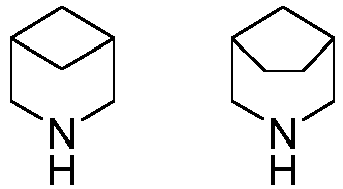
- The term "hydroxy" (which may also be referred to as "hydroxyl") refers to an -OH group.
- The term "oxo" refers to a =O substituent, whereby an oxygen atom is doubly bonded to carbon (e.g. C=O) or another element (e.g. S=O, S(=O)2). The carbon or other element is suitably an atom of an alkyl, cycloalkyl, spirocycloalkyl or heterocyclyl group.
- The term "halo" as used herein, refers to fluorine, chlorine, bromine or iodine. Particular examples of halo are fluorine and chlorine, especially fluorine.
- Where substituents are indicated as being optionally substituted e.g. optionally further substituted in formula (I) in the embodiments and preferences set out below, said substituents are optionally substituted e.g. optionally further substituted as specified in the given formula unless stated otherwise, even if the possible substitution is not explicitly listed in the embodiment.
- In one embodiment, RA is selected from the group consisting of C1-10 alkyl and C3-10 cycloalkyl.
- In one embodiment, RA is C1-10 alkyl, in particular C1-8 alkyl.
- Suitably, RA is selected from the group consisting of methyl, ethyl, n-propyl, iso-propyl, n-butyl, n-pentyl, n-hexyl, n-heptyl and n-octyl, and in particular is selected from the group consisting of methyl, ethyl, n-propyl, iso-propyl, n-butyl, n-hexyl and n-octyl.
- Suitably, RA is C6-10 alkyl, in particular n-heptyl, n-octyl, heptyl-CH(CH3)- and hexyl-CH(CH3)-, such as hexyl-CH(CH3)-.
- Suitably, RA is n-pentyl-C(CH3)2- or n-hexyl-C(CH3)2-.
- Suitably, RA is n-hexyl-CH(CH3)-, n-pentyl-C(CH3)2- or n-hexyl-C(CH3)2-.
- Most suitably, RA is hexyl-CH(CH3)- and has the following structure:

- In one embodiment, RA is C3-10 cycloalkyl, in particular C3-8 cycloalkyl. Suitably, RA is C6-10 cycloalkyl, in particular C8 cycloalkyl.
- Suitably, RA is selected from the group consisting of cyclopropyl, cyclobutyl, cyclopentyl, cyclohexyl, cycloheptyl, cyclooctyl and bicyclo[2.2.1]heptyl; and in particular is cyclobutyl, cyclopentyl, cyclohexyl, cyclooctyl or bicyclo[2.2.1]heptyl. Suitably, RA is selected from the group consisting of cyclopropyl, cyclobutyl, cyclopentyl, cyclohexyl, cycloheptyl and cyclooctyl, and in particular is cyclobutyl or cyclooctyl. Suitably, RA is cyclooctyl. Alternatively RA is cyclobutyl.
- Suitably, RA is 1-adamantyl:

- In one embodiment, RA is C5-10 spirocycloalkyl, such as C5-8 spirocycloalkyl, and in particular is spiro[3.3]heptyl.
- In one embodiment, RA e.g. as defined above, is not substituted. Suitably, RA is hexyl-CH(CH3)- and is not substituted.
- In another embodiment, RA e.g. as defined above, is substituted.
- In one embodiment, RA is substituted by one or more substituents selected from the group consisting of oxo, R1A, NR2AR3A, SR2A, SOR9A, SO2R9A, SO2NR2AR3A, C(O)R2A and CONR2AR3A. Suitably, the one or more substituent is R1A. Suitably, RA is substituted by one R1A. Alternatively, RA is substituted by two R1A. Alternatively, RA is substituted by three R1A. In any one of the above embodiments, R1A may be the same or different e.g. the same.
- When RA is substituted by at least one R1A group the substituent may replace any C-H bond present in RA. When RA is substituted by at least two R1A groups, the R1A groups may be on the same carbon atom or different carbon atoms. When RA is C3-10 cycloalkyl or C5-10 spirocycloalkyl, the group may be substituted at the point of attachment of RA to the oxygen atom such that the following structures form:

- In one embodiment, R1A is selected from the group consisting of fluoro, methyl, cyano, SiR4AR5AR6A and phenyl.
- Suitably, R1A is fluoro. Alternatively, R1A is methyl. Alternatively, R1A is cyano. Alternatively, R1A is SIR4AR5AR6A, Alternatively, R1A is C3-8 cycloalkyl. Alternatively, R1A is phenyl.
- Most suitably, R1A is selected from fluoro, methyl, C3-8 cycloalkyl and phenyl, such as fluoro and phenyl, especially fluoro.
- In another embodiment, RA is substituted by one phenyl group. In another embodiment, RA is substituted by three fluoro groups. Suitably the three fluoro groups are attached to the same terminal carbon atom to form a CF3 group.
- In one embodiment, R4A, R3A and R6A are independently selected from the group consisting of C1-4 alkyl and phenyl. Suitably, R4A, R3A and R6A are independently selected from the group consisting of methyl, ethyl, isopropyl, tert-butyl and phenyl.
- In one embodiment, R1A is substituted by R7A and/or R8A when R1A is methyl, C3-8 cycloalkyl and phenyl. Suitably, R1A is substituted by R7A and R8A. Alternatively, R1A is substituted by R7A or R8A. In one embodiment, R1A is not substituted by R7A and/or R8A when R1A is methyl, C3-8 cycloalkyl and phenyl. In one embodiment R1A is substituted by R7A and R8A is absent.
- In one embodiment, R7A and R8A are independently selected from the group consisting of oxo, C1-4 alkyl, C1-4 alkoxy, hydroxy, CO2H, cyano, methanesulfonyl and halo; or, taken together, R7A and R8A form a C3-8 cycloalkyl or 4-7 membered heterocyclic ring.
- Suitably, R7A and R8A are independently selected from the group consisting of oxo, methyl, ethyl, methoxy, hydroxy, CO2H, cyano, methanesulfonyl and halo (e.g. fluoro) such as oxo, methyl, ethyl, methoxy, hydroxy, cyano, methanesulfonyl and halo (e.g. fluoro); or, taken together, R7A and R8A form a C3-8 cycloalkyl or 4-7 membered heterocyclic ring. In one embodiment, R7A and R8A are fluoro. In one embodiment, R7A and R8A are chloro. In one embodiment, R7A and R8A are independently selected from the group consisting of oxo, C1-4 alkyl, C1-4 alkoxy, hydroxy, cyano, methanesulfonyl and halo.
- Suitably, R7A is oxo. Alternatively, R7A is C1-4 alkyl, such as methyl. Alternatively, R7A is C1-4 alkoxy such as methoxy. Alternatively, R7A is C1-4 haloalkyl such as CF3. Alternatively, R7A is C1-4 haloalkoxy such as OCF3. Alternatively, R7A is hydroxy. Alternatively, R7A is CO2H. Alternatively, R7A is cyano. Alternatively, R7A is methanesulfonyl. Alternatively, R7A is halo such as chloro or fluoro, e.g., chloro. In any one of the above embodiments, suitably R8A is absent. Most suitably, R7A is halo such as chloro or fluoro, e.g., chloro, or C1-4 haloalkyl such as CF3 and R8A is absent.
- Suitably, R8A is oxo. Alternatively, R8A is C1-4 alkyl, such as methyl. Alternatively, R8A is C1-4 alkoxy such as methoxy. Alternatively, R8A is C1-4 haloalkyl such as CF3. Alternatively, R8A is C1-4 haloalkoxy such as OCF3. Alternatively, R8A is hydroxy. Alternatively, R8A is CO2H. Alternatively, R8A is cyano. Alternatively, R8A is methanesulfonyl. Alternatively, R8A is halo such as chloro or fluoro, e.g., chloro. In any one of the above embodiments, suitably R7A is absent.
- In another embodiment, taken together, R7A and R8A form a C3-8 cycloalkyl or 4-7 membered heterocyclic ring. Suitably, R7A and R8A form a C3-8 cycloalkyl ring such as a C3-6 cycloalkyl ring. Suitably, R7A and R8A form a 4-7 membered heterocyclic ring such as a 4-6 membered heterocyclic ring.
- In one embodiment, R2A and R3A are independently H, C1-8 alkyl, C3-8 cycloalkyl or phenyl. Suitably, R2A and R3A are independently H, C1-4 alkyl, C3-8 cycloalkyl or phenyl.
- Suitably, R2A is H. Alternatively, R2A is C1-8 alkyl, such as C1-4 alkyl e.g. methyl. Alternatively, R2A is C3-8 cycloalkyl such as C3-6 cycloalkyl. Alternatively, R2A is phenyl.
- In one embodiment, R2A is methyl or phenyl, in particular phenyl.
- Suitably, R3A is H. Alternatively, R3A is C1-8 alkyl, such as C1-4 alkyl e.g. methyl. Alternatively, R3A is C3-8 cycloalkyl, such as C3-6 cycloalkyl. Alternatively, R3A is phenyl.
- In one embodiment, R3A is methyl.
- In one embodiment, R2A and R3A form a 4-7 membered heterocyclic ring.
- In one embodiment, R9A is C1-8 alkyl, C3-8 cycloalkyl or phenyl. Suitably, R9A is C1-4 alkyl, C3-8 cycloalkyl or phenyl. Suitably, R9A is C1-4 alkyl such as methyl. Alternatively, R9A is C3-8 cycloalkyl such as C3-5 cycloalkyl. Alternatively, R9A is phenyl.
- In one embodiment, R9A is methyl or phenyl, in particular phenyl.
- In one embodiment, RA contains 6 or more carbon atoms, such as 6, 7, 8, 9 or 10 carbon atoms, such as 8, 9 or 10 carbon atoms. Suitably, RA contains 6 carbon atoms. Alternatively, RA contains 7 carbon atoms. Alternatively, RA contains 8 carbon atoms. Alternatively, RA contains 9 carbon atoms. Alternatively, RA contains 10 carbon atoms.
- In one embodiment, RB is C1 alkyl substituted by CO2H. Suitably, RB is C1 alkyl substituted by CO2H and the C1 alkyl carbon of RB adjacent to the ester oxygen atom is also attached to at least one (such as one) hydrogen atom. In another embodiment, RB is C2 alkyl substituted by CO2H. Suitably, RB is C2 alkyl substituted by CO2H and the carbon of RB adjacent to the ester oxygen atom is also attached to at least one (such as one) hydrogen atom. In any one of these embodiments, suitably RB is not further substituted by trifluoromethyl or methyl.
- When RB is substituted by CO2H and is optionally further substituted by trifluoromethyl or methyl, the substituent may replace any C-H bond present in RB. When RB is substituted by CO2H and trifluoromethyl, the substituents may be on the same carbon atom or different carbon atoms. When RB is substituted by CO2H and methyl, the substituents may be on the same carbon atom or different carbon atoms.
- Suitably the CO2H group is attached to the terminal carbon i.e. such that the following moiety forms:

- When RB is substituted by CO2H and is optionally further substituted by trifluoromethyl or methyl, suitably the carbon atom of RB adjacent to the ester oxygen atom is also attached to at least one (such as one) hydrogen atom i.e. such that the following moiety forms:

- In one embodiment, RB is not further substituted.
- In another embodiment, RB is further substituted by trifluoromethyl. Suitably, the trifluoromethyl group is attached to the carbon atom of RB adjacent to the ester oxygen atom i.e. such that the following moiety forms:

- In another embodiment, RB is further substituted by methyl. Suitably, the methyl group is attached to the carbon atom of RB adjacent to the ester oxygen atom i.e. such that the following moiety forms:

- In one embodiment, RC and RD are independently selected from the group consisting of H, C1-2 alkyl, hydroxy, methoxy and fluoro. Suitably, RC and RD are independently selected from the group consisting of H, C1-2 alkyl, hydroxy and fluoro. In one embodiment, RC and RD are independently selected from the group consisting of H, methoxy and fluoro.
- In one embodiment, RC is H. In one embodiment, RC is C1-2 alkyl, in particular methyl. In one embodiment, RC is hydroxy. In one embodiment, RC is fluoro. In one embodiment, RC is methoxy.
- In one embodiment, RD is H. In one embodiment, RD is C1-2 alkyl, in particular methyl. In one embodiment, RD is hydroxy. In one embodiment, RD is fluoro. In one embodiment, RD is methoxy.
- In one embodiment, RC is H, C1-2 alkyl (in particular methyl), hydroxy or fluoro; and RD is H, C1-2 alkyl (in particular methyl), or fluoro. In one embodiment, RC is H, C1-2 alkyl (in particular methyl), hydroxy or fluoro; and RD is H, C1-2 alkyl (in particular methyl) or fluoro. In one embodiment, RC is H, C1-2 alkyl (in particular methyl), hydroxy or fluoro; and RD is H or C1-2 alkyl (in particular methyl). In one embodiment, RC is H, C1-2 alkyl (in particular methyl), hydroxy or fluoro; and RD is H or fluoro. In one embodiment, RC is H, C1-2 alkyl (in particular methyl), hydroxy or fluoro; and RD is H. In one embodiment, RC is H and RD is H or C1-2 alkyl (in particular methyl). In one embodiment, RC is H and RD is H or fluoro. In one embodiment, RC is H or C1-2 alkyl (in particular methyl); and RD is H, C1-2 alkyl (in particular methyl), or fluoro. In one embodiment, RC is H or C1-2 alkyl (in particular methyl); and RD is H or C1-2 alkyl (in particular methyl). In one embodiment, RC is H or C1-2 alkyl (in particular methyl); and RD is H. In one embodiment, RC is H and RD is H. In one embodiment, both of RC and RD are not hydroxy. In one embodiment, RC is methoxy and RD is H.
- In one embodiment, when RB contains 2 or more carbon atoms and 4 or more heteroatoms, then RA must contain 6 or more carbon atoms, and the number of carbon atoms in RA must exceed the number of heteroatoms in RA by at least 3 atoms.
- In one embodiment, the molecular weight of the compound of formula (I) is 150 Da - 450 Da.
- In any one of the above embodiments, suitably when RA is

- In one embodiment there is provided a compound of formula (I), selected from the group consisting of:
- 2-((2-methylene-4-(octyloxy)-4-oxobutanoyl)oxy)acetic acid;
- 2-((2-methylene-4-(octyloxy)-4-oxobutanoyl)oxy)propanoic acid;
- 3-((2-methylene-4-(octyloxy)-4-oxobutanoyl)oxy)propanoic acid;
- 3-((4-((4-fluorobenzyl)oxy)-2-methylene-4-oxobutanoyl)oxy)propanoic acid;
- 3-((4-(cyclooctyloxy)-2-methylene-4-oxobutanoyl)oxy)propanoic acid;
- 3-((2-methylene-4-(neopentyloxy)-4-oxobutanoyl)oxy)propanoic acid;
- (S)-3-((2-methylene-4-(octan-2-yloxy)-4-oxobutanoyl)oxy)propanoic acid;
- 3-((4-(hexyloxy)-2-methylene-4-oxobutanoyl)oxy)propanoic acid;
- 3-((2-methylene-4-oxo-4-(3-phenoxypropoxy)butanoyl)oxy)propanoic acid;
- 3-((4-(cyclohexyloxy)-2-methylene-4-oxobutanoyl)oxy)propanoic acid;
- (R)-3-((2-methylene-4-(octan-2-yloxy)-4-oxobutanoyl)oxy)propanoic acid;
- (S)-2-((2-methylene-4-(octan-2-yloxy)-4-oxobutanoyl)oxy)acetic acid;
- 2-((4-(cyclooctyloxy)-2-methylene-4-oxobutanoyl)oxy)acetic acid;
- 2-((4-(cyclohexyloxy)-2-methylene-4-oxobutanoyl)oxy)acetic acid;
- 2-((2-methylene-4-(neopentyloxy)-4-oxobutanoyl)oxy)acetic acid;
- 2-((4-((4-fluorobenzyl)oxy)-2-methylene-4-oxobutanoyl)oxy)acetic acid;
- 2-((4-(hexyloxy)-2-methylene-4-oxobutanoyl)oxy)acetic acid;
- 2-((2-methylene-4-oxo-4-(3-phenoxypropoxy)butanoyl)oxy)acetic acid;
- 2-((2-methylene-4-oxo-4-(spiro[3.3]heptan-2-yloxy)butanoyl)oxy)acetic acid;
- 2-((4-(cyclohexyloxy)-2-methylene-4-oxobutanoyl)oxy)propanoic acid;
- (R)-2-((2-methylene-4-(octan-2-yloxy)-4-oxobutanoyl)oxy)acetic acid;
- 2-((4-((4,4-difluorocyclohexyl)methoxy)-2-methylene-4-oxobutanoyl)oxy)acetic acid;
- 2-((4-(3-ethoxypropoxy)-2-methylene-4-oxobutanoyl)oxy)acetic acid;
- 2-((4-(bicyclo[2.2.1]heptan-2-yloxy)-2-methylene-4-oxobutanoyl)oxy)acetic acid;
- 2-((4-cyclobutoxy-2-methylene-4-oxobutanoyl)oxy)acetic acid;
- 2-((4-(cyclohexyloxy)-2-methylene-4-oxobutanoyl)oxy)-3,3,3-trifluoropropanoic acid;
- 2-((4-(cyclooctyloxy)-2-methylene-4-oxobutanoyl)oxy)-3,3,3-trifluoropropanoic acid;
- 3-((4-(cyclooctyloxy)-2-methylene-4-oxobutanoyl)oxy)-4,4,4-trifluorobutanoic acid;
- 2-(4-(cycloheptyloxy)-2-methylene-4-oxobutanoyloxy)acetic acid;
- 2-(2-methylene-4-(octan-3-yloxy)-4-oxobutanoyloxy)acetic acid;
- 2-(2-methylene-4-(octan-4-yloxy)-4-oxobutanoyloxy)acetic acid;
- 2-((4-(heptan-4-yloxy)-2-methylene-4-oxobutanoyl)oxy) acetic acid;
- 2-((4-((adamantan-2-yl)oxy)-2-methylene-4-oxobutanoyl)oxy)acetic acid;
- 2-((4-(1-cyclohexylethoxy)-2-methylene-4-oxobutanoyl)oxy) acetic acid;
- 2-((4-(1-cycloheptylethoxy)-2-methylene-4-oxobutanoyl)oxy)acetic acid;
- 2-(2-methylene-4-oxo-4-(spiro[3.4]octan-2-yloxy)butanoyloxy)acetic acid;
- 2-(2-methylene-4-oxo-4-(spiro[3.5]nonan-2-yloxy)butanoyloxy)acetic acid;
- 2-(2-methylene-4-oxo-4-(spiro[3.5]nonan-7-yloxy)butanoyloxy)acetic acid;
- 2-((4-((2,2-dimethylcyclohexyl)oxy)-2-methylene-4-oxobutanoyl)oxy)acetic acid;
- 2-((4-(cyclooctyloxy)-3-methyl-2-methylene-4-oxobutanoyl)oxy)acetic acid;
- 2-((2-methylene-4-oxo-4-(2,2,4,4-tetramethylcyclobutoxy)butanoyl)oxy) acetic acid;
- (S)-2-(2-methylene-4-(octan-3-yloxy)-4-oxobutanoyloxy)acetic acid;
- 2-((4-(cyclooctyloxy)-3-methoxy-2-methylene-4-oxobutanoyl)oxy)acetic acid;
- 2-((4-((-adamantan-1-yl)oxy)-2-methylene-4-oxobutanoyl)oxy)acetic acid;
- (R)-2-((4-(heptan-2-yloxy)-2-methylene-4-oxobutanoyl)oxy)acetic acid;
- 2-((2-methylene-4-(nonan-2-yloxy)-4-oxobutanoyl)oxy)acetic acid;
- 2-((2-methylene-4-(nonan-5-yloxy)-4-oxobutanoyl)oxy)acetic acid;
- 2-((4-(1-(3,5-dichlorophenyl)ethoxy)-2-methylene-4-oxobutanoyl)oxy)acetic acid;
- 2-((4-((1-(3,5-dichlorophenyl)propan-2-yl)oxy)-2-methylene-4-oxobutanoyl)oxy)acetic acid;
- (R)-2-(2-methylene-4-(octan-3-yloxy)-4-oxobutanoyloxy)acetic acid;
- 2-((2-methylene-4-oxo-4-(((1R,2S,4R)-1,7,7-trimethylbicyclo[2.2.1]heptan-2-yl)oxy)butanoyl)oxy)acetic acid;
- 2-((4-(1-cyclohexyl-2,2,2-trifluoroethoxy)-2-methylene-4-oxobutanoyl)oxy)acetic acid;
- 2-((4-(bicyclo[3.3.1]nonan-9-yloxy)-2-methylene-4-oxobutanoyl)oxy)acetic acid;
- (S)-2-((2-methylene-4-oxo-4-((1,1,1-trifluorooctan-2-yl)oxy)butanoyl)oxy)acetic acid;
- (R)-2-((2-methylene-4-(nonan-2-yloxy)-4-oxobutanoyl)oxy)acetic acid;
- (R)-2-((4-(1-cyclohexylethoxy)-2-methylene-4-oxobutanoyl)oxy)acetic acid;
- (R)-4,4,4-trifluoro-3-((2-methylene-4-(((R)-octan-2-yl)oxy)-4-oxobutanoyl)oxy)butanoic acid;
- 2-((4-(cyclooctyloxy)-3-hydroxy-2-methylene-4-oxobutanoyl)oxy)acetic acid;
- 2-(3-methylene-5-(4-methylheptan-4-yloxy)-5-oxopent-1-en-2-yloxy)acetic acid;
- 2-((4-(1-cyclohexylcyclobutoxy)-2-methylene-4-oxobutanoyl)oxy)acetic acid;
- 2-((2-methylene-4-((2-methyloctan-2-yl)oxy)-4-oxobutanoyl)oxy)acetic acid;
- 2-((2-methylene-4-((2-methylheptan-2-yl)oxy)-4-oxobutanoyl)oxy)acetic acid;
- 2-((2-methylene-4-oxo-4-(1-pentylcyclobutoxy)butanoyl)oxy) acetic acid;
- 2-((2-methylene-4-((2-methylspiro[3.5]nonan-2-yl)oxy)-4-oxobutanoyl)oxy)acetic acid;
- 2-((2-methylene-4-oxo-4-(((exo)-1,7,7-trimethylbicyclo[2.2.1]heptan-2-yl)oxy)butanoyl)oxy)acetic acid;
- 2-((2-methylene-4-oxo-4-((2,2,6,6-tetramethylcyclohexyl)oxy) butanoyl)oxy)acetic acid;
- 2-((4-(1-(3,5-dichlorophenyl)ethoxy)-2-methylene-4-oxobutanoyl)oxy)acetic acid (Isomer 1);
- 2-((4-(1-(3,5-dichlorophenyl)ethoxy)-2-methylene-4-oxobutanoyl)oxy)acetic acid (Isomer 2);
- (R)-2-((2-methylene-4-oxo-4-(1-(4-(trifluoromethyl)phenyl)ethoxy)butanoyl) oxy) acetic acid);
- (S)-2-((2-methylene-4-oxo-4-(1-(4-(trifluoromethyl)phenyl)ethoxy)butanoyl) oxy) acetic acid);
- 2-((4-(1-cyclohexylcyclopropoxy)-2-methylene-4-oxobutanoyl)oxy)acetic acid;
- (S)-2-((4-(1-cyclohexylethoxy)-2-methylene-4-oxobutanoyl)oxy)acetic acid;
- 2-((2-methylene-4-oxo-4-((2,2,4,4-tetramethylpentan-3-yl)oxy)butanoyl) oxy)acetic acid;
- (S)-4,4,4-trifluoro-3-((2-methylene-4-(((R)-octan-2-yl)oxy)-4-oxobutanoyl)oxy)butanoic acid;
- 2-((2-methylene-4-oxo-4-(1-pentylcyclopropoxy)butanoyl)oxy) acetic acid; and
- 3-((2-methylene-4-oxo-4-(2,2,4,4-tetramethylcyclobutoxy)butanoyl)oxy)propanoic acid;
- or a pharmaceutically acceptable salt and/or solvate of any one thereof.
- Suitably, the compound is selected from the group consisting of:
- (R)-2-((2-methylene-4-(octan-2-yloxy)-4-oxobutanoyl)oxy)acetic acid;
- (R)-3-((2-methylene-4-(octan-2-yloxy)-4-oxobutanoyl)oxy)propanoic acid;
- (S)-2-((2-methylene-4-oxo-4-((1,1,1-trifluorooctan-2-yl)oxy)butanoyl)oxy)acetic acid; and
- 2-((2-methylene-4-((2-methyloctan-2-yl)oxy)-4-oxobutanoyl)oxy)acetic acid;
- or a pharmaceutically acceptable salt and/or solvate of any one thereof.
- Suitably, the compound is selected from the group consisting of:
- (R)-4,4,4-trifluoro-3-((2-methylene-4-(((R)-octan-2-yl)oxy)-4-oxobutanoyl)oxy)butanoic acid; and
- (S)-4,4,4-trifluoro-3-((2-methylene-4-(((R)-octan-2-yl)oxy)-4-oxobutanoyl)oxy)butanoic acid;
- or a pharmaceutically acceptable salt and/or solvate of any one thereof.
- Compounds of formula (I) may be prepared as set out in the Examples, e.g. as set out in General Procedures 1-4.
- For example, compounds of formula (I) may prepared using the following route:

- RA, RB, RC and RD are as defined elsewhere herein.
- Step (i): itaconate anhydride (V) can be reacted with alcohol (IV), wherein RA' represents RA or a protected derivative thereof, in the presence of a catalyst such as p-TsOH.H2O in a solvent such as toluene to give monoester (III).
- Step (ii): Monoester (III) and alcohol (II), where RB' represents RB or a protected derivative thereof, can be condensed under standard coupling conditions as shown in the General Procedures 2 and 3 to give compounds of formula (I) following any optional deprotection steps. Alternatively, monoester (III) can be reacted with compound (II'), wherein RB' represents RB or a protected derivative thereof and X represents a leaving group such as chloro, bromo, iodo, alkanesulfonate or arenesulfonate, in the presence of a base such as potassium carbonate to give compounds of formula (I) after any requisite deprotection steps.
- Compounds of formula (I) may also be prepared by the following route:

- RA, RB, RC and RD are as defined elsewhere herein.
- Step (i): itaconate anhydride (V) can be reacted with alcohol (VI), wherein PG represents a protecting group orthogonal to any protecting group present in RB', in the presence of a catalyst such as p-TsOH.H2O in a solvent such as toluene to give monoester (VII).
- Step (ii): Monoester (VII) and alcohol (II), wherein RB' represents RB or a protected derivative thereof, can be condensed under standard coupling conditions to give diesters of formula (VIII).
- Step (iii): The orthogonal protecting group PG is removed using conditions known to the person skilled in the art to give itaconate (IX) possessing a free carboxyl group at the 4-position.
- Step (iv): Itaconate (IX) is coupled with alcohol (IV), wherein RA' represents RA or a protected derivative thereof, under standard coupling conditions to give monoester (I) following any deprotection steps required.
- Compounds of formula (I) may additionally be made by the following route:

- RA, RB, RC and RD are as defined elsewhere herein.
- Step (i): Alcohol (IV) is condensed with compound (X), wherein X1 and X2 represent leaving groups, such as halo e.g., chloro, bromo or iodo, and RA' represents RA or a protected derivative thereof, to give monoester (XI).
- Step (ii): Monoester (XI) is reacted with a trialkylphosphonoacetate of formula (XII), wherein R11 and R12 independently represent C1-4 alkyl optionally substituted with halo and RB' represents RB or a protected derivative thereof, to provide a compound of formula (XIII).
- Step (iii): Condensation of a compound of formula (XIII) with formaldehyde or a formaldehyde equivalent thereof e.g., paraformaldehyde, and after any optional deprotection steps, provides the compound of formula (I).
- The skilled person will appreciate that protecting groups may be used throughout the synthetic schemes described herein to give protected derivatives of any of the above compounds or generic formulae. Protective groups and the means for their removal are described in " Protective Groups in Organic Synthesis", by Theodora W. Greene and Peter G. M. Wuts, published by John Wiley & Sons Inc; 4th Rev Ed., 2006, ISBN-10: 0471697540. Examples of nitrogen protecting groups include trityl (Tr), tert-butyloxycarbonyl (BOC), 9-fluorenylmethyloxycarbonyl (Fmoc), acetyl (Ac), benzyl (Bn) and para-methoxy benzyl (PMB). Examples of oxygen protecting groups include acetyl (Ac), methoxymethyl (MOM), para-methoxybenzyl (PMB), benzyl, tert-butyl, methyl, ethyl, tetrahydropyranyl (THP), and silyl ethers and esters (such as trimethylsilyl (TMS), tertbutyldimethylsilyl (TBDMS), tri-iso-propylsilyloxymethyl (TOM), and triisopropylsilyl (TIPS) ethers and esters). Specific examples of carboxylic acid protecting groups include alkyl esters (such as C1-6 alkyl e.g. C1-4 alkyl esters), benzyl esters and silyl esters.
- Thus, in one embodiment there is provided a process for preparing a compound of formula (I) or a salt such as a pharmaceutically acceptable salt thereof, which comprises reacting a compound of formula (III):

- wherein RA', RC and RD are defined elsewhere herein,
- or a salt thereof;
- with a compound of formula (II):
RB' -OH (II)
- wherein RB' is defined elsewhere herein,
- or a salt thereof.
- In one embodiment there is provided a process for preparing a compound of formula (I), or a salt such as a pharmaceutically acceptable salt thereof, which comprises reacting a compound of formula (III):

- wherein RA', RC and RD are defined elsewhere herein,
- or a salt thereof;
- with a compound of formula (II'):
RB'-X (II')
- wherein RB' and X are defined elsewhere herein,
- or a salt thereof.
- There is also provided a process for preparing a compound of formula (III) or a salt thereof, which comprises reacting a compound of formula (V):
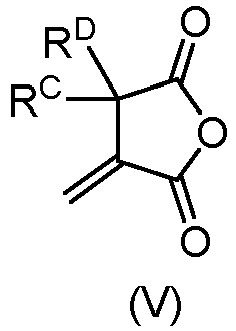
- or a salt thereof;
- with a compound of formula (IV):
RA'-OH (IV)
- wherein RA' is defined elsewhere herein,
- or a salt thereof.
- There is also provided a process for preparing a compound of formula (I), or a salt such as a pharmaceutically acceptable salt thereof, which comprises reacting a compound of formula (IX):

- wherein RB', RC and RD are defined elsewhere herein,
- or a salt thereof;
- with a compound of formula (IV)
RA'-OH (IV)
- wherein RA' is defined elsewhere herein,
- or a salt thereof.
- In one embodiment there is provided a process for preparing a compound of formula (VIII) or a salt thereof, which comprises reacting a compound of formula (VII):

- wherein PG, RC and RD are defined elsewhere herein,
- or a salt thereof;
- with a compound of formula (II):
RB'-OH (II)
- wherein RB' is defined elsewhere herein,
- or a salt thereof.
- In one embodiment there is provided a process for preparing a compound of formula (I), or a salt such as a pharmaceutically acceptable salt thereof, which comprises reacting a compound of formula (XIII):

- or a salt thereof,
- with formaldehyde or an equivalent thereof;
- wherein RA', RB', RC, RD, R11 and R12 are defined elsewhere herein.
- In one embodiment there is provided a process for preparing a compound of formula (XIII) or a salt thereof, which comprises reacting a compound of formula (XI):

- wherein RA', RC, RD and X2 are defined elsewhere herein,
- or a salt thereof;
- with a compound of formula (XII):

- wherein RB', R11 and R12 are defined elsewhere herein,
- or a salt thereof.
- In one embodiment, there is provided a compound of formula (IX):

- In one embodiment, there is provided a compound of formula (XIII):

- In one embodiment, there is provided a compound of formula (XI):

- Certain intermediates are novel and are claimed as an aspect of the invention:
- 4-(cyclooctyloxy)-2-methylene-4-oxobutanoic acid;
- 2-methylene-4-oxo-4-(3-phenoxypropoxy)butanoic acid;
- 4-((4-fluorobenzyl)oxy)-2-methylene-4-oxobutanoic acid;
- (R)-2-methylene-4-(octan-2-yloxy)-4-oxobutanoic acid;
- (S)-2-methylene-4-(octan-2-yloxy)-4-oxobutanoic acid;
- 2-methylene-4-(neopentyloxy)-4-oxobutanoic acid; and
- 3-((2-(tert-butoxy)-2-oxoethoxy)carbonyl)but-3-enoic acid;
- or salts thereof.
- It will be appreciated that for use in therapy the salts of the compounds of formula (I) should be pharmaceutically acceptable. Suitable pharmaceutically acceptable salts will be apparent to those skilled in the art. Pharmaceutically acceptable salts include acid addition salts, suitably salts of compounds of the invention comprising a basic group such as an amino group, formed with inorganic acids e.g. hydrochloric acid, hydrobromic acid, sulfuric acid, nitric acid or phosphoric acid. Also included are salts formed with organic acids e.g. succinic acid, maleic acid, acetic acid, fumaric acid, citric acid, tartaric acid, benzoic acid, p-toluenesulfonic acid, methanesulfonic acid, naphthalenesulfonic acid and 1,5-naphthalenedisulfonic acid. Other salts e.g. oxalates or formates, may be used, for example in the isolation of compounds of formula (I) and are included within the scope of this invention, as are basic addition salts such as sodium, potassium, calcium, aluminium, zinc, magnesium and other metal salts.
- Pharmaceutically acceptable salts may also be formed with organic bases such as basic amines e.g. with ammonia, meglumine, tromethamine, piperazine, arginine, choline, diethylamine, benzathine or lysine. Thus, in one embodiment there is provided a compound of formula (I) in the form of a pharmaceutically acceptable salt. Alternatively, there is provided a compound of formula (I) in the form of a free acid. When the compound contains a basic group as well as the free acid it may be Zwitterionic.
- Suitably, the compound of formula (I) is not a salt e.g. is not a pharmaceutically acceptable salt.
- Suitably, where the compound of formula (I) is in the form of a salt, the pharmaceutically acceptable salt is a basic addition salt such as a carboxylate salt formed with a group 1 metal (e.g. a sodium or potassium salt), a group 2 metal (e.g. a magnesium or calcium salt) or an ammonium salt of a basic amine (e.g. an NH4 + salt), such as a sodium salt.
- The compounds of formula (I) may be prepared in crystalline or non-crystalline form and, if crystalline, may optionally be solvated, e.g. as the hydrate. This invention includes within its scope stoichiometric solvates (e.g. hydrates) as well as compounds containing variable amounts of solvent (e.g. water). Suitably, the compound of formula (I) is not a solvate.
- The invention extends to a pharmaceutically acceptable derivative thereof, such as a pharmaceutically acceptable prodrug of compounds of formula (I). Typical prodrugs of compounds of formula (I) which comprise a carboxylic acid include ester (e.g. C1-6 alkyl e.g. C1-4 alkyl ester) derivatives thereof. Thus, in one embodiment, the compound of formula (I) is provided as a pharmaceutically acceptable prodrug. In another embodiment, the compound of formula (I) is not provided as a pharmaceutically acceptable prodrug.
- Certain compounds of formula (I) may metabolise under certain conditions such as by hydrolysis of the RB ester group. Certain metabolites of compounds of formula (I) have activity, as described in Biological Example 6. Without wishing to be bound by theory, formation of an active metabolite (such as in vivo) of a compound of formula (I) may be beneficial by contributing to the biological activity observed of the compound of formula (I). Thus, in one embodiment, there is provided an active metabolite of the compound of formula (I) and its use as a pharmaceutical e.g. for the treatment or prevention of the diseases mentioned herein.
- It is to be understood that the present invention encompasses all isomers of compounds of formula (I) including all geometric, tautomeric and optical forms, and mixtures thereof (e.g. racemic mixtures). Where additional chiral centres are present in compounds of formula (I), the present invention includes within its scope all possible diastereoisomers, including mixtures thereof. The different isomeric forms may be separated or resolved one from the other by conventional methods, or any given isomer may be obtained by conventional synthetic methods or by stereospecific or asymmetric syntheses.
- The present invention also includes all isotopic forms of the compounds provided herein, whether in a form (i) wherein all atoms of a given atomic number have a mass number (or mixture of mass numbers) which predominates in nature (referred to herein as the "natural isotopic form") or (ii) wherein one or more atoms are replaced by atoms having the same atomic number, but a mass number different from the mass number of atoms which predominates in nature (referred to herein as an "unnatural variant isotopic form"). It is understood that an atom may naturally exists as a mixture of mass numbers. The term "unnatural variant isotopic form" also includes embodiments in which the proportion of an atom of given atomic number having a mass number found less commonly in nature (referred to herein as an "uncommon isotope") has been increased relative to that which is naturally occurring e.g. to the level of >20%, >50%, >75%, >90%, >95% or> 99% by number of the atoms of that atomic number (the latter embodiment referred to as an "isotopically enriched variant form"). The term "unnatural variant isotopic form" also includes embodiments in which the proportion of an uncommon isotope has been reduced relative to that which is naturally occurring. Isotopic forms may include radioactive forms (i.e. they incorporate radioisotopes) and non-radioactive forms. Radioactive forms will typically be isotopically enriched variant forms.
- An unnatural variant isotopic form of a compound may thus contain one or more artificial or uncommon isotopes such as deuterium (2H or D), carbon-11 (11C), carbon-13 (13C), carbon-14 (14C), nitrogen-13 (13N), nitrogen-15 (15N), oxygen-15 (15O), oxygen-17 (17O), oxygen-18 (18O), phosphorus-32 (32P), sulphur-35 (35S), chlorine-36 (35Cl), chlorine-37 (31Cl), fluorine-18 (13F) iodine-123 (123I), iodine-125 (125I) in one or more atoms or may contain an increased proportion of said isotopes as compared with the proportion that predominates in nature in one or more atoms.
- Unnatural variant isotopic forms comprising radioisotopes may, for example, be used for drug and/or substrate tissue distribution studies. The radioactive isotopes tritium, i.e. 3H, and carbon-14, i.e. 14C, are particularly useful for this purpose in view of their ease of incorporation and ready means of detection. Unnatural variant isotopic forms which incorporate deuterium i.e. 2H or D may afford certain therapeutic advantages resulting from greater metabolic stability, for example, increased in vivo half-life or reduced dosage requirements, and hence may be preferred in some circumstances. Further, unnatural variant isotopic forms may be prepared which incorporate positron emitting isotopes, such as 11C, 18F, 15O and 13N, and would be useful in positron emission topography (PET) studies for examining substrate receptor occupancy.
- In one embodiment, the compounds of formula (I) are provided in a natural isotopic form. In one embodiment, the compounds of formula (I) are provided in an unnatural variant isotopic form. In a specific embodiment, the unnatural variant isotopic form is a form in which deuterium (i.e. 2H or D) is incorporated where hydrogen is specified in the chemical structure in one or more atoms of a compound of formula (I). In one embodiment, the atoms of the compounds of formula (I) are in an isotopic form which is not radioactive. In one embodiment, one or more atoms of the compounds of formula (I) are in an isotopic form which is radioactive. Suitably radioactive isotopes are stable isotopes. Suitably the unnatural variant isotopic form is a pharmaceutically acceptable form.
- In one embodiment, a compound of formula (I) is provided whereby a single atom of the compound exists in an unnatural variant isotopic form. In another embodiment, a compound of formula (I) is provided whereby two or more atoms exist in an unnatural variant isotopic form.
- Unnatural isotopic variant forms can generally be prepared by conventional techniques known to those skilled in the art or by processes described herein e.g. processes analogous to those described in the accompanying Examples for preparing natural isotopic forms. Thus, unnatural isotopic variant forms could be prepared by using appropriate isotopically variant (or labelled) reagents in place of the normal reagents employed in the Examples. Since the compounds of formula (I) are intended for use in pharmaceutical compositions it will readily be understood that they are each preferably provided in substantially pure form, for example at least 60% pure, more suitably at least 75% pure and preferably at least 85%, especially at least 98% pure (% are on a weight for weight basis). Impure preparations of the compounds may be used for preparing the more pure forms used in the pharmaceutical compositions.
- Compounds of formula (I) are of use in therapy, particularly for treating or preventing an inflammatory disease or a disease associated with an undesirable immune response. As shown in Biological Example 1 below, example compounds of formula (I) reduced cytokine release more effectively than dimethyl itaconate, as demonstrated by lower IC50 values. Cytokines are important mediators of inflammation and immune-mediated disease as evidenced by the therapeutic benefit delivered by antibodies targeting them.
- Thus, in a first aspect, the present invention provides a compound of formula (I) or a pharmaceutically acceptable salt and/or solvate thereof as defined herein, for use as a medicament. Also provided is a pharmaceutical composition comprising a compound of formula (I) or a pharmaceutically acceptable salt and/or solvate thereof as defined herein. Such a pharmaceutical composition contains the compound of formula (I) and a pharmaceutically acceptable carrier or excipient.
- In a further aspect, the present invention provides a compound of formula (I) or a pharmaceutically acceptable salt and/or solvate thereof as defined herein, for use in treating or preventing an inflammatory disease or a disease associated with an undesirable immune response.
- For all aspects of the invention, suitably the compound is administered to a subject in need thereof, wherein the subject is suitably a human subject.
- In one embodiment is provided a compound of formula (I) or a pharmaceutically acceptable salt and/or solvate thereof as defined herein, for use in treating an inflammatory disease or disease associated with an undesirable immune response.
- In one embodiment is provided a compound of formula (I) or a pharmaceutically acceptable salt and/or solvate thereof as defined herein, for use in preventing an inflammatory disease or a disease associated with an undesirable immune response.
- In one embodiment is provided a compound of formula (I) or a pharmaceutically acceptable salt and/or solvate thereof as defined herein, for use in treating or preventing an inflammatory disease.
- In one embodiment is provided a compound of formula (I) or a pharmaceutically acceptable salt and/or solvate thereof as defined herein, for use in treating or preventing a disease associated with an undesirable immune response.
- An undesirable immune response will typically be an immune response which gives rise to a pathology i.e. is a pathological immune response or reaction.
- In one embodiment, the inflammatory disease or disease associated with an undesirable immune response is an auto-immune disease.
- In one embodiment, the inflammatory disease or disease associated with an undesirable immune response is, or is associated with, a disease selected from the group consisting of: psoriasis (including chronic plaque, erythrodermic, pustular, guttate, inverse and nail variants), asthma, chronic obstructive pulmonary disease (COPD, including chronic bronchitis and emphysema), heart failure (including left ventricular failure), myocardial infarction, angina pectoris, other atherosclerosis and/or atherothrombosis-related disorders (including peripheral vascular disease and ischaemic stroke), a mitochondrial and neurodegenerative disease (such as Parkinson's disease, Alzheimer's disease, Huntington's disease, amyotrophic lateral sclerosis, retinitis pigmentosa or mitochondrial encephalomyopathy), autoimmune paraneoplastic retinopathy, transplantation rejection (including antibody-mediated and T cell-mediated forms), multiple sclerosis, transverse myelitis, ischaemia-reperfusion injury (e.g. during elective surgery such as cardiopulmonary bypass for coronary artery bypass grafting or other cardiac surgery, following percutaneous coronary intervention, following treatment of acute ST-elevation myocardial infarction or ischaemic stroke, organ transplantation, or acute compartment syndrome), AGE-induced genome damage, an inflammatory bowel disease (e.g. Crohn's disease or ulcerative colitis), primary sclerosing cholangitis (PSC), PSC-autoimmune hepatitis overlap syndrome, non-alcoholic fatty liver disease (non-alcoholic steatohepatitis), rheumatica, granuloma annulare, cutaneous lupus erythematosus (CLE), systemic lupus erythematosus (SLE), lupus nephritis, drug-induced lupus, autoimmune myocarditis or myopericarditis, Dressler's syndrome, giant cell myocarditis, post-pericardiotomy syndrome, drug-induced hypersensitivity syndromes (including hypersensitivity myocarditis), eczema, sarcoidosis, erythema nodosum, acute disseminated encephalomyelitis (ADEM), neuromyelitis optica spectrum disorders, MOG (myelin oligodendrocyte glycoprotein) antibody-associated disorders (including MOG-EM), optic neuritis, CLIPPERS (chronic lymphocytic inflammation with pontine perivascular enhancement responsive to steroids), diffuse myelinoclastic sclerosis, Addison's disease, alopecia areata, ankylosing spondylitis, other spondyloarthritides (including peripheral spondyloarthritis, that is associated with psoriasis, inflammatory bowel disease, reactive arthritis or juvenile onset forms), antiphospholipid antibody syndrome, autoimmune hemolytic anaemia, autoimmune hepatitis, autoimmune inner ear disease, pemphigoid (including bullous pemphigoid, mucous membrane pemphigoid, cicatricial pemphigoid, herpes gestationis or pemphigoid gestationis, ocular cicatricial pemphigoid), linear IgA disease, Behçet's disease, celiac disease, Chagas disease, dermatomyositis, diabetes mellitus type I, endometriosis, Goodpasture's syndrome, Graves' disease, Guillain-Barre syndrome and its subtypes (including acute inflammatory demyelinating polyneuropathy, AIDP, acute motor axonal neuropathy (AMAN), acute motor and sensory axonal neuropathy (AMSAN), pharyngeal-cervical-brachial variant, Miller-Fisher variant and Bickerstaff's brainstem encephalitis), progressive inflammatory neuropathy, Hashimoto's disease, hidradenitis suppurativa, inclusion body myositis, necrotising myopathy, Kawasaki disease, IgA nephropathy, Henoch-Schonlein purpura, idiopathic thrombocytopenic purpura, thrombotic thrombocytopenic purpura (TTP), Evans' syndrome, interstitial cystitis, mixed connective tissue disease, undifferentiated connective tissue disease, morphea, myasthenia gravis (including MuSK antibody positive and seronegative variants), narcolepsy, neuromyotonia, pemphigus vulgaris, pernicious anaemia, psoriatic arthritis, polymyositis, primary biliary cholangitis (also known as primary biliary cirrhosis), rheumatoid arthritis, palindromic rheumatism, schizophrenia, autoimmune (meningo-)encephalitis syndromes, scleroderma, Sjogren's syndrome, stiff person syndrome, polymylagia rheumatica, giant cell arteritis (temporal arteritis), Takayasu arteritis, polyarteritis nodosa, Kawasaki disease, granulomatosis with polyangitis (GPA; formerly known as Wegener's granulomatosis), eosinophilic granulomatosis with polyangiitis (EGPA; formerly known as Churg-Strauss syndrome), microscopic polyarteritis/polyangiitis, hypocomplementaemic urticarial vasculitis, hypersensitivity vasculitis, cryoglobulinemia, thromboangiitis obliterans (Buerger's disease), vasculitis, leukocytoclastic vasculitis, vitiligo, acute disseminated encephalomyelitis, adrenoleukodystrophy, Alexander's disease, Alper's disease, balo concentric sclerosis or Marburg disease, cryptogenic organising pneumonia (formerly known as bronchiolitis obliterans organizing pneumonia), Canavan disease, central nervous system vasculitic syndrome, Charcot-Marie-Tooth disease, childhood ataxia with central nervous system hypomyelination, chronic inflammatory demyelinating polyneuropathy (CIDP), diabetic retinopathy, globoid cell leukodystrophy (Krabbe disease), graft-versus-host disease (GVHD) (including acute and chronic forms, as well as intestinal GVHD), hepatitis C (HCV) infection or complication, herpes simplex viral infection or complication, human immunodeficiency virus (HIV) infection or complication, lichen planus, monomelic amyotrophy, cystic fibrosis, pulmonary arterial hypertension (PAH, including idiopathic PAH), lung sarcoidosis, idiopathic pulmonary fibrosis, paediatric asthma, atopic dermatitis, allergic dermatitis, contact dermatitis, allergic rhinitis, rhinitis, sinusitis, conjunctivitis, allergic conjunctivitis, keratoconjunctivitis sicca, dry eye, xerophthalmia, glaucoma, macular oedema, diabetic macular oedema, central retinal vein occlusion (CRVO), macular degeneration (including dry and/or wet age related macular degeneration, AMD), post-operative cataract inflammation, uveitis (including posterior, anterior, intermediate and pan uveitis), iridocyclitis, scleritis, corneal graft and limbal cell transplant rejection, gluten sensitive enteropathy (coeliac disease), dermatitis herpetiformis, eosinophilic esophagitis, achalasia, autoimmune dysautonomia, autoimmune encephalomyelitis, autoimmune oophoritis, autoimmune orchitis, autoimmune pancreatitis, aortitis and periaortitis, autoimmune retinopathy, autoimmune urticaria, Behcet's disease, (idiopathic) Castleman's disease, Cogan's syndrome, IgG4-related disease, retroperitoneal fibrosis, juvenile idiopathic arthritis including systemic juvenile idiopathic arthritis (Still's disease), adult-onset Still's disease, ligneous conjunctivitis, Mooren's ulcer, pityriasis lichenoides et varioliformis acuta (PLEVA, also known as Mucha-Habermann disease), multifocal motor neuropathy (MMN), paediatric acute-onset neuropsychiatric syndrome (PANS) (including paediatric autoimmune neuropsychiatric disorders associated with streptococcal infections (PANDAS)), paraneoplastic syndromes (including paraneoplastic cerebellar degeneration, Lambert-Eaton myaesthenic syndrome, limbic encephalitis, brainstem encephalitis, opsoclonus myoclonus ataxia syndrome, anti-NMDA receptor encephalitis, thymoma-associated multiorgan autoimmunity), perivenous encephalomyelitis, reflex sympathetic dystrophy, relapsing polychondritis, sperm & testicular autoimmunity, Susac's syndrome, Tolosa-Hunt syndrome, Vogt-Koyanagi-Harada Disease, anti-synthetase syndrome, autoimmune enteropathy, immune dysregulation polyendocrinopathy enteropathy X-linked (IPEX), microscopic colitis, autoimmune lymphoproliferative syndrome (ALPS), autoimmune polyendocrinopathy-candidiasis-ectodermal dystrophy syndrome (APEX), gout, pseudogout, amyloid (including AA or secondary amyloidosis), eosinophilic fasciitis (Shulman syndrome) progesterone hypersensitivity (including progesterone dermatitis), familial Mediterranean fever (FMF), tumour necrosis factor (TNF) receptor-associated periodic fever syndrome (TRAPS), hyperimmunoglobulinaemia D with periodic fever syndrome (HIDS), PAPA (pyogenic arthritis, pyoderma gangrenosum, severe cystic acne) syndrome, deficiency of interleukin-1 receptor antagonist (DIRA), deficiency of the interleukin-36-receptor antagonist (DITRA), cryopyrin-associated periodic syndromes (CAPS) (including familial cold autoinflammatory syndrome [FCAS], Muckle-Wells syndrome, neonatal onset multisystem inflammatory disease [NOMID]), NLRP12-associated autoinflammatory disorders (NLRP12AD), periodic fever aphthous stomatitis (PFAPA), chronic atypical neutrophilic dermatosis with lipodystrophy and elevated temperature (CANDLE), Majeed syndrome, Blau syndrome (also known as juvenile systemic granulomatosis), macrophage activation syndrome, chronic recurrent multifocal osteomyelitis (CRMO), familial cold autoinflammatory syndrome, mutant adenosine deaminase 2 and monogenic interferonopathies (including Aicardi-Goutières syndrome, retinal vasculopathy with cerebral leukodystrophy, spondyloenchondrodysplasia, STING [stimulator of interferon genes]-associated vasculopathy with onset in infancy, proteasome associated autoinflammatory syndromes, familial chilblain lupus, dyschromatosis symmetrica hereditaria), Schnitzler syndrome; familial cylindromatosis, congenital B cell lymphocytosis, OTULIN-related autoinflammatory syndrome, type 2 diabetes mellitus, insulin resistance and the metabolic syndrome (including obesity-associated inflammation), atherosclerotic disorders (e.g. myocardial infarction, angina, ischaemic heart failure, ischaemic nephropathy, ischaemic stroke, peripheral vascular disease, aortic aneurysm), renal inflammatory disorders (e.g. diabetic nephropathy, membranous nephropathy, minimal change disease, crescentic glomerulonephritis, acute kidney injury, renal transplantation).
- In one embodiment, the inflammatory disease or disease associated with an undesirable immune response is, or is associated with, a disease selected from the following autoinflammatory diseases: familial Mediterranean fever (FMF), tumour necrosis factor (TNF) receptor-associated periodic fever syndrome (TRAPS), hyperimmunoglobulinaemia D with periodic fever syndrome (HIDS), PAPA (pyogenic arthritis, pyoderma gangrenosum, and severe cystic acne) syndrome, deficiency of interleukin-1 receptor antagonist (DIRA), deficiency of the interleukin-36-receptor antagonist (DITRA), cryopyrin-associated periodic syndromes (CAPS) (including familial cold autoinflammatory syndrome [FCAS], Muckle-Wells syndrome, and neonatal onset multisystem inflammatory disease [NOMID]), NLRP12-associated autoinflammatory disorders (NLRP12AD), periodic fever aphthous stomatitis (PFAPA), chronic atypical neutrophilic dermatosis with lipodystrophy and elevated temperature (CANDLE), Majeed syndrome, Blau syndrome (also known as juvenile systemic granulomatosis), macrophage activation syndrome, chronic recurrent multifocal osteomyelitis (CRMO), familial cold autoinflammatory syndrome, mutant adenosine deaminase 2 and monogenic interferonopathies (including Aicardi-Goutières syndrome, retinal vasculopathy with cerebral leukodystrophy, spondyloenchondrodysplasia, STING [stimulator of interferon genes]-associated vasculopathy with onset in infancy, proteasome associated autoinflammatory syndromes, familial chilblain lupus, dyschromatosis symmetrica hereditaria) and Schnitzler syndrome.
- In one embodiment, the inflammatory disease or disease associated with an undesirable immune response is, or is associated with, a disease selected from the following diseases mediated by excess NF-κB or gain of function in the NF-κB signalling pathway or in which there is a major contribution to the abnormal pathogenesis therefrom (including non-canonical NF-κB signalling): familial cylindromatosis, congenital B cell lymphocytosis, OTULIN-related autoinflammatory syndrome, type 2 diabetes mellitus, insulin resistance and the metabolic syndrome (including obesity-associated inflammation), atherosclerotic disorders (e.g. myocardial infarction, angina, ischaemic heart failure, ischaemic nephropathy, ischaemic stroke, peripheral vascular disease, aortic aneurysm), renal inflammatory disorders (e.g. diabetic nephropathy, membranous nephropathy, minimal change disease, crescentic glomerulonephritis, acute kidney injury, renal transplantation), asthma, COPD, type 1 diabetes mellitus, rheumatoid arthritis, multiple sclerosis, inflammatory bowel disease (including ulcerative colitis and Crohn's disease), and SLE.
- In one embodiment, the disease is selected from the group consisting of rheumatoid arthritis, psoriatic arthritis, ankylosing spondylitis, systemic lupus erythematosus, multiple sclerosis, psoriasis, Crohn's disease, ulcerative colitis, uveitis, cryopyrin-associated periodic syndromes, Muckle-Wells syndrome, juvenile idiopathic arthritis and chronic obstructive pulmonary disease. In one embodiment, the disease is multiple sclerosis.
- In one embodiment, the disease is psoriasis.
- In one embodiment, the compound of formula (I) exhibits a lower IC50 compared with dimethyl itaconate when tested in a cytokine assay e.g. as described in Biological Example 1. In one embodiment, the compound of formula (I) exhibits a lower IC50 compared with dimethyl fumarate when tested in a cytokine assay e.g. as described in Biological Example 1.
- In one embodiment, the compound of formula (I) exhibits a lower EC50 compared with dimethyl itaconate when tested in an NRF2 assay e.g. as described in Biological Example 3. In one embodiment, the compound of formula (I) exhibits a higher Emax compared with dimethyl itaconate when tested in an NRF2 assay e.g. as described in Biological Example 3. In one embodiment, the compound of formula (I) exhibits a lower EC50 and/or higher Emax compared with dimethyl itaconate when tested in an NRF2 assay e.g. as described in Biological Example 3. In one embodiment, the compound of formula (I) exhibits a lower EC50 and higher Emax compared with dimethyl itaconate when tested in an NRF2 assay e.g. as described in Biological Example 3.
- In one embodiment, the compound of formula (I) exhibits improved oral systemic bioavailability compared with dimethyl itaconate e.g. as described in Biological Example 4. In one embodiment, the compound of formula (I) exhibits reduced plasma clearance following intravenous dosing compared with dimethyl itaconate e.g. as described in Biological Example 4.
- In one embodiment, the compound of formula (I) exhibits lower intrinsic clearance (Clint) compared with 4-octyl itaconate when tested in a hepatocyte stability assay, e.g., as described in Biological Example 5. In one embodiment, the compound of formula (I) exhibits a longer half-life (T1/2) compared with 4-octyl itaconate when tested in a hepatocyte stability assay, e.g. as described in Biological Example 5.
- The compound of formula (I) is usually administered as a pharmaceutical composition. Thus, in one embodiment, is provided a pharmaceutical composition comprising a compound of formula (I) and one or more pharmaceutically acceptable diluents or carriers.
- The compound of formula (I) may be administered by any convenient method, e.g. by oral, parenteral, buccal, sublingual, nasal, rectal, intrathecal or transdermal administration, and the pharmaceutical compositions adapted accordingly.
- The compound of formula (I) may be administered topically to the target organ e.g. topically to the eye, lung, nose or skin. Hence the invention provides a pharmaceutical composition comprising a compound of formula (I) optionally in combination with one or more topically acceptable diluents or carriers.
- A compound of formula (I) which is active when given orally can be formulated as a liquid or solid, e.g. as a syrup, suspension, emulsion, tablet, capsule or lozenge.
- A liquid formulation will generally consist of a suspension or solution of the compound of formula (I) in a suitable liquid carrier(s). Suitably the carrier is non-aqueous e.g. polyethylene glycol or an oil. The formulation may also contain a suspending agent, preservative, flavouring and/or colouring agent.
- A composition in the form of a tablet can be prepared using any suitable pharmaceutical carrier(s) routinely used for preparing solid formulations, such as magnesium stearate, starch, lactose, sucrose and cellulose.
- A composition in the form of a capsule can be prepared using routine encapsulation procedures, e.g. pellets containing the active ingredient can be prepared using standard carriers and then filled into a hard gelatine capsule; alternatively, a dispersion or suspension can be prepared using any suitable pharmaceutical carrier(s), e.g. aqueous gums, celluloses, silicates or oils and the dispersion or suspension then filled into a soft gelatine capsule.
- Typical parenteral compositions consist of a solution or suspension of the compound of formula (I) in a sterile aqueous carrier or parenterally acceptable oil, e.g. polyethylene glycol, polyvinyl pyrrolidone, lecithin, arachis oil or sesame oil. Alternatively, the solution can be lyophilised and then reconstituted with a suitable solvent just prior to administration.
- Compositions for nasal administration may conveniently be formulated as aerosols, drops, gels and powders. Aerosol formulations typically comprise a solution or fine suspension of the compound of formula (I) in a pharmaceutically acceptable aqueous or non-aqueous solvent and are usually presented in single or multidose quantities in sterile form in a sealed container which can take the form of a cartridge or refill for use with an atomising device. Alternatively, the sealed container may be a disposable dispensing device such as a single dose nasal inhaler or an aerosol dispenser fitted with a metering valve. Where the dosage form comprises an aerosol dispenser, it will contain a propellant which can be a compressed gas e.g. air, or an organic propellant such as a chlorofluorocarbon (CFC) or a hydrofluorocarbon (HFC). Aerosol dosage forms can also take the form of pump-atomisers.
- Topical administration to the lung may be achieved by use of an aerosol formulation. Aerosol formulations typically comprise the active ingredient suspended or dissolved in a suitable aerosol propellant, such as a chlorofluorocarbon (CFC) or a hydrofluorocarbon (HFC).
- Topical administration to the lung may also be achieved by use of a non-pressurised formulation such as an aqueous solution or suspension. These may be administered by means of a nebuliser e.g. one that can be hand-held and portable or for home or hospital use (i.e. non-portable). The formulation may comprise excipients such as water, buffers, tonicity adjusting agents, pH adjusting agents, surfactants and co-solvents.
- Topical administration to the lung may also be achieved by use of a dry-powder formulation. The formulation will typically contain a topically acceptable diluent such as lactose, glucose or mannitol (preferably lactose).
- The compound of the invention may also be administered rectally, for example in the form of suppositories or enemas, which include aqueous or oily solutions as well as suspensions and emulsions and foams. Such compositions are prepared following standard procedures, well known by those skilled in the art. For example, suppositories can be prepared by mixing the active ingredient with a conventional suppository base such as cocoa butter or other glycerides. In this case, the drug is mixed with a suitable non-irritating excipient which is solid at ordinary temperatures but liquid at the rectal temperature and will therefore melt in the rectum to release the drug. Such materials are cocoa butter and polyethylene glycols.
- Generally, for compositions intended to be administered topically to the eye in the form of eye drops or eye ointments, the total amount of the compound of the present invention will be about 0.0001 to less than 4.0% (w/w).
- Preferably, for topical ocular administration, the compositions administered according to the present invention will be formulated as solutions, suspensions, emulsions and other dosage forms.
- The compositions administered according to the present invention may also include various other ingredients, including, but not limited to, tonicity agents, buffers, surfactants, stabilizing polymer, preservatives, co-solvents and viscosity building agents. Suitable pharmaceutical compositions of the present invention include a compound of the invention formulated with a tonicity agent and a buffer. The pharmaceutical compositions of the present invention may further optionally include a surfactant and/or a palliative agent and/or a stabilizing polymer.
- Various tonicity agents may be employed to adjust the tonicity of the composition, preferably to that of natural tears for ophthalmic compositions. For example, sodium chloride, potassium chloride, magnesium chloride, calcium chloride, simple sugars such as dextrose, fructose, galactose, and/or simply polyols such as the sugar alcohols mannitol, sorbitol, xylitol, lactitol, isomaltitol, maltitol, and hydrogenated starch hydrolysates may be added to the composition to approximate physiological tonicity. Such an amount of tonicity agent will vary, depending on the particular agent to be added. In general, however, the compositions will have a tonicity agent in an amount sufficient to cause the final composition to have an ophthalmically acceptable osmolality (generally about 150-450 mOsm, preferably 250-350 mOsm and most preferably at approximately 290 mOsm). In general, the tonicity agents of the invention will be present in the range of 2 to 4% w/w. Preferred tonicity agents of the invention include the simple sugars or the sugar alcohols, such as D-mannitol.
- An appropriate buffer system (e.g. sodium phosphate, sodium acetate, sodium citrate, sodium borate or boric acid) may be added to the compositions to prevent pH drift under storage conditions. The particular concentration will vary, depending on the agent employed. Preferably however, the buffer will be chosen to maintain a target pH within the range of pH 5 to 8, and more preferably to a target pH of pH 5 to 7.
- Surfactants may optionally be employed to deliver higher concentrations of compound of the present invention. The surfactants function to solubilise the compound and stabilise colloid dispersion, such as micellar solution, microemulsion, emulsion and suspension. Examples of surfactants which may optionally be used include polysorbate, poloxamer, polyosyl 40 stearate, polyoxyl castor oil, tyloxapol, Triton, and sorbitan monolaurate. Preferred surfactants to be employed in the invention have a hydrophile/lipophile/balance "HLB" in the range of 12.4 to 13.2 and are acceptable for ophthalmic use, such as TritonX114 and tyloxapol.
- Additional agents that may be added to the ophthalmic compositions of compounds of the present invention are demulcents which function as a stabilising polymer. The stabilizing polymer should be an ionic/charged example with precedence for topical ocular use, more specifically, a polymer that carries negative charge on its surface that can exhibit a zeta-potential of (-)10-50 mV for physical stability and capable of making a dispersion in water (i.e. water soluble). A preferred stabilising polymer of the invention would be polyelectrolyte, or polyelectrolytes if more than one, from the family of cross-linked polyacrylates, such as carbomers and Pemulen(R), specifically Carbomer 974p (polyacrylic acid), at 0.1-0.5% w/w.
- Other compounds may also be added to the ophthalmic compositions of the compound of the present invention to increase the viscosity of the carrier. Examples of viscosity enhancing agents include, but are not limited to: polysaccharides, such as hyaluronic acid and its salts, chondroitin sulfate and its salts, dextrans, various polymers of the cellulose family; vinyl polymers; and acrylic acid polymers.
- Topical ophthalmic products are typically packaged in multidose form. Preservatives are thus required to prevent microbial contamination during use. Suitable preservatives include: benzalkonium chloride, chlorobutanol, benzododecinium bromide, methyl paraben, propyl paraben, phenylethyl alcohol, edentate disodium, sorbic acid, polyquaternium-1, or other agents known to those skilled in the art. Such preservatives are typically employed at a level of from 0.001 to 1.0% w/v. Unit dose compositions of the present invention will be sterile, but typically unpreserved. Such compositions, therefore, generally will not contain preservatives.
- Compositions suitable for buccal or sublingual administration include tablets, lozenges and pastilles where the compound of formula (I) is formulated with a carrier such as sugar and acacia, tragacanth, or gelatine and glycerine.
- Compositions suitable for transdermal administration include ointments, gels and patches.
- The composition may contain from 0.1% to 100% by weight, for example from 10 to 60% by weight, of the compound of formula (I), depending on the method of administration. The composition may contain from 0% to 99% by weight, for example 40% to 90% by weight, of the carrier, depending on the method of administration. The composition may contain from 0.05mg to 1000mg, for example from 1.0 mg to 500 mg, such as from 1.0 mg to 50 mg, e.g. about 10 mg of the compound of formula (I), depending on the method of administration. The composition may contain from 50 mg to 1000 mg, for example from 100mg to 400mg of the carrier, depending on the method of administration. The dose of the compound used in the treatment of the aforementioned disorders will vary in the usual way with the seriousness of the disorders, the weight of the sufferer, and other similar factors. However, as a general guide suitable unit doses may be 0.05 to 1000 mg, more suitably 1.0 to 500mg, such as from 1.0 mg to 50 mg, e.g. about 10 mg and such unit doses may be administered more than once a day, for example two or three times a day. Such therapy may extend for a number of weeks or months.
- In one embodiment of the invention, the compound of formula (I) is used in combination with a further therapeutic agent or agents. When the compound of formula (I) is used in combination with other therapeutic agents, the compounds may be administered either sequentially or simultaneously by any convenient route. Alternatively, the compounds may be administered separately.
- Therapeutic agents which may be used in combination with the present invention include: corticosteroids (glucocorticoids), retinoids (e.g. acitretin, isotretinoin, tazarotene), anthralin, vitamin D analogues (e.g. cacitriol, calcipotriol), calcineurin inhibitors (e.g. tacrolimus, pimecrolimus), phototherapy or photochemotherapy (e.g. psoralen ultraviolet irradiation, PUVA) or other form of ultraviolet light irradiation therapy, ciclosporine, thiopurines (e.g. azathioprine, 6-mercaptopurine), methotrexate, anti-TNFα agents (e.g. infliximab, etanercept, adalimumab, certolizumab, golimumab and biosimilars), phosphodiesterase-4 (PDE4) inhibition (e.g. apremilast, crisaborole), anti-IL-17 agents (e.g. brodalumab, ixekizumab, secukinumab), anti-IL12/IL-23 agents (e.g. ustekinumab, briakinumab), anti-IL-23 agents (e.g. guselkumab, tildrakizumab), JAK (Janus Kinase) inhibitors (e.g. tofacitinib, ruxolitinib, baricitinib, filgotinib, upadacitinib), plasma exchange, intravenous immune globulin (IVIG), cyclophosphamide, anti-CD20 B cell depleting agents (e.g. rituximab, ocrelizumab, ofatumumab, obinutuzumab), anthracycline analogues (e.g. mitoxantrone), cladribine, sphingosine 1-phosphate receptor modulators or sphingosine analogues (e.g. fingolimod, siponimod, ozanimod, etrasimod), interferon beta preparations (including interferon beta 1b/1a), glatiramer, anti-CD3 therapy (e.g. OKT3), anti-CD52 targeting agents (e.g. alemtuzumab), leflunomide, teriflunomide, gold compounds, laquinimod, potassium channel blockers (e.g. dalfampridine/4-aminopyridine), mycophenolic acid, mycophenolate mofetil, purine analogues (e.g. pentostatin), mTOR (mechanistic target of rapamycin) pathway inhibitors (e.g. sirolimus, everolimus), anti-thymocyte globulin (ATG), IL-2 receptor (CD25) inhibitors (e.g. basiliximab, daclizumab), anti-IL-6 receptor or anti-IL-6 agents (e.g. tocilizumab, siltuximab), Bruton's tyrosine kinase (BTK) inhibitors (e.g. ibrutinib), tyrosine kinase inhibitors (e.g. imatinib), ursodeoxycholic acid, hydroxychloroquine, chloroquine, B cell activating factor (BAFF, also known as BLyS, B lymphocyte stimulator) inhibitors (e.g. belimumab, blisibimod), other B cell targeted therapy including fusion proteins targeting both APRIL (A PRoliferation-Inducing Ligand) and BLyS (e.g. atacicept), PI3K inhibitors including pan-inhibitors or those targeting the p110δ and/or p110y containing isoforms (e.g. idelalisib, copanlisib, duvelisib), interferon α receptor inhibitors (e.g. anifrolumab, sifalimumab), T cell co-stimulation blockers (e.g. abatacept, belatacept), thalidomide and its derivatives (e.g. lenalidomide), dapsone, clofazimine, leukotriene antagonists (e.g. montelukast), theophylline, anti-IgE therapy (e.g. omalizumab), anti-IL-5 agents (e.g. mepolizumab, reslizumab), long-acting muscarinic agents (e.g. tiotropium, aclidinium, umeclidinium), PDE4 inhibitors (e.g. roflumilast), riluzole, free radical scavengers (e.g. edaravone), proteasome inhibitors (e.g. bortezomib), complement cascade inhibitors including those directed against C5 (e.g. eculizumab), immunoadsor, antithymocyte globulin, 5-aminosalicylates and their derivatives (e.g. sulfasalazine, balsalazide, mesalamine), anti-integrin agents including those targeting α4β1 and/or α4β7 integrins (e.g. natalizumab, vedolizumab), anti-CD11-α agents (e.g. efalizumab), non-steroidal anti-inflammatory drugs (NSAIDs) including the salicylates (e.g. aspirin), propionic acids (e.g. ibuprofen, naproxen), acetic acids (e.g. indomethacin, diclofenac, etodolac), oxicams (e.g. meloxicam) and fenamates (e.g. mefenamic acid), selective or relatively selective COX-2 inhibitors (e.g. celecoxib, etroxicoxib, valdecoxib and etodolac, meloxicam, nabumetone), colchicine, IL-4 receptor inhibitors (e.g. dupilumab), topical/contact immunotherapy (e.g. diphenylcyclopropenone, squaric acid dibutyl ester), anti-IL-1 receptor therapy (e.g. anakinra), IL-1β inhibitor (e.g. canakinumab), IL-1 neutralising therapy (e.g. rilonacept), chlorambucil, specific antibiotics with immunomodulatory properties and/or ability to modulate NRF2 (e.g. tetracyclines including minocycline, clindamycin, macrolide antibiotics), anti-androgenic therapy (e.g. cyproterone, spironolactone, finasteride), pentoxifylline, ursodeoxycholic acid, obeticholic acid, fibrate, cystic fibrosis transmembrane conductance regulator (CFTR) modulators, VEGF (vascular endothelial growth factor) inhibitors (e.g. bevacizumab, ranibizumab, pegaptanib, aflibercept), pirfenidone, and mizoribine.
- Compounds of formula (I) may display one or more of the following desirable properties:
- low IC50 values for inhibiting release of cytokines e.g. IL-1β and/or IL-6, from cells;
- low EC50 and/or high Emax values for activating the NRF2 pathway;
- enhanced efficacy through improved hydrolytic stability of carboxylic acid esters and/or augmented maximum response;
- reduced dose and dosing frequency through improved pharmacokinetics;
- improved oral systemic bioavailability;
- reduced plasma clearance following intravenous dosing;
- improved metabolic stability e.g. as demonstrated by improved stability in plasma and/or hepatocytes;
- augmented cell permeability;
- enhanced aqueous solubility;
- good tolerability, for example, by limiting the flushing and/or gastrointestinal side effects provoked by oral DMF (
Hunt T. et al., 2015; WO2014/152494A1 ), possibly by reducing or eliminating HCA2 activity; - low toxicity at the relevant therapeutic dose;
- distinct anti-inflammatory profiles resulting from varied electrophilicities, leading to differential targeting of the cysteine proteome (van der Reest J. et al., 2018) and, therefore, modified effects on gene activation;
- glutathione-sparing actions;
- avoiding the oncometabolite fumaric acid (Kulkarni R. A. et al., 2019).
-
- Ac2O
- acetic anhydride
- ADEM
- acute disseminated encephalomyelitis
- AIDP
- acute inflammatory demyelinating polyneuropathy
- ALPS
- autoimmune lymphoproliferative syndrome
- AMAN
- acute motor axonal neuropathy
- AMD
- age related macular degeneration
- AMSAN
- acute motor and sensory axonal neuropathy
- APEX
- autoimmune polyendocrinopathy-candidiasis-ectodermal dystrophy syndrome
- APRIL
- A PRoliferation-Inducing Ligand
- aq.
- aqueous
- ATF3
- activating transcription factor 3
- ATG
- anti-thymocyte
- BAFF
- B cell activating factor
- BBFO
- broadband fluorine observe
- BEH
- ethylene bridged hybrid
- Boc
- tertiary-butoxycarbonyl
- BSA
- bovine serum albumin
- BTK
- Bruton's tyrosine kinase
- CAC
- citric acid cycle
- CANDLE
- chronic atypical neutrophilic dermatosis with lipodystrophy and elevated temperature
- CAPS
- cryopyrin-associated periodic syndromes
- CFC
- chlorofluorocarbon
- CFTR
- cystic fibrosis transmembrane conductance regulator
- CIDP
- chronic inflammatory demyelinating polyneuropathy
- CLE
- cutaneous lupus erythematosus
- CLIPPERS
- chronic lymphocytic inflammation with pontine perivascular enhancement responsive to steroids
- CLL
- chronic lymphocytic leukaemia
- COPD
- chronic obstructive pulmonary disease
- CRMO
- chronic recurrent multifocal osteomyelitis
- CRVO
- central retinal vein occlusion
- CSH
- charged surface hybrid
- DABCO
- 1,4-diazabicyclo[2.2.2]octane
- DAD
- diode array detector
- DBU
- 1,8-diazabicyclo(5.4.0)undec-7-ene
- DCC
- N,N'-dicyclohexylcarbodiimide
- DCM
- dichloromethane
- DIPEA
- N,N-diisopropylethylamine
- DIRA
- deficiency of interleukin-1 receptor antagonist
- DITRA
- deficiency of the interleukin-36-receptor antagonist
- DLBCL
- diffuse large B cell lymphoma
- DMAP
- 4-dimethylaminopyridine
- DMF
- dimethyl fumarate
- DMI
- dimethyl itaconate
- DMP
- Dess-Martin periodinane
- DMSO
- dimethyl sulfoxide
- EDC
- 1-ethyl-3-(3-dimethylaminopropyl)carbodiimide
- EDTA
- ethylenediaminetetraacetic acid
- EGPA
- eosinophilic granulomatosis with polyangiitis
- EtOAc
- ethyl acetate
- FBS
- fetal bovine serum
- FCAS
- familial cold autoinflammatory syndrome
- FMF
- familial Mediterranean fever
- GAPDH
- glyceraldehyde 3-phosphate dehydrogenase
- GPA
- granulomatosis with polyangiitis
- GSH
- glutathione
- GVHD
- graft versus host disease
- HATU
- 1-[bis(dimethylamino)methylene]-1H-1,2,3-triazolo[4,5-b]pyridinium 3-oxid hexafluorophosphate
- HCA2
- hydroxycarboxylic acid receptor 2
- HCV
- hepatitis C
- HFC
- hydrofluorocarbon
- HIF-1α
- hypoxia-inducible factor-1α
- HIV
- human immunodeficiency virus
- HMDMs
- human monocyte derived macrophages
- HOBt
- 1-hydroxybenzotriazole
- IL
- interleukin
- IPEX
- immune dysregulation polyendocrinopathy enteropathy X-linked
- IRG1
- immune-responsive gene 1
- IVIG
- intravenous immune globulin
- JAK
- Janus kinase
- KEAP1
- kelch-like ECH-associated protein 1
- LCMS
- liquid chromatography-mass spectrometry
- LDA
- lithium diisopropylamide
- LPS
- lipopolysaccharide
- MALT
- mucosa-associated lymphoid tissue
- mCPBA
- meta-chloroperoxybenzoic acid
- M-CSF
- macrophage-colony stimulating factor
- MMF
- monomethyl fumarate
- MMN
- multifocal motor neuropathy
- MOG
- myelin oligodendrocyte glycoprotein
- MS
- mass spectrometry
- MSD
- mass selective detector
- MTBE
- methyl tertiary-butyl ether
- NLRP12AD
- NLRP12-associated autoinflammatory disorders
- NMM
- N-methylmorpholine
- NMR
- nuclear magnetic resonance
- NOMID
- neonatal onset multisystem inflammatory disease
- NRF2
- nuclear factor (erythroid-derived 2)-like 2
- NSAIDs
- non-steroidal anti-inflammatory drugs
- O/N
- overnight
- PAH
- pulmonary arterial hypertension
- PANDAS
- paediatric autoimmune neuropsychiatric disorders associated with streptococcal infections
- PANS
- paediatric acute-onset neuropsychiatric syndrome
- PAPA
- pyogenic arthritis, pyoderma gangrenosum, severe cystic acne
- PMB
- 4-methoxybenzyl
- PBMCs
- primary peripheral blood mononuclear cells
- PBS
- phosphate buffered saline
- PDA
- photodiode array
- PDE4
- phosphodiesterase-4
- PET
- positron emission topography
- PFAPA
- periodic fever aphthous stomatitis
- PLEVA
- pityriasis lichenoides et varioliformis acuta
- PMA
- phorbol 12-myristate 13-acetate
- PSC
- primary sclerosing cholangitis
- PUVA
- psoralen ultraviolet irradiation
- p-TsOH
- p-toluenesulfonic acid
- 4OI
- 4-octyl itaconic acid
- RT
- room temperature
- sat.
- saturated
- SDH
- succinate dehydrogenase
- SFC
- supercritical fluid chromatography
- SLE
- systemic lupus erythematosus
- STING
- stimulator of interferon genes
- TFA
- trifluoroacetic acid
- TLR
- Toll-like receptor
- TNF
- tumour necrosis factor
- TRAPS
- tumour necrosis factor receptor-associated periodic fever
- Trt
- trityl, triphenylmethyl
- TTP
- thrombotic thrombocytopenic purpura
- UPLC
- ultra performance liquid chromatography
- VEGF
- vascular endothelial growth factor
- VWD
- variable wavelength detector
- wt.
- weight
- NMR spectra were recorded using a Bruker 400 MHz Avance III spectrometer fitted with a BBFO 5 mm probe, or a Bruker 500 MHz Avance III HD spectrometer equipped with a Bruker 5 mm SmartProbeTM. Spectra were measured at 298 K, unless indicated otherwise, and were referenced relative to the solvent resonance. The chemical shifts are reported in parts per million. Data were acquired using Bruker TopSpin software.
- UPLC/MS analysis was carried out on a Waters Acquity UPLC system using either a Waters Acquity CSH C18 or BEH C18 column (2.1 x 30 mm) maintained at a temperature of 40 °C and eluted with a linear acetonitrile gradient appropriate for the lipophilicity of the compound over 3 or 10 minutes at a constant flow rate of 0.77 mL/min. The aqueous portion of the mobile phase was either 0.1 % Formic Acid (CSH C18 column) or 10 mM Ammonium Bicarbonate (BEH C18 column). LC-UV chromatograms were recorded using a Waters Acquity PDA detector between 210 and 400 nm. Mass spectra were recorded using a Waters Acquity Qda detector with electrospray ionisation switching between positive and negative ion mode. Sample concentration was adjusted to give adequate UV response.
- LCMS analysis was carried out on a Agilent LCMS system using either a Waters Acquity CSH C18 or BEH C18 column (4.6 x 30 mm) maintained at a temperature of 40 °C and eluted with a linear acetonitrile gradient appropriate for the lipophilicity of the compound over 4 or 15 minutes at a constant flow rate of 2.5 mL/min. The aqueous portion of the mobile phase was either 0.1 % Formic Acid (CSH C18 column) or 10 mM Ammonium Bicarbonate (BEH C18 column). LC-UV chromatograms were recorded using an Agilent VWD or DAD detector at 254 nm. Mass spectra were recorded using an Agilent MSD detector with electrospray ionisation switching between positive and negative ion mode. Sample concentration was adjusted to give adequate UV response.
- Alternatively, the following analytical LCMS equipment and methods were also used:
LCMS/HPLC Instrument Details System Instrument Name LC Detector ELS detector Mass detector 1 Agilent LCMS 1200 G1315D DAD 380 ELSD Agilent G6120B 2 Agilent LCMS 1200 G1315C DAD 380 ELSD Agilent G6110A LCMS/HPLC Method Details Method Name Solvent System Column Gradient UV range Mass Range Column Temp. °C Flow Rate ml/min A A) water + 10 mM NH4HCO3 Waters X-Bridge C18 (50 mm x 4.6 mm x 3.5 µm) From 95:5 to 0:100 in 1.6 min, 0:100 for 1.4 min, from 0:100 to 95:5 in 0.1 min, 95:5 for 0.7 min 190-400 nm 100-1800 amu 40 2.0 B) acetonitrile B A) water + 0.05% TFA Waters X-Bridge C18 (50 mm x 4.6 mm x 3.5 µm) From 95:5 to 0:100 in 1.6 min, 0:100 for 1.4 min, from 0:100 to 95:5 in 0.05 min, 95:5 for 0.7 min 190-400 nm 100-1100 amu 40 2.0 B) acetonitrile + 0.05% TFA C A) water + 0.05% TFA Halo C18 (30 mm x 4.6 mm x 2.7 µm) From 95:5 to 0:100 in 0.8 min, 0:100 for 0.4 min, from 0:100 to 95:5 in 0.01 min, 95:5 for 0.2 min 190-400 nm 100-1100 amu 40 3.0 - Dimethyl itaconate was purchased from Sigma-Aldrich (product number: 109533); 4-octyl itaconate was purchased from BOC biosciences (product number: B0001-007866); 4-methyl itaconate was purchased from Apollo Scientific (product number: OR10969); 4-butyl itaconate was purchased from Combi-Blocks (product number: QV-5962).
- Unless otherwise stated all reactions were stirred. Organic solutions were routinely dried over anhydrous magnesium sulfate. Hydrogenations were performed on a Thales H-cube flow reactor under the conditions stated or under pressure in a gas autoclave (bomb).
-

- A suspension of itaconic anhydride (1 eq.) in toluene was treated with p-TsOH.H2O (10 mol%) followed by the appropriate alcohol (R-OH, 1 eq.) which is defined where relevant below. The resultant yellow solution was stirred at 80-110 °C. The reaction mixture was concentrated onto silica gel and the crude product was purified by chromatography on silica gel (0-5% MeOH/DCM) to afford the desired monoester.
-

- A solution of the appropriate itaconic acid monoester (1 eq.) which is defined where relevant below, EDC.HCl (1.5 eq.) and DMAP (5-200 mol%) in DCM was treated with DIPEA (3 eq.) and the appropriate alcohol (R2-OH, 1.1 eq.) which is defined where relevant below. The resulting solution was stirred at RT for 20 h. The reaction mixture was concentrated onto silica and the crude product purified by chromatography on silica gel (0-5% MeOH/DCM) to afford the desired diester.
-

- A solution of the appropriate alcohol (R2-OH, 1 eq.) which is defined where relevant below, HOBt.H2O hydrate (2 eq.) and EDC.HCl (2 eq.) in DCM was treated with the appropriate itaconic acid monoester (1 eq.) which is defined where relevant below, followed by dropwise addition of DIPEA (3 eq.) at RT. The resulting mixture was stirred at RT for 16 h. The reaction mixture was concentrated in vacuo and purified by column chromatography on silica gel (DCM/EtOAc 1:1) to provide the desired diester.
-

- A mixture of the appropriate itaconic acid monoester (1 eq.) which is defined where relevant below, potassium carbonate (1.2 eq.) and iodomethane (1.2 eq.) in acetone was stirred for 18 h at RT. The mixture was filtered and the filtrate was concentrated onto silica gel. The crude product was purified by chromatography on silica gel (0-20% EtOAc/isohexane) to afford the desired diester.
- In any one of the above General Procedures, suitably R1 is RA' which is defined elsewhere herein.
-

- Intermediate 1 was prepared according to General Procedure 1, using cyclooctanol as R-OH. 1H NMR (500 MHz, DMSO-d6) δ 12.59 (br. s, 1H), 6.13 (d, J = 1.6 Hz, 1H), 5.75 - 5.72 (m, 1H), 4.82 (tt, J = 8.2, 3.9 Hz, 1H), 3.25 (s, 2H), 1.76 - 1.40 (m, 14H). LCMS m/z 263.2 (M+Na)+ (ES+); 239.2 (M-H)- (ES-).
-

- Intermediate 2 was prepared according to General Procedure 1, using 3-phenoxypropan-1-ol as R-OH. 1H NMR (500 MHz, DMSO-d6) δ 12.65 (br. s, 1H), 7.32 - 7.26 (m, 2H), 6.95 - 6.91 (m, 3H), 6.15 (d, J = 1.6 Hz, 1H), 5.76 (br. s, 2H), 4.18 (t, J = 6.4 Hz, 2H), 4.02 (t, J = 6.3 Hz, 2H), 3.33 (br. s, 4H), 2.01 (qu, J = 6.3 Hz, 2H). LCMS m/z 287.1 (M+Na)+ (ES+); 263.1 (M-H)- (ES-).
-

- Intermediate 3 was prepared according to General Procedure 1, using hexan-1-ol as R-OH. 1H NMR (500 MHz, DMSO-d6) δ 12.57 (br. s, 1H), 6.15 (d, J = 1.6 Hz, 1H), 5.78 - 5.74 (m, 1H), 4.01 (t, J = 6.6 Hz, 2H), 3.30 (s, 2H), 1.58 - 1.51 (m, 2H), 1.35 - 1.21 (m, 6H), 0.87 (t, J = 6.8 Hz, 3H). LCMS m/z 237.2 (M+H)+ (ES+); 213.2 (M-H)- (ES-).
-

- Intermediate 4 was prepared according to General Procedure 1, using cyclohexanol as R-OH. 1H NMR (500 MHz, CDCl3) δ 6.44 (d, J = 0.9 Hz, 1H), 5.81 (d, J = 1.2 Hz, 1H), 4.90 - 4.69 (m, 1H), 3.32 (s, 2H), 1.83 - 1.64 (m, 4H), 1.55 - 1.16 (m, 6H). 1H NMR (500 MHz, DMSO-d6) δ 12.62 (s, 1H), 6.17 (d, J = 1.6 Hz, 1H), 5.78 (q, J = 1.3 Hz, 1H), 4.15 - 4.11 (m, 2H), 3.61 - 3.58 (m, 2H), 3.54 - 3.51 (m, 2H), 3.49 - 3.46 (m, 2H), 3.43 (q, J = 7.0 Hz, 2H), 3.33 (s, 2H), 1.10 (t, J = 7.0 Hz, 3H). LCMS m/z 210.7 (M-H)- (ES-).
-

- Intermediate 5 was prepared according to General Procedure 1, using (4-fluorophenyl)methanol as R-OH. 1H NMR (500 MHz, DMSO-d6) δ 12.67 (s, 1H), 7.44 - 7.38 (m, 2H), 7.23 - 7.16 (m, 2H), 6.17 (d, J = 1.6 Hz, 1H), 5.81 - 5.77 (m, 1H), 5.09 (s, 2H), 3.38 (s, 2H). LCMS m/z 237.3 (M-H)- (ES-).
-

- Intermediate 6 was prepared according to General Procedure 1, using (R)-octan-2-ol as R-OH. 1H NMR (500 MHz, CDCl3) δ 12.58 (s, 1H), 6.13 (d, J = 1.6 Hz, 1H), 5.74 (d, J = 1.6 Hz, 1H), 4.88 - 4.58 (m, 1H), 3.26 (s, 2H), 1.54 - 1.38 (m, 2H), 1.30 - 1.20 (m, 8H), 1.13 (d, J = 6.2 Hz, 3H), 0.85 (t, J = 6.7 Hz, 3H). LCMS m/z 241.2 (M-H)- (ES-).
-

- Intermediate 7 was prepared according to General Procedure 1, using (S)-octan-2-ol as R-OH. 1H NMR (500 MHz, DMSO-d6) δ 12.58 (s, 1H), 6.14 (d, J = 1.6 Hz, 1H), 5.75 (d, J = 1.6 Hz, 1H), 4.84 - 4.74 (m, 1H), 3.26 (s, 2H), 1.56 - 1.40 (m, 2H), 1.33 - 1.20 (m, 8H), 1.14 (d, J = 6.2 Hz, 3H), 0.86 (t, J = 6.8 Hz, 3H). LCMS m/z 241.0 (M-H)- (ES-).
-

- Intermediate 8 was prepared according to General Procedure 1, using 2,2-dimethylpropan-1-ol as R-OH. 1H NMR (500 MHz, DMSO-d6) δ 12.63 (s, 1H), 6.16 (d, J = 1.6 Hz, 1H), 5.77 (d, J = 1.4 Hz, 1H), 3.72 (s, 2H), 3.34 (s, 2H), 0.88 (s, 9H). LCMS m/z 198.9 (M-H)- (ES-).
-

- Boron trifluoride diethyl etherate (1.43 mL, 11.6 mmol) was added to a mixture of itaconic anhydride (10 g, 89 mmol) and 2,2,2-trichloroethanol (15.4 mL, 161 mmol) under nitrogen at RT. The reaction mixture was heated to 95 °C for 30 mins, then cooled to RT. The residue was treated with sat. aq. NaHCO3 (400 mL) and washed with EtOAc (3 x 100 mL). The aqueous phase was acidified to pH=2 with concentrated HCl and extracted with EtOAc (3 x 120 mL). The combined organic layers were dried (MgSO4) and concentrated. The residue was recrystallised from a mixture of toluene and iso-hexane (1:1) (300 mL). The resulting solid was filtered, washed with iso-hexane and dried in vacuo to afford 2-methylene-4-oxo-4-(2,2,2-trichloroethoxy)butanoic acid (13.7 g, 51.3 mmol) as a white crystalline solid. 1H NMR (400 MHz, DMSO-d6) δ 12.70 (s, 1H), 6.21 (d, J = 1.5 Hz, 1H), 5.86 (d, J = 1.3 Hz, 1H), 4.88 (s, 2H), 3.49 (s, 2H).
- Potassium carbonate (4.16 g, 30.1 mmol) was added portionwise to a solution of 2-methylene-4-oxo-4-(2,2,2-trichloroethoxy)butanoic acid (7.50 g, 28.7 mmol) in acetone (140 mL) at RT. After 5 min tert-butyl bromoacetate (4.45 mL, 30.1 mmol) was added dropwise. The reaction mixture was stirred at RT for 16 h, then diluted with EtOAc (150 mL) and filtered. The filtrate was concentrated to afford 1-(2-(tert-butoxy)-2-oxoethyl) 4-(2,2,2-trichloroethyl) 2-methylenesuccinate (10.7 g, 28.5 mmol) as a white solid. 1H NMR (400 MHz, DMSO-d6) δ 6.36 (d, J = 1.2 Hz, 1H), 6.03 (q, J = 1.1 Hz, 1H), 4.89 (s, 2H), 4.62 (s, 2H), 3.58 (d, J = 1.0 Hz, 2H), 1.42 (s, 9H).
- Zinc (11.2 g, 171 mmol) was added portionwise over 5 min to a solution of 1-(2-(tert-butoxy)-2-oxoethyl) 4-(2,2,2-trichloroethyl) 2-methylenesuccinate (10.7 g, 28.5 mmol) in acetic acid (160 mL). The reaction mixture was stirred at RT for 18 h then diluted with water (100 mL) and EtOAc (300 mL). The mixture was carefully decanted and the phases were separated. The aqueous phase was extracted with EtOAc (3 x 200 mL). The combined organic extracts were washed with brine (3 x 150 mL), dried (Na2SO4) and concentrated to afford the title compound as a colourless solid (6.07 g). An analytically pure sample was obtained by recrystallisation of a small sample (300 mg) from toluene and isohexane (1:1). 1H NMR (400 MHz, DMSO-d6) δ 12.35 (s, 1H), 6.26 (d, J = 1.3 Hz, 1H), 5.91 - 5.85 (m, 1H), 4.62 (s, 2H), 3.32 (s, 2H), 1.42 (s, 9H). LCMS m/z 267.1 (M+Na)+ (ES+).
-

- tert-Butyl bromoacetate (0.37 mL, 2.5 mmol) was added to a mixture of 4-octyl itaconate (0.50 g, 2.1 mmol) and potassium carbonate (0.35 g, 2.5 mmol) in acetone (10 mL). The mixture was stirred for 16 h at RT. The mixture was diluted with EtOAc (20 mL), filtered and concentrated onto silica gel. The crude product was purified by chromatography on silica gel (0-30% EtOAc/isohexane) to afford 1-(2-(tert-butoxy)-2-oxoethyl) 4-octyl 2-methylenesuccinate as a colourless oil. 1H NMR (500 MHz, DMSO-d6) δ 6.29 (d, J = 1.3 Hz, 1H), 5.95 - 5.92 (m, 1H), 4.61 (s, 2H), 4.01 (t, J = 6.6 Hz, 2H), 3.38 (s, 2H), 1.60 - 1.50 (m, 2H), 1.42 (s, 9H), 1.34 - 1.21 (m, 10H), 0.90 - 0.83 (m, 3H). LCMS m/z 379.3 (M+Na)+ (ES+).
- TFA (5 mL, 65 mmol) was added to a solution of 1-(2-(tert-butoxy)-2-oxoethyl) 4-octyl 2-methylenesuccinate (0.65 g, 1.82 mmol) in DCM (5 mL). The reaction mixture was stirred for 30 minutes, diluted with toluene (10 mL) and concentrated. The crude product was purified by chromatography on silica gel (0-4% MeOH/DCM) to afford the title compound as a colourless oil. 1H NMR (500 MHz, DMSO-d6) δ 13.08 (s, 1H), 6.29 (d, J = 1.2 Hz, 1H), 5.93 (q, J = 1.2 Hz, 1H), 4.64 (s, 2H), 4.01 (t, J = 6.6 Hz, 2H), 3.38 (s, 2H), 1.60 - 1.48 (m, 2H), 1.32 - 1.20 (m, 10H), 0.92 - 0.82 (m, 3H). LCMS m/z 323.2 (M+Na)+ (ES+).
-

- tert-Butyl 2-bromopropanoate (1.03 g, 4.95 mmol) was added to a suspension of 4-octyl itaconate (1.00 g, 4.13 mmol) and potassium carbonate (0.696 g, 5.03 mmol) in acetone (20 mL). The reaction mixture was stirred at RT for 18 h, then heated to 50 °C and stirred for a further 5 h. The reaction mixture was diluted with ethyl acetate (40 mL), filtered and concentrated to afford 1-(1-(tert-butoxy)-1-oxopropan-2-yl) 4-octyl 2-methylenesuccinate (1.7 g, 3.07 mmol). 1H NMR (500 MHz, DMSO-d6) δ 6.27 (d, J = 1.3 Hz, 1H), 5.95 - 5.88 (m, 1H), 4.88 (q, J = 7.0 Hz, 1H), 4.00 (t, J = 6.6 Hz, 2H), 3.41 - 3.32 (m, 2H), 1.59 - 1.51 (m, 2H), 1.43 - 1.35 (m, 12H), 1.32 - 1.18 (m, 10H), 0.89 - 0.84 (m, 3H). LCMS m/z 393.2 (M+Na)+ (ES+).
- TFA (11 mL) was added to a solution of 1-(1-(tert-butoxy)-1-oxopropan-2-yl) 4-octyl 2-methylenesuccinate (1.53 g, 4.13 mmol) in DCM (11 mL) and the mixture was stirred for 30 min at RT. The reaction was diluted with toluene (20 mL) and concentrated. The residue was dissolved in ethyl acetate (40 mL) and washed with water (10 x 25 mL). The organic phase was dried (MgSO4) and concentrated to afford the title compound (1.00 g, 3.15 mmol) as a colourless oil. 1H NMR (500 MHz, DMSO-d6) δ 13.06 (s, 1H), 6.27 (d, J = 1.3 Hz, 1H), 5.90 (d, J = 1.3 Hz, 1H), 4.96 (q, J = 7.1 Hz, 1H), 4.00 (t, J = 6.6 Hz, 2H), 3.36 (s, 2H), 1.59 - 1.50 (m, 2H), 1.42 (d, J = 7.0 Hz, 3H), 1.31 - 1.22 (m, 10H), 0.86 (t, J = 6.8 Hz, 3H). LCMS m/z 337.2 (M+Na)+ (ES+).
-

- A solution of 4-octyl itaconate (2.00 g, 8.25 mmol), tert-butyl 3-hydroxypropanoate (1.49 mL, 9.90 mmol), N-(3-dimethylaminopropyl)-N'-ethylcarbodiimide hydrochloride (3.16 g, 16.5 mmol) and DMAP (0.101 g, 0.83 mmol) in DCM (60 mL) was treated with DIPEA (2.88 mL, 16.5 mmol). The resulting solution was stirred at RT for 20 h. The reaction mixture was concentrated onto silica gel and the crude product purified by chromatography on silica gel (0-20% EtOAc/DCM or 0-20% EtOAc/DCM) to afford 1-(3-(tert-butoxy)-3-oxopropyl) 4-octyl 2-methylenesuccinate (1.56 g, 4.13 mmol) as a clear colourless oil. 1H NMR (500 MHz, DMSO-d6) δ 6.30 (d, J = 1.0 Hz, 1H), 5.70 (d, J = 1.2 Hz, 1H), 4.39 (t, J = 6.5 Hz, 2H), 4.08 (t, J = 6.8 Hz, 2H), 3.32 (s, 2H), 2.59 (t, J = 6.5 Hz, 2H), 1.63 - 1.51 (m, 2H), 1.45 (s, 9H), 1.32 - 1.13 (m, 10H), 0.88 (t, J = 6.9 Hz, 3H). LCMS m/z 392.9 (M+Na)+ (ES+).
- TFA (15 mL) was added to a solution of 1-(3-(tert-butoxy)-3-oxopropyl) 4-octyl 2-methylenesuccinate (1.56 g, 4.21 mmol) in DCM (15 mL) and the mixture was stirred for 2 h at RT. The reaction was diluted with toluene (50 mL) and concentrated. The residue was co-evaporated with toluene (2 x 20 mL) and dried in vacuo to afford the title compound (1.546 g, 4.87 mmol) as a colourless solid. 1H NMR (500 MHz, DMSO-d6) δ 12.37 (s, 1H), 6.16 (d, J = 1.3 Hz, 1H), 5.82 (d, J = 1.4 Hz, 1H), 4.25 (t, J = 6.2 Hz, 2H), 4.00 (t, J = 6.6 Hz, 2H), 3.32 (s, 2H), 2.59 (t, J = 6.2 Hz, 2H), 1.58 - 1.47 (m, 2H), 1.36 - 1.16 (m, 10H), 0.86 (t, J = 6.8 Hz, 3H). LCMS m/z 337.2 (M+Na)+ (ES+).
-

- Example 4 was prepared according to the procedure of Example 3, but using 4-((4-fluorobenzyl)oxy)-2-methylene-4-oxobutanoic acid (Intermediate 5) instead of 4-octyl itaconate. 1H NMR (500 MHz, DMSO-d6) δ 12.39 (br s, 1H), 7.44 - 7.38 (m, 2H), 7.25 - 7.17 (m, 2H), 6.18 (d, J = 1.3 Hz, 1H), 5.85 (d, J = 1.3 Hz, 1H), 5.08 (s, 2H), 4.24 (t, J = 6.2 Hz, 2H), 3.41 (s, 2H), 2.57 (t, J = 6.2 Hz, 2H). LCMS m/z 333.3 (M+Na)+ (ES+).
-

- Example 5 was prepared according to the procedure of Example 3, but using 4-(cyclooctyloxy)-2-methylene-4-oxobutanoic acid (Intermediate 1) instead of 4-octyl itaconate. 1H NMR (500 MHz, DMSO-d6) δ 12.39 (s, 1H), 6.15 (d, J = 1.4 Hz, 1H), 5.85 - 5.74 (m, 1H), 4.83 (tt, J = 8.1, 3.9 Hz, 1H), 4.26 (t, J = 6.2 Hz, 2H), 3.30 (s, 2H), 2.60 (t, J = 6.2 Hz, 2H), 1.77 - 1.41 (m, 14H). LCMS m/z 335.3 (M+Na)+ (ES+).
-

- Example 6 was prepared according to the procedure of Example 3, but using 2-methylene-4-(neopentyloxy)-4-oxobutanoic acid (Intermediate 8) instead of 4-octyl itaconate. 1H NMR (400 MHz, DMSO-d6) δ 12.38 (s, 1H), 6.18 (d, J = 1.4 Hz, 1H), 5.88 - 5.82 (m, 1H), 4.26 (t, J = 6.2 Hz, 2H), 3.72 (s, 2H), 3.38 (s, 2H), 2.59 (t, J = 6.2 Hz, 2H), 0.88 (s, 9H). LCMS m/z 295.7 (M+Na)+ (ES+).
-

- Example 7 was prepared according to the procedure of Example 3, but using S)-2-methylene-4-(octan-2-yloxy)-4-oxobutanoic acid (Intermediate 7) instead of 4-octyl itaconate. 1H NMR (400 MHz, DMSO-d6) δ 12.39 (s, 1H), 6.15 (d, J = 1.3 Hz, 1H), 5.81 (d, J = 1.3 Hz, 1H), 4.84 - 4.70 (m, 1H), 4.25 (t, J = 6.2 Hz, 2H), 3.30 (s, 2H), 2.59 (t, J = 6.2 Hz, 2H), 1.54 - 1.37 (m, 2H), 1.25 (dd, J = 10.7, 5.2 Hz, 8H), 1.13 (d, J = 6.2 Hz, 3H), 0.85 (t, J = 6.4 Hz, 3H). LCMS m/z 336.9 (M+Na)+ (ES+).
-

- Example 8 was prepared according to the procedure of Example 3, but using 4-(hexyloxy)-2-methylene-4-oxobutanoic acid (Intermediate 3) instead of 4-octyl itaconate. 1H NMR (400 MHz, DMSO-d6) δ 12.39 (s, 1H), 6.16 (d, J = 1.4 Hz, 1H), 5.82 (d, J = 1.3 Hz, 1H), 4.25 (t, J = 6.2 Hz, 2H), 4.00 (t, J = 6.6 Hz, 2H), 3.33 (s, 2H), 2.59 (t, J = 6.2 Hz, 2H), 1.61 - 1.47 (m, 2H), 1.32 - 1.19 (m, 6H), 0.93 - 0.78 (m, 3H). LCMS m/z 309.7 (M+Na)+ (ES+).
-
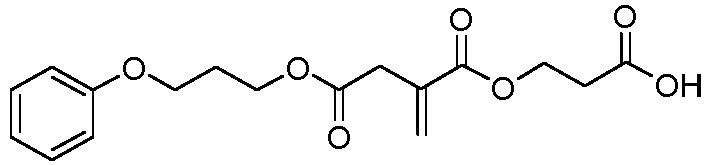
- Example 9 was prepared according to the procedure of Example 3, but using 2-methylene-4-oxo-4-(3-phenoxypropoxy)butanoic acid (Intermediate 2) instead of 4-octyl itaconate. 1H NMR (400 MHz, DMSO-d6) δ 12.41 (s, 1H), 7.35 - 7.24 (m, 2H), 6.99 - 6.88 (m, 3H), 6.17 (d, J = 1.3 Hz, 1H), 5.83 (q, J = 1.2 Hz, 1H), 4.24 (t, J = 6.2 Hz, 2H), 4.19 (t, J = 6.4 Hz, 2H), 4.01 (t, J = 6.3 Hz, 2H), 3.37 (s, 2H), 2.58 (t, J = 6.2 Hz, 2H), 2.06 - 1.97 (m, 2H). LCMS m/z 359.3 (M+Na)+ (ES+).
-

- Example 10 was prepared according to the procedure of Example 3, but using 4-(cyclohexyloxy)-2-methylene-4-oxobutanoic acid (Intermediate 4) instead of 4-octyl itaconate. 1H NMR (400 MHz, DMSO-d6) δ 12.40 (s, 1H), 6.15 (d, J = 1.4 Hz, 1H), 5.81 (d, J = 1.3 Hz, 1H), 4.70 - 4.59 (m, 1H), 4.25 (t, J = 6.2 Hz, 2H), 3.31 (s, 2H), 2.59 (t, J = 6.2 Hz, 2H), 1.77 - 1.70 (m, 2H), 1.65 - 1.55 (m, 2H), 1.49 - 1.16 (m, 6H). LCMS m/z 307.4 (M+Na)+ (ES+).
-

- Example 11 was prepared according to the procedure of Example 3, but using (R)-2-methylene-4-(octan-2-yloxy)-4-oxobutanoic acid (Intermediate 6) instead of 4-octyl itaconate. 1H NMR (400 MHz, DMSO-d6) δ 12.38 (s, 1H), 6.15 (d, J = 1.4 Hz, 1H), 5.81 (d, J = 1.4 Hz, 1H), 4.83 - 4.72 (m, 1H), 4.25 (t, J = 6.2 Hz, 2H), 3.30 (s, 2H), 2.59 (t, J = 6.3 Hz, 2H), 1.54 - 1.39 (m, 2H), 1.29 - 1.16 (m, 8H), 1.13 (d, J = 6.3 Hz, 3H), 0.85 (t, J = 6.4 Hz, 3H). LCMS m/z 337.4 (M+Na)+ (ES+).
-

- A mixture of (S)-2-methylene-4-(octan-2-yloxy)-4-oxobutanoic acid (Intermediate 7, 1 g, 4.13 mmol), tert-butyl bromoacetate (0.64 mL, 4.3 mmol) and potassium carbonate (0.684 g, 4.95 mmol) in acetone (20 mL) was stirred at RT overnight. The reaction mixture was concentrated and the residue was partitioned between water (20 mL) and EtOAc (10 mL). The phases were separated and the aqueous phase was extracted with EtOAc (10 mL). The combined organic phases were washed with brine (10 mL), dried (MgSO4) and concentrated to afford (S)-1-(2-(tert-butoxy)-2-oxoethyl) 4-octan-2-yl 2-methylenesuccinate (1.56 g, 4.07 mmol) as a colourless oil. 1H NMR (500 MHz, DMSO-d6) δ 6.28 (s, 1H), 5.92 (s, 1H), 4.82 - 4.75 (m, 1H), 4.60 (s, 2H), 3.35 (s, 2H), 1.42 (s, 9H), 1.31 - 1.20 (m, 10H), 1.14 (d, J = 6.3 Hz, 3H), 0.88 - 0.84 (m, 3H).
- TFA (7.5 mL) was added to a solution of (S)-1-(2-(tert-butoxy)-2-oxoethyl) 4-octan-2-yl 2-methylenesuccinate (1.5 g, 3.79 mmol) in DCM (7.5 mL). The reaction mixture was stirred for 2 h, partitioned between EtOAc (50 mL) and water (50 mL) and the phases separated. The organic phase was washed with water (2 x 20 mL), brine (20 mL), dried (MgSO4) and concentrated. The residue was redissolved in DCM (10 mL), washed with water (2 x 10 mL), dried (MgSO4) and concentrated to afford the title compound (0.922 g, 3.04 mmol) as a colourless oil. 1H NMR (500 MHz, DMSO-d6) δ 13.08 (br. s, 1H), 6.28 (d, J = 1.2 Hz, 1H), 5.92 (d, J = 1.3 Hz, 1H), 4.83 - 4.74 (m, 1H), 4.64 (s, 2H), 3.35 (s, 2H), 1.55 - 1.40 (m, 2H), 1.31 - 1.18 (m, 8H), 1.14 (d, J = 6.2 Hz, 3H), 0.86 (t, J = 6.9 Hz, 3H). LCMS m/z 323.2 (M+H)+ (ES+).
-

- Example 13 was prepared according to the procedure of Example 12, but using 4-(cyclooctyloxy)-2-methylene-4-oxobutanoic acid (Intermediate 1) instead of (S)-2-methylene-4-(octan-2-yloxy)-4-oxobutanoic acid. 1H NMR (500 MHz, DMSO-d6) δ 13.11 (s, 1H), 6.27 (d, J = 1.2 Hz, 1H), 5.91 (d, J = 1.4 Hz, 1H), 4.82 (tt, J = 8.1, 3.9 Hz, 1H), 4.63 (s, 2H), 3.33 (s, 2H), 1.75 - 1.42 (m, 14H). LCMS m/z 321.3 (M+Na)+ (ES+).
-

- Example 14 was prepared according to the procedure of Example 12, but using 4-(cyclohexyloxy)-2-methylene-4-oxobutanoic acid (Intermediate 4) instead of (S)-2-methylene-4-(octan-2-yloxy)-4-oxobutanoic acid. 1H NMR (500 MHz, DMSO-d6) δ 13.09 (s, 1H), 6.27 (d, J = 1.3 Hz, 1H), 5.91 (d, J = 1.3 Hz, 1H), 4.68 - 4.59 (m, 3H), 3.35 (s, 2H), 1.77 - 1.70 (m, 2H), 1.65 - 1.58 (m, 2H), 1.50 - 1.17 (m, 6H). LCMS m/z 293.6 (M+Na)+ (ES+).
-

- Example 15 was prepared according to the procedure of Example 12, but using 2-methylene-4-(neopentyloxy)-4-oxobutanoic acid (Intermediate 8) instead of (S)-2-methylene-4-(octan-2-yloxy)-4-oxobutanoic acid. 1H NMR (500 MHz, DMSO-d6) δ 13.08 (s, 1H), 6.30 (d, J = 1.2 Hz, 1H), 5.95 (d, J = 1.2 Hz, 1H), 4.64 (s, 2H), 3.73 (s, 2H), 3.42 (s, 2H), 0.88 (s, 9H). LCMS m/z 280.7 (M+Na)+ (ES+).
-

- Example 16 was prepared according to the procedure of Example 12, but using 4-((4-fluorobenzyl)oxy)-2-methylene-4-oxobutanoic acid (Intermediate 5) instead of (S)-2-methylene-4-(octan-2-yloxy)-4-oxobutanoic acid. 1H NMR (400 MHz, DMSO-d6) δ 13.10 (br. s, 1H), 7.44 - 7.37 (m, 2H), 7.25 - 7.17 (m, 2H), 6.30 (d, J = 1.2 Hz, 1H), 5.95 (d, J = 1.2 Hz, 1H), 5.09 (s, 2H), 4.63 (s, 2H), 3.45 (s, 2H). LCMS m/z 297.3 (M+H)+ (ES+).
-

- Example 17 was prepared according to the procedure of Example 12, but using 4-(hexyloxy)-2-methylene-4-oxobutanoic acid (Intermediate 3) instead of (S)-2-methylene-4-(octan-2-yloxy)-4-oxobutanoic acid. 1H NMR (400 MHz, DMSO-d6) δ 13.10 (s, 1H), 6.28 (d, J = 1.2 Hz, 1H), 5.92 (d, J = 1.2 Hz, 1H), 4.63 (s, 2H), 4.00 (t, J = 6.6 Hz, 2H), 3.37 (s, 2H), 1.58 - 1.42 (m, 2H), 1.31 - 1.11 (m, 6H), 0.86 (t, J = 6.8 Hz, 3H). LCMS m/z 295.3 (M+Na)+ (ES+).
-

- Example 18 was prepared according to the procedure of Example 12, but using 2-methylene-4-oxo-4-(3-phenoxypropoxy)butanoic acid (Intermediate 2) instead of (S)-2-methylene-4-(octan-2-yloxy)-4-oxobutanoic acid. 1H NMR (400 MHz, DMSO-d6) δ 13.09 (s, 1H), 7.33 - 7.25 (m, 2H), 6.98 - 6.90 (m, 3H), 6.29 (d, J = 1.2 Hz, 1H), 5.97 - 5.90 (m, 1H), 4.62 (s, 2H), 4.19 (t, J = 6.4 Hz, 2H), 4.01 (t, J = 6.3 Hz, 2H), 3.41 (s, 2H), 2.07 - 1.97 (m, 2H). LCMS m/z 345.3 (M+Na)+ (ES+).
-

- N-(3-dimethylaminopropyl)-N'-ethylcarbodiimide hydrochloride (0.471 g, 2.46 mmol) was added to a solution of 3-((2-(tert-butoxy)-2-oxoethoxy)carbonyl)but-3-enoic acid (Intermediate 9, 0.400 g, 1.64 mmol), spiro[3.3]heptan-2-ol (0.220 g, 1.97 mmol) and DMAP (0.300 g, 2.46 mmol) in DCM (10 mL). The reaction mixture was stirred at RT for 18 h. The reaction mixture was concentrated and the crude product was purified by chromatography on silica gel (0-10% EtOAc/DCM) to afford impure product. The crude product was purified by chromatography on silica gel (0-10% EtOAc/isohexane) to afford 1-(2-(tert-butoxy)-2-oxoethyl) 4-spiro[3.3]heptan-2-yl 2-methylenesuccinate (146 mg, 0.41 mmol) as a pale yellow oil.
- TFA (1 mL) was added to a solution of 1-(2-(tert-butoxy)-2-oxoethyl) 4-spiro[3.3]heptan-2-yl 2-methylenesuccinate (146 mg, 0.41 mmol) in DCM (1 mL). The reaction mixture was stirred for 1 h, diluted with toluene (5 mL) and concentrated. The residue was taken up in EtOAc (10 mL), washed with brine (10 mL), dried (MgSO4) and concentrated to afford the title compound (90 mg, 0.316 mmol) as a colourless oil. 1H NMR (400 MHz, DMSO-d6) δ 13.08 (br. s, 1H), 6.28 (d, J = 1.2 Hz, 1H), 5.91 (d, J = 1.2 Hz, 1H), 4.82 - 4.73 (m, 1H), 4.64 (s, 2H), 3.34 (s, 2H), 2.43 - 2.34 (m, 2H), 2.02 - 1.90 (m, 6H), 1.85 - 1.74 (m, 2H). LCMS m/z 305.3 (M+Na)+ (ES+).
-

- Example 20 was prepared using the same procedure as described in Example 2, but using 4-(cyclohexyloxy)-2-methylene-4-oxobutanoic acid (Intermediate 4) instead of 4-octyl itaconate. 1H NMR (400 MHz, DMSO-d6) δ 13.03 (s, 1H), 6.26 (d, J = 1.3 Hz, 1H), 5.89 (d, J = 1.3 Hz, 1H), 4.96 (q, J = 7.0 Hz, 1H), 4.65 (dq, J = 8.6, 4.0 Hz, 1H), 3.40 - 3.29 (m, 2H), 1.80 - 1.70 (m, 2H), 1.64 (ddd, J = 13.0, 6.9, 3.9 Hz, 2H), 1.42 (d, J = 7.1 Hz, 3H), 1.52 - 1.19 (m, 6H). LCMS m/z 307.6 (M+Na)+ (ES+).
-

- Example 21 was prepared according to the procedure of Example 12, but using (R)-2-methylene-4-(octan-2-yloxy)-4-oxobutanoic acid (Intermediate 6) instead of (S)-2-methylene-4-(octan-2-yloxy)-4-oxobutanoic acid. 1H NMR (400 MHz, DMSO-d6) δ 13.09 (s, 1H), 6.28 (d, J = 1.2 Hz, 1H), 5.92 (d, J = 1.2 Hz, 1H), 4.84 - 4.74 (m, 1H), 4.64 (s, 2H), 3.35 (s, 2H), 1.58 - 1.39 (m, 2H), 1.31 - 1.18 (m, 8H), 1.14 (d, J = 6.3 Hz, 3H), 0.91 - 0.82 (m, 3H). LCMS m/z 323.0 (M+Na)+ (ES+).
- The sodium salt of Example 21 was made as follows:
-

- To a solution of (R)-2-((2-methylene-4-(octan-2-yloxy)-4-oxobutanoyl)oxy)acetic acid (1.0 g, 3.3 mmol) in MeCN (10 mL) was added a solution of NaHCO3 in water (0.5 M, 6.27 mL, 3.14 mmol), and the mixture was stirred at room temperature for 10 min. The mixture was then concentrated under reduced pressure at 30 °C to remove the MeCN, and the remaining aqueous solution was washed with MTBE. The aqueous solution was then concentrated under reduced pressure at 30 °C to remove residual dissolved MTBE, and finally lyophilized to give (R)-2-((2-methylene-4-(octan-2-yloxy)-4-oxobutanoyl)oxy)acetic acid sodium salt (1.0 g, 3.1 mmol, 94 % yield) as a white solid. LCMS (System 2, Method B) m/z 323.2 (M+H)+ (ES+). 1H NMR (400 MHz, DMSO-d6) δ: 6.18 (d, J = 0.8 Hz, 1H), 5.75 (d, J = 0.8 Hz, 1H), 4.82-4.74 (m, 1H), 4.14 (d, J = 1.2 Hz, 2H), 3.25 (s, 2H), 1.52-1.38 (m, 2H), 1.27-1.23 (m, 8H), 1.13 (d, J = 6.4 Hz, 3H), 0.85 (t, J = 6.4 Hz, 3H).
-

- Example 22 was prepared according to the procedure of Example 19, but using 4,4-difluorocyclohexanol instead of spiro[3.3]heptan-2-ol. 1H NMR (400 MHz, DMSO-d6) δ 13.08 (s, 1H), 6.30 (d, J = 1.2 Hz, 1H), 5.94 (d, J = 1.3 Hz, 1H), 4.65 (s, 2H), 3.92 (d, J = 6.1 Hz, 2H), 3.41 (s, 2H), 2.07 - 1.93 (m, 2H), 1.89 - 1.68 (m, 5H), 1.28 - 1.14 (m, 2H). LCMS m/z 319.1 (M-H)- (ES-).
-

- EDC.HCl (0.371 g, 1.935 mmol) was added to a solution of 3-((2-(tert-butoxy)-2-oxoethoxy)carbonyl)but-3-enoic acid (Intermediate 9, 0.35 g, 1.29 mmol), 3-ethoxypropan-1-ol (0.18 mL, 1.56 mmol), DMAP (0.016 g, 0.13 mmol) and DIPEA (0.34 mL, 1.95 mmol) in DCM (10 mL). The reaction mixture was stirred at RT for 18 h. The reaction mixture was diluted with water (50 mL) and extracted with DCM (3 x 20 mL). The organic layers were combined and passed through a phase separator and concentrated in vacuo. The crude product was purified by chromatography on silica gel (0-10% EtOAc/DCM) to afford impure product. The crude product was purified by chromatography on silica gel (0-20% EtOAc/DCM) to afford 1-(2-(tert-butoxy)-2-oxoethyl) 4-(3-ethoxypropyl) 2-methylenesuccinate (260 mg, 0.71 mmol) as a colourless oil. 1H NMR (400 MHz, DMSO-d6) δ 6.30 (d, J = 1.2 Hz, 1H), 5.95 - 5.92 (m, 1H), 4.62 (s, 2H), 4.07 (t, J = 6.5 Hz, 2H), 3.43 - 3.35 (m, 6H), 1.82 - 1.71 (m, 2H), 1.42 (s, 9H), 1.10 (t, J = 7.0 Hz, 3H). LCMS m/z 353.3 (M+Na)+ (ES+).
- TFA (2.5 mL) was added to a solution of 1-(2-(tert-butoxy)-2-oxoethyl) 4-(3-ethoxypropyl) 2-methylenesuccinate (260 mg, 0.71 mmol) in DCM (2.5 mL). The reaction mixture was stirred for 2 h, then concentrated. The crude product was purified by chromatography on RP Flash C18 (5-75% MeCN/Water 0.1% Formic Acid) followed by chromatography on silica gel (0-10% MeOH/DCM) to afford the title compound (0.015 g, 0.052 mmol) as a clear and colourless gum. 1H NMR (400 MHz, DMSO-d6) δ 6.21 (d, J = 1.5 Hz, 1H), 5.82 - 5.77 (m, 1H), 4.20 (s, 2H), 4.06 (t, J = 6.5 Hz, 2H), 3.45 - 3.36 (m, 4H), 3.34 (s, 2H), 1.82 - 1.71 (m, 2H), 1.10 (t, J = 7.0 Hz, 3H). LCMS m/z 275.3 (M+H)+ (ES+).
-

- Example 24 was prepared according to the procedure of Example 23, but using bicyclo[2.2.1]heptan-2-ol instead of 3-ethoxypropan-1-ol. 1H NMR (400 MHz, DMSO-d6) δ 13.10 (s, 1H), 6.27 (d, J = 1.2 Hz, 1H), 5.96 - 5.86 (m, 1H), 4.64 (s, 2H), 4.55 - 4.47 (m, 1H), 3.33 (s, 2H), 2.29 - 2.17 (m, 2H), 1.69 - 1.61 (m, 1H), 1.52 - 1.29 (m, 4H), 1.16 - 1.03 (m, 3H). LCMS m/z 305.2 (M+Na)+ (ES+).
-

- Example 25 was prepared according to the procedure of Example 23, but using cyclobutanol instead of 3-ethoxypropan-1-ol. 1H NMR (400 MHz, DMSO-d6) δ 13.08 (s, 1H), 6.29 (s, 1H), 5.92 (d, J = 1.5 Hz, 1H), 4.89 (p, J = 7.4 Hz, 1H), 4.65 (s, 2H), 3.36 (s, 2H), 2.30 - 2.19 (m, 2H), 2.06 - 1.92 (m, 2H), 1.79 - 1.68 (m, 1H), 1.65 - 1.50 (m, 1H). LCMS m/z 265.1 (M+Na)+ (ES+).
-

- 1-(chloromethyl)-4-methoxybenzene (0.90 mL, 6.64 mmol) was added to a mixture of 3,3,3-trifluoro-2-hydroxypropanoic acid (1.00 g, 6.94 mmol) and cesium carbonate (2.26 g, 6.94 mmol) in dimethylformamide (30 mL). The mixture was stirred at RT for 3 h, then heated to 70 °C for 2 h, then cooled to RT and stirred for 18 h. The mixture was poured onto water (50 mL) and extracted with EtOAc (3 x 50 mL). The combined organic phases were washed with brine (100 mL), dried (MgSO4) and concentrated. The crude product was purified by chromatography on silica gel (0-50% EtOAc/isohexane) to afford 4-methoxybenzyl 3,3,3-trifluoro-2-hydroxypropanoate (640 mg, 2.30 mmol) as a colourless oil. 1H NMR (400 MHz, DMSO-d6) δ 7.36 - 7.30 (m, 2H), 7.14 (d, J = 7.4 Hz, 1H), 7.00 - 6.91 (m, 2H), 5.22 - 5.14 (m, 2H), 4.92 - 4.83 (m, 1H), 3.76 (s, 3H).
- EDC.HCl (0.348 g, 1.81 mmol) was added to a solution of 4-(cyclohexyloxy)-2-methylene-4-oxobutanoic acid (Intermediate 4, 0.35 g, 1.65 mmol), 4-methoxybenzyl 3,3,3-trifluoro-2-hydroxypropanoate (0.523 g, 1.98 mmol), DMAP (0.020 g, 0.17 mmol) and DIPEA (0.43 mL, 2.47 mmol) in DCM (8 mL) at 0 °C. The reaction mixture was allowed to warm to RT and stirred for 72 h. The reaction mixture was diluted with 1 M HCl (30 mL). The phases were separated and the aqueous phase was extracted with DCM (10 mL). The combined organic phases were washed with brine (30 mL), dried (MgSO4) and concentrated. The crude product was purified by chromatography on silica gel (0-20% EtOAc/isohexane) to afford 4-cyclohexyl 1-(1,1,1-trifluoro-3-((4-methoxybenzyl)oxy)-3-oxopropan-2-yl) 2-methylenesuccinate (302 mg, 0.593 mmol) as a colourless oil. 1H NMR (400 MHz, DMSO-d6) δ 7.34 - 7.29 (m, 2H), 6.98 - 6.92 (m, 2H), 6.36 (d, J = 0.9 Hz, 1H), 6.15 (q, J = 7.3 Hz, 1H), 6.06 (d, J = 1.1 Hz, 1H), 5.23 (s, 2H), 4.70 - 4.61 (m, 1H), 3.76 (s, 3H), 3.41 (s, 2H), 1.79 - 1.71 (m, 2H), 1.68 - 1.59 (m, 2H), 1.54 - 1.42 (m, 1H), 1.41 - 1.21 (m, 5H). LCMS m/z 481.3 (M+Na)+ (ES+).
- TFA (1 mL) was added to a solution of 4-cyclohexyl 1-(1,1,1-trifluoro-3-((4-methoxybenzyl)oxy)-3-oxopropan-2-yl) 2-methylenesuccinate (302 mg, 0.659 mmol) in DCM (2 mL). The reaction mixture was stirred for 1 h, diluted with toluene (5 mL) and concentrated. The crude product was purified by chromatography on silica gel (0-60% EtOAc/isohexane) to afford the title compound (38 mg, 0.107 mmol, 16.20 % yield) as a colourless oil. 1H NMR (400 MHz, DMSO-d6) δ 14.49 (br. s, 1H), 6.35 (d, J = 0.9 Hz, 1H), 6.04 (d, J = 1.1 Hz, 1H), 5.87 (q, J = 7.6 Hz, 1H), 4.70 - 4.60 (m, 1H), 3.47 - 3.35 (m, 2H), 1.80 - 1.71 (m, 2H), 1.69 - 1.58 (m, 2H), 1.52 - 1.43 (m, 1H), 1.42 - 1.18 (m, 5H). LCMS m/z 337.2 (M-H)- (ES-).
-
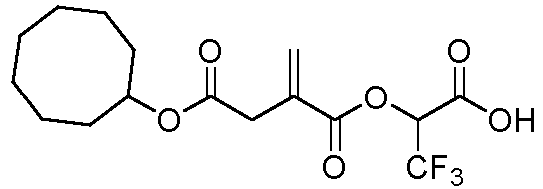
- Example 27 was prepared according to the procedure of Example 26, but using 4-(cyclooctyloxy)-2-methylene-4-oxobutanoic acid (Intermediate 1) instead of 4-(cyclohexyloxy)-2-methylene-4-oxobutanoic acid. 1H NMR (400 MHz, DMSO-d6) δ 14.47 (s, 1H), 6.34 (s, 1H), 6.03 (s, 1H), 5.86 (q, J = 7.6 Hz, 1H), 4.82 (tt, J = 8.2, 4.0 Hz, 1H), 3.37 (d, J = 2.1 Hz, 2H), 1.80 - 1.32 (m, 12H). LCMS m/z 390.0 (M+H)+ (ES+).
-

- 1-(chloromethyl)-4-methoxybenzene (0.86 ml, 6.3 mmol) was added to a mixture of 4,4,4-trifluoro-3-hydroxybutanoic acid (1.00 g, 6.33 mmol) and cesium carbonate (2.06 g, 6.33 mmol) in DMF (27 mL). The mixture was stirred at RT for 1 h, then heated to 70 °C for 2 h. The mixture was cooled to RT and stirred for 18 h. The mixture was poured onto water (50 mL) and extracted with EtOAc (3x50 mL). The combined organic phases were washed with brine (100 mL), dried (MgSO4) and concentrated. The crude product was purified by chromatography on silica gel (0-100% EtOAc/isohexane) to afford 4-methoxybenzyl 4,4,4-trifluoro-3-hydroxybutanoate (0.283 g, 0.97 mmol) as a colourless oil. 1H NMR (400 MHz, DMSO-d6) δ 7.37 - 7.26 (m, 2H), 6.98 - 6.87 (m, 2H), 6.58 (d, J = 6.7 Hz, 1H), 5.08 (d, J = 13.5 Hz, 1H), 5.05 (d, J = 13.6 Hz, 1H), 4.35 (dtt, J = 17.3, 7.2, 3.3 Hz, 1H), 3.75 (s, 3H), 2.77 (dd, J = 15.8, 3.3 Hz, 1H), 2.57 - 2.52 (m, 1H).
- A slurry of N-(3-dimethylaminopropyl)-N'-ethylcarbodiimide hydrochloride (0.28 g, 1.5 mmol) in DCM (1.6 mL) was added slowly to a solution of 4-(cyclooctyloxy)-2-methylene-4-oxobutanoic acid (0.233 g, 0.97 mmol), 4-methoxybenzyl 4,4,4-trifluoro-3-hydroxybutanoate (0.283 g, 0.97 mmol), DIPEA (0.25 mL, 1.5 mmol) and DMAP (0.012 g, 0.097 mmol) in DCM (1.6 mL) at 0 °C. The mixture was allowed to warm slowly to RT and stirred for 18 h. The mixture was diluted with 1 M HCl (10 mL) and extracted with EtOAc (3x10 mL). The combined organic phases were washed with brine (15 mL), dried (Na2SO4) and concentrated. The crude product was purified by chromatography on silica gel (0-50% EtOAc/isohexane) to afford 4-cyclooctyl 1-(1,1,1-trifluoro-4-((4-methoxybenzyl)oxy)-4-oxobutan-2-yl) 2-methylenesuccinate (0.304 g, 0.56 mmol) as a colourless oil. LCMS m/z 523.2 (M+Na)+ (ES+). 1H NMR (400 MHz, DMSO-d6) δ 7.34 - 7.22 (m, 2H), 6.96 - 6.85 (m, 2H), 6.23 (d, J = 1.0 Hz, 1H), 5.93 (d, J = 1.1 Hz, 1H), 5.81 (dqd, J = 10.3, 6.7, 3.6 Hz, 1H), 5.04 (s, 2H), 4.80 (tt, J = 8.2, 4.0 Hz, 1H), 3.75 (s, 3H), 3.31 (s, 2H), 3.10 (dd, J = 16.8, 3.6 Hz, 1H), 2.87 (dd, J = 16.8, 9.5 Hz, 1H), 1.78 - 1.33 (m, 14H).
- Trifluoroacetic acid (1.4 mL) was added to a solution of 4-cyclooctyl 1-(1,1,1-trifluoro-4-((4-methoxybenzyl)oxy)-4-oxobutan-2-yl) 2-methylenesuccinate (0.304 g, 0.56 mmol) in DCM (5 mL) at 0 °C. The reaction mixture was warmed to RT, stirred for 30 min and concentrated. The resiude was co-evaporated with toluene (2x10 mL). The crude product was purified by chromatography on silica gel (0-50% EtOAc/DCM) to afford 3-((4-(cyclooctyloxy)-2-methylene-4-oxobutanoyl)oxy)-4,4,4-trifluorobutanoic acid (0.127 g, 0.32 mmol) as a colourless oil. LCMS m/z 403.3 (M+Na)+ (ES+). 1H NMR (400 MHz, DMSO-d6) δ 12.84 (s, 1H), 6.29 (d, J = 1.1 Hz, 1H), 5.96 (d, J = 1.2 Hz, 1H), 5.83 - 5.71 (m, 1H), 4.82 (tt, J = 8.1, 3.9 Hz, 1H), 3.35 (s, 2H), 2.96 (dd, J = 16.9, 3.8 Hz, 1H), 2.74 (dd, J = 16.9, 9.2 Hz, 1H), 1.79 - 1.34 (m, 14H).
-

- To a solution of 3-((2-tert-butoxy-2-oxoethoxy)carbonyl)but-3-enoic acid (234 mg, 0.96 mmol), cycloheptanol (110 mg, 0.96 mmol) and DMAP (117 mg, 0.96 mmol) in DCM (4 mL) was added EDC.HCl (276 mg, 1.44 mmol) at 0 °C, and the resulting mixture was stirred at room temperature for 1 h. The mixture was quenched with aqueous NH4Cl (2 mL), the phases were separated, and the aqueous phase was extracted with DCM (2 x 3 mL). The combined organic phases were washed with brine, dried over Na2SO4 and filtered. The filtrate was concentrated under reduced pressure at 40 °C , and the residue was purified by flash column chromatography (25 g silica, 0-10% MTBE/petroleum ether) to give 1-(2-tert-butoxy-2-oxoethyl) 4-cycloheptyl 2-methylenesuccinate (130 mg, 0.38 mmol, 40 %) as a pale-yellow oil. LCMS (System 2, Method B) m/z 363.3 (M+Na)+ (ES+).
- A mixture of 1-(2-tert-butoxy-2-oxoethyl) 4-cycloheptyl 2-methylenesuccinate (130 mg, 0.38 mmol) and HCl solution in 1,4-dioxane (4 M, 3 mL, 12 mmol) in DCM (2 mL) was stirred at room temperature for 4 h. The mixture was concentrated under reduced pressure at 40 °C and the residue was purified by preparative HPLC (Column: Waters X-Bridge C18 OBD 10 µm 19x250 mm; Flow Rate: 20 mL/min; solvent system: MeCN/(0.05% TFA/water); gradient: 15-95% MeCN; collection wavelength: 214 nm). The collected fractions were concentrated at 40 °C under reduced pressure to remove MeCN, and the residue was lyophilized to give 2-(4-(cycloheptyloxy)-2-methylene-4-oxobutanoyloxy)acetic acid (76 mg, 0.27 mmol, 70 %) as a pale-yellow oil. LCMS (System 2, Method B) m/z 307.1 (M+Na)+ (ES+). 1H NMR (400 MHz, DMSO-d6) δ: 13.06 (br, 1H), 6.27 (d, J = 0.8 Hz, 1H), 5.91 (d, J = 0.8 Hz, 1H), 4.83-4.78 (m, 1H), 4.63 (s, 2H), 3.33 (s, 2H), 1.83-1.76 (m, 2H), 1.62-1.51 (m, 4H), 1.50-1.48 (m, 4H), 1.42-1.37 (m, 2H).
- The following compounds were made using a similar procedure:
Example No. Alcohol Intermediate / Example Structure / Name LCMS / 1H NMR data 30 octan-3-ol LCMS (System 2, Method B) m/z 323.2 (M+Na)+ (ES+). 
1H NMR (400 MHz, DMSO-d6) δ: 13.09 (br, 1H), 6.28 (d, J = 0.8 Hz, 1H), 5.93 (d, J = 0.8 Hz, 1H), 4.73-4.66 (m, 1H), 4.62 (s, 2H), 3.37 (s, 2H), 1.56-1.40 (m, 4H), 1.25-1.14 (m, 6H), 0.84 (t, J = 6.4 Hz, 3H), 0.80 (d, J = 7.2 Hz, 3H). 31 octan-4-ol LCMS (System 2, Method B) m/z 323.2 (M+Na)+ (ES+). 
1H NMR (400 MHz, DMSO-d6) δ: 13.09 (br, 1H), 6.28 (d, J = 1.2 Hz, 1H), 5.92 (d, J = 1.2 Hz, 1H), 4.81-4.74 (m, 1H), 4.62 (s, 2H), 3.36 (s, 2H), 1.49-1.42 (m, 4H), 1.32-1.14 (m, 6H), 0.84 (t, J = 7.2 Hz, 6H). 32 heptan-4-ol LCMS (System 2, Method B) m/z 309.3 (M+Na)+ (ES+). 
1H NMR (400 MHz, DMSO-d6) δ: 13.09 (br, 1H), 6.28 (d, J = 1.2 Hz, 1H), 5.93 (d, J = 0.8 Hz, 1H), 4.82-4.77 (m, 1H), 4.62 (s, 2H), 3.37 (s, 2H), 1.48-1.42 (m, 4H), 1.32-1.16 (m, 4H), 0.85 (t, J = 7.2 Hz, 6H). 33 adamantan-2-ol LCMS (System 2, Method B) m/z 323.2 (M+H)+ (ES+). 
1H NMR (400 MHz, DMSO-d6) δ: 13.01 (br, 1H), 6.29 (s, 1H), 5.94 (s, 1H), 4.80 (m, 1H), 4.63 (s, 2H), 3.41 (s, 2H), 1.89-1.86 (m, 4H), 1.80-1.78 (m, 4H), 1.72-1.68 (m, 4H), 1.49 (d, J = 12.4 Hz, 2H). 34 1-cyclohexylethan-1-ol LCMS (System 2, Method B) m/z 321.3 (M+Na)+ (ES+). 
1H NMR (400 MHz, DMSO-d6) δ: 13.11 (br, 1H), 6.28 (s, 1H), 5.92 (s, 1H), 4.64-4.58 (m, 1H), 4.62 (s, 2H), 3.40 (s, 2H), 1.68 (d, J = 10.0 Hz, 3H), 1.59 (t, J = 10.8 Hz, 2H), 1.42-1.35 (m, 1H), 1.21-1.12 (m, 3H), 1.09 (d, J = 6.0 Hz, 3H), 1.06-0.84 (m, 2H). 35 1-cycloheptylethan-1-ol LCMS (System 2, Method B) m/z 335.2 (M+Na)+ (ES+). 
1H NMR (400 MHz, DMSO-d6) δ: 13.08 (br, 1H), 6.27 (s, 1H), 5.92 (s, 1H), 4.70-4.65 (m, 1H), 4.63 (s, 2H), 3.34 (s, 2H), 1.63-1.61 (m, 5H), 1.57-1.33 (m, 6H), 1.22-1.14 (m, 2H), 1.07 (d, J = 6.0 Hz, 3H). 36 spiro[3.4]octan-2-ol LCMS (System 2, Method B) m/z 319.1 (M+Na)+ (ES+). 
1H NMR (400 MHz, DMSO-d6) δ: 13.08 (br, 1H), 6.28 (d, J = 0.8 Hz, 1H), 5.91 (d, J = 0.8 Hz, 1H), 4.90-4.83 (m, 1H), 4.64 (s, 2H), 3.35 (s, 2H), 2.23-2.18 (m, 2H), 1.92-1.87 (m, 2H), 1.57-1.47 (m, 8H). 37 spiro[3.5]nonan-2-ol LCMS (System 2, Method B) m/z 333.3 (M+Na)+ (ES+). 
1H NMR (400 MHz, DMSO-d6) δ: 13.08 (br, 1H), 6.28 (s, 1H), 5.91 (s, 1H), 4.91-4.83 (m, 1H), 4.64 (s, 2H), 3.35 (s, 2H), 2.19-2.14 (m, 2H), 1.68-1.63 (m, 2H), 1.40-1.30 (m, 10H). 38 spiro[3.5]nonan-7-ol LCMS (System 2, Method B) m/z 333.3 (M+Na)+ (ES+). 
1H NMR (400 MHz, DMSO-d6) δ: 13.10 (br, 1H), 6.26 (s, 1H), 5.90 (s, 1H), 4.62 (s, 3H), 3.34 (s, 2H), 1.83-1.77 (m, 2H), 1.70-1.61 (m, 8H), 1.37-1.34 (m, 4H). 39 2,2-dimethylcyclohexan-1-ol LCMS (System 2, Method B) m/z 321.3 (M+Na)+ (ES+). 
2-((4-((2,2-dimethylcyclohexyl)oxy)-2-methylene-4-oxobutanoyl)oxy)acetic acid 1H NMR (400 MHz, DMSO-d6) δ: 13.09 (br, 1H), 6.28 (s, 1H), 5.93 (s, 1H), 4.62 (s, 2H), 4.47-4.44 (m, 1H), 3.38 (s, 2H), 1.62-1.58 (m, 2H), 1.42-1.34 (m, 4H), 1.29-1.18 (m, 2H), 0.84 (s, 6H). 41 2,2,4,4-tetramethylcyclobutan-1-ol LCMS (System 2, Method B) m/z 321.2 (M+Na)+ (ES+). 
1H NMR (400 MHz, DMSO-d6) δ: 13.11 (br, 1H), 6.29 (s, 1H), 5.95 (s, 1H), 4.63 (s, 2H), 4.35 (s, 1H), 3.43 (s, 2H), 1.51 (d, J = 11.6 Hz, 1H), 1.41 (d, J = 11.6 Hz, 1H), 1.10 (s, 6H), 1.00 (s, 6H). 42 (S)-octan-3-ol LCMS (System 2, Method B) m/z 323.2 (M+Na)+ (ES+). 
1H NMR (400 MHz, DMSO-d6) δ: 13.09 (br, 1H), 6.28 (d, J = 0.8 Hz, 1H), 5.93 (d, J = 0.8 Hz, 1H), 4.73-4.66 (m, 1H), 4.62 (s, 2H), 3.37 (s, 2H), 1.56-1.40 (m, 4H), 1.25-1.14 (m, 6H), 0.84 (t, J = 6.4 Hz, 3H), 0.80 (d, J = 7.2 Hz, 3H). 45 (R)-heptan-2-ol LCMS (System 2, Method B) m/z 309.3 (M+Na)+ (ES+). 
1H NMR (400 MHz, DMSO-d6) δ: 13.14 (br, 1H), 6.27 (d, J = 0.8 Hz, 1H), 5.91 (d, J = 0.8 Hz, 1H), 4.80-4.75 (m, 1H), 4.63 (s, 2H), 3.34 (s, 2H), 1.49-1.43 (m, 2H), 1.29-1.23 (m, 6H), 1.13 (d, J = 6.4 Hz, 3H), 0.85 (t, J = 6.4 Hz, 3H). 46 nonan-2-ol LCMS (System 2, Method B) 
m/z 337.3 (M+Na)+ (ES+). 2-((2-methylene-4-(nonan-2-yloxy)-4-oxobutanoyl)oxy)acetic acid 1H NMR (400 MHz, DMSO-d6) δ: 13.09 (br, 1H), 6.27 (d, J = 1.2 Hz, 1H), 5.91 (d, J = 1.2 Hz, 1H), 4.82-4.74 (m, 1H), 4.62 (s, 2H), 3.50 (s, 2H), 1.48-1.43 (m, 2H), 1.29-1.23 (m, 10H), 1.13 (d, J = 6.4 Hz, 3H), 0.86 (t, J = 6.8 Hz, 3H). 47 nonan-5-ol LCMS (System 2, Method B) m/z 337.3 (M+Na)+ (ES+). 
1H NMR (400 MHz, DMSO-d6) δ: 13.14 (br, 1H), 6.28 (d, J = 1.2 Hz, 1H), 5.92 (d, J = 0.8 Hz, 1H), 4.79-4.74 (m, 1H), 4.62 (s, 2H), 3.37 (s, 2H), 1.52-1.42 (m, 4H), 1.31-1.14 (m, 8H), 0.85 (t, J = 6.8 Hz, 6H). 48 1-(3,5-dichlorophenyl)ethan-1-ol LCMS (System 2, Method B) m/z 383.0 (M+Na)+ (ES+). 
1H NMR (400 MHz, DMSO-d6) δ: 13.12 (br, 1H), 7.54 (t, J = 2.0 Hz, 1H), 7.41 (d, J = 1.6 Hz, 2H), 6.31 (d, J = 0.8 Hz, 1H), 5.96 (d, J = 0.8 Hz, 1H), 5.77 (q, J = 6.4 Hz, 1H), 4.63 (s, 2H), 3.47 (s, 2H), 1.44 (d, J = 6.4 Hz, 3H). 49 1-(3,5-dichlorophenyl)propan-2-ol LCMS (System 2, Method B) m/z 397.1 (M+Na)+ (ES+). 
1H NMR (400 MHz, DMSO-d6) δ: 13.07 (br, 1H), 7.46 (t, J = 2.0 Hz, 1H ), 7.29 (d, J = 1.6 Hz, 2H), 6.27 (s, 1H), 5.87 (d, J = 0.8 Hz, 1H ), 4.99 (q, J = 6.4 Hz, 1H), 4.61 (d, J =1.6 Hz, 2H), 3.31 (s, 2H), 2.88-2.78 (m, 2H), 1.14 (d, J = 6.4 Hz, 3H). 50 (R)-octan-3-ol LCMS (System 2, Method B) m/z 323.2 (M+Na)+ (ES+). 
1H NMR (400 MHz, DMSO-d6) δ: 13.11 (br, 1H), 6.28 (d, J = 0.8 Hz, 1H), 5.93 (d, J = 0.8 Hz, 1H), 4.73-4.66 (m, 1H), 4.62 (s, 2H), 3.37 (s, 2H), 1.56-1.40 (m, 4H), 1.25-1.14 (m, 6H), 0.84 (t, J = 6.4 Hz, 3H), 0.80 (d, J = 7.2 Hz, 3H). 51 (1R,2S,4R)-1,7,7-trimethylbicyclo[2.2.1] heptan-2-ol (CAS No. 464-43-7) LCMS (System 2, Method B) m/z 347.2 (M+Na)+ (ES+). 
1H NMR (400 MHz, DMSO-d6) δ: 13.13 (br, 1H), 6.29 (s, 1H), 5.94 (d, J = 0.8 Hz, 1H), 4.79-4.77 (m, 1H), 4.64 (s, 2H), 3.40 (s, 2H), 2.27-2.20 (m, 1H), 1.84-1.77 (m, 1H), 1.72-1.63 (m, 2H), 1.27-1.12 (m, 2H), 0.91 (dd, J = 13.6, 3.6 Hz, 1H), 0.84 (d, J = 8.8 Hz, 6H), 0.76 (s, 3H). 52 1-cyclohexyl-2,2,2-trifluoroethan-1-ol LCMS (System 2, Method B) m/z 375.3 (M+Na)+ (ES+). 
1H NMR (400 MHz, DMSO-d6) δ: 13.08 (br, 1H), 6.33 (s, 1H), 6.01 (s, 1H), 5.27-5.18 (m, 1H), 4.63 (s, 2H), 3.56 (s, 2H), 1.88-1.75 (m, 1H), 1.71-1.51 (m, 5H), 1.29-0.96 (m, 5H). 53 bicyclo[3.3.1]nonan-9-ol LCMS (System 2, Method B) m/z 333.2 (M+Na)+ (ES+). 
1H NMR (400 MHz, DMSO-d6) δ: 13.08 (br, 1H), 6.29 (d, J = 1.2 Hz, 1H), 5.94 (d, J = 1.2 Hz, 1H), 4.66 (s, 1H), 4.63 (s, 2H), 3.41 (s, 2H), 1.83-1.75 (m, 6H), 1.73 (d, J = 13.2 Hz, 4H), 1.45 (d, J = 6.0 Hz, 4H). 54 (S)-1,1,1-trifluorooctan-2-ol LCMS (System 2, Method B) m/z 377.1 (M+Na)+ (ES+). 
1H NMR (400 MHz, DMSO-d6) δ: 13.10 (br, 1H), 6.34 (s,1H), 6.02 (s, 1H), 5.41-5.36 (m, 1H), 4.62 (s, 2H), 3.54 (s, 2H), 1.75-1.62 (m, 2H), 1.26-1.24 (m, 8H), 0.86 (t, J = 6.4 Hz, 3H). 55 (R)-nonan-2-ol LCMS (System 2, Method B) m/z 337.3 (M+Na)+ (ES+). 
1H NMR (400 MHz, DMSO-d6) δ: 13.06 (br, 1H), 6.27 (d, J = 1.2 Hz, 1H), 5.91 (d, J = 1.2 Hz, 1H), 4.82-4.74 (m, 1H), 4.62 (s, 2H), 3.50 (s, 2H), 1.48-1.43 (m, 2H), 1.29-1.23 (m, 10H), 1.13 (d, J = 6.4 Hz, 3H), 0.86 (t, J = 6.8 Hz, 3H). 56 (R)-1-cyclohexylethan-1-ol LCMS (System 2, Method B) m/z 321.3 (M+Na)+ (ES+). 
1H NMR (400 MHz, DMSO-d6) δ: 13.14 (br, 1H), 6.28 (s,1H), 5.92 (s, 1H), 4.62 (s, 2H), 4.66-4.58 (m, 1H), 3.26 (s, 2H), 1.69-1.67 (m, 3H), 1.62-1.53 (m, 2H), 1.42-1.35 (m, 1H), 1.25-1.08 (m, 3H), 1.15 (d, J = 6.4 Hz, 3H), 1.04-0.82 (m, 2H). -

- To a solution of 4-(cyclooctyloxy)-2-methylene-4-oxobutanoic acid (570 mg, 2.38 mmol) in THF (10 mL) at -78 °C was added a solution of LDA in THF/n-heptane/ethyl benzene (2 M, 2.38 mL, 4.76 mmol), and the reaction mixture was stirred at -78 °C for 1 h. lodomethane (338 mg, 2.38 mmol) was then added at -78 °C, and the reaction mixture was stirred at -78 °C for 2 h. The reaction mixture was quenched with dilute aqueous HCl (0.5 M, 20 mL) and extracted with EtOAc (2 x 20 mL). The combined organic phases were dried over Na2SO4, filtered and the filtrate was concentrated under reduced pressure at 35 °C to give crude 4-(cyclooctyloxy)-3-methyl-2-methylene-4-oxobutanoic acid (550 mg, 2.16 mmol, 91%) as a colorless oil, which was used in the next step without purification. LCMS (System 2, Method C) m/z 277.4 (M+Na)+ (ES+).
- To a solution of 4-(cyclooctyloxy)-3-methyl-2-methylene-4-oxobutanoic acid (550 mg, 2.16 mmol) in acetone (10 mL) was added potassium carbonate (329 mg, 2.39 mmol), and the reaction mixture was stirred at room temperature for 30 min. tert-Butyl 2-bromoacetate (464 mg, 2.39 mmol) was then added and the resulting mixture was stirred at room temperature overnight. The reaction mixture was filtered and the filtrate was concentrated under reduced pressure at 40 °C. The residue was purified by flash column chromatography (25 g silica, 0-10% MTBE/petroleum ether) to give 1-(2-(tert-butoxy)-2-oxoethyl) 4-cyclooctyl 3-methyl-2-methylenesuccinate (380 mg, 1.0 mmol, 48%) as a yellow oil. LCMS (System 2, Method B) m/z 391.3 (M+Na)+ (ES+).
- A mixture of 1-(2-(tert-butoxy)-2-oxoethyl) 4-cyclooctyl 3-methyl-2-methylenesuccinate (180 mg, 0.49 mmol) and HCl solution in 1,4-dioxane (4 M, 2 mL, 8.0 mmol) in DCM (2 mL) was stirred at room temperature for 4 h, then concentrated under reduced pressure at 40 °C. The residue was purified by preparative HPLC (Column: Waters X-Bridge C18 OBD 10µm 19x250 mm; Flow Rate: 20 mL/min; solvent system: MeCN/(0.05% TFA/water) gradient: 30-95% MeCN; collection wavelength: 214 nm). The fractions were concentrated under reduced pressure at 40 °C to remove MeCN, and the residue was lyophilized to give 2-((4-(cyclooctyloxy)-3-methyl-2-methylene-4-oxobutanoyl)oxy)acetic acid (117 mg, 0.37 mmol, 77 %) as a pale-yellow oil.
- LCMS (System 2, Method B) m/z 335.2 (M+Na)+ (ES+). 1H NMR (400 MHz, DMSO-d6) δ: 13.10 (br, 1H), 6.28 (s, 1H), 5.85 (s, 1H), 4.82-4.76 (m, 1H), 4.64 (d, J = 1.6 Hz, 2H), 3.51 (q, J = 6.8 Hz, 1H), 1.70-1.62 (m, 6H), 1.55-1.41 (m, 8H), 1.27 (d, J = 7.2 Hz, 3H).
-

- A mixture of (2R,3R)-2,3-dihydroxysuccinic acid (3 g, 20 mmol), cyclooctanol (7.7 g, 60 mmol), anhydrous p-toluenesulfonic acid (344 mg, 2 mmol) and anhydrous Na2SO4 (6 g, 42.2 mmol) in toluene (40 mL) was stirred at 80 °C for 16 h. The reaction mixture was cooled to room temperature and filtered. The filtrate was concentrated under reduced pressure at 45 °C and the residue was purified by reversed phase column chromatography (120 g C18 silica; flow rate: 40 mL/min; 50-70% MeCN/(10 mM HCl/water); collection wavelength: 214 nm). The collected fractions were concentrated under reduced pressure at 40 °C to remove MeCN, and the residue was lyophilized to give dicyclooctyl (2R,3R)-2,3-dihydroxysuccinate (3.5 g, 9.4 mmol, 47 %) as a white solid. LCMS (System 2, Method B) m/z 393.3 (M+Na)+ (ES+). 1H NMR (400 MHz, DMSO-d6) δ: 5.38 (d, J = 8.0 Hz, 2H), 4.90-4.86 (m, 2H), 4.32 (d, J = 7.6 Hz, 2H), 1.77-1.65 (m, 12H), 1.58-1.49 (m, 16H).
- To a solution of dicyclooctyl (2R,3R)-2,3-dihydroxysuccinate (3.5 g, 9.4 mmol) in THF:H2O (2:1, 40 mL) was added NalO4 (2.3 g, 18.8 mmol) at room temperature, and the reaction mixture was stirred at room temperature for 2 h. The reaction mixture was filtered, the filtrate was diluted with EtOAc (30 mL), quenched with saturated aqueous Na2S2O3 aq. and separated. The organic layer was washed with saturated aqueous NaHCO3, dried over Na2SO4, filtered and concentrated under reduced pressure at 30 °C. The residue was purified by flash column chromatography (40 g silica, 0-20% EtOAc/petroleum ether) to give crude cyclooctyl 2-oxoacetate (3 g, 16.3 mmol, 87 %) as a pale yellow oil, which was used directly in the next step. 1H NMR (400 MHz, CDCl3) δ: 9.39 (s, 1H), 5.08-5.03 (m, 1H), 1.91-1.68 (m, 6H), 1.60-1.58 (m, 8H).
- A mixture of cyclooctyl 2-oxoacetate (3 g, 16.3 mmol), tert-butyl acrylate (3.1 g, 24.4 mmol) and DABCO (914 mg, 8.1 mmol) in a solvent mixture of 1,4-dioxane/DMSO/H2O (20 mL, 8/2/1) was stirred at room temperature for 48 h. The reaction mixture was filtered and the filtrate was concentrated under reduced pressure at 50 °C. The residue was purified by reversed phase column chromatography (120 g C18 silica; flow rate: 40 mL/min; 50-70% MeCN/H2O; collection wavelength: 214 nm). The collected fractions were concentrated under reduced pressure at 40 °C to remove MeCN, and the residue was lyophilized to give 1-(tert-butyl) 4-cyclooctyl 3-hydroxy-2-methylenesuccinate (2.3 g, 7.4 mmol, 45 %) as a yellow oil. LCMS (System 2, Method B) m/z 335.2 (M+Na)+ (ES+).
- To a mixture of 1-(tert-butyl) 4-cyclooctyl 3-hydroxy-2-methylenesuccinate (300 mg, 0.96 mmol) and Ag2O (445 mg, 1.92 mmol) in DCM (1 mL) was added methyl iodide (818 mg, 5.76 mmol), and the reaction mixture was stirred at 40 °C for 16 h. The mixture was filtered and the filtrate was concentrated under reduced pressure at 30 °C to give the crude product as a 5:1 mixture of 1-(tert-butyl) 4-cyclooctyl 3-methoxy-2-methylenesuccinate and 1-(tert-butyl) 4-cyclooctyl 3-methoxy-2-methylfumarate respectively. The crude product was purified by flash column chromatography (25 g silica, 0-10% MTBE/petroleum ether) to give pure 1-(tert-butyl) 4-cyclooctyl 3-methoxy-2-methylenesuccinate (250 mg, 0.77 mmol, 79%) as a pale yellow oil. LCMS (System 2, Method B) m/z 349.3 (M+Na)+ (ES+). 1H NMR (400 MHz, CDCl3) δ: 6.31 (d, J = 0.8 Hz, 1H), 5.88 (s, 1H), 5.02-4.98 (m, 1H), 4.58 (s, 1H), 3.44 (s, 3H), 1.86-1.64 (m, 6H), 1.63-1.52 (m, 8H), 1.48 (s, 9H).
- A mixture of 1-(tert-butyl) 4-cyclooctyl 3-methoxy-2-methylenesuccinate (230 mg, 0.71 mmol) and TFA (2 mL) in DCM (2 mL) was stirred at room temperature overnight. The mixture was concentrated under reduced pressure at 40 °C to give crude 4-(cyclooctyloxy)-3-methoxy-2-methylene-4-oxobutanoic acid (200 mg, 0.71 mmol, > 100 %) as a pale yellow oil, which was used directly in the next step. LCMS (System 2, Method C) m/z 293.4 (M+Na)+ (ES+).
- To a solution of crude 4-(cyclooctyloxy)-3-methoxy-2-methylene-4-oxobutanoic acid (200 mg, 0.71 mmol) in acetone (5 mL) was added potassium carbonate (110 mg, 0.74 mmol), and the reaction mixture was stirred at room temperature for 30 min. Tert-butyl 2-bromoacetate (171 mg, 0.89 mmol) was added and the resulting mixture was stirred at room temperature overnight. The reaction mixture was filtered, and the filtrate was concentrated under reduced pressure at 40 °C. The residue was purified by flash column chromatography (25 g silica, 0-10% MTBE/petroleum ether) to give 1-(2-(tert-butoxy)-2-oxoethyl) 4-cyclooctyl 3-methoxy-2-methylenesuccinate (200 mg, 0.52 mmol, 73%) as a yellow oil. LCMS (System 2, Method B) m/z 407.3 (M+Na)+ (ES+).
- A mixture of 1-(2-(tert-butoxy)-2-oxoethyl) 4-cyclooctyl 3-methoxy-2-methylenesuccinate (200 mg, 0.52 mmol) and TFA (2 mL) in DCM (2 mL) was stirred at room temperature for 3 h. The mixture was concentrated under reduced pressure at 40 °C and the residue was purified by preparative HPLC (Column: Waters X-Bridge C18 OBD 10µm 19x250 mm; Flow Rate: 20 mL/min; solvent system: MeCN/(0.1% TFA/water) gradient: 45-95% MeCN; collection wavelength: 214 nm). The fractions were concentrated under reduced pressure at 40 °C to remove MeCN, and the residue was lyophilized to give 2-((4-(cyclooctyloxy)-3-methoxy-2-methylene-4-oxobutanoyl)oxy)acetic acid (144 mg, 0.44 mmol, 84%) as a white solid. LCMS (System 2, Method B) m/z 351.2 (M+Na)+ (ES+). 1H NMR (400 MHz, DMSO-d6) δ: 12.97 (br, 1H), 6.40 (s, 1H), 6.03 (s, 1H), 4.90-4.84 (m, 1H), 4.65 (s, 2H), 4.60 (s, 1H), 3.33 (s, 3H), 1.77-1.54 (m, 6H), 1.49-1.38 (m, 8H).
-

- A mixture of adamantan-1-ol (3.1 g, 20 mmol), bromoacetic acid (5.5 g, 40 mmol) and anhydrous p-toluenesulfonic acid (172 mg, 1 mmol) in toluene (100 mL) was heated at reflux overnight. The reaction mixture was cooled to room temperature, diluted with saturated aqueous NaHCO3, separated and the aqueous layer was extracted with EtOAc (2 x 30 mL). The combined organic layers was washed with brine, dried over Na2SO4, filtered and concentrated under reduced pressure at 40 °C. The residue was purified by flash column chromatography (80 g silica, 0-5% EtOAc/petroleum ether) to give adamantan-1-yl 2-bromoacetate (4.5 g, 16.5 mmol, 83%) as a white solid. 1H NMR (400 MHz, DMSO-d6) δ: 4.02 (s, 2H), 2.50 (m, 3H), 2.05 (d, J = 3.2 Hz, 6H), 1.62 (t, J = 2.8 Hz, 6H).
- To a solution of ethyl 2-(diethoxyphosphoryl)acetate (1.2 g, 5.4 mmol) in THF (10 mL) was added NaH suspension in mineral oil (60 wt. %, 236 mg, 5.9 mmol) at 0 °C, the reaction mixture was stirred at 0 °C for 0.5 h, then adamantan-1-yl 2-bromoacetate (1.61 g, 5.9 mmol) was added. The reaction mixture was stirred at room temperature for 4 h, then it was quenched by the addition of dilute aqueous HCl (0.5 M, 10 mL), adjusted to pH = 5, and extracted with EtOAc (2 x 10 mL). The combined organic layers were washed with brine, dried over Na2SO4, filtered and concentrated under reduced pressure at 40 °C. The residue was purified by flash column chromatography (40 g silica, 0-30% EtOAc/petroleum ether) to give crude 4-(adamantan-1-yl) 1-ethyl 2-(diethoxyphosphoryl)succinate (2 g, 4.8 mmol, 90%) as a yellow oil. LCMS (System 2, Method B) m/z 417.3 (M+H)+ (ES+). 1H NMR (400 MHz, DMSO-d6) δ: 4.13-4.00 (m, 6H), 3.37-3.32 (m, 1H), 2.75-2.72 (m, 1H), 2.63-2.60 (m, 1H), 2.11 (m, 3H), 2.01(s, 6H), 1.60 (m, 6H), 1.26-1.17 (m, 9H).
- To a solution of 4-(adamantan-1-yl) 1-ethyl 2-(diethoxyphosphoryl)succinate (2 g, 4.8 mmol) and potassium carbonate (1.3 g, 9.6 mmol) in DMF (20 mL) was added formaldehyde solution in water (37 wt. %, 7.8 mL, 96 mmol) at room temperature, and the reaction mixture was stirred at room temperature for 4 h. The reaction mixture was diluted with H2O (60 mL) and extracted with MTBE (2 x 30 mL). The combined organic layers were washed with H2O and brine, dried over Na2SO4, filtered and concentrated under reduced pressure at 30 °C. The residue was purified by flash column chromatography (40 g silica, 0-10% MTBE/petroleum ether) to give 4-(adamantan-1-yl) 1-ethyl 2-methylenesuccinate (800 mg, 3.0 mmol, 57%) as a yellow oil. LCMS (System 2, Method B) m/z 315.3 (M+Na)+ (ES+). 1H NMR (400 MHz, DMSO-d6) δ: 6.14 (d, J = 1.2 Hz, 1H), 5.75 (d, J = 1.2 Hz, 1H), 4.13 (q, J = 7.2 Hz, 2H), 3.26 (s, 2H), 2.11 (m, 3H), 2.01 (d, J = 2.8 Hz, 6H), 1.60 (s, 6H), 1.21 (t, J = 7.8 Hz, 3H).
- To a solution of 4-(adamantan-1-yl) 1-ethyl 2-methylenesuccinate (800 mg, 3.0 mmol) in THF (10 mL) was added LiOH solution in water (2 M, 4.5 mL, 9 mmol), and the reaction mixture was stirred at room temperature overnight. The reaction mixture was concentrated under reduced pressure at 30 °C to remove THF. The residue was diluted with H2O (20 mL) and washed with MTBE (2 x 10 mL). The aqueous layer was adjusted to pH = 3 using dilute aqueous HCl (0.5 M) and extracted with EtOAc (2 x 10 mL). The combined EtOAc layers were washed with brine, dried over Na2SO4, filtered and concentrated under reduced pressure at 40 °C to give a 1:1 mixture of 4-((adamantan-1-yl)oxy)-2-methylene-4-oxobutanoic acid and 4-((adamantan-1-yl)oxy)-2-methyl-4-oxobut-2-enoic acid (300 mg, 1.1 mmol, 38%) as a pale yellow oil, which was used directly in the next step. LCMS (System 2, Method C) m/z 287.2 (M+Na)+ (ES+).
- To a solution of a 1:1 mixture of 4-((adamantan-1-yl)oxy)-2-methylene-4-oxobutanoic acid and 4-((adamantan-1-yl)oxy)-2-methyl-4-oxobut-2-enoic acid (300 mg, 1.1 mmol), and potassium carbonate (157 mg, 1.1 mmol) in acetone (10 mL) was added 2,2,2-trichloroethyl 2-bromoacetate (354 mg, 1.3 mmol) at room temperature, and the reaction mixture was stirred at room temperature overnight. The reaction mixture was then filtered, and the filtrate was concentrated under reduced pressure at 30 °C. The residue was purified by flash column chromatography (40 g silica, 0-10% MTBE/petroleum ether) to give 4-(adamantan-1-yl) 1-(2-oxo-2-(2,2,2-trichloroethoxy)ethyl) 2-methylenesuccinate (270 mg, 0.60 mmol, 54%) as a yellow oil. LCMS (System 2, Method B) m/z 475.3 (M+Na)+ (ES+).
- To a solution of 4-(adamantan-1-yl) 1-(2-oxo-2-(2,2,2-trichloroethoxy)ethyl) 2-methylenesuccinate (270 mg, 0.60 mmol) in AcOH (5 mL) was added zinc powder (195 mg, 3 mmol), and the reaction mixture was stirred at room temperature overnight. The reaction mixture was filtered, and the filtrate was concentrated under reduced pressure at 45 °C. The residue was purified by preparative HPLC (Column: Waters X-Bridge C18 OBD 10µm 19x250 mm; Flow Rate: 20 mL/min; solvent system: MeCN/(0.05% TFA/water) gradient: 50-95% MeCN; collection wavelength: 214 nm). The fractions were concentrated under reduced pressure at 40 °C to remove MeCN, and the residue was lyophilized to give 2-((4-((-adamantan-1-yl)oxy)-2-methylene-4-oxobutanoyl)oxy)acetic acid (72 mg, 37 %) as a colorless oil. LCMS (System 2, Method B) m/z 345.3 (M+Na)+ (ES+). 1H NMR (400 MHz, DMSO-d6) δ: 13.07 (br, 1H), 6.23 (s, 1H), 5.86 (s, 1H), 4.64 (s, 2H), 3.27 (s, 2H), 2.10 (s, 3H), 2.01 (d, J = 2.4 Hz, 6H), 1.60 (m, 6H).
-

- To a mixture of (R)-4,4,4-trifluoro-3-hydroxybutanoic acid (300 mg, 1.90 mmol) and K2CO3 (315 mg, 2.28 mmol) in DMF (10 mL) was added PMBCl (327 mg, 2.09 mmol) at 0 °C, and the reaction mixture was stirred at room temperature overnight. The reaction mixture was quenched with water and extracted with EtOAc. The organic layers were washed with water and brine, dried over Na2SO4 and filtered. The filtrate was concentrated under reduced pressure at 40 °C, and the residue was purified by flash column chromatography (80 g silica, 0-20% MTBE/petroleum ether) to give 4-methoxybenzyl (R)-4,4,4-trifluoro-3-hydroxybutanoate (320 mg, 1.15 mmol, 61 %) as a yellow oil. LCMS (System 2, Method B) m/z 301.1 (M+Na)+ (ES+).
- To a solution of (R)-2-methylene-4-(octan-2-yloxy)-4-oxobutanoic acid (228 mg, 1.15 mmol), 4-methoxybenzyl (R)-4,4,4-trifluoro-3-hydroxybutanoate (320 mg, 1.15 mmol) and DMAP (140 mg, 1.15 mmol) in DCM (3 mL) was added EDC.HCl (331 mg, 1.725 mmol) at 0 °C, and the resulting pale yellow mixture was stirred at room temperature for 2 h. The mixture was quenched with saturated aqueous NH4Cl solution (1 mL), separated and the organic phase was extracted with DCM (2 x 2 mL). The separated organic phases were washed with brine, dried over Na2SO4 and filtered. The filtrate was concentrated under reduced pressure at 40 °C, and the residue was purified by flash column chromatography (25 g silica, 0-15% MTBE/petroleum ether) to give 4-((R)-octan-2-yl) 1-((R)-1,1,1-trifluoro-4-((4-methoxybenzyl)oxy)-4-oxobutan-2-yl) 2-methylenesuccinate (300 mg, 0.60 mmol, 52 %) as a yellow oil. LCMS (System 2, Method C) m/z 525.3 (M+Na)+ (ES+).
- A solution of 4-((R)-octan-2-yl) 1-((R)-1,1,1-trifluoro-4-((4-methoxybenzyl)oxy)-4-oxobutan-2-yl) 2-methylenesuccinate (300 mg, 0.60 mmol) in HCl solution in 1,4-dioxane (4 M, 3 mL) was stirred at room temperature for 4 h. The mixture was concentrated under reduced pressure at 30 °C and the residue was purified by preparative HPLC (Column: Waters X-Bridge C18 OBD 10µm 19x250 mm; Flow Rate: 20 mL/min; solvent system: MeCN/(0.05% TFA/water) gradient: 60-95% MeCN; collection wavelength: 214 nm). The fractions were concentrated under reduced pressure at 40 °C to remove MeCN, and the residue was lyophilized to give (R)-4,4,4-trifluoro-3-((2-methylene-4-(((R)-octan-2-yl)oxy)-4-oxobutanoyl)oxy)butanoic acid (134 mg, 0.35 mmol 59 %) as a colourless oil. LCMS (System 2, Method B) m/z 405.3 (M+Na)+ (ES+). 1H NMR (400 MHz, DMSO-d6) δ: 12.85 (br, 1H), 6.28 (s, 1H), 5.96 (d, J = 0.8 Hz, 1H), 5.79-5.73 (m, 1H), 4.80-4.75 (m, 1H), 3.40 (s, 2H), 2.95 (dd, J = 22.8, 4.0 Hz, 1H), 2.74 (dd, J = 16.8, 9.2 Hz, 1H), 1.48-1.33 (m, 2H), 1.29-1.23 (m, 8H), 1.12 (d, J = 6.4 Hz, 3H), 0.85(t, J = 6.4 Hz, 3H).
- The following compound was synthesised using a similar procedure but starting from (S)-4,4,4-trifluoro-3-hydroxybutanoic acid:
Example No. Example Structure / Name LCMS / 1H NMR data 74 
LCMS (System 2, Method B) m/z 405.3 (M+Na)+ (ES+). (S)-4,4,4-trifluoro-3-((2-methylene-4-(((R)-octan-2-yl)oxy)-4-oxobutanoyl)oxy)butanoic acid 1H NMR (400 MHz, DMSO-d6) δ: 12.83 (br, 1H), 6.29 (s, 1H), 5.96 (s, 1H), 5.80-5.72 (m, 1H), 4.81-4.73 (m, 1H), 3.40 (s, 2H), 2.95 (dd, J = 22.8, 4.0 Hz, 1H), 2.74 (dd, J = 16.8, 9.2 Hz, 1H), 1.51-1.41 (m, 2H), 1.29-1.23 (m, 8H), 1.12 (d, J = 6.4 Hz, 3H), 0.85 (t, J = 6.4 Hz, 3H). -

- A mixture of 1-(tert-butyl) 4-cyclooctyl 3-hydroxy-2-methylenesuccinate (200 mg, 0.64 mmol) and HCl solution in 1,4-dioxane (4 M, 2 mL) in DCM (2 mL) was stirred at room temperature for 4 h.
- The mixture was concentrated under reduced pressure at 40 °C to give crude 2-(chloromethyl)-4-(cyclooctyloxy)-3-hydroxy-4-oxobutanoic acid (200 mg, 0.68 mmol, >100 %) as a pale yellow oil, which was used directly in the next step. LCMS (System 2, Method C) m/z 315.2 (M+Na)+ (ES+).
- To a solution of the crude 2-(chloromethyl)-4-(cyclooctyloxy)-3-hydroxy-4-oxobutanoic acid (200 mg, 0.68 mmol) in acetone (5 mL) was added potassium carbonate (94 mg, 0.68 mmol) and the reaction mixture was stirred at room temperature for 30 min, then tert-butyl 2-bromoacetate (158 mg, 0.82 mmol) was added, and the resulting mixture was stirred at room temperature overnight. The reaction mixture was filtered, the filtrate was concentrated under reduced pressure at 40 °C, and the residue was purified by flash column chromatography (25 g silica, 0-20% MTBE/petroleum ether) to give 1-(2-(tert-butoxy)-2-oxoethyl) 4-cyclooctyl 3-hydroxy-2-methylenesuccinate (200 mg, 0.54 mmol, 79 %) as a yellow oil. LCMS (System 2, Method B) m/z 393.3 (M+Na)+ (ES+). 1H NMR (400 MHz, CDCl3) δ: 6.47 (s, 1H), 6.00 (s, 1H), 5.30 (m, 1H), 4.85 (d, J = 6.0 Hz, 1H), 4.66 (d, J = 16.0 Hz, 1H), 4.52 (d, J = 16.0 Hz, 1H), 3.56 (d, J = 6.0 Hz, 1H), 1.86-1.65 (m, 6H), 1.63-1.52 (m, 8H), 1.42 (s, 9H).
- A mixture of 1-(2-(tert-butoxy)-2-oxoethyl) 4-cyclooctyl 3-hydroxy-2-methylenesuccinate (200 mg, 0.54 mmol) and TFA (2 mL) in DCM (2 mL) was stirred at room temperature overnight. The mixture was concentrated under reduced pressure at 40 °C and the residue was purified by preparative HPLC (Column: Waters X-Bridge C18 OBD 10µm 19x250 mm; Flow Rate: 20 mL/min; solvent system: MeCN/(0.1% TFA/water) gradient: 35-95% MeCN; collection wavelength: 214 nm). The fractions were concentrated under reduced pressure at 40 °C to remove MeCN, and the residue was lyophilized to give 2-((4-(cyclooctyloxy)-3-hydroxy-2-methylene-4-oxobutanoyl)oxy)acetic acid (99 mg, 58 %) as a colorless oil. LCMS (System 2, Method B) m/z 337.3 (M+Na)+ (ES+). 1H NMR (400 MHz, DMSO-d6) δ: 13.10 (br, 1H), 6.30 (s, 1H), 6.07 (m, 1H), 6.03 (s, 1H), 4.85-4.79 (m, 1H), 4.83 (s, 1H), 4.64 (s, 2H), 1.71-1.53 (m, 6H), 1.49-1.36 (m, 8H).
-

- To a solution of 4-methylheptan-4-ol (1.50 g, 11.52 mmol) and DBU (2.62 g, 17.28 mmol) in 1-methyl-2-pyrrolidinone (25 mL) was slowly added 2-bromoacetyl bromide (3.49 g, 17.28 mmol) dropwise at 0 °C, and the mixture was stirred at room temperature for 1 h. The reaction mixture was diluted with water (20 mL) and MTBE (20 mL), the layers were separated and the aqueous layer was extracted with MTBE (2 x 10 mL). The combined organic layers were washed with brine, dried over Na2SO4, filtered and concentrated under reduced pressure at 40 °C. The residue was purified by flash column chromatography (25 g silica, 0-3% MTBE/petroleum ether) to give 4-methylheptan-4-yl 2-bromoacetate (2.00 g, 7.96 mmol, 69 %) as a colourless oil. 1H NMR (400 MHz, CDCl3) δ: 3.75 (s, 2H), 1.86-1.78 (m, 2H), 1.74-1.67 (m, 2H), 1.42 (s, 3H), 1.36-1.26 (m, 4H), 0.91 (t, J = 7.6 Hz, 6H).
- To a solution of methyl 2-(diethoxyphosphoryl)acetate (1.52 g, 7.24 mmol) in THF (30 mL) was added NaH suspension in mineral oil (60 wt. %, 290 mg, 7.96 mmol) at 0 °C, and the reaction mixture was stirred at 0 °C for 0.5 h. 4-Methylheptan-4-yl 2-bromoacetate (2.00 g, 7.96 mmol) was added and the reaction mixture was stirred at room temperature overnight. The reaction mixture was then quenched with dilute aqueous HCl (0.5 M, 10 mL) to pH = 5, and extracted with EtOAc (2 x 10 mL). The combined organic layers were washed with brine, dried over Na2SO4, filtered and concentrated under reduced pressure at 40 °C. The residue was purified by silica gel column chromatography (25 g silica, 1:4-1:2 EtOAc/petroleum ether) to give 1-methyl 4-(4-methylheptan-4-yl) 2-(diethoxyphosphoryl)succinate (2.30 g, 6.0 mmol, 83 %) as a light yellow oil. LCMS (System 2, Method C) m/z 403.3 (M+Na)+ (ES+).
- To a solution of 1-methyl 4-(4-methylheptan-4-yl) 2-(diethoxyphosphoryl)succinate (1.30 g, 3.42 mmmol) and potassium carbonate (945 mg, 6.84 mmol) in DMF (15 mL) was added formaldehyde solution in water (37 wt. %, 5.5 mL, 68.40 mmol) at room temperature, and the reaction mixture was stirred at room temperature for 4 h. The reaction mixture was diluted with H2O (30 mL) and extracted with MTBE (2 x 20 mL). The combined organic layers were washed with H2O (2 x 15 mL) and brine, dried over Na2SO4, filtered and concentrated under reduced pressure at 30 °C. The residue was purified by flash column chromatography (25 g silica, 0-10% MTBE/petroleum ether) to give 1-methyl 4-(4-methylheptan-4-yl) 2-methylenesuccinate (600 mg, 2.34 mmol, 68 %) as a colourless oil. LCMS (System 2, Method C) m/z 279.4 (M+Na)+ (ES+).
- To a solution of 1-methyl 4-(4-methylheptan-4-yl) 2-methylenesuccinate (600 mg, 2.34 mmol) in THF (10 mL) was added LiOH solution in water (2 M, 4.7 mL, 9.36 mmol), and the reaction mixture was stirred at room temperature overnight. The reaction mixture was acidified with dilute aqueous HCl (0.5 M) to pH = 3, and extracted with EtOAc (2 x 10 mL). The EtOAc layer was washed with brine, dried over Na2SO4, filtered and concentrated under reduced pressure at 40 °C to give a 5:1 mixture of 2-methylene-4-(4-methylheptan-4-yloxy)-4-oxobutanoic acid and 2-methyl-4-(4-methylheptan-4-yloxy)-4-oxobut-2-enoic acid (500 mg, 2.06 mmol, 88 %) as a pale yellow oil, which was used directly in the next step. LCMS (System 2, Method B) m/z 265.3 (M+Na)+ (ES+).
- To a solution of the 5:1 mixture of 2-methylene-4-(4-methylheptan-4-yloxy)-4-oxobutanoic acid and 2-methyl-4-(4-methylheptan-4-yloxy)-4-oxobut-2-enoic acid (500 mg, 2.06 mmol), and potassium carbonate (313 mg, 2.26 mmol) in acetone (10 mL) was added 2,2,2-trichloroethyl 2-bromoacetate (558 mg, 2.06 mmol), and the reaction mixture was stirred at room temperature overnight. The reaction mixture was filtered and the filtrate was concentrated under reduced pressure at 30 °C. The residue was purified by flash column chromatography (25 g silica, 0-10% MTBE/petroleum ether) to give 4-(4-methylheptan-4-yl) 1-(2-oxo-2-(2,2,2-trichloroethoxy)ethyl) 2-methylenesuccinate (430 mg, 1.00 mmol, 48 %) as a pale yellow oil. LCMS (System 2, Method B) m/z 455.0 (M+Na)+ (ES+).
- To a solution of 4-(4-methylheptan-4-yl) 1-(2-oxo-2-(2,2,2-trichloroethoxy)ethyl) 2-methylenesuccinate (430 mg, 1.00 mmol) in AcOH (5 mL) was added zinc powder (325 mg, 4.98 mmol), and the reaction mixture was stirred at room temperature overnight. The reaction mixture was filtered and the filtrate was concentrated under reduced pressure at 30 °C. The residue was purified by preparative HPLC (Column: Waters X-Bridge C18 OBD 10µm 19x250 mm; Flow Rate: 20 mL/min; solvent system: MeCN/(0.1% TFA/water) gradient: 50-95% MeCN; collection wavelength: 214 nm). The fractions were concentrated under reduced pressure at 30 °C to remove MeCN, and the residue was lyophilized to give 2-(3-methylene-5-(4-methylheptan-4-yloxy)-5-oxopent-1-en-2-yloxy)acetic acid (72 mg, 0.24 mmol, 24 %) as a colourless oil. LCMS (System 2, Method B) m/z 323.2 (M+Na)+ (ES+). 1H NMR (400 MHz, DMSO-d6) δ: 13.09 (br, 1H), 6.23 (d, J = 1.2 Hz, 1H), 5.86 (d, J = 0.4 Hz, 1H), 4.61 (s, 2H), 3.28 (s, 2H), 1.76-1.68 (m, 2H), 1.64-1.56 (m, 2H), 1.30 (s, 3H), 1.28-1.18 (m, 4H), 0.85 (d, J = 7.2 Hz, 6H).
- The following compounds were made using a similar procedure:
Example No. Alcohol used in step 5 / Example Structure / Name LCMS / 1H NMR data 60 1-cyclohexylcyclobutan-1-ol LCMS (System 2, Method B) m/z 347.2 (M+Na)+ (ES+). 
1H NMR (400 MHz, DMSO-d6) δ: 13.09 (br, 1H), 6.26 (d, J = 1.2 Hz, 1H), 5.90 (d, J = 0.8 Hz, 1H), 4.63 (s, 2H), 3.23 (s, 2H), 2.28-2.15 (m, 4 H), 1.88-1.80 (m, 1H), 1.79-1.68 (m, 6H), 1.63-1.61 (m, 1H), 1.54-1.45 (m, 1H), 1.20-1.06 (m, 2H), 1.02-0.92 (m, 2H). 61 2-methyloctan-2-ol LCMS (System 2, Method B) m/z 337.3 (M+Na)+ (ES+). 
1H NMR (400 MHz, DMSO-d6) δ: 13.11 (br, 1H), 6.24 (d, J = 0.8 Hz, 1H), 5.87 (d, J = 0.8 Hz, 1H), 4.63 (s, 2H), 3.35 (s, 2H), 1.65-1.63 (m, 2H), 1.34 (s, 6H), 1.27-1.23 (m, 8H), 0.86 (t, J = 7.2 Hz, 3H). 62 2-methylheptan-2-ol LCMS (System 2, Method B) m/z 323.2 (M+Na)+ (ES+). 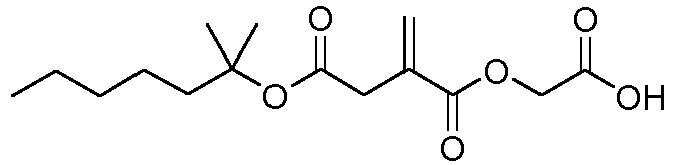
1H NMR (400 MHz, DMSO-d6) δ: 13.07 (br, 1H), 6.24 (d, J = 1.2 Hz, 1H), 5.87 (d, J = 0.8 Hz, 1H), 4.63 (s, 2H), 3.27 (s, 2H), 1.67-1.63 (m, 2H), 1.34 (s, 6H), 1.29-1.18 (m, 6H), 0.85 (d, J = 6.8 Hz, 3H). 63 1-pentylcyclobutan-1-ol LCMS (System 2, Method B) m/z 335.2 (M+Na)+ (ES+). 
1H NMR (400 MHz, DMSO-d6) δ: 13.09 (br, 1H), 6.27 (s, 1H), 5.90 (s, 1H), 4.64 (s, 2H), 3.31 (s, 2H), 2.19-2.13 (m, 2H), 2.09-2.05 (m, 2H), 1.82-1.79 (m, 2H), 1.76-1.72 (m, 1H), 1.63-1.53 (m, 1H), 1.30-1.22 (m, 6H), 0.86 (t, J = 7.2 Hz, 3H). 64 2-methylspiro[3.5]nonan-2-ol LCMS (System 2, Method B) m/z 347.2 (M+Na)+ (ES+). 
1H NMR (400 MHz, DMSO-d6) δ: 13.08 (br, 1H), 6.26 (s, 1H), 5.90 (s, 1H), 4.64 (s, 2H), 3.34 (s, 2H), 1.95 (q, J = 12.8 Hz, 4H), 1.46 (s, 3H), 1.40 (m, 4H), 1.31-1.30 (m, 6H). 75 1-pentylcyclopropan-1-ol LCMS (System 2, Method B) m/z 299.2 (M+H)+ (ES+). 
1H NMR (400 MHz, DMSO-d6) δ: 13.07 (br, 1H), 6.27 (s, 1H), 5.90 (s, 1H), 4.62 (s, 2H), 3.33 (s, 2H), 1.68-1.64 (m, 2H), 1.37-1.24 (m, 6H), 0.86 (t, J = 6.8 Hz, 3H), 0.73 (t, J = 5.2 Hz, 2H), 0.61 (t, J = 5.2 Hz, 2H). - 2-Methylspiro[3.5]nonan-2-ol was made by MeMgBr addition to the corresponding commercially available ketone in THF. 1H NMR (400 MHz, CDCl3) δ: 1.92 (d, J = 14.6 Hz, 2H), 1.89 (d, J = 14.4 Hz, 2H), 1.71 (m, 1H), 1.53-1.50 (m, 2H), 1.43-1.34 (m, 8H), 1.39 (s, 3H).
-

- To a solution of (exo)-1,7,7-trimethylbicyclo[2.2.1]heptan-2-ol (CAS No. 124-76-5) (1.00 g, 6.49 mmol) and DBU (1.48 g, 9.74 mmol) in 1-methyl-2-pyrrolidinone (20 mL) was slowly added 2-bromoacetyl bromide (1.97 g, 9.74 mmol) dropwise at 0 °C, and the mixture was stirred at room temperature for 3 h. The reaction mixture was diluted with water (20 mL) and MTBE (20 mL), separated and the aqueous layer was extracted with MTBE (2 x 10 mL). The combined organic layers were washed with brine, dried over Na2SO4, filtered and concentrated under reduced pressure at 40 °C. The residue was purified by flash column chromatography (40 g silica, 0-3% MTBE/petroleum ether) to give (exo)-1,7,7-trimethylbicyclo[2.2.1]heptan-2-yl 2-bromoacetate (1.5 g, 5.11 mmol, 79 %) as a colourless oil. 1H NMR (400 MHz, CDCl3) δ: 4.74-4.71 (m, 1H), 3.80 (s, 2H), 1.86-1.68 (m, 4H), 1.61-1.54 (m, 1H), 1.18-1.08 (m, 2H), 1.00 (s, 3H), 0.80 (s, 3H), 0.77 (s, 3H).
- To a solution of tert-butyl 2-(diethoxyphosphoryl)acetate (1.29 g, 5.11 mmol) in THF (20 mL) was added NaH suspension in mineral oil (60 wt. %, 225 mg, 5.62 mmol) at 0 °C, and the reaction mixture was stirred at 0 °C for 0.5 h, then (exo)-1,7,7-trimethylbicyclo[2.2.1]heptan-2-yl 2-bromoacetate (1.50 g, 5.11 mmol) was added. The reaction mixture was stirred at room temperature overnight, then quenched with dilute aqueous HCl (0.5 M) to pH = 5 and extracted with EtOAc (2 x 10 mL). The combined organic layers were washed with brine, dried over Na2SO4, filtered and concentrated under reduced pressure at 40 °C. The residue was purified by flash column chromatography (40 g silica, 1:4-1:2 EtOAc/petroleum ether) to give 1-(tert-butyl) 4-((exo)-1,7,7-trimethylbicyclo[2.2.1]heptan-2-yl) 2-(diethoxyphosphoryl)succinate (1.60 g, 3.59 mmol, 70 %) as a colourless oil. LCMS (System 2, Method C) m/z 469.4 (M+Na)+ (ES+).
- To a mixture of 1-(tert-butyl) 4-((exo)-1,7,7-trimethylbicyclo[2.2.1]heptan-2-yl) 2-(diethoxyphosphoryl)succinate (1.60 g, 3.59 mmol) and potassium carbonate (990 mg, 7.17 mmol) in DMF (10 mL) was added formaldehyde solution in water (37 wt. %, 2.9 mL, 35.9 mmol) at room temperature, and the reaction mixture was stirred at room temperature for 4 h. The reaction mixture was diluted with H2O (15 mL) and extracted with MTBE (2 x 20 mL). The combined organic layers were washed with H2O (2 x 10 mL) and brine, dried over Na2SO4, filtered and concentrated under reduced pressure at 30 °C. The residue was purified by flash column chromatography (25 g silica, 0-10% MTBE/petroleum ether) to give 1-(tert-butyl) 4-((exo)-1,7,7-trimethylbicyclo[2.2.1]heptan-2-yl) 2-methylenesuccinate (850 mg, 2.64 mmol, 73 %) as a colourless oil. LCMS (System 2, Method C) m/z 345.4 (M+Na)+ (ES+).
- To a solution of 1-(tert-butyl) 4-((exo)-1,7,7-trimethylbicyclo[2.2.1]heptan-2-yl) 2-methylenesuccinate (400 mg, 1.24 mmol) in DCM (8 mL) was added HCl solution in 1,4-dioxane (4 M, 4.0 mL), and the reaction mixture was stirred at room temperature overnight. The reaction mixture was concentrated under reduced pressure at 40 °C to give a crude 33:20:47 mixture of 2-methylene-4-oxo-4-(((exo)-1,7,7-trimethylbicyclo[2.2.1]heptan-2-yl)oxy)butanoic acid (LCMS (System 2, Method C) m/z 289.4 (M+Na)+ (ES+)), 2-methyl-4-oxo-4-(((exo)-1,7,7-trimethylbicyclo[2.2.1]heptan-2-yl)oxy)but-2-enoic acid (LCMS (System 2, Method C) m/z 289.4 (M+Na)+ (ES+)) and 2-(chloromethyl)-4-oxo-4-(((exo)-1,7,7-trimethylbicyclo[2.2.1]heptan-2-yl)oxy)butanoic acid (LCMS (System 2, Method C) m/z 325.2 (M+Na)+ (ES+)) (400 mg) as a pale yellow oil, which was used directly in the next step.
- To a crude 33:20:47 mixture of 2-methylene-4-oxo-4-(((exo)-1,7,7-trimethylbicyclo[2.2.1]heptan-2-yl)oxy) butanoic acid, (2-methyl-4-oxo-4-(((exo)-1,7,7-trimethylbicyclo[2.2.1]heptan-2-yl)oxy)but-2- enoic acid and 2-(chloromethyl)-4-oxo-4-(((exo)-1,7,7-trimethylbicyclo[2.2.1]heptan-2-yl)oxy) butanoic acid (400 mg) and potassium carbonate (342 mg, 2.48 mmol) in acetone (10 mL) was added tert-butyl 2-bromoacetate (331 mg, 1.24 mmol), and the reaction mixture was stirred at room temperature overnight. The mixture was then filtered, and the filtrate was concentrated under reduced pressure at 30 °C. The residue was purified by flash column chromatography (25 g silica, 0-10% MTBE/petroleum ether) to give 1-(2-oxo-2-(2,2,2-trichloroethoxy)ethyl) 4-((exo)-1,7,7-trimethylbicyclo[2.2.1]heptan-2-yl) 2-methylenesuccinate (450 mg, 0.99 mmol, 80 % over two steps) as a pale yellow oil. LCMS (System 2, Method C) m/z 477.0 (M+Na)+ (ES+).
- To a solution of 1-(2-oxo-2-(2,2,2-trichloroethoxy)ethyl) 4-((exo)-1,7,7-trimethylbicyclo[2.2.1]heptan-2-yl) 2-methylenesuccinate (450 mg, 0.99 mmol) in AcOH (5 mL) was added zinc powder (322 mg, 4.96 mmol), and the reaction mixture was stirred at room temperature overnight. The reaction mixture was filtered and the filtrate was concentrated under reduced pressure at 30 °C. The residue was purified by preparative HPLC (Column: Waters X-Bridge C18 OBD 10µm 19x250 mm; Flow Rate: 20 mL/min; solvent system: MeCN/(0.05% TFA/water) gradient: 40-95% MeCN; collection wavelength: 214 nm). The fractions were concentrated under reduced pressure at 30 °C to remove MeCN, and the residue was lyophilized to give 2-((2-methylene-4-oxo-4-(((exo)-1,7,7-trimethylbicyclo[2.2.1]heptan-2-yl) oxy)butanoyl)oxy)acetic acid (77 mg, 0.23 mmol, 24 %) as a colourless oil. LCMS (System 2, Method B) m/z 347.2 (M+Na)+ (ES+). 1H NMR (400 MHz, DMSO-d6) δ: 13.06 (br, 1H), 6.27 (d, J = 0.8 Hz, 1H), 5.92 (d, J = 0.8 Hz, 1H), 4.61 (s, 2H), 4.54 (dd, J = 8.0, 3.6 Hz, 1H), 3.35 (s, 2H), 1.74-1.60 (m, 4H), 1.53-1.47 (m, 1H), 1.13-1.01 (m, 2H), 0.88 (s, 3H), 0.79 (s, 3H), 0.75 (s, 3H).
- The following compound was made using a similar procedure:
Example No. / Structure / Name Alcohol / Example LCMS / 1H NMR data 66 2,2,6,6-tetramethylcyclohexan-1-ol LCMS (System 2, Method B) m/z 349.3 (M+Na)+ (ES+). 
1H NMR (400 MHz, DMSO-d6) δ: 13.09 (br, 1H), 6.31 (d, J = 1.2 Hz, 1H), 5.98 (s, 1H), 4.62 (s, 2H), 4.40 (s, 1H), 3.46 (s, 2H), 1.56-1.44 (1H, m), 1.45-1.37 (2H, m), 1.37-1.29 (m, 1H), 1.27-1.16 (m, 2H), 0.86 (s, 6H), 0.75 (s, 6H). - 2,2,6,6-Tetramethylcyclohexan-1-ol was made by reduction of the corresponding commercially available ketone with NaBH4 in MeOH. 1H NMR (400 MHz, DMSO-d6) δ: 4.40 (br, 1H), 2.83 (s, 1H), 1.56-1.48 (1H, m), 1.47-1.38 (m, 2H), 1.36-1.28 (m, 1H), 1.22-1.11 (m, 2H), 0.93 (s, 6H), 0.88 (s, 6H).
- The following examples were prepared according to the procedure of Example 23, but using the alcohols described below instead of 3-ethoxypropan-1-ol:
Example No. Alcohol / Example Structure / Name LCMS / 1H NMR data 67 1-(3,5-dichlorophenyl)ethan-1-ol (Isomer 1) LCMS (System 2, Method B) m/z 383.0 (M+Na)+ (ES+). 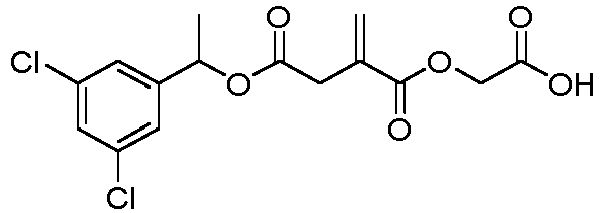
1H NMR (400 MHz, DMSO-d6) δ 13.12 (br, 1H), 7.54 (t, J = 2.0 Hz, 1H), 7.41 (d, J = 1.6 Hz, 2H), 6.31 (d, J = 0.8 Hz, 1H), 5.96 (d, J = 0.8 Hz, 1H), 5.77 (q, J = 6.4 Hz, 1H), 4.63 (s, 2H), 3.47 (s, 2H), 1.44 (d, J = 6.4 Hz, 3H). 68 1-(3,5-dichlorophenyl)ethan-1-ol (Isomer 2) LCMS (System 2, Method B) m/z 383.0 (M+Na)+ (ES+). 
1H NMR (400 MHz, DMSO-d6) δ 13.12 (br, 1H), 7.54 (t, J = 2.0 Hz, 1H), 7.41 (d, J = 1.6 Hz, 2H), 6.31 (d, J = 0.8 Hz, 1H), 5.96 (d, J = 0.8 Hz, 1H), 5.77 (q, J = 6.4 Hz, 1H), 4.63 (s, 2H), 3.47 (s, 2H), 1.44 (d, J = 6.4 Hz, 3H). 69 (R)-1-(4-(trifluoromethyl)phenyl) ethan-1-ol) LCMS (System 2, Method B) m/z 383.0 (M+Na)+ (ES+). 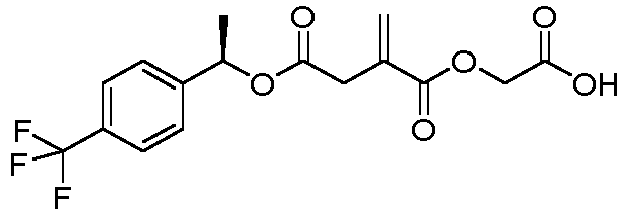
1H NMR (400 MHz, DMSO-d6) δ 13.13 (br, 1H), 7.73 (d, J = 8.4 Hz, 2H), 7.57 (d, J = 8.4 Hz, 2H), 6.30 (d, J = 0.8 Hz, 1H), 5.94 (d, J = 0.8 Hz, 1H), 5.86 (q, J = 6.8 Hz, 1H), 4.62 (s, 2H), 3.46 (s, 2H), 1.47 (d, J = 6.4 Hz, 3H). 70 (S)-1-(4-(trifluoromethyl)phenyl) ethan-1-ol) LCMS (System 2, Method B) m/z 383.0 (M+Na)+ (ES+). 
1H NMR (400 MHz, DMSO-d6) δ 13.06 (br, 1H), 7.73 (d, J = 8.4 Hz, 2H), 7.57 (d, J = 8.4 Hz, 2H), 6.30 (d, J = 0.8 Hz, 1H), 5.94 (d, J = 0.8 Hz, 1H), 5.86 (q, J = 6.8 Hz, 1H), 4.62 (s, 2H), 3.46 (s, 2H), 1.47 (d, J = 6.4 Hz, 3H). 72 (S)-1-cyclohexylethan-1-ol LCMS (System 2, Method B) m/z 321.3 (M+Na)+ (ES+). 
1H NMR (400 MHz, DMSO-d6) δ: 13.14 (br, 1H), 6.28 (s,1H), 5.92 (s, 1H), 4.62 (s, 2H), 4.66-4.58 (m, 1H), 3.26 (s, 2H), 1.69-1.67 (m, 3H), 1.62-1.53 (m, 2H), 1.42-1.35 (m, 1H), 1.25-1.08 (m, 3H), 1.15 (d, J = 6.4 Hz, 3H), 1.04-0.82 (m, 2H). - 1-(3,5-dichlorophenyl)ethan-1-ol (Isomer 1) was prepared by the following method: Racemic 1-(3,5-dichlorophenyl)ethan-1-ol was resolved using chiral SFC (Column: CHIRALPAK AY-3 4.6x100 mm; Flow Rate: 2 mL/min; solvent system: 10% IPA/CO2; collection wavelength: 214 nm). Isomer 1 was the first eluting peak at 1.34 min.
- 1-(3,5-dichlorophenyl)ethan-1-ol (Isomer 2) was prepared by the following method: Racemic 1-(3,5-dichlorophenyl)ethan-1-ol was resolved using chiral SFC (Column: CHIRALPAK AY-3 4.6x100 mm; Flow Rate: 2 mL/min; solvent system: 10% IPA/CO2; collection wavelength: 214 nm). Isomer 2 was the second eluting peak at 1.53 min.
-

- To a solution of methyl cyclohexanecarboxylate (4.26 g, 30 mmol) and titanium tetraisopropoxide (11.93 g, 42 mmol) in THF (60 mL) at 0 °C was slowly added a solution of ethyl magnesium bromide in diethyl ether (3M, 30 mL, 90 mmol), and the mixture was stirred at room temperature for 16 h. The reaction mixture was quenched with water (60 mL), and stirred for 1 h until a gray precipitate was formed, and then filtered. The filtrate was extracted with MTBE (3 x 40 mL), and the combined organic layers were washed with brine, dried over Na2SO4, filtered and concentrated under reduced pressure at 40 °C. The residue was purified by flash column chromatography (0-3% EtOAc/petroleum ether) give 1-cyclohexylcyclopropan-1-ol (2.50 g, 17.8 mmol, 60 %) as a colourless oil. 1H NMR (400 MHz, CDCl3) δ: 1.80-1.75 (m, 4H), 1.69-1.66 (m, 1H), 1.26-1.17 (m, 5H), 0.94-0.92 (m, 1H), 0.70-0.67 (m, 2H), 0.45-0.42 (m, 2H). One exchangeable proton not observed.
- To a solution of 1-cyclohexylcyclopropan-1-ol (1.50 g, 10.7 mmol) and DBU (2.43 g, 16.05 mmol) in 1-methyl-2-pyrrolidinone (20 mL) was slowly added 2-bromoacetyl bromide (3.24 g, 16.05 mmol) dropwise at 0 °C, and the resulting mixture was stirred at room temperature for 1 h. The reaction mixture was diluted with water (20 mL) and MTBE (20 mL), separated and the aqueous layer was extracted with MTBE (2 x 10 mL). The combined organic layers were washed with brine, dried over Na2SO4, filtered and concentrated under reduced pressure at 40 °C. The residue was purified by flash column chromatography (25 g silica, 0-3% MTBE/petroleum ether) to give 1-cyclohexylcyclopropyl 2-bromoacetate (1.70 g, 6.51 mmol, 61 %) as a colourless oil. 1H NMR (400 MHz, CDCl3) δ: 3.74 (s, 2H), 1.80-1.73 (m, 5H), 1.67-1.64 (m, 1H), 1.24-1.08 (m, 3H), 0.95-0.79(m, 2H), 0.70-0.67 (m, 4H).
- To a solution of methyl 2-(diethoxyphosphoryl)acetate (1.36 g, 6.51 mmol) in THF (30 mL) was added NaH suspension in mineral oil (60 wt. %, 261 mg, 6.51 mmol) at 0 °C, and the reaction mixture was stirred at 0 °C for 0.5 h. Then 1-cyclohexylcyclopropyl 2-bromoacetate (1.70 g, 6.51 mmol) was added, and the reaction mixture was stirred at room temperature overnight. The reaction mixture was quenched with dilute aqueous HCl (0.5 M) to pH = 5, and extracted with EtOAc (2 x 10 mL). The combined organic layers were washed with brine, dried over Na2SO4, filtered and concentrated under reduced pressure at 40 °C to give 4-(1-cyclohexylcyclopropyl) 1-methyl 2-(diethoxyphosphoryl)succinate (2.70 g, 6.92 mmol, > 100 %) as a colourless oil. The crude product was used directly in next step. LCMS (System 2, Method B) m/z 413.2 (M+Na)+ (ES+).
- To a mixture of 4-(1-cyclohexylcyclopropyl) 1-methyl 2-(diethoxyphosphoryl)succinate (2.70 g, 6.92 mmmol) and potassium carbonate (1.83 g, 13.8 mmol) in THF (20 mL) was added formaldehyde solution in water (37 wt. %, 11.2 mL, 138 mmol) at room temperature, and the reaction mixture was stirred at room temperature for 4 h. The reaction mixture was diluted with H2O (20 mL) and extracted with MTBE (2 x 20 mL). The combined organic layers were washed with H2O (2 x 15 mL) and brine, dried over Na2SO4, filtered and concentrated under reduced pressure at 30 °C. The residue was purified by flash column chromatography (25 g silica, 0-10% MTBE/petroleum ether) to give 4-(1-cyclohexylcyclopropyl) 1-methyl 2-methylenesuccinate (1.20 g, 4.51 mmol, 65 %) as a colourless oil. LCMS (System 2, Method B) m/z 267.3 (M+H)+ (ES+).
- To a solution of 4-(1-cyclohexylcyclopropyl) 1-methyl 2-methylenesuccinate (600 mg, 2.25 mmol) in THF (8 mL) was added LiOH solution in water (2 M, 3.4 mL, 6.75 mmol), and the reaction mixture was stirred at room temperature for 7 h (about 24 % of starting material remained). The reaction mixture was acidified with dilute aqueous HCl (0.5 M) to pH = 3 and extracted with EtOAc (2 x 10 mL). The EtOAc layers were washed with brine, dried over Na2SO4, filtered and concentrated under reduced pressure at 40 °C to give a 2:1 mixture of 4-(1-cyclohexylcyclopropoxy)-2-methylene-4-oxobutanoic acid and 4-(1-cyclohexylcyclopropoxy)-2-methyl-4-oxobut-2-enoic acid (500 mg, 1.98 mmol, 88 %) as a pale yellow oil, which was used directly in the next step. LCMS (System 2, Method C) m/z 253.4 (M+H)+ (ES+).
- To a solution of a 2:1 mixture of 4-(1-cyclohexylcyclopropoxy)-2-methylene-4-oxobutanoic acid and 4-(1-cyclohexylcyclopropoxy)-2-methyl-4-oxobut-2-enoic acid (500 mg, 1.98 mmol), and potassium carbonate (328 mg, 2.38 mmol) in acetone (10 mL) was added 2,2,2-trichloroethyl 2-bromoacetate (530 mg, 1.98 mmol), and the reaction mixture was stirred at room temperature overnight. The reaction mixture was filtered and the filtrate was concentrated under reduced pressure at 30 °C. The residue was purified by flash column chromatography (25 g silica, 0-10% MTBE/petroleum ether) to give 4-(1-cyclohexylcyclopropyl) 1-(2-oxo-2-(2,2,2-trichloroethoxy)ethyl) 2-methylenesuccinate (300 mg, 0.68 mmol, 34 %) as a pale yellow oil. LCMS (System 2, Method B) m/z 463.1 (M+Na)+ (ES+).
- To a solution of 4-(1-cyclohexylcyclopropyl) 1-(2-oxo-2-(2,2,2-trichloroethoxy)ethyl) 2-methylenesuccinate (100 mg, 0.22 mmol) in THF (2 mL) and water (0.5 mL) was added zinc powder (71 mg, 1.10 mmol) and sodium acetate (90 mg, 1.10 mmol), and the reaction mixture was stirred at room temperature overnight. The reaction mixture was filtered and the filtrate was concentrated under reduced pressure at 30 °C. The residue was purified by preparative HPLC (Column: Waters X-Bridge C18 OBD 10µm 19x250 mm; Flow Rate: 20 mL/min; solvent system: MeCN/(0.05% TFA/water) gradient: 30-95% MeCN; collection wavelength: 214 nm). The fractions were concentrated under reduced pressure at 30 °C to remove MeCN, and the residue was lyophilized to give 2-((4-(1-cyclohexylcyclopropoxy)-2-methylene-4-oxobutanoyl)oxy)acetic acid (6 mg, 0.019 mmol, 9 %) as a colourless oil. LCMS (System 2, Method B) m/z 311.2 (M+H)+ (ES+). 1H NMR (400 MHz, CDCl3) δ: 6.43 (s, 1H), 5.80 (s, 1H), 4.74 (s, 2H), 3.31 (s, 2H), 1.79-1.71 (m, 5H), 1.66-1.63 (m, 1H), 1.25-1.15 (m, 2H), 1.11-1.05 (m, 1H), 0.92-0.83 (m, 2H), 0.74 (d, J = 2.0 Hz, 4H). One exchangeable proton not observed.
-

- To a solution of 2,2,4,4-tetramethylpentan-3-one (1.5 g, 10.6 mmol) in dry THF (40 mL) was added LiAlH4 (802 mg, 21.1 mmol) at 0 °C, and the resulting mixture was stirred at room temperature for 1 h. To the reaction mixture was sequentially added water (1 mL), aqueous NaOH (15 wt %, 1 mL), water (2.5 mL) and Na2SO4 (20 g), the mixture was stirred at room temperature for 20 min, filtered, and concentrated under reduced pressure at 35 °C to give 2,2,4,4-tetramethylpentan-3-ol (1.4 g, 9.70 mmol, 90 % ) as colourless crystals. 1H NMR (400 MHz, CDCl3) δ: 3.12 (d, J= 2.4 Hz, 1H), 1.23 (s, 18H). One exchangeable proton not observed.
- To a solution of 2,2,4,4-tetramethylpentan-3-ol (1.3 g, 9.02 mmol) and DBU (2.74 g, 18.0 mmol) in 1-methyl-2-pyrrolidinone (45 mL) was slowly added 2-bromoacetyl bromide (3.64 g, 18.0 mmol) at 0 °C dropwise and the mixture was stirred at room temperature for 1 h. The reaction mixture was diluted with water (10 mL) and MTBE (20 mL), separated and the aqueous layer was extracted with MTBE (2 x 20 mL). The combined organic layers were washed with brine, dried over Na2SO4, filtered and concentrated under reduced pressure at 40 °C. The residue was purified by flash column chromatography (50 g silica, 0-10% EtOAc/petroleum ether) to give 2,2,4,4-tetramethylpentan-3-yl 2-bromoacetate (1.50 g, 5.68 mmol, 62 %) as a colorless oil. 1H NMR (400 MHz, CDCl3) δ: 4.63 (s, 1H), 3.87 (s, 2H), 1.04 (s, 18H).
- To a solution of tert-butyl 2-(diethoxyphosphoryl)acetate (1.43 g, 5.68 mmol) in THF (15 mL) was added NaH suspension in mineral oil (60 wt. %, 227 mg, 5.68 mmol) at 0 °C, and the reaction mixture was stirred at 0 °C for 0.5 h. 2,2,4,4-Tetramethylpentan-3-yl 2-bromoacetate (1.5 g, 5.68 mmol) was then added and the reaction mixture was stirred at room temperature overnight. The reaction mixture was quenched with dilute aqueous HCl (0.5 M) to pH = 5, and extracted with EtOAc (3 x 20 mL). The combined organic layers were washed with brine, dried over Na2SO4, filtered and concentrated under reduced pressure at 40 °C to give crude 1-(tert-butyl) 4-(2,2,4,4-tetramethylpentan-3-yl) 2-(diethoxyphosphoryl)succinate (3.00 g, 6.87 mmol, > 100 %) as a colourless oil. The crude product was used directly in next step. LCMS (System 2, Method B) m/z 459.3 (M+Na)+ (ES+).
- To a solution of 1-(tert-butyl) 4-(2,2,4,4-tetramethylpentan-3-yl) 2-(diethoxyphosphoryl)succinate (3.00 g, ~ 6.87 mmol, crude) and potassium carbonate (1.90 g, 13.8 mmol) in THF (24 mL) and H2O (6 mL) was added formaldehyde solution in water (37 wt. %, 11.15 mL, 138 mmol) at room temperature, and the reaction mixture was stirred at room temperature for 4 h. The reaction mixture was diluted with H2O (15 mL) and extracted with MTBE (3 x 30 mL). The combined organic layers were washed with H2O (2 x 10 mL) and brine, dried over Na2SO4, filtered and concentrated under reduced pressure at 40 °C. The residue was purified by flash column chromatography (25 g silica, 0-20% MTBE/petroleum ether) to give 1-(tert-butyl) 4-(2,2,4,4-tetramethylpentan-3-yl) 2-methylenesuccinate (1.45 g, 4.64 mmol, 68 %) as a colourless oil. LCMS (System 2, Method B) m/z 335.4 (M+Na)+ (ES+). 1H NMR (400 MHz, CDCl3) δ: 6.24 (d, J = 1.2 Hz, 1H), 5.63 (d, J = 1.2 Hz, 1H), 4.57 (s, 1H), 3.35 (d, J = 0.8 Hz, 2H), 1.48 (s, 9H), 0.98 (s, 18H).
- A solution of 1-(tert-butyl) 4-(2,2,4,4-tetramethylpentan-3-yl) 2-methylenesuccinate (450 mg, 1.44 mmol) in TFA/DCM (2:1, 7 mL) was stirred at room temperature for 4 h. The mixture was concentrated under reduced pressure at 40 °C to give 2-methylene-4-oxo-4-((2,2,4,4-tetramethylpentan-3-yl)oxy)butanoic acid (400 mg, 1.56 mmol, > 100 %) as a colourless oil, which was used directly in the next step. LCMS (System 2, Method C) m/z 279.4 (M+Na)+ (ES+).
- To a solution of 2-methylene-4-oxo-4-((2,2,4,4-tetramethylpentan-3-yl)oxy)butanoic acid (400 mg, 1.56 mmol), and potassium carbonate (645 mg, 4.68 mmol) in acetone (10 mL) was added tert-butyl 2-bromoacetate (608 mg, 3.12 mmol), and the reaction mixture was stirred at room temperature for 2 days. The reaction mixture was filtered, and the filtrate was concentrated under reduced pressure at 40 °C. The residue was purified by flash column chromatography (25 g silica, 0-20% MTBE/petroleum ether) to give 1-(2-(tert-butoxy)-2-oxoethyl) 4-(2,2,4,4-tetramethylpentan-3-yl) 2-methylenesuccinate (430 mg, 1.16 mmol, 81 %) as a colourless oil. LCMS (System 2, Method C) m/z 393.4 (M+Na)+ (ES+).
- A solution of 1-(2-(tert-butoxy)-2-oxoethyl) 4-(2,2,4,4-tetramethylpentan-3-yl) 2-methylenesuccinate (430 mg, 1.16 mmol) in TFA/DCM (2:1, 6 mL) was stirred at room temperature for 1 h. The reaction mixture was filtered and the filtrate was concentrated under reduced pressure at 40 °C. The residue was purified by preparative HPLC (Column: Waters X-Bridge C18 OBD 10µm 19x250 mm; Flow Rate: 20 mL/min; solvent system: MeCN/(0.05% TFA/water) gradient: 50-95% MeCN; collection wavelength: 214 nm). The fractions were concentrated under reduced pressure at 40 °C to remove MeCN, and the residue was lyophilized to give 2-((2-methylene-4-oxo-4-((2,2,4,4-tetramethylpentan-3-yl)oxy)butanoyl)oxy)acetic acid (302 mg, 0.96 mmol, 83 %) as a white solid. LCMS (System 2, Method B) m/z 337.3 (M+Na)+ (ES+). 1H NMR (400 MHz, CDCl3) δ: 13.01 (br, 1H), 6.30 (d, J = 1.2 Hz, 1H), 5.97 (s, J = 1.2 Hz, 1H), 4.62 (s, 2H), 4.45 (s, 1H), 3.45 (s, 2H), 0.93 (s, 18H).
-

- Example 77 was prepared according to the procedure of Example 3, but using 2,2,4,4-tetramethylcyclobutan-1-ol instead of 4-octyl itaconate. LCMS (System 2, Method B) m/z 335.2 (M+Na)+ (ES+). 1H NMR (400 MHz, DMSO-d6) δ 12.41 (br, 1H), 6.17 (d, J = 1.2 Hz, 1H), 5.85 (d, J = 0.8 Hz, 1H), 4.36 (s, 1H), 4.25 (t, J = 2.0 Hz, 2H), 3.39 (s, 2H), 2.59 (t, J = 2.0 Hz, 2H), 1.51 (d, J = 11.6 Hz, 1H), 1.41 (d, J = 11.6 Hz, 1H), 1.10 (s, 6H), 1.00 (s, 6H).
- The cytokine inhibition profiles of compounds of formula (I) were determined in a differentiated THP-1 cell assay. All assays were performed in RPMI-1640 growth medium (Gibco), supplemented with 10% fetal bovine serum (FBS; Gibco), 1% penicillin-streptomycin and 1% sodium pyruvate unless specified otherwise. The IL-1β and IL-6 cytokine inhibition assays were each run in a background of differentiated THP-1 cells as described below. All reagents described were from Sigma-Aldrich unless specified otherwise. Compounds were prepared as 10mM DMSO stocks.
- THP-1 cells were expanded as a suspension up to 80% confluence in appropriate growth medium. Cells were harvested, suspended, and treated with an appropriate concentration of phorbol 12-myristate 13-acetate (PMA) over a 72hr period (37°C/5% CO2).
- Following 72hrs of THP-1 cell incubation, cellular medium was removed and replaced with fresh growth media containing 1% of FBS. Working concentrations of compounds were prepared separately in 10% FBS treated growth medium and pre-incubated with the cells for 30 minutes (37°C/5% CO2). Following the 30 minute compound pre-incubation, THP-1s were treated with an appropriate concentration of LPS and the THP-1s were subsequently incubated for a 24hr period (37°C/5% CO2). An appropriate final concentration of Nigericin was then dispensed into the THP-1 plates and incubated for 1 hour (37°C/5% CO2) before THP-1 supernatants were harvested and collected in separate polypropylene 96-well holding plates.
- Reagents from each of the IL-1β and IL-6 commercial kits (Perkin Elmer) were prepared and run according to the manufacturer's instructions. Subsequently, fluorescence signal detection in a microplate reader was measured (EnVision® Multilabel Reader, Perkin Elmer).
- Percentage inhibition was calculated per cytokine by normalising the sample data to the high and low controls used within each plate (+/- LPS respectively). Percentage inhibition was then plotted against compound concentration and the 50% inhibitory concentration (IC50) was determined from the resultant concentration-response curve.
- A number of Example compounds of formula (I) were tested and the results are shown in Table 1 below. Dimethyl itaconate and dimethyl fumarate were included as comparator compounds. All compounds of formula (I) shown in Table 1 exhibited comparable or improved cytokine-lowering potencies compared to dimethyl itaconate and/or dimethyl fumarate for IL-1β and/or IL-6. Certain compounds shown in Table 1 exhibited improved cytokine-lowering potencies compared to dimethyl itaconate and/or dimethyl fumarate for IL-1β and/or IL-6.
Table 1 - THP-1 cell IL-1β and IL-6 IC50 values (µM) Compound IL-1β (IC50) IL-6 (IC50) dimethyl fumarate 14.4 9.3 dimethyl itaconate >100 100.0 Example 1 7.2 5.5 Example 2 11.9 13.5 Example 3 9.6 5.3 Example 4 100 52.1 Example 5 25.7 18.9 Example 6 34.2 96.9 Example 7 14.3 22 Example 8 22.6 18.6 Example 9 100 15.7 Example 10 28.1 100 Example 11 25.2 20.4 Example 12 17.5 12.6 Example 13 16.4 9.8 Example 14 48.1 33.8 Example 15 75.3 21.2 Example 16 73.8 28.1 Example 17 5.3 NT* Example 18 80.6 NT* Example 19 15.7 47.1 Example 20 100 70.9 Example 21 14.6 NT* Example 22 100 48.5 Example 23 100 56.2 Example 24 59.5 36.3 Example 25 100 60.4 Example 26 54.2 NT* Example 27 13 NT* Example 28 1.7 NT Example 29 19.3 NT Example 30 8.5 NT Example 31 13.4 NT Example 32 29.6 NT dimethyl fumarate 14.4 9.3 dimethyl itaconate >100 100.0 Example 33 12.1 NT Example 34 11.7 NT Example 35 10.3 NT Example 36 10.3 NT Example 37 7.0 NT Example 38 8.4 NT Example 39 16.5 NT Example 40 49.3 NT Example 41 15.6 NT Example 42 14.7 NT Example 43 21.8 NT Example 44 23.8 NT Example 45 27.6 NT Example 46 10.9 NT Example 47 7.6 NT Example 48 12.0 NT Example 49 20.5 NT Example 50 24.6 NT Example 51 11.0 NT Example 52 8.2 NT Example 53 32.8 NT Example 54 6.1 NT Example 55 9.6 NT Example 56 33.9 NT Example 57 3.5 NT Example 58 57.9 NT Example 59 58.4 NT Example 60 26.6 NT Example 61 10.6 NT Example 62 17.6 NT Example 63 24.8 NT Example 64 24.3 NT Example 65 18.8 NT dimethyl fumarate 14.4 9.3 dimethyl itaconate >100 100.0 Example 66 21.4 NT Example 67 22.0 NT Example 68 18.3 NT Example 69 11.5 NT Example 70 24.6 NT Example 71 36.7 NT Example 72 22.0 NT Example 73 41.7 NT Example 74 1.7 NT Example 75 19.1 NT Example 77 100 NT NT* = not tested - The cytokine inhibition profiles of compounds of formula (I) were determined in a CD14+ isolated primary human monocyte cell assay. All assays were performed in RPMI-1640 growth medium (Gibco), supplemented with heat-inactivated fetal bovine serum (FBS) and 1% penicillin-streptomycin unless specified otherwise. The IL-1β and IL-6 cytokine inhibition assays were each run in a background of isolated primary human monocyte cells as described below. All reagents described were from Sigma-Aldrich unless specified otherwise. Compounds were prepared as 100mM DMSO stocks.
- Primary peripheral blood mononuclear cells (PBMCs) were isolated from human whole blood. Following PBMC isolation, a CD14+ monocyte isolation step was conducted whereby CD14+ magnetic beads (Miltenyi Biotec) were incubated for 15 minutes with the PBMC suspension that was previously treated with ice cold T-cell isolation buffer (PBS, 0.5% BSA, 2mM EDTA). Following bead incubation, the treated cell suspension was passed through a magnetic separation column designed to positively select for magnetically labelled cells. The isolated CD14+ monocytes were subsequently plated at the appropriate cell density for the assay, prior to compound treatment on the day of plating. Working concentrations of compounds were prepared separately in RPMI-1640 only growth medium and pre-incubated with the cells for 30 minutes (37°C/5% CO2). Following the 30 minute compound pre-incubation, primary monocytes were treated with an appropriate concentration of LPS and subsequently incubated for a 24hr period (37°C/5% CO2). An appropriate final concentration of Nigericin was then dispensed into the primary monocyte plates and incubated for 1 hour (37°C/5% CO2) before monocyte supernatants were harvested and collected in separate polypropylene 96-well holding plates prior to commencing the AlphaLISA cytokine assay.
- Reagents from each of the IL-1β and IL-6 commercial kits (Perkin Elmer) were prepared and run according to the manufacturer's instructions. Subsequently, fluorescence signal was measured in a microplate reader (EnVision® Multilabel Reader, Perkin Elmer).
- Percentage inhibition was calculated per cytokine by normalising the sample data to the high and low controls used within each plate (+/- LPS respectively). Percentage inhibition was then plotted against compound concentration and the 50% inhibitory concentration (IC50) was determined from the resultant concentration-response curve.
- A number of Example compounds of formula (I) were tested and the results are shown in Table 2 below. Dimethyl fumarate and 4-octyl itaconate were included as comparator compounds. All compounds which were tested exhibited lower IC50s than 4-octyl itaconate.
Table 2 - primary monocyte IL-1β and IL-6 IC50 values (µM) Compound IL-1β (IC50) IL-6 (IC50) dimethyl fumarate 8.5 15.7 4-octyl itaconate >100 NT* Example 11 17.3 NT Example 13 81.3 NT Example 21 13.7 NT NT* = not tested - Potency and efficacy of compounds of formula (I) against the target of interest to activate NRF2 (nuclear factor erythroid 2-related factor 2) were determined using the PathHunter NRF2 translocation kit (DiscoverX). The NRF2 translocation assay was run using an engineered recombinant cell line, utilising enzyme fragment complementation to determine activation of the Keap1-NRF2 protein complex and subsequent translocation of NRF2 into the nucleus. Enzyme activity was quantified using a chemiluminescent substrate consumed following the formation of a functional enzyme upon PK-tagged NRF2 translocation into the nucleus.
- The assay was run under either +/- GSH (glutathione) conditions to determine the attenuating activities of GSH against target compounds.
- Additionally, a defined concentration of dimethyl fumarate was used as the 'High' control to normalise test compound activation responses to.
- U2OS PathHunter eXpress cells were thawed from frozen prior to plating. Following plating, U2OS cells were incubated for 24hrs (37°C/5%CO2) in commercial kit provided cell medium.
- Following 24hrs of U2OS incubation, cells were directly treated with an appropriate final concentration of compound, for -GSH conditions, or for +GSH conditions, an intermediate plate containing 6x working concentrations of compound stocks was prepared in a 6mM working concentration of GSH solution (solubilised in sterile PBS). Following a 30 minute compound-GSH pre-incubation (37°C/5%CO2) for +GSH treatment, plated U2OS cells were incubated with an appropriate final concentration of compound and GSH.
- Following compound (+/-GSH) treatment, the U2OS plates were incubated for a further 6 hours (37°C/5%CO2) before detection reagent from the PathHunter NRF2 commercial kit was prepared and added to test plates according to the manufacturer's instructions. Subsequently, the luminescence signal detection in a microplate reader was measured (PHERAstar®, BMG Labtech).
- Percentage activation was calculated by normalising the sample data to the high and low controls used within each plate (+/- DMF). Percentage activation/response was then plotted against compound concentration and the 50% activation concentration (EC50) was determined from the plotted concentration-response curve.
- A number of compounds of formula (I) were tested, and the results are shown in Table 3 below. Dimethyl itaconate and dimethyl fumarate were included as comparator compounds. Certain compounds of formula (I) shown in Table 3 exhibited a lower or comparable EC50 and/or a higher Emax compared with dimethyl itaconate and/or dimethyl fumarate.
Table 3 - NRF2 activation Compound EC50 (µM) Emax (%) dimethyl fumarate 5.6 102 dimethyl itaconate 21.4 137 Example 1 15.8 232 Example 3 21.5 229 Example 4 24.9 110 Example 5 26.5 164 Example 7 6.3 185 Example 8 25.0 163 Example 9 21.0 91 Example 10 34.2 113 Example 11 3.2 139 Example 12 22.4 238 Example 13 29.4 157 Example 14 10.1 73 Example 15 37.8 109 Example 16 36.0 118 Example 17 22.2 193 Example 18 36.5 122 Example 19 21.2 180 Example 21 8.9 173 Example 27 17.5 178 Example 28 2.1 176 Example 29 >100 7 Example 50 14.3 188 dimethyl fumarate 5.6 102 dimethyl itaconate 21.4 137 Example 54 5.5 188 Example 58 18.0 137 Example 61 11.8 194 - Pharmacokinetic studies were carried out in 6-8-week-old male C57BL/6 mice having free access to food and water. Intravenous dosing was conducted at 10 mg/kg (5 mL/kg; vehicle: 10% DMSO-90% (25% HP-β-CD in water)) via tail vein injection, with sampling at 3min, 8min, 15min, 30min, 1, 2, 4, 6 and 8 hours, i.e., 9 time points in total (N=3/time point), using semi-serial bleeding for plasma. Oral compound administration, via gavage, was carried out at 100 mg/kg (10 mL/kg; vehicle: 5% DMSO-95% (0.5% HPMC + 0.1% Tween 80 in water)), with sampling at 5min, 15min, 30min, 1, 2, 4, 6, 8 and 24 hours, i.e., 9 time points in total (N=3/time point), using semi-serial bleeding for plasma.
- For both intravenous and oral routes, the mice were restrained manually at the designated time points, with ca. 110 µL of blood being taken into K2EDTA tubes via the facial vein. Blood samples were put on ice and centrifuged to obtain plasma samples from which the concentration at each time point was measured by LC-MS/MS.
- A number of compounds of formula (I) were tested, and the results are shown in Tables 4 and 5 below. Dimethyl itaconate was included as a comparator compound. All compounds of formula (I) exhibited higher systemic exposures than dimethyl itaconate which was only quantifiable at one timepoint following intravenous dosing and was below the limit of quantification at all timepoints following oral administration.
Table 4 - Parent compound concentrations (ng/mL) following intravenous administration Time (h) Compound 0.05 0.133 0.25 0.5 1 2 4 6 8 dimethyl itaconate 874 <24 <24 <24 <24 <24 <24 <24 <24 Example 5 17600 8347 2783 752 69 2.2 1.4 1.6 <0.8 Example 7 5575 -* 1034 217 34 6.5 <2.0 <2.0 - Example 11 42500 23533 12367 6253 2513 200 40 11 4.2 Example 12 27833 12377 7680 2300 430 65 6.8 <4.0 <4.0 Example 13 19233 7160 2023 1597 89 3.6 2.8 1.7 1.2 Example 17 18000 6073 2437 550 42 1.9 1.4 <0.8 <0.8 Example 19 15100 3587 659 169 6.4 3.0 <0.8 <0.8 <0.8 Example 21 63467 40133 36233 23533 13000 3537 1513 424 154 Example 41 15600 6433 2803 516 8.6 2.5 1.3 <0.8 <0.8 Example 42 37167 21867 8933 1663 476 66 12 <4.0 <4.0 Example 44 23667 11300 2637 1211 75 9.9 6.1 <4.0 <4.0 Example 47 27467 11700 6110 1193 181 32 <4.0 <4.0 <4.0 Example 50 33367 15500 5677 2850 594 61 8.2 <4.0 <4.0 Example 51 17867 5317 1810 456 13 <4.0 <4.0 <4.0 <4.0 Example 54 40833 17933 6737 2893 642 88 20 6.0 <4.0 Example 61 36633 21433 11273 2907 400 86 26 <4.0 <4.0 Example 62 28833 10677 4040 1450 134 16 4.1 <4.0 <4.0 *Timepoints where no samples were taken are indicated with a dash, "-". Table 5 - Parent compound concentrations (ng/mL) following oral administration Time (h) Compound 0.083 0.25 0.5 1 2 4 6 8 24 Dimethyl itaconate <24 <24 <24 <24 <24 <24 <24 <24 <24 Example 1 -* 536 843 344 111 12 - 4.5 <1.5 Example 3 - 850 1151 715 173 67 - <1.5 <1.5 Example 5 27533 18000 6447 3400 1042 568 112 86 <0.8 Example 7 - 9089 5116 3314 1005 368 - 217 <31 Example 9 - 41 943 686 149 19 - <3.0 <3.0 Example 10 - 35333 15884 8515 1465 198 - 31 <14 Example 11 53900 43633 33767 12683 10527 4105 1947 72 5.5 Example 12 43967 39133 28500 13967 4737 918 582 16 6.8 Example 13 22867 10637 6200 3373 3473 1645 1048 500 1.1 Example 14 - 8863 6235 1920 450 33 - 19 13 Example 17 27833 12563 8217 3113 2137 392 196 90 <0.8 Example 19 15300 4773 3780 1551 810 856 330 443 <0.8 Example 21 79833 64567 72333 49500 31433 21267 6783 12187 25 Example 41 37800 9877 4603 1750 971 215 57 7.7 <0.8 Example 42 55000 38367 40567 10053 4420 4403 441 25 8.1 Example 47 39133 19467 18233 5517 1407 2000 784 231 <4.0 Example 60 67067 27067 27933 11050 3660 1464 2245 639 <4.0 Example 54 65867 46833 27867 13493 5393 1372 1285 417 5.9 Example 61 47000 60667 37900 25167 8737 5440 79 41 6.6 Example 62 52900 45600 31533 8927 2123 920 55 19 5.6 *Timepoints where no samples were taken are indicated with a dash, "-". - These results reveal that compounds of the invention display improved systemic exposures, as shown by the plasma concentrations of certain compounds of formula (I) in this assay. All the compounds of formula (I) shown in Table 4 exhibited higher systemic exposures compared with dimethyl itaconate when administered intravenously, and all the compounds of formula (I) shown in Table 5 exhibited higher systemic exposures compared with dimethyl itaconate when administered orally.
- Defrosted cryo-preserved hepatocytes (viability > 70%) are used to determine the metabolic stability of a compound via calculation of intrinsic clearance (Clint; a measure of the removal of a compound from the liver in the absence of blood flow and cell binding). Clearance data are particularly important for in vitro work as they can be used in combination with in vivo data to predict the half-life and oral bioavailability of a drug.
- The metabolic stability in hepatocytes assay involves a time-dependent reaction using both positive and negative controls. The cells must be pre-incubated at 37 °C then spiked with test compound (and positive control); samples taken at pre-determined time intervals are analysed to monitor the change in concentration of the initial drug compound over 60 minutes. A buffer incubation reaction (with no hepatocytes present) acts as a negative control and two cocktail solutions, containing compounds with known high and low clearance values (verapamil/7-hydroxycoumarin and propranolol/diltiazem), act as positive controls.
- 1. The assay is run with a cell concentration of 0.5 x 10⁶ cells/mL in Leibovitz buffer.
- 2. All compounds and controls are run in duplicate.
- 3. Compound concentration is 10µM.
- 4. All compounds and controls are incubated with both cells and buffer to show turnover is due to hepatic metabolism.
- 5. All wells on the incubation plate will have 326.7µL of either cells or buffer added.
- 6. Prior to assay, cell and buffer-only incubation plates are preincubated for 10 mins at 37 °C.
- 7. The assay is initiated by adding compounds, 3.3µL of 1mM in 10%DMSO-90%Buffer; final DMSO concentration is 0.1%.
- 8. Samples are taken at regular timepoints (0, 5, 10, 20, 40, 60 min) until 60 mins.
- 9. Sample volume is 40µL and it is added to 160µL of crash solvent (acetonitrile with internal standard) and stored on ice.
- 10. At the end of the assay, the crash plates are centrifuged at 3500rpm for 20mins at 4 °C.
- 11. 80µL of clear supernatant is removed and mixed with 80µL of deionised water before being analysed by LC-MS/MS.
- Raw LC-MS/MS data are exported to, and analysed in, Microsoft Excel for determination of intrinsic clearance. The percentage remaining of a compound is monitored using the peak area of the initial concentration as 100%. Intrinsic clearance and half-life values are calculated using a graph of the natural log of percentage remaining versus the time of reaction in minutes. Half-life (min) and intrinsic clearance (Clint in µL min-1 10-6 cells) values are calculated using the gradient of the graph (the elimination rate constant, k) and Equations 1 and 2.


- A number of compounds of formula (I) which were tested in Biological Example 4 were tested in this assay, and the results are shown in Table 6 below. 4-Octyl itaconate was included as a comparator compound.
Table 6 - Hepatocyte stability Compound Species Clint (µL min-1 10-6 cells) T½ (min) 4-octyl itaconate Human 401 4 Mouse 351 4 Example 1 Human 109 13 Mouse 138 10 Example 3 Human 243 6 Mouse 158 9 Example 5 Human 15 91 Mouse 52 27 4-octyl itaconate Human 401 4 Mouse 351 4 Example 7 Human 86 16 Mouse 220 6 Example 9 Human 44 31 Mouse NT* NT Example 10 Human 11 136 Mouse 21 65 Example 11 Human 134 13 Mouse 297 7 Example 12 Human 29 49 Mouse 198 13 Example 13 Human 8 183 Mouse 47 30 Example 14 Human 4 352 Mouse 29 48 Example 17 Human 16 85 Mouse 60 23 Example 19 Human 11 126 Mouse 112 12 Example 21 Human 65 25 Mouse 255 13 Example 41 Human 5 268 Mouse 38 34 Example 42 Human 12 120 Mouse 64 20 Example 51 Human 13 129 Mouse 129 13 Example 54 Human 60 28 Mouse 187 9 Example 61 Human 32 54 Mouse 350 5 Example 62 Human 16 109 Mouse 79 22 *NT means not tested in this assay - These results reveal that compounds of the invention, at least those of Table 6, are expected to have acceptable or improved metabolic stabilities, as shown by their intrinsic clearance (Clint) and half-life (T1/2) values in this assay. All the compounds of formula (I) shown in Table 6 were more stable, i.e., they exhibited lower intrinsic clearance (Clint) and longer half-life (T1/2) values compared with 4-octyl itaconate in at least human or mouse species. Preferred compounds exhibited lower intrinsic clearance (Clint) and longer half-life (T1/2) values compared with 4-octyl itaconate in both human and mouse species.
-

- Example 21 undergoes hydrolysis in vivo to form Intermediate 6, as evidenced by a mouse pharmacokinetic study - carried out according to the protocol outlined in Biological Example 4 - the data for which are shown in Table 7. Intermediate 6 was tested in the assay described in Biological Examples 1 and 3 and the results are presented in Table 8. Example 21 is also shown as is dimethyl fumarate and dimethyl itaconate which were used as comparator compounds.
Table 7 - Example 21 and Intermediate 6 concentrations (ng/mL) following oral administration at 100mg/kg to the mouse Time (h) Compound 0.083 0.25 0.5 1 2 4 6 8 24 Example 21 109300 115667 74200 27900 14000 4883 4024 867 <8 Intermediate 6 18467 19767 12767 4713 2157 719 614 132 BQL* *BQL means below quantifiable limit - As shown in Table 7, these results reveal that Intermediate 6 (which is a metabolite of Example 21) displayed improved systemic exposure, as shown by the plasma concentrations of the compound in this assay. Intermediate 6 exhibited higher systemic exposure compared with dimethyl itaconate when administered orally.
Table 8: Biological assay data for Intermediate 6 Compound IL-1β (IC50) IL-6 (IC50) EC50 (µM) Emax (%) dimethyl fumarate 14.4 9.3 5.6 102 dimethyl itaconate >100 100.0 21.4 137 Example 21 14.6 NT* 8.9 173 Intermediate 6 56.7 23.7 20.4 165 - As shown in Table 8, Intermediate 6 (which is a metabolite of Example 21) exhibited improved cytokine-lowering potencies compared to dimethyl itaconate for IL-1β and IL-6, and a lower EC50 and a higher Emax compared with dimethyl itaconate. Intermediate 6 also displayed a higher Emax compared to dimethyl fumarate.
-
- Ackermann et al. Proc. Soc. Exp. Bio. Med. 1949, 72(1), 1-9.
- Andersen J. L. et al. Nat. Commun. 2018, 9, 4344.
- Angiari S. and O'Neill L. A. Cell Res. 2018, 28, 613-615.
- Bagavant G. et al. Indian J. Pharm. Sci. 1994, 56, 80-85.
- Bambouskova M. et al. Nature 2018, 556, 501-504.
- Blewett M. M. et al. Sci. Sign. 2016, 9 (445), rs10; 6.
- Brennan M. S. et al. PLoS One 2015, 10, e0120254.
- Brück J. et al. Exp. Dermatol. 2018, 27, 611-624.
- Cocco M. et al. J. Med. Chem. 2014, 57, 10366-10382.
- Cocco M. et al. J. Med. Chem. 2017, 60, 3656-3671.
- Cordes T. et al. J. Biol. Chem. 2016, 291, 14274-14284.
- Cordes T. et al. Mol. Metab. 2020, 32, 122-135.
- Daly R. et al. medRxiv 2019, 19001594; doi: https://doi.org/10.1101/19001594.
- Daniels B. P. et al. Immunity 2019, 50(1), 64-76.e4.
- Dibbert S. et al. Arch. Dermatol. Res. 2013, 305, 447-451.
- ElAzzouny M. et al. J. Biol. Chem. 2017, 292, 4766-4769.
- Gillard G. O. et al. J. Neuroimmunol. 2015, 283, 74-85.
- Gu L. et al. Immunol. Cell Biol. 2020 doi:10.1111/imcb.12316.
- Hanke T. et al. Pharmacol. Therapeut. 2016, 157, 163-187.
- Hunt T. et al. Consortium of Multiple Sclerosis Centers 2015 Annual Meeting, 27-30 May 2015 ,
- Indianapolis, IN, USA: Poster DX37.
- Kornberg M. D. et al. Science 2018, 360, 449-453.
- Kulkarni R. A. et al. Nat. Chem. Biol. 2019 10.1038/s41589-018-0217-y.
- Lampropoulou V. et al. Cell Metab. 2016, 24, 158-166.
- Lehmann J. C. U. et al. J. Invest. Dermatol. 2007, 127, 835-845.
- Liao S.-T. et al. Nat. Commun. 2019, 10(1), 5091.
- Liu H. et al. Cell Commun. Signal. 2018, 16, 81.
- McGuire V. A. et al. Sci. Rep. 2016, 6, 31159.
- Michelucci A. et al. Proc. Natl. Acad. Sci. USA 2013, 110, 7820-7825.
- Mills E. A. et al. Front. Neurol. 2018, 9, 5.
- Mills E. L. et al. Cell 2016, 167, 457-470.
- Mills E. L. et al. Nature 2018, 556, 113-117.
- Mrowietz U. et al. Trends Pharmacol. Sci. 2018, 39, 1-12.
- Müller S. et al. J. Dermatol. Sci. 2017, 87, 246-251.
- Murphy M. P. and O'Neill L. A. J. Cell 2018, 174, 780-784.
- O'Neill L. A. J. and Artyomov M. N. Nat. Rev. Immunol. 2019 273-281.
- Olagnier D. et al. Nat. Commun. 2018, 9, 3506.
- Schmidt T. J. et al. Bioorg. Med. Chem. 2007, 15, 333-342.
- Shan Q. et al. Biochem. Biophys. Res. Commun. 2019, 517, 538-544.
- Straub R. H. and Schradin C. Evol. Med. Public Health 2016, 1, 37-51S.
- Straub R. H. and Cutolo M. Rheumatology 2016, 55 (Suppl. 2), ii6-ii14.
- Sun X. et al., FASEB J. 2019, 33, 12929-12940.
- Tang C. et al. Cell Physiol. Biochem. 2018, 51, 979-990.
- Tang C. et al. Biochem. Biophys. Res. Commun. 2019, 508, 921-927.
- Tang H. et al. Biochem. Biophys. Res. Commun. 2008, 375, 562-565.
- Tian et al. Eur. J. Pharmacol. 2020, 873, 172989.
- van der Reest J. et al. Nat. Commun. 2018, 9, 1581.
- von Glehn F. et al. Mult. Scler. Relat. Disord. 2018, 23, 46-50.
- Yi F. et al. Hepatology 2020, 873, 172989.
- Yu X.-H. et al. Immunol. Cell Biol. 2019, 97, 134-141.
- Zhang S. et al. Bioorg. Med. Chem. 2012, 20, 6073-6079.
- Zhang D. et al. Int. Immunopharmacol. 2019, 77, 105924.
- Zhao C. et al. Microb. Pathogen. 2019, 133, 103541.
- Zhao G. et al. Biochem. Biophys. Res. Commun. 2014, 448, 303-307.
- Throughout the specification and the claims which follow, unless the context requires otherwise, the word 'comprise', and variations such as 'comprises' and 'comprising', will be understood to imply the inclusion of a stated integer, step, group of integers or group of steps but not to the exclusion of any other integer, step, group of integers or group of steps.
Claims (14)
- A compound of formula (I):
 RA is selected from the group consisting of C1-10 alkyl, C3-10 cycloalkyl and C5-10 spirocycloalkyl; wherein RA is not substituted or is substituted by one or more substituents selected from the group consisting of oxo, R1A, OR2A, NR2AR3A, SR2A, SOR9A, SO2R9A, SO2NR2AR3A, C(O)R2A and CONR2AR3A;R1A is selected from the group consisting of fluoro, methyl, cyano, SiR4AR5AR6A, C3-8 cycloalkyl and phenyl; wherein methyl, C3-8 cycloalkyl and phenyl are not substituted or are substituted by R7A and/or R8A;R4A, R5A and R6A are independently selected from the group consisting of C1-4 alkyl and phenyl;R7A and R8A are independently selected from the group consisting of oxo, C1-4 alkyl, C1-4 alkoxy, C1-4 haloalkyl, C1-4 haloalkoxy, hydroxy, CO2H, cyano, methanesulfonyl and halo;or, taken together, R7A and R8A form a C3-8 cycloalkyl or 4-7 membered heterocyclic ring;R2A and R3A are independently H, C1-8 alkyl, C3-8 cycloalkyl or phenyl;or, taken together, R2A and R3A form a 4-7 membered heterocyclic ring;R9A is C1-8 alkyl, C3-8 cycloalkyl or phenyl; andRB is C1-2 alkyl substituted by CO2H and is optionally further substituted by trifluoromethyl or methyl;RC and RD are independently selected from the group consisting of H, C1-2 alkyl, hydroxy, methoxy and fluoro;or a pharmaceutically acceptable salt and/or solvate thereof.
 - The compound or a pharmaceutically acceptable salt and/or solvate thereof according to claim 1 wherein RA is C3-8 cycloalkyl.
- The compound or a pharmaceutically acceptable salt and/or solvate thereof according to claim 1 or claim 2 wherein RA is substituted by R1A.
- The compound or a pharmaceutically acceptable salt and/or solvate thereof according to claim 3 wherein R1A is phenyl and said phenyl is substituted by R7A or R8A.
- The compound or a pharmaceutically acceptable salt and/or solvate thereof according to claim 4 wherein R7A is C1-4 haloalkyl such as CF3 and R8A is absent.
- The compound or a pharmaceutically acceptable salt and/or solvate thereof according to any one of claims 1 to 5 wherein RB is C1 alkyl substituted by CO2H.
- The compound or a pharmaceutically acceptable salt and/or solvate thereof according to any one of claims 1 to 6, wherein RC and RD are H.
- The compound or a pharmaceutically acceptable salt and/or solvate thereof according to claim 1 which is selected from the list consisting of:2-((2-methylene-4-(octyloxy)-4-oxobutanoyl)oxy)acetic acid;2-((2-methylene-4-(octyloxy)-4-oxobutanoyl)oxy)propanoic acid;3-((2-methylene-4-(octyloxy)-4-oxobutanoyl)oxy)propanoic acid;3-((4-((4-fluorobenzyl)oxy)-2-methylene-4-oxobutanoyl)oxy)propanoic acid;3-((4-(cyclooctyloxy)-2-methylene-4-oxobutanoyl)oxy)propanoic acid;3-((2-methylene-4-(neopentyloxy)-4-oxobutanoyl)oxy)propanoic acid;(S)-3-((2-methylene-4-(octan-2-yloxy)-4-oxobutanoyl)oxy)propanoic acid;3-((4-(hexyloxy)-2-methylene-4-oxobutanoyl)oxy)propanoic acid;3-((2-methylene-4-oxo-4-(3-phenoxypropoxy)butanoyl)oxy)propanoic acid;3-((4-(cyclohexyloxy)-2-methylene-4-oxobutanoyl)oxy)propanoic acid;(R)-3-((2-methylene-4-(octan-2-yloxy)-4-oxobutanoyl)oxy)propanoic acid;(S)-2-((2-methylene-4-(octan-2-yloxy)-4-oxobutanoyl)oxy)acetic acid;2-((4-(cyclooctyloxy)-2-methylene-4-oxobutanoyl)oxy)acetic acid;2-((4-(cyclohexyloxy)-2-methylene-4-oxobutanoyl)oxy)acetic acid;2-((2-methylene-4-(neopentyloxy)-4-oxobutanoyl)oxy)acetic acid;2-((4-((4-fluorobenzyl)oxy)-2-methylene-4-oxobutanoyl)oxy)acetic acid;2-((4-(hexyloxy)-2-methylene-4-oxobutanoyl)oxy)acetic acid;2-((2-methylene-4-oxo-4-(3-phenoxypropoxy)butanoyl)oxy)acetic acid;2-((2-methylene-4-oxo-4-(spiro[3.3]heptan-2-yloxy)butanoyl)oxy)acetic acid;2-((4-(cyclohexyloxy)-2-methylene-4-oxobutanoyl)oxy)propanoic acid;(R)-2-((2-methylene-4-(octan-2-yloxy)-4-oxobutanoyl)oxy)acetic acid;2-((4-((4,4-difluorocyclohexyl)methoxy)-2-methylene-4-oxobutanoyl)oxy)acetic acid;2-((4-(3-ethoxypropoxy)-2-methylene-4-oxobutanoyl)oxy)acetic acid;2-((4-(bicyclo[2.2.1]heptan-2-yloxy)-2-methylene-4-oxobutanoyl)oxy)acetic acid;2-((4-cyclobutoxy-2-methylene-4-oxobutanoyl)oxy)acetic acid;2-((4-(cyclohexyloxy)-2-methylene-4-oxobutanoyl)oxy)-3,3,3-trifluoropropanoic acid;2-((4-(cyclooctyloxy)-2-methylene-4-oxobutanoyl)oxy)-3,3,3-trifluoropropanoic acid;3-((4-(cyclooctyloxy)-2-methylene-4-oxobutanoyl)oxy)-4,4,4-trifluorobutanoic acid;2-(4-(cycloheptyloxy)-2-methylene-4-oxobutanoyloxy)acetic acid;2-(2-methylene-4-(octan-3-yloxy)-4-oxobutanoyloxy)acetic acid;2-(2-methylene-4-(octan-4-yloxy)-4-oxobutanoyloxy)acetic acid;2-((4-(heptan-4-yloxy)-2-methylene-4-oxobutanoyl)oxy) acetic acid;2-((4-((adamantan-2-yl)oxy)-2-methylene-4-oxobutanoyl)oxy)acetic acid;2-((4-(1-cyclohexylethoxy)-2-methylene-4-oxobutanoyl)oxy) acetic acid;2-((4-(1-cycloheptylethoxy)-2-methylene-4-oxobutanoyl)oxy)acetic acid;2-(2-methylene-4-oxo-4-(spiro[3.4]octan-2-yloxy)butanoyloxy)acetic acid;2-(2-methylene-4-oxo-4-(spiro[3.5]nonan-2-yloxy)butanoyloxy)acetic acid;2-(2-methylene-4-oxo-4-(spiro[3.5]nonan-7-yloxy)butanoyloxy)acetic acid;2-((4-((2,2-dimethylcyclohexyl)oxy)-2-methylene-4-oxobutanoyl)oxy)acetic acid;2-((4-(cyclooctyloxy)-3-methyl-2-methylene-4-oxobutanoyl)oxy)acetic acid;2-((2-methylene-4-oxo-4-(2,2,4,4-tetramethylcyclobutoxy)butanoyl)oxy) acetic acid;(S)-2-(2-methylene-4-(octan-3-yloxy)-4-oxobutanoyloxy)acetic acid;2-((4-(cyclooctyloxy)-3-methoxy-2-methylene-4-oxobutanoyl)oxy)acetic acid;2-((4-((-adamantan-1-yl)oxy)-2-methylene-4-oxobutanoyl)oxy)acetic acid;(R)-2-((4-(heptan-2-yloxy)-2-methylene-4-oxobutanoyl)oxy)acetic acid;2-((2-methylene-4-(nonan-2-yloxy)-4-oxobutanoyl)oxy)acetic acid;2-((2-methylene-4-(nonan-5-yloxy)-4-oxobutanoyl)oxy)acetic acid;2-((4-(1-(3,5-dichlorophenyl)ethoxy)-2-methylene-4-oxobutanoyl)oxy)acetic acid;2-((4-((1-(3,5-dichlorophenyl)propan-2-yl)oxy)-2-methylene-4-oxobutanoyl)oxy)acetic acid;(R)-2-(2-methylene-4-(octan-3-yloxy)-4-oxobutanoyloxy)acetic acid;2-((2-methylene-4-oxo-4-(((1R,2S,4R)-1,7,7-trimethylbicyclo[2.2.1]heptan-2-yl)oxy)butanoyl)oxy)acetic acid;2-((4-(1-cyclohexyl-2,2,2-trifluoroethoxy)-2-methylene-4-oxobutanoyl)oxy)acetic acid;2-((4-(bicyclo[3.3.1]nonan-9-yloxy)-2-methylene-4-oxobutanoyl)oxy)acetic acid;(S)-2-((2-methylene-4-oxo-4-((1,1,1-trifluorooctan-2-yl)oxy)butanoyl)oxy)acetic acid;(R)-2-((2-methylene-4-(nonan-2-yloxy)-4-oxobutanoyl)oxy)acetic acid;(R)-2-((4-(1-cyclohexylethoxy)-2-methylene-4-oxobutanoyl)oxy)acetic acid;(R)-4,4,4-trifluoro-3-((2-methylene-4-(((R)-octan-2-yl)oxy)-4-oxobutanoyl)oxy)butanoic acid;2-((4-(cyclooctyloxy)-3-hydroxy-2-methylene-4-oxobutanoyl)oxy)acetic acid;2-(3-methylene-5-(4-methylheptan-4-yloxy)-5-oxopent-1-en-2-yloxy)acetic acid;2-((4-(1-cyclohexylcyclobutoxy)-2-methylene-4-oxobutanoyl)oxy)acetic acid;2-((2-methylene-4-((2-methyloctan-2-yl)oxy)-4-oxobutanoyl)oxy)acetic acid;2-((2-methylene-4-((2-methylheptan-2-yl)oxy)-4-oxobutanoyl)oxy)acetic acid;2-((2-methylene-4-oxo-4-(1-pentylcyclobutoxy)butanoyl)oxy) acetic acid;2-((2-methylene-4-((2-methylspiro[3.5]nonan-2-yl)oxy)-4-oxobutanoyl)oxy)acetic acid;2-((2-methylene-4-oxo-4-(((exo)-1,7,7-trimethylbicyclo[2.2.1]heptan-2-yl)oxy)butanoyl)oxy)acetic acid;2-((2-methylene-4-oxo-4-((2,2,6,6-tetramethylcyclohexyl)oxy) butanoyl)oxy)acetic acid;2-((4-(1-(3,5-dichlorophenyl)ethoxy)-2-methylene-4-oxobutanoyl)oxy)acetic acid (Isomer 1);2-((4-(1-(3,5-dichlorophenyl)ethoxy)-2-methylene-4-oxobutanoyl)oxy)acetic acid (Isomer 2);(R)-2-((2-methylene-4-oxo-4-(1-(4-(trifluoromethyl)phenyl)ethoxy)butanoyl) oxy) acetic acid);(S)-2-((2-methylene-4-oxo-4-(1-(4-(trifluoromethyl)phenyl)ethoxy)butanoyl) oxy) acetic acid);2-((4-(1-cyclohexylcyclopropoxy)-2-methylene-4-oxobutanoyl)oxy)acetic acid;(S)-2-((4-(1-cyclohexylethoxy)-2-methylene-4-oxobutanoyl)oxy)acetic acid;2-((2-methylene-4-oxo-4-((2,2,4,4-tetramethylpentan-3-yl)oxy)butanoyl) oxy)acetic acid;(S)-4,4,4-trifluoro-3-((2-methylene-4-(((R)-octan-2-yl)oxy)-4-oxobutanoyl)oxy)butanoic acid;2-((2-methylene-4-oxo-4-(1-pentylcyclopropoxy)butanoyl)oxy) acetic acid; and3-((2-methylene-4-oxo-4-(2,2,4,4-tetramethylcyclobutoxy)butanoyl)oxy)propanoic acid;or a pharmaceutically acceptable salt and/or solvate of any one thereof.
- A pharmaceutical composition comprising a compound or a pharmaceutically acceptable salt and/or solvate thereof according to any one of claims 1 to 8.
- A compound or a pharmaceutically acceptable salt and/or solvate thereof according to any one of claims 1 to 8 or a pharmaceutical composition according to claim 9 for use as a medicament.
- A compound or a pharmaceutically acceptable salt and/or solvate thereof according to any one of claims 1 to 8 or a pharmaceutical composition according to claim 9 for use in treating or preventing an inflammatory disease or a disease associated with an undesirable immune response.
- The compound for use according to claim 11, wherein the inflammatory disease or disease associated with an undesirable immune response is, or is associated with, a disease selected from the group consisting of: psoriasis (including chronic plaque, erythrodermic, pustular, guttate, inverse and nail variants), asthma, chronic obstructive pulmonary disease (COPD, including chronic bronchitis and emphysema), heart failure (including left ventricular failure), myocardial infarction, angina pectoris, other atherosclerosis and/or atherothrombosis-related disorders (including peripheral vascular disease and ischaemic stroke), a mitochondrial and neurodegenerative disease (such as Parkinson's disease, Alzheimer's disease, Huntington's disease, amyotrophic lateral sclerosis, retinitis pigmentosa or mitochondrial encephalomyopathy), autoimmune paraneoplastic retinopathy, transplantation rejection (including antibody-mediated and T cell-mediated forms), multiple sclerosis, transverse myelitis, ischaemia-reperfusion injury (e.g. during elective surgery such as cardiopulmonary bypass for coronary artery bypass grafting or other cardiac surgery, following percutaneous coronary intervention, following treatment of acute ST-elevation myocardial infarction or ischaemic stroke, organ transplantation, or acute compartment syndrome), AGE-induced genome damage, an inflammatory bowel disease (e.g. Crohn's disease or ulcerative colitis), primary sclerosing cholangitis (PSC), PSC-autoimmune hepatitis overlap syndrome, non-alcoholic fatty liver disease (non-alcoholic steatohepatitis), rheumatica, granuloma annulare, cutaneous lupus erythematosus (CLE), systemic lupus erythematosus (SLE), lupus nephritis, drug-induced lupus, autoimmune myocarditis or myopericarditis, Dressler's syndrome, giant cell myocarditis, post-pericardiotomy syndrome, drug-induced hypersensitivity syndromes (including hypersensitivity myocarditis), eczema, sarcoidosis, erythema nodosum, acute disseminated encephalomyelitis (ADEM), neuromyelitis optica spectrum disorders, MOG (myelin oligodendrocyte glycoprotein) antibody-associated disorders (including MOG-EM), optic neuritis, CLIPPERS (chronic lymphocytic inflammation with pontine perivascular enhancement responsive to steroids), diffuse myelinoclastic sclerosis, Addison's disease, alopecia areata, ankylosing spondylitis, other spondyloarthritides (including peripheral spondyloarthritis, that is associated with psoriasis, inflammatory bowel disease, reactive arthritis or juvenile onset forms), antiphospholipid antibody syndrome, autoimmune hemolytic anaemia, autoimmune hepatitis, autoimmune inner ear disease, pemphigoid (including bullous pemphigoid, mucous membrane pemphigoid, cicatricial pemphigoid, herpes gestationis or pemphigoid gestationis, ocular cicatricial pemphigoid), linear IgA disease, Behçet's disease, celiac disease, Chagas disease, dermatomyositis, diabetes mellitus type I, endometriosis, Goodpasture's syndrome, Graves' disease, Guillain-Barre syndrome and its subtypes (including acute inflammatory demyelinating polyneuropathy, AIDP, acute motor axonal neuropathy (AMAN), acute motor and sensory axonal neuropathy (AMSAN), pharyngeal-cervical-brachial variant, Miller-Fisher variant and Bickerstaff's brainstem encephalitis), progressive inflammatory neuropathy, Hashimoto's disease, hidradenitis suppurativa, inclusion body myositis, necrotising myopathy, Kawasaki disease, IgA nephropathy, Henoch-Schonlein purpura, idiopathic thrombocytopenic purpura, thrombotic thrombocytopenic purpura (TTP), Evans' syndrome, interstitial cystitis, mixed connective tissue disease, undifferentiated connective tissue disease, morphea, myasthenia gravis (including MuSK antibody positive and seronegative variants), narcolepsy, neuromyotonia, pemphigus vulgaris, pernicious anaemia, psoriatic arthritis, polymyositis, primary biliary cholangitis (also known as primary biliary cirrhosis), rheumatoid arthritis, palindromic rheumatism, schizophrenia, autoimmune (meningo-)encephalitis syndromes, scleroderma, Sjogren's syndrome, stiff person syndrome, polymylagia rheumatica, giant cell arteritis (temporal arteritis), Takayasu arteritis, polyarteritis nodosa, Kawasaki disease, granulomatosis with polyangitis (GPA; formerly known as Wegener's granulomatosis), eosinophilic granulomatosis with polyangiitis (EGPA; formerly known as Churg-Strauss syndrome), microscopic polyarteritis/polyangiitis, hypocomplementaemic urticarial vasculitis, hypersensitivity vasculitis, cryoglobulinemia, thromboangiitis obliterans (Buerger's disease), vasculitis, leukocytoclastic vasculitis, vitiligo, acute disseminated encephalomyelitis, adrenoleukodystrophy, Alexander's disease, Alper's disease, balo concentric sclerosis or Marburg disease, cryptogenic organising pneumonia (formerly known as bronchiolitis obliterans organizing pneumonia), Canavan disease, central nervous system vasculitic syndrome, Charcot-Marie-Tooth disease, childhood ataxia with central nervous system hypomyelination, chronic inflammatory demyelinating polyneuropathy (CIDP), diabetic retinopathy, globoid cell leukodystrophy (Krabbe disease), graft-versus-host disease (GVHD) (including acute and chronic forms, as well as intestinal GVHD), hepatitis C (HCV) infection or complication, herpes simplex viral infection or complication, human immunodeficiency virus (HIV) infection or complication, lichen planus, monomelic amyotrophy, cystic fibrosis, pulmonary arterial hypertension (PAH, including idiopathic PAH), lung sarcoidosis, idiopathic pulmonary fibrosis, paediatric asthma, atopic dermatitis, allergic dermatitis, contact dermatitis, allergic rhinitis, rhinitis, sinusitis, conjunctivitis, allergic conjunctivitis, keratoconjunctivitis sicca, dry eye, xerophthalmia, glaucoma, macular oedema, diabetic macular oedema, central retinal vein occlusion (CRVO), macular degeneration (including dry and/or wet age related macular degeneration, AMD), post-operative cataract inflammation, uveitis (including posterior, anterior, intermediate and pan uveitis), iridocyclitis, scleritis, corneal graft and limbal cell transplant rejection, gluten sensitive enteropathy (coeliac disease), dermatitis herpetiformis, eosinophilic esophagitis, achalasia, autoimmune dysautonomia, autoimmune encephalomyelitis, autoimmune oophoritis, autoimmune orchitis, autoimmune pancreatitis, aortitis and periaortitis, autoimmune retinopathy, autoimmune urticaria, Behcet's disease, (idiopathic) Castleman's disease, Cogan's syndrome, IgG4-related disease, retroperitoneal fibrosis, juvenile idiopathic arthritis including systemic juvenile idiopathic arthritis (Still's disease), adult-onset Still's disease, ligneous conjunctivitis, Mooren's ulcer, pityriasis lichenoides et varioliformis acuta (PLEVA, also known as Mucha-Habermann disease), multifocal motor neuropathy (MMN), paediatric acute-onset neuropsychiatric syndrome (PANS) (including paediatric autoimmune neuropsychiatric disorders associated with streptococcal infections (PANDAS)), paraneoplastic syndromes (including paraneoplastic cerebellar degeneration, Lambert-Eaton myaesthenic syndrome, limbic encephalitis, brainstem encephalitis, opsoclonus myoclonus ataxia syndrome, anti-NMDA receptor encephalitis, thymoma-associated multiorgan autoimmunity), perivenous encephalomyelitis, reflex sympathetic dystrophy, relapsing polychondritis, sperm & testicular autoimmunity, Susac's syndrome, Tolosa-Hunt syndrome, Vogt-Koyanagi-Harada Disease, anti-synthetase syndrome, autoimmune enteropathy, immune dysregulation polyendocrinopathy enteropathy X-linked (IPEX), microscopic colitis, autoimmune lymphoproliferative syndrome (ALPS), autoimmune polyendocrinopathy-candidiasis-ectodermal dystrophy syndrome (APEX), gout, pseudogout, amyloid (including AA or secondary amyloidosis), eosinophilic fasciitis (Shulman syndrome) progesterone hypersensitivity (including progesterone dermatitis), amilial Mediterranean fever (FMF), tumour necrosis factor (TNF) receptor-associated periodic fever syndrome (TRAPS), hyperimmunoglobulinaemia D with periodic fever syndrome (HIDS), PAPA (pyogenic arthritis, pyoderma gangrenosum, severe cystic acne) syndrome, deficiency of interleukin-1 receptor antagonist (DIRA), deficiency of the interleukin-36-receptor antagonist (DITRA), cryopyrin-associated periodic syndromes (CAPS) (including familial cold autoinflammatory syndrome [FCAS], Muckle-Wells syndrome, neonatal onset multisystem inflammatory disease [NOMID]), NLRP12-associated autoinflammatory disorders (NLRP12AD), periodic fever aphthous stomatitis (PFAPA), chronic atypical neutrophilic dermatosis with lipodystrophy and elevated temperature (CANDLE), Majeed syndrome, Blau syndrome (also known as juvenile systemic granulomatosis), macrophage activation syndrome, chronic recurrent multifocal osteomyelitis (CRMO), familial cold autoinflammatory syndrome, mutant adenosine deaminase 2 and monogenic interferonopathies (including Aicardi-Goutières syndrome, retinal vasculopathy with cerebral leukodystrophy, spondyloenchondrodysplasia, STING [stimulator of interferon genes]-associated vasculopathy with onset in infancy, proteasome associated autoinflammatory syndromes, familial chilblain lupus, dyschromatosis symmetrica hereditaria), Schnitzler syndrome; familial cylindromatosis, congenital B cell lymphocytosis, OTULIN-related autoinflammatory syndrome, type 2 diabetes mellitus, insulin resistance and the metabolic syndrome (including obesity-associated inflammation), atherosclerotic disorders (e.g. myocardial infarction, angina, ischaemic heart failure, ischaemic nephropathy, ischaemic stroke, peripheral vascular disease, aortic aneurysm), renal inflammatory disorders (e.g. diabetic nephropathy, membranous nephropathy, minimal change disease, crescentic glomerulonephritis, acute kidney injury, renal transplantation).
- A compound which is a compound of formula (IX):
 RB' is RB or a derivative thereof in which the carboxylic acid of RB is protected by an alkyl, benzyl or silyl group;
wherein RB is as defined in any one of claims 1 to 8;RC and RD are as defined in any one of claims 1 to 8;or a salt thereof. - A process for preparing a compound or a pharmaceutically acceptable salt and/or solvate thereof according to any one of claims 1 to 8 which comprises:(a) reacting a compound of formula (III):
 or a salt thereof;with a compound of formula (II):
RB'-OH (II)or a salt thereof;(b) reacting a compound of formula (III): or a salt thereof;with a compound of formula (II'):
RB'-X (II')or a salt thereof;(c) reacting a compound of formula (IX): or a salt thereof;with a compound of formula (IV)
RA'-OH (IV)or a salt thereof; or(d) reacting a compound of formula (XIII): or a salt thereof,with formaldehyde or an equivalent thereof;wherein:RA' is RA or a protected derivative thereof;
wherein RA is as defined in any one of claims 1 to 8;RB' is RB or a protected derivative thereof;
wherein RB is as defined in any one of claims 1 to 8;RC and RD are as defined in any one of claims 1 to 8;X is a leaving group;R11 is C1-4 alkyl optionally substituted with halo; andR12 is C1-4 alkyl optionally substituted with halo.
Applications Claiming Priority (5)
| Application Number | Priority Date | Filing Date | Title |
|---|---|---|---|
| EP19172051 | 2019-04-30 | ||
| EP19189910 | 2019-08-02 | ||
| EP19217846 | 2019-12-19 | ||
| EP20162494 | 2020-03-11 | ||
| PCT/GB2020/051059 WO2020222010A1 (en) | 2019-04-30 | 2020-04-30 | Itaconic acid derivatives and uses thereof in treating an inflammatory disease or a disease associated with an undesirable immune response |
Publications (2)
| Publication Number | Publication Date |
|---|---|
| EP3962602A1 EP3962602A1 (en) | 2022-03-09 |
| EP3962602B1 true EP3962602B1 (en) | 2025-06-25 |
Family
ID=70480305
Family Applications (2)
| Application Number | Title | Priority Date | Filing Date |
|---|---|---|---|
| EP20723186.1A Active EP3962602B1 (en) | 2019-04-30 | 2020-04-30 | Itaconic acid derivatives and uses thereof in treating an inflammatory disease or a disease associated with an undesirable immune response |
| EP20723187.9A Withdrawn EP3962888A1 (en) | 2019-04-30 | 2020-04-30 | Itaconic acid derivatives and uses thereof in treating an inflammatory disease or a disease associated with an undesirable immune response |
Family Applications After (1)
| Application Number | Title | Priority Date | Filing Date |
|---|---|---|---|
| EP20723187.9A Withdrawn EP3962888A1 (en) | 2019-04-30 | 2020-04-30 | Itaconic acid derivatives and uses thereof in treating an inflammatory disease or a disease associated with an undesirable immune response |
Country Status (19)
| Country | Link |
|---|---|
| US (1) | US12390437B2 (en) |
| EP (2) | EP3962602B1 (en) |
| JP (1) | JP2022530985A (en) |
| KR (1) | KR20220002952A (en) |
| CN (1) | CN113825740A (en) |
| AU (1) | AU2020264773A1 (en) |
| BR (1) | BR112021021301A2 (en) |
| CA (1) | CA3135991A1 (en) |
| CO (1) | CO2021015538A2 (en) |
| CR (1) | CR20210578A (en) |
| DO (1) | DOP2021000219A (en) |
| EC (1) | ECSP21086530A (en) |
| IL (1) | IL287444B2 (en) |
| JO (3) | JOP20210291A1 (en) |
| MA (2) | MA55796A (en) |
| MX (1) | MX2021013299A (en) |
| PE (1) | PE20220762A1 (en) |
| SG (1) | SG11202110624YA (en) |
| WO (2) | WO2020222010A1 (en) |
Families Citing this family (30)
| Publication number | Priority date | Publication date | Assignee | Title |
|---|---|---|---|---|
| CN113768934A (en) | 2018-03-30 | 2021-12-10 | 因赛特公司 | Treatment of hidradenitis suppurativa with JAK inhibitors |
| AU2019326368B2 (en) | 2018-08-20 | 2021-11-11 | Janssen Pharmaceutica Nv | Inhibitors of KEAP1-Nrf2 protein-protein interaction |
| BR112021022682A2 (en) | 2019-05-14 | 2022-02-22 | Provention Bio Inc | Methods and compositions for preventing type 1 diabetes |
| CN115052588B (en) * | 2019-10-29 | 2025-04-08 | 约翰霍普金斯大学 | Prodrugs of itaconate esters and methyl itaconate |
| MX2022005248A (en) | 2019-10-29 | 2022-08-25 | Univ Johns Hopkins | USE OF ITACONATE AND ITS DERIVATIVES/ANALOGUES TO INDUCE HAIR GROWTH. |
| DK4081511T3 (en) | 2019-12-23 | 2024-09-23 | Sitryx Therapeutics Ltd | Carboxy derivatives with anti-inflammatory properties |
| US12006366B2 (en) | 2020-06-11 | 2024-06-11 | Provention Bio, Inc. | Methods and compositions for preventing type 1 diabetes |
| EP4192821A1 (en) | 2020-08-05 | 2023-06-14 | Sitryx Therapeutics Limited | Alpha,beta unsaturated methacrylic esters with anti-inflammatory properties |
| WO2022090724A1 (en) * | 2020-10-29 | 2022-05-05 | Sitryx Therapeutics Limited | Novel compounds |
| CN114681450A (en) * | 2020-12-28 | 2022-07-01 | 苏州澳宗生物科技有限公司 | New application of edaravone, derivative, pharmaceutically acceptable salt, prodrug or polymorph |
| CN112812052B (en) * | 2021-02-02 | 2023-12-01 | 成都阿奇生物医药科技有限公司 | Compound for treating ulcerative colitis and preparation method and use thereof |
| US20240368065A1 (en) * | 2021-04-23 | 2024-11-07 | Helmholtz-Zentrum für Infektionsforschung GmbH | Citraconic acid and derivatives thereof for use as a medicament |
| WO2022229617A1 (en) | 2021-04-26 | 2022-11-03 | Sitryx Therapeutics Limited | 2-methylene-4-oxo-butanoic acid drivatives for the treatment of inflammation |
| WO2022251253A1 (en) | 2021-05-24 | 2022-12-01 | Provention Bio, Inc. | Methods for treating type 1 diabetes |
| WO2022269251A1 (en) | 2021-06-22 | 2022-12-29 | Sitryx Therapeutics Limited | Acrylamide derivatives useful as anti-inflammatory agents |
| US20240360067A1 (en) | 2021-08-11 | 2024-10-31 | Sitryx Therapeutics Limited | Derivatives of itaconic acid and their use as anti-inflammatory agents |
| GB202203755D0 (en) * | 2022-03-17 | 2022-05-04 | Imperial College Innovations Ltd | Treatment or prevention of respiratory diseases characterised by, or involving, lung fibrosis |
| CN114557993B (en) * | 2022-03-22 | 2023-05-12 | 中南大学湘雅三医院 | Application of 4-octyl itaconate in preparation of injection preparation before pancreas islet extraction |
| CN115969790B (en) * | 2022-05-27 | 2024-09-06 | 哈尔滨医科大学 | A pneumonia treatment drug PFC@4-OI and its preparation method and application |
| CN116139117A (en) * | 2022-05-31 | 2023-05-23 | 西南医科大学附属医院 | Application of itaconic acid and its derivatives in prevention and treatment of doxorubicin-induced cardiotoxicity |
| KR20250033235A (en) | 2022-06-22 | 2025-03-07 | 시트릭스 테라퓨틱스 리미티드 | Oxadiazole derivatives, their preparation and their use in the treatment of inflammatory diseases |
| CN115518060A (en) * | 2022-09-30 | 2022-12-27 | 中国人民解放军空军军医大学 | Application of itaconic acid and its derivatives in medicine for treating vitiligo and medicine for treating vitiligo |
| WO2024089421A1 (en) | 2022-10-25 | 2024-05-02 | Sitryx Therapeutics Limited | Tetrazole derivatives |
| JP2025541281A (en) | 2022-12-15 | 2025-12-18 | シトリクス・セラピューティクス・リミテッド | Substituted pyridines for use in the treatment or prevention of inflammatory diseases or diseases associated with an undesired immune response - Patent Application 20070122993 |
| CN116019975A (en) * | 2023-01-06 | 2023-04-28 | 天津市天津医院 | An injectable hydrogel loaded with anti-inflammatory factor 4-octyl itaconate and its preparation method and application |
| CN117205194A (en) * | 2023-05-10 | 2023-12-12 | 苏州大学 | Application of itaconic acid or its derivatives in preparing drugs for preventing or treating acute graft-versus-host disease |
| CN117599037A (en) * | 2023-12-25 | 2024-02-27 | 中国医学科学院放射医学研究所 | Application of tetraoctyl itaconate in the preparation of drugs for the prevention and treatment of radiation-induced myelosuppression |
| CN117530944A (en) * | 2023-12-25 | 2024-02-09 | 中国医学科学院放射医学研究所 | Application of tetraoctyl itaconate in preparation of medicine for preventing and treating radioactive intestinal injury |
| WO2025153532A1 (en) | 2024-01-16 | 2025-07-24 | NodThera Limited | Nlrp3 inhibitors and glp-1 agonists combination therapies |
| WO2026008955A1 (en) * | 2024-07-03 | 2026-01-08 | Cambridge Enterprise Limited | Treatment or prevention of central nervous system (cns) disorder |
Citations (10)
| Publication number | Priority date | Publication date | Assignee | Title |
|---|---|---|---|---|
| US6042991A (en) * | 1997-02-18 | 2000-03-28 | Fuji Photo Film Co., Ltd. | Positive working photosensitive composition |
| JP2001354625A (en) * | 2000-04-12 | 2001-12-25 | Dainippon Ink & Chem Inc | Novel itaconic ester and method for producing the same |
| JP2002107918A (en) * | 2000-10-03 | 2002-04-10 | Fuji Photo Film Co Ltd | Photosensitive planographic printing plate |
| WO2004087636A1 (en) * | 2003-03-28 | 2004-10-14 | Tokyo Ohka Kogyo Co., Ltd. | Dicarboxylic acid monoester compound, method for producing same and polymer thereof |
| EP2145920A1 (en) * | 2008-07-15 | 2010-01-20 | Lanxess Deutschland GmbH | Vulcanizable polymer compositions |
| US20110251119A1 (en) * | 2008-12-04 | 2011-10-13 | Basf Se | Mixtures of itaconic acid or itaconic acid derivatives and primary amines for producing 1,3- and 1,4-alkyl methyl pyrrolidones |
| EP2423178A1 (en) * | 2010-07-28 | 2012-02-29 | Chemo Ibérica, S.A. | Process for the production of sitagliptin |
| US20170291906A1 (en) * | 2016-04-08 | 2017-10-12 | Regents Of The University Of Minnesota | Compounds from renewable resources |
| WO2019036509A1 (en) * | 2017-08-14 | 2019-02-21 | Washington University | Methods and compositions for the treatment of diseases associated with cancer, inflammation, or immune response |
| WO2019064827A1 (en) * | 2017-09-26 | 2019-04-04 | Jnc株式会社 | Polymerizable polar compound, liquid crystal composition, and liquid crystal display element |
Family Cites Families (14)
| Publication number | Priority date | Publication date | Assignee | Title |
|---|---|---|---|---|
| US4743657A (en) * | 1986-03-17 | 1988-05-10 | Milliken Research Corporation | Method for preparing polymer bound stabilizers made from non-homopolymerizable stabilizers |
| US5422349A (en) * | 1992-08-14 | 1995-06-06 | G. D. Seale & Co. | Morpholino-oxazinyl-terminated alkylamino ethynyl alanine amino diol compounds for treatment of hypertension |
| US6235787B1 (en) * | 1997-06-30 | 2001-05-22 | Hoffmann-La Roche Inc. | Hydrazine derivatives |
| US6777155B2 (en) * | 2000-10-03 | 2004-08-17 | Fuji Photo Film Co., Ltd. | Photosensitive lithographic printing plate |
| JP3925288B2 (en) * | 2002-04-22 | 2007-06-06 | チッソ株式会社 | Itaconic acid derivatives and polymers thereof |
| JP4133376B2 (en) * | 2002-09-03 | 2008-08-13 | 信越化学工業株式会社 | Polymer compound, positive resist material, and pattern forming method using the same |
| JP2007086285A (en) * | 2005-09-21 | 2007-04-05 | Fujifilm Corp | Resist composition and pattern forming method using the same |
| JP5526693B2 (en) * | 2009-10-09 | 2014-06-18 | 日油株式会社 | Photosensitive resin composition and use thereof |
| JP5732306B2 (en) * | 2011-04-20 | 2015-06-10 | 東京応化工業株式会社 | Compound, polymer compound, acid generator, resist composition, resist pattern forming method |
| CN105452213B (en) | 2013-03-14 | 2017-09-22 | 阿尔克梅斯制药爱尔兰有限公司 | Fumarate prodrugs and their application in the treatment of various diseases |
| WO2017142855A1 (en) | 2016-02-15 | 2017-08-24 | Artyomov Maxim | Immunomodulatory agents and methods of use thereof |
| JP7396682B2 (en) | 2018-06-29 | 2023-12-12 | エルゴン ファーマシューティカルズ エルエルシー | Composition and method of use of itaconic acid derivatives |
| CN110731955B (en) | 2019-10-28 | 2023-05-02 | 中山大学 | Application of dimethyl itaconate in prevention and treatment of ulcerative colitis and its canceration |
| DK4081511T3 (en) | 2019-12-23 | 2024-09-23 | Sitryx Therapeutics Ltd | Carboxy derivatives with anti-inflammatory properties |
-
2020
- 2020-04-30 PE PE2021001799A patent/PE20220762A1/en unknown
- 2020-04-30 IL IL287444A patent/IL287444B2/en unknown
- 2020-04-30 KR KR1020217036775A patent/KR20220002952A/en not_active Ceased
- 2020-04-30 CA CA3135991A patent/CA3135991A1/en active Pending
- 2020-04-30 BR BR112021021301A patent/BR112021021301A2/en not_active Application Discontinuation
- 2020-04-30 JP JP2021564826A patent/JP2022530985A/en not_active Ceased
- 2020-04-30 CN CN202080032325.1A patent/CN113825740A/en active Pending
- 2020-04-30 AU AU2020264773A patent/AU2020264773A1/en not_active Abandoned
- 2020-04-30 MX MX2021013299A patent/MX2021013299A/en unknown
- 2020-04-30 MA MA055796A patent/MA55796A/en unknown
- 2020-04-30 CR CR20210578A patent/CR20210578A/en unknown
- 2020-04-30 SG SG11202110624YA patent/SG11202110624YA/en unknown
- 2020-04-30 WO PCT/GB2020/051059 patent/WO2020222010A1/en not_active Ceased
- 2020-04-30 EP EP20723186.1A patent/EP3962602B1/en active Active
- 2020-04-30 WO PCT/GB2020/051060 patent/WO2020222011A1/en not_active Ceased
- 2020-04-30 MA MA055795A patent/MA55795A/en unknown
- 2020-04-30 EP EP20723187.9A patent/EP3962888A1/en not_active Withdrawn
- 2020-04-30 US US17/606,884 patent/US12390437B2/en active Active
-
2021
- 2021-10-28 JO JOP/2021/0291A patent/JOP20210291A1/en unknown
- 2021-10-28 JO JOP/2021/0290A patent/JOP20210290A1/en unknown
- 2021-10-28 DO DO2021000219A patent/DOP2021000219A/en unknown
- 2021-10-28 JO JOP/2021/0292A patent/JOP20210292A1/en unknown
- 2021-11-18 CO CONC2021/0015538A patent/CO2021015538A2/en unknown
- 2021-11-30 EC ECSENADI202186530A patent/ECSP21086530A/en unknown
Patent Citations (10)
| Publication number | Priority date | Publication date | Assignee | Title |
|---|---|---|---|---|
| US6042991A (en) * | 1997-02-18 | 2000-03-28 | Fuji Photo Film Co., Ltd. | Positive working photosensitive composition |
| JP2001354625A (en) * | 2000-04-12 | 2001-12-25 | Dainippon Ink & Chem Inc | Novel itaconic ester and method for producing the same |
| JP2002107918A (en) * | 2000-10-03 | 2002-04-10 | Fuji Photo Film Co Ltd | Photosensitive planographic printing plate |
| WO2004087636A1 (en) * | 2003-03-28 | 2004-10-14 | Tokyo Ohka Kogyo Co., Ltd. | Dicarboxylic acid monoester compound, method for producing same and polymer thereof |
| EP2145920A1 (en) * | 2008-07-15 | 2010-01-20 | Lanxess Deutschland GmbH | Vulcanizable polymer compositions |
| US20110251119A1 (en) * | 2008-12-04 | 2011-10-13 | Basf Se | Mixtures of itaconic acid or itaconic acid derivatives and primary amines for producing 1,3- and 1,4-alkyl methyl pyrrolidones |
| EP2423178A1 (en) * | 2010-07-28 | 2012-02-29 | Chemo Ibérica, S.A. | Process for the production of sitagliptin |
| US20170291906A1 (en) * | 2016-04-08 | 2017-10-12 | Regents Of The University Of Minnesota | Compounds from renewable resources |
| WO2019036509A1 (en) * | 2017-08-14 | 2019-02-21 | Washington University | Methods and compositions for the treatment of diseases associated with cancer, inflammation, or immune response |
| WO2019064827A1 (en) * | 2017-09-26 | 2019-04-04 | Jnc株式会社 | Polymerizable polar compound, liquid crystal composition, and liquid crystal display element |
Non-Patent Citations (5)
| Title |
|---|
| ALBERT PADWA ET AL: "Cycloaddition-Rearrangement Sequence of 2-Amido Substituted Furans as a Method of Synthesizing Hexahydroindolinones", JOURNAL OF ORGANIC CHEMISTRY,, vol. 64, no. 13, 3 June 1999 (1999-06-03), pages 4617 - 4626, XP002794262, DOI: 10.1021/JO982061+ * |
| KOZBEKÇI CANSU ET AL: "Compressive moduli and network parameters of N -isopropylacrylamide hydrogels copolymerized by monoesters of itaconic acid and crosslinked with tetraallylammonium bromide", JOURNAL OF APPLIED POLYMER SCIENCE, vol. 134, no. 29, 13 March 2017 (2017-03-13), US, pages 45039, XP093084452, ISSN: 0021-8995, Retrieved from the Internet <URL:https://api.wiley.com/onlinelibrary/tdm/v1/articles/10.1002%2Fapp.45039> DOI: 10.1002/app.45039 * |
| LYNNE KATSIKAS ET AL: "Improvement to the Flynn-Wall Method of Determining Apparent Activation Energies of the Thermal Degradation of Polymers", JOURNAL OF PHYSICAL CHEMISTRY B,, vol. 107, 30 May 2003 (2003-05-30), pages 7522 - 7525, XP002794259, DOI: 10.1021/JP027865E * |
| RUNGUO WANG ET AL: "Design and Preparation of a Novel Cross-Linkable, High Molecular Weight, and Bio-Based Elastomer by Emulsion Polymerization", MACROMOLECULES, vol. 45, no. 17, 21 August 2012 (2012-08-21), US, pages 6830 - 6839, XP055474756, ISSN: 0024-9297, DOI: 10.1021/ma301183k * |
| SANJIBAN CHAKRABORTY ET AL: "Suspension polymerization of itaconic acid diesters", JOURNAL OF APPLIED POLYMER SCIENCE,, vol. 135, no. 26, 12 March 2018 (2018-03-12), pages 46417 (1) - 46417 (5), XP002794260, DOI: 10.1002/APP.46417 * |
Also Published As
| Publication number | Publication date |
|---|---|
| MA55795A (en) | 2022-03-09 |
| US12390437B2 (en) | 2025-08-19 |
| WO2020222011A1 (en) | 2020-11-05 |
| JP2022530985A (en) | 2022-07-05 |
| IL287444B1 (en) | 2024-05-01 |
| CA3135991A1 (en) | 2020-11-05 |
| MX2021013299A (en) | 2022-01-31 |
| BR112021021301A2 (en) | 2022-01-18 |
| EP3962602A1 (en) | 2022-03-09 |
| JOP20210290A1 (en) | 2021-10-28 |
| PE20220762A1 (en) | 2022-05-16 |
| CO2021015538A2 (en) | 2021-12-10 |
| MA55796A (en) | 2022-03-09 |
| WO2020222010A1 (en) | 2020-11-05 |
| IL287444A (en) | 2021-12-01 |
| ECSP21086530A (en) | 2021-12-30 |
| JOP20210291A1 (en) | 2023-01-30 |
| AU2020264773A1 (en) | 2021-10-14 |
| SG11202110624YA (en) | 2021-10-28 |
| US20220265595A1 (en) | 2022-08-25 |
| IL287444B2 (en) | 2024-09-01 |
| JOP20210292A1 (en) | 2021-10-28 |
| DOP2021000219A (en) | 2022-01-16 |
| KR20220002952A (en) | 2022-01-07 |
| EP3962888A1 (en) | 2022-03-09 |
| CN113825740A (en) | 2021-12-21 |
| CR20210578A (en) | 2022-02-22 |
Similar Documents
| Publication | Publication Date | Title |
|---|---|---|
| US12390437B2 (en) | Itaconic acid derivatives and uses thereof intreating an inflammatory disease or a disease associated with an undesirable immune response | |
| US12617762B2 (en) | Carboxy derivatives with antiinflamatory properties | |
| US12459908B2 (en) | Alpha, beta unsaturated methacrylic esters with anti-inflammatory properties | |
| US20240010606A1 (en) | Fumarate derivatives and their medical use | |
| US20230381132A1 (en) | Novel compounds | |
| US20230399289A1 (en) | Itaconic acid derivatives | |
| US20230399287A1 (en) | Novel compounds | |
| US20240360067A1 (en) | Derivatives of itaconic acid and their use as anti-inflammatory agents | |
| US20240335451A1 (en) | Acrylamide derivatives useful as anti-inflammatory agents | |
| AU2023392783A1 (en) | Substituted pyridines for use in treating or preventing inflammatory diseases or diseases associated with an undesirable immune response | |
| US20260138973A1 (en) | Substituted pyridines for use in treating or preventing inflammatory diseases or diseases associated with an undesirable immune response | |
| TW202136195A (en) | Novel compounds | |
| WO2024089421A1 (en) | Tetrazole derivatives |
Legal Events
| Date | Code | Title | Description |
|---|---|---|---|
| STAA | Information on the status of an ep patent application or granted ep patent |
Free format text: STATUS: UNKNOWN |
|
| STAA | Information on the status of an ep patent application or granted ep patent |
Free format text: STATUS: THE INTERNATIONAL PUBLICATION HAS BEEN MADE |
|
| PUAI | Public reference made under article 153(3) epc to a published international application that has entered the european phase |
Free format text: ORIGINAL CODE: 0009012 |
|
| STAA | Information on the status of an ep patent application or granted ep patent |
Free format text: STATUS: REQUEST FOR EXAMINATION WAS MADE |
|
| 17P | Request for examination filed |
Effective date: 20211118 |
|
| AK | Designated contracting states |
Kind code of ref document: A1 Designated state(s): AL AT BE BG CH CY CZ DE DK EE ES FI FR GB GR HR HU IE IS IT LI LT LU LV MC MK MT NL NO PL PT RO RS SE SI SK SM TR |
|
| RAV | Requested validation state of the european patent: fee paid |
Extension state: TN Effective date: 20211118 Extension state: MD Effective date: 20211118 Extension state: MA Effective date: 20211118 |
|
| STAA | Information on the status of an ep patent application or granted ep patent |
Free format text: STATUS: EXAMINATION IS IN PROGRESS |
|
| 17Q | First examination report despatched |
Effective date: 20220825 |
|
| P01 | Opt-out of the competence of the unified patent court (upc) registered |
Effective date: 20230524 |
|
| GRAP | Despatch of communication of intention to grant a patent |
Free format text: ORIGINAL CODE: EPIDOSNIGR1 |
|
| STAA | Information on the status of an ep patent application or granted ep patent |
Free format text: STATUS: GRANT OF PATENT IS INTENDED |
|
| RIC1 | Information provided on ipc code assigned before grant |
Ipc: C07D 295/185 20060101ALI20250109BHEP Ipc: C07D 305/08 20060101ALI20250109BHEP Ipc: C07D 295/088 20060101ALI20250109BHEP Ipc: C07C 69/593 20060101ALI20250109BHEP Ipc: A61K 31/19 20060101ALI20250109BHEP Ipc: A61K 31/215 20060101ALI20250109BHEP Ipc: A61P 37/02 20060101ALI20250109BHEP Ipc: C07C 57/13 20060101ALI20250109BHEP Ipc: C07C 69/74 20060101ALI20250109BHEP Ipc: C07C 69/66 20060101ALI20250109BHEP Ipc: C07D 207/267 20060101ALI20250109BHEP Ipc: C07D 211/54 20060101ALI20250109BHEP Ipc: C07D 305/04 20060101ALI20250109BHEP Ipc: C07D 307/06 20060101ALI20250109BHEP Ipc: C07D 309/20 20060101ALI20250109BHEP Ipc: C07C 69/608 20060101ALI20250109BHEP Ipc: A61K 31/194 20060101ALI20250109BHEP Ipc: C07C 69/003 20060101ALI20250109BHEP Ipc: A61P 29/00 20060101AFI20250109BHEP |
|
| INTG | Intention to grant announced |
Effective date: 20250124 |
|
| GRAS | Grant fee paid |
Free format text: ORIGINAL CODE: EPIDOSNIGR3 |
|
| GRAA | (expected) grant |
Free format text: ORIGINAL CODE: 0009210 |
|
| STAA | Information on the status of an ep patent application or granted ep patent |
Free format text: STATUS: THE PATENT HAS BEEN GRANTED |
|
| AK | Designated contracting states |
Kind code of ref document: B1 Designated state(s): AL AT BE BG CH CY CZ DE DK EE ES FI FR GB GR HR HU IE IS IT LI LT LU LV MC MK MT NL NO PL PT RO RS SE SI SK SM TR |
|
| REG | Reference to a national code |
Ref country code: GB Ref legal event code: FG4D |
|
| REG | Reference to a national code |
Ref country code: CH Ref legal event code: EP |
|
| REG | Reference to a national code |
Ref country code: CH Ref legal event code: EP |
|
| REG | Reference to a national code |
Ref country code: IE Ref legal event code: FG4D |
|
| REG | Reference to a national code |
Ref country code: DE Ref legal event code: R096 Ref document number: 602020053291 Country of ref document: DE |
|
| PG25 | Lapsed in a contracting state [announced via postgrant information from national office to epo] |
Ref country code: FI Free format text: LAPSE BECAUSE OF FAILURE TO SUBMIT A TRANSLATION OF THE DESCRIPTION OR TO PAY THE FEE WITHIN THE PRESCRIBED TIME-LIMIT Effective date: 20250625 |
|
| REG | Reference to a national code |
Ref country code: LT Ref legal event code: MG9D |
|
| PG25 | Lapsed in a contracting state [announced via postgrant information from national office to epo] |
Ref country code: NO Free format text: LAPSE BECAUSE OF FAILURE TO SUBMIT A TRANSLATION OF THE DESCRIPTION OR TO PAY THE FEE WITHIN THE PRESCRIBED TIME-LIMIT Effective date: 20250925 Ref country code: GR Free format text: LAPSE BECAUSE OF FAILURE TO SUBMIT A TRANSLATION OF THE DESCRIPTION OR TO PAY THE FEE WITHIN THE PRESCRIBED TIME-LIMIT Effective date: 20250926 |
|
| PG25 | Lapsed in a contracting state [announced via postgrant information from national office to epo] |
Ref country code: BG Free format text: LAPSE BECAUSE OF FAILURE TO SUBMIT A TRANSLATION OF THE DESCRIPTION OR TO PAY THE FEE WITHIN THE PRESCRIBED TIME-LIMIT Effective date: 20250625 |
|
| PG25 | Lapsed in a contracting state [announced via postgrant information from national office to epo] |
Ref country code: HR Free format text: LAPSE BECAUSE OF FAILURE TO SUBMIT A TRANSLATION OF THE DESCRIPTION OR TO PAY THE FEE WITHIN THE PRESCRIBED TIME-LIMIT Effective date: 20250625 |
|
| PG25 | Lapsed in a contracting state [announced via postgrant information from national office to epo] |
Ref country code: RS Free format text: LAPSE BECAUSE OF FAILURE TO SUBMIT A TRANSLATION OF THE DESCRIPTION OR TO PAY THE FEE WITHIN THE PRESCRIBED TIME-LIMIT Effective date: 20250925 |
|
| PG25 | Lapsed in a contracting state [announced via postgrant information from national office to epo] |
Ref country code: LV Free format text: LAPSE BECAUSE OF FAILURE TO SUBMIT A TRANSLATION OF THE DESCRIPTION OR TO PAY THE FEE WITHIN THE PRESCRIBED TIME-LIMIT Effective date: 20250625 |
|
| REG | Reference to a national code |
Ref country code: NL Ref legal event code: MP Effective date: 20250625 |
|
| PG25 | Lapsed in a contracting state [announced via postgrant information from national office to epo] |
Ref country code: NL Free format text: LAPSE BECAUSE OF FAILURE TO SUBMIT A TRANSLATION OF THE DESCRIPTION OR TO PAY THE FEE WITHIN THE PRESCRIBED TIME-LIMIT Effective date: 20250625 |
|
| PG25 | Lapsed in a contracting state [announced via postgrant information from national office to epo] |
Ref country code: PT Free format text: LAPSE BECAUSE OF FAILURE TO SUBMIT A TRANSLATION OF THE DESCRIPTION OR TO PAY THE FEE WITHIN THE PRESCRIBED TIME-LIMIT Effective date: 20251027 |
|
| REG | Reference to a national code |
Ref country code: AT Ref legal event code: MK05 Ref document number: 1805874 Country of ref document: AT Kind code of ref document: T Effective date: 20250625 |
|
| PG25 | Lapsed in a contracting state [announced via postgrant information from national office to epo] |
Ref country code: IS Free format text: LAPSE BECAUSE OF FAILURE TO SUBMIT A TRANSLATION OF THE DESCRIPTION OR TO PAY THE FEE WITHIN THE PRESCRIBED TIME-LIMIT Effective date: 20251025 |
|
| PG25 | Lapsed in a contracting state [announced via postgrant information from national office to epo] |
Ref country code: AT Free format text: LAPSE BECAUSE OF FAILURE TO SUBMIT A TRANSLATION OF THE DESCRIPTION OR TO PAY THE FEE WITHIN THE PRESCRIBED TIME-LIMIT Effective date: 20250625 Ref country code: SM Free format text: LAPSE BECAUSE OF FAILURE TO SUBMIT A TRANSLATION OF THE DESCRIPTION OR TO PAY THE FEE WITHIN THE PRESCRIBED TIME-LIMIT Effective date: 20250625 |
|
| VS25 | Lapsed in a validation state [announced via postgrant information from nat. office to epo] |
Ref country code: MD Free format text: LAPSE BECAUSE OF FAILURE TO SUBMIT A TRANSLATION OF THE DESCRIPTION OR TO PAY THE FEE WITHIN THE PRESCRIBED TIME-LIMIT Effective date: 20250625 |
|
| PG25 | Lapsed in a contracting state [announced via postgrant information from national office to epo] |
Ref country code: CZ Free format text: LAPSE BECAUSE OF FAILURE TO SUBMIT A TRANSLATION OF THE DESCRIPTION OR TO PAY THE FEE WITHIN THE PRESCRIBED TIME-LIMIT Effective date: 20250625 |
|
| PG25 | Lapsed in a contracting state [announced via postgrant information from national office to epo] |
Ref country code: PL Free format text: LAPSE BECAUSE OF FAILURE TO SUBMIT A TRANSLATION OF THE DESCRIPTION OR TO PAY THE FEE WITHIN THE PRESCRIBED TIME-LIMIT Effective date: 20250625 |
|
| PG25 | Lapsed in a contracting state [announced via postgrant information from national office to epo] |
Ref country code: EE Free format text: LAPSE BECAUSE OF FAILURE TO SUBMIT A TRANSLATION OF THE DESCRIPTION OR TO PAY THE FEE WITHIN THE PRESCRIBED TIME-LIMIT Effective date: 20250625 |
|
| PG25 | Lapsed in a contracting state [announced via postgrant information from national office to epo] |
Ref country code: SK Free format text: LAPSE BECAUSE OF FAILURE TO SUBMIT A TRANSLATION OF THE DESCRIPTION OR TO PAY THE FEE WITHIN THE PRESCRIBED TIME-LIMIT Effective date: 20250625 |
|
| PG25 | Lapsed in a contracting state [announced via postgrant information from national office to epo] |
Ref country code: ES Free format text: LAPSE BECAUSE OF FAILURE TO SUBMIT A TRANSLATION OF THE DESCRIPTION OR TO PAY THE FEE WITHIN THE PRESCRIBED TIME-LIMIT Effective date: 20250625 |
|
| PGFP | Annual fee paid to national office [announced via postgrant information from national office to epo] |
Ref country code: GB Payment date: 20260317 Year of fee payment: 7 |
|
| PG25 | Lapsed in a contracting state [announced via postgrant information from national office to epo] |
Ref country code: DK Free format text: LAPSE BECAUSE OF FAILURE TO SUBMIT A TRANSLATION OF THE DESCRIPTION OR TO PAY THE FEE WITHIN THE PRESCRIBED TIME-LIMIT Effective date: 20250625 |
|
| PG25 | Lapsed in a contracting state [announced via postgrant information from national office to epo] |
Ref country code: IT Free format text: LAPSE BECAUSE OF FAILURE TO SUBMIT A TRANSLATION OF THE DESCRIPTION OR TO PAY THE FEE WITHIN THE PRESCRIBED TIME-LIMIT Effective date: 20250625 |
|
| VS25 | Lapsed in a validation state [announced via postgrant information from nat. office to epo] |
Ref country code: MA Free format text: LAPSE BECAUSE OF FAILURE TO SUBMIT A TRANSLATION OF THE DESCRIPTION OR TO PAY THE FEE WITHIN THE PRESCRIBED TIME-LIMIT Effective date: 20250625 |
|
| PLBE | No opposition filed within time limit |
Free format text: ORIGINAL CODE: 0009261 |
|
| STAA | Information on the status of an ep patent application or granted ep patent |
Free format text: STATUS: NO OPPOSITION FILED WITHIN TIME LIMIT |
|
| REG | Reference to a national code |
Ref country code: CH Ref legal event code: L10 Free format text: ST27 STATUS EVENT CODE: U-0-0-L10-L00 (AS PROVIDED BY THE NATIONAL OFFICE) Effective date: 20260507 |