EP3962156A1 - Data transmission method and apparatus - Google Patents
Data transmission method and apparatus Download PDFInfo
- Publication number
- EP3962156A1 EP3962156A1 EP20795704.4A EP20795704A EP3962156A1 EP 3962156 A1 EP3962156 A1 EP 3962156A1 EP 20795704 A EP20795704 A EP 20795704A EP 3962156 A1 EP3962156 A1 EP 3962156A1
- Authority
- EP
- European Patent Office
- Prior art keywords
- link
- links
- ordinary
- dedicated
- transmitted
- Prior art date
- Legal status (The legal status is an assumption and is not a legal conclusion. Google has not performed a legal analysis and makes no representation as to the accuracy of the status listed.)
- Withdrawn
Links
Images



Classifications
-
- H—ELECTRICITY
- H04—ELECTRIC COMMUNICATION TECHNIQUE
- H04W—WIRELESS COMMUNICATION NETWORKS
- H04W28/00—Network traffic management; Network resource management
- H04W28/02—Traffic management, e.g. flow control or congestion control
-
- H—ELECTRICITY
- H04—ELECTRIC COMMUNICATION TECHNIQUE
- H04W—WIRELESS COMMUNICATION NETWORKS
- H04W28/00—Network traffic management; Network resource management
- H04W28/02—Traffic management, e.g. flow control or congestion control
- H04W28/06—Optimizing the usage of the radio link, e.g. header compression, information sizing, discarding information
-
- H—ELECTRICITY
- H04—ELECTRIC COMMUNICATION TECHNIQUE
- H04L—TRANSMISSION OF DIGITAL INFORMATION, e.g. TELEGRAPHIC COMMUNICATION
- H04L45/00—Routing or path finding of packets in data switching networks
- H04L45/24—Multipath
- H04L45/245—Link aggregation, e.g. trunking
-
- H—ELECTRICITY
- H04—ELECTRIC COMMUNICATION TECHNIQUE
- H04L—TRANSMISSION OF DIGITAL INFORMATION, e.g. TELEGRAPHIC COMMUNICATION
- H04L5/00—Arrangements affording multiple use of the transmission path
- H04L5/003—Arrangements for allocating sub-channels of the transmission path
- H04L5/0048—Allocation of pilot signals, i.e. of signals known to the receiver
-
- H—ELECTRICITY
- H04—ELECTRIC COMMUNICATION TECHNIQUE
- H04W—WIRELESS COMMUNICATION NETWORKS
- H04W28/00—Network traffic management; Network resource management
- H04W28/02—Traffic management, e.g. flow control or congestion control
- H04W28/08—Load balancing or load distribution
- H04W28/0867—Load balancing or load distribution among entities in the downlink
-
- H—ELECTRICITY
- H04—ELECTRIC COMMUNICATION TECHNIQUE
- H04W—WIRELESS COMMUNICATION NETWORKS
- H04W28/00—Network traffic management; Network resource management
- H04W28/02—Traffic management, e.g. flow control or congestion control
- H04W28/08—Load balancing or load distribution
- H04W28/09—Management thereof
- H04W28/0925—Management thereof using policies
- H04W28/0933—Management thereof using policies based on load-splitting ratios
-
- H—ELECTRICITY
- H04—ELECTRIC COMMUNICATION TECHNIQUE
- H04W—WIRELESS COMMUNICATION NETWORKS
- H04W28/00—Network traffic management; Network resource management
- H04W28/02—Traffic management, e.g. flow control or congestion control
- H04W28/10—Flow control between communication endpoints
-
- H—ELECTRICITY
- H04—ELECTRIC COMMUNICATION TECHNIQUE
- H04W—WIRELESS COMMUNICATION NETWORKS
- H04W28/00—Network traffic management; Network resource management
- H04W28/16—Central resource management; Negotiation of resources or communication parameters, e.g. negotiating bandwidth or QoS [Quality of Service]
-
- H—ELECTRICITY
- H04—ELECTRIC COMMUNICATION TECHNIQUE
- H04W—WIRELESS COMMUNICATION NETWORKS
- H04W28/00—Network traffic management; Network resource management
- H04W28/16—Central resource management; Negotiation of resources or communication parameters, e.g. negotiating bandwidth or QoS [Quality of Service]
- H04W28/18—Negotiating wireless communication parameters
-
- H—ELECTRICITY
- H04—ELECTRIC COMMUNICATION TECHNIQUE
- H04W—WIRELESS COMMUNICATION NETWORKS
- H04W28/00—Network traffic management; Network resource management
- H04W28/16—Central resource management; Negotiation of resources or communication parameters, e.g. negotiating bandwidth or QoS [Quality of Service]
- H04W28/26—Resource reservation
-
- H—ELECTRICITY
- H04—ELECTRIC COMMUNICATION TECHNIQUE
- H04W—WIRELESS COMMUNICATION NETWORKS
- H04W76/00—Connection management
- H04W76/10—Connection setup
- H04W76/15—Setup of multiple wireless link connections
Definitions
- the present disclosure generally relates to communication field, and more particularly, to a data transmission method and device.
- control and management frames (referred as control frames hereinafter) and data frames are transmitted merely on a single link in the Wi-Fi system. Therefore, in some cases, control information of the system cannot be transmitted in time.
- a data transmission method is provided, wherein the method is applied in a multi-link Wi-Fi system which includes a plurality of links, each of the plurality of links includes a queuing list for determining a transmission order of data in the link, and the method includes: determining a portion of the plurality of links as dedicated link, and the other portion of the plurality of links as ordinary link, wherein the dedicated link is configured to transmit control frames which include ordinary control frames and dedicated control frames, and the ordinary link is configured to transmit data frames and ordinary control frames; determining links for control frames to be transmitted and data frames to be transmitted; and when the dedicated link or the ordinary link obtains a transmission opportunity, transmitting a control frame or a data frame at a head of a queuing list of the link.
- determining a portion of the plurality of links as dedicated link includes: an Access Point (AP) configuring a portion of the plurality of links as dedicated link.
- AP Access Point
- the method further includes: the AP broadcasting index information of the dedicated link.
- determining a portion of the plurality of links as dedicated link includes: an AP configuring a portion of the plurality of links as dedicated link in a default way.
- determining a portion of the plurality of links as dedicated link includes: a station (STA) receiving index information of the dedicated link; and configuring a portion of the plurality of links as dedicated link based on the index information.
- STA station
- determining a portion of the plurality of links as dedicated link includes: a station (STA) receiving index information of the dedicated link; and configuring a portion of the plurality of links as dedicated link based on the index information.
- determining a portion of the plurality of links as dedicated link includes: a STA configuring a portion of the plurality of links as dedicated link in a default way.
- determining links for control frames to be transmitted and data frames to be transmitted includes: configuring the control frames to the dedicated link.
- determining links for control frames to be transmitted and data frames to be transmitted includes: dividing the control frames to a plurality of groups; and duplicating the plurality of groups of control frames to queuing lists of different dedicated links.
- the ordinary control frame can be transmitted again on the dedicated link; or, after transmission of one ordinary control frame on the dedicated link is completed, the ordinary control frame can be transmitted again on the ordinary link.
- the ordinary control frame can be transmitted again on the dedicated link; or, after one ordinary control frame starts to be transmitted on the dedicated link, the ordinary control frame can be transmitted again on the ordinary link.
- the ordinary control frame cannot be transmitted again on other links.
- a data transmission device including a memory and a processor
- the memory has a computer program stored therein, and when the processor executes the computer program, the above data transmission method is performed.
- Embodiments of the present disclosure may provide following advantages.
- the data transmission method includes: determining a portion of a plurality of links as dedicated link, and the other portion of the plurality of links as ordinary link, wherein the dedicated link is configured to transmit control frames which include ordinary control frames and dedicated control frames, and the ordinary link is configured to transmit data frames and ordinary control frames; determining links for control frames to be transmitted and data frames to be transmitted; and when the dedicated link or the ordinary link obtains a transmission opportunity, transmitting a control frame or a data frame at a head of a queuing list of the link.
- the dedicated link transmission efficiency of the control frames may be improved, compatibility with existing systems is relatively good, and complexity of design is relatively low.
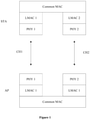
- Figure 1 is a diagram of a multi-link Wi-Fi system according to an embodiment.
- the multi-link Wi-Fi system may include a STA, an AP and multiple links. Data frames are transmitted on the multiple links between the STA and the AP.
- the multi-link Wi-Fi system includes a first link CH1 and a second link CH2.
- the first link CH1 and the second link CH2 may occupy different frequency band resources to implement data transmission.
- the first link CH1 may occupy a frequency band with a center frequency of 2 GHz
- the second link CH2 may occupy a frequency band with a center frequency of 5 GHz.
- the first link CH1 and the second link CH2 may occupy a same frequency band to implement data transmission.
- the frequency band shared by the two links may be relatively wide so as to be used for simultaneous data transmission on the two links, or may be used by the two links for data transmission via time division multiplexing.
- data frames to be transmitted may be arranged into a queuing list of the first link CH1 and a queuing list of the second link CH2, respectively.
- the data frames to be transmitted can be arranged into queuing lists of different links in the form of indexes.
- a network layer includes a MAC layer (Common MAC), and below the MAC layer there are a first sub MAC layer LMAC1, a second sub MAC layer LMAC2, a first physical layer PHY1 and a second physical layer PHY2.
- the first sub MAC layer LMAC1 and the first physical layer PHY1 are configured to enable the STA or the AP to transmit data on the first link CH1
- the second sub MAC layer LMAC2 and the second physical layer PHY2 are configured to enable the STA or the AP to transmit data on the second link CH2.
- the multi-link Wi-Fi system include multiple links, thus, the multi-link Wi-Fi system may include multiple sub MAC layers and multiple corresponding physical layers.
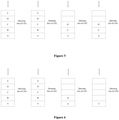
- Figure 2 is a diagram of queuing lists when data transmission is performed in the multi-link Wi-Fi system as shown in Figure 1 .
- the data frames to be transmitted include a data frame A, a data frame B, a data frame C, a data frame D and a data frame E.
- the data frames to be transmitted are arranged in a queuing list of each link, and may be transmitted on any link.
- Figure 3 is a flow chart of a data transmission method according to an embodiment
- Figures 4 to 8 are diagrams of queuing lists in the method as shown in Figure 3 .
- the method may be applied in a STA or an AP.
- the method is applied in a multi-link Wi-Fi system which includes a plurality of links, and each of the plurality of links includes a queuing list for determining a transmission order of data in the link.
- the data includes data frames and control frames.
- a portion of the plurality of links is determined as dedicated link, and the other portion of the plurality of links is determined as ordinary link.
- the dedicated link is configured to transmit control frames which include ordinary control frames and dedicated control frames
- the ordinary link is configured to transmit data frames and ordinary control frames. That is, the ordinary control frames may be transmitted on the ordinary link or the dedicated link, while the dedicated control frames may be transmitted merely on the dedicated link, and the data frames may be transmitted merely on the ordinary link.
- the control frames contain control information of the system, and the data frames contain service data.
- the multi-link Wi-Fi system includes a first link CH1, a second link CH2 and a third link CH3, and queuing lists of these links are illustrated in Figure 4 .
- the third link is a dedicated link, and the first and second links are ordinary links.
- the multi-link Wi-Fi system includes a first link CH1, a second link CH2, a third link CH3 and a fourth link CH4, and queuing lists of these links are illustrated in Figure 5 .
- the third and fourth links are dedicated links, and the first and second links are ordinary links.
- the multi-link Wi-Fi system includes a first link CH1, a second link CH2, a third link CH3 and a fourth link CH4, and queuing lists of these links are illustrated in Figure 6 .
- the third and fourth links are dedicated links, and the first and second links are ordinary links.
- the multi-link Wi-Fi system includes a first link CH1, a second link CH2 and a third link CH3, and queuing lists of these links are illustrated in Figure 7 .
- the third link is a dedicated link, and the first and second links are ordinary links.
- the AP may configure a portion of the plurality of links as dedicated link, and broadcast index information of the dedicated link. Therefore, the STA can determine which links are dedicated links.
- the AP may configure a portion of the plurality of links as dedicated link in a default way.
- the STA may receive index information of the dedicated link, and configure a portion of the plurality of links as dedicated link based on the index information.
- the STA may configure a portion of the plurality of links as dedicated link in a default way.
- the STA may determine links for control frames to be transmitted and data frames to be transmitted, and add the control frames to be transmitted and the data frames to be transmitted into queuing lists of the corresponding links.
- determining links for control frames to be transmitted and data frames to be transmitted includes: configuring the control frames to the dedicated link.
- the data to be transmitted includes an ordinary control frame A, a data frame B, an ordinary control frame C, an ordinary control frame D and a data frame E.
- the five frames are all in queuing lists of the first link and the second link.
- the frames A, C and D are the ordinary control frames, they are duplicated to a queuing list of the third link.
- the data to be transmitted includes an ordinary control frame A, a data frame B, an ordinary control frame C, an ordinary control frame D and a data frame E.
- the five frames are all in queuing lists of the first link and the second link.
- the frames A, C and D are the ordinary control frames, they are duplicated to queuing lists of the third and fourth links.
- determining links for control frames to be transmitted and data frames to be transmitted includes: dividing the control frames to a plurality of groups; and duplicating the plurality of groups of control frames to queuing lists of different dedicated links.
- the data to be transmitted includes an ordinary control frame A, a data frame B, an ordinary control frame C, an ordinary control frame D and a data frame E.
- the five frames are all in queuing lists of the first link and the second link.
- the frames A, C and D are the ordinary control frames, a first group consisting of the frames A and D is duplicated to a queuing list of the third link, and a second group consisting of the frame C is duplicated to a queuing list of the fourth link.
- the data to be transmitted includes an ordinary control frame A, a data frame B, an ordinary control frame C, an ordinary control frame D, a data frame E and a dedicated control frame F.
- the frames A, B, C, D and E are all in queuing lists of the first link and the second link.
- the frames A, C and D are the ordinary control frames
- the frame F is the dedicated control frame
- the frames A, C and D are duplicated to a queuing list of the third link
- the frame F is arranged in the queuing list of the third link.
- the STA or the AP transmits the ordinary control frame A on the first link.
- the third link obtains a transmission opportunity, and thus the ordinary control frame C is transmitted on the dedicated link.
- Embodiments as shown in Figures 5 to 7 are similar to the embodiment as shown in Figure 4 , and are not described in detail here.
- the first link CH1 is an ordinary link
- the second link CH2 is a dedicated link
- Frames A, C and D are ordinary control frames
- frames B and E are data frames.
- the ordinary control frame after transmission of one ordinary control frame on one link is completed, the ordinary control frame cannot be transmitted again on other links.
- the frame C or D when transmission of the frame C or D on the first link is completely, the frame C or D is removed from the queuing lists of the second link and the third link, that is, the frame C or D cannot be transmitted again on the second or third link.
- the ordinary control frame after transmission of one ordinary control frame on the ordinary link is completed, can be transmitted again on the dedicated link; or, after transmission of one ordinary control frame on the dedicated link is completed, the ordinary control frame can be transmitted again on the ordinary link.
- the ordinary control frame after one ordinary control frame starts to be transmitted on the ordinary link, the ordinary control frame can be transmitted again on the dedicated link; or, after one ordinary control frame starts to be transmitted on the dedicated link, the ordinary control frame can be transmitted again on the ordinary link.
- the AP duplicates the frame A to a queuing list of the second link (frame A'), and may further configure that the frame A can be repeatedly transmitted on the ordinary link and the dedicated link.
- the frame A' may also be transmitted on the second link, or, after the frame A' starts to be transmitted on the second link, the frame A may also be transmitted on the first link.
- the frame A' may be transmitted on the second link, or, after transmission of the frame A' on the second link is completed, the frame A may be transmitted on the first link.
- some STAs do not support a multi-link Wi-Fi system, however, the above mechanism that allows ordinary control frames to be repeatedly transmitted on multiple links ensures that the STAs can receive ordinary control frames, thereby improving compatibility and stability of the system.
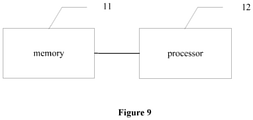
- Figure 9 is a structural diagram of a data transmission device according to an embodiment.
- the device may be applied in a STA or an AP.
- the device includes a memory 11 and a processor 12, where the memory 11 has a computer program stored therein which can be run on the processor 12 and is for implementing steps in the above data transmission method, and when the processor 12 executes the computer program, the steps are performed.
- the memory 11 may include a Read Only Memory (ROM), a Random Access Memory (RAM), a magnetic disk or an optical disk.
- ROM Read Only Memory
- RAM Random Access Memory
- the steps of the data transmission method can be referred to the above descriptions, and are not described in detail here.
Landscapes
- Engineering & Computer Science (AREA)
- Signal Processing (AREA)
- Computer Networks & Wireless Communication (AREA)
- Quality & Reliability (AREA)
- Mobile Radio Communication Systems (AREA)
Abstract
Description
- This application claims the benefit of priority to
Chinese Patent Application No. 201910327698.0, filed on April 22, 2019 - The present disclosure generally relates to communication field, and more particularly, to a data transmission method and device.
- In a conventional Wireless Fidelity (Wi-Fi) system, there is merely one Media Access Control (MAC) layer and one physical layer. Therefore, control and management frames (referred as control frames hereinafter) and data frames are transmitted merely on a single link in the Wi-Fi system. Therefore, in some cases, control information of the system cannot be transmitted in time.
- At present, there are some solutions for multi-link Wi-Fi systems. However, in multi-link Wi-Fi systems, transmission efficiency of control information still needs to be improved.
- In an embodiment of the present disclosure, a data transmission method is provided, wherein the method is applied in a multi-link Wi-Fi system which includes a plurality of links, each of the plurality of links includes a queuing list for determining a transmission order of data in the link, and the method includes: determining a portion of the plurality of links as dedicated link, and the other portion of the plurality of links as ordinary link, wherein the dedicated link is configured to transmit control frames which include ordinary control frames and dedicated control frames, and the ordinary link is configured to transmit data frames and ordinary control frames; determining links for control frames to be transmitted and data frames to be transmitted; and when the dedicated link or the ordinary link obtains a transmission opportunity, transmitting a control frame or a data frame at a head of a queuing list of the link.
- Optionally, determining a portion of the plurality of links as dedicated link includes: an Access Point (AP) configuring a portion of the plurality of links as dedicated link.
- Optionally, after the portion of the plurality of links is determined as dedicated link, the method further includes: the AP broadcasting index information of the dedicated link.
- Optionally, determining a portion of the plurality of links as dedicated link includes: an AP configuring a portion of the plurality of links as dedicated link in a default way.
- Optionally, determining a portion of the plurality of links as dedicated link includes: a station (STA) receiving index information of the dedicated link; and configuring a portion of the plurality of links as dedicated link based on the index information.
- Optionally, determining a portion of the plurality of links as dedicated link includes: a STA configuring a portion of the plurality of links as dedicated link in a default way.
- Optionally, determining links for control frames to be transmitted and data frames to be transmitted includes: configuring the control frames to the dedicated link.
- Optionally, determining links for control frames to be transmitted and data frames to be transmitted includes: dividing the control frames to a plurality of groups; and duplicating the plurality of groups of control frames to queuing lists of different dedicated links.
- Optionally, after transmission of one ordinary control frame on the ordinary link is completed, the ordinary control frame can be transmitted again on the dedicated link; or, after transmission of one ordinary control frame on the dedicated link is completed, the ordinary control frame can be transmitted again on the ordinary link.
- Optionally, after one ordinary control frame starts to be transmitted on the ordinary link, the ordinary control frame can be transmitted again on the dedicated link; or, after one ordinary control frame starts to be transmitted on the dedicated link, the ordinary control frame can be transmitted again on the ordinary link.
- Optionally, after transmission of one ordinary control frame on one link is completed, the ordinary control frame cannot be transmitted again on other links.
- In an embodiment of the present disclosure, a data transmission device including a memory and a processor is provided, wherein the memory has a computer program stored therein, and when the processor executes the computer program, the above data transmission method is performed.
- Embodiments of the present disclosure may provide following advantages.
- In embodiments of the present disclosure, the data transmission method includes: determining a portion of a plurality of links as dedicated link, and the other portion of the plurality of links as ordinary link, wherein the dedicated link is configured to transmit control frames which include ordinary control frames and dedicated control frames, and the ordinary link is configured to transmit data frames and ordinary control frames; determining links for control frames to be transmitted and data frames to be transmitted; and when the dedicated link or the ordinary link obtains a transmission opportunity, transmitting a control frame or a data frame at a head of a queuing list of the link. By configuring the dedicated link, transmission efficiency of the control frames may be improved, compatibility with existing systems is relatively good, and complexity of design is relatively low.
-
-
Figure 1 is a diagram of a multi-link Wi-Fi system according to an embodiment; -
Figure 2 is a diagram of queuing lists when data transmission is performed in the multi-link Wi-Fi system as shown inFigure 1 ; -
Figure 3 is a flow chart of a data transmission method according to an embodiment; -
Figure 4 is a diagram of queuing lists in the method as shown inFigure 3 ; -
Figure 5 is a diagram of queuing lists in the method as shown inFigure 3 ; -
Figure 6 is a diagram of queuing lists in the method as shown inFigure 3 ; -
Figure 7 is a diagram of queuing lists in the method as shown inFigure 3 ; -
Figure 8 is a diagram of queuing lists in the method as shown inFigure 3 ; and -
Figure 9 is a structural diagram of a data transmission device according to an embodiment. - Referring to
Figure 1, Figure 1 is a diagram of a multi-link Wi-Fi system according to an embodiment. - The multi-link Wi-Fi system may include a STA, an AP and multiple links. Data frames are transmitted on the multiple links between the STA and the AP. In the embodiment as shown in
Figure 1 , the multi-link Wi-Fi system includes a first link CH1 and a second link CH2. - In some embodiments, the first link CH1 and the second link CH2 may occupy different frequency band resources to implement data transmission. For example, the first link CH1 may occupy a frequency band with a center frequency of 2 GHz, and the second link CH2 may occupy a frequency band with a center frequency of 5 GHz. In some embodiments, the first link CH1 and the second link CH2 may occupy a same frequency band to implement data transmission. In some embodiments, the frequency band shared by the two links may be relatively wide so as to be used for simultaneous data transmission on the two links, or may be used by the two links for data transmission via time division multiplexing.
- In the embodiment as shown in
Figure 1 , at the STA, data frames to be transmitted may be arranged into a queuing list of the first link CH1 and a queuing list of the second link CH2, respectively. In some embodiments, the data frames to be transmitted can be arranged into queuing lists of different links in the form of indexes. - In the embodiment as shown in
Figure 1 , at either the STA or the AP, a network layer includes a MAC layer (Common MAC), and below the MAC layer there are a first sub MAC layer LMAC1, a second sub MAC layer LMAC2, a first physical layer PHY1 and a second physical layer PHY2. Specifically, the first sub MAC layer LMAC1 and the first physical layer PHY1 are configured to enable the STA or the AP to transmit data on the first link CH1, and the second sub MAC layer LMAC2 and the second physical layer PHY2 are configured to enable the STA or the AP to transmit data on the second link CH2. In some embodiments, the multi-link Wi-Fi system include multiple links, thus, the multi-link Wi-Fi system may include multiple sub MAC layers and multiple corresponding physical layers. - Referring to
Figure 2, Figure 2 is a diagram of queuing lists when data transmission is performed in the multi-link Wi-Fi system as shown inFigure 1 . The data frames to be transmitted include a data frame A, a data frame B, a data frame C, a data frame D and a data frame E. In an existing multi-link Wi-Fi system, the data frames to be transmitted are arranged in a queuing list of each link, and may be transmitted on any link. - Referring to
Figures 3 to 8 ,Figure 3 is a flow chart of a data transmission method according to an embodiment, andFigures 4 to 8 are diagrams of queuing lists in the method as shown inFigure 3 . The method may be applied in a STA or an AP. - The method is applied in a multi-link Wi-Fi system which includes a plurality of links, and each of the plurality of links includes a queuing list for determining a transmission order of data in the link. The data includes data frames and control frames.
- In S11, a portion of the plurality of links is determined as dedicated link, and the other portion of the plurality of links is determined as ordinary link.
- The dedicated link is configured to transmit control frames which include ordinary control frames and dedicated control frames, and the ordinary link is configured to transmit data frames and ordinary control frames. That is, the ordinary control frames may be transmitted on the ordinary link or the dedicated link, while the dedicated control frames may be transmitted merely on the dedicated link, and the data frames may be transmitted merely on the ordinary link. The control frames contain control information of the system, and the data frames contain service data.
- Referring to
Figure 4 , in the embodiment as shown inFigure 4 , the multi-link Wi-Fi system includes a first link CH1, a second link CH2 and a third link CH3, and queuing lists of these links are illustrated inFigure 4 . The third link is a dedicated link, and the first and second links are ordinary links. - In the embodiment as shown in
Figure 5 , the multi-link Wi-Fi system includes a first link CH1, a second link CH2, a third link CH3 and a fourth link CH4, and queuing lists of these links are illustrated inFigure 5 . The third and fourth links are dedicated links, and the first and second links are ordinary links. - In the embodiment as shown in
Figure 6 , the multi-link Wi-Fi system includes a first link CH1, a second link CH2, a third link CH3 and a fourth link CH4, and queuing lists of these links are illustrated inFigure 6 . The third and fourth links are dedicated links, and the first and second links are ordinary links. - In the embodiment as shown in
Figure 7 , the multi-link Wi-Fi system includes a first link CH1, a second link CH2 and a third link CH3, and queuing lists of these links are illustrated inFigure 7 . The third link is a dedicated link, and the first and second links are ordinary links. - In some embodiments, the AP may configure a portion of the plurality of links as dedicated link, and broadcast index information of the dedicated link. Therefore, the STA can determine which links are dedicated links.
- In some embodiments, the AP may configure a portion of the plurality of links as dedicated link in a default way.
- In some embodiments, the STA may receive index information of the dedicated link, and configure a portion of the plurality of links as dedicated link based on the index information.
- In some embodiments, the STA may configure a portion of the plurality of links as dedicated link in a default way.
- In S12, links for control frames to be transmitted and data frames to be transmitted are determined.
- In some embodiments, after a portion of the plurality of links is determined as dedicated link, the STA may determine links for control frames to be transmitted and data frames to be transmitted, and add the control frames to be transmitted and the data frames to be transmitted into queuing lists of the corresponding links.
- In some embodiments, determining links for control frames to be transmitted and data frames to be transmitted includes: configuring the control frames to the dedicated link.
- For example, in the embodiment as shown in
Figure 4 , the data to be transmitted includes an ordinary control frame A, a data frame B, an ordinary control frame C, an ordinary control frame D and a data frame E. The five frames are all in queuing lists of the first link and the second link. As the frames A, C and D are the ordinary control frames, they are duplicated to a queuing list of the third link. - For another example, in the embodiment as shown in
Figure 5 , the data to be transmitted includes an ordinary control frame A, a data frame B, an ordinary control frame C, an ordinary control frame D and a data frame E. The five frames are all in queuing lists of the first link and the second link. As the frames A, C and D are the ordinary control frames, they are duplicated to queuing lists of the third and fourth links. - In some embodiments, determining links for control frames to be transmitted and data frames to be transmitted includes: dividing the control frames to a plurality of groups; and duplicating the plurality of groups of control frames to queuing lists of different dedicated links.
- For example, in the embodiment as shown in
Figure 6 , the data to be transmitted includes an ordinary control frame A, a data frame B, an ordinary control frame C, an ordinary control frame D and a data frame E. The five frames are all in queuing lists of the first link and the second link. As the frames A, C and D are the ordinary control frames, a first group consisting of the frames A and D is duplicated to a queuing list of the third link, and a second group consisting of the frame C is duplicated to a queuing list of the fourth link. - For another example, in the embodiment as shown in
Figure 7 , the data to be transmitted includes an ordinary control frame A, a data frame B, an ordinary control frame C, an ordinary control frame D, a data frame E and a dedicated control frame F. The frames A, B, C, D and E are all in queuing lists of the first link and the second link. As the frames A, C and D are the ordinary control frames, and the frame F is the dedicated control frame, the frames A, C and D are duplicated to a queuing list of the third link, and the frame F is arranged in the queuing list of the third link. - In S13, when the dedicated link or the ordinary link obtains a transmission opportunity, a control frame or a data frame at a head of a queuing list of the link is transmitted.
- In the embodiment as shown in
Figure 4 , if the first link obtains a transmission opportunity, the STA or the AP transmits the ordinary control frame A on the first link. In some embodiments, after the frame A starts to be transmitted, the third link obtains a transmission opportunity, and thus the ordinary control frame C is transmitted on the dedicated link. - Embodiments as shown in
Figures 5 to 7 are similar to the embodiment as shown inFigure 4 , and are not described in detail here. - Referring to
Figure 8 , in the embodiment as shown inFigure 8 , the first link CH1 is an ordinary link, and the second link CH2 is a dedicated link. Frames A, C and D are ordinary control frames, and frames B and E are data frames. - In some embodiments, after transmission of one ordinary control frame on one link is completed, the ordinary control frame cannot be transmitted again on other links. Referring to
Figure 4 , when transmission of the frame C or D on the first link is completely, the frame C or D is removed from the queuing lists of the second link and the third link, that is, the frame C or D cannot be transmitted again on the second or third link. - In some embodiments, after transmission of one ordinary control frame on the ordinary link is completed, the ordinary control frame can be transmitted again on the dedicated link; or, after transmission of one ordinary control frame on the dedicated link is completed, the ordinary control frame can be transmitted again on the ordinary link.
- In some embodiments, after one ordinary control frame starts to be transmitted on the ordinary link, the ordinary control frame can be transmitted again on the dedicated link; or, after one ordinary control frame starts to be transmitted on the dedicated link, the ordinary control frame can be transmitted again on the ordinary link.
- In the embodiment as shown in
Figure 8 , the AP duplicates the frame A to a queuing list of the second link (frame A'), and may further configure that the frame A can be repeatedly transmitted on the ordinary link and the dedicated link. In some embodiments, after the frame A starts to be transmitted on the first link, the frame A' may also be transmitted on the second link, or, after the frame A' starts to be transmitted on the second link, the frame A may also be transmitted on the first link. In some embodiments, after transmission of the frame A on the first link is completed, the frame A' may be transmitted on the second link, or, after transmission of the frame A' on the second link is completed, the frame A may be transmitted on the first link. - In some embodiments, some STAs do not support a multi-link Wi-Fi system, however, the above mechanism that allows ordinary control frames to be repeatedly transmitted on multiple links ensures that the STAs can receive ordinary control frames, thereby improving compatibility and stability of the system.
- Referring to
Figure 9, Figure 9 is a structural diagram of a data transmission device according to an embodiment. The device may be applied in a STA or an AP. The device includes amemory 11 and aprocessor 12, where thememory 11 has a computer program stored therein which can be run on theprocessor 12 and is for implementing steps in the above data transmission method, and when theprocessor 12 executes the computer program, the steps are performed. Thememory 11 may include a Read Only Memory (ROM), a Random Access Memory (RAM), a magnetic disk or an optical disk. The steps of the data transmission method can be referred to the above descriptions, and are not described in detail here. - Although the present disclosure has been disclosed above with reference to preferred embodiments thereof, it should be understood that the disclosure is presented by way of example only, and not limitation. Those skilled in the art can modify and vary the embodiments without departing from the spirit and scope of the present disclosure.
Claims (12)
- A data transmission method, characterized in that the method is applied in a multi-link Wi-Fi system which comprises a plurality of links, each of the plurality of links comprises a queuing list for determining a transmission order of data in the link, and the method comprises:determining a portion of the plurality of links as dedicated link, and the other portion of the plurality of links as ordinary link, wherein the dedicated link is configured to transmit control frames which comprise ordinary control frames and dedicated control frames, and the ordinary link is configured to transmit data frames and ordinary control frames;determining links for control frames to be transmitted and data frames to be transmitted; andtransmitting a control frame or a data frame at a head of a queuing list of the dedicated link or the ordinary link based on the dedicated link or the ordinary link obtaining a transmission opportunity.
- The method according to claim 1, characterized in that said determining a portion of the plurality of links as dedicated link comprises:
an access point configuring a portion of the plurality of links as dedicated link. - The method according to claim 2, characterized in that after the portion of the plurality of links is determined as dedicated link, the method further comprises:
the access point broadcasting index information of the dedicated link. - The method according to claim 1, characterized in that said determining a portion of the plurality of links as dedicated link comprises:
an access point configuring a portion of the plurality of links as dedicated link in a default way. - The method according to claim 1, characterized in that said determining a portion of the plurality of links as dedicated link comprises:a station receiving index information of the dedicated link; andconfiguring a portion of the plurality of links as dedicated link based on the index information.
- The method according to claim 1, characterized in that said determining a portion of the plurality of links as dedicated link comprises:
a station configuring a portion of the plurality of links as dedicated link in a default way. - The method according to claim 1, characterized in that said determining links for control frames to be transmitted and data frames to be transmitted comprises:
configuring the control frames to the dedicated link. - The method according to claim 1, characterized in that said determining links for control frames to be transmitted and data frames to be transmitted comprises:dividing the control frames to a plurality of groups; andduplicating the plurality of groups of control frames to queuing lists of different dedicated links.
- The method according to claim 1, characterized in that after transmission of one ordinary control frame on the ordinary link is completed, the ordinary control frame can be transmitted again on the dedicated link; or, after transmission of one ordinary control frame on the dedicated link is completed, the ordinary control frame can be transmitted again on the ordinary link.
- The method according to claim 1, characterized in that after one ordinary control frame starts to be transmitted on the ordinary link, the ordinary control frame can be transmitted again on the dedicated link; or, after one ordinary control frame starts to be transmitted on the dedicated link, the ordinary control frame can be transmitted again on the ordinary link.
- The method according to claim 1, characterized in that after transmission of one ordinary control frame on one link is completed, the ordinary control frame cannot be transmitted again on other links.
- A data transmission device comprising a memory and a processor, characterized in that the memory has a computer program stored therein, and when the processor executes the computer program, the method according to any one of claims 1 to 11 is performed.
Applications Claiming Priority (2)
| Application Number | Priority Date | Filing Date | Title |
|---|---|---|---|
| CN201910327698.0A CN111294858B (en) | 2019-04-22 | 2019-04-22 | Data transmission method and device |
| PCT/CN2020/080457 WO2020215948A1 (en) | 2019-04-22 | 2020-03-20 | Data transmission method and apparatus |
Publications (2)
| Publication Number | Publication Date |
|---|---|
| EP3962156A1 true EP3962156A1 (en) | 2022-03-02 |
| EP3962156A4 EP3962156A4 (en) | 2023-01-04 |
Family
ID=71024095
Family Applications (1)
| Application Number | Title | Priority Date | Filing Date |
|---|---|---|---|
| EP20795704.4A Withdrawn EP3962156A4 (en) | 2019-04-22 | 2020-03-20 | DATA TRANSMISSION METHOD AND APPARATUS |
Country Status (4)
| Country | Link |
|---|---|
| US (1) | US11611903B2 (en) |
| EP (1) | EP3962156A4 (en) |
| CN (1) | CN111294858B (en) |
| WO (1) | WO2020215948A1 (en) |
Families Citing this family (2)
| Publication number | Priority date | Publication date | Assignee | Title |
|---|---|---|---|---|
| CN115695326B (en) * | 2022-09-30 | 2025-10-28 | 曙光信息产业(北京)有限公司 | Data frame transmission method, device, computer equipment and storage medium |
| CN120111462B (en) * | 2025-03-06 | 2026-01-02 | 北方工业大学 | A method, apparatus and system for communication between robots |
Family Cites Families (13)
| Publication number | Priority date | Publication date | Assignee | Title |
|---|---|---|---|---|
| CN101873700B (en) * | 2009-04-21 | 2013-03-27 | 华为技术有限公司 | Method, device and system for transmitting data |
| CN103580773A (en) * | 2012-07-18 | 2014-02-12 | 中兴通讯股份有限公司 | Method and device for transmitting data frame |
| US9516356B2 (en) * | 2013-12-06 | 2016-12-06 | Cable Television Laboratories, Inc. | Parallel scheduling of multilayered media |
| CN105337705B (en) * | 2014-08-06 | 2020-06-23 | 中兴通讯股份有限公司 | Data transmission feedback, data transmission method and device |
| US9955478B2 (en) | 2015-04-17 | 2018-04-24 | Qualcomm Incorporated | Techniques for managing communications in a shared radio frequency spectrum band |
| KR102376335B1 (en) | 2015-09-18 | 2022-03-18 | 삼성전자주식회사 | Method and apparatus for broadcasting using channel information |
| CN105553868A (en) | 2015-09-21 | 2016-05-04 | 宇龙计算机通信科技(深圳)有限公司 | Data transmission method and device and terminal |
| US20170311204A1 (en) * | 2016-04-26 | 2017-10-26 | Laurent Cariou | Access point (ap), station (sta) and method for link aggregation |
| CN106455107B (en) * | 2016-11-04 | 2019-06-11 | 武汉大学 | A preemptive Wi-Fi TDMA access control method |
| US10856203B2 (en) * | 2017-01-19 | 2020-12-01 | Qualcomm Incorporated | Signaling for link aggregation setup and reconfiguration |
| US10659540B2 (en) * | 2017-03-27 | 2020-05-19 | Intel IP Corporation | [5G next generation Wi-Fi] on the fly traffic steering for collocated multi-band aggregation |
| CN109640310B (en) * | 2019-02-12 | 2021-07-06 | Oppo广东移动通信有限公司 | Data transmission control method and related product |
| CN111294865B (en) * | 2019-04-22 | 2022-02-01 | 展讯通信(上海)有限公司 | Data transmission method and device |
-
2019
- 2019-04-22 CN CN201910327698.0A patent/CN111294858B/en active Active
-
2020
- 2020-03-20 US US16/956,928 patent/US11611903B2/en active Active
- 2020-03-20 EP EP20795704.4A patent/EP3962156A4/en not_active Withdrawn
- 2020-03-20 WO PCT/CN2020/080457 patent/WO2020215948A1/en not_active Ceased
Also Published As
| Publication number | Publication date |
|---|---|
| EP3962156A4 (en) | 2023-01-04 |
| WO2020215948A1 (en) | 2020-10-29 |
| US11611903B2 (en) | 2023-03-21 |
| CN111294858A (en) | 2020-06-16 |
| CN111294858B (en) | 2021-08-03 |
| US20210368388A1 (en) | 2021-11-25 |
Similar Documents
| Publication | Publication Date | Title |
|---|---|---|
| JP7237091B2 (en) | Methods, devices and apparatus for obtaining information and computer storage media | |
| EP2958371B1 (en) | Method and device for implementing non-centralized clustering mechanism | |
| EP3127393B1 (en) | Carrier aggregation aware load distribution | |
| EP3962163A1 (en) | Data transmission method and device | |
| US20080248805A1 (en) | Method and apparatus for subcell selection for assigning subcarrier in DAS OFDMA scheme | |
| WO2017186092A1 (en) | Network slice selection method and apparatus | |
| KR20160051852A (en) | Method for truncating service period, network controller and station | |
| EP2966904B1 (en) | Channel switching method, device, and wireless terminal | |
| US11611903B2 (en) | Data transmission method and device for multi-link Wi-Fi system | |
| CN106506132B (en) | Multi-carrier air interface reconfiguration method, user equipment and radio network controller | |
| CN102905270B (en) | Communication method and device for frequency division duplexing (FDD) system and base station | |
| WO2020174823A1 (en) | Communication device and communication method | |
| WO2011038692A1 (en) | Network node configuration information processing method, network node, and communication system | |
| US11424870B2 (en) | Data frame retransmission method and device | |
| WO2018035801A9 (en) | Message transmission method, related device, and system | |
| EP3293994B1 (en) | Method and apparatus for allocating association identifier | |
| US20210385004A1 (en) | Method and apparatus for configuring uplink time-frequency resource set, and method and apparatus for receiving uplink time-frequency resource set | |
| JP2008182618A (en) | Adaptive beacon coordination in communication networks applying multiple signal formats | |
| US20210368424A1 (en) | Information indication method, apparatus, system and device, and storage medium | |
| US10257827B2 (en) | Method for configuring frame structure, user equipment and network equipment | |
| EP3419248A1 (en) | Data processing method self-adaptive to access network architectures, access network architecture, and storage medium | |
| WO2022074769A1 (en) | Wireless base station and terminal | |
| EP4319401A1 (en) | Method for transmitting downlink control information and related device | |
| KR102026135B1 (en) | Operation method of communication node in communication network | |
| RU2803320C1 (en) | Method and device for communicating with a plurality of communication lines, electronic device and a computer-readable storage medium |
Legal Events
| Date | Code | Title | Description |
|---|---|---|---|
| STAA | Information on the status of an ep patent application or granted ep patent |
Free format text: STATUS: THE INTERNATIONAL PUBLICATION HAS BEEN MADE |
|
| PUAI | Public reference made under article 153(3) epc to a published international application that has entered the european phase |
Free format text: ORIGINAL CODE: 0009012 |
|
| STAA | Information on the status of an ep patent application or granted ep patent |
Free format text: STATUS: REQUEST FOR EXAMINATION WAS MADE |
|
| 17P | Request for examination filed |
Effective date: 20211122 |
|
| AK | Designated contracting states |
Kind code of ref document: A1 Designated state(s): AL AT BE BG CH CY CZ DE DK EE ES FI FR GB GR HR HU IE IS IT LI LT LU LV MC MK MT NL NO PL PT RO RS SE SI SK SM TR |
|
| DAV | Request for validation of the european patent (deleted) | ||
| DAX | Request for extension of the european patent (deleted) | ||
| A4 | Supplementary search report drawn up and despatched |
Effective date: 20221205 |
|
| RIC1 | Information provided on ipc code assigned before grant |
Ipc: H04L 45/24 20220101ALI20221129BHEP Ipc: H04W 76/15 20180101ALI20221129BHEP Ipc: H04W 28/10 20090101ALI20221129BHEP Ipc: H04W 28/08 20090101ALI20221129BHEP Ipc: H04W 28/02 20090101AFI20221129BHEP |
|
| STAA | Information on the status of an ep patent application or granted ep patent |
Free format text: STATUS: THE APPLICATION HAS BEEN WITHDRAWN |
|
| 18W | Application withdrawn |
Effective date: 20250221 |