EP3961979B1 - Kapazitätsbasierte netzwerkauswahl für zellulare vorrichtungen - Google Patents
Kapazitätsbasierte netzwerkauswahl für zellulare vorrichtungen Download PDFInfo
- Publication number
- EP3961979B1 EP3961979B1 EP21191399.1A EP21191399A EP3961979B1 EP 3961979 B1 EP3961979 B1 EP 3961979B1 EP 21191399 A EP21191399 A EP 21191399A EP 3961979 B1 EP3961979 B1 EP 3961979B1
- Authority
- EP
- European Patent Office
- Prior art keywords
- wireless communication
- supports
- cellular communications
- invite message
- communication device
- Prior art date
- Legal status (The legal status is an assumption and is not a legal conclusion. Google has not performed a legal analysis and makes no representation as to the accuracy of the status listed.)
- Active
Links
Images

Classifications
-
- H—ELECTRICITY
- H04—ELECTRIC COMMUNICATION TECHNIQUE
- H04L—TRANSMISSION OF DIGITAL INFORMATION, e.g. TELEGRAPHIC COMMUNICATION
- H04L65/00—Network arrangements, protocols or services for supporting real-time applications in data packet communication
- H04L65/1066—Session management
- H04L65/1069—Session establishment or de-establishment
-
- H—ELECTRICITY
- H04—ELECTRIC COMMUNICATION TECHNIQUE
- H04L—TRANSMISSION OF DIGITAL INFORMATION, e.g. TELEGRAPHIC COMMUNICATION
- H04L12/00—Data switching networks
- H04L12/02—Details
- H04L12/14—Charging, metering or billing arrangements for data wireline or wireless communications
-
- H—ELECTRICITY
- H04—ELECTRIC COMMUNICATION TECHNIQUE
- H04L—TRANSMISSION OF DIGITAL INFORMATION, e.g. TELEGRAPHIC COMMUNICATION
- H04L12/00—Data switching networks
- H04L12/02—Details
- H04L12/14—Charging, metering or billing arrangements for data wireline or wireless communications
- H04L12/1403—Architecture for metering, charging or billing
-
- H—ELECTRICITY
- H04—ELECTRIC COMMUNICATION TECHNIQUE
- H04L—TRANSMISSION OF DIGITAL INFORMATION, e.g. TELEGRAPHIC COMMUNICATION
- H04L12/00—Data switching networks
- H04L12/02—Details
- H04L12/14—Charging, metering or billing arrangements for data wireline or wireless communications
- H04L12/1403—Architecture for metering, charging or billing
- H04L12/1407—Policy-and-charging control [PCC] architecture
-
- H—ELECTRICITY
- H04—ELECTRIC COMMUNICATION TECHNIQUE
- H04L—TRANSMISSION OF DIGITAL INFORMATION, e.g. TELEGRAPHIC COMMUNICATION
- H04L65/00—Network arrangements, protocols or services for supporting real-time applications in data packet communication
- H04L65/10—Architectures or entities
- H04L65/1016—IP multimedia subsystem [IMS]
-
- H—ELECTRICITY
- H04—ELECTRIC COMMUNICATION TECHNIQUE
- H04L—TRANSMISSION OF DIGITAL INFORMATION, e.g. TELEGRAPHIC COMMUNICATION
- H04L65/00—Network arrangements, protocols or services for supporting real-time applications in data packet communication
- H04L65/10—Architectures or entities
- H04L65/102—Gateways
- H04L65/1043—Gateway controllers, e.g. media gateway control protocol [MGCP] controllers
-
- H—ELECTRICITY
- H04—ELECTRIC COMMUNICATION TECHNIQUE
- H04L—TRANSMISSION OF DIGITAL INFORMATION, e.g. TELEGRAPHIC COMMUNICATION
- H04L65/00—Network arrangements, protocols or services for supporting real-time applications in data packet communication
- H04L65/10—Architectures or entities
- H04L65/1045—Proxies, e.g. for session initiation protocol [SIP]
-
- H—ELECTRICITY
- H04—ELECTRIC COMMUNICATION TECHNIQUE
- H04M—TELEPHONIC COMMUNICATION
- H04M15/00—Arrangements for metering, time-control or time indication ; Metering, charging or billing arrangements for voice wireline or wireless communications, e.g. VoIP
- H04M15/57—Arrangements for metering, time-control or time indication ; Metering, charging or billing arrangements for voice wireline or wireless communications, e.g. VoIP for integrated multimedia messaging subsystem [IMS]
-
- H—ELECTRICITY
- H04—ELECTRIC COMMUNICATION TECHNIQUE
- H04M—TELEPHONIC COMMUNICATION
- H04M15/00—Arrangements for metering, time-control or time indication ; Metering, charging or billing arrangements for voice wireline or wireless communications, e.g. VoIP
- H04M15/63—Arrangements for metering, time-control or time indication ; Metering, charging or billing arrangements for voice wireline or wireless communications, e.g. VoIP based on the content carried by the session initiation protocol [SIP] messages
-
- H—ELECTRICITY
- H04—ELECTRIC COMMUNICATION TECHNIQUE
- H04M—TELEPHONIC COMMUNICATION
- H04M15/00—Arrangements for metering, time-control or time indication ; Metering, charging or billing arrangements for voice wireline or wireless communications, e.g. VoIP
- H04M15/66—Policy and charging system
-
- H—ELECTRICITY
- H04—ELECTRIC COMMUNICATION TECHNIQUE
- H04M—TELEPHONIC COMMUNICATION
- H04M15/00—Arrangements for metering, time-control or time indication ; Metering, charging or billing arrangements for voice wireline or wireless communications, e.g. VoIP
- H04M15/82—Criteria or parameters used for performing billing operations
- H04M15/8228—Session based
-
- H—ELECTRICITY
- H04—ELECTRIC COMMUNICATION TECHNIQUE
- H04W—WIRELESS COMMUNICATION NETWORKS
- H04W12/00—Security arrangements; Authentication; Protecting privacy or anonymity
- H04W12/08—Access security
- H04W12/084—Access security using delegated authorisation, e.g. open authorisation [OAuth] protocol
-
- H—ELECTRICITY
- H04—ELECTRIC COMMUNICATION TECHNIQUE
- H04W—WIRELESS COMMUNICATION NETWORKS
- H04W12/00—Security arrangements; Authentication; Protecting privacy or anonymity
- H04W12/30—Security of mobile devices; Security of mobile applications
- H04W12/37—Managing security policies for mobile devices or for controlling mobile applications
-
- H—ELECTRICITY
- H04—ELECTRIC COMMUNICATION TECHNIQUE
- H04W—WIRELESS COMMUNICATION NETWORKS
- H04W4/00—Services specially adapted for wireless communication networks; Facilities therefor
- H04W4/24—Accounting or billing
-
- H—ELECTRICITY
- H04—ELECTRIC COMMUNICATION TECHNIQUE
- H04W—WIRELESS COMMUNICATION NETWORKS
- H04W8/00—Network data management
- H04W8/22—Processing or transfer of terminal data, e.g. status or physical capabilities
- H04W8/24—Transfer of terminal data
-
- H—ELECTRICITY
- H04—ELECTRIC COMMUNICATION TECHNIQUE
- H04L—TRANSMISSION OF DIGITAL INFORMATION, e.g. TELEGRAPHIC COMMUNICATION
- H04L65/00—Network arrangements, protocols or services for supporting real-time applications in data packet communication
- H04L65/1066—Session management
- H04L65/1101—Session protocols
- H04L65/1104—Session initiation protocol [SIP]
Definitions
- Legacy systems may be used as backups and to serve geographic areas in which the newer are not yet implemented. Legacy technologies may also be supported in order to provide service to customers whose devices do not support the newer technologies.
- 4 th -Generation (4G) cellular networks continue to be used during development and deployment of 5 th -Generation (5G) cellular networks.
- This allows existing 4G mobile devices to be used in places where a network has not implemented 5G technologies.
- SA WG2 no. Newport Beach, CA, US; 20180528 - 20180601 27 May 2018 (2018-05-27 ), discusses on which basis the Core Network selects a SMF/UPF or a PGW for the IMS APN.
- the UE provides the P-CSCF with an indication that it supports SG NAS.
- US 2019/306324 A1 discloses an application function (AF) of an IP Multimedia Subsystem (IMS) in communication with multiple Policy Control Function (PCF) domains of a telecommunication network.
- the AF reviews attributes of a particular communication session, and identifies a particular one of the PCF domains that corresponds to the attributes.
- the AF sends a request about the communication session to a PCF element of the identified PCF domain over an Rx interface.
- WO 2020/063971 A1 discloses a PCF+PCRF selection method, an AMF, a BSF and a storage medium, belonging to the field of communications.
- the method comprises: when an AMF detects that UE is switched from 4G to 5G, querying from a BSF the PCF+PCRF selected by an SMF+PGW-C for the UE; requesting access and mobility policy control from the selected PCF+PCRF.
- the PCF+PCRF selected by the SMF+PGW-C for the UE in 4G access is queried from newly-introduced BSF of 5G, and the access and mobility policy control are requested from the selected PCF+PCRF, so that when the UE is switched from 4G to 5G, the AMF is able to select the PCF+PCRF that the SMF+PGW-C has selected when 4G is accessed.
- the present invention provides a method as detailed in claim 1. Also provided is a system according to claim 9 and a wireless communication device according to claim 15. Advantageous features are provided in the dependent claims.
- Described herein are techniques for initiating a voice communication session in a system that supports both current and legacy cellular technologies, such as cellular communication networks that support legacy 4 th -Generation networks while also having at least partial deployment of newer 5 th -Generation (5G) technologies.
- legacy cellular technologies such as cellular communication networks that support legacy 4 th -Generation networks while also having at least partial deployment of newer 5 th -Generation (5G) technologies.
- a voice communication session is typically initiated when a mobile device sends a Session Initiation Protocol (SIP) INVITE message to its network.
- An IP Multimedia Session (IMS) core of the network responds to a SIP INVITE message by establishing a dedicated bearer.
- establishing a dedicated bearer with a mobile device involves different procedures, depending on whether the dedicated bearer will use 4G or 5G technologies. If the dedicated bearer will use 4G technologies, the IMS core communicates with a Policy and Charging Rules Function (PCRF), which is part of a 4G system, to request the establishment of the dedicated bearer. If the dedicated bearer will use 5G technologies, the IMS core communicates with a Policy Control Function (PCF), which is part of a 5G system, to request the dedicated bearer.
- PCF Policy Control Function
- the IMS core may not have information regarding the capabilities of the mobile device with which the dedicated bearer will be established, and therefore may not be able to determine which of the 4G and 5G systems to use for the dedicated bearer.
- a 5G-capable device that initiates a Voice over IP (VOIP) communication session adds an Information Element (IE) as part of its SIP INVITE message to indicate that the device supports 5G cellular communications.
- the IMS core uses this indication to determine whether to establish a dedicated bearer through the network's 4G system or 5G system. Specifically, if the SIP INVITE message has an IE indicating that the device supports 5G, the dedicated bearer is established through the PCR of the 5G system. Otherwise, if the IE indicates that the system does not support 5G or if the IE is absent from the SIP INVITE message, the dedicated bearer is established through the PCRF of the 4G system.
- IE Information Element
- the described techniques improve the experiences of users by ensuring that legacy 4G devices are able to function within a network even after the network has implemented 5G technologies, while allowing 5G-compatible devices to take advantage of any available 5G technologies.
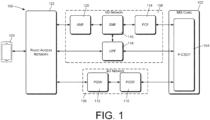
- FIG. 1 illustrates an example cellular communication system 100 in which the described techniques may be implemented.
- the system 100 comprises an IP Multimedia Subsystem (IMS) core 102 that provides IP multimedia services such as messaging, video conferencing, and so forth.
- IMS IP Multimedia Subsystem
- the system 100 also includes a 4 th -Generation (4G) cellular communication network 106 and a 5 th -Generation (5G) cellular communication network 108, which may be referred to herein as the 4G network 106 and the 5G network 108, respectively.
- 4G 4 th -Generation
- 5G 5 th -Generation
- the IMS core 102 may include various components and functions in accordance with relevant standards and specifications. Most relevant to the discussion below, the IMS core 102 includes a Session Initiation Protocol (SIP) control function, shown in the described embodiment as a Proxy Call Session Control Function (P-CSCF) 104, that is responsible for various functions, including initiating dedicated bearers for voice communication sessions.
- SIP Session Initiation Protocol
- P-CSCF Proxy Call Session Control Function
- the 4G network 106 may comprise a Long-Term Evolution (LTE) network, as one example.
- the 4G network 106 may have a Policy and Charging Rules Function (PCRF) 110 and a Packet Data Network Gateway (PGW) 112, which may include a user plane PGW (PGW-U) and a control plane PGW (PGW-C).
- PCRF Policy and Charging Rules Function
- PGW Packet Data Network Gateway
- PGW-U user plane PGW
- PGW-C control plane PGW
- the 4G network may include other components, functions, and nodes that are not shown in FIG. 1 .
- the 5G communication network may include a Policy Control Function (PCF) 114, a Session Management Function (SMF) 116, a User Plane Function (UPF) 118, and an Access and Mobility Management Function (AMF) 120, among other components, functions, and nodes that are not shown in FIG. 1 .
- PCF Policy Control Function
- SMF Session Management Function
- UPF User Plane Function
- AMF Access and Mobility Management Function
- the system may include one or more radio access networks 122, which may include a 4G LTE radio access network and/or a 5G New Radio (NR) radio access network.
- radio access networks 122 may include a 4G LTE radio access network and/or a 5G New Radio (NR) radio access network.
- 4G LTE radio access network may include a 4G LTE radio access network and/or a 5G New Radio (NR) radio access network.
- NR New Radio
- the example of FIG. 1 includes a wireless communication device 124 that has 4G cellular communication capabilities and that in some cases may also have 5G cellular communication capabilities. That is, the device 124 is capable of communicating through the 4G network 106 and may or may not be capable of communicating through the 5G network 108.
- the illustrated components of the 4G circuit-switched communication network 106 and the 5G packet-switched communication network 108 are examples of multiple instances of such components that are used in networks such as those described.
- the illustrated wireless communication device 124 is an example of multiple such devices that are used in conjunction with the networks 106 and 108.
- the illustrated components are arranged to illustrate certain relationships and communications that are most relevant to the topics discussed herein.
- the system 100 may have various other components, functions, and/or nodes, which may use various other communication paths that are not shown in FIG. 1 .
- a Voice Over IP (VOIP) communication session may be initiated by sending a Session Initiation Protocol (SIP) INVITE message to the P-CSCF 104 of the IMS core 102.
- SIP Session Initiation Protocol
- the SIP INVITE message may be sent by the device 124 through the UPF 118 of the 5G network 108.
- the UPF 118 forwards the SIP INVITE message to the IMS core 102.
- the device 124 is configured to include an information element in the SIP INVITE message indicating whether the device 124 has 5G capabilities.
- the P-CSCF 104 responds to the SIP INVITE message by communicating with either the PCRF 110 of the 4G network 106 or the PCF 114 of the 5G network 108 to request a dedicated bearer.
- the P-CSCF 104 sends a Diameter-Protocol Authorization Authentication Request (AAR) to the PCRF 110 to initiate establishment of a 4G/LTE dedicated bearer.
- AAR Diameter-Protocol Authorization Authentication Request
- the PCRF 110 responds by sending a Reauthorization Request (RAR) to the PGW 112.
- RAR Reauthorization Request
- Various additional communications may occur in the process of setting up a 4G/LTE dedicated bearer, including communications with the radio access network 122, in accordance with applicable specifications and standards.
- the P-CSCF 104 sends a Diameter-Protocol AAR to the PCF 114 to initiate establishment of a SG/NR dedicated bearer.
- the PCF 114 responds by sending an N7 update notify message to the SMF 116.
- Various additional communications may occur in the process of setting up a SG/NR dedicated bearer, including communications with the radio access network 122, in accordance with applicable specifications and standards.
- the P-CSCF 104 determines whether to send an AAR to the PCRF 110 of the 4G network 106 or to the PCF 114 of the 5G network 108. To determine whether to send an AAR to the PCRF 110 of the 4G network 106 or to the PCF 114 of the 5G network 108, the P-CSCF 104 refers to the capabilities information that has been included in the SIP INVITE message received from the device 124. If the capabilities information indicates that the device 124 supports 5G services, the P-CSCF 104 sends an AAR to the PCF 114. If the capabilities information is absent or does not indicate that the device 124 supports 5G services, the P-CSCF 104 sends the AAR to the PCRF 110.
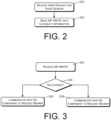
- FIG. 2 illustrates an example method 200 that may be performed by a cellular or other wireless communication device in accordance with the techniques described herein.
- the example method 200 will be described in the context of FIG. 1 , although the method is also applicable in other environments.
- An action 202 performed by the device 124, comprises receiving a user request to initiate a voice communication session.
- a request might result from a user selecting a telephone number or other identifier and entering commands or pressing buttons to initiate a voice call.
- An action 204 is performed by the device 124 in response to receiving the user request to initiate the voice communication session.
- the action 204 comprises sending a Session Initiation Protocol (SIP) INVITE message to a cellular network.
- the device 124 typically sends the SIP INVITE message to the UPF 118 of the 5G network 108.
- the UPF 118 forwards the SIP INVITE message to the IMS core 102.
- SIP Session Initiation Protocol
- the device 124 sends the SIP INVITE message to a cellular communication system that supports both a legacy cellular technology and an advanced cellular technology.
- the legacy cellular technology might comprise the 4G network 106 and the advanced cellular technology may comprise the 5G network 108.
- the legacy cellular technology might comprise a 5G network and the advanced technology might comprise a future 6 th -Generation (6G) network.
- 6G 6 th -Generation
- the advanced network cellular technology may be of a given generation (e.g. 5G) while the legacy cellular technology may be of another generation (e.g. 4G) that is older than the given generation.
- the device 124 includes device capability information in the SIP INVITE message.
- the device capability information may be conveyed, for example, by an Information Element (IE) of the SIP INVITE message, in which a binary flag or other value may indicate whether or not the device 124 supports 5G cellular communications.
- IE Information Element
- the device 124 After sending the SIP INVITE message, the device 124 interacts with various components of the system 100 to complete setting up the requested voice session.
- FIG. 3 illustrates an example method 300 that may be performed by a network system in accordance with the techniques described herein.
- the example method 300 will be described in the context of FIG. 1 , although the method is also applicable in other environments.
- the method may be performed by the IMS core 102, and more specifically by the P-CSCF 104 of the IMS core 102.
- An action 302 comprises receiving a SIP INVITE message, from the device 124, to initiate a voice communication session with the device 124.
- the SIP INVITE message is typically relayed by the UPF 118 from the device 124 to the IMS core 102.
- the SIP INVITE message may in some cases have an IE indicating whether or not the requesting device 124 supports 5G technologies. In other cases, such as in some cases where the UE does not support 5G technologies, this IE may be absent from the SIP INVITE message.
- An action 304 which may be performed by the P-CSCF 104, comprises determining whether the received SIP INVITE message indicates that the requesting device 124 supports 5G cellular communications.
- the P-CSCF 104 may obtain device capability information from the SIP INVITE message.
- the P-CSCF 104 may obtain the device capability information from the previously discussed IE of the SIP INVITE message and determine whether the IE contains a flag or other value indicating that the device 124 supports 5G communications.
- an IE such as this may be absent from the SIP INVITE message, which is interpreted as an indication that the device 124 does not support 5G communications.
- an action 306 is performed of communicating with a 5G component such as the PCF 114 to establish a dedicated 5G bearer with the requesting device 124 using a 5G New Radio (NR) radio access network.
- the action 306 may comprise sending an AAR to the PCF 114 to request the dedicated bearer.
- an action 308 is performed of communicating with a 4G component such as the PCRF 110 to establish a 4G dedicated bearer with the requesting device 124 using a 4G Long-Term Evolution (LTE) radio access network.
- the action 308 may comprise sending an AAR to the PCRF 110 to request the dedicated bearer.
- FIG. 4 is a block diagram of an illustrative computing device 400 such as may be used to implement various components of a core network, a base station, and/or any servers, routers, gateways, administrative components, functions, or nodes that may be used within the system 100, including components and nodes of the IMS core 102, the 4G network 106, and the 5G network 108.
- the computing device 400 may include at least one processing unit 402 and system memory 404.
- the system memory 404 may be volatile (such as RAM), non-volatile (such as ROM, flash memory, etc.) or some combination of the two.
- the system memory 404 may include an operating system 406, one or more program modules 408, and may include program data 410.
- the computing device 400 may also include additional data storage devices (removable and/or non-removable) such as, for example, magnetic disks, optical disks, or tape. Such additional storage devices are illustrated in FIG. 4 as storage 412.
- Non-transitory computer storage media of the computing device 400 may include volatile and nonvolatile, removable and non-removable media, implemented in any method or technology for storage of information, such as computer readable instructions, data structures, program modules, or other data.
- the system memory 404 and storage 412 are all examples of computer-readable storage media.
- Non-transitory computer-readable storage media includes, but is not limited to, RAM, ROM, EEPROM, flash memory or other memory technology, CD-ROM, digital versatile discs (DVD) or other optical storage, magnetic cassettes, magnetic tape, magnetic disk storage or other magnetic storage devices, or any other medium which can be used to store the desired information and which can be accessed by computing device 400. Any such non-transitory computer-readable storage media may be part of the computing device 400.
- any or all of the system memory 404 and storage 412 may store programming instructions which, when executed, implement some or all of the function functionality described above.
- the computing device 400 may also have input device(s) 414 such as a keyboard, a mouse, a touch-sensitive display, voice input device, etc.
- Output device(s) 416 such as a display, speakers, a printer, etc. may also be included.
- the computing device 400 may also contain communication connections 418 that allow the device to communicate with other computing devices.
- FIG. 5 illustrates an example wireless communication device 500 that may be used in conjunction with the techniques described herein.
- the device 500 is an example of the wireless communication device 124, illustrating high-level components that are not shown in FIG. 1 .
- the device 500 may include memory 502 and a processor 504.
- the memory 502 may include both volatile memory and non-volatile memory.
- the memory 502 can also be described as non-transitory computer-readable media or machine-readable storage memory, and may include removable and non-removable media implemented in any method or technology for storage of information, such as computer executable instructions, data structures, program modules, or other data.
- the memory 502 may include a SIM (subscriber identity module), which is a removable smart card used to identify a user of the device 500 to a service provider network.
- SIM subscriber identity module
- the memory 502 may include, but is not limited to, RAM, ROM, EEPROM, flash memory or other memory technology, CD-ROM, digital versatile discs (DVD) or other optical storage, magnetic cassettes, magnetic tape, magnetic disk storage or other magnetic storage devices, or any other tangible, physical medium which can be used to store the desired information.
- the memory 502 may in some cases include storage media used to transfer or distribute instructions, applications, and/or data.
- the memory 502 may include data storage that is accessed remotely, such as network-attached storage that the device 500 accesses over some type of data communication network.
- the memory 502 stores one or more sets of computer-executable instructions (e.g., software) such as programs that embody operating logic for implementing and/or performing desired functionality of the device 500.
- the instructions may also reside at least partially within the processor 504 during execution thereof by the device 500.
- the instructions stored in the computer-readable storage media may include various applications 506 that are executed by the processor 504, an operating system (OS) 508 that is also executed by the processor 504, and data 510.
- OS operating system
- the processor(s) 504 is a central processing unit (CPU), a graphics processing unit (GPU), both CPU and GPU, or other processing unit or component known in the art. Furthermore, the processor(s) 504 may include any number of processors and/or processing cores. The processor(s) 504 is configured to retrieve and execute instructions from the memory 502.
- the device 500 may have interfaces 512, which may comprise any sort of interfaces known in the art.
- the interfaces 512 may include any one or more of an Ethernet interface, wireless local-area network (WLAN) interface, a near field interface, a DECT chipset, or an interface for an RJ-11 or RJ-45 port.
- a wireless LAN interface can include a Wi-Fi interface or a Wi-Max interface, or a Bluetooth interface that performs the function of transmitting and receiving wireless communications using, for example, the IEEE 802.11, 802.16 and/or 802.20 standards.
- the near field interface can include a Bluetooth ® interface or radio frequency identifier (RFID) for transmitting and receiving near field radio communications via a near field antenna.
- the near field interface may be used for functions, as is known in the art, such as communicating directly with nearby devices that are also, for instance, Bluetooth ® or RFID enabled.
- the device 500 may also have an LTE radio 514 and a 5G radio 516, which may be used as described above for implementing voice communications between mobile devices.
- the radios 514 and 516 transmit and receive radio frequency communications via an antenna (not shown).
- the device 500 may have a display 518, which may comprise a liquid crystal display (LCD) or any other type of display commonly used in telemobile devices or other portable devices.
- the display 518 may be a touch-sensitive display screen, which may also act as an input device or keypad, such as for providing a soft-key keyboard, navigation buttons, or the like.
- the device 500 may have input and output devices 520. These devices may include any sort of output devices known in the art, such as speakers, a vibrating mechanism, or a tactile feedback mechanism. Output devices may also include ports for one or more peripheral devices, such as headphones, peripheral speakers, or a peripheral display. Input devices may include any sort of input devices known in the art.
- the input devices may include a microphone, a keyboard/keypad, or a touch-sensitive display.
- a keyboard/keypad may be a push button numeric dialing pad (such as on a typical telemobile device), a multi-key keyboard (such as a conventional QWERTY keyboard), or one or more other types of keys or buttons, and may also include a joystick-like controller and/or designated navigation buttons, or the like.
Landscapes
- Engineering & Computer Science (AREA)
- Computer Networks & Wireless Communication (AREA)
- Signal Processing (AREA)
- Multimedia (AREA)
- Computer Security & Cryptography (AREA)
- Business, Economics & Management (AREA)
- General Business, Economics & Management (AREA)
- Accounting & Taxation (AREA)
- Databases & Information Systems (AREA)
- Mobile Radio Communication Systems (AREA)
- Telephone Function (AREA)
Claims (7)
- Verfahren, das durch ein IP-Multimedia-Subsystem, IMS, (102, 400) ausgeführt wird, das Verfahren umfassend:Empfangen (302) einer ersten INVITE-Nachricht eines Sitzungsinitiierungsprotokolls, SIP, um eine erste Sprachkommunikationssitzung mit einer ersten Drahtloskommunikationsvorrichtung (124) zu initiieren;Erhalten von ersten Vorrichtungsfähigkeitsinformationen aus der ersten SIP-INVITE-Nachricht, wobei die ersten Vorrichtungsfähigkeitsinformationen angeben, ob die erste Drahtloskommunikationsvorrichtung eine Mobilkommunikation der Fünften Generation, 5G, unterstützt, wobei die ersten Vorrichtungsfähigkeitsinformationen (124) in einem Informationselement, IE, der ersten SIP-INVITE-Nachricht enthalten sind, wobei das IE in Form eines binären Flags vorliegt, das angibt, ob die Vorrichtung (124) die 5G-Mobilkommunikation unterstützt oder nicht;Bestimmen (304), dass die ersten Vorrichtungsfähigkeitsinformationen angeben, dass die erste Drahtloskommunikationsvorrichtung 5G-Mobilfunkkommunikation unterstützt, wobei das Bestimmen darauf basiert, dass das IMS bestimmt, dass das IE das binäre Flag enthält, das angibt, dass die Vorrichtung (124) 5G-Mobilfunkkommunikation unterstützt;als Reaktion auf das Bestimmen, dass die ersten Vorrichtungsfähigkeitsinformationen angeben, dass die erste Drahtloskommunikationsvorrichtung 5G-Mobilfunkkommunikation (516) unterstützt, Kommunizieren (306) mit einer 5G-Richtliniensteuerungsfunktion, PCF, (114), um einen ersten dedizierten Träger mit der ersten Drahtloskommunikationsvorrichtung einzurichten;Empfangen (302) einer zweiten SIP-INVITE-Nachricht, um eine zweite Sprachkommunikationssitzung mit einer zweiten Drahtloskommunikationsvorrichtung (124) zu initiieren;Erhalten von zweiten Vorrichtungsfähigkeitsinformationen aus der zweiten SIP-INVITE-Nachricht, wobei die zweiten Vorrichtungsfähigkeitsinformationen angeben, ob die zweite Drahtloskommunikationsvorrichtung die Mobilkommunikation der Fünften Generation, 5G, unterstützt;wobei die zweiten Vorrichtungsfähigkeitsinformationen (124) in einem Informationselement, IE, der zweiten SIP INVITE-Nachricht enthalten sind, wobei das IE in Form eines binären Flags vorliegt, das angibt, ob die Vorrichtung (124) 5G-Mobilfunkkommunikation unterstützt oder nicht;Bestimmen (304), dass die zweite SIP-INVITE-Nachricht nicht angibt, dass die zweite Drahtloskommunikationsvorrichtung 5G-Mobilfunkkommunikation (516) unterstützt, wobei das Bestimmen darauf basiert, dass das IMS bestimmt, dass das IE das binäre Flag enthält, das angibt, dass die Vorrichtung (124) 5G-Mobilfunkkommunikation nicht unterstützt; undals Reaktion auf das Bestimmen, dass die zweite SIP-INVITE-Nachricht nicht angibt, dass die zweite Drahtloskommunikationsvorrichtung 5G-Mobilfunkkommunikation unterstützt, Kommunizieren (308) mit einer Funktion für 4G-Richtlinien und Gebührenregeln, PCRF, (110), um einen zweiten dedizierten Träger mit der zweiten Drahtloskommunikationsvorrichtung einzurichten.
- Verfahren nach Anspruch 1, wobei:das Kommunizieren mit der 5G-PCF (114) ein Senden einer ersten Diameter-Protokoll-Autorisierungs-Authentifizierungsanforderung, AAR, an die PCF umfasst; unddas Kommunizieren mit der 4G-PCRF (110) das Senden einer zweiten Diameter-Protokoll-AAR-Nachricht an die 4G-PCRF umfasst.
- Verfahren nach Anspruch 1, wobei:das Bestimmen, dass die ersten Vorrichtungsfähigkeitsinformationen angeben, dass die erste Drahtloskommunikationsvorrichtung (124) 5G-Mobilfunkkommunikation (516) unterstützt, durch eine Funktion zum Steuern von Anrufsitzungen, CSCF, des IMS (102, 400) ausgeführt wird; unddas Bestimmen, dass die zweite SIP-INVITE-Nachricht nicht angibt, dass die zweite Drahtloskommunikationsvorrichtung (124) 5G-Mobilfunkkommunikation (516) unterstützt, durch die CSCF des IMS (102, 400) ausgeführt wird.
- Verfahren nach Anspruch 1, ferner umfassend das Einrichten des ersten dedizierten Trägers unter Verwendung eines 5G-New-Radio-, NR-, Funkzugangsnetzes (108).
- Verfahren nach Anspruch 1, ferner umfassend das Einrichten des zweiten dedizierten Trägers unter Verwendung eines 4G-Long-Term-Evolution, LTE-, Funkzugangsnetzes (106).
- Verfahren nach Anspruch 1, wobei das Verfahren durch eine Funktion zum Steuern von Anrufsitzungen, CSCF, ausgeführt wird.
- System, umfassend einen oder mehrere Prozessoren und ein oder mehrere nichtflüchtige computerlesbare Medien, die computerlesbare Anweisungen speichern, die, wenn sie durch den einen oder die mehreren Prozessoren durchgeführt werden, das System veranlassen, das Verfahren nach einem der Ansprüche 1 bis 6 auszuführen.
Applications Claiming Priority (1)
| Application Number | Priority Date | Filing Date | Title |
|---|---|---|---|
| US17/001,077 US11765211B2 (en) | 2020-08-24 | 2020-08-24 | Capabilities-based network selection for cellular devices |
Publications (3)
| Publication Number | Publication Date |
|---|---|
| EP3961979A1 EP3961979A1 (de) | 2022-03-02 |
| EP3961979B1 true EP3961979B1 (de) | 2025-01-22 |
| EP3961979C0 EP3961979C0 (de) | 2025-01-22 |
Family
ID=77358116
Family Applications (1)
| Application Number | Title | Priority Date | Filing Date |
|---|---|---|---|
| EP21191399.1A Active EP3961979B1 (de) | 2020-08-24 | 2021-08-13 | Kapazitätsbasierte netzwerkauswahl für zellulare vorrichtungen |
Country Status (2)
| Country | Link |
|---|---|
| US (1) | US11765211B2 (de) |
| EP (1) | EP3961979B1 (de) |
Families Citing this family (1)
| Publication number | Priority date | Publication date | Assignee | Title |
|---|---|---|---|---|
| CN116266830A (zh) * | 2021-12-16 | 2023-06-20 | 华为技术有限公司 | 一种多媒体消息的传输方法和装置 |
Family Cites Families (6)
| Publication number | Priority date | Publication date | Assignee | Title |
|---|---|---|---|---|
| EP3343890A1 (de) * | 2016-12-30 | 2018-07-04 | Orange | Verfahren zur verarbeitung von daten im zusammenhang mit einer anruferpartei und ausrüstung zur implementierung des verfahrens |
| WO2019150245A1 (en) * | 2018-02-02 | 2019-08-08 | Telefonaktiebolaget Lm Ericsson (Publ) | Network slicing in ims |
| US10491753B2 (en) | 2018-03-27 | 2019-11-26 | T-Mobile Usa, Inc. | Optimized policy control function mapping for application function |
| US10341907B1 (en) * | 2018-04-13 | 2019-07-02 | Charter Communications Operating, Llc | Multi-network wireless management and transport selection |
| CN110972090B (zh) | 2018-09-29 | 2022-04-15 | 中兴通讯股份有限公司 | Pcf+pcrf选择方法、amf、bsf及存储介质 |
| US12273940B2 (en) * | 2019-08-16 | 2025-04-08 | Apple Inc. | 5G NR voice call EPS fallback enhancements |
-
2020
- 2020-08-24 US US17/001,077 patent/US11765211B2/en active Active
-
2021
- 2021-08-13 EP EP21191399.1A patent/EP3961979B1/de active Active
Non-Patent Citations (3)
| Title |
|---|
| AVAYA: "Avaya Aura Solution Design Considerations and Guidelines", 30 September 2019 (2019-09-30), pages 1 - 266, XP093116631, Retrieved from the Internet <URL:https://documentation.avaya.com/nl-NL/bundle/SolutionDesignConsiderationsandGuidelines_r7.1.3/page/IMSFlagandSIP-ISCInterface.html#> [retrieved on 20240108] * |
| MAHY CISCO SYSTEMS R ET AL: "The Session Initiation Protocol (SIP) "Replaces" Header; rfc3891.txt", THE SESSION INITIATION PROTOCOL (SIP) "REPLACES" HEADER; RFC3891.TXT, INTERNET ENGINEERING TASK FORCE, IETF; STANDARD, INTERNET SOCIETY (ISOC) 4, RUE DES FALAISES CH- 1205 GENEVA, SWITZERLAND, 1 September 2004 (2004-09-01), XP015009668 * |
| ROSENBERG J ET AL: "SIP: Session Initiation Protocol", 20020601; 20020600, 1 June 2002 (2002-06-01), pages 1 - 269, XP015009039 * |
Also Published As
| Publication number | Publication date |
|---|---|
| US11765211B2 (en) | 2023-09-19 |
| US20220060519A1 (en) | 2022-02-24 |
| EP3961979A1 (de) | 2022-03-02 |
| EP3961979C0 (de) | 2025-01-22 |
Similar Documents
| Publication | Publication Date | Title |
|---|---|---|
| US10582565B2 (en) | Registration method, session establishment method, terminal, and AMF entity | |
| CN111034253B (zh) | 5g网络中的无线通信方法以及用户设备 | |
| EP4142218A1 (de) | Slice-zugriffsverfahren, -vorrichtung und -system | |
| EP2272290B1 (de) | System und verfahren für mehrfach-paketdaten-netzwerkkonnektivitäts-ablösung | |
| CN113767672A (zh) | 用于在插入中间会话管理功能之后管理无线通信的移动通信核心网络装置及方法 | |
| US9832650B2 (en) | Dynamic WLAN connections | |
| KR20130063694A (ko) | 단말간 직접 통신에서 그룹 설정을 제어하는 장치 및 방법 | |
| US8848701B2 (en) | Split usage of radio access networks with IMS | |
| US12432805B2 (en) | Method and apparatus for session management | |
| EP3479604B1 (de) | Ip-basierte ussd-kommunikation | |
| EP3595345B1 (de) | Verfahren und vorrichtung zur verwaltung von verbindungen auf steuerungsebene | |
| MX2015003208A (es) | Perfiles de medios para configurar un transceptor dentro de un modem. | |
| CN112399634B (zh) | 定义注意命令以支持5g pdu会话操作的ssc的方法及移动终端 | |
| US11792694B2 (en) | Packet-switched to circuit-switched handover during VOIP call initiation | |
| EP3961979B1 (de) | Kapazitätsbasierte netzwerkauswahl für zellulare vorrichtungen | |
| US11765582B2 (en) | Asymmetric key exchange between user equipment using SIP | |
| WO2025008895A1 (en) | Method and system for performing handover from wlan to new radio (nr) in a wireless network | |
| AU2022327300B2 (en) | Communication method and apparatus | |
| US20200236148A1 (en) | Interface session discovery within wireless communication networks | |
| WO2025153757A1 (en) | Apparatus, method and computer program for direct exposure | |
| WO2024017238A1 (zh) | 呼叫协商的方法、装置、通信设备及可读存储介质 | |
| WO2024099139A1 (zh) | 呼叫方法、装置、第一核心网设备及第三核心网设备 | |
| JP6387268B2 (ja) | 通信制御装置、通信制御システム、及び通信制御方法 | |
| HK1153075B (en) | System and method for muiltiple packet data network connectivity detachment |
Legal Events
| Date | Code | Title | Description |
|---|---|---|---|
| PUAI | Public reference made under article 153(3) epc to a published international application that has entered the european phase |
Free format text: ORIGINAL CODE: 0009012 |
|
| STAA | Information on the status of an ep patent application or granted ep patent |
Free format text: STATUS: THE APPLICATION HAS BEEN PUBLISHED |
|
| AK | Designated contracting states |
Kind code of ref document: A1 Designated state(s): AL AT BE BG CH CY CZ DE DK EE ES FI FR GB GR HR HU IE IS IT LI LT LU LV MC MK MT NL NO PL PT RO RS SE SI SK SM TR |
|
| STAA | Information on the status of an ep patent application or granted ep patent |
Free format text: STATUS: REQUEST FOR EXAMINATION WAS MADE |
|
| 17P | Request for examination filed |
Effective date: 20220826 |
|
| RBV | Designated contracting states (corrected) |
Designated state(s): AL AT BE BG CH CY CZ DE DK EE ES FI FR GB GR HR HU IE IS IT LI LT LU LV MC MK MT NL NO PL PT RO RS SE SI SK SM TR |
|
| STAA | Information on the status of an ep patent application or granted ep patent |
Free format text: STATUS: EXAMINATION IS IN PROGRESS |
|
| 17Q | First examination report despatched |
Effective date: 20230126 |
|
| REG | Reference to a national code |
Ref country code: DE Free format text: PREVIOUS MAIN CLASS: H04L0009400000 Ref country code: DE Ref legal event code: R079 Ref document number: 602021025089 Country of ref document: DE Free format text: PREVIOUS MAIN CLASS: H04L0009400000 Ipc: H04L0012140000 |
|
| GRAP | Despatch of communication of intention to grant a patent |
Free format text: ORIGINAL CODE: EPIDOSNIGR1 |
|
| STAA | Information on the status of an ep patent application or granted ep patent |
Free format text: STATUS: GRANT OF PATENT IS INTENDED |
|
| INTG | Intention to grant announced |
Effective date: 20240826 |
|
| RIC1 | Information provided on ipc code assigned before grant |
Ipc: H04L 65/1016 20220101ALI20240816BHEP Ipc: H04L 65/1069 20220101ALI20240816BHEP Ipc: H04W 76/12 20180101ALI20240816BHEP Ipc: H04W 8/24 20090101ALI20240816BHEP Ipc: H04M 15/00 20060101ALI20240816BHEP Ipc: H04L 12/14 20060101AFI20240816BHEP |
|
| GRAS | Grant fee paid |
Free format text: ORIGINAL CODE: EPIDOSNIGR3 |
|
| GRAA | (expected) grant |
Free format text: ORIGINAL CODE: 0009210 |
|
| STAA | Information on the status of an ep patent application or granted ep patent |
Free format text: STATUS: THE PATENT HAS BEEN GRANTED |
|
| AK | Designated contracting states |
Kind code of ref document: B1 Designated state(s): AL AT BE BG CH CY CZ DE DK EE ES FI FR GB GR HR HU IE IS IT LI LT LU LV MC MK MT NL NO PL PT RO RS SE SI SK SM TR |
|
| REG | Reference to a national code |
Ref country code: GB Ref legal event code: FG4D |
|
| REG | Reference to a national code |
Ref country code: CH Ref legal event code: EP |
|
| REG | Reference to a national code |
Ref country code: IE Ref legal event code: FG4D |
|
| REG | Reference to a national code |
Ref country code: DE Ref legal event code: R096 Ref document number: 602021025089 Country of ref document: DE |
|
| U01 | Request for unitary effect filed |
Effective date: 20250131 |
|
| U07 | Unitary effect registered |
Designated state(s): AT BE BG DE DK EE FI FR IT LT LU LV MT NL PT RO SE SI Effective date: 20250207 |
|
| PG25 | Lapsed in a contracting state [announced via postgrant information from national office to epo] |
Ref country code: RS Free format text: LAPSE BECAUSE OF FAILURE TO SUBMIT A TRANSLATION OF THE DESCRIPTION OR TO PAY THE FEE WITHIN THE PRESCRIBED TIME-LIMIT Effective date: 20250422 |
|
| PG25 | Lapsed in a contracting state [announced via postgrant information from national office to epo] |
Ref country code: PL Free format text: LAPSE BECAUSE OF FAILURE TO SUBMIT A TRANSLATION OF THE DESCRIPTION OR TO PAY THE FEE WITHIN THE PRESCRIBED TIME-LIMIT Effective date: 20250122 |
|
| U20 | Renewal fee for the european patent with unitary effect paid |
Year of fee payment: 5 Effective date: 20250603 |
|
| PG25 | Lapsed in a contracting state [announced via postgrant information from national office to epo] |
Ref country code: ES Free format text: LAPSE BECAUSE OF FAILURE TO SUBMIT A TRANSLATION OF THE DESCRIPTION OR TO PAY THE FEE WITHIN THE PRESCRIBED TIME-LIMIT Effective date: 20250122 |
|
| PG25 | Lapsed in a contracting state [announced via postgrant information from national office to epo] |
Ref country code: NO Free format text: LAPSE BECAUSE OF FAILURE TO SUBMIT A TRANSLATION OF THE DESCRIPTION OR TO PAY THE FEE WITHIN THE PRESCRIBED TIME-LIMIT Effective date: 20250422 Ref country code: IS Free format text: LAPSE BECAUSE OF FAILURE TO SUBMIT A TRANSLATION OF THE DESCRIPTION OR TO PAY THE FEE WITHIN THE PRESCRIBED TIME-LIMIT Effective date: 20250522 |
|
| PG25 | Lapsed in a contracting state [announced via postgrant information from national office to epo] |
Ref country code: HR Free format text: LAPSE BECAUSE OF FAILURE TO SUBMIT A TRANSLATION OF THE DESCRIPTION OR TO PAY THE FEE WITHIN THE PRESCRIBED TIME-LIMIT Effective date: 20250122 |
|
| PG25 | Lapsed in a contracting state [announced via postgrant information from national office to epo] |
Ref country code: GR Free format text: LAPSE BECAUSE OF FAILURE TO SUBMIT A TRANSLATION OF THE DESCRIPTION OR TO PAY THE FEE WITHIN THE PRESCRIBED TIME-LIMIT Effective date: 20250423 |
|
| PG25 | Lapsed in a contracting state [announced via postgrant information from national office to epo] |
Ref country code: SM Free format text: LAPSE BECAUSE OF FAILURE TO SUBMIT A TRANSLATION OF THE DESCRIPTION OR TO PAY THE FEE WITHIN THE PRESCRIBED TIME-LIMIT Effective date: 20250122 |
|
| PG25 | Lapsed in a contracting state [announced via postgrant information from national office to epo] |
Ref country code: CZ Free format text: LAPSE BECAUSE OF FAILURE TO SUBMIT A TRANSLATION OF THE DESCRIPTION OR TO PAY THE FEE WITHIN THE PRESCRIBED TIME-LIMIT Effective date: 20250122 |
|
| PG25 | Lapsed in a contracting state [announced via postgrant information from national office to epo] |
Ref country code: SK Free format text: LAPSE BECAUSE OF FAILURE TO SUBMIT A TRANSLATION OF THE DESCRIPTION OR TO PAY THE FEE WITHIN THE PRESCRIBED TIME-LIMIT Effective date: 20250122 |
|
| PLBE | No opposition filed within time limit |
Free format text: ORIGINAL CODE: 0009261 |
|
| STAA | Information on the status of an ep patent application or granted ep patent |
Free format text: STATUS: NO OPPOSITION FILED WITHIN TIME LIMIT |