EP3961533B1 - Autonome lebensmittelstation - Google Patents
Autonome lebensmittelstation Download PDFInfo
- Publication number
- EP3961533B1 EP3961533B1 EP21191754.7A EP21191754A EP3961533B1 EP 3961533 B1 EP3961533 B1 EP 3961533B1 EP 21191754 A EP21191754 A EP 21191754A EP 3961533 B1 EP3961533 B1 EP 3961533B1
- Authority
- EP
- European Patent Office
- Prior art keywords
- food
- station
- cubbies
- cubby
- portion container
- Prior art date
- Legal status (The legal status is an assumption and is not a legal conclusion. Google has not performed a legal analysis and makes no representation as to the accuracy of the status listed.)
- Active
Links
Images












Classifications
-
- G—PHYSICS
- G06—COMPUTING OR CALCULATING; COUNTING
- G06Q—INFORMATION AND COMMUNICATION TECHNOLOGY [ICT] SPECIALLY ADAPTED FOR ADMINISTRATIVE, COMMERCIAL, FINANCIAL, MANAGERIAL OR SUPERVISORY PURPOSES; SYSTEMS OR METHODS SPECIALLY ADAPTED FOR ADMINISTRATIVE, COMMERCIAL, FINANCIAL, MANAGERIAL OR SUPERVISORY PURPOSES, NOT OTHERWISE PROVIDED FOR
- G06Q10/00—Administration; Management
- G06Q10/08—Logistics, e.g. warehousing, loading or distribution; Inventory or stock management
- G06Q10/083—Shipping
- G06Q10/0836—Recipient pick-ups
-
- G—PHYSICS
- G06—COMPUTING OR CALCULATING; COUNTING
- G06Q—INFORMATION AND COMMUNICATION TECHNOLOGY [ICT] SPECIALLY ADAPTED FOR ADMINISTRATIVE, COMMERCIAL, FINANCIAL, MANAGERIAL OR SUPERVISORY PURPOSES; SYSTEMS OR METHODS SPECIALLY ADAPTED FOR ADMINISTRATIVE, COMMERCIAL, FINANCIAL, MANAGERIAL OR SUPERVISORY PURPOSES, NOT OTHERWISE PROVIDED FOR
- G06Q20/00—Payment architectures, schemes or protocols
- G06Q20/08—Payment architectures
- G06Q20/18—Payment architectures involving self-service terminals [SST], vending machines, kiosks or multimedia terminals
-
- G—PHYSICS
- G06—COMPUTING OR CALCULATING; COUNTING
- G06Q—INFORMATION AND COMMUNICATION TECHNOLOGY [ICT] SPECIALLY ADAPTED FOR ADMINISTRATIVE, COMMERCIAL, FINANCIAL, MANAGERIAL OR SUPERVISORY PURPOSES; SYSTEMS OR METHODS SPECIALLY ADAPTED FOR ADMINISTRATIVE, COMMERCIAL, FINANCIAL, MANAGERIAL OR SUPERVISORY PURPOSES, NOT OTHERWISE PROVIDED FOR
- G06Q20/00—Payment architectures, schemes or protocols
- G06Q20/30—Payment architectures, schemes or protocols characterised by the use of specific devices or networks
- G06Q20/32—Payment architectures, schemes or protocols characterised by the use of specific devices or networks using wireless devices
- G06Q20/326—Payment applications installed on the mobile devices
-
- G—PHYSICS
- G06—COMPUTING OR CALCULATING; COUNTING
- G06Q—INFORMATION AND COMMUNICATION TECHNOLOGY [ICT] SPECIALLY ADAPTED FOR ADMINISTRATIVE, COMMERCIAL, FINANCIAL, MANAGERIAL OR SUPERVISORY PURPOSES; SYSTEMS OR METHODS SPECIALLY ADAPTED FOR ADMINISTRATIVE, COMMERCIAL, FINANCIAL, MANAGERIAL OR SUPERVISORY PURPOSES, NOT OTHERWISE PROVIDED FOR
- G06Q50/00—Information and communication technology [ICT] specially adapted for implementation of business processes of specific business sectors, e.g. utilities or tourism
- G06Q50/10—Services
- G06Q50/12—Hotels or restaurants
-
- G—PHYSICS
- G07—CHECKING-DEVICES
- G07F—COIN-FREED OR LIKE APPARATUS
- G07F11/00—Coin-freed apparatus for dispensing, or the like, discrete articles
- G07F11/02—Coin-freed apparatus for dispensing, or the like, discrete articles from non-movable magazines
- G07F11/04—Coin-freed apparatus for dispensing, or the like, discrete articles from non-movable magazines in which magazines the articles are stored one vertically above the other
- G07F11/16—Delivery means
- G07F11/165—Delivery means using xyz-picker or multi-dimensional article picking arrangements
-
- G—PHYSICS
- G07—CHECKING-DEVICES
- G07F—COIN-FREED OR LIKE APPARATUS
- G07F11/00—Coin-freed apparatus for dispensing, or the like, discrete articles
- G07F11/62—Coin-freed apparatus for dispensing, or the like, discrete articles in which the articles are stored in compartments in fixed receptacles
-
- G—PHYSICS
- G07—CHECKING-DEVICES
- G07F—COIN-FREED OR LIKE APPARATUS
- G07F17/00—Coin-freed apparatus for hiring articles; Coin-freed facilities or services
- G07F17/0064—Coin-freed apparatus for hiring articles; Coin-freed facilities or services for processing of food articles
- G07F17/0071—Food articles which need to be processed for dispensing in a cold condition, e.g. ice and ice cream
-
- G—PHYSICS
- G07—CHECKING-DEVICES
- G07F—COIN-FREED OR LIKE APPARATUS
- G07F17/00—Coin-freed apparatus for hiring articles; Coin-freed facilities or services
- G07F17/0064—Coin-freed apparatus for hiring articles; Coin-freed facilities or services for processing of food articles
- G07F17/0078—Food articles which need to be processed for dispensing in a hot or cooked condition, e.g. popcorn, nuts
-
- G—PHYSICS
- G07—CHECKING-DEVICES
- G07F—COIN-FREED OR LIKE APPARATUS
- G07F7/00—Mechanisms actuated by objects other than coins to free or to actuate vending, hiring, coin or paper currency dispensing or refunding apparatus
- G07F7/06—Mechanisms actuated by objects other than coins to free or to actuate vending, hiring, coin or paper currency dispensing or refunding apparatus by returnable containers, i.e. reverse vending systems in which a user is rewarded for returning a container that serves as a token of value, e.g. bottles
- G07F7/069—Mechanisms actuated by objects other than coins to free or to actuate vending, hiring, coin or paper currency dispensing or refunding apparatus by returnable containers, i.e. reverse vending systems in which a user is rewarded for returning a container that serves as a token of value, e.g. bottles by box-like containers, e.g. videocassettes, books
-
- G—PHYSICS
- G07—CHECKING-DEVICES
- G07F—COIN-FREED OR LIKE APPARATUS
- G07F9/00—Details other than those peculiar to special kinds or types of apparatus
-
- G—PHYSICS
- G07—CHECKING-DEVICES
- G07F—COIN-FREED OR LIKE APPARATUS
- G07F9/00—Details other than those peculiar to special kinds or types of apparatus
- G07F9/002—Vending machines being part of a centrally controlled network of vending machines
-
- G—PHYSICS
- G07—CHECKING-DEVICES
- G07F—COIN-FREED OR LIKE APPARATUS
- G07F9/00—Details other than those peculiar to special kinds or types of apparatus
- G07F9/10—Casings or parts thereof, e.g. with means for heating or cooling
- G07F9/105—Heating or cooling means, for temperature and humidity control, for the conditioning of articles and their storage
Definitions
- This invention relates to the food service industry. More particularly, the invention relates to means for providing pre-ordered hot and cold foods to users in a vending system.
- Vending machines which provide cold sandwiches and snacks are well known.
- the machines are regularly stocked with a selection of items, each indicating an item price, and customers may insert payment and select one of the provided items for consumption at the stored temperature or for heating remotely.
- Such machines offer a limited number of items chosen by a food partner in some remote location, which may or may not be the type of food truly desired by the customer, forcing the customer to choose the "least undesirable" item.
- US2019/050799 discloses a kiosk that may be part of a multi-modal food distribution system in which the kiosk may operate in one or more various modes, including a kiosk vending mode, a constellation mode, and a cook en route mode to vend hot, prepared food to customers.
- the kiosks in the system are configurable to change between each of the different modes depending upon information received by the system and the kiosk is part of a kiosk-based food preparation system.
- US2019/385118 (Deemter ) discloses a food locker that has a housing, a food support member, a first door, a second door, and a lock.
- the housing includes a front wall a front wall, a rear wall, and a chamber and the front wall includes a first opening in communication with the chamber.
- a food support member is disposed within the chamber.
- the first door is supported by the housing and is movable between a closed position and an open position and the food support member is accessible through the first opening when the first door is in the open position.
- US2016/335833 discloses an automatic-cooking-and-processing vending system for frozen-food, having a low-temperature chamber, an object-moving system, product shelves, a low-temperature chamber equipment, and a food container.
- the low-temperature chamber equipment is inside the low-temperature chamber, and the low-temperature chamber equipment contains a hot-air source and a humid-air source.
- the product shelves are inside the low-temperature chamber with disposable food containers placed on and the object-moving system is inside the low-temperature chamber.
- the vending system has an-automatic-cook-and-processing.
- the invention is directed to a food station as set out in accompanying claim 1.
- Preferred features are set out in the accompanying subclaims.
- the invention may be embodied in or practiced using an autonomous system including software and hardware for enabling consumers to order and pay for a desired food, snack, or meal from an extensive menu of hot or cold choices, and from one or more food, snack, or meal providers, then to receive the chosen food, snack, or meal in a fresh and optimally temperatured state at a pre-chosen future time.
- a novel and non-obvious aspect of the system may reside in its ability to enable consumers to receive the ordered and paid for food, snack, or meal at a convenient location at the pre-chosen time.
- Another novel and non-obvious aspect of the system may be having delivery Stations (autonomous vending apparatuses) conveniently placed where the consumers may receive the chosen food, snack, or meal.
- delivery Stations autonomous vending apparatuses
- Another novel and non-obvious aspect of the system may reside in providing a convenient means for enabling a consumer to choose, pay for, and order a consumable for receipt at a later time and to receive a security key, such as a code, for identification and access at the Station.
- a security key such as a code
- Another novel and non-obvious aspect of the system may reside in delivering the consumable in a ready-to-consume condition at or around that later time.
- Another novel and non-obvious aspect of the system may reside in providing the consumable in sealed portion container.
- Another novel and non-obvious aspect of the system may reside in its ability to enable one or more food partners (consumable providers) to deposit the pre-ordered consumables into a chamber within the apparatus which is adapted to store the consumable at a temperature capable of maintaining the freshness of the consumable until an appropriate time before the later time, to begin warming or cooling the consumable at that appropriate time so that it will be ready to consume at the later time, and for moving the consumable to a delivery port at the demand of the identified consumer at or after the later time.
- food partners consumer providers
- Another novel and non-obvious aspect of the system may reside in providing a convenient means for enabling a consumer to reschedule the later time at any reasonable time prior to the appropriate time.
- Another novel and non-obvious aspect of the vending system may reside in using the security key for allowing only the consumer to reschedule the later time.
- Another novel and non-obvious aspect of the system may reside in its ability for receiving the consumable from the consumable provider, moving it into its storage chamber, maintaining the storage temperature in the chamber, recognizing the appropriate time, providing the warming or cooling in the chamber, recognizing the later time, recognizing the key when provided by the consumer, transporting the consumable to the delivery port, and allowing access to the consumable by the consumer.
- Another novel and non-obvious aspect of the system may reside in its labor-saving advantage based on the ability for receiving the consumable from the consumable provider, delivering it, in bulk, to the apparatus, randomly placing the consumable containers into an empty storage chamber, recognizing the content of the consumable container for providing the appropriate warming or cooling in the chamber, for recognizing the later time, for recognizing the key when provided by the consumer, for transporting the consumable to the delivery port.
- Another novel and non-obvious aspect of the system may reside in the small amount of wall space the unit occupies as the consumer does not have to access the consumable storage directly but that the consumable is delivered to the Consumer through a hatch, located at a height determined to be most convenient for the average Consumer.
- a system 100 based around a first autonomous Food Station 102 Numerous of such Stations may be conveniently positioned around a neighborhood, town, or city and may be owned/operated by the same entity/entities or may be owned by different entities.
- FIG. 1 An exemplary flow chart of operation 104 of the system for one of the Stations is shown in Fig 1 and described as follows to demonstrate the system and process.
- a remote Food Partner (food provider) 106 may own the Station or be hired by the Station's owner to prepare and supply meals for the Station. More than one food provider may prepare and supply meals to any given Station or Stations, so that consumers may have the option to purchase meals of numerous types.
- the food providers may be well known restaurants whose brand more readily attracts consumers, or the food provider may be commissaries.
- the owner may place numerous Stations around town or may be a franchisee who buys one or more Station(s) from a franchiser who may in turn control and partially profit from the meals provided. For instance, a popular restaurant chain may sell franchises and each Station's franchisee may be given a larger menu which is limited to meals from that restaurant and may be required to make their smaller menu choice from that larger menu.
- the food provider might then profit from the sale of the meal to the Station owner and the Station owner may profit from the sale of the meal to the end customer.
- the Station owner may be one and the same as the food provider and thereby obtain all profits.
- the Station owner may pay a location owner a rental fee or a share of the profits for being allowed to place the Station(s) in one or more convenient location(s) owned by the location owner.
- the Station Owner may place the Stations in select locations such as apartment building lobbies, office buildings, office lunchrooms, workplace lobbies, university cafeterias, hospital cafeterias, taverns, etc., ... typically anyplace that is convenient to consumers who are in the same vicinity day after day.
- Either the food provider or the Station Owner may always offer the same menu or may generate a weekly menu with a range of meal choices (a steak dinner, soup and sandwich, burger and fries, etc.), or with a range of meal components (proteins, sides, vegetables, etc.), or a range of ethnicities (Italian, Chinese, Mexican, etc.), and with a range of desserts (hot apple pie, cold desserts, room temperature pastries, etc.).
- a range of meal choices a steak dinner, soup and sandwich, burger and fries, etc.
- a range of meal components proteins, sides, vegetables, etc.
- a range of ethnicities Italian, Chinese, Mexican, etc.
- desserts hot apple pie, cold desserts, room temperature pastries, etc.
- a Customer (the ultimate consumer) 108 selects a meal from a list of Cumulative Menu Choices 111 offered by the food provider and orders the selected consumable in advance using a system program, which may be a Smartphone App, may be a call-in phone number, may be an on-line site, or may be a user-interface on the Station.
- the consumer reviews the menu and places a Customer Menu Choice 109 say a day in advance of the desired receipt of the meal (Day 0). This order is stored in Food Station Control Logic 115 and the consumer is provided with an Identification Key 117.
- Cumulative Customer Menu Choices 119 are transmitted to the Food Partner who then prepares the meal and places it into a Portion Container 110.
- Each Portion Container is provided with an identifying label that can be read and the data stored in the Food Station Control Logic.
- the Portion Containers are picked up from the food provider and delivered to the Station by a Delivery Partner 112, or may be delivered by the food provider, preferably in a Refrigerated Transport Unit 114.
- the containers are randomly loaded into individual Cubbies 116 in the Food Station.
- an Internal Transport System 118 transports each Portion Container to an Identifier Station 122 to have its Identifying Label 124 scanned and then be returned to its Cubby.
- Food Station Control Logic links the identified meal with the associated identification key and its Cubby.
- Each meal may have a meal preparation instruction specific thereto. This instruction may be stored in the logic's memory or may be provided to the logic by a code on the Identifying Label. For instance, a soup may be best served at 160F while a grilled cheese sandwich may be best served at 130F, and a tuna sandwich may be best served at room temperature. This preparation instruction would also be linked to the Cubby.
- the information on the Identifying Label, the Cubby number, the identification key, and the preparation instruction for each loaded Cubby are stored in the Food Station Control Logic.
- the Food Station Control Logic commands the system to refrigerate all the Cubbies containing Portion Containers, and to maintain them at say 37F, being considered a temperature suitable for extended safe storage of cooked food, and a temperature where the taste and flavor of the food is not affected within the typical time the consumable is kept in the Station.
- the Food Station Control Logic will command heating of the Cubby and its Portion Container containing the food to be served to a temperature of say 140F, or some other appropriate temperature, and keep it at that temperature until it is ready to be picked up. If the food is to be served cold, it may be maintained at the refrigerated temperature. If the food is to be served at room temperature, it may be warmed only to room temperature.
- the Storage Unit may be a large container external of the Station intended merely to collect the spent Portion Containers or may be an internal function and portion of the Station. If internal, the Storage Unit may have means to move, scan, and identify the returned Portion Container and the Customer may then receive a return deposit or credit against his account.
- Portion Containers are disposable, compostable or recyclable the Portion Containers may be identified by the appropriate disposal icons or terms for the Customer to be guided by.
- FIG. 2 A typical Portion Container within a typical Cubby is shown in Fig 2 .
- Each Portion Container is cooled and heated independently of the other Portion Containers, each held in an independent Cubby with its own independent cooling and heating terminal. Also shown is the Cubby's Cooling and Heating Terminal 130.
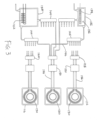
- FIG. 3 A schematic representation of the system cooling and heating arrangement is shown in Fig 3 . It includes a conventional 4000 BTU refrigeration system 132 with a shell and tube evaporator 134 for cooling a thermal fluid 136, and a conventional boiler 138 including a submersed electric heating element 142.
- the system also includes headers 144 for connecting to a series of circulation tubes 146, valves 148, and individual pumps 150 for driving the fluids through the Cooling and Heating terminals. While Fig. 3 shows individual pumps, such pumps may be replaced by one pump and a multitude of valves, serving to supply heated or chilled thermal fluid to the cooling and heating terminals.
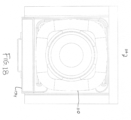
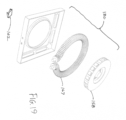
- the Cubby cooling and heating arrangement is shown in Figs 4 and 19 .
- Flexible insulated tubes 152 are channeled through a 25 mm gap 154 between the Cubbies. 12 mm diameter tubes are used as well as low-voltage insulated electric wires 156 connected to Cubby fans 158 and NTC temperature sensors 162.
- a preferred assembly sequence is to lay the tubes and wires into the gaps between the Cubbies, connect their ends as needed, and blow-in expandable polyurethane insulation after the tubes and electric wires have been tested and found to operate satisfactorily.
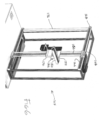
- a Cartesian transport system 164 is employed to move the Portion Containers within the Station.
- the system operates along X, Y, and Z axes to transport the containers, comprising drive spindles 166 and stepper motors 168, as well as an End-Effector 172 adapted to pick up Portion Container Carriers 174 which are located to either side of the transport system.
- the X axis is horizontal and runs side-to-side relative to the Station
- the Y axis is vertical
- the Z axis is horizontal and runs front-to-back relative to the Station.
- the Cartesian system includes a support-frame 176, the drive spindles, the stepper motors, and power and control cables.
- the End-Effector latches on to the Portion Container Carrier and delivers it to the Hatch.
- the End-Effector is mounted on a Stepper Motor driven belt 182 for movement in the Z axis 184.
- the End-Effector includes two T-shaped brackets 186, one on the left and one on the right, for grabbing the Portion Container Carriers on the left and right sides respectively.
- the End-Effector may include a single T-shaped bracket that may swivel to the left or the right for grabbing portion container carriers on the left and right sides respectively.
- the Hatch include two shutters, Front Shutter 192 facing the Customer and Rear Shutter 194 at the back of the Hatch. These shutters are programmed to open and close during the delivery into the Hatch and the collection of the Portion Containers in order to help maintain a safe and sanitary condition within the station.
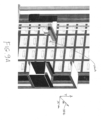
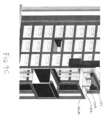
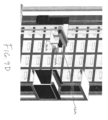
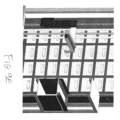
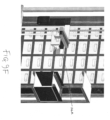
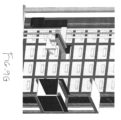
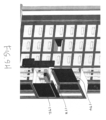
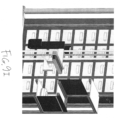
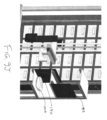
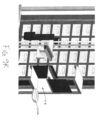
- Figs 9A through 9L provide an incremental series which demonstrates the function of the Cartesian system in moving the End Effector from a selected Cubby 116A to the Scanner 171 ( Figs 9A-9C ), the return of the selected Portion Container Carrier 181A and Portion Container 110A from that Scanner and transport back to the Cubby ( Figs 9D-9E ), moving the Carrier and Container to the Hatch ( Figs 9E-9I ), the delivery of that Portion Container to the Customer and reclosing of the Hatch ( Figs 9J-9L ).
- the Transport System plays two major roles in the overall system:
- the customer may bring the empty Portion Container back to the station.
- the Hatch's Front Shutter opens, and the Customer is allowed to place the container into the Hatch. This may require no Customer Identification.
- the Front Shutter then closes, and the Rear Shutter opens, allowing the Transport System to either just move the contain to the Storage Area or to bring the container to the Scanner where its identification is noted for credit to the Customer.
- the Customer may be prompted to give feedback about the quality of his meal which may be used to adjust future menus in general or future offerings to this Customer.
- the Customer may select and order their meal in a variety of ways.
- an App is downloaded to the customer's Smartphone for the customer to register with the system.
- the App may have knowledge of or access to information about every Station everywhere and each Station's available menu at any given time. That App may have the ability to know and apply the Customer's location at any given time in order to offer access to only nearby Stations.
- That App may include a Customer Registry allowing the Customer to initially Sign-up and load relevant personal information, payment information, food type preferences, dietary restrictions and allergies, most common location of use ("home base"), etc.
- the Registered Customer may be assigned a Customer Number. That Customer Number may be used as the Customer's Identification Key.
- the Customer may also be required to select an Account Password for Identification.
- the Station may have a user interface allowing the Customer to input Customer Identification Information to gain access to the system, and to then make meal decisions for a later time directly with the Station.
- the Customer could conveniently arrange the next day's order while picking-up today's meal.
- the Station could prompt the Customer such as "Would you like to place another order” or "10% off if you place another order within the next 15 minutes", etc., thereby promoting additional sales before the customer has eaten today's meal and is presumably hunger.
- Another communication option between Consumer and the System may be an Online Site accessible to the Customer, say from the convenience of their home or office.
- the Account could be set up similarly to the afore-mentions Smartphone App.
- the customer may be able to order meals via a call-in phone number.
- the Delivery Partner arrives at the Station early on Day 0, unlocks Side Doors 196L and 196R of the Station and checks for unclaimed meals and returned empty Portion Containers, which are then removed and set aside. The Delivery Partner then loads the new Portion Containers, one per cubby, in no specific order or position. If the Storage Unit containing used portion containers is external of the Station, the Delivery Partner then visits the Storage Unit, and collects any used Portion Containers therein.
- the Food Station on-board Logic directs the transport system to pick up and deliver the Portion Containers into the Hatch. One Portion Container at a time.
- the Food Station Control Logic recognizes when a Customer has not collected his meal by some period after the pre-designated pick-up time, then sends a reminder, such as by text or notice to the Customer's Smartphone, or by email or by phone call. Based on feedback which may then be provided by the Customer, the logic system may; keep food at heated temperature for an additional specified time, chill the food to avoid spoilage and reheat based on feedback from Customer, or chill the Portion Container and inform food Delivery partner to remove un-claimed Portion Containers during the following morning visit.
- the 49" width and 72" height of the Station allow it to be moved through a standard commercial door, with an opening of 36" wide and 80" tall.
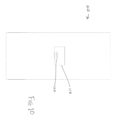
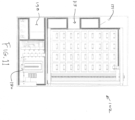
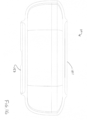
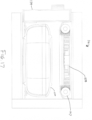
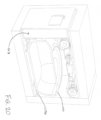
- the Station includes 72 Cubbies, and the Hatch is positioned approximately halfway up the Station's height for most-convenient customer access (See Figs 10 and 11 ).
- the Left and Right Side Panels (Delivery Partner Access Doors) 196L and 196R are large to ease loading, provide visibility of all Cubbies, enable cleaning, and are insulated as they serve as the outside wall of the Cubbies. They allow quick and easy access to the Delivery partner to place the Portion Containers into the Cubbies and to do other internal tasks.
- the lower portion 197 of the Station is dedicated to house the cooling and heating system and various controls. It also houses the System Computer 198 and provides for the structural integrity of the entire unit, including the Transport System and the Cubbies.
- the Station walls 199 include adequate thermal and acoustic insulation and are structurally designed to carry the weight of the rest of the system.
- the Cubbies have a cubic outer shape.
- the Portion Containers have a round shape which, being similar to most dishware, is familiar to Customers as a food serving device.
- the lids 151 of the containers are easily stackable and the bases 153 of the containers are easily and compactly nestable.
- the Cubbies are insulated to save energy and facilitate easy loading and removal of the Portion Containers.
- the Cubbies include enough internal space for the Portion Container a Heat Transfer Element 167 and insulation on all four sides.
- the back 155 of each Cubby is open but is covered by the Station Wall.
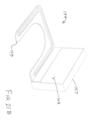
- each Cubby is part of the Portion Container Carrier comprising an insulated wall, connected to a horseshoe shaped horizontal metal plate 159 designed to support the Portion Container.
- the Portion Container Carrier serves to support the Portion Containers as it is transported by the transport system from the cubby to the hatch to be collected by the Customer, or to the scanning camera during the identification routine.
- the Station logic system may include features allowing the customization of temperature of each Portion Container that may be based on Customer selection and/or its contents.
- the Portion Container Carrier supports the Portion Container while in its Cubby, for better air circulation, and while being transported by the Transport System.
- the Carrier consists of two basic elements: the horseshoe-shaped support plate which is permanently fixed to the removable front panel of the cubby, including a 1" thick insulated block 163.
- the insulated front features a handle portion 165 that is adapted to be grasped by the End-Effector of the cartesian transport system.
- the horse-shoe shape is Designed and shaped to slide out from under the Portion Container lower rim to be left in the Hatch while the Carrier is being withdrawn.
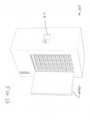
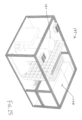
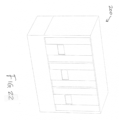
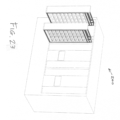
- a second Station 200 constructed of multiple Modules 202L, 202C and 202R, and intended to serve a larger number of Customers is shown in Figs 22-24 .
- the basic operational concept of each module remains the same as the first embodiment except that additional modules are added, each including its own Cubbies, Hatch, Transport System, and End Effector. All modules are connected to a single Control Logic.
- the alternate front-loading of the modules enables a compact manner for the Delivery Partner to service the Station.
- a virtually unlimited expansion is enabled by the simple addition of Modules in side-by-side fashion.
- the Customer arriving to collect the food is directed to the specific one of the Hatches where the portion containers may be collected.
- This expanded version allows the Food Partner to prepare additional un-ordered meals, snacks, desserts, side dishes, etc., to be deposited into the Station for spontaneous purchasers. Thereby being able to accommodate Customers who did not order in advance or who find themselves hungrier than originally expected.
- the Station could prompt the customer to add to their pre ordered purchase... "Would you like fries with that?" ... "Would you like to add a dessert?”.
- Such items may carry a premium cost, due to the risk the Food Partner takes and to encourage Customers to order in advance.
- This expanded Station could be further expanded by the addition of Modules according to the traffic expected in the area it is to be placed. It could be installed in private or public locations, such as airport terminals or train stations, where people could pick up a pre ordered meal before boarding. Ballparks, beaches, campgrounds, and other recreational venues are perfect candidates for setting up such a Station. High-end restaurants could set up dedicated Stations at airports or other public places, such as downtowns and business centers.
Landscapes
- Physics & Mathematics (AREA)
- General Physics & Mathematics (AREA)
- Business, Economics & Management (AREA)
- Engineering & Computer Science (AREA)
- Tourism & Hospitality (AREA)
- Theoretical Computer Science (AREA)
- General Business, Economics & Management (AREA)
- Strategic Management (AREA)
- Life Sciences & Earth Sciences (AREA)
- Food Science & Technology (AREA)
- Accounting & Taxation (AREA)
- Economics (AREA)
- Marketing (AREA)
- Human Resources & Organizations (AREA)
- Finance (AREA)
- General Health & Medical Sciences (AREA)
- Health & Medical Sciences (AREA)
- Primary Health Care (AREA)
- Development Economics (AREA)
- Multimedia (AREA)
- Entrepreneurship & Innovation (AREA)
- Operations Research (AREA)
- Quality & Reliability (AREA)
- Computer Networks & Wireless Communication (AREA)
- Control Of Vending Devices And Auxiliary Devices For Vending Devices (AREA)
- Warehouses Or Storage Devices (AREA)
Claims (13)
- Lebensmittelstation (102), umfassend:eine Vielzahl von Fächern (116), wobei jedes Fach (116) so bemessen ist, dass es einen Lebensmittelportionsbehälter (110) umschließen kann, und wobei jedes Fach (116) einen Lebensmittelportionsbehälterträger (174) enthält, der den Lebensmittelportionsbehälter (110) stützt, während er sich in dem Fach (116) befindet und während er durch ein Transportsystem transportiert wird, wobei der Träger eine hufeisenförmige Stützplatte umfasst, die an einer abnehmbaren Frontplatte des Fachs befestigt ist;eine Entnahmeöffnung (113), die groß genug ist, damit der Lebensmittelportionsbehälter (110) hindurchtreten kann, wobei die Entnahmeöffnung (113) von außen zugänglich ist;ein internes Transportsystem (118), das einen Endeffektor (172) enthält, der sich vorübergehend an den Lebensmittelportionsbehälterträger (174) eines ausgewählten Fachs (116) koppelt und den Lebensmittelportionsbehälterträger (174) innerhalb der Lebensmittelstation (102) steuerbar aus dem ausgewählten Fach (116) zu der Entnahmeöffnung (113) bewegt;ein Heizsystem (130), das selektiv jedem der Vielzahl von Fächern (116) unabhängig von den anderen Fächern (116) Wärme bereitstellt, wobei das Heizsystem jedes der Vielzahl von Fächern (116) unabhängig steuerbar ist;ein Kühlsystem (130), das selektiv Wärme aus jedem der Vielzahl von Fächern (116) unabhängig von den anderen Fächern (116) abführt, wobei die Kühlung für jedes der Vielzahl von Fächern (116) unabhängig steuerbar ist;ein Steuersystem (115), das die Heizung und Kühlung jedes der Vielzahl von Fächern (116) und die Bewegung des internen Transportsystems (118) steuert, wobei das Steuersystem (115) einen Speicher zum Speichern von Informationen enthält, die Zubereitungsanweisungen für jedes der Vielzahl von Fächern (116) enthalten.
- Lebensmittelstation (102) nach Anspruch 1, wobei der Portionsbehälterträger (174) eine Frontplatte (163) mit einem Griff (165) zum Koppeln mit dem Endeffektor (172) enthält.
- Lebensmittelstation (102) nach Anspruch 2, wobei die Entnahmeöffnung (113) einen äußeren Deckel (192) enthält, der durch das Steuersystem (115) betätigt werden kann, um die Zugänglichkeit der Entnahmeöffnung von außen selektiv zu steuern.
- Lebensmittelstation (102) nach Anspruch 3, wobei die Entnahmeöffnung (113) einen inneren Deckel (194) enthält, der durch das Steuersystem (115) betätigt werden kann, um selektiv den Zugang von der Entnahmeöffnung (113) zu einem Inneren der Lebensmittelstation (102) zu verweigern, während der äußere Deckel (192) geöffnet ist.
- Lebensmittelstation (102) nach einem vorhergehenden Anspruch, wobei das interne Transportsystem (118) steuerbare mechanische Aktuatoren enthält, die den Endeffektor (172) in drei orthogonale Richtungen verschieben, von denen jede eine Achse eines kartesischen Koordinatensystems bildet.
- Lebensmittelstation (102) nach Anspruch 5, wobei die steuerbaren mechanischen Aktuatoren einen ersten Motor zum Drehen einer ersten Antriebsspindel (166) zum Verschieben des Endeffektors (172) entlang einer ersten Achse eines kartesischen Koordinatensystems und einen zweiten Motor zum Drehen einer zweiten Antriebsspindel (166) zum Verschieben des Endeffektors (172) entlang einer zweiten Achse eines kartesischen Koordinatensystems enthalten, und wobei ein Schrittmotor-Antriebsriemen (182) eine Bewegung entlang einer dritten Achse eines kartesischen Koordinatensystems bereitstellt.
- Lebensmittelstation (102) nach einem vorhergehenden Anspruch, ferner eine Benutzerschnittstelle umfassend, wobei die Bewegung des Portionsbehälterträgers (174) durch das interne Transportsystem (118) innerhalb der Lebensmittelstation (102) von dem ausgewählten Fach (116) zu der Entnahmeöffnung (113) durch eine Eingabe an der Benutzerschnittstelle ausgelöst wird.
- Lebensmittelstation (102) nach einem vorhergehenden Anspruch, wobei dem Speicher gespeicherte Informationen bereitgestellt werden, die mindestens eines aus einer Gruppe enthalten, die Folgendes umfasst: eine geplante Zeit zur Entnahme des Lebensmittelportionsbehälters (110) durch einen Kunden; einen Schlüssel zur Kundenidentitätsüberprüfung; und Speisenzubereitungsanweisungen, die dem Lebensmittelportionsbehälter (110) entsprechen.
- Lebensmittelstation (102) nach einem vorhergehenden Anspruch und ferner Kommunikationselektronik umfassend, die in der Lage ist, Informationen über eine Smartphone-Anwendung oder eine Online-Website zu empfangen, und wobei die im Speicher gespeicherten Informationen Informationen enthalten, die über die Smartphone-Anwendung oder die Online-Website empfangen werden.
- Lebensmittelstation (102) nach einem vorhergehenden Anspruch und ferner einen Scanner (171) umfassend, wobei dem Speicher Informationen bereitgestellt werden, die durch den Etikettenscanner (171) von einem auf dem Lebensmittelportionsbehälter (110) aufgedruckten Etikett gelesen werden, und wobei das interne Transportsystem (118) den Lebensmittelportionsbehälter (110) innerhalb der Lebensmittelstation (102) steuerbar von dem ausgewählten Fach (116) zu einem internen Identifikationsort bewegt, der einen Etikettenscanner (171) enthält.
- Lebensmittelstation (102) nach einem vorhergehenden Anspruch und ferner eine Vielzahl von Rohren (152) umfassend und wobei das Heizsystem ein erstes Thermofluid erhitzt und durch eines oder mehrere der Vielzahl von Rohren (152) pumpt und das Kühlsystem ein zweites Thermofluid kühlt und durch eines oder mehrere der Vielzahl von Rohren (152) pumpt und wobei jedes der Vielzahl von Fächern (116) sein eigenes Heiz- und Kühlelement enthält, durch das das erste und das zweite Thermofluid fließen können;wobei das Heizsystem eine erste Vielzahl von Ventilen (148) enthält, die durch das Steuersystem (115) gesteuert werden können, um das erste Thermofluid selektiv durch das Heizund Kühlelement jedes der Vielzahl von Fächern (116) zu leiten; undwobei das Heizsystem ferner eine zweite Vielzahl von Ventilen (148) enthält, die durch das Steuersystem (115) gesteuert werden können, um das zweite Thermofluid selektiv durch das Heiz- und Kühlelement jedes der Vielzahl von Fächern (116) zu leiten.
- Lebensmittelstation (102) nach einem vorhergehenden Anspruch, wobei jedes der Vielzahl von Fächern (116) einen internen Lüfter (158) enthält.
- Lebensmittelstation (102) nach einem vorhergehenden Anspruch, wobei jedes der Vielzahl von Fächern (116) eine quaderförmige Form aufweist, die durch Fachwände (196) definiert ist, die eine Wärmeisolierung enthalten.
Applications Claiming Priority (3)
| Application Number | Priority Date | Filing Date | Title |
|---|---|---|---|
| US202063066904P | 2020-08-18 | 2020-08-18 | |
| US202063105056P | 2020-10-23 | 2020-10-23 | |
| US17/387,936 US20220058604A1 (en) | 2020-08-18 | 2021-07-28 | Autonomous Food Station |
Publications (3)
| Publication Number | Publication Date |
|---|---|
| EP3961533A1 EP3961533A1 (de) | 2022-03-02 |
| EP3961533B1 true EP3961533B1 (de) | 2024-12-18 |
| EP3961533C0 EP3961533C0 (de) | 2024-12-18 |
Family
ID=77626923
Family Applications (1)
| Application Number | Title | Priority Date | Filing Date |
|---|---|---|---|
| EP21191754.7A Active EP3961533B1 (de) | 2020-08-18 | 2021-08-17 | Autonome lebensmittelstation |
Country Status (4)
| Country | Link |
|---|---|
| US (1) | US20220058604A1 (de) |
| EP (1) | EP3961533B1 (de) |
| CN (1) | CN114078295A (de) |
| ES (1) | ES3008736T3 (de) |
Families Citing this family (3)
| Publication number | Priority date | Publication date | Assignee | Title |
|---|---|---|---|---|
| JP7136950B2 (ja) * | 2021-02-25 | 2022-09-13 | 楽天グループ株式会社 | 制御装置、運搬機、制御方法、及び運搬システム |
| DE102023116710A1 (de) * | 2023-06-26 | 2025-01-02 | Sielaff GmbH & Co. KG Automatenbau Herrieden | Aufnahmevorrichtung zur Aufnahme oder Abgabe von Produkten in einem Kombiautomaten |
| DE102023135758A1 (de) * | 2023-12-19 | 2025-06-26 | Sielaff GmbH & Co. KG Automatenbau Herrieden | Speichervorrichtung zur Speicherung von Produkten in einem Kombiautomaten, Automat und Verfahren |
Citations (1)
| Publication number | Priority date | Publication date | Assignee | Title |
|---|---|---|---|---|
| US20160335833A1 (en) * | 2013-08-05 | 2016-11-17 | ZiSheng Huang | System for Automatically Cooking and Selling Frozen Food |
Family Cites Families (4)
| Publication number | Priority date | Publication date | Assignee | Title |
|---|---|---|---|---|
| MX2018009785A (es) * | 2016-02-12 | 2018-11-29 | Little Caesar Entpr Inc | Sistema y metodo para administrar la entrega de un producto alimenticio. |
| US20190270398A1 (en) * | 2017-07-14 | 2019-09-05 | Zume, Inc. | Vending-kiosk based systems and methods to vend and/or prepare items, for instance prepared foods |
| CN109509292A (zh) * | 2018-11-26 | 2019-03-22 | 湖南金码智能设备制造有限公司 | 一种基于蓝牙的智能售货机、系统与方法 |
| CN210635168U (zh) * | 2019-09-30 | 2020-05-29 | 青岛三维海容机电有限公司 | 一种物资自动化配送系统 |
-
2021
- 2021-07-28 US US17/387,936 patent/US20220058604A1/en not_active Abandoned
- 2021-08-17 CN CN202110944336.3A patent/CN114078295A/zh not_active Withdrawn
- 2021-08-17 ES ES21191754T patent/ES3008736T3/es active Active
- 2021-08-17 EP EP21191754.7A patent/EP3961533B1/de active Active
Patent Citations (1)
| Publication number | Priority date | Publication date | Assignee | Title |
|---|---|---|---|---|
| US20160335833A1 (en) * | 2013-08-05 | 2016-11-17 | ZiSheng Huang | System for Automatically Cooking and Selling Frozen Food |
Also Published As
| Publication number | Publication date |
|---|---|
| CN114078295A (zh) | 2022-02-22 |
| EP3961533C0 (de) | 2024-12-18 |
| ES3008736T3 (en) | 2025-03-25 |
| US20220058604A1 (en) | 2022-02-24 |
| EP3961533A1 (de) | 2022-03-02 |
Similar Documents
| Publication | Publication Date | Title |
|---|---|---|
| US11462072B2 (en) | Autonomous food station | |
| EP4099879B1 (de) | Ondo selbstbedienungslebensmittelschrankanordung, system und verfahren | |
| EP3961533B1 (de) | Autonome lebensmittelstation | |
| US10902371B2 (en) | Vending-kiosk based systems and methods to vend and/or prepare items, for instance prepared foods | |
| US7183518B2 (en) | System of food storage preparation and delivery in finished cooked state | |
| US11776351B2 (en) | Autonomous food station | |
| US12303050B2 (en) | To-go cubby unit | |
| US11727746B2 (en) | Vending machine and transport cartridge systems and methods | |
| US20150230658A1 (en) | Accelerated heating, cooking and dispensing incorporating a stored energy oven in a mobile apparatus | |
| WO2018136777A1 (en) | Automated sous-vide cooking device | |
| US12527421B2 (en) | System and method for preparing food autonomously | |
| US11605260B2 (en) | Autonomous food station | |
| HK40068750A (en) | Autonomous food station | |
| US12536860B2 (en) | Autonomous food station | |
| JP7398176B2 (ja) | 商品供給システム | |
| JPH09147222A (ja) | 自動販売機 | |
| US11966876B2 (en) | Facility and method of use for a transportable autonomous robotic merchandise dispensing drive-thru |
Legal Events
| Date | Code | Title | Description |
|---|---|---|---|
| PUAI | Public reference made under article 153(3) epc to a published international application that has entered the european phase |
Free format text: ORIGINAL CODE: 0009012 |
|
| STAA | Information on the status of an ep patent application or granted ep patent |
Free format text: STATUS: THE APPLICATION HAS BEEN PUBLISHED |
|
| AK | Designated contracting states |
Kind code of ref document: A1 Designated state(s): AL AT BE BG CH CY CZ DE DK EE ES FI FR GB GR HR HU IE IS IT LI LT LU LV MC MK MT NL NO PL PT RO RS SE SI SK SM TR |
|
| STAA | Information on the status of an ep patent application or granted ep patent |
Free format text: STATUS: REQUEST FOR EXAMINATION WAS MADE |
|
| 17P | Request for examination filed |
Effective date: 20220901 |
|
| RBV | Designated contracting states (corrected) |
Designated state(s): AL AT BE BG CH CY CZ DE DK EE ES FI FR GB GR HR HU IE IS IT LI LT LU LV MC MK MT NL NO PL PT RO RS SE SI SK SM TR |
|
| P01 | Opt-out of the competence of the unified patent court (upc) registered |
Effective date: 20230525 |
|
| STAA | Information on the status of an ep patent application or granted ep patent |
Free format text: STATUS: EXAMINATION IS IN PROGRESS |
|
| 17Q | First examination report despatched |
Effective date: 20240131 |
|
| GRAP | Despatch of communication of intention to grant a patent |
Free format text: ORIGINAL CODE: EPIDOSNIGR1 |
|
| STAA | Information on the status of an ep patent application or granted ep patent |
Free format text: STATUS: GRANT OF PATENT IS INTENDED |
|
| INTG | Intention to grant announced |
Effective date: 20240910 |
|
| GRAS | Grant fee paid |
Free format text: ORIGINAL CODE: EPIDOSNIGR3 |
|
| GRAA | (expected) grant |
Free format text: ORIGINAL CODE: 0009210 |
|
| STAA | Information on the status of an ep patent application or granted ep patent |
Free format text: STATUS: THE PATENT HAS BEEN GRANTED |
|
| AK | Designated contracting states |
Kind code of ref document: B1 Designated state(s): AL AT BE BG CH CY CZ DE DK EE ES FI FR GB GR HR HU IE IS IT LI LT LU LV MC MK MT NL NO PL PT RO RS SE SI SK SM TR |
|
| REG | Reference to a national code |
Ref country code: CH Ref legal event code: EP |
|
| REG | Reference to a national code |
Ref country code: DE Ref legal event code: R096 Ref document number: 602021023474 Country of ref document: DE |
|
| REG | Reference to a national code |
Ref country code: IE Ref legal event code: FG4D |
|
| U01 | Request for unitary effect filed |
Effective date: 20250113 |
|
| U07 | Unitary effect registered |
Designated state(s): AT BE BG DE DK EE FI FR IT LT LU LV MT NL PT RO SE SI Effective date: 20250120 |
|
| P04 | Withdrawal of opt-out of the competence of the unified patent court (upc) registered |
Free format text: CASE NUMBER: APP_2621/2025 Effective date: 20250116 |
|
| REG | Reference to a national code |
Ref country code: ES Ref legal event code: FG2A Ref document number: 3008736 Country of ref document: ES Kind code of ref document: T3 Effective date: 20250325 |
|
| PG25 | Lapsed in a contracting state [announced via postgrant information from national office to epo] |
Ref country code: HR Free format text: LAPSE BECAUSE OF FAILURE TO SUBMIT A TRANSLATION OF THE DESCRIPTION OR TO PAY THE FEE WITHIN THE PRESCRIBED TIME-LIMIT Effective date: 20241218 |
|
| PG25 | Lapsed in a contracting state [announced via postgrant information from national office to epo] |
Ref country code: NO Free format text: LAPSE BECAUSE OF FAILURE TO SUBMIT A TRANSLATION OF THE DESCRIPTION OR TO PAY THE FEE WITHIN THE PRESCRIBED TIME-LIMIT Effective date: 20250318 |
|
| PG25 | Lapsed in a contracting state [announced via postgrant information from national office to epo] |
Ref country code: GR Free format text: LAPSE BECAUSE OF FAILURE TO SUBMIT A TRANSLATION OF THE DESCRIPTION OR TO PAY THE FEE WITHIN THE PRESCRIBED TIME-LIMIT Effective date: 20250319 |
|
| PG25 | Lapsed in a contracting state [announced via postgrant information from national office to epo] |
Ref country code: RS Free format text: LAPSE BECAUSE OF FAILURE TO SUBMIT A TRANSLATION OF THE DESCRIPTION OR TO PAY THE FEE WITHIN THE PRESCRIBED TIME-LIMIT Effective date: 20250318 |
|
| PG25 | Lapsed in a contracting state [announced via postgrant information from national office to epo] |
Ref country code: SM Free format text: LAPSE BECAUSE OF FAILURE TO SUBMIT A TRANSLATION OF THE DESCRIPTION OR TO PAY THE FEE WITHIN THE PRESCRIBED TIME-LIMIT Effective date: 20241218 |
|
| PG25 | Lapsed in a contracting state [announced via postgrant information from national office to epo] |
Ref country code: PL Free format text: LAPSE BECAUSE OF FAILURE TO SUBMIT A TRANSLATION OF THE DESCRIPTION OR TO PAY THE FEE WITHIN THE PRESCRIBED TIME-LIMIT Effective date: 20241218 |
|
| PG25 | Lapsed in a contracting state [announced via postgrant information from national office to epo] |
Ref country code: IS Free format text: LAPSE BECAUSE OF FAILURE TO SUBMIT A TRANSLATION OF THE DESCRIPTION OR TO PAY THE FEE WITHIN THE PRESCRIBED TIME-LIMIT Effective date: 20250418 |
|
| PG25 | Lapsed in a contracting state [announced via postgrant information from national office to epo] |
Ref country code: SK Free format text: LAPSE BECAUSE OF FAILURE TO SUBMIT A TRANSLATION OF THE DESCRIPTION OR TO PAY THE FEE WITHIN THE PRESCRIBED TIME-LIMIT Effective date: 20241218 |
|
| PG25 | Lapsed in a contracting state [announced via postgrant information from national office to epo] |
Ref country code: CZ Free format text: LAPSE BECAUSE OF FAILURE TO SUBMIT A TRANSLATION OF THE DESCRIPTION OR TO PAY THE FEE WITHIN THE PRESCRIBED TIME-LIMIT Effective date: 20241218 |
|
| PLBE | No opposition filed within time limit |
Free format text: ORIGINAL CODE: 0009261 |
|
| STAA | Information on the status of an ep patent application or granted ep patent |
Free format text: STATUS: NO OPPOSITION FILED WITHIN TIME LIMIT |
|
| REG | Reference to a national code |
Ref country code: CH Ref legal event code: L10 Free format text: ST27 STATUS EVENT CODE: U-0-0-L10-L00 (AS PROVIDED BY THE NATIONAL OFFICE) Effective date: 20251029 |
|
| 26N | No opposition filed |
Effective date: 20250919 |
|
| REG | Reference to a national code |
Ref country code: CH Ref legal event code: H13 Free format text: ST27 STATUS EVENT CODE: U-0-0-H10-H13 (AS PROVIDED BY THE NATIONAL OFFICE) Effective date: 20260324 |
|
| PG25 | Lapsed in a contracting state [announced via postgrant information from national office to epo] |
Ref country code: MC Free format text: LAPSE BECAUSE OF FAILURE TO SUBMIT A TRANSLATION OF THE DESCRIPTION OR TO PAY THE FEE WITHIN THE PRESCRIBED TIME-LIMIT Effective date: 20241218 |
|
| U90 | Renewal fees not paid: noting of loss of rights |
Free format text: RENEWAL FEE NOT PAID FOR YEAR 05 Effective date: 20260323 |