EP3961331A1 - Article conveyance apparatus and method of controlling the same - Google Patents
Article conveyance apparatus and method of controlling the same Download PDFInfo
- Publication number
- EP3961331A1 EP3961331A1 EP21191696.0A EP21191696A EP3961331A1 EP 3961331 A1 EP3961331 A1 EP 3961331A1 EP 21191696 A EP21191696 A EP 21191696A EP 3961331 A1 EP3961331 A1 EP 3961331A1
- Authority
- EP
- European Patent Office
- Prior art keywords
- control parameter
- articles
- conveyance apparatus
- article conveyance
- production mode
- Prior art date
- Legal status (The legal status is an assumption and is not a legal conclusion. Google has not performed a legal analysis and makes no representation as to the accuracy of the status listed.)
- Pending
Links
Images

Classifications
-
- G—PHYSICS
- G05—CONTROLLING; REGULATING
- G05B—CONTROL OR REGULATING SYSTEMS IN GENERAL; FUNCTIONAL ELEMENTS OF SUCH SYSTEMS; MONITORING OR TESTING ARRANGEMENTS FOR SUCH SYSTEMS OR ELEMENTS
- G05B19/00—Program-control systems
- G05B19/02—Program-control systems electric
- G05B19/418—Total factory control, i.e. centrally controlling a plurality of machines, e.g. direct or distributed numerical control [DNC], flexible manufacturing systems [FMS], integrated manufacturing systems [IMS] or computer integrated manufacturing [CIM]
- G05B19/4189—Total factory control, i.e. centrally controlling a plurality of machines, e.g. direct or distributed numerical control [DNC], flexible manufacturing systems [FMS], integrated manufacturing systems [IMS] or computer integrated manufacturing [CIM] characterised by the transport system
- G05B19/41895—Total factory control, i.e. centrally controlling a plurality of machines, e.g. direct or distributed numerical control [DNC], flexible manufacturing systems [FMS], integrated manufacturing systems [IMS] or computer integrated manufacturing [CIM] characterised by the transport system using automatic guided vehicles [AGV]
-
- B—PERFORMING OPERATIONS; TRANSPORTING
- B65—CONVEYING; PACKING; STORING; HANDLING THIN OR FILAMENTARY MATERIAL
- B65G—TRANSPORT OR STORAGE DEVICES, e.g. CONVEYORS FOR LOADING OR TIPPING, SHOP CONVEYOR SYSTEMS OR PNEUMATIC TUBE CONVEYORS
- B65G43/00—Control devices, e.g. for safety, warning or fault-correcting
- B65G43/08—Control devices operated by article or material being fed, conveyed or discharged
-
- G—PHYSICS
- G06—COMPUTING OR CALCULATING; COUNTING
- G06N—COMPUTING ARRANGEMENTS BASED ON SPECIFIC COMPUTATIONAL MODELS
- G06N20/00—Machine learning
-
- B—PERFORMING OPERATIONS; TRANSPORTING
- B65—CONVEYING; PACKING; STORING; HANDLING THIN OR FILAMENTARY MATERIAL
- B65G—TRANSPORT OR STORAGE DEVICES, e.g. CONVEYORS FOR LOADING OR TIPPING, SHOP CONVEYOR SYSTEMS OR PNEUMATIC TUBE CONVEYORS
- B65G47/00—Article or material-handling devices associated with conveyors; Methods employing such devices
- B65G47/74—Feeding, transfer, or discharging devices of particular kinds or types
-
- B—PERFORMING OPERATIONS; TRANSPORTING
- B65—CONVEYING; PACKING; STORING; HANDLING THIN OR FILAMENTARY MATERIAL
- B65G—TRANSPORT OR STORAGE DEVICES, e.g. CONVEYORS FOR LOADING OR TIPPING, SHOP CONVEYOR SYSTEMS OR PNEUMATIC TUBE CONVEYORS
- B65G2203/00—Indexing code relating to control or detection of the articles or the load carriers during conveying
- B65G2203/02—Control or detection
- B65G2203/0208—Control or detection relating to the transported articles
- B65G2203/0258—Weight of the article
-
- B—PERFORMING OPERATIONS; TRANSPORTING
- B65—CONVEYING; PACKING; STORING; HANDLING THIN OR FILAMENTARY MATERIAL
- B65G—TRANSPORT OR STORAGE DEVICES, e.g. CONVEYORS FOR LOADING OR TIPPING, SHOP CONVEYOR SYSTEMS OR PNEUMATIC TUBE CONVEYORS
- B65G2203/00—Indexing code relating to control or detection of the articles or the load carriers during conveying
- B65G2203/04—Detection means
- B65G2203/041—Camera
-
- Y—GENERAL TAGGING OF NEW TECHNOLOGICAL DEVELOPMENTS; GENERAL TAGGING OF CROSS-SECTIONAL TECHNOLOGIES SPANNING OVER SEVERAL SECTIONS OF THE IPC; TECHNICAL SUBJECTS COVERED BY FORMER USPC CROSS-REFERENCE ART COLLECTIONS [XRACs] AND DIGESTS
- Y02—TECHNOLOGIES OR APPLICATIONS FOR MITIGATION OR ADAPTATION AGAINST CLIMATE CHANGE
- Y02P—CLIMATE CHANGE MITIGATION TECHNOLOGIES IN THE PRODUCTION OR PROCESSING OF GOODS
- Y02P90/00—Enabling technologies with a potential contribution to greenhouse gas [GHG] emissions mitigation
- Y02P90/02—Total factory control, e.g. smart factories, flexible manufacturing systems [FMS] or integrated manufacturing systems [IMS]
-
- Y—GENERAL TAGGING OF NEW TECHNOLOGICAL DEVELOPMENTS; GENERAL TAGGING OF CROSS-SECTIONAL TECHNOLOGIES SPANNING OVER SEVERAL SECTIONS OF THE IPC; TECHNICAL SUBJECTS COVERED BY FORMER USPC CROSS-REFERENCE ART COLLECTIONS [XRACs] AND DIGESTS
- Y02—TECHNOLOGIES OR APPLICATIONS FOR MITIGATION OR ADAPTATION AGAINST CLIMATE CHANGE
- Y02P—CLIMATE CHANGE MITIGATION TECHNOLOGIES IN THE PRODUCTION OR PROCESSING OF GOODS
- Y02P90/00—Enabling technologies with a potential contribution to greenhouse gas [GHG] emissions mitigation
- Y02P90/60—Electric or hybrid propulsion means for production processes
Definitions
- the present invention relates to an article conveyance apparatus and a method of controlling the article conveyance apparatus.
- Patent Literature 1 JP 2020-11326 A
- an object of the present invention is to provide an article conveyance apparatus and a method of controlling the article conveyance apparatus that enable acquisition of sufficient learning data for control, with avoidance of deterioration in yield.
- a method of controlling an article conveyance apparatus including steps of: (A) generating, with, as learning data, information regarding an amount of charge indicating a weight value of articles that a conveyer conveys to a member disposed on a downstream side, information indicating a state of the articles on the conveyer, and a control parameter for the conveyer, a learning model that estimates the control parameter to be set for conveyance of the articles having a targeted weight; (B) performing conveyance control of the articles, based on the learning model; (C) performing selective switching between a production mode involved in actual production and a non-production mode not involved in the actual production, and causing the article conveyance apparatus to operate; and (D) collecting and storing, when the article conveyance apparatus operates in the non-production mode, as the learning data, the information regarding the amount of charge actually acquired and the control parameter.
- An article conveyance apparatus including: a conveyer which conveys charged articles; a learning model generator generates, with, as learning data, information regarding an amount of charge indicating a weight value of the articles that the conveyer conveys to a member disposed on a downstream side, information indicating a state of the articles on the conveyer, and a control parameter for the conveyer, a learning model that estimates the control parameter to be set for conveyance of the articles having a targeted weight; and a controller which performs conveyance control of the articles, based on the learning model, wherein the controller: performs selective switching between a production mode involved in actual production and a non-production mode not involved in the actual production, and causes the article conveyance apparatus to operate, and collects and stores, in a case where the article conveyance apparatus operates in the non-production mode, as the learning data, the information regarding the amount of charge actually acquired and the control parameter.
- an article conveyance apparatus and a method of controlling the article conveyance apparatus that enable acquisition of sufficient learning data for control, with avoidance of deterioration in yield.
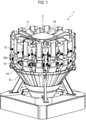
- FIG. 1 is a perspective view of an exemplary entirety of the combination weighing apparatus 1 according to the present embodiment.
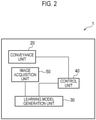
- FIG. 2 illustrates exemplary functional blocks of the combination weighing apparatus 1 according to the embodiment.
- FIG. 3 is a flowchart of an exemplary method of controlling the combination weighing apparatus 1 according to the embodiment.
- the combination weighing apparatus 1 includes a distribution table 10, supply troughs 11, pool hoppers 12, weighing hoppers 13, booster hoppers 14, and a gathering discharge chute 15.
- the distribution table 10 distributes weighing targets that fall from a supply apparatus (not illustrated), to the supply troughs 11.
- the distribution table 10 in the present embodiment rotationally drives around a rotation axis C extending upward and downward, to convey the weighing targets radially outward in a circumferential distribution manner.
- the distribution table 10 is not limited to the configuration, and may have any configuration as long as having a function of conveying the weighing targets to the supply troughs 11.
- the weighing targets are soft and sticky food, such as raw chicken. However, the weighing targets are not limited to this.
- the supply troughs 11 each supply the weighing targets supplied from the distribution table 10, to the corresponding pool hopper 12 provided downstream.
- the supply troughs 11 may each convey the weighing targets downstream by vibration.
- the pool hoppers 12 each temporarily accumulate the weighing targets supplied from the supply trough 11.
- the pool hoppers 12 each have a lower portion provided with a gate 12a. In response to the open and shut operation of the gate 12a, the weighing targets accumulated in the pool hopper 12 are discharged to the weighing hopper 13 provided below the gate 12a.
- the weighing hoppers 13 each temporarily accumulate the weighing targets discharged from the pool hopper 12.
- the weighing hoppers 13 are each connected to a weight detector (not illustrated).
- the weighing hoppers 13 each have a lower portion provided with a gate (not illustrated). In response to the open and shut operation of the gate, the weighing targets accumulated in the weighing hopper 13 are discharged to the booster hopper 14 disposed below the gate.
- the booster hoppers 14 each house the weighing targets supplied from the weighing hopper 13 and temporarily retains the weighing targets.
- the booster hoppers 14 each have a lower portion provided with a gate (not illustrated). In response to the open and shut operation of the gate, the weighing targets accumulated in the booster hopper 14 are discharged to the gathering discharge chute 15 disposed below the gate.
- the gathering discharge chute 15 gathers the weighing targets discharged from a plurality of booster hoppers 14 and drops the gathered weighing targets downward.
- the combination weighing apparatus 1 includes, as functional blocks, a conveyance unit (conveyer) 20, a learning model generation unit (learning model generator) 30, and a control unit (controller) 40.
- the combination weighing apparatus 1 may further include an image acquisition unit (image acquirer) 50.
- the conveyance unit 20 conveys charged articles.
- the conveyance unit 20 includes the distribution table 10 or the supply troughs 11.
- the supply troughs 11 are provided as the conveyance unit 20.
- the image acquisition unit 50 acquires an image of articles placed on the supply troughs 11 (conveyance unit 20).
- the image acquisition unit 50 may be an arbitrary type of camera.
- the learning model generation unit 30 generates a learning model that estimates a control parameter to be set for conveyance of articles having a targeted weight by each supply trough 11.
- the learning model as learning data, used are information regarding the amount of charge indicating the weight value of articles that the supply troughs 11 each convey to the member disposed on the downstream side (e.g., the pool hopper 12), information indicating the state of articles on each supply trough 11, and the control parameter for each supply trough 11 (conveyance unit 20).
- the learning model generation unit 30 generates a learning model, for example, by machine learning or deep learning.
- the weight value of articles that the supply troughs 11 each convey to the member disposed on the downstream side corresponds to the weight value of articles supplied from each supply through 11 to the weighing hopper 13 through the pool hopper 12, namely, the weight value acquired by the weight detector (load cell) connected to the weighing hopper 13.
- the information regarding the amount of charge may be the weight value of articles or may be an arbitrary value corresponding to the weight value of articles.
- control parameter for each supply trough 11 for example, the duration of vibration of each supply trough 11 or the voltage to be applied for vibration of each supply trough 11 may be targeted.
- control parameter includes a first control parameter and a second control parameter, as described later.
- the information indicating the state of articles on each supply trough 11 may be, for example, an image of articles acquired by the image acquisition unit 50.
- the learning model generation unit 30 generates the learning model.
- the learning model generation unit 30 may use, as the information regarding the amount of charge, the image of articles acquired by the image acquisition unit 50.
- control unit 40 On the basis of the learning model generated by the learning model generation unit 30, the control unit 40 performs conveyance control of articles on the conveyance unit 20.
- the control unit 40 performs selective switching between a production mode involved in actual production and a non-production mode not involved in actual production and causes the combination weighing apparatus 1 to operate.
- the production mode is a mode in which the combination weighing apparatus 1 performs a weighing job for weighing targets, for example, in a production line.
- the non-production mode is a mode in which the combination weighing apparatus 1 discharges all weighing targets accumulated in the combination weighing apparatus 1 (namely, a mode in which the combination weighing apparatus 1 performs complete discharge) or a mode in which the combination weighing apparatus 1 drives as a test.
- control unit 40 collects and stores, as learning data, the information regarding the amount of charge actually acquired and the control parameter.
- This configuration enables, in a case where no actual production is performed in the combination weighing apparatus 1, namely, in a case where the combination weighing apparatus 1 operates in the non-production mode, collection of learning data with a flexible change in the control parameter without concern for deterioration in yield.
- control unit 40 may collect and store, as learning data, the information regarding the amount of charge actually acquired and the control parameter.
- This configuration enables, in a case where actual production is performed in the combination weighing apparatus 1, namely, in a case where the combination weighing apparatus 1 operates in the production mode, collection of the learning data according to the control parameter used in actual production, so that the learning model can be generated efficiently.
- control unit 40 may collect and store, as learning data, the first control parameter and the information regarding the amount of charge due to the first control parameter.
- the first control parameter may be the control parameter collected during a predetermined period from the combination weighing apparatus 1 operating in the production mode or may be a parameter in a predetermined range determined in advance.
- the predetermined range corresponds to the range of the control parameter usable in the combination weighing apparatus 1 operating in the production mode.
- This configuration enables collection of learning data with the combination weighing apparatus 1 performing actual production.
- control unit 40 collects and stores, as learning data, the second control parameter and the information regarding the amount of charge due to the second control parameter.
- the second control parameter is different from the first control parameter in the entirety of the control parameter acceptable by the combination weighing apparatus 1.
- the second control parameter may be the remaining parameter different from the first control parameter in the entirety of the control parameter acceptable by the combination weighing apparatus 1 or may be part of the remaining parameter different from the first control parameter in the entirety of the control parameter acceptable by the combination weighing apparatus 1.
- This configuration enables collection of only the learning data regarding the control parameter not collected with the combination weighing apparatus 1 operating in the production mode, so that sufficient learning data for conveyance control can be acquired efficiently.
- step S101 in accordance with an instruction from an operator, the control unit 40 of the combination weighing apparatus 1 causes the combination weighing apparatus 1 to operate in the production mode, and collects and stores the learning data according to the first control parameter.
- step S102 in accordance with an instruction from the operator, the control unit 40 of the combination weighing apparatus 1 switches the mode of the combination weighing apparatus 1 from the production mode to the non-production mode.
- step S103 the control unit 40 of the combination weighing apparatus 1 collects and stores the learning data according to the second control parameter, from the combination weighing apparatus 1 operating in the non-production mode.
- step S104 the learning model generation unit 30 of the combination weighing apparatus 1 generates a learning model, with the learning data collected and stored by the control unit 40.
- step S105 the control unit 40 of the combination weighing apparatus 1 performs conveyance control of articles on the conveyance unit 20, on the basis of the learning model generated by the learning model generation unit 30.
- sufficient learning data for conveyance control in the combination weighing apparatus 1 can be acquired with avoidance of deterioration in yield.
- the combination weighing apparatus 1 has been exemplarily described as the article conveyance apparatus 1.
- the article conveyance apparatus 1 is not limited to the combination weighing apparatus 1, and thus may be, for example, a food conveyance apparatus that supplies food to the combination weighing apparatus 1.
Landscapes
- Engineering & Computer Science (AREA)
- Software Systems (AREA)
- Theoretical Computer Science (AREA)
- General Physics & Mathematics (AREA)
- General Engineering & Computer Science (AREA)
- Physics & Mathematics (AREA)
- Data Mining & Analysis (AREA)
- Medical Informatics (AREA)
- Evolutionary Computation (AREA)
- Computing Systems (AREA)
- Computer Vision & Pattern Recognition (AREA)
- Artificial Intelligence (AREA)
- Mathematical Physics (AREA)
- Mechanical Engineering (AREA)
- Manufacturing & Machinery (AREA)
- Quality & Reliability (AREA)
- Automation & Control Theory (AREA)
- Control Of Conveyors (AREA)
- Weight Measurement For Supplying Or Discharging Of Specified Amounts Of Material (AREA)
Abstract
A method of controlling an article conveyance apparatus (1) includes steps of: (A) generating, with, as learning data, information regarding an amount of charge indicating a weight value of articles that a conveyer (20) conveys to a member disposed on a downstream side, information indicating a state of the articles on the conveyer, and a control parameter for the conveyer, a learning model that estimates the control parameter to be set for conveyance of the articles having a targeted weight; (B) performing conveyance control of the articles, based on the learning model; (C) performing selective switching between a production mode involved in actual production and a non-production mode not involved in the actual production, and causing the article conveyance apparatus to operate; and (D) collecting and storing, when the article conveyance apparatus operates in the non-production mode, as the learning data, the information regarding the amount of charge actually acquired and the control parameter.
Description
- The present invention relates to an article conveyance apparatus and a method of controlling the article conveyance apparatus.
- In recent years, technology for control of various apparatuses with deep learning has been progressively developed. For achievement of such control, a large amount of learning data needs acquiring with changes in various control parameters for the various apparatuses.
- Patent Literature 1:
JP 2020-11326 A - However, in actual production with such apparatuses as above, for avoidance of deterioration in yield, the various control parameters are not allowed to be flexibly changed, resulting in a problem that sufficient learning data for the control is difficult to acquire.
- Therefore, the present invention has been made in consideration of the problem, and an object of the present invention is to provide an article conveyance apparatus and a method of controlling the article conveyance apparatus that enable acquisition of sufficient learning data for control, with avoidance of deterioration in yield.
- A method of controlling an article conveyance apparatus according to an embodiment, the method including steps of: (A) generating, with, as learning data, information regarding an amount of charge indicating a weight value of articles that a conveyer conveys to a member disposed on a downstream side, information indicating a state of the articles on the conveyer, and a control parameter for the conveyer, a learning model that estimates the control parameter to be set for conveyance of the articles having a targeted weight; (B) performing conveyance control of the articles, based on the learning model; (C) performing selective switching between a production mode involved in actual production and a non-production mode not involved in the actual production, and causing the article conveyance apparatus to operate; and (D) collecting and storing, when the article conveyance apparatus operates in the non-production mode, as the learning data, the information regarding the amount of charge actually acquired and the control parameter.
- An article conveyance apparatus according to an embodiment including: a conveyer which conveys charged articles; a learning model generator generates, with, as learning data, information regarding an amount of charge indicating a weight value of the articles that the conveyer conveys to a member disposed on a downstream side, information indicating a state of the articles on the conveyer, and a control parameter for the conveyer, a learning model that estimates the control parameter to be set for conveyance of the articles having a targeted weight; and a controller which performs conveyance control of the articles, based on the learning model, wherein the controller: performs selective switching between a production mode involved in actual production and a non-production mode not involved in the actual production, and causes the article conveyance apparatus to operate, and collects and stores, in a case where the article conveyance apparatus operates in the non-production mode, as the learning data, the information regarding the amount of charge actually acquired and the control parameter.
- According to the embodiment, it is possible to provide an article conveyance apparatus and a method of controlling the article conveyance apparatus that enable acquisition of sufficient learning data for control, with avoidance of deterioration in yield.
-
-
FIG. 1 is a perspective view of an exemplary entirety of a combination weighing apparatus according to an embodiment; -
FIG. 2 illustrates exemplary functional blocks of the combination weighing apparatus according to the embodiment; and -
FIG. 3 is a flowchart of an exemplary method of controlling the combination weighing apparatus according to the embodiment. - Hereinafter, the present embodiment will be described in detail with reference to the attached drawings. In the following description of the drawings, the same or similar parts are denoted by the same or similar reference symbols. However, note that the drawings are schematic, and ratios of dimensions are different from actual ones. Therefore, specific dimensions and the like are determined in consideration of the following description. Moreover, there may be portions where dimensional relationships or proportions are different among the drawings. In this specification and the drawings, elements having substantially the same function and configuration are denoted by the same reference numerals to omit redundant description, and elements not directly related to the present invention are omitted.
- A
combination weighing apparatus 1 as an exemplaryarticle conveyance apparatus 1 in a first embodiment of the present invention will be described below with reference toFIGS. 1 to 3 .FIG. 1 is a perspective view of an exemplary entirety of thecombination weighing apparatus 1 according to the present embodiment.FIG. 2 illustrates exemplary functional blocks of thecombination weighing apparatus 1 according to the embodiment.FIG. 3 is a flowchart of an exemplary method of controlling thecombination weighing apparatus 1 according to the embodiment. - As illustrated in
FIG. 1 , thecombination weighing apparatus 1 according to the present embodiment includes a distribution table 10,supply troughs 11,pool hoppers 12, weighinghoppers 13,booster hoppers 14, and agathering discharge chute 15. - The distribution table 10 distributes weighing targets that fall from a supply apparatus (not illustrated), to the
supply troughs 11. For example, the distribution table 10 in the present embodiment rotationally drives around a rotation axis C extending upward and downward, to convey the weighing targets radially outward in a circumferential distribution manner. However, the distribution table 10 is not limited to the configuration, and may have any configuration as long as having a function of conveying the weighing targets to thesupply troughs 11. - The weighing targets are soft and sticky food, such as raw chicken. However, the weighing targets are not limited to this.
- The
supply troughs 11 each supply the weighing targets supplied from the distribution table 10, to thecorresponding pool hopper 12 provided downstream. For example, thesupply troughs 11 may each convey the weighing targets downstream by vibration. - The
pool hoppers 12 each temporarily accumulate the weighing targets supplied from thesupply trough 11. Thepool hoppers 12 each have a lower portion provided with agate 12a. In response to the open and shut operation of thegate 12a, the weighing targets accumulated in thepool hopper 12 are discharged to the weighinghopper 13 provided below thegate 12a. - The weighing
hoppers 13 each temporarily accumulate the weighing targets discharged from thepool hopper 12. The weighinghoppers 13 are each connected to a weight detector (not illustrated). - The weighing
hoppers 13 each have a lower portion provided with a gate (not illustrated). In response to the open and shut operation of the gate, the weighing targets accumulated in the weighinghopper 13 are discharged to thebooster hopper 14 disposed below the gate. - The booster hoppers 14 each house the weighing targets supplied from the weighing
hopper 13 and temporarily retains the weighing targets. Thebooster hoppers 14 each have a lower portion provided with a gate (not illustrated). In response to the open and shut operation of the gate, the weighing targets accumulated in thebooster hopper 14 are discharged to thegathering discharge chute 15 disposed below the gate. - The
gathering discharge chute 15 gathers the weighing targets discharged from a plurality ofbooster hoppers 14 and drops the gathered weighing targets downward. - As illustrated in
FIG. 2 , thecombination weighing apparatus 1 includes, as functional blocks, a conveyance unit (conveyer) 20, a learning model generation unit (learning model generator) 30, and a control unit (controller) 40. Thecombination weighing apparatus 1 may further include an image acquisition unit (image acquirer) 50. - The
conveyance unit 20 conveys charged articles. For example, theconveyance unit 20 includes the distribution table 10 or thesupply troughs 11. In the present specification, below given will be an exemplary case where thesupply troughs 11 are provided as theconveyance unit 20. - The
image acquisition unit 50 acquires an image of articles placed on the supply troughs 11 (conveyance unit 20). For example, theimage acquisition unit 50 may be an arbitrary type of camera. - The learning
model generation unit 30 generates a learning model that estimates a control parameter to be set for conveyance of articles having a targeted weight by eachsupply trough 11. - For the learning model, as learning data, used are information regarding the amount of charge indicating the weight value of articles that the
supply troughs 11 each convey to the member disposed on the downstream side (e.g., the pool hopper 12), information indicating the state of articles on eachsupply trough 11, and the control parameter for each supply trough 11 (conveyance unit 20). - For example, the learning
model generation unit 30 generates a learning model, for example, by machine learning or deep learning. - Here, for example, the weight value of articles that the
supply troughs 11 each convey to the member disposed on the downstream side corresponds to the weight value of articles supplied from each supply through 11 to the weighinghopper 13 through thepool hopper 12, namely, the weight value acquired by the weight detector (load cell) connected to the weighinghopper 13. - Note that the information regarding the amount of charge may be the weight value of articles or may be an arbitrary value corresponding to the weight value of articles.
- As the control parameter for each
supply trough 11, for example, the duration of vibration of eachsupply trough 11 or the voltage to be applied for vibration of eachsupply trough 11 may be targeted. Here, the control parameter includes a first control parameter and a second control parameter, as described later. - Furthermore, the information indicating the state of articles on each supply trough 11 (conveyance unit 20) may be, for example, an image of articles acquired by the
image acquisition unit 50. - Specifically, with the learning data collected and stored by the
control unit 40, the learningmodel generation unit 30 generates the learning model. - The learning
model generation unit 30 may use, as the information regarding the amount of charge, the image of articles acquired by theimage acquisition unit 50. - On the basis of the learning model generated by the learning
model generation unit 30, thecontrol unit 40 performs conveyance control of articles on theconveyance unit 20. - The
control unit 40 performs selective switching between a production mode involved in actual production and a non-production mode not involved in actual production and causes thecombination weighing apparatus 1 to operate. - Here, the production mode is a mode in which the
combination weighing apparatus 1 performs a weighing job for weighing targets, for example, in a production line. - Meanwhile, the non-production mode is a mode in which the
combination weighing apparatus 1 discharges all weighing targets accumulated in the combination weighing apparatus 1 (namely, a mode in which thecombination weighing apparatus 1 performs complete discharge) or a mode in which thecombination weighing apparatus 1 drives as a test. - In a case where the
combination weighing apparatus 1 operates in the non-production mode, thecontrol unit 40 collects and stores, as learning data, the information regarding the amount of charge actually acquired and the control parameter. - This configuration enables, in a case where no actual production is performed in the
combination weighing apparatus 1, namely, in a case where thecombination weighing apparatus 1 operates in the non-production mode, collection of learning data with a flexible change in the control parameter without concern for deterioration in yield. - In a case where the
combination weighing apparatus 1 operates in the production mode, thecontrol unit 40 may collect and store, as learning data, the information regarding the amount of charge actually acquired and the control parameter. - This configuration enables, in a case where actual production is performed in the
combination weighing apparatus 1, namely, in a case where thecombination weighing apparatus 1 operates in the production mode, collection of the learning data according to the control parameter used in actual production, so that the learning model can be generated efficiently. - Specifically, in a case where the
combination weighing apparatus 1 operates in the production mode, thecontrol unit 40 may collect and store, as learning data, the first control parameter and the information regarding the amount of charge due to the first control parameter. - Note that the first control parameter may be the control parameter collected during a predetermined period from the
combination weighing apparatus 1 operating in the production mode or may be a parameter in a predetermined range determined in advance. Here, the predetermined range corresponds to the range of the control parameter usable in thecombination weighing apparatus 1 operating in the production mode. - This configuration enables collection of learning data with the
combination weighing apparatus 1 performing actual production. - In a case where the
combination weighing apparatus 1 operates in the non-production mode, thecontrol unit 40 collects and stores, as learning data, the second control parameter and the information regarding the amount of charge due to the second control parameter. - Note that the second control parameter is different from the first control parameter in the entirety of the control parameter acceptable by the
combination weighing apparatus 1. Here, the second control parameter may be the remaining parameter different from the first control parameter in the entirety of the control parameter acceptable by thecombination weighing apparatus 1 or may be part of the remaining parameter different from the first control parameter in the entirety of the control parameter acceptable by thecombination weighing apparatus 1. - This configuration enables collection of only the learning data regarding the control parameter not collected with the
combination weighing apparatus 1 operating in the production mode, so that sufficient learning data for conveyance control can be acquired efficiently. - An exemplary operation of the
combination weighing apparatus 1 according to the embodiment will be described below with reference toFIG. 3 . - As illustrated in
FIG. 3 , in step S101, in accordance with an instruction from an operator, thecontrol unit 40 of thecombination weighing apparatus 1 causes thecombination weighing apparatus 1 to operate in the production mode, and collects and stores the learning data according to the first control parameter. - In step S102, in accordance with an instruction from the operator, the
control unit 40 of thecombination weighing apparatus 1 switches the mode of thecombination weighing apparatus 1 from the production mode to the non-production mode. - In step S103, the
control unit 40 of thecombination weighing apparatus 1 collects and stores the learning data according to the second control parameter, from thecombination weighing apparatus 1 operating in the non-production mode. - In step S104, the learning
model generation unit 30 of thecombination weighing apparatus 1 generates a learning model, with the learning data collected and stored by thecontrol unit 40. - In step S105, the
control unit 40 of thecombination weighing apparatus 1 performs conveyance control of articles on theconveyance unit 20, on the basis of the learning model generated by the learningmodel generation unit 30. - According to the present embodiment, sufficient learning data for conveyance control in the
combination weighing apparatus 1 can be acquired with avoidance of deterioration in yield. - The embodiment of the present invention has been described in detail above. It is obvious to a person skilled in the art that the present invention is not limited to the embodiment in the present specification. The present invention can be carried out in aspects corrected and altered without departing from the gist and scope of the present invention in the claims. Therefore, the present specification is intended for exemplificative description and thus does not have any limitative meanings to the present invention.
- In the embodiment, the
combination weighing apparatus 1 has been exemplarily described as thearticle conveyance apparatus 1. However, thearticle conveyance apparatus 1 is not limited to thecombination weighing apparatus 1, and thus may be, for example, a food conveyance apparatus that supplies food to thecombination weighing apparatus 1. -
- 1 Article conveyance apparatus, Combination weighing apparatus
- 10 Distribution table
- 11 Supply trough
- 12 Pool hopper
- 12a Gate
- 13 Weighing hopper
- 14 Booster hopper
- 15 Gathering discharge chute
- 20 Conveyance unit
- 30 Learning model generation unit
- 40 Control unit
- 50 Image acquisition unit
Claims (8)
- A method of controlling an article conveyance apparatus, the method comprising steps of:(A) generating, with, as learning data, information regarding an amount of charge indicating a weight value of articles that a conveyer conveys to a member disposed on a downstream side, information indicating a state of the articles on the conveyer, and a control parameter for the conveyer, a learning model that estimates the control parameter to be set for conveyance of the articles having a targeted weight;(B) performing conveyance control of the articles, based on the learning model;(C) performing selective switching between a production mode involved in actual production and a non-production mode not involved in the actual production, and causing the article conveyance apparatus to operate; and(D) collecting and storing, when the article conveyance apparatus operates in the non-production mode, as the learning data, the information regarding the amount of charge actually acquired and the control parameter.
- The method of controlling an article conveyance apparatus according to claim 1, wherein
the step (D) includes:
collecting and storing, in a case where the article conveyance apparatus operates in the production mode, as the learning data, the information regarding the amount of charge actually acquired and the control parameter. - The method of controlling an article conveyance apparatus according to claim 2, whereinthe control parameter includes a first control parameter and a second control parameter, andthe step (D) includes:collecting, in the case where the article conveyance apparatus operates in the production mode, as the learning data, the first control parameter and the information regarding the amount of charge when using the first control parameter; andcollecting, in the case where the article conveyance apparatus operates in the non-production mode, as the learning data, the second control parameter and the information regarding the amount of charge when using the second control parameter.
- The method of controlling an article conveyance apparatus according to any of claims 1 to 3, wherein
in the step (A), a captured image of the articles is used as the information indicating the state of the articles. - An article conveyance apparatus comprising:a conveyer which conveys charged articles;a learning model generator generates, with, as learning data, information regarding an amount of charge indicating a weight value of the articles that the conveyer conveys to a member disposed on a downstream side, information indicating a state of the articles on the conveyer, and a control parameter for the conveyer, a learning model that estimates the control parameter to be set for conveyance of the articles having a targeted weight; anda controller which performs conveyance control of the articles, based on the learning model, whereinthe controller:performs selective switching between a production mode involved in actual production and a non-production mode not involved in the actual production, and causes the article conveyance apparatus to operate, andcollects and stores, in a case where the article conveyance apparatus operates in the non-production mode, as the learning data, the information regarding the amount of charge actually acquired and the control parameter.
- The article conveyance apparatus according to claim 5, wherein
the controller collects and stores, in a case where the article conveyance apparatus operates in the production mode, as the learning data, the information regarding the amount of charge actually acquired and the control parameter. - The article conveyance apparatus according to claim 6, whereinthe control parameter includes a first control parameter and a second control parameter, andthe controller:collects and stores, in the case where the article conveyance apparatus operates in the production mode, as the learning data, the first control parameter and the information regarding the amount of charge when using the first control parameter, andcollects and stores, in the case where the article conveyance apparatus operates in the non-production mode, as the learning data, the second control parameter and the information regarding the amount of charge when using the second control parameter.
- The article conveyance apparatus according to any of claims 5 to 7, further comprising:an image acquirer which acquires an image of the articles placed on the conveyer, whereinthe learning model generator uses the image of the articles as the information indicating the state of the articles.
Applications Claiming Priority (1)
| Application Number | Priority Date | Filing Date | Title |
|---|---|---|---|
| JP2020143959A JP7553077B2 (en) | 2020-08-27 | 2020-08-27 | Control method for article transport device and article transport device |
Publications (1)
| Publication Number | Publication Date |
|---|---|
| EP3961331A1 true EP3961331A1 (en) | 2022-03-02 |
Family
ID=77367335
Family Applications (1)
| Application Number | Title | Priority Date | Filing Date |
|---|---|---|---|
| EP21191696.0A Pending EP3961331A1 (en) | 2020-08-27 | 2021-08-17 | Article conveyance apparatus and method of controlling the same |
Country Status (4)
| Country | Link |
|---|---|
| US (1) | US11643280B2 (en) |
| EP (1) | EP3961331A1 (en) |
| JP (1) | JP7553077B2 (en) |
| CN (1) | CN114118436B (en) |
Citations (5)
| Publication number | Priority date | Publication date | Assignee | Title |
|---|---|---|---|---|
| JP2007139422A (en) * | 2005-11-14 | 2007-06-07 | Takao Yoshikawa | Powder feeder and seasoning system |
| US20160330225A1 (en) * | 2014-01-13 | 2016-11-10 | Brightsource Industries (Israel) Ltd. | Systems, Methods, and Devices for Detecting Anomalies in an Industrial Control System |
| US20190056718A1 (en) * | 2017-08-18 | 2019-02-21 | Fanuc Corporation | Controller and machine learning device |
| US20190118226A1 (en) * | 2017-10-23 | 2019-04-25 | Fanuc Corporation | Sorting system |
| JP2020011326A (en) | 2018-07-17 | 2020-01-23 | ファナック株式会社 | Robot system |
Family Cites Families (5)
| Publication number | Priority date | Publication date | Assignee | Title |
|---|---|---|---|---|
| JP2002062185A (en) * | 2000-08-24 | 2002-02-28 | Ishida Co Ltd | Combination weighing device |
| FR2936601B1 (en) | 2008-09-30 | 2011-02-11 | Arbor Sa | METHOD OF PROCESSING OBJECTS BASED ON THEIR INDIVIDUAL WEIGHTS |
| CN107209049B (en) | 2015-02-10 | 2020-07-24 | 株式会社石田 | Conveying device and combined metering device |
| JP6588358B2 (en) | 2016-02-16 | 2019-10-09 | 株式会社イシダ | Control device, combination weighing device, and combination weighing device system for combination weighing device |
| DE102020207679A1 (en) * | 2020-06-22 | 2021-12-23 | Krones Aktiengesellschaft | Method and device for buffering containers |
-
2020
- 2020-08-27 JP JP2020143959A patent/JP7553077B2/en active Active
-
2021
- 2021-08-17 EP EP21191696.0A patent/EP3961331A1/en active Pending
- 2021-08-18 US US17/406,021 patent/US11643280B2/en active Active
- 2021-08-23 CN CN202110971629.0A patent/CN114118436B/en active Active
Patent Citations (5)
| Publication number | Priority date | Publication date | Assignee | Title |
|---|---|---|---|---|
| JP2007139422A (en) * | 2005-11-14 | 2007-06-07 | Takao Yoshikawa | Powder feeder and seasoning system |
| US20160330225A1 (en) * | 2014-01-13 | 2016-11-10 | Brightsource Industries (Israel) Ltd. | Systems, Methods, and Devices for Detecting Anomalies in an Industrial Control System |
| US20190056718A1 (en) * | 2017-08-18 | 2019-02-21 | Fanuc Corporation | Controller and machine learning device |
| US20190118226A1 (en) * | 2017-10-23 | 2019-04-25 | Fanuc Corporation | Sorting system |
| JP2020011326A (en) | 2018-07-17 | 2020-01-23 | ファナック株式会社 | Robot system |
Also Published As
| Publication number | Publication date |
|---|---|
| CN114118436A (en) | 2022-03-01 |
| US11643280B2 (en) | 2023-05-09 |
| US20220063925A1 (en) | 2022-03-03 |
| JP7553077B2 (en) | 2024-09-18 |
| JP2022039107A (en) | 2022-03-10 |
| CN114118436B (en) | 2025-08-19 |
Similar Documents
| Publication | Publication Date | Title |
|---|---|---|
| EP3258227B1 (en) | Conveyor apparatus and combined weighing apparatus | |
| EP3428587B1 (en) | Combination weighing device | |
| US11435220B2 (en) | Combination weighing device with selectable weighing hoppers | |
| CN103276137A (en) | Control method used for computer batch charging system of steelmaking converter | |
| US11643280B2 (en) | Article conveyance apparatus and method of controlling the same | |
| JP2010175514A (en) | Combination balance and weighing system | |
| CN109579964A (en) | A kind of weight detection system applied to powder storage box of coffee maker | |
| Susilawati et al. | Design and implementation of automatic fish feeder (AFF) using microcontroller powered by solar cell: A Contribution to the fish farmers | |
| EP3617670A1 (en) | Measuring apparatus | |
| US20160308356A1 (en) | Method and Apparatus for Electrical Distribution Grid Control | |
| CN112478216A (en) | Combined metering device | |
| CN110495264B (en) | Method and control device for producing printed circuit boards with optimized production | |
| US10948337B2 (en) | Control device for setting parameters of combination weighing apparatuses, combination weighing apparatus, and combination weighing apparatus system utilizing such control device | |
| JP2019182561A (en) | Program and picking system | |
| EP3385684B1 (en) | Combination weighing apparatus | |
| JP6157989B2 (en) | Combination scale | |
| CN113967970B (en) | Control method of micro metering system and micro metering system | |
| JP2016061716A (en) | Combination weighing device | |
| CN103092085B (en) | Control method of multiple-step competing batch charging | |
| JP6348408B2 (en) | Combination scale | |
| JP5758726B2 (en) | Combination scale | |
| del Rosario et al. | Conveyor scheduling system for a feeds manufacturing plant: a case study | |
| JP5694005B2 (en) | Combination scale | |
| JP2023071430A5 (en) | ||
| CN110833792A (en) | Calcium carbide furnace batching and feeding control method, device, equipment and storage medium |
Legal Events
| Date | Code | Title | Description |
|---|---|---|---|
| PUAI | Public reference made under article 153(3) epc to a published international application that has entered the european phase |
Free format text: ORIGINAL CODE: 0009012 |
|
| STAA | Information on the status of an ep patent application or granted ep patent |
Free format text: STATUS: REQUEST FOR EXAMINATION WAS MADE |
|
| 17P | Request for examination filed |
Effective date: 20210817 |
|
| AK | Designated contracting states |
Kind code of ref document: A1 Designated state(s): AL AT BE BG CH CY CZ DE DK EE ES FI FR GB GR HR HU IE IS IT LI LT LU LV MC MK MT NL NO PL PT RO RS SE SI SK SM TR |
|
| STAA | Information on the status of an ep patent application or granted ep patent |
Free format text: STATUS: EXAMINATION IS IN PROGRESS |
|
| 17Q | First examination report despatched |
Effective date: 20230523 |