EP3961103B1 - Methods of servicing a fuel nozzle tip - Google Patents
Methods of servicing a fuel nozzle tip Download PDFInfo
- Publication number
- EP3961103B1 EP3961103B1 EP21190912.2A EP21190912A EP3961103B1 EP 3961103 B1 EP3961103 B1 EP 3961103B1 EP 21190912 A EP21190912 A EP 21190912A EP 3961103 B1 EP3961103 B1 EP 3961103B1
- Authority
- EP
- European Patent Office
- Prior art keywords
- nozzle
- fuel nozzle
- annular groove
- nozzle tip
- fuel
- Prior art date
- Legal status (The legal status is an assumption and is not a legal conclusion. Google has not performed a legal analysis and makes no representation as to the accuracy of the status listed.)
- Active
Links
Images





Classifications
-
- F—MECHANICAL ENGINEERING; LIGHTING; HEATING; WEAPONS; BLASTING
- F23—COMBUSTION APPARATUS; COMBUSTION PROCESSES
- F23R—GENERATING COMBUSTION PRODUCTS OF HIGH PRESSURE OR HIGH VELOCITY, e.g. GAS-TURBINE COMBUSTION CHAMBERS
- F23R3/00—Continuous combustion chambers using liquid or gaseous fuel
- F23R3/28—Continuous combustion chambers using liquid or gaseous fuel characterised by the fuel supply
-
- B—PERFORMING OPERATIONS; TRANSPORTING
- B05—SPRAYING OR ATOMISING IN GENERAL; APPLYING FLUENT MATERIALS TO SURFACES, IN GENERAL
- B05B—SPRAYING APPARATUS; ATOMISING APPARATUS; NOZZLES
- B05B15/00—Details of spraying plant or spraying apparatus not otherwise provided for; Accessories
- B05B15/50—Arrangements for cleaning; Arrangements for preventing deposits, drying-out or blockage; Arrangements for detecting improper discharge caused by the presence of foreign matter
-
- B—PERFORMING OPERATIONS; TRANSPORTING
- B05—SPRAYING OR ATOMISING IN GENERAL; APPLYING FLUENT MATERIALS TO SURFACES, IN GENERAL
- B05B—SPRAYING APPARATUS; ATOMISING APPARATUS; NOZZLES
- B05B7/00—Spraying apparatus for discharge of liquids or other fluent materials from two or more sources, e.g. of liquid and air, of powder and gas
- B05B7/02—Spray pistols; Apparatus for discharge
- B05B7/06—Spray pistols; Apparatus for discharge with at least one outlet orifice surrounding another approximately in the same plane
-
- B—PERFORMING OPERATIONS; TRANSPORTING
- B05—SPRAYING OR ATOMISING IN GENERAL; APPLYING FLUENT MATERIALS TO SURFACES, IN GENERAL
- B05B—SPRAYING APPARATUS; ATOMISING APPARATUS; NOZZLES
- B05B7/00—Spraying apparatus for discharge of liquids or other fluent materials from two or more sources, e.g. of liquid and air, of powder and gas
- B05B7/02—Spray pistols; Apparatus for discharge
- B05B7/10—Spray pistols; Apparatus for discharge producing a swirling discharge
-
- B—PERFORMING OPERATIONS; TRANSPORTING
- B23—MACHINE TOOLS; METAL-WORKING NOT OTHERWISE PROVIDED FOR
- B23K—SOLDERING OR UNSOLDERING; WELDING; CLADDING OR PLATING BY SOLDERING OR WELDING; CUTTING BY APPLYING HEAT LOCALLY, e.g. FLAME CUTTING; WORKING BY LASER BEAM
- B23K1/00—Soldering, e.g. brazing, or unsoldering
- B23K1/0008—Soldering, e.g. brazing, or unsoldering specially adapted for particular articles or work
-
- B—PERFORMING OPERATIONS; TRANSPORTING
- B23—MACHINE TOOLS; METAL-WORKING NOT OTHERWISE PROVIDED FOR
- B23P—METAL-WORKING NOT OTHERWISE PROVIDED FOR; COMBINED OPERATIONS; UNIVERSAL MACHINE TOOLS
- B23P6/00—Restoring or reconditioning objects
-
- B—PERFORMING OPERATIONS; TRANSPORTING
- B23—MACHINE TOOLS; METAL-WORKING NOT OTHERWISE PROVIDED FOR
- B23P—METAL-WORKING NOT OTHERWISE PROVIDED FOR; COMBINED OPERATIONS; UNIVERSAL MACHINE TOOLS
- B23P6/00—Restoring or reconditioning objects
- B23P6/002—Repairing turbine components, e.g. moving or stationary blades, rotors
- B23P6/005—Repairing turbine components, e.g. moving or stationary blades, rotors using only replacement pieces of a particular form
-
- F—MECHANICAL ENGINEERING; LIGHTING; HEATING; WEAPONS; BLASTING
- F02—COMBUSTION ENGINES; HOT-GAS OR COMBUSTION-PRODUCT ENGINE PLANTS
- F02C—GAS-TURBINE PLANTS; AIR INTAKES FOR JET-PROPULSION PLANTS; CONTROLLING FUEL SUPPLY IN AIR-BREATHING JET-PROPULSION PLANTS
- F02C7/00—Features, components parts, details or accessories, not provided for in, or of interest apart form groups F02C1/00 - F02C6/00; Air intakes for jet-propulsion plants
- F02C7/22—Fuel supply systems
- F02C7/228—Dividing fuel between various burners
-
- B—PERFORMING OPERATIONS; TRANSPORTING
- B23—MACHINE TOOLS; METAL-WORKING NOT OTHERWISE PROVIDED FOR
- B23P—METAL-WORKING NOT OTHERWISE PROVIDED FOR; COMBINED OPERATIONS; UNIVERSAL MACHINE TOOLS
- B23P2700/00—Indexing scheme relating to the articles being treated, e.g. manufactured, repaired, assembled, connected or other operations covered in the subgroups
- B23P2700/13—Parts of turbine combustion chambers
-
- F—MECHANICAL ENGINEERING; LIGHTING; HEATING; WEAPONS; BLASTING
- F05—INDEXING SCHEMES RELATING TO ENGINES OR PUMPS IN VARIOUS SUBCLASSES OF CLASSES F01-F04
- F05D—INDEXING SCHEME FOR ASPECTS RELATING TO NON-POSITIVE-DISPLACEMENT MACHINES OR ENGINES, GAS-TURBINES OR JET-PROPULSION PLANTS
- F05D2220/00—Application
- F05D2220/30—Application in turbines
- F05D2220/32—Application in turbines in gas turbines
-
- F—MECHANICAL ENGINEERING; LIGHTING; HEATING; WEAPONS; BLASTING
- F05—INDEXING SCHEMES RELATING TO ENGINES OR PUMPS IN VARIOUS SUBCLASSES OF CLASSES F01-F04
- F05D—INDEXING SCHEME FOR ASPECTS RELATING TO NON-POSITIVE-DISPLACEMENT MACHINES OR ENGINES, GAS-TURBINES OR JET-PROPULSION PLANTS
- F05D2230/00—Manufacture
- F05D2230/80—Repairing, retrofitting or upgrading methods
-
- F—MECHANICAL ENGINEERING; LIGHTING; HEATING; WEAPONS; BLASTING
- F23—COMBUSTION APPARATUS; COMBUSTION PROCESSES
- F23R—GENERATING COMBUSTION PRODUCTS OF HIGH PRESSURE OR HIGH VELOCITY, e.g. GAS-TURBINE COMBUSTION CHAMBERS
- F23R2900/00—Special features of, or arrangements for continuous combustion chambers; Combustion processes therefor
- F23R2900/00019—Repairing or maintaining combustion chamber liners or subparts
Definitions
- the present disclosure relates to a method of servicing a turbomachine fuel nozzle tip.
- a gas turbine engine generally includes a compressor section, a combustion section, a turbine section, and an exhaust section.
- the compressor section progressively increases the pressure of a working fluid entering the gas turbine engine and supplies this compressed working fluid to the combustion section.
- the compressed working fluid and a fuel e.g., natural gas
- the combustion gases flow from the combustion section into the turbine section where they expand to produce work.
- expansion of the combustion gases in the turbine section may rotate a rotor shaft connected, e.g., to a generator to produce electricity.
- the combustion gases then exit the gas turbine via the exhaust section.
- Gas turbines typically include fuel nozzles in the combustor section.
- Each fuel nozzle is a component having one or more passages for delivering a mixture of fuel and air to a combustion chamber for ignition.
- each of the fuel nozzles may be exposed to various forces and stresses, e.g., vibrational forces and thermal stresses, which can cause wear to one or more subcomponents of the fuel nozzles over time.
- forces and stresses e.g., vibrational forces and thermal stresses
- wear to a single sub-component of a fuel nozzle can result in repairing or replacing the entire fuel nozzle, which can be a costly and time-consuming service process.
- US 2017/080530 A1 further describes a method of electron beam welding utilizing a collection pocket as well as a method of reconditioning gas turbine components.
- the method of electron beam welding includes providing a first surface and a second surface, forming a collection pocket in at least one of the first surface and the second surface, coupling the first surface to the second surface at a joining location, and electron beam welding the first surface and the second surface to each other at the joining location.
- an improved method for servicing a fuel nozzle is desired in the art.
- a method of servicing a fuel nozzle that advantageously restores a worn fuel nozzle sub-component without replacing the entire sub-component and/or fuel nozzle.
- the objective of the present invention is solved by the method of servicing a fuel nozzle according to claim 1.
- a method of servicing a fuel nozzle includes a step of removing material from a nozzle tip of the fuel nozzle to form an annular groove within the nozzle tip.
- the method further includes a step of inserting a replacement coupon into the annular groove.
- the replacement coupon having a radially outermost that corresponds to the annular groove such that the replacement coupon is fully seated within, and entirely in contact with, the annular groove and a post-removal contact surface.
- the method further includes a step of fixedly coupling the radially outermost of the replacement coupon to the annular groove.
- a method of servicing a fuel nozzle includes a step of furnishing the fuel nozzle that has undergone at least one duty cycle.
- the method further includes a step of removing material from a nozzle tip of the fuel nozzle to form an annular groove within the nozzle tip.
- the method further includes a step of inserting a replacement coupon into the annular groove.
- the replacement coupon having a radially outermost that corresponds to the annular groove and a post-removal contact surface.
- the method further includes a step of fixedly coupling the radially outermost of the replacement coupon to the annular groove.
- upstream refers to the relative direction with respect to fluid flow in a fluid pathway.
- upstream refers to the direction from which the fluid flows
- downstream refers to the direction to which the fluid flows.
- radially refers to the relative direction that is substantially perpendicular to an axial centerline of a particular component
- axially refers to the relative direction that is substantially parallel and/or coaxially aligned to an axial centerline of a particular component
- the term “circumferentially” refers to the relative direction that extends around the axial centerline of a particular component.
- FIG. 1 illustrates a schematic diagram of one embodiment of a turbomachine, which in the illustrated embodiment is a gas turbine 10.
- a gas turbine 10 which in the illustrated embodiment is a gas turbine 10.
- an industrial or land-based gas turbine is shown and described herein, the present disclosure is not limited to a land-based and/or industrial gas turbine unless otherwise specified in the claims.
- the fuel nozzles as described herein may be used in any type of turbomachine including, but not limited to, a steam turbine, an aircraft gas turbine, or a marine gas turbine.
- the gas turbine 10 generally includes an inlet section 12, a compressor section 14 disposed downstream of the inlet section 12, a plurality of combustors 17 (one of which is shown in FIG. 2 ) within a combustor section 16 disposed downstream of the compressor section 14, a turbine section 18 disposed downstream of the combustor section 16, and an exhaust section 20 disposed downstream of the turbine section 18. Additionally, the gas turbine 10 may include one or more shafts 22 coupled between the compressor section 14 and the turbine section 18.
- the compressor section 14 may generally include a plurality of rotor disks 24 (one of which is shown) and a plurality of rotor blades 26 extending radially outwardly from and connected to each rotor disk 24. Each rotor disk 24 in turn may be coupled to or form a portion of the shaft 22 that extends through the compressor section 14.
- the turbine section 18 may generally include a plurality of rotor disks 28 (one of which is shown) and a plurality of rotor blades 30 extending radially outwardly from and being interconnected to each rotor disk 28. Each rotor disk 28 in turn may be coupled to or form a portion of the shaft 22 that extends through the turbine section 18.
- the turbine section 18 further includes an outer casing 31 that circumferentially surrounds the portion of the shaft 22 and the rotor blades 30, thereby at least partially defining a hot gas path 32 through the turbine section 18.
- a working fluid such as air flows through the inlet section 12 and into the compressor section 14 where the air is progressively compressed, thus providing pressurized air 27 to the combustors of the combustor section 16.
- the pressurized air 27 is mixed with fuel and burned within each combustor to produce combustion gases 34.
- the combustion gases 34 flow through the hot gas path 32 from the combustor section 16 into the turbine section 18, wherein energy (kinetic and/or thermal) is transferred from the combustion gases 34 to the rotor blades 30, causing the shaft 22 to rotate.
- the mechanical rotational energy may then be used to power the compressor section 14 and/or to generate electricity.
- the combustion gases 34 exiting the turbine section 18 may then be exhausted from the gas turbine 10 via the exhaust section 20.
- the combustor 17 may be at least partially surrounded by the outer casing 31, which may be referred to as a compressor discharge casing.
- the outer casing 31 may at least partially define a high-pressure plenum 35 that at least partially surrounds various components of the combustor 17.
- the high-pressure plenum 35 may be in fluid communication with the compressor 14 ( FIG. 1 ) to receive the compressed air 27 therefrom.
- An end cover 36 may be coupled to the outer casing 31.
- the outer casing 31 and the end cover 36 may at least partially define a head end volume or portion 38 of the combustor 17.
- the head end portion 38 is in fluid communication with the high-pressure plenum 35 and/or the compressor 14.
- One or more liners or ducts 40 may at least partially define a combustion chamber or zone 42 for combusting the fuel-air mixture and/or may at least partially define a hot gas path through the combustor as indicated by arrow 43, for directing the combustion gases 34 towards an inlet to the turbine 18.
- the combustor 17 includes at least one fuel nozzle 100 at the head end portion 38.
- the fuel nozzle 100 may be disposed within the outer casing 31 downstream from and/or spaced from the end cover 36 of the combustor 17 and upstream from the combustion chamber 42.
- each of the fuel nozzles 100 may be in fluid communication with fuel supply 48.
- FIG. 3 is a perspective view of a fuel nozzle 100 and FIG. 4 is a cross-sectional view of the fuel nozzle 100.
- the fuel nozzle 100 may define an axial direction A and a circumferential direction C, which extends around the axial direction A.
- the fuel nozzle 100 may also define a radial direction R perpendicular to the axial direction A.
- the fuel nozzle 100 may extend between a forward end 102 and an aft end 104.
- the fuel nozzle 100 may include a flange 110 disposed at the forward end 102 and a nozzle tip 115 disposed at the aft end 104 of the fuel nozzle 100.
- the flange 110 may couple the fuel nozzle 100 to the end cover 36 of the combustor 17.
- the nozzle tip 115 may define an aft face 116, which may be the aft most surface of the fuel nozzle 100.
- the fuel nozzle 100 may include a nozzle body 105 that extends axially between the flange 110 and the nozzle tip 110.
- fuel nozzle 100 also includes a forward fuel/air delivery section at nozzle tip 115.
- the fuel nozzle 100 may further include a swirler 122 that extends radially outwardly from the nozzle body 105 and is disposed between the forward end 102 and the aft end 104 of the fuel nozzle 100.
- the swirler may include a collar 120 that surrounds a portion of the nozzle body 105.
- An annular passage 125 may be defined between the collar 120 and the nozzle body 125.
- a plurality of swirler vanes 130 may be disposed within the annular passage 125 and may each extend between the nozzle body 105 and the collar 120.
- the plurality of swirler vanes 130 may be positioned upstream of a plurality of radial fuel injectors 135, each of which is formed with a plurality of discharge orifices 145 for discharging fuel such as a premix gas into passage 125 within the premix chamber of a combustor.
- fuel nozzle 100 may further include an inner tube 150 that extends axially within nozzle body 105 and defines an inner passage 155.
- the inner tube 150 may extend from the flange 110 to the aft face 116.
- the inner tube 150 may be held in place via a first interference coupling between the inner tube 150 and the nozzle tip 115 and a second interference coupling between the inner tube and the radially inner surface of the flange 110.
- An interference fit is a fit between two parts in which the external dimension of one part slightly exceeds the internal dimension of the part into which it has to fit.
- the dimensions of the external surface of the inner tube 150 may slightly exceed the internal dimension of the flange 110 and the internal dimension of the nozzle tip 115.
- the inner passage 155 may feed air to the combustion zone 42 or may be configured for receipt of a liquid fuel delivery cartridge.
- an intermediate tube 160 may extend axially within nozzle body 105. Intermediate tube 160 is positioned around the inner tube 150 in a concentric manner but with a larger diameter to create an intermediate passage 165. Intermediate passage 165 provides for the flow of e.g., diffusion gas, curtain air, or purge air through orifice 166.
- an outer tube 170 extends axially along nozzle body 105. Outer tube 170 is positioned around the intermediate tube 160 in a concentric manner but with a larger diameter to create an outer passage 175. Outer passage 175 provides for carrying fuel such as a premix gas. During normal (nonflamehold) operation of fuel nozzle 100, fuel is forced to discharge from outer passage 175 by exiting through discharge orifices 145 in radial fuel injectors 135.
- the nozzle tip 115 may be located at the aft end 104 of the fuel nozzle.
- the nozzle tip 115 is sized to engage the nozzle body 105 and is typically welded thereto at interface 180.
- the nozzle tip 115 may be formed with an interior annular shoulder 185 ( FIG. 2 ) that receives the forward edge of intermediate tube 160, and which is welded or brazed at this forward edge. At or near shoulder 185 is also where the forward or downstream end of the intermediate passage 165 is closed.
- FIG. 5 illustrates an enlarged cross-sectional view of the aft end 104 of the fuel nozzle 100 prior to having any repairs performed thereto, in accordance with embodiments of the present disclosure.
- the nozzle tip 115 may include a radial projection 200 that extends radially inwards, for example, towards an axial centerline 202 of the fuel nozzle 100.
- the radial projection 200 may extend annularly around the inner tube 150 and may be in contact therewith, such that the inner tube 150 is held in place by the radial projection 200 via an interference fit.
- the radial projection 200 may be disposed immediately forward the aft face 116.
- the radial projection 200 may be disposed axially between the aft face 116 and the annular shoulder 185.
- the nozzle tip 115 includes a pre-removal contact surface 204 that forms a worn interference fit with the inner tube 150. More specifically, the radial projection 200 of the nozzle tip 115 may define the pre-removal contact surface 204, such that it is the radially inwardmost surface of the nozzle tip 115.
- the pre-removal contact surface 200 may be exposed to various forces and stresses, e.g., vibrational forces of the gas turbine 10 and thermal stresses caused by the high temperatures of the combustion zone 42.
- FIGS. 6-10 illustrate a nozzle tip 115 along different stages of a servicing method, such as the methods of servicing a fuel nozzle 1200 and 1300 described herein, which may advantageously restore a proper interference fit between the nozzle tip 115 and the inner tube 150.
- the servicing method may be performed in the sequence shown in FIGS. 6-9 .
- FIG. 6 illustrates a nozzle tip 115, from which the inner tube 150 has been decoupled and removed from the fuel nozzle 100, in order to expose the pre-removal contact surface 200 prior to machining. As shown in FIG.
- the dashed line 206 may represent the material 201 that is to be removed by the machining process, i.e., the material 201 radially inward from the dashed line 206 is to be removed by a machining process.
- the material 201 that is to be removed is worn and/or out of engineering design tolerance due to use within a gas turbine 10.
- FIG. 7 illustrates a nozzle tip that has undergone a removal process, in which the pre-removal contact surface 200 has been machined away.
- the removal process may utilize either or both of a conventional (or traditional) machining process or a non-conventional (or nontraditional) machining process.
- a conventional machining process may include, but is not limited to, turning, boring, drilling, swanning, broaching, filling, planing, and/or milling processes.
- a non-conventional machining process may include, but is not limited to, Ultrasonic Machining (USM), Water Jet Machining (WJM), Chemical Machining (CHM), Electrochimical Machining (ECM), Electrical Discharge Machining (EDM), Laser Beam Machining (LBM), and/or Plasma Beam Machining (PBM).
- USM Ultrasonic Machining
- WJM Water Jet Machining
- CHM Chemical Machining
- ECM Electrochimical Machining
- EDM Electrical Discharge Machining
- LBM Laser Beam Machining
- PBM Plasma Beam Machining
- the nozzle tip 115 may define an annular groove 208.
- the annular groove 208 may include a protrusion 210 that extends radially inward.
- the radially innermost surface of the annular groove may extend generally linearly, such that there is no protrusion(s) defined by the annular groove.
- the protrusion 210 may provide increased surface area for the replacement coupon 214 ( FIG. 8 ) to contact, thereby increasing the retention strength of the fixed connection between the nozzle tip 115 and the annular groove 208.
- the replacement coupon 214 may be fixedly coupled to the annular groove 208 via a brazing or welding.
- the replacement coupon 214 may be fixedly coupled to the annular groove 208 via a brazing process.
- the protrusion 210 may provide a surface for the deposition of a braze material, which may subsequently be heated using a braze furnace to fixedly couple the replacement coupon 214 to the annular groove 208.
- the braze material may be disposed directly between the annular grove 208 and the replacement coupon 214.
- the braze material may be, but is not limited to, copper, nickel, silver, aluminum, gold, or other suitable materials.
- the nozzle tip 115 and the replacement coupon 214 may form continuous surfaces with one another, such that there are no voids, gaps, or cavities between the nozzle tip 115 and the replacement coupon 214.
- the replacement coupon 214 includes a radially outermost surface 218 that corresponds with the annular groove 208. In this way, the replacement coupon is fully seated within, and entirely in contact with, the annular groove 208.
- the dimensions of the replacement coupon 214 are substantially the same as the material that has been removed to form the annular groove 208.
- the dimensions of the replacement coupon 214 may be within (+/-) 10% of the material that has been removed to form the annular groove 208.
- the dimensions of the replacement coupon 214 may be within (+/-) 5% of the material that has been removed to form the annular groove 208.
- the dimensions of the replacement coupon 214 may be within (+/-) 2.5% of the material that has been removed to form the annular groove 208.
- the inner tube 150 may be inserted back into the nozzle 100.
- the replacement coupon 214 may define a contact surface or post-removal contact surface 216, which advantageously forms a restored interference fit with the inner tube 150.
- the post-removal contact surface restores the tight engineering design tolerances, which enables the post-removal contact surface 216 of the replacement coupon 214 to form an interference fit with the inner tube 150.
- the fuel nozzle 100 may be operable without any leaks at the joint formed by the interference fit between the replacement coupon 214 and the inner tube 150.
- the post-removal contact surface may annularly surround the inner tube 150 and form a restored interference fit therewith.
- the contact surface or post-removal contact surface 216 may be the radially innermost surface of the replacement coupon 214.
- the nozzle tip 115 may be formed of a first material, and the replacement coupon may be formed of a second material.
- the second material may have a greater resistance to wear than the first material. This may advantageously extend the life of the fuel nozzle 100.
- the increased wear resistance of the replacement coupon 214 may allow the fuel nozzle 100 to be used within a gas turbine 10 for a longer period of time without having to be removed for repair, which can advantageously improve the overall efficiency of the power plant.
- the method of servicing a fuel nozzle described herein may be performed on fuel nozzles that have undergone a duty cycle and are in need of repair, fuel nozzles that have undergone a duty cycle and are not in need of repair, or fuel nozzles that have not undergone any duty cycles.
- the increased wear resistance of the replacement coupon 214 may advantageously increase the life of the fuel nozzle regardless of whether or not it has been in operation.
- duty cycle may refer to a component or components that have spent a certain amount of time operating within a gas turbine. In this way, a component that has not undergone any duty cycles has never been used in the operation of a gas turbine.
- FIG. 11 is a plan view of the aft face 116 of a fuel nozzle 100 from along the axial centerline 202.
- the fuel nozzle shown in FIG. 5 has undergone a servicing method, such as the servicing methods 1200 or 1300 described herein, as indicated by the fixed connection line 117 disposed between the aft face 116 of the nozzle tip 115 and the replacement coupon 214.
- the fixed connection line 117 may be the coupling between the radially outermost surface 218 of the replacement coupon 214 and the annular groove 208.
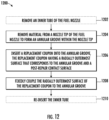
- FIG. 12 is a flow chart of a sequential set of steps 1202 through 1210, which define a method 1200 of servicing a fuel nozzle (such as the fuel nozzle 100 described herein), in accordance with embodiments of the present disclosure.
- the method 1200 may include optional steps (as indicated by dashed boxes) and non-optional steps (as indicated by solid boxes).
- the method 1200 may include an optional step 1202 of removing an inner tube 150 from a fuel nozzle 100 ( FIG. 6 ).
- the method 1200 may further include a step 1204 of removing material 201 from a nozzle tip 115 to form an annular groove 208 within the nozzle tip 115.
- the step 1202 may be performed prior to the step 1204.
- the method may further include a step 1206 of inserting a replacement coupon 214 into the annular groove 208.
- the replacement coupon 214 may define a radially outermost surface 218 that corresponds to the annular groove 208.
- the replacement coupon 214 may also define a post-removal contact surface 216.
- the method 1200 may further include a step 1208 of fixedly coupling the radially outermost surface 218 of the replacement coupon 214 to the annular groove 208.
- the method 1200 may include an optional step 1210 of re-inserting the inner tube 150.
- FIG. 13 flow chart of a sequential set of steps 1302 through 1312, which define a method 1300 of servicing a fuel nozzle (such as the fuel nozzle 100 described herein), in accordance with embodiments of the present disclosure.
- the method 1300 may include optional steps (as indicated by dashed boxes) and non-optional steps (as indicated by solid boxes).
- the method 1300 may include an optional step 1302 of furnishing the fuel nozzle 100 that has previously undergone at least one duty cycle.
- the method 1300 may further include a step 1304 of removing an inner tube 150 from a fuel nozzle 100 ( FIG. 6 ).
- the method 1300 may further include a step 1306 of removing material 201 from a nozzle tip 115 to form an annular groove 208 within the nozzle tip 115.
- the step 1304 may be performed prior to the step 1306.
- the method 1300 may further include a step 1308 of inserting a replacement coupon 214 into the annular groove 208.
- the replacement coupon 214 may define a radially outermost surface 218 that corresponds to the annular groove 208.
- the replacement coupon 214 may also define a post-removal contact surface 216.
- the method 1300 may further include a step 1310 of fixedly coupling the radially outermost surface 218 of the replacement coupon 214 to the annular groove 208. In some embodiments, the method 1300 may include an optional step 1312 of re-inserting the inner tube 150.
- the methods of servicing a fuel nozzle described herein may advantageously allow for restoration of the interference fit between the nozzle tip and the inner tube, without requiring the entire nozzle tip to be replaced. This favorably reduces both the cost and the time necessary to service the fuel nozzle.
Landscapes
- Engineering & Computer Science (AREA)
- Mechanical Engineering (AREA)
- Chemical & Material Sciences (AREA)
- Combustion & Propulsion (AREA)
- General Engineering & Computer Science (AREA)
- Gas Burners (AREA)
- Turbine Rotor Nozzle Sealing (AREA)
Description
- The present disclosure relates to a method of servicing a turbomachine fuel nozzle tip.
- Turbomachines are utilized in a variety of industries and applications for energy transfer purposes. For example, a gas turbine engine generally includes a compressor section, a combustion section, a turbine section, and an exhaust section. The compressor section progressively increases the pressure of a working fluid entering the gas turbine engine and supplies this compressed working fluid to the combustion section. The compressed working fluid and a fuel (e.g., natural gas) mix within the combustion section and burn in a combustion chamber to generate high pressure and high temperature combustion gases. The combustion gases flow from the combustion section into the turbine section where they expand to produce work. For example, expansion of the combustion gases in the turbine section may rotate a rotor shaft connected, e.g., to a generator to produce electricity. The combustion gases then exit the gas turbine via the exhaust section.
- Gas turbines typically include fuel nozzles in the combustor section. Each fuel nozzle is a component having one or more passages for delivering a mixture of fuel and air to a combustion chamber for ignition. During operation of the turbomachine, each of the fuel nozzles may be exposed to various forces and stresses, e.g., vibrational forces and thermal stresses, which can cause wear to one or more subcomponents of the fuel nozzles over time. In some cases, wear to a single sub-component of a fuel nozzle can result in repairing or replacing the entire fuel nozzle, which can be a costly and time-consuming service process.
-
US 2017/080530 A1 further describes a method of electron beam welding utilizing a collection pocket as well as a method of reconditioning gas turbine components. The method of electron beam welding includes providing a first surface and a second surface, forming a collection pocket in at least one of the first surface and the second surface, coupling the first surface to the second surface at a joining location, and electron beam welding the first surface and the second surface to each other at the joining location. - Accordingly, an improved method for servicing a fuel nozzle is desired in the art. In particular, a method of servicing a fuel nozzle that advantageously restores a worn fuel nozzle sub-component without replacing the entire sub-component and/or fuel nozzle.
- The objective of the present invention is solved by the method of servicing a fuel nozzle according to claim 1.
- Aspects and advantages of the methods of servicing a fuel nozzle in accordance with the present disclosure will be set forth in part in the following description, or may be obvious from the description, or may be learned through practice of the technology.
- In accordance with one embodiment, a method of servicing a fuel nozzle is provided. The method includes a step of removing material from a nozzle tip of the fuel nozzle to form an annular groove within the nozzle tip. The method further includes a step of inserting a replacement coupon into the annular groove. The replacement coupon having a radially outermost that corresponds to the annular groove such that the replacement coupon is fully seated within, and entirely in contact with, the annular groove and a post-removal contact surface. The method further includes a step of fixedly coupling the radially outermost of the replacement coupon to the annular groove.
- In accordance with another embodiment, a method of servicing a fuel nozzle is provided. The method includes a step of furnishing the fuel nozzle that has undergone at least one duty cycle. The method further includes a step of removing material from a nozzle tip of the fuel nozzle to form an annular groove within the nozzle tip. The method further includes a step of inserting a replacement coupon into the annular groove. The replacement coupon having a radially outermost that corresponds to the annular groove and a post-removal contact surface. The method further includes a step of fixedly coupling the radially outermost of the replacement coupon to the annular groove.
- These and other features, aspects and advantages of the present methods of servicing a fuel nozzle will become better understood with reference to the following description and appended claims. The accompanying drawings, which are incorporated in and constitute a part of this specification, illustrate embodiments of the technology and, together with the description, serve to explain the principles of the technology.
- A full and enabling disclosure of the present methods of servicing a fuel nozzle, including the best mode of making and using the present systems and methods, directed to one of ordinary skill in the art, is set forth in the specification, which makes reference to the appended figures, in which:
-
FIG. 1 is a schematic illustration of a turbomachine, in accordance with embodiments of the present disclosure; -
FIG. 2 illustrates a combustor suitable for use with the turbomachine ofFIG. 1 , in accordance with embodiments of the present disclosure; -
FIG. 3 illustrates a perspective view of a fuel nozzle for use within the combustor ofFIG. 2 , in accordance with embodiments of the present disclosure; -
FIG. 4 illustrates a cross-sectional side view of a fuel nozzle, in accordance with embodiments of the present disclosure; -
FIG. 5 illustrates an enlarged cross-sectional view of the aft end of the fuel nozzle prior to having any repairs performed thereto, in accordance with embodiments of the present disclosure; -
FIG. 6 illustrates an enlarged cross-sectional view of a nozzle tip, in accordance with embodiments of the present disclosure; -
FIG. 7 illustrates an enlarged cross-sectional view of a nozzle tip, in accordance with embodiments of the present disclosure; -
FIG. 8 illustrates an enlarged cross-sectional view of a nozzle tip, in accordance with embodiments of the present disclosure; -
FIG. 9 illustrates an enlarged cross-sectional view of a nozzle tip, in accordance with embodiments of the present disclosure; -
FIG. 10 illustrates an enlarged cross-sectional view of a nozzle tip, in accordance with embodiments of the present disclosure; -
FIG. 11 illustrates a plan view of an aft face of a fuel nozzle from along an axial centerline of the fuel nozzle, in accordance with embodiments of the present disclosure; -
FIG. 12 is a flow chart of a method of servicing a fuel injector, in accordance with embodiments of the present disclosure; and -
FIG. 13 is a flow chart of a method of servicing a fuel injector, in accordance with embodiments of the present disclosure. - Reference now will be made in detail to embodiments of the present methods of servicing a fuel nozzle, one or more examples of which are illustrated in the drawings. Each example is provided by way of explanation, rather than limitation of, the technology. In fact, it will be apparent to those skilled in the art that modifications and variations can be made in the present technology without departing from the scope of the claimed technology. For instance, features illustrated or described as part of one embodiment can be used with another embodiment to yield a still further embodiment. Thus, it is intended that the present disclosure covers such modifications and variations as come within the scope of the appended claims.
- The detailed description uses numerical and letter designations to refer to features in the drawings. Like or similar designations in the drawings and description have been used to refer to like or similar parts of the invention. As used herein, the terms "first", "second", and "third" may be used interchangeably to distinguish one component from another and are not intended to signify location or importance of the individual components.
- As used herein, the terms "upstream" (or "forward") and "downstream" (or "aft") refer to the relative direction with respect to fluid flow in a fluid pathway. For example, "upstream" refers to the direction from which the fluid flows, and "downstream" refers to the direction to which the fluid flows. The term "radially" refers to the relative direction that is substantially perpendicular to an axial centerline of a particular component, the term "axially" refers to the relative direction that is substantially parallel and/or coaxially aligned to an axial centerline of a particular component and the term "circumferentially" refers to the relative direction that extends around the axial centerline of a particular component. terms of approximation, such as "generally," or "about" include values within ten percent greater or less than the stated value. When used in the context of an angle or direction, such terms include within ten degrees greater or less than the stated angle or direction. For example, "generally vertical" includes directions within ten degrees of vertical in any direction, e.g., clockwise or counter-clockwise.
- Referring now to the drawings,
FIG. 1 illustrates a schematic diagram of one embodiment of a turbomachine, which in the illustrated embodiment is agas turbine 10. Although an industrial or land-based gas turbine is shown and described herein, the present disclosure is not limited to a land-based and/or industrial gas turbine unless otherwise specified in the claims. For example, the fuel nozzles as described herein may be used in any type of turbomachine including, but not limited to, a steam turbine, an aircraft gas turbine, or a marine gas turbine. - As shown, the
gas turbine 10 generally includes aninlet section 12, acompressor section 14 disposed downstream of theinlet section 12, a plurality of combustors 17 (one of which is shown inFIG. 2 ) within acombustor section 16 disposed downstream of thecompressor section 14, aturbine section 18 disposed downstream of thecombustor section 16, and anexhaust section 20 disposed downstream of theturbine section 18. Additionally, thegas turbine 10 may include one ormore shafts 22 coupled between thecompressor section 14 and theturbine section 18. - The
compressor section 14 may generally include a plurality of rotor disks 24 (one of which is shown) and a plurality ofrotor blades 26 extending radially outwardly from and connected to each rotor disk 24. Each rotor disk 24 in turn may be coupled to or form a portion of theshaft 22 that extends through thecompressor section 14. - The
turbine section 18 may generally include a plurality of rotor disks 28 (one of which is shown) and a plurality ofrotor blades 30 extending radially outwardly from and being interconnected to eachrotor disk 28. Eachrotor disk 28 in turn may be coupled to or form a portion of theshaft 22 that extends through theturbine section 18. Theturbine section 18 further includes anouter casing 31 that circumferentially surrounds the portion of theshaft 22 and therotor blades 30, thereby at least partially defining ahot gas path 32 through theturbine section 18. - During operation, a working fluid such as air flows through the
inlet section 12 and into thecompressor section 14 where the air is progressively compressed, thus providingpressurized air 27 to the combustors of thecombustor section 16. Thepressurized air 27 is mixed with fuel and burned within each combustor to producecombustion gases 34. Thecombustion gases 34 flow through thehot gas path 32 from thecombustor section 16 into theturbine section 18, wherein energy (kinetic and/or thermal) is transferred from thecombustion gases 34 to therotor blades 30, causing theshaft 22 to rotate. The mechanical rotational energy may then be used to power thecompressor section 14 and/or to generate electricity. Thecombustion gases 34 exiting theturbine section 18 may then be exhausted from thegas turbine 10 via theexhaust section 20. - As shown in
FIG. 2 , the combustor 17 may be at least partially surrounded by theouter casing 31, which may be referred to as a compressor discharge casing. Theouter casing 31 may at least partially define a high-pressure plenum 35 that at least partially surrounds various components of the combustor 17. The high-pressure plenum 35 may be in fluid communication with the compressor 14 (FIG. 1 ) to receive thecompressed air 27 therefrom. Anend cover 36 may be coupled to theouter casing 31. In particular embodiments, theouter casing 31 and theend cover 36 may at least partially define a head end volume orportion 38 of the combustor 17. - In particular embodiments, the
head end portion 38 is in fluid communication with the high-pressure plenum 35 and/or thecompressor 14. One or more liners orducts 40 may at least partially define a combustion chamber orzone 42 for combusting the fuel-air mixture and/or may at least partially define a hot gas path through the combustor as indicated byarrow 43, for directing thecombustion gases 34 towards an inlet to theturbine 18. - In various embodiments, the combustor 17 includes at least one
fuel nozzle 100 at thehead end portion 38. As shown inFIG. 2 , thefuel nozzle 100 may be disposed within theouter casing 31 downstream from and/or spaced from theend cover 36 of the combustor 17 and upstream from thecombustion chamber 42. In particular embodiments, each of thefuel nozzles 100 may be in fluid communication withfuel supply 48. -
FIG. 3 is a perspective view of afuel nozzle 100 andFIG. 4 is a cross-sectional view of thefuel nozzle 100. As shown, thefuel nozzle 100 may define an axial direction A and a circumferential direction C, which extends around the axial direction A. Thefuel nozzle 100 may also define a radial direction R perpendicular to the axial direction A. - In particular embodiment, the
fuel nozzle 100 may extend between aforward end 102 and anaft end 104. In many embodiments, thefuel nozzle 100 may include aflange 110 disposed at theforward end 102 and anozzle tip 115 disposed at theaft end 104 of thefuel nozzle 100. Theflange 110 may couple thefuel nozzle 100 to theend cover 36 of the combustor 17. As shown, thenozzle tip 115 may define anaft face 116, which may be the aft most surface of thefuel nozzle 100. In many embodiments, thefuel nozzle 100 may include anozzle body 105 that extends axially between theflange 110 and thenozzle tip 110. At its tip portion,fuel nozzle 100 also includes a forward fuel/air delivery section atnozzle tip 115. In various embodiments, thefuel nozzle 100 may further include aswirler 122 that extends radially outwardly from thenozzle body 105 and is disposed between theforward end 102 and theaft end 104 of thefuel nozzle 100. The swirler may include acollar 120 that surrounds a portion of thenozzle body 105. Anannular passage 125 may be defined between thecollar 120 and thenozzle body 125. A plurality ofswirler vanes 130 may be disposed within theannular passage 125 and may each extend between thenozzle body 105 and thecollar 120. As shown, the plurality ofswirler vanes 130 may be positioned upstream of a plurality ofradial fuel injectors 135, each of which is formed with a plurality ofdischarge orifices 145 for discharging fuel such as a premix gas intopassage 125 within the premix chamber of a combustor. - With specific reference to
FIG. 4 ,fuel nozzle 100 may further include aninner tube 150 that extends axially withinnozzle body 105 and defines aninner passage 155. For example, in many embodiments, theinner tube 150 may extend from theflange 110 to theaft face 116. In particular embodiments, theinner tube 150 may be held in place via a first interference coupling between theinner tube 150 and thenozzle tip 115 and a second interference coupling between the inner tube and the radially inner surface of theflange 110. An interference fit (otherwise known as a press fit or friction fit), is a fit between two parts in which the external dimension of one part slightly exceeds the internal dimension of the part into which it has to fit. For example, in the present case, the dimensions of the external surface of theinner tube 150 may slightly exceed the internal dimension of theflange 110 and the internal dimension of thenozzle tip 115. - In various embodiments, the
inner passage 155 may feed air to thecombustion zone 42 or may be configured for receipt of a liquid fuel delivery cartridge. In some embodiments, an intermediate tube 160 may extend axially withinnozzle body 105. Intermediate tube 160 is positioned around theinner tube 150 in a concentric manner but with a larger diameter to create an intermediate passage 165. Intermediate passage 165 provides for the flow of e.g., diffusion gas, curtain air, or purge air throughorifice 166. Similarly, anouter tube 170 extends axially alongnozzle body 105.Outer tube 170 is positioned around the intermediate tube 160 in a concentric manner but with a larger diameter to create anouter passage 175.Outer passage 175 provides for carrying fuel such as a premix gas. During normal (nonflamehold) operation offuel nozzle 100, fuel is forced to discharge fromouter passage 175 by exiting throughdischarge orifices 145 inradial fuel injectors 135. - Still referring to the nozzle shown in
FIGS. 3 and4 , in many embodiments thenozzle tip 115 may be located at theaft end 104 of the fuel nozzle. Thenozzle tip 115 is sized to engage thenozzle body 105 and is typically welded thereto atinterface 180. In various embodiments, thenozzle tip 115 may be formed with an interior annular shoulder 185 (FIG. 2 ) that receives the forward edge of intermediate tube 160, and which is welded or brazed at this forward edge. At or nearshoulder 185 is also where the forward or downstream end of the intermediate passage 165 is closed. -
FIG. 5 illustrates an enlarged cross-sectional view of theaft end 104 of thefuel nozzle 100 prior to having any repairs performed thereto, in accordance with embodiments of the present disclosure. As shown, thenozzle tip 115 may include aradial projection 200 that extends radially inwards, for example, towards anaxial centerline 202 of thefuel nozzle 100. In exemplary embodiments, theradial projection 200 may extend annularly around theinner tube 150 and may be in contact therewith, such that theinner tube 150 is held in place by theradial projection 200 via an interference fit. As shown inFIG. 4 , theradial projection 200 may be disposed immediately forward theaft face 116. For example, in some embodiments, theradial projection 200 may be disposed axially between theaft face 116 and theannular shoulder 185. - In particular embodiments, the
nozzle tip 115 includes apre-removal contact surface 204 that forms a worn interference fit with theinner tube 150. More specifically, theradial projection 200 of thenozzle tip 115 may define thepre-removal contact surface 204, such that it is the radially inwardmost surface of thenozzle tip 115. During operation of thegas turbine 10, thepre-removal contact surface 200 may be exposed to various forces and stresses, e.g., vibrational forces of thegas turbine 10 and thermal stresses caused by the high temperatures of thecombustion zone 42. These forces and stresses may cause frictional wear between thepre-removal contact surface 200 and theinner tube 150 over time, thereby inhibiting the pre-removal contact surfaces 204 ability to create an effective press or interference fit with theinner tube 150. In this way, thepre-removal contact surface 204 may not be capable of forming an effective interference fit with theinner tube 150 due to the material that has worn away during the operation of the gas turbine, which could result in leaks and/or losses in efficiency. -
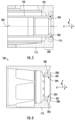
FIGS. 6-10 illustrate anozzle tip 115 along different stages of a servicing method, such as the methods of servicing afuel nozzle nozzle tip 115 and theinner tube 150. In many embodiments, the servicing method may be performed in the sequence shown inFIGS. 6-9 . For example,FIG. 6 illustrates anozzle tip 115, from which theinner tube 150 has been decoupled and removed from thefuel nozzle 100, in order to expose thepre-removal contact surface 200 prior to machining. As shown inFIG. 6 , the dashedline 206 may represent the material 201 that is to be removed by the machining process, i.e., thematerial 201 radially inward from the dashedline 206 is to be removed by a machining process. In exemplary embodiments, thematerial 201 that is to be removed is worn and/or out of engineering design tolerance due to use within agas turbine 10. -
FIG. 7 illustrates a nozzle tip that has undergone a removal process, in which thepre-removal contact surface 200 has been machined away. In various embodiments, the removal process may utilize either or both of a conventional (or traditional) machining process or a non-conventional (or nontraditional) machining process. For example, a conventional machining process may include, but is not limited to, turning, boring, drilling, swanning, broaching, filling, planing, and/or milling processes. Further, a non-conventional machining process may include, but is not limited to, Ultrasonic Machining (USM), Water Jet Machining (WJM), Chemical Machining (CHM), Electrochimical Machining (ECM), Electrical Discharge Machining (EDM), Laser Beam Machining (LBM), and/or Plasma Beam Machining (PBM). Conventional and non-conventional machining processes are generally understood by those of skill in the art and, as such, are not shown or described in further detail herein for the sake of clarity and concision. - As shown, after the machining process is complete, the
nozzle tip 115 may define anannular groove 208. In many embodiments, theannular groove 208 may include aprotrusion 210 that extends radially inward. In other embodiments (not shown), the radially innermost surface of the annular groove may extend generally linearly, such that there is no protrusion(s) defined by the annular groove. Theprotrusion 210 may provide increased surface area for the replacement coupon 214 (FIG. 8 ) to contact, thereby increasing the retention strength of the fixed connection between thenozzle tip 115 and theannular groove 208. In various embodiments, thereplacement coupon 214 may be fixedly coupled to theannular groove 208 via a brazing or welding. However, in exemplary embodiments, thereplacement coupon 214 may be fixedly coupled to theannular groove 208 via a brazing process. In such embodiments, theprotrusion 210 may provide a surface for the deposition of a braze material, which may subsequently be heated using a braze furnace to fixedly couple thereplacement coupon 214 to theannular groove 208. In many embodiments, the braze material may be disposed directly between theannular grove 208 and thereplacement coupon 214. In various embodiments, the braze material may be, but is not limited to, copper, nickel, silver, aluminum, gold, or other suitable materials. - Once the fixed connection between the
annular groove 208 defined in thenozzle tip 115 and thereplacement coupon 214 is established, thenozzle tip 115 and thereplacement coupon 214 may form continuous surfaces with one another, such that there are no voids, gaps, or cavities between thenozzle tip 115 and thereplacement coupon 214. Thereplacement coupon 214 includes a radiallyoutermost surface 218 that corresponds with theannular groove 208. In this way, the replacement coupon is fully seated within, and entirely in contact with, theannular groove 208. - In particular embodiments, the dimensions of the
replacement coupon 214 are substantially the same as the material that has been removed to form theannular groove 208. For example, in some embodiments, the dimensions of thereplacement coupon 214 may be within (+/-) 10% of the material that has been removed to form theannular groove 208. In other embodiments, the dimensions of thereplacement coupon 214 may be within (+/-) 5% of the material that has been removed to form theannular groove 208. In various embodiments, the dimensions of thereplacement coupon 214 may be within (+/-) 2.5% of the material that has been removed to form theannular groove 208. - As shown in
FIG. 10 , following the repair process, theinner tube 150 may be inserted back into thenozzle 100. In particular embodiments, thereplacement coupon 214 may define a contact surface orpost-removal contact surface 216, which advantageously forms a restored interference fit with theinner tube 150. For example, the post-removal contact surface restores the tight engineering design tolerances, which enables thepost-removal contact surface 216 of thereplacement coupon 214 to form an interference fit with theinner tube 150. In this way, thefuel nozzle 100 may be operable without any leaks at the joint formed by the interference fit between thereplacement coupon 214 and theinner tube 150. In exemplary embodiments, once theinner tube 150 is re-inserted into thefuel nozzle 100, the post-removal contact surface may annularly surround theinner tube 150 and form a restored interference fit therewith. As shown inFIG. 10 , the contact surface orpost-removal contact surface 216 may be the radially innermost surface of thereplacement coupon 214. - In many embodiments, the
nozzle tip 115 may be formed of a first material, and the replacement coupon may be formed of a second material. The second material may have a greater resistance to wear than the first material. This may advantageously extend the life of thefuel nozzle 100. For example, the increased wear resistance of thereplacement coupon 214 may allow thefuel nozzle 100 to be used within agas turbine 10 for a longer period of time without having to be removed for repair, which can advantageously improve the overall efficiency of the power plant. - In this regard, the method of servicing a fuel nozzle described herein may be performed on fuel nozzles that have undergone a duty cycle and are in need of repair, fuel nozzles that have undergone a duty cycle and are not in need of repair, or fuel nozzles that have not undergone any duty cycles. For example, the increased wear resistance of the
replacement coupon 214 may advantageously increase the life of the fuel nozzle regardless of whether or not it has been in operation. As used herein, "duty cycle" may refer to a component or components that have spent a certain amount of time operating within a gas turbine. In this way, a component that has not undergone any duty cycles has never been used in the operation of a gas turbine. -
FIG. 11 is a plan view of theaft face 116 of afuel nozzle 100 from along theaxial centerline 202. The fuel nozzle shown inFIG. 5 has undergone a servicing method, such as theservicing methods connection line 117 disposed between theaft face 116 of thenozzle tip 115 and thereplacement coupon 214. As discussed above, the fixedconnection line 117 may be the coupling between the radiallyoutermost surface 218 of thereplacement coupon 214 and theannular groove 208. -
FIG. 12 is a flow chart of a sequential set ofsteps 1202 through 1210, which define amethod 1200 of servicing a fuel nozzle (such as thefuel nozzle 100 described herein), in accordance with embodiments of the present disclosure. As shown, themethod 1200 may include optional steps (as indicated by dashed boxes) and non-optional steps (as indicated by solid boxes). For example, themethod 1200 may include anoptional step 1202 of removing aninner tube 150 from a fuel nozzle 100 (FIG. 6 ). In various embodiments, themethod 1200 may further include astep 1204 of removingmaterial 201 from anozzle tip 115 to form anannular groove 208 within thenozzle tip 115. In exemplary embodiments, thestep 1202 may be performed prior to thestep 1204. In many embodiments, the method may further include astep 1206 of inserting areplacement coupon 214 into theannular groove 208. Thereplacement coupon 214 may define a radiallyoutermost surface 218 that corresponds to theannular groove 208. In exemplary embodiments, thereplacement coupon 214 may also define apost-removal contact surface 216. In many embodiments, themethod 1200 may further include astep 1208 of fixedly coupling the radiallyoutermost surface 218 of thereplacement coupon 214 to theannular groove 208. In some embodiments, themethod 1200 may include anoptional step 1210 of re-inserting theinner tube 150. -
FIG. 13 flow chart of a sequential set ofsteps 1302 through 1312, which define amethod 1300 of servicing a fuel nozzle (such as thefuel nozzle 100 described herein), in accordance with embodiments of the present disclosure. As shown, themethod 1300 may include optional steps (as indicated by dashed boxes) and non-optional steps (as indicated by solid boxes). For example, themethod 1300 may include anoptional step 1302 of furnishing thefuel nozzle 100 that has previously undergone at least one duty cycle. In many embodiments, themethod 1300 may further include astep 1304 of removing aninner tube 150 from a fuel nozzle 100 (FIG. 6 ). In various embodiments, themethod 1300 may further include astep 1306 of removingmaterial 201 from anozzle tip 115 to form anannular groove 208 within thenozzle tip 115. In exemplary embodiments, thestep 1304 may be performed prior to thestep 1306. In many embodiments, themethod 1300 may further include astep 1308 of inserting areplacement coupon 214 into theannular groove 208. Thereplacement coupon 214 may define a radiallyoutermost surface 218 that corresponds to theannular groove 208. In exemplary embodiments, thereplacement coupon 214 may also define apost-removal contact surface 216. In many embodiments, themethod 1300 may further include astep 1310 of fixedly coupling the radiallyoutermost surface 218 of thereplacement coupon 214 to theannular groove 208. In some embodiments, themethod 1300 may include anoptional step 1312 of re-inserting theinner tube 150. - The methods of servicing a fuel nozzle described herein may advantageously allow for restoration of the interference fit between the nozzle tip and the inner tube, without requiring the entire nozzle tip to be replaced. This favorably reduces both the cost and the time necessary to service the fuel nozzle.
- This written description uses examples to disclose the invention, including the best mode, and also to enable any person skilled in the art to practice the invention, including making and using any devices or systems and performing any incorporated methods. The patentable scope of the invention is defined by the claims, and may include other examples that occur to those skilled in the art. Such other examples are intended to be within the scope of the claims if they include structural elements that do not differ from the literal language of the claims.
Claims (12)
- A method of servicing a fuel nozzle (100), the method comprising:removing material (201) from a nozzle tip (115) of the fuel nozzle (100) to form an annular groove (208) within the nozzle tip (115);inserting a replacement coupon (214) into the annular groove (208), wherein the replacement coupon (214) includes a radially outermost surface (218) that corresponds with the annular groove (208) such that the replacement coupon (214) is fully seated within, and entirely in contact with, the annular groove (208) and a post-removal contact surface (216);fixedly coupling the radially outermost surface (218) of the replacement coupon (214) to the annular groove (208).
- The method as in claim 1, wherein the fuel nozzle (100) comprises a flange (110) disposed at a forward end (102) of the fuel nozzle (100), a nozzle tip (115) disposed at an aft end (104) of the fuel nozzle (100), the nozzle tip (115) defining an aft face (116), a nozzle body (105) extending axially between the flange (110) and the nozzle tip (115), a swirler (122) extending radially outwardly from the nozzle body (105) and disposed between the forward end (102) and the aft end (104) of the fuel nozzle (100), an inner tube (150) disposed within the nozzle body (105) and extending from the flange (110) to the aft face (116).
- The method as in claim 1, wherein the nozzle tip (115) includes a pre-removal contact surface (204) that forms a worn interference fit with an inner tube (150).
- The method as in claim 3, further comprising removing the inner tube (150) prior to the removing step.
- The method as in claim 4, wherein the pre-removal contact surface (204) is removed during the removal step to form the annular groove (208).
- The method as in claim 4, further comprising re-inserting the inner tube (150) after the fixedly coupling step, wherein the post-removal contact surface (216) forms a restored interference fit with the inner tube (150).
- The method as in claim 1, wherein the fixedly coupling step comprises brazing or welding the radially outermost surface (218) of the replacement coupon (214) to the nozzle tip (115).
- The method as in claim 1, wherein the removal step is performed using one of a conventional machining process or a non-conventional machining process.
- The method as in claim 1, wherein the annular groove (208) formed by the removal step includes a protrusion (210) that extends radially inward.
- The method as in claim 1, wherein the dimensions of the replacement coupon (214) are substantially the same as the material (201) that has been removed to form the annular groove (208).
- The method as in claim 1, wherein the nozzle tip (115) comprises a first material (201), and wherein the replacement coupon (214) comprises a second material (201) having a greater wear resistance than the first material (201).
- The method as in claim 1, further comprising furnishing the fuel nozzle (100), the fuel nozzle (100) having undergone at least one duty cycle.
Applications Claiming Priority (1)
| Application Number | Priority Date | Filing Date | Title |
|---|---|---|---|
| US17/006,045 US11435081B2 (en) | 2020-08-28 | 2020-08-28 | Methods of servicing a fuel nozzle tip |
Publications (2)
| Publication Number | Publication Date |
|---|---|
| EP3961103A1 EP3961103A1 (en) | 2022-03-02 |
| EP3961103B1 true EP3961103B1 (en) | 2024-05-15 |
Family
ID=77316820
Family Applications (1)
| Application Number | Title | Priority Date | Filing Date |
|---|---|---|---|
| EP21190912.2A Active EP3961103B1 (en) | 2020-08-28 | 2021-08-11 | Methods of servicing a fuel nozzle tip |
Country Status (5)
| Country | Link |
|---|---|
| US (1) | US11435081B2 (en) |
| EP (1) | EP3961103B1 (en) |
| JP (1) | JP2022040039A (en) |
| CN (1) | CN114110656A (en) |
| PL (1) | PL3961103T3 (en) |
Families Citing this family (2)
| Publication number | Priority date | Publication date | Assignee | Title |
|---|---|---|---|---|
| US12083640B1 (en) * | 2023-08-09 | 2024-09-10 | Ge Infrastructure Technology Llc | Methods of repairing tubes in bundled tube fuel injectors |
| CN120502808B (en) * | 2025-07-15 | 2025-09-19 | 山东一燃节能环保有限公司 | A heating furnace processing automatic welding equipment |
Family Cites Families (19)
| Publication number | Priority date | Publication date | Assignee | Title |
|---|---|---|---|---|
| US4509299A (en) | 1982-09-27 | 1985-04-09 | United Technologies Corporation | Means for refacing a fuel nozzle and method thereof |
| US5685139A (en) | 1996-03-29 | 1997-11-11 | General Electric Company | Diffusion-premix nozzle for a gas turbine combustor and related method |
| WO2009126701A2 (en) | 2008-04-11 | 2009-10-15 | General Electric Company | Repairable fuel nozzle and a method of repairing |
| US8061142B2 (en) * | 2008-04-11 | 2011-11-22 | General Electric Company | Mixer for a combustor |
| US8079218B2 (en) * | 2009-05-21 | 2011-12-20 | General Electric Company | Method and apparatus for combustor nozzle with flameholding protection |
| JP5787496B2 (en) * | 2010-07-30 | 2015-09-30 | 三菱重工業株式会社 | Repair method for nozzle |
| US9021675B2 (en) | 2011-08-15 | 2015-05-05 | United Technologies Corporation | Method for repairing fuel nozzle guides for gas turbine engine combustors using cold metal transfer weld technology |
| US9079273B2 (en) * | 2012-05-14 | 2015-07-14 | Solar Turbines Incorporated | Methods for manufacturing, modifying, and retrofitting a gas turbine injector |
| US9303515B2 (en) | 2012-08-30 | 2016-04-05 | General Electric Company | Turbomachine diaphragm and method of repairing a turbomachine diaphragm |
| CN104781610B (en) * | 2012-11-15 | 2017-03-08 | 通用电气公司 | fuel nozzle heat shield |
| US20150167983A1 (en) | 2013-12-13 | 2015-06-18 | General Electric Company | Bundled tube fuel injector tube tip |
| US9423134B2 (en) | 2013-12-13 | 2016-08-23 | General Electric Company | Bundled tube fuel injector with a multi-configuration tube tip |
| US20170080530A1 (en) * | 2015-09-22 | 2017-03-23 | Michael Davis McGhee | Method of electron beam welding |
| DE102015219515B4 (en) * | 2015-10-08 | 2023-08-03 | Ford Global Technologies, Llc | Injector assembly for an internal combustion engine, z. B. Diesel engine |
| US10364982B2 (en) * | 2015-11-19 | 2019-07-30 | Ansaldo Energia Switzerland AG | Method for reconditioning fuel nozzle assemblies |
| US10697639B2 (en) | 2017-03-16 | 2020-06-30 | General Electric Compamy | Dual-fuel fuel nozzle with liquid fuel tip |
| US20190040762A1 (en) * | 2017-08-02 | 2019-02-07 | Cummins Inc. | Method and system for nozzle ring repair |
| US10471554B2 (en) * | 2017-08-22 | 2019-11-12 | Caterpillar Inc. | Fuel injector bore repair |
| US10940535B2 (en) * | 2018-06-08 | 2021-03-09 | General Electric Company | Method and system for additive manufacturing |
-
2020
- 2020-08-28 US US17/006,045 patent/US11435081B2/en active Active
-
2021
- 2021-07-26 CN CN202110847378.5A patent/CN114110656A/en active Pending
- 2021-08-11 EP EP21190912.2A patent/EP3961103B1/en active Active
- 2021-08-11 PL PL21190912.2T patent/PL3961103T3/en unknown
- 2021-08-23 JP JP2021135281A patent/JP2022040039A/en active Pending
Also Published As
| Publication number | Publication date |
|---|---|
| CN114110656A (en) | 2022-03-01 |
| JP2022040039A (en) | 2022-03-10 |
| US11435081B2 (en) | 2022-09-06 |
| US20220065455A1 (en) | 2022-03-03 |
| PL3961103T3 (en) | 2024-07-08 |
| EP3961103A1 (en) | 2022-03-02 |
Similar Documents
| Publication | Publication Date | Title |
|---|---|---|
| EP2899466B1 (en) | Method for repairing a bundled tube fuel injector | |
| CA2476745C (en) | Methods and apparatus for attaching swirlers to gas turbine engine combustors | |
| US9664392B2 (en) | Bundled tube fuel injector with outer shroud and outer band connection | |
| US9618209B2 (en) | Gas turbine engine fuel injector with an inner heat shield | |
| CN113864818B (en) | Combustor air flow path | |
| EP3961103B1 (en) | Methods of servicing a fuel nozzle tip | |
| KR102120116B1 (en) | Turbine blade of gas turbine having cast tip | |
| US10982855B2 (en) | Combustor cap assembly with cooling microchannels | |
| CN119642219A (en) | Gas turbine engine and fuel nozzle thereof | |
| EP4067746B1 (en) | Combustor having a wake energizer | |
| US11846419B2 (en) | Dome-deflector joint cooling arrangement | |
| JP2022070219A (en) | Integrated combustion nozzle with integrated headend | |
| US12601487B2 (en) | Injector head for fuel injector | |
| US12083640B1 (en) | Methods of repairing tubes in bundled tube fuel injectors | |
| EP3892921B1 (en) | Burner with burner cooling structures | |
| US11774099B2 (en) | Gas turbine fuel nozzle tip comprising an impingement wall | |
| US20250244016A1 (en) | Turbomachine having improved mixing tube elements | |
| JP7604198B2 (en) | Improved patching and usage |
Legal Events
| Date | Code | Title | Description |
|---|---|---|---|
| PUAI | Public reference made under article 153(3) epc to a published international application that has entered the european phase |
Free format text: ORIGINAL CODE: 0009012 |
|
| STAA | Information on the status of an ep patent application or granted ep patent |
Free format text: STATUS: THE APPLICATION HAS BEEN PUBLISHED |
|
| AK | Designated contracting states |
Kind code of ref document: A1 Designated state(s): AL AT BE BG CH CY CZ DE DK EE ES FI FR GB GR HR HU IE IS IT LI LT LU LV MC MK MT NL NO PL PT RO RS SE SI SK SM TR |
|
| STAA | Information on the status of an ep patent application or granted ep patent |
Free format text: STATUS: REQUEST FOR EXAMINATION WAS MADE |
|
| 17P | Request for examination filed |
Effective date: 20220831 |
|
| RBV | Designated contracting states (corrected) |
Designated state(s): AL AT BE BG CH CY CZ DE DK EE ES FI FR GB GR HR HU IE IS IT LI LT LU LV MC MK MT NL NO PL PT RO RS SE SI SK SM TR |
|
| STAA | Information on the status of an ep patent application or granted ep patent |
Free format text: STATUS: EXAMINATION IS IN PROGRESS |
|
| 17Q | First examination report despatched |
Effective date: 20230309 |
|
| RAP1 | Party data changed (applicant data changed or rights of an application transferred) |
Owner name: GENERAL ELECTRIC TECHNOLOGY GMBH |
|
| GRAP | Despatch of communication of intention to grant a patent |
Free format text: ORIGINAL CODE: EPIDOSNIGR1 |
|
| STAA | Information on the status of an ep patent application or granted ep patent |
Free format text: STATUS: GRANT OF PATENT IS INTENDED |
|
| INTG | Intention to grant announced |
Effective date: 20240306 |
|
| GRAS | Grant fee paid |
Free format text: ORIGINAL CODE: EPIDOSNIGR3 |
|
| GRAA | (expected) grant |
Free format text: ORIGINAL CODE: 0009210 |
|
| STAA | Information on the status of an ep patent application or granted ep patent |
Free format text: STATUS: THE PATENT HAS BEEN GRANTED |
|
| AK | Designated contracting states |
Kind code of ref document: B1 Designated state(s): AL AT BE BG CH CY CZ DE DK EE ES FI FR GB GR HR HU IE IS IT LI LT LU LV MC MK MT NL NO PL PT RO RS SE SI SK SM TR |
|
| REG | Reference to a national code |
Ref country code: CH Ref legal event code: EP |
|
| REG | Reference to a national code |
Ref country code: DE Ref legal event code: R096 Ref document number: 602021013243 Country of ref document: DE |
|
| REG | Reference to a national code |
Ref country code: IE Ref legal event code: FG4D |
|
| REG | Reference to a national code |
Ref country code: LT Ref legal event code: MG9D |
|
| REG | Reference to a national code |
Ref country code: NL Ref legal event code: MP Effective date: 20240515 |
|
| PG25 | Lapsed in a contracting state [announced via postgrant information from national office to epo] |
Ref country code: IS Free format text: LAPSE BECAUSE OF FAILURE TO SUBMIT A TRANSLATION OF THE DESCRIPTION OR TO PAY THE FEE WITHIN THE PRESCRIBED TIME-LIMIT Effective date: 20240915 |
|
| PG25 | Lapsed in a contracting state [announced via postgrant information from national office to epo] |
Ref country code: BG Free format text: LAPSE BECAUSE OF FAILURE TO SUBMIT A TRANSLATION OF THE DESCRIPTION OR TO PAY THE FEE WITHIN THE PRESCRIBED TIME-LIMIT Effective date: 20240515 |
|
| PG25 | Lapsed in a contracting state [announced via postgrant information from national office to epo] |
Ref country code: HR Free format text: LAPSE BECAUSE OF FAILURE TO SUBMIT A TRANSLATION OF THE DESCRIPTION OR TO PAY THE FEE WITHIN THE PRESCRIBED TIME-LIMIT Effective date: 20240515 Ref country code: FI Free format text: LAPSE BECAUSE OF FAILURE TO SUBMIT A TRANSLATION OF THE DESCRIPTION OR TO PAY THE FEE WITHIN THE PRESCRIBED TIME-LIMIT Effective date: 20240515 |
|
| PG25 | Lapsed in a contracting state [announced via postgrant information from national office to epo] |
Ref country code: GR Free format text: LAPSE BECAUSE OF FAILURE TO SUBMIT A TRANSLATION OF THE DESCRIPTION OR TO PAY THE FEE WITHIN THE PRESCRIBED TIME-LIMIT Effective date: 20240816 |
|
| PG25 | Lapsed in a contracting state [announced via postgrant information from national office to epo] |
Ref country code: PT Free format text: LAPSE BECAUSE OF FAILURE TO SUBMIT A TRANSLATION OF THE DESCRIPTION OR TO PAY THE FEE WITHIN THE PRESCRIBED TIME-LIMIT Effective date: 20240916 |
|
| REG | Reference to a national code |
Ref country code: AT Ref legal event code: MK05 Ref document number: 1687190 Country of ref document: AT Kind code of ref document: T Effective date: 20240515 |
|
| PG25 | Lapsed in a contracting state [announced via postgrant information from national office to epo] |
Ref country code: NL Free format text: LAPSE BECAUSE OF FAILURE TO SUBMIT A TRANSLATION OF THE DESCRIPTION OR TO PAY THE FEE WITHIN THE PRESCRIBED TIME-LIMIT Effective date: 20240515 |
|
| PG25 | Lapsed in a contracting state [announced via postgrant information from national office to epo] |
Ref country code: ES Free format text: LAPSE BECAUSE OF FAILURE TO SUBMIT A TRANSLATION OF THE DESCRIPTION OR TO PAY THE FEE WITHIN THE PRESCRIBED TIME-LIMIT Effective date: 20240515 |
|
| PG25 | Lapsed in a contracting state [announced via postgrant information from national office to epo] |
Ref country code: AT Free format text: LAPSE BECAUSE OF FAILURE TO SUBMIT A TRANSLATION OF THE DESCRIPTION OR TO PAY THE FEE WITHIN THE PRESCRIBED TIME-LIMIT Effective date: 20240515 |
|
| PG25 | Lapsed in a contracting state [announced via postgrant information from national office to epo] |
Ref country code: LV Free format text: LAPSE BECAUSE OF FAILURE TO SUBMIT A TRANSLATION OF THE DESCRIPTION OR TO PAY THE FEE WITHIN THE PRESCRIBED TIME-LIMIT Effective date: 20240515 |
|
| PG25 | Lapsed in a contracting state [announced via postgrant information from national office to epo] |
Ref country code: PT Free format text: LAPSE BECAUSE OF FAILURE TO SUBMIT A TRANSLATION OF THE DESCRIPTION OR TO PAY THE FEE WITHIN THE PRESCRIBED TIME-LIMIT Effective date: 20240916 Ref country code: NO Free format text: LAPSE BECAUSE OF FAILURE TO SUBMIT A TRANSLATION OF THE DESCRIPTION OR TO PAY THE FEE WITHIN THE PRESCRIBED TIME-LIMIT Effective date: 20240815 Ref country code: NL Free format text: LAPSE BECAUSE OF FAILURE TO SUBMIT A TRANSLATION OF THE DESCRIPTION OR TO PAY THE FEE WITHIN THE PRESCRIBED TIME-LIMIT Effective date: 20240515 Ref country code: LV Free format text: LAPSE BECAUSE OF FAILURE TO SUBMIT A TRANSLATION OF THE DESCRIPTION OR TO PAY THE FEE WITHIN THE PRESCRIBED TIME-LIMIT Effective date: 20240515 Ref country code: IS Free format text: LAPSE BECAUSE OF FAILURE TO SUBMIT A TRANSLATION OF THE DESCRIPTION OR TO PAY THE FEE WITHIN THE PRESCRIBED TIME-LIMIT Effective date: 20240915 Ref country code: HR Free format text: LAPSE BECAUSE OF FAILURE TO SUBMIT A TRANSLATION OF THE DESCRIPTION OR TO PAY THE FEE WITHIN THE PRESCRIBED TIME-LIMIT Effective date: 20240515 Ref country code: GR Free format text: LAPSE BECAUSE OF FAILURE TO SUBMIT A TRANSLATION OF THE DESCRIPTION OR TO PAY THE FEE WITHIN THE PRESCRIBED TIME-LIMIT Effective date: 20240816 Ref country code: FI Free format text: LAPSE BECAUSE OF FAILURE TO SUBMIT A TRANSLATION OF THE DESCRIPTION OR TO PAY THE FEE WITHIN THE PRESCRIBED TIME-LIMIT Effective date: 20240515 Ref country code: ES Free format text: LAPSE BECAUSE OF FAILURE TO SUBMIT A TRANSLATION OF THE DESCRIPTION OR TO PAY THE FEE WITHIN THE PRESCRIBED TIME-LIMIT Effective date: 20240515 Ref country code: BG Free format text: LAPSE BECAUSE OF FAILURE TO SUBMIT A TRANSLATION OF THE DESCRIPTION OR TO PAY THE FEE WITHIN THE PRESCRIBED TIME-LIMIT Effective date: 20240515 Ref country code: AT Free format text: LAPSE BECAUSE OF FAILURE TO SUBMIT A TRANSLATION OF THE DESCRIPTION OR TO PAY THE FEE WITHIN THE PRESCRIBED TIME-LIMIT Effective date: 20240515 Ref country code: RS Free format text: LAPSE BECAUSE OF FAILURE TO SUBMIT A TRANSLATION OF THE DESCRIPTION OR TO PAY THE FEE WITHIN THE PRESCRIBED TIME-LIMIT Effective date: 20240815 |
|
| PG25 | Lapsed in a contracting state [announced via postgrant information from national office to epo] |
Ref country code: DK Free format text: LAPSE BECAUSE OF FAILURE TO SUBMIT A TRANSLATION OF THE DESCRIPTION OR TO PAY THE FEE WITHIN THE PRESCRIBED TIME-LIMIT Effective date: 20240515 |
|
| PG25 | Lapsed in a contracting state [announced via postgrant information from national office to epo] |
Ref country code: EE Free format text: LAPSE BECAUSE OF FAILURE TO SUBMIT A TRANSLATION OF THE DESCRIPTION OR TO PAY THE FEE WITHIN THE PRESCRIBED TIME-LIMIT Effective date: 20240515 |
|
| PG25 | Lapsed in a contracting state [announced via postgrant information from national office to epo] |
Ref country code: CZ Free format text: LAPSE BECAUSE OF FAILURE TO SUBMIT A TRANSLATION OF THE DESCRIPTION OR TO PAY THE FEE WITHIN THE PRESCRIBED TIME-LIMIT Effective date: 20240515 |
|
| PG25 | Lapsed in a contracting state [announced via postgrant information from national office to epo] |
Ref country code: RO Free format text: LAPSE BECAUSE OF FAILURE TO SUBMIT A TRANSLATION OF THE DESCRIPTION OR TO PAY THE FEE WITHIN THE PRESCRIBED TIME-LIMIT Effective date: 20240515 Ref country code: SK Free format text: LAPSE BECAUSE OF FAILURE TO SUBMIT A TRANSLATION OF THE DESCRIPTION OR TO PAY THE FEE WITHIN THE PRESCRIBED TIME-LIMIT Effective date: 20240515 |
|
| PG25 | Lapsed in a contracting state [announced via postgrant information from national office to epo] |
Ref country code: SM Free format text: LAPSE BECAUSE OF FAILURE TO SUBMIT A TRANSLATION OF THE DESCRIPTION OR TO PAY THE FEE WITHIN THE PRESCRIBED TIME-LIMIT Effective date: 20240515 |
|
| PG25 | Lapsed in a contracting state [announced via postgrant information from national office to epo] |
Ref country code: SM Free format text: LAPSE BECAUSE OF FAILURE TO SUBMIT A TRANSLATION OF THE DESCRIPTION OR TO PAY THE FEE WITHIN THE PRESCRIBED TIME-LIMIT Effective date: 20240515 Ref country code: SK Free format text: LAPSE BECAUSE OF FAILURE TO SUBMIT A TRANSLATION OF THE DESCRIPTION OR TO PAY THE FEE WITHIN THE PRESCRIBED TIME-LIMIT Effective date: 20240515 Ref country code: RO Free format text: LAPSE BECAUSE OF FAILURE TO SUBMIT A TRANSLATION OF THE DESCRIPTION OR TO PAY THE FEE WITHIN THE PRESCRIBED TIME-LIMIT Effective date: 20240515 Ref country code: EE Free format text: LAPSE BECAUSE OF FAILURE TO SUBMIT A TRANSLATION OF THE DESCRIPTION OR TO PAY THE FEE WITHIN THE PRESCRIBED TIME-LIMIT Effective date: 20240515 Ref country code: DK Free format text: LAPSE BECAUSE OF FAILURE TO SUBMIT A TRANSLATION OF THE DESCRIPTION OR TO PAY THE FEE WITHIN THE PRESCRIBED TIME-LIMIT Effective date: 20240515 Ref country code: CZ Free format text: LAPSE BECAUSE OF FAILURE TO SUBMIT A TRANSLATION OF THE DESCRIPTION OR TO PAY THE FEE WITHIN THE PRESCRIBED TIME-LIMIT Effective date: 20240515 |
|
| PG25 | Lapsed in a contracting state [announced via postgrant information from national office to epo] |
Ref country code: IT Free format text: LAPSE BECAUSE OF FAILURE TO SUBMIT A TRANSLATION OF THE DESCRIPTION OR TO PAY THE FEE WITHIN THE PRESCRIBED TIME-LIMIT Effective date: 20240515 |
|
| REG | Reference to a national code |
Ref country code: DE Ref legal event code: R097 Ref document number: 602021013243 Country of ref document: DE |
|
| PLBE | No opposition filed within time limit |
Free format text: ORIGINAL CODE: 0009261 |
|
| STAA | Information on the status of an ep patent application or granted ep patent |
Free format text: STATUS: NO OPPOSITION FILED WITHIN TIME LIMIT |
|
| REG | Reference to a national code |
Ref country code: CH Ref legal event code: PL |
|
| PG25 | Lapsed in a contracting state [announced via postgrant information from national office to epo] |
Ref country code: LU Free format text: LAPSE BECAUSE OF NON-PAYMENT OF DUE FEES Effective date: 20240811 |
|
| 26N | No opposition filed |
Effective date: 20250218 |
|
| PG25 | Lapsed in a contracting state [announced via postgrant information from national office to epo] |
Ref country code: SI Free format text: LAPSE BECAUSE OF FAILURE TO SUBMIT A TRANSLATION OF THE DESCRIPTION OR TO PAY THE FEE WITHIN THE PRESCRIBED TIME-LIMIT Effective date: 20240515 Ref country code: MC Free format text: LAPSE BECAUSE OF FAILURE TO SUBMIT A TRANSLATION OF THE DESCRIPTION OR TO PAY THE FEE WITHIN THE PRESCRIBED TIME-LIMIT Effective date: 20240515 Ref country code: CH Free format text: LAPSE BECAUSE OF NON-PAYMENT OF DUE FEES Effective date: 20240831 |
|
| REG | Reference to a national code |
Ref country code: BE Ref legal event code: MM Effective date: 20240831 |
|
| PG25 | Lapsed in a contracting state [announced via postgrant information from national office to epo] |
Ref country code: BE Free format text: LAPSE BECAUSE OF NON-PAYMENT OF DUE FEES Effective date: 20240831 |
|
| PG25 | Lapsed in a contracting state [announced via postgrant information from national office to epo] |
Ref country code: FR Free format text: LAPSE BECAUSE OF NON-PAYMENT OF DUE FEES Effective date: 20240831 |
|
| PG25 | Lapsed in a contracting state [announced via postgrant information from national office to epo] |
Ref country code: IE Free format text: LAPSE BECAUSE OF NON-PAYMENT OF DUE FEES Effective date: 20240811 |
|
| PG25 | Lapsed in a contracting state [announced via postgrant information from national office to epo] |
Ref country code: SE Free format text: LAPSE BECAUSE OF FAILURE TO SUBMIT A TRANSLATION OF THE DESCRIPTION OR TO PAY THE FEE WITHIN THE PRESCRIBED TIME-LIMIT Effective date: 20240515 |
|
| PGFP | Annual fee paid to national office [announced via postgrant information from national office to epo] |
Ref country code: DE Payment date: 20250724 Year of fee payment: 5 |
|
| PGFP | Annual fee paid to national office [announced via postgrant information from national office to epo] |
Ref country code: PL Payment date: 20250723 Year of fee payment: 5 |
|
| PG25 | Lapsed in a contracting state [announced via postgrant information from national office to epo] |
Ref country code: CY Free format text: LAPSE BECAUSE OF FAILURE TO SUBMIT A TRANSLATION OF THE DESCRIPTION OR TO PAY THE FEE WITHIN THE PRESCRIBED TIME-LIMIT; INVALID AB INITIO Effective date: 20210811 |
|
| PG25 | Lapsed in a contracting state [announced via postgrant information from national office to epo] |
Ref country code: HU Free format text: LAPSE BECAUSE OF FAILURE TO SUBMIT A TRANSLATION OF THE DESCRIPTION OR TO PAY THE FEE WITHIN THE PRESCRIBED TIME-LIMIT; INVALID AB INITIO Effective date: 20210811 |