EP3960828A1 - Resin composition and cured product thereof - Google Patents
Resin composition and cured product thereof Download PDFInfo
- Publication number
- EP3960828A1 EP3960828A1 EP20193556.6A EP20193556A EP3960828A1 EP 3960828 A1 EP3960828 A1 EP 3960828A1 EP 20193556 A EP20193556 A EP 20193556A EP 3960828 A1 EP3960828 A1 EP 3960828A1
- Authority
- EP
- European Patent Office
- Prior art keywords
- resin composition
- meth
- resin
- group
- produced
- Prior art date
- Legal status (The legal status is an assumption and is not a legal conclusion. Google has not performed a legal analysis and makes no representation as to the accuracy of the status listed.)
- Pending
Links
- 0 *CCCOCC1(COCCCN=C)COCCC[Cn]C=*CCCOC1 Chemical compound *CCCOCC1(COCCCN=C)COCCC[Cn]C=*CCCOC1 0.000 description 7
- GPEJZGUQYVPGQS-UHFFFAOYSA-N C(C1C2)C1C21CCCC1 Chemical compound C(C1C2)C1C21CCCC1 GPEJZGUQYVPGQS-UHFFFAOYSA-N 0.000 description 1
- KQPBGVHGLDUVKU-UHFFFAOYSA-N O=C(N(CCCS)C1N2CCCS)N(CCCS)C1N(CCCS)C2=O Chemical compound O=C(N(CCCS)C1N2CCCS)N(CCCS)C1N(CCCS)C2=O KQPBGVHGLDUVKU-UHFFFAOYSA-N 0.000 description 1
Images

Classifications
-
- C—CHEMISTRY; METALLURGY
- C08—ORGANIC MACROMOLECULAR COMPOUNDS; THEIR PREPARATION OR CHEMICAL WORKING-UP; COMPOSITIONS BASED THEREON
- C08L—COMPOSITIONS OF MACROMOLECULAR COMPOUNDS
- C08L33/00—Compositions of homopolymers or copolymers of compounds having one or more unsaturated aliphatic radicals, each having only one carbon-to-carbon double bond, and only one being terminated by only one carboxyl radical, or of salts, anhydrides, esters, amides, imides or nitriles thereof; Compositions of derivatives of such polymers
- C08L33/04—Homopolymers or copolymers of esters
-
- C—CHEMISTRY; METALLURGY
- C09—DYES; PAINTS; POLISHES; NATURAL RESINS; ADHESIVES; COMPOSITIONS NOT OTHERWISE PROVIDED FOR; APPLICATIONS OF MATERIALS NOT OTHERWISE PROVIDED FOR
- C09J—ADHESIVES; NON-MECHANICAL ASPECTS OF ADHESIVE PROCESSES IN GENERAL; ADHESIVE PROCESSES NOT PROVIDED FOR ELSEWHERE; USE OF MATERIALS AS ADHESIVES
- C09J133/00—Adhesives based on homopolymers or copolymers of compounds having one or more unsaturated aliphatic radicals, each having only one carbon-to-carbon double bond, and at least one being terminated by only one carboxyl radical, or of salts, anhydrides, esters, amides, imides, or nitriles thereof; Adhesives based on derivatives of such polymers
- C09J133/04—Homopolymers or copolymers of esters
- C09J133/14—Homopolymers or copolymers of esters of esters containing halogen, nitrogen, sulfur or oxygen atoms in addition to the carboxy oxygen
-
- C—CHEMISTRY; METALLURGY
- C08—ORGANIC MACROMOLECULAR COMPOUNDS; THEIR PREPARATION OR CHEMICAL WORKING-UP; COMPOSITIONS BASED THEREON
- C08K—Use of inorganic or non-macromolecular organic substances as compounding ingredients
- C08K5/00—Use of organic ingredients
- C08K5/36—Sulfur-, selenium-, or tellurium-containing compounds
- C08K5/37—Thiols
-
- C—CHEMISTRY; METALLURGY
- C08—ORGANIC MACROMOLECULAR COMPOUNDS; THEIR PREPARATION OR CHEMICAL WORKING-UP; COMPOSITIONS BASED THEREON
- C08K—Use of inorganic or non-macromolecular organic substances as compounding ingredients
- C08K5/00—Use of organic ingredients
- C08K5/36—Sulfur-, selenium-, or tellurium-containing compounds
- C08K5/37—Thiols
- C08K5/378—Thiols containing heterocyclic rings
-
- C—CHEMISTRY; METALLURGY
- C08—ORGANIC MACROMOLECULAR COMPOUNDS; THEIR PREPARATION OR CHEMICAL WORKING-UP; COMPOSITIONS BASED THEREON
- C08L—COMPOSITIONS OF MACROMOLECULAR COMPOUNDS
- C08L9/00—Compositions of homopolymers or copolymers of conjugated diene hydrocarbons
-
- C—CHEMISTRY; METALLURGY
- C09—DYES; PAINTS; POLISHES; NATURAL RESINS; ADHESIVES; COMPOSITIONS NOT OTHERWISE PROVIDED FOR; APPLICATIONS OF MATERIALS NOT OTHERWISE PROVIDED FOR
- C09J—ADHESIVES; NON-MECHANICAL ASPECTS OF ADHESIVE PROCESSES IN GENERAL; ADHESIVE PROCESSES NOT PROVIDED FOR ELSEWHERE; USE OF MATERIALS AS ADHESIVES
- C09J11/00—Features of adhesives not provided for in group C09J9/00, e.g. additives
- C09J11/02—Non-macromolecular additives
- C09J11/06—Non-macromolecular additives organic
-
- C—CHEMISTRY; METALLURGY
- C09—DYES; PAINTS; POLISHES; NATURAL RESINS; ADHESIVES; COMPOSITIONS NOT OTHERWISE PROVIDED FOR; APPLICATIONS OF MATERIALS NOT OTHERWISE PROVIDED FOR
- C09J—ADHESIVES; NON-MECHANICAL ASPECTS OF ADHESIVE PROCESSES IN GENERAL; ADHESIVE PROCESSES NOT PROVIDED FOR ELSEWHERE; USE OF MATERIALS AS ADHESIVES
- C09J135/00—Adhesives based on homopolymers or copolymers of compounds having one or more unsaturated aliphatic radicals, each having only one carbon-to-carbon double bond, and at least one being terminated by a carboxyl radical, and containing at least another carboxyl radical in the molecule, or of salts, anhydrides, esters, amides, imides or nitriles thereof; Adhesives based on derivatives of such polymers
- C09J135/02—Homopolymers or copolymers of esters
-
- C—CHEMISTRY; METALLURGY
- C09—DYES; PAINTS; POLISHES; NATURAL RESINS; ADHESIVES; COMPOSITIONS NOT OTHERWISE PROVIDED FOR; APPLICATIONS OF MATERIALS NOT OTHERWISE PROVIDED FOR
- C09J—ADHESIVES; NON-MECHANICAL ASPECTS OF ADHESIVE PROCESSES IN GENERAL; ADHESIVE PROCESSES NOT PROVIDED FOR ELSEWHERE; USE OF MATERIALS AS ADHESIVES
- C09J163/00—Adhesives based on epoxy resins; Adhesives based on derivatives of epoxy resins
- C09J163/10—Epoxy resins modified by unsaturated compounds
Definitions
- the present invention relates to a resin composition and cured product thereof.
- a small camera module mounted on a smartphone etc. has a lens, a cylindrical lens holder that holds the lens, and an imaging element that converts the light collected by the lens into electrical signals and that is fixed on a substrate. During the assembly of this small camera module, it is necessary to firmly bond the lens holder and the substrate on which the imaging element is fixed. An adhesive is used to bond them (PTL 1).
- An object of the present invention is to provide an adhesive having sufficient adhesion strength during heat-curing when a lens holder and a substrate on which an imaging element is fixed are bonded in camera module assembly, and also having excellent adhesion strength and position accuracy after a high-temperature and high-humidity durability test after curing.
- the present inventor conducted extensive studies to solve the above problems, and found that the above problems can be solved by using a resin composition comprising (a) a (meth)acrylate group-containing resin, (b) a polyfunctional thiol having a specific structure, and (c) a latent curing agent.
- a resin composition comprising (a) a (meth)acrylate group-containing resin, (b) a polyfunctional thiol having a specific structure, and (c) a latent curing agent.
- the present invention has been completed upon further studies based on the above finding, and includes the following aspects.
- the resin composition of the present invention When the resin composition of the present invention is used in camera module assembly to bond a lens holder and a substrate on which an imaging element is fixed, sufficient adhesion strength is ensured during heat-curing of the adhesive, and the position accuracy after a high-temperature and high-humidity durability test after curing can be improved.
- Fig. 1 is a schematic diagram of an adhesion test in the Examples.
- the weight average molecular weight refers to a polystyrene conversion value determined by gel permeation chromatography (GPC) using a solvent, such as tetrahydrofuran, as an eluent.
- the (meth)acrylate, (meth)acrylic, and (meth)acryloyl group mean acrylate or methacrylate, acrylic or methacrylic, and an acryloyl or methacryloyl group, respectively.
- the (meth)acrylate group-containing resin includes, for example, (meth)acrylate, a (meth)acrylate oligomer, an acrylic polymer obtained by copolymerizing a (meth)acrylate monomer with another monomer, and one that can be obtained by reacting (meth)acrylic acid with a resin.
- Examples of (meth)acrylates include (meth)acrylic acid esters.
- the (meth)acrylic acid ester may be a monofunctional (meth)acrylic acid ester or a polyfunctional (meth)acrylic acid ester.
- monofunctional (meth)acrylic acid esters include methyl methacrylate, ethyl methacrylate, n-propyl methacrylate, glycidyl methacrylate, 2-hydroxyethyl methacrylate, 2-isocyanatoethyl methacrylate, isobornyl methacrylate (e.g., product name: "IBXA,” Osaka Organic Chemical Industry Ltd.), 2-methacryloxyethyltrimethoxysilane, 2-methacryloxyethyltriethoxysilane, 3-methacryloxypropyltrimethoxysilane, 3-methacryloxypropylmethyldimethoxysilane, 3-methacryloxypropyltriethoxysilane, 3-methacryloxymethyldiethoxysilane, 4-methacryloxybutyltrimethoxysilane, 4-methacryloxybutyltriethoxysilane, dicyclopentenyloxyethyl methacryl
- bifunctional (meth)acrylic acid esters include tricyclodecane dimethanol diacrylate (e.g., product name: "SR833," Sartomer), dipropylene glycol diacrylate (e.g., product name: "APG-100,” Shin-Nakamura Chemical Co., Ltd.), tricyclodecane dimethanol diacrylate (e.g., product name: "A-DCP,” Shin-Nakamura Chemical Co., Ltd.), 1,4-butanediol dimethacrylate (e.g., product name: "FA-124M,” produced by Hitachi Chemical Co., Ltd.), neopentyl glycol dimethacrylate (e.g., product name: "FA-125M,” produced by Hitachi Chemical Co., Ltd.), polyethylene glycol #200 dimethacrylate (e.g., product name: "FA-220M,” produced by Hitachi Chemical Co., Ltd.), bisphenol A type epoxy acrylate (e.g., product name:
- trifunctional or higher polyfunctional (meth)acrylic acid esters include trimethylolpropane trimethacrylate (e.g., product name: "TMPT,” produced by Shin-Nakamura Chemical Co., Ltd.), tris(2-hydroxyethyl)isocyanurate triacrylate (e.g., product name: "SR368NS,” Sartomer), and the like.
- the resin composition of the present invention may contain only one, or two or more of the (meth)acrylates.
- the (meth)acrylate group-containing resin may be an acrylate oligomer.
- the resin composition of the present invention has excellent adhesion strength and moisture resistance after curing, because it contains an acrylate oligomer.
- the (meth)acrylate group-containing resin examples include urethane acrylate oligomers.
- Urethane acrylate oligomers are widely known to those skilled in the art, and can be obtained, for example, by reacting diisocyanates, preferably aliphatic diisocyanates, with hydroxy acrylates. Alternatively, they can be obtained, for example, by reacting diisocyanates, preferably aliphatic diisocyanates, with hydroxy acrylates and polyols.
- urethane acrylate oligomers examples include polycarbonate-based urethane acrylate oligomers.
- the resin composition of the present invention particularly has excellent adhesion strength and moisture resistance after curing, because it contains a polycarbonate-based urethane acrylate oligomer. The reason for this is considered to be because the polycarbonate skeleton strongly interacts with the surface to be bonded, such as LCP, and because it is a polymer and thus can prevent the entrance of water under high temperature and high humidity.
- Polycarbonate-based urethane acrylate oligomers are widely known to those skilled in the art, and can be obtained, for example, by reacting diisocyanates, preferably aliphatic diisocyanates, with hydroxy acrylates and polycarbonates.
- polycarbonate-based urethane acrylate oligomers include "UN9200A” (Negami Chemical Industrial Co., Ltd.; weight average molecular weight: 15,000), “UV3310B” (Mitsubishi Chemical Corporation; weight average molecular weight: 5,000), and the like.
- urethane acrylate oligomers examples include polyether-based urethane acrylate oligomers.
- Polyether-based urethane acrylate oligomers are widely known to those skilled in the art, and can be obtained, for example, by reacting diisocyanates, preferably aliphatic diisocyanates, with hydroxy acrylates and polyethers.
- Specific examples of polyether-based urethane acrylate oligomers include "UV6640B" (Mitsubishi Chemical Corporation; weight average molecular weight: 5,000), "UN6202” (Negami Chemical Industrial Co., Ltd.; weight average molecular weight: 11,000), and the like.
- the weight average molecular weight of the (meth)acrylate oligomer is preferably 4,000 or more.
- the weight average molecular weight of the (meth)acrylate oligomer is preferably 5,000 or more, more preferably 6,000 or more, even more preferably 8,000 or more, and still even more preferably 10,000 or more, in terms of forming a sufficiently soft segment structure in a cured product to thereby enhance durability to heat and mechanical stimuli, and to optimize the storage modulus.
- the weight average molecular weight of the (meth)acrylate oligomer is preferably 20,000 or less, more preferably 18,000 or less, and even more preferably 16,000 or less, in terms of the dispensability of the adhesive.
- the (meth)acrylate group-containing resin may be an acrylic polymer obtained by copolymerizing an acrylate monomer with another monomer, or may be one that can be obtained by reacting (meth)acrylic acid with a resin.
- Examples of the (meth)acrylate group-containing resin include partially (meth)acrylated epoxy resins.
- Examples of partially (meth)acrylated epoxy resins include those that can be obtained by reacting (meth)acrylic acid with epoxy resins. Such a reaction can be carried out in the presence of a basic catalyst according to a conventional method.
- Partially (meth)acrylated epoxy resins contain an epoxy group and a (meth)acrylate group per molecule, and thus can be cured with various curing systems.
- the resin composition of the present invention preferably contains a partially (meth)acrylated epoxy resin, because it can be cured efficiently, has sufficient adhesion strength after heating, and can suppress the decrease in strength after high temperature and high humidity.
- the epoxy resin that can be used as a raw material in the production of the partially (meth)acrylated epoxy resin is not particularly limited.
- Examples include bisphenol A type epoxy resin, bisphenol F type epoxy resin, bisphenol S type epoxy resin, 2,2'-diallyl bisphenol A type epoxy resin, hydrogenated bisphenol type epoxy resin, propylene oxide-added bisphenol A type epoxy resin, resorcinol type epoxy resin, biphenyl type epoxy resin, sulfide type epoxy resin, diphenyl ether type epoxy resin, dicyclopentadiene type epoxy resin, naphthalene type epoxy resin, phenol novolac type epoxy resin, orthocresol novolac type epoxy resin, dicyclopentadiene novolac type epoxy resin, biphenyl novolac type epoxy resin, naphthalene phenol novolac type epoxy resin, glycidyl amine type epoxy resin, alkyl polyol type epoxy resin, rubber-modified epoxy resin, glycidyl ester compound, bisphenol A type epis
- Example of commercially available partially (meth)acrylated epoxy resins include EA-1010LC, EA-1020, EA-5323, EA-5520, EA-CHD, and EMA-1020 (all produced by Shin-Nakamura Chemical Co., Ltd.), Ebecryl 860, Ebecryl 3200, Ebecryl 3201, Ebecryl 3412, Ebecryl 3600, Ebecryl 3700, Ebecryl 3701, Ebecryl 3702, Ebecryl 3703, Ebecryl 3800, Ebecryl 6040, and Ebecryl RDX63182 (all produced by Daicel Cytec Co., Ltd.), Epoxy Ester M-600A, Epoxy Ester 40EM, Epoxy Ester 70PA, Epoxy Ester 200PA, Epoxy Ester 80MFA, Epoxy Ester 3002M, Epoxy Ester 3002A, Epoxy Ester 1600A, Epoxy Ester 3000M, Epoxy Ester 3000A, Epoxy Ester 200EA,
- the partially (meth)acrylated epoxy resin is preferably a bisphenol A type partially (meth)acrylated epoxy resin.
- the weight average molecular weight Mw of the partially (meth)acrylated epoxy resin is not particularly limited, but is preferably 300 to 1000, and more preferably 400 to 800.
- the resin composition of the present invention may contain only one, or two or more of the (meth)acrylate group-containing resins.
- the resin composition of the present invention preferably contains the (meth)acrylate group-containing resin(s) (a) in a total amount of 30 wt% or more based on the entire composition.
- the resin composition of the present invention has more excellent thermal durability after curing.
- the resin composition of the present invention more preferably contains an acrylate monomer and the (meth)acrylate group-containing resin (a) in a total amount of 35 wt% or more based on the entire composition.
- the resin composition of the present invention preferably contains the (meth)acrylate group-containing resin (a) in a total amount of 80 wt.% or less, and more preferably 60 wt% or less, based on the entire composition.
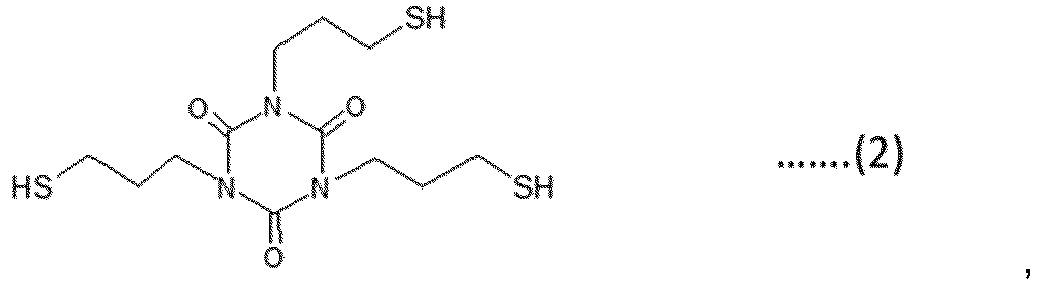
- the resin composition contains at least one polyfunctional thiol selected from the group consisting of compounds represented by the following formulas (1) and (2): "Multhiol Y-4" (SC Organic Chemical Co., Ltd.) can be used as the compound represented by formula (1).
- the resin composition of the present invention has excellent moisture resistance after curing, because it contains at least one of the polyfunctional thiols (b) having a specific structure.
- the polyfunctional thiols (b) do not have an ester bond.
- Many polyfunctional thiols are known to have an ester bond; however, ester bonds are easily hydrolyzed. Therefore, the resin composition of the present invention, which contains at least one of the polyfunctional thiols (b) having a specific structure as a polyfunctional thiol, is superior in moisture resistance after curing to a resin composition containing a polyfunctional thiol having an ester bond.
- the resin composition of the present invention has excellent position accuracy after curing, because it contains at least one of the polyfunctional thiols (b) having a specific structure. This is considered to be because the polyfunctional thiols (b) do not contain a hydroxyl group and are less likely to absorb water under high temperature and high humidity after curing.
- the resin composition of the present invention has excellent adhesion at the interface with a surface to be bonded, such as LCP, because it contains at least one of the polyfunctional thiols (b) having a specific structure. This is considered to be because the polyfunctional thiols (b) do not contain a hydroxyl group and are less likely to draw water.
- the resin composition of the present invention has excellent durability after high temperature and high humidity, because it contains at least one of the polyfunctional thiols (b) having a specific structure. This is considered to be because the polyfunctional thiols (b) have a flexible skeleton and thus react efficiently during heat-curing to improve the crosslink density.
- the resin composition of the present invention generally contains at least one of the polyfunctional thiols (b) in a total amount of 5 to 50 wt% based on the entire composition.
- the resin composition of the present invention preferably contains at least one of the polyfunctional thiols (b) in a total amount of 10 wt% or more based on the entire composition.
- latent curing agent (c) those generally used in the technical field of UV-curing or thermosetting adhesives can be used.
- examples of the latent curing agent (c) include polyamine, imidazole, and the like.
- polyamine as the latent curing agent (c) include AJICURE (amine adduct type) PN23J, PN31J, and PN40J (Ajinomoto Fine-Techno Co., Inc.), Fujicure FXR-1020, FXR-1030, FXR-1050, and FXR-1080 (produced by Fuji Kasei Co., Ltd.), Adeka Hardener EH-4357S and EH-5030S (produced by ADEKA), EH-5057 (produced by ADEKA), EH-5057PK (produced by ADEKA), and the like.
- AJICURE amine adduct type
- PN31J PN31J
- PN40J Ajinomoto Fine-Techno Co., Inc.
- Fujicure FXR-1020, FXR-1030, FXR-1050, and FXR-1080 produced by Fuji Kasei Co., Ltd.
- Adeka Hardener EH-4357S and EH-5030S produced
- the resin composition of the present invention may contain only one, or two or more of the latent curing agents (c).
- the resin composition of the present invention preferably contains the latent curing agent (c) in an amount of 5 wt% or more, more preferably 10 wt% or more, based on the entire composition. In terms of excellent moisture resistance and dispensability, the resin composition of the present invention preferably contains the latent curing agent (c) in an amount of 40 wt% or less, and more preferably 30 wt% or less, based on the entire composition. (d) Polymerization inhibitor
- the resin composition of the present invention contains at least one polymerization inhibitor (d) selected from the group consisting of N-nitrosophenylhydroxylamine aluminum, triphenyl phosphite, p-methoxyphenol, and hindered phenol, for the purpose of suppressing radical polymerization.
- d polymerization inhibitor
- the resin composition of the present invention preferably contains the polymerization inhibitor (d) in an amount of 0.01 to 5 wt% based on the entire composition, in terms of suppressing radical polymerization.
- the resin composition of the present invention contains an anionic polymerization inhibitor (e) that is an organic acid for the purpose of suppressing anionic polymerization.
- anionic polymerization inhibitor (e) that is an organic acid include barbituric acid.
- the resin composition of the present invention preferably contains the polymerization inhibitor (e) in an amount of 0.1 to 5 wt% based on the entire composition, in terms of suppressing anionic polymerization.
- the photopolymerization initiator (f) is not particularly limited, and those generally used in the technical field of UV-curing can be used.
- photopolymerization initiator examples include Omnirad 651 (2,2-dimethoxy-1,2-diphenylethan-1-one), Omnirad 184 (1-hydroxy-cyclohexyl-phenyl-ketone), Omnirad 1173 (2-hydroxy-2-methyl-1-phenyl-propan-1-one), Omnirad 2959 (1-[4-(2-hydroxyethoxy)-phenyl]-2-hydroxy-2-methyl-1-propan-1-one), Omnirad 127 (2-hydroxy-1- ⁇ 4-[4-(2-hydroxy-2-methylpropionyl)-benzyl]phenyl ⁇ -2-methyl-propan-1-one), Omnirad 907 (2-methyl-1-(4-methylthiophenyl)-2-morpholinopropan-1-one), Omnirad 369 (2-benzyl-2-dimethylamino-1-(4-morpholinophenyl)-butanone-1), Omnirad 379 (2-(dimethylamino)-2-[(4-methylphenyl)methyl]-1-[4-methyl
- the photopolymerization initiators may be used singly or in combination of two or more.
- the resin composition of the present invention preferably contains the photopolymerization initiator (f) in an amount of 0.1wt% or more, and more preferably 0.5 wt% or more, based on the entire composition, in terms of excellent UV curability.
- the resin composition of the present invention preferably contains the photopolymerization initiator (f) in an amount of 5 wt% or less, and more preferably 2 wt% or less, based on the entire composition.
- the resin composition of the present invention may further contain epoxidized polybutadiene (g).
- the epoxidized polybutadiene (g) is preferably epoxidized 1,2-polybutadiene.
- the resin composition of the present invention preferably contains the epoxidized polybutadiene (g) in an amount of 5 to 20 wt% based on the entire composition, in terms of obtaining excellent compatibility.
- the resin composition of the present invention may further contain other components.
- other components include general rheology modifiers, adhesion-imparting agents, fillers, and the like.
- the resin composition of the present invention preferably has an adhesion strength of 7 MPa or more after being cured with heat and UV. Further, the resin composition of the present invention preferably has an adhesion strength reduction rate of 40% or less after a reliability test (85 ⁇ C/85% RH, 250 hours).
- the resin composition of the present invention is preferably used for assembling a camera module. More specifically, the resin composition of the present invention is preferably used in camera module assembly to bond a lens holder and a substrate on which an imaging element is fixed.
- the camera module is not particularly limited, and examples include small camera modules used for smartphones and the like.
- Adhesive compositions of Examples 1 to 12 and Comparative Examples 1 to 4 were each prepared by mixing components at the composition ratios shown in Table 2. Specifically, each component was well dispersed using a 3-roll mill, and the resulting mixture, other additives, etc., were mixed using a planetary mixer, followed by vacuum defoaming, thereby obtaining adhesive compositions.
- “Multhiol Y-4" (SC Organic Chemical Co., Ltd.), “Multhiol K-3” (SC Organic Chemical Co., Ltd.), “Multhiol Y-3” (SC Organic Chemical Co., Ltd.), and “C3TS-G” (Shikoku Chemicals Corporation) used as polyfunctional thiols are compounds represented by the following formulas (1) to (4), respectively.
- Table 1 Multhiol Y-4 Multhiol K-3 Multhiol Y-3 C3TS-G
- the adhesion strength test was performed as shown in Fig. 1 . The details are as described below.
- the adhesive composition was dispensed on a 15 mm ⁇ 15 mm ceramic substrate in a square shape of 5 mm ⁇ 5 mm so that the weight was about 3.5 mg.
- a PC chip with a shape of 7 mm ⁇ 7 mm was mounted, and the thickness of the adhesive was adjusted to 100 ⁇ m.
- a 365 nm-LED was irradiated from four surrounding directions at 500 mW/cm2 for 4 seconds for temporary curing.
- the sample was heat-cured in a hot-air circulation oven at 80 ⁇ C for 60 minutes, and measured using a Dage 4000 Universal Bond Tester at a shear speed of 200 ⁇ m/s and a shear height of 120 ⁇ m.
- the conditions for a reliability test were 85 °C/85% RH and 250 hours.
- Table 2 shows the evaluation results. It is demonstrated that the resin compositions of Examples 1 to 12 have excellent adhesion strength at the initial stage of heat-curing, and show a low rate of decrease in the adhesion strength after the reliability test, because they contain a thiol compound with a specific structure, and the ratio of component (a) to the entire composition is 30 wt% or more.
- the resin composition of Comparative Example 3 has inferior position accuracy after a high-temperature and high-humidity durability test after curing, because it contains a thiol compound having a hydroxyl group, so that the resin composition tends to absorb water during the high-temperature and high-humidity durability test.
- the resin composition of Comparative Example 4 has inferior durability after high temperature and high humidity, because it contains a thiol compound having poor mobility, so that it tends to lead to insufficient crosslinking, and thereby allowing water to intrude into the resin composition as well as the interface between the resin composition and the coated surface.
- Table 2 Type Compound name "product name" (manufacturer) Ex. 1 Ex. 2 Ex. 3 Ex. 4 Ex. 5 Ex. 6 Ex. 7 Ex. 8 Ex. 9 Ex. 10 Ex. 11 Ex. 12 Comp. Ex. 1 Comp.1 Ex. 2 Comp. Ex. 3 Comp. Ex.
Landscapes
- Chemical & Material Sciences (AREA)
- Organic Chemistry (AREA)
- Health & Medical Sciences (AREA)
- Chemical Kinetics & Catalysis (AREA)
- Medicinal Chemistry (AREA)
- Polymers & Plastics (AREA)
- Adhesives Or Adhesive Processes (AREA)
- Macromonomer-Based Addition Polymer (AREA)
- Polymers With Sulfur, Phosphorus Or Metals In The Main Chain (AREA)
- Epoxy Resins (AREA)
Abstract
Description
- The present invention relates to a resin composition and cured product thereof.
- A small camera module mounted on a smartphone etc. has a lens, a cylindrical lens holder that holds the lens, and an imaging element that converts the light collected by the lens into electrical signals and that is fixed on a substrate. During the assembly of this small camera module, it is necessary to firmly bond the lens holder and the substrate on which the imaging element is fixed. An adhesive is used to bond them (PTL 1).
- When bonding the lens holder and the substrate on which the imaging element is fixed, it is necessary to accurately maintain the distance between the lens and the imaging element. Specifically, it is necessary to match the distance between the lens and the light-receiving surface of the imaging element with the focal length of the lens. The use of a UV-curing adhesive for this purpose has been proposed (PTL 2).
-
- PTL 1:
JP2007-184801A - PTL 2:
JP2009-141406A - Materials such as LCP are widely used as materials for lens holders. Further, it has recently been understood that lens holders have a larger structure and are heavier than conventional ones because imaging elements for capturing clear images have become large. The present inventor found that as the weight of lens holders increased, the use of conventional UV-curing adhesives caused problems in terms of the initial adhesion strength, as well as the adhesion strength and position accuracy after a high-temperature and high-humidity durability test.
- An object of the present invention is to provide an adhesive having sufficient adhesion strength during heat-curing when a lens holder and a substrate on which an imaging element is fixed are bonded in camera module assembly, and also having excellent adhesion strength and position accuracy after a high-temperature and high-humidity durability test after curing.
- The present inventor conducted extensive studies to solve the above problems, and found that the above problems can be solved by using a resin composition comprising (a) a (meth)acrylate group-containing resin, (b) a polyfunctional thiol having a specific structure, and (c) a latent curing agent. The present invention has been completed upon further studies based on the above finding, and includes the following aspects.
- Item 1.
A resin composition, comprising: (a) a (meth)acrylate group-containing resin, (b) at least one polyfunctional thiol selected from the group consisting of compounds represented by the following formulas (1) and (2):

- Item 2.
The resin composition according to Item 1, further comprising: (d) at least one polymerization inhibitor selected from the group consisting of N-nitrosophenylhydroxylamine aluminum, triphenyl phosphite, p-methoxyphenol, and hindered phenol. - Item 3.
The resin composition according to Item 1 or 2, further comprising: (e) an anionic polymerization inhibitor that is an organic acid. - Item 4.
The resin composition according to any one of Items 1 to 3, further comprising: (f) a photopolymerization initiator. - Item 5.
The resin composition according to any one of Items 1 to 4, further comprising: (g) epoxidized polybutadiene. - Item 6.
The resin composition according to any one of Items 1 to 5, for use in assembling a camera module. - Item 7.
A cured product obtainable by curing the resin composition according to any one of Items 1 to 6. - Item. 8
Use of a resin composition for assembling a camera module, the resin composition comprising: (a) a (meth)acrylate group-containing resin, (b) at least one polyfunctional thiol selected from the group consisting of compounds represented by the following formulas (1) and (2):
- Item 9.
A method for bonding a camera module lens holder and a camera module substrate on which an imaging element is fixed, the method comprising bonding the lens holder and the substrate using a resin composition; the resin composition comprising: (a) a (meth)acrylate group-containing resin, (b) at least one polyfunctional thiol selected from the group consisting of compounds represented by the following formulas (1) and (2):

- When the resin composition of the present invention is used in camera module assembly to bond a lens holder and a substrate on which an imaging element is fixed, sufficient adhesion strength is ensured during heat-curing of the adhesive, and the position accuracy after a high-temperature and high-humidity durability test after curing can be improved.
-
Fig. 1 is a schematic diagram of an adhesion test in the Examples. - In the present specification, the weight average molecular weight (Mw) refers to a polystyrene conversion value determined by gel permeation chromatography (GPC) using a solvent, such as tetrahydrofuran, as an eluent.
- In the present specification, the (meth)acrylate, (meth)acrylic, and (meth)acryloyl group mean acrylate or methacrylate, acrylic or methacrylic, and an acryloyl or methacryloyl group, respectively.
- The (meth)acrylate group-containing resin includes, for example, (meth)acrylate, a (meth)acrylate oligomer, an acrylic polymer obtained by copolymerizing a (meth)acrylate monomer with another monomer, and one that can be obtained by reacting (meth)acrylic acid with a resin.
- Examples of (meth)acrylates include (meth)acrylic acid esters. The (meth)acrylic acid ester may be a monofunctional (meth)acrylic acid ester or a polyfunctional (meth)acrylic acid ester.
- Specific examples of monofunctional (meth)acrylic acid esters include methyl methacrylate, ethyl methacrylate, n-propyl methacrylate, glycidyl methacrylate, 2-hydroxyethyl methacrylate, 2-isocyanatoethyl methacrylate, isobornyl methacrylate (e.g., product name: "IBXA," Osaka Organic Chemical Industry Ltd.), 2-methacryloxyethyltrimethoxysilane, 2-methacryloxyethyltriethoxysilane, 3-methacryloxypropyltrimethoxysilane, 3-methacryloxypropylmethyldimethoxysilane, 3-methacryloxypropyltriethoxysilane, 3-methacryloxymethyldiethoxysilane, 4-methacryloxybutyltrimethoxysilane, 4-methacryloxybutyltriethoxysilane, dicyclopentenyloxyethyl methacrylate (e.g., product name: "FA-512M," produced by Hitachi Chemical Co., Ltd.), dicyclopentanyl methacrylate (e.g., product name: "FA-513M," produced by Hitachi Chemical Co., Ltd.), pentamethylpiperidyl methacrylate (e.g., product name: "FA-711MM," produced by Hitachi Chemical Co., Ltd.), tetramethylpiperidyl methacrylate (e.g., product name: "FA-712HM," produced by Hitachi Chemical Co., Ltd.), methoxy polyethylene glycol methacrylate (e.g., produced by Hitachi Chemical Co., Ltd.), benzyl methacrylate (e.g., product name: "FA-BZM," produced by Hitachi Chemical Co., Ltd.), 2-hydroxy-3-acryloyloxypropyl methacrylate (e.g., product name "Light Ester G-201P," produced by Kyoeisha Chemical Co., Ltd.), 2-methacryloyloxyethyl phthalic acid (e.g., product name: "CB-1," produced by Shin-Nakamura Chemical Co., Ltd.), methoxy polyethylene glycol methacrylate, phenoxyethylene glycol methacrylate (e.g., product name: "PHE-1G," produced by Shin-Nakamura Chemical Co., Ltd.), stearyl methacrylate (e.g., product name: "S," produced by Shin-Nakamura Chemical Co., Ltd.), 2-methacryloyloxyethyl succinate (e.g., product name: "SA," produced by Shin-Nakamura Chemical Co., Ltd.), 3,4-epoxycyclohexylmethyl methacrylate (e.g., product name: "Cyclomer M100," produced by Daicel Corporation), and the like.
- Specific examples of bifunctional (meth)acrylic acid esters include tricyclodecane dimethanol diacrylate (e.g., product name: "SR833," Sartomer), dipropylene glycol diacrylate (e.g., product name: "APG-100," Shin-Nakamura Chemical Co., Ltd.), tricyclodecane dimethanol diacrylate (e.g., product name: "A-DCP," Shin-Nakamura Chemical Co., Ltd.), 1,4-butanediol dimethacrylate (e.g., product name: "FA-124M," produced by Hitachi Chemical Co., Ltd.), neopentyl glycol dimethacrylate (e.g., product name: "FA-125M," produced by Hitachi Chemical Co., Ltd.), polyethylene glycol #200 dimethacrylate (e.g., product name: "FA-220M," produced by Hitachi Chemical Co., Ltd.), bisphenol A type epoxy acrylate (e.g., product name: "Ebecryl 3700," Daicel-Allnex Ltd.), EO-modified bisphenol A dimethacrylate (e.g., product name: "FA-321M," produced by Hitachi Chemical Co., Ltd.), EO-modified polypropylene glycol #700 dimethacrylate (e.g., product name: "FA-023M," produced by Hitachi Chemical Co., Ltd.), ethylene glycol dimethacrylate (e.g., product name: "1G," produced by Shin-Nakamura Chemical Co., Ltd.), diethylene glycol dimethacrylate (e.g., product name: "2G," produced by Shin-Nakamura Chemical Co., Ltd.), triethylene glycol dimethacrylate (e.g., product name: "3G," produced by Shin-Nakamura Chemical Co., Ltd.), polyethylene glycol dimethacrylate (e.g., produced by Shin-Nakamura Chemical Co., Ltd.), 2,2-bis[4-(methacryloxyethoxy)phenyl]propane (e.g., product name: "BPE-80N," produced by Shin-Nakamura Chemical Co., Ltd.), ethoxylated bisphenol A dimethacrylate (e.g., produced by Shin-Nakamura Chemical Co., Ltd.), tricyclodecane dimethanol dimethacrylate (e.g., product name: "DCP," produced by Shin-Nakamura Chemical Co., Ltd.), 1,10-decanediol dimethacrylate (e.g., product name: "DOD-N," produced by Shin-Nakamura Chemical Co., Ltd.), 1,6-hexanediol dimethacrylate (e.g., product name: "HD-N," produced by Shin-Nakamura Chemical Co., Ltd.), 1,9-nonanediol dimethacrylate (e.g., product name: "NOD-N," produced by Shin-Nakamura Chemical Co., Ltd.), neopentyl glycol dimethacrylate (e.g., product name: "NPG," produced by Shin-Nakamura Chemical Co., Ltd.), ethoxylated polypropylene glycol dimethacrylate (e.g., produced by Shin-Nakamura Chemical Co., Ltd.), glycerin dimethacrylate (e.g., product name: "701," produced by Shin-Nakamura Chemical Co., Ltd.), polypropylene glycol dimethacrylate (e.g., produced by Shin-Nakamura Chemical Co., Ltd.), and the like.
- Specific examples of trifunctional or higher polyfunctional (meth)acrylic acid esters include trimethylolpropane trimethacrylate (e.g., product name: "TMPT," produced by Shin-Nakamura Chemical Co., Ltd.), tris(2-hydroxyethyl)isocyanurate triacrylate (e.g., product name: "SR368NS," Sartomer), and the like.
- The resin composition of the present invention may contain only one, or two or more of the (meth)acrylates.
- The (meth)acrylate group-containing resin may be an acrylate oligomer. The resin composition of the present invention has excellent adhesion strength and moisture resistance after curing, because it contains an acrylate oligomer.
- Specific examples of the (meth)acrylate group-containing resin include urethane acrylate oligomers. Urethane acrylate oligomers are widely known to those skilled in the art, and can be obtained, for example, by reacting diisocyanates, preferably aliphatic diisocyanates, with hydroxy acrylates. Alternatively, they can be obtained, for example, by reacting diisocyanates, preferably aliphatic diisocyanates, with hydroxy acrylates and polyols.
- Examples of urethane acrylate oligomers include polycarbonate-based urethane acrylate oligomers. The resin composition of the present invention particularly has excellent adhesion strength and moisture resistance after curing, because it contains a polycarbonate-based urethane acrylate oligomer. The reason for this is considered to be because the polycarbonate skeleton strongly interacts with the surface to be bonded, such as LCP, and because it is a polymer and thus can prevent the entrance of water under high temperature and high humidity. Polycarbonate-based urethane acrylate oligomers are widely known to those skilled in the art, and can be obtained, for example, by reacting diisocyanates, preferably aliphatic diisocyanates, with hydroxy acrylates and polycarbonates.
- Specific examples of polycarbonate-based urethane acrylate oligomers include "UN9200A" (Negami Chemical Industrial Co., Ltd.; weight average molecular weight: 15,000), "UV3310B" (Mitsubishi Chemical Corporation; weight average molecular weight: 5,000), and the like.
- Examples of urethane acrylate oligomers include polyether-based urethane acrylate oligomers. Polyether-based urethane acrylate oligomers are widely known to those skilled in the art, and can be obtained, for example, by reacting diisocyanates, preferably aliphatic diisocyanates, with hydroxy acrylates and polyethers. Specific examples of polyether-based urethane acrylate oligomers include "UV6640B" (Mitsubishi Chemical Corporation; weight average molecular weight: 5,000), "UN6202" (Negami Chemical Industrial Co., Ltd.; weight average molecular weight: 11,000), and the like.
- The weight average molecular weight of the (meth)acrylate oligomer is preferably 4,000 or more.
- The weight average molecular weight of the (meth)acrylate oligomer is preferably 5,000 or more, more preferably 6,000 or more, even more preferably 8,000 or more, and still even more preferably 10,000 or more, in terms of forming a sufficiently soft segment structure in a cured product to thereby enhance durability to heat and mechanical stimuli, and to optimize the storage modulus. The weight average molecular weight of the (meth)acrylate oligomer is preferably 20,000 or less, more preferably 18,000 or less, and even more preferably 16,000 or less, in terms of the dispensability of the adhesive.
- Other than acrylate oligomers, the (meth)acrylate group-containing resin may be an acrylic polymer obtained by copolymerizing an acrylate monomer with another monomer, or may be one that can be obtained by reacting (meth)acrylic acid with a resin.
- Examples of the (meth)acrylate group-containing resin include partially (meth)acrylated epoxy resins. Examples of partially (meth)acrylated epoxy resins include those that can be obtained by reacting (meth)acrylic acid with epoxy resins. Such a reaction can be carried out in the presence of a basic catalyst according to a conventional method. Partially (meth)acrylated epoxy resins contain an epoxy group and a (meth)acrylate group per molecule, and thus can be cured with various curing systems. The resin composition of the present invention preferably contains a partially (meth)acrylated epoxy resin, because it can be cured efficiently, has sufficient adhesion strength after heating, and can suppress the decrease in strength after high temperature and high humidity. The epoxy resin that can be used as a raw material in the production of the partially (meth)acrylated epoxy resin is not particularly limited. Examples include bisphenol A type epoxy resin, bisphenol F type epoxy resin, bisphenol S type epoxy resin, 2,2'-diallyl bisphenol A type epoxy resin, hydrogenated bisphenol type epoxy resin, propylene oxide-added bisphenol A type epoxy resin, resorcinol type epoxy resin, biphenyl type epoxy resin, sulfide type epoxy resin, diphenyl ether type epoxy resin, dicyclopentadiene type epoxy resin, naphthalene type epoxy resin, phenol novolac type epoxy resin, orthocresol novolac type epoxy resin, dicyclopentadiene novolac type epoxy resin, biphenyl novolac type epoxy resin, naphthalene phenol novolac type epoxy resin, glycidyl amine type epoxy resin, alkyl polyol type epoxy resin, rubber-modified epoxy resin, glycidyl ester compound, bisphenol A type episulfide resin, and the like.
- Example of commercially available partially (meth)acrylated epoxy resins include EA-1010LC, EA-1020, EA-5323, EA-5520, EA-CHD, and EMA-1020 (all produced by Shin-Nakamura Chemical Co., Ltd.), Ebecryl 860, Ebecryl 3200, Ebecryl 3201, Ebecryl 3412, Ebecryl 3600, Ebecryl 3700, Ebecryl 3701, Ebecryl 3702, Ebecryl 3703, Ebecryl 3800, Ebecryl 6040, and Ebecryl RDX63182 (all produced by Daicel Cytec Co., Ltd.), Epoxy Ester M-600A, Epoxy Ester 40EM, Epoxy Ester 70PA, Epoxy Ester 200PA, Epoxy Ester 80MFA, Epoxy Ester 3002M, Epoxy Ester 3002A, Epoxy Ester 1600A, Epoxy Ester 3000M, Epoxy Ester 3000A, Epoxy Ester 200EA, and Epoxy Ester 400EA (all produced by Kyoeisha Chemical Co., Ltd.), Denacol Acrylate DA-141, Denacol Acrylate DA-314, and Denacol Acrylate DA-911 (all produced by Nagase ChemteX Corporation), and the like.
- The partially (meth)acrylated epoxy resin is preferably a bisphenol A type partially (meth)acrylated epoxy resin.
- The weight average molecular weight Mw of the partially (meth)acrylated epoxy resin is not particularly limited, but is preferably 300 to 1000, and more preferably 400 to 800.
- The resin composition of the present invention may contain only one, or two or more of the (meth)acrylate group-containing resins.
- The resin composition of the present invention preferably contains the (meth)acrylate group-containing resin(s) (a) in a total amount of 30 wt% or more based on the entire composition. As a result, the resin composition of the present invention has more excellent thermal durability after curing. In this respect, the resin composition of the present invention more preferably contains an acrylate monomer and the (meth)acrylate group-containing resin (a) in a total amount of 35 wt% or more based on the entire composition.
- The resin composition of the present invention preferably contains the (meth)acrylate group-containing resin (a) in a total amount of 80 wt.% or less, and more preferably 60 wt% or less, based on the entire composition.
- The resin composition contains at least one polyfunctional thiol selected from the group consisting of compounds represented by the following formulas (1) and (2):


- "Multhiol K-3" (SC Organic Chemical Co., Ltd.) can be used as the compound represented by formula (2).
- The resin composition of the present invention has excellent moisture resistance after curing, because it contains at least one of the polyfunctional thiols (b) having a specific structure. One of the reasons therefor is that the polyfunctional thiols (b) do not have an ester bond. Many polyfunctional thiols are known to have an ester bond; however, ester bonds are easily hydrolyzed. Therefore, the resin composition of the present invention, which contains at least one of the polyfunctional thiols (b) having a specific structure as a polyfunctional thiol, is superior in moisture resistance after curing to a resin composition containing a polyfunctional thiol having an ester bond.
- Further, the resin composition of the present invention has excellent position accuracy after curing, because it contains at least one of the polyfunctional thiols (b) having a specific structure. This is considered to be because the polyfunctional thiols (b) do not contain a hydroxyl group and are less likely to absorb water under high temperature and high humidity after curing. In addition, the resin composition of the present invention has excellent adhesion at the interface with a surface to be bonded, such as LCP, because it contains at least one of the polyfunctional thiols (b) having a specific structure. This is considered to be because the polyfunctional thiols (b) do not contain a hydroxyl group and are less likely to draw water. Further, the resin composition of the present invention has excellent durability after high temperature and high humidity, because it contains at least one of the polyfunctional thiols (b) having a specific structure. This is considered to be because the polyfunctional thiols (b) have a flexible skeleton and thus react efficiently during heat-curing to improve the crosslink density.
- The resin composition of the present invention generally contains at least one of the polyfunctional thiols (b) in a total amount of 5 to 50 wt% based on the entire composition. The resin composition of the present invention preferably contains at least one of the polyfunctional thiols (b) in a total amount of 10 wt% or more based on the entire composition.
- As the latent curing agent (c), those generally used in the technical field of UV-curing or thermosetting adhesives can be used. Examples of the latent curing agent (c) include polyamine, imidazole, and the like.
- Specific examples of polyamine as the latent curing agent (c) include AJICURE (amine adduct type) PN23J, PN31J, and PN40J (Ajinomoto Fine-Techno Co., Inc.), Fujicure FXR-1020, FXR-1030, FXR-1050, and FXR-1080 (produced by Fuji Kasei Co., Ltd.), Adeka Hardener EH-4357S and EH-5030S (produced by ADEKA), EH-5057 (produced by ADEKA), EH-5057PK (produced by ADEKA), and the like.
- The resin composition of the present invention may contain only one, or two or more of the latent curing agents (c).
- In terms of excellent adhesion and sufficient addition reaction with an acrylic monomer and oligomer, the resin composition of the present invention preferably contains the latent curing agent (c) in an amount of 5 wt% or more, more preferably 10 wt% or more, based on the entire composition. In terms of excellent moisture resistance and dispensability, the resin composition of the present invention preferably contains the latent curing agent (c) in an amount of 40 wt% or less, and more preferably 30 wt% or less, based on the entire composition. (d) Polymerization inhibitor
- The resin composition of the present invention contains at least one polymerization inhibitor (d) selected from the group consisting of N-nitrosophenylhydroxylamine aluminum, triphenyl phosphite, p-methoxyphenol, and hindered phenol, for the purpose of suppressing radical polymerization.
- The resin composition of the present invention preferably contains the polymerization inhibitor (d) in an amount of 0.01 to 5 wt% based on the entire composition, in terms of suppressing radical polymerization.
- The resin composition of the present invention contains an anionic polymerization inhibitor (e) that is an organic acid for the purpose of suppressing anionic polymerization. Specific examples of the anionic polymerization inhibitor (e) that is an organic acid include barbituric acid.
- The resin composition of the present invention preferably contains the polymerization inhibitor (e) in an amount of 0.1 to 5 wt% based on the entire composition, in terms of suppressing anionic polymerization. (f) Photopolymerization initiator
- The photopolymerization initiator (f) is not particularly limited, and those generally used in the technical field of UV-curing can be used.
- Specific examples of the photopolymerization initiator include Omnirad 651 (2,2-dimethoxy-1,2-diphenylethan-1-one), Omnirad 184 (1-hydroxy-cyclohexyl-phenyl-ketone), Omnirad 1173 (2-hydroxy-2-methyl-1-phenyl-propan-1-one), Omnirad 2959 (1-[4-(2-hydroxyethoxy)-phenyl]-2-hydroxy-2-methyl-1-propan-1-one), Omnirad 127 (2-hydroxy-1-{4-[4-(2-hydroxy-2-methylpropionyl)-benzyl]phenyl}-2-methyl-propan-1-one), Omnirad 907 (2-methyl-1-(4-methylthiophenyl)-2-morpholinopropan-1-one), Omnirad 369 (2-benzyl-2-dimethylamino-1-(4-morpholinophenyl)-butanone-1), Omnirad 379 (2-(dimethylamino)-2-[(4-methylphenyl)methyl]-1-[4-(4-morpholinyl)phenyl]-1-butanone), Omnirad TPO (2,4,6-trimethylbenzoyl-diphenyl-phosphine oxide), Omnirad 819 (bis(2,4,6-trimethylbenzoyl)-phenylphosphine oxide), Omnirad 784 (bis(η5-2,4-cyclopentadien-1-yl)-bis(2,6-difluoro-3-(1H-pyrrol-1-yl)-phenyl)titanium), Omnirad OXE 01 (1,2-Octanedione, 1-[4-(phenylthio) phenyl]-, 2-(o-benzoyloxime)), Omnirad OXE 02 (ethanone, 1-[9-ethyl-6-(2-methylbenzoyl)-9H-carbazol-3-yl]-, 1-(O-acetyloxime)), Omnirad 754 (blend of oxy-phenyl-acetic acid 2-[2-oxo-2-phenylacetoxyethoxy]ethyl ester and oxy-phenyl-acetic acid 2-(2-hydroxyethoxy)ethyl ester), Omnirad TPO, LR8893, and LR8970 (all produced by IGM Resins B.V.), DETX-S (2,4-diethylthioxanthone) (produced by Nippon Kayaku Co., Ltd.), Ubecryl P36 (produced by UCB), and the like.
- The photopolymerization initiators may be used singly or in combination of two or more.
- The resin composition of the present invention preferably contains the photopolymerization initiator (f) in an amount of 0.1wt% or more, and more preferably 0.5 wt% or more, based on the entire composition, in terms of excellent UV curability. In terms of the stability of adhesiveness, the resin composition of the present invention preferably contains the photopolymerization initiator (f) in an amount of 5 wt% or less, and more preferably 2 wt% or less, based on the entire composition.
- The resin composition of the present invention may further contain epoxidized polybutadiene (g).
- The epoxidized polybutadiene (g) is preferably epoxidized 1,2-polybutadiene.
- The resin composition of the present invention preferably contains the epoxidized polybutadiene (g) in an amount of 5 to 20 wt% based on the entire composition, in terms of obtaining excellent compatibility.
- The resin composition of the present invention may further contain other components. Examples of other components include general rheology modifiers, adhesion-imparting agents, fillers, and the like.
- The resin composition of the present invention preferably has an adhesion strength of 7 MPa or more after being cured with heat and UV. Further, the resin composition of the present invention preferably has an adhesion strength reduction rate of 40% or less after a reliability test (85□C/85% RH, 250 hours).
- The resin composition of the present invention is preferably used for assembling a camera module. More specifically, the resin composition of the present invention is preferably used in camera module assembly to bond a lens holder and a substrate on which an imaging element is fixed. In the above, the camera module is not particularly limited, and examples include small camera modules used for smartphones and the like.
- The present invention is described below with reference to Examples; however, the present invention is not limited to these Examples and the like. The value of each component in the tables indicates weight (g), unless otherwise specified.
- Adhesive compositions of Examples 1 to 12 and Comparative Examples 1 to 4 were each prepared by mixing components at the composition ratios shown in Table 2. Specifically, each component was well dispersed using a 3-roll mill, and the resulting mixture, other additives, etc., were mixed using a planetary mixer, followed by vacuum defoaming, thereby obtaining adhesive compositions.
- "Multhiol Y-4" (SC Organic Chemical Co., Ltd.), "Multhiol K-3" (SC Organic Chemical Co., Ltd.), "Multhiol Y-3" (SC Organic Chemical Co., Ltd.), and "C3TS-G" (Shikoku Chemicals Corporation) used as polyfunctional thiols are compounds represented by the following formulas (1) to (4), respectively.
Table 1 Multhiol Y-4 
Multhiol K-3 
Multhiol Y-3 
C3TS-G 
- The physical properties were each evaluated as follows. Table 2 shows the evaluation results.
- The adhesion strength test was performed as shown in
Fig. 1 . The details are as described below. The adhesive composition was dispensed on a 15 mm × 15 mm ceramic substrate in a square shape of 5 mm × 5 mm so that the weight was about 3.5 mg. Then, a PC chip with a shape of 7 mm × 7 mm was mounted, and the thickness of the adhesive was adjusted to 100 µm. A 365 nm-LED was irradiated from four surrounding directions at 500 mW/cm2 for 4 seconds for temporary curing. Then, the sample was heat-cured in a hot-air circulation oven at 80□C for 60 minutes, and measured using a Dage 4000 Universal Bond Tester at a shear speed of 200 µm/s and a shear height of 120 µm. - The conditions for a reliability test were 85 °C/85% RH and 250 hours.
- Table 2 shows the evaluation results. It is demonstrated that the resin compositions of Examples 1 to 12 have excellent adhesion strength at the initial stage of heat-curing, and show a low rate of decrease in the adhesion strength after the reliability test, because they contain a thiol compound with a specific structure, and the ratio of component (a) to the entire composition is 30 wt% or more.
- On the other hand, it is demonstrated that the resin compositions of Comparative Examples 1 and 2 show a high rate of decrease in the adhesion strength after the reliability test, because they contain thiol compounds that are different from the thiol compounds with a specific structure of the present invention.
- Further, it is demonstrated that the resin composition of Comparative Example 3 has inferior position accuracy after a high-temperature and high-humidity durability test after curing, because it contains a thiol compound having a hydroxyl group, so that the resin composition tends to absorb water during the high-temperature and high-humidity durability test.
- In addition, it is demonstrated that the resin composition of Comparative Example 4 has inferior durability after high temperature and high humidity, because it contains a thiol compound having poor mobility, so that it tends to lead to insufficient crosslinking, and thereby allowing water to intrude into the resin composition as well as the interface between the resin composition and the coated surface.
Table 2 Type Compound name "product name" (manufacturer) Ex. 1 Ex. 2 Ex. 3 Ex. 4 Ex. 5 Ex. 6 Ex. 7 Ex. 8 Ex. 9 Ex. 10 Ex. 11 Ex. 12 Comp. Ex. 1 Comp.1 Ex. 2 Comp. Ex. 3 Comp. Ex. 4 Tricyclodecanedimethanol diacrylate "SR833" (Sartomer) 46 43 64 39 35 20 20 10 45 37 42 47 Isobornyl acrylate "IBXA" (Osaka Organic Chemical Industry Ltd.) 15 15 15 15 15 15 (a) Acrylate monomer and (meth)acrylate group-containing resin Polycarbonate-based urethane acrylate oligomer "UV3310B" (Mitsubishi Chemical Corporation) 20 20 20 20 20 20 Bisphenol A type partially (meth)acrylated epoxy resin "EA-1010LC" (Shin-Nakamura Chemical Co., Ltd.) 61 10 10 20 20 10 (b) Polyfunctional thiol "Multhiol Y-4" (SC Organic Chemical Co., Ltd.) 34 31 15 15 "Multhiol K-3" (SC Organic Chemical Co., Ltd.) 37 16 19 35 15 15 15 15 Pentaerythritol tetrakis(3-mercaptopropionate) "PEMP" (SC Organic Chemical Co., Ltd.) 35 (b') Polyfunctional thiol 1,3,5-Tris-(2-(3-sulfanylbutanoyloxy)ethyl)-1,3,5-triazinane-2,4,6-trione "NR" (Karenz) 43 "Multhiol Y-3" (SC Organic Chemical Co., Ltd.) 38 "C3TS-G" (Shikoku Chemicals Corporation) 33 (c) Latent curing agent "AJICURE 23J" (Ajinomoto Fine-Techno Co., Inc.) 15 15 15 15 15 15 15 15 15 15 "5057P" (Adeka) 25 25 25 25 25 25 (d) Polymerization inhibitor Triphenyl phosphite 1 1 1 1 1 1 1 1 1 1 1 1 1 1 1 1 Pentaerythritol tetrakis(3-(3,5-di-tert-butyl-4-hydroxyphenyl)propionate "Irganox 1010" (BASF) 1 1 1 1 1 1 1 1 1 1 1 1 1 1 1 1 (e) Anionic polymerization inhibitor Barbituric acid 3 3 3 3 3 3 3 3 3 3 3 3 3 3 3 3 (f) Photopolymerizati on initiator 1-Hydroxycyclohexyl-phenyl ketone "Omnirad 184" (IGM Resins B.V.) 2 2 2 2 2 2 2 2 2 2 2 2 2 2 2 2 (g) Epoxidized polybutadiene Epoxidized 1,2-polybutadiene "BF-1000" (Adeka) 10 10 Silane coupling agent 3-Glycidoxypropyltrimethoxysilane "KBM-403" (Shin-Etsu Chemical Co., Ltd.) 0.5 0.5 0.5 0.5 0.5 0.5 0.5 0.5 0.5 0.5 0.5 0.5 0.5 0.5 0.5 0.5 Rheology modifier NK200 (Nippon Aerosil Co., Ltd.) 5 5 5 5 5 5 5 5 5 5 5 5 5 5 5 5 Total 107.5 107.5 107.5 107.5 107.5 107.5 107.5 107.5 107.5 107.5 107.5 107.5 107.5 107.5 107.5 107.5 Adhesion strength to LCP after curing (MPa) 10 14 11 9 11 14 8 10 13 9 10 13 11 14 8 14 Decrease in adhesion strength after the reliability test (%) 25 20 27 23 20 15 5 7 10 10 10 7 70 60 35 30
Claims (9)
- A resin composition, comprising:(a) a (meth)acrylate group-containing resin,(b) at least one polyfunctional thiol selected from the group consisting of compounds represented by the following formulas (1) and (2):

 (c) a latent curing agent.
 - The resin composition according to claim 1, further comprising: (d) at least one polymerization inhibitor selected from the group consisting of N-nitrosophenylhydroxylamine aluminum, triphenyl phosphite, p-methoxyphenol, and hindered phenol.
- The resin composition according to claim 1 or 2, further comprising: (e) an anionic polymerization inhibitor that is an organic acid.
- The resin composition according to any one of claims 1 to 3, further comprising: (f) a photopolymerization initiator.
- The resin composition according to any one of claims 1 to 4, further comprising: (g) epoxidized polybutadiene.
- The resin composition according to any one of claims 1 to 5, for use in assembling a camera module.
- A cured product obtainable by curing the resin composition according to any one of claims 1 to 6.
- Use of a resin composition for assembling a camera module, the resin composition comprising:(a) a (meth)acrylate group-containing resin,(b) at least one polyfunctional thiol selected from the group consisting of compounds represented by the following formulas (1) and (2):

 (c) a latent curing agent.
 - A method for bonding a camera module lens holder and a camera module substrate on which an imaging element is fixed, the method comprising bonding the lens holder and the substrate using a resin composition; the resin composition comprising:(a) a (meth)acrylate group-containing resin,(b) at least one polyfunctional thiol selected from the group consisting of compounds represented by the following formulas (1) and (2):

 (c) a latent curing agent.
Priority Applications (7)
| Application Number | Priority Date | Filing Date | Title |
|---|---|---|---|
| EP20193556.6A EP3960828A1 (en) | 2020-08-31 | 2020-08-31 | Resin composition and cured product thereof |
| TW110129566A TW202221049A (en) | 2020-08-31 | 2021-08-11 | Resin composition and cured product thereof |
| JP2023513827A JP2023539313A (en) | 2020-08-31 | 2021-08-18 | Resin composition and its cured product |
| CN202180052014.6A CN115968392A (en) | 2020-08-31 | 2021-08-18 | Resin composition and cured product thereof |
| KR1020237006579A KR20230058625A (en) | 2020-08-31 | 2021-08-18 | Resin composition and cured product thereof |
| PCT/EP2021/072940 WO2022043158A1 (en) | 2020-08-31 | 2021-08-18 | Resin composition and cured product thereof |
| US18/115,475 US20230212443A1 (en) | 2020-08-31 | 2023-02-28 | Resin composition and cured product thereof |
Applications Claiming Priority (1)
| Application Number | Priority Date | Filing Date | Title |
|---|---|---|---|
| EP20193556.6A EP3960828A1 (en) | 2020-08-31 | 2020-08-31 | Resin composition and cured product thereof |
Publications (1)
| Publication Number | Publication Date |
|---|---|
| EP3960828A1 true EP3960828A1 (en) | 2022-03-02 |
Family
ID=72292322
Family Applications (1)
| Application Number | Title | Priority Date | Filing Date |
|---|---|---|---|
| EP20193556.6A Pending EP3960828A1 (en) | 2020-08-31 | 2020-08-31 | Resin composition and cured product thereof |
Country Status (7)
| Country | Link |
|---|---|
| US (1) | US20230212443A1 (en) |
| EP (1) | EP3960828A1 (en) |
| JP (1) | JP2023539313A (en) |
| KR (1) | KR20230058625A (en) |
| CN (1) | CN115968392A (en) |
| TW (1) | TW202221049A (en) |
| WO (1) | WO2022043158A1 (en) |
Families Citing this family (1)
| Publication number | Priority date | Publication date | Assignee | Title |
|---|---|---|---|---|
| JPWO2024071132A1 (en) * | 2022-09-29 | 2024-04-04 |
Citations (6)
| Publication number | Priority date | Publication date | Assignee | Title |
|---|---|---|---|---|
| JP2007184801A (en) | 2006-01-10 | 2007-07-19 | Alps Electric Co Ltd | The camera module |
| JP2009141406A (en) | 2007-12-03 | 2009-06-25 | Iwate Toshiba Electronics Co Ltd | Manufacturing method of camera module |
| WO2013005471A1 (en) * | 2011-07-07 | 2013-01-10 | ナミックス株式会社 | Resin composition |
| US20180044478A1 (en) * | 2015-03-12 | 2018-02-15 | Namics Corporation | Resin composition, adhesive agent, and sealing agent |
| US20180051127A1 (en) * | 2015-03-12 | 2018-02-22 | Namics Corporation | Semiconductor device and image sensor module |
| WO2018047849A1 (en) * | 2016-09-12 | 2018-03-15 | ナミックス株式会社 | Resin composition, adhesive, sealing material, dam agent, and semiconductor device |
Family Cites Families (9)
| Publication number | Priority date | Publication date | Assignee | Title |
|---|---|---|---|---|
| WO2008130894A1 (en) * | 2007-04-16 | 2008-10-30 | Designer Molecules, Inc. | Low temperature curing acrylate and maleimide based formulations and methods for use thereof |
| JP2012153794A (en) * | 2011-01-26 | 2012-08-16 | Sakai Chem Ind Co Ltd | Resin composition, resin cured material, and resin molded product |
| JP6699145B2 (en) * | 2015-11-30 | 2020-05-27 | 味の素株式会社 | Light and thermosetting resin composition |
| KR102312045B1 (en) * | 2016-08-10 | 2021-10-12 | 가부시끼가이샤 쓰리본드 | Epoxy resin composition and conductive adhesive comprising same |
| WO2018181421A1 (en) * | 2017-03-29 | 2018-10-04 | 味の素株式会社 | Curable composition and structure |
| DE102017129780A1 (en) * | 2017-12-13 | 2019-06-13 | Delo Industrie Klebstoffe Gmbh & Co. Kgaa | Light-fixable and thermosetting compounds based on epoxy resins and thiols |
| JP7266881B2 (en) * | 2018-01-30 | 2023-05-01 | ナミックス株式会社 | Photocurable and thermosetting resin compositions and their cured products, adhesives, semiconductor devices, and electronic components |
| JP7282602B2 (en) * | 2018-06-06 | 2023-05-29 | Sc有機化学株式会社 | Ether bond-containing sulfur compound and resin composition |
| JP7331867B2 (en) * | 2018-12-12 | 2023-08-23 | Jsr株式会社 | Photosensitive resin composition, method for producing resist pattern film, and method for producing plated model |
-
2020
- 2020-08-31 EP EP20193556.6A patent/EP3960828A1/en active Pending
-
2021
- 2021-08-11 TW TW110129566A patent/TW202221049A/en unknown
- 2021-08-18 CN CN202180052014.6A patent/CN115968392A/en active Pending
- 2021-08-18 WO PCT/EP2021/072940 patent/WO2022043158A1/en not_active Ceased
- 2021-08-18 KR KR1020237006579A patent/KR20230058625A/en active Pending
- 2021-08-18 JP JP2023513827A patent/JP2023539313A/en active Pending
-
2023
- 2023-02-28 US US18/115,475 patent/US20230212443A1/en active Pending
Patent Citations (6)
| Publication number | Priority date | Publication date | Assignee | Title |
|---|---|---|---|---|
| JP2007184801A (en) | 2006-01-10 | 2007-07-19 | Alps Electric Co Ltd | The camera module |
| JP2009141406A (en) | 2007-12-03 | 2009-06-25 | Iwate Toshiba Electronics Co Ltd | Manufacturing method of camera module |
| WO2013005471A1 (en) * | 2011-07-07 | 2013-01-10 | ナミックス株式会社 | Resin composition |
| US20180044478A1 (en) * | 2015-03-12 | 2018-02-15 | Namics Corporation | Resin composition, adhesive agent, and sealing agent |
| US20180051127A1 (en) * | 2015-03-12 | 2018-02-22 | Namics Corporation | Semiconductor device and image sensor module |
| WO2018047849A1 (en) * | 2016-09-12 | 2018-03-15 | ナミックス株式会社 | Resin composition, adhesive, sealing material, dam agent, and semiconductor device |
Also Published As
| Publication number | Publication date |
|---|---|
| US20230212443A1 (en) | 2023-07-06 |
| CN115968392A (en) | 2023-04-14 |
| JP2023539313A (en) | 2023-09-13 |
| TW202221049A (en) | 2022-06-01 |
| WO2022043158A1 (en) | 2022-03-03 |
| KR20230058625A (en) | 2023-05-03 |
Similar Documents
| Publication | Publication Date | Title |
|---|---|---|
| US11111421B2 (en) | Thermal- and UV-curing adhesive composition | |
| KR102686110B1 (en) | Manufacturing method of semiconductor device and adhesive film for semiconductor wafer processing | |
| JP6793474B2 (en) | Sealing material for liquid crystal dripping method, liquid crystal display panel and manufacturing method of liquid crystal display panel | |
| US12180392B2 (en) | Thermal- and UV-curing adhesive composition | |
| TWI617644B (en) | Curable resin film and first protective film forming sheet | |
| JP6641255B2 (en) | Adhesives for electronic components and adhesives for display elements | |
| US20230212443A1 (en) | Resin composition and cured product thereof | |
| JP5996176B2 (en) | Heat resistant adhesive | |
| CN108352365B (en) | Protective film forming sheet | |
| JP6798791B2 (en) | Adhesives for electronic components and adhesives for display elements | |
| WO2016163353A1 (en) | Photo/moisture curable resin composition, adhesive for electronic components, and adhesive for display elements | |
| JP2025531167A (en) | Photosensitive resin composition, dry film, cured product, printed wiring board and laminate | |
| CN113853413B (en) | Adhesive compositions, optical components, electronic components and electronic modules | |
| TW202028408A (en) | Sealing agent for liquid crystal display elements, vertically conducting material and liquid crystal display element | |
| JP7505275B2 (en) | Manufacturing method for electronic components, temporary protective resin composition, and temporary protective resin film | |
| WO2023276889A1 (en) | Adhesive film for connecting circuit, circuit connection structure, and method for manufacturing same | |
| JP2021195384A (en) | Adhesive composition, optical component, electronic component, and electronic module | |
| TW202530302A (en) | Resin composition, adhesive, sealant, cured product, semiconductor device, and electronic component | |
| WO2025177662A1 (en) | Adhesive tape for semiconductor, method for manufacturing semiconductor chip with adhesive layer, and method for manufacturing semiconductor device | |
| WO2025177663A1 (en) | Bonding tape for semiconductor, method for manufacturing semiconductor chip with adhesive layer, and method for manufacturing semiconductor device | |
| JP2022062383A (en) | Adhesive film for circuit connection, circuit connection structure, and manufacturing method thereof |
Legal Events
| Date | Code | Title | Description |
|---|---|---|---|
| PUAI | Public reference made under article 153(3) epc to a published international application that has entered the european phase |
Free format text: ORIGINAL CODE: 0009012 |
|
| STAA | Information on the status of an ep patent application or granted ep patent |
Free format text: STATUS: THE APPLICATION HAS BEEN PUBLISHED |
|
| AK | Designated contracting states |
Kind code of ref document: A1 Designated state(s): AL AT BE BG CH CY CZ DE DK EE ES FI FR GB GR HR HU IE IS IT LI LT LU LV MC MK MT NL NO PL PT RO RS SE SI SK SM TR |
|
| STAA | Information on the status of an ep patent application or granted ep patent |
Free format text: STATUS: REQUEST FOR EXAMINATION WAS MADE |
|
| RBV | Designated contracting states (corrected) |
Designated state(s): AL AT BE BG CH CY CZ DE DK EE ES FI FR GB GR HR HU IE IS IT LI LT LU LV MC MK MT NL NO PL PT RO RS SE SI SK SM TR |
|
| 17P | Request for examination filed |
Effective date: 20220819 |
|
| P01 | Opt-out of the competence of the unified patent court (upc) registered |
Effective date: 20230530 |
|
| STAA | Information on the status of an ep patent application or granted ep patent |
Free format text: STATUS: EXAMINATION IS IN PROGRESS |
|
| 17Q | First examination report despatched |
Effective date: 20250425 |