EP3960648A1 - B-diketone storage container and packaging method - Google Patents
B-diketone storage container and packaging method Download PDFInfo
- Publication number
- EP3960648A1 EP3960648A1 EP20813802.4A EP20813802A EP3960648A1 EP 3960648 A1 EP3960648 A1 EP 3960648A1 EP 20813802 A EP20813802 A EP 20813802A EP 3960648 A1 EP3960648 A1 EP 3960648A1
- Authority
- EP
- European Patent Office
- Prior art keywords
- diketone
- storage container
- container
- inorganic film
- silicon
- Prior art date
- Legal status (The legal status is an assumption and is not a legal conclusion. Google has not performed a legal analysis and makes no representation as to the accuracy of the status listed.)
- Granted
Links
Images
Classifications
-
- C—CHEMISTRY; METALLURGY
- C23—COATING METALLIC MATERIAL; COATING MATERIAL WITH METALLIC MATERIAL; CHEMICAL SURFACE TREATMENT; DIFFUSION TREATMENT OF METALLIC MATERIAL; COATING BY VACUUM EVAPORATION, BY SPUTTERING, BY ION IMPLANTATION OR BY CHEMICAL VAPOUR DEPOSITION, IN GENERAL; INHIBITING CORROSION OF METALLIC MATERIAL OR INCRUSTATION IN GENERAL
- C23C—COATING METALLIC MATERIAL; COATING MATERIAL WITH METALLIC MATERIAL; SURFACE TREATMENT OF METALLIC MATERIAL BY DIFFUSION INTO THE SURFACE, BY CHEMICAL CONVERSION OR SUBSTITUTION; COATING BY VACUUM EVAPORATION, BY SPUTTERING, BY ION IMPLANTATION OR BY CHEMICAL VAPOUR DEPOSITION, IN GENERAL
- C23C16/00—Chemical coating by decomposition of gaseous compounds, without leaving reaction products of surface material in the coating, i.e. chemical vapour deposition [CVD] processes
- C23C16/44—Chemical coating by decomposition of gaseous compounds, without leaving reaction products of surface material in the coating, i.e. chemical vapour deposition [CVD] processes characterised by the method of coating
- C23C16/4401—Means for minimising impurities, e.g. dust, moisture or residual gas, in the reaction chamber
- C23C16/4404—Coatings or surface treatment on the inside of the reaction chamber or on parts thereof
-
- B—PERFORMING OPERATIONS; TRANSPORTING
- B65—CONVEYING; PACKING; STORING; HANDLING THIN OR FILAMENTARY MATERIAL
- B65D—CONTAINERS FOR STORAGE OR TRANSPORT OF ARTICLES OR MATERIALS, e.g. BAGS, BARRELS, BOTTLES, BOXES, CANS, CARTONS, CRATES, DRUMS, JARS, TANKS, HOPPERS, FORWARDING CONTAINERS; ACCESSORIES, CLOSURES, OR FITTINGS THEREFOR; PACKAGING ELEMENTS; PACKAGES
- B65D23/00—Details of bottles or jars not otherwise provided for
- B65D23/02—Linings or internal coatings
-
- B—PERFORMING OPERATIONS; TRANSPORTING
- B65—CONVEYING; PACKING; STORING; HANDLING THIN OR FILAMENTARY MATERIAL
- B65D—CONTAINERS FOR STORAGE OR TRANSPORT OF ARTICLES OR MATERIALS, e.g. BAGS, BARRELS, BOTTLES, BOXES, CANS, CARTONS, CRATES, DRUMS, JARS, TANKS, HOPPERS, FORWARDING CONTAINERS; ACCESSORIES, CLOSURES, OR FITTINGS THEREFOR; PACKAGING ELEMENTS; PACKAGES
- B65D7/00—Containers having bodies formed by interconnecting or uniting two or more rigid, or substantially rigid, components made wholly or mainly of metal
- B65D7/42—Details of metal walls
-
- B—PERFORMING OPERATIONS; TRANSPORTING
- B65—CONVEYING; PACKING; STORING; HANDLING THIN OR FILAMENTARY MATERIAL
- B65D—CONTAINERS FOR STORAGE OR TRANSPORT OF ARTICLES OR MATERIALS, e.g. BAGS, BARRELS, BOTTLES, BOXES, CANS, CARTONS, CRATES, DRUMS, JARS, TANKS, HOPPERS, FORWARDING CONTAINERS; ACCESSORIES, CLOSURES, OR FITTINGS THEREFOR; PACKAGING ELEMENTS; PACKAGES
- B65D85/00—Containers, packaging elements or packages, specially adapted for particular articles or materials
- B65D85/70—Containers, packaging elements or packages, specially adapted for particular articles or materials for materials not otherwise provided for
- B65D85/84—Containers, packaging elements or packages, specially adapted for particular articles or materials for materials not otherwise provided for for corrosive chemicals
-
- C—CHEMISTRY; METALLURGY
- C23—COATING METALLIC MATERIAL; COATING MATERIAL WITH METALLIC MATERIAL; CHEMICAL SURFACE TREATMENT; DIFFUSION TREATMENT OF METALLIC MATERIAL; COATING BY VACUUM EVAPORATION, BY SPUTTERING, BY ION IMPLANTATION OR BY CHEMICAL VAPOUR DEPOSITION, IN GENERAL; INHIBITING CORROSION OF METALLIC MATERIAL OR INCRUSTATION IN GENERAL
- C23C—COATING METALLIC MATERIAL; COATING MATERIAL WITH METALLIC MATERIAL; SURFACE TREATMENT OF METALLIC MATERIAL BY DIFFUSION INTO THE SURFACE, BY CHEMICAL CONVERSION OR SUBSTITUTION; COATING BY VACUUM EVAPORATION, BY SPUTTERING, BY ION IMPLANTATION OR BY CHEMICAL VAPOUR DEPOSITION, IN GENERAL
- C23C16/00—Chemical coating by decomposition of gaseous compounds, without leaving reaction products of surface material in the coating, i.e. chemical vapour deposition [CVD] processes
- C23C16/44—Chemical coating by decomposition of gaseous compounds, without leaving reaction products of surface material in the coating, i.e. chemical vapour deposition [CVD] processes characterised by the method of coating
- C23C16/448—Chemical coating by decomposition of gaseous compounds, without leaving reaction products of surface material in the coating, i.e. chemical vapour deposition [CVD] processes characterised by the method of coating characterised by the method used for generating reactive gas streams, e.g. by evaporation or sublimation of precursor materials
-
- B—PERFORMING OPERATIONS; TRANSPORTING
- B65—CONVEYING; PACKING; STORING; HANDLING THIN OR FILAMENTARY MATERIAL
- B65D—CONTAINERS FOR STORAGE OR TRANSPORT OF ARTICLES OR MATERIALS, e.g. BAGS, BARRELS, BOTTLES, BOXES, CANS, CARTONS, CRATES, DRUMS, JARS, TANKS, HOPPERS, FORWARDING CONTAINERS; ACCESSORIES, CLOSURES, OR FITTINGS THEREFOR; PACKAGING ELEMENTS; PACKAGES
- B65D2501/00—Containers having bodies formed in one piece
- B65D2501/24—Boxes or like containers with moulded compartments or partitions
- B65D2501/24006—Details relating to bottle crates
- B65D2501/24012—Materials
- B65D2501/24025—Mainly metal
Definitions
- the present disclosure relates to a ⁇ -diketone storage container for use in a semiconductor manufacturing apparatus, for example.
- ⁇ -diketones such as acetylacetone and hexafluoroacetylacetone (1,1,1,5,5,5-hexafluoro-2,4-pentanedione) easily react and form complexes with various kinds of metals.
- ⁇ -diketones is expected in semiconductor manufacturing apparatuses, for example, for forming or etching semiconductor layers and metal layers and cleaning the inside of chambers.
- High-purity ⁇ -diketones are required for use in semiconductor manufacturing apparatuses because even a small amount of impurities therein can affect the product quality.
- ⁇ -diketones which are organic materials, are usually stored in durable resin or glass containers.
- metal containers are preferred for actual use of ⁇ -diketones in semiconductor manufacturing apparatuses in terms of containers' sealability, durability, and easy connection to pipes.
- Patent Literature 1 examines, as a chemical resistant metal container, a chemical container including a metal container (e.g., stainless steel container) and a film made of a chemically stable fluororesin, such as PFA, which is a copolymer of tetrafluoroethylene and perfluoroalkoxyethylene, on an inner surface of the container.
- a chemical container including a metal container (e.g., stainless steel container) and a film made of a chemically stable fluororesin, such as PFA, which is a copolymer of tetrafluoroethylene and perfluoroalkoxyethylene, on an inner surface of the container.
- PFA chemically stable fluororesin
- Patent Literature 2 in order to sufficiently maintain the quality of resistivity or the like of a liquid to be stored (e.g., an organic material having a melting point of -70°C to 30°C, such as a liquid crystal material), an inorganic film having a thickness of 10 nm to 1000 ⁇ m is formed on an inner surface of a container made of metal selected from iron, copper, corrosion resistant steel, aluminum, and titanium.
- a liquid to be stored e.g., an organic material having a melting point of -70°C to 30°C, such as a liquid crystal material
- an inorganic film having a thickness of 10 nm to 1000 ⁇ m is formed on an inner surface of a container made of metal selected from iron, copper, corrosion resistant steel, aluminum, and titanium.
- ⁇ -diketones easily form complexes with transition metals such as iron.
- materials containing transition metals such as stainless steel are not preferred as materials of ⁇ -diketone storage containers. This gives consideration to storage of ⁇ -diketones in containers made of aluminum materials that are less likely to form complexes with ⁇ -diketones.
- Patent Literature 3 since hexafluoroacetylacetone suffers from a decrease in purity immediately after introduction into an Al container, an Al-Mg alloy container, or an Al-Mg-Si alloy container for storage due to reaction and formation of a metal complex with a natural oxide film on an inner surface of the metal container, a washing step is provided to remove the natural oxide film in advance so as to prevent the decrease in purity.
- ⁇ -diketone-containing container a temperature that vaporizes a liquid ⁇ -diketone contained in the ⁇ -diketone-containing container.
- hexafluoroacetylacetone has a normal boiling point of about 70°C, and when it is used in the form of gas, the storage container is required to be heated to at least 60°C, preferably to 80°C.
- Patent Literature 3 even use of an aluminum container with a natural oxide film removed could not prevent the dissolution of the metal component into the ⁇ -diketone when the container was continuously heated for a long time.
- a ⁇ -diketone-containing container may be heated only when the gaseous ⁇ -diketone is supplied or may be continuously heated even when the gaseous ⁇ -diketone is not supplied.
- a ⁇ -diketone-containing container may be heated only when the gaseous ⁇ -diketone is supplied or may be continuously heated even when the gaseous ⁇ -diketone is not supplied.
- the present disclosure aims to provide, for example, a ⁇ -diketone storage container, which can suppress an increase in metal impurities in a liquid ⁇ -diketone charged in the container and retained in a state where the liquid ⁇ -diketone is vaporizable.
- the present inventors found that when a ⁇ -diketone is stored in an Al or Al alloy storage container including an inorganic film made of silicon dioxide (SiO 2 ), silicon carbonitride (SiCN), diamond-like carbon (DLC), or the like on its inner surface, it is possible to suppress an increase in metal impurities in the ⁇ -diketone even when the container is retained at high temperatures for a long time, and the present disclosure was thus accomplished.
- SiO 2 silicon dioxide
- SiCN silicon carbonitride
- DLC diamond-like carbon
- a ⁇ -diketone storage container including: a metal storage container to which a liquid ⁇ -diketone is charged, the metal being an aluminum material; and an inorganic film on an inner surface of the storage container, the inorganic film containing at least one material selected from the group consisting of silicon dioxide, silicon carbonitride, silicon carbide, silicon nitride, diamond, and diamond-like carbon.
- the present disclosure can provide, for example, a ⁇ -diketone storage container, which can suppress an increase in metal impurities in a liquid ⁇ -diketone charged in the container and retained in a state where the liquid ⁇ -diketone is vaporizable.
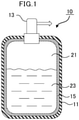
- Fig. 1 is a schematic cross-sectional view of a storage container according to one embodiment of the present disclosure.
- Fig. 1 shows a ⁇ -diketone-containing container 10 of the present embodiment.
- the ⁇ -diketone-containing container 10 is obtained by charging a liquid ⁇ -diketone into a metal storage container 11.
- ⁇ -diketone is divided into a gas phase 21 and a liquid phase 23.
- the storage container 11 includes an outlet 13 through which a ⁇ -diketone can be charged and discharged, and a gaseous ⁇ -diketone in the gas phase 21 can be supplied therethrough.
- Such supply requires heating of the ⁇ -diketone-containing container 10 to compensate heat of vaporization of the ⁇ -diketone in the liquid phase 23.
- the metal storage container 11 is a container obtained by molding using an aluminum material, and includes an inorganic film 15 made of silicon dioxide (SiO 2 ), silicon carbonitride (SiCN), diamond-like carbon (DLC), or the like on its inner surface.
- an inorganic film 15 made of silicon dioxide (SiO 2 ), silicon carbonitride (SiCN), diamond-like carbon (DLC), or the like on its inner surface.
- the term "aluminum material” refers to pure aluminum and aluminum alloy defined in JIS H 4000:2014.
- the aluminum material may be pure aluminum having a purity of 99 mass% or higher, preferably 99.5 mass% or higher, with the balance being unavoidable impurities.
- A1050 can be used.
- the aluminum alloy may be Al-Mg alloy having an Al content of 90 mass% or more and 99.9 mass% or less and a Mg content of 0.1 mass% or more and 10 mass% or less.
- A5052 can be used.
- the aluminum alloy may be Al-Mg-Si alloy having an Al content of 94 mass% or more and 99.8 mass% or less, a Mg content of 0.1 mass% or more and 5 mass% or less, and a Si content of 0.1 mass% or more and 1 mass% or less.
- A6061 can be used.
- the storage container is heated to a normal boiling point (i.e., a boiling point at 1 atm) or higher of the ⁇ -diketone in use.
- the storage container may have any shape.
- the storage container can be what is called a cylinder having a cylindrical shape in which one end is closed and the other end includes an opening through which a liquid ⁇ -diketone can be charged and a gaseous ⁇ -diketone can be discharged.
- the opening can be provided with the outlet 13 through which a gaseous ⁇ -diketone can be supplied to the outside.
- the inorganic film has a thickness of 10 nm or more and 1000 ⁇ m or less.
- the thickness is more preferably 100 nm or more and 100 ⁇ m or less, still more preferably 500 nm or more and 50 ⁇ m or less.
- Too thin an inorganic film may allow contact between the ⁇ -diketone and the metal due to a defect in the inorganic film or the like.
- the inorganic film has a thickness of 500 nm or more.
- the storage container according to the present embodiment is obtained by producing a container using a plate made of an aluminum material and forming an inorganic film on its inner surface.
- An inorganic film is formed on the inner surface of the storage container by a method such as a physical vapor deposition (PVD) method (e.g., vacuum deposition or sputtering), a chemical vapor deposition (CVD) method, or a method that includes applying and baking a raw material solution.
- PVD physical vapor deposition
- CVD chemical vapor deposition
- the inorganic film contains at least one material selected from the group consisting of silicon dioxide (SiO 2 ), silicon carbonitride (SiCN), silicon carbide, silicon nitride, diamond, and diamond-like carbon (DLC).
- the inorganic film contains the material in an amount of preferably 99 mass% or more, more preferably 99.9 mass% or more. Particularly preferred is a high-purity inorganic film whose balance consists only of unavoidable impurities.
- the inorganic film may be an amorphous hard film made of hydrocarbon or an allotrope of carbon.
- Silicon carbonitride is a material represented by a chemical formula of SiC x N y (x is 0.3 or more and 9 or less; and y is 0.3 or more and 9 or less).
- Silicon carbide is a material represented by a chemical formula of SiC.
- Silicon nitride is a material represented by a chemical formula of SiN x (x is 0.3 or more and 9 or less). Usually, it is Si 3 N 4 .
- Diamond is a material having carbon atoms in a diamond cubic crystal structure.
- a diamond thin film can be obtained by the CVD method.
- the inorganic film may be an amorphous hard film made of hydrocarbon or an allotrope of carbon.
- the inorganic film includes at least one material selected from the group consisting of silicon dioxide, silicon carbonitride, and diamond-like carbon. More preferably, the inorganic film includes at least one material selected from the group consisting of silicon dioxide and silicon carbonitride.
- the ⁇ -diketone is a compound in which two carbonyl groups are bonded to each other across one carbon atom. Specifically, it is preferably a compound represented by R 1 -CO-CR 3 R 4 -CO-R 2 (R 1 and R 2 are C1-C10 hydrocarbon groups and each may include a heteroatom or a halogen atom; R 3 and R 4 are hydrogen atoms, halogen atoms, or hydrocarbon groups same as R 1 and R 2 , examples of the heteroatom including nitrogen, oxygen, sulfur, phosphorus, chlorine, iodine, and bromine; R 1 to R 4 may be the same as or different from each other; and a hydrocarbon group having three of more carbon atoms may be one having a branched chain structure or one having a ring structure). Specifically, examples of the ⁇ -diketone include acetylacetone, hexafluoroacetylacetone, and trifluoroacetylacetone.
- the ⁇ -diketone for use in the present embodiment preferably includes a fluorine atom in its chemical formula.
- examples of the ⁇ -diketone include hexafluoroacetylacetone, trifluoroacetylacetone, 1,1,1,6,6,6-hexafluoro-2,4-hexanedione, 4,4,4-trifluoro-1-(2-thienyl)-1,3-butanedione, 4,4,4-trifluoro-1-phenyl-1,3-butanedione, 1,1,1,5,5,5-hexafluoro-3-methyl-2,4-pentanedione, 1,1,1,3,5,5,5-heptafluoro-2,4-pentanedione, and 1,1,1-trifluoro-5,5-dimethyl-2,4-hexanedione.
- the ⁇ -diketone charging method includes a charging step of charging a liquid ⁇ -diketone into the storage container.
- the charging method of the present embodiment can provide the ⁇ -diketone-containing container of the present embodiment.
- the charging method of the present embodiment includes, prior to the charging step, a washing step of washing the inner surface of the storage container with a same ⁇ -diketone as the ⁇ -diketone that is charged in the charging step, at a temperature of 10°C or higher.
- a liquid ⁇ -diketone is introduced into the container purged with an inert gas, and the container is sealed and retained at a constant temperature for a certain time.
- any type of inert gas may be used.
- the temperature range is 10°C to 400°C.
- the temperature range is more preferably 20°C to 200°C, still more preferably 40°C to 120°C.
- the retention time may be suitably set, but is preferably one minute to one week, more preferably one hour to five days.
- the liquid ⁇ -diketone inside the container is discarded, and the container is washed again with a liquid ⁇ -diketone and dried in an inert gas atmosphere.
- any type of inert gas may be used under any conditions. Examples of the inert gas that can be used include nitrogen gas, argon gas, neon gas, helium gas, krypton gas, and xenon gas.
- the temperature of the container containing the liquid ⁇ -diketone and sealed is preferably 80°C or higher, more preferably 90°C or higher, still more preferably 100°C or higher.
- the ⁇ -diketone supply method includes a supplying step of supplying a gaseous ⁇ -diketone by heating the ⁇ -diketone-containing container obtained by the charging method to 60°C or higher.
- the heating temperature of the ⁇ -diketone-containing container in the supplying step may be 70°C or higher, or 80°C or higher. An increase in the temperature facilitates supply of a large amount of a gaseous ⁇ -diketone but is likely to cause the dissolution of the metal component.
- the heating time of the container is not limited. The container may be heated only when supply of a gaseous ⁇ -diketone is required, or the container may be continuously heated for a long time, for example, for one month or longer or one year or longer.
- the ⁇ -diketone in the ⁇ -diketone storage container according to the present embodiment shows an increase in the aluminum concentration in the liquid ⁇ -diketone of not more than 50 ppb by mass even when it is retained at 80°C for one year.
- the increase is more preferably not more than 30 ppb by mass, still more preferably not more than 10 ppb by mass.
- An Al (A1050) container, an Al-Mg alloy (A5052) container, and an Al-Mg-Si alloy (A6061) container respectively including 1 ⁇ m thick inorganic films made of silicon dioxide (SiO 2 ), silicon carbonitride (SiCN), and diamond-like carbon (DLC) on their respective inner surfaces were prepared.
- an Al (A1050) container, an Al-Mg alloy (A5052) container, and an Al-Mg-Si alloy (A6061) container not including inorganic films on their respective inner surfaces were prepared.
- the inorganic film made of SiO 2 was obtained by applying a raw material solution of silica and baking the raw material solution at 300°C or higher.
- the inorganic film made of SiCN was obtained by the PVD method.
- the inorganic film made of DLC was obtained by the plasma CVD method. The amount of each material in the corresponding inorganic film was 99 mass% or more.
- the inside of the container was purged with nitrogen gas.
- a liquid ⁇ -diketone was introduced into the container, and the container was sealed and heated.
- the container was retained at 100°C for four days, and the inside of the container was washed.
- the liquid ⁇ -diketone in the container was discarded, and the container was washed again with a liquid ⁇ -diketone and dried with nitrogen gas.
- the inside of the container was purged with nitrogen gas.
- the container Into the container was charged, as a liquid ⁇ -diketone, hexafluoroacetylacetone in which the Al concentration and the Fe concentration were each 5 ppb by mass or less, and the container was sealed. Then, the container was heated to 80°C was left to stand for one month or one year. The metal component in the liquid ⁇ -diketone in the container was analyzed before the test, one month after the test, and one year after the test, using inductively coupled plasma mass spectroscopy (ICP-MS). The nitrogen gas used in the examples and the comparative examples was nitrogen gas from which metal particles were removed using a filter.
- ICP-MS inductively coupled plasma mass spectroscopy
- Table 1 shows the results obtained by the above operation.
- the containers each including the inorganic film made of SiO 2 or SiCN on their inner surfaces showed no increase in the Al component one month after the test and one year after the test.
- the liquid ⁇ -diketones in the containers without the inorganic films on their inner surfaces showed an increase in the Al component.
- the ⁇ -diketones in the containers each including the inorganic film made of DLC showed no increase in the Al component one month after the test, but showed an increase in the Al component one year after the test. Yet, the increase was small, compared to Comparative Examples 1 to 3.
- a ⁇ -diketone storage test was performed as in Example 1 and Comparative Example 1, except that the temperature in the washing step was changed from 100°C to 20°C.
- Table 1 shows the results obtained by the above operation.
- a comparison between Example 10 and Comparative Example 4 shows that the presence of the inorganic film can suppress the increase in the Al component even when the washing was performed at 20°C.
- a comparison between Example 10 and Example 1 shows that the increase in the Al component was more suppressed in Example 1 in which the washing was performed at 100°C before the ⁇ -diketone was charged than in Example 10 in which the washing was performed at 20°C.
- a ⁇ -diketone storage test was performed as in Example 1, except that a stainless steel (SUS304L) container including 1- ⁇ m thick PFA on its inner surface was used.
- SUS304L stainless steel
- Table 1 shows the results obtained by the above operation. According to Comparative Example 5, the liquid ⁇ -diketone in the stainless steel container including PFA on its inner surface showed a significant increase in the Fe component. It is clear from Comparative Example 5 that the container disclosed in Patent Literature 1 cannot prevent the dissolution of the metal component.
Landscapes
- Chemical & Material Sciences (AREA)
- Engineering & Computer Science (AREA)
- Mechanical Engineering (AREA)
- General Chemical & Material Sciences (AREA)
- Chemical Kinetics & Catalysis (AREA)
- Materials Engineering (AREA)
- Metallurgy (AREA)
- Organic Chemistry (AREA)
- General Health & Medical Sciences (AREA)
- Toxicology (AREA)
- Health & Medical Sciences (AREA)
- Filling Or Discharging Of Gas Storage Vessels (AREA)
- Details Of Rigid Or Semi-Rigid Containers (AREA)
- Chemical Vapour Deposition (AREA)
- Packging For Living Organisms, Food Or Medicinal Products That Are Sensitive To Environmental Conditiond (AREA)
Abstract
Description
- The present disclosure relates to a β-diketone storage container for use in a semiconductor manufacturing apparatus, for example.
- β-diketones such as acetylacetone and hexafluoroacetylacetone (1,1,1,5,5,5-hexafluoro-2,4-pentanedione) easily react and form complexes with various kinds of metals. Thus, nowadays, use of β-diketones is expected in semiconductor manufacturing apparatuses, for example, for forming or etching semiconductor layers and metal layers and cleaning the inside of chambers. High-purity β-diketones are required for use in semiconductor manufacturing apparatuses because even a small amount of impurities therein can affect the product quality.
- β-diketones, which are organic materials, are usually stored in durable resin or glass containers. However, metal containers are preferred for actual use of β-diketones in semiconductor manufacturing apparatuses in terms of containers' sealability, durability, and easy connection to pipes.
- However, when a β-diketone is stored in a metal container, a metal constituting the container and the β-diketone form a complex, which causes dissolution of the metal into the β-diketone, thus increasing metal impurities in the β-diketone during storage.
- Patent Literature 1 examines, as a chemical resistant metal container, a chemical container including a metal container (e.g., stainless steel container) and a film made of a chemically stable fluororesin, such as PFA, which is a copolymer of tetrafluoroethylene and perfluoroalkoxyethylene, on an inner surface of the container.
- However, when a β-diketone is stored in the stainless steel container including the fluororesin film disclosed in Patent Literature 1, the β-diketone permeates the fluororesin and a part of the β-diketone reaches a surface of the metal. Thus, the container cannot prevent the dissolution of the metal component.
- In Patent Literature 2, in order to sufficiently maintain the quality of resistivity or the like of a liquid to be stored (e.g., an organic material having a melting point of -70°C to 30°C, such as a liquid crystal material), an inorganic film having a thickness of 10 nm to 1000 µm is formed on an inner surface of a container made of metal selected from iron, copper, corrosion resistant steel, aluminum, and titanium.
- β-diketones easily form complexes with transition metals such as iron. Thus, materials containing transition metals such as stainless steel are not preferred as materials of β-diketone storage containers. This gives consideration to storage of β-diketones in containers made of aluminum materials that are less likely to form complexes with β-diketones.
- In Patent Literature 3, since hexafluoroacetylacetone suffers from a decrease in purity immediately after introduction into an Al container, an Al-Mg alloy container, or an Al-Mg-Si alloy container for storage due to reaction and formation of a metal complex with a natural oxide film on an inner surface of the metal container, a washing step is provided to remove the natural oxide film in advance so as to prevent the decrease in purity.
-
- Patent Literature 1:
JP H04-201854 A JP 2882421 B - Patent Literature 2:
JP 2017-190165 A - Patent Literature 3:
JP 2006-176180 A JP 4460440 B - However, supply of a gaseous β-diketone to a semiconductor manufacturing apparatus requires heating of a β -diketone-containing container to a temperature that vaporizes a liquid β-diketone contained in the β-diketone-containing container. For example, hexafluoroacetylacetone has a normal boiling point of about 70°C, and when it is used in the form of gas, the storage container is required to be heated to at least 60°C, preferably to 80°C. Yet, as disclosed in Patent Literature 3, even use of an aluminum container with a natural oxide film removed could not prevent the dissolution of the metal component into the β-diketone when the container was continuously heated for a long time. In the case of supply of a gaseous β-diketone to a semiconductor manufacturing apparatus, a β-diketone-containing container may be heated only when the gaseous β-diketone is supplied or may be continuously heated even when the gaseous β-diketone is not supplied. Thus, it is desired to suppress the dissolution of metal components into a β-diketone even when β-diketone-containing containers are continuously heated for a long time.
- The present disclosure aims to provide, for example, a β-diketone storage container, which can suppress an increase in metal impurities in a liquid β-diketone charged in the container and retained in a state where the liquid β-diketone is vaporizable.
- As a result of extensive studies, the present inventors found that when a β-diketone is stored in an Al or Al alloy storage container including an inorganic film made of silicon dioxide (SiO2), silicon carbonitride (SiCN), diamond-like carbon (DLC), or the like on its inner surface, it is possible to suppress an increase in metal impurities in the β-diketone even when the container is retained at high temperatures for a long time, and the present disclosure was thus accomplished.
- Specifically, the present disclosure provides a β-diketone storage container including: a metal storage container to which a liquid β-diketone is charged, the metal being an aluminum material; and an inorganic film on an inner surface of the storage container, the inorganic film containing at least one material selected from the group consisting of silicon dioxide, silicon carbonitride, silicon carbide, silicon nitride, diamond, and diamond-like carbon.
- The present disclosure can provide, for example, a β-diketone storage container, which can suppress an increase in metal impurities in a liquid β-diketone charged in the container and retained in a state where the liquid β-diketone is vaporizable.
-
Fig. 1 is a schematic cross-sectional view of a storage container according to one embodiment of the present disclosure. - Hereinafter, the present disclosure is described in detail. The following description of elements is intended to provide an example of an embodiment of the present disclosure, and the present disclosure is not limited to the specific contents of the description. Various modifications can be made within the scope of the gist.
-
Fig. 1 shows a β-diketone-containingcontainer 10 of the present embodiment. The β-diketone-containingcontainer 10 is obtained by charging a liquid β-diketone into ametal storage container 11. In thestorage container 11, β-diketone is divided into agas phase 21 and aliquid phase 23. Thestorage container 11 includes anoutlet 13 through which a β-diketone can be charged and discharged, and a gaseous β-diketone in thegas phase 21 can be supplied therethrough. Such supply requires heating of the β-diketone-containingcontainer 10 to compensate heat of vaporization of the β-diketone in theliquid phase 23. - In a preferred embodiment of the present disclosure, the
metal storage container 11 is a container obtained by molding using an aluminum material, and includes aninorganic film 15 made of silicon dioxide (SiO2), silicon carbonitride (SiCN), diamond-like carbon (DLC), or the like on its inner surface. In the present disclosure, the term "aluminum material" refers to pure aluminum and aluminum alloy defined in JIS H 4000:2014. - In a preferred embodiment of the present disclosure, the aluminum material may be pure aluminum having a purity of 99 mass% or higher, preferably 99.5 mass% or higher, with the balance being unavoidable impurities. For example, A1050 can be used. The aluminum alloy may be Al-Mg alloy having an Al content of 90 mass% or more and 99.9 mass% or less and a Mg content of 0.1 mass% or more and 10 mass% or less. For example, A5052 can be used. Alternatively, the aluminum alloy may be Al-Mg-Si alloy having an Al content of 94 mass% or more and 99.8 mass% or less, a Mg content of 0.1 mass% or more and 5 mass% or less, and a Si content of 0.1 mass% or more and 1 mass% or less. For example, A6061 can be used.
- The storage container is heated to a normal boiling point (i.e., a boiling point at 1 atm) or higher of the β-diketone in use. The storage container may have any shape. Generally, the storage container can be what is called a cylinder having a cylindrical shape in which one end is closed and the other end includes an opening through which a liquid β-diketone can be charged and a gaseous β-diketone can be discharged. The opening can be provided with the
outlet 13 through which a gaseous β-diketone can be supplied to the outside. - Preferably, the inorganic film has a thickness of 10 nm or more and 1000 µm or less. The thickness is more preferably 100 nm or more and 100 µm or less, still more preferably 500 nm or more and 50 µm or less.
- Too thin an inorganic film may allow contact between the β-diketone and the metal due to a defect in the inorganic film or the like. Thus, preferably, the inorganic film has a thickness of 500 nm or more.
- The storage container according to the present embodiment is obtained by producing a container using a plate made of an aluminum material and forming an inorganic film on its inner surface. An inorganic film is formed on the inner surface of the storage container by a method such as a physical vapor deposition (PVD) method (e.g., vacuum deposition or sputtering), a chemical vapor deposition (CVD) method, or a method that includes applying and baking a raw material solution.
- The inorganic film contains at least one material selected from the group consisting of silicon dioxide (SiO2), silicon carbonitride (SiCN), silicon carbide, silicon nitride, diamond, and diamond-like carbon (DLC). The inorganic film contains the material in an amount of preferably 99 mass% or more, more preferably 99.9 mass% or more. Particularly preferred is a high-purity inorganic film whose balance consists only of unavoidable impurities.
- The inorganic film may be an amorphous hard film made of hydrocarbon or an allotrope of carbon.
- Silicon carbonitride is a material represented by a chemical formula of SiCxNy (x is 0.3 or more and 9 or less; and y is 0.3 or more and 9 or less).
- Silicon carbide is a material represented by a chemical formula of SiC.
- Silicon nitride is a material represented by a chemical formula of SiNx (x is 0.3 or more and 9 or less). Usually, it is Si3N4.
- Diamond is a material having carbon atoms in a diamond cubic crystal structure. For example, a diamond thin film can be obtained by the CVD method.
- The inorganic film may be an amorphous hard film made of hydrocarbon or an allotrope of carbon.
- In particular, according to the present embodiment, preferably, the inorganic film includes at least one material selected from the group consisting of silicon dioxide, silicon carbonitride, and diamond-like carbon. More preferably, the inorganic film includes at least one material selected from the group consisting of silicon dioxide and silicon carbonitride.
- The β-diketone is a compound in which two carbonyl groups are bonded to each other across one carbon atom. Specifically, it is preferably a compound represented by R1-CO-CR3R4-CO-R2 (R1 and R2 are C1-C10 hydrocarbon groups and each may include a heteroatom or a halogen atom; R3 and R4 are hydrogen atoms, halogen atoms, or hydrocarbon groups same as R1 and R2, examples of the heteroatom including nitrogen, oxygen, sulfur, phosphorus, chlorine, iodine, and bromine; R1 to R4 may be the same as or different from each other; and a hydrocarbon group having three of more carbon atoms may be one having a branched chain structure or one having a ring structure). Specifically, examples of the β-diketone include acetylacetone, hexafluoroacetylacetone, and trifluoroacetylacetone.
- In particular, the β-diketone for use in the present embodiment preferably includes a fluorine atom in its chemical formula. Specifically, examples of the β-diketone include hexafluoroacetylacetone, trifluoroacetylacetone, 1,1,1,6,6,6-hexafluoro-2,4-hexanedione, 4,4,4-trifluoro-1-(2-thienyl)-1,3-butanedione, 4,4,4-trifluoro-1-phenyl-1,3-butanedione, 1,1,1,5,5,5-hexafluoro-3-methyl-2,4-pentanedione, 1,1,1,3,5,5,5-heptafluoro-2,4-pentanedione, and 1,1,1-trifluoro-5,5-dimethyl-2,4-hexanedione.
- The β-diketone charging method according to the present embodiment includes a charging step of charging a liquid β-diketone into the storage container. The charging method of the present embodiment can provide the β-diketone-containing container of the present embodiment.
- Preferably, the charging method of the present embodiment includes, prior to the charging step, a washing step of washing the inner surface of the storage container with a same β-diketone as the β-diketone that is charged in the charging step, at a temperature of 10°C or higher. In the washing step, first, a liquid β-diketone is introduced into the container purged with an inert gas, and the container is sealed and retained at a constant temperature for a certain time. Here, any type of inert gas may be used. Preferably, the temperature range is 10°C to 400°C. The temperature range is more preferably 20°C to 200°C, still more preferably 40°C to 120°C. The retention time may be suitably set, but is preferably one minute to one week, more preferably one hour to five days. Next, the liquid β-diketone inside the container is discarded, and the container is washed again with a liquid β-diketone and dried in an inert gas atmosphere. Here, any type of inert gas may be used under any conditions. Examples of the inert gas that can be used include nitrogen gas, argon gas, neon gas, helium gas, krypton gas, and xenon gas.
- In the washing step, the temperature of the container containing the liquid β-diketone and sealed is preferably 80°C or higher, more preferably 90°C or higher, still more preferably 100°C or higher.
- The β-diketone supply method according to the present embodiment includes a supplying step of supplying a gaseous β-diketone by heating the β-diketone-containing container obtained by the charging method to 60°C or higher.
- The heating temperature of the β-diketone-containing container in the supplying step may be 70°C or higher, or 80°C or higher. An increase in the temperature facilitates supply of a large amount of a gaseous β-diketone but is likely to cause the dissolution of the metal component. The heating time of the container is not limited. The container may be heated only when supply of a gaseous β-diketone is required, or the container may be continuously heated for a long time, for example, for one month or longer or one year or longer.
- Preferably, the β-diketone in the β-diketone storage container according to the present embodiment shows an increase in the aluminum concentration in the liquid β-diketone of not more than 50 ppb by mass even when it is retained at 80°C for one year. The increase is more preferably not more than 30 ppb by mass, still more preferably not more than 10 ppb by mass.
- Hereinafter, the present disclosure is described in detail with reference to examples, but is not limited to these examples.
- An Al (A1050) container, an Al-Mg alloy (A5052) container, and an Al-Mg-Si alloy (A6061) container respectively including 1 µm thick inorganic films made of silicon dioxide (SiO2), silicon carbonitride (SiCN), and diamond-like carbon (DLC) on their respective inner surfaces were prepared. Also, an Al (A1050) container, an Al-Mg alloy (A5052) container, and an Al-Mg-Si alloy (A6061) container not including inorganic films on their respective inner surfaces were prepared. The inorganic film made of SiO2 was obtained by applying a raw material solution of silica and baking the raw material solution at 300°C or higher. The inorganic film made of SiCN was obtained by the PVD method. The inorganic film made of DLC was obtained by the plasma CVD method. The amount of each material in the corresponding inorganic film was 99 mass% or more.
- Next, the inside of the container was purged with nitrogen gas. A liquid β-diketone was introduced into the container, and the container was sealed and heated. The container was retained at 100°C for four days, and the inside of the container was washed. The liquid β-diketone in the container was discarded, and the container was washed again with a liquid β-diketone and dried with nitrogen gas. The inside of the container was purged with nitrogen gas.
- Into the container was charged, as a liquid β-diketone, hexafluoroacetylacetone in which the Al concentration and the Fe concentration were each 5 ppb by mass or less, and the container was sealed. Then, the container was heated to 80°C was left to stand for one month or one year. The metal component in the liquid β-diketone in the container was analyzed before the test, one month after the test, and one year after the test, using inductively coupled plasma mass spectroscopy (ICP-MS). The nitrogen gas used in the examples and the comparative examples was nitrogen gas from which metal particles were removed using a filter.
- Table 1 shows the results obtained by the above operation. According to Examples 1 to 6, the containers each including the inorganic film made of SiO2 or SiCN on their inner surfaces showed no increase in the Al component one month after the test and one year after the test. In contrast, according to Comparative Examples 1 to 3, the liquid β-diketones in the containers without the inorganic films on their inner surfaces showed an increase in the Al component. According to Examples 7 to 9, the β-diketones in the containers each including the inorganic film made of DLC showed no increase in the Al component one month after the test, but showed an increase in the Al component one year after the test. Yet, the increase was small, compared to Comparative Examples 1 to 3.
- In Examples disclosed in Patent Literature 3, the Al concentration in hexafluoroacetylacetone remained the same even after retention at 30°C for one week or two weeks. However, in Comparative Examples 1 to 3 each in which the storage method disclosed in Patent Literature 3 was replicated, the Al component increased due to the retention at a high temperature (80°C) for a long time (one month or longer).
- A β-diketone storage test was performed as in Example 1 and Comparative Example 1, except that the temperature in the washing step was changed from 100°C to 20°C.
- Table 1 shows the results obtained by the above operation. A comparison between Example 10 and Comparative Example 4 shows that the presence of the inorganic film can suppress the increase in the Al component even when the washing was performed at 20°C. A comparison between Example 10 and Example 1 shows that the increase in the Al component was more suppressed in Example 1 in which the washing was performed at 100°C before the β-diketone was charged than in Example 10 in which the washing was performed at 20°C.
- A β-diketone storage test was performed as in Example 1, except that a stainless steel (SUS304L) container including 1-µm thick PFA on its inner surface was used.
- Table 1 shows the results obtained by the above operation. According to Comparative Example 5, the liquid β-diketone in the stainless steel container including PFA on its inner surface showed a significant increase in the Fe component. It is clear from Comparative Example 5 that the container disclosed in Patent Literature 1 cannot prevent the dissolution of the metal component.
- Presumably, even if an inorganic film made of SiO2 or the like was formed on the inner surface of the stainless steel container, the dissolution of the metal component derived from the stainless steel into the β-diketone would not be prevented.
- The above results show that use of the metal container made of an aluminum material and including the inorganic film made of SiO2, SiCN, or DLC on its inner surface can prevent an increase in the metal component in the liquid β-diketone during storage at high temperatures for a long time. Use of the metal container made of an aluminum material and including the inorganic film made of silicon carbide, silicon nitride, or diamond on its inner surface can also prevent an increase in the metal component in the liquid β-diketone during storage at high temperatures for a long time.
[Table 1] Material of container Film on inner surface Washing temperature before storage Before test After storage at 80°C for one month After storage at 80°C for one year Al concentration [ppb by mass] Fe concentration [ppb by mass] Al concentration [ppb by mass] Fe concentration [ppb by mass] Al concentration [ppb by mass] Example 1 Al SiO2 1 µm 100°C < 5 - < 5 - < 5 Example 2 Al-Mg alloy SiO2 1 µm 100°C < 5 - < 5 - < 5 Example 3 Al-Mg-Si alloy SiO2 1 µm 100°C < 5 - < 5 - < 5 Example 4 Al SiCN 1 µm 100°C < 5 - < 5 - < 5 Example 5 Al-Mg alloy SiCN 1 µm 100°C < 5 - < 5 - < 5 Example 6 Al-Mg-Si alloy SiCN 1 µm 100°C < 5 - < 5 - < 5 Example 7 Al DLC 1 µm 100°C < 5 - < 5 - 15 Example 8 Al-Mg alloy DLC 1 µm 100°C < 5 - < 5 - 20 Example 9 Al-Mg-Si alloy DLC 1 µm 100°C < 5 - < 5 - 15 Example 10 Al SO2 1 µm 20°C < 5 - 10 - 10 Comparative Example 1 Al None 100°C < 5 - 15 - 95 Comparative Example 2 Al-Mg alloy None 100°C < 5 - 15 - 100 Comparative Example 3 Al-Mg-Si alloy None 100°C < 5 - 10 - 90 Comparative Example 4 Al None 20°C < 5 - 20 - 130 Comparative Example 5 SUS PFA 1 µm 100°C - < 5 - 300 - - The present application claims priority to
Japanese Patent Application No. 2019-099431 filed in Japan on May 28, 2019 -
- 10
- β-diketone-containing container
- 11
- storage container
- 13
- outlet
- 15
- inorganic film
- 21
- gas phase
- 23
- liquid phase
Claims (14)
- A β-diketone storage container comprising:a metal storage container to which a liquid β-diketone is charged, the metal being an aluminum material; andan inorganic film on an inner surface of the storage container, the inorganic film containing at least one material selected from the group consisting of silicon dioxide, silicon carbonitride, silicon carbide, silicon nitride, diamond, and diamond-like carbon.
- The β-diketone storage container according to claim 1,
wherein the β-diketone includes a fluorine atom in its chemical formula. - The β-diketone storage container according to claim 1 or 2,
wherein the aluminum material is pure aluminum, Al-Mg alloy, or Al-Mg-Si alloy. - The β-diketone storage container according to any one of claims 1 to 3,
wherein the inorganic film has a thickness of 10 nm or more and 1000 µm or less. - The β-diketone storage container according to any one of claims 1 to 4,
wherein the storage container is heated to a normal boiling point or higher of the β-diketone in use. - The β-diketone storage container according to claim 1,wherein the β-diketone is hexafluoroacetylacetone,the inorganic film includes at least one material selected from the group consisting of silicon dioxide, silicon carbonitride, and diamond-like carbon, andthe inorganic film has a thickness of 500 nm or more and 50 µm or less.
- The β-diketone storage container according to claim 6,
wherein the inorganic film includes at least one material selected from the group consisting of silicon dioxide and silicon carbonitride. - A β-diketone-containing container comprising:a storage container; anda liquid β-diketone charged in the storage container, the storage container being one according to claim 1.
- The β-diketone-containing container according to claim 8,
wherein an increase in the aluminum concentration in the β-diketone is not more than 50 ppb by mass even after retention at 80°C for one year. - A β-diketone charging method comprising:
a charging step of charging a liquid β-diketone into a storage container made of an aluminum material, the storage container including an inorganic film on an inner surface thereof, the inorganic film containing at least one material selected from the group consisting of silicon dioxide, silicon carbonitride, silicon carbide, silicon nitride, diamond, and diamond-like carbon. - The β-diketone charging method according to claim 10, further comprising, prior to the charging step, a washing step of washing the inner surface of the storage container with a same β-diketone as the β-diketone that is charged in the charging step, at a temperature of 10°C or higher.
- The β-diketone charging method according to claim 11,
wherein the temperature in the washing step is 80°C or higher. - A β-diketone supply method comprising:
a supplying step of suppling a gaseous β-diketone by heating a β-diketone-containing container to 60°C or higher, the β-diketone-containing container being one according to claim 8 or 9 or one obtained by the charging method according to any one of claims 10 to 12. - The β-diketone supply method according to claim 13,
wherein in the supplying step, the β-diketone-containing container is heated to 80°C or higher.
Applications Claiming Priority (2)
| Application Number | Priority Date | Filing Date | Title |
|---|---|---|---|
| JP2019099431 | 2019-05-28 | ||
| PCT/JP2020/017308 WO2020241128A1 (en) | 2019-05-28 | 2020-04-22 | β-DIKETONE STORAGE CONTAINER AND PACKAGING METHOD |
Publications (3)
| Publication Number | Publication Date |
|---|---|
| EP3960648A1 true EP3960648A1 (en) | 2022-03-02 |
| EP3960648A4 EP3960648A4 (en) | 2023-06-21 |
| EP3960648B1 EP3960648B1 (en) | 2024-08-14 |
Family
ID=73554019
Family Applications (1)
| Application Number | Title | Priority Date | Filing Date |
|---|---|---|---|
| EP20813802.4A Active EP3960648B1 (en) | 2019-05-28 | 2020-04-22 | B-diketone storage container and packaging method |
Country Status (8)
| Country | Link |
|---|---|
| US (1) | US12006096B2 (en) |
| EP (1) | EP3960648B1 (en) |
| JP (1) | JP7464856B2 (en) |
| KR (1) | KR102850012B1 (en) |
| CN (1) | CN113795431B (en) |
| SG (1) | SG11202112548UA (en) |
| TW (1) | TWI848106B (en) |
| WO (1) | WO2020241128A1 (en) |
Families Citing this family (1)
| Publication number | Priority date | Publication date | Assignee | Title |
|---|---|---|---|---|
| US20250033849A1 (en) * | 2023-07-24 | 2025-01-30 | Mitsubishi Chemical Corporation | Metal container for organotin compound, reusing method thereof, and method for storing organotin compound |
Family Cites Families (15)
| Publication number | Priority date | Publication date | Assignee | Title |
|---|---|---|---|---|
| JPS6269787A (en) * | 1985-09-24 | 1987-03-31 | Sanyo Hoso Kk | Television casting system |
| JP2882421B2 (en) | 1990-11-30 | 1999-04-12 | サンレックス工業株式会社 | Fluororesin-lined chemical container and manufacturing method thereof |
| JP2957728B2 (en) * | 1991-02-19 | 1999-10-06 | 北海製罐株式会社 | Can body and method of manufacturing the same |
| JP4460440B2 (en) * | 2004-12-24 | 2010-05-12 | セントラル硝子株式会社 | How to store hexafluoroacetylacetone |
| JP5407290B2 (en) * | 2008-11-14 | 2014-02-05 | 宇部興産株式会社 | Filling container and method for vaporizing and supplying low melting point compound using the filling container |
| DE102010011185A1 (en) | 2010-03-12 | 2011-09-15 | Epg (Engineered Nanoproducts Germany) Ag | Metallic surfaces with a thin, glass or ceramic-like protective layer with high chemical resistance and improved non-stick properties |
| US8590705B2 (en) | 2010-06-11 | 2013-11-26 | Air Products And Chemicals, Inc. | Cylinder surface treated container for monochlorosilane |
| US9650205B2 (en) | 2013-06-14 | 2017-05-16 | S. C. Johnson & Son, Inc. | Chelating system for a polymer lined steel container |
| JP6399083B2 (en) * | 2014-03-12 | 2018-10-03 | Jsr株式会社 | Composition for multilayer resist process and pattern forming method using the composition for multilayer resist process |
| JP2017190165A (en) * | 2016-04-14 | 2017-10-19 | Dic株式会社 | Container for storing or conveying organic material |
| WO2018128079A1 (en) * | 2017-01-04 | 2018-07-12 | セントラル硝子株式会社 | DRY ETCHING METHOD AND β-DIKETONE-FILLED CONTAINER |
| JP6883733B2 (en) | 2017-12-06 | 2021-06-09 | パナソニックIpマネジメント株式会社 | Hydrogen generator and its operation method |
| KR102244395B1 (en) * | 2018-03-30 | 2021-04-23 | 도쿄엘렉트론가부시키가이샤 | Etching method and etching apparatus |
| JP6517994B1 (en) * | 2018-10-26 | 2019-05-22 | アドバンストマテリアルテクノロジーズ株式会社 | Protective film, container with protective film, method for manufacturing the same, and plasma CVD apparatus |
| KR20220124311A (en) * | 2021-03-02 | 2022-09-14 | 덕산네오룩스 주식회사 | Photosensitive composition for forming an insulating film for a touch panel of an organic light emitting display device |
-
2020
- 2020-04-22 WO PCT/JP2020/017308 patent/WO2020241128A1/en not_active Ceased
- 2020-04-22 JP JP2021522711A patent/JP7464856B2/en active Active
- 2020-04-22 US US17/595,627 patent/US12006096B2/en active Active
- 2020-04-22 KR KR1020217037684A patent/KR102850012B1/en active Active
- 2020-04-22 SG SG11202112548UA patent/SG11202112548UA/en unknown
- 2020-04-22 EP EP20813802.4A patent/EP3960648B1/en active Active
- 2020-04-22 CN CN202080033952.7A patent/CN113795431B/en active Active
- 2020-05-05 TW TW109114869A patent/TWI848106B/en active
Also Published As
| Publication number | Publication date |
|---|---|
| KR20220015386A (en) | 2022-02-08 |
| CN113795431B (en) | 2024-08-23 |
| EP3960648B1 (en) | 2024-08-14 |
| SG11202112548UA (en) | 2021-12-30 |
| US12006096B2 (en) | 2024-06-11 |
| WO2020241128A1 (en) | 2020-12-03 |
| TW202104016A (en) | 2021-02-01 |
| JPWO2020241128A1 (en) | 2020-12-03 |
| CN113795431A (en) | 2021-12-14 |
| TWI848106B (en) | 2024-07-11 |
| JP7464856B2 (en) | 2024-04-10 |
| KR102850012B1 (en) | 2025-08-26 |
| EP3960648A4 (en) | 2023-06-21 |
| US20220227531A1 (en) | 2022-07-21 |
Similar Documents
| Publication | Publication Date | Title |
|---|---|---|
| US20240035157A1 (en) | Methods for depositing tungsten or molybdenum films | |
| EP0070751B1 (en) | Method for lpcvd co-deposition of metal and silicon to form metal silicide | |
| Hieber | Structural and electrical properties of Ta and Ta nitrides deposited by chemical vapour deposition | |
| US20100304027A1 (en) | Substrate processing system and methods thereof | |
| US20200199743A1 (en) | Methods for depositing a tungsten or molybdenum layer in the presence of a reducing co-reactant | |
| US5149596A (en) | Vapor deposition of thin films | |
| TWI677591B (en) | Solid material container and solid material product in which said solid material container is filled with a solid material | |
| KR20200103890A (en) | Coatings for enhancement of properties and performance of substrate articles and apparatus | |
| EP3960648B1 (en) | B-diketone storage container and packaging method | |
| JPH03197640A (en) | High purity tantalum material and its production and tantalum target using the same | |
| US5055246A (en) | Method of forming high purity metal silicides targets for sputtering | |
| TW202248140A (en) | Ultra-pure molybdenum dichloride dioxide, packaged forms thereof and methods of preparing the same | |
| JP7783760B2 (en) | Membrane manufacturing method | |
| US20250223689A1 (en) | Cvd precursor supply container, method of reuse thereof, and precursor deposition method | |
| WO2019216206A1 (en) | Evaporation raw material container | |
| HK40098917A (en) | Film production method | |
| JPH0331475A (en) | Formation of thin metallic film by cvd method | |
| JP2021059780A (en) | Thin film deposition apparatus and thin film deposition method | |
| JP2001023904A (en) | Film forming method and apparatus | |
| JP2020059885A (en) | Container for evaporation raw material, and manufacturing method of container for evaporation raw material | |
| JPH04322430A (en) | Thin film production equipment | |
| KR20000024977A (en) | Method for preparation of nitriding film | |
| JP2005133157A (en) | Organometal chemical vapor deposition apparatus |
Legal Events
| Date | Code | Title | Description |
|---|---|---|---|
| STAA | Information on the status of an ep patent application or granted ep patent |
Free format text: STATUS: THE INTERNATIONAL PUBLICATION HAS BEEN MADE |
|
| PUAI | Public reference made under article 153(3) epc to a published international application that has entered the european phase |
Free format text: ORIGINAL CODE: 0009012 |
|
| STAA | Information on the status of an ep patent application or granted ep patent |
Free format text: STATUS: REQUEST FOR EXAMINATION WAS MADE |
|
| 17P | Request for examination filed |
Effective date: 20211123 |
|
| AK | Designated contracting states |
Kind code of ref document: A1 Designated state(s): AL AT BE BG CH CY CZ DE DK EE ES FI FR GB GR HR HU IE IS IT LI LT LU LV MC MK MT NL NO PL PT RO RS SE SI SK SM TR |
|
| DAV | Request for validation of the european patent (deleted) | ||
| DAX | Request for extension of the european patent (deleted) | ||
| REG | Reference to a national code |
Ref country code: DE Ref legal event code: R079 Free format text: PREVIOUS MAIN CLASS: B65D0023020000 Ipc: C23C0016440000 Ref country code: DE Ref legal event code: R079 Ref document number: 602020035881 Country of ref document: DE Free format text: PREVIOUS MAIN CLASS: B65D0023020000 Ipc: C23C0016440000 |
|
| A4 | Supplementary search report drawn up and despatched |
Effective date: 20230524 |
|
| RIC1 | Information provided on ipc code assigned before grant |
Ipc: B65D 85/84 20060101ALI20230517BHEP Ipc: B65D 23/02 20060101ALI20230517BHEP Ipc: C23C 16/448 20060101ALI20230517BHEP Ipc: C23C 16/44 20060101AFI20230517BHEP |
|
| RIC1 | Information provided on ipc code assigned before grant |
Ipc: B65D 85/84 20060101ALI20231218BHEP Ipc: B65D 23/02 20060101ALI20231218BHEP Ipc: C23C 16/448 20060101ALI20231218BHEP Ipc: C23C 16/44 20060101AFI20231218BHEP |
|
| GRAP | Despatch of communication of intention to grant a patent |
Free format text: ORIGINAL CODE: EPIDOSNIGR1 |
|
| STAA | Information on the status of an ep patent application or granted ep patent |
Free format text: STATUS: GRANT OF PATENT IS INTENDED |
|
| INTG | Intention to grant announced |
Effective date: 20240318 |
|
| GRAS | Grant fee paid |
Free format text: ORIGINAL CODE: EPIDOSNIGR3 |
|
| GRAA | (expected) grant |
Free format text: ORIGINAL CODE: 0009210 |
|
| STAA | Information on the status of an ep patent application or granted ep patent |
Free format text: STATUS: THE PATENT HAS BEEN GRANTED |
|
| P01 | Opt-out of the competence of the unified patent court (upc) registered |
Free format text: CASE NUMBER: APP_39565/2024 Effective date: 20240703 |
|
| AK | Designated contracting states |
Kind code of ref document: B1 Designated state(s): AL AT BE BG CH CY CZ DE DK EE ES FI FR GB GR HR HU IE IS IT LI LT LU LV MC MK MT NL NO PL PT RO RS SE SI SK SM TR |
|
| REG | Reference to a national code |
Ref country code: GB Ref legal event code: FG4D |
|
| REG | Reference to a national code |
Ref country code: CH Ref legal event code: EP |
|
| REG | Reference to a national code |
Ref country code: DE Ref legal event code: R096 Ref document number: 602020035881 Country of ref document: DE |
|
| REG | Reference to a national code |
Ref country code: IE Ref legal event code: FG4D |
|
| REG | Reference to a national code |
Ref country code: LT Ref legal event code: MG9D |
|
| REG | Reference to a national code |
Ref country code: NL Ref legal event code: MP Effective date: 20240814 |
|
| PG25 | Lapsed in a contracting state [announced via postgrant information from national office to epo] |
Ref country code: NO Free format text: LAPSE BECAUSE OF FAILURE TO SUBMIT A TRANSLATION OF THE DESCRIPTION OR TO PAY THE FEE WITHIN THE PRESCRIBED TIME-LIMIT Effective date: 20241114 |
|
| REG | Reference to a national code |
Ref country code: AT Ref legal event code: MK05 Ref document number: 1713357 Country of ref document: AT Kind code of ref document: T Effective date: 20240814 |
|
| PG25 | Lapsed in a contracting state [announced via postgrant information from national office to epo] |
Ref country code: NL Free format text: LAPSE BECAUSE OF FAILURE TO SUBMIT A TRANSLATION OF THE DESCRIPTION OR TO PAY THE FEE WITHIN THE PRESCRIBED TIME-LIMIT Effective date: 20240814 Ref country code: FI Free format text: LAPSE BECAUSE OF FAILURE TO SUBMIT A TRANSLATION OF THE DESCRIPTION OR TO PAY THE FEE WITHIN THE PRESCRIBED TIME-LIMIT Effective date: 20240814 Ref country code: PL Free format text: LAPSE BECAUSE OF FAILURE TO SUBMIT A TRANSLATION OF THE DESCRIPTION OR TO PAY THE FEE WITHIN THE PRESCRIBED TIME-LIMIT Effective date: 20240814 Ref country code: GR Free format text: LAPSE BECAUSE OF FAILURE TO SUBMIT A TRANSLATION OF THE DESCRIPTION OR TO PAY THE FEE WITHIN THE PRESCRIBED TIME-LIMIT Effective date: 20241115 Ref country code: PT Free format text: LAPSE BECAUSE OF FAILURE TO SUBMIT A TRANSLATION OF THE DESCRIPTION OR TO PAY THE FEE WITHIN THE PRESCRIBED TIME-LIMIT Effective date: 20241216 |
|
| PG25 | Lapsed in a contracting state [announced via postgrant information from national office to epo] |
Ref country code: BG Free format text: LAPSE BECAUSE OF FAILURE TO SUBMIT A TRANSLATION OF THE DESCRIPTION OR TO PAY THE FEE WITHIN THE PRESCRIBED TIME-LIMIT Effective date: 20240814 |
|
| PG25 | Lapsed in a contracting state [announced via postgrant information from national office to epo] |
Ref country code: LV Free format text: LAPSE BECAUSE OF FAILURE TO SUBMIT A TRANSLATION OF THE DESCRIPTION OR TO PAY THE FEE WITHIN THE PRESCRIBED TIME-LIMIT Effective date: 20240814 |
|
| PG25 | Lapsed in a contracting state [announced via postgrant information from national office to epo] |
Ref country code: AT Free format text: LAPSE BECAUSE OF FAILURE TO SUBMIT A TRANSLATION OF THE DESCRIPTION OR TO PAY THE FEE WITHIN THE PRESCRIBED TIME-LIMIT Effective date: 20240814 Ref country code: IS Free format text: LAPSE BECAUSE OF FAILURE TO SUBMIT A TRANSLATION OF THE DESCRIPTION OR TO PAY THE FEE WITHIN THE PRESCRIBED TIME-LIMIT Effective date: 20241214 |
|
| PG25 | Lapsed in a contracting state [announced via postgrant information from national office to epo] |
Ref country code: HR Free format text: LAPSE BECAUSE OF FAILURE TO SUBMIT A TRANSLATION OF THE DESCRIPTION OR TO PAY THE FEE WITHIN THE PRESCRIBED TIME-LIMIT Effective date: 20240814 |
|
| PG25 | Lapsed in a contracting state [announced via postgrant information from national office to epo] |
Ref country code: ES Free format text: LAPSE BECAUSE OF FAILURE TO SUBMIT A TRANSLATION OF THE DESCRIPTION OR TO PAY THE FEE WITHIN THE PRESCRIBED TIME-LIMIT Effective date: 20240814 Ref country code: RS Free format text: LAPSE BECAUSE OF FAILURE TO SUBMIT A TRANSLATION OF THE DESCRIPTION OR TO PAY THE FEE WITHIN THE PRESCRIBED TIME-LIMIT Effective date: 20241114 |
|
| PG25 | Lapsed in a contracting state [announced via postgrant information from national office to epo] |
Ref country code: RS Free format text: LAPSE BECAUSE OF FAILURE TO SUBMIT A TRANSLATION OF THE DESCRIPTION OR TO PAY THE FEE WITHIN THE PRESCRIBED TIME-LIMIT Effective date: 20241114 Ref country code: PT Free format text: LAPSE BECAUSE OF FAILURE TO SUBMIT A TRANSLATION OF THE DESCRIPTION OR TO PAY THE FEE WITHIN THE PRESCRIBED TIME-LIMIT Effective date: 20241216 Ref country code: PL Free format text: LAPSE BECAUSE OF FAILURE TO SUBMIT A TRANSLATION OF THE DESCRIPTION OR TO PAY THE FEE WITHIN THE PRESCRIBED TIME-LIMIT Effective date: 20240814 Ref country code: NO Free format text: LAPSE BECAUSE OF FAILURE TO SUBMIT A TRANSLATION OF THE DESCRIPTION OR TO PAY THE FEE WITHIN THE PRESCRIBED TIME-LIMIT Effective date: 20241114 Ref country code: NL Free format text: LAPSE BECAUSE OF FAILURE TO SUBMIT A TRANSLATION OF THE DESCRIPTION OR TO PAY THE FEE WITHIN THE PRESCRIBED TIME-LIMIT Effective date: 20240814 Ref country code: LV Free format text: LAPSE BECAUSE OF FAILURE TO SUBMIT A TRANSLATION OF THE DESCRIPTION OR TO PAY THE FEE WITHIN THE PRESCRIBED TIME-LIMIT Effective date: 20240814 Ref country code: IS Free format text: LAPSE BECAUSE OF FAILURE TO SUBMIT A TRANSLATION OF THE DESCRIPTION OR TO PAY THE FEE WITHIN THE PRESCRIBED TIME-LIMIT Effective date: 20241214 Ref country code: HR Free format text: LAPSE BECAUSE OF FAILURE TO SUBMIT A TRANSLATION OF THE DESCRIPTION OR TO PAY THE FEE WITHIN THE PRESCRIBED TIME-LIMIT Effective date: 20240814 Ref country code: GR Free format text: LAPSE BECAUSE OF FAILURE TO SUBMIT A TRANSLATION OF THE DESCRIPTION OR TO PAY THE FEE WITHIN THE PRESCRIBED TIME-LIMIT Effective date: 20241115 Ref country code: FI Free format text: LAPSE BECAUSE OF FAILURE TO SUBMIT A TRANSLATION OF THE DESCRIPTION OR TO PAY THE FEE WITHIN THE PRESCRIBED TIME-LIMIT Effective date: 20240814 Ref country code: ES Free format text: LAPSE BECAUSE OF FAILURE TO SUBMIT A TRANSLATION OF THE DESCRIPTION OR TO PAY THE FEE WITHIN THE PRESCRIBED TIME-LIMIT Effective date: 20240814 Ref country code: BG Free format text: LAPSE BECAUSE OF FAILURE TO SUBMIT A TRANSLATION OF THE DESCRIPTION OR TO PAY THE FEE WITHIN THE PRESCRIBED TIME-LIMIT Effective date: 20240814 Ref country code: AT Free format text: LAPSE BECAUSE OF FAILURE TO SUBMIT A TRANSLATION OF THE DESCRIPTION OR TO PAY THE FEE WITHIN THE PRESCRIBED TIME-LIMIT Effective date: 20240814 |
|
| PG25 | Lapsed in a contracting state [announced via postgrant information from national office to epo] |
Ref country code: SM Free format text: LAPSE BECAUSE OF FAILURE TO SUBMIT A TRANSLATION OF THE DESCRIPTION OR TO PAY THE FEE WITHIN THE PRESCRIBED TIME-LIMIT Effective date: 20240814 Ref country code: DK Free format text: LAPSE BECAUSE OF FAILURE TO SUBMIT A TRANSLATION OF THE DESCRIPTION OR TO PAY THE FEE WITHIN THE PRESCRIBED TIME-LIMIT Effective date: 20240814 Ref country code: RO Free format text: LAPSE BECAUSE OF FAILURE TO SUBMIT A TRANSLATION OF THE DESCRIPTION OR TO PAY THE FEE WITHIN THE PRESCRIBED TIME-LIMIT Effective date: 20240814 |
|
| PG25 | Lapsed in a contracting state [announced via postgrant information from national office to epo] |
Ref country code: EE Free format text: LAPSE BECAUSE OF FAILURE TO SUBMIT A TRANSLATION OF THE DESCRIPTION OR TO PAY THE FEE WITHIN THE PRESCRIBED TIME-LIMIT Effective date: 20240814 |
|
| PG25 | Lapsed in a contracting state [announced via postgrant information from national office to epo] |
Ref country code: CZ Free format text: LAPSE BECAUSE OF FAILURE TO SUBMIT A TRANSLATION OF THE DESCRIPTION OR TO PAY THE FEE WITHIN THE PRESCRIBED TIME-LIMIT Effective date: 20240814 |
|
| PG25 | Lapsed in a contracting state [announced via postgrant information from national office to epo] |
Ref country code: SK Free format text: LAPSE BECAUSE OF FAILURE TO SUBMIT A TRANSLATION OF THE DESCRIPTION OR TO PAY THE FEE WITHIN THE PRESCRIBED TIME-LIMIT Effective date: 20240814 |
|
| REG | Reference to a national code |
Ref country code: DE Ref legal event code: R097 Ref document number: 602020035881 Country of ref document: DE |
|
| PLBE | No opposition filed within time limit |
Free format text: ORIGINAL CODE: 0009261 |
|
| STAA | Information on the status of an ep patent application or granted ep patent |
Free format text: STATUS: NO OPPOSITION FILED WITHIN TIME LIMIT |
|
| PGFP | Annual fee paid to national office [announced via postgrant information from national office to epo] |
Ref country code: DE Payment date: 20250417 Year of fee payment: 6 |
|
| PGFP | Annual fee paid to national office [announced via postgrant information from national office to epo] |
Ref country code: IT Payment date: 20250430 Year of fee payment: 6 |
|
| PGFP | Annual fee paid to national office [announced via postgrant information from national office to epo] |
Ref country code: FR Payment date: 20250425 Year of fee payment: 6 |
|
| 26N | No opposition filed |
Effective date: 20250515 |
|
| PG25 | Lapsed in a contracting state [announced via postgrant information from national office to epo] |
Ref country code: SE Free format text: LAPSE BECAUSE OF FAILURE TO SUBMIT A TRANSLATION OF THE DESCRIPTION OR TO PAY THE FEE WITHIN THE PRESCRIBED TIME-LIMIT Effective date: 20240814 |
|
| REG | Reference to a national code |
Ref country code: CH Ref legal event code: H13 Free format text: ST27 STATUS EVENT CODE: U-0-0-H10-H13 (AS PROVIDED BY THE NATIONAL OFFICE) Effective date: 20251125 |
|
| PG25 | Lapsed in a contracting state [announced via postgrant information from national office to epo] |
Ref country code: LU Free format text: LAPSE BECAUSE OF NON-PAYMENT OF DUE FEES Effective date: 20250422 |
|
| PG25 | Lapsed in a contracting state [announced via postgrant information from national office to epo] |
Ref country code: MC Free format text: LAPSE BECAUSE OF FAILURE TO SUBMIT A TRANSLATION OF THE DESCRIPTION OR TO PAY THE FEE WITHIN THE PRESCRIBED TIME-LIMIT Effective date: 20240814 |
|
| REG | Reference to a national code |
Ref country code: BE Ref legal event code: MM Effective date: 20250430 |
|
| PG25 | Lapsed in a contracting state [announced via postgrant information from national office to epo] |
Ref country code: BE Free format text: LAPSE BECAUSE OF NON-PAYMENT OF DUE FEES Effective date: 20250430 |
|
| PG25 | Lapsed in a contracting state [announced via postgrant information from national office to epo] |
Ref country code: CH Free format text: LAPSE BECAUSE OF NON-PAYMENT OF DUE FEES Effective date: 20250430 |
|
| PGFP | Annual fee paid to national office [announced via postgrant information from national office to epo] |
Ref country code: GB Payment date: 20260324 Year of fee payment: 7 |
|
| PG25 | Lapsed in a contracting state [announced via postgrant information from national office to epo] |
Ref country code: IE Free format text: LAPSE BECAUSE OF NON-PAYMENT OF DUE FEES Effective date: 20250422 |