EP3960500B1 - Tire with asymmetrical tread with reduced shoulder heat generation - Google Patents
Tire with asymmetrical tread with reduced shoulder heat generation Download PDFInfo
- Publication number
- EP3960500B1 EP3960500B1 EP21194221.4A EP21194221A EP3960500B1 EP 3960500 B1 EP3960500 B1 EP 3960500B1 EP 21194221 A EP21194221 A EP 21194221A EP 3960500 B1 EP3960500 B1 EP 3960500B1
- Authority
- EP
- European Patent Office
- Prior art keywords
- compound
- tire
- tread
- strip
- shoulder region
- Prior art date
- Legal status (The legal status is an assumption and is not a legal conclusion. Google has not performed a legal analysis and makes no representation as to the accuracy of the status listed.)
- Active
Links
Images



Classifications
-
- B—PERFORMING OPERATIONS; TRANSPORTING
- B60—VEHICLES IN GENERAL
- B60C—VEHICLE TYRES; TYRE INFLATION; TYRE CHANGING; CONNECTING VALVES TO INFLATABLE ELASTIC BODIES IN GENERAL; DEVICES OR ARRANGEMENTS RELATED TO TYRES
- B60C11/00—Tyre tread bands; Tread patterns; Anti-skid inserts
- B60C11/03—Tread patterns
- B60C11/0304—Asymmetric patterns
-
- B—PERFORMING OPERATIONS; TRANSPORTING
- B60—VEHICLES IN GENERAL
- B60C—VEHICLE TYRES; TYRE INFLATION; TYRE CHANGING; CONNECTING VALVES TO INFLATABLE ELASTIC BODIES IN GENERAL; DEVICES OR ARRANGEMENTS RELATED TO TYRES
- B60C11/00—Tyre tread bands; Tread patterns; Anti-skid inserts
- B60C11/0041—Tyre tread bands; Tread patterns; Anti-skid inserts comprising different tread rubber layers
-
- B—PERFORMING OPERATIONS; TRANSPORTING
- B60—VEHICLES IN GENERAL
- B60C—VEHICLE TYRES; TYRE INFLATION; TYRE CHANGING; CONNECTING VALVES TO INFLATABLE ELASTIC BODIES IN GENERAL; DEVICES OR ARRANGEMENTS RELATED TO TYRES
- B60C1/00—Tyres characterised by the chemical composition or the physical arrangement or mixture of the composition
- B60C1/0016—Compositions of the tread
-
- B—PERFORMING OPERATIONS; TRANSPORTING
- B60—VEHICLES IN GENERAL
- B60C—VEHICLE TYRES; TYRE INFLATION; TYRE CHANGING; CONNECTING VALVES TO INFLATABLE ELASTIC BODIES IN GENERAL; DEVICES OR ARRANGEMENTS RELATED TO TYRES
- B60C11/00—Tyre tread bands; Tread patterns; Anti-skid inserts
- B60C11/03—Tread patterns
-
- B—PERFORMING OPERATIONS; TRANSPORTING
- B29—WORKING OF PLASTICS; WORKING OF SUBSTANCES IN A PLASTIC STATE IN GENERAL
- B29D—PRODUCING PARTICULAR ARTICLES FROM PLASTICS OR FROM SUBSTANCES IN A PLASTIC STATE
- B29D30/00—Producing pneumatic or solid tyres or parts thereof
- B29D30/06—Pneumatic tyres or parts thereof (e.g. produced by casting, moulding, compression moulding, injection moulding, centrifugal casting)
- B29D30/52—Unvulcanised treads, e.g. on used tyres; Retreading
-
- B—PERFORMING OPERATIONS; TRANSPORTING
- B29—WORKING OF PLASTICS; WORKING OF SUBSTANCES IN A PLASTIC STATE IN GENERAL
- B29D—PRODUCING PARTICULAR ARTICLES FROM PLASTICS OR FROM SUBSTANCES IN A PLASTIC STATE
- B29D30/00—Producing pneumatic or solid tyres or parts thereof
- B29D30/06—Pneumatic tyres or parts thereof (e.g. produced by casting, moulding, compression moulding, injection moulding, centrifugal casting)
- B29D30/52—Unvulcanised treads, e.g. on used tyres; Retreading
- B29D30/58—Applying bands of rubber treads, i.e. applying camel backs
- B29D30/60—Applying bands of rubber treads, i.e. applying camel backs by winding narrow strips
-
- B—PERFORMING OPERATIONS; TRANSPORTING
- B29—WORKING OF PLASTICS; WORKING OF SUBSTANCES IN A PLASTIC STATE IN GENERAL
- B29D—PRODUCING PARTICULAR ARTICLES FROM PLASTICS OR FROM SUBSTANCES IN A PLASTIC STATE
- B29D30/00—Producing pneumatic or solid tyres or parts thereof
- B29D30/06—Pneumatic tyres or parts thereof (e.g. produced by casting, moulding, compression moulding, injection moulding, centrifugal casting)
- B29D30/52—Unvulcanised treads, e.g. on used tyres; Retreading
- B29D30/58—Applying bands of rubber treads, i.e. applying camel backs
- B29D30/62—Applying bands of rubber treads, i.e. applying camel backs by extrusion or injection of the tread on carcass
-
- B—PERFORMING OPERATIONS; TRANSPORTING
- B60—VEHICLES IN GENERAL
- B60C—VEHICLE TYRES; TYRE INFLATION; TYRE CHANGING; CONNECTING VALVES TO INFLATABLE ELASTIC BODIES IN GENERAL; DEVICES OR ARRANGEMENTS RELATED TO TYRES
- B60C11/00—Tyre tread bands; Tread patterns; Anti-skid inserts
- B60C11/0041—Tyre tread bands; Tread patterns; Anti-skid inserts comprising different tread rubber layers
- B60C11/005—Tyre tread bands; Tread patterns; Anti-skid inserts comprising different tread rubber layers with cap and base layers
-
- B—PERFORMING OPERATIONS; TRANSPORTING
- B60—VEHICLES IN GENERAL
- B60C—VEHICLE TYRES; TYRE INFLATION; TYRE CHANGING; CONNECTING VALVES TO INFLATABLE ELASTIC BODIES IN GENERAL; DEVICES OR ARRANGEMENTS RELATED TO TYRES
- B60C11/00—Tyre tread bands; Tread patterns; Anti-skid inserts
- B60C11/01—Shape of the shoulders between tread and sidewall, e.g. rounded, stepped or cantilevered
-
- B—PERFORMING OPERATIONS; TRANSPORTING
- B60—VEHICLES IN GENERAL
- B60C—VEHICLE TYRES; TYRE INFLATION; TYRE CHANGING; CONNECTING VALVES TO INFLATABLE ELASTIC BODIES IN GENERAL; DEVICES OR ARRANGEMENTS RELATED TO TYRES
- B60C11/00—Tyre tread bands; Tread patterns; Anti-skid inserts
- B60C11/03—Tread patterns
- B60C11/0327—Tread patterns characterised by special properties of the tread pattern
Definitions
- the invention relates in general to tire manufacturing, and more particularly to a tire having a tire tread and a method of forming said tread.
- Tire manufacturers have progressed to more complicated designs due to an advance in technology as well as a highly competitive industrial environment.
- tire designers seek to use multiple rubber compounds in a tire component such as the tread in order to meet customer demands.
- Using multiple rubber compounds per tire component can result in a huge number of compounds needed to be on hand for the various tire lines of the manufacturer.
- tire manufacturers seek to limit the number of compounds available, due to the extensive costs associated with each compound.
- Each compound typically requires the use of a banbury mixer, which involves expensive capital expenditures.
- Banbury mixers have difficulty mixing up tough or stiff rubber compounds.
- the compounds generated from the banbury mixers are typically shipped to the tire building plants, thus requiring additional costs for transportation.
- the shelf life of the compounds is not finite, and if not used within a certain time period, is scrapped.
- US 2015/090381 A1 , US 2020/198274 A1 , US 2020/198414 A1 and EP 3 653 360 A1 each describe a tire having a tread formed from a dual layer strip having a first layer formed of a first compound and a second layer formed from a second compound, the dual layer strip having a strip ratio of % first compound to % second compound in a range of from 20 to 50 % of the first compound to 50 to 80 % of the second compound.
- US 2018/141 296 A1 and US 2009/320 985 A1 each describe a tire having a tread formed from a dual layer strip formed of a first compound and a second layer.
- the invention relates to a tire in accordance with claim 1.
- a tire having a tread wherein the tread has a first shoulder region on an axial first side of the tread and a second shoulder region on the axial opposite side of the tread, wherein each shoulder region is formed from a dual layer strip having a first layer formed of a first compound, and a second layer formed of a different second compound, wherein the dual layer strip has a strip ratio of % first compound to % second compound, wherein first shoulder region has a strip ratio in a range of from 70 to 95% of the first compound to a range of from 5 to 30% of the second compound.
- the first shoulder region is the axially outside shoulder region of the tire when the tire is mounted on a vehicle in accordance with the tire's specification and the second shoulder region is the axially inside shoulder region of the tire when the tire is mounted on a vehicle in accordance with the tire's specification.
- the first shoulder region has a strip ratio of 75% to 85%, preferably 80%, of the first compound to 15 to 25 percent, preferably 20%, of the second compound.
- the second shoulder region has a strip ratio in a range of from 8 to 15% of the first compound to a range of from 92 to 85% of the second compound.
- the tread consists of 30 to 50 percent, preferably 35 to 45 percent or 40%, of the first compound and of 50 to 70 percent, preferably 55 to 65 percent or 60% percent of the second compound.
- the first compound is selected for dry traction or has a higher dry traction, preferably an at least 10 percent higher dry traction, than the second compound.
- the second compound is selected for rolling resistance or has a lower rolling resistance, preferably an at least 10 percent lower rolling resistance, than the first compound.
- the first compound has an at least 20% higher hysteresis than the second compound, preferably an at least 50% higher hysteresis than the second compound.
- the dual layer strips are overlapped with each other.
- the dual layer strips are applied at an angle in the range of from 0 to 60 degrees, preferably 1 to 10 degrees, with respect to the circumferential direction of the tire (100).
- one or both of the first and second shoulder regions is formed of a first layer having an at least substantially triangular cross-sectional shape and of a second layer having an at least polygonal shape.
- the first tread compound is selected for the desired tread property from the group of: rolling resistance, stiffness, electrical conductivity, thermal conductivity, wet traction, dry traction, and wear.
- the second compound is selected from the desired tread property from the group of: rolling resistance, stiffness, electrical conductivity, thermal conductivity, wet traction, dry traction, and wear.
- the first desired tread property is different than the second tread property.
- Axial and “axially” means the lines or directions that are parallel to the axis of rotation of the tire.
- “Circumferential” means lines or directions extending along the perimeter of the surface of the annular tread perpendicular to the axial direction; it can also refer to the direction of the sets of adjacent circular curves whose radii define the axial curvature of the tread as viewed in cross section.
- Ply means a cord-reinforced layer of elastomer-coated, radially deployed or otherwise parallel cords.
- Ring and radially mean directions radially toward or away from the axis of rotation of the tire.
- Tangent delta is a ratio of the shear loss modulus, also known as G", to the shear storage modulus (G'). These properties, namely the G', G" and tan delta, characterize the viscoelastic response of a rubber test sample to a tensile deformation at a fixed frequency and temperature, measured at 100°C.
- FIG. 1 illustrates a cross-sectional view of a tire tread 100, which tread is not used in a tire according to the present invention.
- the tire tread 100 is formed into at least two tread regions, wherein the first tread region 105 is the outside shoulder and comprises 100% of a first compound A, wherein the compound A is selected for a first desired property of the tread.
- compound A is selected for the property of high traction
- a tread compound having a highly loaded carbon black tread formulation is used for the desired tread characteristics.
- the second tread region 110 or the inside shoulder region is formed of a second compound B, wherein the second compound B is selected for a desired property of the tread.
- the second compound B is selected for low rolling resistance, and low hysteresis, and a highly loaded silica compound is selected, although other low rolling resistance compounds with low hysteresis known to those skilled in the art, are suitable for use.
- the overall ratio of the first compound A to the second compound B is 40% A/60% B, although the overall ratio may vary from 20-80% A to 80%-20% compound B.
- FIG. 2 A second embodiment of a tire tread 120 is shown in FIG. 2 , wherein said tread 120 may be used in a tire according to the present invention.
- This tread is also asymmetric and has an outside shoulder region 122 and an inside shoulder region 124.
- the outside shoulder region 122 is formed of a dual layer strip of a first compound A and a second compound B.
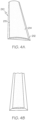
- the dual layer strip is shown in FIG. 4A and FIG. 4B .
- the volume ratio of compound A to compound B can be varied, as shown in FIG. 4A and FIG. 4B .
- the outside shoulder region 122 is formed of a dual layer strip having a ratio of 80% compound A to 20% compound B.
- the dual layer strip is formed preferably by spirally winding the strip to form the tread. As shown, the dual layer strip is layed up at an angle that may vary as desired.
- the inside shoulder region 124 is formed of a dual layer strip, but with a different strip ratio.
- the ratio of compound A to compound B is 13% A/87% B.
- the overall ratio of the tire tread is 40% A and 60% B.
- the overall ratio of compound A to compound B is the same in FIG. 1 and FIG. 2.
- FIG. 2 however, has fine layers of compound A and Compound B in each shoulder region, but the strip ratio is different in each zone.
- FIG. 3 illustrates a cross-sectional view of a tire tread 130, which tread is not used in a tire according to the present invention.
- the entire tread is formed of a dual layer strip, wherein the dual layer strip has a strip ratio of 40% A and 60% B, providing an overall tread composition of 40% A and 60%B.
- the tire tread profile of FIG. 2 and FIG. 3 result in a lower outside shoulder temperature than the tire tread profile of FIG. 1 .
- the substitution of a portion of the higher hysteresis carbon black dry traction compound with a small portion of the lower hysteresis/lower rolling resistance silica compound in fine layering results in a reduced temperature of the outside shoulder and the lap count handling sensitivity while maintaining the other tire performances.
- the overall total proportion of the two compounds were maintained, as compared to the overall ratio of FIG. 1 .
- tread profiles have described an overall tread composition of 40% A and 60% B
- the overall tread composition may vary as desired and are not limited to this example, as well as the strip ratio in each zone.
- Each zone of the tread is accomplished by the use of a dual layer strip 210 as shown in FIG. 4A that has two discrete layers of compound A and compound B, and in which the ratio of the two compounds in the strip can be varied in real time.
- the invention is directed to a tire having a tread formed of multiple zones thus simulating the use of many compounds by varying the volume ratio of compound A to compound B.
- FIG. 4A and 4B illustrates one embodiment of the strip cross-sectional shape.
- FIG. 6A illustrates an alternative embodiment of a dual layer strip wherein the layers are side by side.
- FIG. 6B illustrates a duplex strip configuration having a first layer that has a first triangular cross-sectional shape 252, and a polygon shape 254 forming a second layer.
- the dual layer strip has a strip thickness in the range of 0 to 10 mm thickness, more preferably in the range of 5-8 mm, and most preferably in the range of 0-3 mm thickness.
- the overall width of the dual layer strip is in the range of from 10 to 25 mm.
- the tire tread is formed by spirally winding the dual layer strip onto a tire carcass or a tire building drum.
- the dual layer strips may be oriented at an angle of zero to 60 degrees. Multiple layers of the dual layer strip may be used to form the tire tread regions such as a rib.
- the apparatus used to form the continuous dual layer strip is shown in FIGS. 5A and 5B .
- the apparatus can form the coextruded strip while instantaneously varying the ratio of the first compound to the second compound.
- the dual strip forming apparatus 10 includes a first extruder 30 and a second extruder 60, preferably arranged vertically in close proximity.
- the first extruder 30 has an inlet 32 for receiving a first rubber composition A
- the second extruder 60 has an inlet 62 for receiving a second rubber composition B.
- Compound A is extruded by the first extruder 60 and then pumped by the first gear pump 64 into a nozzle 80, while at the same time Compound B is extruded by the second extruder 30 and then pumped by the second gear pump 34 into the nozzle 80.
- the volume ratio of compound A to compound B may be changed by varying the ratio of the speed of gear pump of compound A to the speed of gear pump of compound B.
- the dual coextruded strip forming apparatus 10 can adjust the speed ratios on the fly, and due to the small residence time of the coextrusion nozzle, the apparatus has a fast response to a change in the compound ratios. This is due to the low volume of the coextrusion zone.
- the nozzle 80 forms two discrete layers 212, 214 joined together at an interface 215.
- the nozzle can be configured to provide different cross-sectional configurations of the strip, as shown in FIG. 6A and FIG. 6B .
Landscapes
- Engineering & Computer Science (AREA)
- Mechanical Engineering (AREA)
- Tires In General (AREA)
Description
- The invention relates in general to tire manufacturing, and more particularly to a tire having a tire tread and a method of forming said tread.
- Tire manufacturers have progressed to more complicated designs due to an advance in technology as well as a highly competitive industrial environment. In particular, tire designers seek to use multiple rubber compounds in a tire component such as the tread in order to meet customer demands. Using multiple rubber compounds per tire component can result in a huge number of compounds needed to be on hand for the various tire lines of the manufacturer. For cost and efficiency reasons, tire manufacturers seek to limit the number of compounds available, due to the extensive costs associated with each compound. Each compound typically requires the use of a banbury mixer, which involves expensive capital expenditures. Furthermore, Banbury mixers have difficulty mixing up tough or stiff rubber compounds. The compounds generated from the banbury mixers are typically shipped to the tire building plants, thus requiring additional costs for transportation. The shelf life of the compounds is not finite, and if not used within a certain time period, is scrapped.
- Thus, it is desired to have an improved method and apparatus which provides independent flow of two or more compounds from a single application head. More particularly, it is desired to be able to make a custom tire tread or tire component using only two tire compounds, which can be used to simulate multiple compounds having a variety of properties. More particularly, it is desired to provide an asymmetric tire tread that has reduced heat generation in the outside shoulder.
-
US 2015/090381 A1 ,US 2020/198274 A1 ,US 2020/198414 A1 andEP 3 653 360 A1 each describe a tire having a tread formed from a dual layer strip having a first layer formed of a first compound and a second layer formed from a second compound, the dual layer strip having a strip ratio of % first compound to % second compound in a range of from 20 to 50 % of the first compound to 50 to 80 % of the second compound. -
US 2018/141 296 A1 andUS 2009/320 985 A1 each describe a tire having a tread formed from a dual layer strip formed of a first compound and a second layer. - The invention relates to a tire in accordance with claim 1.
- Dependent claims refer to preferred embodiments of the invention.
- In one aspect, a tire having a tread is disclosed wherein the tread has a first shoulder region on an axial first side of the tread and a second shoulder region on the axial opposite side of the tread, wherein each shoulder region is formed from a dual layer strip having a first layer formed of a first compound, and a second layer formed of a different second compound, wherein the dual layer strip has a strip ratio of % first compound to % second compound, wherein first shoulder region has a strip ratio in a range of from 70 to 95% of the first compound to a range of from 5 to 30% of the second compound. The first shoulder region is the axially outside shoulder region of the tire when the tire is mounted on a vehicle in accordance with the tire's specification and the second shoulder region is the axially inside shoulder region of the tire when the tire is mounted on a vehicle in accordance with the tire's specification.
- In a preferred aspect of the invention, the first shoulder region has a strip ratio of 75% to 85%, preferably 80%, of the first compound to 15 to 25 percent, preferably 20%, of the second compound.
- The second shoulder region has a strip ratio in a range of from 8 to 15% of the first compound to a range of from 92 to 85% of the second compound.
- In a preferred aspect of the invention, the tread consists of 30 to 50 percent, preferably 35 to 45 percent or 40%, of the first compound and of 50 to 70 percent, preferably 55 to 65 percent or 60% percent of the second compound.
- In a preferred aspect of the invention, the first compound is selected for dry traction or has a higher dry traction, preferably an at least 10 percent higher dry traction, than the second compound.
- In a preferred aspect of the invention, the second compound is selected for rolling resistance or has a lower rolling resistance, preferably an at least 10 percent lower rolling resistance, than the first compound.
- The first compound has an at least 20% higher hysteresis than the second compound, preferably an at least 50% higher hysteresis than the second compound.
- In a preferred aspect of the invention, the dual layer strips are overlapped with each other.
- In a preferred aspect of the invention, the dual layer strips are applied at an angle in the range of from 0 to 60 degrees, preferably 1 to 10 degrees, with respect to the circumferential direction of the tire (100).
- In a preferred aspect of the invention, one or both of the first and second shoulder regions is formed of a first layer having an at least substantially triangular cross-sectional shape and of a second layer having an at least polygonal shape.
- In a preferred aspect of the invention, the first tread compound is selected for the desired tread property from the group of: rolling resistance, stiffness, electrical conductivity, thermal conductivity, wet traction, dry traction, and wear.
- In a preferred aspect of the invention, the second compound is selected from the desired tread property from the group of: rolling resistance, stiffness, electrical conductivity, thermal conductivity, wet traction, dry traction, and wear.
- In a preferred aspect of the invention, the first desired tread property is different than the second tread property.
- "Aspect Ratio" means the ratio of a tire's section height to its section width.
- "Axial" and "axially" means the lines or directions that are parallel to the axis of rotation of the tire.
- "Circumferential" means lines or directions extending along the perimeter of the surface of the annular tread perpendicular to the axial direction; it can also refer to the direction of the sets of adjacent circular curves whose radii define the axial curvature of the tread as viewed in cross section.
- "Ply" means a cord-reinforced layer of elastomer-coated, radially deployed or otherwise parallel cords.
- "Radial" and "radially" mean directions radially toward or away from the axis of rotation of the tire.
- "Tangent delta", or "tan delta," is a ratio of the shear loss modulus, also known as G", to the shear storage modulus (G'). These properties, namely the G', G" and tan delta, characterize the viscoelastic response of a rubber test sample to a tensile deformation at a fixed frequency and temperature, measured at 100°C.
- The invention will be described by way of example and with reference to the accompanying drawings in which:
-
FIG. 1 is a cross-sectional view of an asymmetrical tire tread profile formed of a 40% of a first compound A and 60% of a second compound B, wherein said tread profile is not used in a tire according to the present invention; -
FIG. 2 is a cross-sectional view of an asymmetrical tire tread formed of an outside shoulder region formed of multiple layers of a dual layer strip, and an inside shoulder region formed of a dual layer strip, wherein the overall ratio of the first compound to the second compound for the entire tread is 40% A/60% B, and the strip ratio of the outside shoulder region is 80%A/20%B, and the strip ratio for the inside shoulder region is 13% A/87% B; -
FIG. 3 is a cross-sectional view of a tire tread formed of a dual layer strip, wherein the overall ratio of the first compound to the second compound for the entire tread is 40% compound A/60% compound B, and the strip ratio used to form the tread has a 40%A/60%B ratio, wherein said tire tread is not used in a tire according to the present invention; -
FIG. 4A is a front perspective view of a dual layer strip, wherein the dual layer strip has a bottom layer formed of 90% of a first compound and a top layer formed of 10% of a second compound; -
FIG. 4B is a front perspective view of a dual layer strip having a bottom layer formed of 95% of a first compound and 5% of a second compound; -
FIG. 5A is a perspective view of an apparatus for forming a dual strip, whileFIG. 5B is a perspective close up cross-sectional view of a nozzle used to form the dual strip; and -
FIGS. 6A-6B illustrate alternative cross-sectional views of the dual layer strip geometry. -
FIG. 1 illustrates a cross-sectional view of atire tread 100, which tread is not used in a tire according to the present invention. Thetire tread 100 is formed into at least two tread regions, wherein thefirst tread region 105 is the outside shoulder and comprises 100% of a first compound A, wherein the compound A is selected for a first desired property of the tread. In this example, compound A is selected for the property of high traction, and a tread compound having a highly loaded carbon black tread formulation is used for the desired tread characteristics. Thesecond tread region 110 or the inside shoulder region is formed of a second compound B, wherein the second compound B is selected for a desired property of the tread. In this example, the second compound B is selected for low rolling resistance, and low hysteresis, and a highly loaded silica compound is selected, although other low rolling resistance compounds with low hysteresis known to those skilled in the art, are suitable for use. In this example, the overall ratio of the first compound A to the second compound B is 40% A/60% B, although the overall ratio may vary from 20-80% A to 80%-20% compound B. - A second embodiment of a
tire tread 120 is shown inFIG. 2 , wherein saidtread 120 may be used in a tire according to the present invention. - This tread is also asymmetric and has an
outside shoulder region 122 and aninside shoulder region 124. Theoutside shoulder region 122 is formed of a dual layer strip of a first compound A and a second compound B. The dual layer strip is shown inFIG. 4A and FIG. 4B . The volume ratio of compound A to compound B can be varied, as shown inFIG. 4A and FIG. 4B . In this example, theoutside shoulder region 122 is formed of a dual layer strip having a ratio of 80% compound A to 20% compound B. The dual layer strip is formed preferably by spirally winding the strip to form the tread. As shown, the dual layer strip is layed up at an angle that may vary as desired. Theinside shoulder region 124 is formed of a dual layer strip, but with a different strip ratio. In this example, the ratio of compound A to compound B is 13% A/87% B. The overall ratio of the tire tread is 40% A and 60% B. Thus, the overall ratio of compound A to compound B is the same inFIG. 1 and FIG. 2. FIG. 2 , however, has fine layers of compound A and Compound B in each shoulder region, but the strip ratio is different in each zone. -
FIG. 3 illustrates a cross-sectional view of atire tread 130, which tread is not used in a tire according to the present invention. In this embodiment, the entire tread is formed of a dual layer strip, wherein the dual layer strip has a strip ratio of 40% A and 60% B, providing an overall tread composition of 40% A and 60%B. - The tire tread profile of
FIG. 2 and FIG. 3 result in a lower outside shoulder temperature than the tire tread profile ofFIG. 1 . In the tire tread profiles ofFIG. 2 and FIG. 3 , it has been found that the substitution of a portion of the higher hysteresis carbon black dry traction compound with a small portion of the lower hysteresis/lower rolling resistance silica compound in fine layering results in a reduced temperature of the outside shoulder and the lap count handling sensitivity while maintaining the other tire performances. The overall total proportion of the two compounds were maintained, as compared to the overall ratio ofFIG. 1 . - While the above described tread profiles have described an overall tread composition of 40% A and 60% B, the overall tread composition may vary as desired and are not limited to this example, as well as the strip ratio in each zone. Each zone of the tread is accomplished by the use of a
dual layer strip 210 as shown inFIG. 4A that has two discrete layers of compound A and compound B, and in which the ratio of the two compounds in the strip can be varied in real time. Thus the invention is directed to a tire having a tread formed of multiple zones thus simulating the use of many compounds by varying the volume ratio of compound A to compound B. - The strip of
FIG. 4A and 4B illustrates one embodiment of the strip cross-sectional shape.FIG. 6A illustrates an alternative embodiment of a dual layer strip wherein the layers are side by side.FIG. 6B illustrates a duplex strip configuration having a first layer that has a first triangularcross-sectional shape 252, and apolygon shape 254 forming a second layer. - Multiple compound layering with the dual layer strip with very thin layers enable the tire component to leverage the properties of each compound while minimizing compound to compound interface durability issues because the thin cross sections of each layer are individually exposed to low stress concentration. Dynamically tuning the ratio of the two parent compounds across the component permits fine tuning of the tire zone performance contribution and delivers a previously unachievable performance.
- The dual layer strip has a strip thickness in the range of 0 to 10 mm thickness, more preferably in the range of 5-8 mm, and most preferably in the range of 0-3 mm thickness. The overall width of the dual layer strip is in the range of from 10 to 25 mm. The tire tread is formed by spirally winding the dual layer strip onto a tire carcass or a tire building drum. The dual layer strips may be oriented at an angle of zero to 60 degrees. Multiple layers of the dual layer strip may be used to form the tire tread regions such as a rib.
- The apparatus used to form the continuous dual layer strip is shown in
FIGS. 5A and 5B . The apparatus can form the coextruded strip while instantaneously varying the ratio of the first compound to the second compound. The dualstrip forming apparatus 10 includes afirst extruder 30 and asecond extruder 60, preferably arranged vertically in close proximity. Thefirst extruder 30 has aninlet 32 for receiving a first rubber composition A, while thesecond extruder 60 has an inlet 62 for receiving a second rubber composition B. Compound A is extruded by thefirst extruder 60 and then pumped by thefirst gear pump 64 into anozzle 80, while at the same time Compound B is extruded by thesecond extruder 30 and then pumped by thesecond gear pump 34 into thenozzle 80. The volume ratio of compound A to compound B may be changed by varying the ratio of the speed of gear pump of compound A to the speed of gear pump of compound B. The dual coextrudedstrip forming apparatus 10 can adjust the speed ratios on the fly, and due to the small residence time of the coextrusion nozzle, the apparatus has a fast response to a change in the compound ratios. This is due to the low volume of the coextrusion zone. - The
nozzle 80 forms twodiscrete layers interface 215. The nozzle can be configured to provide different cross-sectional configurations of the strip, as shown inFIG. 6A and FIG. 6B .
Claims (10)
- A tire having a tread (100) wherein the tread (100) has a first shoulder region (122) on an axial first side of the tread (100) and a second shoulder region (124) on the axial opposite side of the tread (100), wherein the first shoulder region (122) is the axially outside shoulder region of the tire (100) when the tire (100) is mounted on a vehicle in accordance with the tire's specification and wherein the second shoulder region (124) is the axially inside shoulder region of the tire (100) when the tire is mounted on a vehicle in accordance with the tire's specification, wherein each shoulder region (122, 124) is formed from a dual layer strip (210) having a first layer (212) formed of a first compound, and a second layer (214) formed of a different second compound, wherein first shoulder region (122) has a strip ratio in a range of from 70 to 95% of the first compound to a range of from 5 to 30% of the second compound, characterised in that the second shoulder region (124) has a strip ratio in a range of from 8 to 15% of the first compound to a range of from 92 to 85% of the second compound, and wherein the first compound has an at least 20% higher hysteresis than the second compound.
- The tire of claim 1 wherein the first shoulder region (122) has a strip ratio of 75 to 85%, preferably 80%, of the first compound to 15 to 25%, preferably 20%, of the second compound.
- The tire of at least one of the previous claims wherein the tread (100) consists of 30 to 50 percent, preferably 35 to 45 percent or 40%, of the first compound and of 50 to 70 percent, preferably 55 to 65 percent or 60% percent of the second compound.
- The tire of at least one of the previous claims wherein the first compound is selected for dry traction or has a higher dry traction, preferably an at least 10 percent higher try traction, than the second compound.
- The tire of at least one of the previous claims wherein the second compound is selected for rolling resistance or has a lower rolling resistance, preferably an at least 10 percent lower rolling resistance, than the first compound.
- The tire of at least one of the previous claims wherein the first compound has an at least 50% higher hysteresis than the second compound.
- The tire of at least one of the previous claims wherein the dual layer strips (210) are overlapped with each other.
- The tire of at least one of the previous claims wherein the dual layer strips (210) are applied at an angle in the range of from 0 to 60 degrees, preferably 1 to 10 degrees, with respect to the circumferential direction of the tire (100).
- The tire of at least one of the previous claims wherein one or both of the first and second shoulder regions (122, 124) is formed of a first layer having an at least substantially triangular cross-sectional shape (252) and of a second layer having an at least polygonal shape (254).
- The tire of at least one of the previous claims wherein the dual layer strip (210) has a strip thickness in the range of from 0.5 to 10 mm, more preferably in the range of from 5 to 8 mm or from 0.5 to 3 mm thickness, and/or an axial width in the range of from 10 to 25 mm.
Applications Claiming Priority (2)
| Application Number | Priority Date | Filing Date | Title |
|---|---|---|---|
| US202063073262P | 2020-09-01 | 2020-09-01 | |
| US17/355,280 US20220063343A1 (en) | 2020-09-01 | 2021-06-23 | Tire with asymmetrical tread with reduced shoulder heat generation |
Publications (2)
| Publication Number | Publication Date |
|---|---|
| EP3960500A1 EP3960500A1 (en) | 2022-03-02 |
| EP3960500B1 true EP3960500B1 (en) | 2023-10-04 |
Family
ID=77595368
Family Applications (1)
| Application Number | Title | Priority Date | Filing Date |
|---|---|---|---|
| EP21194221.4A Active EP3960500B1 (en) | 2020-09-01 | 2021-09-01 | Tire with asymmetrical tread with reduced shoulder heat generation |
Country Status (3)
| Country | Link |
|---|---|
| US (1) | US20220063343A1 (en) |
| EP (1) | EP3960500B1 (en) |
| CN (1) | CN114103553A (en) |
Families Citing this family (1)
| Publication number | Priority date | Publication date | Assignee | Title |
|---|---|---|---|---|
| US12285976B2 (en) | 2023-07-31 | 2025-04-29 | The Goodyear Tire & Rubber Company | Tire comprising a dual-layer tread |
Family Cites Families (18)
| Publication number | Priority date | Publication date | Assignee | Title |
|---|---|---|---|---|
| KR100624121B1 (en) * | 1998-12-21 | 2006-09-19 | 피렐리 타이어 소시에떼 퍼 아찌오니 | Dual structure tread band for tire |
| JP3573636B2 (en) * | 1998-12-28 | 2004-10-06 | 横浜ゴム株式会社 | Automotive pneumatic tire and method of manufacturing the same |
| JP5394062B2 (en) * | 2006-07-10 | 2014-01-22 | 東洋ゴム工業株式会社 | Method for molding inner-liner rubber member for tire |
| US20080066838A1 (en) * | 2006-09-08 | 2008-03-20 | Ping Zhang | Carbon black-rich rubber composition containing particulate hydrophylic water absorbing polymer and tire with tread thereof |
| JP4377933B2 (en) * | 2007-08-03 | 2009-12-02 | 住友ゴム工業株式会社 | Pneumatic tire |
| JP5155935B2 (en) * | 2009-05-18 | 2013-03-06 | 住友ゴム工業株式会社 | Pneumatic tire and manufacturing method thereof |
| US9290052B2 (en) * | 2012-03-05 | 2016-03-22 | The Goodyear Tire & Rubber Company | Pneumatic tire |
| JP6091006B2 (en) * | 2013-09-30 | 2017-03-08 | 東洋ゴム工業株式会社 | Pneumatic tire manufacturing method and pneumatic tire |
| DE102014209059A1 (en) * | 2014-05-14 | 2015-11-19 | Continental Reifen Deutschland Gmbh | Vehicle tires |
| DE102014223160A1 (en) * | 2014-11-13 | 2016-05-19 | Continental Reifen Deutschland Gmbh | Method of producing vehicle tires |
| DE102015207937A1 (en) * | 2015-04-29 | 2016-11-03 | Continental Reifen Deutschland Gmbh | Pneumatic vehicle tire with a tread |
| DE102015207931A1 (en) * | 2015-04-29 | 2016-11-03 | Continental Reifen Deutschland Gmbh | Pneumatic vehicle tire with a tread |
| KR101894013B1 (en) * | 2017-08-24 | 2018-08-31 | 넥센타이어 주식회사 | Tire |
| DE102018219640A1 (en) * | 2018-11-16 | 2020-04-30 | Continental Reifen Deutschland Gmbh | Preform device for use in an extrusion device, pneumatic vehicle tires, method for producing a pneumatic vehicle tire with a tread section with at least two rubber components, and corresponding uses |
| US20200198414A1 (en) * | 2018-12-19 | 2020-06-25 | The Goodyear Tire & Rubber Company | Method and apparatus for forming a composite tread with microchimneys |
| US11993110B2 (en) * | 2018-12-19 | 2024-05-28 | The Goodyear Tire & Rubber Company | Reinforced tread and method of forming |
| US11541691B2 (en) * | 2018-12-19 | 2023-01-03 | The Goodyear Tire & Rubber Company | Composite tread with targeted stiffness gradient and method of making |
| IT201900012765A1 (en) * | 2019-07-24 | 2021-01-24 | Bridgestone Europe Nv Sa | MULTI-COMPOUND TREAD FOR ROAD VEHICLE TIRE |
-
2021
- 2021-06-23 US US17/355,280 patent/US20220063343A1/en active Pending
- 2021-09-01 EP EP21194221.4A patent/EP3960500B1/en active Active
- 2021-09-01 CN CN202111021029.4A patent/CN114103553A/en active Pending
Also Published As
| Publication number | Publication date |
|---|---|
| CN114103553A (en) | 2022-03-01 |
| EP3960500A1 (en) | 2022-03-02 |
| BR102021016968A2 (en) | 2022-03-15 |
| US20220063343A1 (en) | 2022-03-03 |
Similar Documents
| Publication | Publication Date | Title |
|---|---|---|
| EP2695751B1 (en) | Pneumatic tire | |
| US12441072B2 (en) | Reinforced tread and method of forming | |
| KR20010093215A (en) | Radial tyre bead | |
| EP2886315B1 (en) | Manufacturing method for run-flat pneumatic tyre, and run-flat pneumatic tyre | |
| EP3960500B1 (en) | Tire with asymmetrical tread with reduced shoulder heat generation | |
| US12202221B2 (en) | Composite tread with targeted stiffness gradient and method of making | |
| EP3960436B1 (en) | Tire with composite tread and method of making | |
| JP6014542B2 (en) | Aircraft tire | |
| EP3670167B1 (en) | Method for forming a tire component and tire component | |
| EP3643537A1 (en) | Run-flat tire | |
| EP3643539A1 (en) | Run-flat tire | |
| BR102021016403B1 (en) | METHOD FOR FORMING A COMPOSITE TREAD | |
| EP3081395A1 (en) | A continuous crown reinforcement for a pneumatic tire | |
| JP2010260446A (en) | Pneumatic tire | |
| US12109773B2 (en) | Method and apparatus for forming an apex | |
| EP0648621B1 (en) | Pneumatic tyre | |
| US20200198206A1 (en) | Dual compound extruder apparatus with rotatable head | |
| BR102021016968B1 (en) | TIRE WITH ASYMMETRICAL TREAD WITH REDUCED SHOULDER HEAT GENERATION | |
| EP3643538A1 (en) | Run-flat tire | |
| US8235083B2 (en) | Pneumatic tyre for vehicle wheels | |
| JP6444815B2 (en) | tire |
Legal Events
| Date | Code | Title | Description |
|---|---|---|---|
| PUAI | Public reference made under article 153(3) epc to a published international application that has entered the european phase |
Free format text: ORIGINAL CODE: 0009012 |
|
| STAA | Information on the status of an ep patent application or granted ep patent |
Free format text: STATUS: THE APPLICATION HAS BEEN PUBLISHED |
|
| AK | Designated contracting states |
Kind code of ref document: A1 Designated state(s): AL AT BE BG CH CY CZ DE DK EE ES FI FR GB GR HR HU IE IS IT LI LT LU LV MC MK MT NL NO PL PT RO RS SE SI SK SM TR |
|
| STAA | Information on the status of an ep patent application or granted ep patent |
Free format text: STATUS: REQUEST FOR EXAMINATION WAS MADE |
|
| 17P | Request for examination filed |
Effective date: 20220902 |
|
| RBV | Designated contracting states (corrected) |
Designated state(s): AL AT BE BG CH CY CZ DE DK EE ES FI FR GB GR HR HU IE IS IT LI LT LU LV MC MK MT NL NO PL PT RO RS SE SI SK SM TR |
|
| GRAP | Despatch of communication of intention to grant a patent |
Free format text: ORIGINAL CODE: EPIDOSNIGR1 |
|
| STAA | Information on the status of an ep patent application or granted ep patent |
Free format text: STATUS: GRANT OF PATENT IS INTENDED |
|
| INTG | Intention to grant announced |
Effective date: 20230502 |
|
| GRAS | Grant fee paid |
Free format text: ORIGINAL CODE: EPIDOSNIGR3 |
|
| GRAA | (expected) grant |
Free format text: ORIGINAL CODE: 0009210 |
|
| STAA | Information on the status of an ep patent application or granted ep patent |
Free format text: STATUS: THE PATENT HAS BEEN GRANTED |
|
| AK | Designated contracting states |
Kind code of ref document: B1 Designated state(s): AL AT BE BG CH CY CZ DE DK EE ES FI FR GB GR HR HU IE IS IT LI LT LU LV MC MK MT NL NO PL PT RO RS SE SI SK SM TR |
|
| REG | Reference to a national code |
Ref country code: GB Ref legal event code: FG4D |
|
| REG | Reference to a national code |
Ref country code: CH Ref legal event code: EP |
|
| REG | Reference to a national code |
Ref country code: IE Ref legal event code: FG4D |
|
| REG | Reference to a national code |
Ref country code: DE Ref legal event code: R096 Ref document number: 602021005599 Country of ref document: DE |
|
| REG | Reference to a national code |
Ref country code: LT Ref legal event code: MG9D |
|
| REG | Reference to a national code |
Ref country code: NL Ref legal event code: MP Effective date: 20231004 |
|
| REG | Reference to a national code |
Ref country code: AT Ref legal event code: MK05 Ref document number: 1617390 Country of ref document: AT Kind code of ref document: T Effective date: 20231004 |
|
| PG25 | Lapsed in a contracting state [announced via postgrant information from national office to epo] |
Ref country code: NL Free format text: LAPSE BECAUSE OF FAILURE TO SUBMIT A TRANSLATION OF THE DESCRIPTION OR TO PAY THE FEE WITHIN THE PRESCRIBED TIME-LIMIT Effective date: 20231004 |
|
| PG25 | Lapsed in a contracting state [announced via postgrant information from national office to epo] |
Ref country code: GR Free format text: LAPSE BECAUSE OF FAILURE TO SUBMIT A TRANSLATION OF THE DESCRIPTION OR TO PAY THE FEE WITHIN THE PRESCRIBED TIME-LIMIT Effective date: 20240105 |
|
| PG25 | Lapsed in a contracting state [announced via postgrant information from national office to epo] |
Ref country code: IS Free format text: LAPSE BECAUSE OF FAILURE TO SUBMIT A TRANSLATION OF THE DESCRIPTION OR TO PAY THE FEE WITHIN THE PRESCRIBED TIME-LIMIT Effective date: 20240204 |
|
| PG25 | Lapsed in a contracting state [announced via postgrant information from national office to epo] |
Ref country code: LT Free format text: LAPSE BECAUSE OF FAILURE TO SUBMIT A TRANSLATION OF THE DESCRIPTION OR TO PAY THE FEE WITHIN THE PRESCRIBED TIME-LIMIT Effective date: 20231004 |
|
| PG25 | Lapsed in a contracting state [announced via postgrant information from national office to epo] |
Ref country code: AT Free format text: LAPSE BECAUSE OF FAILURE TO SUBMIT A TRANSLATION OF THE DESCRIPTION OR TO PAY THE FEE WITHIN THE PRESCRIBED TIME-LIMIT Effective date: 20231004 |
|
| PG25 | Lapsed in a contracting state [announced via postgrant information from national office to epo] |
Ref country code: ES Free format text: LAPSE BECAUSE OF FAILURE TO SUBMIT A TRANSLATION OF THE DESCRIPTION OR TO PAY THE FEE WITHIN THE PRESCRIBED TIME-LIMIT Effective date: 20231004 |
|
| PG25 | Lapsed in a contracting state [announced via postgrant information from national office to epo] |
Ref country code: LT Free format text: LAPSE BECAUSE OF FAILURE TO SUBMIT A TRANSLATION OF THE DESCRIPTION OR TO PAY THE FEE WITHIN THE PRESCRIBED TIME-LIMIT Effective date: 20231004 Ref country code: IS Free format text: LAPSE BECAUSE OF FAILURE TO SUBMIT A TRANSLATION OF THE DESCRIPTION OR TO PAY THE FEE WITHIN THE PRESCRIBED TIME-LIMIT Effective date: 20240204 Ref country code: GR Free format text: LAPSE BECAUSE OF FAILURE TO SUBMIT A TRANSLATION OF THE DESCRIPTION OR TO PAY THE FEE WITHIN THE PRESCRIBED TIME-LIMIT Effective date: 20240105 Ref country code: ES Free format text: LAPSE BECAUSE OF FAILURE TO SUBMIT A TRANSLATION OF THE DESCRIPTION OR TO PAY THE FEE WITHIN THE PRESCRIBED TIME-LIMIT Effective date: 20231004 Ref country code: BG Free format text: LAPSE BECAUSE OF FAILURE TO SUBMIT A TRANSLATION OF THE DESCRIPTION OR TO PAY THE FEE WITHIN THE PRESCRIBED TIME-LIMIT Effective date: 20240104 Ref country code: AT Free format text: LAPSE BECAUSE OF FAILURE TO SUBMIT A TRANSLATION OF THE DESCRIPTION OR TO PAY THE FEE WITHIN THE PRESCRIBED TIME-LIMIT Effective date: 20231004 Ref country code: PT Free format text: LAPSE BECAUSE OF FAILURE TO SUBMIT A TRANSLATION OF THE DESCRIPTION OR TO PAY THE FEE WITHIN THE PRESCRIBED TIME-LIMIT Effective date: 20240205 |
|
| PG25 | Lapsed in a contracting state [announced via postgrant information from national office to epo] |
Ref country code: SE Free format text: LAPSE BECAUSE OF FAILURE TO SUBMIT A TRANSLATION OF THE DESCRIPTION OR TO PAY THE FEE WITHIN THE PRESCRIBED TIME-LIMIT Effective date: 20231004 Ref country code: RS Free format text: LAPSE BECAUSE OF FAILURE TO SUBMIT A TRANSLATION OF THE DESCRIPTION OR TO PAY THE FEE WITHIN THE PRESCRIBED TIME-LIMIT Effective date: 20231004 Ref country code: PL Free format text: LAPSE BECAUSE OF FAILURE TO SUBMIT A TRANSLATION OF THE DESCRIPTION OR TO PAY THE FEE WITHIN THE PRESCRIBED TIME-LIMIT Effective date: 20231004 Ref country code: NO Free format text: LAPSE BECAUSE OF FAILURE TO SUBMIT A TRANSLATION OF THE DESCRIPTION OR TO PAY THE FEE WITHIN THE PRESCRIBED TIME-LIMIT Effective date: 20240104 Ref country code: LV Free format text: LAPSE BECAUSE OF FAILURE TO SUBMIT A TRANSLATION OF THE DESCRIPTION OR TO PAY THE FEE WITHIN THE PRESCRIBED TIME-LIMIT Effective date: 20231004 Ref country code: HR Free format text: LAPSE BECAUSE OF FAILURE TO SUBMIT A TRANSLATION OF THE DESCRIPTION OR TO PAY THE FEE WITHIN THE PRESCRIBED TIME-LIMIT Effective date: 20231004 |
|
| REG | Reference to a national code |
Ref country code: DE Ref legal event code: R097 Ref document number: 602021005599 Country of ref document: DE |
|
| PG25 | Lapsed in a contracting state [announced via postgrant information from national office to epo] |
Ref country code: DK Free format text: LAPSE BECAUSE OF FAILURE TO SUBMIT A TRANSLATION OF THE DESCRIPTION OR TO PAY THE FEE WITHIN THE PRESCRIBED TIME-LIMIT Effective date: 20231004 |
|
| PG25 | Lapsed in a contracting state [announced via postgrant information from national office to epo] |
Ref country code: CZ Free format text: LAPSE BECAUSE OF FAILURE TO SUBMIT A TRANSLATION OF THE DESCRIPTION OR TO PAY THE FEE WITHIN THE PRESCRIBED TIME-LIMIT Effective date: 20231004 |
|
| PG25 | Lapsed in a contracting state [announced via postgrant information from national office to epo] |
Ref country code: SK Free format text: LAPSE BECAUSE OF FAILURE TO SUBMIT A TRANSLATION OF THE DESCRIPTION OR TO PAY THE FEE WITHIN THE PRESCRIBED TIME-LIMIT Effective date: 20231004 |
|
| PG25 | Lapsed in a contracting state [announced via postgrant information from national office to epo] |
Ref country code: SM Free format text: LAPSE BECAUSE OF FAILURE TO SUBMIT A TRANSLATION OF THE DESCRIPTION OR TO PAY THE FEE WITHIN THE PRESCRIBED TIME-LIMIT Effective date: 20231004 Ref country code: SK Free format text: LAPSE BECAUSE OF FAILURE TO SUBMIT A TRANSLATION OF THE DESCRIPTION OR TO PAY THE FEE WITHIN THE PRESCRIBED TIME-LIMIT Effective date: 20231004 Ref country code: RO Free format text: LAPSE BECAUSE OF FAILURE TO SUBMIT A TRANSLATION OF THE DESCRIPTION OR TO PAY THE FEE WITHIN THE PRESCRIBED TIME-LIMIT Effective date: 20231004 Ref country code: EE Free format text: LAPSE BECAUSE OF FAILURE TO SUBMIT A TRANSLATION OF THE DESCRIPTION OR TO PAY THE FEE WITHIN THE PRESCRIBED TIME-LIMIT Effective date: 20231004 Ref country code: DK Free format text: LAPSE BECAUSE OF FAILURE TO SUBMIT A TRANSLATION OF THE DESCRIPTION OR TO PAY THE FEE WITHIN THE PRESCRIBED TIME-LIMIT Effective date: 20231004 Ref country code: CZ Free format text: LAPSE BECAUSE OF FAILURE TO SUBMIT A TRANSLATION OF THE DESCRIPTION OR TO PAY THE FEE WITHIN THE PRESCRIBED TIME-LIMIT Effective date: 20231004 |
|
| PLBE | No opposition filed within time limit |
Free format text: ORIGINAL CODE: 0009261 |
|
| STAA | Information on the status of an ep patent application or granted ep patent |
Free format text: STATUS: NO OPPOSITION FILED WITHIN TIME LIMIT |
|
| 26N | No opposition filed |
Effective date: 20240705 |
|
| PG25 | Lapsed in a contracting state [announced via postgrant information from national office to epo] |
Ref country code: SI Free format text: LAPSE BECAUSE OF FAILURE TO SUBMIT A TRANSLATION OF THE DESCRIPTION OR TO PAY THE FEE WITHIN THE PRESCRIBED TIME-LIMIT Effective date: 20231004 |
|
| PG25 | Lapsed in a contracting state [announced via postgrant information from national office to epo] |
Ref country code: SI Free format text: LAPSE BECAUSE OF FAILURE TO SUBMIT A TRANSLATION OF THE DESCRIPTION OR TO PAY THE FEE WITHIN THE PRESCRIBED TIME-LIMIT Effective date: 20231004 |
|
| PG25 | Lapsed in a contracting state [announced via postgrant information from national office to epo] |
Ref country code: MC Free format text: LAPSE BECAUSE OF FAILURE TO SUBMIT A TRANSLATION OF THE DESCRIPTION OR TO PAY THE FEE WITHIN THE PRESCRIBED TIME-LIMIT Effective date: 20231004 |
|
| REG | Reference to a national code |
Ref country code: CH Ref legal event code: PL |
|
| PG25 | Lapsed in a contracting state [announced via postgrant information from national office to epo] |
Ref country code: LU Free format text: LAPSE BECAUSE OF NON-PAYMENT OF DUE FEES Effective date: 20240901 |
|
| REG | Reference to a national code |
Ref country code: BE Ref legal event code: MM Effective date: 20240930 |
|
| PG25 | Lapsed in a contracting state [announced via postgrant information from national office to epo] |
Ref country code: BE Free format text: LAPSE BECAUSE OF NON-PAYMENT OF DUE FEES Effective date: 20240930 |
|
| PG25 | Lapsed in a contracting state [announced via postgrant information from national office to epo] |
Ref country code: CH Free format text: LAPSE BECAUSE OF NON-PAYMENT OF DUE FEES Effective date: 20240930 |
|
| PG25 | Lapsed in a contracting state [announced via postgrant information from national office to epo] |
Ref country code: IE Free format text: LAPSE BECAUSE OF NON-PAYMENT OF DUE FEES Effective date: 20240901 |
|
| PG25 | Lapsed in a contracting state [announced via postgrant information from national office to epo] |
Ref country code: FI Free format text: LAPSE BECAUSE OF FAILURE TO SUBMIT A TRANSLATION OF THE DESCRIPTION OR TO PAY THE FEE WITHIN THE PRESCRIBED TIME-LIMIT Effective date: 20231004 |
|
| PGFP | Annual fee paid to national office [announced via postgrant information from national office to epo] |
Ref country code: DE Payment date: 20250820 Year of fee payment: 5 |
|
| PGFP | Annual fee paid to national office [announced via postgrant information from national office to epo] |
Ref country code: IT Payment date: 20250820 Year of fee payment: 5 |
|
| PGFP | Annual fee paid to national office [announced via postgrant information from national office to epo] |
Ref country code: FR Payment date: 20250820 Year of fee payment: 5 |
|
| PG25 | Lapsed in a contracting state [announced via postgrant information from national office to epo] |
Ref country code: CY Free format text: LAPSE BECAUSE OF FAILURE TO SUBMIT A TRANSLATION OF THE DESCRIPTION OR TO PAY THE FEE WITHIN THE PRESCRIBED TIME-LIMIT; INVALID AB INITIO Effective date: 20210901 |
|
| PG25 | Lapsed in a contracting state [announced via postgrant information from national office to epo] |
Ref country code: HU Free format text: LAPSE BECAUSE OF FAILURE TO SUBMIT A TRANSLATION OF THE DESCRIPTION OR TO PAY THE FEE WITHIN THE PRESCRIBED TIME-LIMIT; INVALID AB INITIO Effective date: 20210901 |