EP3960290A1 - Catalyst for organic matter decomposition, and organic matter decomposition device - Google Patents
Catalyst for organic matter decomposition, and organic matter decomposition device Download PDFInfo
- Publication number
- EP3960290A1 EP3960290A1 EP20819539.6A EP20819539A EP3960290A1 EP 3960290 A1 EP3960290 A1 EP 3960290A1 EP 20819539 A EP20819539 A EP 20819539A EP 3960290 A1 EP3960290 A1 EP 3960290A1
- Authority
- EP
- European Patent Office
- Prior art keywords
- sub
- organic material
- material decomposition
- baco
- decomposition catalyst
- Prior art date
- Legal status (The legal status is an assumption and is not a legal conclusion. Google has not performed a legal analysis and makes no representation as to the accuracy of the status listed.)
- Withdrawn
Links
Images


Classifications
-
- B—PERFORMING OPERATIONS; TRANSPORTING
- B01—PHYSICAL OR CHEMICAL PROCESSES OR APPARATUS IN GENERAL
- B01J—CHEMICAL OR PHYSICAL PROCESSES, e.g. CATALYSIS OR COLLOID CHEMISTRY; THEIR RELEVANT APPARATUS
- B01J23/00—Catalysts comprising metals or metal oxides or hydroxides, not provided for in group B01J21/00
- B01J23/02—Catalysts comprising metals or metal oxides or hydroxides, not provided for in group B01J21/00 of the alkali- or alkaline earth metals or beryllium
-
- B—PERFORMING OPERATIONS; TRANSPORTING
- B01—PHYSICAL OR CHEMICAL PROCESSES OR APPARATUS IN GENERAL
- B01D—SEPARATION
- B01D53/00—Separation of gases or vapours; Recovering vapours of volatile solvents from gases; Chemical or biological purification of waste gases, e.g. engine exhaust gases, smoke, fumes, flue gases, aerosols
- B01D53/34—Chemical or biological purification of waste gases
- B01D53/74—General processes for purification of waste gases; Apparatus or devices specially adapted therefor
- B01D53/86—Catalytic processes
- B01D53/8668—Removing organic compounds not provided for in B01D53/8603 - B01D53/8665
-
- B—PERFORMING OPERATIONS; TRANSPORTING
- B01—PHYSICAL OR CHEMICAL PROCESSES OR APPARATUS IN GENERAL
- B01D—SEPARATION
- B01D53/00—Separation of gases or vapours; Recovering vapours of volatile solvents from gases; Chemical or biological purification of waste gases, e.g. engine exhaust gases, smoke, fumes, flue gases, aerosols
- B01D53/34—Chemical or biological purification of waste gases
- B01D53/74—General processes for purification of waste gases; Apparatus or devices specially adapted therefor
- B01D53/86—Catalytic processes
- B01D53/864—Removing carbon monoxide or hydrocarbons
-
- B—PERFORMING OPERATIONS; TRANSPORTING
- B01—PHYSICAL OR CHEMICAL PROCESSES OR APPARATUS IN GENERAL
- B01D—SEPARATION
- B01D53/00—Separation of gases or vapours; Recovering vapours of volatile solvents from gases; Chemical or biological purification of waste gases, e.g. engine exhaust gases, smoke, fumes, flue gases, aerosols
- B01D53/34—Chemical or biological purification of waste gases
- B01D53/92—Chemical or biological purification of waste gases of engine exhaust gases
- B01D53/94—Chemical or biological purification of waste gases of engine exhaust gases by catalytic processes
-
- B—PERFORMING OPERATIONS; TRANSPORTING
- B01—PHYSICAL OR CHEMICAL PROCESSES OR APPARATUS IN GENERAL
- B01J—CHEMICAL OR PHYSICAL PROCESSES, e.g. CATALYSIS OR COLLOID CHEMISTRY; THEIR RELEVANT APPARATUS
- B01J23/00—Catalysts comprising metals or metal oxides or hydroxides, not provided for in group B01J21/00
- B01J23/002—Mixed oxides other than spinels, e.g. perovskite
-
- B—PERFORMING OPERATIONS; TRANSPORTING
- B01—PHYSICAL OR CHEMICAL PROCESSES OR APPARATUS IN GENERAL
- B01J—CHEMICAL OR PHYSICAL PROCESSES, e.g. CATALYSIS OR COLLOID CHEMISTRY; THEIR RELEVANT APPARATUS
- B01J27/00—Catalysts comprising the elements or compounds of halogens, sulfur, selenium, tellurium, phosphorus or nitrogen; Catalysts comprising carbon compounds
- B01J27/20—Carbon compounds
- B01J27/232—Carbonates
-
- B—PERFORMING OPERATIONS; TRANSPORTING
- B01—PHYSICAL OR CHEMICAL PROCESSES OR APPARATUS IN GENERAL
- B01J—CHEMICAL OR PHYSICAL PROCESSES, e.g. CATALYSIS OR COLLOID CHEMISTRY; THEIR RELEVANT APPARATUS
- B01J35/00—Catalysts, in general, characterised by their form or physical properties
- B01J35/60—Catalysts, in general, characterised by their form or physical properties characterised by their surface properties or porosity
- B01J35/61—Surface area
- B01J35/612—Surface area less than 10 m2/g
-
- B—PERFORMING OPERATIONS; TRANSPORTING
- B01—PHYSICAL OR CHEMICAL PROCESSES OR APPARATUS IN GENERAL
- B01J—CHEMICAL OR PHYSICAL PROCESSES, e.g. CATALYSIS OR COLLOID CHEMISTRY; THEIR RELEVANT APPARATUS
- B01J35/00—Catalysts, in general, characterised by their form or physical properties
- B01J35/60—Catalysts, in general, characterised by their form or physical properties characterised by their surface properties or porosity
- B01J35/61—Surface area
- B01J35/613—10-100 m2/g
-
- B—PERFORMING OPERATIONS; TRANSPORTING
- B01—PHYSICAL OR CHEMICAL PROCESSES OR APPARATUS IN GENERAL
- B01J—CHEMICAL OR PHYSICAL PROCESSES, e.g. CATALYSIS OR COLLOID CHEMISTRY; THEIR RELEVANT APPARATUS
- B01J35/00—Catalysts, in general, characterised by their form or physical properties
- B01J35/70—Catalysts, in general, characterised by their form or physical properties characterised by their crystalline properties, e.g. semi-crystalline
- B01J35/733—Perovskite-type
-
- B—PERFORMING OPERATIONS; TRANSPORTING
- B01—PHYSICAL OR CHEMICAL PROCESSES OR APPARATUS IN GENERAL
- B01J—CHEMICAL OR PHYSICAL PROCESSES, e.g. CATALYSIS OR COLLOID CHEMISTRY; THEIR RELEVANT APPARATUS
- B01J37/00—Processes, in general, for preparing catalysts; Processes, in general, for activation of catalysts
- B01J37/0009—Use of binding agents; Moulding; Pressing; Powdering; Granulating; Addition of materials ameliorating the mechanical properties of the product catalyst
-
- B—PERFORMING OPERATIONS; TRANSPORTING
- B01—PHYSICAL OR CHEMICAL PROCESSES OR APPARATUS IN GENERAL
- B01J—CHEMICAL OR PHYSICAL PROCESSES, e.g. CATALYSIS OR COLLOID CHEMISTRY; THEIR RELEVANT APPARATUS
- B01J37/00—Processes, in general, for preparing catalysts; Processes, in general, for activation of catalysts
- B01J37/04—Mixing
-
- B—PERFORMING OPERATIONS; TRANSPORTING
- B01—PHYSICAL OR CHEMICAL PROCESSES OR APPARATUS IN GENERAL
- B01J—CHEMICAL OR PHYSICAL PROCESSES, e.g. CATALYSIS OR COLLOID CHEMISTRY; THEIR RELEVANT APPARATUS
- B01J37/00—Processes, in general, for preparing catalysts; Processes, in general, for activation of catalysts
- B01J37/08—Heat treatment
-
- B—PERFORMING OPERATIONS; TRANSPORTING
- B01—PHYSICAL OR CHEMICAL PROCESSES OR APPARATUS IN GENERAL
- B01D—SEPARATION
- B01D2255/00—Catalysts
- B01D2255/20—Metals or compounds thereof
- B01D2255/204—Alkaline earth metals
- B01D2255/2042—Barium
-
- B—PERFORMING OPERATIONS; TRANSPORTING
- B01—PHYSICAL OR CHEMICAL PROCESSES OR APPARATUS IN GENERAL
- B01D—SEPARATION
- B01D2255/00—Catalysts
- B01D2255/20—Metals or compounds thereof
- B01D2255/207—Transition metals
- B01D2255/20715—Zirconium
-
- B—PERFORMING OPERATIONS; TRANSPORTING
- B01—PHYSICAL OR CHEMICAL PROCESSES OR APPARATUS IN GENERAL
- B01D—SEPARATION
- B01D2255/00—Catalysts
- B01D2255/20—Metals or compounds thereof
- B01D2255/207—Transition metals
- B01D2255/2073—Manganese
-
- B—PERFORMING OPERATIONS; TRANSPORTING
- B01—PHYSICAL OR CHEMICAL PROCESSES OR APPARATUS IN GENERAL
- B01D—SEPARATION
- B01D2255/00—Catalysts
- B01D2255/40—Mixed oxides
- B01D2255/402—Perovskites
-
- B—PERFORMING OPERATIONS; TRANSPORTING
- B01—PHYSICAL OR CHEMICAL PROCESSES OR APPARATUS IN GENERAL
- B01D—SEPARATION
- B01D2255/00—Catalysts
- B01D2255/65—Catalysts not containing noble metals
-
- B—PERFORMING OPERATIONS; TRANSPORTING
- B01—PHYSICAL OR CHEMICAL PROCESSES OR APPARATUS IN GENERAL
- B01D—SEPARATION
- B01D2255/00—Catalysts
- B01D2255/90—Physical characteristics of catalysts
- B01D2255/92—Dimensions
- B01D2255/9202—Linear dimensions
-
- B—PERFORMING OPERATIONS; TRANSPORTING
- B01—PHYSICAL OR CHEMICAL PROCESSES OR APPARATUS IN GENERAL
- B01D—SEPARATION
- B01D2255/00—Catalysts
- B01D2255/90—Physical characteristics of catalysts
- B01D2255/92—Dimensions
- B01D2255/9207—Specific surface
-
- B—PERFORMING OPERATIONS; TRANSPORTING
- B01—PHYSICAL OR CHEMICAL PROCESSES OR APPARATUS IN GENERAL
- B01D—SEPARATION
- B01D2257/00—Components to be removed
- B01D2257/70—Organic compounds not provided for in groups B01D2257/00 - B01D2257/602
- B01D2257/702—Hydrocarbons
- B01D2257/7027—Aromatic hydrocarbons
-
- B—PERFORMING OPERATIONS; TRANSPORTING
- B01—PHYSICAL OR CHEMICAL PROCESSES OR APPARATUS IN GENERAL
- B01J—CHEMICAL OR PHYSICAL PROCESSES, e.g. CATALYSIS OR COLLOID CHEMISTRY; THEIR RELEVANT APPARATUS
- B01J2235/00—Indexing scheme associated with group B01J35/00, related to the analysis techniques used to determine the catalysts form or properties
- B01J2235/15—X-ray diffraction
-
- B—PERFORMING OPERATIONS; TRANSPORTING
- B01—PHYSICAL OR CHEMICAL PROCESSES OR APPARATUS IN GENERAL
- B01J—CHEMICAL OR PHYSICAL PROCESSES, e.g. CATALYSIS OR COLLOID CHEMISTRY; THEIR RELEVANT APPARATUS
- B01J2523/00—Constitutive chemical elements of heterogeneous catalysts
Definitions
- the present invention relates to an organic material decomposition catalyst used to decompose an organic material and an organic material decomposition apparatus including the organic material decomposition catalyst.
- organic material decomposition catalysts are used to decompose organic materials.
- Patent Document 1 discloses an organic material decomposition catalyst containing a perovskite composite oxide represented by the general formula ABO 3 , wherein the site A contains Ba, the site B contains Zr, and the Zr is partly substituted with at least one of Mn, Co, and Ni.
- This organic material decomposition catalyst does not contain expensive noble metals and is said to have high activity and heat resistance.
- Patent Document 1 Japanese Patent No. 6303834
- the present invention aims to address such an issue and provide an organic material decomposition catalyst with further improved activity and an organic material decomposition apparatus including such an organic material decomposition catalyst.
- An organic material decomposition catalyst according to the present invention is
- the organic material decomposition catalyst may have a specific surface area in the range of 12.3 to 16.9 m 2 /g.
- the ratio (BaCO 3 (111))/I(BaZrO 3 (110)) of the peak intensity I(BaCO 3 (111)) to the peak intensity I(BaZrO 3 (110)) may range from 0.022 to 0.041.
- the organic material decomposition catalyst may have a specific surface area in the range of 12.3 to 13.5 m 2 /g.
- An organic material decomposition catalyst according to the present invention is
- the organic material decomposition catalyst may have a specific surface area in the range of 12.3 to 13.5 m 2 /g.
- An organic material decomposition apparatus includes one of the organic material decomposition catalysts.
- An organic material decomposition catalyst according to the present invention can have further improved activity.
- an organic material decomposition apparatus includes an organic material decomposition catalyst with further improved activity and can therefore decompose an organic material at a higher decomposition rate.
- An organic material decomposition catalyst according to the present invention is a catalyst used to decompose an organic material and satisfies at least one of the following first requirement (hereinafter referred to as a first requirement of the present invention) and the following second requirement (hereinafter referred to as a second requirement of the present invention).
- an organic material decomposition catalyst contains BaCO 3 and a perovskite composite oxide represented by the general formula A x B y M z O w , wherein A contains Ba, B contains Zr, M denotes Mn, and the peak intensity I(BaCO 3 (111)) of BaCO 3 (111) and the peak intensity I(BaZrO 3 (110)) of a perovskite composite oxide A x B y M z O w (110) each determined by the X-ray diffractometry of the organic material decomposition catalyst have a ratio I(BaCO 3 (111))/I(BaZrO 3 (110)) in the range of 0.022 to 0.052.
- B and M in the general formula A x B y M z O w occupy a crystallographically equivalent position and can be represented by A x (B y M z )O w .
- the BaCO 3 (111) refers to a (111) plane of BaCO 3
- the perovskite composite oxide A x B y M z O w (110) refers to a (110) plane of the perovskite composite oxide A x B y M z O w
- the peak intensity refers to the maximum value of the target peak.
- an organic material decomposition catalyst that satisfies at least one of the first and second requirements of the present invention has high activity and can have a higher organic material decomposition rate than known organic material decomposition catalysts.
- This organic material decomposition catalyst can be used for various applications to decompose organic materials, such as purification of exhaust gases from factories and automobiles.
- an organic material decomposition apparatus can be configured with an organic material decomposition catalyst that satisfies at least one of the first and second requirements of the present invention.
- High-purity BaCO 3 , ZrO 2 , and MnCO 3 powders were weighed so as to have the composition shown in Table 1. Pure water was added to the powders. The powders were wet-blended together with ZrO 2 cobblestones to prepare slurry. The slurry was dried with a dryer at 120°C. The resulting raw mixed powder was heat-treated in the predetermined temperature range of 1100°C to 1150°C for 2 hours. Thus, a desired perovskite composite oxide was prepared.
- organic material decomposition catalysts of sample Nos. 1 to 10 listed in Table 1 were prepared.
- the organic material decomposition catalysts have a diameter in the range of 0.5 to 0.6 mm and have a particulate shape.
- the samples of sample Nos. 1 to 7 without * are samples that satisfy the first and second requirements of the present invention.
- the samples of sample Nos. 8 to 10 with * are samples that do not satisfy the first and second requirements of the present invention.
- Fig. 1 is a schematic view of a test apparatus 10 used in a test for evaluating the organic material decomposition performance of an organic material decomposition catalyst.
- the test apparatus 10 includes a reactor 11 through which an organic material flows, a heater 12 for heating the organic material flowing through the reactor 11, and a controller 13 for controlling the heater 12.
- a sample (organic material decomposition catalyst) produced by the above method is placed in a central region of the reactor 11 to be heated with the heater 12.
- the controller 13 is configured to control the temperature of the region heated with the heater 12.
- a gas supply pipe 14 is coupled upstream to the reactor 11.
- the gas supply pipe 14 is coupled to a toluene supply line 16 for supplying toluene (an organic material), a nitrogen supply line 17 for supplying nitrogen (N 2 ), and an oxygen supply line 18 for supplying oxygen (O 2 ).
- a gas to be treated containing toluene, nitrogen, and oxygen is supplied to the reactor 11 through the gas supply pipe 14.
- a gas discharge pipe 15 for discharging treated gas from the system after the decomposition of the organic material is coupled downstream to the reactor 11.
- the gas discharge pipe 15 is coupled to a sampling line 19 for sampling the treated gas and is configured to analyze the concentration of toluene in the treated gas with a gas chromatograph.
- the test apparatus 10 was used in a test in which a gas to be treated containing toluene, nitrogen, and oxygen was continuously supplied to the reactor 11 to decompose toluene.
- the composition of the gas to be treated was toluene (C 7 H 8 ) : 50 ppm, nitrogen (N 2 ) : 80%, and oxygen (O 2 ) : 20% by volume, the space velocity SV during measurement was 150,000 /h, and the catalyst temperature was 300°C.
- the treated gas was sampled at the outlet of the sampling line 19 to determine the toluene concentration by gas chromatography.
- the toluene decomposition rate was determined using the formula (1).
- "50" in the formula (1) is the concentration of toluene in the gas to be treated before the treatment.
- Toluene decomposition rate % 100 ⁇ 100 ⁇ tolune concentration / 50
- Fig. 2 is an X-ray diffraction pattern obtained by the X-ray diffractometry of an organic material decomposition catalyst. As shown in Fig. 2 , I(BaCO 3 (111)) was observed in the diffraction angle 2 ⁇ range of 20 degrees ⁇ 2 ⁇ ⁇ 30 degrees, and I(BaZrO 3 (110)) was observed in the diffraction angle 2 ⁇ range of 25 degrees ⁇ 2 ⁇ ⁇ 35 degrees.
- the peak intensity ratio I(BaCO 3 (111))/I(BaZrO 3 (110)) was determined from the I(BaCO 3 (111)) and I(BaZrO 3 (110)).
- the amount of BaCO 3 in the organic material decomposition catalyst can be determined from the peak intensity ratio I(BaCO 3 (111))/I(BaZrO 3 (110)). It is difficult to directly measure the amount of BaCO 3 in the organic material decomposition catalyst, and the BaCO 3 content is therefore determined by measuring the peak intensity ratio I(BaCO 3 (111))/I(BaZrO 3 (110)).
- the specific surface area (SSA) of an organic material decomposition catalyst prepared was measured with a specific surface area measuring apparatus "Macsorb model-1201" manufactured by Mountech Co., Ltd.
- the degassing conditions included 400°C for 20 minutes.
- Table 1 shows the catalyst composition, the heat-treatment temperature of the raw mixed powder, the firing temperature, the toluene decomposition rate, the peak intensity ratio I(BaCO 3 (111))/I(BaZrO 3 (110)), and the specific surface area.
- the peak intensity ratio I(BaCO 3 (111))/I(BaZrO 3 (110)) is a numerical value rounded to the third decimal place.
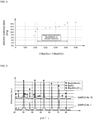
- Fig. 3 is a graph showing the relationship between the peak intensity ratio I(BaCO 3 (111))/I(BaZrO 3 (110)) and the toluene decomposition rate in the organic material decomposition catalysts of sample Nos. 1 to 10 listed in Table 1.
- the "RANGE SATISFYING FIRST REQUIREMENT OF PRESENT INVENTION" in Fig. 3 is a range in which the peak intensity ratio I(BaCO 3 (111))/I(BaZrO 3 (110)) ranges from 0.022 to 0.052.
- the organic material decomposition catalysts of sample Nos. 1 to 7 satisfying the first requirement of the present invention had a toluene decomposition rate of 92% or more.
- the organic material decomposition catalysts with a peak intensity ratio I(BaCO 3 (111))/I(BaZrO 3 (110)) in the range of 0.022 to 0.052 and with a BaCO 3 content in a predetermined range have a toluene decomposition rate of 92% or more and have higher activity than the organic material decomposition catalysts with a BaCO 3 content outside the predetermined range.
- the organic material decomposition catalysts of sample Nos. 1 to 7 also satisfy the second requirement of the present invention.
- the organic material decomposition catalysts satisfying the second requirement of the present invention have a toluene decomposition rate of 92% or more and have high activity.
- organic material decomposition catalysts of sample Nos. 1 to 7 satisfy the first and second requirements of the present invention, satisfying at least one of the requirements improves activity.
- Fig. 4 is a graph showing the relationship between the peak intensity ratio I(BaCO 3 (111))/I(BaZrO 3 (110)) and the specific surface area in the organic material decomposition catalysts of sample Nos. 1 to 10.
- a smaller peak intensity ratio I(BaCO 3 (111))/I(BaZrO 3 (110)), that is, a lower BaCO 3 content results in a smaller specific surface area.
- a peak intensity ratio I(BaCO 3 (111))/I(BaZrO 3 (110)) of less than 0.022 results in a drastically decreased specific surface area and consequently lower catalytic activity.
- a peak intensity ratio I(BaCO 3 (111))/I(BaZrO 3 (110)) of more than 0.052 and an increased BaCO 3 content result in a decreased amount of Ba(ZrMn)O 3 due to the production of BaCO 3 , result in the formation of a different phase, and result in lower crystallinity, thus resulting in a catalyst with lower activity.
- a peak intensity ratio I(BaCO 3 (111))/I(BaZrO 3 (110)) within the range satisfying the first requirement of the present invention that is, in the range of 0.022 to 0.052 and a BaCO 3 content within the predetermined range result in the formation of a smaller amount of different phase and a stably maintained crystal phase of Ba(ZrMn)O 3 , thus resulting in high activity.
- the organic material decomposition catalysts of sample Nos. 1 to 7 with a peak intensity ratio I(BaCO 3 (111))/I(BaZrO 3 (110)) in the range of 0.022 to 0.052 have a specific surface area in the range of 12.3 to 16.9 m 2 /g.
- Fig. 5 is a graph showing X-ray diffraction patterns of the organic material decomposition catalyst of sample No. 1 and the organic material decomposition catalyst of sample No. 10 in Table 1 obtained by X-ray diffractometry.
- Fig. 5 shows that the organic material decomposition catalyst of sample No. 10 with a peak intensity ratio I(BaCO 3 (111))/I(BaZrO 3 (110)) of more than 0.052 and with a high BaCO 3 content formed a different phase, such as Ba 6 Mn 5 O 16 .
- catalytic activity depends on the heat-treatment temperature of the raw mixed powder in the production process and the firing temperature in the subsequent firing process and, as described above, can be improved by adjusting the BaCO 3 content within the predetermined range.
- an organic material decomposition catalyst satisfying the first requirement of the present invention preferably has a peak intensity ratio I(BaCO 3 (111))/I(BaZrO 3 (110)) in the range of 0.022 to 0.041.
- the organic material decomposition catalysts of sample Nos. 1, 2, 4, and 5 have a specific surface area in the range of 12.3 to 13.5 m 2 /g.
- the organic material decomposition catalysts of sample Nos. 1 to 7 satisfying the second requirement of the present invention preferably has a specific surface area in the range of 12.3 to 13.5 m 2 /g.
- organic material decomposition catalyst according to the present invention is used to decompose toluene in the above description, the organic material is not limited to toluene.
- the organic material decomposition catalysts were formed into pellets in the above embodiments, the organic material decomposition catalysts may have any form other than pellets.
- the organic material decomposition catalysts may have any shape, for example, a honeycomb shape.
Landscapes
- Chemical & Material Sciences (AREA)
- Engineering & Computer Science (AREA)
- Chemical Kinetics & Catalysis (AREA)
- Materials Engineering (AREA)
- Organic Chemistry (AREA)
- Environmental & Geological Engineering (AREA)
- Health & Medical Sciences (AREA)
- Biomedical Technology (AREA)
- Analytical Chemistry (AREA)
- General Chemical & Material Sciences (AREA)
- Oil, Petroleum & Natural Gas (AREA)
- Combustion & Propulsion (AREA)
- Physics & Mathematics (AREA)
- Thermal Sciences (AREA)
- Catalysts (AREA)
- Photometry And Measurement Of Optical Pulse Characteristics (AREA)
Abstract
Description
- The present invention relates to an organic material decomposition catalyst used to decompose an organic material and an organic material decomposition apparatus including the organic material decomposition catalyst.
- It has been known that organic material decomposition catalysts are used to decompose organic materials.
-
Patent Document 1 discloses an organic material decomposition catalyst containing a perovskite composite oxide represented by the general formula ABO3, wherein the site A contains Ba, the site B contains Zr, and the Zr is partly substituted with at least one of Mn, Co, and Ni. This organic material decomposition catalyst does not contain expensive noble metals and is said to have high activity and heat resistance. - Patent Document 1:
Japanese Patent No. 6303834 - Although the organic material decomposition catalyst described in
Patent Document 1 has high activity, there is yet room for further improvement in activity. - The present invention aims to address such an issue and provide an organic material decomposition catalyst with further improved activity and an organic material decomposition apparatus including such an organic material decomposition catalyst.
- An organic material decomposition catalyst according to the present invention is
- an organic material decomposition catalyst used to decompose an organic material, which contains BaCO3 and a perovskite composite oxide represented by the general formula AxByMzOw, wherein A contains Ba, B contains Zr, and M denotes Mn,
- wherein a peak intensity I(BaCO3(111)) of BaCO3(111) and a peak intensity I(BaZrO3(110)) of a perovskite composite oxide AxByMzOw(110) each determined by X-ray diffractometry of the organic material decomposition catalyst have a ratio I(BaCO3(111))/I(BaZrO3(110)) in the range of 0.022 to 0.052.
- The organic material decomposition catalyst may have a specific surface area in the range of 12.3 to 16.9 m2/g.
- The ratio (BaCO3(111))/I(BaZrO3(110)) of the peak intensity I(BaCO3(111)) to the peak intensity I(BaZrO3(110)) may range from 0.022 to 0.041.
- The organic material decomposition catalyst may have a specific surface area in the range of 12.3 to 13.5 m2/g.
- An organic material decomposition catalyst according to the present invention is
- an organic material decomposition catalyst used to decompose an organic material, which contains BaCO3 and a perovskite composite oxide represented by the general formula AxByMzOw,
- wherein A contains Ba, B contains Zr, M denotes Mn, x, y, and z satisfy


- w denotes a positive value that satisfies electroneutrality, and
- the organic material decomposition catalyst has a specific surface area in the range of 12.3 to 16.9 m2/g.
- The organic material decomposition catalyst may have a specific surface area in the range of 12.3 to 13.5 m2/g.
- An organic material decomposition apparatus according to the present invention includes one of the organic material decomposition catalysts.
- An organic material decomposition catalyst according to the present invention can have further improved activity.
- Furthermore, an organic material decomposition apparatus according to the present invention includes an organic material decomposition catalyst with further improved activity and can therefore decompose an organic material at a higher decomposition rate.
-
- [
Fig. 1] Fig. 1 is a schematic view of a test apparatus used in a test for evaluating the organic material decomposition performance of an organic material decomposition catalyst. - [
Fig. 2] Fig. 2 is an X-ray diffraction pattern obtained by the X-ray diffractometry of an organic material decomposition catalyst. - [
Fig. 3] Fig. 3 is a graph showing the relationship between the peak intensity ratio I(BaCO3(111))/I(BaZrO3(110)) and the toluene decomposition rate in organic material decomposition catalysts of sample Nos. 1 to 10. - [
Fig. 4] Fig. 4 is a graph showing the relationship between the peak intensity ratio I(BaCO3(111))/I(BaZrO3(110)) and the specific surface area in the organic material decomposition catalysts of sample Nos. 1 to 10. - [
Fig. 5] Fig. 5 is a graph showing X-ray diffraction patterns of the organic material decomposition catalyst of sample No. 1 and the organic material decomposition catalyst of sample No. 10 obtained by X-ray diffractometry. Description of Embodiments - The features of the present invention are specifically described in the following embodiments of the present invention.
- An organic material decomposition catalyst according to the present invention is a catalyst used to decompose an organic material and satisfies at least one of the following first requirement (hereinafter referred to as a first requirement of the present invention) and the following second requirement (hereinafter referred to as a second requirement of the present invention).
- The first requirement of the present invention is that an organic material decomposition catalyst contains BaCO3 and a perovskite composite oxide represented by the general formula AxByMzOw, wherein A contains Ba, B contains Zr, M denotes Mn, and the peak intensity I(BaCO3(111)) of BaCO3(111) and the peak intensity I(BaZrO3(110)) of a perovskite composite oxide AxByMzOw(110) each determined by the X-ray diffractometry of the organic material decomposition catalyst have a ratio I(BaCO3(111))/I(BaZrO3(110)) in the range of 0.022 to 0.052. B and M in the general formula AxByMzOw occupy a crystallographically equivalent position and can be represented by Ax(ByMz)Ow.
- The BaCO3(111) refers to a (111) plane of BaCO3, and the perovskite composite oxide AxByMzOw(110) refers to a (110) plane of the perovskite composite oxide AxByMzOw. The peak intensity refers to the maximum value of the target peak.
- The second requirement of the present invention is that the organic material decomposition catalyst contains BaCO3 and a perovskite composite oxide represented by the general formula AxByMzOw, wherein A contains Ba, B contains Zr, M denotes Mn, x, y, and z satisfy 1.01 ≤ x ≤ 1.06, 0.1 ≤ z ≤ 0.125, and y + z = 1, and w denotes a positive value that satisfies electroneutrality, and the organic material decomposition catalyst has a specific surface area in the range of 12.3 to 16.9 m2/g.
- As described later, an organic material decomposition catalyst that satisfies at least one of the first and second requirements of the present invention has high activity and can have a higher organic material decomposition rate than known organic material decomposition catalysts. This organic material decomposition catalyst can be used for various applications to decompose organic materials, such as purification of exhaust gases from factories and automobiles. In such a case, an organic material decomposition apparatus can be configured with an organic material decomposition catalyst that satisfies at least one of the first and second requirements of the present invention.
- High-purity BaCO3, ZrO2, and MnCO3 powders were weighed so as to have the composition shown in Table 1. Pure water was added to the powders. The powders were wet-blended together with ZrO2 cobblestones to prepare slurry. The slurry was dried with a dryer at 120°C. The resulting raw mixed powder was heat-treated in the predetermined temperature range of 1100°C to 1150°C for 2 hours. Thus, a desired perovskite composite oxide was prepared.
- Subsequently, an organic binder and pure water were added to the perovskite composite oxide, and the mixture was wet-blended together with ZrO2 cobblestones to prepare slurry. The slurry was dried with a dryer at 120°C, was ground into a powder, and was then formed with a pressing machine into cylindrical pellets 8.5 mm in diameter and 8 mm in thickness. The pellets were fired in the predetermined temperature range of 990°C to 1100°C for 2 hours, and were ground in a mortar, and were classified. Thus, organic material decomposition catalysts of sample Nos. 1 to 10 listed in Table 1 were prepared. The organic material decomposition catalysts have a diameter in the range of 0.5 to 0.6 mm and have a particulate shape.
[Table 1] Sample No. Charge composition Heat -treatment temperature of raw mixed powder (°C) Firing temperature (°C) Toluene decomposition rate (%) I(BaCO3)/I(BaZrO3) Specific surface area (m2/g) x y z 1 1.01 0.9 0.1 1100 990 94.8 0.022 12.3 2 1.03 0.875 0.125 1100 1050 94.5 0.041 13.5 3 1.05 0.89 0.11 1150 1050 93.9 0.049 15.2 4 1.02 0.9 0.1 1150 1050 96.0 0.030 13.1 5 1.02 0.9 0.1 1120 1050 94.8 0.035 13.2 6 1.04 0.9 0.1 1120 1050 93.3 0.044 14.1 7 1.06 0.9 0.1 1120 1050 92.2 0.052 16.9 8* 1.00 0.9 0.1 1100 1100 91.8 0.020 10.5 9* 0.97 0.9 0.1 1100 1050 89.5 0.019 7.3 10* 1.07 0.9 0.1 1100 1050 84.6 0.060 17.1 - In Table 1, the samples of sample Nos. 1 to 7 without * are samples that satisfy the first and second requirements of the present invention. On the other hand, the samples of sample Nos. 8 to 10 with * are samples that do not satisfy the first and second requirements of the present invention.
-
Fig. 1 is a schematic view of atest apparatus 10 used in a test for evaluating the organic material decomposition performance of an organic material decomposition catalyst. Thetest apparatus 10 includes areactor 11 through which an organic material flows, aheater 12 for heating the organic material flowing through thereactor 11, and acontroller 13 for controlling theheater 12. - A sample (organic material decomposition catalyst) produced by the above method is placed in a central region of the
reactor 11 to be heated with theheater 12. Thecontroller 13 is configured to control the temperature of the region heated with theheater 12. - A
gas supply pipe 14 is coupled upstream to thereactor 11. Thegas supply pipe 14 is coupled to atoluene supply line 16 for supplying toluene (an organic material), anitrogen supply line 17 for supplying nitrogen (N2), and anoxygen supply line 18 for supplying oxygen (O2). Thus, a gas to be treated containing toluene, nitrogen, and oxygen is supplied to thereactor 11 through thegas supply pipe 14. - A
gas discharge pipe 15 for discharging treated gas from the system after the decomposition of the organic material is coupled downstream to thereactor 11. Thegas discharge pipe 15 is coupled to asampling line 19 for sampling the treated gas and is configured to analyze the concentration of toluene in the treated gas with a gas chromatograph. - The
test apparatus 10 was used in a test in which a gas to be treated containing toluene, nitrogen, and oxygen was continuously supplied to thereactor 11 to decompose toluene. The composition of the gas to be treated was toluene (C7H8) : 50 ppm, nitrogen (N2) : 80%, and oxygen (O2) : 20% by volume, the space velocity SV during measurement was 150,000 /h, and the catalyst temperature was 300°C. - The treated gas was sampled at the outlet of the
sampling line 19 to determine the toluene concentration by gas chromatography. The toluene decomposition rate was determined using the formula (1). "50" in the formula (1) is the concentration of toluene in the gas to be treated before the treatment.
- The organic material decomposition catalyst of each of the sample Nos. 1 to 10 in Table 1 was finely ground in a mortar and was subjected to X-ray diffractometry using an X-ray diffractometer "D8 ADVANCE" manufactured by BRUKER. The measurement was performed in the range of 2θ = 20 to 85 degrees at intervals of 0.0195 degrees, wherein θ denotes the angle of X-ray incident on the sample. From the measurement results, the peak intensity I(BaCO3(111)) of BaCO3(111) and the peak intensity I(BaZrO3(110)) of the perovskite composite oxide AxByMzOw(110) (BaZrO3(110)) were determined.
-
Fig. 2 is an X-ray diffraction pattern obtained by the X-ray diffractometry of an organic material decomposition catalyst. As shown inFig. 2 , I(BaCO3(111)) was observed in the diffraction angle 2θ range of 20 degrees < 2θ < 30 degrees, and I(BaZrO3(110)) was observed in the diffraction angle 2θ range of 25 degrees < 2θ < 35 degrees. - The peak intensity ratio I(BaCO3(111))/I(BaZrO3(110)) was determined from the I(BaCO3(111)) and I(BaZrO3(110)).
- The amount of BaCO3 in the organic material decomposition catalyst can be determined from the peak intensity ratio I(BaCO3(111))/I(BaZrO3(110)). It is difficult to directly measure the amount of BaCO3 in the organic material decomposition catalyst, and the BaCO3 content is therefore determined by measuring the peak intensity ratio I(BaCO3(111))/I(BaZrO3(110)).
- The specific surface area (SSA) of an organic material decomposition catalyst prepared was measured with a specific surface area measuring apparatus "Macsorb model-1201" manufactured by Mountech Co., Ltd. For the measurement of the specific surface area, the degassing conditions included 400°C for 20 minutes.
- Table 1 shows the catalyst composition, the heat-treatment temperature of the raw mixed powder, the firing temperature, the toluene decomposition rate, the peak intensity ratio I(BaCO3(111))/I(BaZrO3(110)), and the specific surface area. The peak intensity ratio I(BaCO3(111))/I(BaZrO3(110)) is a numerical value rounded to the third decimal place.
-
Fig. 3 is a graph showing the relationship between the peak intensity ratio I(BaCO3(111))/I(BaZrO3(110)) and the toluene decomposition rate in the organic material decomposition catalysts of sample Nos. 1 to 10 listed in Table 1. The "RANGE SATISFYING FIRST REQUIREMENT OF PRESENT INVENTION" inFig. 3 is a range in which the peak intensity ratio I(BaCO3(111))/I(BaZrO3(110)) ranges from 0.022 to 0.052. - As shown in Table 1 and
Fig. 3 , the organic material decomposition catalysts of sample Nos. 8 to 10 with a peak intensity ratio I(BaCO3(111))/I(BaZrO3(110)) of less than 0.022 or more than 0.052 and not satisfying the first requirement of the present invention had a toluene decomposition rate of less than 92%. - In contrast, the organic material decomposition catalysts of sample Nos. 1 to 7 satisfying the first requirement of the present invention had a toluene decomposition rate of 92% or more. Thus, the organic material decomposition catalysts with a peak intensity ratio I(BaCO3(111))/I(BaZrO3(110)) in the range of 0.022 to 0.052 and with a BaCO3 content in a predetermined range have a toluene decomposition rate of 92% or more and have higher activity than the organic material decomposition catalysts with a BaCO3 content outside the predetermined range.
- As described above, the organic material decomposition catalysts of sample Nos. 1 to 7 also satisfy the second requirement of the present invention. Thus, the organic material decomposition catalysts satisfying the second requirement of the present invention have a toluene decomposition rate of 92% or more and have high activity.
- It should be noted that although the organic material decomposition catalysts of sample Nos. 1 to 7 satisfy the first and second requirements of the present invention, satisfying at least one of the requirements improves activity.
-
Fig. 4 is a graph showing the relationship between the peak intensity ratio I(BaCO3(111))/I(BaZrO3(110)) and the specific surface area in the organic material decomposition catalysts of sample Nos. 1 to 10. A smaller peak intensity ratio I(BaCO3(111))/I(BaZrO3(110)), that is, a lower BaCO3 content results in a smaller specific surface area. As shown inFig. 4 , a peak intensity ratio I(BaCO3(111))/I(BaZrO3(110)) of less than 0.022 results in a drastically decreased specific surface area and consequently lower catalytic activity. - On the other hand, a peak intensity ratio I(BaCO3(111))/I(BaZrO3(110)) of more than 0.052 and an increased BaCO3 content result in a decreased amount of Ba(ZrMn)O3 due to the production of BaCO3, result in the formation of a different phase, and result in lower crystallinity, thus resulting in a catalyst with lower activity.
- In contrast, a peak intensity ratio I(BaCO3(111))/I(BaZrO3(110)) within the range satisfying the first requirement of the present invention, that is, in the range of 0.022 to 0.052 and a BaCO3 content within the predetermined range result in the formation of a smaller amount of different phase and a stably maintained crystal phase of Ba(ZrMn)O3, thus resulting in high activity.
- As shown in Table 1, the organic material decomposition catalysts of sample Nos. 1 to 7 with a peak intensity ratio I(BaCO3(111))/I(BaZrO3(110)) in the range of 0.022 to 0.052 have a specific surface area in the range of 12.3 to 16.9 m2/g.
-
Fig. 5 is a graph showing X-ray diffraction patterns of the organic material decomposition catalyst of sample No. 1 and the organic material decomposition catalyst of sample No. 10 in Table 1 obtained by X-ray diffractometry.Fig. 5 shows that the organic material decomposition catalyst of sample No. 10 with a peak intensity ratio I(BaCO3(111))/I(BaZrO3(110)) of more than 0.052 and with a high BaCO3 content formed a different phase, such as Ba6Mn5O16. - In general, catalytic activity depends on the heat-treatment temperature of the raw mixed powder in the production process and the firing temperature in the subsequent firing process and, as described above, can be improved by adjusting the BaCO3 content within the predetermined range.
- Among the organic material decomposition catalysts of sample Nos. 1 to 7 satisfying the first requirement of the present invention, the organic material decomposition catalysts of sample Nos. 1, 2, 4, and 5 with a peak intensity ratio (BaCO3(111))/I(BaZrO3(110)) in the range of 0.022 to 0.041 had a much higher toluene decomposition rate of 94.5% or more. Thus, an organic material decomposition catalyst satisfying the first requirement of the present invention preferably has a peak intensity ratio I(BaCO3(111))/I(BaZrO3(110)) in the range of 0.022 to 0.041. The organic material decomposition catalysts of sample Nos. 1, 2, 4, and 5 have a specific surface area in the range of 12.3 to 13.5 m2/g.
- Among the organic material decomposition catalysts of sample Nos. 1 to 7 satisfying the second requirement of the present invention, the organic material decomposition catalysts of sample Nos. 1, 2, 4, and 5 with a specific surface area in the range of 12.3 to 13.5 m2/g had a much higher toluene decomposition rate of 94.5% or more. Thus, the organic material decomposition catalyst satisfying the second requirement of the present invention preferably has a specific surface area in the range of 12.3 to 13.5 m2/g.
- The present invention is not limited to these embodiments, and various applications and modifications can be made within the scope of the present invention.
- Although an organic material decomposition catalyst according to the present invention is used to decompose toluene in the above description, the organic material is not limited to toluene.
- Although the organic material decomposition catalysts were formed into pellets in the above embodiments, the organic material decomposition catalysts may have any form other than pellets. The organic material decomposition catalysts may have any shape, for example, a honeycomb shape.
-
- 10
- test apparatus
- 11
- reactor
- 12
- heater
- 13
- controller
- 14
- gas supply pipe
- 15
- gas discharge pipe
- 16
- toluene supply line
- 17
- nitrogen supply line
- 18
- oxygen supply line
- 19
- sampling line
Claims (7)
- An organic material decomposition catalyst used to decompose an organic material, comprising:BaCO3; anda perovskite composite oxide represented by the general formula AxByMzOw, wherein A contains Ba, B contains Zr, and M denotes Mn,wherein a peak intensity I(BaCO3(111)) of BaCO3(111) and a peak intensity I(BaZrO3(110)) of a perovskite composite oxide AxByMzOw(110) each determined by X-ray diffractometry of the organic material decomposition catalyst have a ratio I(BaCO3(111))/I(BaZrO3(110)) in the range of 0.022 to 0.052.
- The organic material decomposition catalyst according to Claim 1, wherein the organic material decomposition catalyst has a specific surface area in the range of 12.3 to 16.9 m2/g.
- The organic material decomposition catalyst according to Claim 1 or 2, wherein the ratio (BaCO3(111))/I(BaZrO3(110)) of the peak intensity I(BaCO3(111)) to the peak intensity I(BaZrO3(110)) ranges from 0.022 to 0.041.
- The organic material decomposition catalyst according to Claim 3, wherein the organic material decomposition catalyst has a specific surface area in the range of 12.3 to 13.5 m2/g.
- An organic material decomposition catalyst used to decompose an organic material, comprising:BaCO3; anda perovskite composite oxide represented by the general formula AxByMzOw,wherein A contains Ba, B contains Zr, M denotes Mn, x, y, and z satisfy


 w denotes a positive value that satisfies electroneutrality, andthe organic material decomposition catalyst has a specific surface area in the range of 12.3 to 16.9 m2/g.
 - The organic material decomposition catalyst according to Claim 5, wherein the organic material decomposition catalyst has a specific surface area in the range of 12.3 to 13.5 m2/g.
- An organic material decomposition apparatus comprising the organic material decomposition catalyst according to any one of Claims 1 to 6.
Applications Claiming Priority (2)
| Application Number | Priority Date | Filing Date | Title |
|---|---|---|---|
| JP2019106131 | 2019-06-06 | ||
| PCT/JP2020/016243 WO2020246140A1 (en) | 2019-06-06 | 2020-04-13 | Catalyst for organic matter decomposition, and organic matter decomposition device |
Publications (2)
| Publication Number | Publication Date |
|---|---|
| EP3960290A1 true EP3960290A1 (en) | 2022-03-02 |
| EP3960290A4 EP3960290A4 (en) | 2022-12-14 |
Family
ID=73652934
Family Applications (1)
| Application Number | Title | Priority Date | Filing Date |
|---|---|---|---|
| EP20819539.6A Withdrawn EP3960290A4 (en) | 2019-06-06 | 2020-04-13 | CATALYST AND DEVICE FOR DECOMPOSITION OF ORGANIC MATERIALS |
Country Status (5)
| Country | Link |
|---|---|
| US (1) | US12280358B2 (en) |
| EP (1) | EP3960290A4 (en) |
| JP (1) | JP7001201B2 (en) |
| CN (1) | CN113905820A (en) |
| WO (1) | WO2020246140A1 (en) |
Family Cites Families (13)
| Publication number | Priority date | Publication date | Assignee | Title |
|---|---|---|---|---|
| JPS58157697A (en) | 1982-03-11 | 1983-09-19 | 株式会社キト− | Lever type small-sized hoisting combined tracking device |
| US4522706A (en) * | 1982-06-16 | 1985-06-11 | Exxon Research & Engineering Co. | Hydrocarbon treating processes using perovskite-containing catalytic compositions |
| US4636378A (en) * | 1985-06-11 | 1987-01-13 | Hughes Aircraft Company | Method of preparation of perovskite-type compounds |
| JP3800651B2 (en) * | 1994-11-30 | 2006-07-26 | 住友化学株式会社 | Method for producing composite metal oxide powder |
| US6350421B1 (en) * | 1998-08-24 | 2002-02-26 | Dmc2 Degussa Metals Catalysts Cerdec Ag | Nitrogen oxide storage material and nitrogen oxide storing catalyst prepared therefrom |
| US7601325B2 (en) * | 2004-03-22 | 2009-10-13 | Daihatsu Motor Co., Ltd. | Perovskite-type composite oxide, catalyst composition and method for producing perovskite-type composite oxide |
| JP5216189B2 (en) * | 2005-12-22 | 2013-06-19 | 株式会社キャタラー | Exhaust gas purification catalyst |
| US20140170088A1 (en) * | 2012-12-18 | 2014-06-19 | SECRETARY, DEPARTMENT OF ELECTRONICS AND INFORMATION TECHNOLOGY (DeitY) | BARIUM ZIRCONIUM OXIDE (BaZrO3.BaCO3) NANOPARTICLES |
| JP6303834B2 (en) * | 2014-06-05 | 2018-04-04 | 株式会社村田製作所 | Organic substance decomposition catalyst |
| CN107983361A (en) * | 2017-11-14 | 2018-05-04 | 浙江浙能催化剂技术有限公司 | It is a kind of to be used to handle monoblock type base metal composite catalyst of organic exhaust gas and preparation method thereof |
| WO2019215951A1 (en) * | 2018-05-11 | 2019-11-14 | 株式会社村田製作所 | Organic matter decomposition catalyst, organic matter decomposition aggregate, and organic matter decomposition device |
| CN114007741A (en) * | 2019-06-26 | 2022-02-01 | 株式会社村田制作所 | Catalyst for decomposing organic matter and device for decomposing organic matter |
| JP7318734B2 (en) * | 2019-12-06 | 2023-08-01 | 株式会社村田製作所 | Hydrocarbon reforming catalyst and hydrocarbon reformer |
-
2020
- 2020-04-13 WO PCT/JP2020/016243 patent/WO2020246140A1/en not_active Ceased
- 2020-04-13 EP EP20819539.6A patent/EP3960290A4/en not_active Withdrawn
- 2020-04-13 CN CN202080041455.1A patent/CN113905820A/en active Pending
- 2020-04-13 JP JP2021524687A patent/JP7001201B2/en active Active
-
2021
- 2021-11-30 US US17/538,016 patent/US12280358B2/en active Active
Also Published As
| Publication number | Publication date |
|---|---|
| US12280358B2 (en) | 2025-04-22 |
| EP3960290A4 (en) | 2022-12-14 |
| JPWO2020246140A1 (en) | 2020-12-10 |
| WO2020246140A1 (en) | 2020-12-10 |
| JP7001201B2 (en) | 2022-02-04 |
| CN113905820A (en) | 2022-01-07 |
| US20220080391A1 (en) | 2022-03-17 |
Similar Documents
| Publication | Publication Date | Title |
|---|---|---|
| US11383226B2 (en) | Catalyst for organic substance decomposition and organic substance decomposing apparatus | |
| Zhang et al. | Preparation and characterization of Fe3+-doped Ni0. 9Co0. 8Mn1. 3− xFexO4 (0≤ x≤ 0.7) negative temperature coefficient ceramic materials | |
| EP3501639A1 (en) | Methane oxidation catalyst | |
| JP2011078947A (en) | Ammonia decomposition catalyst and ammonia decomposition method | |
| US12296321B2 (en) | Organic substance decomposition catalyst and organic substance decomposition apparatus | |
| US12280358B2 (en) | Organic material decomposition catalyst and organic material decomposition apparatus | |
| Girdauskaite et al. | Oxygen stoichiometry, unit cell volume, and thermodynamic quantities of perovskite-type oxides | |
| Alexander et al. | A combinatorial nanoprecursor route for direct solid state chemistry: Discovery and electronic properties of new iron-doped lanthanum nickelates up to La4Ni2FeO10− δ | |
| Shemin et al. | Effects of doping CeO2, Er2O3 on properties of TiO2-SiO2 ceramics for catalyst supporter of deNOx | |
| RU2602277C1 (en) | Method for production of ferrites-chromites transitional elements with spinel structure | |
| EP3925688A1 (en) | Exhaust gas purification catalyst and exhaust gas treatment equipment | |
| DE202025000181U1 (en) | Electrically directly heated catalysts for endothermic ammonia cracking | |
| DE112024002117T5 (en) | Catalyst for the decomposition of organic substances, honeycomb structure, process for the decomposition of organic substances and device for the decomposition of organic substances | |
| Gomes et al. | QUANTIFICATION OF PHASE COMPOSITIONS PRESENT IN THE SYSTEM [(NiO) x].[(CoO)].[(Al2O3)], 0.05≤ X≤ 0.95, AND THE EFFECT IN THE ELECTRICAL PROPERTIES OF SEMICONDUCTOR AS A CONSEQUENCE OF THE CO VARIATION | |
| Klande et al. | 4.2 Effect of microstructure on oxygen permeation of | |
| JPS5835739B2 (en) | Catalyst structure and its manufacturing method |
Legal Events
| Date | Code | Title | Description |
|---|---|---|---|
| STAA | Information on the status of an ep patent application or granted ep patent |
Free format text: STATUS: THE INTERNATIONAL PUBLICATION HAS BEEN MADE |
|
| PUAI | Public reference made under article 153(3) epc to a published international application that has entered the european phase |
Free format text: ORIGINAL CODE: 0009012 |
|
| STAA | Information on the status of an ep patent application or granted ep patent |
Free format text: STATUS: REQUEST FOR EXAMINATION WAS MADE |
|
| 17P | Request for examination filed |
Effective date: 20211126 |
|
| AK | Designated contracting states |
Kind code of ref document: A1 Designated state(s): AL AT BE BG CH CY CZ DE DK EE ES FI FR GB GR HR HU IE IS IT LI LT LU LV MC MK MT NL NO PL PT RO RS SE SI SK SM TR |
|
| RIN1 | Information on inventor provided before grant (corrected) |
Inventor name: SATO, HIDETO Inventor name: ISHIHARA, KENTARO Inventor name: SUGAHARA, NARIO |
|
| DAV | Request for validation of the european patent (deleted) | ||
| DAX | Request for extension of the european patent (deleted) | ||
| A4 | Supplementary search report drawn up and despatched |
Effective date: 20221111 |
|
| RIC1 | Information provided on ipc code assigned before grant |
Ipc: B01J 27/232 20060101ALI20221107BHEP Ipc: B01D 53/94 20060101ALI20221107BHEP Ipc: B01D 53/86 20060101ALI20221107BHEP Ipc: B01J 35/10 20060101AFI20221107BHEP |
|
| STAA | Information on the status of an ep patent application or granted ep patent |
Free format text: STATUS: EXAMINATION IS IN PROGRESS |
|
| 17Q | First examination report despatched |
Effective date: 20250530 |
|
| STAA | Information on the status of an ep patent application or granted ep patent |
Free format text: STATUS: THE APPLICATION IS DEEMED TO BE WITHDRAWN |
|
| 18D | Application deemed to be withdrawn |
Effective date: 20251001 |