EP3960259A1 - Information processing system, information processing device, method for controlling information processing device, and program - Google Patents
Information processing system, information processing device, method for controlling information processing device, and program Download PDFInfo
- Publication number
- EP3960259A1 EP3960259A1 EP20795790.3A EP20795790A EP3960259A1 EP 3960259 A1 EP3960259 A1 EP 3960259A1 EP 20795790 A EP20795790 A EP 20795790A EP 3960259 A1 EP3960259 A1 EP 3960259A1
- Authority
- EP
- European Patent Office
- Prior art keywords
- sound
- sound signal
- information processing
- processing apparatus
- user
- Prior art date
- Legal status (The legal status is an assumption and is not a legal conclusion. Google has not performed a legal analysis and makes no representation as to the accuracy of the status listed.)
- Granted
Links
Images

Classifications
-
- A—HUMAN NECESSITIES
- A63—SPORTS; GAMES; AMUSEMENTS
- A63F—CARD, BOARD, OR ROULETTE GAMES; INDOOR GAMES USING SMALL MOVING PLAYING BODIES; VIDEO GAMES; GAMES NOT OTHERWISE PROVIDED FOR
- A63F13/00—Video games, i.e. games using an electronically generated display having two or more dimensions
- A63F13/20—Input arrangements for video game devices
- A63F13/21—Input arrangements for video game devices characterised by their sensors, purposes or types
- A63F13/215—Input arrangements for video game devices characterised by their sensors, purposes or types comprising means for detecting acoustic signals, e.g. using a microphone
-
- A—HUMAN NECESSITIES
- A63—SPORTS; GAMES; AMUSEMENTS
- A63F—CARD, BOARD, OR ROULETTE GAMES; INDOOR GAMES USING SMALL MOVING PLAYING BODIES; VIDEO GAMES; GAMES NOT OTHERWISE PROVIDED FOR
- A63F13/00—Video games, i.e. games using an electronically generated display having two or more dimensions
- A63F13/20—Input arrangements for video game devices
- A63F13/21—Input arrangements for video game devices characterised by their sensors, purposes or types
- A63F13/212—Input arrangements for video game devices characterised by their sensors, purposes or types using sensors worn by the player, e.g. for measuring heart beat or leg activity
-
- A—HUMAN NECESSITIES
- A63—SPORTS; GAMES; AMUSEMENTS
- A63F—CARD, BOARD, OR ROULETTE GAMES; INDOOR GAMES USING SMALL MOVING PLAYING BODIES; VIDEO GAMES; GAMES NOT OTHERWISE PROVIDED FOR
- A63F13/00—Video games, i.e. games using an electronically generated display having two or more dimensions
- A63F13/50—Controlling the output signals based on the game progress
- A63F13/53—Controlling the output signals based on the game progress involving additional visual information provided to the game scene, e.g. by overlay to simulate a head-up display [HUD] or displaying a laser sight in a shooting game
- A63F13/537—Controlling the output signals based on the game progress involving additional visual information provided to the game scene, e.g. by overlay to simulate a head-up display [HUD] or displaying a laser sight in a shooting game using indicators, e.g. showing the condition of a game character on screen
-
- A—HUMAN NECESSITIES
- A63—SPORTS; GAMES; AMUSEMENTS
- A63F—CARD, BOARD, OR ROULETTE GAMES; INDOOR GAMES USING SMALL MOVING PLAYING BODIES; VIDEO GAMES; GAMES NOT OTHERWISE PROVIDED FOR
- A63F13/00—Video games, i.e. games using an electronically generated display having two or more dimensions
- A63F13/50—Controlling the output signals based on the game progress
- A63F13/54—Controlling the output signals based on the game progress involving acoustic signals, e.g. for simulating revolutions per minute [RPM] dependent engine sounds in a driving game or reverberation against a virtual wall
-
- A—HUMAN NECESSITIES
- A63—SPORTS; GAMES; AMUSEMENTS
- A63F—CARD, BOARD, OR ROULETTE GAMES; INDOOR GAMES USING SMALL MOVING PLAYING BODIES; VIDEO GAMES; GAMES NOT OTHERWISE PROVIDED FOR
- A63F13/00—Video games, i.e. games using an electronically generated display having two or more dimensions
- A63F13/85—Providing additional services to players
- A63F13/87—Communicating with other players during game play, e.g. by e-mail or chat
-
- G—PHYSICS
- G06—COMPUTING OR CALCULATING; COUNTING
- G06F—ELECTRIC DIGITAL DATA PROCESSING
- G06F3/00—Input arrangements for transferring data to be processed into a form capable of being handled by the computer; Output arrangements for transferring data from processing unit to output unit, e.g. interface arrangements
- G06F3/16—Sound input; Sound output
- G06F3/165—Management of the audio stream, e.g. setting of volume, audio stream path
-
- G—PHYSICS
- G10—MUSICAL INSTRUMENTS; ACOUSTICS
- G10L—SPEECH ANALYSIS TECHNIQUES OR SPEECH SYNTHESIS; SPEECH RECOGNITION; SPEECH OR VOICE PROCESSING TECHNIQUES; SPEECH OR AUDIO CODING OR DECODING
- G10L15/00—Speech recognition
- G10L15/20—Speech recognition techniques specially adapted for robustness in adverse environments, e.g. in noise, of stress induced speech
Definitions
- the present invention relates to an information processing system, an information processing apparatus, a control method for an information processing apparatus, and a program.
- voice uttered by one of the gathered players is collected not only by a sound inputting device (for example, a microphone) of the uttering player but also by a sound inputting device of a different player who plays at a position adjacent to the relevant player.
- a sound inputting device for example, a microphone
- simply performing a mixing process for voice of the players causes the voice to become hard-to-hear sound due to muffling of the voice muffled or generation of an echo.
- the present invention has been made in view of such a situation as described above, and it is an object of the present invention to provide an information processing system, an information processing apparatus, a control method for an information processing apparatus, and a program by which control of a plurality of sound inputting devices can be implemented by taking such a circumstance as described above into consideration.
- an information processing system that includes peripheral apparatuses that are to be worn or grasped and used by a user and an information processing apparatus.
- at least one of the peripheral apparatuses includes sound inputting means for collecting sound of surroundings and outputting a sound signal representative of the collected sound
- the information processing apparatus includes means for accepting a sound signal or signals outputted from at least one of the peripheral apparatuses worn or grasped by the user, selection means for selecting at least part of the accepted sound signal or signals on the basis of a predetermined rule, and means for outputting the sound signal or signals selected by the selection means and cutting off any other sound signal.
- An information processing system 1 is configured as exemplified in FIG. 1 and includes an information processing apparatus 10 such as a home game machine or a personal computer (PC) and a controller 20.
- an information processing apparatus 10 such as a home game machine or a personal computer (PC)
- a controller 20 may be included.
- the information processing system 1 may further include a plurality of peripheral apparatuses each including a sound inputting device, such as a chat controller 30, a headset 40, or a head-mounted display 50, that may be connected to the information processing apparatus 10.
- the information processing apparatus 10 includes a control unit 11, a storage unit 12, an operation controlling unit 13, an output controlling unit 14, a sound input controlling unit 15, and a communication unit 16.
- the controller 20 includes an operation unit 21, a microphone 22, a communication unit 23, a display unit 24, and a sound outputting unit 25.
- the chat controller 30 includes an operation unit 31, a microphone 32, a communication unit 33, and a display unit 34.
- the control unit 11 of the information processing apparatus 10 is a program-controlled device such as a central processing unit (CPU) and operates in accordance with a program stored in the storage unit 12. In the present embodiment, it is assumed that the control unit 11 executes a plurality of application programs (performs what is generally called a multitasking process) in parallel.
- the control unit 11 executes various application programs such as an application of a game and a chat application for transferring a sound signal through a network. Further, the control unit 11 executes a system program and executes, as processing of the system program, a process for authenticating a user who uses the relevant apparatus such as the controller 20 or the headset 40 for each apparatus, to associate information for specifying a user (for example, a user name) for each information for specifying the apparatus such as a controller 20 and to store the associated information.
- various application programs such as an application of a game and a chat application for transferring a sound signal through a network.
- the control unit 11 executes a system program and executes, as processing of the system program, a process for authenticating a user who uses the relevant apparatus such as the controller 20 or the headset 40 for each apparatus, to associate information for specifying a user (for example, a user name) for each information for specifying the apparatus such as a controller 20 and to store the associated information.
- a user for example, a user name
- control unit 11 accepts input of operation information together with information for specifying the controller 20 from the operation controlling unit 13, then the control unit 11 selects an application that becomes an output destination of the operation information from among applications being executed. It is sufficient if a condition for selecting an output destination here is determined in advance in such a manner that, for example, when a game application is run, the game application is selected in principle and predetermined operation information is processed exceptionally by the system and the selection is performed according to the condition.
- the control unit 11 executes, as a process of the application or the system of the output destination of the operation information, a process that uses the information for specifying the controller 20 that is inputted from the operation controlling unit 13 and the operation information. Further, the control unit 11 determines a sound volume of mixing of each sound signal when pieces of sound information individually received from a plurality of apparatus are to be mixed. Operation of the control unit 11 is described later.
- the storage unit 12 is a memory device, a hard disk drive, or the like and retains programs to be executed by the control unit 11. Further, the storage unit 12 operates also as a work memory of the control unit 11.
- the operation controlling unit 13 is connected for communication by wireless or wired communication to the controller 20, and receives, from the controller 20, operation information representative of the substance of an operation performed by the user with use of the controller 20, to output the received operation information to the control unit 11 together with the information for specifying controller 20 that is a transmission source of the operation information.
- the operation controlling unit 13 sends out, in accordance with an instruction inputted from the control unit 11, a display controlling signal and so forth to the controller 20 indicated by the instruction.
- the output controlling unit 14 is connected to a display device such as a home television set, a monitor, or the head-mounted display 50, and outputs a signal of sound, video, and so forth to the display devices in accordance with an instruction inputted from the control unit 11. Further, the output controlling unit 14 may output video and a sound signal to apparatuses different from each other. For example, the video may be outputted to a monitor, and the sound signal may be outputted to the controller 20 or the headset 40.
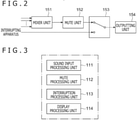
- the sound input controlling unit 15 receives a sound signal from peripheral apparatuses that include a sound inputting device such as the controller 20, the chat controller 30, the headset 40, and the head-mounted display 50. Further, the sound input controlling unit 15 includes, as exemplified in FIG. 2 , a mixer unit 151, a mute unit 152, a switch unit 153, and an outputting unit 154, and synthesizes, by the mixer unit 151, sound signals inputted from an apparatus other than an apparatus determined in advance (for example, other than the chat controller 30) among the sound signals received.
- the mixer unit 151 determines a sound volume for each of sound signals received from the individual apparatuses such as the controller 20, the headset 40, and the head-mounted display 50 and synthesizes the sound signals received from the individual apparatuses with the determined sound volumes. In a certain example of the present embodiment, the mixer unit 151 determines a sound volume of a sound signal received from each apparatus, in accordance with an instruction inputted from the control unit 11.
- the mixer unit 151 functions also as selection means.
- the mixer unit 151 selectively outputs the sound signal only from the headset 40. Further, in this case, even if there is a sound signal received from the controller 20, the head-mounted display 50, or the like other than the headset 40, such sound signal is not included in the output of the mixer unit 151.
- the mixer unit 151 determines a sound volume for a sound signal received from each controller 20, in accordance with an instruction inputted from the control unit 11. For example, in a case where an instruction is inputted from the control unit 11 to set the sound volume for a sound signal received from a controller 20a used by a user A to "255" and set the sound volume for sound signals received from controllers 20b and 20c used by the other users B and C to "0," the mixer unit 151 selectively outputs the sound signal received from the controller 20a.
- the mute unit 152 switches a sound signal outputted from the mixer unit 151, between outputting as it is or not outputting (muting), in accordance with an instruction inputted from the control unit 11.
- the mute unit 152 outputs the sound signal outputted from the mixer unit 151, as it is.
- the mute unit 152 discards (mutes) the sound signal outputted from the mixer unit 151 without outputting the signal to the switch unit 153.
- the switch unit 153 accepts input, from among sound signals received by the information processing apparatus 10, of a sound signal from an apparatus that is not inputted to the mixer unit 151 (such sound signal is hereinafter referred to as an interrupting sound signal; in the example here, the sound signal received from the chat controller 30). Further, when the mute unit 152 outputs a sound signal, the switch unit 153 accepts input of the sound signal. The switch unit 153 selectively outputs one of a sound signal (if any) accepted from the mute unit 152 and an interrupting sound signal (if any) in accordance with an instruction inputted from the control unit 11.
- the outputting unit 154 outputs the sound signal outputted from the switch unit 153 to the control unit 11.
- the sound input controlling unit 15 receives sound signals from peripheral apparatuses each including a sound inputting device, mixes the sound signals or selects one of the sound signals, and outputs the resulting sound signal for processing in the control unit 11.
- the communication unit 16 is a network interface or the like, and transmits various kinds of information through a network in accordance with an instruction inputted from the control unit 11. Further, the communication unit 16 outputs information received through the network to the control unit 11.
- the operation unit 21 of the controller 20 includes buttons, a joystick, and so forth, and accepts an operation of the user, to output operation information representative of the substance of the operation performed by the user to the communication unit 23. Meanwhile, the microphone 22 collects sound of surroundings and outputs a digital sound signal representative of the collected sound.
- the communication unit 23 is wireless communication means of, for example, Bluetooth (registered trademark), and outputs information (operation information) representative of the substance of an operation performed on the operation unit 21 by the user to the information processing apparatus 10. Further, the communication unit 23 outputs, to the information processing apparatus 10, the sound signal outputted from the microphone 22. Further, the communication unit 23 outputs, to the display unit 24, a display controlling signal outputted from the information processing apparatus 10. Furthermore, upon receiving a sound signal from the information processing apparatus 10, the communication unit 23 outputs the received sound signal to the sound outputting unit 25.
- Bluetooth registered trademark
- the display unit 24 includes, for example, a light emitting diode (LED) and so forth.
- the display unit 24 receives input of a display controlling signal from the communication unit 23 and turns on or off the LED.
- the sound outputting unit 25 is a device including a vibrator such as a speaker and generates sound on the basis of a sound signal received from the information processing apparatus 10.
- the chat controller 30 is what is generally called a push-to-talk device (PTT device) that accepts and outputs input of sound only while the user gives an instruction on sound input, and the operation unit 31 of the chat controller 30 includes, for example, a button. Further, the microphone 32 collects and converts sound of surroundings into a sound signal and outputs the sound signal.
- PTT device push-to-talk device
- the communication unit 33 is wireless communication means of, for example, Bluetooth (registered trademark) or the like and outputs, while the user is pressing the button of the operation unit 31, a sound signal outputted from the microphone 32, to the information processing apparatus 10. On the other hand, when the user is not pressing the button of the operation unit 31, the communication unit 33 discards the sound signal outputted from the microphone 32 without outputting the sound signal to the information processing apparatus 10. Furthermore, the communication unit 33 outputs, to the display unit 34, the display controlling signal outputted from the information processing apparatus 10.
- the display unit 34 includes, for example, an LED and so forth.
- the display unit 34 receives input of a display controlling signal from the communication unit 33 and turns on or off the LED. Operation of the chat controller 30 is also described later.
- the headset 40 includes, for example, a headphone, a microphone, and so forth.
- the headset 40 causes the speaker to generate sound on the basis of a sound signal outputted from the information processing apparatus 10. Further, the headset 40 sends out a sound signal collected by the microphone to the information processing apparatus 10.
- the head-mounted display 50 includes a display, a speaker, and a microphone.
- the head-mounted display 50 accepts a video signal and a sound signal outputted from the information processing apparatus 10, to display an image on the display and cause the speaker to generate sound. Further, the head-mounted display 50 sends out a sound signal collected by the microphone to the information processing apparatus 10.
- control unit 11 functionally includes a sound input processing unit 111, a mute processing unit 112, an interruption processing unit 113, and a display processing unit 114 as exemplified as processing of the system in FIG. 3 .
- control unit 11 determines, in advance, one of apparatuses that are connected to the information processing apparatus 10 and that include a sound inputting device as an interrupting apparatus.
- the sound input processing unit 111 performs the following process for target apparatuses that are apparatus including a sound inputting device (in a case where an interrupting apparatus is determined, the interrupting apparatus is excluded from the target apparatus).
- the sound input processing unit 111 determines a sound volume of mixing for each target apparatus connected to the information processing apparatus 10, in accordance with a predetermined rule.
- This predetermined rule can be, for example, such as that described in the following.
- the control unit 11 determines a priority order for the target apparatuses in advance and sets a sound volume of mixing of a sound signal received from a target apparatus that is highest in the priority order from among the target apparatuses connected thereto to a value that is determined in advance and that is higher than 0 (0 is not included).
- the highest value may be set or, for each target apparatus, a different value that is different depending upon the type of the target apparatus may be set; in the following description, the value larger than 0 is referred to as an output value.
- the sound volume of mixing of a sound signal received from a target apparatus other than the target apparatus highest in the priority order among the apparatuses connected is set to the lowest value. It is sufficient if this lowest value is a value representing, for example, the sound volume "0.” This lowest value is hereinafter referred to as a "cutoff value.”
- control unit 11 may set, for a target apparatus selected by the user, a sound volume of mixing of a sound signal received from the selected target apparatus to the output value determined in advance, and set a sound volume of mixing of a sound signal received from any other target apparatus to the cutoff value.
- the rule may be such as described below.
- the rule may be such as described below.
- a sound signal collected by the headset 40 is enabled to be used in processing as an application.
- the controller 20 that is a wide range sound collection apparatus in which the directivity of the microphone is relatively low, only the sound signal collected by the controller 20 operated by one of the users who use the controller 20 as a sound inputting device is enabled to be used in processing as an application.
- the mixing sound volume of the wide range sound collection apparatus such as the controller 20 of the user is set to the output value, and the mixing sound volume of any other wide range sound collection apparatus is set to the cutoff value.
- the mute processing unit 112 outputs an instruction to mute to the sound input controlling unit 15 when it accepts operation information for muting, as operation information received from the controller 20 operated by the user.
- the interruption processing unit 113 may output, in accordance with an instruction inputted from an interrupting apparatus determined in advance (for example, an instruction for requesting selection), an instruction to select a sound signal received from the interrupting apparatus to the sound input controlling unit 15. Further, if an instruction to cancel the selection is received from the interrupting apparatus, then the control unit 11 outputs to the sound input controlling unit 15 an instruction to select a sound signal received from any apparatus other than the interrupting apparatus.
- the display processing unit 114 outputs, in response to an instruction outputted from the sound input processing unit 111, the mute processing unit 112, and the interruption processing unit 113, a display controlling signal to the apparatus in order to indicate an input state of sound signals.
- a display controlling signal is described later.
- the information processing system 1 of the present embodiment basically includes such a configuration as described above and operates in the following manner.
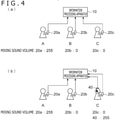
- FIG. 4(a) an example in which three users A, B, and C play a game sharing one information processing apparatus 10 will be described.
- the information processing apparatus 10 initially authenticates the users who operate the controllers 20 and records, in association with information that specifies the controllers, information specifying the authenticated users. Further, it is assumed that the chat controller 30 as an interrupting apparatus is connected to the information processing apparatus 10.
- the information processing apparatus 10 observes the following rules as the rule determined in advance.
- the information processing apparatus 10 determines, setting the controllers 20a, 20b, and 20c connected to the information processing apparatus 10 as target apparatuses, a sound volume of mixing for each target apparatus in accordance with the predetermined rule.
- the controller 20 is a wide range sound collection apparatus.
- the information processing apparatus 10 sets, for example, the sound volume of mixing of the controller 20 that is connected first (it is assumed that this is the controller 20a of the user A) to the output value and sets the sound volume of mixing of a sound signal outputted from any other target apparatus to the cutoff value.
- a sound signal collected by the controller 20a used by the user A and sent out to the information processing apparatus 10 is used in processing of the application.
- the information processing apparatus 10 sends out a sound signal that has been collected by the controller 20a and sent out to the information processing apparatus 10 to a chat partner.
- the information processing apparatus 10 outputs a sound signal received from the partner to an output destination determined by a predetermined method (for example, the controllers 20a, 20b, and 20c here).
- the information processing apparatus 10 again sets the controllers 20a, 20b, and 20c connected to the information processing apparatus 10 and the headset 40 used by the user C as target apparatuses and determines sound volumes of mixing for each target apparatus, in accordance with the abovementioned rule.
- the information processing apparatus 10 determines, first for the user C, the sound volume of mixing of the headset 40 to the output value, on the basis of the predetermined rule described above.
- the information processing apparatus 10 determines, for example, the sound volume of mixing of the controller 20 that is connected first (here, the controller 20a of the user A) to the output value, and determines the sound volume of mixing of sound signals received from any other target apparatus (controller 20b of the user B) to the cutoff value.
- voice uttered by the user C is collected by the headset 40. Then, the sound signal collected by the controller 20a used by the user A and sent out to the information processing apparatus 10 and the sound signal sent out from the headset 40 are mixed and used in processing of the application.
- the sound signals sent out from the controllers 20b and 20c are discarded by operation of the sound input controlling unit 15 of the information processing apparatus 10. Consequently, the sound collected by the controllers 20a, 20b, and 20c is prevented from being mixed, avoiding muffling of voice or generation of an echo.
- the headset 40 since the headset 40 has relatively high directivity, the voice of the user A included in the sound signal outputted from the headset 40 is sufficiently small. Thus, even if the sound signal obtained by sound collection by the headset 40 is mixed with the sound signal sent out from the controller 20a, the sound signals are prevented from being mixed, avoiding muffling of voice or generation of an echo.
- the information processing apparatus 10 receives the request, and maintains the sound volume of mixing of the headset 40 to the output value for the user C. Further, the information processing apparatus 10 sets the sound volume of mixing of the controller 20b that has requested inputting of a sound signal to the output value and sets the sound volume of mixing of the sound signal received from any other target apparatus (controller 20a of the user A) to the cutoff value.
- the sound signals sent out from the controllers 20a and 20c are discarded by operation of the sound input controlling unit 15 of the information processing apparatus 10. Consequently, the sound collected by the controllers 20a, 20b, and 20c is prevented from being mixed, avoiding muffling of voice or generation of an echo.
- the information processing apparatus 10 that performs processing of the chat application outputs a sound signal received from a chat partner to each controller 20 such that sound is generated by the controllers 20.
- operation information representing that the operation to mute has been performed is sent out to the information processing apparatus 10.
- the information processing apparatus 10 accepts the operation information indicating that muting is to be performed from the controller 20 and outputs an instruction to mute to the sound input controlling unit 15. At this time, with whichever sound volume setting the mixer unit 151 of the sound input controlling unit 15 is mixing the sound signals sent out from the individual apparatus, the mute unit 152 performs control in such a manner that the sound signal outputted from the mixer unit 151 is not outputted (is muted).
- muting is performed generally by one operation of a user, requiring no labor for setting mute for each apparatus and improving the operability for muting.
- control unit 11 may perform such control that, as a process of the output controlling unit 14, a sound signal is not outputted (all mute). By this, sound outputting from the television set, headset, and controllers 20 is also stopped.
- the information processing apparatus 10 may instruct such a peripheral apparatus as described above to stop sending out a sound signal.
- control unit 11 receiving input of a sound signal from the sound input controlling unit 15 normally performs such control that the inputted sound signal can be used by any application being executed by the control unit 11.
- an operation mode of the control unit 11 in which it performs such control as just described is referred to as a share mode for the convenience of description.
- it is sometimes preferable that an inputted sound signal is used only by a specific application.
- a sound signal from the interrupting apparatus (in the example here, from the chat controller 30) may be used only by a specific application.
- a mute state is valid even though an application is demanding sound input, then sound input is disabled.
- a state in which mute can be cancelled is established temporarily in response to a request from the application side, a sound signal inputted in the state in which the mute is temporarily cancelled should be outputted only to the application by which this request has been issued.
- control unit 11 outputs a display indicating that sound input is requested, to a monitor or the like, and temporarily retains information that specifies the application (that may be an application name).
- the control unit 11 detects that the operation has been performed and controls the mixer unit 151 of the sound input controlling unit 15 such that the mixing sound volume of the controller 20 for which the operation has been performed is made maximum (for the other controllers 20 and so forth, the mixing sound volume is set to the cutoff value). It is to be noted that, when an unmute operation is performed for a plurality of controllers 20, the mixing sound volume may be set to the maximum only for the controller 20 for which the unmute operation has been performed at an earliest point of time.
- control unit 11 uses a sound signal that has been received from a controller 20 in a period until a user performs a mute operation through its controller 20 subsequently or until after a predetermined period of time elapses, for processing of an application specified by the information temporarily retained previously (temporary unmute).
- This sound signal is set to be unavailable for any application other than the application specified by the information.
- the operation mode of the control unit 11 when this setting is performed is referred to as an exclusive mode for the convenience of description.
- Control of such an exclusive mode as just described is similar to operation of a widely known operating system for using inputted information in processing of only a specific application, and thus, detailed description is omitted here.
- control unit 11 outputs
- a display controlling signal representative of a mute/unmute state is outputted from the information processing apparatus 10 and the controller 20 or the like changes the display of the display unit 24 (changes to turning off, turning on, or flickering) according to the display controlling signal to thereby clearly indicate that a mute state is valid, the user can easily recognize whether or not a state in which sound inputting is possible is valid.
- control unit 11 (4) may output, to a device whose mixing sound volume is set to the cutoff value, a display controlling signal that blinks the LED of the display unit 24 in a mode in which the blinking can be distinguished from that in the all mute state.
- the mode in which the blinking can be distinguished from that in the all mute state may be such that the cycle of blinking is made longer than that in the case of the all mute state. According to this, such a case in which sound input cannot be performed through the controller 20 owned by a user itself as a case in which sound input is being performed by a different person can be indicated clearly.
- the display unit 24 may be formed, for example, as a liquid crystal display unit such that the color of the backlight of the liquid crystal display unit or the display substance is changed to notify the user of the state.
Landscapes
- Engineering & Computer Science (AREA)
- Multimedia (AREA)
- Human Computer Interaction (AREA)
- Physics & Mathematics (AREA)
- Health & Medical Sciences (AREA)
- Audiology, Speech & Language Pathology (AREA)
- Acoustics & Sound (AREA)
- General Health & Medical Sciences (AREA)
- Theoretical Computer Science (AREA)
- Computational Linguistics (AREA)
- General Physics & Mathematics (AREA)
- General Engineering & Computer Science (AREA)
- Optics & Photonics (AREA)
- Life Sciences & Earth Sciences (AREA)
- Biophysics (AREA)
- Cardiology (AREA)
- Heart & Thoracic Surgery (AREA)
- Circuit For Audible Band Transducer (AREA)
Abstract
Description
- The present invention relates to an information processing system, an information processing apparatus, a control method for an information processing apparatus, and a program.
- In recent years, for controlling by voice or processing of a chat, a plurality of peripheral apparatuses that allow sound inputting are sometimes connected to an information processing apparatus such as a home game machine or a personal computer.
- However, if voice or the like uttered by a user is processed at a site where a plurality of sound inputting devices exist in such a manner, then the inputted voice sometimes becomes unintended sound due to a difference in timing at which the sound inputting devices collect the same sound or a difference in characteristic of the sound inputting devices.
- For example, in a case where several players from among a plurality of players who participate in a game performed through a network gather at one place, such a problem as described below occurs when the players try to perform a chat.
- In particular, voice uttered by one of the gathered players is collected not only by a sound inputting device (for example, a microphone) of the uttering player but also by a sound inputting device of a different player who plays at a position adjacent to the relevant player. In this case, simply performing a mixing process for voice of the players causes the voice to become hard-to-hear sound due to muffling of the voice muffled or generation of an echo.
- The present invention has been made in view of such a situation as described above, and it is an object of the present invention to provide an information processing system, an information processing apparatus, a control method for an information processing apparatus, and a program by which control of a plurality of sound inputting devices can be implemented by taking such a circumstance as described above into consideration.
- According to an aspect of the present invention that solves the problem of the prior art described above, there is provided an information processing system that includes peripheral apparatuses that are to be worn or grasped and used by a user and an information processing apparatus. In the information processing system, at least one of the peripheral apparatuses includes sound inputting means for collecting sound of surroundings and outputting a sound signal representative of the collected sound, and the information processing apparatus includes means for accepting a sound signal or signals outputted from at least one of the peripheral apparatuses worn or grasped by the user, selection means for selecting at least part of the accepted sound signal or signals on the basis of a predetermined rule, and means for outputting the sound signal or signals selected by the selection means and cutting off any other sound signal.
- With the present invention, sound becoming hard-to-hear sound due to muffling of voice or generation of an echo can be prevented to thereby implement control of a plurality of sound inputting peripheral apparatuses.
-
- [
FIG. 1 ]
FIG. 1 is a block diagram depicting an example of a configuration of an information processing system according to an embodiment of the present invention. - [
FIG. 2 ]
FIG. 2 is a block diagram depicting an example of a configuration of a sound input controlling unit of an information processing apparatus according to the embodiment of the present invention. - [
FIG. 3 ]
FIG. 3 is a functional block diagram depicting an example of a control unit of the information processing apparatus according to the embodiment of the present invention. - [
FIG. 4 ]
FIG. 4 depicts explanatory views depicting an example of operation of the information processing system according to the embodiment of the present invention. - An embodiment of the present invention is described with reference to the drawings. An
information processing system 1 according to the embodiment of the present invention is configured as exemplified inFIG. 1 and includes aninformation processing apparatus 10 such as a home game machine or a personal computer (PC) and acontroller 20. Here, a plurality ofcontrollers 20 may be included. In addition, theinformation processing system 1 may further include a plurality of peripheral apparatuses each including a sound inputting device, such as achat controller 30, aheadset 40, or a head-mounteddisplay 50, that may be connected to theinformation processing apparatus 10. - As exemplified in
FIG. 1 , theinformation processing apparatus 10 includes acontrol unit 11, astorage unit 12, anoperation controlling unit 13, anoutput controlling unit 14, a soundinput controlling unit 15, and acommunication unit 16. Further, thecontroller 20 includes anoperation unit 21, amicrophone 22, acommunication unit 23, adisplay unit 24, and asound outputting unit 25. Further, thechat controller 30 includes anoperation unit 31, amicrophone 32, acommunication unit 33, and adisplay unit 34. - The
control unit 11 of theinformation processing apparatus 10 is a program-controlled device such as a central processing unit (CPU) and operates in accordance with a program stored in thestorage unit 12. In the present embodiment, it is assumed that thecontrol unit 11 executes a plurality of application programs (performs what is generally called a multitasking process) in parallel. - In particular, in a case where the
information processing apparatus 10 is a home game machine, thecontrol unit 11 executes various application programs such as an application of a game and a chat application for transferring a sound signal through a network. Further, thecontrol unit 11 executes a system program and executes, as processing of the system program, a process for authenticating a user who uses the relevant apparatus such as thecontroller 20 or theheadset 40 for each apparatus, to associate information for specifying a user (for example, a user name) for each information for specifying the apparatus such as acontroller 20 and to store the associated information. - Then, if the
control unit 11 accepts input of operation information together with information for specifying thecontroller 20 from theoperation controlling unit 13, then thecontrol unit 11 selects an application that becomes an output destination of the operation information from among applications being executed. It is sufficient if a condition for selecting an output destination here is determined in advance in such a manner that, for example, when a game application is run, the game application is selected in principle and predetermined operation information is processed exceptionally by the system and the selection is performed according to the condition. - The
control unit 11 executes, as a process of the application or the system of the output destination of the operation information, a process that uses the information for specifying thecontroller 20 that is inputted from theoperation controlling unit 13 and the operation information. Further, thecontrol unit 11 determines a sound volume of mixing of each sound signal when pieces of sound information individually received from a plurality of apparatus are to be mixed. Operation of thecontrol unit 11 is described later. - The
storage unit 12 is a memory device, a hard disk drive, or the like and retains programs to be executed by thecontrol unit 11. Further, thestorage unit 12 operates also as a work memory of thecontrol unit 11. - The
operation controlling unit 13 is connected for communication by wireless or wired communication to thecontroller 20, and receives, from thecontroller 20, operation information representative of the substance of an operation performed by the user with use of thecontroller 20, to output the received operation information to thecontrol unit 11 together with the information for specifyingcontroller 20 that is a transmission source of the operation information. - Further, in the present embodiment, the
operation controlling unit 13 sends out, in accordance with an instruction inputted from thecontrol unit 11, a display controlling signal and so forth to thecontroller 20 indicated by the instruction. - The
output controlling unit 14 is connected to a display device such as a home television set, a monitor, or the head-mounteddisplay 50, and outputs a signal of sound, video, and so forth to the display devices in accordance with an instruction inputted from thecontrol unit 11. Further, theoutput controlling unit 14 may output video and a sound signal to apparatuses different from each other. For example, the video may be outputted to a monitor, and the sound signal may be outputted to thecontroller 20 or theheadset 40. - The sound
input controlling unit 15 receives a sound signal from peripheral apparatuses that include a sound inputting device such as thecontroller 20, thechat controller 30, theheadset 40, and the head-mounteddisplay 50. Further, the soundinput controlling unit 15 includes, as exemplified inFIG. 2 , amixer unit 151, amute unit 152, aswitch unit 153, and anoutputting unit 154, and synthesizes, by themixer unit 151, sound signals inputted from an apparatus other than an apparatus determined in advance (for example, other than the chat controller 30) among the sound signals received. - In particular, the
mixer unit 151 determines a sound volume for each of sound signals received from the individual apparatuses such as thecontroller 20, theheadset 40, and the head-mounteddisplay 50 and synthesizes the sound signals received from the individual apparatuses with the determined sound volumes. In a certain example of the present embodiment, themixer unit 151 determines a sound volume of a sound signal received from each apparatus, in accordance with an instruction inputted from thecontrol unit 11. - Further, for example, in a case where the
control unit 11 sets the sound volume of the sound signal from theheadset 40 to "255" and sets the sound volume of the other sound signals to "0," themixer unit 151 functions also as selection means. In this example, themixer unit 151 selectively outputs the sound signal only from theheadset 40. Further, in this case, even if there is a sound signal received from thecontroller 20, the head-mounteddisplay 50, or the like other than theheadset 40, such sound signal is not included in the output of themixer unit 151. - Further, in an example of the present embodiment, a plurality of
controllers 20 are possibly connected to theinformation processing apparatus 10. Alto in this case, themixer unit 151 determines a sound volume for a sound signal received from eachcontroller 20, in accordance with an instruction inputted from thecontrol unit 11. For example, in a case where an instruction is inputted from thecontrol unit 11 to set the sound volume for a sound signal received from acontroller 20a used by a user A to "255" and set the sound volume for sound signals received fromcontrollers mixer unit 151 selectively outputs the sound signal received from thecontroller 20a. - The
mute unit 152 switches a sound signal outputted from themixer unit 151, between outputting as it is or not outputting (muting), in accordance with an instruction inputted from thecontrol unit 11. When thecontrol unit 11 outputs an instruction not to mute, themute unit 152 outputs the sound signal outputted from themixer unit 151, as it is. On the other hand, when thecontrol unit 11 outputs an instruction to mute, themute unit 152 discards (mutes) the sound signal outputted from themixer unit 151 without outputting the signal to theswitch unit 153. - The
switch unit 153 accepts input, from among sound signals received by theinformation processing apparatus 10, of a sound signal from an apparatus that is not inputted to the mixer unit 151 (such sound signal is hereinafter referred to as an interrupting sound signal; in the example here, the sound signal received from the chat controller 30). Further, when themute unit 152 outputs a sound signal, theswitch unit 153 accepts input of the sound signal. Theswitch unit 153 selectively outputs one of a sound signal (if any) accepted from themute unit 152 and an interrupting sound signal (if any) in accordance with an instruction inputted from thecontrol unit 11. - The
outputting unit 154 outputs the sound signal outputted from theswitch unit 153 to thecontrol unit 11. In such a manner, the soundinput controlling unit 15 according to the one example of the present embodiment receives sound signals from peripheral apparatuses each including a sound inputting device, mixes the sound signals or selects one of the sound signals, and outputs the resulting sound signal for processing in thecontrol unit 11. - The
communication unit 16 is a network interface or the like, and transmits various kinds of information through a network in accordance with an instruction inputted from thecontrol unit 11. Further, thecommunication unit 16 outputs information received through the network to thecontrol unit 11. - The
operation unit 21 of thecontroller 20 includes buttons, a joystick, and so forth, and accepts an operation of the user, to output operation information representative of the substance of the operation performed by the user to thecommunication unit 23. Meanwhile, themicrophone 22 collects sound of surroundings and outputs a digital sound signal representative of the collected sound. - The
communication unit 23 is wireless communication means of, for example, Bluetooth (registered trademark), and outputs information (operation information) representative of the substance of an operation performed on theoperation unit 21 by the user to theinformation processing apparatus 10. Further, thecommunication unit 23 outputs, to theinformation processing apparatus 10, the sound signal outputted from themicrophone 22. Further, thecommunication unit 23 outputs, to thedisplay unit 24, a display controlling signal outputted from theinformation processing apparatus 10. Furthermore, upon receiving a sound signal from theinformation processing apparatus 10, thecommunication unit 23 outputs the received sound signal to thesound outputting unit 25. - The
display unit 24 includes, for example, a light emitting diode (LED) and so forth. Thedisplay unit 24 receives input of a display controlling signal from thecommunication unit 23 and turns on or off the LED. Thesound outputting unit 25 is a device including a vibrator such as a speaker and generates sound on the basis of a sound signal received from theinformation processing apparatus 10. - Further, the
chat controller 30 is what is generally called a push-to-talk device (PTT device) that accepts and outputs input of sound only while the user gives an instruction on sound input, and theoperation unit 31 of thechat controller 30 includes, for example, a button. Further, themicrophone 32 collects and converts sound of surroundings into a sound signal and outputs the sound signal. - The
communication unit 33 is wireless communication means of, for example, Bluetooth (registered trademark) or the like and outputs, while the user is pressing the button of theoperation unit 31, a sound signal outputted from themicrophone 32, to theinformation processing apparatus 10. On the other hand, when the user is not pressing the button of theoperation unit 31, thecommunication unit 33 discards the sound signal outputted from themicrophone 32 without outputting the sound signal to theinformation processing apparatus 10. Furthermore, thecommunication unit 33 outputs, to thedisplay unit 34, the display controlling signal outputted from theinformation processing apparatus 10. - The
display unit 34 includes, for example, an LED and so forth. Thedisplay unit 34 receives input of a display controlling signal from thecommunication unit 33 and turns on or off the LED. Operation of thechat controller 30 is also described later. - The
headset 40 includes, for example, a headphone, a microphone, and so forth. Theheadset 40 causes the speaker to generate sound on the basis of a sound signal outputted from theinformation processing apparatus 10. Further, theheadset 40 sends out a sound signal collected by the microphone to theinformation processing apparatus 10. - The head-mounted
display 50 includes a display, a speaker, and a microphone. The head-mounteddisplay 50 accepts a video signal and a sound signal outputted from theinformation processing apparatus 10, to display an image on the display and cause the speaker to generate sound. Further, the head-mounteddisplay 50 sends out a sound signal collected by the microphone to theinformation processing apparatus 10. - Here, operation of the
control unit 11 of theinformation processing apparatus 10 is described. In the present embodiment, thecontrol unit 11 functionally includes a soundinput processing unit 111, amute processing unit 112, aninterruption processing unit 113, and adisplay processing unit 114 as exemplified as processing of the system inFIG. 3 . - It is to be noted that, in the following description of the present embodiment, it is assumed that the
control unit 11 determines, in advance, one of apparatuses that are connected to theinformation processing apparatus 10 and that include a sound inputting device as an interrupting apparatus. - The sound
input processing unit 111 performs the following process for target apparatuses that are apparatus including a sound inputting device (in a case where an interrupting apparatus is determined, the interrupting apparatus is excluded from the target apparatus). The soundinput processing unit 111 determines a sound volume of mixing for each target apparatus connected to theinformation processing apparatus 10, in accordance with a predetermined rule. This predetermined rule can be, for example, such as that described in the following. In particular, thecontrol unit 11 determines a priority order for the target apparatuses in advance and sets a sound volume of mixing of a sound signal received from a target apparatus that is highest in the priority order from among the target apparatuses connected thereto to a value that is determined in advance and that is higher than 0 (0 is not included). For this value, for example, the highest value may be set or, for each target apparatus, a different value that is different depending upon the type of the target apparatus may be set; in the following description, the value larger than 0 is referred to as an output value. Further, the sound volume of mixing of a sound signal received from a target apparatus other than the target apparatus highest in the priority order among the apparatuses connected is set to the lowest value. It is sufficient if this lowest value is a value representing, for example, the sound volume "0." This lowest value is hereinafter referred to as a "cutoff value." - It is to be noted that the setting of a rule and a sound volume here is an example, and various other methods may be available. For example, the
control unit 11 may set, for a target apparatus selected by the user, a sound volume of mixing of a sound signal received from the selected target apparatus to the output value determined in advance, and set a sound volume of mixing of a sound signal received from any other target apparatus to the cutoff value. - Further, taking a case in which a plurality of users use the
information processing apparatus 10 into consideration, the rule may be such as described below. In particular, - (1) In principle, one target apparatus is selected for each user;
- (2) In a case where the target apparatus selected for each user is a target apparatus determined in advance as an apparatus including a sound inputting device that is less likely to collect sound other than voice of the relevant user, the sound volume of mixing of the relevant target apparatus is set to the output value;
- (3) In a case where the target apparatus selected for each user is not a target apparatus determined in advance as an apparatus including a sound inputting device that is less likely to collect sound other than voice of the relevant user (such a target apparatus as just described is referred to as a wide range sound collection apparatus for the convenience of description), one user is selected from among the users whose selected target apparatuses are wide range sound collection apparatuses, and the sound volume of mixing of the target apparatus selected for the selected user is set to the output value; and
- (4) The sound volume of mixing of the target apparatus whose sound volume in mixing is not set to the output value in (2) and (3) is set to the cutoff value.
- According to this example, for a user who uses, as a sound inputting device, the
headset 40 or a like device in which the directivity of the microphone is relatively high, a sound signal collected by theheadset 40 is enabled to be used in processing as an application. On the other hand, for a user who uses, as a sound inputting device, thecontroller 20 that is a wide range sound collection apparatus in which the directivity of the microphone is relatively low, only the sound signal collected by thecontroller 20 operated by one of the users who use thecontroller 20 as a sound inputting device is enabled to be used in processing as an application. - It is to be noted that, in both cases, when a user who uses a wide range sound collection apparatus operates the
controller 20 to issue a request for input of a sound signal, the mixing sound volume of the wide range sound collection apparatus such as thecontroller 20 of the user is set to the output value, and the mixing sound volume of any other wide range sound collection apparatus is set to the cutoff value. - The
mute processing unit 112 outputs an instruction to mute to the soundinput controlling unit 15 when it accepts operation information for muting, as operation information received from thecontroller 20 operated by the user. - The
interruption processing unit 113 may output, in accordance with an instruction inputted from an interrupting apparatus determined in advance (for example, an instruction for requesting selection), an instruction to select a sound signal received from the interrupting apparatus to the soundinput controlling unit 15. Further, if an instruction to cancel the selection is received from the interrupting apparatus, then thecontrol unit 11 outputs to the soundinput controlling unit 15 an instruction to select a sound signal received from any apparatus other than the interrupting apparatus. - The
display processing unit 114 outputs, in response to an instruction outputted from the soundinput processing unit 111, themute processing unit 112, and theinterruption processing unit 113, a display controlling signal to the apparatus in order to indicate an input state of sound signals. A particular example of this display controlling signal is described later. - The
information processing system 1 of the present embodiment basically includes such a configuration as described above and operates in the following manner. In the following, an example (FIG. 4(a) ) in which three users A, B, and C play a game sharing oneinformation processing apparatus 10 will be described. - At this time, it is assumed that the users A, B, and C operate by holding the
controllers information processing apparatus 10 initially authenticates the users who operate thecontrollers 20 and records, in association with information that specifies the controllers, information specifying the authenticated users. Further, it is assumed that thechat controller 30 as an interrupting apparatus is connected to theinformation processing apparatus 10. - At this time, it is assumed that the
information processing apparatus 10 observes the following rules as the rule determined in advance. - (1) In principle, one target apparatus is selected for each user;
- (2) In a case where the target apparatus selected for each user is a target apparatus determined in advance as an apparatus including a sound inputting device that is less likely to collect sound other than voice of the relevant user, the sound volume of mixing of the relevant target apparatus is set to the output value ("255" in
FIG. 4 ); - (3) In a case where the target apparatus selected for each user is not a target apparatus determined in advance as an apparatus including a sound inputting device that is less likely to collect sound other than voice of the user (such a target apparatus as just described is referred to as wide range sound collection apparatus here for the convenience of description), one user is selected from among the users whose selected target apparatuses are wide range sound collection apparatuses, and the sound volume of mixing of the target apparatus selected for the selected user is set to the output value; and
- (4) The sound volume of mixing of the target apparatus whose sound volume of mixing is not set to the output value in (2) and (3) is set to the cutoff value.
- Thus, the
information processing apparatus 10 determines, setting thecontrollers information processing apparatus 10 as target apparatuses, a sound volume of mixing for each target apparatus in accordance with the predetermined rule. Here, it is assumed that thecontroller 20 is a wide range sound collection apparatus. In this example, on the basis of the predetermined rule described above, theinformation processing apparatus 10 sets, for example, the sound volume of mixing of thecontroller 20 that is connected first (it is assumed that this is thecontroller 20a of the user A) to the output value and sets the sound volume of mixing of a sound signal outputted from any other target apparatus to the cutoff value. - Thus, in the
information processing apparatus 10, a sound signal collected by thecontroller 20a used by the user A and sent out to theinformation processing apparatus 10 is used in processing of the application. - For example, if the application is a chat application, then the
information processing apparatus 10 sends out a sound signal that has been collected by thecontroller 20a and sent out to theinformation processing apparatus 10 to a chat partner. On the other hand, theinformation processing apparatus 10 outputs a sound signal received from the partner to an output destination determined by a predetermined method (for example, thecontrollers - At this time, sound signals sent out from the
controllers input controlling unit 15 of theinformation processing apparatus 10. Consequently, sound collected by thecontrollers - Further, if the user C here wears the
headset 40 and is authenticated as a user of theheadset 40 by the information processing apparatus 10 (FIG. 4(b) ), then, using the authentication of the new apparatus as a trigger, theinformation processing apparatus 10 again sets thecontrollers information processing apparatus 10 and theheadset 40 used by the user C as target apparatuses and determines sound volumes of mixing for each target apparatus, in accordance with the abovementioned rule. - Here, if it is assumed that the
headset 40 is not a wide range sound collection apparatus, then theinformation processing apparatus 10 here determines, first for the user C, the sound volume of mixing of theheadset 40 to the output value, on the basis of the predetermined rule described above. On the other hand, for the other users A and B, theinformation processing apparatus 10 determines, for example, the sound volume of mixing of thecontroller 20 that is connected first (here, thecontroller 20a of the user A) to the output value, and determines the sound volume of mixing of sound signals received from any other target apparatus (controller 20b of the user B) to the cutoff value. - At this time, voice uttered by the user C is collected by the
headset 40. Then, the sound signal collected by thecontroller 20a used by the user A and sent out to theinformation processing apparatus 10 and the sound signal sent out from theheadset 40 are mixed and used in processing of the application. - At this time, the sound signals sent out from the
controllers input controlling unit 15 of theinformation processing apparatus 10. Consequently, the sound collected by thecontrollers headset 40 has relatively high directivity, the voice of the user A included in the sound signal outputted from theheadset 40 is sufficiently small. Thus, even if the sound signal obtained by sound collection by theheadset 40 is mixed with the sound signal sent out from thecontroller 20a, the sound signals are prevented from being mixed, avoiding muffling of voice or generation of an echo. - Further, if the user B here operates the
controller 20b to perform an operation for requesting input of a sound signal, then information representative of the substance of the operation is transmitted to theinformation processing apparatus 10. Theinformation processing apparatus 10 receives the request, and maintains the sound volume of mixing of theheadset 40 to the output value for the user C. Further, theinformation processing apparatus 10 sets the sound volume of mixing of thecontroller 20b that has requested inputting of a sound signal to the output value and sets the sound volume of mixing of the sound signal received from any other target apparatus (controller 20a of the user A) to the cutoff value. - At this time, the sound signals sent out from the
controllers input controlling unit 15 of theinformation processing apparatus 10. Consequently, the sound collected by thecontrollers - Further, the
information processing apparatus 10 that performs processing of the chat application outputs a sound signal received from a chat partner to eachcontroller 20 such that sound is generated by thecontrollers 20. - Further, in an example of the present embodiment, if one of the users operates its
controller 20 to issue an instruction for mute, then a sound signal from each apparatus (except the interrupting apparatus) that includes a sound inputting device is muted. In short, in the example of the present embodiment, if an instruction for mute is issued from any of thecontrollers 20 or the like, then every sound input is cut off. - In particular, if one of the users A, B, and C operates the
controller 20 operated by the user itself to issue an instruction for mute, then operation information representing that the operation to mute has been performed is sent out to theinformation processing apparatus 10. - The
information processing apparatus 10 accepts the operation information indicating that muting is to be performed from thecontroller 20 and outputs an instruction to mute to the soundinput controlling unit 15. At this time, with whichever sound volume setting themixer unit 151 of the soundinput controlling unit 15 is mixing the sound signals sent out from the individual apparatus, themute unit 152 performs control in such a manner that the sound signal outputted from themixer unit 151 is not outputted (is muted). - Consequently, muting is performed generally by one operation of a user, requiring no labor for setting mute for each apparatus and improving the operability for muting.
- Further, depending upon the substance of the mute instruction (for example, in a case where a button for the mute instruction is long-pressed or the like), the
control unit 11 may perform such control that, as a process of theoutput controlling unit 14, a sound signal is not outputted (all mute). By this, sound outputting from the television set, headset, andcontrollers 20 is also stopped. - Here, in a case where it is possible for a peripheral apparatus side that includes a sound inputting device such as the
controller 20 to control whether or not sending out of a sound signal is to be performed, when some user operates itscontroller 20 to issue a mute instruction, theinformation processing apparatus 10 may instruct such a peripheral apparatus as described above to stop sending out a sound signal. - Further, in the present embodiment, the
control unit 11 receiving input of a sound signal from the soundinput controlling unit 15 normally performs such control that the inputted sound signal can be used by any application being executed by thecontrol unit 11. In the following, an operation mode of thecontrol unit 11 in which it performs such control as just described is referred to as a share mode for the convenience of description. However, in a certain example of the present embodiment, it is sometimes preferable that an inputted sound signal is used only by a specific application. - In particular, a sound signal from the interrupting apparatus (in the example here, from the chat controller 30) may be used only by a specific application.
- Further, if a mute state is valid even though an application is demanding sound input, then sound input is disabled. Thus, when a state in which mute can be cancelled is established temporarily in response to a request from the application side, a sound signal inputted in the state in which the mute is temporarily cancelled should be outputted only to the application by which this request has been issued.
- Thus, if sound input becomes necessary in processing of one application, the
control unit 11 outputs a display indicating that sound input is requested, to a monitor or the like, and temporarily retains information that specifies the application (that may be an application name). - Here, if a user performs a predetermined operation to unmute through its
controller 20, then thecontrol unit 11 detects that the operation has been performed and controls themixer unit 151 of the soundinput controlling unit 15 such that the mixing sound volume of thecontroller 20 for which the operation has been performed is made maximum (for theother controllers 20 and so forth, the mixing sound volume is set to the cutoff value). It is to be noted that, when an unmute operation is performed for a plurality ofcontrollers 20, the mixing sound volume may be set to the maximum only for thecontroller 20 for which the unmute operation has been performed at an earliest point of time. - Then, the
control unit 11 uses a sound signal that has been received from acontroller 20 in a period until a user performs a mute operation through itscontroller 20 subsequently or until after a predetermined period of time elapses, for processing of an application specified by the information temporarily retained previously (temporary unmute). This sound signal is set to be unavailable for any application other than the application specified by the information. The operation mode of thecontrol unit 11 when this setting is performed is referred to as an exclusive mode for the convenience of description. - Control of such an exclusive mode as just described is similar to operation of a widely known operating system for using inputted information in processing of only a specific application, and thus, detailed description is omitted here.
- Now, an example of a display controlling signal by the
display processing unit 114 is described. In an example of the present embodiment, thecontrol unit 11 outputs - (1) a display controlling signal for turning off the LED of the
display unit 24 in an unmute state, - (2) a display controlling signal for turning on the LED of the
display unit 24 in a mute state, and - (3) a display controlling signal for blinking the LED of the
display unit 24 in an all mute state, in the individual cases. - According to this, since a display controlling signal representative of a mute/unmute state is outputted from the
information processing apparatus 10 and thecontroller 20 or the like changes the display of the display unit 24 (changes to turning off, turning on, or flickering) according to the display controlling signal to thereby clearly indicate that a mute state is valid, the user can easily recognize whether or not a state in which sound inputting is possible is valid. - Further, in the present embodiment, the control unit 11 (4) may output, to a device whose mixing sound volume is set to the cutoff value, a display controlling signal that blinks the LED of the
display unit 24 in a mode in which the blinking can be distinguished from that in the all mute state. - Here, the mode in which the blinking can be distinguished from that in the all mute state may be such that the cycle of blinking is made longer than that in the case of the all mute state. According to this, such a case in which sound input cannot be performed through the
controller 20 owned by a user itself as a case in which sound input is being performed by a different person can be indicated clearly. - Further, although the LED of the
display unit 24 is controlled here, thedisplay unit 24 may be formed, for example, as a liquid crystal display unit such that the color of the backlight of the liquid crystal display unit or the display substance is changed to notify the user of the state. -
- 1:
- Information processing system
- 10:
- Information processing apparatus
- 11:
- Control unit
- 12:
- Storage unit
- 13:
- Operation controlling unit
- 14:
- Output controlling unit
- 15:
- Sound input controlling unit
- 16:
- Communication unit
- 20:
- Controller
- 21:
- Operation unit
- 22:
- Microphone
- 23:
- Communication unit
- 24:
- Display unit
- 25:
- Sound outputting unit
- 30:
- Chat controller
- 31:
- Operation unit
- 32:
- Microphone
- 33:
- Communication unit
- 34:
- Display unit
- 40:
- Headset
- 50:
- Head-mounted display
- 111:
- Sound input processing unit
- 112:
- Mute processing unit
- 113:
- Interruption processing unit
- 114:
- Display processing unit
- 151:
- Mixer unit
- 152:
- Mute unit
- 153:
- Switch unit
- 154:
- Outputting unit.
Claims (7)
- An information processing apparatus connected to a plurality of peripheral apparatus that are to be worn or grasped and used by one or more users and individually include sound inputting means that collects sound of surroundings and outputs a sound signal representative of the collected sound, the information processing apparatus comprising:means for accepting a sound signal outputted from at least one of the peripheral apparatuses that is worn or grasped by the user;selection means for selecting at least part of the accepted sound signal or sound signals on a basis of a predetermined rule; andmeans for outputting the sound signal or sound signals selected by the selection means and cutting off any other sound signal.
- The information processing apparatus according to claim 1, whereinthe selection meansselects, when a peripheral apparatus used by a user is a peripheral apparatus determined in advance as a peripheral apparatus that is less likely to collect any voice other than that of the user, the relevant peripheral apparatus, butselects, from among the peripheral apparatuses that are to be used by the user but are not the peripheral apparatus determined as the peripheral apparatus that is less likely to collect any voice other than that of the user, one of the relevant peripheral apparatuses.
- The information processing apparatus according to claim 1 or 2, wherein
the information processing apparatus outputs, to any peripheral apparatus whose output sound signal is cut off and that is among the peripheral apparatuses, a display controlling signal such that the peripheral apparatus performs display representative of a state in which sound input through the relevant peripheral apparatus is unavailable. - The information processing apparatus according to any one of claims 1 to 3, wherein
the sound signal or sound signals selected by the selection means and outputted are used in processing of a chat application. - An information processing system that includes one or more peripheral apparatuses that are to be worn or grasped and used by one or more users and an information processing apparatus, whereinat least one of the peripheral apparatuses includes sound inputting means for collecting sound of surroundings and outputting a sound signal representative of the collected sound, andthe information processing apparatus includesmeans for accepting a sound signal or signals outputted from at least one of the peripheral apparatuses that is worn or grasped by the user,selection means for selecting at least part of the accepted sound signal or signals on a basis of a predetermined rule, andmeans for outputting the sound signal or signals selected by the selection means and cutting off any other sound signal.
- A control method for an information processing apparatus connected to a plurality of peripheral apparatuses that are to be worn or grasped and used by one or more users and individually include sound inputting means that collects sound of surroundings and outputs a sound signal representative of the collected sound, wherein the information processing apparatus executes the steps of accepting, by means for accepting a sound signal, a sound signal outputted from at least one of the peripheral apparatuses that is worn or grasped by the user,selecting, by selection means, at least part of the accepted sound signal or signals on a basis of a predetermined rule, andoutputting, by means for controlling outputting of a sound signal, the sound signal or signals selected by the selection means and cutting off any other sound signal.
- A program for causing an information processing apparatus that is connected to a plurality of peripheral apparatuses that are to be worn or grasped and used by one or more users and individually include sound inputting means that collects sound of surroundings and outputs a sound signal representative of the collected sound, to function as:means for accepting a sound signal or signals outputted from at least one of the peripheral apparatuses that is worn or grasped by the user;selection means for selecting at least part of the accepted sound signal or signals on a basis of a predetermined rule; andmeans for outputting the sound signal or signals selected by the selection means and cutting off any other sound signal.
Applications Claiming Priority (2)
| Application Number | Priority Date | Filing Date | Title |
|---|---|---|---|
| JP2019086343 | 2019-04-26 | ||
| PCT/JP2020/016480 WO2020218094A1 (en) | 2019-04-26 | 2020-04-14 | Information processing system, information processing device, method for controlling information processing device, and program |
Publications (3)
| Publication Number | Publication Date |
|---|---|
| EP3960259A1 true EP3960259A1 (en) | 2022-03-02 |
| EP3960259A4 EP3960259A4 (en) | 2023-05-17 |
| EP3960259B1 EP3960259B1 (en) | 2026-03-25 |
Family
ID=72941893
Family Applications (1)
| Application Number | Title | Priority Date | Filing Date |
|---|---|---|---|
| EP20795790.3A Active EP3960259B1 (en) | 2019-04-26 | 2020-04-14 | Information processing system, information processing device, method for controlling information processing device, and program |
Country Status (5)
| Country | Link |
|---|---|
| US (1) | US12233333B2 (en) |
| EP (1) | EP3960259B1 (en) |
| JP (1) | JP7170851B2 (en) |
| CN (1) | CN113710334B (en) |
| WO (1) | WO2020218094A1 (en) |
Family Cites Families (23)
| Publication number | Priority date | Publication date | Assignee | Title |
|---|---|---|---|---|
| JP4202640B2 (en) | 2001-12-25 | 2008-12-24 | 株式会社東芝 | Short range wireless communication headset, communication system using the same, and acoustic processing method in short range wireless communication |
| US6905414B2 (en) | 2002-05-16 | 2005-06-14 | Microsoft Corporation | Banning verbal communication to and from a selected party in a game playing system |
| JP4384179B2 (en) | 2004-10-26 | 2009-12-16 | パナソニック株式会社 | Information output device, information output control method, and information output control program |
| CN101179693B (en) * | 2007-09-26 | 2011-02-02 | 深圳市迪威视讯股份有限公司 | Mixed audio processing method of session television system |
| US9374453B2 (en) | 2007-12-31 | 2016-06-21 | At&T Intellectual Property I, L.P. | Audio processing for multi-participant communication systems |
| US20110111805A1 (en) | 2009-11-06 | 2011-05-12 | Apple Inc. | Synthesized audio message over communication links |
| JP5411880B2 (en) | 2011-01-14 | 2014-02-12 | レノボ・シンガポール・プライベート・リミテッド | Information processing apparatus, voice setting method thereof, and program executed by computer |
| CN103917947B (en) | 2011-11-09 | 2017-09-22 | 索尼电脑娱乐公司 | Information processor, information processing method, program and information storage medium |
| WO2014004224A1 (en) | 2012-06-28 | 2014-01-03 | Dolby Laboratories Licensing Corporation | Metric for meeting commencement in a voice conferencing system |
| CN105308681B (en) | 2013-02-26 | 2019-02-12 | 皇家飞利浦有限公司 | Method and apparatus for generating a speech signal |
| US20150249736A1 (en) * | 2014-02-28 | 2015-09-03 | Plantronics, Inc. | Notification of Muting During Voice Activity for Multiple Muters |
| WO2016047902A1 (en) | 2014-09-23 | 2016-03-31 | 엘지전자 주식회사 | Mobile terminal and method for controlling same |
| CN107431852B (en) | 2015-04-17 | 2019-10-01 | 索尼公司 | Signal processing apparatus, signal processing method and computer readable storage medium |
| US9940094B1 (en) | 2015-05-19 | 2018-04-10 | Orion Labs | Dynamic muting audio transducer control for wearable personal communication nodes |
| JP2017047784A (en) | 2015-09-02 | 2017-03-09 | アルパイン株式会社 | Voice input device |
| US9978366B2 (en) | 2015-10-09 | 2018-05-22 | Xappmedia, Inc. | Event-based speech interactive media player |
| JP6888553B2 (en) | 2015-12-11 | 2021-06-16 | ソニーグループ株式会社 | Information processing equipment, information processing methods and programs |
| US9918042B2 (en) | 2016-04-29 | 2018-03-13 | Getgo, Inc. | Performing electronic conferencing operations using electronic portals at different locations |
| US20170351476A1 (en) | 2016-06-03 | 2017-12-07 | Avaya Inc. | Create private interaction workspace |
| WO2017220856A1 (en) | 2016-06-23 | 2017-12-28 | Paumax Oy | Electronic accessory incorporating dynamic user-controlled audio muting capabilities, related methods and communications terminal |
| US10412565B2 (en) | 2016-12-19 | 2019-09-10 | Qualcomm Incorporated | Systems and methods for muting a wireless communication device |
| US10425781B1 (en) * | 2018-02-22 | 2019-09-24 | Amazon Technologies, Inc. | Outputting notifications using device groups |
| US11057702B1 (en) | 2019-12-20 | 2021-07-06 | Microsoft Technology Licensing, Llc | Method and system for reducing audio feedback |
-
2020
- 2020-04-14 WO PCT/JP2020/016480 patent/WO2020218094A1/en not_active Ceased
- 2020-04-14 CN CN202080029786.3A patent/CN113710334B/en active Active
- 2020-04-14 US US17/602,857 patent/US12233333B2/en active Active
- 2020-04-14 JP JP2021516024A patent/JP7170851B2/en active Active
- 2020-04-14 EP EP20795790.3A patent/EP3960259B1/en active Active
Also Published As
| Publication number | Publication date |
|---|---|
| EP3960259A4 (en) | 2023-05-17 |
| JPWO2020218094A1 (en) | 2021-11-11 |
| CN113710334A (en) | 2021-11-26 |
| US12233333B2 (en) | 2025-02-25 |
| US20220161128A1 (en) | 2022-05-26 |
| CN113710334B (en) | 2024-06-18 |
| EP3960259B1 (en) | 2026-03-25 |
| WO2020218094A1 (en) | 2020-10-29 |
| JP7170851B2 (en) | 2022-11-14 |
Similar Documents
| Publication | Publication Date | Title |
|---|---|---|
| US10567900B2 (en) | Audio system, audio device, and audio device setting method | |
| US10306366B2 (en) | Audio system, audio device, and audio signal playback method | |
| JP2005519555A (en) | A method, apparatus, and system for providing a single user interface to a plurality of devices. | |
| CN113573195B (en) | Mode control method and device for Bluetooth headset and computer readable storage medium | |
| WO2022237609A1 (en) | Communication control method, electronic device and earphones | |
| EP3960259B1 (en) | Information processing system, information processing device, method for controlling information processing device, and program | |
| WO2015078349A1 (en) | Microphone sound-reception status switching method and apparatus | |
| EP3961370B1 (en) | Information processing system, information processing device, method for controlling information processing device, and program | |
| JP6868397B2 (en) | Vibration control system, vibration control device, vibration control program and vibration control method | |
| JP7220780B2 (en) | Information processing system, controller, information processing device, control method for information processing device, and program | |
| JP7388061B2 (en) | Sound signal processing method, sound signal processing system, and program | |
| WO2017030113A1 (en) | System, terminal device, main device, and method | |
| US11524224B2 (en) | Operating device | |
| US20170304723A1 (en) | System and method for providing a software application controller | |
| US20220391245A1 (en) | Information processing apparatus | |
| JP2025006362A (en) | Karaoke system and karaoke device | |
| KR200218282Y1 (en) | A keyboard which has function of a mouse | |
| CN111641753A (en) | Audio output control method, device and electronic device | |
| KR20030079840A (en) | multi cd video game converting interface board | |
| EP3013003A1 (en) | Contents processing device and contents processing system | |
| JP2007110477A (en) | Volume recognition talkback device | |
| KR20010070015A (en) | A keyboard which has function of a mouse |
Legal Events
| Date | Code | Title | Description |
|---|---|---|---|
| STAA | Information on the status of an ep patent application or granted ep patent |
Free format text: STATUS: THE INTERNATIONAL PUBLICATION HAS BEEN MADE |
|
| PUAI | Public reference made under article 153(3) epc to a published international application that has entered the european phase |
Free format text: ORIGINAL CODE: 0009012 |
|
| STAA | Information on the status of an ep patent application or granted ep patent |
Free format text: STATUS: REQUEST FOR EXAMINATION WAS MADE |
|
| 17P | Request for examination filed |
Effective date: 20211005 |
|
| AK | Designated contracting states |
Kind code of ref document: A1 Designated state(s): AL AT BE BG CH CY CZ DE DK EE ES FI FR GB GR HR HU IE IS IT LI LT LU LV MC MK MT NL NO PL PT RO RS SE SI SK SM TR |
|
| DAV | Request for validation of the european patent (deleted) | ||
| DAX | Request for extension of the european patent (deleted) | ||
| A4 | Supplementary search report drawn up and despatched |
Effective date: 20230417 |
|
| RIC1 | Information provided on ipc code assigned before grant |
Ipc: G06F 3/16 20060101ALI20230411BHEP Ipc: A63F 13/54 20140101ALI20230411BHEP Ipc: A63F 13/215 20140101AFI20230411BHEP |
|
| GRAP | Despatch of communication of intention to grant a patent |
Free format text: ORIGINAL CODE: EPIDOSNIGR1 |
|
| STAA | Information on the status of an ep patent application or granted ep patent |
Free format text: STATUS: GRANT OF PATENT IS INTENDED |
|
| INTG | Intention to grant announced |
Effective date: 20251024 |
|
| P01 | Opt-out of the competence of the unified patent court (upc) registered |
Free format text: CASE NUMBER: UPC_APP_0018283_3960259/2025 Effective date: 20251218 |
|
| GRAS | Grant fee paid |
Free format text: ORIGINAL CODE: EPIDOSNIGR3 |
|
| GRAA | (expected) grant |
Free format text: ORIGINAL CODE: 0009210 |
|
| STAA | Information on the status of an ep patent application or granted ep patent |
Free format text: STATUS: THE PATENT HAS BEEN GRANTED |
|
| AK | Designated contracting states |
Kind code of ref document: B1 Designated state(s): AL AT BE BG CH CY CZ DE DK EE ES FI FR GB GR HR HU IE IS IT LI LT LU LV MC MK MT NL NO PL PT RO RS SE SI SK SM TR |
|
| REG | Reference to a national code |
Ref country code: CH Ref legal event code: F10 Free format text: ST27 STATUS EVENT CODE: U-0-0-F10-F00 (AS PROVIDED BY THE NATIONAL OFFICE) Effective date: 20260325 Ref country code: GB Ref legal event code: FG4D |
|
| REG | Reference to a national code |
Ref country code: DE Ref legal event code: R096 Ref document number: 602020069227 Country of ref document: DE |
|
| REG | Reference to a national code |
Ref country code: IE Ref legal event code: FG4D |