EP3959764B1 - Surface protection of lithium metal anode - Google Patents
Surface protection of lithium metal anode Download PDFInfo
- Publication number
- EP3959764B1 EP3959764B1 EP20794850.6A EP20794850A EP3959764B1 EP 3959764 B1 EP3959764 B1 EP 3959764B1 EP 20794850 A EP20794850 A EP 20794850A EP 3959764 B1 EP3959764 B1 EP 3959764B1
- Authority
- EP
- European Patent Office
- Prior art keywords
- film
- lithium
- protective film
- nanometers
- implementations
- Prior art date
- Legal status (The legal status is an assumption and is not a legal conclusion. Google has not performed a legal analysis and makes no representation as to the accuracy of the status listed.)
- Active
Links
Images



Classifications
-
- C—CHEMISTRY; METALLURGY
- C23—COATING METALLIC MATERIAL; COATING MATERIAL WITH METALLIC MATERIAL; CHEMICAL SURFACE TREATMENT; DIFFUSION TREATMENT OF METALLIC MATERIAL; COATING BY VACUUM EVAPORATION, BY SPUTTERING, BY ION IMPLANTATION OR BY CHEMICAL VAPOUR DEPOSITION, IN GENERAL; INHIBITING CORROSION OF METALLIC MATERIAL OR INCRUSTATION IN GENERAL
- C23C—COATING METALLIC MATERIAL; COATING MATERIAL WITH METALLIC MATERIAL; SURFACE TREATMENT OF METALLIC MATERIAL BY DIFFUSION INTO THE SURFACE, BY CHEMICAL CONVERSION OR SUBSTITUTION; COATING BY VACUUM EVAPORATION, BY SPUTTERING, BY ION IMPLANTATION OR BY CHEMICAL VAPOUR DEPOSITION, IN GENERAL
- C23C28/00—Coating for obtaining at least two superposed coatings either by methods not provided for in a single one of groups C23C2/00 - C23C26/00 or by combinations of methods provided for in subclasses C23C and C25C or C25D
- C23C28/04—Coating for obtaining at least two superposed coatings either by methods not provided for in a single one of groups C23C2/00 - C23C26/00 or by combinations of methods provided for in subclasses C23C and C25C or C25D only coatings of inorganic non-metallic material
-
- C—CHEMISTRY; METALLURGY
- C23—COATING METALLIC MATERIAL; COATING MATERIAL WITH METALLIC MATERIAL; CHEMICAL SURFACE TREATMENT; DIFFUSION TREATMENT OF METALLIC MATERIAL; COATING BY VACUUM EVAPORATION, BY SPUTTERING, BY ION IMPLANTATION OR BY CHEMICAL VAPOUR DEPOSITION, IN GENERAL; INHIBITING CORROSION OF METALLIC MATERIAL OR INCRUSTATION IN GENERAL
- C23C—COATING METALLIC MATERIAL; COATING MATERIAL WITH METALLIC MATERIAL; SURFACE TREATMENT OF METALLIC MATERIAL BY DIFFUSION INTO THE SURFACE, BY CHEMICAL CONVERSION OR SUBSTITUTION; COATING BY VACUUM EVAPORATION, BY SPUTTERING, BY ION IMPLANTATION OR BY CHEMICAL VAPOUR DEPOSITION, IN GENERAL
- C23C28/00—Coating for obtaining at least two superposed coatings either by methods not provided for in a single one of groups C23C2/00 - C23C26/00 or by combinations of methods provided for in subclasses C23C and C25C or C25D
- C23C28/30—Coatings combining at least one metallic layer and at least one inorganic non-metallic layer
- C23C28/34—Coatings combining at least one metallic layer and at least one inorganic non-metallic layer including at least one inorganic non-metallic material layer, e.g. metal carbide, nitride, boride, silicide layer and their mixtures, enamels, phosphates and sulphates
-
- C—CHEMISTRY; METALLURGY
- C23—COATING METALLIC MATERIAL; COATING MATERIAL WITH METALLIC MATERIAL; CHEMICAL SURFACE TREATMENT; DIFFUSION TREATMENT OF METALLIC MATERIAL; COATING BY VACUUM EVAPORATION, BY SPUTTERING, BY ION IMPLANTATION OR BY CHEMICAL VAPOUR DEPOSITION, IN GENERAL; INHIBITING CORROSION OF METALLIC MATERIAL OR INCRUSTATION IN GENERAL
- C23G—CLEANING OR DE-GREASING OF METALLIC MATERIAL BY CHEMICAL METHODS OTHER THAN ELECTROLYSIS
- C23G5/00—Cleaning or de-greasing metallic material by other methods; Apparatus for cleaning or de-greasing metallic material with organic solvents
-
- H—ELECTRICITY
- H01—ELECTRIC ELEMENTS
- H01M—PROCESSES OR MEANS, e.g. BATTERIES, FOR THE DIRECT CONVERSION OF CHEMICAL ENERGY INTO ELECTRICAL ENERGY
- H01M10/00—Secondary cells; Manufacture thereof
- H01M10/05—Accumulators with non-aqueous electrolyte
- H01M10/052—Li-accumulators
-
- H—ELECTRICITY
- H01—ELECTRIC ELEMENTS
- H01M—PROCESSES OR MEANS, e.g. BATTERIES, FOR THE DIRECT CONVERSION OF CHEMICAL ENERGY INTO ELECTRICAL ENERGY
- H01M10/00—Secondary cells; Manufacture thereof
- H01M10/05—Accumulators with non-aqueous electrolyte
- H01M10/056—Accumulators with non-aqueous electrolyte characterised by the materials used as electrolytes, e.g. mixed inorganic/organic electrolytes
- H01M10/0561—Accumulators with non-aqueous electrolyte characterised by the materials used as electrolytes, e.g. mixed inorganic/organic electrolytes the electrolyte being constituted of inorganic materials only
- H01M10/0562—Solid materials
-
- H—ELECTRICITY
- H01—ELECTRIC ELEMENTS
- H01M—PROCESSES OR MEANS, e.g. BATTERIES, FOR THE DIRECT CONVERSION OF CHEMICAL ENERGY INTO ELECTRICAL ENERGY
- H01M10/00—Secondary cells; Manufacture thereof
- H01M10/42—Methods or arrangements for servicing or maintenance of secondary cells or secondary half-cells
- H01M10/4235—Safety or regulating additives or arrangements in electrodes, separators or electrolyte
-
- H—ELECTRICITY
- H01—ELECTRIC ELEMENTS
- H01M—PROCESSES OR MEANS, e.g. BATTERIES, FOR THE DIRECT CONVERSION OF CHEMICAL ENERGY INTO ELECTRICAL ENERGY
- H01M4/00—Electrodes
- H01M4/02—Electrodes composed of, or comprising, active material
- H01M4/04—Processes of manufacture in general
- H01M4/0402—Methods of deposition of the material
- H01M4/0404—Methods of deposition of the material by coating on electrode collectors
-
- H—ELECTRICITY
- H01—ELECTRIC ELEMENTS
- H01M—PROCESSES OR MEANS, e.g. BATTERIES, FOR THE DIRECT CONVERSION OF CHEMICAL ENERGY INTO ELECTRICAL ENERGY
- H01M4/00—Electrodes
- H01M4/02—Electrodes composed of, or comprising, active material
- H01M4/04—Processes of manufacture in general
- H01M4/0402—Methods of deposition of the material
- H01M4/0421—Methods of deposition of the material involving vapour deposition
- H01M4/0423—Physical vapour deposition
-
- H—ELECTRICITY
- H01—ELECTRIC ELEMENTS
- H01M—PROCESSES OR MEANS, e.g. BATTERIES, FOR THE DIRECT CONVERSION OF CHEMICAL ENERGY INTO ELECTRICAL ENERGY
- H01M4/00—Electrodes
- H01M4/02—Electrodes composed of, or comprising, active material
- H01M4/04—Processes of manufacture in general
- H01M4/0402—Methods of deposition of the material
- H01M4/0421—Methods of deposition of the material involving vapour deposition
- H01M4/0423—Physical vapour deposition
- H01M4/0426—Sputtering
-
- H—ELECTRICITY
- H01—ELECTRIC ELEMENTS
- H01M—PROCESSES OR MEANS, e.g. BATTERIES, FOR THE DIRECT CONVERSION OF CHEMICAL ENERGY INTO ELECTRICAL ENERGY
- H01M4/00—Electrodes
- H01M4/02—Electrodes composed of, or comprising, active material
- H01M4/04—Processes of manufacture in general
- H01M4/0402—Methods of deposition of the material
- H01M4/0421—Methods of deposition of the material involving vapour deposition
- H01M4/0428—Chemical vapour deposition
-
- H—ELECTRICITY
- H01—ELECTRIC ELEMENTS
- H01M—PROCESSES OR MEANS, e.g. BATTERIES, FOR THE DIRECT CONVERSION OF CHEMICAL ENERGY INTO ELECTRICAL ENERGY
- H01M4/00—Electrodes
- H01M4/02—Electrodes composed of, or comprising, active material
- H01M4/13—Electrodes for accumulators with non-aqueous electrolyte, e.g. for lithium-accumulators; Processes of manufacture thereof
- H01M4/134—Electrodes based on metals, Si or alloys
-
- H—ELECTRICITY
- H01—ELECTRIC ELEMENTS
- H01M—PROCESSES OR MEANS, e.g. BATTERIES, FOR THE DIRECT CONVERSION OF CHEMICAL ENERGY INTO ELECTRICAL ENERGY
- H01M4/00—Electrodes
- H01M4/02—Electrodes composed of, or comprising, active material
- H01M4/13—Electrodes for accumulators with non-aqueous electrolyte, e.g. for lithium-accumulators; Processes of manufacture thereof
- H01M4/139—Processes of manufacture
- H01M4/1395—Processes of manufacture of electrodes based on metals, Si or alloys
-
- H—ELECTRICITY
- H01—ELECTRIC ELEMENTS
- H01M—PROCESSES OR MEANS, e.g. BATTERIES, FOR THE DIRECT CONVERSION OF CHEMICAL ENERGY INTO ELECTRICAL ENERGY
- H01M4/00—Electrodes
- H01M4/02—Electrodes composed of, or comprising, active material
- H01M4/36—Selection of substances as active materials, active masses, active liquids
- H01M4/38—Selection of substances as active materials, active masses, active liquids of elements or alloys
- H01M4/381—Alkaline or alkaline earth metals elements
- H01M4/382—Lithium
-
- H—ELECTRICITY
- H01—ELECTRIC ELEMENTS
- H01M—PROCESSES OR MEANS, e.g. BATTERIES, FOR THE DIRECT CONVERSION OF CHEMICAL ENERGY INTO ELECTRICAL ENERGY
- H01M4/00—Electrodes
- H01M4/02—Electrodes composed of, or comprising, active material
- H01M4/62—Selection of inactive substances as ingredients for active masses, e.g. binders, fillers
-
- H—ELECTRICITY
- H01—ELECTRIC ELEMENTS
- H01M—PROCESSES OR MEANS, e.g. BATTERIES, FOR THE DIRECT CONVERSION OF CHEMICAL ENERGY INTO ELECTRICAL ENERGY
- H01M4/00—Electrodes
- H01M4/02—Electrodes composed of, or comprising, active material
- H01M4/62—Selection of inactive substances as ingredients for active masses, e.g. binders, fillers
- H01M4/628—Inhibitors, e.g. gassing inhibitors, corrosion inhibitors
-
- H—ELECTRICITY
- H01—ELECTRIC ELEMENTS
- H01M—PROCESSES OR MEANS, e.g. BATTERIES, FOR THE DIRECT CONVERSION OF CHEMICAL ENERGY INTO ELECTRICAL ENERGY
- H01M4/00—Electrodes
- H01M4/02—Electrodes composed of, or comprising, active material
- H01M4/64—Carriers or collectors
- H01M4/66—Selection of materials
- H01M4/661—Metal or alloys, e.g. alloy coatings
-
- H—ELECTRICITY
- H01—ELECTRIC ELEMENTS
- H01M—PROCESSES OR MEANS, e.g. BATTERIES, FOR THE DIRECT CONVERSION OF CHEMICAL ENERGY INTO ELECTRICAL ENERGY
- H01M4/00—Electrodes
- H01M4/02—Electrodes composed of, or comprising, active material
- H01M4/64—Carriers or collectors
- H01M4/66—Selection of materials
- H01M4/669—Steels
-
- H—ELECTRICITY
- H01—ELECTRIC ELEMENTS
- H01M—PROCESSES OR MEANS, e.g. BATTERIES, FOR THE DIRECT CONVERSION OF CHEMICAL ENERGY INTO ELECTRICAL ENERGY
- H01M4/00—Electrodes
- H01M4/02—Electrodes composed of, or comprising, active material
- H01M2004/026—Electrodes composed of, or comprising, active material characterised by the polarity
- H01M2004/027—Negative electrodes
-
- H—ELECTRICITY
- H01—ELECTRIC ELEMENTS
- H01M—PROCESSES OR MEANS, e.g. BATTERIES, FOR THE DIRECT CONVERSION OF CHEMICAL ENERGY INTO ELECTRICAL ENERGY
- H01M2300/00—Electrolytes
- H01M2300/0017—Non-aqueous electrolytes
- H01M2300/0065—Solid electrolytes
- H01M2300/0068—Solid electrolytes inorganic
-
- Y—GENERAL TAGGING OF NEW TECHNOLOGICAL DEVELOPMENTS; GENERAL TAGGING OF CROSS-SECTIONAL TECHNOLOGIES SPANNING OVER SEVERAL SECTIONS OF THE IPC; TECHNICAL SUBJECTS COVERED BY FORMER USPC CROSS-REFERENCE ART COLLECTIONS [XRACs] AND DIGESTS
- Y02—TECHNOLOGIES OR APPLICATIONS FOR MITIGATION OR ADAPTATION AGAINST CLIMATE CHANGE
- Y02E—REDUCTION OF GREENHOUSE GAS [GHG] EMISSIONS, RELATED TO ENERGY GENERATION, TRANSMISSION OR DISTRIBUTION
- Y02E60/00—Enabling technologies; Technologies with a potential or indirect contribution to GHG emissions mitigation
- Y02E60/10—Energy storage using batteries
Definitions
- Implementations described herein generally relate to metal electrodes, more specifically lithium-containing anodes, high performance electrochemical devices, such as primary and secondary electrochemical devices, including the aforementioned lithium-containing electrodes, and methods for fabricating the same.
- Li-ion batteries are used in a growing number of applications, including portable electronics, medical, transportation, grid-connected large energy storage, renewable energy storage, and uninterruptible power supply (UPS).
- Traditional lead/sulfuric acid batteries often lack the capacitance and are often inadequately cyclable for these growing applications.
- Both lithium-ion and subsequently, solid-state batteries are thought to provide the best options for meeting increasing performance demands.
- Lithium provides an exceptional anode material for both lithium-ion and solid-state batteries.
- Lithium is a light alkali metal with a high voltage and theoretical capacity.
- lithium is characterized by a strong reactivity with a variety of substances. Lithium reacts violently with water, alcohols and other substances that contain protic hydrogen, often resulting in ignition. Lithium is unstable in air and reacts with oxygen, nitrogen and carbon dioxide. Lithium is normally handled under an inert gas atmosphere (noble gases such as argon) and the strong reactivity of lithium necessitates that other processing operations also be performed in an inert gas atmosphere. As a result, lithium provides several challenges when it comes to processing, storage, and transportation.
- One method of protective surface treatment of lithium metal includes coating the lithium metal with a wax layer, for example, polyethylene wax.
- a large amount of coating agent is typically applied which interferes with subsequent processing of the lithium metal film.
- SLMP stabilized lithium metal powder
- polymer coating for example, polyurethanes, PTFE, PVC, polystyrene and others.
- SLMP stabilized lithium metal powder
- polymer coating for example, polyurethanes, PTFE, PVC, polystyrene and others.
- WO 2019/060196 A1 describes an anode electrode structure comprising a current collector comprising copper, a lithium metal film formed on the current collector, a copper film formed on the lithium metal film, and a protective film formed on the copper film.
- KR 20180062963 A describes a method for manufacturing a cathode for a lithium metal secondary battery.
- WO 2019/094124 A1 which is a document according to Art. 54 (3) EPC, describes an anode electrode structure comprising a current collector comprising copper with a lithium metal film formed on the current collector.
- Implementations described herein generally relate to metal electrodes, more specifically lithium-containing anodes, high performance electrochemical devices, such as primary and secondary electrochemical devices, including the aforementioned lithium-containing electrodes, and methods for fabricating the same.
- a method is provided. The method comprises forming a lithium metal film on a current collector.
- the current collector comprises copper and/or stainless steel.
- the method further comprises forming a protective film stack on the lithium metal film, comprising forming a first protective film on the lithium metal film.
- the first protective film is selected from a tin chalcogenide film, a gallium chalcogenide film, a germanium chalcogenide film, an indium chalcogenide film, a silver chalcogenide film, a dielectric film, or a combination thereof.
- the method further comprises forming a second protective film on the first protective film, the second protective film selected from a lithium fluoride (LiF) film, a metallic film, a carbon-containing film, or a combination thereof.
- LiF lithium fluoride
- an anode electrode structure comprises a current collector comprising copper and/or stainless steel, a lithium metal film formed on the current collector, and a protective film stack formed on the lithium metal film.
- the protective film stack comprises a first protective film formed on the lithium metal film.
- the first protective film is selected from a tin chalcogenide film, a gallium chalcogenide film, a germanium chalcogenide film, an indium chalcogenide film, a silver chalcogenide film, a dielectric film, or a combination thereof.
- the protective film stack further comprises a second protective film formed on the first protective film.
- the second protective film is selected from a lithium fluoride (LiF) film, a metallic film, a carbon-containing film, or a combination thereof.
- the following disclosure describes anode electrodes, high performance electrochemical cells and batteries including the aforementioned anode electrodes, and methods for fabricating the same. Certain details are set forth in the following description and in FIGS. 1-6 to provide a thorough understanding of various implementations of the disclosure. Other details describing well-known structures and systems often associated with electrochemical cells and batteries are not set forth in the following disclosure to avoid unnecessarily obscuring the description of the various implementations.
- Implementations described herein will be described below in reference to a reel-to-reel coating system, such as TopMet TM , SMARTWEB ® , TopBeam TM , all of which are available from Applied Materials, Inc. of Santa Clara, California.
- Other tools capable of performing vapor deposition processes e.g., physical vapor deposition (PVD) processes, chemical vapor deposition (CVD) processes, atomic layer deposition (ALD) processes
- PVD physical vapor deposition
- CVD chemical vapor deposition
- ALD atomic layer deposition
- any system enabling the vapor deposition processes described herein can be used to advantage.
- the apparatus description described herein is illustrative and should not be construed or interpreted as limiting the scope of the implementations described herein. It should also be understood that although described as a reel-to-reel process, the implementations described herein may also be performed on discrete substrates. In some implementations, the reel-to-reel coating
- flexible substrates can be considered to include among other things, films, foils, webs, strips of plastic material, metal, paper, or other materials.
- web typically, the terms “web,” “foil,” “strip,” “substrate” and the like are used synonymously.
- Li-ion batteries typically include a positive electrode (e.g., cathode), and a negative electrode separated by a polymer separator with a liquid electrolyte.
- Solid-state batteries also typically include a positive electrode (e.g., cathode) and a negative electrode (e.g., anode) but replace both the polymer separator and the liquid electrolyte with an ion-conducting material.
- Graphite anodes are the current state of the art but the industry is moving from the graphite based anode to silicon blended graphite anodes to increase cell energy density.
- silicon blended graphite anodes often suffer from irreversible capacity loss that occurs during the first cycle.
- the current generation of batteries uses graphite anodes, a porous polymer separator, and a liquid electrolyte.
- the liquid electrolyte typically includes additives, which form a solid electrolyte interface (SEI) in-situ during formation on the electrode.
- SEI solid electrolyte interface
- the energy density of the state of the art graphite anode based battery is limited to around 650 Wh/I.
- the energy density of a silicon powder blended graphite anode will help boost the energy density to greater than 700 Wh/I.
- the ability to use lithium in next generation batteries including both Li-ion batteries and solid-state batteries becomes increasingly substantial.
- lithium technology presents significant device integration challenges such as handling lithium in dry room ambient, suitable surface protection technology, and the need to suppress or eliminate lithium metal dendrite during battery cycling. From the electrochemical device perspective, an interface material, which not only helps to prevent surface from oxidation but also should help in improving device performance is desirable.
- the deposited lithium metal can be protected during winding and unwinding of the reels downstream.
- Deposition of one or more thin protective films as described herein has several advantages.
- the one or more protective films described herein provide adequate surface protection for shipping, handling, and storage as well as avoiding surface reactions of lithium during device integration.
- the one or more protective films described herein are compatible with lithium ions and reduce impedance for ions to move across.
- the one or more protective films described herein are ion-conducting and thus may be incorporated into the formed energy storage device.
- the one or more protective films described herein can also help suppress or eliminate lithium dendrites, especially at high current density operation.
- the use of protective films described herein reduces the complexity of manufacturing systems and is compatible with current manufacturing systems.
- FIG. 1 illustrates a schematic cross-sectional view of one implementation of an energy storage device 100 incorporating an anode electrode structure formed according to implementations described herein.
- the energy storage device 100 may be a solid-state energy storage device or a lithium-ion based energy storage device.
- the energy storage device 100 even though shown as a planar structure, may also be formed into a cylinder by rolling the stack of layers; furthermore, other cell configurations (e.g., prismatic cells, button cells, or stacked electrode cells) may be formed.
- the energy storage device 100 includes an anode electrode structure 110 and a cathode electrode structure 120 with a solid-electrolyte film 130 positioned therebetween.
- the solid-electrolyte film is replaced with a polymer separator and a liquid electrolyte.
- the cathode electrode structure 120 includes a cathode current collector 140 and a cathode film 150.
- the anode electrode structure 110 includes an anode current collector 160, an anode film 170, and one or more protective film(s) 180.
- the one or more protective film(s) 180 include at least one or more of a lithium fluoride (LiF) film; a dielectric or ceramic film (e.g., oxides of titanium (Ti), aluminum (Al), niobium (Nb), tantalum (Ta), zirconium (Zr), or a combination thereof); one or more metal film(s) (e.g., tin (Sn), antimony (Sb), bismuth (Bi), gallium (Ga), germanium (Ge), copper films, silver films, gold films, or a combination thereof); a tin chalcogenide film (e.g., SnTe, SnSe, SnSe 2 , SnS), a gallium chalcogenide film (e.g., GaS, Ga 2 S 3 , GaSe, Ga 2 Se 3 , GaTe), a germanium chalcogenide film (GeTe, GeSe, GeS), an indium chalcogen
- the cathode electrode structure 120 includes the cathode current collector 140 with the cathode film 150 formed on the cathode current collector 140. It should be understood that the cathode electrode structure 120 may include other elements or films.
- the current collectors 140, 160, on the cathode film 150 and the anode film 170, respectively, can be identical or different electronic conductors.
- at least one of the current collectors 140, 160 is a flexible substrate.
- the flexible substrate is a CPP film (i.e., a casting polypropylene film), an OPP film (i.e., an oriented polypropylene film), or a PET film (i.e., an oriented polyethylene terephthalate film).
- the flexible substrate may be a pre-coated paper, a polypropylene (PP) film, a PEN film, a poly lactase acetate (PLA) film, or a PVC film.
- the current collectors 140, 160 may be comprised of include aluminum (Al), copper (Cu), zinc (Zn), nickel (Ni), cobalt (Co), manganese (Mn), chromium (Cr), stainless steel, clad materials, alloys thereof, and a combination thereof.
- at least one of the current collectors 140, 160 is perforated.
- at least one of the current collectors 140, 160 includes a polymer substrate (e.g., polyethylene terephthalate (“PET”) coated with a metallic material.
- PET polyethylene terephthalate
- the anode current collector 160 is a polymer substrate (e.g., a PET film) coated with copper.
- the anode current collector 160 is a multi-metal layer on a polymer substrate.
- the multi-metal layer can be combinations of copper, chromium, nickel, etc.
- the anode current collector 160 is a multi-layer structure that includes a copper-nickel cladding material.
- the multi-layer structure includes a first layer of nickel or chromium, a second layer of copper formed on the first layer, and a third layer including nickel, chromium, or both formed on the second layer.
- the anode current collector 160 is nickel coated copper.
- current collectors may be of any form factor (e.g., metallic foil, sheet, or plate), shape and micro/macro structure.
- the cathode current collector 140 is aluminum. In another implementation, the cathode current collector 140 comprises aluminum deposited on a polymer substrate (e.g., a PET film). In one implementation, the cathode current collector 140 has a thickness below 50 ⁇ m more specifically, 5 ⁇ m or, even more specifically 2 ⁇ m.
- the cathode current collector 140 has a thickness from about 0.5 ⁇ m to about 20 ⁇ m (e.g., from about 1 ⁇ m to about 10 ⁇ m; from about 2 ⁇ m to about 8 ⁇ m; or from about 5 ⁇ m to about 10 ⁇ m).
- the anode current collector 160 is copper.
- the anode current collector 160 is stainless steel.
- the anode current collector 160 has a thickness below 50 ⁇ m more specifically, 5 ⁇ m or, even more specifically 2 ⁇ m.
- the anode current collector 160 has a thickness from about 0.5 ⁇ m to about 20 ⁇ m (e.g., from about 1 ⁇ m to about 10 ⁇ m; from about 2 ⁇ m to about 8 ⁇ m; from about 6 ⁇ m to about 12 ⁇ m; or from about 5 ⁇ m to about 10 ⁇ m).
- the cathode film 150 or cathode may be any material compatible with the anode and may include an intercalation compound, an insertion compound, or an electrochemically active polymer.
- Suitable intercalation materials include, for example, lithium-containing metal oxides, MoS 2 , FeS 2 , BiF 3 , Fe 2 OF 4 , MnO 2 , TiS 2 , NbSe 3 , LiCoOz, LiNiO 2 , LiMnO 2 , LiMn 2 O 4 , V 6 O 13 and V 2 O 5 .
- Suitable polymers include, for example, polyacetylene, polypyrrole, polyaniline, and polythiophene.
- the cathode film 150 or cathode may be made from a layered oxide, such as lithium cobalt oxide, an olivine, such as lithium iron phosphate, or a spinel, such as lithium manganese oxide.
- Exemplary lithium-containing oxides may be layered, such as lithium cobalt oxide (LiCoO 2 ), or mixed metal oxides, such as LiNi x Co 1-2x MnO 2 , LiNiMnCoO 2 ("NMC"), LiNi 0.5 Mn 1.5 O 4 , Li(Ni 0.8 Co 0.15 Al 0.05 )O 2 , LiMn 2 O 4 , and doped lithium rich layered-layered materials, wherein x is zero or a non-zero number.
- Exemplary phosphates may be iron olivine (LiFePO 4 ) and it is variants (such as LiFe (1-x) Mg x PO 4 ), LiMoPO 4 , LiCoPO 4 , LiNiPO 4 , Li 3 V 2 (PO 4 ) 3 , LiVOPO 4 , LiMP 2 O 7 , or LiFe 1.5 P 2 O 7 , wherein x is zero or a non-zero number.
- Exemplary fluorophosphates may be LiVPO 4 F, LiAlPO 4 F, Li 5 V(PO 4 ) 2 F 2 , Li 5 Cr(PO 4 ) 2 F 2 , Li 2 CoPO 4 F, or Li 2 NiPO 4 F.
- Exemplary silicates may be Li 2 FeSiO 4 , Li 2 MnSiO 4 , or Li 2 VOSiO 4 .
- An exemplary non-lithium compound is Na 5 V 2 (PO 4 ) 2 F 3 .
- the anode electrode structure 110 includes the anode current collector 160 with the anode film 170 formed on the anode current collector 160.
- the anode electrode structure 110 comprises the one or more protective film(s) 180, which includes at least one or more of a lithium fluoride (LiF) film; a dielectric or ceramic film (e.g., oxides of titanium (Ti), aluminum (Al), niobium (Nb), tantalum (Ta), zirconium (Zr), or a combination thereof); one or more metal film(s) (e.g., tin (Sn), antimony (Sb), bismuth (Bi), gallium (Ga), germanium (Ge), copper films, silver films, gold films, or a combination thereof); a tin chalcogenide film (e.g., SnTe, SnSe, SnSe 2 , SnS), a gallium chalcogenide film (e.g., GaS, Ga 2 S 3
- the anode film 170 may be any material compatible with the cathode film 150.
- the anode film 170 may have an energy capacity greater than or equal to 372 mAh/g, preferably ⁇ 700 mAh/g, and most preferably ⁇ 1000 mAh/g.
- the anode film 170 may be constructed from graphite, silicon-containing graphite, lithium metal, lithium metal foil or a lithium alloy foil (e.g. lithium aluminum alloys), or a mixture of a lithium metal and/or lithium alloy and materials such as carbon (e.g. coke, graphite), nickel, copper, tin, indium, silicon, oxides thereof, or a combination thereof.
- the anode film 170 typically comprises intercalation compounds containing lithium or insertion compounds containing lithium.
- the anode film is a lithium metal film.
- the lithium metal may be deposited using the methods described herein.
- the anode film 170 has a thickness from about 10 ⁇ m to about 200 ⁇ m (e.g., from about 1 ⁇ m to about 100 ⁇ m; from about 10 ⁇ m to about 30 ⁇ m; from about 20 ⁇ m to about 30 ⁇ m; from about 1 ⁇ m to about 20 ⁇ m; or from about 50 ⁇ m to about 100 ⁇ m).
- the one or more protective film(s) 180 is formed on the anode film 170.
- the one or more protective film(s) 180 includes at least one or more of a lithium fluoride (LiF) film; a dielectric or ceramic film (e.g., oxides of titanium (Ti), aluminum (Al), niobium (Nb), tantalum (Ta), zirconium (Zr), or a combination thereof); one or more metal film(s) (e.g., tin (Sn), antimony (Sb), bismuth (Bi), gallium (Ga), germanium (Ge), copper films, silver films, gold films, or a combination thereof); a tin chalcogenide film (e.g., SnTe, SnSe, SnSe 2 , SnS), a gallium chalcogenide film (e.g., GaS, Ga 2 S 3 , GaSe, Ga 2 Se 3 , GaTe), a germanium
- the one or more protective film(s) are ion-conducting films. In some implementations, the one or more protective film(s) 180 are permeable to at least one of lithium ions and lithium atoms. The one or more protective film(s) 180 provide surface protection of the anode film 170, which allows for handling of the anode film in a dry room. In some implementations where the energy storage device 100 is a solid-state energy storage device, the one or more protective film(s) 180 contribute to the formation of an improved SEI layer and thus improve device performance.
- the one or more protective film(s) 180 can be directly deposited on the anode film 170 by Physical Vapor Deposition (PVD), such as evaporation (e.g., thermal or e-beam) or sputtering, atomic layer deposition (ALD), a slot-die process, dip coating, planar flow melt-spin process, a thin-film transfer process, gravure coating or a three-dimensional lithium printing process.
- PVD Physical Vapor Deposition
- evaporation e.g., thermal or e-beam
- ALD atomic layer deposition
- slot-die process dip coating
- planar flow melt-spin process a thin-film transfer process
- gravure coating or a three-dimensional lithium printing process.
- the one or more protective film(s) 180 include a lithium fluoride (LiF) film.
- the one or more protective film(s) 180 include one or more dielectric film(s).
- the dielectric film is a ceramic film.
- the dielectric film is an ion-conducting ceramic film. Suitable dielectric film(s) include but are not limited to titanium oxides (e.g., TiO 2 ), aluminum oxides (e.g., Al 2 O 3 , AlO x , AlO x N y ), boron nitride, aluminum oxyhydroxide AIO(OH), niobium oxides (e.g., NbO, NbO 2 , Nb 2 O 5 ), tantalum oxides (e.g., Ta 2 O 5 ), zirconium oxides (ZrO 2 ), or a combination thereof.
- the dielectric film is a binder-free ceramic coating.
- the dielectric film is a porous aluminum oxide film.
- the one or more protective film(s) 180 include one or more metal film(s). Suitable metal film(s) include but are not limited to tin films, antimony films, bismuth films, gallium films, germanium films, copper, silver, gold, or a combination thereof.
- the one or more metal film(s) may be an ultra-thin metal seed film.
- the one or more protective film(s) 180 include one or more metal chalcogenide film(s).
- Suitable chalcogenide films include but are not limited to tin chalcogenides (e.g., SnTe, SnSe, SnSe 2 , SnS), gallium chalcogenides (e.g., GaS, Ga 2 S 3 , GaSe, Ga 2 Se 3 , GaTe), germanium chalcogenides (GeTe, GeSe, GeS), indium chalcogenides (e.g., InS, In 6 S 7 , In 2 S 3 , InSe, InS 4 Se 3 , In 6 Se 7 , In 2 Se 3 , InTe, In 4 Te 3 , In 3 Te 4 , In 7 Te 10 , In 2 Te 3 , In 2 Te 5 ), silver chalcogenides (Ag 2 Se, Ag 2 S, Ag 2 Te), boron nitride, lithium nitrate, lithium
- the one or more protective film(s) 180 include carbon-containing films.
- Suitable carbon-containing films include but are not limited to amorphous carbon films (e.g., diamond-like carbon (DLC)), CVD diamond films, graphite films, and graphene oxides.
- each layer of the one or more protective film(s) 180 is a coating or a discrete film having a thickness in a range of 1 nanometer to 3,000 nanometers (e.g., in the range of 10 nanometers to 600 nanometers; in the range of 50 nanometers to 100 nanometers; in the range of 50 nanometers to 200 nanometers; in the range of 100 nanometers to 150 nanometers).
- each layer of the one or more protective film(s) 180 is a coating or discrete film having a thickness of 500 nanometers or less (e.g., from about 1 nm to about 400 nm; from about 25 nm to about 300 nm; from about 50 nm to about 200 nm; from about 100 nm to about 150 nm; from about 10 nm to about 80 nm; or from about 30 to about 60 nanometers).
- each layer of the one or more protective film(s) 180 is a coating or discrete film having a thickness of 100 nanometers or less (e.g., from about 5 nanometers to about 100 nanometers; from about 5 nanometers to about 40 nanometers; from about 10 nanometers to about 20 nanometers; or from about 50 nanometers to about 100 nanometers).
- At least one of the one or more protective film(s) 180 is porous. In some implementations, at least one of the one or more protective film(s) 180 has nanopores. In some implementations, at least one of the one or more protective film(s) 180 has a plurality of nanopores that are sized to have an average pore size or diameter less than about 10 nanometers (e.g., from about 1 nanometer to about 10 nanometers; from about 3 nanometers to about 5 nanometers). In another implementation, at least one of the one or more protective film(s) 180 has a plurality of nanopores sized to have an average pore size or diameter less than about 5 nanometers.
- At least one of the one or more protective film(s) 180 has a plurality of nanopores having a diameter ranging from about 1 nanometer to about 20 nanometers (e.g., from about 2 nanometers to about 15 nanometers; or from about 5 nanometers to about 10 nanometers).
- the solid-electrolyte film 130 is a lithium-ion conducting material.
- the lithium-ion conducting material is a lithium-ion conducting ceramic or a lithium-ion conducting glass.
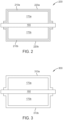
- FIG. 2 illustrates a cross-sectional view of one implementation of an anode electrode structure 200 formed according to implementations described herein. Note in FIG. 2 that the anode current collector 160 is shown to extend beyond the stack, although it is not necessary for the anode current collector 160 to extend beyond the stack, the portions extending beyond the stack may be used as tabs. Although the anode electrode structure 200 is depicted as a dual-sided electrode structure, it should be understood that the implementations described herein also apply to single-sided electrode structures.
- the anode electrode structure 200 has the anode current collector 160, anode films 170a, 170b (collectively 170) formed on opposing sides of the anode current collector 160.
- the anode film 170 is a lithium metal film.
- the anode film 170 has a thickness of 20 micrometers or less (e.g., from about 1 micrometer to about 20 micrometer).
- a first protective film 210a, 210b (collectively 210) is formed on each of the anode films 170a, 170b.
- the first protective film 210 is selected from the group comprising a metal chalcogenide film, a dielectric film, a metallic film, a lithium fluoride film, or a combination thereof.
- the first protective film 210 has a thickness in a range of 1 nanometer to 3,000 nanometers (e.g., in the range of 10 nanometers to 600 nanometers; in the range of 50 nanometers to 100 nanometers; in the range of 50 nanometers to 200 nanometers; in the range of 100 nanometers to 150 nanometers). In some implementations, the first protective film 210 has a thickness of 100 nanometers or less (e.g., from about 5 nanometers to 100 nanometers; from about 5 nanometers to about 40 nanometers; from about 10 nanometers to about 20 nanometers; or from about 50 nanometers to about 100 nanometers). In some implementations, as depicted in FIG. 2 , the first protective film 210 coats the exposed surfaces (e.g., top surface and sidewalls) of the anode film 170 extending to contact the anode current collector 160.
- the exposed surfaces e.g., top surface and sidewalls
- a second protective film 220a, 220b (collectively 220) is formed on each on the first protective film(s) 210.
- the second protective film 220 is permeable to at least one of lithium ions and lithium atoms.
- the second protective film 220 is selected from the group comprising lithium fluoride films, metallic films, carbon-containing films, or a combination thereof.
- the second protective film 220 has a thickness in a range of 1 nanometer to 3,000 nanometers (e.g., in the range of 10 nanometers to 600 nanometers; in the range of 50 nanometers to 100 nanometers; in the range of 50 nanometers to 200 nanometers; in the range of 100 nanometers to 150 nanometers).
- the second protective film 220 has a thickness of 100 nanometers or less (e.g., from about 5 nanometers to 100 nanometers; from about 5 nanometers to about 40 nanometers; from about 10 nanometers to about 20 nanometers; or from about 50 nanometers to about 100 nanometers).
- the first protective film 210 is a metal chalcogenide film and the second protective film 220 is a lithium fluoride film. In some implementations, the first protective film 210 is a dielectric film and the second protective film 220 is a lithium fluoride film. In some implementations, the first protective film 210 is a metal chalcogenide film and the second protective film 220 is a metallic film.
- FIG. 3 illustrates a cross-sectional view of one implementation of an anode electrode structure 300 formed according to implementations described herein. Note in FIG. 3 that the anode current collector 160 is shown to extend beyond the stack, although it is not necessary for the anode current collector 160 to extend beyond the stack, the portions extending beyond the stack may be used as tabs. Although the anode electrode structure 300 is depicted as a dual-sided electrode structure, it should be understood that the implementations described herein also apply to single-sided electrode structures.
- the anode electrode structure 300 has the anode current collector 160, anode films 170a, 170b (collectively 170) formed on opposing sides of the anode current collector 160.
- the anode film 170 is a lithium metal film.
- the anode film 170 has a thickness of 20 micrometers or less (e.g., from about 1 micrometer to about 20 micrometer).
- a carbon-containing protective film 310a, 310b (collectively 310) is formed on each of the anode films 170a, 170b.
- the carbon-containing protective film 310 is selected from the group comprising amorphous carbon films (e.g., diamond-like carbon (DLC)), CVD diamond films, graphite films, and graphene oxides.
- the carbon protective film 310 has a thickness of 500 nanometers or less (e.g., from about 1 nm to about 400 nm; from about 25 nm to about 300 nm; from about 50 nm to about 200 nm; from about 100 nm to about 150 nm; from about 10 nm to about 80 nm; or from about 30 to about 60 nanometers).
- the carbon protective film 310 has a thickness of 100 nanometers or less (e.g., from about 5 nanometers to 100 nanometers; from about 5 nanometers to about 40 nanometers; from about 10 nanometers to about 20 nanometers; or from about 50 nanometers to about 100 nanometers).
- the carbon-containing protective film 310 coats the exposed surfaces (e.g., top surface and sidewalls) of the anode film 170 extending to contact the anode current collector 160.
- FIG. 4 illustrates a process flow chart summarizing one implementation of a method 400 for forming an anode electrode structure according to implementations described herein.
- the anode electrode structure may be the anode electrode structure 200 depicted in FIG. 2 .
- a substrate is provided.
- the substrate is a continuous sheet of material 650 as shown in FIG. 6 .
- the substrate is the anode current collector 160.
- metals that the substrate may be comprised of include aluminum (Al), copper (Cu), zinc (Zn), nickel (Ni), cobalt (Co), manganese (Mn), chromium (Cr), stainless steel, clad materials, alloys thereof, and a combination thereof.
- the substrate is copper material.
- the substrate is a stainless steel material.
- the substrate is perforated.
- the substrate may be of any form factor (e.g., metallic foil, sheet, or plate), shape and micro/macro structure.
- the substrate is exposed to a pretreatment process, which includes at least one of a plasma treatment or corona discharge process to remove organic materials from the exposed surfaces of the current collector.
- the pretreatment process is performed prior to film deposition on the substrate.
- a lithium metal film is formed on the substrate.
- the lithium metal film is the anode film 170 and the substrate is the anode current collector 160.
- the lithium metal film is formed on a copper current collector.
- the lithium metal film is formed on the anode film. If the anode film 170 is not present, the lithium metal film may be formed directly on the substrate. Any suitable lithium metal film deposition process for depositing thin films of lithium metal may be used to deposit the thin film of lithium metal.
- Deposition of the thin film of lithium metal may be by PVD processes, such as evaporation (e.g., thermal evaporation or e-beam), a slot-die process, a transfer process, or a three-dimensional lithium printing process.
- the chamber for depositing the thin film of lithium metal may include a PVD system, such as an electron-beam evaporator, a thermal evaporator, or a sputtering system, a thin film transfer system (including large area pattern printing systems such as gravure printing systems) or a slot-die deposition system.
- a first protective film is formed on the lithium metal film.
- the first protective film may be the first protective film 210 and the lithium metal film may be anode film 170.
- the first protective film 210 is selected from the group comprising a metal chalcogenide film, a dielectric film, a metallic film, a lithium fluoride film, or a combination thereof.
- the first protective film 210 has a thickness in a range of 1 nanometer to 3,000 nanometers (e.g., in the range of 10 nanometers to 600 nanometers; in the range of 50 nanometers to 100 nanometers; in the range of 50 nanometers to 200 nanometers; in the range of 100 nanometers to 150 nanometers).
- the first protective film 210 has a thickness of 500 nanometers or less (e.g., from about 1 nm to about 400 nm; from about 25 nm to about 300 nm; from about 50 nm to about 200 nm; from about 100 nm to about 150 nm; from about 10 nm to about 80 nm; or from about 30 to about 60 nanometers). In some implementations, the first protective film 210 has a thickness of 100 nanometers or less (e.g., from about 5 nanometers to 100 nanometers; from about 10 nanometers to about 20 nanometers; or from about 50 nanometers to about 100 nanometers).
- the first protective film 210 is a metal chalcogenide film.
- the metal chalcogenide film is deposited using a PVD process having an RF power source coupled to a target.
- the target is typically composed of the materials of the metal chalcogenide film.
- the target is a bismuth-telluride alloy target.
- the bismuth-telluride alloy target comprises from about 5 at. % to about 95 at.% bismuth and from about 5 at.% to about 95 at. % tellurium.
- the plasma may be generated from a non-reactive gas such as argon (Ar), krypton (Kr), nitrogen, etc.
- a plasma may be generated from argon gas having a flow rate within a range from about 30 standard cubic centimeters (sccm) to about 200 sccm, such as about 100 sccm to about 150 sccm.
- An RF power may be applied to the target at a power level within a range from about 50 W to about 4,000 W, for example, about 1000 W to about 3000 W, such as about 2000 W.
- the deposition chamber may be pressurized from about 0.1 mTorr to about 500 mTorr.
- the deposition chamber may be pressurized from about 0.1 mTorr to about 100 mTorr, for example, from about 10 mTorr to about 30 mTorr, such as 25 mTorr.
- the substrate may be electrically "floating" and have no bias.
- the deposition process of operation 430 may be performed at a deposition temperature from about 50 °C to about 400 °C, for example, from about 100 °C to about 200 °C, such as about 120 °C.
- the plasma may be generated using a DC power source coupled to bismuth-telluride alloy target.
- the substrate may be electrically "floating" and have no bias.
- plasma may be generated from an argon gas having a flow rate within a range from about 30 standard cubic centimeters (sccm) to about 200 sccm, such as about 100 sccm to about 150 sccm.
- a DC power may be applied to the target at a power level within a range from about 50 W to about 5,000 W, from about 1000 W to about 3000 W, for example between about 1000 W to about 2000 W, such as about 2000 W.
- the deposition chamber may be pressurized from about 0.1 mTorr to about 500 mTorr.
- the deposition chamber may be pressurized from about 0.1 mTorr to about 500 mTorr.
- the deposition chamber may be pressurized from about 0.1 mTorr to about 100 mTorr, for example, from about 10 mTorr to about 30 mTorr, such as 25 mTorr.
- the substrate may be electrically "floating" and have no bias.
- the deposition process of operation 430 may be performed at a deposition temperature from about 50 °C to about 400 °C, for example, from about 100 °C to about 200 °C, such as about 120 °C.
- the first protective film 210 is a dielectric.
- Suitable methods for depositing the dielectric film include, but are not limited to, PVD, such as evaporation or sputtering, a slot-die process, a thin-film transfer process, a chemical vapor deposition (CVD) process, or a three-dimensional lithium printing process.
- a second protective film is formed on the first protective film.
- the second protective film may be the second protective film 220 and the first protective film may be the first protective film 210.
- the second protective film 220 is selected from the group comprising a lithium fluoride film, a metal film, a carbon-containing film, or a combination thereof.
- the second protective film 220 has a thickness in a range of 1 nanometer to 3,000 nanometers (e.g., in the range of 10 nanometers to 600 nanometers; in the range of 50 nanometers to 100 nanometers; in the range of 50 nanometers to 200 nanometers; in the range of 100 nanometers to 150 nanometers).
- the second protective film 220 has a thickness of 500 nanometers or less (e.g., from about 1 nm to about 400 nm; from about 25 nm to about 300 nm; from about 50 nm to about 200 nm; from about 100 nm to about 150 nm; from about 10 nm to about 80 nm; or from about 30 to about 60 nanometers). In some implementations, the second protective film 220 has a thickness of 100 nanometers or less (e.g., from about 5 nanometers to 100 nanometers; from about 10 nanometers to about 20 nanometers; or from about 50 nanometers to about 100 nanometers).
- the second protective film 220 is a lithium fluoride film.
- Suitable methods for depositing the lithium fluoride film include, but are not limited to, PVD, such as evaporation or sputtering, a slot-die process, a thin-film transfer process, a chemical vapor deposition (CVD) process, or a three-dimensional lithium printing process.
- PVD is the method for deposition of the lithium fluoride film.
- the lithium fluoride film is deposited using a thermal evaporation process.
- the lithium fluoride film is deposited using an e-beam evaporation process.
- the second protective film 220 is a metal film.
- the metal film is a copper film, a bismuth film, a tin film, a gallium film, or a germanium film.
- the metal film is an ultra-thin metal film. Any suitable metal film deposition process for depositing thin films of metal may be used to deposit the thin film of metal. Deposition of the thin film of metal may be by a PVD process, such as evaporation (e.g., thermal or e-beam), a CVD process, a slot-die process, a transfer process, or a three-dimensional lithium printing process.
- PVD process such as evaporation (e.g., thermal or e-beam), a CVD process, a slot-die process, a transfer process, or a three-dimensional lithium printing process.
- the chamber for depositing the thin film of metal may include a PVD system, such as an electron-beam evaporator, a thermal evaporator, or a sputtering system, a thin film transfer system (including large area pattern printing systems such as gravure printing systems) or a slot-die deposition system.
- a PVD system such as an electron-beam evaporator, a thermal evaporator, or a sputtering system
- a thin film transfer system including large area pattern printing systems such as gravure printing systems
- slot-die deposition system such as a slot-die deposition system.
- FIG. 5 illustrates a process flow chart summarizing one implementation of a method 500 for forming an anode electrode structure according to one or more implementations described herein.
- the anode electrode structure may be the anode electrode structure 300 depicted in FIG. 3 .
- a substrate is provided.
- the substrate is a continuous sheet of material 650 as shown in FIG. 6 .
- the substrate is the anode current collector 160.
- metals that the substrate may be comprised of include aluminum (Al), copper (Cu), zinc (Zn), nickel (Ni), cobalt (Co), manganese (Mn), chromium (Cr), stainless steel, clad materials, alloys thereof, and a combination thereof.
- the substrate is copper material. In one implementation, the substrate is stainless steel. In one implementation, the substrate is perforated. Furthermore, the substrate may be of any form factor (e.g., metallic foil, sheet, or plate), shape and micro/macro structure.
- the substrate is exposed to a pretreatment process, which includes at least one of a plasma treatment or corona discharge process to remove organic materials from the exposed surfaces of the current collector.
- the pretreatment process is performed prior to film deposition on the substrate.
- a lithium metal film is formed on the substrate.
- the lithium metal film is the anode film 170 and the substrate is the anode current collector 160.
- the lithium metal film is formed on a copper current collector.
- the lithium metal film is formed on the anode film. If the anode film 170 is not present, the lithium metal film may be formed directly on the substrate. Any suitable lithium metal film deposition process for depositing thin films of lithium metal may be used to deposit the thin film of lithium metal. Deposition of the thin film of lithium metal may be by PVD processes, such as evaporation, a slot-die process, a transfer process, or a three-dimensional lithium printing process.
- the chamber for depositing the thin film of lithium metal may include a PVD system, such as an electron-beam evaporator, a thermal evaporator, or a sputtering system, a thin film transfer system (including large area pattern printing systems such as gravure printing systems) or a slot-die deposition system.
- a PVD system such as an electron-beam evaporator, a thermal evaporator, or a sputtering system
- a thin film transfer system including large area pattern printing systems such as gravure printing systems
- slot-die deposition system such as a slot-die deposition system.
- a carbon-containing protective film is formed on the lithium metal film.
- the carbon-containing protective film may be the carbon-containing protective film 310 and the lithium metal film may be the anode film 170.
- the carbon-containing protective film 310 is selected from the group comprising amorphous carbon films (e.g., diamond-like carbon (DLC)), CVD diamond films, graphite films, and graphene oxides.
- amorphous carbon films e.g., diamond-like carbon (DLC)
- CVD diamond films e.g., graphite films, and graphene oxides.
- the carbon-containing protective film 310 has a thickness of 500 nanometers or less (e.g., from about 1 nm to about 400 nm; from about 25 nm to about 300 nm; from about 50 nm to about 200 nm; from about 100 nm to about 150 nm; from about 10 nm to about 80 nm; or from about 30 to about 60 nanometers). In one implementation, the carbon-containing protective film 310 has a thickness of 100 nanometers or less (e.g., from about 5 nanometers to 100 nanometers; from about 10 nanometers to about 20 nanometers; or from about 50 nanometers to about 100 nanometers).
- any suitable carbon-containing film deposition process may be used to deposit the carbon-containing protective film.
- Deposition of the carbon-containing film may be by PVD processes, such as evaporation (e.g., thermal or e-beam), a CVD process, a slot-die process, a transfer process, or a three-dimensional lithium printing process.
- the chamber for depositing the carbon-containing film may include a PVD system, such as an electron-beam evaporator, a thermal evaporator, or a sputtering system, a thin film transfer system (including large area pattern printing systems such as gravure printing systems) or a slot-die deposition system.
- FIG. 6 illustrates a schematic view of a flexible substrate coating apparatus 600 for forming anode electrode structures according to implementations described herein.
- the flexible substrate coating apparatus 600 may be a SMARTWEB ® , manufactured by Applied Materials, adapted for manufacturing lithium anode devices according to the implementations described herein. According to typical implementations, the flexible substrate coating apparatus 600 can be used for manufacturing lithium anodes, and particularly for SEI film stacks for lithium anodes.
- the flexible substrate coating apparatus 600 is constituted as a roll-to-roll system including an unwinding module 602, a processing module 604 and a winding module 606.
- the processing module 604 comprises a plurality of processing modules or chambers 610, 620, 630 and 640 arranged in sequence, each configured to perform one processing operation to the continuous sheet of material 650 or web of material.
- the processing chambers 610-640 are radially disposed about a coating drum 655. Arrangements other than radial are contemplated.
- the processing chambers may be positioned in a linear configuration.
- the processing chambers 610-640 are stand-alone modular processing chambers wherein each modular processing chamber is structurally separated from the other modular processing chambers. Therefore, each of the stand-alone modular processing chambers, can be arranged, rearranged, replaced, or maintained independently without affecting each other. Although four processing chambers 610-640 are shown, it should be understood that any number of processing chambers may be included in the flexible substrate coating apparatus 600.
- the processing chambers 610-640 may include any suitable structure, configuration, arrangement, and/or components that enable the flexible substrate coating apparatus 600 to deposit a lithium anode device according to implementations of the present disclosure.
- the processing chambers may include suitable deposition systems including coating sources, power sources, individual pressure controls, deposition control systems, and temperature control.
- the chambers are provided with individual gas supplies.
- the chambers are typically separated from each other for providing a good gas separation.
- the flexible substrate coating apparatus 600 according to implementations described herein is not limited in the number of deposition chambers.
- flexible substrate coating apparatus 600 may include 3, 6, or 12 processing chambers.
- the processing chambers 610-640 typically include one or more deposition units 612, 622, 632, and 642.
- the one or more deposition units as described herein can be selected from a CVD source, a PECVD source and a PVD source.
- the one or more deposition units can include an evaporation source (thermal evaporation or e-beam), a sputter source, such as, a magnetron sputter source, DC sputter source, AC sputter source, pulsed sputter source, radio frequency (RF) sputtering, or middle frequency (MF) sputtering can be provided.
- RF radio frequency
- MF middle frequency
- the one or more deposition units can include an evaporation source.
- the evaporation source is a thermal evaporation source or an electron beam evaporation.
- the evaporation source is a lithium (Li) source.
- the evaporation source may also be an alloy of two or more metals.
- the material to be deposited e.g., lithium
- the lithium can be provided in a crucible.
- the lithium can, for example, be evaporated by thermal evaporation techniques or by electron beam evaporation techniques.
- any of the processing chambers 610-640 of the flexible substrate coating apparatus 600 may be configured for performing deposition by sputtering, such as magnetron sputtering.
- magnet sputtering refers to sputtering performed using a magnet assembly, that is, a unit capable of a generating a magnetic field.
- a magnet assembly includes a permanent magnet.
- This permanent magnet is typically arranged within a rotatable target or coupled to a planar target in a manner such that the free electrons are trapped within the generated magnetic field generated below the rotatable target surface.
- Such a magnet assembly may also be arranged coupled to a planar cathode.
- Magnetron sputtering may also be realized by a double magnetron cathode, such as, but not limited to, a TwinMag TM cathode assembly.
- the cathodes in the processing chamber may be interchangeable.
- a modular design of the apparatus is provided which facilitates optimizing the apparatus for particular manufacturing processes.
- the number of cathodes in a chamber for sputtering deposition is chosen for optimizing an optimal productivity of the flexible substrate coating apparatus 600.
- one or some of the processing chambers 610-640 may be configured for performing sputtering without a magnetron assembly.
- one or some of the chambers may be configured for performing deposition by other methods, such as, but not limited to, chemical vapor deposition, atomic laser deposition or pulsed laser deposition.
- one or some of the chambers may be configured for performing a plasma treatment process, such as a plasma oxidation or plasma nitridation process.
- the processing chambers 610-640 are configured to process both sides of the continuous sheet of material 650.
- the flexible substrate coating apparatus 600 is configured to process the continuous sheet of material 650, which is horizontally oriented, the flexible substrate coating apparatus 600 may be configured to process substrates positioned in different orientations, for example, the continuous sheet of material 650 may be vertically oriented.
- the continuous sheet of material 650 is a flexible conductive substrate.
- the continuous sheet of material 650 includes a conductive substrate with one or more layers formed thereon.
- the conductive substrate is a copper substrate.
- the flexible substrate coating apparatus 600 comprises a transfer mechanism 652.
- the transfer mechanism 652 may comprise any transfer mechanism capable of moving the continuous sheet of material 650 through the processing region of the processing chambers 610-640.
- the transfer mechanism 652 may comprise a common transport architecture.
- the common transport architecture may comprise a reel-to-reel system with a common take-up reel 654 positioned in the winding module 606, the coating drum 655 positioned in the processing module 604, and a feed reel 656 positioned in the unwinding module 602.
- the take-up reel 654, the coating drum 655, and the feed reel 656 may be individually heated.
- the take-up reel 654, the coating drum 655 and the feed reel 656 may be individually heated using an internal heat source positioned within each reel or an external heat source.
- the common transport architecture may further comprise one or more auxiliary transfer reels 653a, 653b (collectively 653)positioned between the take-up reel 654, the coating drum 655, and the feed reel 656.
- auxiliary transfer reels 653a, 653b collectively 653
- the flexible substrate coating apparatus 600 is depicted as having a single processing region, in some implementations, it may be advantageous to have separated or discrete processing regions for each individual processing chamber 610-640.
- the common transport architecture may be a reel-to-reel system where each chamber or processing region has an individual take-up-reel and feed reel and one or more optional intermediate transfer reels positioned between the take-up reel and the feed reel.
- the flexible substrate coating apparatus 600 may comprise the feed reel 656 and the take-up reel 654 for moving the continuous sheet of material 650 through the different processing chambers 610-640.
- the first processing chamber 610 and the second processing chamber 620 are each configured to deposit a portion of a lithium metal film.
- the third processing chamber 630 is configured to deposit a chalcogenide film.
- the fourth processing chamber 640 is configured to deposit a lithium fluoride film over the chalcogenide film.
- the first processing chamber 610 and the second processing chamber 620 are each configured to deposit a portion of a lithium metal film.
- the third processing chamber 630 is configured to deposit a dielectric film.
- the fourth processing chamber 640 is configured to deposit a lithium fluoride film over the dielectric film.
- the first processing chamber 610 and the second processing chamber 620 are each configured to deposit a portion of a lithium metal film.
- the third processing chamber 630 is configured to deposit a chalcogenide film.
- the fourth processing chamber 640 is configured to deposit a metallic film over the chalcogenide film.
- the first processing chamber 610 and the second processing chamber 620 are each configured to deposit a portion of a lithium metal film.
- the third processing chamber 630 is configured to deposit a metallic film over the lithium metallic film.
- the fourth processing chamber 640 is configured to deposit a lithium fluoride film over the metallic film.
- processing chambers 610-620 are configured for depositing a thin film of lithium metal on the continuous sheet of material 650.
- Any suitable lithium deposition process for depositing thin films of lithium metal may be used to deposit the thin film of lithium metal.
- Deposition of the thin film of lithium metal may be by PVD processes, such as evaporation (e.g., thermal evaporation or e-beam), a slot-die process, a transfer process, a lamination process or a three-dimensional lithium printing process.
- the chambers for depositing the thin film of lithium metal may include a PVD system, such as a thermal evaporator, an electron-beam evaporator, a thin film transfer system (including large area pattern printing systems such as gravure printing systems), a lamination system, or a slot-die deposition system.
- a PVD system such as a thermal evaporator, an electron-beam evaporator, a thin film transfer system (including large area pattern printing systems such as gravure printing systems), a lamination system, or a slot-die deposition system.
- the third processing chamber 630 is configured for depositing a chalcogenide film on the lithium metal film.
- the chalcogenide film may be deposited using a PVD sputtering technique as described herein.
- the fourth processing chamber 640 is configured for forming a lithium fluoride film on the chalcogenide film.
- Any suitable lithium deposition process for depositing thin films of lithium metal may be used to deposit the thin film of lithium metal. Deposition of the thin film of lithium metal may be by PVD processes, such as evaporation, a slot-die process, a transfer process, a lamination process or a three-dimensional lithium printing process.
- the fourth processing chamber 640 is an evaporation chamber or PVD chamber configured to deposit a lithium fluoride film over the continuous sheet of material 650.
- the evaporation chamber has a processing region that is shown to comprise an evaporation source that may be placed in a crucible, which may be a thermal evaporator or an electron beam evaporator (cold) in a vacuum environment, for example.
- the continuous sheet of material 650 is unwound from the feed reel 656 as indicated by the substrate movement direction shown by arrow 608.
- the continuous sheet of material 650 may be guided via one or more auxiliary transfer reels 653a, 653b. It is also possible that the continuous sheet of material 650 is guided by one or more substrate guide control units (not shown) that shall control the proper run of the flexible substrate, for instance, by fine adjusting the orientation of the flexible substrate.
- the continuous sheet of material 650 is then moved through the deposition areas provided at the coating drum 655 and corresponding to positions of the deposition units 612, 622, 632, and 642.
- the coating drum 655 rotates around axis 651 such that the flexible substrate moves in the direction of arrow 608.
- some of the benefits of the present disclosure include the efficient integration of lithium metal deposition into currently available processing systems.
- lithium metal deposition is performed in a dry room or an argon gas atmosphere. Due to the volatility of lithium metal, subsequent processing operations are performed in an argon gas atmosphere. Performance of subsequent processing operations in an argon gas atmosphere would involve retrofitting of current manufacturing tools. It has been found by the inventors that coating the lithium metal with a protective film prior to subsequent processing, allows subsequent processing to be performed either under vacuum or in atmosphere.
- the protective film eliminates the need to perform additional processing operations in an inert gas atmosphere reducing the complexity of tools.
- the protective film also allows for the transportation, storage, or both of the negative electrode with the lithium metal film formed thereon.
- the ion-conducting film can be incorporated into the final battery structure reducing the complexity of the battery formation process. This reduces the complexity of the tool and subsequently reduces the cost of ownership.
Landscapes
- Chemical & Material Sciences (AREA)
- Chemical Kinetics & Catalysis (AREA)
- Engineering & Computer Science (AREA)
- General Chemical & Material Sciences (AREA)
- Electrochemistry (AREA)
- Materials Engineering (AREA)
- Manufacturing & Machinery (AREA)
- Inorganic Chemistry (AREA)
- Mechanical Engineering (AREA)
- Metallurgy (AREA)
- Organic Chemistry (AREA)
- Physics & Mathematics (AREA)
- General Physics & Mathematics (AREA)
- Condensed Matter Physics & Semiconductors (AREA)
- Battery Electrode And Active Subsutance (AREA)
- Secondary Cells (AREA)
- Cell Electrode Carriers And Collectors (AREA)
Description
- Implementations described herein generally relate to metal electrodes, more specifically lithium-containing anodes, high performance electrochemical devices, such as primary and secondary electrochemical devices, including the aforementioned lithium-containing electrodes, and methods for fabricating the same.
- Rechargeable electrochemical storage systems are currently becoming increasingly valuable for many fields of everyday life. High-capacity electrochemical energy storage devices, such as lithium-ion (Li-ion) batteries, are used in a growing number of applications, including portable electronics, medical, transportation, grid-connected large energy storage, renewable energy storage, and uninterruptible power supply (UPS). Traditional lead/sulfuric acid batteries often lack the capacitance and are often inadequately cyclable for these growing applications. Both lithium-ion and subsequently, solid-state batteries, are thought to provide the best options for meeting increasing performance demands.
- Lithium provides an exceptional anode material for both lithium-ion and solid-state batteries. Lithium is a light alkali metal with a high voltage and theoretical capacity. However, like the heavy element homologs of the first main group, lithium is characterized by a strong reactivity with a variety of substances. Lithium reacts violently with water, alcohols and other substances that contain protic hydrogen, often resulting in ignition. Lithium is unstable in air and reacts with oxygen, nitrogen and carbon dioxide. Lithium is normally handled under an inert gas atmosphere (noble gases such as argon) and the strong reactivity of lithium necessitates that other processing operations also be performed in an inert gas atmosphere. As a result, lithium provides several challenges when it comes to processing, storage, and transportation.
- Protective surface treatments have been developed for lithium metal. One method of protective surface treatment of lithium metal includes coating the lithium metal with a wax layer, for example, polyethylene wax. However, a large amount of coating agent is typically applied which interferes with subsequent processing of the lithium metal film.
- Another method of protective surface treatment proposes producing stabilized lithium metal powder ("SLMP") with a continuous carbonate coating, polymer coating, for example, polyurethanes, PTFE, PVC, polystyrene and others. However, these polymer coatings can cause problems when prelithiating electrode materials.
WO 2019/060196 A1 describes an anode electrode structure comprising a current collector comprising copper, a lithium metal film formed on the current collector, a copper film formed on the lithium metal film, and a protective film formed on the copper film.KR 20180062963 A WO 2019/094124 A1 , which is a document according to Art. 54 (3) EPC, describes an anode electrode structure comprising a current collector comprising copper with a lithium metal film formed on the current collector. - Therefore, there is a need for methods and systems for the deposition and processing of lithium metals in energy storage systems.
- The invention is defined by the appended set of claims. Implementations described herein generally relate to metal electrodes, more specifically lithium-containing anodes, high performance electrochemical devices, such as primary and secondary electrochemical devices, including the aforementioned lithium-containing electrodes, and methods for fabricating the same. In one implementation, a method is provided. The method comprises forming a lithium metal film on a current collector. The current collector comprises copper and/or stainless steel. The method further comprises forming a protective film stack on the lithium metal film, comprising forming a first protective film on the lithium metal film. The first protective film is selected from a tin chalcogenide film, a gallium chalcogenide film, a germanium chalcogenide film, an indium chalcogenide film, a silver chalcogenide film, a dielectric film, or a combination thereof. The method further comprises forming a second protective film on the first protective film, the second protective film selected from a lithium fluoride (LiF) film, a metallic film, a carbon-containing film, or a combination thereof.
- In another implementation, an anode electrode structure is provided. The anode electrode structure comprises a current collector comprising copper and/or stainless steel, a lithium metal film formed on the current collector, and a protective film stack formed on the lithium metal film. The protective film stack comprises a first protective film formed on the lithium metal film. The first protective film is selected from a tin chalcogenide film, a gallium chalcogenide film, a germanium chalcogenide film, an indium chalcogenide film, a silver chalcogenide film, a dielectric film, or a combination thereof. The protective film stack further comprises a second protective film formed on the first protective film. The second protective film is selected from a lithium fluoride (LiF) film, a metallic film, a carbon-containing film, or a combination thereof.
- So that the manner in which the above-recited features of the present disclosure can be understood in detail, a more particular description of the implementations, briefly summarized above, may be had by reference to implementations, some of which are illustrated in the appended drawings. It is to be noted, however, that the appended drawings illustrate only typical implementations of this disclosure and are therefore not to be considered limiting of its scope, for the disclosure may admit to other equally effective implementations.
-
FIG. 1 illustrates a schematic cross-sectional view of one implementation of an energy storage device incorporating an electrode structure formed according to one or more implementations described herein; -
FIG. 2 illustrates a cross-sectional view of one implementation of a dual-sided anode electrode structure formed according to one or more implementations described herein; -
FIG. 3 illustrates a cross-sectional view of one implementation of a dual-sided anode electrode structure formed according to one or more implementations described herein; -
FIG. 4 illustrates a process flow chart summarizing one implementation of a method for forming an anode electrode structure according to one or more implementations described herein; -
FIG. 5 illustrates a process flow chart summarizing one implementation of a method for forming an anode electrode structure according to one or more implementations described herein; and -
FIG. 6 illustrates a schematic view of an integrated processing tool for forming anode electrode structures according to one or more implementations described herein. - To facilitate understanding, identical reference numerals have been used, where possible, to designate identical elements that are common to the figures. It is contemplated that elements and features of one implementation may be beneficially incorporated in other implementations without further recitation.
- The following disclosure describes anode electrodes, high performance electrochemical cells and batteries including the aforementioned anode electrodes, and methods for fabricating the same. Certain details are set forth in the following description and in
FIGS. 1-6 to provide a thorough understanding of various implementations of the disclosure. Other details describing well-known structures and systems often associated with electrochemical cells and batteries are not set forth in the following disclosure to avoid unnecessarily obscuring the description of the various implementations. - Many of the details, dimensions, angles and other features shown in the Figures are merely illustrative of particular implementations. Accordingly, other implementations can have other details, components, dimensions, angles and features without departing from the spirit or scope of the present disclosure. In addition, further implementations of the disclosure can be practiced without several of the details described below.
- Implementations described herein will be described below in reference to a reel-to-reel coating system, such as TopMet™, SMARTWEB®, TopBeam™, all of which are available from Applied Materials, Inc. of Santa Clara, California. Other tools capable of performing vapor deposition processes (e.g., physical vapor deposition (PVD) processes, chemical vapor deposition (CVD) processes, atomic layer deposition (ALD) processes) may also be adapted to benefit from the implementations described herein. In addition, any system enabling the vapor deposition processes described herein can be used to advantage. The apparatus description described herein is illustrative and should not be construed or interpreted as limiting the scope of the implementations described herein. It should also be understood that although described as a reel-to-reel process, the implementations described herein may also be performed on discrete substrates. In some implementations, the reel-to-reel coating systems can be combined to form device stack.
- As described herein, flexible substrates can be considered to include among other things, films, foils, webs, strips of plastic material, metal, paper, or other materials. Typically, the terms "web," "foil," "strip," "substrate" and the like are used synonymously.
- Energy storage devices, for example, Li-ion batteries, typically include a positive electrode (e.g., cathode), and a negative electrode separated by a polymer separator with a liquid electrolyte. Solid-state batteries also typically include a positive electrode (e.g., cathode) and a negative electrode (e.g., anode) but replace both the polymer separator and the liquid electrolyte with an ion-conducting material.
- Graphite anodes are the current state of the art but the industry is moving from the graphite based anode to silicon blended graphite anodes to increase cell energy density. However, silicon blended graphite anodes often suffer from irreversible capacity loss that occurs during the first cycle. Thus, there is a need for methods for replenishing this first cycle capacity loss. The current generation of batteries uses graphite anodes, a porous polymer separator, and a liquid electrolyte. The liquid electrolyte typically includes additives, which form a solid electrolyte interface (SEI) in-situ during formation on the electrode. The SEI helps determine cycle life of the battery. The energy density of the state of the art graphite anode based battery is limited to around 650 Wh/I. The energy density of a silicon powder blended graphite anode will help boost the energy density to greater than 700 Wh/I. There is a need for manufacturing technology to compensate for first cycle irreversible capacity loss of lithium associated with silicon anodes. Thus, the ability to use lithium in next generation batteries including both Li-ion batteries and solid-state batteries becomes increasingly substantial. However, lithium technology presents significant device integration challenges such as handling lithium in dry room ambient, suitable surface protection technology, and the need to suppress or eliminate lithium metal dendrite during battery cycling. From the electrochemical device perspective, an interface material, which not only helps to prevent surface from oxidation but also should help in improving device performance is desirable.
- Using the implementations described herein, the deposited lithium metal, either single-sided or dual-sided, can be protected during winding and unwinding of the reels downstream. Deposition of one or more thin protective films as described herein has several advantages. In some implementations, the one or more protective films described herein provide adequate surface protection for shipping, handling, and storage as well as avoiding surface reactions of lithium during device integration. In some implementations, the one or more protective films described herein are compatible with lithium ions and reduce impedance for ions to move across. In some implementations, the one or more protective films described herein are ion-conducting and thus may be incorporated into the formed energy storage device. In some implementations, the one or more protective films described herein can also help suppress or eliminate lithium dendrites, especially at high current density operation. In some implementations, the use of protective films described herein reduces the complexity of manufacturing systems and is compatible with current manufacturing systems.
-
FIG. 1 illustrates a schematic cross-sectional view of one implementation of anenergy storage device 100 incorporating an anode electrode structure formed according to implementations described herein. Theenergy storage device 100 may be a solid-state energy storage device or a lithium-ion based energy storage device. Theenergy storage device 100, even though shown as a planar structure, may also be formed into a cylinder by rolling the stack of layers; furthermore, other cell configurations (e.g., prismatic cells, button cells, or stacked electrode cells) may be formed. Theenergy storage device 100 includes ananode electrode structure 110 and acathode electrode structure 120 with a solid-electrolyte film 130 positioned therebetween. In implementations where theenergy storage device 100 is a Li-ion energy storage device, the solid-electrolyte film is replaced with a polymer separator and a liquid electrolyte. Thecathode electrode structure 120 includes a cathodecurrent collector 140 and acathode film 150. Theanode electrode structure 110 includes an anodecurrent collector 160, ananode film 170, and one or more protective film(s) 180. The one or more protective film(s) 180 include at least one or more of a lithium fluoride (LiF) film; a dielectric or ceramic film (e.g., oxides of titanium (Ti), aluminum (Al), niobium (Nb), tantalum (Ta), zirconium (Zr), or a combination thereof); one or more metal film(s) (e.g., tin (Sn), antimony (Sb), bismuth (Bi), gallium (Ga), germanium (Ge), copper films, silver films, gold films, or a combination thereof); a tin chalcogenide film (e.g., SnTe, SnSe, SnSe2, SnS), a gallium chalcogenide film (e.g., GaS, Ga2S3, GaSe, Ga2Se3, GaTe), a germanium chalcogenide film (GeTe, GeSe, GeS), an indium chalcogenide film (e.g., InS, In6S7, In2S3, InSe, InS4Se3, In6Se7, In2Se3, InTe, In4Te3, In3Te4, In7Te10, In2Te3, In2Te5), a silver chalcogenide film (Ag2Se, Ag2S, Ag2Te), boron nitride, lithium nitrate, lithium borohydride, and a combination thereof; and a carbon-containing film. - The
cathode electrode structure 120 includes the cathodecurrent collector 140 with thecathode film 150 formed on the cathodecurrent collector 140. It should be understood that thecathode electrode structure 120 may include other elements or films. - The
current collectors cathode film 150 and theanode film 170, respectively, can be identical or different electronic conductors. In some implementations, at least one of thecurrent collectors current collectors current collectors current collectors current collector 160 is a polymer substrate (e.g., a PET film) coated with copper. In another implementation, the anodecurrent collector 160 is a multi-metal layer on a polymer substrate. The multi-metal layer can be combinations of copper, chromium, nickel, etc. In one implementation, the anodecurrent collector 160 is a multi-layer structure that includes a copper-nickel cladding material. In one implementation, the multi-layer structure includes a first layer of nickel or chromium, a second layer of copper formed on the first layer, and a third layer including nickel, chromium, or both formed on the second layer. In one implementation, the anodecurrent collector 160 is nickel coated copper. Furthermore, current collectors may be of any form factor (e.g., metallic foil, sheet, or plate), shape and micro/macro structure. - Generally, in prismatic cells, tabs are formed of the same material as the current collector and may be formed during fabrication of the stack, or added later. In some implementations, the current collectors extend beyond the stack and the portions of the current collector extending beyond the stack may be used as tabs. In one implementation, the cathode
current collector 140 is aluminum. In another implementation, the cathodecurrent collector 140 comprises aluminum deposited on a polymer substrate (e.g., a PET film). In one implementation, the cathodecurrent collector 140 has a thickness below 50 µm more specifically, 5 µm or, even more specifically 2 µm. In one implementation, the cathodecurrent collector 140 has a thickness from about 0.5 µm to about 20 µm (e.g., from about 1 µm to about 10 µm; from about 2 µm to about 8 µm; or from about 5 µm to about 10 µm). In one implementation, the anodecurrent collector 160 is copper. In one implementation, the anodecurrent collector 160 is stainless steel. In one implementation, the anodecurrent collector 160 has a thickness below 50 µm more specifically, 5 µm or, even more specifically 2 µm. In one implementation, the anodecurrent collector 160 has a thickness from about 0.5 µm to about 20 µm (e.g., from about 1 µm to about 10 µm; from about 2 µm to about 8 µm; from about 6 µm to about 12 µm; or from about 5 µm to about 10 µm). - The
cathode film 150 or cathode may be any material compatible with the anode and may include an intercalation compound, an insertion compound, or an electrochemically active polymer. Suitable intercalation materials include, for example, lithium-containing metal oxides, MoS2, FeS2, BiF3, Fe2OF4, MnO2, TiS2, NbSe3, LiCoOz, LiNiO2, LiMnO2, LiMn2O4, V6O13 and V2O5. Suitable polymers include, for example, polyacetylene, polypyrrole, polyaniline, and polythiophene. Thecathode film 150 or cathode may be made from a layered oxide, such as lithium cobalt oxide, an olivine, such as lithium iron phosphate, or a spinel, such as lithium manganese oxide. Exemplary lithium-containing oxides may be layered, such as lithium cobalt oxide (LiCoO2), or mixed metal oxides, such as LiNixCo1-2xMnO2, LiNiMnCoO2 ("NMC"), LiNi0.5Mn1.5O4, Li(Ni0.8Co0.15Al0.05)O2, LiMn2O4, and doped lithium rich layered-layered materials, wherein x is zero or a non-zero number. Exemplary phosphates may be iron olivine (LiFePO4) and it is variants (such as LiFe(1-x)MgxPO4), LiMoPO4, LiCoPO4, LiNiPO4, Li3V2(PO4)3, LiVOPO4, LiMP2O7, or LiFe1.5P2O7, wherein x is zero or a non-zero number. Exemplary fluorophosphates may be LiVPO4F, LiAlPO4F, Li5V(PO4)2F2, Li5Cr(PO4)2F2, Li2CoPO4F, or Li2NiPO4F. Exemplary silicates may be Li2FeSiO4, Li2MnSiO4, or Li2VOSiO4. An exemplary non-lithium compound is Na5V2(PO4)2F3. - The
anode electrode structure 110 includes the anodecurrent collector 160 with theanode film 170 formed on the anodecurrent collector 160. The anode electrode structure 110 comprises the one or more protective film(s) 180, which includes at least one or more of a lithium fluoride (LiF) film; a dielectric or ceramic film (e.g., oxides of titanium (Ti), aluminum (Al), niobium (Nb), tantalum (Ta), zirconium (Zr), or a combination thereof); one or more metal film(s) (e.g., tin (Sn), antimony (Sb), bismuth (Bi), gallium (Ga), germanium (Ge), copper films, silver films, gold films, or a combination thereof); a tin chalcogenide film (e.g., SnTe, SnSe, SnSe2, SnS), a gallium chalcogenide film (e.g., GaS, Ga2S3, GaSe, Ga2Se3, GaTe), a germanium chalcogenide film (GeTe, GeSe, GeS), an indium chalcogenide film (e.g., InS, In6S7, In2S3, InSe, InS4Se3, In6Se7, In2Se3, InTe, In4Te3, In3Te4, In7Te10, In2Te3, In2Te5), a silver chalcogenide film (Ag2Se, Ag2S, Ag2Te), boron nitride, lithium nitrate, lithium borohydride, and a combination thereof; and a carbon-containing film. In some implementations, the one or more protective film(s) are ion-conducting films. - The
anode film 170 may be any material compatible with thecathode film 150. Theanode film 170 may have an energy capacity greater than or equal to 372 mAh/g, preferably ≥ 700 mAh/g, and most preferably ≥ 1000 mAh/g. Theanode film 170 may be constructed from graphite, silicon-containing graphite, lithium metal, lithium metal foil or a lithium alloy foil (e.g. lithium aluminum alloys), or a mixture of a lithium metal and/or lithium alloy and materials such as carbon (e.g. coke, graphite), nickel, copper, tin, indium, silicon, oxides thereof, or a combination thereof. Theanode film 170 typically comprises intercalation compounds containing lithium or insertion compounds containing lithium. In some implementations, the anode film is a lithium metal film. In some implementations, wherein theanode film 170 comprises lithium metal, the lithium metal may be deposited using the methods described herein. - In one implementation, the
anode film 170 has a thickness from about 10 µm to about 200 µm (e.g., from about 1 µm to about 100 µm; from about 10 µm to about 30 µm; from about 20 µm to about 30 µm; from about 1 µm to about 20 µm; or from about 50 µm to about 100 µm). - In some implementations, the one or more protective film(s) 180 is formed on the
anode film 170. The one or more protective film(s) 180 includes at least one or more of a lithium fluoride (LiF) film; a dielectric or ceramic film (e.g., oxides of titanium (Ti), aluminum (Al), niobium (Nb), tantalum (Ta), zirconium (Zr), or a combination thereof); one or more metal film(s) (e.g., tin (Sn), antimony (Sb), bismuth (Bi), gallium (Ga), germanium (Ge), copper films, silver films, gold films, or a combination thereof); a tin chalcogenide film (e.g., SnTe, SnSe, SnSe2, SnS), a gallium chalcogenide film (e.g., GaS, Ga2S3, GaSe, Ga2Se3, GaTe), a germanium chalcogenide film (GeTe, GeSe, GeS), an indium chalcogenide film (e.g., InS, In6S7, In2S3, InSe, InS4Se3, In6Se7, In2Se3, InTe, In4Te3, In3Te4, In7Te10, In2Te3, In2Te5), a silver chalcogenide film (Ag2Se, Ag2S, Ag2Te), boron nitride, lithium nitrate, lithium borohydride, and a combination thereof; and a carbon-containing film. In some implementations, the one or more protective film(s) are ion-conducting films. In some implementations, the one or more protective film(s) 180 are permeable to at least one of lithium ions and lithium atoms. The one or more protective film(s) 180 provide surface protection of theanode film 170, which allows for handling of the anode film in a dry room. In some implementations where theenergy storage device 100 is a solid-state energy storage device, the one or more protective film(s) 180 contribute to the formation of an improved SEI layer and thus improve device performance. The one or more protective film(s) 180 can be directly deposited on theanode film 170 by Physical Vapor Deposition (PVD), such as evaporation (e.g., thermal or e-beam) or sputtering, atomic layer deposition (ALD), a slot-die process, dip coating, planar flow melt-spin process, a thin-film transfer process, gravure coating or a three-dimensional lithium printing process. - In some implementations, the one or more protective film(s) 180 include a lithium fluoride (LiF) film.
- In some implementations, the one or more protective film(s) 180 include one or more dielectric film(s). In some implementations, the dielectric film is a ceramic film. In some implementations, the dielectric film is an ion-conducting ceramic film. Suitable dielectric film(s) include but are not limited to titanium oxides (e.g., TiO2), aluminum oxides (e.g., Al2O3, AlOx, AlOxNy), boron nitride, aluminum oxyhydroxide AIO(OH), niobium oxides (e.g., NbO, NbO2, Nb2O5), tantalum oxides (e.g., Ta2O5), zirconium oxides (ZrO2), or a combination thereof. In some implementations, the dielectric film is a binder-free ceramic coating. In some implementations, the dielectric film is a porous aluminum oxide film.
- In some implementations, the one or more protective film(s) 180 include one or more metal film(s). Suitable metal film(s) include but are not limited to tin films, antimony films, bismuth films, gallium films, germanium films, copper, silver, gold, or a combination thereof. The one or more metal film(s) may be an ultra-thin metal seed film.
- In some implementations, the one or more protective film(s) 180 include one or more metal chalcogenide film(s). Suitable chalcogenide films include but are not limited to tin chalcogenides (e.g., SnTe, SnSe, SnSe2, SnS), gallium chalcogenides (e.g., GaS, Ga2S3, GaSe, Ga2Se3, GaTe), germanium chalcogenides (GeTe, GeSe, GeS), indium chalcogenides (e.g., InS, In6S7, In2S3, InSe, InS4Se3, In6Se7, In2Se3, InTe, In4Te3, In3Te4, In7Te10, In2Te3, In2Te5), silver chalcogenides (Ag2Se, Ag2S, Ag2Te), boron nitride, lithium nitrate, lithium borohydride, and a combination thereof.
- In some implementations, the one or more protective film(s) 180 include carbon-containing films. Suitable carbon-containing films include but are not limited to amorphous carbon films (e.g., diamond-like carbon (DLC)), CVD diamond films, graphite films, and graphene oxides.
- In some implementations, each layer of the one or more protective film(s) 180 is a coating or a discrete film having a thickness in a range of 1 nanometer to 3,000 nanometers (e.g., in the range of 10 nanometers to 600 nanometers; in the range of 50 nanometers to 100 nanometers; in the range of 50 nanometers to 200 nanometers; in the range of 100 nanometers to 150 nanometers). In some implementations, each layer of the one or more protective film(s) 180 is a coating or discrete film having a thickness of 500 nanometers or less (e.g., from about 1 nm to about 400 nm; from about 25 nm to about 300 nm; from about 50 nm to about 200 nm; from about 100 nm to about 150 nm; from about 10 nm to about 80 nm; or from about 30 to about 60 nanometers). In some implementations, each layer of the one or more protective film(s) 180 is a coating or discrete film having a thickness of 100 nanometers or less (e.g., from about 5 nanometers to about 100 nanometers; from about 5 nanometers to about 40 nanometers; from about 10 nanometers to about 20 nanometers; or from about 50 nanometers to about 100 nanometers).
- In some implementations, at least one of the one or more protective film(s) 180 is porous. In some implementations, at least one of the one or more protective film(s) 180 has nanopores. In some implementations, at least one of the one or more protective film(s) 180 has a plurality of nanopores that are sized to have an average pore size or diameter less than about 10 nanometers (e.g., from about 1 nanometer to about 10 nanometers; from about 3 nanometers to about 5 nanometers). In another implementation, at least one of the one or more protective film(s) 180 has a plurality of nanopores sized to have an average pore size or diameter less than about 5 nanometers. In one implementation, at least one of the one or more protective film(s) 180 has a plurality of nanopores having a diameter ranging from about 1 nanometer to about 20 nanometers (e.g., from about 2 nanometers to about 15 nanometers; or from about 5 nanometers to about 10 nanometers).
- In some implementations, the solid-
electrolyte film 130 is a lithium-ion conducting material. In some implementations, the lithium-ion conducting material is a lithium-ion conducting ceramic or a lithium-ion conducting glass. The Li-ion conducting material may be comprised of one or more of LiPON, doped variants of either crystalline or amorphous phases of Li7La3Zr2O12, doped anti-perovskite compositions, argyrodite compositions (e.g., Li6PS5Br, Li6PS5Cl, Li7PS6, Li3SBF4, A3-2×0.005Ba0.005OCl (A = alkali metal), Li9.54Si1.74P1.44S11.7Cl0.3, Li6PS5I, Li6PO5Cl), lithium-sulfur-phosphorous materials, (Li0.7Na0.3)3BH4B12H12, Li2S-P2S5, Li10GeP2S12, and Li3PS4, lithium phosphate glasses, (1-x)LiI-(x)Li4SnS4, xLiI(1-x)Li4SnS4, mixed sulfide and oxide electrolytes (crystalline LLZO, amorphous (1-x)LiI-(x)Li4SnS4 mixture, amorphous xLiI-(1-x)Li4SnS4), Li3S(BF4)0.5Cl0.5, Li4Ti5O12, lithium doped lanthanum titanate (LATP), Li2+2xZn1-xGeO4, LiM2(PO4)3 where M = Ti, Ge, Hf, for example. In one implementation, x is between 0 and 1 (e.g., 0.1, 0.2, 0.3, 0.4, 0.5, 0.6, 0.7, 0.8, and 0.9). -
FIG. 2 illustrates a cross-sectional view of one implementation of ananode electrode structure 200 formed according to implementations described herein. Note inFIG. 2 that the anodecurrent collector 160 is shown to extend beyond the stack, although it is not necessary for the anodecurrent collector 160 to extend beyond the stack, the portions extending beyond the stack may be used as tabs. Although theanode electrode structure 200 is depicted as a dual-sided electrode structure, it should be understood that the implementations described herein also apply to single-sided electrode structures. - The
anode electrode structure 200 has the anodecurrent collector 160,anode films current collector 160. In one implementation, theanode film 170 is a lithium metal film. In one implementation, theanode film 170 has a thickness of 20 micrometers or less (e.g., from about 1 micrometer to about 20 micrometer). A firstprotective film anode films FIG. 2 , the first protective film 210 coats the exposed surfaces (e.g., top surface and sidewalls) of theanode film 170 extending to contact the anodecurrent collector 160. - A second
protective film - In some implementations, the first protective film 210 is a metal chalcogenide film and the second protective film 220 is a lithium fluoride film. In some implementations, the first protective film 210 is a dielectric film and the second protective film 220 is a lithium fluoride film. In some implementations, the first protective film 210 is a metal chalcogenide film and the second protective film 220 is a metallic film.
-
FIG. 3 illustrates a cross-sectional view of one implementation of ananode electrode structure 300 formed according to implementations described herein. Note inFIG. 3 that the anodecurrent collector 160 is shown to extend beyond the stack, although it is not necessary for the anodecurrent collector 160 to extend beyond the stack, the portions extending beyond the stack may be used as tabs. Although theanode electrode structure 300 is depicted as a dual-sided electrode structure, it should be understood that the implementations described herein also apply to single-sided electrode structures. - The
anode electrode structure 300 has the anodecurrent collector 160,anode films current collector 160. In one implementation, theanode film 170 is a lithium metal film. In one implementation, theanode film 170 has a thickness of 20 micrometers or less (e.g., from about 1 micrometer to about 20 micrometer). A carbon-containingprotective film anode films FIG. 3 , the carbon-containing protective film 310 coats the exposed surfaces (e.g., top surface and sidewalls) of theanode film 170 extending to contact the anodecurrent collector 160. -
FIG. 4 illustrates a process flow chart summarizing one implementation of amethod 400 for forming an anode electrode structure according to implementations described herein. The anode electrode structure may be theanode electrode structure 200 depicted inFIG. 2 . Atoperation 410, a substrate is provided. In one implementation, the substrate is a continuous sheet ofmaterial 650 as shown inFIG. 6 . In one implementation, the substrate is the anodecurrent collector 160. Examples of metals that the substrate may be comprised of include aluminum (Al), copper (Cu), zinc (Zn), nickel (Ni), cobalt (Co), manganese (Mn), chromium (Cr), stainless steel, clad materials, alloys thereof, and a combination thereof. In one implementation, the substrate is copper material. In one implementation, the substrate is a stainless steel material. In one implementation, the substrate is perforated. Furthermore, the substrate may be of any form factor (e.g., metallic foil, sheet, or plate), shape and micro/macro structure. - In some implementations, the substrate is exposed to a pretreatment process, which includes at least one of a plasma treatment or corona discharge process to remove organic materials from the exposed surfaces of the current collector. The pretreatment process is performed prior to film deposition on the substrate.
- At
operation 420, a lithium metal film is formed on the substrate. In one implementation, the lithium metal film is theanode film 170 and the substrate is the anodecurrent collector 160. In one implementation, the lithium metal film is formed on a copper current collector. In some implementations, if an anode film is already present on the substrate, the lithium metal film is formed on the anode film. If theanode film 170 is not present, the lithium metal film may be formed directly on the substrate. Any suitable lithium metal film deposition process for depositing thin films of lithium metal may be used to deposit the thin film of lithium metal. Deposition of the thin film of lithium metal may be by PVD processes, such as evaporation (e.g., thermal evaporation or e-beam), a slot-die process, a transfer process, or a three-dimensional lithium printing process. The chamber for depositing the thin film of lithium metal may include a PVD system, such as an electron-beam evaporator, a thermal evaporator, or a sputtering system, a thin film transfer system (including large area pattern printing systems such as gravure printing systems) or a slot-die deposition system. - At
operation 430, a first protective film is formed on the lithium metal film. With reference toFIG. 2 , the first protective film may be the first protective film 210 and the lithium metal film may be anodefilm 170. In one implementation, the first protective film 210 is selected from the group comprising a metal chalcogenide film, a dielectric film, a metallic film, a lithium fluoride film, or a combination thereof. In some implementations, the first protective film 210 has a thickness in a range of 1 nanometer to 3,000 nanometers (e.g., in the range of 10 nanometers to 600 nanometers; in the range of 50 nanometers to 100 nanometers; in the range of 50 nanometers to 200 nanometers; in the range of 100 nanometers to 150 nanometers). In some implementations, the first protective film 210 has a thickness of 500 nanometers or less (e.g., from about 1 nm to about 400 nm; from about 25 nm to about 300 nm; from about 50 nm to about 200 nm; from about 100 nm to about 150 nm; from about 10 nm to about 80 nm; or from about 30 to about 60 nanometers). In some implementations, the first protective film 210 has a thickness of 100 nanometers or less (e.g., from about 5 nanometers to 100 nanometers; from about 10 nanometers to about 20 nanometers; or from about 50 nanometers to about 100 nanometers). - In some implementations, the first protective film 210 is a metal chalcogenide film. In some implementations, the metal chalcogenide film is deposited using a PVD process having an RF power source coupled to a target. The target is typically composed of the materials of the metal chalcogenide film. For example, in one implementation, the target is a bismuth-telluride alloy target. In one implementation, the bismuth-telluride alloy target comprises from about 5 at. % to about 95 at.% bismuth and from about 5 at.% to about 95 at. % tellurium. The plasma may be generated from a non-reactive gas such as argon (Ar), krypton (Kr), nitrogen, etc. For example, a plasma may be generated from argon gas having a flow rate within a range from about 30 standard cubic centimeters (sccm) to about 200 sccm, such as about 100 sccm to about 150 sccm. An RF power may be applied to the target at a power level within a range from about 50 W to about 4,000 W, for example, about 1000 W to about 3000 W, such as about 2000 W. The deposition chamber may be pressurized from about 0.1 mTorr to about 500 mTorr. The deposition chamber may be pressurized from about 0.1 mTorr to about 100 mTorr, for example, from about 10 mTorr to about 30 mTorr, such as 25 mTorr. The substrate may be electrically "floating" and have no bias. In one implementation, the deposition process of
operation 430 may be performed at a deposition temperature from about 50 °C to about 400 °C, for example, from about 100 °C to about 200 °C, such as about 120 °C. - In another implementation, the plasma may be generated using a DC power source coupled to bismuth-telluride alloy target. The substrate may be electrically "floating" and have no bias. In this implementation, plasma may be generated from an argon gas having a flow rate within a range from about 30 standard cubic centimeters (sccm) to about 200 sccm, such as about 100 sccm to about 150 sccm. A DC power may be applied to the target at a power level within a range from about 50 W to about 5,000 W, from about 1000 W to about 3000 W, for example between about 1000 W to about 2000 W, such as about 2000 W. The deposition chamber may be pressurized from about 0.1 mTorr to about 500 mTorr. The deposition chamber may be pressurized from about 0.1 mTorr to about 500 mTorr. The deposition chamber may be pressurized from about 0.1 mTorr to about 100 mTorr, for example, from about 10 mTorr to about 30 mTorr, such as 25 mTorr. The substrate may be electrically "floating" and have no bias. The deposition process of
operation 430 may be performed at a deposition temperature from about 50 °C to about 400 °C, for example, from about 100 °C to about 200 °C, such as about 120 °C. - In some implementations, the first protective film 210 is a dielectric. Suitable methods for depositing the dielectric film include, but are not limited to, PVD, such as evaporation or sputtering, a slot-die process, a thin-film transfer process, a chemical vapor deposition (CVD) process, or a three-dimensional lithium printing process.
- At
operation 440, a second protective film is formed on the first protective film. With reference toFIG. 2 , the second protective film may be the second protective film 220 and the first protective film may be the first protective film 210. In one implementation, the second protective film 220 is selected from the group comprising a lithium fluoride film, a metal film, a carbon-containing film, or a combination thereof. In some implementations, the second protective film 220 has a thickness in a range of 1 nanometer to 3,000 nanometers (e.g., in the range of 10 nanometers to 600 nanometers; in the range of 50 nanometers to 100 nanometers; in the range of 50 nanometers to 200 nanometers; in the range of 100 nanometers to 150 nanometers). In some implementations, the second protective film 220 has a thickness of 500 nanometers or less (e.g., from about 1 nm to about 400 nm; from about 25 nm to about 300 nm; from about 50 nm to about 200 nm; from about 100 nm to about 150 nm; from about 10 nm to about 80 nm; or from about 30 to about 60 nanometers). In some implementations, the second protective film 220 has a thickness of 100 nanometers or less (e.g., from about 5 nanometers to 100 nanometers; from about 10 nanometers to about 20 nanometers; or from about 50 nanometers to about 100 nanometers). - In some implementations, the second protective film 220 is a lithium fluoride film. Suitable methods for depositing the lithium fluoride film include, but are not limited to, PVD, such as evaporation or sputtering, a slot-die process, a thin-film transfer process, a chemical vapor deposition (CVD) process, or a three-dimensional lithium printing process. In some implementations, PVD is the method for deposition of the lithium fluoride film. In some implementations, the lithium fluoride film is deposited using a thermal evaporation process. In some implementations, the lithium fluoride film is deposited using an e-beam evaporation process.
- In some implementations, the second protective film 220 is a metal film. In some implementations, the metal film is a copper film, a bismuth film, a tin film, a gallium film, or a germanium film. In some implementations, the metal film is an ultra-thin metal film. Any suitable metal film deposition process for depositing thin films of metal may be used to deposit the thin film of metal. Deposition of the thin film of metal may be by a PVD process, such as evaporation (e.g., thermal or e-beam), a CVD process, a slot-die process, a transfer process, or a three-dimensional lithium printing process. The chamber for depositing the thin film of metal may include a PVD system, such as an electron-beam evaporator, a thermal evaporator, or a sputtering system, a thin film transfer system (including large area pattern printing systems such as gravure printing systems) or a slot-die deposition system.
-
FIG. 5 illustrates a process flow chart summarizing one implementation of amethod 500 for forming an anode electrode structure according to one or more implementations described herein. The anode electrode structure may be theanode electrode structure 300 depicted inFIG. 3 . Atoperation 510, a substrate is provided. In one implementation, the substrate is a continuous sheet ofmaterial 650 as shown inFIG. 6 . In one implementation, the substrate is the anodecurrent collector 160. Examples of metals that the substrate may be comprised of include aluminum (Al), copper (Cu), zinc (Zn), nickel (Ni), cobalt (Co), manganese (Mn), chromium (Cr), stainless steel, clad materials, alloys thereof, and a combination thereof. In one implementation, the substrate is copper material. In one implementation, the substrate is stainless steel. In one implementation, the substrate is perforated. Furthermore, the substrate may be of any form factor (e.g., metallic foil, sheet, or plate), shape and micro/macro structure. - In some implementations, the substrate is exposed to a pretreatment process, which includes at least one of a plasma treatment or corona discharge process to remove organic materials from the exposed surfaces of the current collector. The pretreatment process is performed prior to film deposition on the substrate.
- At
operation 520, a lithium metal film is formed on the substrate. In one implementation, the lithium metal film is theanode film 170 and the substrate is the anodecurrent collector 160. In one implementation, the lithium metal film is formed on a copper current collector. In some implementations, if an anode film is already present on the substrate, the lithium metal film is formed on the anode film. If theanode film 170 is not present, the lithium metal film may be formed directly on the substrate. Any suitable lithium metal film deposition process for depositing thin films of lithium metal may be used to deposit the thin film of lithium metal. Deposition of the thin film of lithium metal may be by PVD processes, such as evaporation, a slot-die process, a transfer process, or a three-dimensional lithium printing process. The chamber for depositing the thin film of lithium metal may include a PVD system, such as an electron-beam evaporator, a thermal evaporator, or a sputtering system, a thin film transfer system (including large area pattern printing systems such as gravure printing systems) or a slot-die deposition system. - At
operation 530, a carbon-containing protective film is formed on the lithium metal film. With reference toFIG. 3 , the carbon-containing protective film may be the carbon-containing protective film 310 and the lithium metal film may be theanode film 170. In one implementation, the carbon-containing protective film 310 is selected from the group comprising amorphous carbon films (e.g., diamond-like carbon (DLC)), CVD diamond films, graphite films, and graphene oxides. In some implementations, the carbon-containing protective film 310 has a thickness of 500 nanometers or less (e.g., from about 1 nm to about 400 nm; from about 25 nm to about 300 nm; from about 50 nm to about 200 nm; from about 100 nm to about 150 nm; from about 10 nm to about 80 nm; or from about 30 to about 60 nanometers). In one implementation, the carbon-containing protective film 310 has a thickness of 100 nanometers or less (e.g., from about 5 nanometers to 100 nanometers; from about 10 nanometers to about 20 nanometers; or from about 50 nanometers to about 100 nanometers). - Any suitable carbon-containing film deposition process may be used to deposit the carbon-containing protective film. Deposition of the carbon-containing film may be by PVD processes, such as evaporation (e.g., thermal or e-beam), a CVD process, a slot-die process, a transfer process, or a three-dimensional lithium printing process. The chamber for depositing the carbon-containing film may include a PVD system, such as an electron-beam evaporator, a thermal evaporator, or a sputtering system, a thin film transfer system (including large area pattern printing systems such as gravure printing systems) or a slot-die deposition system.
-
FIG. 6 illustrates a schematic view of a flexiblesubstrate coating apparatus 600 for forming anode electrode structures according to implementations described herein. The flexiblesubstrate coating apparatus 600 may be a SMARTWEB®, manufactured by Applied Materials, adapted for manufacturing lithium anode devices according to the implementations described herein. According to typical implementations, the flexiblesubstrate coating apparatus 600 can be used for manufacturing lithium anodes, and particularly for SEI film stacks for lithium anodes. The flexiblesubstrate coating apparatus 600 is constituted as a roll-to-roll system including anunwinding module 602, aprocessing module 604 and a windingmodule 606. In some implementations, theprocessing module 604 comprises a plurality of processing modules orchambers material 650 or web of material. In one implementation, as depicted inFIG. 6 , the processing chambers 610-640 are radially disposed about acoating drum 655. Arrangements other than radial are contemplated. For example, in another implementation, the processing chambers may be positioned in a linear configuration. - In one implementation, the processing chambers 610-640 are stand-alone modular processing chambers wherein each modular processing chamber is structurally separated from the other modular processing chambers. Therefore, each of the stand-alone modular processing chambers, can be arranged, rearranged, replaced, or maintained independently without affecting each other. Although four processing chambers 610-640 are shown, it should be understood that any number of processing chambers may be included in the flexible
substrate coating apparatus 600. - The processing chambers 610-640 may include any suitable structure, configuration, arrangement, and/or components that enable the flexible
substrate coating apparatus 600 to deposit a lithium anode device according to implementations of the present disclosure. For example, but not limited to, the processing chambers may include suitable deposition systems including coating sources, power sources, individual pressure controls, deposition control systems, and temperature control. According to typical implementations, the chambers are provided with individual gas supplies. The chambers are typically separated from each other for providing a good gas separation. The flexiblesubstrate coating apparatus 600 according to implementations described herein is not limited in the number of deposition chambers. For example, but not limited to, flexiblesubstrate coating apparatus 600 may include 3, 6, or 12 processing chambers. - The processing chambers 610-640 typically include one or
more deposition units - In some implementations, any of the processing chambers 610-640 of the flexible
substrate coating apparatus 600 may be configured for performing deposition by sputtering, such as magnetron sputtering. As used herein, "magnetron sputtering" refers to sputtering performed using a magnet assembly, that is, a unit capable of a generating a magnetic field. Typically, such a magnet assembly includes a permanent magnet. This permanent magnet is typically arranged within a rotatable target or coupled to a planar target in a manner such that the free electrons are trapped within the generated magnetic field generated below the rotatable target surface. Such a magnet assembly may also be arranged coupled to a planar cathode. - Magnetron sputtering may also be realized by a double magnetron cathode, such as, but not limited to, a TwinMag™ cathode assembly. In some implementations, the cathodes in the processing chamber may be interchangeable. Thus, a modular design of the apparatus is provided which facilitates optimizing the apparatus for particular manufacturing processes. In some implementations, the number of cathodes in a chamber for sputtering deposition is chosen for optimizing an optimal productivity of the flexible
substrate coating apparatus 600. - In some implementations, one or some of the processing chambers 610-640 may be configured for performing sputtering without a magnetron assembly. In some implementations, one or some of the chambers may be configured for performing deposition by other methods, such as, but not limited to, chemical vapor deposition, atomic laser deposition or pulsed laser deposition. In some implementations, one or some of the chambers may be configured for performing a plasma treatment process, such as a plasma oxidation or plasma nitridation process.
- In some implementations, the processing chambers 610-640 are configured to process both sides of the continuous sheet of
material 650. Although the flexiblesubstrate coating apparatus 600 is configured to process the continuous sheet ofmaterial 650, which is horizontally oriented, the flexiblesubstrate coating apparatus 600 may be configured to process substrates positioned in different orientations, for example, the continuous sheet ofmaterial 650 may be vertically oriented. In some implementations, the continuous sheet ofmaterial 650 is a flexible conductive substrate. In some implementations, the continuous sheet ofmaterial 650 includes a conductive substrate with one or more layers formed thereon. In some implementations, the conductive substrate is a copper substrate. - In some implementations, the flexible
substrate coating apparatus 600 comprises a transfer mechanism 652. The transfer mechanism 652 may comprise any transfer mechanism capable of moving the continuous sheet ofmaterial 650 through the processing region of the processing chambers 610-640. The transfer mechanism 652 may comprise a common transport architecture. The common transport architecture may comprise a reel-to-reel system with a common take-upreel 654 positioned in the windingmodule 606, thecoating drum 655 positioned in theprocessing module 604, and afeed reel 656 positioned in theunwinding module 602. The take-upreel 654, thecoating drum 655, and thefeed reel 656 may be individually heated. The take-upreel 654, thecoating drum 655 and thefeed reel 656 may be individually heated using an internal heat source positioned within each reel or an external heat source. The common transport architecture may further comprise one or moreauxiliary transfer reels reel 654, thecoating drum 655, and thefeed reel 656. Although the flexiblesubstrate coating apparatus 600 is depicted as having a single processing region, in some implementations, it may be advantageous to have separated or discrete processing regions for each individual processing chamber 610-640. For implementations having discrete processing regions, modules, or chambers, the common transport architecture may be a reel-to-reel system where each chamber or processing region has an individual take-up-reel and feed reel and one or more optional intermediate transfer reels positioned between the take-up reel and the feed reel. - The flexible
substrate coating apparatus 600 may comprise thefeed reel 656 and the take-upreel 654 for moving the continuous sheet ofmaterial 650 through the different processing chambers 610-640. In one implementation, thefirst processing chamber 610 and thesecond processing chamber 620 are each configured to deposit a portion of a lithium metal film. Thethird processing chamber 630 is configured to deposit a chalcogenide film. Thefourth processing chamber 640 is configured to deposit a lithium fluoride film over the chalcogenide film. In another implementation, thefirst processing chamber 610 and thesecond processing chamber 620 are each configured to deposit a portion of a lithium metal film. Thethird processing chamber 630 is configured to deposit a dielectric film. Thefourth processing chamber 640 is configured to deposit a lithium fluoride film over the dielectric film. In yet another implementation, thefirst processing chamber 610 and thesecond processing chamber 620 are each configured to deposit a portion of a lithium metal film. Thethird processing chamber 630 is configured to deposit a chalcogenide film. Thefourth processing chamber 640 is configured to deposit a metallic film over the chalcogenide film. In yet another implementation, thefirst processing chamber 610 and thesecond processing chamber 620 are each configured to deposit a portion of a lithium metal film. Thethird processing chamber 630 is configured to deposit a metallic film over the lithium metallic film. Thefourth processing chamber 640 is configured to deposit a lithium fluoride film over the metallic film. - In one implementation, processing chambers 610-620 are configured for depositing a thin film of lithium metal on the continuous sheet of
material 650. Any suitable lithium deposition process for depositing thin films of lithium metal may be used to deposit the thin film of lithium metal. Deposition of the thin film of lithium metal may be by PVD processes, such as evaporation (e.g., thermal evaporation or e-beam), a slot-die process, a transfer process, a lamination process or a three-dimensional lithium printing process. The chambers for depositing the thin film of lithium metal may include a PVD system, such as a thermal evaporator, an electron-beam evaporator, a thin film transfer system (including large area pattern printing systems such as gravure printing systems), a lamination system, or a slot-die deposition system. - In one implementation, the
third processing chamber 630 is configured for depositing a chalcogenide film on the lithium metal film. The chalcogenide film may be deposited using a PVD sputtering technique as described herein. In one implementation, thefourth processing chamber 640 is configured for forming a lithium fluoride film on the chalcogenide film. Any suitable lithium deposition process for depositing thin films of lithium metal may be used to deposit the thin film of lithium metal. Deposition of the thin film of lithium metal may be by PVD processes, such as evaporation, a slot-die process, a transfer process, a lamination process or a three-dimensional lithium printing process. In one implementation, thefourth processing chamber 640 is an evaporation chamber or PVD chamber configured to deposit a lithium fluoride film over the continuous sheet ofmaterial 650. In one implementation, the evaporation chamber has a processing region that is shown to comprise an evaporation source that may be placed in a crucible, which may be a thermal evaporator or an electron beam evaporator (cold) in a vacuum environment, for example. - In operation, the continuous sheet of
material 650 is unwound from thefeed reel 656 as indicated by the substrate movement direction shown byarrow 608. The continuous sheet ofmaterial 650 may be guided via one or moreauxiliary transfer reels material 650 is guided by one or more substrate guide control units (not shown) that shall control the proper run of the flexible substrate, for instance, by fine adjusting the orientation of the flexible substrate. - After uncoiling from the
feed reel 656 and running over theauxiliary transfer reel 653a, the continuous sheet ofmaterial 650 is then moved through the deposition areas provided at thecoating drum 655 and corresponding to positions of thedeposition units coating drum 655 rotates aroundaxis 651 such that the flexible substrate moves in the direction ofarrow 608. - In summary, some of the benefits of the present disclosure include the efficient integration of lithium metal deposition into currently available processing systems. Currently, lithium metal deposition is performed in a dry room or an argon gas atmosphere. Due to the volatility of lithium metal, subsequent processing operations are performed in an argon gas atmosphere. Performance of subsequent processing operations in an argon gas atmosphere would involve retrofitting of current manufacturing tools. It has been found by the inventors that coating the lithium metal with a protective film prior to subsequent processing, allows subsequent processing to be performed either under vacuum or in atmosphere. The protective film eliminates the need to perform additional processing operations in an inert gas atmosphere reducing the complexity of tools. The protective film also allows for the transportation, storage, or both of the negative electrode with the lithium metal film formed thereon. In addition, in implementations where the protective film is an ion-conducting film, the ion-conducting film can be incorporated into the final battery structure reducing the complexity of the battery formation process. This reduces the complexity of the tool and subsequently reduces the cost of ownership.
- When introducing elements of the present disclosure or exemplary aspects or implementation(s) thereof, the articles "a," "an," "the" and "said" are intended to mean that there are one or more of the elements.
- The terms "comprising," "including" and "having" are intended to be inclusive and mean that there may be additional elements other than the listed elements.
- While the foregoing is directed to implementations of the present disclosure, other and further implementations of the disclosure may be devised without departing from the basic scope thereof, and the scope thereof is determined by the claims that follow.
Claims (11)
- A method, comprising:forming a lithium metal film on a current collector, wherein the current collector comprises copper and/or stainless steel; andforming a protective film stack on the lithium metal film, comprising:forming a first protective film on the lithium metal film, wherein the first protective film is selected from a tin chalcogenide film, a gallium chalcogenide film, a germanium chalcogenide film, an indium chalcogenide film, a silver chalcogenide film, a dielectric film, or a combination thereof; andforming a second protective film on the first protective film, the second protective film selected from a lithium fluoride (LiF) film, a metallic film, a carbon-containing film, or a combination thereof.
- The method of claim 1, wherein the dielectric film is selected from oxides of: titanium (Ti), aluminum (Al), niobium (Nb), tantalum (Ta), zirconium (Zr), or a combination thereof.
- The method of claim 1, wherein the metallic film is selected from tin (Sn), antimony (Sb), bismuth (Bi), gallium (Ga), germanium (Ge), copper (Cu), silver (Ag), gold (Au), or a combination thereof.
- The method of claim 1, wherein the first protective film has a thickness of 100 nanometers or less.
- The method of claim 1, further comprising exposing the current collector to a plasma treatment or corona discharge process to remove organic materials from exposed surfaces of the current collector prior to forming the lithium metal film on the current collector.
- The method of claim 1, wherein forming the first protective film comprises performing at least one of a sputtering process, a thermal evaporation process, an e-beam evaporation process, and a chemical vapor deposition (CVD) process; or
forming the second protective film comprises performing at least one of a sputtering process, a thermal evaporation process, an e-beam evaporation process, and a chemical vapor deposition (CVD) process. - An anode electrode structure, comprising:a current collector comprising copper and/or stainless steel;a lithium metal film formed on the current collector; anda protective film stack formed on the lithium metal film, comprising:
a first protective film formed on the lithium metal film, wherein the first protective film is selected from a tin chalcogenide film, a gallium chalcogenide film, a germanium chalcogenide film, an indium chalcogenide film, a silver chalcogenide film, a dielectric film, or a combination thereof; anda second protective film formed on the first protective film, the second protective film selected from a lithium fluoride (LiF) film, a metallic film, a carbon-containing film, or a combination thereof. - The anode electrode structure of claim 7, wherein the dielectric film is selected from oxides of: titanium (Ti), aluminum (Al), niobium (Nb), tantalum (Ta), zirconium (Zr), or a combination thereof.
- The anode electrode structure of claim 7, wherein
the metallic film is selected from tin (Sn), antimony (Sb), bismuth (Bi), gallium (Ga), germanium (Ge), copper (Cu), silver (Ag), gold (Au), or a combination thereof. - An energy storage device, comprising:the anode electrode structure of claim 8;a cathode electrode structure; anda solid electrolyte film formed between the anode electrode structure and the cathode electrode structure.
- The energy storage device of claim 10, wherein the solid electrolyte film is comprised of one or more of: LiPON, doped variants of either crystalline or amorphous phases of Li7La3Zr2O12, doped anti-perovskite compositions, argyrodite compositions, lithium-sulfur-phosphorous materials, Li2S-P2S5, Li10GeP2S12, and Li3PS4, lithium phosphate glasses, (1-x)Lil-(x)Li4SnS4, xLiI-(1-x)Li4SnS4, mixed sulfide and oxide electrolytes (crystalline LLZO, amorphous (1-x)LiI-(x)Li4SnS4 mixture, amorphous xLiI-(1-x)Li4SnS4), Li3S(BF4)0.5Cl0.5, Li4Ti5O12, lithium doped lanthanum titanate (LATP), Li2+2xZn1-xGeO4, LiTi2(PO4)3, LiHf2(PO4)3, LiGe2(PO4)3, and a combination thereof.
Applications Claiming Priority (3)
| Application Number | Priority Date | Filing Date | Title |
|---|---|---|---|
| US201962839117P | 2019-04-26 | 2019-04-26 | |
| US16/658,286 US11631840B2 (en) | 2019-04-26 | 2019-10-21 | Surface protection of lithium metal anode |
| PCT/US2020/024687 WO2020219201A1 (en) | 2019-04-26 | 2020-03-25 | Surface protection of lithium metal anode |
Publications (3)
| Publication Number | Publication Date |
|---|---|
| EP3959764A1 EP3959764A1 (en) | 2022-03-02 |
| EP3959764A4 EP3959764A4 (en) | 2023-04-26 |
| EP3959764B1 true EP3959764B1 (en) | 2024-08-07 |
Family
ID=72921846
Family Applications (1)
| Application Number | Title | Priority Date | Filing Date |
|---|---|---|---|
| EP20794850.6A Active EP3959764B1 (en) | 2019-04-26 | 2020-03-25 | Surface protection of lithium metal anode |
Country Status (6)
| Country | Link |
|---|---|
| US (2) | US11631840B2 (en) |
| EP (1) | EP3959764B1 (en) |
| JP (1) | JP7679307B2 (en) |
| KR (1) | KR102858081B1 (en) |
| CN (1) | CN113785416A (en) |
| WO (1) | WO2020219201A1 (en) |
Families Citing this family (23)
| Publication number | Priority date | Publication date | Assignee | Title |
|---|---|---|---|---|
| KR102805042B1 (en) * | 2019-11-08 | 2025-05-12 | 삼성에스디아이 주식회사 | Negative electrode layer for all solid secondary battery, all solid secondary battery including the same, and preparing method thereof |
| CN119252862A (en) | 2019-12-20 | 2025-01-03 | 赛昂能源有限公司 | Lithium metal electrode |
| CN115769399B (en) * | 2020-09-16 | 2025-07-01 | 株式会社Lg新能源 | Method for producing lithium metal electrode, lithium metal electrode produced thereby, and lithium secondary battery containing the same |
| JP2023551406A (en) * | 2020-11-19 | 2023-12-08 | アプライド マテリアルズ インコーポレイテッド | protective layer source |
| EP4320654A4 (en) * | 2021-04-09 | 2025-06-11 | Applied Materials, Inc. | Pretreatment and post-treatment of electrode surfaces |
| KR102923735B1 (en) | 2021-07-07 | 2026-02-04 | 삼성전자주식회사 | Proteced anode, electrochemical device including the same, and method of preparing the electrochemical device |
| US11769867B2 (en) * | 2021-07-26 | 2023-09-26 | Textron Innovations Inc. | Forming battery electrodes and associated battery |
| KR102678947B1 (en) * | 2021-09-13 | 2024-06-26 | 재단법인 포항산업과학연구원 | Lithium metal anode for lithium secondary battery, method of preparing the same and lithium secondry battery using the same |
| CN114171712B (en) * | 2021-11-12 | 2024-09-06 | 天津中能锂业有限公司 | Method for improving lithium supplement on surface of negative electrode, negative electrode for supplementing lithium and lithium ion secondary battery |
| WO2023089200A2 (en) * | 2021-11-22 | 2023-05-25 | Oerlikon Surface Solutions Ag, Pfäffikon | In-line coating apparatus for the manufacture of parts of a solid-state cell |
| CN114464877B (en) * | 2022-01-05 | 2023-09-29 | 东南大学 | A composite solid electrolyte material and its preparation method and application |
| JP7753891B2 (en) | 2022-01-14 | 2025-10-15 | トヨタ自動車株式会社 | negative electrode |
| US12283687B2 (en) | 2022-03-09 | 2025-04-22 | GM Global Technology Operations LLC | Method for fabricating wide and continuous double-sided lithium metal anodes |
| KR102893457B1 (en) * | 2022-03-17 | 2025-12-02 | 주식회사 엘지에너지솔루션 | Negative electrode for lithium secondary battery and method for preparing the same |
| US12555777B2 (en) * | 2022-09-09 | 2026-02-17 | Apple Inc. | Layered structure of battery electrodes |
| JP2025533053A (en) * | 2022-10-14 | 2025-10-03 | リサーチ インスティチュート オブ インダストリアル サイエンス アンド テクノロジー | Lithium metal electrode for secondary battery, method for manufacturing the same, and lithium secondary battery including the same |
| WO2024091411A1 (en) * | 2022-10-28 | 2024-05-02 | Applied Materials, Inc. | Multilayer protective coating for li metal anodes |
| DE102023200133A1 (en) * | 2023-01-10 | 2024-07-11 | Volkswagen Aktiengesellschaft | Process for producing a solid electrolyte for a battery cell |
| CN116470066A (en) * | 2023-05-29 | 2023-07-21 | 贵州梅岭电源有限公司 | A kind of composite copper current collector and its application in making composite lithium metal negative electrode |
| WO2025049152A1 (en) * | 2023-08-31 | 2025-03-06 | Applied Materials, Inc. | Li metal battery cycle life improvement by interface metal/dielectric stack |
| TW202515003A (en) * | 2023-09-23 | 2025-04-01 | 南亞塑膠工業股份有限公司 | Manufacturing method of lithium battery negative electrode |
| WO2026070888A1 (en) * | 2024-09-26 | 2026-04-02 | パナソニックIpマネジメント株式会社 | Secondary battery electrode and secondary battery |
| CN120453301B (en) * | 2025-07-09 | 2025-09-23 | 天津中能锂业有限公司 | Pre-lithiated anode, preparation method thereof and battery |
Family Cites Families (65)
| Publication number | Priority date | Publication date | Assignee | Title |
|---|---|---|---|---|
| US4299890A (en) | 1980-06-18 | 1981-11-10 | Duracell International Inc. | Solid state cell |
| CA2068290C (en) | 1992-05-08 | 1999-07-13 | Michel Gauthier | Electrical connecting on lithium anodes |
| JP2000173586A (en) * | 1998-12-02 | 2000-06-23 | Matsushita Electric Ind Co Ltd | Non-aqueous electrolyte secondary battery |
| JPH11297359A (en) | 1998-04-15 | 1999-10-29 | Matsushita Electric Ind Co Ltd | All-solid lithium secondary battery |
| US6733924B1 (en) | 1999-11-23 | 2004-05-11 | Moltech Corporation | Lithium anodes for electrochemical cells |
| JP5106732B2 (en) * | 1999-11-23 | 2012-12-26 | シオン・パワー・コーポレーション | Lithium negative electrode for electrochemical cells |
| US7247408B2 (en) * | 1999-11-23 | 2007-07-24 | Sion Power Corporation | Lithium anodes for electrochemical cells |
| US20110165471A9 (en) | 1999-11-23 | 2011-07-07 | Sion Power Corporation | Protection of anodes for electrochemical cells |
| US6797428B1 (en) | 1999-11-23 | 2004-09-28 | Moltech Corporation | Lithium anodes for electrochemical cells |
| JP2001351611A (en) * | 2000-06-02 | 2001-12-21 | Mitsubishi Chemicals Corp | Positive electrode material for lithium secondary battery, positive electrode for lithium secondary battery, and lithium secondary battery |
| JP3812324B2 (en) * | 2000-11-06 | 2006-08-23 | 日本電気株式会社 | Lithium secondary battery and manufacturing method thereof |
| CN1179432C (en) | 2001-05-31 | 2004-12-08 | 三星Sdi株式会社 | Method for forming lithium metal anode protective layer of lithium battery |
| JP4997674B2 (en) * | 2001-09-03 | 2012-08-08 | 日本電気株式会社 | Negative electrode for secondary battery and secondary battery |
| US6911280B1 (en) | 2001-12-21 | 2005-06-28 | Polyplus Battery Company | Chemical protection of a lithium surface |
| KR100450208B1 (en) | 2002-09-23 | 2004-09-24 | 삼성에스디아이 주식회사 | Negative electrode for lithium battery and lithium battery comprising same |
| KR100449765B1 (en) | 2002-10-12 | 2004-09-22 | 삼성에스디아이 주식회사 | Lithium metal anode for lithium battery |
| US20080057386A1 (en) | 2002-10-15 | 2008-03-06 | Polyplus Battery Company | Ionically conductive membranes for protection of active metal anodes and battery cells |
| US20050130043A1 (en) | 2003-07-29 | 2005-06-16 | Yuan Gao | Lithium metal dispersion in electrodes |
| GB0318942D0 (en) | 2003-08-13 | 2003-09-17 | Aea Technology Battery Systems | Process for producing an electrode |
| KR100542198B1 (en) | 2003-10-23 | 2006-01-11 | 삼성에스디아이 주식회사 | Lithium polymer secondary battery |
| KR100542213B1 (en) | 2003-10-31 | 2006-01-10 | 삼성에스디아이 주식회사 | A negative electrode for a lithium metal battery and a lithium metal battery including the same |
| JP2008307893A (en) * | 2007-05-14 | 2008-12-25 | Sumitomo Chemical Co Ltd | Laminated porous film |
| US20090107834A1 (en) | 2007-10-29 | 2009-04-30 | Applied Materials, Inc. | Chalcogenide target and method |
| JP4778034B2 (en) | 2008-01-30 | 2011-09-21 | パナソニック株式会社 | Method for producing non-aqueous secondary battery |
| US20100156353A1 (en) | 2008-12-18 | 2010-06-24 | Quantumsphere, Inc. | Lithium nanoparticle compositions for use in electrochemical applications |
| US9799914B2 (en) | 2009-01-29 | 2017-10-24 | Corning Incorporated | Barrier layer for thin film battery |
| US20110135810A1 (en) | 2009-12-03 | 2011-06-09 | Marina Yakovleva | Finely deposited lithium metal powder |
| US8958197B2 (en) * | 2010-03-30 | 2015-02-17 | Panasonic Corporation | Electrode for capacitor, process for producing same, and capacitor including the electrode |
| EP2402481A1 (en) | 2010-06-29 | 2012-01-04 | Applied Materials, Inc. | Method and system for manufacturing a transparent body for use in a touch panel |
| US20140127569A1 (en) | 2011-04-12 | 2014-05-08 | Mitsui Mining & Smelting Co., Ltd. | Copper foil provided with chromate film for negative electrode current collector, and negative electrode material using the copper foil provided with chromate film for negative electrode current collector |
| CN103502502B (en) | 2011-04-29 | 2017-09-01 | 应用材料公司 | Gas systems for reactive deposition processes |
| JP5846780B2 (en) * | 2011-06-30 | 2016-01-20 | 株式会社アルバック | Vacuum processing apparatus, vacuum processing method, and method for manufacturing lithium ion secondary battery |
| CN103958723B (en) | 2011-11-30 | 2017-04-05 | 应用材料公司 | Closed loop control |
| US20140001576A1 (en) | 2012-06-27 | 2014-01-02 | Applied Materials, Inc. | Lowering tungsten resistivity by replacing titanium nitride with titanium silicon nitride |
| US10431830B2 (en) | 2012-08-30 | 2019-10-01 | Kaneka Corporation | Current collector for battery and battery using same |
| KR20160002988A (en) | 2013-04-23 | 2016-01-08 | 어플라이드 머티어리얼스, 인코포레이티드 | Electrochemical cell with solid and liquid electrolytes |
| WO2015003123A1 (en) | 2013-07-03 | 2015-01-08 | Sion Power Corporation | Ceramic/polymer matrix for electrode protection in electrochemical cells, including rechargeable lithium batteries |
| EP2863291A1 (en) | 2013-10-18 | 2015-04-22 | Applied Materials, Inc. | Transparent body for a touch panel manufacturing method and system for manufacturing a transparent body for a touch screen panel |
| US20150236343A1 (en) * | 2014-02-18 | 2015-08-20 | GM Global Technology Operations LLC | Coated electrodes for lithium batteries |
| US9985293B2 (en) | 2014-07-10 | 2018-05-29 | The Board Of Trustees Of The Leland Stanford Junior University | Structure that encapsulates lithium metal for high energy density battery anode |
| WO2016049213A1 (en) | 2014-09-23 | 2016-03-31 | Applied Materials, Inc. | Electrochemical cell with protected negative electrode |
| US10826065B2 (en) * | 2014-10-06 | 2020-11-03 | University Of Maryland, College Park | Protection layers for metal anodes |
| TWI681581B (en) | 2015-01-09 | 2020-01-01 | 美商應用材料股份有限公司 | Lithium ion battery having lithium metal coated battery separator and method and apparatus for manufacturing the same |
| CN107534135B (en) | 2015-04-08 | 2022-08-26 | 索利得动力公司 | Binder and slurry composition and solid-state battery made of the same |
| JP6380306B2 (en) | 2015-09-07 | 2018-08-29 | トヨタ自動車株式会社 | Nonaqueous electrolyte secondary battery |
| DE102015224345A1 (en) | 2015-12-04 | 2017-06-08 | Robert Bosch Gmbh | SIC separator and SIC cell |
| KR102937833B1 (en) * | 2016-01-28 | 2026-03-10 | 엘리베이티드 머티어리얼스 저머니 게엠베하 | Integrated lithium deposition using a protective layer tool |
| WO2017154313A1 (en) | 2016-03-11 | 2017-09-14 | Necエナジーデバイス株式会社 | Electrochemical device electrode, electrochemical device, and manufacturing method for said electrode and said device |
| DE112017003085T5 (en) | 2016-06-21 | 2019-03-14 | Applied Materials, Inc. | Interfacial layer for improved lithium metal cyclization |
| KR102664380B1 (en) * | 2016-06-28 | 2024-05-08 | 삼성전자주식회사 | Lithium battery, and preparing method thereof |
| KR102003307B1 (en) * | 2016-09-21 | 2019-07-24 | 주식회사 엘지화학 | Anode comprising multi passivation layers and lithium secondary battery comprising the same |
| KR102160708B1 (en) * | 2016-09-30 | 2020-09-28 | 주식회사 엘지화학 | Anode for lithium secondary battery with double protective layer and lithium secondary battery comprising the same |
| CN107919491B (en) * | 2016-10-10 | 2020-03-27 | 中国科学院成都有机化学有限公司 | Lithium metal anode surface graphene-based protective layer and corresponding lithium-sulfur battery |
| US10756340B2 (en) | 2016-12-01 | 2020-08-25 | Lg Chem, Ltd. | Negative electrode for lithium metal secondary battery and method for manufacturing the same |
| KR102155025B1 (en) | 2017-01-11 | 2020-09-11 | 주식회사 엘지화학 | Deposition of LiF on Li metal surface and Li secondary battery using thereof |
| CN107154499B (en) | 2017-04-14 | 2020-05-15 | 宁德时代新能源科技股份有限公司 | A lithium battery containing current collector and preparation method thereof |
| CN107394113A (en) * | 2017-06-07 | 2017-11-24 | 天津中科先进技术研究院有限公司 | Surface coating for improving safety performance of power lithium ion battery, surface coating application and power lithium ion battery |
| WO2018224334A1 (en) * | 2017-06-09 | 2018-12-13 | Robert Bosch Gmbh | Battery cell with anode protective layer |
| CN117673277A (en) | 2017-09-21 | 2024-03-08 | 应用材料公司 | Lithium anode device stack manufacturing |
| WO2019078526A2 (en) * | 2017-10-17 | 2019-04-25 | 주식회사 엘지화학 | Electrolyte for lithium metal battery and lithium metal battery comprising same |
| EP3707767B1 (en) | 2017-11-09 | 2024-07-10 | Applied Materials, Inc. | Ex-situ solid electrolyte interface modification using chalcogenides for lithium metal anode |
| US10830025B2 (en) | 2017-11-09 | 2020-11-10 | Baker Hughes, A Ge Company, Llc | Ultrasonic weld between components of an electrical submersible pump assembly |
| WO2019103282A1 (en) * | 2017-11-24 | 2019-05-31 | 주식회사 엘지화학 | Lithium electrode and lithium secondary battery comprising same |
| US10840513B2 (en) * | 2018-03-05 | 2020-11-17 | Samsung Electronics Co., Ltd. | Solid electrolyte for a negative electrode of a secondary battery and methods for the manufacture of an electrochemical cell |
| CN109378491A (en) * | 2018-09-27 | 2019-02-22 | 山东大学 | A kind of lithium-air battery and preparation method thereof |
-
2019
- 2019-10-21 US US16/658,286 patent/US11631840B2/en active Active
-
2020
- 2020-03-25 CN CN202080031662.9A patent/CN113785416A/en active Pending
- 2020-03-25 WO PCT/US2020/024687 patent/WO2020219201A1/en not_active Ceased
- 2020-03-25 EP EP20794850.6A patent/EP3959764B1/en active Active
- 2020-03-25 KR KR1020217037849A patent/KR102858081B1/en active Active
- 2020-03-25 JP JP2021562346A patent/JP7679307B2/en active Active
-
2023
- 2023-03-13 US US18/120,997 patent/US20230246163A1/en active Pending
Also Published As
| Publication number | Publication date |
|---|---|
| KR20210147077A (en) | 2021-12-06 |
| WO2020219201A1 (en) | 2020-10-29 |
| JP2022529995A (en) | 2022-06-27 |
| CN113785416A (en) | 2021-12-10 |
| US20230246163A1 (en) | 2023-08-03 |
| EP3959764A4 (en) | 2023-04-26 |
| US11631840B2 (en) | 2023-04-18 |
| US20200343533A1 (en) | 2020-10-29 |
| EP3959764A1 (en) | 2022-03-02 |
| KR102858081B1 (en) | 2025-09-09 |
| JP7679307B2 (en) | 2025-05-19 |
Similar Documents
| Publication | Publication Date | Title |
|---|---|---|
| EP3959764B1 (en) | Surface protection of lithium metal anode | |
| US11888109B2 (en) | Lithium anode device stack manufacturing | |
| US12051810B2 (en) | Protection interfaces for Li-ion battery anodes | |
| CN112292775B (en) | Diffusion barrier film to achieve lithium stability | |
| US20260106143A1 (en) | Alkali metal oxide and hydroxide reduction in the film by ex-situ surface passivated layer | |
| WO2024091411A1 (en) | Multilayer protective coating for li metal anodes |
Legal Events
| Date | Code | Title | Description |
|---|---|---|---|
| STAA | Information on the status of an ep patent application or granted ep patent |
Free format text: STATUS: THE INTERNATIONAL PUBLICATION HAS BEEN MADE |
|
| PUAI | Public reference made under article 153(3) epc to a published international application that has entered the european phase |
Free format text: ORIGINAL CODE: 0009012 |
|
| STAA | Information on the status of an ep patent application or granted ep patent |
Free format text: STATUS: REQUEST FOR EXAMINATION WAS MADE |
|
| 17P | Request for examination filed |
Effective date: 20211014 |
|
| AK | Designated contracting states |
Kind code of ref document: A1 Designated state(s): AL AT BE BG CH CY CZ DE DK EE ES FI FR GB GR HR HU IE IS IT LI LT LU LV MC MK MT NL NO PL PT RO RS SE SI SK SM TR |
|
| DAV | Request for validation of the european patent (deleted) | ||
| DAX | Request for extension of the european patent (deleted) | ||
| A4 | Supplementary search report drawn up and despatched |
Effective date: 20230328 |
|
| RIC1 | Information provided on ipc code assigned before grant |
Ipc: H01M 10/42 20060101ALI20230322BHEP Ipc: H01M 4/1395 20100101ALI20230322BHEP Ipc: H01M 4/04 20060101ALI20230322BHEP Ipc: H01M 10/052 20100101ALI20230322BHEP Ipc: C23G 5/00 20060101ALI20230322BHEP Ipc: C23C 28/00 20060101ALI20230322BHEP Ipc: C23C 28/04 20060101ALI20230322BHEP Ipc: H01M 10/0562 20100101ALI20230322BHEP Ipc: H01M 4/38 20060101ALI20230322BHEP Ipc: H01M 4/66 20060101ALI20230322BHEP Ipc: H01M 4/62 20060101ALI20230322BHEP Ipc: H01M 4/134 20100101AFI20230322BHEP |
|
| GRAP | Despatch of communication of intention to grant a patent |
Free format text: ORIGINAL CODE: EPIDOSNIGR1 |
|
| STAA | Information on the status of an ep patent application or granted ep patent |
Free format text: STATUS: GRANT OF PATENT IS INTENDED |
|
| INTG | Intention to grant announced |
Effective date: 20240229 |
|
| GRAS | Grant fee paid |
Free format text: ORIGINAL CODE: EPIDOSNIGR3 |
|
| GRAA | (expected) grant |
Free format text: ORIGINAL CODE: 0009210 |
|
| STAA | Information on the status of an ep patent application or granted ep patent |
Free format text: STATUS: THE PATENT HAS BEEN GRANTED |
|
| AK | Designated contracting states |
Kind code of ref document: B1 Designated state(s): AL AT BE BG CH CY CZ DE DK EE ES FI FR GB GR HR HU IE IS IT LI LT LU LV MC MK MT NL NO PL PT RO RS SE SI SK SM TR |
|
| REG | Reference to a national code |
Ref country code: GB Ref legal event code: FG4D |
|
| REG | Reference to a national code |
Ref country code: CH Ref legal event code: EP |
|
| REG | Reference to a national code |
Ref country code: IE Ref legal event code: FG4D |
|
| REG | Reference to a national code |
Ref country code: DE Ref legal event code: R096 Ref document number: 602020035430 Country of ref document: DE |
|
| REG | Reference to a national code |
Ref country code: LT Ref legal event code: MG9D |
|
| REG | Reference to a national code |
Ref country code: NL Ref legal event code: MP Effective date: 20240807 |
|
| PG25 | Lapsed in a contracting state [announced via postgrant information from national office to epo] |
Ref country code: NO Free format text: LAPSE BECAUSE OF FAILURE TO SUBMIT A TRANSLATION OF THE DESCRIPTION OR TO PAY THE FEE WITHIN THE PRESCRIBED TIME-LIMIT Effective date: 20241107 |
|
| REG | Reference to a national code |
Ref country code: AT Ref legal event code: MK05 Ref document number: 1711954 Country of ref document: AT Kind code of ref document: T Effective date: 20240807 |
|
| PG25 | Lapsed in a contracting state [announced via postgrant information from national office to epo] |
Ref country code: NL Free format text: LAPSE BECAUSE OF FAILURE TO SUBMIT A TRANSLATION OF THE DESCRIPTION OR TO PAY THE FEE WITHIN THE PRESCRIBED TIME-LIMIT Effective date: 20240807 Ref country code: FI Free format text: LAPSE BECAUSE OF FAILURE TO SUBMIT A TRANSLATION OF THE DESCRIPTION OR TO PAY THE FEE WITHIN THE PRESCRIBED TIME-LIMIT Effective date: 20240807 Ref country code: PL Free format text: LAPSE BECAUSE OF FAILURE TO SUBMIT A TRANSLATION OF THE DESCRIPTION OR TO PAY THE FEE WITHIN THE PRESCRIBED TIME-LIMIT Effective date: 20240807 Ref country code: GR Free format text: LAPSE BECAUSE OF FAILURE TO SUBMIT A TRANSLATION OF THE DESCRIPTION OR TO PAY THE FEE WITHIN THE PRESCRIBED TIME-LIMIT Effective date: 20241108 Ref country code: PT Free format text: LAPSE BECAUSE OF FAILURE TO SUBMIT A TRANSLATION OF THE DESCRIPTION OR TO PAY THE FEE WITHIN THE PRESCRIBED TIME-LIMIT Effective date: 20241209 |
|
| PG25 | Lapsed in a contracting state [announced via postgrant information from national office to epo] |
Ref country code: BG Free format text: LAPSE BECAUSE OF FAILURE TO SUBMIT A TRANSLATION OF THE DESCRIPTION OR TO PAY THE FEE WITHIN THE PRESCRIBED TIME-LIMIT Effective date: 20240807 |
|
| PG25 | Lapsed in a contracting state [announced via postgrant information from national office to epo] |
Ref country code: LV Free format text: LAPSE BECAUSE OF FAILURE TO SUBMIT A TRANSLATION OF THE DESCRIPTION OR TO PAY THE FEE WITHIN THE PRESCRIBED TIME-LIMIT Effective date: 20240807 |
|
| PG25 | Lapsed in a contracting state [announced via postgrant information from national office to epo] |
Ref country code: AT Free format text: LAPSE BECAUSE OF FAILURE TO SUBMIT A TRANSLATION OF THE DESCRIPTION OR TO PAY THE FEE WITHIN THE PRESCRIBED TIME-LIMIT Effective date: 20240807 Ref country code: IS Free format text: LAPSE BECAUSE OF FAILURE TO SUBMIT A TRANSLATION OF THE DESCRIPTION OR TO PAY THE FEE WITHIN THE PRESCRIBED TIME-LIMIT Effective date: 20241207 |
|
| PG25 | Lapsed in a contracting state [announced via postgrant information from national office to epo] |
Ref country code: HR Free format text: LAPSE BECAUSE OF FAILURE TO SUBMIT A TRANSLATION OF THE DESCRIPTION OR TO PAY THE FEE WITHIN THE PRESCRIBED TIME-LIMIT Effective date: 20240807 |
|
| PG25 | Lapsed in a contracting state [announced via postgrant information from national office to epo] |
Ref country code: RS Free format text: LAPSE BECAUSE OF FAILURE TO SUBMIT A TRANSLATION OF THE DESCRIPTION OR TO PAY THE FEE WITHIN THE PRESCRIBED TIME-LIMIT Effective date: 20241107 Ref country code: ES Free format text: LAPSE BECAUSE OF FAILURE TO SUBMIT A TRANSLATION OF THE DESCRIPTION OR TO PAY THE FEE WITHIN THE PRESCRIBED TIME-LIMIT Effective date: 20240807 |
|
| PG25 | Lapsed in a contracting state [announced via postgrant information from national office to epo] |
Ref country code: RS Free format text: LAPSE BECAUSE OF FAILURE TO SUBMIT A TRANSLATION OF THE DESCRIPTION OR TO PAY THE FEE WITHIN THE PRESCRIBED TIME-LIMIT Effective date: 20241107 Ref country code: PT Free format text: LAPSE BECAUSE OF FAILURE TO SUBMIT A TRANSLATION OF THE DESCRIPTION OR TO PAY THE FEE WITHIN THE PRESCRIBED TIME-LIMIT Effective date: 20241209 Ref country code: PL Free format text: LAPSE BECAUSE OF FAILURE TO SUBMIT A TRANSLATION OF THE DESCRIPTION OR TO PAY THE FEE WITHIN THE PRESCRIBED TIME-LIMIT Effective date: 20240807 Ref country code: NO Free format text: LAPSE BECAUSE OF FAILURE TO SUBMIT A TRANSLATION OF THE DESCRIPTION OR TO PAY THE FEE WITHIN THE PRESCRIBED TIME-LIMIT Effective date: 20241107 Ref country code: NL Free format text: LAPSE BECAUSE OF FAILURE TO SUBMIT A TRANSLATION OF THE DESCRIPTION OR TO PAY THE FEE WITHIN THE PRESCRIBED TIME-LIMIT Effective date: 20240807 Ref country code: LV Free format text: LAPSE BECAUSE OF FAILURE TO SUBMIT A TRANSLATION OF THE DESCRIPTION OR TO PAY THE FEE WITHIN THE PRESCRIBED TIME-LIMIT Effective date: 20240807 Ref country code: IS Free format text: LAPSE BECAUSE OF FAILURE TO SUBMIT A TRANSLATION OF THE DESCRIPTION OR TO PAY THE FEE WITHIN THE PRESCRIBED TIME-LIMIT Effective date: 20241207 Ref country code: HR Free format text: LAPSE BECAUSE OF FAILURE TO SUBMIT A TRANSLATION OF THE DESCRIPTION OR TO PAY THE FEE WITHIN THE PRESCRIBED TIME-LIMIT Effective date: 20240807 Ref country code: GR Free format text: LAPSE BECAUSE OF FAILURE TO SUBMIT A TRANSLATION OF THE DESCRIPTION OR TO PAY THE FEE WITHIN THE PRESCRIBED TIME-LIMIT Effective date: 20241108 Ref country code: FI Free format text: LAPSE BECAUSE OF FAILURE TO SUBMIT A TRANSLATION OF THE DESCRIPTION OR TO PAY THE FEE WITHIN THE PRESCRIBED TIME-LIMIT Effective date: 20240807 Ref country code: ES Free format text: LAPSE BECAUSE OF FAILURE TO SUBMIT A TRANSLATION OF THE DESCRIPTION OR TO PAY THE FEE WITHIN THE PRESCRIBED TIME-LIMIT Effective date: 20240807 Ref country code: BG Free format text: LAPSE BECAUSE OF FAILURE TO SUBMIT A TRANSLATION OF THE DESCRIPTION OR TO PAY THE FEE WITHIN THE PRESCRIBED TIME-LIMIT Effective date: 20240807 Ref country code: AT Free format text: LAPSE BECAUSE OF FAILURE TO SUBMIT A TRANSLATION OF THE DESCRIPTION OR TO PAY THE FEE WITHIN THE PRESCRIBED TIME-LIMIT Effective date: 20240807 |
|
| PG25 | Lapsed in a contracting state [announced via postgrant information from national office to epo] |
Ref country code: DK Free format text: LAPSE BECAUSE OF FAILURE TO SUBMIT A TRANSLATION OF THE DESCRIPTION OR TO PAY THE FEE WITHIN THE PRESCRIBED TIME-LIMIT Effective date: 20240807 Ref country code: SM Free format text: LAPSE BECAUSE OF FAILURE TO SUBMIT A TRANSLATION OF THE DESCRIPTION OR TO PAY THE FEE WITHIN THE PRESCRIBED TIME-LIMIT Effective date: 20240807 |
|
| PG25 | Lapsed in a contracting state [announced via postgrant information from national office to epo] |
Ref country code: EE Free format text: LAPSE BECAUSE OF FAILURE TO SUBMIT A TRANSLATION OF THE DESCRIPTION OR TO PAY THE FEE WITHIN THE PRESCRIBED TIME-LIMIT Effective date: 20240807 |
|
| PG25 | Lapsed in a contracting state [announced via postgrant information from national office to epo] |
Ref country code: CZ Free format text: LAPSE BECAUSE OF FAILURE TO SUBMIT A TRANSLATION OF THE DESCRIPTION OR TO PAY THE FEE WITHIN THE PRESCRIBED TIME-LIMIT Effective date: 20240807 |
|
| PG25 | Lapsed in a contracting state [announced via postgrant information from national office to epo] |
Ref country code: SK Free format text: LAPSE BECAUSE OF FAILURE TO SUBMIT A TRANSLATION OF THE DESCRIPTION OR TO PAY THE FEE WITHIN THE PRESCRIBED TIME-LIMIT Effective date: 20240807 |
|
| REG | Reference to a national code |
Ref country code: DE Ref legal event code: R097 Ref document number: 602020035430 Country of ref document: DE |
|
| PLBE | No opposition filed within time limit |
Free format text: ORIGINAL CODE: 0009261 |
|
| STAA | Information on the status of an ep patent application or granted ep patent |
Free format text: STATUS: NO OPPOSITION FILED WITHIN TIME LIMIT |
|
| REG | Reference to a national code |
Ref country code: DE Ref legal event code: R081 Ref document number: 602020035430 Country of ref document: DE Owner name: ELEVATED MATERIALS GERMANY GMBH, DE Free format text: FORMER OWNER: APPLIED MATERIALS, INC., SANTA CLARA, CA, US |
|
| 26N | No opposition filed |
Effective date: 20250508 |
|
| PG25 | Lapsed in a contracting state [announced via postgrant information from national office to epo] |
Ref country code: SE Free format text: LAPSE BECAUSE OF FAILURE TO SUBMIT A TRANSLATION OF THE DESCRIPTION OR TO PAY THE FEE WITHIN THE PRESCRIBED TIME-LIMIT Effective date: 20240807 |
|
| PG25 | Lapsed in a contracting state [announced via postgrant information from national office to epo] |
Ref country code: MC Free format text: LAPSE BECAUSE OF FAILURE TO SUBMIT A TRANSLATION OF THE DESCRIPTION OR TO PAY THE FEE WITHIN THE PRESCRIBED TIME-LIMIT Effective date: 20240807 |
|
| REG | Reference to a national code |
Ref country code: CH Ref legal event code: H13 Free format text: ST27 STATUS EVENT CODE: U-0-0-H10-H13 (AS PROVIDED BY THE NATIONAL OFFICE) Effective date: 20251023 |
|
| PG25 | Lapsed in a contracting state [announced via postgrant information from national office to epo] |
Ref country code: LU Free format text: LAPSE BECAUSE OF NON-PAYMENT OF DUE FEES Effective date: 20250325 |
|
| GBPC | Gb: european patent ceased through non-payment of renewal fee |
Effective date: 20250325 |
|
| REG | Reference to a national code |
Ref country code: BE Ref legal event code: MM Effective date: 20250331 |
|
| PG25 | Lapsed in a contracting state [announced via postgrant information from national office to epo] |
Ref country code: GB Free format text: LAPSE BECAUSE OF NON-PAYMENT OF DUE FEES Effective date: 20250325 |
|
| PG25 | Lapsed in a contracting state [announced via postgrant information from national office to epo] |
Ref country code: FR Free format text: LAPSE BECAUSE OF NON-PAYMENT OF DUE FEES Effective date: 20250331 |
|
| PG25 | Lapsed in a contracting state [announced via postgrant information from national office to epo] |
Ref country code: BE Free format text: LAPSE BECAUSE OF NON-PAYMENT OF DUE FEES Effective date: 20250331 |
|
| PG25 | Lapsed in a contracting state [announced via postgrant information from national office to epo] |
Ref country code: CH Free format text: LAPSE BECAUSE OF NON-PAYMENT OF DUE FEES Effective date: 20250331 |
|
| PG25 | Lapsed in a contracting state [announced via postgrant information from national office to epo] |
Ref country code: IE Free format text: LAPSE BECAUSE OF NON-PAYMENT OF DUE FEES Effective date: 20250325 |
|
| PG25 | Lapsed in a contracting state [announced via postgrant information from national office to epo] |
Ref country code: IT Free format text: LAPSE BECAUSE OF FAILURE TO SUBMIT A TRANSLATION OF THE DESCRIPTION OR TO PAY THE FEE WITHIN THE PRESCRIBED TIME-LIMIT Effective date: 20240807 |
|
| PGFP | Annual fee paid to national office [announced via postgrant information from national office to epo] |
Ref country code: DE Payment date: 20260320 Year of fee payment: 7 |
|
| PG25 | Lapsed in a contracting state [announced via postgrant information from national office to epo] |
Ref country code: RO Free format text: LAPSE BECAUSE OF FAILURE TO SUBMIT A TRANSLATION OF THE DESCRIPTION OR TO PAY THE FEE WITHIN THE PRESCRIBED TIME-LIMIT Effective date: 20240807 |