EP3957761A1 - Alloy - Google Patents
Alloy Download PDFInfo
- Publication number
- EP3957761A1 EP3957761A1 EP21190470.1A EP21190470A EP3957761A1 EP 3957761 A1 EP3957761 A1 EP 3957761A1 EP 21190470 A EP21190470 A EP 21190470A EP 3957761 A1 EP3957761 A1 EP 3957761A1
- Authority
- EP
- European Patent Office
- Prior art keywords
- nickel
- percent
- cobalt
- based superalloy
- cobalt based
- Prior art date
- Legal status (The legal status is an assumption and is not a legal conclusion. Google has not performed a legal analysis and makes no representation as to the accuracy of the status listed.)
- Withdrawn
Links
- 229910045601 alloy Inorganic materials 0.000 title description 90
- 239000000956 alloy Substances 0.000 title description 90
- QXZUUHYBWMWJHK-UHFFFAOYSA-N [Co].[Ni] Chemical compound [Co].[Ni] QXZUUHYBWMWJHK-UHFFFAOYSA-N 0.000 claims abstract description 51
- 229910000601 superalloy Inorganic materials 0.000 claims abstract description 45
- 239000012535 impurity Substances 0.000 claims abstract description 15
- 239000000203 mixture Substances 0.000 claims abstract description 14
- PXHVJJICTQNCMI-UHFFFAOYSA-N Nickel Chemical compound [Ni] PXHVJJICTQNCMI-UHFFFAOYSA-N 0.000 claims description 76
- 239000010936 titanium Substances 0.000 claims description 36
- 239000011651 chromium Substances 0.000 claims description 34
- 229910052721 tungsten Inorganic materials 0.000 claims description 33
- 229910052759 nickel Inorganic materials 0.000 claims description 32
- 239000002244 precipitate Substances 0.000 claims description 31
- 239000010955 niobium Substances 0.000 claims description 30
- 229910052782 aluminium Inorganic materials 0.000 claims description 29
- 229910052715 tantalum Inorganic materials 0.000 claims description 27
- 229910052719 titanium Inorganic materials 0.000 claims description 24
- 229910052758 niobium Inorganic materials 0.000 claims description 22
- 229910052799 carbon Inorganic materials 0.000 claims description 21
- 229910052804 chromium Inorganic materials 0.000 claims description 21
- 229910052750 molybdenum Inorganic materials 0.000 claims description 20
- WFKWXMTUELFFGS-UHFFFAOYSA-N tungsten Chemical compound [W] WFKWXMTUELFFGS-UHFFFAOYSA-N 0.000 claims description 20
- 239000010937 tungsten Substances 0.000 claims description 20
- 229910052796 boron Inorganic materials 0.000 claims description 19
- 239000004411 aluminium Substances 0.000 claims description 17
- XAGFODPZIPBFFR-UHFFFAOYSA-N aluminium Chemical compound [Al] XAGFODPZIPBFFR-UHFFFAOYSA-N 0.000 claims description 17
- 229910017052 cobalt Inorganic materials 0.000 claims description 17
- 239000010941 cobalt Substances 0.000 claims description 17
- GUTLYIVDDKVIGB-UHFFFAOYSA-N cobalt atom Chemical compound [Co] GUTLYIVDDKVIGB-UHFFFAOYSA-N 0.000 claims description 17
- GUVRBAGPIYLISA-UHFFFAOYSA-N tantalum atom Chemical compound [Ta] GUVRBAGPIYLISA-UHFFFAOYSA-N 0.000 claims description 17
- ZOKXTWBITQBERF-UHFFFAOYSA-N Molybdenum Chemical compound [Mo] ZOKXTWBITQBERF-UHFFFAOYSA-N 0.000 claims description 16
- RTAQQCXQSZGOHL-UHFFFAOYSA-N Titanium Chemical compound [Ti] RTAQQCXQSZGOHL-UHFFFAOYSA-N 0.000 claims description 16
- 239000011733 molybdenum Substances 0.000 claims description 16
- 229910052726 zirconium Inorganic materials 0.000 claims description 16
- ZOXJGFHDIHLPTG-UHFFFAOYSA-N Boron Chemical compound [B] ZOXJGFHDIHLPTG-UHFFFAOYSA-N 0.000 claims description 14
- VYZAMTAEIAYCRO-UHFFFAOYSA-N Chromium Chemical compound [Cr] VYZAMTAEIAYCRO-UHFFFAOYSA-N 0.000 claims description 14
- QCWXUUIWCKQGHC-UHFFFAOYSA-N Zirconium Chemical compound [Zr] QCWXUUIWCKQGHC-UHFFFAOYSA-N 0.000 claims description 14
- GUCVJGMIXFAOAE-UHFFFAOYSA-N niobium atom Chemical compound [Nb] GUCVJGMIXFAOAE-UHFFFAOYSA-N 0.000 claims description 13
- XEEYBQQBJWHFJM-UHFFFAOYSA-N Iron Chemical compound [Fe] XEEYBQQBJWHFJM-UHFFFAOYSA-N 0.000 claims description 9
- 239000011572 manganese Substances 0.000 claims description 7
- 229910052710 silicon Inorganic materials 0.000 claims description 6
- 229910052748 manganese Inorganic materials 0.000 claims description 5
- 229910052742 iron Inorganic materials 0.000 claims description 4
- PWHULOQIROXLJO-UHFFFAOYSA-N Manganese Chemical compound [Mn] PWHULOQIROXLJO-UHFFFAOYSA-N 0.000 claims description 3
- 229910052735 hafnium Inorganic materials 0.000 claims description 3
- VBJZVLUMGGDVMO-UHFFFAOYSA-N hafnium atom Chemical compound [Hf] VBJZVLUMGGDVMO-UHFFFAOYSA-N 0.000 claims description 2
- OKTJSMMVPCPJKN-UHFFFAOYSA-N Carbon Chemical compound [C] OKTJSMMVPCPJKN-UHFFFAOYSA-N 0.000 claims 13
- 239000010703 silicon Substances 0.000 claims 3
- 150000001247 metal acetylides Chemical class 0.000 description 16
- 229910000531 Co alloy Inorganic materials 0.000 description 12
- 238000007792 addition Methods 0.000 description 10
- 230000015572 biosynthetic process Effects 0.000 description 10
- QDOXWKRWXJOMAK-UHFFFAOYSA-N dichromium trioxide Chemical compound O=[Cr]O[Cr]=O QDOXWKRWXJOMAK-UHFFFAOYSA-N 0.000 description 10
- PNEYBMLMFCGWSK-UHFFFAOYSA-N aluminium oxide Inorganic materials [O-2].[O-2].[O-2].[Al+3].[Al+3] PNEYBMLMFCGWSK-UHFFFAOYSA-N 0.000 description 8
- 238000010438 heat treatment Methods 0.000 description 8
- 238000002844 melting Methods 0.000 description 8
- 230000008018 melting Effects 0.000 description 8
- 230000002829 reductive effect Effects 0.000 description 8
- 230000001627 detrimental effect Effects 0.000 description 7
- 230000003647 oxidation Effects 0.000 description 7
- 238000007254 oxidation reaction Methods 0.000 description 7
- 239000002245 particle Substances 0.000 description 7
- 238000001556 precipitation Methods 0.000 description 7
- 230000035882 stress Effects 0.000 description 6
- 238000007711 solidification Methods 0.000 description 5
- 230000008023 solidification Effects 0.000 description 5
- 238000005728 strengthening Methods 0.000 description 5
- 229910000943 NiAl Inorganic materials 0.000 description 4
- NPXOKRUENSOPAO-UHFFFAOYSA-N Raney nickel Chemical compound [Al].[Ni] NPXOKRUENSOPAO-UHFFFAOYSA-N 0.000 description 4
- 238000005266 casting Methods 0.000 description 4
- 229910052729 chemical element Inorganic materials 0.000 description 4
- 238000000034 method Methods 0.000 description 4
- 238000005192 partition Methods 0.000 description 4
- 238000010587 phase diagram Methods 0.000 description 4
- 230000009467 reduction Effects 0.000 description 4
- 229910017709 Ni Co Inorganic materials 0.000 description 3
- 238000013459 approach Methods 0.000 description 3
- 230000007797 corrosion Effects 0.000 description 3
- 238000005260 corrosion Methods 0.000 description 3
- 230000008878 coupling Effects 0.000 description 3
- 238000010168 coupling process Methods 0.000 description 3
- 238000005859 coupling reaction Methods 0.000 description 3
- 238000005034 decoration Methods 0.000 description 3
- 239000007789 gas Substances 0.000 description 3
- 239000011159 matrix material Substances 0.000 description 3
- 229910052760 oxygen Inorganic materials 0.000 description 3
- 230000035515 penetration Effects 0.000 description 3
- 238000004881 precipitation hardening Methods 0.000 description 3
- 239000000243 solution Substances 0.000 description 3
- XKRFYHLGVUSROY-UHFFFAOYSA-N Argon Chemical compound [Ar] XKRFYHLGVUSROY-UHFFFAOYSA-N 0.000 description 2
- VYPSYNLAJGMNEJ-UHFFFAOYSA-N Silicium dioxide Chemical compound O=[Si]=O VYPSYNLAJGMNEJ-UHFFFAOYSA-N 0.000 description 2
- 239000012300 argon atmosphere Substances 0.000 description 2
- 238000001816 cooling Methods 0.000 description 2
- 238000005336 cracking Methods 0.000 description 2
- 238000005520 cutting process Methods 0.000 description 2
- 238000002354 inductively-coupled plasma atomic emission spectroscopy Methods 0.000 description 2
- 239000000463 material Substances 0.000 description 2
- 230000006911 nucleation Effects 0.000 description 2
- 238000010899 nucleation Methods 0.000 description 2
- 230000008569 process Effects 0.000 description 2
- 238000012545 processing Methods 0.000 description 2
- 230000001681 protective effect Effects 0.000 description 2
- 238000005204 segregation Methods 0.000 description 2
- 238000000638 solvent extraction Methods 0.000 description 2
- 229910052596 spinel Inorganic materials 0.000 description 2
- 239000011029 spinel Substances 0.000 description 2
- 229910052717 sulfur Inorganic materials 0.000 description 2
- 238000010313 vacuum arc remelting Methods 0.000 description 2
- 229910001203 Alloy 20 Inorganic materials 0.000 description 1
- 229910002515 CoAl Inorganic materials 0.000 description 1
- 206010014970 Ephelides Diseases 0.000 description 1
- 208000003351 Melanosis Diseases 0.000 description 1
- 239000007832 Na2SO4 Substances 0.000 description 1
- 229910000990 Ni alloy Inorganic materials 0.000 description 1
- 229910001005 Ni3Al Inorganic materials 0.000 description 1
- PMZURENOXWZQFD-UHFFFAOYSA-L Sodium Sulfate Chemical compound [Na+].[Na+].[O-]S([O-])(=O)=O PMZURENOXWZQFD-UHFFFAOYSA-L 0.000 description 1
- NINIDFKCEFEMDL-UHFFFAOYSA-N Sulfur Chemical compound [S] NINIDFKCEFEMDL-UHFFFAOYSA-N 0.000 description 1
- 239000005864 Sulphur Substances 0.000 description 1
- 239000000654 additive Substances 0.000 description 1
- 230000000996 additive effect Effects 0.000 description 1
- 230000032683 aging Effects 0.000 description 1
- 229910052786 argon Inorganic materials 0.000 description 1
- QVGXLLKOCUKJST-UHFFFAOYSA-N atomic oxygen Chemical compound [O] QVGXLLKOCUKJST-UHFFFAOYSA-N 0.000 description 1
- 230000004888 barrier function Effects 0.000 description 1
- 230000009286 beneficial effect Effects 0.000 description 1
- 230000002902 bimodal effect Effects 0.000 description 1
- 239000003245 coal Substances 0.000 description 1
- 239000000470 constituent Substances 0.000 description 1
- 229910052593 corundum Inorganic materials 0.000 description 1
- 210000001787 dendrite Anatomy 0.000 description 1
- 238000001739 density measurement Methods 0.000 description 1
- 230000001419 dependent effect Effects 0.000 description 1
- 238000011161 development Methods 0.000 description 1
- 230000018109 developmental process Effects 0.000 description 1
- 238000009792 diffusion process Methods 0.000 description 1
- 238000009826 distribution Methods 0.000 description 1
- 230000000694 effects Effects 0.000 description 1
- 230000007613 environmental effect Effects 0.000 description 1
- 230000005496 eutectics Effects 0.000 description 1
- 239000010408 film Substances 0.000 description 1
- 230000008014 freezing Effects 0.000 description 1
- 238000007710 freezing Methods 0.000 description 1
- 238000000265 homogenisation Methods 0.000 description 1
- 230000006698 induction Effects 0.000 description 1
- 230000002401 inhibitory effect Effects 0.000 description 1
- 230000000670 limiting effect Effects 0.000 description 1
- 239000007788 liquid Substances 0.000 description 1
- 230000007774 longterm Effects 0.000 description 1
- 238000004519 manufacturing process Methods 0.000 description 1
- 238000005259 measurement Methods 0.000 description 1
- 230000007246 mechanism Effects 0.000 description 1
- 239000000155 melt Substances 0.000 description 1
- 238000005272 metallurgy Methods 0.000 description 1
- 239000003607 modifier Substances 0.000 description 1
- 229910000363 nickel(II) sulfate Inorganic materials 0.000 description 1
- 239000001301 oxygen Substances 0.000 description 1
- 239000008188 pellet Substances 0.000 description 1
- 239000000843 powder Substances 0.000 description 1
- 238000004663 powder metallurgy Methods 0.000 description 1
- 230000001737 promoting effect Effects 0.000 description 1
- 239000010453 quartz Substances 0.000 description 1
- 239000002516 radical scavenger Substances 0.000 description 1
- 239000002994 raw material Substances 0.000 description 1
- 238000001953 recrystallisation Methods 0.000 description 1
- 150000003839 salts Chemical class 0.000 description 1
- 239000000523 sample Substances 0.000 description 1
- 230000002000 scavenging effect Effects 0.000 description 1
- 229910052938 sodium sulfate Inorganic materials 0.000 description 1
- 239000006104 solid solution Substances 0.000 description 1
- 230000003068 static effect Effects 0.000 description 1
- 239000000126 substance Substances 0.000 description 1
- 238000009864 tensile test Methods 0.000 description 1
- 238000012360 testing method Methods 0.000 description 1
- 230000000930 thermomechanical effect Effects 0.000 description 1
- 239000010409 thin film Substances 0.000 description 1
- 150000003568 thioethers Chemical class 0.000 description 1
- 238000003325 tomography Methods 0.000 description 1
- 229910052723 transition metal Inorganic materials 0.000 description 1
- 150000003624 transition metals Chemical class 0.000 description 1
- XLYOFNOQVPJJNP-UHFFFAOYSA-N water Substances O XLYOFNOQVPJJNP-UHFFFAOYSA-N 0.000 description 1
- 238000003466 welding Methods 0.000 description 1
- 229910001845 yogo sapphire Inorganic materials 0.000 description 1
Images
Classifications
-
- C—CHEMISTRY; METALLURGY
- C22—METALLURGY; FERROUS OR NON-FERROUS ALLOYS; TREATMENT OF ALLOYS OR NON-FERROUS METALS
- C22C—ALLOYS
- C22C30/00—Alloys containing less than 50% by weight of each constituent
-
- C—CHEMISTRY; METALLURGY
- C22—METALLURGY; FERROUS OR NON-FERROUS ALLOYS; TREATMENT OF ALLOYS OR NON-FERROUS METALS
- C22C—ALLOYS
- C22C19/00—Alloys based on nickel or cobalt
- C22C19/03—Alloys based on nickel or cobalt based on nickel
- C22C19/05—Alloys based on nickel or cobalt based on nickel with chromium
-
- C—CHEMISTRY; METALLURGY
- C22—METALLURGY; FERROUS OR NON-FERROUS ALLOYS; TREATMENT OF ALLOYS OR NON-FERROUS METALS
- C22C—ALLOYS
- C22C19/00—Alloys based on nickel or cobalt
- C22C19/03—Alloys based on nickel or cobalt based on nickel
- C22C19/05—Alloys based on nickel or cobalt based on nickel with chromium
- C22C19/051—Alloys based on nickel or cobalt based on nickel with chromium and Mo or W
- C22C19/056—Alloys based on nickel or cobalt based on nickel with chromium and Mo or W with the maximum Cr content being at least 10% but less than 20%
-
- C—CHEMISTRY; METALLURGY
- C22—METALLURGY; FERROUS OR NON-FERROUS ALLOYS; TREATMENT OF ALLOYS OR NON-FERROUS METALS
- C22C—ALLOYS
- C22C19/00—Alloys based on nickel or cobalt
- C22C19/03—Alloys based on nickel or cobalt based on nickel
- C22C19/05—Alloys based on nickel or cobalt based on nickel with chromium
- C22C19/051—Alloys based on nickel or cobalt based on nickel with chromium and Mo or W
- C22C19/057—Alloys based on nickel or cobalt based on nickel with chromium and Mo or W with the maximum Cr content being less 10%
-
- C—CHEMISTRY; METALLURGY
- C22—METALLURGY; FERROUS OR NON-FERROUS ALLOYS; TREATMENT OF ALLOYS OR NON-FERROUS METALS
- C22F—CHANGING THE PHYSICAL STRUCTURE OF NON-FERROUS METALS AND NON-FERROUS ALLOYS
- C22F1/00—Changing the physical structure of non-ferrous metals or alloys by heat treatment or by hot or cold working
- C22F1/10—Changing the physical structure of non-ferrous metals or alloys by heat treatment or by hot or cold working of nickel or cobalt or alloys based thereon
Definitions
- the invention relates to alloys suitable for high temperature applications and particularly nickel-cobalt based alloys that may be used to manufacture components in a gas turbine engine.
- the current alloy compositions can show unwanted secondary phases such as NiAl, CoAl (B2 phase), Co 3 Al (D0 19 ⁇ phase), Co 7 M 6 (D8 5 ⁇ phase), borides (M 2 B), carbides (MeC).
- the current alloy compositions can have high density levels at 20°C > 8.5 g.cm -3 .
- the current alloy compositions can show poor oxidation resistance at temperatures over 800°C, if sufficient levels of chromium and aluminium are not added. Whilst there is the potential for good Type I hot corrosion resistance, given the high Co content, the Type II hot corrosion resistance is likely to be worse than existing nickel-based alloys.
- a nickel-cobalt alloy composition comprising by weight (wt.): 33.5 to 54 percent Ni; 19.5 to 36 percent Co; 9.0 to 12.0 percent Cr; 3.9 to 5.5 percent Al; 4.5 to 9.5 percent W; up to 5.5 percent Fe; 2 to 3.5 percent Mo; 0.6 to 5 percent Ta; 0.15 to 2.2 percent Ti; up to 1.75 percent Nb; up to 0.1 percent Hf ; 0.005 to 0.03 percent C; 0.001 to 0.02 percent B; 0.005 to 0.06 percent Zr; up to 0.3 percent Si; up to 0.6 percent Mn; and the balance being impurities.
- Ni and Co are present in the Ni:Co ratio between 1:1 and about 2.6:1 in atomic percent.
- the alloy may comprise by atomic percentage: 9-11.5 percent Al; 1.5 to 3 percent W; 0.25-1.6 percent Ta; 0.3-2.5 percent Ti; and up to 1 percent Nb; wherein a combined atomic percentage of Al, Ta, Ti, Nb and 0.62 of W in the nickel-cobalt based superalloy is between 12.5 and 16.25 percent to provide substantially 50 to 65 percent by volume gamma prime precipitates.
- the alloy may comprise by atomic percentage: 1.5-3 percent W; 1.3-2 percent Mo; wherein a combined atomic percentage of Mo + 0.38 of W in the nickel-cobalt based superalloy is at least 2.44 percent.
- alloy density at ambient temperature is less than 8.7 grams per cubic centimetre.
- alloy density is less than 8.5 grams per cubic centimetre, which requires a combined atomic percentage of Mo + 0.38 of W to be no greater than 2.5 percent and a combined atomic percentage of W + Ta + Nb to be no greater than 3.8 percent.
- the gamma prime solvus temperature (T solvus ) of the alloy is between 1020 and 1125°C. This is the temperature at which all ⁇ ' precipitates dissolve, with constituent elements returning to the ⁇ phase.
- An optimised oxidation resistance in the proposed alloy is achieved with high values of Cr and Al to maximise the Cr:Ti and AI:Cr ratios in atomic percent.
- the aim is to promote the formation of a continuous alumina layer, rather than alumina intrusions, below the chromia scale.
- the alloy can be readily hot formed above T solvus , despite having a large volume fraction (up to 65 %) of ⁇ ' precipitates.
- the hot working range of the alloy is much larger than that for nickel-based alloys with similar fractions of ⁇ ' precipitates due to lower values of T solvus .
- Ni containing alloys Subjecting some Ni containing alloys to specific heat treatments or other processing steps permits precipitation strengthening by the formation of ordered L1 2 gamma prime ( ⁇ ') precipitates.
- Gamma prime is described by Ni 3 X where X is predominantly Al with progressively smaller proportions of Ti, Ta and Nb.
- Nickel-cobalt-based alloys containing Al and W can be precipitation strengthened by the ordered L1 2 Co 3 (Al,W) ⁇ ' precipitates as well as the Ni 3 X ⁇ ' precipitates that are found in conventional Ni base superalloys.
- the ordered L1 2 ⁇ ' phase of Co is denser than a disordered Co matrix such that the precipitation of the ⁇ ' phase increases the density of the alloy whilst the high temperature strength and temperature capability is improved.
- the density of the alloy has a component weight penalty that offsets the improved temperature capability of the alloy.
- the ordered L1 2 ⁇ ' phase of nickel is less dense than the matrix Ni, such that an increase in ⁇ ' content results in a reduction in alloy density whilst simultaneously increasing the temperature and capability and strength of the alloy.
- Anti-phase boundary (APB) energy is produced from pairwise penetration and cutting of dislocations through ⁇ 'precipitates. Such precipitation hardening is the main contributor to strength in Ni-based alloys. Pairs of dislocations cut ⁇ ' precipitates to produce stacking faults. The magnitude of the APB energy associated with these stacking faults is dependent on the composition of the ⁇ ' precipitates. In Ni-base superalloys, replacing Al in y' by Ti, Ta and Nb increases APB energy. In Co-base alloys containing Al and W, it is understood that W in Co 3 (Al, W) ⁇ ' can be replaced by Nb, which can reduce alloy density if W levels are reduced or increases the partitioning of W to the gamma ( ⁇ ) matrix phase.
- the ⁇ ' phase is meta-stable in the Co-Al-W ternary phase diagram.
- the phase is stabilised by the addition of Ni.
- Increasing amounts of Ni also increase the proportion of Ni 3 X ⁇ ' precipitates, which produce higher APB energy when cut by pairs of dislocations compared to Co 3 (Al, W) ⁇ ' precipitates.
- the Ni:Co ratio (in atomic percent) in the proposed alloys is varied from 1:1 to about 2.6:1.
- Atom probe tomography has shown that W partitions to both ⁇ and ⁇ ' (M. Knop et al., 2014, JOM, 66 (12), p. 2495 ).
- the partitioning of W between these phases depends on the Ni content in the alloy.
- the W content in ⁇ ' can be 0.62 and 0.38 in ⁇ .
- alloys have been designed that precipitate between 50 and 65 % of the ⁇ ' phase.
- AI+Ti+Ta+Nb+0.62W > 12.5 at. % but no greater than 16.25 at. % ( Table 3 ).
- the aim is to produce nickel-cobalt superalloys with density values at ambient temperature of less than 8.5 g.cm -3 , which requires that W + Ta + Nb ⁇ 3.8 at. % and Mo + 0.38W ⁇ 2.5 at. %.
- Yield strength is also determined by the size, as well as the composition of ⁇ ' precipitates. Slow diffusion of Nb, Ta and W in Ni and Co minimises coarsening of ⁇ ' precipitates after nucleation at temperatures below T solvus .
- the size of the ⁇ ' precipitates is also determined by T solvus , such that smaller precipitates are produced in alloys with lower T solvus values as the rate of coarsening is reduced at lower temperatures.
- Increased levels of Co and Cr reduce T solvus whilst increasing amounts of Ni, Al, Ti and Ta increase T solvus . In the proposed alloys, a 1 at. % reduction in Cr increases T solvus by 20°C.
- optimised yield strength, creep resistance and ductility can be achieved by producing a bimodal size distribution of ⁇ ' precipitates in the proposed nickel-cobalt alloys, i.e. secondary ⁇ ' precipitates that are between 50 and 200 nm and tertiary ⁇ ' precipitates that are less than 35 nm.
- Molybdenum preferentially partitions to the ⁇ phase and acts as a relatively slow diffusing heavy element within the ⁇ phase. This is advantageous for resistance to creep deformation and is due to the larger atomic size of Mo atoms compared to Ni or Co atoms. As they are large atoms, they increase the lattice parameter of the ⁇ phase (a ⁇ ).
- the aim in designing the proposed alloys is to minimise the occurrence and size of grain boundary carbides (M 6 C, MC) and borides (M 2 B) in alloys prepared by casting or ingot metallurgy, i.e. conventional vacuum induction melting (VIM) and subsequent remelting processes such as vacuum arc remelting (VAR) and electroslag remelting (ESR), which are processes that are used for producing nickel base superalloy ingots.
- VIP vacuum induction melting
- VAR vacuum arc remelting
- ESR electroslag remelting
- the levels of C and B have been selected to minimise grain boundary decoration of carbides and borides but provide benefits in terms of (i) resistance to solidification cracking or hot tearing, and (ii) beneficial segregation of elemental B at grain boundaries for chemical bonding, for inhibiting the formation of grain boundary M 23 C 6 carbides and for promoting the precipitation of intergranular secondary ⁇ '.
- M 2 B Boron reduces the incipient melting temperature of nickel alloys and is problematic for highly segregated areas in large castings, ingots or during welding.
- M 2 B has been detected in an alloy with 0.085 at. % (0.015 wt. %) B. It is understood, however, that the formation of M 2 B is reduced by additions of Ti and Zr, which has been confirmed by making up experimental alloys.
- the maximum B content in the proposed alloys is specified to be 0.02 wt.%.
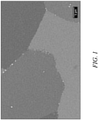
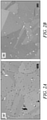
- Figure 1 shows the microstructure of an alloy, which is largely free of bright carbide and boride particles. This should be compared to Figure 2(b) for an alloy, which contains 0.06 wt. % C and 0.02 wt. % B.
- MC carbides in preference to Zr, W or Mo. Any remaining Ti that is added will partition to ⁇ '.
- Primary MC carbides are formed first, during melting whereas M 6 C carbides form during subsequent thermo-mechanical processing and heat treatment. Excessive levels of W, Mo, Cr and Si can promote the formation M 6 C carbides and will be avoided in the proposed alloys.
- the ordered intermetallic B2 type NiAl phase forms in alloys with 12 at. % Al, as shown in Figure 2(a) , in both inter- and intra-granular locations.
- T solvus of the y' phase is reduced.
- the NiAl phase can be eliminated by reducing the Al content to below 11.5 at. %.
- the specified Al values (9-11.5 at. %) can produce a continuous alumina (Al 2 O 3 ) layer below the chromia scale during long term exposure of the proposed alloys at temperatures above 800°C.
- This is a highly desirable condition as alumina provides a very effective barrier to penetration of oxygen from the surface into the alloy.
- phase stability of the proposed alloys has been assessed using phase diagram modelling and the approach reported by M. Morinaga et al. (Superalloys 1984, M. Gell, ed., TMS, Warrendale, PA, USA, pp. 523-532 ), which uses theoretical calculations of electronic structure to determine an average energy level of d orbitals of transition metal additions to nickel. This is known as an average Md ⁇ number for the ⁇ phase.
- the approach has been reported to predict the occurrence of detrimental topologically close packed (TCP) phases such as sigma ( ⁇ ) phase in a wide range of commercial alloys.
- TCP topologically close packed
- ⁇ sigma
- the accuracy of the approach relies on defining a critical average Md ⁇ value, below which a TCP free microstructure is assured.
- Zr provides improved high temperature tensile ductility and strength, creep life and rupture strength. Furthermore, Zr has an affinity for O and S and scavenges these elements, thereby limiting the potential of oxides and S or sulphides to reduce grain boundary cohesion. It also contributes to stable primary MC carbides and can be the sole MC carbide if Ti is not present in the alloy. It is proposed that alloys contain a small addition of Ti (at least 0.3 at. %) to enable TiC to form in preference to ZrC.
- Zr is included in the alloy at a concentration of 0.005 to 0.06 weight percent, which achieves adequate S and O scavenging and grain boundary strengthening, without excessive formation of Zr oxides.
- Mn is specified in the proposed alloys.
- Manganese is also a scavenger of S.
- Si is specified in the proposed alloys.
- An addition of Si can improve oxidation resistance as silica (SiO 2 ) particles that are present below the chromia scale are known to promote the formation of a continuous alumina layer beneath chromia. As discussed previously, however, excessive Si reduces phase stability and promotes the formation of M 6 C carbides.
- Hf 0.1 wt.% Hf is specified in the proposed alloys. Hafnium produces similar effects and benefits to those from Zr.
- chromia Cr 2 O 3
- Cr 2 O 3 can provide a protective scale on the surface of Ni, Co based alloys at temperatures below 1000°C.
- the effectiveness of the scale depends on the Cr content, the environment and the presence of any corrosive species. Ideally a Cr content of above 20 wt. % would be added to produce a continuous protective chromia scale.
- a maximum limit of 13.75 at. % Cr (about 12 wt.
- a reduced Co content (20 at. %) is preferred to promote improved resistance to type II hot corrosion damage (from Na 2 SO 4 based salts in the presence of SO 2 ) since the melting temperature of Na 2 SO 4 -CoSO 4 eutectic is 565 °C ( K.L. Luthra, 1982, Met. Trans. A, 13, p. 1843 ), compared to Na 2 5O 4 -NiSO 4 , which melts at 671 °C ( K.P. Gebrud and P. Kofstad, 1984, Oxid. Met., 21, p. 233 ).
- the proposed alloys can be readily hot formed above T solvus , despite having a large volume fraction (up to 65 %) of ⁇ ' precipitates.
- the hot working range of the alloy is much larger than that for nickel-based alloys with similar fractions of ⁇ ' precipitates..
- T solvus is between 1020 and 1125°C and the difference between T solvus and the solidus temperature is at least 100°C but preferably 200°C or higher.
- T solvus is between 1047 and 1110°C.
- the solidification or freezing range i.e. the difference in temperature between the incipient melting temperature (solidus) and the liquidus temperature, is greater than 100°C, which may be sufficiently large to produce detrimental solidification anomalies (e.g. hot tearing) in large complex castings or remelt segregation anomalies (e.g. freckles) in large diameter ingots.
- detrimental solidification anomalies e.g. hot tearing
- remelt segregation anomalies e.g. freckles
- critical features of castings or wrought components that are made from the proposed alloys may be repaired using powder-based additive layer methods.
- Example alloys were initially produced from high-purity elemental pellets as 450 g ingots by vacuum arc melting under a back-filled argon atmosphere.
- the as-cast ingots were homogenised in vacuum at 1200°C for 48 hours, then hot rolled using cold rolls but with the alloy ingots initially at 1200°C, i.e. above T solvus , from an initial thickness of 23 mm to 12 mm, using successive 12-15% reductions.
- Samples for testing were electrical discharge machined from the rolled bars, and encapsulated in back-filled argon quartz tubes for heat treatment.
- a NETZSCH Jupiter differential scanning calorimeter (DSC) was employed to determine T solvus at a 10°C/minute scan rate under argon atmosphere. Alloy compositions were measured using Inductively Coupled Plasma-Optical Emission Spectroscopy (ICP-OES) and density measurements were performed according to ASTM B311-08 at room temperature.
- ICP-OES Inductively Coupled Plasma-Optical Emission Spectroscopy
- compositional ranges disclosed herein are inclusive and combinable, are inclusive of the endpoints and all intermediate values of the ranges).
- the modifier "about” used in connection with a quantity is inclusive of the stated value, and has the meaning dictated by context, (e.g., includes the degree of error associated with measurement of the particular quantity).
- Table 1 Ranges of chemical elements in alloys (in weight percent) wt.% Ni Co Cr Fe W Mo Al Ta Nb Ti Mn Si Hf C B Zr min 33.5 19.5 9 0 4.5 2 3.9 0.6 0 0.2 0.0 0.0 0 0.005 0.001 0.005 max 54 36 12 5.5 9.5 3.5 5.5 5 1.75 2.2 0.6 0.3 0.1 0.03 0.02 0.06 Tables 2A and 2B - Example alloys Table 2A - Atomic % Alloy Ni Co Cr Fe W Mo Al Ta Nb Ti Mn Si C B Zr 1 35.7 35.7 12.0 0.0 1.75 1.80 9.10 1.00 1.00 1.85 0.00 0.0 0.075 0.050 0.025 2 40.4 31.0 12.0 0.0 1.75 1.80 9.10 1.00 1.00 1.85 0.00 0.0 0.075 0.050 0.025 3 38.4 28.0 12.0 5.0 1.75 1.80 9.10 1.00 1.00 1.85 0.00 0.0 0.075 0.050 0.025 3 38.4 28.0
Landscapes
- Chemical & Material Sciences (AREA)
- Engineering & Computer Science (AREA)
- Materials Engineering (AREA)
- Mechanical Engineering (AREA)
- Metallurgy (AREA)
- Organic Chemistry (AREA)
- Physics & Mathematics (AREA)
- Thermal Sciences (AREA)
- Crystallography & Structural Chemistry (AREA)
- Turbine Rotor Nozzle Sealing (AREA)
Abstract
A nickel-cobalt based superalloy composition consisting of by weight (wt.): 33.5 to 54 percent Ni; 19.5 to 36 percent Co; 9 to 12 percent Cr; 3.9 to 5.5 percent Al; 4.5 to 9.5 percent W; up to 5.5 percent Fe; 2 to 3.5 percent Mo; 0.6 to 5 percent Ta; 0.15 to 2.2 percent Ti; up to 1.75 percent Nb; up to 0.1 percent Hf ; 0.005 to 0.03 percent C; 0.001 to 0.02 percent B; 0.005 to 0.06 percent Zr; up to 0.3 percent Si; up to 0.6 percent Mn; and the balance being impurities.
Description
- The invention relates to alloys suitable for high temperature applications and particularly nickel-cobalt based alloys that may be used to manufacture components in a gas turbine engine.
- Many components in the hot section of gas turbine engines are expected to operate for extended periods of time at temperatures above 800°C. Components that operate in these conditions can be subject to significant stresses caused by rotational, pressure or other forces and thermal gradients. There are other, static components and structures that experience much lower stresses, and as such can tolerate higher temperatures, up to 950°C.
- There is a requirement to provide improved alloys that extend temperature capability, reduce weight or cost, or increase the number of operating cycles and operation time for components within difficult conditions in order to provide an affordable service life.
- It is an object of the present invention to seek to provide an improved nickel-cobalt based alloy.
- Current nickel-cobalt based alloys, which are precipitation strengthened by ordered L12 gamma prime (γ') precipitates, show one or many of the following disadvantages:
- Relatively low yield stress levels compared to precipitation strengthened nickel-based alloys. It is understood that low yield stress is due to low Anti Phase Boundary (APB) energy. This is the energy that is produced from pairwise penetration and cutting of dislocations through y' precipitates. Such precipitation hardening is the main contributor to strength in nickel-based alloys.
- The current alloy compositions can show unwanted secondary phases such as NiAl, CoAl (B2 phase), Co3Al (D019 χ phase), Co7M6 (D85 µ phase), borides (M2B), carbides (MeC).
- The current alloy compositions can have high density levels at 20°C > 8.5 g.cm-3.
- The current alloy compositions can show poor oxidation resistance at temperatures over 800°C, if sufficient levels of chromium and aluminium are not added. Whilst there is the potential for good Type I hot corrosion resistance, given the high Co content, the Type II hot corrosion resistance is likely to be worse than existing nickel-based alloys.
- Un-optimised solid solution strengthening in the gamma (γ) phase as large fraction (circa 0.4) of added tungsten partitions to y' precipitates.
- Un-optimised grain boundary strengthening from carbides, borides and sulphur scavengers such as zirconium.
- Expensive raw material costs due to price of cobalt.
- According to the invention there is provided a nickel-cobalt alloy composition comprising by weight (wt.): 33.5 to 54 percent Ni; 19.5 to 36 percent Co; 9.0 to 12.0 percent Cr; 3.9 to 5.5 percent Al; 4.5 to 9.5 percent W; up to 5.5 percent Fe; 2 to 3.5 percent Mo; 0.6 to 5 percent Ta; 0.15 to 2.2 percent Ti; up to 1.75 percent Nb; up to 0.1 percent Hf ; 0.005 to 0.03 percent C; 0.001 to 0.02 percent B; 0.005 to 0.06 percent Zr; up to 0.3 percent Si; up to 0.6 percent Mn; and the balance being impurities.
- Preferably, Ni and Co are present in the Ni:Co ratio between 1:1 and about 2.6:1 in atomic percent.
- The alloy may comprise by atomic percentage: 9-11.5 percent Al; 1.5 to 3 percent W; 0.25-1.6 percent Ta; 0.3-2.5 percent Ti; and up to 1 percent Nb; wherein a combined atomic percentage of Al, Ta, Ti, Nb and 0.62 of W in the nickel-cobalt based superalloy is between 12.5 and 16.25 percent to provide substantially 50 to 65 percent by volume gamma prime precipitates.
- The alloy may comprise by atomic percentage: 1.5-3 percent W; 1.3-2 percent Mo; wherein a combined atomic percentage of Mo + 0.38 of W in the nickel-cobalt based superalloy is at least 2.44 percent.
- The alloy density at ambient temperature is less than 8.7 grams per cubic centimetre. Preferably, alloy density is less than 8.5 grams per cubic centimetre, which requires a combined atomic percentage of Mo + 0.38 of W to be no greater than 2.5 percent and a combined atomic percentage of W + Ta + Nb to be no greater than 3.8 percent.
- The gamma prime solvus temperature (Tsolvus) of the alloy is between 1020 and 1125°C. This is the temperature at which all γ' precipitates dissolve, with constituent elements returning to the γ phase.
- An optimised oxidation resistance in the proposed alloy is achieved with high values of Cr and Al to maximise the Cr:Ti and AI:Cr ratios in atomic percent. The aim is to promote the formation of a continuous alumina layer, rather than alumina intrusions, below the chromia scale.
- The alloy can be readily hot formed above Tsolvus, despite having a large volume fraction (up to 65 %) of γ' precipitates. The hot working range of the alloy is much larger than that for nickel-based alloys with similar fractions of γ' precipitates due to lower values of Tsolvus.
- Embodiments will now be described by way of example only, with reference to the Tables and Figures, in which:
- Table 1 illustrates the ranges of weight percentages for chemical elements in a nickel-cobalt alloy according to the invention;
- Table 2A illustrates the atomic percentages for chemical elements in twelve example nickel-cobalt alloys, 1 to 12, according to the invention; and Table 2B illustrates the weight percentages for chemical elements in the twelve example nickel-cobalt alloys 1 to 12;
- Table 3 illustrates attributes of the twelve example nickel-cobalt alloys 1 to 12 in atomic percent in terms of: (i) nickel:cobalt ratio; (ii) combined molybdenum and 0.38 of tungsten content, which is used to optimise the properties of the γ phase and contributes to alloy density; (iii) combined aluminium, tantalum, niobium, titanium and 0.62 of tungsten content, which indicates the volume fraction of the y' phase; (iv) combined tungsten, tantalum and niobium content, which contributes to alloy density;
- Table 4 illustrates the density and gamma prime solvus temperature of eight of the twelve example nickel-cobalt alloys: 1, 2, 4, 5, 7, 8, 9, and 10;
- Table 5 illustrates ambient temperature yield stress and tensile strength of six of the twelve example nickel-cobalt alloys: 1, 2, 7, 8, 9, and 10;
-
Figure 1 illustrates a backscatter electron image of an example alloy showing minimal grain boundary decoration of carbides and boride particles. The alloy contains 0.1 at.% C (0.02 wt.%) and 0.042 at.% B (0.007 wt.%); -
Figure 2(a) and Figure 2(b) illustrate backscatter electron images.Figure 2(a) shows dark B2 (NiAl) phase in an alloy with 12 at.% Al (> 5.5 wt.%).Figure 2(b) shows that the dark B2 phase is not formed in an alloy with 10 at.% Al. The light phase is M6C at grain boundaries and intragranular MC carbide for an alloy with 0.3 at.% C (0.06 wt.%) and 0.11 at.% B (0.02 wt.%); -
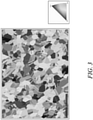
Figure 3 illustrates the grain size of hot rolled and heat treated material that has been produced for the proposed alloys. The image is an orientation map (or an inverse pole figure) from electron backscattered diffraction (EBSD). As well as the orientations of grains, it clearly indicates grain size. - Subjecting some Ni containing alloys to specific heat treatments or other processing steps permits precipitation strengthening by the formation of ordered L12 gamma prime (γ') precipitates. Gamma prime is described by Ni3X where X is predominantly Al with progressively smaller proportions of Ti, Ta and Nb. Nickel-cobalt-based alloys containing Al and W can be precipitation strengthened by the ordered L12 Co3(Al,W) γ' precipitates as well as the Ni3X γ' precipitates that are found in conventional Ni base superalloys.
- The ordered L12γ' phase of Co is denser than a disordered Co matrix such that the precipitation of the γ' phase increases the density of the alloy whilst the high temperature strength and temperature capability is improved. The density of the alloy has a component weight penalty that offsets the improved temperature capability of the alloy.
- By contrast the ordered L12γ' phase of nickel is less dense than the matrix Ni, such that an increase in γ' content results in a reduction in alloy density whilst simultaneously increasing the temperature and capability and strength of the alloy.
- Anti-phase boundary (APB) energy is produced from pairwise penetration and cutting of dislocations through γ'precipitates. Such precipitation hardening is the main contributor to strength in Ni-based alloys. Pairs of dislocations cut γ' precipitates to produce stacking faults. The magnitude of the APB energy associated with these stacking faults is dependent on the composition of the γ' precipitates. In Ni-base superalloys, replacing Al in y' by Ti, Ta and Nb increases APB energy. In Co-base alloys containing Al and W, it is understood that W in Co3(Al, W) γ' can be replaced by Nb, which can reduce alloy density if W levels are reduced or increases the partitioning of W to the gamma (γ) matrix phase. The γ' phase is meta-stable in the Co-Al-W ternary phase diagram. The phase is stabilised by the addition of Ni. Increasing amounts of Ni also increase the proportion of Ni3X γ' precipitates, which produce higher APB energy when cut by pairs of dislocations compared to Co3(Al, W) γ' precipitates. To achieve this, the Ni:Co ratio (in atomic percent) in the proposed alloys is varied from 1:1 to about 2.6:1. Where Ni and Co are present in these ratios, a density increase from the formation of the L12γ' phase of Co is offset by a density reduction of the ordered L12γ' phase of Ni particularly where y' has a continuous phase field between Ni3Al,X (where X = Ti, Ta, Nb) and Co3Al,Z (where Z = W, Ta, Nb).
- Atom probe tomography (APT) has shown that W partitions to both γ and γ' (M. Knop et al., 2014, JOM, 66 (12), p. 2495). The partitioning of W between these phases depends on the Ni content in the alloy. For an alloy with a Ni:Co ratio of about 1:1, the W content in γ' can be 0.62 and 0.38 in γ.
- To produce the required levels of strength, alloys have been designed that precipitate between 50 and 65 % of the γ' phase. To achieve this, AI+Ti+Ta+Nb+0.62W > 12.5 at. % but no greater than 16.25 at. % (Table 3). However, there are limits for each of these elements, i.e. Al from 9-11.5 at. %, Ti from 0.3-2.5 at. %, Ta from 0.25-1.6 at. %, Nb from 0 to 1 at. %, and W from 1.5-3 at. % to ensure the desired balance of material properties and resistance to environmental damage.
- The aim is to produce nickel-cobalt superalloys with density values at ambient temperature of less than 8.5 g.cm-3, which requires that W + Ta + Nb ≤ 3.8 at. % and Mo + 0.38W ≤ 2.5 at. %.
- Yield strength is also determined by the size, as well as the composition of γ' precipitates. Slow diffusion of Nb, Ta and W in Ni and Co minimises coarsening of γ' precipitates after nucleation at temperatures below Tsolvus. The size of the γ' precipitates is also determined by Tsolvus, such that smaller precipitates are produced in alloys with lower Tsolvus values as the rate of coarsening is reduced at lower temperatures. Increased levels of Co and Cr reduce Tsolvus whilst increasing amounts of Ni, Al, Ti and Ta increase Tsolvus. In the proposed alloys, a 1 at. % reduction in Cr increases Tsolvus by 20°C.
- For Ni-based superalloys, there are 2 precipitation strengthening mechanisms (weak and strong pair coupling), which depend on the size of γ' precipitates. Weak pair coupling for yield strength and optimised resistance to creep deformation requires γ' precipitates < about 35 nm. These are typically tertiary γ' precipitates that are formed during ageing heat treatment and during cooling from solution heat treatment at temperatures below 800°C. Strong pair coupling for optimising yield strength requires γ' precipitates > about 50 nm. These are secondary γ' precipitates that are formed during cooling from solution heat treatment, which for the proposed alloys is conducted at temperatures above Tsolvus for a time period of about 1 to 2 hours. It is proposed that optimised yield strength, creep resistance and ductility can be achieved by producing a bimodal size distribution of γ' precipitates in the proposed nickel-cobalt alloys, i.e. secondary γ' precipitates that are between 50 and 200 nm and tertiary γ' precipitates that are less than 35 nm.
- As well as optimising precipitation hardening, there is merit in improving the resistance of the γ phase to plastic and creep deformation. This can be achieved in the proposed alloys by maintaining Mo + 0.38W levels, in atomic percent, of at least 2.44 but preferably higher (Table 3). Molybdenum preferentially partitions to the γ phase and acts as a relatively slow diffusing heavy element within the γ phase. This is advantageous for resistance to creep deformation and is due to the larger atomic size of Mo atoms compared to Ni or Co atoms. As they are large atoms, they increase the lattice parameter of the γ phase (aγ). This is important as the lattice parameter of γ' (aγ') also increases as a result of additions of W, Ta and Nb. It is advantageous that the misfit (δ) or difference in the lattice parameters, see equation 1, between the γ and γ' phases is minimised and is preferably negative at temperatures above 800°C as this minimises the rate of coarsening of γ' particles, the presence and size of which strongly affect high temperature strength and resistance to creep deformation.

- The values of δ have been estimated for the proposed alloys using the respective lattice parameters for γ (aγ) and γ' (aγ'), which were calculated from molar volume values of the phases from phase diagram modelling and Avogadro's constant. These were negative at 700°C, in the range of -0.2 to -0.45 % for example alloys 1 to 12 (Table 2). A further consequence of adding higher amounts of Mo is the increased risk of forming Mo rich carbides and borides, which is mitigated by reducing the C and B content.
- The aim in designing the proposed alloys is to minimise the occurrence and size of grain boundary carbides (M6C, MC) and borides (M2B) in alloys prepared by casting or ingot metallurgy, i.e. conventional vacuum induction melting (VIM) and subsequent remelting processes such as vacuum arc remelting (VAR) and electroslag remelting (ESR), which are processes that are used for producing nickel base superalloy ingots. It is proposed that a continuous or significant decoration of grain boundary carbides, in particular, is detrimental in nickel-cobalt based superalloys as they promote grain boundary cracking and reduce ductility. In the proposed compositions, the levels of C and B have been selected to minimise grain boundary decoration of carbides and borides but provide benefits in terms of (i) resistance to solidification cracking or hot tearing, and (ii) beneficial segregation of elemental B at grain boundaries for chemical bonding, for inhibiting the formation of grain boundary M23C6 carbides and for promoting the precipitation of intergranular secondary γ'. In experimental work that has been undertaken to establish the proposed compositions, intergranular M6C (where M = Cr, Mo, W) carbide has been found in alloys with more than 0.15 at. % (0.03 wt. %) C. The preference is to avoid M6C carbides. Boron reduces the incipient melting temperature of nickel alloys and is problematic for highly segregated areas in large castings, ingots or during welding. M2B has been detected in an alloy with 0.085 at. % (0.015 wt. %) B. It is understood, however, that the formation of M2B is reduced by additions of Ti and Zr, which has been confirmed by making up experimental alloys. The maximum B content in the proposed alloys is specified to be 0.02 wt.%.
Figure 1 shows the microstructure of an alloy, which is largely free of bright carbide and boride particles. This should be compared toFigure 2(b) for an alloy, which contains 0.06 wt. % C and 0.02 wt. % B. - In the proposed alloys, an addition of at least 0.25 wt. % (about 0.3 at. %) Ti is made to form MC carbides in preference to Zr, W or Mo. Any remaining Ti that is added will partition to γ'. Primary MC carbides are formed first, during melting whereas M6C carbides form during subsequent thermo-mechanical processing and heat treatment. Excessive levels of W, Mo, Cr and Si can promote the formation M6C carbides and will be avoided in the proposed alloys.
- It has been discovered that the ordered intermetallic B2 type NiAl phase forms in alloys with 12 at. % Al, as shown in
Figure 2(a) , in both inter- and intra-granular locations. When this phase is formed, Tsolvus of the y' phase is reduced. The NiAl phase can be eliminated by reducing the Al content to below 11.5 at. %. - In the proposed alloys, the specified Al values (9-11.5 at. %) can produce a continuous alumina (Al2O3) layer below the chromia scale during long term exposure of the proposed alloys at temperatures above 800°C. This is a highly desirable condition as alumina provides a very effective barrier to penetration of oxygen from the surface into the alloy. There is a greater chance of forming a continuous alumina layer in the proposed alloys for those Al levels at the upper end of the specification and if the AI:Cr ratio in atomic percent is close to 1:1.
- The phase stability of the proposed alloys has been assessed using phase diagram modelling and the approach reported by M. Morinaga et al. (Superalloys 1984, M. Gell, ed., TMS, Warrendale, PA, USA, pp. 523-532), which uses theoretical calculations of electronic structure to determine an average energy level of d orbitals of transition metal additions to nickel. This is known as an average Mdγ number for the γ phase. The approach has been reported to predict the occurrence of detrimental topologically close packed (TCP) phases such as sigma (σ) phase in a wide range of commercial alloys. However, the accuracy of the approach relies on defining a critical average Mdγ value, below which a TCP free microstructure is assured. Using phase diagram modelling to predict the composition of the γ phase, it has been found that increasing Ni content reduces the average Mdγ value, whereas increasing W and the addition of Fe, to replace Co or Ni, increases the average Mdγ value. As such, the W and Fe contents in the proposed alloys have been limited to less than 9.5 and 5.5 weight percent respectively. Similarly, limits have also been imposed on small additions of Si and Mn as these elements also increase the average Mdγ value.
- It is desirable to add Zr in the proposed alloys but without introducing detrimental effects as the element can optimise grain boundary strength and ductility. For both cast and forged polycrystalline superalloys that are used in gas turbine applications, Zr provides improved high temperature tensile ductility and strength, creep life and rupture strength. Furthermore, Zr has an affinity for O and S and scavenges these elements, thereby limiting the potential of oxides and S or sulphides to reduce grain boundary cohesion. It also contributes to stable primary MC carbides and can be the sole MC carbide if Ti is not present in the alloy. It is proposed that alloys contain a small addition of Ti (at least 0.3 at. %) to enable TiC to form in preference to ZrC. Excessive quantities of Zr can detrimentally affect solidification behaviour (the thin film stage of solidification in which thin liquid films separate dendrites) and produce small oxide particles during melting, which can agglomerate and be sources of fatigue crack nucleation. Thus, in a specific embodiment, Zr is included in the alloy at a concentration of 0.005 to 0.06 weight percent, which achieves adequate S and O scavenging and grain boundary strengthening, without excessive formation of Zr oxides.
- Up to 0.6 wt. % Mn is specified in the proposed alloys. Manganese is also a scavenger of S. There are additional benefits in adding Mn as it forms spinel oxide (Cr2MnO4) particles above or within chromia scale. It is proposed that such spinel particles can reduce the rate of oxidation.
- Up to 0.3 wt. % Si is specified in the proposed alloys. An addition of Si can improve oxidation resistance as silica (SiO2) particles that are present below the chromia scale are known to promote the formation of a continuous alumina layer beneath chromia. As discussed previously, however, excessive Si reduces phase stability and promotes the formation of M6C carbides.
- Up to 0.1 wt.% Hf is specified in the proposed alloys. Hafnium produces similar effects and benefits to those from Zr.
- In the absence of water vapour, chromia (Cr2O3) can provide a protective scale on the surface of Ni, Co based alloys at temperatures below 1000°C. However, the effectiveness of the scale depends on the Cr content, the environment and the presence of any corrosive species. Ideally a Cr content of above 20 wt. % would be added to produce a continuous protective chromia scale. However, in the proposed alloys, a maximum limit of 13.75 at. % Cr (about 12 wt. %) is specified as (i) higher Cr values produce excessive amounts of Cr rich M6C carbides at grain boundaries, which are detrimental as they promote grain boundary fracture and reduced ductility and (ii) higher Cr values produce higher average Mdγ values, which indicate a greater susceptibility to formation of detrimental TCP phases such as σ A thin chromia scale is produced, with reduced rates of oxidation, if Ti content is minimised or eliminated as Ti tends to segregate at the grain boundaries of chromia scale. Titanium is therefore considered detrimental to oxidation resistance and is specified to levels below 2.5 at. % (or about 2.2 wt. %). In terms of oxidation damage, the proposed alloys showed the most effective resistance, i.e. the least depth of damage when a continuous alumina layer was formed. This is most likely in compositions that show high values of Cr and Al to maximise the Cr:Ti and AI:Cr ratios in atomic percent.
- Ideally, a reduced Co content (20 at. %) is preferred to promote improved resistance to type II hot corrosion damage (from Na2SO4 based salts in the presence of SO2) since the melting temperature of Na2SO4-CoSO4 eutectic is 565 °C (K.L. Luthra, 1982, Met. Trans. A, 13, p. 1843), compared to Na25O4-NiSO4, which melts at 671 °C (K.P. Lillerud and P. Kofstad, 1984, Oxid. Met., 21, p. 233).
- The proposed alloys can be readily hot formed above Tsolvus, despite having a large volume fraction (up to 65 %) of γ' precipitates. The hot working range of the alloy is much larger than that for nickel-based alloys with similar fractions of γ' precipitates..
- The good formability of these alloys is achieved as a result of the large temperature range between Tsolvus and the incipient melting temperature or solidus temperature. For the proposed alloys, Tsolvus is between 1020 and 1125°C and the difference between Tsolvus and the solidus temperature is at least 100°C but preferably 200°C or higher. For the example alloys in Table 4, Tsolvus is between 1047 and 1110°C. Increasing additions of Ni, Al, Ta and Ti raise Tsolvus whereas increasing Co and Cr levels reduce Tsolvus.
- Given the high Ni content in the proposed alloys, the solidification or freezing range, i.e. the difference in temperature between the incipient melting temperature (solidus) and the liquidus temperature, is greater than 100°C, which may be sufficiently large to produce detrimental solidification anomalies (e.g. hot tearing) in large complex castings or remelt segregation anomalies (e.g. freckles) in large diameter ingots. The latter can be reduced by effective homogenisation heat treatments of small diameter ingots or eliminated using powder metallurgy. Similarly, it is possible that critical features of castings or wrought components that are made from the proposed alloys may be repaired using powder-based additive layer methods.
- Example alloys were initially produced from high-purity elemental pellets as 450 g ingots by vacuum arc melting under a back-filled argon atmosphere. The as-cast ingots were homogenised in vacuum at 1200°C for 48 hours, then hot rolled using cold rolls but with the alloy ingots initially at 1200°C, i.e. above Tsolvus, from an initial thickness of 23 mm to 12 mm, using successive 12-15% reductions. Samples for testing were electrical discharge machined from the rolled bars, and encapsulated in back-filled argon quartz tubes for heat treatment. They were brought to the solution heat treatment temperature of 1100°C at 4°C/min (above 500°C), soaked for 1 hour; cooled at 20°C/min to 800°C, and aged for 4 h; cooled at 20°C/min to 500°C, and finally air cooled. This procedure enables small quantities of development alloys to be produced quickly, which is ideal for evaluating many compositions. It produces an average size (including twins) of 30-60 µm (
Figure 3 ), with isolated grains as large as 100-350 µm. Further grain refinement can be achieved through post dynamic recrystallization at a temperature about 25°C below Tsolvus for 1-4 hours. - A NETZSCH Jupiter differential scanning calorimeter (DSC) was employed to determine Tsolvus at a 10°C/minute scan rate under argon atmosphere. Alloy compositions were measured using Inductively Coupled Plasma-Optical Emission Spectroscopy (ICP-OES) and density measurements were performed according to ASTM B311-08 at room temperature.
- The compositional ranges disclosed herein are inclusive and combinable, are inclusive of the endpoints and all intermediate values of the ranges). The modifier "about" used in connection with a quantity is inclusive of the stated value, and has the meaning dictated by context, (e.g., includes the degree of error associated with measurement of the particular quantity).
Table 1- Ranges of chemical elements in alloys (in weight percent) wt.% Ni Co Cr Fe W Mo Al Ta Nb Ti Mn Si Hf C B Zr min 33.5 19.5 9 0 4.5 2 3.9 0.6 0 0.2 0.0 0.0 0 0.005 0.001 0.005 max 54 36 12 5.5 9.5 3.5 5.5 5 1.75 2.2 0.6 0.3 0.1 0.03 0.02 0.06 Tables 2A and 2B - Example alloys Table 2A - Atomic % Alloy Ni Co Cr Fe W Mo Al Ta Nb Ti Mn Si C B Zr 1 35.7 35.7 12.0 0.0 1.75 1.80 9.10 1.00 1.00 1.85 0.00 0.0 0.075 0.050 0.025 2 40.4 31.0 12.0 0.0 1.75 1.80 9.10 1.00 1.00 1.85 0.00 0.0 0.075 0.050 0.025 3 38.4 28.0 12.0 5.0 1.75 1.80 9.10 1.00 1.00 1.85 0.00 0.0 0.075 0.050 0.025 4 37.6 28.0 12.0 5.0 1.75 1.80 9.10 1.00 1.00 1.85 0.55 0.2 0.075 0.050 0.025 5 51.6 20.0 12.0 0.0 2.00 1.75 9.75 1.00 0.50 1.25 0.00 0.0 0.075 0.050 0.020 6 40.9 31.0 12.0 0.0 1.75 1.80 9.10 1.00 0.00 2.30 0.00 0.0 0.075 0.050 0.025 7 35.3 35.3 12.0 0.0 2.75 2.00 10.00 1.25 0.00 1.30 0.00 0.0 0.100 0.042 0.020 8 34.8 34.8 12.0 0.0 2.75 2.00 10.00 1.25 0.00 2.30 0.00 0.0 0.100 0.042 0.020 9 35.5 35.5 12.0 0.0 2.75 2.00 10.00 1.25 0.50 0.30 0.00 0.0 0.100 0.042 0.020 10 35.3 35.3 12.0 0.0 2.75 2.00 10.00 1.25 1.00 0.30 0.00 0.0 0.100 0.042 0.020 11 52.3 20.0 12.0 0.0 2.00 1.75 9.75 0.25 0.25 1.00 0.00 0.52 0.075 0.050 0.020 12 34.7 34.7 13.0 0.0 2.75 2.00 11.5 1.25 0.00 0.00 0.00 0.0 0.075 0.085 0.040 Table 2B - Weight % Alloy Ni Co Cr Fe W Mo Al Ta Nb Ti Mn Si C B Zr 1 35.5 35.5 10.5 0.0 5.39 2.90 4.15 3.00 1.50 1.50 0.0 0.0 0.015 0.009 0.039 2 40.0 31.1 10.5 0.0 5.39 2.90 4.15 3.00 1.50 1.50 0.0 0.0 0.015 0.009 0.039 3 37.9 28.1 10.5 5.0 5.39 2.92 4.15 2.99 1.50 1.50 0.0 0.0 0.015 0.009 0.038 4 37.5 28.0 10.5 5.0 5.39 2.90 4.15 3.00 1.50 1.50 0.5 0.1 0.015 0.009 0.038 5 50.8 19.8 10.5 0.0 6.20 2.80 4.40 3.80 0.80 0.80 0.0 0.0 0.015 0.009 0.030 6 40.8 31.0 10.6 0.0 5.47 2.93 4.17 3.07 0.00 1.87 0.0 0.0 0.015 0.009 0.039 7 34.3 34.5 10.3 0.0 8.38 3.18 4.47 3.75 0.00 1.03 0.0 0.0 0.020 0.008 0.030 8 33.9 34.0 10.4 0.0 8.40 3.19 4.48 3.76 0.00 1.83 0.0 0.0 0.020 0.008 0.030 9 34.4 34.5 10.3 0.0 8.34 3.17 4.45 3.73 0.77 0.24 0.0 0.0 0.020 0.007 0.030 10 34.1 34.2 10.3 0.0 8.32 3.16 4.44 3.72 1.53 0.24 0.0 0.0 0.020 0.007 0.030 11 52.9 20.3 10.7 0.0 6.33 2.89 4.53 0.78 0.40 0.82 0.0 0.25 0.016 0.009 0.031 12 33.9 34.1 11.3 0.0 8.44 3.20 5.18 3.78 0.00 0.00 0.0 0.0 0.015 0.015 0.061 Table 3 - Attributes of example alloys in atomic % Alloy (i) (ii) (iii) (iv) Ni:Co Mo+ 0.38W Al+ Ta+Nb+ Ti+0.62W W+Ta+Nb 1 1:1 2.47 14.04 3.75 2 1.3:1 2.47 14.04 3.75 3 1.4:1 2.47 14.04 3.75 4 1.3:1 2.47 14.04 3.75 5 2.6:1 2.51 13.74 3.50 6 1.3:1 2.47 13.49 2.75 7 1:1 3.05 14.26 4.00 8 1:1 3.05 15.26 4.00 9 1:1 3.05 13.76 4.50 10 1:1 3.05 14.26 5.00 11 2.6 2.51 12.5 2.50 12 1 3.05 14.5 4.00 Table 4 - Measured values for ambient temperature density (ρ) and gamma prime solvus (Tsolvus) Alloy ρ (g.cm-3) Tsolvus (°C) 1 8.4 1073 2 8.22 1086 4 8.28 1047 5 8.39 1110 7 8.61 1067 8 8.53 1090 9 8.69 1049 10 8.74 1062 Table 5 - Data from tensile tests at 20°C where YS is yield stress and TS is tensile strength Alloy 20°C YS (MPa) 20°C TS (MPa) 1 915 1336 2 902 1325 7 937 1329 8 1000 1336 9 953 1363 10 940 1336
Claims (19)
- A nickel-cobalt based superalloy composition consisting of by weight: 33.5 to 54 percent nickel; 19.5 to 36 percent cobalt; 9.0 to 12.0 percent chromium; 3.9 to 5.5 percent aluminium; 4.5 to 9.5 percent tungsten; up to 5.5 percent iron; 2 to 3.5 percent molybdenum; 0.6 to 5 percent tantalum; 0.15 to 2.2 percent titanium; up to 1.75 percent niobium; up to 0.1 percent hafnium ; 0.005 to 0.03 percent carbon; 0.001 to 0.02 percent boron; 0.005 to 0.06 percent zirconium; up to 0.3 percent silicon; up to 0.6 percent manganese; and the balance being impurities.
- A nickel-cobalt based superalloy according to claim 1, wherein the nickel and cobalt (Ni:Co) are present in the ratio between 1:1 and about 2.6:1 in atomic percent.
- A nickel-cobalt based superalloy as claimed in claim 1 comprising by atomic percentage; 9-11.5 percent aluminium; 1.5 to 3 percent tungsten; 0.25-1.6 percent tantalum; 0.3-2.5 percent titanium; and up to 1 percent niobium; wherein a combined percentage of aluminium, tantalum, titanium, niobium and 0.62 of tungsten in the nickel-cobalt based superalloy is between 12.5 and 16.25 percent to provide substantially 50 to 65 percent by volume gamma prime precipitates.
- A nickel-cobalt based superalloy according to claim 1 comprising by atomic percentage; 1.5-3 percent tungsten; 1.3-2 percent molybdenum; wherein a combined percentage of Mo + 0.38 of W in the nickel-cobalt based superalloy is at least 2.44 percent.
- A nickel-cobalt based superalloy as claimed in claim 1 wherein the density at ambient temperature is less than 8.5 grams per cubic centimetre; wherein a combined atomic percentage of Mo + 0.38 is no greater than 2.5 percent and a combined atomic percentage of W + Ta + Nb that is no greater than 3.8 percent.
- A nickel-cobalt based superalloy according to claim 1, wherein the nickel-cobalt based superalloy has a gamma prime solvus temperature of 1020 to 1125°C.
- A nickel-cobalt based superalloy as claimed in claim 1, and comprising by weight: 47 to 54 percent nickel and 19.5 to 25 percent cobalt.
- A nickel-cobalt based superalloy as claimed in claim 1, wherein the nickel-cobalt based superalloy consists of, by weight: 35.5 % cobalt; 10.5 % chromium; 5.4 % tungsten; 2.9 % molybdenum; 4.15 % aluminium; 3 % tantalum; 1.5 % niobium; 1.5 % titanium; 0.015 % carbon; 0.009 % boron; 0.039 % zirconium; and the balance being nickel and impurities.
- A nickel-cobalt based superalloy as claimed in claim 1, wherein the nickel-cobalt based superalloy consists of, by weight: 31.1 % cobalt; 10.5 % chromium; 5.4 % tungsten; 2.9 % molybdenum; 4.15 % aluminium; 3 % tantalum; 1.5 % niobium; 1.5 % titanium; 0.015 % carbon; 0.009 % boron; 0.039 % zirconium; and the balance being nickel and impurities.
- A nickel-cobalt based superalloy as claimed in claim 1, wherein the nickel-cobalt based superalloy consists of, by weight: 28.1 % cobalt; 10.5 % chromium; 5 % iron; 5.4 % tungsten; 2.9 % molybdenum; 4.15 % aluminium; 3 % tantalum; 1.5 % niobium; 1.5 % titanium; 0.015 % carbon; 0.009 % boron; 0.039 % zirconium; and the balance being nickel and impurities.
- A nickel-cobalt based superalloy as claimed in claim 1, wherein the nickel-cobalt based superalloy consists of, by weight: 28.0 % cobalt; 10.5 % chromium; 5 % iron; 5.4 % tungsten; 2.9 % molybdenum; 4.15 % aluminium; 3 % tantalum; 1.5 % niobium; 1.5 % titanium; 0.5 % manganese; 0.1 % silicon; 0.015 % carbon; 0.009 % boron; 0.039 % zirconium; and the balance being nickel and impurities.
- A nickel-cobalt based superalloy as claimed in claim 1, wherein the nickel-cobalt based superalloy consists of, by weight: 19.8 % cobalt; 10.5 % chromium; 6.2 % tungsten; 2.8 % molybdenum; 4.4 % aluminium; 3.8 % tantalum; 0.8 % niobium; 0.8 % titanium; 0.015 % carbon; 0.009 % boron; 0.030 % zirconium; and the balance being nickel and impurities.
- A nickel-cobalt based superalloy as claimed in claim 1, wherein the nickel-cobalt based superalloy consists of, by weight: 31.0 % cobalt; 10.6 % chromium; 5.5 % tungsten; 2.9 % molybdenum; 4.2 % aluminium; 3.1 % tantalum; 1.9 % titanium; 0.015 % carbon; 0.009 % boron; 0.039 % zirconium; and the balance being nickel and impurities.
- A nickel-cobalt based superalloy as claimed in claim 1, wherein the nickel-cobalt based superalloy consists of, by weight: 34.5 % cobalt; 10.3 % chromium; 8.4 % tungsten; 3.2 % molybdenum; 4.5 % aluminium; 3.75 % tantalum; 1.0 % titanium; 0.020 % carbon; 0.008 % boron; 0.030 % zirconium; and the balance being nickel and impurities.
- A nickel-cobalt based superalloy as claimed in claim 1, wherein the nickel-cobalt based superalloy consists of, by weight: 34.0 % cobalt; 10.4 % chromium; 8.4 % tungsten; 3.2 % molybdenum; 4.5 % aluminium; 3.75 % tantalum; 1.8 % titanium; 0.020 % carbon; 0.008 % boron; 0.030 % zirconium; and the balance being nickel and impurities.
- A nickel-cobalt based superalloy as claimed in claim 1, wherein the nickel-cobalt based superalloy consists of, by weight: 34.5 % cobalt; 10.3 % chromium; 8.3 % tungsten; 3.2 % molybdenum; 4.45 % aluminium; 3.7 % tantalum; 0.8 % niobium; 0.25 % titanium; 0.020 % carbon; 0.007 % boron; 0.030 % zirconium; and the balance being nickel and impurities.
- A nickel-cobalt based superalloy as claimed in claim 1, wherein the nickel-cobalt based superalloy consists of, by weight: 34.2 % cobalt; 10.3 % chromium; 8.3 % tungsten; 3.2 % molybdenum; 4.4 % aluminium; 3.7 % tantalum; 1.5 % niobium; 0.25 % titanium; 0.020 % carbon; 0.007 % boron; 0.030 % zirconium; and the balance being nickel and impurities.
- A nickel-cobalt based superalloy as claimed in claim 1, wherein the nickel-cobalt based superalloy consists of, by weight: 20.3 % cobalt; 10.7 % chromium; 6.3 % tungsten; 2.9 % molybdenum; 4.5 % aluminium; 0.8 % tantalum; 0.4 % niobium; 0.8 % titanium; 0.25 % silicon; 0.015 % carbon; 0.009 % boron; 0.030 % zirconium; and the balance being nickel and impurities.
- A nickel-cobalt based superalloy as claimed in claim 1, wherein the nickel-cobalt based superalloy consists of, by weight: 34.1 % cobalt; 11.3 % chromium; 8.4 % tungsten; 3.2 % molybdenum; 5.2 % aluminium; 3.8 % tantalum; 0.015 % carbon; 0.015 % boron; 0.060 % zirconium; and the balance being nickel and impurities.
Applications Claiming Priority (1)
| Application Number | Priority Date | Filing Date | Title |
|---|---|---|---|
| GR20200100502 | 2020-08-20 |
Publications (1)
| Publication Number | Publication Date |
|---|---|
| EP3957761A1 true EP3957761A1 (en) | 2022-02-23 |
Family
ID=73197259
Family Applications (1)
| Application Number | Title | Priority Date | Filing Date |
|---|---|---|---|
| EP21190470.1A Withdrawn EP3957761A1 (en) | 2020-08-20 | 2021-08-10 | Alloy |
Country Status (3)
| Country | Link |
|---|---|
| US (1) | US11898228B2 (en) |
| EP (1) | EP3957761A1 (en) |
| GB (1) | GB202015106D0 (en) |
Families Citing this family (2)
| Publication number | Priority date | Publication date | Assignee | Title |
|---|---|---|---|---|
| CN116990107B (en) * | 2023-06-08 | 2024-05-24 | 辽宁红银金属有限公司 | Cobalt-based superalloy standard sample and preparation method thereof |
| CN117926098B (en) * | 2023-12-12 | 2024-12-20 | 中南大学 | High-strength and high-toughness light multi-component refractory intermetallic compound and preparation method thereof |
Citations (6)
| Publication number | Priority date | Publication date | Assignee | Title |
|---|---|---|---|---|
| EP1201777A1 (en) * | 2000-09-29 | 2002-05-02 | General Electric Company | Superalloy optimized for high-temperature performance in high-pressure turbine disks |
| US20130167687A1 (en) * | 2010-11-10 | 2013-07-04 | National Institute For Materials Science | Nickel alloy |
| US20130209265A1 (en) * | 2012-02-14 | 2013-08-15 | Paul L. Reynolds | Superalloy Compositions, Articles, and Methods of Manufacture |
| EP2628811A1 (en) * | 2012-02-14 | 2013-08-21 | United Technologies Corporation | Superalloy compositions, articles, and methods of manufacture |
| US20180305792A1 (en) * | 2017-04-21 | 2018-10-25 | Crs Holdings, Inc. | Precipitation Hardenable Cobalt-Nickel Base Superalloy And Article Made Therefrom |
| US20190360077A1 (en) * | 2018-05-23 | 2019-11-28 | Rolls-Royce Plc | Nickel-base superalloy |
Family Cites Families (6)
| Publication number | Priority date | Publication date | Assignee | Title |
|---|---|---|---|---|
| WO2001050429A1 (en) | 2000-01-05 | 2001-07-12 | American Express Travel Related Services Company, Inc. | Smartcard internet authorization system |
| US8992699B2 (en) | 2009-05-29 | 2015-03-31 | General Electric Company | Nickel-base superalloys and components formed thereof |
| US8613810B2 (en) | 2009-05-29 | 2013-12-24 | General Electric Company | Nickel-base alloy, processing therefor, and components formed thereof |
| WO2012047352A2 (en) | 2010-07-09 | 2012-04-12 | General Electric Company | Nickel-base alloy, processing therefor, and components formed thereof |
| GB2554898B (en) | 2016-10-12 | 2018-10-03 | Univ Oxford Innovation Ltd | A Nickel-based alloy |
| GB2573572A (en) | 2018-05-11 | 2019-11-13 | Oxmet Tech Limited | A nickel-based alloy |
-
2020
- 2020-09-24 GB GBGB2015106.4A patent/GB202015106D0/en not_active Ceased
-
2021
- 2021-08-10 EP EP21190470.1A patent/EP3957761A1/en not_active Withdrawn
- 2021-08-16 US US17/402,699 patent/US11898228B2/en active Active
Patent Citations (6)
| Publication number | Priority date | Publication date | Assignee | Title |
|---|---|---|---|---|
| EP1201777A1 (en) * | 2000-09-29 | 2002-05-02 | General Electric Company | Superalloy optimized for high-temperature performance in high-pressure turbine disks |
| US20130167687A1 (en) * | 2010-11-10 | 2013-07-04 | National Institute For Materials Science | Nickel alloy |
| US20130209265A1 (en) * | 2012-02-14 | 2013-08-15 | Paul L. Reynolds | Superalloy Compositions, Articles, and Methods of Manufacture |
| EP2628811A1 (en) * | 2012-02-14 | 2013-08-21 | United Technologies Corporation | Superalloy compositions, articles, and methods of manufacture |
| US20180305792A1 (en) * | 2017-04-21 | 2018-10-25 | Crs Holdings, Inc. | Precipitation Hardenable Cobalt-Nickel Base Superalloy And Article Made Therefrom |
| US20190360077A1 (en) * | 2018-05-23 | 2019-11-28 | Rolls-Royce Plc | Nickel-base superalloy |
Non-Patent Citations (2)
| Title |
|---|
| M. KNOP ET AL., JOM, vol. 66, no. 12, 2014, pages 2495 |
| M. MORINAGA ET AL.: "Superalloys", 1984, TMS, pages: 523 - 532 |
Also Published As
| Publication number | Publication date |
|---|---|
| US11898228B2 (en) | 2024-02-13 |
| US20230131449A1 (en) | 2023-04-27 |
| GB202015106D0 (en) | 2020-11-11 |
Similar Documents
| Publication | Publication Date | Title |
|---|---|---|
| EP2503013B1 (en) | Heat-resistant superalloy | |
| EP2778241B1 (en) | Heat-resistant nickel-based superalloy | |
| EP1842934B1 (en) | Heat-resistant superalloy | |
| CN102586652B (en) | For the Ni-Cr-Co alloy of advanced gas turbine engines | |
| JP5177559B2 (en) | Ni-based single crystal superalloy | |
| JP5270123B2 (en) | Nitride reinforced cobalt-chromium-iron-nickel alloy | |
| EP2675931B1 (en) | HIGH TEMPERATURE LOW THERMAL EXPANSION Ni-Mo-Cr ALLOY | |
| EP2610360B1 (en) | Co-based alloy | |
| JP5684261B2 (en) | Nickel superalloys and parts made from nickel superalloys | |
| US20220380867A1 (en) | Precipitation Hardenable Cobalt-Nickel Base Superalloy And Article Made Therefrom | |
| WO1994000611A1 (en) | Single crystal nickel-based superalloy | |
| CA3039661C (en) | High temperature, damage tolerant superalloy, an article of manufacture made from the alloy, and process for making the alloy | |
| EP3572541B1 (en) | Nickel-base superalloy | |
| Liu et al. | Effects of Mo on the evolution of microstructures and mechanical properties in Co-Al-W base superalloys | |
| US11898228B2 (en) | Alloy | |
| EP3121298B1 (en) | Ni-base alloy for structural applications | |
| JP4387331B2 (en) | Ni-Fe base alloy and method for producing Ni-Fe base alloy material | |
| Caron et al. | Effects of composition, processing, and structure on properties of nonferrous alloys | |
| EP3914453A1 (en) | Ni-based superalloy powder for additive manufacturing and an article made therefrom | |
| EP4616976A1 (en) | Nickel-cobalt-based alloy, nickel-cobalt-based alloy member using same, and method for manufacturing same | |
| WO2025178552A1 (en) | Nickel-based alloy | |
| CN117026014A (en) | A Co-based high-strength deformation high-entropy high-temperature alloy with high γ′ content and preparation method |
Legal Events
| Date | Code | Title | Description |
|---|---|---|---|
| PUAI | Public reference made under article 153(3) epc to a published international application that has entered the european phase |
Free format text: ORIGINAL CODE: 0009012 |
|
| STAA | Information on the status of an ep patent application or granted ep patent |
Free format text: STATUS: THE APPLICATION HAS BEEN PUBLISHED |
|
| AK | Designated contracting states |
Kind code of ref document: A1 Designated state(s): AL AT BE BG CH CY CZ DE DK EE ES FI FR GB GR HR HU IE IS IT LI LT LU LV MC MK MT NL NO PL PT RO RS SE SI SK SM TR |
|
| STAA | Information on the status of an ep patent application or granted ep patent |
Free format text: STATUS: THE APPLICATION IS DEEMED TO BE WITHDRAWN |
|
| 18D | Application deemed to be withdrawn |
Effective date: 20220824 |