EP3957122B1 - Marine data collection for marine artificial intelligence systems - Google Patents
Marine data collection for marine artificial intelligence systems Download PDFInfo
- Publication number
- EP3957122B1 EP3957122B1 EP20790982.1A EP20790982A EP3957122B1 EP 3957122 B1 EP3957122 B1 EP 3957122B1 EP 20790982 A EP20790982 A EP 20790982A EP 3957122 B1 EP3957122 B1 EP 3957122B1
- Authority
- EP
- European Patent Office
- Prior art keywords
- data
- marine vessel
- criterion
- matching
- collected
- Prior art date
- Legal status (The legal status is an assumption and is not a legal conclusion. Google has not performed a legal analysis and makes no representation as to the accuracy of the status listed.)
- Active
Links
Images




Classifications
-
- G—PHYSICS
- G01—MEASURING; TESTING
- G01C—MEASURING DISTANCES, LEVELS OR BEARINGS; SURVEYING; NAVIGATION; GYROSCOPIC INSTRUMENTS; PHOTOGRAMMETRY OR VIDEOGRAMMETRY
- G01C21/00—Navigation; Navigational instruments not provided for in groups G01C1/00 - G01C19/00
- G01C21/20—Instruments for performing navigational calculations
- G01C21/203—Instruments for performing navigational calculations specially adapted for water-borne vessels
-
- H—ELECTRICITY
- H04—ELECTRIC COMMUNICATION TECHNIQUE
- H04L—TRANSMISSION OF DIGITAL INFORMATION, e.g. TELEGRAPHIC COMMUNICATION
- H04L67/00—Network arrangements or protocols for supporting network services or applications
- H04L67/50—Network services
- H04L67/60—Scheduling or organising the servicing of application requests, e.g. requests for application data transmissions using the analysis and optimisation of the required network resources
- H04L67/61—Scheduling or organising the servicing of application requests, e.g. requests for application data transmissions using the analysis and optimisation of the required network resources taking into account QoS or priority requirements
-
- B—PERFORMING OPERATIONS; TRANSPORTING
- B63—SHIPS OR OTHER WATERBORNE VESSELS; RELATED EQUIPMENT
- B63B—SHIPS OR OTHER WATERBORNE VESSELS; EQUIPMENT FOR SHIPPING
- B63B79/00—Monitoring properties or operating parameters of vessels in operation
-
- G—PHYSICS
- G06—COMPUTING OR CALCULATING; COUNTING
- G06N—COMPUTING ARRANGEMENTS BASED ON SPECIFIC COMPUTATIONAL MODELS
- G06N20/00—Machine learning
- G06N20/20—Ensemble learning
-
- G—PHYSICS
- G06—COMPUTING OR CALCULATING; COUNTING
- G06N—COMPUTING ARRANGEMENTS BASED ON SPECIFIC COMPUTATIONAL MODELS
- G06N3/00—Computing arrangements based on biological models
- G06N3/02—Neural networks
- G06N3/04—Architecture, e.g. interconnection topology
- G06N3/0464—Convolutional networks [CNN, ConvNet]
-
- G—PHYSICS
- G06—COMPUTING OR CALCULATING; COUNTING
- G06N—COMPUTING ARRANGEMENTS BASED ON SPECIFIC COMPUTATIONAL MODELS
- G06N3/00—Computing arrangements based on biological models
- G06N3/02—Neural networks
- G06N3/08—Learning methods
-
- G—PHYSICS
- G06—COMPUTING OR CALCULATING; COUNTING
- G06N—COMPUTING ARRANGEMENTS BASED ON SPECIFIC COMPUTATIONAL MODELS
- G06N3/00—Computing arrangements based on biological models
- G06N3/02—Neural networks
- G06N3/08—Learning methods
- G06N3/09—Supervised learning
-
- G—PHYSICS
- G06—COMPUTING OR CALCULATING; COUNTING
- G06N—COMPUTING ARRANGEMENTS BASED ON SPECIFIC COMPUTATIONAL MODELS
- G06N3/00—Computing arrangements based on biological models
- G06N3/02—Neural networks
- G06N3/04—Architecture, e.g. interconnection topology
-
- G—PHYSICS
- G08—SIGNALLING
- G08G—TRAFFIC CONTROL SYSTEMS
- G08G3/00—Traffic control systems for marine craft
- G08G3/02—Anti-collision systems
-
- H—ELECTRICITY
- H04—ELECTRIC COMMUNICATION TECHNIQUE
- H04L—TRANSMISSION OF DIGITAL INFORMATION, e.g. TELEGRAPHIC COMMUNICATION
- H04L67/00—Network arrangements or protocols for supporting network services or applications
- H04L67/50—Network services
- H04L67/52—Network services specially adapted for the location of the user terminal
Definitions
- the presently disclosed subject matter relates to the field of marine environment.
- a marine vessel In the marine environment, a marine vessel travels on a route on which it can encounter various situations. Some of these situations can comprise a danger, e.g. an obstacle to be avoided, zones with dangerous weather, etc.
- KR101284850 describes a vessel data transmission system which relies on various communication means, such as a land communication unit, a VHF communication unit, and a satellite communication unit. KR101284850 proposes to select the most appropriate communication means.
- KR20100099833 describes a solution for remote medical examination of a patient on a ship, in which biological data is transmitted from the ship to a remote location.
- US 2012/307720 describes a system for communicating with one or more satellites over two frequencies, where information identifying the second frequency is transmitted over the first frequency.
- US 2014/086191 proposes a solution for providing an integrated long range, high capacity communication system between several entities involved in maritime Simultaneous Operations (SIMOPS).
- SIMOPS maritime Simultaneous Operations
- KR 101874361 describes a system for the satellite communication of a vessel.
- EP 3291206 describes a vessel traffic service expert system using a deep learning algorithm.
- the proposed solution allows collecting relevant data representative of situations encountered by marine vessels, in order to train one or more machine learning algorithms (which can include e.g. one or more deep learning algorithms) providing output (e.g. prediction, detection, analysis, etc.) based on these data.
- machine learning algorithms which can include e.g. one or more deep learning algorithms
- output e.g. prediction, detection, analysis, etc.
- the proposed solution allows collecting large amount of relevant data representative of situations encountered by marine vessels, and remotely transmitting these data, although remote communication in the marine environment is challenging (e.g. in terms of coverage, quality of communication, latency, connectivity, cost, etc.).
- the proposed solution allows collecting and transmitting large amount of relevant data representative of situations encountered by marine vessels in a more efficient way, which optimizes processing resources and cost.
- the proposed solution is tailored for the marine environment and splits processing of data and transmission of data over time. It takes advantage of the specificity of a voyage of a marine vessel. In particular, processing of data is mainly performed while the marine vessel is travelling in zones in which remote data communication is not possible or not efficient, therefore allowing immediate remote transmission of data when remote data communication becomes possible.
- the proposed solution allows selecting in an adaptive way data collected by sensors of the marine vessel over time, based on their relevance, thereby optimizing storage, processing resources, labeling effort, supervising incoming data and bandwidth required for transmitting data.
- the proposed solution allows up-to-date and online assessment of relevance of collected data for training one or more machine learning algorithms (which can include e.g. one or more deep learning algorithms)in the marine environment.
- machine learning algorithms which can include e.g. one or more deep learning algorithms
- the proposed solution is critical for training of machine leaning algorithms (which can include e.g. one or more deep learning algorithms) providing output in the marine environment. As a consequence, it is useful for improving safety and reliability of marine vessels.
- machine leaning algorithms which can include e.g. one or more deep learning algorithms
- processing unit as disclosed herein should be broadly construed to include any kind of electronic device with data processing circuitry, which includes for example a computer processing device operatively connected to a computer memory (e.g. digital signal processor (DSP), a microcontroller, a field programmable gate array (FPGA), and an application specific integrated circuit (ASIC), etc.) capable of executing various data processing operations.
- a computer memory e.g. digital signal processor (DSP), a microcontroller, a field programmable gate array (FPGA), and an application specific integrated circuit (ASIC), etc.
- DSP digital signal processor
- FPGA field programmable gate array
- ASIC application specific integrated circuit
- non-transitory memory should be expansively construed to cover any volatile or non-volatile computer memory suitable to the presently disclosed subject matter.
- Fig. 1 illustrates an embodiment of a system 100 which can be used to perform one or more of the methods described hereinafter.
- system 100 can comprise a processing unit 110 and a memory 120 (e.g. non-transitory memory).
- memory 120 e.g. non-transitory memory
- the Marine System 100 can be embedded on a marine platform.
- the marine platform can be a moving marine platform.
- the moving marine platform can be e.g. a marine vessel.
- Marine vessels include e.g. ships, boats, hovercraft, etc.
- system 100 can be embedded on a marine platform which can be stationary.
- system 100 can obtain data from one or more sensors 130. At least some of the sensors 130 can be located on the marine vessel on which system 100 is located (or on at least one other marine vessel communicating with the marine vessel on which system 100 is located).
- Sensors 130 collect data during the voyage of the marine vessel.
- the voyage include of course portions of the voyage in which the marine vessel is in motion, but can also include portions of the voyage in which the marine vessel is substantially static (e.g. when the marine vessel is moored or docked such as at a harbor).
- Sensors 130 can include (this list is not limitative): camera, radar, geo-localization system (e.g. GPS), automatic identification system (AIS), inertial sensor (speed or acceleration sensor), temperature sensor, pressure sensor, wind sensor, etc.
- geo-localization system e.g. GPS
- AIS automatic identification system
- inertial sensor speed or acceleration sensor
- system 100 can process data collected by sensors 130. At least part of the data can be stored in memory 120, and can be transmitted using a remote communication link.
- data output by system 100 can be transmitted according to some embodiments through a remote communication network 140 towards e.g. a central station 150.
- the remote communication link can correspond e.g. to a broadband cellular network (e.g. 4G, 5G, LTE, etc.), a satellite communication network, Radio communication network (such as Radio VHF - very high frequency), etc.
- a broadband cellular network e.g. 4G, 5G, LTE, etc.
- a satellite communication network e.g. 4G, 5G, LTE, etc.
- Radio communication network such as Radio VHF - very high frequency
- Data can be transmitted using a communication system located on the marine vessel which is suitable to transmit data via the remote communication network.
- the communication system can include e.g. an antenna, an emitter, a transponder, etc.
- the central station 150 can comprise one or more database for storing data which have been transmitted from the marine vessel. As explained hereinafter, data transmitted to the central station 150 can be further used to train one or more machine learning algorithms (which can include one or more deep learning algorithms).
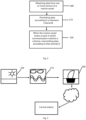
- FIG. 2 Attention is now drawn to Fig. 2 .
- a method can comprise (operation 200 ) obtaining data collected by one or more sensors (see reference 130 in Fig. 1 ) of at least one marine vessel.
- Data are representative of one or more situations encountered by the marine vessel during its voyage. For example, if the sensor is a camera, the data can comprise a large amount of images taken by the camera during the voyage of the marine vessel.
- situation is to be construed in a broad way and include e.g. various objects (e.g. icebergs, other marine vessels, etc.) that can be encountered by the marine vessel, and/or world state (e.g. climatic conditions, state of the sea, etc.)
- objects e.g. icebergs, other marine vessels, etc.
- world state e.g. climatic conditions, state of the sea, etc.
- the expression "voyage” includes both time periods in which the marine vessel is travelling, and time periods in which the marine vessel can be moored or docked.
- data are collected in particular for training one or more machine learning algorithms (which can include e.g. one or more deep learning algorithms) which can be used to provide output in the marine environment based on data collected by sensors of marine vessels.
- machine learning algorithms which can include e.g. one or more deep learning algorithms
- the output can comprise e.g. detection of obstacles (e.g. other marine vessels, icebergs, etc.), recognition of obstacles, detection of potential collision, estimation of distance to objects, alert raising (with level of severity), assistance for navigation, filtering of interesting objects, etc.
- obstacles e.g. other marine vessels, icebergs, etc.
- recognition of obstacles e.g. other marine vessels, icebergs, etc.
- detection of potential collision e.g. other marine vessels, icebergs, etc.
- estimation of distance to objects e.g. other marine vessels, icebergs, etc.
- alert raising with level of severity
- the method can comprise (operation 210 ) prioritizing data according to at least one relevance criterion.
- relevance criterion Various examples of the relevance criterion will be provided hereinafter.
- data obtained by the system 100 from the sensors 130 can be assigned a priority which depends on the relevance of the data. The higher the relevance, the higher the priority of the data. The lower the relevance, the lower the priority of the data.
- Prioritization of data can be performed e.g. by tagging data with a marker, or with a label, or by storing data in a table or a data structure in a manner which reflects priority of data (for example the first lines or columns correspond to the data with higher priority and the last lines or columns to the lower priority - this is not limitative). These examples are not limitative.
- data collected from sensors 130 can be stored in a database (e.g. in memory 120, or in another memory located on the marine vessel), together with priority assigned to data.
- a database e.g. in memory 120, or in another memory located on the marine vessel
- Priority can be e.g. assigned using a scale or a rate (wherein one extremity of the scale corresponds to lowest priority, and another extremity of the scale corresponds to highest priority).
- the scale or the rate can be represented using any adapted values. This is however not limitative and priority can be represented using a textual representation (e.g. "high”, “medium”, “low”) or any other adapted representation.
- Priority can be assigned (based on the relevance criterion) e.g. by periods of time, for example, from time t 0 to t 1 , a priority P 1 is assigned, from time t 2 to t 3 , a priority P 2 is assigned, etc.
- Operation 210 can be performed before the data are stored in the database (for example in real time or quasi real time), and/or can be performed once the data are stored in a database, using post-processing.
- prioritization can be performed separately for each type of data. For example, data acquired by a camera are prioritized separately, data acquired by an AIS are prioritized between them, and data acquired by a radar are prioritized separately. As explained hereinafter, prioritization can be influenced by data collected by a multiplicity of sensors.
- a prioritization can be performed between data of the sensors. For example, if data received from sensor 1 and data received from sensor 2 are both considered as having high priority, it can be defined that data from sensor 1 will have a higher priority relatively to data from sensor 2 because data from sensor 1 are considered as generally more relevant and useful for training one or more machine learning algorithms. This is not limitative and can be applied to a large number of sensors.
- criterion can be defined as a requirement for the quality of the remote data communication, which can include at least one of:
- the criterion can also include financial/cost consideration.
- some networks can provide remote data communication in the marine environment with a satisfactory quality but which involves high cost which can be incompatible with the volume of data to be transmitted.
- data required for training machine learning algorithms include high volume rates to be transmitted since data can include visual data such as images (which can be of high resolution) and/or videos (which can be of high resolution).
- a different criterion can be defined for each remote communication link. For example, broadband cellular communication is associated with a first criterion and satellite communication is associated with a second criterion.
- system 100 stores predefined data which defines for each remote communication link data representative of the quality (and if necessary cost) of the remote communication link with respect to the geographical zone. For example, for a given zone near the shore, it is stored that remote communication can be performed with a predefined minimal bandwidth.
- System 100 monitors position of the marine vessel (using e.g. GPS, and/or AIS sensors), and can detect when the marine vessel enters (or exits) a zone in which remote communication data meets the criterion.
- system 100 can comprise, or can communicate with a device which is suitable for measuring quality of the remote communication link.
- a device which is suitable for measuring quality of the remote communication link.
- an antenna of the marine vessel can be used to measure quality of reception and/or transmission of data in the zone in which the marine vessel is currently located. This measured quality can be compared to the criterion in order to trigger remote communication.
- both predefined data and data measured during the voyage of the marine vessel can be used to assess whether remote communication link matches the criterion.
- a combination of these two types of data e.g. an average - this is not limitative
- the method of Fig. 2 has been described with reference to a moving marine platform (marine vessel), in some embodiments, it can be applied similarly to a static marine platform. In this embodiment, operations 200 and 210 can be performed similarly. Communication of data from the marine platform can be at some periods of time more difficult (e.g. because satellite coverage is not optimal, or for some technical reasons, or because of bad climatic conditions) and therefore, when communication matches the criterion (e.g.
- the method can comprise transmitting data according to their priority (similarly to what was described for a moving marine platform).
- transmission of data is triggered when the marine vessel enters a zone in which communication matches the criterion, whereas in this embodiment, the marine platform remains in the same zone (static marine platform) and communication is triggered when it matches the criterion.
- data can be transmitted according to their priority.
- a plurality of criteria it can be set that if at least one criterion is met for at least one type of remote communication link, then data can be transmitted using this remote communication link.
- transmission of data according to their priority can include transmitting data in a (temporal) order which reflects priority, e.g. first data with higher priority, and then data with lower priority.
- a priority queue can be created, wherein the data with higher priority are located at the top of the priority queue, and transmitted first, whereas the data with lower priority are located at the bottom of the priority queue, and transmitted last.
- transmission of data according to their priority can include:
- this allows transmitting first high data mixed up with a few portions of low priority data.
- transmission of data according to their priority can comprise allocating a bandwidth to the data which reflects priority, e.g. high bandwidth to data with high priority and low bandwidth to data with low priority.
- the amount of data which is transmitted depends in particular on the size of the temporal window for which the marine vessel is located in a zone in which remote communication data meets the criterion.
- a second remote communication link (different from the first one) meets the criterion, then data can be transmitted using this second remote communication link. Data communication using the first remote communication link is stopped and is resumed using the second communication link. This can be viewed as a kind of handover.
- Remote data communication will resume when the marine vessel returns in a zone in which a remote communication link meets the criterion. Communication will resume from the latest data in the priority queue which were not transmitted, except if, in the meantime, additional data are collected which have a higher priority than this latest data (and therefore this additional data will be transmitted first when remote communication resumes).
- a priority queue is illustrated in the non-limitative example of Fig. 3 .
- image 300 has the highest priority and is transmitted first using the remote communication link to a central station.
- Image 310 has medium priority rank, and is located after image 300 in the priority queue. Therefore, image 310 is transmitted (if the temporal window in which remote communication is large enough) after image 300. Lastly, image 320 is transmitted (if the temporal window in which remote communication is large enough).
- transmission of data and collection of data can be simultaneous over one or more periods of time.
- a priority queue has been determined, and that according to the priority queue, given data of medium priority needs now to be transmitted. Since the process is dynamic, if the method determines new data of high priority, then this data will be inserted in the priority queue before the given data of medium priority, and therefore will be transmitted first, although they were collected later.
- FIG. 4 illustrates a non-limitative example of a voyage of a marine vessel 400.
- system 100 collects data from sensors and prioritizes them. However, data is not transmitted since the marine vessel is not located in a zone 430 in which remote communication link meets the criterion. When the marine vessel 400 enters zone 430, data can be transmitted towards the central station 460 according to their priority, using the remote communication link which is available in zone 430.
- zone 430 is located in the vicinity of the shore 450. This is however not mandatory. This kind of configuration is met in particular when a broadband cellular network is used to transmit data, since quality of the communication is better when the marine vessel is close to the shore.
- the solution takes advantage of the time in which the marine vessel is located outside of a zone in which remote communication data is possible in order to process data collected from sensors (this processing comprises in particular prioritizing data, but can comprise other processing that could be needed, such as filtering, etc.).
- this processing comprises in particular prioritizing data, but can comprise other processing that could be needed, such as filtering, etc.
- data is ready to be transmitted according to the expected order.
- time allocated for prioritization of data is mainly located in periods of time in which the marine vessel is not located in a zone in which remote communication data is possible. In these periods of time, processing resources of system 100 can be dedicated more to these prioritization tasks, since the task of transmitting data is not performed.
- prioritization of data can also be performed when the marine vessel is located in a communication zone, since additional data can be also collected during this period of time.
- data can be prioritized according to one or more relevance criteria.
- the relevance criterion can reflect a relevance of the data for training one or more machine learning algorithms based on these marine data.
- one or more machine learning algorithms can be trained based on this maritime data in order to perform various tasks, such as detecting of objects, alerting, predicting, outputting help for navigation, etc.
- the machine learning algorithm is trained to detect objects.
- An example of objects includes e.g. other marine vessels.
- prioritizing data according to the at least one relevance criterion is based on at least a monitoring of data representative of the route of the marine vessel.
- a non-limitative example is provided in Fig. 5 .
- This change can be detected by a localization system (GPS, AIS, etc.), and can be indicative that from this point 510, data which are collected from the sensors correspond to a more relevant situation and therefore should get a higher priority.
- GPS global positioning system
- AIS AIS
- a change from the planned route can indicate that the crew had to avoid an obstacle, a danger or a zone with bad weather, and therefore data collected from the sensors in the corresponding period of time have a certain relevancy and should be transmitted in priority to the central station.
- priority of data collected from point 510 can be considered as having a high relevancy according to the relevance criterion, and therefore can get a higher priority.
- This high priority can be set for data collected until a predefined period of time has elapsed, or until the marine vessel 500 has returned to its planned route 520 (according e.g. to some proximity criterion 530 defining a distance between the marine vessel 500 and the planned route 520 ).
- prioritizing data according to the at least one relevance criterion is based on at least a monitoring of data representative of inertial data (position, speed, acceleration, etc.) of the marine vessel.
- this can also indicate that the situation can be relevant for collecting data (since this can correspond to a situation which can present a risk, or which is not usual), and a higher priority can be assigned to the data collected during the corresponding period of time.
- prioritizing data according to the at least one relevance criterion depends on one or more actions taken by at least one of a crew and an auto-pilot of the marine vessel for controlling the marine vessel.
- the marine vessel is generally controlled by an auto-pilot, which attempts to keep speed and course (according to some GPS waypoints). If the crew provides instruction to the auto-pilot to modify its operation (e.g. speed and/or course), this can indicate that the situation encountered by the marine is relevant and corresponding collected data should get high priority.
- an auto-pilot which attempts to keep speed and course (according to some GPS waypoints). If the crew provides instruction to the auto-pilot to modify its operation (e.g. speed and/or course), this can indicate that the situation encountered by the marine is relevant and corresponding collected data should get high priority.
- a higher priority can be assigned to the data collected during the corresponding period of time in which these actions have been detected.
- Other actions which can reflect a higher relevancy, and therefore trigger a higher priority of the collected data can include e.g. raising of an alert by the crew, entering a port, bad visibility, congested waterways, certain speeds, maneuvers, collision alert, shallow waters, etc.
- prioritizing data according to the at least one relevance criterion depends on data collected by one or more weather sensors.
- climatic conditions For example, if specific climatic conditions are detected (e.g. high winds, large quantity of rain, or more generally climatic conditions which differ from predefined standard climatic conditions reflecting usual weather, etc.), this can correspond to relevant data, and therefore a higher priority can be assigned to the data collected during the corresponding period of time.
- specific climatic conditions e.g. high winds, large quantity of rain, or more generally climatic conditions which differ from predefined standard climatic conditions reflecting usual weather, etc.
- prioritizing data according to the at least one relevance criterion depends on data collected by vibration sensors on the marine vessel.
- vibration above a threshold is detected (thereby indicating an abnormal situation)
- this can correspond to relevant data, and therefore a higher priority can be assigned to the data collected during the corresponding period of time.
- prioritizing data according to the at least one relevance criterion depends on a detection of objects in the images taken by one or more cameras of the marine vessel. For example, if a detection algorithm detects one or more marine vessels, or specific objects (e.g. icebergs, etc.), in the images, then the data collected during this period of time (data collected by the camera, but also data from other sensors) can be considered as having a higher relevancy and therefore can be assigned with a higher priority.
- the detection algorithm can be a machine learning algorithm (for example which was already trained using past data collected according to the present solution) and which is used currently on the marine vessel for detecting and identifying objects in the sea based on data collected by sensors of the marine vessel.
- prioritizing data according to the at least one relevance criterion depends on multiple set of rules, which can be e.g. predefined by an operator and stored in a memory (e.g. of system 100 ).
- the relevance can be defined depending on data collected by various sensors of the marine vessel.
- data collected by various sensors can be fused to assess whether the situation in which the marine vessel is located corresponds to a relevant situation.
- one or more of these rules can be generated by a machine learning algorithm during the voyage of the marine vessel.
- the machine learning algorithm can be different from the machine learning algorithm for which data are collected and transmitted in order to train this machine learning algorithm.
- the machine learning algorithm (used for generating rules) can receive as an input a set of rules (already predefined by an operator), and data from sensors, and can be trained to generate new set of rules which are adapted to the marine vessel.
- a rule is adapted to a zone in which many icebergs are present.
- the rule defines that data are relevant if the number of icebergs in the vicinity of the marine vessel is above a threshold.
- the machine learning algorithm can learn that the threshold has to be changed (based on data collected by the sensors of the marine vessel), and reduced, thereby generating a new rule which is more adapted to the current situation of the marine vessel.
- This example is however not limitative.
- prioritizing data according to the at least one relevance criterion is based on at least a comparison between collected data and data already stored in the database of the system 100. If this comparison shows that the collected data (for example images) match data already stored in the database, then it is not worth assigning these data with a high priority since they have already been collected in the past, and are redundant. This comparison can be performed using e.g. image processing.
- FIG. 6 depicts another embodiment for prioritizing data according to the relevance criterion.
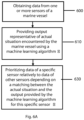
- the marine vessel embeds a system comprising a machine learning algorithm attempting to provide output representative of an actual situation encountered by the marine vessel during its voyage.
- the output can be e.g. a detection/identification of the objects present in the images taken by a camera of the marine vessel, based on various data collected by the sensors (camera, AIS, radar, etc.). This is however not limitative and other output can be provided (e.g. assistance to navigation for the marine vessel, etc.).
- this machine learning algorithm has been trained previously using data collected during previous voyages of marine vessels (according e.g. to the various methods described in the present application), and/or using simulated data.
- the machine learning algorithm has been trained previously to detect/identify objects present in the vicinity of the marine vessel, using e.g. images from cameras, AIS data, radar data, etc.
- the machine learning algorithm provides an output (operation 610 ) depending on the data collected by the sensors of the marine vessel (operation 600 ). As mentioned above, this output should be (depending on the performance of the model) representative of the actual situation encountered by the marine vessel.
- the machine learning algorithm needs to provide an output which reflects the presence of these three other marine vessels.
- a comparison between the output provided by the machine learning algorithm and the actual situation encountered by the machine vessel is representative of the level of performance of the machine learning algorithm.
- This comparison can be performed using an input of an operator.
- the machine learning algorithm can detect two vessels, and the operator will indicate to the system (using e.g. an interface of the system) the level of matching of the output with the actual situation.
- This level matching can be represented using various manners: for example, the operator can indicate a level of matching using a score, etc.
- the level of matching can be determined using data provided by sensors of the marine vessel.
- the machine learning algorithm detected based on the images provided by a camera, two other marine vessels.
- the AIS indicates that in fact, three marine vessels are located in the vicinity. The comparison of the output provided by the machine learning algorithm with the data provided by the AIS therefore indicates that the level of matching is not satisfactory.
- prioritizing data according to the least one relevance criterion depends on a matching between the actual situation and the output provided by the system (operation 620 ). This level of matching can be assessed based e.g. on a matching criterion (which defines e.g. a scale for which high matching, medium matching, or low matching is obtained).
- a matching criterion which defines e.g. a scale for which high matching, medium matching, or low matching is obtained).
- the matching can be a comparison between the detection provided by the machine learning algorithm and the actual situation.
- the matching can reflect to what extent the command output by the machine learning algorithm is really adapted to the actual situation faced by the marine vessel.
- the matching between data provided by the machine learning algorithm and the actual situation as sensed by the sensor can be assessed for any of the sensors of the marine vessel, in order to determine relevance/priority of data associated to these sensors.
- the AIS can provide position of marine vessels located in the vicinity of the marine vessel, and the machine learning algorithm can predict position of these marine vessels based on the data collected by a radar. If there is a low level of matching, this can indicate that data collected by the radar should get high priority.
- this method allows assigning priority of data using an actual version of the machine learning algorithm, thereby allowing online and up-to-date understanding of the relevance of the data.
- the method can be performed in a similar way.
- the machine learning algorithm embedded on the marine vessel provides its output based on the collected data, an operator can input to the system a level of matching of the output with the current situation (or a level of performance of the output with respect to the actual situation). For example, if the machine learning algorithm provides instructions or commands or recommendation for assisting in navigation (e.g. inertial commands, such as direction or speed), and an operator understands that these commands are adapted to the actual situation, then the operator can provide that the matching is high, and, if not, that the matching is low. The higher the matching, the lower the relevancy, and the lower the priority. The lower the matching, the higher the relevancy, and the higher the priority.
- a processor e.g. of system 100
- the processor can be connected to the marine vessel's helm, or and/or another actuator of the marine vessel, and/or to the auto-pilot, and can detect what action was taken with respect to the recommendation (or more generally the output) provided by system 100, and the error rate (difference between the recommendation and the actual action taken by the crew). This indicates to what extent the recommendation provided by system 100 matches the actual situation.
- data collected by one or more specific sensors can be prioritized relatively to data collected by other sensors.
- the method comprises operations 610 and 620 as described above. Assume that for a specific sensor out of the sensors 130, an output representative of an actual situation encountered by the marine vessel using the machine learning algorithm differs from the actual situation.
- the method can comprise (operation 630 ) assigning a higher priority to data collected by this specific sensor, whereas data collected by the other sensors can also get high priority but less than for this specific sensor.
- the method can comprise assigning a high priority to the data collected by all sensors (because the situation corresponds to a relevant situation since the machine learning algorithm was not able to provide correct detection), but the priority assigned to the data collected by the camera will get higher priority than all the other sensors, because it appears that the machine learning algorithm needs to be improved specifically for data collected by this sensor.
- prioritization specific to data collected for each sensor can be performed, based e.g. on online performance obtained for data collected for this sensor.
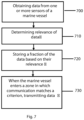
- the method can comprise (operation 700 ) obtaining data collected by one or more sensors (see reference 130 in Fig. 1 ) of at least one marine vessel during its voyage (it has to be noted that the method of Fig. 7 can be applied to a static marine platform).
- Operation 700 is similar to operation 200 and is not described again.
- the method can comprise (operation 710 ) determining relevance of data according to at least one relevance criterion.
- the relevance criterion can be defined to determine a relevance of the data for training a machine learning algorithm which provides an output based on these data (e.g. detection, recognition of objects, alerting, etc.).
- a higher relevance can be assigned.
- Operation 710 is similar to operation 210 and is not described again.
- the method can comprise storing, in a memory, a fraction of the data obtained from the sensors (and not all obtained data) during a period of time.
- the selection of the fraction of the obtained data relatively to the obtained data can be performed based on the relevance determined for the obtained data.
- the fraction of the obtained data (relatively to the obtained data) which is stored (in particular for their subsequent transmission) in this period of time will be high (and can be up to one, that it to say that all obtained data during this period of time will be stored in a database).
- the camera records 30 frames per second.
- data are considered as not very relevant based on the relevance criterion (for example, the camera records images which comprise only the sea and the sky in standard climatic conditions).
- the system 100 comprises a layer (query layer) which stores only fraction of data as explained with respect to Fig. 7 .
- the method will thus store only a fraction of the obtained data (because as already mentioned above, most of the data obtained from the sensors correspond to situations which are not relevant for improving the training of the machine leaning algorithm). During some periods of time, all obtained data will be stored, and during other periods of time, only a small fraction of the obtained data will be stored.
- Fig. 7 when the marine vessel is located in a zone in which remote data communication meets a criterion, transmission of stored data using at least one remote communication link can be performed (if the method is used for a static marine platform, then data is transmitted when remote data communication meets a criterion).
- a mechanism such as first in, first out, can be used, or data to be transmitted among the stored data can be selected randomly. This is however not limitative.
- data which are stored are transmitted according to their relevance. This is shown in operation 740 in Fig. 7A .
- This operation is equivalent to operation 220 described in Fig. 2 .
- the main difference is that in the embodiment of Fig. 7A , obtained data have first been reduced by selecting only a fraction of them based on their relevance.
- the method of Fig. 7A can be applied to a stationary marine platform (in operation 740, data will be transmitted when communication meets a criterion).
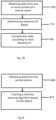
- FIG. 7B describes a method of processing data according to their relevance.
- the method comprises (operation 700 ) in which data are obtained from one or more sensors of a marine vessel (this operation has already been described with respect to Figs. 7 and 7A ).
- the method comprises (operation 710 ) determining relevance of data according to at least one relevance criterion (this operation has already been described with respect to Figs. 7 and 7A ).
- the method can comprise compressing (operation 760 ) data according to their relevance. For example, data with low relevance will be compressed with a high compression rate (even if quality of data is reduced), whereas data with high relevance will not be compressed or with a lower compression rate (thereby preserving quality of data).
- This method can be combined with the various methods already described above. For example, if this method is combined with the method of Fig. 2 , data will be prioritized according to their relevance and transmitted according this prioritization. Low priority data (which have been highly compressed according to the method of Fig. 7B ) will be transmitted last, whereas high priority data (which have not been compressed, or with a low compression rate), will be transmitted first.
- FIG. 8 describes a method of using the data transmitted using the various embodiments described above.
- data collected by sensors and representative of various situations encountered by the marine vessel are transmitted to a central station.
- a plurality of marine vessels are used, and therefore, data are collected from a plurality of marine vessels.
- a machine learning algorithm (or a plurality) can be trained (see operations 800, 810 ).
- the machine learning algorithm can include e.g. a deep learning algorithm (or a plurality).
- a supervised learning can be used. Depending on the output which is expected from the machine learning algorithm, a different supervised learning can be used.
- detection and/or identification of objects and/or of situations is to performed by the machine learning algorithm. This is not limitative and other output can be computed based on these data (alerting, output for assisting the crew in navigation, etc.).
- an operator can annotate the data transmitted to the central station.
- annotations include e.g. type of objects (type of marine vessel, iceberg, maritime creatures, etc.)
- data can be sent according to their relevance, and/or can be stored according to their relevance, labelling effort is reduced and supervision of incoming data is optimized.
- the machine learning algorithm can be trained based on these data and on the annotations provided by the operator.
- the machine learning algorithm can be deployed on a marine vessel, in order to test its performance.
- Fig. 6 the method of Fig. 6 can be performed, as explained above.
- the machine learning algorithm can be at least partially trained on the marine vessel.
- machine learning algorithms which can include deep learning algorithm
- machine learning algorithms which can include deep learning algorithm
- Deep neural networks Deep belief networks
- Convolutional neural networks Convolutional Deep Belief Networks
- Stacked (Denoising) Auto-Encoders Deep stacking networks
- Deep Recurrent Neural Networks Super resolution
- Generative adversarial Networks etc. This is however not limitative.
- Embodiments of the presently disclosed subject matter are not described with reference to any particular programming language. It will be appreciated that a variety of programming languages may be used to implement the teachings of the presently disclosed subject matter as described herein.
- the invention contemplates a computer program being readable by a computer for executing one or more methods of the invention.
- the invention further contemplates a machine-readable memory tangibly embodying a program of instructions executable by the machine for executing one or more methods of the invention.
Landscapes
- Engineering & Computer Science (AREA)
- Physics & Mathematics (AREA)
- Theoretical Computer Science (AREA)
- Software Systems (AREA)
- General Physics & Mathematics (AREA)
- Artificial Intelligence (AREA)
- General Engineering & Computer Science (AREA)
- Data Mining & Analysis (AREA)
- Evolutionary Computation (AREA)
- Mathematical Physics (AREA)
- Computing Systems (AREA)
- Radar, Positioning & Navigation (AREA)
- Remote Sensing (AREA)
- Computational Linguistics (AREA)
- Molecular Biology (AREA)
- General Health & Medical Sciences (AREA)
- Biophysics (AREA)
- Biomedical Technology (AREA)
- Health & Medical Sciences (AREA)
- Life Sciences & Earth Sciences (AREA)
- Mechanical Engineering (AREA)
- Combustion & Propulsion (AREA)
- Chemical & Material Sciences (AREA)
- Ocean & Marine Engineering (AREA)
- Computer Networks & Wireless Communication (AREA)
- Signal Processing (AREA)
- Medical Informatics (AREA)
- Computer Vision & Pattern Recognition (AREA)
- Automation & Control Theory (AREA)
- Traffic Control Systems (AREA)
- Aviation & Aerospace Engineering (AREA)
Description
- The presently disclosed subject matter relates to the field of marine environment.
- In the marine environment, a marine vessel travels on a route on which it can encounter various situations. Some of these situations can comprise a danger, e.g. an obstacle to be avoided, zones with dangerous weather, etc.
-
KR101284850 KR101284850 -
KR20100099833 -
US 2012/307720 describes a system for communicating with one or more satellites over two frequencies, where information identifying the second frequency is transmitted over the first frequency. -
US 2014/086191 proposes a solution for providing an integrated long range, high capacity communication system between several entities involved in maritime Simultaneous Operations (SIMOPS). -
KR 101874361 -
EP 3291206 describes a vessel traffic service expert system using a deep learning algorithm. - It is now necessary to provide new methods and systems in order to improve safety and reliability of marine vessels navigation.
- Systems and methods as described in the appended claims are provided.
- According to some embodiments, the proposed solution allows collecting relevant data representative of situations encountered by marine vessels, in order to train one or more machine learning algorithms (which can include e.g. one or more deep learning algorithms) providing output (e.g. prediction, detection, analysis, etc.) based on these data.
- According to some embodiments, the proposed solution allows collecting large amount of relevant data representative of situations encountered by marine vessels, and remotely transmitting these data, although remote communication in the marine environment is challenging (e.g. in terms of coverage, quality of communication, latency, connectivity, cost, etc.).
- According to some embodiments, the proposed solution allows collecting and transmitting large amount of relevant data representative of situations encountered by marine vessels in a more efficient way, which optimizes processing resources and cost.
- According to some embodiments, the proposed solution is tailored for the marine environment and splits processing of data and transmission of data over time. It takes advantage of the specificity of a voyage of a marine vessel. In particular, processing of data is mainly performed while the marine vessel is travelling in zones in which remote data communication is not possible or not efficient, therefore allowing immediate remote transmission of data when remote data communication becomes possible.
- According to some embodiments, the proposed solution allows selecting in an adaptive way data collected by sensors of the marine vessel over time, based on their relevance, thereby optimizing storage, processing resources, labeling effort, supervising incoming data and bandwidth required for transmitting data.
- According to some embodiments, the proposed solution allows up-to-date and online assessment of relevance of collected data for training one or more machine learning algorithms (which can include e.g. one or more deep learning algorithms)in the marine environment.
- According to some embodiments, the proposed solution is critical for training of machine leaning algorithms (which can include e.g. one or more deep learning algorithms) providing output in the marine environment. As a consequence, it is useful for improving safety and reliability of marine vessels.
- In order to understand the invention and to see how it can be carried out in practice, embodiments will be described, by way of non-limiting examples, with reference to the accompanying drawings, in which:
-
Fig. 1 illustrates an embodiment of a system which can be used to perform one or more of the methods described hereinafter; -
Fig. 2 illustrates an embodiment of a method which can be used to collect data and transmit such data according to its relevance; -
Fig. 3 illustrates an example of prioritizing data in a priority queue according to its relevance; -
Fig. 4 illustrates an example of a voyage of a marine vessel; -
Fig. 5 illustrates an example of a method of determining relevance of collected data; -
Fig. 6 illustrates an embodiment of a method of determining relevance of collected data based on the output of a machine learning algorithm currently operating on the marine vessel; -
Fig. 6A illustrates an embodiment of a method of determining relevance of collected data based on the output of a machine learning algorithm currently operating on the marine vessel, and transmitting data based on this relevance; -
Fig. 7 illustrates an embodiment of a method of reducing size of collected data, for their storage before their transmission; -
Fig. 7A illustrates an embodiment of a method of reducing size of collected data for its storage before transmission, and transmitting the data according to its relevance; and - 7B illustrates an embodiment of a method of compressing data according to their relevance; and
-
Fig. 8 illustrates an embodiment of training a machine learning algorithm based on the collected data. - In the following detailed description, numerous specific details are set forth in order to provide a thorough understanding of the invention. However, it will be understood by those skilled in the art that the presently disclosed subject matter may be practiced without these specific details. In other instances, well-known methods have not been described in detail so as not to obscure the presently disclosed subject matter.
- Unless specifically stated otherwise, as apparent from the following discussions, it is appreciated that throughout the specification discussions utilizing terms such as "obtaining", "prioritizing", "selecting", "monitoring", "training", "storing" or the like, refer to the action(s) and/or process(es) of a processing unit that manipulate and/or transform data into other data, said data represented as physical, such as electronic, quantities and/or said data representing the physical objects.
- The term "processing unit" as disclosed herein should be broadly construed to include any kind of electronic device with data processing circuitry, which includes for example a computer processing device operatively connected to a computer memory (e.g. digital signal processor (DSP), a microcontroller, a field programmable gate array (FPGA), and an application specific integrated circuit (ASIC), etc.) capable of executing various data processing operations.
- It can encompass a single processor or multiple processors, which may be located in the same geographical zone or may, at least partially, be located in different zones and may be able to communicate together.
- The term "non-transitory memory" as used herein should be expansively construed to cover any volatile or non-volatile computer memory suitable to the presently disclosed subject matter.
-
Fig. 1 illustrates an embodiment of asystem 100 which can be used to perform one or more of the methods described hereinafter. As shown,system 100 can comprise aprocessing unit 110 and a memory 120 (e.g. non-transitory memory). -
System 100 can be embedded on a marine platform. In particular, the marine platform can be a moving marine platform. The moving marine platform can be e.g. a marine vessel. Marine vessels include e.g. ships, boats, hovercraft, etc. - In some embodiments,
system 100 can be embedded on a marine platform which can be stationary. - Although embodiments will be described with reference to marine vessels, it is to be understood that these embodiments apply similarly to a stationary marine platform.
- As shown in
Fig. 1 ,system 100 can obtain data from one ormore sensors 130. At least some of thesensors 130 can be located on the marine vessel on whichsystem 100 is located (or on at least one other marine vessel communicating with the marine vessel on whichsystem 100 is located). -
Sensors 130 collect data during the voyage of the marine vessel. The voyage include of course portions of the voyage in which the marine vessel is in motion, but can also include portions of the voyage in which the marine vessel is substantially static (e.g. when the marine vessel is moored or docked such as at a harbor). -
Sensors 130 can include (this list is not limitative): camera, radar, geo-localization system (e.g. GPS), automatic identification system (AIS), inertial sensor (speed or acceleration sensor), temperature sensor, pressure sensor, wind sensor, etc. - As explained hereinafter in the specification,
system 100 can process data collected bysensors 130. At least part of the data can be stored inmemory 120, and can be transmitted using a remote communication link. - In particular, data output by
system 100 can be transmitted according to some embodiments through aremote communication network 140 towards e.g. acentral station 150. - The remote communication link can correspond e.g. to a broadband cellular network (e.g. 4G, 5G, LTE, etc.), a satellite communication network, Radio communication network (such as Radio VHF - very high frequency), etc.
- Data can be transmitted using a communication system located on the marine vessel which is suitable to transmit data via the remote communication network. The communication system can include e.g. an antenna, an emitter, a transponder, etc.
- The
central station 150 can comprise one or more database for storing data which have been transmitted from the marine vessel. As explained hereinafter, data transmitted to thecentral station 150 can be further used to train one or more machine learning algorithms (which can include one or more deep learning algorithms). - Attention is now drawn to
Fig. 2 . - A method can comprise (operation 200) obtaining data collected by one or more sensors (see
reference 130 inFig. 1 ) of at least one marine vessel. Data are representative of one or more situations encountered by the marine vessel during its voyage. For example, if the sensor is a camera, the data can comprise a large amount of images taken by the camera during the voyage of the marine vessel. - The expression "situation" is to be construed in a broad way and include e.g. various objects (e.g. icebergs, other marine vessels, etc.) that can be encountered by the marine vessel, and/or world state (e.g. climatic conditions, state of the sea, etc.)
- The expression "voyage" includes both time periods in which the marine vessel is travelling, and time periods in which the marine vessel can be moored or docked.
- As explained hereinafter, data are collected in particular for training one or more machine learning algorithms (which can include e.g. one or more deep learning algorithms) which can be used to provide output in the marine environment based on data collected by sensors of marine vessels.
- The output can comprise e.g. detection of obstacles (e.g. other marine vessels, icebergs, etc.), recognition of obstacles, detection of potential collision, estimation of distance to objects, alert raising (with level of severity), assistance for navigation, filtering of interesting objects, etc.
- Collection and transmission of data (required for training/evaluating a machine learning algorithm) in the marine environment is however challenging since huge amounts are collected by the sensors, and remote communication data is difficult at sea.
- The method can comprise (operation 210) prioritizing data according to at least one relevance criterion. Various examples of the relevance criterion will be provided hereinafter.
- In other words, data obtained by the
system 100 from thesensors 130 can be assigned a priority which depends on the relevance of the data. The higher the relevance, the higher the priority of the data. The lower the relevance, the lower the priority of the data. - Prioritization of data can be performed e.g. by tagging data with a marker, or with a label, or by storing data in a table or a data structure in a manner which reflects priority of data (for example the first lines or columns correspond to the data with higher priority and the last lines or columns to the lower priority - this is not limitative). These examples are not limitative.
- Therefore, data collected from
sensors 130 can be stored in a database (e.g. inmemory 120, or in another memory located on the marine vessel), together with priority assigned to data. - Priority can be e.g. assigned using a scale or a rate (wherein one extremity of the scale corresponds to lowest priority, and another extremity of the scale corresponds to highest priority). The scale or the rate can be represented using any adapted values. This is however not limitative and priority can be represented using a textual representation (e.g. "high", "medium", "low") or any other adapted representation.
- Priority can be assigned (based on the relevance criterion) e.g. by periods of time, for example, from time t0 to t1, a priority P1 is assigned, from time t2 to t3, a priority P2 is assigned, etc.
-
Operation 210 can be performed before the data are stored in the database (for example in real time or quasi real time), and/or can be performed once the data are stored in a database, using post-processing. - According to some embodiments, if data are received from a plurality of
different sensors 130, prioritization can be performed separately for each type of data. For example, data acquired by a camera are prioritized separately, data acquired by an AIS are prioritized between them, and data acquired by a radar are prioritized separately. As explained hereinafter, prioritization can be influenced by data collected by a multiplicity of sensors. - According to some embodiments, if data are received from a plurality of
different sensors 130, a prioritization can be performed between data of the sensors. For example, if data received fromsensor 1 and data received from sensor 2 are both considered as having high priority, it can be defined that data fromsensor 1 will have a higher priority relatively to data from sensor 2 because data fromsensor 1 are considered as generally more relevant and useful for training one or more machine learning algorithms. This is not limitative and can be applied to a large number of sensors. - As shown in
Fig. 2 (see operation 220), when then marine vessel is located in a zone in which remote data communication meets a criterion, transmission of data using at least one remote communication link can be performed. In some embodiments, data transmission is triggered as soon as possible, that it to say as soon as the marine vessel enters a zone in which remote data communication meets the criterion. According to some embodiments, the criterion can be defined as a requirement for the quality of the remote data communication, which can include at least one of: - data representative of a minimal available transmission rate in this zone;
- data representative of a level of coverage of the zone for this communication link;
- data representative of the communication bandwidth in this zone, etc.
- According to some embodiments, the criterion can also include financial/cost consideration. Indeed, some networks can provide remote data communication in the marine environment with a satisfactory quality but which involves high cost which can be incompatible with the volume of data to be transmitted. In particular, according to some embodiments, data required for training machine learning algorithms include high volume rates to be transmitted since data can include visual data such as images (which can be of high resolution) and/or videos (which can be of high resolution).
- In some embodiments, a different criterion can be defined for each remote communication link. For example, broadband cellular communication is associated with a first criterion and satellite communication is associated with a second criterion.
- Assessment whether remote communication data in which the marine vessel is located meets the criteria can be performed in various ways.
- According to some embodiments,
system 100 stores predefined data which defines for each remote communication link data representative of the quality (and if necessary cost) of the remote communication link with respect to the geographical zone. For example, for a given zone near the shore, it is stored that remote communication can be performed with a predefined minimal bandwidth. - These data can be provided e.g. by the provider of the remote communication link.
System 100 monitors position of the marine vessel (using e.g. GPS, and/or AIS sensors), and can detect when the marine vessel enters (or exits) a zone in which remote communication data meets the criterion. - According to some embodiments,
system 100 can comprise, or can communicate with a device which is suitable for measuring quality of the remote communication link. For example, for a broadband cellular network, an antenna of the marine vessel can be used to measure quality of reception and/or transmission of data in the zone in which the marine vessel is currently located. This measured quality can be compared to the criterion in order to trigger remote communication. - According to some embodiments, both predefined data and data measured during the voyage of the marine vessel can be used to assess whether remote communication link matches the criterion. A combination of these two types of data (e.g. an average - this is not limitative) can be performed in order to assess quality of the remote communication link in this zone. Although the method of
Fig. 2 has been described with reference to a moving marine platform (marine vessel), in some embodiments, it can be applied similarly to a static marine platform. In this embodiment,operations 200 and 210 can be performed similarly. Communication of data from the marine platform can be at some periods of time more difficult (e.g. because satellite coverage is not optimal, or for some technical reasons, or because of bad climatic conditions) and therefore, when communication matches the criterion (e.g. when satellite coverage has become sufficient, or when bad climatic conditions have disappeared), the method can comprise transmitting data according to their priority (similarly to what was described for a moving marine platform). In the embodiment described inFig. 2 , transmission of data is triggered when the marine vessel enters a zone in which communication matches the criterion, whereas in this embodiment, the marine platform remains in the same zone (static marine platform) and communication is triggered when it matches the criterion. - Reverting to the example of a moving marine platform mentioned above (such as a marine vessel), when the marine vessel enters a zone for which remote data communication matches the criterion, data can be transmitted according to their priority. According to some embodiments, if a plurality of criteria have been defined, it can be set that if at least one criterion is met for at least one type of remote communication link, then data can be transmitted using this remote communication link.
- According to some embodiments, transmission of data according to their priority can include transmitting data in a (temporal) order which reflects priority, e.g. first data with higher priority, and then data with lower priority.
- Therefore, a priority queue can be created, wherein the data with higher priority are located at the top of the priority queue, and transmitted first, whereas the data with lower priority are located at the bottom of the priority queue, and transmitted last.
- According to some embodiments, transmission of data according to their priority can include:
- most data which are transmitted first belong to the high priority data;
- a (in particular small) percentage of data which are transmitted first belong to the low priority data.
- In other words, this allows transmitting first high data mixed up with a few portions of low priority data.
- According to some embodiments, transmission of data according to their priority can comprise allocating a bandwidth to the data which reflects priority, e.g. high bandwidth to data with high priority and low bandwidth to data with low priority.
- The amount of data which is transmitted (relatively to the entire subset of data which has been collected) depends in particular on the size of the temporal window for which the marine vessel is located in a zone in which remote communication data meets the criterion.
- Assume the marine vessel exits a first zone in which a first remote communication link met the criterion, and enters a second zone.
- If, in the second zone, the first remote communication link still meets the criterion, then data communication is pursued as initiated.
- If, in the second zone, a second remote communication link (different from the first one) meets the criterion, then data can be transmitted using this second remote communication link. Data communication using the first remote communication link is stopped and is resumed using the second communication link. This can be viewed as a kind of handover.
- If no remote communication link meets the criterion in the second zone, then remote data communication is stopped.
- Remote data communication will resume when the marine vessel returns in a zone in which a remote communication link meets the criterion. Communication will resume from the latest data in the priority queue which were not transmitted, except if, in the meantime, additional data are collected which have a higher priority than this latest data (and therefore this additional data will be transmitted first when remote communication resumes).
- A priority queue is illustrated in the non-limitative example of
Fig. 3 . - As shown,
image 300 has the highest priority and is transmitted first using the remote communication link to a central station. -
Image 310 has medium priority rank, and is located afterimage 300 in the priority queue. Therefore,image 310 is transmitted (if the temporal window in which remote communication is large enough) afterimage 300. Lastly,image 320 is transmitted (if the temporal window in which remote communication is large enough). - According to some embodiments, transmission of data and collection of data can be simultaneous over one or more periods of time.
- Assume the marine vessel is located in a zone in which remote communication data meets a criterion. While data which were already acquired can be transmitted using the remote communication link, additional data can be acquired and prioritized. In this case, the additional data will be inserted in the priority queue according to their priority rank, and data will be transmitted according to this priority queue. Therefore, there is an overlap in time between the process of transmitting data and the process of collecting additional data and prioritizing them.
- According to some embodiments, assume a priority queue has been determined, and that according to the priority queue, given data of medium priority needs now to be transmitted. Since the process is dynamic, if the method determines new data of high priority, then this data will be inserted in the priority queue before the given data of medium priority, and therefore will be transmitted first, although they were collected later.
- Attention is drawn to
Fig. 4 , which illustrates a non-limitative example of a voyage of amarine vessel 400. - When the
marine vessel 400 is located onportion 410 of its route,system 100 collects data from sensors and prioritizes them. However, data is not transmitted since the marine vessel is not located in a zone 430 in which remote communication link meets the criterion. When themarine vessel 400 enters zone 430, data can be transmitted towards thecentral station 460 according to their priority, using the remote communication link which is available in zone 430. - In this example, zone 430 is located in the vicinity of the
shore 450. This is however not mandatory. This kind of configuration is met in particular when a broadband cellular network is used to transmit data, since quality of the communication is better when the marine vessel is close to the shore. - According to some embodiments, the solution takes advantage of the time in which the marine vessel is located outside of a zone in which remote communication data is possible in order to process data collected from sensors (this processing comprises in particular prioritizing data, but can comprise other processing that could be needed, such as filtering, etc.). When the marine vessel enters the zone in which remote communication becomes possible, data is ready to be transmitted according to the expected order.
- According to some embodiments, time allocated for prioritization of data is mainly located in periods of time in which the marine vessel is not located in a zone in which remote communication data is possible. In these periods of time, processing resources of
system 100 can be dedicated more to these prioritization tasks, since the task of transmitting data is not performed. - However, as mentioned above, prioritization of data can also be performed when the marine vessel is located in a communication zone, since additional data can be also collected during this period of time.
- As mentioned above, data can be prioritized according to one or more relevance criteria.
- In particular, according to some embodiments, the relevance criterion can reflect a relevance of the data for training one or more machine learning algorithms based on these marine data. As explained hereinafter, one or more machine learning algorithms can be trained based on this maritime data in order to perform various tasks, such as detecting of objects, alerting, predicting, outputting help for navigation, etc.
- When training a machine learning algorithm, it is recommended to feed a large amount of data, which represent a large variety of different scenarios.
- For example, assume the machine learning algorithm is trained to detect objects. An example of objects includes e.g. other marine vessels. The more data representative of marine vessels are fed to the machine learning algorithm (in particular data comprising a large variety of marine vessels), the better the prospects that the machine learning algorithm will be able to detect marine vessels.
- For example, it is better to feed different images of a marine vessel with different angles, in different climate conditions, etc. than a single image of this marine vessel for training the machine learning algorithm.
- Applicants have discovered that during the voyage of a marine vessel (this is also applicable to a static marine platform from which data are collected), only a limited fraction of the data collected by the sensors correspond to scenarios that have a certain relevance for training the machine learning algorithm.
- Indeed, considering the example of images taken by a camera, then most of the images will correspond substantially to the same scene (that is to say the sky, the sea, and the sun - see
image 320 inFig. 3 ). Although this kind of scene is also to be fed to the machine learning algorithm (in order for it to learn the common background encountered in the sea, and therefore, this kind of scene also has some relevancy), it is not of any benefit to feed it a large number of times, since this will not improve the training of the machine learning algorithm. Therefore, these kind of images are less relevant (relative to other images) and can get a lower priority. To the contrary, if an image of another marine vessel is taken (seeimage 300 inFig. 3 ), it is recommended to assign to this image a higher priority, since this will help in the training of the machine learning algorithm to detect this type of marine vessel. - Examples of relevance criteria are provided hereinafter.
- According to some embodiments, prioritizing data according to the at least one relevance criterion is based on at least a monitoring of data representative of the route of the marine vessel. A non-limitative example is provided in
Fig. 5 . - Indeed, assume a
planned route 520 was set for themarine vessel 500, and that at somepoint 510 of the voyage, themarine vessel 500 changes its route with respect to the plannedroute 520. - This change can be detected by a localization system (GPS, AIS, etc.), and can be indicative that from this
point 510, data which are collected from the sensors correspond to a more relevant situation and therefore should get a higher priority. Indeed, a change from the planned route can indicate that the crew had to avoid an obstacle, a danger or a zone with bad weather, and therefore data collected from the sensors in the corresponding period of time have a certain relevancy and should be transmitted in priority to the central station. - For example, priority of data collected from
point 510 can be considered as having a high relevancy according to the relevance criterion, and therefore can get a higher priority. This high priority can be set for data collected until a predefined period of time has elapsed, or until themarine vessel 500 has returned to its planned route 520 (according e.g. to someproximity criterion 530 defining a distance between themarine vessel 500 and the planned route 520). - According to some embodiments, prioritizing data according to the at least one relevance criterion is based on at least a monitoring of data representative of inertial data (position, speed, acceleration, etc.) of the marine vessel.
- For example, if it is detected that the marine vessel has a position which is close to a harbour, this can indicate that the marine vessel attempts to reach this harbour. This kind of data can be relevant for training the machine learning algorithm, and therefore a high or medium priority can be assigned to the data collected during the corresponding period of time.
- In another example, if the speed or the acceleration of the marine vessel is above (or in some cases below) a threshold, this can also indicate that the situation can be relevant for collecting data (since this can correspond to a situation which can present a risk, or which is not usual), and a higher priority can be assigned to the data collected during the corresponding period of time.
- According to some embodiments, prioritizing data according to the at least one relevance criterion depends on one or more actions taken by at least one of a crew and an auto-pilot of the marine vessel for controlling the marine vessel.
- Indeed, the marine vessel is generally controlled by an auto-pilot, which attempts to keep speed and course (according to some GPS waypoints). If the crew provides instruction to the auto-pilot to modify its operation (e.g. speed and/or course), this can indicate that the situation encountered by the marine is relevant and corresponding collected data should get high priority.
- In some examples, if it is detected that the marine vessel received a command to change its direction, or its speed, and this change is above a predefined threshold, this can indicate that the marine vessel has encountered a situation which not usual (and/or risky) and is relevant to record. Therefore, a higher priority can be assigned to the data collected during the corresponding period of time in which these actions have been detected.
- Other actions which can reflect a higher relevancy, and therefore trigger a higher priority of the collected data can include e.g. raising of an alert by the crew, entering a port, bad visibility, congested waterways, certain speeds, maneuvers, collision alert, shallow waters, etc.
- According to some embodiments, prioritizing data according to the at least one relevance criterion depends on data collected by one or more weather sensors.
- For example, if specific climatic conditions are detected (e.g. high winds, large quantity of rain, or more generally climatic conditions which differ from predefined standard climatic conditions reflecting usual weather, etc.), this can correspond to relevant data, and therefore a higher priority can be assigned to the data collected during the corresponding period of time.
- According to some embodiments, prioritizing data according to the at least one relevance criterion depends on data collected by vibration sensors on the marine vessel.
- For example, if vibration above a threshold is detected (thereby indicating an abnormal situation), this can correspond to relevant data, and therefore a higher priority can be assigned to the data collected during the corresponding period of time.
- According to some embodiments, prioritizing data according to the at least one relevance criterion, depends on a detection of objects in the images taken by one or more cameras of the marine vessel. For example, if a detection algorithm detects one or more marine vessels, or specific objects (e.g. icebergs, etc.), in the images, then the data collected during this period of time (data collected by the camera, but also data from other sensors) can be considered as having a higher relevancy and therefore can be assigned with a higher priority.
- In some embodiments, the detection algorithm can be a machine learning algorithm (for example which was already trained using past data collected according to the present solution) and which is used currently on the marine vessel for detecting and identifying objects in the sea based on data collected by sensors of the marine vessel.
- According to some embodiments, prioritizing data according to the at least one relevance criterion depends on multiple set of rules, which can be e.g. predefined by an operator and stored in a memory (e.g. of system 100).
- For example, if both a speed of the marine vessel, and a number of objects detected in the images, and climatic conditions each meet a predefined criterion, then this can correspond to relevant data and therefore a higher priority can be assigned to data collected during this period of time.
- According to some embodiments, the relevance can be defined depending on data collected by various sensors of the marine vessel. In other words, data collected by various sensors can be fused to assess whether the situation in which the marine vessel is located corresponds to a relevant situation.
- For example, if the velocity of the marine vessel is below a threshold, and the distance to port is less than a threshold, this indicates that the marine vessel is stationed at the port, and therefore, data which are collected will get a very low priority. This is not limitative and various other rules can be defined which depend on various data collected by various sensors.
- According to some embodiments, one or more of these rules can be generated by a machine learning algorithm during the voyage of the marine vessel. The machine learning algorithm can be different from the machine learning algorithm for which data are collected and transmitted in order to train this machine learning algorithm.
- The machine learning algorithm (used for generating rules) can receive as an input a set of rules (already predefined by an operator), and data from sensors, and can be trained to generate new set of rules which are adapted to the marine vessel.
- For example, assume a rule is adapted to a zone in which many icebergs are present. The rule defines that data are relevant if the number of icebergs in the vicinity of the marine vessel is above a threshold.
- If the marine vessel moves to another part of the sea in which icebergs are less present, the machine learning algorithm can learn that the threshold has to be changed (based on data collected by the sensors of the marine vessel), and reduced, thereby generating a new rule which is more adapted to the current situation of the marine vessel. This example is however not limitative.
- According to some embodiments, prioritizing data according to the at least one relevance criterion is based on at least a comparison between collected data and data already stored in the database of the
system 100. If this comparison shows that the collected data (for example images) match data already stored in the database, then it is not worth assigning these data with a high priority since they have already been collected in the past, and are redundant. This comparison can be performed using e.g. image processing. - Attention is drawn to
Fig. 6 , which depicts another embodiment for prioritizing data according to the relevance criterion. - Assume the marine vessel embeds a system comprising a machine learning algorithm attempting to provide output representative of an actual situation encountered by the marine vessel during its voyage. The output can be e.g. a detection/identification of the objects present in the images taken by a camera of the marine vessel, based on various data collected by the sensors (camera, AIS, radar, etc.). This is however not limitative and other output can be provided (e.g. assistance to navigation for the marine vessel, etc.).
- For example, this machine learning algorithm has been trained previously using data collected during previous voyages of marine vessels (according e.g. to the various methods described in the present application), and/or using simulated data. In some embodiments, the machine learning algorithm has been trained previously to detect/identify objects present in the vicinity of the marine vessel, using e.g. images from cameras, AIS data, radar data, etc.
- During the voyage of the marine vessel, the machine learning algorithm provides an output (operation 610) depending on the data collected by the sensors of the marine vessel (operation 600). As mentioned above, this output should be (depending on the performance of the model) representative of the actual situation encountered by the marine vessel.
- Assume an example in which a machine learning algorithm is trained to detect/identify objects. This is however not limitative and the machine learning algorithm can be trained for other purposes (e.g. alert raising, assistance to navigation, etc.).
- If, in the actual situation, three other marine vessels are present in front of the marine vessel, the machine learning algorithm needs to provide an output which reflects the presence of these three other marine vessels.
- A comparison between the output provided by the machine learning algorithm and the actual situation encountered by the machine vessel is representative of the level of performance of the machine learning algorithm.
- This comparison can be performed using an input of an operator. For example, the machine learning algorithm can detect two vessels, and the operator will indicate to the system (using e.g. an interface of the system) the level of matching of the output with the actual situation. This level matching can be represented using various manners: for example, the operator can indicate a level of matching using a score, etc.
- In other embodiments, the level of matching can be determined using data provided by sensors of the marine vessel.
- For example, assume that the machine learning algorithm detected, based on the images provided by a camera, two other marine vessels. However, the AIS indicates that in fact, three marine vessels are located in the vicinity. The comparison of the output provided by the machine learning algorithm with the data provided by the AIS therefore indicates that the level of matching is not satisfactory.
- According to some embodiments, prioritizing data according to the least one relevance criterion depends on a matching between the actual situation and the output provided by the system (operation 620). This level of matching can be assessed based e.g. on a matching criterion (which defines e.g. a scale for which high matching, medium matching, or low matching is obtained).
- If the output is a detection of objects, then the matching can be a comparison between the detection provided by the machine learning algorithm and the actual situation.
- If the output is e.g. a command for assisting the marine vessel in navigation, the matching can reflect to what extent the command output by the machine learning algorithm is really adapted to the actual situation faced by the marine vessel.
- According to some embodiments, the lower the matching, the higher the relevancy, and conversely, the higher the matching, the lower the relevancy.
- Indeed, if the matching is high, this means that the machine learning algorithm is already well trained for the actual situation, and therefore the collected data are not so relevant to further improve training of the machine learning algorithm. As a consequence, there is no point assigning high priority to the collected data.
- To the contrary, if the matching is low, or medium, this shows that the machine learning algorithm is not well trained for this actual situation, and therefore, collected data are highly relevant and should be assigned a higher priority, in order to improve training of the machine learning algorithm for this kind of situation.
- Although an example has been provided with data collected by a camera, this is not limitative and the matching between data provided by the machine learning algorithm and the actual situation as sensed by the sensor can be assessed for any of the sensors of the marine vessel, in order to determine relevance/priority of data associated to these sensors. For example, the AIS can provide position of marine vessels located in the vicinity of the marine vessel, and the machine learning algorithm can predict position of these marine vessels based on the data collected by a radar. If there is a low level of matching, this can indicate that data collected by the radar should get high priority.
- Therefore, this method allows assigning priority of data using an actual version of the machine learning algorithm, thereby allowing online and up-to-date understanding of the relevance of the data.
- If the machine learning algorithm is trained to provide other output, such as alert raising, or assistance to navigation, the method can be performed in a similar way. When the machine learning algorithm embedded on the marine vessel provides its output based on the collected data, an operator can input to the system a level of matching of the output with the current situation (or a level of performance of the output with respect to the actual situation). For example, if the machine learning algorithm provides instructions or commands or recommendation for assisting in navigation (e.g. inertial commands, such as direction or speed), and an operator understands that these commands are adapted to the actual situation, then the operator can provide that the matching is high, and, if not, that the matching is low. The higher the matching, the lower the relevancy, and the lower the priority. The lower the matching, the higher the relevancy, and the higher the priority.
- In some embodiments, a processor (e.g. of system 100) can detect the level of matching. For example, the processor can be connected to the marine vessel's helm, or and/or another actuator of the marine vessel, and/or to the auto-pilot, and can detect what action was taken with respect to the recommendation (or more generally the output) provided by
system 100, and the error rate (difference between the recommendation and the actual action taken by the crew). This indicates to what extent the recommendation provided bysystem 100 matches the actual situation. - The higher the matching, the lower the relevancy, and the lower the priority. The lower the matching, the higher the relevancy, and the higher the priority.
- In some embodiments (see
Fig. 6A ), data collected by one or more specific sensors can be prioritized relatively to data collected by other sensors. - The method comprises
operations sensors 130, an output representative of an actual situation encountered by the marine vessel using the machine learning algorithm differs from the actual situation. The method can comprise (operation 630) assigning a higher priority to data collected by this specific sensor, whereas data collected by the other sensors can also get high priority but less than for this specific sensor. - For example, assume there is a bad weather, and therefore, low visibility. Assume the AIS provided that there are three boats in front of the marine vessel, and that the machine learning algorithm detected based on the data provided by the camera only one boat. The method can comprise assigning a high priority to the data collected by all sensors (because the situation corresponds to a relevant situation since the machine learning algorithm was not able to provide correct detection), but the priority assigned to the data collected by the camera will get higher priority than all the other sensors, because it appears that the machine learning algorithm needs to be improved specifically for data collected by this sensor.
- Therefore, prioritization specific to data collected for each sensor can be performed, based e.g. on online performance obtained for data collected for this sensor.
- Attention is now drawn to
Fig. 7 . - The method can comprise (operation 700) obtaining data collected by one or more sensors (see
reference 130 inFig. 1 ) of at least one marine vessel during its voyage (it has to be noted that the method ofFig. 7 can be applied to a static marine platform). -
Operation 700 is similar to operation 200 and is not described again. - The method can comprise (operation 710) determining relevance of data according to at least one relevance criterion.
- In particular, the relevance criterion can be defined to determine a relevance of the data for training a machine learning algorithm which provides an output based on these data (e.g. detection, recognition of objects, alerting, etc.).
- Several embodiments have been described above for assessing relevancy of data based on the relevance criterion and can be used in the present method (see e.g.
Figs. 4 to Fig. 6 ). Therefore, these embodiments are not described again. - For example, when the marine vessel changes its route from a predefined route, a higher relevance can be assigned.
-
Operation 710 is similar tooperation 210 and is not described again. - The method can comprise storing, in a memory, a fraction of the data obtained from the sensors (and not all obtained data) during a period of time.
- The selection of the fraction of the obtained data relatively to the obtained data can be performed based on the relevance determined for the obtained data.
- Assume data are obtained during a period of time. Assume it is determined based on the relevance criterion that these data are not so relevant (low relevance). Therefore, the fraction of the obtained data which is stored in a database (in particular for their subsequent transmission) will be low.
- To the contrary, assume it is determined based on the relevance criterion that data obtained during a period of time are highly relevant. Therefore, the fraction of the obtained data (relatively to the obtained data) which is stored (in particular for their subsequent transmission) in this period of time will be high (and can be up to one, that it to say that all obtained data during this period of time will be stored in a database).
- In other words, the higher the relevance of the obtained data, the higher the fraction of obtained data which is stored, and the lower the relevance of the obtained data, the lower the fraction of obtained data which is stored.
- This can be illustrated in a simple example (which is not limitative).
- Assume images are recorded by a camera of the marine vessel.
- For example, the camera records 30 frames per second.
- Assume that during a given period of time, data are considered as not very relevant based on the relevance criterion (for example, the camera records images which comprise only the sea and the sky in standard climatic conditions).
- Therefore, it is not worth storing all data obtained by the camera during this given period of time, and it can be decided that only a fraction of the obtained data is stored in a memory of the
system 100. For example, if the relevancy is very low, only one frame per hour can be stored. This is however not limitative. - If the relevance is very low, for example when it is detected that the marine vessel is located at the port (see above embodiments for detecting this position), then in some embodiments data collected from sensors are not stored at all by
system 100. - In some embodiments, all data collected from the sensors are stored, and the
system 100 comprises a layer (query layer) which stores only fraction of data as explained with respect toFig. 7 . - Assume that during a given period of time, data are considered as very relevant based on the relevance criterion.
- Therefore, it is worth storing most or all data obtained by the camera during this given period of time, and it can be decided that most or all the data collected by the camera is stored in a memory of the
system 100. For example, if the relevance is very high, all frames (at the rate of 30 frames per second) obtained by the camera can be stored. This is however not limitative. - Over a plurality of periods of time, the method will thus store only a fraction of the obtained data (because as already mentioned above, most of the data obtained from the sensors correspond to situations which are not relevant for improving the training of the machine leaning algorithm). During some periods of time, all obtained data will be stored, and during other periods of time, only a small fraction of the obtained data will be stored.
- As shown in
Fig. 7 (see operation 730), when the marine vessel is located in a zone in which remote data communication meets a criterion, transmission of stored data using at least one remote communication link can be performed (if the method is used for a static marine platform, then data is transmitted when remote data communication meets a criterion). - Examples of criteria have been provided in the previous embodiments above and apply herein.
- In some embodiments, since selection of a fraction of the data has already allowed a reduction of the size of the data to be transmitted, then data are transmitted without taking into account relevance of data. This is shown in
operation 730 inFig. 7 . - For example, a mechanism such as first in, first out, can be used, or data to be transmitted among the stored data can be selected randomly. This is however not limitative.
- In other embodiments, data which are stored (which correspond to the fraction of the obtained data) are transmitted according to their relevance. This is shown in
operation 740 inFig. 7A . - This operation is equivalent to
operation 220 described inFig. 2 . The main difference is that in the embodiment ofFig. 7A , obtained data have first been reduced by selecting only a fraction of them based on their relevance. - The more the data are relevant, the higher their priority in the priority queue in which data are transmitted.
- The less the data are relevant, the lower their priority in the priority queue in which data are transmitted.
- Various embodiments have been described above for transmitting data according to their relevance, and apply herein.
- According to some embodiments, the method of
Fig. 7A can be applied to a stationary marine platform (inoperation 740, data will be transmitted when communication meets a criterion). - Attention is drawn to
Fig. 7B , which describes a method of processing data according to their relevance. - The method comprises (operation 700) in which data are obtained from one or more sensors of a marine vessel (this operation has already been described with respect to
Figs. 7 and7A ). - The method comprises (operation 710) determining relevance of data according to at least one relevance criterion (this operation has already been described with respect to
Figs. 7 and7A ). - The method can comprise compressing (operation 760) data according to their relevance. For example, data with low relevance will be compressed with a high compression rate (even if quality of data is reduced), whereas data with high relevance will not be compressed or with a lower compression rate (thereby preserving quality of data).
- This method can be combined with the various methods already described above. For example, if this method is combined with the method of
Fig. 2 , data will be prioritized according to their relevance and transmitted according this prioritization. Low priority data (which have been highly compressed according to the method ofFig. 7B ) will be transmitted last, whereas high priority data (which have not been compressed, or with a low compression rate), will be transmitted first. - If this method is combined with the method of
Fig. 7 , then only a fraction of the data is stored, depending on their relevance, and among this fraction of data, compression is performed according to the relevance as explained inFig. 7B . - The same applies to the combination of the method of
Fig. 7B with the method ofFig. 7A . - Attention is now drawn to
Fig. 8 which describes a method of using the data transmitted using the various embodiments described above. - As described above, data collected by sensors and representative of various situations encountered by the marine vessel are transmitted to a central station. In some embodiments, a plurality of marine vessels are used, and therefore, data are collected from a plurality of marine vessels.
- Based on these data, a machine learning algorithm (or a plurality) can be trained (see
operations 800, 810). The machine learning algorithm can include e.g. a deep learning algorithm (or a plurality). - According to some embodiments, a supervised learning can be used. Depending on the output which is expected from the machine learning algorithm, a different supervised learning can be used.
- For example, in some embodiments, detection and/or identification of objects and/or of situations is to performed by the machine learning algorithm. This is not limitative and other output can be computed based on these data (alerting, output for assisting the crew in navigation, etc.).
- In this case, an operator can annotate the data transmitted to the central station. Examples of annotations include e.g. type of objects (type of marine vessel, iceberg, maritime creatures, etc.)
- As mentioned above, since data can be sent according to their relevance, and/or can be stored according to their relevance, labelling effort is reduced and supervision of incoming data is optimized.
- The machine learning algorithm can be trained based on these data and on the annotations provided by the operator.
- After training, the machine learning algorithm can be deployed on a marine vessel, in order to test its performance.
- For example, the method of
Fig. 6 can be performed, as explained above. - In some embodiments, the machine learning algorithm can be at least partially trained on the marine vessel.
- Examples of machine learning algorithms (which can include deep learning algorithm)which can be used include e.g. Deep neural networks, Deep belief networks, Convolutional neural networks, Convolutional Deep Belief Networks, Stacked (Denoising) Auto-Encoders, Deep stacking networks, Deep Recurrent Neural Networks, Super resolution, Generative adversarial Networks, etc. This is however not limitative.
- Embodiments of the presently disclosed subject matter are not described with reference to any particular programming language. It will be appreciated that a variety of programming languages may be used to implement the teachings of the presently disclosed subject matter as described herein.
- The invention contemplates a computer program being readable by a computer for executing one or more methods of the invention. The invention further contemplates a machine-readable memory tangibly embodying a program of instructions executable by the machine for executing one or more methods of the invention.
- It is to be noted that the various features described in the various embodiments may be combined according to all possible technical combinations.
- It is to be understood that the invention is not limited in its application to the details set forth in the description contained herein or illustrated in the drawings. The invention is capable of other embodiments and of being practiced and carried out in various ways. Hence, it is to be understood that the phraseology and terminology employed herein are for the purpose of description and should not be regarded as limiting. As such, those skilled in the art will appreciate that the conception upon which this disclosure is based may readily be utilized as a basis for designing other structures, methods, and systems for carrying out the several purposes of the presently disclosed subject matter.
- Those skilled in the art will readily appreciate that various modifications and changes can be applied to the embodiments of the invention as hereinbefore described without departing from its scope, defined in and by the appended claims.
Claims (12)
- A system (100) comprising at least one processing unit (110) configured to:- obtain (200, 700) data collected by one or more sensors (130) of at least one marine vessel (400, 500), said data being representative of one or more situations encountered by the marine vessel during its voyage,- prioritize (620) data according to at least one relevance criterion,- when the marine vessel is located in a zone (430) in which at least one remote data communication link meets a criterion, trigger (220) transmission of at least some of the data using the at least one remote data communication link, wherein data are transmitted according to priority determined for the data,wherein the system (100) is characterized in that:- the marine vessel (400, 500) embeds a second system comprising a machine learning algorithm attempting to provide (610) output representative of actual situation encountered by the marine vessel (400, 500) during its voyage based at least on the data collected by said one or more sensors (130),wherein the system is configured to:- prioritize (620) the data according to the at least one relevance criterion depending on a matching between the actual situation and the output provided by the second system according to a matching criterion.
- The system of claim 1, wherein the machine learning algorithm is trained to detect or identify objects.
- The system of claim 1, wherein the machine learning algorithm is trained to provide assistance to navigation.
- The system of claim 1, wherein the matching is determined using data provided by the sensors of the marine vessel.
- The system of claim 1, configured to select a fraction of the obtained data for storing said fraction of obtained data before their transmission, wherein, for each period of time of a plurality of periods of time, selection of the fraction of obtained data relative to the obtained data depends on priority assigned to obtained data associated with said period of time.
- The system of claim 1, wherein the lower the matching between the actual situation and the output provided by the second system, the higher the priority assigned to collected data representative of said actual situation.
- The system of claim 1, wherein prioritizing data according to the least one relevance criterion for a specific sensor relative to data collected by other sensors depends on a matching between the actual situation and the output provided by the second system for this specific sensor according to a matching criterion.
- A method comprising, by at least one processing unit (110):- obtaining (200, 700) data collected by one or more sensors (130) of at least one marine vessel (400, 500), said data being representative of one or more situations encountered by the marine vessel during its voyage,- prioritizing (620) data according to at least one relevance criterion,- when the marine vessel is located in a zone (430) in which at least one remote data communication link meets a criterion, transmitting (220) at least some of the data using the at least one remote data communication link, wherein data are transmitted according to priority determined for the data,wherein the method is characterized in that:- a system comprising a machine learning model embedded in the marine vessel (400, 500) attempts to provide (610) output representative of actual situation encountered by the marine vessel (400, 500) during its voyage based at least on the data collected by said one or more sensors (130),wherein the method comprises:- prioritizing (620) the data according to the at least one relevance criterion depending on a matching between the actual situation and the output provided by the system according to a matching criterion.
- The method of claim 8, comprising selecting (720) a fraction of the obtained data for storing said fraction of obtained data before their transmission, wherein, for each period of time of a plurality of periods of time, a selection of the fraction of obtained data relative to the obtained data depends on priority assigned to obtained data associated with said period of time.
- The method of claim 8, wherein the lower the matching between the actual situation and the output provided by the system, the higher the priority assigned to collected data representative of said actual situation.
- The method of claim 8, wherein prioritizing data according to the least one relevance criterion for a specific sensor relative to data collected by other sensors depends on a matching between the actual situation and the output provided by the system for this specific sensor according to a matching criterion.
- A non-transitory storage device readable by a machine, tangibly embodying a program of instructions executable by the machine to perform the method of claim 8.
Applications Claiming Priority (2)
| Application Number | Priority Date | Filing Date | Title |
|---|---|---|---|
| US201962835517P | 2019-04-18 | 2019-04-18 | |
| PCT/IL2020/050420 WO2020212973A1 (en) | 2019-04-18 | 2020-04-07 | Marine data collection for marine artificial intelligence systems |
Publications (4)
| Publication Number | Publication Date |
|---|---|
| EP3957122A1 EP3957122A1 (en) | 2022-02-23 |
| EP3957122A4 EP3957122A4 (en) | 2022-06-22 |
| EP3957122B1 true EP3957122B1 (en) | 2025-02-19 |
| EP3957122C0 EP3957122C0 (en) | 2025-02-19 |
Family
ID=72838094
Family Applications (1)
| Application Number | Title | Priority Date | Filing Date |
|---|---|---|---|
| EP20790982.1A Active EP3957122B1 (en) | 2019-04-18 | 2020-04-07 | Marine data collection for marine artificial intelligence systems |
Country Status (4)
| Country | Link |
|---|---|
| US (2) | US12177315B2 (en) |
| EP (1) | EP3957122B1 (en) |
| ES (1) | ES3014424T3 (en) |
| WO (1) | WO2020212973A1 (en) |
Families Citing this family (12)
| Publication number | Priority date | Publication date | Assignee | Title |
|---|---|---|---|---|
| KR102812660B1 (en) * | 2019-10-18 | 2025-05-26 | 한국전자통신연구원 | Apparatus and Method for Automatic Sailing of Ship and Recording Medium |
| US12058586B2 (en) * | 2020-08-04 | 2024-08-06 | Qualcomm Incorporated | Selective triggering of neural network functions for positioning of a user equipment |
| US11132552B1 (en) | 2021-02-12 | 2021-09-28 | ShipIn Systems Inc. | System and method for bandwidth reduction and communication of visual events |
| CN113487481B (en) * | 2021-07-02 | 2022-04-12 | 河北工业大学 | Circular video super-resolution method based on information construction and multi-density residual block |
| US12406489B2 (en) | 2021-07-26 | 2025-09-02 | ShipIn Systems Inc. | System and method for automatic detection of visual events in transportation environments |
| US20230195724A1 (en) * | 2021-12-21 | 2023-06-22 | Elektrobit Automotive Gmbh | Smart data ingestion |
| US12154054B2 (en) | 2022-10-26 | 2024-11-26 | ShipIn Systems Inc. | System and method for maritime vessel risk assessment in response to maritime visual events |
| WO2024116717A1 (en) * | 2022-12-01 | 2024-06-06 | 古野電気株式会社 | Navigation assistance device, navigation assistance method, and program |
| FI20245269A1 (en) * | 2024-03-05 | 2025-09-06 | Norsepower Oy Ltd | System and method for training ai model for predicting performance of wind propulsion device |
| US12477084B2 (en) | 2024-04-26 | 2025-11-18 | ShipIn Systems Inc. | System and method for automatic detection of maritime blackout events |
| CN119165798B (en) * | 2024-09-10 | 2025-09-19 | 江苏筑港建设集团有限公司 | Intelligent channel environment data acquisition management system and method |
| CN119865784A (en) * | 2025-03-20 | 2025-04-22 | 时代天海(厦门)智能科技有限公司 | 5G technology-based fleet local area network and satellite communication cooperative system |
Family Cites Families (15)
| Publication number | Priority date | Publication date | Assignee | Title |
|---|---|---|---|---|
| JP4020091B2 (en) * | 2004-03-10 | 2007-12-12 | 日本電気株式会社 | Data transmission / reception system, data transmission / reception method, and data transmission / reception program |
| US8594933B2 (en) * | 2006-02-09 | 2013-11-26 | Sap Ag | Transmission of sensor data based on geographical navigation data |
| US8462793B2 (en) * | 2007-05-25 | 2013-06-11 | Caterpillar Inc. | System for strategic management and communication of data in machine environments |
| EP2229668B1 (en) * | 2007-12-11 | 2015-09-23 | Continental Teves AG & Co. oHG | Transmission of vehicle-relevant data of a vehicle via mobile communication |
| KR20100099833A (en) | 2009-03-04 | 2010-09-15 | 동명대학교산학협력단 | Remote medical treament system for a sailing ship using inmarsat satellites |
| CN201514701U (en) * | 2009-09-28 | 2010-06-23 | 大连海事大学 | Ship synthesis data collecting, processing and transmitting system |
| EP2522087B8 (en) * | 2010-01-04 | 2016-08-03 | Thrane & Thrane A/S | A terminal and a method for communicating simultaneously on two frequencies |
| NO333567B1 (en) * | 2011-05-16 | 2013-07-08 | Kongsberg Seatex As | Method and system for maritime, high-speed broadband communications network construction |
| KR101284850B1 (en) | 2011-08-12 | 2013-07-09 | 삼성중공업 주식회사 | System and method for forwarding ship data, and recording medium |
| KR101541808B1 (en) | 2015-04-30 | 2015-08-04 | 한국해양과학기술원 | Vessel traffic service expert system for using deep learning algorithm and method thereof |
| IL278550B2 (en) | 2016-02-29 | 2023-03-01 | Urugus S A | System for planetary-scale analytics |
| KR101874361B1 (en) | 2016-09-29 | 2018-07-05 | 삼성중공업 주식회사 | System and method for satellite communication of vessel |
| CN106599995B (en) * | 2016-12-09 | 2019-04-30 | 上海海事大学 | A Method for Predicting Meteorological Factors of Ship Navigation Based on Marine Meteorological Information |
| US10810806B2 (en) * | 2017-03-13 | 2020-10-20 | Renovo Motors, Inc. | Systems and methods for processing vehicle sensor data |
| US11603173B2 (en) * | 2019-02-12 | 2023-03-14 | Nauti-Tech Inc. | Devices, systems and methods for monitoring, recording and communication of vessel information |
-
2020
- 2020-04-07 ES ES20790982T patent/ES3014424T3/en active Active
- 2020-04-07 US US17/602,130 patent/US12177315B2/en active Active
- 2020-04-07 WO PCT/IL2020/050420 patent/WO2020212973A1/en not_active Ceased
- 2020-04-07 EP EP20790982.1A patent/EP3957122B1/en active Active
-
2024
- 2024-11-18 US US18/950,615 patent/US20250080624A1/en active Pending
Also Published As
| Publication number | Publication date |
|---|---|
| WO2020212973A1 (en) | 2020-10-22 |
| US12177315B2 (en) | 2024-12-24 |
| EP3957122A1 (en) | 2022-02-23 |
| US20250080624A1 (en) | 2025-03-06 |
| US20220144392A1 (en) | 2022-05-12 |
| EP3957122A4 (en) | 2022-06-22 |
| EP3957122C0 (en) | 2025-02-19 |
| ES3014424T3 (en) | 2025-04-22 |
Similar Documents
| Publication | Publication Date | Title |
|---|---|---|
| EP3957122B1 (en) | Marine data collection for marine artificial intelligence systems | |
| EP3729407B1 (en) | A collision avoidance method and system for marine vessels | |
| US9659501B2 (en) | Vessel monitoring system and vessel monitoring method thereof | |
| WO2019126755A1 (en) | Generating and classifying training data for machine learning functions | |
| US10255367B2 (en) | Vessel traffic service system and method for extracting accident data | |
| KR101799012B1 (en) | Method, apparatus and system for ship safety management | |
| CN118197098B (en) | Inland general wharf ship-shore collaborative management and control system based on radar and Beidou | |
| KR102569376B1 (en) | Apparatus and method for high-speed tracking of vessel | |
| US11733374B2 (en) | Radar system device and method for corroborating human reports on high-risk, search and response incidents | |
| WO2017129859A1 (en) | An arrangement for defining a state for a marine vessel | |
| CN114757566A (en) | Method and system for managing chart operation | |
| WO2018149901A1 (en) | Route planning of a vessel | |
| KR20200092791A (en) | Navigation system of unmanned ship and method for the same | |
| JP7086475B2 (en) | Ship maneuvering support device | |
| CN113191266B (en) | Remote monitoring management method and system for ship power device | |
| KR20250176534A (en) | A method for a collision avoidance system of a host marine vessel, related to updating vessel classifications and navigational statuses of marine vessels | |
| US11532236B2 (en) | Method and system for policy-based traffic encounter assessment to detect and avoid traffic | |
| CN114185328A (en) | Unmanned ship control method, device, equipment and medium based on sea condition self-adaption | |
| CN118395134B (en) | Prediction method and device for personnel water falling situation based on positioning equipment | |
| KR102650152B1 (en) | System and method for detection of pirate ship by using 4d radar and computer-readable recording medium including the same | |
| CN113192234B (en) | Ship power device fault detection method and system | |
| CN117237768B (en) | Method and system for identifying and processing sea surface navigation by integrating multi-dimensional data | |
| CN114627681B (en) | Early warning system and method for meeting of ships in bridge area | |
| KR102464086B1 (en) | Collision avoidance system and method between autonomous vessel and general vessel | |
| WO2026027793A1 (en) | Flotsam trajectory estimation, tracking and collision avoidance |
Legal Events
| Date | Code | Title | Description |
|---|---|---|---|
| STAA | Information on the status of an ep patent application or granted ep patent |
Free format text: STATUS: THE INTERNATIONAL PUBLICATION HAS BEEN MADE |
|
| PUAI | Public reference made under article 153(3) epc to a published international application that has entered the european phase |
Free format text: ORIGINAL CODE: 0009012 |
|
| STAA | Information on the status of an ep patent application or granted ep patent |
Free format text: STATUS: REQUEST FOR EXAMINATION WAS MADE |
|
| 17P | Request for examination filed |
Effective date: 20211116 |
|
| AK | Designated contracting states |
Kind code of ref document: A1 Designated state(s): AL AT BE BG CH CY CZ DE DK EE ES FI FR GB GR HR HU IE IS IT LI LT LU LV MC MK MT NL NO PL PT RO RS SE SI SK SM TR |
|
| A4 | Supplementary search report drawn up and despatched |
Effective date: 20220520 |
|
| RIC1 | Information provided on ipc code assigned before grant |
Ipc: H04L 67/52 20220101ALN20220516BHEP Ipc: G08G 3/02 20060101ALN20220516BHEP Ipc: G06N 20/20 20190101ALN20220516BHEP Ipc: G06N 3/04 20060101ALN20220516BHEP Ipc: G01C 21/20 20060101AFI20220516BHEP |
|
| DAV | Request for validation of the european patent (deleted) | ||
| DAX | Request for extension of the european patent (deleted) | ||
| REG | Reference to a national code |
Ref country code: DE Ref legal event code: R079 Free format text: PREVIOUS MAIN CLASS: H04W0072120000 Ipc: G01C0021200000 Ref country code: DE Ref legal event code: R079 Ref document number: 602020046385 Country of ref document: DE Free format text: PREVIOUS MAIN CLASS: H04W0072120000 Ipc: G01C0021200000 |
|
| RIC1 | Information provided on ipc code assigned before grant |
Ipc: H04L 67/52 20220101ALN20230814BHEP Ipc: G08G 3/02 20060101ALN20230814BHEP Ipc: G06N 20/20 20190101ALN20230814BHEP Ipc: G06N 3/04 20060101ALN20230814BHEP Ipc: G01C 21/20 20060101AFI20230814BHEP |
|
| GRAP | Despatch of communication of intention to grant a patent |
Free format text: ORIGINAL CODE: EPIDOSNIGR1 |
|
| STAA | Information on the status of an ep patent application or granted ep patent |
Free format text: STATUS: GRANT OF PATENT IS INTENDED |
|
| INTG | Intention to grant announced |
Effective date: 20231017 |
|
| GRAJ | Information related to disapproval of communication of intention to grant by the applicant or resumption of examination proceedings by the epo deleted |
Free format text: ORIGINAL CODE: EPIDOSDIGR1 |
|
| STAA | Information on the status of an ep patent application or granted ep patent |
Free format text: STATUS: REQUEST FOR EXAMINATION WAS MADE |
|
| INTC | Intention to grant announced (deleted) | ||
| STAA | Information on the status of an ep patent application or granted ep patent |
Free format text: STATUS: EXAMINATION IS IN PROGRESS |
|
| 17Q | First examination report despatched |
Effective date: 20240117 |
|
| GRAP | Despatch of communication of intention to grant a patent |
Free format text: ORIGINAL CODE: EPIDOSNIGR1 |
|
| STAA | Information on the status of an ep patent application or granted ep patent |
Free format text: STATUS: GRANT OF PATENT IS INTENDED |
|
| RIC1 | Information provided on ipc code assigned before grant |
Ipc: H04L 67/52 20220101ALN20240802BHEP Ipc: G08G 3/02 20060101ALN20240802BHEP Ipc: G06N 20/20 20190101ALN20240802BHEP Ipc: G06N 3/04 20060101ALN20240802BHEP Ipc: G01C 21/20 20060101AFI20240802BHEP |
|
| INTG | Intention to grant announced |
Effective date: 20240827 |
|
| GRAS | Grant fee paid |
Free format text: ORIGINAL CODE: EPIDOSNIGR3 |
|
| GRAA | (expected) grant |
Free format text: ORIGINAL CODE: 0009210 |
|
| STAA | Information on the status of an ep patent application or granted ep patent |
Free format text: STATUS: THE PATENT HAS BEEN GRANTED |
|
| RAP3 | Party data changed (applicant data changed or rights of an application transferred) |
Owner name: ORCA AI LTD. |
|
| AK | Designated contracting states |
Kind code of ref document: B1 Designated state(s): AL AT BE BG CH CY CZ DE DK EE ES FI FR GB GR HR HU IE IS IT LI LT LU LV MC MK MT NL NO PL PT RO RS SE SI SK SM TR |
|
| REG | Reference to a national code |
Ref country code: GB Ref legal event code: FG4D |
|
| REG | Reference to a national code |
Ref country code: CH Ref legal event code: EP |
|
| REG | Reference to a national code |
Ref country code: IE Ref legal event code: FG4D |
|
| REG | Reference to a national code |
Ref country code: DE Ref legal event code: R096 Ref document number: 602020046385 Country of ref document: DE |
|
| U01 | Request for unitary effect filed |
Effective date: 20250313 |
|
| REG | Reference to a national code |
Ref country code: ES Ref legal event code: FG2A Ref document number: 3014424 Country of ref document: ES Kind code of ref document: T3 Effective date: 20250422 |
|
| PGFP | Annual fee paid to national office [announced via postgrant information from national office to epo] |
Ref country code: NO Payment date: 20250317 Year of fee payment: 6 |
|
| U07 | Unitary effect registered |
Designated state(s): AT BE BG DE DK EE FI FR IT LT LU LV MT NL PT RO SE SI Effective date: 20250321 |
|
| U20 | Renewal fee for the european patent with unitary effect paid |
Year of fee payment: 6 Effective date: 20250508 |
|
| PG25 | Lapsed in a contracting state [announced via postgrant information from national office to epo] |
Ref country code: RS Free format text: LAPSE BECAUSE OF FAILURE TO SUBMIT A TRANSLATION OF THE DESCRIPTION OR TO PAY THE FEE WITHIN THE PRESCRIBED TIME-LIMIT Effective date: 20250519 |
|
| PG25 | Lapsed in a contracting state [announced via postgrant information from national office to epo] |
Ref country code: PL Free format text: LAPSE BECAUSE OF FAILURE TO SUBMIT A TRANSLATION OF THE DESCRIPTION OR TO PAY THE FEE WITHIN THE PRESCRIBED TIME-LIMIT Effective date: 20250219 |
|
| PGFP | Annual fee paid to national office [announced via postgrant information from national office to epo] |
Ref country code: ES Payment date: 20250501 Year of fee payment: 6 |
|
| PG25 | Lapsed in a contracting state [announced via postgrant information from national office to epo] |
Ref country code: IS Free format text: LAPSE BECAUSE OF FAILURE TO SUBMIT A TRANSLATION OF THE DESCRIPTION OR TO PAY THE FEE WITHIN THE PRESCRIBED TIME-LIMIT Effective date: 20250619 |
|
| PG25 | Lapsed in a contracting state [announced via postgrant information from national office to epo] |
Ref country code: HR Free format text: LAPSE BECAUSE OF FAILURE TO SUBMIT A TRANSLATION OF THE DESCRIPTION OR TO PAY THE FEE WITHIN THE PRESCRIBED TIME-LIMIT Effective date: 20250219 |
|
| PG25 | Lapsed in a contracting state [announced via postgrant information from national office to epo] |
Ref country code: GR Free format text: LAPSE BECAUSE OF FAILURE TO SUBMIT A TRANSLATION OF THE DESCRIPTION OR TO PAY THE FEE WITHIN THE PRESCRIBED TIME-LIMIT Effective date: 20250520 |
|
| PG25 | Lapsed in a contracting state [announced via postgrant information from national office to epo] |
Ref country code: SM Free format text: LAPSE BECAUSE OF FAILURE TO SUBMIT A TRANSLATION OF THE DESCRIPTION OR TO PAY THE FEE WITHIN THE PRESCRIBED TIME-LIMIT Effective date: 20250219 |
|
| PG25 | Lapsed in a contracting state [announced via postgrant information from national office to epo] |
Ref country code: CZ Free format text: LAPSE BECAUSE OF FAILURE TO SUBMIT A TRANSLATION OF THE DESCRIPTION OR TO PAY THE FEE WITHIN THE PRESCRIBED TIME-LIMIT Effective date: 20250219 |
|
| PG25 | Lapsed in a contracting state [announced via postgrant information from national office to epo] |
Ref country code: SK Free format text: LAPSE BECAUSE OF FAILURE TO SUBMIT A TRANSLATION OF THE DESCRIPTION OR TO PAY THE FEE WITHIN THE PRESCRIBED TIME-LIMIT Effective date: 20250219 |
|
| REG | Reference to a national code |
Ref country code: CH Ref legal event code: H13 Free format text: ST27 STATUS EVENT CODE: U-0-0-H10-H13 (AS PROVIDED BY THE NATIONAL OFFICE) Effective date: 20251125 |
|
| PG25 | Lapsed in a contracting state [announced via postgrant information from national office to epo] |
Ref country code: MC Free format text: LAPSE BECAUSE OF FAILURE TO SUBMIT A TRANSLATION OF THE DESCRIPTION OR TO PAY THE FEE WITHIN THE PRESCRIBED TIME-LIMIT Effective date: 20250219 |
|
| PLBE | No opposition filed within time limit |
Free format text: ORIGINAL CODE: 0009261 |
|
| STAA | Information on the status of an ep patent application or granted ep patent |
Free format text: STATUS: NO OPPOSITION FILED WITHIN TIME LIMIT |
|
| PG25 | Lapsed in a contracting state [announced via postgrant information from national office to epo] |
Ref country code: CH Free format text: LAPSE BECAUSE OF NON-PAYMENT OF DUE FEES Effective date: 20250430 |
|
| 26N | No opposition filed |
Effective date: 20251120 |
|
| PGFP | Annual fee paid to national office [announced via postgrant information from national office to epo] |
Ref country code: GB Payment date: 20260323 Year of fee payment: 7 |
|
| PG25 | Lapsed in a contracting state [announced via postgrant information from national office to epo] |
Ref country code: IE Free format text: LAPSE BECAUSE OF NON-PAYMENT OF DUE FEES Effective date: 20250407 |
|
| U1N | Appointed representative for the unitary patent procedure changed after the registration of the unitary effect |
Representative=s name: MARKS & CLERK LLP; GB |
|
| U20 | Renewal fee for the european patent with unitary effect paid |
Year of fee payment: 7 Effective date: 20260319 |