EP3955741B1 - Whipping agent for baked goods - Google Patents
Whipping agent for baked goods Download PDFInfo
- Publication number
- EP3955741B1 EP3955741B1 EP20717893.0A EP20717893A EP3955741B1 EP 3955741 B1 EP3955741 B1 EP 3955741B1 EP 20717893 A EP20717893 A EP 20717893A EP 3955741 B1 EP3955741 B1 EP 3955741B1
- Authority
- EP
- European Patent Office
- Prior art keywords
- protein hydrolysate
- conjugate
- acid
- range
- molecular weight
- Prior art date
- Legal status (The legal status is an assumption and is not a legal conclusion. Google has not performed a legal analysis and makes no representation as to the accuracy of the status listed.)
- Active
Links
Images


Classifications
-
- A—HUMAN NECESSITIES
- A21—BAKING; EDIBLE DOUGHS
- A21D—TREATMENT OF FLOUR OR DOUGH FOR BAKING, e.g. BY ADDITION OF MATERIALS; BAKING; BAKERY PRODUCTS
- A21D10/00—Batters, dough or mixtures before baking
- A21D10/002—Dough mixes; Baking or bread improvers; Premixes
- A21D10/005—Solid, dry or compact materials; Granules; Powders
-
- A—HUMAN NECESSITIES
- A21—BAKING; EDIBLE DOUGHS
- A21D—TREATMENT OF FLOUR OR DOUGH FOR BAKING, e.g. BY ADDITION OF MATERIALS; BAKING; BAKERY PRODUCTS
- A21D2/00—Treatment of flour or dough by adding materials thereto before or during baking
- A21D2/08—Treatment of flour or dough by adding materials thereto before or during baking by adding organic substances
- A21D2/14—Organic oxygen compounds
- A21D2/145—Acids, anhydrides or salts thereof
-
- A—HUMAN NECESSITIES
- A21—BAKING; EDIBLE DOUGHS
- A21D—TREATMENT OF FLOUR OR DOUGH FOR BAKING, e.g. BY ADDITION OF MATERIALS; BAKING; BAKERY PRODUCTS
- A21D2/00—Treatment of flour or dough by adding materials thereto before or during baking
- A21D2/08—Treatment of flour or dough by adding materials thereto before or during baking by adding organic substances
- A21D2/14—Organic oxygen compounds
- A21D2/18—Carbohydrates
- A21D2/181—Sugars or sugar alcohols
-
- A—HUMAN NECESSITIES
- A21—BAKING; EDIBLE DOUGHS
- A21D—TREATMENT OF FLOUR OR DOUGH FOR BAKING, e.g. BY ADDITION OF MATERIALS; BAKING; BAKERY PRODUCTS
- A21D2/00—Treatment of flour or dough by adding materials thereto before or during baking
- A21D2/08—Treatment of flour or dough by adding materials thereto before or during baking by adding organic substances
- A21D2/24—Organic nitrogen compounds
- A21D2/26—Proteins
- A21D2/268—Hydrolysates from proteins
-
- A—HUMAN NECESSITIES
- A23—FOODS OR FOODSTUFFS; TREATMENT THEREOF, NOT COVERED BY OTHER CLASSES
- A23J—PROTEIN COMPOSITIONS FOR FOODSTUFFS; WORKING-UP PROTEINS FOR FOODSTUFFS; PHOSPHATIDE COMPOSITIONS FOR FOODSTUFFS
- A23J3/00—Working-up of proteins for foodstuffs
- A23J3/30—Working-up of proteins for foodstuffs by hydrolysis
-
- A—HUMAN NECESSITIES
- A61—MEDICAL OR VETERINARY SCIENCE; HYGIENE
- A61K—PREPARATIONS FOR MEDICAL, DENTAL OR TOILETRY PURPOSES
- A61K47/00—Medicinal preparations characterised by the non-active ingredients used, e.g. carriers or inert additives; Targeting or modifying agents chemically bound to the active ingredient
- A61K47/50—Medicinal preparations characterised by the non-active ingredients used, e.g. carriers or inert additives; Targeting or modifying agents chemically bound to the active ingredient the non-active ingredient being chemically bound to the active ingredient, e.g. polymer-drug conjugates
- A61K47/51—Medicinal preparations characterised by the non-active ingredients used, e.g. carriers or inert additives; Targeting or modifying agents chemically bound to the active ingredient the non-active ingredient being chemically bound to the active ingredient, e.g. polymer-drug conjugates the non-active ingredient being a modifying agent
- A61K47/56—Medicinal preparations characterised by the non-active ingredients used, e.g. carriers or inert additives; Targeting or modifying agents chemically bound to the active ingredient the non-active ingredient being chemically bound to the active ingredient, e.g. polymer-drug conjugates the non-active ingredient being a modifying agent the modifying agent being an organic macromolecular compound, e.g. an oligomeric, polymeric or dendrimeric molecule
- A61K47/59—Medicinal preparations characterised by the non-active ingredients used, e.g. carriers or inert additives; Targeting or modifying agents chemically bound to the active ingredient the non-active ingredient being chemically bound to the active ingredient, e.g. polymer-drug conjugates the non-active ingredient being a modifying agent the modifying agent being an organic macromolecular compound, e.g. an oligomeric, polymeric or dendrimeric molecule obtained otherwise than by reactions only involving carbon-to-carbon unsaturated bonds, e.g. polyureas or polyurethanes
- A61K47/60—Medicinal preparations characterised by the non-active ingredients used, e.g. carriers or inert additives; Targeting or modifying agents chemically bound to the active ingredient the non-active ingredient being chemically bound to the active ingredient, e.g. polymer-drug conjugates the non-active ingredient being a modifying agent the modifying agent being an organic macromolecular compound, e.g. an oligomeric, polymeric or dendrimeric molecule obtained otherwise than by reactions only involving carbon-to-carbon unsaturated bonds, e.g. polyureas or polyurethanes the organic macromolecular compound being a polyoxyalkylene oligomer, polymer or dendrimer, e.g. PEG, PPG, PEO or polyglycerol
-
- C—CHEMISTRY; METALLURGY
- C07—ORGANIC CHEMISTRY
- C07D—HETEROCYCLIC COMPOUNDS
- C07D519/00—Heterocyclic compounds containing more than one system of two or more relevant hetero rings condensed among themselves or condensed with a common carbocyclic ring system not provided for in groups C07D453/00 or C07D455/00
-
- A—HUMAN NECESSITIES
- A23—FOODS OR FOODSTUFFS; TREATMENT THEREOF, NOT COVERED BY OTHER CLASSES
- A23V—INDEXING SCHEME RELATING TO FOODS, FOODSTUFFS OR NON-ALCOHOLIC BEVERAGES AND LACTIC OR PROPIONIC ACID BACTERIA USED IN FOODSTUFFS OR FOOD PREPARATION
- A23V2002/00—Food compositions, function of food ingredients or processes for food or foodstuffs
Definitions
- the presently claimed invention relates to the use of a composition comprising protein hydrolysate or protein hydrolysate conjugate and at least one acid as whipping agent.
- the invention further relates to a method for aerating a carbohydrate containing food product by adding protein hydrolysate or protein hydrolysate conjugate and at least one acid and its salts thereof.
- the invention also relates to the process of preparing a composition comprising at least one protein hydrolysate conjugate and at least one acid and its salts thereof.
- baking powder acts much faster and is easy to store and handle due to its powdery consistency. Baking powders develop carbon dioxide by reaction of a carbon dioxide source with an acidifier.
- baking powders comprise sodium bicarbonate or, less frequently, potassium bicarbonate, as the carbon dioxide source, and tartaric acid, sodium acid pyrophosphate, or monocalcium phosphate and sodium aluminum sulfate as acidifier.
- tartaric acid sodium acid pyrophosphate
- monocalcium phosphate and sodium aluminum sulfate as acidifier.
- phosphate free compositions are desired glucono delta lactone and calcium citrate are also used as acidifier.
- EP 0,362,181 A2 describes a sodium free baking powder containing a combination of stabilized, X-ray amorphous calcium carbonate and a leavening acid.
- leavening acids sodium acid pyrophosphate, sodium aluminum sulfate, monocalcium phosphate, dicalcium phosphate, sodium aluminum phosphate, fumaric acid and citric acid are disclosed.
- EP 0,588,496 A1 relates to the addition of citric acid combined with at least one of calcium hydroxide, calcium oxide and calcium carbonate to yeast raised doughs intended for microwave ovens.
- US 7,250,187 B2 describes the mixing of encapsulatedchemical leavening agents into a dough with reduced shear to protect the encapsulation by a degradable barrier material applied to control the reaction of the leavening agent until a time during baking.
- WO 93/08702 relates to casein hydrolysates which do not contain any unhydrolysed casein, which have a defined molecular weight distribution and a number-average molecular weight of 400-650 and which are (almost) completely soluble in aqueous medium with a pH of 3.5-7.0.
- the hydrolysates are intended as constituents of dietary food.
- WO 2019/081706 relates to protein hydrolysates with a molecular weight in the range of 600 to 2400 Da and a solubility of at least 85% and their use as emulsifiers in the preparation of baked goods, in particular of fat-free cakes.
- the protein hydrolysate can be conjugated to a reducing sugar.
- the protein hydrolysate is neutralized to about pH 7.0 after hydrolysis with any acid suitable for food ingredients, such as lactic acid, phosphoric acid, hydrochloric acid, citric acid or sulfuric acid, before spray drying.
- US 2,958,630 relates to the treatment of blood to obtain amino acids and to the preparation of protein food products from the hemoglobin-containing fraction of blood by subjecting blood to centrifugation to obtain i.a. a dark albumin (or hemoglobin) fraction, acidifying the latter to pH 4-6, adding an anti-enzyme precipitant to precipitate enzyme-inhibitor substances and removing the precipitate, bringing the solution to the pH suitable for the enzyme used, subjecting the solution to enzyme proteolysis and acidifying the hydrolysate to an pH of less than 5.
- the only acid mentioned is sulfuric acid.
- the obtained proteins/amino acids are used as nutrients.
- WO 2009/053852 relates to protein-based foaming agents to be used in firefighting applications and oil recovery operations.
- the proteins are hydrolyzed and chemically modified by hydrolyzing a protein present in an animal by-product with a base to produce a hydrolyzed protein and chemically modifying the hydrolyzed protein..
- the prior art does not provide a suitable whipping/aerating agent for industrial use that has the same leavening effect as the most commonly used whipping/aerating agents, such as emulsifiers, and good storage stability.
- the object remains to provide an aerating or whipping agent which is free of baking powder and chemical emulsifiers and yet allows to generate a fine foam and to stabilize foam under stressful environments such as baking.
- the presently claimed invention provides a use of a composition comprising
- the presently claimed invention provides a method for aerating a carbohydrate containing food product comprising the step of adding at least one composition comprising at least one protein hydrolysate or at least one protein hydrolysate conjugate and at least one acid and its salts thereof to the carbohydrate containing food product prior to aerating,
- the presently claimed invention relates to a composition
- a composition comprising
- the presently claimed invention relates to a process for the preparation of the composition according to the invention, which comprises at least the steps of:
- steps of a method or use or assay there is no time or time interval coherence between the steps, that is, the steps may be carried out simultaneously or there may be time intervals of seconds, minutes, hours, days, weeks, months or even years between such steps, unless otherwise indicated in the application as set forth herein above or below.
- the baked goods are products, wherein the lifting of the batter is preferably performed without the presence of yeast or sour dough or any baking powder, but is basically done by mechanically aerating the batter.
- the composition that is described herein is preferably free of any baking powder.
- Baking powder is a powder used as a leavening agent in making baked goods that typically consists of sodium bicarbonate or potassium bicarbonate.
- the compositions that are describec herein are free of sodium bicarbonate and potassium bicarbonate.
- Preferred baked goods are cakes like sponge cake, swiss rolls or angel cakes.
- the presently claimed invention provides a use of a composition comprising
- the presently claimed invention provides a use of a composition comprising
- the presently claimed invention provides a method for aerating a carbohydrate containing food product comprising the step of adding at least one composition comprising at least one protein hydrolysate or at least one protein hydrolysate conjugate and at least one acid and its salts thereof to the carbohydrate containing food product prior to aerating,
- the at least one acid is selected from the group consisting of lactic acid, phosphoric acid, hydrochloric acid, citric acid, ascorbic acid, tartaric acid and sulfuric acid. In a more preferred embodiment, the at least one acid is lactic acid.
- the presently claimed invention relates to a composition
- a composition comprising
- Protein hydrolysate is defined as a mixture of amino acids prepared by splitting at least one protein with enzyme or by chemical treatment.
- the at least one protein hydrolysate is a plant or animal protein hydrolysate.
- the at least one protein is selected from the group consisting of wheat, soy, rice, potato, pea, sunflower, rape seed, lupin and milk protein hydrolysate.
- the at least one milk protein is selected from the group consisting of casein, whey protein and beta-lactoglobulin hydrolysate.
- at least one protein is selected from the group consisting of wheat hydrolysate and casein hydrolysate; more preferably casein hydrolysate.
- Each protein has a different weight average molecular weight (M w ), and structure and therefore the optimal range of different protein hydrolysates depend of the individual protein.
- the at least one protein hydrolysate is an enzymatically hydrolysed protein hydrolysate.
- the enzymes are endopeptidases.
- the examples of endopeptidases enzymes are Alkalase and Neutrase.
- the at least one protein hydrolysate is a chemically hydrolysed protein hydrolysate.
- the chemically hydrolysed protein hydrolysate is obtained by hydrolysis of a protein by an an acid or an alkali hydroxide.
- the alkali hydroxide is selected from the group consisting of sodium hydroxide and potassium hydroxide.
- the acid is selected from the group consisting of hydrochloric acid, sulfuric acid and phosphoric acid. The conditions and the process must be carefully controlled to obtain a protein hydrolysate in the desired M W range.
- the at least one protein hydrolysate is unfiltered after hydrolysis. It is also possible to add a filtering step, when solubility after hydrolysis is too low, and needs to be increased to obtain a higher solubility, a lower batter density, a higher elasticity and a higher cake volume.
- the at least one protein hydrolysate is neutralized to about pH 7.0 after hydrolysis by application of any acid suitable for food ingredients.
- the acid suitable for food ingredients is selected from the group consisting of lactic acid, phosphoric acid, hydrochloric acid, citric acid and sulfuric acid.
- This pH neutral protein hydrolysate is spray dried. The spray dried product has advantages depending on the other batter ingredients.
- the maximum weight average molecular weight (M W ) of the protein hydrolysate is 2300 Da; more preferably 2200; yet more preferably 2100; most preferably 2000; particularly 1800 or 1700 Da.
- M W the minimum weight average molecular weight of the protein hydrolysate is 600 Da, preferably 650 Da, more preferably 660; yet more preferably 670; most preferably 680; particularly 750 or 800 Da.
- the weight average molecular weight (M W ) of a casein hydrolysate is between 600 or 650 and 1000 Da, more preferably between 600 or 670 and 900 Da or 690 and 900 Da; particularly between 680 and 870 Da or 720 and 870 Da.
- the at least one protein hydrolysate conjugate is obtained by amino-carbonyl bonding of at least one protein hydrolysate with a weight average molecular weight (M W ) in the range of ⁇ 600 to ⁇ 2400 Da and an at least one sugar having a weight average molecular weight (M W ) in the range of ⁇ 100 to ⁇ 20000 Da.
- the amino-carbonyl bonding is performed at a temperature in the range of ⁇ 40°C to ⁇ 75°C.
- the at least one protein hydrolysate conjugate is casein hydrolysate conjugate or wheat hydrolysate conjugate.
- the M W of the hydrolysate is preferably between 700 and 1000 Da, more preferably between 720 or 750 and 900 Da.
- the M W of the hydrolysate is preferably between 1300 and 2200 Da, more preferably between 1500 and 2000 Da.
- the weight average molecular weight of the at least one protein hydrolysate and the at least one protein hydrolysate conjugate is determined by measuring OPA-N according to Frister H., Meisel H., Schlimme E. (1988) OPA method modified by use of N,N-dimethyl-2-mercaptoethylammonium chloride as thiol component.
- OPA-N Frister H., Meisel H., Schlimme E. (1988) OPA method modified by use of N,N-dimethyl-2-mercaptoethylammonium chloride as thiol component.
- the at least one sugar is a reducing sugar.
- the reducing sugar is selected from the group consisting of monosaccharides, disaccharides and polysaccharides.
- the monosaccharide is selected from the group consisting of xylose, glucose, ribose, arabinose, galactose, fructose and mannose; more preferably the at least one monosaccharide is glucose.
- the disaccharide is selected from the group consisting of lactose and maltose.
- the polysaccharide is selected from the group consisting of dextrin, dextran, mannan, galactomannan, pullulan, xanthan gum, carrageenan, locust bean gum, tamarind seed gum, guar gum, galactooligosaccharide, monooligosaccharide, xylooligosaccharide, pectin, chitin, chitosan, and alginic acid.
- the at least one sugar has a weight average molecular weight (M W ) in the range of ⁇ 100 to ⁇ 20000 Da, preferably ⁇ 100 to ⁇ 10000 Da, more preferably ⁇ 100 to ⁇ 2000 Da, even more preferably ⁇ 100 to ⁇ 1000 Da.
- M W weight average molecular weight
- Molecular weight determination of sugar In an embodiment, the molecular weight of the monosaccharide or disaccharide is determined by methods known in the art.
- the molecular weight of the polysaccharide is determined by chromatographic techniques (Gel permeation chromatography, High performance chromatography).
- the at least one sugar is a monosaccharide or a disaccharide.
- the composition comprises
- the molar ratio of the at least one sugar to the at least one protein hydrolysate is in the range of ⁇ 0.5:1.0 to ⁇ 2.0:1.0.
- the at least one protein hydrolysate is conjugated with at least one reducing sugar.
- An advantage of this conjugation is the reduction of a bitter taste of some protein hydrolysates without influencing or reducing the baking performance of the hydrolysates.
- Conjugation in the context of this application means more than just mixing hydrolysate and sugar but performing a Maillard reaction at elevated temperature.
- the conjugation is initiated by a condensation of amino groups of the protein hydrolysate with the carbonyl groups on the reducing sugar, resulting in Schiff base formation and rearrangement to Amadori and Heyns products.
- the conjugation can be performed in solutions/dispersions or in dry state and is preferably performed in solution with high concentration of peptides and sugars with reducing end.
- conjugation The hydrolysates treated by this conjugation are called “conjugated hydrolysates".
- the process of conjugation is controlled by selecting, e.g. pH, temperature and reaction time depending on the respective protein hydrolysate and its M W . Higher amount of sugar results in less bitterness and higher pH results in less bitterness as well as longer reaction time further reduces bitterness.
- the temperature is about 65 °C as higher temperatures need very accurate control of the process to avoid changes in color of the conjugate which are not desired for some applications where a white powder is preferred.
- the level of conjugation is characterized by determining the degree of conjugation.
- the degree of conjugation is in the range of ⁇ 10.0 % to ⁇ 45.0 %; more preferably ⁇ 15.0 % to ⁇ 40.0 %. It is to be understood that the higher the amount of sugar is, the lower is the bitterness of the conjugated hydrolysate, as more bitter taste causing groups can react with the reducing sugar. Therefore, the amount of sugar is higher for more bitter hydrolysates such as casein hydrolysate than for less bitter peptides such as wheat protein hydrolysate and will be adjusted depending of the individual bitterness.
- the composition that is used according to the presently claimed invention is free of isolated emulsifiers selected form the group consisting of Lecithin (E322); Polysorbates (E432-436); Ammonium phosphatides (E442); Sodium, potassium and calcium salts of fatty acids (E470); Mono- and diglycerides of fatty acids (E471); Acetic acid ester of mono and diglycerides (E472a); Lactic acid ester of mono and diglycerides (E472b); Citric acid ester of mono and diglycerides (E472c); Diacetyl tartaric acid esters of mono- and diglycerides (E472e); sucrose esters of fatty acids (E473); sucroglycerides (E474); Propylene Glycol Esters of Fatty Acids (E477); Polyglycerol ester of fatty acid (E475); polyglycerol ester of castor oil fatty acids (E476); thermally oxidized
- composition that is used according to the presently claimed invention is free of baking powder.
- the presently claimed invention provides a method for aerating a carbohydrate containing food product comprising the step of adding at least one composition comprising at least one protein hydrolysate or at least one protein hydrolysate conjugate and at least one acid and its salts thereof to the carbohydrate containing food product prior to aerating.
- the presently claimed method for aerating a carbohydrate containing food product is performed for the preparation of baked goods.
- the presently claimed invention provides a use, according to claim 1, of a composition comprising at least one protein hydrolysate or at least one protein hydrolysate conjugate and at least one acid and its salts thereof in baked goods.
- the presently claimed invention provides a use, according to claim 1, of the composition comprising at least one protein hydrolysate conjugate; and at least one acid and its salts thereof, in baked goods.
- the presently claimed invention provides a use, according to claim 1, of the composition comprising at least one protein hydrolysate conjugate; and lactic acid and its salts thereof, in baked goods.
- the amount of the at least one protein hydrolysate or the at least one protein hydrolysate conjugate for the use or method according to the presently claimed invention is depending on the content of flour in the batter.
- the molar ratio of the acid and its salts thereof to the at least one protein hydrolysate conjugate is in the range of ⁇ 0.3:1.0 to ⁇ 10:1.0.
- the molar ratio of the acid and its salts thereof to the at least one protein hydrolysate is in the range of ⁇ 0.3:1.0 to ⁇ 10:1.0.
- the quality of the composition having at least one protein hydrolysate or at least one protein hydrolysate conjugate and at least one acid to create a fine and stable foam is determined by the batter density.
- the lower batter density means, the batter is comprising more air bubbles and the final cake volume will be higher, if there is also sufficient stabilization during baking.
- the batter density of a standard cake recipe including the composition comprising the at least one protein hydrolysate or the at least one protein hydrolysate conjugate and at least one acid and its salts thereof after whipping and before baking is ⁇ 320 g/L; more preferably ⁇ 300 g/L.
- the whipping is performed according to example part "Whipping".
- the amount of protein hydrolysate or the at least one protein hydrolysate conjugate, in the batter is in the range of ⁇ 0.8 % (w/w) to ⁇ 10.0 % (w/w).
- the optimal dosing depends on the individual protein hydrolysate or the protein hydrolysate conjugate, the batter variation and additional ingredients each baker makes.
- the amount of casein hydrolysate or casein hydrolysate conjugate in the batter is 4.0 % (w/w); more preferably 3.0 % (w/w); in particular 2.5 % (w/w).
- the maximum amount of wheat protein hydrolysate or wheat protein hydrolysate conjugate in the batter is 7.0 % (w/w); more preferably 6.0 % (w/w), in particular 5.0 % (w/w).
- the presently claimed invention provides a method, according to claim 2, for aerating a carbohydrate containing food product comprising the step of adding the composition comprising at least one protein hydrolysate or at least one protein hydrolysate conjugate and at least one acid and its salts thereof to the carbohydrate containing food product prior to aerating, wherein the carbohydrate containing food product is free of isolated emulsifiers selected form the group consisting of Lecithin (E322); Polysorbates (E432-436); Ammonium phosphatides (E442); Sodium, potassium and calcium salts of fatty acids (E470); Mono- and diglycerides of fatty acids (E471); Acetic acid ester of mono and diglycerides (E472a); Lactic acid ester of mono and diglycerides (E472b); Citric acid ester of mono and diglycerides (E472c); Diacetyl tartaric acid esters of mono- and diglycerides (E472e);
- the presently claimed invention provides a method, according to claim 2, for aerating a carbohydrate containing food product comprising the step of adding at least one composition comprising at least one protein hydrolysate or at least one protein hydrolysate conjugate and at least one acid and its salts thereof to the carbohydrate containing food product prior to aerating, wherein the carbohydrate containing food product is free of baking powder.
- the volume of a standard cake comprising the composition comprising at least one protein hydrolysate or at least one protein hydrolysate conjugate and at least one acid and its salts thereof, which is a cake baked of 500 g to 550 g batter according to the flour/starch or starch recipe, is 3000 mL to 3300 mL flour.
- the volume after baking is an important quality parameter together with the crumb structure of the cake.
- the volume can be determined by various methods such as laser scanning or rapeseed displacement method.
- a sponge cake is expected to be light and having an even structure. High volumes often result in big air pockets and an irregular structure.
- the composition of the invention is used as a lyophilizec or spray dried powder. It is also possible to apply the composition as a liquid or concentrate directly after hydrolysis, but protein liquids are generally more difficult to stabilize and to preserve than dried powders, especially for food applications.
- the presently claimed invention provides a process for the preparation of a composition according to the invention, which comprises at least the steps of:
- lactic acid is present in a solid form or in the form of a solution, preferably an aqueous solution.
- the lactic acid and its salts thereof are present in the form of a solution.
- the pH in step i) is in the range of ⁇ 5.0 to ⁇ 6.0.
- the presently claimed process further comprises at least one processing step selected from the group consisting of spray drying, pasteurization and lyophilization of the mixture; more preferably spray drying and lyophilization.
- the protein concentration is analyzed per an ISO standard method (ISO 16634). Samples are converted to gases by heating in a combustion tube which gasifies samples. Interfering components are removed from the resulting gas mixture. The nitrogen compounds in the gas mixture or a representative part of them are converted to molecular nitrogen, which is quantitatively determined by a thermal conductivity detector. The nitrogen content is calculated by a microprocessor. To estimate the protein content based on nitrogen the following factors where used: Wheat protein, 5,7; casein and soy 6,25; rice 5,95.
- OPA-N start is the OPA-N value of hydrolysed protein without conjugation reaction and OPA-N end is the OPA-N value after conjugation reaction.
- Nitrogen start is the total nitrogen content of the hydrolysed protein without conjugation reaction while Nitrogen end is the total nitrogen content after conjugation reaction.
- the ratios are used to account for the dilution effect which occurs when sugar is added to the system therefore both total nitrogen and OPA-N is directly reduced by the dilution. However, by using the ratios only the absolute reduction in free amino groups are calculated.
- Hardness and Elasticity of the baked goods was determined by texture profile analyses (TPA) (TA-XT2i, Stable Micro Systems, Surrey GU7 1YL Unitid Kingdom)) which was done with a texture analyzer.
- TPA texture profile analyses
- Proteins were dispersed in water followed by pH adjustment. The pH was adjusted to the optimal pH range for each enzyme and can thus vary depending on which enzyme was used.
- the common processing temperature was 50-65 °C. When temperature and pH conditions of the protein dispersion were stable, the enzyme was added to start the protein hydrolysis reaction. The reaction time dictates the MW of the protein hydrolysate that was produced thus protein hydrolysate properties can be controlled by the reaction time. When the desired MW was achieved, the reaction was stopped by either increasing temperature to denature the enzyme or by changing pH. Common denaturation temperatures are 80-90°C, depending on the type of enzyme used. After denaturation, the protein hydrolysate was lyophilized using, but not limited to, spray drying or freeze drying.
- the protein hydrolysate was dissolved in water, the sugar was added to the solution at 65- 85 °C and pH was adjusted to 8 or 8.5 with NaOH. The system was stirred while pH was kept constant using NaOH. After 30 or 60 minutes the system was spray dried to form powder.
- the mixture was stirred for 30-120 minutes while the pH was not kept constant.
- the end pH was 7.5-8.5.
- the enzymatic reaction was stopped by heating to 80-84 °C, and the temperature was kept constant for 15 minutes.
- the weight average molecular weight of the casein hydrolysate was between 600 and 750 Da.
- the mixture was cooled to 65°C and 8-12 kg of dextrose (Mw- 180 g/ mol) was added to the solution then NaOH (20% NaOH solution) was used to adjust the pH to 8.5-9.0 and the pH was kept for 1 h.
- the weight average molecular weight of the casein hydrolysate conjugate was between 720 and 870 Da. Lactic acid (88-90% solution) was added to it and pH was adjusted to 5.5.
- the mixture was spray dried to form a powder.
- the batter density was determined by weighing the amount (g) of batter that fills a 250 mL bowl. The weight was multiplied with four to achieve a batter density in gram per liter.
- 100 g batter in 250 mL bowl * 4 batter density of 400 g/L
- the volume of the standard cake was determined by using a laser scanner (Volscan 600 VSP6000152 Stable Micro Systems, Surrey GU7 1YL United Kingdom).
- Cake structure evaluation was performed by letting the cake cool down to room temperature (store at room temperature for 1 hour) then the cake was cut horizontally in the middle to investigate the cake structure.
- the cake structure was evaluated haptically and visually by skilled master bakers or lab technicians.
- the recipes 1-6 were tested and the texture profile analysis (TPA) was performed on parameters of hardness and elasticity for recipes 1-6.
- Table 2 Ingredients recipe 1* recipe 2 recipe 3* recipe 4 recipe 5 recipe 6 Wheat flour 36.8 36.8 36.8 36.8 36.8 36.8 36.8 Wheat starch 147.2 147.2 147.2 147.2 147.2 Sugar 150.0 150.0 150.0 150.0 150.0 Salt 1.0 1.0 1.0 1.0 1.0 1.0 1.0 1.0 Casein hydrolysate conjugate - - 18.0 18.0 18.0 18.0 Casein hydrolysate 10.0 10.0 - - - - Lactic acid - 0.9 - 0.9 - - Citric acid - - - - 0.9 - Acetic acid - - - - - 0.9 Whole egg 250.0 250.0 250.0 250.0 250.0 250.0 250.0 250.0 250.0 250.0 250.0 250.0 250.0 250.0 250.0 250.0 250.0 250.0 250.0 250.0 250.0 250.0 250.0 250.0 250.0 250.0 250.0 25
Landscapes
- Life Sciences & Earth Sciences (AREA)
- Engineering & Computer Science (AREA)
- Food Science & Technology (AREA)
- Chemical & Material Sciences (AREA)
- Health & Medical Sciences (AREA)
- Organic Chemistry (AREA)
- Bioinformatics & Cheminformatics (AREA)
- Epidemiology (AREA)
- Molecular Biology (AREA)
- Biochemistry (AREA)
- Nutrition Science (AREA)
- Medicinal Chemistry (AREA)
- Pharmacology & Pharmacy (AREA)
- Polymers & Plastics (AREA)
- Animal Behavior & Ethology (AREA)
- General Health & Medical Sciences (AREA)
- Public Health (AREA)
- Veterinary Medicine (AREA)
- Bakery Products And Manufacturing Methods Therefor (AREA)
- General Preparation And Processing Of Foods (AREA)
Description
- The presently claimed invention relates to the use of a composition comprising protein hydrolysate or protein hydrolysate conjugate and at least one acid as whipping agent. The invention further relates to a method for aerating a carbohydrate containing food product by adding protein hydrolysate or protein hydrolysate conjugate and at least one acid and its salts thereof. The invention also relates to the process of preparing a composition comprising at least one protein hydrolysate conjugate and at least one acid and its salts thereof.
- During the preparation of all bakery products a leavening agent or system to is required to impart a light and soft crumb structure to the bakery products. In the 19th century baking powder was developed. Baking powder acts much faster and is easy to store and handle due to its powdery consistency. Baking powders develop carbon dioxide by reaction of a carbon dioxide source with an acidifier.
- Today, baking powders comprise sodium bicarbonate or, less frequently, potassium bicarbonate, as the carbon dioxide source, and tartaric acid, sodium acid pyrophosphate, or monocalcium phosphate and sodium aluminum sulfate as acidifier. When phosphate free compositions are desired glucono delta lactone and calcium citrate are also used as acidifier.
- Current industrial scale baking uses emulsifiers which help to generate foam much faster and secondly stabilize the foam during whipping and baking (Bennion & Bemford, 1997). Furthermore, by using emulsifiers, it is possible to whip the whole recipe (i.e. egg white, egg yolk, sugar, starch, wheat flour and baking powder) without side effects. However, such emulsifiers are used in combination with baking powder.
-
EP 0,362,181 A2 describes a sodium free baking powder containing a combination of stabilized, X-ray amorphous calcium carbonate and a leavening acid. As leavening acids, sodium acid pyrophosphate, sodium aluminum sulfate, monocalcium phosphate, dicalcium phosphate, sodium aluminum phosphate, fumaric acid and citric acid are disclosed. -
EP 0,588,496 A1 relates to the addition of citric acid combined with at least one of calcium hydroxide, calcium oxide and calcium carbonate to yeast raised doughs intended for microwave ovens. -
US 7,250,187 B2 describes the mixing of encapsulatedchemical leavening agents into a dough with reduced shear to protect the encapsulation by a degradable barrier material applied to control the reaction of the leavening agent until a time during baking. -
WO 93/08702 -
WO 2019/081706 relates to protein hydrolysates with a molecular weight in the range of 600 to 2400 Da and a solubility of at least 85% and their use as emulsifiers in the preparation of baked goods, in particular of fat-free cakes. The protein hydrolysate can be conjugated to a reducing sugar. The protein hydrolysate is neutralized to about pH 7.0 after hydrolysis with any acid suitable for food ingredients, such as lactic acid, phosphoric acid, hydrochloric acid, citric acid or sulfuric acid, before spray drying. -
US 2,958,630 relates to the treatment of blood to obtain amino acids and to the preparation of protein food products from the hemoglobin-containing fraction of blood by subjecting blood to centrifugation to obtain i.a. a dark albumin (or hemoglobin) fraction, acidifying the latter to pH 4-6, adding an anti-enzyme precipitant to precipitate enzyme-inhibitor substances and removing the precipitate, bringing the solution to the pH suitable for the enzyme used, subjecting the solution to enzyme proteolysis and acidifying the hydrolysate to an pH of less than 5. The only acid mentioned is sulfuric acid. The obtained proteins/amino acids are used as nutrients. -
WO 2009/053852 relates to protein-based foaming agents to be used in firefighting applications and oil recovery operations. The proteins are hydrolyzed and chemically modified by hydrolyzing a protein present in an animal by-product with a base to produce a hydrolyzed protein and chemically modifying the hydrolyzed protein.. - Nowadays, the baking industry is interested to extend the volume of a cake based on the same amount of batter or to reduce the amount of ingredients and therefore costs to produce the same volume of cake without reducing cake quality. Further, consumer trends for more natural products and lower number of ingredients on the product label creates a demand for an alternative to chemical baking powder and synthetic emulsifiers such as mono-and diglycerides of fatty acids and synthetic fatty acid esters.
- Additionally, for quite a long time now, sodium in food has been a concern. It is believed that an excessive sodium intake provokes or aggravates high blood pressure. Therefore, efforts are undertaken to replace sodium. While replacing sodium bicarbonate with potassium bicarbonate is not problematic for baking powders, the acidifier is more critical. Many batters react sensitively to an exchange of sodium acid pyrophosphate by other acidifiers, especially industrial batters.
- Thus, the prior art does not provide a suitable whipping/aerating agent for industrial use that has the same leavening effect as the most commonly used whipping/aerating agents, such as emulsifiers, and good storage stability.
- Therefore, the object remains to provide an aerating or whipping agent which is free of baking powder and chemical emulsifiers and yet allows to generate a fine foam and to stabilize foam under stressful environments such as baking.
- It has surprisingly been found in the context of the presently claimed invention and as shown and exemplified herein, that the use of the protein hydrolysate or protein hydrolysate conjugate and an acid, such as lactic acid, in baked goods results in superior cake volume and elasticity compared to baking powder and chemical emulsifiers. The use of the protein hydrolysate or protein hydrolysate conjugate and an acid obviates the use of baking powder and chemical emulsifiers and yet results in the same preferred even cake crumb structure.
- Thus, in one aspect, the presently claimed invention provides a use of a composition comprising
- a) at least one protein hydrolysate or at least one protein hydrolysate conjugate; and
- b) at least one acid and its salts thereof;
- wherein the at least one protein hydrolysate conjugate is obtained by amino-carbonyl bonding of an at least one protein hydrolysate with a weight average molecular weight (MW) in the range of ≥ 600 to ≤ 2400 Da and at least one sugar having a weight molecular weight (MW) in the range of ≥ 100 to ≤ 20000 Da;
- wherein the molar ratio of the at least one acid and its salts thereof to the at least one protein hydrolysate or at least one protein hydrolysate conjugate is in the range of ≥0.3:1.0 to ≤10:1.0;
- as whipping agent.
- In another aspect, the presently claimed invention provides a method for aerating a carbohydrate containing food product comprising the step of adding at least one composition comprising at least one protein hydrolysate or at least one protein hydrolysate conjugate and at least one acid and its salts thereof to the carbohydrate containing food product prior to aerating,
- wherein the at least one protein hydrolysate conjugate is obtained by amino-carbonyl bonding of an at least one protein hydrolysate with a weight average molecular weight (MW) in the range of ≥ 600 to ≤ 2400 Da and at least one sugar having a weight average molecular weight (MW) in the range of ≥ 100 to ≤ 20000 Da,
- wherein the molar ratio of the at least one acid and its salts thereof to the at least one protein hydrolysate or at least one protein hydrolysate conjugate is in the range of ≥0.3:1.0 to ≤10:1.0.
- In yet another aspect, the presently claimed invention relates to a composition comprising
- A) at least one protein hydrolysate conjugate; and
- B) lactic acid;
- wherein the at least one protein hydrolysate conjugate is obtained by amino-carbonyl bonding of an at least one protein hydrolysate with a weight average molecular weight (MW) in the range of ≥ 600 to ≤ 2400 Da and at least one sugar having a weight average molecular weight (MW) in the range of ≥ 100 to ≤ 20000 Da;
- wherein the molar ratio of lactic acid to the at least one protein hydrolysate conjugate is in the range of ≥0.3:1.0 to ≤10:1.0.
- In yet another aspect, the presently claimed invention relates to a process for the preparation of the composition according to the invention, which comprises at least the steps of:
- i) contacting lactic acid with a protein hydrolysate conjugate to adjust a pH in the range of ≥ 4.5 to ≤ 6.5 to obtain a mixture; and
- ii) a processing step selected from the group consisting of spray drying, pasteurization and lyophilization of the mixture;
- wherein the protein hydrolysate conjugate is obtained by amino-carbonyl bonding of an at least one protein hydrolysate with a weight average molecular weight (MW) in the range of ≥ 600 to ≤ 2400 Da and at least one sugar having a weight average molecular weight (MW) in the range of ≥ 100 to ≤ 20000 Da;
- wherein the molar ratio of lactic acid to the at least one protein hydrolysate conjugate is in the range of ≥0.3:1.0 to ≤10:1.0.
- The following detailed description is merely exemplary in nature and is not intended to limit the presently claimed invention or the application and uses of the presently claimed invention. Furthermore, there is no intention to be bound by any theory presented in the preceding technical field, background, summary or the following detailed description.
- The terms "comprising", "comprises" and "comprised of" as used herein are synonymous with "including", "includes" or "containing", "contains", and are inclusive or open-ended and do not exclude additional, non-recited members, elements or method steps. It will be appreciated that the terms "comprising", "comprises" and "comprised of" as used herein comprise the terms "consisting of", "consists" and "consists of".
- Furthermore, the terms "(a)", "(b)", "(c)", "(d)" etc. and the like in the description and in the claims, are used for distinguishing between similar elements and not necessarily for describing a sequential or chronological order. It is to be understood that the terms so used are interchangeable under appropriate circumstances and that the embodiments of the subject matter described herein are capable of operation in other sequences than described or illustrated herein. In case the terms "(A)", "(B)" and "(C)" or AA), BB) and CC) or "(a)", "(b)", "(c)", "(d)", "(i)", "(ii)" etc. relate to steps of a method or use or assay there is no time or time interval coherence between the steps, that is, the steps may be carried out simultaneously or there may be time intervals of seconds, minutes, hours, days, weeks, months or even years between such steps, unless otherwise indicated in the application as set forth herein above or below.
- In the following passages, different aspects of the subject matter are defined in more detail. Each aspect so defined may be combined with any other aspect or aspects unless clearly indicated to the contrary. In particular, any feature indicated as being preferred or advantageous may be combined with any other feature or features indicated as being preferred or advantageous.
- Reference throughout this specification to "one embodiment" or "an embodiment" or "preferred embodiment" means that a particular feature, structure or characteristic described in connection with the embodiment is included in at least one embodiment of the presently claimed invention. Thus, appearances of the phrases "in one embodiment" or "In a preferred embodiment" or "in a preferred embodiment" in various places throughout this specification are not necessarily all referring to the same embodiment but may refer. Furthermore, the features, structures or characteristics may be combined in any suitable manner, as would be apparent to a person skilled in the art from this disclosure, in one or more embodiments. Furthermore, while some embodiments described herein include some, but not other features included in other embodiments, combinations of features of different embodiments are meant to be within the scope of the subject matter, and form different embodiments, as would be understood by those in the art. For example, in the appended claims, any of the claimed embodiments are used in any combination.
- Furthermore, the ranges defined throughout the specification include the end values as well, i.e. a range of 1 to 10 implies that both 1 and 10 are included in the range. For the avoidance of doubt, the applicant shall be entitled to any equivalents according to applicable law.
- The baked goods are products, wherein the lifting of the batter is preferably performed without the presence of yeast or sour dough or any baking powder, but is basically done by mechanically aerating the batter. In other words, the composition that is described herein is preferably free of any baking powder. Baking powder is a powder used as a leavening agent in making baked goods that typically consists of sodium bicarbonate or potassium bicarbonate. Hence, the compositions that are describec herein are free of sodium bicarbonate and potassium bicarbonate.
- Preferred baked goods are cakes like sponge cake, swiss rolls or angel cakes.
- In an embodiment, the presently claimed invention provides a use of a composition comprising
- a) at least one protein hydrolysate or at least one protein hydrolysate conjugate; and
- b) at least one acid and its salts thereof;
- wherein the at least one protein hydrolysate conjugate is obtained by amino-carbonyl bonding of an at least one protein hydrolysate with a weight average molecular weight (MW) in the range of ≥ 600 to ≤ 2400 Da and at least one sugar having a weight average molecular weight (MW) in the range of ≥ 100 to ≤ 20000 Da;
- wherein the molar ratio of the at least one acid and its salts thereof to the at least one protein hydrolysate or at least one protein hydrolysate conjugate is in the range of ≥0.3:1.0 to ≤10:1.0;
- as whipping agent.
- In preferred embodiment, the presently claimed invention provides a use of a composition comprising
- a) at least one protein hydrolysate or at least one protein hydrolysate conjugate; and
- b) at least one acid and its salts thereof;
- wherein the at least one protein hydrolysate conjugate is obtained by amino-carbonyl bonding of an at least one protein hydrolysate with a weight average molecular weight (MW) in the range of ≥ 750 to ≤ 1800 Da and at least one sugar having a weight average molecular weight (MW) in the range of ≥ 100 to ≤ 1000 Da;
- wherein the molar ratio of the at least one acid and its salts thereof to the at least one protein hydrolysate or at least one protein hydrolysate conjugate is in the range of ≥0.3:1.0 to ≤10:1.0;
- as whipping agent.
- In another aspect, the presently claimed invention provides a method for aerating a carbohydrate containing food product comprising the step of adding at least one composition comprising at least one protein hydrolysate or at least one protein hydrolysate conjugate and at least one acid and its salts thereof to the carbohydrate containing food product prior to aerating,
- wherein the at least one protein hydrolysate conjugate is obtained by amino-carbonyl bonding of an at least one protein hydrolysate with a weight average molecular weight (MW) in the range of ≥ 600 to ≤ 2400 Da and at least one sugar having a weight average molecular weight (MW) in the range of ≥ 100 to ≤ 20000 Da,
- wherein the molar ratio of the at least one acid and its salts thereof to the at least one protein hydrolysate or at least one protein hydrolysate conjugate is in the range of ≥0.3:1.0 to ≤10:1.0.
- In a preferred embodiment, the at least one acid is selected from the group consisting of lactic acid, phosphoric acid, hydrochloric acid, citric acid, ascorbic acid, tartaric acid and sulfuric acid. In a more preferred embodiment, the at least one acid is lactic acid.
- In another aspect, the presently claimed invention relates to a composition comprising
- A) at least one protein hydrolysate conjugate; and
- B) lactic acid;
- wherein the at least one protein hydrolysate conjugate is obtained by amino-carbonyl bonding of an at least one protein hydrolysate with a weight average molecular weight (MW) in the range of ≥ 600 to ≤ 2400 Da and at least one sugar having a weight average molecular weight (MW) in the range of ≥ 100 to ≤ 20000 Da;
- wherein the molar ratio of lactic acid to the at least one protein hydrolysate conjugate is in the range of ≥0.3:1.0 to ≤10:1.0.
- Protein hydrolysate is defined as a mixture of amino acids prepared by splitting at least one protein with enzyme or by chemical treatment.
- In a preferred embodiment, the at least one protein hydrolysate is a plant or animal protein hydrolysate. The at least one protein is selected from the group consisting of wheat, soy, rice, potato, pea, sunflower, rape seed, lupin and milk protein hydrolysate. The at least one milk protein is selected from the group consisting of casein, whey protein and beta-lactoglobulin hydrolysate. In a more preferred embodiment at least one protein is selected from the group consisting of wheat hydrolysate and casein hydrolysate; more preferably casein hydrolysate.
- Each protein has a different weight average molecular weight (Mw), and structure and therefore the optimal range of different protein hydrolysates depend of the individual protein.
- In a preferred embodiment, the at least one protein hydrolysate is an enzymatically hydrolysed protein hydrolysate. In yet another preferred embodiment, the enzymes are endopeptidases. The examples of endopeptidases enzymes are Alkalase and Neutrase.
- In yet another preferred embodiment, the at least one protein hydrolysate is a chemically hydrolysed protein hydrolysate. The chemically hydrolysed protein hydrolysate is obtained by hydrolysis of a protein by an an acid or an alkali hydroxide. In a preferred embodiment, the alkali hydroxide is selected from the group consisting of sodium hydroxide and potassium hydroxide. In a preferred embodiment, the acid is selected from the group consisting of hydrochloric acid, sulfuric acid and phosphoric acid. The conditions and the process must be carefully controlled to obtain a protein hydrolysate in the desired MW range.
- In a preferred embodiment, the at least one protein hydrolysate is unfiltered after hydrolysis. It is also possible to add a filtering step, when solubility after hydrolysis is too low, and needs to be increased to obtain a higher solubility, a lower batter density, a higher elasticity and a higher cake volume.
- In another embodiment, the at least one protein hydrolysate is neutralized to about pH 7.0 after hydrolysis by application of any acid suitable for food ingredients. The acid suitable for food ingredients is selected from the group consisting of lactic acid, phosphoric acid, hydrochloric acid, citric acid and sulfuric acid. This pH neutral protein hydrolysate is spray dried. The spray dried product has advantages depending on the other batter ingredients.
- In a preferred embodiment, the maximum weight average molecular weight (MW) of the protein hydrolysate is 2300 Da; more preferably 2200; yet more preferably 2100; most preferably 2000; particularly 1800 or 1700 Da. The lower the weight average molecular weight is, the finer the resulting cake structure after baking will be with respect to the air pockets in the cake. But a too small MW results in a loss of stability during whipping or baking, and the batter will have a higher density, or the batter will collapse during baking. Therefore, the minimum weight average molecular weight (MW) of the protein hydrolysate is 600 Da, preferably 650 Da, more preferably 660; yet more preferably 670; most preferably 680; particularly 750 or 800 Da.
- In a preferred embodiment, the weight average molecular weight (MW) of a casein hydrolysate is between 600 or 650 and 1000 Da, more preferably between 600 or 670 and 900 Da or 690 and 900 Da; particularly between 680 and 870 Da or 720 and 870 Da.
- The at least one protein hydrolysate conjugate is obtained by amino-carbonyl bonding of at least one protein hydrolysate with a weight average molecular weight (MW) in the range of ≥ 600 to ≤ 2400 Da and an at least one sugar having a weight average molecular weight (MW) in the range of ≥ 100 to ≤ 20000 Da. In a preferred embodiment, the amino-carbonyl bonding is performed at a temperature in the range of ≥ 40°C to ≤ 75°C.
- In a preferred embodiment, the at least one protein hydrolysate conjugate is casein hydrolysate conjugate or wheat hydrolysate conjugate. For casein hydrolysate conjugate the MW of the hydrolysate is preferably between 700 and 1000 Da, more preferably between 720 or 750 and 900 Da. For wheat hydrolysate conjugate, the MW of the hydrolysate is preferably between 1300 and 2200 Da, more preferably between 1500 and 2000 Da.
- Molecular weight (MW) determination of protein hydrolysate:
In a preferred embodiment, the weight average molecular weight of the at least one protein hydrolysate and the at least one protein hydrolysate conjugate is determined by measuring OPA-N according to Frister H., Meisel H., Schlimme E. (1988) OPA method modified by use of N,N-dimethyl-2-mercaptoethylammonium chloride as thiol component. Anal. Chem. V 330, pp 631-633) and Total N according to Dumas method 1826 and calculating of the weight average molecular weight by the following formula:
- In a more preferred embodiment, the at least one sugar is a reducing sugar. The reducing sugar is selected from the group consisting of monosaccharides, disaccharides and polysaccharides.
- In yet another preferred embodiment, the monosaccharide is selected from the group consisting of xylose, glucose, ribose, arabinose, galactose, fructose and mannose; more preferably the at least one monosaccharide is glucose.
- In yet another preferred embodiment, the disaccharide is selected from the group consisting of lactose and maltose. In yet another preferred embodiment, the polysaccharide is selected from the group consisting of dextrin, dextran, mannan, galactomannan, pullulan, xanthan gum, carrageenan, locust bean gum, tamarind seed gum, guar gum, galactooligosaccharide, monooligosaccharide, xylooligosaccharide, pectin, chitin, chitosan, and alginic acid.
- The at least one sugar has a weight average molecular weight (MW) in the range of ≥ 100 to ≤ 20000 Da, preferably ≥ 100 to ≤ 10000 Da, more preferably ≥ 100 to ≤ 2000 Da, even more preferably ≥ 100 to ≤ 1000 Da.
- Molecular weight determination of sugar:
In an embodiment, the molecular weight of the monosaccharide or disaccharide is determined by methods known in the art. - In an embodiment, the molecular weight of the polysaccharide is determined by chromatographic techniques (Gel permeation chromatography, High performance chromatography).
- In an embodiment, the at least one sugar is a monosaccharide or a disaccharide.
- In a preferred embodiment of the use and method of the invention, the composition comprises
- a) at least one protein hydrolysate conjugate; and
- b) lactic acid;
- wherein the at least one protein hydrolysate conjugate is obtained by amino-carbonyl bonding of an at least one casein hydrolysate with a weight average molecular weight (MW) in the range of ≥ 600 to ≤ 2400 Da and at least one monosaccharide and/or at least one disaccharide;
- wherein the molar ratio of lactic acid to the at least one protein hydrolysate conjugate is in the range of ≥0.3:1.0 to ≤10:1.0.
- In yet another preferred embodiment, the molar ratio of the at least one sugar to the at least one protein hydrolysate is in the range of ≥ 0.5:1.0 to ≤ 2.0:1.0.
- In a preferred embodiment, the at least one protein hydrolysate is conjugated with at least one reducing sugar. An advantage of this conjugation is the reduction of a bitter taste of some protein hydrolysates without influencing or reducing the baking performance of the hydrolysates. Conjugation in the context of this application means more than just mixing hydrolysate and sugar but performing a Maillard reaction at elevated temperature. The conjugation is initiated by a condensation of amino groups of the protein hydrolysate with the carbonyl groups on the reducing sugar, resulting in Schiff base formation and rearrangement to Amadori and Heyns products. The conjugation can be performed in solutions/dispersions or in dry state and is preferably performed in solution with high concentration of peptides and sugars with reducing end. The hydrolysates treated by this conjugation are called "conjugated hydrolysates". The process of conjugation is controlled by selecting, e.g. pH, temperature and reaction time depending on the respective protein hydrolysate and its MW. Higher amount of sugar results in less bitterness and higher pH results in less bitterness as well as longer reaction time further reduces bitterness. Preferably, the temperature is about 65 °C as higher temperatures need very accurate control of the process to avoid changes in color of the conjugate which are not desired for some applications where a white powder is preferred. The level of conjugation is characterized by determining the degree of conjugation.
- In a preferred embodiment, the degree of conjugation, measured according to the method explained below, is in the range of ≥ 10.0 % to ≤ 45.0 %; more preferably ≥ 15.0 % to ≤ 40.0 %. It is to be understood that the higher the amount of sugar is, the lower is the bitterness of the conjugated hydrolysate, as more bitter taste causing groups can react with the reducing sugar. Therefore, the amount of sugar is higher for more bitter hydrolysates such as casein hydrolysate than for less bitter peptides such as wheat protein hydrolysate and will be adjusted depending of the individual bitterness.
- In a preferred embodiment, the composition that is used according to the presently claimed invention is free of isolated emulsifiers selected form the group consisting of Lecithin (E322); Polysorbates (E432-436); Ammonium phosphatides (E442); Sodium, potassium and calcium salts of fatty acids (E470); Mono- and diglycerides of fatty acids (E471); Acetic acid ester of mono and diglycerides (E472a); Lactic acid ester of mono and diglycerides (E472b); Citric acid ester of mono and diglycerides (E472c); Diacetyl tartaric acid esters of mono- and diglycerides (E472e); sucrose esters of fatty acids (E473); sucroglycerides (E474); Propylene Glycol Esters of Fatty Acids (E477); Polyglycerol ester of fatty acid (E475); polyglycerol ester of castor oil fatty acids (E476); thermally oxidized soya bean oil interacted with mono- and diglycerides of fatty acids (E479) and sodium and calcium stearyl lactylate (E481 and E482) as all these emulsifiers have to be listed with their E number on a product label. Isolated emulsifiers in the context of this application mean emulsifiers prepared and added as a separate component to the batter and not as a naturally occurring part of an ingredient such as e.g. lecithin present in egg yolk.
- In another preferred embodiment, the composition that is used according to the presently claimed invention is free of baking powder.
- In one embodiment, the presently claimed invention provides a method for aerating a carbohydrate containing food product comprising the step of adding at least one composition comprising at least one protein hydrolysate or at least one protein hydrolysate conjugate and at least one acid and its salts thereof to the carbohydrate containing food product prior to aerating. In a more preferred embodiment, the presently claimed method for aerating a carbohydrate containing food product is performed for the preparation of baked goods.
- In a preferred embodiment, the presently claimed invention provides a use, according to claim 1, of a composition comprising at least one protein hydrolysate or at least one protein hydrolysate conjugate and at least one acid and its salts thereof in baked goods.
- In a preferred embodiment, the presently claimed invention provides a use, according to claim 1, of the composition comprising at least one protein hydrolysate conjugate; and at least one acid and its salts thereof, in baked goods.
- In a preferred embodiment, the presently claimed invention provides a use, according to claim 1, of the composition comprising at least one protein hydrolysate conjugate; and lactic acid and its salts thereof, in baked goods.
- The amount of the at least one protein hydrolysate or the at least one protein hydrolysate conjugate for the use or method according to the presently claimed invention is depending on the content of flour in the batter.
- The molar ratio of the acid and its salts thereof to the at least one protein hydrolysate conjugate is in the range of ≥0.3:1.0 to ≤10:1.0.
- The molar ratio of the acid and its salts thereof to the at least one protein hydrolysate is in the range of ≥0.3:1.0 to ≤ 10:1.0.
- The quality of the composition having at least one protein hydrolysate or at least one protein hydrolysate conjugate and at least one acid to create a fine and stable foam is determined by the batter density. The lower batter density means, the batter is comprising more air bubbles and the final cake volume will be higher, if there is also sufficient stabilization during baking.
- In a preferred embodiment, the batter density of a standard cake recipe including the composition comprising the at least one protein hydrolysate or the at least one protein hydrolysate conjugate and at least one acid and its salts thereof after whipping and before baking is ≤ 320 g/L; more preferably ≤ 300 g/L. The whipping is performed according to example part "Whipping".
- In a preferred embodiment, for an only starch comprising batter the amount of protein hydrolysate or the at least one protein hydrolysate conjugate, in the batter is in the range of ≥ 0.8 % (w/w) to ≤ 10.0 % (w/w). The optimal dosing depends on the individual protein hydrolysate or the protein hydrolysate conjugate, the batter variation and additional ingredients each baker makes.
- In a preferred embodiment, for an only starch comprising batter the amount of casein hydrolysate or casein hydrolysate conjugate in the batter is 4.0 % (w/w); more preferably 3.0 % (w/w); in particular 2.5 % (w/w).
- In yet another preferred embodiment, the maximum amount of wheat protein hydrolysate or wheat protein hydrolysate conjugate in the batter is 7.0 % (w/w); more preferably 6.0 % (w/w), in particular 5.0 % (w/w).
- In a preferred embodiment, the presently claimed invention provides a method, according to claim 2, for aerating a carbohydrate containing food product comprising the step of adding the composition comprising at least one protein hydrolysate or at least one protein hydrolysate conjugate and at least one acid and its salts thereof to the carbohydrate containing food product prior to aerating, wherein the carbohydrate containing food product is free of isolated emulsifiers selected form the group consisting of Lecithin (E322); Polysorbates (E432-436); Ammonium phosphatides (E442); Sodium, potassium and calcium salts of fatty acids (E470); Mono- and diglycerides of fatty acids (E471); Acetic acid ester of mono and diglycerides (E472a); Lactic acid ester of mono and diglycerides (E472b); Citric acid ester of mono and diglycerides (E472c); Diacetyl tartaric acid esters of mono- and diglycerides (E472e); sucrose esters of fatty acids (E473); sucroglycerides (E474); Propylene Glycol Esters of Fatty Acids (E477); Polyglycerol ester of fatty acid (E475); polyglycerol ester of castor oil fatty acids (E476); thermally oxidized soya bean oil interacted with mono- and diglycerides of fatty acids (E479) and sodium and calcium stearyl lactylate (E481 and E482) as all these emulsifiers have to be listed with their E number on a product label. Isolated emulsifiers in the context of this application mean emulsifiers prepared and added as a separate component to the batter and not as a naturally occurring part of an ingredient such as e.g. lecithin present in egg yolk.
- In a preferred embodiment, the presently claimed invention provides a method, according to claim 2, for aerating a carbohydrate containing food product comprising the step of adding at least one composition comprising at least one protein hydrolysate or at least one protein hydrolysate conjugate and at least one acid and its salts thereof to the carbohydrate containing food product prior to aerating, wherein the carbohydrate containing food product is free of baking powder.
- In a preferred embodiment, the volume of a standard cake comprising the composition comprising at least one protein hydrolysate or at least one protein hydrolysate conjugate and at least one acid and its salts thereof, which is a cake baked of 500 g to 550 g batter according to the flour/starch or starch recipe, is 3000 mL to 3300 mL flour. The volume after baking is an important quality parameter together with the crumb structure of the cake. The volume can be determined by various methods such as laser scanning or rapeseed displacement method. A sponge cake is expected to be light and having an even structure. High volumes often result in big air pockets and an irregular structure.
- In a preferred embodiment, the composition of the invention is used as a lyophilizec or spray dried powder. It is also possible to apply the composition as a liquid or concentrate directly after hydrolysis, but protein liquids are generally more difficult to stabilize and to preserve than dried powders, especially for food applications.
- In one embodiment, the presently claimed invention provides a process for the preparation of a composition according to the invention, which comprises at least the steps of:
- i) contacting lactic acid with protein hydrolysate conjugate to adjust a pH in the range of ≥ 4.5 to ≤ 6.5 to obtain a mixture; and
- ii) a processing step selected from the group consisting of spray drying, pasteurization and lyophilization of the mixture;
- wherein the protein hydrolysate conjugate is obtained by amino-carbonyl bonding of an at least one protein hydrolysate with a weight average molecular weight (MW) in the range of ≥ 600 to ≤ 2400 Da and an at least one sugar having a weight average molecular weight (MW) in the range of ≥ 100 to ≤ 20000 Da;
- wherein the molar ratio of lactic acid to the at least one protein hydrolysate conjugate is in the range of ≥0.3:1.0 to ≤10:1.0.
- In a preferred embodiment, lactic acid is present in a solid form or in the form of a solution, preferably an aqueous solution. In yet another preferred embodiment, the lactic acid and its salts thereof are present in the form of a solution.
- In yet another preferred embodiment, the pH in step i) is in the range of ≥ 5.0 to ≤ 6.0.
- The presently claimed process further comprises at least one processing step selected from the group consisting of spray drying, pasteurization and lyophilization of the mixture; more preferably spray drying and lyophilization.
- The presently claimed invention is illustrated in detail by non-restrictive working examples which follow. More particularly, the test methods specified hereinafter are part of the general disclosure of the application and are not restricted to the specific working examples.
-
- Hobart N 50 planetary mixer having three speed settings, step 1, 2, and 3
- Winkler deck oven
- Stable Micro Systems Texture Analyzer
- Volscan, Micro Stable Systems.
- Solubility of the protein hydrolysate is determined for the protein hydrolysate powders after spray drying by dispersing 5 g protein hydrolysate powder in 92,5 g tap water with 2,5 g Clarcel DIC-B as filtration aide at 25°C. Care must be taken that the protein hydrolysate powder does not form clumps, when it is dispensed into the water, by adding it slowly to the water phase. The dispersion is then adjusted to pH 8 ± 0,5 using NaOH or HCl. The dispersion/solution is stirred with a magnetic stirrer at 200 rpm for 1 hour. The sample is filtered under pressure at 2,5 bars using Seitz K 300 R001/ 4cm filter paper. Protein concentration was measured before filtration and in the filtrate. Solubility was calculated by the following formula:

- The protein concentration is analyzed per an ISO standard method (ISO 16634). Samples are converted to gases by heating in a combustion tube which gasifies samples. Interfering components are removed from the resulting gas mixture. The nitrogen compounds in the gas mixture or a representative part of them are converted to molecular nitrogen, which is quantitatively determined by a thermal conductivity detector. The nitrogen content is calculated by a microprocessor. To estimate the protein content based on nitrogen the following factors where used: Wheat protein, 5,7; casein and soy 6,25; rice 5,95.
- A weight average molecular weight MW value was determined by measuring OPA-N (Frister H., Meisel H., Schlimme E. (1988) OPA method modified by use of N,N-dimethyl-2-mer captoethylammonium chloride as thiol component. Anal. Chem. V 330, pp 631-633). OPA-N does not give a direct indication of MW but only the amount of end amine groups per sample. A MW measurement needs to be done prior to the conjugation. An MW value can be gotten by dividing the total amount of nitrogen (total amount of Nitrogen is measured with the Dumas method 1826 described above) found with the OPA-N value using the following formula:

- Method to quantify Mono- and diglyceride see Morrison, W. R. Mann, D. L. Soon, W. Conventry A. M. (1975). Selective extraction and quantitative analysis of non-strarch and starch lipids from wheat flour. Journal of the science of food and agriculture, v. 26 (4), pp 507-521.
- First OPA-N value is divided by the total amount of nitrogen i.e. free amino group divided by total amount of nitrogen from all amino acids. Then calculate the % reduction of this ratio after conjugation.

- OPA-Nstart is the OPA-N value of hydrolysed protein without conjugation reaction and OPA-Nend is the OPA-N value after conjugation reaction. Similarly, Nitrogenstart is the total nitrogen content of the hydrolysed protein without conjugation reaction while Nitrogenend is the total nitrogen content after conjugation reaction. The ratios are used to account for the dilution effect which occurs when sugar is added to the system therefore both total nitrogen and OPA-N is directly reduced by the dilution. However, by using the ratios only the absolute reduction in free amino groups are calculated.
- Hardness and Elasticity of the baked goods was determined by texture profile analyses (TPA) (TA-XT2i, Stable Micro Systems, Surrey GU7 1YL Unitid Kingdom)) which was done with a texture analyzer.
- Proteins were dispersed in water followed by pH adjustment. The pH was adjusted to the optimal pH range for each enzyme and can thus vary depending on which enzyme was used. The common processing temperature was 50-65 °C. When temperature and pH conditions of the protein dispersion were stable, the enzyme was added to start the protein hydrolysis reaction. The reaction time dictates the MW of the protein hydrolysate that was produced thus protein hydrolysate properties can be controlled by the reaction time. When the desired MW was achieved, the reaction was stopped by either increasing temperature to denature the enzyme or by changing pH. Common denaturation temperatures are 80-90°C, depending on the type of enzyme used. After denaturation, the protein hydrolysate was lyophilized using, but not limited to, spray drying or freeze drying.
- The protein hydrolysate was dissolved in water, the sugar was added to the solution at 65- 85 °C and pH was adjusted to 8 or 8.5 with NaOH. The system was stirred while pH was kept constant using NaOH. After 30 or 60 minutes the system was spray dried to form powder.
- Water (21.5 kg) was heated to 55-65 °C (temperature was kept during the whole hydrolysis time) and NaOH (20% NaOH solution, 0-250 g) was added to it. Casein (6-8 kg) (moelcular weight approx. 20KDa) was added into the warm water and the pH was adjusted to 8.5-9.5 using 20% NaOH solution. Alcalase (40-100 g) was added to it and the material was stirred for 15-60 minutes while slowly adding 5-12 kg of casein (pH was kept at 8.5-9.5). Alcalase (40-100 g) was added and pH was kept constant at pH 8.0-9.0 for 10-120 minutes using 20% NaOH solution. Optionally 5-7 kg of casein was added while keeping pH at 8.0-9.0 for 30-120 minutes. The mixture was stirred for 30-120 minutes while the pH was not kept constant. The end pH was 7.5-8.5. The enzymatic reaction was stopped by heating to 80-84 °C, and the temperature was kept constant for 15 minutes. The weight average molecular weight of the casein hydrolysate was between 600 and 750 Da.
- The mixture was cooled to 65°C and 8-12 kg of dextrose (Mw- 180 g/ mol) was added to the solution then NaOH (20% NaOH solution) was used to adjust the pH to 8.5-9.0 and the pH was kept for 1 h. The weight average molecular weight of the casein hydrolysate conjugate was between 720 and 870 Da. Lactic acid (88-90% solution) was added to it and pH was adjusted to 5.5. The mixture was spray dried to form a powder.
- The baking performance of a protein hydrolysate was tested in a standard cake application (Table 1). A blend of 36.8 g wheat flour, 147.2 g native wheat starch, 150 g sugar, 1 g sodium chloride and either, 230 g whole egg, 30 g egg white and 30 g water or 250 g whole egg and 50 g was whipped up together with the protein hydrolysate in a planetary mixer (Hobart N 50, Dayton, Ohio, USA) for 5 minutes at step 3 and additional 30 seconds at step 2.
Table 1: Sponge cake recipes Ingredients recipe I recipe II Wheat flour 36.8 36.8 Wheat starch 147.2 147.2 Sugar 150.0 150.0 Salt 1.0 1.0 Whole egg 230.0 250.0 Egg white 30.0 - Water 20.0 50.0 - After whipping, the batter density was determined by weighing the amount (g) of batter that fills a 250 mL bowl. The weight was multiplied with four to achieve a batter density in gram per liter. Example: 100 g batter in 250 mL bowl * 4 = batter density of 400 g/L
- 550 g batter was weighed into a round baking tin (26 cm diameter, 5 cm high) and baked at 195 °C for approx. 29 minutes in deck oven (Wachtel, Hilden, Germany) with opened draft.
- The volume of the standard cake was determined by using a laser scanner (Volscan 600 VSP6000152 Stable Micro Systems, Surrey GU7 1YL United Kingdom).
- Cake structure evaluation was performed by letting the cake cool down to room temperature (store at room temperature for 1 hour) then the cake was cut horizontally in the middle to investigate the cake structure. The cake structure was evaluated haptically and visually by skilled master bakers or lab technicians.
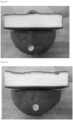
- 4. The cake recipes 2 (
figure 2 ) and recipe 4 (figure 4 ), recipe 5 (figure 5 ), recipe 6 (figure 6 ) are according to the invention and recipes 1 (figure 1 ) and3 (figure 3 ) are not according to the invention (comparative). - The recipes 1-6 were tested and the texture profile analysis (TPA) was performed on parameters of hardness and elasticity for recipes 1-6.
Table 2 Ingredients recipe 1* recipe 2 recipe 3* recipe 4 recipe 5 recipe 6 Wheat flour 36.8 36.8 36.8 36.8 36.8 36.8 Wheat starch 147.2 147.2 147.2 147.2 147.2 147.2 Sugar 150.0 150.0 150.0 150.0 150.0 150.0 Salt 1.0 1.0 1.0 1.0 1.0 1.0 Casein hydrolysate conjugate - - 18.0 18.0 18.0 18.0 Casein hydrolysate 10.0 10.0 - - - - Lactic acid - 0.9 - 0.9 - - Citric acid - - - - 0.9 - Acetic acid - - - - - 0.9 Whole egg 250.0 250.0 250.0 250.0 250.0 250.0 Egg white - - - - - - Water 50.0 50.0 50.0 50.0 50.0 50.0 Batter density (g/L) 290 280 300 290 256 224 Hardness (g) 590 380 550 350 311 324 Elasticity 1.0 2.0 1.0 2.25 - - * out of scope - The following observations were made on addition of lactic acid in the recipes 2 and 4:
- stabilized consistency of batter and lower batter density.
- improvement of cake volume and thus crumbs hardness was reduced.
- cakes showed higher elasticity.
Claims (16)
- Use of a composition comprisinga) at least one protein hydrolysate or at least one protein hydrolysate conjugate; andb) at least one acid and its salts thereof;wherein the at least one protein hydrolysate conjugate is obtained by amino-carbonyl bonding of an at least one protein hydrolysate with a weight average molecular weight (MW) in the range of ≥ 600 to ≤ 2400 Da and at least one sugar having a weight average molecular weight (MW) in the range of ≥ 100 to ≤ 20000 Da;wherein the molar ratio of the at least one acid and its salts thereof to the at least one protein hydrolysate or at least one protein hydrolysate conjugate is in the range of ≥0.3:1.0 to ≤10:1.0; as whipping agent.
- A method for aerating a carbohydrate containing food product comprising the step of adding at least one composition comprising at least one protein hydrolysate or at least one protein hydrolysate conjugate and at least one acid and its salts thereof to the carbohydrate containing food product prior to aerating,wherein the at least one protein hydrolysate conjugate is obtained by amino-carbonyl bonding of an at least one protein hydrolysate with a weight average molecular weight (MW) in the range of ≥ 600 to ≤ 2400 Da and at least one sugar having a weight average molecular weight (MW) in the range of ≥ 100 to ≤ 20000 Da,wherein the molar ratio of the at least one acid and its salts thereof to the at least one protein hydrolysate or at least one protein hydrolysate conjugate is in the range of ≥0.3:1.0 to ≤10:1.0.
- The use or method according to claim 1 or 2, wherein the at least one acid is selected from the group consisting of lactic acid, phosphoric acid, hydrochloric acid, citric acid, ascorbic acid, tartaric acid and sulfuric acid.
- The use or method according to any one of the preceding claims, wherein the at least one acid is lactic acid.
- The use or method according to any one of the preceding claims, wherein the at least one protein hydrolysate is a plant or animal protein hydrolysate.
- The use or method according to any one of the preceding claims, wherein the at least one protein hydrolysate is selected from the group consisting of wheat, soy, rice, potato, pea, sunflower, rape seed, lupin and milk protein hydrolysate.
- The use or method according to any one of the preceding claims, wherein the at least one protein hydrolysate is an enzymatically hydrolysed protein hydrolysate.
- The use according to claim1, wherein the at least one sugar is a reducing sugar.
- The use according to claim 8, wherein the reducing sugar is selected from the group consisting of monosaccharides, disaccharides and polysaccharides.
- The use according to claim 9, wherein the monosaccharide is selected from the group consisting of xylose, glucose, ribose, arabinose, galactose, fructose and mannose.
- The use or method according to any of the preceding claims, wherein the at least one protein hydrolysate conjugate is obtained by amino-carbonyl bonding of an at least one protein hydrolysate with a weight average molecular weight (MW) in the range of ≥ 750 to ≤ 1800 Da and at least one sugar having a weight molecular weight (MW) in the range of ≥ 100 to ≤ 1000 Da.
- The use or method according to any one of the preceding claims, wherein the composition is free of baking powder.
- The use of a composition as defined in any one of the preceding claims for the preparation of baked goods.
- A composition comprisingA) at least one protein hydrolysate conjugate; andB) lactic acid;wherein the at least one protein hydrolysate conjugate is obtained by amino-carbonyl bonding of an at least one protein hydrolysate with a weight average molecular weight (MW) in the range of ≥ 600 to ≤ 2400 Da and at least one sugar having a weight average molecular weight (MW) in the range of ≥ 100 to ≤ 20000 Da;wherein the molar ratio of lactic acid to the at least one protein hydrolysate conjugate is in the range of ≥0.3:1.0 to ≤10:1.0.
- The composition according to claim 14, wherein the composition is free of baking powder.
- A process for the preparation of the composition according to any one of claims 14 to 15, which comprises at least the steps of:i) contacting lactic acid with a protein hydrolysate conjugate to adjust a pH in the range of ≥ 4.5 to ≤ 6.5 to obtain a mixture; andii) a processing step selected from the group consisting of spray drying, pasteurization and lyophilization of the mixture;wherein the protein hydrolysate conjugate is obtained by amino-carbonyl bonding of an at least one protein hydrolysate with a weight average molecular weight (MW) in the range of ≥ 600 to ≤ 2400 Da and at least one sugar having a weight average molecular weight (MW) in the range of ≥ 100 to ≤ 20000 Da;wherein the molar ratio of lactic acid to the at least one protein hydrolysate conjugate is in the range of ≥0.3:1.0 to ≤10:1.0.
Applications Claiming Priority (2)
| Application Number | Priority Date | Filing Date | Title |
|---|---|---|---|
| EP19169153 | 2019-04-15 | ||
| PCT/EP2020/060596 WO2020212425A1 (en) | 2019-04-15 | 2020-04-15 | Whipping agent for baked goods |
Publications (2)
| Publication Number | Publication Date |
|---|---|
| EP3955741A1 EP3955741A1 (en) | 2022-02-23 |
| EP3955741B1 true EP3955741B1 (en) | 2025-04-02 |
Family
ID=66290193
Family Applications (1)
| Application Number | Title | Priority Date | Filing Date |
|---|---|---|---|
| EP20717893.0A Active EP3955741B1 (en) | 2019-04-15 | 2020-04-15 | Whipping agent for baked goods |
Country Status (10)
| Country | Link |
|---|---|
| US (1) | US20220232838A1 (en) |
| EP (1) | EP3955741B1 (en) |
| JP (1) | JP7596300B2 (en) |
| CN (1) | CN113710094A (en) |
| AU (1) | AU2020259984A1 (en) |
| DK (1) | DK3955741T3 (en) |
| ES (1) | ES3031242T3 (en) |
| PL (1) | PL3955741T3 (en) |
| PT (1) | PT3955741T (en) |
| WO (1) | WO2020212425A1 (en) |
Citations (1)
| Publication number | Priority date | Publication date | Assignee | Title |
|---|---|---|---|---|
| US4411915A (en) * | 1979-11-16 | 1983-10-25 | Caj Eriksson | Heme-iron-enriched amino acid and a process for the preparation of heme-iron-enriched amino acid |
Family Cites Families (25)
| Publication number | Priority date | Publication date | Assignee | Title |
|---|---|---|---|---|
| US2958630A (en) * | 1957-07-17 | 1960-11-01 | Armour & Co | Treatment of blood to yield amino acids |
| US3814816A (en) * | 1968-01-25 | 1974-06-04 | Staley Mfg Co A E | Vegetable aerating proteins |
| US3653917A (en) * | 1970-02-05 | 1972-04-04 | Gen Mills Inc | Angel food cake mixes and their production |
| US3666493A (en) * | 1970-06-08 | 1972-05-30 | John A Bluemke | Preparation of cheese and pie fillings |
| FR2474828B1 (en) * | 1980-02-01 | 1983-09-09 | Agronomique Inst Nat Rech | PROCESS FOR TREATING A CASEIN RAW MATERIAL CONTAINING BIVALENT CATION PHOSPHOCASEINATES, PRODUCTS OBTAINED AND APPLICATION |
| IE55934B1 (en) * | 1984-02-20 | 1991-02-27 | Nestle Sa | Method for the manufacture of a beverage composition |
| ES2016075A4 (en) | 1988-09-27 | 1990-10-16 | Monsanto Co | CHEMICAL YEAST SYSTEM. |
| US5486461A (en) * | 1991-11-08 | 1996-01-23 | Novo Nordisk A/S | Casein hydrolyzate and method for production of such casein hydrolyzate |
| US5260082A (en) | 1992-09-16 | 1993-11-09 | Kraft General Foods, Inc. | Baked goods, doughs or batters, dry mixes and methods for producing thereof |
| US6303161B1 (en) | 1996-04-01 | 2001-10-16 | Nichimo Co., Ltd. | Product containing healthful component and process for preparing the same |
| NL1008564C2 (en) * | 1998-03-11 | 1999-02-01 | Avebe Latenstein B V | Additive with emulsifying and / or gelling and / or foaming properties. |
| JP2000210030A (en) | 1999-01-25 | 2000-08-02 | Morinaga Milk Ind Co Ltd | Foamable casein hydrolyzate and method for producing the same |
| JP3640645B2 (en) * | 2001-03-29 | 2005-04-20 | 森永乳業株式会社 | Foaming agent for baked food, baked food using the same, method for producing baked food, and premix for baked food |
| EP1327390B1 (en) * | 2001-12-04 | 2008-01-09 | Kerry Group Services International Limited | Method of manufacturing an aerated carbohydrate containing food product |
| JP5183006B2 (en) | 2002-05-16 | 2013-04-17 | 不二製油株式会社 | Method for producing soy protein hydrolyzate |
| US7250187B2 (en) | 2002-08-21 | 2007-07-31 | General Mills Marketing, Inc. | Methods of incorporating encapsulated chemical leavening agent into dough ingredients, and composition so prepared |
| WO2009053852A2 (en) * | 2007-10-26 | 2009-04-30 | The Governors Of The University Of Alberta | Protein based foaming agents and methods of making thereof |
| US20090196973A1 (en) * | 2008-02-01 | 2009-08-06 | Rich Products Corporation | Foam Compositions |
| AU2009225516B2 (en) * | 2008-03-19 | 2014-08-14 | Wisconsin Alumni Research Foundation | Production of protein-polysaccharide conjugates |
| PL2196097T3 (en) * | 2008-12-04 | 2014-12-31 | Nestec Sa | Hydrolysed protein-polysaccharide complexes |
| FR2960129B1 (en) * | 2010-05-20 | 2014-10-10 | Roquette Freres | PROCESS FOR THE PREPARATION OF ALKALINE HYDROLYSATES OF PLANT PROTEINS |
| WO2014018937A1 (en) * | 2012-07-26 | 2014-01-30 | Solae, Llc | Foaming agent for use in food compositions |
| CN103013669B (en) * | 2012-12-31 | 2014-03-12 | 浙江绿晶香精有限公司 | Preparation method of tobacco leaf moisturizing liquor for lowering tar content and benzopyrene content |
| JP6823446B2 (en) * | 2015-12-16 | 2021-02-03 | 花王株式会社 | Solid composition |
| EP3700348A1 (en) * | 2017-10-26 | 2020-09-02 | Basf Se | Protein hydrolysates as emulsifier for baked goods |
-
2020
- 2020-04-15 US US17/603,654 patent/US20220232838A1/en active Pending
- 2020-04-15 ES ES20717893T patent/ES3031242T3/en active Active
- 2020-04-15 DK DK20717893.0T patent/DK3955741T3/en active
- 2020-04-15 PT PT207178930T patent/PT3955741T/en unknown
- 2020-04-15 WO PCT/EP2020/060596 patent/WO2020212425A1/en not_active Ceased
- 2020-04-15 PL PL20717893.0T patent/PL3955741T3/en unknown
- 2020-04-15 EP EP20717893.0A patent/EP3955741B1/en active Active
- 2020-04-15 CN CN202080028812.0A patent/CN113710094A/en active Pending
- 2020-04-15 AU AU2020259984A patent/AU2020259984A1/en active Pending
- 2020-04-15 JP JP2021560848A patent/JP7596300B2/en active Active
Patent Citations (1)
| Publication number | Priority date | Publication date | Assignee | Title |
|---|---|---|---|---|
| US4411915A (en) * | 1979-11-16 | 1983-10-25 | Caj Eriksson | Heme-iron-enriched amino acid and a process for the preparation of heme-iron-enriched amino acid |
Also Published As
| Publication number | Publication date |
|---|---|
| EP3955741A1 (en) | 2022-02-23 |
| PL3955741T3 (en) | 2025-08-04 |
| US20220232838A1 (en) | 2022-07-28 |
| WO2020212425A1 (en) | 2020-10-22 |
| JP2022529149A (en) | 2022-06-17 |
| ES3031242T3 (en) | 2025-07-07 |
| PT3955741T (en) | 2025-06-16 |
| JP7596300B2 (en) | 2024-12-09 |
| CN113710094A (en) | 2021-11-26 |
| DK3955741T3 (en) | 2025-06-10 |
| AU2020259984A1 (en) | 2021-11-04 |
Similar Documents
| Publication | Publication Date | Title |
|---|---|---|
| JP7589202B2 (en) | Protein hydrolysates as emulsifiers for baked goods | |
| US4481222A (en) | Dry mix for bread | |
| EP0685164A1 (en) | Food quality improver | |
| CA3059770C (en) | L-cysteine-treated proteins with altered functionalities and preparation thereof | |
| KR100565160B1 (en) | Novel protein complexes | |
| IE60405B1 (en) | Room temperature storage stable dough | |
| AU2020343722A1 (en) | Bread products | |
| US6291005B1 (en) | Pumpable baking additive | |
| US20220232838A1 (en) | Whipping agent for baked goods | |
| JP2000004768A (en) | Bread maker and method for producing bread | |
| AU2018356583B2 (en) | Flour improver and uses thereof | |
| WO2017141702A1 (en) | Method for manufacturing modified gluten | |
| EP4329496B1 (en) | Phosphate-free baking powder | |
| JP4849066B2 (en) | Confectionery dough with high protein content | |
| CN117794376A (en) | Powdered Sugar Substitute | |
| WO2002034052A2 (en) | Co-processed emulsifier/carrier systems for full-fat bakery products | |
| US4122206A (en) | Corn, grain sorghum and millet premix and method of preparing same | |
| JP7124369B2 (en) | Bread-making oil and fat composition and bread-making flour dough | |
| JPH0276531A (en) | Bread making method |
Legal Events
| Date | Code | Title | Description |
|---|---|---|---|
| STAA | Information on the status of an ep patent application or granted ep patent |
Free format text: STATUS: UNKNOWN |
|
| STAA | Information on the status of an ep patent application or granted ep patent |
Free format text: STATUS: THE INTERNATIONAL PUBLICATION HAS BEEN MADE |
|
| PUAI | Public reference made under article 153(3) epc to a published international application that has entered the european phase |
Free format text: ORIGINAL CODE: 0009012 |
|
| STAA | Information on the status of an ep patent application or granted ep patent |
Free format text: STATUS: REQUEST FOR EXAMINATION WAS MADE |
|
| 17P | Request for examination filed |
Effective date: 20211115 |
|
| AK | Designated contracting states |
Kind code of ref document: A1 Designated state(s): AL AT BE BG CH CY CZ DE DK EE ES FI FR GB GR HR HU IE IS IT LI LT LU LV MC MK MT NL NO PL PT RO RS SE SI SK SM TR |
|
| DAV | Request for validation of the european patent (deleted) | ||
| DAX | Request for extension of the european patent (deleted) | ||
| STAA | Information on the status of an ep patent application or granted ep patent |
Free format text: STATUS: EXAMINATION IS IN PROGRESS |
|
| 17Q | First examination report despatched |
Effective date: 20240202 |
|
| GRAP | Despatch of communication of intention to grant a patent |
Free format text: ORIGINAL CODE: EPIDOSNIGR1 |
|
| STAA | Information on the status of an ep patent application or granted ep patent |
Free format text: STATUS: GRANT OF PATENT IS INTENDED |
|
| INTG | Intention to grant announced |
Effective date: 20241114 |
|
| GRAS | Grant fee paid |
Free format text: ORIGINAL CODE: EPIDOSNIGR3 |
|
| GRAA | (expected) grant |
Free format text: ORIGINAL CODE: 0009210 |
|
| STAA | Information on the status of an ep patent application or granted ep patent |
Free format text: STATUS: THE PATENT HAS BEEN GRANTED |
|
| P01 | Opt-out of the competence of the unified patent court (upc) registered |
Free format text: CASE NUMBER: APP_4836/2025 Effective date: 20250129 |
|
| AK | Designated contracting states |
Kind code of ref document: B1 Designated state(s): AL AT BE BG CH CY CZ DE DK EE ES FI FR GB GR HR HU IE IS IT LI LT LU LV MC MK MT NL NO PL PT RO RS SE SI SK SM TR |
|
| REG | Reference to a national code |
Ref country code: GB Ref legal event code: FG4D |
|
| REG | Reference to a national code |
Ref country code: CH Ref legal event code: EP |
|
| REG | Reference to a national code |
Ref country code: IE Ref legal event code: FG4D |
|
| REG | Reference to a national code |
Ref country code: DE Ref legal event code: R096 Ref document number: 602020048686 Country of ref document: DE |
|
| PGFP | Annual fee paid to national office [announced via postgrant information from national office to epo] |
Ref country code: NL Payment date: 20250424 Year of fee payment: 6 |
|
| REG | Reference to a national code |
Ref country code: DK Ref legal event code: T3 Effective date: 20250606 |
|
| REG | Reference to a national code |
Ref country code: PT Ref legal event code: SC4A Ref document number: 3955741 Country of ref document: PT Date of ref document: 20250616 Kind code of ref document: T Free format text: AVAILABILITY OF NATIONAL TRANSLATION Effective date: 20250606 |
|
| REG | Reference to a national code |
Ref country code: NL Ref legal event code: FP |
|
| REG | Reference to a national code |
Ref country code: ES Ref legal event code: FG2A Ref document number: 3031242 Country of ref document: ES Kind code of ref document: T3 Effective date: 20250707 |
|
| PGFP | Annual fee paid to national office [announced via postgrant information from national office to epo] |
Ref country code: DE Payment date: 20250428 Year of fee payment: 6 |
|
| PGFP | Annual fee paid to national office [announced via postgrant information from national office to epo] |
Ref country code: ES Payment date: 20250513 Year of fee payment: 6 Ref country code: DK Payment date: 20250619 Year of fee payment: 6 |
|
| PGFP | Annual fee paid to national office [announced via postgrant information from national office to epo] |
Ref country code: NO Payment date: 20250422 Year of fee payment: 6 |
|
| PGFP | Annual fee paid to national office [announced via postgrant information from national office to epo] |
Ref country code: BE Payment date: 20250424 Year of fee payment: 6 Ref country code: IT Payment date: 20250530 Year of fee payment: 6 |
|
| PGFP | Annual fee paid to national office [announced via postgrant information from national office to epo] |
Ref country code: FR Payment date: 20250424 Year of fee payment: 6 |
|
| PGFP | Annual fee paid to national office [announced via postgrant information from national office to epo] |
Ref country code: CH Payment date: 20250501 Year of fee payment: 6 |
|
| PGFP | Annual fee paid to national office [announced via postgrant information from national office to epo] |
Ref country code: AT Payment date: 20250417 Year of fee payment: 6 |
|
| PGFP | Annual fee paid to national office [announced via postgrant information from national office to epo] |
Ref country code: CZ Payment date: 20250401 Year of fee payment: 6 |
|
| PG25 | Lapsed in a contracting state [announced via postgrant information from national office to epo] |
Ref country code: FI Free format text: LAPSE BECAUSE OF FAILURE TO SUBMIT A TRANSLATION OF THE DESCRIPTION OR TO PAY THE FEE WITHIN THE PRESCRIBED TIME-LIMIT Effective date: 20250402 |
|
| REG | Reference to a national code |
Ref country code: LT Ref legal event code: MG9D |
|
| PG25 | Lapsed in a contracting state [announced via postgrant information from national office to epo] |
Ref country code: GR Free format text: LAPSE BECAUSE OF FAILURE TO SUBMIT A TRANSLATION OF THE DESCRIPTION OR TO PAY THE FEE WITHIN THE PRESCRIBED TIME-LIMIT Effective date: 20250703 |
|
| PG25 | Lapsed in a contracting state [announced via postgrant information from national office to epo] |
Ref country code: BG Free format text: LAPSE BECAUSE OF FAILURE TO SUBMIT A TRANSLATION OF THE DESCRIPTION OR TO PAY THE FEE WITHIN THE PRESCRIBED TIME-LIMIT Effective date: 20250402 |
|
| PG25 | Lapsed in a contracting state [announced via postgrant information from national office to epo] |
Ref country code: HR Free format text: LAPSE BECAUSE OF FAILURE TO SUBMIT A TRANSLATION OF THE DESCRIPTION OR TO PAY THE FEE WITHIN THE PRESCRIBED TIME-LIMIT Effective date: 20250402 |
|
| PG25 | Lapsed in a contracting state [announced via postgrant information from national office to epo] |
Ref country code: RS Free format text: LAPSE BECAUSE OF FAILURE TO SUBMIT A TRANSLATION OF THE DESCRIPTION OR TO PAY THE FEE WITHIN THE PRESCRIBED TIME-LIMIT Effective date: 20250702 |
|
| PG25 | Lapsed in a contracting state [announced via postgrant information from national office to epo] |
Ref country code: IS Free format text: LAPSE BECAUSE OF FAILURE TO SUBMIT A TRANSLATION OF THE DESCRIPTION OR TO PAY THE FEE WITHIN THE PRESCRIBED TIME-LIMIT Effective date: 20250802 |
|
| PG25 | Lapsed in a contracting state [announced via postgrant information from national office to epo] |
Ref country code: LV Free format text: LAPSE BECAUSE OF FAILURE TO SUBMIT A TRANSLATION OF THE DESCRIPTION OR TO PAY THE FEE WITHIN THE PRESCRIBED TIME-LIMIT Effective date: 20250402 |
|
| PG25 | Lapsed in a contracting state [announced via postgrant information from national office to epo] |
Ref country code: LU Free format text: LAPSE BECAUSE OF NON-PAYMENT OF DUE FEES Effective date: 20250415 |
|
| REG | Reference to a national code |
Ref country code: DE Ref legal event code: R097 Ref document number: 602020048686 Country of ref document: DE |
|
| PG25 | Lapsed in a contracting state [announced via postgrant information from national office to epo] |
Ref country code: SM Free format text: LAPSE BECAUSE OF FAILURE TO SUBMIT A TRANSLATION OF THE DESCRIPTION OR TO PAY THE FEE WITHIN THE PRESCRIBED TIME-LIMIT Effective date: 20250402 |
|
| PG25 | Lapsed in a contracting state [announced via postgrant information from national office to epo] |
Ref country code: EE Free format text: LAPSE BECAUSE OF FAILURE TO SUBMIT A TRANSLATION OF THE DESCRIPTION OR TO PAY THE FEE WITHIN THE PRESCRIBED TIME-LIMIT Effective date: 20250402 |
|
| PG25 | Lapsed in a contracting state [announced via postgrant information from national office to epo] |
Ref country code: RO Free format text: LAPSE BECAUSE OF FAILURE TO SUBMIT A TRANSLATION OF THE DESCRIPTION OR TO PAY THE FEE WITHIN THE PRESCRIBED TIME-LIMIT Effective date: 20250402 Ref country code: SK Free format text: LAPSE BECAUSE OF FAILURE TO SUBMIT A TRANSLATION OF THE DESCRIPTION OR TO PAY THE FEE WITHIN THE PRESCRIBED TIME-LIMIT Effective date: 20250402 |
|
| PG25 | Lapsed in a contracting state [announced via postgrant information from national office to epo] |
Ref country code: MC Free format text: LAPSE BECAUSE OF FAILURE TO SUBMIT A TRANSLATION OF THE DESCRIPTION OR TO PAY THE FEE WITHIN THE PRESCRIBED TIME-LIMIT Effective date: 20250402 |
|
| PLBE | No opposition filed within time limit |
Free format text: ORIGINAL CODE: 0009261 |
|
| STAA | Information on the status of an ep patent application or granted ep patent |
Free format text: STATUS: NO OPPOSITION FILED WITHIN TIME LIMIT |
|
| REG | Reference to a national code |
Ref country code: CH Ref legal event code: L10 Free format text: ST27 STATUS EVENT CODE: U-0-0-L10-L00 (AS PROVIDED BY THE NATIONAL OFFICE) Effective date: 20260211 |
|
| 26N | No opposition filed |
Effective date: 20260105 |
|
| PGFP | Annual fee paid to national office [announced via postgrant information from national office to epo] |
Ref country code: GB Payment date: 20260225 Year of fee payment: 7 |
|
| PG25 | Lapsed in a contracting state [announced via postgrant information from national office to epo] |
Ref country code: IE Free format text: LAPSE BECAUSE OF NON-PAYMENT OF DUE FEES Effective date: 20250415 |
|
| PGFP | Annual fee paid to national office [announced via postgrant information from national office to epo] |
Ref country code: PT Payment date: 20260325 Year of fee payment: 7 |
|
| PGFP | Annual fee paid to national office [announced via postgrant information from national office to epo] |
Ref country code: PL Payment date: 20260324 Year of fee payment: 7 |
|
| REG | Reference to a national code |
Ref country code: CH Ref legal event code: U11 Free format text: ST27 STATUS EVENT CODE: U-0-0-U10-U11 (AS PROVIDED BY THE NATIONAL OFFICE) Effective date: 20260501 |