EP3955078B1 - Travel path planning system for multiple automatic harvesters and method therefor - Google Patents
Travel path planning system for multiple automatic harvesters and method therefor Download PDFInfo
- Publication number
- EP3955078B1 EP3955078B1 EP19924166.2A EP19924166A EP3955078B1 EP 3955078 B1 EP3955078 B1 EP 3955078B1 EP 19924166 A EP19924166 A EP 19924166A EP 3955078 B1 EP3955078 B1 EP 3955078B1
- Authority
- EP
- European Patent Office
- Prior art keywords
- automatic
- driving
- information
- obstacle
- detection
- Prior art date
- Legal status (The legal status is an assumption and is not a legal conclusion. Google has not performed a legal analysis and makes no representation as to the accuracy of the status listed.)
- Active
Links
Images



Classifications
-
- G—PHYSICS
- G05—CONTROLLING; REGULATING
- G05D—SYSTEMS FOR CONTROLLING OR REGULATING NON-ELECTRIC VARIABLES
- G05D1/00—Control of position, course, altitude or attitude of land, water, air or space vehicles, e.g. using automatic pilots
- G05D1/02—Control of position or course in two dimensions
- G05D1/021—Control of position or course in two dimensions specially adapted to land vehicles
- G05D1/0287—Control of position or course in two dimensions specially adapted to land vehicles involving a plurality of land vehicles, e.g. fleet or convoy travelling
- G05D1/0291—Fleet control
- G05D1/0297—Fleet control by controlling means in a control room
-
- A—HUMAN NECESSITIES
- A01—AGRICULTURE; FORESTRY; ANIMAL HUSBANDRY; HUNTING; TRAPPING; FISHING
- A01D—HARVESTING; MOWING
- A01D34/00—Mowers; Mowing apparatus of harvesters
- A01D34/006—Control or measuring arrangements
- A01D34/008—Control or measuring arrangements for automated or remotely controlled operation
-
- A—HUMAN NECESSITIES
- A01—AGRICULTURE; FORESTRY; ANIMAL HUSBANDRY; HUNTING; TRAPPING; FISHING
- A01B—SOIL WORKING IN AGRICULTURE OR FORESTRY; PARTS, DETAILS, OR ACCESSORIES OF AGRICULTURAL MACHINES OR IMPLEMENTS, IN GENERAL
- A01B69/00—Steering of agricultural machines or implements; Guiding agricultural machines or implements on a desired track
- A01B69/007—Steering or guiding of agricultural vehicles, e.g. steering of the tractor to keep the plough in the furrow
- A01B69/008—Steering or guiding of agricultural vehicles, e.g. steering of the tractor to keep the plough in the furrow automatic
-
- A—HUMAN NECESSITIES
- A01—AGRICULTURE; FORESTRY; ANIMAL HUSBANDRY; HUNTING; TRAPPING; FISHING
- A01B—SOIL WORKING IN AGRICULTURE OR FORESTRY; PARTS, DETAILS, OR ACCESSORIES OF AGRICULTURAL MACHINES OR IMPLEMENTS, IN GENERAL
- A01B79/00—Methods for working soil
- A01B79/005—Precision agriculture
-
- A—HUMAN NECESSITIES
- A01—AGRICULTURE; FORESTRY; ANIMAL HUSBANDRY; HUNTING; TRAPPING; FISHING
- A01D—HARVESTING; MOWING
- A01D75/00—Accessories for harvesters or mowers
- A01D75/18—Safety devices for parts of the machines
- A01D75/185—Avoiding collisions with obstacles
-
- A—HUMAN NECESSITIES
- A01—AGRICULTURE; FORESTRY; ANIMAL HUSBANDRY; HUNTING; TRAPPING; FISHING
- A01D—HARVESTING; MOWING
- A01D75/00—Accessories for harvesters or mowers
- A01D75/20—Devices for protecting men or animals
-
- G—PHYSICS
- G05—CONTROLLING; REGULATING
- G05D—SYSTEMS FOR CONTROLLING OR REGULATING NON-ELECTRIC VARIABLES
- G05D1/00—Control of position, course, altitude or attitude of land, water, air or space vehicles, e.g. using automatic pilots
- G05D1/0011—Control of position, course, altitude or attitude of land, water, air or space vehicles, e.g. using automatic pilots associated with a remote control arrangement
- G05D1/0016—Control of position, course, altitude or attitude of land, water, air or space vehicles, e.g. using automatic pilots associated with a remote control arrangement characterised by the operator's input device
-
- G—PHYSICS
- G05—CONTROLLING; REGULATING
- G05D—SYSTEMS FOR CONTROLLING OR REGULATING NON-ELECTRIC VARIABLES
- G05D1/00—Control of position, course, altitude or attitude of land, water, air or space vehicles, e.g. using automatic pilots
- G05D1/02—Control of position or course in two dimensions
- G05D1/021—Control of position or course in two dimensions specially adapted to land vehicles
- G05D1/0212—Control of position or course in two dimensions specially adapted to land vehicles with means for defining a desired trajectory
- G05D1/0214—Control of position or course in two dimensions specially adapted to land vehicles with means for defining a desired trajectory in accordance with safety or protection criteria, e.g. avoiding hazardous areas
-
- G—PHYSICS
- G05—CONTROLLING; REGULATING
- G05D—SYSTEMS FOR CONTROLLING OR REGULATING NON-ELECTRIC VARIABLES
- G05D1/00—Control of position, course, altitude or attitude of land, water, air or space vehicles, e.g. using automatic pilots
- G05D1/02—Control of position or course in two dimensions
- G05D1/021—Control of position or course in two dimensions specially adapted to land vehicles
- G05D1/0212—Control of position or course in two dimensions specially adapted to land vehicles with means for defining a desired trajectory
- G05D1/0219—Control of position or course in two dimensions specially adapted to land vehicles with means for defining a desired trajectory ensuring the processing of the whole working surface
-
- G—PHYSICS
- G05—CONTROLLING; REGULATING
- G05D—SYSTEMS FOR CONTROLLING OR REGULATING NON-ELECTRIC VARIABLES
- G05D1/00—Control of position, course, altitude or attitude of land, water, air or space vehicles, e.g. using automatic pilots
- G05D1/02—Control of position or course in two dimensions
- G05D1/021—Control of position or course in two dimensions specially adapted to land vehicles
- G05D1/0231—Control of position or course in two dimensions specially adapted to land vehicles using optical position detecting means
- G05D1/0242—Control of position or course in two dimensions specially adapted to land vehicles using optical position detecting means using non-visible light signals, e.g. IR or UV signals
-
- G—PHYSICS
- G05—CONTROLLING; REGULATING
- G05D—SYSTEMS FOR CONTROLLING OR REGULATING NON-ELECTRIC VARIABLES
- G05D1/00—Control of position, course, altitude or attitude of land, water, air or space vehicles, e.g. using automatic pilots
- G05D1/02—Control of position or course in two dimensions
- G05D1/021—Control of position or course in two dimensions specially adapted to land vehicles
- G05D1/0231—Control of position or course in two dimensions specially adapted to land vehicles using optical position detecting means
- G05D1/0246—Control of position or course in two dimensions specially adapted to land vehicles using optical position detecting means using a video camera in combination with image processing means
-
- G—PHYSICS
- G05—CONTROLLING; REGULATING
- G05D—SYSTEMS FOR CONTROLLING OR REGULATING NON-ELECTRIC VARIABLES
- G05D1/00—Control of position, course, altitude or attitude of land, water, air or space vehicles, e.g. using automatic pilots
- G05D1/02—Control of position or course in two dimensions
- G05D1/021—Control of position or course in two dimensions specially adapted to land vehicles
- G05D1/0255—Control of position or course in two dimensions specially adapted to land vehicles using acoustic signals, e.g. ultra-sonic singals
-
- G—PHYSICS
- G05—CONTROLLING; REGULATING
- G05D—SYSTEMS FOR CONTROLLING OR REGULATING NON-ELECTRIC VARIABLES
- G05D1/00—Control of position, course, altitude or attitude of land, water, air or space vehicles, e.g. using automatic pilots
- G05D1/02—Control of position or course in two dimensions
- G05D1/021—Control of position or course in two dimensions specially adapted to land vehicles
- G05D1/0276—Control of position or course in two dimensions specially adapted to land vehicles using signals provided by a source external to the vehicle
- G05D1/0278—Control of position or course in two dimensions specially adapted to land vehicles using signals provided by a source external to the vehicle using satellite positioning signals, e.g. GPS
-
- B—PERFORMING OPERATIONS; TRANSPORTING
- B60—VEHICLES IN GENERAL
- B60W—CONJOINT CONTROL OF VEHICLE SUB-UNITS OF DIFFERENT TYPE OR DIFFERENT FUNCTION; CONTROL SYSTEMS SPECIALLY ADAPTED FOR HYBRID VEHICLES; ROAD VEHICLE DRIVE CONTROL SYSTEMS FOR PURPOSES NOT RELATED TO THE CONTROL OF A PARTICULAR SUB-UNIT
- B60W2300/00—Indexing codes relating to the type of vehicle
- B60W2300/15—Agricultural vehicles
- B60W2300/158—Harvesters
-
- B—PERFORMING OPERATIONS; TRANSPORTING
- B60—VEHICLES IN GENERAL
- B60W—CONJOINT CONTROL OF VEHICLE SUB-UNITS OF DIFFERENT TYPE OR DIFFERENT FUNCTION; CONTROL SYSTEMS SPECIALLY ADAPTED FOR HYBRID VEHICLES; ROAD VEHICLE DRIVE CONTROL SYSTEMS FOR PURPOSES NOT RELATED TO THE CONTROL OF A PARTICULAR SUB-UNIT
- B60W2420/00—Indexing codes relating to the type of sensors based on the principle of their operation
- B60W2420/40—Photo, light or radio wave sensitive means, e.g. infrared sensors
-
- B—PERFORMING OPERATIONS; TRANSPORTING
- B60—VEHICLES IN GENERAL
- B60W—CONJOINT CONTROL OF VEHICLE SUB-UNITS OF DIFFERENT TYPE OR DIFFERENT FUNCTION; CONTROL SYSTEMS SPECIALLY ADAPTED FOR HYBRID VEHICLES; ROAD VEHICLE DRIVE CONTROL SYSTEMS FOR PURPOSES NOT RELATED TO THE CONTROL OF A PARTICULAR SUB-UNIT
- B60W2420/00—Indexing codes relating to the type of sensors based on the principle of their operation
- B60W2420/40—Photo, light or radio wave sensitive means, e.g. infrared sensors
- B60W2420/403—Image sensing, e.g. optical camera
-
- B—PERFORMING OPERATIONS; TRANSPORTING
- B60—VEHICLES IN GENERAL
- B60W—CONJOINT CONTROL OF VEHICLE SUB-UNITS OF DIFFERENT TYPE OR DIFFERENT FUNCTION; CONTROL SYSTEMS SPECIALLY ADAPTED FOR HYBRID VEHICLES; ROAD VEHICLE DRIVE CONTROL SYSTEMS FOR PURPOSES NOT RELATED TO THE CONTROL OF A PARTICULAR SUB-UNIT
- B60W2420/00—Indexing codes relating to the type of sensors based on the principle of their operation
- B60W2420/40—Photo, light or radio wave sensitive means, e.g. infrared sensors
- B60W2420/408—Radar; Laser, e.g. lidar
-
- B—PERFORMING OPERATIONS; TRANSPORTING
- B60—VEHICLES IN GENERAL
- B60W—CONJOINT CONTROL OF VEHICLE SUB-UNITS OF DIFFERENT TYPE OR DIFFERENT FUNCTION; CONTROL SYSTEMS SPECIALLY ADAPTED FOR HYBRID VEHICLES; ROAD VEHICLE DRIVE CONTROL SYSTEMS FOR PURPOSES NOT RELATED TO THE CONTROL OF A PARTICULAR SUB-UNIT
- B60W2420/00—Indexing codes relating to the type of sensors based on the principle of their operation
- B60W2420/54—Audio sensitive means, e.g. ultrasound
-
- B—PERFORMING OPERATIONS; TRANSPORTING
- B60—VEHICLES IN GENERAL
- B60W—CONJOINT CONTROL OF VEHICLE SUB-UNITS OF DIFFERENT TYPE OR DIFFERENT FUNCTION; CONTROL SYSTEMS SPECIALLY ADAPTED FOR HYBRID VEHICLES; ROAD VEHICLE DRIVE CONTROL SYSTEMS FOR PURPOSES NOT RELATED TO THE CONTROL OF A PARTICULAR SUB-UNIT
- B60W2554/00—Input parameters relating to objects
- B60W2554/40—Dynamic objects, e.g. animals, windblown objects
- B60W2554/402—Type
- B60W2554/4029—Pedestrians
-
- B—PERFORMING OPERATIONS; TRANSPORTING
- B60—VEHICLES IN GENERAL
- B60W—CONJOINT CONTROL OF VEHICLE SUB-UNITS OF DIFFERENT TYPE OR DIFFERENT FUNCTION; CONTROL SYSTEMS SPECIALLY ADAPTED FOR HYBRID VEHICLES; ROAD VEHICLE DRIVE CONTROL SYSTEMS FOR PURPOSES NOT RELATED TO THE CONTROL OF A PARTICULAR SUB-UNIT
- B60W2556/00—Input parameters relating to data
- B60W2556/45—External transmission of data to or from the vehicle
- B60W2556/50—External transmission of data to or from the vehicle of positioning data, e.g. GPS [Global Positioning System] data
-
- B—PERFORMING OPERATIONS; TRANSPORTING
- B60—VEHICLES IN GENERAL
- B60W—CONJOINT CONTROL OF VEHICLE SUB-UNITS OF DIFFERENT TYPE OR DIFFERENT FUNCTION; CONTROL SYSTEMS SPECIALLY ADAPTED FOR HYBRID VEHICLES; ROAD VEHICLE DRIVE CONTROL SYSTEMS FOR PURPOSES NOT RELATED TO THE CONTROL OF A PARTICULAR SUB-UNIT
- B60W60/00—Drive control systems specially adapted for autonomous road vehicles
- B60W60/001—Planning or execution of driving tasks
- B60W60/0025—Planning or execution of driving tasks specially adapted for specific operations
-
- G—PHYSICS
- G05—CONTROLLING; REGULATING
- G05D—SYSTEMS FOR CONTROLLING OR REGULATING NON-ELECTRIC VARIABLES
- G05D1/00—Control of position, course, altitude or attitude of land, water, air or space vehicles, e.g. using automatic pilots
- G05D1/02—Control of position or course in two dimensions
- G05D1/021—Control of position or course in two dimensions specially adapted to land vehicles
- G05D1/0231—Control of position or course in two dimensions specially adapted to land vehicles using optical position detecting means
- G05D1/0238—Control of position or course in two dimensions specially adapted to land vehicles using optical position detecting means using obstacle or wall sensors
Definitions
- the present disclosure relates to automatic harvesters, and particularly to a system and a method for planning driving paths for multiple automatic harvesters, and a method for planning an optimal driving paths for simultaneous operation of multiple automatic harvesters.
- the automatic harvesters began to develop in the direction of unmanned aerial vehicles or autonomous driving.
- driving path planning of the automatic harvester is one of the critical areas of focus.
- large-scale production is not only a trend of foreign agriculture, but also a trend of domestic agriculture.
- multiple harvesters are usually utilized to operate simultaneously.
- the harvesters are automatic harvesters, how do multiple automatic harvesters operate together, and how to plan a harvesting path of each automatic harvester is worth studying.
- EP3018987A1 discloses a method comprising identifying field boundaries from aerial imagery; detecting entry upon a first field by an agricultural machine without operator intervention, the first field within the identified field boundaries; and providing a first path to be traversed in the first field at least in part by the agricultural machine.
- the present disclosure provides a system and a method for planning driving paths for multiple automatic harvesters, the driving paths of multiple automatic harvesters are planned, so that the automatic harvesters operate in cooperation with each other, to achieve a more efficient harvesting effect.
- the present disclosure provides a system and a method for planning driving paths for multiple automatic harvesters, manual, automatic, and semi-automatic settings can be used to enable the driving path planning system to separately plan the most suitable driving path for each automatic harvester, so as to ensure better harvesting efficiency and better operation distribution.
- the present disclosure provides a system and a method for planning driving paths for multiple automatic harvesters, obstacle information is acquired in advance to enable the automatic harvester to automatically avoid the obstacle during path planning or driving operation.
- the present disclosure provides a system and a method for planning driving paths for multiple automatic harvesters, when each of the automatic harvesters are harvesting in the respective harvesting areas, while acquiring obstacle information, the path planning can be modified to avoid obstacles, or the automatic harvester can be stopped directly.
- the automatic harvester in the area replans the path
- the automatic harvester in other areas maintains the originally set path when it does not affect the driving path of the automatic harvester in other areas.
- the driving path of the automatic harvester in other areas will be modified simultaneously.
- the present disclosure provides a system and a method for planning driving paths for multiple automatic harvesters, if there is a sudden obstacle, like a small animal or a person, the driving path planning system will stop the automatic harvester to ensure safety.
- the present disclosure provides a system and a method for planning driving paths for multiple automatic harvesters, each time driving obstacle information is generated, the driving obstacle information sequentially transmitted to a path planning module for analysis to confirm whether a driving path needs to be replanned.
- the present disclosure provides a system and a method for planning driving paths for multiple automatic harvesters, when a probe touches an obstacle, the obstacle analysis device determines whether the automatic harvester stops operating.
- the present disclosure provides a system and a method for planning driving paths for multiple automatic harvesters, an infrared detector is used to detect whether an obstacle suddenly breaks into the dangerous area in front of the automatic harvester.
- the present disclosure provides a system and a method for planning driving paths for multiple automatic harvesters, there is no need for precise parts and complicated structures, and the manufacturing process is simple and the cost is low.
- the present disclosure provides a method for planning driving paths for multiple automatic harvesters, which includes the following steps:
- the basic farmland information is a group formed by a size, an area, a shape, coordinates, and a crop category of a farmland.
- a detection device detecting and forming basic farmland information includes acquiring the basic farmland information by an automatic detection module through a fixed-point detection or a movement detection.
- the automatic detection module is a module formed by an infrared sensor, a laser sensor, an ultrasonic sensor, an image sensor, or a GPS satellite positioning module.
- dividing a harvesting area and forming a driving path for each of the multiple automatic harvesters include detecting whether there is at least one obstacle; and generating previous obstacle information.
- the driving path of each automatic harvester has an initial driving point, each initial driving point is the same or different.
- dividing a harvesting area and forming a driving path for each of the multiple automatic harvesters include determining a quantity of the multiple automatic harvesters.
- the driving paths of the multiple automatic harvesters are not to be affected by each other.
- dividing a harvesting area and forming a driving path for each of the multiple automatic harvesters include determining a driving mode of each automatic harvester and generating driving information.
- the present disclosure further provides a system for planning driving paths for multiple automatic harvesters, which includes:
- the basic farmland information is a group formed by a size, an area, a shape, coordinates, and a crop category of a farmland.
- the detection device includes an automatic detection module connected with the control module, wherein the automatic detection module acquires the basic farmland information through a fixed-point detection or a movement detection, and transmits the basic farmland information to the control module.
- the automatic detection module is arranged on the automatic harvesters, an unmanned aerial vehicle, or a wireless detector, to perform movable detection.
- the automatic detection module is a module formed by an infrared sensor, a laser sensor, an ultrasonic sensor, an image sensor, or a GPS satellite positioning module.
- At least one manual determining module connected with the control module and inputting the basic farmland information into the control module.
- the detection device includes at least one obstacle pre-detecting device connected with the control module and acquiring previous obstacle information through a fixed-point detection or a movement detection, and transmitting the previous obstacle information to the control module.
- the detection device includes at least one driving obstacle detector connected with the control module, arranged on the automatic harvester, acquiring driving obstacle information in response that the at least one obstacle is detected while the automatic harvester is driving, and transmitting the driving obstacle information to the control module.
- the at least one driving obstacle detector includes a driving camera sensor, which includes a plurality of cameras surrounding the automatic harvester for acquiring images around the automatic harvester.
- the at least one driving obstacle detector includes at least one probe, which is arranged in front of the automatic harvester and detects whether there is at least one obstacle in front of the automatic harvester.
- the at least one driving obstacle detector includes at least one infrared detector, which is arranged in front of the automatic harvester for sensing people or animals who suddenly enter the front of the automatic harvester.
- the system is arranged on at least one of the multiple automatic harvesters, a remote control, a smart phone, a radio remote control, or a smart tablet host device.
- the term “a” should be understood as “at least one” or “one or more”, that is, in one embodiment, the number of a component may be one, and in another embodiment, the number of the component may also be multiple, the term “one” cannot be understood as a restriction on the number.
- a driving path planning system 100 plans the driving path of each of the automatic harvesters 1, and the planning of the driving path takes into account conditions of various farms or fields, and problem of operation assignment of multiple automatic harvesters 1, so as to achieve better harvesting efficiency, and avoid mutual influence of the automatic harvesters 1 while operating, such as collision with each other or leaving unharvested areas. Further, the driving path planning system 100 analyzes and plans according to a size, a shape, and features of farmland or fields, and the multiple automatic harvesters 1, so that each of the automatic harvesters 1 has an optimal driving path.
- the driving path planning system 100 is adapted to the multiple automatic harvesters 1 to plan driving paths of the multiple automatic harvesters 1 in advance.
- the driving path planning system 100 is not only adapted to the harvesters, but also adapted to various agricultural machines such as rice transplanters, planting machines, transplanters, tillers, soil preparation machines, etc., which are not a limitation of the present disclosure.
- the driving path planning system 100 can be arranged in each of the automatic harvesters, a remote control, a smart phone, a radio remote control, or a smart tablet host device.
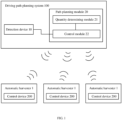
- the driving path planning system 100 includes a detection device 10 and a path planning module 20.
- the detection device 10 is connected with the path planning module 20.
- the above-mentioned connection mode can be a wired connection or an wireless connection, which is not a limitation of the present disclosure.
- the detection device 10 is used to acquire basic farmland information, such as an area, a shape, and a crop category of the farmland or field.
- the area or the shape is a field range to be harvested by the multiple automatic harvesters 1.
- the path planning module 20 includes a quantity determining module 21 and a control module 22.
- the quantity determining module 21 is connected with the control module 22.
- the quantity determining module 21 is used to determine the quantity of the automatic harvesters 1 and transmit quantity determining information to the control module 22.
- the detection device 10 is connected with the control module 22, and is used to transmit the basic farmland information to the control module 22. Further, the control module 22 divides a harvesting area of each automatic harvester 1 according to the quantity of the automatic harvesters 1 and the basic farmland information, plans the driving path of each automatic harvester 1, and transmits the driving path to a control device 200 of each automatic harvester 1.
- the detection device 10 includes at least one automatic detection module 11 and a manual determining module 12, the automatic detection module 11 and the manual determining module 12 are respectively connected with the control module 22 of the planning module 20.
- the automatic detection module 11 can be implemented to perform a fixed-point detection or a movement detection.
- the fixed-point detection is performed by having a number of automatic detection modules 11 respectively arranged on an corner edge of the farmland or the field, and the basic farmland information is acquired through mutual sensing of the number of automatic detection modules 11, and includes a range, a shape, coordinates, a crop category, etc. of the farmland, land, or field.
- the movement detection is performed by having the automatic detection module 11 arranged on an automatic harvester, an unmanned aerial vehicle, or a wireless detector, so that the automatic harvester, the unmanned aerial vehicle, or the operator can move to acquire the basic farmland information.
- the automatic detection module 11 can be implemented as an infrared sensor, a laser sensor, an ultrasonic sensor, an image sensor, or a GPS satellite positioning module, etc., which is not a limitation of the present disclosure.
- the manual determining module 12 pre-acquires the basic farmland information such as a range, a shape, coordinates, a crop category, etc.
- control module 22 of the path planning module 20 analyzes and plans the driving path of multiple automatic harvesters 1 (i.e., the driving path of each automatic harvester) according to the basic farmland information acquired by the automatic detection module 11 or the manual determining module 12 and the quantity determining information determined by the quantity determining module.
- the detection device 10 further includes an obstacle pre-detecting device 13.
- the obstacle pre-detecting device 13 detects whether there is at least one obstacle, generates a previous obstacle information if there is at least one obstacle, and transmits the previous obstacle information to the control module 22 of the path planning module 20. It is worth mentioning that, the obstacle pre-detecting device 13 can be set to synchronously detect the at least one obstacle together with the automatic detection module 11. In other words, when the automatic detection module 11 acquires the range and shape of the land or field, the obstacle pre-detecting device 13 can synchronously acquire the previous obstacle information, so that when the path planning module 20 plans the driving path, problem of obstacle is synchronously considered and the at least one obstacle may be avoided.
- the automatic detection module 11 may also be equal to the obstacle pre-detecting device 13 and simultaneously acquire the basic farmland information and the previous obstacle information.
- the control module 22 of the path planning module 20 analyzes the basic farmland information, the previous obstacle information, and the quantity determining information and plans the driving path of each of the automatic harvesters 1.
- the obstacle pre-detecting device 13 can be used to distinguish differences between crops and obstacles.
- the previous obstacle information may include size information, image information, coordinate information, etc. of the at least one obstacle, which is not a limitation of the present disclosure.
- the obstacle pre-detecting device 13 may adopt the fixed-point detection or the movement detection which is the same as the detection method adopted by the automatic detection module 11, and the obstacle pre-detecting device 13 and the automatic detection module 11 may synchronously perform the detection method.
- the obstacle pre-detecting device 13 can be implemented as an infrared sensor, a laser sensor, an ultrasonic sensor, an image sensor, or a GPS satellite positioning module, etc., which is not a limitation of the present disclosure.
- the detection device 10 further includes at least one driving obstacle detector 14, which detects whether there is at least one obstacle when each automatic harvester 1 is driven, further acquires driving obstacle information when the at least one obstacle is detected, and transmits the driving obstacle information to the control module 22 of the path planning module 20, when the control module 22 of the path planning module 20 receives the driving obstacle information, the control module 22 determines whether the automatic harvesters 1 in the harvesting area are required to replan the driving path according to the driving obstacle information.
- the driving obstacle detector 14 of the automatic harvester 1 in the harvesting area acquires the driving obstacle information that affects a harvesting path
- the driving obstacle information is transmitted to the control module 22, and the control module 22 replans the driving path of the automatic harvester 1 in the harvesting area.
- the new driving path of the automatic harvester 1 in the harvesting area will not affect the driving path of other automatic harvesters 1.
- the driving obstacle detector 14 is arranged on the automatic harvester 1, and is optimally arranged in front of the automatic harvester 1.
- the encountered obstacle can be directly detected by the driving obstacle detector 14 while the automatic harvester 1 is being driven forward.
- the automatic harvester 1 determines whether to replan the driving path according to the existing basis.
- the driving obstacle detector 14 may recognize the crop and the at least one obstacle, acquire the driving obstacle information, such as the size, and transmit the size information of the at least one obstacle to the control module 22 of the path planning module 20.
- the control module 22 of the path planning module 20 determines whether the at least one obstacle affects the driving path, if not, the automatic harvester 1 directly follows the initial planned driving path, if the at least one obstacle is determined to affect the driving path, the obstacle information is transmitted to the path planning module 20 for replanning the driving path.
- the driving obstacle detector 14 may acquire image features for distinguishing the difference between the crops and the at least one obstacle.
- the driving obstacle detector 14 is arranged on the automatic harvester 1 and conveniently acquires at least one forward signal, such as the crops and the at least one obstacle, while the automatic harvester 1 is being driven.
- the driving obstacle detector 14 includes a driving camera sensor 141, which acquires images around the automatic harvester 1 and forms a video signal.
- the driving camera sensor 141 includes a number of cameras 1411 surrounding the automatic harvester 1 for acquiring the images around the automatic harvester 1 and forming the video signal.
- the driving obstacle detector 14 further includes at least one probe 142, which is arranged in front of the automatic harvester 1 and detects whether there is at least one obstacle in front of the automatic harvester 1, such as trees, walls, large rocks, concavities, puddles, rivers, etc.
- the at least one probe 142 further detects the sizes or the features of various obstacles at the same time, and transmits the detection information to the control module 22 of the path planning module 20, so that the control module 22 of the path planning module 20 determines whether the automatic harvester 1 stops operating.
- the driving obstacle detector 14 further includes at least one infrared detector 143, which is arranged in front of the automatic harvester 1 for sensing people or animals who suddenly enter the front of the automatic harvester 1. It is worth mentioning that, after the driving obstacle detector 14 acquires the driving obstacle information, the control module 22 replans the driving path for the automatic harvesting 1 in the harvesting area that has detected the at least one obstacle, the driving paths of the other automatic harvestings 1 in the harvesting areas are not affected. In particular, the replanned driving path prevents the automatic harvester 1 from colliding with each other.
- the path planning module 20 further includes a path determining module 23, which is connected with the control module 22.
- the path determining module 23 can determine a driving mode of each automatic harvester 1 respectively, or determine the driving mode of the multiple automatic harvesters 1 to a same driving mode.
- the driving mode includes driving modes in a multiple circles pattern, a zigzag pattern, a shortest path, an optimal path, loop inward from periphery etc.
- a user or an operator of the automatic harvester 1 can determine the driving mode of each of the automatic harvesters 1 according to the shape of the field or farmland.
- the multiple circles pattern can be adopted if the field or farmland is square, the zigzag pattern can be used if the field or farmland is rectangular, the shortest path can be adopted for reducing harvesting time, the optimal path can be adopted if considering landform, harvesting efficiency, and program setting.
- the various determining methods mentioned above are suggested methods and are not limitations of the present disclosure.
- the present disclosure provides an implementation of a planned path, which is applicable to three automatic harvesters.
- the outer thick line represents edges of the field or farmland
- the three line types in the figure represent three driving paths, which are adopted as the driving paths of the three automatic harvesters 1, and the arrow on the line indicates the driving direction.
- the initial driving points are determined to be the same, and the three automatic harvesters 1 return to the initial travel points after harvesting.
- the driving path planning in this embodiment can be used as a reference, and it is not the only way of implementation, which is not a limitation of the present disclosure.
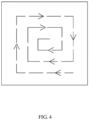
- FIG. 4 a schematic diagram of the driving path in the multiple circles pattern is illustrated, the automatic harvester 1 drives as indicated by the dashed line and the arrow, the dashed line represents the driving path of the automatic harvester, and the arrow represents the driving direction of the automatic harvester.
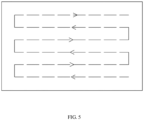
- FIG. 5 a schematic diagram of the driving path in the zigzag pattern is illustrated, the automatic harvester 1 drives as indicated by the dashed line and the arrow. Understandably, the zigzag pattern indicates that the automatic harvesters 1 drives back and forth in rows. Therefore, if the field or farmland has any shape which is not rectangular, the driving mode in the zigzag pattern can also be selected.
- the driving mode of the shortest path or the optimal path is a smart set, if the user or operator of the automatic harvester selects such mode, the path planning module 20 plans the shortest path or the optimal path according to all option content. It can be understood that, the shortest path is the least path that the automatic harvester 1 drives in the entire field, and the optimal path is planned after considering the overall situation. In addition, not all fields or farmlands are completely rectangular or square, but usually have many irregular shapes.
- the driving mode of loop inward from periphery can also be selected.
- the driving mode of loop inward from periphery is to drive inward in circles directly according to the boundary shape of the field.
- the driving mode of loop inward from periphery is similar to driving mode in the multiple circles pattern, and the difference lies in the shape of the farmland.
- each of the automatic harvesters 1 includes a control device 200, a first driving device 300, a second driving device 400, and an actuation device 500.
- the driving path planning system 100 is a path planning system for multiple automatic harvesters 1, in which each component can be arranged on the automatic harvester 1 or independently according to requirements, which is not a limitation of the present disclosure.
- the driving path planning system 100 is connected with the control device 200 and transmits the planned driving path to the control device 200, so that each automatic harvester 1 follows the driving path planned by the driving path planning system 100.
- the connection mode between the driving path planning system 100 and the control device 200 may adopt a wired or wireless connection mode according to actual settings, which is not a limitation of the present disclosure.
- the first driving device 300, the second driving device 400, and the actuation device 500 are each connected with the control device 200.
- the control device 200 can be a central control system of the automatic harvester 1, which integrates and controls of various devices of the automatic harvester 1.
- the first driving device 300 is connected with the actuation device 500, the second driving device 400, and the control device 200, and provides power for the actuation device 500, the second driving device 400, and the control device 200.
- the first driving device 300 is controlled by the control device 200 to drive various components to perform corresponding operations.
- the first driving device 300 can be implemented as a fuel, electric, or hybrid drive, which is not a limitation of the present disclosure.
- the second driving device 400 is used to drive the automatic harvester 1 to move, such as crawler moving, two-wheel moving, or four-wheel moving.
- the actuation device 500 is used to perform harvesting operations, such as cutting.
- the driving path planning system 100 is used to provide driving paths of the multiple automatic harvesters 1.
- the method for planning driving paths of multiple automatic harvesters includes the following steps:
- the basic farmland information includes information such as a size, an area, a shape, coordinates, and a crop category of the farmland.
- the basic farmland information is acquired by an automatic detection module 11 through a fixed-point detection or a movement detection.
- the automatic detection module 11 may be combined with the automatic harvesters, an unmanned aerial vehicle, or a wireless detector to acquire the basic farmland information.
- the automatic detection module 11 may be implemented as an infrared sensor, a laser sensor, an ultrasonic sensor, an image sensor, or a GPS satellite positioning module.
- step (a) the basic farmland information is manually input through a manual determining module 12.
- an obstacle pre-detecting device 13 is used to detect whether there is at least one obstacle, and generate previous obstacle information.
- the obstacle pre-detecting device 13 detects together with the automatic detection module 11.
- the previous obstacle information can also be generated at the same time. Both the basic farmland information and the obstacle information are transmitted to a control module 22 of the path planning module 20, and the control module 22 of the path planning module 20 performs analysis and path planning.
- step (b) the driving path of each automatic harvester 1 has an initial driving point
- each initial driving point may be the same or different.
- the multiple automatic harvesters 1 may all start harvesting from a same place or different places.
- the initial travel point is a starting point of the driving path of each automatic harvester 1.
- step (b) the quantity of harvesting areas is equal to the quantity of automatic harvesters 1. For example, assuming that there are four automatic harvesters 1, the quantity of harvesting areas is four.
- step (b) a quantity determining module 21 is used to determine the quantity of the automatic harvesters 1.
- step (b) the total of each of the harvesting areas is equal to the total farmland area.
- step (b) the driving paths of the automatic harvesters 1 are not to be disturbed by each other.
Landscapes
- Engineering & Computer Science (AREA)
- Physics & Mathematics (AREA)
- Radar, Positioning & Navigation (AREA)
- Remote Sensing (AREA)
- Automation & Control Theory (AREA)
- Aviation & Aerospace Engineering (AREA)
- General Physics & Mathematics (AREA)
- Life Sciences & Earth Sciences (AREA)
- Environmental Sciences (AREA)
- Electromagnetism (AREA)
- Mechanical Engineering (AREA)
- Soil Sciences (AREA)
- Acoustics & Sound (AREA)
- Computing Systems (AREA)
- Mathematical Physics (AREA)
- Theoretical Computer Science (AREA)
- Computer Vision & Pattern Recognition (AREA)
- Multimedia (AREA)
- Guiding Agricultural Machines (AREA)
- Control Of Position, Course, Altitude, Or Attitude Of Moving Bodies (AREA)
Description
- The present disclosure relates to automatic harvesters, and particularly to a system and a method for planning driving paths for multiple automatic harvesters, and a method for planning an optimal driving paths for simultaneous operation of multiple automatic harvesters.
- Nowadays, agricultural machinery industry has great momentum of development and current agriculture can be said to have got rid of the backward manner of farming by manpower, almost all links from sowing, plant protection to harvesting are completed by automatic harvester equipment, it can be said that modem agriculture has entered an era of mechanization. Further, in recent years, agricultural machinery has continued to develop and progress, in order to improve economic benefits of agriculture and promote a development of economic society, various agricultural machineries have sprung up like bamboo shoots after a rain, entered thousands of households in the countryside and brought countless benefits to farmers. In other words, modem agricultural machinery has played a certain role in improving labor productivity and promoting economic development. The mechanization of agriculture has improved efficiency of agricultural production, brought great convenience to the farmers, and played an important role in the rapid development of agriculture,
- In particular, the automatic harvesters began to develop in the direction of unmanned aerial vehicles or autonomous driving. For unmanned aerial vehicles or autonomous driving, driving path planning of the automatic harvester is one of the critical areas of focus. At the same time, with a development of domestic urbanization and merger of fertile land, large-scale production is not only a trend of foreign agriculture, but also a trend of domestic agriculture. In order to improve harvesting efficiency, in large farmland, multiple harvesters are usually utilized to operate simultaneously. However, when the harvesters are automatic harvesters, how do multiple automatic harvesters operate together, and how to plan a harvesting path of each automatic harvester is worth studying. D1:
EP3018987A1 discloses a method comprising identifying field boundaries from aerial imagery; detecting entry upon a first field by an agricultural machine without operator intervention, the first field within the identified field boundaries; and providing a first path to be traversed in the first field at least in part by the agricultural machine. - The present disclosure provides a system and a method for planning driving paths for multiple automatic harvesters, the driving paths of multiple automatic harvesters are planned, so that the automatic harvesters operate in cooperation with each other, to achieve a more efficient harvesting effect.
- The present disclosure provides a system and a method for planning driving paths for multiple automatic harvesters, manual, automatic, and semi-automatic settings can be used to enable the driving path planning system to separately plan the most suitable driving path for each automatic harvester, so as to ensure better harvesting efficiency and better operation distribution.
- The present disclosure provides a system and a method for planning driving paths for multiple automatic harvesters, obstacle information is acquired in advance to enable the automatic harvester to automatically avoid the obstacle during path planning or driving operation.
- The present disclosure provides a system and a method for planning driving paths for multiple automatic harvesters, when each of the automatic harvesters are harvesting in the respective harvesting areas, while acquiring obstacle information, the path planning can be modified to avoid obstacles, or the automatic harvester can be stopped directly. In particular, when the automatic harvester in the area replans the path, the automatic harvester in other areas maintains the originally set path when it does not affect the driving path of the automatic harvester in other areas. In contrast, for example, when the automatic harvester in the area replans the path, when the driving path of the automatic harvester in other areas is affected, the driving path of the automatic harvester in other areas will be modified simultaneously.
- The present disclosure provides a system and a method for planning driving paths for multiple automatic harvesters, if there is a sudden obstacle, like a small animal or a person, the driving path planning system will stop the automatic harvester to ensure safety.
- The present disclosure provides a system and a method for planning driving paths for multiple automatic harvesters, each time driving obstacle information is generated, the driving obstacle information sequentially transmitted to a path planning module for analysis to confirm whether a driving path needs to be replanned.
- The present disclosure provides a system and a method for planning driving paths for multiple automatic harvesters, when a probe touches an obstacle, the obstacle analysis device determines whether the automatic harvester stops operating.
- The present disclosure provides a system and a method for planning driving paths for multiple automatic harvesters, an infrared detector is used to detect whether an obstacle suddenly breaks into the dangerous area in front of the automatic harvester.
- The present disclosure provides a system and a method for planning driving paths for multiple automatic harvesters, there is no need for precise parts and complicated structures, and the manufacturing process is simple and the cost is low.
- To satisfy the above purposes and other purposes and advantages of the present disclosure, the present disclosure provides a method for planning driving paths for multiple automatic harvesters, which includes the following steps:
- (a) a detection device detecting and forming basic farmland information; and
- (b) dividing a harvesting area and forming a driving path for each of the multiple automatic harvester after the basic farmland information is received and quantity determining information is determined.
- According to the method of the present disclosure, transmitting the driving path of each of the multiple automatic harvesters to a control device of each of the multiple automatic harvesters.
- According to the method of the present disclosure, the basic farmland information is a group formed by a size, an area, a shape, coordinates, and a crop category of a farmland.
- According to the method of the present disclosure, a detection device detecting and forming basic farmland information includes acquiring the basic farmland information by an automatic detection module through a fixed-point detection or a movement detection.
- According to the method of the present disclosure, the automatic detection module is a module formed by an infrared sensor, a laser sensor, an ultrasonic sensor, an image sensor, or a GPS satellite positioning module.
- According to the method of the present disclosure, dividing a harvesting area and forming a driving path for each of the multiple automatic harvesters include detecting whether there is at least one obstacle; and generating previous obstacle information.
- According to the method of the present disclosure, the driving path of each automatic harvester has an initial driving point, each initial driving point is the same or different.
- According to the method of the present disclosure, dividing a harvesting area and forming a driving path for each of the multiple automatic harvesters include determining a quantity of the multiple automatic harvesters.
- According to the method of the present disclosure, the driving paths of the multiple automatic harvesters are not to be affected by each other.
- According to the method of the present disclosure, dividing a harvesting area and forming a driving path for each of the multiple automatic harvesters include determining a driving mode of each automatic harvester and generating driving information.
- According to the method of the present disclosure, generating driving obstacle information in response that at least one obstacle is detected while the automatic harvesters are driving.
- To satisfy the above purposes and other purposes and advantages of the present disclosure, the present disclosure further provides a system for planning driving paths for multiple automatic harvesters, which includes:
- a detection device acquiring basic farmland information; and
- a path planning module comprising a quantity determining module and a control module; wherein the quantity determining module is connected with the control module and transmits quantity determining information to the control module, wherein the control module divides a harvesting area and a driving path of each of the multiple automatic harvester according to the basic farmland information and the quantity determining information.
- According to one embodiment of the present disclosure, the basic farmland information is a group formed by a size, an area, a shape, coordinates, and a crop category of a farmland.
- According to one embodiment of the present disclosure, the detection device includes an automatic detection module connected with the control module, wherein the automatic detection module acquires the basic farmland information through a fixed-point detection or a movement detection, and transmits the basic farmland information to the control module.
- According to one embodiment of the present disclosure, the automatic detection module is arranged on the automatic harvesters, an unmanned aerial vehicle, or a wireless detector, to perform movable detection.
- According to one embodiment of the present disclosure, the automatic detection module is a module formed by an infrared sensor, a laser sensor, an ultrasonic sensor, an image sensor, or a GPS satellite positioning module.
- According to one embodiment of the present disclosure, at least one manual determining module connected with the control module and inputting the basic farmland information into the control module.
- According to one embodiment of the present disclosure, the detection device includes at least one obstacle pre-detecting device connected with the control module and acquiring previous obstacle information through a fixed-point detection or a movement detection, and transmitting the previous obstacle information to the control module.
- According to one embodiment of the present disclosure, the detection device includes at least one driving obstacle detector connected with the control module, arranged on the automatic harvester, acquiring driving obstacle information in response that the at least one obstacle is detected while the automatic harvester is driving, and transmitting the driving obstacle information to the control module.
- According to one embodiment of the present disclosure, the at least one driving obstacle detector includes a driving camera sensor, which includes a plurality of cameras surrounding the automatic harvester for acquiring images around the automatic harvester.
- According to one embodiment of the present disclosure, the at least one driving obstacle detector includes at least one probe, which is arranged in front of the automatic harvester and detects whether there is at least one obstacle in front of the automatic harvester.
- According to one embodiment of the present disclosure, the at least one driving obstacle detector includes at least one infrared detector, which is arranged in front of the automatic harvester for sensing people or animals who suddenly enter the front of the automatic harvester.
- According to one embodiment of the present disclosure, the system is arranged on at least one of the multiple automatic harvesters, a remote control, a smart phone, a radio remote control, or a smart tablet host device.
- These and other objectives, features, and advantages of the present disclosure are fully embodied by the following detailed description, drawings, and claims.
-
-
FIG. 1 is a logic schematic view of a preferred embodiment of a system for planning driving paths for multiple automatic harvesters according to the present disclosure. -
FIG. 2 is a logic schematic view of a preferred embodiment of a detection device according to the present disclosure. -
FIG. 3 is a schematic view of a preferred embodiment of an implantation of planned path according to the present disclosure, three driving paths are taken as the driving paths of three automatic harvesters. -
FIG. 4 is a schematic view of a preferred embodiment of a driving mode in multiple circles pattern of the system according to the present disclosure. -
FIG. 5 is a schematic view of a preferred embodiment of a driving mode in zigzag pattern of the system according to the present disclosure. -
FIG. 6 is a logic schematic view of a preferred embodiment of an automatic harvester according to the present disclosure. - The following description is used to disclose the present disclosure so that one skilled in the art can implement the present disclosure. The preferred embodiments in the following description are only examples, and one skilled in the art can think of other obvious variations. The basic principles of the present disclosure defined in the following description can be applied to other embodiments, modified embodiments, improvement embodiments, equivalent embodiments, and other technical solutions that do not deviate from the spirit and scope of the present disclosure.
- One of ordinary skill in the art should understand that, according to the present disclosure, the orientation or position relationship indicated by the terms "longitudinal", "lateral", "upper", "lower", "front", "rear", "left", "right", "vertical", "horizontal", "top", "bottom", "inner", "outer", etc., is the orientation or position relationship shown in the drawings, which is convenient for describing the present disclosure and simplifying the description, rather than indicating or implying that the referred device or component must have a specific orientation, be constructed and operated in a specific orientation, the above terms should not be understood as limiting the present disclosure.
- It can be understood that, the term "a" should be understood as "at least one" or "one or more", that is, in one embodiment, the number of a component may be one, and in another embodiment, the number of the component may also be multiple, the term "one" cannot be understood as a restriction on the number.
- Referring to
FIGS. 1-6 , a system and a method for planning driving paths for multiple automatic harvesters are illustrated according to a first preferred embodiment of the present disclosure, which enables multipleautomatic harvesters 1 to operate at the same time. A drivingpath planning system 100 plans the driving path of each of theautomatic harvesters 1, and the planning of the driving path takes into account conditions of various farms or fields, and problem of operation assignment of multipleautomatic harvesters 1, so as to achieve better harvesting efficiency, and avoid mutual influence of theautomatic harvesters 1 while operating, such as collision with each other or leaving unharvested areas. Further, the drivingpath planning system 100 analyzes and plans according to a size, a shape, and features of farmland or fields, and the multipleautomatic harvesters 1, so that each of theautomatic harvesters 1 has an optimal driving path. Further, the drivingpath planning system 100 is adapted to the multipleautomatic harvesters 1 to plan driving paths of the multipleautomatic harvesters 1 in advance. In particular, the drivingpath planning system 100 is not only adapted to the harvesters, but also adapted to various agricultural machines such as rice transplanters, planting machines, transplanters, tillers, soil preparation machines, etc., which are not a limitation of the present disclosure. In addition, the drivingpath planning system 100 can be arranged in each of the automatic harvesters, a remote control, a smart phone, a radio remote control, or a smart tablet host device. - In the preferred embodiment of the present disclosure, the driving
path planning system 100 includes adetection device 10 and apath planning module 20. Thedetection device 10 is connected with thepath planning module 20. It is worth mentioning that, the above-mentioned connection mode can be a wired connection or an wireless connection, which is not a limitation of the present disclosure. Further, thedetection device 10 is used to acquire basic farmland information, such as an area, a shape, and a crop category of the farmland or field. The area or the shape is a field range to be harvested by the multipleautomatic harvesters 1. Thepath planning module 20 includes aquantity determining module 21 and acontrol module 22. Thequantity determining module 21 is connected with thecontrol module 22. Thequantity determining module 21 is used to determine the quantity of theautomatic harvesters 1 and transmit quantity determining information to thecontrol module 22. Thedetection device 10 is connected with thecontrol module 22, and is used to transmit the basic farmland information to thecontrol module 22. Further, thecontrol module 22 divides a harvesting area of eachautomatic harvester 1 according to the quantity of theautomatic harvesters 1 and the basic farmland information, plans the driving path of eachautomatic harvester 1, and transmits the driving path to acontrol device 200 of eachautomatic harvester 1. - Referring to
FIG. 2 , in the preferred embodiment of the present disclosure, thedetection device 10 includes at least oneautomatic detection module 11 and a manual determiningmodule 12, theautomatic detection module 11 and the manual determiningmodule 12 are respectively connected with thecontrol module 22 of theplanning module 20. Theautomatic detection module 11 can be implemented to perform a fixed-point detection or a movement detection. The fixed-point detection is performed by having a number ofautomatic detection modules 11 respectively arranged on an corner edge of the farmland or the field, and the basic farmland information is acquired through mutual sensing of the number ofautomatic detection modules 11, and includes a range, a shape, coordinates, a crop category, etc. of the farmland, land, or field. The movement detection is performed by having theautomatic detection module 11 arranged on an automatic harvester, an unmanned aerial vehicle, or a wireless detector, so that the automatic harvester, the unmanned aerial vehicle, or the operator can move to acquire the basic farmland information. It is worth mentioning that, theautomatic detection module 11 can be implemented as an infrared sensor, a laser sensor, an ultrasonic sensor, an image sensor, or a GPS satellite positioning module, etc., which is not a limitation of the present disclosure. In addition, the manual determiningmodule 12 pre-acquires the basic farmland information such as a range, a shape, coordinates, a crop category, etc. of the farmland, land, or field, and manually inputs the basic farmland information into thecontrol module 22 of thepath planning module 20 through the manual determiningmodule 12. It is worth mentioning that, thecontrol module 22 of thepath planning module 20 analyzes and plans the driving path of multiple automatic harvesters 1 (i.e., the driving path of each automatic harvester) according to the basic farmland information acquired by theautomatic detection module 11 or the manual determiningmodule 12 and the quantity determining information determined by the quantity determining module. - In the preferred embodiment of the present disclosure, the
detection device 10 further includes anobstacle pre-detecting device 13. Theobstacle pre-detecting device 13 detects whether there is at least one obstacle, generates a previous obstacle information if there is at least one obstacle, and transmits the previous obstacle information to thecontrol module 22 of thepath planning module 20. It is worth mentioning that, theobstacle pre-detecting device 13 can be set to synchronously detect the at least one obstacle together with theautomatic detection module 11. In other words, when theautomatic detection module 11 acquires the range and shape of the land or field, theobstacle pre-detecting device 13 can synchronously acquire the previous obstacle information, so that when thepath planning module 20 plans the driving path, problem of obstacle is synchronously considered and the at least one obstacle may be avoided. In other words, theautomatic detection module 11 may also be equal to theobstacle pre-detecting device 13 and simultaneously acquire the basic farmland information and the previous obstacle information. It is worth mentioning that, thecontrol module 22 of thepath planning module 20 analyzes the basic farmland information, the previous obstacle information, and the quantity determining information and plans the driving path of each of theautomatic harvesters 1. In addition, theobstacle pre-detecting device 13 can be used to distinguish differences between crops and obstacles. The previous obstacle information may include size information, image information, coordinate information, etc. of the at least one obstacle, which is not a limitation of the present disclosure. It is worth mentioning that, theobstacle pre-detecting device 13 may adopt the fixed-point detection or the movement detection which is the same as the detection method adopted by theautomatic detection module 11, and theobstacle pre-detecting device 13 and theautomatic detection module 11 may synchronously perform the detection method. In addition, theobstacle pre-detecting device 13 can be implemented as an infrared sensor, a laser sensor, an ultrasonic sensor, an image sensor, or a GPS satellite positioning module, etc., which is not a limitation of the present disclosure. - In the preferred embodiment of the present disclosure, the
detection device 10 further includes at least one drivingobstacle detector 14, which detects whether there is at least one obstacle when eachautomatic harvester 1 is driven, further acquires driving obstacle information when the at least one obstacle is detected, and transmits the driving obstacle information to thecontrol module 22 of thepath planning module 20, when thecontrol module 22 of thepath planning module 20 receives the driving obstacle information, thecontrol module 22 determines whether theautomatic harvesters 1 in the harvesting area are required to replan the driving path according to the driving obstacle information. Further, after the drivingobstacle detector 14 of theautomatic harvester 1 in the harvesting area acquires the driving obstacle information that affects a harvesting path, the driving obstacle information is transmitted to thecontrol module 22, and thecontrol module 22 replans the driving path of theautomatic harvester 1 in the harvesting area. The new driving path of theautomatic harvester 1 in the harvesting area will not affect the driving path of otherautomatic harvesters 1. It is worth mentioning that, the drivingobstacle detector 14 is arranged on theautomatic harvester 1, and is optimally arranged in front of theautomatic harvester 1. The encountered obstacle can be directly detected by the drivingobstacle detector 14 while theautomatic harvester 1 is being driven forward. In particular, when the drivingobstacle detector 14 detects the obstacle, theautomatic harvester 1 determines whether to replan the driving path according to the existing basis. - In the preferred embodiment of the present disclosure, the driving
obstacle detector 14 may recognize the crop and the at least one obstacle, acquire the driving obstacle information, such as the size, and transmit the size information of the at least one obstacle to thecontrol module 22 of thepath planning module 20. Thecontrol module 22 of thepath planning module 20 determines whether the at least one obstacle affects the driving path, if not, theautomatic harvester 1 directly follows the initial planned driving path, if the at least one obstacle is determined to affect the driving path, the obstacle information is transmitted to thepath planning module 20 for replanning the driving path. In particular, the drivingobstacle detector 14 may acquire image features for distinguishing the difference between the crops and the at least one obstacle. It is worth mentioning that, the drivingobstacle detector 14 is arranged on theautomatic harvester 1 and conveniently acquires at least one forward signal, such as the crops and the at least one obstacle, while theautomatic harvester 1 is being driven. The drivingobstacle detector 14 includes a drivingcamera sensor 141, which acquires images around theautomatic harvester 1 and forms a video signal. In particular, the drivingcamera sensor 141 includes a number ofcameras 1411 surrounding theautomatic harvester 1 for acquiring the images around theautomatic harvester 1 and forming the video signal. The drivingobstacle detector 14 further includes at least oneprobe 142, which is arranged in front of theautomatic harvester 1 and detects whether there is at least one obstacle in front of theautomatic harvester 1, such as trees, walls, large rocks, concavities, puddles, rivers, etc. The at least oneprobe 142 further detects the sizes or the features of various obstacles at the same time, and transmits the detection information to thecontrol module 22 of thepath planning module 20, so that thecontrol module 22 of thepath planning module 20 determines whether theautomatic harvester 1 stops operating. In addition, the drivingobstacle detector 14 further includes at least oneinfrared detector 143, which is arranged in front of theautomatic harvester 1 for sensing people or animals who suddenly enter the front of theautomatic harvester 1. It is worth mentioning that, after the drivingobstacle detector 14 acquires the driving obstacle information, thecontrol module 22 replans the driving path for theautomatic harvesting 1 in the harvesting area that has detected the at least one obstacle, the driving paths of the otherautomatic harvestings 1 in the harvesting areas are not affected. In particular, the replanned driving path prevents theautomatic harvester 1 from colliding with each other. - In the preferred embodiment of the present disclosure, the
path planning module 20 further includes a path determining module 23, which is connected with thecontrol module 22. The path determining module 23 can determine a driving mode of eachautomatic harvester 1 respectively, or determine the driving mode of the multipleautomatic harvesters 1 to a same driving mode. The driving mode includes driving modes in a multiple circles pattern, a zigzag pattern, a shortest path, an optimal path, loop inward from periphery etc. A user or an operator of theautomatic harvester 1 can determine the driving mode of each of theautomatic harvesters 1 according to the shape of the field or farmland. As reference sets, the multiple circles pattern can be adopted if the field or farmland is square, the zigzag pattern can be used if the field or farmland is rectangular, the shortest path can be adopted for reducing harvesting time, the optimal path can be adopted if considering landform, harvesting efficiency, and program setting. The various determining methods mentioned above are suggested methods and are not limitations of the present disclosure. - In particular, as illustrated in
FIG. 3 , the present disclosure provides an implementation of a planned path, which is applicable to three automatic harvesters. InFIG. 3 , the outer thick line represents edges of the field or farmland, the three line types in the figure represent three driving paths, which are adopted as the driving paths of the threeautomatic harvesters 1, and the arrow on the line indicates the driving direction. In this embodiment, the initial driving points are determined to be the same, and the threeautomatic harvesters 1 return to the initial travel points after harvesting. The driving path planning in this embodiment can be used as a reference, and it is not the only way of implementation, which is not a limitation of the present disclosure. - In addition, referring to
FIG. 4 , a schematic diagram of the driving path in the multiple circles pattern is illustrated, theautomatic harvester 1 drives as indicated by the dashed line and the arrow, the dashed line represents the driving path of the automatic harvester, and the arrow represents the driving direction of the automatic harvester. Referring toFIG. 5 , a schematic diagram of the driving path in the zigzag pattern is illustrated, theautomatic harvester 1 drives as indicated by the dashed line and the arrow. Understandably, the zigzag pattern indicates that theautomatic harvesters 1 drives back and forth in rows. Therefore, if the field or farmland has any shape which is not rectangular, the driving mode in the zigzag pattern can also be selected. That is, when theautomatic harvester 1 drives to a boundary of one row, theautomatic harvester 1 turns and drives to another row, and when driving to the boundary, theautomatic harvester 1 turns and drives again in the same manner. In addition, the driving mode of the shortest path or the optimal path is a smart set, if the user or operator of the automatic harvester selects such mode, thepath planning module 20 plans the shortest path or the optimal path according to all option content. It can be understood that, the shortest path is the least path that theautomatic harvester 1 drives in the entire field, and the optimal path is planned after considering the overall situation. In addition, not all fields or farmlands are completely rectangular or square, but usually have many irregular shapes. In this case, besides selecting the driving mode in the zigzag pattern, the shortest path, or the optimal path, the driving mode of loop inward from periphery can also be selected. The driving mode of loop inward from periphery is to drive inward in circles directly according to the boundary shape of the field. In other words, the driving mode of loop inward from periphery is similar to driving mode in the multiple circles pattern, and the difference lies in the shape of the farmland. - It is worth mentioning that, as illustrated in
FIG. 6 , each of theautomatic harvesters 1 includes acontrol device 200, afirst driving device 300, asecond driving device 400, and anactuation device 500. The drivingpath planning system 100 is a path planning system for multipleautomatic harvesters 1, in which each component can be arranged on theautomatic harvester 1 or independently according to requirements, which is not a limitation of the present disclosure. The drivingpath planning system 100 is connected with thecontrol device 200 and transmits the planned driving path to thecontrol device 200, so that eachautomatic harvester 1 follows the driving path planned by the drivingpath planning system 100. It is worth mentioning that, the connection mode between the drivingpath planning system 100 and thecontrol device 200 may adopt a wired or wireless connection mode according to actual settings, which is not a limitation of the present disclosure. In addition, thefirst driving device 300, thesecond driving device 400, and theactuation device 500 are each connected with thecontrol device 200. It is understandable that, thecontrol device 200 can be a central control system of theautomatic harvester 1, which integrates and controls of various devices of theautomatic harvester 1. Thefirst driving device 300 is connected with theactuation device 500, thesecond driving device 400, and thecontrol device 200, and provides power for theactuation device 500, thesecond driving device 400, and thecontrol device 200. Thefirst driving device 300 is controlled by thecontrol device 200 to drive various components to perform corresponding operations. It is worth mentioning that, thefirst driving device 300 can be implemented as a fuel, electric, or hybrid drive, which is not a limitation of the present disclosure. Thesecond driving device 400 is used to drive theautomatic harvester 1 to move, such as crawler moving, two-wheel moving, or four-wheel moving. Theactuation device 500 is used to perform harvesting operations, such as cutting. The drivingpath planning system 100 is used to provide driving paths of the multipleautomatic harvesters 1. - In addition, a method for planning driving paths of multiple automatic harvesters provided by the present disclosure is described. The method for planning driving paths of multiple automatic harvesters includes the following steps:
- (a) a
detection device 10 detects and forms basic farmland information; and - (b) after the basic farmland information is received and quantity determining information is determined, a
path planning module 20 divides a harvesting area of multipleautomatic harvesters 1 and the driving path of each of the multipleautomatic harvester 1. - In step (a), the basic farmland information includes information such as a size, an area, a shape, coordinates, and a crop category of the farmland.
- In step (a), the basic farmland information is acquired by an
automatic detection module 11 through a fixed-point detection or a movement detection. In particular, theautomatic detection module 11 may be combined with the automatic harvesters, an unmanned aerial vehicle, or a wireless detector to acquire the basic farmland information. In addition, theautomatic detection module 11 may be implemented as an infrared sensor, a laser sensor, an ultrasonic sensor, an image sensor, or a GPS satellite positioning module. - In step (a), the basic farmland information is manually input through a manual determining
module 12. - In step (a), an
obstacle pre-detecting device 13 is used to detect whether there is at least one obstacle, and generate previous obstacle information. In particular, theobstacle pre-detecting device 13 detects together with theautomatic detection module 11. Further, in step (a), in addition to generating the basic farmland information, if there is at least one obstacle, the previous obstacle information can also be generated at the same time. Both the basic farmland information and the obstacle information are transmitted to acontrol module 22 of thepath planning module 20, and thecontrol module 22 of thepath planning module 20 performs analysis and path planning. - In step (b), the driving path of each
automatic harvester 1 has an initial driving point, each initial driving point may be the same or different. In other words, the multipleautomatic harvesters 1 may all start harvesting from a same place or different places. It is worth mentioning that, the initial travel point is a starting point of the driving path of eachautomatic harvester 1. - In step (b), the quantity of harvesting areas is equal to the quantity of
automatic harvesters 1. For example, assuming that there are fourautomatic harvesters 1, the quantity of harvesting areas is four. - In step (b), a
quantity determining module 21 is used to determine the quantity of theautomatic harvesters 1. - In step (b), the total of each of the harvesting areas is equal to the total farmland area.
- In step (b), the driving paths of the
automatic harvesters 1 are not to be disturbed by each other.
Claims (22)
- A method for planning driving paths of multiple automatic harvesters (1), each harvester comprising a detection device, the method comprising:detecting and forming basic farmland information by a detection device (10); anddividing a harvesting area and forming a driving path for each of the multiple automatic harvesters (1) after the basic farmland information is received and quantity determining information is determined;characterized in that the detection device (10) comprises at least one driving obstacle detector (14); the at least one driving obstacle detector (14) comprises at least one probe (142) arranged in front of the automatic harvester (1); and the method further comprises:acquiring detection information of at least one obstacle by using the at least one probe (142) in response that the at least one obstacle is detected when the automatic harvester (1) is driving based on the driving path, the detection information comprising a size of the at least one obstacle; anddetermining whether the automatic harvester (1) stops operating according to the detection information;wherein the driving path of each automatic harvester (1) has an initial driving point, the initial travel point is a starting point of the driving path of each automatic harvester (1), the initial travel point of each automatic harvester (1) is the same, and each automatic harvester (1) returns to the initial driving point after harvesting.
- The method according to claim 1, further comprising:
transmitting the driving path for each of the multiple automatic harvesters (1) to a control device (200) of each of the multiple automatic harvesters (1). - The method according to claim 1, wherein the basic farmland information is an information group formed by a size, an area, a shape, coordinates, and a crop category of a farmland.
- The method according to claim 1, wherein detecting and forming basic farmland information by a detection device (10) comprises:
acquiring the basic farmland information by an automatic detection module (11) through a fixed-point detection or a movement detection. - The method according to claim 4, wherein the automatic detection module (11) is a module formed by an infrared sensor, a laser sensor, an ultrasonic sensor, an image sensor, or a GPS satellite positioning module.
- The method according to claim 1, wherein dividing a harvesting area and forming a driving path for each of the multiple automatic harvesters (1) further comprising:detecting whether there is at least one obstacle; andgenerating previous obstacle information.
- The method according to claim 1, wherein dividing a harvesting area and forming a driving path for each of the multiple automatic harvesters (1) further comprising:
determining a quantity of the multiple automatic harvesters (1). - The method according to claim 1, wherein the driving paths of the multiple automatic harvesters (1) are not to be affected by each other.
- The method according to claim 1, wherein dividing a harvesting area and forming a driving path for each of the multiple automatic harvesters (1) further comprising:
determining a driving mode of each automatic harvester (1) in response to user input and generating driving information, the driving mode being selected from one of a plurality of modes, and the plurality of modes comprising a multiple circles pattern, a zigzag pattern, a shortest path, and an optimal path, loop inward from periphery. - The method according to claim 1, further comprising:
replanning the driving path for the automatic harvesting in the harvesting area that has detected the at least one obstacle and obtaining a replanned driving path, the driving paths of other automatic harvestings in the harvesting areas are not affected, and the replanned driving path prevents the multiple automatic harvesters (1) from colliding with each other. - A system for planning driving paths of multiple automatic harvesters (1), each harvester comprising a detection device (10), the system comprising:at least one of the detection devices (10) is configured to acquire basic farmland information; anda path planning module (20) comprising a quantity determining module (21) and a control module (22), wherein the quantity determining module (21) is connected with the control module (22) and is configured to transmit quantity determining information to the control module (22),wherein the control module (22) is configured to divide a harvesting area and to form a driving path for each of the multiple automatic harvesters (1) according to the basic farmland information and the quantity determining information;characterized in that the detection device (10) comprises at least one driving obstacle detector (14) connected with the control module (22); the at least one driving obstacle detector (14) comprising at least one probe (142) arranged in front of the automatic harvester (1); the at least one probe (142) acquiring detection information of at least one obstacle in response that the at least one obstacle is detected when the automatic harvester (1) is driving based on the driving path, and configured to transmit the detection information to the control module (22), the detection information comprising a size of the at least one obstacle; and the control module (22) is configured to determine whether the automatic harvester (1) stops operating according to the detection information;wherein the driving path of each automatic harvester (1) has an initial driving point, the initial travel point is a starting point of the driving path of each automatic harvester (1), the initial travel point of each automatic harvester (1) is the same, and each automatic harvester (1) is configured to return to the initial driving point after harvesting.
- The system according to claim 11, wherein the basic farmland information is an information group formed by a size, an area, a shape, coordinates, and a crop category of a farmland.
- The system according to claim 11, wherein the detection device (10) comprises:
an automatic detection module (11) connected with the control module (22), wherein the automatic detection module (11) is configured to acquire the basic farmland information through a fixed-point detection or a movement detection, and transmits the basic farmland information to the control module (22). - The system according to claim 13, wherein the automatic detection module (11) is arranged on the automatic harvesters (1), an unmanned aerial vehicle, or a wireless detector, to perform movement detection.
- The system according to claim 13, wherein the automatic detection module (11) is a module formed by an infrared sensor, a laser sensor, an ultrasonic sensor, an image sensor, or a GPS satellite positioning module.
- The system according to claim 11, wherein the detection device (10) further comprises:
at least one manual determining module connected with the control module (22) and configured to input the basic farmland information into the control module (22). - The system according to claim 11, wherein the detection device (10) further comprises:
at least one obstacle pre-detecting device (13) connected with the control module (22) for acquiring previous obstacle information through a fixed-point detection or a movement detection, and transmitting the previous obstacle information to the control module (22). - The system according to claim 11,
wherein the control module (22) is configured to replan the driving path for the automatic harvesting in the harvesting area that has detected the at least one obstacle and obtains a replanned driving path, the driving paths of other automatic harvestings in the harvesting areas are not affected, and the replanned driving path prevents the multiple automatic harvesters (1) from colliding with each other. - The system according to claim 11, wherein the at least one driving obstacle detector (14) comprises a driving camera sensor (141), which comprises a plurality of cameras (1411) surrounding the automatic harvester (1) for acquiring images around the automatic harvester (1).
- The system according to claim 11, wherein the path determining module (23) is configured to determine a driving mode of each automatic harvester (1) in response to user input, the driving mode is selected from one of a plurality of modes, the plurality of modes comprise a multiple circles pattern, a zigzag pattern, a shortest path, and an optimal path, loop inward from periphery.
- The system according to claim 11, wherein the at least one driving obstacle detector (14) comprises at least one infrared detector (143), which is arranged in front of the automatic harvester (1) for sensing people or animals who suddenly enter the front of the automatic harvester (1).
- The system according to claim 11, wherein the system is arranged on at least one of the multiple automatic harvesters (1), a remote control, a smart phone, a radio remote control, or a smart tablet host device.
Applications Claiming Priority (2)
| Application Number | Priority Date | Filing Date | Title |
|---|---|---|---|
| CN201910280738.0A CN110286670A (en) | 2019-04-09 | 2019-04-09 | The driving path planning system and its method of more automatic harvesters |
| PCT/CN2019/106985 WO2020206945A1 (en) | 2019-04-09 | 2019-09-20 | Travel path planning system for multiple automatic harvesters and method therefor |
Publications (3)
| Publication Number | Publication Date |
|---|---|
| EP3955078A1 EP3955078A1 (en) | 2022-02-16 |
| EP3955078A4 EP3955078A4 (en) | 2022-12-21 |
| EP3955078B1 true EP3955078B1 (en) | 2025-01-01 |
Family
ID=68001680
Family Applications (1)
| Application Number | Title | Priority Date | Filing Date |
|---|---|---|---|
| EP19924166.2A Active EP3955078B1 (en) | 2019-04-09 | 2019-09-20 | Travel path planning system for multiple automatic harvesters and method therefor |
Country Status (5)
| Country | Link |
|---|---|
| US (1) | US20220019242A1 (en) |
| EP (1) | EP3955078B1 (en) |
| CN (1) | CN110286670A (en) |
| AU (1) | AU2019440384A1 (en) |
| WO (1) | WO2020206945A1 (en) |
Families Citing this family (11)
| Publication number | Priority date | Publication date | Assignee | Title |
|---|---|---|---|---|
| CN110825091A (en) * | 2019-11-29 | 2020-02-21 | 洛阳中科龙网创新科技有限公司 | Intelligent tractor intelligent routing method and device based on unmanned aerial vehicle |
| CN112470966B (en) * | 2020-06-04 | 2022-11-25 | 丰疆智能科技股份有限公司 | Automatic feeding system and automatic feeding method for farm |
| CN113805575B (en) * | 2020-06-12 | 2024-07-05 | 颜炳郎 | Carrier system |
| CN113313784B (en) * | 2021-04-29 | 2023-12-08 | 北京农业智能装备技术研究中心 | Farmland painting production method and device based on unmanned agricultural machinery |
| EP4388840A4 (en) * | 2021-08-20 | 2025-08-27 | Kubota Kk | AGRICULTURAL ASSISTANCE SYSTEM |
| CA3230621A1 (en) * | 2021-09-10 | 2023-03-16 | Raven Industries, Inc. | Multi-vehicle coordination systems and methods for agricultural field operations |
| CN114402995B (en) * | 2022-01-19 | 2023-03-24 | 北京市农林科学院智能装备技术研究中心 | Air-ground cooperative corn emasculation method and system and air unmanned emasculation machine |
| CN115285144B (en) * | 2022-08-05 | 2025-04-25 | 北京百度网讯科技有限公司 | Vehicle control method and device, electronic device, and computer readable medium |
| CN115509228B (en) * | 2022-09-27 | 2024-12-24 | 五邑大学 | Agricultural machinery obstacle avoidance method, device, agricultural machinery, and storage medium based on target detection |
| CN115963821A (en) * | 2022-12-20 | 2023-04-14 | 北京市农林科学院信息技术研究中心 | Automatic production operation method, device, equipment and medium for outdoor vegetables |
| CN116109268B (en) * | 2023-02-01 | 2024-05-17 | 泰州市衡顺电控科技有限公司 | Intelligent agriculture supervision system and method based on Internet of things |
Citations (1)
| Publication number | Priority date | Publication date | Assignee | Title |
|---|---|---|---|---|
| EP3018987B1 (en) * | 2013-07-10 | 2020-09-02 | Agco Corporation | Automating distribution of work in a field |
Family Cites Families (67)
| Publication number | Priority date | Publication date | Assignee | Title |
|---|---|---|---|---|
| US5107946A (en) * | 1989-07-26 | 1992-04-28 | Honda Giken Kogyo Kabushiki Kaisha | Steering control system for moving vehicle |
| US6236907B1 (en) * | 1995-05-30 | 2001-05-22 | Ag-Chem Equipment Co., Inc. | System and method for creating agricultural decision and application maps for automated agricultural machines |
| EP0975209B1 (en) * | 1997-04-16 | 2003-05-21 | Carnegie Mellon University | Agricultural harvester with robotic control |
| US6236924B1 (en) * | 1999-06-21 | 2001-05-22 | Caterpillar Inc. | System and method for planning the operations of an agricultural machine in a field |
| US8712144B2 (en) * | 2003-04-30 | 2014-04-29 | Deere & Company | System and method for detecting crop rows in an agricultural field |
| US7272474B1 (en) * | 2004-03-31 | 2007-09-18 | Carnegie Mellon University | Method and system for estimating navigability of terrain |
| US8185275B2 (en) * | 2005-07-01 | 2012-05-22 | Deere & Company | System for vehicular guidance with respect to harvested crop |
| DE102006015203A1 (en) * | 2006-03-30 | 2007-11-15 | Claas Selbstfahrende Erntemaschinen Gmbh | Method for controlling agricultural machine systems |
| US7715966B2 (en) * | 2007-03-02 | 2010-05-11 | Cnh America Llc | Method for creating spiral swath patterns for convex polygon shaped field boundaries |
| US8626441B2 (en) * | 2008-06-17 | 2014-01-07 | Agco Corporation | Methods and apparatus for using position/attitude information to enhance a vehicle guidance system |
| US9026315B2 (en) * | 2010-10-13 | 2015-05-05 | Deere & Company | Apparatus for machine coordination which maintains line-of-site contact |
| US8738238B2 (en) * | 2009-11-12 | 2014-05-27 | Deere & Company | Coordination of vehicle movement in a field |
| DE102010038661B4 (en) * | 2010-07-29 | 2020-07-02 | Deere & Company | Harvester with a sensor attached to an aircraft |
| US9043129B2 (en) * | 2010-10-05 | 2015-05-26 | Deere & Company | Method for governing a speed of an autonomous vehicle |
| WO2012122448A1 (en) * | 2011-03-10 | 2012-09-13 | Agco Corporation | Moving geofence for machine tracking in agriculture |
| US20130173321A1 (en) * | 2011-12-30 | 2013-07-04 | Jerome Dale Johnson | Methods, apparatus and systems for generating, updating and executing a crop-harvesting plan |
| CN102722973B (en) * | 2012-06-29 | 2018-02-13 | 深圳市赛格导航科技股份有限公司 | Reading intelligent agriculture operating system and its operational method based on GPS |
| WO2014050524A1 (en) * | 2012-09-26 | 2014-04-03 | 株式会社クボタ | Agricultural management system and crop harvester |
| US20150348419A1 (en) * | 2012-12-28 | 2015-12-03 | Agco Corporation | Method of assigning planned paths to multiple machines to cooperatively cover area |
| CN103149914B (en) * | 2013-03-11 | 2016-04-06 | 西北农林科技大学 | A kind of control system of multimachine device cooperation wheat cropping system |
| US10740703B2 (en) * | 2013-04-29 | 2020-08-11 | Verge Technologies Inc. | Method and system for determining optimized travel path for agricultural implement on land with obstacle |
| CN103345246A (en) * | 2013-05-29 | 2013-10-09 | 西北农林科技大学 | Multi-robot system for real-time harvesting, transferring, drying and preserving of wheat |
| JP6301702B2 (en) * | 2014-03-27 | 2018-03-28 | 株式会社クボタ | Work vehicle coordination system |
| EP3171241A4 (en) * | 2014-07-16 | 2017-12-13 | Ricoh Company, Ltd. | System, machine, control method, and program |
| JP6219790B2 (en) * | 2014-07-29 | 2017-10-25 | 株式会社クボタ | Work vehicle coordination system |
| SG10201406357QA (en) * | 2014-10-03 | 2016-05-30 | Infinium Robotics Pte Ltd | System for performing tasks in an operating region and method of controlling autonomous agents for performing tasks in the operating region |
| ES2905883T3 (en) * | 2015-01-21 | 2022-04-12 | Univ Ramot | agricultural robot |
| JP2017015527A (en) * | 2015-06-30 | 2017-01-19 | 株式会社トプコン | Wide area sensor system, flight detection method and program |
| US10586464B2 (en) * | 2015-07-29 | 2020-03-10 | Warren F. LeBlanc | Unmanned aerial vehicles |
| US10884430B2 (en) * | 2015-09-11 | 2021-01-05 | The Trustees Of The University Of Pennsylvania | Systems and methods for generating safe trajectories for multi-vehicle teams |
| WO2017092904A1 (en) * | 2015-12-03 | 2017-06-08 | Graf Plessen Mogens Max Sophus Edzard | Path planning for area coverage |
| CN106020233B (en) * | 2016-07-08 | 2023-11-28 | 聂浩然 | Unmanned aerial vehicle plant protection operation system, unmanned aerial vehicle for plant protection operation and control method |
| ES2905856T3 (en) * | 2016-08-18 | 2022-04-12 | Tevel Aerobotics Tech Ltd | Device, system and method for harvesting and thinning using aerial drones, for orchards, plantations and greenhouses |
| US11464168B2 (en) * | 2016-10-12 | 2022-10-11 | Kyndryl, Inc. | Automated vegetation removal |
| BR112019007680A2 (en) * | 2016-10-24 | 2019-07-02 | Agco International Gmbh | land mapping and guidance system |
| WO2018101351A1 (en) * | 2016-12-02 | 2018-06-07 | 株式会社クボタ | Travel route management system and travel route determination device |
| WO2018116770A1 (en) * | 2016-12-19 | 2018-06-28 | 株式会社クボタ | Work vehicle automatic traveling system |
| JP6619325B2 (en) * | 2016-12-26 | 2019-12-11 | 本田技研工業株式会社 | Lawn mower |
| SE541287C2 (en) * | 2017-02-27 | 2019-06-11 | Katam Tech Ab | Forest surveying apparatus and method using video sequences to generate 3D models |
| CN110622088B (en) * | 2017-04-20 | 2023-05-16 | 深圳市大疆创新科技有限公司 | Flight path determination method, information processing device, program and recording medium |
| KR102359931B1 (en) * | 2017-04-28 | 2022-02-07 | 현대자동차 주식회사 | Fork lifter system, and control method thereof |
| US20180364739A1 (en) * | 2017-06-19 | 2018-12-20 | Cnh Industrial America Llc | Choreographer system for autonomous off-road vehicles |
| US10188021B2 (en) * | 2017-06-19 | 2019-01-29 | Cnh Industrial America Llc | Path planning system for autonomous off-road vehicles |
| JP2019028688A (en) * | 2017-07-28 | 2019-02-21 | 井関農機株式会社 | Autonomous combine harvester system |
| CN107451754A (en) * | 2017-08-16 | 2017-12-08 | 河北农业大学 | Agricultural machinery trans-regional operation scheduling method and system |
| CN107508905A (en) * | 2017-09-09 | 2017-12-22 | 佛山推启农业研究院(普通合伙) | Dispatching management information system in large-scale agricultural machinery region based on Internet of Things |
| CN107844129B (en) * | 2017-11-30 | 2021-03-23 | 北京大学深圳研究生院 | Multi-UAV cooperative search method and system based on path planning and information fusion |
| JP7027142B2 (en) * | 2017-12-06 | 2022-03-01 | ヤンマーパワーテクノロジー株式会社 | Target route generation system for work vehicles |
| US20190302783A1 (en) * | 2018-03-29 | 2019-10-03 | Autonomous Solutions, Inc. | System and method for autonomous work vehicle operations |
| JP7059096B2 (en) * | 2018-04-27 | 2022-04-25 | 株式会社クボタ | Work equipment spraying support system |
| JP7064066B2 (en) * | 2018-08-28 | 2022-05-10 | ヤンマーパワーテクノロジー株式会社 | Automatic driving system for work vehicles |
| CN109099925B (en) * | 2018-08-31 | 2021-07-20 | 江苏大学 | A method and device for unmanned agricultural machinery navigation path planning and operation quality assessment |
| US11042162B2 (en) * | 2018-09-13 | 2021-06-22 | Cnh Industrial Canada, Ltd. | System and method for determining work routes for agricultural vehicles |
| US11653588B2 (en) * | 2018-10-26 | 2023-05-23 | Deere & Company | Yield map generation and control system |
| CN109631903A (en) * | 2019-01-04 | 2019-04-16 | 丰疆智慧农业股份有限公司 | Cereal handles automated driving system and its automatic Pilot method and paths planning method |
| CN109814551A (en) * | 2019-01-04 | 2019-05-28 | 丰疆智慧农业股份有限公司 | Cereal handles automated driving system, automatic Pilot method and automatic identifying method |
| DE102019108505A1 (en) * | 2019-04-02 | 2020-10-08 | Claas E-Systems Gmbh | Agricultural work machine |
| CN110209156A (en) * | 2019-04-09 | 2019-09-06 | 丰疆智能科技股份有限公司 | The driving path planning system and its method of automatic harvester |
| CN110232493B (en) * | 2019-04-09 | 2021-07-30 | 丰疆智能科技股份有限公司 | Harvester and logistics vehicle intelligent coordination system and method |
| US11440659B2 (en) * | 2019-09-12 | 2022-09-13 | National Formosa University | Precision agriculture implementation method by UAV systems and artificial intelligence image processing technologies |
| IT201900004218U1 (en) * | 2019-11-25 | 2021-05-25 | Rinieri S R L | IMPROVED INTER-ROW MACHINE. |
| WO2021202202A2 (en) * | 2020-03-27 | 2021-10-07 | Skygrid, Llc | Utilizing unmanned aerial vehicles for emergency response |
| US11874669B2 (en) * | 2020-10-09 | 2024-01-16 | Deere & Company | Map generation and control system |
| US11635765B2 (en) * | 2020-10-09 | 2023-04-25 | Deere & Company | Crop state map generation and control system |
| US11849671B2 (en) * | 2020-10-09 | 2023-12-26 | Deere & Company | Crop state map generation and control system |
| US11946747B2 (en) * | 2020-10-09 | 2024-04-02 | Deere & Company | Crop constituent map generation and control system |
| US12085955B2 (en) * | 2021-10-19 | 2024-09-10 | Deere & Company | Methods, apparatus, and articles of manufacture to select track paths for one or more vehicles in a field |
-
2019
- 2019-04-09 CN CN201910280738.0A patent/CN110286670A/en active Pending
- 2019-09-20 WO PCT/CN2019/106985 patent/WO2020206945A1/en not_active Ceased
- 2019-09-20 EP EP19924166.2A patent/EP3955078B1/en active Active
- 2019-09-20 AU AU2019440384A patent/AU2019440384A1/en not_active Abandoned
-
2021
- 2021-09-30 US US17/490,134 patent/US20220019242A1/en not_active Abandoned
Patent Citations (1)
| Publication number | Priority date | Publication date | Assignee | Title |
|---|---|---|---|---|
| EP3018987B1 (en) * | 2013-07-10 | 2020-09-02 | Agco Corporation | Automating distribution of work in a field |
Also Published As
| Publication number | Publication date |
|---|---|
| WO2020206945A1 (en) | 2020-10-15 |
| CN110286670A (en) | 2019-09-27 |
| AU2019440384A1 (en) | 2021-12-02 |
| CA3135645A1 (en) | 2020-10-15 |
| EP3955078A4 (en) | 2022-12-21 |
| EP3955078A1 (en) | 2022-02-16 |
| US20220019242A1 (en) | 2022-01-20 |
Similar Documents
| Publication | Publication Date | Title |
|---|---|---|
| EP3955078A1 (en) | Travel path planning system for multiple automatic harvesters and method therefor | |
| CA3132022C (en) | Traveling path planning system and method of automatic harvester | |
| US11490563B2 (en) | Weeding robot and method | |
| WO2020206946A1 (en) | Lodging driving planning system of automatic harvester, and method thereof | |
| CN109154823A (en) | Utonomous working vehicle barrier detection system | |
| US20170318732A1 (en) | Work vehicle travel system | |
| EP3414982A1 (en) | Method and device for the identification of animals in the machine track of an agricultural field cultivating machine | |
| AU2019422604B2 (en) | Route management system and management method thereof | |
| WO2022147156A1 (en) | Generating a ground plane for obstruction detection | |
| JP6910926B2 (en) | Field work support terminal, field work machine, and field work support program | |
| US12001221B2 (en) | Methods for managing coordinated autonomous teams of under-canopy robotic systems for an agricultural field and devices | |
| US20240206450A1 (en) | System and method for an agricultural applicator | |
| CN117274519A (en) | Map construction method, device and lawn mowing robot | |
| CN110209154B (en) | Residual harvesting path planning system and method of automatic harvester | |
| WO2020206935A1 (en) | Obstacle avoidance system and method for automatic harvester | |
| CA3135645C (en) | System and method for planning driving paths for multiple automatic harvesters | |
| CN109857101A (en) | Intelligent agricultural machinery authoring system and method | |
| US20230350426A1 (en) | System and method for deployment planning and coordination of a vehicle fleet | |
| JP2020096545A (en) | Harvest access system and harvest access method | |
| US20250130049A1 (en) | Control method of work vehicle, control program for work vehicle, control system for work vehicle, and work system | |
| US20260096500A1 (en) | Control method for work vehicle, work vehicle control program, work vehicle control system, and work system | |
| Jahns | Automatic guidance of agricultural field machinery | |
| US20250311657A1 (en) | Farm field registration device, farm field registration method, and computer program | |
| US20260099153A1 (en) | Control method for work vehicle, work vehicle control program, work vehicle control system, and work system | |
| JP2024177707A (en) | Work vehicle |
Legal Events
| Date | Code | Title | Description |
|---|---|---|---|
| STAA | Information on the status of an ep patent application or granted ep patent |
Free format text: STATUS: THE INTERNATIONAL PUBLICATION HAS BEEN MADE |
|
| PUAI | Public reference made under article 153(3) epc to a published international application that has entered the european phase |
Free format text: ORIGINAL CODE: 0009012 |
|
| STAA | Information on the status of an ep patent application or granted ep patent |
Free format text: STATUS: REQUEST FOR EXAMINATION WAS MADE |
|
| 17P | Request for examination filed |
Effective date: 20211105 |
|
| AK | Designated contracting states |
Kind code of ref document: A1 Designated state(s): AL AT BE BG CH CY CZ DE DK EE ES FI FR GB GR HR HU IE IS IT LI LT LU LV MC MK MT NL NO PL PT RO RS SE SI SK SM TR |
|
| DAV | Request for validation of the european patent (deleted) | ||
| DAX | Request for extension of the european patent (deleted) | ||
| A4 | Supplementary search report drawn up and despatched |
Effective date: 20221118 |
|
| RIC1 | Information provided on ipc code assigned before grant |
Ipc: A01B 69/04 20060101ALI20221114BHEP Ipc: A01D 75/20 20060101ALI20221114BHEP Ipc: G05D 1/02 20200101AFI20221114BHEP |
|
| STAA | Information on the status of an ep patent application or granted ep patent |
Free format text: STATUS: EXAMINATION IS IN PROGRESS |
|
| 17Q | First examination report despatched |
Effective date: 20231108 |
|
| REG | Reference to a national code |
Ref country code: DE Ref legal event code: R079 Free format text: PREVIOUS MAIN CLASS: G05D0001020000 Ipc: G05D0001000000 Ref document number: 602019064472 Country of ref document: DE |
|
| GRAP | Despatch of communication of intention to grant a patent |
Free format text: ORIGINAL CODE: EPIDOSNIGR1 |
|
| STAA | Information on the status of an ep patent application or granted ep patent |
Free format text: STATUS: GRANT OF PATENT IS INTENDED |
|
| RIC1 | Information provided on ipc code assigned before grant |
Ipc: A01B 69/04 20060101ALI20240523BHEP Ipc: A01D 75/20 20060101ALI20240523BHEP Ipc: G05D 1/00 20060101AFI20240523BHEP |
|
| INTG | Intention to grant announced |
Effective date: 20240624 |
|
| GRAS | Grant fee paid |
Free format text: ORIGINAL CODE: EPIDOSNIGR3 |
|
| P01 | Opt-out of the competence of the unified patent court (upc) registered |
Free format text: CASE NUMBER: APP_51394/2024 Effective date: 20240911 |
|
| GRAA | (expected) grant |
Free format text: ORIGINAL CODE: 0009210 |
|
| STAA | Information on the status of an ep patent application or granted ep patent |
Free format text: STATUS: THE PATENT HAS BEEN GRANTED |
|
| AK | Designated contracting states |
Kind code of ref document: B1 Designated state(s): AL AT BE BG CH CY CZ DE DK EE ES FI FR GB GR HR HU IE IS IT LI LT LU LV MC MK MT NL NO PL PT RO RS SE SI SK SM TR |
|
| REG | Reference to a national code |
Ref country code: GB Ref legal event code: FG4D |
|
| REG | Reference to a national code |
Ref country code: DE Ref legal event code: R096 Ref document number: 602019064472 Country of ref document: DE |
|
| REG | Reference to a national code |
Ref country code: CH Ref legal event code: EP |
|
| REG | Reference to a national code |
Ref country code: IE Ref legal event code: FG4D |
|
| REG | Reference to a national code |
Ref country code: LT Ref legal event code: MG9D |
|
| REG | Reference to a national code |
Ref country code: NL Ref legal event code: MP Effective date: 20250101 |
|
| REG | Reference to a national code |
Ref country code: AT Ref legal event code: MK05 Ref document number: 1756900 Country of ref document: AT Kind code of ref document: T Effective date: 20250101 |
|
| PG25 | Lapsed in a contracting state [announced via postgrant information from national office to epo] |
Ref country code: NL Free format text: LAPSE BECAUSE OF FAILURE TO SUBMIT A TRANSLATION OF THE DESCRIPTION OR TO PAY THE FEE WITHIN THE PRESCRIBED TIME-LIMIT Effective date: 20250101 |
|
| PG25 | Lapsed in a contracting state [announced via postgrant information from national office to epo] |
Ref country code: FI Free format text: LAPSE BECAUSE OF FAILURE TO SUBMIT A TRANSLATION OF THE DESCRIPTION OR TO PAY THE FEE WITHIN THE PRESCRIBED TIME-LIMIT Effective date: 20250101 |
|
| PG25 | Lapsed in a contracting state [announced via postgrant information from national office to epo] |
Ref country code: PL Free format text: LAPSE BECAUSE OF FAILURE TO SUBMIT A TRANSLATION OF THE DESCRIPTION OR TO PAY THE FEE WITHIN THE PRESCRIBED TIME-LIMIT Effective date: 20250101 |
|
| PG25 | Lapsed in a contracting state [announced via postgrant information from national office to epo] |
Ref country code: ES Free format text: LAPSE BECAUSE OF FAILURE TO SUBMIT A TRANSLATION OF THE DESCRIPTION OR TO PAY THE FEE WITHIN THE PRESCRIBED TIME-LIMIT Effective date: 20250101 |
|
| PG25 | Lapsed in a contracting state [announced via postgrant information from national office to epo] |
Ref country code: NO Free format text: LAPSE BECAUSE OF FAILURE TO SUBMIT A TRANSLATION OF THE DESCRIPTION OR TO PAY THE FEE WITHIN THE PRESCRIBED TIME-LIMIT Effective date: 20250401 Ref country code: IS Free format text: LAPSE BECAUSE OF FAILURE TO SUBMIT A TRANSLATION OF THE DESCRIPTION OR TO PAY THE FEE WITHIN THE PRESCRIBED TIME-LIMIT Effective date: 20250501 |
|
| PG25 | Lapsed in a contracting state [announced via postgrant information from national office to epo] |
Ref country code: HR Free format text: LAPSE BECAUSE OF FAILURE TO SUBMIT A TRANSLATION OF THE DESCRIPTION OR TO PAY THE FEE WITHIN THE PRESCRIBED TIME-LIMIT Effective date: 20250101 |
|
| PG25 | Lapsed in a contracting state [announced via postgrant information from national office to epo] |
Ref country code: LV Free format text: LAPSE BECAUSE OF FAILURE TO SUBMIT A TRANSLATION OF THE DESCRIPTION OR TO PAY THE FEE WITHIN THE PRESCRIBED TIME-LIMIT Effective date: 20250101 Ref country code: PT Free format text: LAPSE BECAUSE OF FAILURE TO SUBMIT A TRANSLATION OF THE DESCRIPTION OR TO PAY THE FEE WITHIN THE PRESCRIBED TIME-LIMIT Effective date: 20250502 |
|
| PG25 | Lapsed in a contracting state [announced via postgrant information from national office to epo] |
Ref country code: GR Free format text: LAPSE BECAUSE OF FAILURE TO SUBMIT A TRANSLATION OF THE DESCRIPTION OR TO PAY THE FEE WITHIN THE PRESCRIBED TIME-LIMIT Effective date: 20250402 Ref country code: BG Free format text: LAPSE BECAUSE OF FAILURE TO SUBMIT A TRANSLATION OF THE DESCRIPTION OR TO PAY THE FEE WITHIN THE PRESCRIBED TIME-LIMIT Effective date: 20250101 |
|
| PG25 | Lapsed in a contracting state [announced via postgrant information from national office to epo] |
Ref country code: AT Free format text: LAPSE BECAUSE OF FAILURE TO SUBMIT A TRANSLATION OF THE DESCRIPTION OR TO PAY THE FEE WITHIN THE PRESCRIBED TIME-LIMIT Effective date: 20250101 |
|
| PG25 | Lapsed in a contracting state [announced via postgrant information from national office to epo] |
Ref country code: CZ Free format text: LAPSE BECAUSE OF FAILURE TO SUBMIT A TRANSLATION OF THE DESCRIPTION OR TO PAY THE FEE WITHIN THE PRESCRIBED TIME-LIMIT Effective date: 20250101 |
|
| PG25 | Lapsed in a contracting state [announced via postgrant information from national office to epo] |
Ref country code: SE Free format text: LAPSE BECAUSE OF FAILURE TO SUBMIT A TRANSLATION OF THE DESCRIPTION OR TO PAY THE FEE WITHIN THE PRESCRIBED TIME-LIMIT Effective date: 20250101 |
|
| REG | Reference to a national code |
Ref country code: DE Ref legal event code: R097 Ref document number: 602019064472 Country of ref document: DE |
|
| PG25 | Lapsed in a contracting state [announced via postgrant information from national office to epo] |
Ref country code: SM Free format text: LAPSE BECAUSE OF FAILURE TO SUBMIT A TRANSLATION OF THE DESCRIPTION OR TO PAY THE FEE WITHIN THE PRESCRIBED TIME-LIMIT Effective date: 20250101 |
|
| PG25 | Lapsed in a contracting state [announced via postgrant information from national office to epo] |
Ref country code: DK Free format text: LAPSE BECAUSE OF FAILURE TO SUBMIT A TRANSLATION OF THE DESCRIPTION OR TO PAY THE FEE WITHIN THE PRESCRIBED TIME-LIMIT Effective date: 20250101 |
|
| PG25 | Lapsed in a contracting state [announced via postgrant information from national office to epo] |
Ref country code: IT Free format text: LAPSE BECAUSE OF FAILURE TO SUBMIT A TRANSLATION OF THE DESCRIPTION OR TO PAY THE FEE WITHIN THE PRESCRIBED TIME-LIMIT Effective date: 20250101 |
|
| PGFP | Annual fee paid to national office [announced via postgrant information from national office to epo] |
Ref country code: FR Payment date: 20250930 Year of fee payment: 7 |
|
| PG25 | Lapsed in a contracting state [announced via postgrant information from national office to epo] |
Ref country code: EE Free format text: LAPSE BECAUSE OF FAILURE TO SUBMIT A TRANSLATION OF THE DESCRIPTION OR TO PAY THE FEE WITHIN THE PRESCRIBED TIME-LIMIT Effective date: 20250101 |
|
| PG25 | Lapsed in a contracting state [announced via postgrant information from national office to epo] |
Ref country code: RO Free format text: LAPSE BECAUSE OF FAILURE TO SUBMIT A TRANSLATION OF THE DESCRIPTION OR TO PAY THE FEE WITHIN THE PRESCRIBED TIME-LIMIT Effective date: 20250101 |
|
| PG25 | Lapsed in a contracting state [announced via postgrant information from national office to epo] |
Ref country code: SK Free format text: LAPSE BECAUSE OF FAILURE TO SUBMIT A TRANSLATION OF THE DESCRIPTION OR TO PAY THE FEE WITHIN THE PRESCRIBED TIME-LIMIT Effective date: 20250101 |
|
| PLBE | No opposition filed within time limit |
Free format text: ORIGINAL CODE: 0009261 |
|
| STAA | Information on the status of an ep patent application or granted ep patent |
Free format text: STATUS: NO OPPOSITION FILED WITHIN TIME LIMIT |
|
| REG | Reference to a national code |
Ref country code: CH Ref legal event code: L10 Free format text: ST27 STATUS EVENT CODE: U-0-0-L10-L00 (AS PROVIDED BY THE NATIONAL OFFICE) Effective date: 20251112 |
|
| 26N | No opposition filed |
Effective date: 20251002 |
|
| PGFP | Annual fee paid to national office [announced via postgrant information from national office to epo] |
Ref country code: DE Payment date: 20251015 Year of fee payment: 7 |
|
| REG | Reference to a national code |
Ref country code: CH Ref legal event code: H13 Free format text: ST27 STATUS EVENT CODE: U-0-0-H10-H13 (AS PROVIDED BY THE NATIONAL OFFICE) Effective date: 20260425 |