EP3954880B1 - Heat exchanger with inner sensor grid and restraints for sensor wires and heat exchange tubes - Google Patents
Heat exchanger with inner sensor grid and restraints for sensor wires and heat exchange tubes Download PDFInfo
- Publication number
- EP3954880B1 EP3954880B1 EP21185958.2A EP21185958A EP3954880B1 EP 3954880 B1 EP3954880 B1 EP 3954880B1 EP 21185958 A EP21185958 A EP 21185958A EP 3954880 B1 EP3954880 B1 EP 3954880B1
- Authority
- EP
- European Patent Office
- Prior art keywords
- heat exchange
- exchange tubes
- sensor
- heat exchanger
- header
- Prior art date
- Legal status (The legal status is an assumption and is not a legal conclusion. Google has not performed a legal analysis and makes no representation as to the accuracy of the status listed.)
- Active
Links
Images




Classifications
-
- F—MECHANICAL ENGINEERING; LIGHTING; HEATING; WEAPONS; BLASTING
- F22—STEAM GENERATION
- F22B—METHODS OF STEAM GENERATION; STEAM BOILERS
- F22B37/00—Component parts or details of steam boilers
- F22B37/02—Component parts or details of steam boilers applicable to more than one kind or type of steam boiler
- F22B37/38—Determining or indicating operating conditions in steam boilers, e.g. monitoring direction or rate of water flow through water tubes
-
- F—MECHANICAL ENGINEERING; LIGHTING; HEATING; WEAPONS; BLASTING
- F28—HEAT EXCHANGE IN GENERAL
- F28D—HEAT-EXCHANGE APPARATUS, NOT PROVIDED FOR IN ANOTHER SUBCLASS, IN WHICH THE HEAT-EXCHANGE MEDIA DO NOT COME INTO DIRECT CONTACT
- F28D7/00—Heat-exchange apparatus having stationary tubular conduit assemblies for both heat-exchange media, the media being in contact with different sides of a conduit wall
- F28D7/16—Heat-exchange apparatus having stationary tubular conduit assemblies for both heat-exchange media, the media being in contact with different sides of a conduit wall the conduits being arranged in parallel spaced relation
- F28D7/163—Heat-exchange apparatus having stationary tubular conduit assemblies for both heat-exchange media, the media being in contact with different sides of a conduit wall the conduits being arranged in parallel spaced relation with conduit assemblies having a particular shape, e.g. square or annular; with assemblies of conduits having different geometrical features; with multiple groups of conduits connected in series or parallel and arranged inside common casing
-
- F—MECHANICAL ENGINEERING; LIGHTING; HEATING; WEAPONS; BLASTING
- F28—HEAT EXCHANGE IN GENERAL
- F28D—HEAT-EXCHANGE APPARATUS, NOT PROVIDED FOR IN ANOTHER SUBCLASS, IN WHICH THE HEAT-EXCHANGE MEDIA DO NOT COME INTO DIRECT CONTACT
- F28D7/00—Heat-exchange apparatus having stationary tubular conduit assemblies for both heat-exchange media, the media being in contact with different sides of a conduit wall
- F28D7/16—Heat-exchange apparatus having stationary tubular conduit assemblies for both heat-exchange media, the media being in contact with different sides of a conduit wall the conduits being arranged in parallel spaced relation
-
- F—MECHANICAL ENGINEERING; LIGHTING; HEATING; WEAPONS; BLASTING
- F01—MACHINES OR ENGINES IN GENERAL; ENGINE PLANTS IN GENERAL; STEAM ENGINES
- F01D—NON-POSITIVE DISPLACEMENT MACHINES OR ENGINES, e.g. STEAM TURBINES
- F01D15/00—Adaptations of machines or engines for special use; Combinations of engines with devices driven thereby
- F01D15/10—Adaptations for driving, or combinations with, electric generators
-
- F—MECHANICAL ENGINEERING; LIGHTING; HEATING; WEAPONS; BLASTING
- F01—MACHINES OR ENGINES IN GENERAL; ENGINE PLANTS IN GENERAL; STEAM ENGINES
- F01K—STEAM ENGINE PLANTS; STEAM ACCUMULATORS; ENGINE PLANTS NOT OTHERWISE PROVIDED FOR; ENGINES USING SPECIAL WORKING FLUIDS OR CYCLES
- F01K13/00—General layout or general methods of operation of complete plants
- F01K13/02—Controlling, e.g. stopping or starting
-
- F—MECHANICAL ENGINEERING; LIGHTING; HEATING; WEAPONS; BLASTING
- F01—MACHINES OR ENGINES IN GENERAL; ENGINE PLANTS IN GENERAL; STEAM ENGINES
- F01K—STEAM ENGINE PLANTS; STEAM ACCUMULATORS; ENGINE PLANTS NOT OTHERWISE PROVIDED FOR; ENGINES USING SPECIAL WORKING FLUIDS OR CYCLES
- F01K23/00—Plants characterised by more than one engine delivering power external to the plant, the engines being driven by different fluids
- F01K23/02—Plants characterised by more than one engine delivering power external to the plant, the engines being driven by different fluids the engine cycles being thermally coupled
- F01K23/06—Plants characterised by more than one engine delivering power external to the plant, the engines being driven by different fluids the engine cycles being thermally coupled combustion heat from one cycle heating the fluid in another cycle
- F01K23/10—Plants characterised by more than one engine delivering power external to the plant, the engines being driven by different fluids the engine cycles being thermally coupled combustion heat from one cycle heating the fluid in another cycle with exhaust fluid of one cycle heating the fluid in another cycle
-
- F—MECHANICAL ENGINEERING; LIGHTING; HEATING; WEAPONS; BLASTING
- F01—MACHINES OR ENGINES IN GENERAL; ENGINE PLANTS IN GENERAL; STEAM ENGINES
- F01K—STEAM ENGINE PLANTS; STEAM ACCUMULATORS; ENGINE PLANTS NOT OTHERWISE PROVIDED FOR; ENGINES USING SPECIAL WORKING FLUIDS OR CYCLES
- F01K23/00—Plants characterised by more than one engine delivering power external to the plant, the engines being driven by different fluids
- F01K23/02—Plants characterised by more than one engine delivering power external to the plant, the engines being driven by different fluids the engine cycles being thermally coupled
- F01K23/06—Plants characterised by more than one engine delivering power external to the plant, the engines being driven by different fluids the engine cycles being thermally coupled combustion heat from one cycle heating the fluid in another cycle
- F01K23/10—Plants characterised by more than one engine delivering power external to the plant, the engines being driven by different fluids the engine cycles being thermally coupled combustion heat from one cycle heating the fluid in another cycle with exhaust fluid of one cycle heating the fluid in another cycle
- F01K23/101—Regulating means specially adapted therefor
-
- F—MECHANICAL ENGINEERING; LIGHTING; HEATING; WEAPONS; BLASTING
- F02—COMBUSTION ENGINES; HOT-GAS OR COMBUSTION-PRODUCT ENGINE PLANTS
- F02C—GAS-TURBINE PLANTS; AIR INTAKES FOR JET-PROPULSION PLANTS; CONTROLLING FUEL SUPPLY IN AIR-BREATHING JET-PROPULSION PLANTS
- F02C6/00—Plural gas-turbine plants; Combinations of gas-turbine plants with other apparatus; Adaptations of gas-turbine plants for special use
-
- F—MECHANICAL ENGINEERING; LIGHTING; HEATING; WEAPONS; BLASTING
- F02—COMBUSTION ENGINES; HOT-GAS OR COMBUSTION-PRODUCT ENGINE PLANTS
- F02C—GAS-TURBINE PLANTS; AIR INTAKES FOR JET-PROPULSION PLANTS; CONTROLLING FUEL SUPPLY IN AIR-BREATHING JET-PROPULSION PLANTS
- F02C6/00—Plural gas-turbine plants; Combinations of gas-turbine plants with other apparatus; Adaptations of gas-turbine plants for special use
- F02C6/18—Plural gas-turbine plants; Combinations of gas-turbine plants with other apparatus; Adaptations of gas-turbine plants for special use using the waste heat of gas-turbine plants outside the plants themselves, e.g. gas-turbine power heat plants
-
- F—MECHANICAL ENGINEERING; LIGHTING; HEATING; WEAPONS; BLASTING
- F28—HEAT EXCHANGE IN GENERAL
- F28D—HEAT-EXCHANGE APPARATUS, NOT PROVIDED FOR IN ANOTHER SUBCLASS, IN WHICH THE HEAT-EXCHANGE MEDIA DO NOT COME INTO DIRECT CONTACT
- F28D21/00—Heat-exchange apparatus not covered by any of the groups F28D1/00 - F28D20/00
- F28D21/0001—Recuperative heat exchangers
- F28D21/0003—Recuperative heat exchangers the heat being recuperated from exhaust gases
- F28D21/001—Recuperative heat exchangers the heat being recuperated from exhaust gases for thermal power plants or industrial processes
-
- F—MECHANICAL ENGINEERING; LIGHTING; HEATING; WEAPONS; BLASTING
- F28—HEAT EXCHANGE IN GENERAL
- F28D—HEAT-EXCHANGE APPARATUS, NOT PROVIDED FOR IN ANOTHER SUBCLASS, IN WHICH THE HEAT-EXCHANGE MEDIA DO NOT COME INTO DIRECT CONTACT
- F28D7/00—Heat-exchange apparatus having stationary tubular conduit assemblies for both heat-exchange media, the media being in contact with different sides of a conduit wall
- F28D7/06—Heat-exchange apparatus having stationary tubular conduit assemblies for both heat-exchange media, the media being in contact with different sides of a conduit wall the conduits having a single U-bend
-
- F—MECHANICAL ENGINEERING; LIGHTING; HEATING; WEAPONS; BLASTING
- F28—HEAT EXCHANGE IN GENERAL
- F28D—HEAT-EXCHANGE APPARATUS, NOT PROVIDED FOR IN ANOTHER SUBCLASS, IN WHICH THE HEAT-EXCHANGE MEDIA DO NOT COME INTO DIRECT CONTACT
- F28D7/00—Heat-exchange apparatus having stationary tubular conduit assemblies for both heat-exchange media, the media being in contact with different sides of a conduit wall
- F28D7/08—Heat-exchange apparatus having stationary tubular conduit assemblies for both heat-exchange media, the media being in contact with different sides of a conduit wall the conduits being otherwise bent, e.g. in a serpentine or zig-zag
- F28D7/082—Heat-exchange apparatus having stationary tubular conduit assemblies for both heat-exchange media, the media being in contact with different sides of a conduit wall the conduits being otherwise bent, e.g. in a serpentine or zig-zag with serpentine or zig-zag configuration
- F28D7/085—Heat-exchange apparatus having stationary tubular conduit assemblies for both heat-exchange media, the media being in contact with different sides of a conduit wall the conduits being otherwise bent, e.g. in a serpentine or zig-zag with serpentine or zig-zag configuration in the form of parallel conduits coupled by bent portions
- F28D7/087—Heat-exchange apparatus having stationary tubular conduit assemblies for both heat-exchange media, the media being in contact with different sides of a conduit wall the conduits being otherwise bent, e.g. in a serpentine or zig-zag with serpentine or zig-zag configuration in the form of parallel conduits coupled by bent portions assembled in arrays, each array being arranged in the same plane
-
- F—MECHANICAL ENGINEERING; LIGHTING; HEATING; WEAPONS; BLASTING
- F28—HEAT EXCHANGE IN GENERAL
- F28D—HEAT-EXCHANGE APPARATUS, NOT PROVIDED FOR IN ANOTHER SUBCLASS, IN WHICH THE HEAT-EXCHANGE MEDIA DO NOT COME INTO DIRECT CONTACT
- F28D7/00—Heat-exchange apparatus having stationary tubular conduit assemblies for both heat-exchange media, the media being in contact with different sides of a conduit wall
- F28D7/16—Heat-exchange apparatus having stationary tubular conduit assemblies for both heat-exchange media, the media being in contact with different sides of a conduit wall the conduits being arranged in parallel spaced relation
- F28D7/1615—Heat-exchange apparatus having stationary tubular conduit assemblies for both heat-exchange media, the media being in contact with different sides of a conduit wall the conduits being arranged in parallel spaced relation the conduits being inside a casing and extending at an angle to the longitudinal axis of the casing; the conduits crossing the conduit for the other heat exchange medium
-
- F—MECHANICAL ENGINEERING; LIGHTING; HEATING; WEAPONS; BLASTING
- F28—HEAT EXCHANGE IN GENERAL
- F28F—DETAILS OF HEAT-EXCHANGE AND HEAT-TRANSFER APPARATUS, OF GENERAL APPLICATION
- F28F27/00—Control arrangements or safety devices specially adapted for heat-exchange or heat-transfer apparatus
-
- F—MECHANICAL ENGINEERING; LIGHTING; HEATING; WEAPONS; BLASTING
- F28—HEAT EXCHANGE IN GENERAL
- F28F—DETAILS OF HEAT-EXCHANGE AND HEAT-TRANSFER APPARATUS, OF GENERAL APPLICATION
- F28F9/00—Casings; Header boxes; Auxiliary supports for elements; Auxiliary members within casings
- F28F9/007—Auxiliary supports for elements
- F28F9/013—Auxiliary supports for elements for tubes or tube-assemblies
-
- F—MECHANICAL ENGINEERING; LIGHTING; HEATING; WEAPONS; BLASTING
- F28—HEAT EXCHANGE IN GENERAL
- F28F—DETAILS OF HEAT-EXCHANGE AND HEAT-TRANSFER APPARATUS, OF GENERAL APPLICATION
- F28F9/00—Casings; Header boxes; Auxiliary supports for elements; Auxiliary members within casings
- F28F9/007—Auxiliary supports for elements
- F28F9/013—Auxiliary supports for elements for tubes or tube-assemblies
- F28F9/0131—Auxiliary supports for elements for tubes or tube-assemblies formed by plates
-
- F—MECHANICAL ENGINEERING; LIGHTING; HEATING; WEAPONS; BLASTING
- F28—HEAT EXCHANGE IN GENERAL
- F28F—DETAILS OF HEAT-EXCHANGE AND HEAT-TRANSFER APPARATUS, OF GENERAL APPLICATION
- F28F9/00—Casings; Header boxes; Auxiliary supports for elements; Auxiliary members within casings
- F28F9/007—Auxiliary supports for elements
- F28F9/013—Auxiliary supports for elements for tubes or tube-assemblies
- F28F9/0132—Auxiliary supports for elements for tubes or tube-assemblies formed by slats, tie-rods, articulated or expandable rods
-
- F—MECHANICAL ENGINEERING; LIGHTING; HEATING; WEAPONS; BLASTING
- F28—HEAT EXCHANGE IN GENERAL
- F28F—DETAILS OF HEAT-EXCHANGE AND HEAT-TRANSFER APPARATUS, OF GENERAL APPLICATION
- F28F9/00—Casings; Header boxes; Auxiliary supports for elements; Auxiliary members within casings
- F28F9/02—Header boxes; End plates
-
- F—MECHANICAL ENGINEERING; LIGHTING; HEATING; WEAPONS; BLASTING
- F28—HEAT EXCHANGE IN GENERAL
- F28F—DETAILS OF HEAT-EXCHANGE AND HEAT-TRANSFER APPARATUS, OF GENERAL APPLICATION
- F28F9/00—Casings; Header boxes; Auxiliary supports for elements; Auxiliary members within casings
- F28F9/02—Header boxes; End plates
- F28F9/0243—Header boxes having a circular cross-section
-
- F—MECHANICAL ENGINEERING; LIGHTING; HEATING; WEAPONS; BLASTING
- F28—HEAT EXCHANGE IN GENERAL
- F28F—DETAILS OF HEAT-EXCHANGE AND HEAT-TRANSFER APPARATUS, OF GENERAL APPLICATION
- F28F9/00—Casings; Header boxes; Auxiliary supports for elements; Auxiliary members within casings
- F28F9/22—Arrangements for directing heat-exchange media into successive compartments, e.g. arrangements of guide plates
- F28F2009/222—Particular guide plates, baffles or deflectors, e.g. having particular orientation relative to an elongated casing or conduit
-
- Y—GENERAL TAGGING OF NEW TECHNOLOGICAL DEVELOPMENTS; GENERAL TAGGING OF CROSS-SECTIONAL TECHNOLOGIES SPANNING OVER SEVERAL SECTIONS OF THE IPC; TECHNICAL SUBJECTS COVERED BY FORMER USPC CROSS-REFERENCE ART COLLECTIONS [XRACs] AND DIGESTS
- Y02—TECHNOLOGIES OR APPLICATIONS FOR MITIGATION OR ADAPTATION AGAINST CLIMATE CHANGE
- Y02E—REDUCTION OF GREENHOUSE GAS [GHG] EMISSIONS, RELATED TO ENERGY GENERATION, TRANSMISSION OR DISTRIBUTION
- Y02E20/00—Combustion technologies with mitigation potential
- Y02E20/16—Combined cycle power plant [CCPP], or combined cycle gas turbine [CCGT]
Definitions
- the disclosure relates generally to heat exchangers and, more particularly, to a heat exchanger including a sensor grid with sensor lead(s) extending through opening(s) in tube restraints for heat exchange tubes in the heat exchanger.
- the herein claimed invention relates to the subject matter set forth in the claims.
- Convective heat exchangers include multiple rows of heat exchange tubes in close proximity to one another. While applicable to any heat exchanger, to illustrate the challenges and benefits of embodiments of the disclosure, the disclosure will consider a heat exchanger in the form of a heat recovery steam generator (HRSG) in a combined cycle power plant (CCPP) including a gas turbine (GT) system and a steam turbine (ST) system.
- HRSG heat recovery steam generator
- CCPP combined cycle power plant
- GT gas turbine
- ST steam turbine
- efficiency of the HRSG varies due to a number of operating parameters.
- heat input may vary due to operating parameters such as but not limited to: GT system load, ambient temperature, GT system degradation, GT system modification/uprating, duct burner load, and deviations between expected and actual operation.
- heat exchange efficiency within the HRSG may vary due to operating parameters of the HRSG, such as its cleanliness.
- Managing operations of the CCPP and the heat exchanger to achieve high efficiency performance requires use of sensors in the heat exchanger to measure a variety of operational parameters of the heat exchange process such as, but not limited to, temperature, pressure, flow velocity, etc.
- Current practice is to mount a sensor grid on the outermost rows of heat exchange tubes on the HRSG in the field, i.e., after the HRSG is assembled at a site where it will be used.
- Each sensor has sensor leads extending therefrom.
- the manual installing of the sensors and running of the sensor leads through (and out of) the HRSG typically requires scaffolding or other high-lift equipment to be employed next to the heat exchange tubes, which can be, for example, 10-25 meters in height.
- US 2019/063853 A1 which discloses the features of the preamble of claim 1, relates to a heater assembly including a continuous series of perforated helical members and a plurality of heating elements.
- the perforated helical members cooperate to define a geometric helicoid disposed about a longitudinal axis of the heater assembly.
- Each perforated helical member defines opposed edges and a predetermined pattern of perforations.
- the perforations extend through each perforated helical member parallel to the longitudinal axis.
- the heating elements extend through the perforations.
- WO 2018/225292 A1 suggests a supporting force inspection device comprising an acceleration sensor for detecting the vibration state of the curved parts, a sensor holding part that is for holding the acceleration sensor and is disposed inside the heat transfer tubes, and a vibration generation unit for generating vibration force for causing the heat transfer tubes to vibrate along the plane of the osculating circles of the curved parts.
- the vibration generation unit works together with the sensor holding part to vibrate the heat transfer tubes along the plane of the osculating circles.
- US 2011/016788 A1 discloses a tube and shell heat exchanger for a gasification system.
- the heat exchanger includes a first shell-side inlet positioned proximate to a heat exchanger tube-side inlet.
- the first shell-side inlet is configured to receive a first portion of a scrubbed syngas flow therethrough. This first scrubbed syngas portion facilitates substantially preventing fouling at the heat exchanger inlet.
- the heat exchanger also includes a second shell-side inlet positioned proximate to a heat exchanger tube-side outlet.
- the second shell-side inlet is configured to receive a second portion of a scrubbed syngas flow therethrough.
- downstream and upstream are terms that indicate a direction relative to the flow of a fluid, such as a working fluid through the turbine engine or, for example, the flow of hot gas through a heat exchanger.
- the term “downstream” corresponds to the direction of flow of the fluid, and the term “upstream” refers to the direction opposite to the flow (that is, the direction from which the flow originates).
- forward and aft without any further specificity, refer to directions, with “forward” referring to the front or compressor end of the engine, and “aft” referring to the rearward or turbine end of the engine.
- radial refers to movement or position perpendicular to an axis. In cases such as this, if a first component resides closer to the axis than a second component, it will be stated herein that the first component is “radially inward” or “inboard” of the second component. If, on the other hand, the first component resides further from the axis than the second component, it may be stated herein that the first component is “radially outward” or “outboard” of the second component.
- axial refers to movement or position parallel to an axis.
- circumferential refers to movement or position around an axis. It will be appreciated that such terms may be applied in relation to the center axis of the turbine.
- the herein claimed invention is based upon a heat exchanger including a sensor grid with sensor leads extending through tube restraints for the heat exchange tubes in the heat exchanger.
- the heat exchanger includes a plurality of sets, e.g., rows, of heat exchange tubes positioned adjacent each other.
- the tube restraint includes a body having a plurality of tube openings defined therein with each tube opening receiving one of a set of heat exchange tubes therethrough.
- the body also includes a sensor lead opening defined therein to receive a sensor lead therethrough. Each tube opening has a larger dimension than the sensor lead opening.
- the sensor grid includes a plurality of sensors that are installed during manufacture rather than in the field. In this manner, the sensor leads for the sensor grid can be installed through the tube restraints rather than over them. Since each set of heat exchange tubes are accessible during manufacture, as opposed to their installed position in the field, a sensor grid can be mounted to not just outermost sets of heat exchange tubes but also to any of the inner sets of heat exchange tubes in the heat exchanger. With the sensor grid so arranged, more data about the operation of the heat exchanger can be gathered and used to provide more efficient operation of the heat exchanger or power plant in which it is used.
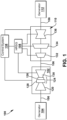
- FIG. 1 shows a schematic view of CCPP 100. It is emphasized that the teachings of the disclosure are applicable to any heat exchanger.
- CCPP 100 may include a gas turbine (GT) system 102 operably connected to a generator 104, and a steam turbine (ST) system 110 operably coupled to another generator 112.
- GT gas turbine
- ST steam turbine
- Generator 104 and GT system 102 may be mechanically coupled by a shaft 106, which may transfer energy between a drive shaft (not shown) of GT system 102 and generator 104.
- generators 104, 112 and shaft 106 may be of any size or type known in the art and may differ depending upon their application or the system to which they are connected. Common numbering of the generators and shafts is for clarity and does not necessarily suggest these generators or shafts are identical. In the illustrative application, CCPP 100 is a single shaft system with two generators, but one with skill in the art will readily understand that the teachings of the disclosure are applicable to any variety of combined cycle power generating systems.
- heat exchanger 108 is operably connected to GT system 102 and ST system 110.
- heat exchanger 108 may include a heat recovery steam generator (HRSG) (as labeled in drawings) including a sensor grid positioned in accordance with embodiments of the disclosure.
- Heat exchanger 108 may be fluidly connected to both GT system 102 and ST system 110 via conventional conduits (numbering omitted).
- GT system 102 may include a compressor 120 and a combustor 124.
- Combustor 124 includes a combustion region 126 and a fuel nozzle assembly 128.
- GT system 102 also includes a gas turbine 130 coupled to common compressor/turbine shaft 106.
- GT system 102 may be 7HA.03 engine, commercially available from General Electric Company, Greenville, S.C.
- the present disclosure is not limited to any one particular GT system and may be implanted in connection with other engines including, for example, the other HA, F, B, LM, GT, TM and E-class engine models of General Electric Company, and engine models of other companies.
- gas turbine 130 the energy of the hot gases is converted into work, some of which is used to drive compressor 120 through rotating shaft 106, with the remainder available for useful work to drive a load such as generator 104 via shaft 106 for producing electricity.
- FIG. 1 also represents CCPP 100 in its simplest form in which the energy in the exhaust gases exiting gas turbine 130 are converted into additional useful work.
- the exhaust gases enter heat exchanger 108, in the form of an HRSG, in which water is converted to steam in the manner of a boiler. Heat exchanger 108 may also use the energy to create hot feedwater.
- ST system 110 may include one or more steam turbines.
- ST system 110 may include a high pressure (HP) turbine 132, an intermediate pressure (IP) turbine 134 and a low pressure (LP) turbine 136, each of which are coupled to shaft 106.
- HP high pressure
- IP intermediate pressure
- LP low pressure
- Each steam turbine 132, 134, 136 includes a plurality of rotating blades (not shown) mechanically coupled to shaft 106.
- steam from heat exchanger 108 enters an inlet of HP turbine 132, IP turbine 134 and/or LP turbine 136 and is channeled to impart a force on blades thereof, causing shaft 106 to rotate.
- steam from an upstream turbine may be employed later in a downstream turbine.
- the steam produced by heat exchanger 108 drives at least a part of ST system 110 in which additional work is extracted to drive shaft 106 and an additional load such as second generator 112, which, in turn, produces additional electric power.
- additional load such as second generator 112
- turbines 130, 132, 134, 136 drive a common generator.
- FIG. 1 also shows a CCPP control system 138 operatively coupled to GT system 102, heat exchanger (i.e., HRSG) 108, and ST system 110.
- Control system 138 may include any now known or later developed computerized controller for providing automated control of CCPP 100. As will be described, control system 138 may receive data from a number of sensors of a sensor grid within heat exchanger 108 and may use the data to control heat exchanger 108 and/or other parts of CCPP 100.
- FIGS. 2 and 3 show partially transparent, perspective views of embodiments of heat exchanger 108.
- Heat exchanger 108 is illustrated as an HRSG configured to couple to GT system 102 ( FIG. 1 ) and to deliver steam to, e.g., ST system 110 ( FIG. 1 ) and/or heated water to other parts of CCPP 100 ( FIG. 1 ).
- heat exchanger 108 includes an insulated enclosure 140 (hereinafter "enclosure 140") configured to contain a fluid 142.
- Enclosure 140 may be housed in a heat exchanger enclosure 148.
- Enclosure 140 may include any now known or later developed insulated duct configured to contain fluid 142, e.g., with a carbon steel or stainless steel inner liner, insulation layer and outer carbon steel layer.
- Heat exchanger enclosure 148 may include any now known or later developed structural protection, e.g., a building or other physical protection.
- Fluid 142 may be any form of gas having a heat differential with a fluid 144 (shown by arrows only) passing through a plurality of heat exchange tubes 146 of heat exchanger 108. Heat is exchanged between fluid 142 and fluid 144.
- Fluid 142 may be combustion gas exhaust from GT system 102 ( FIG. 1 ), and fluid 144 may be a liquid (e.g., water) and/or gas (e.g., steam). Fluid 142 passes over and around the exterior surfaces of a plurality of heat exchange tubes 146 and exits enclosure 140 via an exhaust system 150, e.g., a stack and/or scrubber, etc., while fluid 144 passes through the interior of the plurality of heat exchange tubes 146.
- an exhaust system 150 e.g., a stack and/or scrubber, etc.
- FIGS. 2 and 3 differ in that, in FIG. 2 , tubes 146 extend in a vertical direction or arrangement and fluid 142 passes thereabout in a generally horizontal direction, while, in FIG. 3 , tubes 146 extend in a horizontal direction or arrangement and fluid 142 passes thereabout in a generally vertical direction.
- "generally" as applied to a flow direction of fluid 142 indicates that the fluid usually travels in the stated direction with some minor or temporary deviations as it passes over or about tubes 146 that may impede its path. While the teachings of the disclosure will be described relative to the FIG. 2 embodiment, it will be readily appreciated that the teachings are equally applicable to the FIG. 3 embodiment.
- Tubes 146 may have any now known or later developed form of heat exchange tubes and may be made of any material capable of providing the desired heat transfer characteristics, flexibility, and ability to withstand the environment in which exposed. Tubes 146 may vary in size depending on application, e.g., in some applications varying from 1.25 inches to 2.0 inches in outer diameter.
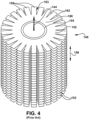
- FIG. 4 shows a perspective view of one illustrative prior art heat exchange tube in the form of a finned tube.
- tubes 146 may include a plurality of disks 152 disposed around a center tube 154 aligned in a longitudinal direction 156.
- Each disk 152 may be substantially planar and may be stacked such that it is disposed longitudinally above and/or below at least one adjacent disk 152.
- Center tube 154 may include any now known or later developed tubular member configured to allow fluid 144 to pass therethrough, e.g., by pumping or other force.
- Each disk 152 may include a plurality of fin segments 158 extending radially outward from a disk center portion 160, such that fin segments 158 extend outwardly from center tube 154.
- Disk center portion 160 extends circumferentially around the outer circumference of center tube 154.
- Each of fin segments 158 is separated from an adjacent fin segment 158 by a serration 163.
- Fin segments 158 of adjacent disks can be circumferentially and/or longitudinally aligned or circumferentially and/or longitudinally offset. Fin segments 158 may be arranged in a spiral configuration, an alternating pattern, and/or a random configuration relative to fin segments 158 longitudinally above and/or below them.
- Disk(s) 152 may be at least partially composed of carbon steel, alloy steel, stainless steel, aluminum, beryllium, copper, gold, magnesium, iridium, molybdenum, rhodium, silver, tungsten, and/or other suitable materials, as well as alloys thereof.
- Center tube 154 may be at least partially composed of carbon steel, alloy steel, stainless steel, ferritic stainless, austenitic stainless, and/or other materials that are sufficiently thermally conductive, stress tolerant, and temperature resistant. While one example of a heat exchange tube 146 has been described, it is understood that heat exchanger tubes can take a variety of alternative forms.
- FIG. 5 shows an enlarged perspective view of an upper portion 170 of heat exchanger 108, sometimes referred to as the vestibule.
- upper portion 170 includes a number of manifolds or headers that provide distribution of fluid 144 to heat exchange tubes 146.
- a number of manifolds 172 may direct fluid 144 to or from various upper headers 174.
- Heat exchanger 108 includes a plurality of sets 176 of heat exchange tubes 146 positioned adjacent each other. Each set 176 of heat exchange tubes 146 is fluidly coupled to an (upper) header 174 at one end thereof. That is, each upper header 174 is in fluid communication with a set 176 of heat exchange tubes 146 to direct fluid 144 to the set of heat exchange tubes 146 from a manifold 172.
- sets 176 of heat exchange tubes 146 are also in fluid communication with respective lower headers 178, which allows a change in direction of fluid through different tubes 146 within a given set 176 of tubes 146.
- a set 176 of heat exchange tubes 146 may extend vertically as in FIG. 2 , and accordingly together with coupled headers 174, 178 may be referenced as a 'harp' due to the resemblance to a musical harp.
- tubes 146 may have U-shaped ends rather than lower headers 178, see e.g., FIGS. 3 and 7 (right side).
- sets 176 of heat exchange tubes 146 share a common manifold (source) 172 of fluid 144 and are arranged in rows with each row having its own respective upper header 174. It is emphasized that the sets 176 of heat exchange tubes 146 do not necessarily have to be in rows, e.g., they can be staggered, randomly arranged, temporarily misaligned, etc. Each set 176 may include any number of heat exchange tubes 146, e.g., 38-50 tubes across and arranged in a single row. Each header 174 may be, for example, 2-6 meters long.
- Sets 176 of heat exchange tubes 146 include a first outermost set 176A of heat exchange tubes 146, a second outermost set 176B of heat exchange tubes 146 opposite the first outermost set 176A of heat exchange tubes 146, and at least one inner set 176C of heat exchange tubes 146 between first outermost set 176A of heat exchange tubes and second outermost set 176B of heat exchange tubes. Any number of sets 176 of heat exchange tubes 146 may be used. For example, anywhere between 10-30 sets 176 of heat exchange tubes 146 may be provided in line with fluid 142. In the non-limiting example shown in FIG. 5 , fourteen (14) sets 176 of heat exchange tubes are illustrated with twelve (12) inner sets 176C.
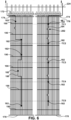
- FIG. 6 shows a side view of two sets 176 of heat exchange tubes 146 (side-by-side)
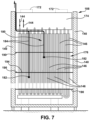
- FIG. 7 shows an enlarged, partial side view of a set 176 of heat exchange tubes 146
- FIG. 8 shows an enlarged, partial perspective view of a tube restraint 190, according to embodiments of the disclosure.
- the sets illustrated can be of any set in FIG. 5 , outermost or inner.
- heat exchanger 108 includes a sensor grid 180 positioned amongst the plurality of set of heat exchange tubes 146.
- Sensor grid 180 includes a plurality of sensors 182.
- Sensor grid 180 is used in a general manner herein to indicate a distributed layout or arrangement of sensors 182 desired and is not necessarily used to describe sensors 182 arranged in any particular spaced framework.
- Each sensor 182 may be any now known or later developed sensor such as but not limited to: thermocouples, resistance temperature detectors (RTD) or other type of temperature sensors; pressure or flow velocity sensors such as pitot tubes; strain gages; gas sampling tubing; etc. Sensors 182 within sensor grid 180 are not necessarily all of the same type. Sensors 182 can measure, for example, fluid temperature, tube or fin metal temperature, gas static pressure, gas velocity, tube or header strain, exhaust gas composition (such as oxygen, NOx, CO, CO2, hydrocarbons), particulates, ammonia slip, etc. Consequently, sensors 182 permit collection of data to determine, for example, heat exchanger 108 section thermal or pressure drop performance, gas temperature or exhaust gas composition distribution for evaluation of burners and emission control equipment, gas velocity distribution, tube or header thermal strain, etc.
- RTD resistance temperature detectors
- pressure or flow velocity sensors such as pitot tubes
- strain gages such as pitot tubes
- gas sampling tubing etc.
- Sensors 182 within sensor grid 180 are not necessarily all of
- Each sensor 182 may include a sensor lead 184 extending therefrom. Sensors 182 may also share a sensor lead 184. Sensor leads 184 may include any form of linear structure capable of communicating with one or more respective sensors 182 and control system 138 ( FIG. 1 ), e.g., an electrical wire with any form of shielding, a pneumatic tube for pitot tube type sensors, etc. Sensors 182 and sensor leads 184 are constructed of appropriate materials to withstand the operational environment of heat exchanger 108.
- sensor grid 180 and its respective sensors 182 can be coupled to one or more sets 176 of heat exchange tubes 146 during manufacture. That is, sensor grid 180 is installed during coupling of heat exchange tubes 146 with a header 174 to form a 'harp' and prior to final installation side-by-side with a plurality of other sets 176 of heat exchange tubes 146 in the field at a power plant. Accordingly, and in contrast to conventional heat exchanger sensor systems, sensor grid 180 of heat exchanger 108, once assembled in the field, may include at least one sensor 182 coupled to at least one heat exchange tube 146 in at least one inner set 176C ( FIG. 5 ) of heat exchange tubes 146.
- thermocouples can be spaced vertically at levels TC1-TC5 of any set 176 of heat exchange tubes 146.
- Sensor leads 184 can be run to any location within heat exchanger 108.
- Heat exchanger 108 also includes a tube restraint 190 for positioning at least one of the plurality of sets 176 of heat exchange tubes 146 relative to enclosure 140. Any number of tube restraints 190 may be used within heat exchanger 108 along any given set 176 of heat exchange tubes 146. For example, the partial views of FIGS. 5 and 7 show two tube restraints 190, and FIG. 6 shows eight (8). Tube restraints 190 can be spaced, e.g., vertically as shown, in any manner necessary to support the position of heat exchange tubes 146.
- FIG. 8 shows a partial perspective view of a tube restraint 190, according to embodiments of the disclosure.
- Each tube restraint 190 includes a body 192, and a plurality of tube openings 194 defined in the body.
- Each tube opening 194 is configured to receive one heat exchange tube 146 of the set 176 of heat exchange tubes 146 therethrough (only some of a set shown in FIG. 8 ).
- tube opening 194 is in the form of a hole 196 in body 192.
- tube opening 194 may be an open seat, forming a scalloped bar.
- tube restraint 190 positions heat exchange tubes 146, and either restrains them from moving in an undesirable manner or allows controlled movement, e.g., through thermal expansion or controlled actuators (not shown).
- tube restraint 190 may also include a sensor lead opening 200 defined in body 192.
- Sensor lead opening 200 is configured to receive sensor lead(s) 184 therethrough.
- Each tube opening 194 has a larger dimension than sensor lead opening 200, e.g., a larger diameter where they are circular.
- Conventional tube restraints do not require and do not provide sensor lead opening 200 because they are not necessary since sensor leads 184 are coupled to an exterior of the tubes and tube restraints on only the outermost sets of heat exchange tubes.
- sensors 182 of a sensor grid 180 can be positioned anywhere desired on a set 176 of heat exchange tubes 146, and the respective sensor leads 184 can be easily positioned through sensor lead openings 200.
- Sensor lead openings 200 allow collective routing of sensor leads 184, and protection of the wires during, for example, transport and assembly of heat exchanger 108 in the field.
- Each sensor lead opening 200 can be sized to accommodate any number of sensor leads 184 to be positioned therethrough. For example, tube restraints 190 closer to a location through which sensor leads 184 will exit enclosure 140 may have larger sensor lead openings 200 to accommodate the sensor leads of any number of downstream sensors 182.
- Sensors 182 and sensor leads 184 may be coupled to sets 176 of heat exchange tubes 146 in any now known or later developed manner such as, but not limited to, wire ties to tubes 146 and/or tube restraints 190. Sensors 182 can be operatively positioned, as necessary, to measure the desired operational parameter, e.g., temperature. Sensor leads 184, as shown in the enlarged section of FIG. 6 , may include expansion bends 202 therein to accommodate thermal expansion/contraction in heat exchanger 108.
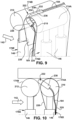
- FIG. 9 shows an enlarged perspective view of ends of a pair of adjacent headers 174A, 174B
- FIG. 10 shows an end view of the pair of adjacent headers 174A, 174B.
- ends of adjacent headers 174 do not extend to the same length (they have non-coplanar ends).
- Ends of headers 174 may alternate in length. More particularly, as shown best in FIG.
- an end 210 of header 174A of a first set 176D of heat exchange tubes 146 does not extend longitudinally to the same extent as an end 212 of adjacent header 174B of a second set 176E of heat exchange tubes 146.
- the shorter headers 174A include a baffle 220 extending from the end thereof, e.g., to prevent fluid 142 moving upwardly through the gap or to otherwise direct fluid 142 in a desired manner through heat exchanger 108.
- Baffles 220 may extend to the same longitudinal extent of adjacent header 174B.
- end 212 of header 174B of second set 176E of heat exchange tubes 146 adjacent header 174A of first set 176D of heat exchange tubes 146 may extend to the same length as baffle 220 from end 210 of header 174A of first set 176D of heat exchange tubes 146.
- Sensor leads 184 may need to extend upwardly between any two adjacent sets 176D, 176E (inner or outermost sets) of heat exchange tubes 146.
- heat exchanger 108 may also include a conduit 222 extending through baffle 220.
- Conduit 222 may include a plurality of sensor leads 184 of sensor grid 180 ( FIG. 5 ) extending therethrough. In this manner, sensor leads 184 can be routed through baffle 220.
- Conduit 222 may take a variety of forms, but in the example shown includes a first length 230 extending along end 210 of header 174A of first set 176D of heat exchange tubes 146 and a second length 232 extending along a length of header 174A of first set 176D of heat exchange tubes 146.
- first length 230 may be fixedly coupled to end 210 of header 174A, e.g., by a gusset or other connection.
- first length 230 may be at a substantially perpendicular angle to second length 232.
- Conduit 222 may have any cross-sectional shape and may be formed in parts that are later fastened together, e.g., by welding, to allow routing of sensor leads 184 therethrough, e.g., in cases where sensor leads 184 are not very flexible.
- conduit 222 may include a pair of longitudinally extending portions 234, 236 coupled together, e.g., half portions coupled along a weld joint 238.
- Conduit 222 may be made of any material capable of withstanding the environment of heat exchanger 108.
- Sensor leads 184 may be routed along headers 174A, 174B, and eventually out through enclosure 140. In FIG. 5 , sensor leads 184 are shown exiting through a roof 224 of enclosure 140; however, they may extend through any portion of enclosure 140. Sensor leads 184 may be coupled to control system 138 ( FIG. 1 ) in any now known or later developed fashion for operational control of any number of parts of CCPP 100.
- Embodiments of the disclosure also include a tube restraint 190 and a CCPP 100, as described herein. While a particular type of power plant and a particular type of CCPP 100 have been described herein, it is emphasized that the teachings of the disclosure are applicable to any type of heat exchanger.
- sensor grids 180 can be installed alongside any set 176 of heat exchange tubes 146.
- Sensor grid 180 thus can provide data about any portion of heat exchanger 108, even relative to inner sets 176C ( FIG. 5 ) of heat exchange tubes 146.
- Installation of sensor grids 180 during manufacture of the sets is easier and faster than field installation and removes the installation of sensor grids 180 on the critical path of a site construction schedule.
- Sensor grids 180 also support online performance monitoring, active control of CCPP 100 efficiency optimization, and heat exchanger 108 component lifetime monitoring and optimization.
Landscapes
- Engineering & Computer Science (AREA)
- Mechanical Engineering (AREA)
- General Engineering & Computer Science (AREA)
- Physics & Mathematics (AREA)
- Thermal Sciences (AREA)
- Chemical & Material Sciences (AREA)
- Combustion & Propulsion (AREA)
- Geometry (AREA)
- Heat-Exchange Devices With Radiators And Conduit Assemblies (AREA)
- Engine Equipment That Uses Special Cycles (AREA)
Description
- The disclosure relates generally to heat exchangers and, more particularly, to a heat exchanger including a sensor grid with sensor lead(s) extending through opening(s) in tube restraints for heat exchange tubes in the heat exchanger. The herein claimed invention relates to the subject matter set forth in the claims.
- Convective heat exchangers include multiple rows of heat exchange tubes in close proximity to one another. While applicable to any heat exchanger, to illustrate the challenges and benefits of embodiments of the disclosure, the disclosure will consider a heat exchanger in the form of a heat recovery steam generator (HRSG) in a combined cycle power plant (CCPP) including a gas turbine (GT) system and a steam turbine (ST) system. In this setting, efficiency of the HRSG varies due to a number of operating parameters. In the CCPP example, heat input may vary due to operating parameters such as but not limited to: GT system load, ambient temperature, GT system degradation, GT system modification/uprating, duct burner load, and deviations between expected and actual operation. Similarly, heat exchange efficiency within the HRSG may vary due to operating parameters of the HRSG, such as its cleanliness.
- Managing operations of the CCPP and the heat exchanger to achieve high efficiency performance requires use of sensors in the heat exchanger to measure a variety of operational parameters of the heat exchange process such as, but not limited to, temperature, pressure, flow velocity, etc. Current practice is to mount a sensor grid on the outermost rows of heat exchange tubes on the HRSG in the field, i.e., after the HRSG is assembled at a site where it will be used. Each sensor has sensor leads extending therefrom. The manual installing of the sensors and running of the sensor leads through (and out of) the HRSG typically requires scaffolding or other high-lift equipment to be employed next to the heat exchange tubes, which can be, for example, 10-25 meters in height. Sensors are mounted on only the outermost rows of heat exchangers because it is nearly impossible to reach within the rows of heat exchange tubes once they are assembled. Consequently, measurement of operational characteristics of the heat exchange process within the inner rows of heat exchange tubes is not available, which limits understanding of how best to control operations of the CCPP or the heat exchanger that impact the heat exchange process and overall efficiency of the system.
US 2019/063853 A1 , which discloses the features of the preamble of claim 1, relates to a heater assembly including a continuous series of perforated helical members and a plurality of heating elements. The perforated helical members cooperate to define a geometric helicoid disposed about a longitudinal axis of the heater assembly. Each perforated helical member defines opposed edges and a predetermined pattern of perforations. The perforations extend through each perforated helical member parallel to the longitudinal axis. The heating elements extend through the perforations.WO 2018/225292 A1 suggests a supporting force inspection device comprising an acceleration sensor for detecting the vibration state of the curved parts, a sensor holding part that is for holding the acceleration sensor and is disposed inside the heat transfer tubes, and a vibration generation unit for generating vibration force for causing the heat transfer tubes to vibrate along the plane of the osculating circles of the curved parts. The vibration generation unit works together with the sensor holding part to vibrate the heat transfer tubes along the plane of the osculating circles.US 2011/016788 A1 discloses a tube and shell heat exchanger for a gasification system is provided. The heat exchanger includes a first shell-side inlet positioned proximate to a heat exchanger tube-side inlet. The first shell-side inlet is configured to receive a first portion of a scrubbed syngas flow therethrough. This first scrubbed syngas portion facilitates substantially preventing fouling at the heat exchanger inlet. The heat exchanger also includes a second shell-side inlet positioned proximate to a heat exchanger tube-side outlet. The second shell-side inlet is configured to receive a second portion of a scrubbed syngas flow therethrough. - The herein claimed invention relates to the subject matter set forth in the claims.
- The illustrative aspects of the disclosure subject matter are designed to solve the problems herein described and/or other problems not discussed.
- These and other features of this disclosure will be more readily understood from the following detailed description of the various aspects of the disclosure taken in conjunction with the accompanying drawings that depict various embodiments of the disclosure, in which:
-
FIG. 1 shows a schematic view of an illustrative application in the form of a combined cycle power plant for a heat exchanger, according to embodiments of the disclosure; -
FIG. 2 shows a partially transparent perspective view of a heat exchanger with vertical heat exchange tubes, according to one embodiment of the disclosure; -
FIG. 3 shows a partially transparent perspective view of a heat exchanger with horizontal heat exchange tubes, according to one embodiment of the disclosure; -
FIG. 4 shows a perspective view of an example prior art heat exchange tube; -
FIG. 5 shows a perspective view of a plurality of sets of heat exchange tubes and a sensor grid for a heat exchanger, according to embodiments of the disclosure; -
FIG. 6 shows a side view of a pair of sets of heat exchange tubes and a sensor grid for a heat exchanger, according to embodiments of the disclosure; -
FIG. 7 shows an enlarged side view of a set of heat exchange tubes and a sensor grid for a heat exchanger, according to embodiments of the disclosure; -
FIG. 8 shows a perspective view of a tube restraint, according to embodiments of the disclosure; -
FIG. 9 shows a perspective view of a conduit through a baffle at ends of headers of the heat exchanger, according to embodiments of the disclosure; and -
FIG. 10 shows an end view of ends of headers with the conduit through the baffle, according to embodiments of the disclosure. - It is noted that the drawings of the disclosure are not necessarily to scale. The drawings are intended to depict only typical aspects of the disclosure, and therefore should not be considered as limiting the scope of the disclosure. In the drawings, like numbering represents like elements between the drawings.
- .
- Several descriptive terms may be used regularly herein, and it should prove helpful to define these terms at the onset of this section. These terms and their definitions, unless stated otherwise, are as follows. As used herein, "downstream" and "upstream" are terms that indicate a direction relative to the flow of a fluid, such as a working fluid through the turbine engine or, for example, the flow of hot gas through a heat exchanger. The term "downstream" corresponds to the direction of flow of the fluid, and the term "upstream" refers to the direction opposite to the flow (that is, the direction from which the flow originates). The terms "forward" and "aft," without any further specificity, refer to directions, with "forward" referring to the front or compressor end of the engine, and "aft" referring to the rearward or turbine end of the engine.
- It is often required to describe parts that are located at differing radial positions with regard to a center axis. The term "radial" refers to movement or position perpendicular to an axis. In cases such as this, if a first component resides closer to the axis than a second component, it will be stated herein that the first component is "radially inward" or "inboard" of the second component. If, on the other hand, the first component resides further from the axis than the second component, it may be stated herein that the first component is "radially outward" or "outboard" of the second component. The term "axial" refers to movement or position parallel to an axis. Finally, the term "circumferential" refers to movement or position around an axis. It will be appreciated that such terms may be applied in relation to the center axis of the turbine.
- In addition, several descriptive terms may be used regularly herein, as described below. The terms "first", "second", and "third" may be used interchangeably to distinguish one component from another and are not intended to signify location or importance of the individual components.
- The terminology used herein is for the purpose of describing particular embodiments only and is not intended to be limiting of the disclosure. As used herein, the singular forms "a", "an" and "the" are intended to include the plural forms as well, unless the context clearly indicates otherwise.
- Where an element or layer is referred to as being "on," "engaged to," "connected to" or "coupled to" another element or layer, it may be directly on, engaged to, connected to, or coupled to the other element or layer, or intervening elements or layers may be present. In contrast, when an element is referred to as being "directly on," "directly engaged to," "directly connected to" or "directly coupled to" another element or layer, there may be no intervening elements or layers present.
- The herein claimed invention is based upon a heat exchanger including a sensor grid with sensor leads extending through tube restraints for the heat exchange tubes in the heat exchanger. The heat exchanger includes a plurality of sets, e.g., rows, of heat exchange tubes positioned adjacent each other. The tube restraint includes a body having a plurality of tube openings defined therein with each tube opening receiving one of a set of heat exchange tubes therethrough. The body also includes a sensor lead opening defined therein to receive a sensor lead therethrough. Each tube opening has a larger dimension than the sensor lead opening.
- The sensor grid includes a plurality of sensors that are installed during manufacture rather than in the field. In this manner, the sensor leads for the sensor grid can be installed through the tube restraints rather than over them. Since each set of heat exchange tubes are accessible during manufacture, as opposed to their installed position in the field, a sensor grid can be mounted to not just outermost sets of heat exchange tubes but also to any of the inner sets of heat exchange tubes in the heat exchanger. With the sensor grid so arranged, more data about the operation of the heat exchanger can be gathered and used to provide more efficient operation of the heat exchanger or power plant in which it is used.
- Turning to
FIG. 1 , a heat exchanger according to embodiments of the disclosure will be described relative to an illustrative application in the form of a combined cycle power plant (CCPP) 100.FIG. 1 shows a schematic view ofCCPP 100. It is emphasized that the teachings of the disclosure are applicable to any heat exchanger.CCPP 100 may include a gas turbine (GT)system 102 operably connected to agenerator 104, and a steam turbine (ST)system 110 operably coupled to anothergenerator 112.Generator 104 andGT system 102 may be mechanically coupled by ashaft 106, which may transfer energy between a drive shaft (not shown) ofGT system 102 andgenerator 104. - It is understood that
generators shaft 106 may be of any size or type known in the art and may differ depending upon their application or the system to which they are connected. Common numbering of the generators and shafts is for clarity and does not necessarily suggest these generators or shafts are identical. In the illustrative application,CCPP 100 is a single shaft system with two generators, but one with skill in the art will readily understand that the teachings of the disclosure are applicable to any variety of combined cycle power generating systems. - Also shown in
FIG. 1 , aheat exchanger 108 is operably connected toGT system 102 andST system 110. As will be described in greater detail herein,heat exchanger 108 may include a heat recovery steam generator (HRSG) (as labeled in drawings) including a sensor grid positioned in accordance with embodiments of the disclosure.Heat exchanger 108 may be fluidly connected to bothGT system 102 andST system 110 via conventional conduits (numbering omitted). -
GT system 102 may include acompressor 120 and acombustor 124.Combustor 124 includes acombustion region 126 and afuel nozzle assembly 128.GT system 102 also includes agas turbine 130 coupled to common compressor/turbine shaft 106. In one non-limiting example,GT system 102 may be 7HA.03 engine, commercially available from General Electric Company, Greenville, S.C. The present disclosure is not limited to any one particular GT system and may be implanted in connection with other engines including, for example, the other HA, F, B, LM, GT, TM and E-class engine models of General Electric Company, and engine models of other companies. - In operation, air enters the inlet of
compressor 120, is compressed and then discharged to combustor 124 where gaseous or liquid fuel, such as natural gas or oil, is burned to provide high energy combustion gases which drivegas turbine 130. Ingas turbine 130, the energy of the hot gases is converted into work, some of which is used to drivecompressor 120 throughrotating shaft 106, with the remainder available for useful work to drive a load such asgenerator 104 viashaft 106 for producing electricity. -
FIG. 1 also representsCCPP 100 in its simplest form in which the energy in the exhaust gases exitinggas turbine 130 are converted into additional useful work. The exhaust gases enterheat exchanger 108, in the form of an HRSG, in which water is converted to steam in the manner of a boiler.Heat exchanger 108 may also use the energy to create hot feedwater. -
ST system 110 may include one or more steam turbines. For example,ST system 110 may include a high pressure (HP)turbine 132, an intermediate pressure (IP)turbine 134 and a low pressure (LP)turbine 136, each of which are coupled toshaft 106. Eachsteam turbine shaft 106. In operation, steam fromheat exchanger 108, and perhaps other sources, enters an inlet ofHP turbine 132,IP turbine 134 and/orLP turbine 136 and is channeled to impart a force on blades thereof, causingshaft 106 to rotate. As understood, steam from an upstream turbine may be employed later in a downstream turbine. Thus, the steam produced byheat exchanger 108 drives at least a part ofST system 110 in which additional work is extracted to driveshaft 106 and an additional load such assecond generator 112, which, in turn, produces additional electric power. In some configurations,turbines -
FIG. 1 also shows aCCPP control system 138 operatively coupled toGT system 102, heat exchanger (i.e., HRSG) 108, andST system 110.Control system 138 may include any now known or later developed computerized controller for providing automated control ofCCPP 100. As will be described,control system 138 may receive data from a number of sensors of a sensor grid withinheat exchanger 108 and may use the data to controlheat exchanger 108 and/or other parts ofCCPP 100. -
FIGS. 2 and3 show partially transparent, perspective views of embodiments ofheat exchanger 108.Heat exchanger 108 is illustrated as an HRSG configured to couple to GT system 102 (FIG. 1 ) and to deliver steam to, e.g., ST system 110 (FIG. 1 ) and/or heated water to other parts of CCPP 100 (FIG. 1 ). As illustrated,heat exchanger 108 includes an insulated enclosure 140 (hereinafter "enclosure 140") configured to contain afluid 142.Enclosure 140 may be housed in aheat exchanger enclosure 148.Enclosure 140 may include any now known or later developed insulated duct configured to contain fluid 142, e.g., with a carbon steel or stainless steel inner liner, insulation layer and outer carbon steel layer.Heat exchanger enclosure 148 may include any now known or later developed structural protection, e.g., a building or other physical protection. -
Fluid 142 may be any form of gas having a heat differential with a fluid 144 (shown by arrows only) passing through a plurality ofheat exchange tubes 146 ofheat exchanger 108. Heat is exchanged betweenfluid 142 andfluid 144.Fluid 142 may be combustion gas exhaust from GT system 102 (FIG. 1 ), andfluid 144 may be a liquid (e.g., water) and/or gas (e.g., steam). Fluid 142 passes over and around the exterior surfaces of a plurality ofheat exchange tubes 146 and exitsenclosure 140 via anexhaust system 150, e.g., a stack and/or scrubber, etc., while fluid 144 passes through the interior of the plurality ofheat exchange tubes 146. -
FIGS. 2 and3 differ in that, inFIG. 2 ,tubes 146 extend in a vertical direction or arrangement and fluid 142 passes thereabout in a generally horizontal direction, while, inFIG. 3 ,tubes 146 extend in a horizontal direction or arrangement and fluid 142 passes thereabout in a generally vertical direction. As used herein, "generally" as applied to a flow direction offluid 142 indicates that the fluid usually travels in the stated direction with some minor or temporary deviations as it passes over or abouttubes 146 that may impede its path. While the teachings of the disclosure will be described relative to theFIG. 2 embodiment, it will be readily appreciated that the teachings are equally applicable to theFIG. 3 embodiment. -
Tubes 146 may have any now known or later developed form of heat exchange tubes and may be made of any material capable of providing the desired heat transfer characteristics, flexibility, and ability to withstand the environment in which exposed.Tubes 146 may vary in size depending on application, e.g., in some applications varying from 1.25 inches to 2.0 inches in outer diameter. -
FIG. 4 shows a perspective view of one illustrative prior art heat exchange tube in the form of a finned tube. As illustrated, in one non-limiting example,tubes 146 may include a plurality ofdisks 152 disposed around acenter tube 154 aligned in alongitudinal direction 156. Eachdisk 152 may be substantially planar and may be stacked such that it is disposed longitudinally above and/or below at least oneadjacent disk 152.Center tube 154 may include any now known or later developed tubular member configured to allow fluid 144 to pass therethrough, e.g., by pumping or other force. Eachdisk 152 may include a plurality offin segments 158 extending radially outward from adisk center portion 160, such thatfin segments 158 extend outwardly fromcenter tube 154.Disk center portion 160 extends circumferentially around the outer circumference ofcenter tube 154. Each offin segments 158 is separated from anadjacent fin segment 158 by aserration 163.Fin segments 158 of adjacent disks can be circumferentially and/or longitudinally aligned or circumferentially and/or longitudinally offset.Fin segments 158 may be arranged in a spiral configuration, an alternating pattern, and/or a random configuration relative tofin segments 158 longitudinally above and/or below them. - Disk(s) 152 may be at least partially composed of carbon steel, alloy steel, stainless steel, aluminum, beryllium, copper, gold, magnesium, iridium, molybdenum, rhodium, silver, tungsten, and/or other suitable materials, as well as alloys thereof.
Center tube 154 may be at least partially composed of carbon steel, alloy steel, stainless steel, ferritic stainless, austenitic stainless, and/or other materials that are sufficiently thermally conductive, stress tolerant, and temperature resistant. While one example of aheat exchange tube 146 has been described, it is understood that heat exchanger tubes can take a variety of alternative forms. -
FIG. 5 shows an enlarged perspective view of anupper portion 170 ofheat exchanger 108, sometimes referred to as the vestibule. As illustrated,upper portion 170 includes a number of manifolds or headers that provide distribution offluid 144 to heatexchange tubes 146. For example, a number ofmanifolds 172 may direct fluid 144 to or from variousupper headers 174.Heat exchanger 108 includes a plurality ofsets 176 ofheat exchange tubes 146 positioned adjacent each other. Each set 176 ofheat exchange tubes 146 is fluidly coupled to an (upper)header 174 at one end thereof. That is, eachupper header 174 is in fluid communication with aset 176 ofheat exchange tubes 146 to direct fluid 144 to the set ofheat exchange tubes 146 from amanifold 172. - In
FIG. 5 , sets 176 ofheat exchange tubes 146 are also in fluid communication with respectivelower headers 178, which allows a change in direction of fluid throughdifferent tubes 146 within a givenset 176 oftubes 146. In the example shown, aset 176 ofheat exchange tubes 146 may extend vertically as inFIG. 2 , and accordingly together with coupledheaders tubes 146 may have U-shaped ends rather thanlower headers 178, see e.g.,FIGS. 3 and7 (right side). - In the illustrative embodiment, sets 176 of
heat exchange tubes 146 share a common manifold (source) 172 offluid 144 and are arranged in rows with each row having its own respectiveupper header 174. It is emphasized that thesets 176 ofheat exchange tubes 146 do not necessarily have to be in rows, e.g., they can be staggered, randomly arranged, temporarily misaligned, etc. Eachset 176 may include any number ofheat exchange tubes 146, e.g., 38-50 tubes across and arranged in a single row. Eachheader 174 may be, for example, 2-6 meters long. -
Sets 176 ofheat exchange tubes 146 include a first outermost set 176A ofheat exchange tubes 146, a second outermost set 176B ofheat exchange tubes 146 opposite the first outermost set 176A ofheat exchange tubes 146, and at least one inner set 176C ofheat exchange tubes 146 between first outermost set 176A of heat exchange tubes and second outermost set 176B of heat exchange tubes. Any number ofsets 176 ofheat exchange tubes 146 may be used. For example, anywhere between 10-30sets 176 ofheat exchange tubes 146 may be provided in line withfluid 142. In the non-limiting example shown inFIG. 5 , fourteen (14) sets 176 of heat exchange tubes are illustrated with twelve (12) inner sets 176C. -
FIG. 6 shows a side view of twosets 176 of heat exchange tubes 146 (side-by-side),FIG. 7 shows an enlarged, partial side view of aset 176 ofheat exchange tubes 146, andFIG. 8 shows an enlarged, partial perspective view of atube restraint 190, according to embodiments of the disclosure. The sets illustrated can be of any set inFIG. 5 , outermost or inner. As shown inFIGS. 6 and7 ,heat exchanger 108 includes asensor grid 180 positioned amongst the plurality of set ofheat exchange tubes 146.Sensor grid 180 includes a plurality ofsensors 182. "Sensor grid" 180 is used in a general manner herein to indicate a distributed layout or arrangement ofsensors 182 desired and is not necessarily used to describesensors 182 arranged in any particular spaced framework. - Each
sensor 182 may be any now known or later developed sensor such as but not limited to: thermocouples, resistance temperature detectors (RTD) or other type of temperature sensors; pressure or flow velocity sensors such as pitot tubes; strain gages; gas sampling tubing; etc.Sensors 182 withinsensor grid 180 are not necessarily all of the same type.Sensors 182 can measure, for example, fluid temperature, tube or fin metal temperature, gas static pressure, gas velocity, tube or header strain, exhaust gas composition (such as oxygen, NOx, CO, CO2, hydrocarbons), particulates, ammonia slip, etc. Consequently,sensors 182 permit collection of data to determine, for example,heat exchanger 108 section thermal or pressure drop performance, gas temperature or exhaust gas composition distribution for evaluation of burners and emission control equipment, gas velocity distribution, tube or header thermal strain, etc. - Each
sensor 182 may include asensor lead 184 extending therefrom.Sensors 182 may also share asensor lead 184. Sensor leads 184 may include any form of linear structure capable of communicating with one or morerespective sensors 182 and control system 138 (FIG. 1 ), e.g., an electrical wire with any form of shielding, a pneumatic tube for pitot tube type sensors, etc.Sensors 182 and sensor leads 184 are constructed of appropriate materials to withstand the operational environment ofheat exchanger 108. - In accordance with embodiments of the disclosure,
sensor grid 180 and itsrespective sensors 182 can be coupled to one ormore sets 176 ofheat exchange tubes 146 during manufacture. That is,sensor grid 180 is installed during coupling ofheat exchange tubes 146 with aheader 174 to form a 'harp' and prior to final installation side-by-side with a plurality ofother sets 176 ofheat exchange tubes 146 in the field at a power plant. Accordingly, and in contrast to conventional heat exchanger sensor systems,sensor grid 180 ofheat exchanger 108, once assembled in the field, may include at least onesensor 182 coupled to at least oneheat exchange tube 146 in at least one inner set 176C (FIG. 5 ) ofheat exchange tubes 146. In this manner, operational data can be measured at any location withinheat exchanger 108 and from anyheat exchange tube 146. Any number ofsensors 182 can be used, andsensors 182 can be arranged in any fashion. For example, inFIG. 6 , five thermocouples can be spaced vertically at levels TC1-TC5 of anyset 176 ofheat exchange tubes 146. Sensor leads 184 can be run to any location withinheat exchanger 108. -
Heat exchanger 108 also includes atube restraint 190 for positioning at least one of the plurality ofsets 176 ofheat exchange tubes 146 relative toenclosure 140. Any number oftube restraints 190 may be used withinheat exchanger 108 along any given set 176 ofheat exchange tubes 146. For example, the partial views ofFIGS. 5 and7 show twotube restraints 190, andFIG. 6 shows eight (8).Tube restraints 190 can be spaced, e.g., vertically as shown, in any manner necessary to support the position ofheat exchange tubes 146. -
FIG. 8 shows a partial perspective view of atube restraint 190, according to embodiments of the disclosure. Eachtube restraint 190 includes abody 192, and a plurality oftube openings 194 defined in the body. Eachtube opening 194 is configured to receive oneheat exchange tube 146 of theset 176 ofheat exchange tubes 146 therethrough (only some of a set shown inFIG. 8 ). In the example shown,tube opening 194 is in the form of a hole 196 inbody 192. In other embodiments,tube opening 194 may be an open seat, forming a scalloped bar. In any event,tube restraint 190 positions heatexchange tubes 146, and either restrains them from moving in an undesirable manner or allows controlled movement, e.g., through thermal expansion or controlled actuators (not shown). - In contrast to conventional tube restraints,
tube restraint 190 may also include a sensor lead opening 200 defined inbody 192.Sensor lead opening 200 is configured to receive sensor lead(s) 184 therethrough. Eachtube opening 194 has a larger dimension thansensor lead opening 200, e.g., a larger diameter where they are circular. Conventional tube restraints do not require and do not providesensor lead opening 200 because they are not necessary since sensor leads 184 are coupled to an exterior of the tubes and tube restraints on only the outermost sets of heat exchange tubes. - Since
sets 176 ofheat exchange tubes 146 are manufactured withsensor grid 180 coupled thereto,sensors 182 of asensor grid 180 can be positioned anywhere desired on aset 176 ofheat exchange tubes 146, and the respective sensor leads 184 can be easily positioned throughsensor lead openings 200.Sensor lead openings 200 allow collective routing of sensor leads 184, and protection of the wires during, for example, transport and assembly ofheat exchanger 108 in the field. Eachsensor lead opening 200 can be sized to accommodate any number of sensor leads 184 to be positioned therethrough. For example,tube restraints 190 closer to a location through which sensor leads 184 will exitenclosure 140 may have largersensor lead openings 200 to accommodate the sensor leads of any number ofdownstream sensors 182. -
Sensors 182 and sensor leads 184 may be coupled tosets 176 ofheat exchange tubes 146 in any now known or later developed manner such as, but not limited to, wire ties totubes 146 and/ortube restraints 190.Sensors 182 can be operatively positioned, as necessary, to measure the desired operational parameter, e.g., temperature. Sensor leads 184, as shown in the enlarged section ofFIG. 6 , may include expansion bends 202 therein to accommodate thermal expansion/contraction inheat exchanger 108. -
FIG. 9 shows an enlarged perspective view of ends of a pair ofadjacent headers FIG. 10 shows an end view of the pair ofadjacent headers FIG. 5 and the enlarged perspective view ofFIG. 9 , ends of adjacent headers 174 (174A, 174B inFIG. 9 ) do not extend to the same length (they have non-coplanar ends). Ends ofheaders 174, as shown inFIG. 5 , may alternate in length. More particularly, as shown best inFIG. 9 , anend 210 ofheader 174A of afirst set 176D ofheat exchange tubes 146 does not extend longitudinally to the same extent as anend 212 ofadjacent header 174B of asecond set 176E ofheat exchange tubes 146. As shown inFIGS. 9 and 10 (notFIG. 5 for clarity), theshorter headers 174A include abaffle 220 extending from the end thereof, e.g., to prevent fluid 142 moving upwardly through the gap or to otherwise direct fluid 142 in a desired manner throughheat exchanger 108.Baffles 220 may extend to the same longitudinal extent ofadjacent header 174B. That is, end 212 ofheader 174B ofsecond set 176E ofheat exchange tubes 146adjacent header 174A offirst set 176D ofheat exchange tubes 146 may extend to the same length asbaffle 220 fromend 210 ofheader 174A offirst set 176D ofheat exchange tubes 146. - Sensor leads 184 may need to extend upwardly between any two
adjacent sets heat exchange tubes 146. In order to direct sensor leads 184 throughbaffle 220,heat exchanger 108 may also include aconduit 222 extending throughbaffle 220.Conduit 222 may include a plurality of sensor leads 184 of sensor grid 180 (FIG. 5 ) extending therethrough. In this manner, sensor leads 184 can be routed throughbaffle 220.Conduit 222 may take a variety of forms, but in the example shown includes afirst length 230 extending alongend 210 ofheader 174A offirst set 176D ofheat exchange tubes 146 and asecond length 232 extending along a length ofheader 174A offirst set 176D ofheat exchange tubes 146. Where desired,first length 230 may be fixedly coupled to end 210 ofheader 174A, e.g., by a gusset or other connection. Although not necessary in all instances,first length 230 may be at a substantially perpendicular angle tosecond length 232.Conduit 222 may have any cross-sectional shape and may be formed in parts that are later fastened together, e.g., by welding, to allow routing of sensor leads 184 therethrough, e.g., in cases where sensor leads 184 are not very flexible. For example,conduit 222 may include a pair of longitudinally extendingportions Conduit 222 may be made of any material capable of withstanding the environment ofheat exchanger 108. - Sensor leads 184 may be routed along
headers enclosure 140. InFIG. 5 , sensor leads 184 are shown exiting through aroof 224 ofenclosure 140; however, they may extend through any portion ofenclosure 140. Sensor leads 184 may be coupled to control system 138 (FIG. 1 ) in any now known or later developed fashion for operational control of any number of parts ofCCPP 100. - Embodiments of the disclosure also include a
tube restraint 190 and aCCPP 100, as described herein. While a particular type of power plant and a particular type ofCCPP 100 have been described herein, it is emphasized that the teachings of the disclosure are applicable to any type of heat exchanger. - As described herein, embodiments of the disclosure allow
sensor grids 180 to be installed alongside anyset 176 ofheat exchange tubes 146.Sensor grid 180 thus can provide data about any portion ofheat exchanger 108, even relative to inner sets 176C (FIG. 5 ) ofheat exchange tubes 146. Installation ofsensor grids 180 during manufacture of the sets is easier and faster than field installation and removes the installation ofsensor grids 180 on the critical path of a site construction schedule.Sensor grids 180 also support online performance monitoring, active control ofCCPP 100 efficiency optimization, andheat exchanger 108 component lifetime monitoring and optimization.
Claims (8)
- A heat exchanger (108), comprising:a plurality of sets (176) of heat exchange tubes (146) positioned adjacent each other, each set (176) of heat exchange tubes (146) fluidly coupled to a header (174) at an end (210, 212) thereof;a sensor grid (180) positioned amongst the plurality of sets (176) of heat exchange tubes (146), the sensor grid (180) including a plurality of sensors (182), each sensor (182) including a sensor lead (184) extending therefrom; anda tube restraint (190) for positioning at least one of the plurality of sets (176) of heat exchange tubes (146) relative to an enclosure (148), the tube restraint (190) including a tube opening (194) for each of the heat exchange tubes (146) of a respective set (176) of heat exchange tubes (146) and a sensor lead opening (200),wherein at least one sensor lead (184) of the sensor grid (180) extends through the sensor lead opening (200),characterized in that an end (210) of the header (174) of a first set (176) of heat exchange tubes (146) includes a baffle (220) extending therefrom, and further comprising a conduit (222) extending through the baffle (220), the conduit (222) including a plurality of sensor leads (184) of the sensor grid (180) extending therein.
- The heat exchanger (108) of claim 1, wherein the plurality of sets (176) of heat exchange tubes (146) includes a first outermost set (176) of heat exchange tubes (146), a second outermost set (176) of heat exchange tubes (146), and at least one inner set (176) of heat exchange tubes (146) between the first outermost set (176) of heat exchange tubes (146) and the second outermost set (176) of heat exchange tubes (146), and wherein the sensor grid (180) includes at least one sensor (182) coupled to at least one heat exchange tube (146) in the at least one inner set (176) of heat exchange tubes (146).
- The heat exchanger (108) of claim 1, wherein an end (210) of the header (174) of a second set (176) of heat exchange tubes (146) adjacent the header (174) of the first set (176) of heat exchange tubes (146) extends to the same length as the baffle (220) from the end (210, 212) of the header (174) of the first set (176) of heat exchange tubes (146).
- The heat exchanger (108) of claim 1, wherein the conduit (222) includes a first length (230) extending along the end (210) of the header (174) of the first set (176) of heat exchange tubes (146) and a second length (232) extending along a length of the header (174) of the first set (176) of heat exchange tubes (146).
- The heat exchanger (108) of claim 4, wherein the first length (230) is fixedly coupled to the end (210) of the header (174).
- The heat exchanger (108) of claim 4, wherein the first length (230) is at a substantially perpendicular angle to the second length (232).
- The heat exchanger (108) of claim 1, wherein the conduit (222) includes a pair of longitudinally extending portions (234, 236) coupled together.
- A combined cycle power plant CCPP (100), comprising:a gas turbine (130) system;a steam turbine system (110); anda heat recovery steam generator (108) coupled to the gas turbine system (102) to create steam for the steam turbine system (102) using an exhaust of the gas turbine (130) system (102), wherein the HRSG (108) includes:an enclosure (148) configured to direct the exhaust therethrough;and a heat exchanger (108) according to any preceding claim..
Applications Claiming Priority (1)
| Application Number | Priority Date | Filing Date | Title |
|---|---|---|---|
| US16/942,986 US11655737B2 (en) | 2020-07-30 | 2020-07-30 | Heat exchanger with inner sensor grid and restraints for sensor wires and heat exchange tubes |
Publications (2)
| Publication Number | Publication Date |
|---|---|
| EP3954880A1 EP3954880A1 (en) | 2022-02-16 |
| EP3954880B1 true EP3954880B1 (en) | 2024-08-28 |
Family
ID=76958727
Family Applications (1)
| Application Number | Title | Priority Date | Filing Date |
|---|---|---|---|
| EP21185958.2A Active EP3954880B1 (en) | 2020-07-30 | 2021-07-15 | Heat exchanger with inner sensor grid and restraints for sensor wires and heat exchange tubes |
Country Status (5)
| Country | Link |
|---|---|
| US (1) | US11655737B2 (en) |
| EP (1) | EP3954880B1 (en) |
| JP (1) | JP7757068B2 (en) |
| KR (1) | KR20220015333A (en) |
| CN (1) | CN114061337B (en) |
Families Citing this family (3)
| Publication number | Priority date | Publication date | Assignee | Title |
|---|---|---|---|---|
| DE102023114470A1 (en) | 2023-03-24 | 2024-09-26 | MTU Aero Engines AG | aircraft engine |
| EP4442977A1 (en) * | 2023-03-24 | 2024-10-09 | MTU Aero Engines AG | Turbomachine for a flight drive |
| CN118463210B (en) * | 2024-05-30 | 2025-03-11 | 华能武汉发电有限责任公司 | Thermal power generation flue cooler |
Family Cites Families (16)
| Publication number | Priority date | Publication date | Assignee | Title |
|---|---|---|---|---|
| NL274149A (en) * | 1961-01-31 | |||
| SE530902C2 (en) | 2006-12-19 | 2008-10-14 | Alfa Laval Corp Ab | Sectioned flow device and method for controlling the temperature thereof |
| US20110016788A1 (en) * | 2009-07-23 | 2011-01-27 | Thacker Pradeep S | Methods and system for heat recovery in a gasification system |
| US8965728B2 (en) | 2011-05-10 | 2015-02-24 | General Electric Company | Exhaust strut radial temperature measurement |
| US9509923B2 (en) | 2012-01-10 | 2016-11-29 | General Electric Company | Continuous infrared thermography monitoring and life management system for heat recovery steam generators |
| JP6137772B2 (en) * | 2012-02-22 | 2017-05-31 | 三菱日立パワーシステムズ株式会社 | Waste heat recovery boiler and combined power generation facility |
| US10012452B2 (en) * | 2012-10-17 | 2018-07-03 | Tetra Laval Holdings & Finance S.A. | Device for closing inner tubes in a tubular heat exchanger |
| US9255746B2 (en) * | 2012-10-26 | 2016-02-09 | Modine Manufacturing Company | Reactor core for use in a chemical reactor, and method of making the same |
| US20150027663A1 (en) * | 2013-07-26 | 2015-01-29 | Areva Inc. | Instrumented Steam Generator Anti-Vibration Bar |
| JP6251941B2 (en) * | 2014-08-19 | 2017-12-27 | 三菱日立パワーシステムズ株式会社 | boiler |
| US9303924B1 (en) * | 2014-10-14 | 2016-04-05 | Neptune-Benson, Llc | Multi-segmented tube sheet |
| EP3387672A4 (en) * | 2015-12-10 | 2018-12-05 | Laird Technologies, Inc. | Heat exchangers |
| JP6810660B2 (en) * | 2017-06-07 | 2021-01-06 | 三菱重工業株式会社 | Bearing capacity inspection device and bearing capacity inspection method |
| JP7275110B2 (en) * | 2017-08-28 | 2023-05-17 | ワットロー・エレクトリック・マニュファクチャリング・カンパニー | continuous spiral baffle heat exchanger |
| NL2019792B1 (en) * | 2017-10-24 | 2019-04-29 | Micro Turbine Tech B V | Heat exchanger comprising a stack of cells and method of manufacturing such a heat exchanger |
| JP6892007B2 (en) * | 2018-03-14 | 2021-06-18 | 富士通株式会社 | Manufacturing method of detection device, temperature distribution measurement device and detection device |
-
2020
- 2020-07-30 US US16/942,986 patent/US11655737B2/en active Active
-
2021
- 2021-06-29 CN CN202110726307.XA patent/CN114061337B/en active Active
- 2021-07-15 EP EP21185958.2A patent/EP3954880B1/en active Active
- 2021-07-19 JP JP2021119048A patent/JP7757068B2/en active Active
- 2021-07-22 KR KR1020210096695A patent/KR20220015333A/en active Pending
Also Published As
| Publication number | Publication date |
|---|---|
| CN114061337A (en) | 2022-02-18 |
| KR20220015333A (en) | 2022-02-08 |
| US11655737B2 (en) | 2023-05-23 |
| EP3954880A1 (en) | 2022-02-16 |
| US20220034241A1 (en) | 2022-02-03 |
| JP2022060153A (en) | 2022-04-14 |
| CN114061337B (en) | 2025-08-08 |
| JP7757068B2 (en) | 2025-10-21 |
Similar Documents
| Publication | Publication Date | Title |
|---|---|---|
| EP3954880B1 (en) | Heat exchanger with inner sensor grid and restraints for sensor wires and heat exchange tubes | |
| KR102880073B1 (en) | Heat exchanger with heat exchange tubes movable between aligned and non-aligned positions | |
| US7963097B2 (en) | Flexible assembly of recuperator for combustion turbine exhaust | |
| EP2410241A1 (en) | Heat exchanger | |
| CN106051724B (en) | Collar-supported pressure member for heat recovery steam generator | |
| US8635976B2 (en) | Economizer arrangement for steam generator | |
| JP6911295B2 (en) | boiler | |
| US6148908A (en) | Heat exchanger for cooling a hot process gas | |
| DK2577206T3 (en) | Heat exchanger unit | |
| CN109564077B (en) | Heat exchanger and system and method for assembling heat exchanger | |
| EP3819538B1 (en) | Multiple cooled supports for heat exchange tubes in heat exchanger | |
| EP2878885B1 (en) | Internally stiffened extended service heat recovery steam generator apparatus | |
| US20120186253A1 (en) | Heat Recovery Steam Generator Boiler Tube Arrangement | |
| KR20190044154A (en) | Turbine casing and turbine and gas turbine comprising the same | |
| RU2805943C2 (en) | Boiler | |
| JP6109715B2 (en) | Finned tube heat exchanger | |
| JP7827313B2 (en) | Supporting elements for supporting heat exchanger tubes | |
| JP5693311B2 (en) | Heat transfer tube structure | |
| JP2025015873A (en) | Seal structure of boiler, and repair method for seal structure of boiler | |
| KR20200074010A (en) | Tube with conductive fins | |
| EA045473B1 (en) | BOILER | |
| CN118729813A (en) | Channel switching heat exchanger | |
| WO2020095572A1 (en) | Heat exchanger, boiler equipped with heat exchanger, and heat exchanging method | |
| JP2005042961A (en) | Waste heat recovery boiler and its operation method | |
| JP2014031908A (en) | Duct for waste heat recovery boiler |
Legal Events
| Date | Code | Title | Description |
|---|---|---|---|
| PUAI | Public reference made under article 153(3) epc to a published international application that has entered the european phase |
Free format text: ORIGINAL CODE: 0009012 |
|
| STAA | Information on the status of an ep patent application or granted ep patent |
Free format text: STATUS: THE APPLICATION HAS BEEN PUBLISHED |
|
| AK | Designated contracting states |
Kind code of ref document: A1 Designated state(s): AL AT BE BG CH CY CZ DE DK EE ES FI FR GB GR HR HU IE IS IT LI LT LU LV MC MK MT NL NO PL PT RO RS SE SI SK SM TR |
|
| STAA | Information on the status of an ep patent application or granted ep patent |
Free format text: STATUS: REQUEST FOR EXAMINATION WAS MADE |
|
| 17P | Request for examination filed |
Effective date: 20220815 |
|
| RBV | Designated contracting states (corrected) |
Designated state(s): AL AT BE BG CH CY CZ DE DK EE ES FI FR GB GR HR HU IE IS IT LI LT LU LV MC MK MT NL NO PL PT RO RS SE SI SK SM TR |
|
| GRAP | Despatch of communication of intention to grant a patent |
Free format text: ORIGINAL CODE: EPIDOSNIGR1 |
|
| STAA | Information on the status of an ep patent application or granted ep patent |
Free format text: STATUS: GRANT OF PATENT IS INTENDED |
|
| INTG | Intention to grant announced |
Effective date: 20231017 |
|
| RAP1 | Party data changed (applicant data changed or rights of an application transferred) |
Owner name: GENERAL ELECTRIC TECHNOLOGY GMBH |
|
| GRAJ | Information related to disapproval of communication of intention to grant by the applicant or resumption of examination proceedings by the epo deleted |
Free format text: ORIGINAL CODE: EPIDOSDIGR1 |
|
| STAA | Information on the status of an ep patent application or granted ep patent |
Free format text: STATUS: REQUEST FOR EXAMINATION WAS MADE |
|
| GRAP | Despatch of communication of intention to grant a patent |
Free format text: ORIGINAL CODE: EPIDOSNIGR1 |
|
| STAA | Information on the status of an ep patent application or granted ep patent |
Free format text: STATUS: GRANT OF PATENT IS INTENDED |
|
| INTC | Intention to grant announced (deleted) | ||
| INTG | Intention to grant announced |
Effective date: 20240306 |
|
| GRAS | Grant fee paid |
Free format text: ORIGINAL CODE: EPIDOSNIGR3 |
|
| GRAA | (expected) grant |
Free format text: ORIGINAL CODE: 0009210 |
|
| STAA | Information on the status of an ep patent application or granted ep patent |
Free format text: STATUS: THE PATENT HAS BEEN GRANTED |
|
| AK | Designated contracting states |
Kind code of ref document: B1 Designated state(s): AL AT BE BG CH CY CZ DE DK EE ES FI FR GB GR HR HU IE IS IT LI LT LU LV MC MK MT NL NO PL PT RO RS SE SI SK SM TR |
|
| REG | Reference to a national code |
Ref country code: CH Ref legal event code: EP |
|
| REG | Reference to a national code |
Ref country code: DE Ref legal event code: R096 Ref document number: 602021017796 Country of ref document: DE |
|
| REG | Reference to a national code |
Ref country code: IE Ref legal event code: FG4D |
|
| REG | Reference to a national code |
Ref country code: LT Ref legal event code: MG9D |
|
| PG25 | Lapsed in a contracting state [announced via postgrant information from national office to epo] |
Ref country code: NO Free format text: LAPSE BECAUSE OF FAILURE TO SUBMIT A TRANSLATION OF THE DESCRIPTION OR TO PAY THE FEE WITHIN THE PRESCRIBED TIME-LIMIT Effective date: 20241128 |
|
| REG | Reference to a national code |
Ref country code: AT Ref legal event code: MK05 Ref document number: 1718145 Country of ref document: AT Kind code of ref document: T Effective date: 20240828 |
|
| PG25 | Lapsed in a contracting state [announced via postgrant information from national office to epo] |
Ref country code: NL Free format text: LAPSE BECAUSE OF FAILURE TO SUBMIT A TRANSLATION OF THE DESCRIPTION OR TO PAY THE FEE WITHIN THE PRESCRIBED TIME-LIMIT Effective date: 20240828 Ref country code: PL Free format text: LAPSE BECAUSE OF FAILURE TO SUBMIT A TRANSLATION OF THE DESCRIPTION OR TO PAY THE FEE WITHIN THE PRESCRIBED TIME-LIMIT Effective date: 20240828 Ref country code: GR Free format text: LAPSE BECAUSE OF FAILURE TO SUBMIT A TRANSLATION OF THE DESCRIPTION OR TO PAY THE FEE WITHIN THE PRESCRIBED TIME-LIMIT Effective date: 20241129 Ref country code: FI Free format text: LAPSE BECAUSE OF FAILURE TO SUBMIT A TRANSLATION OF THE DESCRIPTION OR TO PAY THE FEE WITHIN THE PRESCRIBED TIME-LIMIT Effective date: 20240828 Ref country code: PT Free format text: LAPSE BECAUSE OF FAILURE TO SUBMIT A TRANSLATION OF THE DESCRIPTION OR TO PAY THE FEE WITHIN THE PRESCRIBED TIME-LIMIT Effective date: 20241230 |
|
| PG25 | Lapsed in a contracting state [announced via postgrant information from national office to epo] |
Ref country code: BG Free format text: LAPSE BECAUSE OF FAILURE TO SUBMIT A TRANSLATION OF THE DESCRIPTION OR TO PAY THE FEE WITHIN THE PRESCRIBED TIME-LIMIT Effective date: 20240828 |
|
| PG25 | Lapsed in a contracting state [announced via postgrant information from national office to epo] |
Ref country code: LV Free format text: LAPSE BECAUSE OF FAILURE TO SUBMIT A TRANSLATION OF THE DESCRIPTION OR TO PAY THE FEE WITHIN THE PRESCRIBED TIME-LIMIT Effective date: 20240828 |
|
| REG | Reference to a national code |
Ref country code: NL Ref legal event code: MP Effective date: 20240828 |
|
| PG25 | Lapsed in a contracting state [announced via postgrant information from national office to epo] |
Ref country code: AT Free format text: LAPSE BECAUSE OF FAILURE TO SUBMIT A TRANSLATION OF THE DESCRIPTION OR TO PAY THE FEE WITHIN THE PRESCRIBED TIME-LIMIT Effective date: 20240828 Ref country code: IS Free format text: LAPSE BECAUSE OF FAILURE TO SUBMIT A TRANSLATION OF THE DESCRIPTION OR TO PAY THE FEE WITHIN THE PRESCRIBED TIME-LIMIT Effective date: 20241228 |
|
| PG25 | Lapsed in a contracting state [announced via postgrant information from national office to epo] |
Ref country code: HR Free format text: LAPSE BECAUSE OF FAILURE TO SUBMIT A TRANSLATION OF THE DESCRIPTION OR TO PAY THE FEE WITHIN THE PRESCRIBED TIME-LIMIT Effective date: 20240828 |
|
| PG25 | Lapsed in a contracting state [announced via postgrant information from national office to epo] |
Ref country code: RS Free format text: LAPSE BECAUSE OF FAILURE TO SUBMIT A TRANSLATION OF THE DESCRIPTION OR TO PAY THE FEE WITHIN THE PRESCRIBED TIME-LIMIT Effective date: 20241128 Ref country code: ES Free format text: LAPSE BECAUSE OF FAILURE TO SUBMIT A TRANSLATION OF THE DESCRIPTION OR TO PAY THE FEE WITHIN THE PRESCRIBED TIME-LIMIT Effective date: 20240828 |
|
| PG25 | Lapsed in a contracting state [announced via postgrant information from national office to epo] |
Ref country code: RS Free format text: LAPSE BECAUSE OF FAILURE TO SUBMIT A TRANSLATION OF THE DESCRIPTION OR TO PAY THE FEE WITHIN THE PRESCRIBED TIME-LIMIT Effective date: 20241128 Ref country code: PT Free format text: LAPSE BECAUSE OF FAILURE TO SUBMIT A TRANSLATION OF THE DESCRIPTION OR TO PAY THE FEE WITHIN THE PRESCRIBED TIME-LIMIT Effective date: 20241230 Ref country code: PL Free format text: LAPSE BECAUSE OF FAILURE TO SUBMIT A TRANSLATION OF THE DESCRIPTION OR TO PAY THE FEE WITHIN THE PRESCRIBED TIME-LIMIT Effective date: 20240828 Ref country code: NO Free format text: LAPSE BECAUSE OF FAILURE TO SUBMIT A TRANSLATION OF THE DESCRIPTION OR TO PAY THE FEE WITHIN THE PRESCRIBED TIME-LIMIT Effective date: 20241128 Ref country code: NL Free format text: LAPSE BECAUSE OF FAILURE TO SUBMIT A TRANSLATION OF THE DESCRIPTION OR TO PAY THE FEE WITHIN THE PRESCRIBED TIME-LIMIT Effective date: 20240828 Ref country code: LV Free format text: LAPSE BECAUSE OF FAILURE TO SUBMIT A TRANSLATION OF THE DESCRIPTION OR TO PAY THE FEE WITHIN THE PRESCRIBED TIME-LIMIT Effective date: 20240828 Ref country code: IS Free format text: LAPSE BECAUSE OF FAILURE TO SUBMIT A TRANSLATION OF THE DESCRIPTION OR TO PAY THE FEE WITHIN THE PRESCRIBED TIME-LIMIT Effective date: 20241228 Ref country code: HR Free format text: LAPSE BECAUSE OF FAILURE TO SUBMIT A TRANSLATION OF THE DESCRIPTION OR TO PAY THE FEE WITHIN THE PRESCRIBED TIME-LIMIT Effective date: 20240828 Ref country code: GR Free format text: LAPSE BECAUSE OF FAILURE TO SUBMIT A TRANSLATION OF THE DESCRIPTION OR TO PAY THE FEE WITHIN THE PRESCRIBED TIME-LIMIT Effective date: 20241129 Ref country code: FI Free format text: LAPSE BECAUSE OF FAILURE TO SUBMIT A TRANSLATION OF THE DESCRIPTION OR TO PAY THE FEE WITHIN THE PRESCRIBED TIME-LIMIT Effective date: 20240828 Ref country code: ES Free format text: LAPSE BECAUSE OF FAILURE TO SUBMIT A TRANSLATION OF THE DESCRIPTION OR TO PAY THE FEE WITHIN THE PRESCRIBED TIME-LIMIT Effective date: 20240828 Ref country code: BG Free format text: LAPSE BECAUSE OF FAILURE TO SUBMIT A TRANSLATION OF THE DESCRIPTION OR TO PAY THE FEE WITHIN THE PRESCRIBED TIME-LIMIT Effective date: 20240828 Ref country code: AT Free format text: LAPSE BECAUSE OF FAILURE TO SUBMIT A TRANSLATION OF THE DESCRIPTION OR TO PAY THE FEE WITHIN THE PRESCRIBED TIME-LIMIT Effective date: 20240828 |
|
| PG25 | Lapsed in a contracting state [announced via postgrant information from national office to epo] |
Ref country code: SM Free format text: LAPSE BECAUSE OF FAILURE TO SUBMIT A TRANSLATION OF THE DESCRIPTION OR TO PAY THE FEE WITHIN THE PRESCRIBED TIME-LIMIT Effective date: 20240828 Ref country code: RO Free format text: LAPSE BECAUSE OF FAILURE TO SUBMIT A TRANSLATION OF THE DESCRIPTION OR TO PAY THE FEE WITHIN THE PRESCRIBED TIME-LIMIT Effective date: 20240828 Ref country code: DK Free format text: LAPSE BECAUSE OF FAILURE TO SUBMIT A TRANSLATION OF THE DESCRIPTION OR TO PAY THE FEE WITHIN THE PRESCRIBED TIME-LIMIT Effective date: 20240828 |
|
| PG25 | Lapsed in a contracting state [announced via postgrant information from national office to epo] |
Ref country code: EE Free format text: LAPSE BECAUSE OF FAILURE TO SUBMIT A TRANSLATION OF THE DESCRIPTION OR TO PAY THE FEE WITHIN THE PRESCRIBED TIME-LIMIT Effective date: 20240828 |
|
| PG25 | Lapsed in a contracting state [announced via postgrant information from national office to epo] |
Ref country code: CZ Free format text: LAPSE BECAUSE OF FAILURE TO SUBMIT A TRANSLATION OF THE DESCRIPTION OR TO PAY THE FEE WITHIN THE PRESCRIBED TIME-LIMIT Effective date: 20240828 |
|
| PG25 | Lapsed in a contracting state [announced via postgrant information from national office to epo] |
Ref country code: IT Free format text: LAPSE BECAUSE OF FAILURE TO SUBMIT A TRANSLATION OF THE DESCRIPTION OR TO PAY THE FEE WITHIN THE PRESCRIBED TIME-LIMIT Effective date: 20240828 Ref country code: SK Free format text: LAPSE BECAUSE OF FAILURE TO SUBMIT A TRANSLATION OF THE DESCRIPTION OR TO PAY THE FEE WITHIN THE PRESCRIBED TIME-LIMIT Effective date: 20240828 |
|
| REG | Reference to a national code |
Ref country code: DE Ref legal event code: R097 Ref document number: 602021017796 Country of ref document: DE |
|
| PLBE | No opposition filed within time limit |
Free format text: ORIGINAL CODE: 0009261 |
|
| STAA | Information on the status of an ep patent application or granted ep patent |
Free format text: STATUS: NO OPPOSITION FILED WITHIN TIME LIMIT |
|
| PGFP | Annual fee paid to national office [announced via postgrant information from national office to epo] |
Ref country code: BE Payment date: 20250619 Year of fee payment: 5 |
|
| 26N | No opposition filed |
Effective date: 20250530 |
|
| PG25 | Lapsed in a contracting state [announced via postgrant information from national office to epo] |
Ref country code: SE Free format text: LAPSE BECAUSE OF FAILURE TO SUBMIT A TRANSLATION OF THE DESCRIPTION OR TO PAY THE FEE WITHIN THE PRESCRIBED TIME-LIMIT Effective date: 20240828 |
|
| PGFP | Annual fee paid to national office [announced via postgrant information from national office to epo] |
Ref country code: DE Payment date: 20250620 Year of fee payment: 5 |
|
| REG | Reference to a national code |
Ref country code: CH Ref legal event code: H13 Free format text: ST27 STATUS EVENT CODE: U-0-0-H10-H13 (AS PROVIDED BY THE NATIONAL OFFICE) Effective date: 20260224 |
|
| PG25 | Lapsed in a contracting state [announced via postgrant information from national office to epo] |
Ref country code: LU Free format text: LAPSE BECAUSE OF NON-PAYMENT OF DUE FEES Effective date: 20250715 |
|
| GBPC | Gb: european patent ceased through non-payment of renewal fee |
Effective date: 20250715 |
|
| PG25 | Lapsed in a contracting state [announced via postgrant information from national office to epo] |
Ref country code: GB Free format text: LAPSE BECAUSE OF NON-PAYMENT OF DUE FEES Effective date: 20250715 |
|
| PG25 | Lapsed in a contracting state [announced via postgrant information from national office to epo] |
Ref country code: FR Free format text: LAPSE BECAUSE OF NON-PAYMENT OF DUE FEES Effective date: 20250731 |
|
| PG25 | Lapsed in a contracting state [announced via postgrant information from national office to epo] |
Ref country code: CH Free format text: LAPSE BECAUSE OF NON-PAYMENT OF DUE FEES Effective date: 20250731 |