EP3952811B1 - Diapers for non-humans including sectioned absorbent core - Google Patents
Diapers for non-humans including sectioned absorbent core Download PDFInfo
- Publication number
- EP3952811B1 EP3952811B1 EP20788186.3A EP20788186A EP3952811B1 EP 3952811 B1 EP3952811 B1 EP 3952811B1 EP 20788186 A EP20788186 A EP 20788186A EP 3952811 B1 EP3952811 B1 EP 3952811B1
- Authority
- EP
- European Patent Office
- Prior art keywords
- absorbent
- zone
- section
- diaper
- absorbent section
- Prior art date
- Legal status (The legal status is an assumption and is not a legal conclusion. Google has not performed a legal analysis and makes no representation as to the accuracy of the status listed.)
- Active
Links
Images


Classifications
-
- A—HUMAN NECESSITIES
- A01—AGRICULTURE; FORESTRY; ANIMAL HUSBANDRY; HUNTING; TRAPPING; FISHING
- A01K—ANIMAL HUSBANDRY; AVICULTURE; APICULTURE; PISCICULTURE; FISHING; REARING OR BREEDING ANIMALS, NOT OTHERWISE PROVIDED FOR; NEW BREEDS OF ANIMALS
- A01K23/00—Manure or urine pouches
-
- A—HUMAN NECESSITIES
- A61—MEDICAL OR VETERINARY SCIENCE; HYGIENE
- A61F—FILTERS IMPLANTABLE INTO BLOOD VESSELS; PROSTHESES; DEVICES PROVIDING PATENCY TO, OR PREVENTING COLLAPSING OF, TUBULAR STRUCTURES OF THE BODY, e.g. STENTS; ORTHOPAEDIC, NURSING OR CONTRACEPTIVE DEVICES; FOMENTATION; TREATMENT OR PROTECTION OF EYES OR EARS; BANDAGES, DRESSINGS OR ABSORBENT PADS; FIRST-AID KITS
- A61F13/00—Bandages or dressings; Absorbent pads
- A61F13/15—Absorbent pads, e.g. sanitary towels, swabs or tampons for external or internal application to the body; Supporting or fastening means therefor; Tampon applicators
- A61F13/15577—Apparatus or processes for manufacturing
- A61F13/15707—Mechanical treatment, e.g. notching, twisting, compressing, shaping
- A61F13/15739—Sealing, e.g. involving cutting
-
- A—HUMAN NECESSITIES
- A61—MEDICAL OR VETERINARY SCIENCE; HYGIENE
- A61F—FILTERS IMPLANTABLE INTO BLOOD VESSELS; PROSTHESES; DEVICES PROVIDING PATENCY TO, OR PREVENTING COLLAPSING OF, TUBULAR STRUCTURES OF THE BODY, e.g. STENTS; ORTHOPAEDIC, NURSING OR CONTRACEPTIVE DEVICES; FOMENTATION; TREATMENT OR PROTECTION OF EYES OR EARS; BANDAGES, DRESSINGS OR ABSORBENT PADS; FIRST-AID KITS
- A61F13/00—Bandages or dressings; Absorbent pads
- A61F13/15—Absorbent pads, e.g. sanitary towels, swabs or tampons for external or internal application to the body; Supporting or fastening means therefor; Tampon applicators
- A61F13/45—Absorbent pads, e.g. sanitary towels, swabs or tampons for external or internal application to the body; Supporting or fastening means therefor; Tampon applicators characterised by the shape
- A61F13/49—Absorbent pads, e.g. sanitary towels, swabs or tampons for external or internal application to the body; Supporting or fastening means therefor; Tampon applicators characterised by the shape specially adapted to be worn around the waist, e.g. diapers, nappies
- A61F13/49058—Absorbent pads, e.g. sanitary towels, swabs or tampons for external or internal application to the body; Supporting or fastening means therefor; Tampon applicators characterised by the shape specially adapted to be worn around the waist, e.g. diapers, nappies characterised by the modular concept of constructing the diaper
-
- A—HUMAN NECESSITIES
- A61—MEDICAL OR VETERINARY SCIENCE; HYGIENE
- A61F—FILTERS IMPLANTABLE INTO BLOOD VESSELS; PROSTHESES; DEVICES PROVIDING PATENCY TO, OR PREVENTING COLLAPSING OF, TUBULAR STRUCTURES OF THE BODY, e.g. STENTS; ORTHOPAEDIC, NURSING OR CONTRACEPTIVE DEVICES; FOMENTATION; TREATMENT OR PROTECTION OF EYES OR EARS; BANDAGES, DRESSINGS OR ABSORBENT PADS; FIRST-AID KITS
- A61F13/00—Bandages or dressings; Absorbent pads
- A61F13/15—Absorbent pads, e.g. sanitary towels, swabs or tampons for external or internal application to the body; Supporting or fastening means therefor; Tampon applicators
- A61F13/45—Absorbent pads, e.g. sanitary towels, swabs or tampons for external or internal application to the body; Supporting or fastening means therefor; Tampon applicators characterised by the shape
- A61F13/49—Absorbent pads, e.g. sanitary towels, swabs or tampons for external or internal application to the body; Supporting or fastening means therefor; Tampon applicators characterised by the shape specially adapted to be worn around the waist, e.g. diapers, nappies
- A61F13/494—Absorbent pads, e.g. sanitary towels, swabs or tampons for external or internal application to the body; Supporting or fastening means therefor; Tampon applicators characterised by the shape specially adapted to be worn around the waist, e.g. diapers, nappies characterised by edge leakage prevention means
- A61F13/49473—Absorbent pads, e.g. sanitary towels, swabs or tampons for external or internal application to the body; Supporting or fastening means therefor; Tampon applicators characterised by the shape specially adapted to be worn around the waist, e.g. diapers, nappies characterised by edge leakage prevention means the edge leakage prevention means having a continuous closed form, e.g. circle, ellipse, rectangle
-
- A—HUMAN NECESSITIES
- A61—MEDICAL OR VETERINARY SCIENCE; HYGIENE
- A61F—FILTERS IMPLANTABLE INTO BLOOD VESSELS; PROSTHESES; DEVICES PROVIDING PATENCY TO, OR PREVENTING COLLAPSING OF, TUBULAR STRUCTURES OF THE BODY, e.g. STENTS; ORTHOPAEDIC, NURSING OR CONTRACEPTIVE DEVICES; FOMENTATION; TREATMENT OR PROTECTION OF EYES OR EARS; BANDAGES, DRESSINGS OR ABSORBENT PADS; FIRST-AID KITS
- A61F13/00—Bandages or dressings; Absorbent pads
- A61F13/15—Absorbent pads, e.g. sanitary towels, swabs or tampons for external or internal application to the body; Supporting or fastening means therefor; Tampon applicators
- A61F13/53—Absorbent pads, e.g. sanitary towels, swabs or tampons for external or internal application to the body; Supporting or fastening means therefor; Tampon applicators characterised by the absorbing medium
- A61F13/534—Absorbent pads, e.g. sanitary towels, swabs or tampons for external or internal application to the body; Supporting or fastening means therefor; Tampon applicators characterised by the absorbing medium having an inhomogeneous composition through the thickness of the pad
- A61F13/535—Absorbent pads, e.g. sanitary towels, swabs or tampons for external or internal application to the body; Supporting or fastening means therefor; Tampon applicators characterised by the absorbing medium having an inhomogeneous composition through the thickness of the pad inhomogeneous in the plane of the pad, e.g. core absorbent layers being of different sizes
-
- A—HUMAN NECESSITIES
- A61—MEDICAL OR VETERINARY SCIENCE; HYGIENE
- A61F—FILTERS IMPLANTABLE INTO BLOOD VESSELS; PROSTHESES; DEVICES PROVIDING PATENCY TO, OR PREVENTING COLLAPSING OF, TUBULAR STRUCTURES OF THE BODY, e.g. STENTS; ORTHOPAEDIC, NURSING OR CONTRACEPTIVE DEVICES; FOMENTATION; TREATMENT OR PROTECTION OF EYES OR EARS; BANDAGES, DRESSINGS OR ABSORBENT PADS; FIRST-AID KITS
- A61F13/00—Bandages or dressings; Absorbent pads
- A61F13/15—Absorbent pads, e.g. sanitary towels, swabs or tampons for external or internal application to the body; Supporting or fastening means therefor; Tampon applicators
- A61F2013/15008—Absorbent pads, e.g. sanitary towels, swabs or tampons for external or internal application to the body; Supporting or fastening means therefor; Tampon applicators characterized by the use
- A61F2013/15186—Absorbent pads, e.g. sanitary towels, swabs or tampons for external or internal application to the body; Supporting or fastening means therefor; Tampon applicators characterized by the use for animals
-
- A—HUMAN NECESSITIES
- A61—MEDICAL OR VETERINARY SCIENCE; HYGIENE
- A61F—FILTERS IMPLANTABLE INTO BLOOD VESSELS; PROSTHESES; DEVICES PROVIDING PATENCY TO, OR PREVENTING COLLAPSING OF, TUBULAR STRUCTURES OF THE BODY, e.g. STENTS; ORTHOPAEDIC, NURSING OR CONTRACEPTIVE DEVICES; FOMENTATION; TREATMENT OR PROTECTION OF EYES OR EARS; BANDAGES, DRESSINGS OR ABSORBENT PADS; FIRST-AID KITS
- A61F13/00—Bandages or dressings; Absorbent pads
- A61F13/15—Absorbent pads, e.g. sanitary towels, swabs or tampons for external or internal application to the body; Supporting or fastening means therefor; Tampon applicators
- A61F13/45—Absorbent pads, e.g. sanitary towels, swabs or tampons for external or internal application to the body; Supporting or fastening means therefor; Tampon applicators characterised by the shape
- A61F13/49—Absorbent pads, e.g. sanitary towels, swabs or tampons for external or internal application to the body; Supporting or fastening means therefor; Tampon applicators characterised by the shape specially adapted to be worn around the waist, e.g. diapers, nappies
- A61F2013/49088—Absorbent pads, e.g. sanitary towels, swabs or tampons for external or internal application to the body; Supporting or fastening means therefor; Tampon applicators characterised by the shape specially adapted to be worn around the waist, e.g. diapers, nappies characterized by the leg opening
- A61F2013/4909—Absorbent pads, e.g. sanitary towels, swabs or tampons for external or internal application to the body; Supporting or fastening means therefor; Tampon applicators characterised by the shape specially adapted to be worn around the waist, e.g. diapers, nappies characterized by the leg opening being asymmetric leg openings
-
- A—HUMAN NECESSITIES
- A61—MEDICAL OR VETERINARY SCIENCE; HYGIENE
- A61F—FILTERS IMPLANTABLE INTO BLOOD VESSELS; PROSTHESES; DEVICES PROVIDING PATENCY TO, OR PREVENTING COLLAPSING OF, TUBULAR STRUCTURES OF THE BODY, e.g. STENTS; ORTHOPAEDIC, NURSING OR CONTRACEPTIVE DEVICES; FOMENTATION; TREATMENT OR PROTECTION OF EYES OR EARS; BANDAGES, DRESSINGS OR ABSORBENT PADS; FIRST-AID KITS
- A61F13/00—Bandages or dressings; Absorbent pads
- A61F13/15—Absorbent pads, e.g. sanitary towels, swabs or tampons for external or internal application to the body; Supporting or fastening means therefor; Tampon applicators
- A61F13/53—Absorbent pads, e.g. sanitary towels, swabs or tampons for external or internal application to the body; Supporting or fastening means therefor; Tampon applicators characterised by the absorbing medium
- A61F2013/530481—Absorbent pads, e.g. sanitary towels, swabs or tampons for external or internal application to the body; Supporting or fastening means therefor; Tampon applicators characterised by the absorbing medium having superabsorbent materials, i.e. highly absorbent polymer gel materials
- A61F2013/53051—Absorbent pads, e.g. sanitary towels, swabs or tampons for external or internal application to the body; Supporting or fastening means therefor; Tampon applicators characterised by the absorbing medium having superabsorbent materials, i.e. highly absorbent polymer gel materials being only in particular parts or specially arranged
- A61F2013/530547—Absorbent pads, e.g. sanitary towels, swabs or tampons for external or internal application to the body; Supporting or fastening means therefor; Tampon applicators characterised by the absorbing medium having superabsorbent materials, i.e. highly absorbent polymer gel materials being only in particular parts or specially arranged positioned in a separate layer or layers
- A61F2013/530562—Absorbent pads, e.g. sanitary towels, swabs or tampons for external or internal application to the body; Supporting or fastening means therefor; Tampon applicators characterised by the absorbing medium having superabsorbent materials, i.e. highly absorbent polymer gel materials being only in particular parts or specially arranged positioned in a separate layer or layers being arranged in discontinuous pattern
Definitions
- the present invention is directed to diapers for non-humans and, more specifically, to diapers including sectioned absorbent cores arranged to accommodate non-humans.
- Diapers are configured to contain body waste products or excreta including solids and fluids.
- Typical diapers are designed for human bodies and provide functionality and comfort when worn on the human body.
- the diapers are configured to accommodate movement of human bodies, which move in a vertical, or upright, manner.
- the diapers also collect excreta that are typically released from the human body in a vertical manner, i.e., in a direction parallel to the legs of the human when the human is upright.
- non-humans such as canines or felines, may also require diapers and the diapers designed for humans may not accommodate non-humans.
- many non-humans are adapted to move in a four-legged horizontal manner. Four-legged non-humans typically release excreta from horizontal positions, not vertical positions like from humans.
- Diapers that are designed to contain excreta released in a vertical direction may not properly contain excreta that is released from a non-human in a horizontal direction.
- humans' legs extend vertically in a direction parallel to the body and rotate approximately 180° at the hips. As such, human legs are generally circular in cross-section to accommodate the 180° rotation.
- many non-humans have legs that extend downward in a direction perpendicular to the horizontal body of the non-humans and rotate approximately 90° at the hips relative to the body. Accordingly, the non-humans' legs may be other than circular (e.g., elliptical) to accommodate the 90° rotation.
- most diapers are designed to fit humans and include, for example, circular leg openings. When applied to diapers for non-humans, the circular leg openings may result in gaps between the legs of the non-human that allow excreta to leak around the legs.
- the absorbent material of diapers designed for humans may not properly receive and contain excreta from non-humans.
- WO2017/221472 A1 discloses an absorbent article for pets that fits the body of a pet in an excellent manner and is able to properly absorb liquid bodily waste. This article that is wrapped around the body of pet is provided with deformation guide parts.
- a disposable diaper that is adapted specifically for non-humans, such as canines or felines, and that provides enhanced functionality and comfort when worn by the non-humans.
- the present invention provides a diaper for a non-human, the diaper comprising: a chassis configured to form two leg openings when the diaper is placed on a non-human in a wear configuration; and an absorbent core attached to the chassis, the absorbent core having a total superabsorbent polymer (SAP) load and comprising:
- a method of making an absorbent core for a diaper for a nonhuman includes depositing a superabsorbent polymer in zones of the absorbent core to form a total superabsorbent polymer (SAP) load of the absorbent core.
- the method further includes forming seals around the first absorbent section, the second absorbent section, the third absorbent section, the fourth absorbent section, and the fifth absorbent section.
- Embodiments of a diaper for a non-human include an absorbent core having at least five absorbent sections.
- the diaper also includes a chassis including a front edge, a back edge, and sides extending between the front and back edges.
- the absorbent core is attached to the chassis and positioned to absorb excreta of a non-human wearer.
- the sections of the absorbent core extend perpendicular to the waistband of the diaper. For example, at least one middle section extends through the middle of the diaper along the length of the diaper. At least two first side sections having approximately equal length are positioned end-to-end on a left side of the middle section. At least two second side sections having approximately equal length are positioned end-to-end on a right side of the middle section.
- the absorbent sections are separated by seals. Due at least partially to the arrangement of the sections of the absorbent core, the diaper forms leg openings that are non-circular in shape and accommodate the legs of non-human species to provide an improved function and fit of the diaper for non-humans.
- the absorbent core includes a superabsorbent polymer (SAP).
- SAP superabsorbent polymer
- Each absorbent section is filled with a range of 15% to 20% of a total SAP load of the diaper.
- the first side sections provide a range of 30% to 40% of the total SAP load
- the middle section provides a range of 20% to 40% of the total SAP load
- the second side sections provide a range of 30% to 40% of the total SAP load.
- the absorbent core allows for an initial release of excreta to be absorbed by a range of 20% to 40% SAP in the middle section and any remaining excreta is absorbed by a range of 30% to 40% SAP in the first side sections and the second side sections to prevent leakage out the diaper around the non-human's leg.
- FIG. 1 is a top view of an exemplary embodiment of an absorbent article in the form of a diaper, generally indicated at 100, for a non-human.
- the diaper 100 includes a chassis 102 and an absorbent core 104 attached to the chassis.
- the absorbent core 104 is positioned between an inner sheet and an outer sheet 106 of the chassis 102 in a sandwiched configuration.
- the absorbent core 104 may be adhered, bonded, entrapped, or otherwise attached to the chassis 102.
- the absorbent core 104 forms a portion of the chassis 102 such as the inner layer.
- the absorbent core 104 may directly contact the body of the wearer.
- an inner sheet extends between the absorbent core 104 and the body and is at least semi-permeable to allow excreta to pass through the inner sheet and reach the absorbent core.
- the chassis 102 includes a front 108 having a front edge 110, a back 112 having a back edge 114, and sides 116 extending between the front edge and the back edge.
- the front 108 and the back 112 attach together to form a waistband that is sized and shaped to extend around the wearer.
- the chassis 102 may include fasteners 118 that secure the front 108 and the back 112 together.
- the fasteners 118 may include hook and loop fasteners, adhesives, and/or any other suitable fasteners.
- the fasteners 118 may be formed as part of or attached to the front 108 and/or the back 112.
- the fasteners 118 extend from the back 112 and attach to the material of the front 108 when the diaper is in the wear configuration.
- the sides 116 form leg openings that accommodate the legs of the wearer when the diaper 100 is in the wear configuration.
- the sides 116 may be curved (e.g., concave) as shown in the illustrated embodiment.
- the diaper 100 is adapted to accommodate noncircular legs of non-humans.
- the configuration of the chassis 102 and the absorbent core 104 allow the diaper to conform to the shape of non-humans.
- a leg opening of the diaper 100 conforms to the shape of a leg 202 of a non-human such as a canine or a feline and forms a tight seal around the leg to prevent leakage.
- the diaper 100 includes an opening 119 in the middle of the diaper sized and shaped to accommodate a tail of a non-human.
- the chassis 102 has a length 120 defined between the front edge 110 and the back edge 114. Also, the chassis 102 has a width 122 defined between the sides 116.
- the chassis 102 may be sized to accommodate bodies of non-humans.
- the length 120 may be in a range of about 98 centimeters (cm) to about 142 cm and the width 122 may be in a range of about 110 cm to about 172 cm.
- the absorbent core 104 is attached to the chassis 102 between the front edge 110 and the back edge 114 and extends along the length 120 of the chassis.
- the absorbent core 104 includes a first absorbent zone 124, a second absorbent zone 126, and a third absorbent zone 128.
- the second absorbent zone 126 extends along a centerline of the chassis 102.
- the first absorbent zone 124 and the third absorbent zone 128 are on opposite sides of the second absorbent zone 126 between the second absorbent zone and respective sides 116 of the chassis 102.
- the second absorbent zone 126 is configured to receive excreta that is released into a central region of the diaper 100 and the first absorbent zone 124 and the third absorbent zone 128 provide a secondary receiving area to seal along the sides 116 and prevent any excreta not absorbed by the second absorbent zone 126 from flowing out of the diaper 100 along the sides 116.
- the absorbent core 104 includes a plurality of sections that are arranged in the zones 124, 126, 128 to absorb the excreta released by the non-human wearer.
- the first absorbent zone 124 includes a first absorbent section 130 and a second absorbent section 132.
- the second absorbent zone 126 includes a third absorbent section 134.
- the third absorbent zone 128 includes a fourth absorbent section 136 and a fifth absorbent section 138.
- the absorbent core 104 includes at least five absorbent sections.
- the absorbent core may include any suitable absorbent sections.
- the first absorbent zone 124 and the third absorbent zone 128 each include three or more absorbent sections.
- the second absorbent zone 126 includes two or more absorbent sections.
- the absorbent sections 130, 132, 134, 136, 138 of the absorbent zones 124, 126, 128 are bounded by seals 140, 142, 144, 146.
- the absorbent core 104 includes edge seals 140 that extend parallel to the front edge 110 and the back edge 114 of the chassis 102 on opposite ends of the absorbent zones 124, 126, 128 and along the ends of the absorbent sections 130, 132, 134, 136, 138.
- the absorbent core 104 includes longitudinal seals 142 that extend longitudinally between the absorbent zones 124, 126, 128 and along the sides of the absorbent sections 130, 132, 134, 136, 138.
- the absorbent core 104 includes a first lateral seal 144 that extends through the first absorbent zone 124 between the first absorbent section 130 and the second absorbent section 132.
- the absorbent core 104 includes a second lateral seal 146 that extends through the third absorbent zone between the fourth absorbent section 136 and the fifth absorbent section 138.
- the lateral seals 144, 146 extend perpendicular to the longitudinal seals 142 and parallel to the front edge 110 and the back edge 114 of the chassis 102.
- the seals 140, 142, 144, 146 overlap and connect to each other.
- each absorbent section 130, 132, 134, 136, 138 is completely encircled by the seals 140, 142, 144, 146 and each absorbent section 130, 132, 134, 136, 138 acts as an individual absorbent body to absorb excreta and the sections 130, 132, 134, 136, 138 are able to move relative to each other.
- the seals 140, 142, 144, 146 may be formed in any suitable manner.
- the seals 140, 142, 144, 146 may be heat seals that are formed by heating layers of the absorbent core 104.
- the seals may be formed by ultrasonic bonding, welding, and any other suitable process.
- the absorbent sections 130, 132, 134, 136, 138 may be separated by embossments formed using embossing rollers.
- the first absorbent section 130, the second absorbent section 132, the fourth absorbent section 136, and the fifth absorbent section 138 are identical to each other and each have a length 148 and a width 150.
- the length 148 is greater than the width 150 and is equal to approximately half of the total length of the absorbent core 104.
- the third absorbent section 134 is a different size from the first absorbent section 130, the second absorbent section 132, the fourth absorbent section 136, and the fifth absorbent section 138.
- the third absorbent section 134 has a length 152 and a width 154.
- the length 152 is approximately equal to the total length of the absorbent core 104.
- the width 154 of the third absorbent section 134 equal to the width 150 of the first absorbent section 130, the second absorbent section 132, the fourth absorbent section 136, and the fifth absorbent section 138 such that a ratio of each width 150, 154 to the total width of the absorbent core 104 is 1:3.
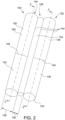
- FIG. 2 is a perspective view of the absorbent core 104 of the diaper 100 (shown in FIG. 1 ).
- the absorbent core 104 is constructed of a superabsorbent polymer (SAP).
- SAP may be distributed throughout the absorbent core 104 in an arrangement that accommodates a non-human wearer.
- the first absorbent section 130, the second absorbent section 132, the third absorbent section 134, the fourth absorbent section 136, and the fifth absorbent section 138 each include a range of 15% to 20% of the total SAP load.
- the first absorbent zone 124 and the third absorbent zone 128 each include a range of 30% to 40% of the total SAP load of the absorbent core 104.
- the second absorbent zone 126 includes a range of 15% to 20% of the total SAP load of the absorbent core 104. In other embodiments, the second absorbent zone 126 includes a range of 20% to 40% of the total SAP load of the absorbent core 104.
- the SAP in the second absorbent zone 126 is distributed along the length of the absorbent core 104 in the center region and is configured to absorb excreta released by a non-human in a horizontal direction.
- the first absorbent zone 124 and the third absorbent zone 128 are configured to absorb excreta that is not absorbed by the second absorbent zone 126 to prevent the excreta from flowing toward the sides 116 (shown in FIG. 1 ) of the diaper 100.
- each section 130, 132, 134, 136, 138 expands.
- each section 130, 132, 134, 136, 138 forms a cylinder when the SAP within each section 130, 132, 134, 136, 138 is fully loaded.
- the first absorbent section 130, the second absorbent section 132, the fourth absorbent section 136, and the fifth absorbent section 138 are identical to each other and each have an expanded width 156 that is greater than the width 150.
- the third absorbent section 134 has an expanded width 158 that is less than the expanded width 156 of the first absorbent section 130, the second absorbent section 132, the fourth absorbent section 136, and the fifth absorbent section 138. Accordingly, when the SAP has absorbed fluids, the third absorbent section 134 has an elongate, thinner shape in comparison to the first absorbent section 130, the second absorbent section 132, the fourth absorbent section 136, and the fifth absorbent section 138.
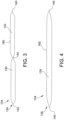
- FIG. 3 is a cross-sectional view of the absorbent core 104 of the diaper 100 taken along line 3-3.
- Line 3-3 extends through the first absorbent zone 124.
- the absorbent zone 124 includes the first absorbent section 130 and the second absorbent section 132 which are separated by the seal 144.
- the seal 144 extends through a middle of the first absorbent zone 124 such that the first absorbent section 130 and the second absorbent section 132 are approximately equal halves of the first absorbent zone 124.
- the first absorbent zone is symmetric about the seal 144.
- the seal 144 defines a minimum thickness of the first absorbent zone 124 (i.e., a thickness substantially less than the thickness of the first absorbent section 130 and the second absorbent section 132) and separates the sections from each other.
- first absorbent section 130 and the second absorbent section 132 are distinct absorbent regions and act as separate absorbent bodies to absorb excreta.
- the seal 144 acts as a joint between the sections 130 and 132 and allows for movement of the sections relative to each other.
- the sections 130 and 132 allow the leg openings of the diaper 100 (shown in FIG. 1 ) to assume an elliptical shape when the diaper is in the wear configuration.
- the foregoing description also applies to the third absorbent zone 128 because the third absorbent zone 128 is identical to the first absorbent zone 124 other than being positioned on an opposite side of the second absorbent zone 126.
- FIG. 4 is a cross-sectional view of the absorbent core 104 of the diaper 100 taken along line 4-4.
- Line 4-4 extends through the second absorbent zone 126.
- the third absorbent section 134 extends throughout the entirety of the second absorbent zone 126. Accordingly, the second absorbent zone 126 is not divided by any seals and has a substantially uniform thickness.
- the third absorbent section 134 is positioned generally in a middle area of the diaper 100 (shown in FIG. 1 ) and is arranged to receive an initial discharge of excreta from the non-human wearer. The excreta may be distributed substantially evenly throughout the SAP of the third absorbent section 134 because of the uniform thickness of the third absorbent section 134.
- a method of assembling the diaper 100 generally includes forming the chassis 102 and attaching the absorbent core 104 to the chassis 102.
- the absorbent core 104 may be attached to the outer sheet 106 of the chassis 102 and/or sandwiched between two or more sheets 106 of the chassis.
- One or more sheets 106 may be secured together to form the chassis 102 before, after, or simultaneous with the absorbent core 104 being attached to the chassis.
- the chassis 102 may be cut or formed to a shape including the front edge 110, the back edge 114, and/or the sides 116. In some embodiments, the sides 116 may be at least partially curved to accommodate the legs of the wearer.
- the fasteners 118 may be attached to or otherwise provided on the chassis 102 such that the diaper 100 has a laid flat configuration (shown in FIG. 1 ) and a wear configuration.
- the absorbent core 104 may be formed of one or more sheets 160 that are arranged to receive the SAP.
- the SAP may be distributed and/or injected into the respective sections 130, 132, 134, 136, 138 of the absorbent core 104 in desired ratios.
- each section 130, 132, 134, 136, 138 may receive about 1/5 of the total SAP for the absorbent core.
- the seals 140, 142, 144, 146 are formed during the same manufacturing step that the SAP is positioned in the absorbent core 104 in an in-situ manufacturing process.
- channels could be formed between and around the sections 130, 132, 134, 136, 138 using one or more embossing rollers.
- the distribution of the SAP is closely controlled and the formation of the seals is more precise relative to the distribution of the SAP because the seals are formed during the distribution of the SAP. As a result, the amount of SAP required to assemble the diaper 100 is reduced and the efficiency of the manufacturing process is increased.
- the edges and/or sides of the absorbent core 104 may be sealed after the SAP is distributed.
- the SAP is distributed onto the sheet 160 before at least one of the seals 140, 142, 144, 146 is formed.
- the diaper 100 may undergo further processing such as printing and/or coating.
- the diapers 100 are formed in continuous sheets and the diapers 100 are cut apart from each other before shipping.
- Each diaper 100 is then prepared for shipping. For example, each diaper 100 may be folded and packaged for shipping.
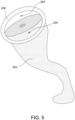
- FIG. 5 is a schematic perspective view illustrating a diaper with a conventional leg opening 200 on a leg 202 of a non-human.
- the leg opening 200 forms a circular shape because of the arrangement of the absorbent core of the diaper.
- the absorbent core around the leg opening is substantially continuous and provides a uniform bend or curve and causes the circular shape.
- the circular shape is configured to accommodate most human legs but does not conform to the shape of non-human legs.
- the circular shape of the leg opening 200 forms gaps 204 around the leg 202 of the non-human because the leg 202 has a generally non-circular shape. Accordingly, the diaper may allow excreta to leak around the leg 202 through the gaps 204.
- FIG. 6 is a schematic perspective view illustrating the diaper 100 on the leg 202 of the non-human.
- the diaper 100 fits snugly on the leg 202 and provides a tight seal to prevent leakage around the leg 202.
- the arrangement of the absorbent sections 130, 132, 134, 136, 138 and the seals 146 allow the leg openings 206 to have an elliptical shape and accommodate the generally elliptical shape of the leg 202.
- the lateral seals 146 allow the absorbent core 104 to at least partially bend or crease at a midpoint of the absorbent core 104 and form the elliptical shape.
- the leg opening 206 and the absorbent core 104 conform to the shape of the leg 202 such that the diaper 100 prevents leaks and provides a more comfortable fit for the wearer.
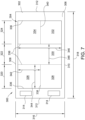
- FIG. 7 is a top view of another embodiment not in accordance with the invention of an absorbent article in the form of a diaper, generally indicated at 300, for a non-human.
- the diaper 300 is configured, in particular, for use on a male non-human.
- the diaper 300 may extend around the waste of the male non-human to collect urine released in a horizontal direction.
- the diaper 300 acts as a wrap that covers the inguinal region and/or the penis of the non-human to collect urine and other excreta that is emitted by the male non-human.
- the diaper 300 does not extend across the tail end of the non-human.
- the diaper 300 may be used as a surgical wrap to cover a surgical site of a non-human.
- the diaper 300 includes a chassis 302 and an absorbent core 304 attached to the chassis.
- the absorbent core 304 is positioned between an inner sheet and an outer sheet 306 of the chassis 302 in a sandwiched configuration.
- the absorbent core 304 may be adhered, bonded, entrapped, or otherwise attached to the chassis 302.
- the absorbent core 304 forms a portion of the chassis 302 such as the inner layer.
- the absorbent core 304 may directly contact the body of the wearer.
- an inner sheet extends between the absorbent core 304 and the body and is at least semi-permeable to allow excreta to pass through and reach the absorbent core.
- the chassis 302 includes a front edge 308, a back edge 310, and sides 312 extending between the front edge and the back edge.
- the diaper 300 is sized and shaped to wrap around the wearer in a wear configuration and the sides 312 are configured to attach together to secure the diaper 300 in the wear configuration.
- the chassis 302 may include one or more fasteners 314 that attach the sides 312 together.
- the fasteners 314 may include hook and loop fasteners, adhesives, and/or any other suitable fasteners.
- the fasteners 314 may be formed as part of or attached to the chassis 302.
- the fasteners 314 extend along one side 312 of the chassis and attach to another side 312 when the diaper 300 is in the wear configuration.
- the diaper 300 may include a single fastener 314 extending along the side 312.
- the diaper 300 includes one or more straps (not shown) that facilitate securing the diaper to the non-human.
- the chassis 302 has a width 316 defined between the front edge 308 and the back edge 310. Also, the chassis 302 has a length 318 defined between the sides 312. Accordingly, the chassis 302 has a rectangular shape. In addition, the chassis 302 may be sized to accommodate bodies of non-humans. For example, in some embodiments, the width 316 may be in a range of about 270 cm to about 350 cm and the length 318 may be in a range of about 190 cm to about 400 cm.
- the absorbent core 304 includes a first absorbent zone 320, a second absorbent zone 322, and a third absorbent zone 324.
- the second absorbent zone 322 extends along a centerline of the chassis 302.
- the first absorbent zone 320 and the third absorbent zone 324 extend between the second absorbent zone 322 and respective sides 312 of the chassis 302.
- the diaper 300 is configured to wrap around the non-human such that the second absorbent zone 322 is positioned along the inguinal region of the non-human and the first absorbent zone 320 and the third absorbent zone 324 are positioned at least partially along the sides of the non-human.
- the second absorbent zone 322 is configured to receive excreta that is released into a central region of the diaper 300 and the first absorbent zone 320 and the third absorbent zone 324 provide a secondary receiving area to seal along the sides 312 and prevent any excreta not absorbed by the second absorbent zone 322 from escaping the diaper.
- the zones 320, 322, 324 include a plurality of absorbent sections 326, 328, 330, 332, 334 that are arranged to absorb excreta released by the non-human wearer.
- the first absorbent zone 320 includes a first absorbent section 326 and a second absorbent section 328.
- the second absorbent zone 322 includes a third absorbent section 330.
- the third absorbent zone 324 includes a fourth absorbent section 332 and a fifth absorbent section 334.
- the absorbent core 304 includes at least five absorbent sections.
- the first absorbent zone 320 and the third absorbent zone 324 each include three or more absorbent sections.
- the second absorbent zone 322 includes two or more absorbent sections.
- the absorbent sections 326, 328, 330, 332, 334 may be any suitable shape.
- the diaper 300 is configured to accommodate a male non-human such as a canine or a feline and the absorbent sections 326, 328, 330, 332, 334 are arranged to absorb excreta released by the male non-human.
- the first absorbent section 326, the second absorbent section 328, the fourth absorbent section 332, and the fifth absorbent section 334 each are square.
- the third absorbent section 330 is a rectangle.
- the shapes of the absorbent sections 326, 328, 330, 332, 334 provide a desired distribution of the SAP and facilitate the diaper 300 being positioned around the waistline of the non-human.
- the absorbent sections 326, 328, 330, 332, 334 of the absorbent core 304 are bounded by longitudinal seals 336 and lateral seals 338, 340.
- the longitudinal seals 336 extend along the width 316 of the chassis 302 between the front edge 308 and the back edge 310 of the chassis.
- the first absorbent section 326 and the second absorbent section 328 of the first absorbent zone 320 are separated by a first lateral seal 338.
- the fourth absorbent section 332 and the fifth absorbent section 334 are separated by a second lateral seal 340.
- the lateral seals 338, 340 extend perpendicular to the longitudinal seals 336 and parallel to the front edge 308 and the back edge 310 of the chassis 302.
- the seals 336, 338, 340 divide the absorbent zones 320, 322, 324 into the absorbent sections 326, 328, 330, 332, 334 and completely circumscribe each absorbent section 326, 328, 330, 332, 334.
- the first absorbent section 326, the second absorbent section 328, the fourth absorbent section 332, and the fifth absorbent section 334 are identical to each other and each have a length 342 and a width 344.
- the length 342 is equal to the width 344 and is equal to approximately half of the total length of the absorbent core 304.
- the third absorbent section 330 is a different shape from the first absorbent section 326, the second absorbent section 328, the fourth absorbent section 332, and the fifth absorbent section 334.
- the third absorbent section 330 has a length 346 and a width 348.
- the length 346 is approximately equal to the total length of the absorbent core 304.
- the width 348 of the third absorbent section 330 is equal to the width 344 of the first absorbent section 326, the second absorbent section 328, the fourth absorbent section 332, and the fifth absorbent section 334 such that a ratio of each width 344, 348 to the total width of the absorbent core 304 is 1:3.
- the SAP may be distributed throughout the absorbent core 304 in an arrangement that accommodates a non-human wearer.
- the first absorbent section 326, the second absorbent section 328, the third absorbent section 330, the fourth absorbent section 332, and the fifth absorbent section 334 each include a range of 15% to 20% of the total SAP.
- the first absorbent zone 320 and the third absorbent zone 324 each include a range of 30% to 40% of the total SAP load of the absorbent core 304.
- the second absorbent zone 322 includes a range of 15% to 20% of the total SAP load of the absorbent core 304.
- the SAP in the second absorbent zone 322 is distributed along the length of the absorbent core 104 in the center region and is configured to absorb excreta released by a non-human in a horizontal direction.
- the first absorbent zone 320 and the third absorbent zone 324 are configured to absorb excreta that is not absorbed by the second absorbent zone 322.
- the terms “about,” “substantially,” “essentially,” and “approximately” when used in conjunction with ranges of dimensions, concentrations, temperatures or other physical or chemical properties or characteristics is meant to cover variations that may exist in the upper and/or lower limits of the ranges of the properties or characteristics, including, for example, variations resulting from rounding, measurement methodology or other statistical variation.
Landscapes
- Health & Medical Sciences (AREA)
- Life Sciences & Earth Sciences (AREA)
- Engineering & Computer Science (AREA)
- General Health & Medical Sciences (AREA)
- Veterinary Medicine (AREA)
- Vascular Medicine (AREA)
- Biomedical Technology (AREA)
- Animal Behavior & Ethology (AREA)
- Epidemiology (AREA)
- Public Health (AREA)
- Heart & Thoracic Surgery (AREA)
- Environmental Sciences (AREA)
- Mechanical Engineering (AREA)
- Manufacturing & Machinery (AREA)
- Animal Husbandry (AREA)
- Biodiversity & Conservation Biology (AREA)
- Absorbent Articles And Supports Therefor (AREA)
- Orthopedics, Nursing, And Contraception (AREA)
Description
- The present invention is directed to diapers for non-humans and, more specifically, to diapers including sectioned absorbent cores arranged to accommodate non-humans.
- Diapers are configured to contain body waste products or excreta including solids and fluids. Typical diapers are designed for human bodies and provide functionality and comfort when worn on the human body. For example, the diapers are configured to accommodate movement of human bodies, which move in a vertical, or upright, manner. The diapers also collect excreta that are typically released from the human body in a vertical manner, i.e., in a direction parallel to the legs of the human when the human is upright. However, non-humans, such as canines or felines, may also require diapers and the diapers designed for humans may not accommodate non-humans. For example, many non-humans are adapted to move in a four-legged horizontal manner. Four-legged non-humans typically release excreta from horizontal positions, not vertical positions like from humans. Diapers that are designed to contain excreta released in a vertical direction may not properly contain excreta that is released from a non-human in a horizontal direction.
- In addition, humans' legs extend vertically in a direction parallel to the body and rotate approximately 180° at the hips. As such, human legs are generally circular in cross-section to accommodate the 180° rotation. In contrast, many non-humans have legs that extend downward in a direction perpendicular to the horizontal body of the non-humans and rotate approximately 90° at the hips relative to the body. Accordingly, the non-humans' legs may be other than circular (e.g., elliptical) to accommodate the 90° rotation. However, most diapers are designed to fit humans and include, for example, circular leg openings. When applied to diapers for non-humans, the circular leg openings may result in gaps between the legs of the non-human that allow excreta to leak around the legs. In addition, the absorbent material of diapers designed for humans may not properly receive and contain excreta from non-humans.
-
WO2017/221472 A1 discloses an absorbent article for pets that fits the body of a pet in an excellent manner and is able to properly absorb liquid bodily waste. This article that is wrapped around the body of pet is provided with deformation guide parts. - Accordingly, there is a need for a disposable diaper that is adapted specifically for non-humans, such as canines or felines, and that provides enhanced functionality and comfort when worn by the non-humans.
- The present invention provides a diaper for a non-human, the diaper comprising: a chassis configured to form two leg openings when the diaper is placed on a non-human in a wear configuration; and an absorbent core attached to the chassis, the absorbent core having a total superabsorbent polymer (SAP) load and comprising:
- a first zone including a first absorbent section and a second absorbent section, wherein the first absorbent section and the second absorbent section each include a range of 15% to 20% of the total SAP load;
- a second zone including a third absorbent section including a range of 15% to 20% or of 20% to 40% of the total SAP load;
- a third zone including a fourth absorbent section and a fifth absorbent section, wherein the fourth absorbent section and the fifth absorbent section each include a range of 15% to 20% of the total SAP load, and wherein the second zone is between the first zone and the third zone; and
- seals surrounding each of the first absorbent section, the second absorbent section, the third absorbent section, the fourth absorbent section, and the fifth absorbent section, wherein one of the seals extends through the first zone between the first absorbent section and the second absorbent section, and another of the seals extends through the third zone between the fourth absorbent section and the fifth absorbent section,
- wherein the seals extending through the first zone and the third zone are lateral seals extending parallel to an edge of the absorbent core,
- wherein the first absorbent section has a first length, the second absorbent section has a second length, the third absorbent section has a third length, the fourth absorbent section has a fourth length, and the fifth absorbent section has a fifth length, and wherein the first length, the second length, the fourth length, and the fifth length are equal to each other, and wherein a ratio of the first length to the third length is 1:2, and
- wherein the seals further include longitudinal seals extending perpendicular to the lateral seals and between the first zone and the second zone and between the second zone and the third zone, and
- wherein at least two of the absorbent sections extend along each leg opening, wherein the leg openings have an elliptical shape when the diaper is placed on the non-human in the wear configuration.
- A method of making an absorbent core for a diaper for a nonhuman is also described herein. It includes depositing a superabsorbent polymer in zones of the absorbent core to form a total superabsorbent polymer (SAP) load of the absorbent core. The method further includes forming seals around the first absorbent section, the second absorbent section, the third absorbent section, the fourth absorbent section, and the fifth absorbent section.
- The embodiments described herein may be better understood by referring to the following description in conjunction with the accompanying drawings.
-
FIG. 1 is a top view of a diaper for a non-human in a laid-flat configuration. -
FIG. 2 is a perspective view of an absorbent core of the diaper shown inFIG. 1 . -
FIG. 3 is a cross-sectional view of an absorbent core of the diaper shown inFIG. 1 taken along line 3-3. -
FIG. 4 is a cross-sectional view of an absorbent core of the diaper shown inFIG. 1 taken along line 4-4. -
FIG. 5 is a schematic perspective view illustrating the fit of a diaper with a conventional leg opening on a leg of a non-human. -
FIG. 6 is a schematic perspective view illustrating the fit of the diaper shown inFIG. 1 on a leg of a non-human. -
FIG. 7 is a top view of a diaper not in accordance with the invention for a non-human in a laid flat configuration, the diaper is adapted for a male non-human. - Embodiments of a diaper for a non-human include an absorbent core having at least five absorbent sections. The diaper also includes a chassis including a front edge, a back edge, and sides extending between the front and back edges. The absorbent core is attached to the chassis and positioned to absorb excreta of a non-human wearer. The sections of the absorbent core extend perpendicular to the waistband of the diaper. For example, at least one middle section extends through the middle of the diaper along the length of the diaper. At least two first side sections having approximately equal length are positioned end-to-end on a left side of the middle section. At least two second side sections having approximately equal length are positioned end-to-end on a right side of the middle section. The absorbent sections are separated by seals. Due at least partially to the arrangement of the sections of the absorbent core, the diaper forms leg openings that are non-circular in shape and accommodate the legs of non-human species to provide an improved function and fit of the diaper for non-humans.
- In addition, the absorbent core includes a superabsorbent polymer (SAP). Each absorbent section is filled with a range of 15% to 20% of a total SAP load of the diaper. Thus, the first side sections provide a range of 30% to 40% of the total SAP load, the middle section provides a range of 20% to 40% of the total SAP load, and the second side sections provide a range of 30% to 40% of the total SAP load. As a result, the absorbent core allows for an initial release of excreta to be absorbed by a range of 20% to 40% SAP in the middle section and any remaining excreta is absorbed by a range of 30% to 40% SAP in the first side sections and the second side sections to prevent leakage out the diaper around the non-human's leg.
-
FIG. 1 is a top view of an exemplary embodiment of an absorbent article in the form of a diaper, generally indicated at 100, for a non-human. Thediaper 100 includes achassis 102 and anabsorbent core 104 attached to the chassis. For example, in some embodiments, theabsorbent core 104 is positioned between an inner sheet and anouter sheet 106 of thechassis 102 in a sandwiched configuration. Theabsorbent core 104 may be adhered, bonded, entrapped, or otherwise attached to thechassis 102. In some embodiments, theabsorbent core 104 forms a portion of thechassis 102 such as the inner layer. In such embodiments, theabsorbent core 104 may directly contact the body of the wearer. In other embodiments, an inner sheet extends between theabsorbent core 104 and the body and is at least semi-permeable to allow excreta to pass through the inner sheet and reach the absorbent core. - The
chassis 102 includes afront 108 having afront edge 110, aback 112 having aback edge 114, andsides 116 extending between the front edge and the back edge. When thediaper 100 is in a wear configuration, the front 108 and the back 112 attach together to form a waistband that is sized and shaped to extend around the wearer. For example, thechassis 102 may includefasteners 118 that secure the front 108 and the back 112 together. Thefasteners 118 may include hook and loop fasteners, adhesives, and/or any other suitable fasteners. Thefasteners 118 may be formed as part of or attached to the front 108 and/or theback 112. For example, in the illustrated embodiment, thefasteners 118 extend from the back 112 and attach to the material of the front 108 when the diaper is in the wear configuration. - In addition, the
sides 116 form leg openings that accommodate the legs of the wearer when thediaper 100 is in the wear configuration. Thesides 116 may be curved (e.g., concave) as shown in the illustrated embodiment. As described further herein, thediaper 100 is adapted to accommodate noncircular legs of non-humans. Specifically, the configuration of thechassis 102 and theabsorbent core 104 allow the diaper to conform to the shape of non-humans. For example, as shown inFIG. 6 , a leg opening of thediaper 100 conforms to the shape of aleg 202 of a non-human such as a canine or a feline and forms a tight seal around the leg to prevent leakage. In addition, thediaper 100 includes anopening 119 in the middle of the diaper sized and shaped to accommodate a tail of a non-human. - The
chassis 102 has a length 120 defined between thefront edge 110 and theback edge 114. Also, thechassis 102 has awidth 122 defined between thesides 116. Thechassis 102 may be sized to accommodate bodies of non-humans. For example, in some embodiments, the length 120 may be in a range of about 98 centimeters (cm) to about 142 cm and thewidth 122 may be in a range of about 110 cm to about 172 cm. - The
absorbent core 104 is attached to thechassis 102 between thefront edge 110 and theback edge 114 and extends along the length 120 of the chassis. Theabsorbent core 104 includes a firstabsorbent zone 124, a secondabsorbent zone 126, and a thirdabsorbent zone 128. The secondabsorbent zone 126 extends along a centerline of thechassis 102. The firstabsorbent zone 124 and the thirdabsorbent zone 128 are on opposite sides of the secondabsorbent zone 126 between the second absorbent zone andrespective sides 116 of thechassis 102. Accordingly, the secondabsorbent zone 126 is configured to receive excreta that is released into a central region of thediaper 100 and the firstabsorbent zone 124 and the thirdabsorbent zone 128 provide a secondary receiving area to seal along thesides 116 and prevent any excreta not absorbed by the secondabsorbent zone 126 from flowing out of thediaper 100 along thesides 116. - The
absorbent core 104 includes a plurality of sections that are arranged in thezones absorbent zone 124 includes a firstabsorbent section 130 and a secondabsorbent section 132. The secondabsorbent zone 126 includes a thirdabsorbent section 134. The thirdabsorbent zone 128 includes a fourthabsorbent section 136 and a fifthabsorbent section 138. Accordingly, in the illustrated embodiment, theabsorbent core 104 includes at least five absorbent sections. In other embodiments, the absorbent core may include any suitable absorbent sections. For example, in some embodiments, the firstabsorbent zone 124 and the thirdabsorbent zone 128 each include three or more absorbent sections. In further embodiments, the secondabsorbent zone 126 includes two or more absorbent sections. - The
absorbent sections absorbent zones seals absorbent core 104 includes edge seals 140 that extend parallel to thefront edge 110 and theback edge 114 of thechassis 102 on opposite ends of theabsorbent zones absorbent sections absorbent core 104 includeslongitudinal seals 142 that extend longitudinally between theabsorbent zones absorbent sections absorbent core 104 includes a firstlateral seal 144 that extends through the firstabsorbent zone 124 between the firstabsorbent section 130 and the secondabsorbent section 132. Theabsorbent core 104 includes a secondlateral seal 146 that extends through the third absorbent zone between the fourthabsorbent section 136 and the fifthabsorbent section 138. The lateral seals 144, 146 extend perpendicular to thelongitudinal seals 142 and parallel to thefront edge 110 and theback edge 114 of thechassis 102. Theseals absorbent section seals absorbent section sections - The
seals seals absorbent core 104. In some embodiments, the seals may be formed by ultrasonic bonding, welding, and any other suitable process. For example, in some embodiments, theabsorbent sections - The first
absorbent section 130, the secondabsorbent section 132, the fourthabsorbent section 136, and the fifthabsorbent section 138 are identical to each other and each have alength 148 and awidth 150. Thelength 148 is greater than thewidth 150 and is equal to approximately half of the total length of theabsorbent core 104. The thirdabsorbent section 134 is a different size from the firstabsorbent section 130, the secondabsorbent section 132, the fourthabsorbent section 136, and the fifthabsorbent section 138. The thirdabsorbent section 134 has a length 152 and awidth 154. The length 152 is approximately equal to the total length of theabsorbent core 104. Thewidth 154 of the thirdabsorbent section 134 equal to thewidth 150 of the firstabsorbent section 130, the secondabsorbent section 132, the fourthabsorbent section 136, and the fifthabsorbent section 138 such that a ratio of eachwidth absorbent core 104 is 1:3. -
FIG. 2 is a perspective view of theabsorbent core 104 of the diaper 100 (shown inFIG. 1 ). Theabsorbent core 104 is constructed of a superabsorbent polymer (SAP). The SAP may be distributed throughout theabsorbent core 104 in an arrangement that accommodates a non-human wearer. For example, the firstabsorbent section 130, the secondabsorbent section 132, the thirdabsorbent section 134, the fourthabsorbent section 136, and the fifthabsorbent section 138 each include a range of 15% to 20% of the total SAP load. Accordingly, the firstabsorbent zone 124 and the thirdabsorbent zone 128 each include a range of 30% to 40% of the total SAP load of theabsorbent core 104. The secondabsorbent zone 126 includes a range of 15% to 20% of the total SAP load of theabsorbent core 104. In other embodiments, the secondabsorbent zone 126 includes a range of 20% to 40% of the total SAP load of theabsorbent core 104. The SAP in the secondabsorbent zone 126 is distributed along the length of theabsorbent core 104 in the center region and is configured to absorb excreta released by a non-human in a horizontal direction. The firstabsorbent zone 124 and the thirdabsorbent zone 128 are configured to absorb excreta that is not absorbed by the secondabsorbent zone 126 to prevent the excreta from flowing toward the sides 116 (shown inFIG. 1 ) of thediaper 100. - When the SAP absorbs excreta, as shown in
FIG. 2 , eachsection section section absorbent section 130, the secondabsorbent section 132, the fourthabsorbent section 136, and the fifthabsorbent section 138 are identical to each other and each have an expandedwidth 156 that is greater than thewidth 150. The thirdabsorbent section 134 has an expanded width 158 that is less than the expandedwidth 156 of the firstabsorbent section 130, the secondabsorbent section 132, the fourthabsorbent section 136, and the fifthabsorbent section 138. Accordingly, when the SAP has absorbed fluids, the thirdabsorbent section 134 has an elongate, thinner shape in comparison to the firstabsorbent section 130, the secondabsorbent section 132, the fourthabsorbent section 136, and the fifthabsorbent section 138. -
FIG. 3 is a cross-sectional view of theabsorbent core 104 of thediaper 100 taken along line 3-3. Line 3-3 extends through the firstabsorbent zone 124. Theabsorbent zone 124 includes the firstabsorbent section 130 and the secondabsorbent section 132 which are separated by theseal 144. Theseal 144 extends through a middle of the firstabsorbent zone 124 such that the firstabsorbent section 130 and the secondabsorbent section 132 are approximately equal halves of the firstabsorbent zone 124. The first absorbent zone is symmetric about theseal 144. Theseal 144 defines a minimum thickness of the first absorbent zone 124 (i.e., a thickness substantially less than the thickness of the firstabsorbent section 130 and the second absorbent section 132) and separates the sections from each other. Accordingly, the firstabsorbent section 130 and the secondabsorbent section 132 are distinct absorbent regions and act as separate absorbent bodies to absorb excreta. Moreover, theseal 144 acts as a joint between thesections sections FIG. 1 ) to assume an elliptical shape when the diaper is in the wear configuration. The foregoing description also applies to the thirdabsorbent zone 128 because the thirdabsorbent zone 128 is identical to the firstabsorbent zone 124 other than being positioned on an opposite side of the secondabsorbent zone 126. -
FIG. 4 is a cross-sectional view of theabsorbent core 104 of thediaper 100 taken along line 4-4. Line 4-4 extends through the secondabsorbent zone 126. The thirdabsorbent section 134 extends throughout the entirety of the secondabsorbent zone 126. Accordingly, the secondabsorbent zone 126 is not divided by any seals and has a substantially uniform thickness. The thirdabsorbent section 134 is positioned generally in a middle area of the diaper 100 (shown inFIG. 1 ) and is arranged to receive an initial discharge of excreta from the non-human wearer. The excreta may be distributed substantially evenly throughout the SAP of the thirdabsorbent section 134 because of the uniform thickness of the thirdabsorbent section 134. - Referring to
FIGS. 1-4 , a method of assembling thediaper 100 generally includes forming thechassis 102 and attaching theabsorbent core 104 to thechassis 102. For example, theabsorbent core 104 may be attached to theouter sheet 106 of thechassis 102 and/or sandwiched between two ormore sheets 106 of the chassis. One ormore sheets 106 may be secured together to form thechassis 102 before, after, or simultaneous with theabsorbent core 104 being attached to the chassis. - The
chassis 102 may be cut or formed to a shape including thefront edge 110, theback edge 114, and/or thesides 116. In some embodiments, thesides 116 may be at least partially curved to accommodate the legs of the wearer. Thefasteners 118 may be attached to or otherwise provided on thechassis 102 such that thediaper 100 has a laid flat configuration (shown inFIG. 1 ) and a wear configuration. - The
absorbent core 104 may be formed of one ormore sheets 160 that are arranged to receive the SAP. The SAP may be distributed and/or injected into therespective sections absorbent core 104 in desired ratios. For example, eachsection seals absorbent core 104 in an in-situ manufacturing process. In other embodiments, channels could be formed between and around thesections - The distribution of the SAP is closely controlled and the formation of the seals is more precise relative to the distribution of the SAP because the seals are formed during the distribution of the SAP. As a result, the amount of SAP required to assemble the
diaper 100 is reduced and the efficiency of the manufacturing process is increased. In some embodiments, the edges and/or sides of theabsorbent core 104 may be sealed after the SAP is distributed. In other embodiments, the SAP is distributed onto thesheet 160 before at least one of theseals - After the sealing process, the
diaper 100 may undergo further processing such as printing and/or coating. In some embodiments, thediapers 100 are formed in continuous sheets and thediapers 100 are cut apart from each other before shipping. Eachdiaper 100 is then prepared for shipping. For example, eachdiaper 100 may be folded and packaged for shipping. -
FIG. 5 is a schematic perspective view illustrating a diaper with aconventional leg opening 200 on aleg 202 of a non-human. Theleg opening 200 forms a circular shape because of the arrangement of the absorbent core of the diaper. For example, the absorbent core around the leg opening is substantially continuous and provides a uniform bend or curve and causes the circular shape. The circular shape is configured to accommodate most human legs but does not conform to the shape of non-human legs. For example, the circular shape of theleg opening 200forms gaps 204 around theleg 202 of the non-human because theleg 202 has a generally non-circular shape. Accordingly, the diaper may allow excreta to leak around theleg 202 through thegaps 204. -
FIG. 6 is a schematic perspective view illustrating thediaper 100 on theleg 202 of the non-human. In contrast to the conventional diaper shown inFIG. 5 , thediaper 100 fits snugly on theleg 202 and provides a tight seal to prevent leakage around theleg 202. For example, the arrangement of theabsorbent sections seals 146 allow theleg openings 206 to have an elliptical shape and accommodate the generally elliptical shape of theleg 202. In particular, the lateral seals 146 allow theabsorbent core 104 to at least partially bend or crease at a midpoint of theabsorbent core 104 and form the elliptical shape. Accordingly, theleg opening 206 and theabsorbent core 104 conform to the shape of theleg 202 such that thediaper 100 prevents leaks and provides a more comfortable fit for the wearer. -
FIG. 7 is a top view of another embodiment not in accordance with the invention of an absorbent article in the form of a diaper, generally indicated at 300, for a non-human. Thediaper 300 is configured, in particular, for use on a male non-human. For example, thediaper 300 may extend around the waste of the male non-human to collect urine released in a horizontal direction. In particular, thediaper 300 acts as a wrap that covers the inguinal region and/or the penis of the non-human to collect urine and other excreta that is emitted by the male non-human. Thediaper 300 does not extend across the tail end of the non-human. In some embodiments, thediaper 300 may be used as a surgical wrap to cover a surgical site of a non-human. - The
diaper 300 includes achassis 302 and anabsorbent core 304 attached to the chassis. For example in some embodiments, theabsorbent core 304 is positioned between an inner sheet and anouter sheet 306 of thechassis 302 in a sandwiched configuration. Theabsorbent core 304 may be adhered, bonded, entrapped, or otherwise attached to thechassis 302. In some embodiments, theabsorbent core 304 forms a portion of thechassis 302 such as the inner layer. In such embodiments, theabsorbent core 304 may directly contact the body of the wearer. In other embodiments, an inner sheet extends between theabsorbent core 304 and the body and is at least semi-permeable to allow excreta to pass through and reach the absorbent core. - The
chassis 302 includes afront edge 308, aback edge 310, andsides 312 extending between the front edge and the back edge. Thediaper 300 is sized and shaped to wrap around the wearer in a wear configuration and thesides 312 are configured to attach together to secure thediaper 300 in the wear configuration. For example, thechassis 302 may include one ormore fasteners 314 that attach thesides 312 together. Thefasteners 314 may include hook and loop fasteners, adhesives, and/or any other suitable fasteners. Thefasteners 314 may be formed as part of or attached to thechassis 302. For example, in the illustrated embodiment, thefasteners 314 extend along oneside 312 of the chassis and attach to anotherside 312 when thediaper 300 is in the wear configuration. In other embodiments, thediaper 300 may include asingle fastener 314 extending along theside 312. In further embodiments, thediaper 300 includes one or more straps (not shown) that facilitate securing the diaper to the non-human. - The
chassis 302 has awidth 316 defined between thefront edge 308 and theback edge 310. Also, thechassis 302 has alength 318 defined between thesides 312. Accordingly, thechassis 302 has a rectangular shape. In addition, thechassis 302 may be sized to accommodate bodies of non-humans. For example, in some embodiments, thewidth 316 may be in a range of about 270 cm to about 350 cm and thelength 318 may be in a range of about 190 cm to about 400 cm. - The
absorbent core 304 includes a firstabsorbent zone 320, a secondabsorbent zone 322, and a thirdabsorbent zone 324. The secondabsorbent zone 322 extends along a centerline of thechassis 302. The firstabsorbent zone 320 and the thirdabsorbent zone 324 extend between the secondabsorbent zone 322 andrespective sides 312 of thechassis 302. Thediaper 300 is configured to wrap around the non-human such that the secondabsorbent zone 322 is positioned along the inguinal region of the non-human and the firstabsorbent zone 320 and the thirdabsorbent zone 324 are positioned at least partially along the sides of the non-human. Accordingly, the secondabsorbent zone 322 is configured to receive excreta that is released into a central region of thediaper 300 and the firstabsorbent zone 320 and the thirdabsorbent zone 324 provide a secondary receiving area to seal along thesides 312 and prevent any excreta not absorbed by the secondabsorbent zone 322 from escaping the diaper. - The
zones absorbent sections absorbent zone 320 includes a firstabsorbent section 326 and a secondabsorbent section 328. The secondabsorbent zone 322 includes a thirdabsorbent section 330. The thirdabsorbent zone 324 includes a fourthabsorbent section 332 and a fifthabsorbent section 334. Accordingly, theabsorbent core 304 includes at least five absorbent sections. For example, in some embodiments, the firstabsorbent zone 320 and the thirdabsorbent zone 324 each include three or more absorbent sections. In further embodiments, the secondabsorbent zone 322 includes two or more absorbent sections. - The
absorbent sections diaper 300 is configured to accommodate a male non-human such as a canine or a feline and theabsorbent sections absorbent section 326, the secondabsorbent section 328, the fourthabsorbent section 332, and the fifthabsorbent section 334 each are square. The thirdabsorbent section 330 is a rectangle. The shapes of theabsorbent sections diaper 300 being positioned around the waistline of the non-human. - The
absorbent sections absorbent core 304 are bounded bylongitudinal seals 336 andlateral seals longitudinal seals 336 extend along thewidth 316 of thechassis 302 between thefront edge 308 and theback edge 310 of the chassis. In addition, the firstabsorbent section 326 and the secondabsorbent section 328 of the firstabsorbent zone 320 are separated by a firstlateral seal 338. The fourthabsorbent section 332 and the fifthabsorbent section 334 are separated by a secondlateral seal 340. The lateral seals 338, 340 extend perpendicular to thelongitudinal seals 336 and parallel to thefront edge 308 and theback edge 310 of thechassis 302. Accordingly, theseals absorbent zones absorbent sections absorbent section - The first
absorbent section 326, the secondabsorbent section 328, the fourthabsorbent section 332, and the fifthabsorbent section 334 are identical to each other and each have alength 342 and awidth 344. Thelength 342 is equal to thewidth 344 and is equal to approximately half of the total length of theabsorbent core 304. The thirdabsorbent section 330 is a different shape from the firstabsorbent section 326, the secondabsorbent section 328, the fourthabsorbent section 332, and the fifthabsorbent section 334. The thirdabsorbent section 330 has alength 346 and awidth 348. Thelength 346 is approximately equal to the total length of theabsorbent core 304. Thewidth 348 of the thirdabsorbent section 330 is equal to thewidth 344 of the firstabsorbent section 326, the secondabsorbent section 328, the fourthabsorbent section 332, and the fifthabsorbent section 334 such that a ratio of eachwidth absorbent core 304 is 1:3. - The SAP may be distributed throughout the
absorbent core 304 in an arrangement that accommodates a non-human wearer. For example, the firstabsorbent section 326, the secondabsorbent section 328, the thirdabsorbent section 330, the fourthabsorbent section 332, and the fifthabsorbent section 334 each include a range of 15% to 20% of the total SAP. Accordingly, the firstabsorbent zone 320 and the thirdabsorbent zone 324 each include a range of 30% to 40% of the total SAP load of theabsorbent core 304. The secondabsorbent zone 322 includes a range of 15% to 20% of the total SAP load of theabsorbent core 304. The SAP in the secondabsorbent zone 322 is distributed along the length of theabsorbent core 104 in the center region and is configured to absorb excreta released by a non-human in a horizontal direction. The firstabsorbent zone 320 and the thirdabsorbent zone 324 are configured to absorb excreta that is not absorbed by the secondabsorbent zone 322. - As used herein, the terms "about," "substantially," "essentially," and "approximately" when used in conjunction with ranges of dimensions, concentrations, temperatures or other physical or chemical properties or characteristics is meant to cover variations that may exist in the upper and/or lower limits of the ranges of the properties or characteristics, including, for example, variations resulting from rounding, measurement methodology or other statistical variation.
- When introducing elements of the present invention or the embodiment(s) thereof, the articles "a," "an," "the," and "said" are intended to mean that there are one or more of the elements. The terms "comprising," "including," "containing," and "having" are intended to be inclusive and mean there may be additional elements other than the listed elements. The use of terms indicating a particular orientation (e.g., "top," "bottom," "side," etc.) is for convenience of description and does not require any particular orientation of the item described.
Claims (4)
- A diaper for a non-human, the diaper comprising:a chassis configured to form two leg openings when the diaper is placed on a non-human in a wear configuration; andan absorbent core attached to the chassis, the absorbent core having a total superabsorbent polymer (SAP) load and comprising:a first zone including a first absorbent section and a second absorbent section, wherein the first absorbent section and the second absorbent section each include a range of 15% to 20% of the total SAP load;a second zone including a third absorbent section including a range of 15% to 20% or of 20% to 40% of the total SAP load;a third zone including a fourth absorbent section and a fifth absorbent section, wherein the fourth absorbent section and the fifth absorbent section each include a range of 15% to 20% of the total SAP load, and wherein the second zone is between the first zone and the third zone; andseals surrounding each of the first absorbent section, the second absorbent section, the third absorbent section, the fourth absorbent section, and the fifth absorbent section, wherein one of the seals extends through the first zone between the first absorbent section and the second absorbent section, and another of the seals extends through the third zone between the fourth absorbent section and the fifth absorbent section,wherein the seals extending through the first zone and the third zone are lateral seals extending parallel to an edge of the absorbent core,wherein the first absorbent section has a first length, the second absorbent section has a second length, the third absorbent section has a third length, the fourth absorbent section has a fourth length, and the fifth absorbent section has a fifth length, and wherein the first length, the second length, the fourth length, and the fifth length are equal to each other, and wherein a ratio of the first length to the third length is 1:2, andwherein the seals further include longitudinal seals extending perpendicular to the lateral seals and between the first zone and the second zone and between the second zone and the third zone, andwherein at least two of the absorbent sections extend along each leg opening, wherein the leg openings have an elliptical shape when the diaper is placed on the non-human in the wear configuration.
- The diaper of claim 1, wherein the first zone has a first width, the second zone has a second width, and the third zone has a third width, and wherein the first width is equal to the third width.
- The diaper of claim 1, wherein the first absorbent zone has a first width, the second absorbent zone has a second width, and the third absorbent zone has a third width, and wherein the first width, the second width, and the third width are equal.
- The diaper of any one of claims 1 to 3, wherein the non-human is a male canine or feline and each of the first, second, fourth, and fifth absorbent sections are square; or
wherein the non-human is a female canine or feline and each of the first, second, third, fourth, and fifth sections is a rectangle having a length and a width, the length being greater than the width.
Priority Applications (2)
| Application Number | Priority Date | Filing Date | Title |
|---|---|---|---|
| RS20241102A RS66097B1 (en) | 2019-04-11 | 2020-04-09 | Diapers for non-humans including sectioned absorbent core |
| HRP20241387TT HRP20241387T1 (en) | 2019-04-11 | 2020-04-09 | NON-HUMAN INDIVIDUALS DIAPERS INCLUDING A DIVISIONAL ABSORBENT CORE |
Applications Claiming Priority (2)
| Application Number | Priority Date | Filing Date | Title |
|---|---|---|---|
| US201962832615P | 2019-04-11 | 2019-04-11 | |
| PCT/US2020/027479 WO2020210499A1 (en) | 2019-04-11 | 2020-04-09 | Diapers for non-humans including sectioned absorbent core |
Publications (4)
| Publication Number | Publication Date |
|---|---|
| EP3952811A1 EP3952811A1 (en) | 2022-02-16 |
| EP3952811A4 EP3952811A4 (en) | 2023-01-04 |
| EP3952811C0 EP3952811C0 (en) | 2024-09-04 |
| EP3952811B1 true EP3952811B1 (en) | 2024-09-04 |
Family
ID=72750838
Family Applications (1)
| Application Number | Title | Priority Date | Filing Date |
|---|---|---|---|
| EP20788186.3A Active EP3952811B1 (en) | 2019-04-11 | 2020-04-09 | Diapers for non-humans including sectioned absorbent core |
Country Status (8)
| Country | Link |
|---|---|
| US (1) | US12336507B2 (en) |
| EP (1) | EP3952811B1 (en) |
| ES (1) | ES2991648T3 (en) |
| HR (1) | HRP20241387T1 (en) |
| HU (1) | HUE068771T2 (en) |
| PL (1) | PL3952811T3 (en) |
| RS (1) | RS66097B1 (en) |
| WO (1) | WO2020210499A1 (en) |
Citations (1)
| Publication number | Priority date | Publication date | Assignee | Title |
|---|---|---|---|---|
| EP2441418A1 (en) * | 2010-10-13 | 2012-04-18 | Romanova bvba starter | Absorbent structure |
Family Cites Families (18)
| Publication number | Priority date | Publication date | Assignee | Title |
|---|---|---|---|---|
| US6837191B2 (en) | 2003-05-02 | 2005-01-04 | Dana Brewington | Pet diaper garment |
| US7174860B2 (en) | 2003-07-10 | 2007-02-13 | Pedigree Perfection | Disposable animal diaper |
| JP5072557B2 (en) | 2007-11-30 | 2012-11-14 | 花王株式会社 | Absorbent articles |
| US20100319633A1 (en) | 2009-06-23 | 2010-12-23 | Moncheski Cynthia A | Adjustable male dog diaper wrap |
| JP5813976B2 (en) * | 2011-03-29 | 2015-11-17 | ユニ・チャーム株式会社 | Pet diapers |
| JP5818483B2 (en) * | 2011-03-31 | 2015-11-18 | ユニ・チャーム株式会社 | Water-absorbing articles |
| EP2586410A1 (en) * | 2011-10-24 | 2013-05-01 | Bostik SA | Novel process for preparing an absorbent article |
| JP6212489B2 (en) * | 2012-07-04 | 2017-10-11 | 株式会社瑞光 | Ultrasonic bonding method for absorbent article, ultrasonic bonding apparatus for absorbent article, and absorbent article |
| CN104507432B (en) * | 2012-08-01 | 2017-07-14 | 株式会社瑞光 | Disposable shorts and its manufacture method |
| JP5829599B2 (en) * | 2012-12-13 | 2015-12-09 | ユニ・チャーム株式会社 | Disposable diapers for pets |
| US10369246B2 (en) | 2013-06-14 | 2019-08-06 | Krp U.S., Llc | Absorbent articles having pockets and related methods therefor |
| JP5837250B1 (en) | 2015-05-12 | 2015-12-24 | ユニ・チャーム株式会社 | Absorbent articles for pets |
| EP3162339A1 (en) * | 2015-10-26 | 2017-05-03 | 3M Innovative Properties Company | Absorbent article with liquid-redirecting layer |
| JP6781577B2 (en) * | 2016-06-22 | 2020-11-04 | ユニ・チャーム株式会社 | Absorbent goods for pets |
| US10828208B2 (en) * | 2016-11-21 | 2020-11-10 | The Procte & Gamble Company | Low-bulk, close-fitting, high-capacity disposable absorbent pant |
| US11564377B2 (en) | 2017-03-02 | 2023-01-31 | Microfine, Inc. | Durable pet diaper and method of using the same |
| NL2020902B1 (en) * | 2017-05-15 | 2019-07-12 | Drylock Tech Nv | Absorbent article with four channels |
| WO2019038451A1 (en) * | 2017-08-25 | 2019-02-28 | Drylock Technologies Nv | Integrated absorbent system for disposable articles |
-
2020
- 2020-04-09 HR HRP20241387TT patent/HRP20241387T1/en unknown
- 2020-04-09 ES ES20788186T patent/ES2991648T3/en active Active
- 2020-04-09 PL PL20788186.3T patent/PL3952811T3/en unknown
- 2020-04-09 RS RS20241102A patent/RS66097B1/en unknown
- 2020-04-09 EP EP20788186.3A patent/EP3952811B1/en active Active
- 2020-04-09 US US17/602,671 patent/US12336507B2/en active Active
- 2020-04-09 HU HUE20788186A patent/HUE068771T2/en unknown
- 2020-04-09 WO PCT/US2020/027479 patent/WO2020210499A1/en not_active Ceased
Patent Citations (1)
| Publication number | Priority date | Publication date | Assignee | Title |
|---|---|---|---|---|
| EP2441418A1 (en) * | 2010-10-13 | 2012-04-18 | Romanova bvba starter | Absorbent structure |
Also Published As
| Publication number | Publication date |
|---|---|
| PL3952811T3 (en) | 2024-12-16 |
| HUE068771T2 (en) | 2025-01-28 |
| EP3952811A1 (en) | 2022-02-16 |
| EP3952811C0 (en) | 2024-09-04 |
| US12336507B2 (en) | 2025-06-24 |
| EP3952811A4 (en) | 2023-01-04 |
| ES2991648T3 (en) | 2024-12-04 |
| HRP20241387T1 (en) | 2024-12-20 |
| US20220174910A1 (en) | 2022-06-09 |
| RS66097B1 (en) | 2024-11-29 |
| WO2020210499A1 (en) | 2020-10-15 |
Similar Documents
| Publication | Publication Date | Title |
|---|---|---|
| US10932957B2 (en) | Leg and flap elastic composite for an absorbent article and method of manufacturing same | |
| US7722587B2 (en) | Disposable diaper | |
| US6682515B1 (en) | Disposable absorbent sanitary article | |
| JP4739416B2 (en) | Barrier cuff for an integral disposable absorbent article with an intermediate bond for sustained fit | |
| US10098795B2 (en) | Absorbent article | |
| EP4110252A1 (en) | Pant-type absorbent article and manufacturing method thereof | |
| AU2008294256B2 (en) | Disposable bodily fluid absorptive wearing article of pants type | |
| CN101287433A (en) | Absorbent article comprising barrier leg cuff structure and elastically stretchable side panels | |
| US9668925B2 (en) | Absorbent article | |
| CN104010604B (en) | There are disposable absorbent products with reference to side zones and associated method | |
| JP5714170B1 (en) | Absorbent articles for pets | |
| US20080021424A1 (en) | Side seams for absorbent articles | |
| US12336507B2 (en) | Diapers for non-humans including sectioned absorbent core | |
| US8114236B2 (en) | Method for making disposable pants-type diaper | |
| AU2007342936B2 (en) | Method for making disposable pants-type diaper | |
| JP2006181172A (en) | Absorbency article and method of producing absorbency article | |
| JP2005110990A (en) | Absorbent article and method of manufacturing absorbent article | |
| RU2774347C1 (en) | Absorbent article and method for manufacturing the absorbent article | |
| US20150257945A1 (en) | Refastenable training pant | |
| JP2026034878A (en) | Worn article and method for manufacturing the worn article | |
| AU2015271979A1 (en) | Leg and flap elastic composite for an absorbent article and method of manufacturing same |
Legal Events
| Date | Code | Title | Description |
|---|---|---|---|
| REG | Reference to a national code |
Ref country code: HR Ref legal event code: TUEP Ref document number: P20241387T Country of ref document: HR |
|
| STAA | Information on the status of an ep patent application or granted ep patent |
Free format text: STATUS: THE INTERNATIONAL PUBLICATION HAS BEEN MADE |
|
| PUAI | Public reference made under article 153(3) epc to a published international application that has entered the european phase |
Free format text: ORIGINAL CODE: 0009012 |
|
| STAA | Information on the status of an ep patent application or granted ep patent |
Free format text: STATUS: REQUEST FOR EXAMINATION WAS MADE |
|
| 17P | Request for examination filed |
Effective date: 20211104 |
|
| AK | Designated contracting states |
Kind code of ref document: A1 Designated state(s): AL AT BE BG CH CY CZ DE DK EE ES FI FR GB GR HR HU IE IS IT LI LT LU LV MC MK MT NL NO PL PT RO RS SE SI SK SM TR |
|
| DAV | Request for validation of the european patent (deleted) | ||
| DAX | Request for extension of the european patent (deleted) | ||
| A4 | Supplementary search report drawn up and despatched |
Effective date: 20221205 |
|
| RIC1 | Information provided on ipc code assigned before grant |
Ipc: A61F 13/535 20060101ALI20221129BHEP Ipc: A61F 13/53 20060101ALI20221129BHEP Ipc: A61F 13/494 20060101ALI20221129BHEP Ipc: A61F 13/15 20060101ALI20221129BHEP Ipc: A01K 23/00 20060101ALI20221129BHEP Ipc: A61F 13/49 20060101AFI20221129BHEP |
|
| STAA | Information on the status of an ep patent application or granted ep patent |
Free format text: STATUS: EXAMINATION IS IN PROGRESS |
|
| 17Q | First examination report despatched |
Effective date: 20231115 |
|
| GRAP | Despatch of communication of intention to grant a patent |
Free format text: ORIGINAL CODE: EPIDOSNIGR1 |
|
| STAA | Information on the status of an ep patent application or granted ep patent |
Free format text: STATUS: GRANT OF PATENT IS INTENDED |
|
| INTG | Intention to grant announced |
Effective date: 20240327 |
|
| GRAS | Grant fee paid |
Free format text: ORIGINAL CODE: EPIDOSNIGR3 |
|
| GRAA | (expected) grant |
Free format text: ORIGINAL CODE: 0009210 |
|
| STAA | Information on the status of an ep patent application or granted ep patent |
Free format text: STATUS: THE PATENT HAS BEEN GRANTED |
|
| AK | Designated contracting states |
Kind code of ref document: B1 Designated state(s): AL AT BE BG CH CY CZ DE DK EE ES FI FR GB GR HR HU IE IS IT LI LT LU LV MC MK MT NL NO PL PT RO RS SE SI SK SM TR |
|
| REG | Reference to a national code |
Ref country code: GB Ref legal event code: FG4D |
|
| REG | Reference to a national code |
Ref country code: CH Ref legal event code: EP |
|
| REG | Reference to a national code |
Ref country code: IE Ref legal event code: FG4D |
|
| REG | Reference to a national code |
Ref country code: DE Ref legal event code: R096 Ref document number: 602020037176 Country of ref document: DE |
|
| U01 | Request for unitary effect filed |
Effective date: 20241002 |
|
| REG | Reference to a national code |
Ref country code: GR Ref legal event code: EP Ref document number: 20240402343 Country of ref document: GR Effective date: 20241111 |
|
| U07 | Unitary effect registered |
Designated state(s): AT BE BG DE DK EE FI FR IT LT LU LV MT NL PT RO SE SI Effective date: 20241025 |
|
| REG | Reference to a national code |
Ref country code: SK Ref legal event code: T3 Ref document number: E 45131 Country of ref document: SK Ref country code: ES Ref legal event code: FG2A Ref document number: 2991648 Country of ref document: ES Kind code of ref document: T3 Effective date: 20241204 |
|
| REG | Reference to a national code |
Ref country code: HR Ref legal event code: T1PR Ref document number: P20241387 Country of ref document: HR |
|
| REG | Reference to a national code |
Ref country code: HU Ref legal event code: AG4A Ref document number: E068771 Country of ref document: HU |
|
| PG25 | Lapsed in a contracting state [announced via postgrant information from national office to epo] |
Ref country code: SM Free format text: LAPSE BECAUSE OF FAILURE TO SUBMIT A TRANSLATION OF THE DESCRIPTION OR TO PAY THE FEE WITHIN THE PRESCRIBED TIME-LIMIT Effective date: 20240904 |
|
| REG | Reference to a national code |
Ref country code: HR Ref legal event code: ODRP Ref document number: P20241387 Country of ref document: HR Payment date: 20250409 Year of fee payment: 6 |
|
| U20 | Renewal fee for the european patent with unitary effect paid |
Year of fee payment: 6 Effective date: 20250425 |
|
| PGFP | Annual fee paid to national office [announced via postgrant information from national office to epo] |
Ref country code: PL Payment date: 20250409 Year of fee payment: 6 |
|
| PGFP | Annual fee paid to national office [announced via postgrant information from national office to epo] |
Ref country code: GB Payment date: 20250423 Year of fee payment: 6 Ref country code: ES Payment date: 20250519 Year of fee payment: 6 |
|
| PLBE | No opposition filed within time limit |
Free format text: ORIGINAL CODE: 0009261 |
|
| STAA | Information on the status of an ep patent application or granted ep patent |
Free format text: STATUS: NO OPPOSITION FILED WITHIN TIME LIMIT |
|
| PGFP | Annual fee paid to national office [announced via postgrant information from national office to epo] |
Ref country code: IS Payment date: 20250423 Year of fee payment: 6 Ref country code: HU Payment date: 20250425 Year of fee payment: 6 Ref country code: RS Payment date: 20250409 Year of fee payment: 6 Ref country code: NO Payment date: 20250422 Year of fee payment: 6 |
|
| PGFP | Annual fee paid to national office [announced via postgrant information from national office to epo] |
Ref country code: HR Payment date: 20250409 Year of fee payment: 6 |
|
| PGFP | Annual fee paid to national office [announced via postgrant information from national office to epo] |
Ref country code: GR Payment date: 20250416 Year of fee payment: 6 |
|
| PGFP | Annual fee paid to national office [announced via postgrant information from national office to epo] |
Ref country code: CH Payment date: 20250501 Year of fee payment: 6 |
|
| PGFP | Annual fee paid to national office [announced via postgrant information from national office to epo] |
Ref country code: TR Payment date: 20250409 Year of fee payment: 6 Ref country code: SK Payment date: 20250409 Year of fee payment: 6 |
|
| PGFP | Annual fee paid to national office [announced via postgrant information from national office to epo] |
Ref country code: CZ Payment date: 20250409 Year of fee payment: 6 |
|
| PGFP | Annual fee paid to national office [announced via postgrant information from national office to epo] |
Ref country code: IE Payment date: 20250428 Year of fee payment: 6 |
|
| 26N | No opposition filed |
Effective date: 20250605 |
|
| PG25 | Lapsed in a contracting state [announced via postgrant information from national office to epo] |
Ref country code: MC Free format text: LAPSE BECAUSE OF FAILURE TO SUBMIT A TRANSLATION OF THE DESCRIPTION OR TO PAY THE FEE WITHIN THE PRESCRIBED TIME-LIMIT Effective date: 20240904 |
|
| PGFP | Annual fee paid to national office [announced via postgrant information from national office to epo] |
Ref country code: CY Payment date: 20250410 Year of fee payment: 6 |