EP3951979A1 - Method for separating transition metal from waste cathode material - Google Patents
Method for separating transition metal from waste cathode material Download PDFInfo
- Publication number
- EP3951979A1 EP3951979A1 EP20903703.5A EP20903703A EP3951979A1 EP 3951979 A1 EP3951979 A1 EP 3951979A1 EP 20903703 A EP20903703 A EP 20903703A EP 3951979 A1 EP3951979 A1 EP 3951979A1
- Authority
- EP
- European Patent Office
- Prior art keywords
- positive electrode
- electrode material
- transition metal
- waste positive
- lithium
- Prior art date
- Legal status (The legal status is an assumption and is not a legal conclusion. Google has not performed a legal analysis and makes no representation as to the accuracy of the status listed.)
- Granted
Links
Images

Classifications
-
- H—ELECTRICITY
- H01—ELECTRIC ELEMENTS
- H01M—PROCESSES OR MEANS, e.g. BATTERIES, FOR THE DIRECT CONVERSION OF CHEMICAL ENERGY INTO ELECTRICAL ENERGY
- H01M10/00—Secondary cells; Manufacture thereof
- H01M10/54—Reclaiming serviceable parts of waste accumulators
-
- C—CHEMISTRY; METALLURGY
- C22—METALLURGY; FERROUS OR NON-FERROUS ALLOYS; TREATMENT OF ALLOYS OR NON-FERROUS METALS
- C22B—PRODUCTION AND REFINING OF METALS; PRETREATMENT OF RAW MATERIALS
- C22B26/00—Obtaining alkali, alkaline earth metals or magnesium
- C22B26/10—Obtaining alkali metals
- C22B26/12—Obtaining lithium
-
- H—ELECTRICITY
- H01—ELECTRIC ELEMENTS
- H01M—PROCESSES OR MEANS, e.g. BATTERIES, FOR THE DIRECT CONVERSION OF CHEMICAL ENERGY INTO ELECTRICAL ENERGY
- H01M10/00—Secondary cells; Manufacture thereof
- H01M10/05—Accumulators with non-aqueous electrolyte
- H01M10/054—Accumulators with insertion or intercalation of metals other than lithium, e.g. with magnesium or aluminium
-
- C—CHEMISTRY; METALLURGY
- C01—INORGANIC CHEMISTRY
- C01D—COMPOUNDS OF ALKALI METALS, i.e. LITHIUM, SODIUM, POTASSIUM, RUBIDIUM, CAESIUM, OR FRANCIUM
- C01D15/00—Lithium compounds
- C01D15/02—Oxides; Hydroxides
-
- C—CHEMISTRY; METALLURGY
- C01—INORGANIC CHEMISTRY
- C01G—COMPOUNDS CONTAINING METALS NOT COVERED BY SUBCLASSES C01D OR C01F
- C01G53/00—Compounds of nickel
- C01G53/04—Oxides
-
- C—CHEMISTRY; METALLURGY
- C01—INORGANIC CHEMISTRY
- C01G—COMPOUNDS CONTAINING METALS NOT COVERED BY SUBCLASSES C01D OR C01F
- C01G53/00—Compounds of nickel
- C01G53/40—Complex oxides containing nickel and at least one other metal element
-
- C—CHEMISTRY; METALLURGY
- C01—INORGANIC CHEMISTRY
- C01G—COMPOUNDS CONTAINING METALS NOT COVERED BY SUBCLASSES C01D OR C01F
- C01G53/00—Compounds of nickel
- C01G53/80—Compounds containing nickel, with or without oxygen or hydrogen, and containing one or more other elements
- C01G53/82—Compounds containing nickel, with or without oxygen or hydrogen, and containing two or more other elements
-
- C—CHEMISTRY; METALLURGY
- C22—METALLURGY; FERROUS OR NON-FERROUS ALLOYS; TREATMENT OF ALLOYS OR NON-FERROUS METALS
- C22B—PRODUCTION AND REFINING OF METALS; PRETREATMENT OF RAW MATERIALS
- C22B7/00—Working up raw materials other than ores, e.g. scrap, to produce non-ferrous metals and compounds thereof; Methods of a general interest or applied to the winning of more than two metals
- C22B7/001—Dry processes
-
- C—CHEMISTRY; METALLURGY
- C22—METALLURGY; FERROUS OR NON-FERROUS ALLOYS; TREATMENT OF ALLOYS OR NON-FERROUS METALS
- C22B—PRODUCTION AND REFINING OF METALS; PRETREATMENT OF RAW MATERIALS
- C22B7/00—Working up raw materials other than ores, e.g. scrap, to produce non-ferrous metals and compounds thereof; Methods of a general interest or applied to the winning of more than two metals
- C22B7/006—Wet processes
-
- H—ELECTRICITY
- H01—ELECTRIC ELEMENTS
- H01M—PROCESSES OR MEANS, e.g. BATTERIES, FOR THE DIRECT CONVERSION OF CHEMICAL ENERGY INTO ELECTRICAL ENERGY
- H01M10/00—Secondary cells; Manufacture thereof
- H01M10/05—Accumulators with non-aqueous electrolyte
- H01M10/052—Li-accumulators
- H01M10/0525—Rocking-chair batteries, i.e. batteries with lithium insertion or intercalation in both electrodes; Lithium-ion batteries
-
- C—CHEMISTRY; METALLURGY
- C01—INORGANIC CHEMISTRY
- C01P—INDEXING SCHEME RELATING TO STRUCTURAL AND PHYSICAL ASPECTS OF SOLID INORGANIC COMPOUNDS
- C01P2002/00—Crystal-structural characteristics
- C01P2002/50—Solid solutions
- C01P2002/52—Solid solutions containing elements as dopants
-
- C—CHEMISTRY; METALLURGY
- C01—INORGANIC CHEMISTRY
- C01P—INDEXING SCHEME RELATING TO STRUCTURAL AND PHYSICAL ASPECTS OF SOLID INORGANIC COMPOUNDS
- C01P2002/00—Crystal-structural characteristics
- C01P2002/70—Crystal-structural characteristics defined by measured X-ray, neutron or electron diffraction data
- C01P2002/72—Crystal-structural characteristics defined by measured X-ray, neutron or electron diffraction data by d-values or two theta-values, e.g. as X-ray diagram
-
- C—CHEMISTRY; METALLURGY
- C01—INORGANIC CHEMISTRY
- C01P—INDEXING SCHEME RELATING TO STRUCTURAL AND PHYSICAL ASPECTS OF SOLID INORGANIC COMPOUNDS
- C01P2002/00—Crystal-structural characteristics
- C01P2002/70—Crystal-structural characteristics defined by measured X-ray, neutron or electron diffraction data
- C01P2002/76—Crystal-structural characteristics defined by measured X-ray, neutron or electron diffraction data by a space-group or by other symmetry indications
-
- C—CHEMISTRY; METALLURGY
- C01—INORGANIC CHEMISTRY
- C01P—INDEXING SCHEME RELATING TO STRUCTURAL AND PHYSICAL ASPECTS OF SOLID INORGANIC COMPOUNDS
- C01P2002/00—Crystal-structural characteristics
- C01P2002/70—Crystal-structural characteristics defined by measured X-ray, neutron or electron diffraction data
- C01P2002/77—Crystal-structural characteristics defined by measured X-ray, neutron or electron diffraction data by unit-cell parameters, atom positions or structure diagrams
-
- C—CHEMISTRY; METALLURGY
- C01—INORGANIC CHEMISTRY
- C01P—INDEXING SCHEME RELATING TO STRUCTURAL AND PHYSICAL ASPECTS OF SOLID INORGANIC COMPOUNDS
- C01P2006/00—Physical properties of inorganic compounds
- C01P2006/80—Compositional purity
-
- H—ELECTRICITY
- H01—ELECTRIC ELEMENTS
- H01M—PROCESSES OR MEANS, e.g. BATTERIES, FOR THE DIRECT CONVERSION OF CHEMICAL ENERGY INTO ELECTRICAL ENERGY
- H01M4/00—Electrodes
- H01M4/02—Electrodes composed of, or comprising, active material
- H01M4/36—Selection of substances as active materials, active masses, active liquids
- H01M4/48—Selection of substances as active materials, active masses, active liquids of inorganic oxides or hydroxides
- H01M4/50—Selection of substances as active materials, active masses, active liquids of inorganic oxides or hydroxides of manganese
- H01M4/505—Selection of substances as active materials, active masses, active liquids of inorganic oxides or hydroxides of manganese of mixed oxides or hydroxides containing manganese for inserting or intercalating light metals, e.g. LiMn2O4 or LiMn2OxFy
-
- H—ELECTRICITY
- H01—ELECTRIC ELEMENTS
- H01M—PROCESSES OR MEANS, e.g. BATTERIES, FOR THE DIRECT CONVERSION OF CHEMICAL ENERGY INTO ELECTRICAL ENERGY
- H01M4/00—Electrodes
- H01M4/02—Electrodes composed of, or comprising, active material
- H01M4/36—Selection of substances as active materials, active masses, active liquids
- H01M4/48—Selection of substances as active materials, active masses, active liquids of inorganic oxides or hydroxides
- H01M4/52—Selection of substances as active materials, active masses, active liquids of inorganic oxides or hydroxides of nickel, cobalt or iron
- H01M4/525—Selection of substances as active materials, active masses, active liquids of inorganic oxides or hydroxides of nickel, cobalt or iron of mixed oxides or hydroxides containing iron, cobalt or nickel for inserting or intercalating light metals, e.g. LiNiO2, LiCoO2 or LiCoOxFy
-
- Y—GENERAL TAGGING OF NEW TECHNOLOGICAL DEVELOPMENTS; GENERAL TAGGING OF CROSS-SECTIONAL TECHNOLOGIES SPANNING OVER SEVERAL SECTIONS OF THE IPC; TECHNICAL SUBJECTS COVERED BY FORMER USPC CROSS-REFERENCE ART COLLECTIONS [XRACs] AND DIGESTS
- Y02—TECHNOLOGIES OR APPLICATIONS FOR MITIGATION OR ADAPTATION AGAINST CLIMATE CHANGE
- Y02W—CLIMATE CHANGE MITIGATION TECHNOLOGIES RELATED TO WASTEWATER TREATMENT OR WASTE MANAGEMENT
- Y02W30/00—Technologies for solid waste management
- Y02W30/50—Reuse, recycling or recovery technologies
- Y02W30/84—Recycling of batteries or fuel cells
Definitions
- the present invention relates to a method for separating a transition metal from a waste positive electrode material.
- a lithium secondary battery is generally composed of a positive electrode including a positive electrode active material, a negative electrode including a negative electrode active material, a separator, and an electrolyte, and is a secondary battery charged and discharged by the intercalation-deintercalation of lithium ions.
- a lithium secondary battery has advantages of having high energy density, high electromotive force, and high capacity, and thus is applied in various fields.
- a positive electrode active material of a lithium secondary battery includes a transition metal, such as nickel, cobalt, manganese, and the like, together with lithium.
- the nickel and cobalt are metals which are relatively expensive, and in particular, there are limited number of countries producing cobalt, so that cobalt is known as a metal whose supply and demand is unstable worldwide. Therefore, when a transition metal, including the lithium and the cobalt, is recovered from a waste electrode, particularly a positive electrode, and recycled as a raw material, price competitiveness may be ensured, and additional revenue may be generated. Therefore, studies have been conducted on a method for recovering and recycling a metal component from a waste electrode.
- Patent Document 1 Korean Patent Laid-Open Publication No. 1497921
- a first aspect of the present invention provides a method that can easily separate a transition metal from a waste positive electrode material in a dry manner without the problem of environmental pollution.
- a method for separating a transition metal from a waste positive electrode material includes Step 1 of preparing a waste positive electrode material represented by Formula 1 below, Step 2 of heat treating the waste positive electrode material in an inert gas atmosphere or an oxygen atmosphere to phase separate the waste positive electrode material into a lithium oxide and a metal oxide, Step 3 of cooling an obtained product of Step 2 to room temperature in an inert atmosphere, and Step 4 of mixing a cooled product cooled to room temperature in Step 3 with distilled water, and then filtering the mixture to leach a transition metal.
- Step 1 Li 1+a Ni 1-x M x O 2
- M is one or more selected from the group consisting of Co, Mn, and Al, 0 ⁇ a ⁇ 0.3, and 0 ⁇ x ⁇ 0.5.
- a transition metal is separated from a waste positive electrode material by a structural change caused by heat treatment, so that environmental pollution problems according to the use of a chemical solvent may be prevented in advance, and the transition metal may be easily separated from the waste positive electrode material.
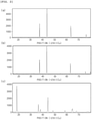
- FIG. 2 are graphs respectively showing XRD data measured after separating a transition metal from a waste positive electrode material prepared in (a) Example 1, (b) Example 2, and (c) Comparative Example 1.
- Step 1 of preparing a waste positive electrode material represented by Formula 1 below Step 2 of heat treating the waste positive electrode material in an inert gas atmosphere or an oxygen atmosphere to phase separate the waste positive electrode material into a lithium oxide and a metal oxide, Step 3 of cooling an obtained product of Step 2 to room temperature in an inert atmosphere, and Step 4 of mixing a cooled product cooled to room temperature in Step 3 with distilled water, and then filtering the mixture to leach a transition metal.
- Step 1 a waste positive electrode material is prepared (Step 1).
- a waste positive electrode material may be obtained from an electrode with defects generated during a manufacturing process of a secondary battery, or may be obtained from an electrode separated from a secondary battery used and then discarded.
- the waste positive electrode material may be, for example, one with coating defects generated during the coating of an electrode active material slurry, or one that do not meet specifications, or may be obtained from an electrode with an expiration date set at the time of storage expired among manufactured electrodes.
- benefits from recycling an active material may be greater than when recycling a waste negative electrode material.
- the waste positive electrode material according to the present invention may be represented by Formula 1 below, and preferably, nickel may be included in 60 mol% or greater based on a total number of moles of transition metals except for lithium.
- Formula 1 Li 1+a Ni 1-x M x O 2
- M is one or more selected from the group consisting of Co, Mn, and Al, 0 ⁇ a ⁇ 0.3, and 0 ⁇ x ⁇ 0.5.
- the M is an element substituted for a Ni site in an oxide represented by Formula 1, and may include one or more selected from the group consisting of Co, Mn, and Al.
- 1+a represents a molar ratio of lithium in the oxide represented by Formula 1 above, wherein the a may satisfy 0 ⁇ a ⁇ 0.3, preferably 0 ⁇ a ⁇ 0.2.
- x represents a molar ratio of a doping element M in the oxide represented by Formula 1 above, wherein the x may satisfy 0 ⁇ x ⁇ 0.5, preferably 0 ⁇ x ⁇ 0.4, more preferably 0 ⁇ x ⁇ 0.2.
- 1-x represents a molar ratio of nickel in the oxide represented by Formula 1 above, wherein the 1-x may satisfy 0.5 ⁇ 1-x ⁇ 1.0, preferably 0.6 ⁇ 1-x ⁇ 1.0, more preferably 0.8 ⁇ 1-x ⁇ 1.0.
- the waste positive electrode material is heat treated in an inert gas atmosphere or an oxygen atmosphere to phase separate the waste positive electrode material into a lithium oxide and a metal oxide (Step 2).
- the waste positive electrode material when the waste positive electrode material is heat treated above a temperature range (700 to 800°C) in which a layered structure is stable, due to the destabilization of the layered structure, the waste positive electrode material is phase separated into phases where the phase of a lithium oxide and the phase of a metal oxide are each stable at a high temperature, that is, the phases of the lithium oxide and the metal oxide.
- the positive electrode material is in a stable phase form when having a layered structure at 600°C to 800°C, and when heat treating is performed at 800°C or higher, the positive electrode material is in a stable phase form when separated into a lithium oxide and a metal oxide.
- the higher the heat treatment temperature during the phase separation the higher the purity of a separation rate.
- the heat treating of the waste positive electrode material may be performed in an inert gas atmosphere or an oxygen atmosphere, and for example, may be performed in an inert gas atmosphere, the inert gas being such as nitrogen, argon, helium or neon, or in an oxygen atmosphere having an oxygen concentration of 100 mol% or less.
- the heat treating when the heat treating is performed in an oxygen atmosphere, the heat treating may be performed at 900°C or higher, preferably 900°C to 1,000°C. Therefore, when the heat treating is performed in the above-described temperature range, a stable phase tends to be formed, so that a lithium transition metal oxide may be easily phase separated. However, when the heat treatment temperature is lower than the above range, a layered structure remains, so that separation efficiently may decrease, and when higher than the above range, process efficiency may decrease.
- the oxygen concentration is 100 mol% or less, preferably 50% or less, more preferably 0 mol% to 10 mol%, the easier the phase separation of a lithium transition metal oxide.
- phase separation is possible in the above-described heat treatment temperature range.
- the heat treating when the heat treating is performed in an inert gas atmosphere, the heat treating may be performed at 800°C or higher, preferably 800°C to 950°C.
- a reducing atmosphere is maintained to lower a temperature at which phases of a lithium oxide and a metal oxide are separated, so that even when the heat treatment temperature is relatively low, the phase separation of a lithium transition metal oxide may easily occur.
- hydrogen gas when the heat treating is performed in the inert gas atmosphere, hydrogen gas may be further included.
- hydrogen gas in an amount of 10 vol% or less, preferably 2 to 5 vol% based on 100 vol% of an inert gas may be further included.
- the heat treating is performed in the inert gas atmosphere, and when hydrogen gas is further included, the temperature at which the phases of the lithium oxide and the metal oxide are separated is further lowered due to reducing power of the hydrogen gas, so that even when the heat treatment temperature is relatively low, an effect of easily phase separate the lithium transition metal oxide may be further achieved.
- Step 3 an obtained product of Step 2 is cooled to room temperature in an inert atmosphere.
- the cooling is performed in an inert atmosphere, so that the waste positive electrode material is prevented from being transitioned back to having a layered structure during temperature lowering.
- cooling to room temperature may be achieved while phases separated in Step 2 are maintained.
- the cooling is performed in an oxygen atmosphere, when the temperature of the waste positive electrode material passes an interval of 600 to 800°C during temperature lowering, the waste positive electrode material may be transitioned back to having a layered structure due to recrystallization of the positive electrode material.
- a temperature lowering rate when cooling the waste positive electrode material may be 1°C/min to 10°C/min.
- a temperature lowering rate when cooling the waste positive electrode material may be 1°C/min to 10°C/min.
- a phase separation rate may be lowered, and also, process time increases, so that process efficiency may decrease.
- the temperature lowering rate is higher than the above range, equipment is strained, so that process cost may increase due to the reduction in equipment life, and the like.
- Step 3 a mixed solution in which a cooled product obtained in Step 3 and distilled water are mixed is subjected to filtering to leach a transition metal.
- the cooled product obtained in Step 3 and the distilled water may be mixed at a weight ratio of 1:0.3 to 1:2, preferably 1:0.5 to 1:1.2, to leach the lithium oxide and the metal oxide phase separated in Step 2 in the distilled water.
- the leaching of a transition metal in the distilled water may be performed for 5 to 20 minutes at a temperature of 10 to 50°C.
- leaching time is as short as less than the above range, a transition metal is not sufficiently leached in distilled water, and when leaching time exceeds the above range, a leached amount may increase, but a process is lengthened, so that economic feasibility may lowered.
- leaching efficiency may further increase, but the present invention is not limited thereto.
- the distilled water is filtered to obtain each of a lithium oxide and a metal oxide leached in the distilled water.
- the filtering may be performed by a method in which the mixed solution is passed through a filter having micro-pores to filter out floating matters and impurities in the mixed solution, and may preferably be performed by a method in which a leachate is subjected to decompression filtration using a filter connected to a vacuum pump, and the like, or by a method in which the mixed solution is filtered using a filter paper having micro-pores.
- the transition metal leached after Step 4 may include, for example, a lithium compound including a lithium hydroxide formed by a reaction between the lithium oxide separated in Step 2 and the distilled water, and a nickel metal oxide including nickel and M, specifically a metal oxide in the form of Ni 1-x M x O (at this time, 0 ⁇ x ⁇ 0.5).
- the metal oxide is leached as a metal oxide in the form of Ni 1-x M x O (where, 0 ⁇ x ⁇ 0.5).
- Step 1 to Step 4 of the present invention may be repeatedly performed to further increase separation purity between a lithium oxide and a metal oxide.
- the separation purity of a metal oxide may be determined through the size of a unit cell measured by inductively coupled plasma(ICP) or XRD.
- Step 1 to Step 4 may be repeatedly performed once to 4 times to obtain a target separation purity.
- the separation purity of a metal oxide may be determined by the concentration of Li measured by the ICP.
- the size of a unit cell measured by XRD is 0.42 nm to 0.4165 nm, it can be determined that purity is 80% or greater.
- the size of a unit cell measured by XRD is less than the above range, it means that lithium is substituted in a nickel site, so that it can be determined that separation purity is less than 80%, which is lower, and when the size exceeds the above range, it can be determined that phases other than the metal oxide may co-exist.
- a waste positive electrode material including LiNi 0.9 Co 0.05 Mn 0.05 O 2 as a positive electrode active material was prepared (Step 1).
- the waste positive electrode material was heat treated at 850°C in a nitrogen atmosphere to separate the phase of the waste positive electrode material into Li 2 O and Ni 0.9 Co 0.05 Mn 0.05 O (Step 2) .
- Step 3 the phase-separated waste positive electrode material was cooled to room temperature in a nitrogen atmosphere.
- an obtained cooled product was mixed with distilled water at a weight ratio of 1:0.8 to be washed, and was subjected to vacuum filtration using a filter made of polyvinylidene fluoride and having a pore of 0.5 ⁇ m. Thereafter, a filtered solid and an aqueous solution were subjected to vacuum filtration to be separated in the form of a lithium oxide (LiOH) and a metal oxide (Ni 0.9 Co 0.05 Mn 0.05 O) (Step 4).
- Transition metals were separated in the form of the lithium oxide (LiOH) and the metal oxide (Ni 0.9 Co 0.05 Mn 0.05 O) from the waste positive electrode material in the same manner as in Example 1 except that the waste positive electrode material was heat treated at 950°C in an atmospheric atmosphere.
- Transition metals were separated in the form of the lithium oxide (LiOH) and the metal oxide (Ni 0.9 Co 0.05 Mn 0.05 O) from the waste positive electrode material in the same manner as in Example 1 except that Step 1 to Step 4 were repeatedly performed 4 times.
- Transition metals were separated in the form of the lithium oxide (LiOH) and the metal oxide (Ni 0.9 Co 0.05 Mn 0.05 O) from the waste positive electrode material in the same manner as in Example 1 except that the phase-separated waste positive electrode material was cooled to room temperature in an oxygen atmosphere.
- Transition metals were separated in the form of the lithium oxide (LiOH) and the metal oxide (Ni 0.9 Co 0.05 Mn 0.05 O) from the waste positive electrode material in the same manner as in Example 1 except that the heat treating was performed at 750°C.
- Transition metals were separated in the form of the lithium oxide (LiOH) and the metal oxide (Ni 0.9 Co 0.05 Mn 0.05 O) from the waste positive electrode material in the same manner as in Example 1 except that the heat treating was performed at 850°C in an oxygen atmosphere.
- the temperature was raised from 700°C to 830°C during the heat treating of the waste positive electrode material of Example 1, and changes in the phase of the positive electrode material at the time were observed.
- Example 1 the temperature of the waste positive electrode material of Example 1 was raised in a nitrogen(>99%) atmosphere, and in situ thermal XRD data at the time was identified using Empyrean XRD equipment of Panalytical Co., Ltd.
- the waste positive electrode material prepared in Example 1 had a phase of a lithium transition metal oxide (LiMO 2 , R-3m, layered structure) at 710°C.
- a lithium transition metal oxide LiMO 2 , R-3m, layered structure
- the same had a phase of a metal oxide (MO, Fm3m, rock-salt structure) at 790°C or higher, specifically around 820°C.
- the waste positive electrode material was prepared and then cooled after the phase separation in each Examples 1 and 2 and Comparative Example 1, and in situ thermal XRD data at the time was identified using the Empyrean XRD equipment of Panalytical Co., Ltd, and is shown in (a) to (c) of FIG. 2 .
- FIG. 2 are graphs respectively showing the in situ thermal XRD data of the waste positive electrode material prepared and then cooled after the phase separation in (a) Example 1, (b) Example 2, and (c) Comparative Example 1.
- the transition metals separated in each of Examples 1 to 3 had the size of a unit cell measured by XRD in the range of 0.42 nm to 0.4165 nm, so that it can be confirmed that the purity thereof is 80% or higher.
- the transition metals separated in each of Comparative Examples 2 and 3 had the size of a unit cell measured by XRD in a range less than the range of the present invention, so that it can be confirmed that the purity thereof is lower than that of the transition metals separated in each of Examples 1 to 3.
Landscapes
- Chemical & Material Sciences (AREA)
- Engineering & Computer Science (AREA)
- Organic Chemistry (AREA)
- Materials Engineering (AREA)
- Manufacturing & Machinery (AREA)
- Inorganic Chemistry (AREA)
- Chemical Kinetics & Catalysis (AREA)
- Electrochemistry (AREA)
- General Chemical & Material Sciences (AREA)
- General Life Sciences & Earth Sciences (AREA)
- Geology (AREA)
- Environmental & Geological Engineering (AREA)
- Mechanical Engineering (AREA)
- Metallurgy (AREA)
- Life Sciences & Earth Sciences (AREA)
- Secondary Cells (AREA)
- Battery Electrode And Active Subsutance (AREA)
- Manufacture And Refinement Of Metals (AREA)
Abstract
Description
- This application claims the benefit of
Korean Patent Application No. 10-2019-0168318, filed on December 16, 2019 - The present invention relates to a method for separating a transition metal from a waste positive electrode material.
- A lithium secondary battery is generally composed of a positive electrode including a positive electrode active material, a negative electrode including a negative electrode active material, a separator, and an electrolyte, and is a secondary battery charged and discharged by the intercalation-deintercalation of lithium ions. A lithium secondary battery has advantages of having high energy density, high electromotive force, and high capacity, and thus is applied in various fields.
- A positive electrode active material of a lithium secondary battery includes a transition metal, such as nickel, cobalt, manganese, and the like, together with lithium. The nickel and cobalt are metals which are relatively expensive, and in particular, there are limited number of countries producing cobalt, so that cobalt is known as a metal whose supply and demand is unstable worldwide. Therefore, when a transition metal, including the lithium and the cobalt, is recovered from a waste electrode, particularly a positive electrode, and recycled as a raw material, price competitiveness may be ensured, and additional revenue may be generated. Therefore, studies have been conducted on a method for recovering and recycling a metal component from a waste electrode.
- Typically, in order to recover a metal component from a waste electrode, a method for extracting a transition metal by dissolving a positive electrode active material in a chemical solvent such as an acid solvent or an organic solvent has been used. However, when a chemical solvent is used as described above, there is a problem of environmental pollution.
- Therefore, there is a need for a separation method capable of suppressing an environmental pollution problem when separating a transition metal from a waste positive electrode.
- (Patent Document 1)
Korean Patent Laid-Open Publication No. 1497921 - In order to solve the above problem, a first aspect of the present invention provides a method that can easily separate a transition metal from a waste positive electrode material in a dry manner without the problem of environmental pollution.
- According to an aspect of the present invention, there is provided a method for separating a transition metal from a waste positive electrode material, wherein the method includes Step 1 of preparing a waste positive electrode material represented by Formula 1 below, Step 2 of heat treating the waste positive electrode material in an inert gas atmosphere or an oxygen atmosphere to phase separate the waste positive electrode material into a lithium oxide and a metal oxide, Step 3 of cooling an obtained product of Step 2 to room temperature in an inert atmosphere, and Step 4 of mixing a cooled product cooled to room temperature in Step 3 with distilled water, and then filtering the mixture to leach a transition metal.
[Formula 1] Li1+aNi1-xMxO2
- In Formula 1 above, M is one or more selected from the group consisting of Co, Mn, and Al, 0≤a≤0.3, and 0≤x≤0.5.
- According to the present invention, a transition metal is separated from a waste positive electrode material by a structural change caused by heat treatment, so that environmental pollution problems according to the use of a chemical solvent may be prevented in advance, and the transition metal may be easily separated from the waste positive electrode material.
- (a) to (c) of
FIG. 1 are graphs showing XRD data representing structural changes according to the temperature of a waste positive electrode material produced in Example 1; and - (a) to (c) of
FIG. 2 are graphs respectively showing XRD data measured after separating a transition metal from a waste positive electrode material prepared in (a) Example 1, (b) Example 2, and (c) Comparative Example 1. - Hereinafter, the present invention will be described in more detail.
- It will be understood that words or terms used in the specification and claims of the present invention shall not be construed as being limited to having the meaning defined in commonly used dictionaries. It will be further understood that the words or terms should be interpreted as having meanings that are consistent with their meanings in the context of the relevant art and the technical idea of the invention, based on the principle that an inventor may properly define the meaning of the words or terms to best explain the invention.
- In order to separate a transition metal from a waste positive electrode material according to the present invention, there are included Step 1 of preparing a waste positive electrode material represented by Formula 1 below, Step 2 of heat treating the waste positive electrode material in an inert gas atmosphere or an oxygen atmosphere to phase separate the waste positive electrode material into a lithium oxide and a metal oxide, Step 3 of cooling an obtained product of Step 2 to room temperature in an inert atmosphere, and Step 4 of mixing a cooled product cooled to room temperature in Step 3 with distilled water, and then filtering the mixture to leach a transition metal.
- Hereinafter, each step of the present invention will be described in more detail.
- First, a waste positive electrode material is prepared (Step 1).
- In the present invention, a waste positive electrode material may be obtained from an electrode with defects generated during a manufacturing process of a secondary battery, or may be obtained from an electrode separated from a secondary battery used and then discarded. Specifically, the waste positive electrode material may be, for example, one with coating defects generated during the coating of an electrode active material slurry, or one that do not meet specifications, or may be obtained from an electrode with an expiration date set at the time of storage expired among manufactured electrodes.
- Particularly, when a waste positive electrode material is used as in the present invention, benefits from recycling an active material may be greater than when recycling a waste negative electrode material.
- For example, the waste positive electrode material according to the present invention may be represented by Formula 1 below, and preferably, nickel may be included in 60 mol% or greater based on a total number of moles of transition metals except for lithium.
[Formula 1] Li1+aNi1-xMxO2
- In Formula 1 above, M is one or more selected from the group consisting of Co, Mn, and Al, 0≤a≤0.3, and 0≤x≤ 0.5.
- Specifically, in Formula 1 above, the M is an element substituted for a Ni site in an oxide represented by Formula 1, and may include one or more selected from the group consisting of Co, Mn, and Al.
- 1+a represents a molar ratio of lithium in the oxide represented by Formula 1 above, wherein the a may satisfy 0≤ a≤0.3, preferably 0≤a≤0.2.
- x represents a molar ratio of a doping element M in the oxide represented by Formula 1 above, wherein the x may satisfy 0≤x≤0.5, preferably 0≤x≤0.4, more preferably 0≤x≤ 0.2.
- 1-x represents a molar ratio of nickel in the oxide represented by Formula 1 above, wherein the 1-x may satisfy 0.5≤1-x≤1.0, preferably 0.6≤1-x≤1.0, more preferably 0.8^ 1-x≤1.0.
- When a nickel-in excess waste positive electrode material containing nickel in excess is used as in the present invention, since nickel, which is expensive, is contained in a large quantity, price competitiveness may be ensured when transition metals are recovered therefrom and recycled as raw materials. In addition, as the need for a high capacity battery for a third-generation electric vehicle or the like increases, it is expected that the use of a nickel-in excess positive electrode material rapidly increases, so that it is important to secure a technology for processing a nickel-in excess waste positive electrode material.
- Next, the waste positive electrode material is heat treated in an inert gas atmosphere or an oxygen atmosphere to phase separate the waste positive electrode material into a lithium oxide and a metal oxide (Step 2).
- As in the present invention, when the waste positive electrode material is heat treated above a temperature range (700 to 800°C) in which a layered structure is stable, due to the destabilization of the layered structure, the waste positive electrode material is phase separated into phases where the phase of a lithium oxide and the phase of a metal oxide are each stable at a high temperature, that is, the phases of the lithium oxide and the metal oxide. For example, the positive electrode material is in a stable phase form when having a layered structure at 600°C to 800°C, and when heat treating is performed at 800°C or higher, the positive electrode material is in a stable phase form when separated into a lithium oxide and a metal oxide. In addition, the higher the heat treatment temperature during the phase separation, the higher the purity of a separation rate.
- According to the present invention, the heat treating of the waste positive electrode material may be performed in an inert gas atmosphere or an oxygen atmosphere, and for example, may be performed in an inert gas atmosphere, the inert gas being such as nitrogen, argon, helium or neon, or in an oxygen atmosphere having an oxygen concentration of 100 mol% or less.
- For example, when the heat treating is performed in an oxygen atmosphere, the heat treating may be performed at 900°C or higher, preferably 900°C to 1,000°C. Therefore, when the heat treating is performed in the above-described temperature range, a stable phase tends to be formed, so that a lithium transition metal oxide may be easily phase separated. However, when the heat treatment temperature is lower than the above range, a layered structure remains, so that separation efficiently may decrease, and when higher than the above range, process efficiency may decrease.
- Particularly, the lower the partial pressure of oxygen, wherein the oxygen concentration is 100 mol% or less, preferably 50% or less, more preferably 0 mol% to 10 mol%, the easier the phase separation of a lithium transition metal oxide. However, even in an oxygen atmosphere of 100 mol%, phase separation is possible in the above-described heat treatment temperature range.
- For example, when the heat treating is performed in an inert gas atmosphere, the heat treating may be performed at 800°C or higher, preferably 800°C to 950°C.
- When the heat treating is performed in an inert gas atmosphere, a reducing atmosphere is maintained to lower a temperature at which phases of a lithium oxide and a metal oxide are separated, so that even when the heat treatment temperature is relatively low, the phase separation of a lithium transition metal oxide may easily occur.
- In addition, according to the present invention, when the heat treating is performed in the inert gas atmosphere, hydrogen gas may be further included. Preferably, hydrogen gas in an amount of 10 vol% or less, preferably 2 to 5 vol% based on 100 vol% of an inert gas may be further included.
- When the heat treating is performed in the inert gas atmosphere, and when hydrogen gas is further included, the temperature at which the phases of the lithium oxide and the metal oxide are separated is further lowered due to reducing power of the hydrogen gas, so that even when the heat treatment temperature is relatively low, an effect of easily phase separate the lithium transition metal oxide may be further achieved.
- Next, an obtained product of Step 2 is cooled to room temperature in an inert atmosphere (Step 3).
- When cooling a waste positive electrode material heat treated as in the present invention, the cooling is performed in an inert atmosphere, so that the waste positive electrode material is prevented from being transitioned back to having a layered structure during temperature lowering. Through the above, cooling to room temperature may be achieved while phases separated in Step 2 are maintained. For example, if the cooling is performed in an oxygen atmosphere, when the temperature of the waste positive electrode material passes an interval of 600 to 800°C during temperature lowering, the waste positive electrode material may be transitioned back to having a layered structure due to recrystallization of the positive electrode material.
- For example, a temperature lowering rate when cooling the waste positive electrode material may be 1°C/min to 10°C/min. When the temperature lowering rate is lower than the above range, as time passing through a layered structure generation interval, which is 600 to 800°C, increases, a phase separation rate may be lowered, and also, process time increases, so that process efficiency may decrease. On the other hand, when the temperature lowering rate is higher than the above range, equipment is strained, so that process cost may increase due to the reduction in equipment life, and the like.
- Lastly, a mixed solution in which a cooled product obtained in Step 3 and distilled water are mixed is subjected to filtering to leach a transition metal.
- For example, the cooled product obtained in Step 3 and the distilled water may be mixed at a weight ratio of 1:0.3 to 1:2, preferably 1:0.5 to 1:1.2, to leach the lithium oxide and the metal oxide phase separated in Step 2 in the distilled water.
- For example, the leaching of a transition metal in the distilled water may be performed for 5 to 20 minutes at a temperature of 10 to 50°C. When leaching time is as short as less than the above range, a transition metal is not sufficiently leached in distilled water, and when leaching time exceeds the above range, a leached amount may increase, but a process is lengthened, so that economic feasibility may lowered. In addition, when a leaching temperature satisfies the above range, leaching efficiency may further increase, but the present invention is not limited thereto.
- Next, the distilled water is filtered to obtain each of a lithium oxide and a metal oxide leached in the distilled water.
- The filtering may be performed by a method in which the mixed solution is passed through a filter having micro-pores to filter out floating matters and impurities in the mixed solution, and may preferably be performed by a method in which a leachate is subjected to decompression filtration using a filter connected to a vacuum pump, and the like, or by a method in which the mixed solution is filtered using a filter paper having micro-pores.
- The transition metal leached after Step 4 may include, for example, a lithium compound including a lithium hydroxide formed by a reaction between the lithium oxide separated in Step 2 and the distilled water, and a nickel metal oxide including nickel and M, specifically a metal oxide in the form of Ni1-xMxO (at this time, 0≤x≤0.5).
- Meanwhile, it is most preferable that the metal oxide is leached as a metal oxide in the form of Ni1-xMxO (where, 0≤x≤0.5). However, the metal oxide may be leached in the form of Lix2Ni1-x1-x2Mx1O (where, 0≤x1≤0.2, 0≤x2≤0.3, and x=x1+x2) in which a portion of nickel is substituted with lithium. When a metal oxide in the form in which a portion of nickel is substituted with lithium is leached, Step 1 to Step 4 of the present invention may be repeatedly performed to further increase separation purity between a lithium oxide and a metal oxide.
- For example, the separation purity of a metal oxide may be determined through the size of a unit cell measured by inductively coupled plasma(ICP) or XRD. Step 1 to Step 4 may be repeatedly performed once to 4 times to obtain a target separation purity.
- For example, the separation purity of a metal oxide may be determined by the concentration of Li measured by the ICP. Alternatively, when the size of a unit cell measured by XRD is 0.42 nm to 0.4165 nm, it can be determined that purity is 80% or greater. On the other hand, when the size of a unit cell measured by XRD is less than the above range, it means that lithium is substituted in a nickel site, so that it can be determined that separation purity is less than 80%, which is lower, and when the size exceeds the above range, it can be determined that phases other than the metal oxide may co-exist.
- Hereinafter, the present invention will be described in detail with reference to embodiments. However, the embodiments according to the present invention may be modified into other various forms, and the scope of the present invention should not be construed as being limited to the embodiments described below. The embodiments of the present invention are provided to more fully describe the present invention to those skilled in the art.
- A waste positive electrode material including LiNi0.9Co0.05Mn0.05O2 as a positive electrode active material was prepared (Step 1). The waste positive electrode material was heat treated at 850°C in a nitrogen atmosphere to separate the phase of the waste positive electrode material into Li2O and Ni0.9Co0.05Mn0.05O (Step 2) .
- Thereafter, the phase-separated waste positive electrode material was cooled to room temperature in a nitrogen atmosphere (Step 3).
- Next, an obtained cooled product was mixed with distilled water at a weight ratio of 1:0.8 to be washed, and was subjected to vacuum filtration using a filter made of polyvinylidene fluoride and having a pore of 0.5 µm. Thereafter, a filtered solid and an aqueous solution were subjected to vacuum filtration to be separated in the form of a lithium oxide (LiOH) and a metal oxide (Ni0.9Co0.05Mn0.05O) (Step 4).
- Transition metals were separated in the form of the lithium oxide (LiOH) and the metal oxide (Ni0.9Co0.05Mn0.05O) from the waste positive electrode material in the same manner as in Example 1 except that the waste positive electrode material was heat treated at 950°C in an atmospheric atmosphere.
- Transition metals were separated in the form of the lithium oxide (LiOH) and the metal oxide (Ni0.9Co0.05Mn0.05O) from the waste positive electrode material in the same manner as in Example 1 except that Step 1 to Step 4 were repeatedly performed 4 times.
- Transition metals were separated in the form of the lithium oxide (LiOH) and the metal oxide (Ni0.9Co0.05Mn0.05O) from the waste positive electrode material in the same manner as in Example 1 except that the phase-separated waste positive electrode material was cooled to room temperature in an oxygen atmosphere.
- Transition metals were separated in the form of the lithium oxide (LiOH) and the metal oxide (Ni0.9Co0.05Mn0.05O) from the waste positive electrode material in the same manner as in Example 1 except that the heat treating was performed at 750°C.
- Transition metals were separated in the form of the lithium oxide (LiOH) and the metal oxide (Ni0.9Co0.05Mn0.05O) from the waste positive electrode material in the same manner as in Example 1 except that the heat treating was performed at 850°C in an oxygen atmosphere.
- In order to identify phase separation properties of the waste positive electrode material of Example 1, the temperature was raised from 700°C to 830°C during the heat treating of the waste positive electrode material of Example 1, and changes in the phase of the positive electrode material at the time were observed.
- Specifically, the temperature of the waste positive electrode material of Example 1 was raised in a nitrogen(>99%) atmosphere, and in situ thermal XRD data at the time was identified using Empyrean XRD equipment of Panalytical Co., Ltd.
- As shown in (a) and (b) of
FIG. 1 , it can be confirmed that the waste positive electrode material prepared in Example 1 had a phase of a lithium transition metal oxide (LiMO2, R-3m, layered structure) at 710°C. However, when looking at (a) and (c) ofFIG. 1 , it can be confirmed that the same had a phase of a metal oxide (MO, Fm3m, rock-salt structure) at 790°C or higher, specifically around 820°C. As a result, it can be seen that the lithium transition metal oxide was decomposed at 790°C or higher and converted into a metal oxide/lithium oxide phase. - Changes in the phase of the waste positive electrode material after the heat treating and the cooling to room temperature in each of Examples 1 and 2 and Comparative Example 1 were observed.
- Specifically, the waste positive electrode material was prepared and then cooled after the phase separation in each Examples 1 and 2 and Comparative Example 1, and in situ thermal XRD data at the time was identified using the Empyrean XRD equipment of Panalytical Co., Ltd, and is shown in (a) to (c) of
FIG. 2 . -
FIG. 2 are graphs respectively showing the in situ thermal XRD data of the waste positive electrode material prepared and then cooled after the phase separation in (a) Example 1, (b) Example 2, and (c) Comparative Example 1. - Looking at (a) and (b) of
FIG. 2 , it can confirmed that even through the waste positive electrode material is heated and then cooled by the method of each of Examples 1 and 2, (c) ofFIG. 1 , that is, the metal oxide (MO, Fm3m, rock-salt structure) phase is maintained. - On the other hand, looking at (c) of
FIG. 2 , when the waste positive electrode material is heated and then cooled by the method of Comparative Example 1, (b) ofFIG. 1 , that is, the lithium transition metal oxide (LiMO2, R-3m, layered structure) phase is regenerated. - In order to identify the separation purity of the transition metals separated in each of Examples 1 to 3 and Comparative Examples 2 to 3, the size of a unit cell at the time was identified using the Empyrean XRD equipment of Panalytical Co., Ltd, and the sizes are shown in Table 1 below.
[Table 1] Unit cell size (nm) Example 1 0.4187 Example 2 0.4185 Example 3 0.4195 Comparative Example 2 0.4134 Comparative Example 3 0.4125 - The transition metals separated in each of Examples 1 to 3 had the size of a unit cell measured by XRD in the range of 0.42 nm to 0.4165 nm, so that it can be confirmed that the purity thereof is 80% or higher. On the other hand, the transition metals separated in each of Comparative Examples 2 and 3 had the size of a unit cell measured by XRD in a range less than the range of the present invention, so that it can be confirmed that the purity thereof is lower than that of the transition metals separated in each of Examples 1 to 3.
Claims (13)
- A method for separating a transition metal from a waste positive electrode material, the method comprising:step 1 of preparing a waste positive electrode material represented by Formula 1 below;step 2 of heat treating the waste positive electrode material in an inert gas atmosphere or an oxygen atmosphere to phase separate the waste positive electrode material into a lithium oxide and a metal oxide;step 3 of cooling an obtained product of step 2 to room temperature in an inert atmosphere; andstep 4 of mixing a cooled product cooled to room temperature in the step 3 with distilled water, and then filtering the mixture to leach a transition metal:
[Formula 1] Li1+aNi1-xMxO2,
wherein in Formula 1 above,M is one or more selected from the group consisting of Co, Mn, and Al, and0≤a≤0.3, and 0≤x≤0.5. - The method of claim 1, wherein in the step 2, the heat treating is performed at 900°C or higher in an oxygen atmosphere.
- The method of claim 2, wherein the heat treating is performed at 900°C to 1,000°C in the oxygen atmosphere.
- The method of claim 1, wherein in the step 2, the heat treating is performed at 800°C or higher in an inert gas atmosphere.
- The method of claim 4, wherein the heat treating is performed at 800°C to 950°C in the inert gas atmosphere.
- The method of claim 4, wherein the inert gas atmosphere of the step 2 further contains hydrogen gas in an amount of 10 vol% or less based on 100 vol% of an inert gas.
- The method of claim 1, wherein the waste positive electrode material of the step 1 contains nickel in 80 mol% or greater based on a total number of moles of transition metals except for lithium.
- The method of claim 1, wherein during the cooling of the step 3, a temperature lowering rate is 1°C/min to 10°C/min.
- The method of claim 1, wherein in the step 4, the cooled product and the distilled water are mixed at 1:0.3 to 1:2.
- The method of claim 1, wherein the transition metal leached in the step 4 is in the form of a lithium compound including a lithium hydroxide formed by a reaction of the lithium oxide and the distilled water.
- The method of claim 1, wherein the transition metal leached in the step 4 is in the form of a nickel metal oxide including nickel and M, wherein the M is one or more selected from the group consisting of Co, Mn, and Al.
- The method of claim 1, wherein the step 1 to the step 4 are repeatedly performed once to 4 times.
- The method of claim 1, wherein when the size of a unit cell obtained by measuring the transition metal separated in Step 4 by XRD is 0.42 nm to 0.4165 nm, the transition metal is determined to have purity of 80% or greater.
Applications Claiming Priority (2)
| Application Number | Priority Date | Filing Date | Title |
|---|---|---|---|
| KR1020190168318A KR102750747B1 (en) | 2019-12-16 | 2019-12-16 | Method for seperating transition metal from waste positive electrode material |
| PCT/KR2020/018324 WO2021125735A1 (en) | 2019-12-16 | 2020-12-15 | Method for separating transition metal from waste cathode material |
Publications (3)
| Publication Number | Publication Date |
|---|---|
| EP3951979A1 true EP3951979A1 (en) | 2022-02-09 |
| EP3951979A4 EP3951979A4 (en) | 2022-08-17 |
| EP3951979B1 EP3951979B1 (en) | 2024-02-07 |
Family
ID=76477821
Family Applications (1)
| Application Number | Title | Priority Date | Filing Date |
|---|---|---|---|
| EP20903703.5A Active EP3951979B1 (en) | 2019-12-16 | 2020-12-15 | Method for separating transition metal from waste cathode material |
Country Status (6)
| Country | Link |
|---|---|
| US (1) | US12266771B2 (en) |
| EP (1) | EP3951979B1 (en) |
| JP (1) | JP7317430B2 (en) |
| KR (1) | KR102750747B1 (en) |
| CN (1) | CN113784922B (en) |
| WO (1) | WO2021125735A1 (en) |
Families Citing this family (7)
| Publication number | Priority date | Publication date | Assignee | Title |
|---|---|---|---|---|
| CN113636605A (en) * | 2021-07-07 | 2021-11-12 | 华中科技大学 | Physical repair method for completely-failed ternary positive electrode material under low-cost air condition |
| KR20240036328A (en) * | 2022-09-13 | 2024-03-20 | 에스케이이노베이션 주식회사 | Fluidized bed reactor and method of recycling active metal of lithium secondary battery utilizing the same |
| WO2024167390A1 (en) * | 2023-02-09 | 2024-08-15 | 서강대학교산학협력단 | Method for recovering valuable metal from waste cathode material or metal compound |
| JP2024143839A (en) | 2023-03-30 | 2024-10-11 | Jx金属株式会社 | Positive electrode active material for lithium ion batteries, positive electrode for lithium ion batteries, lithium ion battery, method for producing precursor of positive electrode active material for lithium ion batteries, and method for producing positive electrode active material for lithium ion batteries |
| JP2025083172A (en) | 2023-11-20 | 2025-05-30 | Jx金属株式会社 | Cathode active material for lithium ion battery, cathode for lithium ion battery, lithium ion battery, method for manufacturing precursor of cathode active material for lithium ion battery, and method for manufacturing cathode active material for lithium ion battery |
| JP2025083926A (en) | 2023-11-21 | 2025-06-02 | Jx金属株式会社 | Positive electrode active material for lithium ion batteries, positive electrode for lithium ion batteries, lithium ion battery, method for producing precursor of positive electrode active material for lithium ion batteries, and method for producing positive electrode active material for lithium ion batteries |
| CN118064714A (en) * | 2024-01-24 | 2024-05-24 | 江西三吨锂业有限公司 | Lithium extraction and regeneration method of waste lithium-ion battery electrode materials |
Family Cites Families (20)
| Publication number | Priority date | Publication date | Assignee | Title |
|---|---|---|---|---|
| US5393622A (en) * | 1992-02-07 | 1995-02-28 | Matsushita Electric Industrial Co., Ltd. | Process for production of positive electrode active material |
| JP2010034021A (en) | 2008-07-03 | 2010-02-12 | Sumitomo Chemical Co Ltd | Method of recycling oxide-containing battery material from waste battery material |
| KR101049937B1 (en) | 2009-09-03 | 2011-07-15 | 한국과학기술연구원 | Method of recovering lithium compound from positive electrode material of spent lithium secondary battery |
| JP5535716B2 (en) * | 2009-09-30 | 2014-07-02 | Dowaエコシステム株式会社 | Lithium recovery method |
| KR101271669B1 (en) | 2010-04-20 | 2013-06-05 | 한국지질자원연구원 | Method for reusing valuable metal of used battery |
| JP2012229481A (en) * | 2011-04-27 | 2012-11-22 | Japan Metals & Chem Co Ltd | Method for separating and recovering valuable material from used lithium ion battery |
| GB2503896A (en) | 2012-07-10 | 2014-01-15 | Faradion Ltd | Nickel doped compound for use as an electrode material in energy storage devices |
| KR101497041B1 (en) | 2013-04-24 | 2015-03-02 | 타운마이닝캄파니(주) | Method for recovering valuable metals from cathodic active material of used lithium battery |
| KR101497921B1 (en) | 2013-06-28 | 2015-03-03 | 한국생산기술연구원 | Recycling methdo of ncm type cathode active material from waste lithium ion battery and ncm type cathode active material recycled by the same |
| KR101623930B1 (en) | 2014-02-11 | 2016-05-24 | 타운마이닝캄파니(주) | Method for recovering valuable metals from cathodic active material of used lithium battery |
| JP6065874B2 (en) * | 2014-05-27 | 2017-01-25 | 住友金属鉱山株式会社 | Positive electrode active material for non-aqueous electrolyte secondary battery, method for producing the same, and non-aqueous electrolyte secondary battery using the positive electrode active material |
| CN104538696B (en) * | 2015-01-08 | 2017-04-05 | 兰州理工大学 | The method that metal is reclaimed from the used Li ion cell of nickel-cobalt lithium manganate cathode material |
| CN104953199B (en) * | 2015-05-13 | 2018-03-13 | 中国科学院过程工程研究所 | Metal-doped nickle cobalt lithium manganate using lithium ion cell anode waste synthesis and its production and use |
| CN106848470B (en) * | 2017-03-08 | 2019-07-02 | 中南大学 | A method for recovering and preparing ternary positive electrode material from waste nickel-cobalt-manganese ternary lithium-ion battery |
| KR101883100B1 (en) * | 2017-04-04 | 2018-07-27 | 연세대학교 산학협력단 | Method of recovering valuable metals from wasted batteries and system for the same |
| KR101911633B1 (en) * | 2017-05-12 | 2018-10-24 | 부경대학교 산학협력단 | Recovery method of lithium carbonate from lithium-nickel manganese cobalt oxide |
| KR102008582B1 (en) | 2017-12-05 | 2019-08-07 | 타운마이닝리소스주식회사 | A Method for Preparing Nickel-Cobalt-Manganese Complex Sulfate Solution by Recycling A Waste Cathode Material of Lithium Secondary Battery Using Solvent Extraction Process to Control Impurities |
| CN108220607A (en) * | 2018-02-23 | 2018-06-29 | 中国科学院过程工程研究所 | A kind of method that lithium is recycled from waste material containing lithium electrode |
| AU2019252587B2 (en) | 2018-04-11 | 2024-06-06 | Basf Se | Process for the recovery of lithium and transition metal using heat |
| CN109742476A (en) * | 2019-01-09 | 2019-05-10 | 东北师范大学 | A kind of recycling method of waste lithium ion battery cathode material |
-
2019
- 2019-12-16 KR KR1020190168318A patent/KR102750747B1/en active Active
-
2020
- 2020-12-15 JP JP2021566535A patent/JP7317430B2/en active Active
- 2020-12-15 CN CN202080033025.5A patent/CN113784922B/en active Active
- 2020-12-15 US US17/608,904 patent/US12266771B2/en active Active
- 2020-12-15 WO PCT/KR2020/018324 patent/WO2021125735A1/en not_active Ceased
- 2020-12-15 EP EP20903703.5A patent/EP3951979B1/en active Active
Also Published As
| Publication number | Publication date |
|---|---|
| CN113784922A (en) | 2021-12-10 |
| EP3951979B1 (en) | 2024-02-07 |
| US20220320617A1 (en) | 2022-10-06 |
| JP2022532575A (en) | 2022-07-15 |
| JP7317430B2 (en) | 2023-07-31 |
| WO2021125735A1 (en) | 2021-06-24 |
| CN113784922B (en) | 2023-06-20 |
| US12266771B2 (en) | 2025-04-01 |
| KR20210076778A (en) | 2021-06-24 |
| KR102750747B1 (en) | 2025-01-08 |
| EP3951979A4 (en) | 2022-08-17 |
Similar Documents
| Publication | Publication Date | Title |
|---|---|---|
| US12266771B2 (en) | Method for separating transition metal from waste positive electrode material | |
| US8835026B2 (en) | Recovery and synthesis method for metaloxidic cathodic active material for lithium ion secondary battery | |
| CN100530813C (en) | Method of disposing of lithium battery | |
| US6514311B1 (en) | Clean process of recovering metals from waste lithium ion batteries | |
| CN101831548B (en) | Method for recovering valuable metals from waste lithium manganese oxide battery | |
| CN107196004B (en) | Method for recovering valuable metals from waste lithium ion power batteries | |
| EP3767737A1 (en) | Method for recovering active metal of lithium secondary battery | |
| EP4152476A1 (en) | Method for recovering cathode material | |
| EP4253578A1 (en) | Method of preparing high-purity lithium carbonate through reduction calcining of waste cathode material | |
| KR101325176B1 (en) | Method of manufacturing chemical manganese dioxide from trivalent cathode active material, the chemical manganese dioxide manufactured by the method and secondary battery including the chemical manganese dioxide | |
| KR20170061206A (en) | Collection method of precursor material using disposed lithum-ion battery | |
| KR102332465B1 (en) | Method for Collecting Valuable Metal from Cathode Materials of Waste Lithium Ion Battery | |
| JP2012064557A5 (en) | ||
| KR20170052012A (en) | Recycling method for waste electrode of lithium secondary battery | |
| KR102710458B1 (en) | Method for recovering lithium element from lithium containing waste solution | |
| CN114744165A (en) | A kind of preparation method of polyanionic positive electrode material | |
| EP4398382A1 (en) | Method for recovering lithium precursor from lithium secondary battery | |
| KR102685070B1 (en) | Method of recycling lithium precursor | |
| CN113904016A (en) | Method for reconstructing single crystal electrode material from waste lithium ion battery | |
| KR20130138491A (en) | Cobalt laeching solution for cobalt containing wastes and recycling method for cobalt using the same | |
| KR20240094502A (en) | Carbon material produced by recycling waste battery and method of manufacturing thereof | |
| CN111807413B (en) | Method for recycling manganese sulfate by using power battery | |
| KR102777485B1 (en) | A Preparation Method Of High Purity Lithium Carbonate Using Lithium Ion Secondary Battery Scrap and A Lithium Carbonate Prepared Thereby | |
| CN118702163B (en) | Recycling method of waste ternary lithium battery | |
| WO2024082063A1 (en) | Direct cathode regeneration method for lithium-ion battery recycling |
Legal Events
| Date | Code | Title | Description |
|---|---|---|---|
| STAA | Information on the status of an ep patent application or granted ep patent |
Free format text: STATUS: THE INTERNATIONAL PUBLICATION HAS BEEN MADE |
|
| PUAI | Public reference made under article 153(3) epc to a published international application that has entered the european phase |
Free format text: ORIGINAL CODE: 0009012 |
|
| STAA | Information on the status of an ep patent application or granted ep patent |
Free format text: STATUS: REQUEST FOR EXAMINATION WAS MADE |
|
| 17P | Request for examination filed |
Effective date: 20211027 |
|
| AK | Designated contracting states |
Kind code of ref document: A1 Designated state(s): AL AT BE BG CH CY CZ DE DK EE ES FI FR GB GR HR HU IE IS IT LI LT LU LV MC MK MT NL NO PL PT RO RS SE SI SK SM TR |
|
| A4 | Supplementary search report drawn up and despatched |
Effective date: 20220718 |
|
| RIC1 | Information provided on ipc code assigned before grant |
Ipc: H01M 10/54 20060101ALI20220712BHEP Ipc: C22B 26/12 20060101ALI20220712BHEP Ipc: C01G 53/04 20060101ALI20220712BHEP Ipc: H01M 4/505 20100101ALI20220712BHEP Ipc: H01M 4/525 20100101ALI20220712BHEP Ipc: C22B 7/00 20060101ALI20220712BHEP Ipc: C01G 53/00 20060101ALI20220712BHEP Ipc: C01D 15/02 20060101ALI20220712BHEP Ipc: H01M 10/054 20100101AFI20220712BHEP |
|
| STAA | Information on the status of an ep patent application or granted ep patent |
Free format text: STATUS: EXAMINATION IS IN PROGRESS |
|
| DAV | Request for validation of the european patent (deleted) | ||
| DAX | Request for extension of the european patent (deleted) | ||
| 17Q | First examination report despatched |
Effective date: 20230228 |
|
| GRAP | Despatch of communication of intention to grant a patent |
Free format text: ORIGINAL CODE: EPIDOSNIGR1 |
|
| STAA | Information on the status of an ep patent application or granted ep patent |
Free format text: STATUS: GRANT OF PATENT IS INTENDED |
|
| INTG | Intention to grant announced |
Effective date: 20231017 |
|
| GRAS | Grant fee paid |
Free format text: ORIGINAL CODE: EPIDOSNIGR3 |
|
| GRAA | (expected) grant |
Free format text: ORIGINAL CODE: 0009210 |
|
| STAA | Information on the status of an ep patent application or granted ep patent |
Free format text: STATUS: THE PATENT HAS BEEN GRANTED |
|
| P01 | Opt-out of the competence of the unified patent court (upc) registered |
Effective date: 20231221 |
|
| AK | Designated contracting states |
Kind code of ref document: B1 Designated state(s): AL AT BE BG CH CY CZ DE DK EE ES FI FR GB GR HR HU IE IS IT LI LT LU LV MC MK MT NL NO PL PT RO RS SE SI SK SM TR |
|
| REG | Reference to a national code |
Ref country code: GB Ref legal event code: FG4D |
|
| REG | Reference to a national code |
Ref country code: CH Ref legal event code: EP |
|
| REG | Reference to a national code |
Ref country code: IE Ref legal event code: FG4D |
|
| REG | Reference to a national code |
Ref country code: DE Ref legal event code: R096 Ref document number: 602020025477 Country of ref document: DE |
|
| REG | Reference to a national code |
Ref country code: LT Ref legal event code: MG9D |
|
| REG | Reference to a national code |
Ref country code: NL Ref legal event code: MP Effective date: 20240207 |
|
| PG25 | Lapsed in a contracting state [announced via postgrant information from national office to epo] |
Ref country code: IS Free format text: LAPSE BECAUSE OF FAILURE TO SUBMIT A TRANSLATION OF THE DESCRIPTION OR TO PAY THE FEE WITHIN THE PRESCRIBED TIME-LIMIT Effective date: 20240607 |
|
| PG25 | Lapsed in a contracting state [announced via postgrant information from national office to epo] |
Ref country code: LT Free format text: LAPSE BECAUSE OF FAILURE TO SUBMIT A TRANSLATION OF THE DESCRIPTION OR TO PAY THE FEE WITHIN THE PRESCRIBED TIME-LIMIT Effective date: 20240207 |
|
| PG25 | Lapsed in a contracting state [announced via postgrant information from national office to epo] |
Ref country code: GR Free format text: LAPSE BECAUSE OF FAILURE TO SUBMIT A TRANSLATION OF THE DESCRIPTION OR TO PAY THE FEE WITHIN THE PRESCRIBED TIME-LIMIT Effective date: 20240508 |
|
| REG | Reference to a national code |
Ref country code: AT Ref legal event code: MK05 Ref document number: 1655952 Country of ref document: AT Kind code of ref document: T Effective date: 20240207 |
|
| PG25 | Lapsed in a contracting state [announced via postgrant information from national office to epo] |
Ref country code: HR Free format text: LAPSE BECAUSE OF FAILURE TO SUBMIT A TRANSLATION OF THE DESCRIPTION OR TO PAY THE FEE WITHIN THE PRESCRIBED TIME-LIMIT Effective date: 20240207 Ref country code: NL Free format text: LAPSE BECAUSE OF FAILURE TO SUBMIT A TRANSLATION OF THE DESCRIPTION OR TO PAY THE FEE WITHIN THE PRESCRIBED TIME-LIMIT Effective date: 20240207 |
|
| PG25 | Lapsed in a contracting state [announced via postgrant information from national office to epo] |
Ref country code: ES Free format text: LAPSE BECAUSE OF FAILURE TO SUBMIT A TRANSLATION OF THE DESCRIPTION OR TO PAY THE FEE WITHIN THE PRESCRIBED TIME-LIMIT Effective date: 20240207 |
|
| PG25 | Lapsed in a contracting state [announced via postgrant information from national office to epo] |
Ref country code: AT Free format text: LAPSE BECAUSE OF FAILURE TO SUBMIT A TRANSLATION OF THE DESCRIPTION OR TO PAY THE FEE WITHIN THE PRESCRIBED TIME-LIMIT Effective date: 20240207 |
|
| PG25 | Lapsed in a contracting state [announced via postgrant information from national office to epo] |
Ref country code: NO Free format text: LAPSE BECAUSE OF FAILURE TO SUBMIT A TRANSLATION OF THE DESCRIPTION OR TO PAY THE FEE WITHIN THE PRESCRIBED TIME-LIMIT Effective date: 20240507 Ref country code: NL Free format text: LAPSE BECAUSE OF FAILURE TO SUBMIT A TRANSLATION OF THE DESCRIPTION OR TO PAY THE FEE WITHIN THE PRESCRIBED TIME-LIMIT Effective date: 20240207 Ref country code: LT Free format text: LAPSE BECAUSE OF FAILURE TO SUBMIT A TRANSLATION OF THE DESCRIPTION OR TO PAY THE FEE WITHIN THE PRESCRIBED TIME-LIMIT Effective date: 20240207 Ref country code: IS Free format text: LAPSE BECAUSE OF FAILURE TO SUBMIT A TRANSLATION OF THE DESCRIPTION OR TO PAY THE FEE WITHIN THE PRESCRIBED TIME-LIMIT Effective date: 20240607 Ref country code: HR Free format text: LAPSE BECAUSE OF FAILURE TO SUBMIT A TRANSLATION OF THE DESCRIPTION OR TO PAY THE FEE WITHIN THE PRESCRIBED TIME-LIMIT Effective date: 20240207 Ref country code: GR Free format text: LAPSE BECAUSE OF FAILURE TO SUBMIT A TRANSLATION OF THE DESCRIPTION OR TO PAY THE FEE WITHIN THE PRESCRIBED TIME-LIMIT Effective date: 20240508 Ref country code: FI Free format text: LAPSE BECAUSE OF FAILURE TO SUBMIT A TRANSLATION OF THE DESCRIPTION OR TO PAY THE FEE WITHIN THE PRESCRIBED TIME-LIMIT Effective date: 20240207 Ref country code: ES Free format text: LAPSE BECAUSE OF FAILURE TO SUBMIT A TRANSLATION OF THE DESCRIPTION OR TO PAY THE FEE WITHIN THE PRESCRIBED TIME-LIMIT Effective date: 20240207 Ref country code: BG Free format text: LAPSE BECAUSE OF FAILURE TO SUBMIT A TRANSLATION OF THE DESCRIPTION OR TO PAY THE FEE WITHIN THE PRESCRIBED TIME-LIMIT Effective date: 20240207 Ref country code: AT Free format text: LAPSE BECAUSE OF FAILURE TO SUBMIT A TRANSLATION OF THE DESCRIPTION OR TO PAY THE FEE WITHIN THE PRESCRIBED TIME-LIMIT Effective date: 20240207 |
|
| PG25 | Lapsed in a contracting state [announced via postgrant information from national office to epo] |
Ref country code: PL Free format text: LAPSE BECAUSE OF FAILURE TO SUBMIT A TRANSLATION OF THE DESCRIPTION OR TO PAY THE FEE WITHIN THE PRESCRIBED TIME-LIMIT Effective date: 20240207 Ref country code: PT Free format text: LAPSE BECAUSE OF FAILURE TO SUBMIT A TRANSLATION OF THE DESCRIPTION OR TO PAY THE FEE WITHIN THE PRESCRIBED TIME-LIMIT Effective date: 20240607 |
|
| PG25 | Lapsed in a contracting state [announced via postgrant information from national office to epo] |
Ref country code: SE Free format text: LAPSE BECAUSE OF FAILURE TO SUBMIT A TRANSLATION OF THE DESCRIPTION OR TO PAY THE FEE WITHIN THE PRESCRIBED TIME-LIMIT Effective date: 20240207 Ref country code: PT Free format text: LAPSE BECAUSE OF FAILURE TO SUBMIT A TRANSLATION OF THE DESCRIPTION OR TO PAY THE FEE WITHIN THE PRESCRIBED TIME-LIMIT Effective date: 20240607 Ref country code: PL Free format text: LAPSE BECAUSE OF FAILURE TO SUBMIT A TRANSLATION OF THE DESCRIPTION OR TO PAY THE FEE WITHIN THE PRESCRIBED TIME-LIMIT Effective date: 20240207 Ref country code: LV Free format text: LAPSE BECAUSE OF FAILURE TO SUBMIT A TRANSLATION OF THE DESCRIPTION OR TO PAY THE FEE WITHIN THE PRESCRIBED TIME-LIMIT Effective date: 20240207 |
|
| PG25 | Lapsed in a contracting state [announced via postgrant information from national office to epo] |
Ref country code: DK Free format text: LAPSE BECAUSE OF FAILURE TO SUBMIT A TRANSLATION OF THE DESCRIPTION OR TO PAY THE FEE WITHIN THE PRESCRIBED TIME-LIMIT Effective date: 20240207 |
|
| PG25 | Lapsed in a contracting state [announced via postgrant information from national office to epo] |
Ref country code: SM Free format text: LAPSE BECAUSE OF FAILURE TO SUBMIT A TRANSLATION OF THE DESCRIPTION OR TO PAY THE FEE WITHIN THE PRESCRIBED TIME-LIMIT Effective date: 20240207 |
|
| PG25 | Lapsed in a contracting state [announced via postgrant information from national office to epo] |
Ref country code: CZ Free format text: LAPSE BECAUSE OF FAILURE TO SUBMIT A TRANSLATION OF THE DESCRIPTION OR TO PAY THE FEE WITHIN THE PRESCRIBED TIME-LIMIT Effective date: 20240207 Ref country code: EE Free format text: LAPSE BECAUSE OF FAILURE TO SUBMIT A TRANSLATION OF THE DESCRIPTION OR TO PAY THE FEE WITHIN THE PRESCRIBED TIME-LIMIT Effective date: 20240207 |
|
| PG25 | Lapsed in a contracting state [announced via postgrant information from national office to epo] |
Ref country code: SK Free format text: LAPSE BECAUSE OF FAILURE TO SUBMIT A TRANSLATION OF THE DESCRIPTION OR TO PAY THE FEE WITHIN THE PRESCRIBED TIME-LIMIT Effective date: 20240207 |
|
| PG25 | Lapsed in a contracting state [announced via postgrant information from national office to epo] |
Ref country code: SM Free format text: LAPSE BECAUSE OF FAILURE TO SUBMIT A TRANSLATION OF THE DESCRIPTION OR TO PAY THE FEE WITHIN THE PRESCRIBED TIME-LIMIT Effective date: 20240207 Ref country code: SK Free format text: LAPSE BECAUSE OF FAILURE TO SUBMIT A TRANSLATION OF THE DESCRIPTION OR TO PAY THE FEE WITHIN THE PRESCRIBED TIME-LIMIT Effective date: 20240207 Ref country code: RO Free format text: LAPSE BECAUSE OF FAILURE TO SUBMIT A TRANSLATION OF THE DESCRIPTION OR TO PAY THE FEE WITHIN THE PRESCRIBED TIME-LIMIT Effective date: 20240207 Ref country code: EE Free format text: LAPSE BECAUSE OF FAILURE TO SUBMIT A TRANSLATION OF THE DESCRIPTION OR TO PAY THE FEE WITHIN THE PRESCRIBED TIME-LIMIT Effective date: 20240207 Ref country code: DK Free format text: LAPSE BECAUSE OF FAILURE TO SUBMIT A TRANSLATION OF THE DESCRIPTION OR TO PAY THE FEE WITHIN THE PRESCRIBED TIME-LIMIT Effective date: 20240207 Ref country code: CZ Free format text: LAPSE BECAUSE OF FAILURE TO SUBMIT A TRANSLATION OF THE DESCRIPTION OR TO PAY THE FEE WITHIN THE PRESCRIBED TIME-LIMIT Effective date: 20240207 |
|
| REG | Reference to a national code |
Ref country code: DE Ref legal event code: R097 Ref document number: 602020025477 Country of ref document: DE |
|
| PG25 | Lapsed in a contracting state [announced via postgrant information from national office to epo] |
Ref country code: IT Free format text: LAPSE BECAUSE OF FAILURE TO SUBMIT A TRANSLATION OF THE DESCRIPTION OR TO PAY THE FEE WITHIN THE PRESCRIBED TIME-LIMIT Effective date: 20240207 |
|
| PLBE | No opposition filed within time limit |
Free format text: ORIGINAL CODE: 0009261 |
|
| STAA | Information on the status of an ep patent application or granted ep patent |
Free format text: STATUS: NO OPPOSITION FILED WITHIN TIME LIMIT |
|
| PG25 | Lapsed in a contracting state [announced via postgrant information from national office to epo] |
Ref country code: IT Free format text: LAPSE BECAUSE OF FAILURE TO SUBMIT A TRANSLATION OF THE DESCRIPTION OR TO PAY THE FEE WITHIN THE PRESCRIBED TIME-LIMIT Effective date: 20240207 |
|
| 26N | No opposition filed |
Effective date: 20241108 |
|
| PG25 | Lapsed in a contracting state [announced via postgrant information from national office to epo] |
Ref country code: SI Free format text: LAPSE BECAUSE OF FAILURE TO SUBMIT A TRANSLATION OF THE DESCRIPTION OR TO PAY THE FEE WITHIN THE PRESCRIBED TIME-LIMIT Effective date: 20240207 |
|
| PG25 | Lapsed in a contracting state [announced via postgrant information from national office to epo] |
Ref country code: RS Free format text: LAPSE BECAUSE OF FAILURE TO SUBMIT A TRANSLATION OF THE DESCRIPTION OR TO PAY THE FEE WITHIN THE PRESCRIBED TIME-LIMIT Effective date: 20240207 |
|
| PG25 | Lapsed in a contracting state [announced via postgrant information from national office to epo] |
Ref country code: MC Free format text: LAPSE BECAUSE OF FAILURE TO SUBMIT A TRANSLATION OF THE DESCRIPTION OR TO PAY THE FEE WITHIN THE PRESCRIBED TIME-LIMIT Effective date: 20240207 |
|
| REG | Reference to a national code |
Ref country code: CH Ref legal event code: PL |
|
| PG25 | Lapsed in a contracting state [announced via postgrant information from national office to epo] |
Ref country code: LU Free format text: LAPSE BECAUSE OF NON-PAYMENT OF DUE FEES Effective date: 20241215 |
|
| REG | Reference to a national code |
Ref country code: BE Ref legal event code: MM Effective date: 20241231 |
|
| PG25 | Lapsed in a contracting state [announced via postgrant information from national office to epo] |
Ref country code: BE Free format text: LAPSE BECAUSE OF NON-PAYMENT OF DUE FEES Effective date: 20241231 |
|
| PG25 | Lapsed in a contracting state [announced via postgrant information from national office to epo] |
Ref country code: CH Free format text: LAPSE BECAUSE OF NON-PAYMENT OF DUE FEES Effective date: 20241231 |
|
| PG25 | Lapsed in a contracting state [announced via postgrant information from national office to epo] |
Ref country code: IE Free format text: LAPSE BECAUSE OF NON-PAYMENT OF DUE FEES Effective date: 20241215 |
|
| PGFP | Annual fee paid to national office [announced via postgrant information from national office to epo] |
Ref country code: DE Payment date: 20251120 Year of fee payment: 6 |
|
| PGFP | Annual fee paid to national office [announced via postgrant information from national office to epo] |
Ref country code: GB Payment date: 20251120 Year of fee payment: 6 |
|
| PGFP | Annual fee paid to national office [announced via postgrant information from national office to epo] |
Ref country code: FR Payment date: 20251125 Year of fee payment: 6 |
|
| PG25 | Lapsed in a contracting state [announced via postgrant information from national office to epo] |
Ref country code: CY Free format text: LAPSE BECAUSE OF FAILURE TO SUBMIT A TRANSLATION OF THE DESCRIPTION OR TO PAY THE FEE WITHIN THE PRESCRIBED TIME-LIMIT Effective date: 20240207 |