EP3951907A1 - Cylindrical battery gasket for preventing corrosion of battery case, and cylindrical battery comprising same - Google Patents
Cylindrical battery gasket for preventing corrosion of battery case, and cylindrical battery comprising same Download PDFInfo
- Publication number
- EP3951907A1 EP3951907A1 EP20801553.7A EP20801553A EP3951907A1 EP 3951907 A1 EP3951907 A1 EP 3951907A1 EP 20801553 A EP20801553 A EP 20801553A EP 3951907 A1 EP3951907 A1 EP 3951907A1
- Authority
- EP
- European Patent Office
- Prior art keywords
- gasket
- cylindrical
- battery case
- cylindrical battery
- cap assembly
- Prior art date
- Legal status (The legal status is an assumption and is not a legal conclusion. Google has not performed a legal analysis and makes no representation as to the accuracy of the status listed.)
- Pending
Links
Images



Classifications
-
- H—ELECTRICITY
- H01—ELECTRIC ELEMENTS
- H01M—PROCESSES OR MEANS, e.g. BATTERIES, FOR THE DIRECT CONVERSION OF CHEMICAL ENERGY INTO ELECTRICAL ENERGY
- H01M50/00—Constructional details or processes of manufacture of the non-active parts of electrochemical cells other than fuel cells, e.g. hybrid cells
- H01M50/10—Primary casings; Jackets or wrappings
- H01M50/147—Lids or covers
- H01M50/166—Lids or covers characterised by the methods of assembling casings with lids
-
- H—ELECTRICITY
- H01—ELECTRIC ELEMENTS
- H01M—PROCESSES OR MEANS, e.g. BATTERIES, FOR THE DIRECT CONVERSION OF CHEMICAL ENERGY INTO ELECTRICAL ENERGY
- H01M50/00—Constructional details or processes of manufacture of the non-active parts of electrochemical cells other than fuel cells, e.g. hybrid cells
- H01M50/10—Primary casings; Jackets or wrappings
- H01M50/102—Primary casings; Jackets or wrappings characterised by their shape or physical structure
- H01M50/107—Primary casings; Jackets or wrappings characterised by their shape or physical structure having curved cross-section, e.g. round or elliptic
-
- H—ELECTRICITY
- H01—ELECTRIC ELEMENTS
- H01M—PROCESSES OR MEANS, e.g. BATTERIES, FOR THE DIRECT CONVERSION OF CHEMICAL ENERGY INTO ELECTRICAL ENERGY
- H01M50/00—Constructional details or processes of manufacture of the non-active parts of electrochemical cells other than fuel cells, e.g. hybrid cells
- H01M50/10—Primary casings; Jackets or wrappings
- H01M50/116—Primary casings; Jackets or wrappings characterised by the material
- H01M50/124—Primary casings; Jackets or wrappings characterised by the material having a layered structure
- H01M50/1245—Primary casings; Jackets or wrappings characterised by the material having a layered structure characterised by the external coating on the casing
-
- H—ELECTRICITY
- H01—ELECTRIC ELEMENTS
- H01M—PROCESSES OR MEANS, e.g. BATTERIES, FOR THE DIRECT CONVERSION OF CHEMICAL ENERGY INTO ELECTRICAL ENERGY
- H01M50/00—Constructional details or processes of manufacture of the non-active parts of electrochemical cells other than fuel cells, e.g. hybrid cells
- H01M50/10—Primary casings; Jackets or wrappings
- H01M50/14—Primary casings; Jackets or wrappings for protecting against damage caused by external factors
- H01M50/145—Primary casings; Jackets or wrappings for protecting against damage caused by external factors for protecting against corrosion
-
- H—ELECTRICITY
- H01—ELECTRIC ELEMENTS
- H01M—PROCESSES OR MEANS, e.g. BATTERIES, FOR THE DIRECT CONVERSION OF CHEMICAL ENERGY INTO ELECTRICAL ENERGY
- H01M50/00—Constructional details or processes of manufacture of the non-active parts of electrochemical cells other than fuel cells, e.g. hybrid cells
- H01M50/10—Primary casings; Jackets or wrappings
- H01M50/147—Lids or covers
-
- H—ELECTRICITY
- H01—ELECTRIC ELEMENTS
- H01M—PROCESSES OR MEANS, e.g. BATTERIES, FOR THE DIRECT CONVERSION OF CHEMICAL ENERGY INTO ELECTRICAL ENERGY
- H01M50/00—Constructional details or processes of manufacture of the non-active parts of electrochemical cells other than fuel cells, e.g. hybrid cells
- H01M50/10—Primary casings; Jackets or wrappings
- H01M50/147—Lids or covers
- H01M50/148—Lids or covers characterised by their shape
- H01M50/152—Lids or covers characterised by their shape for cells having curved cross-section, e.g. round or elliptic
-
- H—ELECTRICITY
- H01—ELECTRIC ELEMENTS
- H01M—PROCESSES OR MEANS, e.g. BATTERIES, FOR THE DIRECT CONVERSION OF CHEMICAL ENERGY INTO ELECTRICAL ENERGY
- H01M50/00—Constructional details or processes of manufacture of the non-active parts of electrochemical cells other than fuel cells, e.g. hybrid cells
- H01M50/10—Primary casings; Jackets or wrappings
- H01M50/147—Lids or covers
- H01M50/166—Lids or covers characterised by the methods of assembling casings with lids
- H01M50/167—Lids or covers characterised by the methods of assembling casings with lids by crimping
-
- H—ELECTRICITY
- H01—ELECTRIC ELEMENTS
- H01M—PROCESSES OR MEANS, e.g. BATTERIES, FOR THE DIRECT CONVERSION OF CHEMICAL ENERGY INTO ELECTRICAL ENERGY
- H01M50/00—Constructional details or processes of manufacture of the non-active parts of electrochemical cells other than fuel cells, e.g. hybrid cells
- H01M50/10—Primary casings; Jackets or wrappings
- H01M50/183—Sealing members
- H01M50/184—Sealing members characterised by their shape or structure
-
- H—ELECTRICITY
- H01—ELECTRIC ELEMENTS
- H01M—PROCESSES OR MEANS, e.g. BATTERIES, FOR THE DIRECT CONVERSION OF CHEMICAL ENERGY INTO ELECTRICAL ENERGY
- H01M50/00—Constructional details or processes of manufacture of the non-active parts of electrochemical cells other than fuel cells, e.g. hybrid cells
- H01M50/10—Primary casings; Jackets or wrappings
- H01M50/183—Sealing members
- H01M50/186—Sealing members characterised by the disposition of the sealing members
-
- H—ELECTRICITY
- H01—ELECTRIC ELEMENTS
- H01M—PROCESSES OR MEANS, e.g. BATTERIES, FOR THE DIRECT CONVERSION OF CHEMICAL ENERGY INTO ELECTRICAL ENERGY
- H01M50/00—Constructional details or processes of manufacture of the non-active parts of electrochemical cells other than fuel cells, e.g. hybrid cells
- H01M50/30—Arrangements for facilitating escape of gases
-
- H—ELECTRICITY
- H01—ELECTRIC ELEMENTS
- H01M—PROCESSES OR MEANS, e.g. BATTERIES, FOR THE DIRECT CONVERSION OF CHEMICAL ENERGY INTO ELECTRICAL ENERGY
- H01M50/00—Constructional details or processes of manufacture of the non-active parts of electrochemical cells other than fuel cells, e.g. hybrid cells
- H01M50/50—Current conducting connections for cells or batteries
- H01M50/572—Means for preventing undesired use or discharge
- H01M50/574—Devices or arrangements for the interruption of current
-
- H—ELECTRICITY
- H01—ELECTRIC ELEMENTS
- H01M—PROCESSES OR MEANS, e.g. BATTERIES, FOR THE DIRECT CONVERSION OF CHEMICAL ENERGY INTO ELECTRICAL ENERGY
- H01M50/00—Constructional details or processes of manufacture of the non-active parts of electrochemical cells other than fuel cells, e.g. hybrid cells
- H01M50/50—Current conducting connections for cells or batteries
- H01M50/572—Means for preventing undesired use or discharge
- H01M50/574—Devices or arrangements for the interruption of current
- H01M50/578—Devices or arrangements for the interruption of current in response to pressure
-
- Y—GENERAL TAGGING OF NEW TECHNOLOGICAL DEVELOPMENTS; GENERAL TAGGING OF CROSS-SECTIONAL TECHNOLOGIES SPANNING OVER SEVERAL SECTIONS OF THE IPC; TECHNICAL SUBJECTS COVERED BY FORMER USPC CROSS-REFERENCE ART COLLECTIONS [XRACs] AND DIGESTS
- Y02—TECHNOLOGIES OR APPLICATIONS FOR MITIGATION OR ADAPTATION AGAINST CLIMATE CHANGE
- Y02E—REDUCTION OF GREENHOUSE GAS [GHG] EMISSIONS, RELATED TO ENERGY GENERATION, TRANSMISSION OR DISTRIBUTION
- Y02E60/00—Enabling technologies; Technologies with a potential or indirect contribution to GHG emissions mitigation
- Y02E60/10—Energy storage using batteries
Definitions
- the present invention relates to a gasket for cylindrical batteries configured to prevent corrosion of a battery case and a cylindrical battery including the same, and more particularly to a gasket for cylindrical batteries having a structure configured to wrap the upper part of a cylindrical battery case, from which an anticorrosive layer is removed, in order to prevent corrosion of the battery case and a cylindrical battery including the same.
- a lithium secondary battery having high energy density, high operating voltage, and excellent lifespan characteristics has been widely used as an energy source that is applied to wireless products.
- the lithium secondary battery is classified as a cylindrical secondary battery, configured such that an electrode assembly is mounted in a cylindrical metal can, a prismatic secondary battery, configured such that an electrode assembly is mounted in a prismatic metal can, or a pouch-shaped secondary battery, configured such that an electrode assembly is mounted in a pouch case made of an aluminum laminate sheet.
- the cylindrical secondary battery has advantages in that the cylindrical secondary battery has a relatively large capacity and is structurally stable.
- a steel plate made of an iron (Fe) material coated with nickel or the like is used as the battery case in order to prevent corrosion of the battery case, and a process of cutting a cylindrical battery case portion from the steel plate, which is the basic material, is performed after a forming process, such as deep drawing.
- the cut surface of the battery case is a portion at which no nickel coating layer is formed, and therefore the section of the iron material is exposed.
- the cut surface is still exposed even after a crimping process, whereby the cut surface may rust or corrode.
- Patent Document 1 relates to a secondary battery including a battery can configured to receive the electrode assembly without provision of a beading portion and a cap assembly coupled to an open end of the battery can.
- Patent Document 1 a cap cover having a structure configured to wrap the upper part of the edge of the cap assembly and the upper part of the battery can is used, wherein it is possible to prevent exposure of the battery case using the cap cover, but a structure in which the upper part of the battery case is deformed is used in order to fix the cap cover.
- a structure in which the upper part of the battery case is deformed is used in order to fix the cap cover.
- Patent Document 2 relates to a cylindrical battery to which a vaporizable anticorrosive agent including a polymer resin and a sodium nitrate-based material and an anticorrosive gasket including a base resin are applied.
- Patent Document 2 discloses a method in which a material in the anticorrosive gasket reacts with moisture to generate a nitrogen oxide, and the nitrogen oxide oxidizes the surface of a cylindrical can, whereby it is possible to prevent corrosion of a crimping portion even under high-temperature, high-humidity conditions.
- Patent Document 3 relates to a cylindrical battery including a gasket having a first part including an insertion recess, to which the end of a cylindrical case is fixed by insertion, and a second part extending from the first part to the interior of the case in order to support a cap assembly.
- the gasket having the insertion recess, into which the end of the battery case is inserted is used; however, the gasket is applied to a cylindrical battery having no beading portion and no crimping portion formed thereat, and has a structure in which the distal end of the battery case is inserted into the first part before the crimping portion of the battery case is formed.
- gasket for cylindrical secondary batteries having a crimping structure, wherein the gasket is configured to have a structure capable of preventing corrosion of a battery case even in the case in which nickel coating is removed from the distal end of the upper part of the battery case and thus an exposed portion is formed.
- the present invention has been made in view of the above problems, and it is an object of the present invention to provide a gasket for cylindrical batteries having a structure configured to wrap the distal end of a battery case, from which an anticorrosive coating is easily removed, in order to prevent corrosion of the battery case and a cylindrical battery including the same.
- the present invention may provide a doughnut-shaped gasket for cylindrical batteries including a supporting portion constituting the lower part of the gasket, the supporting portion being configured to support a cap assembly, and a crimping portion constituting the side part of the gasket, the crimping portion extending upwards from the outside of the supporting portion, wherein an extension portion is formed at the outside of the distal end of the crimping portion so as to extend downwards.
- a protrusion structure may be formed at the upper surface of the supporting portion.
- the outermost radius of the extension portion may be less than the inner radius of the crimping portion in the state in which the crimping portion is deformed in order to assemble a cylindrical battery.
- the gasket for cylindrical batteries may further include a lower end portion formed at the inside of the supporting portion so as to extend downwards.
- the present invention may provide a cylindrical battery including the gasket for cylindrical batteries, wherein the cylindrical battery includes a cylindrical battery case having an electrode assembly received therein, a cap assembly mounted in an open part of the cylindrical battery case, and the gasket for cylindrical batteries interposed between the cylindrical battery case and the cap assembly, and wherein the upper part of the cylindrical battery case wraps the outer circumference of the cap assembly and is bent toward the central part of the cylindrical battery case, and the distal end of the upper part of the cylindrical battery case is received in a reception portion defined by the extension portion of the gasket for cylindrical batteries.
- the distance between the crimping portion and the distal end of the extension portion may be equal to or less than the thickness of the upper part of the battery case.
- the reception portion may have a structure inclined downwards in the direction toward the center of the battery case in the state in which the cylindrical battery is coupled.
- the extension portion may be formed in a shape in which the thickness of the extension portion gradually decreases from the proximal end of the extension portion to the distal end of the extension portion.
- a non-coating portion, from which an anticorrosive layer is removed, may be formed on at least a portion of the upper part of the battery case, and the extension portion may have a structure configured to wrap the non-coating portion.
- the cap assembly may include a top cap and a safety vent, a concave portion may be formed in the lower surface of the safety vent, and the concave portion may be located so as to engage with a protrusion structure formed at an upper surface of the supporting portion of the gasket for cylindrical batteries, whereby the safety vent and the gasket for cylindrical batteries may be coupled to each other.
- the battery case may include a beading portion configured to support the cap assembly and the gasket for cylindrical batteries, and a lower end portion formed at an inside of the supporting portion of the gasket for cylindrical batteries so as to extend downwards may be located between the beading portion and the cap assembly.
- the cap assembly may further include a current interrupt device coupled to the lower surface of the safety vent, and the lower end portion of the gasket may include a structure extending in the direction toward the center of the gasket so as to support the current interrupt device.
- the present invention may provide a battery pack including the cylindrical battery.
- the structure of a gasket which is a sealing member of a cylindrical battery, is deformed in order to prevent corrosion of a battery case of the cylindrical battery.
- a steel plate having a nickel coating layer formed on the surface thereof is used in order to prevent corrosion of a cylindrical battery.
- the steel plate is deep drawn so as to be formed into the shape of a battery case, and the formed portion is cut from the steel plate in order to be used as a battery case.
- the cut surface of the battery case is a portion at which no nickel coating layer is formed, and the cut surface may rust or corrode when exposed to the air.
- the present invention solves the above problem by applying a new structure to a gasket used as a sealing member of the cylindrical battery. That is, the structure of the gasket is changed such that the gasket wraps the distal end of the upper part of the battery case at which no nickel coating layer is formed.
- FIG. 1 is an upper sectional view of a cylindrical secondary battery including a gasket according to the present invention before being assembled
- FIG. 2 is a partial cutaway perspective view of the gasket according to the present invention.
- a cap assembly 110 includes a top cap 101 having a protruding structure functioning as a positive electrode terminal, a safety vent 102 located at the lower part of the top cap 101 while wrapping the outer circumference of the top cap 101, a current interrupt device 104 disposed so as to contact the lower surface of the safety vent 102, and a CID gasket 103 configured to prevent contact between the current interrupt device 104 and the outer circumference of the safety vent 102.
- the gasket which is used to provide insulation between the cap assembly 110 and a battery case and to seal the battery case, includes a supporting portion 121 configured to support the cap assembly, a crimping portion 122 extending upwards from the outside of the supporting portion 121, and an extension portion 123 is formed at the outside of the distal end of the crimping portion 122 so as to extend downwards.
- the gasket further includes a lower end portion 124 formed at the inside of the supporting portion 121 so as to extend downwards, and the lower end portion 124 includes a structure extending further in the direction toward the center of the gasket so as to support the current interrupt device 104 and the CID gasket 103 configured to provide insulation between the current interrupt device 104 and the safety vent 102.
- the safety vent 102 has a concave portion 105 formed in the lower surface thereof, and a protrusion structure 125 is formed at the upper surface of the supporting portion 121.
- the protrusion structure 125 may be inserted into the concave portion 105, whereby the cap assembly, including the safety vent, may be stably coupled to the gasket, and the cap assembly may be fixed in position through coupling therebetween.
- protrusion structure 125 is shown as being a two-line ring-shaped structure, one or more protrusions spaced apart from each other may be continuously or non-continuously formed.
- the extension portion 123 defines a reception portion 126 configured to receive the distal end of the battery case, and is formed in a shape in which the thickness of the extension portion 123 gradually decreases from a proximal end 123a of the extension portion to a distal end 123b of the extension portion, whereby the distal end 123b of the extension portion may more tightly contact the battery case in the state in which the battery case is received in the reception portion 126.
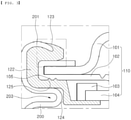
- FIG. 3 is an upper sectional view of the cylindrical secondary battery including the gasket according to the present invention after being assembled
- FIG. 4 is an enlarged sectional view of the extension portion of the gasket according to the present invention.
- An upper part 201 of the battery case 200 is bent in the direction toward the central part of the battery case through a crimping process and thus is deformed into a structure configured to wrap the upper part of the gasket and the upper surface of the outer circumference of the cap assembly, and a distal end 202 of the upper part 201 of the deformed battery case 200 is received in the reception portion 126 of the gasket defined by the extension portion 123.
- the length of the extension portion 123 is not particularly restricted but is a length sufficient to wrap a non-coating portion 201a, from which an anticorrosive layer is removed, formed at the upper part of the battery case.
- the non-coating portion 201a, from which the anticorrosive layer is removed, is not formed at the distal end but is pushed from the upper part of the battery case toward an outer or inner lower end portion due to deformation of a metal during manufacture of the battery case.
- the present invention is capable of solving this problem through recognition of the fact that the non-coating portion is pushed.
- the extension portion 123 is located at the outer surface of the upper part of the battery case, however, the extension portion may be formed so as to have a length that does not extend to the maximum upper protrusion of the crimping portion of the battery case in order to prevent an increase in total length of the cylindrical battery.
- the outermost radius a1 of the extension portion may be formed so as to be less than the inner radius a2 of the crimping portion.
- the protrusion structure 125 of the gasket is inserted into the concave portion 105 of the safety vent, whereby it is possible to provide a structure capable of achieving stable fixing therebetween.
- the battery case 200 is formed in a structure having the beading portion 203, wherein the lower end portion 124 of the gasket is located between the beading portion 203 and the cap assembly 110 in order to prevent contact therebetween.
- the extension portion 123 is located at the outer surface of the battery case 200 so as to be in tight contact with the battery case 200.
- the distance b1 between the crimping portion 122 and the distal end of the extension portion 123 of the gasket may be equal to the thickness b2 of the upper part of the battery case.
- the gasket may be made of an elastic member, wherein the distance b1 between the crimping portion 122 and the distal end of the extension portion 123 may be less than the thickness b2 of the upper part of the battery case.
- the reception portion 126 may be deformed so as to stretch such that the upper part of the battery case is seated therein.
- the reception portion 126 may have a structure inclined downwards in the direction toward the center of the battery case. Even in the case in which force returning the upper part of the battery case to the state before the upper part of the battery case is crimped is applied to the crimped upper part of the battery case due to a rollback phenomenon, therefore, it is possible to minimize exposure of the non-coating portion and, as an additional effect, to stably maintain sealing of the battery case.
- the present invention may provide a battery pack configured such that cylindrical batteries, each of which has the above structure, are connected to each other in series and/or in parallel, and may provide a battery pack having high output, high capacity, and improved safety.
- the present invention has a structure in which a reception portion configured to receive the distal end of the upper part of a battery case is formed in a crimping portion of a gasket, whereby it is possible to prevent corrosion of an iron (Fe) exposure portion, as a nickel(Ni) plating rupture portion, which inevitably occurs at the distal end of the upper part of the battery case during a manufacturing process of the battery case.
- an extension portion of the gasket is formed so as to have a structure inclined downwards in the direction toward the center of the battery case, whereby it is possible to prevent the distal end of the upper part of the battery case from being separated from the reception portion of the gasket due to rollback of the crimping portion.
- the length of the extension portion of the gasket is limited to a predetermined range, whereby it is possible to prevent an increase in total size of a cylindrical secondary battery even in the case in which the extension portion is formed.
Landscapes
- Chemical & Material Sciences (AREA)
- Chemical Kinetics & Catalysis (AREA)
- Electrochemistry (AREA)
- General Chemical & Material Sciences (AREA)
- Sealing Battery Cases Or Jackets (AREA)
- Gas Exhaust Devices For Batteries (AREA)
- Connection Of Batteries Or Terminals (AREA)
Abstract
Description
- This application claims the benefit of priority to
Korean Patent Application No. 2019-0053969 filed on May 8, 2019 - The present invention relates to a gasket for cylindrical batteries configured to prevent corrosion of a battery case and a cylindrical battery including the same, and more particularly to a gasket for cylindrical batteries having a structure configured to wrap the upper part of a cylindrical battery case, from which an anticorrosive layer is removed, in order to prevent corrosion of the battery case and a cylindrical battery including the same.
- With an increasing trend of mobile devices including mobile phones, earphones and cleaners, most of which are wired products, also have been manufactured as wireless products. A lithium secondary battery having high energy density, high operating voltage, and excellent lifespan characteristics has been widely used as an energy source that is applied to wireless products.
- Depending on the shape of a battery case, the lithium secondary battery is classified as a cylindrical secondary battery, configured such that an electrode assembly is mounted in a cylindrical metal can, a prismatic secondary battery, configured such that an electrode assembly is mounted in a prismatic metal can, or a pouch-shaped secondary battery, configured such that an electrode assembly is mounted in a pouch case made of an aluminum laminate sheet. Thereamong, the cylindrical secondary battery has advantages in that the cylindrical secondary battery has a relatively large capacity and is structurally stable.
- In the cylindrical secondary battery, a steel plate made of an iron (Fe) material coated with nickel or the like is used as the battery case in order to prevent corrosion of the battery case, and a process of cutting a cylindrical battery case portion from the steel plate, which is the basic material, is performed after a forming process, such as deep drawing.
- At this time, the cut surface of the battery case is a portion at which no nickel coating layer is formed, and therefore the section of the iron material is exposed. The cut surface is still exposed even after a crimping process, whereby the cut surface may rust or corrode.
- Patent Document 1 relates to a secondary battery including a battery can configured to receive the electrode assembly without provision of a beading portion and a cap assembly coupled to an open end of the battery can.
- In Patent Document 1, a cap cover having a structure configured to wrap the upper part of the edge of the cap assembly and the upper part of the battery can is used, wherein it is possible to prevent exposure of the battery case using the cap cover, but a structure in which the upper part of the battery case is deformed is used in order to fix the cap cover. In the case in which the upper part of the battery case is deformed, as described above, an additional process is required, and therefore a battery manufacturing process is complicated.
- Patent Document 2 relates to a cylindrical battery to which a vaporizable anticorrosive agent including a polymer resin and a sodium nitrate-based material and an anticorrosive gasket including a base resin are applied.
- Patent Document 2 discloses a method in which a material in the anticorrosive gasket reacts with moisture to generate a nitrogen oxide, and the nitrogen oxide oxidizes the surface of a cylindrical can, whereby it is possible to prevent corrosion of a crimping portion even under high-temperature, high-humidity conditions.
- Patent Document 3 relates to a cylindrical battery including a gasket having a first part including an insertion recess, to which the end of a cylindrical case is fixed by insertion, and a second part extending from the first part to the interior of the case in order to support a cap assembly.
- In Patent Document 3, the gasket having the insertion recess, into which the end of the battery case is inserted, is used; however, the gasket is applied to a cylindrical battery having no beading portion and no crimping portion formed thereat, and has a structure in which the distal end of the battery case is inserted into the first part before the crimping portion of the battery case is formed.
- Therefore, there is a high necessity for a gasket for cylindrical secondary batteries having a crimping structure, wherein the gasket is configured to have a structure capable of preventing corrosion of a battery case even in the case in which nickel coating is removed from the distal end of the upper part of the battery case and thus an exposed portion is formed.
-
-
Korean Patent Application Publication No. 2012-0047114 -
Korean Patent Application Publication No. 2018-0127938 (2018.11.30 -
Korean Patent Application Publication No. 1998-030967 (1998.07.25 - The present invention has been made in view of the above problems, and it is an object of the present invention to provide a gasket for cylindrical batteries having a structure configured to wrap the distal end of a battery case, from which an anticorrosive coating is easily removed, in order to prevent corrosion of the battery case and a cylindrical battery including the same.
- In order to accomplish the above object, the present invention may provide a doughnut-shaped gasket for cylindrical batteries including a supporting portion constituting the lower part of the gasket, the supporting portion being configured to support a cap assembly, and a crimping portion constituting the side part of the gasket, the crimping portion extending upwards from the outside of the supporting portion, wherein an extension portion is formed at the outside of the distal end of the crimping portion so as to extend downwards.
- A protrusion structure may be formed at the upper surface of the supporting portion.
- The outermost radius of the extension portion may be less than the inner radius of the crimping portion in the state in which the crimping portion is deformed in order to assemble a cylindrical battery.
- The gasket for cylindrical batteries may further include a lower end portion formed at the inside of the supporting portion so as to extend downwards.
- In addition, the present invention may provide a cylindrical battery including the gasket for cylindrical batteries, wherein the cylindrical battery includes a cylindrical battery case having an electrode assembly received therein, a cap assembly mounted in an open part of the cylindrical battery case, and the gasket for cylindrical batteries interposed between the cylindrical battery case and the cap assembly, and wherein the upper part of the cylindrical battery case wraps the outer circumference of the cap assembly and is bent toward the central part of the cylindrical battery case, and the distal end of the upper part of the cylindrical battery case is received in a reception portion defined by the extension portion of the gasket for cylindrical batteries.
- The distance between the crimping portion and the distal end of the extension portion may be equal to or less than the thickness of the upper part of the battery case.
- The reception portion may have a structure inclined downwards in the direction toward the center of the battery case in the state in which the cylindrical battery is coupled.
- The extension portion may be formed in a shape in which the thickness of the extension portion gradually decreases from the proximal end of the extension portion to the distal end of the extension portion.
- A non-coating portion, from which an anticorrosive layer is removed, may be formed on at least a portion of the upper part of the battery case, and the extension portion may have a structure configured to wrap the non-coating portion.
- The cap assembly may include a top cap and a safety vent, a concave portion may be formed in the lower surface of the safety vent, and the concave portion may be located so as to engage with a protrusion structure formed at an upper surface of the supporting portion of the gasket for cylindrical batteries, whereby the safety vent and the gasket for cylindrical batteries may be coupled to each other.
- The battery case may include a beading portion configured to support the cap assembly and the gasket for cylindrical batteries, and a lower end portion formed at an inside of the supporting portion of the gasket for cylindrical batteries so as to extend downwards may be located between the beading portion and the cap assembly.
- The cap assembly may further include a current interrupt device coupled to the lower surface of the safety vent, and the lower end portion of the gasket may include a structure extending in the direction toward the center of the gasket so as to support the current interrupt device.
- The present invention may provide a battery pack including the cylindrical battery.
-
-
FIG. 1 is an upper sectional view of a cylindrical secondary battery including a gasket according to the present invention before being assembled. -
FIG. 2 is a partial cutaway perspective view of the gasket according to the present invention. -
FIG. 3 is an upper sectional view of the cylindrical secondary battery including the gasket according to the present invention after being assembled. -
FIG. 4 is an enlarged sectional view of an extension portion of the gasket according to the present invention. - Now, embodiments of the present invention will be described in detail with reference to the accompanying drawings such that the present invention can be easily implemented by a person having ordinary skill in the art to which the present invention pertains. In describing the principle of operation of preferred embodiments of the present invention in detail, however, a detailed description of known functions and configurations incorporated herein will be omitted when the same may obscure the subject matter of the present invention.
- In addition, the same reference numbers will be used throughout the drawings to refer to parts that perform similar functions or operations. In the case in which one part is said to be connected to another part in the specification, not only may the one part be directly connected to the other part, but also, the one part may be indirectly connected to the other part via a further part. In addition, that a certain element is included does not mean that other elements are excluded, but means that such elements may be further included unless mentioned otherwise.
- In the present invention, the structure of a gasket, which is a sealing member of a cylindrical battery, is deformed in order to prevent corrosion of a battery case of the cylindrical battery.
- In general, a steel plate having a nickel coating layer formed on the surface thereof is used in order to prevent corrosion of a cylindrical battery. The steel plate is deep drawn so as to be formed into the shape of a battery case, and the formed portion is cut from the steel plate in order to be used as a battery case.
- At this time, the cut surface of the battery case is a portion at which no nickel coating layer is formed, and the cut surface may rust or corrode when exposed to the air.
- Therefore, the present invention solves the above problem by applying a new structure to a gasket used as a sealing member of the cylindrical battery. That is, the structure of the gasket is changed such that the gasket wraps the distal end of the upper part of the battery case at which no nickel coating layer is formed.
- In connection therewith,
FIG. 1 is an upper sectional view of a cylindrical secondary battery including a gasket according to the present invention before being assembled, andFIG. 2 is a partial cutaway perspective view of the gasket according to the present invention. - Referring to
FIGS. 1 and2 , acap assembly 110 includes atop cap 101 having a protruding structure functioning as a positive electrode terminal, asafety vent 102 located at the lower part of thetop cap 101 while wrapping the outer circumference of thetop cap 101, acurrent interrupt device 104 disposed so as to contact the lower surface of thesafety vent 102, and aCID gasket 103 configured to prevent contact between thecurrent interrupt device 104 and the outer circumference of thesafety vent 102. - The gasket, which is used to provide insulation between the
cap assembly 110 and a battery case and to seal the battery case, includes a supportingportion 121 configured to support the cap assembly, a crimpingportion 122 extending upwards from the outside of the supportingportion 121, and anextension portion 123 is formed at the outside of the distal end of the crimpingportion 122 so as to extend downwards. - The gasket further includes a
lower end portion 124 formed at the inside of the supportingportion 121 so as to extend downwards, and thelower end portion 124 includes a structure extending further in the direction toward the center of the gasket so as to support thecurrent interrupt device 104 and theCID gasket 103 configured to provide insulation between thecurrent interrupt device 104 and thesafety vent 102. - The
safety vent 102 has aconcave portion 105 formed in the lower surface thereof, and aprotrusion structure 125 is formed at the upper surface of the supportingportion 121. Theprotrusion structure 125 may be inserted into theconcave portion 105, whereby the cap assembly, including the safety vent, may be stably coupled to the gasket, and the cap assembly may be fixed in position through coupling therebetween. - Although the
protrusion structure 125 is shown as being a two-line ring-shaped structure, one or more protrusions spaced apart from each other may be continuously or non-continuously formed. - The
extension portion 123 defines areception portion 126 configured to receive the distal end of the battery case, and is formed in a shape in which the thickness of theextension portion 123 gradually decreases from aproximal end 123a of the extension portion to adistal end 123b of the extension portion, whereby thedistal end 123b of the extension portion may more tightly contact the battery case in the state in which the battery case is received in thereception portion 126. -
FIG. 3 is an upper sectional view of the cylindrical secondary battery including the gasket according to the present invention after being assembled, andFIG. 4 is an enlarged sectional view of the extension portion of the gasket according to the present invention. Referring toFIGS. 3 and4 , the state in which the gasket and thecap assembly 110 ofFIGS. 1 and2 are received in abattery case 200 of the cylindrical battery ofFIG. 3 so as to be sealed is shown. - An
upper part 201 of thebattery case 200 is bent in the direction toward the central part of the battery case through a crimping process and thus is deformed into a structure configured to wrap the upper part of the gasket and the upper surface of the outer circumference of the cap assembly, and adistal end 202 of theupper part 201 of thedeformed battery case 200 is received in thereception portion 126 of the gasket defined by theextension portion 123. - The length of the
extension portion 123 is not particularly restricted but is a length sufficient to wrap anon-coating portion 201a, from which an anticorrosive layer is removed, formed at the upper part of the battery case. Thenon-coating portion 201a, from which the anticorrosive layer is removed, is not formed at the distal end but is pushed from the upper part of the battery case toward an outer or inner lower end portion due to deformation of a metal during manufacture of the battery case. Conventionally, design is conducted based on an expectation that corrosion will be prevented through contact between the distal end portion and the gasket on the assumption that the non-coating portion is formed at the distal end portion without minimum recognition thereabout, whereby it is not possible to prevent continuous corrosion at the non-coating portion pushed from the upper part of the case toward the outer or inner lower end portion. - Particularly, in the case in which a battery is exposed to the outside, it is very important to prevent corrosion of the battery caused by condensation of vapor due to a change in atmospheric temperature, contamination due to rain or snow, and the like. However, corrosion continuously occurs as the result of failure to recognize such a minute difference, and such a problem is still not solved. In contrast, the present invention is capable of solving this problem through recognition of the fact that the non-coating portion is pushed.
- In consideration of the fact that the
extension portion 123 is located at the outer surface of the upper part of the battery case, however, the extension portion may be formed so as to have a length that does not extend to the maximum upper protrusion of the crimping portion of the battery case in order to prevent an increase in total length of the cylindrical battery. - Specifically, referring to
FIG. 4 , the outermost radius a1 of the extension portion may be formed so as to be less than the inner radius a2 of the crimping portion. - In addition, a structure in which the thickness of the extension portion decreases in the direction toward the distal end thereof is applied in order to prevent an increase in total length of the cylindrical battery due to addition of the extension portion.
- When the gasket and the
cap assembly 110 come into tight contact with each other in the state in which the crimpingportion 122 and abeading portion 203 are formed after thecap assembly 110 and the gasket are received in thebattery case 200, theprotrusion structure 125 of the gasket is inserted into theconcave portion 105 of the safety vent, whereby it is possible to provide a structure capable of achieving stable fixing therebetween. - The
battery case 200 is formed in a structure having thebeading portion 203, wherein thelower end portion 124 of the gasket is located between thebeading portion 203 and thecap assembly 110 in order to prevent contact therebetween. - Preferably, the
extension portion 123 is located at the outer surface of thebattery case 200 so as to be in tight contact with thebattery case 200. The distance b1 between the crimpingportion 122 and the distal end of theextension portion 123 of the gasket may be equal to the thickness b2 of the upper part of the battery case. - Alternatively, the gasket may be made of an elastic member, wherein the distance b1 between the crimping
portion 122 and the distal end of theextension portion 123 may be less than the thickness b2 of the upper part of the battery case. When the upper part of thebattery case 200 is inserted into thereception portion 126, thereception portion 126 may be deformed so as to stretch such that the upper part of the battery case is seated therein. - Meanwhile, the
reception portion 126 may have a structure inclined downwards in the direction toward the center of the battery case. Even in the case in which force returning the upper part of the battery case to the state before the upper part of the battery case is crimped is applied to the crimped upper part of the battery case due to a rollback phenomenon, therefore, it is possible to minimize exposure of the non-coating portion and, as an additional effect, to stably maintain sealing of the battery case. - In addition, the present invention may provide a battery pack configured such that cylindrical batteries, each of which has the above structure, are connected to each other in series and/or in parallel, and may provide a battery pack having high output, high capacity, and improved safety.
- Those skilled in the art to which the present invention pertains will appreciate that various applications and modifications are possible based on the above description, without departing from the scope of the present invention.
-
- 101:
- Top cap
- 102:
- Safety vent
- 103:
- CID gasket
- 104:
- Current interrupt device
- 105:
- Concave portion
- 110:
- Cap assembly
- 121:
- Supporting portion
- 122:
- Crimping portion
- 123:
- Extension portion
- 123a:
- Proximal end of extension portion
- 123b:
- Distal end of extension portion
- 124:
- Lower end portion
- 125:
- Protrusion structure
- 126:
- Reception portion
- 200:
- Battery case
- 201:
- Upper part of battery case
- 201a:
- Non-coating portion
- 202:
- Distal end of upper part of battery case
- 203:
- Beading portion
- a1:
- Outermost radius of extension portion
- a2:
- Inner radius of crimping portion
- b1:
- Distance between crimping portion and distal end of extension portion
- b2:
- Thickness of upper part of battery case
- As is apparent from the above description, the present invention has a structure in which a reception portion configured to receive the distal end of the upper part of a battery case is formed in a crimping portion of a gasket, whereby it is possible to prevent corrosion of an iron (Fe) exposure portion, as a nickel(Ni) plating rupture portion, which inevitably occurs at the distal end of the upper part of the battery case during a manufacturing process of the battery case.
- In addition, an extension portion of the gasket is formed so as to have a structure inclined downwards in the direction toward the center of the battery case, whereby it is possible to prevent the distal end of the upper part of the battery case from being separated from the reception portion of the gasket due to rollback of the crimping portion.
- In addition, the length of the extension portion of the gasket is limited to a predetermined range, whereby it is possible to prevent an increase in total size of a cylindrical secondary battery even in the case in which the extension portion is formed.
Claims (13)
- A doughnut-shaped gasket for cylindrical batteries comprising:a supporting portion constituting a lower part of the gasket, the supporting portion being configured to support a cap assembly; anda crimping portion constituting a side part of the gasket, the crimping portion extending upwards from an outside of the supporting portion, whereinan extension portion is formed at an outside of a distal end of the crimping portion so as to extend downwards.
- The gasket for cylindrical batteries according to claim 1, wherein a protrusion structure is formed at an upper surface of the supporting portion.
- The gasket for cylindrical batteries according to claim 1, wherein an outermost radius of the extension portion is less than an inner radius of the crimping portion in a state in which the crimping portion is deformed in order to assemble a cylindrical battery.
- The gasket for cylindrical batteries according to claim 1, further comprising a lower end portion formed at an inside of the supporting portion so as to extend downwards.
- A cylindrical battery comprising:a cylindrical battery case having an electrode assembly received therein;a cap assembly mounted in an open part of the cylindrical battery case; andthe gasket for cylindrical batteries according to any one of claims 1 to 4, the gasket for cylindrical batteries being interposed between the cylindrical battery case and the cap assembly, whereinan upper part of the cylindrical battery case wraps around an outer circumference of the cap assembly and is bent toward a central part of the cylindrical battery case, anda distal end of the upper part of the cylindrical battery case is received in a reception portion defined by the extension portion of the gasket for cylindrical batteries.
- The cylindrical battery according to claim 5, wherein a distance between the crimping portion and the distal end of the extension portion is equal to or less than a thickness of the upper part of the battery case.
- The cylindrical battery according to claim 5, wherein the reception portion has a structure inclined downwards in a direction toward a center of the battery case in a state in which the cylindrical battery is coupled.
- The cylindrical battery according to claim 5, wherein the extension portion is formed in a shape in which a thickness of the extension portion gradually decreases from a proximal end of the extension portion to a distal end of the extension portion.
- The cylindrical battery according to claim 5, whereina non-coating portion, from which an anticorrosive layer is removed, is formed on at least a portion of the upper part of the battery case, andthe extension portion has a structure configured to wrap around the non-coating portion.
- The cylindrical battery according to claim 5, whereinthe cap assembly comprises a top cap and a safety vent,a concave portion is formed in a lower surface of the safety vent, andthe concave portion is located so as to engage with a protrusion structure formed at an upper surface of the supporting portion of the gasket for cylindrical batteries, whereby the safety vent and the gasket for cylindrical batteries are coupled to each other.
- The cylindrical battery according to claim 5, whereinthe battery case comprises a beading portion configured to support the cap assembly and the gasket for cylindrical batteries, anda lower end portion formed at an inside of the supporting portion of the gasket for cylindrical batteries so as to extend downwards is located between the beading portion and the cap assembly.
- The cylindrical battery according to claim 11, whereinthe cap assembly further comprises a current interrupt device coupled to a lower surface of the safety vent, andthe lower end portion of the gasket comprises a structure extending in a direction toward a center of the gasket so as to support the current interrupt device.
- A battery pack comprising the cylindrical battery according to claim 5.
Applications Claiming Priority (2)
| Application Number | Priority Date | Filing Date | Title |
|---|---|---|---|
| KR1020190053969A KR102746304B1 (en) | 2019-05-08 | 2019-05-08 | Gasket for a Cylindrical Battery to Prevent Corrosion of Battery Case and Cylindrical Battery Comprising the Same |
| PCT/KR2020/004670 WO2020226286A1 (en) | 2019-05-08 | 2020-04-07 | Cylindrical battery gasket for preventing corrosion of battery case, and cylindrical battery comprising same |
Publications (2)
| Publication Number | Publication Date |
|---|---|
| EP3951907A1 true EP3951907A1 (en) | 2022-02-09 |
| EP3951907A4 EP3951907A4 (en) | 2022-06-08 |
Family
ID=73051077
Family Applications (1)
| Application Number | Title | Priority Date | Filing Date |
|---|---|---|---|
| EP20801553.7A Pending EP3951907A4 (en) | 2019-05-08 | 2020-04-07 | CYLINDRICAL BATTERY GASKET FOR PREVENTING CORROSION OF A BATTERY HOUSING, AND CYLINDRICAL BATTERY INCLUDING THE SAME |
Country Status (6)
| Country | Link |
|---|---|
| US (1) | US12107282B2 (en) |
| EP (1) | EP3951907A4 (en) |
| JP (1) | JP7207639B2 (en) |
| KR (1) | KR102746304B1 (en) |
| CN (1) | CN113661603B (en) |
| WO (1) | WO2020226286A1 (en) |
Cited By (5)
| Publication number | Priority date | Publication date | Assignee | Title |
|---|---|---|---|---|
| EP4284953A1 (en) * | 2021-02-01 | 2023-12-06 | Novelis, Inc. | High strength, sag resistant aluminum alloys for use as fin stock and methods of making the same |
| EP4468472A1 (en) * | 2023-05-24 | 2024-11-27 | VARTA Microbattery GmbH | Seal, cover assembly, energy storage cell and composite of energy storage cells |
| EP4510325A1 (en) * | 2023-08-14 | 2025-02-19 | Samsung Sdi Co., Ltd. | Secondary battery |
| EP4510324A1 (en) * | 2023-08-14 | 2025-02-19 | Samsung SDI Co., Ltd. | Secondary battery |
| EP4693634A4 (en) * | 2023-03-31 | 2026-06-24 | Panasonic Ip Man Co Ltd | ENERGY STORAGE DEVICE |
Families Citing this family (15)
| Publication number | Priority date | Publication date | Assignee | Title |
|---|---|---|---|---|
| WO2023113436A1 (en) * | 2021-12-13 | 2023-06-22 | 주식회사 엘지에너지솔루션 | Cap assembly, cylindrical secondary battery including same, and method for manufacturing cylindrical secondary battery including same |
| US20250183429A1 (en) * | 2022-03-04 | 2025-06-05 | Panasonic Energy Co., Ltd. | Cylindrical battery |
| EP4391187A4 (en) * | 2022-06-02 | 2025-05-07 | LG Energy Solution, Ltd. | SECONDARY BATTERY |
| CN220627729U (en) | 2022-06-27 | 2024-03-19 | 米沃奇电动工具公司 | Fuses and devices including conductive paths for the passage of electric current |
| US20260237805A1 (en) * | 2022-09-05 | 2026-08-13 | Fdk Corporation | Cylindrical battery gasket, and cylindrical battery provided with said gasket |
| KR102559655B1 (en) * | 2022-09-21 | 2023-07-24 | 삼성에스디아이 주식회사 | Rechargeable battery |
| EP4571964A4 (en) * | 2022-12-13 | 2026-02-11 | Lg Energy Solution Ltd | BATTERY AND BATTERY PACK AND VEHICLE WITH THE BATTERY |
| SE2251551A1 (en) * | 2022-12-22 | 2024-06-23 | Northvolt Ab | A gasket for a cylindrical secondary cell |
| JP2026519586A (en) * | 2023-06-02 | 2026-06-16 | エルジー エナジー ソリューション リミテッド | A printing method for corrosion prevention, and a battery cell manufactured using this method. |
| US20260213386A1 (en) * | 2023-07-24 | 2026-07-23 | Lg Energy Solution, Ltd. | Electrolyte Leakage Prevention O-Ring |
| WO2025204942A1 (en) * | 2024-03-29 | 2025-10-02 | パナソニックIpマネジメント株式会社 | Cylindrical battery |
| WO2025225442A1 (en) * | 2024-04-26 | 2025-10-30 | パナソニックIpマネジメント株式会社 | Battery can and battery using same |
| KR20260031308A (en) * | 2024-08-28 | 2026-03-09 | 삼성에스디아이 주식회사 | Cap assembly, secondary battery including same, and method for manufacturing secondary battery |
| CN119890572B (en) * | 2024-12-09 | 2025-11-14 | 东莞市创明电池技术有限公司 | Sealing rings for power batteries, assembly methods for power batteries, and power batteries |
| CN120691064A (en) * | 2025-06-06 | 2025-09-23 | 厦门新能安科技有限公司 | Cylindrical batteries, battery modules and electrical equipment |
Family Cites Families (40)
| Publication number | Priority date | Publication date | Assignee | Title |
|---|---|---|---|---|
| JPH07320703A (en) | 1994-05-20 | 1995-12-08 | Hitachi Maxell Ltd | Cylindrical manganese battery |
| KR970031053A (en) * | 1995-11-08 | 1997-06-26 | 윤종용 | Cap assembly assembly structure and method of alkaline secondary battery |
| KR19980030967A (en) | 1996-10-30 | 1998-07-25 | 손욱 | Cylindrical Battery and Manufacturing Method Thereof |
| KR19980057861A (en) | 1996-12-30 | 1998-09-25 | 배순훈 | battery |
| US6368745B1 (en) | 2000-06-21 | 2002-04-09 | Eveready Battery Company, Inc. | Battery construction having cover assembly |
| JP3954494B2 (en) | 2000-08-09 | 2007-08-08 | 松下電器産業株式会社 | Coin battery |
| JP3744788B2 (en) | 2000-10-31 | 2006-02-15 | 三洋電機株式会社 | Sealed battery and manufacturing method thereof |
| JP2005026090A (en) | 2003-07-03 | 2005-01-27 | Sii Micro Parts Ltd | Electrochemical cell |
| KR20060037595A (en) * | 2004-10-28 | 2006-05-03 | 삼성에스디아이 주식회사 | Secondary battery |
| WO2006058467A1 (en) | 2004-12-02 | 2006-06-08 | Chung Pak Battery Works Ltd. | A Button-Shaped Alkaline Battery |
| KR100601521B1 (en) | 2005-03-09 | 2006-07-19 | 삼성에스디아이 주식회사 | Lithium secondary battery |
| KR100686827B1 (en) | 2005-07-11 | 2007-02-26 | 삼성에스디아이 주식회사 | Lithium secondary battery |
| KR100760757B1 (en) * | 2005-12-29 | 2007-09-21 | 삼성에스디아이 주식회사 | Lithium secondary battery |
| KR100998847B1 (en) | 2006-10-23 | 2010-12-08 | 주식회사 엘지화학 | Beading prosthetic member and cylindrical battery including the same |
| KR100846955B1 (en) * | 2006-11-30 | 2008-07-17 | 삼성에스디아이 주식회사 | Cylindrical secondary battery |
| KR100966549B1 (en) * | 2008-10-14 | 2010-06-29 | 주식회사 엘지화학 | Cap assembly with improved safety and cylindrical secondary battery containing same |
| US8486546B2 (en) | 2008-12-01 | 2013-07-16 | Samsung Sdi Co., Ltd. | Cap assembly and secondary battery using the same with notched vent member |
| KR101050535B1 (en) | 2008-12-18 | 2011-07-20 | 삼성에스디아이 주식회사 | Cap assembly and secondary battery having the same |
| US9017860B2 (en) * | 2009-02-26 | 2015-04-28 | Samsung Sdi Co., Ltd. | Cylinder type secondary battery |
| WO2011115392A2 (en) | 2010-03-17 | 2011-09-22 | 주식회사 엘지화학 | Secondary battery |
| KR101062685B1 (en) * | 2009-09-30 | 2011-09-06 | 주식회사 엘지화학 | Double sealed cap assembly, and cylindrical secondary battery having the same |
| KR101184970B1 (en) * | 2009-10-13 | 2012-10-02 | 주식회사 엘지화학 | Cap assembly characterized by preventing gasket from drooping, and cylinderical secondary battery comprising the same |
| KR101084209B1 (en) | 2009-10-29 | 2011-11-17 | 삼성에스디아이 주식회사 | Cylindrical rechargeable battery with improved cap up structure |
| KR101097255B1 (en) * | 2009-11-30 | 2011-12-21 | 삼성에스디아이 주식회사 | Secondary battery |
| KR101093924B1 (en) * | 2010-01-11 | 2011-12-13 | 삼성에스디아이 주식회사 | Secondary battery |
| JP5396349B2 (en) * | 2010-08-10 | 2014-01-22 | 日立ビークルエナジー株式会社 | Secondary battery |
| KR101184403B1 (en) * | 2010-10-21 | 2012-09-19 | 주식회사 엘지화학 | Cap assembly and secondary battery using the same |
| KR101511302B1 (en) | 2010-11-03 | 2015-04-10 | 주식회사 엘지화학 | Secondary battery |
| JP2012174523A (en) | 2011-02-22 | 2012-09-10 | Toyota Motor Corp | Cylinder type battery |
| KR101313325B1 (en) | 2011-07-13 | 2013-09-27 | 주식회사 엘지화학 | Cylindrical-type secondary battery |
| KR20160011983A (en) | 2014-07-23 | 2016-02-02 | 주식회사 엘지화학 | Cylindrical battery with improved corrosion resistance and method of making the same |
| KR20160042327A (en) | 2014-10-08 | 2016-04-19 | 상신이디피(주) | The cylindrical can of secondary battery and its manufacturing method |
| KR101948620B1 (en) * | 2015-06-05 | 2019-02-15 | 주식회사 엘지화학 | A cap assembly for a secondary battery |
| KR101947477B1 (en) | 2015-07-21 | 2019-02-13 | 주식회사 엘지화학 | Cap Assembly of Improved Safety and Cylindrical Secondary Battery Comprising the Same |
| KR20170085978A (en) | 2016-01-14 | 2017-07-25 | 신흥에스이씨주식회사 | Cap assembly of excellent electrical safety for a secondary battery and the battery thereof |
| JP2017129153A (en) | 2016-01-18 | 2017-07-27 | 株式会社Fts | Pressure vessel |
| EP3523012A1 (en) | 2016-10-07 | 2019-08-14 | W. L. Gore & Associates, Inc. | Heated moisture pump having a differential valve area |
| KR102063462B1 (en) * | 2016-12-22 | 2020-01-08 | 주식회사 엘지화학 | Device Having Secondary Crimping Mold for Manufacturing Cylindrical Battery Cell |
| CN109952665B (en) | 2017-05-22 | 2022-11-25 | 株式会社Lg新能源 | Cylindrical battery comprising an anti-corrosion gasket |
| WO2018217017A2 (en) | 2017-05-22 | 2018-11-29 | 주식회사 엘지화학 | Cylindrical battery comprising anti-rust gasket |
-
2019
- 2019-05-08 KR KR1020190053969A patent/KR102746304B1/en active Active
-
2020
- 2020-04-07 WO PCT/KR2020/004670 patent/WO2020226286A1/en not_active Ceased
- 2020-04-07 EP EP20801553.7A patent/EP3951907A4/en active Pending
- 2020-04-07 CN CN202080027551.0A patent/CN113661603B/en active Active
- 2020-04-07 JP JP2021563127A patent/JP7207639B2/en active Active
- 2020-04-07 US US17/609,131 patent/US12107282B2/en active Active
Cited By (5)
| Publication number | Priority date | Publication date | Assignee | Title |
|---|---|---|---|---|
| EP4284953A1 (en) * | 2021-02-01 | 2023-12-06 | Novelis, Inc. | High strength, sag resistant aluminum alloys for use as fin stock and methods of making the same |
| EP4693634A4 (en) * | 2023-03-31 | 2026-06-24 | Panasonic Ip Man Co Ltd | ENERGY STORAGE DEVICE |
| EP4468472A1 (en) * | 2023-05-24 | 2024-11-27 | VARTA Microbattery GmbH | Seal, cover assembly, energy storage cell and composite of energy storage cells |
| EP4510325A1 (en) * | 2023-08-14 | 2025-02-19 | Samsung Sdi Co., Ltd. | Secondary battery |
| EP4510324A1 (en) * | 2023-08-14 | 2025-02-19 | Samsung SDI Co., Ltd. | Secondary battery |
Also Published As
| Publication number | Publication date |
|---|---|
| US20220223953A1 (en) | 2022-07-14 |
| WO2020226286A1 (en) | 2020-11-12 |
| US12107282B2 (en) | 2024-10-01 |
| CN113661603B (en) | 2023-09-22 |
| JP7207639B2 (en) | 2023-01-18 |
| KR102746304B1 (en) | 2024-12-26 |
| KR20200129488A (en) | 2020-11-18 |
| EP3951907A4 (en) | 2022-06-08 |
| CN113661603A (en) | 2021-11-16 |
| JP2022531845A (en) | 2022-07-12 |
Similar Documents
| Publication | Publication Date | Title |
|---|---|---|
| US12107282B2 (en) | Gasket for cylindrical batteries configured to prevent corrosion of battery case and cylindrical battery including the same | |
| EP3147987B1 (en) | Secondary battery | |
| EP2104160B1 (en) | Cylindrical secondary battery | |
| EP2696429B1 (en) | Compressible core for a wound electrode assembly | |
| US8062786B2 (en) | Cylindrical secondary battery of improved safety | |
| EP3614451A1 (en) | Secondary battery | |
| EP4343907A1 (en) | Rechargeable battery | |
| CN117855758A (en) | Rechargeable battery | |
| JP2022191525A (en) | Battery can for battery | |
| KR101093401B1 (en) | Cap up plate and cylindrical secondary battery having same | |
| US8642207B2 (en) | Cylindrical secondary battery | |
| US20230238614A1 (en) | Cylindrical secondary battery | |
| US10741821B2 (en) | Secondary battery | |
| EP3958390A1 (en) | Cylindrical secondary battery comprising positive electrode tab fixing member | |
| EP4471946A1 (en) | Rechargeable battery | |
| JP2002324523A (en) | Sealing method for sealed batteries | |
| US12009534B2 (en) | Secondary battery | |
| KR20170047053A (en) | Rechargeable battery | |
| US20260112681A1 (en) | Secondary battery and method for manufacturing the same | |
| JP3631792B2 (en) | Square battery | |
| KR20260049920A (en) | Secondary battery and method for manufacturing same | |
| KR20260038609A (en) | Secondary battery, secondary battery crimping device, and crimping method using the same | |
| KR20260004787A (en) | Secondary battery |
Legal Events
| Date | Code | Title | Description |
|---|---|---|---|
| STAA | Information on the status of an ep patent application or granted ep patent |
Free format text: STATUS: THE INTERNATIONAL PUBLICATION HAS BEEN MADE |
|
| PUAI | Public reference made under article 153(3) epc to a published international application that has entered the european phase |
Free format text: ORIGINAL CODE: 0009012 |
|
| STAA | Information on the status of an ep patent application or granted ep patent |
Free format text: STATUS: REQUEST FOR EXAMINATION WAS MADE |
|
| 17P | Request for examination filed |
Effective date: 20211026 |
|
| AK | Designated contracting states |
Kind code of ref document: A1 Designated state(s): AL AT BE BG CH CY CZ DE DK EE ES FI FR GB GR HR HU IE IS IT LI LT LU LV MC MK MT NL NO PL PT RO RS SE SI SK SM TR |
|
| RAP3 | Party data changed (applicant data changed or rights of an application transferred) |
Owner name: LG ENERGY SOLUTION, LTD. |
|
| A4 | Supplementary search report drawn up and despatched |
Effective date: 20220511 |
|
| RIC1 | Information provided on ipc code assigned before grant |
Ipc: H01M 50/578 20210101ALI20220504BHEP Ipc: H01M 50/30 20210101ALI20220504BHEP Ipc: H01M 50/184 20210101ALI20220504BHEP Ipc: H01M 50/167 20210101ALI20220504BHEP Ipc: H01M 50/152 20210101ALI20220504BHEP Ipc: H01M 50/145 20210101ALI20220504BHEP Ipc: H01M 50/124 20210101ALI20220504BHEP Ipc: H01M 50/107 20210101AFI20220504BHEP |
|
| DAV | Request for validation of the european patent (deleted) | ||
| DAX | Request for extension of the european patent (deleted) | ||
| REG | Reference to a national code |
Ref country code: DE Ref legal event code: R079 Free format text: PREVIOUS MAIN CLASS: H01M0002040000 Ipc: H01M0050107000 |
|
| STAA | Information on the status of an ep patent application or granted ep patent |
Free format text: STATUS: EXAMINATION IS IN PROGRESS |
|
| RIC1 | Information provided on ipc code assigned before grant |
Ipc: H01M 50/107 20210101AFI20250721BHEP Ipc: H01M 50/124 20210101ALI20250721BHEP Ipc: H01M 50/145 20210101ALI20250721BHEP Ipc: H01M 50/147 20210101ALI20250721BHEP Ipc: H01M 50/152 20210101ALI20250721BHEP Ipc: H01M 50/167 20210101ALI20250721BHEP Ipc: H01M 50/184 20210101ALI20250721BHEP Ipc: H01M 50/186 20210101ALI20250721BHEP Ipc: H01M 50/30 20210101ALI20250721BHEP Ipc: H01M 50/574 20210101ALI20250721BHEP Ipc: H01M 50/578 20210101ALI20250721BHEP |
|
| 17Q | First examination report despatched |
Effective date: 20250814 |
|
| GRAJ | Information related to disapproval of communication of intention to grant by the applicant or resumption of examination proceedings by the epo deleted |
Free format text: ORIGINAL CODE: EPIDOSDIGR1 |
|
| GRAP | Despatch of communication of intention to grant a patent |
Free format text: ORIGINAL CODE: EPIDOSNIGR1 |