EP3951590A1 - Migration method and system of virtual machine - Google Patents
Migration method and system of virtual machine Download PDFInfo
- Publication number
- EP3951590A1 EP3951590A1 EP20779006.4A EP20779006A EP3951590A1 EP 3951590 A1 EP3951590 A1 EP 3951590A1 EP 20779006 A EP20779006 A EP 20779006A EP 3951590 A1 EP3951590 A1 EP 3951590A1
- Authority
- EP
- European Patent Office
- Prior art keywords
- processor
- virtual machine
- migration
- video memory
- memory data
- Prior art date
- Legal status (The legal status is an assumption and is not a legal conclusion. Google has not performed a legal analysis and makes no representation as to the accuracy of the status listed.)
- Granted
Links
Images




Classifications
-
- G—PHYSICS
- G06—COMPUTING OR CALCULATING; COUNTING
- G06F—ELECTRIC DIGITAL DATA PROCESSING
- G06F9/00—Arrangements for program control, e.g. control units
- G06F9/06—Arrangements for program control, e.g. control units using stored programs, i.e. using an internal store of processing equipment to receive or retain programs
- G06F9/44—Arrangements for executing specific programs
- G06F9/455—Emulation; Interpretation; Software simulation, e.g. virtualisation or emulation of application or operating system execution engines
- G06F9/45533—Hypervisors; Virtual machine monitors
-
- G—PHYSICS
- G06—COMPUTING OR CALCULATING; COUNTING
- G06T—IMAGE DATA PROCESSING OR GENERATION, IN GENERAL
- G06T1/00—General purpose image data processing
- G06T1/20—Processor architectures; Processor configuration, e.g. pipelining
-
- G—PHYSICS
- G06—COMPUTING OR CALCULATING; COUNTING
- G06F—ELECTRIC DIGITAL DATA PROCESSING
- G06F9/00—Arrangements for program control, e.g. control units
- G06F9/06—Arrangements for program control, e.g. control units using stored programs, i.e. using an internal store of processing equipment to receive or retain programs
- G06F9/44—Arrangements for executing specific programs
- G06F9/455—Emulation; Interpretation; Software simulation, e.g. virtualisation or emulation of application or operating system execution engines
- G06F9/45533—Hypervisors; Virtual machine monitors
- G06F9/45558—Hypervisor-specific management and integration aspects
-
- G—PHYSICS
- G06—COMPUTING OR CALCULATING; COUNTING
- G06F—ELECTRIC DIGITAL DATA PROCESSING
- G06F9/00—Arrangements for program control, e.g. control units
- G06F9/06—Arrangements for program control, e.g. control units using stored programs, i.e. using an internal store of processing equipment to receive or retain programs
- G06F9/46—Multiprogramming arrangements
- G06F9/48—Program initiating; Program switching, e.g. by interrupt
- G06F9/4806—Task transfer initiation or dispatching
- G06F9/4843—Task transfer initiation or dispatching by program, e.g. task dispatcher, supervisor, operating system
- G06F9/485—Task life-cycle, e.g. stopping, restarting, resuming execution
- G06F9/4856—Task life-cycle, e.g. stopping, restarting, resuming execution resumption being on a different machine, e.g. task migration, virtual machine migration
-
- G—PHYSICS
- G06—COMPUTING OR CALCULATING; COUNTING
- G06T—IMAGE DATA PROCESSING OR GENERATION, IN GENERAL
- G06T1/00—General purpose image data processing
- G06T1/60—Memory management
-
- G—PHYSICS
- G06—COMPUTING OR CALCULATING; COUNTING
- G06F—ELECTRIC DIGITAL DATA PROCESSING
- G06F9/00—Arrangements for program control, e.g. control units
- G06F9/06—Arrangements for program control, e.g. control units using stored programs, i.e. using an internal store of processing equipment to receive or retain programs
- G06F9/44—Arrangements for executing specific programs
- G06F9/455—Emulation; Interpretation; Software simulation, e.g. virtualisation or emulation of application or operating system execution engines
- G06F9/45533—Hypervisors; Virtual machine monitors
- G06F9/45558—Hypervisor-specific management and integration aspects
- G06F2009/4557—Distribution of virtual machine instances; Migration and load balancing
Definitions
- the invention relates to the field of computers, and in particular, to virtual machine migration methods and systems.
- NVIDA GPUs are widely used for training and reasoning in the fields of AI, machine learning and the like, and all types of computations of training and reasoning account for more than 80% of consumption of all GPUs.
- a CUDA Computer Unified Device Architecture
- a CUDA Computer Unified Device Architecture
- a CUDA core is a basic operation unit of a GPU, and the GPU is composed of thousands of CUDA cores, which is also called sp (streaming processor). Since GPU pass-through technologies do not perform information interception and rebuild at a host machine end, state information of a CUDA core cannot be known, and therefore a virtual machine cannot be subjected to a live migration. Thus, the following problems still exist when machine learning and other applications are used on public clouds: a virtual machine using a NVIDIA GPU pass-through mode does not have the capability of live migration. This limits operations that rely on live migration capabilities on many public clouds, such as load balancing, active operation and maintenance, hardware replacement and system software updates.
- Embodiments of the invention provide virtual machine migration methods and systems, which at least solve the technical problem that a virtual machine using an NVIDIA GPU pass-through mode fails to perform a live migration between host machines in existing technologies.
- a virtual machine migration method includes: a virtual machine detecting whether a migration instruction is received, wherein the virtual machine runs on a first processor of a first host machine; the virtual machine calling and obtaining video memory data generated in the first processor if the migration instruction is detected; and the virtual machine migrating the video memory data to a second processor of a second host machine.
- a virtual machine migration system includes: a virtual machine running on a first processor of a first host; and a migration module running on the virtual machine and being used for storing video memory data generated by the first processor and migrating the video memory data to a second processor of a second host machine if the migration module receives a migration instruction.
- a virtual machine migration method including: detecting, by a migration module running in a virtual machine, whether a migration instruction is received, wherein the virtual machine runs on a first processor of a first host machine; determining whether the first processor enters a migration state if the migration instruction is detected; and the virtual machine calling and obtaining video memory data generated in the first processor and migrating the video memory data to a second processor of a second host machine if the first processor enters the migration state.
- a storage medium including a stored program, wherein: a device on which the storage medium is located is controlled to perform the following steps when the program is executed: a virtual machine detecting whether a migration instruction is received, wherein the virtual machine runs on a first processor of a first host machine; the virtual machine calling and obtaining video memory data generated in the first processor if the migration instruction is detected; and the virtual machine migrating the video memory data to a second processor of a second host machine.
- a processor is provided, and the processor is configured to execute a program, wherein the program, when running, executes the following steps: a virtual machine detecting whether a migration instruction is received, wherein the virtual machine runs on a first processor of a first host machine; the virtual machine calling and obtaining video memory data generated in the first processor if the migration instruction is detected; and the virtual machine migrating the video memory data to a second processor of a second host machine.
- a virtual machine detects whether a migration instruction is received, wherein the virtual machine runs on a first processor of a first host machine. If the migration instruction is detected, the virtual machine calls and obtains video memory data that is generated in the first processor, and migrates the video memory data to a second processor of a second host machine.
- video memory data of a first processor is stored in a virtual machine through a migration instruction detected by the virtual machine, and the video memory data of the first processor is migrated to a video memory of a second processor by the virtual machine, thus implementing a live migration of virtual machines in different host machines. Therefore, the embodiments of the application solve the technical problem that a virtual machine using a NVIDIA GPU pass-through mode fails to perform a live migration between host machines in the existing technologies.
- an embodiment of a virtual machine migration method is also provided. It needs to be noted that steps illustrated in a flowchart of an accompanying drawing may be performed in a computer system such as a set of computer-executable instructions. Moreover, although a logical order is illustrated in a flowchart, in some cases, illustrated or described steps may be performed in an order different than those described herein.
- FIG. 1 shows a block diagram of a hardware configuration of a computer terminal (or a mobile device) used for implementing a virtual machine migration method.
- a computer terminal 10 (or a mobile device 10) may include one or more (102a, 102b, ising, 102n as shown in the figure) processors 102 (the processors 102 may include, but are not limited to, a processing device, such as a microprocessor MCU or a programmable logic device FPGA, etc.), a memory 104 used for storing data, and a transmission module used for communication functions.
- a processing device such as a microprocessor MCU or a programmable logic device FPGA, etc.
- memory 104 used for storing data
- a transmission module used for communication functions.
- a display an input/output interface (I/O interface), a Universal Serial Bus (USB) port (which may be included as one of the ports of the I/O interface), a network interface, a power source, and/or a camera may also be included.
- I/O interface input/output interface
- USB Universal Serial Bus
- FIG. 1 is only an illustration, and is not intended to limit the structure of the above electronic device.
- the computer terminal 10 may also include more or fewer components than those shown in FIG. 1 , or have a configuration different than that shown in FIG. 1 .
- the one or more processors 102 and/or other data processing circuits described above may be referred to generally herein as "data processing circuits".
- the data processing circuits may be embodied in whole or in part in software, hardware, firmware, or any combination thereof. Further, the data processing circuits may be a single stand-alone processing module, or incorporated in whole or in part into any of the other elements in the computer terminal 10 (or the mobile device). As involved in the embodiments of the application, the data processing circuits act as a processor control (e.g. a selection of a variable resistance terminal path connected to an interface).
- the memory 104 may be used to store software programs and modules of application software, such as program instructions/data storage devices corresponding to the methods in the embodiments of the present invention.
- the processor 102 executes various types of functional applications and data processing by running the software programs and modules stored in the memory 104, i.e., implementing the virtual machine migration methods described above.
- the memory 104 may include high speed random access memory, and may also include non-volatile memory, such as one or more magnetic storage devices, flash memory, or other non-volatile solid-state storage devices.
- the memory 104 may further include storage devices located remotely from the processor 102. These storage devices may be connected to the computer terminal 10 via a network. Examples of such network include, but are not limited to, the internet, an intranet, a local area network, a mobile communication network, and a combination thereof.
- the transmission device is used for receiving or transmitting data via a network.
- the network may include a wireless network provided by a communication provider of the computer terminal 10.
- the transmission device 106 includes a network adapter (NIC) that can be connected to other network devices through a base station to communicate with the internet.
- the transmission device 106 can be a radio frequency (RF) module, which is used to communicate with the internet wirelessly.
- NIC network adapter
- RF radio frequency
- the display may be, for example, a touch-screen-type liquid crystal display (LCD) that may enable a user to interact with a user interface of the computer terminal 10 (or the mobile device).
- LCD liquid crystal display
- the computer device (or the mobile device) shown in FIG. 1 described above may include hardware elements (including circuits), software elements (including computer codes stored on a computer-readable medium), or a combination of both hardware and software elements.
- FIG. 1 is only an example of a particular specific embodiment, and is intended to illustrate types of components that may be present in a computer device (or a mobile device) as described above.
- FIG. 2 is a flowchart of a method for a live migration of a virtual machine according to the first embodiment of the present application.
- a virtual machine detects whether a migration instruction is received, wherein the virtual machine runs on a first processor of a first host machine.
- the virtual machine runs on a first host machine
- a first processor in the first host machine may be a GPU in a pass-through mode, and provides services to the virtual machine in the pass-through mode.
- a GPU pass-through mode By adopting a GPU pass-through mode, an overhead of an abstraction layer caused by a GPU sharing mode can be avoided, and the performance of delivery is similar to that of a special desktop.
- a migration module is disposed in the virtual machine, and the migration module in the virtual machine detects a migration instruction sent by a console. After receiving the migration instruction sent by the console, the migration module starts to perform migration of the virtual machine.
- the virtual machine calls and obtains video memory data generated in the first processor.
- the video memory data generated by the first processor includes an operation result obtained when the first processor operates task(s) of the virtual machine.
- the first processor is a GPU
- AI application(s) is/are run on the virtual machine, and is/are processed by a plurality of processing units (CUDA cores) that are included in the GPU.
- the processing units execute task(s) of the AI application(s), and store a running result in a video memory of the GPU.
- the migration module includes a save/restore unit. After receiving the migration instruction, the migration module obtains video memory data that is generated by the first processor for executing the task(s) of the virtual machine from the video memory of the first processor, and stores the obtained video memory data in the save/restore unit of the migration module.
- the virtual machine migrates the video memory data into a second processor of a second host machine.
- the video memory data is moved to a second processor of a second host machine by the migration module in the virtual machine.
- the second host machine is a destination host, i.e. a host indicated in the migration instruction.
- the second processor may still be a GPU in the pass-through mode. After the virtual machine migrates the video memory data into the second processor, the virtual machine may continue to operate with the support of the second processor according to the migrated video memory data, thereby completing a live migration of the virtual machine from the first host machine to the second host machine.
- FIG. 3 is a schematic diagram of a live migration method of a virtual machine according to the first embodiment of the present application.
- an AI task (workload) of an AI application is running on a virtual machine VM.
- the virtual machine VM runs on a first host machine.
- the first host machine includes a host machine virtualization management component 1 (hypervisor1) and a GPU1.
- the GPU1 executes the AI task in the VM in a pass-through mode under the support of the host machine virtualization management component 1 and a GPU driver in the virtual machine.
- a CUMA (a migration assist module) module is deployed in the virtual machine, i.e., the migration module is configured to receive a migration instruction sent by a console.
- the migration instruction instructs the virtual machine to migrate to a second host machine.
- the second host machine includes a host machine virtualization management component 2 (hypervisor1) and a GPU2.
- the migration module fetches memory data that is generated by the GPU1 for executing the task of the virtual machine from the memory of the GPU1, and stores the memory data in the CUMA (3.1).
- the migration module migrates the video memory data to the second host machine, and writes the video memory data into the video memory of the GPU2 of the second host machine (3.2), thereby completing the migration of the virtual machine.
- a virtual machine detects whether a migration instruction is received, where the virtual machine runs on a first processor of a first host machine. If the migration instruction is detected, the virtual machine calls and obtains video memory data generated in the first processor. The virtual machine migrates the video memory data to a second processor of a second host machine. According to the solution, through the migration instruction detected by the virtual machine, the video memory data of the first processor is stored in the virtual machine, and the video memory data of the first processor is migrated by the virtual machine to the video memory of the second processor, thus realizing a live migration of the virtual machine between different host machines.
- the embodiments of the application solve the technical problem that a virtual machine using a NVIDIA GPU pass-through mode fails to perform a live migration between host machines in the existing technologies.
- whether a migration instruction is received is detected by a migration module running on the virtual machine. If the migration module detects the migration instruction, the migration module controls processing unit(s) in the first processor to suspend receiving new tasks, and/or release the video memory of the first processor.
- the processing unit(s) in the first processor need(s) to be controlled to suspend receiving new tasks, and release the video memory in the first processor.
- the migration module of the virtual machine includes a control unit. After receiving the migration instruction, the control unit controls all processing units in the first processor to suspend receiving new tasks, and releases the video memory of the first processor, thereby starting to perform migration of the virtual machine.
- the method further includes: the migration module determining whether all processing units in the first processor finish executing; and entering the step of storing the video memory data generated by the first processor if all the processing units in the first processor finish executing.
- the step of storing the video memory data of the first processor can be executed only after all the processing units in the first processor finish executing.
- the migration module further includes a tracking unit.
- the control unit of the migration module receives the migration instruction, controls all the processing units to suspend receiving new tasks, and release the video memory of the first processor
- the tracking unit tracks a running state of each processing unit in the first processor to determine whether all the processing units in the first processor run results, and starts to store the video memory data of the first processor after all the processing units in the first processor finish executing.
- the processing units of the first processor are first stopped from receiving new tasks, and then the video memory data of the first processor is stored after determining that all the processing units finish executing.
- all computational results that are obtained by the first processor for operating the tasks of the virtual machine can be migrated to the second host machine, and the virtual machine can smoothly continue to run after being migrated to the second host machine.
- the migration module determining whether all the processing units in the first processor finish executing includes: the migration module intercepting a first preset interface of each processing unit in a first image processing unit to obtain task execution information, wherein the first preset interface includes at least: a calling interface and an execution interface, and the task execution information includes at least information used for indicating the processing unit to finish executing; and the migration module determining whether each processing unit in the first processor finish executing according to the task execution information.
- the first preset interface may include a scheduling API and an execution API
- the AI application running on the virtual machine sends task execution information to the first processor by calling the scheduling API and the execution API.
- the migration module intercepts the task execution information and determines whether all the processing units of the first processor have finished operations according to the task execution information.
- the migration module further includes an interception unit.
- the interception unit is configured to intercept a calling interface and an execution interface of a processing unit to obtain task execution information of an AI application.
- the migration module further includes a tracking unit.
- the interception unit sends the intercepted task execution information to the tracking unit, and the tracking unit determines whether all the processing units in the first processor finish executing according to the task execution information.
- the first preset interface may include: cudaSetDevice, cudaStreamCreate, cudaLaunchHostFunc, cudaLaunchKernel, cudaStreamSynchronize, and cudaSetKernel.
- the method further includes: the migration module intercepting a second preset interface of a first image processing unit and obtaining video memory information, wherein the second preset interface includes at least a video memory allocation interface, and the video memory information includes at least a video memory amount and a storage position used by an application program; and the migration module storing the video memory information.
- the video memory information includes a video memory amount and a storage location corresponding to running data of an AI application, and is used for restoring the video memory data.
- the video memory of the entire processor is up to 16G, but a currently operating AI application only uses a part of the video memory amount, so the video memory data needs to be migrated to a specified location in the video memory of the second processor according to the video memory information stored in the migration module when the video memory data is migrated to the video memory of the second processor.
- the interception unit in the migration module may intercept the video memory allocation interface (e.g., cudaMalloc and cudafree) and obtain the video memory information, and the tracking unit performs monitoring of the video memory of the first processor according to the video memory information to determine a video memory size and a video memory location occupied by the current AI application for restoring the video memory data.
- the video memory allocation interface e.g., cudaMalloc and cudafree
- all interface calling information except for the first preset interface and the second preset interface is directly transferred to a real processing unit runtime resource library (a CUDA runtime library) for execution, to ensure the performance of the first processor.
- a CUDA runtime library a real processing unit runtime resource library
- calling information including the task execution information and the video memory information
- the tracking unit transfers the calling information of the first preset interface and the second preset interface to a real interface (CUDA API) of a processing unit for execution.
- the tracking unit determines whether all the processing units in the first processing finish executing according to the calling information, and obtains the video memory information corresponding to the AI application program.
- the method further includes: the migration module restoring the video memory data in the video memory of the second processor according to the video memory information.
- the video memory data needs to be restored in the video memory of the second processor according to the video memory information, so that the virtual machine can continue to operate on the second host machine according to the restored video memory data, thereby completing the live migration of the virtual machine.
- the restoration of the video memory data may be performed by the save/restore unit in the migration module.
- the save/restore unit restores the video memory data to the video memory of the second processor according to the size and the storage position of the data recorded in the video memory information.
- the method before the virtual machine migrates the video memory data to the second processor of the second host machine, the method further includes: the migration module triggering the virtual machine to unload an image processor driver and triggering a host machine virtualization management component of the first processor to detach an image processor hardware component.
- the method further includes: the migration module triggering a host virtualization management component of the second processor to attach an image processor hardware component and triggering the virtual machine to load an image processor driver.
- a GPU driver of the virtual machine needs to be unloaded, and an image processor hardware component needs to be detached.
- the virtual machine needs to be restarted, and an image processor hardware component needs to be attached, and then a virtual machine driver is reloaded, so that the virtual machine can be re-run on the second host machine.
- FIG. 4 is a schematic diagram of a control unit that executes migration according to the first embodiment of the present application.
- a first processor is still taken as a GPU as an example, and a control unit in a migration module may execute the following steps during a migration process:
- FIG. 5 is a schematic diagram of a virtual machine migration system according to a second embodiment of the present application. As shown in the drawing, the system includes: a virtual machine 50, running on a first processor 60 of a first host machine.
- the virtual machine runs on the first host machine
- the first processor in the first host may be a GPU in a pass-through mode, and provide services to the virtual machine in the pass-through mode.
- a GPU pass-through mode By adopting a GPU pass-through mode, an overhead of an abstraction layer caused by a GPU sharing mode can be avoided, and the delivery performance is similar to that of a special desktop.
- a migration module is deployed in the virtual machine, and the migration module in the virtual machine detects a migration instruction sent by a console. After receiving the migration instruction sent by the console, the migration module starts to migrate the virtual machine.
- a migration module 51 running on the virtual machine, and configured to store video memory data generated by the first processor and migrate the video memory data to a second processor 70 of a second host machine if the migration module receives a migration instruction.
- the video memory data generated by the first processor includes an operation result obtained when the first processor operates a task of the virtual machine.
- the first processor is a GPU.
- AI application(s) is/are run on the virtual machine, and is/are processed by a plurality of processing units (CUDA cores) included in the GPU.
- the processing units execute tasks of the AI application(s) and store a running result in a video memory of the GPU.
- the migration module after the migration module receives a migration instruction, the migration module obtains video memory data that is generated by the first processor for executing task(s) of the virtual machine from a video memory of the first processor, and stores the obtained video memory data in a save/restore unit of the migration module.
- the video memory data is migrated to a second processor of a second host machine by the migration module in the virtual machine.
- the second host machine is a destination host, i.e. a host indicated in the migration instruction.
- the second processor may still be a GPU in a pass-through mode. After the virtual machine migrates the video memory data into the second processor, the virtual machine may continue to operate with the support of the second processor according to the migrated video memory data, thereby completing a live migration of the virtual machine from the first host machine to the second host machine.
- FIG. 3 is a schematic diagram of a live migration method of a virtual machine according to the first embodiment of the present application.
- an AI task (workload) of an AI application is running on a virtual machine VM.
- the virtual machine VM runs on a first host machine.
- the first host machine includes a host machine virtualization management component 1 (hypervisor1) and a GPU1.
- the GPU1 executes the AI task in the VM in a pass-through mode under the support of the host machine virtualization management component 1 and a GPU driver in the virtual machine.
- a CUMA (a migration assist module) module is deployed in the virtual machine, i.e., the migration module is configured to receive a migration instruction sent by a console.
- the migration instruction instructs the virtual machine to migrate to a second host machine.
- the migration module fetches memory data that is generated by the GPU1 for executing the task of the virtual machine from the memory of the GPU1, and stores the memory data in the CUMA (3.1).
- the migration module migrates the video memory data to the second host machine, and writes the video memory data into the video memory of the GPU2 of the second host machine (3.2), thereby completing the migration of the virtual machine.
- a migration module of a virtual machine detects whether a migration instruction is received. If detecting the migration instruction, the migration module saves video memory data generated in the first processor, and migrates the video memory data to a second processor of a second host machine. According to the solution, through the migration instruction detected by the virtual machine, the video memory data of the first processor is stored in the virtual machine, and the video memory data of the first processor is migrated by the virtual machine to the video memory of the second processor, thus realizing a live migration of the virtual machine between different host machines.
- the embodiments of the application solve the technical problem that a virtual machine using a NVIDIA GPU pass-through mode fails to perform a live migration between host machines in the existing technologies.
- the migration module includes: a tracking unit used for controlling processing units in the first processor to pause receiving tasks and determining whether all the processing units in the first processor finish executing when the migration module receives the migration instruction; a save/restore unit used for storing the video memory data generated by the first processor after the tracking unit determines that all the processing units finish executing; a control unit used for migrating the video memory data to the second processor, wherein the save/restore unit is further used for restoring the video memory data to a video memory of the second processor after the video memory data is migrated to the second processor.
- the tracking unit is used for obtaining running states of all the processing units in the first processor, and calling the save/restore unit to store the video memory data after all the processing units finish executing.
- the save/restore unit restores the video memory data to the video memory of the second processor.
- the migration module further includes: an interception unit used for obtaining task execution information by intercepting a first preset interface of each processing unit in the first processor, wherein the first preset interface includes at least: a calling interface and an execution interface, and the task execution information includes at least information for instructing the processing units to finish executing; and a tracking unit, which is connected with the interception unit, used for determining whether all processing units in the first processor finish executing according to the task execution information.
- the first preset interface may include a scheduling API and an execution API.
- An AI application running on the virtual machine sends task execution information to the first processor by calling the scheduling API and the execution API, and the migration module intercepts the task execution information and determines whether all the processing units of the first processor are finished running according to the task execution information.
- an interception unit in the migration module intercepts a calling interface and an execution interface of a processing unit to obtain task execution information of an AI application.
- the migration module further includes a tracking unit.
- the interception unit sends the intercepted task execution information to the tracking unit, and the tracking unit determines whether all the processing units in the first processor finish executing according to the task execution information.
- the first preset interface may include: cudaSetDevice, cudaStreamCreate, cudaLaunchHostFunc, cudaLaunchKernel, cudaStreamSynchronize, and cudaSetKernel.
- the first preset interface When the first preset interface is called, the first preset interface is intercepted by the interception unit, and calling information is sent to the tracking unit to be analyzed and stored.
- the tracking unit monitors a CUDA stream according to information obtained by the interception unit from intercepting the first preset interface.
- the tracking unit receives a migration instruction, the tracking unit temporarily blocks operations of the CUDA steam of App (through cudaLaunchHostFunc and cudaLaunchKernel), and determines whether operations of all processing units are finished by calling an operation of cudaStreamSynchronize.
- the interception unit is further used for obtaining video memory information by intercepting a second preset interface of each processing unit of the first processor, wherein the second preset interface includes at least a video memory allocation interface, and the video memory information includes at least a video memory amount and a storage location currently used by an application program running on the virtual machine.
- the tracking unit stores the video memory information.
- the video memory information includes a video memory amount and a storage location corresponding to running data of an AI application, and is used for restoring the video memory data.
- the video memory of the entire processor is up to 16G, but a currently operating AI application only uses a part of the video memory amount. Therefore, when the video memory data is migrated to the video memory of the second processor, the video memory data needs to be migrated to a specified location in the video memory of the second processor according to the video memory information stored in the migration module.
- the interception unit in the migration module may intercept a video memory allocation interface (e.g., cudaMalloc and cudafree), and obtain video memory information.
- the tracking unit performs monitoring of the video memory of the first processor according to the video memory information to determine a video memory size and a video memory location occupied by a current AI application for restoring the video memory data.
- all interface calling information except for the first preset interface and the second preset interface is directly transferred to a real processing unit runtime resource library (a CUDA runtime library) for execution, to ensure the performance of the first processor.
- a CUDA runtime library a real processing unit runtime resource library
- calling information including the task execution information and the video memory information
- the tracking unit transfers the calling information of the first preset interface and the second preset interface to a real interface (CUDA API) of a processing unit for execution.
- the tracking unit determines whether all the processing units in the first processing finish executing according to the calling information, and obtains the video memory information corresponding to the AI application program.
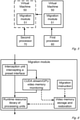
- FIG. 6 is a schematic diagram of operations of a migration module according to the second embodiment of the present application.
- an interception unit intercepts a preset interface of each processing unit in a first processor, and directly sends calling information of a non-preset interface to a runtime resource library (a CUDA runtime library) of a processing unit for execution.
- a runtime resource library a CUDA runtime library
- a tracking unit monitors a CUDA stream and a GPU video memory according to the calling information of the preset interface.
- the control unit monitors migration instructions. If the control unit receives a migration instruction of a console, the tracking unit waits for a completion of operations of all processing units in the first processor, and calls the save/restore unit to store the video memory data that is generated by the first processor for processing tasks of the virtual machine under a condition that the operations of all the processing units are completed. If the control unit does not receive a migration instruction, the tracking unit returns the calling information of the preset interface that is called to a runtime resource library of processing units for execution.
- a migration module provided by the present application is used for migrating a virtual machine
- a determination can be made as to whether a CUDA runtime API is intercepted when determining whether the virtual machine is migrated. For example, a calling stack of a current CUDA libcuda.so can be checked through tools such as gdb, ldd, strace, perf, etc., to check whether the API is intercepted. If being intercepted, a determination is made that the virtual machine is migrated. A UUID or S/N number of a GPU can also be read inside the virtual machine. If the S/N has been changed, a determination is made that the virtual machine has been migrated.
- the first processor runs a target application
- the migration module runs between the target application and a processing unit of the first processor.
- the migration module includes at least one interface disposed outside of a dynamic library of processing units.
- a CUMA module runs between an AI application on the virtual machine and a cuda runtime library, and wraps a layer of CUMA interface outside libcuda.so. All API calls of an AI/CUDA application program are sent to the migration module, and are processed by a real CUDA library after being recorded. Therefore, there is no performance loss during program execution.
- the AI/CUDA application program also does not need to be compiled again. It is completely transparent to an owner of the application program.
- control unit is further configured to initialize the second processor in the second host machine.
- the migration module needs to initialize the second processor and activate the virtual machine on the second host machine, so that the virtual machine continues to run on the second host machine.
- control unit is further configured to trigger the virtual machine to unload an image processor driver and trigger a host virtualization management component of the first processor to detach an image processor hardware component before the migration module migrates the video memory data into the second processor of the second host machine; and triggers a host virtualization management component of the second processor to attach an image processor hardware component, and triggers the virtual machine to load an image processor driver after the migration module migrates the video memory data to the second processor of the second host machine.
- a GPU driver of the virtual machine needs to be unloaded, an image processor hardware component needs to be detached.
- the virtual machine needs to be restarted, and an image processor hardware component needs to be attached, and then a virtual machine driver is reloaded, so that the virtual machine can be re-run on the second host machine.
- FIG. 7 is a schematic diagram of a virtual machine migration method according to a third embodiment of the present application. As shown in FIG. 7 , the apparatus 700 includes:
- the detection module 702, the calling module 704 and the migration module 706 correspond to steps S21 to S25 in the first embodiment. Embodiments and application scenarios of these two modules are the same as those of the corresponding steps, but are not limited to the content disclosed in the first embodiment. It should be noted that the above modules, which act as parts of the apparatus, may be run in the computer terminal 10 provided in the first embodiment.
- the migration module running on the virtual machine detects whether the migration instruction is received, where the migration module controls processing units in the first processor to suspend receiving new tasks and/or release a video memory of the first processor if the migration module detects the migration instruction.
- the apparatus further includes: a determination module used by the migration module for determining whether all the processing units in the first processor finish executing; and an entering module used for entering the step of storing the video memory data generated by the first processor if all the processing units in the first processor finish executing.
- the determination module includes: an interception submodule used by the migration module for intercepting a first preset interface of each processing unit in the first processor and obtaining task execution information, wherein the first preset interface includes at least: a calling interface and an execution interface, wherein the task execution information includes at least information for instructing the processing units to finish executing; and a determination submodule used by the migration module for determining whether each processing units in the first processor finish executing according to the task execution information.
- the apparatus further includes: an interception module used by the migration module for intercepting a second preset interface of each processing unit of the first processor to obtain video memory information, wherein the second preset interface includes at least a video memory allocation interface, and the video memory information includes at least a video memory amount and a storage position which are currently used by an application program running on the virtual machine; and a storage module used by the migration module for storing the video memory information.
- the apparatus further includes: a restoration module used for restoring the video memory data to a video memory of the second processor according to the video memory information after the virtual machine migrates the video memory data to the second processor of the second host machine.
- the apparatus further includes: an unloading module used for triggering the virtual machine to unload an image processor driver and triggering a host machine virtualization management component of the first processor to detach an image processor hardware component before the virtual machine migrates the video memory data into the second processor of the second host machine; and a loading module used for triggering a host machine virtualization management component of the second processor to attach an image processor hardware component and triggering the virtual machine to load an image processor driver after the virtual machine migrates the video memory data into the second processor of the second host machine.
- an unloading module used for triggering the virtual machine to unload an image processor driver and triggering a host machine virtualization management component of the first processor to detach an image processor hardware component before the virtual machine migrates the video memory data into the second processor of the second host machine
- a loading module used for triggering a host machine virtualization management component of the second processor to attach an image processor hardware component and triggering the virtual machine to load an image processor driver after the virtual machine migrates the video memory data into the second processor of the second host machine.
- FIG. 8 is a schematic diagram of a virtual machine migration method according to a fourth embodiment of the present application. As shown in FIG. 8 , the method includes the following steps: At step S81, a migration module running in a virtual machine detects whether a migration instruction is received, wherein the virtual machine runs on a first processor of a first host machine.
- the virtual machine runs on the first host machine
- the first processor in the first host may be a GPU in a pass-through mode, and provides services to the virtual machine in the pass-through mode.
- a GPU pass-through mode By adopting a GPU pass-through mode, an overhead of an abstraction layer caused by a GPU sharing mode can be avoided, and the delivery performance is similar to that of a special desktop.
- a migration module is disposed in a virtual machine, and the migration module in the virtual machine detects a migration instruction sent by a console. After receiving the migration instruction sent by the console, the migration module starts to migrate the virtual machine.
- step S83 if the migration instruction is detected, a determination is made as to whether the first processor enters a migration state.
- the above steps may be performed by a tracking unit in the migration module.
- the tracking unit monitors an operating state of each processing unit in the first processor and a video memory state of the first processor, so that when a migration instruction is detected, a determination about whether the first processor enters a migration status can be made.
- a determination that the first processor enters the migration state is made if each processing unit in the first processor finishes executing.
- the virtual machine calls video memory data generated in the first processor, and migrates the video memory data to a second processor of a second host machine.
- the video memory data is migrated to a second processor of a second host machine by the migration module in the virtual machine.
- the second host machine is a destination host, i.e. a host indicated in the migration instruction.
- the second processor may still be a GPU in a pass-through mode. After the virtual machine migrates the video memory data into the second processor, the virtual machine may continue to operate with the support of the second processor according to the migrated video memory data, thereby completing a live migration of the virtual machine from the first host machine to the second host machine.
- FIG. 3 is a schematic diagram of a live migration method of a virtual machine according to the first embodiment of the present application.
- an AI task (workload) of an AI application is running on a virtual machine VM.
- the virtual machine VM runs on a first host machine.
- the first host machine includes a host machine virtualization management component 1 (hypervisor1) and a GPU1.
- the GPU1 executes the AI task in the VM in a pass-through mode under the support of the host machine virtualization management component 1 and a GPU driver in the virtual machine.
- a CUMA (a migration assist module) module is deployed in the virtual machine, i.e., the migration module is configured to receive a migration instruction sent by a console.
- the migration instruction instructs the virtual machine to migrate to a second host machine.
- the migration module fetches memory data that is generated by the GPU1 for executing the task of the virtual machine from the memory of the GPU1, and stores the memory data in the CUMA (3.1).
- the migration module migrates the video memory data to the second host machine, and writes the video memory data into the video memory of the GPU2 of the second host machine (3.2), thereby completing the migration of the virtual machine.
- a migration module running in a virtual machine detects whether a migration instruction is received, wherein the virtual machine runs on a first processor of a first host machine. If the migration instruction is detected, a determination is made as to whether the first processor enters a migration state. Under a condition that the first processor enters the migration state, the virtual machine calls and obtains video memory data generated in the first processor and migrates the video memory data to a second processor of a second host machine.
- a migration module is deployed in a virtual machine, and the migration module performs information interception and reconstruction in the first host machine, which achieves monitoring of a state of the first processor.
- the virtual machine detects a migration instruction, by using the migration module to monitor whether the first processing enters a migration state, video memory data of the first processor are stored in the virtual machine after the first processor enters the migration state, and the video memory data are migrated to a video memory of a second processor, thus implementing a live migration of the virtual machine between different host machines.
- the embodiments of the application solve the technical problem that a virtual machine using a NVIDIA GPU pass-through mode fails to perform a live migration between host machines in the existing technologies.
- determining whether the first processor enters the migration state includes: the migration module obtaining task execution information by intercepting a first preset interface of each processing unit in the first processor, wherein the first preset interface includes at least: a calling interface and an execution interface, and the task execution information includes at least information for instructing the processing units to finish executing; and the migration module determining whether all processing units in the first processor finish executing according to the task execution information; and determining that the first processor enters the migration state if all the processing units finish executing.
- the first preset interface may include a scheduling API and an execution API.
- An AI application running on the virtual machine sends task execution information to the first processor by calling the scheduling API and the execution API, and the migration module intercepts the task execution information and determines whether all the processing units of the first processor are finished running according to the task execution information.
- the migration module further includes an interception unit, and the interception unit is used for intercepting a calling interface and an execution interface of a processing unit to obtain task execution information of an AI application.
- the migration module further includes a tracking unit.
- the interception unit sends the intercepted task execution information to the tracking unit, and the tracking unit determines whether all the processing units in the first processor finish executing according to the task execution information.
- the first preset interface may include: cudaSetDevice, cudaStreamCreate, cudaLaunchHostFunc, cudaLaunchKernel, cudaStreamSynchronize, and cudaSetKernel.
- FIG. 9 is a schematic diagram of a virtual machine migration method according to a fifth embodiment of the present application.
- the apparatus 900 includes:
- the detection module 902, the determination module 904, and the migration module 906 correspond to steps S81 to S85 in the fourth embodiment. Embodiments and application scenarios of these two modules are the same as those of the corresponding steps, but are not limited to the content disclosed in the first embodiment. It should be noted that the above modules, which act as parts of the apparatus, may be run in the computer terminal 10 provided in the first embodiment.
- the determination module includes: an interception submodule used by the migration module for intercepting a first preset interface of each processing unit in the first processor and obtaining task execution information, wherein the first preset interface includes at least: a calling interface and an execution interface, wherein the task execution information includes at least information for instructing the processing units to finish executing; a judgement submodule used by the migration module for determining whether each processing units in the first processor finish executing according to the task execution information; and a determination submodule used for determining that the first processor enters the migration state if all the processing units finish executing.
- the embodiments of the invention can provide a computer terminal which can be any computer terminal device in a computer terminal group.
- the computer terminal may also be replaced by a terminal device such as a mobile terminal.
- the computer terminal may be located in at least one network device of a plurality of network devices of a computer network.
- the computer terminal may execute program codes of the following steps in a virtual machine migration method: a virtual machine detecting whether a migration instruction is received, wherein the virtual machine runs on a first processor of a first host machine; the virtual machine calling and obtaining video memory data generated in the first processor if the migration instruction is detected; and the virtual machine migrating the video memory data to a second processor of a second host machine.
- FIG. 10 is a block diagram of a computer terminal according to a sixth embodiment of the present invention.
- the computer terminal A may include: one or more (only one shown) processors 102, a memory 104, and a peripheral interface 106.
- the memory may be configured to store software programs and modules, such as program instructions/modules corresponding to the virtual machine migration methods and apparatuses in the embodiments of the present invention.
- the processor executes various types of functional applications and data processing by running the software programs and modules stored in the memory, i.e., implementing the virtual machine migration methods as described above.
- the memory may include high speed random access memory, and may also include non-volatile memory, such as one or more magnetic storage devices, flash memory, or other non-volatile solid-state storage devices.
- the memory may further include storage devices remotely located from the processor, and these remote storage devices may be connected to the terminal A through a network. Examples of such network include, but are not limited to, the Internet, an intranet, a local area network, a mobile communication network, and a combination thereof.
- the processor can call information and an application program stored in the memory through a transmission device to execute the following steps: a virtual machine detecting whether a migration instruction is received, wherein the virtual machine runs on a first processor of a first host machine; the virtual machine calling and obtaining video memory data generated in the first processor if the migration instruction is detected; and the virtual machine migrating the video memory data to a second processor of a second host machine.
- the processor may further execute program codes of the following steps: detecting, by a migration module running on the virtual machine, whether the migration instruction is received, wherein the migration module controls processing units in the first processor to suspend receiving new tasks and/or release a video memory of the first processor if the migration module detects the migration instruction.
- the processor may further execute program codes of the following steps: the migration module determining whether all processing units in the first processor finish executing if the migration module detects the migration instruction; and entering a step of storing the video memory data generated by the first processor if all the processing units in the first processor finish executing.
- the processor may further execute program codes of the following steps: the migration module intercepting a first preset interface of each processing unit in the first processor, and obtaining task execution information, wherein the first preset interface includes at least: a calling interface and an execution interface, and the task execution information includes at least information for instructing the processing units to finish executing; and the migration module determining whether each processing unit in the first processor finishes executing according to the task execution information.
- the processor may further execute program codes of the following steps: the migration module intercepting a second preset interface of each processing unit of the first processor to obtain video memory information if the migration module detects the migration instruction, wherein the second preset interface includes at least a video memory allocation interface, and the video memory information includes at least a video memory amount and a storage position currently used by an application program running on the virtual machine; and the migration module storing the video memory information.
- the processor may further execute program codes of the following steps: the migration module restoring the video memory data to a video memory of the second processor according to the video memory information after the virtual machine migrates the video memory data to the second processor of the second host machine.
- the processor may further execute program codes of the following steps: before the virtual machine migrates the video memory data to the second processor of the second host machine, the method further includes: the migration module triggering the virtual machine to unload an image processor driver and triggering a host machine virtualization management component of the first processor to detach an image processor hardware component; and after the virtual machine migrates the video memory data to the second processor of the second host machine, the method further includes: the migration module triggering a host virtualization management component of the second processor to attach the image processor hardware component and triggering the virtual machine to load the image processor driver.
- the embodiments of the invention provide a solution of migration of a virtual machine.
- a virtual machine detects whether a migration instruction is received, wherein the virtual machine runs on a first processor of a first host machine. If the migration instruction is detected, the virtual machine calls and obtains video memory data generated in the first processor. The virtual machine migrates the video memory data to a second processor of a second host machine. According to the solution, through the migration instruction detected by the virtual machine, the video memory data of the first processor is stored in the virtual machine, and the video memory data of the first processor is migrated to the video memory of the second processor by the virtual machine, thus achieving a live migration of the virtual machine between different host machines.
- the embodiments of the application solve the technical problem that a virtual machine using a NVIDIA GPU pass-through mode fails to perform a live migration between host machines in the existing technologies.
- the structure shown in FIG. 10 is only an illustration, and the computer terminal may also be a terminal device such as a smart phone (e.g., an Android phone, an iOS phone, etc.), a tablet computer, a handheld computer, a mobile internet device (MID), a PAD, and the like.
- FIG. 10 does not limit the structure of the electronic device.
- the computer terminal 10 may also include more or fewer components (e.g., a network interface, a display device, etc.) than those shown in FIG. 10 , or have a configuration different from that shown in FIG. 10 .
- the program may be stored in a computer-readable storage medium.
- the storage medium may include: a flash drive, a read-only memory (ROM), a random access memory (RAM), a magnetic disk, or an optical disk, etc.
- the embodiments of the invention also provide a storage medium.
- the storage medium may be configured to store program codes that are executed by the virtual machine migration methods provided in the first embodiment.
- the storage medium may be located in any one of computer terminals in a computer terminal group in a computer network, or in any one of mobile terminals in a mobile terminal group.
- the storage medium is configured to store program codes for performing the following steps: a virtual machine detecting whether a migration instruction is received, wherein the virtual machine runs on a first processor of a first host machine; the virtual machine calling and obtaining video memory data generated in the first processor if the migration instruction is detected; and the virtual machine migrating the video memory data to a second processor of a second host machine.
- Units that are described as separate components may or may not be physically separate.
- Components that are displayed as units may or may not be physical units, may be located in a single place, or may be distributed over a plurality of network units. Some or all of the units can be selected according to actual needs to achieve the purpose of the solutions of the embodiments.
- each unit may exist alone physically.
- two or more units are integrated into one unit.
- the integrated unit can be realized in a form of hardware, and can also be realized in a form of a software functional unit.
- the integrated unit if implemented in a form of a software functional unit and sold or used as a stand-alone product, may be stored in a computer readable storage medium.
- a computer readable storage medium includes instructions to enable a computer device (which may be a personal computer, a server, or a network device) to execute all or part of the steps of the methods according to the embodiments of the present invention.
- the storage medium includes various types of media capable of storing program codes, such as a U-disk, a read-only memory (ROM), a random access memory (RAM), a removable hard disk, a magnetic disk, or an optical disk, etc.
Landscapes
- Engineering & Computer Science (AREA)
- Software Systems (AREA)
- Theoretical Computer Science (AREA)
- Physics & Mathematics (AREA)
- General Physics & Mathematics (AREA)
- General Engineering & Computer Science (AREA)
- Stored Programmes (AREA)
Abstract
Description
- This application claims priority to
Chinese Application No. 201910227209.4, filed on 25 March 2019 - The invention relates to the field of computers, and in particular, to virtual machine migration methods and systems.
- At present, NVIDA GPUs are widely used for training and reasoning in the fields of AI, machine learning and the like, and all types of computations of training and reasoning account for more than 80% of consumption of all GPUs. Meanwhile, a CUDA (Compute Unified Device Architecture) is used as a unique software matching system for AI and machine learning, and establishes an integrated uplink and downlink application scenario by matching with an NVIDIA GPU.
- A CUDA core is a basic operation unit of a GPU, and the GPU is composed of thousands of CUDA cores, which is also called sp (streaming processor). Since GPU pass-through technologies do not perform information interception and rebuild at a host machine end, state information of a CUDA core cannot be known, and therefore a virtual machine cannot be subjected to a live migration. Thus, the following problems still exist when machine learning and other applications are used on public clouds: a virtual machine using a NVIDIA GPU pass-through mode does not have the capability of live migration. This limits operations that rely on live migration capabilities on many public clouds, such as load balancing, active operation and maintenance, hardware replacement and system software updates.
- Embodiments of the invention provide virtual machine migration methods and systems, which at least solve the technical problem that a virtual machine using an NVIDIA GPU pass-through mode fails to perform a live migration between host machines in existing technologies.
- According to an aspect of the embodiments of the present invention, a virtual machine migration method is provided, and includes: a virtual machine detecting whether a migration instruction is received, wherein the virtual machine runs on a first processor of a first host machine; the virtual machine calling and obtaining video memory data generated in the first processor if the migration instruction is detected; and the virtual machine migrating the video memory data to a second processor of a second host machine.
- According to another aspect of the embodiments of the present invention, a virtual machine migration system is also provided, and includes: a virtual machine running on a first processor of a first host; and a migration module running on the virtual machine and being used for storing video memory data generated by the first processor and migrating the video memory data to a second processor of a second host machine if the migration module receives a migration instruction.
- According to an aspect of the embodiments of the present invention, a virtual machine migration method is provided, including: detecting, by a migration module running in a virtual machine, whether a migration instruction is received, wherein the virtual machine runs on a first processor of a first host machine; determining whether the first processor enters a migration state if the migration instruction is detected; and the virtual machine calling and obtaining video memory data generated in the first processor and migrating the video memory data to a second processor of a second host machine if the first processor enters the migration state.
- According to an aspect of the embodiments of the present invention, a storage medium is provided, the storage medium including a stored program, wherein: a device on which the storage medium is located is controlled to perform the following steps when the program is executed: a virtual machine detecting whether a migration instruction is received, wherein the virtual machine runs on a first processor of a first host machine; the virtual machine calling and obtaining video memory data generated in the first processor if the migration instruction is detected; and the virtual machine migrating the video memory data to a second processor of a second host machine.
- According to an aspect of the embodiments of the present invention, a processor is provided, and the processor is configured to execute a program, wherein the program, when running, executes the following steps: a virtual machine detecting whether a migration instruction is received, wherein the virtual machine runs on a first processor of a first host machine; the virtual machine calling and obtaining video memory data generated in the first processor if the migration instruction is detected; and the virtual machine migrating the video memory data to a second processor of a second host machine.
- In the embodiments of the invention, a virtual machine detects whether a migration instruction is received, wherein the virtual machine runs on a first processor of a first host machine. If the migration instruction is detected, the virtual machine calls and obtains video memory data that is generated in the first processor, and migrates the video memory data to a second processor of a second host machine. According to the above solution, video memory data of a first processor is stored in a virtual machine through a migration instruction detected by the virtual machine, and the video memory data of the first processor is migrated to a video memory of a second processor by the virtual machine, thus implementing a live migration of virtual machines in different host machines. Therefore, the embodiments of the application solve the technical problem that a virtual machine using a NVIDIA GPU pass-through mode fails to perform a live migration between host machines in the existing technologies.
- The accompanying drawings described herein are used to provide a further understanding of the invention and form a part of the present application. Illustrative embodiments of the invention and descriptions thereof serve to explain the invention, and are not to be construed as limitations to the invention. In the drawings:
-
FIG. 1 shows a block diagram of a hardware configuration of a computer terminal (or a mobile device) for implementing a migration method of a virtual machine. -
FIG. 2 is a flowchart of a live migration method of a virtual machine according to a first embodiment of the present application. -
FIG. 3 is a schematic diagram of a live migration method of a virtual machine according to the first embodiment of the present application. -
FIG. 4 is a schematic diagram of a control unit performing a migration according to the first embodiment of the present application. -
FIG. 5 is a schematic diagram of a migration system of a virtual machine according to a second embodiment of the present application. -
FIG. 6 is a schematic diagram of a migration module in operation according to the second embodiment of the present application. -
FIG. 7 is a schematic diagram of a migration method of a virtual machine according to a third embodiment of the present application. -
FIG. 8 is a schematic diagram of a migration method of a virtual machine according to a fourth embodiment of the present application. -
FIG. 9 is a schematic diagram of a migration method of a virtual machine according to a fifth embodiment of the present application. -
FIG. 10 is a block diagram of a computer terminal according to a sixth embodiment of the present invention. - In order to enable one skilled in the art to better understand the technical solutions of the present invention, the technical solutions in the embodiments of the present invention will be clearly and completely described hereinafter with reference to the drawings in the embodiments of the present invention. Apparently, the described embodiments represent only a part and not all of the embodiments of the present invention. All other embodiments, which can be derived by one skilled in the art from the embodiments given herein without making any creative effort, shall fall within the scope of protection of the present invention.
- It should be noted that terms "first," "second," and the like in the description and claims of the present invention and in the drawings described above are used for distinguishing between similar elements and not necessarily used for describing a particular sequential or chronological order. It is to be understood that data so used is interchangeable under appropriate circumstances, such that the embodiments of the invention described herein can be implemented in orders other than those illustrated or described herein. Furthermore, terms "including," "having," and any variations thereof, are intended to cover a non-exclusive inclusion, such that a process, method, system, article, or device that includes a list of steps or elements is not necessarily limited to those steps or elements that are expressly listed, but may include other steps or elements that are not expressly listed or that are inherent to such process, method, article, or device.
- First, some nouns or terms that appear in the description of the embodiments of the present application are applicable to the following explanations:
- GPU: Graphics Processing Unit, a graphics processor, which is a microprocessor that performs image computations on a personal computer, a workstation, a game machine, and a mobile device.
- GPU pass-through: A GPU pass-through refers to a physical GPU assigned to each virtual desktop user, and the GPU pass-through can avoid an overhead of an abstraction layer brought by a GPU sharing mode. In a GPU sharing mode, a virtual machine uses a virtual graphics card that is virtualized by software and does not physically exist. All image information is packaged into this virtual graphics card, while commands of the virtual graphics card are executed by a CPU, thus having a low efficiency. In a GPU pass-through, a virtual machine realizes that a direct mapping of a physical display card into the virtual machine. In this case, image information of the virtual machine is not required to be handed to a virtual display card, but is directly sent to a real display card for computations, having a relatively higher efficiency.
- Live migration: Virtual machines can be migrated between different hosts without interrupting internal tasks of the virtual machines.
- Hypervisor: A host virtualization management component, which is a software layer running between a physical server and an operating system, and can allow a plurality of operating systems and applications to share a set of basic physical hardware for coordinating access to hardware resources.
- According to the embodiments of the present invention, an embodiment of a virtual machine migration method is also provided. It needs to be noted that steps illustrated in a flowchart of an accompanying drawing may be performed in a computer system such as a set of computer-executable instructions. Moreover, although a logical order is illustrated in a flowchart, in some cases, illustrated or described steps may be performed in an order different than those described herein.
- The method embodiment provided by the first embodiment of the present application may be executed in a mobile terminal, a computer terminal, or a similar computing device.
FIG. 1 shows a block diagram of a hardware configuration of a computer terminal (or a mobile device) used for implementing a virtual machine migration method. As shown inFIG. 1 , a computer terminal 10 (or a mobile device 10) may include one or more (102a, 102b, ......, 102n as shown in the figure) processors 102 (theprocessors 102 may include, but are not limited to, a processing device, such as a microprocessor MCU or a programmable logic device FPGA, etc.), amemory 104 used for storing data, and a transmission module used for communication functions. Furthermore, a display, an input/output interface (I/O interface), a Universal Serial Bus (USB) port (which may be included as one of the ports of the I/O interface), a network interface, a power source, and/or a camera may also be included. One skilled in the art can understand that the structure shown inFIG. 1 is only an illustration, and is not intended to limit the structure of the above electronic device. For example, thecomputer terminal 10 may also include more or fewer components than those shown inFIG. 1 , or have a configuration different than that shown inFIG. 1 . - It should be noted that the one or
more processors 102 and/or other data processing circuits described above may be referred to generally herein as "data processing circuits". The data processing circuits may be embodied in whole or in part in software, hardware, firmware, or any combination thereof. Further, the data processing circuits may be a single stand-alone processing module, or incorporated in whole or in part into any of the other elements in the computer terminal 10 (or the mobile device). As involved in the embodiments of the application, the data processing circuits act as a processor control (e.g. a selection of a variable resistance terminal path connected to an interface). - The
memory 104 may be used to store software programs and modules of application software, such as program instructions/data storage devices corresponding to the methods in the embodiments of the present invention. Theprocessor 102 executes various types of functional applications and data processing by running the software programs and modules stored in thememory 104, i.e., implementing the virtual machine migration methods described above. Thememory 104 may include high speed random access memory, and may also include non-volatile memory, such as one or more magnetic storage devices, flash memory, or other non-volatile solid-state storage devices. In some examples, thememory 104 may further include storage devices located remotely from theprocessor 102. These storage devices may be connected to thecomputer terminal 10 via a network. Examples of such network include, but are not limited to, the internet, an intranet, a local area network, a mobile communication network, and a combination thereof. - The transmission device is used for receiving or transmitting data via a network. Specific examples of the network may include a wireless network provided by a communication provider of the
computer terminal 10. In an example, thetransmission device 106 includes a network adapter (NIC) that can be connected to other network devices through a base station to communicate with the internet. In an example, thetransmission device 106 can be a radio frequency (RF) module, which is used to communicate with the internet wirelessly. - The display may be, for example, a touch-screen-type liquid crystal display (LCD) that may enable a user to interact with a user interface of the computer terminal 10 (or the mobile device).
- It needs to be noted herein that, in some optional embodiments, the computer device (or the mobile device) shown in
FIG. 1 described above may include hardware elements (including circuits), software elements (including computer codes stored on a computer-readable medium), or a combination of both hardware and software elements. It should be noted thatFIG. 1 is only an example of a particular specific embodiment, and is intended to illustrate types of components that may be present in a computer device (or a mobile device) as described above. - Under the above operating environment, the present application provides a method for a live migration of a virtual machine as shown in
FIG. 2. FIG. 2 is a flowchart of a method for a live migration of a virtual machine according to the first embodiment of the present application. - At step S21, a virtual machine detects whether a migration instruction is received, wherein the virtual machine runs on a first processor of a first host machine.
- Specifically, the virtual machine runs on a first host machine, and a first processor in the first host machine may be a GPU in a pass-through mode, and provides services to the virtual machine in the pass-through mode. By adopting a GPU pass-through mode, an overhead of an abstraction layer caused by a GPU sharing mode can be avoided, and the performance of delivery is similar to that of a special desktop.
- In an optional embodiment, a migration module is disposed in the virtual machine, and the migration module in the virtual machine detects a migration instruction sent by a console. After receiving the migration instruction sent by the console, the migration module starts to perform migration of the virtual machine.
- At step S23, if the migration instruction is detected, the virtual machine calls and obtains video memory data generated in the first processor.
- Specifically, the video memory data generated by the first processor includes an operation result obtained when the first processor operates task(s) of the virtual machine.
- In an optional embodiment, the first processor is a GPU, and AI application(s) is/are run on the virtual machine, and is/are processed by a plurality of processing units (CUDA cores) that are included in the GPU. The processing units execute task(s) of the AI application(s), and store a running result in a video memory of the GPU.
- In the above solution, the migration module includes a save/restore unit. After receiving the migration instruction, the migration module obtains video memory data that is generated by the first processor for executing the task(s) of the virtual machine from the video memory of the first processor, and stores the obtained video memory data in the save/restore unit of the migration module.
- At step S25, the virtual machine migrates the video memory data into a second processor of a second host machine.
- In the above solution, the video memory data is moved to a second processor of a second host machine by the migration module in the virtual machine. The second host machine is a destination host, i.e. a host indicated in the migration instruction.
- The second processor may still be a GPU in the pass-through mode. After the virtual machine migrates the video memory data into the second processor, the virtual machine may continue to operate with the support of the second processor according to the migrated video memory data, thereby completing a live migration of the virtual machine from the first host machine to the second host machine.
-
FIG. 3 is a schematic diagram of a live migration method of a virtual machine according to the first embodiment of the present application. Referring toFIG. 3 , an AI task (workload) of an AI application is running on a virtual machine VM. Before the migration of the virtual machine VM, the virtual machine VM runs on a first host machine. The first host machine includes a host machine virtualization management component 1 (hypervisor1) and a GPU1. The GPU1 executes the AI task in the VM in a pass-through mode under the support of the host machinevirtualization management component 1 and a GPU driver in the virtual machine. - In this example, a CUMA (a migration assist module) module is deployed in the virtual machine, i.e., the migration module is configured to receive a migration instruction sent by a console. The migration instruction instructs the virtual machine to migrate to a second host machine. The second host machine includes a host machine virtualization management component 2 (hypervisor1) and a GPU2. After receiving the migration instruction, the migration module fetches memory data that is generated by the GPU1 for executing the task of the virtual machine from the memory of the GPU1, and stores the memory data in the CUMA (3.1).
- After obtaining the video memory data of the CPU1, the migration module migrates the video memory data to the second host machine, and writes the video memory data into the video memory of the GPU2 of the second host machine (3.2), thereby completing the migration of the virtual machine.
- In the foregoing embodiments of the present application, a virtual machine detects whether a migration instruction is received, where the virtual machine runs on a first processor of a first host machine. If the migration instruction is detected, the virtual machine calls and obtains video memory data generated in the first processor. The virtual machine migrates the video memory data to a second processor of a second host machine. According to the solution, through the migration instruction detected by the virtual machine, the video memory data of the first processor is stored in the virtual machine, and the video memory data of the first processor is migrated by the virtual machine to the video memory of the second processor, thus realizing a live migration of the virtual machine between different host machines.
- Therefore, the embodiments of the application solve the technical problem that a virtual machine using a NVIDIA GPU pass-through mode fails to perform a live migration between host machines in the existing technologies.
- As an optional embodiment, whether a migration instruction is received is detected by a migration module running on the virtual machine. If the migration module detects the migration instruction, the migration module controls processing unit(s) in the first processor to suspend receiving new tasks, and/or release the video memory of the first processor.
- Specifically, when the virtual machine detects a migration instruction, if the processing unit(s) in the first processor continue(s) to receive a task from an AI application, all running data of the virtual machine in the video memory of the first processor cannot be ensured to be migrated to the second processor. Therefore, after the virtual machine receives the migration instruction, the processing unit(s) in the first processor need(s) to be controlled to suspend receiving new tasks, and release the video memory in the first processor.
- In an optional embodiment, the migration module of the virtual machine includes a control unit. After receiving the migration instruction, the control unit controls all processing units in the first processor to suspend receiving new tasks, and releases the video memory of the first processor, thereby starting to perform migration of the virtual machine.
- As an optional embodiment, if the migration module detects the migration instruction, the method further includes: the migration module determining whether all processing units in the first processor finish executing; and entering the step of storing the video memory data generated by the first processor if all the processing units in the first processor finish executing.
- Specifically, the step of storing the video memory data of the first processor can be executed only after all the processing units in the first processor finish executing.
- In an optional embodiment, the migration module further includes a tracking unit. After the control unit of the migration module receives the migration instruction, controls all the processing units to suspend receiving new tasks, and release the video memory of the first processor, the tracking unit tracks a running state of each processing unit in the first processor to determine whether all the processing units in the first processor run results, and starts to store the video memory data of the first processor after all the processing units in the first processor finish executing.
- In the above solution, after the migration instruction is received, the processing units of the first processor are first stopped from receiving new tasks, and then the video memory data of the first processor is stored after determining that all the processing units finish executing. Thus, all computational results that are obtained by the first processor for operating the tasks of the virtual machine can be migrated to the second host machine, and the virtual machine can smoothly continue to run after being migrated to the second host machine.
- As an optional embodiment, the migration module determining whether all the processing units in the first processor finish executing includes: the migration module intercepting a first preset interface of each processing unit in a first image processing unit to obtain task execution information, wherein the first preset interface includes at least: a calling interface and an execution interface, and the task execution information includes at least information used for indicating the processing unit to finish executing; and the migration module determining whether each processing unit in the first processor finish executing according to the task execution information.
- Specifically, the first preset interface may include a scheduling API and an execution API, the AI application running on the virtual machine sends task execution information to the first processor by calling the scheduling API and the execution API. The migration module intercepts the task execution information and determines whether all the processing units of the first processor have finished operations according to the task execution information.
- In an optional embodiment, the migration module further includes an interception unit. The interception unit is configured to intercept a calling interface and an execution interface of a processing unit to obtain task execution information of an AI application. The migration module further includes a tracking unit. The interception unit sends the intercepted task execution information to the tracking unit, and the tracking unit determines whether all the processing units in the first processor finish executing according to the task execution information. Optionally, the first preset interface may include: cudaSetDevice, cudaStreamCreate, cudaLaunchHostFunc, cudaLaunchKernel, cudaStreamSynchronize, and cudaSetKernel.
- As an optional embodiment, if the migration module detects a migration instruction, the method further includes: the migration module intercepting a second preset interface of a first image processing unit and obtaining video memory information, wherein the second preset interface includes at least a video memory allocation interface, and the video memory information includes at least a video memory amount and a storage position used by an application program; and the migration module storing the video memory information.
- Specifically, the video memory information includes a video memory amount and a storage location corresponding to running data of an AI application, and is used for restoring the video memory data. For example, the video memory of the entire processor is up to 16G, but a currently operating AI application only uses a part of the video memory amount, so the video memory data needs to be migrated to a specified location in the video memory of the second processor according to the video memory information stored in the migration module when the video memory data is migrated to the video memory of the second processor.
- In an optional embodiment, the interception unit in the migration module may intercept the video memory allocation interface (e.g., cudaMalloc and cudafree) and obtain the video memory information, and the tracking unit performs monitoring of the video memory of the first processor according to the video memory information to determine a video memory size and a video memory location occupied by the current AI application for restoring the video memory data.
- It needs to be noted that all interface calling information except for the first preset interface and the second preset interface is directly transferred to a real processing unit runtime resource library (a CUDA runtime library) for execution, to ensure the performance of the first processor. When the first preset interface and the second preset interface are called, calling information (including the task execution information and the video memory information) is intercepted by the migration module and is transferred to the tracking unit for analysis and storage. If a migration instruction is not received, the tracking unit transfers the calling information of the first preset interface and the second preset interface to a real interface (CUDA API) of a processing unit for execution. If the migration instruction is received, the tracking unit determines whether all the processing units in the first processing finish executing according to the calling information, and obtains the video memory information corresponding to the AI application program.
- As an optional embodiment, after the virtual machine migrates the video memory data to the second processor of the second host machine, the method further includes: the migration module restoring the video memory data in the video memory of the second processor according to the video memory information.
- Specifically, after the migration module in the virtual machine migrates the video memory data to the second host machine, the video memory data needs to be restored in the video memory of the second processor according to the video memory information, so that the virtual machine can continue to operate on the second host machine according to the restored video memory data, thereby completing the live migration of the virtual machine.
- In an optional embodiment, the restoration of the video memory data may be performed by the save/restore unit in the migration module. And the save/restore unit restores the video memory data to the video memory of the second processor according to the size and the storage position of the data recorded in the video memory information.
- As an optional embodiment, before the virtual machine migrates the video memory data to the second processor of the second host machine, the method further includes: the migration module triggering the virtual machine to unload an image processor driver and triggering a host machine virtualization management component of the first processor to detach an image processor hardware component. After the virtual machine migrates the video memory data to the second processor of the second host machine, the method further includes: the migration module triggering a host virtualization management component of the second processor to attach an image processor hardware component and triggering the virtual machine to load an image processor driver.
- In the above solution, before the migration by the migration module, a GPU driver of the virtual machine needs to be unloaded, and an image processor hardware component needs to be detached. After the migration by the migration module, the virtual machine needs to be restarted, and an image processor hardware component needs to be attached, and then a virtual machine driver is reloaded, so that the virtual machine can be re-run on the second host machine.
-
FIG. 4 is a schematic diagram of a control unit that executes migration according to the first embodiment of the present application. In an optional embodiment, a first processor is still taken as a GPU as an example, and a control unit in a migration module may execute the following steps during a migration process: - (1) The control unit receives a live migration request, calls a tracking unit to suspend all processing units (CUDA) from receiving new tasks, calls a save/restore unit to complete storage of GPU video memory data, and releases all allocated GPU resources.
- (2) The control unit triggers a GPU driver in a virtual machine to perform unloading (unload).
- (3) The control unit triggers a host machine virtualization management component (hypervisor) to detach a GPU hardware component.
- (4) The control unit performs a live migration of the virtual machine.
- (5) The control unit triggers the hypervisor to attach a currently new GPU hardware component to the virtual machine.
- (6) The control unit activates the virtual machine, and reloading (reload) of a driver is completed by an internal control unit of the virtual machine.
- (7) A save/restore unit restores video memory data stored in a CUMA into a new GPU, and the control unit informs the tracking unit to continue to run call(s) of application program(s).
- Thus, the overall live migration process is completed, and AI application(s) can continue to execute on the virtual machine.
- It should be noted that the foregoing method embodiments are described as a series of actions for the simplicity of description. One skilled in the art, however, should understand that the present invention is not limited by the described orders of actions, because some steps may be performed in other orders or in parallel in accordance with the invention. Furthermore, one skilled in the art should also understand that the embodiments described in the specification are preferred embodiments, and actions and modules involved may not be necessarily required by the invention.
- Through the above description of the embodiments, one skilled in the art can clearly understand that the methods according to the above embodiments can be implemented by software plus a necessary general hardware platform, and apparently can also be implemented by hardware. However, the former is a better implementation mode in many cases. Based on such understanding, the essence of the technical solutions of the present invention or the parts that make contributions to the existing technologies may be embodied in a form of a software product. Such computer software product is stored in a storage medium (e.g., ROM/RAM, a magnetic disk, an optical disk), and includes a number of instructions to enable a terminal device (e.g., a mobile phone, a computer, a server, or a network device, etc.) to execute the methods according to the embodiments of the present invention.
- According to the embodiments of the present invention, an embodiment of a virtual machine migration system is further provided.
FIG. 5 is a schematic diagram of a virtual machine migration system according to a second embodiment of the present application. As shown in the drawing, the system includes:
avirtual machine 50, running on afirst processor 60 of a first host machine. - Specifically, the virtual machine runs on the first host machine, and the first processor in the first host may be a GPU in a pass-through mode, and provide services to the virtual machine in the pass-through mode. By adopting a GPU pass-through mode, an overhead of an abstraction layer caused by a GPU sharing mode can be avoided, and the delivery performance is similar to that of a special desktop.
- In an optional embodiment, a migration module is deployed in the virtual machine, and the migration module in the virtual machine detects a migration instruction sent by a console. After receiving the migration instruction sent by the console, the migration module starts to migrate the virtual machine.
amigration module 51, running on the virtual machine, and configured to store video memory data generated by the first processor and migrate the video memory data to asecond processor 70 of a second host machine if the migration module receives a migration instruction. - Specifically, the video memory data generated by the first processor includes an operation result obtained when the first processor operates a task of the virtual machine.
- In an optional embodiment, the first processor is a GPU. AI application(s) is/are run on the virtual machine, and is/are processed by a plurality of processing units (CUDA cores) included in the GPU. The processing units execute tasks of the AI application(s) and store a running result in a video memory of the GPU.
- In the above solution, after the migration module receives a migration instruction, the migration module obtains video memory data that is generated by the first processor for executing task(s) of the virtual machine from a video memory of the first processor, and stores the obtained video memory data in a save/restore unit of the migration module.
- In the above solution, the video memory data is migrated to a second processor of a second host machine by the migration module in the virtual machine. The second host machine is a destination host, i.e. a host indicated in the migration instruction.
- The second processor may still be a GPU in a pass-through mode. After the virtual machine migrates the video memory data into the second processor, the virtual machine may continue to operate with the support of the second processor according to the migrated video memory data, thereby completing a live migration of the virtual machine from the first host machine to the second host machine.
-
FIG. 3 is a schematic diagram of a live migration method of a virtual machine according to the first embodiment of the present application. Referring toFIG. 3 , an AI task (workload) of an AI application is running on a virtual machine VM. Before the migration of the virtual machine VM, the virtual machine VM runs on a first host machine. The first host machine includes a host machine virtualization management component 1 (hypervisor1) and a GPU1. The GPU1 executes the AI task in the VM in a pass-through mode under the support of the host machinevirtualization management component 1 and a GPU driver in the virtual machine. - In this example, a CUMA (a migration assist module) module is deployed in the virtual machine, i.e., the migration module is configured to receive a migration instruction sent by a console. The migration instruction instructs the virtual machine to migrate to a second host machine. After receiving the migration instruction, the migration module fetches memory data that is generated by the GPU1 for executing the task of the virtual machine from the memory of the GPU1, and stores the memory data in the CUMA (3.1).
- After obtaining the video memory data of the CPU1, the migration module migrates the video memory data to the second host machine, and writes the video memory data into the video memory of the GPU2 of the second host machine (3.2), thereby completing the migration of the virtual machine.
- In the foregoing embodiments of the present application, a migration module of a virtual machine detects whether a migration instruction is received. If detecting the migration instruction, the migration module saves video memory data generated in the first processor, and migrates the video memory data to a second processor of a second host machine. According to the solution, through the migration instruction detected by the virtual machine, the video memory data of the first processor is stored in the virtual machine, and the video memory data of the first processor is migrated by the virtual machine to the video memory of the second processor, thus realizing a live migration of the virtual machine between different host machines.
- Therefore, the embodiments of the application solve the technical problem that a virtual machine using a NVIDIA GPU pass-through mode fails to perform a live migration between host machines in the existing technologies.
- As an optional embodiment, the migration module includes: a tracking unit used for controlling processing units in the first processor to pause receiving tasks and determining whether all the processing units in the first processor finish executing when the migration module receives the migration instruction; a save/restore unit used for storing the video memory data generated by the first processor after the tracking unit determines that all the processing units finish executing; a control unit used for migrating the video memory data to the second processor, wherein the save/restore unit is further used for restoring the video memory data to a video memory of the second processor after the video memory data is migrated to the second processor.
- Specifically, the tracking unit is used for obtaining running states of all the processing units in the first processor, and calling the save/restore unit to store the video memory data after all the processing units finish executing. After the control unit migrates the video memory data to the second processor, the save/restore unit restores the video memory data to the video memory of the second processor.
- As an optional embodiment, the migration module further includes: an interception unit used for obtaining task execution information by intercepting a first preset interface of each processing unit in the first processor, wherein the first preset interface includes at least: a calling interface and an execution interface, and the task execution information includes at least information for instructing the processing units to finish executing; and a tracking unit, which is connected with the interception unit, used for determining whether all processing units in the first processor finish executing according to the task execution information.
- Specifically, the first preset interface may include a scheduling API and an execution API. An AI application running on the virtual machine sends task execution information to the first processor by calling the scheduling API and the execution API, and the migration module intercepts the task execution information and determines whether all the processing units of the first processor are finished running according to the task execution information.
- In an optional embodiment, an interception unit in the migration module intercepts a calling interface and an execution interface of a processing unit to obtain task execution information of an AI application. The migration module further includes a tracking unit. The interception unit sends the intercepted task execution information to the tracking unit, and the tracking unit determines whether all the processing units in the first processor finish executing according to the task execution information. Optionally, the first preset interface may include: cudaSetDevice, cudaStreamCreate, cudaLaunchHostFunc, cudaLaunchKernel, cudaStreamSynchronize, and cudaSetKernel.
- When the first preset interface is called, the first preset interface is intercepted by the interception unit, and calling information is sent to the tracking unit to be analyzed and stored. The tracking unit monitors a CUDA stream according to information obtained by the interception unit from intercepting the first preset interface. When the tracking unit receives a migration instruction, the tracking unit temporarily blocks operations of the CUDA steam of App (through cudaLaunchHostFunc and cudaLaunchKernel), and determines whether operations of all processing units are finished by calling an operation of cudaStreamSynchronize.
- As an optional embodiment, the interception unit is further used for obtaining video memory information by intercepting a second preset interface of each processing unit of the first processor, wherein the second preset interface includes at least a video memory allocation interface, and the video memory information includes at least a video memory amount and a storage location currently used by an application program running on the virtual machine. The tracking unit stores the video memory information.
- Specifically, the video memory information includes a video memory amount and a storage location corresponding to running data of an AI application, and is used for restoring the video memory data. For example, the video memory of the entire processor is up to 16G, but a currently operating AI application only uses a part of the video memory amount. Therefore, when the video memory data is migrated to the video memory of the second processor, the video memory data needs to be migrated to a specified location in the video memory of the second processor according to the video memory information stored in the migration module.
- In an optional embodiment, the interception unit in the migration module may intercept a video memory allocation interface (e.g., cudaMalloc and cudafree), and obtain video memory information. The tracking unit performs monitoring of the video memory of the first processor according to the video memory information to determine a video memory size and a video memory location occupied by a current AI application for restoring the video memory data.
- It needs to be noted that all interface calling information except for the first preset interface and the second preset interface is directly transferred to a real processing unit runtime resource library (a CUDA runtime library) for execution, to ensure the performance of the first processor. When the first preset interface and the second preset interface are called, calling information (including the task execution information and the video memory information) is intercepted by the migration module and is transferred to the tracking unit for analysis and storage. If a migration instruction is not received, the tracking unit transfers the calling information of the first preset interface and the second preset interface to a real interface (CUDA API) of a processing unit for execution. If the migration instruction is received, the tracking unit determines whether all the processing units in the first processing finish executing according to the calling information, and obtains the video memory information corresponding to the AI application program.
-
FIG. 6 is a schematic diagram of operations of a migration module according to the second embodiment of the present application. Referring toFIG. 6 , firstly, an interception unit intercepts a preset interface of each processing unit in a first processor, and directly sends calling information of a non-preset interface to a runtime resource library (a CUDA runtime library) of a processing unit for execution. For calling information of a preset interface, a tracking unit monitors a CUDA stream and a GPU video memory according to the calling information of the preset interface. - When the tracking unit monitors the CUDA stream and the GPU video memory, the control unit monitors migration instructions. If the control unit receives a migration instruction of a console, the tracking unit waits for a completion of operations of all processing units in the first processor, and calls the save/restore unit to store the video memory data that is generated by the first processor for processing tasks of the virtual machine under a condition that the operations of all the processing units are completed. If the control unit does not receive a migration instruction, the tracking unit returns the calling information of the preset interface that is called to a runtime resource library of processing units for execution.
- Using a solution of intercepting a preset interface enables a migration of a virtual machine to be detectable. If a migration module provided by the present application is used for migrating a virtual machine, a determination can be made as to whether a CUDA runtime API is intercepted when determining whether the virtual machine is migrated. For example, a calling stack of a current CUDA libcuda.so can be checked through tools such as gdb, ldd, strace, perf, etc., to check whether the API is intercepted. If being intercepted, a determination is made that the virtual machine is migrated. A UUID or S/N number of a GPU can also be read inside the virtual machine. If the S/N has been changed, a determination is made that the virtual machine has been migrated.
- As an optional embodiment, the first processor runs a target application, and the migration module runs between the target application and a processing unit of the first processor.
- As an optional embodiment, the migration module includes at least one interface disposed outside of a dynamic library of processing units.
- In an optional embodiment, a CUMA module runs between an AI application on the virtual machine and a cuda runtime library, and wraps a layer of CUMA interface outside libcuda.so. All API calls of an AI/CUDA application program are sent to the migration module, and are processed by a real CUDA library after being recorded. Therefore, there is no performance loss during program execution. The AI/CUDA application program also does not need to be compiled again. It is completely transparent to an owner of the application program.
- As an optional embodiment, the control unit is further configured to initialize the second processor in the second host machine.
- After the video memory data is migrated to the second processor of the second host machine, the migration module needs to initialize the second processor and activate the virtual machine on the second host machine, so that the virtual machine continues to run on the second host machine.
- As an optional embodiment, the control unit is further configured to trigger the virtual machine to unload an image processor driver and trigger a host virtualization management component of the first processor to detach an image processor hardware component before the migration module migrates the video memory data into the second processor of the second host machine; and triggers a host virtualization management component of the second processor to attach an image processor hardware component, and triggers the virtual machine to load an image processor driver after the migration module migrates the video memory data to the second processor of the second host machine.
- In the above solution, before the migration by the migration module, a GPU driver of the virtual machine needs to be unloaded, an image processor hardware component needs to be detached. After the migration by the migration module, the virtual machine needs to be restarted, and an image processor hardware component needs to be attached, and then a virtual machine driver is reloaded, so that the virtual machine can be re-run on the second host machine.
- According to the embodiments of the present invention, a virtual machine migration apparatus for implementing the virtual machine migration method in the first embodiment is further provided.
FIG. 7 is a schematic diagram of a virtual machine migration method according to a third embodiment of the present application. As shown inFIG. 7 , theapparatus 700 includes: - a
detection module 702 used by a virtual machine for detecting whether a migration instruction is received, wherein the virtual machine runs on a first processor of a first host machine; - a
calling module 704 used by the virtual machine for calling video memory number generated in the first processor if the migration instruction is detected; and - a
migration module 706 used by the virtual machine for migrating the video memory data to a second processor of a second host machine. - It needs to be noted herein that the
detection module 702, the callingmodule 704 and themigration module 706 correspond to steps S21 to S25 in the first embodiment. Embodiments and application scenarios of these two modules are the same as those of the corresponding steps, but are not limited to the content disclosed in the first embodiment. It should be noted that the above modules, which act as parts of the apparatus, may be run in thecomputer terminal 10 provided in the first embodiment. - As an optional embodiment, the migration module running on the virtual machine detects whether the migration instruction is received, where the migration module controls processing units in the first processor to suspend receiving new tasks and/or release a video memory of the first processor if the migration module detects the migration instruction.
- As an optional embodiment, if the migration module detects the migration instruction, the apparatus further includes: a determination module used by the migration module for determining whether all the processing units in the first processor finish executing; and an entering module used for entering the step of storing the video memory data generated by the first processor if all the processing units in the first processor finish executing.
- As an optional embodiment, the determination module includes: an interception submodule used by the migration module for intercepting a first preset interface of each processing unit in the first processor and obtaining task execution information, wherein the first preset interface includes at least: a calling interface and an execution interface, wherein the task execution information includes at least information for instructing the processing units to finish executing; and a determination submodule used by the migration module for determining whether each processing units in the first processor finish executing according to the task execution information.
- As an optional embodiment, if the migration module detects the migration instruction, the apparatus further includes: an interception module used by the migration module for intercepting a second preset interface of each processing unit of the first processor to obtain video memory information, wherein the second preset interface includes at least a video memory allocation interface, and the video memory information includes at least a video memory amount and a storage position which are currently used by an application program running on the virtual machine; and a storage module used by the migration module for storing the video memory information.
- As an optional embodiment, the apparatus further includes: a restoration module used for restoring the video memory data to a video memory of the second processor according to the video memory information after the virtual machine migrates the video memory data to the second processor of the second host machine.
- As an optional embodiment, the apparatus further includes: an unloading module used for triggering the virtual machine to unload an image processor driver and triggering a host machine virtualization management component of the first processor to detach an image processor hardware component before the virtual machine migrates the video memory data into the second processor of the second host machine; and a loading module used for triggering a host machine virtualization management component of the second processor to attach an image processor hardware component and triggering the virtual machine to load an image processor driver after the virtual machine migrates the video memory data into the second processor of the second host machine.
- According to the embodiments of the present invention, a virtual machine migration method is further provided. The virtual machine migration method may be executed by the virtual machine migration system in the second embodiment.
FIG. 8 is a schematic diagram of a virtual machine migration method according to a fourth embodiment of the present application. As shown inFIG. 8 , the method includes the following steps:
At step S81, a migration module running in a virtual machine detects whether a migration instruction is received, wherein the virtual machine runs on a first processor of a first host machine. - Specifically, the virtual machine runs on the first host machine, and the first processor in the first host may be a GPU in a pass-through mode, and provides services to the virtual machine in the pass-through mode. By adopting a GPU pass-through mode, an overhead of an abstraction layer caused by a GPU sharing mode can be avoided, and the delivery performance is similar to that of a special desktop.
- In an optional embodiment, a migration module is disposed in a virtual machine, and the migration module in the virtual machine detects a migration instruction sent by a console. After receiving the migration instruction sent by the console, the migration module starts to migrate the virtual machine.
- At step S83, if the migration instruction is detected, a determination is made as to whether the first processor enters a migration state.
- Specifically, the above steps may be performed by a tracking unit in the migration module. In an optional embodiment, the tracking unit monitors an operating state of each processing unit in the first processor and a video memory state of the first processor, so that when a migration instruction is detected, a determination about whether the first processor enters a migration status can be made.
- In an optional embodiment, a determination that the first processor enters the migration state is made if each processing unit in the first processor finishes executing.
- At step S85, when the first processor enters the migration state, the virtual machine calls video memory data generated in the first processor, and migrates the video memory data to a second processor of a second host machine.
- In the above solution, the video memory data is migrated to a second processor of a second host machine by the migration module in the virtual machine. The second host machine is a destination host, i.e. a host indicated in the migration instruction.
- The second processor may still be a GPU in a pass-through mode. After the virtual machine migrates the video memory data into the second processor, the virtual machine may continue to operate with the support of the second processor according to the migrated video memory data, thereby completing a live migration of the virtual machine from the first host machine to the second host machine.
-
FIG. 3 is a schematic diagram of a live migration method of a virtual machine according to the first embodiment of the present application. Referring toFIG. 3 , an AI task (workload) of an AI application is running on a virtual machine VM. Before the migration of the virtual machine VM, the virtual machine VM runs on a first host machine. The first host machine includes a host machine virtualization management component 1 (hypervisor1) and a GPU1. The GPU1 executes the AI task in the VM in a pass-through mode under the support of the host machinevirtualization management component 1 and a GPU driver in the virtual machine. - In this example, a CUMA (a migration assist module) module is deployed in the virtual machine, i.e., the migration module is configured to receive a migration instruction sent by a console. The migration instruction instructs the virtual machine to migrate to a second host machine. After receiving the migration instruction, the migration module fetches memory data that is generated by the GPU1 for executing the task of the virtual machine from the memory of the GPU1, and stores the memory data in the CUMA (3.1).
- After obtaining the video memory data of the CPU1, the migration module migrates the video memory data to the second host machine, and writes the video memory data into the video memory of the GPU2 of the second host machine (3.2), thereby completing the migration of the virtual machine.
- In the above embodiments of the present application, a migration module running in a virtual machine detects whether a migration instruction is received, wherein the virtual machine runs on a first processor of a first host machine. If the migration instruction is detected, a determination is made as to whether the first processor enters a migration state. Under a condition that the first processor enters the migration state, the virtual machine calls and obtains video memory data generated in the first processor and migrates the video memory data to a second processor of a second host machine. According to the above solution, a migration module is deployed in a virtual machine, and the migration module performs information interception and reconstruction in the first host machine, which achieves monitoring of a state of the first processor. When the virtual machine detects a migration instruction, by using the migration module to monitor whether the first processing enters a migration state, video memory data of the first processor are stored in the virtual machine after the first processor enters the migration state, and the video memory data are migrated to a video memory of a second processor, thus implementing a live migration of the virtual machine between different host machines.
- Therefore, the embodiments of the application solve the technical problem that a virtual machine using a NVIDIA GPU pass-through mode fails to perform a live migration between host machines in the existing technologies.
- As an optional embodiment, determining whether the first processor enters the migration state includes: the migration module obtaining task execution information by intercepting a first preset interface of each processing unit in the first processor, wherein the first preset interface includes at least: a calling interface and an execution interface, and the task execution information includes at least information for instructing the processing units to finish executing; and the migration module determining whether all processing units in the first processor finish executing according to the task execution information; and determining that the first processor enters the migration state if all the processing units finish executing.
- Specifically, the first preset interface may include a scheduling API and an execution API. An AI application running on the virtual machine sends task execution information to the first processor by calling the scheduling API and the execution API, and the migration module intercepts the task execution information and determines whether all the processing units of the first processor are finished running according to the task execution information.
- In an optional embodiment, the migration module further includes an interception unit, and the interception unit is used for intercepting a calling interface and an execution interface of a processing unit to obtain task execution information of an AI application. The migration module further includes a tracking unit. The interception unit sends the intercepted task execution information to the tracking unit, and the tracking unit determines whether all the processing units in the first processor finish executing according to the task execution information. Optionally, the first preset interface may include: cudaSetDevice, cudaStreamCreate, cudaLaunchHostFunc, cudaLaunchKernel, cudaStreamSynchronize, and cudaSetKernel.
- According to the embodiments of the present invention, a virtual machine migration apparatus for implementing the virtual machine migration method in the fourth embodiment is further provided, where
FIG. 9 is a schematic diagram of a virtual machine migration method according to a fifth embodiment of the present application. As shown inFIG. 5 , theapparatus 900 includes: - a
detection module 902 used by a migration module running in a virtual machine to detect whether a migration instruction is received, wherein the virtual machine runs on a first processor of a first host machine; - a
determination module 904 used for determining whether the first processor enters a migration state if the migration instruction is detected; - a
migration module 906 used by the virtual machine for calling and obtaining video memory data generated in the first processor, and migrating the video memory data to a second processor of a second host machine when the first processor enters the migration state. - It should be noted here that the
detection module 902, thedetermination module 904, and themigration module 906 correspond to steps S81 to S85 in the fourth embodiment. Embodiments and application scenarios of these two modules are the same as those of the corresponding steps, but are not limited to the content disclosed in the first embodiment. It should be noted that the above modules, which act as parts of the apparatus, may be run in thecomputer terminal 10 provided in the first embodiment. - As an optional embodiment, the determination module includes: an interception submodule used by the migration module for intercepting a first preset interface of each processing unit in the first processor and obtaining task execution information, wherein the first preset interface includes at least: a calling interface and an execution interface, wherein the task execution information includes at least information for instructing the processing units to finish executing; a judgement submodule used by the migration module for determining whether each processing units in the first processor finish executing according to the task execution information; and a determination submodule used for determining that the first processor enters the migration state if all the processing units finish executing.
- The embodiments of the invention can provide a computer terminal which can be any computer terminal device in a computer terminal group. Optionally, in the present embodiment, the computer terminal may also be replaced by a terminal device such as a mobile terminal.
- Optionally, in the present embodiment, the computer terminal may be located in at least one network device of a plurality of network devices of a computer network.
- In the present embodiment, the computer terminal may execute program codes of the following steps in a virtual machine migration method: a virtual machine detecting whether a migration instruction is received, wherein the virtual machine runs on a first processor of a first host machine; the virtual machine calling and obtaining video memory data generated in the first processor if the migration instruction is detected; and the virtual machine migrating the video memory data to a second processor of a second host machine.
- Optionally,
FIG. 10 is a block diagram of a computer terminal according to a sixth embodiment of the present invention. As shown inFIG. 10 , the computer terminal A may include: one or more (only one shown)processors 102, amemory 104, and aperipheral interface 106. - The memory may be configured to store software programs and modules, such as program instructions/modules corresponding to the virtual machine migration methods and apparatuses in the embodiments of the present invention. The processor executes various types of functional applications and data processing by running the software programs and modules stored in the memory, i.e., implementing the virtual machine migration methods as described above. The memory may include high speed random access memory, and may also include non-volatile memory, such as one or more magnetic storage devices, flash memory, or other non-volatile solid-state storage devices. In some examples, the memory may further include storage devices remotely located from the processor, and these remote storage devices may be connected to the terminal A through a network. Examples of such network include, but are not limited to, the Internet, an intranet, a local area network, a mobile communication network, and a combination thereof.
- The processor can call information and an application program stored in the memory through a transmission device to execute the following steps: a virtual machine detecting whether a migration instruction is received, wherein the virtual machine runs on a first processor of a first host machine; the virtual machine calling and obtaining video memory data generated in the first processor if the migration instruction is detected; and the virtual machine migrating the video memory data to a second processor of a second host machine.
- Optionally, the processor may further execute program codes of the following steps: detecting, by a migration module running on the virtual machine, whether the migration instruction is received, wherein the migration module controls processing units in the first processor to suspend receiving new tasks and/or release a video memory of the first processor if the migration module detects the migration instruction.
- Optionally, the processor may further execute program codes of the following steps: the migration module determining whether all processing units in the first processor finish executing if the migration module detects the migration instruction; and entering a step of storing the video memory data generated by the first processor if all the processing units in the first processor finish executing.
- Optionally, the processor may further execute program codes of the following steps: the migration module intercepting a first preset interface of each processing unit in the first processor, and obtaining task execution information, wherein the first preset interface includes at least: a calling interface and an execution interface, and the task execution information includes at least information for instructing the processing units to finish executing; and the migration module determining whether each processing unit in the first processor finishes executing according to the task execution information.
- Optionally, the processor may further execute program codes of the following steps: the migration module intercepting a second preset interface of each processing unit of the first processor to obtain video memory information if the migration module detects the migration instruction, wherein the second preset interface includes at least a video memory allocation interface, and the video memory information includes at least a video memory amount and a storage position currently used by an application program running on the virtual machine; and the migration module storing the video memory information.
- Optionally, the processor may further execute program codes of the following steps: the migration module restoring the video memory data to a video memory of the second processor according to the video memory information after the virtual machine migrates the video memory data to the second processor of the second host machine.
- Optionally, the processor may further execute program codes of the following steps: before the virtual machine migrates the video memory data to the second processor of the second host machine, the method further includes: the migration module triggering the virtual machine to unload an image processor driver and triggering a host machine virtualization management component of the first processor to detach an image processor hardware component; and after the virtual machine migrates the video memory data to the second processor of the second host machine, the method further includes: the migration module triggering a host virtualization management component of the second processor to attach the image processor hardware component and triggering the virtual machine to load the image processor driver.
- The embodiments of the invention provide a solution of migration of a virtual machine. A virtual machine detects whether a migration instruction is received, wherein the virtual machine runs on a first processor of a first host machine. If the migration instruction is detected, the virtual machine calls and obtains video memory data generated in the first processor. The virtual machine migrates the video memory data to a second processor of a second host machine. According to the solution, through the migration instruction detected by the virtual machine, the video memory data of the first processor is stored in the virtual machine, and the video memory data of the first processor is migrated to the video memory of the second processor by the virtual machine, thus achieving a live migration of the virtual machine between different host machines.
- Therefore, the embodiments of the application solve the technical problem that a virtual machine using a NVIDIA GPU pass-through mode fails to perform a live migration between host machines in the existing technologies.
- It can be understood by one skilled in the art that the structure shown in
FIG. 10 is only an illustration, and the computer terminal may also be a terminal device such as a smart phone (e.g., an Android phone, an iOS phone, etc.), a tablet computer, a handheld computer, a mobile internet device (MID), a PAD, and the like.FIG. 10 does not limit the structure of the electronic device. For example, thecomputer terminal 10 may also include more or fewer components (e.g., a network interface, a display device, etc.) than those shown inFIG. 10 , or have a configuration different from that shown inFIG. 10 . - One skilled in the art can understand that all or part of the steps in the methods of the above embodiments may be implemented by instructing hardware associated with a terminal device through a program. The program may be stored in a computer-readable storage medium. The storage medium may include: a flash drive, a read-only memory (ROM), a random access memory (RAM), a magnetic disk, or an optical disk, etc.
- The embodiments of the invention also provide a storage medium. Optionally, in the present embodiment, the storage medium may be configured to store program codes that are executed by the virtual machine migration methods provided in the first embodiment.
- Optionally, in the present embodiment, the storage medium may be located in any one of computer terminals in a computer terminal group in a computer network, or in any one of mobile terminals in a mobile terminal group.
- Optionally, in the present embodiment, the storage medium is configured to store program codes for performing the following steps: a virtual machine detecting whether a migration instruction is received, wherein the virtual machine runs on a first processor of a first host machine; the virtual machine calling and obtaining video memory data generated in the first processor if the migration instruction is detected; and the virtual machine migrating the video memory data to a second processor of a second host machine.
- The above serial numbers of the embodiments of the present invention are merely intended for description, and do not represent the advantages and disadvantages of the embodiments.
- In the above embodiments of the present invention, descriptions of various embodiments each have different emphases. For parts that are not described in detail in a certain embodiment, reference may be made to related descriptions of other embodiments.
- In the embodiments provided in the present application, it should be understood that the disclosed technical content can be implemented in other ways. The above-described embodiments of the apparatus are merely illustrative. For example, a division of units is only a type of division of logical functions, and other divisions may exist in practical implementations. For example, a plurality of units or components may be combined or may be integrated into another system, or some features may be omitted, or not executed. In addition, mutual coupling, direct coupling, or communication connection that is shown or discussed may be an indirect coupling or communication connection through some interfaces, units or modules, and may be in an electrical or other form.
- Units that are described as separate components may or may not be physically separate. Components that are displayed as units may or may not be physical units, may be located in a single place, or may be distributed over a plurality of network units. Some or all of the units can be selected according to actual needs to achieve the purpose of the solutions of the embodiments.
- In addition, functional units in the embodiments of the present invention may be integrated into a single processing unit. Alternatively, each unit may exist alone physically. Alternatively, two or more units are integrated into one unit. The integrated unit can be realized in a form of hardware, and can also be realized in a form of a software functional unit.
- The integrated unit, if implemented in a form of a software functional unit and sold or used as a stand-alone product, may be stored in a computer readable storage medium. Based on such understanding, the essence of the technical solutions of the present invention, the parts that make contributions to the existing technologies, or all or parts of the technical solutions, may be embodied in a form of a software product. Such computer software product is stored in a storage medium, and includes instructions to enable a computer device (which may be a personal computer, a server, or a network device) to execute all or part of the steps of the methods according to the embodiments of the present invention. And the storage medium includes various types of media capable of storing program codes, such as a U-disk, a read-only memory (ROM), a random access memory (RAM), a removable hard disk, a magnetic disk, or an optical disk, etc.
- The foregoing description refers to preferred embodiments of the present invention only. It should be noted that, for one skilled in the art, various modifications and improvements can be made without departing from the principles of the present invention. These modifications and improvements should also be regarded to fall within the scope of protection of the present invention.
Claims (19)
- A virtual machine migration method comprising:a virtual machine detecting whether a migration instruction is received, wherein the virtual machine runs on a first processor of a first host machine;the virtual machine calling and obtaining video memory data generated in the first processor if the migration instruction is detected; andthe virtual machine migrating the video memory data to a second processor of a second host machine.
- The method of claim 1, wherein whether the migration instruction is received is detected by a migration module running on the virtual machine, wherein the migration module controls processing units in the first processor to suspend receiving new tasks and/or release a video memory of the first processor if the migration module detects the migration instruction.
- The method of claim 2, wherein if the migration module detects the migration instruction, the method further comprises:the migration module determining whether all processing units in the first processor finish executing; andentering the step of storing the video memory data generated by the first processor if all the processing units in the first processor finish executing.
- The method of claim 3, wherein the migration module determining whether all the processing units in the first processor finish executing comprises:the migration module intercepting a first preset interface of each processing unit in the first processor, and obtaining task execution information, wherein the first preset interface includes at least: a calling interface and an execution interface, and the task execution information includes at least information for instructing the processing units to finish executing; andthe migration module determining whether each processing unit in the first processor finishes executing according to the task execution information.
- The method of claim 3, wherein if the migration module detects the migration instruction, the method further comprises:the migration module intercepting a second preset interface of each processing unit of the first processor to obtain video memory information if the migration module detects the migration instruction, wherein the second preset interface includes at least a video memory allocation interface, and the video memory information includes at least a video memory amount and a storage position currently used by an application program running on the virtual machine; andthe migration module storing the video memory information.
- The method of claim 5, wherein after the virtual machine migrates the video memory data to the second processor of the second host machine, the method further comprises:
the migration module restoring the video memory data to a video memory of the second processor according to the video memory information after the virtual machine migrates the video memory data to the second processor of the second host machine. - The method of claim 2, wherein:before the virtual machine migrates the video memory data to the second processor of the second host machine, the method further comprises: the migration module triggering the virtual machine to unload an image processor driver and triggering a host machine virtualization management component of the first processor to detach an image processor hardware component; andafter the virtual machine migrates the video memory data to the second processor of the second host machine, the method further comprises: the migration module triggering a host virtualization management component of the second processor to attach the image processor hardware component and triggering the virtual machine to load the image processor driver.
- A virtual machine migration system comprising:a virtual machine running on a first processor of a first host machine; anda migration module running on the virtual machine and used for storing video memory data generated by the first processor and migrating the video memory data to a second processor of a second host machine if the migration module receives a migration instruction.
- The system of claim 8, wherein the migration module comprises:a tracking unit used for controlling processing units in the first processor to pause receiving tasks and determining whether all the processing units in the first processor finish executing when the migration module receives the migration instruction;a save/restore unit used for storing the video memory data generated by the first processor after the tracking unit determines that all the processing units finish executing; anda control unit used for migrating the video memory data to the second processor, wherein the save/restore unit is further used for restoring the video memory data to the video memory of the second processor after the video memory data is migrated to the second processor.
- The system of claim 9, wherein the migration module further comprises:
an interception unit used for obtaining task execution information by intercepting a first preset interface of each processing unit in the first processor, wherein the first preset interface includes at least: a calling interface and an execution interface, and the task execution information includes at least information for instructing the processing units to finish executing, wherein the tracking unit is connected with the interception unit and used for determining whether all the processing units in the first processor finish executing according to the task execution information. - The system of claim 10, wherein:the interception unit is further used for obtaining video memory information by intercepting a second preset interface of each processing unit of the first processor, wherein the second preset interface includes at least a video memory allocation interface, and the video memory information includes at least a video memory amount and a storage location currently used by an application program running on the virtual machine; andthe tracking unit stores the video memory information.
- The system of claim 8, wherein the first processor runs a target application, and the migration module runs between the target application and a processing unit of the first processor.
- The system of claim 8, wherein the migration module comprises at least one interface disposed outside of a dynamic library of processing units.
- The system of claim 9, wherein the control unit is further used for initializing the second processor in the second host machine.
- The system of claim 9, wherein the control unit is further used for triggering the virtual machine to unload an image processor driver and triggering a host virtualization management component of the first processor to detach an image processor hardware component before the migration module migrates the video memory data into the second processor of the second host machine; and triggering a host virtualization management component of the second processor to attach the image processor hardware component, and triggering the virtual machine to load the image processor driver after the migration module migrates the video memory data to the second processor of the second host machine.
- A virtual machine migration method comprising:a migration module running in a virtual machine detects whether a migration instruction is received, wherein the virtual machine runs on a first processor of a first host machine;determining whether the first processor enters a migration state if the migration instruction is detected; andthe virtual machine calling and obtaining video memory data generated in the first processor and migrating the video memory data to a second processor of a second host machine under a condition that the first processor enters the migration state.
- The method of claim 16, wherein determining whether the first processor enters the migration state comprises:the migration module intercepting a first preset interface of each processing unit in the first processor to obtain task execution information, wherein the first preset interface comprises at least: a calling interface and an execution interface, and the task execution information comprises at least information for instructing processing units to finish executing;the migration module determining whether all processing units in the first processor finish executing according to the task execution information; anddetermining that the first processor enters the migration state if all the processing units finish executing.
- A storage medium, the storage medium comprising a stored program, wherein: a device on which the storage medium is located is controlled to perform the following steps when the program is executed: a virtual machine detecting whether a migration instruction is received, wherein the virtual machine runs on a first processor of a first host machine; the virtual machine calling and obtaining video memory data generated in the first processor if the migration instruction is detected; and the virtual machine migrating the video memory data to a second processor of a second host machine.
- A processor, the processor being configured to execute a program, wherein the program, when running, executes the following steps: a virtual machine detecting whether a migration instruction is received, wherein the virtual machine runs on a first processor of a first host machine; the virtual machine calling and obtaining video memory data generated in the first processor if the migration instruction is detected; and the virtual machine migrating the video memory data to a second processor of a second host machine.
Applications Claiming Priority (2)
| Application Number | Priority Date | Filing Date | Title |
|---|---|---|---|
| CN201910227209.4A CN111736943B (en) | 2019-03-25 | 2019-03-25 | Virtual machine migration method and system |
| PCT/CN2020/079127 WO2020192448A1 (en) | 2019-03-25 | 2020-03-13 | Migration method and system of virtual machine |
Publications (3)
| Publication Number | Publication Date |
|---|---|
| EP3951590A1 true EP3951590A1 (en) | 2022-02-09 |
| EP3951590A4 EP3951590A4 (en) | 2022-12-21 |
| EP3951590B1 EP3951590B1 (en) | 2026-04-29 |
Family
ID=72608630
Family Applications (1)
| Application Number | Title | Priority Date | Filing Date |
|---|---|---|---|
| EP20779006.4A Active EP3951590B1 (en) | 2019-03-25 | 2020-03-13 | Virtual machine migration method and system |
Country Status (4)
| Country | Link |
|---|---|
| US (1) | US12417112B2 (en) |
| EP (1) | EP3951590B1 (en) |
| CN (1) | CN111736943B (en) |
| WO (1) | WO2020192448A1 (en) |
Families Citing this family (7)
| Publication number | Priority date | Publication date | Assignee | Title |
|---|---|---|---|---|
| US12039356B2 (en) * | 2021-01-06 | 2024-07-16 | Baidu Usa Llc | Method for virtual machine migration with checkpoint authentication in virtualization environment |
| US12086620B2 (en) * | 2021-01-06 | 2024-09-10 | Kunlunxin Technology (Beijing) Company Limited | Method for virtual machine migration with artificial intelligence accelerator status validation in virtualization environment |
| US20240289164A1 (en) * | 2021-09-13 | 2024-08-29 | Hyperplane Ltd. | Techniques for Clearing the Internal State of a Library |
| CN115328065A (en) * | 2022-09-16 | 2022-11-11 | 中国核动力研究设计院 | Method for automatically migrating control unit functions applied to industrial control system |
| CN120234090A (en) * | 2023-12-28 | 2025-07-01 | 杭州阿里云飞天信息技术有限公司 | Virtual machine hot migration method, physical host and storage medium |
| CN120508414A (en) * | 2024-02-19 | 2025-08-19 | 杭州阿里云飞天信息技术有限公司 | Device abnormality processing method, electronic device, computer storage medium, and computer program product |
| CN120973460A (en) * | 2024-05-16 | 2025-11-18 | 阿里云计算有限公司 | A virtual machine migration method, device, computer program product, and storage medium. |
Family Cites Families (33)
| Publication number | Priority date | Publication date | Assignee | Title |
|---|---|---|---|---|
| US6115763A (en) * | 1998-03-05 | 2000-09-05 | International Business Machines Corporation | Multi-core chip providing external core access with regular operation function interface and predetermined service operation services interface comprising core interface units and masters interface unit |
| CN101419558A (en) * | 2008-11-13 | 2009-04-29 | 湖南大学 | CUDA graphic subsystem virtualization method |
| US8659590B1 (en) * | 2008-12-17 | 2014-02-25 | Nvidia Corporation | System, method, and computer program product for modifying signals of a three-dimensional graphics application program based on a tracking algorithm |
| JP4947081B2 (en) * | 2009-03-30 | 2012-06-06 | 日本電気株式会社 | Apparatus, method and program for dynamic migration of LPAR with pass-through I/O device |
| US20100262722A1 (en) * | 2009-04-10 | 2010-10-14 | Christophe Vauthier | Dynamic Assignment of Graphics Processing Unit to a Virtual Machine |
| US8405666B2 (en) * | 2009-10-08 | 2013-03-26 | Advanced Micro Devices, Inc. | Saving, transferring and recreating GPU context information across heterogeneous GPUs during hot migration of a virtual machine |
| JP5427574B2 (en) * | 2009-12-02 | 2014-02-26 | 株式会社日立製作所 | Virtual computer migration management method, computer using the migration management method, virtualization mechanism using the migration management method, and computer system using the migration management method |
| US8468288B2 (en) * | 2009-12-10 | 2013-06-18 | International Business Machines Corporation | Method for efficient guest operating system (OS) migration over a network |
| US8489699B2 (en) * | 2010-08-13 | 2013-07-16 | Vmware, Inc. | Live migration of virtual machine during direct access to storage over SR IOV adapter |
| CN102446119B (en) * | 2010-10-13 | 2013-04-24 | 中标软件有限公司 | Virtual machine dynamical migration method based on Passthrough I/O device |
| US9450885B2 (en) * | 2012-03-26 | 2016-09-20 | Oracle International Corporation | System and method for supporting live migration of virtual machines in a virtualization environment |
| CN103812823B (en) * | 2012-11-07 | 2017-10-10 | 华为技术有限公司 | Configuration information is migrated during live migration of virtual machine method, equipment and system |
| WO2014100273A1 (en) * | 2012-12-18 | 2014-06-26 | Dynavisor, Inc. | Dynamic device virtualization |
| US10180852B2 (en) * | 2013-06-04 | 2019-01-15 | Vmware, Inc. | High-performance processing in a virtualization environment |
| US9152447B2 (en) * | 2013-07-23 | 2015-10-06 | Netapp, Inc. | System and method for emulating shared storage |
| CN104199716B (en) * | 2014-07-31 | 2018-01-16 | 华为技术有限公司 | A kind of method of live migration of virtual machine, physical host and system |
| US10572288B2 (en) * | 2015-06-26 | 2020-02-25 | Intel Corporation | Apparatus and method for efficient communication between virtual machines |
| US9904973B2 (en) * | 2015-11-11 | 2018-02-27 | Amazon Technologies, Inc. | Application-specific virtualized graphics processing |
| WO2017107001A1 (en) * | 2015-12-21 | 2017-06-29 | Intel Corporation | Apparatus and method for pattern-driven page table shadowing for graphics virtualization |
| US12034740B1 (en) * | 2016-03-28 | 2024-07-09 | Amazon Technologies, Inc. | Distributed denial of service mitigation in a container based framework |
| CN106020929A (en) * | 2016-05-13 | 2016-10-12 | 深圳市青葡萄科技有限公司 | System and method for supporting 3D application in virtual environment |
| US11487566B2 (en) * | 2016-06-28 | 2022-11-01 | Vmware, Inc. | Cross-cloud provider virtual machine migration |
| WO2018040112A1 (en) * | 2016-09-05 | 2018-03-08 | Huawei Technologies Co., Ltd. | Allocation of graphics processing units for virtual machines |
| CN107977251B (en) * | 2016-10-21 | 2023-10-27 | 超威半导体(上海)有限公司 | Exclusive access to shared registers in virtualized systems |
| CN106569876A (en) * | 2016-11-11 | 2017-04-19 | 郑州云海信息技术有限公司 | Direct device visiting model-based virtual machine migrating method and apparatus |
| US10447752B2 (en) * | 2016-11-22 | 2019-10-15 | Vmware, Inc. | Live migration of virtualized video stream decoding |
| CN106991007B (en) * | 2017-03-31 | 2019-09-03 | 青岛大学 | A kind of data processing method and device based on GPU chip |
| WO2019000358A1 (en) * | 2017-06-30 | 2019-01-03 | Intel Corporation | Techniques for live migration support for graphics processing unit virtualization |
| CN109697120B (en) * | 2017-10-20 | 2023-06-27 | 伊姆西Ip控股有限责任公司 | Method for application migration and electronic device |
| US10198299B1 (en) * | 2017-10-30 | 2019-02-05 | Vmware, Inc. | Enabling live migration of virtual machines with passthrough PCI devices |
| CN110162378B (en) * | 2018-02-13 | 2023-12-29 | 华为技术有限公司 | A resource scheduling method, device, equipment and system |
| CN108874506B (en) * | 2018-06-08 | 2020-07-24 | 北京百度网讯科技有限公司 | Method and apparatus for live migration of virtual machine pass-through device |
| US10534730B1 (en) * | 2018-12-20 | 2020-01-14 | Ati Technologies Ulc | Storing microcode for a virtual function in a trusted memory region |
-
2019
- 2019-03-25 CN CN201910227209.4A patent/CN111736943B/en active Active
-
2020
- 2020-03-13 WO PCT/CN2020/079127 patent/WO2020192448A1/en not_active Ceased
- 2020-03-13 EP EP20779006.4A patent/EP3951590B1/en active Active
-
2021
- 2021-09-24 US US17/485,071 patent/US12417112B2/en active Active
Also Published As
| Publication number | Publication date |
|---|---|
| CN111736943B (en) | 2024-10-29 |
| CN111736943A (en) | 2020-10-02 |
| WO2020192448A1 (en) | 2020-10-01 |
| US20220012087A1 (en) | 2022-01-13 |
| EP3951590A4 (en) | 2022-12-21 |
| EP3951590B1 (en) | 2026-04-29 |
| US12417112B2 (en) | 2025-09-16 |
Similar Documents
| Publication | Publication Date | Title |
|---|---|---|
| EP3951590B1 (en) | Virtual machine migration method and system | |
| US10999139B2 (en) | Online upgrade method, apparatus, and system | |
| US10740146B2 (en) | Migrating virtual machines between compute systems by transmitting programmable logic accelerator state | |
| US10768960B2 (en) | Method for affinity binding of interrupt of virtual network interface card, and computer device | |
| CN115033352B (en) | Multi-core processor task scheduling method, device and equipment and storage medium | |
| US8904159B2 (en) | Methods and systems for enabling control to a hypervisor in a cloud computing environment | |
| US11157302B2 (en) | Idle processor management in virtualized systems via paravirtualization | |
| CN110968392B (en) | Method and device for upgrading virtualized simulator | |
| US20110219373A1 (en) | Virtual machine management apparatus and virtualization method for virtualization-supporting terminal platform | |
| WO2018119951A1 (en) | Gpu virtualization method, device, system, and electronic apparatus, and computer program product | |
| US10318343B2 (en) | Migration methods and apparatuses for migrating virtual machine including locally stored and shared data | |
| US10467078B2 (en) | Crash dump extraction of guest failure | |
| US9658894B2 (en) | Automatically and dynamically reclaiming resources during virtual machine decommission | |
| US12360794B2 (en) | Lifecycle and recovery for virtualized DPU management operating systems | |
| CN109542829B (en) | Control method, device and electronic equipment of GPU equipment in multi-system | |
| US9304874B2 (en) | Virtual machine-guest driven state restoring by hypervisor | |
| CN110968393B (en) | Virtual machine migration processing method, storage medium, and computing device | |
| HK40038777A (en) | Virtual machine migration method and system | |
| EP3244311A1 (en) | Multiprocessor system and method for operating a multiprocessor system | |
| HK40038777B (en) | Virtual machine migration method and system | |
| EP4675421A1 (en) | System and method for updating a computer program | |
| US20250315286A1 (en) | Transparently servicing a host compute layer of a virtual machine | |
| US20240427619A1 (en) | Maintaining live state of virtual function during virtual machine save and restore operations | |
| HK40026972A (en) | Migration processing method of virtual machine, storage medium and computing equipment | |
| US20210133914A1 (en) | Multiple o/s virtual video platform |
Legal Events
| Date | Code | Title | Description |
|---|---|---|---|
| STAA | Information on the status of an ep patent application or granted ep patent |
Free format text: STATUS: THE INTERNATIONAL PUBLICATION HAS BEEN MADE |
|
| PUAI | Public reference made under article 153(3) epc to a published international application that has entered the european phase |
Free format text: ORIGINAL CODE: 0009012 |
|
| STAA | Information on the status of an ep patent application or granted ep patent |
Free format text: STATUS: REQUEST FOR EXAMINATION WAS MADE |
|
| 17P | Request for examination filed |
Effective date: 20210924 |
|
| AK | Designated contracting states |
Kind code of ref document: A1 Designated state(s): AL AT BE BG CH CY CZ DE DK EE ES FI FR GB GR HR HU IE IS IT LI LT LU LV MC MK MT NL NO PL PT RO RS SE SI SK SM TR |
|
| DAV | Request for validation of the european patent (deleted) | ||
| DAX | Request for extension of the european patent (deleted) | ||
| A4 | Supplementary search report drawn up and despatched |
Effective date: 20221123 |
|
| RIC1 | Information provided on ipc code assigned before grant |
Ipc: G06T 1/20 20060101ALI20221117BHEP Ipc: G06F 9/48 20060101ALI20221117BHEP Ipc: G06F 9/455 20180101AFI20221117BHEP |
|
| P01 | Opt-out of the competence of the unified patent court (upc) registered |
Effective date: 20230418 |
|
| STAA | Information on the status of an ep patent application or granted ep patent |
Free format text: STATUS: EXAMINATION IS IN PROGRESS |
|
| 17Q | First examination report despatched |
Effective date: 20240312 |
|
| GRAP | Despatch of communication of intention to grant a patent |
Free format text: ORIGINAL CODE: EPIDOSNIGR1 |
|
| STAA | Information on the status of an ep patent application or granted ep patent |
Free format text: STATUS: GRANT OF PATENT IS INTENDED |
|
| INTG | Intention to grant announced |
Effective date: 20251121 |
|
| GRAS | Grant fee paid |
Free format text: ORIGINAL CODE: EPIDOSNIGR3 |
|
| GRAA | (expected) grant |
Free format text: ORIGINAL CODE: 0009210 |
|
| STAA | Information on the status of an ep patent application or granted ep patent |
Free format text: STATUS: THE PATENT HAS BEEN GRANTED |
|
| AK | Designated contracting states |
Kind code of ref document: B1 Designated state(s): AL AT BE BG CH CY CZ DE DK EE ES FI FR GB GR HR HU IE IS IT LI LT LU LV MC MK MT NL NO PL PT RO RS SE SI SK SM TR |
|
| REG | Reference to a national code |
Ref country code: CH Ref legal event code: F10 Free format text: ST27 STATUS EVENT CODE: U-0-0-F10-F00 (AS PROVIDED BY THE NATIONAL OFFICE) Effective date: 20260429 |