EP3951141B1 - Gas expansion power generation system - Google Patents
Gas expansion power generation system Download PDFInfo
- Publication number
- EP3951141B1 EP3951141B1 EP19923679.5A EP19923679A EP3951141B1 EP 3951141 B1 EP3951141 B1 EP 3951141B1 EP 19923679 A EP19923679 A EP 19923679A EP 3951141 B1 EP3951141 B1 EP 3951141B1
- Authority
- EP
- European Patent Office
- Prior art keywords
- natural gas
- power generation
- unit
- steam
- gas
- Prior art date
- Legal status (The legal status is an assumption and is not a legal conclusion. Google has not performed a legal analysis and makes no representation as to the accuracy of the status listed.)
- Active
Links
Images

Classifications
-
- F—MECHANICAL ENGINEERING; LIGHTING; HEATING; WEAPONS; BLASTING
- F17—STORING OR DISTRIBUTING GASES OR LIQUIDS
- F17D—PIPE-LINE SYSTEMS; PIPE-LINES
- F17D1/00—Pipe-line systems
-
- F—MECHANICAL ENGINEERING; LIGHTING; HEATING; WEAPONS; BLASTING
- F01—MACHINES OR ENGINES IN GENERAL; ENGINE PLANTS IN GENERAL; STEAM ENGINES
- F01K—STEAM ENGINE PLANTS; STEAM ACCUMULATORS; ENGINE PLANTS NOT OTHERWISE PROVIDED FOR; ENGINES USING SPECIAL WORKING FLUIDS OR CYCLES
- F01K25/00—Plants or engines characterised by use of special working fluids, not otherwise provided for; Plants operating in closed cycles and not otherwise provided for
- F01K25/08—Plants or engines characterised by use of special working fluids, not otherwise provided for; Plants operating in closed cycles and not otherwise provided for using special vapours
- F01K25/10—Plants or engines characterised by use of special working fluids, not otherwise provided for; Plants operating in closed cycles and not otherwise provided for using special vapours the vapours being cold, e.g. ammonia, carbon dioxide, ether
-
- F—MECHANICAL ENGINEERING; LIGHTING; HEATING; WEAPONS; BLASTING
- F01—MACHINES OR ENGINES IN GENERAL; ENGINE PLANTS IN GENERAL; STEAM ENGINES
- F01K—STEAM ENGINE PLANTS; STEAM ACCUMULATORS; ENGINE PLANTS NOT OTHERWISE PROVIDED FOR; ENGINES USING SPECIAL WORKING FLUIDS OR CYCLES
- F01K27/00—Plants for converting heat or fluid energy into mechanical energy, not otherwise provided for
- F01K27/02—Plants modified to use their waste heat, other than that of exhaust, e.g. engine-friction heat
-
- F—MECHANICAL ENGINEERING; LIGHTING; HEATING; WEAPONS; BLASTING
- F17—STORING OR DISTRIBUTING GASES OR LIQUIDS
- F17C—VESSELS FOR CONTAINING OR STORING COMPRESSED, LIQUEFIED OR SOLIDIFIED GASES; FIXED-CAPACITY GAS-HOLDERS; FILLING VESSELS WITH, OR DISCHARGING FROM VESSELS, COMPRESSED, LIQUEFIED, OR SOLIDIFIED GASES
- F17C9/00—Methods or apparatus for discharging liquefied or solidified gases from vessels not under pressure
- F17C9/02—Methods or apparatus for discharging liquefied or solidified gases from vessels not under pressure with change of state, e.g. vaporisation
-
- H—ELECTRICITY
- H01—ELECTRIC ELEMENTS
- H01M—PROCESSES OR MEANS, e.g. BATTERIES, FOR THE DIRECT CONVERSION OF CHEMICAL ENERGY INTO ELECTRICAL ENERGY
- H01M8/00—Fuel cells; Manufacture thereof
- H01M8/04—Auxiliary arrangements, e.g. for control of pressure or for circulation of fluids
- H01M8/04082—Arrangements for control of reactant parameters, e.g. pressure or concentration
- H01M8/04089—Arrangements for control of reactant parameters, e.g. pressure or concentration of gaseous reactants
- H01M8/04111—Arrangements for control of reactant parameters, e.g. pressure or concentration of gaseous reactants using a compressor turbine assembly
-
- H—ELECTRICITY
- H01—ELECTRIC ELEMENTS
- H01M—PROCESSES OR MEANS, e.g. BATTERIES, FOR THE DIRECT CONVERSION OF CHEMICAL ENERGY INTO ELECTRICAL ENERGY
- H01M8/00—Fuel cells; Manufacture thereof
- H01M8/06—Combination of fuel cells with means for production of reactants or for treatment of residues
- H01M8/0606—Combination of fuel cells with means for production of reactants or for treatment of residues with means for production of gaseous reactants
- H01M8/0612—Combination of fuel cells with means for production of reactants or for treatment of residues with means for production of gaseous reactants from carbon-containing material
- H01M8/0618—Reforming processes, e.g. autothermal, partial oxidation or steam reforming
-
- F—MECHANICAL ENGINEERING; LIGHTING; HEATING; WEAPONS; BLASTING
- F01—MACHINES OR ENGINES IN GENERAL; ENGINE PLANTS IN GENERAL; STEAM ENGINES
- F01K—STEAM ENGINE PLANTS; STEAM ACCUMULATORS; ENGINE PLANTS NOT OTHERWISE PROVIDED FOR; ENGINES USING SPECIAL WORKING FLUIDS OR CYCLES
- F01K13/00—General layout or general methods of operation of complete plants
-
- F—MECHANICAL ENGINEERING; LIGHTING; HEATING; WEAPONS; BLASTING
- F17—STORING OR DISTRIBUTING GASES OR LIQUIDS
- F17C—VESSELS FOR CONTAINING OR STORING COMPRESSED, LIQUEFIED OR SOLIDIFIED GASES; FIXED-CAPACITY GAS-HOLDERS; FILLING VESSELS WITH, OR DISCHARGING FROM VESSELS, COMPRESSED, LIQUEFIED, OR SOLIDIFIED GASES
- F17C2250/00—Accessories; Control means; Indicating, measuring or monitoring of parameters
- F17C2250/06—Controlling or regulating of parameters as output values
- F17C2250/0605—Parameters
- F17C2250/0631—Temperature
-
- F—MECHANICAL ENGINEERING; LIGHTING; HEATING; WEAPONS; BLASTING
- F17—STORING OR DISTRIBUTING GASES OR LIQUIDS
- F17C—VESSELS FOR CONTAINING OR STORING COMPRESSED, LIQUEFIED OR SOLIDIFIED GASES; FIXED-CAPACITY GAS-HOLDERS; FILLING VESSELS WITH, OR DISCHARGING FROM VESSELS, COMPRESSED, LIQUEFIED, OR SOLIDIFIED GASES
- F17C2265/00—Effects achieved by gas storage or gas handling
- F17C2265/06—Fluid distribution
- F17C2265/068—Distribution pipeline networks
-
- F—MECHANICAL ENGINEERING; LIGHTING; HEATING; WEAPONS; BLASTING
- F17—STORING OR DISTRIBUTING GASES OR LIQUIDS
- F17C—VESSELS FOR CONTAINING OR STORING COMPRESSED, LIQUEFIED OR SOLIDIFIED GASES; FIXED-CAPACITY GAS-HOLDERS; FILLING VESSELS WITH, OR DISCHARGING FROM VESSELS, COMPRESSED, LIQUEFIED, OR SOLIDIFIED GASES
- F17C2265/00—Effects achieved by gas storage or gas handling
- F17C2265/07—Generating electrical power as side effect
-
- F—MECHANICAL ENGINEERING; LIGHTING; HEATING; WEAPONS; BLASTING
- F17—STORING OR DISTRIBUTING GASES OR LIQUIDS
- F17C—VESSELS FOR CONTAINING OR STORING COMPRESSED, LIQUEFIED OR SOLIDIFIED GASES; FIXED-CAPACITY GAS-HOLDERS; FILLING VESSELS WITH, OR DISCHARGING FROM VESSELS, COMPRESSED, LIQUEFIED, OR SOLIDIFIED GASES
- F17C2270/00—Applications
- F17C2270/01—Applications for fluid transport or storage
- F17C2270/0134—Applications for fluid transport or storage placed above the ground
- F17C2270/0136—Terminals
-
- H—ELECTRICITY
- H01—ELECTRIC ELEMENTS
- H01M—PROCESSES OR MEANS, e.g. BATTERIES, FOR THE DIRECT CONVERSION OF CHEMICAL ENERGY INTO ELECTRICAL ENERGY
- H01M2250/00—Fuel cells for particular applications; Specific features of fuel cell system
- H01M2250/40—Combination of fuel cells with other energy production systems
- H01M2250/402—Combination of fuel cell with other electric generators
-
- H—ELECTRICITY
- H01—ELECTRIC ELEMENTS
- H01M—PROCESSES OR MEANS, e.g. BATTERIES, FOR THE DIRECT CONVERSION OF CHEMICAL ENERGY INTO ELECTRICAL ENERGY
- H01M2250/00—Fuel cells for particular applications; Specific features of fuel cell system
- H01M2250/40—Combination of fuel cells with other energy production systems
- H01M2250/407—Combination of fuel cells with mechanical energy generators
-
- H—ELECTRICITY
- H01—ELECTRIC ELEMENTS
- H01M—PROCESSES OR MEANS, e.g. BATTERIES, FOR THE DIRECT CONVERSION OF CHEMICAL ENERGY INTO ELECTRICAL ENERGY
- H01M8/00—Fuel cells; Manufacture thereof
- H01M8/06—Combination of fuel cells with means for production of reactants or for treatment of residues
- H01M8/0662—Treatment of gaseous reactants or gaseous residues, e.g. cleaning
- H01M8/0668—Removal of carbon monoxide or carbon dioxide
-
- H—ELECTRICITY
- H01—ELECTRIC ELEMENTS
- H01M—PROCESSES OR MEANS, e.g. BATTERIES, FOR THE DIRECT CONVERSION OF CHEMICAL ENERGY INTO ELECTRICAL ENERGY
- H01M8/00—Fuel cells; Manufacture thereof
- H01M8/06—Combination of fuel cells with means for production of reactants or for treatment of residues
- H01M8/0662—Treatment of gaseous reactants or gaseous residues, e.g. cleaning
- H01M8/0675—Removal of sulfur
-
- Y—GENERAL TAGGING OF NEW TECHNOLOGICAL DEVELOPMENTS; GENERAL TAGGING OF CROSS-SECTIONAL TECHNOLOGIES SPANNING OVER SEVERAL SECTIONS OF THE IPC; TECHNICAL SUBJECTS COVERED BY FORMER USPC CROSS-REFERENCE ART COLLECTIONS [XRACs] AND DIGESTS
- Y02—TECHNOLOGIES OR APPLICATIONS FOR MITIGATION OR ADAPTATION AGAINST CLIMATE CHANGE
- Y02B—CLIMATE CHANGE MITIGATION TECHNOLOGIES RELATED TO BUILDINGS, e.g. HOUSING, HOUSE APPLIANCES OR RELATED END-USER APPLICATIONS
- Y02B90/00—Enabling technologies or technologies with a potential or indirect contribution to GHG emissions mitigation
- Y02B90/10—Applications of fuel cells in buildings
-
- Y—GENERAL TAGGING OF NEW TECHNOLOGICAL DEVELOPMENTS; GENERAL TAGGING OF CROSS-SECTIONAL TECHNOLOGIES SPANNING OVER SEVERAL SECTIONS OF THE IPC; TECHNICAL SUBJECTS COVERED BY FORMER USPC CROSS-REFERENCE ART COLLECTIONS [XRACs] AND DIGESTS
- Y02—TECHNOLOGIES OR APPLICATIONS FOR MITIGATION OR ADAPTATION AGAINST CLIMATE CHANGE
- Y02E—REDUCTION OF GREENHOUSE GAS [GHG] EMISSIONS, RELATED TO ENERGY GENERATION, TRANSMISSION OR DISTRIBUTION
- Y02E60/00—Enabling technologies; Technologies with a potential or indirect contribution to GHG emissions mitigation
- Y02E60/30—Hydrogen technology
- Y02E60/50—Fuel cells
Definitions
- the present invention relates to a gas expansion power generation system. Specifically, the present invention relates to a gas expansion power generation system which is installed in a facility for supplying natural gas and reduces the pressure of the natural gas to concurrently generate electric power using energy generated during the reduction in pressure.
- Liquefied natural gas (LNG) stored in a storage tank of an LNG receiving terminal is transmitted at a high pressure of 70 bar using a gas pipeline network.
- the pressure of LNG is forcibly decreased from a high pressure of 70 bar in static pressure management stations across the country and is supplied to power plants and city gas required places at pressures of 25 bar and 8.5 bar, respectively.
- a pre-heating device for raising the temperature of natural gas before a decrease in pressure in order to prevent the temperature of natural gas from dropping in the power plants or the city gas required places when the pressure of natural gas is decreased in the static pressure management stations.
- Such a pre-heating device uses a portion of supplied natural gas as a heat source to raise the temperature of natural gas, there are problems in that harmful substances such as NO x and SO x are generated, and a supply amount of natural gas should be set in consideration of pre-heating.
- WO 2018 213 806 A1 discloses a two-phase thermal pump that uses a fluid storage tank with natural gas that can be heated and expanded in a turbine. Certain valves are disclosed that are used for the distribution of the natural gas in a power generating unit.
- KR 10 2011 0 047 905 A discloses an energy recovery apparatus and an energy recovery method for a natural gas static pressure facility using a fuel cell-turboexpander integrated energy recovery system.
- the present invention is directed to providing a gas expansion power generation system which decreases the pressure of natural gas in a line, through which the natural gas is supplied, and concurrently generates electric power through the expansion of the natural gas.
- the present invention is directed to maximizing energy efficiency and fuel cost reduction by linking a gas expansion power generation system with a steam methane reforming (SMR) process and a fuel cell.
- SMR steam methane reforming
- a gas expansion power generation system comprises: a heating unit configured to raise the temperature of natural gas; a flow rate adjustment unit configured to adjust a flow rate of the natural gas; and a power generation unit configured to reduce the pressure of the natural gas and concurrently expand the natural gas and configured to generate electric power through energy generated when the natural gas is expanded, wherein the natural gas sequentially moves to the heating unit, the flow rate adjustment unit, and the power generation unit, and the heating unit receives waste heat generated in a natural gas reforming process as a heat source to preheat the natural gas before moving the power generation unit, or to receive waste heat generated in a natural gas reforming process together with waste heat generated in a power generation process through a fuel cell as a heat to preheat the natural gas before moving the power generation unit.
- the heating unit raises the temperature of the natural gas in consideration of the temperature decreased when the pressure of the natural gas is decreased in the power generation unit.
- the flow rate adjustment unit adjusts the flow rate of the natural gas such that the natural gas moves to the power generation unit in consideration of the amount of the natural gas of which the pressure is decreased in the power generation unit.
- the flow rate adjustment unit adjusts the flow rate of the natural gas such that the natural gas moves to a pressure regulator connected parallel with the power generation unit, when the amount of the natural gas, of which the pressure is decreased in the power generation unit, is exceeded.
- a portion of the electric power generated by the power generation unit is utilized in the natural gas reforming process.
- hydrogen generated in a natural gas reforming process is used in the power generation process through a fuel cell.
- the natural gas reforming process includes:
- a steam generating unit is provided to supply high-temperature steam to the steam reforming unit when the steam reforming unit primarily produces hydrogen and CO, and the remaining portion of the waste heat generated when the steam transition unit increases the concentration of hydrogen is supplied to the steam generating unit.
- partial electric power of the electric power generated by the power generation unit is stored in a grid, and the remaining partial electric power thereof is supplied to the steam generating unit so that the steam generating unit generates high-temperature steam.
- hydrogen produced in the natural gas reforming process is supplied as a source of the fuel cell, and electric power generated in the fuel cell is stored in the grid.
- a heating unit raises the temperature of natural gas; a flow rate adjustment unit adjusts a flow rate of the natural gas; and a power generation unit reduces the pressure of the natural gas and concurrently expands the natural gas and generates electric power through energy generated when the natural gas is expanded, wherein the natural gas is sequentially moved to the heating unit, the flow rate adjustment unit, and the power generation unit, and wherein the heating unit receives waste heat generated in a natural gas reforming process or waste heat generated in a power generation process through a fuel cell as a heat source.
- the heating unit raises the temperature of the natural gas in consideration of a temperature decreased when the pressure of the natural gas is decreased in the power generation unit.
- the flow rate adjustment unit adjusts the flow rate of the natural gas such that the natural gas moves to the power generation unit.
- the flow rate adjustment unit adjusts the flow rate of the natural gas such that the natural gas moves to a pressure regulator connected parallel with the power generation unit.
- a portion of the electric power generated by the power generation unit is utilized in the natural gas reforming process.
- hydrogen generated in the natural gas reforming process is used in the power generation process through the fuel cell.
- the natural gas reforming process includes a process in which a desulfurization unit desulfurizes the natural gas of which the pressure is decreased in a pressure regulator, a steam reforming unit primarily steam-reforms the desulfurized natural gas into hydrogen and CO, a steam transition unit increases the concentration of hydrogen through a steam transition process, and an unreacted gas removal unit removes unreacted CH 4 , CO, and CO 2 to produce hydrogen, and a portion of waste heat generated when the steam transition unit increases the concentration of hydrogen is supplied to the power generation unit.
- a steam generating unit is provided to supply high-temperature steam to the steam reforming unit when the steam reforming unit primarily produces hydrogen and CO, and the remaining portion of the waste heat generated when the steam transition unit increases the concentration of hydrogen is supplied to the steam generating unit.
- partial electric power of the electric power generated by the power generation unit is stored in a grid, and the remaining partial electric power thereof is supplied to the steam generating unit so that the steam generating unit generates high-temperature steam.
- hydrogen produced in the natural gas reforming process is supplied as a source of the fuel cell, and electric power generated in the fuel cell is stored in the grid.
- electric power is generated by decreasing the pressure of natural gas and concurrently expanding the natural gas in a line through which the natural gas is supplied. Accordingly, the present invention has an effect of generating electric power without a separate power generation facility.
- a gas expansion power generation system is linked with a steam methane reforming (SMR) process and a fuel cell. Accordingly, the present invention has an effect of maximizing energy efficiency and fuel cost reduction.
- SMR steam methane reforming
- FIG. 1 is a block diagram of a gas expansion power generation system according to one exemplary embodiment of the present invention.
- a gas expansion power generation system 100 includes a heating unit 101, a flow rate adjustment unit 103, and a power generation unit 105.
- the heating unit 101 raises the temperature of natural gas. Specifically, the heating unit 101 raises the temperature of the natural gas in consideration of the temperature decreased when a pressure of the natural gas is decreased in the power generation unit 105.
- the heating unit 101 raises the temperature of the natural gas by 70 °C in advance to allow the natural gas to move the power generation unit 105. That is, the heating unit 101 pre-heats the natural gas.
- a conventional gas expansion power generation system has burned a portion of natural gas flowing into the heating unit 101 to use combustion heat as a heat source for raising a temperature of the natural gas. Accordingly, there is a problem in that harmful substances such as NO x and SO x are generated.
- the gas expansion power generation system 100 since the gas expansion power generation system 100 according to one exemplary embodiment of the present invention is linked with a natural gas reforming process and a power generating process through a fuel cell, the heating unit 101 receives a heat source from waste heat generated in the natural gas reforming process and the power generating process through a fuel cell. Therefore, in the gas expansion power generation system 100 according to one exemplary embodiment of the present invention, since there is no need to burn a portion of the natural gas flowing into the heating unit 101, there is an advantage in that harmful substances and the like are not generated. A detailed description thereof will be provided below with reference to FIG. 3 .
- the flow rate adjustment unit 103 adjusts a flow rate of the natural gas. Specifically, in consideration of an amount of the natural gas of which the pressure can be decreased in the power generation unit 105, the flow rate adjustment unit 103 adjusts the flow rate of the natural gas such that the natural gas moves to the power generation unit 105.
- the flow rate adjustment unit 103 adjusts the flow rate of the natural gas such that the natural gas moves to a pressure regulator 10 connected parallel with the power generation unit 105.
- a detailed description of the pressure regulator 10 will be described below.
- the power generation unit 105 reduces the pressure of the natural gas and concurrently expands the natural gas to generate electric power through energy generated when the natural gas is expanded.
- the power generation unit 105 performs a function of decreasing the pressure of natural gas and concurrently generating electric power through the expansion of the natural gas, and thus, the gas expansion power generation system 100 has high utilization.
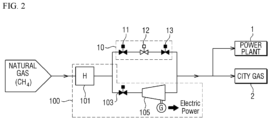
- FIG. 2 is a diagram for describing a process in which natural gas moves in a gas expansion power generation system according to one exemplary embodiment of the present invention.
- natural gas (CH 4 ) is introduced into a heating unit 101, and then, a temperature thereof is raised.
- the natural gas (CH 4 ) of which the temperature is raised in the heating unit 101 moves to a power generation unit 105 through a flow rate adjustment unit 103.
- the flow rate adjustment unit 103 adjusts a flow rate such that the natural gas (CH 4 ) moves first to the power generation unit 105, and the power generation unit 105 decreases a pressure of the natural gas (CH 4 ) and generates electric power.
- the flow rate adjustment unit 103 adjusts the flow rate of the natural gas (CH 4 ) such that the natural gas (CH 4 ) moves to a pressure regulator 10 connected parallel with the power generation unit 105. Thereafter, the pressure regulator 10 adjusts an opening/closing degree of a plurality of valves 11, 12, and 13 to decrease the pressure of the natural gas (CH 4 ).
- the natural gas of which the pressure is decreased in each of the power generation unit 105 and the pressure regulator 10 is supplied for a power plant 1, a city gas 2, and/or like.
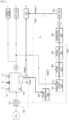
- FIG. 3 is a diagram for describing a process in which a gas expansion power generation system according to one exemplary embodiment of the present invention is linked with a steam methane reforming (SMR) process and a fuel cell process.
- SMR steam methane reforming
- the SMR process is a process of producing hydrogen (H 2 ) by reforming natural gas (CH 4 ).
- a desulfurization unit 301 desulfurizes the natural gas (CH 4 ) of which a pressure is decreased in each of a power generation unit 105 and a pressure regulator 10 to remove a sulfur component remaining in the natural gas (CH 4 ).
- a steam reforming unit 303 primarily produces hydrogen and CO by steam-reforming the natural gas from which the sulfur component is removed in the desulfurization unit 301.
- a steam transition unit 305 increases a concentration of hydrogen through a steam transition process.
- an unreacted gas removal unit 307 removes unreacted CH 4 , CO, and CO 2 through a pressure swing adsorption (PSA) process to produce hydrogen (H 2 ).
- PSA pressure swing adsorption
- the steam reforming unit 303 when the steam reforming unit 303 primarily produces hydrogen and CO, high-temperature steam is supplied through a steam generating unit 309.
- the steam generating unit 309 supplies the high-temperature steam using first waste heat Heat I as a heat source, wherein the first waste heat Heat I is generated when the steam transition unit 305 increases the concentration of hydrogen through the steam transition process.
- the first waste heat Heat I is supplied to a heating unit 101 as well as the steam generating unit 309 and serves as a heat source required for the heating unit 101 to raise a temperature of natural gas (CH 4 ) together with second waste heat Heat II to be described below.
- a fuel cell 400 is a device which generates electric power through a chemical reaction between hydrogen (H 2 ) and oxygen (O 2 ).
- heat is generated according to the chemical reaction between hydrogen (H 2 ) and oxygen (O 2 ) and is generally discarded heat.
- the discarded heat is defined as the second waste heat Heat II.
- the second waste heat Heat II is supplied to the heating unit 101 and thus serves as a heat source required for the heating unit 101 to raise the temperature of the natural gas (CH 4 ) together with the first waste heat Heat I.
- first electric power Power I is stored in a grid 3, but second electric power Power II is supplied to the steam generating unit 309, thereby allowing the steam generating unit 309 to generate high-temperature steam.
- electric power generated by the power generation unit 105 is used in the SMR process, thereby obtaining an effect of reducing energy costs.
- hydrogen (H 2 ) produced through the SMR process is supplied as a source of the fuel cell 400, thereby allowing the fuel cell 400 to produce third electric power Power III.
- the third electric power Power III produced by the fuel cell 400 is stored in a grid 3.
- the gas expansion power generation system 100 is linked with the SMR process and the fuel cell process to complementally perform supplying heat and supplying power, thereby having an effect of maximizing energy efficiency and cost reduction.
Landscapes
- Engineering & Computer Science (AREA)
- Chemical & Material Sciences (AREA)
- General Engineering & Computer Science (AREA)
- Mechanical Engineering (AREA)
- Combustion & Propulsion (AREA)
- Sustainable Development (AREA)
- Chemical Kinetics & Catalysis (AREA)
- Electrochemistry (AREA)
- General Chemical & Material Sciences (AREA)
- Sustainable Energy (AREA)
- Life Sciences & Earth Sciences (AREA)
- Manufacturing & Machinery (AREA)
- Fuel Cell (AREA)
- Hydrogen, Water And Hydrids (AREA)
Description
- The present invention relates to a gas expansion power generation system. Specifically, the present invention relates to a gas expansion power generation system which is installed in a facility for supplying natural gas and reduces the pressure of the natural gas to concurrently generate electric power using energy generated during the reduction in pressure.
- Liquefied natural gas (LNG) stored in a storage tank of an LNG receiving terminal is transmitted at a high pressure of 70 bar using a gas pipeline network. The pressure of LNG is forcibly decreased from a high pressure of 70 bar in static pressure management stations across the country and is supplied to power plants and city gas required places at pressures of 25 bar and 8.5 bar, respectively.
- In this case, it is common to add a pre-heating device for raising the temperature of natural gas before a decrease in pressure in order to prevent the temperature of natural gas from dropping in the power plants or the city gas required places when the pressure of natural gas is decreased in the static pressure management stations.
- Since such a pre-heating device uses a portion of supplied natural gas as a heat source to raise the temperature of natural gas, there are problems in that harmful substances such as NOx and SOx are generated, and a supply amount of natural gas should be set in consideration of pre-heating.
- On the other hand, when a volume of natural gas is expanded while the pressure of natural gas is reduced, separate differential pressure energy can be generated, and by utilizing the separate differential pressure energy, a system for a decrease in pressure of natural gas and concurrently generating electricity can be implemented.
- Accordingly, there is a need for an invention capable of utilizing electric power generated during the decrease in pressure while using a separate heat source in order to pre-heat natural gas.
WO 2018 213 806 A1 discloses a two-phase thermal pump that uses a fluid storage tank with natural gas that can be heated and expanded in a turbine. Certain valves are disclosed that are used for the distribution of the natural gas in a power generating unit. -
KR 10 2011 0 047 905 A - The present invention is directed to providing a gas expansion power generation system which decreases the pressure of natural gas in a line, through which the natural gas is supplied, and concurrently generates electric power through the expansion of the natural gas.
- The present invention is directed to maximizing energy efficiency and fuel cost reduction by linking a gas expansion power generation system with a steam methane reforming (SMR) process and a fuel cell.
- However, aspects of the present invention are not restricted to those set forth herein. The above and other aspects will become more apparent to one of ordinary skill in the art to which the disclosure pertains by referencing the detailed description of the present invention given below.
- According to embodiments of the present disclosure, a gas expansion power generation system comprises: a heating unit configured to raise the temperature of natural gas; a flow rate adjustment unit configured to adjust a flow rate of the natural gas; and a power generation unit configured to reduce the pressure of the natural gas and concurrently expand the natural gas and configured to generate electric power through energy generated when the natural gas is expanded, wherein the natural gas sequentially moves to the heating unit, the flow rate adjustment unit, and the power generation unit, and the heating unit receives waste heat generated in a natural gas reforming process as a heat source to preheat the natural gas before moving the power generation unit, or to receive waste heat generated in a natural gas reforming process together with waste heat generated in a power generation process through a fuel cell as a heat to preheat the natural gas before moving the power generation unit.
- According to an embodiment of the present disclosure, the heating unit raises the temperature of the natural gas in consideration of the temperature decreased when the pressure of the natural gas is decreased in the power generation unit.
- According to an embodiment of the present disclosure, the flow rate adjustment unit adjusts the flow rate of the natural gas such that the natural gas moves to the power generation unit in consideration of the amount of the natural gas of which the pressure is decreased in the power generation unit.
- According to an embodiment of the present disclosure, the flow rate adjustment unit adjusts the flow rate of the natural gas such that the natural gas moves to a pressure regulator connected parallel with the power generation unit, when the amount of the natural gas, of which the pressure is decreased in the power generation unit, is exceeded..
- According to an embodiment of the present disclosure, a portion of the electric power generated by the power generation unit is utilized in the natural gas reforming process.
- According to an embodiment of the present disclosure, hydrogen generated in a natural gas reforming process is used in the power generation process through a fuel cell.
- According to an embodiment of the present disclosure, the natural gas reforming process includes:
- a process in which a desulfurization unit desulfurizes the natural gas of which the pressure is decreased in a pressure regulator, a steam reforming unit primarily steam-reforms the desulfurized natural gas into hydrogen and CO, a steam transition unit increases the concentration of hydrogen through a steam transition process, and an unreacted gas removal unit removes unreacted CH4, CO, and CO2 to produce hydrogen, and
- a portion of waste heat generated when the steam transition unit increases the concentration of hydrogen is supplied to the power generation unit.
- According to an embodiment of the present disclosure, a steam generating unit is provided to supply high-temperature steam to the steam reforming unit when the steam reforming unit primarily produces hydrogen and CO, and the remaining portion of the waste heat generated when the steam transition unit increases the concentration of hydrogen is supplied to the steam generating unit.
- According to an embodiment of the present disclosure, partial electric power of the electric power generated by the power generation unit is stored in a grid, and the remaining partial electric power thereof is supplied to the steam generating unit so that the steam generating unit generates high-temperature steam.
- According to an embodiment of the present disclosure, hydrogen produced in the natural gas reforming process is supplied as a source of the fuel cell, and electric power generated in the fuel cell is stored in the grid.
- According to embodiments of the present disclosure of a gas expansion power generation process, a heating unit raises the temperature of natural gas; a flow rate adjustment unit adjusts a flow rate of the natural gas; and a power generation unit reduces the pressure of the natural gas and concurrently expands the natural gas and generates electric power through energy generated when the natural gas is expanded, wherein the natural gas is sequentially moved to the heating unit, the flow rate adjustment unit, and the power generation unit, and wherein the heating unit receives waste heat generated in a natural gas reforming process or waste heat generated in a power generation process through a fuel cell as a heat source.
- According to an embodiment of the present disclosure of the gas expansion power generation process, the heating unit raises the temperature of the natural gas in consideration of a temperature decreased when the pressure of the natural gas is decreased in the power generation unit.
- According to an embodiment of the present disclosure of the gas expansion power generation process, in consideration of an amount of the natural gas of which the pressure is decreased in the power generation unit, the flow rate adjustment unit adjusts the flow rate of the natural gas such that the natural gas moves to the power generation unit.
- According to an embodiment of the present disclosure of the gas expansion power generation process, when the amount of the natural gas, of which the pressure is decreased in the power generation unit, is exceeded, the flow rate adjustment unit adjusts the flow rate of the natural gas such that the natural gas moves to a pressure regulator connected parallel with the power generation unit.
- According to an embodiment of the present disclosure of the gas expansion power generation process, a portion of the electric power generated by the power generation unit is utilized in the natural gas reforming process.
- According to an embodiment of the present disclosure of the gas expansion power generation process, hydrogen generated in the natural gas reforming process is used in the power generation process through the fuel cell.
- According to an embodiment of the present disclosure of the gas expansion power generation process, the natural gas reforming process includes a process in which a desulfurization unit desulfurizes the natural gas of which the pressure is decreased in a pressure regulator, a steam reforming unit primarily steam-reforms the desulfurized natural gas into hydrogen and CO, a steam transition unit increases the concentration of hydrogen through a steam transition process, and an unreacted gas removal unit removes unreacted CH4, CO, and CO2 to produce hydrogen, and a portion of waste heat generated when the steam transition unit increases the concentration of hydrogen is supplied to the power generation unit.
- According to an embodiment of the present disclosure of the gas expansion power generation process, a steam generating unit is provided to supply high-temperature steam to the steam reforming unit when the steam reforming unit primarily produces hydrogen and CO, and the remaining portion of the waste heat generated when the steam transition unit increases the concentration of hydrogen is supplied to the steam generating unit.
- According to an embodiment of the present disclosure of the gas expansion power generation process, partial electric power of the electric power generated by the power generation unit is stored in a grid, and the remaining partial electric power thereof is supplied to the steam generating unit so that the steam generating unit generates high-temperature steam. According to an embodiment of the present disclosure of the gas expansion power generation process hydrogen produced in the natural gas reforming process is supplied as a source of the fuel cell, and electric power generated in the fuel cell is stored in the grid.
- According to the present invention, electric power is generated by decreasing the pressure of natural gas and concurrently expanding the natural gas in a line through which the natural gas is supplied. Accordingly, the present invention has an effect of generating electric power without a separate power generation facility.
- In addition, in the present invention, a gas expansion power generation system is linked with a steam methane reforming (SMR) process and a fuel cell. Accordingly, the present invention has an effect of maximizing energy efficiency and fuel cost reduction.
- The effects of the present invention are not limited to the above-described effects and other effects which are not described herein will become apparent to those skilled in the art from the following description.
-
-
FIG. 1 is a block diagram of a gas expansion power generation system according to one exemplary embodiment of the present invention. -
FIG. 2 is a diagram for describing a process in which natural gas moves in a gas expansion power generation system according to one exemplary embodiment of the present invention. -
FIG. 3 is a diagram for describing a process in which a gas expansion power generation system according to one exemplary embodiment of the present invention is linked with a steam methane reforming (SMR) process and a fuel cell process. -
- 1: power plant
- 2: city gas
- 3: Grid
- 10:
pressure regulator - 100: gas expansion power generation system
- 101: heating unit 103: flow rate adjustment unit
- 105: power generation unit
- 301: desulfurization unit 303: steam reforming unit
- 305: steam transition unit 307: unreacted gas removal unit
- 309: steam generating unit
- 400: fuel cell
- Various changes may be made to embodiments of the present disclosure, and the present disclosure may have various embodiments which will be described in detail with reference to the drawings. However, the embodiments according to concepts of the present disclosure are not construed as limited to the described embodiments, and include all changes, equivalents, or substitutes that do not depart from the spirit and technical scope of the present disclosure.
- The terms used in the present disclosure are for the purpose of describing particular non-limiting example embodiments only and are not intended to be limiting. The singular forms are intended to include the plural forms as well, unless the context clearly indicates otherwise. The term "include" or "has" used in the present disclosure is to indicate the presence of features, numbers, steps, operations, elements, parts, or a combination thereof described in the specifications, and does not preclude the presence or addition of one or more other features, numbers, steps, operations, elements, parts, or a combination thereof.
- All of the terms used herein including technical or scientific terms have the same meanings as those generally understood by an ordinary skilled person in the related art unless they are defined otherwise. The terms defined in a generally used dictionary should be interpreted as having meanings that are the same as or similar with the contextual meanings of the relevant technology and should not be interpreted as having ideal or exaggerated meanings unless they are clearly defined in the present disclosure.
- Hereinafter, configurations of exemplary embodiments of the present invention will be described in detail with reference to the accompanying drawings.
-
FIG. 1 is a block diagram of a gas expansion power generation system according to one exemplary embodiment of the present invention. - Referring to
FIG. 1 , a gas expansionpower generation system 100 according to one exemplary embodiment of the present invention includes aheating unit 101, a flowrate adjustment unit 103, and apower generation unit 105. - The
heating unit 101 raises the temperature of natural gas. Specifically, theheating unit 101 raises the temperature of the natural gas in consideration of the temperature decreased when a pressure of the natural gas is decreased in thepower generation unit 105. - For example, when the temperature of the natural gas is set to drop by 70 °C during the decrease in pressure in the
power generation unit 105, theheating unit 101 raises the temperature of the natural gas by 70 °C in advance to allow the natural gas to move thepower generation unit 105. That is, theheating unit 101 pre-heats the natural gas. - In this case, a conventional gas expansion power generation system has burned a portion of natural gas flowing into the
heating unit 101 to use combustion heat as a heat source for raising a temperature of the natural gas. Accordingly, there is a problem in that harmful substances such as NOx and SOx are generated. - However, since the gas expansion
power generation system 100 according to one exemplary embodiment of the present invention is linked with a natural gas reforming process and a power generating process through a fuel cell, theheating unit 101 receives a heat source from waste heat generated in the natural gas reforming process and the power generating process through a fuel cell. Therefore, in the gas expansionpower generation system 100 according to one exemplary embodiment of the present invention, since there is no need to burn a portion of the natural gas flowing into theheating unit 101, there is an advantage in that harmful substances and the like are not generated. A detailed description thereof will be provided below with reference toFIG. 3 . - The flow
rate adjustment unit 103 adjusts a flow rate of the natural gas. Specifically, in consideration of an amount of the natural gas of which the pressure can be decreased in thepower generation unit 105, the flowrate adjustment unit 103 adjusts the flow rate of the natural gas such that the natural gas moves to thepower generation unit 105. - Meanwhile, when an amount of the natural gas, of which the pressure can be decreased in the
power generation unit 105, is exceeded, the flowrate adjustment unit 103 adjusts the flow rate of the natural gas such that the natural gas moves to apressure regulator 10 connected parallel with thepower generation unit 105. A detailed description of thepressure regulator 10 will be described below. - The
power generation unit 105 reduces the pressure of the natural gas and concurrently expands the natural gas to generate electric power through energy generated when the natural gas is expanded. - That is, unlike a general pressure regulator installed on a line through which natural gas moves, in the gas expansion
power generation system 100 according to one exemplary embodiment of the present invention, thepower generation unit 105 performs a function of decreasing the pressure of natural gas and concurrently generating electric power through the expansion of the natural gas, and thus, the gas expansionpower generation system 100 has high utilization. -
FIG. 2 is a diagram for describing a process in which natural gas moves in a gas expansion power generation system according to one exemplary embodiment of the present invention. - Referring to
FIG. 2 , natural gas (CH4) is introduced into aheating unit 101, and then, a temperature thereof is raised. The natural gas (CH4) of which the temperature is raised in theheating unit 101 moves to apower generation unit 105 through a flowrate adjustment unit 103. In this case, as described above, the flowrate adjustment unit 103 adjusts a flow rate such that the natural gas (CH4) moves first to thepower generation unit 105, and thepower generation unit 105 decreases a pressure of the natural gas (CH4) and generates electric power. Then, as described above, when an amount of the natural gas (CH4), of which the pressure can be decreased in thepower generation unit 105, is exceeded, the flowrate adjustment unit 103 adjusts the flow rate of the natural gas (CH4) such that the natural gas (CH4) moves to apressure regulator 10 connected parallel with thepower generation unit 105. Thereafter, thepressure regulator 10 adjusts an opening/closing degree of a plurality ofvalves power generation unit 105 and thepressure regulator 10 is supplied for apower plant 1, acity gas 2, and/or like. -
FIG. 3 is a diagram for describing a process in which a gas expansion power generation system according to one exemplary embodiment of the present invention is linked with a steam methane reforming (SMR) process and a fuel cell process. - The SMR process is a process of producing hydrogen (H2) by reforming natural gas (CH4). Specifically, referring to
FIG. 3 , adesulfurization unit 301 desulfurizes the natural gas (CH4) of which a pressure is decreased in each of apower generation unit 105 and apressure regulator 10 to remove a sulfur component remaining in the natural gas (CH4). Thereafter, asteam reforming unit 303 primarily produces hydrogen and CO by steam-reforming the natural gas from which the sulfur component is removed in thedesulfurization unit 301. Subsequently, asteam transition unit 305 increases a concentration of hydrogen through a steam transition process. Thereafter, an unreactedgas removal unit 307 removes unreacted CH4, CO, and CO2 through a pressure swing adsorption (PSA) process to produce hydrogen (H2). - In this case, when the
steam reforming unit 303 primarily produces hydrogen and CO, high-temperature steam is supplied through asteam generating unit 309. Thesteam generating unit 309 supplies the high-temperature steam using first waste heat Heat I as a heat source, wherein the first waste heat Heat I is generated when thesteam transition unit 305 increases the concentration of hydrogen through the steam transition process. - In addition, the first waste heat Heat I is supplied to a
heating unit 101 as well as thesteam generating unit 309 and serves as a heat source required for theheating unit 101 to raise a temperature of natural gas (CH4) together with second waste heat Heat II to be described below. - A
fuel cell 400 is a device which generates electric power through a chemical reaction between hydrogen (H2) and oxygen (O2). In this case, heat is generated according to the chemical reaction between hydrogen (H2) and oxygen (O2) and is generally discarded heat. Thus, in the present invention, the discarded heat is defined as the second waste heat Heat II. - As described above, the second waste heat Heat II is supplied to the
heating unit 101 and thus serves as a heat source required for theheating unit 101 to raise the temperature of the natural gas (CH4) together with the first waste heat Heat I. - That is, in the gas expansion
power generation system 100 according to one exemplary embodiment of the present invention, since waste heat generated in the SMR process and a process of thefuel cell 400 is used as a heat source for heating natural gas without being discarded, there is an effect of maximizing efficiency due to fuel cost reduction and energy recycling. - In addition, referring to
FIG. 3 , in electric power generated by thepower generation unit 105, first electric power Power I is stored in agrid 3, but second electric power Power II is supplied to thesteam generating unit 309, thereby allowing thesteam generating unit 309 to generate high-temperature steam. - That is, in the gas expansion
power generation system 100 according to one exemplary embodiment of the present invention, electric power generated by thepower generation unit 105 is used in the SMR process, thereby obtaining an effect of reducing energy costs. - In addition, referring to
FIG. 3 , hydrogen (H2) produced through the SMR process is supplied as a source of thefuel cell 400, thereby allowing thefuel cell 400 to produce third electric power Power III. In this case, the third electric power Power III produced by thefuel cell 400 is stored in agrid 3. - That is, the gas expansion
power generation system 100 according to one exemplary embodiment of the present invention is linked with the SMR process and the fuel cell process to complementally perform supplying heat and supplying power, thereby having an effect of maximizing energy efficiency and cost reduction.
Claims (11)
- A gas expansion power generation system (100) comprising:a heating unit (101) configured to raise the temperature of natural gas;a flow rate adjustment unit (103) configured to adjust a flow rate of the natural gas; anda power generation unit (105) configured to reduce the pressure of the natural gas and concurrently expand the natural gas and configured to generate electric power through energy generated when the natural gas is expanded,wherein the natural gas is sequentially movable to the heating unit (101), the flow rate adjustment unit (103), and the power generation unit (105), characterized in thatthe heating (101) unit is configured to receive waste heat generated in a natural gas reforming process as a heat source to preheat the natural gas before moving the power generation unit, or to receive waste heat generated in a natural gas reforming process together with waste heat generated in a power generation process through a fuel cell (400) as a heat source to preheat the natural gas before moving the power generation unit.
- The gas expansion power generation system (100) of claim 1, wherein the heating unit (101) is configured to raise the temperature of the natural gas in consideration of a temperature decreased when the pressure of the natural gas is decreased in the power generation unit (105).
- The gas expansion power generation system (100) according to claim 1, wherein, in consideration of an amount of the natural gas of which the pressure is decreased in the power generation unit (105), the flow rate adjustment unit (103) is configured to adjust the flow rate of the natural gas such that the natural gas is movable to the power generation unit (105).
- The gas expansion power generation system (100) according to any of the claims 1 to 3, wherein the natural gas reforming includes a a desulfurization unit (301) which is configured to desulfurize the natural gas of which the pressure is decreased in a pressure regulator (10), a steam reforming unit (303) is configured to primarily steam-reform the desulfurized natural gas into hydrogen and CO, a steam transition unit (305) is configured to increase the concentration of hydrogen through steam transition, and an unreacted gas removal unit (307) is configured to remove unreacted CH4, CO, and CO2 to produce hydrogen, and
a portion of waste heat generated when the steam transition unit (305) increases the concentration of hydrogen is supplied to the power generation unit (105). - The gas expansion power generation system (100) according to claim 4, wherein a steam generating unit (309) is provided and configured to supply high-temperature steam to the steam reforming unit (303) when the steam reforming unit (303) primarily produces hydrogen and CO, and
the remaining portion of the waste heat generated when the steam transition unit (305) increases the concentration of hydrogen is supplied to the steam generating unit (309). - The gas expansion power generation system (100) according to claim 5, wherein partial electric power of the electric power generated by the power generation unit (105) is stored in a grid (3), and
the remaining partial electric power thereof is supplied to the steam generating unit (309) so that the steam generating unit (309) generates high-temperature steam. - The gas expansion power generation system (100) according to claim 6, wherein hydrogen produced in the natural gas reforming process is supplied as a source of the fuel cell (400), and
electric power generated in the fuel cell (400) is stored in the grid (3). - A gas expansion power generation process, whereina heating unit (101) raises the temperature of natural gas;a flow rate adjustment unit (103) adjusts a flow rate of the natural gas; anda power generation unit (105) reduces the pressure of the natural gas and concurrently expands the natural gas and generates electric power through energy generated when the natural gas is expanded,wherein the natural gas is sequentially moved to the heating unit (101), the flow rate adjustment unit (103), and the power generation unit (105), characterized in thatthe heating (101) unit receives waste heat generated in a natural gas reforming process as a heat source to preheat the natural gas before moving the power generation unit, or to receive waste heat generated in a natural gas reforming process together with waste heat generated in a power generation process through a fuel cell (400) as a heat source to preheat the natural gas before moving the power generation unit.
- The gas expansion power generation process of claim 8, wherein the heating unit (101) raises the temperature of the natural gas in consideration of a temperature decreased when the pressure of the natural gas is decreased in the power generation unit (105).
- The gas expansion power generation process of claim 8 or 9, wherein, in consideration of an amount of the natural gas of which the pressure is decreased in the power generation unit (105), the flow rate adjustment unit (103) adjusts the flow rate of the natural gas such that the natural gas moves to the power generation unit (105).
- The gas expansion power generation process according to any of the claims 8 to 10, wherein a portion of the electric power generated by the power generation unit (105) is utilized in the natural gas reforming process.
Applications Claiming Priority (2)
| Application Number | Priority Date | Filing Date | Title |
|---|---|---|---|
| KR1020190039448A KR102662302B1 (en) | 2019-04-04 | 2019-04-04 | System of power generation through gas expansion |
| PCT/KR2019/014229 WO2020204292A1 (en) | 2019-04-04 | 2019-10-28 | Gas expansion power generation system |
Publications (3)
| Publication Number | Publication Date |
|---|---|
| EP3951141A1 EP3951141A1 (en) | 2022-02-09 |
| EP3951141A4 EP3951141A4 (en) | 2023-01-11 |
| EP3951141B1 true EP3951141B1 (en) | 2024-08-14 |
Family
ID=72667309
Family Applications (1)
| Application Number | Title | Priority Date | Filing Date |
|---|---|---|---|
| EP19923679.5A Active EP3951141B1 (en) | 2019-04-04 | 2019-10-28 | Gas expansion power generation system |
Country Status (3)
| Country | Link |
|---|---|
| EP (1) | EP3951141B1 (en) |
| KR (1) | KR102662302B1 (en) |
| WO (1) | WO2020204292A1 (en) |
Families Citing this family (2)
| Publication number | Priority date | Publication date | Assignee | Title |
|---|---|---|---|---|
| KR102290387B1 (en) * | 2020-11-19 | 2021-08-19 | 한국가스공사 | Combination Power Generating System and Method for Combination Pre-heating |
| KR102536782B1 (en) * | 2021-08-13 | 2023-05-26 | 한국해양과학기술원 | Electric generating system using volume expansion pressure of vaporized hydrogen |
Family Cites Families (11)
| Publication number | Priority date | Publication date | Assignee | Title |
|---|---|---|---|---|
| JPS6193211A (en) * | 1984-10-12 | 1986-05-12 | Hitachi Ltd | Control device for cold power generation equipment |
| JP3597552B2 (en) * | 1994-01-31 | 2004-12-08 | 大阪瓦斯株式会社 | City gas pressure regulator with energy recovery device |
| JP4786162B2 (en) * | 2004-10-21 | 2011-10-05 | 東芝燃料電池システム株式会社 | Liquid fuel reforming system and method |
| US8080344B2 (en) * | 2006-05-16 | 2011-12-20 | Fuelcell Energy, Inc. | Fuel cell hybrid power generation system |
| US9470452B2 (en) * | 2006-07-27 | 2016-10-18 | Cosmodyne, LLC | Imported LNG treatment |
| KR20110047905A (en) * | 2009-10-31 | 2011-05-09 | 유한회사 이지엠에너지홀딩스 | Energy recovery system and energy recovery method of natural gas constant pressure facility through fuel cell-turbo inflator integrated energy recovery system |
| US8742604B2 (en) * | 2012-06-06 | 2014-06-03 | Energy Recovery, Inc. | Systems and methods for combined flow control and electricity generation |
| US20140000275A1 (en) * | 2012-06-29 | 2014-01-02 | Icr Turbine Engine Corporation | Lng fuel handling for a gas turbine engine |
| KR101534235B1 (en) * | 2014-06-26 | 2015-07-06 | 대우조선해양 주식회사 | Mcfc power supply system for ship |
| KR102153758B1 (en) * | 2015-12-24 | 2020-09-09 | 한국조선해양 주식회사 | Ship |
| US11619146B2 (en) * | 2017-05-18 | 2023-04-04 | Rolls-Royce North American Technologies Inc. | Two-phase thermal pump |
-
2019
- 2019-04-04 KR KR1020190039448A patent/KR102662302B1/en active Active
- 2019-10-28 WO PCT/KR2019/014229 patent/WO2020204292A1/en not_active Ceased
- 2019-10-28 EP EP19923679.5A patent/EP3951141B1/en active Active
Also Published As
| Publication number | Publication date |
|---|---|
| WO2020204292A1 (en) | 2020-10-08 |
| EP3951141A4 (en) | 2023-01-11 |
| KR102662302B1 (en) | 2024-04-29 |
| KR20200117402A (en) | 2020-10-14 |
| EP3951141A1 (en) | 2022-02-09 |
Similar Documents
| Publication | Publication Date | Title |
|---|---|---|
| US7354566B2 (en) | Fuel gas production method and apparatus | |
| CN105580178B (en) | Recirculation device and method for high-temperature battery system | |
| KR101576289B1 (en) | Fuel cell hybrid power generation system and method for gas distribution system | |
| JP5389167B2 (en) | Hydrogen generator and operating method thereof | |
| US7785539B2 (en) | Method of controlling a hydrogen generator | |
| KR20210103677A (en) | Hydrogen Reforming System | |
| JPWO2020203087A1 (en) | Hydrocarbon combustion system | |
| EP3951141B1 (en) | Gas expansion power generation system | |
| US8053130B2 (en) | Fuel cell system | |
| KR20210114231A (en) | Hydrogen Reforming System | |
| JP2002298889A (en) | Solid electrolyte fuel cell system | |
| JP5731202B2 (en) | Syngas production method and apparatus | |
| JP2021528586A (en) | Supercritical CO2 cycle coupled to chemical loop equipment | |
| JPS61218073A (en) | Fuel cell system | |
| Sayama et al. | Dynamic operation of two-stage CO2 methanation reactor: Start-up by H2 combustion and load change by independent control of heat-carrier flow rate | |
| KR101447335B1 (en) | Heat recovery high efficiency fuel cell hybrid system linked with steam turbine | |
| JP2023032263A (en) | Fuel cell power generation device | |
| JP4049526B2 (en) | Method for starting reformer for fuel cell | |
| JP4393760B2 (en) | Gas production method and production plant | |
| AU2023384328A1 (en) | Formic acid energy storage system and relative method | |
| JP2024172778A (en) | Carbon Dioxide Conversion System | |
| KR20250006723A (en) | Hybrid system for reforming fuel and method for reforming fuel using the same | |
| WO2007021172A1 (en) | System and method for integration of renewable energy and fuel cell for the production of electricity and hydrogen | |
| JP2010160928A (en) | Method for starting fuel reforming device, fuel reforming device, and fuel cell power generation device | |
| CN101175690A (en) | Reformer, method for controlling pump in fuel cell system, and control device |
Legal Events
| Date | Code | Title | Description |
|---|---|---|---|
| STAA | Information on the status of an ep patent application or granted ep patent |
Free format text: STATUS: THE INTERNATIONAL PUBLICATION HAS BEEN MADE |
|
| PUAI | Public reference made under article 153(3) epc to a published international application that has entered the european phase |
Free format text: ORIGINAL CODE: 0009012 |
|
| STAA | Information on the status of an ep patent application or granted ep patent |
Free format text: STATUS: REQUEST FOR EXAMINATION WAS MADE |
|
| 17P | Request for examination filed |
Effective date: 20211104 |
|
| AK | Designated contracting states |
Kind code of ref document: A1 Designated state(s): AL AT BE BG CH CY CZ DE DK EE ES FI FR GB GR HR HU IE IS IT LI LT LU LV MC MK MT NL NO PL PT RO RS SE SI SK SM TR |
|
| DAV | Request for validation of the european patent (deleted) | ||
| DAX | Request for extension of the european patent (deleted) | ||
| A4 | Supplementary search report drawn up and despatched |
Effective date: 20221214 |
|
| RIC1 | Information provided on ipc code assigned before grant |
Ipc: H01M 8/0662 20160101ALI20221208BHEP Ipc: H01M 8/0668 20160101ALI20221208BHEP Ipc: H01M 8/0612 20160101ALI20221208BHEP Ipc: F17D 1/00 20060101ALI20221208BHEP Ipc: F01K 13/00 20060101ALI20221208BHEP Ipc: F17C 9/02 20060101ALI20221208BHEP Ipc: H01M 8/04111 20160101ALI20221208BHEP Ipc: F01K 25/10 20060101ALI20221208BHEP Ipc: F01K 27/02 20060101AFI20221208BHEP |
|
| RIC1 | Information provided on ipc code assigned before grant |
Ipc: H01M 8/0662 20160101ALI20240206BHEP Ipc: H01M 8/0668 20160101ALI20240206BHEP Ipc: H01M 8/0612 20160101ALI20240206BHEP Ipc: F17D 1/00 20060101ALI20240206BHEP Ipc: F01K 13/00 20060101ALI20240206BHEP Ipc: F17C 9/02 20060101ALI20240206BHEP Ipc: H01M 8/04111 20160101ALI20240206BHEP Ipc: F01K 25/10 20060101ALI20240206BHEP Ipc: F01K 27/02 20060101AFI20240206BHEP |
|
| GRAP | Despatch of communication of intention to grant a patent |
Free format text: ORIGINAL CODE: EPIDOSNIGR1 |
|
| STAA | Information on the status of an ep patent application or granted ep patent |
Free format text: STATUS: GRANT OF PATENT IS INTENDED |
|
| INTG | Intention to grant announced |
Effective date: 20240319 |
|
| GRAS | Grant fee paid |
Free format text: ORIGINAL CODE: EPIDOSNIGR3 |
|
| GRAA | (expected) grant |
Free format text: ORIGINAL CODE: 0009210 |
|
| STAA | Information on the status of an ep patent application or granted ep patent |
Free format text: STATUS: THE PATENT HAS BEEN GRANTED |
|
| AK | Designated contracting states |
Kind code of ref document: B1 Designated state(s): AL AT BE BG CH CY CZ DE DK EE ES FI FR GB GR HR HU IE IS IT LI LT LU LV MC MK MT NL NO PL PT RO RS SE SI SK SM TR |
|
| REG | Reference to a national code |
Ref country code: GB Ref legal event code: FG4D |
|
| REG | Reference to a national code |
Ref country code: CH Ref legal event code: EP |
|
| REG | Reference to a national code |
Ref country code: DE Ref legal event code: R096 Ref document number: 602019057199 Country of ref document: DE |
|
| REG | Reference to a national code |
Ref country code: IE Ref legal event code: FG4D |
|
| REG | Reference to a national code |
Ref country code: LT Ref legal event code: MG9D |
|
| REG | Reference to a national code |
Ref country code: NL Ref legal event code: MP Effective date: 20240814 |
|
| PG25 | Lapsed in a contracting state [announced via postgrant information from national office to epo] |
Ref country code: NO Free format text: LAPSE BECAUSE OF FAILURE TO SUBMIT A TRANSLATION OF THE DESCRIPTION OR TO PAY THE FEE WITHIN THE PRESCRIBED TIME-LIMIT Effective date: 20241114 |
|
| REG | Reference to a national code |
Ref country code: AT Ref legal event code: MK05 Ref document number: 1713483 Country of ref document: AT Kind code of ref document: T Effective date: 20240814 |
|
| PG25 | Lapsed in a contracting state [announced via postgrant information from national office to epo] |
Ref country code: FI Free format text: LAPSE BECAUSE OF FAILURE TO SUBMIT A TRANSLATION OF THE DESCRIPTION OR TO PAY THE FEE WITHIN THE PRESCRIBED TIME-LIMIT Effective date: 20240814 Ref country code: NL Free format text: LAPSE BECAUSE OF FAILURE TO SUBMIT A TRANSLATION OF THE DESCRIPTION OR TO PAY THE FEE WITHIN THE PRESCRIBED TIME-LIMIT Effective date: 20240814 Ref country code: PL Free format text: LAPSE BECAUSE OF FAILURE TO SUBMIT A TRANSLATION OF THE DESCRIPTION OR TO PAY THE FEE WITHIN THE PRESCRIBED TIME-LIMIT Effective date: 20240814 Ref country code: GR Free format text: LAPSE BECAUSE OF FAILURE TO SUBMIT A TRANSLATION OF THE DESCRIPTION OR TO PAY THE FEE WITHIN THE PRESCRIBED TIME-LIMIT Effective date: 20241115 Ref country code: PT Free format text: LAPSE BECAUSE OF FAILURE TO SUBMIT A TRANSLATION OF THE DESCRIPTION OR TO PAY THE FEE WITHIN THE PRESCRIBED TIME-LIMIT Effective date: 20241216 |
|
| PG25 | Lapsed in a contracting state [announced via postgrant information from national office to epo] |
Ref country code: BG Free format text: LAPSE BECAUSE OF FAILURE TO SUBMIT A TRANSLATION OF THE DESCRIPTION OR TO PAY THE FEE WITHIN THE PRESCRIBED TIME-LIMIT Effective date: 20240814 |
|
| PG25 | Lapsed in a contracting state [announced via postgrant information from national office to epo] |
Ref country code: LV Free format text: LAPSE BECAUSE OF FAILURE TO SUBMIT A TRANSLATION OF THE DESCRIPTION OR TO PAY THE FEE WITHIN THE PRESCRIBED TIME-LIMIT Effective date: 20240814 |
|
| PG25 | Lapsed in a contracting state [announced via postgrant information from national office to epo] |
Ref country code: AT Free format text: LAPSE BECAUSE OF FAILURE TO SUBMIT A TRANSLATION OF THE DESCRIPTION OR TO PAY THE FEE WITHIN THE PRESCRIBED TIME-LIMIT Effective date: 20240814 Ref country code: IS Free format text: LAPSE BECAUSE OF FAILURE TO SUBMIT A TRANSLATION OF THE DESCRIPTION OR TO PAY THE FEE WITHIN THE PRESCRIBED TIME-LIMIT Effective date: 20241214 |
|
| PG25 | Lapsed in a contracting state [announced via postgrant information from national office to epo] |
Ref country code: HR Free format text: LAPSE BECAUSE OF FAILURE TO SUBMIT A TRANSLATION OF THE DESCRIPTION OR TO PAY THE FEE WITHIN THE PRESCRIBED TIME-LIMIT Effective date: 20240814 |
|
| PG25 | Lapsed in a contracting state [announced via postgrant information from national office to epo] |
Ref country code: ES Free format text: LAPSE BECAUSE OF FAILURE TO SUBMIT A TRANSLATION OF THE DESCRIPTION OR TO PAY THE FEE WITHIN THE PRESCRIBED TIME-LIMIT Effective date: 20240814 Ref country code: RS Free format text: LAPSE BECAUSE OF FAILURE TO SUBMIT A TRANSLATION OF THE DESCRIPTION OR TO PAY THE FEE WITHIN THE PRESCRIBED TIME-LIMIT Effective date: 20241114 |
|
| PG25 | Lapsed in a contracting state [announced via postgrant information from national office to epo] |
Ref country code: RS Free format text: LAPSE BECAUSE OF FAILURE TO SUBMIT A TRANSLATION OF THE DESCRIPTION OR TO PAY THE FEE WITHIN THE PRESCRIBED TIME-LIMIT Effective date: 20241114 Ref country code: PT Free format text: LAPSE BECAUSE OF FAILURE TO SUBMIT A TRANSLATION OF THE DESCRIPTION OR TO PAY THE FEE WITHIN THE PRESCRIBED TIME-LIMIT Effective date: 20241216 Ref country code: PL Free format text: LAPSE BECAUSE OF FAILURE TO SUBMIT A TRANSLATION OF THE DESCRIPTION OR TO PAY THE FEE WITHIN THE PRESCRIBED TIME-LIMIT Effective date: 20240814 Ref country code: NO Free format text: LAPSE BECAUSE OF FAILURE TO SUBMIT A TRANSLATION OF THE DESCRIPTION OR TO PAY THE FEE WITHIN THE PRESCRIBED TIME-LIMIT Effective date: 20241114 Ref country code: NL Free format text: LAPSE BECAUSE OF FAILURE TO SUBMIT A TRANSLATION OF THE DESCRIPTION OR TO PAY THE FEE WITHIN THE PRESCRIBED TIME-LIMIT Effective date: 20240814 Ref country code: LV Free format text: LAPSE BECAUSE OF FAILURE TO SUBMIT A TRANSLATION OF THE DESCRIPTION OR TO PAY THE FEE WITHIN THE PRESCRIBED TIME-LIMIT Effective date: 20240814 Ref country code: IS Free format text: LAPSE BECAUSE OF FAILURE TO SUBMIT A TRANSLATION OF THE DESCRIPTION OR TO PAY THE FEE WITHIN THE PRESCRIBED TIME-LIMIT Effective date: 20241214 Ref country code: HR Free format text: LAPSE BECAUSE OF FAILURE TO SUBMIT A TRANSLATION OF THE DESCRIPTION OR TO PAY THE FEE WITHIN THE PRESCRIBED TIME-LIMIT Effective date: 20240814 Ref country code: GR Free format text: LAPSE BECAUSE OF FAILURE TO SUBMIT A TRANSLATION OF THE DESCRIPTION OR TO PAY THE FEE WITHIN THE PRESCRIBED TIME-LIMIT Effective date: 20241115 Ref country code: FI Free format text: LAPSE BECAUSE OF FAILURE TO SUBMIT A TRANSLATION OF THE DESCRIPTION OR TO PAY THE FEE WITHIN THE PRESCRIBED TIME-LIMIT Effective date: 20240814 Ref country code: ES Free format text: LAPSE BECAUSE OF FAILURE TO SUBMIT A TRANSLATION OF THE DESCRIPTION OR TO PAY THE FEE WITHIN THE PRESCRIBED TIME-LIMIT Effective date: 20240814 Ref country code: BG Free format text: LAPSE BECAUSE OF FAILURE TO SUBMIT A TRANSLATION OF THE DESCRIPTION OR TO PAY THE FEE WITHIN THE PRESCRIBED TIME-LIMIT Effective date: 20240814 Ref country code: AT Free format text: LAPSE BECAUSE OF FAILURE TO SUBMIT A TRANSLATION OF THE DESCRIPTION OR TO PAY THE FEE WITHIN THE PRESCRIBED TIME-LIMIT Effective date: 20240814 |
|
| PG25 | Lapsed in a contracting state [announced via postgrant information from national office to epo] |
Ref country code: DK Free format text: LAPSE BECAUSE OF FAILURE TO SUBMIT A TRANSLATION OF THE DESCRIPTION OR TO PAY THE FEE WITHIN THE PRESCRIBED TIME-LIMIT Effective date: 20240814 Ref country code: RO Free format text: LAPSE BECAUSE OF FAILURE TO SUBMIT A TRANSLATION OF THE DESCRIPTION OR TO PAY THE FEE WITHIN THE PRESCRIBED TIME-LIMIT Effective date: 20240814 Ref country code: SM Free format text: LAPSE BECAUSE OF FAILURE TO SUBMIT A TRANSLATION OF THE DESCRIPTION OR TO PAY THE FEE WITHIN THE PRESCRIBED TIME-LIMIT Effective date: 20240814 |
|
| PG25 | Lapsed in a contracting state [announced via postgrant information from national office to epo] |
Ref country code: EE Free format text: LAPSE BECAUSE OF FAILURE TO SUBMIT A TRANSLATION OF THE DESCRIPTION OR TO PAY THE FEE WITHIN THE PRESCRIBED TIME-LIMIT Effective date: 20240814 |
|
| PG25 | Lapsed in a contracting state [announced via postgrant information from national office to epo] |
Ref country code: CZ Free format text: LAPSE BECAUSE OF FAILURE TO SUBMIT A TRANSLATION OF THE DESCRIPTION OR TO PAY THE FEE WITHIN THE PRESCRIBED TIME-LIMIT Effective date: 20240814 |
|
| PG25 | Lapsed in a contracting state [announced via postgrant information from national office to epo] |
Ref country code: SK Free format text: LAPSE BECAUSE OF FAILURE TO SUBMIT A TRANSLATION OF THE DESCRIPTION OR TO PAY THE FEE WITHIN THE PRESCRIBED TIME-LIMIT Effective date: 20240814 Ref country code: IT Free format text: LAPSE BECAUSE OF FAILURE TO SUBMIT A TRANSLATION OF THE DESCRIPTION OR TO PAY THE FEE WITHIN THE PRESCRIBED TIME-LIMIT Effective date: 20240814 |
|
| REG | Reference to a national code |
Ref country code: DE Ref legal event code: R097 Ref document number: 602019057199 Country of ref document: DE |
|
| REG | Reference to a national code |
Ref country code: CH Ref legal event code: PL |
|
| PLBE | No opposition filed within time limit |
Free format text: ORIGINAL CODE: 0009261 |
|
| STAA | Information on the status of an ep patent application or granted ep patent |
Free format text: STATUS: NO OPPOSITION FILED WITHIN TIME LIMIT |
|
| PG25 | Lapsed in a contracting state [announced via postgrant information from national office to epo] |
Ref country code: MC Free format text: LAPSE BECAUSE OF FAILURE TO SUBMIT A TRANSLATION OF THE DESCRIPTION OR TO PAY THE FEE WITHIN THE PRESCRIBED TIME-LIMIT Effective date: 20240814 |
|
| PG25 | Lapsed in a contracting state [announced via postgrant information from national office to epo] |
Ref country code: LU Free format text: LAPSE BECAUSE OF NON-PAYMENT OF DUE FEES Effective date: 20241028 Ref country code: BE Free format text: LAPSE BECAUSE OF NON-PAYMENT OF DUE FEES Effective date: 20241031 |
|
| PG25 | Lapsed in a contracting state [announced via postgrant information from national office to epo] |
Ref country code: FR Free format text: LAPSE BECAUSE OF NON-PAYMENT OF DUE FEES Effective date: 20241031 |
|
| 26N | No opposition filed |
Effective date: 20250515 |
|
| GBPC | Gb: european patent ceased through non-payment of renewal fee |
Effective date: 20241114 |
|
| PG25 | Lapsed in a contracting state [announced via postgrant information from national office to epo] |
Ref country code: CH Free format text: LAPSE BECAUSE OF NON-PAYMENT OF DUE FEES Effective date: 20241031 |
|
| REG | Reference to a national code |
Ref country code: BE Ref legal event code: MM Effective date: 20241031 |
|
| PG25 | Lapsed in a contracting state [announced via postgrant information from national office to epo] |
Ref country code: SE Free format text: LAPSE BECAUSE OF FAILURE TO SUBMIT A TRANSLATION OF THE DESCRIPTION OR TO PAY THE FEE WITHIN THE PRESCRIBED TIME-LIMIT Effective date: 20240814 |
|
| PG25 | Lapsed in a contracting state [announced via postgrant information from national office to epo] |
Ref country code: GB Free format text: LAPSE BECAUSE OF NON-PAYMENT OF DUE FEES Effective date: 20241114 |
|
| PG25 | Lapsed in a contracting state [announced via postgrant information from national office to epo] |
Ref country code: IE Free format text: LAPSE BECAUSE OF NON-PAYMENT OF DUE FEES Effective date: 20241028 |
|
| PGFP | Annual fee paid to national office [announced via postgrant information from national office to epo] |
Ref country code: DE Payment date: 20250922 Year of fee payment: 7 |
|
| PG25 | Lapsed in a contracting state [announced via postgrant information from national office to epo] |
Ref country code: HU Free format text: LAPSE BECAUSE OF FAILURE TO SUBMIT A TRANSLATION OF THE DESCRIPTION OR TO PAY THE FEE WITHIN THE PRESCRIBED TIME-LIMIT; INVALID AB INITIO Effective date: 20191028 |
|
| PG25 | Lapsed in a contracting state [announced via postgrant information from national office to epo] |
Ref country code: CY Free format text: LAPSE BECAUSE OF FAILURE TO SUBMIT A TRANSLATION OF THE DESCRIPTION OR TO PAY THE FEE WITHIN THE PRESCRIBED TIME-LIMIT; INVALID AB INITIO Effective date: 20191028 |